EP2562057A2 - Stützvorrichtung für einen Sattelanhänger, mit einem Stützfuß und wenigstens einer Abdeckeinrichtung für diesen Stützfuß - Google Patents
Stützvorrichtung für einen Sattelanhänger, mit einem Stützfuß und wenigstens einer Abdeckeinrichtung für diesen Stützfuß Download PDFInfo
- Publication number
- EP2562057A2 EP2562057A2 EP12178962A EP12178962A EP2562057A2 EP 2562057 A2 EP2562057 A2 EP 2562057A2 EP 12178962 A EP12178962 A EP 12178962A EP 12178962 A EP12178962 A EP 12178962A EP 2562057 A2 EP2562057 A2 EP 2562057A2
- Authority
- EP
- European Patent Office
- Prior art keywords
- support
- plate
- covering
- support tube
- region
- Prior art date
- Legal status (The legal status is an assumption and is not a legal conclusion. Google has not performed a legal analysis and makes no representation as to the accuracy of the status listed.)
- Granted
Links
- 239000000463 material Substances 0.000 claims abstract description 7
- 229920002994 synthetic fiber Polymers 0.000 claims abstract description 4
- 239000004753 textile Substances 0.000 claims abstract description 4
- 239000002131 composite material Substances 0.000 claims abstract description 3
- 239000004744 fabric Substances 0.000 claims abstract description 3
- 230000007935 neutral effect Effects 0.000 claims description 6
- 239000012858 resilient material Substances 0.000 claims description 2
- 238000005096 rolling process Methods 0.000 description 12
- 239000004575 stone Substances 0.000 description 4
- XLYOFNOQVPJJNP-UHFFFAOYSA-N water Substances O XLYOFNOQVPJJNP-UHFFFAOYSA-N 0.000 description 4
- 238000005452 bending Methods 0.000 description 2
- 239000013013 elastic material Substances 0.000 description 2
- 239000007921 spray Substances 0.000 description 2
- 230000008719 thickening Effects 0.000 description 2
- 238000010276 construction Methods 0.000 description 1
- 230000001419 dependent effect Effects 0.000 description 1
- 239000013536 elastomeric material Substances 0.000 description 1
- 239000007769 metal material Substances 0.000 description 1
- 230000000284 resting effect Effects 0.000 description 1
- 230000000630 rising effect Effects 0.000 description 1
- 239000011435 rock Substances 0.000 description 1
- -1 skidding Substances 0.000 description 1
- 239000000758 substrate Substances 0.000 description 1
- 239000000725 suspension Substances 0.000 description 1
- 230000037303 wrinkles Effects 0.000 description 1
Images
Classifications
-
- B—PERFORMING OPERATIONS; TRANSPORTING
- B60—VEHICLES IN GENERAL
- B60S—SERVICING, CLEANING, REPAIRING, SUPPORTING, LIFTING, OR MANOEUVRING OF VEHICLES, NOT OTHERWISE PROVIDED FOR
- B60S9/00—Ground-engaging vehicle fittings for supporting, lifting, or manoeuvring the vehicle, wholly or in part, e.g. built-in jacks
- B60S9/02—Ground-engaging vehicle fittings for supporting, lifting, or manoeuvring the vehicle, wholly or in part, e.g. built-in jacks for only lifting or supporting
Definitions
- the invention relates to a support device for a semi-trailer or semitrailer or the like with a support tube, a support leg and a cover.
- Support devices of the type in question are usually arranged in pairs (support pair) in the front area on the frame of a semitrailer and are then used when the semitrailer is to be disconnected from the tractor and parked separately.
- Such systems are particularly in DE 10 2009 001 288 A1 and DE 10 2009 001 299 A1 the same applicant.
- the support devices have a mostly multi-part support tube, at the lower end of a usually height-adjustable support leg is arranged.
- the support leg comprises a roll-off segment (compensation segment) attached to the lower end side of the support tube and a footing plate (base element or base plate) with a roll-off region for the roll-off segment.
- the semitrailer can thus move forward or backward, without resulting in excessive bending and / or buckling of the support devices.
- the support feet of the support devices are in driving in the spray area of the rear wheels of the tractor and are thus sprayed water, skidding, stone chipping and the like exposed. This can lead to soiling, which must be removed regularly. Furthermore, undesirable carry-over of dirt, mud, stones and the like from a terrain (for example construction sites) may occur on the road. This represents a hazard to road traffic.
- a support device for a semitrailer or the like comprising a support tube and a support tube arranged on the support leg, wherein the support leg has a support tube arranged on the compensation element and a support plate having a support portion for the compensation element, and wherein at least one arranged on the support device cover provided is that at least partially covers the compensation element and / or the support area of the footprint plate.
- the compensating element may be formed as a rolling segment or sliding element, which on a support area -.
- At least one covering device arranged on the supporting device is provided, which (when driving) at least partially covers the compensation element or rolling segment and / or the support region or rolling region of the contact plate and protects it against splashing water, stone chips and / or the like.
- the support tube may be formed in one or more parts. Preferably, it is a telescopic support tube, wherein the support leg on the lower support tube part or on Inner support tube is arranged.
- the attachment of the support foot is substantially via the compensation element or rolling segment, which is attached directly or indirectly to the lower end side of a lower support tube part or an inner support tube.
- the compensating element or rolling segment is pivotally mounted.
- the compensating element or rolling-off segment preferably has an arcuate rolling-off section.
- the contact plate is a substantially planar component which has a contact surface and a support region or rolling region, which is opposite the contact surface, for the compensating element (or its roll-off section).
- the support region is in particular the region or the surface of the contact plate which touches or contacts the compensation element (or its roll-off section) during a compensation movement (ie, a positional offset of the semitrailer).
- the compensating element and the footing plate are connected together in a known manner.
- the covering device for the cover and the protection of the compensating element and / or the support region can be formed in one piece or in several parts.
- the covering device is preferably arranged directly in the region of the support foot on the supporting device, which is advantageous in terms of the height adjustability of the supporting foot.
- the covering device may be an apron (made of a metal material or possibly also of a plastic material) which is fastened to the support foot and / or to the support tube.
- the proposed covering device (which may also be provided with a plurality of covering devices, as explained in more detail below) protects the support leg and in particular the compensating element or rolling segment and / or the support region or rolling region of the contact plate during driving against splash water and / or falling rocks.
- the aforementioned disadvantages of conventional support devices thus do not occur in the support device according to the invention.
- a further advantage of the proposed covering device can also be seen in the fact that considerably less air turbulence (as compared with conventional supporting devices) occurs on the supporting device according to the invention during driving, whereby above all driving noise is reduced.
- the covering device is formed from a resilient material and expediently fixed to the supporting device in such a way that it returns the contact plate to a neutral starting position.
- the covering or the tarpaulin or possibly the open bellows are formed of an elastic material, what about when raising or retracting the support device, an automatic return of the contact plate (relative to the compensating element or rolling segment and / or support tube) in one neutral starting position can be accomplished. This will be explained in more detail with reference to the figure.
- Such an automatic or automatic reset can be accomplished with a suitable design as well as with a closed bellows or with a tubular tarpaulin.
- the cover is attached to the support tube and to the support plate.
- the cover device - seen in the direction of travel - be set at the front and rear of the support tube and / or front and back of the uprising plate.
- a respective lateral attachment to the support tube and / or on the support plate is ebenfall additionally or alternatively possible.
- knotting hooks are provided on the support tube and / or on the uprising plate for fastening the covering device.
- the compensation element is pivotally mounted on the support tube via a pivot joint, wherein the cover preferably also at least partially covers this pivot joint.
- the proposed cover thus also serves to protect the pivot joint for the compensation element.
- a single covering device which essentially completely encloses or covers the compensating element and / or the supporting region of the standing plate.
- the individual covering device can substantially completely enclose the support foot.
- This cover can, as already previously explained, be formed in one piece or multiple parts.
- this covering device is a closed-loop bellows or a tubular tarpaulin which surrounds the support leg and in particular the region of the compensating element and the support region of the standing plate in the manner of a cuff.
- the bellows or tubular tarpaulin may be secured at the top (ie, at its upper end) to the outer circumference of the support tube and at the bottom (ie, at its lower end) to an edge portion of the uprising plate.
- the lock can z. B. by a clamp or the like. Another preferred mounting option will be explained in more detail below.
- a plurality, preferably two cover means are provided, which at least partially cover the compensating element and / or the support region of the contact plate. It can thus be provided two covering means which cover the support leg and in particular the region of the compensating element and the support region of the footing plate with respect to the direction of travel when driving forward and backward. It may thus be provided a first cover, the support foot, expediently the compensation element and / or support area of the footing plate in the front, d. H. covered in front of the symmetry axis.
- a second covering device may be provided, which supports the support foot, expediently its compensating element and / or supporting region of the contact plate, in the direction of travel behind, d. H.
- covering devices can also be formed in one piece or in several parts. It is preferably provided that the covering devices are two tarpaulins. Alternatively, these covering devices can also be designed as open bellows.
- the tarpaulins can be fixed at the top of the support tube and at the bottom of the support plate.
- This fastening is particularly preferably carried out by being tied in, for which purpose suitable eyelets, thickenings or the like and to the support tube are provided on the tarpaulins as well as corresponding to the uprising plate Einknüpfhaken or clamping hooks can be provided.
- a tarpaulin is expediently understood to be a cloth-like material having limp properties which consists, for example, of a textile fabric, a rubber material, a synthetic material or synthetic material (in particular a synthetic elastomeric material) or a composite material. It is preferably provided that the tarpaulin has elastic properties, as explained in more detail below.
- the bellows may consist of a plastic material or a textile material.
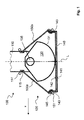
- Fig. 1 shows the lower portion or foot region of a support device 100 according to the invention for a semi-trailer or the like.
- the supporting device 100 comprises a support tube 110 on which a support foot 120 is arranged.
- the support leg 120 has a compensation element or rolling segment 130 and a contact plate 140.
- the compensating element 130 is pivotably attached to the support tube 110 by a pivot joint 135, which is in particular a telescoping inner support tube.
- the compensation element 130 has an arcuate roll-off section labeled 131.
- the contact plate 140 has a contact surface 141 and a supporting region or rolling region 142 opposite the contact surface 141 for the compensating element 130 or its rolling-off section 131.
- the reference numeral 143 designates raised edge portions formed on the footing plate 140, which form a front edge and a rear edge of the footing plate 140 according to the normal traveling direction x (of the semitrailer).
- the support leg 120 is formed symmetrically with respect to the side view shown.
- L denotes the axis of symmetry, which also also corresponds to the axis of movement of the support leg 120 when raising or lowering.
- the pivotally mounted compensation element 130 can roll on the support region 142 of the stationary support plate 140 resting on the substrate, thereby avoiding excessive bending and / or buckling stress on the support device 100.
- the support 120 is exposed during driving swirled spray water and spin, and stone chipping and the like.
- two covers 150a and 150b are provided, which support the support leg 120 with respect to the direction of travel x in a tent-like manner to the front and to the rear cover.
- the covers 150a and 150b are formed as tarpaulins (as discussed above) secured to the top of the outside of the support tube 110 and to the bottom of the raised edge portions 143 of the riser plate 140.
- the covers 150a and 150b also cover the pivot 135 and thus also serve as its protection.
- the tarpaulins 150a and 150b are formed with marginal thickenings 151, which engage behind the tie-in hooks 115 and 145 in a form-fitting manner.
- eyelets or the like may be provided on the tarpaulins 150a and 150b.
- the tarpaulins 150a and 150b are formed from an elastic material.
- the compensating element 130 on the support portion 142 of the standing on the ground rising support plate 140 occurs (depending on the unwinding) to an elastic elongation of the two tarpaulins 150a or 150b, wherein the other tarpaulin 150b or 150a can wrinkle wrinkle-free.
- the support leg 120 is raised out of such condition, the tensile elastic forces in the stretched tarpaulin 150a or 150b can restore the tread plate 140 to a neutral starting position (as in FIG Fig.1 shown) accomplish, with the compensation element 130 back to the neutral starting position (as in Fig. 1 shown) can be brought.
- This neutral initial position is characterized by an equilibrium of forces in the tarpaulins 150a and 150b, for which the symmetrical design of the support leg 120 is also advantageous.
- the tarpaulins 150a and 150b have steep spring characteristics (force over travel).
- the known from the prior art spring elements for restoring may thus be eliminated or made smaller.
- the support leg 120 is protected forwards and backwards by the covers 150a and 150b.
- the covers 150a and 150b are protected forwards and backwards by the covers 150a and 150b.
- only a single front cover 150 a can be provided, which can ensure a minimum protection.
- a variant with a cover is conceivable which completely surrounds the support leg 120 and protects it all around, ie also in the lateral direction.
- Such a cover could z. B. be designed as a bellows or tubular tarpaulin, as explained above.
Landscapes
- Engineering & Computer Science (AREA)
- Mechanical Engineering (AREA)
- Sealing Devices (AREA)
- Supports For Pipes And Cables (AREA)
- Vehicle Cleaning, Maintenance, Repair, Refitting, And Outriggers (AREA)
- Body Structure For Vehicles (AREA)
Abstract
Description
- Die Erfindung betrifft eine Stützvorrichtung für einen Sattelanhänger bzw. Sattelauflieger oder dergleichen mit einem Stützrohr, einem Stützfuß und einer Abdeckeinrichtung.
- Stützvorrichtungen der betreffenden Art sind meist paarweise (Stützenpaar) im vorderen Bereich am Rahmen eines Sattelanhängers angeordnet und kommen dann zum Einsatz, wenn der Sattelanhänger von der Sattelzugmaschine abgekoppelt und getrennt abgestellt werden soll. Derartige Systeme sind insbesondere in
DE 10 2009 001 288 A1 undDE 10 2009 001 299 A1 derselben Anmelderin dargestellt. - Die Stützvorrichtungen weisen ein zumeist mehrteiliges Stützrohr auf, an dessen unterem Ende ein in der Regel höhenverstellbarer Stützfuß angeordnet ist. Der Stützfuß umfasst ein an der unteren Stirnseite des Stützrohrs befestigtes Abrollsegment (Ausgleichssegment) und eine Aufstandsplatte (Fußelement bzw. Fußplatte) mit einem Abrollbereich für das Abrollsegment. Bei längeren Abstellzeiten kann sich somit der Sattelanhänger vorwärts oder rückwärts bewegen, ohne dass es zu einer übermäßigen Biege- und/oder Knickbeanspruchung der Stützvorrichtungen kommt.
- Die Stützfüße der Stützvorrichtungen befinden sich im Fahrbetrieb im Spritzbereich der Hinterräder der Sattelzugmaschine und sind somit Spritzwasser, Schleuderdreck, Steinschlag und dergleichen ausgesetzt. Dies kann zu Verschmutzungen führen, die regelmäßig zu entfernen sind. Ferner kann es zu unerwünschten Verschleppungen von Dreck, Matsch, Steinen und dergleichen aus einem Gelände (bspw. Baustellengelände) auf die Straße kommen. Dies stellt eine Gefahr für den Straßenverkehr dar.
- Es ist daher eine Aufgabe der vorliegenden Erfindung, eine Stützvorrichtung für einen Sattelanhänger oder dergleichen vorzusehen, die eine verbesserte Betriebssicherheit aufweist.
- Diese Aufgabe wird durch eine Stützvorrichtung für einen Sattelanhänger oder dergleichen mit den Merkmalen des Anspruchs 1 gelöst. Die vom Anspruch 1 abhängigen Ansprüche betreffen bevorzugte Ausgestaltungen und Weiterbildungen der erfindungsgemäßen Stützvorrichtung.
- Erfindungsgemäß ist eine Stützvorrichtung für einen Sattelanhänger oder dergleichen vorgesehen, umfassend ein Stützrohr und einen am Stützrohr angeordneten Stützfuß, wobei der Stützfuß ein am Stützrohr angeordnetes Ausgleichselement und eine Aufstandsplatte mit einem Tragbereich für das Ausgleichselement aufweist, und wobei wenigstens eine an der Stützvorrichtung angeordnete Abdeckeinrichtung vorgesehen ist, die das Ausgleichselement und/oder den Tragbereich der Aufstandsplatte zumindest teilweise überdeckt. Das Ausgleichselement kann als Abrollsegment oder Gleitelement ausgebildet sein, welches auf einem Tragbereich - z. B. einem Abrollbereich oder Gleitbereich - der Aufstandsplatte verlagerbar bzw. abrollbar bzw. gleitbar ist. Es ist wenigstens eine an der Stützvorrichtung angeordnete Abdeckeinrichtung vorgesehen, die (im Fahrbetrieb) das Ausgleichselement bzw. Abrollsegment und/oder den Tragbereich bzw. Abrollbereich der Aufstandsplatte zumindest teilweise abdeckt und vor Spritzwasser, Steinschlag und/oder dergleichen schützt. Das Stützrohr kann einteilig oder mehrteilig ausgebildet sein. Bevorzugt handelt es sich um ein teleskopierbares Stützrohr, wobei der Stützfuß am unteren Stützrohrteil oder am Innenstützrohr angeordnet ist. Die Befestigung des Stützfußes erfolgt im Wesentlichen über das Ausgleichselement bzw. Abrollsegment, das direkt oder indirekt an der unteren Stirnseite eines unteren Stützrohrteils oder eines Innenstützrohrs befestigt ist. Bevorzugt ist das Ausgleichselement bzw. Abrollsegment verschwenkbar befestigt. Das Ausgleichselement bzw. Abrollsegment weist bevorzugt einen bogenförmigen Abrollabschnitt auf. Bei der Aufstandsplatte handelt es sich um ein im Wesentlichen flächiges Bauteil, das eine Aufstandsfläche und einen der Aufstandsfläche gegenüberliegenden Tragbereich bzw. Abrollbereich für das Ausgleichselement (bzw. dessen Abrollabschnitt) aufweist. Der Tragbereich ist hierbei insbesondere derjenige Bereich bzw. diejenige Oberfläche der Aufstandsplatte, welche(n) das Ausgleichselement (bzw. dessen Abrollabschnitt) bei einer Ausgleichsbewegung (d. h. einem Positionsversatz des Sattelanhängers) berührt bzw. kontaktiert. Das Ausgleichselement und die Aufstandsplatte sind in bekannter Weise miteinander verbunden. Die Abdeckeinrichtung für die Abdeckung und den Schutz des Ausgleichselements und/oder des Tragbereichs kann einteilig oder mehrteilig ausgebildet sein. Bevorzugt ist die Abdeckeinrichtung direkt im Bereich des Stützfußes an der Stützvorrichtung angeordnet, was hinsichtlich der Höhenverstellbarkeit des Stützfußes von Vorteil ist. In einer einfachen Ausführungsmöglichkeit kann es sich bei der Abdeckeinrichtung um ein Schutzblech (aus einem Metallmaterial oder ggf. auch aus einem Kunststoffmaterial) handeln, das am Stützfuß und/oder am Stützrohr befestigt ist. Die vorgeschlagene Abdeckeinrichtung (wobei auch mehrere Abdeckeinrichtungen vorgesehen sein können, wie nachfolgend noch näher erläutert), schützt den Stützfuß und insbesondere das Ausgleichselement bzw. Abrollsegment und/oder den Tragbereich bzw. Abrollbereich der Aufstandsplatte im Fahrbetrieb vor Spritzwasser und/oder Steinschlag. Die eingangs genannten Nachteile an herkömmlichen Stützvorrichtungen treten somit bei der erfindungsgemäßen Stützvorrichtung nicht auf. Ein weiterer Vorteil der vorgeschlagenen Abdeckeinrichtung ist auch darin zu sehen, dass an der erfindungsgemäßen Stützvorrichtung im Fahrbetrieb deutlich weniger Luftverwirbelungen (im Vergleich zu herkömmlichen Stützvorrichtungen) auftreten, wodurch vor allem Fahrgeräusche reduziert werden.
- Vorteilhafterweise ist die Abdeckeinrichtung aus einem rückstellfähigen Material ausgebildet und zweckmäßigerweise derart an der Stützvorrichtung festgelegt, dass diese die Aufstandsplatte in eine neutrale Ausgangslage rückstellt. Besonders bevorzugt ist vorgesehen, dass die Abdeckeinrichtung bzw. die Planen oder gegebenenfalls die offenen Faltenbälge aus einem elastischen Material gebildet sind, worüber beim Anheben oder Einfahren der Stützvorrichtung ein selbsttätiges Rückstellen der Aufstandsplatte (relativ zum Ausgleichselement bzw. Abrollsegment und/oder Stützrohr) in eine neutrale Ausgangslage bewerkstelligt werden kann. Dies wird nachfolgend anhand der Figur noch näher erläutert. Ein solches selbsttätiges bzw. automatisches Rückstellen kann bei geeigneter Ausgestaltung ebenso auch mit einem geschlossenen Faltenbalg oder mit einer schlauchförmigen Plane bewerkstelligt werden.
- Vorzugsweise ist die Abdeckeinrichtung am Stützrohr und an der Aufstandsplatte befestigt. Hierbei kann die Abdeckeinrichtung - in Fahrtrichtung gesehen - vorne und hinten am Stützrohr und/oder vorne und hinten an der Aufstandsplatte festgelegt sein. Eine jeweilige seitliche Befestigung am Stützrohr und/oder an der Aufstandsplatte ist ebenfall zusätzlich oder alternativ möglich.
- Zweckmäßigerweise sind zur Befestigung der Abdeckeinrichtung Knüpfhaken am Stützrohr und/oder an der Aufstandsplatte vorgesehen.
- Vorteilhafterweise ist das Ausgleichselement über ein Schwenkgelenk schwenkbar am Stützrohr befestigt, wobei die Abdeckeinrichtung vorzugsweise auch dieses Schwenkgelenk zumindest teilweise überdeckt. Die vorgeschlagene Abdeckeinrichtung dient somit auch dem Schutz des Schwenkgelenks für das Ausgleichselement.
- In einer ersten Ausführungsvariante ist eine einzelne Abdeckeinrichtung vorgesehen, die das Ausgleichselement und/oder den Tragbereich der Aufstandsplatte im Wesentlichen vollständig umschließt oder abdeckt. In anderen Worten kann die einzelne Abdeckeinrichtung den Stützfuß im Wesentlichen vollständig umschliessen. Diese Abdeckeinrichtung kann, wie bereits vorausgehend erläutert, einteilig oder mehrteilig ausgebildet sein. Besonders bevorzugt ist vorgesehen, dass es sich bei dieser Abdeckeinrichtung um einen umseitig geschlossenen Faltenbalg oder um eine schlauchförmige Plane handelt, der bzw. die den Stützfuß und insbesondere den Bereich des Ausgleichselements und des Tragbereichs der Aufstandsplatte stulpenartig umschließt. Der Faltenbalg oder die schlauchförmige Plane kann oben (d. h. mit ihrem oberen Ende) am Außenumfang des Stützrohrs und unten (d. h. mit ihrem unteren Ende) an einem Randabschnitt der Aufstandsplatte befestigt sein. Die Arretierung kann z. B. durch eine Spannschelle oder dergleichen erfolgen. Eine weitere bevorzugte Befestigungsmöglichkeit wird nachfolgend noch näher erläutert.
- In einer zweiten Ausführungsvariante sind eine Vielzahl, vorzugsweise zwei Abdeckeinrichtungen vorgesehen sind, die das Ausgleichselement und/oder den Tragbereich der Aufstandsplatte zumindest teilweise überdecken. Es können somit zwei Abdeckeinrichtungen vorgesehen sein, die den Stützfuß und insbesondere den Bereich des Ausgleichselements und des Tragbereichs der Aufstandsplatte bezüglich der Fahrtrichtung im Fahrbetrieb nach vorne und nach hinten abdecken. Es kann somit eine erste Abdeckeinrichtung vorgesehen sein, die den Stützfuß, zweckmäßigerweise dessen Ausgleichselement und/oder Tragbereich der Aufstandsplatte, in Fahrtrichtung vorne, d. h. vor der Symmetrieachse überdeckt. Analog kann eine zweite Abdeckeinrichtung vorgesehen sein, die den Stützfuß, zweckmäßigerweise dessen Ausgleichselement und/oder Tragbereich der Aufstandsplatte, in Fahrtrichtung hinten, d. h. hinter der Symmetrieachse überdeckt. Auch diese Abdeckeinrichtungen können einteilig oder mehrteilig ausgebildet sein. Bevorzugt ist vorgesehen, dass es sich bei den Abdeckeinrichtungen um zwei Planen handelt. Alternativ können diese Abdeckeinrichtungen auch als offene Faltenbälge ausgebildet sein. Die Planen können oben am Stützrohr und unten an der Aufstandsplatte befestigt sein.
- Besonders bevorzugt erfolgt dieses Befestigen durch ein Einknüpfen, wozu an den Planen geeignete Ösen, Verdickungen oder dergleichen und an dem Stützrohr sowie an der Aufstandsplatte korrespondierende Einknüpfhaken oder Klemmhaken vorgesehen sein können.
- Unter einer Plane wird zweckmäßigerweise ein tuchartiges Material mit biegeschlaffen Eigenschaften verstanden, das bspw. aus einem Textilgewebe, einem Kautschukmaterial, einem Kunststoffmaterial bzw. synthetischen Material (insbesondere einem synthetischen Elastomermaterial) oder einem Verbundmaterial besteht. Bevorzugt ist vorgesehen, dass die Plane elastische Eigenschaften aufweist, wie nachfolgend noch näher erläutert. Der Faltenbalg kann aus einem Kunststoffmaterial oder aus einem Textilmaterial bestehen.
- Die Erfindung wird nachfolgend anhand einer Figur beispielhaft und in nicht einschränkender Weise näher erläutert.
- Fig.1
- zeigt in einer schematischen Seitenansicht den Fußbereich einer bevorzugten Ausführungsform der erfindungsgemäßen Stützvorrichtung.
-
Fig. 1 zeigt den unteren Bereich bzw. Fußbereich einer erfindungsgemäßen Stützvorrichtung 100 für einen Sattelanhänger oder dergleichen. Die Stützvorrichtung 100 umfasst ein Stützrohr 110 an dem ein Stützfuß 120 angeordnet ist. Der Stützfuß 120 weist ein Ausgleichselement bzw. Abrollsegment 130 und eine Aufstandsplatte 140 auf. Das Ausgleichselement 130 ist mit einem Schwenkgelenk 135 verschwenkbar am Stützrohr 110, wobei es sich insbesondere um eine teleskopierbares Innenstützrohr handelt, befestigt. Das Ausgleichselement 130 weist einen mit 131 bezeichneten bogenförmigen Abrollabschnitt auf. Die Aufstandsplatte 140 weist eine Aufstandsfläche 141 und einen der Aufstandsfläche 141 gegenüberliegenden Tragbereich bzw. Abrollbereich 142 für das Ausgleichselement 130 bzw. dessen Abrollabschnitt 131 auf. Mit 143 sind an der Aufstandsplatte 140 ausgebildete hochgezogene Randabschnitte bezeichnet, die gemäß der normalen Fahrtrichtung x (des Sattelanhängers) eine vordere Kante und eine hintere Kante der Aufstandsplatte 140 ausbilden. Der Stützfuß 120 ist bezüglich der gezeigten Seitenansicht symmetrisch ausgebildet. Mit L ist die Symmetrieachse bezeichnet, die gleichfalls auch der Bewegungsachse des Stützfußes 120 beim Anheben oder Absenken entspricht. - Beim längeren Abstellen des Sattelanhängers kann es, bspw. infolge eines Entweichens von Druckluft aus einem Luftfedersystem, zu einer Vorwärts- oder Rückwärtsbewegung des Sattelanhängers kommen. Zum Ausgleich einer solchen Vorwärts- oder Rückwärtsbewegung kann das schwenkbar gelagerte Ausgleichselement 130 auf dem Tragbereich 142 der ortsfest auf dem Untergrund aufstehenden Aufstandsplatte 140 abrollen, wodurch eine übermäßige Biege- und/oder Knickbeanspruchung der Stützvorrichtung 100 vermieden wird.
- Der Stützfuß 120 ist im Fahrbetrieb aufgewirbeltem Spritzwasser und Schleuderdreck, sowie Steinschlag und dergleichen ausgesetzt. Um den Stützfuß 120 und insbesondere das Ausgleichselement 130 (bzw. vornehmlich dessen Abrollabschnitt 131) und den Tragbereich 142 der Aufstandsplatte 140 hiervor zu schützen sind zwei Abdeckungen 150a und 150b vorgesehen, die den Stützfuß 120 bezüglich der Fahrtrichtung x quasi zeltartig nach vorne und nach hinten abdecken. Die Abdeckungen 150a und 150b sind als Planen (wie obenstehend erläutert) ausgebildet, die oben an der Außenseite des Stützrohrs 110 und unten an den hochgezogenen Randabschnitten 143 der Aufstandsplatte 140 befestigt sind. Die Abdeckungen bzw. Planen 150a und 150b überdecken auch das Schwenkgelenk 135 und dienen somit auch als dessen Schutz.
- Zur Befestigung der Planen 150a und 150b sind am Stützrohr 110 und an der Aufstandsplatte 140 Einknüpfhaken oder Klemmhaken 115 und 145 in Kombination mit Kulissenführungen ausgebildet. Korrespondierend hierzu sind die Planen 150a und 150b mit randseitigen Verdickungen 151 ausgebildet, die die Einknüpfhaken 115 und 145 formschlüssig hintergreifen. Alternativ können auch Ösen oder dergleichen an den Planen 150a und 150b vorgesehen sein. Diese Befestigungselemente sind bevorzugt auch im Hinblick auf hohe Zugkräfte und/oder Rückstellkräfte in den Planen 150a und 150b ausgelegt (wie nachfolgend noch näher erläutert).
- Bevorzugt ist vorgesehen, dass die Planen 150a und 150b aus einem elastischen Material gebildet sind. Beim Abrollen des Ausgleichselements 130 auf dem Tragbereich 142 der ortsfest auf dem Untergrund aufstehenden Aufstandsplatte 140 kommt es (abhängig von der Abrollrichtung) zu einer elastischen Dehnung einer der beiden Planen 150a oder 150b, wobei sich die andere Plane 150b oder 150a faltenfrei zusammenziehen kann. Wird der Stützfuß 120 aus einem solchen Zustand heraus angehoben, können die elastischen Zugkräfte in der gedehnten Plane 150a oder 150b eine Rückstellung der Aufstandsplatte 140 in eine neutrale Ausgangslage (wie in
Fig.1 gezeigt) bewerkstelligen, wobei auch das Ausgleichselement 130 wieder in die neutrale Ausgangslage (wie inFig. 1 gezeigt) gebracht werden kann. Diese neutrale Ausgangslage ist durch ein Kräftegleichgewicht in den Planen 150a und 150b gekennzeichnet, wofür auch die symmetrische Ausbildung des Stützfußes 120 von Vorteil ist. Um eine ausreichende Rückstellkraft zu erhalten, weisen die Planen 150a und 150b steile Federkennlinien (Kraft über Weg) auf. Die aus dem Stand der Technik bekannten Federelemente zur Rückstellung (wie bspw. in dem eingangs genannten Stand der Technik gezeigt) können somit möglicherweise entfallen oder kleiner dimensioniert werden. - Bei der in
Fig. 1 gezeigten Ausführungsvariante ist der Stützfuß 120 nach vorne und nach hinten durch die Abdeckungen 150a und 150b geschützt. Ebenso kann auch nur eine einzelne vordere Abdeckung 150a vorgesehen sein, die einen Minimalschutz gewährleisten kann. Ferner ist eine Ausführungsvariante mit einer Abdeckung denkbar, die den Stützfuß 120 vollständig umschließt und diesen rundherum, d. h. auch in seitlicher Richtung, schützt. Eine solche Abdeckung könnte z. B. als Faltenbalg oder schlauchförmige Plane ausgebildet sein, wie obenstehend erläutert.
Claims (9)
- Stützvorrichtung (100) für einen Sattelanhänger oder dergleichen, umfassend ein Stützrohr (110) und einen am Stützrohr (110) angeordneten Stützfuß (120),
wobei der Stützfuß (120) ein am Stützrohr (110) angeordnetes Ausgleichselement (130) und eine Aufstandsplatte (140) mit einem Tragbereich (142) für das Ausgleichselement (130) aufweist, und
wobei wenigstens eine an der Stützvorrichtung (100) angeordnete Abdeckeinrichtung (150a; 150b) vorgesehen ist, die das Ausgleichselement (130) und/oder den Tragbereich (142) der Aufstandsplatte (140) zumindest teilweise überdeckt. - Stützvorrichtung nach Anspruch 1, wobei die Abdeckeinrichtung (150a, 150b) aus einem rückstellfähigen Material ausgebildet und zweckmäßigerweise derart an der Stützvorrichtung (100) festgelegt ist, dass diese die Aufstandsplatte (140) in eine neutrale Ausgangslage rückstellt.
- Stützvorrichtung nach einem der vorhergehenden Ansprüche, wobei die Abdeckeinrichtung (150a, 150b) am Stützrohr (110) und an der Aufstandsplatte (140) befestigt ist.
- Stützvorrichtung nach Anspruch 3, wobei zur Befestigung der Abdeckeinrichtung (150a, 150b) Knüpfhaken (115, 145) am Stützrohr (110) und/oder an der Aufstandsplatte (140) vorgesehen sind.
- Stützvorrichtung nach einem der vorhergehenden Ansprüche, wobei das Ausgleichselement (130) über ein Schwenkgelenk (135) schwenkbar am Stützrohr (110) befestigt ist, und wobei die Abdeckeinrichtung (150a; 150b) vorzugsweise auch dieses Schwenkgelenk (135) zumindest teilweise überdeckt.
- Stützvorrichtung nach einem der vorhergehenden Ansprüche, wobei eine einzelne Abdeckeinrichtung vorgesehen ist, die das Ausgleichselement (130) und/oder den Tragbereich (142) der Aufstandsplatte (140) im Wesentlichen vollständig umschließt.
- Stützvorrichtung nach einem der Ansprüche 1 - 5, wobei eine Vielzahl, vorzugsweise zwei Abdeckeinrichtungen (150a, 150b) vorgesehen sind, die das Ausgleichselement (130) und/oder den Tragbereich (142) der Aufstandsplatte (140) zumindest teilweise überdecken.
- Stützvorrichtung nach einem der vorhergehenden Ansprüche, wobei die Abdeckeinrichtung (150a; 150b) als Faltenbalg oder schlauchförmige Plane ausgebildet ist.
- Stützvorrichtung nach einem der vorhergehenden Ansprüche, wobei die Abdeckeinrichtung (150a, 150b) aus einem Textilgewebe, einem Kautschukmaterial, einem synthetischen Material oder einem Verbundmaterial ausgebildet ist.
Applications Claiming Priority (1)
| Application Number | Priority Date | Filing Date | Title |
|---|---|---|---|
| DE201110081338 DE102011081338B4 (de) | 2011-08-22 | 2011-08-22 | Stützvorrichtung für einen Sattelanhänger, mit einem Stützfuß und wenigstens einer Abdeckeinrichtung für diesen Stützfuß |
Publications (3)
| Publication Number | Publication Date |
|---|---|
| EP2562057A2 true EP2562057A2 (de) | 2013-02-27 |
| EP2562057A3 EP2562057A3 (de) | 2013-07-03 |
| EP2562057B1 EP2562057B1 (de) | 2015-07-29 |
Family
ID=46614365
Family Applications (1)
| Application Number | Title | Priority Date | Filing Date |
|---|---|---|---|
| EP12178962.2A Not-in-force EP2562057B1 (de) | 2011-08-22 | 2012-08-02 | Stützvorrichtung für einen Sattelanhänger, mit einem Stützfuß und wenigstens einer Abdeckeinrichtung für diesen Stützfuß |
Country Status (4)
| Country | Link |
|---|---|
| EP (1) | EP2562057B1 (de) |
| CN (1) | CN102951131B (de) |
| AU (1) | AU2012211505B2 (de) |
| DE (1) | DE102011081338B4 (de) |
Families Citing this family (1)
| Publication number | Priority date | Publication date | Assignee | Title |
|---|---|---|---|---|
| DE102014200486B3 (de) * | 2014-01-14 | 2015-06-11 | Saf-Holland Gmbh | Stützwinde |
Citations (2)
| Publication number | Priority date | Publication date | Assignee | Title |
|---|---|---|---|---|
| DE102009001299A1 (de) | 2009-03-03 | 2010-09-16 | Saf-Holland Gmbh | Stützfuß für Fahrzeuge |
| DE102009001288A1 (de) | 2009-03-03 | 2010-09-16 | Saf-Holland Gmbh | Stützfuß |
Family Cites Families (5)
| Publication number | Priority date | Publication date | Assignee | Title |
|---|---|---|---|---|
| DE2609631B2 (de) * | 1976-03-09 | 1979-10-18 | Carl Metz Gmbh, 7500 Karlsruhe | Abstützung für ein Kraftfahrzeug |
| DE3119359C2 (de) * | 1981-05-15 | 1983-02-24 | Jost-Werke GmbH, 6078 Neu Isenburg | Teleskop-Stützvorrichtung für Schwerlasten, insbesondere Sattelauflieger |
| DE3431526C2 (de) * | 1984-08-28 | 1986-10-02 | Anton Ruthmann Gmbh & Co, 4423 Gescher | Stützvorrichtung für Fahrzeuge |
| DE3604596C1 (de) * | 1986-02-14 | 1987-09-03 | Haacon Hebetech Gmbh | Hoehenverstellbare Stuetze fuer Sattelanhaenger |
| DE3642079A1 (de) * | 1986-12-10 | 1988-06-23 | Haacon Hebetech Gmbh | Hoehenverstellbare stuetze fuer sattelanhaenger |
-
2011
- 2011-08-22 DE DE201110081338 patent/DE102011081338B4/de not_active Expired - Fee Related
-
2012
- 2012-08-02 EP EP12178962.2A patent/EP2562057B1/de not_active Not-in-force
- 2012-08-13 AU AU2012211505A patent/AU2012211505B2/en not_active Ceased
- 2012-08-17 CN CN201210294892.1A patent/CN102951131B/zh not_active Expired - Fee Related
Patent Citations (2)
| Publication number | Priority date | Publication date | Assignee | Title |
|---|---|---|---|---|
| DE102009001299A1 (de) | 2009-03-03 | 2010-09-16 | Saf-Holland Gmbh | Stützfuß für Fahrzeuge |
| DE102009001288A1 (de) | 2009-03-03 | 2010-09-16 | Saf-Holland Gmbh | Stützfuß |
Also Published As
| Publication number | Publication date |
|---|---|
| AU2012211505B2 (en) | 2013-10-03 |
| DE102011081338A1 (de) | 2013-02-28 |
| EP2562057A3 (de) | 2013-07-03 |
| CN102951131B (zh) | 2015-12-16 |
| AU2012211505A1 (en) | 2013-03-14 |
| DE102011081338B4 (de) | 2014-12-24 |
| EP2562057B1 (de) | 2015-07-29 |
| CN102951131A (zh) | 2013-03-06 |
Similar Documents
| Publication | Publication Date | Title |
|---|---|---|
| DE2715375A1 (de) | Landwirtschaftliches arbeitsgeraet | |
| WO2022063471A1 (de) | Kraftrad mit verstellbarem luftleitelement | |
| DE10051096B4 (de) | Vorrichtung zur Erhöhung des Fassungsvermögens eines nach oben offenen Korntanks eines Mähdreschers und Mähdrescher mit einer derartigen Vorrichtung | |
| DE8717019U1 (de) | Höhenverstellbare Stütze, insbesondere mittels Handkurbel betätigbare Stütze für Sattelanhänger | |
| EP2562057B1 (de) | Stützvorrichtung für einen Sattelanhänger, mit einem Stützfuß und wenigstens einer Abdeckeinrichtung für diesen Stützfuß | |
| DE19839360C2 (de) | Stützfuß | |
| EP1199194B1 (de) | Vorrichtung zum Kuppeln eines Fahrzeugs mit einem Gerät oder Anhänger | |
| DE19957239C2 (de) | Stützvorrichtung | |
| DE19957244C2 (de) | Stützvorrichtung | |
| DE3216589A1 (de) | Anbau-frontkraftheber fuer schlepper | |
| DE7005530U (de) | Ueberschlagschutzbuegel fuer kraftfahrzeuge, insbesondere schlepper. | |
| EP3786009B1 (de) | Hydraulisch betätigbare stützvorrichtung an einem fahrzeug oder an einem fahrzeugaufbau | |
| DE1003604B (de) | Anbauvorrichtung fuer endlose Gleisketten an Ackerschleppern u. dgl. | |
| DE1506922A1 (de) | Gaskissenvorrichtung fuer lasttragende Einrichtungen | |
| DE29519033U1 (de) | Mobiler Verkaufsstand | |
| EP1186233A2 (de) | Spritzgestängeführung | |
| DE202006008619U1 (de) | Stütz- und Ausgleichsfuß einer höhenverstellbaren Stütze für Sattelanhänger | |
| DE3027117A1 (de) | Aus einer zugmaschine und einem sattelanhaenger bestehender sattelzug | |
| DE4241216A1 (de) | Bandlaufwerk | |
| DE1010911B (de) | Am Hebemechanismus eines Traktors anzubringende Lade- oder Hebeeinrichtung | |
| DE9108865U1 (de) | Längenverstellbare Abstellstütze an einem Frontlader | |
| DE1885022U (de) | Wagenheber fuer kraftwagen. | |
| EP0428960A1 (de) | Landwirtschaftliche Verteilmaschine | |
| DE10149926A1 (de) | Höhenverstellbare Stütze für Sattelauflieger | |
| DE202007008065U1 (de) | Verdeck für ein Element zur Beförderung von Ladegut, wie Ladungstgräger, Ladefläche eines Fahrzeuges o.dgl. |
Legal Events
| Date | Code | Title | Description |
|---|---|---|---|
| PUAI | Public reference made under article 153(3) epc to a published international application that has entered the european phase |
Free format text: ORIGINAL CODE: 0009012 |
|
| AK | Designated contracting states |
Kind code of ref document: A2 Designated state(s): AL AT BE BG CH CY CZ DE DK EE ES FI FR GB GR HR HU IE IS IT LI LT LU LV MC MK MT NL NO PL PT RO RS SE SI SK SM TR |
|
| AX | Request for extension of the european patent |
Extension state: BA ME |
|
| PUAL | Search report despatched |
Free format text: ORIGINAL CODE: 0009013 |
|
| AK | Designated contracting states |
Kind code of ref document: A3 Designated state(s): AL AT BE BG CH CY CZ DE DK EE ES FI FR GB GR HR HU IE IS IT LI LT LU LV MC MK MT NL NO PL PT RO RS SE SI SK SM TR |
|
| AX | Request for extension of the european patent |
Extension state: BA ME |
|
| RIC1 | Information provided on ipc code assigned before grant |
Ipc: B60S 9/02 20060101AFI20130528BHEP |
|
| 17P | Request for examination filed |
Effective date: 20130730 |
|
| RBV | Designated contracting states (corrected) |
Designated state(s): AL AT BE BG CH CY CZ DE DK EE ES FI FR GB GR HR HU IE IS IT LI LT LU LV MC MK MT NL NO PL PT RO RS SE SI SK SM TR |
|
| 17Q | First examination report despatched |
Effective date: 20140522 |
|
| GRAP | Despatch of communication of intention to grant a patent |
Free format text: ORIGINAL CODE: EPIDOSNIGR1 |
|
| INTG | Intention to grant announced |
Effective date: 20150312 |
|
| GRAS | Grant fee paid |
Free format text: ORIGINAL CODE: EPIDOSNIGR3 |
|
| GRAA | (expected) grant |
Free format text: ORIGINAL CODE: 0009210 |
|
| AK | Designated contracting states |
Kind code of ref document: B1 Designated state(s): AL AT BE BG CH CY CZ DE DK EE ES FI FR GB GR HR HU IE IS IT LI LT LU LV MC MK MT NL NO PL PT RO RS SE SI SK SM TR |
|
| REG | Reference to a national code |
Ref country code: GB Ref legal event code: FG4D Free format text: NOT ENGLISH |
|
| REG | Reference to a national code |
Ref country code: CH Ref legal event code: EP |
|
| REG | Reference to a national code |
Ref country code: AT Ref legal event code: REF Ref document number: 739002 Country of ref document: AT Kind code of ref document: T Effective date: 20150815 |
|
| REG | Reference to a national code |
Ref country code: IE Ref legal event code: FG4D Free format text: LANGUAGE OF EP DOCUMENT: GERMAN |
|
| REG | Reference to a national code |
Ref country code: DE Ref legal event code: R096 Ref document number: 502012003906 Country of ref document: DE |
|
| REG | Reference to a national code |
Ref country code: LT Ref legal event code: MG4D |
|
| REG | Reference to a national code |
Ref country code: NL Ref legal event code: MP Effective date: 20150729 |
|
| PG25 | Lapsed in a contracting state [announced via postgrant information from national office to epo] |
Ref country code: NO Free format text: LAPSE BECAUSE OF FAILURE TO SUBMIT A TRANSLATION OF THE DESCRIPTION OR TO PAY THE FEE WITHIN THE PRESCRIBED TIME-LIMIT Effective date: 20151029 Ref country code: LT Free format text: LAPSE BECAUSE OF FAILURE TO SUBMIT A TRANSLATION OF THE DESCRIPTION OR TO PAY THE FEE WITHIN THE PRESCRIBED TIME-LIMIT Effective date: 20150729 Ref country code: FI Free format text: LAPSE BECAUSE OF FAILURE TO SUBMIT A TRANSLATION OF THE DESCRIPTION OR TO PAY THE FEE WITHIN THE PRESCRIBED TIME-LIMIT Effective date: 20150729 Ref country code: GR Free format text: LAPSE BECAUSE OF FAILURE TO SUBMIT A TRANSLATION OF THE DESCRIPTION OR TO PAY THE FEE WITHIN THE PRESCRIBED TIME-LIMIT Effective date: 20151030 Ref country code: LV Free format text: LAPSE BECAUSE OF FAILURE TO SUBMIT A TRANSLATION OF THE DESCRIPTION OR TO PAY THE FEE WITHIN THE PRESCRIBED TIME-LIMIT Effective date: 20150729 |
|
| PG25 | Lapsed in a contracting state [announced via postgrant information from national office to epo] |
Ref country code: IS Free format text: LAPSE BECAUSE OF FAILURE TO SUBMIT A TRANSLATION OF THE DESCRIPTION OR TO PAY THE FEE WITHIN THE PRESCRIBED TIME-LIMIT Effective date: 20151129 Ref country code: PL Free format text: LAPSE BECAUSE OF FAILURE TO SUBMIT A TRANSLATION OF THE DESCRIPTION OR TO PAY THE FEE WITHIN THE PRESCRIBED TIME-LIMIT Effective date: 20150729 Ref country code: ES Free format text: LAPSE BECAUSE OF FAILURE TO SUBMIT A TRANSLATION OF THE DESCRIPTION OR TO PAY THE FEE WITHIN THE PRESCRIBED TIME-LIMIT Effective date: 20150729 Ref country code: HR Free format text: LAPSE BECAUSE OF FAILURE TO SUBMIT A TRANSLATION OF THE DESCRIPTION OR TO PAY THE FEE WITHIN THE PRESCRIBED TIME-LIMIT Effective date: 20150729 Ref country code: RS Free format text: LAPSE BECAUSE OF FAILURE TO SUBMIT A TRANSLATION OF THE DESCRIPTION OR TO PAY THE FEE WITHIN THE PRESCRIBED TIME-LIMIT Effective date: 20150729 Ref country code: PT Free format text: LAPSE BECAUSE OF FAILURE TO SUBMIT A TRANSLATION OF THE DESCRIPTION OR TO PAY THE FEE WITHIN THE PRESCRIBED TIME-LIMIT Effective date: 20151130 Ref country code: SE Free format text: LAPSE BECAUSE OF FAILURE TO SUBMIT A TRANSLATION OF THE DESCRIPTION OR TO PAY THE FEE WITHIN THE PRESCRIBED TIME-LIMIT Effective date: 20150729 |
|
| PG25 | Lapsed in a contracting state [announced via postgrant information from national office to epo] |
Ref country code: NL Free format text: LAPSE BECAUSE OF FAILURE TO SUBMIT A TRANSLATION OF THE DESCRIPTION OR TO PAY THE FEE WITHIN THE PRESCRIBED TIME-LIMIT Effective date: 20150729 |
|
| REG | Reference to a national code |
Ref country code: CH Ref legal event code: PL |
|
| PG25 | Lapsed in a contracting state [announced via postgrant information from national office to epo] |
Ref country code: IT Free format text: LAPSE BECAUSE OF FAILURE TO SUBMIT A TRANSLATION OF THE DESCRIPTION OR TO PAY THE FEE WITHIN THE PRESCRIBED TIME-LIMIT Effective date: 20150729 Ref country code: DK Free format text: LAPSE BECAUSE OF FAILURE TO SUBMIT A TRANSLATION OF THE DESCRIPTION OR TO PAY THE FEE WITHIN THE PRESCRIBED TIME-LIMIT Effective date: 20150729 Ref country code: MC Free format text: LAPSE BECAUSE OF FAILURE TO SUBMIT A TRANSLATION OF THE DESCRIPTION OR TO PAY THE FEE WITHIN THE PRESCRIBED TIME-LIMIT Effective date: 20150729 Ref country code: CZ Free format text: LAPSE BECAUSE OF FAILURE TO SUBMIT A TRANSLATION OF THE DESCRIPTION OR TO PAY THE FEE WITHIN THE PRESCRIBED TIME-LIMIT Effective date: 20150729 Ref country code: EE Free format text: LAPSE BECAUSE OF FAILURE TO SUBMIT A TRANSLATION OF THE DESCRIPTION OR TO PAY THE FEE WITHIN THE PRESCRIBED TIME-LIMIT Effective date: 20150729 Ref country code: CH Free format text: LAPSE BECAUSE OF NON-PAYMENT OF DUE FEES Effective date: 20150831 Ref country code: SK Free format text: LAPSE BECAUSE OF FAILURE TO SUBMIT A TRANSLATION OF THE DESCRIPTION OR TO PAY THE FEE WITHIN THE PRESCRIBED TIME-LIMIT Effective date: 20150729 Ref country code: LI Free format text: LAPSE BECAUSE OF NON-PAYMENT OF DUE FEES Effective date: 20150831 |
|
| REG | Reference to a national code |
Ref country code: DE Ref legal event code: R097 Ref document number: 502012003906 Country of ref document: DE |
|
| PG25 | Lapsed in a contracting state [announced via postgrant information from national office to epo] |
Ref country code: RO Free format text: LAPSE BECAUSE OF FAILURE TO SUBMIT A TRANSLATION OF THE DESCRIPTION OR TO PAY THE FEE WITHIN THE PRESCRIBED TIME-LIMIT Effective date: 20150729 |
|
| REG | Reference to a national code |
Ref country code: IE Ref legal event code: MM4A |
|
| PLBE | No opposition filed within time limit |
Free format text: ORIGINAL CODE: 0009261 |
|
| STAA | Information on the status of an ep patent application or granted ep patent |
Free format text: STATUS: NO OPPOSITION FILED WITHIN TIME LIMIT |
|
| 26N | No opposition filed |
Effective date: 20160502 |
|
| PG25 | Lapsed in a contracting state [announced via postgrant information from national office to epo] |
Ref country code: IE Free format text: LAPSE BECAUSE OF NON-PAYMENT OF DUE FEES Effective date: 20150802 |
|
| REG | Reference to a national code |
Ref country code: FR Ref legal event code: PLFP Year of fee payment: 5 |
|
| PG25 | Lapsed in a contracting state [announced via postgrant information from national office to epo] |
Ref country code: SI Free format text: LAPSE BECAUSE OF FAILURE TO SUBMIT A TRANSLATION OF THE DESCRIPTION OR TO PAY THE FEE WITHIN THE PRESCRIBED TIME-LIMIT Effective date: 20150729 |
|
| PG25 | Lapsed in a contracting state [announced via postgrant information from national office to epo] |
Ref country code: MT Free format text: LAPSE BECAUSE OF FAILURE TO SUBMIT A TRANSLATION OF THE DESCRIPTION OR TO PAY THE FEE WITHIN THE PRESCRIBED TIME-LIMIT Effective date: 20150729 |
|
| PG25 | Lapsed in a contracting state [announced via postgrant information from national office to epo] |
Ref country code: SM Free format text: LAPSE BECAUSE OF FAILURE TO SUBMIT A TRANSLATION OF THE DESCRIPTION OR TO PAY THE FEE WITHIN THE PRESCRIBED TIME-LIMIT Effective date: 20150729 Ref country code: BG Free format text: LAPSE BECAUSE OF FAILURE TO SUBMIT A TRANSLATION OF THE DESCRIPTION OR TO PAY THE FEE WITHIN THE PRESCRIBED TIME-LIMIT Effective date: 20150729 Ref country code: HU Free format text: LAPSE BECAUSE OF FAILURE TO SUBMIT A TRANSLATION OF THE DESCRIPTION OR TO PAY THE FEE WITHIN THE PRESCRIBED TIME-LIMIT; INVALID AB INITIO Effective date: 20120802 |
|
| PG25 | Lapsed in a contracting state [announced via postgrant information from national office to epo] |
Ref country code: CY Free format text: LAPSE BECAUSE OF FAILURE TO SUBMIT A TRANSLATION OF THE DESCRIPTION OR TO PAY THE FEE WITHIN THE PRESCRIBED TIME-LIMIT Effective date: 20150729 |
|
| PG25 | Lapsed in a contracting state [announced via postgrant information from national office to epo] |
Ref country code: BE Free format text: LAPSE BECAUSE OF NON-PAYMENT OF DUE FEES Effective date: 20150831 |
|
| REG | Reference to a national code |
Ref country code: FR Ref legal event code: PLFP Year of fee payment: 6 |
|
| PG25 | Lapsed in a contracting state [announced via postgrant information from national office to epo] |
Ref country code: TR Free format text: LAPSE BECAUSE OF FAILURE TO SUBMIT A TRANSLATION OF THE DESCRIPTION OR TO PAY THE FEE WITHIN THE PRESCRIBED TIME-LIMIT Effective date: 20150729 |
|
| PGFP | Annual fee paid to national office [announced via postgrant information from national office to epo] |
Ref country code: DE Payment date: 20170509 Year of fee payment: 6 Ref country code: FR Payment date: 20170823 Year of fee payment: 6 Ref country code: GB Payment date: 20170824 Year of fee payment: 6 |
|
| PG25 | Lapsed in a contracting state [announced via postgrant information from national office to epo] |
Ref country code: LU Free format text: LAPSE BECAUSE OF NON-PAYMENT OF DUE FEES Effective date: 20150802 |
|
| PG25 | Lapsed in a contracting state [announced via postgrant information from national office to epo] |
Ref country code: MK Free format text: LAPSE BECAUSE OF FAILURE TO SUBMIT A TRANSLATION OF THE DESCRIPTION OR TO PAY THE FEE WITHIN THE PRESCRIBED TIME-LIMIT Effective date: 20150729 |
|
| REG | Reference to a national code |
Ref country code: AT Ref legal event code: MM01 Ref document number: 739002 Country of ref document: AT Kind code of ref document: T Effective date: 20170802 |
|
| PG25 | Lapsed in a contracting state [announced via postgrant information from national office to epo] |
Ref country code: AL Free format text: LAPSE BECAUSE OF FAILURE TO SUBMIT A TRANSLATION OF THE DESCRIPTION OR TO PAY THE FEE WITHIN THE PRESCRIBED TIME-LIMIT Effective date: 20150729 |
|
| PG25 | Lapsed in a contracting state [announced via postgrant information from national office to epo] |
Ref country code: AT Free format text: LAPSE BECAUSE OF NON-PAYMENT OF DUE FEES Effective date: 20170802 |
|
| REG | Reference to a national code |
Ref country code: DE Ref legal event code: R119 Ref document number: 502012003906 Country of ref document: DE |
|
| GBPC | Gb: european patent ceased through non-payment of renewal fee |
Effective date: 20180802 |
|
| PG25 | Lapsed in a contracting state [announced via postgrant information from national office to epo] |
Ref country code: DE Free format text: LAPSE BECAUSE OF NON-PAYMENT OF DUE FEES Effective date: 20190301 |
|
| PG25 | Lapsed in a contracting state [announced via postgrant information from national office to epo] |
Ref country code: FR Free format text: LAPSE BECAUSE OF NON-PAYMENT OF DUE FEES Effective date: 20180831 |
|
| PG25 | Lapsed in a contracting state [announced via postgrant information from national office to epo] |
Ref country code: GB Free format text: LAPSE BECAUSE OF NON-PAYMENT OF DUE FEES Effective date: 20180802 |