EP2551964A1 - Elektrische Kupplung - Google Patents
Elektrische Kupplung Download PDFInfo
- Publication number
- EP2551964A1 EP2551964A1 EP11305973A EP11305973A EP2551964A1 EP 2551964 A1 EP2551964 A1 EP 2551964A1 EP 11305973 A EP11305973 A EP 11305973A EP 11305973 A EP11305973 A EP 11305973A EP 2551964 A1 EP2551964 A1 EP 2551964A1
- Authority
- EP
- European Patent Office
- Prior art keywords
- plug
- cap
- mating connector
- electrical
- protective
- Prior art date
- Legal status (The legal status is an assumption and is not a legal conclusion. Google has not performed a legal analysis and makes no representation as to the accuracy of the status listed.)
- Withdrawn
Links
- 230000008878 coupling Effects 0.000 title claims description 20
- 238000010168 coupling process Methods 0.000 title claims description 20
- 238000005859 coupling reaction Methods 0.000 title claims description 20
- 230000001681 protective effect Effects 0.000 claims abstract description 30
- 230000013011 mating Effects 0.000 claims abstract description 20
- 239000011810 insulating material Substances 0.000 claims description 4
- 239000012774 insulation material Substances 0.000 abstract 1
- 239000004020 conductor Substances 0.000 description 4
- XLYOFNOQVPJJNP-UHFFFAOYSA-N water Substances O XLYOFNOQVPJJNP-UHFFFAOYSA-N 0.000 description 4
- 238000001746 injection moulding Methods 0.000 description 3
- 239000004952 Polyamide Substances 0.000 description 2
- 229920002647 polyamide Polymers 0.000 description 2
- 230000035939 shock Effects 0.000 description 2
- 239000004743 Polypropylene Substances 0.000 description 1
- 238000004140 cleaning Methods 0.000 description 1
- 230000000295 complement effect Effects 0.000 description 1
- 238000011109 contamination Methods 0.000 description 1
- 238000009434 installation Methods 0.000 description 1
- 238000004519 manufacturing process Methods 0.000 description 1
- 239000000463 material Substances 0.000 description 1
- 238000000034 method Methods 0.000 description 1
- -1 polypropylene Polymers 0.000 description 1
- 229920001155 polypropylene Polymers 0.000 description 1
Images
Classifications
-
- H—ELECTRICITY
- H01—ELECTRIC ELEMENTS
- H01R—ELECTRICALLY-CONDUCTIVE CONNECTIONS; STRUCTURAL ASSOCIATIONS OF A PLURALITY OF MUTUALLY-INSULATED ELECTRICAL CONNECTING ELEMENTS; COUPLING DEVICES; CURRENT COLLECTORS
- H01R13/00—Details of coupling devices of the kinds covered by groups H01R12/70 or H01R24/00 - H01R33/00
- H01R13/46—Bases; Cases
- H01R13/502—Bases; Cases composed of different pieces
- H01R13/506—Bases; Cases composed of different pieces assembled by snap action of the parts
-
- H—ELECTRICITY
- H01—ELECTRIC ELEMENTS
- H01R—ELECTRICALLY-CONDUCTIVE CONNECTIONS; STRUCTURAL ASSOCIATIONS OF A PLURALITY OF MUTUALLY-INSULATED ELECTRICAL CONNECTING ELEMENTS; COUPLING DEVICES; CURRENT COLLECTORS
- H01R13/00—Details of coupling devices of the kinds covered by groups H01R12/70 or H01R24/00 - H01R33/00
- H01R13/46—Bases; Cases
- H01R13/516—Means for holding or embracing insulating body, e.g. casing, hoods
-
- H—ELECTRICITY
- H01—ELECTRIC ELEMENTS
- H01R—ELECTRICALLY-CONDUCTIVE CONNECTIONS; STRUCTURAL ASSOCIATIONS OF A PLURALITY OF MUTUALLY-INSULATED ELECTRICAL CONNECTING ELEMENTS; COUPLING DEVICES; CURRENT COLLECTORS
- H01R13/00—Details of coupling devices of the kinds covered by groups H01R12/70 or H01R24/00 - H01R33/00
- H01R13/58—Means for relieving strain on wire connection, e.g. cord grip, for avoiding loosening of connections between wires and terminals within a coupling device terminating a cable
- H01R13/582—Means for relieving strain on wire connection, e.g. cord grip, for avoiding loosening of connections between wires and terminals within a coupling device terminating a cable the cable being clamped between assembled parts of the housing
-
- H—ELECTRICITY
- H01—ELECTRIC ELEMENTS
- H01R—ELECTRICALLY-CONDUCTIVE CONNECTIONS; STRUCTURAL ASSOCIATIONS OF A PLURALITY OF MUTUALLY-INSULATED ELECTRICAL CONNECTING ELEMENTS; COUPLING DEVICES; CURRENT COLLECTORS
- H01R13/00—Details of coupling devices of the kinds covered by groups H01R12/70 or H01R24/00 - H01R33/00
- H01R13/62—Means for facilitating engagement or disengagement of coupling parts or for holding them in engagement
- H01R13/625—Casing or ring with bayonet engagement
Definitions
- the invention relates to an electrical coupling, which consists of a plug and a mating connector, both of which have a protective body surrounded electrical contacts, in which at least to the plug a surrounded by a protective tube electrical line is connected.
- the electrical contacts of the plug are, for example, moisture-tight embedded in a protective body produced by injection molding, which also encloses an electrical line connected to the plug, which may be surrounded by a protective tube for their mechanical protection.
- the mating connector can be constructed similar to the plug. But it can also be a device connection, on which the plug is plugged in mounting position.
- Such couplings are usually made moisture-proof, so that the electrical contacts are protected from moisture. At high mechanical loads, especially vibrations and shocks, such as occur during operation of motor vehicles, however, the tight fit of the two coupling parts can be relaxed.
- the invention has the object of developing the above-described coupling so that it is effectively protected in a simple manner against larger mechanical loads, especially against high pressure water jets.
- the advantage closely or even tightly against the protective body of the plug cap provides for the clutch protection against coarser mechanical stress and contamination and especially against water jets, and holds the two parts of the clutch firmly together even at higher mechanical loads, because it is locked with the mating connector.
- the cap itself is thus firmly anchored to the coupling, so that the enclosed by it protective tube of the line enclosed and remains fixed relative to the coupling.
- the effective protection of the coupling is thus achieved by only one part, the cap, which surrounds and is locked to the coupling.
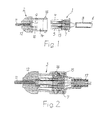
- Fig. 1 schematically a plug 1 and a mating connector 2 are shown, the result in an assembled state, an electrical coupling 3, as they are in Fig. 2 is shown for example.
- the plug 1 has in the illustrated embodiment, two electrical contacts 4 and 5, to which electrical conductors of an electrical line 6 are connected.
- the contacts 4 and 5 and the end of the conduit 6 are made in an advantageously made by injection molding, consisting of insulating protective body. 7 embedded.
- the plug 1 may also have more than two electrical contacts.
- the line 6 then has more than two conductors accordingly. It is surrounded for its protection by a mechanically stable material existing protective tube 8, which consists for example of polyamide or polypropylene.
- the mating connector 2 has two to the contacts 4 and 5 of the connector 1 complementary electrical contacts 9 and 10, to which the electrical conductors of an electrical line 11 are connected. Again, more than two electrical contacts and more than two conductors can be present again.
- the contacts 9 and 10 and the end of the conduit 11 are enclosed by a preferably made by injection molding protection body 12 of insulating material.
- the protective body 7 has a connection surrounding the contacts 4 and 5 13, which fits into a the contacts 9 and 10 of the mating connector 2 surrounding recess 14 of the Schutzgropers 12. In the finished coupling 3, the nozzle 13 is received in the recess 14.
- a cap 15 made of mechanically stable insulating material, which preferably fits tightly against the same and with its one end on the protective tube 8.
- the cap 15 is made of polyamide, for example. It protrudes with its other end to over the protective body 12 of the mating connector 2.
- the cap 15 is locked in mounting position with the protective body 12 so that the two parts of the clutch 3 are held by the cap 15 secured and secured against shock in their mated position .
- the locking of the protective body 12 may have, for example, in a simple embodiment, for example, at least one outwardly projecting projection 16 which engages in the mounting of the cap 15 in a recess thereof latching.
- the lock is designed as a bayonet lock. The cap 15 is rotated in the circumferential direction around the protective body 7 of the plug 1 and the clutch 3 and brought into the locking position.
- the cap 15 can in principle be made in one piece. It can then be "parked” before production of the protective body 7 of the plug 1 on the protective tube 8 and moved after completion of the protective body 7 on the protective tube 8 until it rests against the same.
- the cap 15 consists of two half-shells, which are placed around the clutch 3 for their assembly and locked together.
- the projection 16 of the protective body 12 engages in the mounting position in the corresponding recess of the cap 15.
- the cap 15 can then be rotated around the clutch 3 in the circumferential direction when using a bayonet closure.
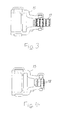
- a half-shell of the cap 15 is in the 3 and 4 shown.
- cap 15 of two half-shells can as a protective tube 8 with advantage on Fig. 3 apparent corrugated tube 17 are used, which is provided with a transverse to its longitudinal direction corrugation.
- the cap 15 can then according to Fig. 4 in their surrounding the corrugated tube 17 area ribs 18 which engage in the mounting position in the corrugation of the corrugated tube 17 and the same thing thereby protects protected against axially acting loads.
- the clutch 3 is described as consisting of a plug 1 and a mating connector 2 unit.
- the mating connector 2 may also belong to the coupling 3, however, a permanently connected to an electrical device device connection, on which the plug 1 is plugged in the mounting position.
- the cap 15 is then locked after its installation analogous to the lock described for the mating connector 2 with the device connection.
Landscapes
- Details Of Connecting Devices For Male And Female Coupling (AREA)
Abstract
Es wird eine elektrische Kupplung (3) angegeben, welche aus einem Stecker und einem Gegenstecker besteht, die beide von einem Schutzkörper (7,12) umgebene elektrische Kontakte aufweisen, bei welcher zumindest an den Stecker eine von einem Schutzrohr (17) umgebene elektrische Leitung angeschlossen ist. Der Schutzkörper (7) des Steckers ist in Montageposition von einer an demselben anliegenden Kappe (15) aus Isoliermaterial umschlossen, welche sich bis über das die angeschlossene Leitung umgebende Schutzrohr (17) erstreckt, an dem sie ebenfalls anliegt. Die Kappe (15) ist in Montageposition, in welcher Stecker und Gegenstecker zusammengesteckt sind, mit dem Gegenstecker verriegelt.
Description
- Die Erfindung bezieht sich auf eine elektrische Kupplung, welche aus einem Stecker und einem Gegenstecker besteht, die beide von einem Schutzkörper umgebene elektrische Kontakte aufweisen, bei welcher zumindest an den Stecker eine von einem Schutzrohr umgebene elektrische Leitung angeschlossen ist.
- Aus einem Stecker und einem Gegenstecker bestehende elektrische Kupplungen sind in unterschiedlichsten Ausführungen seit Jahren bekannt und weltweit im Einsatz. Die elektrischen Kontakte des Steckers sind beispielsweise feuchtigkeitsdicht in einen durch Spritzgießen hergestellten Schutzkörper eingebettet, welcher auch eine an den Stecker angeschlossene elektrische Leitung umschließt, die zu ihrem mechanischen Schutz von einem Schutzrohr umgeben sein kann. Der Gegenstecker kann ähnlich wie der Stecker aufgebaut sein. Es kann sich aber auch um einen Geräteanschluß handeln, auf den der Stecker in Montageposition aufgesteckt ist. Derartige Kupplungen sind in der Regel feuchtigkeitsdicht ausgeführt, so daß die elektrischen Kontakte vor Feuchtigkeit geschützt sind. Bei hohen mechanischen Belastungen, insbesondere Vibrationen und Erschütterungen, wie sie beispielsweise beim Betrieb von Kraftfahrzeugen auftreten, kann der Festsitz der beiden Kupplungsteile jedoch gelockert werden. Der übliche Schutz gegen Feuchtigkeit und Schmutz reicht auch dann in der Regel nicht aus, wenn Spritzwasser auf die Kupplung auftrifft. Das kann bereits beim Betrieb eines Kraftfahrzeugs geschehen, insbesondere aber bei einer Hochdruckreinigung mittels eines Wasserstrahls. Die Kupplungen werden daher in bekannter Technik aufwendig abgekapselt.
- Der Erfindung liegt die Aufgabe zugrunde, die eingangs geschilderte Kupplung so weiterzubilden, daß sie auf einfache Weise wirksam auch gegenüber größeren mechanischen Belastungen geschützt ist, insbesondere gegenüber unter hohem Druck stehenden Wasserstrahlen.
- Diese Aufgabe wird gemäß der Erfindung dadurch gelöst,
- daß der Schutzkörper des Steckers in Montageposition von einer an demselben anliegenden Kappe aus Isoliermaterial umschlossen ist, welche sich bis über das die angeschlossene Leitung umgebende Schutzrohr erstreckt, an dem sie ebenfalls anliegt, und
- daß die Kappe in Montageposition, in welcher Stecker und Gegenstecker zusammengesteckt sind, mit dem Gegenstecker verriegelt ist.
- Die mit Vorteil eng bzw. sogar dicht am Schutzkörper des Steckers anliegende Kappe stellt für die Kupplung einen Schutz gegenüber auch gröberen mechanischen Belastungen und Verschmutzungen sowie insbesondere gegenüber Wasserstrahlen dar, und sie hält die beiden Teile der Kupplung auch bei größeren mechanischen Belastungen fest zusammen, weil sie mit dem Gegenstecker verriegelt ist. Die Kappe selbst ist dadurch fest an der Kupplung verankert, so daß auch das von ihr umschlossene Schutzrohr der Leitung umschlossen und relativ zur Kupplung fixiert bleibt. Der wirksame Schutz der Kupplung wird somit durch nur ein Teil, die Kappe, erreicht, welche die Kupplung umgibt und mit derselben verriegelt ist.
- Ein Ausführungsbeispiel des Erfindungsgegenstandes ist in den Zeichnungen dargestellt.
- Es zeigen:
-
Fig. 1 zwei zusammensteckbare Teile einer elektrischen Kupplung. -
Fig. 2 die Kupplung nach der Erfindung in zusammengesteckter Form in vergrößerter Darstellung. -
Fig. 3 und 4 Einzelheiten der Kupplung nachFig. 2 in weiter vergrößerter Darstellung. - In
Fig. 1 sind schematisch ein Stecker 1 und ein Gegenstecker 2 dargestellt, die in zusammengestecktem Zustand eine elektrische Kupplung 3 ergeben, so wie sie inFig. 2 beispielsweise dargestellt ist. - Der Stecker 1 weist im dargestellten Ausführungsbeispiel zwei elektrische Kontakte 4 und 5 auf, an welche elektrische Leiter einer elektrischen Leitung 6 angeschlossen sind. Die Kontakte 4 und 5 und das Ende der Leitung 6 sind in einen mit Vorteil durch Spritzgießen hergestellten, aus Isoliermaterial bestehenden Schutzkörper 7 eingebettet. Der Stecker 1 kann auch mehr als zwei elektrische Kontakte haben. Die Leitung 6 hat dann entsprechend mehr als zwei Leiter. Sie ist zu ihrem Schutz von einem aus mechanisch stabilem Material bestehenden Schutzrohr 8 umgeben, das beispielsweise aus Polyamid oder Polypropylen besteht.
- Der Gegenstecker 2 hat zwei zu den Kontakten 4 und 5 des Steckers 1 komplementäre elektrische Kontakte 9 und 10, an welche die elektrischen Leiter einer elektrischen Leitung 11 angeschlossen sind. Auch hier können wieder mehr als zwei elektrische Kontakte und mehr als zwei Leiter vorhanden sein. Die Kontakte 9 und 10 und das Ende der Leitung 11 sind von einem vorzugsweise durch Spritzgießen hergestellten Schutzkörper 12 aus Isoliermaterial umschlossen. Der Schutzkörper 7 hat einen die Kontakte 4 und 5 umgebenden Stutzen 13, der in eine die Kontakte 9 und 10 des Gegensteckers 2 umgebende Ausnehmung 14 des Schutzköpers 12 hineinpaßt. In der fertigen Kupplung 3 ist der Stutzen 13 in der Ausnehmung 14 aufgenommen.
- Gemäß
Fig. 2 ist über dem Schutzkörper 7 der fertiggestellten Kupplung 3 eine Kappe 15 aus mechanisch stabilem Isoliermaterial angebracht, welche vorzugsweise eng bzw. dicht an demselben und mit ihrem einen Ende auch am Schutzrohr 8 anliegt. Die Kappe 15 besteht beispielsweise aus Polyamid. Sie ragt mit ihrem anderen Ende bis über den Schutzkörper 12 des Gegensteckers 2. Die Kappe 15 ist in Montageposition mit dem Schutzkörper 12 verriegelt, so daß die beiden Teile der Kupplung 3 durch die Kappe 15 fest und gegen Erschütterungen gesichert in ihrer zusammengesteckten Position gehalten sind. Für die Verriegelung kann der Schutzkörper 12 in einer einfachen Ausführungsform beispielsweise mindestens einen nach außen abstehenden Vorsprung 16 aufweisen, welcher bei der Montage der Kappe 15 in eine Ausnehmung derselben einrastend eingreift. In bevorzugter Ausführungsform ist die Verriegelung als Bajonettverschluß ausgeführt. Die Kappe 15 wird dazu in Umfangsrichtung um den Schutzkörper 7 des Steckers 1 bzw. die Kupplung 3 gedreht und in die Verriegelungsposition gebracht. - Die Kappe 15 kann prinzipiell einteilig ausgeführt sein. Sie kann dann vor Erzeugung des Schutzkörpers 7 des Steckers 1 auf dem Schutzrohr 8 "geparkt" und nach Fertigstellung des Schutzkörpers 7 auf dem Schutzrohr 8 verschoben werden, bis sie an demselben anliegt.
- In bevorzugter Ausführungsform besteht die Kappe 15 aus zwei Halbschalen, die zu ihrer Montage um die Kupplung 3 herumgelegt und miteinander verrastet werden. Dabei greift der Vorsprung 16 des Schutzkörpers 12 in Montageposition in die entsprechende Ausnehmung der Kappe 15 ein. Die Kappe 15 kann dann bei Einsatz eines Bajonettverschlusses auch in Umfangsrichtung um die Kupplung 3 gedreht werden. Eine Halbschale der Kappe 15 ist in den
Fig. 3 und 4 dargestellt. - Bei der Ausführung der Kappe 15 aus zwei Halbschalen kann als Schutzrohr 8 mit Vorteil ein aus
Fig. 3 ersichtliches Wellrohr 17 eingesetzt werden, das mit einer quer zu seiner Längsrichtung verlaufenden Wellung versehen ist. Die Kappe 15 kann dann gemäßFig. 4 in ihrem das Wellrohr 17 umgebenden Bereich Rippen 18 aufweisen, welche in Montageposition in die Wellung des Wellrohres 17 eingreifen und dasselbe dadurch gegen axial wirkende Belastungen geschützt festlegt. - Im Vorangehenden ist die Kupplung 3 als aus einem Stecker 1 und einem Gegenstecker 2 bestehende Einheit beschrieben. Statt des Gegensteckers 2 kann zu der Kupplung 3 aber auch ein fest mit einem elektrischen Gerät verbundener Geräteanschluß gehören, auf welchen der Stecker 1 in Montageposition aufgesteckt ist. Die Kappe 15 ist dann nach ihrer Montage analog zu der für den Gegenstecker 2 beschriebenen Verriegelung mit dem Geräteanschluß verriegelt.
Claims (3)
- Elektrische Kupplung, welche aus einem Stecker und einem Gegenstecker besteht, die beide von einem Schutzkörper umgebene elektrische Kontakte aufweisen, bei welcher zumindest an den Stecker eine von einem Schutzrohr umgebene elektrische Leitung angeschlossen ist, dadurch gekennzeichnet,- daß der Schutzkörper (7) des Steckers (1) in Montageposition von einer an demselben anliegenden Kappe (15) aus Isoliermaterial umschlossen ist, welche sich bis über das die angeschlossene Leitung (6) umgebende Schutzrohr (8) erstreckt, an dem sie ebenfalls anliegt, und- daß die Kappe (15) in Montageposition, in welcher Stecker (1) und Gegenstecker (2) zusammengesteckt sind, mit dem Gegenstecker (2) verriegelt ist.
- Anordnung nach Anspruch 1, dadurch gekennzeichnet, daß die Kappe (15) mittels eines Bajonettverschlusses mit dem Gegenstecker (2) verbunden ist.
- Anordnung nach Anspruch 1 oder 2, dadurch gekennzeichnet,- daß das Schutzrohr (8) ein mit einer quer zu seiner Längsrichtung verlaufenden Wellung versehenes Wellrohr (17) ist und- daß in der Kappe (15) Rippen (18) angebracht sind, welche in Montageposition in die Wellung des Wellrohres (17) eingreifen.
Priority Applications (1)
| Application Number | Priority Date | Filing Date | Title |
|---|---|---|---|
| EP11305973A EP2551964A1 (de) | 2011-07-27 | 2011-07-27 | Elektrische Kupplung |
Applications Claiming Priority (1)
| Application Number | Priority Date | Filing Date | Title |
|---|---|---|---|
| EP11305973A EP2551964A1 (de) | 2011-07-27 | 2011-07-27 | Elektrische Kupplung |
Publications (1)
| Publication Number | Publication Date |
|---|---|
| EP2551964A1 true EP2551964A1 (de) | 2013-01-30 |
Family
ID=44503658
Family Applications (1)
| Application Number | Title | Priority Date | Filing Date |
|---|---|---|---|
| EP11305973A Withdrawn EP2551964A1 (de) | 2011-07-27 | 2011-07-27 | Elektrische Kupplung |
Country Status (1)
| Country | Link |
|---|---|
| EP (1) | EP2551964A1 (de) |
Citations (7)
| Publication number | Priority date | Publication date | Assignee | Title |
|---|---|---|---|---|
| US4596432A (en) * | 1981-11-20 | 1986-06-24 | Amp Incorporated | Shielded ribbon coax cable assembly |
| US4721475A (en) * | 1986-11-20 | 1988-01-26 | Burke Jr Roland A | Safety shroud for an electrical connector |
| DE4237895A1 (en) * | 1991-11-12 | 1993-05-13 | Yazaki Corp | Plug-socket connection protector, esp. for motor vehicle - comprises moulded sleeve fitted and closed around mated housings of male and female portions of connector |
| US20030209524A1 (en) * | 2002-05-08 | 2003-11-13 | David Delgado | Welding cable insulation method and apparatus |
| US20040014367A1 (en) * | 2002-07-19 | 2004-01-22 | Petersen Cyle D. | Telecommunications connector adapted for bi-directional insertion |
| EP1885030A2 (de) * | 2006-08-02 | 2008-02-06 | Sumitomo Wiring Systems, Ltd. | Kabelabdeckung und Montageverfahren |
| DE202007017488U1 (de) * | 2007-12-14 | 2009-04-23 | Grawe, Quirin | Steckeranordnung |
-
2011
- 2011-07-27 EP EP11305973A patent/EP2551964A1/de not_active Withdrawn
Patent Citations (7)
| Publication number | Priority date | Publication date | Assignee | Title |
|---|---|---|---|---|
| US4596432A (en) * | 1981-11-20 | 1986-06-24 | Amp Incorporated | Shielded ribbon coax cable assembly |
| US4721475A (en) * | 1986-11-20 | 1988-01-26 | Burke Jr Roland A | Safety shroud for an electrical connector |
| DE4237895A1 (en) * | 1991-11-12 | 1993-05-13 | Yazaki Corp | Plug-socket connection protector, esp. for motor vehicle - comprises moulded sleeve fitted and closed around mated housings of male and female portions of connector |
| US20030209524A1 (en) * | 2002-05-08 | 2003-11-13 | David Delgado | Welding cable insulation method and apparatus |
| US20040014367A1 (en) * | 2002-07-19 | 2004-01-22 | Petersen Cyle D. | Telecommunications connector adapted for bi-directional insertion |
| EP1885030A2 (de) * | 2006-08-02 | 2008-02-06 | Sumitomo Wiring Systems, Ltd. | Kabelabdeckung und Montageverfahren |
| DE202007017488U1 (de) * | 2007-12-14 | 2009-04-23 | Grawe, Quirin | Steckeranordnung |
Similar Documents
| Publication | Publication Date | Title |
|---|---|---|
| DE102011052078A1 (de) | Ladekupplung und Ladekupplungsanordnung für ein Kraftfahrzeug sowie Kraftfahrzeug | |
| EP2617104A1 (de) | Elektrischer kontakt | |
| DE102014008343A1 (de) | Elektrisches Gerät | |
| DE202014101430U1 (de) | Als Kupplung oder Stecker ausgebildete Steckvorrichtung | |
| DE102012101094A1 (de) | Steckverbinder, Einrichtung mit Steckverbinder und entsprechende Steckverbinderanordnung | |
| WO2015104117A1 (de) | Vorrichtung zur fixierung einer elektrischen leitung in einem stecker, stecker für eine elektrische leitung sowie elektrisches kabel | |
| DE102009053779B3 (de) | Hochspannungsstecker mit Kontaktanordnung und Sicherungsplatte zur redundanten Fixierung der Kontaktanordnung | |
| EP2551978B1 (de) | Vorrichtung zur Durchführung einer elektrischen Leitung durch ein Gehäuse | |
| WO2009115080A2 (de) | Vorrichtung zur realisierung eines trockenen elektrischen anschlusses eines kraftfahrzeugschlosses | |
| DE102010063143A1 (de) | Scheibenwischvorrichtung für ein Kraftfahrzeug | |
| DE102011075513A1 (de) | Kabelanschlussvorrichtung, sowie Kabelverbinder | |
| DE102008055841A1 (de) | Elektrisches Steckverbinderteil | |
| DE102014215231A1 (de) | Getriebe-Antriebseinheit einschiebbaren Elektronikmodul | |
| DE202013007516U1 (de) | Anordnung zur Montage eines elektrischen Kupplungsteils in einem Kraftfahrzeug | |
| DE102017221025A1 (de) | Verbindungsmittel zur elektrischen Verbindung elektrischer Leitungen | |
| DE102011122296A1 (de) | Masseanbindungseinrichtung | |
| DE9207523U1 (de) | Steckdose für eine mehrpolige Steckvorrichtung | |
| EP3103315B1 (de) | Elektrisches gerät und verbindungsanordnung mit einem elektrischen gerät | |
| DE102006041949B3 (de) | Fremdstartpunkt | |
| DE202019100546U1 (de) | Elektrisches Steckerteil und elektrisches Steckverbindungssystem mit Verriegelung | |
| DE10361235A1 (de) | Bausatz zum Erstellen eines elektrischen Steckverbinders | |
| DE102013005094B4 (de) | Verbindersystem mit einer Gehäuseeinrichtung und einer darin berührgeschützt lagerbaren Kontakteinrichtung zum Herstellen eines elektrischen Kontakts zwischen zwei elektrisch leitfähigen Komponenten | |
| DE102010003138B4 (de) | Elektrogerät, insbesondere Elektrohandwerkzeug | |
| WO2007087964A1 (de) | Antennenstab mit gewindeverbindung zum antennensockel | |
| EP2405547B1 (de) | Anordnung zum feuchtigkeitsdichten Verbinden von zwei Geräten |
Legal Events
| Date | Code | Title | Description |
|---|---|---|---|
| PUAI | Public reference made under article 153(3) epc to a published international application that has entered the european phase |
Free format text: ORIGINAL CODE: 0009012 |
|
| 17P | Request for examination filed |
Effective date: 20120424 |
|
| AK | Designated contracting states |
Kind code of ref document: A1 Designated state(s): AL AT BE BG CH CY CZ DE DK EE ES FI FR GB GR HR HU IE IS IT LI LT LU LV MC MK MT NL NO PL PT RO RS SE SI SK SM TR |
|
| AX | Request for extension of the european patent |
Extension state: BA ME |
|
| STAA | Information on the status of an ep patent application or granted ep patent |
Free format text: STATUS: THE APPLICATION IS DEEMED TO BE WITHDRAWN |
|
| 18D | Application deemed to be withdrawn |
Effective date: 20141219 |