EP2548585A1 - Composition nettoyante et/ou désinfectante - Google Patents
Composition nettoyante et/ou désinfectante Download PDFInfo
- Publication number
- EP2548585A1 EP2548585A1 EP12176897A EP12176897A EP2548585A1 EP 2548585 A1 EP2548585 A1 EP 2548585A1 EP 12176897 A EP12176897 A EP 12176897A EP 12176897 A EP12176897 A EP 12176897A EP 2548585 A1 EP2548585 A1 EP 2548585A1
- Authority
- EP
- European Patent Office
- Prior art keywords
- chlorhexidine
- solution
- composition according
- composition
- cleaning
- Prior art date
- Legal status (The legal status is an assumption and is not a legal conclusion. Google has not performed a legal analysis and makes no representation as to the accuracy of the status listed.)
- Granted
Links
Images



Classifications
-
- A—HUMAN NECESSITIES
- A01—AGRICULTURE; FORESTRY; ANIMAL HUSBANDRY; HUNTING; TRAPPING; FISHING
- A01N—PRESERVATION OF BODIES OF HUMANS OR ANIMALS OR PLANTS OR PARTS THEREOF; BIOCIDES, e.g. AS DISINFECTANTS, AS PESTICIDES OR AS HERBICIDES; PEST REPELLANTS OR ATTRACTANTS; PLANT GROWTH REGULATORS
- A01N47/00—Biocides, pest repellants or attractants, or plant growth regulators containing organic compounds containing a carbon atom not being member of a ring and having no bond to a carbon or hydrogen atom, e.g. derivatives of carbonic acid
- A01N47/40—Biocides, pest repellants or attractants, or plant growth regulators containing organic compounds containing a carbon atom not being member of a ring and having no bond to a carbon or hydrogen atom, e.g. derivatives of carbonic acid the carbon atom having a double or triple bond to nitrogen, e.g. cyanates, cyanamides
- A01N47/42—Biocides, pest repellants or attractants, or plant growth regulators containing organic compounds containing a carbon atom not being member of a ring and having no bond to a carbon or hydrogen atom, e.g. derivatives of carbonic acid the carbon atom having a double or triple bond to nitrogen, e.g. cyanates, cyanamides containing —N=CX2 groups, e.g. isothiourea
- A01N47/44—Guanidine; Derivatives thereof
-
- A—HUMAN NECESSITIES
- A01—AGRICULTURE; FORESTRY; ANIMAL HUSBANDRY; HUNTING; TRAPPING; FISHING
- A01N—PRESERVATION OF BODIES OF HUMANS OR ANIMALS OR PLANTS OR PARTS THEREOF; BIOCIDES, e.g. AS DISINFECTANTS, AS PESTICIDES OR AS HERBICIDES; PEST REPELLANTS OR ATTRACTANTS; PLANT GROWTH REGULATORS
- A01N33/00—Biocides, pest repellants or attractants, or plant growth regulators containing organic nitrogen compounds
- A01N33/02—Amines; Quaternary ammonium compounds
- A01N33/12—Quaternary ammonium compounds
-
- A—HUMAN NECESSITIES
- A61—MEDICAL OR VETERINARY SCIENCE; HYGIENE
- A61L—METHODS OR APPARATUS FOR STERILISING MATERIALS OR OBJECTS IN GENERAL; DISINFECTION, STERILISATION OR DEODORISATION OF AIR; CHEMICAL ASPECTS OF BANDAGES, DRESSINGS, ABSORBENT PADS OR SURGICAL ARTICLES; MATERIALS FOR BANDAGES, DRESSINGS, ABSORBENT PADS OR SURGICAL ARTICLES
- A61L2/00—Disinfection or sterilisation of materials or objects, in general; Accessories therefor
- A61L2/16—Disinfection or sterilisation of materials or objects, in general; Accessories therefor using chemical substances
- A61L2/18—Liquid substances
-
- A—HUMAN NECESSITIES
- A61—MEDICAL OR VETERINARY SCIENCE; HYGIENE
- A61L—METHODS OR APPARATUS FOR STERILISING MATERIALS OR OBJECTS IN GENERAL; DISINFECTION, STERILISATION OR DEODORISATION OF AIR; CHEMICAL ASPECTS OF BANDAGES, DRESSINGS, ABSORBENT PADS OR SURGICAL ARTICLES; MATERIALS FOR BANDAGES, DRESSINGS, ABSORBENT PADS OR SURGICAL ARTICLES
- A61L2103/00—Materials or objects being the target of disinfection or sterilisation
- A61L2103/15—Laboratory, medical or dentistry appliances, e.g. catheters or sharps
Definitions
- the present invention relates to a concentrated cleaning and / or disinfecting composition and its use for cleaning and / or disinfecting surfaces and materials.
- Disinfection is a well-known method for destroying pathogens such as bacteria, viruses, yeasts, molds, fungi and others.
- the disinfection of surfaces or materials thus makes it possible to avoid the transmission of these pathogens to humans. It is routinely performed by everyone and systematically in hospital, in the medical or paramedical sector, veterinary, in the field of pharmacy, cosmetics and agri-food.
- disinfection of surfaces, instruments and materials is mandatory in the medical or veterinary environment, particularly in clinics and hospitals.
- compositions that can be used directly or diluted in water that are used in a medical environment.
- compositions comprising antimicrobial agents of the biguanide family such as chlorhexidine or its derivatives are widely used. These compositions may further comprise one or more other antimicrobial agents.
- Chlorhexidine is an antiseptic with bactericidal or bacteriostatic effects on gram-positive or negative bacteria. It is therefore advantageous to use it because of its broad spectrum of antibacterial action but also for its favorable toxicological and eco-toxicological profile at low dose. In fact, dilute aqueous solutions of chlorhexidine are used as cutaneous or oral antiseptics.
- chlorinated contains hypochlorite ions (ClO - ) and hypochlorous acid (HOCl).
- composition ANIOS ® ref. 1916 (which comprises chlorhexidine) with hospital-run water, gave a yellow color to the resulting solution.
- sodium hypochlorite is dissolved in water as an oral antiseptic used in dental medicine, just like chlorhexidine.
- the concomitant use of sodium hypochlorite and chlorhexidine leads, depending on the quantities used, to the formation of a brown precipitate ( Zehnder M., JOE 2006; 37, 38-41 ) or the appearance of a yellow coloring.
- the yellow coloring of chlorhexidine disinfectant solutions is not acceptable to the user, it gives a "dirt" appearance and may color and deteriorate the surfaces on which they are used.
- the present invention relates to a cleaning and / or disinfecting composition
- a cleaning and / or disinfecting composition comprising chlorhexidine or a chlorhexidine salt, characterized in that it further comprises a reducing agent chosen from the group consisting of inorganic thiosulfates, ascorbic acid and salts. ascorbate, mineral metabisulfites and mixtures of one or more thereof.
- the present invention also relates to the use of this cleaning and / or disinfecting composition in the cleaning and / or disinfection of surfaces, materials and instruments, in particular for medical use.
- chlorhexidine salt refers to all the inorganic or organic acid addition salts of chlorhexidine. It includes, but is not limited to, chlorhexidine gluconate, chlorhexidine digluconate, chlorhexidine acetate, chlorhexidine diacetate, chlorhexidine hydrochloride and chlorhexidine dihydrochloride, and their solvated derivatives, especially hydrates.
- inorganic thiosulfates refers to, but is not limited to, alkaline thiosulfates, especially lithium thiosulfate, sodium thiosulfate, potassium thiosulfate, alkaline earth thiosulfates, especially calcium thiosulfate, and their solvated derivatives, in particular hydrates.
- corbate salts denotes, but is not limited to, alkaline ascorbates, especially sodium ascorbate, potassium ascorbate, alkaline earth ascorbates, in particular ascorbate of ascorbate. calcium, and their solvated derivatives, in particular hydrates.
- mineral metabisulfites refers to, but is not limited to, sodium metabisulfite, potassium metabisulfite, calcium metabisulfite, and their solvated derivatives, in particular hydrates.
- the composition comprises a chlorhexidine salt, more particularly and preferably chlorhexidine digluconate.
- the amount of chlorhexidine or chlorhexidine salt is between 1 and 50 mg / g of disinfectant composition, preferably between 1 and 25 mg / g, more preferably about 5 mg / g.
- the reducing agent is chosen from the group consisting of sodium thiosulfate, potassium thiosulfate and calcium thiosulfate.
- Sodium thiosulfate is preferred because it provides greater stability to the resulting composition.
- the amount of reducing agent is between 0.5 and 50 mg / g of disinfecting composition, preferably between 2 and 6 mg / g, more preferably about 4 mg / g.
- the amount of chlorhexidine or chlorhexidine salt is between 1 and 50 mg / g of disinfectant composition and the amount of reducing agent is between 0.5 and 50 mg / g of composition disinfectant.
- the amount of chlorhexidine or chlorhexidine salt is between 1 and 25 mg / g of disinfectant composition and the amount of reducing agent is between 2 and 6 mg / g of disinfectant composition; preferably the amount of chlorhexidine or chlorhexidine salt is about 5 mg / g of disinfectant composition and the amount of reducing agent is about 4 mg / g of disinfectant composition.
- composition according to the invention is generally in the form of an aqueous solution.
- Distilled or demineralised water which may have been filtered on a membrane of low porosity, preferably 0.2 ⁇ m, will advantageously be used for their preparation.
- the composition according to the invention is characterized in that it is in the form of a liquid concentrate comprising from 50 to 70%, preferably from 55 to 65%, more preferably approximately 60%, by weight. of water based on the total weight of the composition.
- the composition according to the invention comprises from 99 to 99.95%, preferably from 99.5 to 99.95%, more preferably from approximately 99.9% by volume of water relative to the total volume of the composition.
- compositions can be obtained by diluting the concentrated liquid composition described above.
- the solutions obtained by dilution with chlorinated running water used in a hospital environment are clear and do not take on a yellow coloring. They can then be applied to surfaces or materials, they have the desired cleaning and disinfecting properties and do not require rinsing the surfaces or materials on which they were used.
- the pH of the composition according to the invention is acid (less than 7) or neutral (approximately equal to 7).
- the pH of the compositions containing acidic chlorhexidine salts is acidic or slightly acidic, the addition of a base such as sodium hydroxide makes it possible to adjust the pH around 7.
- composition according to the invention one or more additional antimicrobial agent (s) in combination with chlorhexidine. This makes it possible to widen the biocidal spectrum of the composition.
- composition according to the invention may further comprise one or more additional antimicrobial agent (s) chosen from the group consisting of polyhexamethylene biguanide (PHMB), polyhexamethylene biguanide hydrochloride (PHMB-HCl) ), polyaminopropylbiguanide (PAPB), benzalkonium chloride, benzethonium chloride, methylbenzethonium chloride, cetalkonium chloride, cetylpyridinium chloride, cetrimonium chloride, didecyldimethylammonium chloride, didecyldimethyl ammonium carbonate, propionate of didecylmethylpolyoxyethylammonium, laurylamine, N- (3-aminopropyl) -N-dodecylpropane-1,3-diamine, tetraacetylethylenediamine, phenoxyethanol and phenoxypropanol, preferentially polyhexamethylene biguanide (PHMB
- the composition according to the invention comprises polyhexamethylene biguanide (PHMB) or polyhexamethylene biguanide hydrochloride (PHMB-HCl) and didecyldimethylammonium chloride, preferentially polyhexamethylene biguanide hydrochloride (PHMB-HCl) and chloride. of didecyldimethylammonium as additional microbial agents.
- PHMB polyhexamethylene biguanide
- PHMB-HCl polyhexamethylene biguanide hydrochloride
- didecyldimethylammonium chloride preferentially polyhexamethylene biguanide hydrochloride (PHMB-HCl) and chloride. of didecyldimethylammonium as additional microbial agents.
- the amount of PHMB-HCl contained in the composition according to the invention is between 0.1 and 50 mg / g of composition disinfectant, preferably between 0.2 and 0.3 mg / g, more preferably about 0.24 mg / g; the amount of didecyldimethylammonium chloride is between 1 and 100 mg / g, preferably between 80 and 85 mg / g, more preferably about 82 mg / g.
- composition according to the invention comprises N- (3-aminopropyl) -N-dodecylpropane-1,3-diamine and didecyldimethylammonium chloride as additional microbial agents.
- the amount of N- (3-aminopropyl) -N-dodecylpropane-1,3-diamine) contained in the composition according to the invention is between 20 and 80 mg / g of disinfectant composition, preferably between 40 and 60 mg g, more preferably about 51 mg / g; the amount of didecyldimethylammonium chloride is between 10 and 50 mg / g, preferably between 20 and 30 mg / g, more preferably about 25 mg / g.
- composition according to the invention further comprises one or more excipient (s) chosen from the group consisting of emulsifiers, surfactants of nonionic, cationic or amphoteric type, hydrotropes, third parties polyol-type solvents such as glycerol.
- excipient chosen from the group consisting of emulsifiers, surfactants of nonionic, cationic or amphoteric type, hydrotropes, third parties polyol-type solvents such as glycerol.
- hydrophile refers, without limitation, sodium para-toluenesulfonate, sodium xylene.
- composition according to the invention may further comprise other agents commonly used in the field of disinfectants such as one or more perfume (s), preferably non-allergen (s) and non-sensitizing (s), and or one or more dyes.
- perfume preferably non-allergen (s) and non-sensitizing (s)
- dyes preferably one or more dyes.
- composition according to the invention is characterized in that it is in the form of a liquid, optionally colored, which flows and is easily transvase and which preferably mixes / dissolves instantly in dilution in water.
- This liquid concentrate is intended to be diluted in water, for example tap water, water previously treated by addition of chlorine, bleach or other disinfectant, distilled water, demineralized or purified.
- the diluted solution obtained is clear and possibly slightly colored.
- Another subject of the invention is the use of a cleaning and / or disinfecting composition according to the invention in the cleaning and / or the disinfection of surfaces and materials, more particularly equipment for medical, paramedical, veterinary, pharmaceutical or agri-food purposes.
- surfaces within the meaning of the present invention include hard surfaces such as floors, walls, tiles, worktops, tables, doors, cupboards, shelves, trolleys.
- BSA bovine serum albumin
- CHLX chlorhexidine
- g gram (s); h: hour (s)
- kg kilogram (s)
- L liter (s)
- m meter (s)
- mg milligram (s)
- mL milliliter (s)
- mm millimeter (s)
- ⁇ m micrometer (s)
- min. minute (s)
- TFA trifluoroacetic acid
- HPLC spectra were obtained on an Alliance integrated system marketed by WATERS using UV detection.
- This integrated system comprises a separation module 2690 and a diode array detector 996 set at a wavelength of 260 nm.
- the column used is a HyPURITY column (HYPERSIL) containing a C18 stationary phase of 5 ⁇ m, the dimensions of the column are 4.6 x 250mm.
- HYPERSIL HyPURITY column
- the eluent is a mixture in volumes of 60% of solution A (0.1% v / v TFA in water) and 40% solution B (0.08% v / v of TFA in acetonitrile).
- the analysis was carried out with this eluent in isocratic mode with a flow rate of 1 mL / min and a column temperature of 30 ° C.
- the injection volume of the analyzed solutions is 20 ⁇ L.
- chlorhexidine has a retention time of between 5 and 5.5 min.
- compositions A and B were prepared by adding 0.4% by weight of a reducing agent to an undiluted solution of ANIOS ® 1916 (marketed by the Applicant).
- the resulting solutions therefore include the following products: chlorhexidine digluconate 5 mg / g, didecyldimethylammonium chloride 82 mg / g, polyhexamethylene biguanide hydrochloride 0.24 mg / g, - reducing agent 4 mg / g, - dyes, perfume, deionized water filtered on 0.2 ⁇ m membrane, nonionic or amphoteric surfactants; ⁇ u> Table 1: ⁇ / u> Reducing agents included in solutions A and B. Composition Reducing agent AT Sodium thiosulfate B Ascorbic acid
- compositions A and B were then diluted to 0.25% by weight in network water to give solutions A and B, respectively.
- Solution A is clear and pale green which is identical to a solution obtained according to the same dilution from ANIOS ® 1916
- Solution B was a little cloudy with the formation of a precipitate and the appearance of a pale yellow color.
- sodium thiosulfate is preferred over ascorbic acid even though it also allows the stabilization of chlorhexidine solutions containing sodium hypochlorite.
- Example 2 stability study of a composition according to the invention in chlorinated aqueous solution.
- Solution 1 serves as a control.
- the amount of chlorhexidine in this solution is stable over time and substantially equal to the theoretical amount calculated on the basis of the amount of chlorhexidine contained in the ANIOS ® 1916
- the coloring of the solution 1 remains unchanged over time, the solution 1 remains limpid and pale green which is consistent with the green color of ANIOS ® 1916
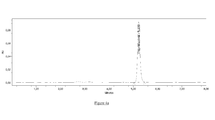
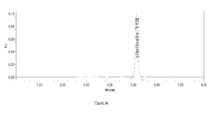
- the chromatograms of figures 1a , 1b and 1 C attest to the very high purity of the solution 1 at the different time intervals measured, the peak observed being that corresponding to chlorhexidine.
- Solution 3 serves as the second control.
- the amount of chlorhexidine in this solution 3 is stable over time and substantially equal to the theoretical amount calculated.
- the coloring of solution 3 remains unchanged over time, solution 3 also remains clear and pale green.
- the chromatograms of figures 3a , 3b and 3c attest to the very high purity of solution 3 at the different time intervals measured.
- the results obtained with the solution 3 ANIOS ® 1916 containing sodium thiosulfate are identical to those obtained with solution 1 ANIOS ® 1916.
- composition according to the invention makes it possible to use a disinfectant solution based on chlorhexidine diluted with a water containing sodium hypochlorite such as hot running water that is found in a hospital environment.
- NF EN 13727 A test suspension of bacteria with interfering substances is added to a sample of the disinfectant detergent diluted in water. The number of bacteria in the suspension is adjusted between 1.5 and 5 ⁇ 10 7 cfu / ml. The mixture is maintained at a temperature of 20 ° C +/- 1 ° C for 5 min +/- 10 s. At the end of the contact time an aliquot is removed, the biocidal activity in this portion is immediately neutralized by a dilution / neutralization process. The number of surviving bacteria in the sample is determined and a logarithmic reduction factor calculated. The product will be deemed to comply with standard NF EN 13727 if it shows a reduction greater than or equal to 5 log
- the test was carried out with the bacterial strain Pseudomonas aeruginosa, with a concentration of sheep erythrocytes of 3 ml / l and BSA at a concentration of 3 g / l for a contact time of 5 minutes. These conditions are representative of dirt conditions.
- This bacterial strain is particularly pathogenic and very resistant. With other gram-negative bacteria, it is more and more often responsible for nosocomial infections. It is one of the most difficult bacteria to treat clinically, the mortality rate reaches 50% in vulnerable (immunocompromised) patients.
- solution 2 The bactericidal activity of solution 2 is lower than that of solution 1. This result is consistent with the fact that solution 2 is not stable and has a much lower amount of chlorhexidine than that of solution 1.
- the biocidal activity of solution 4 is equivalent to that of solution 1, the composition according to the invention therefore has a high bactericidal power, the latter being in no way affected by the additional presence of sodium thiosulfate.
Landscapes
- Life Sciences & Earth Sciences (AREA)
- Health & Medical Sciences (AREA)
- General Health & Medical Sciences (AREA)
- Environmental Sciences (AREA)
- Plant Pathology (AREA)
- Engineering & Computer Science (AREA)
- Dentistry (AREA)
- Pest Control & Pesticides (AREA)
- Wood Science & Technology (AREA)
- Zoology (AREA)
- Agronomy & Crop Science (AREA)
- Chemical Kinetics & Catalysis (AREA)
- Chemical & Material Sciences (AREA)
- General Chemical & Material Sciences (AREA)
- Epidemiology (AREA)
- Animal Behavior & Ethology (AREA)
- Public Health (AREA)
- Veterinary Medicine (AREA)
- Agricultural Chemicals And Associated Chemicals (AREA)
- Acyclic And Carbocyclic Compounds In Medicinal Compositions (AREA)
- Cosmetics (AREA)
- Pharmaceuticals Containing Other Organic And Inorganic Compounds (AREA)
Abstract
Description
- La présente invention concerne une composition nettoyante et/ou désinfectante concentrée et son utilisation pour le nettoyage et/ou la désinfection des surfaces et des matériels.
- La désinfection est un procédé bien connu destiné à détruire des agents pathogènes tels que les bactéries, les virus, les levures, les moisissures, les champignons ou autres. La désinfection de surfaces ou de matériels permet donc d'éviter la transmission de ces agents pathogènes à l'Homme. Elle est effectuée couramment par tout un chacun et de manière systématique en milieu hospitalier, dans le secteur médical ou paramédical, vétérinaire, dans le domaine de la pharmacie, des cosmétiques et de l'agroalimentaire. Plus particulièrement, la désinfection de surfaces, d'instruments et de matériels est obligatoire en milieu médical ou vétérinaire, notamment dans les cliniques et les hôpitaux.
- Il existe de nombreuses compositions nettoyantes et/ou désinfectantes utilisables directement ou à diluer dans de l'eau qui sont employées en milieu médical. Parmi celles-ci, les compositions comprenant des agents antimicrobiens de la famille des biguanides tels que la chlorhexidine ou ses dérivés sont d'un usage très répandu. Ces compositions peuvent comprendre en outre un ou plusieurs autres agents antimicrobiens.
- La chlorhexidine est notamment un antiseptique aux effets bactéricides ou bactériostatiques sur les bactéries à gram positif ou négatif. Il est donc avantageux de l'utiliser en raison de son large spectre d'action antibactérien mais aussi pour son profil toxicologique et éco-toxicologique favorable à faible dose. En effet, des solutions aqueuses diluées de chlorhexidine sont utilisées comme antiseptiques cutanés ou bucco-dentaires.
- Dans les milieux hospitaliers, l'eau chaude courante utilisée est préalablement traitée, le plus souvent par ajout de dérivés de chlore ou d'eau de javel, cela permet notamment la prévention du risque de légionellose. Cette eau dite chlorée contient donc des ions hypochlorite (ClO-) et de l'acide hypochloreux (HOCl).
- Il a été récemment observé que la dilution de la composition ANIOS® réf. 1916 (qui comprend de la chlorhexidine) avec de l'eau courante javellisée en milieu hospitalier donnait une coloration jaune à la solution obtenue.
- Par ailleurs, l'hypochlorite de sodium est en solution diluée dans l'eau un antiseptique buccal utilisé en médecine dentaire au même titre que la chlorhexidine. Toutefois, l'utilisation concomitante d'hypochlorite de sodium et de chlorhexidine entraîne, selon les quantités utilisées, la formation d'un précipité marron (Zehnder M., JOE 2006 ; 37, 38-41) ou l'apparition d'une coloration jaune.
- Ce précipité marron et cette couleur jaune sont en partie attribués à une réaction d'oxydation de la chlorhexidine par les ions hypochlorite (Basrani et al., JOE 2007 ; 33, 966-969).
- Par ailleurs, la demanderesse a maintenant observé qu'une solution comprenant de chlorhexidine et des ions hypochlorite se dégradait rapidement en plusieurs sous produits.
- La coloration jaune des solutions désinfectantes à base de chlorhexidine n'est pas acceptable pour l'utilisateur, elle donne un aspect « salissure » et risque de colorer et détériorer les surfaces sur lesquelles elles sont employées.
- De plus, les solutions diluées de composition comprenant de la chlorhexidine et des ions hypochlorite sont instables, la chlorhexidine se dégrade rapidement. En conséquence, la capacité antimicrobienne de telles solutions est fortement altérée et ne répond certainement plus aux exigences et besoins qui sont nécessaires en milieu médical.
- Pour ces raisons, l'utilisation de chlorhexidine en présence d'ions hypochlorite, et donc d'eau préalablement javellisée ou chlorée, est délicate à mettre en oeuvre, notamment en milieu hospitalier et peut de surcroît présenter un risque sanitaire. Il y a donc un réel besoin de trouver des compositions comprenant de la chlorhexidine ou un de ses dérivés qui puissent être diluées dans de l'eau préalablement javellisée sans que la chlorhexidinene soit dégradée.
- Il est du mérite de la demanderesse d'avoir mis au point une composition comprenant de la chlorhexidine ou un de ses dérivés qui, en contact avec des ions hypochlorite, ne se dégrade pas, c'est-à-dire qu'il n'y a pas ou très peu de dégradation de la chlorhexidine.
- La présente invention concerne une composition nettoyante et/ou désinfectante comprenant de la chlorhexidine ou un sel de chlorhexidine, caractérisée en ce qu'elle comprend en outre un agent réducteur choisi parmi le groupe constitué par les thiosulfates minéraux, l'acide ascorbique, les sels d'ascorbate, les métabisulfites minéraux et les mélanges d'un ou plusieurs de ceux-ci.
- La présente invention concerne également l'utilisation de cette composition nettoyante et/ou désinfectante dans le nettoyage et/ou la désinfection de surfaces, de matériels et d'instruments, notamment à usage médical.
- L'expression « sel de chlorhexidine » selon l'invention, désigne tous les sels d'addition d'acides minéraux ou organiques de la chlorhexidine. Elle comprend, sans s'y limiter, le gluconate de chlorhexidine, le digluconate de chlorhexidine, l'acétate de chlorhexidine, le diacétate de chlorhexidine, le chlorhydrate de chlorhexidine et le dichlorhydrate de chlorhexidine, et leurs dérivés solvates, en particulier les hydrates.
- L'expression « thiosulfates minéraux » selon l'invention, désigne, sans s'y limiter, les thiosulfates alcalins, notamment le thiosulfate de lithium, le thiosulfate de sodium, le thiosulfate de potassium, les thiosulfates alcalino-terreux, notamment le thiosulfate de calcium, et leurs dérivés solvates, en particulier les hydrates.
- L'expression « sels d'ascorbate » selon l'invention, désigne, sans s'y limiter, les ascorbates alcalins, notamment l'ascorbate de sodium, l'ascorbate de potassium, les ascorbates alcalino-terreux, notamment l'ascorbate de calcium, et leurs dérivés solvates, en particulier les hydrates.
- L'expression « métabisulfites minéraux » selon l'invention, désigne, sans s'y limiter, le métabisulfite de sodium, le métabisulfite de potassium, le métabisulfite de calcium, et leurs dérivés solvates, en particulier les hydrates.
- Avantageusement, la composition comprend un sel de chlorhexidine, plus particulièrement et préférentiellement du digluconate de chlorhexidine.
- La quantité de chlorhexidine ou de sel de chlorhexidine est comprise entre 1 et 50 mg/g de composition désinfectante, préférentiellement entre 1 et 25 mg/g, plus préférentiellement d'environ 5 mg/g.
- Avantageusement, l'agent réducteur est choisi parmi le groupe constitué par le thiosulfate de sodium, le thiosulfate de potassium, le thiosulfate de calcium. Le thiosulfate de sodium est préféré car il procure une plus grande stabilité à la composition obtenue.
- La quantité d'agent réducteur est comprise entre 0.5 et 50 mg/g de composition désinfectante, préférentiellement entre 2 et 6 mg/g, plus préférentiellement d'environ 4 mg/g.
- Dans un mode de réalisation, la quantité de chlorhexidine ou de sel de chlorhexidine est comprise entre 1 et 50 mg/g de composition désinfectante et la quantité d'agent réducteur est comprise entre 0.5 et 50 mg/g de composition désinfectante. De préférence, la quantité de chlorhexidine ou de sel de chlorhexidine est comprise entre 1 et 25 mg/g de composition désinfectante et la quantité d'agent réducteur est comprise entre 2 et 6 mg/g de composition désinfectante; préférentiellement la quantité de chlorhexidine ou de sel de chlorhexidine est d'environ 5 mg/g de composition désinfectante et la quantité d'agent réducteur est d'environ 4 mg/g de composition désinfectante.
- La composition selon l'invention se présente généralement sous la forme d'une solution aqueuse. On utilisera avantageusement pour leur préparation de l'eau distillée ou déminéralisée, ayant éventuellement subie une filtration sur une membrane de faible porosité, de préférence de 0.2 µm.
- Dans un mode de réalisation, la composition selon l'invention est caractérisée en ce qu'elle se présente sous forme d'un concentré liquide comprenant de 50 à 70 %, préférentiellement de 55 à 65%, plus préférentiellement environ 60 %, en poids d'eau rapporté au poids total de la composition.
- Dans un autre mode de réalisation, la composition selon l'invention comprend de 99 à 99.95%, préférentiellement de 99.5 à 99.95 %, plus préférentiellement d'environ 99.9 %, en volume d'eau rapporté au volume total de la composition.
- De telles compositions peuvent être obtenues par dilution de la composition liquide concentrée décrite plus haut. Les solutions obtenues par dilution avec de l'eau courante chlorée utilisée en milieu hospitalier sont limpides et ne prennent pas une coloration jaune. Elles peuvent ensuite être appliquées sur des surfaces ou des matériels, elles possèdent les propriétés nettoyantes et désinfectantes souhaitées et ne nécessitent pas de rinçage des surfaces ou matériels sur lesquels elles ont été utilisées.
- Il est également avantageux d'ajuster le pH de la composition selon l'invention par ajout d'un acide minéral ou d'une base minérale selon le pH souhaité. De préférence, le pH de la composition selon l'invention est acide (inférieur à 7) ou neutre (environ égal à 7). En général, le pH des compositions contenant des sels acides de chlorhexidine est acide ou légèrement acide, l'ajout d'une base telle que l'hydroxyde de sodium permet d'ajuster le pH autour de 7.
- Il est avantageux d'ajouter à la composition selon l'invention un ou plusieurs agent(s) antimicrobien(s) supplémentaire(s) en combinaison avec la chlorhexidine. Cela permet d'élargir le spectre biocide de la composition.
- La composition selon l'invention peut en outre comprendre un ou plusieurs agent(s) antimicrobien(s) supplémentaire(s) choisi(s) parmi le groupe constitué par le polyhexaméthylène biguanide (PHMB), le chlorhydrate de polyhexaméthylène biguanide (PHMB-HCl), polyaminopropylbiguanide (PAPB), le chlorure de benzalkonium, le chlorure de benzethonium, le chlorure de methylbenzethonium, le chlorure de cetalkonium, le chlorure de cetylpyridinium, le chlorure de cetrimonium, le chlorure de didécyldiméthylammonium, le carbonate de didécyldiméthyl ammonium, le propionate de didécylméthylpolyoxyéthyl ammonium, la laurylamine, la N-(3-aminopropyl)-N-dodécylpropane-1,3-diamine, la tétra-acétyl éthylène diamine, le phénoxy éthanol et le phénoxy propanol, préférentiellement le polyhexaméthylène biguanide (PHMB), le chlorhydrate de polyhexaméthylène biguanide (PHMB-HCl), le chlorure de didécyldiméthylammonium et la N-(3-aminopropyl)-N-dodécylpropane-1,3-diamine.
- Dans un mode de réalisation, la composition selon l'invention comprend du polyhexaméthylène biguanide (PHMB) ou du chlorhydrate de polyhexaméthylène biguanide (PHMB-HCl) et du chlorure de didécyldiméthylammonium, préférentiellement du chlorhydrate de polyhexaméthylène biguanide (PHMB-HCl) et du chlorure de didécyldiméthylammonium, en tant qu'agents microbiens supplémentaires.
- Avantageusement, la quantité de PHMB-HCl contenue dans la composition selon l'invention est comprise entre 0.1 et 50 mg/g de composition désinfectante, préférentiellement entre 0.2 et 0.3 mg/g, plus préférentiellement d'environ 0.24 mg/g; la quantité de chlorure de didécyldiméthylammonium est elle comprise entre 1 et 100 mg/g, préférentiellement entre 80 et 85 mg/g, plus préférentiellement d'environ 82 mg/g.
- Dans un autre mode de réalisation, la composition selon l'invention comprend de la N-(3-aminopropyl)-N-dodécylpropane-1,3-diamine et du chlorure de didécyldiméthylammonium en tant qu'agents microbiens supplémentaires.
- Avantageusement, la quantité de N-(3-aminopropyl)-N-dodécylpropane-1,3-diamine) contenue dans la composition selon l'invention est comprise entre 20 et 80 mg/g de composition désinfectante, préférentiellement entre 40 et 60 mg/g, plus préférentiellement d'environ 51 mg/g; la quantité de chlorure de didécyldiméthylammonium est elle comprise entre 10 et 50 mg/g, préférentiellement entre 20 et 30 mg/g, plus préférentiellement d'environ 25 mg/g.
- Généralement, la composition selon l'invention comprend en outre un ou plusieurs excipient(s) choisi(s) dans le groupe constitué par les émulsifiants, les tensioactifs de type non-ioniques, cationiques ou encore à caractère amphotère, les hydrotropes, les tiers-solvants de type polyol tels que le glycérol.
- L'expression « hydrotrope » selon l'invention, désigne, sans s'y limiter, le para-toluènesulfonate de sodium, le xylènesulfonate de sodium.
- Dans un mode de réalisation préféré, la composition selon l'invention comprend :
- entre 1 et 50 mg/g de composition désinfectante d'un sel de chlorhexidine, préférentiellement environ 5 mg/g de digluconate de chlorhexidine, et
- entre 0.5 et 50 mg/g de composition désinfectante d'un thiosulfate minéral, préférentiellement environ 4 mg/g d'un thiosulfate alcalin, notamment le thiosulfate de sodium, et
- entre 1 et 100 mg/g de composition désinfectante, préférentiellement environ 82 mg/g, de chlorure de didécyldiméthylammonium, et
- entre 0.1 et 50 mg/g de composition désinfectante, préférentiellement environ 0.24 mg/g, de polyhexaméthylène biguanide ou de chlorhydrate de polyhexaméthylène biguanide, de préférence de chlorhydrate de polyhexaméthylène biguanide, et
- éventuellement un ou plusieurs excipients(s).
- La composition selon l'invention peut en outre comprendre d'autres agents couramment utilisés dans le domaine des désinfectants tels qu'un ou plusieurs parfum(s), de préférence non-allergène(s) et non-sensibilisant(s), et/ou un ou plusieurs colorant(s).
- En effet, il est courant d'ajouter un colorant à ces compositions afin de les distinguer clairement les unes des autres et éviter qu'elles ne soient confondues entre elles par l'utilisateur.
- La composition selon l'invention est caractérisée en ce qu'elle se présente sous forme d'un liquide, éventuellement coloré, qui s'écoule et se transvase facilement et qui préférentiellement se mélange / solubilise instantanément en dilution dans l'eau.
- Ce concentré liquide est destiné à être dilué dans de l'eau, par exemple de l'eau du robinet, de l'eau préalablement traitée par ajout de chlore, d'eau de javel ou autre produit désinfectant, de l'eau distillée, déminéralisée ou purifiée. La solution diluée obtenue est limpide et éventuellement légèrement colorée.
- Un autre objet de l'invention est l'utilisation d'une composition nettoyante et/ou désinfectante selon l'invention dans le nettoyage et/ou la désinfection de surfaces et de matériels, plus particulièrement de matériels à usage médical, paramédical, vétérinaire, pharmaceutique ou agro-alimentaire.
- A titre d'exemples de « surfaces » au sens de la présente invention, on peut citer les surfaces dures telles que les sols, les murs, les carrelages, plans de travail, tables, portes, placards, étagères, chariots.
- A titre d'exemples de « matériels » au sens de la présente invention, on peut citer les instruments chirurgicaux, instruments médicaux tels que des endoscopes, tubes et tuyaux, bassines, la verrerie et les équipements de laboratoire.
- Les exemples ci-après sont donnés afin d'illustrer l'invention mais ne sont en rien limitatifs quant à la portée de l'invention et des revendications.
- Les abréviations suivantes sont utilisées : BSA : albumine de sérum bovin, cfu : unité formant une colonie, CHLX : chlorhexidine, g : gramme(s) ; h : heure(s), kg : kilogramme(s), L : litre(s), m : mètre(s), mg : milligramme(s), mL : millilitre(s), mm : millimètre(s), µm : micromètre(s), min. : minute(s), TFA : acide trifluoroacétique,
-
- La
figure 1a montre le chromatogramme de la solution 1 au temps t=0 h. - La
figure 1b montre le chromatogramme de la solution 1 au temps t=8 h. - La
figure 1c montre le chromatogramme de la solution 1 au temps t=24 h. - La
figure 2a montre le chromatogramme de la solution 2 au temps t=0 h. - La
figure 2b montre le chromatogramme de la solution 2 au temps t=8 h. - La
figure 2c montre le chromatogramme de la solution 2 au temps t=24 h. - La
figure 3 a montre le chromatogramme de la solution 3 au temps t=0 h. - La
figure 3b montre le chromatogramme de la solution 3 au temps t=8 h. - La
figure 3c montre le chromatogramme de la solution 3 au temps t=24 h. - La
figure 4a montre le chromatogramme de la solution 4 au temps t=0 h. - La
figure 4b montre le chromatogramme de la solution 4 au temps t=8 h. - La
figure 4c montre le chromatogramme de la solution 4 au temps t=24 h. - Les spectres HPLC on été obtenus sur un système intégré Alliance commercialisé par WATERS en utilisant une détection UV. Ce système intégré comprend un module de séparation 2690 et un détecteur à barrettes de diodes 996 réglé sur une longueur d'onde de 260 nm. La colonne utilisée est une colonne HyPURITY (HYPERSIL) contenant une phase stationnaire C18 de 5 µm, les dimensions de la colonne sont de 4.6 x 250mm.
- L'éluent est un mélange en volumes de 60% de solution A (0.1% v/v TFA dans de l'eau) et de 40% solution B (0.08% v/v de TFA dans de l'acétonitrile). L'analyse a été réalisée avec cet éluent en mode isocratique avec un débit de 1 mL/min et une température de colonne de 30 °C. Le volume d'injection des solutions analysées est de 20 µL.
- Dans ces conditions, la chlorhexidine a un temps de rétention compris entre 5 et 5.5 min.
- Les compositions A et B ont été préparées par ajout de 0.4 % en poids d'un agent réducteur à une solution non diluée d'ANIOS ®1916 (commercialisée par la demanderesse).
- Les solutions obtenues comprennent donc les produits suivants :
- digluconate de chlorhexidine 5 mg/g,
- chlorure de didecyldimethylammonium 82 mg/g,
- chlorhydrate de polyhexaméthylène biguanide 0.24 mg/g,
- agent réducteur 4 mg/g,
- colorants, parfum, eau déminéralisée filtrée sur membrane 0.2 µm,
- tensioactifs non ioniques ou amphotériques ;Tableau 1 : Agents réducteurs compris dans les solutions A et B. Composition Agent réducteur A Thiosulfate de sodium B Acide ascorbique - Ces compositions A et B ont ensuite été diluées à 0.25 % en poids dans de l'eau de réseau pour donner respectivement les solutions A et B.
- La solution A est limpide et de couleur vert pâle ce qui est identique à une solution obtenue selon la même dilution à partir d'ANIOS ®1916
- La solution B en revanche était un peu trouble avec la formation d'un précipité et l'apparition d'une couleur jaune pâle.
- En raison des aspects physiques obtenus, le thiosulfate de sodium est préféré à l'acide ascorbique même si ce dernier permet également la stabilisation de solutions de chlorhexidine contenant de l'hypochlorite de sodium.
- Les 4 solutions suivantes ont été préparées par dilution de 5 g de composition A ou d'ANIOS ®1916 dans 2 kg d'eau courante, avec ou sans ajout d'hypochlorite de sodium :
Tableau 2 : Composition des solutions 1, 2, 3 et 4. Solution Quantité de Na2S2O3 (Thiosulfate de sodium) Quantité de NaOCl (Hypochlorite de sodium) 1 0 0 2 0 2 ppm 3 0.4% (p/p) 0 4 0.4% (p/p) 2 ppm % (p/p) : pourcentage en poids
ppm : partie par million - Les 4 solutions ont été maintenues à température ambiante pendant 24 h. Aux temps t=0, 1 h, 8 h et 24 h, un aliquot de chacune des solutions a été prélevé puis analysé par HPLC. Les quantités de chlorhexidine (quantité de chlorhexidine / quantité de solution en poids) sont exprimées en ppm (parties par million).
- Les résultats sont répertoriés dans le tableau 3 ci-dessous :
Tableau 3 : Résultats de la stabilité des solutions 1,2, 3 et 4 en présence d'hypochlorite de sodium. Identification des solutions Dilution dans eau de réseau en % (p/p) Quantité théorique de CHLX dans la solution en ppm Quantité de CHLX à t=0 * en ppm Quantité de CHLX à t=1h * en ppm Quantité de CHLX à t=8h * en ppm Quantité de CHLX à t=24h * en ppm Solution 1 0,25 % 62,5 67,5 70,6 70 68,5 d'ANIOS ®1916 (Lot N011.13S) Solutions limpides de couleur vert pâle Solution 2 0,25 % 62,5 23,8 22,6 23,7 25,2 d'ANIOS ®1916 (Lot N011.13S) + 2 ppm de NaOCl Solution marron clair Solution marron clair Solution marron Solution marron clair Solution 3 0,25 % 62,5 74,0 79,0 80,0 73,3 d'ANIOS ®1916 (Lot N011.135) + 0,4 % Na2S2O3 Solutions limpides de couleur vert pâle Solution 4 0,25 % 62,5 66,4 66,5 77,8 70,1 d'ANIOS ®1916 (Lot N011.13S) + 0,4 % Na2S2O3 + 2 ppm de NaOCl Solutions limpides de couleur vert pâle * : déterminé par HPLC - La solution 1 sert de témoin. La quantité de chlorhexidine dans cette solution est stable dans le temps et sensiblement égale à la quantité théorique calculée sur base de la quantité de chlorhexidine contenue dans l'ANIOS ®1916 La coloration de la solution 1 reste inchangée dans le temps, la solution 1 reste limpide et de couleur vert pâle ce qui est consistant avec la couleur verte d'ANIOS ®1916 Les chromatogrammes des
figures 1a ,1b et1c attestent de la très haute pureté de la solution 1 aux différents intervalles de temps mesurés, le pic observé étant celui correspondant à la chlorhexidine. - Les résultats obtenus pour la solution 2 montrent qu'il y a une dégradation de la solution dès l'ajout d'hypochlorite de sodium. La quantité de chlorhexidine est diminuée de près de 60 % par rapport à la quantité théorique calculée et la solution prend une couleur marron. Les chromatogrammes des
figures 2a ,2b et2c indiquent la présence de nombreuses impuretés dans la solution. - Ces données expérimentales confirment bien que les solutions contenant de la chlorhexidine ne sont pas stables en présence d'hypochlorite de sodium. Elles deviennent colorées, contiennent des produits de dégradation et ont une teneur en chlorhexidine fortement réduite.
- La solution 3 sert de second témoin. De même que pour la solution 1 d'ANIOS ®1916 la quantité de chlorhexidine dans cette solution 3 est stable dans le temps et sensiblement égale à la quantité théorique calculée. De même, la coloration de la solution 3 reste inchangée dans le temps, la solution 3 reste également limpide et de couleur vert pâle. Enfin, les chromatogrammes des
figures 3a ,3b et3c attestent de la très haute pureté de la solution 3 aux différents intervalles de temps mesurés. Les résultats obtenus avec la solution 3 d'ANIOS ®1916 contenant du thiosulfate de sodium sont identiques à ceux obtenus avec la solution 1 d'ANIOS ®1916. - En conclusion, l'ajout de thiosulfate de sodium à une solution comprenant de la chlorhexidine n'affecte en rien la stabilité l'aspect et la teneur en chlorhexidine de ladite solution.
- De même que pour les solutions 1 et 3 la quantité de chlorhexidine dans cette solution 4 est stable dans le temps et sensiblement égale à la quantité théorique calculée. De même, la coloration de la solution 4 reste inchangée dans le temps, la solution 4 reste également limpide et de couleur vert pâle. Enfin, les chromatogrammes des
figures 4a ,4b et4c attestent de la très haute pureté de la solution 4 aux différents intervalles de temps mesurés. Ces données expérimentales confirment bien que les solutions contenant de la chlorhexidine et du thiosulfate de sodium sont stables en présence d'hypochlorite de sodium, résultat qui n'avait pas pu être obtenu avec la solution 2 qui ne contenait pas de thiosulfate de sodium. - En conclusion, la composition selon l'invention permet d'utiliser une solution désinfectante à base de chlorhexidine diluée par une eau contenant de l'hypochlorite de sodium telle que l'eau chaude courante que l'on trouve en milieu hospitalier.
- L'activité biocide des solutions 1, 2 et 4 décrites à l'exemple 2 ont été déterminées selon la norme NF EN 13727 essai en suspension quantitative pour l'évaluation de l'activité bactéricide de formulations nettoyantes désinfectantes. Principe de la NF EN 13727 : une suspension d'essais de bactéries avec substances interférentes est ajoutée à un échantillon du détergent désinfectant dilué dans de l'eau. Le nombre de bactéries de la suspension est ajusté entre 1.5 et 5 x10⁷ cfu/ml. Le mélange est maintenu à une température de 20°C +/- 1°C pendant 5 min +/- 10 s. A la fin du temps de contact une partie aliquote est prélevée, l'activité biocide dans cette portion est immédiatement neutralisée par un procédé de dilution/neutralisation. Le nombre de bactéries survivantes dans l'échantillon est déterminé et un facteur de réduction logarithmique calculé. Le produit sera réputé satisfaire la norme NF EN 13727 s'il démontre une réduction supérieur ou égale à 5 log
- L'essai a été réalisé avec la souche bactérienne Pseudomonas aeruginosa, avec une concentration en érythrocytes de mouton de 3 mL/L et de la BSA en concentration de 3 g/L pour un temps de contact de 5 minutes. Ces conditions sont représentatives de conditions de saleté.
- Cette souche bactérienne est particulièrement pathogène et très résistante. Avec d'autres bactéries à gram-négatif, elle est de plus en plus souvent responsable d'infections nosocomiales. C'est l'une des bactéries les plus difficiles à traiter cliniquement, le taux de mortalité atteint 50% chez les patients vulnérables (immunodéprimés).
- L'activité bactéricide est exprimée en log, les résultats sont décrits dans le tableau 4.
Tableau 4 : Résultats de l'activité bactéricide des solutions 1, 2 et 4 Identification des solutions Dilution dans eau de réseau en % (p/p) Activité Solution 1 0,25% > 5 log d'ANIOS ®1916 (Lot N011.13S) Solution 2 0,25% 4 log d'ANIOS ®1916 (Lot N011.135) + 2 ppm de NaOCl Solution 4 0,25% > 5 log d'ANIOS ®1916 (Lot N011.13S) + 0,4 % Na2S2O3 + 2 ppm de NaOCl - L'activité bactéricide de la solution 2 est inférieure à celle de la solution 1. Ce résultat est consistant avec le fait que la solution 2 n'est pas stable et a une quantité de chlorhexidine bien inférieure à celle de la solution 1.
- L'activité biocide de la solution 4 est équivalente à celle de la solution 1, la composition selon l'invention a donc un pouvoir bactéricide élevé, ce dernier n'étant en rien affecté par la présence additionnelle de thiosulfate de sodium.
- En conclusion, ces exemples démontrent bien que la demanderesse a mis au point une composition nettoyante et/ou désinfectante à base de chlorhexidine utilisable en présence d'hypochlorite de sodium, apportant ainsi une solution innovante au problème technique précédemment mentionné.
Claims (9)
- Composition nettoyante et/ou désinfectante comprenant de la chlorhexidine ou un sel de chlorhexidine, caractérisée en ce qu'elle comprend en outre un agent réducteur choisi parmi le groupe constitué par les thiosulfates minéraux, l'acide ascorbique, les sels d'ascorbate, les métabisulfites minéraux et les mélanges d'un ou plusieurs de ceux-ci.
- Composition selon la revendication 1, caractérisée en ce qu'elle comprend un sel de chlorhexidine, préférentiellement du digluconate de chlorhexidine.
- Composition selon la revendication 1 ou la revendication 2, caractérisée en ce que l'agent réducteur est choisi parmi les thiosulfates minéraux, préférentiellement le thiosulfate de sodium.
- Composition selon l'une quelconque des revendications 1 à 3, caractérisée en ce que la quantité de chlorhexidine ou de sel de chlorhexidine est comprise entre 1 et 50 mg/g de composition désinfectante.
- Composition selon l'une quelconque des revendications 1 à 4, caractérisée en ce que la quantité d'agent réducteur est comprise entre 0.5 et 50 mg/g de composition désinfectante.
- Composition selon l'une quelconque des revendications 1 à 5, caractérisée en ce qu'elle se présente sous forme d'une solution aqueuse.
- Composition selon l'une quelconque des revendications 1 à 6, caractérisée en ce qu'elle comprend en outre un ou plusieurs agent(s) antimicrobien(s) supplémentaire(s), choisi(s) de préférence dans le groupe constitué par le polyhexaméthylène biguanide (PHMB), le chlorhydrate de polyhexaméthylène biguanide (PHMB-HCl), le chlorure de didécyldiméthylammonium et la N-(3-aminopropyl)-N-dodécylpropane-1,3-diamine.
- Composition selon l'une quelconque des revendications 1 à 7, caractérisée en ce qu'elle comprend en outre comprend en outre un ou plusieurs excipient(s) choisi(s) dans le groupe constitué par les émulsifiants, les tensioactifs de type non-ioniques, cationiques ou encore à caractère amphotère, les hydrotropes, les tiers-solvants de type polyol tels que le glycérol.
- Utilisation d'une composition selon l'une quelconque des revendications 1 à 8 pour le nettoyage et/ou la désinfection de surfaces, ou de matériels, de préférence de matériels à usage médical, paramédical, vétérinaire, pharmaceutique ou agro-alimentaire.
Priority Applications (1)
| Application Number | Priority Date | Filing Date | Title |
|---|---|---|---|
| PL12176897T PL2548585T3 (pl) | 2011-07-19 | 2012-07-18 | Kompozycja czyszcząca i/lub dezynfekująca |
Applications Claiming Priority (1)
| Application Number | Priority Date | Filing Date | Title |
|---|---|---|---|
| FR1102238A FR2978050B1 (fr) | 2011-07-19 | 2011-07-19 | Composition nettoyante et/ou desinfectante |
Publications (2)
| Publication Number | Publication Date |
|---|---|
| EP2548585A1 true EP2548585A1 (fr) | 2013-01-23 |
| EP2548585B1 EP2548585B1 (fr) | 2017-08-23 |
Family
ID=46508285
Family Applications (1)
| Application Number | Title | Priority Date | Filing Date |
|---|---|---|---|
| EP12176897.2A Active EP2548585B1 (fr) | 2011-07-19 | 2012-07-18 | Composition nettoyante et/ou désinfectante |
Country Status (5)
| Country | Link |
|---|---|
| EP (1) | EP2548585B1 (fr) |
| ES (1) | ES2647284T3 (fr) |
| FR (1) | FR2978050B1 (fr) |
| PL (1) | PL2548585T3 (fr) |
| PT (1) | PT2548585T (fr) |
Cited By (1)
| Publication number | Priority date | Publication date | Assignee | Title |
|---|---|---|---|---|
| WO2015069655A1 (fr) * | 2013-11-06 | 2015-05-14 | Lonza, Inc. | Composition désinfectante et lingettes à temps de contact réduit |
Citations (5)
| Publication number | Priority date | Publication date | Assignee | Title |
|---|---|---|---|---|
| DE3334555A1 (de) * | 1982-09-24 | 1984-05-03 | Johnson & Johnson Baby Products Co., 08903 New Brunswick, N.J. | Antimikrobielles gemisch |
| US4642234A (en) * | 1983-09-15 | 1987-02-10 | University Of Bath | Disinfection of contact lenses |
| JPH03215411A (ja) * | 1989-09-14 | 1991-09-20 | Kanebo Ltd | 洗口液 |
| US5453435A (en) * | 1993-01-07 | 1995-09-26 | Polymer Technology Corporation | Preservative system for contact lens solutions |
| US20040265246A1 (en) * | 2002-03-01 | 2004-12-30 | Restituta Castellaccio | Chlorhexidine-based collutory for oral hygiene |
Family Cites Families (1)
| Publication number | Priority date | Publication date | Assignee | Title |
|---|---|---|---|---|
| GB201108797D0 (en) * | 2011-05-25 | 2011-07-06 | Arcis Biotechnology Ltd | Surface treatment method |
-
2011
- 2011-07-19 FR FR1102238A patent/FR2978050B1/fr active Active
-
2012
- 2012-07-18 PL PL12176897T patent/PL2548585T3/pl unknown
- 2012-07-18 ES ES12176897.2T patent/ES2647284T3/es active Active
- 2012-07-18 EP EP12176897.2A patent/EP2548585B1/fr active Active
- 2012-07-18 PT PT121768972T patent/PT2548585T/pt unknown
Patent Citations (5)
| Publication number | Priority date | Publication date | Assignee | Title |
|---|---|---|---|---|
| DE3334555A1 (de) * | 1982-09-24 | 1984-05-03 | Johnson & Johnson Baby Products Co., 08903 New Brunswick, N.J. | Antimikrobielles gemisch |
| US4642234A (en) * | 1983-09-15 | 1987-02-10 | University Of Bath | Disinfection of contact lenses |
| JPH03215411A (ja) * | 1989-09-14 | 1991-09-20 | Kanebo Ltd | 洗口液 |
| US5453435A (en) * | 1993-01-07 | 1995-09-26 | Polymer Technology Corporation | Preservative system for contact lens solutions |
| US20040265246A1 (en) * | 2002-03-01 | 2004-12-30 | Restituta Castellaccio | Chlorhexidine-based collutory for oral hygiene |
Non-Patent Citations (2)
| Title |
|---|
| BASRANI ET AL., JOE, vol. 33, 2007, pages 966 - 969 |
| ZEHNDER M., JOE, vol. 37, 2006, pages 38 - 41 |
Cited By (2)
| Publication number | Priority date | Publication date | Assignee | Title |
|---|---|---|---|---|
| WO2015069655A1 (fr) * | 2013-11-06 | 2015-05-14 | Lonza, Inc. | Composition désinfectante et lingettes à temps de contact réduit |
| US9655367B2 (en) | 2013-11-06 | 2017-05-23 | Lonza, Inc. | Disinfecting composition and wipes with reduced contact time |
Also Published As
| Publication number | Publication date |
|---|---|
| FR2978050B1 (fr) | 2013-11-08 |
| PL2548585T3 (pl) | 2018-03-30 |
| FR2978050A1 (fr) | 2013-01-25 |
| EP2548585B1 (fr) | 2017-08-23 |
| ES2647284T3 (es) | 2017-12-20 |
| PT2548585T (pt) | 2017-11-16 |
Similar Documents
| Publication | Publication Date | Title |
|---|---|---|
| EP2227084B1 (fr) | Composition viricide | |
| EP1500331B1 (fr) | Composition microbicide | |
| US10676430B2 (en) | Non-alpha substituted peroxy acids and uses thereof | |
| RU2554802C2 (ru) | Микробиологически стабильная фармацевтическая композиция, включающая электрохимически активированный солевой раствор, и ее применение | |
| JP2002532398A (ja) | 高活性を有する過酸化水素系消毒薬 | |
| ES2488823T3 (es) | Composiciones microbicidas sinérgicas que comprenden 2,2-dibromomalonamida y un biocida oxidante | |
| US20030198692A1 (en) | Microbial inhibitory compositions | |
| EP2578083B1 (fr) | Compositions désinfectantes et détergentes | |
| US20110124734A1 (en) | N-halogenated amino acid formulations and methods for cleaning and disinfection | |
| EP2548585B1 (fr) | Composition nettoyante et/ou désinfectante | |
| JP2004292449A (ja) | 殺菌剤組成物 | |
| JP6066157B2 (ja) | バイオフィルム形成抑制剤および/または除去剤、ならびにバイオフィルム形成抑制方法および/または除去方法 | |
| US6441045B1 (en) | Disinfectant composition | |
| Rodrigues et al. | Disinfectants to fight oral candida biofilms | |
| EP1860946B1 (fr) | Conservateur a efficacite accrue contenant de l'isothiazolone | |
| US20180086694A1 (en) | Disinfecting compositions having improved antimicrobial efficacy | |
| WO2017110674A1 (fr) | Microbicide de candida pour cavité buccale et composition de nettoyage de prothèses dentaires | |
| FR2696903A1 (fr) | Composition germicide et savon la contenant. | |
| US20030004216A1 (en) | Disinfectant composition | |
| CN1265710C (zh) | 碘酸盐类组合物及其在环境消毒中的应用 | |
| EP1372397B1 (fr) | Lutte contre pseudomonas aeruginosa | |
| Yeptho et al. | Insights into Biocides and Bacterial Resistance | |
| JPH0825848B2 (ja) | 工業用殺菌、防腐、殺藻剤 |
Legal Events
| Date | Code | Title | Description |
|---|---|---|---|
| PUAI | Public reference made under article 153(3) epc to a published international application that has entered the european phase |
Free format text: ORIGINAL CODE: 0009012 |
|
| AK | Designated contracting states |
Kind code of ref document: A1 Designated state(s): AL AT BE BG CH CY CZ DE DK EE ES FI FR GB GR HR HU IE IS IT LI LT LU LV MC MK MT NL NO PL PT RO RS SE SI SK SM TR |
|
| AX | Request for extension of the european patent |
Extension state: BA ME |
|
| 17P | Request for examination filed |
Effective date: 20130723 |
|
| RBV | Designated contracting states (corrected) |
Designated state(s): AL AT BE BG CH CY CZ DE DK EE ES FI FR GB GR HR HU IE IS IT LI LT LU LV MC MK MT NL NO PL PT RO RS SE SI SK SM TR |
|
| 17Q | First examination report despatched |
Effective date: 20150807 |
|
| RIC1 | Information provided on ipc code assigned before grant |
Ipc: A01N 47/44 20060101ALI20170131BHEP Ipc: A01N 33/12 20060101ALI20170131BHEP Ipc: A61L 2/18 20060101AFI20170131BHEP |
|
| GRAP | Despatch of communication of intention to grant a patent |
Free format text: ORIGINAL CODE: EPIDOSNIGR1 |
|
| STAA | Information on the status of an ep patent application or granted ep patent |
Free format text: STATUS: GRANT OF PATENT IS INTENDED |
|
| RIN1 | Information on inventor provided before grant (corrected) |
Inventor name: RAUWEL, GAETAN Inventor name: LETARTRE, BERTRAND Inventor name: CRIQUELION, JACQUES |
|
| INTG | Intention to grant announced |
Effective date: 20170314 |
|
| GRAS | Grant fee paid |
Free format text: ORIGINAL CODE: EPIDOSNIGR3 |
|
| GRAA | (expected) grant |
Free format text: ORIGINAL CODE: 0009210 |
|
| STAA | Information on the status of an ep patent application or granted ep patent |
Free format text: STATUS: THE PATENT HAS BEEN GRANTED |
|
| AK | Designated contracting states |
Kind code of ref document: B1 Designated state(s): AL AT BE BG CH CY CZ DE DK EE ES FI FR GB GR HR HU IE IS IT LI LT LU LV MC MK MT NL NO PL PT RO RS SE SI SK SM TR |
|
| REG | Reference to a national code |
Ref country code: GB Ref legal event code: FG4D Free format text: NOT ENGLISH |
|
| REG | Reference to a national code |
Ref country code: CH Ref legal event code: EP |
|
| REG | Reference to a national code |
Ref country code: AT Ref legal event code: REF Ref document number: 920638 Country of ref document: AT Kind code of ref document: T Effective date: 20170915 |
|
| REG | Reference to a national code |
Ref country code: IE Ref legal event code: FG4D Free format text: LANGUAGE OF EP DOCUMENT: FRENCH |
|
| REG | Reference to a national code |
Ref country code: DE Ref legal event code: R096 Ref document number: 602012036199 Country of ref document: DE |
|
| REG | Reference to a national code |
Ref country code: RO Ref legal event code: EPE |
|
| REG | Reference to a national code |
Ref country code: PT Ref legal event code: SC4A Ref document number: 2548585 Country of ref document: PT Date of ref document: 20171116 Kind code of ref document: T Free format text: AVAILABILITY OF NATIONAL TRANSLATION Effective date: 20171110 |
|
| REG | Reference to a national code |
Ref country code: CH Ref legal event code: NV Representative=s name: RENTSCH PARTNER AG, CH |
|
| REG | Reference to a national code |
Ref country code: ES Ref legal event code: FG2A Ref document number: 2647284 Country of ref document: ES Kind code of ref document: T3 Effective date: 20171220 |
|
| REG | Reference to a national code |
Ref country code: NL Ref legal event code: MP Effective date: 20170823 |
|
| REG | Reference to a national code |
Ref country code: LT Ref legal event code: MG4D |
|
| REG | Reference to a national code |
Ref country code: AT Ref legal event code: MK05 Ref document number: 920638 Country of ref document: AT Kind code of ref document: T Effective date: 20170823 |
|
| PG25 | Lapsed in a contracting state [announced via postgrant information from national office to epo] |
Ref country code: NO Free format text: LAPSE BECAUSE OF FAILURE TO SUBMIT A TRANSLATION OF THE DESCRIPTION OR TO PAY THE FEE WITHIN THE PRESCRIBED TIME-LIMIT Effective date: 20171123 Ref country code: NL Free format text: LAPSE BECAUSE OF FAILURE TO SUBMIT A TRANSLATION OF THE DESCRIPTION OR TO PAY THE FEE WITHIN THE PRESCRIBED TIME-LIMIT Effective date: 20170823 Ref country code: FI Free format text: LAPSE BECAUSE OF FAILURE TO SUBMIT A TRANSLATION OF THE DESCRIPTION OR TO PAY THE FEE WITHIN THE PRESCRIBED TIME-LIMIT Effective date: 20170823 Ref country code: HR Free format text: LAPSE BECAUSE OF FAILURE TO SUBMIT A TRANSLATION OF THE DESCRIPTION OR TO PAY THE FEE WITHIN THE PRESCRIBED TIME-LIMIT Effective date: 20170823 Ref country code: AT Free format text: LAPSE BECAUSE OF FAILURE TO SUBMIT A TRANSLATION OF THE DESCRIPTION OR TO PAY THE FEE WITHIN THE PRESCRIBED TIME-LIMIT Effective date: 20170823 Ref country code: SE Free format text: LAPSE BECAUSE OF FAILURE TO SUBMIT A TRANSLATION OF THE DESCRIPTION OR TO PAY THE FEE WITHIN THE PRESCRIBED TIME-LIMIT Effective date: 20170823 Ref country code: LT Free format text: LAPSE BECAUSE OF FAILURE TO SUBMIT A TRANSLATION OF THE DESCRIPTION OR TO PAY THE FEE WITHIN THE PRESCRIBED TIME-LIMIT Effective date: 20170823 |
|
| PG25 | Lapsed in a contracting state [announced via postgrant information from national office to epo] |
Ref country code: LV Free format text: LAPSE BECAUSE OF FAILURE TO SUBMIT A TRANSLATION OF THE DESCRIPTION OR TO PAY THE FEE WITHIN THE PRESCRIBED TIME-LIMIT Effective date: 20170823 Ref country code: BG Free format text: LAPSE BECAUSE OF FAILURE TO SUBMIT A TRANSLATION OF THE DESCRIPTION OR TO PAY THE FEE WITHIN THE PRESCRIBED TIME-LIMIT Effective date: 20171123 Ref country code: GR Free format text: LAPSE BECAUSE OF FAILURE TO SUBMIT A TRANSLATION OF THE DESCRIPTION OR TO PAY THE FEE WITHIN THE PRESCRIBED TIME-LIMIT Effective date: 20171124 Ref country code: RS Free format text: LAPSE BECAUSE OF FAILURE TO SUBMIT A TRANSLATION OF THE DESCRIPTION OR TO PAY THE FEE WITHIN THE PRESCRIBED TIME-LIMIT Effective date: 20170823 Ref country code: IS Free format text: LAPSE BECAUSE OF FAILURE TO SUBMIT A TRANSLATION OF THE DESCRIPTION OR TO PAY THE FEE WITHIN THE PRESCRIBED TIME-LIMIT Effective date: 20171223 |
|
| PG25 | Lapsed in a contracting state [announced via postgrant information from national office to epo] |
Ref country code: DK Free format text: LAPSE BECAUSE OF FAILURE TO SUBMIT A TRANSLATION OF THE DESCRIPTION OR TO PAY THE FEE WITHIN THE PRESCRIBED TIME-LIMIT Effective date: 20170823 Ref country code: CZ Free format text: LAPSE BECAUSE OF FAILURE TO SUBMIT A TRANSLATION OF THE DESCRIPTION OR TO PAY THE FEE WITHIN THE PRESCRIBED TIME-LIMIT Effective date: 20170823 |
|
| REG | Reference to a national code |
Ref country code: DE Ref legal event code: R097 Ref document number: 602012036199 Country of ref document: DE |
|
| PG25 | Lapsed in a contracting state [announced via postgrant information from national office to epo] |
Ref country code: SK Free format text: LAPSE BECAUSE OF FAILURE TO SUBMIT A TRANSLATION OF THE DESCRIPTION OR TO PAY THE FEE WITHIN THE PRESCRIBED TIME-LIMIT Effective date: 20170823 Ref country code: EE Free format text: LAPSE BECAUSE OF FAILURE TO SUBMIT A TRANSLATION OF THE DESCRIPTION OR TO PAY THE FEE WITHIN THE PRESCRIBED TIME-LIMIT Effective date: 20170823 Ref country code: SM Free format text: LAPSE BECAUSE OF FAILURE TO SUBMIT A TRANSLATION OF THE DESCRIPTION OR TO PAY THE FEE WITHIN THE PRESCRIBED TIME-LIMIT Effective date: 20170823 |
|
| REG | Reference to a national code |
Ref country code: FR Ref legal event code: PLFP Year of fee payment: 7 |
|
| PLBE | No opposition filed within time limit |
Free format text: ORIGINAL CODE: 0009261 |
|
| STAA | Information on the status of an ep patent application or granted ep patent |
Free format text: STATUS: NO OPPOSITION FILED WITHIN TIME LIMIT |
|
| 26N | No opposition filed |
Effective date: 20180524 |
|
| PG25 | Lapsed in a contracting state [announced via postgrant information from national office to epo] |
Ref country code: SI Free format text: LAPSE BECAUSE OF FAILURE TO SUBMIT A TRANSLATION OF THE DESCRIPTION OR TO PAY THE FEE WITHIN THE PRESCRIBED TIME-LIMIT Effective date: 20170823 |
|
| PG25 | Lapsed in a contracting state [announced via postgrant information from national office to epo] |
Ref country code: MT Free format text: LAPSE BECAUSE OF FAILURE TO SUBMIT A TRANSLATION OF THE DESCRIPTION OR TO PAY THE FEE WITHIN THE PRESCRIBED TIME-LIMIT Effective date: 20170823 |
|
| PG25 | Lapsed in a contracting state [announced via postgrant information from national office to epo] |
Ref country code: LU Free format text: LAPSE BECAUSE OF NON-PAYMENT OF DUE FEES Effective date: 20180718 Ref country code: MC Free format text: LAPSE BECAUSE OF FAILURE TO SUBMIT A TRANSLATION OF THE DESCRIPTION OR TO PAY THE FEE WITHIN THE PRESCRIBED TIME-LIMIT Effective date: 20170823 |
|
| REG | Reference to a national code |
Ref country code: IE Ref legal event code: MM4A |
|
| PG25 | Lapsed in a contracting state [announced via postgrant information from national office to epo] |
Ref country code: IE Free format text: LAPSE BECAUSE OF NON-PAYMENT OF DUE FEES Effective date: 20180718 |
|
| PG25 | Lapsed in a contracting state [announced via postgrant information from national office to epo] |
Ref country code: HU Free format text: LAPSE BECAUSE OF FAILURE TO SUBMIT A TRANSLATION OF THE DESCRIPTION OR TO PAY THE FEE WITHIN THE PRESCRIBED TIME-LIMIT; INVALID AB INITIO Effective date: 20120718 |
|
| PG25 | Lapsed in a contracting state [announced via postgrant information from national office to epo] |
Ref country code: MK Free format text: LAPSE BECAUSE OF NON-PAYMENT OF DUE FEES Effective date: 20170823 Ref country code: CY Free format text: LAPSE BECAUSE OF FAILURE TO SUBMIT A TRANSLATION OF THE DESCRIPTION OR TO PAY THE FEE WITHIN THE PRESCRIBED TIME-LIMIT Effective date: 20170823 |
|
| PG25 | Lapsed in a contracting state [announced via postgrant information from national office to epo] |
Ref country code: AL Free format text: LAPSE BECAUSE OF FAILURE TO SUBMIT A TRANSLATION OF THE DESCRIPTION OR TO PAY THE FEE WITHIN THE PRESCRIBED TIME-LIMIT Effective date: 20170823 |
|
| PGFP | Annual fee paid to national office [announced via postgrant information from national office to epo] |
Ref country code: ES Payment date: 20250806 Year of fee payment: 14 |
|
| PGFP | Annual fee paid to national office [announced via postgrant information from national office to epo] |
Ref country code: DE Payment date: 20250521 Year of fee payment: 14 |
|
| PGFP | Annual fee paid to national office [announced via postgrant information from national office to epo] |
Ref country code: TR Payment date: 20250708 Year of fee payment: 14 |
|
| PGFP | Annual fee paid to national office [announced via postgrant information from national office to epo] |
Ref country code: CH Payment date: 20250801 Year of fee payment: 14 |
|
| PGFP | Annual fee paid to national office [announced via postgrant information from national office to epo] |
Ref country code: GB Payment date: 20260601 Year of fee payment: 15 Ref country code: PL Payment date: 20260518 Year of fee payment: 15 |
|
| PGFP | Annual fee paid to national office [announced via postgrant information from national office to epo] |
Ref country code: IT Payment date: 20260622 Year of fee payment: 15 |
|
| PGFP | Annual fee paid to national office [announced via postgrant information from national office to epo] |
Ref country code: RO Payment date: 20260612 Year of fee payment: 15 Ref country code: BE Payment date: 20260624 Year of fee payment: 15 |
|
| PGFP | Annual fee paid to national office [announced via postgrant information from national office to epo] |
Ref country code: PT Payment date: 20260630 Year of fee payment: 15 |
|
| PGFP | Annual fee paid to national office [announced via postgrant information from national office to epo] |
Ref country code: FR Payment date: 20260511 Year of fee payment: 15 |
|
| REG | Reference to a national code |
Ref country code: CH Ref legal event code: U11 Free format text: ST27 STATUS EVENT CODE: U-0-0-U10-U11 (AS PROVIDED BY THE NATIONAL OFFICE) Effective date: 20260801 |