EP2546229A1 - Verfahren zur Synthese von Aminobiphenylen - Google Patents
Verfahren zur Synthese von Aminobiphenylen Download PDFInfo
- Publication number
- EP2546229A1 EP2546229A1 EP11005807A EP11005807A EP2546229A1 EP 2546229 A1 EP2546229 A1 EP 2546229A1 EP 11005807 A EP11005807 A EP 11005807A EP 11005807 A EP11005807 A EP 11005807A EP 2546229 A1 EP2546229 A1 EP 2546229A1
- Authority
- EP
- European Patent Office
- Prior art keywords
- alkyl
- aryl
- formula
- haloalkyl
- compound
- Prior art date
- Legal status (The legal status is an assumption and is not a legal conclusion. Google has not performed a legal analysis and makes no representation as to the accuracy of the status listed.)
- Withdrawn
Links
- 238000000034 method Methods 0.000 title claims abstract description 83
- -1 2-aminobiphenylene compound Chemical class 0.000 claims abstract description 403
- 125000000217 alkyl group Chemical group 0.000 claims abstract description 115
- 125000001188 haloalkyl group Chemical group 0.000 claims abstract description 99
- 238000006243 chemical reaction Methods 0.000 claims abstract description 85
- 125000003545 alkoxy group Chemical group 0.000 claims abstract description 76
- 125000003118 aryl group Chemical group 0.000 claims abstract description 74
- 125000004438 haloalkoxy group Chemical group 0.000 claims abstract description 72
- 125000000753 cycloalkyl group Chemical group 0.000 claims abstract description 62
- 229910052757 nitrogen Inorganic materials 0.000 claims abstract description 55
- 125000001072 heteroaryl group Chemical group 0.000 claims abstract description 49
- 125000004093 cyano group Chemical group *C#N 0.000 claims abstract description 33
- 125000003710 aryl alkyl group Chemical group 0.000 claims abstract description 30
- 229910052717 sulfur Inorganic materials 0.000 claims abstract description 29
- 125000004446 heteroarylalkyl group Chemical group 0.000 claims abstract description 28
- 150000001450 anions Chemical class 0.000 claims abstract description 27
- 229910052760 oxygen Inorganic materials 0.000 claims abstract description 23
- XEEYBQQBJWHFJM-UHFFFAOYSA-N Iron Chemical compound [Fe] XEEYBQQBJWHFJM-UHFFFAOYSA-N 0.000 claims abstract description 20
- 125000002768 hydroxyalkyl group Chemical group 0.000 claims abstract description 20
- 230000008569 process Effects 0.000 claims abstract description 20
- 238000002360 preparation method Methods 0.000 claims abstract description 17
- 239000002253 acid Substances 0.000 claims abstract description 14
- 125000004104 aryloxy group Chemical group 0.000 claims abstract description 12
- 125000004453 alkoxycarbonyl group Chemical group 0.000 claims abstract description 11
- 125000003342 alkenyl group Chemical group 0.000 claims abstract description 10
- 125000005277 alkyl imino group Chemical group 0.000 claims abstract description 10
- QTBSBXVTEAMEQO-UHFFFAOYSA-M Acetate Chemical compound CC([O-])=O QTBSBXVTEAMEQO-UHFFFAOYSA-M 0.000 claims abstract description 9
- QAOWNCQODCNURD-UHFFFAOYSA-L Sulfate Chemical compound [O-]S([O-])(=O)=O QAOWNCQODCNURD-UHFFFAOYSA-L 0.000 claims abstract description 9
- 125000005090 alkenylcarbonyl group Chemical group 0.000 claims abstract description 9
- 125000005092 alkenyloxycarbonyl group Chemical group 0.000 claims abstract description 9
- 125000004448 alkyl carbonyl group Chemical group 0.000 claims abstract description 9
- 125000004390 alkyl sulfonyl group Chemical group 0.000 claims abstract description 9
- 125000004414 alkyl thio group Chemical group 0.000 claims abstract description 9
- 125000004103 aminoalkyl group Chemical group 0.000 claims abstract description 9
- 125000005098 aryl alkoxy carbonyl group Chemical group 0.000 claims abstract description 9
- 125000005129 aryl carbonyl group Chemical group 0.000 claims abstract description 9
- 125000003178 carboxy group Chemical group [H]OC(*)=O 0.000 claims abstract description 9
- 125000004993 haloalkoxycarbonyl group Chemical group 0.000 claims abstract description 9
- 125000004692 haloalkylcarbonyl group Chemical group 0.000 claims abstract description 9
- 125000004441 haloalkylsulfonyl group Chemical group 0.000 claims abstract description 9
- 125000004995 haloalkylthio group Chemical group 0.000 claims abstract description 9
- 150000004820 halides Chemical class 0.000 claims abstract description 8
- 125000002924 primary amino group Chemical group [H]N([H])* 0.000 claims abstract description 8
- 125000000304 alkynyl group Chemical group 0.000 claims abstract description 7
- 125000000449 nitro group Chemical group [O-][N+](*)=O 0.000 claims abstract description 7
- DTQVDTLACAAQTR-UHFFFAOYSA-M Trifluoroacetate Chemical compound [O-]C(=O)C(F)(F)F DTQVDTLACAAQTR-UHFFFAOYSA-M 0.000 claims abstract description 6
- 125000005196 alkyl carbonyloxy group Chemical group 0.000 claims abstract description 6
- 125000002102 aryl alkyloxo group Chemical group 0.000 claims abstract description 6
- 125000005160 aryl oxy alkyl group Chemical group 0.000 claims abstract description 6
- 125000000000 cycloalkoxy group Chemical group 0.000 claims abstract description 6
- 125000005203 haloalkylcarbonyloxy group Chemical group 0.000 claims abstract description 6
- 125000005326 heteroaryloxy alkyl group Chemical group 0.000 claims abstract description 6
- QAOWNCQODCNURD-UHFFFAOYSA-M hydrogensulfate Chemical compound OS([O-])(=O)=O QAOWNCQODCNURD-UHFFFAOYSA-M 0.000 claims abstract description 6
- 125000004183 alkoxy alkyl group Chemical group 0.000 claims abstract description 5
- 125000005140 aralkylsulfonyl group Chemical group 0.000 claims abstract description 5
- 125000005099 aryl alkyl carbonyl group Chemical group 0.000 claims abstract description 5
- 125000004659 aryl alkyl thio group Chemical group 0.000 claims abstract description 5
- 125000005199 aryl carbonyloxy group Chemical group 0.000 claims abstract description 5
- 125000005161 aryl oxy carbonyl group Chemical group 0.000 claims abstract description 5
- 125000004391 aryl sulfonyl group Chemical group 0.000 claims abstract description 5
- 125000005110 aryl thio group Chemical group 0.000 claims abstract description 5
- 125000006254 cycloalkyl carbonyl group Chemical group 0.000 claims abstract description 5
- 125000005201 cycloalkylcarbonyloxy group Chemical group 0.000 claims abstract description 5
- 125000005144 cycloalkylsulfonyl group Chemical group 0.000 claims abstract description 5
- 125000005366 cycloalkylthio group Chemical group 0.000 claims abstract description 5
- 125000005223 heteroarylcarbonyl group Chemical group 0.000 claims abstract description 5
- 125000005204 heteroarylcarbonyloxy group Chemical group 0.000 claims abstract description 5
- 125000005553 heteroaryloxy group Chemical group 0.000 claims abstract description 5
- 125000005226 heteroaryloxycarbonyl group Chemical group 0.000 claims abstract description 5
- 125000005143 heteroarylsulfonyl group Chemical group 0.000 claims abstract description 5
- 125000005368 heteroarylthio group Chemical group 0.000 claims abstract description 5
- 150000003949 imides Chemical class 0.000 claims abstract description 4
- 239000002904 solvent Substances 0.000 claims description 209
- 150000001875 compounds Chemical class 0.000 claims description 144
- 229910052736 halogen Inorganic materials 0.000 claims description 82
- 150000002367 halogens Chemical class 0.000 claims description 82
- HEMHJVSKTPXQMS-UHFFFAOYSA-M Sodium hydroxide Chemical group [OH-].[Na+] HEMHJVSKTPXQMS-UHFFFAOYSA-M 0.000 claims description 51
- 125000004432 carbon atom Chemical group C* 0.000 claims description 40
- KWYUFKZDYYNOTN-UHFFFAOYSA-M Potassium hydroxide Chemical compound [OH-].[K+] KWYUFKZDYYNOTN-UHFFFAOYSA-M 0.000 claims description 36
- 229910005965 SO 2 Inorganic materials 0.000 claims description 36
- XLYOFNOQVPJJNP-UHFFFAOYSA-N water Substances O XLYOFNOQVPJJNP-UHFFFAOYSA-N 0.000 claims description 35
- 239000001257 hydrogen Substances 0.000 claims description 32
- 229910052739 hydrogen Inorganic materials 0.000 claims description 32
- 125000004435 hydrogen atom Chemical class [H]* 0.000 claims description 17
- 239000000460 chlorine Substances 0.000 claims description 14
- 239000003638 chemical reducing agent Substances 0.000 claims description 12
- 125000004430 oxygen atom Chemical group O* 0.000 claims description 12
- 230000009467 reduction Effects 0.000 claims description 12
- 125000004434 sulfur atom Chemical group 0.000 claims description 12
- ZAMOUSCENKQFHK-UHFFFAOYSA-N Chlorine atom Chemical compound [Cl] ZAMOUSCENKQFHK-UHFFFAOYSA-N 0.000 claims description 9
- PXGOKWXKJXAPGV-UHFFFAOYSA-N Fluorine Chemical compound FF PXGOKWXKJXAPGV-UHFFFAOYSA-N 0.000 claims description 9
- 229910052801 chlorine Inorganic materials 0.000 claims description 9
- 239000011737 fluorine Substances 0.000 claims description 9
- 229910052731 fluorine Inorganic materials 0.000 claims description 9
- WKBOTKDWSSQWDR-UHFFFAOYSA-N Bromine atom Chemical compound [Br] WKBOTKDWSSQWDR-UHFFFAOYSA-N 0.000 claims description 8
- GDTBXPJZTBHREO-UHFFFAOYSA-N bromine Substances BrBr GDTBXPJZTBHREO-UHFFFAOYSA-N 0.000 claims description 8
- 229910052794 bromium Inorganic materials 0.000 claims description 8
- 125000002887 hydroxy group Chemical group [H]O* 0.000 claims description 8
- 125000000956 methoxy group Chemical group [H]C([H])([H])O* 0.000 claims description 8
- 125000004433 nitrogen atom Chemical group N* 0.000 claims description 7
- 125000006413 ring segment Chemical group 0.000 claims description 7
- 125000006574 non-aromatic ring group Chemical group 0.000 claims description 6
- 238000002604 ultrasonography Methods 0.000 claims description 6
- 229910052799 carbon Inorganic materials 0.000 claims description 3
- 125000001301 ethoxy group Chemical group [H]C([H])([H])C([H])([H])O* 0.000 claims description 2
- 239000007789 gas Substances 0.000 claims description 2
- 238000003608 radiolysis reaction Methods 0.000 claims description 2
- 230000001681 protective effect Effects 0.000 claims 1
- 230000015572 biosynthetic process Effects 0.000 abstract description 18
- 238000003786 synthesis reaction Methods 0.000 abstract description 17
- 125000005842 heteroatom Chemical group 0.000 abstract description 12
- 230000000694 effects Effects 0.000 abstract description 7
- PAYRUJLWNCNPSJ-UHFFFAOYSA-N N-phenyl amine Natural products NC1=CC=CC=C1 PAYRUJLWNCNPSJ-UHFFFAOYSA-N 0.000 abstract description 6
- 125000005843 halogen group Chemical group 0.000 abstract description 6
- ZUOUZKKEUPVFJK-UHFFFAOYSA-N phenylbenzene Natural products C1=CC=CC=C1C1=CC=CC=C1 ZUOUZKKEUPVFJK-UHFFFAOYSA-N 0.000 abstract description 5
- 125000001118 alkylidene group Chemical group 0.000 abstract description 3
- 239000004305 biphenyl Substances 0.000 abstract description 2
- 235000010290 biphenyl Nutrition 0.000 abstract description 2
- CIZVQWNPBGYCGK-UHFFFAOYSA-N benzenediazonium Chemical class N#[N+]C1=CC=CC=C1 CIZVQWNPBGYCGK-UHFFFAOYSA-N 0.000 abstract 2
- 125000004356 hydroxy functional group Chemical group O* 0.000 abstract 2
- 125000000229 (C1-C4)alkoxy group Chemical group 0.000 abstract 1
- 125000006570 (C5-C6) heteroaryl group Chemical group 0.000 abstract 1
- 230000010534 mechanism of action Effects 0.000 abstract 1
- 239000000575 pesticide Substances 0.000 abstract 1
- VLKZOEOYAKHREP-UHFFFAOYSA-N n-Hexane Chemical compound CCCCCC VLKZOEOYAKHREP-UHFFFAOYSA-N 0.000 description 94
- XEKOWRVHYACXOJ-UHFFFAOYSA-N Ethyl acetate Chemical compound CCOC(C)=O XEKOWRVHYACXOJ-UHFFFAOYSA-N 0.000 description 88
- 150000003839 salts Chemical class 0.000 description 87
- 125000001424 substituent group Chemical group 0.000 description 61
- RTZKZFJDLAIYFH-UHFFFAOYSA-N Diethyl ether Chemical compound CCOCC RTZKZFJDLAIYFH-UHFFFAOYSA-N 0.000 description 60
- IJGRMHOSHXDMSA-UHFFFAOYSA-N Atomic nitrogen Chemical compound N#N IJGRMHOSHXDMSA-UHFFFAOYSA-N 0.000 description 56
- HEDRZPFGACZZDS-MICDWDOJSA-N Trichloro(2H)methane Chemical compound [2H]C(Cl)(Cl)Cl HEDRZPFGACZZDS-MICDWDOJSA-N 0.000 description 44
- 150000005840 aryl radicals Chemical class 0.000 description 44
- 235000019439 ethyl acetate Nutrition 0.000 description 42
- 239000002585 base Substances 0.000 description 38
- 241000702421 Dependoparvovirus Species 0.000 description 37
- 239000000243 solution Substances 0.000 description 32
- 238000005160 1H NMR spectroscopy Methods 0.000 description 29
- WEVYAHXRMPXWCK-UHFFFAOYSA-N Acetonitrile Chemical compound CC#N WEVYAHXRMPXWCK-UHFFFAOYSA-N 0.000 description 27
- 238000001644 13C nuclear magnetic resonance spectroscopy Methods 0.000 description 26
- 150000003254 radicals Chemical class 0.000 description 25
- 238000000354 decomposition reaction Methods 0.000 description 21
- 150000002431 hydrogen Chemical class 0.000 description 19
- 239000002184 metal Chemical class 0.000 description 19
- 229910052751 metal Inorganic materials 0.000 description 19
- 239000003125 aqueous solvent Substances 0.000 description 18
- 239000012954 diazonium Substances 0.000 description 18
- VEXZGXHMUGYJMC-UHFFFAOYSA-M Chloride anion Chemical compound [Cl-] VEXZGXHMUGYJMC-UHFFFAOYSA-M 0.000 description 17
- 150000001448 anilines Chemical class 0.000 description 17
- 239000000203 mixture Substances 0.000 description 17
- LYCAIKOWRPUZTN-UHFFFAOYSA-N Ethylene glycol Chemical compound OCCO LYCAIKOWRPUZTN-UHFFFAOYSA-N 0.000 description 16
- 239000003960 organic solvent Substances 0.000 description 16
- CSCPPACGZOOCGX-UHFFFAOYSA-N Acetone Chemical compound CC(C)=O CSCPPACGZOOCGX-UHFFFAOYSA-N 0.000 description 15
- YMWUJEATGCHHMB-UHFFFAOYSA-N Dichloromethane Chemical compound ClCCl YMWUJEATGCHHMB-UHFFFAOYSA-N 0.000 description 15
- UFHFLCQGNIYNRP-UHFFFAOYSA-N Hydrogen Chemical compound [H][H] UFHFLCQGNIYNRP-UHFFFAOYSA-N 0.000 description 15
- ZMXDDKWLCZADIW-UHFFFAOYSA-N N,N-Dimethylformamide Chemical compound CN(C)C=O ZMXDDKWLCZADIW-UHFFFAOYSA-N 0.000 description 15
- 125000002915 carbonyl group Chemical group [*:2]C([*:1])=O 0.000 description 15
- KRZCOLNOCZKSDF-UHFFFAOYSA-N 4-fluoroaniline Chemical compound NC1=CC=C(F)C=C1 KRZCOLNOCZKSDF-UHFFFAOYSA-N 0.000 description 14
- LFQSCWFLJHTTHZ-UHFFFAOYSA-N Ethanol Chemical compound CCO LFQSCWFLJHTTHZ-UHFFFAOYSA-N 0.000 description 14
- VYPSYNLAJGMNEJ-UHFFFAOYSA-N Silicium dioxide Chemical compound O=[Si]=O VYPSYNLAJGMNEJ-UHFFFAOYSA-N 0.000 description 14
- 238000004440 column chromatography Methods 0.000 description 14
- 239000012071 phase Substances 0.000 description 14
- 239000000741 silica gel Substances 0.000 description 14
- 229910002027 silica gel Inorganic materials 0.000 description 14
- CPELXLSAUQHCOX-UHFFFAOYSA-M Bromide Chemical compound [Br-] CPELXLSAUQHCOX-UHFFFAOYSA-M 0.000 description 13
- 239000011541 reaction mixture Substances 0.000 description 13
- OKKJLVBELUTLKV-UHFFFAOYSA-N Methanol Chemical compound OC OKKJLVBELUTLKV-UHFFFAOYSA-N 0.000 description 12
- DGAQECJNVWCQMB-PUAWFVPOSA-M Ilexoside XXIX Chemical compound C[C@@H]1CC[C@@]2(CC[C@@]3(C(=CC[C@H]4[C@]3(CC[C@@H]5[C@@]4(CC[C@@H](C5(C)C)OS(=O)(=O)[O-])C)C)[C@@H]2[C@]1(C)O)C)C(=O)O[C@H]6[C@@H]([C@H]([C@@H]([C@H](O6)CO)O)O)O.[Na+] DGAQECJNVWCQMB-PUAWFVPOSA-M 0.000 description 11
- 239000012043 crude product Substances 0.000 description 11
- 239000000047 product Substances 0.000 description 11
- IJGRMHOSHXDMSA-UHFFFAOYSA-O diazynium Chemical compound [NH+]#N IJGRMHOSHXDMSA-UHFFFAOYSA-O 0.000 description 10
- HDSKJRZKLHXPNF-UHFFFAOYSA-M 4-chlorobenzenediazonium;chloride Chemical compound [Cl-].ClC1=CC=C([N+]#N)C=C1 HDSKJRZKLHXPNF-UHFFFAOYSA-M 0.000 description 9
- YXFVVABEGXRONW-UHFFFAOYSA-N Toluene Chemical compound CC1=CC=CC=C1 YXFVVABEGXRONW-UHFFFAOYSA-N 0.000 description 9
- VEXZGXHMUGYJMC-UHFFFAOYSA-N Hydrochloric acid Chemical compound Cl VEXZGXHMUGYJMC-UHFFFAOYSA-N 0.000 description 8
- KFZMGEQAYNKOFK-UHFFFAOYSA-N Isopropanol Chemical compound CC(C)O KFZMGEQAYNKOFK-UHFFFAOYSA-N 0.000 description 8
- 239000007864 aqueous solution Substances 0.000 description 8
- 150000002170 ethers Chemical class 0.000 description 8
- LPXPTNMVRIOKMN-UHFFFAOYSA-M sodium nitrite Chemical compound [Na+].[O-]N=O LPXPTNMVRIOKMN-UHFFFAOYSA-M 0.000 description 8
- 239000000758 substrate Substances 0.000 description 8
- 238000005292 vacuum distillation Methods 0.000 description 8
- WHXSMMKQMYFTQS-UHFFFAOYSA-N Lithium Chemical compound [Li] WHXSMMKQMYFTQS-UHFFFAOYSA-N 0.000 description 7
- 150000001298 alcohols Chemical class 0.000 description 7
- BWHMMNNQKKPAPP-UHFFFAOYSA-L potassium carbonate Substances [K+].[K+].[O-]C([O-])=O BWHMMNNQKKPAPP-UHFFFAOYSA-L 0.000 description 7
- 230000002829 reductive effect Effects 0.000 description 7
- 239000000725 suspension Substances 0.000 description 7
- QTBSBXVTEAMEQO-UHFFFAOYSA-N Acetic acid Chemical compound CC(O)=O QTBSBXVTEAMEQO-UHFFFAOYSA-N 0.000 description 6
- UHOVQNZJYSORNB-UHFFFAOYSA-N Benzene Chemical compound C1=CC=CC=C1 UHOVQNZJYSORNB-UHFFFAOYSA-N 0.000 description 6
- HEDRZPFGACZZDS-UHFFFAOYSA-N Chloroform Chemical compound ClC(Cl)Cl HEDRZPFGACZZDS-UHFFFAOYSA-N 0.000 description 6
- 101150065749 Churc1 gene Proteins 0.000 description 6
- IAZDPXIOMUYVGZ-UHFFFAOYSA-N Dimethylsulphoxide Chemical compound CS(C)=O IAZDPXIOMUYVGZ-UHFFFAOYSA-N 0.000 description 6
- LRHPLDYGYMQRHN-UHFFFAOYSA-N N-Butanol Chemical compound CCCCO LRHPLDYGYMQRHN-UHFFFAOYSA-N 0.000 description 6
- 102100038239 Protein Churchill Human genes 0.000 description 6
- WQDUMFSSJAZKTM-UHFFFAOYSA-N Sodium methoxide Chemical compound [Na+].[O-]C WQDUMFSSJAZKTM-UHFFFAOYSA-N 0.000 description 6
- WYURNTSHIVDZCO-UHFFFAOYSA-N Tetrahydrofuran Chemical compound C1CCOC1 WYURNTSHIVDZCO-UHFFFAOYSA-N 0.000 description 6
- 125000005708 carbonyloxy group Chemical group [*:2]OC([*:1])=O 0.000 description 6
- WMFOQBRAJBCJND-UHFFFAOYSA-M lithium hydroxide Inorganic materials [Li+].[OH-] WMFOQBRAJBCJND-UHFFFAOYSA-M 0.000 description 6
- 239000002243 precursor Substances 0.000 description 6
- CDBYLPFSWZWCQE-UHFFFAOYSA-L sodium carbonate Substances [Na+].[Na+].[O-]C([O-])=O CDBYLPFSWZWCQE-UHFFFAOYSA-L 0.000 description 6
- 239000007858 starting material Substances 0.000 description 6
- 239000000126 substance Substances 0.000 description 6
- 125000000472 sulfonyl group Chemical group *S(*)(=O)=O 0.000 description 6
- IIOKEAUIKKVDHM-UHFFFAOYSA-N 2-(4-chlorophenyl)-4-fluoroaniline Chemical compound NC1=CC=C(F)C=C1C1=CC=C(Cl)C=C1 IIOKEAUIKKVDHM-UHFFFAOYSA-N 0.000 description 5
- GVNVAWHJIKLAGL-UHFFFAOYSA-N 2-(cyclohexen-1-yl)cyclohexan-1-one Chemical compound O=C1CCCCC1C1=CCCCC1 GVNVAWHJIKLAGL-UHFFFAOYSA-N 0.000 description 5
- FYYHWMGAXLPEAU-UHFFFAOYSA-N Magnesium Chemical compound [Mg] FYYHWMGAXLPEAU-UHFFFAOYSA-N 0.000 description 5
- BZLVMXJERCGZMT-UHFFFAOYSA-N Methyl tert-butyl ether Chemical class COC(C)(C)C BZLVMXJERCGZMT-UHFFFAOYSA-N 0.000 description 5
- JUJWROOIHBZHMG-UHFFFAOYSA-N Pyridine Chemical compound C1=CC=NC=C1 JUJWROOIHBZHMG-UHFFFAOYSA-N 0.000 description 5
- QAOWNCQODCNURD-UHFFFAOYSA-N Sulfuric acid Chemical compound OS(O)(=O)=O QAOWNCQODCNURD-UHFFFAOYSA-N 0.000 description 5
- 150000001338 aliphatic hydrocarbons Chemical class 0.000 description 5
- 150000002009 diols Chemical class 0.000 description 5
- 125000002496 methyl group Chemical group [H]C([H])([H])* 0.000 description 5
- BDERNNFJNOPAEC-UHFFFAOYSA-N propan-1-ol Chemical compound CCCO BDERNNFJNOPAEC-UHFFFAOYSA-N 0.000 description 5
- 239000011734 sodium Substances 0.000 description 5
- JPBWZIPCMDZOPM-UHFFFAOYSA-N 2-(4-chlorophenyl)aniline Chemical compound NC1=CC=CC=C1C1=CC=C(Cl)C=C1 JPBWZIPCMDZOPM-UHFFFAOYSA-N 0.000 description 4
- OREQWMWYRYXCDF-UHFFFAOYSA-N 4-(4-chlorophenyl)aniline Chemical compound C1=CC(N)=CC=C1C1=CC=C(Cl)C=C1 OREQWMWYRYXCDF-UHFFFAOYSA-N 0.000 description 4
- XKRFYHLGVUSROY-UHFFFAOYSA-N Argon Chemical compound [Ar] XKRFYHLGVUSROY-UHFFFAOYSA-N 0.000 description 4
- RGSFGYAAUTVSQA-UHFFFAOYSA-N Cyclopentane Chemical compound C1CCCC1 RGSFGYAAUTVSQA-UHFFFAOYSA-N 0.000 description 4
- IMNFDUFMRHMDMM-UHFFFAOYSA-N N-Heptane Chemical compound CCCCCCC IMNFDUFMRHMDMM-UHFFFAOYSA-N 0.000 description 4
- PXHVJJICTQNCMI-UHFFFAOYSA-N Nickel Chemical compound [Ni] PXHVJJICTQNCMI-UHFFFAOYSA-N 0.000 description 4
- JCXJVPUVTGWSNB-UHFFFAOYSA-N Nitrogen dioxide Chemical class O=[N]=O JCXJVPUVTGWSNB-UHFFFAOYSA-N 0.000 description 4
- OFBQJSOFQDEBGM-UHFFFAOYSA-N Pentane Chemical compound CCCCC OFBQJSOFQDEBGM-UHFFFAOYSA-N 0.000 description 4
- FAPWRFPIFSIZLT-UHFFFAOYSA-M Sodium chloride Chemical compound [Na+].[Cl-] FAPWRFPIFSIZLT-UHFFFAOYSA-M 0.000 description 4
- DTQVDTLACAAQTR-UHFFFAOYSA-N Trifluoroacetic acid Chemical compound OC(=O)C(F)(F)F DTQVDTLACAAQTR-UHFFFAOYSA-N 0.000 description 4
- RHQDFWAXVIIEBN-UHFFFAOYSA-N Trifluoroethanol Chemical compound OCC(F)(F)F RHQDFWAXVIIEBN-UHFFFAOYSA-N 0.000 description 4
- 150000007513 acids Chemical class 0.000 description 4
- 150000001408 amides Chemical class 0.000 description 4
- 150000001649 bromium compounds Chemical class 0.000 description 4
- MVPPADPHJFYWMZ-UHFFFAOYSA-N chlorobenzene Chemical compound ClC1=CC=CC=C1 MVPPADPHJFYWMZ-UHFFFAOYSA-N 0.000 description 4
- 229960001701 chloroform Drugs 0.000 description 4
- 239000010949 copper Substances 0.000 description 4
- 150000004292 cyclic ethers Chemical class 0.000 description 4
- 150000001989 diazonium salts Chemical class 0.000 description 4
- WOZVHXUHUFLZGK-UHFFFAOYSA-N dimethyl terephthalate Chemical compound COC(=O)C1=CC=C(C(=O)OC)C=C1 WOZVHXUHUFLZGK-UHFFFAOYSA-N 0.000 description 4
- 150000007529 inorganic bases Chemical class 0.000 description 4
- 239000003049 inorganic solvent Substances 0.000 description 4
- 150000002576 ketones Chemical class 0.000 description 4
- 239000007788 liquid Substances 0.000 description 4
- 229910052808 lithium carbonate Inorganic materials 0.000 description 4
- 150000002739 metals Chemical class 0.000 description 4
- 150000002825 nitriles Chemical class 0.000 description 4
- 125000002524 organometallic group Chemical group 0.000 description 4
- 125000001997 phenyl group Chemical group [H]C1=C([H])C([H])=C(*)C([H])=C1[H] 0.000 description 4
- 229910000027 potassium carbonate Inorganic materials 0.000 description 4
- 229910000029 sodium carbonate Inorganic materials 0.000 description 4
- 235000010288 sodium nitrite Nutrition 0.000 description 4
- MFRIHAYPQRLWNB-UHFFFAOYSA-N sodium tert-butoxide Chemical compound [Na+].CC(C)(C)[O-] MFRIHAYPQRLWNB-UHFFFAOYSA-N 0.000 description 4
- 238000012360 testing method Methods 0.000 description 4
- VZGDMQKNWNREIO-UHFFFAOYSA-N tetrachloromethane Chemical compound ClC(Cl)(Cl)Cl VZGDMQKNWNREIO-UHFFFAOYSA-N 0.000 description 4
- 238000010626 work up procedure Methods 0.000 description 4
- 0 *c1ccccc1 Chemical compound *c1ccccc1 0.000 description 3
- RYHBNJHYFVUHQT-UHFFFAOYSA-N 1,4-Dioxane Chemical compound C1COCCO1 RYHBNJHYFVUHQT-UHFFFAOYSA-N 0.000 description 3
- ZYVYEJXMYBUCMN-UHFFFAOYSA-N 1-methoxy-2-methylpropane Chemical compound COCC(C)C ZYVYEJXMYBUCMN-UHFFFAOYSA-N 0.000 description 3
- IZEVZNMTXLDJHB-UHFFFAOYSA-N 2-(2-bromophenyl)-4-fluoroaniline Chemical compound NC1=CC=C(F)C=C1C1=CC=CC=C1Br IZEVZNMTXLDJHB-UHFFFAOYSA-N 0.000 description 3
- QUVGVAKQHNJQNN-UHFFFAOYSA-N 2-(3,4-dichlorophenyl)-4-fluoroaniline Chemical compound NC1=CC=C(F)C=C1C1=CC=C(Cl)C(Cl)=C1 QUVGVAKQHNJQNN-UHFFFAOYSA-N 0.000 description 3
- DPLKRWQERVIIDB-UHFFFAOYSA-N 2-(4-chlorophenyl)-4-ethoxyaniline Chemical compound CCOC1=CC=C(N)C(C=2C=CC(Cl)=CC=2)=C1 DPLKRWQERVIIDB-UHFFFAOYSA-N 0.000 description 3
- RUKLFHZFENMNTG-UHFFFAOYSA-N 2-(4-chlorophenyl)-4-methoxyaniline Chemical compound COC1=CC=C(N)C(C=2C=CC(Cl)=CC=2)=C1 RUKLFHZFENMNTG-UHFFFAOYSA-N 0.000 description 3
- FXDLCVWCDSGXRS-UHFFFAOYSA-N 3-(4-chlorophenyl)-4-methoxyaniline Chemical compound COC1=CC=C(N)C=C1C1=CC=C(Cl)C=C1 FXDLCVWCDSGXRS-UHFFFAOYSA-N 0.000 description 3
- JIUQDIIKUSOXFP-UHFFFAOYSA-N 4-amino-3-(4-chlorophenyl)benzonitrile Chemical compound NC1=CC=C(C#N)C=C1C1=CC=C(Cl)C=C1 JIUQDIIKUSOXFP-UHFFFAOYSA-N 0.000 description 3
- DROSFTJPBQKGBP-UHFFFAOYSA-N 4-bromo-2-(4-chlorophenyl)aniline Chemical compound NC1=CC=C(Br)C=C1C1=CC=C(Cl)C=C1 DROSFTJPBQKGBP-UHFFFAOYSA-N 0.000 description 3
- IGUSYGKTIXSBBV-UHFFFAOYSA-N 4-chloro-2-(4-chlorophenyl)aniline Chemical compound NC1=CC=C(Cl)C=C1C1=CC=C(Cl)C=C1 IGUSYGKTIXSBBV-UHFFFAOYSA-N 0.000 description 3
- DCJWZLPHRSFAMS-UHFFFAOYSA-N 4-chloro-2-(4-fluorophenyl)aniline Chemical compound NC1=CC=C(Cl)C=C1C1=CC=C(F)C=C1 DCJWZLPHRSFAMS-UHFFFAOYSA-N 0.000 description 3
- QSNSCYSYFYORTR-UHFFFAOYSA-N 4-chloroaniline Chemical compound NC1=CC=C(Cl)C=C1 QSNSCYSYFYORTR-UHFFFAOYSA-N 0.000 description 3
- UISDZSQMKDJQDU-UHFFFAOYSA-N 4-fluoro-2-(4-fluorophenyl)aniline Chemical compound NC1=CC=C(F)C=C1C1=CC=C(F)C=C1 UISDZSQMKDJQDU-UHFFFAOYSA-N 0.000 description 3
- LKJREZZQAUKZHN-UHFFFAOYSA-N 4-fluoro-2-(4-methoxyphenyl)aniline Chemical compound C1=CC(OC)=CC=C1C1=CC(F)=CC=C1N LKJREZZQAUKZHN-UHFFFAOYSA-N 0.000 description 3
- JDRKNEMJCQALHM-UHFFFAOYSA-N 4-fluoro-2-phenylaniline Chemical compound NC1=CC=C(F)C=C1C1=CC=CC=C1 JDRKNEMJCQALHM-UHFFFAOYSA-N 0.000 description 3
- NJQFCQXFOHVYQJ-PMACEKPBSA-N BF 4 Chemical compound C1([C@@H]2CC(=O)C=3C(O)=C(C)C4=C(C=3O2)[C@H](C(C)C)C2=C(O4)C(C)=C(C(C2=O)(C)C)OC)=CC=CC=C1 NJQFCQXFOHVYQJ-PMACEKPBSA-N 0.000 description 3
- XDTMQSROBMDMFD-UHFFFAOYSA-N Cyclohexane Chemical compound C1CCCCC1 XDTMQSROBMDMFD-UHFFFAOYSA-N 0.000 description 3
- DKGAVHZHDRPRBM-UHFFFAOYSA-N Tert-Butanol Chemical compound CC(C)(C)O DKGAVHZHDRPRBM-UHFFFAOYSA-N 0.000 description 3
- ZMANZCXQSJIPKH-UHFFFAOYSA-N Triethylamine Chemical compound CCN(CC)CC ZMANZCXQSJIPKH-UHFFFAOYSA-N 0.000 description 3
- 229960000583 acetic acid Drugs 0.000 description 3
- 150000001242 acetic acid derivatives Chemical class 0.000 description 3
- 239000003513 alkali Substances 0.000 description 3
- 229910000272 alkali metal oxide Inorganic materials 0.000 description 3
- 150000001340 alkali metals Chemical class 0.000 description 3
- 229910001860 alkaline earth metal hydroxide Inorganic materials 0.000 description 3
- 229910000287 alkaline earth metal oxide Inorganic materials 0.000 description 3
- 125000002947 alkylene group Chemical group 0.000 description 3
- 150000004945 aromatic hydrocarbons Chemical class 0.000 description 3
- 238000006254 arylation reaction Methods 0.000 description 3
- 150000005347 biaryls Chemical group 0.000 description 3
- 150000001735 carboxylic acids Chemical class 0.000 description 3
- 125000004122 cyclic group Chemical group 0.000 description 3
- MTHSVFCYNBDYFN-UHFFFAOYSA-N diethylene glycol Chemical compound OCCOCCO MTHSVFCYNBDYFN-UHFFFAOYSA-N 0.000 description 3
- 230000005670 electromagnetic radiation Effects 0.000 description 3
- 125000001495 ethyl group Chemical group [H]C([H])([H])C([H])([H])* 0.000 description 3
- 239000012362 glacial acetic acid Substances 0.000 description 3
- 229930195733 hydrocarbon Natural products 0.000 description 3
- 150000002430 hydrocarbons Chemical class 0.000 description 3
- XMBWDFGMSWQBCA-UHFFFAOYSA-N hydrogen iodide Chemical compound I XMBWDFGMSWQBCA-UHFFFAOYSA-N 0.000 description 3
- 229910001867 inorganic solvent Inorganic materials 0.000 description 3
- ZXEKIIBDNHEJCQ-UHFFFAOYSA-N isobutanol Chemical compound CC(C)CO ZXEKIIBDNHEJCQ-UHFFFAOYSA-N 0.000 description 3
- 229940091250 magnesium supplement Drugs 0.000 description 3
- 125000000325 methylidene group Chemical group [H]C([H])=* 0.000 description 3
- 150000007530 organic bases Chemical class 0.000 description 3
- 239000012074 organic phase Substances 0.000 description 3
- 239000003208 petroleum Substances 0.000 description 3
- 125000000951 phenoxy group Chemical group [H]C1=C([H])C([H])=C(O*)C([H])=C1[H] 0.000 description 3
- 235000011181 potassium carbonates Nutrition 0.000 description 3
- 125000001436 propyl group Chemical group [H]C([*])([H])C([H])([H])C([H])([H])[H] 0.000 description 3
- 239000011814 protection agent Substances 0.000 description 3
- 238000000746 purification Methods 0.000 description 3
- 239000000376 reactant Substances 0.000 description 3
- 230000009257 reactivity Effects 0.000 description 3
- 229920006395 saturated elastomer Polymers 0.000 description 3
- 238000007086 side reaction Methods 0.000 description 3
- 238000001228 spectrum Methods 0.000 description 3
- 238000003756 stirring Methods 0.000 description 3
- 238000006467 substitution reaction Methods 0.000 description 3
- YLQBMQCUIZJEEH-UHFFFAOYSA-N tetrahydrofuran Natural products C=1C=COC=1 YLQBMQCUIZJEEH-UHFFFAOYSA-N 0.000 description 3
- 238000012546 transfer Methods 0.000 description 3
- UOCLXMDMGBRAIB-UHFFFAOYSA-N 1,1,1-trichloroethane Chemical compound CC(Cl)(Cl)Cl UOCLXMDMGBRAIB-UHFFFAOYSA-N 0.000 description 2
- SCYULBFZEHDVBN-UHFFFAOYSA-N 1,1-Dichloroethane Chemical compound CC(Cl)Cl SCYULBFZEHDVBN-UHFFFAOYSA-N 0.000 description 2
- ILFIRBGRMCGNOO-UHFFFAOYSA-N 1,1-bis($l^{1}-oxidanyl)ethene Chemical group [O]C([O])=C ILFIRBGRMCGNOO-UHFFFAOYSA-N 0.000 description 2
- DURPTKYDGMDSBL-UHFFFAOYSA-N 1-butoxybutane Chemical compound CCCCOCCCC DURPTKYDGMDSBL-UHFFFAOYSA-N 0.000 description 2
- 125000004777 2-fluoroethyl group Chemical group [H]C([H])(F)C([H])([H])* 0.000 description 2
- BMYNFMYTOJXKLE-UHFFFAOYSA-N 3-azaniumyl-2-hydroxypropanoate Chemical compound NCC(O)C(O)=O BMYNFMYTOJXKLE-UHFFFAOYSA-N 0.000 description 2
- TXXSVHPRRLRBPS-UHFFFAOYSA-M 4-fluorobenzenediazonium;chloride Chemical compound [Cl-].FC1=CC=C([N+]#N)C=C1 TXXSVHPRRLRBPS-UHFFFAOYSA-M 0.000 description 2
- QGZKDVFQNNGYKY-UHFFFAOYSA-N Ammonia Chemical compound N QGZKDVFQNNGYKY-UHFFFAOYSA-N 0.000 description 2
- CIWBSHSKHKDKBQ-JLAZNSOCSA-N Ascorbic acid Chemical compound OC[C@H](O)[C@H]1OC(=O)C(O)=C1O CIWBSHSKHKDKBQ-JLAZNSOCSA-N 0.000 description 2
- VTYYLEPIZMXCLO-UHFFFAOYSA-L Calcium carbonate Chemical compound [Ca+2].[O-]C([O-])=O VTYYLEPIZMXCLO-UHFFFAOYSA-L 0.000 description 2
- RYGMFSIKBFXOCR-UHFFFAOYSA-N Copper Chemical compound [Cu] RYGMFSIKBFXOCR-UHFFFAOYSA-N 0.000 description 2
- KRHYYFGTRYWZRS-UHFFFAOYSA-M Fluoride anion Chemical compound [F-] KRHYYFGTRYWZRS-UHFFFAOYSA-M 0.000 description 2
- ZHNUHDYFZUAESO-UHFFFAOYSA-N Formamide Chemical compound NC=O ZHNUHDYFZUAESO-UHFFFAOYSA-N 0.000 description 2
- 238000000023 Kugelrohr distillation Methods 0.000 description 2
- IOVCWXUNBOPUCH-UHFFFAOYSA-M Nitrite anion Chemical compound [O-]N=O IOVCWXUNBOPUCH-UHFFFAOYSA-M 0.000 description 2
- NBIIXXVUZAFLBC-UHFFFAOYSA-N Phosphoric acid Chemical compound OP(O)(O)=O NBIIXXVUZAFLBC-UHFFFAOYSA-N 0.000 description 2
- 229910006074 SO2NH2 Inorganic materials 0.000 description 2
- PMZURENOXWZQFD-UHFFFAOYSA-L Sodium Sulfate Chemical compound [Na+].[Na+].[O-]S([O-])(=O)=O PMZURENOXWZQFD-UHFFFAOYSA-L 0.000 description 2
- VMHLLURERBWHNL-UHFFFAOYSA-M Sodium acetate Chemical compound [Na+].CC([O-])=O VMHLLURERBWHNL-UHFFFAOYSA-M 0.000 description 2
- 239000013543 active substance Substances 0.000 description 2
- 150000008044 alkali metal hydroxides Chemical class 0.000 description 2
- 125000006193 alkinyl group Chemical group 0.000 description 2
- WNROFYMDJYEPJX-UHFFFAOYSA-K aluminium hydroxide Chemical compound [OH-].[OH-].[OH-].[Al+3] WNROFYMDJYEPJX-UHFFFAOYSA-K 0.000 description 2
- 238000013459 approach Methods 0.000 description 2
- 229910052786 argon Inorganic materials 0.000 description 2
- 150000004982 aromatic amines Chemical class 0.000 description 2
- 238000006149 azo coupling reaction Methods 0.000 description 2
- 150000001555 benzenes Chemical class 0.000 description 2
- HFACYLZERDEVSX-UHFFFAOYSA-N benzidine Chemical compound C1=CC(N)=CC=C1C1=CC=C(N)C=C1 HFACYLZERDEVSX-UHFFFAOYSA-N 0.000 description 2
- 125000003236 benzoyl group Chemical group [H]C1=C([H])C([H])=C(C([H])=C1[H])C(*)=O 0.000 description 2
- 125000001797 benzyl group Chemical group [H]C1=C([H])C([H])=C(C([H])=C1[H])C([H])([H])* 0.000 description 2
- 125000000649 benzylidene group Chemical group [H]C(=[*])C1=C([H])C([H])=C([H])C([H])=C1[H] 0.000 description 2
- 125000001584 benzyloxycarbonyl group Chemical group C(=O)(OCC1=CC=CC=C1)* 0.000 description 2
- NDKBVBUGCNGSJJ-UHFFFAOYSA-M benzyltrimethylammonium hydroxide Chemical compound [OH-].C[N+](C)(C)CC1=CC=CC=C1 NDKBVBUGCNGSJJ-UHFFFAOYSA-M 0.000 description 2
- KDKYADYSIPSCCQ-UHFFFAOYSA-N but-1-yne Chemical compound CCC#C KDKYADYSIPSCCQ-UHFFFAOYSA-N 0.000 description 2
- BTANRVKWQNVYAZ-UHFFFAOYSA-N butan-2-ol Chemical compound CCC(C)O BTANRVKWQNVYAZ-UHFFFAOYSA-N 0.000 description 2
- AXCZMVOFGPJBDE-UHFFFAOYSA-L calcium dihydroxide Chemical compound [OH-].[OH-].[Ca+2] AXCZMVOFGPJBDE-UHFFFAOYSA-L 0.000 description 2
- 239000000920 calcium hydroxide Substances 0.000 description 2
- 229910001861 calcium hydroxide Inorganic materials 0.000 description 2
- BRPQOXSCLDDYGP-UHFFFAOYSA-N calcium oxide Chemical compound [O-2].[Ca+2] BRPQOXSCLDDYGP-UHFFFAOYSA-N 0.000 description 2
- 239000000292 calcium oxide Substances 0.000 description 2
- ODINCKMPIJJUCX-UHFFFAOYSA-N calcium oxide Inorganic materials [Ca]=O ODINCKMPIJJUCX-UHFFFAOYSA-N 0.000 description 2
- QGJOPFRUJISHPQ-NJFSPNSNSA-N carbon disulfide-14c Chemical compound S=[14C]=S QGJOPFRUJISHPQ-NJFSPNSNSA-N 0.000 description 2
- 150000001805 chlorine compounds Chemical class 0.000 description 2
- 125000004773 chlorofluoromethyl group Chemical group [H]C(F)(Cl)* 0.000 description 2
- 239000010941 cobalt Substances 0.000 description 2
- 229910017052 cobalt Inorganic materials 0.000 description 2
- GUTLYIVDDKVIGB-UHFFFAOYSA-N cobalt atom Chemical compound [Co] GUTLYIVDDKVIGB-UHFFFAOYSA-N 0.000 description 2
- 229910052802 copper Inorganic materials 0.000 description 2
- 230000008878 coupling Effects 0.000 description 2
- 238000010168 coupling process Methods 0.000 description 2
- 238000005859 coupling reaction Methods 0.000 description 2
- 238000002425 crystallisation Methods 0.000 description 2
- 230000008025 crystallization Effects 0.000 description 2
- 125000001995 cyclobutyl group Chemical group [H]C1([H])C([H])([H])C([H])(*)C1([H])[H] 0.000 description 2
- 125000006639 cyclohexyl carbonyl group Chemical group 0.000 description 2
- 125000000113 cyclohexyl group Chemical group [H]C1([H])C([H])([H])C([H])([H])C([H])(*)C([H])([H])C1([H])[H] 0.000 description 2
- 125000006638 cyclopentyl carbonyl group Chemical group 0.000 description 2
- 125000001511 cyclopentyl group Chemical group [H]C1([H])C([H])([H])C([H])([H])C([H])(*)C1([H])[H] 0.000 description 2
- 125000006255 cyclopropyl carbonyl group Chemical group [H]C1([H])C([H])([H])C1([H])C(*)=O 0.000 description 2
- 125000001559 cyclopropyl group Chemical group [H]C1([H])C([H])([H])C1([H])* 0.000 description 2
- 238000006193 diazotization reaction Methods 0.000 description 2
- POLCUAVZOMRGSN-UHFFFAOYSA-N dipropyl ether Chemical compound CCCOCCC POLCUAVZOMRGSN-UHFFFAOYSA-N 0.000 description 2
- 238000004821 distillation Methods 0.000 description 2
- 239000003814 drug Substances 0.000 description 2
- 125000003754 ethoxycarbonyl group Chemical group C(=O)(OCC)* 0.000 description 2
- 125000005448 ethoxyethyl group Chemical group [H]C([H])([H])C([H])([H])OC([H])([H])C([H])([H])* 0.000 description 2
- 125000005745 ethoxymethyl group Chemical group [H]C([H])([H])C([H])([H])OC([H])([H])* 0.000 description 2
- FKRCODPIKNYEAC-UHFFFAOYSA-N ethyl propionate Chemical compound CCOC(=O)CC FKRCODPIKNYEAC-UHFFFAOYSA-N 0.000 description 2
- 125000004672 ethylcarbonyl group Chemical group [H]C([H])([H])C([H])([H])C(*)=O 0.000 description 2
- 125000006125 ethylsulfonyl group Chemical group 0.000 description 2
- 238000002474 experimental method Methods 0.000 description 2
- 125000004216 fluoromethyl group Chemical group [H]C([H])(F)* 0.000 description 2
- 230000008014 freezing Effects 0.000 description 2
- 238000007710 freezing Methods 0.000 description 2
- DMEGYFMYUHOHGS-UHFFFAOYSA-N heptamethylene Natural products C1CCCCCC1 DMEGYFMYUHOHGS-UHFFFAOYSA-N 0.000 description 2
- GNOIPBMMFNIUFM-UHFFFAOYSA-N hexamethylphosphoric triamide Chemical compound CN(C)P(=O)(N(C)C)N(C)C GNOIPBMMFNIUFM-UHFFFAOYSA-N 0.000 description 2
- 238000009815 homocoupling reaction Methods 0.000 description 2
- 239000011261 inert gas Substances 0.000 description 2
- 239000000543 intermediate Substances 0.000 description 2
- 229910052742 iron Inorganic materials 0.000 description 2
- 125000006229 isopropoxyethyl group Chemical group [H]C([H])([H])C([H])(OC([H])([H])C([H])([H])*)C([H])([H])[H] 0.000 description 2
- 125000001449 isopropyl group Chemical group [H]C([H])([H])C([H])(*)C([H])([H])[H] 0.000 description 2
- 125000005928 isopropyloxycarbonyl group Chemical group [H]C([H])([H])C([H])(OC(*)=O)C([H])([H])[H] 0.000 description 2
- 229940008015 lithium carbonate Drugs 0.000 description 2
- 239000000347 magnesium hydroxide Substances 0.000 description 2
- 229910001862 magnesium hydroxide Inorganic materials 0.000 description 2
- 239000000395 magnesium oxide Substances 0.000 description 2
- CPLXHLVBOLITMK-UHFFFAOYSA-N magnesium oxide Inorganic materials [Mg]=O CPLXHLVBOLITMK-UHFFFAOYSA-N 0.000 description 2
- 239000000155 melt Substances 0.000 description 2
- 230000008018 melting Effects 0.000 description 2
- 238000002844 melting Methods 0.000 description 2
- HRDXJKGNWSUIBT-UHFFFAOYSA-N methoxybenzene Chemical group [CH2]OC1=CC=CC=C1 HRDXJKGNWSUIBT-UHFFFAOYSA-N 0.000 description 2
- 125000001160 methoxycarbonyl group Chemical group [H]C([H])([H])OC(*)=O 0.000 description 2
- 125000004184 methoxymethyl group Chemical group [H]C([H])([H])OC([H])([H])* 0.000 description 2
- 125000004674 methylcarbonyl group Chemical group CC(=O)* 0.000 description 2
- 125000004170 methylsulfonyl group Chemical group [H]C([H])([H])S(*)(=O)=O 0.000 description 2
- 125000001624 naphthyl group Chemical group 0.000 description 2
- 229910052759 nickel Inorganic materials 0.000 description 2
- TVMXDCGIABBOFY-UHFFFAOYSA-N octane Chemical compound CCCCCCCC TVMXDCGIABBOFY-UHFFFAOYSA-N 0.000 description 2
- 239000003444 phase transfer catalyst Substances 0.000 description 2
- 125000006678 phenoxycarbonyl group Chemical group 0.000 description 2
- PAYRUJLWNCNPSJ-UHFFFAOYSA-O phenylazanium Chemical class [NH3+]C1=CC=CC=C1 PAYRUJLWNCNPSJ-UHFFFAOYSA-O 0.000 description 2
- UYWQUFXKFGHYNT-UHFFFAOYSA-N phenylmethyl ester of formic acid Natural products O=COCC1=CC=CC=C1 UYWQUFXKFGHYNT-UHFFFAOYSA-N 0.000 description 2
- 125000003170 phenylsulfonyl group Chemical group C1(=CC=CC=C1)S(=O)(=O)* 0.000 description 2
- 239000003495 polar organic solvent Substances 0.000 description 2
- 239000002798 polar solvent Substances 0.000 description 2
- 229910000028 potassium bicarbonate Inorganic materials 0.000 description 2
- 235000015497 potassium bicarbonate Nutrition 0.000 description 2
- 239000011736 potassium bicarbonate Substances 0.000 description 2
- 229940094025 potassium bicarbonate Drugs 0.000 description 2
- TYJJADVDDVDEDZ-UHFFFAOYSA-M potassium hydrogencarbonate Chemical compound [K+].OC([O-])=O TYJJADVDDVDEDZ-UHFFFAOYSA-M 0.000 description 2
- LPNYRYFBWFDTMA-UHFFFAOYSA-N potassium tert-butoxide Chemical compound [K+].CC(C)(C)[O-] LPNYRYFBWFDTMA-UHFFFAOYSA-N 0.000 description 2
- FVSKHRXBFJPNKK-UHFFFAOYSA-N propionitrile Chemical compound CCC#N FVSKHRXBFJPNKK-UHFFFAOYSA-N 0.000 description 2
- 125000006225 propoxyethyl group Chemical group [H]C([H])([H])C([H])([H])C([H])([H])OC([H])([H])C([H])([H])* 0.000 description 2
- 125000004742 propyloxycarbonyl group Chemical group 0.000 description 2
- 230000005588 protonation Effects 0.000 description 2
- BBEAQIROQSPTKN-UHFFFAOYSA-N pyrene Chemical compound C1=CC=C2C=CC3=CC=CC4=CC=C1C2=C43 BBEAQIROQSPTKN-UHFFFAOYSA-N 0.000 description 2
- UMJSCPRVCHMLSP-UHFFFAOYSA-N pyridine Natural products COC1=CC=CN=C1 UMJSCPRVCHMLSP-UHFFFAOYSA-N 0.000 description 2
- 230000005855 radiation Effects 0.000 description 2
- 239000012429 reaction media Substances 0.000 description 2
- 238000012552 review Methods 0.000 description 2
- 229910052708 sodium Inorganic materials 0.000 description 2
- 239000001632 sodium acetate Substances 0.000 description 2
- 235000017281 sodium acetate Nutrition 0.000 description 2
- 229910000030 sodium bicarbonate Inorganic materials 0.000 description 2
- 235000017557 sodium bicarbonate Nutrition 0.000 description 2
- UIIMBOGNXHQVGW-UHFFFAOYSA-M sodium bicarbonate Substances [Na+].OC([O-])=O UIIMBOGNXHQVGW-UHFFFAOYSA-M 0.000 description 2
- 229940001593 sodium carbonate Drugs 0.000 description 2
- 239000011780 sodium chloride Substances 0.000 description 2
- 229910001948 sodium oxide Inorganic materials 0.000 description 2
- 229910052938 sodium sulfate Inorganic materials 0.000 description 2
- 235000011152 sodium sulphate Nutrition 0.000 description 2
- 150000005846 sugar alcohols Polymers 0.000 description 2
- NHGXDBSUJJNIRV-UHFFFAOYSA-M tetrabutylammonium chloride Chemical compound [Cl-].CCCC[N+](CCCC)(CCCC)CCCC NHGXDBSUJJNIRV-UHFFFAOYSA-M 0.000 description 2
- 230000009466 transformation Effects 0.000 description 2
- 238000000844 transformation Methods 0.000 description 2
- AYNNSCRYTDRFCP-UHFFFAOYSA-N triazene Chemical compound NN=N AYNNSCRYTDRFCP-UHFFFAOYSA-N 0.000 description 2
- 125000002023 trifluoromethyl group Chemical group FC(F)(F)* 0.000 description 2
- 125000001889 triflyl group Chemical group FC(F)(F)S(*)(=O)=O 0.000 description 2
- 239000008096 xylene Substances 0.000 description 2
- 150000003738 xylenes Chemical class 0.000 description 2
- 125000000171 (C1-C6) haloalkyl group Chemical group 0.000 description 1
- CRPTXKKKIGGDBX-UHFFFAOYSA-N (z)-but-2-ene Chemical group [CH2]C=CC CRPTXKKKIGGDBX-UHFFFAOYSA-N 0.000 description 1
- FKTXDTWDCPTPHK-UHFFFAOYSA-N 1,1,1,2,3,3,3-heptafluoropropane Chemical group FC(F)(F)[C](F)C(F)(F)F FKTXDTWDCPTPHK-UHFFFAOYSA-N 0.000 description 1
- OCJBOOLMMGQPQU-UHFFFAOYSA-N 1,4-dichlorobenzene Chemical compound ClC1=CC=C(Cl)C=C1 OCJBOOLMMGQPQU-UHFFFAOYSA-N 0.000 description 1
- 125000006083 1-bromoethyl group Chemical group 0.000 description 1
- 125000004973 1-butenyl group Chemical group C(=CCC)* 0.000 description 1
- 125000004972 1-butynyl group Chemical group [H]C([H])([H])C([H])([H])C#C* 0.000 description 1
- 125000001478 1-chloroethyl group Chemical group [H]C([H])([H])C([H])(Cl)* 0.000 description 1
- 125000004776 1-fluoroethyl group Chemical group [H]C([H])([H])C([H])(F)* 0.000 description 1
- QAIGYXWRIHZZAA-UHFFFAOYSA-M 1-methylpyridin-1-ium;chloride Chemical compound [Cl-].C[N+]1=CC=CC=C1 QAIGYXWRIHZZAA-UHFFFAOYSA-M 0.000 description 1
- XQQZRZQVBFHBHL-UHFFFAOYSA-N 12-crown-4 Chemical compound C1COCCOCCOCCO1 XQQZRZQVBFHBHL-UHFFFAOYSA-N 0.000 description 1
- VFTFKUDGYRBSAL-UHFFFAOYSA-N 15-crown-5 Chemical compound C1COCCOCCOCCOCCO1 VFTFKUDGYRBSAL-UHFFFAOYSA-N 0.000 description 1
- XEZNGIUYQVAUSS-UHFFFAOYSA-N 18-crown-6 Chemical compound C1COCCOCCOCCOCCOCCO1 XEZNGIUYQVAUSS-UHFFFAOYSA-N 0.000 description 1
- 125000000453 2,2,2-trichloroethyl group Chemical group [H]C([H])(*)C(Cl)(Cl)Cl 0.000 description 1
- 125000004206 2,2,2-trifluoroethyl group Chemical group [H]C([H])(*)C(F)(F)F 0.000 description 1
- 125000004781 2,2-dichloro-2-fluoroethyl group Chemical group [H]C([H])(*)C(F)(Cl)Cl 0.000 description 1
- 125000004778 2,2-difluoroethyl group Chemical group [H]C([H])(*)C([H])(F)F 0.000 description 1
- 125000000022 2-aminoethyl group Chemical group [H]C([*])([H])C([H])([H])N([H])[H] 0.000 description 1
- 125000004974 2-butenyl group Chemical group C(C=CC)* 0.000 description 1
- 125000000069 2-butynyl group Chemical group [H]C([H])([H])C#CC([H])([H])* 0.000 description 1
- 125000004780 2-chloro-2,2-difluoroethyl group Chemical group [H]C([H])(*)C(F)(F)Cl 0.000 description 1
- 125000004779 2-chloro-2-fluoroethyl group Chemical group [H]C([H])(*)C([H])(F)Cl 0.000 description 1
- SDTMFDGELKWGFT-UHFFFAOYSA-N 2-methylpropan-2-olate Chemical compound CC(C)(C)[O-] SDTMFDGELKWGFT-UHFFFAOYSA-N 0.000 description 1
- FGLBSLMDCBOPQK-UHFFFAOYSA-N 2-nitropropane Chemical compound CC(C)[N+]([O-])=O FGLBSLMDCBOPQK-UHFFFAOYSA-N 0.000 description 1
- 125000000094 2-phenylethyl group Chemical group [H]C1=C([H])C([H])=C(C([H])=C1[H])C([H])([H])C([H])([H])* 0.000 description 1
- 125000003903 2-propenyl group Chemical group [H]C([*])([H])C([H])=C([H])[H] 0.000 description 1
- SOKOLNIZKULHBC-UHFFFAOYSA-M 3,4-dichlorobenzenediazonium;chloride Chemical compound [Cl-].ClC1=CC=C([N+]#N)C=C1Cl SOKOLNIZKULHBC-UHFFFAOYSA-M 0.000 description 1
- YBAZINRZQSAIAY-UHFFFAOYSA-N 4-aminobenzonitrile Chemical compound NC1=CC=C(C#N)C=C1 YBAZINRZQSAIAY-UHFFFAOYSA-N 0.000 description 1
- WDFQBORIUYODSI-UHFFFAOYSA-N 4-bromoaniline Chemical compound NC1=CC=C(Br)C=C1 WDFQBORIUYODSI-UHFFFAOYSA-N 0.000 description 1
- IMPPGHMHELILKG-UHFFFAOYSA-N 4-ethoxyaniline Chemical compound CCOC1=CC=C(N)C=C1 IMPPGHMHELILKG-UHFFFAOYSA-N 0.000 description 1
- 125000004217 4-methoxybenzyl group Chemical group [H]C1=C([H])C(=C([H])C([H])=C1OC([H])([H])[H])C([H])([H])* 0.000 description 1
- 125000004172 4-methoxyphenyl group Chemical group [H]C1=C([H])C(OC([H])([H])[H])=C([H])C([H])=C1* 0.000 description 1
- TYMLOMAKGOJONV-UHFFFAOYSA-N 4-nitroaniline Chemical compound NC1=CC=C([N+]([O-])=O)C=C1 TYMLOMAKGOJONV-UHFFFAOYSA-N 0.000 description 1
- NVKLTRSBZLYZHK-UHFFFAOYSA-N 4-tert-butylcalix[4]arene Chemical compound C1C(C=2O)=CC(C(C)(C)C)=CC=2CC(C=2O)=CC(C(C)(C)C)=CC=2CC(C=2O)=CC(C(C)(C)C)=CC=2CC2=CC(C(C)(C)C)=CC1=C2O NVKLTRSBZLYZHK-UHFFFAOYSA-N 0.000 description 1
- 241000202702 Adeno-associated virus - 3 Species 0.000 description 1
- 241001136792 Alle Species 0.000 description 1
- NLXLAEXVIDQMFP-UHFFFAOYSA-N Ammonia chloride Chemical class [NH4+].[Cl-] NLXLAEXVIDQMFP-UHFFFAOYSA-N 0.000 description 1
- BVKZGUZCCUSVTD-UHFFFAOYSA-M Bicarbonate Chemical class OC([O-])=O BVKZGUZCCUSVTD-UHFFFAOYSA-M 0.000 description 1
- LSNNMFCWUKXFEE-UHFFFAOYSA-M Bisulfite Chemical compound OS([O-])=O LSNNMFCWUKXFEE-UHFFFAOYSA-M 0.000 description 1
- FIPWRIJSWJWJAI-UHFFFAOYSA-N Butyl carbitol 6-propylpiperonyl ether Chemical compound C1=C(CCC)C(COCCOCCOCCCC)=CC2=C1OCO2 FIPWRIJSWJWJAI-UHFFFAOYSA-N 0.000 description 1
- 241000819038 Chichester Species 0.000 description 1
- VYZAMTAEIAYCRO-UHFFFAOYSA-N Chromium Chemical compound [Cr] VYZAMTAEIAYCRO-UHFFFAOYSA-N 0.000 description 1
- 229920000858 Cyclodextrin Polymers 0.000 description 1
- 229940125373 Gamma-Secretase Inhibitor Drugs 0.000 description 1
- 238000007341 Heck reaction Methods 0.000 description 1
- 102000001554 Hemoglobins Human genes 0.000 description 1
- 108010054147 Hemoglobins Proteins 0.000 description 1
- ULSSJYNJIZWPSB-CVRXJBIPSA-N LY-411575 Chemical compound C1([C@H](O)C(=O)N[C@@H](C)C(=O)N[C@@H]2C(N(C)C3=CC=CC=C3C3=CC=CC=C32)=O)=CC(F)=CC(F)=C1 ULSSJYNJIZWPSB-CVRXJBIPSA-N 0.000 description 1
- OKIZCWYLBDKLSU-UHFFFAOYSA-M N,N,N-Trimethylmethanaminium chloride Chemical compound [Cl-].C[N+](C)(C)C OKIZCWYLBDKLSU-UHFFFAOYSA-M 0.000 description 1
- JGFZNNIVVJXRND-UHFFFAOYSA-N N,N-Diisopropylethylamine (DIPEA) Chemical compound CCN(C(C)C)C(C)C JGFZNNIVVJXRND-UHFFFAOYSA-N 0.000 description 1
- RZGQJANKGMICOP-UHFFFAOYSA-N N=Nc1ccccc1 Chemical compound N=Nc1ccccc1 RZGQJANKGMICOP-UHFFFAOYSA-N 0.000 description 1
- 238000005481 NMR spectroscopy Methods 0.000 description 1
- 229910002651 NO3 Inorganic materials 0.000 description 1
- NHNBFGGVMKEFGY-UHFFFAOYSA-N Nitrate Chemical compound [O-][N+]([O-])=O NHNBFGGVMKEFGY-UHFFFAOYSA-N 0.000 description 1
- GRYLNZFGIOXLOG-UHFFFAOYSA-N Nitric acid Chemical compound O[N+]([O-])=O GRYLNZFGIOXLOG-UHFFFAOYSA-N 0.000 description 1
- ZLMJMSJWJFRBEC-UHFFFAOYSA-N Potassium Chemical compound [K] ZLMJMSJWJFRBEC-UHFFFAOYSA-N 0.000 description 1
- 238000000297 Sandmeyer reaction Methods 0.000 description 1
- VBIIFPGSPJYLRR-UHFFFAOYSA-M Stearyltrimethylammonium chloride Chemical compound [Cl-].CCCCCCCCCCCCCCCCCC[N+](C)(C)C VBIIFPGSPJYLRR-UHFFFAOYSA-M 0.000 description 1
- RTAQQCXQSZGOHL-UHFFFAOYSA-N Titanium Chemical compound [Ti] RTAQQCXQSZGOHL-UHFFFAOYSA-N 0.000 description 1
- HCHKCACWOHOZIP-UHFFFAOYSA-N Zinc Chemical compound [Zn] HCHKCACWOHOZIP-UHFFFAOYSA-N 0.000 description 1
- YSVZGWAJIHWNQK-UHFFFAOYSA-N [3-(hydroxymethyl)-2-bicyclo[2.2.1]heptanyl]methanol Chemical compound C1CC2C(CO)C(CO)C1C2 YSVZGWAJIHWNQK-UHFFFAOYSA-N 0.000 description 1
- DGYIJVNZSDYBOE-UHFFFAOYSA-N [CH2]C1=CC=NC=C1 Chemical group [CH2]C1=CC=NC=C1 DGYIJVNZSDYBOE-UHFFFAOYSA-N 0.000 description 1
- CDYUXJBPCIBFNK-UHFFFAOYSA-N [O]C(=O)CC(F)(F)F Chemical group [O]C(=O)CC(F)(F)F CDYUXJBPCIBFNK-UHFFFAOYSA-N 0.000 description 1
- 230000009102 absorption Effects 0.000 description 1
- 238000010521 absorption reaction Methods 0.000 description 1
- 125000002777 acetyl group Chemical group [H]C([H])([H])C(*)=O 0.000 description 1
- 125000003668 acetyloxy group Chemical group [H]C([H])([H])C(=O)O[*] 0.000 description 1
- 230000004913 activation Effects 0.000 description 1
- 238000007259 addition reaction Methods 0.000 description 1
- 125000001931 aliphatic group Chemical group 0.000 description 1
- 229910052783 alkali metal Inorganic materials 0.000 description 1
- 229910000288 alkali metal carbonate Inorganic materials 0.000 description 1
- 150000008041 alkali metal carbonates Chemical class 0.000 description 1
- 150000004703 alkoxides Chemical class 0.000 description 1
- 125000000278 alkyl amino alkyl group Chemical group 0.000 description 1
- 229910000147 aluminium phosphate Inorganic materials 0.000 description 1
- 150000001412 amines Chemical class 0.000 description 1
- 125000003277 amino group Chemical group 0.000 description 1
- 125000004202 aminomethyl group Chemical group [H]N([H])C([H])([H])* 0.000 description 1
- 229910021529 ammonia Inorganic materials 0.000 description 1
- 235000019270 ammonium chloride Nutrition 0.000 description 1
- 150000003863 ammonium salts Chemical class 0.000 description 1
- 125000002490 anilino group Chemical group [H]N(*)C1=C([H])C([H])=C([H])C([H])=C1[H] 0.000 description 1
- 125000002178 anthracenyl group Chemical group C1(=CC=CC2=CC3=CC=CC=C3C=C12)* 0.000 description 1
- 239000012300 argon atmosphere Substances 0.000 description 1
- 150000001500 aryl chlorides Chemical class 0.000 description 1
- 150000001502 aryl halides Chemical class 0.000 description 1
- 235000010323 ascorbic acid Nutrition 0.000 description 1
- 229960005070 ascorbic acid Drugs 0.000 description 1
- 239000011668 ascorbic acid Substances 0.000 description 1
- 239000012298 atmosphere Substances 0.000 description 1
- 125000003828 azulenyl group Chemical group 0.000 description 1
- 125000000051 benzyloxy group Chemical group [H]C1=C([H])C([H])=C(C([H])=C1[H])C([H])([H])O* 0.000 description 1
- 238000009835 boiling Methods 0.000 description 1
- 125000005997 bromomethyl group Chemical group 0.000 description 1
- 125000005510 but-1-en-2-yl group Chemical group 0.000 description 1
- 125000005514 but-1-yn-3-yl group Chemical group 0.000 description 1
- 125000000484 butyl group Chemical group [H]C([*])([H])C([H])([H])C([H])([H])C([H])([H])[H] 0.000 description 1
- 229910000019 calcium carbonate Inorganic materials 0.000 description 1
- GQPLZGRPYWLBPW-UHFFFAOYSA-N calix[4]arene Chemical compound C1C(C=2)=CC=CC=2CC(C=2)=CC=CC=2CC(C=2)=CC=CC=2CC2=CC=CC1=C2 GQPLZGRPYWLBPW-UHFFFAOYSA-N 0.000 description 1
- VTJUKNSKBAOEHE-UHFFFAOYSA-N calixarene Chemical class COC(=O)COC1=C(CC=2C(=C(CC=3C(=C(C4)C=C(C=3)C(C)(C)C)OCC(=O)OC)C=C(C=2)C(C)(C)C)OCC(=O)OC)C=C(C(C)(C)C)C=C1CC1=C(OCC(=O)OC)C4=CC(C(C)(C)C)=C1 VTJUKNSKBAOEHE-UHFFFAOYSA-N 0.000 description 1
- 239000011203 carbon fibre reinforced carbon Substances 0.000 description 1
- 150000004649 carbonic acid derivatives Chemical class 0.000 description 1
- 150000001733 carboxylic acid esters Chemical class 0.000 description 1
- 230000015556 catabolic process Effects 0.000 description 1
- 239000003054 catalyst Substances 0.000 description 1
- 230000003197 catalytic effect Effects 0.000 description 1
- 238000006555 catalytic reaction Methods 0.000 description 1
- 229920002301 cellulose acetate Polymers 0.000 description 1
- WOWHHFRSBJGXCM-UHFFFAOYSA-M cetyltrimethylammonium chloride Chemical compound [Cl-].CCCCCCCCCCCCCCCC[N+](C)(C)C WOWHHFRSBJGXCM-UHFFFAOYSA-M 0.000 description 1
- 230000008859 change Effects 0.000 description 1
- 125000004775 chlorodifluoromethyl group Chemical group FC(F)(Cl)* 0.000 description 1
- OZXORESQXYQQLY-UHFFFAOYSA-N chloroethene;fluoroethene Chemical group FC=C.ClC=C OZXORESQXYQQLY-UHFFFAOYSA-N 0.000 description 1
- 125000004218 chloromethyl group Chemical group [H]C([H])(Cl)* 0.000 description 1
- 238000004587 chromatography analysis Methods 0.000 description 1
- 229910052804 chromium Inorganic materials 0.000 description 1
- 239000011651 chromium Substances 0.000 description 1
- 230000006835 compression Effects 0.000 description 1
- 238000007906 compression Methods 0.000 description 1
- 238000001816 cooling Methods 0.000 description 1
- 238000006880 cross-coupling reaction Methods 0.000 description 1
- 150000003983 crown ethers Chemical class 0.000 description 1
- 239000002739 cryptand Substances 0.000 description 1
- 125000002993 cycloalkylene group Chemical group 0.000 description 1
- 125000006637 cyclobutyl carbonyl group Chemical group 0.000 description 1
- 229940097362 cyclodextrins Drugs 0.000 description 1
- 125000000582 cycloheptyl group Chemical group [H]C1([H])C([H])([H])C([H])([H])C([H])([H])C([H])(*)C([H])([H])C1([H])[H] 0.000 description 1
- 125000002933 cyclohexyloxy group Chemical group C1(CCCCC1)O* 0.000 description 1
- 125000006547 cyclononyl group Chemical group [H]C1([H])C([H])([H])C([H])([H])C([H])([H])C([H])([H])C([H])(*)C([H])([H])C([H])([H])C1([H])[H] 0.000 description 1
- 125000000640 cyclooctyl group Chemical group [H]C1([H])C([H])([H])C([H])([H])C([H])([H])C([H])(*)C([H])([H])C([H])([H])C1([H])[H] 0.000 description 1
- 230000009615 deamination Effects 0.000 description 1
- 238000006481 deamination reaction Methods 0.000 description 1
- 125000002704 decyl group Chemical group [H]C([H])([H])C([H])([H])C([H])([H])C([H])([H])C([H])([H])C([H])([H])C([H])([H])C([H])([H])C([H])([H])C([H])([H])* 0.000 description 1
- 238000007872 degassing Methods 0.000 description 1
- 238000006731 degradation reaction Methods 0.000 description 1
- 238000011161 development Methods 0.000 description 1
- 230000018109 developmental process Effects 0.000 description 1
- YSSSPARMOAYJTE-UHFFFAOYSA-N dibenzo-18-crown-6 Chemical compound O1CCOCCOC2=CC=CC=C2OCCOCCOC2=CC=CC=C21 YSSSPARMOAYJTE-UHFFFAOYSA-N 0.000 description 1
- 229940117389 dichlorobenzene Drugs 0.000 description 1
- 150000004816 dichlorobenzenes Chemical class 0.000 description 1
- 125000004774 dichlorofluoromethyl group Chemical group FC(Cl)(Cl)* 0.000 description 1
- 125000004772 dichloromethyl group Chemical group [H]C(Cl)(Cl)* 0.000 description 1
- ONIHPYYWNBVMID-UHFFFAOYSA-N diethyl benzene-1,4-dicarboxylate Chemical compound CCOC(=O)C1=CC=C(C(=O)OCC)C=C1 ONIHPYYWNBVMID-UHFFFAOYSA-N 0.000 description 1
- HPNMFZURTQLUMO-UHFFFAOYSA-N diethylamine Chemical compound CCNCC HPNMFZURTQLUMO-UHFFFAOYSA-N 0.000 description 1
- 125000004786 difluoromethoxy group Chemical group [H]C(F)(F)O* 0.000 description 1
- 125000001028 difluoromethyl group Chemical group [H]C(F)(F)* 0.000 description 1
- 230000003292 diminished effect Effects 0.000 description 1
- 239000002270 dispersing agent Substances 0.000 description 1
- 239000006185 dispersion Substances 0.000 description 1
- 238000004090 dissolution Methods 0.000 description 1
- GRWZHXKQBITJKP-UHFFFAOYSA-L dithionite(2-) Chemical compound [O-]S(=O)S([O-])=O GRWZHXKQBITJKP-UHFFFAOYSA-L 0.000 description 1
- 230000007613 environmental effect Effects 0.000 description 1
- 125000005678 ethenylene group Chemical group [H]C([*:1])=C([H])[*:2] 0.000 description 1
- HHFAWKCIHAUFRX-UHFFFAOYSA-N ethoxide Chemical compound CC[O-] HHFAWKCIHAUFRX-UHFFFAOYSA-N 0.000 description 1
- 125000000219 ethylidene group Chemical group [H]C(=[*])C([H])([H])[H] 0.000 description 1
- 238000001704 evaporation Methods 0.000 description 1
- 230000008020 evaporation Effects 0.000 description 1
- 238000000605 extraction Methods 0.000 description 1
- KTWOOEGAPBSYNW-UHFFFAOYSA-N ferrocene Chemical compound [Fe+2].C=1C=C[CH-]C=1.C=1C=C[CH-]C=1 KTWOOEGAPBSYNW-UHFFFAOYSA-N 0.000 description 1
- GVEPBJHOBDJJJI-UHFFFAOYSA-N fluoranthrene Natural products C1=CC(C2=CC=CC=C22)=C3C2=CC=CC3=C1 GVEPBJHOBDJJJI-UHFFFAOYSA-N 0.000 description 1
- 125000003983 fluorenyl group Chemical group C1(=CC=CC=2C3=CC=CC=C3CC12)* 0.000 description 1
- 125000004785 fluoromethoxy group Chemical group [H]C([H])(F)O* 0.000 description 1
- 125000002541 furyl group Chemical group 0.000 description 1
- 239000003540 gamma secretase inhibitor Substances 0.000 description 1
- 229940052308 general anesthetics halogenated hydrocarbons Drugs 0.000 description 1
- 150000002334 glycols Chemical class 0.000 description 1
- 150000008282 halocarbons Chemical class 0.000 description 1
- 150000002366 halogen compounds Chemical class 0.000 description 1
- 125000003187 heptyl group Chemical group [H]C([*])([H])C([H])([H])C([H])([H])C([H])([H])C([H])([H])C([H])([H])C([H])([H])[H] 0.000 description 1
- 125000004051 hexyl group Chemical group [H]C([H])([H])C([H])([H])C([H])([H])C([H])([H])C([H])([H])C([H])([H])* 0.000 description 1
- 229940079826 hydrogen sulfite Drugs 0.000 description 1
- 150000004679 hydroxides Chemical class 0.000 description 1
- WGCNASOHLSPBMP-UHFFFAOYSA-N hydroxyacetaldehyde Natural products OCC=O WGCNASOHLSPBMP-UHFFFAOYSA-N 0.000 description 1
- 125000002883 imidazolyl group Chemical group 0.000 description 1
- 230000006872 improvement Effects 0.000 description 1
- 229910052500 inorganic mineral Inorganic materials 0.000 description 1
- 238000011835 investigation Methods 0.000 description 1
- 150000004694 iodide salts Chemical class 0.000 description 1
- PNDPGZBMCMUPRI-UHFFFAOYSA-N iodine Chemical compound II PNDPGZBMCMUPRI-UHFFFAOYSA-N 0.000 description 1
- 150000002506 iron compounds Chemical class 0.000 description 1
- UETZVSHORCDDTH-UHFFFAOYSA-N iron(2+);hexacyanide Chemical compound [Fe+2].N#[C-].N#[C-].N#[C-].N#[C-].N#[C-].N#[C-] UETZVSHORCDDTH-UHFFFAOYSA-N 0.000 description 1
- 125000006328 iso-butylcarbonyl group Chemical group [H]C([H])([H])C([H])(C(*)=O)C([H])([H])[H] 0.000 description 1
- 125000005929 isobutyloxycarbonyl group Chemical group [H]C([H])([H])C([H])(C([H])([H])[H])C([H])([H])OC(*)=O 0.000 description 1
- 238000002955 isolation Methods 0.000 description 1
- 125000003253 isopropoxy group Chemical group [H]C([H])([H])C([H])(O*)C([H])([H])[H] 0.000 description 1
- 125000001786 isothiazolyl group Chemical group 0.000 description 1
- 125000000842 isoxazolyl group Chemical group 0.000 description 1
- 239000011344 liquid material Substances 0.000 description 1
- 231100000053 low toxicity Toxicity 0.000 description 1
- 239000011777 magnesium Substances 0.000 description 1
- 229910052749 magnesium Inorganic materials 0.000 description 1
- 239000000463 material Substances 0.000 description 1
- 230000007246 mechanism Effects 0.000 description 1
- AUHZEENZYGFFBQ-UHFFFAOYSA-N mesitylene Substances CC1=CC(C)=CC(C)=C1 AUHZEENZYGFFBQ-UHFFFAOYSA-N 0.000 description 1
- 125000001827 mesitylenyl group Chemical group [H]C1=C(C(*)=C(C([H])=C1C([H])([H])[H])C([H])([H])[H])C([H])([H])[H] 0.000 description 1
- NBTOZLQBSIZIKS-UHFFFAOYSA-N methoxide Chemical compound [O-]C NBTOZLQBSIZIKS-UHFFFAOYSA-N 0.000 description 1
- 125000006533 methyl amino methyl group Chemical group [H]N(C([H])([H])[H])C([H])([H])* 0.000 description 1
- XKBGEWXEAPTVCK-UHFFFAOYSA-M methyltrioctylammonium chloride Chemical compound [Cl-].CCCCCCCC[N+](C)(CCCCCCCC)CCCCCCCC XKBGEWXEAPTVCK-UHFFFAOYSA-M 0.000 description 1
- 239000000693 micelle Substances 0.000 description 1
- 235000010755 mineral Nutrition 0.000 description 1
- 239000011707 mineral Substances 0.000 description 1
- YKYONYBAUNKHLG-UHFFFAOYSA-N n-Propyl acetate Natural products CCCOC(C)=O YKYONYBAUNKHLG-UHFFFAOYSA-N 0.000 description 1
- GVOISEJVFFIGQE-YCZSINBZSA-N n-[(1r,2s,5r)-5-[methyl(propan-2-yl)amino]-2-[(3s)-2-oxo-3-[[6-(trifluoromethyl)quinazolin-4-yl]amino]pyrrolidin-1-yl]cyclohexyl]acetamide Chemical compound CC(=O)N[C@@H]1C[C@H](N(C)C(C)C)CC[C@@H]1N1C(=O)[C@@H](NC=2C3=CC(=CC=C3N=CN=2)C(F)(F)F)CC1 GVOISEJVFFIGQE-YCZSINBZSA-N 0.000 description 1
- 125000006126 n-butyl sulfonyl group Chemical group 0.000 description 1
- 125000004706 n-propylthio group Chemical group C(CC)S* 0.000 description 1
- AUWFXUHWMBMPTI-UHFFFAOYSA-N n-pyrazin-2-ylnitrous amide Chemical compound O=NNC1=CN=CC=N1 AUWFXUHWMBMPTI-UHFFFAOYSA-N 0.000 description 1
- 125000005185 naphthylcarbonyl group Chemical group C1(=CC=CC2=CC=CC=C12)C(=O)* 0.000 description 1
- 125000005186 naphthyloxy group Chemical group C1(=CC=CC2=CC=CC=C12)O* 0.000 description 1
- 125000005146 naphthylsulfonyl group Chemical group C1(=CC=CC2=CC=CC=C12)S(=O)(=O)* 0.000 description 1
- 150000002823 nitrates Chemical class 0.000 description 1
- 229910017604 nitric acid Inorganic materials 0.000 description 1
- 150000002828 nitro derivatives Chemical class 0.000 description 1
- 150000005181 nitrobenzenes Chemical class 0.000 description 1
- 239000012299 nitrogen atmosphere Substances 0.000 description 1
- 229910017464 nitrogen compound Inorganic materials 0.000 description 1
- 150000002830 nitrogen compounds Chemical class 0.000 description 1
- LYGJENNIWJXYER-UHFFFAOYSA-N nitromethane Chemical compound C[N+]([O-])=O LYGJENNIWJXYER-UHFFFAOYSA-N 0.000 description 1
- VPCDQGACGWYTMC-UHFFFAOYSA-N nitrosyl chloride Chemical compound ClN=O VPCDQGACGWYTMC-UHFFFAOYSA-N 0.000 description 1
- 235000019392 nitrosyl chloride Nutrition 0.000 description 1
- 125000001400 nonyl group Chemical group [H]C([*])([H])C([H])([H])C([H])([H])C([H])([H])C([H])([H])C([H])([H])C([H])([H])C([H])([H])C([H])([H])[H] 0.000 description 1
- 125000002347 octyl group Chemical group [H]C([*])([H])C([H])([H])C([H])([H])C([H])([H])C([H])([H])C([H])([H])C([H])([H])C([H])([H])[H] 0.000 description 1
- 238000012803 optimization experiment Methods 0.000 description 1
- 150000002894 organic compounds Chemical class 0.000 description 1
- 150000003961 organosilicon compounds Chemical class 0.000 description 1
- 125000002971 oxazolyl group Chemical group 0.000 description 1
- 230000003647 oxidation Effects 0.000 description 1
- 238000007254 oxidation reaction Methods 0.000 description 1
- 230000001590 oxidative effect Effects 0.000 description 1
- 239000001301 oxygen Substances 0.000 description 1
- BHAAPTBBJKJZER-UHFFFAOYSA-N p-anisidine Chemical compound COC1=CC=C(N)C=C1 BHAAPTBBJKJZER-UHFFFAOYSA-N 0.000 description 1
- 125000003854 p-chlorophenyl group Chemical group [H]C1=C([H])C(*)=C([H])C([H])=C1Cl 0.000 description 1
- 230000037361 pathway Effects 0.000 description 1
- 125000006340 pentafluoro ethyl group Chemical group FC(F)(F)C(F)(F)* 0.000 description 1
- 125000001147 pentyl group Chemical group C(CCCC)* 0.000 description 1
- 230000000737 periodic effect Effects 0.000 description 1
- 125000001792 phenanthrenyl group Chemical group C1(=CC=CC=2C3=CC=CC=C3C=CC12)* 0.000 description 1
- ISWSIDIOOBJBQZ-UHFFFAOYSA-M phenolate Chemical compound [O-]C1=CC=CC=C1 ISWSIDIOOBJBQZ-UHFFFAOYSA-M 0.000 description 1
- 125000003356 phenylsulfanyl group Chemical group [*]SC1=C([H])C([H])=C([H])C([H])=C1[H] 0.000 description 1
- REJGOFYVRVIODZ-UHFFFAOYSA-N phosphanium;chloride Chemical class P.Cl REJGOFYVRVIODZ-UHFFFAOYSA-N 0.000 description 1
- ACVYVLVWPXVTIT-UHFFFAOYSA-M phosphinate Chemical compound [O-][PH2]=O ACVYVLVWPXVTIT-UHFFFAOYSA-M 0.000 description 1
- OJMIONKXNSYLSR-UHFFFAOYSA-N phosphorous acid Chemical compound OP(O)O OJMIONKXNSYLSR-UHFFFAOYSA-N 0.000 description 1
- 238000005375 photometry Methods 0.000 description 1
- 229960005235 piperonyl butoxide Drugs 0.000 description 1
- 150000003138 primary alcohols Chemical class 0.000 description 1
- OGHBATFHNDZKSO-UHFFFAOYSA-N propan-2-olate Chemical compound CC(C)[O-] OGHBATFHNDZKSO-UHFFFAOYSA-N 0.000 description 1
- 125000004368 propenyl group Chemical group C(=CC)* 0.000 description 1
- 229940090181 propyl acetate Drugs 0.000 description 1
- 125000004673 propylcarbonyl group Chemical group 0.000 description 1
- 239000003586 protic polar solvent Substances 0.000 description 1
- 125000003373 pyrazinyl group Chemical group 0.000 description 1
- 125000003226 pyrazolyl group Chemical group 0.000 description 1
- 125000002098 pyridazinyl group Chemical group 0.000 description 1
- 125000004076 pyridyl group Chemical group 0.000 description 1
- 125000005554 pyridyloxy group Chemical group 0.000 description 1
- 125000000714 pyrimidinyl group Chemical group 0.000 description 1
- 125000000168 pyrrolyl group Chemical group 0.000 description 1
- 238000007342 radical addition reaction Methods 0.000 description 1
- 238000011160 research Methods 0.000 description 1
- 230000027756 respiratory electron transport chain Effects 0.000 description 1
- 125000005930 sec-butyloxycarbonyl group Chemical group [H]C([H])([H])C([H])([H])C([H])(OC(*)=O)C([H])([H])[H] 0.000 description 1
- 238000000926 separation method Methods 0.000 description 1
- 230000035939 shock Effects 0.000 description 1
- QDRKDTQENPPHOJ-UHFFFAOYSA-N sodium ethoxide Chemical compound [Na+].CC[O-] QDRKDTQENPPHOJ-UHFFFAOYSA-N 0.000 description 1
- 239000011343 solid material Substances 0.000 description 1
- 230000000087 stabilizing effect Effects 0.000 description 1
- 238000000859 sublimation Methods 0.000 description 1
- 230000008022 sublimation Effects 0.000 description 1
- HXJUTPCZVOIRIF-UHFFFAOYSA-N sulfolane Chemical compound O=S1(=O)CCCC1 HXJUTPCZVOIRIF-UHFFFAOYSA-N 0.000 description 1
- 150000003464 sulfur compounds Chemical class 0.000 description 1
- 150000003467 sulfuric acid derivatives Chemical class 0.000 description 1
- 239000004094 surface-active agent Substances 0.000 description 1
- 230000002194 synthesizing effect Effects 0.000 description 1
- 125000006253 t-butylcarbonyl group Chemical group [H]C([H])([H])C(C(*)=O)(C([H])([H])[H])C([H])([H])[H] 0.000 description 1
- 125000005931 tert-butyloxycarbonyl group Chemical group [H]C([H])([H])C(OC(*)=O)(C([H])([H])[H])C([H])([H])[H] 0.000 description 1
- 125000003698 tetramethyl group Chemical group [H]C([H])([H])* 0.000 description 1
- WAGFXJQAIZNSEQ-UHFFFAOYSA-M tetraphenylphosphonium chloride Chemical compound [Cl-].C1=CC=CC=C1[P+](C=1C=CC=CC=1)(C=1C=CC=CC=1)C1=CC=CC=C1 WAGFXJQAIZNSEQ-UHFFFAOYSA-M 0.000 description 1
- 125000003831 tetrazolyl group Chemical group 0.000 description 1
- 238000010257 thawing Methods 0.000 description 1
- 125000000335 thiazolyl group Chemical group 0.000 description 1
- 125000001544 thienyl group Chemical group 0.000 description 1
- 150000003568 thioethers Chemical class 0.000 description 1
- 150000003573 thiols Chemical class 0.000 description 1
- DHCDFWKWKRSZHF-UHFFFAOYSA-L thiosulfate(2-) Chemical compound [O-]S([S-])(=O)=O DHCDFWKWKRSZHF-UHFFFAOYSA-L 0.000 description 1
- IUTCEZPPWBHGIX-UHFFFAOYSA-N tin(2+) Chemical class [Sn+2] IUTCEZPPWBHGIX-UHFFFAOYSA-N 0.000 description 1
- 239000010936 titanium Substances 0.000 description 1
- 229910052719 titanium Inorganic materials 0.000 description 1
- 231100000331 toxic Toxicity 0.000 description 1
- 230000002588 toxic effect Effects 0.000 description 1
- 229910052723 transition metal Inorganic materials 0.000 description 1
- 150000003624 transition metals Chemical class 0.000 description 1
- 125000004306 triazinyl group Chemical group 0.000 description 1
- 125000001425 triazolyl group Chemical group 0.000 description 1
- 125000003866 trichloromethyl group Chemical group ClC(Cl)(Cl)* 0.000 description 1
- 125000005034 trifluormethylthio group Chemical group FC(S*)(F)F 0.000 description 1
- 125000000876 trifluoromethoxy group Chemical group FC(F)(F)O* 0.000 description 1
- RNPOWDKBFLNPNV-UHFFFAOYSA-M trihexyl(methyl)azanium;chloride Chemical compound [Cl-].CCCCCC[N+](C)(CCCCCC)CCCCCC RNPOWDKBFLNPNV-UHFFFAOYSA-M 0.000 description 1
- NQPDZGIKBAWPEJ-UHFFFAOYSA-N valeric acid Chemical compound CCCCC(O)=O NQPDZGIKBAWPEJ-UHFFFAOYSA-N 0.000 description 1
- BLSRSXLJVJVBIK-UHFFFAOYSA-N vanadium(2+) Chemical class [V+2] BLSRSXLJVJVBIK-UHFFFAOYSA-N 0.000 description 1
- 239000012991 xanthate Substances 0.000 description 1
- 229910052725 zinc Inorganic materials 0.000 description 1
- 239000011701 zinc Substances 0.000 description 1
Classifications
-
- C—CHEMISTRY; METALLURGY
- C07—ORGANIC CHEMISTRY
- C07C—ACYCLIC OR CARBOCYCLIC COMPOUNDS
- C07C209/00—Preparation of compounds containing amino groups bound to a carbon skeleton
- C07C209/68—Preparation of compounds containing amino groups bound to a carbon skeleton from amines, by reactions not involving amino groups, e.g. reduction of unsaturated amines, aromatisation, or substitution of the carbon skeleton
-
- C—CHEMISTRY; METALLURGY
- C07—ORGANIC CHEMISTRY
- C07C—ACYCLIC OR CARBOCYCLIC COMPOUNDS
- C07C213/00—Preparation of compounds containing amino and hydroxy, amino and etherified hydroxy or amino and esterified hydroxy groups bound to the same carbon skeleton
- C07C213/08—Preparation of compounds containing amino and hydroxy, amino and etherified hydroxy or amino and esterified hydroxy groups bound to the same carbon skeleton by reactions not involving the formation of amino groups, hydroxy groups or etherified or esterified hydroxy groups
-
- C—CHEMISTRY; METALLURGY
- C07—ORGANIC CHEMISTRY
- C07C—ACYCLIC OR CARBOCYCLIC COMPOUNDS
- C07C253/00—Preparation of carboxylic acid nitriles
- C07C253/30—Preparation of carboxylic acid nitriles by reactions not involving the formation of cyano groups
Definitions
- the present invention describes a process for the synthesis of 2-aminobiphenyls and derivatives thereof. This method is inexpensive to carry out and based on selective implementation. Functionalized biphenyl compounds are of great interest in particular as pharmaceuticals and crop protection agents and as precursors of such active substances.
- Simpler starting materials can be used when the biaryl coupling is via a C ⁇ H bond activation on the aromatic ring.
- G. Dyker Handbook of CH Transformations, Wiley-VCH, Weinheim, 2005 ; L. Ackermann, Top. Organomet. Chem. 2007, 24, 35-60 ; T. Vogler, A. Studer, Org. Lett. 2008, 10, 129-131 ; L. Ackermann, R. Vicente, A. Althammer, Org. Lett. 2008, 10, 2299-2302 , Despite numerous current works In this field of research, the usable substrate spectrum is still very limited.
- Anilines are an important substrate group in this context. While some examples of aryl radical addition reactions to aniline derivatives have been known for a long time, this method of synthesizing biarylamines has not gained any importance. Allan and Muzik [Chem. Abstr. 1953, 8705 ] report, for example, the reaction of the diazonium salt of para-nitroaniline with benzidine and N, N, N; N'- tetramethylbenzidine. Only the tetramethyl derivative undergoes the radical biaryl coupling, while the unsubstituted benzidine reacts by a non-radical mechanism to the corresponding triazene.
- WO2010037531 Due to the protonation and the resulting slowed addition of the aryl radical to the anilinium salt, a large part of the aniline compounds could only be converted into biarylamines in moderate yields. On the other hand, if anilines were unprotonated with aryl radicals, significantly higher yields and better selectivities are to be expected. On the other hand, protonation (or dialkyl substitution) of the amino group has hitherto been essential, especially in connection with aryldiazonium salts, since only in this way is it possible to effectively suppress the otherwise predominant reaction pathways of triazene formation and azo coupling.
- Functionalized biphenyl compounds are of great interest in particular as pharmaceuticals and crop protection agents and as precursors of such active substances.
- the present invention was based on the object to provide a process for the preparation of 2-aminobiphenyls and derivatives, which is preferably based on the radical arylation of unprotonated aniline compounds. For cost reasons and conditional their easy accessibility should make use of aryldiazonium salts as aryl radical precursors.
- compounds of the formulas 1a and / or 1b and / or 1c are preferably formed as intermediates .
- the radicals are as defined above.
- the counteranion of compound 1a depends on the base used. Preferred counter anions are Na + and K + .
- the present invention thus further relates to a process for the preparation of a compound of formula 3 wherein in a first step, a compound of formula 1 in the basic range to compounds of formulas 1a and / or 1b and / or 1c is reacted, and in a second step, the compounds 1a and / or 1b and / or 1c in the basic range with a compound of formula 2 converted to a compound of formula 3 , wherein all radicals are as defined above.
- the compounds of structure 3 can be used, for example, as intermediates for the preparation of biologically active compounds.
- a ⁇ -secretase inhibitor of structure 7 (LY411575) can be prepared ( X. Pan, CS Wilcox, J. Org. Chem. 2010, 75, 6445-6451 ).
- the preparation of diversely functionalized compounds of formula 8 is possible under the conditions detailed below for the diazotization of aromatic amines.
- the compounds of the formula 8 are converted into compounds of the formula 9 by methods known from the literature.
- the prefix C x -C y denotes the number of possible carbon atoms in each case.
- halogen denotes in each case fluorine, bromine, chlorine or iodine, especially fluorine, chlorine or bromine, more preferably fluorine or chlorine.
- alkyl denotes a linear or branched saturated alkyl radical comprising 1 to 20 carbon atoms, such as methyl, ethyl, propyl, 1-methylethyl (isopropyl), butyl, 1-methylpropyl (sec-butyl), 2-methylpropyl (isobutyl) 1,1-dimethylethyl (tert-butyl), pentyl, hexyl, heptyl, octyl, 2-ethylhexyl, nonyl, decyl or 2-propylheptyl and positional isomers thereof, preferably methyl, ethyl or propyl.
- haloalkyl as used herein and in the haloalkyl moieties of haloalkoxy describes straight-chain or branched saturated alkyl groups having from 1 to 10 carbon atoms, the hydrogen atoms of these groups being partially or completely replaced by halogen atoms.
- cycloalkylidene or "cycloalkylene” refers to cycloalkyl radicals attached via a double bond, where the cycloalkyl radical is optionally 1, 2 or 3
- alkenyl denotes a monounsaturated, linear or branched aliphatic radical having 3 to 8 carbon atoms. Examples of these are propen-1-yl, propen-2-yl (allyl), but-1-en-1-yl, but-1-en-2-yl, but-1-en-3-yl, butyne 1-en-4-yl, but-2-en-1-yl, but-2-en-2-yl, but-2-en-4-yl, 2-methylprop-1-en-1-yl, 2-methylprop-2-en-1-yl and the like, preferably propenyl or but-1-en-4-yl.
- cycloalkyl denotes a saturated alicyclic radical having 3 to 10 carbon atoms as ring members. Examples are cyclopropyl, cyclobutyl, cyclopentyl, cyclohexyl, cycloheptyl, cyclooctyl, cyclononyl and cyclodecyl.
- the cycloalkyl radicals may carry 1, 2 or 3 substituents which are selected from alkyl, alkoxy or halogen, preferably cyclopropyl, cyclobutyl, cyclopentyl or cyclohexyl.
- alkoxy denotes straight-chain or branched saturated alkyl groups comprising 1 to 10 carbon atoms which are bonded via an oxygen atom, the alkyl radical optionally carrying 1, 2 or 3 substituents which are selected from halogen, alkyl, haloalkyl, cycloalkyl, alkoxy , Haloalkoxy.
- alkoxy examples include methoxy, ethoxy, n-propoxy, 1-methylethoxy (isopropoxy), n-butoxy, 1-methylpropoxy (sec-butoxy), 2-methylpropoxy (isobutoxy) and 1,1-dimethylethoxy (tert-butoxy), preferably methoxy, ethoxy, n-propoxy, or -OCH 2 -cyclopentyl.
- haloalkoxy describes straight-chain or branched saturated haloalkyl groups comprising 1 to 10 carbon atoms which are bonded via an oxygen atom. Examples thereof are chloromethoxy, bromomethoxy, dichloromethoxy, trichloromethoxy, fluoromethoxy, difluoromethoxy, trifluoromethoxy, chlorofluoromethoxy, dichlorofluoromethoxy, chlorodifluoromethoxy, 1-chloroethoxy, 1-bromoethoxy, 1-fluoroethoxy, 2-fluoroethoxy, 2,2-difluoroethoxy, 2,2,2 Trifluoroethoxy, 2-chloro-2-fluoroethoxy, 2-chloro-2,2-difluoroethoxy, 2,2-dichloro-2-fluoroethoxy, 2,2,2-trichloroethoxy, 1,1,2,2-tetrafluoroethoxy, 1 Chloro-1,2,2-trifluoroe
- cycloalkoxy refers to a cycloalkyl radical of 3 to 10 carbon atoms as ring members bonded through an oxygen atom. Examples are cyclopropyloxy, cyclobutyloxy, cyclopentyloxy, cyclohexyloxy, cycloheptyloxy, cyclooctyloxy, cyclononyloxy and cyclodecyloxy.
- the cycloalkyl radicals may carry 1, 2 or 3 substituents selected from alkyl and halogen.
- Preferred cycloalkoxy radicals are cyclopropyloxy, cyclobutyloxy, cyclopentyloxy or cyclohexyloxy.
- alkylcarbonyl denotes alkyl radicals having 1 to 10 carbon atoms attached via a carbonyl group, the alkyl radical optionally carrying 1, 2 or 3 substituents selected from halogen, alkyl, haloalkyl, cycloalkyl, alkoxy, haloalkoxy. Examples of these are methylcarbonyl (acetyl), ethylcarbonyl, propylcarbonyl, isopropylcarbonyl, n-butylcarbonyl, sec-butylcarbonyl, isobutylcarbonyl and tert-butylcarbonyl, preferably methylcarbonyl or ethylcarbonyl.
- haloalkylcarbonyl denotes haloalkyl radicals having 1 to 10 carbon atoms attached via a carbonyl group. Examples thereof are fluoromethylcarbonyl, difluoromethylcarbonyl, trifluoromethylcarbonyl, 1-fluoroethylcarbonyl, 2-fluoroethylcarbonyl, 1,1-difluoroethylcarbonyl, 2,2-difluoroethylcarbonyl, 2,2,2-trifluoroethylcarbonyl, pentafluoroethylcarbonyl and the like, preferred are fluoromethylcarbonyl, difluoromethylcarbonyl or trifluoromethylcarbonyl.
- alkylcarbonyloxy refers to alkyl radicals having 1 to 10 carbon atoms attached via a carbonyloxy group, the alkyl radical optionally bearing 1, 2 or 3 substituents selected from halogen, alkyl, haloalkyl, cycloalkyl, alkoxy, haloalkoxy. Examples of these are methylcarbonyloxy (acetoxy), ethylcarbonyloxy, propylcarbonyloxy and isopropylcarbonyloxy, preferably methylcarbonyloxy or ethylcarbonyloxy.
- haloalkylcarbonyloxy refers to haloalkyl radicals having from 1 to 10 carbon atoms attached via a carbonyloxy group. Examples thereof are fluoromethylcarbonyloxy, difluoromethylcarbonyloxy, trifluoromethylcarbonyloxy, 1-fluoroethylcarbonyloxy, 2-fluoroethylcarbonyloxy, 1,1-difluoroethylcarbonyloxy, 2,2-difluoroethylcarbonyloxy, 2,2,2-trifluoroethylcarbonyloxy, pentafluoroethylcarbonyloxy and the like, preferred are fluoromethylcarbonyloxy, difluoromethylcarbonyloxy or trifluoromethylcarbonyloxy.
- alkenylcarbonyl refers to alkenyl radicals having 3 to 6 carbon atoms attached via a carbonyl group, where the alkenyl radical optionally carries 1, 2 or 3 substituents which are selected from halogen, alkyl, haloalkyl, cycloalkyl, alkoxy, haloalkoxy.
- propen-1-ylcarbonyl propen-2-ylcarbonyl (allylcarbonyl), but-1-en-1-ylcarbonyl, but-1-en-2-ylcarbonyl, but-1-en-3-ylcarbonyl, butanol 1-en-4-ylcarbonyl, but-2-en-1-ylcarbonyl, but-2-en-2-ylcarbonyl, but-2-en-4-ylcarbonyl, 2-methylprop-1-en-1-ylcarbonyl, 2-methylprop-2-en-1-ylcarbonyl and the like, propene-1-ylcarbonyl, propen-2-ylcarbonyl or but-1-en-4-ylcarbonyl are preferred.
- alkoxycarbonyl denotes alkoxy radicals having 1 to 10 carbon atoms bonded via a carbonyl group, the alkyl radical optionally carrying 1, 2 or 3 substituents selected from halogen, alkyl, haloalkyl, cycloalkyl, alkoxy, haloalkoxy. Examples of these are methoxycarbonyl, ethoxycarbonyl, propoxycarbonyl, Isopropoxycarbonyl, n-butoxycarbonyl, sec-butoxycarbonyl, isobutoxycarbonyl and tert-butoxycarbonyl, preferred are methoxycarbonyl, ethoxycarbonyl, propoxycarbonyl or isopropoxycarbonyl.
- haloalkoxycarbonyl denotes haloalkoxy radicals having 1 to 10 carbon atoms attached via a carbonyl group. Examples thereof are fluoromethoxycarbonyl, difluoromethoxycarbonyl, trifluoromethoxycarbonyl, 1-fluoroethoxycarbonyl, 2-fluoroethoxycarbonyl, 1,1-difluoroethoxycarbonyl, 2,2-difluoroethoxycarbonyl, 2,2,2-trifluoroethoxycarbonyl, pentafluoroethoxycarbonyl and the like, preferably fluoromethoxycarbonyl, difluoromethoxycarbonyl or trifluoromethoxycarbonyl.
- alkenyloxycarbonyl denotes alkenyloxy radicals having from 3 to 8 carbon atoms which are bonded via a carbonyl group, where the alkenyl radical optionally bears 1, 2 or 3 substituents which are selected from halogen, alkyl, haloalkyl, cycloalkyl, alkoxy, haloalkoxy. Examples of these are allyloxycarbonyl and methallyloxycarbonyl, preferably allyloxycarbonyl.
- alkylsulfonyl refers to a sulfonyl group (SO 2 ) bonded alkyl radicals having 1 to 10 carbon atoms, wherein the alkyl radical optionally 1, 2 or 3 substituents selected from halogen, alkyl, haloalkyl, cycloalkyl, alkoxy, haloalkoxy.
- Examples of these are methylsulfonyl, ethylsulfonyl, propylsulfonyl, isopropylsulfonyl, n-butylsulfonyl, sec-butylsulfonyl, isobutylsulfonyl and tert-butylsulfonyl, preferably methylsulfonyl, ethylsulfonyl, propylsulfonyl or isopropylsulfonyl.
- haloalkylsulfonyl refers to a sulfonyl group (SO 2 ) bonded haloalkyl having 1 to 10 carbon atoms. Examples thereof are fluoromethylsulfonyl, difluoromethylsulfonyl, trifluoromethylsulfonyl, 1-fluoroethylsulfonyl, 2-fluoroethylsulfonyl, 1,1-difluoroethylsulfonyl, 2,2-difluoroethylsulfonyl, 2,2,2-trifluoroethylsulfonyl, pentafluoroethylsulfonyl and the like, preferably fluoromethylsulfonyl, difluoromethylsulfonyl or trifluoromethylsulfonyl.
- aryl refers to carbocyclic aromatic radicals having from 6 to 14 carbon atoms wherein the aryl group optionally carries 1, 2, 3, 4 or 5 substituents selected from halogen, cyano , Nitro, alkyl, haloalkyl, alkoxy, alkoxycarbonyl or haloalkoxy. Examples thereof include phenyl, 4-chlorophenyl, 4-methoxyphenyl, naphthyl, fluorenyl, azulenyl, anthracenyl and phenanthrenyl.
- Aryl is preferably phenyl or naphthyl and in particular phenyl.
- heteroaryl as used herein and for example in the heteroarylalkyl moieties of heteroarylalkyl denotes aromatic radicals having from 1 to 4 heteroatoms selected from O, N, S and SO 2 , where the heteroaryl group is optionally 1, 2, 3 or 4 Carries substituents selected from halogen, nitro, cyano, alkyl, haloalkyl, alkoxy, alkoxycarbonyl or haloalkoxy.
- Examples of these are 5- and 6-membered heteroaryl radicals having 1, 2, 3 or 4 heteroatoms selected from O, N, S and SO 2 such as pyrrolyl, 5-methyl-2-pyrrolyl, furanyl, 3-methyl-2-furanyl, Thienyl, pyrazolyl, imidazolyl, oxazolyl, isoxazolyl, thiazolyl, isothiazolyl, triazolyl, tetrazolyl, pyridyl, pyrazinyl, pyridazinyl, pyrimidyl or triazinyl.
- arylcarbonyl denotes aryl radicals which are bonded via a carbonyl group, the aryl group optionally carrying 1, 2, 3, 4 or 5 substituents which are selected from halogen, alkyl, haloalkyl, alkoxy or haloalkoxy. Examples of these are phenylcarbonyl, 4-nitrophenylcarbonyl, 2-methoxyphenylcarbonyl, 4-chlorophenylcarbonyl, 2,4-dichlorophenylcarbonyl, 4-nitrophenylcarbonyl or naphthylcarbonyl, preferably phenylcarbonyl.
- arylalkyl denotes aryl radicals which are bonded via an alkyl group, where the alkyl radical optionally carries 1, 2 or 3 substituents which are selected from halogen, alkyl, haloalkyl, cycloalkyl, alkoxy, haloalkoxy, and where the aryl group is optionally 1, 2, 3, 4 or 5 substituents which are selected from halogen, alkyl, haloalkyl, alkoxy or haloalkoxy. Examples of these are 4-methoxybenzyl, benzyl, 2-phenylethyl (phenethyl) and the like, preferably benzyl and phenethyl.
- the alkylene radical of "alkylimino" optionally bears 1, 2 or 3 substituents selected from halogen, alkyl, haloalkyl, cycloalkyl, alkoxy, haloalkoxy.
- R arylalkylene
- the aryl group in “arylalkylimino” may optionally bear 1, 2, 3, 4 or 5 substituents selected from halogen, alkyl, haloalkyl, alkoxy or haloalkoxy.
- hydroxyalkyl denotes a hydroxy group bonded via an alkyl group, the alkyl group optionally carrying 1, 2 or 3 substituents selected from halogen, alkyl, haloalkyl, cycloalkyl, alkoxy, haloalkoxy. Examples are -CH 2 OH, - (CH 2 ) 2 OH or - (CH 2 ) 3 OH.
- alkynyl refers to a diunsaturated, linear or branched aliphatic radical of 3 to 8 carbon atoms in the form of a carbon-carbon triple bond. Examples of these are propin-3-yl, but-1-yn-1-yl, but-1-yn-3-yl, but-1-yn-4-yl, but-2-yn-1-yl, but 2-yn-4-yl and the like, preferably propyn-3-yl or but-1-yn-4-yl.
- heteroarylalkyl denotes heteroaryl radicals which are bonded via an alkyl group, the alkyl radical optionally carrying 1, 2 or 3 substituents which are selected from halogen, alkyl, haloalkyl, cycloalkyl, alkoxy, haloalkoxy, and where the heteroaryl group is optionally 1, 2, 3 or 4 substituents which are selected from halogen, alkyl, haloalkyl, alkoxy or haloalkoxy.
- 4-pyridylmethyl 1- (4-pyridyl) ethyl, 2- (4-pyridyl) ethyl, 2-furanylmethyl, 1- (2-furanyl) ethyl, 2- (2-furanyl) ethyl and the like 4-Pyridyhmethyl.
- alkoxyalkyl denotes alkoxy radicals having from 1 to 10 carbon atoms which are bonded via an alkyl group, the alkyl radicals optionally having 1, 2 or 3 substituents which are selected from halogen, alkyl, haloalkyl, cycloalkyl, alkoxy, haloalkoxy.
- aryloxyalkyl denotes aryloxy radicals having 6 to 14 carbon atoms attached via an alkyl group, the alkyl radical optionally bearing 1, 2 or 3 substituents selected from halogen, alkyl, haloalkyl, cycloalkyl, alkoxy, haloalkoxy.
- the aryl group in "aryloxyalkyl” optionally carries 1, 2, 3, 4 or 5 substituents selected from halogen, alkyl, haloalkyl, alkoxy or haloalkoxy.
- phenoxymethyl phenoxyethyl, phenoxypropyl, phenoxybutyl, 1-naphthyloxymethyl, 1- (1-naphthyloxy) ethyl, 2- (1-naphthyloxy) ethyl, 1- (1-naphthyloxy) propyl, 2- (1-naphthyloxy) propyl , 3- (1-Naphtyloxy) propyl and the like, preferred are phenoxymethyl and phenoxyethyl.
- heteroaryloxyalkyl denotes heteroaryloxy radicals having 1 to 4 heteroatoms bonded via an alkyl group and selected from O, N, S and SO 2 , the alkyl radical optionally carrying 1, 2 or 3 substituents selected from halogen, alkyl, Haloalkyl, cycloalkyl, alkoxy, haloalkoxy.
- the heteroaryl group in “heteroaryloxyalkyl” optionally carries 1, 2, 3 or 4 substituents which are selected from halogen, alkyl, haloalkyl, alkoxy or haloalkoxy.
- 4-pyridyloxymethyl 1- (4-pyridyloxy) ethyl, 2- (4-pyridyloxy) ethyl, 1- (4-pyridyloxy) propyl, 2- (4-pyridyloxy) propyl, 3- (4-pyridyloxy) propyl, 2-furanyloxymethyl, 1- (2-furanyloxy) ethyl, 2- (2-furanyloxy) ethyl, 1- (2-furanyloxy) propyl, 2- (2-furanyloxy) propyl, 3- (2-furanyloxy) propyl and the like, preferred are 4-pyridyloxymethyl or 1- (4-pyridyloxy) ethyl.
- aminoalkyl refers to an -NH 2 radical attached via an alkyl group, wherein the alkyl group optionally carries 1, 2 or 3 substituents which are selected under halogen, alkyl, haloalkyl, cycloalkyl, alkoxy, haloalkoxy. Examples of these are aminomethyl [-CH 2 NH 2 ], aminoethyl [- (CH 2 ) 2 NH 2 ] and the like, preferred are -CH 2 NH 2 , - (CH 2 ) 2 NH 2 or - (CH 2 ) 3 NH 2 .
- alkylaminoalkyl refers to an -NHR 4 or -NR 4 R 5 radical attached via an alkyl group, wherein R 4 and R 5 are as defined above and the alkyl group optionally bears 1, 2 or 3 substituents selected from halogen , Alkyl, haloalkyl, cycloalkyl, alkoxy, haloalkoxy.
- Examples are methylaminomethyl [-CH 2 -NH-CH 3 ], N, N-dimethylaminomethyl [-CH 2 -N (CH 3 ) 2 ], N, N-dimethylaminoethyl [- (CH 2 ) 2 -N (CH 3 ) 2 ] and the like, preferably -CH 2 -N (CH 3 ) 2 or - (CH 2 ) 2 -N (CH 3 ) 2 .
- cycloalkylcarbonyl denotes cycloalkyl radicals having 3 to 10 carbon atoms attached via a carbonyl group as ring members, the cycloalkyl radical optionally carrying 1, 2 or 3 substituents selected from halogen, alkyl, haloalkyl, cycloalkyl, alkoxy, haloalkoxy. Examples of these are cyclopropylcarbonyl, cyclobutylcarbonyl, cyclopentylcarbonyl, cyclohexylcarbonyl and the like, preferably cyclopropylcarbonyl, cyclopentylcarbonyl or cyclohexylcarbonyl.
- arylalkylcarbonyl refers to arylalkyl radicals bonded via a carbonyl group, the alkyl radical optionally carrying 1, 2 or 3 substituents which are selected from halogen, alkyl, haloalkyl, cycloalkyl, alkoxy, haloalkoxy and where the aryl group is optionally 1, 2, 3 , 4 or 5 substituents selected from halogen, alkyl, haloalkyl, alkoxy or haloalkoxy. Examples of these are benzylcarbonyl, 2-phenylethylcarbonyl and the like, preferably benzylcarbonyl or 2-phenylethylcarbonyl.
- heteroarylalkylcarbonyl denotes heteroarylalkyl radicals having 1 to 4 heteroatoms bonded via a carbonyl group and selected from O, N, S and SO 2 , the alkyl radical optionally carrying 1, 2 or 3 substituents selected from halogen, alkyl, Haloalkyl, cycloalkyl, alkoxy, haloalkoxy, and wherein the heteroaryl optionally carries 1, 2, 3 or 4 substituents selected from halogen, alkyl, haloalkyl, alkoxy or haloalkoxy.
- Examples are 4-pyridylmethylcarbonyl, 1- (4-pyridyl) ethylcarbonyl, 2-furanylmethylcarbonyl, 1- (2-furanyl) ethylcarbonyl and the like, preferably 4-pyridylmethylcarbonyl.
- cycloalkoxycarbonyl denotes cycloalkoxy radicals having 3 to 10 carbon atoms attached via a carbonyl group as ring members, the cycloalkyl radical optionally carrying 1, 2 or 3 substituents selected from halogen, alkyl, haloalkyl, cycloalkyl, alkoxy, haloalkoxy.
- cyclopropyloxycarbonyl examples include cyclopropyloxycarbonyl, cyclobutyloxycarbonyl, cyclopentyloxycarbonyl, cyclohexyloxycarbonyl, cycloheptyloxycarbonyl, cyclooctyloxycarbonyl, cyclononyloxycarbonyl and the like, preferred are cyclopropyloxycarbonyl, cyclopentyloxycarbonyl or cyclohexyloxycarbonyl.
- arylalkoxycarbonyl refers to arylalkoxy groups having 6 to 14 carbon atoms attached via a carbonyl group, the alkoxy group optionally carrying 1, 2 or 3 substituents selected from halogen, alkyl, haloalkyl, cycloalkyl, alkoxy, haloalkoxy, and wherein the aryl group is optionally 1, 2, 3 or 4 substituents which are selected from halogen, alkyl, haloalkyl, alkoxy or haloalkoxy. Examples of these are benzyloxycarbonyl, 2-phenylethyloxycarbonyl and the like, preferred is benzyloxycarbonyl.
- aryloxy denotes an aryl radical which is bonded via an oxygen atom, where the aryl group optionally carries 1, 2, 3, 4 or 5 substituents which are selected from halogen, alkyl, haloalkyl, alkoxy or haloalkoxy. Examples of these are phenyloxy (phenoxy), naphthyloxy, fluorenyloxy and the like, phenoxy is preferred.
- aryloxycarbonyl denotes aryloxy radicals having 6 to 14 carbon atoms attached via a carbonyl group, the aryl radical optionally carrying 1, 2, 3 or 4 substituents selected from halogen, alkyl, haloalkyl, alkoxy or haloalkoxy. Examples of these are phenyloxycarbonyl (phenoxycarbonyl), naphthyloxycarbonyl, fluorenyloxycarbonyl and the like, preferred is phenoxycarbonyl.
- heteroaryloxy denotes heteroaryl radicals bonded via an oxygen atom with 1 to 4 heteroatoms selected from O, N, S and SO 2 , wherein the heteroaryl group optionally carries 1, 2, 3 or 4 substituents selected from halogen, alkyl, haloalkyl, alkoxy or haloalkoxy.
- Examples thereof are pyrrolyloxy, furanyloxy, thienyloxy, pyrazolyloxy, imidazolyloxy, oxazolyloxy, thiazolyloxy, pyridyloxy, pyrazinyloxy, pyridazinyloxy, pyrimidyloxy and the like, preferably pyrazolyloxy or pyridyloxy.
- heteroaryloxycarbonyl denotes heteroaryloxy radicals having 1 to 4 heteroatoms bonded via a carbonyl group and selected from O, N, S and SO 2 , the heteroaryl group optionally carrying 1, 2, 3 or 4 substituents selected from halogen, Alkyl, haloalkyl, alkoxy or haloalkoxy.
- Examples thereof are pyrrolyloxycarbonyl, furanyloxycarbonyl, thienyloxycarbonyl, pyrazolyloxycarbonyl, imidazolyloxycarbonyl, oxazolyloxycarbonyl, thiazolyloxycarbonyl, pyridyloxycarbonyl, pyrazinyloxycarbonyl, pyridazinyloxycarbonyl, pyrimidyloxycarbonyl and the same, preferably imidazolyloxycarbonyl or oxazolyloxycarbonyl.
- arylalkyloxy denotes arylalkyl radicals bonded via an oxygen atom, the alkyl radical optionally bearing 1, 2 or 3 substituents selected from halogen, alkyl, haloalkyl, cycloalkyl, alkoxy, haloalkoxy, and wherein the aryl group is optionally 1, 2, 3 or bears 4 substituents which are selected from halogen, alkyl, haloalkyl, alkoxy or haloalkoxy. Examples of these are benzyloxy, 2-phenylethyloxy (phenethyloxy) and the like, preferred is benzyloxy.
- R cyclopentylidene, cyclohexylidene, cycloheptylidene and the like.
- R examples of R are chloromethylene, bromomethylene, dichloromethylene, fluoromethylene, difluoromethylene, chlorofluoromethylene, 1-chloroethylene, 1-bromoethylene, 1-fluoroethylene, 2-fluoroethylene, 2,2-difluoroethylene, 2,2,2-trifluoroethylene, 2-chloroethylene 2-fluoroethylene, 2-chloro-2,2-difluoroethylene, 2,2-dichloro-2-fluoroethylene, 2,2,2-trichlorethylene and the like.
- cycloalkylcarbonyloxy denotes cycloalkyl radicals having 3 to 10 carbon atoms attached via a carbonyloxy group as ring members, the cycloalkyl radical optionally carrying 1, 2 or 3 substituents selected from halogen, alkyl, haloalkyl, cycloalkyl, alkoxy, haloalkoxy.
- Examples of these are cyclopropylcarbonyloxy, cyclobutylcarbonyloxy, cyclopentylcarbonyloxy, cyclohexylcarbonyloxy, cycloheptylcarbonyloxy, cyclooctylcarbonyloxy, cyclononylcarbonyloxy and the like, preferably cyclopentylcarbonyloxy or cyclohexylcarbonyloxy.
- arylalkylcarbonyloxy denotes arylalkyl radicals bonded via a carbonyloxy group, the alkyl radical optionally carrying 1, 2 or 3 substituents selected from halogen, alkyl, haloalkyl, cycloalkyl, alkoxy, haloalkoxy, and wherein the aryl group is optionally 1, 2, 3 or bears 4 substituents which are selected from halogen, alkyl, haloalkyl, alkoxy or haloalkoxy. Examples of these are benzylcarbonyloxy, 2-phenylethylcarbonyloxy (phenethylcarbonyloxy) and the like, preferably benzylcarbonyloxy.
- arylcarbonyloxy denotes aryl radicals bonded via a carbonyloxy group, where the aryl radical optionally carries 1, 2, 3 or 4 substituents which are selected from halogen, alkyl, haloalkyl, alkoxy or haloalkoxy. Examples of these are phenylcarbonyloxy, naphthylcarbonyloxy, fluorenylcarbonyloxy, anthracenylcarbonyloxy and the like, preferably phenylcarbonyloxy.
- heteroarylcarbonyloxy denotes heteroaryl radicals having 1 to 4 heteroatoms bonded via a carbonyloxy group and selected from O, N, S and SO 2 , the heteroaryl group optionally carrying 1, 2, 3 or 4 substituents selected from halogen, Alkyl, haloalkyl, alkoxy or haloalkoxy.
- Examples for this are 2-Pyrrolylcarbonyloxy, 2-furanylcarbonyloxy, 2-thienylcarbonyloxy, 3-pyrazolylcarbonyloxy, 2-imidazolylcarbonyloxy, 2-oxazolylcarbonyloxy, 2-thiazolylcarbonyloxy, 4-triazolylcarbonyloxy, 4-pyridylcarbonyloxy and the like.
- heteroarylcarbonyl denotes heteroaryl radicals having 1 to 4 heteroatoms bonded via a carbonyl group and selected from O, N, S and SO 2 , the heteroaryl group optionally carrying 1, 2, 3 or 4 substituents which are selected from halogen, Alkyl, haloalkyl, alkoxy or haloalkoxy. Examples thereof are 2-pyrrolylcarbonyl, 2-furanylcarbonyl, 2-thienylcarbonyl, 3-pyrazolylcarbonyl, 2-imidazolylcarbonyl, 2-oxazolylcarbonyl, 2-thiazolylcarbonyl, 4-triazolylcarbonyl, 4-pyridylcarbonyl and the like.
- alkylthio denotes alkyl radicals which are bonded via a sulfur atom, where the alkyl radical optionally carries 1, 2 or 3 substituents which are selected from halogen, alkyl, haloalkyl, cycloalkyl, alkoxy, haloalkoxy.
- haloalkylthio describes haloalkyl groups which are bonded via a sulfur atom. Examples thereof are chloromethylthio, bromomethylthio, dichloromethylthio, trichloromethylthio, fluoromethylthio, difluoromethylthio, trifluoromethylthio, chlorofluoromethylthio, dichlorofluoromethylthio, chlorodifluoromethylthio, 1-chloroethylthio, 1-bromoethylthio, 1-fluoroethylthio, 2-fluoroethylthio, 2,2-difluoroethylthio, 2,2,2 Trifluoroethylthio, 2-chloro-2-fluoroethylthio, 2-chloro-2,2-difluoroethylthio, 2,2-dichloro-2-fluoroethylthio, 2,2,2-trichloroethylthio, 1,
- cycloalkylthio denotes cycloalkyl radicals which are bonded via a sulfur atom. Examples are cyclopropylthio, cyclobutylthio, cyclopentylthio, cyclohexylthio, cycloheptylthio, cyclooctylthio, cyclononylthio and cyclodecylthio.
- the cycloalkyl radicals may carry 1, 2 or 3 substituents selected from alkyl and halogen.
- Preferred cycloalkylthio radicals are cyclopentylthio or cyclohexylthio.
- arylthio denotes aryl radicals which are bonded via a sulfur atom, where the aryl group optionally carries 1, 2, 3 or 4 substituents which are selected from halogen, alkyl, haloalkyl, alkoxy or haloalkoxy. Examples of these are phenylthio, naphthylthio, fluorenylthio and the like, preferably phenylthio.
- heteroarylthio denotes heteroaryl radicals having 1 to 4 heteroatoms bonded via a sulfur atom and selected from O, N, S and SO 2 , the heteroaryl group optionally carrying 1, 2, 3 or 4 substituents which are selected from halogen, Alkyl, haloalkyl, alkoxy or haloalkoxy. Examples of these are 2-pyrrolylthio, 3-furanylthio, 3-thienylthio, 2-pyridylthio and the like, preferably 2-pyridylthio or 4-pyridylthio.
- arylalkylthio denotes arylalkyl radicals bonded via a sulfur atom, where the alkyl radical optionally carries 1, 2 or 3 substituents which are selected from halogen, alkyl, haloalkyl, cycloalkyl, alkoxy, haloalkoxy and where the aryl group is optionally 1, 2, 3 or bears 4 substituents which are selected from halogen, alkyl, haloalkyl, alkoxy or haloalkoxy. Examples of these are benzylthio, 2-phenylethylthio and the like, preferably benzylthio.
- cycloalkylsulfonyl denotes via a sulfonyl group (SO 2 ) bonded cycloalkyl radicals having 3 to 10 carbon atoms as ring members, wherein the cycloalkyl optionally carries 1, 2 or 3 substituents selected from halogen, alkyl, haloalkyl, cycloalkyl, alkoxy, haloalkoxy , Examples of these are cyclopropylsulfonyl, cyclobutylsulfonyl, cyclopentylsulfonyl, cyclohexylsulfonyl and the like, preferably cyclopropylsulfonyl, cyclopentylsulfonyl or cyclohexylsulfonyl.
- arylsulfonyl denotes aryl radicals bonded via a sulfonyl group (SO 2 ), where the aryl group optionally bears 1, 2, 3 or 4 substituents which are selected from halogen, alkyl, haloalkyl, alkoxy or haloalkoxy. Examples of these are phenylsulfonyl, naphthylsulfonyl, fluorenylsulfonyl and the like, preferably phenylsulfonyl.
- heteroarylsulfonyl denotes heteroaryl radicals having from 1 to 4 heteroatoms bonded via a sulfonyl group (SO 2 ) and selected from O, N, S and SO 2 , the heteroaryl group optionally carrying 1, 2, 3 or 4 substituents selected are halogen, alkyl, haloalkyl, alkoxy or haloalkoxy.
- Examples of these are 2-pyrrolylsulfonyl, 2-furanylsulfonyl, 2-thienylsulfonyl, 3-pyrazolylsulfonyl, 2-imidazolylsulfonyl, 2-oxazolylsulfonyl, 4-pyridylsulfonyl and the like, 2-pyrrolylsulfonyl, 2-furanylsulfonyl or 4-pyridylsulfonyl.
- arylalkylsulfonyl denotes arylalkyl radicals bonded via a sulfonyl group (SO 2 ), where the alkyl radical optionally bears 1, 2 or 3 substituents which are selected from halogen, alkyl, haloalkyl, cycloalkyl, alkoxy, haloalkoxy and where the aryl group is optionally 1 , 2, 3 or 4 substituents selected from halogen, alkyl, haloalkyl, alkoxy or haloalkoxy. Examples of these are benzylsulfonyl, 2-phenylethylsulfonyl and the like, preferably benzylsulfonyl.
- reaction vessels customary for such reactions it being possible for the reaction procedure to be carried out both continuously, semicontinuously and discontinuously.
- the respective reactions will be carried out under atmospheric pressure.
- the reactions can also be carried out under reduced (eg 0.1 to 1.0 bar) or elevated pressure (eg 1.0 to 100 bar).
- m is preferably 0, 1, 2, 3 or 4, in particular 0, 1, 2 or 3, particularly preferably 1, 2 or 3.
- n is preferably 1, 2, 3, 4 or 5, in particular 1, 2 or 3.
- q is preferably 1, 2, 3 or 4, in particular 1, 2 or 3.
- R 1 is preferably halogen, alkyl, hydroxyalkyl, haloalkyl, alkoxy, haloalkoxy, nitro, cyano, aryl, aryloxy or heteroaryl. Particularly preferably, R 1 is halogen, alkoxy, haloalkoxy or optionally substituted with halogen, alkyl or alkoxy substituted aryloxy and more preferably chlorine, bromine, fluorine, alkoxy or phenoxy (particularly preferably chlorine, bromine, fluorine or methoxy).
- R 1 is 2-Me, 3-Me, 4-Me, 2-F, 3-F, 4-F, 2-Cl, 3-Cl, 4-Cl, 2-Br, 3-Br, 4 -Br, 2-methoxy, 3-methoxy, 4-methoxy, 2-CF 3 , 3-CF 3 , 4-CF 4 , 2-OCF 3 , 3-OCF 3 , or 4-OCF 3 .
- the position information refers to the 1-position, via which the aryl radical derived from the compound of the formula 1 is bonded to the aniline ring of the compound of the formula 3 or to the 1-position of the diazonium radical in the compound of the formula 1.
- X - preferably a halide, such as fluoride, chloride, bromide, iodide, BF 4 - , PF 6 - , hydrogen sulfate, sulfate (1 ⁇ 2 SO 4 2- ), acetate, the anion of an aromatic 1,2 Dicarboxylic acid imide or the anion of an aromatic 1,2-disulfonimide.
- X - is a halide, such as chloride, bromide, BF - 4 or sulfate (1 ⁇ 2SO 4 2- ).
- Y represents - preferably a halide, such as fluoride, chloride, bromide, iodide, BF 4 - , PF 6 - , hydrogen sulfate, sulfate (1 ⁇ 2 SO 4 2- ), acetate, the anion of an aromatic 1,2 Dicarboxylic acid imide or the anion of an aromatic 1,2-disulfonimide.
- the anion is formed in the latter two cases by abstraction of the proton at the imide nitrogen atom.
- Y - is a halide such as chloride, bromide, BF 4 - or sulfate (1 ⁇ 2 SO 4 2-).
- R 2 is preferably hydrogen, alkyl, haloalkyl, hydroxyalkyl, cycloalkyl, aryl, heteroaryl, arylalkyl or heteroarylalkyl. Particularly preferably, R 2 is hydrogen or C 1 -C 6 alkyl; especially for hydrogen.
- R 3 is preferably hydrogen, alkyl, haloalkyl, hydroxyalkyl, cycloalkyl, aryl, heteroaryl, arylalkyl or heteroarylalkyl. Particularly preferably, R 3 is hydrogen or C 1 -C 6 alkyl; especially for hydrogen.
- R 2 and R 3 together with the nitrogen atom to which they are attached form a 5 or 6 membered ring having 5 or 6 ring atoms selected from O, S, N and C.
- R 2 and R 3 together form an alkylidene radical.
- R 2 and R 3 are hydrogen atoms.
- R 4 is preferably hydrogen, alkyl, haloalkyl, cycloalkyl, arylalkyl, aryl or heteroaryl.
- R 5 is preferably hydrogen, alkyl, haloalkyl, cycloalkyl, arylalkyl, aryl or heteroaryl.
- R 10 is preferably hydrogen, halogen, alkyl, haloalkyl, alkoxy, haloalkoxy, cycloalkyl, aryl or heteroaryl.
- R 10 particularly preferably represents hydrogen, halogen, C 1 -C 6 -alkyl or C 1 -C 6 -haloalkyl.
- Especially preferred R 10 is hydrogen.
- R 11 is preferably hydrogen, halogen, hydroxyl, cyano, aryl or heteroaryl.
- R 14 is preferably hydrogen, alkyl or haloalkyl.
- R 15 is preferably hydrogen, alkyl, haloalkyl, cyano, aryl or heteroaryl.
- R 6 is preferably hydrogen, halogen, alkyl, haloalkyl, cycloalkyl, alkoxy, cyano, haloalkoxy, cycloalkoxy, alkylcarbonyloxy, haloalkylcarbonyloxy, aryloxy, aryl or heteroaryl.
- R 6 Particularly preferred for R 6 are: hydrogen, fluorine, chlorine, bromine, cyano, methyl, ethyl, -OMe, -OCH 2 F, -OCHF 2 , -OCF 3 , -OCF 2 Cl, -OEt, -OCF 2 CHClF, -OCF 2 CHF 2 , -O (CH 2 ) 2 Cl, -OCH 2 CF 3 , -OCF 2 CF 3 , -O (CH 2 ) 2 CH 3 , -OCH (CF 3 ) 2 , -O (CH 2 ) 2 OMe, -OCHMe 2 , -O (CH 2 ) 2 CN, -O (CH 2 ) 3 CH 3 , -OCMe 3 , -OCH (Me) Et, -OCH 2 CHMe 2 , -O (CH 2 ) 2 OEt, -OCH (Me) CH 2 OMe, -O (
- reducing agent refers to those elements and compounds which, as electron donors [also electron-donor complexes], seek to pass to a lower energy state by the release of electrons, v. a. under formation of stable electron shells.
- a measure of the strength of a reducing agent is the redox potential.
- reducing agents are inorganic salts, metals, metal salts or reducing organic compounds.
- reaction is carried out in the presence of a reducing agent
- the reaction is preferably carried out such that the compound of formula 2 and the reducing agent, preferably dissolved or dispersed in a solvent or solvent system, initially charged and the compound of formula 1, successively added.
- rate of addition reaction temperature and solvent or solvent system, reference is made to the following statements.
- the at least one reducing agent is preferably selected from reducing metal salts, metals and / or reducing anions; However, other reducing agents are also suitable whose reduction potential is sufficiently high to transfer an electron to the particular compound of formula 1 used . These include compounds as diverse as pyrene, ascorbic acid and hemoglobin. However, the use of reducing metals, metal salts and / or reducing is preferred
- any reducing metal salts can be used as long as their reduction potential is sufficiently high to transfer an electron to the compound of formula 1 used in each case.
- reducing metal salts are understood as meaning those in which the most stable oxidation number of the metal is higher under the reaction conditions than in the employed form, so that the metal salt acts as a reducing agent.
- Preferred metal salts are at least partially soluble in the reaction medium. Since the reaction medium is preferably aqueous, preferred metal reducing salts are accordingly water-soluble. Preferred counteranions of the metal salts are common water-soluble anions such as the halides, especially chloride, sulfate, nitrate, acetate and the like.
- metal complexes such as hexacyanoferrate (II) or ferrocene are also suitable.
- Reducing metal salts are selected from Cu (I) salts, Fe (II) salts, tin (II) salts and vanadium (II) salts, and more particularly among Cu (I) salts and Fe (II) salts. Preferred among these are their water-soluble salts, such as the chlorides, sulfates, nitrates, acetates and the like.
- Preferred reducing metals are selected from iron, copper, cobalt, nickel, zinc, magnesium, titanium and chromium, more preferably iron and copper.
- the reducing metal (s) or metal salt (s) are added in a total amount of from 0.005 to 8 moles, more preferably from 0.01 to 3 moles, more preferably from 0.1 to 1 mole, based on 1 Mol of the compound of formula 1 a.
- the reducing metal salt can be used in minor amounts. for example, in an amount of 0.005 to 4 mol, based on 1 mol of the compound of formula 1.
- the reducing anions are preferably selected from those whose reduction potential is still sufficient in the selected pH range to effect the decomposition of the compound of formula 1 into an aryl radical and nitrogen.
- the reducing anions are used in an amount of preferably 0.005 to 8 moles, more preferably from 0.01 to 6 moles, and especially from 1 to 6 moles, relative to 1 mole of the compound of formula 1 .
- aryldiazenyl radicals are generated from the compound of formula 1 by cathodic reduction, which initiates the decomposition of the abovementioned compounds.
- the procedure is carried out, for example, so that in the reaction vessel, which contains the presented in a suitable solvent or solvent system compound of formula 2 , cathode and anode are arranged and during the successive addition of the compound of formula 1 voltage is applied.
- the voltage and current density to be selected depend on various factors, such as the rate of addition and the solvent or solvent system, and must be determined on a case-by-case basis, for example by means of preliminary tests.
- the solvents or solvent systems are suitably chosen so that they do not undergo any competing reaction at the electrodes under the given reaction conditions. Since the cathodic reduction of protons is difficult to avoid, even at very low current densities and voltages, it is preferred to use non-protic, polar solvents, such as acetonitrile, dimethylformamide or acetone, used.
- the implementation in the presence of at least one reducing agent and in particular at least one reducing anion is preferred depending on the reaction conditions.
- the method for the preparation of compounds of structure 3 is characterized in that the reaction takes place under irradiation with electromagnetic radiation in the visible and / or ultraviolet range. Preference is given to using electromagnetic radiation having a wavelength in the range from 100 to 400 nm, particularly preferably in the range from 200 to 380 nm and in particular in the range from 250 to 360 nm.
- the irradiation is preferably carried out in such a way that the compound of formula 2 is initially charged in a suitable solvent or solvent system and is irradiated with cooling during the successive addition of the compound of formula 1.
- the solvents or solvent systems are preferably used in degassed form, since otherwise oxygen radicals can arise, which can lead to undesirable products. Since water or aqueous solutions can not trivially degas, the organic solvents mentioned below are suitable in this case.
- the process for the preparation of compounds of formula 3 is carried out in that the reaction is carried out using ultrasound.
- ultrasound Like all sound waves, ultrasound also produces periodic compression and stretching of the medium; the molecules are compressed and stretched. Small bubbles form which grow and implode immediately. This phenomenon is called cavitation.
- Each imploding bubble emits shock waves and tiny jets of liquid at a speed of about 400 km / h, which affect the surrounding area. Cavitation, for example, can be exploited to accelerate chemical reactions and increase the solubility of products in a given medium.
- the implementation using ultrasound can be carried out, for example, such that the reaction vessel in which the compound of formula 2 is initially charged in a suitable solvent or solvent system is in an ultrasonic bath and the reaction mixture is exposed during the successive addition of the compound of formula 1 ultrasound becomes.
- a sonotrode device which forwards the ultrasonic vibrations generated by a sound transducer to the material to be sounded
- the latter alternative is particularly suitable for larger approaches. Preliminary tests must be carried out with regard to rate of addition, reaction temperature and solvent or solvent system.
- solvated electrons in aqueous solution are produced by irradiation with ⁇ radiation, for example from a 60 Co source. This procedure will be closer in JE Packer et al., J. Chem. Soc., Perkin Trans. 2, 1975, 751 and in Aust. J. Chem. 1980, 33, 965 which is incorporated herein by reference in its entirety.
- solvent refers in the broadest sense substances that can bring the other physically or partially to solve the solution, in the narrower sense, inorganic and organic liquids that other gaseous, liquid or solid materials are able to solve.
- the prerequisite for the suitability as a solvent is that neither the solvent nor the solute chemically change during the dissolution process, ie that the components of the solution can be recovered by physical separation processes such as distillation, crystallization, sublimation, evaporation, absorption in the original form.
- proton-containing such as H 2 O, liquid NH 3 , H 2 S, HF, HCN, HNO 3 , and proton (hydrogen) -free (aprotic)
- Solvents such as liquid SO 2 , N 2 O 4 , NOCl, SeOCl 2 , ICl, BrF 3 , AsCl 3 , on the other aqueous and non-aqueous solvents (all except H 2 O, with the subgroups aprotic, amphiprotic, protogenic, protophilic solvent ).
- Suitable solvents or solvent systems depend in detail on the choice of the particular reaction conditions for the decomposition of the compound of formula 1 , such as, for example, the reactants. However, it has generally proved advantageous to use as solvent or solvent systems for the reaction of the compound of formula 1 and the compound of formula 2, an aqueous solvent or solvent system. Preferably, the solvent or solvent system contains water.
- preferred organic solvents are, for example, short-chain nitriles, such as acetonitrile or propionitrile, amides, such as dimethylformamide, short-chain monohydric or polyhydric alcohols, such as methanol, ethanol, propanol, isopropanol, ethylene glycol or trifluoroethanol, short-chain carboxylic acids, such as glacial acetic acid, trifluoroacetic acid , short-chain ketones, such as acetone, and dimethyl sulfoxide or mixtures of these organic solvents with one another.
- acetonitrile is preferable.
- Acids are understood as meaning aqueous solutions of mineral acids, such as hydrochloric acid, hydrobromic acid, nitric acid, sulfuric acid, phosphoric acid and the like. Preference is given here to non-oxidizing acids, such as hydrochloric acid or hydrobromic acid.
- aqueous solvents are understood to mean water to which preferably at least one base (for example sodium hydroxide or potassium hydroxide) has been added.
- base for example sodium hydroxide or potassium hydroxide
- Aqueous solvent systems are understood as meaning a mixture of water with water-miscible organic and / or inorganic solvents, wherein in turn preferably one or more bases (for example sodium hydroxide or potassium hydroxide) are added.
- bases for example sodium hydroxide or potassium hydroxide
- Aqueous solvents and aqueous solvent systems are preferred within the scope of the present invention.
- suitable bases are, for example, inorganic bases, such as alkali metal hydroxides, e.g. Lithium, sodium or potassium hydroxide, alkaline earth metal hydroxides, e.g. Magnesium or calcium hydroxide, aluminum hydroxide, or alkali and alkaline earth metal oxides, e.g. Sodium, magnesium or calcium oxide.
- alkali metal hydroxides e.g. Lithium, sodium or potassium hydroxide
- alkaline earth metal hydroxides e.g. Magnesium or calcium hydroxide, aluminum hydroxide, or alkali and alkaline earth metal oxides, e.g. Sodium, magnesium or calcium oxide.
- alkali and alkaline earth carbonates e.g. Lithium, sodium, potassium or calcium carbonate
- alkali and alkaline earth bicarbonates e.g. Lithium, sodium or potassium bicarbonate
- organic bases such as acetates, e.g. Sodium acetate, alcoholates, e.g. Sodium methoxide, sodium ethanolate, sodium tert-butoxide or potassium tert-butoxide and the like; aliphatic and aromatic amines such as diethylamine, triethylamine, ethyldiisopropylamine or pyridine are used as bases.
- the alcoholates are preferably used as aqueous solvent systems.
- inorganic bases which are preferably used as aqueous solution, and in particular the abovementioned alkali metal and alkaline earth metal hydroxides, such as lithium, sodium or potassium hydroxide, preferably in the form of their aqueous solution.
- alkali metal and alkaline earth metal hydroxides such as lithium, sodium or potassium hydroxide
- the alkali metal and alkaline earth metal hydroxides are used in dilute form.
- “Diluted” in this context means that the concentration of the base is from 0.1 to 50% by weight, in particular from 1 to 32% by weight and especially from 2 to 16% by weight, based on the total weight of the solvent.
- aqueous bases a solution or dispersion of said bases in water.
- aqueous solutions of said inorganic and / or organic bases can also be used in admixture with the abovementioned, water-miscible organic solvents.
- concentration of the base in the aqueous solvent or solvent system is chosen such that the pH of the reaction mixture is greater than 9 (eg 9.1 or greater), preferably 9.5 or greater, in particular 10 or greater ( eg 9.1 to 14, 9.5 to 14 or 10 to 14).
- the pH of the reaction mixture is greater than 9 (eg 9.1 or greater), preferably 9.5 or greater, in particular 10 or greater (eg 9, 1 to 14, 9.5 to 14 or 10 to 14).
- the process according to the invention can also be carried out only in one of the solvents or solvent systems mentioned.
- the aqueous solvent or solvent system contains a base, i. in the aqueous solvent or solvent system, a base is present in a concentration of usually 0.1 to 50 wt .-%, in particular from 1 to 32 wt .-% and especially from 2 to 16 wt .-% before.
- sodium hydroxide or potassium hydroxide are preferably used here.
- nonaqueous solvents or solvent systems such as e.g. the o.g. organic solvents and mixtures of these solvents.
- a preferred embodiment again consists in adding at least one of the bases mentioned to the nonaqueous solvent or solvent system.
- solvent systems is meant a mixture of at least two solvents independently selected from the group of aqueous, organic and / or inorganic solvents.
- water is one of the solvents used in the solvent system.
- the reaction is carried out in the "basic range". If at least one aqueous solvent or solvent system is used, the reaction mixture shows a pH of greater than 9 (eg 9.1 or greater), preferably 9.5 or greater, in particular 10 or greater (eg 9.1 to 14; 9.5 to 14 or 10 to 14).
- the pH value can also be greater than 14.
- reaction mixture in question would show a pH of greater than 9 (eg 9.1 or greater), preferably 9.5 or more upon addition of water greater, in particular 10 or greater (eg 9.1 to 14, 9.5 to 14 or 10 to 14).
- the pH value can also be greater than 14.
- Another suitable solvent system is a two-phase solvent system comprising two substantially immiscible solvents or solvent systems.
- substantially immiscible means that a first solvent or solvent system used in lesser or equal amount as a second solvent or solvent system in the second solvent or solvent system is at most 20% by weight, preferably about at most 10 wt .-% and in particular at most 5 wt .-%, based on the total weight of the first solvent or solvent system dissolves.
- Examples are systems which, in addition to an aqueous solvent or solvent system as defined above, contain one or more water-immiscible solvents, such as carboxylic esters, eg, ethyl acetate, propyl acetate or ethyl propionate, open-chain ethers, such as diethyl ether, dipropyl ether, dibutyl ether, methyl isobutyl ether, and methyl tert-butyl ethers, aliphatic hydrocarbons such as pentane, hexane, heptane and octane, and petroleum ethers, halogenated aliphatic hydrocarbons such as methylene chloride, trichloromethane, dichloroethane and trichloroethane, cycloaliphatic hydrocarbons such as cyclopentane and cyclohexane, and aromatic hydrocarbons such as benzene, toluene, X
- Such a two-phase solvent system may also contain at least one phase transfer catalyst.
- Phase transfer catalysts are well known to those skilled in the art and include, for example, charged systems such as organic ammonium salts, for example tetra (C 1 -C 18 alkyl) ammonium chlorides or bromides such as tetramethylammonium chloride or bromide, tetrabutylammonium chloride or bromide, hexadecyltrimethylammonium chloride or bromide, Octadecyltrimethylammonium chloride or bromide, methyltrihexylammonium chloride or bromide, methyltrioctylammonium chloride or bromide or benzyltrimethylammonium hydroxide (Triton B), further tetra (C 1 -C 18 -alkyl) phosphonium chlorides or bromides such as tetraphenylphosphonium chloride or bromide, [(phenyl) a - (C 1 -C 18 -alkyl) b
- one of the phases comprises at least one of the abovementioned solvents or solvent systems and the second phase is substantially immiscible with the first phase.
- the first phase Preferably comprises the first phase of at least one of the abovementioned protic solvents, such as water, alcohols or diols.
- the first phase is an aqueous solvent or solvent system to which at least one base such as sodium hydroxide, potassium hydroxide and the like is added, or a mixture of water and at least one base with at least one water-miscible organic solvent such as alcohols such as methanol , Ethanol, propanol, isopropanol or trifluoroethanol, diols such as ethylene glycol, cyclic ethers such as tetrahydrofuran and dioxane, acetonitrile, amides such as dimethylformamide, carboxylic acids such as glacial acetic acid, and ketones such as acetone.
- the first phase comprises water or an aqueous solution of at least one of said bases, the base preferably being sodium hydroxide or potassium hydroxide.
- the second phase is preferably selected from open-chain ethers, such as diethyl ether, dipropyl ether, dibutyl ether, methyl isobutyl ether and methyl tert-butyl ether, aliphatic hydrocarbons, such as pentane, hexane, heptane and octane, and petroleum ethers, halogenated aliphatic hydrocarbons, such as methylene chloride, trichloromethane, carbon tetrachloride, Dichloroethane and trichloroethane, cycloaliphatic hydrocarbons such as cyclopentane and cyclohexane, and aromatic hydrocarbons such as benzene, toluene, the xylenes, chlorobenzene or dichlorobenzene.
- open-chain ethers such as diethyl ether, dipropyl ether, dibutyl ether, methyl isobuty
- nonpolar (non-polar) solvents include, for example, carbon disulfide, carbon tetrachloride, most aromatic and saturated aliphatic hydrocarbons.
- weakly polar solvent denotes, for example, halogen and some aromatic hydrocarbons.
- the empirical polarity expressed in terms of the so-called E T (30) scale increases, for example, from apolar n-hexane over toluene, chloroform, n-butanol, acetone, ethanol, formamide to strongly polar water.
- polar organic solvents are understood as meaning, for example, short-chain nitriles, such as acetonitrile or propionitrile, amides, such as dimethylformamide, short-chain monohydric or polyhydric alcohols, such as methanol, ethanol, propanol, isopropanol, ethylene glycol or trifluoroethanol, short-chain carboxylic acids, such as glacial acetic acid, trifluoroacetic acid, short chain ketones such as acetone, and dimethyl sulfoxide.
- short-chain nitriles such as acetonitrile or propionitrile
- amides such as dimethylformamide
- short-chain monohydric or polyhydric alcohols such as methanol, ethanol, propanol, isopropanol, ethylene glycol or trifluoroethanol
- short-chain carboxylic acids such as glacial acetic acid, trifluoroacetic acid
- short chain ketones such as acetone, and di
- the solvents or solvent systems are used in degassed (i.e., especially deoxygenated) form.
- Degassing of solvents or solvent systems is known and may be accomplished, for example, by one or more freezing of the solvent or solvent system, thawing under vacuum (to remove the dissolved / dispersed gas in the solvent or solvent system), and compensating with an inert gas such as nitrogen or argon , Alternatively or additionally, the solvent or solvent system may be sonicated.
- the latter approach is particularly suitable for water or aqueous solvents or solvent systems, since the expansion of water during freezing can lead to equipment problems.
- a preferred embodiment of the process according to the invention carried out in at least one solvent or solvent system which causes the radical decomposition of the compound of formula 1 in nitrogen and an aryl radical and / or favors the reaction in a different manner.
- solvent or solvent system which causes the radical decomposition of the compound of formula 1 in nitrogen and an aryl radical and / or favors the reaction in a different manner.
- "favored in another way” means that the solvent or solvent system promotes the formation of the aryl radical.
- Solvent or solvent systems which promote the radical decomposition of the compound of formula 1 into an aryl radical are characterized by a certain reductive potential and can act as a reducing agent in conjunction with a compound of formula 1; ie the solvent or at least one solvent of the solvent system is itself oxidizable.
- solvents examples include alcohols, for example C 1 -C 4 -alcohols, such as methanol, ethanol, propanol, isopropanol, butanol, sec-butanol, isobutanol and tert-butanol, diols, such as ethylene glycol and diethylene glycol, open-chain ethers, such as diethyl ether, Methyl isobutyl ether and methyl tert-butyl ether, cyclic ethers such as tetrahydrofuran and dioxane, nitrogen-containing heterocycles such as pyridine, and HMPT (hexamethylphosphoric triamide), but also basic aqueous solutions.
- alcohols for example C 1 -C 4 -alcohols, such as methanol, ethanol, propanol, isopropanol, butanol, sec-butanol, isobutanol and tert-butanol,
- Suitable bases are inorganic bases, such as alkali metal hydroxides, for example lithium, sodium or potassium hydroxide, alkaline earth hydroxides, for example magnesium or calcium hydroxide, aluminum hydroxide, alkali metal and alkaline earth metal oxides, for example sodium, magnesium or calcium oxide, alkali metal carbonates, for example, lithium, sodium or potassium carbonate, and alkali metal bicarbonates, for example lithium, sodium or potassium bicarbonate, and organic bases, such as acetates, for example sodium acetate, or alcoholates, for example, sodium, sodium, sodium tert-butoxide or potassium tert-butoxide ,
- Particularly suitable are those solvents or solvent systems which do not have readily abstractable hydrogen atoms, since they best protect a formed aryl radical from side reactions.
- solvents or solvent systems are water in admixture with at least one base, such as sodium hydroxide, potassium hydroxide, sodium methoxide, sodium carbonate, potassium carbonate and the like (especially sodium hydroxide, potassium hydroxide), but also alcohols without hydrogen atoms in the ⁇ -position, such as tertiary Butanol, or comparatively inert organic solvents or solvent systems, such as acetonitrile, acetone, trifluoroethanol and / or dimethyl sulfoxide.
- bases such as sodium hydroxide, potassium hydroxide, sodium methoxide, sodium carbonate, potassium carbonate and the like (especially sodium hydroxide, potassium hydroxide), but also alcohols without hydrogen atoms in the ⁇ -position, such as tertiary Butanol, or comparatively inert organic solvents or solvent systems, such as acetonitrile, acetone, trifluoroethanol and / or dimethyl sulfoxide.
- an addition of water or aqueous bases such as sodium hydroxide, potassium hydroxide, sodium methoxide, sodium carbonate, potassium carbonate and the like, generally has a stabilizing effect on the resulting aryl radicals, since these undergo practically no side reactions with water.
- solvents with readily abstractable hydrogen atoms such as primary alcohols
- they are preferably used in admixture with at least one further solvent which does not possess readily abstractable hydrogen atoms.
- the aryl radical to non-inert organic solvent or solvent systems in an amount of at most 50 wt .-%, more preferably of at most 20 wt .-% and in particular of at most 10 wt .-%, based on the weight the mixture of reducing solvent or solvent system and solvents or solvent systems without easy abstractable hydrogen atoms, included.
- the reducing solvents or solvent systems used in the mixtures are preferably those which are miscible with water (these are the abovementioned alcohols, diols and cyclic ethers).
- At least one solvent which effects the radical decomposition of the compound of formula 1 into nitrogen and an aryl radical and / or promotes the reaction in another manner, in particular of water, at least one of the above aqueous bases or a mixture of said reductively active, organic, water-miscible solvents with water or at least one of the abovementioned aqueous bases.
- the solvents or solvent systems can be used in degassed or non-degassed form.
- solubilizer refers to (surfactant) substances which, by their presence, render other, practically insoluble, compounds or solvents in a solvent or solvent system soluble or emulsifiable in this solvent or solvent system.
- solubilizers that make a molecular compound with the poorly soluble substance and those that act by micelle formation. It can also be said that solubilizers impart a solvent capacity to a so-called latent solvent. For example, ethanol (as a latent solvent) dissolves cellulose acetate bad, but much better after addition of 2-nitropropane (as a solubilizer).
- the reaction of the invention is carried out by contacting the compound of formula 1 and a compound of formula 2, preferably in a suitable solvent or solvent system, under reaction conditions which cause decomposition of the compound of formula 1 into nitrogen and an aryl radical.
- the reactants can in principle be brought into contact with each other in a different order.
- the compound of formula 2 optionally dissolved or dispersed in a solvent or solvent system, initially charged and with the compound of formula 1 , optionally dissolved or dispersed in a solvent or solvent system, are added.
- the compound of formula 1 optionally dissolved or dispersed in a solvent or solvent system, initially charged and with the compound of formula 2 , optionally dissolved or dispersed in a solvent or solvent system, are added.
- the compounds of Formula 1 and Formula 2 may be first dissolved or dispersed in a first solvent or solvent system, and then a second solvent or solvent system added which causes the compound of Formula 1 to decompose into nitrogen and an aryl radical ,
- the first solvent or solvent system is preferably chosen so that there is no decomposition of the compound of formula 1 in nitrogen and aryl radical.
- solvents or solvent systems which have a pH of at most 7 due to the presence of at least one acid.
- the second solvent or solvent system is preferably chosen so that it after the combination with the mixture of the compound of formula 1 and the compound of formula 2 , which are dissolved or dispersed in the first solvent or solvent system, the decomposition of the compound of formula 1 in Nitrogen and an aryl radical causes.
- the second solvent or solvent system contains at least one base. The base should be in excess of the said acid (addition to the first solvent or solvent system), so that after addition of all components, the reaction proceeds in the basic range.
- the reaction can be carried out both in a solvent or solvent system and in substance.
- the compound of formula 2 itself acts as a solvent or dispersant or, if its melting point is above room temperature (25 ° C), introduced as a melt and then admixed with the compound of formula 1 under suitable reaction conditions.
- the preferred embodiment is the implementation in a solvent or solvent system which optionally contains at least one base.
- the compound of formula 2 is used directly as a free amine.
- it can also be used, either completely or partially, in the form of one of its acid adducts or a mixture of such adducts, the hydrochloride of the compound of formula 2 being particularly preferred.
- the acid adducts of the compound of formula 2 it must be ensured by addition of at least one base that the reaction (ie the decomposition of the compound of formula 1 into nitrogen and an aryl radical) in turn proceeds in the basic range.
- the implementation is carried out, for example, so that the compound of formula 2 is initially charged in a solvent or solvent system and then the compound of formula 1 is added successively or, conversely, presented the compound of formula 1 in such a solvent or solvent system and then added the compound of formula 2 is, with the first variant is preferred.
- Regarding adding speed and reaction temperature is referred to the following embodiments.
- the compound of formula 2 in the solvent or solvent system of one phase and the compound of formula 1 in the solvent or solvent system of the second phase can be respectively presented.
- the compound of formula 1 is added to the compound of formula 2 present in the template.
- the compound of formula 1 can be added either in bulk or in a solvent or solvent system dissolved or dispersed.
- the solvent water or the abovementioned aqueous solvent systems or polar organic solvents may be used, it being possible if appropriate to add at least one base.
- the compound of formula 1 is preferably added successively (in portions or continuously). In many cases, the successive addition suppresses the formation of homo-coupling products, ie products which are formed by reaction of two or more compounds of formula 1 , because a low concentration of the compound of formula 1 in the reaction mixture ensures that its reaction with the compound of Formula 2 outweighs the implementation with itself.
- the rate of addition is determined by several factors, such as batch size, temperature, reactivity of the starting materials and the nature of the reaction conditions selected, which causes decomposition of the compound of formula 1 in nitrogen and an aryl radical, and can be selected by the skilled person in an individual case, for example by suitable Preliminary tests, to be determined.
- low reactivity of the educts requires a slower rate of addition, but can be compensated, for example, by a higher temperature and / or by the choice of reaction conditions which accelerate decomposition of the compound of formula 1 , at least partially.
- the two preferred measures ie the use of the compound of formula 1 in excess (with respect to the compound of formula 2 ) and their gradual addition, cause an advantageous course of reaction, since they suppress the homocoupling of the compound of formula 1 .
- the compound of the formula 1 and the compound of the formula 2 are reacted under reaction conditions which bring about a decomposition of the compound of the formula 1 into nitrogen and an aryl radical.
- Reaction conditions are preferably chosen under which a single electron (SET, single electron transfer) is transferred to the compound of formula 1 .
- Suitable conditions under which decomposition of the compound of formula 1 into nitrogen and an aryl radical occur are well known to those skilled in the art.
- the addition of the compound of formula 1 to the compound of formula 2 can cause the decomposition of the compound of formula 1 in nitrogen and an aryl radical, since at least a part of the compound of formula 2 has a sufficient reductive potential.
- the reduction potential of the aniline used should be sufficient to initiate the decomposition of the Formula 1 compound into nitrogen and an aryl radical, it may be advantageous to take further process measures involving decomposition or degradation of the Formula 1 compound into nitrogen and ensure / accelerate an aryl radical or allow it to proceed preferentially to other possible reactions of the compound of the formula 1 (eg azo coupling).
- one of these measures is preferably to carry out in the presence of at least one solvent or solvent system and / or to carry out the reaction in the presence of at least one solvent or solvent system which effects the radical decomposition of the compound of formula 1 into nitrogen and causes an aryl radical and / or favors the reaction in another way.
- Particularly suitable is the combination of these two measures with each other and with the implementation with the addition of at least one base.
- the reaction temperature is determined by several factors, such as the reactivity of the reactants used and the nature of the selected reaction condition, which causes a decomposition of the compound of formula 1 in nitrogen and an aryl radical, and can be determined by the skilled person in a particular case, for example by simple preliminary experiments .
- These temperatures are for solution in solution; if, on the other hand, the test is carried out in bulk and the melting point of the compound of the formula 2 is above room temperature, the reaction temperature is of course at least equal to the temperature of the melt of the reaction mixture.
- the compound of the formula 1 is preferably used in an amount of 0.001 to 5.0 mol, particularly preferably 0.002 to 1.0 mol (for example 0.02 to 0, 5 mol) and in particular from 0.05 to 0.3 mol (eg 0.05 to 0.2 mol), in each case based on 1 mol of the compound of formula 2 a.
- Excess or unreacted starting materials are preferably isolated in the workup and reused.
- the reaction mixture is diluted with water for workup and extracted several times with a suitable, substantially water-immiscible organic solvent and concentrated the combined organic phases.
- a suitable, substantially water-immiscible organic solvent and concentrated the combined organic phases Depending on the acid-base properties of the product, the pH may be suitably adjusted prior to extraction, if appropriate by addition of acids or bases. Examples of suitable substantially water-immiscible organic solvents are listed above.
- the product isolated in this way can then be kept ready for use or used directly, for example in a further reaction step, or further purified beforehand.
- a mixture of the respective aniline derivative (40.0 mmol), tetrafluoroboric acid (50%, 80.0 mmol, 14.0 mL) and water (15 mL) are cooled to 0-5 ° C in an ice bath.
- the diazonium salt is filtered off and washed with cold diethyl ether. Solvent residues are removed at room temperature in vacuo. The yields are between 80% and 95%.
- the Aryldiazoniumtetrafluoroborate thus obtained can be stored for several weeks at below -18 ° C.
- the yield of biphenyl synthesis refers to the mixture of diazotate, diazo hydroxide and diazoanhydride obtained from the addition of the aqueous sodium hydroxide solution to the diazonium chloride solution as a suspension.
- the proportion of compounds from which aryl radicals can be formed in the subsequent step is determined by three independent methods (NMR, nitrogen evolution, photometry) to 75% based on the aniline derivative used in AAV 1.
- NMR nitrogen evolution, photometry
- 4'-Chloro-5-fluorobiphenyl-2-amine is prepared from 4-fluoroaniline (25.0 mmol, 2.40 mL) and 4-chlorophenyl diazonium chloride (2.00 mmol, 5.00 mL of 0.4 M aryl diazonium chloride solution prepared according to general procedure AAV 1) according to the general procedure AAV 3 and the variations of this protocol given in Table 1. It is extracted with diethyl ether and concentrated in vacuo.
- 4'-Chloro-5-methoxybiphenyl-2-amine and 4'-chloro-6-methoxybiphenyl-3-amine are prepared from p- anisidine (20.0 mmol, 2.46 g) and 4-chlorophenyl diazonium chloride (2.00 mmol, 5.00 mL of the general procedure AAV 1 0.4 M aryl diazonium chloride solution prepared) synthesized analogously to the general procedure AAV 3. It is extracted with diethyl ether and concentrated in vacuo.
Landscapes
- Chemical & Material Sciences (AREA)
- Organic Chemistry (AREA)
- Chemical Kinetics & Catalysis (AREA)
- Organic Low-Molecular-Weight Compounds And Preparation Thereof (AREA)
Abstract
Die vorliegende Erfindung beschreibt ein Verfahren zur Synthese von 2-Aminobiphenylen sowie Derivaten davon. Dieses Verfahren ist kostengünstig durchführbar und beruht auf selektiven Umsetzungen. Funktionalisierte Biphenylverbindungen sind insbesondere als Pharmazeutika und Pflanzenschutzmittel sowie als Vorstufen solcher Wirkstoffe von großem Interesse. Das Verfahren zur Herstellung einer Verbindungen der Formel 3 ist dadurch gekennzeichnet, dass eine Verbindung der Formel 1 mit einer Verbindung der Formel 2 umgesetzt wird.
Description
- Die vorliegende Erfindung beschreibt ein Verfahren zur Synthese von 2-Aminobiphenylen sowie Derivaten davon. Dieses Verfahren ist kostengünstig durchführbar und beruht auf selektiven Umsetzungen. Funktionalisierte Biphenylverbindungen sind insbesondere als Pharmazeutika und Pflanzenschutzmittel sowie als Vorstufen solcher Wirkstoffe von großem Interesse.
- Eine breite Palette metallorganischer Methoden steht heute zur milden und effizienten Synthese von Biarylverbindungen zur Verfügung. Aktuelle Übersichtsartikel zu dieser Thematik wurden von Beller, Bolm, de Meijere und Diederich verfasst. [M. Beller, C. Bolm, Transition Metals for Organic Synthesis, 2nd ed., Wiley-VCH, Weinheim, 2004 ; A. de Meijere, F. Diederich, Metal-Catalyzed Cross-Coupling Reactions, 2nd ed., Wiley-VCH, Weinheim, 2004 ; L. Ackermann, Modern Arylation Methods, 1st ed., Wiley-VCH, Weinheim, 2009 .]
- Kürzlich erschienene Artikel, in denen neueste Entwicklungen beschrieben werden, wurden von folgenden Arbeitsgruppen publiziert: [T. Dohi, M. Ito, K. Morimoto, M. Iwata, Y. Kita, Angew. Chem. 2008, 120, 1321-1324, Angew. Chem. Int. Ed. 2008, 47, 1301-1304; M. Amatore, C. Gosmini, Angew. Chem. 2008, 120, 2119-2122, Angew. Chem. Int. Ed. 2008, 47, 2089-2092; L. J. Gooßen, N. Rodriguez, K. Gooßen, Angew. Chem. 2008, 120, 3144-3164, Angew. Chem. Int. Ed. 2008, 47, 3100-3120.]
- Die bekannten metallorganischen Methoden sind allerdings auch mit Nachteilen behaftet. Ihre Attraktivität wird beispielsweise durch hohe Kosten der Ausgangsmaterialien, insbesondere bei Palladium-katalysierten Umsetzungen, oder mangelnde Umweltverträglichkeit, wie im Falle des Nickels, gemindert. Katalytische Verfahren unter Verwendung von Cobalt- und Eisenverbindungen sind bisher nur eingeschränkt anwendbar.
- Einfachere Ausgangsmaterialien können eingesetzt werden, wenn die Biarylkupplung über eine CH-Bindungsaktivierung am Aromaten erfolgt. G. Dyker, Handbook of C-H Transformations, Wiley-VCH, Weinheim, 2005 ; L. Ackermann, Top. Organomet. Chem. 2007, 24, 35-60; T. Vogler, A. Studer, Org. Lett. 2008, 10, 129-131; L. Ackermann, R. Vicente, A. Althammer, Org. Lett. 2008, 10, 2299-2302. Trotz zahlreicher aktueller Arbeiten auf diesem Forschungsgebiet ist das verwendbare Substratspektrum bisher noch sehr begrenzt.
- Verglichen mit der Vielfalt an metallorganischen Transformationen, die im Wesentlichen in den letzten zwei Jahrzehnten entwickelt wurden, kommen Additionsreaktionen von Arylradikalen an aromatische Substrate aktuell nur selten zum Einsatz.
- Dabei liegen die Pionierarbeiten von Pschorr, Gomberg und Bachmann auf dem Gebiet der radikalischen Biarylsynthese, in der traditionell Aryldiazoniumsalze als Radikalvorläufer eingesetzt werden, bereits lange zurück. [M. Gomberg, W. E. Bachmann, J. Am. Chem. Soc. 1924, 46, 2339-2343, R. Pschorr, Chem. Ber. 1896, 29, 496-501] Ein grundlegender Nachteil der intermolekularen Reaktionsführung besteht allerdings darin, dass die Addition von Arylradikalen an gängige Substrate wie substituierte Benzole meist nur langsam erfolgt, was in der Folge Nebenreaktionen begünstigt. [J. C. Scaiano, L. C. Stewart, J. Am. Chem. Soc. 1983, 105, 3609-3614] Der Erfolg radikalischer Biarylsynthesen ist deshalb häufig an spezielle Bedingungen geknüpft, wobei das Substrat als Lösungsmittel eingesetzt [A. Nunez, A. Sanchez, C. Burgos, J. Alvarez-Builla, Tetrahedron 2004, 60, 6217-6224, P. T. F. McLoughlin, M. A. Clyne, F. Aldabbagh, Tetrahedron 2004, 60, 8065-8071] oder die Reaktion intramolekular durchführt wird [M. L. Bennasar, T. Roca, F. Ferrando, Tetrahedron Lett. 2004, 45, 5605-5609]. Eine Verbesserung der klassischen Gomberg-Bachmann Reaktion konnte auch durch eine Reaktionsführung unter Phasentransferbedingungen erzielt werden. [J. R. Beadle, S. H. Korzeniowski, D. E. Rosenberg, B. J. Garcia-Slanga, G. W. Gokel, J. Org. Chem. 1984, 49, 1594-1603]
- Aus kürzlich erschienen Übersichtsartikeln zur radikalischen Biarylsynthese geht hervor, dass in der aktuellen Forschung Aryldiazoniumsalze zunehmend durch Arylchloride, -bromide und iodide als Radikalvorläufer ersetzt werden. [A. Studer, M. Brossart in Radicals in Organic Synthesis, Eds. P. Renaud, M. P. Sibi, 1st ed., Wiley-VCH, Weinheim, 2001, Vol. 2, 62-80; W. R. Bowman, J. M. D. Storey, Chem. Soc. Rev. 2007, 36, 1803-1822; J. Fossey, D. Lefort, J. Sorba, Free Radicals in Organic Chemistry, Wiley, Chichester, 1995, 167-180.] Allerdings müssen zur Generierung von Arylradikalen aus Arylhalogeniden meist toxische Organozinn- oder teure Organosiliciumverbindungen eingesetzt werden.
- Basierend auf der grundsätzlichen Attraktivität von Aryldiazoniumsalzen als Vorläufer von Arylradikalen [C. Galli, Chem. Rev. 1988, 88, 765-792], die vor allem durch die geringe Toxizität und einfache Zugänglichkeit aus Anilinverbindungen begründet ist, besteht eine wesentliche Herausforderung in der Erweiterung des bekannten Substratspektrums hinsichtlich der Synthese von Biarylverbindungen.
- In diesem Zusammenhang stellen vor allem Aniline eine bedeutende Substratgruppe dar. Einzelne Beispiele für Additionsreaktionen von Arylradikalen an Anilinderivate sind zwar seit langem bekannt, doch hat diese Synthesemethode für Biarylamine bisher keine Bedeutung erlangt. Allan und Muzik [Chem. Abstr. 1953, 8705] berichten beispielsweise über die Umsetzung des Diazoniumsalzes vonpara-Nitroanilin mit Benzidin sowie N,N,N;N'-Tetramethylbenzidin. Dabei geht nur das Tetramethylderivat die radikalische Biarylkupplung ein, während das unsubstituierte Benzidin nach einem nichtradikalischen Mechanismus zum entsprechenden Triazen reagiert. Ein der Methylsubstitution ähnlicher Effekt kann erzielt werden, wenn Anilinverbindungen nicht als freie Basen, sondern als Aniliniumsalze mit Arylradikalen zur Reaktion gebracht werden. Erste Arbeiten zur radikalischen Arylierung von protoniertem 1,4-Phenyldiamin wurden ebenfalls von Allan und Muzik beschrieben [Z. J. Allan, F. Muzik, Chem. Listy 1954, 48,52]. Neuere Untersuchungen unter verbesserten Reaktionsbedingungen führten zu einer wesentlichen Erweiterung des Substratspektrums, die Anilinverbindungen mussten aber stets noch in protonierter Form in der Reaktionslösung vorliegen.[Angew. Chem. Int. Ed. 2008, 47, 9130-9133,
WO2010000856 ,WO2010037531 ] Begründet durch die Protonierung und der daraus resultierenden, verlangsamten Addition des Arylradikals an das Aniliniumsalz, konnte ein großer Teil der Anilinverbindungen nur in mäßigen Ausbeuten zu Biarylaminen umgesetzt werden. Wären Aniline dagegen unprotoniert mit Arylradikalen umsetzbar, so sind deutlich höhere Ausbeuten und bessere Selektivitäten zu erwarten. Andererseits ist speziell im Zusammenhang mit Aryldiazoniumsalzen die Protonierung (oder Dialkylsubstitution) der Aminogruppe bisher essentiell, da nur auf diese Weise eine wirkungsvolle Zurückdrängung der sonst vorherrschenden Reaktionswege von Triazenbildung und Azokupplung gelingt. - Funktionalisierte Biphenylverbindungen sind insbesondere als Pharmazeutika und Pflanzenschutzmittel sowie als Vorstufen solcher Wirkstoffe von großem Interesse.
- Der vorliegenden Erfindung lag die Aufgabe zu Grunde, ein Verfahren zur Herstellung von 2-Aminobiphenylen und Derivaten bereitzustellen, das vorzugsweise auf der radikalischen Arylierung von unprotonieren Anilinverbindungen beruht. Aus Kostengründen und bedingt durch ihre einfache Zugänglichkeit sollten Aryldiazoniumsalze als Arylradikalvorläufer eingesetzt werden.
- Die Aufgabe wird durch die im Folgenden näher beschriebenen Verfahren zur Herstellung von 2-Aminobiphenylen gelöst.
- Ausführungsfonnen der Erfindung sind:
- Verfahren zur Herstellung einer Verbindung der Formel 3
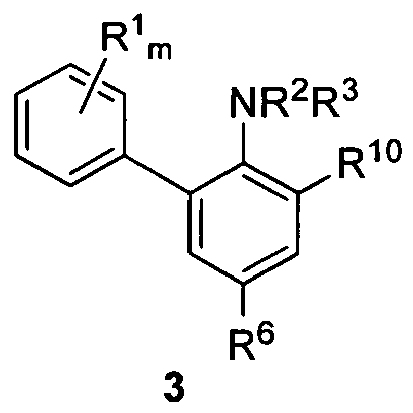


- m
- für 0, 1, 2, 3, 4 oder 5 steht;
- jedes R1
- jeweils unabhängig für Halogen, Alkyl, Haloalkyl, Hydroxy, Hydroxyalkyl, Alkoxy, Haloalkoxy, Alkylthio, Cycloalkyl, Haloalkylthio, Alkenyl, Alkinyl, Amino, Nitro, Cyano, -SO3R5, -SO2NH2, -SO2NHR4, -SO2NR4R5, -COOR4, -CONHR4, -CONR4R5, -COR4, -OCOR4,-NR4R5, -NR4COR5, -NR4SO2R5, Alkylcarbonyl, Haloalkylcarbonyl, Alkenylcarbonyl, Alkoxycarbonyl, Haloalkoxycarbonyl, Alkenyloxycarbonyl, Alkylsulfonyl, Haloalkylsulfonyl, Alkylimino, Aryl, Aryloxy, Arylcarbonyl, Arylalkyl, Heteroarylalkyl, Arylalkoxycarbonyl, Arylalkylimino oder Heteroaryl steht;
- X-
- fiir Halogenid, Hydrogensulfat, Sulfat, Tetrafluoroborat, Acetat, Trifluoracetat, Hexafluorophosphat, Hexafluoroantimonat, das Anion eines aromatischen 1,2-Dicarbonsäureimids oder das Anion eines aromatischen 1,2-Disulfonsäureimids steht;
- R2 und R3
- jeweils unabhängig für Wasserstoff, Alkyl, Hydroxyalkyl, Aminoalkyl, Cycloalkyl, Haloalkyl, -(CH2)n-OR4, -(CH2)n-NR4R5, -(CH2)n-NR4COR5, -(CH2)n-NR4COOR5, -(CH2)n-COOR4, -(CH2)n-CONHR4, -(CH2)n-CONR4R5, -(CH2)n-SO3R4, -(CH2)n-CN, Arylalkyl, Heteroarylalkyl, Aryl oder Heteroaryl steht, oder ein R2 und ein R3 zusammen einen Alkylidenrest bilden, oder ein R2 und ein R3 zusammen ein nichtaromatisches Ringsystem bilden, welches 4, 5, 6, oder 7 Ringatome enthält, ausgewählt aus O, S, N und Kohlenstoffatomen, vorzugsweise mit Kohlenstoffatomen, oder ein R2 und ein R10 zusammen ein nichtaromatisches Ringsystem bilden, welches 4, 5, 6, oder 7 Ringatome enthält, ausgewählt aus O, S, N und Kohlenstoffatomen, vorzugsweise mit Kohlenstoffatomen, oder ein R3 und ein R10 zusammen ein nichtaromatisches Ringsystem bilden, welches 4, 5, 6, oder 7 Ringatome enthält, ausgewählt aus O, S, N und Kohlenstoffatomen, vorzugsweise mit Kohlenstoffatomen;
- n
- jeweils unabhängig für 1, 2, 3, 4, 5, 6, 7, 8, 9 oder 10 steht;
- R4
- jeweils unabhängig für Wasserstoff, Alkyl, Cycloalkyl, Haloalkyl, Arylalkyl, Heteroarylalkyl, Aryl oder Heteroaryl steht;
- R5
- jeweils unabhängig für Wasserstoff, Alkyl, Cycloalkyl, Haloalkyl, Arylalkyl, Heteroarylalkyl, Aryl oder Heteroaryl steht;
- R6
- jeweils unabhängig für Wasserstoff, Halogen, Alkyl, Alkenyl, Alkinyl, Cycloalkyl, Arylalkyl, Heteroarylalkyl, Haloalkyl, Hydroxyalkyl, Alkoxyalkyl, Aryloxyalkyl, Heteroaryloxyalkyl, Aminoalkyl, -(CH2)n-NR4R5, -COOH, -CHO, -CN, -COR4, Alkylcarbonyl, Haloalkylcarbonyl, Cycloalkylcarbonyl, Arylalkylcarbonyl, Alkenylcarbonyl, Arylcarbonyl, Heteroarylcarbonyl, -COOR4, Alkoxycarbonyl, Haloalkoxycarbonyl, Cycloalkoxycarbonyl, Arylalkoxycarbonyl, Alkenyloxycarbonyl, Aryloxycarbonyl, Heteroaryloxycarbonyl, -CONHR4, -CONR4R5, Amino, Nitro, -NHR4, -NR4R5, 1-Pyrrolidino, 1-Piperidino, 1-Morpholino, Alkylimino, Cycloalkylimino, Haloalkylimino, Arylalkylimino, -NR4COR5, NR4COOR5, -NR4SO2R5, Hydroxy, Alkoxy, Haloalkoxy, Cycloalkoxy, Arylalkyloxy, Aryloxy, Heteroaryloxy, -OCOR4, Alkylcarbonyloxy, Haloalkylcarbonyloxy, Cycloalkylcarbonyloxy, Arylalkylcarbonyloxy, Arylcarbonyloxy, Heteroarylcarbonyloxy, -OCONR4R5, -O-(CH2)n-OR4, -O-(CH2)n-NR4R5, -O-(CH2)n-NR4COR5, -O-(CH2)n-NR4COOR5, -O-(CH2)n-COOR4, -O-(CH2)n-CONHR4, -O-(CH2)n-CONR4R5, -O-(CH2)n-SO3R4, -O-(CH2)n-SO2R4, -O-(CH2)n-CN, -SH, Alkylthio, Haloalkylthio, Cycloalkylthio, Arylalkylthio, Arylthio, Heteroarylthio, Alkylsulfonyl, Haloalkylsulfonyl, Cycloalkylsulfonyl, Arylalkylsulfonyl, Arylsulfonyl, Heteroarylsulfonyl, -SO2NH2, -SO2NHR4, -SO2NR4R5, -SO3R5, Aryl oder Heteroaryl steht;
- R10
- jeweils unabhängig für Wasserstoff, Halogen, Alkyl, Haloalkyl, Hydroxyalkyl, Cycloalkyl, Arylalkyl, Heteroarylalkyl, -(CH2)q-NR4R5, -(CH2)q-NR4COR5, -(CH2)q-NR4COOR5, -(CH2)q-COOR4, -(CH2)q-CONHR4, -(CH2)q-CONR4R5, -(CH2)q-SO3R4, -(CH2)q-CN, Aryl oder Heteroaryl steht;
- q
- jeweils unabhängig für 1, 2, 3, 4, oder 5 steht,
- Im Besonderen wird ein Verfahren zur Synthese von substituierten 2-Aminobiphenylen der Struktur 3 durch Umsetzung von substituierten Aryldiazoniumsalzen der Struktur 1 mit substituierten Anilinverbindungen der Struktur 2 beschrieben.

- Als Zwischenprodukte entstehen dabei im basischen Bereich vorzugsweise Verbindungen der Formeln 1a und/oder 1b und/oder 1c:

- Dabei sind die Reste wie oben definiert. Das Gegenanion von Verbindung 1a hängt dabei von der verwendeten Base ab. Bevorzugte Gegenanionen sind Na+ und K+.
- Die Vorliegende Erfindung betrifft somit weiterhin ein Verfahren zur Herstellung einer Verbindung der Formel 3


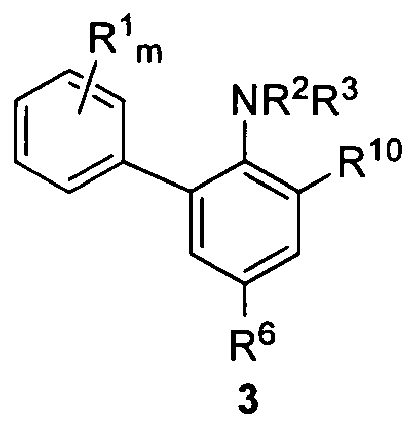
- Die Verbindungen der Struktur 3 können beispielsweise als Zwischenprodukte zur Herstellung biologisch aktiver Verbindungen verwendet werden.
- Ein Beispiel ist das Pflanzenschutzmittel der Struktur 5, das nach bekannten Verfahren aus einer Verbindung der Struktur 4 gewonnen werden kann (
US 2010174094A1 ,WO 2006024388A1 ,US 2008269263A1 ,US 2010069646A1 ). Metallorganische Synthesen der Verbindung der Struktur 4, die allerdings deutlich teurere Ausgangsmaterialien benötigen als das im Folgenden vorgestellte erfindungsgemäße Verfahren, sind ebenfalls kürzlich beschrieben worden. (WO2007138089A1 ,US2010185015A1 )

- Ausgehend von der Verbindung der Struktur 6 kann z. B. ein γ-Sekretase-Inhibitor der Struktur 7 (LY411575) hergestellt werden (X. Pan, C. S. Wilcox, J. Org. Chem. 2010, 75, 6445-6451).
- Des Weiteren wird ein Verfahren zur Synthese einer Verbindung der Formel 9 beschrieben, dadurch gekennzeichnet, dass in einem ersten Schritt eine Verbindung der Formel 1 mit einer Verbindung der Formel 2, wobei R2 und R3 = H, zu einer Verbindung der Formel 3, wobei R2 und R3 = H, (vorzugsweise wie oben beschrieben) umgesetzt wird und in einem weiteren Schritt die Verbindung der Formel 3 in eine Verbindung der Formel 8 überführt wird. Die Herstellung von divers funktionalisierten Verbindungen der Formel 8 gelingt unter den unten genauer ausgeführten Bedingungen zur Diazotierung aromatischer Amine.
- In einem weiteren Schritt werden die Verbindungen der Formel 8 nach literaturbekannten Verfahren in Verbindungen der Formel 9 überführt. Die reduktive Deaminierung zu 9 (R11 = H) kann unter verschiedensten Reaktionsbedingungen durchgeführt werden (z.B. in A. Wetzel, V. Ehrhardt, M. R. Heinrich, Angew. Chem. Int. Ed. 2008, 47, 9130-9133). Alternativ sind Halogenverbindungen, Thiole, Thioether und Nitrile der Formel 9 (R11= -SH, -SAlkyl, -SHaloalkyl, -SAryl, -SHeteroaryl, Halogen, Cyano) unter den Bedingungen der Sandmeyer-Reaktion zugänglich (F. Minisci, F. Fontana, E. Vismara, Gazz. Chim. Ital. 1993, 123, 9-18). Umsetzungen von 8 unter den Bedingungen der Heck-Reaktion liefern alkenylsubstituierte Verbindungen der Formel 9 (R11 = -CR14=CR15-COOH, -CR14=CR15-COOAlkyl, -CR14=CR15-COOHaloalkyl, -CR14=CR15-CN) (S. Sengupta, S. Bhattacharya, J. Chem. Soc. Perkin Trans 1, 1993, 17, 1943). Reaktionsbedingungen für die Umsetzungen von Verbindungen der Formel 8 mit aromatischen Substraten unter Erhalt von Verbindungen der Formel 9 (R11 = Aryl, Heteroaryl) werden in der Einleitung und in den folgenden Ausführungen vielfach beschrieben.
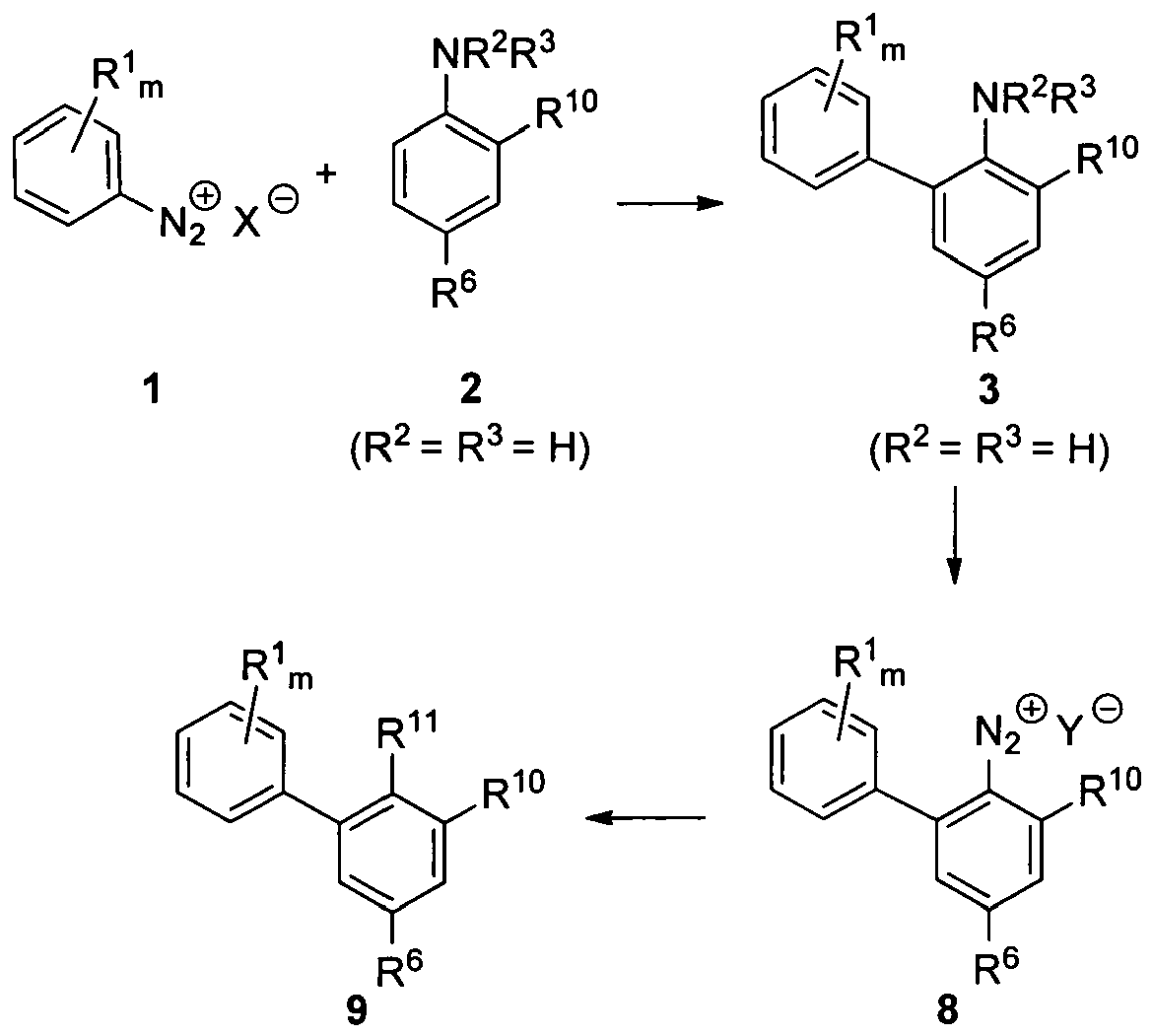
- Dabei stehen
- R11
- für Wasserstoff, -OH, -SH, -SAlkyl, -SHaloalkyl, -SCycloalkyl, -S-(CH2)q-Aryl, -S-(CH2)q-Heteroaryl, -SAryl, -SHeteroaryl, Halogen, Cyano, -CR14=CR15-COOH -CR14=CR15-COOAlkyl, -CR14=CR15-COOHaloalkyl, -CR14=CR15-CN, -CR14=CR15-Aryl, -CR14=CR15-Heteroaryl, -SO2R4, Aryl oder Heteroaryl;
- R14
- für Wasserstoff, Alkyl oder Haloalkyl;
- R15
- für Wasserstoff, Alkyl, Haloalkyl, -COOH, -COOAlykl, -COOHaloalkyl, Cyano, Aryl, Heteroaryl, -NHCOAlkyl oder -NHCOOAlkyl;
- Y-
- für Halogenid, Hydrogensulfat, Sulfat, Tetrafluoroborat, Acetat, Trifluoracetat, Hexa-fluorophosphat, Hexafluoroantimonat, das Anion eines aromatischen 1,2-Dicarbonsäureimids oder das Anion eines aromatischen 1,2-Disulfonsäureimids;
- Im Rahmen der vorliegenden Erfindung haben die generisch verwendeten Begriffe die folgenden Bedeutungen:
- Das Präfix Cx-Cy bezeichnet im jeweiligen Fall die Anzahl möglicher Kohlenstoffatome.
- Der Begriff "Halogen" bezeichnet jeweils Fluor, Brom, Chlor oder Iod, speziell Fluor, Chlor oder Brom, besonders bevorzugt Fluor oder Chlor.
- Der Begriff "Alkyl" bezeichnet einen linearen oder verzweigten gesättigten Alkylrest, umfassend 1 bis 20 Kohlenstoffatome, wie Methyl, Ethyl, Propyl, 1-Methylethyl (Isopropyl), Butyl, 1-Methylpropyl (sec-Butyl), 2-Methylpropyl (Isobutyl), 1,1-Dimethylethyl (tert-Butyl), Pentyl, Hexyl, Heptyl, Octyl, 2-Ethylhexyl, Nonyl, Decyl oder 2-Propylheptyl und Stellungsisomere davon, bevorzugt Methyl, Ethyl oder Propyl.
- Der Begriff "Haloalkyl", wie hierin und in den Haloalkyleinheiten von Haloalkoxy verwendet, beschreibt geradkettige oder verzweigte gesättigte Alkylgruppen mit 1 bis 10 Kohlenstoffatomen, wobei die Wasserstoffatome dieser Gruppen teilweise oder vollständig durch Halogenatome ersetzt sind. Beispiele hierfür sind Chlormethyl, Brommethyl, Dichlormethyl, Trichlormethyl, Fluormethyl, Difluormethyl, Trifluormethyl, Chlorofluormethyl, Dichlorfluormethyl, Chlordifluormethyl, 1-Chlorethyl,1-Bromethyl, 1-Fluorethyl, 2-Fluorethyl, 2,2-Difluorethyl, 2,2,2-Trifluorethyl, 2-Chlor-2-fluorethyl, 2-Chlor-2,2-difluorethyl, 2,2 Dichlor-2-fluorethyl, 2,2,2-Trichlorethyl, Pentafluorethyl, 3,3,3-Trifluorprop-1-yl, 1,1,1-Trifluorprop-2-yl, 3,3,3-Trichlorprop-1-yl, Heptafluorisopropyl, 1-Chlorbutyl, 2-Chlorbutyl, 3-Chlorbutyl, 4-Chlorbutyl, 1-Fluorbutyl, 2-Fluorbutyl, 3-Fluorbutyl, 4-Fluorbutyl und dergleichen, bevorzugt Fluormethyl, 2-Fluorethyl oder Trifluormethyl.
- Der Begriff "Alkyliden" oder "Alkylen" bezeichnet über eine Doppelbindung gebundene Alkylreste, wobei der Alkylrest gegebenenfalls 1, 2 oder 3 Substituenten trägt, die ausgewählt sind unter Halogen, Alkyl, Haloalkyl, Cycloalkyl, Alkoxy, Haloalkoxy. Beispiele sind Methyliden (=CH2), Ethyliden (=CHCH3), 1-Propyliden (=CHCH2CH3) oder 2-Propyliden [=C(CH3)2].
- Der Begriff "Cycloalkyliden" oder "Cycloalkylen" bezeichnet über eine Doppelbindung gebundene Cycloalkylreste, wobei der Cycloalkylrest gegebenenfalls 1, 2 oder 3
- Substituenten trägt, die ausgewählt sind unter Halogen, Alkyl, Haloalkyl, Cycloalkyl, Alkoxy, Haloalkoxy. Beispiele sind Cyclopentyliden, Cyclohexyliden oder Cycloheptyliden.
- Der Begriff "Haloalkyliden" oder "Haloalkylen" bezeichnet über eine Doppelbindung gebundene Haloalkylreste. Beispiele sind Fluormethylen (=CHF), 2-Chlorethyliden (=CH-CH2C1), 3-Brom-1-propyliden (=CH2-CH2-CH2Br).
- Der Begriff "Arylalkyliden" oder "Arylalkylen" bezeichnet über eine Alkylideneinheit gebundene Arylreste, wobei die Arylgruppe gegebenenfalls 1, 2, 3, 4 oder 5 Substituenten trägt, die ausgewählt sind unter Halogen, Alkyl, Haloalkyl, Alkoxy oder Haloalkoxy. Beispiele sind Benzyliden (=CH-Phenyl), 1-Naphthyliden (=CH-Naphthyl) oder =CH-CH2-Phenyl.
- Der Begriff "Alkenyl" bezeichnet einen einfach ungesättigten, linearen oder verzweigten aliphatischen Rest mit 3 bis 8 Kohlenstoffatomen. Beispiele hierfür sind Propen-1-yl, Propen-2-yl (Allyl), But-1-en-1-yl, But-1-en-2-yl, But-1-en-3-yl, But-1-en-4-yl, But-2-en-1-yl, But-2-en-2-yl, But-2-en-4-yl, 2-Methylprop-1-en-1-yl, 2-Methylprop-2-en-1-yl und dergleichen, bevorzugt Propenyl oder But-1-en-4-yl.
- Der Begriff "Cycloalkyl" bezeichnet einen gesättigten alicyclischen Rest mit 3 bis 10 Kohlenstoffatomen als Ringglieder. Beispiele sind Cyclopropyl, Cyclobutyl, Cyclopentyl, Cyclohexyl, Cycloheptyl, Cyclooctyl, Cyclononyl und Cyclodecyl. Die Cycloalkylreste können 1, 2 oder 3 Substituenten tragen, die ausgewählt sind unter Alkyl, Alkoxy oder Halogen, bevorzugt Cyclopropyl, Cyclobutyl, Cyclopentyl oder Cyclohexyl.
- Der Begriff "Alkoxy" bezeichnet geradkettige oder verzweigte gesättigte Alkylgruppen, umfassend 1 bis 10 Kohlenstoffatome, die über ein Sauerstoffatom gebunden sind, wobei der Alkylrest gegebenenfalls 1, 2 oder 3 Substituenten trägt, die ausgewählt sind unter Halogen, Alkyl, Haloalkyl, Cycloalkyl, Alkoxy, Haloalkoxy. Beispiele für Alkoxy sind Methoxy, Ethoxy, n-Propoxy, 1-Methylethoxy (Isopropoxy), n-Butoxy, 1-Methylpropoxy (sec-Butoxy), 2-Methylpropoxy (Isobutoxy) und 1,1-Dimethylethoxy (tert-Butoxy), bevorzugt Methoxy, Ethoxy, n-Propoxy, oder -OCH2-cyclo-Pentyl.
- Der Begriff "Haloalkoxy" beschreibt geradkettige oder verzweigte gesättigte Haloalkylgruppen, umfassend 1 bis 10 Kohlenstoffatome, die über ein Sauerstoffatom gebunden sind. Beispiele hierfür sind Chlormethoxy, Brommethoxy, Dichlormethoxy, Trichlormethoxy, Fluormethoxy, Difluormethoxy, Trifluormethoxy, Chlorofluormethoxy, Dichlorfluormethoxy, Chlordifluormethoxy, 1-Chlorethoxy, 1-Bromethoxy, 1-Fluorethoxy, 2-Fluorethoxy, 2,2-Difluorethoxy, 2,2,2-Trifluorethoxy, 2-Chlor-2-fluorethoxy, 2-Chlor-2,2-difluorethoxy, 2,2-Dichlor-2-fluorethoxy, 2,2,2-Trichlorethoxy, 1,1,2,2-Tetrafluorethoxy, 1-Chlor-1,2,2-trifluorethoxy, Pentafluorethoxy, 3,3,3-Trifluorprop-1-oxy, 1,1,1-Trifluorprop-2-oxy, 3,3,3-Trichlorprop-1-oxy, 1-Chlorbutoxy, 2-Chlorbutoxy, 3-Chlorbutoxy, 4-Chlorbutoxy, 1-Fluorbutoxy, 2-Fluorbutoxy, 3-Fluorbutoxy, 4-Fluorbutoxy und dergleichen, bevorzugt sind Fluormethoxy, Difluormethoxy oder Trifluormethoxy.
- Der Begriff "Cycloalkoxy" bezeichnet einen Cycloalkylrest mit 3 bis 10 Kohlenstoffatomen als Ringglieder, die über ein Sauerstoffatom gebunden sind. Beispiele sind Cyclopropyloxy, Cyclobutyloxy, Cyclopentyloxy, Cyclohexyloxy, Cycloheptyloxy, Cyclooctyloxy, Cyclononyloxy und Cyclodecyloxy. Die Cycloalkylreste können 1, 2 oder 3 Substituenten tragen, die ausgewählt sind unter Alkyl und Halogen. Bevorzugte Cycloalkoxyreste sind Cyclopropyloxy, Cyclobutyloxy, Cyclopentyloxy oder Cyclohexyloxy.
- Der Begriff "Alkylcarbonyl" bezeichnet über eine Carbonylgruppe gebundene Alkylreste mit 1 bis 10 Kohlenstoffatomen, wobei der Alkylrest gegebenenfalls 1, 2 oder 3 Substituenten trägt, die ausgewählt sind unter Halogen, Alkyl, Haloalkyl, Cycloalkyl, Alkoxy, Haloalkoxy. Beispiele hierfür sind Methylcarbonyl (Acetyl), Ethylcarbonyl, Propylcarbonyl, Isopropylcarbonyl, n-Butylcarbonyl, sec-Butylcarbonyl, Isobutylcarbonyl und tert-Butylcarbonyl, bevorzugt Methylcarbonyl oder Ethylcarbonyl.
- Der Begriff "Haloalkylcarbonyl" bezeichnet über eine Carbonylgruppe gebundene Haloalkylreste mit 1 bis 10 Kohlenstoffatomen. Beispiele hierfür sind Fluormethylcarbonyl, Difluormethylcarbonyl, Trifluormethylcarbonyl, 1-Fluorethylcarbonyl, 2-Fluorethylcarbonyl, 1,1-Difluorethylcarbonyl, 2,2-Difluorethylcarbonyl, 2,2,2-Trifluorethylcarbonyl, Pentafluorethylcarbonyl und dergleichen, bevorzugt sind Fluormethylcarbonyl, Difluormethylcarbonyl oder Trifluormethylcarbonyl.
- Der Begriff "Alkylcarbonyloxy" bezeichnet über eine Carbonyloxygruppe gebundene Alkylreste mit 1 bis 10 Kohlenstoffatomen, wobei der Alkylrest gegebenenfalls 1, 2 oder 3 Substituenten trägt, die ausgewählt sind unter Halogen, Alkyl, Haloalkyl, Cycloalkyl, Alkoxy, Haloalkoxy. Beispiele hierfür sind Methylcarbonyloxy (Acetoxy), Ethylcarbonyloxy, Propylcarbonyloxy und Isopropylcarbonyloxy, bevorzugt Methylcarbonyloxy oder Ethylcarbonyloxy.
- Der Begriff "Haloalkylcarbonyloxy "bezeichnet über eine Carbonyloxygruppe gebundene Haloalkylreste mit 1 bis 10 Kohlenstoffatomen. Beispiele hierfür sind Fluormethylcarbonyloxy, Difluormethylcarbonyloxy, Trifluormethylcarbonyloxy, 1-Fluorethylcarbonyloxy, 2-Fluorethylcarbonyloxy, 1,1-Difluorethylcarbonyloxy, 2,2-Difluorethylcarbonyloxy, 2,2,2-Trifluorethylcarbonyloxy, Pentafluorethylcarbonyloxy und dergleichen, bevorzugt sind Fluormethylcarbonyloxy, Difluormethylcarbonyloxy oder Trifluormethylcarbonyloxy.
- Der Begriff "Alkenylcarbonyl" bezeichnet über eine Carbonylgruppe gebundene Alkenylreste mit 3 bis 6 Kohlenstoffatomen, wobei der Alkenylrest gegebenenfalls 1, 2 oder 3 Substituenten trägt, die ausgewählt sind unter Halogen, Alkyl, Haloalkyl, Cycloalkyl, Alkoxy, Haloalkoxy. Beispiele hierfür sind Propen-1-ylcarbonyl, Propen-2-ylcarbonyl (Allylcarbonyl), But-1-en-1-ylcarbonyl, But-1-en-2-ylcarbonyl, But-1-en-3-ylcarbonyl, But-1-en-4-ylcarbonyl, But-2-en-1-ylcarbonyl, But-2-en-2-ylcarbonyl, But-2-en-4-ylcarbonyl, 2-Methylprop-1-en-1-ylcarbonyl, 2-Methylprop-2-en-1-ylcarbonyl und dergleichen, bevorzugt sind Propen-1-ylcarbonyl, Propen-2-ylcarbonyl oder But-1-en-4-ylcarbonyl.
- Der Begriff "Alkoxycarbonyl" bezeichnet über eine Carbonylgruppe gebundene Alkoxyreste mit 1 bis 10 Kohlenstoffatomen, wobei der Alkylrest gegebenenfalls 1, 2 oder 3 Substituenten trägt, die ausgewählt sind unter Halogen, Alkyl, Haloalkyl, Cycloalkyl, Alkoxy, Haloalkoxy. Beispiele hierfür sind Methoxycarbonyl, Ethoxycarbonyl, Propoxycarbonyl, Isopropoxycarbonyl, n-Butoxycarbonyl, sec-Butoxycarbonyl, Isobutoxycarbonyl und tert-Butoxycarbonyl, bevorzugt sind Methoxycarbonyl, Ethoxycarbonyl, Propoxycarbonyl oder Isopropoxycarbonyl.
- Der Begriff "Haloalkoxycarbonyl" bezeichnet über eine Carbonylgruppe gebundene Haloalkoxyreste mit 1 bis 10 Kohlenstoffatomen. Beispiele hierfür sind Fluormethoxycarbonyl, Difluormethoxycarbonyl, Trifluormethoxycarbonyl, 1-Fluorethoxycarbonyl, 2-Fluorethoxycarbonyl, 1,1-Difluorethoxycarbonyl, 2,2-Difluorethoxycarbonyl, 2,2,2-Trifluorethoxycarbonyl, Pentafluorethoxycarbonyl und dergleichen, bevorzugt sind Fluormethoxycarbonyl, Difluormethoxycarbonyl oder Trifluormethoxycarbonyl.
- Der Begriff "Alkenyloxycarbonyl" bezeichnet Alkenyloxyreste mit 3 bis 8 Kohlenstoffatomen, die über eine Carbonylgruppe gebunden sind, wobei der Alkenylrest gegebenenfalls 1, 2 oder 3 Substituenten trägt, die ausgewählt sind unter Halogen, Alkyl, Haloalkyl, Cycloalkyl, Alkoxy, Haloalkoxy. Beispiele hierfür sind Allyloxycarbonyl und Methallyloxycarbonyl, bevorzugt Allyloxycarbonyl.
- Der Begriff "Alkylsulfonyl" bezeichnet über eine Sulfonylgruppe (SO2) gebundene Alkylreste mit 1 bis 10 Kohlenstoffatomen, wobei der Alkylrest gegebenenfalls 1, 2 oder 3 Substituenten trägt, die ausgewählt sind unter Halogen, Alkyl, Haloalkyl, Cycloalkyl, Alkoxy, Haloalkoxy. Beispiele hierfür sind Methylsulfonyl, Ethylsulfonyl, Propylsulfonyl, Isopropylsulfonyl, n-Butylsulfonyl, sec-Butylsulfonyl, Isobutylsulfonyl und tert-Butylsulfonyl, bevorzugt Methylsulfonyl, Ethylsulfonyl, Propylsulfonyl oder Isopropylsulfonyl.
- Der Begriff "Haloalkylsulfonyl" bezeichnet über eine Sulfonylgruppe (SO2) gebundene Haloalkylreste mit 1 bis 10 Kohlenstoffatomen. Beispiele hierfür sind Fluormethylsulfonyl, Difluormethylsulfonyl, Trifluormethylsulfonyl, 1-Fluorethylsulfonyl, 2-Fluorethylsulfonyl, 1,1-Difluorethylsulfonyl, 2,2-Difluorethylsulfonyl, 2,2,2-Trifluorethylsulfonyl, Pentafluorethylsulfonyl und dergleichen, bevorzugt Fluormethylsulfonyl, Difluormethylsulfonyl oder Trifluormethylsulfonyl.
- Der Begriff "Aryl", wie hierin und beispielsweise in den Arylalkyleinheiten von Arylalkyl verwendet, bezeichnet carbocyclische aromatische Reste mit 6 bis 14 Kohlenstoffatomen, wobei die Arylgruppe gegebenenfalls 1, 2, 3, 4 oder 5 Substituenten trägt, die ausgewählt sind unter Halogen, Cyano, Nitro, Alkyl, Haloalkyl, Alkoxy, Alkoxycarbonyl oder Haloalkoxy. Beispiele hierfür umfassen Phenyl, 4-Chlorphenyl, 4-Methoxyphenyl, Naphthyl, Fluorenyl, Azulenyl, Anthracenyl und Phenanthrenyl. Bevorzugt steht Aryl für Phenyl oder Naphthyl und insbesondere Phenyl.
- Der Begriff "Heteroaryl", wie hierin und beispielsweise in den Heteroarylalkyleinheiten von Heteroarylalkyl verwendet, bezeichnet aromatische Reste mit 1 bis 4 Heteroatomen, die ausgewählt sind unter O, N, S und SO2, wobei die Heteroarylgruppe gegebenenfalls 1, 2, 3 oder 4 Substituenten trägt, die ausgewählt sind unter Halogen, Nitro, Cyano, Alkyl, Haloalkyl, Alkoxy, Alkoxycarbonyl oder Haloalkoxy. Beispiele hierfür sind 5- und 6- gliedrige Heteroarylreste mit 1, 2, 3 oder 4 Heteroatomen ausgewählt unter O, N, S und SO2 wie Pyrrolyl, 5-Methyl-2-pyrrolyl, Furanyl, 3-Methyl-2-furanyl, Thienyl, Pyrazolyl, Imidazolyl, Oxazolyl, Isoxazolyl, Thiazolyl, Isothiazolyl, Triazolyl, Tetrazolyl, Pyridyl, Pyrazinyl, Pyridazinyl, Pyrimidyl oder Triazinyl.
- Der Begriff "Arylcarbonyl" bezeichnet Arylreste, die über eine Carbonylgruppe gebunden sind, wobei die Arylgruppe gegebenenfalls 1, 2, 3, 4 oder 5 Substituenten trägt, die ausgewählt sind unter Halogen, Alkyl, Haloalkyl, Alkoxy oder Haloalkoxy. Beispiele hierfür sind Phenylcarbonyl, 4-Nitrophenylcarbonyl, 2-Methoxyphenylcarbonyl, 4-Chlorphenylcarbonyl, 2,4-Dichlorphenylcarbonyl, 4-Nitrophenylcarbonyl oder Naphthylcarbonyl, bevorzugt Phenylcarbonyl.
- Der Begriff "Arylalkyl" bezeichnet Arylreste, die über eine Alkylgruppe gebunden sind, wobei der Alkylrest gegebenenfalls 1, 2 oder 3 Substituenten trägt, die ausgewählt sind unter Halogen, Alkyl, Haloalkyl, Cycloalkyl, Alkoxy, Haloalkoxy, und wobei die Arylgruppe gegebenenfalls 1, 2, 3, 4 oder 5 Substituenten trägt, die ausgewählt sind unter Halogen, Alkyl, Haloalkyl, Alkoxy oder Haloalkoxy. Beispiele hierfür sind 4-Methoxybenzyl, Benzyl, 2-Phenylethyl (Phenethyl) und dergleichen, bevorzugt Benzyl und Phenethyl.
- Der Begriff "Alkylimino" bezeichnet einen Rest der Formel -N=R, der über den Stickstoff gebunden ist, worin R für Alkylen steht, wie =CH2, =CHCH3, =CHCH2CH3, =C(CH3)2, =CHCH2CH2CH3, =C(CH3)CH2CH3 oder =CHCH(CH3)2. Der Alkylenrest von "Alkylimino" trägt gegebenenfalls 1, 2 oder 3 Substituenten, die ausgewählt sind unter Halogen, Alkyl, Haloalkyl, Cycloalkyl, Alkoxy, Haloalkoxy.
- Der Begriff "Arylalkylimino" bezeichnet einen Rest der Formel -N=R, der über den Stickstoff gebunden ist, worin R für Arylalkylen, wie Benzyliden (R = CH-Phenyl) steht. Die Arylgruppe in "Arylalkylimino" kann gegebenenfalls 1, 2, 3, 4 oder 5 Substituenten tragen, die ausgewählt sind unter Halogen, Alkyl, Haloalkyl, Alkoxy oder Haloalkoxy.
- Der Begriff "Hydroxyalkyl" bezeichnet einen über eine Alkylgruppe gebundene Hydroxygruppe, wobei die Alkylgruppe gegebenenfalls 1, 2 oder 3 Substituenten trägt, die ausgewählt sind unter Halogen, Alkyl, Haloalkyl, Cycloalkyl, Alkoxy, Haloalkoxy. Beispiele sind -CH2OH, -(CH2)2OH oder -(CH2)3OH.
- Der Begriff "Alkinyl" bezeichnet einen in Form einer Kohlenstoff-Kohlenstoff-Dreifachbindung zweifach ungesättigten, linearen oder verzweigten aliphatischen Rest mit 3 bis 8 Kohlenstoffatomen. Beispiele hierfür sind Propin-3-yl, But-1-in-1-yl, But-1-in-3-yl, But-1-in-4-yl, But-2-in-1-yl, But-2-in-4-yl und dergleichen, bevorzugt Propin-3-yl oder But-1-in-4-yl.
- Der Begriff "Heteroarylalkyl" bezeichnet Heteroarylreste, die über eine Alkylgruppe gebunden sind, wobei der Alkylrest gegebenenfalls 1, 2 oder 3 Substituenten trägt, die ausgewählt sind unter Halogen, Alkyl, Haloalkyl, Cycloalkyl, Alkoxy, Haloalkoxy, und wobei die Heteroarylgruppe gegebenenfalls 1, 2, 3 oder 4 Substituenten trägt, die ausgewählt sind unter Halogen, Alkyl, Haloalkyl, Alkoxy oder Haloalkoxy. Beispiele hierfür sind 4-Pyridylmethyl, 1-(4-Pyridyl)ethyl, 2-(4-Pyridyl)ethyl, 2-Furanylmethyl, 1-(2-Furanyl)ethyl, 2-(2-Furanyl)ethyl und dergleichen, bevorzugt 4-Pyridyhmethyl.
- Der Begriff "Alkoxyalkyl" bezeichnet über eine Alkylgruppe gebundene Alkoxyreste mit 1 bis 10 Kohlenstoffatomen, wobei die Alkylreste gegebenenfalls 1, 2 oder 3 Substituenten trägt, die ausgewählt sind unter Halogen, Alkyl, Haloalkyl, Cycloalkyl, Alkoxy, Haloalkoxy. Beispiele hierfür sind Methoxymethyl, Ethoxymethyl, n-Propoxymethyl, Isopropoxymethyl, n-Butoxymethyl, sec-Butoxymethyl, Isobutoxymethyl, tert-Butoxymethyl, Methoxyethyl, Ethoxyethyl, Propoxyethyl, Isopropoxyethyl, n-Butoxyethyl, sec-Butoxyethyl, Isobutoxyethyl, tert-Butoxyethyl und dergleichen, bevorzugt sind Methoxymethyl, Ethoxymethyl, n-Propoxymethyl, Isopropoxymethyl, Methoxyethyl, Ethoxyethyl, Propoxyethyl oder Isopropoxyethyl.
- Der Begriff "Aryloxyalkyl" bezeichnet über eine Alkylgruppe gebundene Aryloxyreste mit 6 bis 14 Kohlenstoffatomen, wobei der Alkylrest gegebenenfalls 1, 2 oder 3 Substituenten trägt, die ausgewählt sind unter Halogen, Alkyl, Haloalkyl, Cycloalkyl, Alkoxy, Haloalkoxy. Die Arylgruppe in "Aryloxyalkyl" trägt gegebenenfalls 1, 2, 3, 4 oder 5 Substituenten, die ausgewählt sind unter Halogen, Alkyl, Haloalkyl, Alkoxy oder Haloalkoxy. Beispiele hierfür sind Phenoxymethyl, Phenoxyethyl, Phenoxypropyl, Phenoxybutyl, 1-Naphtyloxymethyl, 1-(1-Naphtyloxy)ethyl, 2-(1-Naphtyloxy)ethyl, 1-(1-Naphtyloxy)propyl, 2-(1-Naphtyloxy)propyl, 3-(1-Naphtyloxy)propyl und dergleichen, bevorzugt sind Phenoxymethyl und Phenoxyethyl.
- Der Begriff "Heteroaryloxyalkyl" bezeichnet über eine Alkylgruppe gebundene Heteroaryloxyreste mit 1 bis 4 Heteroatomen, die ausgewählt sind unter O, N, S und SO2, wobei der Alkylrest gegebenenfalls 1, 2 oder 3 Substituenten trägt, die ausgewählt sind unter Halogen, Alkyl, Haloalkyl, Cycloalkyl, Alkoxy, Haloalkoxy. Die Heteroarylgruppe in "Heteroaryloxyalkyl" trägt gegebenenfalls 1, 2, 3 oder 4 Substituenten, die ausgewählt sind unter Halogen, Alkyl, Haloalkyl, Alkoxy oder Haloalkoxy. Beispiele hierfür sind 4-Pyridyloxymethyl, 1-(4-Pyridyloxy)ethyl, 2-(4-Pyridyloxy)ethyl, 1-(4-Pyridyloxy)propyl, 2-(4-Pyridyloxy)propyl, 3-(4-Pyridyloxy)propyl, 2-Furanyloxymethyl, 1-(2-Furanyloxy)ethyl, 2-(2-Furanyloxy)ethyl, 1-(2-Furanyloxy)propyl, 2-(2-Furanyloxy)propyl, 3-(2-Furanyloxy)propyl und dergleichen, bevorzugt sind 4-Pyridyloxymethyl oder 1-(4-Pyridyloxy)ethyl.
- Der Begriff "Aminoalkyl" bezeichnet einen über eine Alkylgruppe gebundenen -NH2-Rest, wobei die Alkylgruppe gegebenenfalls 1, 2 oder 3 Substituenten trägt, die ausgewählt sind unter Halogen, Alkyl, Haloalkyl, Cycloalkyl, Alkoxy, Haloalkoxy. Beispiele hiefür sind Aminomethyl [-CH2NH2], Aminoethyl [-(CH2)2NH2] und dergleichen, bevorzugt sind -CH2NH2, -(CH2)2NH2 oder -(CH2)3NH2.
- Der Begriff "Alkylaminoalkyl" bezeichnet einen über eine Alkylgruppe gebundenen -NHR4 oder -NR4R5 -Rest, wobei R4 und R5 wie oben definiert sind und die Alkylgruppe gegebenenfalls 1, 2 oder 3 Substituenten trägt, die ausgewählt sind unter Halogen, Alkyl, Haloalkyl, Cycloalkyl, Alkoxy, Haloalkoxy. Beispiele sind Methylaminomethyl [-CH2-NH-CH3], N,N-Dimethylaminomethyl [-CH2-N(CH3)2], N,N-Dimethylaminoethyl [-(CH2)2-N(CH3)2] und dergleichen, bevorzugt -CH2-N(CH3)2 oder -(CH2)2-N(CH3)2.
- Der Begriff "Cycloalkylcarbonyl" bezeichnet über eine Carbonylgruppe gebundene Cycloalkylreste mit 3 bis 10 Kohlenstoffatomen als Ringglieder, wobei der Cycloalkylrest gegebenenfalls 1, 2 oder 3 Substituenten trägt, die ausgewählt sind unter Halogen, Alkyl, Haloalkyl, Cycloalkyl, Alkoxy, Haloalkoxy. Beispiele hierfür sind Cyclopropylcarbonyl, Cyclobutylcarbonyl, Cyclopentylcarbonyl, Cyclohexylcarbonyl und dergleichen, bevorzugt Cyclopropylcarbonyl, Cyclopentylcarbonyl oder Cylcohexylcarbonyl.
- Der Begriff "Arylalkylcarbonyl" bezeichnet über eine Carbonylgruppe gebundene Arylalkylreste, wobei der Alkylrest gegebenenfalls 1, 2 oder 3 Substituenten trägt, die ausgewählt sind unter Halogen, Alkyl, Haloalkyl, Cycloalkyl, Alkoxy, Haloalkoxy, und wobei die Arylgruppe gegebenenfalls 1, 2, 3, 4 oder 5 Substituenten trägt, die ausgewählt sind unter Halogen, Alkyl, Haloalkyl, Alkoxy oder Haloalkoxy. Beispiele hierfür sind Benzylcarbonyl, 2-Phenylethylcarbonyl und dergleichen, bevorzugt Benzylcarbonyl oder 2-Phenylethylcarbonyl.
- Der Begriff "Heteroarylalkylcarbonyl" bezeichnet über eine Carbonylgruppe gebundene Heteroarylalkylreste mit 1 bis 4 Heteroatomen, die ausgewählt sind unter O, N, S und SO2, wobei der Alkylrest gegebenenfalls 1, 2 oder 3 Substituenten trägt, die ausgewählt sind unter Halogen, Alkyl, Haloalkyl, Cycloalkyl, Alkoxy, Haloalkoxy, und wobei die Heteroarylgruppe gegebenenfalls 1, 2, 3 oder 4 Substituenten trägt, die ausgewählt sind unter Halogen, Alkyl, Haloalkyl, Alkoxy oder Haloalkoxy. Beispiele hierfür sind 4-Pyridylmethylcarbonyl, 1-(4-Pyridyl)ethylcarbonyl, 2-Furanylmethylcarbonyl, 1-(2-Furanyl)ethylcarbonyl und dergleichen, bevorzugt 4-Pyridylmethylcarbonyl.
- Der Begriff "Cycloalkoxycarbonyl" bezeichnet über eine Carbonylgruppe gebundene Cycloalkoxyreste mit 3 bis 10 Kohlenstoffatomen als Ringglieder, wobei der Cycloalkylrest gegebenenfalls 1, 2 oder 3 Substituenten trägt, die ausgewählt sind unter Halogen, Alkyl, Haloalkyl, Cycloalkyl, Alkoxy, Haloalkoxy. Beispiele hierfür sind Cyclopropyloxycarbonyl, Cyclobutyloxycarbonyl, Cyclopentyloxycarbonyl, Cyclohexyloxycarbonyl, Cycloheptyloxycarbonyl, Cyclooctyloxycarbonyl, Cyclononyloxycarbonyl und dergleichen, bevorzugt sind Cyclopropyloxycarbonyl, Cyclopentyloxycarbonyl oder Cyclohexyloxycarbonyl.
- Der Begriff "Arylalkoxycarbonyl" bezeichnet über eine Carbonylgruppe gebundene Arylalkoxyreste mit 6 bis 14 Kohlenstoffatomen, wobei der Alkoxyrest gegebenenfalls 1, 2 oder 3 Substituenten trägt, die ausgewählt sind unter Halogen, Alkyl, Haloalkyl, Cycloalkyl, Alkoxy, Haloalkoxy, und wobei die Arylgruppe gegebenenfalls 1, 2, 3 oder 4 Substituenten trägt, die ausgewählt sind unter Halogen, Alkyl, Haloalkyl, Alkoxy oder Haloalkoxy. Beispiele hierfür sind Benzyloxycarbonyl, 2-Phenylethyloxycarbonyl und der gleichen, bevorzugt ist Benzyloxycarbonyl.
- Der Begriff "Aryloxy" bezeichnet einen Arylrest, der über ein Sauerstoffatom gebunden ist, wobei die Arylgruppe gegebenenfalls 1, 2, 3, 4 oder 5 Substituenten trägt, die ausgewählt sind unter Halogen, Alkyl, Haloalkyl, Alkoxy oder Haloalkoxy. Beispiele hierfür sind Phenyloxy (Phenoxy), Naphtyloxy, Fluorenyloxy und der gleichen, bevorzugt ist Phenoxy.
- Der Begriff "Aryloxycarbonyl" bezeichnet über eine Carbonylgruppe gebundene Aryloxyreste mit 6 bis 14 Kohlenstoffatomen, wobei die Arylgruppe gegebenenfalls 1, 2, 3 oder 4 Substituenten trägt, die ausgewählt sind unter Halogen, Alkyl, Haloalkyl, Alkoxy oder Haloalkoxy. Beispiele hierfür sind Phenyloxycarbonyl (Phenoxycarbonyl), Naphtyloxycarbonyl, Fluorenyloxycarbonyl und dergleichen, bevorzugt ist Phenoxycarbonyl.
- Der Begriff "Heteroaryloxy" bezeichnet über ein Sauerstoffatom gebundene Heteroarylreste mit 1 bis 4 Heteroatomen, die ausgewählt sind unter O, N, S und SO2, wobei die Heteroarylgruppe gegebenenfalls 1, 2, 3 oder 4 Substituenten trägt, die ausgewählt sind unter Halogen, Alkyl, Haloalkyl, Alkoxy oder Haloalkoxy. Beispiele hierfür sind Pyrrolyloxy, Furanyloxy, Thienyloxy, Pyrazolyloxy, Imidazolyloxy, Oxazolyloxy, Thiazolyloxy, Pyridyloxy, Pyrazinyloxy, Pyridazinyloxy, Pyrimidyloxy und dergleichen, bevorzugt Pyrazolyloxy oder Pyridyloxy.
- Der Begriff "Heteroaryloxycarbonyl" bezeichnet über eine Carbonylgruppe gebundene Heteroaryloxyreste mit 1 bis 4 Heteroatomen, die ausgewählt sind unter O, N, S und SO2, wobei die Heteroarylgruppe gegebenenfalls 1, 2, 3 oder 4 Substituenten trägt, die ausgewählt sind unter Halogen, Alkyl, Haloalkyl, Alkoxy oder Haloalkoxy. Beispiele hierfür sind Pyrrolyloxycarbonyl, Furanyloxycarbonyl, Thienyloxycarbonyl, Pyrazolyloxycarbonyl, Imidazolyloxycarbonyl, Oxazolyloxycarbonyl, Thiazolyloxycarbonyl, Pyridyloxycarbonyl, Pyrazinyloxycarbonyl, Pyridazinyloxycarbonyl, Pyrimidyloxycarbonyl und der gleichen, bevorzugt Imidazolyloxycarbonyl oder Oxazolyloxycarbonyl.
- Der Begriff "Arylalkyloxy" bezeichnet über ein Sauerstoffatom gebundene Arylalkylreste, wobei der Alkylrest gegebenenfalls 1, 2 oder 3 Substituenten trägt, die ausgewählt sind unter Halogen, Alkyl, Haloalkyl, Cycloalkyl, Alkoxy, Haloalkoxy, und wobei die Arylgruppe gegebenenfalls 1, 2, 3 oder 4 Substituenten trägt, die ausgewählt sind unter Halogen, Alkyl, Haloalkyl, Alkoxy oder Haloalkoxy. Beispiele hierfür sind Benzyloxy, 2-Phenylethyloxy (Phenethyloxy) und dergleichen, bevorzugt ist Benzyloxy.
- Der Begriff "Cycloalkylimino" bezeichnet einen Rest der Formel -N=R, der über den Stickstoff gebunden ist, worin R für Cycloalkylidenreste steht, die gegebenenfalls 1, 2 oder 3 Substituenten tragen, die ausgewählt sind unter Halogen, Alkyl, Haloalkyl, Cycloalkyl, Alkoxy, Haloalkoxy. Beispiele für R sind Cyclopentyliden, Cyclohexyliden, Cycloheptyliden und dergleichen.
- Der Begriff "Haloalkylimino" bezeichnet einen Rest der Formel -N=R, der über den Stickstoff gebunden ist, worin R für Haloalkylidenreste steht, wobei die Wasserstoffatome dieser geradkettige oder verzweigte Alkylengruppen teilweise oder vollständig durch Halogenatome ersetzt sind. Beispiele für R sind Chlormethylen, Brommethylen, Dichlormethylen, Fluormethylen, Difluormethylen, Chlorofluormethylen, 1-Chlorethylen, 1-Bromethylen, 1-Fluorethylen, 2-Fluorethylen, 2,2-Difluorethylen, 2,2,2-Trifluorethylen, 2-Chlor-2-fluorethylen, 2-Chlor-2,2-difluorethylen, 2,2-Dichlor-2-fluorethylen, 2,2,2-Trichlorethylen und dergleichen.
- Der Begriff "Cycloalkylcarbonyloxy" bezeichnet über eine Carbonyloxygruppe gebundene Cycloalkylreste mit 3 bis 10 Kohlenstoffatomen als Ringglieder, wobei der Cycloalkylrest gegebenenfalls 1, 2 oder 3 Substituenten trägt, die ausgewählt sind unter Halogen, Alkyl, Haloalkyl, Cycloalkyl, Alkoxy, Haloalkoxy. Beispiele hierfür sind Cyclopropylcarbonyloxy, Cyclobutylcarbonyloxy, Cyclopentylcarbonyloxy, Cyclohexylcarbonyloxy, Cycloheptylcarbonyloxy, Cyclooctylcarbonyloxy, Cyclononylcarbonyloxy und dergleichen, bevorzugt Cyclopentylcarbonyloxy oder Cyclohexylcarbonyloxy.
- Der Begriff "Arylalkylcarbonyloxy" bezeichnet über eine Carbonyloxygruppe gebundene Arylalkylreste, wobei der Alkylrest gegebenenfalls 1, 2 oder 3 Substituenten trägt, die ausgewählt sind unter Halogen, Alkyl, Haloalkyl, Cycloalkyl, Alkoxy, Haloalkoxy, und wobei die Arylgruppe gegebenenfalls 1, 2, 3 oder 4 Substituenten trägt, die ausgewählt sind unter Halogen, Alkyl, Haloalkyl, Alkoxy oder Haloalkoxy. Beispiele hierfür sind Benzylcarbonyloxy, 2-Phenylethylcarbonyloxy (Phenethylcarbonyloxy) und dergleichen, bevorzugt Benzylcarbonyloxy.
- Der Begriff "Arylcarbonyloxy" bezeichnet über eine Carbonyloxygruppe gebundene Arylreste, wobei die Arylgruppe gegebenenfalls 1, 2, 3 oder 4 Substituenten trägt, die ausgewählt sind unter Halogen, Alkyl, Haloalkyl, Alkoxy oder Haloalkoxy. Beispiele hierfür sind Phenylcarbonyloxy, Naphthylcarbonyloxy, Fluorenylcarbonyloxy, Anthracenylcarbonyloxy und dergleichen, bevorzugt Phenylcarbonyloxy.
- Der Begriff "Heteroarylcarbonyloxy" bezeichnet über eine Carbonyloxygruppe gebundene Heteroarylreste mit 1 bis 4 Heteroatomen, die ausgewählt sind unter O, N, S und SO2, wobei die Heteroarylgruppe gegebenenfalls 1, 2, 3 oder 4 Substituenten trägt, die ausgewählt sind unter Halogen, Alkyl, Haloalkyl, Alkoxy oder Haloalkoxy. Beispiele hierfür sind 2-Pyrrolylcarbonyloxy, 2-Furanylcarbonyloxy, 2-Thienylcarbonyloxy, 3-Pyrazolylcarbonyloxy, 2-Imidazolylcarbonyloxy, 2-Oxazolylcarbonyloxy, 2-Thiazolylcarbonyloxy, 4-Triazolylcarbonyloxy, 4-Pyridylcarbonyloxy und dergleichen.
- Der Begriff "Heteroarylcarbonyl" bezeichnet über eine Carbonylgruppe gebundene Heteroarylreste mit 1 bis 4 Heteroatomen, die ausgewählt sind unter O, N, S und SO2, wobei die Heteroarylgruppe gegebenenfalls 1, 2, 3 oder 4 Substituenten trägt, die ausgewählt sind unter Halogen, Alkyl, Haloalkyl, Alkoxy oder Haloalkoxy. Beispiele hierfür sind 2-Pyrrolylcarbonyl, 2-Furanylcarbonyl, 2-Thienylcarbonyl, 3-Pyrazolylcarbonyl, 2-Imidazolylcarbonyl, 2-Oxazolylcarbonyl, 2-Thiazolylcarbonyl, 4-Triazolylcarbonyl, 4-Pyridylcarbonyl und dergleichen.
- Der Begriff "Alkylthio" bezeichnet Alkylreste, die über ein Schwefelatom gebunden sind, wobei der Alkylrest gegebenenfalls 1, 2 oder 3 Substituenten trägt, die ausgewählt sind unter Halogen, Alkyl, Haloalkyl, Cycloalkyl, Alkoxy, Haloalkoxy. Beispiele hierfür sind Methylthio, Ethylthio, n-Propylthio, 1-Methylethylthio (Isopropylthio), n-Butylthio, 1-Methylpropylthio (sec-Butylthio), 2-Methylpropylthio (Isobutylthio) und 1,1-Dimethylethylthio (tert-Butylthio) und der gleichen, bevorzugt Methylthio, Ethylthio oder n-Propylthio.
- Der Begriff "Haloalkylthio" beschreibt Haloalkylgruppen, die über ein Schwefelatom gebunden sind. Beispiele hierfür sind Chlormethylthio, Brommethylthio, Dichlormethylthio, Trichlormethylthio, Fluormethylthio, Difluormethylthio, Trifluormethylthio, Chlorofluormethylthio, Dichlorfluormethylthio, Chlordifluormethylthio, 1-Chlorethylthio, 1-Bromethylthio, 1-Fluorethylthio, 2-Fluorethylthio, 2,2-Difluorethylthio, 2,2,2-Trifluorethylthio, 2-Chlor-2-fluorethylthio, 2-Chlor-2,2-difluorethylthio, 2,2-Dichlor-2-fluorethylthio, 2,2,2-Trichlorethylthio, 1,1,2,2-Tetrafluorethylthio, 1-Chlor-1,2,2-trifluorethylthio, Pentafluorethylthio, 3,3,3-Trifluorprop-1-ylthio, 1,1,1-Trifluorprop-2-ylthio, 3,3,3-Trichlorprop-1-ylthio, 1-Chlorbutylthio, 2-Chlorbutylthio, 3-Chlorbutylthio, 4-Chlorbutylthio, 1-Fluorbutylthio, 2-Fluorbutylthio, 3-Fluorbutylthio, 4-Fluorbutylthio und dergleichen, bevorzugt sind Fluormethylthio, 2-Fluorethylthio oder Trifluormethylthio.
- Der Begriff "Cycloalkylthio" bezeichnet Cycloalkylreste, die über ein Schwefelatom gebunden sind. Beispiele sind Cyclopropylthio, Cyclobutylthio, Cyclopentylthio, Cyclohexylthio, Cycloheptylthio, Cyclooctylthio, Cyclononylthio und Cyclodecylthio. Die Cycloalkylreste können 1, 2 oder 3 Substituenten tragen, die ausgewählt sind unter Alkyl und Halogen. Bevorzugte Cycloalkylthioreste sind Cyclopentylthio oder Cyclohexylthio.
- Der Begriff "Arylthio" bezeichnet Arylreste, die über ein Schwefelatom gebunden sind, wobei die Arylgruppe gegebenenfalls 1, 2, 3 oder 4 Substituenten trägt, die ausgewählt sind unter Halogen, Alkyl, Haloalkyl, Alkoxy oder Haloalkoxy. Beispiele hierfür sind Phenylthio, Naphtylthio, Fluorenylthio und der gleichen, bevorzugt Phenylthio.
- Der Begriff "Heteroarylthio" bezeichnet über ein Schwefelatom gebundene Heteroarylreste mit 1 bis 4 Heteroatomen, die ausgewählt sind unter O, N, S und SO2, wobei die Heteroarylgruppe gegebenenfalls 1, 2, 3 oder 4 Substituenten trägt, die ausgewählt sind unter Halogen, Alkyl, Haloalkyl, Alkoxy oder Haloalkoxy. Beispiele hierfür sind 2-Pyrrolylthio, 3-Furanylthio, 3-Thienylthio, 2-Pyridylthio und dergleichen, bevorzugt 2-Pyridylthio oder 4-Pyridylthio.
- Der Begriff "Arylalkylthio" bezeichnet über ein Schwefelatom gebundene Arylalkylreste, wobei der Alkylrest gegebenenfalls 1, 2 oder 3 Substituenten trägt, die ausgewählt sind unter Halogen, Alkyl, Haloalkyl, Cycloalkyl, Alkoxy, Haloalkoxy, und wobei die Arylgruppe gegebenenfalls 1, 2, 3 oder 4 Substituenten trägt, die ausgewählt sind unter Halogen, Alkyl, Haloalkyl, Alkoxy oder Haloalkoxy. Beispiele hierfür sind Benzylthio, 2-Phenylethylthio und dergleichen, bevorzugt Benzylthio.
- Der Begriff "Cycloalkylsulfonyl" bezeichnet über eine Sulfonylgruppe (SO2) gebundene Cycloalkylreste mit 3 bis 10 Kohlenstoffatomen als Ringglieder, wobei der Cycloalkylrest gegebenenfalls 1, 2 oder 3 Substituenten trägt, die ausgewählt sind unter Halogen, Alkyl, Haloalkyl, Cycloalkyl, Alkoxy, Haloalkoxy. Beispiele hierfür sind Cyclopropylsulfonyl, Cyclobutylsulfonyl, Cyclopentylsulfonyl, Cyclohexylsulfonyl und dergleichen, bevorzugt Cyclopropylsulfonyl, Cyclopentylsulfonyl oder Cyclohexylsulfonyl.
- Der Begriff "Arylsulfonyl" bezeichnet über eine Sulfonylgruppe (SO2) gebundene Arylreste, wobei die Arylgruppe gegebenenfalls 1, 2, 3 oder 4 Substituenten trägt, die ausgewählt sind unter Halogen, Alkyl, Haloalkyl, Alkoxy oder Haloalkoxy. Beispiele hierfür sind Phenylsulfonyl, Naphtylsulfonyl, Fluorenylsulfonyl und dergleichen, bevorzugt Phenylsulfonyl.
- Der Begriff "Heteroarylsulfonyl" bezeichnet über eine Sulfonylgruppe (SO2) gebundene Heteroarylreste mit 1 bis 4 Heteroatomen, die ausgewählt sind unter O, N, S und SO2, wobei die Heteroarylgruppe gegebenenfalls 1, 2, 3 oder 4 Substituenten trägt, die ausgewählt sind unter Halogen, Alkyl, Haloalkyl, Alkoxy oder Haloalkoxy. Beispiele hierfür sind 2-Pyrrolylsulfonyl, 2-Furanylsulfonyl, 2-Thienylsulfonyl, 3-Pyrazolylsulfonyl, 2-Imidazolylsulfonyl, 2-Oxazolylsulfonyl, 4-Pyridylsulfonyl und dergleichen, 2-Pyrrolylsulfonyl, 2-Furanylsulfonyl oder 4-Pyridylsulfonyl.
- Der Begriff "Arylalkylsulfonyl" bezeichnet über eine Sulfonylgruppe (SO2) gebundene Arylalkylreste, wobei der Alkylrest gegebenenfalls 1, 2 oder 3 Substituenten trägt, die ausgewählt sind unter Halogen, Alkyl, Haloalkyl, Cycloalkyl, Alkoxy, Haloalkoxy, und wobei die Arylgruppe gegebenenfalls 1, 2, 3 oder 4 Substituenten trägt, die ausgewählt sind unter Halogen, Alkyl, Haloalkyl, Alkoxy oder Haloalkoxy. Beispiele hierfür sind Benzylsulfonyl, 2-Phenylethylsulfonyl und dergleichen, bevorzugt Benzylsulfonyl.
- Die nachfolgend gemachten Ausführungen zu bevorzugten Ausgestaltungen der erfindungsgemäßen Verfahren, insbesondere zu bevorzugten Ausgestaltungen der Reste der verschiedenen Edukte und Produkte und der Reaktionsbedingungen der erfindungsgemäßen Verfahren, gelten sowohl allein für sich genommen als auch insbesondere in jeder denkbaren Kombination miteinander.
- Die hierin beschriebenen Umsetzungen werden in für derartige Reaktionen üblichen Reaktionsgefäßen durchgeführt, wobei die Reaktionsführung sowohl kontinuierlich, semikontinuierlich als auch diskontinuierlich ausgestaltet werden kann. In der Regel wird man die jeweiligen Reaktionen unter Atmosphärendruck durchführen. Die Reaktionen können jedoch auch unter vermindertem (z.B. 0.1 bis 1.0 bar) oder erhöhtem Druck (z. B. 1.0 bis 100 bar) durchgeführt werden.
- Insbesondere ist es bevorzugt die Ausführungsformen in jeder beliebigen Kombination miteinander zu kombinieren.
- Im Rahmen der vorliegenden Erfindung steht m bevorzugt für 0, 1, 2, 3 oder 4, insbesondere für 0, 1, 2 oder 3, besonders bevorzugt für 1, 2 oder 3.
- Im Rahmen der vorliegenden Erfindung steht n bevorzugt für 1, 2, 3, 4 oder 5 insbesondere für 1, 2 oder 3.
- Im Rahmen der vorliegenden Erfindung steht q bevorzugt für 1, 2, 3 oder 4, insbesondere für 1, 2 oder 3.
- Im Rahmen der vorliegenden Erfindung steht R1 bevorzugt für Halogen, Alkyl, Hydroxyalkyl, Haloalkyl, Alkoxy, Haloalkoxy, Nitro, Cyano, Aryl, Aryloxy oder Heteroaryl. Besonders bevorzugt steht R1 für Halogen, Alkoxy, Haloalkoxy oder gegebenenfalls mit Halogen, Alkyl oder Alkoxy substituiertes Aryloxy und stärker bevorzugt für Chlor, Brom, Fluor, Alkoxy oder Phenoxy (besonders bevorzugt für Chlor, Brom, Fluor oder Methoxy). Insbesondere steht R1 für 2-Me, 3-Me, 4-Me, 2-F, 3-F, 4-F, 2-Cl, 3-Cl, 4-Cl, 2-Br, 3-Br, 4-Br, 2-Methoxy, 3-Methoxy, 4-Methoxy, 2-CF3, 3-CF3, 4-CF4, 2-OCF3, 3-OCF3, oder 4-OCF3. Die Positionsangaben beziehen sich dabei auf die 1-Position, über die der sich von der Verbindung der Formel 1 ableitende Arylrest an den Anilinring der Verbindung der Formel 3 gebunden ist bzw. auf die 1-Position des Diazoniumrestes in der Verbindung der Formel 1.
- Im Rahmen der vorliegenden Erfindung steht X- bevorzugt für ein Halogenid, wie Fluorid, Chlorid, Bromid, Iodid, BF4 -, PF6 -, Hydrogensulfat, Sulfat (½ SO4 2-), Acetat, das Anion eines aromatischen 1,2-Dicarbonsäureimids oder das Anion eines aromatischen 1,2-Disulfonimids. Das Anion entsteht in den beiden zuletzt genannten Fällen durch Abstraktion des Protons am Imid-Stickstoffatom. Besonders bevorzugt steht X- für ein Halogenid, wie Chlorid, Bromid, BF- 4 oder Sulfat (½SO4 2-).
- Im Rahmen der vorliegenden Erfindung steht Y- bevorzugt für ein Halogenid, wie Fluorid, Chlorid, Bromid, Iodid, BF4 -, PF6 -, Hydrogensulfat, Sulfat (½ SO4 2-), Acetat, das Anion eines aromatischen 1,2-Dicarbonsäureimids oder das Anion eines aromatischen 1,2-Disulfonimids. Das Anion entsteht in den beiden zuletzt genannten Fällen durch Abstraktion des Protons am Imid-Stickstoffatom. Besonders bevorzugt steht Y- für ein Halogenid, wie Chlorid, Bromid, BF4 - oder Sulfat (½ SO4 2-).
- Im Rahmen der vorliegenden Erfindung steht R2 bevorzugt für Wasserstoff, Alkyl, Haloalkyl, Hydroxyalkyl, Cycloalkyl, Aryl, Heteroaryl, Arylalkyl oder Heteroarylalkyl. Besonders bevorzugt steht R2 für Wasserstoff oder C1-C6 Alkyl; insbesondere für Wasserstoff.
- Im Rahmen der vorliegenden Erfindung steht R3 bevorzugt für Wasserstoff, Alkyl, Haloalkyl, Hydroxyalkyl, Cycloalkyl, Aryl, Heteroaryl, Arylalkyl oder Heteroarylalkyl. Besonders bevorzugt steht R3 für Wasserstoff oder C1-C6 Alkyl; insbesondere für Wasserstoff.
- Weiter bevorzugt bilden R2 und R3 zusammen mit dem Stickstoffatom, an das sie gebunden sind, einen 5 oder 6 gliedrigen Ring mit 5 oder 6 Ringatomen, ausgewählt aus O, S, N und C.
- Weiter bevorzugt bilden R2 und R3 zusammen einen Alkylidenrest.
- Am stärksten bevorzugt sind R2 und R3 Wasserstoffatome.
- Im Rahmen der vorliegenden Erfindung steht R4 bevorzugt für Wasserstoff, Alkyl, Haloalkyl, Cycloalkyl, Arylalkyl, Aryl oder Heteroaryl.
- Im Rahmen der vorliegenden Erfindung steht R5 bevorzugt für Wasserstoff, Alkyl, Haloalkyl, Cycloalkyl, Arylalkyl, Aryl oder Heteroaryl.
- Im Rahmen der vorliegenden Erfindung steht R10 bevorzugt für Wasserstoff, Halogen, Alkyl, Haloalkyl, Alkoxy, Haloalkoxy, Cycloalkyl, Aryl oder Heteroaryl. Besonders bevorzugt steht R10 für Wasserstoff, Halogen, C1-C6 Alkyl oder C1-C6 Haloalkyl. Insbesondere bevorzugt steht R10 für Wasserstoff.
- Im Rahmen der vorliegenden Erfindung steht R11 bevorzugt für Wasserstoff, Halogen, Hydroxy, Cyano, Aryl oder Heteroaryl.
- Im Rahmen der vorliegenden Erfindung steht R14 bevorzugt für Wasserstoff, Alkyl oder Haloalkyl.
- Im Rahmen der vorliegenden Erfindung steht R15 bevorzugt für Wasserstoff, Alkyl, Haloalkyl, Cyano, Aryl oder Heteroaryl.
- Im Rahmen der vorliegenden Erfindung steht R6 bevorzugt für Wasserstoff, Halogen, Alkyl, Haloalkyl, Cycloalkyl, Alkoxy, Cyano, Haloalkoxy, Cycloalkoxy, Alkylcarbonyloxy, Haloalkylcarbonyloxy, Aryloxy, Aryl oder Heteroaryl. Für R6 besonders bevorzugt sind: Wasserstoff, Fluor, Chlor, Brom, Cyano, Methyl, Ethyl, -OMe, -OCH2F, -OCHF2, -OCF3, -OCF2Cl, -OEt, -OCF2CHClF, -OCF2CHF2, -O(CH2)2Cl, -OCH2CF3, -OCF2CF3, -O(CH2)2CH3, -OCH(CF3)2, -O(CH2)2OMe, -OCHMe2, -O(CH2)2CN, -O(CH2)3CH3, -OCMe3, -OCH(Me)Et, -OCH2CHMe2, -O(CH2)2OEt, -OCH(Me)CH2OMe, -O(CH2)4CH3, -O(CH2)2CHMe2, -OCHEt2, -OCH2CMe3, -O(CH2)2O(CH2)2Me, -O(CH2)2O(CH2)2OMe, -O(CH2)5Me, -O(CH2)6Me, -OCH(Me)(CH2)4Me, -O(CH2)7Me, -O(CH2)8Me, -O(CH2)9Me, -O(CH2)11Me, -O(CH2)13Me, -O(CH2)15 Me, -O(CH2)17Me. Insbesondere bevorzugt ist R6 Wasserstoff, Fluor, Chlor, Brom, Methoxy, CN oder Ethoxy.
- Vorzugsweise sind solche Verfahrensmaßnahmen ausgewählt unter folgenden:
- Durchführung in wenigstens einem Lösungsmittel bzw. Lösungsmittelsystem;
- Durchführung in wenigstens einem Lösungsmittel bzw. Lösungsmittelsystem, das die radikalische Zersetzung der Verbindung der Formel 1 in Stickstoff und ein Arylradikal bewirkt und/oder die Umsetzung in einer anderen Art und Weise begünstigt;
- Durchführung in wenigstens einem wässrigen Lösungsmittel bzw. Lösungsmittelsystem, wobei das Reaktionsgemisch einen pH-Wert von größer als 9 aufweist;
- Durchführung in wenigstens einem Lösungsmittel bzw. Lösungsmittelsystem im basischen Bereich;
- Durchführung in wenigstens einem Lösungsmittel bzw. Lösungsmittelsystem und in Gegenwart wenigstens einer Base;
- Durchführung in Gegenwart wenigstens eines Reduktionsmittels;
- Durchführung unter Bestrahlung mit elektromagnetischer Strahlung im sichtbaren und/oder ultravioletten Bereich;
- Durchführung unter Anwendung von Ultraschall;
- Durchführung unter den Bedingungen einer elektrochemischen Reduktion;
- Durchführung unter Radiolysebedingungen;
- und einer Kombination von wenigstens zwei dieser Maßnahmen.
- Der Begriff "Reduktionsmittel" bezeichnet diejenigen Elemente und Verbindungen, die als Elektronendonatoren [auch Elektronen-Donator-Komplexe] bestrebt sind, durch die Abgabe von Elektronen in einen energieärmeren Zustand überzugehen, v. a. unter Bildung stabiler Elektronenschalen. Ein Maß für die Stärke eines Reduktionsmittels ist das Redoxpotential. Beispiele für Reduktionsmittel sind anorganische Salze, Metalle, Metallsalze oder reduzierende organische Verbindungen.
- Wenn die Reaktion in Gegenwart eines Reduktionsmittels durchgeführt wird, so erfolgt die Durchführung vorzugsweise so, dass die Verbindung der Formel 2 und das Reduktionsmittel, vorzugsweise in einem Lösungsmittel oder Lösungsmittelsystem gelöst oder dispergiert, vorgelegt und mit der Verbindung der Formel 1, sukzessive versetzt werden. Bezüglich Zugabegeschwindigkeit, Reaktionstemperatur und Lösungsmittel oder Lösungsmittelsystem wird auf die folgenden Ausführungen verwiesen.
- Das wenigstens eine Reduktionsmittel ist vorzugsweise ausgewählt unter reduzierenden Metallsalzen, Metallen und/oder reduzierenden Anionen; geeignet sind jedoch auch andere Reduktionsmittel, deren Reduktionspotential ausreichend groß ist, um auf die jeweils eingesetzte Verbindung der Formel 1 ein Elektron zu übertragen. Dazu gehören so unterschiedliche Verbindungen, wie Pyren, Ascorbinsäure und Hämoglobin. Bevorzugt ist jedoch die Verwendung von reduzierenden Metallen, Metallsalzen und/oder reduzierenden
- Im Rahmen der vorliegenden Erfindung können beliebige reduzierende Metallsalze verwendet werden, so lange ihr Reduktionspotential ausreichend groß ist, um auf die jeweils eingesetzte Verbindung der Formel 1 ein Elektron zu übertragen.
- Unter reduzierenden Metallsalzen versteht man im Rahmen der vorliegenden Erfindung solche, in denen unter den Reaktionsbedingungen die stabilste Oxidationszahl des Metalls höher ist als in der eingesetzten Form, so dass das Metallsalz als Reduktionsmittel wirkt.
- Bevorzugte Metallsalze sind im Reaktionsmedium wenigstens teilweise löslich. Da das Reaktionsmedium vorzugsweise wässrig ist, sind bevorzugte reduzierende Metallsalze dementsprechend wasserlöslich. Bevorzugte Gegenanionen der Metallsalze sind übliche wasserlösliche Anionen, wie die Halogenide, insbesondere Chlorid, Sulfat, Nitrat, Acetat und dergleichen.
- Geeignet sind aber auch Metallkomplexe, wie Hexacyanoferrat(II) oder Ferrocen.
- Reduzierende Metallsalze sind ausgewählt unter Cu(I)-Salzen, Fe(II)-Salzen, Zinn(II)-Salzen und Vanadium(II)-Salzen und insbesondere unter Cu(I)-Salzen und Fe(II)-Salzen. Hierunter bevorzugt sind deren wasserlösliche Salze, wie die Chloride, Sulfate, Nitrate, Acetate und dergleichen.
- Bevorzugte reduzierende Metalle sind ausgewählt unter Eisen, Kupfer, Cobalt, Nickel, Zink, Magnesium, Titan und Chrom, besonders bevorzugt Eisen und Kupfer.
- Vorzugsweise setzt man das/die reduzierende(n) Metall(e) oder Metallsalz(e) in einer Gesamtmenge von 0,005 bis 8 Mol, besonders bevorzugt von 0,01 bis 3 Mol, stärker bevorzugt von 0,1 bis 1 Mol bezogen auf 1 Mol der Verbindung der Formel 1 ein.
- Wird die Reaktion in entgasten (d.h. von Sauerstoff befreiten) Lösungsmitteln oder Lösungsmittelsystemen und unter einer Inertgasatmosphäre, wie Stickstoff oder Argon, durchgeführt, so kann das reduzierende Metallsalz in geringeren Mengen eingesetzt werden, beispielsweise in einer Menge von 0,005 bis 4 Mol bezogen auf 1 Mol der Verbindung der Formel 1.
- Geeignete reduzierende Anionen sind beispielsweise Bromid, Iodid, Sulfit, Hydrogensulfit, Pyrosulfit, Dithionit, Thiosulfat, Nitrit, Phosphit, Hypophosphit, ArS-, Xanthogenate (R'OCS2 -; R' = Alkyl, Aryl), Alkoxide, wie Methanolat, Ethanolat, Propanolat, Isopropanolat, Butanolat, Isobutanolat und tert-Butanolat, und Phenoxid. Die reduzierenden Anionen selbstverständlich vorzugsweise unter solchen ausgewählt, deren Reduktionspotential auch im gewählten pH-Bereich noch ausreicht, um die Zersetzung der Verbindung der Formel 1 in ein Arylradikal und Stickstoff zu bewirken.
- Die reduzierenden Anionen werden in einer Menge von vorzugsweise 0,005 bis 8 Mol besonders bevorzugt von 0,01 bis 6 Mol und insbesondere von 1 bis 6 Mol, bezogen auf 1 Mol der Verbindung der Formel 1 eingesetzt.
- Alternativ oder zusätzlich erfolgt in einer bevorzugten Ausführungsform des erfindungsgemäßen Verfahrens die Durchführung unter den Bedingungen einer elektrochemischen Reduktion. Bei dieser Vorgehensweise werden aus der Verbindung der Formel 1 durch kathodische Reduktion Aryldiazenylradikale generiert, was den Zerfall der oben genannten Verbindungen initiiert.
- Die Durchführung erfolgt beispielsweise so, dass in das Reaktionsgefäß, welches die in einem geeigneten Lösungsmittel oder Lösungsmittelsystem vorgelegte Verbindung der Formel 2 enthält, Kathode und Anode angeordnet werden und während der sukzessiven Zugabe der Verbindung der Formel 1 Spannung angelegt wird. Die zu wählende Spannung und Stromdichte hängt von diversen Faktoren, wie Zugabegeschwindigkeit und Lösungsmittel bzw. Lösungsmittelsystem ab und muss im Einzelfall bestimmt werden, was beispielsweise mit Hilfe von Vorversuchen gelingt. Die Lösungsmittel oder Lösungsmittelsysteme werden geeigneterweise so gewählt, dass sie unter den gegebenen Reaktionsbedingungen möglichst keine Konkurrenzreaktion an den Elektroden eingehen. Da die kathodische Reduktion von Protonen auch bei sehr geringen Stromdichten und Spannung nur schwer zu vermeiden ist, werden bevorzugt nichtprotische, polare Lösungsmittel, wie Acetonitril, Dimethylformamid oder Aceton, eingesetzt.
- Von den genannten Maßnahmen ist die Durchführung in Gegenwart wenigstens eines Reduktionsmittels und insbesondere wenigstens eines reduzierenden Anions abhängig von den Reaktionsbedingungen bevorzugt.
- Alternativ oder zusätzlich erfolgt das Verfahren zur Herstellung von Verbindungen der Struktur 3 dadurch, dass die Reaktion unter Bestrahlung mit elektromagnetischer Strahlung im sichtbaren und/oder ultravioletten Bereich erfolgt. Bevorzugt wird elektromagnetische Strahlung mit einer Wellenlänge im Bereich von 100 bis 400 nm, besonders bevorzugt im Bereich von 200 bis 380 nm und insbesondere im Bereich von 250 bis 360 nm eingesetzt.
- Die Durchführung unter Bestrahlung erfolgt bevorzugt in der Weise, dass die Verbindung der Formel 2 in einem geeigneten Lösungsmittel oder Lösungsmittelsystem vorgelegt wird und während der sukzessiven Zugabe der Verbindung der Formel 1 unter Kühlen bestrahlt wird. Insbesondere wenn UV-Strahlung verwendet wird, werden die Lösungsmittel oder Lösungsmittelsysteme vorzugsweise in entgaster Form eingesetzt, da ansonsten Sauerstoffradikale entstehen können, die zu unerwünschten Produkten führen können. Da sich Wasser oder wässrige Lösungen nicht trivial entgasen lassen, bieten sich in diesem Fall die unten genannten organischen Lösungsmittel an.
- Alternativ oder zusätzlich erfolgt das Verfahren zur Herstellung von Verbindungen der Formel 3 dadurch, dass die Reaktion unter Anwendung von Ultraschall durchgeführt wird. Wie alle Schallwellen erzeugt auch Ultraschall eine periodische Kompression und Dehnung des Mediums; die Moleküle werden zusammengedrückt und gedehnt. Es bilden sich kleine Bläschen, die anwachsen und sofort wieder implodieren. Dieses Phänomen wird Kavitation genannt. Jedes implodierende Bläschen sendet Schockwellen und winzige Flüssigkeitsstrahlen mit einer Geschwindigkeit von etwa 400 km/h aus, die auf die nähere Umgebung einwirken. Kavitation kann beispielsweise ausgenutzt werden, um chemische Reaktionen zu beschleunigen und die Löslichkeit von Produkten in einem bestimmten Medium zu erhöhen.
- Die Durchführung unter Anwendung von Ultraschall kann beispielsweise so erfolgen, dass sich das Reaktionsgefäß, in welchem die Verbindung der Formel 2 in einem geeigneten Lösungsmittel oder Lösungsmittelsystem vorgelegt ist, in einem Ultraschallbad befindet und das Reaktionsgemisch während der sukzessiven Zugabe der Verbindung der Formel 1 Ultraschall ausgesetzt wird. Anstelle der Verwendung eines Ultraschallbads kann in das Reaktionsgefäß, in welchem die Verbindung der Formel 2 in einem geeigneten Lösungsmittel oder Lösungsmittelsystem vorgelegt ist, eine Sonotrode (= Vorrichtung, welche die von einem Schallwandler erzeugten Ultraschallschwingungen an das zu beschallende Material weiterleitet) angebracht werden. Letztere Alternative bietet sich insbesondere für größere Ansätze an. Bezüglich Zugabegeschwindigkeit, Reaktionstemperatur und Lösungsmittel bzw. Lösungsmittelsystem müssen Vorversuche durchgeführt werden.
- Alternativ oder zusätzlich erfolgt in einer bevorzugten Ausführungsform des erfindungsgemäßen Verfahrens die Durchführung unter Radiolysebedingungen. Hierbei werden solvatisierte Elektronen in wässriger Lösung durch Bestrahlung mit γ-Strahlung beispielsweise aus einer 60Co-Quelle erzeugt. Diese Verfahrensweise wird näher in J.E. Packer et al., J. Chem. Soc., Perkin Trans. 2, 1975, 751 und im Aust. J. Chem. 1980, 33, 965 beschrieben, worauf hiermit in vollem Umfang Bezug genommen wird.
- Der Begriff "Lösungsmittel" (Solvens, Lösemittel) bezeichnet im weitesten Sinne Stoffe, die andere auf physikalischem Wege ganz oder teilweise zur Lösung bringen können, im engeren Sinne anorganische und organische Flüssigkeiten, die andere gasförmige, flüssige oder feste Stoffe zu lösen vermögen. Voraussetzung für die Eignung als Lösungsmittel ist, dass sich beim Lösungsvorgang weder der lösende noch der gelöste Stoff chemisch verändern, dass also die Komponenten der Lösung durch physikalische Trennverfahren wie Destillation, Kristallisation, Sublimation, Verdunstung, Absorption in der Originalgestalt wiedergewonnen werden können.
- Man kennt anorganische und organische Lösungsmittel, die hier gruppenweise vorgestellt werden.
- Bei anorganischen Lösungsmitteln unterscheidet man Protonen-haltige (protische) wie z.B. H2O, flüssiges NH3, H2S, HF, HCN, HNO3, und Protonen-(Wasserstoff-)freie (aprotische)
- Lösungsmittel, wie z.B. flüssiges SO2, N2O4, NOCl, SeOCl2, ICl, BrF3, AsCl3, zum anderen wässrige und nichtwässrige Lösungsmittel (alle außer H2O, mit den Untergruppen aprotische, amphiprotische, protogene, protophile Lösungsmittel).
- Die letzerwähnten Einteilungen lassen sich natürlich erst recht auf die organischen Lösungsmittel anwenden, von denen hier nur die wichtigsten aufgeführt sein können: Alkohole (z.B. Methanol, Ethanol usw.) Glykole (z. B. Ethylenglykol), Ether und Glykolether (z. B. Diethylether, Dioxan, Tetrahydrofuran), Ketone ( z.B. Aceton), Amide, Nitrile und andere Stickstoff-Verbindungen (z.B. Dimethylformamid, Acetonitril), Schwefelverbindungen (z. B. Schwefelkohlenstoff, Sulfolan), Nitroverbindungen (z. B. Nitromethan), Halogenkohlenwasserstoffe (z. B. Dichlormethan, Chloroform), Kohlenwasserstoffe (z. B. Benzine, Petrolether, Cyclohexan).
- Geeignete Lösungsmittel oder Lösungsmittelsysteme hängen im einzelnen von der Wahl der jeweiligen Reaktionsbedingungen für die Zersetzung der Verbindung der Formel 1, wie beispielsweise den Reaktionspartnern, ab. Es hat sich jedoch allgemein als vorteilhaft erwiesen, als Lösungsmittel oder Lösungsmittelsysteme für die Umsetzung der Verbindung der Formel 1 und der Verbindung der Formel 2 ein wässriges Lösungsmittel oder Lösungsmittelsystem zu verwenden. Vorzugsweise enthält das Lösungsmittel oder Lösungsmittelsystem Wasser.
- Im Rahmen der vorliegenden Erfindung ist es nicht erforderlich, dass die Verbindungen der Formeln 1 und 2 vollständig im gewählten Lösungsmittel oder Lösungsmittelsystem löslich sind. Es hat sich umgekehrt sogar als vorteilhaft erwiesen, wenn speziell die Verbindung der Formel 2 im gewählten Lösungsmittel oder Lösungsmittelsystem nur teilweise löslich ist.
- Im Rahmen der vorliegenden Erfindung sind bevorzugte organische Lösungsmittel beispielsweise kurzkettige Nitrile, wie Acetonitril oder Propionitril, Amide, wie Dimethylformamid, kurzkettige ein- oder mehrwertige Alkohole, wie Methanol, Ethanol, Propanol, Isopropanol, Ethylenglykol oder Trifluorethanol, kurzkettige Carbonsäuren, wie Eisessig, Trifluoressigsäure, kurzkettige Ketone, wie Aceton, und Dimethylsulfoxid oder Mischungen dieser organischen Lösungsmittel untereinander. Unter diesen ist Acetonitril bevorzugt.
- Unter Säuren werden wässrige Lösungen von Mineralsäuren, wie Salzsäure, Bromwasserstoffsäure, Salpetersäure, Schwefelsäure, Phosphorsäure und dergleichen verstanden. Bevorzugt sind hierunter nichtoxidierende Säuren, wie Salzsäure oder Bromwasserstoffsäure.
- Im Rahmen der erfindungsgemäßen Verfahren wird unter wässrigen Lösungsmitteln Wasser verstanden, dem vorzugsweise mindestens eine Base (z. B. Natriumhydroxid oder Kaliumhydroxid) zugesetzt sind.
- Unter wässrigen Lösungsmittelsystemen wird eine Mischung aus Wasser mit wassermischbaren organischen und/oder anorganischen Lösungsmitteln verstanden, wobei wiederum bevorzugt eine oder mehrere Basen (z. B. Natriumhydroxid oder Kaliumhydroxid) zugesetzt sind. Wässrige Lösungsmittel und wässrige Lösungsmittelsysteme sind im Rahmen der vorliegenden Erfindung bevorzugt.
- Im Rahmen der erfindungsgemäßen Verfahren sind geeignete Basen beispielsweise anorganische Basen, wie Alkalimetallhydroxide, z.B. Lithium-, Natrium- oder Kaliumhydroxid, Erdalkalimetallhydroxide, z.B. Magnesium- oder Calciumhydroxid, Aluminiumhydroxid, oder Alkali- und Erdalkalimetalloxide wie z.B. Natrium-, Magnesium- oder Calciumoxid.
- Des Weiteren können Alkali- und Erdalkalicarbonate, z.B. Lithium-, Natrium-, Kalium- oder Calciumcarbonat, Alkali - und Erdalkalihydrogencarbonate, z.B. Lithium-, Natrium- oder Kaliumhydrogencarbonat, und organische Basen, wie Acetate, z.B. Natriumacetat, Alkoholate, z.B. Natriummethanolat, Natriumethanolat, Natrium-tert-butanolat oder Kalium-tert-butanolat und dergleichen; aliphatische und aromatische Amine, wie Diethylamin, Triethylamin, Ethyldiisopropylamin oder Pyridin als Basen eingesetzt werden. Die Alkoholate werden vorzugsweise als wässrige Lösungsmittelsysteme eingesetzt.
- Bevorzugt sind die genannten anorganischen Basen, die vorzugsweise als wässrige Lösung verwendet werden, und insbesondere die genannten Alkali- und Erdalkalimetallhydroxide, wie Lithium-, Natrium- oder Kaliumhydroxid, vorzugsweise in Form ihrer wässrigen Lösung.
- In einer bevorzugten Ausführungsform werden die Alkali- und Erdalkalimetallhydroxide dabei in verdünnter Form eingesetzt. "Verdünnt" bedeutet in diesem Zusammenhang, dass die Konzentration der Base 0,1 bis 50 Gew.-%, insbesondere 1 bis 32 Gew.-% und speziell 2 bis 16 Gew.-%, bezogen auf das Gesamtgewicht des Lösungsmittels beträgt.
- Unter wässrigen Basen versteht man eine Lösung oder Dispersion der genannten Basen in Wasser.
- Die wässrigen Lösungen der genannten anorganischen und/oder organischen Basen können auch im Gemisch mit den vorstehend genannten, wassermischbaren organischen Lösungsmitteln eingesetzt werden. In einer besonderen Ausführungsform wird die Konzentration der Base in dem wässrigen Lösungsmittel oder Lösungsmittelsystem so gewählt, dass der pH-Wert des Reaktionsgemisches größer als 9 ist (z.B. 9,1 oder größer), vorzugsweise 9,5 oder größer, insbesondere 10 oder größer (z.B. 9,1 bis 14; 9,5 bis 14 oder 10 bis 14).
- Ebenso bevorzugt ist die Verwendung von Gemischen von mindestens zwei der genannten Basen, wenn dadurch der pH-Wert des Reaktionsgemisches größer als 9 ist (z.B. 9,1 oder größer), vorzugsweise 9,5 oder größer, insbesondere 10 oder größer (z.B. 9,1 bis 14; 9,5 bis 14 oder 10 bis 14).
- Alternativ kann das erfindungsgemäße Verfahren aber auch nur in einem der genannten Lösungsmittel oder Lösungsmittelsysteme durchgeführt werden.
- In einer bevorzugten Ausführungsform enthält das wässrige Lösungsmittel oder Lösungsmittelsystem eine Base, d.h. in dem wässrigen Lösungsmittel oder Lösungsmittelsystem liegt eine Base in einer Konzentration von in der Regel 0,1 bis 50 Gew.-%, insbesondere von 1 bis 32 Gew.-% und speziell von 2 bis 16 Gew.-% vor.
- Als Basen werden hier vorzugsweise Natriumhydroxid oder Kaliumhydroxid verwendet.
- Geeignet sind aber auch nichtwässrige Lösungsmittel oder Lösungsmittelsysteme, wie z.B. die o.g. organischen Lösungsmittel und Gemische dieser Lösungsmittel.
- Bei Verwendung nichtwässriger Lösungsmittel oder Lösungsmittelsysteme besteht eine bevorzugten Ausführungsform wiederum darin, dass dem nichtwässrigen Lösungsmittel oder Lösungsmittelsystem mindestens eine der genannten Basen zugesetzt wird.
- Unter "Lösungsmittelsystemen" wird eine Mischung aus mindestens zwei Lösungsmitteln verstanden, die unabhängig voneinander aus den Gruppen wässriger, organischer und/oder anorganischer Lösungsmittel ausgewählt sind. Bevorzugt ist Wasser eines der verwendeten Lösungsmittel des Lösungsmittelsystems.
- Allgemein wird die Reaktion im "basischen Bereich" durchgeführt. Falls mindestens ein wässriges Lösungsmittel oder Lösungsmittelsystem verwendet wird, so zeigt das Reaktionsgemisch dabei einen pH-Wert von größer 9 (z.B. 9,1 oder größer), vorzugsweise 9,5 oder größer, insbesondere 10 oder größer (z.B. 9,1 bis 14; 9,5 bis 14 oder 10 bis 14). Der pH Wert kann dabei auch größer als 14 sein.
- Falls mindestens ein nichtwässriges Lösungsmittel oder Lösungsmittelsystem verwendet wird, so bedeutet "im basischen Bereich", dass das betreffende Reaktionsgemisch bei Zusatz von Wasser einen pH-Wert von größer als 9 zeigen würde (z.B. 9,1 oder größer), vorzugsweise 9,5 oder größer, insbesondere 10 oder größer (z.B. 9,1 bis 14; 9,5 bis 14 oder 10 bis 14). Der pH Wert kann dabei auch größer als 14 sein.
- Es können z. B. auch hochkonzentrierte Lösungen starker Basen verwendet werden, so dass der pH-Wert größer als 14 ist.
- Ein weiteres geeignetes Lösungsmittelsystem ist ein Zweiphasen-Lösungsmittelsystem, welches zwei miteinander im Wesentlichen nicht mischbare Lösungsmittel oder Lösungsmittelsysteme umfasst. "Im Wesentlichen nicht mischbar" bedeutet, dass sich ein erstes Lösungsmittel oder Lösungsmittelsystem, das in geringerer oder gleicher Menge wie ein zweites Lösungsmittel oder Lösungsmittelsystem eingesetzt wird, im zweiten Lösungsmittel oder Lösungsmittelsystem zu höchstens 20 Gew.-%, vorzugsweise zu höchstens 10 Gew.-% und insbesondere zu höchstens 5 Gew.-%, bezogen auf das Gesamtgewicht des ersten Lösungsmittels oder Lösungsmittelsystems, löst. Beispiele sind Systeme, die neben einem wie oben definierten wässrigen Lösungsmittel bzw. Lösungsmittelsystem ein oder mehrere mit Wasser im Wesentlichen nicht mischbare Lösungsmittel enthalten, wie Carbonsäureester, z.B. Ethylacetat, Propylacetat oder Ethylpropionat, offenkettige Ether, wie Diethylether, Dipropylether, Dibutylether, Methylisobutylether und Methyl-tert-butylether, aliphatische Kohlenwasserstoffe, wie Pentan, Hexan, Heptan und Octan sowie Petrolether, halogenierte aliphatische Kohlenwasserstoffe, wie Methylenchlorid, Trichlormethan, Dichlorethan und Trichlorethan, cycloaliphatische Kohlenwasserstoffe, wie Cyclopentan und Cyclohexan, und aromatische Kohlenwasserstoffe, wie Benzol, Toluol, die Xylole, Chlorbenzol, Dichlorbenzole und Mesitylen.
- Ein solches Zweiphasen-Lösungsmittelsystem kann außerdem wenigstens einen Phasentransferkatalysator enthalten.
- Phasentransferkatalysatoren sind dem Fachmann hinreichend bekannt und umfassen beispielsweise geladene Systeme, wie organische Ammoniumsalze, beispielsweise Tetra-(C1-C18-alkyl)-ammoniumchloride oder -bromide, wie Tetramethylammoniumchlorid oder -bromid, Tetrabutylammoniumchlorid oder -bromid, Hexadecyltrimethylammoniumchlorid oder -bromid, Octadecyltrimethylammoniumchlorid oder -bromid, Methyltrihexylammoniumchlorid oder -bromid, Methyltrioctylammoniumchlorid oder - bromid oder Benzyltrimethylammoniumhydroxid (Triton B), ferner Tetra-(C1-C18-alkyl)-phosphoniumchloride oder -bromide, wie Tetraphenylphosphoniumchlorid oder -bromid, [(Phenyl)a-(C1-C18-alkyl)b]-phosphoniumchloride oder -bromide, worin a = 1 bis 3 und b = 3 bis 1 und die Summe a + b = 4 ist, und außerdem Pyridiniumsalze, wie Methylpyridiniumchlorid oder -bromid, und ungeladene Systeme, wie Kronenether oder Azakronenether, z.B. 12-Krone-4, 15-Krone-5, 18-Krone-6, Dibenzo-18-Krone-6 oder [2,2,2]-Kryptand (222-Kryptofix), Cyclodextrine, Calixarene, wie [14]-Metacyclophan, Calix[4]aren und p-tert-Butyl-Calix[4]aren, und Cyclophane.
- Geeignet ist auch die Durchführung in einem Zweiphasensystem, wobei eine der Phasen wenigstens eines der oben genannten Lösungsmittel bzw. Lösungsmittelsysteme umfasst und die zweite Phase mit der ersten Phase im Wesentlichen nicht mischbar ist. Bevorzugt umfasst die erste Phase wenigstens eines der o.g. protischen Lösungsmittel, wie Wasser, Alkohole oder Diole. Besonders bevorzugt ist die erste Phase ein wässriges Lösungsmittel oder Lösungsmittelystem, dem mindestens eine Base, wie Natriumhydroxid, Kaliumhydroxid und dergleichen zugesetzt ist, oder ein Gemisch aus Wasser und mindestens einer Base mit wenigstens einem mit Wasser mischbaren organischen Lösungsmittel, wie z.B. Alkohole, wie Methanol, Ethanol, Propanol, Isopropanol oder Trifluorethanol, Diole, wie Ethylenglykol, cyclische Ether, wie Tetrahydrofuran und Dioxan, Acetonitril, Amide, wie Dimethylformamid, Carbonsäuren, wie Eisessig, und Ketone, wie Aceton. Insbesondere umfasst die erste Phase Wasser oder eine wässrige Lösung mindestens einer der genannten Basen, wobei die Base vorzugsweise Natriumhydroxid oder Kaliumhydroxid ist.
- Die zweite Phase ist vorzugsweise ausgewählt unter offenkettigen Ethern, wie Diethylether, Dipropylether, Dibutylether, Methylisobutylether und Methyl-tert-butylether, aliphatischen Kohlenwasserstoffen, wie Pentan, Hexan, Heptan und Octan sowie Petrolether, halogenierten aliphatischen Kohlenwasserstoffen, wie Methylenchlorid, Trichlormethan, Tetrachlormethan, Dichlorethan und Trichlorethan, cycloaliphatischen Kohlenwasserstoffen, wie Cyclopentan und Cyclohexan, und aromatischen Kohlenwasserstoffen, wie Benzol, Toluol, die Xylole, Chlorbenzol oder Dichlorbenzol.
- Im Rahmen der vorliegenden Erfindung versteht man unter nichtpolaren (apolaren) Lösungsmitteln beispielsweise Schwefelkohlenstoff, Tetrachlormethan, die meisten aromatischen und die gesättigten aliphatischen Kohlenwasserstoffe.
- Der Begriff "schwach polare Lösungsmittel" bezeichnet beispielsweise Halogen- und manche aromatischen Kohlenwasserstoffe. Die empirische bestimmte und in Einheiten der sog. ET(30)-Skala ausgedrückte Polarität steigt z.B. von apolarem n-Hexan über Toluol, Chloroform, n-Butanol, Aceton, Ethanol, Formamid bis zum stark polaren Wasser.
- Im Rahmen der vorliegenden Erfindung versteht man unter "polaren organischen Lösungsmitteln" beispielsweise kurzkettige Nitrile, wie Acetonitril oder Propionitril, Amide, wie Dimethylformamid, kurzkettige ein- oder mehrwertige Alkohole, wie Methanol, Ethanol, Propanol, Isopropanol, Ethylenglykol oder Trifluorethanol, kurzkettige Carbonsäuren, wie Eisessig, Trifluoressigsäure, kurzkettige Ketone, wie Aceton, und Dimethylsulfoxid.
- In einer alternativen Ausführungsform werden die Lösungsmittel oder Lösungsmittelsysteme in entgaster (d.h. speziell in von Sauerstoff befreiter) Form eingesetzt. Das Entgasen von Lösungsmitteln oder Lösungsmittelsystemen ist bekannt und kann beispielsweise durch ein- oder mehrfaches Einfrieren des Lösungsmittels oder Lösungsmittelsystems, Auftauen unter Vakuum (zum Entziehen des im Lösungsmittel oder Lösungsmittelsystem gelösten/dispergierten Gases) und Kompensieren mit einem Inertgas, wie Stickstoff oder Argon, erfolgen. Alternativ oder zusätzlich kann das Lösungsmittel oder Lösungsmittelsystem mit Ultraschall behandelt werden. Letztere Vorgehensweise bietet sich insbesondere bei Wasser bzw. wässrigen Lösungsmitteln oder Lösungsmittelsystemen an, da die Ausdehnung von Wasser beim Frieren zu apparativen Problemen führen kann.
- Alternativ oder zusätzlich erfolgt in einer bevorzugten Ausführungsform des erfindungsgemäßen Verfahrens die Durchführung in wenigstens einem Lösungsmittel bzw. Lösungsmittelsystem, das die radikalische Zersetzung der Verbindung der Formel 1 in Stickstoff und ein Arylradikal bewirkt und/oder die Umsetzung in einer anderen Art und Weise begünstigt. "In einer anderen Art und Weise begünstigt" bedeutet beispielsweise, dass das Lösungsmittel bzw. Lösungsmittelsystem die Bildung des Arylradikals fördert.
- Lösungsmittel bzw. Lösungsmittelsysteme, die die radikalische Zersetzung der Verbindung der Formel 1 in ein Arylradikal fördern, zeichnen sich durch ein gewisses reduktives Potential aus und können in Verbindung mit einer Verbindung der Formel 1 als Reduktionsmittel wirken; d.h. das Lösungsmittel oder mindestens ein Lösungsmittel des Lösungsmittelsystems ist selbst oxidierbar. Beispiele für solche Lösungsmittel sind Alkohole, z.B. C1-C4-Alkohole, wie Methanol, Ethanol, Propanol, Isopropanol, Butanol, sec-Butanol, Isobutanol und tert-Butanol, Diole, wie Ethylenglykol und Diethylenglykol, offenkettige Ether, wie Diethylether, Methylisobutylether und Methyl-tert-butylether, cyclische Ether, wie Tetrahydrofuran und Dioxan, stickstoffhaltige Heterocyclen, wie Pyridin, und HMPT (Hexamethylphosphorsäuretriamid), aber auch basische wässrige Lösungen. Geeignete Basen sind anorganische Basen, wie Alkalihydroxide, z.B. Lithium-, Natrium- oder Kaliumhydroxid, Erdalkalihydroxide, z.B. Magnesium- oder Calciumhydroxid, Aluminiumhydroxid, Alkali- und Erdalkalimetalloxide wie z.B. Natrium-, Magnesium- oder Calciumoxid, Alkalicarbonate, z.B. Lithium-, Natrium- oder Kaliumcarbonat, und Alkalihydrogencarbonate, z.B. Lithium-, Natrium- oder Kaliumhydrogencarbonat, und organische Basen, wie Acetate, z.B. Natriumacetat, oder Alkoholate, z.B. Natriummethanolat, Natriumethanolat, Natrium-tert-Butanolat oder Kalium-tert-Butanolat.
- Geeignet sind besonders solche Lösungsmittel bzw. Lösungsmittelsysteme, die keine leicht abstrahierbaren Wasserstoffatome besitzen, da sie ein gebildetes Arylradikal bestmöglich vor Nebenreaktionen schützen.
- Im Rahmen des erfindungsgemäßen Verfahrens ist es nicht notwendig, dass die Verbindung der Formel 2 im eingesetzten Lösungsmittel oder Lösungsmittelsystem vollständig löslich ist.
- Beispiele für besonders geeignete Lösungsmittel bzw. Lösungsmittelsysteme sind Wasser im Gemisch mit mindestens einer Base, wie Natriumhydroxid, Kaliumhydroxid, Natriummethanolat, Natriumcarbonat, Kaliumcarbonat und dergleichen (insbesondere Natriumhydroxid, Kaliumhydroxid), aber auch Alkohole ohne Wasserstoffatome in der α-Position, wie tert-Butanol, oder vergleichsweise inerte organische Lösungsmittel bzw. Lösungsmittelsysteme, wie beispielsweise Acetonitril, Aceton, Trifluorethanol und/oder Dimethylsulfoxid. Insbesondere ein Zusatz von Wasser oder wässrigen Basen, wie Natriumhydroxid, Kaliumhydroxid, Natriummethanolat, Natriumcarbonat, Kaliumcarbonat und dergleichen, wirkt allgemein stabilisierend auf die entstehenden Arylradikale, da diese mit Wasser praktisch keine Nebenreaktionen eingehen. Wasser, dem mindestens eine Base zugesetzt wird, ist daher als Lösungsmittel ohne abstrahierbare Wasserstoffatome bevorzugt.
- Wenn Lösungsmittel mit leicht abstrahierbaren Wasserstoffatomen, wie primäre Alkohole, eingesetzt werden, so werden sie vorzugsweise im Gemisch mit mindestens einem weiteren Lösungsmittel verwendet, das keine leicht abstrahierbaren Wasserstoffatome besitzt. Vorzugsweise werden die dem Arylradikal gegenüber nicht inerten organischen Lösungsmittel bzw. Lösungsmittel-systeme dabei in einer Menge von höchstens 50 Gew.-%, besonders bevorzugt von höchstens 20 Gew.-% und insbesondere von höchstens 10 Gew.-%, bezogen auf das Gewicht des Gemischs aus reduzierenden Lösungsmittel bzw. Lösungsmittelsystem und Lösungsmitteln bzw. Lösungsmittelsystemen ohne leicht abstrahierbare Wasserstoffatome, enthalten. Da als Lösungsmittel bzw. Lösungsmittelsysteme ohne leicht abstrahierbare Wasserstoffatome insbesondere Wasser oder wässrige Basen eingesetzt werden, sind die in den Gemischen eingesetzten reduzierenden Lösungsmittel bzw. Lösungsmittelsysteme vorzugsweise solche, die mit Wasser mischbar sind (das sind die zuvor genannten Alkohole, Diole und cyclischen Ether).
- Insgesamt werden als Lösungsmittel bzw. Lösungsmittelsysteme, die die radikalische Zersetzung der Verbindung der Formel 1 in Stickstoff und ein Arylradikal bewirken und/oder die Umsetzung in einer anderen Art und Weise begünstigen, vorzugsweise Wasser, die genannten wässrigen Basen oder Gemische der oben genannten organischen, mit Wasser mischbaren, ein gewisses Reduktionspotential aufweisenden Lösungsmittel bzw. Lösungsmittelsysteme (das sind die zuvor genannten Alkohole, Diole und cyclischen Ether) mit Wasser oder den genannten wässrigen Basen eingesetzt.
- Alternativ bevorzugt ist die Durchführung in (alleiniger) Gegenwart wenigstens eines Lösungsmittels, das die radikalische Zersetzung der Verbindung der Formel 1 in Stickstoff und ein Arylradikal bewirkt und/oder die Umsetzung in einer anderen Art und Weise begünstigt, insbesondere von Wasser, mindestens einer der oben genannten wässrigen Basen oder eines Gemisches der genannten reduktiv wirkenden, organischen, mit Wasser mischbaren Lösungsmittel mit Wasser oder mindestens einer der oben genannten wässrigen Basen. Die Lösungsmittel oder Lösungsmittelsysteme können in entgaster oder nicht entgaster Form eingesetzt werden.
- Alternativ verwendet man nicht die reinen Lösungsmittel, sondern Gemische, die die Lösungseigenschaften vereinigen, oder man greift zu Lösungsvermittlern.
- Der Begriff "Lösungsvermittler" bezeichnet (grenzflächenaktive) Stoffe, die durch ihre Gegenwart andere, in einem Lösungsmittel oder Lösungsmittelsystem praktisch unlösliche Verbindungen in diesem Lösungsmittel oder Lösungsmittelsystem löslich oder emulgierbar machen. Es gibt Lösungsvermittler, die mit der schwer löslichen Substanz eine Molekülverbindung eingehen und solche, die durch Micellen-Bildung wirken. Man kann auch sagen , dass Lösungsvermittler einem sog. latenten Lösungsmittel sein Lösungsvermögen verleihen. Beispielsweise ist Ethanol (als latentes Lösungsmittel) löst Celluloseacetat schlecht, nach Zusatz von 2-Nitropropan (als Lösungsvermittler) jedoch viel besser.
- Die erfindungsgemäße Umsetzung erfolgt, indem man die Verbindung der Formel 1 und eine Verbindung der Formel 2 vorzugsweise in einem geeigneten Lösungsmittel oder Lösungsmittelsystem miteinander unter Reaktionsbedingungen in Kontakt bringt, die eine Zersetzung der Verbindung der Formel 1 in Stickstoff und ein Arylradikal bewirken.
- Die Reaktanden können prinzipiell in unterschiedlicher Reihenfolge miteinander in Kontakt gebracht werden. So kann beispielsweise die Verbindung der Formel 2, gegebenenfalls in einem Lösungsmittel bzw. Lösungsmittelsystem gelöst oder dispergiert, vorgelegt und mit der Verbindung der Formel 1, gegebenenfalls in einem Lösungsmittel bzw. Lösungsmittelsystem gelöst oder dispergiert, versetzt werden.
- Umgekehrt kann die Verbindung der Formel 1, gegebenenfalls in einem Lösungsmittel bzw. Lösungsmittelsystem gelöst oder dispergiert, vorgelegt und mit der Verbindung der Formel 2, gegebenenfalls in einem Lösungsmittel bzw. Lösungsmittelsystem gelöst oder dispergiert, versetzt werden.
- Es hat sich jedoch als vorteilhaft erwiesen, die Verbindung der Formel 2 gegebenenfalls in einem Lösungsmittel bzw. Lösungsmittelsystem vorzulegen und die Verbindung der Formel 1, gegebenenfalls in einem Lösungsmittel bzw. Lösungsmittelsystem gelöst oder dispergiert, hinzuzugeben.
- In einer alternativen Ausführungsform können die Verbindungen der Formel 1 und der Formel 2 zunächst in einem ersten Lösungsmittel oder Lösungsmittelsystem gelöst oder dispergiert werden, und dann ein zweites Lösungsmittel oder Lösungsmittelsystem zugesetzt werden, das die Zersetzung der Verbindung der Formel 1 in Stickstoff und ein Arylradikal bewirkt.
- Vorteilhaft ist auch die Zugabe des Gemisches aus den Verbindungen der Formeln 1 und 2 und dem ersten Lösungsmittel oder Lösungsmittelsystem zum zweiten Lösungsmittel oder Lösungsmittelsystem.
- Das erste Lösungsmittel oder Lösungsmittelsystem wird dabei bevorzugt so gewählt, dass noch keine Zersetzung der Verbindung der Formel 1 in Stickstoff und Arylradikal erfolgt. Speziell sind zu diesem Zweck Lösungsmittel oder Lösungsmittelsysteme geeignet, die durch Anwesenheit mindestens einer Säure einen pH-Wert von höchstens 7 aufweisen.
- Das zweite Lösungsmittel oder Lösungsmittelsystem wird dabei bevorzugt so gewählt, dass es nach der Vereinigung mit dem Gemisch der Verbindung der Formel 1 und der Verbindung der Formel 2, die im ersten Lösungsmittel oder Lösungsmittelsystem gelöst oder dispergiert sind, die Zersetzung der Verbindung der Formel 1 in Stickstoff und ein Arylradikal bewirkt. Bevorzugt enthält das zweite Lösungsmittel oder Lösungsmittelsystem mindestens eine Base. Die Base sollte gegenüber der genannten Säure (Zusatz zum ersten Lösungsmittel oder Lösungsmittelsystem) im Überschuss vorliegen, so dass nach Zugabe aller Komponenten die Reaktion im basischen Bereich abläuft.
- Die Umsetzung kann sowohl in einem Lösungsmittel bzw. Lösungsmittelsystem als auch in Substanz durchgeführt werden. In letzterem Fall fungiert beispielsweise die Verbindung der Formel 2 selbst als Lösungs- oder Dispergiermittel oder wird, falls sein Schmelzpunkt oberhalb Raumtemperatur (25°C) liegt, als Schmelze vorgelegt und dann mit der Verbindung der Formel 1 unter geeigneten Reaktionsbedingungen versetzt. Die bevorzugte Ausführungsform ist jedoch die Durchführung in einem Lösungsmittel bzw. Lösungsmittelsystem, das gegebenenfalls mindestens eine Base enthält.
- Vorzugsweise wird die Verbindung der Formel 2 direkt als freies Amin eingesetzt. Alternativ kann es auch, entweder vollständig oder teilweise, in Form eines seiner Säureaddukte oder einer Mischung solcher Addukte eingesetzt werden, wobei das Hydrochlorid der Verbindung der Formel 2 besonders bevorzugt ist. Bei der Verwendung der Säureaddukte der Verbindung der Formel 2 muss durch Zusatz mindestens einer Base gewährleistet sein, dass die Reaktion (d.h. die Zersetzung der Verbindung der Formel 1 in Stickstoff und ein Arylradikal) wiederum im basischen Bereich abläuft.
- Die Durchführung erfolgt beispielsweise so, dass die Verbindung der Formel 2 in einem Lösungsmittel oder Lösungsmittelsystem vorgelegt und dann die Verbindung der Formel 1 sukzessive zugegeben wird oder umgekehrt die Verbindung der Formel 1 in einem solchen Lösungsmittel oder Lösungsmittelsystem vorgelegt und dann die Verbindung der Formel 2 zugegeben wird, wobei die erste Variante bevorzugt ist. Bezüglich Zugabegeschwindigkeit und Reaktionstemperatur wird auf die folgenden Ausführungen verwiesen. Bei Durchführung in einem Zweiphasensystem kann alternativ die Verbindung der Formel 2 im Lösungsmittel oder Lösungsmittelsystem der einen Phase und die Verbindung der Formel 1 im Lösungsmittel oder Lösungsmittelsystem der zweiten Phase jeweils vorgelegt werden.
- Wie bereits gesagt, wird in einer bevorzugten Ausführungsform die Verbindung der Formel 1, zu der in der Vorlage befindlichen Verbindung der Formel 2 gegeben. Die Verbindung der Formel 1 kann sowohl in Substanz als auch in einem Lösungsmittel oder Lösungsmittelsystem gelöst oder dispergiert zugegeben werden. Als Lösungsmittel können hier Wasser oder die oben genannten wässrigen Lösungsmittelsysteme oder polare organische Lösungsmittel eingesetzt werden, wobei gegebenenfalls mindestens eine Base zugesetzt werden kann. Die Verbindung der Formel 1 wird dabei vorzugsweise sukzessive (portionsweise oder kontinuierlich) zugegeben. Die sukzessive Zugabe unterdrückt in vielen Fällen die Bildung von Homokupplungsprodukten, d.h. von Produkten, die durch Reaktion von zwei oder mehreren Verbindungen der Formel 1 miteinander entstehen, denn eine geringe Konzentration der Verbindung der Formel 1 im Reaktionsgemisch gewährleistet, dass seine Umsetzung mit der Verbindung der Formel 2 gegenüber der Umsetzung mit sich selbst überwiegt.
- Die Geschwindigkeit der Zugabe wird dabei von mehreren Faktoren bestimmt, wie Ansatzgröße, Temperatur, Reaktivität der Edukte und Art der gewählten Reaktionsbedingungen, die eine Zersetzung der Verbindung der Formel 1 in Stickstoff und ein Arylradikal bewirkt, und kann vom Fachmann im Einzelfall, beispielsweise durch geeignete Vorversuche, bestimmt werden. So verlangt eine geringe Reaktivität der Edukte eine langsamere Zugabegeschwindigkeit, die aber beispielsweise durch eine höhere Temperatur und/oder durch die Wahl von Reaktionsbedingungen, die eine Zersetzung der Verbindung der Formel 1 beschleunigen, zumindest teilweise kompensiert werden kann.
- Die beiden bevorzugten Maßnahmen, d.h. der Einsatz der Verbindung der Formel 1 im Unterschuss (bzgl. der Verbindung der Formel 2) sowie deren schrittweise Zugabe, bewirken einen vorteilhaften Reaktionsverlauf, da sie die Homokupplung der Verbindung der Formel 1 zurückdrängen.
- Erfindungsgemäß wird die Verbindung der Formel 1 und die Verbindung der Formel 2 unter Reaktionsbedingung umgesetzt, die eine Zersetzung der Verbindung der Formel 1 in Stickstoff und ein Arylradikal bewirken. Dabei werden bevorzugt Reaktionsbedingungen gewählt, unter denen auf die Verbindung der Formel 1 ein einzelnes Elektron (SET; single electron transfer) übertragen wird.
- Geeignete Bedingungen, unter denen eine Zersetzung der Verbindung der Formel 1 in Stickstoff und ein Arylradikal stattfindet, sind dem Fachmann allgemein bekannt. So kann bereits die Zugabe der Verbindung der Formel 1 zu der Verbindung der Formel 2 die Zersetzung der Verbindung der Formel 1 in Stickstoff und einem Arylradikal bewirken, da zumindest ein Teil der Verbindung der Formel 2 ein ausreichendes reduktives Potential besitzt. In diesem Fall müssen keine speziellen Verfahrensmaßnahmen ergriffen werden und die Reaktion kann unter den oben beschriebenen Reaktionsbedingungen durchgeführt werden. Reicht das Reduktionspotential der Verbindung der Formel 2 nicht aus, ist es erforderlich, weitere Verfahrensmaßnahmen zu ergreifen, um den Reduktionsschritt einzuleiten. Aber auch wenn das Reduktionspotential des eingesetzten Anilins ausreichen sollte, um die Zersetzung der Verbindung der Formel 1 in Stickstoff und ein Arylradikal einzuleiten, kann es von Vorteil sein, weitere Verfahrensmaßnahmen zu ergreifen, die einen Zerfall oder Abbau der Verbindung der Formel 1 in Stickstoff und ein Arylradikal gewährleisten/beschleunigen bzw. gegenüber anderen Reaktionsmöglichkeiten der Verbindung der Formel 1 (z.B. Azokupplung) bevorzugt ablaufen lassen.
- Werden zwei oder mehrere der obigen Maßnahmen kombiniert, so ist vorzugsweise eine dieser Maßnahmen die Durchführung in Gegenwart wenigstens eines Lösungsmittels oder Lösungsmittelsystems und/oder die Durchführung in Gegenwart wenigstens eines Lösungsmittels bzw. Lösungsmittelsystems, das die radikalische Zersetzung der Verbindung der Formel 1 in Stickstoff und ein Arylradikal bewirkt und/oder die Umsetzung in einer anderen Art und Weise begünstigt. Geeignet ist insbesondere die Kombination dieser beiden Maßnahmen untereinander sowie mit der Durchführung unter Zusatz mindestens einer Base. Die Reaktionstemperatur wird von mehreren Faktoren bestimmt, wie beispielsweise der Reaktivität der eingesetzten Edukte und der Art der gewählten Reaktionsbedingung, die eine Zersetzung der Verbindung der Formel 1 in Stickstoff und ein Arylradikal bewirkt, und kann vom Fachmann im Einzelfall ermittelt werden, beispielsweise durch einfache Vorversuche. Im Allgemeinen führt man die Umsetzung der Verbindung der Formel 1 mit der Verbindung der Formel 2 bei einer Temperatur im Bereich von vorzugsweise -100 °C bis zum Siedepunkt des Reaktionsgemischs, bevorzugt -78 °C bis 200 °C, besonders bevorzugt von 0 °C bis 150 °C und insbesondere von 50 °C bis 130 °C (z.B. 70 bis 110 °C) durch. Diese Temperaturen gelten für die Durchführung in Lösung; wird der Versuch hingegen in Substanz durchgeführt und liegt der Schmelzpunkt der Verbindung der Formel 2 über Raumtemperatur, so entspricht die Reaktionstemperatur selbstverständlich mindestens der Temperatur der Schmelze des Reaktionsgemischs.
- Vorzugsweise setzt man in dem erfindungsgemäßen Verfahren zur Herstellung von Verbindungen der Formel 3 die Verbindung der Formel 1 in einer Menge von 0,001 bis 5,0 Mol, besonders bevorzugt von 0,002 bis 1,0 Mol (z. B. 0,02 bis 0,5 Mol) und insbesondere von 0,05 bis 0,3 Mol (z.B. 0,05 bis 0,2 Mol), jeweils bezogen auf 1 Mol der Verbindung der Formel 2 ein.
- Verbindungen der Formel 1 sind allgemein bekannt und können gemäß gängiger Verfahren hergestellt werden, wie sie beispielsweise in Organikum, Wiley VCH, 22. Auflage beschrieben sind. So sind sie durch Diazotierung des entsprechenden Anilinderivates erhältlich, beispielsweise, indem man ein solches Anilinderivat mit Nitrit in Gegenwart einer Säure, wie etwa halbkonzentrierte Schwefelsäure, umsetzt. Sowohl entsprechende Anilinderivate zur Herstellung von Verbindungen der Formel 1 als auch von Verbindungen der Formel 2 sind bekannt oder können nach bekannten Verfahren hergestellt werden, beispielsweise, indem man entsprechend substituierte Nitrobenzole in Gegenwart eines geeigneten Katalysators hydriert oder homogen reduziert (etwa mit Sn(II)-Chlorid / HCl, vgl. Houben Weyl, "Methoden d. org. Chemie" 11/1, 422). Auch die Herstellung aus Azobenzolen und die Substitution geeigneter Benzole mit Ammoniak sind gängige Methoden. Die Herstellung von Verbindungen der Formel 1 bei denen die Gegenanionen unter den Anionen von aromatischen Dicarbonsäureimiden oder Disulfonimiden ausgewählt sind, kann analog zu M. Barbero et al., Synthesis 1998, 1171-1175 erfolgen.
- Die Aufarbeitung der erhaltenen Reaktionsgemische und die Isolierung der Verbindungen der Formel 3 erfolgt in üblicher Weise, beispielsweise durch eine extraktive Aufarbeitung, durch Entfernen des Lösungsmittels, z. B. unter vermindertem Druck, oder durch eine Kombination dieser Maßnahmen. Eine weitere Reinigung kann beispielsweise durch Kristallisation, Destillation oder durch Chromatographie erfolgen.
- Überschüssige bzw. nicht umgesetzte Edukte (hierbei handelt es sich vor allem um die Verbindung der Formel 2, die in Bezug auf die Verbindung der Formel 1 bevorzugt im Überschuss eingesetzt wird) werden bei der Aufarbeitung vorzugsweise isoliert und erneut verwendet.
- Entsprechend einer bevorzugten Ausführungsform der Erfindung wird das Reaktionsgemisch zur Aufarbeitung mit Wasser verdünnt und mit einem geeigneten, im Wesentlichen nicht wassermischbaren organischen Lösungsmittel mehrmals extrahiert und die kombinierten organischen Phasen eingeengt. Je nach den Säure-Base-Eigenschaften des Produktes wird der pH-Wert vor der Extraktion gegebenenfalls durch Zugabe von Säuren oder Basen geeignet eingestellt. Beispiele für geeignete, im Wesentlichen nicht wassermischbare organische Lösungsmittel sind oben aufgeführt. Das so isolierte Produkt kann anschließend für Verwendungen bereitgehalten oder direkt einer Verwendung zugeführt werden, beispielsweise in einem weiteren Reaktionsschritt eingesetzt werden, oder zuvor weiter aufgereinigt werden.
- Beispiele:
- Zu einer im Eisbad gekühlten und mit Stickstoff entgasten Lösung des Anilinderivats (20.0 mmol) in Salzsäure (3 N, 20 mL) und Wasser (20 mL) wird über 10 Minuten eine mit Stickstoff entgaste Lösung aus Natriumnitrit (20.0 mmol, 1.38 g) in Wasser (10 mL) zugetropft. Im Eisbad wird für weitere 20 Minuten gerührt, die klare Lösung kann anschließend für weitere Reaktionen verwendet werden. Die Konzentration der Aryldiazoniumchlorid-Lösung beträgt 0.4 M (20.0 mmol / 50 mL).
- Ein Gemisch aus dem jeweiligen Anilinderivat (40.0 mmol), Tetrafluorborsäure (50%, 80.0 mmol, 14.0 mL) und Wasser (15 mL) werden im Eisbad auf 0-5 °C gekühlt. Es wird langsam eine vorgekühlte Lösung aus Natriumnitrit (42.0 mmol, 2.90 g) in Wasser (6.5 mL) zugetropft, sodass die Temperatur stets unter 5 °C bleibt. Nach 30-minütigem Rühren bei unveränderter Temperatur wird das Diazoniumsalz abfiltriert und mit kaltem Diethylether gewaschen. Lösungsmittelreste werden bei Raumtemperatur im Vakuum entfernt. Die Ausbeuten betragen zwischen 80% und 95%. Die so erhaltenen Aryldiazoniumtetrafluoroborate können für mehrere Wochen bei unter -18 °C gelagert werden.
- Unter starkem Rühren wird zu einem auf 70 °C erwärmten Anilinderivat (25.0 mmol) eine Suspension aus einem Aliquot (2.00 mmol, 5.00 mL) der 0.4 M Diazoniumchloridlösung aus AAV 1 und wässriger Natriumhydroxidlösung (4 N, 3 mL) über einen Zeitraum von 10-15 Minuten zugetropft. Alternativ kann zur Herstellung der Suspension auch eine Lösung des Diazoniumtetrafluoroborates (2.00 mmol, aus AAV 2) in einem Gemisch aus Wasser und Acetonitril (3 mL + 2 mL) verwendet werden.
- Nach erfolgter Zugabe wird für weitere 10 Minuten gerührt und anschließend das Reaktionsgemisch mit gängigen organischen Lösungsmitteln (z. B. Diethylether, Dichlormethan oder Ethylacetat) extrahiert (3 x 75 mL). Die vereinten organischen Phasen werden mit gesättigter, wässriger Natriumchloridlösung gewaschen und über Natriumsulfat getrocknet. Das Lösungsmittel wird bei vermindertem Druck entfernt und das erhaltene Produkt im Vakuum getrocknet. Die weitere Aufreinigung der Produkte erfolgt, je nach Substanz, mittels Vakuumdestillation, Kugelrohrdestillation oder Säulenchromatographie an Kieselgel.
- Die Ausbeute der Biphenylsynthese bezieht sich auf das Gemisch von Diazotat, Diazohydroxid und Diazoanhydrid, das aus der Zugabe der wässrigen Natriumhydroxidlösung zur Diazoniumchloridlösung als Suspension erhalten wird. Der Anteil der Verbindungen, aus denen im Folgeschritt Arylradikale gebildet werden können, wird mittels dreier unabhängiger Methoden (NMR, Stickstoffentwicklung, Photometrie) zu 75% bezogen auf das in AAV 1 eingesetzte Anilinderivat bestimmt. Wird eine Suspension aus gelöstem Aryldiazoniumtetrafluoroborat und wässriger Natriumhydroxidlösung verwendet, so bezieht sich der 75%-Gehalt der Verbindungen, die Arylradikale bilden können, auf die Menge an eingewogenem Aryldiazoniumtetrafluoroborat.
- Unter starkem Rühren wird zu einer auf 70 °C erwärmten Suspension aus dem Anilinderivat (25.0 mmol) und wässriger Natriumhydroxidlösung (4 N, 3 mL) ein Aliquot (2.00 mmol, 5.00 mL) der 0.4 M Diazoniumchloridlösung aus AAV 1 über einen Zeitraum von 10-15 Minuten zugetropft. Nach erfolgter Zugabe wird für weitere 10 Minuten gerührt und anschließend das Reaktionsgemisch mit gängigen organischen Lösungsmitteln (z. B. Diethylether, Dichlormethan oder Ethylacetat) extrahiert (3 × 75 mL). Die vereinten organischen Phasen werden mit gesättigter, wässriger Natriumchloridlösung gewaschen und über Natriumsulfat getrocknet. Das Lösungsmittel wird bei vermindertem Druck entfernt und das erhaltene Produkt im Vakuum getrocknet. Die weitere Aufreinigung der Produkte erfolgt, je nach Substanz, mittels Vakuumdestillation, Kugelrohrdestillation oder Säulenchromatographie an Kieselgel.
- 4'-Chlor-5- fluorbiphenyl-2-amin

- Zur Ermittlung der als AAV3 beschriebenen Reaktionsbedingungen wurden folgende Optimierungsversuche durchgeführt.
- 4'-Chlor-5-fluorbiphenyl-2-amin wird aus 4-Fluoranilin (25.0 mmol, 2.40 mL) und 4-Chlorphenyldiazoniumchlorid (2.00 mmol, 5.00 mL der nach der allgemeinen Arbeitsvorschrift AAV 1 hergestellten 0.4 M Aryldiazoniumchloridlösung) entsprechend der allgemeinen Arbeitsvorschrift AAV 3 und den in Tabelle 1 angegebenen Variationen dieser Vorschrift synthetisiert. Es wird mit Diethylether extrahiert und im Vakuum eingeengt.
- Die in Tabelle 1 angegebenen Ausbeuten wurden mittels 1H-NMR-Spektrometrie (interner Standard: Diethylterephthalat) bestimmt und beziehen sich auf einen 75%igen Gehalt der zwischenzeitlich erhaltenen Suspension (siehe oben).
Reaktionsbedingungen Ausbeute an 4'-Chlor-5-fluorbiphenyl-2-amin [%] (mittels 1H-NMR und int. Standard Dimethylterephthalat) Standardbedingungen, siehe AAV 3 63 Reaktionsführung bei 50 °C 61 Reaktionsführung bei 90 °C 68 Reaktionsführung bei 110 °C 64 Reaktion unter Stickstoffatmosphäre 69 Reaktion unter Argonatmosphäre 64 Zugabezeit des Diazoniumsalzes: 6 min 51 Zugabezeit des Diazoniumsalzes: 24 min 61 8 N Natriumhydroxidlösung 67 4-Fluoranilin (20.0 mmol) 68 nach AAV 4 52 (bzgl. 4-Chloranilin) - Im präparativen Versuch wird 4'-Chlor-5-fluorbiphenyl-2-amin aus 4-Fluoranilin (25.0 mmol, 2.40 mL) und 4-Chlorphenyldiazoniumchlorid (2.00 mmol, 5.00 mL der nach der allgemeinen Arbeitsvorschrift AAV 1 hergestellten 0.4 M Aryldiazoniumchloridlösung) analog der allgemeinen Arbeitsvorschrift AAV 3 synthetisiert. Es wird mit Diethylether extrahiert. Der Überschuss an 4-Fluoranilin wird durch Vakuumdestillation entfernt und das erhaltene Rohprodukt säulenchromatographisch (Kieselgel, Hexan / EtOAc = 4:1) gereinigt. Es wird 4'-Chlor-5-fluorbiphenyl-2-amin (0.76 mmol, 167 mg, 51%) erhalten.
- R f-Wert
- 0.4 (Hexan / EtOAc = 4:1) [UV]
- 1H-NMR
- (360 MHz, CDCl3): δ = 3.58 (s, 2 H), 6.69 (dd, J HF = 4.8 Hz, J = 8.6 Hz, 1 H), 6.83 (dd, J = 3.0 Hz, JHF = 9.2 Hz, 1 H), 6.88 (ddd, J = 3.0 Hz, J HF= 8.2 Hz, J = 8.6 Hz, 1 H), 7.38 (d, J = 8.7 Hz, 2 H), 7.43 (d, J = 8.7 Hz, 2 H).
- 13C-NMR
- (90.6 MHz, CDCl3): δ = 115.2 (d, J CF = 22.2 Hz, CH), 116.5 (d, J CF = 22.6 Hz, CH), 116.6 (d, J CF = 7.7 Hz, CH), 127.2 (d, J CF = 7.1 Hz, Cq), 129.1 (2xCH), 130.3 (2xCH), 133.6 (Cq), 136.9 (d, J CF = 1.7 Hz, Cq), 139.5 (d, J CF = 2.1 Hz, Cq), 156.3 (d, J CF = 236.7 Hz, Cq).
- 4'-Chlor-5-methoxybiphenyl-2-amin und 4'-Chlor-6-methoxybiphenyl-3-amin

- 4'-Chlor-5-methoxybiphenyl-2-amin und 4'-Chlor-6-methoxybiphenyl-3-amin werden aus p-Anisidin (20.0 mmol, 2.46 g) und 4-Chlorphenyldiazoniumchlorid (2.00 mmol, 5.00 mL der nach der allgemeinen Arbeitsvorschrift AAV 1 hergestellten 0.4 M Aryldiazoniumchloridlösung) analog der allgemeinen Arbeitsvorschrift AAV 3 synthetisiert. Es wird mit Diethylether extrahiert und im Vakuum eingeengt. Die Ausbeuten der beiden Regioisomere 4'-Chlor-5-methoxybiphenyl-2-amin (0.56-0.75 mmol, 131-175 mg, 37-50%) und 4'-Chlor-6-methoxybiphenyl-3-amin (0.21-0.27 mmol, 49-63 mg, 14-18%) werden mittels 1H-NMR-Spektrometrie bestimmt (interner Standard: Dimethylterephthalat).
-
- R f-Wert
- 0.7 (CH2Cl2 / EtOAc = 20:1) [UV]
- 1H-NMR
- (360 MHz, CDCl3): δ = 3.77 (s, 3 H), 3.90 (s, 2 H), 6.70 (d, J = 2.7 Hz, 1 H), 6.76 (dd, J = 0.6 Hz, J = 8.6 Hz, 1 H), 6.79 (dd, J = 2.7 Hz, J = 8.6 Hz, 1 H), 7.41 (s, 4 H).
- 13C-NMR
- (90.6 MHz, CDCl3): δ = 55.8 (CH3), 114.7 (CH), 115.7 (CH), 117.4 (CH), 127.9 (Cq), 128.9 (2×CH), 130.4 (2×CH), 133.3 (Cq), 136.3 (Cq), 137.7 (Cq), 153.1 (Cq).
-
- R f-Wert
- 0.5 (CH2Cl2 / EtOAc = 20:1) [UV]
- 1H-NMR
- (360 MHz, CDCl3): δ = 3.44 (s, 2 H), 3.72 (s, 3 H), 6.66-6.69 (m, 2 H), 6.81-6.84 (m, 1 H), 7.36 (d, J = 8.8 Hz, 2 H), 7.46 (d, J = 8.8 Hz, 2 H).
- 13C-NMR
- (90.6 MHz, CDCl3): δ = 56.3 (CH3), 113.2 (CH), 115.3(CH), 117.9 (CH), 128.1 (2×CH), 130.3 (Cq), 130.7 (2×CH), 132.8 (Cq), 136.9 (Cq), 140.2 (Cq), 149.6 (Cq).
- 4',5-Dichlorbiphenyl-2-amin

- 4',5-Dichlorbiphenyl-2-amin wird aus 4-Chloranilin (20.0 mmol, 2.54 g) und 4-Chlorphenyldiazoniumchlorid (2.00 mmol, 5.00 mL der nach der allgemeinen Arbeitsvorschrift AAV 1 hergestellten 0.4 M Aryldiazoniumchloridlösung) analog der allgemeinen Arbeitsvorschrift AAV 3 synthetisiert. Es wird mit Diethylether extrahiert. Das erhaltene Rohprodukt wird mittels Säulenchromatographie (Kieselgel, Hexan / EtOAc = 4:1) gereinigt, wodurch 4',5-Dichlorbiphenyl-2-amin (0.61-0.69 mmol, 145-164 mg, 41-46%) erhalten wird.
- R f-Wert
- 0.5 (Hexan / EtOAc = 4:1) [UV]
- 1H-NMR
- (360 MHz, CDCl3): δ = 6.68 (d, J = 8.5 Hz, 1 H), 7.06 (d, J = 2.5 Hz, 1 H), 7.11 (dd, J = 2.5 Hz, J= 8.5 Hz, 1 H), 7.35-7.44 (m, 4 H).
- 13C-NMR
- (90.6 MHz, CDCl3): δ = 116.9 (CH), 123.4 (Cq), 128.5 (CH), 129.2 (2xCH), 129.8 (CH), 130.3 (2xCH), 131.5 (Cq), 133.7 (Cq), 136.7 (Cq), 141.9 (Cq).
- 4',5-Difluorbiphenyl-2-amin

- 4',5-Difluorbiphenyl-2-amin wird aus 4-Fluoranilin (25.0 mmol, 2.40 mL) und 4-Fluorphenyldiazoniumchlorid (2.00 mmol, 5.00 mL der nach der allgemeinen Arbeitsvorschrift AAV 1 hergestellten 0.4 M Aryldiazoniumchloridlösung) analog der allgemeinen Arbeitsvorschrift AAV 3 synthetisiert. Es wird mit Diethylether extrahiert. Der Überschuss an 4-Fluoranilin wird durch Vakuumdestillation entfernt und das erhaltene Rohprodukt säulenchromatographisch (Kieselgel, Hexan / EtOAc = 4:1) gereinigt. Es wird 4',5-Difluorbiphenyl-2-amin (1.18 mmol, 242 mg, 79%) erhalten.
- R f-Wert
- 0.4 (Hexan / EtOAc = 4:1) [UV]
- 1H-NMR
- (360 MHz, CDCl3): δ = 6.69 (ddd, J = 0.4 Hz, JHF = 4.9 Hz, J = 8.7 Hz, 1 H), 6.81-6.90 (m, 2 H), 7.13 (t, J = 8.7 Hz, J HF = 8.7 Hz, 2 H), 7.40 (dd, J HF = 5.4 Hz, J = 8.7 Hz, 2 H).
- 13C-NMR
- (90.6 MHz, CDCl3): δ = 115.0 (d, J CF = 22.2 Hz, CH), 115.9 (d, J CF = 21.4 Hz, 2xCH), 116.6 (d, JCF = 7.2 Hz, CH), 116.7 (d, JCF = 23.1 Hz, CH), 127.7 (d, J CF = 7.2 Hz, Cq), 130.6 (d, J CF = 8.0 Hz, 2xCH), 134.4 (dd, J CF = 1.7 Hz, JCF = 3.4 Hz, Cq), 139.5 (d, J CF = 2.3 Hz, Cq), 156.3 (d, J CF = 236.6 Hz, Cq), 162.2 (d, JCF = 247.1 Hz, Cq).
- 5-Fluorbiphenyl-2-amin

- 5-Fluorbiphenyl-2-amin wird aus 4-Fluoranilin (25.0 mmol, 2.40 mL) und einer Suspension aus Phenyldiazoniumtetrafluoroborat (2.00 mmol, 384 mg; hergestellt nach der allgemeinen Arbeitsvorschrift AAV 2), Acetonitril (4 mL) und wässriger Natriumhydroxidlösung (4 N, 3 mL) analog der allgemeinen Arbeitsvorschrift AAV 3 synthetisiert. Es wird mit Diethylether extrahiert. Der Überschuss an 4-Fluoranilin wird durch Vakuumdestillation entfernt und das erhaltene Rohprodukt säulenchromatographisch (Kieselgel, Hexan / EtOAc = 4:1) gereinigt. Es wird 5-Fluorbiphenyl-2-amin (0.76 mmol, 142 mg, 51 %) erhalten.
- R f-Wert
- 0.3 (Hexan / EtOAc = 4:1) [UV]
- 1H-NMR
- (360 MHz, CDCl3): δ = 6.69 (dd, J HF = 4.8 Hz, J = 9.4 Hz 1 H), 6.84-6.90 (m, 2 H), 7.33-7.39 (m, 1 H), 7.42-7.48 (m, 4 H).
- 13C-NMR
- (90.6 MHz, CDCl3): δ = 114.8 (d, J CF = 22.2 Hz, CH), 116.4 (d, J CF = 7.7 Hz, CH), 116.6 (d, J CF = 22.5 Hz, CH), 127.6 (s, CH), 128.7 (d, J CF = 7.0 Hz, Cq), 128.9 (4xCH), 138.6 (d, J CF = 1.7 Hz, Cq), 139.6 (d, J CF = 2.3 Hz, Cq), 156.3 (d, J CF = 235.7 Hz, Cq).
- 3',4'-Dichlor-5-fluorbiphenyl-2-amin

- 3',4'-Dichlor-5-fluorbiphenyl-2-amin wird aus 4-Fluoranilin (25.0 mmol, 2.40 mL) und 3,4-Dichlorphenyldiazoniumchlorid (2.00 mmol, 5.00 mL der nach der allgemeinen Arbeitsvorschrift AAV 1 hergestellten 0.4 M Aryldiazoniumchloridlösung) analog der allgemeinen Arbeitsvorschrift AAV 3 synthetisiert. Es wird mit Diethylether extrahiert. Der Überschuss an 4-Fluoranilin wird durch Vakuumdestillation entfernt und das erhaltene Rohprodukt säulenchromatographisch (Kieselgel, Hexan / EtOAc = 5:1) aufgereinigt. Es wird 3',4'-Dichlor-5-fluorbiphenyl-2-amin (0.80 mmol, 205 mg, 53%) erhalten.
- R f-Wert
- 0.6 (Hexan / EtOAc = 5:1) [UV]
- 1H-NMR
- (360 MHz, CDCl3): δ = 6.69 (dd, J HF = 4.8 Hz, J = 8.8 Hz, 1 H), 6.82 (dd, J = 3.0 Hz, J HF = 9.0 Hz, 1 H), 6.89 (ddd, J = 3.0 Hz, J = 8.1 Hz, J HF = 8.8 Hz, 1 H), 7.29 (dd, J = 2.0 Hz, J = 8.2 Hz, 1 H), 7.52 (d, J = 8.2 Hz, 1 H), 7.56 (d, J = 2.1 Hz, 1 H).
- 13C-NMR
- (90.6 MHz, CDCl3): δ = 115.8 (d, J CF = 22.3 Hz, CH), 116.4 (d, J CF = 22.8 Hz, CH), 116.8 (d, J CF = 7.7 Hz, CH), 125.9 (d, J CF = 7.2 Hz, Cq), 128.3 (2xCH), 130.9 (2xCH), 131.8 (Cq), 133.1 (Cq), 138.5 (d, J CF = 1.7 Hz, Cq), 139.5 (d, J CF = 2.1 Hz, Cq), 156.3 (d, J CF = 237.2 Hz, Cq).
- 5-Brom-4'-chlorbiphenyl-2-amin
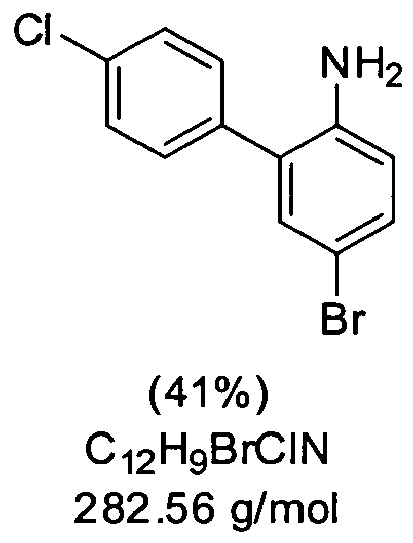
- 5-Brom-4'-chlorbiphenyl-2-amin wird aus 4-Bromanilin (20.0 mmol, 3.44 g) und 4-Chlorphenyldiazoniumchlorid (2.00 mmol, 5.00 mL der nach der allgemeinen Arbeitsvorschrift AAV 1 hergestellten 0.4 M Aryldiazoniumchloridlösung) analog der allgemeinen Arbeitsvorschrift AAV 3 synthetisiert. Es wird mit Diethylether extrahiert. Das erhaltene Rohprodukt wird mittels Säulenchromatographie (Kieselgel, Hexan / EtOAc = 6:1 → 4:1) gereinigt, wodurch 5-Brom-4'-chlorbiphenyl-2-amin (0.62 mmol, 175 mg, 41%) erhalten wird.
- R f-Wert
- 0.6 (Hexan / EtOAc = 4:1) [UV]
- 1H-NMR
- (600 MHz, CDCl3): δ = 6.67 (d, J = 8.5 Hz, 1 H), 7.21 (d, J = 2.3 Hz, 1 H), 7.25 (dd, J = 2.3 Hz, J = 8.5 Hz, 1 H), 7.36 (d, J= 8.6 Hz, 2 H), 7.42 (d, J = 8.6 Hz, 2 H).
- 13C-NMR
- (151 MHz, CDCl3): δ = 117.4 (Cq), 129.2 (2xCH), 130.3 (2xCH), 130.6 (Cq), 131.4 (CH), 132.1 (Cq), 132.7 (CH), 133.7 (Cq), 136.4 (Cq). Ein CH-Signal fehlt aufgrund von Überlappung.
- 4'-Chlor-5-cyanobiphenyl-2-amin

- 4'-Chlor-5-cyanobiphenyl-2-amin wird aus 4-Aminobenzonitril (20.0 mmol, 2.36 g) und 4-Chlorphenyldiazoniumchlorid (2.00 mmol, 5.00 mL der nach der allgemeinen Arbeitsvorschrift AAV 1 hergestellten 0.4 M Aryldiazoniumchloridlösung) analog der allgemeinen Arbeitsvorschrift AAV 3 synthetisiert. Es wird mit Ethylacetat extrahiert. Das erhaltene Rohprodukt wird mittels Säulenchromatographie (Kieselgel, Hexan / EtOAc = 3:1 → 2:1) gereinigt, wodurch 4'-Chlor-5-cyanobiphenyl-2-amin (0.72 mmol, 165 mg, 48%) erhalten wird.
- R f-Wert
- 0.4 (Hexan / EtOAc = 2:1) [UV]
- 1H-NMR
- (600 MHz, CDCl3): δ = 6.74 (d, J= 8.4 Hz, 1 H), 7.33-7.35 (m, 3 H), 7.42 (dd, J= 1.9 Hz, J = 8.4 Hz, 1 H), 7.45 (d, J= 8.3 Hz, 2 H).
- 13C-NMR
- (151 MHz, CDCl3): δ = 100.7 (Cq), 115.2 (CH), 119.8 (Cq), 126.1 (Cq), 129.5 (2xCH), 130.2 (2xCH), 132.9 (CH), 134.2 (Cq), 134.3 (CH), 135.5 (Cq), 147.5 (Cq).
- 4'-Chlor-5-ethoxybiphenyl-2-amin

- 4'-Chlor-5-ethoxybiphenyl-2-amin wird aus p-Phenetidin (20.0 mmol, 2.59 g) und 4-Chlorphenyldiazoniumchlorid (2.00 mmol, 5.00 mL der nach der allgemeinen Arbeitsvorschrift AAV 1 hergestellten 0.4 M Aryldiazoniumchloridlösung) analog der allgemeinen Arbeitsvorschrift AAV 3 synthetisiert. Es wird mit Diethylether extrahiert. Das erhaltene Rohprodukt wird mittels Säulenchromatographie (Kieselgel, Hexan / EtOAc = 6:1 → 4:1) gereinigt, wodurch 4'-Chlor-5-ethoxybiphenyl-2-amin (0.72 mmol, 178 mg, 48%) erhalten wird.
- R f-Wert
- 0.3 (Hexan / EtOAc = 4:1) [UV]
- 1H-NMR
- (360 MHz, CDCl3): δ = 1.38 (t, J= 7.0 Hz, 3 H), 3.98 (q, J = 7.0 Hz, 2 H), 6.67-6.78 (m, 3 H), 7.39 (s, 4 H).
- 13C-NMR
- (90.6 MHz, CDCl3): δ = 15.0 (CH3), 64.2 (CH2), 115.5 (CH), 116.6 (CH), 117.2 (CH), 127.6 (Cq), 128.9 (2xCH), 130.4 (2xCH), 133.2 (Cq), 136.7 (Cq), 137.9 (Cq), 152.2 (Cq).
- 5-Fluor-4'-methoxybiphenyl-2-amin

- 5-Fluor-4'-methoxybiphenyl-2-amin wird aus 4-Fluoranilin (20.0 mmol, 1.90 mL) und 4-Chlorphenyldiazoniumchlorid (2.00 mmol, 5.00 mL der nach der allgemeinen Arbeitsvorschrift AAV 1 hergestellten 0.4 M Aryldiazoniumchloridlösung) analog der allgemeinen Arbeitsvorschrift AAV 3 synthetisiert. Es wird mit Diethylether extrahiert. Der Überschuss an 4-Fluoranilin wird durch Vakuumdestillation entfernt und das erhaltene Rohprodukt säulenchromatographisch (Kieselgel, Hexan / EtOAc = 6: 1) gereinigt. Es wird 5-Fluor-4'-methoxybiphenyl-2-amin (0.26 mmol, 55 mg, 17%) erhalten.
- R f-Wert
- 0.2 (Hexan / EtOAc = 4:1) [UV]
- 1H-NMR
- (600 MHz, CDCl3): δ = 3.84 (s, 3 H), 6.74 (dd, JHF = 4.8 Hz, J = 9.1 Hz, 1 H), 6.83-6.86 (m, 2 H), 6.97 (d, J = 8.7 Hz, 2 H), 7.36 (d, J= 8.7 Hz, 2 H).
- 13C-NMR
- (90.6 MHz, CDCl3): δ = 55.3 (CH3), 114.3 (2xCH), 114.5 (d, J CF = 22.2 Hz, CH), 116.7 (d, J CF = 22.3 Hz, CH), 116.9 (d, J CF = 7.9 Hz, CH), 128.5 (d, J CF = 7.3 Hz, Cq), 130.1 (2xCH), 130.6 (d, J CF = 1.7 Hz, Cq), 138.6 (d, J CF = 2.2 Hz, Cq), 156.7 (d, J CF = 237.2 Hz, Cq), 159.1 (Cq).
- 5-Chlor-4'-fluorbiphenyl-2-amin

- 5-Chlor-4'-fluorbiphenyl-2-amin wird aus 4-Chloranilin (20.0 mmol, 2.54 g) und 4-Fluorphenyldiazoniumchlorid (2.00 mmol, 5.00 mL der nach der allgemeinen Arbeitsvorschrift AAV 1 hergestellten 0.4 M Aryldiazoniumchloridlösung) analog der allgemeinen Arbeitsvorschrift AAV 3 synthetisiert. Es wird mit Diethylether extrahiert. Das erhaltene Rohprodukt wird mittels Säulenchromatographie (Kieselgel, Hexan / EtOAc = 5:1) gereinigt, wodurch 5-Chlor-4'-fluorbiphenyl-2-amin (0.68 mmol, 151 mg, 45%) erhalten wird.
- R f-Wert
- 0.4 (Hexan / EtOAc = 4:1) [UV]
- 1H-NMR
- (360 MHz, CDCl3): δ = 6.69 (d, J= 8.4 Hz, 1 H), 7.07 (d, J= 2.2 Hz, 1 H), 7.08-7.16 (m, 3 H), 7.39 (dd, J = 5.3 Hz, J= 8.8 Hz, 2 H).
- 13C-NMR
- (90.6 MHz, CDCl3): δ = 115.9 (d, J CF = 21.4 Hz, 2xCH), 116.7 (CH), 123.2 (CH), 127.9 (Cq), 128.3 (CH), 130.0 (d, J CF = 0.7 Hz, Cq), 130.7 (d, J CF = 8.1 Hz, 2xCH), 134.2 (d, J CF = 3.5 Hz, Cq), 142.2 (Cq), 162.3 (d, J CF = 247.2 Hz, Cq).
- 2'-Brom-5-fluorbiphenyl-2-amin

- 2'-Brom-5-fluorbiphenyl-2-amin wird aus 4-Fluoranilin (20.0 mmol, 1.90 mL) und 2-Bromphenyldiazoniumtetrafluoroborat (2.00 mmol, 0.54 g) analog der allgemeinen Arbeitsvorschrift AAV 3 synthetisiert. Es wird mit Diethylether extrahiert. Der Überschuss an 4-Fluoranilin wird durch Vakuumdestillation entfernt und das erhaltene Rohprodukt säulenchromatographisch (Kieselgel, Hexan / EtOAc = 10:1 → 4:1) gereinigt. Es wird 2'-Brom-5-fluorbiphenyl-2-amin (0.48 mmol, 128 mg, 32%) erhalten.
- R f-Wert
- 0.3 (Hexan / EtOAc = 4:1) [UV]
- 1H-NMR
- (600 MHz, CDCl3): δ = 3.29 (s, 2 H), 6.70 (dd, JHF = 4.8 Hz, J = 8.7 Hz, 1 H), 6.77 (dd, J = 3.0 Hz, J HF = 8.9 Hz, 1 H), 6.92 (ddd, J = 3.0 Hz, J HF = 8.2 Hz, J= 8.7 Hz, 1 H), 7.22-7.32 (m, 2 H), 7.35-7.41 (m, 1 H), 7.69 (dd, J = 1.2 Hz, J = 8.0 Hz, 1 H).
- 13C-NMR
- (90.6 MHz, CDCl3): δ = 115.6 (d, J CF = 22.3 Hz, CH), 116.6 (d, J CF = 22.7 Hz, CH), 116.5 (d, J CF = 7.7 Hz, CH), 123.9 (Cq), 127.9 (CH), 128.0 (d, J CF = 7.6 Hz, Cq), 129.6 (CH), 131.6 (CH), 133.2 (CH), 139.0 (d, J CF = 1.6 Hz, Cq), 139.7 (d, J CF = 2.1 Hz, Cq), 155.9 (d, J CF = 236.8 Hz, Cq).
- 4'-Chlorbiphenyl-2-amin und 4'-Chlorbiphenyl-4-amin

- 4'-Chlorbiphenyl-2-amin und 4'-Chlorbiphenyl-4-amin werden aus Anilin (20.0 mmol, 2.33 g) und 4-Chlorphenyldiazoniumchlorid (2.00 mmol, 5.00 mL der nach der allgemeinen Arbeitsvorschrift AAV 1 hergestellten 0.4 M Aryldiazoniumchloridlösung) analog der allgemeinen Arbeitsvorschrift AAV 3 synthetisiert. Es wird mit Diethylether extrahiert. Die beiden Regioisomere werden über Säulenchromatographie (Kieselgel, Hexan / EtOAc = 4:1) getrennt. Es wird 4'-Chlorbiphenyl-2-amin (0.88 mmol, 179 mg, 59%) und 4'-Chlorbiphenyl-4-amin (0.24 mmol, 49 mg, 16%) erhalten.
-
- R f-Wert
- 0.6 (Hexan / EtOAc = 4:1) [UV]
- 1H-NMR
- (360 MHz, CDCl3): δ = 6.76 (dd, J = 0.9 Hz, J= 8.0 Hz, 1 H), 6.82 (dt, J= 1.1 Hz, J= 7.47 Hz, 1 H), 7.09 (dd, J= 1.4 Hz, J= 7.6 Hz, 1 H), 7.16 (ddd, J = 1.6 Hz, J = 7.4 Hz, J = 8.0 Hz, 1 H), 7.37-7.45 (m, 4 H).
- 13C-NMR
- (90.6 MHz, CDCl3): δ = 115.7 (CH), 118.8 (CH), 126.3 (Cq), 128.8 (CH), 129.0 (2xCH), 130.3 (CH), 130.4 (2xCH), 133.1 (Cq), 137.9 (Cq), 143.4 (Cq).
-
- R f-Wert
- 0.3 (Hexan / EtOAc = 4:1) [UV]
- 1H-NMR
- (600 MHz, CDCl3): δ = 6.75 (d, J= 8.6 Hz, 2 H), 7.35 (d, J = 8.6 Hz, 2 H), 7.37 (d, J= 8.6 Hz, 2 H), 7.45 (d, J= 8.5 Hz, 2 H).
- 13C-NMR
- (151 MHz, CDCl3): δ = 115.4 (2xCH), 127.5 (2xCH), 127.8 (2xCH), 128.7 (2xCH), 130.2 (Cq), 132.1 (Cq), 139.6 (Cq), 146.1 (Cq).
Claims (12)
- Verfahren zur Herstellung einer Verbindung der Formel 3


 m für 0, 1, 2, 3, 4 oder 5 steht;jedes R1 jeweils unabhängig für Halogen, Alkyl, Haloalkyl, Hydroxy, Hydroxyalkyl, Alkoxy, Haloalkoxy, Alkylthio, Cycloalkyl, Haloalkylthio, Alkenyl, Alkinyl, Amino, Nitro, Cyano, -SO3R5, -SO2NH2, -SO2NHR4, -SO2NR4R5, -COOR4, -CONHR4, -CONR4R5, -COR4, -OCOR4, -NR4R5, -NR4COR5, -NR4SO2R5, Alkylcarbonyl, Haloalkylcarbonyl, Alkenylcarbonyl, Alkoxycarbonyl, Haloalkoxycarbonyl, Alkenyloxycarbonyl, Alkylsulfonyl, Haloalkylsulfonyl, Alkylimino, Aryl, Aryloxy, Arylcarbonyl, Arylalkyl, Heteroarylalkyl, Arylalkoxycarbonyl, Arylalkylimino oder Heteroaryl steht;X- für Halogenid, Hydrogensulfat, Sulfat, Tetrafluoroborat, Acetat, Trifluoracetat, Hexafluorophosphat, Hexafluoroantimonat, das Anion eines aromatischen 1,2-Dicarbonsäureimids oder das Anion eines aromatischen 1,2-Disulfonsäureimids steht;R2 und R3 jeweils unabhängig für Wasserstoff, Alkyl, Hydroxyalkyl, Aminoalkyl, Cycloalkyl, Haloalkyl, -(CH2)n-OR4, -(CH2)n-NR4R5, -(CH2)n-NR4COR5, -(CH2)n-NR4COOR5, -(CH2)n-COOR4, -(CH2)n-CONHR4, -(CH2)n-CONR4R5, -(CH2)n-SO3R4, -(CH2)n-CN, Arylalkyl, Heteroarylalkyl, Aryl oder Heteroaryl steht, oder ein R2 und ein R3 zusammen einen Alkylidenrest bilden, oder ein R2 und ein R3 zusammen ein nichtaromatisches Ringsystem bilden, welches 4, 5, 6, oder 7 Ringatome enthält, ausgewählt aus O, S, N und Kohlenstoffatomen, vorzugsweise mit Kohlenstoffatomen, oder ein R2 und ein R10 zusammen ein nichtaromatisches Ringsystem bilden, welches 4, 5, 6, oder 7 Ringatome enthält, ausgewählt aus O, S, N und Kohlenstoffatomen, vorzugsweise mit Kohlenstoffatomen, oder ein R3 und ein R10 zusammen ein nichtaromatisches Ringsystem bilden, welches 4, 5, 6, oder 7 Ringatome enthält, ausgewählt aus O, S, N und Kohlenstoffatomen, vorzugsweise mit Kohlenstoffatomen;n jeweils unabhängig für 1, 2, 3, 4, 5, 6, 7, 8, 9 oder 10 steht;R4 jeweils unabhängig für Wasserstoff, Alkyl, Cycloalkyl, Haloalkyl, Arylalkyl, Heteroarylalkyl, Aryl oder Heteroaryl steht;R5 jeweils unabhängig für Wasserstoff, Alkyl, Cycloalkyl, Haloalkyl, Arylalkyl, Heteroarylalkyl, Aryl oder Heteroaryl steht;R6 jeweils unabhängig für Wasserstoff, Halogen, Alkyl, Alkenyl, Alkinyl, Cycloalkyl, Arylalkyl, Heteroarylalkyl, Haloalkyl, Hydroxyalkyl, Alkoxyalkyl, Aryloxyalkyl, Heteroaryloxyalkyl, Aminoalkyl, -(CH2)n-NR4R5, -COOH, -CHO, -CN, -COR4, Alkylcarbonyl, Haloalkylcarbonyl, Cycloalkylcarbonyl, Arylalkylcarbonyl, Alkenylcarbonyl, Arylcarbonyl, Heteroarylcarbonyl, -COOR4, Alkoxycarbonyl, Haloalkoxycarbonyl, Cycloalkoxycarbonyl, Arylalkoxycarbonyl, Alkenyloxycarbonyl, Aryloxycarbonyl, Heteroaryloxycarbonyl, -CONHR4, -CONR4R5, Amino, Nitro, -NHR4, -NR4R5, 1-Pyrrolidino, 1-Piperidino, 1-Morpholino, Alkylimino, Cycloalkylimino, Haloalkylimino, Arylalkylimino, -NR4COR5, -NR4COOR5, -NR4SO2R5, Hydroxy, Alkoxy, Haloalkoxy, Cycloalkoxy, Arylalkyloxy, Aryloxy, Heteroaryloxy, -OCOR4, Alkylcarbonyloxy, Haloalkylcarbonyloxy, Cycloalkylcarbonyloxy, Arylalkylcarbonyloxy, Arylcarbonyloxy, Heteroarylcarbonyloxy, -OCONR4R5, -O-(CH2)n-OR4, -O-(CH2)n-NR4R5, -O-(CH2)n-NR4COR5, -O-(CH2)n-NR4COOR5, -O-(CH2)n-COOR4, -O-(CH2)n-CONHR4, -O-(CH2)n-CONR4R5, -O-(CH2)n-SO3R4, -O-(CH2)n-SO2R4, -O-(CH2)n-CN, -SH, Alkylthio, Haloalkylthio, Cycloalkylthio, Arylalkylthio, Arylthio, Heteroarylthio, Alkylsulfonyl, Haloalkylsulfonyl, Cycloalkylsulfonyl, Arylalkylsulfonyl, Arylsulfonyl, Heteroarylsulfonyl, -SO2NH2, -SO2NHR4, -SO2NR4R5, -SO3R5, Aryl oder Heteroaryl steht;R10 jeweils unabhängig für Wasserstoff, Halogen, Alkyl, Haloalkyl, Hydroxyalkyl, Cycloalkyl, Arylalkyl, Heteroarylalkyl, -(CH2)q-NR4R5, -(CH2)q-NR4COR5, -(CH2)q-NR4COOR5, -(CH2)q-COOR4, -(CH2)q-CONHR4, -(CH2)q-CONR4R5, -(CH2)q-SO3R4, -(CH2)q-CN, Aryl oder Heteroaryl steht;q jeweils unabhängig für 1, 2, 3, 4, oder 5 steht,dadurch gekennzeichnet, dass die Umsetzung im basischen Bereich durchgeführt wird.
 - Verfahren zur Herstellung einer Verbindung der Formel 3


- Verfahren nach einem der voranstehenden Ansprüche, dadurch gekennzeichnet, dass die Umsetzung bei einem pH von 9,1 oder größer durchgeführt wird.
- Verfahren nach einem der voranstehenden Ansprüche dadurch gekennzeichnet, dass die Umsetzung in Gegenwart von mindestens einem Lösungsmittel, vorzugsweise Wasser, durchgeführt wird.
- Verfahren nach einem der voranstehenden Ansprüche dadurch gekennzeichnet, dass die Umsetzung in Gegenwart von Wasser und mindestens einer Base durchgeführt wird.
- Verfahren nach Anspruch 5, dadurch gekennzeichnet, dass die Base Natriumhydroxid oder Kaliumhydroxid ist.
- Verfahren nach einem der voranstehenden Ansprüche dadurch gekennzeichnet, dass R1 Fluor, Chlor, Brom oder Methoxy ist, R2, R3 und R10 Wasserstoffatome sind, R6 Wasserstoff, Fluor, Chlor, Brom, CN, Methoxy oder Ethoxy ist und m gleich 0, 1, 2 oder 3 ist.
- Verfahren nach einem der voranstehenden Ansprüche dadurch gekennzeichnet, dass die Umsetzung im Temperaturbereich von 50 bis 130°C, insbesondere von 70 °C bis 110°C durchgeführt wird.
- Verfahren nach einem der voranstehenden Ansprüche dadurch gekennzeichnet, dass die Umsetzung in Gegenwart mindestens eines Reduktionsmittels durchgeführt wird.
- Verfahren nach einem der voranstehenden Ansprüche dadurch gekennzeichnet, dass die Umsetzung unter elektrochemischer Reduktion durchgeführt wird.
- Verfahren nach einem der voranstehenden Ansprüche dadurch gekennzeichnet, dass die Umsetzung unter Bestrahlung, Ultraschall oder Radiolyse durchgeführt wird.
- Verfahren nach einem der voranstehenden Ansprüche dadurch gekennzeichnet, dass die Umsetzung unter Schutzgas durchgeführt wird.
Priority Applications (6)
| Application Number | Priority Date | Filing Date | Title |
|---|---|---|---|
| EP11005807A EP2546229A1 (de) | 2011-07-15 | 2011-07-15 | Verfahren zur Synthese von Aminobiphenylen |
| CN201280012268.6A CN103517893A (zh) | 2011-03-07 | 2012-03-06 | 合成氨基联苯的方法 |
| BR112013022613A BR112013022613A2 (pt) | 2011-03-07 | 2012-03-06 | processo para a preparação de um composto |
| PCT/EP2012/053798 WO2012120003A1 (de) | 2011-03-07 | 2012-03-06 | Verfahren zur synthese von aminobiphenylen |
| US14/003,399 US20130338369A1 (en) | 2011-03-07 | 2012-03-06 | Process for the Synthesis of Aminobiphenylene |
| EP12706867.4A EP2683682A1 (de) | 2011-03-07 | 2012-03-06 | Verfahren zur synthese von aminobiphenylen |
Applications Claiming Priority (1)
| Application Number | Priority Date | Filing Date | Title |
|---|---|---|---|
| EP11005807A EP2546229A1 (de) | 2011-07-15 | 2011-07-15 | Verfahren zur Synthese von Aminobiphenylen |
Publications (1)
| Publication Number | Publication Date |
|---|---|
| EP2546229A1 true EP2546229A1 (de) | 2013-01-16 |
Family
ID=44904681
Family Applications (1)
| Application Number | Title | Priority Date | Filing Date |
|---|---|---|---|
| EP11005807A Withdrawn EP2546229A1 (de) | 2011-03-07 | 2011-07-15 | Verfahren zur Synthese von Aminobiphenylen |
Country Status (1)
| Country | Link |
|---|---|
| EP (1) | EP2546229A1 (de) |
Cited By (2)
| Publication number | Priority date | Publication date | Assignee | Title |
|---|---|---|---|---|
| US10266488B2 (en) | 2013-10-10 | 2019-04-23 | Eastern Virginia Medical School | 4-((2-hydroxy-3-methoxybenzyl)amino)benzenesulfonamide derivatives as potent and selective inhibitors of 12-lipoxygenase |
| CN111072492A (zh) * | 2019-11-29 | 2020-04-28 | 浙江工业大学 | 一种合成3,4-二氯-2-氨基-5-氟联苯的方法 |
Citations (8)
| Publication number | Priority date | Publication date | Assignee | Title |
|---|---|---|---|---|
| WO2006024388A1 (de) | 2004-08-27 | 2006-03-09 | Bayer Cropscience Ag | Verfahren zum herstellen von biphenylaminen |
| WO2007138089A1 (en) | 2006-06-01 | 2007-12-06 | Basf Se | Process for preparing substituted biphenyls |
| US20080269263A1 (en) | 2004-09-17 | 2008-10-30 | Bayer Cropscience Ag | Synergistic Fungidical Active Substance Combinations |
| WO2010000856A1 (de) | 2008-07-03 | 2010-01-07 | Basf Se | Verfahren zur herstellung von aminobiphenylen |
| US20100069646A1 (en) | 2006-11-03 | 2010-03-18 | Basf Se | Process for preparing difluoromethylpyrazolyl carboxylates |
| WO2010037531A1 (de) | 2008-09-30 | 2010-04-08 | Technische Universität München | Verfahren zur herstellung von 3-aminobiphenylen |
| US20100174094A1 (en) | 2007-06-01 | 2010-07-08 | Basf Se | Method for the Production of N-Substituted (3-Dihalomethyl-1-Methyl-Pyrazole-4-yl) Carboxamides |
| US20100185015A1 (en) | 2007-06-29 | 2010-07-22 | Bayer Cropscience Ag | Process for preparing biaryls |
-
2011
- 2011-07-15 EP EP11005807A patent/EP2546229A1/de not_active Withdrawn
Patent Citations (8)
| Publication number | Priority date | Publication date | Assignee | Title |
|---|---|---|---|---|
| WO2006024388A1 (de) | 2004-08-27 | 2006-03-09 | Bayer Cropscience Ag | Verfahren zum herstellen von biphenylaminen |
| US20080269263A1 (en) | 2004-09-17 | 2008-10-30 | Bayer Cropscience Ag | Synergistic Fungidical Active Substance Combinations |
| WO2007138089A1 (en) | 2006-06-01 | 2007-12-06 | Basf Se | Process for preparing substituted biphenyls |
| US20100069646A1 (en) | 2006-11-03 | 2010-03-18 | Basf Se | Process for preparing difluoromethylpyrazolyl carboxylates |
| US20100174094A1 (en) | 2007-06-01 | 2010-07-08 | Basf Se | Method for the Production of N-Substituted (3-Dihalomethyl-1-Methyl-Pyrazole-4-yl) Carboxamides |
| US20100185015A1 (en) | 2007-06-29 | 2010-07-22 | Bayer Cropscience Ag | Process for preparing biaryls |
| WO2010000856A1 (de) | 2008-07-03 | 2010-01-07 | Basf Se | Verfahren zur herstellung von aminobiphenylen |
| WO2010037531A1 (de) | 2008-09-30 | 2010-04-08 | Technische Universität München | Verfahren zur herstellung von 3-aminobiphenylen |
Non-Patent Citations (37)
| Title |
|---|
| "Organikum", WILEY VCH |
| A. DE MEIJERE, F. DIEDERICH: "Metal-Catalyzed Cross-Coupling Reactions", 2004, WILEY-VCH |
| A. NUNEZ, A. SANCHEZ, C. BURGOS, J. ALVAREZ-BUILLA, TETRAHEDRON, vol. 60, 2004, pages 6217 - 6224 |
| A. STUDER, M. BROSSART: "Radicals in Organic Synthesis", vol. 2, 2001, WILEY-VCH, pages: 62 - 80 |
| A. WETZEL, V. EHRHARDT, M. R. HEINRICH, ANGEW. CHEM. INT. ED., vol. 47, 2008, pages 9130 - 9133 |
| ANGEW. CHEM. INT. ED., vol. 47, 2008, pages 1301 - 1304 |
| ANGEW. CHEM. INT. ED., vol. 47, 2008, pages 2089 - 2092 |
| ANGEW. CHEM. INT. ED., vol. 47, 2008, pages 3100 - 3120 |
| ANGEW. CHEM. INT. ED., vol. 47, 2008, pages 9130 - 9133 |
| AUST. J. CHEM., vol. 33, 1980, pages 965 |
| C. GALLI, CHEM. REV., vol. 88, 1988, pages 765 - 792 |
| CHEMICAL ABSTRACTS, Columbus, Ohio, US; abstract no. 8705 |
| F. MINISCI, F. FONTANA, E. VISMARA, GAZZ. CHIM. ITAL., vol. 123, 1993, pages 9 - 18 |
| G. DYKER: "Handbook of C-H Transformations", 2005, WILEY-VCH |
| HOUBEN WEYL: "Methoden d. org. Chemie", vol. 11-1, pages: 422 |
| J. C. SCAIANO, L. C. STEWART, J. AM. CHEM. SOC., vol. 105, 1983, pages 3609 - 3614 |
| J. FOSSEY, D. LEFORT, J. SORBA: "Free Radicals in Organic Chemistry", 1995, WILEY, pages: 167 - 180 |
| J. R. BEADLE, S. H. KORZENIOWSKI, D. E. ROSENBERG, B. J. GARCIA-SLANGA, G. W. GOKEL, J. ORG. CHEM., vol. 49, 1984, pages 1594 - 1603 |
| J.E. PACKER ET AL., J. CHEM. SOC., PERKIN TRANS., vol. 2, 1975, pages 751 |
| L. ACKERMANN, R. VICENTE, A. ALTHAMMER, ORG. LETT., vol. 10, 2008, pages 2299 - 2302 |
| L. ACKERMANN, TOP. ORGANOMET. CHEM., vol. 24, 2007, pages 35 - 60 |
| L. ACKERMANN: "Modern Arylation Methods", 2009, WILEY-VCH |
| L. J. GOOSSEN, N. RODRIGUEZ, K. GOOSSEN, ANGEW. CHEM., vol. 120, 2008, pages 3144 - 3164 |
| M. AMATORE, C. GOSMINI, ANGEW. CHEM., vol. 120, 2008, pages 2119 - 2122 |
| M. BARBERO ET AL., SYNTHESIS, 1998, pages 1171 - 1175 |
| M. BELLER, C. BOLM: "Transition Metalsfor Organic Synthesis", 2004, WILEY-VCH |
| M. GOMBERG, W. E. BACHMANN, J. AM. CHEM. SOC., vol. 46, 1924, pages 2339 - 2343 |
| M. L. BENNASAR, T. ROCA, F. FERRANDO, TETRAHEDRON LETT., vol. 45, 2004, pages 5605 - 5609 |
| P. T. F. MCLOUGHLIN, M. A. CLYNE, F. ALDABBAGH, TETRAHEDRON, vol. 60, 2004, pages 8065 - 8071 |
| R. PSCHORR, CHEM. BER., vol. 29, 1896, pages 496 - 501 |
| S. SENGUPTA, S. BHATTACHARYA, J. CHEM. SOC. PERKIN TRANS 1, vol. 17, 1993, pages 1943 |
| T. DOHI, M. ITO, K. MORIMOTO, M. IWATA, Y. KITA, ANGEW. CHEM., vol. 120, 2008, pages 1321 - 1324 |
| T. VOGLER, A. STUDER, ORG. LETT., vol. 10, 2008, pages 129 - 131 |
| UHL, KYRIATSOULIS: "Namens- und Schlagwort-Reaktionen in der Organischen Chemie", 1984, VIEWEG, Braunschweig, pages: 74 - 75, XP002663623 * |
| W. R. BOWMAN, J. M. D. STOREY, CHEM. SOC. REV., vol. 36, 2007, pages 1803 - 1822 |
| X. PAN, C. S. WILCOX, J. ORG. CHEM., vol. 75, 2010, pages 6445 - 6451 |
| Z. J. ALLAN, F. MUZIK, CHEM. LISTY, 1954, pages 48,52 |
Cited By (4)
| Publication number | Priority date | Publication date | Assignee | Title |
|---|---|---|---|---|
| US10266488B2 (en) | 2013-10-10 | 2019-04-23 | Eastern Virginia Medical School | 4-((2-hydroxy-3-methoxybenzyl)amino)benzenesulfonamide derivatives as potent and selective inhibitors of 12-lipoxygenase |
| US10752581B2 (en) | 2013-10-10 | 2020-08-25 | Eastern Virginia Medical School | 4-((2-hydroxy-3-methoxybenzyl)amino)benzenesulfonamide derivatives as potent and selective inhibitors of 12-lipoxygenase |
| US11274077B2 (en) | 2013-10-10 | 2022-03-15 | Eastern Virginia Medical School | 4-((2-hydroxy-3-methoxybenzyl)amino)benzenesulfonamide derivatives as potent and selective inhibitors of 12-lipoxygenase |
| CN111072492A (zh) * | 2019-11-29 | 2020-04-28 | 浙江工业大学 | 一种合成3,4-二氯-2-氨基-5-氟联苯的方法 |
Similar Documents
| Publication | Publication Date | Title |
|---|---|---|
| EP2822924B1 (de) | Verfahren zur synthese von aminobiphenylen unter verwendung von arylhydrazinen | |
| EP1012144B1 (de) | Verfahren zur herstellung (hetero)aromatischer hydroxylamine | |
| WO2010000856A1 (de) | Verfahren zur herstellung von aminobiphenylen | |
| EP2683682A1 (de) | Verfahren zur synthese von aminobiphenylen | |
| CH706864B1 (de) | Verfahren zur Herstellung einer Pyrazol-Verbindung. | |
| DE102009022830B4 (de) | Verbessertes Verfahren zum Herstellen von Diaminopyridinen | |
| EP2342174B1 (de) | Verfahren zur herstellung von 3-aminobiphenylen | |
| WO2010112211A1 (de) | Verfahren zur arylierung von ringsubstituierten phenolen und phenylethern | |
| EP0569792B1 (de) | Verfahren zur Herstellung von N-acylierten p-Aminophenolen | |
| EP2729444B1 (de) | Verfahren zur herstellung von 2-amino-5-cyano-n,3-dimethylbenzamid | |
| DE69829613T2 (de) | Verfahren zur Herstellung von Heteroarylcarbonsäureamiden und -estern | |
| DE2609530B1 (de) | Verfahren zur herstellung von hydrazobenzol | |
| DE2804263C3 (de) | Verfahren zur Herstellung von Indolin-Derivaten | |
| EP2638002B1 (de) | Verfahren zur herstellung von 2,2-difluorethylamin ausgehend von einer benzylamin-verbindung | |
| EP0811607B1 (de) | Verfahren zur Nitrosierung von C-H-aciden Verbindungen | |
| DE69929453T2 (de) | Zur sulfonierung von perhalogenierten sulfanilid verwendbare verfahren und reagenz zur sulfonierung | |
| EP0820981B1 (de) | Verfahren zur Herstellung von 2-Trifluormethoxy-anilin | |
| EP0720980B1 (de) | Verfahren zur Herstellung von Alkylcarbonsäure-4-Hydroxyaniliden | |
| EP1418171A1 (de) | Perfluoralkylaniline | |
| DE19738864A1 (de) | Verfahren zur Herstellung N-acylierter (hetero)aromatischer Hydroxylamine | |
| ITMI20131371A1 (it) | Procedimento per la preparazione di un composto ad attivita' anticonvulsiva | |
| DE10347932A1 (de) | Verfahren zur Herstellung von fluorhaltigen Anilinen |
Legal Events
| Date | Code | Title | Description |
|---|---|---|---|
| PUAI | Public reference made under article 153(3) epc to a published international application that has entered the european phase |
Free format text: ORIGINAL CODE: 0009012 |
|
| AK | Designated contracting states |
Kind code of ref document: A1 Designated state(s): AL AT BE BG CH CY CZ DE DK EE ES FI FR GB GR HR HU IE IS IT LI LT LU LV MC MK MT NL NO PL PT RO RS SE SI SK SM TR |
|
| AX | Request for extension of the european patent |
Extension state: BA ME |
|
| RAP1 | Party data changed (applicant data changed or rights of an application transferred) |
Owner name: BASF SE |
|
| STAA | Information on the status of an ep patent application or granted ep patent |
Free format text: STATUS: THE APPLICATION HAS BEEN WITHDRAWN |
|
| 18W | Application withdrawn |
Effective date: 20130614 |