EP2522327A1 - Aqueous cosmetic preparation - Google Patents
Aqueous cosmetic preparation Download PDFInfo
- Publication number
- EP2522327A1 EP2522327A1 EP10842192A EP10842192A EP2522327A1 EP 2522327 A1 EP2522327 A1 EP 2522327A1 EP 10842192 A EP10842192 A EP 10842192A EP 10842192 A EP10842192 A EP 10842192A EP 2522327 A1 EP2522327 A1 EP 2522327A1
- Authority
- EP
- European Patent Office
- Prior art keywords
- aqueous cosmetic
- titanium oxide
- aqueous
- organic pigment
- cosmetic
- Prior art date
- Legal status (The legal status is an assumption and is not a legal conclusion. Google has not performed a legal analysis and makes no representation as to the accuracy of the status listed.)
- Granted
Links
Images

Classifications
-
- A—HUMAN NECESSITIES
- A61—MEDICAL OR VETERINARY SCIENCE; HYGIENE
- A61K—PREPARATIONS FOR MEDICAL, DENTAL OR TOILETRY PURPOSES
- A61K8/00—Cosmetics or similar toiletry preparations
- A61K8/18—Cosmetics or similar toiletry preparations characterised by the composition
- A61K8/19—Cosmetics or similar toiletry preparations characterised by the composition containing inorganic ingredients
- A61K8/29—Titanium; Compounds thereof
-
- A—HUMAN NECESSITIES
- A61—MEDICAL OR VETERINARY SCIENCE; HYGIENE
- A61K—PREPARATIONS FOR MEDICAL, DENTAL OR TOILETRY PURPOSES
- A61K8/00—Cosmetics or similar toiletry preparations
- A61K8/18—Cosmetics or similar toiletry preparations characterised by the composition
- A61K8/72—Cosmetics or similar toiletry preparations characterised by the composition containing organic macromolecular compounds
- A61K8/81—Cosmetics or similar toiletry preparations characterised by the composition containing organic macromolecular compounds obtained by reactions involving only carbon-to-carbon unsaturated bonds
- A61K8/8141—Compositions of homopolymers or copolymers of compounds having one or more unsaturated aliphatic radicals, each having only one carbon-to-carbon double bond, and at least one being terminated by only one carboxyl radical, or of salts, anhydrides, esters, amides, imides or nitriles thereof; Compositions of derivatives of such polymers
- A61K8/8158—Homopolymers or copolymers of amides or imides, e.g. (meth) acrylamide; Compositions of derivatives of such polymers
-
- A—HUMAN NECESSITIES
- A61—MEDICAL OR VETERINARY SCIENCE; HYGIENE
- A61Q—SPECIFIC USE OF COSMETICS OR SIMILAR TOILETRY PREPARATIONS
- A61Q3/00—Manicure or pedicure preparations
- A61Q3/02—Nail coatings
-
- A—HUMAN NECESSITIES
- A61—MEDICAL OR VETERINARY SCIENCE; HYGIENE
- A61K—PREPARATIONS FOR MEDICAL, DENTAL OR TOILETRY PURPOSES
- A61K2800/00—Properties of cosmetic compositions or active ingredients thereof or formulation aids used therein and process related aspects
- A61K2800/40—Chemical, physico-chemical or functional or structural properties of particular ingredients
- A61K2800/42—Colour properties
- A61K2800/43—Pigments; Dyes
- A61K2800/432—Direct dyes
Definitions
- the present invention relates to an aqueous cosmetic containing titanium oxide and an acid dye or an organic pigment, more specifically to an aqueous cosmetic which is excellent in an aging settling stability of titanium oxide to make a hard cake less liable to be produced even when titanium oxide settles down and can readily be redispersed by stirring and which is excellent in usability and a coating performance and suited to a manicure composition for a nail art, cosmetics for skin coloring and the like.
- aqueous cosmetics containing titanium oxide which is excellent in a masking power. Titanium oxide contained in the above aqueous cosmetics settles down when left standing still for long time to form a hard cake. This hard cake involves the problem that it is not readily redispersed by stirring and the like.
- Cosmetics for skin coloring comprising at least water, a pigment containing titanium oxide and a resin have so far been known as cosmetics for skin coloring which have good redispersibility of a pigment in storing, wherein contained are at least one rein selected from the group consisting of a styrene-acrylic acid copolymer, a styrene-maleic acid copolymer, a styrene-alkyl acrylate copolymer and a styrene-alkyl maleate copolymer and a base such as ammonia and amines, and at least one thickener selected from a clay base inorganic thickener, an inorganic fine particle thickener and a polysaccharide thickener is contained (refer to, for example, patent document 1 filed by the present applicants).
- an aqueous manicure composition in which dispersibility and the like are improved by blending a powder obtained by subjecting a powder of titanium oxide and the like to hydrophilic treatment with a silylating agent having a polyoxyethylene chain and an acryl base polymer emulsion (refer to, for example, patent document 2).
- the present invention intends to solve them, and an object thereof is to provide an aqueous cosmetic containing titanium oxide and an acid dye or an organic pigment, wherein it is excellent in an aging settling stability to make a hard cake less liable to be produced even when titanium oxide settles down and can readily be redispersed by stirring, and it inhibits a viscosity from rising and is excellent in usability and a coating performance.
- the present inventors intend to solve them, and they have found that the respective aqueous cosmetics meeting the objects described above are obtained by adding at least a specific amount of titanium oxide, an acid dye or an organic pigment, an acryl resin having specific physical properties and water.
- the present invention has come to be completed.
- the present invention comprises in the following items (1) to (7).
- an aqueous cosmetic containing titanium oxide and an acid dye and an aqueous cosmetic containing titanium oxide and an organic pigment wherein both of them are excellent in an aging settling stability to make a hard cake less liable to be produced even when titanium oxide settles down and can readily be redispersed by stirring, and they inhibit a viscosity from rising with the passage of time and are excellent in usability and a coating performance and suited to a manicure composition for a nail art, cosmetics for skin coloring and the like.
- the aqueous cosmetic of the present invention is characterized by that it contains 5 to 30 % by mass of titanium oxide, an acid dye, an alkali-soluble type acryl resin and water in a first invention and that it contains 5 to 30 % by mass of titanium oxide, an organic pigment, an alkali-soluble type acryl resin and water in a second invention.
- the present invention in the followings, it includes the first invention (acid dye base aqueous cosmetic) and the second invention (organic pigment base aqueous cosmetic) each described above [the present invention (the first invention and the second invention)].
- Titanium oxide used in the present invention exerts an excellent masking power when coated on a skin and a nail, and it shall not specifically be restricted as long as it is used usually for aqueous cosmetics. Titanium oxide subjected to alumina treatment is preferably used in terms of controlling a surface activity.
- a content of above titanium oxide is 5 to 30 % by mass (hereinafter referred to merely as "%"), preferably 8 to 25 % based on the total amount of the aqueous cosmetic. If a content of above titanium oxide is less than 5 %, the coating film is poor in a masking property. On the other hand, if it exceeds 30 %, a viscosity of the aqueous cosmetic is instable, and both are not preferred.
- the acid dye used in the present first invention is used as a color material and shall not specifically be restricted as long as it is a dye used usually as an acid dye for aqueous cosmetics.
- dyes which have so far been used for cosmetics and the like and which have high safety to human bodies are preferred as the above acid dye, and they include, for example, nitro dyes, azo, dyes, nitroso dyes, triphenylmethane dyes, xanthene dyes, quinoline dyes, anthraquinone dyes, indigo dyes and the like.
- capable of being preferably listed from the viewpoint of a dyeing power are Red No. 2, Red No. 3 (FD & C Red No. 3), Red No.
- a content of the above acid dyes is 0.02 to 20 %, preferably 0.2 to 10 % based on the total amount of the aqueous cosmetic in terms of a color developing property, a suitable viscosity and a smooth discharge property in an aqueous cosmetic applicator equipped with an applying member. If a content of the above acid dye is less than 0.02 %, the good developed color is not obtained. On the other hand, if it exceeds 20 %, the cosmetic is increased in a viscosity and liable to be reduced in a discharge property and bring about aggregation, and therefore both are not preferred.
- the organic pigment used in the present second invention is used as a color material and shall not specifically be restricted as long as it is a pigment used usually as an organic pigment for aqueous cosmetics. It includes, for example, at least one selected from organic pigments such as Blue No. 1 Al Lake, Red No. 202, Red No. 220, Red No. 226, Red No. 228, Blue No. 201, Blue No. 204, Blue No. 404, Yellow No. 401, Yellow No. 205, Yellow No. 4 Al Lake, Yellow No. 203 Al Lake, and Red No. 104 Al Lake. It shall not specifically be restricted as long as it is an organic pigment used for aqueous cosmetics.
- organic pigments such as Blue No. 1 Al Lake, Red No. 202, Red No. 220, Red No. 226, Red No. 228, Blue No. 201, Blue No. 204, Blue No. 404, Yellow No. 401, Yellow No. 205, Yellow No. 4 Al Lake, Yellow No. 203 Al Lake, and Red No. 104 Al
- a content of the above organic pigments is preferably 0.05 to 15 %, more preferably 0.1 to 10 % based on the total amount of the aqueous cosmetic in terms of a color developing property, a suitable viscosity and a smooth discharge property in an aqueous cosmetic applicator equipped with an applying member. If a content of the above organic pigments is less than 0.05 %, the good developed color is not obtained. On the other hand, if it exceeds 15 %, the cosmetic is increased in a viscosity and liable to be reduced in a discharge property and bring about aggregation, and therefore both are not preferred.
- the alkali-soluble type acryl resin used in the present invention functions as a dispersant for titanium oxide and the like in the aqueous cosmetic and functions as a fixing resin after coated. It includes, to be specific, at least one of (alkyl acrylate/octylacrylamide) copolymers, alkyl acrylate copolymers and the like, and to be more specific, it has a carboxyl group in a structure and is soluble at an alkaline range.
- the composition is suitably controlled by a pH controller and the like until the alkali-soluble type acryl resin is dissolved.
- pH controller Capable of being used as the pH controller are 2-amino-2-methyl-1-propanol, 2-amino-2-methyl-1,3-propanediol, triethanolamine, L-arginine, aqueous ammonia, sodium hydroxide and the like, and 2-amino-2-methyl-1-propanol is particularly preferred. Also, when the alkali-soluble type acryl resin described above is once dissolved at an alkaline range, it has stable solubility up to the vicinity of pH 7.0.
- AMPHOMER V-42 manufactured by Akzo Nobel Corporate
- Luvimer 100P manufactured by BASF A.G.
- DERMACRYL AGF manufactured by Akzo Nobel Corporate
- the (alkyl acrylate/octylacrylamide) copolymer is preferably used in terms of further improving dispersibility of titanium oxide.
- a content of the above alkali-soluble type acryl resins is preferably 0.05 to 30 %, more preferably 0.1 to 20 % in terms of a solid content based on the total amount of the aqueous cosmetic from the viewpoints of dispersion stability and a fixing property of titanium oxide. If a content of the above alkali-soluble type acryl resin is less than 0.05 %, the sufficiently high pigment dispersion ability is not obtained. On the other hand, if it exceeds 30 %, an influence comes to be exerted on the aging stability, and therefore both are not preferred.
- the alkali-soluble type acryl resin is used as a suited dispersant for titanium oxide, and a mass ratio of the alkali-soluble type acryl resin to titanium oxide is more preferably 0.01 to 1, particularly preferably 0.04 to 0.8 based on 1 of titanium oxide. If the above mass ratio is less than 0.01, further effects of the present invention can not be exerted, and even if it exceeds 1, no problems are raised as long as it does not exceed an upper limit of a content of the alkali-soluble type acryl resin.
- a water-soluble organic solvent is preferably contained in terms of improving the finishing property and a moisturizing property of an applying member such as a pen tip of the applicator.
- the water-soluble organic solvent which can be used includes water-soluble glycols such as 1,3-bytylene glycol, 1,4-bytylene glycol, pentylene glycol, ethylene glycol, diethylene glycol, polyethylene glycol, propylene glycol, dipropylene glycol, and glycerin.
- a content of the above water-soluble organic solvents is 1 to 20 %, preferably 8 to 15 % based on the total amount of the aqueous cosmetic.
- a content of the above water-soluble organic solvent water-soluble glycols
- an effect of adding the water-soluble organic solvent can not be exerted, and on the other hand, if it exceeds 20 %, an adverse effect is exerted on suitable dispersion of titanium oxide in a certain case.
- the aqueous cosmetic of the present invention is, as described above, an acid dye base aqueous cosmetic containing titanium oxide, an acid dye, an alkali-soluble type acryl resin and the like or an organic pigment base aqueous cosmetic containing titanium oxide, an organic pigment, an alkali-soluble type acryl resin and the like. Further, it can contain ethanol and the like for a quick drying property.
- a chelating agent such as xanthan gum
- a thickener natural saccharides such as xanthan gum
- various surfactants for reducing a surface tension such as xanthan gum
- various surfactants for reducing a surface tension such as xanthan gum
- various surfactants for reducing a surface tension such as xanthan gum
- various surfactants for reducing a surface tension such as xanthan gum
- a fungicide such as xanthan gum
- an antioxidant such as xanthan gum
- a UV absorber such as a UV absorber
- fragrance and the like which are usually used for liquid cosmetics as long as the effects of the present invention are not damaged.
- the fungicide which can be used includes parabens, sodium dehydroacetate, phenoxyethanol and the like.
- the fungicide used in the present invention includes antiseptic agents, and capable of being used as parabens which are antiseptic agents are methyl paraoxybenzoate, ethyl paraoxybenzoate, propyl paraoxybenzoate, butyl paraoxybenzoate, isopropyl paraoxybenzoate and the like.
- aqueous cosmetic of the present invention the respective components described above are contained in both of the acid dye base aqueous cosmetic and the organic pigment base aqueous cosmetic, and the balance is controlled by water (purified water, ion-exchanged water, distilled water and the like).
- water purified water, ion-exchanged water, distilled water and the like.
- a viscosity thereof at a shear rate of 3.83 s -1 is 150 mPa ⁇ s or less
- a viscosity thereof at a shear rate of 383 s -1 is 20 mPa ⁇ s or less.
- the viscosity described above at a shear rate of 3.83 s -1 exceeds 150 mPa ⁇ s and/or if the viscosity described above at a shear rate of 383 s -1 exceeds 20 mPa ⁇ s, the followability is reduced, and both are not preferred.
- titanium oxide, the acid dye or the organic pigment, the alkali-soluble type acryl resin and the like which are added to the aqueous cosmetic are suitably combined in the ranges of the respective contents described above, whereby the viscosities can be controlled. Also, they can be controlled by suitably using a thickener (natural polysaccharides, mineral base thickeners and the like) and the like.
- the aqueous cosmetic of the present invention is prepared by mixing and dispersing the respective components of the acid dye base aqueous cosmetic and the organic pigment base aqueous cosmetic in the contents of the respective ranges described above by means of a mixing dispersing equipment, for example, a bead mill, a homomixer, a disper, an attritor, a ball mill, a sand grinder and the like.
- a mixing dispersing equipment for example, a bead mill, a homomixer, a disper, an attritor, a ball mill, a sand grinder and the like.
- At least titanium oxide, the acid dye and the alkali-soluble type acryl resin are contained in the acid dye base aqueous cosmetic of the present first invention thus constituted, and at least titanium oxide, the organic pigment and the alkali-soluble type acryl resin are contained in the organic pigment base aqueous cosmetic of the present second invention, whereby both aqueous cosmetics are controlled so that titanium oxide is stably dispersed in water to provide the aqueous cosmetics with prescribed physical properties.
- aqueous cosmetics which are excellent in an aging settling stability to make a hard cake less liable to be produced even when titanium oxide settles down and can readily be redispersed by lightly stirring and which inhibit a viscosity from rising with the passage of time and are excellent in usability and a coating performance and suited to a manicure composition for a nail art, cosmetics for skin coloring and the like.
- the alkali-soluble type acryl resin is added as a dispersant for titanium oxide, whereby the excellent dispersion performance is exerted in a case in which the acid dye is present rather than in a case in which sodium polyaspartate is used as a dispersant for titanium oxide and a case in which a styrene-acryl base resin is used as a dispersant for titanium oxide. This is estimated to be attributable to that a soft cake can be formed due to the absence of a styrene group.
- the acid dye base aqueous cosmetic of the present first invention titanium oxide is not aggregated and solidified and a viscosity thereof can be inhibited from rising with the passage of time, even when the aqueous cosmetic containing titanium oxide and the acid dye is loaded in an applicator of a pen type described later. Accordingly, the aqueous cosmetic which has not so far been available and which can suitably be used in an applicator of a pen type is obtained. Also, in the organic pigment base aqueous cosmetic of the present second invention, the alkali-soluble type acryl resin is added as a dispersant for titanium oxide and the like, whereby more excellent dispersion performance than those of conventional styrene-acryl base resins and the like is exerted.
- Both of the acid dye base aqueous cosmetic or the organic pigment base aqueous cosmetic of the present invention thus constituted is loaded in an applicator of a pen type, to be specific, an applicator which is equipped with at least a liquid storing part and an applying member and in which a liquid is transported from the liquid storing part to the applying member by virtue of a capillary force, wherein the aqueous cosmetic is loaded in the liquid storing part described above, and the applicator comes to be usable.
- an applicator A which is equipped, as shown in Fig. 1 , with a liquid storing part 11 stored therein with the aqueous cosmetic (aqueous manicure composition in the present embodiment) constituted above and an applying member 20 having a capillary force and in which an acid dye base or organic pigment base aqueous cosmetic H is transported from the liquid storing part 11 to the applying member 20 by virtue of a capillary force can be used as an aqueous cosmetic-stored applicator loading the aqueous cosmetic of the present invention.
- aqueous cosmetic aqueous manicure composition in the present embodiment
- an inside of an applicator main body 10 is the liquid storing part 11; a valve mechanism 16 comprising a valve sheet 12, a valve rod 13, a spring member 14 comprising a coil spring and a spring bearing 15 is provided in front of the applicator main body 10, and the applying member 20 described above is slidably held in an inside of a front shaft member 17 mounted in a front of the applicator main body 10.
- reference numeral 18 shown in the drawing is a stirring ball made of SUS, and a reference numeral 30 is a cap member.
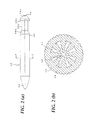
- the applying member 20 provided with a capillary force is preferably, as shown in Fig. 2 (a) and (b) , a member which is equipped with a tubular inner cylinder 21 and in which an applying tip 25 is equipped with a slit in a conical and radial form.
- a rear end part 22 of the applying member 20 is brought into contact with a front end of the valve rod 13, and the tubular inner cylinder 21 is continuously provided in an axial line direction with a cosmetic passage 23 of a cross section-radial inner groove through which the aqueous cosmetic passes.
- the above applying member 20 is constituted from a synthetic resin such as polyacetal, and holes 23a, 23b for introducing the aqueous cosmetic into the passage 23 in the applying member 20 are formed in the rear end part 22 and a side face part 24 of the applying member.
- Reference numerals 26a and 26b shown in the drawing are a front end side face and a rear end side face for introducing the aqueous cosmetic into the passage 23 in the applying member 20.
- the valve mechanism 16 is opened by pushing the above applying member 20, and the aqueous manicure composition H is introduced into the passage 23 in the applying member 20 and supplied to the applying tip 25 equipped with a slit in a conical and radial form.
- the aqueous cosmetic H which is the acid dye base aqueous cosmetic or the organic pigment base aqueous cosmetic of the present invention is transported from the liquid storing part 11 to the applying member 20, and therefore lines and patterns are drawn directly on a nail or drawn on a coating film of a nail enamel comprising nitrocellulose, a resin, acetate esters and the like applied in advance on a nail. Then, a transparent nail enamel is applied thereon to finish coating, whereby drawing is completed.
- the aqueous cosmetic-stored applicator of the present invention is equipped with the liquid storing part 11 stored with the aqueous cosmetic H which is the acid dye base aqueous cosmetic or the organic pigment base aqueous cosmetic having the characteristics described above and the applying member 20, and the aqueous cosmetic H having the respective compositions described above is transported from the liquid storing part 11 to the applying member 20 by virtue of a capillary force.
- An applying member provided with a capillary force is employed as the applying member 20 described above, whereby provided is the aqueous cosmetic-stored applicator which is excellent in usability to make it possible to readily draw fine lines and patterns on a nail, a skin and the like and which is excellent in a finishing property.
- the applying member 20 provided with a capillary force assumes structure in which it is equipped with the tubular inner cylinder 21 and in which the applying tip 25 is equipped with a slit in a conical and radial form, whereby capable of being prepared is the aqueous cosmetic-stored applicator which is more excellent in usability to make it possible to readily draw finer lines and patterns on a nail and the like and which is very excellent in a finishing property.
- the applying member 20 provided with a capillary force in which it is equipped with the tubular inner cylinder 21 and in which the applying tip 25 is equipped with a slit in a conical and radial form, and in addition thereto, it may assume as well a structure in which plural opening parts for allowing the aqueous cosmetic described above to flow in are provided.
- plural opening parts for allowing the aqueous cosmetic described above to flow in are provided.
- only opening parts in an end at an opposite side to the applying tip described above are provided, and a part of a side face of the tubular inner cylinder can be opened by cutting a side face of the applying member to form opening parts.
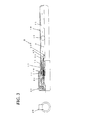
- aqueous cosmetic-stored applicator B in which a porous member having continuous pores (for example, a sponge material) 19 is further provided in a passage of the aqueous cosmetic H extending from the liquid storing part 11 to the applying member 20.
- the porous member having continuous pores (for example, a sponge material) 19 is provided in a rear of the applying member 20 and a periphery of the valve rod 13.
- aqueous cosmetic-stored applicator B of the above structure makes it possible to supply smoothly and efficiently the aqueous cosmetic having the characteristics described above to the applying member. For example, when an excess amount of the aqueous cosmetic flows out due to more opening of the valve mechanism 16 in Fig. 1 than necessary, it becomes possible to hold temporarily the excess amount thereof by the porous member having continuous pores 19 described above, and dripping of the aqueous cosmetic from the applying member 20 can be prevented.
- Blend components shown in the following Table 1 were mixed and dispersed by means of a homomixer or a disper to prepare aqueous manicure compositions which were the respective acid dye base aqueous cosmetics.
- the respective aqueous manicure compositions obtained were used to evaluate a viscosity (initial) at a prescribed shear rate, a viscosity stability, a particle diameter (initial), an aggregation test, a hard cake test, followability and a masking power by the following evaluation methods and the like. The results thereof are shown in the following Table 1.
- the respective aqueous cosmetics obtained were used to measure viscosities at the shear rates of 3.83 s -1 and 383 s -1 at a temperature of 25°C by means of a cone plate type viscometer (among TV-30 type viscometers, an ELD type viscometer or an EMD type viscometer, each equipped with a standard cone plate, manufactured by Tokimec Inc.).
- the aqueous cosmetic was put in a tightly closed vessel and left standing under an environment of 50°C for one week, and after restored to 25°C, a viscosity thereof was measured by the same method as described above and evaluated according to the following evaluation criteria.
- the respective aqueous cosmetics obtained were used to measure a particle diameter (nm) at 25°C by means of N4 Plus (manufactured by Beckman Coulter, Inc.).
- the aqueous cosmetic was put in a tightly closed vessel and left standing under an environment of 50°C for one week, and after restored to 25°C, a particle diameter thereof was measured by the same method as described above and evaluated according to the following criteria.
- the cosmetic loaded in a pen type vessel was discharged and used, and then a discharge state of the cosmetic was evaluated according to the following criteria.
- the cosmetic was loaded in a pen type vessel (storing applicator) and centrifugally separated at 1000 rpm for 30 minutes by means of a centrifugal separator H-40F (manufactured by KOKUSAN Co., Ltd.), and this was shaken up and down to count a frequency observed until the stirring ball moved and evaluate it according to the following criteria.
- the cosmetic was applied on a nail by means of the applying member, and then a state of masking a color of the base was evaluated according to the following criteria.
- the acid dye base aqueous cosmetics of the present first invention prepared in Examples 1 to 8 are excellent in a viscosity and a stability of a particle diameter, do not causing about aggregation and are excellent in an aging settling stability and that in addition thereto, they mask the base and develop good colors as compared with those prepared in Comparative Examples 1 to 4 falling outside the scope of the present first invention.
- the alkali-soluble type acryl resin is not contained in Comparative Examples 1 and 2, and therefore it has been found clear that the aging stability is inferior and that a rise in the viscosity and an increase in the particle diameter are brought about.
- Comparative Example 3 It has been found clear that in Comparative Example 3, a problem is not involved in the aging stability, but the masking power is weak due to a small content of titanium oxide. In Comparative Example 4, it has been found clear that the viscosity stability is inferior since the styrene-acryl resin is used and that a hard cake is produced.
- Blend components shown in the following Table 2 were mixed and dispersed by means of a homomixer or a disper to prepare aqueous manicure compositions which were the respective organic pigment base aqueous cosmetics.
- the respective aqueous manicure compositions obtained were used to evaluate a viscosity (initial) at a prescribed shear rate, a hard cake test, followability and a masking power by the evaluation methods described above. The results thereof are shown in the following Table 2.
- the viscosity stability, the aggregation test and the like which were evaluated in the acid dye base aqueous cosmetics described above were not evaluated in the examples in which the above organic pigment base aqueous cosmetics were prepared because of the following reasons; considering that titanium oxide is liable to be aggregated in a case in which the acid dye is added as compared with a case in which the organic pigment is added and that when sodium-polyaspartate is used as a dispersant for titanium oxide, the cosmetics are liable to be aggregated with the passage of time, the viscosity stability, the aggregation test and the like described above were further added and evaluated; and in a case of the organic pigment base aqueous cosmetics, it was considered that the effects of the organic pigment base aqueous cosmetics of the second invention could be confirmed and verified by the respective evaluations of the hard cake test, the followability and the masking power.
- the organic pigment base aqueous cosmetics of the present second invention prepared in Examples 9 to 18 are excellent in an aging settling stability of titanium oxide to make a hard cake less liable to be produced even when titanium oxide settles down and can readily be redispersed by stirring and that the cosmetics can be applied smoothly without causing about starving to mask the base and develop good colors as compared with those prepared in Comparative Examples 5 to 8 falling outside the scope of the present invention.
- aqueous cosmetic suited to manicure compositions for a nail art, cosmetics for skin coloring and the like is obtained.
Landscapes
- Life Sciences & Earth Sciences (AREA)
- Health & Medical Sciences (AREA)
- Animal Behavior & Ethology (AREA)
- General Health & Medical Sciences (AREA)
- Public Health (AREA)
- Veterinary Medicine (AREA)
- Birds (AREA)
- Epidemiology (AREA)
- Chemical & Material Sciences (AREA)
- Inorganic Chemistry (AREA)
- Cosmetics (AREA)
Abstract
Description
- The present invention relates to an aqueous cosmetic containing titanium oxide and an acid dye or an organic pigment, more specifically to an aqueous cosmetic which is excellent in an aging settling stability of titanium oxide to make a hard cake less liable to be produced even when titanium oxide settles down and can readily be redispersed by stirring and which is excellent in usability and a coating performance and suited to a manicure composition for a nail art, cosmetics for skin coloring and the like.
- Many cosmetics have so far been known as aqueous cosmetics containing titanium oxide which is excellent in a masking power.
Titanium oxide contained in the above aqueous cosmetics settles down when left standing still for long time to form a hard cake. This hard cake involves the problem that it is not readily redispersed by stirring and the like. - Cosmetics for skin coloring comprising at least water, a pigment containing titanium oxide and a resin have so far been known as cosmetics for skin coloring which have good redispersibility of a pigment in storing, wherein contained are at least one rein selected from the group consisting of a styrene-acrylic acid copolymer, a styrene-maleic acid copolymer, a styrene-alkyl acrylate copolymer and a styrene-alkyl maleate copolymer and a base such as ammonia and amines, and at least one thickener selected from a clay base inorganic thickener, an inorganic fine particle thickener and a polysaccharide thickener is contained (refer to, for example,
patent document 1 filed by the present applicants). - Further, known is an aqueous manicure composition in which dispersibility and the like are improved by blending a powder obtained by subjecting a powder of titanium oxide and the like to hydrophilic treatment with a silylating agent having a polyoxyethylene chain and an acryl base polymer emulsion (refer to, for example, patent document 2).
- However, also in aqueous cosmetics such as the aqueous cosmetics for skin coloring and the aqueous manicure composition each described in the
above patent documents
Also, involved therein are the problems that when an acid dye is present in an aqueous cosmetic containing titanium oxide, aggregation of titanium oxide is liable to be brought about and that when sodium-polyaspartate is used as a dispersant for titanium oxide, aggregation thereof is brought about with the passage of time to cause a rise in the viscosity. Accordingly, the problem that they cannot be loaded and used in an applicator of a pen type is involved therein.
Further, when an aqueous cosmetic containing titanium oxide is loaded in an applicator of a pen type, a pen tip thereof is dried, and therefore involved therein is the problem that particularly in a case of an aqueous cosmetic in which titanium oxide is blended with an organic pigment, the above organic pigment is aggregated and solidified, whereby the cakes become harder. -
- Patent document 1: Japanese Patent Application Laid-Open No.
157329/1996 - Patent document 2: Japanese Patent Application Laid-Open No.
110642/1997 - In light of the problems on the conventional arts described above, that is, a problem of an aqueous cosmetic containing titanium oxide and an acid dye and a problem of an aqueous cosmetic containing titanium oxide and an organic pigment, the present invention intends to solve them, and an object thereof is to provide an aqueous cosmetic containing titanium oxide and an acid dye or an organic pigment, wherein it is excellent in an aging settling stability to make a hard cake less liable to be produced even when titanium oxide settles down and can readily be redispersed by stirring, and it inhibits a viscosity from rising and is excellent in usability and a coating performance.
- In light of the problems on the conventional arts described above, the present inventors intend to solve them, and they have found that the respective aqueous cosmetics meeting the objects described above are obtained by adding at least a specific amount of titanium oxide, an acid dye or an organic pigment, an acryl resin having specific physical properties and water. Thus, the present invention has come to be completed.
- That is, the present invention comprises in the following items (1) to (7).
- (1) An aqueous cosmetic containing at least 5 to 30 % by mass of titanium oxide, an acid dye, an alkali-soluble type acryl resin and water.
- (2) An aqueous cosmetic containing at least 5 to 30 % by mass of titanium oxide, an organic pigment, an alkali-soluble type acryl resin and water.
- (3) The aqueous cosmetic as described in the above item (1) or (2), wherein titanium oxide coated on a surface with alumina is contained.
- (4) The aqueous cosmetic as described in any of the above items (1) to (3), wherein a mass ratio of the alkali-soluble type acryl resin to titanium oxide is 0.01 to 1.
- (5) The aqueous cosmetic as described in any one of the above items (1) to (4), wherein the alkali-soluble type acryl resin is an (alkyl acrylate/octylacrylamide) copolymer.
- (6) The aqueous cosmetic as described in any one of the above items (1) to (5), wherein in measuring a viscosity of the aqueous cosmetic at 25°C by means of a cone plate type viscometer, a viscosity thereof at a shear rate of 3.83 S-1 is 150 mPa·s or less, and a viscosity thereof at a shear rate of 383 s-1 is 20 mPa·s or less.
- (7) The aqueous cosmetic as described in any one of the above items (1) to (6), wherein in an applicator which is equipped with at least a liquid storing part and an applying member and in which a liquid is transported from the liquid storing part to the applying member by virtue of a capillary force, the aqueous cosmetic is loaded in the liquid storing part described above.
- According to the present invention, provided are an aqueous cosmetic containing titanium oxide and an acid dye and an aqueous cosmetic containing titanium oxide and an organic pigment, wherein both of them are excellent in an aging settling stability to make a hard cake less liable to be produced even when titanium oxide settles down and can readily be redispersed by stirring, and they inhibit a viscosity from rising with the passage of time and are excellent in usability and a coating performance and suited to a manicure composition for a nail art, cosmetics for skin coloring and the like.
-
-
Fig. 1 is a partial vertical cross section and a left side face drawing which show one example of an applicator loading the aqueous cosmetic of the present invention. -
Fig. 2 (a) is a side face drawing showing one example of the applicator, and (b) is a I-I line cross section of (a). -
Fig. 3 is a partial vertical cross section and a left side face drawing which show another example of an applicator loading the aqueous cosmetic of the present invention. - The embodiments of the present invention shall be explained below in detail.
The aqueous cosmetic of the present invention is characterized by that it contains 5 to 30 % by mass of titanium oxide, an acid dye, an alkali-soluble type acryl resin and water in a first invention and that it contains 5 to 30 % by mass of titanium oxide, an organic pigment, an alkali-soluble type acryl resin and water in a second invention.
When referring to "the present invention" in the followings, it includes the first invention (acid dye base aqueous cosmetic) and the second invention (organic pigment base aqueous cosmetic) each described above [the present invention (the first invention and the second invention)]. - Titanium oxide used in the present invention exerts an excellent masking power when coated on a skin and a nail, and it shall not specifically be restricted as long as it is used usually for aqueous cosmetics. Titanium oxide subjected to alumina treatment is preferably used in terms of controlling a surface activity.
For example, at least one (each alone or a mixture of two or more kinds, hereinafter the same shall apply) of A-100 and W-100 (all manufactured by Ishihara Sangyo Kaisha, Ltd.), JR and JA-1 (all manufactured by Tayca Corporation) and the like which are commercially available can be used as titanium oxide which can be used, and at least one of CR50, CR60, CR67, PF737 and R680 (all manufactured by Ishihara Sangyo Kaisha, Ltd.), R900 (manufactured by Du Pont Co., Ltd.) and the like which are commercially available can be used as titanium oxide subjected to alumina treatment. - A content of above titanium oxide is 5 to 30 % by mass (hereinafter referred to merely as "%"), preferably 8 to 25 % based on the total amount of the aqueous cosmetic.
If a content of above titanium oxide is less than 5 %, the coating film is poor in a masking property. On the other hand, if it exceeds 30 %, a viscosity of the aqueous cosmetic is instable, and both are not preferred. - The acid dye used in the present first invention is used as a color material and shall not specifically be restricted as long as it is a dye used usually as an acid dye for aqueous cosmetics.
For example, dyes which have so far been used for cosmetics and the like and which have high safety to human bodies are preferred as the above acid dye, and they include, for example, nitro dyes, azo, dyes, nitroso dyes, triphenylmethane dyes, xanthene dyes, quinoline dyes, anthraquinone dyes, indigo dyes and the like. To be specific, capable of being preferably listed from the viewpoint of a dyeing power are Red No. 2, Red No. 3 (FD & C Red No. 3), Red No. 40 (FD & C Red No. 40), Red No. 102, Red No. 104 (D & C Red No. 28), Red No. 105, Red No. 106, Red No. 201 (D & C Red No. 6), Red No. 202 (D & C Red No. 7), Red No. 203, Red No. 205, Red No. 227 (D & C Red No. 33), Red No. 230-1 (D & C Red No. 22), Red No. 401, Red No. 402, Red No. 504 (FD & C Red No. 4), Orange No. 205 (D & C Orange No. 4), Orange No. 402, Yellow No. 4 (FD & C Yellow No. 5), Yellow No. 5 (FD & C Yellow No. 6), Yellow No. 203 (D & C Yellow No. 10), Yellow No. 402, Yellow No. 403-1 (Ext. D & C Yellow No. 7), Yellow No. 406, Yellow No. 407, Green No. 3 (FD & C Green No. 3), Green No. 201, Green No. 402, Blue No. 1 (FD & C Blue No.1), Blue No. 2 (FD & C Blue No. 2), Blue No. 203, Blue No. 205 (D & C Blue No. 4), Blue No. 403, Blue No. 404, Brown No. 201 (D & C Brown No. 1), Violet No. 401 (Ext. D & C Violet No. 2), Black No. 401 and the like. At least one selected from the above acid dyes can be used and shall not specifically be restricted as long as it is an acid dye used for aqueous cosmetics. - A content of the above acid dyes is 0.02 to 20 %, preferably 0.2 to 10 % based on the total amount of the aqueous cosmetic in terms of a color developing property, a suitable viscosity and a smooth discharge property in an aqueous cosmetic applicator equipped with an applying member.
If a content of the above acid dye is less than 0.02 %, the good developed color is not obtained. On the other hand, if it exceeds 20 %, the cosmetic is increased in a viscosity and liable to be reduced in a discharge property and bring about aggregation, and therefore both are not preferred. - Next, the organic pigment used in the present second invention is used as a color material and shall not specifically be restricted as long as it is a pigment used usually as an organic pigment for aqueous cosmetics.
It includes, for example, at least one selected from organic pigments such as Blue No. 1 Al Lake, Red No. 202, Red No. 220, Red No. 226, Red No. 228, Blue No. 201, Blue No. 204, Blue No. 404, Yellow No. 401, Yellow No. 205, Yellow No. 4 Al Lake, Yellow No. 203 Al Lake, and Red No. 104 Al Lake. It shall not specifically be restricted as long as it is an organic pigment used for aqueous cosmetics. - A content of the above organic pigments is preferably 0.05 to 15 %, more preferably 0.1 to 10 % based on the total amount of the aqueous cosmetic in terms of a color developing property, a suitable viscosity and a smooth discharge property in an aqueous cosmetic applicator equipped with an applying member.
If a content of the above organic pigments is less than 0.05 %, the good developed color is not obtained. On the other hand, if it exceeds 15 %, the cosmetic is increased in a viscosity and liable to be reduced in a discharge property and bring about aggregation, and therefore both are not preferred. - The alkali-soluble type acryl resin used in the present invention functions as a dispersant for titanium oxide and the like in the aqueous cosmetic and functions as a fixing resin after coated. It includes, to be specific, at least one of (alkyl acrylate/octylacrylamide) copolymers, alkyl acrylate copolymers and the like, and to be more specific, it has a carboxyl group in a structure and is soluble at an alkaline range.
In the present invention, the composition is suitably controlled by a pH controller and the like until the alkali-soluble type acryl resin is dissolved. Capable of being used as the pH controller are 2-amino-2-methyl-1-propanol, 2-amino-2-methyl-1,3-propanediol, triethanolamine, L-arginine, aqueous ammonia, sodium hydroxide and the like, and 2-amino-2-methyl-1-propanol is particularly preferred. Also, when the alkali-soluble type acryl resin described above is once dissolved at an alkaline range, it has stable solubility up to the vicinity of pH 7.0. - Commercially available products such as AMPHOMER V-42 (manufactured by Akzo Nobel Corporate) which is an (alkyl acrylate/octylacrylamide) copolymer, Luvimer 100P (manufactured by BASF A.G.) which is an alkyl acrylate copolymer and DERMACRYL AGF (manufactured by Akzo Nobel Corporate) which is an alkyl acrylate copolymer emulsion can be used as the alkali-soluble type acryl resin.
The (alkyl acrylate/octylacrylamide) copolymer is preferably used in terms of further improving dispersibility of titanium oxide. - A content of the above alkali-soluble type acryl resins is preferably 0.05 to 30 %, more preferably 0.1 to 20 % in terms of a solid content based on the total amount of the aqueous cosmetic from the viewpoints of dispersion stability and a fixing property of titanium oxide.
If a content of the above alkali-soluble type acryl resin is less than 0.05 %, the sufficiently high pigment dispersion ability is not obtained. On the other hand, if it exceeds 30 %, an influence comes to be exerted on the aging stability, and therefore both are not preferred. - In the present invention, the alkali-soluble type acryl resin is used as a suited dispersant for titanium oxide, and a mass ratio of the alkali-soluble type acryl resin to titanium oxide is more preferably 0.01 to 1, particularly preferably 0.04 to 0.8 based on 1 of titanium oxide.
If the above mass ratio is less than 0.01, further effects of the present invention can not be exerted, and even if it exceeds 1, no problems are raised as long as it does not exceed an upper limit of a content of the alkali-soluble type acryl resin. - In the present invention, a water-soluble organic solvent is preferably contained in terms of improving the finishing property and a moisturizing property of an applying member such as a pen tip of the applicator.
The water-soluble organic solvent which can be used includes water-soluble glycols such as 1,3-bytylene glycol, 1,4-bytylene glycol, pentylene glycol, ethylene glycol, diethylene glycol, polyethylene glycol, propylene glycol, dipropylene glycol, and glycerin.
A content of the above water-soluble organic solvents is 1 to 20 %, preferably 8 to 15 % based on the total amount of the aqueous cosmetic.
If a content of the above water-soluble organic solvent (water-soluble glycols) is less than 1 %, an effect of adding the water-soluble organic solvent can not be exerted, and on the other hand, if it exceeds 20 %, an adverse effect is exerted on suitable dispersion of titanium oxide in a certain case. - The aqueous cosmetic of the present invention is, as described above, an acid dye base aqueous cosmetic containing titanium oxide, an acid dye, an alkali-soluble type acryl resin and the like or an organic pigment base aqueous cosmetic containing titanium oxide, an organic pigment, an alkali-soluble type acryl resin and the like. Further, it can contain ethanol and the like for a quick drying property. Still further, it can contain suited amounts of a chelating agent, a thickener (natural saccharides such as xanthan gum), a water-soluble polymer, various surfactants for reducing a surface tension, a fungicide, an antioxidant, a UV absorber, a fragrance and the like which are usually used for liquid cosmetics as long as the effects of the present invention are not damaged.
- The fungicide which can be used includes parabens, sodium dehydroacetate, phenoxyethanol and the like. The fungicide used in the present invention includes antiseptic agents, and capable of being used as parabens which are antiseptic agents are methyl paraoxybenzoate, ethyl paraoxybenzoate, propyl paraoxybenzoate, butyl paraoxybenzoate, isopropyl paraoxybenzoate and the like.
- In the aqueous cosmetic of the present invention, the respective components described above are contained in both of the acid dye base aqueous cosmetic and the organic pigment base aqueous cosmetic, and the balance is controlled by water (purified water, ion-exchanged water, distilled water and the like). In measuring a viscosity of the aqueous cosmetic at 25°C by means of a cone plate type viscometer, a viscosity thereof at a shear rate of 3.83 s-1 is 150 mPa·s or less, and a viscosity thereof at a shear rate of 383 s-1 is 20 mPa·s or less.
If the viscosity described above at a shear rate of 3.83 s-1 exceeds 150 mPa·s and/or if the viscosity described above at a shear rate of 383 s-1 exceeds 20 mPa·s, the followability is reduced, and both are not preferred.
In order to satisfy the viscosities at the respective shear rates described above, titanium oxide, the acid dye or the organic pigment, the alkali-soluble type acryl resin and the like which are added to the aqueous cosmetic are suitably combined in the ranges of the respective contents described above, whereby the viscosities can be controlled. Also, they can be controlled by suitably using a thickener (natural polysaccharides, mineral base thickeners and the like) and the like. - The aqueous cosmetic of the present invention is prepared by mixing and dispersing the respective components of the acid dye base aqueous cosmetic and the organic pigment base aqueous cosmetic in the contents of the respective ranges described above by means of a mixing dispersing equipment, for example, a bead mill, a homomixer, a disper, an attritor, a ball mill, a sand grinder and the like.
- At least titanium oxide, the acid dye and the alkali-soluble type acryl resin are contained in the acid dye base aqueous cosmetic of the present first invention thus constituted, and at least titanium oxide, the organic pigment and the alkali-soluble type acryl resin are contained in the organic pigment base aqueous cosmetic of the present second invention, whereby both aqueous cosmetics are controlled so that titanium oxide is stably dispersed in water to provide the aqueous cosmetics with prescribed physical properties. Accordingly, obtained are the aqueous cosmetics which are excellent in an aging settling stability to make a hard cake less liable to be produced even when titanium oxide settles down and can readily be redispersed by lightly stirring and which inhibit a viscosity from rising with the passage of time and are excellent in usability and a coating performance and suited to a manicure composition for a nail art, cosmetics for skin coloring and the like.
Also, in the acid dye base aqueous cosmetic of the present first invention, the alkali-soluble type acryl resin is added as a dispersant for titanium oxide, whereby the excellent dispersion performance is exerted in a case in which the acid dye is present rather than in a case in which sodium polyaspartate is used as a dispersant for titanium oxide and a case in which a styrene-acryl base resin is used as a dispersant for titanium oxide. This is estimated to be attributable to that a soft cake can be formed due to the absence of a styrene group.
Further, in the acid dye base aqueous cosmetic of the present first invention, titanium oxide is not aggregated and solidified and a viscosity thereof can be inhibited from rising with the passage of time, even when the aqueous cosmetic containing titanium oxide and the acid dye is loaded in an applicator of a pen type described later. Accordingly, the aqueous cosmetic which has not so far been available and which can suitably be used in an applicator of a pen type is obtained.
Also, in the organic pigment base aqueous cosmetic of the present second invention, the alkali-soluble type acryl resin is added as a dispersant for titanium oxide and the like, whereby more excellent dispersion performance than those of conventional styrene-acryl base resins and the like is exerted. This is estimated to be attributable to that a soft cake can be formed due to the absence of a styrene group.
Further, in the organic pigment base aqueous cosmetic of the present second invention, even when the aqueous cosmetic containing titanium oxide is loaded in an applicator of a pen type described later, and therefore the aqueous cosmetic in which aggregation and solidification of the organic pigment due to drying of a pen tip is not caused and which has not so far been available is obtained as well particularly in the aqueous cosmetic blended with the organic pigment. - Both of the acid dye base aqueous cosmetic or the organic pigment base aqueous cosmetic of the present invention thus constituted is loaded in an applicator of a pen type, to be specific, an applicator which is equipped with at least a liquid storing part and an applying member and in which a liquid is transported from the liquid storing part to the applying member by virtue of a capillary force, wherein the aqueous cosmetic is loaded in the liquid storing part described above, and the applicator comes to be usable.
- For example, an applicator A which is equipped, as shown in
Fig. 1 , with a liquid storing part 11 stored therein with the aqueous cosmetic (aqueous manicure composition in the present embodiment) constituted above and an applyingmember 20 having a capillary force and in which an acid dye base or organic pigment base aqueous cosmetic H is transported from the liquid storing part 11 to the applyingmember 20 by virtue of a capillary force can be used as an aqueous cosmetic-stored applicator loading the aqueous cosmetic of the present invention. - To describe the above applicator A in detail, an inside of an applicator
main body 10 is the liquid storing part 11; avalve mechanism 16 comprising avalve sheet 12, avalve rod 13, aspring member 14 comprising a coil spring and aspring bearing 15 is provided in front of the applicatormain body 10, and the applyingmember 20 described above is slidably held in an inside of afront shaft member 17 mounted in a front of the applicatormain body 10. Meanwhile,reference numeral 18 shown in the drawing is a stirring ball made of SUS, and areference numeral 30 is a cap member. - The applying
member 20 provided with a capillary force is preferably, as shown inFig. 2 (a) and (b) , a member which is equipped with a tubularinner cylinder 21 and in which an applyingtip 25 is equipped with a slit in a conical and radial form. To describe the applyingmember 20 in detail, arear end part 22 of the applyingmember 20 is brought into contact with a front end of thevalve rod 13, and the tubularinner cylinder 21 is continuously provided in an axial line direction with acosmetic passage 23 of a cross section-radial inner groove through which the aqueous cosmetic passes. The above applyingmember 20 is constituted from a synthetic resin such as polyacetal, and holes 23a, 23b for introducing the aqueous cosmetic into thepassage 23 in the applyingmember 20 are formed in therear end part 22 and aside face part 24 of the applying member. Reference numerals 26a and 26b shown in the drawing are a front end side face and a rear end side face for introducing the aqueous cosmetic into thepassage 23 in the applyingmember 20.
Thevalve mechanism 16 is opened by pushing the above applyingmember 20, and the aqueous manicure composition H is introduced into thepassage 23 in the applyingmember 20 and supplied to the applyingtip 25 equipped with a slit in a conical and radial form. - In a use mode of the aqueous cosmetic-stored applicator of the present invention, when the applying
member 20 of the applicator A shown inFig. 1 is pushed, the aqueous cosmetic H which is the acid dye base aqueous cosmetic or the organic pigment base aqueous cosmetic of the present invention is transported from the liquid storing part 11 to the applyingmember 20, and therefore lines and patterns are drawn directly on a nail or drawn on a coating film of a nail enamel comprising nitrocellulose, a resin, acetate esters and the like applied in advance on a nail. Then, a transparent nail enamel is applied thereon to finish coating, whereby drawing is completed. - Further, the aqueous cosmetic-stored applicator of the present invention is equipped with the liquid storing part 11 stored with the aqueous cosmetic H which is the acid dye base aqueous cosmetic or the organic pigment base aqueous cosmetic having the characteristics described above and the applying
member 20, and the aqueous cosmetic H having the respective compositions described above is transported from the liquid storing part 11 to the applyingmember 20 by virtue of a capillary force. An applying member provided with a capillary force is employed as the applyingmember 20 described above, whereby provided is the aqueous cosmetic-stored applicator which is excellent in usability to make it possible to readily draw fine lines and patterns on a nail, a skin and the like and which is excellent in a finishing property.
Further, the applyingmember 20 provided with a capillary force assumes structure in which it is equipped with the tubularinner cylinder 21 and in which the applyingtip 25 is equipped with a slit in a conical and radial form, whereby capable of being prepared is the aqueous cosmetic-stored applicator which is more excellent in usability to make it possible to readily draw finer lines and patterns on a nail and the like and which is very excellent in a finishing property. On the other hand, in addition to the structure of the applyingmember 20 provided with a capillary force in which it is equipped with the tubularinner cylinder 21 and in which the applyingtip 25 is equipped with a slit in a conical and radial form, and in addition thereto, it may assume as well a structure in which plural opening parts for allowing the aqueous cosmetic described above to flow in are provided. Usually, only opening parts (introduction holes 23a, 23b in the preset embodiment) in an end at an opposite side to the applying tip described above are provided, and a part of a side face of the tubular inner cylinder can be opened by cutting a side face of the applying member to form opening parts. Employing the above constitution makes it possible to secure a passage in causing about clogging by titanium oxide and the acid dye or the organic pigment each described above and in addition thereto, makes it possible to allow the aqueous cosmetic described above to flow in without delay even when troubles such as a rise in a viscosity of the aqueous cosmetic having the respective compositions described above by vaporization of water and the like are brought about. - Also, in contrast to the aqueous cosmetic-stored applicator A of the embodiment described above, it may be, as shown in
Fig. 3 , an aqueous cosmetic-stored applicator B in which a porous member having continuous pores (for example, a sponge material) 19 is further provided in a passage of the aqueous cosmetic H extending from the liquid storing part 11 to the applyingmember 20.
In the aqueous cosmetic-stored applicator B of the present embodiment, the porous member having continuous pores (for example, a sponge material) 19 is provided in a rear of the applyingmember 20 and a periphery of thevalve rod 13. Employing the aqueous cosmetic-stored applicator B of the above structure makes it possible to supply smoothly and efficiently the aqueous cosmetic having the characteristics described above to the applying member. For example, when an excess amount of the aqueous cosmetic flows out due to more opening of thevalve mechanism 16 inFig. 1 than necessary, it becomes possible to hold temporarily the excess amount thereof by the porous member havingcontinuous pores 19 described above, and dripping of the aqueous cosmetic from the applyingmember 20 can be prevented. - Next, the present invention shall be explained in further details with reference to examples and comparative examples, but the present invention shall not be restricted to the examples shown below.
- Blend components shown in the following Table 1 were mixed and dispersed by means of a homomixer or a disper to prepare aqueous manicure compositions which were the respective acid dye base aqueous cosmetics.
The respective aqueous manicure compositions obtained were used to evaluate a viscosity (initial) at a prescribed shear rate, a viscosity stability, a particle diameter (initial), an aggregation test, a hard cake test, followability and a masking power by the following evaluation methods and the like. The results thereof are shown in the following Table 1. - The respective aqueous cosmetics obtained were used to measure viscosities at the shear rates of 3.83 s-1 and 383 s-1 at a temperature of 25°C by means of a cone plate type viscometer (among TV-30 type viscometers, an ELD type viscometer or an EMD type viscometer, each equipped with a standard cone plate, manufactured by Tokimec Inc.).
- The aqueous cosmetic was put in a tightly closed vessel and left standing under an environment of 50°C for one week, and after restored to 25°C, a viscosity thereof was measured by the same method as described above and evaluated according to the following evaluation criteria.
- Evaluation criteria:
- ○: difference is scarcely present between an initial viscosity value and a viscosity value after left standing at 50°C
- Δ: a viscosity value after left standing at 50°C is risen a little as compared with an initial viscosity value
- ×: a viscosity value after left standing at 50°C is risen to a large extent as compared with an initial viscosity value or gelation is brought about after left standing at 50°C
- The respective aqueous cosmetics obtained were used to measure a particle diameter (nm) at 25°C by means of N4 Plus (manufactured by Beckman Coulter, Inc.).
- The aqueous cosmetic was put in a tightly closed vessel and left standing under an environment of 50°C for one week, and after restored to 25°C, a particle diameter thereof was measured by the same method as described above and evaluated according to the following criteria.
- Evaluation criteria:
- ○: difference is scarcely present between an initial particle diameter and a particle diameter after left standing at 50°C
- Δ: a particle diameter after left standing at 50°C is increased a little as compared with an initial particle diameter
- ×: a particle diameter after left standing at 50°C is increased to a large extent as compared with an initial particle diameter or gelation is brought about after left standing at 50°C
- The cosmetic loaded in a pen type vessel (storing applicator) was discharged and used, and then a discharge state of the cosmetic was evaluated according to the following criteria.
- Evaluation criteria:
- ○:
- the cosmetic can be applied smoothly
- Δ:
- the cosmetic is skipped in some portions
- ×:
- the cosmetic is not discharged at all
- The cosmetic was loaded in a pen type vessel (storing applicator) and centrifugally separated at 1000 rpm for 30 minutes by means of a centrifugal separator H-40F (manufactured by KOKUSAN Co., Ltd.), and this was shaken up and down to count a frequency observed until the stirring ball moved and evaluate it according to the following criteria.
- Evaluation criteria:
- ○:
- 0 to less than 100
- Δ:
- 100 to less than 200
- ×:
- 200 or more
- The cosmetic was applied on a nail by means of the applying member, and then a state of masking a color of the base was evaluated according to the following criteria.
- Evaluation criteria:
- ○: the base is masked, and a color of the cosmetic is developed well
- Δ: a color of the base is slightly observed, but a color of the cosmetic is developed well
- ×: a color of the base is observed, and a color of the cosmetic is developed badly
-


- As apparent from the results shown in Table 1 described above, it has been found clear that the acid dye base aqueous cosmetics of the present first invention prepared in Examples 1 to 8 are excellent in a viscosity and a stability of a particle diameter, do not causing about aggregation and are excellent in an aging settling stability and that in addition thereto, they mask the base and develop good colors as compared with those prepared in Comparative Examples 1 to 4 falling outside the scope of the present first invention.
To observe individually Comparative Examples 1 to 4, the alkali-soluble type acryl resin is not contained in Comparative Examples 1 and 2, and therefore it has been found clear that the aging stability is inferior and that a rise in the viscosity and an increase in the particle diameter are brought about. It has been found clear that in Comparative Example 3, a problem is not involved in the aging stability, but the masking power is weak due to a small content of titanium oxide. In Comparative Example 4, it has been found clear that the viscosity stability is inferior since the styrene-acryl resin is used and that a hard cake is produced. - Blend components shown in the following Table 2 were mixed and dispersed by means of a homomixer or a disper to prepare aqueous manicure compositions which were the respective organic pigment base aqueous cosmetics.
The respective aqueous manicure compositions obtained were used to evaluate a viscosity (initial) at a prescribed shear rate, a hard cake test, followability and a masking power by the evaluation methods described above. The results thereof are shown in the following Table 2.
The viscosity stability, the aggregation test and the like which were evaluated in the acid dye base aqueous cosmetics described above were not evaluated in the examples in which the above organic pigment base aqueous cosmetics were prepared because of the following reasons; considering that titanium oxide is liable to be aggregated in a case in which the acid dye is added as compared with a case in which the organic pigment is added and that when sodium-polyaspartate is used as a dispersant for titanium oxide, the cosmetics are liable to be aggregated with the passage of time, the viscosity stability, the aggregation test and the like described above were further added and evaluated; and in a case of the organic pigment base aqueous cosmetics, it was considered that the effects of the organic pigment base aqueous cosmetics of the second invention could be confirmed and verified by the respective evaluations of the hard cake test, the followability and the masking power. -


- As apparent from the results shown in Table 2 described above, it has been found clear that from the test results of the hard cake, the organic pigment base aqueous cosmetics of the present second invention prepared in Examples 9 to 18 are excellent in an aging settling stability of titanium oxide to make a hard cake less liable to be produced even when titanium oxide settles down and can readily be redispersed by stirring and that the cosmetics can be applied smoothly without causing about starving to mask the base and develop good colors as compared with those prepared in Comparative Examples 5 to 8 falling outside the scope of the present invention.
To observe individually Comparative Examples 5 to 8, since a content of titanium oxide is small in Comparative Example 5, the masking power is inferior, and the alkali-soluble type acryl resin to titanium oxide is short in Comparative Example 6 to produce a hard cake of titanium oxide. It has been found clear that since the alkali-soluble type acryl resin is not contained in Comparative Examples 7 and 8, titanium oxide settles down to produce a hard cake and that it is not readily redispersed. - The aqueous cosmetic suited to manicure compositions for a nail art, cosmetics for skin coloring and the like is obtained.
-
- A
- Aqueous cosmetic-stored applicator
- H
- Aqueous cosmetic (aqueous manicure composition)
- 10
- Applicator main body
- 11
- Liquid storing part
- 16
- Valve mechanism
- 17
- Front shaft member
- 18
- Stirring ball
- 20
- Applying member
- 25
- Applying tip (applying part)
- 30
- Cap member
Claims (7)
- An aqueous cosmetic containing at least 5 to 30 % by mass of titanium oxide, an acid dye, an alkali-soluble type acryl resin and water.
- An aqueous cosmetic containing at least 5 to 30 % by mass of titanium oxide, an organic pigment, an alkali-soluble type acryl resin and water.
- The aqueous cosmetic as described in claim 1 or 2, wherein titanium oxide coated on a surface with alumina is contained.
- The aqueous cosmetic as described in any one of claims 1 to 3, wherein a mass ratio of the alkali-soluble type acryl resin to titanium oxide is 0.01 to 1.
- The aqueous cosmetic as described in any one of claims 1 to 4, wherein the alkali-soluble type acryl resin is an (alkyl acrylate/octylacrylamide) copolymer.
- The aqueous cosmetic as described in any one of claims 1 to 5, wherein in measuring a viscosity of the aqueous cosmetic at 25°C by means of a cone plate type viscometer, a viscosity thereof at a shear rate of 3.83 s-1 is 150 mPa·s or less, and a viscosity thereof at a shear rate of 383 s-1 is 20 mPa·s or less.
- The aqueous cosmetic as described in any one of claims 1 to 6, wherein in an applicator which is equipped with at least a liquid storing part and an applying member and in which a liquid is transported from the liquid storing part to the applying member by virtue of a capillary force, the aqueous cosmetic is loaded in the liquid storing part described above.
Applications Claiming Priority (3)
| Application Number | Priority Date | Filing Date | Title |
|---|---|---|---|
| JP2010001041A JP5669398B2 (en) | 2010-01-06 | 2010-01-06 | Aqueous cosmetics |
| JP2010001868A JP5669399B2 (en) | 2010-01-07 | 2010-01-07 | Aqueous cosmetics |
| PCT/JP2010/072913 WO2011083679A1 (en) | 2010-01-06 | 2010-12-20 | Aqueous cosmetic preparation |
Publications (3)
| Publication Number | Publication Date |
|---|---|
| EP2522327A1 true EP2522327A1 (en) | 2012-11-14 |
| EP2522327A4 EP2522327A4 (en) | 2015-08-05 |
| EP2522327B1 EP2522327B1 (en) | 2020-06-03 |
Family
ID=44305416
Family Applications (1)
| Application Number | Title | Priority Date | Filing Date |
|---|---|---|---|
| EP10842192.6A Active EP2522327B1 (en) | 2010-01-06 | 2010-12-20 | Aqueous cosmetic preparation |
Country Status (4)
| Country | Link |
|---|---|
| US (1) | US20120276178A1 (en) |
| EP (1) | EP2522327B1 (en) |
| CN (1) | CN102791244B (en) |
| WO (1) | WO2011083679A1 (en) |
Families Citing this family (4)
| Publication number | Priority date | Publication date | Assignee | Title |
|---|---|---|---|---|
| JP6348690B2 (en) * | 2013-06-21 | 2018-06-27 | 三菱鉛筆株式会社 | Highly functional color material and manufacturing method thereof |
| CN106232084A (en) * | 2014-06-30 | 2016-12-14 | 株式会社资生堂 | Aqueous cosmetic |
| KR102409403B1 (en) * | 2018-01-04 | 2022-06-14 | 주식회사 엘지생활건강 | Powder complex for cosmetics and cosmetic composition comprising thereof |
| KR102901198B1 (en) * | 2019-02-18 | 2025-12-16 | 가부시키가이샤 도끼와 | Water-based liquid cosmetics |
Family Cites Families (22)
| Publication number | Priority date | Publication date | Assignee | Title |
|---|---|---|---|---|
| US5288493A (en) * | 1991-05-17 | 1994-02-22 | National Starch And Chemical Investment Holding Corporation | Skin care compositions with improved rub-off resistance |
| JP3113114B2 (en) * | 1993-01-13 | 2000-11-27 | 鐘紡株式会社 | Water based nail polish |
| JP3960632B2 (en) * | 1994-12-06 | 2007-08-15 | 三菱鉛筆株式会社 | Drawing cosmetics for skin coloring |
| JP3525593B2 (en) * | 1995-06-30 | 2004-05-10 | 株式会社コーセー | Aqueous nail polish |
| JP3525592B2 (en) * | 1995-10-20 | 2004-05-10 | 株式会社コーセー | Aqueous nail polish |
| EP0953610A4 (en) * | 1996-12-10 | 2008-06-25 | Catalysts & Chem Ind Co | COATED PIGMENTS OF INORGANIC COMPOUNDS AND COSMETIC PRODUCTS |
| JPH10265338A (en) * | 1997-03-21 | 1998-10-06 | Mitsubishi Pencil Co Ltd | Eye makeup cosmetics |
| JPH10265339A (en) * | 1997-03-24 | 1998-10-06 | Mitsubishi Pencil Co Ltd | Skin coloring liquid and method for producing the same |
| TW473526B (en) * | 1997-05-07 | 2002-01-21 | Mitsubishi Pencil Co | Water based white color tone pigment ink for ballpoint pen |
| JPH11100536A (en) * | 1997-09-29 | 1999-04-13 | Pentel Kk | High hiding liquid composition |
| JP4156697B2 (en) * | 1997-11-27 | 2008-09-24 | 三菱化学株式会社 | Water-based beauty nail |
| US6190681B1 (en) * | 1998-04-15 | 2001-02-20 | Yoram Fishman | Long lasting liquid color compositions |
| US5965111A (en) * | 1998-05-01 | 1999-10-12 | The Procter & Gamble Company | Fast drying water-borne nail polish |
| JP2002114641A (en) * | 2000-10-10 | 2002-04-16 | Asanuma Corporation | Water-based manicure preparation |
| JP2003171220A (en) * | 2001-12-07 | 2003-06-17 | Nippon Junyaku Kk | Cosmetics, binder for cosmetics, and method for producing the same |
| JP3738439B2 (en) * | 2001-12-07 | 2006-01-25 | 日本純薬株式会社 | Manufacturing method of nail polish binder, nail polish binder and nail polish |
| JP2004059035A (en) * | 2002-07-26 | 2004-02-26 | Mitsubishi Pencil Co Ltd | Liquid application container |
| JP4716877B2 (en) * | 2004-02-03 | 2011-07-06 | 三菱鉛筆株式会社 | Hair dye |
| JP2007077115A (en) * | 2005-09-16 | 2007-03-29 | Kose Corp | Eyelash cosmetic |
| JP5430149B2 (en) * | 2006-04-17 | 2014-02-26 | 三菱鉛筆株式会社 | Aqueous liquid makeup cosmetics |
| FR2901476B1 (en) * | 2006-05-29 | 2011-12-23 | Oreal | METHOD FOR COLORING A DARK SKIN |
| FR2909844B1 (en) * | 2006-12-14 | 2009-09-11 | Oreal | POINTE FELT PEN FOR NAIL MAKE-UP |
-
2010
- 2010-12-20 US US13/520,689 patent/US20120276178A1/en not_active Abandoned
- 2010-12-20 WO PCT/JP2010/072913 patent/WO2011083679A1/en not_active Ceased
- 2010-12-20 CN CN201080065242.9A patent/CN102791244B/en not_active Expired - Fee Related
- 2010-12-20 EP EP10842192.6A patent/EP2522327B1/en active Active
Non-Patent Citations (1)
| Title |
|---|
| See references of WO2011083679A1 * |
Also Published As
| Publication number | Publication date |
|---|---|
| CN102791244A (en) | 2012-11-21 |
| EP2522327A4 (en) | 2015-08-05 |
| EP2522327B1 (en) | 2020-06-03 |
| US20120276178A1 (en) | 2012-11-01 |
| CN102791244B (en) | 2015-10-21 |
| WO2011083679A1 (en) | 2011-07-14 |
Similar Documents
| Publication | Publication Date | Title |
|---|---|---|
| EP2594246B1 (en) | Liquid cosmetic | |
| US11890363B2 (en) | Liquid cosmetic composition | |
| EP2839825B1 (en) | Liquid cosmetic preparation | |
| EP2522327B1 (en) | Aqueous cosmetic preparation | |
| WO2022091971A1 (en) | Marker composition for skin | |
| EP2353583B1 (en) | Aqueous nail-beautifying materials and nail-beautifying material-containing application tools | |
| EP1238648B1 (en) | Cumulative hair-dyeing temporary hair dyes and process for producing the same | |
| KR102641880B1 (en) | Pigment dispersion for cosmetics, water-based liquid cosmetics using it | |
| US8454981B2 (en) | Cosmetic preparation for coloring the eyelids and eyebrows | |
| JP5669399B2 (en) | Aqueous cosmetics | |
| CN111867547A (en) | Pigment dispersion liquid for cosmetics, water-based liquid cosmetics using the same | |
| JP5669398B2 (en) | Aqueous cosmetics | |
| US9675541B2 (en) | Water-based pigmented preparation | |
| JP7211718B2 (en) | liquid cosmetics | |
| US8388988B2 (en) | Cosmetic preparation for coloring of eyelids and eyebrows | |
| JP6164909B2 (en) | Liquid cosmetics | |
| JP2018188396A (en) | Aqueous makeup cosmetic | |
| US20250277115A1 (en) | Pigment dispersion for aqueous cosmetic compositions, and aqueous cosmetic composition using the same | |
| JPH10279853A (en) | Water-base ink for stamp pad | |
| WO2023127749A1 (en) | Aqueous liquid cosmetic material | |
| JP2024131217A (en) | Iron oxide pigment dispersion for cosmetics | |
| JP2025133044A (en) | Pigment dispersion for aqueous cosmetic composition and aqueous cosmetic composition using the same | |
| JP2015086206A (en) | Manicure composition and manicure applicator using the same | |
| WO2024014508A1 (en) | Marker composition for skin, and application tool for same | |
| JP2013147444A (en) | Manicure composition |
Legal Events
| Date | Code | Title | Description |
|---|---|---|---|
| PUAI | Public reference made under article 153(3) epc to a published international application that has entered the european phase |
Free format text: ORIGINAL CODE: 0009012 |
|
| 17P | Request for examination filed |
Effective date: 20120803 |
|
| AK | Designated contracting states |
Kind code of ref document: A1 Designated state(s): AL AT BE BG CH CY CZ DE DK EE ES FI FR GB GR HR HU IE IS IT LI LT LU LV MC MK MT NL NO PL PT RO RS SE SI SK SM TR |
|
| DAX | Request for extension of the european patent (deleted) | ||
| RIC1 | Information provided on ipc code assigned before grant |
Ipc: A61Q 3/02 20060101ALI20150618BHEP Ipc: A61K 8/81 20060101ALI20150618BHEP Ipc: A61K 8/29 20060101AFI20150618BHEP |
|
| RA4 | Supplementary search report drawn up and despatched (corrected) |
Effective date: 20150708 |
|
| STAA | Information on the status of an ep patent application or granted ep patent |
Free format text: STATUS: EXAMINATION IS IN PROGRESS |
|
| 17Q | First examination report despatched |
Effective date: 20170413 |
|
| GRAP | Despatch of communication of intention to grant a patent |
Free format text: ORIGINAL CODE: EPIDOSNIGR1 |
|
| STAA | Information on the status of an ep patent application or granted ep patent |
Free format text: STATUS: GRANT OF PATENT IS INTENDED |
|
| INTG | Intention to grant announced |
Effective date: 20191210 |
|
| GRAS | Grant fee paid |
Free format text: ORIGINAL CODE: EPIDOSNIGR3 |
|
| GRAA | (expected) grant |
Free format text: ORIGINAL CODE: 0009210 |
|
| STAA | Information on the status of an ep patent application or granted ep patent |
Free format text: STATUS: THE PATENT HAS BEEN GRANTED |
|
| AK | Designated contracting states |
Kind code of ref document: B1 Designated state(s): AL AT BE BG CH CY CZ DE DK EE ES FI FR GB GR HR HU IE IS IT LI LT LU LV MC MK MT NL NO PL PT RO RS SE SI SK SM TR |
|
| REG | Reference to a national code |
Ref country code: GB Ref legal event code: FG4D |
|
| REG | Reference to a national code |
Ref country code: AT Ref legal event code: REF Ref document number: 1276251 Country of ref document: AT Kind code of ref document: T Effective date: 20200615 Ref country code: CH Ref legal event code: EP |
|
| REG | Reference to a national code |
Ref country code: DE Ref legal event code: R096 Ref document number: 602010064548 Country of ref document: DE |
|
| REG | Reference to a national code |
Ref country code: LT Ref legal event code: MG4D |
|
| PG25 | Lapsed in a contracting state [announced via postgrant information from national office to epo] |
Ref country code: LT Free format text: LAPSE BECAUSE OF FAILURE TO SUBMIT A TRANSLATION OF THE DESCRIPTION OR TO PAY THE FEE WITHIN THE PRESCRIBED TIME-LIMIT Effective date: 20200603 Ref country code: SE Free format text: LAPSE BECAUSE OF FAILURE TO SUBMIT A TRANSLATION OF THE DESCRIPTION OR TO PAY THE FEE WITHIN THE PRESCRIBED TIME-LIMIT Effective date: 20200603 Ref country code: FI Free format text: LAPSE BECAUSE OF FAILURE TO SUBMIT A TRANSLATION OF THE DESCRIPTION OR TO PAY THE FEE WITHIN THE PRESCRIBED TIME-LIMIT Effective date: 20200603 Ref country code: GR Free format text: LAPSE BECAUSE OF FAILURE TO SUBMIT A TRANSLATION OF THE DESCRIPTION OR TO PAY THE FEE WITHIN THE PRESCRIBED TIME-LIMIT Effective date: 20200904 Ref country code: NO Free format text: LAPSE BECAUSE OF FAILURE TO SUBMIT A TRANSLATION OF THE DESCRIPTION OR TO PAY THE FEE WITHIN THE PRESCRIBED TIME-LIMIT Effective date: 20200903 |
|
| REG | Reference to a national code |
Ref country code: NL Ref legal event code: MP Effective date: 20200603 |
|
| PG25 | Lapsed in a contracting state [announced via postgrant information from national office to epo] |
Ref country code: LV Free format text: LAPSE BECAUSE OF FAILURE TO SUBMIT A TRANSLATION OF THE DESCRIPTION OR TO PAY THE FEE WITHIN THE PRESCRIBED TIME-LIMIT Effective date: 20200603 Ref country code: RS Free format text: LAPSE BECAUSE OF FAILURE TO SUBMIT A TRANSLATION OF THE DESCRIPTION OR TO PAY THE FEE WITHIN THE PRESCRIBED TIME-LIMIT Effective date: 20200603 Ref country code: HR Free format text: LAPSE BECAUSE OF FAILURE TO SUBMIT A TRANSLATION OF THE DESCRIPTION OR TO PAY THE FEE WITHIN THE PRESCRIBED TIME-LIMIT Effective date: 20200603 Ref country code: BG Free format text: LAPSE BECAUSE OF FAILURE TO SUBMIT A TRANSLATION OF THE DESCRIPTION OR TO PAY THE FEE WITHIN THE PRESCRIBED TIME-LIMIT Effective date: 20200903 |
|
| REG | Reference to a national code |
Ref country code: AT Ref legal event code: MK05 Ref document number: 1276251 Country of ref document: AT Kind code of ref document: T Effective date: 20200603 |
|
| PG25 | Lapsed in a contracting state [announced via postgrant information from national office to epo] |
Ref country code: AL Free format text: LAPSE BECAUSE OF FAILURE TO SUBMIT A TRANSLATION OF THE DESCRIPTION OR TO PAY THE FEE WITHIN THE PRESCRIBED TIME-LIMIT Effective date: 20200603 Ref country code: NL Free format text: LAPSE BECAUSE OF FAILURE TO SUBMIT A TRANSLATION OF THE DESCRIPTION OR TO PAY THE FEE WITHIN THE PRESCRIBED TIME-LIMIT Effective date: 20200603 |
|
| PG25 | Lapsed in a contracting state [announced via postgrant information from national office to epo] |
Ref country code: ES Free format text: LAPSE BECAUSE OF FAILURE TO SUBMIT A TRANSLATION OF THE DESCRIPTION OR TO PAY THE FEE WITHIN THE PRESCRIBED TIME-LIMIT Effective date: 20200603 Ref country code: CZ Free format text: LAPSE BECAUSE OF FAILURE TO SUBMIT A TRANSLATION OF THE DESCRIPTION OR TO PAY THE FEE WITHIN THE PRESCRIBED TIME-LIMIT Effective date: 20200603 Ref country code: RO Free format text: LAPSE BECAUSE OF FAILURE TO SUBMIT A TRANSLATION OF THE DESCRIPTION OR TO PAY THE FEE WITHIN THE PRESCRIBED TIME-LIMIT Effective date: 20200603 Ref country code: PT Free format text: LAPSE BECAUSE OF FAILURE TO SUBMIT A TRANSLATION OF THE DESCRIPTION OR TO PAY THE FEE WITHIN THE PRESCRIBED TIME-LIMIT Effective date: 20201006 Ref country code: SM Free format text: LAPSE BECAUSE OF FAILURE TO SUBMIT A TRANSLATION OF THE DESCRIPTION OR TO PAY THE FEE WITHIN THE PRESCRIBED TIME-LIMIT Effective date: 20200603 Ref country code: EE Free format text: LAPSE BECAUSE OF FAILURE TO SUBMIT A TRANSLATION OF THE DESCRIPTION OR TO PAY THE FEE WITHIN THE PRESCRIBED TIME-LIMIT Effective date: 20200603 Ref country code: AT Free format text: LAPSE BECAUSE OF FAILURE TO SUBMIT A TRANSLATION OF THE DESCRIPTION OR TO PAY THE FEE WITHIN THE PRESCRIBED TIME-LIMIT Effective date: 20200603 |
|
| PG25 | Lapsed in a contracting state [announced via postgrant information from national office to epo] |
Ref country code: IS Free format text: LAPSE BECAUSE OF FAILURE TO SUBMIT A TRANSLATION OF THE DESCRIPTION OR TO PAY THE FEE WITHIN THE PRESCRIBED TIME-LIMIT Effective date: 20201003 Ref country code: SK Free format text: LAPSE BECAUSE OF FAILURE TO SUBMIT A TRANSLATION OF THE DESCRIPTION OR TO PAY THE FEE WITHIN THE PRESCRIBED TIME-LIMIT Effective date: 20200603 Ref country code: PL Free format text: LAPSE BECAUSE OF FAILURE TO SUBMIT A TRANSLATION OF THE DESCRIPTION OR TO PAY THE FEE WITHIN THE PRESCRIBED TIME-LIMIT Effective date: 20200603 |
|
| REG | Reference to a national code |
Ref country code: DE Ref legal event code: R097 Ref document number: 602010064548 Country of ref document: DE |
|
| PLBE | No opposition filed within time limit |
Free format text: ORIGINAL CODE: 0009261 |
|
| STAA | Information on the status of an ep patent application or granted ep patent |
Free format text: STATUS: NO OPPOSITION FILED WITHIN TIME LIMIT |
|
| PG25 | Lapsed in a contracting state [announced via postgrant information from national office to epo] |
Ref country code: DK Free format text: LAPSE BECAUSE OF FAILURE TO SUBMIT A TRANSLATION OF THE DESCRIPTION OR TO PAY THE FEE WITHIN THE PRESCRIBED TIME-LIMIT Effective date: 20200603 |
|
| 26N | No opposition filed |
Effective date: 20210304 |
|
| PG25 | Lapsed in a contracting state [announced via postgrant information from national office to epo] |
Ref country code: SI Free format text: LAPSE BECAUSE OF FAILURE TO SUBMIT A TRANSLATION OF THE DESCRIPTION OR TO PAY THE FEE WITHIN THE PRESCRIBED TIME-LIMIT Effective date: 20200603 |
|
| REG | Reference to a national code |
Ref country code: DE Ref legal event code: R119 Ref document number: 602010064548 Country of ref document: DE |
|
| REG | Reference to a national code |
Ref country code: CH Ref legal event code: PL |
|
| GBPC | Gb: european patent ceased through non-payment of renewal fee |
Effective date: 20201220 |
|
| PG25 | Lapsed in a contracting state [announced via postgrant information from national office to epo] |
Ref country code: MC Free format text: LAPSE BECAUSE OF FAILURE TO SUBMIT A TRANSLATION OF THE DESCRIPTION OR TO PAY THE FEE WITHIN THE PRESCRIBED TIME-LIMIT Effective date: 20200603 |
|
| REG | Reference to a national code |
Ref country code: BE Ref legal event code: MM Effective date: 20201231 |
|
| PG25 | Lapsed in a contracting state [announced via postgrant information from national office to epo] |
Ref country code: IE Free format text: LAPSE BECAUSE OF NON-PAYMENT OF DUE FEES Effective date: 20201220 Ref country code: LU Free format text: LAPSE BECAUSE OF NON-PAYMENT OF DUE FEES Effective date: 20201220 |
|
| PG25 | Lapsed in a contracting state [announced via postgrant information from national office to epo] |
Ref country code: LI Free format text: LAPSE BECAUSE OF NON-PAYMENT OF DUE FEES Effective date: 20201231 Ref country code: DE Free format text: LAPSE BECAUSE OF NON-PAYMENT OF DUE FEES Effective date: 20210701 Ref country code: GB Free format text: LAPSE BECAUSE OF NON-PAYMENT OF DUE FEES Effective date: 20201220 Ref country code: CH Free format text: LAPSE BECAUSE OF NON-PAYMENT OF DUE FEES Effective date: 20201231 |
|
| PG25 | Lapsed in a contracting state [announced via postgrant information from national office to epo] |
Ref country code: IS Free format text: LAPSE BECAUSE OF FAILURE TO SUBMIT A TRANSLATION OF THE DESCRIPTION OR TO PAY THE FEE WITHIN THE PRESCRIBED TIME-LIMIT Effective date: 20201003 Ref country code: TR Free format text: LAPSE BECAUSE OF FAILURE TO SUBMIT A TRANSLATION OF THE DESCRIPTION OR TO PAY THE FEE WITHIN THE PRESCRIBED TIME-LIMIT Effective date: 20200603 Ref country code: MT Free format text: LAPSE BECAUSE OF FAILURE TO SUBMIT A TRANSLATION OF THE DESCRIPTION OR TO PAY THE FEE WITHIN THE PRESCRIBED TIME-LIMIT Effective date: 20200603 Ref country code: CY Free format text: LAPSE BECAUSE OF FAILURE TO SUBMIT A TRANSLATION OF THE DESCRIPTION OR TO PAY THE FEE WITHIN THE PRESCRIBED TIME-LIMIT Effective date: 20200603 |
|
| PG25 | Lapsed in a contracting state [announced via postgrant information from national office to epo] |
Ref country code: MK Free format text: LAPSE BECAUSE OF FAILURE TO SUBMIT A TRANSLATION OF THE DESCRIPTION OR TO PAY THE FEE WITHIN THE PRESCRIBED TIME-LIMIT Effective date: 20200603 |
|
| PG25 | Lapsed in a contracting state [announced via postgrant information from national office to epo] |
Ref country code: BE Free format text: LAPSE BECAUSE OF NON-PAYMENT OF DUE FEES Effective date: 20201231 |
|
| P01 | Opt-out of the competence of the unified patent court (upc) registered |
Effective date: 20230419 |
|
| PGFP | Annual fee paid to national office [announced via postgrant information from national office to epo] |
Ref country code: IT Payment date: 20251121 Year of fee payment: 16 |
|
| PGFP | Annual fee paid to national office [announced via postgrant information from national office to epo] |
Ref country code: FR Payment date: 20251110 Year of fee payment: 16 |