EP2520558B1 - Alkylation method using ionic liquid as catalyst - Google Patents
Alkylation method using ionic liquid as catalyst Download PDFInfo
- Publication number
- EP2520558B1 EP2520558B1 EP10840306.4A EP10840306A EP2520558B1 EP 2520558 B1 EP2520558 B1 EP 2520558B1 EP 10840306 A EP10840306 A EP 10840306A EP 2520558 B1 EP2520558 B1 EP 2520558B1
- Authority
- EP
- European Patent Office
- Prior art keywords
- halogenated hydrocarbons
- alkylation
- fraction
- reaction
- ionic liquid
- Prior art date
- Legal status (The legal status is an assumption and is not a legal conclusion. Google has not performed a legal analysis and makes no representation as to the accuracy of the status listed.)
- Not-in-force
Links
Images
Classifications
-
- C—CHEMISTRY; METALLURGY
- C07—ORGANIC CHEMISTRY
- C07C—ACYCLIC OR CARBOCYCLIC COMPOUNDS
- C07C2/00—Preparation of hydrocarbons from hydrocarbons containing a smaller number of carbon atoms
- C07C2/54—Preparation of hydrocarbons from hydrocarbons containing a smaller number of carbon atoms by addition of unsaturated hydrocarbons to saturated hydrocarbons or to hydrocarbons containing a six-membered aromatic ring with no unsaturation outside the aromatic ring
- C07C2/56—Addition to acyclic hydrocarbons
- C07C2/58—Catalytic processes
-
- B—PERFORMING OPERATIONS; TRANSPORTING
- B01—PHYSICAL OR CHEMICAL PROCESSES OR APPARATUS IN GENERAL
- B01J—CHEMICAL OR PHYSICAL PROCESSES, e.g. CATALYSIS OR COLLOID CHEMISTRY; THEIR RELEVANT APPARATUS
- B01J31/00—Catalysts comprising hydrides, coordination complexes or organic compounds
- B01J31/02—Catalysts comprising hydrides, coordination complexes or organic compounds containing organic compounds or metal hydrides
- B01J31/0277—Catalysts comprising hydrides, coordination complexes or organic compounds containing organic compounds or metal hydrides comprising ionic liquids, as components in catalyst systems or catalysts per se, the ionic liquid compounds being used in the molten state at the respective reaction temperature
- B01J31/0278—Catalysts comprising hydrides, coordination complexes or organic compounds containing organic compounds or metal hydrides comprising ionic liquids, as components in catalyst systems or catalysts per se, the ionic liquid compounds being used in the molten state at the respective reaction temperature containing nitrogen as cationic centre
-
- B—PERFORMING OPERATIONS; TRANSPORTING
- B01—PHYSICAL OR CHEMICAL PROCESSES OR APPARATUS IN GENERAL
- B01J—CHEMICAL OR PHYSICAL PROCESSES, e.g. CATALYSIS OR COLLOID CHEMISTRY; THEIR RELEVANT APPARATUS
- B01J31/00—Catalysts comprising hydrides, coordination complexes or organic compounds
- B01J31/02—Catalysts comprising hydrides, coordination complexes or organic compounds containing organic compounds or metal hydrides
- B01J31/0277—Catalysts comprising hydrides, coordination complexes or organic compounds containing organic compounds or metal hydrides comprising ionic liquids, as components in catalyst systems or catalysts per se, the ionic liquid compounds being used in the molten state at the respective reaction temperature
- B01J31/0278—Catalysts comprising hydrides, coordination complexes or organic compounds containing organic compounds or metal hydrides comprising ionic liquids, as components in catalyst systems or catalysts per se, the ionic liquid compounds being used in the molten state at the respective reaction temperature containing nitrogen as cationic centre
- B01J31/0281—Catalysts comprising hydrides, coordination complexes or organic compounds containing organic compounds or metal hydrides comprising ionic liquids, as components in catalyst systems or catalysts per se, the ionic liquid compounds being used in the molten state at the respective reaction temperature containing nitrogen as cationic centre the nitrogen being a ring member
- B01J31/0284—Catalysts comprising hydrides, coordination complexes or organic compounds containing organic compounds or metal hydrides comprising ionic liquids, as components in catalyst systems or catalysts per se, the ionic liquid compounds being used in the molten state at the respective reaction temperature containing nitrogen as cationic centre the nitrogen being a ring member of an aromatic ring, e.g. pyridinium
-
- C—CHEMISTRY; METALLURGY
- C10—PETROLEUM, GAS OR COKE INDUSTRIES; TECHNICAL GASES CONTAINING CARBON MONOXIDE; FUELS; LUBRICANTS; PEAT
- C10G—CRACKING HYDROCARBON OILS; PRODUCTION OF LIQUID HYDROCARBON MIXTURES, e.g. BY DESTRUCTIVE HYDROGENATION, OLIGOMERISATION, POLYMERISATION; RECOVERY OF HYDROCARBON OILS FROM OIL-SHALE, OIL-SAND, OR GASES; REFINING MIXTURES MAINLY CONSISTING OF HYDROCARBONS; REFORMING OF NAPHTHA; MINERAL WAXES
- C10G29/00—Refining of hydrocarbon oils, in the absence of hydrogen, with other chemicals
- C10G29/20—Organic compounds not containing metal atoms
- C10G29/205—Organic compounds not containing metal atoms by reaction with hydrocarbons added to the hydrocarbon oil
-
- C—CHEMISTRY; METALLURGY
- C10—PETROLEUM, GAS OR COKE INDUSTRIES; TECHNICAL GASES CONTAINING CARBON MONOXIDE; FUELS; LUBRICANTS; PEAT
- C10G—CRACKING HYDROCARBON OILS; PRODUCTION OF LIQUID HYDROCARBON MIXTURES, e.g. BY DESTRUCTIVE HYDROGENATION, OLIGOMERISATION, POLYMERISATION; RECOVERY OF HYDROCARBON OILS FROM OIL-SHALE, OIL-SAND, OR GASES; REFINING MIXTURES MAINLY CONSISTING OF HYDROCARBONS; REFORMING OF NAPHTHA; MINERAL WAXES
- C10G57/00—Treatment of hydrocarbon oils, in the absence of hydrogen, by at least one cracking process or refining process and at least one other conversion process
- C10G57/005—Treatment of hydrocarbon oils, in the absence of hydrogen, by at least one cracking process or refining process and at least one other conversion process with alkylation
-
- B—PERFORMING OPERATIONS; TRANSPORTING
- B01—PHYSICAL OR CHEMICAL PROCESSES OR APPARATUS IN GENERAL
- B01J—CHEMICAL OR PHYSICAL PROCESSES, e.g. CATALYSIS OR COLLOID CHEMISTRY; THEIR RELEVANT APPARATUS
- B01J2231/00—Catalytic reactions performed with catalysts classified in B01J31/00
- B01J2231/40—Substitution reactions at carbon centres, e.g. C-C or C-X, i.e. carbon-hetero atom, cross-coupling, C-H activation or ring-opening reactions
- B01J2231/42—Catalytic cross-coupling, i.e. connection of previously not connected C-atoms or C- and X-atoms without rearrangement
-
- C—CHEMISTRY; METALLURGY
- C10—PETROLEUM, GAS OR COKE INDUSTRIES; TECHNICAL GASES CONTAINING CARBON MONOXIDE; FUELS; LUBRICANTS; PEAT
- C10G—CRACKING HYDROCARBON OILS; PRODUCTION OF LIQUID HYDROCARBON MIXTURES, e.g. BY DESTRUCTIVE HYDROGENATION, OLIGOMERISATION, POLYMERISATION; RECOVERY OF HYDROCARBON OILS FROM OIL-SHALE, OIL-SAND, OR GASES; REFINING MIXTURES MAINLY CONSISTING OF HYDROCARBONS; REFORMING OF NAPHTHA; MINERAL WAXES
- C10G2300/00—Aspects relating to hydrocarbon processing covered by groups C10G1/00 - C10G99/00
- C10G2300/10—Feedstock materials
- C10G2300/1081—Alkanes
-
- C—CHEMISTRY; METALLURGY
- C10—PETROLEUM, GAS OR COKE INDUSTRIES; TECHNICAL GASES CONTAINING CARBON MONOXIDE; FUELS; LUBRICANTS; PEAT
- C10G—CRACKING HYDROCARBON OILS; PRODUCTION OF LIQUID HYDROCARBON MIXTURES, e.g. BY DESTRUCTIVE HYDROGENATION, OLIGOMERISATION, POLYMERISATION; RECOVERY OF HYDROCARBON OILS FROM OIL-SHALE, OIL-SAND, OR GASES; REFINING MIXTURES MAINLY CONSISTING OF HYDROCARBONS; REFORMING OF NAPHTHA; MINERAL WAXES
- C10G2300/00—Aspects relating to hydrocarbon processing covered by groups C10G1/00 - C10G99/00
- C10G2300/10—Feedstock materials
- C10G2300/1088—Olefins
- C10G2300/1092—C2-C4 olefins
-
- C—CHEMISTRY; METALLURGY
- C10—PETROLEUM, GAS OR COKE INDUSTRIES; TECHNICAL GASES CONTAINING CARBON MONOXIDE; FUELS; LUBRICANTS; PEAT
- C10G—CRACKING HYDROCARBON OILS; PRODUCTION OF LIQUID HYDROCARBON MIXTURES, e.g. BY DESTRUCTIVE HYDROGENATION, OLIGOMERISATION, POLYMERISATION; RECOVERY OF HYDROCARBON OILS FROM OIL-SHALE, OIL-SAND, OR GASES; REFINING MIXTURES MAINLY CONSISTING OF HYDROCARBONS; REFORMING OF NAPHTHA; MINERAL WAXES
- C10G2300/00—Aspects relating to hydrocarbon processing covered by groups C10G1/00 - C10G99/00
- C10G2300/40—Characteristics of the process deviating from typical ways of processing
- C10G2300/4081—Recycling aspects
-
- C—CHEMISTRY; METALLURGY
- C10—PETROLEUM, GAS OR COKE INDUSTRIES; TECHNICAL GASES CONTAINING CARBON MONOXIDE; FUELS; LUBRICANTS; PEAT
- C10G—CRACKING HYDROCARBON OILS; PRODUCTION OF LIQUID HYDROCARBON MIXTURES, e.g. BY DESTRUCTIVE HYDROGENATION, OLIGOMERISATION, POLYMERISATION; RECOVERY OF HYDROCARBON OILS FROM OIL-SHALE, OIL-SAND, OR GASES; REFINING MIXTURES MAINLY CONSISTING OF HYDROCARBONS; REFORMING OF NAPHTHA; MINERAL WAXES
- C10G2300/00—Aspects relating to hydrocarbon processing covered by groups C10G1/00 - C10G99/00
- C10G2300/70—Catalyst aspects
Definitions
- the present invention is related to a catalytic alkylation process for producing alkylate oil using ionic liquid as catalyst.
- the present invention belongs to the petrochemical field.
- the alkylation reaction between isobutane and butene (also referred as C4 alkylation or isobutane alkylation) is an important process for producing clean high-octane gasoline blending component.
- the catalyst used in the alkylation reaction may comprise hydrofluoric acid, concentrated sulfuric acid and ionic liquids, wherein hydrofluoric acid and concentrated sulfuric acid are conventional industrial catalysts for this process.
- hydrofluoric acid and concentrated sulfuric acid exhibit satisfactory properties in terms of activity, selectivity and catalyst lifetime, however, they may result in some problems such as environmental pollution, equipments corrosion as well as personnel injuries etc., thus, the industrial development of C4 alkylation being limited seriously.
- ionic liquids have the properties such as being environmental friendly, less corrosive, low toxicity, adjustable acidity and physical-chemical properties, being easily separated from the product as well as being recycled at high rate, so that to become a novel desired catalytic material to be used for C4 alkylation instead of those liquid strong acids such as hydrofluoric acid and concentrated sulfuric acid.
- US 7285698 and CN 1500764A respectively disclosed the catalytic processes for the alkylation reaction between isobutane and butene using a composite ionic liquid as catalyst, wherein the yield of the alkylation product-alkylate oil may be up to 170-180% by volume of the alkene feed, C8 fraction may constitute 60-80% of the alkylate oil, most prominently trimethylpentane may be more than 70% of C8 fraction, and RON (Research Octane Number) may be of 93-98.
- Chinese patent application 200710063459.6 disclosed a process for prolonging the catalyst life by using metallic aluminum or aluminum trichloride as aluminum source to compensate the aluminum trichloride lost due to entrainment in oil phase and hydrolysis of ionic liquid in the presence of water.
- the inventors of this application have found that the primary reason for chloroaluminate as ionic liquid catalyst getting deactivated is the loss of the active aluminum trichloride therein decreases the reaction activity, and the loss of aluminum trichloride is primarily due to the hydrolysis of aluminum trichloride caused by the inevitable water in the reaction feed and further possibly due to that aluminum trichloride may be entrained into oil phase due to complexation with some strong electron-donating species, which may be present in the reaction system.
- said patent application provided a process for producing alkylate oil, wherein the ionic liquid catalyst is regenerated on line continuously by using metallic aluminum or aluminum trichloride as aluminum source to compensate the aluminum trichloride lost due to entrainment in oil phase and hydrolysis of ionic liquid so as to makeup aluminum continuously and extend the catalyst life.
- the process can also reduce the amount of HCl present in the catalytic reaction system, thus maintaining the selectivity of the targeted isooctane in the product at high level and reducing the corrosion due to the presence of HCl.
- WO 2007112238 describes a process for the alkylation of light isoparaffins with olefins using an ionic liquid catalyst.
- Said patent application provided a alkylation processes which are promoted by the addition of alkyl chlorides to the ionic liquids.
- WO2008073945 describes the problem of the presence of trace amounts of organic halides in the the alkylated products, which organic halides are known to form dioxin during combustion.
- Said patent application provides a process which contacts at least a protion of the alkylate with a hydrotreating catalyst to reduce the concentration of organic halide in the alkylate.
- WO 2008076823 describes the preference of using 2-butenes and isobutylene as alkylation olefin feed stocks, since according to said patent application that feed stock tend to produce a much higher quality alkylates than 1-butene feed stock.
- WO2008076823 discloses a process to isomerize at least a portion of 1-butene to 2-butene before the alkylation reaction.
- a series of patent documents such as Chinese patent application CN 200680051282.1 , CN 200680052353.X , United States Patents USP 20070142211 and USP 20070142214 disclosed processes for regenerating ionic liquid catalysts used in alkylation reaction by removing mixed polymers therefrom because it is believed that the ionic liquid catalysts get deactivated due to their anionic components being deactivated by the mixed polymers.
- the major technical problem to be solved by the present invention is to provide an alkylation process using ionic liquid as catalyst, the process, based on the mechanism of catalytic alkylation reaction by an acidic ionic liquid and by reintroducing halogenated hydrocarbons-rich fraction into the reaction system, can effectively prolong the life of the acidic ionic liquid catalyst and reduce the halogenated hydrocarbon content in the alkylate oil product simultaneously.
- the present invention provides an alkylation process for producing alkylate oil using ionic liquid as catalyst, wherein during the alkylation reaction the reaction feed is a mixture of C4 alkene and C4 alkane with C4 alkane being at an excessive amount and then separated from the alkylation product and recycled, and the process further comprises separating halogenated hydrocarbons-rich fraction from the alkylation product and reintroducing the separated fraction into the reaction system during the alkylation reaction, and the ionic liquid catalyst used in the alkylation reaction has a cation derived from hydrohalide of alkyl amine, hydrohalide of imidazole or hydrohalide of pyridine and an anion derived from one or more metallic compounds.
- the catalytic alkylation reaction by ionic liquid is following the positively charged carbon ion mechanism, wherein both Lewis acid and Brönsted acid (also referred as B acid) of the ionic liquid function together during the catalytic reaction.
- B acid Brönsted acid
- the present inventors have found that when the ionic liquid catalyst is selected from the components comprising halide, the acidity of Brönsted acid in the ionic liquid is provided mainly by the hydrogen halide.
- the hydrogen halide as an auxiliary agent is reacted with C4 alkene to produce halogenated hydrocarbons, which are the intermediate of the positively charged carbon ion during the initial reaction phase.
- the present invention provide a process which can effectively prolong the life of the ionic liquid catalyst and reduce the content of the halogenated hydrocarbons in the alkylate oil product, i.e. an alkylation process using ionic liquid as catalyst, wherein halogenated hydrocarbons-rich fraction is separated from the alkylate oil product by distillation or adsorption, and then the separated fraction is reintroduced into the reaction system.
- said ionic liquid catalyst may be selected from various ionic liquids reported or known as catalysts for catalytic alkylation reactions, and said ionic liquids may be simple ones as above described, or composite ones, i.e. said ionic liquids may have an anion derived from two or more metallic compounds, of which at least one metallic compound is aluminum chloride or aluminum bromide and the other metallic compounds are halide, sulphate or nitrate of aluminium, copper, iron, zinc, nickel, titanium or silver.
- the ionic liquids may be selected, prepared and utilized as that in the prior art, and thus no further detailed description is provided herein.
- the alkylation reaction means the reactions between C4 alkane and C4 alkene, in particular the C4 alkylation reaction between isobutane and butene, i.e. the reaction feed is essentially a mixture of isobutane and C4 alkene (butene), wherein C4 alkene may comprise various iso- and n-alkenes such as 1-butene, 2-butene, iso-butene or mixture thereof.
- a hydrocarbon feed comprising C4 alkane and C4 alkene as major components may also be used, and the feed may also comprise propylene at a minor amount.
- the alkylation conditions and parameters may be those reported or used in the prior art.
- isobutane is generally present at an excessive amount and some alkanes with other carbon numbers such as propane, pentane etc. may also be present at a minor amount, i.e. the molar ratio between alkane and alkene in the reaction feed should be more than 1, generally 1:1-40:1; the reaction temperature may be in the range of -20 to 100°C, preferably in the range of 0 to 50°C; the reaction pressure should be selected so that the reaction feed could be maintained as liquids under the reaction conditions, and generally in the range of 0.1 to 1.6MPa.
- reintroducing the halogenated hydrocarbons-rich fraction into the reaction system may comprise:
- the halogenated hydrocarbons contained in the alkylate oil product are mostly mono-halogenated C3 to C5 hydrocarbons, especially mono-halogenated C4 hydrocarbons, and the boiling range of these halogenated hydrocarbons substantially corresponds to C5 to C7 fraction in the alkylation product, e.g. 2-chloropropane is with a boiling point of 35°C; 2-chloro-2-methyl propane is with a boiling point of 51°C; 1-chloro-2-methyl propane is with a boiling point of 69°C; 2-chloro-2-methyl butane is with a boiling point of 87°C, etc.
- 2-chloropropane is with a boiling point of 35°C
- 2-chloro-2-methyl propane is with a boiling point of 51°C
- 1-chloro-2-methyl propane is with a boiling point of 69°C
- 2-chloro-2-methyl butane is with a boiling point of 87°C, etc.
- the boiling range of C5 to C7 fraction is mainly of 28-99-°C
- the boiling range of C6 fraction is mainly of 50-69°C.
- the halogenated hydrocarbons-rich fraction may be determined as C5 to C7 fraction distilled from the alkylation product, more preferably as C6 fraction.
- the alkylation reaction system may comprise distillation column(s) or similar equipment to distill the alkylation product, i.e. distilling the alkylation product may comprise introducing the alkylation product into a distillation column, and then withdrawing the halogenated hydrocarbons-rich fraction from the distillation column as a sidedraw.
- distillation column(s) or similar equipment to distill the alkylation product
- a single column or multiple columns may be arranged to distill the alkylation product.
- the alkylation product may be introduced into a single distillation column, and then the halogenated hydrocarbons-rich fraction is withdrawn from this distillation column as a sidedraw and reintroduced into the reaction system; alternatively, the alkylation product may be introduced into two or more distillation columns in series, and then the halogenated hydrocarbons-rich fraction is withdrawn from the last distillation column as a sidedraw and reintroduced into the reaction system.
- single sidedraw may be withdrawn; however, multiple sidedraws may also be withdrawn in order to obtain the fraction with a narrower boiling range such as C6 fraction.
- the halogenated hydrocarbons or halogenated hydrocarbons-rich fraction may be removed from the alkylation products and then reintroduced into the reaction system, i.e. the halogenated hydrocarbons-rich fraction may also be the fraction obtained by adsorbing the halogenated hydrocarbons from the alkylation product by an adsorption material and then desorbing the adsorbed halogenated hydrocarbons by C3 to C6 hydrocarbon material, the adsorption material comprises molecular sieve, activated carbon, activated alumina, porous silica gel, adsorption resin, activated carbon fiber, acid clay or any mixture thereof.
- halogenated hydrocarbons Due to the strong electronegativity of halogen, halogenated hydrocarbons are with a bigger polarity than the alkylate oil product. Based on the researches, the present inventor have further found that mono-halogenated C3 to C5 hydrocarbons contained in the alkylate oil product may be adsorbed therefrom by an adsorption material such as molecular sieve, activated carbon, activated alumina, porous silica gel, adsorption resin, activated carbon fiber, acid clay etc.
- an adsorption material such as molecular sieve, activated carbon, activated alumina, porous silica gel, adsorption resin, activated carbon fiber, acid clay etc.
- the adsorbed halogenated hydrocarbons may be desorbed by suitable light hydrocarbon fraction to obtain the light hydrocarbon fraction comprising halogenated hydrocarbons.
- suitable light hydrocarbon fraction may be selected suitably.
- the light hydrocarbon fraction comprising halogenated hydrocarbons obtained after desorption may be referred as halogenated hydrocarbons-rich fraction too.
- adsorption materials which are capable of adsorbing halogenated hydrocarbons from the alkylate oil product and of which the preferred is molecular sieve and activated alumina.
- the hydrocarbon material (light hydrocarbon) used as the desorbing agent may be C3 to C6 alkanes or mixtures thereof, such as propane, butane, isobutane, C5 alkanes, C6 alkanes and mixture thereof, of which isobutane is preferred with consideration about the practical production.
- the C3 to C6 light hydrocarbons may be introduced from external sources, or may be fractions distilled from the alkylation product, e.g. a part of the isobutane, distilled from the alkylation product and recycled, may be directly introduced into the adsorption system and bring the desorbed halogenated hydrocarbons back to the reaction system.
- the adsorption-desorption of the alkylation product may comprise firstly introducing the separated alkylate oil product into the adsorption unit with an adsorption material arranged therein previously, and passing the light hydrocarbon fraction as the desorbing agent such as the recycled alkane (isobutane) into the adsorption unit to desorb the halogenated hydrocarbons and then bring the desorbed halogenated hydrocarbons back to the reaction system.
- the desorbing agent such as the recycled alkane (isobutane)
- the above mentioned adsorption-desorption may also be combined with the distillation, wherein the halogenated hydrocarbons-rich fraction (C5 to C7 fraction) withdrawn as sidedraw from the distillation column is firstly introduced into the adsorption unit and then the halogenated hydrocarbons are brought into the alkylation reaction system after being desorbed.
- the process can effectively prolong the life of the acidic ionic liquid catalyst, reduce the consumption of B acid and improve the performance of the catalyst, so as to improve the feed amount processed by per unit weight of the catalyst significantly, and can effectively reduce the content of halogenated hydrocarbons in the alkylate oil too due to the separation of the halogenated hydrocarbons from the alkylation product.
- the halogenated hydrocarbons collected by distillation and/or adsorption are mainly chlorohydrocarbon or bromohydrocarbon.
- reintroducing the halogenated hydrocarbons-rich fraction into the reaction system may comprise mixing the halogenated hydrocarbons-rich fraction with the reaction feed and then introducing the mixture into the reactor; mixing the halogenated hydrocarbons-rich fraction with the ionic liquid catalyst and then introducing the mixture into the reactor; introducing the halogenated hydrocarbons-rich fraction into the reactor directly; or mixing the halogenated hydrocarbons-rich fraction with the recycled isobutane and then introducing the mixture into the reactor.
- the present invention provides an improved process for producing alkylate oil using an acidic ionic liquid as the catalyst, wherein the halogenated hydrocarbons in the alkylation products being brought into the alkylation reaction system as fraction, so as to compensate the consumption of B acid of the acidic ionic liquid and prolong the life of the acidic ionic liquid catalyst; furthermore, wherein the amount of the halogenated hydrocarbons or halogenated hydrocarbons-rich fraction to be reintroduced is determined by the recycle of the reaction system, so as to facilitate the industrial practices.
- the alkylation reaction apparatuses in the prior art may be used with some appropriate modifications such as addition of sidedraw(s) to the distillation column for separating isobutane from alkylate oil, addition of adsorption unit, and addition of pipes for passing the separated fraction to the reaction system, i.e. the inventive process can improve the efficiency of the alkylation reaction without paying much equipment investment.
- the process can effectively prolong the life of the acidic ionic liquid catalyst, reduce the consumption of B acid in the alkylation reaction, and reduce the halogen content in the alkylate oil without compromising the quality thereof.
- the process according to the present invention may be operated simply, so that may be industrialized easily.
- a process for producing alkylate oil wherein the alkylate oil comprises halogen-containing compounds, in particular halogenated hydrocarbons at a reduced amount.
- This alkylate oil comprising halogenated hydrocarbons at a reduced amount is especially suitable for use as fuel or fuel blending component, which may be optionally further processed to remove at least a part of the residual halogenated hydrocarbons prior to use.
- the halogenated hydrocarbons are reintroduced into the reaction system, however, the halogenated hydrocarbons may also be removed from the process and disposed subsequently or used in other processes.
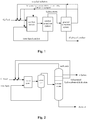
- Fig. 1 is a schematic representative depicting the alkylation process according to the present invention, wherein C4 feed being alkylated in the presence of the ionic liquid as catalyst in the reaction system, and the alkylation product being separated from the catalyst in the catalyst separation system (also referred as the separation system) and then being introduced into the product separation system, and the separated ionic liquid catalyst being brought back to the reaction system.
- the catalyst separation system also referred as the separation system
- the process according to the present invention further comprises obtaining the halogenated hydrocarbons-rich fraction from the product separation system and reintroducing the separated fraction into the reaction system.
- separating the halogenated hydrocarbons-rich fraction as a sidedraw from the distillation column and reintroducing the separated fraction into the reaction system may comprise mixing the separated fraction with the reaction feed and then introducing the mixture into the reaction system, introducing the separated fraction into the reaction system directly, mixing the separated fraction with the ionic liquid catalyst and then introducing the mixture into the reaction system, as well as mixing the separated fraction with the recycled isobutane and then introducing the mixture into the reaction system.
- Fig. 1 does not cover all the embodiments according to the present invention yet in this regard, and the halogenated hydrocarbons-rich fraction to be reintroduced may also be obtained by adsorbing the alkylate oil coming from the product separation system and then desorbing.
- the more specific embodiments may refer to the following examples with reference to Figs. 2 to 6 .
- All the acidic ionic liquid catalysts used in the examples are prepared according to the processes described in USP 7285698 , USP 20040133056A1 and CN 02149296.4 or purchased commercially.
- the composition of the alkylation product is determined by Gas Chromatograph, the halogen (chloro- or bromo-) in the alkylation product is quantitively analyzed by Micro-Coulomb method, and the activity of the catalysts is evaluated on butene conversion.
- Catalytic alkylation reaction of isobutane is carried out in a continuous apparatus using an acidic ionic liquid as catalyst, wherein the cation is provided by Et 3 NHCl and the anion is provided by AlCl 3 and CuCl.
- the inventory of the ionic liquid is of 20kg.
- the reaction pressure is 0.5MPa and the reaction temperature is 30°C.
- the feed is a mixture of isobutane and 2-butene with a molar ratio between alkane and alkene of 20:1.
- the alkylation product obtained in above test is of 110kg in all.
- Catalytic alkylation reaction of isobutane is carried out in a continuous apparatus using the same acidic ionic liquid as catalyst as that in the comparative example.
- the inventory of the ionic liquid is of 200g.
- the reaction pressure is 0.5MPa and the reaction temperature is 30°C.
- the feed is the same mixture of isobutane and 2-butene with a molar ratio between alkane and alkene of 20:1 as that in the comparative example.
- the results are shown in Table 3.
- C5 to C7 fraction distilled from the alkylate oil may be reintroduced into the reaction system to conduct the alkylation reaction continuously.
- Catalytic alkylation reaction of isobutane is carried out in a continuous apparatus using the same acidic ionic liquid as catalyst as that in the comparative example.
- the inventory of the ionic liquid is of 200g.
- the reaction pressure is 0.5MPa and the reaction temperature is 30°C.
- the feed is the same mixture of isobutane and 2-butene with a molar ratio between alkane and alkene of 20:1 as that in the comparative example.
- the results are shown in Table 4.
- the catalyst activity declines significantly.
- the amount of the processed feed is up to 28kg, i.e. the feed processed by per gram of the ionic liquid catalyst is up to 140g, the butene conversion is almost of 0, which indicates the catalyst gets deactivated totally.
- the catalyst is with a normal activity, the obtained alkylation product has the selectivity of C8 fraction and the ratio of TMP/DMH comparable to that in the comparative example.
- the obtained alkylate oil is distilled and the chlorine content in the separated C8+ fraction is determined to be of 9.2mg/L.
- pre-mixing the ionic liquid with C5 to C7 fraction having a higher chlorine content from the alkylate oil product may also prolong the life of the ionic liquid catalyst significantly without compromising the quality of the alkylate oil product substantially.
- C5 to C7 fraction distilled from the alkylate oil may be reintroduced into the reaction system to conduct the alkylation reaction continuously.
- Catalytic alkylation reaction of isobutane is carried out in a continuous apparatus using the same acidic ionic liquid as catalyst as that in the comparative example.
- the inventory of the ionic liquid is of 200g.
- the reaction pressure is 0.5MPa and the reaction temperature is 30°C.
- the feed is the same mixture of isobutane and 2-butene with a molar ratio between alkane and alkene of 20:1 as that in the comparative example.
- the flowrate of the feed is 500g/h.
- the catalyst activity declines significantly.
- the amount of the processed feed is up to 28kg, i.e. the feed processed by per gram of the ionic liquid catalyst is up to 140g, the butene conversion is almost of 0, which indicates the catalyst gets deactivated totally.
- the catalyst is with a normal activity, the obtained alkylation product has the selectivity of C8 fraction and the ratio of TMP/DMH comparable to that in the comparative example.
- the obtained alkylate oil is distilled and the chlorine content in the separated C8+ fraction is determined to be of 9.1mg/L.
- Catalytic alkylation reaction of isobutane is carried out in a continuous apparatus using the same acidic ionic liquid as catalyst as that in the comparative example.
- the inventory of the ionic liquid is of 200g.
- the reaction pressure is 0.5MPa and the reaction temperature is 30°C.
- the feed is the same mixture of isobutane and 2-butene with a molar ratio between alkane and alkene of 20:1 as that in the comparative example.
- the flowrate of the feed is 500g/h.
- the isobutane obtained in the comparative example is firstly mixed with the feed at a flowrate of 8g/h, and then introduced into the reaction system to conduct the alkylation reaction by the ionic liquid to obtain the alkylation product.
- composition of the alkylation product is analyzed and the results are shown in Table 6.
- the catalyst activity declines significantly.
- the amount of the processed feed is up to 28kg, i.e. the feed processed by per gram of the ionic liquid catalyst is up to 140g, the butene conversion is of 27% only, which indicates the catalyst gets deactivated substantially.
- the catalyst is with a normal activity, the obtained alkylation product has the selectivity of C8 fraction and the ratio of TMP/DMH comparable to that in the comparative example.
- the obtained alkylate oil is distilled and the chlorine content in the separated C8+ fraction is determined to be of 9.2mg/L.
- a continuous alkylation reaction is carried out following the alkylation reaction process by the ionic liquid shown in Fig. 1 based on the scheme of Example 1.
- the reaction feed (referred as C4 feed in the figure) and the ionic liquid are introduced into the reactor simultaneously to establish the alkylation reaction system.
- the alkylation product is introduced into the separation system, wherein the ionic liquid is separated and then recycled to the reaction system, and the alkylation product is passed to a distillation column subsequently.
- C5 to C7 fraction or C6 fraction i.e. the halogenated hydrocarbons-rich fraction, is withdrawn from the distillation column as a sidedraw by controlling the distillation operation, and reintroduced into to the reactor by mixing into the reaction feed.
- n-butane is separated from the distillation column as a sidedraw and alkylate oil is discharged at the bottom of the distillation column, both of these streams are sent into the product storage tanks respectively. Excessive isobutane separated from the top of the distillation column is recycled to the reactor to be utilized furthermore.
- the alkylation reaction conditions are same as that in Example 1 except that C5 to C7 fraction is distilled continuously from the alkylation product by a single distillation column as a sidedraw and then reintroduced into the reaction feed to conduct the reaction continuously.
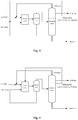
- the alkylation reaction process by the ionic liquid shown in Fig. 2 is employed based on the scheme of Example 2.
- the specific embodiment is a catalytic alkylation reaction process by the ionic liquid using a single distillation column, wherein the excessive isobutane separated from the top of the distillation column is recycled, the alkylate oil product is discharged at the bottom of the distillation column, and C5 to C7 fraction or C6 fraction (the halogenated hydrocarbons-rich fraction) is withdrawn from the distillation column as a sidedraw and then pre-mixed with the ionic liquid catalyst recycled from the catalyst separation system to back to the reaction system.
- the alkylation reaction conditions are same as that in Example 2 except that C5 to C7 fraction is distilled continuously from the alkylation product by a single distillation column as sidedraw and then mixed with the ionic liquid catalyst and reintroduced into the reaction feed to conduct the reaction continuously.
- C6 fraction is collected and reintroduced in the same way, and C5 fraction is collected at the same time, which may be used as alkylate oil product together with the bottom fraction or otherwise based on the design requirements.
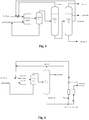
- the alkylation reaction process by the ionic liquid shown in Fig. 3 is employed based on the scheme of Example 3.
- the excessive isobutane separated from the top of the distillation column is recycled, the alkylate oil product is discharged at the bottom of the distillation column, and the halogenated hydrocarbons-rich fraction (C5 to C7 fraction) is withdrawn from the distillation column as a sidedraw and reintroduced directly into the reactor to be used in the alkylation reaction.
- the alkylation reaction conditions are same as that in Example 3 except that C5 to C7 fraction is distilled continuously from the alkylation product by a single distillation column as a sidedraw and then reintroduced into the reactor directly to conduct the reaction continuously.
- the alkylation reaction process by the ionic liquid shown in Fig. 4 is employed based on the scheme of Example 5 with some variations.
- two distillation columns A and B are set in series, wherein the excessive isobutane is separated from the top of distillation column A and recycled, the bottom fraction of distillation column A is sent into distillation column B, n-butane is separated from the top of distillation column B, and C5 fraction and C6 fraction is withdrawn from distillation column B as sidedraws respectively, of which C5 fraction is used as the alkylate oil product together with the bottom fraction, and C6 fraction is pre-mixed with the reaction feed and then reintroduced into the reaction system.
- the alkylation reaction conditions are same as that in Example 1 except that C5 to C7 fraction is distilled continuously from the alkylation product by multiple distillation columns as a sidedraw and then reintroduced into the reaction feed to conduct the reaction continuously.
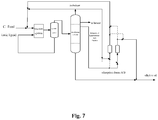
- the alkylation reaction process by the ionic liquid shown in Fig. 5 is employed based on the scheme of Example 4.
- the specific embodiment is a catalytic alkylation reaction process by the ionic liquid using a single distillation column, wherein the excessive isobutane separated from the top of the distillation column is partly recycled to the reaction feed, and the bottom fraction is the alkylate oil, which is introduced into adsorption drums A/B, wherein an adsorption material such as 13X molecular sieves, NaY zeolite or activated alumina is arranged previously, to remove halogenated hydrocarbons by adsorption.
- an adsorption material such as 13X molecular sieves, NaY zeolite or activated alumina
- the adsorption drum with saturated adsorption material is regenerated through desorption by the not-recycled part of the separated isobutane from the distillation column.
- the isobutane with the desorbed halogenated hydrocarbons is also mixed with the reaction feed and then reintroduced into the reaction system to conduct the alkylation reaction.
- the alkylate oil after desorption of halogenated hydrocarbons is discharged as the product.
- the alkylation reaction conditions are same as that in example 4.
- the alkylation reaction process by the ionic liquid shown in Fig. 6 is employed based on the scheme of Example 4.
- the specific embodiment is a catalytic alkylation reaction process by the ionic liquid using a single distillation column, wherein the excessive isobutane separated from the top of the distillation column is partly recycled to the reaction feed, the bottom fraction is the alkylate oil product, and the halogenated hydrocarbons-rich C6 to C7 fraction and n-butane are withdrawn from the distillation column as sidedraws, of which the halogenated hydrocarbons-rich fraction is introduced into adsorption drums A/B to remove the halogenated hydrocarbon by adsorption.
- the fraction after desorption of halogenated hydrocarbon is combined with the bottom fraction and discharged from the system as the alkylate oil product.
- the adsorption drum with saturated adsorption material is regenerated through desorption by the not-recycled part of the separated isobutane from the distillation column.
- the isobutane with the desorbed halogenated hydrocarbons is mixed with the reaction feed and then reintroduced into the reaction system to conduct the alkylation reaction.
- the alkylation reaction conditions are same as that in Example 4.
Landscapes
- Chemical & Material Sciences (AREA)
- Organic Chemistry (AREA)
- Chemical Kinetics & Catalysis (AREA)
- Engineering & Computer Science (AREA)
- Oil, Petroleum & Natural Gas (AREA)
- Materials Engineering (AREA)
- General Chemical & Material Sciences (AREA)
- Organic Low-Molecular-Weight Compounds And Preparation Thereof (AREA)
- Low-Molecular Organic Synthesis Reactions Using Catalysts (AREA)
- Catalysts (AREA)
Applications Claiming Priority (2)
| Application Number | Priority Date | Filing Date | Title |
|---|---|---|---|
| CN200910244097XA CN102108306B (zh) | 2009-12-28 | 2009-12-28 | 一种以离子液体为催化剂的烷基化反应方法 |
| PCT/CN2010/002173 WO2011079516A1 (zh) | 2009-12-28 | 2010-12-27 | 一种以离子液体为催化剂的烷基化反应方法 |
Publications (3)
| Publication Number | Publication Date |
|---|---|
| EP2520558A1 EP2520558A1 (en) | 2012-11-07 |
| EP2520558A4 EP2520558A4 (en) | 2015-11-18 |
| EP2520558B1 true EP2520558B1 (en) | 2018-02-14 |
Family
ID=44172590
Family Applications (1)
| Application Number | Title | Priority Date | Filing Date |
|---|---|---|---|
| EP10840306.4A Not-in-force EP2520558B1 (en) | 2009-12-28 | 2010-12-27 | Alkylation method using ionic liquid as catalyst |
Country Status (7)
| Country | Link |
|---|---|
| US (1) | US9096487B2 (enExample) |
| EP (1) | EP2520558B1 (enExample) |
| CN (1) | CN102108306B (enExample) |
| AU (1) | AU2010338941B2 (enExample) |
| IN (1) | IN2012DN04953A (enExample) |
| SG (1) | SG181453A1 (enExample) |
| WO (1) | WO2011079516A1 (enExample) |
Families Citing this family (30)
| Publication number | Priority date | Publication date | Assignee | Title |
|---|---|---|---|---|
| US8920755B2 (en) * | 2011-09-12 | 2014-12-30 | Chevron U.S.A. Inc. | Conversion of HF alkylation units for ionic liquid catalyzed alkylation processes |
| US9096482B2 (en) | 2013-06-28 | 2015-08-04 | Uop Llc | Catalytic reverse disproportionation of paraffins using ionic liquids |
| US9096481B2 (en) | 2013-06-28 | 2015-08-04 | Uop Llc | Catalytic disproportionation of pentane using ionic liquids |
| US9096485B2 (en) | 2013-06-28 | 2015-08-04 | Uop Llc | Catalytic isomerization of heptane using ionic liquids |
| US9102577B2 (en) | 2013-06-28 | 2015-08-11 | Uop Llc | Catalytic disproportionation of paraffins using ionic liquids |
| US9126881B2 (en) | 2013-06-28 | 2015-09-08 | Uop Llc | Catalytic isomerization of pentane using ionic liquids |
| US9102578B2 (en) | 2013-06-28 | 2015-08-11 | Uop Llc | Catalytic isomerization of paraffins using ionic liquids |
| US9096483B2 (en) | 2013-06-28 | 2015-08-04 | Uop Llc | Catalytic isomerization of hexanes using ionic liquids |
| US20150005555A1 (en) | 2013-06-28 | 2015-01-01 | Uop Llc | Catalytic disproportionation of butane using ionic liquids |
| US9096480B2 (en) | 2013-06-28 | 2015-08-04 | Uop Llc | Catalytic disproportionation of heptane using ionic liquids |
| CN103521263B (zh) * | 2013-10-16 | 2015-08-12 | 连云港正丰生物能源有限公司 | 吗啉盐类离子液体催化剂、其制备方法及其用途 |
| CN103521264A (zh) * | 2013-10-17 | 2014-01-22 | 开滦能源化工股份有限公司 | 氯铝酸离子液体的再生方法 |
| CN104971674B (zh) * | 2014-04-08 | 2017-03-08 | 中国石油大学(华东) | 基于液相催化剂的液液非均相催化反应分离一体化装置 |
| US9416071B2 (en) * | 2014-05-06 | 2016-08-16 | Uop Llc | Hydrocarbon conversion processes using lactamium-based ionic liquids |
| US9518023B2 (en) | 2014-05-06 | 2016-12-13 | Uop Llc | Synthesis of N-derivatized lactam based ionic liquid |
| US9233928B2 (en) | 2014-05-06 | 2016-01-12 | Uop Llc | Synthesis of lactam based ionic liquid |
| US9328037B2 (en) | 2014-07-09 | 2016-05-03 | Uop Llc | Benzene alkylation using acidic ionic liquids |
| US9566578B2 (en) * | 2014-12-11 | 2017-02-14 | Uop Llc | Hydrochloric acid stripping process for ionic liquid regeneration process |
| US9950970B2 (en) | 2014-12-12 | 2018-04-24 | Uop Llc | Ionic liquid reactor with heat exchanger |
| US9914679B2 (en) * | 2014-12-12 | 2018-03-13 | Uop Llc | Processes for removing entrained ionic liquid from a hydrocarbon phase |
| US9669377B2 (en) | 2014-12-12 | 2017-06-06 | Uop Llc | Ionic liquid reactor with heat exchanger |
| CN104549506B (zh) * | 2014-12-15 | 2017-02-22 | 浙江大学 | 一种基于铝的用于烷基化反应的催化剂的制备方法 |
| CN105536866B (zh) * | 2015-12-11 | 2018-08-03 | 中国石油大学(北京) | 类离子液体及其制备方法和在制备烷基化油中的应用 |
| CN106833734B (zh) * | 2017-03-03 | 2018-07-13 | 中国科学院过程工程研究所 | 一种碳基材料强化浓硫酸催化生产烷基化油的方法 |
| CN106946645A (zh) * | 2017-05-06 | 2017-07-14 | 洛阳和梦科技有限公司 | 脱除正己烷中微量溴反应性杂质的方法 |
| US10294173B2 (en) * | 2017-06-30 | 2019-05-21 | Uop Llc | Integration of a dehydrogenation unit and an alkylation unit |
| CN109694734B (zh) * | 2017-10-20 | 2020-11-10 | 中国石油化工股份有限公司 | 烷基化油的脱氯方法 |
| CN112980499B (zh) * | 2019-12-13 | 2023-05-30 | 中化化工科学技术研究总院有限公司 | 一种离子液体催化制备烷基化油的方法 |
| CN111592912A (zh) * | 2020-05-31 | 2020-08-28 | 南京克米斯璀新能源科技有限公司 | 一种烷基化方法及烷基化设备 |
| CN115181585B (zh) * | 2022-08-09 | 2023-11-07 | 中国石油大学(北京) | 基于离子液体催化的烷烃异构化方法 |
Family Cites Families (14)
| Publication number | Priority date | Publication date | Assignee | Title |
|---|---|---|---|---|
| CN1203032C (zh) | 2002-11-12 | 2005-05-25 | 石油大学(北京) | 以复合离子液体为催化剂制备烷基化油剂的方法 |
| CN100348559C (zh) * | 2005-08-02 | 2007-11-14 | 北京化工大学 | 离子液体催化烷基化反应工艺及反应器装置 |
| US7732363B2 (en) | 2005-12-20 | 2010-06-08 | Chevron U.S.A. Inc. | Regeneration of acidic catalysts |
| US7737067B2 (en) | 2005-12-20 | 2010-06-15 | Chevron U.S.A. Inc. | Regeneration of ionic liquid catalyst |
| US7651970B2 (en) | 2005-12-20 | 2010-01-26 | Chevron U.S.A. Inc. | Regeneration of ionic liquid catalyst by hydrogenation using a metal or metal alloy catalyst |
| US7495144B2 (en) | 2006-03-24 | 2009-02-24 | Chevron U.S.A. Inc. | Alkylation process using an alkyl halide promoted ionic liquid catalyst |
| US7538256B2 (en) * | 2006-12-12 | 2009-05-26 | Chevron U.S.A., Inc. | Reduction of organic halides in alkylate gasoline |
| US7531707B2 (en) * | 2006-12-13 | 2009-05-12 | Chevron U.S.A., Inc | Alkylation process using an alkyl halide promoted ionic liquid catalyst |
| US7553999B2 (en) * | 2006-12-14 | 2009-06-30 | Chevron U.S.A. Inc. | Isomerization of butene in the ionic liquid-catalyzed alkylation of light isoparaffins and olefins |
| CN101234945B (zh) | 2007-02-01 | 2011-04-20 | 北京化工大学 | 一种在线再生离子液体催化剂生产烷基化油的方法 |
| US8105481B2 (en) * | 2007-12-19 | 2012-01-31 | Chevron U.S.A. Inc. | Reduction of organic halide contamination in hydrocarbon products |
| US7956230B2 (en) * | 2007-12-21 | 2011-06-07 | Chevron U.S.A. Inc. | Reduction of organic halide contamination in hydrocarbon products |
| US20090171133A1 (en) | 2007-12-28 | 2009-07-02 | Chevron U.S.A. Inc. | Ionic liquid catalyst alkylation using a loop reactor |
| JP5701063B2 (ja) * | 2008-01-02 | 2015-04-15 | ツェオシス ゲゼルシャフト ミット ベシュレンクテル ハフツングZeoSys GmbH | ハロゲン化炭化水素の回収方法 |
-
2009
- 2009-12-28 CN CN200910244097XA patent/CN102108306B/zh active Active
-
2010
- 2010-12-27 EP EP10840306.4A patent/EP2520558B1/en not_active Not-in-force
- 2010-12-27 WO PCT/CN2010/002173 patent/WO2011079516A1/zh not_active Ceased
- 2010-12-27 IN IN4953DEN2012 patent/IN2012DN04953A/en unknown
- 2010-12-27 US US13/519,191 patent/US9096487B2/en not_active Expired - Fee Related
- 2010-12-27 AU AU2010338941A patent/AU2010338941B2/en not_active Ceased
- 2010-12-27 SG SG2012039962A patent/SG181453A1/en unknown
Non-Patent Citations (1)
| Title |
|---|
| None * |
Also Published As
| Publication number | Publication date |
|---|---|
| US20130331625A1 (en) | 2013-12-12 |
| US9096487B2 (en) | 2015-08-04 |
| EP2520558A4 (en) | 2015-11-18 |
| WO2011079516A1 (zh) | 2011-07-07 |
| CN102108306A (zh) | 2011-06-29 |
| CN102108306B (zh) | 2013-12-18 |
| AU2010338941B2 (en) | 2014-05-29 |
| AU2010338941A1 (en) | 2012-07-12 |
| IN2012DN04953A (enExample) | 2015-09-25 |
| SG181453A1 (en) | 2012-07-30 |
| EP2520558A1 (en) | 2012-11-07 |
Similar Documents
| Publication | Publication Date | Title |
|---|---|---|
| AU2010338941B2 (en) | Alkylation method using ionic liquid as catalyst | |
| EP1836285B1 (en) | Integrated alkylation process using ionic liquid catalysts | |
| Huang et al. | Effects of additives on the properties of chloroaluminate ionic liquids catalyst for alkylation of isobutane and butene | |
| AU2010273103B2 (en) | Methods for regenerating and maintaining activity of ionic liquid catalyst and producing alkylate | |
| US3862900A (en) | Removal of chemically combined chlorine and other impurities from hydrocarbons | |
| US8153854B2 (en) | Gasoline alkylate RVP control | |
| US10369556B2 (en) | Integrated process for gasoline production | |
| KR20100103843A (ko) | 탄화수소 생성물 중의 유기 할라이드 오염의 감소 | |
| CZ114594A3 (en) | Regeneration process based on solvent extraction of defined acid catalysts for the conversion of hydrocarbons and the use of such catalysts | |
| US4324936A (en) | Butane isomerization process | |
| CA2072487C (en) | Process for preparing alkylbenzene | |
| EP0593477A1 (en) | Isoparaffin/olefin alkylation | |
| WO1993000164A1 (en) | A method for regenerating lewis acid-promoted transition alumina catalysts used for isoparaffin alkylation by calcination | |
| US20050228204A1 (en) | Process for the preparation of xylene | |
| US10167432B2 (en) | Processes to make alkylate gasoline by sulfur-contaminated ionic liquid catalyzed alkylation | |
| US8993823B2 (en) | Olefin metathesis process using a catalyst containing tungsten fluorine bonds | |
| US10384988B2 (en) | Chloride management in ionic liquid alkylation processes | |
| CA3240259C (en) | Combined process for alkylation of light olefins using ionic liquid catalysts | |
| JPH0649461A (ja) | パラフィン供給原料の品質向上法 | |
| CN1068245C (zh) | 用氢气周期性再生失活的固体烷基化催化剂 | |
| CA3102794C (en) | Ionic liquid catalyst regeneration | |
| CA3240259A1 (en) | Combined process for alkylation of light olefins using ionic liquid catalysts | |
| WO2014210234A1 (en) | Catalytic isomerization of paraffins using ionic liquids | |
| CN111592912A (zh) | 一种烷基化方法及烷基化设备 |
Legal Events
| Date | Code | Title | Description |
|---|---|---|---|
| PUAI | Public reference made under article 153(3) epc to a published international application that has entered the european phase |
Free format text: ORIGINAL CODE: 0009012 |
|
| 17P | Request for examination filed |
Effective date: 20120710 |
|
| AK | Designated contracting states |
Kind code of ref document: A1 Designated state(s): AL AT BE BG CH CY CZ DE DK EE ES FI FR GB GR HR HU IE IS IT LI LT LU LV MC MK MT NL NO PL PT RO RS SE SI SK SM TR |
|
| DAX | Request for extension of the european patent (deleted) | ||
| REG | Reference to a national code |
Ref country code: DE Ref legal event code: R079 Ref document number: 602010048542 Country of ref document: DE Free format text: PREVIOUS MAIN CLASS: C07C0002600000 Ipc: C07C0002580000 |
|
| RA4 | Supplementary search report drawn up and despatched (corrected) |
Effective date: 20151015 |
|
| RIC1 | Information provided on ipc code assigned before grant |
Ipc: C10G 29/20 20060101ALI20151009BHEP Ipc: C10G 57/00 20060101ALI20151009BHEP Ipc: B01J 31/02 20060101ALI20151009BHEP Ipc: C07C 2/58 20060101AFI20151009BHEP |
|
| GRAP | Despatch of communication of intention to grant a patent |
Free format text: ORIGINAL CODE: EPIDOSNIGR1 |
|
| STAA | Information on the status of an ep patent application or granted ep patent |
Free format text: STATUS: GRANT OF PATENT IS INTENDED |
|
| INTG | Intention to grant announced |
Effective date: 20170906 |
|
| GRAS | Grant fee paid |
Free format text: ORIGINAL CODE: EPIDOSNIGR3 |
|
| GRAA | (expected) grant |
Free format text: ORIGINAL CODE: 0009210 |
|
| STAA | Information on the status of an ep patent application or granted ep patent |
Free format text: STATUS: THE PATENT HAS BEEN GRANTED |
|
| AK | Designated contracting states |
Kind code of ref document: B1 Designated state(s): AL AT BE BG CH CY CZ DE DK EE ES FI FR GB GR HR HU IE IS IT LI LT LU LV MC MK MT NL NO PL PT RO RS SE SI SK SM TR |
|
| REG | Reference to a national code |
Ref country code: GB Ref legal event code: FG4D |
|
| REG | Reference to a national code |
Ref country code: CH Ref legal event code: EP |
|
| REG | Reference to a national code |
Ref country code: IE Ref legal event code: FG4D |
|
| REG | Reference to a national code |
Ref country code: DE Ref legal event code: R096 Ref document number: 602010048542 Country of ref document: DE Ref country code: AT Ref legal event code: REF Ref document number: 969734 Country of ref document: AT Kind code of ref document: T Effective date: 20180315 |
|
| RAP2 | Party data changed (patent owner data changed or rights of a patent transferred) |
Owner name: SHELL INTERNATIONALE RESEARCH MAATSCHAPPIJ B.V. Owner name: CHINA UNIVERSITY OF PETROLEUM |
|
| REG | Reference to a national code |
Ref country code: NL Ref legal event code: FP |
|
| REG | Reference to a national code |
Ref country code: AT Ref legal event code: MK05 Ref document number: 969734 Country of ref document: AT Kind code of ref document: T Effective date: 20180214 |
|
| PG25 | Lapsed in a contracting state [announced via postgrant information from national office to epo] |
Ref country code: LT Free format text: LAPSE BECAUSE OF FAILURE TO SUBMIT A TRANSLATION OF THE DESCRIPTION OR TO PAY THE FEE WITHIN THE PRESCRIBED TIME-LIMIT Effective date: 20180214 Ref country code: ES Free format text: LAPSE BECAUSE OF FAILURE TO SUBMIT A TRANSLATION OF THE DESCRIPTION OR TO PAY THE FEE WITHIN THE PRESCRIBED TIME-LIMIT Effective date: 20180214 Ref country code: NO Free format text: LAPSE BECAUSE OF FAILURE TO SUBMIT A TRANSLATION OF THE DESCRIPTION OR TO PAY THE FEE WITHIN THE PRESCRIBED TIME-LIMIT Effective date: 20180514 Ref country code: HR Free format text: LAPSE BECAUSE OF FAILURE TO SUBMIT A TRANSLATION OF THE DESCRIPTION OR TO PAY THE FEE WITHIN THE PRESCRIBED TIME-LIMIT Effective date: 20180214 Ref country code: FI Free format text: LAPSE BECAUSE OF FAILURE TO SUBMIT A TRANSLATION OF THE DESCRIPTION OR TO PAY THE FEE WITHIN THE PRESCRIBED TIME-LIMIT Effective date: 20180214 Ref country code: CY Free format text: LAPSE BECAUSE OF FAILURE TO SUBMIT A TRANSLATION OF THE DESCRIPTION OR TO PAY THE FEE WITHIN THE PRESCRIBED TIME-LIMIT Effective date: 20180214 |
|
| PG25 | Lapsed in a contracting state [announced via postgrant information from national office to epo] |
Ref country code: LV Free format text: LAPSE BECAUSE OF FAILURE TO SUBMIT A TRANSLATION OF THE DESCRIPTION OR TO PAY THE FEE WITHIN THE PRESCRIBED TIME-LIMIT Effective date: 20180214 Ref country code: SE Free format text: LAPSE BECAUSE OF FAILURE TO SUBMIT A TRANSLATION OF THE DESCRIPTION OR TO PAY THE FEE WITHIN THE PRESCRIBED TIME-LIMIT Effective date: 20180214 Ref country code: RS Free format text: LAPSE BECAUSE OF FAILURE TO SUBMIT A TRANSLATION OF THE DESCRIPTION OR TO PAY THE FEE WITHIN THE PRESCRIBED TIME-LIMIT Effective date: 20180214 Ref country code: GR Free format text: LAPSE BECAUSE OF FAILURE TO SUBMIT A TRANSLATION OF THE DESCRIPTION OR TO PAY THE FEE WITHIN THE PRESCRIBED TIME-LIMIT Effective date: 20180515 Ref country code: BG Free format text: LAPSE BECAUSE OF FAILURE TO SUBMIT A TRANSLATION OF THE DESCRIPTION OR TO PAY THE FEE WITHIN THE PRESCRIBED TIME-LIMIT Effective date: 20180514 Ref country code: AT Free format text: LAPSE BECAUSE OF FAILURE TO SUBMIT A TRANSLATION OF THE DESCRIPTION OR TO PAY THE FEE WITHIN THE PRESCRIBED TIME-LIMIT Effective date: 20180214 |
|
| PG25 | Lapsed in a contracting state [announced via postgrant information from national office to epo] |
Ref country code: AL Free format text: LAPSE BECAUSE OF FAILURE TO SUBMIT A TRANSLATION OF THE DESCRIPTION OR TO PAY THE FEE WITHIN THE PRESCRIBED TIME-LIMIT Effective date: 20180214 Ref country code: IT Free format text: LAPSE BECAUSE OF FAILURE TO SUBMIT A TRANSLATION OF THE DESCRIPTION OR TO PAY THE FEE WITHIN THE PRESCRIBED TIME-LIMIT Effective date: 20180214 Ref country code: EE Free format text: LAPSE BECAUSE OF FAILURE TO SUBMIT A TRANSLATION OF THE DESCRIPTION OR TO PAY THE FEE WITHIN THE PRESCRIBED TIME-LIMIT Effective date: 20180214 Ref country code: PL Free format text: LAPSE BECAUSE OF FAILURE TO SUBMIT A TRANSLATION OF THE DESCRIPTION OR TO PAY THE FEE WITHIN THE PRESCRIBED TIME-LIMIT Effective date: 20180214 Ref country code: RO Free format text: LAPSE BECAUSE OF FAILURE TO SUBMIT A TRANSLATION OF THE DESCRIPTION OR TO PAY THE FEE WITHIN THE PRESCRIBED TIME-LIMIT Effective date: 20180214 |
|
| REG | Reference to a national code |
Ref country code: DE Ref legal event code: R097 Ref document number: 602010048542 Country of ref document: DE |
|
| PG25 | Lapsed in a contracting state [announced via postgrant information from national office to epo] |
Ref country code: SM Free format text: LAPSE BECAUSE OF FAILURE TO SUBMIT A TRANSLATION OF THE DESCRIPTION OR TO PAY THE FEE WITHIN THE PRESCRIBED TIME-LIMIT Effective date: 20180214 Ref country code: SK Free format text: LAPSE BECAUSE OF FAILURE TO SUBMIT A TRANSLATION OF THE DESCRIPTION OR TO PAY THE FEE WITHIN THE PRESCRIBED TIME-LIMIT Effective date: 20180214 Ref country code: CZ Free format text: LAPSE BECAUSE OF FAILURE TO SUBMIT A TRANSLATION OF THE DESCRIPTION OR TO PAY THE FEE WITHIN THE PRESCRIBED TIME-LIMIT Effective date: 20180214 Ref country code: DK Free format text: LAPSE BECAUSE OF FAILURE TO SUBMIT A TRANSLATION OF THE DESCRIPTION OR TO PAY THE FEE WITHIN THE PRESCRIBED TIME-LIMIT Effective date: 20180214 |
|
| PLBE | No opposition filed within time limit |
Free format text: ORIGINAL CODE: 0009261 |
|
| STAA | Information on the status of an ep patent application or granted ep patent |
Free format text: STATUS: NO OPPOSITION FILED WITHIN TIME LIMIT |
|
| 26N | No opposition filed |
Effective date: 20181115 |
|
| PGFP | Annual fee paid to national office [announced via postgrant information from national office to epo] |
Ref country code: NL Payment date: 20181213 Year of fee payment: 9 Ref country code: DE Payment date: 20181211 Year of fee payment: 9 |
|
| PG25 | Lapsed in a contracting state [announced via postgrant information from national office to epo] |
Ref country code: SI Free format text: LAPSE BECAUSE OF FAILURE TO SUBMIT A TRANSLATION OF THE DESCRIPTION OR TO PAY THE FEE WITHIN THE PRESCRIBED TIME-LIMIT Effective date: 20180214 |
|
| PGFP | Annual fee paid to national office [announced via postgrant information from national office to epo] |
Ref country code: GB Payment date: 20181227 Year of fee payment: 9 Ref country code: FR Payment date: 20181120 Year of fee payment: 9 |
|
| REG | Reference to a national code |
Ref country code: CH Ref legal event code: PL |
|
| PG25 | Lapsed in a contracting state [announced via postgrant information from national office to epo] |
Ref country code: MC Free format text: LAPSE BECAUSE OF FAILURE TO SUBMIT A TRANSLATION OF THE DESCRIPTION OR TO PAY THE FEE WITHIN THE PRESCRIBED TIME-LIMIT Effective date: 20180214 Ref country code: LU Free format text: LAPSE BECAUSE OF NON-PAYMENT OF DUE FEES Effective date: 20181227 |
|
| REG | Reference to a national code |
Ref country code: IE Ref legal event code: MM4A |
|
| REG | Reference to a national code |
Ref country code: BE Ref legal event code: MM Effective date: 20181231 |
|
| PG25 | Lapsed in a contracting state [announced via postgrant information from national office to epo] |
Ref country code: IE Free format text: LAPSE BECAUSE OF NON-PAYMENT OF DUE FEES Effective date: 20181227 |
|
| PG25 | Lapsed in a contracting state [announced via postgrant information from national office to epo] |
Ref country code: BE Free format text: LAPSE BECAUSE OF NON-PAYMENT OF DUE FEES Effective date: 20181231 |
|
| PG25 | Lapsed in a contracting state [announced via postgrant information from national office to epo] |
Ref country code: CH Free format text: LAPSE BECAUSE OF NON-PAYMENT OF DUE FEES Effective date: 20181231 Ref country code: LI Free format text: LAPSE BECAUSE OF NON-PAYMENT OF DUE FEES Effective date: 20181231 |
|
| PG25 | Lapsed in a contracting state [announced via postgrant information from national office to epo] |
Ref country code: MT Free format text: LAPSE BECAUSE OF NON-PAYMENT OF DUE FEES Effective date: 20181227 |
|
| PG25 | Lapsed in a contracting state [announced via postgrant information from national office to epo] |
Ref country code: TR Free format text: LAPSE BECAUSE OF FAILURE TO SUBMIT A TRANSLATION OF THE DESCRIPTION OR TO PAY THE FEE WITHIN THE PRESCRIBED TIME-LIMIT Effective date: 20180214 |
|
| PG25 | Lapsed in a contracting state [announced via postgrant information from national office to epo] |
Ref country code: PT Free format text: LAPSE BECAUSE OF FAILURE TO SUBMIT A TRANSLATION OF THE DESCRIPTION OR TO PAY THE FEE WITHIN THE PRESCRIBED TIME-LIMIT Effective date: 20180214 |
|
| PG25 | Lapsed in a contracting state [announced via postgrant information from national office to epo] |
Ref country code: HU Free format text: LAPSE BECAUSE OF FAILURE TO SUBMIT A TRANSLATION OF THE DESCRIPTION OR TO PAY THE FEE WITHIN THE PRESCRIBED TIME-LIMIT; INVALID AB INITIO Effective date: 20101227 Ref country code: MK Free format text: LAPSE BECAUSE OF NON-PAYMENT OF DUE FEES Effective date: 20180214 |
|
| REG | Reference to a national code |
Ref country code: DE Ref legal event code: R119 Ref document number: 602010048542 Country of ref document: DE |
|
| PG25 | Lapsed in a contracting state [announced via postgrant information from national office to epo] |
Ref country code: IS Free format text: LAPSE BECAUSE OF FAILURE TO SUBMIT A TRANSLATION OF THE DESCRIPTION OR TO PAY THE FEE WITHIN THE PRESCRIBED TIME-LIMIT Effective date: 20180614 |
|
| REG | Reference to a national code |
Ref country code: NL Ref legal event code: MM Effective date: 20200101 |
|
| GBPC | Gb: european patent ceased through non-payment of renewal fee |
Effective date: 20191227 |
|
| PG25 | Lapsed in a contracting state [announced via postgrant information from national office to epo] |
Ref country code: NL Free format text: LAPSE BECAUSE OF NON-PAYMENT OF DUE FEES Effective date: 20200101 |
|
| PG25 | Lapsed in a contracting state [announced via postgrant information from national office to epo] |
Ref country code: DE Free format text: LAPSE BECAUSE OF NON-PAYMENT OF DUE FEES Effective date: 20200701 Ref country code: FR Free format text: LAPSE BECAUSE OF NON-PAYMENT OF DUE FEES Effective date: 20191231 Ref country code: GB Free format text: LAPSE BECAUSE OF NON-PAYMENT OF DUE FEES Effective date: 20191227 |