EP2500455A1 - Pile fabric and process for producing same - Google Patents
Pile fabric and process for producing same Download PDFInfo
- Publication number
- EP2500455A1 EP2500455A1 EP09851107A EP09851107A EP2500455A1 EP 2500455 A1 EP2500455 A1 EP 2500455A1 EP 09851107 A EP09851107 A EP 09851107A EP 09851107 A EP09851107 A EP 09851107A EP 2500455 A1 EP2500455 A1 EP 2500455A1
- Authority
- EP
- European Patent Office
- Prior art keywords
- pile
- fibers
- ground structure
- ground
- softening point
- Prior art date
- Legal status (The legal status is an assumption and is not a legal conclusion. Google has not performed a legal analysis and makes no representation as to the accuracy of the status listed.)
- Granted
Links
- 239000004744 fabric Substances 0.000 title claims abstract description 120
- 238000000034 method Methods 0.000 title claims abstract description 22
- 239000000835 fiber Substances 0.000 claims abstract description 359
- 238000010438 heat treatment Methods 0.000 claims abstract description 87
- NIXOWILDQLNWCW-UHFFFAOYSA-N acrylic acid group Chemical group C(C=C)(=O)O NIXOWILDQLNWCW-UHFFFAOYSA-N 0.000 claims abstract description 34
- 229920002972 Acrylic fiber Polymers 0.000 claims abstract description 27
- 229920005989 resin Polymers 0.000 claims description 23
- 239000011347 resin Substances 0.000 claims description 23
- 238000001816 cooling Methods 0.000 claims description 11
- 238000004519 manufacturing process Methods 0.000 description 97
- 238000011282 treatment Methods 0.000 description 62
- 229920000728 polyester Polymers 0.000 description 29
- 238000002844 melting Methods 0.000 description 25
- 230000000052 comparative effect Effects 0.000 description 24
- 238000009940 knitting Methods 0.000 description 17
- 238000011156 evaluation Methods 0.000 description 15
- 239000000470 constituent Substances 0.000 description 12
- 239000000178 monomer Substances 0.000 description 12
- 241000270299 Boa Species 0.000 description 10
- -1 vinyl halides Chemical class 0.000 description 10
- GRFFKYTUNTWAGG-UHFFFAOYSA-N chloroethene;prop-2-enenitrile Chemical compound ClC=C.C=CC#N GRFFKYTUNTWAGG-UHFFFAOYSA-N 0.000 description 9
- 230000002349 favourable effect Effects 0.000 description 8
- 238000007517 polishing process Methods 0.000 description 8
- 229920000742 Cotton Polymers 0.000 description 7
- 230000000694 effects Effects 0.000 description 7
- 238000012545 processing Methods 0.000 description 7
- 229920001971 elastomer Polymers 0.000 description 6
- 238000005520 cutting process Methods 0.000 description 5
- 229920002554 vinyl polymer Polymers 0.000 description 5
- 238000010586 diagram Methods 0.000 description 4
- 230000004927 fusion Effects 0.000 description 4
- 238000005470 impregnation Methods 0.000 description 4
- 229910052751 metal Inorganic materials 0.000 description 4
- 239000002184 metal Substances 0.000 description 4
- 229920001169 thermoplastic Polymers 0.000 description 4
- 239000004416 thermosoftening plastic Substances 0.000 description 4
- SMZOUWXMTYCWNB-UHFFFAOYSA-N 2-(2-methoxy-5-methylphenyl)ethanamine Chemical compound COC1=CC=C(C)C=C1CCN SMZOUWXMTYCWNB-UHFFFAOYSA-N 0.000 description 3
- OEPOKWHJYJXUGD-UHFFFAOYSA-N 2-(3-phenylmethoxyphenyl)-1,3-thiazole-4-carbaldehyde Chemical compound O=CC1=CSC(C=2C=C(OCC=3C=CC=CC=3)C=CC=2)=N1 OEPOKWHJYJXUGD-UHFFFAOYSA-N 0.000 description 3
- NLHHRLWOUZZQLW-UHFFFAOYSA-N Acrylonitrile Chemical compound C=CC#N NLHHRLWOUZZQLW-UHFFFAOYSA-N 0.000 description 3
- CERQOIWHTDAKMF-UHFFFAOYSA-N Methacrylic acid Chemical compound CC(=C)C(O)=O CERQOIWHTDAKMF-UHFFFAOYSA-N 0.000 description 3
- BZHJMEDXRYGGRV-UHFFFAOYSA-N Vinyl chloride Chemical compound ClC=C BZHJMEDXRYGGRV-UHFFFAOYSA-N 0.000 description 3
- 239000011230 binding agent Substances 0.000 description 3
- 239000004816 latex Substances 0.000 description 3
- 229920000126 latex Polymers 0.000 description 3
- 230000008018 melting Effects 0.000 description 3
- 229920000139 polyethylene terephthalate Polymers 0.000 description 3
- 239000005020 polyethylene terephthalate Substances 0.000 description 3
- 239000007787 solid Substances 0.000 description 3
- 125000000391 vinyl group Chemical group [H]C([*])=C([H])[H] 0.000 description 3
- LSNNMFCWUKXFEE-UHFFFAOYSA-M Bisulfite Chemical compound OS([O-])=O LSNNMFCWUKXFEE-UHFFFAOYSA-M 0.000 description 2
- 229920002821 Modacrylic Polymers 0.000 description 2
- PPBRXRYQALVLMV-UHFFFAOYSA-N Styrene Chemical compound C=CC1=CC=CC=C1 PPBRXRYQALVLMV-UHFFFAOYSA-N 0.000 description 2
- 239000000853 adhesive Substances 0.000 description 2
- 230000001070 adhesive effect Effects 0.000 description 2
- 239000002390 adhesive tape Substances 0.000 description 2
- 125000004103 aminoalkyl group Chemical group 0.000 description 2
- 230000001680 brushing effect Effects 0.000 description 2
- 239000002131 composite material Substances 0.000 description 2
- 239000000498 cooling water Substances 0.000 description 2
- 239000000839 emulsion Substances 0.000 description 2
- 238000002156 mixing Methods 0.000 description 2
- 239000002245 particle Substances 0.000 description 2
- 229920000642 polymer Polymers 0.000 description 2
- 150000003839 salts Chemical class 0.000 description 2
- XGVXKJKTISMIOW-ZDUSSCGKSA-N simurosertib Chemical compound N1N=CC(C=2SC=3C(=O)NC(=NC=3C=2)[C@H]2N3CCC(CC3)C2)=C1C XGVXKJKTISMIOW-ZDUSSCGKSA-N 0.000 description 2
- QLUXVUVEVXYICG-UHFFFAOYSA-N 1,1-dichloroethene;prop-2-enenitrile Chemical compound C=CC#N.ClC(Cl)=C QLUXVUVEVXYICG-UHFFFAOYSA-N 0.000 description 1
- SXZSFWHOSHAKMN-UHFFFAOYSA-N 2,3,4,4',5-Pentachlorobiphenyl Chemical compound C1=CC(Cl)=CC=C1C1=CC(Cl)=C(Cl)C(Cl)=C1Cl SXZSFWHOSHAKMN-UHFFFAOYSA-N 0.000 description 1
- JAHNSTQSQJOJLO-UHFFFAOYSA-N 2-(3-fluorophenyl)-1h-imidazole Chemical compound FC1=CC=CC(C=2NC=CN=2)=C1 JAHNSTQSQJOJLO-UHFFFAOYSA-N 0.000 description 1
- 229920000536 2-Acrylamido-2-methylpropane sulfonic acid Polymers 0.000 description 1
- XHZPRMZZQOIPDS-UHFFFAOYSA-N 2-Methyl-2-[(1-oxo-2-propenyl)amino]-1-propanesulfonic acid Chemical compound OS(=O)(=O)CC(C)(C)NC(=O)C=C XHZPRMZZQOIPDS-UHFFFAOYSA-N 0.000 description 1
- XEEYSDHEOQHCDA-UHFFFAOYSA-N 2-methylprop-2-ene-1-sulfonic acid Chemical compound CC(=C)CS(O)(=O)=O XEEYSDHEOQHCDA-UHFFFAOYSA-N 0.000 description 1
- AGBXYHCHUYARJY-UHFFFAOYSA-N 2-phenylethenesulfonic acid Chemical compound OS(=O)(=O)C=CC1=CC=CC=C1 AGBXYHCHUYARJY-UHFFFAOYSA-N 0.000 description 1
- HRPVXLWXLXDGHG-UHFFFAOYSA-N Acrylamide Chemical compound NC(=O)C=C HRPVXLWXLXDGHG-UHFFFAOYSA-N 0.000 description 1
- DGAQECJNVWCQMB-PUAWFVPOSA-M Ilexoside XXIX Chemical compound C[C@@H]1CC[C@@]2(CC[C@@]3(C(=CC[C@H]4[C@]3(CC[C@@H]5[C@@]4(CC[C@@H](C5(C)C)OS(=O)(=O)[O-])C)C)[C@@H]2[C@]1(C)O)C)C(=O)O[C@H]6[C@@H]([C@H]([C@@H]([C@H](O6)CO)O)O)O.[Na+] DGAQECJNVWCQMB-PUAWFVPOSA-M 0.000 description 1
- ZLMJMSJWJFRBEC-UHFFFAOYSA-N Potassium Chemical compound [K] ZLMJMSJWJFRBEC-UHFFFAOYSA-N 0.000 description 1
- XTXRWKRVRITETP-UHFFFAOYSA-N Vinyl acetate Chemical compound CC(=O)OC=C XTXRWKRVRITETP-UHFFFAOYSA-N 0.000 description 1
- 239000002253 acid Substances 0.000 description 1
- 125000005907 alkyl ester group Chemical group 0.000 description 1
- 150000005215 alkyl ethers Chemical class 0.000 description 1
- 150000003863 ammonium salts Chemical class 0.000 description 1
- 239000007864 aqueous solution Substances 0.000 description 1
- INLLPKCGLOXCIV-UHFFFAOYSA-N bromoethene Chemical compound BrC=C INLLPKCGLOXCIV-UHFFFAOYSA-N 0.000 description 1
- 125000003178 carboxy group Chemical group [H]OC(*)=O 0.000 description 1
- 150000001733 carboxylic acid esters Chemical class 0.000 description 1
- 229920001577 copolymer Polymers 0.000 description 1
- 238000000354 decomposition reaction Methods 0.000 description 1
- 230000007423 decrease Effects 0.000 description 1
- 239000006185 dispersion Substances 0.000 description 1
- 238000005516 engineering process Methods 0.000 description 1
- NBVXSUQYWXRMNV-UHFFFAOYSA-N fluoromethane Chemical compound FC NBVXSUQYWXRMNV-UHFFFAOYSA-N 0.000 description 1
- 238000007429 general method Methods 0.000 description 1
- 125000003055 glycidyl group Chemical group C(C1CO1)* 0.000 description 1
- 238000005259 measurement Methods 0.000 description 1
- 238000000691 measurement method Methods 0.000 description 1
- FQPSGWSUVKBHSU-UHFFFAOYSA-N methacrylamide Chemical compound CC(=C)C(N)=O FQPSGWSUVKBHSU-UHFFFAOYSA-N 0.000 description 1
- LVHBHZANLOWSRM-UHFFFAOYSA-N methylenebutanedioic acid Natural products OC(=O)CC(=C)C(O)=O LVHBHZANLOWSRM-UHFFFAOYSA-N 0.000 description 1
- 239000000203 mixture Substances 0.000 description 1
- 230000003287 optical effect Effects 0.000 description 1
- 238000005498 polishing Methods 0.000 description 1
- 229920001225 polyester resin Polymers 0.000 description 1
- 239000004645 polyester resin Substances 0.000 description 1
- 229920001343 polytetrafluoroethylene Polymers 0.000 description 1
- 239000004810 polytetrafluoroethylene Substances 0.000 description 1
- 229920002635 polyurethane Polymers 0.000 description 1
- 239000004814 polyurethane Substances 0.000 description 1
- 229910052700 potassium Inorganic materials 0.000 description 1
- 239000011591 potassium Substances 0.000 description 1
- UIIIBRHUICCMAI-UHFFFAOYSA-N prop-2-ene-1-sulfonic acid Chemical compound OS(=O)(=O)CC=C UIIIBRHUICCMAI-UHFFFAOYSA-N 0.000 description 1
- 238000010008 shearing Methods 0.000 description 1
- 229910052708 sodium Inorganic materials 0.000 description 1
- 239000011734 sodium Substances 0.000 description 1
- MNCGMVDMOKPCSQ-UHFFFAOYSA-M sodium;2-phenylethenesulfonate Chemical compound [Na+].[O-]S(=O)(=O)C=CC1=CC=CC=C1 MNCGMVDMOKPCSQ-UHFFFAOYSA-M 0.000 description 1
- 239000000243 solution Substances 0.000 description 1
- 229920002994 synthetic fiber Polymers 0.000 description 1
- 239000012209 synthetic fiber Substances 0.000 description 1
- XLYOFNOQVPJJNP-UHFFFAOYSA-N water Substances O XLYOFNOQVPJJNP-UHFFFAOYSA-N 0.000 description 1
- 238000009941 weaving Methods 0.000 description 1
Images



Classifications
-
- D—TEXTILES; PAPER
- D03—WEAVING
- D03D—WOVEN FABRICS; METHODS OF WEAVING; LOOMS
- D03D27/00—Woven pile fabrics
- D03D27/12—Woven pile fabrics wherein pile tufts are inserted during weaving
-
- D—TEXTILES; PAPER
- D04—BRAIDING; LACE-MAKING; KNITTING; TRIMMINGS; NON-WOVEN FABRICS
- D04B—KNITTING
- D04B1/00—Weft knitting processes for the production of fabrics or articles not dependent on the use of particular machines; Fabrics or articles defined by such processes
- D04B1/02—Pile fabrics or articles having similar surface features
- D04B1/025—Pile fabrics or articles having similar surface features incorporating loose fibres, e.g. high-pile fabrics or artificial fur
-
- D—TEXTILES; PAPER
- D03—WEAVING
- D03D—WOVEN FABRICS; METHODS OF WEAVING; LOOMS
- D03D15/00—Woven fabrics characterised by the material, structure or properties of the fibres, filaments, yarns, threads or other warp or weft elements used
- D03D15/50—Woven fabrics characterised by the material, structure or properties of the fibres, filaments, yarns, threads or other warp or weft elements used characterised by the properties of the yarns or threads
- D03D15/587—Woven fabrics characterised by the material, structure or properties of the fibres, filaments, yarns, threads or other warp or weft elements used characterised by the properties of the yarns or threads adhesive; fusible
-
- D—TEXTILES; PAPER
- D03—WEAVING
- D03D—WOVEN FABRICS; METHODS OF WEAVING; LOOMS
- D03D27/00—Woven pile fabrics
- D03D27/02—Woven pile fabrics wherein the pile is formed by warp or weft
-
- D—TEXTILES; PAPER
- D04—BRAIDING; LACE-MAKING; KNITTING; TRIMMINGS; NON-WOVEN FABRICS
- D04B—KNITTING
- D04B1/00—Weft knitting processes for the production of fabrics or articles not dependent on the use of particular machines; Fabrics or articles defined by such processes
- D04B1/02—Pile fabrics or articles having similar surface features
- D04B1/04—Pile fabrics or articles having similar surface features characterised by thread material
-
- D—TEXTILES; PAPER
- D04—BRAIDING; LACE-MAKING; KNITTING; TRIMMINGS; NON-WOVEN FABRICS
- D04B—KNITTING
- D04B21/00—Warp knitting processes for the production of fabrics or articles not dependent on the use of particular machines; Fabrics or articles defined by such processes
- D04B21/02—Pile fabrics or articles having similar surface features
- D04B21/04—Pile fabrics or articles having similar surface features characterised by thread material
-
- D—TEXTILES; PAPER
- D10—INDEXING SCHEME ASSOCIATED WITH SUBLASSES OF SECTION D, RELATING TO TEXTILES
- D10B—INDEXING SCHEME ASSOCIATED WITH SUBLASSES OF SECTION D, RELATING TO TEXTILES
- D10B2401/00—Physical properties
- D10B2401/04—Heat-responsive characteristics
- D10B2401/041—Heat-responsive characteristics thermoplastic; thermosetting
-
- D—TEXTILES; PAPER
- D10—INDEXING SCHEME ASSOCIATED WITH SUBLASSES OF SECTION D, RELATING TO TEXTILES
- D10B—INDEXING SCHEME ASSOCIATED WITH SUBLASSES OF SECTION D, RELATING TO TEXTILES
- D10B2403/00—Details of fabric structure established in the fabric forming process
- D10B2403/01—Surface features
- D10B2403/011—Dissimilar front and back faces
- D10B2403/0111—One hairy surface, e.g. napped or raised
-
- Y—GENERAL TAGGING OF NEW TECHNOLOGICAL DEVELOPMENTS; GENERAL TAGGING OF CROSS-SECTIONAL TECHNOLOGIES SPANNING OVER SEVERAL SECTIONS OF THE IPC; TECHNICAL SUBJECTS COVERED BY FORMER USPC CROSS-REFERENCE ART COLLECTIONS [XRACs] AND DIGESTS
- Y10—TECHNICAL SUBJECTS COVERED BY FORMER USPC
- Y10T—TECHNICAL SUBJECTS COVERED BY FORMER US CLASSIFICATION
- Y10T428/00—Stock material or miscellaneous articles
- Y10T428/23907—Pile or nap type surface or component
- Y10T428/2395—Nap type surface
Definitions
- the present invention relates to a pile fabric whose pile fibers are inhibited from falling off, and a method of producing the same.
- pile fabrics have been known under the names of imitation furs or fake furs, boas, etc., as fabrics designed to resemble appearances of furs. These are produced from pile knits and pile weaves.
- a seal-fraise knitting machine or a sliver knitting machine (circular knitting machine) is used mainly for knitting, and piles are cut in both cases.
- a double Russell machine warp knitting machine
- piles are knitted by forming a double ground structure while intertwining the double ground structure with a binder yarn, and cutting the middle of the binder yarn.
- Non-Patent Document 1 In a weaving method, a velvet loom or a moquette loom is used to intertwine an upper and a lower ground structure and the middle of the ground structures with a binder yarn, and cut the middle of an upper and a lower base fabrics using a knife, whereby two weaves are obtained simultaneously (Non-Patent Document 1).
- these weaves and knits have the same problem, which is a large amount of pile fiber loss. As many pile fibers fall off, they attach to an inner wear or are dropped on the floor, resulting in a poor appearance and poor hygienic conditions.
- Patent Document 1 In order to prevent such pile fiber loss, there has been a proposal of mixing low-melting fibers into pile fibers (Patent Document 1), and a proposal of mixing low-melting fibers into ground yarns constituting a ground structure (Patent Documents 2-3), etc.
- Patent Documents 2-3 In order to prevent such pile fiber loss, there has been a proposal of mixing low-melting fibers into pile fibers (Patent Document 1), and a proposal of mixing low-melting fibers into ground yarns constituting a ground structure (Patent Documents 2-3), etc.
- Patent Documents 2-3 In order to prevent such pile fiber loss, there has been a proposal of mixing low-melting fibers into pile fibers (Patent Document 1), and a proposal of mixing low-melting fibers into ground yarns constituting a ground structure (Patent Documents 2-3), etc.
- Patent Documents 2-3 because the whole fabric is heated at a temperature equal to or higher than a melting point of the low-melting fibers, the entire ground structure or the pile
- Non-Patent Document 1 " Fiber Handbook third edition", page 341-342, edited by The Society of Fiber Science and Technology, Japan, published by Maruzen, issued on December 15, 2004
- the present invention provides a pile fabric whose pile fibers are inhibited from falling off without impairing the texture by fusing only a specific area of the pile fabric, and a method of producing the same.
- a pile fabric of the present invention is a pile fabric that includes: a ground structure; and pile fibers that are intertwined with ground yarns constituting the ground structure and napped on a front surface of the ground structure, wherein the pile fibers include at least one selected from the group consisting of acrylic fibers and acrylic-based fibers and have a softening point lower than a softening point of fibers constituting the ground structure, and wherein among the pile fibers intertwined with the ground yarns constituting the ground structure, at least part of the pile fibers located outside of the ground yarns constituting the ground structure are fused but the pile fibers napped on the front surface of the ground structure are not fused.
- a method of producing a pile fabric of the present invention is a method of producing a pile fabric, the pile fabric including: a ground structure; and pile fibers that are intertwined with ground yarns constituting the ground structure and napped on a front surface of the ground structure, wherein the pile fibers include at least one selected from the group consisting of acrylic fibers and acrylic-based fibers and have a softening point lower than a softening point of fibers constituting the ground structure, and a contact heating/pressurization is performed at a temperature equal to or higher than the softening point of the pile fibers and lower than the softening point of the fibers constituting the ground structure from a back surface side of the ground structure, whereby among the pile fibers intertwined with the ground yarns constituting the ground structure, at least part of the pile fibers located outside of the ground yarns constituting the ground structure are fused but the pile fibers napped on the front surface of the ground structure are not fused.
- the pile fibers include at least one selected from the group consisting of acrylic fibers and acrylic-based fibers, and at least part of the pile fibers located outside of the ground yarns constituting the ground structure are fused but the pile fibers napped on the front surface of the ground structure are not fused. Thereby, the pile fibers can be prevented from falling off without impairing the texture.
- a contact heating/pressurization is performed at a temperature equal to or higher than the softening point of the pile fibers but lower than the softening point of the fibers constituting the ground structure from a back surface side of the ground structure, whereby only a limited area of the pile fibers located outside of the ground yarns constituting the ground structure is fused but the pile fibers napped on the front surface of the ground structure are not fused. Thereby, the pile fibers can be prevented from falling off without impairing the texture.
- Apile fabric of the present invention is a pile fabric that includes: a ground structure; and pile fibers that are intertwined with ground yarns constituting the ground structure (hereinafter, also referred to as "ground yarn” simply) and napped on a front surface of the ground structure.
- the pile fabric can be manufactured using a seal-fraise knitting machine, a sliver knitting machine (circular knitting machine), a boa machine (circular knitting machine), a double Russell machine, a velvet loom, a moquette loom, etc.
- the pile fabric of the present invention is not limited particularly, it may be a high pile fabric, a boa pile fabric, a tufted carpet, etc.
- the pile fabric is preferably a high pile fabric or a boa pile fabric, and more preferably a high pile fabric.
- the pile fibers have a softening point lower than a softening point of fibers constituting the ground structure (hereinafter, also referred to as "ground structure constituent fibers", simply).
- ground structure constituent fibers a softening point of fibers constituting the ground structure
- the means for the fusion is not limited as long as at least part of the pile fibers located outside of the ground yarns can be fused, it is preferable to perform a contact heating/pressurization at a temperature equal to or higher than the softening point of the pile fibers and lower than the softening point of the ground structure constituent fibers from a back surface side of the ground structure, i.e., a back surface side of the pile fabric.
- outside of the ground yarns constituting the ground structure refers to the back surface side of the pile fabric when a surface thereof with napped pile fibers is defined as a front surface, and an outer side of the ground yarns. Further, there is a case where part of the pile fibers intertwined with the ground yarns are stitched into ground yarns. If the remaining parts of such fibers are present outside of ground yarns, they are considered as being located outside of the ground yarns.
- the pile fibers are at least one selected from the group consisting of acrylic fibers and acrylic-based fibers. Thereby, it is possible to obtain a pile fabric with an excellent texture. If thermoplastic fibers are used as the pile fibers and a polishing process is performed at a temperature equal to or higher than a melting point of the thermoplastic fibers, generally the pile fibers on the front surface of the pile fabric melt, such that a pile fabric with a favorable appearance and texture is not obtained. Further, when the polishing process is performed at a temperature equal to or lower than the melting point of the thermoplastic fibers, crimps of the pile fibers on the front surface of the pile fabric are not straightened, such that a pile fabric with a favorable appearance and texture is not obtained.
- crimps of acrylic fibers and acrylic-based fibers can be straightened at temperatures equal to or lower than their softening points. Because of this, when at least one fiber selected from the group consisting of acrylic fibers and acrylic-based fibers is used as the pile fibers, the polishing process can be performed at a temperature equal to or lower than its softening point, (i.e., 150-160°C). Therefore, when at least one fiber selected from the group consisting of acrylic fibers and acrylic-based fibers is used as the pile fibers, the pile fibers on the front surface of the pile fabric are not fused in the polishing process, such that a pile fabric with a favorable appearance and texture is obtained.
- the pile fibers contain fibers other than acrylic fibers and acrylic-based fibers, such as thermoplastic fibers having a softening point of 160°C or lower (i.e., low-melting polyester fibers having a softening point of 160°C or lower, etc.), these low-melting polyester fibers on the front surface of the pile fabric melt in the polishing process at 150-160°C, which makes it difficult to obtain a pile fabric with a favorable appearance and texture.
- thermoplastic fibers having a softening point of 160°C or lower i.e., low-melting polyester fibers having a softening point of 160°C or lower, etc.
- the pile fibers are not limited particularly as long as the softening point is lower than the softening point of the fibers constituting the ground structure.
- a difference between the softening point of the ground structure constituent fibers and the softening point of the pile fibers is preferably 10°C or more, more preferably 20°C or more, and particularly preferably 30°C or more. The difference of 10°C or more makes it easier to cause only at least part of the fibers located outside of the ground yarns constituting the ground structure to be fused and not to cause the pile fibers napped on the front surface of the ground structure to be fused.
- the pile fibers may be fibers that are softened altogether at a predetermined temperature, or mixed fibers composed of fibers that are softened in different temperatures.
- the pile fibers are mixed fibers composed of fibers softened at different temperatures, it is preferable that fibers to be softened at a relatively lower temperature are mixed at a ratio of 20% by weight (wt%) or more so that the fibers to be softened at a relatively lower temperature are fused.
- a softening point is a softening temperature before fusion or decomposition.
- a softening point of acrylic fibers is 190-232°C
- a softening point of acrylic-based fibers is 150-220°C
- An acrylic fiber refers to a fiber containing 85 wt% or more of acrylonitrile.
- an acrylic-based fiber refers to a fiber composed of a polymer containing 35 wt% or more and less than 85 wt% of acrylonitrile and 15 wt% or more and 65 wt% or less of other copolymerizable monomers.
- examples of other copolymerizable monomers include: vinyl halides and vinylidene halides represented by vinyl chloride, vinylidene chloride, vinyl bromide, and vinylidene bromide; sulfonic acid-containing monomers represented by allylsulfonic acid, methallylsulfonic acid, styrenesulfonic acid, isoprenesulfonic acid, 2-acrylamido-2-methylpropanesulfonic acid, and their metal salts and amine salts; acrylic acid and methacrylic acid, and their lower alkyl esters, N- or N,N-alkyl substituted aminoalkyl esters and glycidyl esters; acrylamide and methacrylamide, and their N- or N,N-alkyl substituted products; anionic vinyl monomers such as carboxyl group-containing vinyl monomers represented by acrylic acid, methacrylic acid and itaconic acid and their sodium, potassium or ammonium salts; cationic vinyl monomers represented by
- These monomers may be used alone or as a mixture of two or more kinds.
- it is preferable to use one or more kinds of monomers selected from the group consisting of vinyl halides, vinylidene halides, and metal salts of sulfonic acid-containing monomers and more preferable to use one or more kinds of monomers selected from the group consisting of vinyl chloride, vinylidene chloride, and sodium styrenesulfonate.
- modacrylic fibers are used as the acrylic-based fibers.
- a modacrylic fiber refers to a fiber composed of a polymer containing 35 wt% or more and less than 85 wt% of acrylonitrile, and 15 wt% or more and 65 wt% or less, in total, of one or more kinds of monomers selected from the group consisting of vinyl chloride and vinylidene chloride as well as other copolymerizable monomers.
- pile fibers located outside of the ground yarns are fused and pressure-bonded.
- pressure-bonded refers to, for example, a state in which respective pile fibers are fused and bonded, or a state in which respective pile fibers are gathered into a mass and flattened, as shown in SEM photographs ( FIG. 5 ) of pile fabrics of Production Examples 5,11 and 17 after a contact heating/pressurization treatment.
- it is preferable that all the pile fibers located outside of the ground yarns are fused and pressure-bonded, because a more superior effect of preventing pile fiber loss can be obtained.
- the thickness of the fused and pressure-bonded pile fibers located outside of the ground yarns is preferably 300 pm or less, more preferably 250 ⁇ m or less, and particularly preferably 200 ⁇ m or less. If the thickness of the pile fibers located outside of the ground yarns is 300 ⁇ m or less, the pile fibers are fused and fixed to each other with sufficient strength. In the present invention, the thickness of the pile fibers located outside of the ground yarns is measured in the following manner, for example. First, in order to maintain the shape of piles at the time of cutting a pile fabric, only front portions of the piles are fixed using an adhesive, and then the pile fabric is cut vertically to a knitting direction of the ground yarns.
- the cutting line is set so as to traverse loops of the ground yarns, and indicated by a line I-I in FIG. 3 , for example.
- a back surface of the ground structure is made to face upward (turned upside down from a state of FIG. 1 ) for observing the cross section at 50x magnification using a scanning electron microscope (SEM).
- SEM scanning electron microscope
- a thickness indicated by a shortest distance between parallel lines 19a and 19b in FIG. 5 is measured.
- An average value of ten measured points is defined as the thickness.
- SEM scanning electron microscope
- an optical microscope a laser microscope or the like that allows observation at 50x or more magnification may be used for distinguishing between the ground yarns and the pile fibers.
- a back surface of the pile fabric is impregnated with a backing resin. If the back surface is impregnated with a backing resin, the napped pile fibers can be aligned before the process of performing a contact heating/pressurization from the back surface side of the ground structure, i.e., the back surface side of the pile fabric.
- the backing resin it is possible to use a latex, an emulsion, a dispersion, etc., of acrylic ester-based resin, polyurethane-based resin, etc.
- the amount of the impregnation backing resin generally is, for example, about 50 g/m 2 at the concentration of solid resin.
- the amount of the impregnation backing resin may be about 1/2 to 1/3 of the above-described general amount.
- the back surface may be impregnated with the backing resin at the concentration of solid resin of about 17-25 g/m 2 .
- any polishing process of pile fibers is performed before fusing a specific area of the pile fibers, and the pile fibers can be fixed temporarily using a backing resin to prevent the fibers from falling off.
- the amount of the resin impregnation need not be high.
- the method of producing a pile fabric of the present invention includes performing a contact heating/pressurization at a temperature equal to or higher than a softening point of the pile fibers and lower than a softening point of the ground structure constituent fibers from the back surface side of the ground structure. Thereby, among the pile fibers intertwined with the ground yarns, at least part of the pile fibers located outside of the ground yarns are fused and pressure-bonded.
- the contact heating/pressurization is performed using a heating roller or a hot plate.
- the use of a heating roller or a hot plate shortens the time of the contact heating treatment, and allows only at least part of the pile fibers located outside of the ground yarns to be fused and pressure-bonded. Further, since the temperature of the heating is not so high as to melt the pile fibers on the front surface of the pile fabric, the pile fibers napped on the front surface of the ground structure are not fused.
- the pile fibers are mixed fibers composed of fibers that are softened in different temperatures
- pile fiber loss can be prevented and a pile fabric with an excellent texture can be easily obtained.
- the napped pile fiber side it is preferable to cool the napped pile fiber side. Further, after performing the contact heating/pressurization step, it is preferable to perform cooling from the back surface side of the ground structure. In the above-described cooling step, it is preferable to cool the surface of the napped pile fibers using a cooling roller through which water of 30°C or lower passes. By performing such cooling, dimensional stability is maintained, and damages to the pile fibers due to heat is reduced.
- the ground structure constituent fibers are not particularly limited as long as the softening point is higher than the softening point of the pile fibers, the fibers may be synthetic fibers composed of polyester resin such as polyethylene terephthalate, cotton, etc.
- the ground structure constituent fibers for example, it is possible to use one or more fibers selected from the group consisting of acrylic-based fibers and acrylic fibers as the pile fibers.
- the pile fibers are acrylic-based fibers, or mixed fibers of acrylic-based fibers and acrylic fibers. The following fibers can be used as the acrylic-based fibers.
- cotton (no softening point) fibers as the ground structure constituent fibers, for example, acrylic fibers (e.g., trade name "Exlan K691" manufactured by Exlan Co., Ltd., softening point 190-232°C, literature value) can be used as the pile fibers.
- acrylic fibers e.g., trade name "Exlan K691” manufactured by Exlan Co., Ltd., softening point 190-232°C, literature value
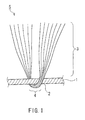
- FIG. 1 is a schematic perspective view of a pile fabric in one example of the present invention.
- a pile fabric 5 is composed of ground yarns 1, and pile fibers 2 that are intertwined with the ground yarns 1 and opened on a front surface of a ground structure to form napped piles 3. Additionally, in a back surface of the pile fabric 5, at least part of the pile fibers 2 are fused at the outside of the ground yarns 1 to form a fused part 4, and the fused part 4 is pressure-bonded to the ground yarns 1. Further, the back surface of the pile fabric 5 may be impregnated with a backing resin.
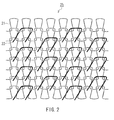
- FIG. 2 is a diagram of a boa knit.
- a pile fabric 25 is composed of ground yarns 21, and pile fibers 22 that are intertwined with the ground yarns 21 and opened on a front surface of a ground structure to form napped piles.
- FIG. 3 is a knitting diagram of a sliver knit.
- a pile fabric 35 is composed of ground yarns 31, and pile fibers 32 that are intertwined with the ground yarns 31 and opened on a front surface of a ground structure to form napped piles.
- a contact heating/pressurization treatment is performed on a surface opposite to the napped pile side, i.e., a back surface of the pile fabric, whereby the pile fibers located outside of the ground yarns are fused.
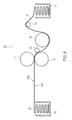
- FIG. 4 shows a production process in one example of the present invention.
- a processing device 10 to be used in this method includes a heating roller 11 that is coated with a fluorocarbon resin such as polytetrafluoroethylene, a cooling rubber roller 12 through which cooling water of 30°C passes and that applies pressure to the heating roller 11, metal cooling rollers 13, 14 through which cooling water of 30°C passes and that apply pressure to the cooling rubber roller 12, and a guide roller 15.
- a raw pile fabric 18 is led out from a container 16 and supplied so that a back surface 18b of the raw pile fabric 18 contacts the heating roller and a front surface (napped pile side) 18a thereof contacts the cooling rubber roller 12.
- the pile fabric 5 after this processing is contained in a container 17.
- the device for the contact heating/pressurization treatment is not limited to the processing device shown in FIG. 4 , but may be a device that is partially modified from the processing device shown in FIG. 4 , a hot plate, or other device.
- the heating temperature may be equal to or higher than the softening point of the pile fibers and lower than the softening point of the ground structure constituent fibers, for example.
- the pressure force is 0.01-100 Kgf/cm 2 in linear pressure
- the supply rate of the raw pile fabric is 0.1-20 m/minutes
- the contact time with the heater is 1-60 seconds. More preferably, the pressure force is 0.05-7 Kgf/cm 2 in linear pressure
- the contact time with the heater is 2-10 seconds, in order to reduce damage on the front surface of the pile fabric.
- An amount of pile fiber loss of the pile fabric according to the present invention is preferably 0.6 g/m 2 or less, and more preferably 0.3 g/m 2 or less.
- the amount of pile fiber loss is measured by: rubbing a front surface of a pile fabric ten times in a forward direction and ten times in a reverse direction of piles with a stroke width of 30 cm while applying a constant load of 600 g (14.3 kg/cm 2 ) using a rubber brush (trade name "prescale mat” 5 mm (particle diameter), length 4 cm, width 10.5 cm, manufactured by FUJIFILM Corporation); collecting fallen pile fibers by an adhesive tape; and converting the weight into per 1m 2 .
- a rubber brush (trade name "prescale mat” 5 mm (particle diameter), length 4 cm, width 10.5 cm, manufactured by FUJIFILM Corporation) was used to rub a front surface of a pile fabric ten times in a forward direction and ten times in a reverse direction of piles with a stroke width of 30 cm while applying a constant load of 600 g (14.3 kg/cm 2 ). Thereafter, fallen pile fibers were collected using an adhesive tape, and the weight was converted into per 1m 2 , which was defined as the amount of pile fiber loss.
- the pile fiber loss of a pile fabric was ranked on a scale ofA to D as below:
- the texture was ranked on a scale ofA to D as below:
- ground structure constituent fiber ground yarn
- a multifilament with a total fineness of 334 dtex (a fiber yarn composed of two filaments, each filament having a fineness of 167 dtex and being composed of 50 polyester single fibers) was used.
- the softening point is 258°C.
- a cotton yarn composed of two spun yarns of cotton count 40 was used. Cotton does not have a softening point, and is decomposed at high temperature.
- Production Examples 1-30 Production Examples 1, 7, 13, 19, 23 and 27 are comparative examples, and the other Production Examples are examples.
- a sliver knitting machine circular knitting machine for manufacturing fake furs was used.
- the above identified polyester fiber yarns were used as the ground yarns.
- Pile fabrics of Production Examples 1-30 were knitted by supplying pile fiber slivers (10-14 g/m) composed of acrylic-based fibers respectively shown in Table 1 below.
- the number of loops in the wales of the ground structure was 16-17/inch, and the number of loops in the course of the ground structure was 22-33/inch.
- the other conditions are shown in Table 1 below.
- back surfaces of the pile fabrics were impregnated with a backing resin.
- the backing resin an emulsion copolymer latex composed mainly of acrylic ester was used.
- the backing resin was an aqueous solution (emulsified solution) with a latex concentration of 40 wt%.
- the pile fabrics of the examples and the pile fabrics of the comparative examples were impregnated and attached with the backing resin at a solid resin concentration of 25 g/m 2 and 50 g/m 2 , respectively, and then dried. Next, pile fibers on front surfaces of the pile fabrics were aligned by polishing, brushing and shearing.
- Production Example 1 is a comparative example in which the contact heating/pressurization treatment was not performed.
- Production Examples 2-6 are examples in which the contact heating/pressurization treatment was performed differently from each other. Further, the same pile fibers and the same ground yarns were used in Production Examples 7-12.
- Production Example 7 is a comparative example in which the contact heating/pressurization treatment was not performed.
- Production Examples 8-12 are examples in which the contact heating/pressurization treatment was performed differently from each other. Further, the same pile fibers and the same ground yarns were used in Production Examples 13-18.
- Production Example 13 is a comparative example in which the contact heating/pressurization treatment was not performed.
- Production Examples 14-18 are examples in which the contact heating/pressurization treatment was performed differently from each other. Further, the same pile fibers and the same ground yarns were used in Production Examples 19-22.
- Production Example 19 is a comparative example in which the contact heating/pressurization treatment was not performed.
- Production Examples 20-22 are examples in which the contact heating/pressurization treatment was performed differently from each other. Further, the same pile fibers and the same ground yarns were used in Production Examples 23-26.
- Production Example 23 is a comparative example in which the contact heating/pressurization treatment was not performed.
- Production Examples 24-26 are examples in which the contact heating/pressurization treatment was performed differently from each other. Further, the same pile fibers and the same ground yarns were used in Production Examples 27-30.
- Production Example 27 is a comparative example in which the contact heating/pressurization treatment was not performed.
- Production Examples 28-30 are examples in which the contact heating/pressurization treatment was performed differently from each other.
- Pile fabrics of Production Examples 31-35 were obtained in the same manner as Production Examples 1-30, except that pile fiber slivers composed of acrylic fibers shown in Table 2 below were used, and the contact heating/pressurization treatment was performed under the conditions shown in Table 2 below. Further, pile fabrics of Production Examples 36-40 were obtained in the same manner as Production Examples 1-30, except that the above cotton yarns were used as the ground yarns, pile fiber slivers composed of acrylic fibers shown in Table 2 below were used, and the contact heating/pressurization treatment was performed under the conditions shown in Table 2 below. The same pile fibers and the same ground yarns were used in Production Examples 31-35. Production Example 31 is a comparative example in which the contact heating/pressurization treatment was not performed.
- Production Examples 32-34 are comparative examples in which the contact heating/pressurization treatment was performed at a predetermined temperature lower than a softening point of the pile fibers.
- Production Example 35 is an example in which the contact heating/pressurization treatment was performed at a predetermined temperature equal to or higher than a softening point of the pile fibers. Further, the same pile fibers and the same ground yarns were used in Production Examples 36-40.
- Production Example 36 is a comparative example in which the contact heating/pressurization treatment was not performed.
- Production Examples 37-40 are examples in which the contact heating/pressurization treatment was performed differently from each other.
- Pile fabrics of Production Examples 41-52 were obtained in the same manner as Production Examples 1-30, except that pile fiber slivers composed of mixed fibers of acrylic-based fibers and acrylic fibers shown in Table 3 below were used, and the contact heating/pressurization treatment was performed under the conditions shown in Table 3 below.
- the same pile fibers and the same ground yarns were used in Production Examples 41-44.
- Production Example 41 is a comparative example in which the contact heating/pressurization treatment was not performed.
- Production Examples 42-44 are examples in which the contact heating/pressurization treatment was performed differently from each other. Further, the same pile fibers and the same ground yarns were used in Production Examples 45-48.
- Production Example 45 is a comparative example in which the contact heating/pressurization treatment was not performed.
- Production Examples 46-48 are examples in which the contact heating/pressurization treatment was performed differently from each other. Further, the same pile fibers and the same ground yarns were used in Production Examples 49-52.
- Production Example 49 is a comparative example in which the contact heating/pressurization treatment was not performed.
- Production Examples 50-52 are examples in which the contact heating/pressurization treatment was performed differently from each other. In all Examples, the contact heating/pressurization treatments were performed at a temperature equal to or higher than the softening point of acrylic-based fibers and lower than the softening point of acrylic fibers.
- FIG. 5 shows photographs (50x magnification) of the pile fabrics of Production Example 1 (comparative example), Production Example 5 (example), Production Example 7 (comparative example), Production Example 11 (example), Production Example 13 (comparative example) and Production Example 17 (example), taken by a scanning electron-microscope (SEM).
- reference numbers 19a and 19b indicate a thickness of the pile fibers located outside of the ground yarns.
- FIG. 5 also indicates the thickness and the amount of pile fiber loss. As can be seen from FIG. 5 , by performing the contact heating/pressurization treatment, the thickness of the pile fibers located outside of the ground structure constituent fibers was reduced to a fraction of the thickness without the contact heating/pressurization treatment, and the amount of pile fiber loss was greatly reduced.
- the pile fiber loss was low and the texture was favorable for those examples that underwent the contact heating/pressurization treatment.
- at least part of the pile fibers located outside of the ground structure constituent fibers were fused and pressure-bonded by the contact heating/pressurization treatment at a temperature equal to or higher than the softening point of the pile fibers and lower than the softening point of the ground structure constituent fibers.
- the thickness of the fused and pressure-bonded pile fibers located outside of the ground yarns was 300 ⁇ m or less
- the pile fiber loss was low and the texture was favorable. Incidentally, it can be confirmed from SEM photographs (50x magnification) such as those shown in FIG. 5 that at least part of the pile fibers located outside of the ground yarns were fused and pressure-bonded.
- a pile fabric of Production Example 53 was obtained in the same manner as Production Example 26, except that the pile fabric was not impregnated with a backing resin.
- Results of the amount of pile fiber loss, the evaluation of pile fiber loss, the texture, the thickness, etc., of the pile fabric of Production Example 53 are shown in Table 4 below.
- the results of Production Example 23 (comparative example) also are shown in Table 4.
- a comparison between Production Example 23 (comparative example) and Production Example 53 (example) indicates that, even without impregnation with a backing resin, the amount of pile fiber loss was greatly reduced. In other words, only performing the contact heating/pressurization treatment on the back surface of the ground structure greatly reduced the amount of pile fiber loss.
- Pile fabrics of Production Examples 54-55 were obtained in the same method as a general method of producing boa piles, using the above polyester fiber yarns as ground yarns and pile fibers composed of mixed fibers of acrylic-based fibers shown in Table 5 below.
- Conditions for the contact heating/pressurization treatment on the back surface of the ground structure of boa piles as well as results of the amount of pile fiber loss, the evaluation of pile fiber loss, the texture, the thickness, etc., are shown in Table 5 below.
- the same pile fibers and the same ground yarns were used in Production Examples 54-55.
- Production Example 54 is a comparative example in which the contact heating/pressurization treatment was not performed.
- Production Example 55 is an example in which the contact heating/pressurization treatment was performed.
- Pile fabrics of Production Examples 56-59 were obtained in the same manner as Production Example 16, except that the above polyester fiber yarns were used as ground yarns, pile fibers shown in Table 6 below were used, and the contact heating/pressurization treatment was performed using the processing device shown in FIG. 4 under the conditions shown in Table 6 below. Conditions for the contact heating/pressurization treatment as well as results of the amount of pile fiber loss, the evaluation of pile fiber loss, the texture, the thickness, etc., are shown in Table 6 below. The results of Production Example 13 also are shown in Table 6.
- Pile fabrics of Production Examples 60-95 were obtained in the same manner as Production Examples 1-30, except that polyester fiber yarns were used as ground yarns, low-melting polyester fibers or mixed fibers of low-melting polyester fibers and acrylic fibers shown in Table 7 below were used as pile fibers, and the contact heating/pressurization treatment was performed under the conditions shown in Table 7 below. Conditions for the contact heating/pressurization treatment as well as results of the amount of pile fiber loss, the evaluation of pile fiber loss, the texture, the thickness, etc., are shown in Table 7 below. All of Production Examples 60-95 are comparative examples.
- Pile fabrics of Production Examples 96-107 were obtained in the same manner as Production Examples 1-30, except that polyester fiber yarns were used as ground yarns, low-melting polyester fibers or mixed fibers of low-melting polyester fibers and acrylic fibers shown in Table 8 below were used as pile fibers, and the contact heating/pressurization treatment was performed under the conditions shown in Table 8 below. Conditions for the contact heating/pressurization treatment as well as results of the amount of pile fiber loss, the evaluation of pile fiber loss, the texture, the thickness, etc., are shown in Table 8 below. All of Production Examples 96-107 are comparative examples.
- the low-melting polyester fibers "UNITIKA 1680” When compared to acrylic fibers and acrylic-based fibers, the low-melting polyester fibers "UNITIKA 1680" have a strong resilience (i.e., an elasticity of staple fibers is strong), have a strong crimp and are voluminous, and they are difficult to be processed into a pile fabric when the content of the low-melting polyester fibers "UNITIKA 1680" in the pile fibers exceeds 20 wt%.
- the present invention provides a pile fabric whose pile fibers are inhibited from falling off while having an excellent texture, and can be applied to general pile fabrics, such as fake furs, boa piles, car sheets and carpets.
Landscapes
- Engineering & Computer Science (AREA)
- Textile Engineering (AREA)
- Knitting Of Fabric (AREA)
- Treatment Of Fiber Materials (AREA)
- Woven Fabrics (AREA)
- Yarns And Mechanical Finishing Of Yarns Or Ropes (AREA)
- Laminated Bodies (AREA)
Abstract
Description
- The present invention relates to a pile fabric whose pile fibers are inhibited from falling off, and a method of producing the same.
- Conventionally, pile fabrics have been known under the names of imitation furs or fake furs, boas, etc., as fabrics designed to resemble appearances of furs. These are produced from pile knits and pile weaves. In the case of knitted piles, a seal-fraise knitting machine or a sliver knitting machine (circular knitting machine) is used mainly for knitting, and piles are cut in both cases. When a double Russell machine (warp knitting machine) is used for knitting, piles are knitted by forming a double ground structure while intertwining the double ground structure with a binder yarn, and cutting the middle of the binder yarn. In a weaving method, a velvet loom or a moquette loom is used to intertwine an upper and a lower ground structure and the middle of the ground structures with a binder yarn, and cut the middle of an upper and a lower base fabrics using a knife, whereby two weaves are obtained simultaneously (Non-Patent Document 1). However, these weaves and knits have the same problem, which is a large amount of pile fiber loss. As many pile fibers fall off, they attach to an inner wear or are dropped on the floor, resulting in a poor appearance and poor hygienic conditions.
- In order to prevent such pile fiber loss, there has been a proposal of mixing low-melting fibers into pile fibers (Patent Document 1), and a proposal of mixing low-melting fibers into ground yarns constituting a ground structure (Patent Documents 2-3), etc. However, in these proposals, because the whole fabric is heated at a temperature equal to or higher than a melting point of the low-melting fibers, the entire ground structure or the pile fibers are also fused, resulting in a coarse texture.
-
- Patent Document 1:
JP 06(1994)-081248 A - Patent Document 2:
JP 2000-314048 A - Patent Document 3:
JP 07(1995)-048765 A - Non-Patent Document 1: "Fiber Handbook third edition", page 341-342, edited by The Society of Fiber Science and Technology, Japan, published by Maruzen, issued on December 15, 2004
- In order to solve the above conventional problem, the present invention provides a pile fabric whose pile fibers are inhibited from falling off without impairing the texture by fusing only a specific area of the pile fabric, and a method of producing the same.
- A pile fabric of the present invention is a pile fabric that includes: a ground structure; and pile fibers that are intertwined with ground yarns constituting the ground structure and napped on a front surface of the ground structure, wherein the pile fibers include at least one selected from the group consisting of acrylic fibers and acrylic-based fibers and have a softening point lower than a softening point of fibers constituting the ground structure, and wherein among the pile fibers intertwined with the ground yarns constituting the ground structure, at least part of the pile fibers located outside of the ground yarns constituting the ground structure are fused but the pile fibers napped on the front surface of the ground structure are not fused.
- A method of producing a pile fabric of the present invention is a method of producing a pile fabric, the pile fabric including: a ground structure; and pile fibers that are intertwined with ground yarns constituting the ground structure and napped on a front surface of the ground structure, wherein the pile fibers include at least one selected from the group consisting of acrylic fibers and acrylic-based fibers and have a softening point lower than a softening point of fibers constituting the ground structure, and a contact heating/pressurization is performed at a temperature equal to or higher than the softening point of the pile fibers and lower than the softening point of the fibers constituting the ground structure from a back surface side of the ground structure, whereby among the pile fibers intertwined with the ground yarns constituting the ground structure, at least part of the pile fibers located outside of the ground yarns constituting the ground structure are fused but the pile fibers napped on the front surface of the ground structure are not fused.
- In the pile fabric of the present invention, the pile fibers include at least one selected from the group consisting of acrylic fibers and acrylic-based fibers, and at least part of the pile fibers located outside of the ground yarns constituting the ground structure are fused but the pile fibers napped on the front surface of the ground structure are not fused. Thereby, the pile fibers can be prevented from falling off without impairing the texture. Further, in the method of producing a pile fabric of the present invention, a contact heating/pressurization is performed at a temperature equal to or higher than the softening point of the pile fibers but lower than the softening point of the fibers constituting the ground structure from a back surface side of the ground structure, whereby only a limited area of the pile fibers located outside of the ground yarns constituting the ground structure is fused but the pile fibers napped on the front surface of the ground structure are not fused. Thereby, the pile fibers can be prevented from falling off without impairing the texture.
-
-
FIG. 1 is a schematic perspective view of a pile fabric in one example of the present invention. -
FIG. 2 is a knitting diagram of a boa knit in one example of the present invention. -
FIG. 3 is a knitting diagram of a sliver knit in one example of the present invention. -
FIG. 4 shows a production process in one example of the present invention. -
FIG. 5 is a table that includes photographs (50x magnification) taken by a scanning electron microscope (SEM) that show a thickness of pile fibers located outside of ground yarns constituting a ground structure in one example of the present invention. -
FIG. 6 is a graph showing a relationship between the thickness of pile fibers located outside of ground yarns constituting a ground structure and an amount of pile fiber loss in one example of the present invention. - Apile fabric of the present invention is a pile fabric that includes: a ground structure; and pile fibers that are intertwined with ground yarns constituting the ground structure (hereinafter, also referred to as "ground yarn" simply) and napped on a front surface of the ground structure. The pile fabric can be manufactured using a seal-fraise knitting machine, a sliver knitting machine (circular knitting machine), a boa machine (circular knitting machine), a double Russell machine, a velvet loom, a moquette loom, etc. Although the pile fabric of the present invention is not limited particularly, it may be a high pile fabric, a boa pile fabric, a tufted carpet, etc. The pile fabric is preferably a high pile fabric or a boa pile fabric, and more preferably a high pile fabric.
- The pile fibers have a softening point lower than a softening point of fibers constituting the ground structure (hereinafter, also referred to as "ground structure constituent fibers", simply). Among the pile fibers intertwined with the ground yarns, at least part of the pile fibers located outside of the ground yarns are fused but the pile fibers napped on the front surface of the ground structure are not fused. Although the means for the fusion is not limited as long as at least part of the pile fibers located outside of the ground yarns can be fused, it is preferable to perform a contact heating/pressurization at a temperature equal to or higher than the softening point of the pile fibers and lower than the softening point of the ground structure constituent fibers from a back surface side of the ground structure, i.e., a back surface side of the pile fabric.
- In the present invention, "outside of the ground yarns constituting the ground structure" refers to the back surface side of the pile fabric when a surface thereof with napped pile fibers is defined as a front surface, and an outer side of the ground yarns. Further, there is a case where part of the pile fibers intertwined with the ground yarns are stitched into ground yarns. If the remaining parts of such fibers are present outside of ground yarns, they are considered as being located outside of the ground yarns.
- The pile fibers are at least one selected from the group consisting of acrylic fibers and acrylic-based fibers. Thereby, it is possible to obtain a pile fabric with an excellent texture. If thermoplastic fibers are used as the pile fibers and a polishing process is performed at a temperature equal to or higher than a melting point of the thermoplastic fibers, generally the pile fibers on the front surface of the pile fabric melt, such that a pile fabric with a favorable appearance and texture is not obtained. Further, when the polishing process is performed at a temperature equal to or lower than the melting point of the thermoplastic fibers, crimps of the pile fibers on the front surface of the pile fabric are not straightened, such that a pile fabric with a favorable appearance and texture is not obtained. On the other hand, crimps of acrylic fibers and acrylic-based fibers can be straightened at temperatures equal to or lower than their softening points. Because of this, when at least one fiber selected from the group consisting of acrylic fibers and acrylic-based fibers is used as the pile fibers, the polishing process can be performed at a temperature equal to or lower than its softening point, (i.e., 150-160°C). Therefore, when at least one fiber selected from the group consisting of acrylic fibers and acrylic-based fibers is used as the pile fibers, the pile fibers on the front surface of the pile fabric are not fused in the polishing process, such that a pile fabric with a favorable appearance and texture is obtained. Moreover, if the pile fibers contain fibers other than acrylic fibers and acrylic-based fibers, such as thermoplastic fibers having a softening point of 160°C or lower (i.e., low-melting polyester fibers having a softening point of 160°C or lower, etc.), these low-melting polyester fibers on the front surface of the pile fabric melt in the polishing process at 150-160°C, which makes it difficult to obtain a pile fabric with a favorable appearance and texture.
- The pile fibers are not limited particularly as long as the softening point is lower than the softening point of the fibers constituting the ground structure. A difference between the softening point of the ground structure constituent fibers and the softening point of the pile fibers is preferably 10°C or more, more preferably 20°C or more, and particularly preferably 30°C or more. The difference of 10°C or more makes it easier to cause only at least part of the fibers located outside of the ground yarns constituting the ground structure to be fused and not to cause the pile fibers napped on the front surface of the ground structure to be fused.
- The pile fibers may be fibers that are softened altogether at a predetermined temperature, or mixed fibers composed of fibers that are softened in different temperatures. When the pile fibers are mixed fibers composed of fibers softened at different temperatures, it is preferable that fibers to be softened at a relatively lower temperature are mixed at a ratio of 20% by weight (wt%) or more so that the fibers to be softened at a relatively lower temperature are fused.
- In the present invention, a softening point is a softening temperature before fusion or decomposition. For example, a softening point of acrylic fibers is 190-232°C, and a softening point of acrylic-based fibers is 150-220°C ("Encyclopaedia Chimica", page 727-729, published by Kyoritsu Shuppan Co., Ltd., on June 1,1993; hereinafter, referred to as "literature value"). An acrylic fiber refers to a fiber containing 85 wt% or more of acrylonitrile. Further, an acrylic-based fiber refers to a fiber composed of a polymer containing 35 wt% or more and less than 85 wt% of acrylonitrile and 15 wt% or more and 65 wt% or less of other copolymerizable monomers. Here, examples of other copolymerizable monomers include: vinyl halides and vinylidene halides represented by vinyl chloride, vinylidene chloride, vinyl bromide, and vinylidene bromide; sulfonic acid-containing monomers represented by allylsulfonic acid, methallylsulfonic acid, styrenesulfonic acid, isoprenesulfonic acid, 2-acrylamido-2-methylpropanesulfonic acid, and their metal salts and amine salts; acrylic acid and methacrylic acid, and their lower alkyl esters, N- or N,N-alkyl substituted aminoalkyl esters and glycidyl esters; acrylamide and methacrylamide, and their N- or N,N-alkyl substituted products; anionic vinyl monomers such as carboxyl group-containing vinyl monomers represented by acrylic acid, methacrylic acid and itaconic acid and their sodium, potassium or ammonium salts; cationic vinyl monomers represented by quaternary aminoalkyl esters of acrylic acid and methacrylic acid; vinyl group-containing lower alkyl ethers; vinyl group-containing lower carboxylic acid esters represented by vinyl acetate; and styrene. These monomers may be used alone or as a mixture of two or more kinds. Among these, it is preferable to use one or more kinds of monomers selected from the group consisting of vinyl halides, vinylidene halides, and metal salts of sulfonic acid-containing monomers, and more preferable to use one or more kinds of monomers selected from the group consisting of vinyl chloride, vinylidene chloride, and sodium styrenesulfonate. Preferably, modacrylic fibers are used as the acrylic-based fibers. A modacrylic fiber refers to a fiber composed of a polymer containing 35 wt% or more and less than 85 wt% of acrylonitrile, and 15 wt% or more and 65 wt% or less, in total, of one or more kinds of monomers selected from the group consisting of vinyl chloride and vinylidene chloride as well as other copolymerizable monomers.
- In the pile fabric of the present invention, at least part of the pile fibers located outside of the ground yarns are fused and pressure-bonded. Here, "pressure-bonded" refers to, for example, a state in which respective pile fibers are fused and bonded, or a state in which respective pile fibers are gathered into a mass and flattened, as shown in SEM photographs (
FIG. 5 ) of pile fabrics of Production Examples 5,11 and 17 after a contact heating/pressurization treatment. Further, in the pile fabric of the present invention, it is preferable that all the pile fibers located outside of the ground yarns are fused and pressure-bonded, because a more superior effect of preventing pile fiber loss can be obtained. - The thickness of the fused and pressure-bonded pile fibers located outside of the ground yarns is preferably 300 pm or less, more preferably 250 µm or less, and particularly preferably 200 µm or less. If the thickness of the pile fibers located outside of the ground yarns is 300 µm or less, the pile fibers are fused and fixed to each other with sufficient strength. In the present invention, the thickness of the pile fibers located outside of the ground yarns is measured in the following manner, for example. First, in order to maintain the shape of piles at the time of cutting a pile fabric, only front portions of the piles are fixed using an adhesive, and then the pile fabric is cut vertically to a knitting direction of the ground yarns. The cutting line is set so as to traverse loops of the ground yarns, and indicated by a line I-I in
FIG. 3 , for example. Next, a back surface of the ground structure is made to face upward (turned upside down from a state ofFIG. 1 ) for observing the cross section at 50x magnification using a scanning electron microscope (SEM). For example, a thickness indicated by a shortest distance betweenparallel lines FIG. 5 is measured. An average value of ten measured points is defined as the thickness. - If during the measurement of the thickness it is difficult to distinguish between the ground yarns and the pile fibers using a scanning electron microscope (SEM), an optical microscope, a laser microscope or the like that allows observation at 50x or more magnification may be used for distinguishing between the ground yarns and the pile fibers.
- In the present invention, it is preferable that a back surface of the pile fabric is impregnated with a backing resin. If the back surface is impregnated with a backing resin, the napped pile fibers can be aligned before the process of performing a contact heating/pressurization from the back surface side of the ground structure, i.e., the back surface side of the pile fabric.
- As the backing resin, it is possible to use a latex, an emulsion, a dispersion, etc., of acrylic ester-based resin, polyurethane-based resin, etc. For preventing pile fiber loss, the amount of the impregnation backing resin generally is, for example, about 50 g/m2 at the concentration of solid resin. However, since the present invention has an effect of preventing pile fiber loss by fusing a specific area of the pile fibers, the amount of the impregnation backing resin may be about 1/2 to 1/3 of the above-described general amount. In other words, the back surface may be impregnated with the backing resin at the concentration of solid resin of about 17-25 g/m2. Any polishing process of pile fibers is performed before fusing a specific area of the pile fibers, and the pile fibers can be fixed temporarily using a backing resin to prevent the fibers from falling off. For this process, the amount of the resin impregnation need not be high.
- Next, a method of producing a pile fabric of the present invention will be described. The method of producing a pile fabric of the present invention includes performing a contact heating/pressurization at a temperature equal to or higher than a softening point of the pile fibers and lower than a softening point of the ground structure constituent fibers from the back surface side of the ground structure. Thereby, among the pile fibers intertwined with the ground yarns, at least part of the pile fibers located outside of the ground yarns are fused and pressure-bonded. Preferably, the contact heating/pressurization is performed using a heating roller or a hot plate. The use of a heating roller or a hot plate shortens the time of the contact heating treatment, and allows only at least part of the pile fibers located outside of the ground yarns to be fused and pressure-bonded. Further, since the temperature of the heating is not so high as to melt the pile fibers on the front surface of the pile fabric, the pile fibers napped on the front surface of the ground structure are not fused.
- Further, when the pile fibers are mixed fibers composed of fibers that are softened in different temperatures, it is preferable to perform the contact heating/pressurization treatment at a temperature equal to or higher than a softening point of pile fibers to be softened at a relatively lower temperature and lower than a softening point of pile fibers to be softened at a relatively higher temperature, so that the pile fibers to be softened at a relatively lower temperature are fused. In this manner, pile fiber loss can be prevented and a pile fabric with an excellent texture can be easily obtained.
- During and/or after performing the contact heating/pressurization step, it is preferable to cool the napped pile fiber side. Further, after performing the contact heating/pressurization step, it is preferable to perform cooling from the back surface side of the ground structure. In the above-described cooling step, it is preferable to cool the surface of the napped pile fibers using a cooling roller through which water of 30°C or lower passes. By performing such cooling, dimensional stability is maintained, and damages to the pile fibers due to heat is reduced.
- Although the ground structure constituent fibers are not particularly limited as long as the softening point is higher than the softening point of the pile fibers, the fibers may be synthetic fibers composed of polyester resin such as polyethylene terephthalate, cotton, etc.
- In the present invention, if using polyethylene terephthalate (PET, softening point about 258°C) fibers as the ground structure constituent fibers for example, it is possible to use one or more fibers selected from the group consisting of acrylic-based fibers and acrylic fibers as the pile fibers. Preferably, the pile fibers are acrylic-based fibers, or mixed fibers of acrylic-based fibers and acrylic fibers. The following fibers can be used as the acrylic-based fibers.
- (1) Vinyl chloride-acrylonitrile fiber (e.g., trade name "KANEKALON" manufactured by Kaneka Corporation, softening point 150-220°C, literature value)
- (2) vinylidene chloride-acrylonitrile fiber (softening point 150-220°C, literature value)
- In the present invention, if using cotton (no softening point) fibers as the ground structure constituent fibers, for example, acrylic fibers (e.g., trade name "Exlan K691" manufactured by Exlan Co., Ltd., softening point 190-232°C, literature value) can be used as the pile fibers.
- Hereinafter, a description will be made with reference to the drawings.
FIG. 1 is a schematic perspective view of a pile fabric in one example of the present invention. Apile fabric 5 is composed ofground yarns 1, and pilefibers 2 that are intertwined with theground yarns 1 and opened on a front surface of a ground structure to form napped piles 3. Additionally, in a back surface of thepile fabric 5, at least part of thepile fibers 2 are fused at the outside of theground yarns 1 to form a fusedpart 4, and the fusedpart 4 is pressure-bonded to theground yarns 1. Further, the back surface of thepile fabric 5 may be impregnated with a backing resin. -
FIG. 2 is a diagram of a boa knit. Apile fabric 25 is composed ofground yarns 21, and pilefibers 22 that are intertwined with theground yarns 21 and opened on a front surface of a ground structure to form napped piles.FIG. 3 is a knitting diagram of a sliver knit. Apile fabric 35 is composed ofground yarns 31, and pilefibers 32 that are intertwined with theground yarns 31 and opened on a front surface of a ground structure to form napped piles. When forming both thepile fabric 25 and thepile fabric 35, a contact heating/pressurization treatment is performed on a surface opposite to the napped pile side, i.e., a back surface of the pile fabric, whereby the pile fibers located outside of the ground yarns are fused. -
FIG. 4 shows a production process in one example of the present invention. Aprocessing device 10 to be used in this method includes aheating roller 11 that is coated with a fluorocarbon resin such as polytetrafluoroethylene, a coolingrubber roller 12 through which cooling water of 30°C passes and that applies pressure to theheating roller 11,metal cooling rollers rubber roller 12, and aguide roller 15. Araw pile fabric 18 is led out from acontainer 16 and supplied so that aback surface 18b of theraw pile fabric 18 contacts the heating roller and a front surface (napped pile side) 18a thereof contacts the coolingrubber roller 12. Thepile fabric 5 after this processing is contained in acontainer 17. Note that the device for the contact heating/pressurization treatment is not limited to the processing device shown inFIG. 4 , but may be a device that is partially modified from the processing device shown inFIG. 4 , a hot plate, or other device. During the contact heating/pressurization treatment, the heating temperature may be equal to or higher than the softening point of the pile fibers and lower than the softening point of the ground structure constituent fibers, for example. Preferably, the pressure force is 0.01-100 Kgf/cm2 in linear pressure, the supply rate of the raw pile fabric is 0.1-20 m/minutes, and the contact time with the heater is 1-60 seconds. More preferably, the pressure force is 0.05-7 Kgf/cm2 in linear pressure, and the contact time with the heater is 2-10 seconds, in order to reduce damage on the front surface of the pile fabric. - An amount of pile fiber loss of the pile fabric according to the present invention is preferably 0.6 g/m2 or less, and more preferably 0.3 g/m2 or less. In the present invention, the amount of pile fiber loss is measured by: rubbing a front surface of a pile fabric ten times in a forward direction and ten times in a reverse direction of piles with a stroke width of 30 cm while applying a constant load of 600 g (14.3 kg/cm2) using a rubber brush (trade name "prescale mat" 5 mm (particle diameter),
length 4 cm, width 10.5 cm, manufactured by FUJIFILM Corporation); collecting fallen pile fibers by an adhesive tape; and converting the weight into per 1m2. - Hereinafter, the present invention will be described more specifically by way of examples. Note that the present invention is not limited to the examples below.
- A rubber brush (trade name "prescale mat" 5 mm (particle diameter),
length 4 cm, width 10.5 cm, manufactured by FUJIFILM Corporation) was used to rub a front surface of a pile fabric ten times in a forward direction and ten times in a reverse direction of piles with a stroke width of 30 cm while applying a constant load of 600 g (14.3 kg/cm2). Thereafter, fallen pile fibers were collected using an adhesive tape, and the weight was converted into per 1m2, which was defined as the amount of pile fiber loss. - The pile fiber loss of a pile fabric was ranked on a scale ofA to D as below:
- A: 0.3 g/m2 or less (very favorable level)
- B: More than 0.3 g/m2 and not more than 0.6 g/m2 (favorable level)
- C: More than 0.6 g/m2 and not more than 1.0 g/m2 (slightly poor level)
- D: More than 1.0 g/m2 (poor level)
- 1g of each of fibers used in the following Production Examples was opened, placed on a hot plate heated to a predetermined temperature, and pressurized at 0.07 Kgf/cm2 for 3 seconds. The temperature at which surfaces of single fibers in contact with the hot plate softened, bonded to each other and formed into a plate shape was defined as the softening point of the fibers.
- In order to maintain the shape of piles at the time of cutting a pile fabric, only front portions of the piles were fixed using an adhesive, and then the pile fabric was cut vertically to a knitting direction of the ground yarns. The cutting line was set so as to traverse loops of the ground yarns, and indicated by line I-I in
FIG. 3 , for example. Next, a back surface of the ground structure was made to face upward (turned upside down from a state ofFIG. 1 ) for observing the cross section at 50x magnification using a scanning electron microscope (SEM). For example, a thickness indicated by a shortest distance betweenparallel lines FIG. 5 was measured. An average value of ten measured points is defined as the thickness. - The texture was ranked on a scale ofA to D as below:
- A: No fusion was found in the napped pile fibers on the front surface of the ground structure; equivalent level to pile fabrics without heat treatment
- B: Slightly inferior as compared with rank A, but no fusion was found in napped pile fibers on the front surface of the ground structure; no problem in practical use
- C: Slightly coarse, with problems in practical use (failure)
- D: Extremely coarse, and unpractical (failure)
-
- (1) Trade name "KANEKALONAH" (hereinafter, referred to as AH, simply), manufactured by Kaneka Corporation
Acrylic-based fiber (vinyl chloride-acrylonitrile fiber), softening point 180-190°C, fineness: 3.3 deci tex (hereinafter, referred to as dtex) - (2) Trade name "KANEKALON FHS" (hereinafter, referred to as FHS, simply), manufactured by Kaneka Corporation
Acrylic-based fiber (vinyl chloride-acrylonitrile fiber), softening point 180-190°C, fineness: 2.2 dtex - (3) Trade name "KANEKALON RMK (801)" (hereinafter, referred to as RMK (801), simply), manufactured by Kaneka Corporation
Acrylic-based fiber (vinyl chloride-acrylonitrile fiber), softening point 180-190°C, fineness: 12 dtex - (4) Trade name "KANEKALON SL" (hereinafter, referred to as SL, simply), manufactured by Kaneka Corporation
Acrylic-based fiber (vinyl chloride-acrylonitrile fiber), softening point 180-190°C, fineness: 3.3 dtex - (5) Trade name "K691", manufactured by Exlan Co., Ltd.
Acrylic fiber, softening point 250-260°C, fineness: 3.3 dtex - (6) Trade name "KANEKALON CC" (hereinafter, referred to as CC, simply), manufactured by Kaneka Corporation
Acrylic-based fiber (vinyl chloride-acrylonitrile fiber), softening point 180-190°C, fineness: 3.3 dtex - (7) Trade name "KANEKALON fmu" (hereinafter, referred to as fmu, simply), manufactured by Kaneka Corporation
Acrylic-based fiber (vinyl chloride-acrylonitrile fiber), softening point 180-190°C, fineness: 1.5 dtex - (8) Trade name "KANEKALON MS" (hereinafter, referred to as MS, simply), manufactured by Kaneka Corporation
Acrylic-based fiber (vinyl chloride-acrylonitrile fiber), softening point 180-190°C, fineness: 5.0 dtex - (9) Trade name "KANEKALON MCS" (hereinafter, referred to as MCS, simply), manufactured by Kaneka Corporation
Acrylic-based fiber (vinyl chloride-acrylonitrile fiber), softening point 180-190°C, fineness: 2.2 dtex - (10) Trade name "Tetoron SD", manufactured by TEIJIN
Polyester composite fiber, softening point 90-100°C, fineness: 4.4 dtex - (11) Trade name "UNITIKA 1680", manufactured by UNITIKA LTD.
Polyester composite fiber, softening point 220°C, fineness: 3.3 dtex - A multifilament with a total fineness of 334 dtex (a fiber yarn composed of two filaments, each filament having a fineness of 167 dtex and being composed of 50 polyester single fibers) was used. The softening point is 258°C.
- A cotton yarn composed of two spun yarns of cotton count 40 was used. Cotton does not have a softening point, and is decomposed at high temperature.
- In Production Examples 1-30, Production Examples 1, 7, 13, 19, 23 and 27 are comparative examples, and the other Production Examples are examples. A sliver knitting machine (circular knitting machine) for manufacturing fake furs was used. The above identified polyester fiber yarns were used as the ground yarns. Pile fabrics of Production Examples 1-30 were knitted by supplying pile fiber slivers (10-14 g/m) composed of acrylic-based fibers respectively shown in Table 1 below. The number of loops in the wales of the ground structure was 16-17/inch, and the number of loops in the course of the ground structure was 22-33/inch. The other conditions are shown in Table 1 below. Next, back surfaces of the pile fabrics were impregnated with a backing resin. As the backing resin, an emulsion copolymer latex composed mainly of acrylic ester was used. The backing resin was an aqueous solution (emulsified solution) with a latex concentration of 40 wt%. The pile fabrics of the examples and the pile fabrics of the comparative examples were impregnated and attached with the backing resin at a solid resin concentration of 25 g/m2 and 50 g/m2, respectively, and then dried. Next, pile fibers on front surfaces of the pile fabrics were aligned by polishing, brushing and shearing. Specifically, first, they were polished twice at 155°C, brushed twice, polished once at each of 150°C, 145°C, 130°C and 120°C, then sheared twice, and last, polished twice at 100°C. Except for the pile fabrics of the comparative examples, the back surfaces of the pile fabrics were subjected to a contact heating/pressurization treatment using a hot plate. The conditions for the contact heating/pressurization treatment are shown in Table 1 below.
- The same pile fibers and the same ground yarns were used in Production Examples 1-6. Production Example 1 is a comparative example in which the contact heating/pressurization treatment was not performed. Production Examples 2-6 are examples in which the contact heating/pressurization treatment was performed differently from each other. Further, the same pile fibers and the same ground yarns were used in Production Examples 7-12. Production Example 7 is a comparative example in which the contact heating/pressurization treatment was not performed. Production Examples 8-12 are examples in which the contact heating/pressurization treatment was performed differently from each other. Further, the same pile fibers and the same ground yarns were used in Production Examples 13-18. Production Example 13 is a comparative example in which the contact heating/pressurization treatment was not performed. Production Examples 14-18 are examples in which the contact heating/pressurization treatment was performed differently from each other. Further, the same pile fibers and the same ground yarns were used in Production Examples 19-22. Production Example 19 is a comparative example in which the contact heating/pressurization treatment was not performed. Production Examples 20-22 are examples in which the contact heating/pressurization treatment was performed differently from each other. Further, the same pile fibers and the same ground yarns were used in Production Examples 23-26. Production Example 23 is a comparative example in which the contact heating/pressurization treatment was not performed. Production Examples 24-26 are examples in which the contact heating/pressurization treatment was performed differently from each other. Further, the same pile fibers and the same ground yarns were used in Production Examples 27-30. Production Example 27 is a comparative example in which the contact heating/pressurization treatment was not performed. Production Examples 28-30 are examples in which the contact heating/pressurization treatment was performed differently from each other.
- Pile fabrics of Production Examples 31-35 were obtained in the same manner as Production Examples 1-30, except that pile fiber slivers composed of acrylic fibers shown in Table 2 below were used, and the contact heating/pressurization treatment was performed under the conditions shown in Table 2 below. Further, pile fabrics of Production Examples 36-40 were obtained in the same manner as Production Examples 1-30, except that the above cotton yarns were used as the ground yarns, pile fiber slivers composed of acrylic fibers shown in Table 2 below were used, and the contact heating/pressurization treatment was performed under the conditions shown in Table 2 below. The same pile fibers and the same ground yarns were used in Production Examples 31-35. Production Example 31 is a comparative example in which the contact heating/pressurization treatment was not performed. Production Examples 32-34 are comparative examples in which the contact heating/pressurization treatment was performed at a predetermined temperature lower than a softening point of the pile fibers. Production Example 35 is an example in which the contact heating/pressurization treatment was performed at a predetermined temperature equal to or higher than a softening point of the pile fibers. Further, the same pile fibers and the same ground yarns were used in Production Examples 36-40. Production Example 36 is a comparative example in which the contact heating/pressurization treatment was not performed. Production Examples 37-40 are examples in which the contact heating/pressurization treatment was performed differently from each other.
- Pile fabrics of Production Examples 41-52 were obtained in the same manner as Production Examples 1-30, except that pile fiber slivers composed of mixed fibers of acrylic-based fibers and acrylic fibers shown in Table 3 below were used, and the contact heating/pressurization treatment was performed under the conditions shown in Table 3 below. The same pile fibers and the same ground yarns were used in Production Examples 41-44. Production Example 41 is a comparative example in which the contact heating/pressurization treatment was not performed. Production Examples 42-44 are examples in which the contact heating/pressurization treatment was performed differently from each other. Further, the same pile fibers and the same ground yarns were used in Production Examples 45-48. Production Example 45 is a comparative example in which the contact heating/pressurization treatment was not performed. Production Examples 46-48 are examples in which the contact heating/pressurization treatment was performed differently from each other. Further, the same pile fibers and the same ground yarns were used in Production Examples 49-52. Production Example 49 is a comparative example in which the contact heating/pressurization treatment was not performed. Production Examples 50-52 are examples in which the contact heating/pressurization treatment was performed differently from each other. In all Examples, the contact heating/pressurization treatments were performed at a temperature equal to or higher than the softening point of acrylic-based fibers and lower than the softening point of acrylic fibers.
- Results of the amount of pile fiber loss, the evaluation of pile fiber loss, the texture, and the thickness of the pile fibers located outside of the ground yarns (hereinafter, also referred to as "thickness" simply) of the pile fabrics of Production Examples 1-52 are shown in Tables 1-3 below. In Tables 1-3, a mark * indicates a comparative example (the same applies to Tables 4-6).
-
[Table 1] Production Example Pile fiber Contact heating/pressurization treatment Amount of pile fiber loss (g/m2) Evaluation of pile fiber loss Texture Thickness (µm) Kind Fineness (dtex) Cut length (mm) Mixed ratio (wt%) Pile length (mm) Weight per unit area (g/m2) Temperature (°C) Time (second) Pressure (Kgf/cm2) 1* - - - 3.48 D A 326 2 180 5 0.07 0.58 B A 260 3 AH 3.3 38 100 20 492 200 5 0.07 0.54 B A 210 4 200 2 0.07 0.55 B A 182 5 220 2 0.07 0.43 B A 83 6 240 2 0.07 0.38 B B 85 7* - - - 1.64 D A 618 8 180 5 0.07 0.54 B A 272 9 AH 3.3 38 100 20 820 200 5 0.07 0.05 A A 107 10 200 3 0.07 0.16 A A 96 11 220 3 0.07 0.06 A A 84 12 240 3 0.07 0.03 A B 73 13* - - - 2.13 D A 521 14 180 5 0.07 0.5 B A 250 15 AH 3.3 38 100 20 1090 200 5 0.07 0.26 A A 220 16 200 2 0.07 0.57 B A 198 17 220 2 0.07 0.42 B A 120 18 240 2 0.07 0.24 A A 111 19* - - - 0.59 B A 378 20 FHS 2.2 32 80 20 1080 180 5 0.07 0.42 B A 273 21 RMK(801) 12 44 20 200 5 0.07 0.2 A A 229 22 220 5 0.07 0.15 A A 134 23* - - - 0.84 C A 389 24 SL 3.3 38 80 20 1130 180 5 0.07 0.49 B A 252 25 RMK(801) 12 44 20 200 5 0.07 0.37 B A 210 26 220 5 0.07 0.02 A A 178 27* - - - 0.79 C A 442 28 AH 3.3 38 80 20 1080 180 5 0.07 0.51 B A 288 29 RMK(801) 12 44 20 200 5 0.07 0.24 A A 295 30 220 5 0.07 0.06 A A 166 -
[Table 2] Production Example Pile fiber Contact heating/pressurization treatment Amount of pile fiber loss (g/m2) Evaluation of pile fiber loss Texture Thickness (µm) Kind Fineness (dtex) Cut length (mm) Mixed ratio (wt%) Pile length (mm) Weight per unit area (g/m2) Temperature (°C) Time (second) Pressure (Kgf/cm2) 31* - - - 1.85 D A 606 32* 200 5 0.07 1 C A 333 33* K691 3.3 51 100 24 860 220 5 0.07 1.07 D A 367 34* 240 5 0.07 1.26 D A 410 35 250 5 0.07 0.51 B B 203 36* - - - 2.74 D A 503 37 260 5 0.07 0.39 B B 205 38 K691 3.3 38 100 20 1130 280 5 0.07 0.21 A B 120 39 300 5 0.07 0.09 A B 118 40 320 5 0.07 0.09 A B 110 -
[Table 3] Production Example Pile fiber ' Contact heating/pressurization treatment Amount of pile fiber loss (g/m2) Evaluation of pile fiber loss Texture Thickness (µm) Kind Fineness (dtex) Cut length (mm) Mixed ratio (wt%) Pile length (mm) Weight per unit area (g/m2) Temperature (°C) Time (second) Pressure (Kgf/cm2) 41* - - - 1.18 D A 596 42 AH 3.3 51 25 24 820 200 5 0.07 0.23 A A 234 43 K691 3.3 51 75 220 5 0.07 0.4 B A 261 44 240 5 0.07 0.35 B A 169 45* - - - 1.49 D A 594 46 AH 3.3 51 50 24 900 200 5 0.07 0.14 A A 178 47 K691 3.3 51 50 220 5 0.07 0.01 A A 159 48 240 5 0.07 0.05 A A 137 49* - - - 1.36 D A 570 50 AH 3.3 51 75 24 860 200 5 0.07 0.23 A A 160 51 K691 3.3 51 25 220 5 0.07 0.09 A A 159 52 240 5 0.07 0.08 A B 108 -
FIG. 5 shows photographs (50x magnification) of the pile fabrics of Production Example 1 (comparative example), Production Example 5 (example), Production Example 7 (comparative example), Production Example 11 (example), Production Example 13 (comparative example) and Production Example 17 (example), taken by a scanning electron-microscope (SEM). InFIG.5 ,reference numbers FIG. 5 also indicates the thickness and the amount of pile fiber loss. As can be seen fromFIG. 5 , by performing the contact heating/pressurization treatment, the thickness of the pile fibers located outside of the ground structure constituent fibers was reduced to a fraction of the thickness without the contact heating/pressurization treatment, and the amount of pile fiber loss was greatly reduced. - Further, as can be seen from the results in Tables 1-3, the pile fiber loss was low and the texture was favorable for those examples that underwent the contact heating/pressurization treatment. In these examples, at least part of the pile fibers located outside of the ground structure constituent fibers were fused and pressure-bonded by the contact heating/pressurization treatment at a temperature equal to or higher than the softening point of the pile fibers and lower than the softening point of the ground structure constituent fibers. Further, regarding the examples in which the thickness of the fused and pressure-bonded pile fibers located outside of the ground yarns was 300 µm or less, the pile fiber loss was low and the texture was favorable. Incidentally, it can be confirmed from SEM photographs (50x magnification) such as those shown in
FIG. 5 that at least part of the pile fibers located outside of the ground yarns were fused and pressure-bonded. - Further, a relationship between the thickness of the pile fibers located outside of the ground yarns and the pile fiber loss is summarized from the results in Tables 1-3, and shown by a graph in
FIG. 6 . As can be seen fromFIG. 6 , the amount of pile fiber loss is greatly reduced when the thickness of the pile fibers located outside of the ground yarns is 300 µm or less. - A pile fabric of Production Example 53 was obtained in the same manner as Production Example 26, except that the pile fabric was not impregnated with a backing resin. Results of the amount of pile fiber loss, the evaluation of pile fiber loss, the texture, the thickness, etc., of the pile fabric of Production Example 53 are shown in Table 4 below. The results of Production Example 23 (comparative example) also are shown in Table 4. A comparison between Production Example 23 (comparative example) and Production Example 53 (example) indicates that, even without impregnation with a backing resin, the amount of pile fiber loss was greatly reduced. In other words, only performing the contact heating/pressurization treatment on the back surface of the ground structure greatly reduced the amount of pile fiber loss.
-
[Table 4] Production Example Pile fiber Contact heating/pressurization treatment Amount of pile fiber loss (g/m2) Evaluation of pile fiber loss Texture Thickness (µm) Kind Fineness (dtex) Cut length (mm) Mixed ratio (wt%) Pile length (mm) Weight per unit area (g/m2) Temperature (°C) Time (second) Pressure (Kgf/cm2) 23* SL 3.3 38 80 20 1130 - - - 8.84 D A 652 53 RMK(801) 12 44 20 220 5 0.07 0.45 B A 212 - Pile fabrics of Production Examples 54-55 were obtained in the same method as a general method of producing boa piles, using the above polyester fiber yarns as ground yarns and pile fibers composed of mixed fibers of acrylic-based fibers shown in Table 5 below. Conditions for the contact heating/pressurization treatment on the back surface of the ground structure of boa piles as well as results of the amount of pile fiber loss, the evaluation of pile fiber loss, the texture, the thickness, etc., are shown in Table 5 below. The same pile fibers and the same ground yarns were used in Production Examples 54-55. Production Example 54 is a comparative example in which the contact heating/pressurization treatment was not performed. Production Example 55 is an example in which the contact heating/pressurization treatment was performed.
-
[Table 5] Production Example Pile fiber Contact heating/pressurization treatment Amount of pile fiber loss (g/m2) Evaluation of pile fiber loss Texture Thickness (µm) Kind Fineness (dtex) Cut length (mm) Mixed ratio (wt%) Pile length (mm) Weight per unit area (g/m2) Temperature (°C) Time (second) Pressure (Kgf/cm2) 54* CC 3.3 127 15 - - - 0.29 A A 217 55 FHS 1.5 82~121 15 15 1100 220 5 0.07 0.05 A A 72 MS 5 127 40 MCS 2.2 82~121 30 - As apparent from Table 5, since boa piles are knitted from worsted yarns, the thickness is thin by nature and the amount of pile fiber loss is low. By performing the contact heating/pressurization treatment, the thickness is further reduced and the amount of pile fiber loss tends to be further reduced. Incidentally, all of the Production Examples except Production Examples 54 and 55 are production examples of high piles.
- Pile fabrics of Production Examples 56-59 were obtained in the same manner as Production Example 16, except that the above polyester fiber yarns were used as ground yarns, pile fibers shown in Table 6 below were used, and the contact heating/pressurization treatment was performed using the processing device shown in
FIG. 4 under the conditions shown in Table 6 below. Conditions for the contact heating/pressurization treatment as well as results of the amount of pile fiber loss, the evaluation of pile fiber loss, the texture, the thickness, etc., are shown in Table 6 below. The results of Production Example 13 also are shown in Table 6. -
[Table 6] Production Example Pile fiber Contact heating/pressurization treatment Amount of pile fiber loss (g/m2) Evaluation of pile fiber loss Texture Thickness (µm) Kind Fineness (dtex) Cut length (mm) Mixed ratio (wt%) Pile length (mm) Weight per unit area (g/m2) Temperature (°C) Time (second) Pressure (Kgf/cm2) 13* - - - 2.13 D A 521 56 220 6 0.07 0.52 B A 203 57 AH 3.3 38 100 20 1090 220 6 1 0.26 A A 163 58 220 6 5 0.12 A A 123 59 220 6 10 0.03 A B 97 - As can be seen from the results in Table 6, as the pressure of the contact heating/pressurization treatment increases, an effect of preventing pile fiber loss tends to increase while the texture decreases. Both the effect of preventing pile fiber loss and the texture become excellent when the pressure of the contact heating/pressurization treatment ranges from 0.01 to 100 Kgf/cm2.
- Pile fabrics of Production Examples 60-95 were obtained in the same manner as Production Examples 1-30, except that polyester fiber yarns were used as ground yarns, low-melting polyester fibers or mixed fibers of low-melting polyester fibers and acrylic fibers shown in Table 7 below were used as pile fibers, and the contact heating/pressurization treatment was performed under the conditions shown in Table 7 below. Conditions for the contact heating/pressurization treatment as well as results of the amount of pile fiber loss, the evaluation of pile fiber loss, the texture, the thickness, etc., are shown in Table 7 below. All of Production Examples 60-95 are comparative examples.
-
[Table 7] Production Example Pile fiber Heat treatment Amount of pile fiber loss (g/m2) Evaluation of pile fiber loss Texture Thickness (µm) Kind Fineness (dtex) Cut length (mm) Mixed ratio (wt%) Pile length (mm) Weight per unit area (g/m2) Temperature (°C) Time (second) Pressure (Kgf/cm2) 60 - - - 2.02 D A 520 61 90 5 0.07 1.95 D A 480 62 Tetoron SD 4.4 51 5 20 130 5 0.07 1.75 D A 450 63 K691 3.3 51 95 970 150 5 0.07 1.85 D A 425 64 180 5 0.07 1.26 D A 362 65 200 5 0.07 1.10 D A 341 66 - - - 2.26 D B 498 67 90 5 0.07 1.85 D B 472 68 Tetoron SD 4.4 51 15 20 130 5 0.07 1.95 D B 422 69 K691 3.3 51 85 930 150 5 0.07 1.65 D B 352 70 180 5 0.07 1.32 D B 353 71 200 5 0.07 1.12 D B 333 72 - - - 2.95 D C 450 73 90 5 0.07 1.48 D C 400 74 Tetoron SD 4.4 51 25 110 5 0.07 2.04 D C 350 75 K691 51 20 920 130 5 0.07 2.03 D C 356 76 3.3 75 150 5 0.07 1.48 D C 330 77 180 5 0.07 0.23 A C 250 78 200 5 0.07 0.18 A C 120 79 - - - 2.16 D D 425 80 90 5 0.07 1.21 D D 350 81 Tetoron SD 4.4 51 50 110 5 0.07 1.28 D D 332 82 K691 3.3 51 50 20 880 130 5 0.07 1.05 D D 340 83 150 5 0.07 0.57 B D 286 84 180 5 0.07 0.16 A D 230 85 200 5 0.07 0.14 A D 205 86 - - - 1.73 D D 430 87 Tetoron SD 4.4 51 75 90 5 0.07 1.55 D D 362 88 K691 3.3 51 25 20 870 110 5 0.07 1.06 D D 322 89 130 5 0.07 0.55 B D 215 90 150 5 0.07 0.30 A D 150 91 - - - 1.01 D D 360 92 90 5 0.07 0.95 C D 355 93 Tetoron SD 4.4 51 100 20 930 110 5 0.07 0.55 B D 215 94 130 5 0.07 0.27 A D 136 95 150 5 0.07 0.20 A D 123 - As can be seen from Table 7, when a content of low-melting polyester fibers "Tetoron SD" in the pile fibers is less than 25 wt%, the effect of preventing pile fiber loss cannot be obtained even if the contact heating/pressurization treatment is performed at a temperature equal to or higher than the softening point of the low-melting polyester fibers and lower than the softening point of the acrylic fibers. Further, when the content of the low-melting polyester fibers "Tetoron SD" in the pile fibers exceeds 25 wt%, the pile fiber loss tends to be suppressed as the temperature of the contact heating/pressurization treatment increases, but the texture is poor. Further, when the low-melting polyester fibers "Tetoron SD" are contained in the pile fibers, the low-melting polyester fibers melt during the polishing process at the time of producing the pile fabric, resulting in an unfavorable appearance.
- Pile fabrics of Production Examples 96-107 were obtained in the same manner as Production Examples 1-30, except that polyester fiber yarns were used as ground yarns, low-melting polyester fibers or mixed fibers of low-melting polyester fibers and acrylic fibers shown in Table 8 below were used as pile fibers, and the contact heating/pressurization treatment was performed under the conditions shown in Table 8 below. Conditions for the contact heating/pressurization treatment as well as results of the amount of pile fiber loss, the evaluation of pile fiber loss, the texture, the thickness, etc., are shown in Table 8 below. All of Production Examples 96-107 are comparative examples.
-
[Table 8] Production Example Pile fiber Contact heating/pressurization treatment Amount of pile fiber loss (g/m2) Evaluation of pile fiber loss Texture Thickness (µm) Kind Fineness (dtex) Cut length (mm) Mixed ratio (wt%) Pile length (mm) Weight per unit area (g/m2) Temperature (°C) Time (second) Pressure (Kgf/cm2) 96 UNITIKA 1680 3.3 64 5 - - - 2.18 D B 583 97 K691 3.3 38 95 20 904 200 5 0.07 1.43 D B 472 98 240 5 0.07 1.11 D B 433 99 UNITIKA 1680 3.3 64 10 - - - 2.15 D B 650 100 K691 3.3 38 90 20 853 200 5 0.07 1.26 D B 452 101 240 5 0.07 0.85 C B 432 102 UNITIKA 1680 3.3 64 15 - - - 1.84 D B 623 103 K691 3.3 38 85 20 848 200 5 0.07 1.39 D B 423 104 240 5 0.07 0.72 C B 376 105 UNITIKA 1680 3.3 64 20 - - - 1.85 D C 550 106 K691 3.3 38 80 20 818 200 5 0.07 1.3 D C 426 107 240 5 0.07 0.65 C C 382 - As can be seen from Table 8, when a content of low-melting polyester fibers "UNITIKA 1680" in the pile fibers is 20 wt% or less, no remarkable effect of preventing pile fiber loss is obtained even though the contact heating/pressurization treatment is performed at a temperature equal to or higher than the softening point of the low-melting polyester fibers and lower than the softening point of the acrylic fibers.
- Although a pile fabric of Production Example 108 was attempted to be produced using polyester fiber yarns as ground yarns and mixed fibers of low-melting polyester fibers "UNITIKA 1680" and acrylic fibers "K691" as pile fibers with the content of the low-melting polyester fibers "UNITIKA 1680" exceeding 20 wt%, they could not be processed into a pile fabric. The reason for this may be as follows. When compared to acrylic fibers and acrylic-based fibers, the low-melting polyester fibers "UNITIKA 1680" have a strong resilience (i.e., an elasticity of staple fibers is strong), have a strong crimp and are voluminous, and they are difficult to be processed into a pile fabric when the content of the low-melting polyester fibers "UNITIKA 1680" in the pile fibers exceeds 20 wt%. Further, since crimps of the low-melting polyester fibers "UNITIKA 1680" are not straightened in the polishing process, problems of high resistance, an occurrence of twines, etc., are caused in the next brushing process if the content of the low-melting polyester fibers "UNITIKA 1680" in the pile fibers exceeds 20 wt%, resulting in the poor processing into a pile fabric.
- The present invention provides a pile fabric whose pile fibers are inhibited from falling off while having an excellent texture, and can be applied to general pile fabrics, such as fake furs, boa piles, car sheets and carpets.
-
- 1, 21, 31
- ground yarn
- 2, 22, 32
- pile fiber
- 3
- napped pile
- 4
- fused part
- 5, 25, 35
- pile fabric
- 10
- processing device
- 11
- heating roller
- 12
- cooling rubber roller
- 13,14
- metal cooling roller
- 15
- guide roller
- 16,17
- container
- 18
- raw pile fabric
- 18a
- front surface of raw pile fabric
- 18b
- back surface of raw pile fabric
Claims (10)
- A pile fabric, comprising:a ground structure; andpile fibers that are intertwined with ground yarns constituting the ground structure and napped on a front surface of the ground structure,wherein the pile fibers comprise at least one selected from the group consisting of acrylic fibers and acrylic-based fibers and have a softening point lower than a softening point of fibers constituting the ground structure, andwherein among the pile fibers intertwined with the ground yarns constituting the ground structure, at least part of the pile fibers located outside of the ground yarns constituting the ground structure are fused but the pile fibers napped on the front surface of the ground structure are not fused.
- The pile fabric according to claim 1,
wherein the fused pile fibers located outside of the ground yarns constituting the ground structure are pressure-bonded, and
a thickness of the fused and pressure-bonded pile fibers located outside of the ground yarns constituting the ground structure is 300 µm or less. - The pile fabric according to claim 1 or 2, wherein the pile fibers are prevented from falling off.
- The pile fabric according to any one of claims 1 to 3, wherein a back surface of the pile fabric is impregnated with a backing resin.
- The pile fabric according to any one of claims 1 to 4, wherein the pile fabric is a high pile fabric or a boa pile fabric.
- A method of producing a pile fabric, the pile fabric comprising: a ground structure; and pile fibers that are intertwined with ground yarns constituting the ground structure and napped on a front surface of the ground structure,
wherein the pile fibers comprise at least one selected from the group consisting of acrylic fibers and acrylic-based fibers and have a softening point lower than a softening point of fibers constituting the ground structure, and
a contact heating/pressurization is performed at a temperature equal to or higher than the softening point of the pile fibers and lower than the softening point of the fibers constituting the ground structure from a back surface side of the ground structure, whereby among the pile fibers intertwined with the ground yarns constituting the ground structure, at least part of the pile fibers located outside of the ground yarns constituting the ground structure are fused but the pile fibers napped on the front surface of the ground structure are not fused. - The method of producing a pile fabric according to claim 6, wherein the contact heating/pressurization is performed by a heating roller or a hot plate.
- The method of producing a pile fabric according to claim 6 or 7, wherein, during and/or after the contact heating/pressurization is performed from the back surface side of the ground structure, a side thereof with the napped pile fibers is cooled.
- The method of producing a pile fabric according to any one of claims 6 to 8, wherein, after the contact heating/pressurization is performed from the back surface side of the ground structure, cooling is performed from the back surface side of the ground structure.
- The method of producing a pile fabric according to any one of claims 6 to 9, wherein, after a back surface of the pile fabric is impregnated with a backing resin and the pile fibers are opened and aligned, the contact heating/pressurization is performed from the back surface side of the ground structure.
Applications Claiming Priority (1)
| Application Number | Priority Date | Filing Date | Title |
|---|---|---|---|
| PCT/JP2009/069054 WO2011055455A1 (en) | 2009-11-09 | 2009-11-09 | Pile fabric and process for producing same |
Publications (3)
| Publication Number | Publication Date |
|---|---|
| EP2500455A1 true EP2500455A1 (en) | 2012-09-19 |
| EP2500455A4 EP2500455A4 (en) | 2014-01-01 |
| EP2500455B1 EP2500455B1 (en) | 2020-05-06 |
Family
ID=43969698
Family Applications (1)
| Application Number | Title | Priority Date | Filing Date |
|---|---|---|---|
| EP09851107.4A Active EP2500455B1 (en) | 2009-11-09 | 2009-11-09 | Pile fabric and process for producing same |
Country Status (8)
| Country | Link |
|---|---|
| US (1) | US20120219751A1 (en) |
| EP (1) | EP2500455B1 (en) |
| JP (1) | JP5461572B2 (en) |
| KR (1) | KR101389764B1 (en) |
| CN (2) | CN102597348B (en) |
| EA (1) | EA023898B1 (en) |
| UA (1) | UA101779C2 (en) |
| WO (1) | WO2011055455A1 (en) |
Cited By (2)
| Publication number | Priority date | Publication date | Assignee | Title |
|---|---|---|---|---|
| CN106167951A (en) * | 2016-08-18 | 2016-11-30 | 浙江真爱毯业科技有限公司 | A kind of production technology of rabbit floss Rachael blanket |
| EP3330434A4 (en) * | 2015-07-31 | 2019-02-13 | Kaneka Corporation | Pile fabric and method for manufacturing same |
Families Citing this family (9)
| Publication number | Priority date | Publication date | Assignee | Title |
|---|---|---|---|---|
| JP2015232184A (en) * | 2012-10-02 | 2015-12-24 | 株式会社カネカ | High-pile fabric and method for producing the same |
| US10368606B2 (en) * | 2014-04-15 | 2019-08-06 | Nike, Inc. | Resilient knitted component with wave features |
| EP3020860A1 (en) * | 2014-11-11 | 2016-05-18 | Bonar B.V. | Primary Carpet Backing for Latex Free Tufted Carpets |
| WO2017077043A1 (en) * | 2015-11-05 | 2017-05-11 | Dsm Ip Assets B.V. | A method to manufacture a textile product, a use thereof, the product itself, and a device for applying the method |
| CN105951284B (en) * | 2016-07-20 | 2018-08-03 | 海安启弘纺织科技有限公司 | A kind of production technology of anti-channeling tweed |
| WO2018062313A1 (en) * | 2016-09-30 | 2018-04-05 | 三菱ケミカル株式会社 | Woven fabric having good heat retaining property |
| CN107440644A (en) * | 2017-08-29 | 2017-12-08 | 芜湖立新清洁用品有限公司 | A kind of rag of catering industry wiping superfine fibre |
| TWI757684B (en) * | 2020-01-31 | 2022-03-11 | 三芳化學工業股份有限公司 | Bristle fabric and method of making the same |
| CN112593336B (en) * | 2020-12-08 | 2023-02-24 | 江苏新凯盛企业发展有限公司 | Fur-wool integrated cloth and production process thereof |
Family Cites Families (47)
| Publication number | Priority date | Publication date | Assignee | Title |
|---|---|---|---|---|
| US3790997A (en) * | 1968-09-20 | 1974-02-12 | Du Pont | Process of producing random three-dimensional crimped acrylic fibers |
| US3616137A (en) * | 1969-11-03 | 1971-10-26 | Kessler Products Co Inc | Pile weatherstripping with monofilament thermoplastic backing |
| GB1352311A (en) * | 1970-01-20 | 1974-05-08 | Du Pont | Coated yarns |
| EP0030566B1 (en) * | 1979-12-06 | 1986-07-30 | Toray Industries, Inc. | Pile fabric |
| US4426415A (en) * | 1981-12-11 | 1984-01-17 | V&L Manufacturing Company, Inc. | Tufted carpeting, especially artificial turf, with tufts stitched through multiple layers of pre-woven backing material of differing gauge |
| JPH0663158B2 (en) * | 1984-03-27 | 1994-08-17 | 鐘淵化学工業株式会社 | Pile composition |
| JPS6131242A (en) * | 1984-07-24 | 1986-02-13 | 日産自動車株式会社 | Interior article |
| US4668552A (en) * | 1986-07-28 | 1987-05-26 | Collins & Aikman Corporation | Wrap yarns having low-melt binder strands and pile fabrics formed therefrom and attendant processes |
| US4705706A (en) * | 1986-09-16 | 1987-11-10 | Avco Synthetic Turf Production Distribution, Inc. | Tufted carpeting having stitches thermally bonded to backing |
| IE890122L (en) * | 1988-02-23 | 1989-08-23 | Minnesota Mining & Mfg | Sheet material used to form portions of fasteners |
| US5525393A (en) * | 1988-06-29 | 1996-06-11 | Raab; Hans | Method for the manufacture of a plush-type cleaning cloth and cleaning cloth or cleaning glove thereby obtained |
| JPH05117975A (en) * | 1991-10-23 | 1993-05-14 | Suminoe Textile Co Ltd | Treating agent for preventing fall of pile fabric, treating method, and treated pile fabric |
| ZA933072B (en) * | 1992-05-01 | 1994-10-30 | Hoechst Celanese Corp | A tufted fabric. |
| CA2094875A1 (en) * | 1992-05-01 | 1993-11-02 | James A. Corbin | Tufted fabric |
| JPH062240A (en) * | 1992-06-13 | 1994-01-11 | Kawashima Textile Manuf Ltd | Moquette |
| JPH0681248A (en) * | 1992-09-01 | 1994-03-22 | Kanegafuchi Chem Ind Co Ltd | Pile products containing heat-fusible synthetic fibers |
| JPH06128840A (en) * | 1992-10-15 | 1994-05-10 | Unitika Ltd | Polyester cut pile woven of knitted fabric |
| US5498459A (en) * | 1993-02-22 | 1996-03-12 | E. I. Du Pont De Nemours And Company | Method and apparatus for making a pile article and the products thereof |
| JPH0748765A (en) | 1993-08-06 | 1995-02-21 | Toyobo Co Ltd | Pile knit fabric |
| CN1074072C (en) * | 1993-09-01 | 2001-10-31 | 菲伯泰克斯公司 | Low resilience and dimensionally stable carpet |
| US5556684A (en) * | 1994-02-04 | 1996-09-17 | Forero; Miguel | Manufacturing process for synthetic fiber carpets fixed by fusion at regular intervals with crest or tufts, without using glues or using small amounts of glues, where threads do not loosen and thus obtaining the carpets |
| US5536551A (en) * | 1994-07-18 | 1996-07-16 | Jps Automotive | Method for binding tufts |
| US5604009A (en) * | 1994-12-02 | 1997-02-18 | Synthetic Industries, Inc. | Non-adhesive bonded tufted carpet and method for making the same |
| DE19506038A1 (en) * | 1995-02-22 | 1996-08-29 | Hoechst Trevira Gmbh & Co Kg | Deformable, heat stabilizable textile loop pile fabric |
| DE19506037A1 (en) * | 1995-02-22 | 1996-08-29 | Hoechst Trevira Gmbh & Co Kg | Deformable, heat-stabilizable textile pile goods |
| JPH09268457A (en) * | 1996-03-28 | 1997-10-14 | Mitsubishi Rayon Co Ltd | Manufacturing method of pile fabric |
| JPH09324347A (en) * | 1996-05-31 | 1997-12-16 | Kanebo Ltd | Raised fabric |
| CN1161507C (en) * | 1996-05-31 | 2004-08-11 | 钟渊化学工业株式会社 | Slivers for preparing fluff products, fluff products and preparation method thereof |
| US20050042412A1 (en) * | 1996-12-31 | 2005-02-24 | Bruner Jeffrey W. | Composite elastomeric yarns and fabric |
| US6828003B2 (en) * | 1999-07-02 | 2004-12-07 | Malden Mills Industries, Inc. | Velour fabric articles having flame retardance and improved dynamic insulation performance |
| JP2000314048A (en) | 1999-04-30 | 2000-11-14 | Matsuoka Orimono Kk | Pile woven/knitted article |
| US6658835B1 (en) * | 2000-11-28 | 2003-12-09 | Honeywell International Inc. | Untwisted wrapped singles yarns and carpets manufactured therefrom |
| US6647601B2 (en) * | 2002-03-13 | 2003-11-18 | William B. Kim | Method for making a blanket having a high pile density and a blanket made therefrom |
| US6837278B2 (en) * | 2002-03-13 | 2005-01-04 | Kim William B | Method for making a blanket having a high pile density and a blanket made therefrom |
| US20040079468A1 (en) * | 2002-09-13 | 2004-04-29 | Reisdorf Raymond Joseph | Process for producing carpet |
| JP3895272B2 (en) * | 2002-12-24 | 2007-03-22 | Ykk株式会社 | Fiber hook and loop fastener |
| JP2005320654A (en) * | 2004-05-10 | 2005-11-17 | Teijin Fibers Ltd | Piled fabric having new appearance and car seat |
| NL1026245C2 (en) * | 2004-05-21 | 2005-11-22 | Klieverik Heli Bv | Method for manufacturing carpet. |
| WO2005122817A1 (en) * | 2004-06-17 | 2005-12-29 | Kuraray Fastening Co., Ltd. | Hook-and-loop fastener made of fabric |
| AU2006208576A1 (en) * | 2005-01-27 | 2006-08-03 | Colbond B.V. | Tufted nonwoven and bonded nonwoven |
| CN101472510A (en) * | 2006-04-27 | 2009-07-01 | 莫赫地毯公司 | Hot melt carpet tile and method of making same |
| US20070270064A1 (en) * | 2006-05-22 | 2007-11-22 | Aseere Lester M | Carpet primary backing having enhanced tufting and tuft securing characteristics |
| ATE458854T1 (en) * | 2006-07-15 | 2010-03-15 | Colbond Bv | TUFTED NON-WOVEN FABRIC AND BONDED NON-WOVEN FABRIC |
| ATE548511T1 (en) * | 2006-08-18 | 2012-03-15 | Mondo Spa | ARTIFICIAL GRASS AND METHOD FOR PRODUCING IT |
| DE102006050704A1 (en) * | 2006-10-24 | 2008-04-30 | Maltzahn Carpets Gmbh | A method of making a carpet and carpet made by the method |
| WO2008069206A1 (en) * | 2006-12-04 | 2008-06-12 | Seiren Co., Ltd. | Pile fabric |
| JP4925006B2 (en) * | 2007-01-12 | 2012-04-25 | Tbカワシマ株式会社 | Pile fabric |
-
2009
- 2009-11-09 WO PCT/JP2009/069054 patent/WO2011055455A1/en not_active Ceased
- 2009-11-09 UA UAA201205889A patent/UA101779C2/en unknown
- 2009-11-09 EA EA201290302A patent/EA023898B1/en not_active IP Right Cessation
- 2009-11-09 JP JP2011539240A patent/JP5461572B2/en active Active
- 2009-11-09 KR KR1020127009811A patent/KR101389764B1/en active Active
- 2009-11-09 US US13/504,027 patent/US20120219751A1/en not_active Abandoned
- 2009-11-09 CN CN200980162337.XA patent/CN102597348B/en active Active
- 2009-11-09 EP EP09851107.4A patent/EP2500455B1/en active Active
-
2010
- 2010-11-09 CN CN2010206111537U patent/CN201942838U/en not_active Expired - Lifetime
Cited By (2)
| Publication number | Priority date | Publication date | Assignee | Title |
|---|---|---|---|---|
| EP3330434A4 (en) * | 2015-07-31 | 2019-02-13 | Kaneka Corporation | Pile fabric and method for manufacturing same |
| CN106167951A (en) * | 2016-08-18 | 2016-11-30 | 浙江真爱毯业科技有限公司 | A kind of production technology of rabbit floss Rachael blanket |
Also Published As
| Publication number | Publication date |
|---|---|
| EA023898B1 (en) | 2016-07-29 |
| US20120219751A1 (en) | 2012-08-30 |
| EP2500455B1 (en) | 2020-05-06 |
| CN102597348A (en) | 2012-07-18 |
| JPWO2011055455A1 (en) | 2013-03-21 |
| EA201290302A1 (en) | 2012-10-30 |
| WO2011055455A1 (en) | 2011-05-12 |
| CN102597348B (en) | 2015-04-08 |
| CN201942838U (en) | 2011-08-24 |
| JP5461572B2 (en) | 2014-04-02 |
| KR20120102042A (en) | 2012-09-17 |
| EP2500455A4 (en) | 2014-01-01 |
| KR101389764B1 (en) | 2014-04-29 |
| UA101779C2 (en) | 2013-04-25 |
Similar Documents
| Publication | Publication Date | Title |
|---|---|---|
| EP2500455B1 (en) | Pile fabric and process for producing same | |
| EP2835460A1 (en) | Fabric and fiber product | |
| JP5933952B2 (en) | Fabrics and textile products | |
| JP5692958B2 (en) | Loop fasteners and textile products | |
| JPWO2017104338A1 (en) | Loop fasteners and textile products | |
| EP2204103A2 (en) | Fastening fabric structure | |
| TW570843B (en) | Cleaning tool | |
| JP7477266B2 (en) | Single pile knitted fabric and shoe interior materials | |
| JP2015232184A (en) | High-pile fabric and method for producing the same | |
| CN121548666A (en) | Flame-retardant double-sided knitted fabric | |
| US20180245244A1 (en) | Pile fabric | |
| JP5336132B2 (en) | Standing blank fabric for hook-and-loop fasteners, hook-and-loop fasteners and textile products | |
| JP5485565B2 (en) | Napped fabrics and supporters and textile products | |
| EP3330434A1 (en) | Pile fabric and method for manufacturing same | |
| JP6360532B2 (en) | Business shirt knitted fabric | |
| JP2012233284A (en) | High pile fabric and method for manufacturing the same | |
| JP3201101U (en) | Polyester spun yarn | |
| JP2000328393A (en) | Pile fabric | |
| JP5893058B2 (en) | Flame retardant antistatic warp knitted fabric and manufacturing method thereof | |
| JP2006200099A (en) | Napped pile fabric and manufacturing method thereof | |
| EP4417412A1 (en) | Laminate cloth and single circular knitted fabric | |
| JP2016123419A (en) | Gray fabric for loop surface fastener, method for manufacturing loop surface fastener, and loop surface fastener | |
| BR102013011522A2 (en) | Flexible or semi-rigid garment carrier for processing fiber material | |
| CN104695159B (en) | Processing device for pile textiles | |
| JP2006296501A (en) | Ground fabric for tile carpet, its manufacturing method, tile carpet using it, and its manufacturing method, |
Legal Events
| Date | Code | Title | Description |
|---|---|---|---|
| PUAI | Public reference made under article 153(3) epc to a published international application that has entered the european phase |
Free format text: ORIGINAL CODE: 0009012 |
|
| 17P | Request for examination filed |
Effective date: 20120515 |
|
| AK | Designated contracting states |
Kind code of ref document: A1 Designated state(s): AT BE BG CH CY CZ DE DK EE ES FI FR GB GR HR HU IE IS IT LI LT LU LV MC MK MT NL NO PL PT RO SE SI SK SM TR |
|
| DAX | Request for extension of the european patent (deleted) | ||
| RAP1 | Party data changed (applicant data changed or rights of an application transferred) |
Owner name: KANEKA CORPORATION |
|
| A4 | Supplementary search report drawn up and despatched |
Effective date: 20131202 |
|
| RIC1 | Information provided on ipc code assigned before grant |
Ipc: D04B 1/04 20060101ALI20131126BHEP Ipc: D04B 1/16 20060101AFI20131126BHEP Ipc: D06C 7/00 20060101ALI20131126BHEP |
|
| STAA | Information on the status of an ep patent application or granted ep patent |
Free format text: STATUS: EXAMINATION IS IN PROGRESS |
|
| 17Q | First examination report despatched |
Effective date: 20170327 |
|
| REG | Reference to a national code |
Ref country code: DE Ref legal event code: R079 Ref document number: 602009062000 Country of ref document: DE Free format text: PREVIOUS MAIN CLASS: D04B0001160000 Ipc: D03D0027000000 |
|
| RIC1 | Information provided on ipc code assigned before grant |
Ipc: D03D 27/00 20060101AFI20191031BHEP |
|
| GRAP | Despatch of communication of intention to grant a patent |
Free format text: ORIGINAL CODE: EPIDOSNIGR1 |
|
| STAA | Information on the status of an ep patent application or granted ep patent |
Free format text: STATUS: GRANT OF PATENT IS INTENDED |
|
| INTG | Intention to grant announced |
Effective date: 20191219 |
|
| GRAS | Grant fee paid |
Free format text: ORIGINAL CODE: EPIDOSNIGR3 |
|
| GRAA | (expected) grant |
Free format text: ORIGINAL CODE: 0009210 |
|
| STAA | Information on the status of an ep patent application or granted ep patent |
Free format text: STATUS: THE PATENT HAS BEEN GRANTED |
|
| AK | Designated contracting states |
Kind code of ref document: B1 Designated state(s): AT BE BG CH CY CZ DE DK EE ES FI FR GB GR HR HU IE IS IT LI LT LU LV MC MK MT NL NO PL PT RO SE SI SK SM TR |
|
| REG | Reference to a national code |
Ref country code: GB Ref legal event code: FG4D |
|
| RIN1 | Information on inventor provided before grant (corrected) |
Inventor name: TOKUMOTO, HIROYUKI Inventor name: NISHIDA, SOHEI Inventor name: MIYOSHI, MASAAKI Inventor name: KUSUNOKI, KAZUYA |
|
| REG | Reference to a national code |
Ref country code: CH Ref legal event code: EP Ref country code: AT Ref legal event code: REF Ref document number: 1266889 Country of ref document: AT Kind code of ref document: T Effective date: 20200515 |
|
| REG | Reference to a national code |
Ref country code: IE Ref legal event code: FG4D |
|
| REG | Reference to a national code |
Ref country code: DE Ref legal event code: R096 Ref document number: 602009062000 Country of ref document: DE |
|
| REG | Reference to a national code |
Ref country code: LT Ref legal event code: MG4D |
|
| REG | Reference to a national code |
Ref country code: NL Ref legal event code: MP Effective date: 20200506 |
|
| PG25 | Lapsed in a contracting state [announced via postgrant information from national office to epo] |
Ref country code: PT Free format text: LAPSE BECAUSE OF FAILURE TO SUBMIT A TRANSLATION OF THE DESCRIPTION OR TO PAY THE FEE WITHIN THE PRESCRIBED TIME-LIMIT Effective date: 20200907 Ref country code: LT Free format text: LAPSE BECAUSE OF FAILURE TO SUBMIT A TRANSLATION OF THE DESCRIPTION OR TO PAY THE FEE WITHIN THE PRESCRIBED TIME-LIMIT Effective date: 20200506 Ref country code: FI Free format text: LAPSE BECAUSE OF FAILURE TO SUBMIT A TRANSLATION OF THE DESCRIPTION OR TO PAY THE FEE WITHIN THE PRESCRIBED TIME-LIMIT Effective date: 20200506 Ref country code: NO Free format text: LAPSE BECAUSE OF FAILURE TO SUBMIT A TRANSLATION OF THE DESCRIPTION OR TO PAY THE FEE WITHIN THE PRESCRIBED TIME-LIMIT Effective date: 20200806 Ref country code: GR Free format text: LAPSE BECAUSE OF FAILURE TO SUBMIT A TRANSLATION OF THE DESCRIPTION OR TO PAY THE FEE WITHIN THE PRESCRIBED TIME-LIMIT Effective date: 20200807 Ref country code: SE Free format text: LAPSE BECAUSE OF FAILURE TO SUBMIT A TRANSLATION OF THE DESCRIPTION OR TO PAY THE FEE WITHIN THE PRESCRIBED TIME-LIMIT Effective date: 20200506 Ref country code: IS Free format text: LAPSE BECAUSE OF FAILURE TO SUBMIT A TRANSLATION OF THE DESCRIPTION OR TO PAY THE FEE WITHIN THE PRESCRIBED TIME-LIMIT Effective date: 20200906 |
|
| PG25 | Lapsed in a contracting state [announced via postgrant information from national office to epo] |
Ref country code: BG Free format text: LAPSE BECAUSE OF FAILURE TO SUBMIT A TRANSLATION OF THE DESCRIPTION OR TO PAY THE FEE WITHIN THE PRESCRIBED TIME-LIMIT Effective date: 20200806 Ref country code: LV Free format text: LAPSE BECAUSE OF FAILURE TO SUBMIT A TRANSLATION OF THE DESCRIPTION OR TO PAY THE FEE WITHIN THE PRESCRIBED TIME-LIMIT Effective date: 20200506 Ref country code: HR Free format text: LAPSE BECAUSE OF FAILURE TO SUBMIT A TRANSLATION OF THE DESCRIPTION OR TO PAY THE FEE WITHIN THE PRESCRIBED TIME-LIMIT Effective date: 20200506 |
|
| REG | Reference to a national code |
Ref country code: AT Ref legal event code: MK05 Ref document number: 1266889 Country of ref document: AT Kind code of ref document: T Effective date: 20200506 |
|
| PG25 | Lapsed in a contracting state [announced via postgrant information from national office to epo] |
Ref country code: NL Free format text: LAPSE BECAUSE OF FAILURE TO SUBMIT A TRANSLATION OF THE DESCRIPTION OR TO PAY THE FEE WITHIN THE PRESCRIBED TIME-LIMIT Effective date: 20200506 |
|
| PG25 | Lapsed in a contracting state [announced via postgrant information from national office to epo] |
Ref country code: DK Free format text: LAPSE BECAUSE OF FAILURE TO SUBMIT A TRANSLATION OF THE DESCRIPTION OR TO PAY THE FEE WITHIN THE PRESCRIBED TIME-LIMIT Effective date: 20200506 Ref country code: SM Free format text: LAPSE BECAUSE OF FAILURE TO SUBMIT A TRANSLATION OF THE DESCRIPTION OR TO PAY THE FEE WITHIN THE PRESCRIBED TIME-LIMIT Effective date: 20200506 Ref country code: AT Free format text: LAPSE BECAUSE OF FAILURE TO SUBMIT A TRANSLATION OF THE DESCRIPTION OR TO PAY THE FEE WITHIN THE PRESCRIBED TIME-LIMIT Effective date: 20200506 Ref country code: EE Free format text: LAPSE BECAUSE OF FAILURE TO SUBMIT A TRANSLATION OF THE DESCRIPTION OR TO PAY THE FEE WITHIN THE PRESCRIBED TIME-LIMIT Effective date: 20200506 Ref country code: ES Free format text: LAPSE BECAUSE OF FAILURE TO SUBMIT A TRANSLATION OF THE DESCRIPTION OR TO PAY THE FEE WITHIN THE PRESCRIBED TIME-LIMIT Effective date: 20200506 Ref country code: RO Free format text: LAPSE BECAUSE OF FAILURE TO SUBMIT A TRANSLATION OF THE DESCRIPTION OR TO PAY THE FEE WITHIN THE PRESCRIBED TIME-LIMIT Effective date: 20200506 Ref country code: CZ Free format text: LAPSE BECAUSE OF FAILURE TO SUBMIT A TRANSLATION OF THE DESCRIPTION OR TO PAY THE FEE WITHIN THE PRESCRIBED TIME-LIMIT Effective date: 20200506 |
|
| REG | Reference to a national code |
Ref country code: DE Ref legal event code: R097 Ref document number: 602009062000 Country of ref document: DE |
|
| PG25 | Lapsed in a contracting state [announced via postgrant information from national office to epo] |
Ref country code: SK Free format text: LAPSE BECAUSE OF FAILURE TO SUBMIT A TRANSLATION OF THE DESCRIPTION OR TO PAY THE FEE WITHIN THE PRESCRIBED TIME-LIMIT Effective date: 20200506 Ref country code: PL Free format text: LAPSE BECAUSE OF FAILURE TO SUBMIT A TRANSLATION OF THE DESCRIPTION OR TO PAY THE FEE WITHIN THE PRESCRIBED TIME-LIMIT Effective date: 20200506 |
|
| PLBE | No opposition filed within time limit |
Free format text: ORIGINAL CODE: 0009261 |
|
| STAA | Information on the status of an ep patent application or granted ep patent |
Free format text: STATUS: NO OPPOSITION FILED WITHIN TIME LIMIT |
|
| 26N | No opposition filed |
Effective date: 20210209 |
|
| PG25 | Lapsed in a contracting state [announced via postgrant information from national office to epo] |
Ref country code: SI Free format text: LAPSE BECAUSE OF FAILURE TO SUBMIT A TRANSLATION OF THE DESCRIPTION OR TO PAY THE FEE WITHIN THE PRESCRIBED TIME-LIMIT Effective date: 20200506 |
|
| PG25 | Lapsed in a contracting state [announced via postgrant information from national office to epo] |
Ref country code: MC Free format text: LAPSE BECAUSE OF FAILURE TO SUBMIT A TRANSLATION OF THE DESCRIPTION OR TO PAY THE FEE WITHIN THE PRESCRIBED TIME-LIMIT Effective date: 20200506 |
|
| REG | Reference to a national code |
Ref country code: CH Ref legal event code: PL |
|
| PG25 | Lapsed in a contracting state [announced via postgrant information from national office to epo] |
Ref country code: LU Free format text: LAPSE BECAUSE OF NON-PAYMENT OF DUE FEES Effective date: 20201109 |
|
| REG | Reference to a national code |
Ref country code: BE Ref legal event code: MM Effective date: 20201130 |
|
| PG25 | Lapsed in a contracting state [announced via postgrant information from national office to epo] |
Ref country code: CH Free format text: LAPSE BECAUSE OF NON-PAYMENT OF DUE FEES Effective date: 20201130 Ref country code: LI Free format text: LAPSE BECAUSE OF NON-PAYMENT OF DUE FEES Effective date: 20201130 |
|
| PG25 | Lapsed in a contracting state [announced via postgrant information from national office to epo] |
Ref country code: IE Free format text: LAPSE BECAUSE OF NON-PAYMENT OF DUE FEES Effective date: 20201109 |
|
| PG25 | Lapsed in a contracting state [announced via postgrant information from national office to epo] |
Ref country code: TR Free format text: LAPSE BECAUSE OF FAILURE TO SUBMIT A TRANSLATION OF THE DESCRIPTION OR TO PAY THE FEE WITHIN THE PRESCRIBED TIME-LIMIT Effective date: 20200506 Ref country code: MT Free format text: LAPSE BECAUSE OF FAILURE TO SUBMIT A TRANSLATION OF THE DESCRIPTION OR TO PAY THE FEE WITHIN THE PRESCRIBED TIME-LIMIT Effective date: 20200506 Ref country code: CY Free format text: LAPSE BECAUSE OF FAILURE TO SUBMIT A TRANSLATION OF THE DESCRIPTION OR TO PAY THE FEE WITHIN THE PRESCRIBED TIME-LIMIT Effective date: 20200506 |
|
| PG25 | Lapsed in a contracting state [announced via postgrant information from national office to epo] |
Ref country code: MK Free format text: LAPSE BECAUSE OF FAILURE TO SUBMIT A TRANSLATION OF THE DESCRIPTION OR TO PAY THE FEE WITHIN THE PRESCRIBED TIME-LIMIT Effective date: 20200506 |
|
| PG25 | Lapsed in a contracting state [announced via postgrant information from national office to epo] |
Ref country code: BE Free format text: LAPSE BECAUSE OF NON-PAYMENT OF DUE FEES Effective date: 20201130 |
|
| P01 | Opt-out of the competence of the unified patent court (upc) registered |
Effective date: 20230522 |
|
| PGFP | Annual fee paid to national office [announced via postgrant information from national office to epo] |
Ref country code: DE Payment date: 20241001 Year of fee payment: 16 |
|
| PGFP | Annual fee paid to national office [announced via postgrant information from national office to epo] |
Ref country code: GB Payment date: 20241001 Year of fee payment: 16 |
|
| PGFP | Annual fee paid to national office [announced via postgrant information from national office to epo] |
Ref country code: FR Payment date: 20241001 Year of fee payment: 16 |
|
| PGFP | Annual fee paid to national office [announced via postgrant information from national office to epo] |
Ref country code: IT Payment date: 20241010 Year of fee payment: 16 |