EP2500095A1 - Vorrichtungen und Verfahren zur Bestimmung der Plättchenfunktion in einem Zentrifugalanalyzer - Google Patents
Vorrichtungen und Verfahren zur Bestimmung der Plättchenfunktion in einem Zentrifugalanalyzer Download PDFInfo
- Publication number
- EP2500095A1 EP2500095A1 EP11158195A EP11158195A EP2500095A1 EP 2500095 A1 EP2500095 A1 EP 2500095A1 EP 11158195 A EP11158195 A EP 11158195A EP 11158195 A EP11158195 A EP 11158195A EP 2500095 A1 EP2500095 A1 EP 2500095A1
- Authority
- EP
- European Patent Office
- Prior art keywords
- chamber
- measuring cell
- liquid
- platelet
- sample
- Prior art date
- Legal status (The legal status is an assumption and is not a legal conclusion. Google has not performed a legal analysis and makes no representation as to the accuracy of the status listed.)
- Withdrawn
Links
Images


Classifications
-
- B—PERFORMING OPERATIONS; TRANSPORTING
- B01—PHYSICAL OR CHEMICAL PROCESSES OR APPARATUS IN GENERAL
- B01L—CHEMICAL OR PHYSICAL LABORATORY APPARATUS FOR GENERAL USE
- B01L3/00—Containers or dishes for laboratory use, e.g. laboratory glassware; Droppers
- B01L3/50—Containers for the purpose of retaining a material to be analysed, e.g. test tubes
- B01L3/502—Containers for the purpose of retaining a material to be analysed, e.g. test tubes with fluid transport, e.g. in multi-compartment structures
- B01L3/5021—Test tubes specially adapted for centrifugation purposes
-
- G—PHYSICS
- G01—MEASURING; TESTING
- G01N—INVESTIGATING OR ANALYSING MATERIALS BY DETERMINING THEIR CHEMICAL OR PHYSICAL PROPERTIES
- G01N33/00—Investigating or analysing materials by specific methods not covered by groups G01N1/00 - G01N31/00
- G01N33/48—Biological material, e.g. blood, urine; Haemocytometers
- G01N33/50—Chemical analysis of biological material, e.g. blood, urine; Testing involving biospecific ligand binding methods; Immunological testing
- G01N33/86—Chemical analysis of biological material, e.g. blood, urine; Testing involving biospecific ligand binding methods; Immunological testing involving blood coagulating time or factors, or their receptors
-
- B—PERFORMING OPERATIONS; TRANSPORTING
- B01—PHYSICAL OR CHEMICAL PROCESSES OR APPARATUS IN GENERAL
- B01L—CHEMICAL OR PHYSICAL LABORATORY APPARATUS FOR GENERAL USE
- B01L2300/00—Additional constructional details
- B01L2300/06—Auxiliary integrated devices, integrated components
- B01L2300/0681—Filter
-
- B—PERFORMING OPERATIONS; TRANSPORTING
- B01—PHYSICAL OR CHEMICAL PROCESSES OR APPARATUS IN GENERAL
- B01L—CHEMICAL OR PHYSICAL LABORATORY APPARATUS FOR GENERAL USE
- B01L2400/00—Moving or stopping fluids
- B01L2400/04—Moving fluids with specific forces or mechanical means
- B01L2400/0403—Moving fluids with specific forces or mechanical means specific forces
- B01L2400/0409—Moving fluids with specific forces or mechanical means specific forces centrifugal forces
Definitions
- the present invention is in the field of coagulation diagnostics, more specifically in the field of platelet function diagnostics, and relates to devices and methods for determining platelet function in a centrifugal analyzer.
- hemostasis Physiological processes, which on the one hand ensure the fluidity of the blood in the vascular system and on the other hand ensure the avoidance of extravasal blood loss through the formation of blood clots, are summarized under the term hemostasis.
- the regulation of hemostasis involves a variety of protein factors, as well as cellular components, e.g. the platelets (platelets).
- platelets In the case of a vascular injury, it first comes to the attachment of platelets to the subendothelial collagen. This adhesion is mediated by adhesive proteins such as von Willebrand Factor (VWF).
- VWF von Willebrand Factor
- the platelets become activated and release mediators from their granules, thereby inducing aggregation of additional platelets as well as enhancing activation.
- coagulation diagnostics various in vitro test procedures have been developed that can be used to determine whether a patient's blood can coagulate properly or whether a coagulation disorder is present.
- a coagulation disorder it is often necessary to have more precise knowledge of the cause of the present disorder to be able to select the optimal therapeutic measures.
- An important part-function of the coagulation system that can be specifically studied is primary hemostasis, which is critically dependent on platelet function.
- Determination of platelet or platelet function is a classic hemostatic diagnostic task that is important in a variety of clinical situations, e.g. in the early detection of cardiovascular diseases, for the diagnosis of acquired or congenital platelet dysfunction, for the elimination of bleeding complications prior to surgery or for the monitoring of antithrombotic therapies.
- Drugs that inhibit aggregation of platelets are primarily used for the prophylaxis and treatment of arterial thromboembolic events, such as myocardial infarction or stroke.
- the most common antiplatelet agents are acetylsalicylic acid (ASA, Aspirin®) and the thienopyridines clopidogrel and ticlopidine.
- Bleeding time determination is an in vivo global test that detects primary hemostasis. Bleeding time is determined by adding a small incision or puncture wound to the patient and measuring the time to stop bleeding. It is a difficult to standardize, roughly informative test that is used primarily in emergency situations to get an overview of the primary hemostasis.
- the use of platelet aggregation inhibitors leads to an increase in bleeding time.
- a disadvantage of bleeding time determination is that a platelet dysfunction can not be ruled out in the case of a normal bleeding time.
- the aggregation of the platelets is induced by addition of an activator and / or by the application of shear forces and the aggregation reaction is measured.
- activators used to induce platelet aggregation are: ADP (adenosine 5'-diphosphate), collagen, epinephrine (adrenaline), ristocetin and various combinations thereof, as well as thrombin, TRAP (thrombin receptor activating protein) or serotonin.
- ADP adenosine 5'-diphosphate
- collagen collagen
- epinephrine adrenaline
- ristocetin ristocetin
- TRAP thrombin receptor activating protein
- serotonin serotonin.
- different methods are used, e.g. agitating the platelet sample or passing the platelet sample through small diameter cannulas or apertures.
- LTA classical light transmission aggregometry
- the aggregation capacity of the platelets in the platelet-rich plasma is measured photometrically in the presence of aggregation-inducing substances in an aggregometer. Aggregate formation increases the light transmittance of the PRP sample so that, for example, the rate of aggregate formation can be determined by measuring light transmittance.
- the light transmission aggregometry can also be used to record therapeutic effects of drug-using antiplatelet agents.
- a disadvantage of light transmission aggregometry is that only platelet-rich plasma can be used as a sample material. Platelet-rich plasma not only lacks important components of the blood, such as the red and white blood cells, but it also requires a time-consuming and error-prone sample preparation.
- the VerifyNow® System (Accumetrics) is a further development of light transmission aggregometry, which allows the investigation of platelet function in whole blood samples.
- the aggregation reaction of the platelets is enhanced by the addition of fibrinogen-coated microparticles.
- the capillary opens into a measuring chamber which is closed off with a separating element, for example a membrane, which contains a capillary central opening (aperture) through which the blood passes due to the negative pressure.
- a separating element for example a membrane, which contains a capillary central opening (aperture) through which the blood passes due to the negative pressure.
- the membrane is displaced, at least in the region around the aperture, with one or more activators that induce platelet aggregation so that the passing blood contacts the aggregation-inducing substances in the region of the aperture.
- a thrombocyte plug thrombus
- This system measures the time required to close the membrane opening. This so-called shutter time correlates with the functioning of the platelets.
- a measuring cell for use in a method for determining the platelet function based on the shutter speed is, for example, in WO 97/34698 described.
- measuring cells are used which are equipped with a membrane coated with collagen (col) and additionally with either ADP or epinephrine (Epi).
- Various separating elements and their preparation and use are, for example in WO 96/00899 A1 described.
- GB 2175691 A is a further development of the FBT test according to Uchiyama et al. described.
- a whole blood sample is passaged by means of overpressure through a filter consisting of a fiber braid.
- the filter has pores of different sizes and allows the passage of particles with a diameter of up to 10 microns. This causes the sample to be forced through the filter at lower pressures of only 20 to 100 mm Hg. Larger platelet aggregates clog pores and increasingly block the passage of sample material.
- the determination of the flow rate or the comparison of the number of platelets in the filtered eluate with the number of platelets in the unfiltered sample provide information on the aggregation capacity of the platelets and thus on the platelet function.
- a disadvantage of the two latter methods is that in addition to the actual test procedure in each sample twice the number of platelets must be determined. Firstly, special analyzers are required and second, each sample must be processed multiple times.
- coagulation analyzer Various devices on the market for automatic coagulation diagnostics (coagulation analyzer) comprise a centrifugation unit. This usually consists of a cuvette rotor on which a spectrophotometer unit is arranged so that the samples can be measured photometrically during the rotation of the cuvette rotor. It is therefore particularly desirable to provide a method of platelet diagnostics that would be feasible on existing equipment having a centrifuge unit.
- platelets and “platelets” are used interchangeably.
- platelet-containing liquid sample is to be understood as meaning a liquid sample which contains human or animal thrombocytes, in particular whole blood, platelet-rich plasma (PRP) or other platelet preparations.
- the whole blood sample is freshly drawn, venous, anticoagulated human or animal blood.
- the whole blood is anticoagulated by the addition of an anticoagulant.
- Suitable for use as an anticoagulant are buffered, calcium-binding citrate solutions such as 3.2 or 3.8% buffered sodium citrate solutions, EDTA, heparin and natural or synthetic direct thrombin inhibitors such as hirudin, PPACK (D-Phe-Pro-Arg Chloromethyl ketone, HCl), argatroban and melagatran, or natural or synthetic direct factor Xa inhibitors such as antistasin, tick anticoagulant peptides, yagin, draculin, GGACK (H-Glu-Glu-Arg-chloromethyl ketone), Diamidino-factor Xa inhibitors and mono-benzamidine factor Xa inhibitors.
- calcium-binding citrate solutions such as 3.2 or 3.8% buffered sodium citrate solutions
- EDTA heparin and natural or synthetic direct thrombin inhibitors
- hirudin such as hirudin
- PPACK D-Phe-Pro-Arg Chloromethyl ketone,
- porous separating element is to be understood as meaning a separating element which completely separates the first and second chambers from one another and which consists of a material which allows the passage of individual blood cells, but prevents the passage of cell aggregates, in particular platelet aggregates of activated platelets.
- the material preferably has a pore size of 2 to 20 ⁇ m, more preferably 5 ⁇ m.
- the separator is intact, i. it is free of perforations, cuts or apertures of any kind.
- the porous separator contains at least one platelet activity-affecting substance which, when a platelet-containing liquid sample is contacted with the separator, is soluble in the liquid sample.
- the separating element is designed in the form of a membrane.
- the preferred material is liquid-absorbent, so that the substances influencing the platelet activity can be applied in dissolved form.
- Particularly preferred materials are cellulose esters, ceramics, nylon, polypropylene, polyethersulfone and polyvinylidene fluoride (PVDF).
- the wetted with the desired substances or impregnated porous separating element is dried. As a result of the contact of the liquid sample with the separating element, the substances are released from or from the separating element and mix with the sample containing platelet.
- substance influencing platelet activity includes substances capable of inducing or inhibiting the aggregation of platelets.
- the porous separating element contains at least one platelet activator, preferably from the group ADP (adenosine 5'-diphosphate), 2-MeSADP (2-methylthioadenosine-5'-diphosphate), collagen, epinephrine, ristocetin, thrombin, TRAP (thrombin Receptor activating protein), arachidonic acid, U46619 ((Z) -7 - [(1S, 4R, 5R, 6S) -5 - [(E, 3S) -3-hydroxyoct-1-enyl] -3-oxabicyclo [2.2.1] heptan-6-yl] hept-5-enolic acid), PMA (phorbol 12-myristate 13-acetate) and serotonin.
- ADP adenosine 5'-diphosphate
- 2-MeSADP (2-methylthioadenosine-5'-diphosphate
- collagen epinephrine
- the porous separating element contains at least one platelet inhibitor, preferably from the group prostaglandin E1 (PGE 1), prostaglandin I2, forskolin, iloprost and cicaprost.
- PGE 1 prostaglandin E1
- prostaglandin I2 prostaglandin I2
- forskolin forskolin
- iloprost iloprost
- cicaprost a platelet inhibitor
- one or more of platelet activators and platelet inhibitors may be included in the separator.
- the combination of ADP and PGE 1 particularly for the determination of platelet activity in samples derived from patients treated with an antithrombotic therapeutic from the group of the P2Y (12) antagonists, e.g. Clopidogrel or ticlopidine.
- P2Y (12) antagonists e.g. Clopidogrel or ticlopidine.
- the measuring cell is a one-piece, preferably cylindrical or conical hollow body, in which a porous separator is accurately inserted, so that the separating element, the first and second chamber completely, ie over the entire diameter of the hollow body, separated from each other.
- the one-piece hollow body is a tube having an inner diameter of about 100 microns to 1 cm.
- the first chamber serves to receive a platelet-containing liquid sample and has an opening for this purpose.
- the second chamber serves to catch the Liquid sample from the first chamber, which passes through the separator, as long as a centrifugal force acts on the measuring cell.
- the measuring cell according to the invention may be a two-part reaction vessel which consists of a first hollow body which is open on one side and which forms the second chamber, and a second hollow body which is open on both sides and which forms the first chamber.
- the two hollow body components are connected so that an opening of the second component is arranged on the one opening of the first component.
- the porous separating element is either mounted exactly between the two components or in the one opening of the first component or in the first component facing the opening of the second component.
- the one-part reaction vessel or the components of the multi-part reaction vessel preferably consist of a transparent material, preferably of plastic or of glass.
- a preferred embodiment of the measuring cell according to the invention has, in the interior of the second chamber, which has a proximal half and a distal half along its longitudinal axis, a means which divides the volume of the second chamber into a first partial area and a second partial area divides.
- the first portion serves to capture and transfer the sample liquid passing through the separator. The forwarding of the sample liquid takes place from the proximal to the distal half of the second chamber.
- the second portion serves to measure the amount of liquid of the sample liquid which is collected in the second chamber.
- the first and the second partial area communicate with one another in the distal half of the second chamber, so that the collected and forwarded sample liquid can pass from the first partial area into the second partial area.
- the division of the Volume of the second chamber in a first portion (catchment area) and a second portion (measuring range) has the advantage that the sample liquid that passes through the separator during centrifugation, not uncontrollably wets the entire second chamber, resulting in interference in the measurement of the level or another parameter in the second measuring chamber.
- the division of the volume of the second chamber into a first sub-area (catchment area) and a second sub-area (measuring area) ensures that the sample liquid is collected, collected and directed to the distal area of the second chamber, thereby ensuring that the sample liquid in the second subrange (measuring range) from the bottom (distal) to the top (proximal) in the measuring cell tip.
- the means for dividing the volume of the second chamber into a first and a second portion may be configured in various ways.
- the means for dividing the volume of the second chamber into a first and a second portion may have a plane inclined relative to the porous separator, or merely a continuous ramp with an inclined plane extending from the proximal to the distal half second chamber is enough.
- the means for dividing the volume of the second chamber into a first and a second portion has a first portion having a plane inclined relative to the porous portion, and a second portion following the first portion which is substantially parallel to a wall bounding the volume of the second chamber wall and forms with this a tubular structure which extends into the distal half of the second chamber.
- This embodiment has the advantage that the first Part of the second chamber (catchment area) is reduced to a minimum of the volume of the second chamber, so that the largest possible volume of the second chamber for the second portion (measuring range) is available.
- This has the advantage, for example, that a maximum of available area is available for any measuring devices which are arranged on the measuring cell.
- the means for dividing the volume of the second chamber into a first and a second portion is funnel-shaped, and the tubular portion of the funnel-shaped means extends into the distal half of the second chamber.
- An embodiment of a measuring cell which has a means for dividing the volume of the second chamber into a first and a second subarea, can be designed such that the second subarea of the second chamber (measuring range) has means for electrically measuring the filling level, preferably a plurality of electrode pairs ,
- Another embodiment of a measuring cell according to the invention has a means for dividing the volume of the second chamber into a first, a second and a third portion.
- the first portion (catchment area) serves to capture and transfer the sample liquid passing through the partition along the longitudinal axis of the second chamber from the proximal to the distal half.
- the first subarea communicates with the second subarea in the distal half of the second chamber so that the collected and redirected sample fluid can pass from the first subarea to the second subarea.
- the second portion (measuring range) is used to measure the flow rate of the sample liquid, which is collected in the second chamber.
- the second portion has the shape of a capillary, which rises from the distal half towards the proximal half of the second chamber and the has at its end an opening which connects to the third portion.
- the third subarea serves as an overflow for the sample liquid from the second subarea.
- This embodiment of a measuring cell is particularly suitable for determining the platelet function by measuring the flow rate of the sample liquid.
- Another object of the present invention relates to a device for a centrifugal analyzer having at least two measuring cells according to the invention.
- a device for a centrifugal analyzer having at least two measuring cells according to the invention.
- such a device can have up to 100 measuring cells.
- the advantage of such a device is that multiple platelet function determinations can be performed simultaneously. Either several aliquots of a sample or aliquots of different samples can be determined simultaneously.
- the plurality of measuring cells may be the same or different, either in terms of their structural form or with respect to the coating of the separating elements with substances influencing platelet activity.
- a device for a centrifugal analyzer which has at least two measuring cells according to the invention, it is a disk on which the measuring cells are arranged in a circular arc and radially.
- a device is also referred to below as a measuring cell rotor.
- the measuring cells have along their longitudinal axis not a straight, but a curved shape. This has the advantage that constant flow conditions prevail in the measuring cells during the rotation of the measuring cell rotor.
- at least the region of a measuring cell which contains the separating element has a smaller diameter than the remaining regions of the measuring cell. Preferably, this range has a diameter of about 50 to 500 microns.
- An inventive measuring cell rotor can for example consist of translucent plastic and / or be composed of an upper part and a lower part.
- the sides of the upper and lower parts facing one another in the assembled measuring cell rotor can have recesses and / or elevations, which then form the desired measuring cell shapes.
- the upper part contains a pipetting hole for each measuring cell, through which the sample material can be introduced into the first chamber of a measuring cell.
- the porous separating element can either be used separately as an individual unit in each measuring cell or in the form of a continuous strip of suitable porous material which is arranged concentrically between the upper and lower part and thus all measuring cells of the Rotor passes through.
- the coating of the porous material with one or more platelet activity-affecting substances can be done either prior to insertion of the separate separators or the continuous strip, or in situ, i. if the dividers or the strip have already been connected to the upper or lower part.
- a measuring cell rotor which consists at least partially of a transparent material, allows the measurement of the amount of liquid that is collected in the second chamber or the measurement of the flow rate of the sample liquid through the separating element by means of photometric methods.
- one or more light sources preferably light-emitting diodes (LEDs), and respective light detectors below the measuring cell rotor are arranged above the measuring cell rotor, or vice versa, so that the light can be radiated perpendicular to the plane of rotation through the measuring areas of the measuring cells.
- the amount of liquid (or liquid volume) that passes from the first chamber through the separator due to the action of centrifugal force and is collected in the second chamber correlates inversely with platelet function.
- the flow rate of the sample fluid passing through the separator and being trapped in the second chamber correlates inversely with platelet function.
- the centrifugal force exerted on the measuring cell according to the invention is in a range of 50-2,000 ⁇ g.
- the centrifugal force can be exerted by means of a conventional centrifuging unit.
- Measuring the amount of liquid that passes through the separator and is collected in the second chamber can be done in different ways.
- the amount of liquid collected in the second chamber is determined photometrically.
- the second chamber of the measuring cell according to the invention consists of a light-transmitting material.
- a plurality of light sources preferably light-emitting diodes (LEDs), and respectively associated light detectors are arranged.
- the light sources emit light whose intensity I is measured by the respective detector associated with a light source. If there is sample liquid between the light source and the detector, the intensity of the light is reduced.
- the relative positioning of the light sources with respect to the longitudinal axis of the second chamber gives an indication of the sample volume that has flowed through the separating layer.
- the amount of liquid that is collected in the second chamber is determined electrically.
- a plurality of electrode pairs of different lengths for filling level detection are arranged on the second test chamber.
- the flow rate is determined by laser Doppler anemometry (LDA).
- LDA laser Doppler anemometry
- the second chamber of the measuring cell according to the invention consists of a light-transmitting material.
- a laser beam is split into two beams, which are aligned so that they intersect in a region of the second chamber.
- An interference pattern is created.
- a detector measures the two stray waves generated by the flowing sample liquid.
- the measurement signal is a superimposition of the two scattered waves, resulting in a beating caused by the Doppler effect whose frequency (Doppler frequency) is proportional to the velocity of the flowing sample liquid.
- the measurement of the amount of liquid collected in the second chamber may be continuous over a given period of time.
- the time-dependent flow is measured by the separating element.
- the measurement of the amount of liquid collected in the second chamber may be made once at a given time.
- the measurement can take place via an end point determination.
- the total amount of liquid is determined, which has passed the separator at a certain time.
- the determination of the platelet function in an unknown sample is preferably carried out by comparing the measurement result of the sample with the measurement result for one or more controls with a known platelet activity.
- the controls / calibrators consist of a pool of blood / plasma donations of healthy individuals. From the measurement results, which were determined for the samples of this collective, preferably the median is determined and the measurement result of an unknown sample is set in relation to it.
- the amount of the sample liquid passing through the separator is inversely proportional to the platelet function, in particular the inverse of the amount of fluid V (1 / V) collected in the second chamber is useful as a measure of platelet function. If the reciprocal 1 / V of an unknown sample is below a previously determined median limit, it is a sample with limited platelet function and a risk of bleeding. If the reciprocal 1 / V of an unknown sample is above a previously determined median limit, it is a sample with an increased platelet function and a risk of thrombosis.
- FIG. 1 A first figure.
- Fig. 1 shows an embodiment of a measuring cell (1) according to the invention.
- the measuring cell (1) comprises a first chamber (11) for receiving a platelet-containing liquid sample and a second chamber (12) which receives the liquid sample from the first chamber, provided that a centrifugal force acts on the measuring cell.
- the measuring cell further comprises a porous separating element (13) which separates the first and second chambers from one another over the entire diameter of the hollow body.
- the separating element (13) contains at least one soluble substance which influences the platelet activity.
- Fig. 2 shows another embodiment of a measuring cell (2) according to the invention.
- the measuring cell (2) comprises a first chamber (21) for receiving a platelet-containing liquid sample and a second chamber (22) which receives the liquid sample from the first chamber, provided that a centrifugal force acts on the measuring cell.
- the measuring cell further comprises a porous separating element (23) which separates the first and second chambers from one another over the entire diameter of the hollow body.
- the separating element (23) contains at least one soluble substance which influences the platelet activity.
- the first portion (221) serves to capture and forward the sample liquid passing through the separator.
- the second portion (222) is for measuring the amount of liquid of the sample liquid (29), which is collected in the second chamber (22).
- the first and second subregions communicate with each other in the distal half of the second chamber (i.e., below the dashed line) so that the trapped and redirected sample fluid can not pass from the first subarea to the second subarea near the tip of the probe.
- This has the advantage that the sample liquid which passes through the separating element (23) during centrifugation does not wet the entire second chamber (24) in an uncontrolled manner, but that the sample liquid is collected, collected and directed to the distal area of the second chamber.
- the sample liquid (29) thus transferred collects in the second chamber (22), in particular in the second subregion (222) of the second chamber (22) from below (distal) upwards (proximally) in the measuring cell tip.
- the measuring cell (2) shown here has electrodes (25) of different lengths for filling level detection. The higher the liquid level in the second chamber (22), in particular in the second subregion (222) of the second chamber (22), increases, the more electrodes are in contact with the sample liquid.
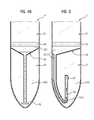
- Fig. 3 shows a further embodiment of a measuring cell (3) according to the invention.
- the measuring cell (3) comprises a first chamber (31) for receiving a platelet-containing liquid sample and a second chamber (32) which receives the liquid sample from the first chamber, provided that a centrifugal force acts on the measuring cell.
- the measuring cell further comprises a porous separating element (33), the the first and second chambers over the entire diameter of the hollow body, separated from each other.
- the separating element (33) contains at least one soluble substance which influences the platelet activity.
- the measuring cell (3) shown here in the second chamber (32) has a means (34) for dividing the volume of the second chamber into a first portion (321) and a second portion (322).
- the means (34) for dividing the volume of the second chamber (32) into a first and a second portion has a first portion (341) having a plane inclined relative to the porous separator.
- the means (34) further comprises a second subsection (342) following the first subsection (341) which extends substantially parallel to a wall (36) delimiting the volume of the second chamber (32) and forms a tubular structure therewith which extends into the distal half of the second chamber (32).
- This embodiment has the advantage that the first portion (321) of the second chamber, the catchment area is reduced to a minimum of the volume of the second chamber (32), so that the largest possible volume of the second chamber (32) for the second portion (322), the measuring range, is available.
- This has the advantage, for example, that a maximum of available area is available for any measuring devices which are arranged on the measuring cell.
- the measuring cell (3) shown here has electrodes (35) of different lengths for filling level detection. The higher the liquid level in the second chamber (32), in particular in the second subregion (322) of the second chamber (32), increases, the more electrodes are in contact with the sample liquid (39).
- Fig. 4 shows a further embodiment of a measuring cell (4) according to the invention.
- the measuring cell (4) comprises a first chamber (41) for receiving a platelet-containing liquid sample and a second chamber (42), which captures the liquid sample from the first chamber, provided that a centrifugal force acts on the measuring cell.
- the measuring cell further comprises a porous separating element (43) which separates the first and second chambers from one another over the entire diameter of the hollow body.
- the separating element (43) contains at least one soluble substance which influences the platelet activity.
- the measuring cell (4) shown here in the second chamber (42) has a means (44) for dividing the volume of the second chamber into a first portion (421) and a second portion (422).
- the means (44) for dividing the volume of the second chamber (42) into a first and a second portion is funnel-shaped here, and the tubular portion of the funnel-shaped means extends into the distal half of the second chamber (42).
- measuring cell (4) has electrodes (45) of different lengths for level detection.
- measuring cell (4) consist of the walls of the measuring cell and at least the tubular portion of the funnel-shaped means (42) made of a translucent material.
- This embodiment of a measuring cell is particularly suitable for measuring the flow rate of the sample liquid (49) in the second chamber of the measuring cell. The flow rate is then measured photometrically in the tubular portion of the funnel-shaped means (44) by means of light sources and light detectors (not shown) arranged along the longitudinal axis of the measuring cell.
- the flow velocity in the tubular portion of the funnel-shaped means (44) are also measured by means of laser Doppler anemometry (LDA).
- LDA laser Doppler anemometry
- Fig. 5 shows a further embodiment of a measuring cell (5) according to the invention.
- the measuring cell (5) comprises a first chamber (51) for receiving a platelet-containing liquid sample and a second chamber (52) which receives the liquid sample from the first chamber, provided that a centrifugal force acts on the measuring cell.
- the measuring cell further comprises a porous separating element (53) which separates the first and second chambers from one another over the entire diameter of the hollow body.
- the separating element (53) contains at least one soluble substance which influences the platelet activity.
- the measuring cell (5) shown here in the second chamber (52) has a means (54) for dividing the volume of the second chamber into a first partial area (521), a second partial area (522) and a third partial area (523).
- the first portion (521), the catch area serves to capture and transfer the sample liquid passing through the separator along the longitudinal axis of the second chamber (52) from the proximal to the distal half.
- the first subregion (521) communicates with the second subregion (522) in the distal half of the second chamber (52) so that the trapped and forwarded sample liquid can pass from the first subregion (521) into the second subregion (522).
- the second portion (522), the measuring range is for measuring the flow rate of the sample liquid collected in the second chamber (52).
- the second portion (522) here has the shape of a capillary rising from the distal half towards the proximal half of the second chamber and having at its end an opening (57) connecting to the third portion (523) ,
- the third subsection (523), the Overflow area serves as an overflow for the sample liquid (59) from the second portion (522).
- This embodiment of a measuring cell is particularly suitable for determining the platelet function by measuring the flow rate of the sample liquid.
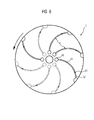
- Fig. 6 shows the top view of a measuring cell rotor according to the invention (7) with a plurality of measuring cells arranged in a circular arc (6), each measuring cell (6) comprising a first chamber (61) for receiving a platelet-containing liquid sample and a second chamber (62) containing the liquid sample from the first Chamber absorbs, if a centrifugal force acts on the measuring cell.
- the measuring cell further comprises a porous separating element (63) which separates the first and second chambers from one another over the entire diameter of the hollow body.
- the separating element (63) contains at least one soluble substance which influences the platelet activity.
- the measuring cells (6) have a curved shape along their longitudinal axis.
- the area of a measuring cell (6) containing the separating element (63) has a smaller diameter than the remaining areas of the measuring cell.
- the arrow indicates the direction of rotation of the measuring cell rotor (7).
- EXAMPLE 1 Determination of platelet activity in a whole blood sample according to the invention
- Measuring cells according to the invention were prepared as follows: conically shaped centrifuge tubes (50 mL transparent plastic falcon tubes, Becton Dickson) were cut at about half height. A disposable filter attachment with a PVDF membrane (Millipore Millex®-SV, 5 ⁇ m pore size) was placed on the opening of a clipped Falcon tube. According to the invention, the PVDF membrane was pretreated with a platelet activator mixture comprising collagen and epinephrine (in each case 0.5 mg / ml). For this purpose, 0.8 ml of the mixture were passed through a Millipore Millex®-SV disposable filter attachment and then air-dried.
- a platelet activator mixture comprising collagen and epinephrine
- the disposable syringe 1.5 mL of a normal citrated blood sample were then introduced, and the measuring cell was in a centrifuge (Rotixa R50, Andreas Hettich GmbH & Co. KG) for 75 seconds at 50 ⁇ g at 22 ° C centrifuged.
Landscapes
- Health & Medical Sciences (AREA)
- Chemical & Material Sciences (AREA)
- Hematology (AREA)
- Life Sciences & Earth Sciences (AREA)
- Engineering & Computer Science (AREA)
- Immunology (AREA)
- Analytical Chemistry (AREA)
- General Health & Medical Sciences (AREA)
- Urology & Nephrology (AREA)
- Biomedical Technology (AREA)
- Molecular Biology (AREA)
- Chemical Kinetics & Catalysis (AREA)
- Cell Biology (AREA)
- Microbiology (AREA)
- Biotechnology (AREA)
- Clinical Laboratory Science (AREA)
- Food Science & Technology (AREA)
- Medicinal Chemistry (AREA)
- Physics & Mathematics (AREA)
- Biochemistry (AREA)
- General Physics & Mathematics (AREA)
- Pathology (AREA)
- Investigating Or Analysing Biological Materials (AREA)
- Apparatus Associated With Microorganisms And Enzymes (AREA)
Priority Applications (6)
| Application Number | Priority Date | Filing Date | Title |
|---|---|---|---|
| EP11158195A EP2500095A1 (de) | 2011-03-15 | 2011-03-15 | Vorrichtungen und Verfahren zur Bestimmung der Plättchenfunktion in einem Zentrifugalanalyzer |
| EP12158003.9A EP2500096B1 (de) | 2011-03-15 | 2012-03-05 | Vorrichtungen und verfahren zur bestimmung der plättchenfunktion in einem zentrifugalanalyzer |
| ES12158003.9T ES2691695T3 (es) | 2011-03-15 | 2012-03-05 | Dispositivos y procedimientos para determinar la función plaquetaria en un analizador centrífugo |
| JP2012057627A JP5860736B2 (ja) | 2011-03-15 | 2012-03-14 | 血小板機能を決定するための装置及び方法 |
| CN201210068133.3A CN102759614B (zh) | 2011-03-15 | 2012-03-15 | 用于在离心分析仪中测定血小板功能的装置和方法 |
| US13/421,468 US9205424B2 (en) | 2011-03-15 | 2012-03-15 | Devices for determining the platelet function in a centrifugal analyzer |
Applications Claiming Priority (1)
| Application Number | Priority Date | Filing Date | Title |
|---|---|---|---|
| EP11158195A EP2500095A1 (de) | 2011-03-15 | 2011-03-15 | Vorrichtungen und Verfahren zur Bestimmung der Plättchenfunktion in einem Zentrifugalanalyzer |
Publications (1)
| Publication Number | Publication Date |
|---|---|
| EP2500095A1 true EP2500095A1 (de) | 2012-09-19 |
Family
ID=44359752
Family Applications (2)
| Application Number | Title | Priority Date | Filing Date |
|---|---|---|---|
| EP11158195A Withdrawn EP2500095A1 (de) | 2011-03-15 | 2011-03-15 | Vorrichtungen und Verfahren zur Bestimmung der Plättchenfunktion in einem Zentrifugalanalyzer |
| EP12158003.9A Active EP2500096B1 (de) | 2011-03-15 | 2012-03-05 | Vorrichtungen und verfahren zur bestimmung der plättchenfunktion in einem zentrifugalanalyzer |
Family Applications After (1)
| Application Number | Title | Priority Date | Filing Date |
|---|---|---|---|
| EP12158003.9A Active EP2500096B1 (de) | 2011-03-15 | 2012-03-05 | Vorrichtungen und verfahren zur bestimmung der plättchenfunktion in einem zentrifugalanalyzer |
Country Status (5)
| Country | Link |
|---|---|
| US (1) | US9205424B2 (enExample) |
| EP (2) | EP2500095A1 (enExample) |
| JP (1) | JP5860736B2 (enExample) |
| CN (1) | CN102759614B (enExample) |
| ES (1) | ES2691695T3 (enExample) |
Cited By (1)
| Publication number | Priority date | Publication date | Assignee | Title |
|---|---|---|---|---|
| CN104359746A (zh) * | 2014-11-19 | 2015-02-18 | 白银市第一人民医院 | 细胞团块收集器及收集体液标本中细胞的方法 |
Families Citing this family (5)
| Publication number | Priority date | Publication date | Assignee | Title |
|---|---|---|---|---|
| US8617468B2 (en) | 2011-10-18 | 2013-12-31 | Chrono-Log Corporation | Platelet aggregation test and device |
| JP6012455B2 (ja) * | 2012-12-21 | 2016-10-25 | シーメンス ヘルスケア ダイアグノスティクス プロダクツ ゲゼルシヤフト ミツト ベシユレンクテル ハフツング | 血小板機能を測定するシステムにおいて測定結果を標準化する方法 |
| KR101497193B1 (ko) * | 2012-12-31 | 2015-03-03 | 고려대학교 산학협력단 | 원심력 미세유동 기반 혈소판 복합기능 및 약물반응 검사 장치 및 방법 |
| CN204182492U (zh) * | 2013-12-05 | 2015-03-04 | 刘玥萌 | 一种离心过滤管 |
| CN110095521B (zh) * | 2019-05-13 | 2022-08-23 | 京东方科技集团股份有限公司 | 离心管、检测系统及检测方法 |
Citations (5)
| Publication number | Priority date | Publication date | Assignee | Title |
|---|---|---|---|---|
| GB2175691A (en) | 1985-04-26 | 1986-12-03 | Brien John Richard O | Bleeding time measurement |
| WO1996000899A1 (en) | 1994-06-30 | 1996-01-11 | Dade International Inc. | Bioactive porous partition members |
| EP0797097A1 (de) * | 1996-03-18 | 1997-09-24 | Stiftung Für Diagnostische Forschung | Partikel-Immunoassay mit kompakter Matrix |
| WO1997034698A1 (en) | 1996-03-22 | 1997-09-25 | Dade International Inc. | Combination reagent holding and test device |
| EP1693109A1 (de) * | 2005-02-21 | 2006-08-23 | Hexal Ag | Behältnis zur Separation von Tumorzellen |
Family Cites Families (13)
| Publication number | Priority date | Publication date | Assignee | Title |
|---|---|---|---|---|
| JPS5256993A (en) * | 1975-10-31 | 1977-05-10 | Jiometsuto Inc | Method of and instrument for measuring solidifying rate |
| JPS5889859U (ja) * | 1981-12-11 | 1983-06-17 | 東亜医用電子株式会社 | 凝固時間測定具 |
| DE3247815C2 (de) * | 1982-12-23 | 1985-10-17 | Gustav Viktor Rudolf Prof. London Born | Einrichtung zur Messung der Blutungszeit in vitro |
| DE3739247C2 (de) * | 1987-11-19 | 1996-11-21 | Dade Int Inc | Blutungszeitmeßeinrichtung |
| US5888826A (en) * | 1994-06-30 | 1999-03-30 | Dade Behring Inc. | Combination reagent holding and test device |
| US20120156278A1 (en) * | 1997-06-24 | 2012-06-21 | Cascade Medical Enterprises, Llc | Systems and methods for preparing autologous fibrin glue |
| US7087177B2 (en) * | 2004-04-16 | 2006-08-08 | Baxter International Inc. | Methods for determining flow rates of biological fluids |
| WO2006086201A2 (en) * | 2005-02-07 | 2006-08-17 | Hanuman Llc | Platelet rich plasma concentrate apparatus and method |
| CN100467075C (zh) * | 2005-08-09 | 2009-03-11 | 郭经纬 | 一种多向离心式连续性血液成分分离设备 |
| US20070102374A1 (en) * | 2005-11-04 | 2007-05-10 | Gambro, Inc. | Blood processing apparatus with controlled cell capture chamber and method background of the invention |
| CN100429517C (zh) * | 2006-09-29 | 2008-10-29 | 暨南大学 | 筛选中药抗血小板聚集作用活性成分的细胞膜固相色谱法模型的建立方法 |
| EP2053387A1 (en) * | 2007-10-22 | 2009-04-29 | Centre National de la Recherche Scientifique | Test device for platelet aggregation detection |
| US8187475B2 (en) * | 2009-03-06 | 2012-05-29 | Biomet Biologics, Llc | Method and apparatus for producing autologous thrombin |
-
2011
- 2011-03-15 EP EP11158195A patent/EP2500095A1/de not_active Withdrawn
-
2012
- 2012-03-05 EP EP12158003.9A patent/EP2500096B1/de active Active
- 2012-03-05 ES ES12158003.9T patent/ES2691695T3/es active Active
- 2012-03-14 JP JP2012057627A patent/JP5860736B2/ja active Active
- 2012-03-15 US US13/421,468 patent/US9205424B2/en active Active
- 2012-03-15 CN CN201210068133.3A patent/CN102759614B/zh active Active
Patent Citations (5)
| Publication number | Priority date | Publication date | Assignee | Title |
|---|---|---|---|---|
| GB2175691A (en) | 1985-04-26 | 1986-12-03 | Brien John Richard O | Bleeding time measurement |
| WO1996000899A1 (en) | 1994-06-30 | 1996-01-11 | Dade International Inc. | Bioactive porous partition members |
| EP0797097A1 (de) * | 1996-03-18 | 1997-09-24 | Stiftung Für Diagnostische Forschung | Partikel-Immunoassay mit kompakter Matrix |
| WO1997034698A1 (en) | 1996-03-22 | 1997-09-25 | Dade International Inc. | Combination reagent holding and test device |
| EP1693109A1 (de) * | 2005-02-21 | 2006-08-23 | Hexal Ag | Behältnis zur Separation von Tumorzellen |
Non-Patent Citations (4)
| Title |
|---|
| KRISCHEK BORIS ET AL: "Role of the retention test Homburg in evaluating platelet hyperactivity and in monitoring therapy with antiplatelet drugs", SEMINARS IN THROMBOSIS AND HEMOSTASIS, STUTTGART, DE, vol. 31, no. 4, 1 August 2005 (2005-08-01), pages 458 - 463, XP008108614, ISSN: 0094-6176 * |
| KRISCHEK, B. ET AL., SEMINARS IN THROMBOSIS AND HEMOSTASIS, vol. 31, no. 4, 2005, pages 449 - 457 |
| KRISCHEK, B. ET AL., SEMINARS IN THROMBOSIS AND HEMOSTASIS, vol. 31, no. 4, 2005, pages 458 - 463 |
| UCHIYAMA, S. ET AL., THROMBOSIS RESEARCH, vol. 31, 1983, pages 99 - 116 |
Cited By (1)
| Publication number | Priority date | Publication date | Assignee | Title |
|---|---|---|---|---|
| CN104359746A (zh) * | 2014-11-19 | 2015-02-18 | 白银市第一人民医院 | 细胞团块收集器及收集体液标本中细胞的方法 |
Also Published As
| Publication number | Publication date |
|---|---|
| ES2691695T3 (es) | 2018-11-28 |
| US9205424B2 (en) | 2015-12-08 |
| EP2500096A1 (de) | 2012-09-19 |
| EP2500096B1 (de) | 2018-07-18 |
| CN102759614B (zh) | 2017-09-26 |
| JP5860736B2 (ja) | 2016-02-16 |
| US20120237960A1 (en) | 2012-09-20 |
| JP2012194181A (ja) | 2012-10-11 |
| CN102759614A (zh) | 2012-10-31 |
Similar Documents
| Publication | Publication Date | Title |
|---|---|---|
| EP1850135B1 (de) | Verfahren zur Bestimmung der Thrombozytenfunktion und der Flussbedingungen | |
| EP2500096B1 (de) | Vorrichtungen und verfahren zur bestimmung der plättchenfunktion in einem zentrifugalanalyzer | |
| EP1850134B1 (de) | Verfahren und Vorrichtung zur Bestimmung der Thrombozytenfunktion und der Flussbedingungen | |
| DE69524063T2 (de) | Trennungsschwimmer für blutsammelröhrchen | |
| DE69523722T2 (de) | Bioaktive poröse trennteile | |
| EP0316599B1 (de) | Durchflussvorrichtung für die Verwendung in einer Blutungszeitmesseinrichtung und Verfahren zur Messung der Blutungszeit | |
| AU766888B2 (en) | Novel method of platelet function analysis using platelet count | |
| EP3052934B1 (de) | Verfahren zum erkennen eines zustands einer probe, vorrichtung zum analysieren von proben und laborautomatisierungssystem | |
| DE69731439T2 (de) | Kombinierte reagenzaufnahme- und testanordnung | |
| EP1547689B1 (de) | Kartusche zur Funktionskontrolle einer Vorrichtung für die Untersuchung der Blutplättchenfunktion, Verfahren zur Funktionskontrolle und Verwendung einer Testflüssigkeit | |
| DE1498577B2 (de) | Vorrichtung zur Abtrennung flüssiger Bestandteile kleiner Blutproben | |
| DE69714568T2 (de) | Bestimmungsverfahren für einen Blutfaktor | |
| DE69919885T2 (de) | Verfahren zur messung der zellulären adhäsion | |
| EP0797097A1 (de) | Partikel-Immunoassay mit kompakter Matrix | |
| EP2634584B1 (de) | Screening-Methode zum Auffinden von Proben mit Antiphospholipid-Antikörpern | |
| EP4384802B1 (de) | Verfahren zur erstellung einer datenbank zur ermittlung eines lichttransmissionsaggregometrie-referenzwerts und verfahren und vorrichtung zur durchführung einer lichttransmissionsaggregometrie-messung | |
| DE10038900A1 (de) | Einfache Methode zum drug monitoring von GPIIb/IIIa-Rezeptor-Antagonisten | |
| EP4056272B1 (de) | Vorrichtung zum niederhalten von jeweiligen membranelementen in jeweiligen vertiefungen einer multi-well-platte | |
| EP2543998B1 (de) | Verfahren zur Standardisierung von Messergebnissen in einem System zur Messung der Thrombozytenfunktion | |
| EP2562542B1 (de) | Dynamischen Bestimmung der Thrombozytenfunktion | |
| AT527882A1 (de) | Testvorrichtung und verfahren zur bestimmung von hämatokrit und/oder fibrinogen in einer blutprobe | |
| DE4035034C1 (en) | Measuring blood clotting and thrombocyte action - by mixing blood sample with clotting retardant and measuring time required start agglutination | |
| EP0421175A1 (de) | Kapillarröhrchen zur Entnahme von Blutproben, Verfahren zu dessen Herstellung sowie eine Vorrichtung zur Messung der Gerinnungszeit | |
| WO2001065260A9 (de) | Chemotaxis-diagnostikum | |
| Nemeh | Introduction fo" RTH-II" as a simple assay for screening PLT function specifically and reliably: validation, standardization and development of the procedures of the retention test of Homburg (RTH) in due of morphological control |
Legal Events
| Date | Code | Title | Description |
|---|---|---|---|
| PUAI | Public reference made under article 153(3) epc to a published international application that has entered the european phase |
Free format text: ORIGINAL CODE: 0009012 |
|
| AK | Designated contracting states |
Kind code of ref document: A1 Designated state(s): AL AT BE BG CH CY CZ DE DK EE ES FI FR GB GR HR HU IE IS IT LI LT LU LV MC MK MT NL NO PL PT RO RS SE SI SK SM TR |
|
| AX | Request for extension of the european patent |
Extension state: BA ME |
|
| STAA | Information on the status of an ep patent application or granted ep patent |
Free format text: STATUS: THE APPLICATION IS DEEMED TO BE WITHDRAWN |
|
| 18D | Application deemed to be withdrawn |
Effective date: 20130320 |