EP2493580B1 - Verfahren zur minimierung der korrosion in einem sprinklersystem mit leerschussschutz - Google Patents
Verfahren zur minimierung der korrosion in einem sprinklersystem mit leerschussschutz Download PDFInfo
- Publication number
- EP2493580B1 EP2493580B1 EP10828853.1A EP10828853A EP2493580B1 EP 2493580 B1 EP2493580 B1 EP 2493580B1 EP 10828853 A EP10828853 A EP 10828853A EP 2493580 B1 EP2493580 B1 EP 2493580B1
- Authority
- EP
- European Patent Office
- Prior art keywords
- gas
- piping network
- nitrogen
- pressure
- oxygen
- Prior art date
- Legal status (The legal status is an assumption and is not a legal conclusion. Google has not performed a legal analysis and makes no representation as to the accuracy of the status listed.)
- Active
Links
Images



Classifications
-
- A—HUMAN NECESSITIES
- A62—LIFE-SAVING; FIRE-FIGHTING
- A62C—FIRE-FIGHTING
- A62C35/00—Permanently-installed equipment
- A62C35/58—Pipe-line systems
- A62C35/64—Pipe-line systems pressurised
- A62C35/645—Pipe-line systems pressurised with compressed gas in pipework
-
- A—HUMAN NECESSITIES
- A62—LIFE-SAVING; FIRE-FIGHTING
- A62C—FIRE-FIGHTING
- A62C35/00—Permanently-installed equipment
- A62C35/58—Pipe-line systems
- A62C35/62—Pipe-line systems dry, i.e. empty of extinguishing material when not in use
-
- A—HUMAN NECESSITIES
- A62—LIFE-SAVING; FIRE-FIGHTING
- A62C—FIRE-FIGHTING
- A62C35/00—Permanently-installed equipment
- A62C35/58—Pipe-line systems
- A62C35/64—Pipe-line systems pressurised
-
- A—HUMAN NECESSITIES
- A62—LIFE-SAVING; FIRE-FIGHTING
- A62C—FIRE-FIGHTING
- A62C35/00—Permanently-installed equipment
- A62C35/58—Pipe-line systems
- A62C35/68—Details, e.g. of pipes or valve systems
-
- Y—GENERAL TAGGING OF NEW TECHNOLOGICAL DEVELOPMENTS; GENERAL TAGGING OF CROSS-SECTIONAL TECHNOLOGIES SPANNING OVER SEVERAL SECTIONS OF THE IPC; TECHNICAL SUBJECTS COVERED BY FORMER USPC CROSS-REFERENCE ART COLLECTIONS [XRACs] AND DIGESTS
- Y10—TECHNICAL SUBJECTS COVERED BY FORMER USPC
- Y10T—TECHNICAL SUBJECTS COVERED BY FORMER US CLASSIFICATION
- Y10T137/00—Fluid handling
- Y10T137/2931—Diverse fluid containing pressure systems
- Y10T137/3003—Fluid separating traps or vents
- Y10T137/3084—Discriminating outlet for gas
- Y10T137/3087—With reverse flow stop or pressure regulating valve
Definitions
- the present technology relates to a method of reducing corrosion in a dry pipe fire sprinkler system.
- a fire protection system also known as a fire suppression or fire sprinkler system, is an active fire protection measure that includes a water supply to provide adequate pressure and water flow to a water distribution piping system, where water is discharged via sprinklers or nozzles.
- Fire protection systems are often an extension of existing water distribution systems, such as a municipal water system, water well, water storage tank, or reservoir. Fire protection systems can be separated into two general types, wet pipe systems that include a piping network prefilled with water, and dry systems that include at least a portion of the piping network filled with air/gas instead of water.
- a typical dry pipe sprinkler system includes a preaction/dry pipe sprinkler network containing a plurality of normally closed sprinkler heads.
- the sprinkler network is connected via a piping system to a dry valve, such as a preaction or dry pipe valve, which has a dry output side facing the piping system and a wet input side facing a pressurized source of water.
- a dry valve such as a preaction or dry pipe valve
- the piping system and sprinkler network are filled or charged with a gas, such as air, which may be pressurized.
- Industrial dry pipe systems generally charge the piping system lines to about 25 to 50 psig.
- the sprinkler heads typically include normally closed temperature-responsive elements.
- the normally closed element of the sprinkler head opens, allowing pressurized gas to escape from the piping system.
- gas pressure in the fluid flow lines drops below a predetermined value or a detector detects the presence of smoke and/or heat, a mechanism causes the dry valve to open.
- Pressurized water then flows into the piping system, displacing the gas, and exits through the open sprinkler head to extinguish the fire or smoke source. Water flows through the system and out the open sprinkler head, and any other sprinkler heads that subsequently open, until the sprinkler head closes itself, if automatically resetting, or until the water supply is turned off.
- Dry pipe sprinkler systems can also suffer from false alarms from ambient temperature-induced expansion and contraction of the pressurized air within the fluid flow lines. For example, the pressurized gas may contract to a degree that triggers opening of the primary water valve.
- Lowe discloses a dry pipe system having a thermal relief valve that opens due to heat thereby allowing air in the dry pipe system to exhaust.
- DE 41 33 410 A1 also discloses a similar vent in figure 2 having a spring which may be adjusted by a threaded bolt on the upper side of the valve.
- Reilly discloses a sprinkler system including an air pump, vents, and a piping network in fluid communication with the air pump.
- the air pump moves dry air through the piping network to absorb residual water within the network. The air is then exhausted through the vents.
- Stephens ( WO 2009/106806 A1 ). discloses a dry pipe sprinkler system including sprinkler heads, a control valve for supplying water to the sprinkler heads, and a piping system connecting the control valve and the sprinkler heads.
- a riser pipe of the piping system contains a predetermined level of water.
- a method for reducing corrosion is performed in a dry pipe fire sprinkler system having a piping network, at least one sprinkler connected with said piping network, a source of pressurized water, and a dry valve coupling the source of pressurized water to the piping network.
- the piping network is pressurized with a source of pressurized nitrogen to a first pressure level.
- the pressure is increased with a source of pressurized nitrogen to a second pressure level that is greater than the first pressure level. Gas is vented from the piping network with the vent assembly when the pressure reaches the second pressure level.
- the steps of increasing pressure and venting may be repeated. These steps may be repeated until the oxygen content within the piping network is less than 10% oxygen or even less than 3% oxygen. These steps may be repeated until the humidity within the piping network is less than 15% humidity or even less than 5% humidity.
- a parameter of the gas within the piping network may be monitored while repeating these steps until the parameter reaches a particular parameter level.
- the parameter may be (i) oxygen/nitrogen ratio and/or (ii) humidity of the gas within the piping network.
- the step of increasing pressure may be carried out by applying a source of nitrogen to the piping network. The nitrogen may be applied to the piping network at a third pressure level that is between the first and second pressure levels and discontinued at the second pressure level. If the dry valve is a dry pipe valve, the first pressure level is sufficient to prevent the dry pipe valve from opening.
- the vent assembly may include a vent and a back pressure regulator.
- the vent has a vent inlet that is connected with the piping network and a vent outlet.
- the back pressure regulator has a regulator inlet and a regulator outlet.
- the regulator inlet is connected directly or indirectly with the vent outlet.
- the step of venting gas includes discharging gas with the back pressure regulator when the pressure reaches the second pressure level.
- the vent may be adapted to vent gas and not liquid from the vent inlet to the vent outlet
- pressurization and depressurization cycles may be repeated so that the pressurized nitrogen, which may be a purging gas effectively displaces substantially all the humidified air/moisture and/or oxygen within the piping network.
- Fig. 1 through Fig. 3 are not according to the invention and are present for illustration purposes only.
- non-standard units are used. They can be converted into internationally recognised standard units by the following factors:
- a controlled discharge gas vent can be used as an automatic vent in a dry pipe or preaction fire sprinkler system, which are collectively referred to as dry fire protection sprinkler systems.
- the vent can provide for the controlled discharge of gas from pressurized fire sprinkler system piping, such as employed in a dry fire protection sprinkler system, which may be a dry pipe or preaction sprinkler systems.
- the controlled discharge gas vent can allow for progressive displacement of pressurized gas initially contained in a fire sprinkler system piping network with another gas.
- pressurized air may be displaced with a drier pressurized gas, i.e., a gas having a lower water vapor content, such as dry nitrogen gas produced from a nitrogen generator, for example, as disclosed by International Application Publication No. WO 2010/030567 A1, Burkhart et al., published Mar. 18, 2010 .
- the controlled discharge gas vent may also be used to provide the controlled discharge of any gas for displacement with another gas while maintaining an acceptable pressure within a system that is being vented.
- aspects of the controlled discharge gas vent can provide for precise release of a quantifiable amount of gas at a known rate of discharge over time within a given pressure range. This is accomplished through the use of one or more vents including particular orifices that may be located at various locations within the fire sprinkler system piping network, for example. These discharge orifices may include particular machined metallic orifices having specific apertures.
- gas is discharged from a pipe or piping network having an internal pressure higher than atmospheric pressure (14.7 psi) to atmospheric pressure at the discharge orifice. The pressure drop may be determined at the discharge orifice. With a known differential pressure and a known orifice diameter, it is possible to establish the amount of gas that will be discharged per unit of time, typically in standard cubic feet per minute.
- the controlled discharge gas vent may be used as part of a fire protection system, such as a dry fire sprinkler system.
- the controlled discharge gas vent can provide for maintaining control of the pressure within the fire sprinkler system piping network while at the same time providing for the controlled discharge of a measured amount of gas that is contained in the fire sprinkler system piping network.
- the vent allows the fire sprinkler system piping system to "breathe,” where for example a gas having lower relative humidity, such as dry nitrogen gas, is admitted to the piping network during a pressuring-up phase and a mixture of gases (e.g., containing the dehumidified air or nitrogen) and a portion the original gas that was contained in the piping system is vented during a pressuring-down phase.
- the pressure within the fire sprinkler system piping network is therefore maintained in a controllable range of pressures throughout the breathing process called the "breathing range.”
- the controlled discharge gas vent and breathing method can be used to reduce corrosion in the fire protection system.
- Oxygen present in air and water vapor present within the fire protection system can be substantially vented from the system and effectively displaced by using the controlled discharge gas vent in conjunction with one or more breathing cycles to purge the system from substantially all or a large portion of the oxygen or to reduce the amount of water vapor contained in the gas within the piping system.
- oxygen and/or water vapor may be displaced with dry nitrogen provided by a nitrogen generator. Removal of oxygen and/or water vapor reduces or eliminates the effects of oxidative corrosion of ferrous and cuprous components of the fire protection system and can further deprive aerobic microbiological organisms the opportunity to grow within the system. Curtailing the growth of aerobic microbiological organisms serves to limit another source of corrosion and can limit solids and debris within the system.
- Oxygen and/or water vapor within the fire protection system may be present in pressurized air used to maintain the dry valve shut until the system is actuated.
- initial pressurization of the dry pipe system can be done using an air compressor to rapidly fill the dry piping network above the trip pressure.
- Testing or actuation of the system also introduces water, including dissolved oxygen, into the piping network, resulting in residual liquid water that pools in low spots of the piping network and/or resulting from condensation of water vapor within the piping network.
- Use of the controlled discharge gas vent and breathing cycle(s) can significantly reduce or eliminate corrosion in the dry pipe system. For example, as oxygen is often the primary corrosive specie within the system, displacement of a large percentage of the oxygen with noncorrosive nitrogen by using the controlled discharge gas vent and breathing cycle can preserve the integrity and hydraulics of the fire protection system.
- An embodiment 10 of the breathing process employing the controlled discharge gas vent is illustrated by the following steps ( Fig. 4 ).
- Step 1 The fire sprinkler system piping network sits empty (12) at atmospheric pressure, i.e., about 14.7 psi, filled with air which contains approximately 78% nitrogen gas and 21% oxygen gas.
- Step 2 The fire sprinkler system piping network is pressurized (14) with compressed air to attain at least a sufficient pressure within the piping system to prevent the dry pipe valve from opening (16), which would allow water from the upstream side of the dry valve to enter the fire sprinkler system piping network.
- the pressure at which the dry valve would actuate and open is called the "trip pressure.”
- the trip pressure for the valve may be about 25 psig. Therefore, as long as the pressure in the fire sprinkler system piping network is maintained above 25 psig, then the dry valve will not actuate and water will not enter the fire sprinkler system piping network.
- Step 3 The fire sprinkler system piping network is pressurized (18) with a source of pressurized nitrogen.
- a source of pressurized nitrogen is used to achieve a pressure of about 40 psig, for example (20). This pressure is the "high limit" pressure of the breathing range. At this pressure, the introduction of additional pressurized nitrogen is stopped.
- a purging gas such as argon, or the like, or dehydrated air or other gas having reduced humidity relative to the compressed air within the piping network may be used.
- Step 4 One or more controlled discharge gas vents within the fire sprinkler system piping network are opened (22) to allow gas to escape from the system. As a result, the pressure drops incrementally from 40 psig. The gas continues to vent from the fire sprinkler system piping network at a rate that is controlled by the vent(s) while preventing the sudden depressurization of the system. This controlled release of gas and the resultant drop in fire sprinkler system piping network pressure continues until the system pressure drops to about 30 psig (24), for example. This pressure is the "low limit" pressure of the breathing range, which is above the trip pressure.
- the nitrogen generator pneumatic pressure switch senses the low limit pressure and opens a control valve in the source of pressurized nitrogen, such as a nitrogen generator, to begin repressurizing the fire sprinkler system piping network with compressed gas having reduced oxygen or reduced humidity relative to the compressed gas within the piping network; e.g., dry nitrogen gas of purity greater than or about 90%.
- the breathing range in the present example is from 30 psig up to 40 psig. All of the breathing takes place at a pressure that exceeds the minimum trip pressure of the dry pipe valve, which is 25 psig in the present example.
- Step 5 Pressurized nitrogen having reduced oxygen or reduced humidity, such as produced from a nitrogen generator, or some acceptable nitrogen gas storage vessel, is pumped into the fire sprinkler system piping network (18) until the pressure in the system reaches the high limit pressure of the breathing range (20). At this point, the nitrogen generator pneumatic pressure switch senses the high limit pressure and closes a control valve in the nitrogen generator to stop pressurizing the fire sprinkler system piping network with the compressed nitrogen gas. This completes one breathing cycle.
- nitrogen generator pneumatic pressure switch senses the high limit pressure and closes a control valve in the nitrogen generator to stop pressurizing the fire sprinkler system piping network with the compressed nitrogen gas. This completes one breathing cycle.
- Step 6 During the pressurizing and depressurizing process (i.e., breathing), one or more of the controlled discharge gas vents may remain open to allow for the continuous discharge of a controlled amount of mixed gases (e.g., air and enriched nitrogen) from the fire sprinkler system piping network.
- a controlled amount of mixed gases e.g., air and enriched nitrogen
- Step 7 With every breathing cycle, the gas composition within the fire sprinkler system piping changes as oxygen and/or water vapor within the piping network is displaced with gas having a lower oxygen content and/or lower relative humidity.
- Purified nitrogen gas (of at least about 90% purity, for example) is added to the fire sprinkler system piping network during the pressurizing phase of the breathing cycle and the mixed gas (residual pressurized air plus the added nitrogen) discharged from the system during the depressurizing phase of the breathing cycle.
- the gas composition within the fire sprinkler system piping network gets closer and closer to the composition of the introduced gas having lower oxygen content and/or relative humidity; e.g., purified nitrogen gas added from the nitrogen generator.
- a parameter of the gas within the piping network such as its ratio of oxygen to nitrogen and/or its relative humidity, can be measured to determine if additional breathing cycles are needed (28). If the gas parameter is not satisfactory, additional breathing steps (18, 20, 22, 24) are performed. If the parameter level is satisfactory (28), the system enters a maintenance phase (30) where gas pressure in the piping network is maintained above the trip pressure using the inert and/or lower humidity purging gas.
- the rate of gas discharge and the changeover in the composition of the gas within the fire sprinkler system piping network from 100% high oxygen air to about 90% nitrogen (or higher), for example, is controlled by the breathing range pressures, the number and location of vents installed on the fire sprinkler system piping network, and the size of the orifices that are installed in the vents. It is possible to accurately determine the number of cycles and the time required to achieve a purity of about 90% nitrogen (or higher) throughout the fire sprinkler system piping network. See the vent breathing rate calculation examples presented in Table 1.
- Table 1 Vent Breathing Rate Calculator Parameter Value Units Operation Sprinkler system capacity (gallons) 800 gallons Sprinkler system capacity (ft3) 106.9 ft 3 Converts gallons to standard cubic foot (SCF) Equivalent SCF @ (psig) 25 288.8 scf Converts volume to volume at high end breathing pressure Equivalent SCF @ (psig) 18 237.9 scf Converts volume to volume at low end breathing pressure Difference (to be vented per cycle) 50.93 scf Amount of gas vented between low end and high end Vent rate from one #10 orifices 2.92 scfh Venting rate of gas from #10 orifice at 20 psig Vent rate from one #8 orifices 1.80 scfh Venting rate of gas from #8 orifice at 20 psig Vent rate from one #5 orifices 0.70 scfh Venting rate of gas from #5 orifice at 20 psig Total venting rate 5.42 scf
- the controlled discharge gas vent may include additional features. For example, in order to control the rate of gas discharge from the pipe through the orifice, it is necessary to prevent plugging of the metal orifice. Pipelines routinely contain debris, corrosion byproduct, mineral scale, and other solid or semi-solid material that might block gas flow through the discharge orifice. Therefore, an in-line filter may be used to protect the orifice from possible blockage by debris.
- a liquid sensing valve may be included that discharges gas, but will close in the presence of a liquid in order to not discharge the liquid.
- a liquid sensing valve can include a levered float valve or an electric liquid sensing control unit. While gas is flowing through the fire sprinkler system piping network, the orifice in the float valve allows for gas to flow freely. In the event of a fire response, water will fill the fire sprinkler system piping network. When water reaches the liquid sensing valve, such as a float valve, an internal float rises on the incoming water to actuate a levered plug which seats on an elastomeric seal at the orifice. This action stops the flow of gas and water from the pipeline through the controlled discharge gas vent.
- Such valve is commercially available, such as from APCO Willamette Corporation.
- an in-line "Y"-strainer may be installed upstream of the float valve to capture any debris, corrosion by-product, mineral scale, or any other solid or semi-solid material that might block the gas or water flow through the float valve orifice.
- the first is an isolation ball valve and the second is a union.
- FIG. 1 An embodiment of the controlled discharge gas vent 100 constructed according to the present disclosure is shown in Fig. 1 .
- the various vent components and their specific functions are illustrated as follows.
- a ball valve 110 provides isolation of the controlled discharge gas vent 100 from the fire sprinkler system piping (not shown), which is pressurized and provides the gas flow 105.
- a coupling union 115 provides easy installation or change out of the vent 100.
- a Y-strainer type filter 120 protects a metallic orifice 145 at the discharge of a levered float valve 125 from plugging with pipe debris.
- the levered float valve 125 or equivalent electric liquid sensing control unit allows gas discharge from the piping system but not liquid discharge; water can be prevented from flowing out of the vent 100 location if the float activates when liquid enters the valve 125 by sealing the discharge orifice.
- a gas sampling port 130 allows for gas analysis using a manual or automatic gas sampling device.
- An in-line filter 135 protects the end-of-line metallic orifice 145 from plugging with debris.
- An adjustable back pressure regulator 140 with a gauge prevents complete depressurization of the fire sprinkler system piping by automatically closing the vent 100 if the system pressure falls below a preset minimum pressure on the regulator 140.
- the preset minimum pressure can be set at a pressure above the trip pressure of the dry pipe valve by setting a minimum closing pressure that is above the trip pressure of the dry pipe valve.
- the end of line metallic orifice 145 provides for the controlled release of gas from the pressurized piping system.
- an end of line muffler 150 may be used to deaden the sound of the gas exhaust 155.
- Discharge rate of gas, e.g., in standard cubic feet per hour (SCFH), from the vent can be controlled using orifices having particular diameters.
- such orifices can employ a one-piece construction of solid metal; e.g., brass or stainless steel.
- Suitable orifices are available from O'Keefe Controls Co., Trumbull, CT. Accurate machining allows predictable discharge rates based on the orifice diameter. Typical sizes range from 0.004" to 0.125" in orifice diameter, which are given a number (#) designation, for example.
- the discharge gas from the controlled discharge gas vent can be coupled to a sensor or analyzer.
- oxygen gas that is contained in the fire sprinkler system piping network is displaced with nitrogen gas from a nitrogen generator.
- water vapor contained in the pressurized piping network is displaced by dry nitrogen from the nitrogen generator. Determining the composition of the gas contained within the fire sprinkler system piping network can provide evidence that the displacement process is progressing. For example, it is not readily feasible to measure the level of nitrogen in gas as the inert nature of the nitrogen gas molecule means it does not readily react with other elements. Accordingly, the level of nitrogen in the pipeline can be derived indirectly by measuring the level of oxygen in the pipeline.
- the oxygen sensor may be used to measure effective displacement of oxygen during the initial setup or installation of the system, following actuation or testing of the system, and/or for monitoring the system while in service.
- one or more oxygen sensors may be connected to the piping network to ascertain whether pressurized nitrogen supplied by the nitrogen generator has effectively displaced oxygen in the system to below a predetermined threshold or to a level where oxygen is no longer detectable.
- the oxygen sensor may also be used in an automated system to trigger the nitrogen generator to purge or flush the system or the system may be manually activated based on a reading provided by the oxygen sensor.
- the oxygen sensor may be coupled to an alarm indicating that oxygen is present or at an undesirable level within the fire protection system.
- the oxygen sensor may also be coupled to a pressure monitor and may trigger the breathing process to sustain pressure above the low limit pressure (e.g., above the trip pressure) by supplying additional nitrogen gas and/or trigger the breathing process to purge any buildup of oxygen while maintaining the pressurized system between the low limit pressure and the high limit pressure.
- a pressure monitor may trigger the breathing process to sustain pressure above the low limit pressure (e.g., above the trip pressure) by supplying additional nitrogen gas and/or trigger the breathing process to purge any buildup of oxygen while maintaining the pressurized system between the low limit pressure and the high limit pressure.
- the volume of the gas being discharged from the fire sprinkler system piping network from one of the controlled discharge gas air vents can be split into a "high flow” stream and a "low flow” stream, where the "low flow” stream can be used to take the oxygen measurement.
- the "low flow” stream may provide a continuous flow for the oxygen measurement.
- a mechanical valve such as an electric solenoid valve can be placed on the "high flow” stream and any other vents on the system.
- a signal can be sent to the electric solenoid valve(s) to close off the "high flow” stream and any other vents on the system. This can allow for lower energy consumption and lower maintenance costs to support the lower oxygen levels within the system.
- Oxygen analyzers are commercially available that can accurately determine the weight percent of oxygen in a gas sample.
- Oxygen analyzers are available as hand held manual analyzers that capture samples at a point in time or as continuous analyzers that continuously monitor the discharge gas composition.
- Oxygen analyzers typically require a flowing stream of the gas that is being sampled in order to measure the level of oxygen in that gas.
- Suitable oxygen sensors include those provided by: GE Sensing - Panametrics (Billerica, MA), built in oxygen analyzers; Maxtec (Salt Lake City, Utah), handheld oxygen analyzers; and AMI (Huntington Beach, CA), built in oxygen analyzers.
- the water vapor contained in the pressurized piping network can be determined by detecting the humidity in the gas being vented from the vents. This allows for the continuous analyzing of the discharge gas when dehumidified air is being used to control corrosion within the piping system, for example.
- Humidity sensors include resistive, capacitive, and thermal conductivity sensing technologies. Suitable humidity sensors include those provided by: America Humirel, Inc. (Dearborn Heights, MI), Honeywell Sensing and Control (Golden Valley, MN), and Sensirion Inc. (Westlake Village, CA).
- the volume of gas that is being discharged from the fire sprinkler system piping network during the breathing process is controlled by one or more controlled discharge gas vents.
- the vent provides controlled discharge of a metered amount of gas from the fire sprinkler system piping network.
- Any sample stream of the fire sprinkler system piping network gas for analysis can be considered as part of the overall gas discharge equation, with respect to the breathing cycle and the calculations illustrated in Table 1, for example.
- All or a portion of the discharge gas stream being exhausted from the vent can be used to provide a sample stream for the continuous gas analyzer.
- the oxygen sensor and/or humidity sensor can be coupled to a backpressure regulator that always allows a "low flow" stream to pass so that the sensor is provided with a continuous gas stream for measurement.
- the senor may be coupled to the vent upstream of the backpressure regulator using tubing and/or an orifice that provides a continuous "low flow” stream of gas to the sensor, while the backpressure regulator passes a "high flow” of gas when pressure is above a set threshold.
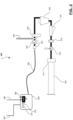
- Fig. 2 Shown in Fig. 2 is a portion of a fire protection system 200 that includes a controlled discharge gas vent and an oxygen sensor with an alarm.
- the fire protection system pipe 205 located for example at the end of a main line or branch line, has a reducer/coupler 210 to join the system piping to a line running to an isolation valve 215; e.g., a ball valve.
- a coupling union 220 is used to join the line from the isolation valve 215 to a Y-strainer 225 positioned ahead of a levered float valve 230.
- Running from the levered float valve 230 is an in-line filter 235 that is then coupled to an adjustable backpressure regulator 240.
- Piping or high pressure tubing 250 runs from the metallic orifice 242 to an oxygen sensor 255. At least a portion of discharged gas from the regulator 240 is directed through the tubing 250. In some cases, a portion of gas is continuously vented from the regulator 240 through the tubing 250 to the oxygen sensor 255.
- the oxygen sensor 255 is connected to a power supply 260, e.g., 24V DC or 110V, and includes an output signal line 265 running to an alarm (not shown).
- the sensor 255 can be affixed to a wall, for example, and provides visual indicators, such as a power "on" lamp 270, alarm lamp 275, and a digital output 280 for O 2 level.
- the humidity of pressurized gas within the dry pipe pressurized piping network may be measured using a humidity sensor; e.g., electronic hygrometer.
- a humidity sensor e.g., electronic hygrometer.
- the system may manually or automatically perform one or more breathing cycles, if necessary, to reduce the humidity of the pressurized gas below a predetermined threshold or below detectable limits.
- Nitrogen may be used in breathing cycles with the dry pipe system and controlled discharge gas vent.
- Nitrogen is preferable as it can be used to simultaneously displace oxygen and dry the piping network by removing water. Nitrogen can also be provided using a nitrogen generator to enrich nitrogen from air. However, other gases, such as dehumidified air, may be used to dry the piping network. Or, in some cases, the breathing cycle may be run using just compressed air where the ambient air has a relatively low humidity and is capable of drying the piping network.
- the breathing cycles may initially use compressed air to substantially dry the piping network following hydrostatic testing, for example, and then the breathing cycles may shift to using pressurized nitrogen to displace oxygen and/or any residual water vapor.
- any of a variety of dry gases like dehydrated air or argon, may be used as the purging gas.
- nitrogen in the breathing cycles to fill the piping void space, pressurize the piping, and to mitigate the corrosion of the ferrous and cuprous metal components.
- Nitrogen for example provided by a nitrogen generator, is used to pressurize the system, purge the initial quantities of oxygen and other gases trapped in the piping through one or more vents in the fire sprinkler system in order to dry the system, and to allow the quantity of nitrogen in the piping to increase and ultimately approach about 90% or greater following a number of breathing cycles.
- the dew point of 95% nitrogen is approximately -71°F; accordingly, the nitrogen will absorb moisture in the piping left from hydrostatic or other types of system testing or from condensation of saturated compressed air that had previously filled the pipe.
- the breathing process allows the nitrogen/air mixture to absorb water and carry it out of the system through the vent point(s), leaving the system in a significantly dryer state, while simultaneously displacing oxygen.
- the fire protection system and controlled discharge gas vent can utilize a nitrogen generator to introduce nitrogen into the system to displace any oxygen via the described breathing cycle(s).
- the nitrogen generator can provide nitrogen on-demand to fill and/or purge a system as desired, automatically based on a sensor, such as an oxygen sensor, on a periodic basis, or on a continuous basis.
- Nitrogen generators and features relating to nitrogen generators include those as described in International Application Publication No. WO 2010/030567 A1, Burkhart et al., published Mar. 18, 2010 .
- the nitrogen generator is used to purge or recharge the pressurized piping network with nitrogen.
- pressurized nitrogen within the piping network holds the dry pipe valve in the closed position to prevent entry of the pressurized water into the piping network. Any leaks in the sprinkler system may cause a loss of pressure.
- the nitrogen generator may therefore be used to recharge the pressurized piping network as needed and may be configured to do so automatically.
- the fire protection system may include a pressure gauge to measure the nitrogen pressure against the dry pipe valve.
- the nitrogen generator may automatically provide pressurized nitrogen when the pressure gauge drops below a predetermined threshold. In this way, the nitrogen generator can automatically maintain the pressure above the low limit, which is above the trip pressure of the dry pipe valve, by supplying additional pressurized nitrogen as needed.
- the fire protection system and controlled discharge vent may also be configured to continuously supply pressurized nitrogen into the piping network using the nitrogen generator, where the breathing cycles allow the pressure to slowly ramp between the low and high limits.
- the nitrogen generator provides a steady stream of pressurized nitrogen into the piping network to keep the dry valve closed.
- the controlled discharge gas vent opens. Pressurized nitrogen is vented while maintaining enough pressure within the system to prevent the dry pipe valve from opening. In the event the fire protection system is actuated, due to a fire or for testing, the pressure within the piping network is lost faster than the nitrogen generator can replace it, even when continuously applying pressurized nitrogen, thereby allowing the dry valve to open and pressurized water to enter the piping network.
- Continuous venting of the fire protection system using one or more controlled discharge gas vents facilitates removal of oxygen within the system while maintaining the required system pressure (of nitrogen) for the fire sprinkler system.
- 90%+ nitrogen gas dew point of -70°F
- 90%+ nitrogen gas may also be used to dehydrate the system by pulling any water within the system into the dry nitrogen and venting the gas, thereby eliminating residual water, one of the key components in the corrosion reaction.
- fire protection systems can be sterilized to control bacteria using chemical treatments and/or heated gases or liquids. Solids may be eliminated by cleaning and flushing the system. Corrosion can also be reduced in fire protection systems through the application appropriate corrosion inhibiting chemicals that are applied to the water that enters the fire protection system piping.
- the fire protection system and controlled discharge gas vent provide several benefits and advantages. For example, breathing cycles employing displacement of oxygen with nitrogen reduce or eliminate the primary corrosive specie within the aqueous environment that exists in a fire sprinkler system. Nitrogen can be applied whenever the system is tested or recharged or following actuation in the event of a fire. For example, each time the fire protection system is breached for annual testing or system modification, nitrogen is added to displace oxygen to prevent corrosion.
- Nitrogen is preferred for use in the breathing cycle as it has many beneficial characteristics for use within a fire protection system. It is inert and will not participate, augment, support, or reinforce corrosion reactions. It can be used as a stripping gas to remove oxygen from the water and/or from the void space above the water with adequate venting. If venting is continued, the concentration of oxygen in the water and in the void space can be reduced to near zero. Nitrogen is non-toxic, odorless, colorless, and very "green,” as it is not a greenhouse gas and may be generated on site and on-demand from air using a nitrogen generator.
- any water treated with nitrogen that must be discharged into the municipal sewer system is non-toxic and will contain little or no iron oxide resulting from corrosion of the piping.
- the present systems and methods using nitrogen also reduce or eliminate oxidation and degradation of elastomeric seats found in valves and other components of the fire protection system.
- Nitrogen displacement of oxygen can also serve to inhibit growth of aerobic microbiological organisms within the fire protection system and may even result in death of these organisms. Aerobic forms of microbial contaminants generally pose the greatest risk of creating slimes in fresh water systems. These slimes pose serious risks to fire sprinkler systems because they can impact the hydraulic design of the fire sprinkler system if they form in sufficient quantities as sessile (attached) populations. These slimes can also slough off of the pipe walls and lodge in sprinklers and valves. The present systems and methods substantially reduce or even eliminate growth of these aerobic microbiological organisms and prevent subsequent slime formations.
- Nitrogen generators are a cost-effective means for continuous administration of nitrogen to the fire protection system. They obviate the need for gas cylinder inventory, changing out of gas cylinders, and risks associated with handling gas cylinders. Nitrogen generators only require a compressed air supply to separate atmospheric nitrogen from oxygen.
- One or more controlled discharge gas vents with oxygen sensors are positioned in the piping network.
- the vents are positioned at or near the end of a length of pipe in the piping network. In this way, when the piping network is filled with pressurized nitrogen for service or when the piping network is purged with nitrogen for drying after testing or actuation, the vent and sensor are used to ensure that all or an appropriate level of oxygen is displaced as the nitrogen stream is allowed to exit a terminal vent within the piping network.
- a dry fire protection system operable to perform one or more breathing cycle 10 is shown 300.
- a city main 301 provides pressurized water to the underground fire main 303 and to a fire hydrant 305.
- a key valve 307 is used to control flow of water into the underground fire main 303 and a post indicator valve 309 indicates water flow is available to the system.
- the system also includes a test drain 311, a ball drip 313, and a fire department connection 315.
- a check valve 317 positioned near the fire department connection 315 prevents backflow from the system back into the fire department connection.
- a water motor alarm drain 319 runs from the water motor alarm 327 and a test drain valve 321 controls flow to the test drain 311.
- a dry valve 323 controls pressurized water flow from the underground fire main 303 to the cross main 329 and the piping network in response to pressurized nitrogen within the piping network.
- a nitrogen generator 325 is connected past the dry pipe valve 323 on the cross main 329 and piping network side and uses a check valve 326 to prevent backflow into the nitrogen generator 325.
- a pressure maintenance device 331 is used to measure nitrogen pressure in the piping network.
- An alarm test valve 333 and drain cup 335 can be used for testing.
- Another check valve 337 is positioned to prevent backflow from the system into the underground fire main 303.
- a drum drip 339 and drain valve and plug 341 are positioned in the piping network.
- One or more upright sprinklers 343 and pendent sprinklers 345 are positioned and spaced within the piping network to provide fire protection coverage.
- An inspector's test valve 347 and an inspector's test drain 349 are positioned at a terminal portion of the piping network to allow testing and purging of the system.
- One or more controlled discharge gas vents 351 are positioned close to ends of piping network lines, for example, near the inspector's test valve 347 and inspector's test drain 349, adjacent to system vents and at other terminal portions of the piping network.
- the controlled discharge gas vents 351 are coupled to a sensor 352, such as an oxygen sensor and/or humidity sensor, which is used to measure exhaust gas from within the system to ensure all oxygen and/or water vapor or an acceptable level of oxygen and/or water vapor is purged from the system.
- a sensor 352 such as an oxygen sensor and/or humidity sensor, which is used to measure exhaust gas from within the system to ensure all oxygen and/or water vapor or an acceptable level of oxygen and/or water vapor is purged from the system.
Landscapes
- Health & Medical Sciences (AREA)
- Public Health (AREA)
- Business, Economics & Management (AREA)
- Emergency Management (AREA)
- Fire-Extinguishing By Fire Departments, And Fire-Extinguishing Equipment And Control Thereof (AREA)
Claims (5)
- Verfahren zum Verringern der Korrosion in einem Trockenrohr-Feuersprinklersystem (300), wobei das Trockenrohr-Feuersprinklersystem (300) ein Rohrleitungsnetz, wenigstens einen Sprinkler (343, 345), der an das Rohrleitungsnetz angeschlossen ist, eine Quelle für unter Druck stehendes Wasser (301) und ein Trockenrohrventil (323), das die Quelle für das unter Druck stehende Wasser (301) mit dem Rohrleitungsnetz koppelt, aufweist, wobei das Verfahren- ein Druckbeaufschlagen des Rohrleitungsnetzes auf ein erstes Druckniveau mit unter Druck stehendem Stickstoff von einem Stickstoffgenerator (325) oder einem Stickstoffgas-Speicherbehälter, wobei das erste Druckniveau höher als ein Auslösedruck oder ein Überwachungsdruck des Trockenrohrventils (323) ist;- ein Erhöhen des Drucks mit dem unter Druck stehenden Stickstoff auf ein zweites Druckniveau, wobei das zweite Druckniveau höher als das erste Druckniveau ist; und- ein Ablassen von Gas aus dem Rohrleitungsnetz mit einem Gasabzug (351), wenn der Druck das zweite Druckniveau erreicht, wobei Sauerstoff in dem Rohrleitungsnetz wenigstens teilweise durch Stickstoff ersetzt wird, umfasst; undwobei der Gasabzug (351) ein Schwimmerventil oder eine elektrische Flüssigkeitssensor-Steuereinheit aufweist, das bzw. die eine Gasabgabe, aber keine Flüssigkeitsabgabe aus dem Gasabzug (351) gestattet.
- Verfahren nach Anspruch 1, ferner umfassend ein Wiederholen des Erhöhens und des Ablassens.
- Verfahren nach Anspruch 2, wobei das Wiederholen ein Wiederholen des Erhöhens und des Ablassens, bis der Sauerstoffgehalt in dem Rohrleitungsnetz geringer als 10 % Sauerstoff und/oder die Feuchtigkeit in dem Rohrleitungsnetz geringer als eine Feuchtigkeit von 15 % ist, umfasst.
- Verfahren nach Anspruch 2, wobei das Wiederholen ein Wiederholen des Erhöhens und des Ablassens, bis der Sauerstoffgehalt in dem Rohrleitungsnetz geringer als 3 % Sauerstoff und/oder die Feuchtigkeit in dem Rohrleitungsnetz geringer als eine Feuchtigkeit von 5 % ist, umfasst.
- Verfahren nach Anspruch 2, wobei das Wiederholen ein Überwachen des abgelassenen Gases während des Wiederholens des Erhöhens und des Ablassens, bis der Sauerstoff und/oder die Feuchtigkeit in dem Rohrleitungsnetz eine bestimmte Parameterebene erreicht, umfasst.
Applications Claiming Priority (2)
| Application Number | Priority Date | Filing Date | Title |
|---|---|---|---|
| US12/606,287 US8720591B2 (en) | 2009-10-27 | 2009-10-27 | Controlled discharge gas vent |
| PCT/US2010/054108 WO2011056580A2 (en) | 2009-10-27 | 2010-10-26 | Controlled discharge gas vent and method of reducing corrosion in a dry fire protection sprinkler system |
Publications (3)
| Publication Number | Publication Date |
|---|---|
| EP2493580A2 EP2493580A2 (de) | 2012-09-05 |
| EP2493580A4 EP2493580A4 (de) | 2017-01-11 |
| EP2493580B1 true EP2493580B1 (de) | 2024-11-27 |
Family
ID=43897419
Family Applications (1)
| Application Number | Title | Priority Date | Filing Date |
|---|---|---|---|
| EP10828853.1A Active EP2493580B1 (de) | 2009-10-27 | 2010-10-26 | Verfahren zur minimierung der korrosion in einem sprinklersystem mit leerschussschutz |
Country Status (9)
| Country | Link |
|---|---|
| US (3) | US8720591B2 (de) |
| EP (1) | EP2493580B1 (de) |
| AU (1) | AU2010315537B9 (de) |
| CA (2) | CA3022228C (de) |
| DK (1) | DK2493580T3 (de) |
| ES (1) | ES3010293T3 (de) |
| FI (1) | FI2493580T3 (de) |
| PL (1) | PL2493580T3 (de) |
| WO (1) | WO2011056580A2 (de) |
Families Citing this family (51)
| Publication number | Priority date | Publication date | Assignee | Title |
|---|---|---|---|---|
| AU2011224120B2 (en) * | 2007-01-31 | 2015-07-30 | Lorenz Turko | Fire sprinkler systems, hydrant systems, hydronic systems and the like |
| US12161900B2 (en) | 2008-09-15 | 2024-12-10 | Engineered Corrosion Solutions, Llc | Adjustable inert gas generation assembly for water-based fire protection systems |
| US9144700B2 (en) * | 2008-09-15 | 2015-09-29 | Engineered Corrosion Solutions, Llc | Fire protection systems having reduced corrosion |
| US9526933B2 (en) | 2008-09-15 | 2016-12-27 | Engineered Corrosion Solutions, Llc | High nitrogen and other inert gas anti-corrosion protection in wet pipe fire protection system |
| US9700746B2 (en) * | 2009-04-16 | 2017-07-11 | South-Tek Systems, LLC | Gas purging valve for fire protection system |
| US8720591B2 (en) | 2009-10-27 | 2014-05-13 | Engineered Corrosion Solutions, Llc | Controlled discharge gas vent |
| CA2811573A1 (en) | 2010-09-16 | 2012-03-22 | Fire Protection Systems Corrosion Management, Inc. | Packaged inerting system for fire protection sprinkler system and method of inerting a fire protection sprinkler system |
| US10426983B2 (en) | 2010-12-23 | 2019-10-01 | Michael L. Hennegan | Fire sprinkler system having combined detection and distribution piping |
| EP2763753B1 (de) * | 2011-10-07 | 2018-12-26 | Engineered Corrosion Solutions, LLC | Inertisierungsgasentlüftungsanordnung, inertisierungssystem mit der gasentlüftungsanordnung und verfahren zur inertisierung eines brandschutzsprinklersystems |
| CN104619381A (zh) * | 2012-05-31 | 2015-05-13 | 工程腐蚀解决方案有限责任公司 | 用于防火喷洒系统的电气操作的气体排放装置及相关方法 |
| AR095323A1 (es) * | 2013-03-14 | 2015-10-07 | Fisher Controls Int Llc | Pronóstico de válvula para componentes poliméricos en función de técnicas de envejecimiento acelerado |
| US9389198B2 (en) * | 2013-04-18 | 2016-07-12 | Ford Global Technologies, Llc | Humidity sensor and engine system |
| US20170100617A1 (en) * | 2014-03-07 | 2017-04-13 | Engineered Corrosion Solutions, Llc | Devices, methods and systems for monitoring water-based fire sprinkler systems |
| US10599164B2 (en) * | 2014-06-12 | 2020-03-24 | Halliburton Energy Services, Inc. | Determination of substance presence, identity and/or level in vessels |
| DE102014211900B4 (de) | 2014-06-20 | 2018-07-19 | Minimax Gmbh & Co. Kg | Entfeuchtungsvorrichtung zum Entfeuchten von Luft innerhalb einer Sprinkleranlage |
| US9393452B2 (en) * | 2014-07-29 | 2016-07-19 | Dan Swift | Anechoic chamber fire suppression system |
| US9884212B2 (en) * | 2014-07-29 | 2018-02-06 | Dan Swift | Anechoic chamber fire suppression system |
| US10317264B1 (en) * | 2014-08-04 | 2019-06-11 | Tyco Fire Products Lp | Automatic trip test simulator |
| US20160206907A1 (en) * | 2015-01-15 | 2016-07-21 | Huguenot Laboratories, Inc. | Corrosion Inhibitor System and Methods for Dry Fire Sprinklers |
| EP3271029A4 (de) * | 2015-03-18 | 2018-11-07 | Engineered Corrosion Solutions, LLC | Redundante belüftungsöffnungen mit einheitlichen ventilkörpern für wasserbasierte feuersprinklersysteme |
| WO2017053396A1 (en) * | 2015-09-21 | 2017-03-30 | AMI Investments, LLC | Remote monitoring of water distribution system |
| US11988656B2 (en) | 2015-09-21 | 2024-05-21 | Mcwane, Inc. | Remote monitoring of water distribution system |
| CA3027323C (en) * | 2016-06-13 | 2022-09-06 | Koatsu Co., Ltd. | Fire extinguisher |
| CN106076026B (zh) * | 2016-08-26 | 2017-12-15 | 赛洛克流体设备成都有限公司 | 一种带检测装置可切换泄放口的排放装置 |
| US10758755B1 (en) | 2016-12-01 | 2020-09-01 | United Services Automobile Association (Usaa) | Systems and methods for electric outlet fire detection and prevention |
| DE102016124475A1 (de) * | 2016-12-15 | 2018-06-21 | Minimax Gmbh & Co. Kg | Feuerlöschanlagenventil, insbesondere Nassalarm-, Trockenalarm- oder Sprühwasserventil, und Feuerlöschanlage mit selbigem |
| US10391344B2 (en) | 2017-02-08 | 2019-08-27 | Agf Manufacturing Inc. | Purge and vent valve assembly |
| US10881887B2 (en) | 2017-09-14 | 2021-01-05 | Agf Manufacturing, Inc. | Valve system and method for venting and measuring a gas content of a fire suppression system |
| CA3075888A1 (en) * | 2017-09-22 | 2019-03-28 | Engineered Corrosion Solutions, Llc | Controllable air maintenance devices for fire protection systems |
| WO2019111032A1 (en) * | 2017-12-04 | 2019-06-13 | Swiss Fire Protection Research & Development Ag | Installed fire extinguishing apparatus, especially for the fire protection of use locations comprising endangered structures separated from each other by spaces |
| KR102057664B1 (ko) * | 2017-12-28 | 2020-01-22 | 승진산업 (주) | 스프링클러용 다목적 커넥터 |
| WO2019143888A1 (en) * | 2018-01-18 | 2019-07-25 | Engineered Corrosion Solutions, Llc | Systems and methods for determining a volume of a pipe network |
| WO2019143892A1 (en) * | 2018-01-19 | 2019-07-25 | Engineered Corrosion Solutions, Llc | Automated adjustable valves for water-based fire sprinkler systems |
| EP3566752B1 (de) * | 2018-05-07 | 2020-07-01 | Faro S.r.l. | Vorrichtung zur messung der feuchtigkeit in druckbeaufschlagten feuerlöschgeräten |
| WO2020056091A2 (en) * | 2018-09-14 | 2020-03-19 | Minimax Viking Research & Development Gmbh | Non-frangible thermally responsive fluid control assemblies for automatic corrosion resistant sprinklers |
| EP3886999A1 (de) * | 2018-11-30 | 2021-10-06 | Carrier Corporation | Fernüberwachung eines feuerunterdrückungssystems |
| CN109541899B (zh) * | 2018-12-21 | 2021-08-17 | 东莞市多普光电设备有限公司 | 一种基板预定位曝光方法及预定位机构 |
| WO2020168007A1 (en) * | 2019-02-12 | 2020-08-20 | Engineered Corrosion Solutions, Llc | Methods and systems for management of corrosion in building pipe circulation systems |
| EP3972701A4 (de) * | 2019-05-20 | 2023-09-13 | Tyco Fire Products LP | Trockenrohrbeschleunigersysteme und verfahren |
| US12286788B2 (en) | 2019-12-03 | 2025-04-29 | Wall to Wall, LLC | Modular pre-wired dwelling panel design |
| US12286789B2 (en) * | 2019-12-03 | 2025-04-29 | Wall to Wall, LLC | Prefabricated above-door cavity conduit routing |
| US12312810B2 (en) * | 2019-12-03 | 2025-05-27 | Wall to Wall, LLC | Prefabricated multi-conduit building panel design |
| US11795689B2 (en) * | 2019-12-03 | 2023-10-24 | Veev Group, Inc. | Multi-head prefabricated wall panel fire sprinkler |
| DK180767B1 (en) * | 2019-12-20 | 2022-03-01 | Dansk Brand Og Sikringsteknisk Inst | Dry-riser, dry riser system, and engineering structure comprising the dry-riser |
| US12054924B2 (en) | 2020-05-28 | 2024-08-06 | Zurn Water, Llc | Smart and connected backflow preventer assembly |
| KR102933401B1 (ko) | 2020-09-24 | 2026-03-03 | 알텍트, 인크. | 화학 에너지 저장소에서의 폭발 환경 중화 |
| US11371643B2 (en) | 2020-10-13 | 2022-06-28 | General Air Products, Inc. | Corrosion risk reduction apparatus, corrosion risk reduction detection device and corrosion risk reduction systems and methods |
| CN115624705B (zh) * | 2022-01-27 | 2023-10-27 | 朝阳市加华电子有限公司 | 一种60l高压细水雾施放系统成套设备 |
| US20230330465A1 (en) * | 2022-04-13 | 2023-10-19 | Potter Electric Signal Company, Llc | Systems and methods for automatic remote testing of a fire system pressure switch |
| CN115094975B (zh) * | 2022-07-04 | 2025-04-01 | 中国人民解放军31666部队 | 一种利用高压气体干扰的高寒区井水防冻装置 |
| US12602066B1 (en) * | 2025-10-17 | 2026-04-14 | Patrick Emmit Enright Senior | Non-permissive fire connection system |
Citations (1)
| Publication number | Priority date | Publication date | Assignee | Title |
|---|---|---|---|---|
| DE4133410A1 (de) * | 1991-10-09 | 1993-04-15 | Total Feuerschutz Gmbh | Feuerschutzanlage |
Family Cites Families (68)
| Publication number | Priority date | Publication date | Assignee | Title |
|---|---|---|---|---|
| US1459594A (en) | 1923-02-19 | 1923-06-19 | Emmett D Mcwhorter | Separator |
| US2187906A (en) * | 1936-06-12 | 1940-01-23 | Airelease Corp | Thermal relief valve |
| US2627868A (en) | 1950-09-07 | 1953-02-10 | Clarence H Runnels | Hydraulic vent valve |
| GB1081293A (en) | 1963-11-26 | 1967-08-31 | Kenneth George Crack | Wet and dry pipe sprinkler systems |
| US3905424A (en) * | 1971-11-26 | 1975-09-16 | Albert A Elwood | Cryogenic control valve |
| US3969092A (en) | 1974-01-10 | 1976-07-13 | Seaton-Wilson, Incorporated | Liquid degassing device |
| US4104004A (en) | 1976-11-12 | 1978-08-01 | The De Laval Separator Company | Air eliminator for pumps |
| US4197097A (en) | 1977-12-02 | 1980-04-08 | Seaton-Wilson Inc. | Apparatus for venting gas from afluid system |
| US4849739A (en) | 1984-07-30 | 1989-07-18 | Ala Inc., A New Jersey Corporation | Liquid detector for air pressure type fire sprinkler system |
| US4991655A (en) * | 1988-11-10 | 1991-02-12 | Back-Flo Alarm Valve Co., Inc. | Combined alarm and back-flow prevention arrangement for fire suppression sprinkler system |
| DE3938394A1 (de) | 1989-11-18 | 1991-05-23 | Preussag Ag Minimax | Feuerloeschanlage |
| US5133577A (en) | 1990-07-13 | 1992-07-28 | Vereinigte Aluminium-Werke Aktiengesellschaft | Refractory pipeline with gas-tight joint |
| CA2036881C (en) * | 1991-02-22 | 1994-06-28 | Jean-Pierre Asselin | Fire emergency, sprinkling control system and method thereof |
| FI96176C (sv) | 1993-07-16 | 1996-05-27 | Goeran Sundholm | Förfarande och anläggning för eldsläckning |
| FI98494C (sv) | 1994-04-14 | 1997-07-10 | Goeran Sundholm | Anordning för eldsläckning |
| US5438841A (en) | 1994-06-15 | 1995-08-08 | Carrier Corporation | Pre-trip system for a controlled atmosphere system for a refrigerated container |
| US6343615B1 (en) * | 1995-01-23 | 2002-02-05 | Hale Products, Inc. | Butterfly valve |
| US5611218A (en) * | 1995-12-18 | 1997-03-18 | The Boc Group, Inc. | Nitrogen generation method and apparatus |
| US5803180A (en) | 1996-03-04 | 1998-09-08 | Talley; Roger K. | Corrosion and sludge prevention in automatic sprinkler-fire protection systems |
| JP3928201B2 (ja) | 1997-02-28 | 2007-06-13 | 能美防災株式会社 | 消火設備 |
| US6076278A (en) * | 1997-12-18 | 2000-06-20 | Halliburton Energy Services, Inc. | Methods of drying pipelines |
| US6102066A (en) | 1998-04-28 | 2000-08-15 | Craig; Robert A. | Condensate drain for an automatic sprinkler system of the dry-pipe type |
| US6024116A (en) * | 1998-09-09 | 2000-02-15 | Aquagard, Llc | Valve assembly and acuator operative for automatically shutting off water and gas supplies to a hot water heater upon detection of a water leak |
| US6390203B1 (en) | 1999-01-11 | 2002-05-21 | Yulian Y. Borisov | Fire suppression apparatus and method |
| US6221263B1 (en) * | 1999-01-17 | 2001-04-24 | Daniel H. Pope | Treatment system for fire protection sprinkler system |
| JP3264939B2 (ja) | 1999-04-09 | 2002-03-11 | 玄五 松岡 | 湿式スプリンクラーシステム |
| DE19936454C5 (de) | 1999-08-03 | 2011-06-22 | TOTAL WALTHER GmbH, Feuerschutz und Sicherheit, 51069 | Sprinkleranlage eines Tiefkühlhauses |
| US6960321B1 (en) * | 1999-10-01 | 2005-11-01 | Ludwig Jerome H | Sterilization of fire sprinkler systems |
| US6666277B2 (en) | 2000-03-27 | 2003-12-23 | Victaulic Company Of America | Low pressure pneumatic and gate actuator |
| US6293348B1 (en) | 2000-03-27 | 2001-09-25 | Victaulic Fire Safety Company, L.L.C. | Low pressure actuator for dry sprinkler system |
| AU2001251533A1 (en) * | 2000-04-11 | 2001-10-23 | James L Wood | Automatic condensate drain device |
| US6557645B1 (en) | 2000-06-13 | 2003-05-06 | Grinnell Corporation | Dry pipe valve for fire protection sprinkler system |
| US6517617B1 (en) * | 2000-09-20 | 2003-02-11 | Whi Usa, Inc. | Method and apparatus to clean and apply foamed corrosion inhibitor to ferrous surfaces |
| DE10051662B4 (de) * | 2000-10-18 | 2004-04-01 | Airbus Deutschland Gmbh | Verfahren zur Löschung eines innerhalb eines geschlossenen Raumes ausgebrochenen Feuers |
| US6581694B2 (en) | 2000-12-29 | 2003-06-24 | Waukesha Electrical Systems, Inc. | Method and system for controlling the supply of nitrogen to electrical power handling equipment |
| US6443173B1 (en) | 2001-03-05 | 2002-09-03 | Frank V. Thompson, Jr. | Automatic drain for a fire protection sprinkler system |
| FI111522B (fi) | 2001-05-07 | 2003-08-15 | Marioff Corp Oy | Palontorjuntalaitteisto ja palontorjuntalaitteiston käyttölähde |
| US6578602B1 (en) * | 2001-08-10 | 2003-06-17 | Automatic Fire Control, Incorporated | Alarm valve system |
| DE10140216B4 (de) * | 2001-08-17 | 2006-02-09 | ITW Oberflächentechnik GmbH & Co. KG | Verfahren und Vorrichtung an einer Lackiereinrichtung zum Reinigen einer Lack-Förderleitung |
| FI113945B (fi) | 2002-06-28 | 2004-07-15 | Marioff Corp Oy | Menetelmä ja laitteisto palon sammuttamiseksi |
| US7104336B2 (en) | 2002-07-25 | 2006-09-12 | Alden Ozment | Method for fighting fire in confined areas using nitrogen expanded foam |
| US6926023B2 (en) * | 2003-01-30 | 2005-08-09 | Potter Electric Signal Company | Automatic air release system with shutoff valve |
| JP2005002977A (ja) | 2003-06-12 | 2005-01-06 | Takao Yamamoto | 水中ポンプの防水構造 |
| US7389824B2 (en) * | 2003-09-05 | 2008-06-24 | The Viking Corporation | Fire extinguishing system |
| GB0413776D0 (en) | 2004-06-18 | 2004-07-21 | Boc Group Plc | Vacuum pump |
| US20060021759A1 (en) | 2004-07-27 | 2006-02-02 | Tyco Fire Products Lp | Non-interlock, preaction residential dry sprinkler fire protection system with a releasing control panel |
| JP4630094B2 (ja) | 2005-03-14 | 2011-02-09 | 能美防災株式会社 | 消火設備における自動ガス抜きノズル |
| EP1888254B1 (de) * | 2005-06-03 | 2019-08-07 | Tyco Fire Products LP | Freigabesteuereinheit für wohngebäude |
| US20070000258A1 (en) * | 2005-07-01 | 2007-01-04 | Bonaquist Dante P | Biological refrigeration sytem |
| US7481238B2 (en) | 2005-08-09 | 2009-01-27 | Roger Ramoth | Automatic degassing valve |
| US7712542B2 (en) * | 2005-11-18 | 2010-05-11 | Munroe David B | Fire suppression system |
| US7594545B2 (en) | 2006-01-25 | 2009-09-29 | Ronald Jay Love | System and methods for preventing ignition and fire via a maintained hypoxic environment |
| CA2646078C (en) | 2006-03-22 | 2014-12-16 | Lubrizol Advanced Materials, Inc. | Fire suppression system |
| US8132629B2 (en) * | 2006-09-12 | 2012-03-13 | Victaulic Company | Method and apparatus for drying sprinkler piping networks |
| JP2008073227A (ja) | 2006-09-21 | 2008-04-03 | Nohmi Bosai Ltd | 消火設備及び送水管の充水方法 |
| DK1913978T3 (da) | 2006-10-19 | 2009-09-21 | Amrona Ag | Inaktiveringsapparat med kvælstofgenerator |
| DK1930048T3 (da) | 2006-12-08 | 2012-04-10 | Amrona Ag | Fremgangsmåde og anordning til reguleret tilførsel af tilgangsluft |
| US7845424B1 (en) | 2007-05-08 | 2010-12-07 | Miller Peter C | Packaged residential fire sprinkler pump system |
| US20090020166A1 (en) | 2007-07-17 | 2009-01-22 | Agf Manufacturing, Inc. | Condensate collector arrangement for dry pipe sprinkler system |
| KR20100103586A (ko) | 2008-02-01 | 2010-09-27 | 유겐가이샤 케이 앤드 지 | 건식 진공 스프링클러 시스템 |
| GB0803357D0 (en) | 2008-02-25 | 2008-04-02 | Building Res Establishment Ltd | Dry pipe sprinkler system |
| US9526933B2 (en) | 2008-09-15 | 2016-12-27 | Engineered Corrosion Solutions, Llc | High nitrogen and other inert gas anti-corrosion protection in wet pipe fire protection system |
| US9144700B2 (en) | 2008-09-15 | 2015-09-29 | Engineered Corrosion Solutions, Llc | Fire protection systems having reduced corrosion |
| US20100263882A1 (en) | 2009-04-16 | 2010-10-21 | South-Tek Systems | System and method for fire protection system corrosion mitigation |
| US8720591B2 (en) | 2009-10-27 | 2014-05-13 | Engineered Corrosion Solutions, Llc | Controlled discharge gas vent |
| US8636023B2 (en) * | 2009-11-10 | 2014-01-28 | Engineered Corrosion Solutions, Llc | Automatic air vent for fire suppression wet pipe system and method of venting a fire suppression wet pipe system |
| CA2862517A1 (en) | 2012-01-24 | 2013-08-01 | Ramboll Danmark A/S | A method for fighting a fire or a temperature rise in a material stored in a large storage facility, a fire fighting system and uses hereof |
| CN102661287B (zh) | 2012-05-24 | 2015-03-25 | 大连福佳·大化石油化工有限公司 | 高温离心泵防火防漏系统 |
-
2009
- 2009-10-27 US US12/606,287 patent/US8720591B2/en active Active
-
2010
- 2010-10-26 ES ES10828853T patent/ES3010293T3/es active Active
- 2010-10-26 CA CA3022228A patent/CA3022228C/en active Active
- 2010-10-26 WO PCT/US2010/054108 patent/WO2011056580A2/en not_active Ceased
- 2010-10-26 EP EP10828853.1A patent/EP2493580B1/de active Active
- 2010-10-26 DK DK10828853.1T patent/DK2493580T3/da active
- 2010-10-26 AU AU2010315537A patent/AU2010315537B9/en active Active
- 2010-10-26 CA CA2779127A patent/CA2779127C/en active Active
- 2010-10-26 FI FIEP10828853.1T patent/FI2493580T3/fi active
- 2010-10-26 PL PL10828853.1T patent/PL2493580T3/pl unknown
-
2014
- 2014-03-26 US US14/225,819 patent/US9610466B2/en active Active
-
2017
- 2017-03-06 US US15/450,712 patent/US10420970B2/en active Active
Patent Citations (1)
| Publication number | Priority date | Publication date | Assignee | Title |
|---|---|---|---|---|
| DE4133410A1 (de) * | 1991-10-09 | 1993-04-15 | Total Feuerschutz Gmbh | Feuerschutzanlage |
Also Published As
| Publication number | Publication date |
|---|---|
| AU2010315537B9 (en) | 2016-11-10 |
| US20110094758A1 (en) | 2011-04-28 |
| US9610466B2 (en) | 2017-04-04 |
| WO2011056580A3 (en) | 2011-09-15 |
| US20170173375A1 (en) | 2017-06-22 |
| US10420970B2 (en) | 2019-09-24 |
| EP2493580A4 (de) | 2017-01-11 |
| AU2010315537A1 (en) | 2012-05-24 |
| US20140202714A1 (en) | 2014-07-24 |
| CA3022228C (en) | 2021-11-09 |
| FI2493580T3 (fi) | 2025-02-13 |
| CA2779127A1 (en) | 2011-05-12 |
| CA3022228A1 (en) | 2011-05-12 |
| WO2011056580A2 (en) | 2011-05-12 |
| DK2493580T3 (da) | 2025-02-24 |
| CA2779127C (en) | 2019-03-12 |
| ES3010293T3 (en) | 2025-04-02 |
| US8720591B2 (en) | 2014-05-13 |
| EP2493580A2 (de) | 2012-09-05 |
| AU2010315537B2 (en) | 2016-10-06 |
| PL2493580T3 (pl) | 2025-03-24 |
Similar Documents
| Publication | Publication Date | Title |
|---|---|---|
| EP2493580B1 (de) | Verfahren zur minimierung der korrosion in einem sprinklersystem mit leerschussschutz | |
| AU2009291941B2 (en) | Fire protection systems having reduced corrosion | |
| US20100263882A1 (en) | System and method for fire protection system corrosion mitigation | |
| CN104619381A (zh) | 用于防火喷洒系统的电气操作的气体排放装置及相关方法 | |
| US9616262B2 (en) | Dynamic deoxygenation of water for fire protection system | |
| US10486005B2 (en) | Inhibiting oxygen corrosion in water supply systems, piping networks and water-based fire sprinkler systems | |
| CA3017309A1 (en) | Valve system and method for venting and measuring a gas content of a fire suppression system | |
| AU2015200526B2 (en) | Fire protection systems having reduced corrosion | |
| US20160030786A1 (en) | Pump Assemblies And Methods For Inhibiting Oxygen From Entering Water Supply Systems | |
| JP2009172178A (ja) | スプリンクラー式消火設備の防錆方法及び防錆処理装置 |
Legal Events
| Date | Code | Title | Description |
|---|---|---|---|
| PUAI | Public reference made under article 153(3) epc to a published international application that has entered the european phase |
Free format text: ORIGINAL CODE: 0009012 |
|
| 17P | Request for examination filed |
Effective date: 20120515 |
|
| AK | Designated contracting states |
Kind code of ref document: A2 Designated state(s): AL AT BE BG CH CY CZ DE DK EE ES FI FR GB GR HR HU IE IS IT LI LT LU LV MC MK MT NL NO PL PT RO RS SE SI SK SM TR |
|
| DAX | Request for extension of the european patent (deleted) | ||
| A4 | Supplementary search report drawn up and despatched |
Effective date: 20161209 |
|
| RIC1 | Information provided on ipc code assigned before grant |
Ipc: A62C 37/08 20060101ALI20161205BHEP Ipc: A62C 35/58 20060101ALI20161205BHEP Ipc: A62C 35/62 20060101AFI20161205BHEP Ipc: A62C 35/68 20060101ALI20161205BHEP |
|
| STAA | Information on the status of an ep patent application or granted ep patent |
Free format text: STATUS: EXAMINATION IS IN PROGRESS |
|
| 17Q | First examination report despatched |
Effective date: 20190618 |
|
| GRAP | Despatch of communication of intention to grant a patent |
Free format text: ORIGINAL CODE: EPIDOSNIGR1 |
|
| STAA | Information on the status of an ep patent application or granted ep patent |
Free format text: STATUS: GRANT OF PATENT IS INTENDED |
|
| INTG | Intention to grant announced |
Effective date: 20240607 |
|
| RIN1 | Information on inventor provided before grant (corrected) |
Inventor name: HOLT, THORSTEIN Inventor name: JONES, KENNETH Inventor name: KOCHELEK, JEFFREY T. Inventor name: BURKHART, DAVID J. |
|
| GRAS | Grant fee paid |
Free format text: ORIGINAL CODE: EPIDOSNIGR3 |
|
| GRAA | (expected) grant |
Free format text: ORIGINAL CODE: 0009210 |
|
| STAA | Information on the status of an ep patent application or granted ep patent |
Free format text: STATUS: THE PATENT HAS BEEN GRANTED |
|
| RAP1 | Party data changed (applicant data changed or rights of an application transferred) |
Owner name: ENGINEERED CORROSION SOLUTIONS, LLC |
|
| AK | Designated contracting states |
Kind code of ref document: B1 Designated state(s): AL AT BE BG CH CY CZ DE DK EE ES FI FR GB GR HR HU IE IS IT LI LT LU LV MC MK MT NL NO PL PT RO RS SE SI SK SM TR |
|
| REG | Reference to a national code |
Ref country code: GB Ref legal event code: FG4D |
|
| REG | Reference to a national code |
Ref country code: CH Ref legal event code: EP |
|
| REG | Reference to a national code |
Ref country code: DE Ref legal event code: R096 Ref document number: 602010069585 Country of ref document: DE |
|
| REG | Reference to a national code |
Ref country code: IE Ref legal event code: FG4D |
|
| REG | Reference to a national code |
Ref country code: FI Ref legal event code: FGE |
|
| REG | Reference to a national code |
Ref country code: SE Ref legal event code: TRGR |
|
| REG | Reference to a national code |
Ref country code: DK Ref legal event code: T3 Effective date: 20250217 |
|
| REG | Reference to a national code |
Ref country code: NL Ref legal event code: FP |
|
| REG | Reference to a national code |
Ref country code: LT Ref legal event code: MG9D |
|
| P01 | Opt-out of the competence of the unified patent court (upc) registered |
Free format text: CASE NUMBER: APP_8902/2025 Effective date: 20250221 |
|
| REG | Reference to a national code |
Ref country code: ES Ref legal event code: FG2A Ref document number: 3010293 Country of ref document: ES Kind code of ref document: T3 Effective date: 20250402 |
|
| PG25 | Lapsed in a contracting state [announced via postgrant information from national office to epo] |
Ref country code: IS Free format text: LAPSE BECAUSE OF FAILURE TO SUBMIT A TRANSLATION OF THE DESCRIPTION OR TO PAY THE FEE WITHIN THE PRESCRIBED TIME-LIMIT Effective date: 20250327 Ref country code: PT Free format text: LAPSE BECAUSE OF FAILURE TO SUBMIT A TRANSLATION OF THE DESCRIPTION OR TO PAY THE FEE WITHIN THE PRESCRIBED TIME-LIMIT Effective date: 20250327 Ref country code: HR Free format text: LAPSE BECAUSE OF FAILURE TO SUBMIT A TRANSLATION OF THE DESCRIPTION OR TO PAY THE FEE WITHIN THE PRESCRIBED TIME-LIMIT Effective date: 20241127 |
|
| REG | Reference to a national code |
Ref country code: AT Ref legal event code: MK05 Ref document number: 1745171 Country of ref document: AT Kind code of ref document: T Effective date: 20241127 |
|
| PG25 | Lapsed in a contracting state [announced via postgrant information from national office to epo] |
Ref country code: BG Free format text: LAPSE BECAUSE OF FAILURE TO SUBMIT A TRANSLATION OF THE DESCRIPTION OR TO PAY THE FEE WITHIN THE PRESCRIBED TIME-LIMIT Effective date: 20241127 |
|
| PG25 | Lapsed in a contracting state [announced via postgrant information from national office to epo] |
Ref country code: LV Free format text: LAPSE BECAUSE OF FAILURE TO SUBMIT A TRANSLATION OF THE DESCRIPTION OR TO PAY THE FEE WITHIN THE PRESCRIBED TIME-LIMIT Effective date: 20241127 Ref country code: GR Free format text: LAPSE BECAUSE OF FAILURE TO SUBMIT A TRANSLATION OF THE DESCRIPTION OR TO PAY THE FEE WITHIN THE PRESCRIBED TIME-LIMIT Effective date: 20250228 Ref country code: AT Free format text: LAPSE BECAUSE OF FAILURE TO SUBMIT A TRANSLATION OF THE DESCRIPTION OR TO PAY THE FEE WITHIN THE PRESCRIBED TIME-LIMIT Effective date: 20241127 |
|
| PG25 | Lapsed in a contracting state [announced via postgrant information from national office to epo] |
Ref country code: RS Free format text: LAPSE BECAUSE OF FAILURE TO SUBMIT A TRANSLATION OF THE DESCRIPTION OR TO PAY THE FEE WITHIN THE PRESCRIBED TIME-LIMIT Effective date: 20250227 |
|
| PG25 | Lapsed in a contracting state [announced via postgrant information from national office to epo] |
Ref country code: SM Free format text: LAPSE BECAUSE OF FAILURE TO SUBMIT A TRANSLATION OF THE DESCRIPTION OR TO PAY THE FEE WITHIN THE PRESCRIBED TIME-LIMIT Effective date: 20241127 |
|
| PG25 | Lapsed in a contracting state [announced via postgrant information from national office to epo] |
Ref country code: EE Free format text: LAPSE BECAUSE OF FAILURE TO SUBMIT A TRANSLATION OF THE DESCRIPTION OR TO PAY THE FEE WITHIN THE PRESCRIBED TIME-LIMIT Effective date: 20241127 |
|
| PG25 | Lapsed in a contracting state [announced via postgrant information from national office to epo] |
Ref country code: RO Free format text: LAPSE BECAUSE OF FAILURE TO SUBMIT A TRANSLATION OF THE DESCRIPTION OR TO PAY THE FEE WITHIN THE PRESCRIBED TIME-LIMIT Effective date: 20241127 |
|
| PG25 | Lapsed in a contracting state [announced via postgrant information from national office to epo] |
Ref country code: SK Free format text: LAPSE BECAUSE OF FAILURE TO SUBMIT A TRANSLATION OF THE DESCRIPTION OR TO PAY THE FEE WITHIN THE PRESCRIBED TIME-LIMIT Effective date: 20241127 |
|
| PG25 | Lapsed in a contracting state [announced via postgrant information from national office to epo] |
Ref country code: CZ Free format text: LAPSE BECAUSE OF FAILURE TO SUBMIT A TRANSLATION OF THE DESCRIPTION OR TO PAY THE FEE WITHIN THE PRESCRIBED TIME-LIMIT Effective date: 20241127 |
|
| REG | Reference to a national code |
Ref country code: DE Ref legal event code: R097 Ref document number: 602010069585 Country of ref document: DE |
|
| PLBE | No opposition filed within time limit |
Free format text: ORIGINAL CODE: 0009261 |
|
| STAA | Information on the status of an ep patent application or granted ep patent |
Free format text: STATUS: NO OPPOSITION FILED WITHIN TIME LIMIT |
|
| 26N | No opposition filed |
Effective date: 20250828 |
|
| PGFP | Annual fee paid to national office [announced via postgrant information from national office to epo] |
Ref country code: NL Payment date: 20251023 Year of fee payment: 16 Ref country code: LU Payment date: 20251022 Year of fee payment: 16 |
|
| PGFP | Annual fee paid to national office [announced via postgrant information from national office to epo] |
Ref country code: DE Payment date: 20250924 Year of fee payment: 16 |
|
| PGFP | Annual fee paid to national office [announced via postgrant information from national office to epo] |
Ref country code: GB Payment date: 20251024 Year of fee payment: 16 |
|
| PGFP | Annual fee paid to national office [announced via postgrant information from national office to epo] |
Ref country code: NO Payment date: 20251022 Year of fee payment: 16 |
|
| PGFP | Annual fee paid to national office [announced via postgrant information from national office to epo] |
Ref country code: FI Payment date: 20251022 Year of fee payment: 16 Ref country code: DK Payment date: 20251023 Year of fee payment: 16 Ref country code: IT Payment date: 20251031 Year of fee payment: 16 |
|
| PGFP | Annual fee paid to national office [announced via postgrant information from national office to epo] |
Ref country code: FR Payment date: 20251022 Year of fee payment: 16 |
|
| PGFP | Annual fee paid to national office [announced via postgrant information from national office to epo] |
Ref country code: TR Payment date: 20251022 Year of fee payment: 16 Ref country code: BE Payment date: 20251022 Year of fee payment: 16 |
|
| PGFP | Annual fee paid to national office [announced via postgrant information from national office to epo] |
Ref country code: SE Payment date: 20251023 Year of fee payment: 16 |
|
| PGFP | Annual fee paid to national office [announced via postgrant information from national office to epo] |
Ref country code: IE Payment date: 20251021 Year of fee payment: 16 |
|
| PGFP | Annual fee paid to national office [announced via postgrant information from national office to epo] |
Ref country code: PL Payment date: 20251021 Year of fee payment: 16 |
|
| PGFP | Annual fee paid to national office [announced via postgrant information from national office to epo] |
Ref country code: ES Payment date: 20251114 Year of fee payment: 16 |