EP2478956A1 - Regenerierbare Absorptionsvorrichtung und Verfahren zu deren Steuerung - Google Patents
Regenerierbare Absorptionsvorrichtung und Verfahren zu deren Steuerung Download PDFInfo
- Publication number
- EP2478956A1 EP2478956A1 EP12151628A EP12151628A EP2478956A1 EP 2478956 A1 EP2478956 A1 EP 2478956A1 EP 12151628 A EP12151628 A EP 12151628A EP 12151628 A EP12151628 A EP 12151628A EP 2478956 A1 EP2478956 A1 EP 2478956A1
- Authority
- EP
- European Patent Office
- Prior art keywords
- electrode
- metal
- filter device
- voltage
- water
- Prior art date
- Legal status (The legal status is an assumption and is not a legal conclusion. Google has not performed a legal analysis and makes no representation as to the accuracy of the status listed.)
- Withdrawn
Links
Images
Classifications
-
- B—PERFORMING OPERATIONS; TRANSPORTING
- B01—PHYSICAL OR CHEMICAL PROCESSES OR APPARATUS IN GENERAL
- B01D—SEPARATION
- B01D35/00—Filtering devices having features not specifically covered by groups B01D24/00 - B01D33/00, or for applications not specifically covered by groups B01D24/00 - B01D33/00; Auxiliary devices for filtration; Filter housing constructions
- B01D35/06—Filters making use of electricity or magnetism
-
- C—CHEMISTRY; METALLURGY
- C02—TREATMENT OF WATER, WASTE WATER, SEWAGE, OR SLUDGE
- C02F—TREATMENT OF WATER, WASTE WATER, SEWAGE, OR SLUDGE
- C02F1/00—Treatment of water, waste water, or sewage
- C02F1/28—Treatment of water, waste water, or sewage by sorption
- C02F1/281—Treatment of water, waste water, or sewage by sorption using inorganic sorbents
-
- B—PERFORMING OPERATIONS; TRANSPORTING
- B01—PHYSICAL OR CHEMICAL PROCESSES OR APPARATUS IN GENERAL
- B01D—SEPARATION
- B01D15/00—Separating processes involving the treatment of liquids with solid sorbents; Apparatus therefor
-
- C—CHEMISTRY; METALLURGY
- C02—TREATMENT OF WATER, WASTE WATER, SEWAGE, OR SLUDGE
- C02F—TREATMENT OF WATER, WASTE WATER, SEWAGE, OR SLUDGE
- C02F1/00—Treatment of water, waste water, or sewage
- C02F1/46—Treatment of water, waste water, or sewage by electrochemical methods
- C02F1/461—Treatment of water, waste water, or sewage by electrochemical methods by electrolysis
- C02F1/46104—Devices therefor; Their operating or servicing
- C02F1/46109—Electrodes
-
- C—CHEMISTRY; METALLURGY
- C02—TREATMENT OF WATER, WASTE WATER, SEWAGE, OR SLUDGE
- C02F—TREATMENT OF WATER, WASTE WATER, SEWAGE, OR SLUDGE
- C02F1/00—Treatment of water, waste water, or sewage
- C02F1/46—Treatment of water, waste water, or sewage by electrochemical methods
- C02F1/461—Treatment of water, waste water, or sewage by electrochemical methods by electrolysis
- C02F1/46104—Devices therefor; Their operating or servicing
- C02F1/46109—Electrodes
- C02F2001/46133—Electrodes characterised by the material
-
- C—CHEMISTRY; METALLURGY
- C02—TREATMENT OF WATER, WASTE WATER, SEWAGE, OR SLUDGE
- C02F—TREATMENT OF WATER, WASTE WATER, SEWAGE, OR SLUDGE
- C02F2101/00—Nature of the contaminant
- C02F2101/10—Inorganic compounds
- C02F2101/20—Heavy metals or heavy metal compounds
- C02F2101/203—Iron or iron compound
-
- C—CHEMISTRY; METALLURGY
- C02—TREATMENT OF WATER, WASTE WATER, SEWAGE, OR SLUDGE
- C02F—TREATMENT OF WATER, WASTE WATER, SEWAGE, OR SLUDGE
- C02F2101/00—Nature of the contaminant
- C02F2101/10—Inorganic compounds
- C02F2101/20—Heavy metals or heavy metal compounds
- C02F2101/206—Manganese or manganese compounds
-
- C—CHEMISTRY; METALLURGY
- C02—TREATMENT OF WATER, WASTE WATER, SEWAGE, OR SLUDGE
- C02F—TREATMENT OF WATER, WASTE WATER, SEWAGE, OR SLUDGE
- C02F2101/00—Nature of the contaminant
- C02F2101/10—Inorganic compounds
- C02F2101/20—Heavy metals or heavy metal compounds
- C02F2101/22—Chromium or chromium compounds, e.g. chromates
-
- C—CHEMISTRY; METALLURGY
- C02—TREATMENT OF WATER, WASTE WATER, SEWAGE, OR SLUDGE
- C02F—TREATMENT OF WATER, WASTE WATER, SEWAGE, OR SLUDGE
- C02F2103/00—Nature of the water, waste water, sewage or sludge to be treated
- C02F2103/02—Non-contaminated water, e.g. for industrial water supply
-
- C—CHEMISTRY; METALLURGY
- C02—TREATMENT OF WATER, WASTE WATER, SEWAGE, OR SLUDGE
- C02F—TREATMENT OF WATER, WASTE WATER, SEWAGE, OR SLUDGE
- C02F2201/00—Apparatus for treatment of water, waste water or sewage
- C02F2201/46—Apparatus for electrochemical processes
- C02F2201/461—Electrolysis apparatus
- C02F2201/46105—Details relating to the electrolytic devices
- C02F2201/4616—Power supply
- C02F2201/46175—Electrical pulses
-
- C—CHEMISTRY; METALLURGY
- C02—TREATMENT OF WATER, WASTE WATER, SEWAGE, OR SLUDGE
- C02F—TREATMENT OF WATER, WASTE WATER, SEWAGE, OR SLUDGE
- C02F2209/00—Controlling or monitoring parameters in water treatment
- C02F2209/06—Controlling or monitoring parameters in water treatment pH
Definitions
- This disclosure relates to a regenerable filter device and a method of driving the same.
- the filter device may be used for the removal of various metals.
- Toxic metal elements exerting an adverse influence on the human body and the ecosystem may include chromium (Cr), copper (Cu), lead (Pb), mercury (Pb), manganese (Mn), cadmium (Cd), nickel (Ni), and the like.
- the generation sources of metal elements may include plating factories, smelting factories, leather factories, paint manufacturing factories, and the like. A relatively large amount of metal is also discharged in the preparation of beverages, ice cream, and the like. Further, iron (Fe), zinc (Zn), copper (Cu), nickel (Ni), manganese (Mn), and the like may be discharged from mines.
- the public may be exposed to water pollution problems due to heavy metals.
- clean water that is treated in a water treatment plant and that satisfies drinking water standards is supplied to waterworks that supply cities and homes.
- heavy metals such as copper (Cu), lead (Pb), zinc (Zn), cadmium (Cd), and the like that are leached from aged water pipes and the like
- lead (Pb), mercury (Hg), cadmium (Cd), and the like are known to have fatal toxicity if accumulated in the body.
- Commonly used heavy metal treating methods include precipitation, adsorption, ion exchange, reverse osmosis, biological treatment, and the like.
- precipitation and adsorption are typically applied to industrial and public water purification, and biological treatment is partly used, but these are not as appropriate for household water purification due to the problems of size reduction and ease of use. Therefore, reverse osmosis and ion exchange are generally used for household water purifiers.
- a reverse osmosis filter in a water purifier may remove most impurities, it may also remove beneficial mineral components (Ca, Mg, and the like) existing in the water. Thus, a post-process of adding minerals to the purified water may be required. Furthermore, using reverse osmosis coincident with high energy consumption for removal of a relatively small amount of heavy metals is unfavorable in terms of energy efficiency. If an ion exchange resin filter is used, it may selectively remove heavy metals and may be desirable in terms of energy efficiency, but filter performance may be deteriorated even before the scheduled replacement time depending on the degree of pollution of the inflow water. As a result, the likelihood of drinking heavy-metal-polluted water may increase. Furthermore, the filter requires periodical replacement, thus generating added costs and inconvenience to the user.
- Various example embodiments relate to a filter device that may selectively adsorb/remove deleterious metals/metal ions existing in water to provide potable and palatable water while maintaining beneficial minerals existing in water.
- Various example embodiments relate to a filter device that may be regenerated in-situ so as to avoid periodic replacements.
- Various example embodiments relate to a method of driving the regenerable filter device.
- Various example embodiments relate to a method of driving a regenerable filter device that may regenerate a metal adsorbent by electrochemical regeneration without dismantling the filter device and without using a separate electrolyte.
- a filter device may include a filter unit including a first electrode and a second electrode that are arranged so as to be spaced apart and opposite to each other, at least one of the first and second electrodes including one or more electrode material layers having electrical conductivity, the one or more electrode material layers including a metal-adsorbing material (metal adsorbent); and a voltage applier configured to apply a voltage to the first electrode and the second electrode for a desired amount of time according to various conditions after operation of the filter unit.
- a filter unit including a first electrode and a second electrode that are arranged so as to be spaced apart and opposite to each other, at least one of the first and second electrodes including one or more electrode material layers having electrical conductivity, the one or more electrode material layers including a metal-adsorbing material (metal adsorbent); and a voltage applier configured to apply a voltage to the first electrode and the second electrode for a desired amount of time according to various conditions after operation of the filter unit.
- metal adsorbent metal-ad
- a filter device may include a filter unit including a first electrode and a second electrode that are arranged so as to be spaced apart and opposite to each other, at least one of the first and second electrodes including a plurality of electrode material layers having electrical conductivity, the plurality of electrode material layers including a metal-adsorbing material (metal adsorbent); and a voltage applier configured to apply a voltage to the first electrode and the second electrode for a desired amount of time according to various conditions after operation of the filter unit.
- a filter unit including a first electrode and a second electrode that are arranged so as to be spaced apart and opposite to each other, at least one of the first and second electrodes including a plurality of electrode material layers having electrical conductivity, the plurality of electrode material layers including a metal-adsorbing material (metal adsorbent); and a voltage applier configured to apply a voltage to the first electrode and the second electrode for a desired amount of time according to various conditions after operation of the filter unit.
- metal adsorbent
- the filter device may further include a plurality of water-permeable separators between the first electrode and the second electrode, wherein the first electrode, the second electrode, and the plurality of electrode material layers may be electrically connected in series or in parallel.
- a method of driving a filter device may include passing inflow water through a filter unit without a voltage application to adsorb metals/metal ions to a metal adsorbent of the filter unit, and applying a voltage to a first electrode and a second electrode so as to desorb metals/metal ions that are adsorbed to the metal adsorbent, thereby regenerating the metal adsorbent.
- the filter unit may include the first electrode and the second electrode arranged so as to be spaced apart and opposite to each other. At least one of the first electrode and the second electrode may include one or more electrode material layers having electrical conductivity, and the one or more electrode material layers may include the metal adsorbent.
- the metal adsorbent may include a basic functional group on its surface that selectively bonds to a metal/metal ion.
- the metal adsorbent may be selected from activated carbon, high specific surface area graphite, carbon nanotubes (CNT), mesoporous carbon, activated carbon fiber, a cation exchange resin, zeolite, smectite, vermiculite, or a combination thereof.
- One of the first electrode and the second electrode may include a carbon material including a basic functional group on its surface that selectively bonds to metals/metal ions, and the other of the first electrode and the second electrode may be a catalyst-supported electrode including a catalyst for water hydrolysis or an inert electrode including a non-catalytic material.
- the catalyst for water hydrolysis or the non-catalytic material may include a metal, a metal oxide, stainless steel, glassy carbon, graphite, carbon black, or a combination thereof.
- the metal may include platinum (Pt), titanium (Ti), ruthenium (Ru), silver (Ag), gold (Au), iridium (Ir), palladium (Pd), cobalt (Co), vanadium (V), iron (Fe), and a combination thereof
- examples of the metal oxide may include PtO 2 , IrO 2 , TiO 2 , CaTiO 3 , NaWO 3 , MnO 2 , RuO 2 , PbO 2 , and a combination thereof.
- the voltage applier may regenerate the metal adsorbent by an applied voltage in-situ.
- the voltage applier may apply a voltage of a magnitude that is adequate to facilitate the hydrolysis of water between the first electrode and the second electrode.
- the filter device may further include a water-permeable separator between the first electrode and the second electrode, and the first electrode and the second electrode may have a helically-wound structure.
- the various conditions for applying the voltage may be selected from a desired period of time, a concentration of metal ions, a concentration of mineral components, or a combination thereof.
- the pH of the surface of the first electrode and/or the second electrode may be locally controlled to about 5 or less by the voltage applied by the voltage applier so that metal ions adsorbed to the metal adsorbent may be desorbed.
- the surface of the first electrode and/or the second electrode may be oxidized by the voltage applied by the voltage applier so that a basic functional group may be produced.
- first, second, third, etc. may be used herein to describe various elements, components, regions, layers, and/or sections, these elements, components, regions, layers, and/or sections should not be limited by these terms. These terms are only used to distinguish one element, component, region, layer, or section from another element, component, region, layer, or section. Thus, a first element, component, region, layer, or section discussed below could be termed a second element, component, region, layer, or section without departing from the teachings of example embodiments.
- spatially relative terms e.g., "beneath,” “below,” “lower,” “above,” “upper,” and the like, may be used herein for ease of description to describe one element or feature's relationship to another element(s) or feature(s) as illustrated in the figures. It will be understood that the spatially relative terms are intended to encompass different orientations of the device in use or operation in addition to the orientation depicted in the figures. For example, if the device in the figures is turned over, elements described as “below” or “beneath” other elements or features would then be oriented “above” the other elements or features. Thus, the term “below” may encompass both an orientation of above and below. The device may be otherwise oriented (rotated 90 degrees or at other orientations) and the spatially relative descriptors used herein interpreted accordingly.
- Example embodiments are described herein with reference to cross-sectional illustrations that are schematic illustrations of idealized embodiments (and intermediate structures) of example embodiments. As such, variations from the shapes of the illustrations as a result, for example, of manufacturing techniques and/or tolerances, are to be expected. Thus, example embodiments should not be construed as limited to the shapes of regions illustrated herein but are to include deviations in shapes that result, for example, from manufacturing.
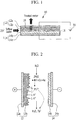
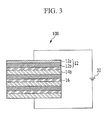
- FIG. 1 and FIG. 2 a filter device according to an example embodiment will be described with reference to FIG. 1 and FIG. 2 .
- FIG. 1 is a schematic diagram of a filter device according to an example embodiment
- FIG. 2 shows a metal ion removal mechanism for the filter device of FIG. 1
- the filter device 10 includes a filter unit 20 including a first electrode 12 and a second electrode 14 that are arranged so as to be spaced apart and opposite to each other, at least one of the first electrode 12 and second electrode 14 including an electrode material layer having electrical conductivity, the electrode material layer including a metal-adsorbing material (metal adsorbent); and a voltage applier 30 for applying a voltage to the first electrode 12 and the second electrode 14 for a desired amount of time depending on the conditions after operation of the filter unit 20.
- a filter unit 20 including a first electrode 12 and a second electrode 14 that are arranged so as to be spaced apart and opposite to each other, at least one of the first electrode 12 and second electrode 14 including an electrode material layer having electrical conductivity, the electrode material layer including a metal-adsorbing material (metal adsorbent); and a voltage applier
- the first electrode 12 and the second electrode 14 may respectively include first and second current collectors 12a and 14a, and first and second electrode material layers 12b and 14b positioned on the first and second current collectors 12a and 14a.
- the first and second current collectors 12a and 14a may be formed of a graphite foil, a titanium foil, and the like. Alternatively, the first and second current collectors 12a and 14a may be omitted depending on the type of electrode material used for the first and second electrode material layers 12b and 14b.
- the first and second current collectors 12a and 14a may facilitate the application of a relatively uniform voltage over the electrode during the process of applying a voltage after metal ion adsorption.
- At least one of the first and second electrode material layers 12b and 14b may include a metal adsorbent.
- the metal adsorbent may include activated carbon, high specific surface area graphite (HSAG), carbon nanotubes (CNT), mesoporous carbon, activated carbon fiber, a cation exchange resin, zeolite, smectite, vermiculite, and the like.
- the high specific surface area graphite may have a specific surface area of about 100 to 300 m 2 /g.
- the metal adsorbent may include a basic functional group (oxygen-containing functional group) on its surface that selectively bonds to heavy metal ions.
- the basic functional group selectively shows strong adsorption to acidic metal ions, particularly heavy metal ions.
- a reaction in which a basic functional group, for example, -COO- or -O - (that may be derived from a functional group such as a carboxyl group, a hydroxyl group, and the like) adsorbs heavy metal ions (such as Pb 2+ ) is represented by the following Reaction Scheme 1.
- At least one of the first electrode 12 and the second electrode 14 may include a carbon material including a basic functional group on its surface that selectively bonds to metal ions, while the other may be a catalyst-supported electrode including a catalyst for water hydrolysis or an inert electrode including a non-catalytic material.
- the catalyst for water hydrolysis may lower a water hydrolysis overvoltage so that a relatively high current driving may be enabled under the same voltage in the voltage applying process after metal ion adsorption.
- the catalyst for water hydrolysis or the non-catalytic material may include a metal, a metal oxide, stainless steel, glassy carbon, graphite, carbon black, or a combination thereof.
- the combination refers to a mixture, a stacking structure of two or more components, and the like.
- the metal may be selected from platinum (Pt), titanium (Ti), ruthenium (Ru), silver (Ag), gold (Au), iridium (Ir), palladium (Pd), cobalt (Co), vanadium (V), iron (Fe), or a combination thereof.
- the combination refers to a mixture, an alloy, a stacking structure of two or more metals, and the like.
- Examples of the metal oxide may include PtO 2 , IrO 2 , TiO 2 , CaTiO 3 , NaWO 3 , MnO 2 , RuO 2 , PbO 2 , or a combination thereof.
- the combination refers to a mixture, a stacking structure of two or more metal oxides, and the like.
- the electrode material used for the first electrode 12 and the second electrode 14 may be coated with nanoparticles. Alternatively, the electrode material may just be deposited as a thin film.
- inflow water contacts the metal adsorbent of the electrode, the metal in the inflow water is adsorbed onto the metal adsorbent, and the treated water is discharged through a hole 18 of the electrode.
- heavy metal ions such as Pb 2+ in the inflow water may be coordination-bonded to the basic functional groups (L) existing on the surface of the first electrode material layer 12b of the first electrode 12 and, thus, adsorbed.
- a voltage is applied between the first electrode 12 and the second electrode 14 so that metal ions may be desorbed from the metal adsorbent.
- the metal adsorbent is in-situ regenerated by the voltage applied between the first electrode 12 and the second electrode 14.
- a positive (+) voltage may be applied to the first electrode 12 and a negative (-) voltage may be applied to the second electrode 14.
- a water hydrolysis reaction may be induced on the surfaces of the first electrode 12 and the second electrode 14. Consequently, H + ions may be produced on the surface of the first electrode 12 to locally decrease the pH of the electrode surface to about 5 or less.
- metal ions that are adsorbed to the basic functional groups may be desorbed by a competing reaction and discharged.
- the filter device 10 may be short-circuited so as to facilitate the metal ion discharge.
- a water hydrolysis reaction and a surface oxidation reaction may simultaneously occur on the surface of the first electrode 12.
- Additional basic functional groups may be introduced on the surface of the first electrode 12 by the surface oxidation reaction.
- the production of basic functional groups of the first electrode 12 may be electrochemically induced.
- the metal adsorbent in the first electrode 12 is a carbon-based material such as activated carbon, high specific surface area graphite (HSAG), carbon nanotubes (CNT), mesoporous carbon, activated carbon fiber, and the like
- a basic functional group may be introduced so as to have an oxygen/carbon (O/C) atomic ratio of about 0.02 or more (based on XPS surface analysis).
- O/C oxygen/carbon
- a basic function group may be introduced so as to have an O/C atomic ratio of about 0.03 to 0.2.
- Voltage application of the voltage applier 30 may be performed after the metal adsorption reaction has progressed according to one or more desired conditions (for example, after a desired amount of time, or according to a desired concentration of metal ions or mineral components).
- the voltage applying time may be determined based on the amount of adsorbent, metal ion composition in the inflow water, flow rate of treated water, and the like.
- the filter device 10 may further include a sensor (or a monitoring system) that may detect fluidic characteristics of the treatment water.
- the voltage application may be performed by applying a pulse voltage in an interval of about 0.1 seconds to about 5 minutes.
- a concentration of metal ions (e.g., heavy metal ions) in the treatment water may be measured (and/or monitored). For example, a voltage may be applied if the concentration of metal ions is above a drinking water standard and/or a voltage may be applied if the concentration of metal ions or mineral components of the treated water is not appropriate for drinking water.
- the filter device 10 may further include a sensor (and/or a monitoring system) that may detect a concentration of metal ions (and/or mineral components).
- the voltage applier 30 may apply a voltage of a magnitude that allows hydrolysis of water between the first electrode 12 and the second electrode 14.
- the voltage of a magnitude that allows hydrolysis of water may be about 1.23 V or more, for example about 2 V to about 30 V.
- the filter device 10 may electrochemically regenerate the performance of the metal adsorbent by applying a voltage between the first electrode 12 and the second electrode 14 without dismantling the device. Furthermore, the filter device 10 may regenerate the performance of the metal adsorbent under inflow water conditions without using a separate electrolyte.
- metal ions particularly heavy metal ions
- the filter device may be semi-permanently used and a filter device that may decrease the maintenance cost of a filter may be provided.
- a water-permeable separator 16 may be inserted between the first electrode 12 and the second electrode 14.
- the separator 16 may enable a relatively smooth flow of inflow water.
- the separator 16 may also function as an insulator during voltage application by the voltage applier 30.
- the separator 16 may be formed of a polyolefin such as polyethylene, polypropylene, and the like.
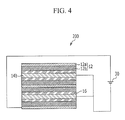
- FIG. 3 is a schematic diagram of a filter device 100 according to another example embodiment.
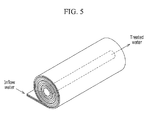
- FIG. 4 is a schematic diagram of a filter device 200 according to another example embodiment.
- FIG. 3 shows a filter device 100 including filter units including a first current collector 12a, a plurality of first electrode material layers 12b, a plurality of separators 16, and a plurality of second electrode material layers 14b, which are electrically connected in series.
- FIG. 4 shows a filter device 200 including filter units including a plurality of first current collectors 12a, a plurality of first electrode material layers 12b, a plurality of separators 16, and a plurality of second electrode material layers 14b, which are electrically connected in parallel.
- FIG. 5 is a schematic diagram of a filter device according to another example embodiment.
- the filter units may be helically wound and introduced into a case, and then the voltage applier may be connected.
- example embodiments are not limited thereto.
- HSA high specific surface area graphite
- carbon black about 10 g
- carbon black about 4.17 g
- polytetrafluoroethylene (PTFE) suspension 60 wt%
- propylene glycol about 100 g
- the molded products are respectively dried at a high temperature at about 80°C, about 120°C, and about 200°C for about 1 hour to prepare a first electrode material layer of a sheet type having an area of about 10x10 cm 2 and a weight of about 2.5 g.
- a graphite foil is used as a current collector, and an open mesh type of polyester (opening size: about 100 ⁇ m) is used as a separator.
- the graphite foil/first electrode material layer/separator/IrO 2 counter electrode/graphite foil are deposited in this order, and then they are fastened with a screw to manufacture a filter unit.
- a voltage applier is connected thereto to manufacture a filter device.
- a filter device is manufactured by the same method as Example 1, using the above first electrode material layer.
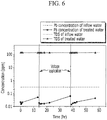
- CaCl 2 , MgSO 4 , and NaHCO 3 are added to distilled water so that the concentrations may become about 48.6 ppm, about 18.2 ppm, and about 66.0 ppm, respectively, and Pb(NO 3 ) 2 is added thereto so that the concentration of Pb 2+ may become about 300 ppb, to prepare inflow water with conductivity of about 210 ⁇ S/cm.
- the inflow water is supplied to the filter device according to Example 1 at about 10 mL/min.
- TDS Total dissolved solids
- TDS total dissolved solids
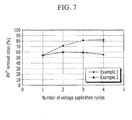
- CaCl 2 , MgSO 4 , and NaHCO 3 are added to distilled water so that the concentrations may become about 48.6 ppm, about 18.2 ppm, and about 66.0 ppm, respectively, and Pb(NO 3 ) 2 is added thereto so that the concentration of Pb 2+ may become about 3 ppm, to prepare inflow water.
- the inflow water is respectively supplied to the filter devices according to Example 1 and Example 2 at about 10 mL/min.
- Pb 2+ removal rates according to the number of voltage application cycles of the filter devices of Example 1 and Example 2 are shown in FIG. 7 . As shown in FIG. 7 , the Pb removal rate of the filter device of Example 1 shows a slight elevation whereas the rate in Example 2 is maintained at almost constant level after voltage application.
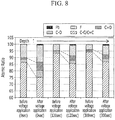
- the functional groups on the electrode surface of the filter device of Example 1 after voltage application are measured by X-ray photoelectron spectroscopy (XPS), and results are as shown in FIG. 8 .
- XPS X-ray photoelectron spectroscopy
Landscapes
- Chemical & Material Sciences (AREA)
- Engineering & Computer Science (AREA)
- Water Supply & Treatment (AREA)
- Organic Chemistry (AREA)
- Life Sciences & Earth Sciences (AREA)
- Hydrology & Water Resources (AREA)
- Environmental & Geological Engineering (AREA)
- Chemical Kinetics & Catalysis (AREA)
- General Chemical & Material Sciences (AREA)
- Electrochemistry (AREA)
- Inorganic Chemistry (AREA)
- Analytical Chemistry (AREA)
- Water Treatment By Electricity Or Magnetism (AREA)
- Water Treatment By Sorption (AREA)
Applications Claiming Priority (1)
| Application Number | Priority Date | Filing Date | Title |
|---|---|---|---|
| KR20110006534 | 2011-01-21 |
Publications (1)
| Publication Number | Publication Date |
|---|---|
| EP2478956A1 true EP2478956A1 (de) | 2012-07-25 |
Family
ID=45557871
Family Applications (1)
| Application Number | Title | Priority Date | Filing Date |
|---|---|---|---|
| EP12151628A Withdrawn EP2478956A1 (de) | 2011-01-21 | 2012-01-18 | Regenerierbare Absorptionsvorrichtung und Verfahren zu deren Steuerung |
Country Status (4)
| Country | Link |
|---|---|
| US (1) | US20120187054A1 (de) |
| EP (1) | EP2478956A1 (de) |
| KR (1) | KR20120085212A (de) |
| CN (1) | CN102603026A (de) |
Cited By (1)
| Publication number | Priority date | Publication date | Assignee | Title |
|---|---|---|---|---|
| TWI748987B (zh) * | 2016-02-15 | 2021-12-11 | 德商希利卡加工工程有限公司 | 帶有污染物之氣體的處理裝置及方法 |
Families Citing this family (7)
| Publication number | Priority date | Publication date | Assignee | Title |
|---|---|---|---|---|
| AU2013357739B2 (en) | 2012-12-11 | 2016-04-28 | Unilever Plc | Impregnated electrode for capacitive deionisation, process for preparing it and apparatus employing the electrodes |
| CN104884677B (zh) * | 2012-12-26 | 2018-01-02 | 皇家飞利浦有限公司 | Ph调节器,包括ph调节器的装置和调节ph值的方法 |
| CN104841371A (zh) * | 2015-04-21 | 2015-08-19 | 安徽凤凰滤清器股份有限公司 | 一种高活性蛭石/碳纳米管复合的吸附过滤剂及其制作方法 |
| CN104909437B (zh) * | 2015-06-25 | 2017-04-12 | 清华大学 | 一种Ti纳米电极高效去除水体中硝酸盐的方法 |
| PH12018501800B1 (en) | 2016-04-06 | 2022-08-10 | Unilever Ip Holdings B V | Electrode for capacative deionisation |
| KR102697322B1 (ko) * | 2016-12-09 | 2024-08-23 | 엘지전자 주식회사 | 수처리 장치용 필터모듈 및 이를 포함하는 수처리 장치 |
| CN107117689B (zh) * | 2017-05-12 | 2020-10-02 | 南京理工大学 | 石墨基板式二氧化钌涂层碳纳米过滤电极及其制备方法 |
Citations (16)
| Publication number | Priority date | Publication date | Assignee | Title |
|---|---|---|---|---|
| US3687829A (en) * | 1971-01-11 | 1972-08-29 | Gen Electric | Deionization of liquid media |
| US3827961A (en) * | 1970-09-15 | 1974-08-06 | Battelle Memorial Institute | Method for purifying ionically conducting solutions |
| JPS5799389A (en) * | 1980-12-15 | 1982-06-21 | Toshiba Corp | Metal ion collector |
| US5584981A (en) * | 1994-05-06 | 1996-12-17 | United Kingdom Atomic Energy Authority | Electrochemical deionization |
| US5738775A (en) * | 1995-10-01 | 1998-04-14 | Ebara Corporation | Electrically regenerable desalting apparatus |
| CN1201759A (zh) * | 1997-06-05 | 1998-12-16 | 大连理工大学 | 连续吸附-电解再生污水处理设备 |
| EP0915059A1 (de) * | 1997-03-19 | 1999-05-12 | Western Pacific Company, Inc. Ltd. | Verfahren zur elektrochemisch kontrollierter absorption löslicher organischen wirkstoffe und aus wässrigen lösungen extrahierter schwermetallionen, und entsprechende vorrichtung |
| US5904832A (en) * | 1996-12-20 | 1999-05-18 | Huron Tech Canada, Inc. | Regeneration of active carbon and polymeric adsorbents |
| US6045704A (en) * | 1996-11-05 | 2000-04-04 | Sanden Corporation | Water purification system and method having a chlorine generating function in addition to a bacteriostatic function |
| US6391185B1 (en) * | 2000-01-05 | 2002-05-21 | Electrophor, Inc. | Composite regenerable adsorption carbon material and its regeneration method |
| US20040187685A1 (en) * | 2003-03-28 | 2004-09-30 | Kiyoshi Tatsuhara | Method of and apparatus for regenerating adsorbent |
| JP2005034705A (ja) * | 2003-07-16 | 2005-02-10 | Mitsubishi Heavy Ind Ltd | 吸着材の再生方法及び再生装置 |
| WO2009053972A1 (en) * | 2007-10-22 | 2009-04-30 | Toxsorb Ltd | Modified activated carbon as adsorbent for anionic and cationic inorganic pollutants |
| EP2258661A1 (de) * | 2008-03-25 | 2010-12-08 | Tanah Process Ltd. | Tragbare härteregulierungsvorrichtung zur regulierung der trinkwasserhärte |
| CN101921030A (zh) * | 2010-08-05 | 2010-12-22 | 南京大学 | 一种处理垃圾渗滤液中重金属的装置 |
| EP2298441A2 (de) * | 2009-08-21 | 2011-03-23 | Samsung Electronics Co., Ltd. | Trinkwasserfiltersystem, Verfahren zu seiner Regeneration und Wasserreinigungsvorrichtung mit dem Trinkwasserfiltersystem |
Family Cites Families (2)
| Publication number | Priority date | Publication date | Assignee | Title |
|---|---|---|---|---|
| US6309532B1 (en) * | 1994-05-20 | 2001-10-30 | Regents Of The University Of California | Method and apparatus for capacitive deionization and electrochemical purification and regeneration of electrodes |
| US20100059378A1 (en) * | 2007-07-18 | 2010-03-11 | The Water Company Llc | Apparatus and method for removal of ions from a porous electrode that is part of a deionization system |
-
2012
- 2012-01-18 EP EP12151628A patent/EP2478956A1/de not_active Withdrawn
- 2012-01-18 US US13/352,756 patent/US20120187054A1/en not_active Abandoned
- 2012-01-19 CN CN2012100179205A patent/CN102603026A/zh active Pending
- 2012-01-20 KR KR1020120006979A patent/KR20120085212A/ko not_active Withdrawn
Patent Citations (16)
| Publication number | Priority date | Publication date | Assignee | Title |
|---|---|---|---|---|
| US3827961A (en) * | 1970-09-15 | 1974-08-06 | Battelle Memorial Institute | Method for purifying ionically conducting solutions |
| US3687829A (en) * | 1971-01-11 | 1972-08-29 | Gen Electric | Deionization of liquid media |
| JPS5799389A (en) * | 1980-12-15 | 1982-06-21 | Toshiba Corp | Metal ion collector |
| US5584981A (en) * | 1994-05-06 | 1996-12-17 | United Kingdom Atomic Energy Authority | Electrochemical deionization |
| US5738775A (en) * | 1995-10-01 | 1998-04-14 | Ebara Corporation | Electrically regenerable desalting apparatus |
| US6045704A (en) * | 1996-11-05 | 2000-04-04 | Sanden Corporation | Water purification system and method having a chlorine generating function in addition to a bacteriostatic function |
| US5904832A (en) * | 1996-12-20 | 1999-05-18 | Huron Tech Canada, Inc. | Regeneration of active carbon and polymeric adsorbents |
| EP0915059A1 (de) * | 1997-03-19 | 1999-05-12 | Western Pacific Company, Inc. Ltd. | Verfahren zur elektrochemisch kontrollierter absorption löslicher organischen wirkstoffe und aus wässrigen lösungen extrahierter schwermetallionen, und entsprechende vorrichtung |
| CN1201759A (zh) * | 1997-06-05 | 1998-12-16 | 大连理工大学 | 连续吸附-电解再生污水处理设备 |
| US6391185B1 (en) * | 2000-01-05 | 2002-05-21 | Electrophor, Inc. | Composite regenerable adsorption carbon material and its regeneration method |
| US20040187685A1 (en) * | 2003-03-28 | 2004-09-30 | Kiyoshi Tatsuhara | Method of and apparatus for regenerating adsorbent |
| JP2005034705A (ja) * | 2003-07-16 | 2005-02-10 | Mitsubishi Heavy Ind Ltd | 吸着材の再生方法及び再生装置 |
| WO2009053972A1 (en) * | 2007-10-22 | 2009-04-30 | Toxsorb Ltd | Modified activated carbon as adsorbent for anionic and cationic inorganic pollutants |
| EP2258661A1 (de) * | 2008-03-25 | 2010-12-08 | Tanah Process Ltd. | Tragbare härteregulierungsvorrichtung zur regulierung der trinkwasserhärte |
| EP2298441A2 (de) * | 2009-08-21 | 2011-03-23 | Samsung Electronics Co., Ltd. | Trinkwasserfiltersystem, Verfahren zu seiner Regeneration und Wasserreinigungsvorrichtung mit dem Trinkwasserfiltersystem |
| CN101921030A (zh) * | 2010-08-05 | 2010-12-22 | 南京大学 | 一种处理垃圾渗滤液中重金属的装置 |
Cited By (1)
| Publication number | Priority date | Publication date | Assignee | Title |
|---|---|---|---|---|
| TWI748987B (zh) * | 2016-02-15 | 2021-12-11 | 德商希利卡加工工程有限公司 | 帶有污染物之氣體的處理裝置及方法 |
Also Published As
| Publication number | Publication date |
|---|---|
| CN102603026A (zh) | 2012-07-25 |
| US20120187054A1 (en) | 2012-07-26 |
| KR20120085212A (ko) | 2012-07-31 |
Similar Documents
| Publication | Publication Date | Title |
|---|---|---|
| Chen et al. | Capacitive deionization and electrosorption for heavy metal removal | |
| US20120187054A1 (en) | Regenerable filter device and method of driving the same | |
| EP2500319B1 (de) | Erneuerbares Filtersystem und Verfahren zum Betrieb des erneuerbaren Filtersystems | |
| Wang et al. | Activated carbon fiber for adsorption/electrodeposition of Cu (II) and the recovery of Cu (0) by controlling the applied voltage during membrane capacitive deionization | |
| KR101022257B1 (ko) | 이온선택성 축전식 탈염 복합전극 및 모듈의 제조 방법 | |
| EP2502884A1 (de) | Regenerierbare Filtereinheit zum Entfernen von Metall, diese Filtereinheit enthaltendes Filtersystem und Verfahren zum Betrieb des Filtersystems | |
| EP2298441B1 (de) | Trinkwasserfiltersystem, Verfahren zu seiner Regeneration und Wasserreinigungsvorrichtung mit dem Trinkwasserfiltersystem | |
| US11117818B2 (en) | Faradic porosity cell | |
| KR20150061323A (ko) | 전기 흡착 탈이온 전극 재생 방법 | |
| KR102301795B1 (ko) | 카본 전극 필터를 포함하는 가정용 정수기 | |
| US20230031927A1 (en) | Faradic porosity cell | |
| US12421616B2 (en) | Faradic porosity cell | |
| CN112543671B (zh) | 法拉第多孔电池 | |
| CN113502506A (zh) | 一种利用交流电分离回收废液中重金属的方法 | |
| EP4421044A2 (de) | Faradaische porositätszelle | |
| Xu et al. | Electrosorption of heavy metals with capacitive deionization: Water reuse, desalination and resources recovery | |
| WO2023107665A1 (en) | Electrode regeneration in electrochemical devices | |
| CN108083517A (zh) | 一种重金属废水一体化净化工艺 | |
| JP7863924B2 (ja) | 水性組成物を処理するためのガルバニックプロセス | |
| US20260001790A1 (en) | Faradic porosity cell | |
| KR20250069889A (ko) | 패러데이 다공성 셀 | |
| Prabhu et al. | Ponnusamy Thillai Arasu, Arumugam Murugan, A. Mohamed Azharudeen, G. Kanthimathi, Natarajan Raman | |
| Arasu et al. | Effective Removal and Remediation of Heavy Metals and Emerging Pollutants from Industrial Wastewater | |
| JP2006272296A (ja) | 銀イオンおよび鉛イオンに対し選択的吸着性を示す吸着剤 | |
| Linkov | Electro-membrane Reactors for Desalination and Disinfection of Aqueous Solutions |
Legal Events
| Date | Code | Title | Description |
|---|---|---|---|
| PUAI | Public reference made under article 153(3) epc to a published international application that has entered the european phase |
Free format text: ORIGINAL CODE: 0009012 |
|
| 17P | Request for examination filed |
Effective date: 20120330 |
|
| AK | Designated contracting states |
Kind code of ref document: A1 Designated state(s): AL AT BE BG CH CY CZ DE DK EE ES FI FR GB GR HR HU IE IS IT LI LT LU LV MC MK MT NL NO PL PT RO RS SE SI SK SM TR |
|
| AX | Request for extension of the european patent |
Extension state: BA ME |
|
| RAP1 | Party data changed (applicant data changed or rights of an application transferred) |
Owner name: SAMSUNG ELECTRONICS CO., LTD. |
|
| 17Q | First examination report despatched |
Effective date: 20130701 |
|
| STAA | Information on the status of an ep patent application or granted ep patent |
Free format text: STATUS: THE APPLICATION IS DEEMED TO BE WITHDRAWN |
|
| 18D | Application deemed to be withdrawn |
Effective date: 20140423 |