EP4421044A2 - Faradaische porositätszelle - Google Patents
Faradaische porositätszelle Download PDFInfo
- Publication number
- EP4421044A2 EP4421044A2 EP24185554.3A EP24185554A EP4421044A2 EP 4421044 A2 EP4421044 A2 EP 4421044A2 EP 24185554 A EP24185554 A EP 24185554A EP 4421044 A2 EP4421044 A2 EP 4421044A2
- Authority
- EP
- European Patent Office
- Prior art keywords
- electrode
- carbon
- removal
- lead
- water
- Prior art date
- Legal status (The legal status is an assumption and is not a legal conclusion. Google has not performed a legal analysis and makes no representation as to the accuracy of the status listed.)
- Pending
Links
Images
















Classifications
-
- C—CHEMISTRY; METALLURGY
- C02—TREATMENT OF WATER, WASTE WATER, SEWAGE, OR SLUDGE
- C02F—TREATMENT OF WATER, WASTE WATER, SEWAGE, OR SLUDGE
- C02F1/00—Treatment of water, waste water, or sewage
- C02F1/46—Treatment of water, waste water, or sewage by electrochemical methods
- C02F1/461—Treatment of water, waste water, or sewage by electrochemical methods by electrolysis
- C02F1/46104—Devices therefor; Their operating or servicing
- C02F1/46109—Electrodes
-
- C—CHEMISTRY; METALLURGY
- C02—TREATMENT OF WATER, WASTE WATER, SEWAGE, OR SLUDGE
- C02F—TREATMENT OF WATER, WASTE WATER, SEWAGE, OR SLUDGE
- C02F1/00—Treatment of water, waste water, or sewage
- C02F1/46—Treatment of water, waste water, or sewage by electrochemical methods
- C02F1/469—Treatment of water, waste water, or sewage by electrochemical methods by electrochemical separation, e.g. by electro-osmosis, electrodialysis, electrophoresis
- C02F1/4691—Capacitive deionisation
-
- C—CHEMISTRY; METALLURGY
- C02—TREATMENT OF WATER, WASTE WATER, SEWAGE, OR SLUDGE
- C02F—TREATMENT OF WATER, WASTE WATER, SEWAGE, OR SLUDGE
- C02F1/00—Treatment of water, waste water, or sewage
- C02F1/46—Treatment of water, waste water, or sewage by electrochemical methods
- C02F1/461—Treatment of water, waste water, or sewage by electrochemical methods by electrolysis
- C02F1/46104—Devices therefor; Their operating or servicing
- C02F1/46109—Electrodes
- C02F2001/46133—Electrodes characterised by the material
-
- C—CHEMISTRY; METALLURGY
- C02—TREATMENT OF WATER, WASTE WATER, SEWAGE, OR SLUDGE
- C02F—TREATMENT OF WATER, WASTE WATER, SEWAGE, OR SLUDGE
- C02F1/00—Treatment of water, waste water, or sewage
- C02F1/46—Treatment of water, waste water, or sewage by electrochemical methods
- C02F1/461—Treatment of water, waste water, or sewage by electrochemical methods by electrolysis
- C02F1/46104—Devices therefor; Their operating or servicing
- C02F1/46109—Electrodes
- C02F2001/46152—Electrodes characterised by the shape or form
- C02F2001/46157—Perforated or foraminous electrodes
-
- C—CHEMISTRY; METALLURGY
- C02—TREATMENT OF WATER, WASTE WATER, SEWAGE, OR SLUDGE
- C02F—TREATMENT OF WATER, WASTE WATER, SEWAGE, OR SLUDGE
- C02F2101/00—Nature of the contaminant
- C02F2101/10—Inorganic compounds
- C02F2101/12—Halogens or halogen-containing compounds
-
- C—CHEMISTRY; METALLURGY
- C02—TREATMENT OF WATER, WASTE WATER, SEWAGE, OR SLUDGE
- C02F—TREATMENT OF WATER, WASTE WATER, SEWAGE, OR SLUDGE
- C02F2101/00—Nature of the contaminant
- C02F2101/10—Inorganic compounds
- C02F2101/20—Heavy metals or heavy metal compounds
-
- C—CHEMISTRY; METALLURGY
- C02—TREATMENT OF WATER, WASTE WATER, SEWAGE, OR SLUDGE
- C02F—TREATMENT OF WATER, WASTE WATER, SEWAGE, OR SLUDGE
- C02F2101/00—Nature of the contaminant
- C02F2101/10—Inorganic compounds
- C02F2101/20—Heavy metals or heavy metal compounds
- C02F2101/206—Manganese or manganese compounds
-
- C—CHEMISTRY; METALLURGY
- C02—TREATMENT OF WATER, WASTE WATER, SEWAGE, OR SLUDGE
- C02F—TREATMENT OF WATER, WASTE WATER, SEWAGE, OR SLUDGE
- C02F2101/00—Nature of the contaminant
- C02F2101/10—Inorganic compounds
- C02F2101/20—Heavy metals or heavy metal compounds
- C02F2101/22—Chromium or chromium compounds, e.g. chromates
Definitions
- the field of the invention is removal of metal ions, halide ions, derivatives of metals and halides, and ionic particulates from solutions, e.g., the removal of lead from water, by pairing selected faradic reactions with carbon electrode pore mouth diameter profiling.
- Activated means a chemical or physical process applied to a material to increase the porosity and thus the surface area. Typically it is applied to a carbon-based material, such as but not limited to bamboo, coconut husk, wood, lignite, or coal, which is then described as activated carbon.
- the activated carbon can be a powder, granular, felt, nonwoven, woven, etc.
- Adsorption means attracting ions in an input stream to and retaining those ions on an electrode surface.
- Allutination means removing metal ions, halide ions, derivatives of metals or halides, or particulate metal from an input stream to a cell by one or more of the following: (i) physical adsorption; (ii) capacitive adsorption; (iii) electrochemical pH modulation & metal immobilization; (iv) electrochemical peroxide (H 2 O 2 ) generation & metal oxidation; (v) electrodeposition or electroplating; (vi) electrochemical oxidation or reduction; (vii) precipitation; (viii) pore mouth diameter profile, (ix) electrode treatment, (x) electrode spacing, and (xi) flow-by vs. flow-through vs. carbon block cell design.
- BET surface area means surface area determined by the Brunauer-Emmett-Teller method, which is a physical adsorption-based method using nitrogen to determine the surface area of a material.
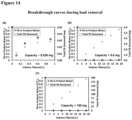
- Breakthrough curve means the course of an effluent adsorptive concentration at the outlet of a fixed adsorber.
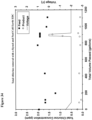
- a breakthrough curve enables the calculation of a technically usable sorption capacity. Breakthrough curves typically plot target species concentration vs. volume treated. See, e.g., Fig. 14 .
- Carbon block is an extruded carbon material with carbon particles bound with a polymer into a bulk solid form. It is typically used for dechlorination and particle filters.
- each of one or more pristine carbon blocks are typically divided into two halves that are electrically isolated in an FPC; one half or each block is used as an anode and the other half of each block is used as a cathode.
- Carbon cloth is a woven porous material consisting essentially of carbon.
- Carbon felt is a non-woven porous material consisting essentially of carbon.
- Carbon film is a carbon composite consisting essentially of carbon particles and polymer binder.
- Capacitive adsorption means adsorption of an ion or other charged species on an electrode as a result of electrical attraction.
- CCC or “capacitive coagulation cell” or “CCC device” means a purification cell that primarily uses capacitive adsorption to remove metal ions, derivatives of metals, or particulate metal from a liquid (typically aqueous) input stream and produce an output stream with a metal, metal derivative, or particulate content below a government regulated limit.
- a liquid typically aqueous
- the US EPA specifies a lead content of 15 ppb as the "action level” for potable or irrigation water.
- CCC Parameter means a user-selected FPC Parameter in an CCC.
- Cell means, in general, a plurality of electrodes exposed to an input stream (influent), with an outlet for the output stream (effluent) during operation, a short-circuit switch or power supply attached to the electrodes, a manual or computerized means of controlling the power supply and any in-stream valves, and sensors that monitor cell operation and interface with the manual or computerized means of control.
- a cell can optionally include a further means of controlling the input stream and the output stream, for instance to select different output stream collection vessels or other dispositions during cell operation.
- an FPC does not regenerate (aka desorb) the electrodes to produce a waste stream of desorbed target species during operation; instead, an FPC, including CCC or an EDC, is replaced, e.g., when the concentration of a target species in the output stream exceeds a user-selected threshold; replacement criteria other than target species concentration in the output stream, e.g., cumulative volume of through stream for a given FPC, and presence of certain reaction byproducts, may be specified.
- Charging potential means a voltage applied to a cell to perform work.
- Conductivity means the electrical conductivity of an input stream, through stream, output stream, or a waste stream. Conductivity is a surrogate measurement for the molarity of ions in an input stream, output stream, or waste stream. Conductivity is directly proportional to molarity of ions in such streams.
- CG means a carbon that has a predominately mesoporous structure with a nominal surface area of ⁇ 700 m 2 /g.
- CG was formulated by the inventors using the pore mouth diameter profile method disclosed herein and fabricated for the inventors by Calgon Corporation (Naperville, IL). CG is sometimes recited as Calgon ® or Calgon FM100 ST2 in the Tables.
- CV means cyclic voltammogram
- CX means carbon xerogel.
- CX electrodes possess a mesoporous structure with a nominal surface area of ⁇ 200 m 2 /g.
- Cycle means a cycle of operation in which a sequence of positive then negative, or negative then positive, potential has been applied to an FPC electrode.
- DO means dissolved oxygen
- E means a voltage, aka electrical potential; if a direct current, E has a constant polarity (positive or negative).
- Electrode means a material, typically porous carbon, which is electrically conductive.
- EDC electro-dehalidation cell disclosed in this Application.
- An EDC is a species of water purification cell within the genus of FPCs.
- EDC Parameter means a user-selected FPC Parameter in an EDC.
- EDX Energy Dispersive X-Ray Analysis
- E o is the potential vs. a reference electrode when the electrodes are short-circuited (i.e., E o is the potential during a short-circuit condition).
- E PZC or "potential of zero charge" means the potential of an electrode at which there is a minimum in ion adsorption at the surface.
- E PZC can be intentionally shifted by surface modification of a carbon electrode, or inherently relocated as a result of oxidation of an electrode surface by extended applied potential or voltage.
- the E PZC of a pristine carbon a electrode is typically between -0.1 V and +0.1 V. Shifting the Epzc of an electrode through surface modifications is disclosed in detail in USAPP 62/702286 incorporated herein.
- FPC electrode E PZC s for a given target species vary by water chemistry and are empirically determined.
- “Faradic immobilization” means electron transfer to a target species in the electrolyte, or electron transfer to a species in the electrolyte, followed by a homogeneous reaction in solution with the target species of interest, after which the reaction product is adsorbed on an electrode.
- Frit is a fabric made by rolling and pressing any suitable textile accompanied by the application of moisture or heat, which causes the constituent fibers to mat together to create a smooth surface.
- Flow-by cell design means the through stream in an FPC flows across the surface of the electrodes in an FPC, rather than through the electrodes.
- Flow-by cell design can provide the following advantages compared to a flow-through cell design: lower pressure drop, higher flow rate, equal degradation of carbon electrodes, equivalent pH regions generated for each electrode pair.
- Flow rate means the flow rate, typically in L/hr, ml/min, etc., of an input, throughput, output, or waste stream.
- Flow-through cell design means the through stream in an FPC is forced through the electrodes in an FPC.
- Flow-through cell design can provide the following advantages compared to a flow-by cell design: more extreme pH regions, better control over outlet pH.
- FPC or "faradic porosity cell” or “FPC device” means a purification cell that uses agglutination to remove metal ions, halide ions, derivatives (e.g., other species) of target metals or target halides, or particulate metal from a liquid (typically aqueous) input stream and produce an output stream with a decreased metal, halide, or particulate content.
- Different species of FPC can be used in series or in parallel to remove target species from an aqueous influent to a purification system.
- An “FPC system” means a water purification system that contains one or more FPCs and optionally other types of purification cells (see definition of “hybrid system”), such as capacitive deionization (“CDI”) cells, membrane CDI cells (“MCDI”), inverted CDI (“i-CDI”) cells, and non-electrochemical cells and filters.
- CDI capacitive deionization
- MCDI membrane CDI cells
- i-CDI inverted CDI
- non-electrochemical cells and filters non-electrochemical cells and filters.
- CDI capacitive deionization
- MCDI membrane CDI cells
- i-CDI inverted CDI
- non-electrochemical cells and filters non-electrochemical cells and filters.
- CCCs and EDCs are species of FPCs.
- FPC Parameter means a user-selected value in an FPC of (i) physical adsorption; (ii) capacitive adsorption; (iii) electrochemical pH modulation; (iv) electrochemical peroxide (H 2 O 2 ) generation & oxidation of target species; (v) electrodeposition (e.g., electroplating, electrophoretic deposition); (vi) electrochemical oxidation or reduction; (vii) precipitation; (viii) pore mouth diameter profile, (ix) electrode treatment, (x) electrode spacing, and (xi) flow-by vs. flow-through vs. carbon block cell design.
- One or more FPC Parameters are selected, or “tuned", to remove a target species from a through stream, based on empirical data for a given input water chemistry.
- Halide derivative means a molecule or compound that contains a halide.
- Hycarb means a microporous activated carbon nonwoven felt with a nominal surface area of ⁇ 1200 m 2 /g.
- HE means a high-efficiency mesoporous carbon. Electrodes made with HE carbon possess a predominately mesoporous structure with a nominal surface area of -380 m 2 /g. HE has a formulation of >98% mesoporous carbon with the balance being macroporous carbon. HE is formulated using the pore mouth diameter profile method disclosed in USAPP 62/702286 incorporated herein.
- Hybrid system means a water purification system that contains at least one FPC (CCC or EDC) and at least one other type of water purification cell, e.g., a peroxidation cell, CDI, MCDI, i-CDI, or non-electrochemical cell or filter.
- FPC FPC
- EDC electrospray cell
- CDI peroxidation cell
- MCDI MCDI
- i-CDI i-CDI
- non-electrochemical cell or filter e.g., a peroxidation cell, CDI, MCDI, i-CDI, or non-electrochemical cell or filter.
- the minimal configuration of a hybrid system is series (FPC feeding other cell type, or vice versa). Larger systems can be series only, or have series paths in parallel (to increase throughput).
- Immobilization means adsorption of a target species on an FPC electrode without later desorption into a purified output stream.
- Input stream means a liquid, typically water containing various ions and metals, admitted through an inlet to a cell.
- KN means a microporous carbon marketed as KynolO available from American Kynol, Inc (Pleasantville, NY). Electrodes made with KN carbon possess a microporous structure with a nominal surface area of ⁇ 1800 m 2 /g. KN is sometimes recited as Kynol ACC-5092-20 in the tables.
- KR-LC means a dense carbon film with binder with a nominal surface area of ⁇ 1400 m 2/ g.
- Maxwell means a dense carbon film with a nominal surface area of >1200 m 2/ g.
- Metal means a metal, metal ion, metal complex, metal particle, or toxin for which a Pourbaix diagram exists and containing a metal selected from the group comprising As, Se, Pb, Ni, Zn, Al, Sc, Ti, V, Cr, Mn, Fe, Co, Ni, Cu, Y, Zr, Nb, Mo, Tc, Ru, Rh, Pd, Ag, Cd, La, Hf, Ta, W, Re, Os, Ir, Pt, Au, Hg, Ce, Pr, Nd, Pm, Sm, Eu, Gd, Tb, Dy, Ho, Er, Tm, Yb, and Lu.
- a metal selected from the group comprising As, Se, Pb, Ni, Zn, Al, Sc, Ti, V, Cr, Mn, Fe, Co, Ni, Cu, Y, Zr, Nb, Mo, Tc, Ru, Rh, Pd, Ag, Cd, La, Hf, Ta, W, Re, Os, Ir, Pt, Au
- Metal derivative means a molecule or compound that contains a metal or metalloid.
- Metal speciation means the different chemical forms ("species") of a metal in a given milieu.
- As(III) and As(V) are species of arsenic that can coexist in an aqueous solution at a given pH.
- NHE Normal Hydrogen Electrode
- Nonwoven means sheet or web structures bonded together by entangling fiber or filaments (and by perforating films) mechanically, thermally or chemically.
- Output stream means a liquid that has passed through an FPC and contains a lower molarity of target species than in the input stream.
- Parallel system architecture means FPCs (and optionally other types of cells and filters) connected in parallel, i.e., the outlet of each FPC (and optionally other types of cells and filters) feeds the system output.
- a parallel system architecture can be fixed, or can comprise multiple FPCs, a process controller, interconnecting lines, sensors, and valves disposed in the lines and cells.
- Physical adsorption means physical entrapment of a target species in an electrode pore.
- PMD means pore mouth diameter, which is the diameter of a pore on the surface of a carbon electrode.
- a pore may be a dead-end channel or a through channel within a carbon electrode, and typically has a variable channel diameter.
- Point of entry or "POE” means the location where a water supply feeds a water distribution system in a residence, commercial/industrial building, or other structure.
- Point of use or “POU” means the location where water is dispensed from a water distribution system to a consumer, beverage dispenser, kitchen appliance, or other end use.
- Polarity means the polarity of a DC voltage, either positive or negative.
- Pore mouth diameter profile means the volumetric ratio(s) among microporous, mesoporous, and macroporous carbon in an electrode fabricated according to the pore mouth diameter profile method disclosed in USAPP 62/702,286 and USAPP 16/417,574 incorporated herein. Generally speaking, the larger the average pore mouth diameter, the longer the working lifetime of the electrode and the more permeable the electrode is to a through stream. The average pore mouth diameter is controlled by the ratio of microporous, mesoporous, and macroporous carbon used to fabricate a given carbon electrode.
- Pourbaix diagram maps out possible stable (equilibrium) phases of an aqueous electrochemical system. Predominant ion boundaries are represented by lines. As such, a Pourbaix diagram can be read much like a standard phase diagram with a different set of axes. Similar to phase diagrams, Pourbaix diagrams do not address reaction rate or kinetic effects. For soluble species, the lines in a Pourbaix diagram are usually drawn for concentrations of 1 M or 10 -6 M. Sometimes additional lines are drawn for other concentrations.
- Plastic operating region means relating the pH and applied E at a given electrode in an FPC to a Pourbaix diagram to select for immobilization of a target species in a given water chemistry.
- Spectracarb TM electrode as supplied by the manufacturer, is pristine.
- Process controller means a computer operating a process control application that monitors sensors disposed in a system of FPCs (and optionally, other types of cells and filters) to sample input, through, and/or output streams and status of FPCs (and optionally, other types of cells and filters) in a water purification system comprising one or more FPCs and optionally one or more other types of water purification cells or filters.
- the process controller actuates valves in lines interconnecting a source of aqueous solution to be treated, FPCs (and optionally other cells and filters), and system outlets, thereby enabling the various FPCs (and optionally other cells and filters) to be configured in a series system architecture, series-parallel system architecture, or parallel system architecture.
- the process controller can dynamically adjust FPC Parameters of FPCs in the system (and optionally adjust other cells and filters in the system).
- Purify means to remove one or more target species from a through stream. Purification includes the removal of metals for which a Pourbaix diagram exists (e.g., As, Pb, Ni, Zn, Al, Cr, Mn, Fe, and Cu), halides (e.g., Cl, Br, chloramines), organics, and biological compounds.
- metals for which a Pourbaix diagram exists e.g., As, Pb, Ni, Zn, Al, Cr, Mn, Fe, and Cu
- halides e.g., Cl, Br, chloramines
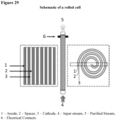
- Rolled cell design means an FCP cell design in which continuous separator and porous carbon-based electrode materials are physically rolled into a spiral to create a cylinder with multiple, predominantly flow-by, through stream paths through the porous carbon electrodes.
- sheets of anode material, separator material, and cathode material are stacked and then rolled up to form a cylinder.
- Current collectors are attached to the anode and the cathode, usually in multiple locations to reduce electrical losses.
- SC means a microporous carbon marketed as Spectracarb TM available from Engineered Fibers Technology, LLC (Shelton, CT). Electrodes made with SC carbon possess a microporous structure with a nominal surface area of ⁇ 1900 m 2 /g.
- SCE means a saturated calomel electrode, a standard reference electrode commonly used as a reference electrode, e.g., in cyclic voltammetry.
- Series system architecture means FPCs (and optionally, other types of cells and filters) connected in series, i.e., the outlet of a first FPC feeds the inlet and a second FPC, the outlet of the second FPC feeds the inlet and a third FPC, and so on.
- a series system architecture can be fixed, or can comprise multiple FPCs (and optionally, other types of cells and filters), a process controller, sensors, interconnecting feed lines, and valves disposed in feed lines between the outlet of one FPC and the inlet of a second FPC.
- Series-parallel system architecture means a system in which FPCs (and optionally, other types of cells and filters) can be connected in series or in parallel.
- a series-parallel system architecture can be fixed, or can comprise multiple FPCs (and optionally, other types of cells and filters), a process controller, interconnecting feed lines, sensors, and valves disposed in feed lines between the outlet of one FPC and the inlet of a second FPC, which valves are actuated by the process controller.
- the typical series-parallel system architecture comprises multiple ranks of a given series of cells, thereby treating the through stream in the same way, but with higher throughput provided by multiple serial paths.
- SHE Standard Hydrogen Electrode
- “Shift” means to alter the potential (aka “location") of the E PZC of an electrode by intentional or unintentional chemical or electrochemical modification of the electrode surface (e.g., electrochemical oxidation due to an applied potential or voltage) using the methods disclosed in USAPP 62/702,286 incorporated herein.
- Sigracell means a porous carbon felt with a nominal surface area of 0.4 m 2/ g. Sigracell is sometimes recited as Sigracell GFD 2.5 in the tables.
- “Species” means a molecule, compound, or particulate in an aqueous stream or adsorbed on a cell electrode.
- Standard means the distribution of an element among defined chemical species in a system or within an FPC. For instance, an uncharged metal particle, a metal ion, and a metal complex of a given metal may coexist in solution or suspension at a given pH, which distribution may change as pH changes.
- Stacked cell design means an FCP cell design in which separate pieces of separator and porous carbon-based electrode materials are stacked layer-by-layer to create a cylinder with multiple, predominantly flow-by, through stream paths through and/or by the porous carbon electrode.
- Current collectors are attached to the anode and the cathode, usually in multiple locations to reduce electrical losses.
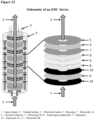
- Figure 23 shows a stacked cell design.
- “Surface-charge enhanced surface” means an electrode surface that has been imparted with surface charge through chemical or electrochemical methods.
- System is a plurality of interconnected FPCs (and optionally, other types of cells and filters) controlled manually or by a process controller.
- Target metal means one or more species of a given metal or metal derivative to be removed using a CCC.
- Target speciation means one of several ionic states or complexations a target species may assume in an aqueous electrochemical cell as a function of E applied to cell electrodes and pH, as shown in a Pourbaix diagram of the target species.
- Target species means a molecule, compound, or particulate to be removed using an FPC.
- Target species includes not only the molecule, compound, or particulate as found (aka “identified as a species in a Pourbaix diagram") in the input stream to an FPC, but one or more intermediate and final reactive products created in an FPC that include that molecule, compound, or particulate.
- Passough stream means the liquid stream being treated within a cell; stated differently, the through stream means the stream within a cell and between the inlet to the cell and the outlet from the cell.
- Treat means to feed an input stream into an operating FPC or system containing FPCs and to recover the purified output stream.
- Treatment electrode means an electrode with an electrode surface modification disclosed herein.
- TDS total dissolved solids.
- the general operational definition is that the solids must be small enough to survive filtration through a filter with two-micrometer pores.
- Untreated electrode means an electrode without an electrode surface modification disclosed herein, i.e., a pristine carbon electrode.
- Voltage and “potential” are synonymous herein. Voltage is direct current (“DC”) unless otherwise specified.
- Wild stream means a liquid that has passed through a CDI, MCDI, i-CDI cell, reverse osmosis, ion exchange, or other water purification cell that cycles between adsorption and desorption and contains a higher molarity of ions than in the input stream.
- Deionization cells e.g., capacitive deionization cells, can be used in a system containing FPCs. An FPC does not have a waste stream: the output stream from an FPC is purified water.
- a system that contains deionization cells that periodically desorb molecules will have (i) a purified output stream from deionization cells operating in an adsorption state that is combined with FPC output streams, and (ii) a waste stream from deionization cells operating in a desorption state.
- “Woven cloth” is any textile formed by weaving.
- Toxic metals, esp. lead, in drinking water and crop irrigation water are a major, worldwide health problem.
- the problem, and health impacts, are largely unreported until a crisis occurs, as when the water in a municipal water system becomes toxic from lead contamination.
- At least 18 million Americans were at risk of drinking lead-contaminated water last year.
- More than 5,000 community water systems violated a federal lead rule.
- Elevated blood lead levels in children cause irreversible neurological and behavioral disorders, and even low levels have been linked to decreased IQ and lifetime achievement.
- the U.S. Environmental Protection Agency (“EPA") emphasizes that there is no safe level of lead exposure.
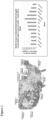
- Figure 1 shows U.S. locations with dangerously high levels of lead in municipal drinking water and the incidence of elevated blood lead levels in young children in the U.S., exposing them to a risk of permanent brain damage, seizures, coma, and even death from lead poisoning.
- the U.S. Natural Resources Defense Council (“NRDC”) recently found 5,363 community water systems in violation of the EPA's lead and copper rule (https://www.epa.gov/dwreginfo/lead-and-copper-rule), a federal requirement for monitoring of lead and copper levels in water.
- the NRDC report also found 1,110 water systems that exceed the action level for lead (15 ppb in at least 10 percent of homes tested). These systems collectively serve nearly 4 million people.
- Chlorine and/or chloramines are routinely added to the US drinking water supply as disinfectants to control microbial growth. While the removal of microbes is beneficial for human consumption, chlorine and/or chloramine contributes to tap water's unpleasant taste and odor. Therefore, removing chlorine and chloramines before end use is desirable. Chlorine is more volatile than chloramine and easier to remove with a typical consumer's filter pitcher; however, to remove chloramine, specially formulated filters containing activated carbon (catalytic carbon) are required. The presence of chlorine and/or chloramines is also detrimental for water purification processes that rely on polymer membranes, such as reverse osmosis (RO). Most membranes are not resistant to these disinfectants and break down upon exposure, causing irreversible damage and replacement of expensive RO membranes.
- RO reverse osmosis
- Drinking water and other water for use in heat and power plants and other industrial processes must have chlorine, chloramines, and other halides (esp., bromine and iodine) and halide derivatives removed to reduce corrosion and fouling of process systems.
- a solution for the technical problem of removing both chlorine and chloramines from water sources without damaging RO membranes and with reduced use of activated carbon filters would not only reduce water purification costs, but improve drinking water and process water quality.
- Oxidation of water-borne contaminants, as a water purification process is normally done with hydrogen peroxide or ozone. Oxidation of certain water-borne contaminants facilitates further degradation and ultimate destruction of the contaminants without further intervention.
- the technical problem to be solved is to provide (i) a more efficient, less expensive, purification device to produce purified water, especially a device that removes soluble and insoluble lead to below 15 ppb in potable water, which purification device is (ii) easily scalable for residential, municipal, commercial, and industrial use.
- Applicant has developed a faradic porosity cell (“FPC") that solves the technical problem by agglutination of target species.
- FPC faradic porosity cell
- FPC Two genera of the FPC are disclosed herein: a first genus that uses a novel electro-dehalidation technology to remove chlorine, other halides, chloramine disinfectants, and other halide derivatives from water - called herein the electro-dehalidation cell ("EDC”); and a second genus that uses a novel capacitive coagulation technology to remove metals, metal derivatives, and particulate metal - called herein the capacitive coagulation cell (“CCC”).
- EDC electro-dehalidation cell
- CCC capacitive coagulation cell
- the EDC solves the technical problem of reducing the cost, and improving the efficiency, of removing chlorine, chloramines, and other halides and halide derivatives from drinking water and from process water.
- the CCC solves the technical problem of reducing the cost, and improving the efficiency, of removing metal, metal derivatives, and particulate metal from drinking water and from process water.
- the faradic porosity cell To increase the efficiency of removal of metal and halide contaminants from water using an electrochemical device that typically operates under a constant applied potential, Applicant's combining of capacitive adsorption, faradic reactions near or on cell electrodes, and electrode pore mouth diameter profiling creates a new type of electrochemical device, the faradic porosity cell.
- the first consideration in a faradic porosity cell is the selection and use of carbon-based materials that can generate reactions and vary pH at both the anode (carbon oxidation with water) and the cathode (dissolved oxygen reduction) over long periods of time. Carbon materials with the right porosity and bulk materials properties can produce these reactions over extended time periods, which will enable targeted reactions with incoming constituents (target species) to be removed from an aqueous solution.
- Electrode spacing is typically less than 1 mm, and is preferably as close as possible without causing a short circuit of anode and cathode or causing an unacceptable pressure drop (the corollary of which is increased residence time and decreased flow rate) within the FPC.
- Preferable electrode spacing is less 1 mm, preferably less than 200 microns, more preferably less than 50 microns, and most preferably less than 20 microns.
- Some species of a target species will adsorb by physical entrapment ("physical adsorption") on, or by electrical attraction (“capacitive adsorption”) to, an electrode.
- Other species of a target species are starting materials for reactions (typically, oxidation) that create, directly or indirectly, new species of the target species that are immobilized on an electrode. Immobilization removes the target species from the solution.
- the potential applied to the anode and cathode are selected, based on the Pourbaix diagram of the target species in the input stream. Examples of FPC Parameters for various target species are shown in Table 1.
- immobilization by plating on an electrode can occur at potentials ranging from ⁇ 0.3 V to -0.4 V vs. NHE for pH regions from 0 to 14.
- precipitation can occur in the form of copper hydroxide (Cu(OH) 2 ) at the anode at pontentials above 0 V vs. NHE and pH values higher than 4 (see Figure 17 ).
- Total cell potentials of approximately 0.4 V are desired for the removal of copper in a faradic porosity cell. Table 1.
- uk/tlplib/pourbaix/pourbaix_example.php Hg > 0.3 ⁇ 0 -0.1 - 1.0 -1.0 - 0.1 0 - 50 ⁇ https://commons.wikimedia.org/wiki/File:Pourbaix-hg.png Free Cl ⁇ 1.5 ⁇ -1.0 -0.1 - 1.0 -1.0 - 0.1 0 - 50 1-3 Debiemme-Chouvy, Catherine & Hua, Y & Hui, F & Duval, Jean-Luc & Cachet, H (2014) Corrigendum to "Electrochemical treatments using tin oxide anode to prevent biofouling" [Electrochimica Acta 56/28 (2011) 10364-10370 ].
- target species can be removed under similar mechanisms but under different voltage regions.
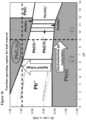
- lead precipitation can occur from the pH and potentials that are generated on the electrode surfaces. At potentials more negative than ⁇ -0.4 V vs. NHE and pH regions from 0 to 14, lead can be plated as a solid at the cathode. Precipitation at the anode can also occur as PbO 2 if the pH is kept >1.5 and potentials >0.5 V vs. NHE are used ( Figure 16 ). Finally, oxidation from H 2 O 2 generated at the cathode can also result in precipitation of target species.
- the rate of reduction of dissolved oxygen (“DO") near the cathode depends upon the oxidation of the cathode carbon, e.g., by oxidative shifting of the cathode E PZC , or as a result of use in situ.
- a faradic porosity cell comprises a series of porous carbon anodes and cathodes, typically consisting of reduced cathodes (negative E PZC and positive surface charge) and pristine anodes (although anodes experience a positive E PZC shift ((negative surface charge)) during use), and operated by applying a small voltage, e.g., 1.2 V, across the electrodes.
- a small voltage e.g., 1.2 V
- An aqueous input stream to be purified is introduced into an FPC through an inlet to the cell; the electrodes in an FPC are immersed in the aqueous stream and a target species is removed from the through stream. After removal of a target species in an FPC, the through stream is discharged from the cell through an outlet for use, storage, or further processing.
- the electrodes of the cell are connected to a power supply that can apply E+ or E- to a given electrode.
- a core inventive step of an FPC is the precise matching of E+ applied to the cell anodes and E- to cell cathodes, pore mouth diameter profile of the electrode material, and selected Pourbaix operating region, thereby improving purification efficiency and improving cost/benefit.
- a Pourbaix diagram operating region shows speciation based on applied E and pH.
- speciation is driven by the potentials, E+ and E-, applied to the electrodes.
- PMD pore mouth distribution
- a preferred average pore mouth diameter is in the range of 0.8 nm to 50 nm, and a more preferred average pore mouth diameter range is 2 nm to 20 nm.
- the applied potential causes redox reactions of the target species (e.g., plating, oxidation, reduction, peroxidation, etc.), and drives faradaic reactions on the carbon electrodes that will change the local pH regions at the anode (acidic) and cathode (basic).
- the combination of reactions of the target species and the change in pH is controlled by the applied potential.
- Applied E is typically at constant voltage and will reach a nearly constant current at steady state. Generally speaking, the applied voltage dictates which faradic reactions will occur within an FPC.
- An FPC will remove target species from a through stream without using treated (i.e., shifted E PZC ) electrodes, but target species removal may be greater in certain water chemistries when using treated electrodes. If treated electrodes are used, the working voltage window (the potential difference between anode E PZC and cathode E PZC ) is typically in the range if 0.3 V to 1.23 V.
- the FPC invention combines adsorption (physical and capacitive) of target species (e.g., lead, iron, manganese, cadmium, chromium, chlorine, chloramine, etc.) and immobilization (aka coagulation) of the adsorbed target species by optimizing electrode porosity, applied E, and Pourbaix operating region.
- target species e.g., lead, iron, manganese, cadmium, chromium, chlorine, chloramine, etc.
- immobilization aka coagulation
- Electrochemical reduction is usually described as an applied potential to the cell.
- the voltage distribution between anode and cathode occurs spontaneously based on the amount of applied voltage, the material properties of the electrodes, and the chemistry of the aqueous solution.
- One embodiment of the invention is a capacitive coagulation system and method that uses one or more capacitive coagulation cells that remove metal ions or particulate metal for which a Pourbaix diagram exists, e.g. As, Se, Pb, Ni, Zn, Al, Sc, Ti, V, Cr, Mn, Fe, Co, Ni, Cu, Y, Zr, Nb, Mo, Tc, Ru, Rh, Pd, Ag, Cd, La, Hf, Ta, W, Re, Os, Ir, Pt, Au, Hg, Ce, Pr, Nd, Pm, Sm, Eu, Gd, Tb, Dy, Ho, Er, Tm, Yb, and Lu, from an input stream by one or more of the following methods, each of which is a CCC Parameter: (i) physical adsorption; (ii) capacitive adsorption; (iii) electrochemical pH modulation & metal immobilization; (iv) electrochemical peroxide (H 2 O 2 ) generation
- Applicant's CCC Compared to prior art devices, Applicant's CCC has higher specificity for lead and other metals, removes both dissolved and particulate lead and other metals, has a device lifetime that can be measured in years rather than days or weeks, and uses low cost materials. Applicant's CCC achieves its longevity and efficiency by combining electrochemistry and carbon materials to provide a system that is not saturated, fouled, or inhibited by other constituents in the water such as iron, volatile organic compounds (VOCs), particulates, and natural organic matter (NOM). Applicant's device lifetime is multi-fold longer than the prior art technologies of carbon filtration, ion-exchange filtration, zeolite adsorbents, and reverse osmosis (RO).
- RO reverse osmosis
- Tuning a CCC primarily means selecting (i) a voltage applied between CCC anodes and cathodes based on (ii) analyzing and selecting an operating region in the target species' Pourbaix diagram, and (iii) selecting a pore mouth diameter profile of the CCC carbon electrodes that maximizes removal of a target species.
- the effluent from an CCC can be used without further processing or can be routed to one or more EDCs, CCCs, or prior art water purification cells for further removal of other target species. Tuning can optionally be further optimized through electrode treatment.
- CCC Metal speciation and chemistries can be exploited to selectively remove lead (and other target metals) from water with high efficacy and selectivity, regardless of water chemistry.
- Applicant's CCC (i) can electrochemically, chemically, and physically remove lead and other target species from drinking water sources, eliminating the need for multiple separation techniques that are currently necessary and driven by varying input stream conditions and pH, and (ii) solves the technical problem of providing a more efficient, less expensive, scalable device for purifying drinking water and process water, especially a device that removes soluble and insoluble lead to below 15 ppb. Adjustment of pH of an input stream may be necessary to improve agglutination of a target species, especially for removal of metals.
- the EDC Parameters are "tuned” to remove other non-metal target species, e.g., chlorine, chloramines, and other halides and halide derivatives, from the EDC influent.
- "Tuning" an EDC primarily means selecting (i) a voltage applied between EDC anodes and cathodes based on (ii) analyzing and selecting an operating region in the target species' Pourbaix diagram, and (iii) selecting a pore mouth diameter profile of the EDC carbon electrodes that maximizes removal of a target species.
- the effluent from an EDC can be used without further processing or can be routed to one or more EDCs, CCCs, or prior art water purification cells for further removal of other target species. Tuning can optionally be further optimized through electrode treatment. Device features and benefits are listed below and in Table 2 and Table 3 in the Drawings. Table 2. Detailed benefits of PTW EDC for chlorine removal Parameter Prior Art PTW EDC Capacity (gallons) 1000 100,000 Free Cl Removal > 99% > 99% Residence Time (seconds) 80 10-15 Operating Cost ($/1000 gallons) $20-$50 $0.1 Carbon Mass (g) 200+ 30 Footprint (sq ft) 0.133 0.130 Table 3.
- An EDC or CCC optionally uses treated anodes and cathodes made of carbon in which the one or both electrodes' Epzc has been shifted compared to a pristine electrode Epzc. Shifting the Epzc of an electrode can change the kinetics of reactions occurring (either positively or negatively). Whether to shift only anodes, or only cathodes, or both types of electrode, and how much Epzc shift to use, depends upon input water chemistry and the target species.
- Carbon electrodes are superior to metal electrodes in avoiding or reducing electrolysis, or water splitting, when potentials as high as 3 V are applied to an electrode.
- An applied potential of more than 1.23 V (“overpotential") can cause electrolysis of water, which produces dangerous hydrogen gas.
- Metal electrodes can cause hydrogen gas production at ⁇ 2 V; in contrast, carbon electrodes can sustain higher applied voltages while avoiding substantive water electrolysis.
- the inventive steps of an EDC are: (i) decreased power consumption required for reduction of chlorine and chloramines (responsible for taste and odor) through specific carbon electrodes and applied voltage, (ii) can be used on-demand or as continuous treatment, (iii) very scalable, simple design that provides significantly lower cost POU/POE devices as well as lower cost municipal, commercial, and industrial large-scale systems, (iv) similar performance to traditional carbon blocks (such as activated carbon/activated charcoal) but with significantly less carbon needed, (v) similar removal performance of free chlorine with a much shorter residence time, (vi) the use of less carbon, (vii) longer electrode life, especially for the removal of chlorine and chloramine, (viii) finer control over specific removal amounts and output water quality, (ix) better control over balancing rate of target species removal vs. electrode life, and (x) FPC cost/benefit can be adjusted by choice of carbon for FPC electrodes.
- Electrodes made of activated carbon are often employed for these capacitive-based charging and discharging processes due to (i) their high specific surface area and resulting high capacitance, and (ii) opportunities to add functional groups to effect surface modifications that improve, inter alia, metal and other target species removal, energy storage and deionization (e.g., desalination of seawater or brackish water).
- Activated carbon is a form of carbon processed to have numerous small, low-volume pores that increase the surface area available for adsorption or chemical reactions.
- An FPC can be used to purify wastewater, cooling water, laundry wastewater, water to be purified for human consumption, water to be purified for agriculture, water to be purified for horticulture, water to be purified for use in food, water to be softened, sea water to be purified for human consumption, water to be purified for laboratory use, brackish water to be purified for human consumption or agriculture use, and water to be purified for medical use.
- Electrode properties are shown in Table 4; the electrode suppliers are recited in the first column of Table 4.
- the pore size, or pore mouth diameter (“PMD”) is extremely important in terms of maintaining charge passed and is directly related to the lifetime of the EDC electrodes. PMD is customarily used as representative of the diameter of the associated pore channel within a carbon electrode.
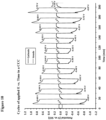
- Figure 9 demonstrates the effect of PMD on stability of charge passed. A pore channel (and even the pore mouth) may "collapse" (more accurately, the pore becomes occluded) after repeated cycles of application of a voltage or potential followed by reverse voltage or potential (or short circuiting or open circuiting of anode(s) and cathode(s)).
- the pore mouth becomes “roofed” and/or the pore channel becomes “closed”, decreasing the surface area of the carbon (esp., the pore channel diameter and length) so that the pore no longer functions effectively.
- a "roofed” pore mouth blocks access to the interior of the pore.
- Pore mouth roofing and pore channel collapse cause a decrease in electrode performance and eventual failure of prior art cells.
- Table 4 Carbon electrode properties Carbon Conductivity (S/cm) PMD (nm) Surface Area (m 2 /g) Calgon 0.2 1.2-3 1000-2000 Kynol 1.2 2.2 2000 Fuel Cell Earth 900 N/A ⁇ 2
- a target species if ionized, bearing an electrical charge, or bearing a partial charge due to the asymmetric distribution of electrons in chemical bonds, can be attracted to the carbon electrode due to the applied potential, which produces a driving force to move the target species close to (or in contact with) the carbon electrode.
- Non-ions and non-charged species of a target species can collide with an electrode surface. Once in contact with the electrode surface, numerous pathways to immobilization of the target species can occur. Local and large pH swings can be controlled to electrochemically produce an alkaline environment, which will produce, e.g., insoluble metal oxides, that precipitate near or on the electrodes and are entrapped in electrode pores.
- Faradic reactions such as oxygen reduction reactions at the cathode, can produce hydrogen peroxide which can diffuse away from the electrode and oxidize target metal molecules that are within close proximity: hydrogen peroxide performs indiscriminate oxidation. When target species closer to the electrode are in a localized higher concentration, the statistical chance for hydrogen peroxide to oxidize the target species is greater.
- Other faradic reactions such as direct electron transfer (reduction or oxidation) between the target species and electrode can also occur.
- the carbon electrode can (1) transfer an electron(s) from the electrode to the target species and reduce it so that it is deposited onto the electrode or (2) transfer an electron(s) from the target species to the carbon electrode and oxidize the target species into either an insoluble oxide or hydroxide, or into a more reactive species that can be immobilized through additional electron transfer reactions or pH adjustments. Precipitated species and electrically attracted species are entrapped in electrode pores.
- pores in activated carbon depend upon the shape, tortuosity (which is usually associated with changes in pore diameter), and channel length of a given pore.
- some pores in activated carbon can be tubular channels, polygonal channels, spheroid chambers, surface slits, etc.
- Channels and chambers can be "dead end” or "through” (i.e., a channel or chamber with two surface appearances, aka “pore mouths", with channel continuity between the two pore mouths).
- Pores in activated carbon are generalized as being tubular channels that have an average pore channel diameter (hereinafter "pore channel diameter”) and an average pore mouth diameter.
- the diameter of a pore mouth i.e., the opening of a pore to electrolyte, has a major, and in small pore mouth diameters, predominant, impact on the utilization of that pore for adsorption and on multi-cycle performance in capacitive coagulation.
- a larger pore mouth diameter (and therefore, pore mouth surface area) will provide significant contact area between the pore channel and the electrolyte.
- a small pore mouth diameter will have more limited contact area (i.e., "pore mouth surface area").
- Pore mouth diameters are defined by IUPAC as microporous, mesoporous, and macroporous with pore mouth diameters of ⁇ 2 nm, 2-50 nm, and >50 nm, respectively.
- the lifetime of an adsorption medium has a direct correlation to the pore mouth diameter present on the surface of the material.
- pore mouth roofing aka pore mouth closure, after repeated cycles of adsorption and desorption using an activated carbon electrode, is explained below.
- Applicant's device incorporating capacitive coagulation technology removed soluble (dissolved) and insoluble (particulate) lead species from tap water to well below the EPA action level in samples spiked with concentrations up to -300 ppb lead. Efficient lead removal was even demonstrated with concentrations of lead as low 5 ppb in input streams, well below the action level.
- the prototype device achieved ⁇ 90%, and frequently >99%, specificity for lead removal over other constituents commonly found in tap water, such as calcium (Ca 2+ ).
- Applicant's capacitive coagulation invention was able to achieve this performance in hard, alkaline water where lead species tend to form complexation species that are difficult to remove by commercial off-the-shelf products.
- a CCC is also unexpectedly capable of removing both soluble (dissolved) and insoluble (particulate) lead, arsenic, nickel, and copper species.
- Applicant's capacitive coagulation invention provides in one embodiment for lead removal a POU/POE water purification device capable of meeting NSF/ANSI 53 and 61 certifications at a minimum flow rate of 1 gallon per minute (gpm) regardless of input water source conditions: hardness, pH, alkalinity, and types of disinfection. Additionally, the device is (i) highly specific for target metals, e.g., arsenic, lead, nickel, copper, cadmium, lead, manganese, mercury, and radioactive metals, (ii) more reliable, (iii) more efficient, and (iv) lasts longer than state-of-the-art solutions.
- target metals e.g., arsenic, lead, nickel, copper, cadmium, lead, manganese, mercury, and radioactive metals
- Applicant's capacitive coagulation cells provide a more efficient, less expensive, and very scalable water purification device that removes soluble and insoluble lead to below 15 ppb and is suitable for residential as well as scale-up to higher-throughput systems.
- a detailed Example below focuses on lead removal using capacitive coagulation cells, but adjustment of CCC parameters permit "tuning" of a CCC to remove any other metal or metal derivative for which a Pourbaix diagram exists, such as arsenic, cadmium, manganese, and mercury, as well as Se, Ni, Zn, Al, Sc, Ti, V, Cr, Fe, Co, Ni, Cu, Y, Zr, Nb, Mo, Tc, Ru, Rh, Pd, Ag, Cd, La, Hf, Ta, W, Re, Os, Ir, Pt, Au, Ce, Pr, Nd, Pm, Sm, Eu, Gd, Tb, Dy, Ho, Er, Tm, Yb, and Lu.
- Applicant's CCC outperformed commercially available POU/POE water purification devices, such as the Brita ® Longlast TM and Brita ® PUR filters and the Calgon GAC filter material.
- the Brita ® Longlast TM pitcher filter had drastically different performance when tested on two different days based on the change in water chemistry being supplied by the municipal water system in Lexington, Kentucky. This differing performance emphasizes the need for a more reliable device that performs well in varying water chemistries that occur from day-to-day.
- Applicant's invention outperformed the Brita ® Longlast TM device in both instances.
- Soluble lead ions adsorb onto the carbon electrodes by physical and/or chemical adsorption, a process that is well documented ( J. Chem. Technol. Biotechnol. 2002, 77, 458-464, Shekinah, P.; Kadirvelu, K.; Kanmani, P.; Senthilkumar, P.; Subburam, V. and Carbon. 2004, 42, 3057-3069, Swiatkowski, A.; Pakula, M.; Biniak, S.; Walczyk, M. ), and undergo additional electro-adsorption onto the cathode under an applied potential. Modulation of the pH can also be exploited to control lead speciation in tap water. At an operating voltage of 1.2 V (as shown in Fig.
- input stream pressure is less than 60 psi, and the porosity of the electrodes typically avoids more than a 20 psi drop at an FPC outlet compared to inlet pressure.
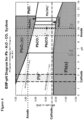
- FIG 4 in the Pourbaix diagram of lead (Pb) in a carbonate aqueous solution, shows the Pourbaix operating regions for lead species removal in a CCC at the intersection of E applied to anode and cathode.
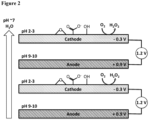
- Figure 2 shows that the pH region at the start of the cathode is acidic (pH 2-3) while at the start of the anode, it is basic (pH 9-10).
- these pH regions are a result of the reactions that take place at the electrode surfaces and yield fluctuations in pH from 2-10.
- Pb 2+ is in solution equilibrium in most of the white area (approximately pH 7) between the darker PbO 2 (s) and Pb(s) areas; however, in the solution nearest the anode and cathode, Pb 2+ becomes (i) reactive or (ii) immobilized as other Pb species.
- Figure 5 shows the reaction mechanisms by which Pb is removed from solution.
- Pb 2+ also forms ionic compounds and lead hydroxide (as shown in the middle box of Fig. 5 ) that are then oxidized into PbO 2 , Pb 3 O 4 , and Pb(OH) 2 , which reaction products are then immobilized (adsorbed).
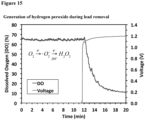
- hydrogen peroxide generated at the cathode from dissolved oxygen reduction and combined with the acidic pH emanating from the anode (pH 2 to pH 3) with an applied E of -0.4 V is a potent oxidizer. Hydrogen peroxide diffuses into the through stream, including the region near the anode where it oxidizes lead species in the intermediate reactions described above. The immobilized lead species are thereby removed from solution. Additional lead species are susceptible to immobilization through reactions with hydrogen peroxide that is generated via oxygen reduction at the cathode ("peroxidation cell"). Water Research. 2017, 120, 229-237, Tang, W.; He, D.; Zhang, C.; Kovalsky, P.; Waite, T. D. In a hybrid system, FPCs can be using in series with peroxidation cells to provide increased lead removal.
- an EDC a cascading series of chemical-electrochemical-chemical-electrochemical reactions are occurring to decompose free chlorine and chloramine.
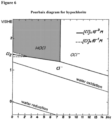
- the pH and operating voltage are correlated through the Pourbaix diagram for a target species. Examples are given below for hypochlorite, hypobromite, and monochloramine and shown in Figure 6 , Figure 7 and Figure 8 , respectively.
- the target speciation can be controlled by selecting the pH and voltage to apply. This calibration process determines and controls what species are decomposed at what voltage and in a given influent water chemistry.
- the y-axis is voltage applied between the anode and cathode vs. a standard hydrogen electrode (SHE), and the x-axis is pH.
- SHE standard hydrogen electrode
- pH 8.5 is preferred in order to provide an instantaneous reaction.
- a Pourbaix diagram for hypochlorite at an anode potential ⁇ 1.2 V vs. NHE, a cathode potential of > -1.0 V vs. NHE, and a total cell potential of ⁇ 2.2 V applied across anode and cathode, electrochemically generated hydrogen peroxide reacts with "free bromine" in solutions with pH > 7.
- Direct electrochemical reduction of hypobromous acid (HOBr) and hypobromite (OBr - ) from the carbon cathode converts them into free chloride ions and water. The bromine ion is then capacitively adsorbed (immobilized).
- a Pourbaix diagram for mono chloramine at an anode potential ⁇ 1.4 V vs. NHE, a cathode potential of > -1.0 V vs. NHE, and a total cell potential of ⁇ 2.4 V applied across anode and cathode, direct electrochemical changes in chloramine under acidic conditions produces the ammonium salt.
- Electrochemically generated (at an EDC cathode) hydrogen peroxide reacts directly with chloramine to produce a mixture of products: chloride ions, nitrite ions, protons (acid), and water.
- Chloramine reacts with electrochemically generated hydrogen peroxide to produce ammonia which will react further in 2 ways: 1) reaction with electrochemically generated hydrogen peroxide to yield nitrogen and hydrogen gas and water, or 2) reaction with acid to yield ammonium salts. Chloramine will also react directly with electrochemically generated acid in a cascade process to yield trichloramine which is converted into hypochlorous acid in water.
- EDCs typically operate with total cell potential of ⁇ 3.0 V applied across anode and cathode; depending upon target species and input water chemistry, total cell potential of ⁇ 3.0 V applied across anode and cathode in an EDC is usually between 1.0 V to 3.0 V.
- the active surface area of SC, KN, and CG carbon electrodes decreases from exposure to cycles of an applied voltage. CX's specific charge passed is stable over repeated cycles, but is lower than the other carbons tested. In contrast, Applicant's HE electrode, formulated with PMD, performs better than the other electrodes after about 220 cycles, and maintains superior performance.
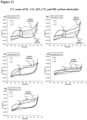
- Figure 10 shows that at a given applied voltage there will be a potential distribution between the anode and cathode in a CCC; the voltage will split between the electrodes, which may not be equal.
- the cathode may be at -0.9 V vs. SCE and the anode at +0.7 V vs. SCE ( Figure 10 ).
- This in turn affects the FPC operating parameters and frequency of polarity-switching performed in each cycle of operation in an EDC.
- the active surface area, carbon material, and applied voltage affect the potential distribution.
- the Epzc of an electrode affects the distribution of applied E during the initial use of an electrode, and the potential distribution changes slightly. Balancing of faradic reaction rates at the anode and cathode ultimately stabilize potential distribution
- a bench-scale CCC system is shown in Figure 12 .
- the capacitive coagulation system provides >50% lead removal selectivity vs. non-metal ions.
- lead removal can approach 100%.
- various oxygen-based surface groups are added to the electrode and lead removal below 15 ppb is achieved in all cases for ⁇ 50 ppb lead tap water input stream, at a CCC operating voltage of 1.2 V.
- a lead-removal CCC reduced the concentration of lead in the output stream to only 0.05 ppb, equating to 99.9% removal efficiency.
- Higher throughput CCC systems are fabricated by adding more capacitive coagulation cells and/or using larger electrodes in each cell. Such larger systems provide lead removal efficacy from 150 ppb to ⁇ 10 ppb at a flow rate of 1 gpm or higher.
- CCC systems remove lead to below EPA action levels even if the input stream has various combinations of lead content, water hardness, alkalinity, disinfectants, and pH. Water chemistry will impact lead speciation (e.g., day to day variations in municipal water chemistry, the effect of which are shown in Figure 4 above).
- lead speciation e.g., day to day variations in municipal water chemistry, the effect of which are shown in Figure 4 above.
- CCCs can remove lead in all forms (species) commonly found in drinking water sources.
- the FPC system can be designed to switch to open circuit or a small potential when not in use, and an inexpensive carbon block pre-filter is added to remove chloramines.
- An optional post-filter is added if small pieces of the carbon cloth are found to flake off over time.
- a three-electrode set-up is used with a cathode, anode, and a standard calomel electrode (SCE) as the reference.
- SCE standard calomel electrode
- the potential at each electrode is recorded at open circuit, short-circuit, and up to a voltage of 1.4 V with 0.2 V increments.
- the pH and operating voltage are correlated through the Pourbaix diagram. Based on the pH and potential distributions at each electrode, the lead speciation can be controlled by selecting what voltage to apply. This calibration process determines and controls what lead species precipitate at what voltage and in a given input stream water chemistry.
- Oxygen reduction and H 2 O 2 generation Oxygen reduction and H 2 O 2 generation. Oxygen reduction at the cathode generates H 2 O 2 that can react with lead species to facilitate the formation of lead oxides. There is a significant reduction in DO at an applied voltage of 1.2 V and measured 1.25 ppm H 2 O 2 in the filtered water. The operating voltage is controlled to amplify this reaction for maximal lead removal. Experiments conducted at open circuit, short-circuit, and up to a voltage of 1.4 V with 0.2 V increments, and the pH, DO, and H 2 O 2 concentrations at the outlet typically remove lead to below EPA action levels.
- Carbon conductivity FPC devices typically use a microporous carbon with a moderate conductivity (carbon B in Table 8).
- Table 8 Carbon properties Carbon Conductivity (S/cm) Pore Size (nm) Surface Area (m 2 /g) A 0.2 1.2-3 1000-2000 B 1.2 2.2 2000 C 900 N/A ⁇ 2
- the CCC lead removal technology relies on (i) physical adsorption; (ii) capacitive adsorption; (iii) electrochemical pH modulation and metal immobilization; (iv) electrochemical peroxide (H 2 O 2 ) generation & metal oxidation; (v) electrodeposition (e.g., electroplating, electrophoretic deposition); (vi) electrochemical oxidation; (vii) precipitation; (viii) pore mouth diameter profile, (ix) electrode treatment, (x) electrode spacing, and (xi) flow-by vs. flow-through vs. carbon block cell design.
- a combination of these factors, or a cascade of these factors, causes speciation and immobilization of target species that become trapped in the pore network of the carbon electrodes, which results in a purified effluent. It is imperative that the carbon electrodes are conductive. The more conductive the carbon material, the more uniform the current distribution was across the electrodes, which typically results in increased H 2 O 2 generation and a more efficient lead removal process.
- the pore size and surface area are related to the adsorption capacity and tortuosity of the material. Pore size and surface area also affect H 2 O 2 generation in an FPC device.
- a POU/POE FPC product design parameters include: (1) Residence time and size of device was identified to achieve a flow rate of 1.5 gpm; and (2) Effective lead removal, defined by a reduction in dissolved lead levels from 150 ppb to ⁇ 10 ppb and removal selectivity >90% over non-metal divalent ions, at 1.5 gpm for at least 150 gallons of water treated.
- the residence time is a measure of the average time a volume of water remains in the device (volume/flow rate). In other words, it is the time required to filter a given amount of water.
- the internal volume of the device and flow rate dictates the residence time.
- a residence time of 5 min typically gives the desired removal.
- the residence time for the flow rate at which the performance reaches a peak is selected as the design specification and the device is sized appropriately.
- Pressure drop The pressure drop across a FPC device is increasingly important as the flow rate increases. A pressure drop of ⁇ 20 psi is considered acceptable and is below a normal inlet water pressure for residential and municipal buildings of ⁇ 45 psi.
- Ultimate capacity of a FPC device For NSF/ANSI certification, the lead concentration must be reduced from 150 to 10 ppb, and POU systems on the market are rated to treat up to 120 gallons of water. This translates into -1 gallon of water treated per gram of carbon for a pitcher system and ⁇ 1.6 gallons of water treated per gram of carbon for an under-the-sink system.
- One embodiment of the CCC device can treat 2 gallons of water at 1.5 gpm to bring lead levels from 150 ppb to ⁇ 10 ppb. Ultimate capacity of the system is obtained from a lead removal curve. Pressure drop issues typically arise after > 1 g of lead removal per gram of FPC carbon electrode.
- CCC embodiments for POU/POE use can include a lead sensor and/or pressure drop sensor to alert a user to replace the device.
- FPC replacement threshold ranges for various embodiments.
- a CCC is replaced when the target metal concentration in the output stream exceeds the relevant threshold level, e.g., 15 ppb for lead concentration and 1.3 ppm for copper (see the Lead and Copper Rule, a regulation published by the EPA in 1991 (https://www.epa.gov/ground-water-and-drinking-water/national-primary-drinking-water-regulations ).
- the threshold level (aka sorption capacity) could be specified by a government agency, or user selected. Municipal and industrial wastewater discharge limits are different from drinking water limits; the metal concentration thresholds are typically higher. There are effluent guidelines for different industries (https://www.epa.gov/eg).
- FPC Regeneration When a FPC output stream metal concentration equals or exceeds the threshold level, rather than replacing the FPC, some types of FPCs can be regenerated (e.g., in a CCC, the adsorbed metal ions and particles desorbed (removed) from the CCC electrodes).
- CCC regeneration One method of CCC regeneration is by flushing acid through the cell to dissolve coagulated metals and regenerate the electrodes. During this "acid regeneration" step, the output stream is diverted to a receptacle in which the highly concentrated waste stream is collected for other processing.
- CCC regeneration After an acid regeneration step, the CCC is flushed with water until the output stream reaches pH 7 (or other target pH) before normal CCC operation (i.e., removal of metal ions and particles from the through stream) is resumed.
- Another method of CCC regeneration is by electrolysis or electrochemical regeneration in an acidic solution; electrolysis (aka electrochemical) regeneration converts metal oxides to soluble metal ions, which are then flushed out of the CCC with water and collected in a waste receptacle.
- Electrolysis is an electrochemical reaction that requires the application of an external voltage to drive a reaction that is non-spontaneous. Any insoluble metal species that have formed on the electrodes can be dissolved into solution using a small voltage, typically up to 5 V, applied across the CCC.
- CCC regeneration can also be a sequence of acid regeneration followed by electrolysis, or vice versa.
- FPCs in series, each of which FPCs targets the same or a different species.
- Multiple FPCs connected in series tuned to remove the same target species act to successively reduce the concentration of the target species in a single pass of an input stream through the FPCs connected in series (accomplishing the same level of target species removal as operating a single cell in batch mode multiple times).
- Adjustment of FPC Parameters e.g., pH of the through stream and voltage applied to the cell electrodes of a given cell, of multiple cells connected in series to different FPC Parameters and EDC Parameters, as the case may be, enable each cell in a series to remove a different target species from the through stream in a single pass.
- Pourbaix diagrams which show the speciation of a target species at a given voltage and pH, best illustrate the "cell series" concept. Pourbaix diagrams for lead ( Figure 16 ) and copper ( Figure 17 ) are used to explain the immobilization of different metals in a CCC series.
- the horizontal dashed lines represent the applied voltage; the applied voltage can move along the vertical axis.
- the vertical dashed lines represent the pH; the pH can move along the horizontal axis. The region where these lines intersect represents the species of the metal that will exist at these conditions.
- the operating conditions depicted in Figure 16 and Figure 17a would immobilize (adsorb on a CCC electrode) Pb and Cu as PbO 2(s) ( Figure 16 ) and Cu(OH) 2(s) ( Figure 17 ), effectively removing each metal from the feed stream.
- the operating conditions depicted in Figure 17b would electrodeposit or electroplate Cu on the electrode as Cu (s) .
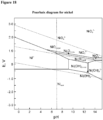
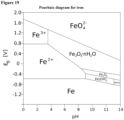
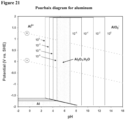
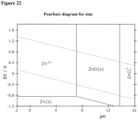
- Pourbaix diagrams for nickel, iron, manganese, aluminum, and zinc have also been included ( Figure 18 to Figure 22 ). A similar approach to manipulating the applied voltage and pH can be taken to remove these metals.
- the operating conditions selected to form insoluble species may differ for each target species, and there could be several possibilities for a given target species depending on the speciation depicted in the Pourbaix diagram.
- Applied voltage and electrochemical pH modulation are selected to remove target species of Ni, Fe, Mn, Al, and Zn from CCC influent using the Pourbaix diagrams shown in Figures 18-22 , respectively, as explained below.
- Those of skill in the art can select an applied voltage and electrochemical pH modulation to remove a given species of a target element or complex. Copper is removed by the CCC via electrodeposition, hydroxide precipitation, and/or oxidation to copper oxides.
- FPC control system FPC Parameters for a given FPC are monitored and controlled using a computer system that monitors and/or controls various sensors, interfaces, valves, and peripheral equipment, and is commonly known as a process control computer (aka processs controller), a computer generally associated with continuous or semi-continuous production operations involving materials such as chemicals and petroleum, whether in liquid, solid, or gas phases.
- process control computer aka processs controller
- the process control computer enables FPC Parameters to be applied to one or more FPCs in a system and changes in through-stream routing, e.g, changes that convert a series system architecture to a series-parallel system architecture.
- Performance tests of EDCs were conducted to verify removal of total chlorine, free chlorine, chloramine, and peroxide (H 2 O 2 ) using carbon electrodes and voltages of ⁇ 3.0 V. Measurements were made using analytical test kits. Experiments were conducted with a flow-by cell design and 14 pairs of electrodes in an alternating series of anode-cathode-anode-cathode (variable number of repeats of anode-cathode) anode-cathode ( Figure 23 ). In the flow-by design shown in Figure 23 , the input stream proceeds through an annular space near the wall of the cell container, then flows centripetally over the electrode surfaces to the axial channel, and is then discharged through the axial channel to the FPC outlet.
- a positive voltage is applied to the anodes and a negative voltage is applied to the cathodes.
- the polarity of the voltage applied to a given electrode is periodically switched (converting each anode into a cathode, and each cathode into an anode) to ensure that all electrodes degrade at the same rate and to extend the lifetime of the EDC device.
- An example is shown in Figure 24 .
- the polarity-switching interval for a given EDC can be arbitrarily set (e.g., every hour) or can be set based on one or more EDC parameters, e.g., current threshold, voltage threshold, rate of current decrease at constant voltage, percentage of current decrease at constant voltage, rate of voltage decrease at constant current, percentage of voltage decrease at constant current, total volume treated, and concentration of target species in EDC effluent.
- EDC parameters e.g., current threshold, voltage threshold, rate of current decrease at constant voltage, percentage of current decrease at constant voltage, rate of voltage decrease at constant current, percentage of voltage decrease at constant current, total volume treated, and concentration of target species in EDC effluent.
- Preferred polarity-switching points are (i) a percentage decrease in current at a constant applied voltage, (ii) a percentage increase in voltage at a constant applied current, (iii) total volume treated, and (iii) concentration of target species in effluent.
- Electrode properties are shown in Table 4.
- Capacitive coagulation experiments were conducted to test Cu removal using 16 pairs of carbon electrodes ( ⁇ 13 g of carbon), in which the cathodes were pristine SC and the anodes were nitric acid oxidized SC.
- the FPC was operated at short-circuit (0 V).
- a 1 L feed solution of ⁇ 100 ppm Cu [Cu(NO 3 ) 2 ] in direct injection (“DI") H 2 O was treated at a flow rate of 20 ml/min.
- Samples were analyzed by inductively coupled plasma (ICP) with optical emission spectrometer (OES) and the results in Table 9 show that approximately 1/3 of the Cu was removed in a single pass.
- Table 9 ICP-OES results for Cu 2+ removal Sample Cu 2+ Concentration (ppm) Untreated 96 Treated 66
- Capacitive coagulation experiments were conducted to test Cu removal using 12 pairs of carbon electrodes (-10 g of carbon), in which the cathodes and anodes were both pristine SC.
- the FPC was operated at an applied potential of 1.2 V on the cathode.
- a 18.5 L feed solution of ⁇ 50 ppm Cu [Cu(NO 3 ) 2 ] and ⁇ 50 ppm Ca (CaCl 2 ) in DI H 2 O was treated at a flow rate of 20 ml/min.
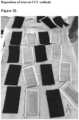
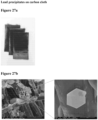
- Cu plated out of solution onto the cathode shown as a grayish deposit in Figure 25a .
- Capacitive coagulation experiments were conducted to test Fe removal using 16 pairs of carbon electrodes (-14 g of carbon), in which the cathodes were pristine SC and the anodes were nitric acid oxidized SC. The cell was operated at short-circuit (0 V).
- a 18.5 L feed solution of 100 ppm Fe [Fe(Cl) 3 ] or 25 ppm FeCl 3 in DI H 2 O was treated at a flow rate of 20 ml/min.
- the concentration of Fe steadily decreased with treatment, ICP-OES results are shown in Table 13.
- ICP-OES results for Fe 2+ removal Sample Fe 2+ Concentration (ppm) Untreated 5.73 Treated 0.10
- Table 23 The experimental results in Table 23 are for pristine anodes and nitric acid oxidized cathodes.
- the measured concentrations of Pb are below the spiked value of ⁇ 50 ppb.
- the pH was close to 9 and there was likely insoluble Pb species not being accounted for in the measurement.
- An orange precipitate was also observed on the last pristine piece of carbon (anode), visible on the perimeter of the filter paper.
- Table 24 The experimental results in Table 24 are for pristine anodes and oven oxidized cathodes at 340°C for 72 h. Pb removal was observed at short-circuit and 1.2 V. The dissolved oxygen (DO) was also monitored throughout the experiment and decreased with applied voltage, suggesting that oxygen is being reduced to H 2 O 2 (Table 25). Table 24.
- Fuel Cell Earth (www.fuelcellstore.com) is a graphitic cloth and is highly conductive. Results are shown in Table 30 and Table 31. There was no measurable current in either case, owing to its very low surface area. When the cell was taken apart after the first experiment (Table 30) there was orange precipitate on all filter paper, regardless of location in the cell. The experiment was repeated with pristine carbon for both the anode and cathode, and samples were taken after 3 h of cycling as opposed to a single pass (Table 31). In this case there was no lead removal at open circuit, some at short-circuit, and much more at an applied potential of 1.2 V. The DO remained unchanged regardless of applied potential, and H 2 O 2 was measured to be 0 ppm at 1.2 V.
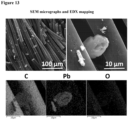
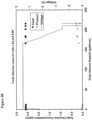
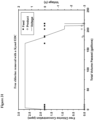
- Breakthrough curves were obtained for packed columns of pristine or nitric acid oxidized carbon ( ⁇ 5 g) and 1 L of ⁇ 150 ppb Pb [Pb(NO 3 ) 2 tap H 2 O was filtered at a flow rate of 20 mL/min (Table 34 and Table 35).
- Pb removal is occurring via physical adsorption (passive filtration) as opposed to capacitive adsorption and coagulation (active filtration) with our device.
- the initial Pb concentration decreases dramatically, but both carbons saturate quickly at ⁇ 0.3 L of water treated and become ineffective.
- Pristine carbon appears to be more effective for physical adsorption of lead as compared to oxidized carbon at the conditions tested.
- a rolled cell design was used for capacitive coagulation experiments with a 1.5 L feed solution of ⁇ 150 ppb Pb [Pb(NO 3 ) 2 ] in tap H 2 O, -14 g of carbon electrodes, pristine anodes and nitric acid oxidized cathodes, and flow rates of 50, 100 , and 200 mL/min, all showed Pb removal to below the federal action level of 15 ppb in a single pass (Table 41).
- the cell was operated at an applied potential of 1.2 V. Samples were taken before and after filtration with the cell and the Pb 2+ concentration measured with a handheld sensor from ANDalyze. Table 41.
- a rolled cell design was used for capacitive coagulation experiments with a 1.5 L feed solution of -50 ppb Pb [Pb(NO 3 ) 2 ] and 2.5 ppm Pb in tap H 2 O, as well as -10 ppm Cu in tap water.
- Pb removal was below the federal action level of 15 ppb for the lower concentration and ⁇ 1 ppm for the higher concentration (Table 42).
- Cu removal was >99% (Table 43).
- a schematic of a rolled cell is shown in Figure 29 . Table 42. Results for Pb removal from tap water with a rolled cell architecture. Feed 2 was adjusted to pH 5.08 with sulfuric acid.
- Reverse osmosis (RO) concentrate, or brine, containing multiple metal species, Cu, Fe, and Mn, at concentrations in the ppb range was used for flow-by capacitive coagulation experiments. Flow rates of 0.1, 0.5, and 1.0 L/min were tested at 1.2 V. Cu was reduced by >99%, Fe by >99%, and Mn by >74% (Table 47). Table 47. ICP-MS results for metals removal from reverse osmosis (RO) brine at increasing flow rates.
- Chloramine was estimated from the difference between total and free chlorine. Free chlorine removal of >99% and chloramine removal of up to 99% was obtained. A voltage ⁇ 3.0 V was applied to the cell during operation. Flow rates of 100 to 500 ml/min were tested. A total of ⁇ 210 gallons of water was treated before degradation in performance was observed, strictly due to charge loss from pore collapse.
- Oxidized Kynol (nitric acid treatment) was used as the anode and pristine Kynol as the cathode when V > 0; electrodes are switched when V ⁇ 0.
- Total chlorine in the feed (influent) and product (effluent) streams is shown in Figure 30 ; a clear reduction of total chlorine in the effluent was observed.
- Figure 31 and Figure 32 show the concentration of free chlorine and chloramine in the feed and product streams, respectively.
- Figure 33 shows the % removal of each disinfectant. Free chlorine removal of >99% and chloramine removal of -80% was obtained. Peroxide removal of up to 100% was also achieved after treatment with the EDC.
- Oxidized Kynol (nitric acid treatment) was used as the cathode and Fuel Cell Earth as the anode.
- Total chlorine in the feed and product streams is shown in Figure 34 ; a clear reduction of total chlorine in the effluent was observed at an applied voltage of 2.0 V.
- Figure 35 and Figure 36 show the concentration of free chlorine and chloramine in the feed and product streams, respectively.
- Figure 37 the % removal of each disinfectant. Free chlorine removal of > 99% and chloramine removal of -40% was obtained. Peroxide removal of -60% was also achieved after treatment with the EDC.
- Oxidized Calgon (nitric acid and electrochemical treatment) was used as the anode and pristine Calgon as the cathode when V > 0; electrodes are switched when V ⁇ 0.
- Total chlorine in the feed and product streams is shown in Figure 38 ; a clear reduction of total chlorine in the effluent was observed.
- Figure 39 and Figure 40 show the concentration of free chlorine and chloramine in the feed and product streams, respectively.
- Figure 41 shows the % removal of each disinfectant. Free chlorine removal of up to 96% and chloramine removal of -57% was obtained. Peroxide removal of -57% was also achieved after treatment with the EDC.
- an electrochemical device for purifying a target ionic species by at least partially removing or reducing the target ionic species from an aqueous solution using faradaic immobilization includes at least one first electrode that includes an activated carbon film having a void fraction (void ratio) of about 30% to about 65% and a surface area of about 1200 square meters per gram (m 2 /g) to about 1400 square meters per gram and at least one second electrode that includes a carbon-based material having a void fraction of about or greater than 95% and a surface area of about 0.1 square meters per gram to about 5 square meters per gram.
- an electrochemical device for at least partially removing or reducing a target ionic species from an aqueous solution using faradaic immobilization includes at least one first electrode that includes an activated carbon film having a void fraction of about 30% to about 65% and a surface area of about 1200 square meters per gram to about 1400 square meters per gram; and at least one second electrode that includes a carbon-based material having a void fraction of about 70% to about 99.9% and a surface area of about 1200 square meters per gram to about 2300 square meters per gram.
- an electrochemical device for at least partially removing or reducing a target ionic species from an aqueous solution using faradaic immobilization includes at least one first electrode that includes a carbon-based material having a void fraction of about or greater than 95% and a surface area of about 0.1 square meters per gram to about 5 square meters per gram, and at least one second electrode that includes a carbon-based material having a void fraction of about 65% to about 99.9% and a surface area of about 700 square meters per gram to about 2300 square meters per gram.
- Electrochemical devices are used to purify target ionic species by at least partially removing or reducing the target ionic species from the aqueous solution.
- the target ionic species e.g., metals
- the target ionic species include silver, copper, chromium, lead, manganese, nickel, zinc, chlorine, chloramine, or any combination thereof.
- the chromium is Cr (VI) and is reduced to Cr (III).
- the electrochemical device is a rolled device. According to other embodiments, the electrochemical device is a stacked device that includes a plurality of the at least one first electrode and a plurality of the at least one second electrode.
- the at least one first and the at least one second electrode are asymmetric.
- the at least one first electrode having a low void fraction (about 30% to about 65%) and a high surface area (about 1200 square meters per gram (m 2 /g) to about 1400 square meters per gram).
- the at least one second electrode has either 1) a high void fraction (about or greater than 95%) and a low surface area (about 0.1 square meters per gram to about 5 square meters per gram), or 2) a high void fraction (about 70% to about 99.9%) and a high surface area (about 1200 to about 2300 square meters per gram).
- the at least one first electrode having a high void fraction (about or greater than 95%) and a low surface area (about 0.1 square meters per gram to about 5 square meters per gram)
- the at least one second electrode has a high void fraction (about 65% to about 99.9%) and a high surface area (about 700 to about 2300 square meters per gram).
- the asymmetry of the electrodes provides a desired voltage distribution across the device, which equates to a different voltage at each electrode, to control the speciation of the target ionic species at the anode and the cathode.
- the applied voltage will split between the at least one first electrode (for example, an anode) and the at least one second electrode (for example, cathode) according to the electrodes' material properties, such as mass, area, surface area, resistance, etc.
- V voltage
- I current
- R resistance
- i current density
- A cross-sectional area
- an electrode with a larger area will require less current density to maintain the applied voltage.
- a more resistive electrode will require less current density to maintain the applied voltage.
- Equation 2 the subscript tot is total, a is anode, and c is cathode.
- the voltage will split according to the Equation 2. This translates into less voltage at the higher surface area electrode and more voltage at the lower surface area electrode.
- the at least one first electrode having a low void fraction (about 30% to about 65%) and high surface area (about 1200 square meters per gram (m 2 /g) to about 1400 square meters per gram) and the at least one second electrode having a high void fraction (about or greater than 95%) and low surface area (about 0.1 square meters per gram to about 5 square meters per gram)
- the at least one second electrode would receive more voltage than the at least one first electrode during device operation because it has the lower surface area of the two.
- the at least one first electrode having a high void fraction (about or greater than 95%) and low surface area (about 0.1 square meters per gram to about 5 square meters per gram), and the at least one second electrode having a high void fraction (about 65% to about 99.9%) and high surface area (about 700 square meters per gram (m 2 /g) to about 2300 square meters per gram), the at least one first electrode would receive more voltage than the at least one second electrode during device operation because it has the lower surface area of the two.
- Non-limiting examples of activated carbon films for the at least one first electrode include KR-LC, which is carbon film made of Kuraray YC-60F powder with a binder, and Maxwell, which is a carbon film (see Table 48 below for carbon properties).
- KR-LC which is carbon film made of Kuraray YC-60F powder with a binder
- Maxwell which is a carbon film (see Table 48 below for carbon properties).
- a non-limiting example of a carbon felt for the at least one first electrode includes a Sigracell carbon felt (see Table 48 below for carbon properties).
- the at least one second electrode is a carbon based felt, carbon based woven cloth, or activated carbon nonwoven felt.
- a non-limiting example of a carbon felt for the at least one second electrode (a high void fraction (about or greater than 95%) and low surface area (about 0.1 square meters per gram to about 5 square meters per gram)) includes a Sigracell carbon felt (see Table 48 below for carbon properties).
- a non-limiting example of a woven cloth for the at least one second electrode includes a Kynol (see Table 48 for carbon properties).
- a non-limiting example of an activated carbon nonwoven felt for the at least one second electrode includes a Haycarb (see Table 48 for carbon properties).
- a non-limiting example of a woven cloth for the at least one second electrode includes a Sigracell (see Table 48 for carbon properties).
- Non-limiting examples of a woven cloth for the at least one second electrode having a high void fraction (about 65% to about 99.9%) and high surface area (about 700 square meters per gram (m 2 /g) to about 2300 square meters per gram) include a Calgon and a Kynol (see Table 48 for carbon properties).
- a non-limiting example of an activated carbon nonwoven felt for the at least one second electrode having a high void fraction (about 65% to about 99.9%) and high surface area (about 700 square meters per gram (m 2 /g) to about 2300 square meters per gram) includes a Haycarb (see Table 48 for carbon properties).
- Void ratio describes the open porosity of a carbon material and how easily an aqueous solution can flow through the carbon material.
- void fraction also referred to as void ratio
- water flows through an electrode with a high porosity about or greater than 95%, about 65% to about 99.9%, or about 70% to about 99.9% void fraction
- the aqueous solution does not flow through an electrode with a low porosity (about 30% to about 65% void fraction).
- the at least one first electrode with the activated carbon film is microporous and includes a binder.
- the binder of the activated carbon film include polyvinylidene fluoride (PVDF), polytetrafluoroethylene (PTFE), sodium alginate, sodium-carboxymethyl cellulose, an ion exchange binder or a combination thereof.
- the activated carbon film of the at least one first electrode has a void fraction of about 30% to about 65%. Still yet, in other embodiments, the activated carbon film of the at least one first electrode has a void fraction of about or in any range between about 30%, 35%, 40%, 45%, 50%, 55%, 60%, and 65%. In another embodiment, the activated carbon film of the at least one first electrode has a void fraction of about 30% to about 60%.
- the activated carbon film of the at least one first electrode has a surface area of about 1200 to about 1400 square meters per gram. Still yet, in other embodiments, the activated carbon film of the at least one first electrode has a surface area of about or in any range between about 1200, 1220, 1240, 1260, 1280, 1300, 1320, 1320, 1340, 1360, 1380, and 1400 square meters per gram.
- the at least one first electrode (the negative electrode) is a cathode
- the at least one second electrode (the positive electrode) is an anode. In other embodiments, the at least one first electrode is an anode, and the at least one second electrode is a cathode.
- the at least one first electrode that includes the carbon-based material is a carbon felt.
- the at least one first electrode has a void fraction of about or greater than 95%.
- the at least one first electrode has a void fraction of about, greater than, or in any range between about 95%, 96%, 97%, 98%, 99%, and 99.9%, for example about 95% to about 99%, about 95% to about 98%, about 95% to about 97%, and about 95% to about 96%.
- the at least one first electrode has a surface area of less than 5 square meters per gram.
- the at least one first electrode has a surface area of about or in any range between about 0.1, 0.2, 0.3, 0.4, 0.5, 0.6, 0.7, 0.8, 0.9, 1.0, 1.2, 1.4, 1.6, 1.8, 2.0, 2.2, 2.4, 2.6, 2.8, 3.0, 3.2, 3.4, 3.6, 3.8, 4.0, 4.2, 4.4, 4.6, 4.8, and 5.0 square meters per gram.
- the at least one second electrode that includes the carbon-based material is a carbon felt.
- the at least one second electrode has a void fraction of about or greater than 95%.
- the at least one second electrode has a void fraction of about, greater than, or in any range between about 95%, 96%, 97%, 98%, 99%, and 99.9%, for example about 95% to about 99%, about 95% to about 98%, about 95% to about 97%, and about 95% to about 96%.
- the at least one second electrode has a surface area of less than 5 square meters per gram.
- the at least one second electrode has a surface area of about or in any range between about 0.1, 0.2, 0.3, 0.4, 0.5, 0.6, 0.7, 0.8, 0.9, 1.0, 1.2, 1.4, 1.6, 1.8, 2.0, 2.2, 2.4, 2.6, 2.8, 3.0, 3.2, 3.4, 3.6, 3.8, 4.0, 4.2, 4.4, 4.6, 4.8, and 5.0 square meters per gram.
- the at least one second electrode that includes the carbon-based material is a nonwoven carbon felt or a woven cloth. In one or more embodiments, the at least one second electrode has a void fraction of about 70% to about 99.9%. In other embodiments, the at least one second electrode has a void fraction of about or in any range between about 70%, 72%, 75%, 77%, 80%, 82%, 85%, 87%, 90%, 92%, 95%, 97%, 99%, and 99.9%. In some embodiments, the at least one second electrode has a surface area of about 1200 to about 2300 square meters per gram.
- the at least one second electrode has a surface area of about or in any range between about 1200, 1250, 1300, 1350, 1400, 1450, 1500, 1550, 1600, 1650, 1700, 1750, 1800, 1850, 1900, 1950, 2000, 2050, 2100, 2150, 2200, 2250, and 2300 square meters per gram.
- the at least one second electrode that includes the carbon-based material is a nonwoven felt or a woven cloth. In one or more embodiments, the at least one second electrode has a void fraction of about 65% to about 99.9%. In other embodiments, the at least one second electrode has a void fraction of about, or in any range between about 65%, 68%, 70%, 72%, 75%, 78%, 80%, 82%, 85%, 88%, 90%, 92%, 95%, 97%, 99%, and 99.9%. In some embodiments, the activated carbon film of the at least one second electrode has a surface area of about 700 to about 2300 square meters per gram.
- the activated carbon film of the at least one second electrode has a surface area of about or in any range between about 700, 750, 800, 850, 900, 950, 1000, 1050, 1100, 1150, 1200, 1250, 1300, 1350, 1400, 1450, 1500, 1550, 1600, 1650, 1700, 1750, 1800, 1850, 1900, 1950, 2000, 2050, 2100, 2150, 2200, 2250, and 2300 square meters per gram.
- Table 48 shows properties of the various carbon materials used.
- the open porosity / void fraction and specific surface area of each electrode are important for maintaining passing charge and are directly related to the lifetime of the electrodes.
- the cathode gains electrons and is reduced, while the anode loses electrons and is oxidized.
- the pores collapse, effectively reducing its specific surface area, and the amount of charge it can pass.
- the anode may completely lose all capacity to hold a charge; the device may drop in performance and ultimately may stop functioning for its intended purpose.
- Table 49 shows the results of specific silver removal from water.
- the electrodes used in this study were Kynol (cathode) and Sigracell (anode) using an applied potential of 1.2 volt (V). The electrodes were selected to keep the cathode potential from entering a Cu 2+ reduction region, which would happen if the electrodes chosen were Sigracell (cathode) and KR-LC (anode).
- An analysis on the raw and treated product waters are shown in Table 49. Silver was removed selectively from a highly concentrated copper sulfate solution (starting concentration of 69.2 g/L).
- Cr(VI) reduction is also preferentially carried out in a Sigracell (cathode) / KR-LC (anode) ElectraMet cartridge over Cu 2+ reduction, when present as well as at voltages of 1.2 V and below.
- Sigracell cathode
- KR-LC anode
- ElectraMet cartridge mentioned herein containing a Sigracell cathode and KR-LC anode at applied voltages of 0.4, 0.6, 0.8, 1.0, and 1.2 V.
- Table 52 shows the results of removing lead using asymmetric carbon electrodes.
- Cathode/anode combinations included Kynol/Sigracell, Kynol/Calgon, and Haycarb/Kynol. As shown, the Kynol cathode/Sigracell anode combination resulted in 94.98% lead removal. Table 52.
- Mn removal from groundwater was also examined as shown in Table 54.
- three different ElectraMet cartridge types were examined for the removal of Mn from a raw groundwater stream: (1) Kynol (cathode) / Sigracell (anode) showed 80-90% Mn removal; (2) KR-LC (cathode) / Sigracell (anode) showed >99% Mn removal; Sigracell (cathode) / KR-LC (anode) showed ⁇ 20% Mn removal. Cell voltages of 0.8-1.5 V were used. Table 54.
- Nickel removal was examined using ElectraMet cartridges built using a variety of porous carbon electrodes showing varying degrees of removal from Ni-spiked tap water. As shown in Table 55, the best removal achieved was with a low surface area porous carbon cathode (Sigracell) and a mesoporous carbon anode (Calgon) at 2.0 V, where nearly 80% of Ni was removed. Table 55.
- Nickel removal with asymmetric electrodes Cathode Anode Voltage / V Ni Feed / ppm Ni Effluent / ppm Ni Removed / ppm Removal % Kynol Calgon 1.2 8.84 7.34 1.5 16.97% 1.6 8.84 7.25 1.59 17.99% 2 8.84 6.48 2.36 26.70% Sigracell Calgon 1.2 4.88 3.73 1.15 23.57% 1.6 4.88 2.5 2.38 48.77% 2 4.88 1.03 3.85 78.89% Calgon Sigracell 2.5 4.88 2.86 2.02 41.39%
- Zinc removal was examined using ElectraMet cartridges built using a variety of porous and dense carbon electrodes showing varying degrees of removal from Zn-spiked tap water, as shown in Table 56.
- a porous carbon cathode Kel, Haycarb, Sigracell
- a dense carbon anode Maxwell
- cell voltages 1.5-2.5 V
- up to 95% removal of Zn was found.
- a dense carbon cathode was combined with a porous carbon anode, the best removal was achieved at 2.5 V of approximately 65%. At lower cell voltages, the overall percent removal of Zn was much lower, between 22-55% removal. Table 56.
- Chlorine/chloramine removal was carried out with cathode/anodes of Sigracell/Maxwell, Kynol/Maxwell, Kynol/Sigracell, Haycarb/Maxwell, and Haycarb/2x Maxwell (wherein 2x means 2 layers of Maxwell were stacked to increase the mass of the anode).
- Table 57 and Figures 42 and 43 show the testing results that were carried out with a Haycarb cathode and 2x Maxwell anode.
- the feed is the starting concentrations
- the product is after purification
- the removal is the % removed.
- Average feed total chlorine was 2.73 parts per million (ppm). The average product free chlorine concentration was 0.01 ppm with an average product chloramine concentration of 0.12 ppm. Table 57. Chlorine/chloramine removal with asymmetric electrodes Feed Product Removal Total Cl (ppm) Free Cl (ppm) Chloramine (ppm) Total Cl (ppm) Free Cl (ppm) Chloramine (ppm) Total Cl (ppm) Free Cl (ppm) Chloramine (ppm) 2.46 0.30 2.16 0.24 0 0.24 90% 100% 89% 2.73 0.66 2.07 0.2 0 0.2 93% 100% 90% 2.45 0.82 1.63 0.18 0 0.18 93% 100% 89% 2.31 1.97 0.34 0.12 0 0.12 95% 100% 65% 2.67 0.48 2.19 0.19 0 0.19 93% 100% 91% 2.88 0.36 2.52 0.19 0 0.19 93% 100% 92% 2.72 0.51 2.21 0.21 0 0.21 92% 100% 90% 2.54 0.51 2.03 0.16 0.15 0.01 94% 71% 100% 2.71
- the present invention is directed to an electrochemical device for at least partially removing or reducing a target ionic species from an aqueous solution using faradaic immobilization
- the electrochemical device including: at least one first electrode including an activated carbon film having a void fraction of about 30% to about 65% and a surface area of about 1200 square meters per gram (m 2 /g) to about 1400 square meters per gram; and at least one second electrode including a carbon-based material having a void fraction of about or greater than 95% and a surface area of about 0.1 square meters per gram to about 5 square meters per gram.
- Another aspect of invention is directed to an electrochemical device for at least partially removing or reducing a target ionic species from an aqueous solution using faradaic immobilization, the electrochemical device including: at least one first electrode including an activated carbon film having a void fraction of about 30% to about 65% and a surface area of about 1200 square meters per gram to about 1400 square meters per gram; and at least one second electrode including a carbon-based material having a void fraction of about 70% to about 99.9% and a surface area of about 1200 square meters per gram to about 2300 square meters per gram.
- Yet another aspect of invention is directed to an electrochemical device for at least partially removing or reducing a target ionic species from an aqueous solution using faradaic immobilization
- the electrochemical device including: at least one first electrode including a carbon-based material having a void fraction of about or greater than 95% and a surface area of about 0.1 square meters per gram to about 5 square meters per gram; and at least one second electrode comprising a carbon-based material having a void fraction of about 65% to about 99.9% and a surface area of about 700 square meters per gram to about 2300 square meters per gram.
Landscapes
- Chemical & Material Sciences (AREA)
- Life Sciences & Earth Sciences (AREA)
- Chemical Kinetics & Catalysis (AREA)
- Engineering & Computer Science (AREA)
- General Chemical & Material Sciences (AREA)
- Hydrology & Water Resources (AREA)
- Electrochemistry (AREA)
- Environmental & Geological Engineering (AREA)
- Water Supply & Treatment (AREA)
- Organic Chemistry (AREA)
- Health & Medical Sciences (AREA)
- Analytical Chemistry (AREA)
- Molecular Biology (AREA)
- Water Treatment By Electricity Or Magnetism (AREA)
- Battery Electrode And Active Subsutance (AREA)
Applications Claiming Priority (3)
| Application Number | Priority Date | Filing Date | Title |
|---|---|---|---|
| US17/369,346 US12421616B2 (en) | 2017-05-18 | 2021-07-07 | Faradic porosity cell |
| EP22748608.1A EP4367068A1 (de) | 2021-07-07 | 2022-07-06 | Faradaische porositätszelle |
| PCT/US2022/036177 WO2023283215A1 (en) | 2021-07-07 | 2022-07-06 | Faradaic porosity cell |
Related Parent Applications (1)
| Application Number | Title | Priority Date | Filing Date |
|---|---|---|---|
| EP22748608.1A Division EP4367068A1 (de) | 2021-07-07 | 2022-07-06 | Faradaische porositätszelle |
Publications (2)
| Publication Number | Publication Date |
|---|---|
| EP4421044A2 true EP4421044A2 (de) | 2024-08-28 |
| EP4421044A3 EP4421044A3 (de) | 2024-12-11 |
Family
ID=82748405
Family Applications (2)
| Application Number | Title | Priority Date | Filing Date |
|---|---|---|---|
| EP24185554.3A Pending EP4421044A3 (de) | 2021-07-07 | 2022-07-06 | Faradaische porositätszelle |
| EP22748608.1A Pending EP4367068A1 (de) | 2021-07-07 | 2022-07-06 | Faradaische porositätszelle |
Family Applications After (1)
| Application Number | Title | Priority Date | Filing Date |
|---|---|---|---|
| EP22748608.1A Pending EP4367068A1 (de) | 2021-07-07 | 2022-07-06 | Faradaische porositätszelle |
Country Status (3)
| Country | Link |
|---|---|
| EP (2) | EP4421044A3 (de) |
| KR (1) | KR20240014509A (de) |
| WO (1) | WO2023283215A1 (de) |
Families Citing this family (1)
| Publication number | Priority date | Publication date | Assignee | Title |
|---|---|---|---|---|
| US12421616B2 (en) | 2017-05-18 | 2025-09-23 | Powertech Water Inc. | Faradic porosity cell |
Family Cites Families (3)
| Publication number | Priority date | Publication date | Assignee | Title |
|---|---|---|---|---|
| US6350520B1 (en) * | 1998-08-26 | 2002-02-26 | Reticle, Inc. | Consolidated amorphous carbon materials, their manufacture and use |
| FR2994565A1 (fr) * | 2012-08-20 | 2014-02-21 | Centre Nat Rech Scient | Piegeage reversible sur carbone actif |
| CN109863129A (zh) * | 2016-11-24 | 2019-06-07 | 旭化成株式会社 | 碳泡沫、膜电极复合体 |
-
2022
- 2022-07-06 KR KR1020237045087A patent/KR20240014509A/ko active Pending
- 2022-07-06 EP EP24185554.3A patent/EP4421044A3/de active Pending
- 2022-07-06 EP EP22748608.1A patent/EP4367068A1/de active Pending
- 2022-07-06 WO PCT/US2022/036177 patent/WO2023283215A1/en not_active Ceased
Non-Patent Citations (35)
| Title |
|---|
| AKSHAY P., WATER TREATMENT SYSTEMS (POE) MARKET BY TECHNOLOGY (WATER SOFTENERS, FILTRATION METHODS, REVERSE OSMOSIS, DISTILLATION SYSTEMS, DISINFECTION METHODS AND OTHERS), BY APPLICATION (RESIDENTIAL AND NON-RESIDENTIAL) - GLOBAL FORECAST TO 2020, MARKETSANDMA, 19 January 2018 (2018-01-19), Retrieved from the Internet <URL:https://www.linkedin.com/pulse/point-of-entry-water-treatment-systems-market-worth-569-akshay-p> |
| AVRAHAM, E.NOKED, E. M.SOFFER, A.AURBACH, D.: "The feasibility of boron removal from water by capacitive deionization", ELECTROCHIMICA ACTA., vol. 121, 2011, pages 6312 - 6317, XP028230348, DOI: 10.1016/j.electacta.2011.05.037 |
| BROWN, R.MCTIGUE, N.CORNWALL, D.: "Newport News", 2015, AMERICAN WATERWORKS ASSOCIATION AND WATER RESEARCH FOUNDATION, article "Controlling Lead in Drinking Water" |
| CBS SF BAY AREA, HIGH LEAD LEVELS FOUND IN WATER FOUNTAINS AT BERKELEY SCHOOLS, 25 January 2018 (2018-01-25), Retrieved from the Internet <URL:http://sanfrancisco.cbslocal.com/2018/01/25/lead-found-in-drinking-water-at-berkeley-schools> |
| CIESIELCZYK, F.BARTCZAK, P.WIESZCZYCKA, K.SIWINSKA-STEFANSKA, K.NOWACKA, M.JESIONOWSKI, T.: "Adsorption of Ni(II) from model solutions using co-precipitated inorganic oxides", ADSORPTION, vol. 19, 2013, pages 423 - 434, XP035375332, DOI: 10.1007/s10450-012-9464-5 |
| DEBIEMME-CHOUVY, CATHERINEHUA, YHUI, FDUVAL, JEAN-LUCCACHET, H.: "Electrochemical treatments using tin oxide anode to prevent biofouling", ELECTROCHIMICA ACTA, vol. 56, no. 28, 2011, pages 10364 - 10370, XP028113364, DOI: 10.1016/j.electacta.2011.03.025 |
| EDWARDS, M.DUDI, A.: "Role of chlorine and chloramine in corrosion of lead-bearing plumbing materials", J AM WATER WORKS ASSOC., vol. 96, no. 10, 2004, pages 69 - 81 |
| EDWARDS, M.MCNEILL, L. S.: "Effect of phosphate inhibitors on lead release from pipes", J. AM. WATER WORKS ASSOC., vol. 94, no. 1, 2002, pages 79 - 90 |
| EL-WAKIL, A.M.ABOU EL-MAATY, W.M.AWAD, F.S.: "Removal of Lead from Aqueous Solution on Activated Carbon and Modified Activated Carbon Prepared from Dried Water Hyacinth Plant", J ANAL. BIOANAL. TECH., vol. 5, no. 2, 2014, pages 1000187 |
| ENVIRONMENTAL PROTECTION AGENCY, LEAD AND COPPER RULE, Retrieved from the Internet <URL:https://www.epa.gov/dwreginfo/lead-and-copper-rule> |
| GIRARDI, L.: "Elevated lead levels found at some Geneva school water fountains", CHICAGO TRIBUNE, BEACON NEWS, 28 March 2017 (2017-03-28), Retrieved from the Internet <URL:http://www.chicagotribune.com/suburbs/aurora-beacon-news/news/ct-abn-geneva-water-st-1214-20171213-story.html> |
| HOLUBOWITCH, N.OMOSEBI, A.GAO, X.LANDON, J.LIU, K.: "Quasi-Steady-State Polarization Reveals the Interplay of Capacitive and Faradaic Processes in Capacitive Deionization", CHEMELECTROCHEM, vol. 4, 2017, pages 2404 - 2413 |
| NILESH R.: "Point-of-Entry Water Treatment Systems Market by Technology (Water Softening, Filtration, Reverse Osmosis (RO), Disinfection, Sedimentation, Distillation) and Application (Residential, Commercial, Industrial) - Global Opportunity Analysis and Industry Forecast, 2015 - 2022", ALLIED MARKET RESEARCH REPORT, June 2016 (2016-06-01), Retrieved from the Internet <URL:https://www.alliedmarketresearch.com/water-treatment-systems-point-of-entry-market> |
| OLSEN, E. D.FEDINICK, K. P.: "What's in Your Water? Flint and Beyond", NATURAL RESOURCES DEFENSE COUNCIL, 28 June 2016 (2016-06-28), Retrieved from the Internet <URL:https://www.nrdc.org/resources/whats-your-water-flint-and-beyond> |
| PATTANI, A.: "NYC Lags in Reinstating Public School Water Fountains Ager Finding Lead", WNYC NEWS, 6 March 2018 (2018-03-06), Retrieved from the Internet <URL:https://www.wnyc.org/story/nyc-lags-repairing-water-fountains-lead-public-schools> |
| POINT OF USE WATER TREATMENT SYSTEMS MARKET ANALYSIS, BY TECHNOLOGY (RO, DISTILLATION, DISINFECTION, FILTRATION), BY DEVICE (PITCHERS, FAUCET FILTERS, COUNTERTOP), BY REGION, AND SEGMENT FORECASTS, October 2017 (2017-10-01), Retrieved from the Internet <URL:https://www.grandviewresearch.com/industry-analysis/point-of-use-water-treatment-systems-market> |
| PURE WATER TECHNOLOGY SD, 5,300 U.S. WATER SYSTEMS ARE IN VIOLATION OF LEAD RULES, 7 July 2016 (2016-07-07), Retrieved from the Internet <URL:http://www.purewatertechsandiego.com/5300-u-s-water-systems-violation-lead-rules> |
| R. LEVIN ET AL.: "Lead Exposures in U.S. Children, 2008: Implications for Prevention, Environ", HEALTH PERSPECT., vol. 116, no. 10, 2008, pages 1285 - 1293 |
| SCHNEYER, J., REUTERSFINDS 3,810 U.S. AREAS WITH LEAD POISONING DOUBLE FLINT'S, 17 November 2017 (2017-11-17), Retrieved from the Internet <URL:https://www.reuters.com/article/us-usa-lead-map/reuters-finds-3810-u-s-areas-with-lead-poisoning-double-flints-idUSKBN1DE1H2> |
| SCHOCK, M. R., HYLAND, R. N., AND WELCH, M. M.: "Occurrence of contaminant accumulation in lead pipe scales from domestic drinking-water distribution systems", ENVIRON. SCI. TECHNOL., vol. 42, no. 12, 2008, pages 4285 - 4291 |
| SEEWER, J.: "Hundreds of water fixtures in Ohio schools founds with lead", THE NEWS-HERALD, 1 January 2018 (2018-01-01), Retrieved from the Internet <URL:http://www.news-herald.com/article/HR/20180108/NEWS/180109566> |
| SHEKINAH, P.KADIRVELU, K.KANMANI, P.SENTHILKUMAR, P.SUBBURAM, V.: "Adsorption of lead(II) from aqueous solution by activated carbon prepared from", J. CHEM. TECHNOL. BIOTECHNOL., vol. 77, 2002, pages 458 - 464, XP001577447, DOI: 10.1002/jctb.576 |
| SIEGEL, J., PRUITT ASKS CABINET TO HELP HIM WITH 'WAR ON LEAD' IN DRINKING WATER, 5 February 2018 (2018-02-05), Retrieved from the Internet <URL:http://www.washingtonexaminer.com/pruitt-asks-cabinet-to-help-him-with-war-on-lead-in-drinking-water/article/2648158> |
| SIEGEL, J.: "Pruitt asks Cabinet to help him with 'war on lead' in drinking water", WASHINGTON EXAMINER, 5 February 2018 (2018-02-05), Retrieved from the Internet <URL:http://www.washingtonexaminer.com/pruitt-asks-cabinet-to-help-him-with-war-on-lead-in-drinking-water/article/2648158> |
| SMITH, A., HEALTH PROBLEMS ASSOCIATED WITH IMPURE TAP WATER, 13 December 2014 (2014-12-13), Retrieved from the Internet <URL:http://www.macrohealth.net/health-problems-associated-with-impure-tap-water> |
| SUH, R.: "Our Drinking- Water Crisis Goes Far Beyond Flint", NATURAL RESOURCES DEFENSE COUNCIL, 28 June 2016 (2016-06-28), Retrieved from the Internet <URL:https://www.nrdc.org/experts/rhea-suh/our-drinking-water-crisis-goes-far-beyond-flint> |
| SWIATKOWSKI, A.PAKULA, M.BINIAK, S.WALCZYK, M.: "Influence of the surface chemistry of modified activated carbon on its electrochemical behaviour in the presence of lead(II) ions", CARBON, vol. 42, 2004, pages 3057 - 3069, XP004602286, DOI: 10.1016/j.carbon.2004.06.043 |
| T. A. JUSKO ET AL.: "Blood lead concentrations < 10 microg/dL and child intelligence at 6 years of age", ENVIRON. HEALTH PERSPECT., vol. 116, no. 2, 2008, pages 243 - 248 |
| TANG, W.HE, D.ZHANG, C.KOVALSKY, P.WAITE, T. D, WATER RESEARCH., vol. 120, 2017, pages 229 - 237 |
| TANG, W.HE, D.ZHANG, C.KOVALSKY, P.WAITE, T. D.: "Comparison of Faradaic reactions in capacitive deionization (CDI) and membrane capacitive deionization (MCDI) water treatment processes", WATER RESEARCH, vol. 120, 2017, pages 229 237 |
| TEST YOUR SCHOOL'S DRINKING WATER FOR LEAD, 12 March 2017 (2017-03-12), Retrieved from the Internet <URL:https://tapwaterwatch.com/school-drinking-water> |
| TORRICE, M.: "A 'war on lead' may be on the horizon", CHEMICAL & ENGINEERING NEWS, 15 January 2018 (2018-01-15), Retrieved from the Internet <URL:https://cen.acs.org/articles/96/i3/us-policy-outlook-for-2018.html> |
| U. S. ENVIRONMENTAL PROTECTION AGENCY OFFICE OF WATER, LEAD AND COPPER RULE REVISIONS WHITE PAPER, October 2016 (2016-10-01) |
| WHITE, J., NEARLY 4,000 US COMMUNITIES HAVE HIGHER RATES OF LEAD POISONING THAN FLINT, 16 November 2017 (2017-11-16), Retrieved from the Internet <URL:https://www.wsws.org/en/articles/2017/11/16/lead-n16.html> |
| XIE, Y.: "PhD Thesis", 2010, WASHINGTON UNIVERSITY, article "Dissolution, Formation, and Transformation of the Lead Corrosion Product PbO : Rates and Mechanisms of Reactions that Control Lead Release in Drinking Water Distribution Systems" |
Also Published As
| Publication number | Publication date |
|---|---|
| WO2023283215A1 (en) | 2023-01-12 |
| KR20240014509A (ko) | 2024-02-01 |
| EP4367068A1 (de) | 2024-05-15 |
| EP4421044A3 (de) | 2024-12-11 |
Similar Documents
| Publication | Publication Date | Title |
|---|---|---|
| US11117818B2 (en) | Faradic porosity cell | |
| Wang et al. | In situ electrochemical generation of reactive chlorine species for efficient ultrafiltration membrane self-cleaning | |
| Zhang et al. | Comparison of faradaic reactions in flow-through and flow-by capacitive deionization (CDI) systems | |
| Ge et al. | Capacitive deionization for nutrient recovery from wastewater with disinfection capability | |
| Pan et al. | Electrokinetic desalination of brackish water and associated challenges in the water and energy nexus | |
| Nadakatti et al. | Use of mesoporous conductive carbon black to enhance performance of activated carbon electrodes in capacitive deionization technology | |
| CN104812709B (zh) | 用于在废水处理的电解池中赋予过滤能力的方法 | |
| US9359226B2 (en) | Regenerable filter unit, regenerable filter system including the same, and method of operating regenerable filter system | |
| US12252420B2 (en) | Methods of removing contaminants from a solution, and related systems | |
| JP2022535730A (ja) | 分離および電気化学的排除を使用したpfas処理スキーム | |
| Simon et al. | Current to clean water–electrochemical solutions for groundwater, water, and wastewater treatment | |
| US20070272550A1 (en) | Total solution for water treatments | |
| Dorji et al. | Bromide and iodide selectivity in membrane capacitive deionisation, and its potential application to reduce the formation of disinfection by-products in water treatment | |
| US20230031927A1 (en) | Faradic porosity cell | |
| US12421616B2 (en) | Faradic porosity cell | |
| CN102603026A (zh) | 可再生过滤器装置及其驱动方法 | |
| US20120241383A1 (en) | Regenerable filter unit for removing metal, regenerable filter system including the same, and method of operating regenerable filter system | |
| Pandit et al. | Advanced techniques in wastewater treatment: A comprehensive review | |
| EP4421044A2 (de) | Faradaische porositätszelle | |
| CN112543671B (zh) | 法拉第多孔电池 | |
| KR101352939B1 (ko) | 수처리 장치 및 그 방법 | |
| US20220127169A1 (en) | Reactive electrochemical membrane system and methods of making and using | |
| WO2024059171A1 (en) | Faradic porosity cell | |
| US20260001790A1 (en) | Faradic porosity cell | |
| CN102190350A (zh) | 一种电化学水处理元件、装置、系统及方法 |
Legal Events
| Date | Code | Title | Description |
|---|---|---|---|
| PUAI | Public reference made under article 153(3) epc to a published international application that has entered the european phase |
Free format text: ORIGINAL CODE: 0009012 |
|
| STAA | Information on the status of an ep patent application or granted ep patent |
Free format text: STATUS: THE APPLICATION HAS BEEN PUBLISHED |
|
| AC | Divisional application: reference to earlier application |
Ref document number: 4367068 Country of ref document: EP Kind code of ref document: P |
|
| AK | Designated contracting states |
Kind code of ref document: A2 Designated state(s): AL AT BE BG CH CY CZ DE DK EE ES FI FR GB GR HR HU IE IS IT LI LT LU LV MC MK MT NL NO PL PT RO RS SE SI SK SM TR |
|
| REG | Reference to a national code |
Ref country code: DE Ref legal event code: R079 Free format text: PREVIOUS MAIN CLASS: C02F0101120000 Ipc: C02F0001461000 |
|
| RIC1 | Information provided on ipc code assigned before grant |
Ipc: C02F 101/12 20060101ALN20240909BHEP Ipc: C02F 101/22 20060101ALN20240909BHEP Ipc: C02F 101/20 20060101ALN20240909BHEP Ipc: C02F 1/469 20230101ALN20240909BHEP Ipc: C02F 1/461 20230101AFI20240909BHEP |
|
| PUAL | Search report despatched |
Free format text: ORIGINAL CODE: 0009013 |
|
| AK | Designated contracting states |
Kind code of ref document: A3 Designated state(s): AL AT BE BG CH CY CZ DE DK EE ES FI FR GB GR HR HU IE IS IT LI LT LU LV MC MK MT NL NO PL PT RO RS SE SI SK SM TR |
|
| RIC1 | Information provided on ipc code assigned before grant |
Ipc: C02F 101/12 20060101ALN20241101BHEP Ipc: C02F 101/22 20060101ALN20241101BHEP Ipc: C02F 101/20 20060101ALN20241101BHEP Ipc: C02F 1/469 20230101ALN20241101BHEP Ipc: C02F 1/461 20230101AFI20241101BHEP |
|
| STAA | Information on the status of an ep patent application or granted ep patent |
Free format text: STATUS: REQUEST FOR EXAMINATION WAS MADE |
|
| 17P | Request for examination filed |
Effective date: 20250530 |