EP2462902A1 - Enveloppe d'habillage pour prothèse et procédé de fabrication d'une telle enveloppe - Google Patents
Enveloppe d'habillage pour prothèse et procédé de fabrication d'une telle enveloppe Download PDFInfo
- Publication number
- EP2462902A1 EP2462902A1 EP11354076A EP11354076A EP2462902A1 EP 2462902 A1 EP2462902 A1 EP 2462902A1 EP 11354076 A EP11354076 A EP 11354076A EP 11354076 A EP11354076 A EP 11354076A EP 2462902 A1 EP2462902 A1 EP 2462902A1
- Authority
- EP
- European Patent Office
- Prior art keywords
- covering
- wall
- prosthesis
- casing
- textile fibers
- Prior art date
- Legal status (The legal status is an assumption and is not a legal conclusion. Google has not performed a legal analysis and makes no representation as to the accuracy of the status listed.)
- Granted
Links
- 238000000034 method Methods 0.000 title claims abstract description 13
- 238000004519 manufacturing process Methods 0.000 title claims description 11
- 239000004744 fabric Substances 0.000 claims abstract description 36
- 239000004753 textile Substances 0.000 claims abstract description 27
- 239000000835 fiber Substances 0.000 claims abstract description 25
- 239000002131 composite material Substances 0.000 claims abstract description 22
- 239000011159 matrix material Substances 0.000 claims abstract description 15
- 229920000642 polymer Polymers 0.000 claims abstract description 15
- 229920002379 silicone rubber Polymers 0.000 claims abstract description 10
- 229920000742 Cotton Polymers 0.000 claims abstract description 7
- 239000004952 Polyamide Substances 0.000 claims abstract description 7
- 229920002334 Spandex Polymers 0.000 claims abstract description 7
- 229920002647 polyamide Polymers 0.000 claims abstract description 7
- 229920002050 silicone resin Polymers 0.000 claims abstract description 3
- 229920001971 elastomer Polymers 0.000 claims description 30
- 239000000806 elastomer Substances 0.000 claims description 30
- 230000003014 reinforcing effect Effects 0.000 claims description 25
- 238000004132 cross linking Methods 0.000 claims description 14
- 230000015572 biosynthetic process Effects 0.000 claims description 6
- 230000036548 skin texture Effects 0.000 claims description 2
- 238000005253 cladding Methods 0.000 claims 1
- 230000002787 reinforcement Effects 0.000 abstract description 4
- 239000000463 material Substances 0.000 abstract description 2
- 210000003414 extremity Anatomy 0.000 description 18
- 210000002414 leg Anatomy 0.000 description 11
- 210000003141 lower extremity Anatomy 0.000 description 10
- 239000011248 coating agent Substances 0.000 description 9
- 238000000576 coating method Methods 0.000 description 9
- 210000003127 knee Anatomy 0.000 description 8
- 229920001296 polysiloxane Polymers 0.000 description 8
- 239000002537 cosmetic Substances 0.000 description 6
- 210000001364 upper extremity Anatomy 0.000 description 4
- 238000005452 bending Methods 0.000 description 3
- 238000005204 segregation Methods 0.000 description 3
- 210000001519 tissue Anatomy 0.000 description 3
- 238000002266 amputation Methods 0.000 description 2
- 230000002146 bilateral effect Effects 0.000 description 2
- 210000002683 foot Anatomy 0.000 description 2
- 238000000465 moulding Methods 0.000 description 2
- 210000000689 upper leg Anatomy 0.000 description 2
- 238000004073 vulcanization Methods 0.000 description 2
- 101100434846 Caenorhabditis elegans lap-1 gene Proteins 0.000 description 1
- 101100216020 Mus musculus Anpep gene Proteins 0.000 description 1
- 230000006978 adaptation Effects 0.000 description 1
- 238000006073 displacement reaction Methods 0.000 description 1
- 239000005038 ethylene vinyl acetate Substances 0.000 description 1
- 239000006260 foam Substances 0.000 description 1
- 238000005470 impregnation Methods 0.000 description 1
- 238000012423 maintenance Methods 0.000 description 1
- 230000007246 mechanism Effects 0.000 description 1
- 239000002184 metal Substances 0.000 description 1
- 239000000203 mixture Substances 0.000 description 1
- 210000000056 organ Anatomy 0.000 description 1
- 239000011505 plaster Substances 0.000 description 1
- 238000006116 polymerization reaction Methods 0.000 description 1
- 239000004814 polyurethane Substances 0.000 description 1
- 238000011084 recovery Methods 0.000 description 1
- 229920005989 resin Polymers 0.000 description 1
- 239000011347 resin Substances 0.000 description 1
- 238000007789 sealing Methods 0.000 description 1
- 239000000126 substance Substances 0.000 description 1
- 229920002725 thermoplastic elastomer Polymers 0.000 description 1
- 210000003371 toe Anatomy 0.000 description 1
- 238000009281 ultraviolet germicidal irradiation Methods 0.000 description 1
Images


Classifications
-
- A—HUMAN NECESSITIES
- A61—MEDICAL OR VETERINARY SCIENCE; HYGIENE
- A61F—FILTERS IMPLANTABLE INTO BLOOD VESSELS; PROSTHESES; DEVICES PROVIDING PATENCY TO, OR PREVENTING COLLAPSING OF, TUBULAR STRUCTURES OF THE BODY, e.g. STENTS; ORTHOPAEDIC, NURSING OR CONTRACEPTIVE DEVICES; FOMENTATION; TREATMENT OR PROTECTION OF EYES OR EARS; BANDAGES, DRESSINGS OR ABSORBENT PADS; FIRST-AID KITS
- A61F2/00—Filters implantable into blood vessels; Prostheses, i.e. artificial substitutes or replacements for parts of the body; Appliances for connecting them with the body; Devices providing patency to, or preventing collapsing of, tubular structures of the body, e.g. stents
- A61F2/50—Prostheses not implantable in the body
-
- A—HUMAN NECESSITIES
- A61—MEDICAL OR VETERINARY SCIENCE; HYGIENE
- A61F—FILTERS IMPLANTABLE INTO BLOOD VESSELS; PROSTHESES; DEVICES PROVIDING PATENCY TO, OR PREVENTING COLLAPSING OF, TUBULAR STRUCTURES OF THE BODY, e.g. STENTS; ORTHOPAEDIC, NURSING OR CONTRACEPTIVE DEVICES; FOMENTATION; TREATMENT OR PROTECTION OF EYES OR EARS; BANDAGES, DRESSINGS OR ABSORBENT PADS; FIRST-AID KITS
- A61F2/00—Filters implantable into blood vessels; Prostheses, i.e. artificial substitutes or replacements for parts of the body; Appliances for connecting them with the body; Devices providing patency to, or preventing collapsing of, tubular structures of the body, e.g. stents
- A61F2/50—Prostheses not implantable in the body
- A61F2/5044—Designing or manufacturing processes
- A61F2/5046—Designing or manufacturing processes for designing or making customized prostheses, e.g. using templates, finite-element analysis or CAD-CAM techniques
-
- A—HUMAN NECESSITIES
- A61—MEDICAL OR VETERINARY SCIENCE; HYGIENE
- A61F—FILTERS IMPLANTABLE INTO BLOOD VESSELS; PROSTHESES; DEVICES PROVIDING PATENCY TO, OR PREVENTING COLLAPSING OF, TUBULAR STRUCTURES OF THE BODY, e.g. STENTS; ORTHOPAEDIC, NURSING OR CONTRACEPTIVE DEVICES; FOMENTATION; TREATMENT OR PROTECTION OF EYES OR EARS; BANDAGES, DRESSINGS OR ABSORBENT PADS; FIRST-AID KITS
- A61F2/00—Filters implantable into blood vessels; Prostheses, i.e. artificial substitutes or replacements for parts of the body; Appliances for connecting them with the body; Devices providing patency to, or preventing collapsing of, tubular structures of the body, e.g. stents
- A61F2/50—Prostheses not implantable in the body
- A61F2/78—Means for protecting prostheses or for attaching them to the body, e.g. bandages, harnesses, straps, or stockings for the limb stump
-
- A—HUMAN NECESSITIES
- A61—MEDICAL OR VETERINARY SCIENCE; HYGIENE
- A61F—FILTERS IMPLANTABLE INTO BLOOD VESSELS; PROSTHESES; DEVICES PROVIDING PATENCY TO, OR PREVENTING COLLAPSING OF, TUBULAR STRUCTURES OF THE BODY, e.g. STENTS; ORTHOPAEDIC, NURSING OR CONTRACEPTIVE DEVICES; FOMENTATION; TREATMENT OR PROTECTION OF EYES OR EARS; BANDAGES, DRESSINGS OR ABSORBENT PADS; FIRST-AID KITS
- A61F2/00—Filters implantable into blood vessels; Prostheses, i.e. artificial substitutes or replacements for parts of the body; Appliances for connecting them with the body; Devices providing patency to, or preventing collapsing of, tubular structures of the body, e.g. stents
- A61F2/50—Prostheses not implantable in the body
- A61F2002/5001—Cosmetic coverings
-
- A—HUMAN NECESSITIES
- A61—MEDICAL OR VETERINARY SCIENCE; HYGIENE
- A61F—FILTERS IMPLANTABLE INTO BLOOD VESSELS; PROSTHESES; DEVICES PROVIDING PATENCY TO, OR PREVENTING COLLAPSING OF, TUBULAR STRUCTURES OF THE BODY, e.g. STENTS; ORTHOPAEDIC, NURSING OR CONTRACEPTIVE DEVICES; FOMENTATION; TREATMENT OR PROTECTION OF EYES OR EARS; BANDAGES, DRESSINGS OR ABSORBENT PADS; FIRST-AID KITS
- A61F2/00—Filters implantable into blood vessels; Prostheses, i.e. artificial substitutes or replacements for parts of the body; Appliances for connecting them with the body; Devices providing patency to, or preventing collapsing of, tubular structures of the body, e.g. stents
- A61F2/50—Prostheses not implantable in the body
- A61F2/5044—Designing or manufacturing processes
- A61F2/5046—Designing or manufacturing processes for designing or making customized prostheses, e.g. using templates, finite-element analysis or CAD-CAM techniques
- A61F2002/5053—Designing or manufacturing processes for designing or making customized prostheses, e.g. using templates, finite-element analysis or CAD-CAM techniques using a positive or a negative model, e.g. casting model or mould
-
- A—HUMAN NECESSITIES
- A61—MEDICAL OR VETERINARY SCIENCE; HYGIENE
- A61F—FILTERS IMPLANTABLE INTO BLOOD VESSELS; PROSTHESES; DEVICES PROVIDING PATENCY TO, OR PREVENTING COLLAPSING OF, TUBULAR STRUCTURES OF THE BODY, e.g. STENTS; ORTHOPAEDIC, NURSING OR CONTRACEPTIVE DEVICES; FOMENTATION; TREATMENT OR PROTECTION OF EYES OR EARS; BANDAGES, DRESSINGS OR ABSORBENT PADS; FIRST-AID KITS
- A61F2/00—Filters implantable into blood vessels; Prostheses, i.e. artificial substitutes or replacements for parts of the body; Appliances for connecting them with the body; Devices providing patency to, or preventing collapsing of, tubular structures of the body, e.g. stents
- A61F2/50—Prostheses not implantable in the body
- A61F2/5044—Designing or manufacturing processes
- A61F2002/5055—Reinforcing prostheses by embedding particles or fibres during moulding or dipping, e.g. carbon fibre composites
-
- A—HUMAN NECESSITIES
- A61—MEDICAL OR VETERINARY SCIENCE; HYGIENE
- A61F—FILTERS IMPLANTABLE INTO BLOOD VESSELS; PROSTHESES; DEVICES PROVIDING PATENCY TO, OR PREVENTING COLLAPSING OF, TUBULAR STRUCTURES OF THE BODY, e.g. STENTS; ORTHOPAEDIC, NURSING OR CONTRACEPTIVE DEVICES; FOMENTATION; TREATMENT OR PROTECTION OF EYES OR EARS; BANDAGES, DRESSINGS OR ABSORBENT PADS; FIRST-AID KITS
- A61F2210/00—Particular material properties of prostheses classified in groups A61F2/00 - A61F2/26 or A61F2/82 or A61F9/00 or A61F11/00 or subgroups thereof
- A61F2210/0057—Particular material properties of prostheses classified in groups A61F2/00 - A61F2/26 or A61F2/82 or A61F9/00 or A61F11/00 or subgroups thereof stretchable
-
- A—HUMAN NECESSITIES
- A61—MEDICAL OR VETERINARY SCIENCE; HYGIENE
- A61F—FILTERS IMPLANTABLE INTO BLOOD VESSELS; PROSTHESES; DEVICES PROVIDING PATENCY TO, OR PREVENTING COLLAPSING OF, TUBULAR STRUCTURES OF THE BODY, e.g. STENTS; ORTHOPAEDIC, NURSING OR CONTRACEPTIVE DEVICES; FOMENTATION; TREATMENT OR PROTECTION OF EYES OR EARS; BANDAGES, DRESSINGS OR ABSORBENT PADS; FIRST-AID KITS
- A61F2240/00—Manufacturing or designing of prostheses classified in groups A61F2/00 - A61F2/26 or A61F2/82 or A61F9/00 or A61F11/00 or subgroups thereof
- A61F2240/001—Designing or manufacturing processes
Definitions
- the invention relates to a casing for prosthesis of a limb, formed by a wall having an outer surface and an inner surface defining a cavity for receiving the prosthesis.
- the invention also relates to a method of manufacturing such an envelope.
- Prostheses are used to replace one or more organs of an individual.
- the prostheses there are exo-prostheses worn on the body of the individual removably as opposed to a stent to be implanted in the body of the individual.
- the exo-prosthesis replaces the end of a sectioned or amputated limb as an arm or leg and is adapted to the residual limb or stump.
- the exo-prosthesis has a set of parts and functional mechanisms allowing the adaptation of the exo-prosthesis on the residual limb.
- the exo-prosthesis can also be articulated to replace a missing articulated limb such as a femoral prosthesis or an arm prosthesis.
- the exo-prosthesis must be functional but also aesthetic. Indeed, the aesthetics of an exo-prosthesis is a problem that preoccupies amputees, especially for the lower and upper limbs. Thus, prostheses complete lower and upper limbs are covered by a flexible coating, usually foam, giving the prosthesis the shape of the missing limb by drawing as much as possible from the aesthetics of the opposite lower or upper limb or a photograph taken before amputation for a bilateral amputee.
- the liner For articulated full dentures, the liner must be able to support bending of the joint without tearing or curbing movements. This constraint is particularly important for femoral prostheses involved in the process of displacement of the paired individual.
- the coating must in particular be able to accompany the useful flexion of the prosthetic knee which covers a large amplitude.
- the bending movement may cover an angle of 0 ° to about 40 ° when walking and an angle of 0 ° to about 110 ° for a sitting position.
- Cosmetic stockings or cover stockings can be used as a covering covering of the prosthesis of a lower limb in order to protect and improve the external aesthetic appearance of the prosthesis.
- Cosmetic stockings or cover stockings are shaped to fit the shape of the prosthesis and have an outer surface and an inner surface. The inner surface is brought into contact with the prosthesis coating.
- the covering stock or cosmetic is threaded on the prosthesis to fully coat the prosthesis.
- the coating of the prosthesis of the lower limb is thus protected and also dressed to give it a more aesthetic exterior appearance, for example, by the choice of the material and the color of the covering or cosmetic bottom.
- silicone coverings or cosmetics have been proposed to perfectly reproduce the appearance and color of the skin.
- the silicone stockings nevertheless have the disadvantage of lack of elasticity and are difficult to put on the prosthesis.
- the pendulum movement of the prosthesis provided with such a silicone stocking is greatly hampered and the presence of the silicone bottom restricts the amplitude of the bending of the prosthetic knee.
- the repeated flexion and extension of the prosthetic knee result in the use of a deformation of the silicone bottom, located at the knee. This deformation forms, in particular, unsightly and unsightly folds.
- the purpose of the invention is a covering casing for prosthesis remedying the disadvantages of the prior art.
- the object of the invention is to provide a covering envelope for a prosthesis that is easy to place on the prosthesis and protects the coating of the prosthesis without deforming said coating or hindering the prosthetic movements.
- the invention also aims a prosthesis covering envelope having an outer surface imitating the texture and appearance of the skin of an individual.
- the wall has a thickness of less than 0.5 mm and is formed by a composite material having a of elastic elongation greater than or equal to 200% and in that the composite material comprises a reinforcing fabric embedded in a polymer matrix, said fabric being formed by textile fibers having a fineness of between 20 denier and 30 denier.
- the textile fibers are of silk, polyamide, elastane and / or cotton.
- the invention also aims a method of manufacturing such a casing envelope, easy to implement, inexpensive and industrializable.
- the object of the invention relates to a method of manufacturing a covering casing adapted to exo-prostheses, in particular articulated prostheses for reproducibly obtaining a covering casing having an external appearance, in particular a texture and a color, close to the missing member.
- the demolding of the casing and the turning of the wall are performed in a single step.
- the elastomer is chosen from silicone elastomers.
- the covering envelope according to the invention is intended to coat a prosthesis of a limb when the prosthesis is worn by an individual in place of the missing limb.
- the covering envelope is, advantageously, intended to coat a prosthesis of a lower or upper limb.
- the covering envelope is particularly suitable for dressing an articulated prosthesis such as a femoral prosthesis or an arm prosthesis.
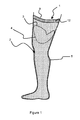
- a covering casing constitutes a covering stock 1 for a prosthesis of a lower limb.
- the prosthesis of the lower limb is, for example, a femoral prosthesis 2 hinged.
- the femoral prosthesis 2 has an outer covering 3 having the shape of the missing lower limb, that is to say, in this case, a leg.
- the femoral prosthesis 2 is mounted on a residual limb 4 and is provided with the covering stock 1.
- the covering stock 1 is shaped to conform to the shape of the femoral prosthesis 2.
- the covering stock 1 is formed by a wall 5 having an outer surface 6 and an inner surface 7.
- the inner surface 7 defines a cavity 8 intended to receive the femoral prosthesis 2 and, possibly, a part of the residual limb 4.
- the covering stock 1 has an opening 9 arranged in the wall 5, to allow the introduction of the femoral prosthesis 2.
- the wall 5 is shaped to match the shape of the femoral prosthesis 2 so that the inner surface 7 is in contact with the femoral prosthesis 2 and, optionally, the skin of the residual limb 4.
- the wall 5 is formed by a composite material comprising a reinforcing fabric 10 embedded in a polymer matrix 11.
- the wall 5 of the covering stock 1 consists solely of the composite material.
- the wall 5 of the covering bottom 1 has a thickness less than 5 mm, advantageously less than or equal to 4 mm, preferably less than or equal to 3 mm.
- the thickness is preferably uniform over the visible areas.
- the wall 5 may be thicker in certain areas to form reinforcements, such as, for example, on the area covering the heel or toes of the femoral prosthesis foot 2.
- the polymer matrix 11 is preferably a silicone resin.
- the textile fibers provide the reinforcement of the covering stock 1 and must be sufficiently thin and flexible to limit the thickness of the covering stock 1 and avoid the formation of unsightly folds during prosthetic movements.
- the textile fibers are preferably of silk, polyamide, elastane and / or cotton.
- the reinforcing fabric 10 is formed of textile fibers having a fineness of between 20 denier and 30 denier.
- the values of 20 denier and 30 denier correspond, respectively, to the values of 2.20 tex and 3.35 tex.
- the reinforcing fabric 10 has, advantageously, an elastic elongation rate greater than or equal to 200%, preferably between 200% and 700%.
- the composite material advantageously has a Shore A hardness of between 5 and 15, preferably between 10 and 12. Furthermore, the composite material has an elastic elongation rate greater than or equal to 200%, advantageously between 200 % and 700%, preferably between 200% and 400%.
- the covering stock 1 may, advantageously, comprise a holding band 12 at the edge of the opening 9 so as to hold the cover stock 1 in place during prosthetic movements, for example during walking.
- the lap stock 1 has, advantageously, a shape mimicking the presumed shape of the missing leg of the individual and a length that advantageously covers the knee to the thigh.
- the assumed shape of the missing leg is defined based on the opposite leg or from a standard leg model in the case of bilateral amputation.
- the dimensions of the lap sock 1 preferably correspond to the presumed dimensions of the missing member with a gap ranging from 0% to 25% relative to the presumed dimensions of the missing member.
- a liner 1 having a length of 1 meter can be used to dress a range of prostheses length between 0.75 meter and 1.25 meters.
- only four sizes of lining 1 are sufficient to cover a wide range of femoral prostheses 2.
- the outer surface 6 of the wall 5 of the covering stock 1 advantageously has recessed and protruding patterns reproducing the skin texture of an individual (not shown).
- the covering stock 1 is used on the residual limb 4 of the individual equipped with the femoral prosthesis 2.
- the use of the covering stock 1 consists in putting the cover stock 1 on the femoral prosthesis 2 through the opening 9, like a sock or a stocking.
- the covering stock 1 is raised along the femoral prosthesis 2 until it covers the entire prosthesis 2.
- the covering stock 1 thus covers the femoral prosthesis 2 and, possibly, a part of the residual limb 4 paired.
- the covering stock 1 has elastic properties and a texture adapted to be able to slide on the femoral prosthesis 2 and lengthen sufficiently by stretching to cover at least the femoral prosthesis 2.
- the mechanical properties of the composite material also ensure the maintenance of the lower part of the femoral prosthesis.
- the lap stock 1 can accompany the useful flexion of the prosthetic knee over a large range of angles ranging from 0 ° to 110 ° thanks, in particular, to the mechanical and elastic properties of the composite material and to the selection of the thickness range of the the wall 5.
- the covering stock 1 may advantageously be extended beyond the femoral prosthesis 2, to also wrap a part of the residual limb 4 of the individual.
- the covering stock 1 of the femoral prosthesis 2 described above is manufactured using a contact or projection molding technique from a positive mold 13.
- a method of manufacturing the cover 1 comprises a step of producing the positive mold 13 having the shape of the missing member, that is to say the shape of a leg for a femoral prosthesis 2.
- the realization of the positive mold 13 is carried out according to any known method and so as to get as close as possible to the shape of the missing leg.
- the positive mold 13 may be made of resin or, preferably, plaster or metal, from a standard negative leg mold and then worked to provide the details giving it a personalized appearance.
- the surface 14 of the positive mold 13 defines the external appearance of the covering stock 1.
- the surface 14 of the positive mold 13 may advantageously have protruding and recessed patterns, reproducing in negative the grain of the skin of an individual. .
- the projecting and recessed patterns are made so that they can be transferred to the outer surface 6 of the wall 5 of the covering stock 1 by a contact molding technique or projection of the positive mold 13.
- the positive mold 13 is covered with a reinforcing fabric 10 shaped to fit the surface 14 of the positive mold 13.
- the reinforcing fabric 10 comprises textile fibers having a fineness of between 20 denier and 30 denier.
- the reinforcing fabric 10 may advantageously be a stocking of textile fibers made of silk, polyamide, elastane or cotton.
- the bottom of the shoe can also be constituted by a mixture of different textile fibers of silk, polyamide, elastane and / or cotton.
- stockings a thin and long sock which shoots the leg from the foot to the top of the thigh.
- the bottom of the shoe may have a retaining band 12 constituting an additional means for holding the covering stock 1 on the individual equipped with the femoral prosthesis 2.
- the wall 5 of the covering bottom 1 is then formed on the positive mold 13 so that the outer surface 6 of the wall 5 is in contact with at least a portion of the surface 14 of the positive mold 13.
- the covered part by the outer surface 6 of the wall 5 must at least correspond to the surface of the outer coating 3 of the femoral prosthesis 2.
- the formation of the wall 5 is performed by applying at least one layer of elastomer to the reinforcing fabric 10 by impregnating the textile fibers of said fabric 10 and then crosslinking.
- the application of the elastomer layer can be carried out by manual laying or projection according to any known method.
- the elastomer layer applied must have a sufficient thickness to impregnate the textile fibers of the reinforcing fabric 10 and cover all of the reinforcing fabric 10.
- the elastomer layer has a thickness of less than 5 mm, advantageously less than or equal to 4 mm, preferably less than or equal to 3mm.
- the elastomer layer adopts the shape of the positive mold 13, in particular, the recessed and protruding patterns intended to reproduce the appearance of the skin of the missing leg.
- the elastomer layer may be transparent or colored.
- the crosslinking is carried out according to any known process, for example, by chemical, thermal or radical crosslinking by UV irradiation.
- the crosslinking causes the polymerization of the elastomer to form the polymer matrix 11 of the composite material.
- the textile fibers of the reinforcing fabric 10, impregnated with the elastomer, are thus trapped and embedded in the polymer matrix 11.
- the crosslinking is a cold vulcanization for a silicone elastomer.
- the silicone elastomer is taken by simple contact with the humidity of the air.
- the elastomer is, advantageously, a thermoplastic elastomer of the silicone (SI), polyurethane (PU) or ethylene-vinyl acetate (EVA) type having a Shore A hardness of between 5 and 15, preferably between 10 and 12, and a rate of elastic elongation greater than or equal to 200%, advantageously between 200% and 700%, preferably between 200% and 400%.
- the elastomer is chosen according to the nature of the textile fibers of the reinforcing fabric 10, to avoid segregation between the textile fibers and the polymer matrix 11 formed after crosslinking. The phenomenon of segregation causes the detachment of the polymer matrix 11 of the textile fibers and the formation of several phases in the composite material.
- the elastomer is preferably selected from silicone elastomers. Silicone elastomers allow good impregnation of textile fibers of silk, polyamide, elastane and / or cotton, without segregation.
- the elastomer layer forms the polymer matrix 11 of the composite material in which the reinforcing fabric 10 is embedded.
- the covering stock 1 thus formed is arranged upside down on the positive mold 13.
- the outer surface 6 of the wall 5 of the covering stock 1 is in contact with the surface 14 of the positive mold 13.
- the covering stock 1 is then obtained by demolding the covering stock 1 and reversing the wall 5.
- the demolding of the covering stock 1 and the reversal of the wall 5 of the cover stock 1 are done in one step.
- the mold is removed by turning the wall 5 (vertical arrows at figure 6 ).
- the reversal has a double and simultaneous action of extracting said bottom 1 of the positive mold 13 and reversing the wall 5 thus making it possible to release the outer surface 6 and to obtain the covering stock 1 in its final form. use that is to say with an inner surface defining the cavity 8 and a visible outer surface.
- the manufacturing method is identical to the embodiment described above with the exception that the formation of the wall 5 of the covering stock 1 is performed by successive applications of several layers of a same elastomer or different elastomers on the reinforcing fabric 10.
- the cover stock 1 has a wall 5 formed by a laminate of first, second and third layers of elastomer (s), respectively, 15, 16 and 17 which cover the reinforcing fabric 10.
- At least partial crosslinking is performed after each application.
- a waiting time is required between each application, to allow the at least partial crosslinking of the applied elastomer layer.
- a first two-component silicone elastomer layer FA 109-12 sold by the company Prevent Silicones having a Shore A hardness of 10/12 and an elongation rate of 700%
- the crosslinking is advantageously partially partial to optimize the adhesion of the different layers 15, 16 and 17 to each other.
- the first layer of elastomer 15 remains sticky to adhere further to the second elastomer layer 16 during the application of the latter and the second elastomer layer 16 remains sticky to adhere more to the third elastomer layer 17 during the application of the third layer of elastomer 17.
- the first, second and third elastomer layers 15, 16 and 17, respectively form the polymer matrix 11 of the composite material constituting the wall 5.
- the polymer matrix 11 coats the textile fibers of the reinforcing fabric 10 of the composite material.
- the first, second and third layers of elastomer (s), respectively 15, 16 and 17, must be of sufficient thickness to impregnate the textile fibers of the reinforcing fabric 10 and to cover the whole of the reinforcing fabric 10.
- Each first second or third elastomer layer, respectively 15, 16 and 17 has a thickness, preferably less than or equal to 0.2mm.
- a composite material consisting of a reinforcing fabric 10 embedded in a polymer matrix 11 is obtained.
- the composite material is preferably extensible in an elastic manner in at least one direction.
- the composite material is advantageously lengthwise extensible up to at least 200% in addition to its initial length, advantageously between 200% and 700% of its initial length, preferably between 200% and 400% of its initial length.
- the composite material is preferably elastically extensible in the width direction of the lap stock 1 to at least 200% in addition to its initial length, advantageously between 200% and 700% of its initial length, preferably, between 200% and 400% of its initial length.
- the resulting composite material has improved mechanical properties and texture that the reinforcing fabric 10 and the polymer matrix 11 alone do not possess.
- the composite material gives the covering stock 1 sealing, elasticity and an improved texture.
- the covering stock 1 has, in particular, an internal surface 7, smooth and slippery, which facilitates the setting and the removal of the covering stock 1 on the femoral prosthesis 2.
- the cover stock 1 has a sheathing power exerting a sufficient pressure to hold it in place on the femoral prosthesis 2, without deforming the outer coating 3.
- the lap 1 does not hinder the prosthetic movements, including the pendular movements of the femoral prosthesis 2.
- the covering envelope according to the invention is remarkable in that it has improved mechanical properties, suitable for the dressing of a prosthesis, in particular articulated.
- the manufacturing method according to the invention makes it possible to obtain a covering envelope having particularly advantageous characteristics, in particular a sheathing power which is sufficient to remain in place on a prosthesis during prosthetic movements without, however, deforming the coating of the prosthesis, hindering the prosthetic movements or form unsightly folds when flexing the knee or elbow.
Landscapes
- Health & Medical Sciences (AREA)
- Engineering & Computer Science (AREA)
- Biomedical Technology (AREA)
- Cardiology (AREA)
- Oral & Maxillofacial Surgery (AREA)
- Transplantation (AREA)
- Heart & Thoracic Surgery (AREA)
- Vascular Medicine (AREA)
- Life Sciences & Earth Sciences (AREA)
- Animal Behavior & Ethology (AREA)
- General Health & Medical Sciences (AREA)
- Public Health (AREA)
- Veterinary Medicine (AREA)
- Manufacturing & Machinery (AREA)
- Prostheses (AREA)
Abstract
Description
- L'invention concerne une enveloppe d'habillage pour prothèse d'un membre, formée par une paroi ayant une surface externe et une surface interne délimitant une cavité destinée à recevoir la prothèse.
- L'invention concerne également un procédé de fabrication d'une telle enveloppe.
- Les prothèses sont utilisées pour remplacer un ou plusieurs organes d'un individu. Parmi les prothèses, on distingue les exo-prothèses portées sur le corps de l'individu de façon amovible par opposition à une endoprothèse destinée à être implantée dans le corps de l'individu.
- L'exo-prothèse remplace l'extrémité d'un membre sectionné ou amputé comme un bras ou une jambe et est adaptée au membre résiduel ou moignon. L'exo-prothèse comporte un ensemble de pièces et de mécanismes fonctionnels permettant l'adaptation de l'exo-prothèse sur le membre résiduel. L'exo-prothèse peut également être articulée pour remplacer un membre manquant articulé comme une prothèse fémorale ou une prothèse de bras.
- L'exo-prothèse doit être fonctionnelle mais également esthétique. En effet, l'esthétique d'une exo-prothèse est un problème qui préoccupe les amputés, spécialement pour les membres inférieur et supérieur. Ainsi, les prothèses complètes de membres inférieure et supérieure sont recouvertes par un revêtement souple, généralement en mousse, donnant à la prothèse la forme du membre manquant en s'inspirant le plus possible de l'esthétique du membre inférieur ou supérieur opposé ou d'une photographie réalisée avant amputation pour un amputé bilatéral.
- Pour les prothèses complètes articulées, le revêtement doit être capable d'accompagner la flexion de l'articulation sans se déchirer ni freiner les mouvements. Cette contrainte est particulièrement importante pour les prothèses fémorales intervenant dans le processus de déplacement de l'individu appareillé. Le revêtement doit notamment être capable d'accompagner la flexion utile du genou prothétique qui couvre une grande amplitude. Le mouvement de flexion peut couvrir un angle allant de 0° à environ 40° lors de la marche et un angle allant de 0° à d'environ 110° pour une position assise.
- Des bas cosmétiques ou bas de recouvrement peuvent être utilisés comme enveloppe d'habillage de la prothèse d'un membre inférieur afin de protéger et améliorer l'aspect esthétique extérieur de la prothèse. Les bas cosmétiques ou bas de recouvrement sont conformés pour épouser la forme de la prothèse et présentent une surface externe et une surface interne. La surface interne est mise en contact avec le revêtement de la prothèse.
- Lorsque le membre résiduel est appareillé avec la prothèse du membre inférieur, le bas de recouvrement ou cosmétique est enfilé sur la prothèse pour revêtir entièrement la prothèse. Le revêtement de la prothèse du membre inférieur est ainsi protégé et, également, habillé afin de lui donner un aspect extérieur plus esthétique, par exemple, par le choix de la matière et de la couleur du bas de recouvrement ou cosmétique.
- À l'heure actuelle, il existe des bas de recouvrement ou cosmétiques en tissu qui n'entravent, ni ne freinent les mouvements de la prothèse d'un membre inférieur, notamment le mouvement d'un genou prothétique. Néanmoins, ces bas en tissu ne confèrent pas à la prothèse une apparence et un touché similaires à ceux de la peau d'un individu.
- Plus récemment, des bas de recouvrement ou cosmétiques en silicone ont été proposés pour reproduire parfaitement l'aspect et la couleur de la peau. Les bas en silicone présentent néanmoins le désavantage de manquer d'élasticité et sont difficiles à enfiler sur la prothèse. Dans le cas de l'habillage d'une prothèse fémorale, le mouvement pendulaire de la prothèse munie d'un tel bas en silicone est fortement gêné et la présence du bas en silicone restreint l'amplitude de la flexion du genou prothétique. Par ailleurs, la flexion et l'extension répétées du genou prothétique entraînent à l'usage une déformation du bas en silicone, localisée au niveau du genou. Cette déformation forme, notamment, des plis disgracieux et inesthétiques.
- L'invention a pour but une enveloppe d'habillage pour prothèse remédiant aux inconvénients de l'art antérieur.
- Plus particulièrement, l'invention a pour but une enveloppe d'habillage pour prothèse facile à mettre en place sur la prothèse et protégeant le revêtement de la prothèse sans déformer ledit revêtement ni entraver les mouvements prothétiques.
- L'invention a également pour but une enveloppe d'habillage pour prothèse ayant une surface externe imitant la texture et l'apparence de la peau d'un individu.
- Selon l'invention, ce but est atteint par le fait que la paroi a une épaisseur inférieure à 0,5mm et est formée par un matériau composite ayant un taux d'allongement élastique supérieur ou égal à 200% et par le fait que le matériau composite comporte un tissu de renfort noyé dans une matrice polymère, ledit tissu étant formé par des fibres textiles ayant une finesse comprise entre 20 deniers et 30 deniers.
- Selon un mode de réalisation préférentiel, les fibres textiles sont en soie, polyamide, élasthanne et/ou coton.
- L'invention a également pour but un procédé de fabrication d'une telle enveloppe d'habillage, facile à mettre en oeuvre, peu coûteux et industrialisable. L'objet de l'invention concerne un procédé de fabrication d'une enveloppe d'habillage adaptée aux exo-prothèses, en particulier, aux prothèses articulées permettant d'obtenir de façon reproductible une enveloppe d'habillage ayant un aspect externe, en particulier une texture et une couleur, proche du membre manquant.
- Selon l'invention, ce but est atteint par un procédé de fabrication d'une telle enveloppe d'habillage pour prothèse d'un membre qui comporte les étapes successives suivantes :
- réalisation d'un moule positif ayant la forme dudit membre,
- recouvrement du moule positif avec le tissu de renfort conformé pour s'ajuster à la surface dudit moule et comportant des fibres textiles ayant une finesse comprise entre 20 deniers et 30 deniers,
- formation de la paroi de l'enveloppe d'habillage sur le moule positif par application d'au moins une couche d'élastomère sur le tissu de renfort en imprégnant les fibres textiles dudit tissu puis réticulation, la surface externe de ladite paroi étant en contact avec la surface dudit moule et,
- obtention de l'enveloppe d'habillage par démoulage de ladite enveloppe et retournement de la paroi.
- Selon un mode de réalisation préférentiel, le démoulage de l'enveloppe d'habillage et le retournement de la paroi sont effectués en une seule étape.
- Selon un développement de l'invention, l'élastomère est choisi parmi les élastomères de silicone.
- D'autres avantages et caractéristiques ressortiront plus clairement de la description qui va suivre de modes particuliers de réalisation de l'invention donnés à titre d'exemples non limitatifs et représentés aux dessins annexés, dans lesquels :
- La
figure 1 représente, schématiquement et en vue de face, une prothèse fémorale, montée sur un membre résiduel, munie d'un bas de recouvrement selon un mode de réalisation particulier de l'invention, - La
figure 2 représente, schématiquement et en coupe, un bas de recouvrement selon un mode de réalisation particulier de l'invention, - les
figures 3 à 6 , représentent, schématiquement et en perspective, différentes étapes d'un procédé de fabrication d'un bas de recouvrement selon lafigure 2 , - la
figure 7 représente, schématiquement et en coupe, un agrandissement d'une paroi d'un bas de recouvrement selon un autre mode de réalisation particulier de l'invention. - L'enveloppe d'habillage selon l'invention est destinée à revêtir une prothèse d'un membre lorsque la prothèse est portée par un individu à la place du membre manquant. L'enveloppe d'habillage est, avantageusement, destinée à revêtir une prothèse d'un membre inférieur ou supérieur.
- L'enveloppe d'habillage est, particulièrement, adaptée pour habiller une prothèse articulée comme une prothèse fémorale ou une prothèse de bras.
- Selon un mode particulier de réalisation représenté aux
figures 1 et2 , une enveloppe d'habillage constitue un bas de recouvrement 1 pour une prothèse d'un membre inférieur. Comme représenté à lafigure 1 , la prothèse du membre inférieur est, par exemple, une prothèse fémorale 2 articulée. La prothèse fémorale 2 comporte un revêtement externe 3 ayant la forme du membre inférieur manquant c'est-à-dire, dans ce cas, d'une jambe. La prothèse fémorale 2 est montée sur un membre résiduel 4 et est munie du bas de recouvrement 1. Le bas de recouvrement 1 est conformé pour épouser la forme de la prothèse fémorale 2. - Comme représenté à la
figure 2 , le bas de recouvrement 1 est formé par une paroi 5 ayant une surface externe 6 et une surface interne 7. La surface interne 7 délimite une cavité 8 destinée à recevoir la prothèse fémorale 2 et, éventuellement, une partie du membre résiduel 4. - Le bas de recouvrement 1 présente une ouverture 9 aménagée dans la paroi 5, pour permettre l'introduction de la prothèse fémorale 2. La paroi 5 est conformée pour épouser la forme de la prothèse fémorale 2 de manière à ce que la surface interne 7 est en contact avec la prothèse fémorale 2 et, optionnellement, la peau du membre résiduel 4.
- La paroi 5 est formée par un matériau composite comportant un tissu de renfort 10 noyé dans une matrice polymère 11. En particulier, la paroi 5 du bas de recouvrement 1 est uniquement constituée par le matériau composite.
- La paroi 5 du bas de recouvrement 1 a une épaisseur inférieure à 5mm, avantageusement, inférieure ou égale à 4mm, de préférence, inférieure ou égale à 3mm. L'épaisseur est, de préférence, uniforme sur les zones visibles.
- Par ailleurs, la paroi 5 peut être plus épaisse sur certaines zones pour former des renforts comme, par exemple, sur la zone recouvrant le talon ou les orteils du pieds de la prothèse fémorale 2.
- La matrice polymère 11 est, de préférence, une résine silicone.
- Les fibres textiles assurent le renfort du bas de recouvrement 1 et doivent être suffisamment fines et souples pour limiter l'épaisseur du bas de recouvrement 1 et éviter la formation de plis disgracieux lors des mouvements prothétiques. Les fibres textiles sont, de préférence, en soie, polyamide, élasthanne et/ou coton. Le tissu de renfort 10 est formé par des fibres textiles ayant une finesse comprise entre 20 deniers et 30 deniers. Les valeurs de 20 deniers et 30 deniers correspondent, respectivement, aux valeurs de 2,20 tex et 3,35 tex. Le tissu de renfort 10 a, avantageusement, un taux d'allongement élastique supérieur ou égal à 200%, de préférence, compris entre 200% et 700%.
- Le matériau composite a, avantageusement, une dureté Shore A comprise entre 5 et 15, de préférence, entre 10 et 12. Par ailleurs, le matériau composite a un taux d'allongement élastique supérieur ou égal à 200%, avantageusement, compris entre 200% et 700%, de préférence, entre 200% et 400%.
- Comme représenté à la
figure 2 , le bas de recouvrement 1 peut, avantageusement, comporter une bande de maintien 12 en bordure de l'ouverture 9 de manière à maintenir le bas de recouvrement 1 en place lors des mouvements prothétiques, par exemple, lors de la marche. - Le bas de recouvrement 1 a, avantageusement, une forme imitant la forme présumée de la jambe manquante de l'individu et une longueur permettant de couvrir avantageusement le genou jusqu'à la cuisse. La forme supposée de la jambe manquante est définie en se basant sur la jambe opposée ou à partir d'un modèle de jambe standard dans le cas d'une amputation bilatérale. Les dimensions du bas de recouvrement 1 correspondent, de préférence, aux dimensions présumées du membre manquant avec un écart pouvant aller de 0% à 25% par rapport aux dimensions présumées du membre manquant. À titre d'exemple, un bas de recouvrement 1 ayant une longueur de 1 mètre peut être utilisé pour habiller une gamme de prothèses de longueur comprise entre 0,75 mètre et 1,25 mètres. Ainsi, seules quatre tailles de bas de recouvrement 1 suffisent pour couvrir une large gamme de prothèses fémorales 2.
- La surface externe 6 de la paroi 5 du bas de recouvrement 1 présente, avantageusement, des motifs en creux et en saillie reproduisant le grain de peau d'un individu (non représentés).
- Le bas de recouvrement 1 est utilisé sur le membre résiduel 4 de l'individu équipé par la prothèse fémorale 2. L'utilisation du bas de recouvrement 1 consiste à enfiler le bas de recouvrement 1 sur la prothèse fémorale 2 par l'ouverture 9, comme une chaussette ou un bas de chausse. Le bas de recouvrement 1 est remonté le long de la prothèse fémorale 2 jusqu'à ce qu'elle recouvre la totalité de la prothèse 2. Le bas de recouvrement 1 habille ainsi la prothèse fémorale 2 et, éventuellement, une partie du membre résiduel 4 appareillé. Le bas de recouvrement 1 a des propriétés élastiques et une texture adaptées pour pouvoir glisser sur la prothèse fémorale 2 et s'allonger suffisamment par étirement pour couvrir au moins la prothèse fémorale 2. Les propriétés mécaniques du matériau composite assurent également le maintien du bas de recouvrement 1 en place même lors du processus de déplacement de l'individu appareillé. Le bas de recouvrement 1 peut accompagner la flexion utile du genou prothétique sur une grande amplitude d'angles allant de 0° à 110° grâce, notamment, aux propriétés mécanique et élastique du matériau composite et à la sélection de la gamme d'épaisseur de la paroi 5.
- Comme représenté à la
figure 1 , le bas de recouvrement 1 peut avantageusement être allongé au-delà de la prothèse fémorale 2, pour envelopper également une partie du membre résiduel 4 de l'individu. - Selon un mode de réalisation particulier représenté aux
figures 3 à 6 , le bas de recouvrement 1 de la prothèse fémorale 2 décrit ci-dessus est fabriqué selon une technique de moulage par contact ou projection à partir d'un moule positif 13. - Comme représenté à la
figure 3 , un procédé de fabrication du bas de recouvrement 1 comporte une étape de réalisation du moule positif 13 ayant la forme du membre manquant c'est-à-dire la forme d'une jambe pour une prothèse fémorale 2. La réalisation du moule positif 13 est effectuée selon tout procédé connu et de manière à se rapprocher le plus possible de la forme de la jambe manquante. À titre d'exemple, le moule positif 13 peut être réalisé en résine ou, de préférence, en plâtre ou en métal, à partir d'un moule négatif de jambe standard puis travaillé pour apporter les détails lui donnant un aspect personnalisé. - La surface 14 du moule positif 13 définit l'aspect externe du bas de recouvrement 1. La surface 14 du moule positif 13 peut, avantageusement, présenter des motifs en saillie et en creux, reproduisant en négatif le grain de la peau d'un individu. Ainsi, les motifs en saillie et en creux sont réalisés de manière à pouvoir être transférés à la surface externe 6 de la paroi 5 du bas de recouvrement 1, par une technique de moulage par contact ou projection du moule positif 13.
- Comme représenté à la
figure 4 , après réalisation du moule positif 13, on recouvre le moule positif 13 avec un tissu de renfort 10 conformé pour s'ajuster à la surface 14 du moule positif 13. - Le tissu de renfort 10 comporte des fibres textiles ayant une finesse comprise entre 20 deniers et 30 deniers. Le tissu de renfort 10 peut, avantageusement, être un bas de chausse formé de fibres textiles en soie, polyamide, élasthanne ou coton. Le bas de chausse peut également être constitué par un mélange de différentes fibres textiles en soie, polyamide, élasthanne et/ou coton. On entend par bas de chausse, une chaussette fine et longue qui gaine la jambe depuis le pied jusqu'en haut de la cuisse. Le bas de chausse peut présenter une bande de maintien 12 constituant un moyen supplémentaire de maintien du bas de recouvrement 1 sur l'individu équipé de la prothèse fémorale 2.
- Comme représenté à la
figure 5 , la paroi 5 du bas de recouvrement 1 est ensuite formée sur le moule positif 13 de manière à ce que la surface externe 6 de la paroi 5 est en contact avec au moins une partie de la surface 14 du moule positif 13. La partie recouverte par la surface externe 6 de la paroi 5 doit au moins correspondre à la surface du revêtement externe 3 de la prothèse fémorale 2. La formation de la paroi 5 est réalisée par application d'au moins une couche d'élastomère sur le tissu de renfort 10 en imprégnant les fibres textiles dudit tissu 10 puis réticulation. - L'application de la couche d'élastomère peut être effectuée par pose manuelle ou projection selon tout procédé connu.
- La couche d'élastomère appliquée doit avoir une épaisseur suffisante pour imprégner les fibres textiles du tissu de renfort 10 et recouvrir la totalité du tissu de renfort 10. La couche d'élastomère a une épaisseur inférieure à 5mm, avantageusement inférieure ou égale à 4mm, de préférence inférieure ou égale à 3mm. La couche d'élastomère adopte la forme du moule positif 13, en particulier, les motifs en creux et en saillie destinés à reproduire l'aspect de la peau de la jambe manquante.
- La couche d'élastomère peut être transparente ou colorée.
- La réticulation est réalisée selon tout procédé connu, par exemple, par réticulation chimique, thermique ou radicalaire par irradiation UV. La réticulation provoque la polymérisation de l'élastomère pour former la matrice polymère 11 du matériau composite. Les fibres textiles du tissu de renfort 10, imprégnées par l'élastomère, sont ainsi emprisonnées et noyées dans la matrice polymère 11. À titre d'exemple, la réticulation est une vulcanisation à froid pour un élastomère silicone. La prise de l'élastomère silicone se produit par simple contact avec l'humidité de l'air.
- L'élastomère est, avantageusement, un élastomère thermoplastique de type silicone (SI), polyuréthane (PU) ou éthylène-acétate de vinyle (EVA) ayant une dureté Shore A comprise entre 5 et 15, de préférence, entre 10 et 12 et un taux d'allongement élastique supérieur ou égal à 200%, avantageusement, compris entre 200% et 700%, de préférence, entre 200% et 400%. L'élastomère est choisi en fonction de la nature des fibres textiles du tissu de renfort 10, pour éviter toute ségrégation entre les fibres textiles et la matrice polymère 11 formée après réticulation. Le phénomène de ségrégation entraîne le décollement de la matrice polymère 11 des fibres textiles et la formation de plusieurs phases dans le matériau composite.
- L'élastomère est, de préférence, choisi parmi les élastomères de silicone. Les élastomères de silicone permettent une bonne imprégnation des fibres textiles en soie, polyamide, élasthanne et/ou coton, sans ségrégation.
- Après réticulation, la couche d'élastomère forme la matrice polymère 11 du matériau composite dans laquelle le tissu de renfort 10 est noyé.
- Comme représenté à la
figure 6 , le bas de recouvrement 1 ainsi formé est disposé à l'envers sur le moule positif 13. La surface externe 6 de la paroi 5 du bas de recouvrement 1 est en contact avec la surface 14 du moule positif 13. - Le bas de recouvrement 1 est, ensuite, obtenu par démoulage du bas de recouvrement 1 et retournement de la paroi 5. Selon un mode de réalisation préférentiel, le démoulage du bas de recouvrement 1 et le retournement de la paroi 5 du bas de recouvrement 1 sont effectués en une seule étape. Le démoulage est réalisé en retournant la paroi 5 (flèches verticales à la
figure 6 ). Le retournement a une action, double et simultanée, d'extraction dudit bas 1 du moule positif 13 et de retournement de la paroi 5 permettant ainsi de libérer la surface externe 6 et d'obtenir le bas de recouvrement 1 sous sa forme définitive d'utilisation c'est-à-dire avec une surface interne délimitant la cavité 8 et une surface externe visible. - Selon un mode de réalisation préférentiel, le procédé de fabrication est identique au mode de réalisation décrit ci-dessus à l'exception du fait que la formation de la paroi 5 du bas de recouvrement 1 est effectuée par applications successives de plusieurs couches d'un même élastomère ou d'élastomères différents sur le tissu de renfort 10. Comme représenté à la
figure 7 , le bas de recouvrement 1 a une paroi 5 formée par un stratifié de première, seconde et troisième couches d'élastomère(s), respectivement, 15, 16 et 17 qui recouvrent le tissu de renfort 10. - Une réticulation au moins partielle est réalisée après chaque application. Dans le cas d'une vulcanisation à froid, un temps d'attente est nécessaire entre chaque application, pour permettre la réticulation au moins partielle de la couche d'élastomère appliquée. À titre d'exemple, après l'application d'une première couche 15 d'élastomère silicone bi-composants FA 109-12 commercialisé par la société Prevent Silicones, ayant une dureté Shore A de 10/12 et un taux d'allongement de 700%, on attend entre 30min et 2h pour appliquer la seconde couche 16 du même élastomère silicone FA 109-12 et entre 30min et 2h pour appliquer la troisième couche d'un élastomère silicone coloré 17. La réticulation est, avantageusement, partielle de manière à optimiser l'adhésion des différentes couches 15, 16 et 17 entre-elles. Ainsi, la première couche d'élastomère 15 reste collante pour adhérer d'avantage à la seconde couche d'élastomère 16 lors de l'application de cette dernière et la seconde couche d'élastomère 16 reste collante pour adhérer d'avantage à la troisième couche d'élastomère 17 lors de l'application de la troisième couche d'élastomère 17. Après réticulations de chaque couches 15, 16 et 17, les première, seconde et troisième couches d'élastomère(s), respectivement 15, 16 et 17, forment la matrice polymère 11 du matériau composite constituant la paroi 5. La matrice polymère 11 enrobe les fibres textiles du tissu de renfort 10 du matériau composite.
- Les première, seconde et troisième couches d'élastomère(s), respectivement 15, 16 et 17, doivent constituées une épaisseur suffisante pour imprégner les fibres textiles du tissu de renfort 10 et recouvrir la totalité du tissu de renfort 10. Chaque première, seconde ou troisième couche d'élastomère, respectivement 15, 16 et 17 a une épaisseur, de préférence, inférieure ou égale à 0,2mm.
- On obtient un matériau composite constitué par un tissu de renfort 10 noyé dans une matrice polymère 11. Le matériau composite est, de préférence, extensible de façon élastique dans au moins une direction. Le matériau composite est, avantageusement, extensible dans le sens de la longueur jusqu'à au moins 200% en plus de sa longueur initiale, avantageusement, entre 200% et 700% de sa longueur initiale, de préférence, entre 200% et 400% de sa longueur initiale. Le matériau composite est, de préférence, extensible de façon élastique dans le sens de la largeur du bas de recouvrement 1 jusqu'à au moins 200% en plus de sa longueur initiale, avantageusement, entre 200% et 700% de sa longueur initiale, de préférence, entre 200% et 400% de sa longueur initiale.
- De façon surprenante, le matériau composite ainsi réalisé possède des propriétés mécaniques et une texture améliorées que le tissu de renfort 10 et la matrice polymère 11 seuls ne possèdent pas. Le matériau composite confère au bas de recouvrement 1 des propriétés d'étanchéité, d'élasticité et une texture améliorée. Le bas de recouvrement 1 a, notamment, une surface interne 7, lisse et glissante, qui facilite la mise et l'enlèvement du bas de recouvrement 1 sur la prothèse fémorale 2. Par ailleurs, le bas de recouvrement 1 a un pouvoir gainant exerçant une pression suffisante pour le maintenir en place sur la prothèse fémorale 2, sans toutefois déformer le revêtement externe 3. Par ailleurs, le bas de recouvrement 1 n'entrave pas les mouvements prothétiques, notamment, les mouvements pendulaires de la prothèse fémorale 2.
- L'enveloppe d'habillage selon l'invention est remarquable en ce qu'elle présente des propriétés mécaniques améliorées, adaptées à l'habillage d'une prothèse, en particulier, articulée. Le procédé de fabrication selon l'invention permet d'obtenir une enveloppe d'habillage ayant des caractéristiques particulièrement avantageuses, notamment un pouvoir gainant suffisant pour rester en place sur une prothèse lors des mouvements prothétiques sans toutefois déformer le revêtement de la prothèse, entraver les mouvements prothétiques ni former des plis inesthétiques lors de la flexion du genoux ou du coude.
Claims (10)
- Enveloppe d'habillage pour prothèse (2) d'un membre, formée par une paroi (5) ayant une surface externe (6) et une surface interne (7) délimitant une cavité (8) destinée à recevoir ladite prothèse (2), caractérisée en ce que la paroi (5) a une épaisseur inférieure à 0,5mm et est formée par un matériau composite ayant un taux d'allongement élastique supérieur ou égal à 200% et en ce que le matériau composite comporte un tissu de renfort (10) noyé dans une matrice polymère (11), ledit tissu (10) étant formé par des fibres textiles ayant une finesse comprise entre 20 deniers et 30 deniers.
- Enveloppe d'habillage selon la revendication 1, caractérisée en ce que les fibres textiles sont en soie, polyamide, élasthanne et/ou coton.
- Enveloppe d'habillage selon l'une des revendications 1 et 2, caractérisée en ce que la matrice polymère (11) est une résine silicone.
- Enveloppe d'habillage selon l'une quelconque des revendications 1 à 3, caractérisée en ce que la surface externe (6) de la paroi (5) présente des motifs en creux et en saillie reproduisant le grain de peau d'un individu.
- Enveloppe d'habillage selon l'une quelconque des revendications 1 à 4, caractérisée en ce qu'elle constitue un bas de recouvrement (1).
- Procédé de fabrication d'une enveloppe d'habillage pour prothèse (2) d'un membre selon l'une quelconque des revendications 1 à 5, caractérisé en ce qu'il comporte les étapes successives suivantes :- réalisation d'un moule positif (13) ayant la forme dudit membre,- recouvrement du moule positif (13) avec le tissu de renfort (10) conformé pour s'ajuster à la surface (14) dudit moule (13) et comportant des fibres textiles ayant une finesse comprise entre 20 deniers et 30 deniers,- formation de la paroi (5) de l'enveloppe d'habillage (1) sur le moule positif (13) par application d'au moins une couche d'élastomère sur le tissu de renfort (10) en imprégnant les fibres textiles dudit tissu (10) puis réticulation, la surface externe (6) de ladite paroi (5) étant en contact avec la surface (14) dudit moule (13) et,- obtention de l'enveloppe d'habillage (1) par démoulage de ladite enveloppe (1) et retournement de la paroi (5).
- Procédé selon la revendication 6, caractérisé en ce que l'élastomère est choisi parmi les élastomères de silicone.
- Procédé selon les revendications 6 et 7, caractérisé en ce que le démoulage de l'enveloppe d'habillage (1) et le retournement de la paroi (5) sont effectués en une seule étape.
- Procédé selon l'une quelconque des revendications 6 à 8, caractérisé en ce que la surface (14) du moule positif (13) présente des motifs en saillie et en creux reproduisant en négatif le grain de la peau d'un individu.
- Procédé selon l'une quelconque des revendications 6 à 9, caractérisé en ce que la formation de la paroi (5) de l'enveloppe d'habillage (1) est effectuée par applications successives de plusieurs couches d'un même élastomère ou d'élastomères différents (15, 16 et 17) sur le tissu de renfort (10) et en ce qu'une réticulation au moins partielle est réalisée après chaque application.
Applications Claiming Priority (1)
| Application Number | Priority Date | Filing Date | Title |
|---|---|---|---|
| FR1004813A FR2968539B1 (fr) | 2010-12-10 | 2010-12-10 | Enveloppe d'habillage pour prothese et procede de fabrication d'une telle enveloppe |
Publications (2)
| Publication Number | Publication Date |
|---|---|
| EP2462902A1 true EP2462902A1 (fr) | 2012-06-13 |
| EP2462902B1 EP2462902B1 (fr) | 2013-09-04 |
Family
ID=44279152
Family Applications (1)
| Application Number | Title | Priority Date | Filing Date |
|---|---|---|---|
| EP20110354076 Not-in-force EP2462902B1 (fr) | 2010-12-10 | 2011-12-09 | Enveloppe d'habillage pour prothèse et procédé de fabrication d'une telle enveloppe |
Country Status (2)
| Country | Link |
|---|---|
| EP (1) | EP2462902B1 (fr) |
| FR (1) | FR2968539B1 (fr) |
Cited By (1)
| Publication number | Priority date | Publication date | Assignee | Title |
|---|---|---|---|---|
| CN109394397A (zh) * | 2018-09-30 | 2019-03-01 | 浙江大学 | 一种连续碳纤维智能假肢的制造方法 |
Families Citing this family (1)
| Publication number | Priority date | Publication date | Assignee | Title |
|---|---|---|---|---|
| DE102020109337B3 (de) * | 2020-04-03 | 2021-08-05 | Otto Bock Healthcare Products Gmbh | Prothesenkosmetik und Verfahren zu deren Herstellung |
Citations (5)
| Publication number | Priority date | Publication date | Assignee | Title |
|---|---|---|---|---|
| DE836393C (de) * | 1949-11-01 | 1952-04-10 | Rathgeber Fa Karl | Schutzbekleidung fuer kuenstliche Gliedmassen |
| SU560607A1 (ru) * | 1976-01-13 | 1977-06-05 | Центральный Ордена Трудового Красного Знамени Научно-Исследовательский Институт Протезирования И Протезостроения | Способ изготовлени косметической оболочки дл протеза голени |
| DE4125635A1 (de) * | 1991-08-02 | 1993-02-04 | Thomas Schmitt | Ueberzug fuer eine oberschenkel- oder unterschenkel-prothese und verfahren zu seiner herstellung |
| WO2008044052A1 (fr) * | 2006-10-12 | 2008-04-17 | Touch Emas Limited | Procédé servant à former des revêtements |
| WO2010070296A1 (fr) * | 2008-12-19 | 2010-06-24 | Touch Emas Limited | Revêtement de prothèse |
-
2010
- 2010-12-10 FR FR1004813A patent/FR2968539B1/fr not_active Expired - Fee Related
-
2011
- 2011-12-09 EP EP20110354076 patent/EP2462902B1/fr not_active Not-in-force
Patent Citations (5)
| Publication number | Priority date | Publication date | Assignee | Title |
|---|---|---|---|---|
| DE836393C (de) * | 1949-11-01 | 1952-04-10 | Rathgeber Fa Karl | Schutzbekleidung fuer kuenstliche Gliedmassen |
| SU560607A1 (ru) * | 1976-01-13 | 1977-06-05 | Центральный Ордена Трудового Красного Знамени Научно-Исследовательский Институт Протезирования И Протезостроения | Способ изготовлени косметической оболочки дл протеза голени |
| DE4125635A1 (de) * | 1991-08-02 | 1993-02-04 | Thomas Schmitt | Ueberzug fuer eine oberschenkel- oder unterschenkel-prothese und verfahren zu seiner herstellung |
| WO2008044052A1 (fr) * | 2006-10-12 | 2008-04-17 | Touch Emas Limited | Procédé servant à former des revêtements |
| WO2010070296A1 (fr) * | 2008-12-19 | 2010-06-24 | Touch Emas Limited | Revêtement de prothèse |
Non-Patent Citations (1)
| Title |
|---|
| DATABASE WPI Derwent World Patents Index; AN 1978-36136A, XP002653813 * |
Cited By (1)
| Publication number | Priority date | Publication date | Assignee | Title |
|---|---|---|---|---|
| CN109394397A (zh) * | 2018-09-30 | 2019-03-01 | 浙江大学 | 一种连续碳纤维智能假肢的制造方法 |
Also Published As
| Publication number | Publication date |
|---|---|
| FR2968539B1 (fr) | 2013-01-04 |
| FR2968539A1 (fr) | 2012-06-15 |
| EP2462902B1 (fr) | 2013-09-04 |
Similar Documents
| Publication | Publication Date | Title |
|---|---|---|
| EP1592315B1 (fr) | Article textile de lingerie moule, notamment soutien-gorge, avec region de maintien en silicone | |
| US20130171288A1 (en) | Device for facilitating molding of breast implant shells | |
| US7351264B2 (en) | Liner for prosthesis | |
| FR3031015A1 (fr) | Procede de fabrication d'un article chaussant | |
| EP2462902B1 (fr) | Enveloppe d'habillage pour prothèse et procédé de fabrication d'une telle enveloppe | |
| FR3007317A1 (fr) | Procede de fabrication d'un objet creux | |
| EP2826389A1 (fr) | Coque de soutien-gorge et son procédé de fabrication | |
| CA2974053A1 (fr) | Endoprothese tissulaire et procede pour sa realisation | |
| FR2589721A1 (fr) | Procede de fabrication de protheses notamment protheses de main, de doigt, respectant un aspect esthetique naturel, protheses ainsi obtenues | |
| FR2838635A1 (fr) | Etui cosmetique pour une prothese endosquelletique. | |
| EP0322285A1 (fr) | Procédé de surmoulage de feuilles non rigides par injection de matières thermoplastiques pour réaliser des pièces composites | |
| WO1985003420A1 (fr) | Procede pour la realisation d'un element de siege par le moulage d'un cadre sur une garniture et element de siege obtenu par ledit procede | |
| WO2003059098A2 (fr) | Article de lingerie en dentelle sans couture | |
| EP2782529B1 (fr) | Revetement de corps de prothese de membre, prothese de membre et son procede de fabrication | |
| KR101812963B1 (ko) | 보형물 또는 그러한 보형물의 중간생성물의 제조 방법 및 상기 방법에 의해 얻어진 보형물 또는 그러한 보형물의 중간생성물 | |
| BE1020275A3 (fr) | Article de lingerie et procede de fabrication. | |
| FR2471181A1 (fr) | Procede pour confectionner une semelle orthopedique, semelle ainsi obtenue et preparation emballee pour confectionner une telle semelle | |
| EP3773353B1 (fr) | Procede de fabrication d'un manchon sur mesure pour prothese | |
| KR20090049767A (ko) | 의지용 맞춤형 실리콘 소켓의 제조방법 및 위 제조방법에의해 제조된 의지용 실리콘 소켓 | |
| CA2019629C (fr) | Insert destine a l'industrie vestimentaire | |
| FR2770094A1 (fr) | Procede et dispositif pour creer des feuilles et des fleurs artificielles | |
| FR2967555A1 (fr) | Perruque extensible | |
| CH717237B1 (fr) | Pièce manufacturée, notamment brin de bracelet de montre, comportant des éléments élastomères en feuille formant un patchwork, et leur procédé de fabrication | |
| CA2591507A1 (fr) | Procede de fabrication en continu d'un complexe souple et complexe souple | |
| FR2738121A1 (fr) | Procede de fabrication de chaussures en caoutchouc |
Legal Events
| Date | Code | Title | Description |
|---|---|---|---|
| PUAI | Public reference made under article 153(3) epc to a published international application that has entered the european phase |
Free format text: ORIGINAL CODE: 0009012 |
|
| AK | Designated contracting states |
Kind code of ref document: A1 Designated state(s): AL AT BE BG CH CY CZ DE DK EE ES FI FR GB GR HR HU IE IS IT LI LT LU LV MC MK MT NL NO PL PT RO RS SE SI SK SM TR |
|
| AX | Request for extension of the european patent |
Extension state: BA ME |
|
| 17P | Request for examination filed |
Effective date: 20121211 |
|
| GRAP | Despatch of communication of intention to grant a patent |
Free format text: ORIGINAL CODE: EPIDOSNIGR1 |
|
| RIC1 | Information provided on ipc code assigned before grant |
Ipc: A61F 2/78 20060101AFI20130227BHEP Ipc: A61F 2/50 20060101ALI20130227BHEP Ipc: A61F 2/00 20060101ALN20130227BHEP |
|
| GRAS | Grant fee paid |
Free format text: ORIGINAL CODE: EPIDOSNIGR3 |
|
| GRAA | (expected) grant |
Free format text: ORIGINAL CODE: 0009210 |
|
| AK | Designated contracting states |
Kind code of ref document: B1 Designated state(s): AL AT BE BG CH CY CZ DE DK EE ES FI FR GB GR HR HU IE IS IT LI LT LU LV MC MK MT NL NO PL PT RO RS SE SI SK SM TR |
|
| REG | Reference to a national code |
Ref country code: GB Ref legal event code: FG4D Free format text: NOT ENGLISH |
|
| REG | Reference to a national code |
Ref country code: CH Ref legal event code: EP |
|
| REG | Reference to a national code |
Ref country code: AT Ref legal event code: REF Ref document number: 630050 Country of ref document: AT Kind code of ref document: T Effective date: 20130915 |
|
| REG | Reference to a national code |
Ref country code: IE Ref legal event code: FG4D Free format text: LANGUAGE OF EP DOCUMENT: FRENCH |
|
| REG | Reference to a national code |
Ref country code: DE Ref legal event code: R096 Ref document number: 602011002920 Country of ref document: DE Effective date: 20131031 |
|
| REG | Reference to a national code |
Ref country code: CH Ref legal event code: NV Representative=s name: CABINET ROLAND NITHARDT CONSEILS EN PROPRIETE , CH |
|
| REG | Reference to a national code |
Ref country code: NL Ref legal event code: VDEP Effective date: 20130904 |
|
| PG25 | Lapsed in a contracting state [announced via postgrant information from national office to epo] |
Ref country code: CY Free format text: LAPSE BECAUSE OF FAILURE TO SUBMIT A TRANSLATION OF THE DESCRIPTION OR TO PAY THE FEE WITHIN THE PRESCRIBED TIME-LIMIT Effective date: 20130828 Ref country code: HR Free format text: LAPSE BECAUSE OF FAILURE TO SUBMIT A TRANSLATION OF THE DESCRIPTION OR TO PAY THE FEE WITHIN THE PRESCRIBED TIME-LIMIT Effective date: 20130904 Ref country code: NO Free format text: LAPSE BECAUSE OF FAILURE TO SUBMIT A TRANSLATION OF THE DESCRIPTION OR TO PAY THE FEE WITHIN THE PRESCRIBED TIME-LIMIT Effective date: 20131204 Ref country code: SE Free format text: LAPSE BECAUSE OF FAILURE TO SUBMIT A TRANSLATION OF THE DESCRIPTION OR TO PAY THE FEE WITHIN THE PRESCRIBED TIME-LIMIT Effective date: 20130904 Ref country code: LT Free format text: LAPSE BECAUSE OF FAILURE TO SUBMIT A TRANSLATION OF THE DESCRIPTION OR TO PAY THE FEE WITHIN THE PRESCRIBED TIME-LIMIT Effective date: 20130904 |
|
| REG | Reference to a national code |
Ref country code: NL Ref legal event code: VDEP Effective date: 20130904 |
|
| REG | Reference to a national code |
Ref country code: LT Ref legal event code: MG4D |
|
| PG25 | Lapsed in a contracting state [announced via postgrant information from national office to epo] |
Ref country code: GR Free format text: LAPSE BECAUSE OF FAILURE TO SUBMIT A TRANSLATION OF THE DESCRIPTION OR TO PAY THE FEE WITHIN THE PRESCRIBED TIME-LIMIT Effective date: 20131205 Ref country code: PL Free format text: LAPSE BECAUSE OF FAILURE TO SUBMIT A TRANSLATION OF THE DESCRIPTION OR TO PAY THE FEE WITHIN THE PRESCRIBED TIME-LIMIT Effective date: 20130904 Ref country code: SI Free format text: LAPSE BECAUSE OF FAILURE TO SUBMIT A TRANSLATION OF THE DESCRIPTION OR TO PAY THE FEE WITHIN THE PRESCRIBED TIME-LIMIT Effective date: 20130904 Ref country code: FI Free format text: LAPSE BECAUSE OF FAILURE TO SUBMIT A TRANSLATION OF THE DESCRIPTION OR TO PAY THE FEE WITHIN THE PRESCRIBED TIME-LIMIT Effective date: 20130904 Ref country code: LV Free format text: LAPSE BECAUSE OF FAILURE TO SUBMIT A TRANSLATION OF THE DESCRIPTION OR TO PAY THE FEE WITHIN THE PRESCRIBED TIME-LIMIT Effective date: 20130904 |
|
| PG25 | Lapsed in a contracting state [announced via postgrant information from national office to epo] |
Ref country code: CY Free format text: LAPSE BECAUSE OF FAILURE TO SUBMIT A TRANSLATION OF THE DESCRIPTION OR TO PAY THE FEE WITHIN THE PRESCRIBED TIME-LIMIT Effective date: 20130904 |
|
| PG25 | Lapsed in a contracting state [announced via postgrant information from national office to epo] |
Ref country code: SK Free format text: LAPSE BECAUSE OF FAILURE TO SUBMIT A TRANSLATION OF THE DESCRIPTION OR TO PAY THE FEE WITHIN THE PRESCRIBED TIME-LIMIT Effective date: 20130904 Ref country code: IS Free format text: LAPSE BECAUSE OF FAILURE TO SUBMIT A TRANSLATION OF THE DESCRIPTION OR TO PAY THE FEE WITHIN THE PRESCRIBED TIME-LIMIT Effective date: 20140104 Ref country code: NL Free format text: LAPSE BECAUSE OF FAILURE TO SUBMIT A TRANSLATION OF THE DESCRIPTION OR TO PAY THE FEE WITHIN THE PRESCRIBED TIME-LIMIT Effective date: 20130904 Ref country code: EE Free format text: LAPSE BECAUSE OF FAILURE TO SUBMIT A TRANSLATION OF THE DESCRIPTION OR TO PAY THE FEE WITHIN THE PRESCRIBED TIME-LIMIT Effective date: 20130904 Ref country code: CZ Free format text: LAPSE BECAUSE OF FAILURE TO SUBMIT A TRANSLATION OF THE DESCRIPTION OR TO PAY THE FEE WITHIN THE PRESCRIBED TIME-LIMIT Effective date: 20130904 Ref country code: RO Free format text: LAPSE BECAUSE OF FAILURE TO SUBMIT A TRANSLATION OF THE DESCRIPTION OR TO PAY THE FEE WITHIN THE PRESCRIBED TIME-LIMIT Effective date: 20130904 |
|
| PG25 | Lapsed in a contracting state [announced via postgrant information from national office to epo] |
Ref country code: ES Free format text: LAPSE BECAUSE OF FAILURE TO SUBMIT A TRANSLATION OF THE DESCRIPTION OR TO PAY THE FEE WITHIN THE PRESCRIBED TIME-LIMIT Effective date: 20130904 |
|
| REG | Reference to a national code |
Ref country code: DE Ref legal event code: R097 Ref document number: 602011002920 Country of ref document: DE |
|
| PG25 | Lapsed in a contracting state [announced via postgrant information from national office to epo] |
Ref country code: PT Free format text: LAPSE BECAUSE OF FAILURE TO SUBMIT A TRANSLATION OF THE DESCRIPTION OR TO PAY THE FEE WITHIN THE PRESCRIBED TIME-LIMIT Effective date: 20140106 |
|
| PLBE | No opposition filed within time limit |
Free format text: ORIGINAL CODE: 0009261 |
|
| STAA | Information on the status of an ep patent application or granted ep patent |
Free format text: STATUS: NO OPPOSITION FILED WITHIN TIME LIMIT |
|
| 26N | No opposition filed |
Effective date: 20140605 |
|
| REG | Reference to a national code |
Ref country code: DE Ref legal event code: R097 Ref document number: 602011002920 Country of ref document: DE Effective date: 20140605 |
|
| REG | Reference to a national code |
Ref country code: IE Ref legal event code: MM4A |
|
| PG25 | Lapsed in a contracting state [announced via postgrant information from national office to epo] |
Ref country code: DK Free format text: LAPSE BECAUSE OF FAILURE TO SUBMIT A TRANSLATION OF THE DESCRIPTION OR TO PAY THE FEE WITHIN THE PRESCRIBED TIME-LIMIT Effective date: 20130904 |
|
| PG25 | Lapsed in a contracting state [announced via postgrant information from national office to epo] |
Ref country code: IE Free format text: LAPSE BECAUSE OF NON-PAYMENT OF DUE FEES Effective date: 20131209 |
|
| PG25 | Lapsed in a contracting state [announced via postgrant information from national office to epo] |
Ref country code: MC Free format text: LAPSE BECAUSE OF FAILURE TO SUBMIT A TRANSLATION OF THE DESCRIPTION OR TO PAY THE FEE WITHIN THE PRESCRIBED TIME-LIMIT Effective date: 20130904 |
|
| PG25 | Lapsed in a contracting state [announced via postgrant information from national office to epo] |
Ref country code: SM Free format text: LAPSE BECAUSE OF FAILURE TO SUBMIT A TRANSLATION OF THE DESCRIPTION OR TO PAY THE FEE WITHIN THE PRESCRIBED TIME-LIMIT Effective date: 20130904 |
|
| PG25 | Lapsed in a contracting state [announced via postgrant information from national office to epo] |
Ref country code: TR Free format text: LAPSE BECAUSE OF FAILURE TO SUBMIT A TRANSLATION OF THE DESCRIPTION OR TO PAY THE FEE WITHIN THE PRESCRIBED TIME-LIMIT Effective date: 20130904 |
|
| PG25 | Lapsed in a contracting state [announced via postgrant information from national office to epo] |
Ref country code: HU Free format text: LAPSE BECAUSE OF FAILURE TO SUBMIT A TRANSLATION OF THE DESCRIPTION OR TO PAY THE FEE WITHIN THE PRESCRIBED TIME-LIMIT; INVALID AB INITIO Effective date: 20111209 Ref country code: BG Free format text: LAPSE BECAUSE OF FAILURE TO SUBMIT A TRANSLATION OF THE DESCRIPTION OR TO PAY THE FEE WITHIN THE PRESCRIBED TIME-LIMIT Effective date: 20130904 Ref country code: MK Free format text: LAPSE BECAUSE OF FAILURE TO SUBMIT A TRANSLATION OF THE DESCRIPTION OR TO PAY THE FEE WITHIN THE PRESCRIBED TIME-LIMIT Effective date: 20130904 Ref country code: RS Free format text: LAPSE BECAUSE OF FAILURE TO SUBMIT A TRANSLATION OF THE DESCRIPTION OR TO PAY THE FEE WITHIN THE PRESCRIBED TIME-LIMIT Effective date: 20131204 |
|
| PG25 | Lapsed in a contracting state [announced via postgrant information from national office to epo] |
Ref country code: MT Free format text: LAPSE BECAUSE OF FAILURE TO SUBMIT A TRANSLATION OF THE DESCRIPTION OR TO PAY THE FEE WITHIN THE PRESCRIBED TIME-LIMIT Effective date: 20130904 |
|
| REG | Reference to a national code |
Ref country code: FR Ref legal event code: TP Owner name: CHABLOZ COMPOSANTS, FR Effective date: 20151026 |
|
| REG | Reference to a national code |
Ref country code: FR Ref legal event code: PLFP Year of fee payment: 5 |
|
| REG | Reference to a national code |
Ref country code: CH Ref legal event code: PUE Owner name: CHABLOZ COMPOSANTS SARL, FR Free format text: FORMER OWNER: CHABLOZ, PIERRE, FR |
|
| REG | Reference to a national code |
Ref country code: FR Ref legal event code: PLFP Year of fee payment: 6 |
|
| REG | Reference to a national code |
Ref country code: FR Ref legal event code: PLFP Year of fee payment: 7 |
|
| PG25 | Lapsed in a contracting state [announced via postgrant information from national office to epo] |
Ref country code: AL Free format text: LAPSE BECAUSE OF FAILURE TO SUBMIT A TRANSLATION OF THE DESCRIPTION OR TO PAY THE FEE WITHIN THE PRESCRIBED TIME-LIMIT Effective date: 20130904 |
|
| PGFP | Annual fee paid to national office [announced via postgrant information from national office to epo] |
Ref country code: PT Payment date: 20181022 Year of fee payment: 13 Ref country code: AT Payment date: 20181221 Year of fee payment: 8 |
|
| PGFP | Annual fee paid to national office [announced via postgrant information from national office to epo] |
Ref country code: IT Payment date: 20181220 Year of fee payment: 8 |
|
| PGFP | Annual fee paid to national office [announced via postgrant information from national office to epo] |
Ref country code: BE Payment date: 20181221 Year of fee payment: 8 |
|
| REG | Reference to a national code |
Ref country code: CH Ref legal event code: PL |
|
| REG | Reference to a national code |
Ref country code: AT Ref legal event code: MM01 Ref document number: 630050 Country of ref document: AT Kind code of ref document: T Effective date: 20191209 |
|
| REG | Reference to a national code |
Ref country code: BE Ref legal event code: MM Effective date: 20191231 |
|
| PG25 | Lapsed in a contracting state [announced via postgrant information from national office to epo] |
Ref country code: IT Free format text: LAPSE BECAUSE OF NON-PAYMENT OF DUE FEES Effective date: 20191209 Ref country code: LU Free format text: LAPSE BECAUSE OF NON-PAYMENT OF DUE FEES Effective date: 20191209 |
|
| PG25 | Lapsed in a contracting state [announced via postgrant information from national office to epo] |
Ref country code: BE Free format text: LAPSE BECAUSE OF NON-PAYMENT OF DUE FEES Effective date: 20191231 Ref country code: CH Free format text: LAPSE BECAUSE OF NON-PAYMENT OF DUE FEES Effective date: 20191231 Ref country code: LI Free format text: LAPSE BECAUSE OF NON-PAYMENT OF DUE FEES Effective date: 20191231 Ref country code: AT Free format text: LAPSE BECAUSE OF NON-PAYMENT OF DUE FEES Effective date: 20191209 |
|
| PGFP | Annual fee paid to national office [announced via postgrant information from national office to epo] |
Ref country code: GB Payment date: 20221222 Year of fee payment: 12 Ref country code: FR Payment date: 20221220 Year of fee payment: 12 |
|
| PGFP | Annual fee paid to national office [announced via postgrant information from national office to epo] |
Ref country code: DE Payment date: 20221221 Year of fee payment: 12 |
|
| REG | Reference to a national code |
Ref country code: DE Ref legal event code: R119 Ref document number: 602011002920 Country of ref document: DE |
|
| GBPC | Gb: european patent ceased through non-payment of renewal fee |
Effective date: 20231209 |
|
| PG25 | Lapsed in a contracting state [announced via postgrant information from national office to epo] |
Ref country code: DE Free format text: LAPSE BECAUSE OF NON-PAYMENT OF DUE FEES Effective date: 20240702 |
|
| PG25 | Lapsed in a contracting state [announced via postgrant information from national office to epo] |
Ref country code: GB Free format text: LAPSE BECAUSE OF NON-PAYMENT OF DUE FEES Effective date: 20231209 |
|
| PG25 | Lapsed in a contracting state [announced via postgrant information from national office to epo] |
Ref country code: FR Free format text: LAPSE BECAUSE OF NON-PAYMENT OF DUE FEES Effective date: 20231231 |
|
| PG25 | Lapsed in a contracting state [announced via postgrant information from national office to epo] |
Ref country code: GB Free format text: LAPSE BECAUSE OF NON-PAYMENT OF DUE FEES Effective date: 20231209 Ref country code: FR Free format text: LAPSE BECAUSE OF NON-PAYMENT OF DUE FEES Effective date: 20231231 Ref country code: DE Free format text: LAPSE BECAUSE OF NON-PAYMENT OF DUE FEES Effective date: 20240702 |