EP2447117A1 - Verfahren zum Fernbetätigen eines Fahrzeugtürschlosses - Google Patents
Verfahren zum Fernbetätigen eines Fahrzeugtürschlosses Download PDFInfo
- Publication number
- EP2447117A1 EP2447117A1 EP11007095A EP11007095A EP2447117A1 EP 2447117 A1 EP2447117 A1 EP 2447117A1 EP 11007095 A EP11007095 A EP 11007095A EP 11007095 A EP11007095 A EP 11007095A EP 2447117 A1 EP2447117 A1 EP 2447117A1
- Authority
- EP
- European Patent Office
- Prior art keywords
- transponder
- access control
- door lock
- vehicle door
- baud rate
- Prior art date
- Legal status (The legal status is an assumption and is not a legal conclusion. Google has not performed a legal analysis and makes no representation as to the accuracy of the status listed.)
- Granted
Links
Images
Classifications
-
- B—PERFORMING OPERATIONS; TRANSPORTING
- B60—VEHICLES IN GENERAL
- B60R—VEHICLES, VEHICLE FITTINGS, OR VEHICLE PARTS, NOT OTHERWISE PROVIDED FOR
- B60R25/00—Fittings or systems for preventing or indicating unauthorised use or theft of vehicles
- B60R25/20—Means to switch the anti-theft system on or off
- B60R25/24—Means to switch the anti-theft system on or off using electronic identifiers containing a code not memorised by the user
- B60R25/243—Means to switch the anti-theft system on or off using electronic identifiers containing a code not memorised by the user with more than one way to gain access
-
- G—PHYSICS
- G07—CHECKING-DEVICES
- G07C—TIME OR ATTENDANCE REGISTERS; REGISTERING OR INDICATING THE WORKING OF MACHINES; GENERATING RANDOM NUMBERS; VOTING OR LOTTERY APPARATUS; ARRANGEMENTS, SYSTEMS OR APPARATUS FOR CHECKING NOT PROVIDED FOR ELSEWHERE
- G07C9/00—Individual registration on entry or exit
- G07C9/00174—Electronically operated locks; Circuits therefor; Nonmechanical keys therefor, e.g. passive or active electrical keys or other data carriers without mechanical keys
- G07C9/00309—Electronically operated locks; Circuits therefor; Nonmechanical keys therefor, e.g. passive or active electrical keys or other data carriers without mechanical keys operated with bidirectional data transmission between data carrier and locks
-
- G—PHYSICS
- G07—CHECKING-DEVICES
- G07C—TIME OR ATTENDANCE REGISTERS; REGISTERING OR INDICATING THE WORKING OF MACHINES; GENERATING RANDOM NUMBERS; VOTING OR LOTTERY APPARATUS; ARRANGEMENTS, SYSTEMS OR APPARATUS FOR CHECKING NOT PROVIDED FOR ELSEWHERE
- G07C9/00—Individual registration on entry or exit
- G07C9/00174—Electronically operated locks; Circuits therefor; Nonmechanical keys therefor, e.g. passive or active electrical keys or other data carriers without mechanical keys
- G07C2009/00753—Electronically operated locks; Circuits therefor; Nonmechanical keys therefor, e.g. passive or active electrical keys or other data carriers without mechanical keys operated by active electrical keys
- G07C2009/00769—Electronically operated locks; Circuits therefor; Nonmechanical keys therefor, e.g. passive or active electrical keys or other data carriers without mechanical keys operated by active electrical keys with data transmission performed by wireless means
- G07C2009/00793—Electronically operated locks; Circuits therefor; Nonmechanical keys therefor, e.g. passive or active electrical keys or other data carriers without mechanical keys operated by active electrical keys with data transmission performed by wireless means by Hertzian waves
-
- G—PHYSICS
- G07—CHECKING-DEVICES
- G07C—TIME OR ATTENDANCE REGISTERS; REGISTERING OR INDICATING THE WORKING OF MACHINES; GENERATING RANDOM NUMBERS; VOTING OR LOTTERY APPARATUS; ARRANGEMENTS, SYSTEMS OR APPARATUS FOR CHECKING NOT PROVIDED FOR ELSEWHERE
- G07C2209/00—Indexing scheme relating to groups G07C9/00 - G07C9/38
- G07C2209/60—Indexing scheme relating to groups G07C9/00174 - G07C9/00944
- G07C2209/61—Signal comprising different frequencies, e.g. frequency hopping
Definitions
- a method for remotely operating a vehicle door lock comprising a portable transponder, the at least one vehicle-side antenna, a radio link, for transmitting a control of the vehicle door lock serving data telegram, build with a control unit for access control, wherein for a keyless access control a first baud rate and for an am Transponder triggering manual access control a second baud rate is used.
- Such methods for remote operation of a vehicle door lock are used in vehicle construction to allow a user a particularly simple and comfortable unlocking or locking a vehicle door lock, preferably all door locks installed on the vehicle at the same time.
- the state of the art as in the example of DE 10 2007 011 498 A1 is shown, describes a transponder, which can set up a radio link with just this in range of a vehicle-side antenna to exchange a data message for identification and authorization of the transponder with a controller.
- the control unit switches the vehicle door lock.
- the radio link can on the one hand keyless access control (keyless entry / keyless go) serve, in which the user without the transponder to operate, but for example, only by pulling the door handle, open the unlocked vehicle door and vice versa can also close again.
- keyless access control keyless entry / keyless go
- most transponders also see the possibility to carry out the identification user-controlled by a manual access control which can be triggered on the transponder.
- a vehicle with a method according to the invention is claimed in claim 7.
- a method for remote operation of a vehicle door lock has a portable transponder, which can establish a radio connection for transmitting a control of the vehicle door lock serving data telegram with a control unit for access control by means of at least one vehicle-side antenna, wherein for a keyless access control a first baud rate and for a a second baud rate is used on the transponder triggerable manual access control and wherein when triggering a manual access control during an active wireless connection for keyless access control an abort signal is emitted from the transponder, after which the control unit switches to the second baud rate.
- Baud is the unit for walking speed in communications engineering.
- a baud is the speed when a symbol is transmitted per second.
- the baud rate of a data transmission must be the same on the send and receive side.
- Keyless access control uses a first baud rate that differs from the second baud rate to manual access control. If the control unit for access control has automatically established a radio link to the transponder via the at least one antenna on the vehicle (keyless access control), data telegrams are transmitted via this radio link at a defined frequency (usually 433 or 868 MHz) at the first baud rate. These data telegrams need not contain instructions for controlling the vehicle door lock, but can only serve to locate or identify the transponder.
- the data telegram is used to identify and authorize the transponder. Furthermore, it may include instructions for operating the vehicle door lock for the control unit.
- the data telegram can also consist of several individual data telegrams, which are exchanged in a kind of dialogue between control unit and transponder.
- the transponder transmits, after transmission of the abort signal, the data message. If the transponder transmits the data telegram directly after the termination of the abort signal, the waiting time for the user can be shortened further until the implementation of his manual inputs on the transponder.
- the transponder transmits the data telegram at least during a time interval which the control unit requires for the conversion from the first to the second baud rate. If the data message is transmitted by the transponder at least as long as the control unit needs for the conversion from the first to the second baud rate, it is ensured that the data message can be received by the control unit.
- the transponder transmits the data telegram after a time interval which the control unit requires for the conversion from the first to the second baud rate. If the data telegram is only transmitted by the transponder after the control unit has changed over from the first to the second baud rate, the probability of a secure receipt of the data telegram from the control device increases and the power consumption of the transponder decreases.
- the transponder is designed as a key with at least one key.
- a transponder has, inter alia, a mechanically coded key bit, as well as the electronic components required for data exchange, such as transmitter and battery.
- the manual access control is triggered by pressing one of the keys.
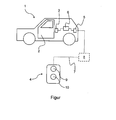
- FIG. 1 shows a schematic representation of a vehicle with the invention fernbetätigbarem vehicle door lock.
- a vehicle 1 has at least one vehicle door 2 which can be unlocked or locked by a vehicle door lock 3.
- the vehicle door lock 3 is switched by a control device for access control 6, which can record a radio connection 7 with a portable transponder 4 via a vehicle-side antenna 5. Via this radio link 7, a data message 8 is exchanged, which serves the identification of the transponder 4 and represents a function instruction to the control unit 6. If the vehicle door lock 3 is locked and a user wants to get into the interior of the vehicle 1, the vehicle door lock 3 is unlocked by the control unit 6 only if the identification of the entrained transponder 4 was successful.
- the procedure for locking the vehicle 1 is analogous.
- a keyless access control is carried out automatically at a first baud rate via the radio link 7 without the user being aware of it, provided that the latter is in range of the antenna 5. If, on the other hand, the user actuates a button 9 or 10 arranged on the transponder 4, a manual access control is carried out at a second baud rate via the radio link 7. The key 9, for example, the lock and the key 10 cause the unlocking of the vehicle door lock 3 or vice versa. If a manual access control is triggered during an active keyless access control, the transponder 4 sends an abort signal via the radio link 7 to the control unit 6, which then switches from the first to the second baud rate. The abort signal is followed by a data telegram 8 for identification of the transponder 4, which is emitted by the transponder 4 at least until the control unit 6 is switched to the second baud rate.
Landscapes
- Engineering & Computer Science (AREA)
- Computer Networks & Wireless Communication (AREA)
- Physics & Mathematics (AREA)
- General Physics & Mathematics (AREA)
- Mechanical Engineering (AREA)
- Lock And Its Accessories (AREA)
Abstract
Description
- Verfahren zum Fernbetätigen eines Fahrzeugtürschlosses, aufweisend einen tragbaren Transponder, der mittels mindestens einer fahrzeugseitigen Antenne eine Funkverbindung, zur Übertragung eines der Steuerung des Fahrzeugtürschlosses dienenden Datentelegramms, mit einem Steuergerät zur Zugangskontrolle aufbauen kann, wobei für eine schlüssellose Zugangskontrolle eine erste Baudrate und für eine am Transponder auslösbare manuelle Zugangskontrolle eine zweite Baudrate verwendet wird.
- Derartige Verfahren zum Fernbetätigen eines Fahrzeugtürschlosses werden im Fahrzeugbau dazu verwendet, um einem Nutzer ein besonders einfaches und komfortables Ent- bzw. Verriegeln eines Fahrzeugtürschlosses, vorzugsweise aller am Fahrzeug verbauten Türschlösser gleichzeitig, zu ermöglichen.
- Der Stand der Technik, wie er beispielsweise in der
DE 10 2007 011 498 A1 gezeigt ist, beschreibt dazu einen Transponder, der in Reichweite einer fahrzeugseitigen Antenne eine Funkverbindung mit eben dieser aufbauen kann, um ein Datentelegramm zur Identifikation und Autorisierung des Transponders mit einem Steuergerät auszutauschen. In Abhängigkeit vom Ergebnis der Identifikation schaltet das Steuergerät das Fahrzeugtürschloss. Die Funkverbindung kann einerseits der schlüssellosen Zugangskontrolle (keyless-entry / keyless-go) dienen, bei der der Nutzer, ohne den Transponder zu betätigen, sondern beispielsweise nur durch Ziehen am Türgriff, die so entriegelte Fahrzeugtür öffnen und umgekehrt auch wieder verschließen kann. Die meisten Transponder sehen andererseits aber auch die Möglichkeit vor durch eine am Transponder auslösbare manuelle Zugangskontrolle die Identifikation nutzergesteuert auszuführen. Während einer aktiven schlüssellosen Zugangskontrolle kann jedoch keine manuelle Zugangskontrolle ausgeführt werden, da für die Funkverbindung in der Regel nur eine Frequenz (433 bzw. 868 MHz) zur Verfügung steht. Dies führt dazu, dass die vom Nutzer ausgelöste manuelle Zugangskontrolle nicht durchgeführt werden kann oder bis zur regelmäßigen Beendigung der schlüssellosen Zugangskontrolle gewartet werden muss. - Es ist daher Aufgabe der vorliegenden Erfindung ein Verfahren zum Fernbetätigen eines Fahrzeugtürschlosses bereitzustellen, bei dem möglichst kurzfristig zwischen einer schlüssellosen und einer manuell auslösbaren Zugangskontrolle gewechselt werden kann.
- Diese Aufgabe wird durch die Merkmale des Patentanspruchs 1 gelöst.
- Ein Fahrzeug mit einem erfindungsgemäßen Verfahren wird in Patentanspruch 7 beansprucht.
- Ein Verfahren zum Fernbetätigen eines Fahrzeugtürschlosses weist einen tragbaren Transponder auf, der mittels mindestens einer fahrzeugseitigen Antenne eine Funkverbindung, zur Übertragung eines der Steuerung des Fahrzeugtürschlosses dienenden Datentelegramms, mit einem Steuergerät zur Zugangskontrolle aufbauen kann, wobei für eine schlüssellose Zugangskontrolle eine erste Baudrate und für eine am Transponder auslösbare manuelle Zugangskontrolle eine zweite Baudrate verwendet wird und wobei beim Auslösen einer manuellen Zugangskontrolle während einer aktiven Funkverbindung zur schlüssellosen Zugangskontrolle ein Abbruchsignal vom Transponder ausgesendet wird, worauf sich das Steuergerät auf die zweite Baudrate umstellt.
- Baud ist die Einheit für die Schrittgeschwindigkeit in der Nachrichtentechnik. Ein Baud ist die Geschwindigkeit, wenn ein Symbol pro Sekunde übertragen wird. Die Baudrate einer Datenübertragung muss auf Sende- und Empfangsseite gleich sein. Für die schlüssellose Zugangskontrolle wird eine erste Baudrate verwendet, die sich von der zweiten Baudrate zur manuellen Zugangskontrolle unterscheidet. Hat das Steuergerät zur Zugangskontrolle selbsttätig eine Funkverbindung zum Transponder über die mindestens eine fahrzeugseitige Antenne aufgebaut (schlüssellose Zugangskontrolle), dann werden Datentelegramme über diese Funkverbindung bei einer definierten Frequenz (meist 433 bzw. 868 MHz) mit der ersten Baudrate übertragen. Diese Datentelegramme müssen keine Anweisungen zur Steuerung des Fahrzeugtürschlosses enthalten, sondern können lediglich der Ortung oder Identifikation des Transponders dienen. Löst ein Nutzer während einer aktiven Funkverbindung zur schlüssellosen Zugangskontrolle eine manuelle Zugangskontrolle am Transponder aus, so sendet der Transponder ein Abbruchsignal, das das Steuergerät zu einer Umstellung von der ersten Baudrate auf die zweite Baudrate veranlasst. Dadurch ist das Steuergerät viel eher dazu bereit eine Funkverbindung zur manuellen Zugangskontrolle mit dem Transponder aufzubauen, insbesondere muss nicht auf eine regelmäßige Beendigung der schlüssellosen Zugangskontrolle gewartet werden. Das Datentelegramm dient der Identifikation und Autorisierung des Transponders. Weiterhin kann es Anweisungen zur Betätigung des Fahrzeugtürschlosses für das Steuergerät beinhalten. Das Datentelegramm kann auch aus mehreren einzelnen Datentelegrammen bestehen, die in einer Art Dialog zwischen Steuergerät und Transponder ausgetauscht werden.
- In einer bevorzugten Ausführung sendet der Transponder, nach Aussenden des Abbruchsignals, das Datentelegramm aus. Wenn der Transponder direkt nach dem Absetzen des Abbruchsignals das Datentelegramm aussendet, kann die Wartezeit für den Nutzer bis zur Umsetzung seiner manuellen Eingaben am Transponder weiter verkürzt werden.
- In einer bevorzugten Ausführung sendet der Transponder das Datentelegramm mindestens während eines Zeitintervalls, das das Steuergerät für die Umstellung von der ersten auf die zweite Baudrate benötigt. Wird das Datentelegramm vom Transponder mindestens so lange ausgesendet, wie das Steuergerät für die Umstellung von der ersten auf die zweite Baudrate braucht, wird sichergestellt, dass das Datentelegramm vom Steuergerät empfangen werden kann.
- In einer alternativen bevorzugten Ausführung sendet der Transponder das Datentelegramm nach einem Zeitintervall, das das Steuergerät für die Umstellung von der ersten auf die zweite Baudrate benötigt. Wird das Datentelegramm vom Transponder erst ausgesendet, nachdem sich das Steuergerät von der ersten auf die zweite Baudrate umgestellt hat, erhöht sich die Wahrscheinlichkeit eines sicheren Empfangs des Datentelegramms vom Steuergerät und der Stromverbrauch des Transponders sinkt.
- In einer bevorzugten Ausführung ist der Transponder als Schlüssel mit mindestens einer Taste ausgebildet. Ein solcher Transponder weist unter anderem einen mechanisch kodierten Schlüsselbart, sowie die zum Datenaustausch benötigten elektronischen Bauteile, wie Sender und Batterie, auf.
- In einer bevorzugten Ausführung wird die manuelle Zugangskontrolle durch Betätigung einer der Tasten ausgelöst.
- Weitere Einzelheiten und Vorteile der Erfindung ergeben sich aus der nachstehenden Beschreibung eines bevorzugten Ausführungsbeispiels unter Bezugnahme auf die Zeichnung.
- Darin zeigt die Figur eine schematische Darstellung eines Fahrzeugs mit erfindungsgemäß fernbetätigbarem Fahrzeugtürschloss.
- Gemäß der Figur hat ein Fahrzeug 1 mindestens eine Fahrzeugtür 2, die von einem Fahrzeugtürschloss 3 entriegelt oder verriegelt werden kann. Das Fahrzeugtürschloss 3 wird von einem Steuergerät zur Zugangskontrolle 6 geschaltet, das über eine fahrzeugseitige Antenne 5 eine Funkverbindung 7 mit einem tragbaren Transponder 4 aufnehmen kann. Über diese Funkverbindung 7 wird ein Datentelegramm 8 ausgetauscht, das der Identifikation des Transponders 4 dient und eine Funktionsanweisung an das Steuergerät 6 darstellt. Ist das Fahrzeugtürschloss 3 verriegelt und möchte ein Nutzer in das Innere des Fahrzeugs 1 gelangen, so erfolgt eine Entriegelung des Fahrzeugtürschlosses 3 durch das Steuergerät 6 nur, wenn die Identifikation des mitgeführten Transponders 4 erfolgreich war. Analog verhält es sich beim Verriegeln des Fahrzeugs 1. Eine schlüssellose Zugangskontrolle wird, ohne dass der Nutzer davon Kenntniss erlangt, selbsttätig mit einer ersten Baudrate über die Funkverbindung 7 durchgeführt, wenn dieser in Reichweite der Antenne 5 ist. Betätigt der Nutzer hingegen eine auf dem Transponder 4 angeordnete Taste 9 oder 10, so wird eine manuelle Zugangskontrolle mit einer zweiten Baudrate über die Funkverbindung 7 durchgeführt. Die Taste 9 kann beispielsweise die Verriegelung und die Taste 10 die Entriegelung des Fahrzeugtürschlosses 3 veranlassen oder umgekehrt. Wird während einer aktiven schlüssellosen Zugangskontrolle eine manuelle Zugangskontrolle ausgelöst, so sendet der Transponder 4 ein Abbruchsignal über die Funkverbindung 7 an das Steuergerät 6, welches sich daraufhin von der ersten auf die zweite Baudrate umstellt. Dem Abbruchsignal folgt ein Datentelegramm 8 zur Identifikation des Transponders 4, welches vom Transponder 4 mindestens so lange ausgesendet wird, bis das Steuergerät 6 auf die zweite Baudrate umgestellt ist.
-
- 1
- Fahrzeug
- 2
- Fahrzeugtür
- 3
- Fahrzeugtürschloss
- 4
- Transponder
- 5
- Antenne
- 6
- Steuergerät zur Zugangskontrolle
- 7
- Funkverbindung
- 8
- Datentelegramm
- 9
- Taste
- 10
- Taste
Claims (7)
- Verfahren zum Fernbetätigen eines Fahrzeugtürschlosses (3), aufweisend einen tragbaren Transponder (4), der mittels mindestens einer fahrzeugseitigen Antenne (5) eine Funkverbindung (7), zur Übertragung eines der Steuerung des Fahrzeugtürschlosses (3) dienenden Datentelegramms (8), mit einem Steuergerät zur Zugangskontrolle (6) aufbauen kann, wobei für eine schlüssellose Zugangskontrolle eine erste Baudrate und für eine am Transponder (4) auslösbare manuelle Zugangskontrolle eine zweite Baudrate verwendet wird, dadurch gekennzeichnet, dass beim Auslösen einer manuellen Zugangskontrolle während einer aktiven Funkverbindung (7) zur schlüssellosen Zugangskontrolle ein Abbruchsignal vom Transponder (4) ausgesendet wird, worauf sich das Steuergerät (6) auf die zweite Baudrate umstellt.
- Verfahren nach Anspruch 1, dadurch gekennzeichnet, dass der Transponder (4), nach Aussenden des Abbruchsignals, das Datentelegramm (8) aussendet.
- Verfahren nach Anspruch 2, dadurch gekennzeichnet, dass der Transponder (4) das Datentelegramm (8) mindestens während eines Zeitintervalls, das das Steuergerät (6) für die Umstellung von der ersten auf die zweite Baudrate benötigt, sendet.
- Verfahren nach Anspruch 2, dadurch gekennzeichnet, dass der Transponder (4) das Datentelegramm (8) nach einem Zeitintervall, das das Steuergerät (6) für die Umstellung von der ersten auf die zweite Baudrate benötigt, sendet.
- Verfahren zum Fernbetätigen eines Fahrzeugtürschlosses nach einem der Ansprüche 1 bis 4, dadurch gekennzeichnet, dass der Transponder (4) als Schlüssel mit mindestens einer Taste (9, 10) ausgebildet ist.
- Verfahren zum Fernbetätigen eines Fahrzeugtürschlosses nach Anspruch 5, dadurch gekennzeichnet, dass die manuelle Zugangskontrolle durch Betätigung einer der Tasten (9, 10) ausgelöst wird.
- Fahrzeug (1) mit mindestens einem Fahrzeugtürschloss (3), das mit einem Verfahren nach Anspruch 1 fernbetätigbar ist.
Applications Claiming Priority (1)
| Application Number | Priority Date | Filing Date | Title |
|---|---|---|---|
| DE102010050230A DE102010050230B4 (de) | 2010-10-30 | 2010-10-30 | Verfahren zum Fernbetätigen eines Fahrzeugtürschlosses |
Publications (2)
| Publication Number | Publication Date |
|---|---|
| EP2447117A1 true EP2447117A1 (de) | 2012-05-02 |
| EP2447117B1 EP2447117B1 (de) | 2013-05-29 |
Family
ID=45508022
Family Applications (1)
| Application Number | Title | Priority Date | Filing Date |
|---|---|---|---|
| EP20110007095 Not-in-force EP2447117B1 (de) | 2010-10-30 | 2011-09-01 | Verfahren zum Fernbetätigen eines Fahrzeugtürschlosses |
Country Status (3)
| Country | Link |
|---|---|
| EP (1) | EP2447117B1 (de) |
| CN (1) | CN102463964B (de) |
| DE (1) | DE102010050230B4 (de) |
Families Citing this family (2)
| Publication number | Priority date | Publication date | Assignee | Title |
|---|---|---|---|---|
| US20150077226A1 (en) * | 2013-09-16 | 2015-03-19 | Xing Ping Lin | Method and apparatus for conserving energy in rke and tpm vehicle systems |
| CN110696773B (zh) * | 2019-10-25 | 2021-04-27 | 浙江吉利汽车研究院有限公司 | 一种车辆的远距离控制方法及系统 |
Citations (6)
| Publication number | Priority date | Publication date | Assignee | Title |
|---|---|---|---|---|
| EP0937844A1 (de) * | 1997-05-16 | 1999-08-25 | Toyota Jidosha Kabushiki Kaisha | Gerät zur fernsteuerung einer vorrichtung für bewegliche körper |
| US6624758B1 (en) * | 1998-07-13 | 2003-09-23 | Hitachi Ltd | Remote keyless entry system |
| US20060279411A1 (en) * | 2005-06-14 | 2006-12-14 | Siemens Vdo Automotive Corporation | Signal recognition for combined receiver for remote keyless entry and tire pressure monitoring systems |
| DE102006027040A1 (de) * | 2005-06-13 | 2006-12-21 | Siemens Vdo Automotive | Verfahren zur Diebstahlsicherung für handfreie Zugangssysteme von Fahrzeugen |
| DE102007011498A1 (de) | 2007-03-07 | 2008-09-11 | Kiekert Ag | Verfahren zum Öffnen einer Kraftfahrzeugtür mit schlüssellosem Zugangssystem |
| US20090051488A1 (en) * | 2007-08-22 | 2009-02-26 | Omron Corporation | Communication system having transmitter and receiver and signal sending/receiving method |
Family Cites Families (5)
| Publication number | Priority date | Publication date | Assignee | Title |
|---|---|---|---|---|
| US5973611A (en) * | 1995-03-27 | 1999-10-26 | Ut Automotive Dearborn, Inc. | Hands-free remote entry system |
| DE19728761C1 (de) * | 1997-07-05 | 1998-09-24 | Kostal Leopold Gmbh & Co Kg | Schlüssellose Zugangskontrolleinrichtung für Kraftfahrzeuge sowie Verfahren zum Durchführen einer schlüssellosen Zugangsberechtigungskontrolle bei Kraftfahrzeugen |
| US6034617A (en) * | 1998-12-04 | 2000-03-07 | Eaton Corporation | Operator intent based passive keyless vehicle control system |
| JP4435632B2 (ja) * | 2004-07-09 | 2010-03-24 | アルプス電気株式会社 | キーレスエントリー装置 |
| US7388466B2 (en) * | 2004-11-30 | 2008-06-17 | Lear Corporation | Integrated passive entry and remote keyless entry system |
-
2010
- 2010-10-30 DE DE102010050230A patent/DE102010050230B4/de not_active Expired - Fee Related
-
2011
- 2011-09-01 EP EP20110007095 patent/EP2447117B1/de not_active Not-in-force
- 2011-10-25 CN CN201110328416.2A patent/CN102463964B/zh not_active Expired - Fee Related
Patent Citations (6)
| Publication number | Priority date | Publication date | Assignee | Title |
|---|---|---|---|---|
| EP0937844A1 (de) * | 1997-05-16 | 1999-08-25 | Toyota Jidosha Kabushiki Kaisha | Gerät zur fernsteuerung einer vorrichtung für bewegliche körper |
| US6624758B1 (en) * | 1998-07-13 | 2003-09-23 | Hitachi Ltd | Remote keyless entry system |
| DE102006027040A1 (de) * | 2005-06-13 | 2006-12-21 | Siemens Vdo Automotive | Verfahren zur Diebstahlsicherung für handfreie Zugangssysteme von Fahrzeugen |
| US20060279411A1 (en) * | 2005-06-14 | 2006-12-14 | Siemens Vdo Automotive Corporation | Signal recognition for combined receiver for remote keyless entry and tire pressure monitoring systems |
| DE102007011498A1 (de) | 2007-03-07 | 2008-09-11 | Kiekert Ag | Verfahren zum Öffnen einer Kraftfahrzeugtür mit schlüssellosem Zugangssystem |
| US20090051488A1 (en) * | 2007-08-22 | 2009-02-26 | Omron Corporation | Communication system having transmitter and receiver and signal sending/receiving method |
Also Published As
| Publication number | Publication date |
|---|---|
| DE102010050230B4 (de) | 2013-12-12 |
| CN102463964B (zh) | 2014-08-06 |
| CN102463964A (zh) | 2012-05-23 |
| DE102010050230A1 (de) | 2012-05-03 |
| EP2447117B1 (de) | 2013-05-29 |
Similar Documents
| Publication | Publication Date | Title |
|---|---|---|
| DE10109869B4 (de) | System und Verfahren zur automatischen Funktionsbestätigung mit gesteuerter Distanzkommunikation mit fahrzeugbasierter Frequenzauswahl | |
| DE19728761C1 (de) | Schlüssellose Zugangskontrolleinrichtung für Kraftfahrzeuge sowie Verfahren zum Durchführen einer schlüssellosen Zugangsberechtigungskontrolle bei Kraftfahrzeugen | |
| DE60303986T2 (de) | Türöffnungs- bzw. Türschliessungsvorrichtung | |
| EP2766884B1 (de) | Verfahren zum betreiben einer berechtigungseinrichtung für schlüssellosen zugang und start eines fahrzeugs | |
| DE102005056910B4 (de) | Integriertes System zum passiven Zugang und zum schlüssellosen Zugang per Fernsteuerung | |
| EP2656323A2 (de) | Verfahren zum betätigen eines kraftfahrzeug-schliesssystems unter verwendung eines mobilen kommunikationsgerätes | |
| DE19902797C1 (de) | Schlüssellose Zugangskontrolleinrichtung für Kraftfahrzeuge sowie Verfahren zum Durchführen einer schlüssellosen Zugangsberechtigungskontrolle bei Kraftfahrzeugen | |
| EP1723614B1 (de) | Schliesszylinder und schliessverfahren | |
| DE102016201603A1 (de) | Verfahren und Vorrichtungen zum Entriegeln eines Kraftfahrzeugs mit einem Motorstart- und/oder Fahrzeugzugangssystem | |
| WO2017144349A1 (de) | Verfahren für eine aktivierung mindestens einer sicherheitsfunktion eines sicherheitssystems eines fahrzeugs | |
| DE112007001015T5 (de) | Verfahren zum Bedienen einer Mehrzahl von Fahrzeugen mittels eines beliebigen Senders aus einer programmierten Gruppe | |
| DE102010017493A1 (de) | Schlüsselfernbedienung und Verfahren zum Austausch von Signalen zwischen einer Schlüsselfernbedienung und einem kraftfahrzeugseitigen Steuergerät | |
| DE112017000755B4 (de) | Elektronisches schlüsselsystem | |
| DE102017120524A1 (de) | Tragbarer ID-Geber für ein Authentifizierungssystem und Verfahren zum Betreiben eines Authentifizierungssystems | |
| DE102017200378A1 (de) | Verfahren und Vorrichtung zum Sichern eines Systems für passive Entriegelung eines Fahrzeugsystems gegen Relaisstellenangriffe | |
| EP3569455A1 (de) | Abwehr eines relayangriffs | |
| EP0659963A1 (de) | Elektronische Wegfahrsperre für ein Kraftfahrzeug | |
| DE102005035167B4 (de) | Fahrzeugsteuersystem und Fahrzeugsteuerverfahren | |
| EP2447117B1 (de) | Verfahren zum Fernbetätigen eines Fahrzeugtürschlosses | |
| DE102017200380A1 (de) | Verfahren zum Verriegeln, Entriegeln und Starten eines Fahrzeugs | |
| EP1849665B1 (de) | Systemarchitektur für ein Keyless-Go-System | |
| DE102008027160A1 (de) | Elektronisches Schließsystem und Verfahren zum Entriegeln einer schließbaren Einheit, insbesondere eines Fahrzeugs | |
| EP1147277A1 (de) | Schlüssellose zugangskontrolleinrichtung für kraftfahrzeuge | |
| DE60024844T2 (de) | Sicherheitssystem | |
| EP2125451B1 (de) | Mobiler identifikationsgeber eines sicherheitssystemes |
Legal Events
| Date | Code | Title | Description |
|---|---|---|---|
| PUAI | Public reference made under article 153(3) epc to a published international application that has entered the european phase |
Free format text: ORIGINAL CODE: 0009012 |
|
| AK | Designated contracting states |
Kind code of ref document: A1 Designated state(s): AL AT BE BG CH CY CZ DE DK EE ES FI FR GB GR HR HU IE IS IT LI LT LU LV MC MK MT NL NO PL PT RO RS SE SI SK SM TR |
|
| AX | Request for extension of the european patent |
Extension state: BA ME |
|
| 17P | Request for examination filed |
Effective date: 20121102 |
|
| GRAP | Despatch of communication of intention to grant a patent |
Free format text: ORIGINAL CODE: EPIDOSNIGR1 |
|
| RIC1 | Information provided on ipc code assigned before grant |
Ipc: G07C 9/00 20060101ALI20130116BHEP Ipc: B60R 25/00 20130101AFI20130116BHEP |
|
| GRAS | Grant fee paid |
Free format text: ORIGINAL CODE: EPIDOSNIGR3 |
|
| GRAA | (expected) grant |
Free format text: ORIGINAL CODE: 0009210 |
|
| RIN1 | Information on inventor provided before grant (corrected) |
Inventor name: GEISSENHOENER, MARTIN Inventor name: SASSMANNSHAUSEN, PATRICK |
|
| AK | Designated contracting states |
Kind code of ref document: B1 Designated state(s): AL AT BE BG CH CY CZ DE DK EE ES FI FR GB GR HR HU IE IS IT LI LT LU LV MC MK MT NL NO PL PT RO RS SE SI SK SM TR |
|
| REG | Reference to a national code |
Ref country code: GB Ref legal event code: FG4D Free format text: NOT ENGLISH |
|
| REG | Reference to a national code |
Ref country code: CH Ref legal event code: EP |
|
| REG | Reference to a national code |
Ref country code: AT Ref legal event code: REF Ref document number: 614173 Country of ref document: AT Kind code of ref document: T Effective date: 20130615 |
|
| REG | Reference to a national code |
Ref country code: IE Ref legal event code: FG4D Free format text: LANGUAGE OF EP DOCUMENT: GERMAN |
|
| REG | Reference to a national code |
Ref country code: DE Ref legal event code: R096 Ref document number: 502011000789 Country of ref document: DE Effective date: 20130801 |
|
| REG | Reference to a national code |
Ref country code: LT Ref legal event code: MG4D |
|
| PG25 | Lapsed in a contracting state [announced via postgrant information from national office to epo] |
Ref country code: PT Free format text: LAPSE BECAUSE OF FAILURE TO SUBMIT A TRANSLATION OF THE DESCRIPTION OR TO PAY THE FEE WITHIN THE PRESCRIBED TIME-LIMIT Effective date: 20130930 Ref country code: NO Free format text: LAPSE BECAUSE OF FAILURE TO SUBMIT A TRANSLATION OF THE DESCRIPTION OR TO PAY THE FEE WITHIN THE PRESCRIBED TIME-LIMIT Effective date: 20130829 Ref country code: FI Free format text: LAPSE BECAUSE OF FAILURE TO SUBMIT A TRANSLATION OF THE DESCRIPTION OR TO PAY THE FEE WITHIN THE PRESCRIBED TIME-LIMIT Effective date: 20130529 Ref country code: LT Free format text: LAPSE BECAUSE OF FAILURE TO SUBMIT A TRANSLATION OF THE DESCRIPTION OR TO PAY THE FEE WITHIN THE PRESCRIBED TIME-LIMIT Effective date: 20130529 Ref country code: ES Free format text: LAPSE BECAUSE OF FAILURE TO SUBMIT A TRANSLATION OF THE DESCRIPTION OR TO PAY THE FEE WITHIN THE PRESCRIBED TIME-LIMIT Effective date: 20130909 Ref country code: IS Free format text: LAPSE BECAUSE OF FAILURE TO SUBMIT A TRANSLATION OF THE DESCRIPTION OR TO PAY THE FEE WITHIN THE PRESCRIBED TIME-LIMIT Effective date: 20130929 Ref country code: SE Free format text: LAPSE BECAUSE OF FAILURE TO SUBMIT A TRANSLATION OF THE DESCRIPTION OR TO PAY THE FEE WITHIN THE PRESCRIBED TIME-LIMIT Effective date: 20130529 Ref country code: SI Free format text: LAPSE BECAUSE OF FAILURE TO SUBMIT A TRANSLATION OF THE DESCRIPTION OR TO PAY THE FEE WITHIN THE PRESCRIBED TIME-LIMIT Effective date: 20130529 Ref country code: GR Free format text: LAPSE BECAUSE OF FAILURE TO SUBMIT A TRANSLATION OF THE DESCRIPTION OR TO PAY THE FEE WITHIN THE PRESCRIBED TIME-LIMIT Effective date: 20130830 |
|
| REG | Reference to a national code |
Ref country code: NL Ref legal event code: VDEP Effective date: 20130529 |
|
| PG25 | Lapsed in a contracting state [announced via postgrant information from national office to epo] |
Ref country code: PL Free format text: LAPSE BECAUSE OF FAILURE TO SUBMIT A TRANSLATION OF THE DESCRIPTION OR TO PAY THE FEE WITHIN THE PRESCRIBED TIME-LIMIT Effective date: 20130529 Ref country code: BG Free format text: LAPSE BECAUSE OF FAILURE TO SUBMIT A TRANSLATION OF THE DESCRIPTION OR TO PAY THE FEE WITHIN THE PRESCRIBED TIME-LIMIT Effective date: 20130829 Ref country code: RS Free format text: LAPSE BECAUSE OF FAILURE TO SUBMIT A TRANSLATION OF THE DESCRIPTION OR TO PAY THE FEE WITHIN THE PRESCRIBED TIME-LIMIT Effective date: 20130529 Ref country code: HR Free format text: LAPSE BECAUSE OF FAILURE TO SUBMIT A TRANSLATION OF THE DESCRIPTION OR TO PAY THE FEE WITHIN THE PRESCRIBED TIME-LIMIT Effective date: 20130529 |
|
| PG25 | Lapsed in a contracting state [announced via postgrant information from national office to epo] |
Ref country code: LV Free format text: LAPSE BECAUSE OF FAILURE TO SUBMIT A TRANSLATION OF THE DESCRIPTION OR TO PAY THE FEE WITHIN THE PRESCRIBED TIME-LIMIT Effective date: 20130529 |
|
| PG25 | Lapsed in a contracting state [announced via postgrant information from national office to epo] |
Ref country code: DK Free format text: LAPSE BECAUSE OF FAILURE TO SUBMIT A TRANSLATION OF THE DESCRIPTION OR TO PAY THE FEE WITHIN THE PRESCRIBED TIME-LIMIT Effective date: 20130529 Ref country code: SK Free format text: LAPSE BECAUSE OF FAILURE TO SUBMIT A TRANSLATION OF THE DESCRIPTION OR TO PAY THE FEE WITHIN THE PRESCRIBED TIME-LIMIT Effective date: 20130529 Ref country code: EE Free format text: LAPSE BECAUSE OF FAILURE TO SUBMIT A TRANSLATION OF THE DESCRIPTION OR TO PAY THE FEE WITHIN THE PRESCRIBED TIME-LIMIT Effective date: 20130529 Ref country code: CZ Free format text: LAPSE BECAUSE OF FAILURE TO SUBMIT A TRANSLATION OF THE DESCRIPTION OR TO PAY THE FEE WITHIN THE PRESCRIBED TIME-LIMIT Effective date: 20130529 |
|
| PG25 | Lapsed in a contracting state [announced via postgrant information from national office to epo] |
Ref country code: NL Free format text: LAPSE BECAUSE OF FAILURE TO SUBMIT A TRANSLATION OF THE DESCRIPTION OR TO PAY THE FEE WITHIN THE PRESCRIBED TIME-LIMIT Effective date: 20130529 Ref country code: RO Free format text: LAPSE BECAUSE OF FAILURE TO SUBMIT A TRANSLATION OF THE DESCRIPTION OR TO PAY THE FEE WITHIN THE PRESCRIBED TIME-LIMIT Effective date: 20130529 Ref country code: IT Free format text: LAPSE BECAUSE OF FAILURE TO SUBMIT A TRANSLATION OF THE DESCRIPTION OR TO PAY THE FEE WITHIN THE PRESCRIBED TIME-LIMIT Effective date: 20130529 |
|
| BERE | Be: lapsed |
Owner name: AUDI A.G. Effective date: 20130930 |
|
| PLBE | No opposition filed within time limit |
Free format text: ORIGINAL CODE: 0009261 |
|
| STAA | Information on the status of an ep patent application or granted ep patent |
Free format text: STATUS: NO OPPOSITION FILED WITHIN TIME LIMIT |
|
| PG25 | Lapsed in a contracting state [announced via postgrant information from national office to epo] |
Ref country code: MC Free format text: LAPSE BECAUSE OF FAILURE TO SUBMIT A TRANSLATION OF THE DESCRIPTION OR TO PAY THE FEE WITHIN THE PRESCRIBED TIME-LIMIT Effective date: 20130529 |
|
| 26N | No opposition filed |
Effective date: 20140303 |
|
| REG | Reference to a national code |
Ref country code: DE Ref legal event code: R097 Ref document number: 502011000789 Country of ref document: DE Effective date: 20140303 |
|
| REG | Reference to a national code |
Ref country code: IE Ref legal event code: MM4A |
|
| PG25 | Lapsed in a contracting state [announced via postgrant information from national office to epo] |
Ref country code: IE Free format text: LAPSE BECAUSE OF NON-PAYMENT OF DUE FEES Effective date: 20130901 Ref country code: BE Free format text: LAPSE BECAUSE OF NON-PAYMENT OF DUE FEES Effective date: 20130930 |
|
| REG | Reference to a national code |
Ref country code: CH Ref legal event code: PL |
|
| PG25 | Lapsed in a contracting state [announced via postgrant information from national office to epo] |
Ref country code: SM Free format text: LAPSE BECAUSE OF FAILURE TO SUBMIT A TRANSLATION OF THE DESCRIPTION OR TO PAY THE FEE WITHIN THE PRESCRIBED TIME-LIMIT Effective date: 20130529 |
|
| PG25 | Lapsed in a contracting state [announced via postgrant information from national office to epo] |
Ref country code: MT Free format text: LAPSE BECAUSE OF FAILURE TO SUBMIT A TRANSLATION OF THE DESCRIPTION OR TO PAY THE FEE WITHIN THE PRESCRIBED TIME-LIMIT Effective date: 20130529 Ref country code: CY Free format text: LAPSE BECAUSE OF FAILURE TO SUBMIT A TRANSLATION OF THE DESCRIPTION OR TO PAY THE FEE WITHIN THE PRESCRIBED TIME-LIMIT Effective date: 20130529 Ref country code: TR Free format text: LAPSE BECAUSE OF FAILURE TO SUBMIT A TRANSLATION OF THE DESCRIPTION OR TO PAY THE FEE WITHIN THE PRESCRIBED TIME-LIMIT Effective date: 20130529 |
|
| PG25 | Lapsed in a contracting state [announced via postgrant information from national office to epo] |
Ref country code: MK Free format text: LAPSE BECAUSE OF FAILURE TO SUBMIT A TRANSLATION OF THE DESCRIPTION OR TO PAY THE FEE WITHIN THE PRESCRIBED TIME-LIMIT Effective date: 20130529 Ref country code: LU Free format text: LAPSE BECAUSE OF NON-PAYMENT OF DUE FEES Effective date: 20130901 Ref country code: CH Free format text: LAPSE BECAUSE OF NON-PAYMENT OF DUE FEES Effective date: 20140930 Ref country code: HU Free format text: LAPSE BECAUSE OF FAILURE TO SUBMIT A TRANSLATION OF THE DESCRIPTION OR TO PAY THE FEE WITHIN THE PRESCRIBED TIME-LIMIT; INVALID AB INITIO Effective date: 20110901 Ref country code: LI Free format text: LAPSE BECAUSE OF NON-PAYMENT OF DUE FEES Effective date: 20140930 |
|
| REG | Reference to a national code |
Ref country code: FR Ref legal event code: PLFP Year of fee payment: 6 |
|
| REG | Reference to a national code |
Ref country code: FR Ref legal event code: PLFP Year of fee payment: 7 |
|
| REG | Reference to a national code |
Ref country code: AT Ref legal event code: MM01 Ref document number: 614173 Country of ref document: AT Kind code of ref document: T Effective date: 20160901 |
|
| PG25 | Lapsed in a contracting state [announced via postgrant information from national office to epo] |
Ref country code: AT Free format text: LAPSE BECAUSE OF NON-PAYMENT OF DUE FEES Effective date: 20160901 |
|
| REG | Reference to a national code |
Ref country code: FR Ref legal event code: PLFP Year of fee payment: 8 |
|
| PG25 | Lapsed in a contracting state [announced via postgrant information from national office to epo] |
Ref country code: AL Free format text: LAPSE BECAUSE OF FAILURE TO SUBMIT A TRANSLATION OF THE DESCRIPTION OR TO PAY THE FEE WITHIN THE PRESCRIBED TIME-LIMIT Effective date: 20130529 |
|
| PGFP | Annual fee paid to national office [announced via postgrant information from national office to epo] |
Ref country code: FR Payment date: 20180924 Year of fee payment: 8 |
|
| PGFP | Annual fee paid to national office [announced via postgrant information from national office to epo] |
Ref country code: GB Payment date: 20180924 Year of fee payment: 8 |
|
| PGFP | Annual fee paid to national office [announced via postgrant information from national office to epo] |
Ref country code: DE Payment date: 20180930 Year of fee payment: 8 |
|
| REG | Reference to a national code |
Ref country code: DE Ref legal event code: R119 Ref document number: 502011000789 Country of ref document: DE |
|
| PG25 | Lapsed in a contracting state [announced via postgrant information from national office to epo] |
Ref country code: DE Free format text: LAPSE BECAUSE OF NON-PAYMENT OF DUE FEES Effective date: 20200401 |
|
| GBPC | Gb: european patent ceased through non-payment of renewal fee |
Effective date: 20190901 |
|
| PG25 | Lapsed in a contracting state [announced via postgrant information from national office to epo] |
Ref country code: GB Free format text: LAPSE BECAUSE OF NON-PAYMENT OF DUE FEES Effective date: 20190901 Ref country code: FR Free format text: LAPSE BECAUSE OF NON-PAYMENT OF DUE FEES Effective date: 20190930 |