EP2445926B1 - Biologisch hergestellte cyclische affinitätsmarker - Google Patents
Biologisch hergestellte cyclische affinitätsmarker Download PDFInfo
- Publication number
- EP2445926B1 EP2445926B1 EP10728424.2A EP10728424A EP2445926B1 EP 2445926 B1 EP2445926 B1 EP 2445926B1 EP 10728424 A EP10728424 A EP 10728424A EP 2445926 B1 EP2445926 B1 EP 2445926B1
- Authority
- EP
- European Patent Office
- Prior art keywords
- pro
- gln
- lys
- cys
- tag
- Prior art date
- Legal status (The legal status is an assumption and is not a legal conclusion. Google has not performed a legal analysis and makes no representation as to the accuracy of the status listed.)
- Not-in-force
Links
Images

Classifications
-
- C—CHEMISTRY; METALLURGY
- C07—ORGANIC CHEMISTRY
- C07K—PEPTIDES
- C07K7/00—Peptides having 5 to 20 amino acids in a fully defined sequence; Derivatives thereof
- C07K7/04—Linear peptides containing only normal peptide links
- C07K7/06—Linear peptides containing only normal peptide links having 5 to 11 amino acids
-
- C—CHEMISTRY; METALLURGY
- C07—ORGANIC CHEMISTRY
- C07K—PEPTIDES
- C07K1/00—General methods for the preparation of peptides, i.e. processes for the organic chemical preparation of peptides or proteins of any length
- C07K1/14—Extraction; Separation; Purification
- C07K1/16—Extraction; Separation; Purification by chromatography
- C07K1/22—Affinity chromatography or related techniques based upon selective absorption processes
-
- C—CHEMISTRY; METALLURGY
- C07—ORGANIC CHEMISTRY
- C07K—PEPTIDES
- C07K14/00—Peptides having more than 20 amino acids; Gastrins; Somatostatins; Melanotropins; Derivatives thereof
- C07K14/435—Peptides having more than 20 amino acids; Gastrins; Somatostatins; Melanotropins; Derivatives thereof from animals; from humans
- C07K14/46—Peptides having more than 20 amino acids; Gastrins; Somatostatins; Melanotropins; Derivatives thereof from animals; from humans from vertebrates
- C07K14/47—Peptides having more than 20 amino acids; Gastrins; Somatostatins; Melanotropins; Derivatives thereof from animals; from humans from vertebrates from mammals
- C07K14/4701—Peptides having more than 20 amino acids; Gastrins; Somatostatins; Melanotropins; Derivatives thereof from animals; from humans from vertebrates from mammals not used
- C07K14/4702—Regulators; Modulating activity
- C07K14/4703—Inhibitors; Suppressors
-
- C—CHEMISTRY; METALLURGY
- C07—ORGANIC CHEMISTRY
- C07K—PEPTIDES
- C07K5/00—Peptides containing up to four amino acids in a fully defined sequence; Derivatives thereof
- C07K5/04—Peptides containing up to four amino acids in a fully defined sequence; Derivatives thereof containing only normal peptide links
- C07K5/08—Tripeptides
- C07K5/0802—Tripeptides with the first amino acid being neutral
- C07K5/0812—Tripeptides with the first amino acid being neutral and aromatic or cycloaliphatic
-
- C—CHEMISTRY; METALLURGY
- C07—ORGANIC CHEMISTRY
- C07K—PEPTIDES
- C07K5/00—Peptides containing up to four amino acids in a fully defined sequence; Derivatives thereof
- C07K5/04—Peptides containing up to four amino acids in a fully defined sequence; Derivatives thereof containing only normal peptide links
- C07K5/10—Tetrapeptides
- C07K5/1002—Tetrapeptides with the first amino acid being neutral
- C07K5/1016—Tetrapeptides with the first amino acid being neutral and aromatic or cycloaliphatic
-
- C—CHEMISTRY; METALLURGY
- C12—BIOCHEMISTRY; BEER; SPIRITS; WINE; VINEGAR; MICROBIOLOGY; ENZYMOLOGY; MUTATION OR GENETIC ENGINEERING
- C12P—FERMENTATION OR ENZYME-USING PROCESSES TO SYNTHESISE A DESIRED CHEMICAL COMPOUND OR COMPOSITION OR TO SEPARATE OPTICAL ISOMERS FROM A RACEMIC MIXTURE
- C12P21/00—Preparation of peptides or proteins
- C12P21/02—Preparation of peptides or proteins having a known sequence of two or more amino acids, e.g. glutathione
Definitions
- the invention relates to the field of recombinant protein expression, purification and immobilization. In particular, it relates to novel ways of introducing an affinity tag into a protein of interest.
- affinity tags have been developed and are used throughout biotechnology. The widespread success of affinity tags throughout the biological sciences has prompted interest in developing new and convenient labeling strategies. Affinity tags are well-established tools for capturing a recombinant protein, e.g. in immobilization and/or purification procedures. More recently, these tags have been utilized for selective biological targeting towards multiplexed protein detection in numerous imaging applications as well as for drug-delivery. The most commonly employed affinity tags range from short polypeptide sequences, to whole proteins, which can confer advantageous solubility effects.
- small peptide epitopes such as polyhistidine tags which can bind to immobilized metal chelates, as well as the myc-tag and FLAG-tag, which can bind to immobilized antibodies, are commonly used for the isolation and immobilization of recombinant proteins.
- streptavidin specific Strep-tag Another small peptide epitope that has gained wide use is the streptavidin specific Strep-tag [ Schmidt, et al., Protein Eng. 6 (1993) 109-122 ; US 2006/0106199 and US 6,841,359 .]. Streptavidin binding peptide sequences have been discovered by screening peptide libraries, most but not all of which contain the His-Pro-Gln (HPQ) motif. The development of streptavidin-fusion peptides has aided in a variety of unique biochemical applications and has made streptavidin, the non-glycosylated bacterial relative of avidin, the preferred protein in many applications of the (strept)avidin-biotin technologies [ Keefe, et al., Protein Expr.
- cyclic affinity tags like cyclised Strep-motifs have advantageous properties for use as protein tag over their linear counterparts.
- the provision of a protein comprising a cyclic affinity tag typically requires chemical modification, which is highly undesirable in terms of time, efforts and costs involved.
- the spontaneous formation of disulfide bridges usually lacks specificity, while the bridges themselves lack stability.
- a linear tag sequence can be cyclised biologically i.e. non-chemically if the tag sequence is flanked on each side by amino acids capable of forming together a covalent bond upon enzyme action, e.g. by an enzyme present in a host cell expressing a construct encoding the protein of interest comprising the tag sequence.
- the invention relates to an enzymatic method for providing a proteinaceous substance comprising a polypeptide of interest and a cyclic affinity tag, comprising the steps of:
- the invention relates to a method involving enzyme-mediated cyclization.
- enzyme-mediated cyclization is meant to indicate that at least one step required for ring formation is performed enzymatically i.e. non-chemically.
- the enzymatic step may be performed in vivo (by a non-human or non-animal host cell) or in vitro.
- the enzyme-mediated step(s) may include enzymatic modification of amino acid residues (e.g. dehydration), and/or enzymatic closure of the ring.
- Enzymatic cyclization may consist of just the enzymatic formation of highly reactive dehydroalanine, but can also consist of cyclase-action ( Rink, R., 2007. Biochemistry 46:13179-13189 ).
- steps a) and b) are performed in a host cell comprising said lantibiotic enzyme capable of forming a thioether bridge between X1 and X2, said host cell being provided with a nucleic acid sequence encoding said precursor proteinaceous substance. It is also possible to provide the precursor proteinaceous substance by recombinant expression and perform the ring closure by contacting the substance with the appropriate enzyme(s) in vitro.
- Step c) advantageously comprises using an immobilized binding partner, like an antibody or other proteinaceous substance, of the cyclized Tag sequence. For example, affinity chromatography is suitably used.
- the polypeptide of interest can be any proteinaceous molecule, including a biologically active polypeptide, such as a hormone, an antimicrobial peptide, receptor agonist, receptor antagonist, or a receptor binding peptide without biological effect.
- a biologically active polypeptide such as a hormone, an antimicrobial peptide, receptor agonist, receptor antagonist, or a receptor binding peptide without biological effect.
- the introduction of lantibiotic-enzyme mediated thioether bridge in a (biologically) active non-lantibiotic polypeptide of interest is known in the art. See e.g. Kluskens et al. J. Pharm. and Exp. Therapeutics, 2009, Vol. 328, No. 3 ; Rink et al., 2007, Biochemistry, Vol 46, No. 45, 13179-13189 ; US 2005/164339 .
- a polypeptide comprising an thioether-cyclized affinity tag allowing for specific capture of the polypeptide has heretofore never been disclosed
- the positioning of the at least one tag sequence (motif) of the general formula X1-Tag-X2 within the proteinaceous substance relative to the polypeptide of interest can vary.
- the motif is inserted into the amino acid sequence of the polypeptide of interest ("internal” tag).
- insertion of a foreign sequence can be detrimental for protein function. It may thus be preferred that the motif is added to the polypeptide of interest, e.g. by N- or C-terminal fusion ("external" or "exogenous” tag).
- the proteinaceous substance may comprise a cleavage site between said polypeptide of interest and the at least one motif, such that the motif can be removed following step c) by action of the appropriate cleaving enzyme to release the polypeptide of interest.
- cleavage sites included a Factor X or a Glu-C-cleavage site.
- the proteinaceous substance is a polypeptide of interest wherein a portion is replaced by said at least one motif such that the motif is an integral part of said polypeptide of interest ("intrinsic" tag).
- an intrinsic tag can be realized by replacing a stretch of amino acids being part of a naturally occurring intramolecular ring structure with an amino sequence that encodes (at least when cyclised) an affinity tag while the replacement leaves the desired propertie(s) of the polypeptide intact.
- This approach is especially suitable for introducing an affinity tag into a biologically produced thioether-bridged peptide, such as nisin or any other type of lantibiotic.
- An advantage of an intrinsic affinity tag is that it eliminates the need of costly removal of the tag.
- affinity tag is an amino acid sequence serving as affinity tag when cyclised.
- affinity tag is well known in the art and the skilled person will understand that it refers to an amino acid sequence capable of binding to a (proteinaceous) non-natural binding partner, typically with a dissociation constant in the micromolar range, e.g. less than 10 ⁇ M.
- affinity tag refers to a polypeptide sequence, which has affinity for a specific capture reagent and which can be separated from a pool of proteins and thus purified on the basis of its affinity for the binding partner.
- affinity tag allows for capture of the proteinaceous substance of the invention to a specific binding partner.
- the Tag sequence consists of 2-20 amino acid residues, more preferably 2-15.
- X1 and X2 may be separated by at most 20, preferably at most 15, more preferably 2-8 amino acid residues, e.g. 4, 5, 6 or 7 amino acids.
- affinity tag refers to any sequence capable of binding specifically to a tag-specific binding partner. The binding is typically characterized by a high K on and a low K off .
- the proteinaceous substance which comprises the tag usually is at least 1.5-fold larger, usually 2-8 fold larger than the tag itself.
- a method of the invention is not restricted to any type of affinity tag allowing for capture of the proteinaceous substance such that the substance can be purified, isolated and/or immobilized.
- the other part of the substance i.e. the 'non-tag' part comprising the peptide to be modified will not bind to the Tag-binding partner but can of course have a distinct binding partner, like a receptor or enzyme.
- the Tag sequence comprises or consists of the sequence Arg-Gly-Asp (RGD) and is capable of binding to the glycoprotein IIb/IIIa adhesion molecule.
- the Tag sequence is a streptavidin binding sequence (Strep tag) having a binding affinity for streptavidin of at least submicromolar Kd.
- the streptavidin binding sequence is selected from the group consisting of His-Pro-Gly (HPG), His-Pro-Lys (HPK), His-Pro-Met (HPM), His-Pro-Gln (HPQ), His-Pro-Asn (HPQ) and His-Pro-Gln-Phe (HPQF).
- the streptavidin binding sequence is His-Pro-Gln (HPQ) or His-Pro-Gln-Phe (HPQF).
- Other useful Tag sequences include DVEAW, DVEAWL/I, DVEA, VEAW, DVE, VEA, EAW, VPLVET, DVXAW, EPDWF/Y, GDF/WXF, PWXWL, VPEY, wherein X is an arbitrary amino acid (see US 6,841,359 and US2008/0032340 ). Either one of these Tags are advantageously used in a method wherein step c) comprises streptavidin-based affinity chromatography.
- a lantibiotic-enzyme activity is used for enzymatic ring closure, and X1 and X2 can represent residues whose side chains can be converted to a (methyl)lanthionine bridge.
- the motif is preceded by a lantibiotic leader sequence. Accordingly, the invention relates to an enzymatic method for providing a proteinaceous substance comprising a protein of interest and a cyclic affinity tag, comprising the steps of:
- X1 is Dha or Dhb and X2 is Cys.
- Suitable lantibiotic leader sequences are well known in the art and include naturally occurring or genetically engineered lantibiotic leader sequences. For instance nisin or lacticin3147 leader sequences.
- Preferred leader sequences for use in the present invention include leader sequences with a conserved FNLD box at positions -18 to -15 counted from the cleavage site and ending with a factor X -or GluC cleavage site inside the leader.
- the leader sequence can have conserved boxes ELD at positions -8, -to -6 and EEV at positions -14 to -12 also having a factor X or GluC cleavage site at its C-terminus.
- lantibiotic enzymes may be used to catalyze ring closure.
- the precursor proteinaceous substance is contacted with lantibiotic enzyme LanM, cyclase LanC in the case of a combination of a dehydroresidue and a cysteine or, in the case wherein X1 or X2 is Ser or Thr, a combination of a lantibiotic dehydratase LanB and cyclase LanC.
- a method of the invention is efficiently carried out in a host cell comprising one or more lanthionine-generating enzymes.
- the host cell comprises the proteins LanB; LanC and LanT; LanM and LanT; LanB and LanC; or only LanM.
- Suitable host cells are Gram-positive bacteria e.g. Lactococcus lactis, Bacillus cereus, Streptococcus epidermis, Streptomyces lividans or actinomycetes, e.g. Actanoplanes garbadinensis.
- the lantibiotic-producing host transformed with the polynucleic acid encoding the precursor proteinaceous substance is a lacticin3147-producing host or a nisin-producing host.
- the lacticin3147-producing host and the nisin-producing host is a strain of Lactobacillus lactis, NZ9000.
- the transporter also has the leaderpeptidase activity
- it will be relevant not to comprise the recognition of the novel lantibiotic by the self protection system.
- the leaderpeptidase may be left out of the host cell, thus producing the novel lantibiotic with the leaderpeptide still attached to it ensuring inactivity of the prelantibiotic and its harmlessness to the producer cell until removal of the leaderpeptide from the harvested prelantibiotic.
- thioether rings comprising a streptavidin binding motif by LanM is also possible.
- (Methyl)lanthionine-cyclized tag-motif containing polypeptides can be conveniently produced by cells containing a two-plasmid expression system.
- lanBTC or lanMT could be encoded by one plasmid, for instance a bidirectionally replicating pIL plasmid.
- the precursor proteinaceous substance can be encoded by a second plasmid, for instance a pNZ4048 rolling circle replicating plasmid. Having the modification genes and the polynucleotide encoding the protein to be cyclized on the same plasmid is also possible but less practical.
- the host cell comprises a first vector encoding said precursor proteinaceous substance and a second vector encoding one or more lantibiotic enzyme(s), for example LanBTC or LanMT.
- the invention thus also relates to a nucleic acid sequence encoding the precursor proteinaceous substance, a vector comprising said nucleic acid sequence, and a host cell provided with the nucleic acid sequence, preferably being part of a suitable expression vector.
- a method of the invention for providing a protein of interest with a thioether-cyclized affinity tag is especially advantageous if the protein of interest itself also (i.e. in addition to the cyclized affinity tag) comprises at least one thioether-containing intramolecular ring structure.
- the protein of interest itself also (i.e. in addition to the cyclized affinity tag) comprises at least one thioether-containing intramolecular ring structure.
- the protein of interest itself also (i.e. in addition to the cyclized affinity tag) comprises at least one thioether-containing intramolecular ring structure.
- the protein of interest itself also (i.e. in addition to the cyclized affinity tag) comprises at least one thioether-containing intramolecular ring structure.
- the cyclized tag is present as intrinsic tag of the lantibiotic. For instance, it provides nisin with a thioether bridged Strep-tag replacing rings DE. The resulting nisin mutant is readily purified with strep
- nisin A is world wide applied, a drastically improved production method is of great commercial importance.
- Advantages over existing (i.e. external) tags used for lantibiotic purification are the high affinity allowing high yield, high purity and making the need for costly removal of external tags obsolete.
- Thioether bridged peptides may have strongly enhanced therapeutic potential ( Kluskens et al. (2009) J. of Pharm. and Exp. Therapeutics, Vol. 328, 849-854 ).
- a screening process is generally performed to select for functional peptides.
- Specific thioether-bridged peptides can be produced in a host cell, like Lactococctis lactis, comprising lantibiotic enzymes. However, in the latter case the peptides are not physically linked to their DNA, thus posing a hurdle to the identification of the sequence of the selected peptides.
- thioether-bridged peptides comprising a lantibiotic-enzyme-introduced thioether affinity tag can be biologically produced.
- peptides can be produced, identified and immobilized e.g. on a defined spot on multiple identical chips provided with a suitable binding partner of the cyclised tag. This allows for the generation of a library with lantibiotic-enzyme cyclised thioether peptides, which can be screened for specific properties, such as binding or kinase-mediated phosphorylation.
- the polypeptide of interest is a member of a library of thioether-bridged peptides, for example a member of a hexa-, hepta- or octapeptide library.
- the peptides within library may be screened for a wide variety of properties, including being a kinase substrate or a receptor ligand, such as a Her2-receptor binding peptide or a G3P-receptor binding peptide.
- the motif X1-Tag-X2 is designed to allow for the biological production of a thioether-cyclized streptavidin binding sequence.
- the motif may contain a sequence selected from His-Pro-Gly (HPG), His-Pro-Lys (HPK), His-Pro-Met (HPM), His-Pro-Gln (HPQ) and His-Pro-Gln-Phe (HPQF), which sequence is flanked by X1 and X2 wherein X1 is selected from Dhb, Dha, Thr, and Ser and wherein X2 is Cys or Lys; or wherein X1 is Cys or Lys and X2 is selected from Dhb, Dha, Thr and Ser.
- the motif comprises the streptavidin binding sequence His-Pro-Gln (HPQ) or His-Pro-Gln-Phe (HPQF).
- HPQ streptavidin binding sequence His-Pro-Gln
- HPQF His-Pro-Gln-Phe
- lantibiotic cyclases can catalyze ring closure of Strep-containing sequences (e.g. DhbHPQFC and DhbHPQFGC). This was unexpected for at least the following reasons: (i) these sequences do not at all occur in natural lantibiotics; (ii) hardly any mutations in nisin's ringC have been published and simultaneous replacement of 4 residues in one lantibiotic thioether ring has not been reported, (iii) the presence of the helix- breaking residue Pro was expected to reduce the likelihood of ring formation.
- the X1-Tag-X2 motif consists for example of an amino acid sequence selected from the group consisting of Dha-His-Pro-Gln-Phe-Cys; Dhb-His-Pro-Gln-Phe-Cys; Ser-His-Pro-Gln-Phe-Cys; Thr- His-Pro-Gln-Phe-Cys; Cys-His-Pro-Gln-Phe-Dha; Cys-His-Pro-Gln-Phe-Dhb; Cys-His-Pro-Gln-Phe-Ser; Cys- His-Pro-Gln-Phe-Thr; Dha- His-Pro-Gln-Cys; Dhb-His-Pro-Gln-Cys; Ser-His-Pro-Gln-Cys; Thr-His-Pro-Gln-Cys; Cys-His-Pro-Gln-Dha; Cys-Hi
- the sequence is selected from the group consisting of Dha-His-Pro-Gln-Phe-Cys; Dhb-His-Pro-Gln-Phe-Cys; Ser-His-Pro-Gln-Phe-Cys; Thr- His-Pro-Gln-Phe-Cys; Cys-His-Pro-Gln-Phe-Dha; Cys-His-Pro-Gln-Phe-Dhb; Cys-His-Pro-Gln-Phe-Ser; Cys- His-Pro-Gln-Phe-Thr; Dha- His-Pro-Gln-Cys; Dhb-His-Pro-Gln-Cys; Ser-His-Pro-Gln-Cys; Thr-His-Pro-Gln-Cys; Cys- His-Pro-Gln-Dha; Cys-His-Pro-Gln-Dhb;
- a proteinaceous substance comprising a cyclic affinity tag obtainable by a method of the invention. More specifically, the proteinaceous substance comprises a lantibiotic-enzyme-mediated cyclized affinity tag. For instance, it comprises a cyclic tag sequence flanked by a dAla-S-Ala, or an Ala-S-dAla or a dAbu-S-Ala or an Ala-S-dAbu or Ala-N-Lys or Lys-N-Ala.
- thioether-cyclized tags In contrast to chemically synthesized thioether-cross linked tags wherein the "bridging" amino acid both have the L stereochemistry, the biologically produced thioether-cyclized tags contain either a D,L- or an LD-thioether-linked ring structure bridging. Therefore, in one embodiment there is provided a proteinaceous substance comprising at least one cyclic tag sequence, wherein said cyclic tag sequence is cyclized streptavidin binding sequence, the tag sequence being part of a thioether-linked ring structure bridging, in the orientation N- to C-, a D-amino acid and an L-amino acid, or an L-amino acid to a D- amino acid.
- the thioether-linked ring structure bridges (in the N- to C-terminal direction) a D-amino acid to an L-amino acid.
- a polynucleotide encoding a proteinaceous substance according to the invention, as well as vectors comprising said polynucleotide.
- Host cells comprising a polynucleotide or vector according to the invention are also disclosed. These are of particular use for practicing a method of the invention.
- the cyclic tag may be an external (either N- or C-terminal), internal or intrinsic tag.
- the proteinaceous substance preferably comprises a cleavage site between said polypeptide of interest and the at least one cyclic binding motif.
- Intrinsic tags are however preferred.
- a proteinaceous substance comprising a cyclic affinity tag obtainable by a method of the invention comprises at least one cyclized streptavidin binding sequence, for instance selected from the group consisting of His-Pro-Gly (HPG), His-Pro-Lys (HPK), His-Pro-Met (HPM), His-Pro-Gln (HPQ), His-Pro-Gln-Phe (HPQF).
- HPG His-Pro-Gly
- HPK His-Pro-Lys
- HPM His-Pro-Met
- HPQ His-Pro-Gln-Phe
- Lanthionine-enzyme-cyclized streptavidin binding motifs are advantageously used in combination with a (methyl)lanthionine-containing polypeptide of interest.
- the polypeptide of interest is a member of a library of D,L-thioether-bridged peptides containing thioether-bonds that bridge D- to L-amino acids or L- to D-amino acids, for example a member of a hexa-, hepta- or octapeptide library.
- the proteinaceous substance comprises or consists of a non-naturally occurring (mutant) lantibiotic or a lantibiotic fragment comprising a ring structure, and wherein said ring structure comprises at least one cyclic streptavidin binding motif containing a thioether bridge, that bridges (in the orientation N- to C-) a D-amino acid to an L-amino acid, or an L-amino acid to a D amino acid.
- lantibiotics More than 30 lantibiotics have been described in the art ( Sahl et al., Annual Reviews in Microbiology, 52, 41-79 ). They are grouped in two major categories based on their structural features and differences in their modes of action. Type A lantibiotics (e.g.
- nisin, epidermin and Pep5 are flexible, elongated, amphipathic molecule which mainly act by forming pores in the bacterial cytoplasmic membrane.
- Type B lantibiotic e.g. mersacidin
- Lantibiotics are known in the art, and any of those known or yet to be discovered, or a fragment thereof, can be suitably modified such that at least one of the rings contains an affinity tag.
- Examples include type A lantibiotics, such as nisin or subtilin, epidermin, gallidermin, mutacin 1140, mutacin I, mutacin B-Ny266, ericin A , ericin S, a fragment thereof, such as of nisin's rings ABC, and prenisin(1-45).
- the invention provides a mutant lantibiotic wherein ring A is mutated to comprise a cyclic affinity tag sequence, like a HPQ-containing streptavidin-binding sequence. It was surprisingly found that such alteration in the ring structure can be made without abolishing lantibiotic activity.
- nisin mutant G14H, A15P, L16Q, M17F, A18 the five residues of ring C, GALMG, have been replaced by four residues, HPQF.
- This mutant, HPQF-nisin and also HPQF-nisin ⁇ (23-34) have growth inhibiting effect of on the indicator strain MG1363.
- the specific activity is slightly lower than for nisin, but the production level is higher.
- a mutant lantibiotic wherein at least ring A comprises an affinity tag, preferably wherein the amino acid sequence at positions 4-6 as in native nisin or subtilin is replaced by a streptavidin-binding sequence, like His-Pro-Gln (HPQ).
- HPQ-lanthionine containing nisin variants have the HPQ sequence in ring A of nisin as in I4H, S5P, L6Q nisin, or having rings DE replaced by one ring with contains the sequence HPQF as in A24H, T25P, C26Q, H27F nisin.
- At least ring C comprises an affinity tag, preferably wherein the amino acid sequence at positions 14-17 as in native nisin or subtilin is replaced by the sequence His-Pro-Gln-Phe-Gly (HPQFG) or His-Pro-Gln-Phe (HPQF), preferably His-Pro-Gln-Phe (HPQF).
- at least rings D and E comprise an affinity tag sequence, preferably wherein the amino acid sequence at positions 24-27 as in native nisin or subtilin is replaced by the sequence His-Pro-Gln-Phe or His-Pro-Gln.
- the lantibiotic structure containing the cyclic affinity tag can be used advantageously as external tag for any polypeptide of interest. However, it is particularly suitable to be used in combination with (e.g. fused to) a polypeptide which in itself contains one or more thioether-bridges, for example a therapeutic protein genetically engineered to contain a (methyl)lanthionine to enhance its metabolic stability.
- thioether-ring stabilization the peptides will require less frequent administration and lower doses, while the bioavailability and shelf life may be increased.
- the attachment of a thioether-ring affinity tag according to the present invention facilitates the purification, detection and/or immobilization of such protein.
- the cyclized proteinaceous substance is composed of a modified nisin sequence wherein ring C comprises a Streptag sequence, followed by factor X cleavage site and a thioether bridged Ang-(1-7) analog.
- exemplary thioether bridged Ang-(1-7) analogs include those disclosed in WO2008/018792 . This molecule can be bound to a streptavidine column and released after washing as a purification step with higher yield and higher purity than by conventional hydrophobic interaction.
- Lantibiotics or other peptides containing the engineered (methyl)lanthionine-streptavidin binding motif, can be efficiently purified using streptavidin columns, which are commercially available from several companies for instance GE Healthcare, following the protocol of the manufacturer keeping the pH not much higher than 7 (at alkaline pH the dehydroresidues are unstable).
- a library comprising a multiplicity of proteinaceous substances comprising at least one cyclic tag sequence, being a streptavidin binding motif, the tag sequence being part of a D,L- or an LD-thioether-linked ring structure that bridges (in the orientation N- to C-) a D-amino acid and an L-amino acid, or an L-amino acid to a D-amino acid.
- the proteinaceous substance may contain one or more further thioether bridges.
- the library comprises a multiplicity of thioether-bridged peptides, each peptide furthermore comprising a lantibiotic-enzyme-introduced thioether-cyclized Strep-tag.
- Each member of the library may be immobilized on a solid support, preferably in an array format. More preferably, each member is immobilized via the at least one cyclic tag sequence to a suitable (proteinaceous) binding partner spotted in an array format on a solid support.
- the invention provides a library of proteinaceous substances comprising a lantibiotic-enzyme-cyclized Strep-tag sequence, each member being immobilized via the Strep-tag to streptavidin spotted in an array format on a solid support (strep-chip). Also within the scope of the invention is the use of such library for the identification of a peptide sequence of interest, for instance a protein kinase substrate or a receptor ligand.
- the thioether-bridged affinity tag may be used to purify, isolate and/or immobilize the polypeptide comprising the tag.
- a method for isolating, purifying and/or immobilizing a proteinaceous substance comprising a polypeptide of interest and a cyclic affinity tag comprising the steps of:
- the capture reagent may be immobilized to a solid support, e.g. a column, an array surface, or a (magnetic) bead.
- a solid support e.g. a column, an array surface, or a (magnetic) bead.
- Control peptide was LMRTTSSLELSDYEQAC.
- a nisin mutant was genetically made.
- nisin's ring C composed of GALMG was replaced by HPQF.
- the encoding plasmid was co-expressed with pIl3BTC [ Rink, R., et al 2005. Biochemistry 44:8873-8882 .].
- Mass spec analyses was performed according to [ Rink, R., et al 2005. Biochemistry 44:8873-8882 ].
- Disulfide bridge formation was precluded by adding triscarboxyethyl phosphine (TCEP).
- Example 1 demonstrates that HPQF can be introduced enzymatically, by the cyclase NisC, in ringC of nisin.
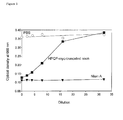
- Example 2 Antimicrobial activity of a truncated nisin variant containing an affinity tag in ring C.
- nisin leader peptide MSTKDFNLDLVSVSKKDSGASPR
- the peptide was produced by L. lactis containing pIl3BTC.
- the leader was cleaved off with trypsin and the antimicrobial activity was measured as follows: In a microwell plate: 200 ⁇ l of. supernatant of nisin fusion strain and in other wells 200 ⁇ l of control (positive e.g. filtered sup of NZ9700 and negative) solutions was added to wells of the first column. 100 ⁇ l medium was added to the remaining empty wells. For each row 100 ⁇ l from the first column was added to the second and after mixing from the second to the third etc leading to two-fold dilution steps. 100 ⁇ l of sensitive strain. MG1363 was added to all wells at low density, OD600: 0.05-0.1. After 6 hours OD600 was measured.
- Figure 2 shows that the truncated nisin's variant with HPQF-containing ringC has clearly antimicrobial activity.
- Example 2 demonstrates that the presence of HPQF in ring C does not abolish the antimicrobial activity of the truncated nisin mutant. This is surprising because simultaneously four amino acids are mutated whereas one amino acid is deleted. Despite the truncation (which may already lead to 10-fold reduction), despite the shortened ring C and despite the negatively charged tail (which reduces binding to the anionic membrane), the peptide still has activity.
Landscapes
- Chemical & Material Sciences (AREA)
- Organic Chemistry (AREA)
- Life Sciences & Earth Sciences (AREA)
- Health & Medical Sciences (AREA)
- Proteomics, Peptides & Aminoacids (AREA)
- Biochemistry (AREA)
- General Health & Medical Sciences (AREA)
- Genetics & Genomics (AREA)
- Molecular Biology (AREA)
- Biophysics (AREA)
- Medicinal Chemistry (AREA)
- Zoology (AREA)
- Engineering & Computer Science (AREA)
- Wood Science & Technology (AREA)
- Microbiology (AREA)
- Gastroenterology & Hepatology (AREA)
- Biotechnology (AREA)
- Chemical Kinetics & Catalysis (AREA)
- General Chemical & Material Sciences (AREA)
- Toxicology (AREA)
- Analytical Chemistry (AREA)
- Bioinformatics & Cheminformatics (AREA)
- General Engineering & Computer Science (AREA)
- Peptides Or Proteins (AREA)
- Preparation Of Compounds By Using Micro-Organisms (AREA)
- Micro-Organisms Or Cultivation Processes Thereof (AREA)
Claims (14)
- Enzymatisches Verfahren zur Bereitstellung einer Proteinsubstanz, die ein Polypeptid von Interesse und ein zyklisches Affinitäts-Tag umfasst, wobei das Verfahren die folgenden Schritte umfasst:a) Bereitstellen von mindestens einer Proteinsubstanzvorstufe, wobei die Vorstufe das Polypeptid von Interesse und mindestens ein Motiv der allgemeinen Formel X1-Tag-X2 umfasst,wobei X1 und X2 Aminosäuren bedeuten, deren Seitenketten über ein Lantibiotikum-Enzym verknüpft sein können, das fähig ist, eine Thioetherbrücke zwischen den Resten X1 und X2 auszubilden, wobei X1 aus der Gruppe bestehend aus Dhb, Dha, Thr und Ser ausgewählt ist und wobei X2 Cys ode Lys ist; oder wobei X1 Cys oder Lys ist und X2 aus der Gruppe bestehend aus Dhb, Dha, Thr und Ser ausgewählt ist;Tag eine Aminosäuresequenz ist, die bei Cyclisierung als Affinitäts-Tag dient, wobei der Affinitäts-Tag das Einfangen der Protein-substanz an einen spezifischen Bindungspartner des Tags gestattet;und wobei dem Motiv N-terminal eine Lantibiotikum-Leitsequenz vorgeschaltet ist;b) Inkontaktbringen der Vorstufe mit dem Lantibiotikum-Enzym LanM, mit einer Lantibiotikum-Cyclase LanC im Fall einer Kombination eines Dehydrorests und eines Cysteins, oder einer Kombination einer Lantibiotikumdehydratase LanB und Lantibiotikum-Cyclase LanC, falls X1 oder X2 Thr oder Ser bedeutet, was die Ausbildung einer Thioetherbrücke zwischen X1 und X2 ermöglicht, wodurch eine intramolekulare Ringstruktur, die die Tag-Sequenz umfasst, eingeführt wird; undc) Isolieren der entstandenen cyclisierten Proteinsubstanz,mit der Maßgabe, dass das Verfahren kein Verfahren für die Behandlung des menschlichen oder tierischen Körpers oder kein diagnostisches Verfahren, dass am menschlichen oder tierischen Körper durchgeführt wird, beinhaltet.
- Verfahren nach Anspruch 1, wobei das Polypeptid von Interesse N- oder C-terminal mit dem mindestens einem Motiv der allgemeinen Formel X1-Tag-X2 fusioniert ist.
- Verfahren nach Anspruch 2, wobei die Proteinsubstanz eine Spaltstelle zwischen dem Polypeptid von Interesse und dem mindestens einen Motiv umfasst, wobei es sich bei der Spaltstelle vorzugweise um eine Faktor-X-Spaltstelle oder eine Glu-C-Spaltstelle handelt.
- Verfahren nach Anspruch 3, wobei sich an Schritt c) die Spaltung der cyclisierten Proteinsubstanz an der Spaltstelle unter Freisetzung des Polypeptids von Interesse anschließt.
- Verfahren nach Anspruch 1, wobei es sich bei der Proteinsubstanz um ein Polypeptid von Interesse handelt, bei dem ein Teil durch das mindestens eine Motiv derart ersetzt ist, dass das Motiv ein integrierender Teil des Polypeptids von Interesse ist.
- Verfahren nach einem der vorhergehenden Ansprüche, wobei die Schritte a) und b) in einer Wirtszelle durchgeführt werden, die das mindestens eine Lantibiotikum-Enzym, das fähig ist, eine Thioether-brückenbindung zwischen X1 und X2 auszubilden, umfasst, wobei die Wirtszelle mit einer Nukleinsäuresequenz ausgestattet ist, die für die Proteinsubstanzvorstufe codiert.
- Verfahren nach einem der vorhergehenden Ansprüche, wobei Tag die Sequenz Arg-Gly-Asp umfasst.
- Verfahren nach einem der Ansprüche 1-6, wobei Tag eine Streptavidinbindungssequenz umfasst, die fähig ist, Streptavidin mit einer Dissoziationskonstante von weniger als 10 µM zu binden, vorzugsweise wobei die Streptavidinbindungssequenz aus der Gruppe bestehend aus His-Pro-Gly, His-Pro-Lys, His-Pro-Met, His-Pro-Gln und His-Pro-Gln-Phe ausgewählt ist, vorzugweise wobei die Streptavidinbindungssequenz His-Pro-Gln oder His-Pro-Gln-Phe ist.
- Verfahren nach Anspruch 8, wobei das Motiv X1-Tag-X2 aus einer Aminosäuresequenz besteht, die aus der Gruppe bestehend aus Dha-His-Pro-Gln-Phe-Cys; Dhb-His-Pro-Gln-Phe-Cys; Ser-His-Pro-Gln-Phe-Cys; Thr-His-Pro-Gln-Phe-Cys; Cys-His-Pro-Gln-Phe-Dha; Cys-His-Pro-Gln-Phe-Dhb; Cys-His-Pro-Gln-Ph-Ser; Cys-His-Pro-Gln-Phe-Thr; Dha-His-Pro-Gln-Cys; Dhb-His-Pro-Gln-Cys; Ser-His-Pro-Gln-Cys; Thr-His-Pro-Gln-Cys; Cys-His-Pro-Gln-Dha; Cys-His-Pro-Gln-Dhb; Cys-His-Pro-Gln-Ser; Cys-His-Pro-Gln-Thr; Ser-His-Pro-Gln-Phe-Lys; Thr-His-Pro-Gln-Phe-Lys; Lys-His-Pro-Gln-Phe-Ser; Lys-His-Pro-Gln-Phe-Thr; Dha-His-Pro-Gln-Phe-Lys; Dhb-His-Pro-Gln-Phe-Lys; Lys-His-Pro-Gln-Dha; Lys-His-Pro-Gln-Dhb; Ser-His-Pro-Gln-Lys; Thr-His-Pro-Gln-Lys; Lys-His-Pro-Gln-Ser; Lys-His-Pro-Gln-Thr; Dha-His-Pro-Gln-Lys; Dhb-His-Pro-Gln-Lys; Lys-His-Pro-Gln-Dha und Lys-His-Pro-Gln-Dhb ausgewählt ist.
- Verfahren nach einem der vorhergehenden Ansprüche, wobei die Schritte a) und b) in einer Wirtszelle durchgeführt werden, die die Lanthioninproteine LanB; LanC und LanT; LanM und LanT; LanB und LanC; oder LanM umfasst.
- Proteinsubstanz, umfassend mindestens eine cyclische Tag-Sequenz, wobei die cyclische Tag-Sequenz eine cyclisierte Streptavidinbindungssequenz ist, wobei die Tag-Sequenz ein Teil einer über Thioether verknüpften Ringstruktur ist, die in N- nach C-Orientierung eine D-Aminosäure und eine L-Aminosäure, oder eine L-Aminosäure mit einer D-Aminosäure, verbrückt.
- Proteinsubstanz nach Anspruch 11, wobei die cyclische Tag-Sequenz eine Sequenz, ausgewählt aus der Gruppe bestehend aus His-Pro-Gly, His-Pro-Lys, His-Pro-Met, His-Pro-Gln und His-Pro-Gln-Phe umfasst oder daraus besteht.
- Proteinsubstanz nach Anspruch 11 oder 12, umfassend ein mutiertes Lantibiotikum oder ein Lantibiotikumfragment umfassend eine Ringstruktur, und wobei die Ringstruktur mindestens ein cyclisches Streptavidinbindungsmotiv umfasst, das eine Thioether-brücke enthält und das in N- nach C-Orientierung eine D-Aminosäure mit einer L-Aminosäure oder eine L-Aminosäure mit einer D-Aminosäure verbrückt.
- Peptidbibliothek, die eine Vielzahl von Proteinsubstanzen nach einem der Ansprüche 11-13 umfasst.
Priority Applications (1)
| Application Number | Priority Date | Filing Date | Title |
|---|---|---|---|
| EP10728424.2A EP2445926B1 (de) | 2009-06-24 | 2010-06-23 | Biologisch hergestellte cyclische affinitätsmarker |
Applications Claiming Priority (3)
| Application Number | Priority Date | Filing Date | Title |
|---|---|---|---|
| EP09163581A EP2267003A1 (de) | 2009-06-24 | 2009-06-24 | Biologisch hergestellte cyclische Affinitätsmarker |
| PCT/NL2010/050389 WO2010151126A1 (en) | 2009-06-24 | 2010-06-23 | Biologically produced cyclic affinity tags |
| EP10728424.2A EP2445926B1 (de) | 2009-06-24 | 2010-06-23 | Biologisch hergestellte cyclische affinitätsmarker |
Publications (2)
| Publication Number | Publication Date |
|---|---|
| EP2445926A1 EP2445926A1 (de) | 2012-05-02 |
| EP2445926B1 true EP2445926B1 (de) | 2015-08-12 |
Family
ID=41064553
Family Applications (2)
| Application Number | Title | Priority Date | Filing Date |
|---|---|---|---|
| EP09163581A Ceased EP2267003A1 (de) | 2009-06-24 | 2009-06-24 | Biologisch hergestellte cyclische Affinitätsmarker |
| EP10728424.2A Not-in-force EP2445926B1 (de) | 2009-06-24 | 2010-06-23 | Biologisch hergestellte cyclische affinitätsmarker |
Family Applications Before (1)
| Application Number | Title | Priority Date | Filing Date |
|---|---|---|---|
| EP09163581A Ceased EP2267003A1 (de) | 2009-06-24 | 2009-06-24 | Biologisch hergestellte cyclische Affinitätsmarker |
Country Status (10)
| Country | Link |
|---|---|
| US (1) | US20120165230A1 (de) |
| EP (2) | EP2267003A1 (de) |
| JP (1) | JP5909812B2 (de) |
| CN (1) | CN102803287A (de) |
| AU (1) | AU2010263353B2 (de) |
| CA (1) | CA2761471C (de) |
| DK (1) | DK2445926T3 (de) |
| ES (1) | ES2551855T3 (de) |
| NZ (1) | NZ596259A (de) |
| WO (1) | WO2010151126A1 (de) |
Families Citing this family (3)
| Publication number | Priority date | Publication date | Assignee | Title |
|---|---|---|---|---|
| WO2015175864A1 (en) * | 2014-05-15 | 2015-11-19 | Cleveland Heartlab, Inc. | Compositions and methods for purification and detection of hdl and apoa1 |
| JP6598344B2 (ja) * | 2017-07-31 | 2019-10-30 | 国立大学法人 東京大学 | 環状ペプチドをタンパク質構造に提示させる超汎用法 |
| CN113354718B (zh) * | 2021-06-21 | 2023-06-02 | 重庆市畜牧科学院 | 一种哌尼生素前体、表达盒及其制备方法 |
Family Cites Families (11)
| Publication number | Priority date | Publication date | Assignee | Title |
|---|---|---|---|---|
| US6028168A (en) * | 1991-08-09 | 2000-02-22 | Winfried Kolbeck | Lanthionine bridged peptides |
| US6841359B2 (en) | 2000-10-31 | 2005-01-11 | The General Hospital Corporation | Streptavidin-binding peptides and uses thereof |
| JP2005536184A (ja) | 2002-03-01 | 2005-12-02 | エルドマン,ヴォルカー,エー. | ストレプトアビジン結合ペプチド |
| US6861236B2 (en) * | 2002-05-24 | 2005-03-01 | Applied Nanosystems B.V. | Export and modification of (poly)peptides in the lantibiotic way |
| US6794181B2 (en) * | 2002-10-09 | 2004-09-21 | Immucell Corporation | Method of purifying lantibiotics |
| US7785825B2 (en) * | 2004-01-12 | 2010-08-31 | The Board Of Trustees Of The University Of Illinois | Compositions and methods for dehydration and cyclization of peptides, synthetic compounds, and lantibiotics |
| WO2006062398A2 (en) * | 2004-12-07 | 2006-06-15 | Applied Nanosystems B.V. | Methods for the production and secretion of modified peptides |
| WO2007022012A2 (en) * | 2005-08-12 | 2007-02-22 | Oragenics, Inc. | Differentially protected orthogonal lanthionine technology |
| US20080032340A1 (en) | 2006-06-09 | 2008-02-07 | University Of Arizona | Peptide motifs for binding avidin or neutravidin |
| WO2008130217A1 (en) | 2006-08-08 | 2008-10-30 | Applied Nanosystems B.V. | Cyclic angiotensin analogs |
| EP2405008A1 (de) * | 2010-07-06 | 2012-01-11 | LanthioPep B.V. | Bakterienoberflächenanzeige von thioether-brücken-haltigen Peptiden |
-
2009
- 2009-06-24 EP EP09163581A patent/EP2267003A1/de not_active Ceased
-
2010
- 2010-06-23 US US13/376,577 patent/US20120165230A1/en not_active Abandoned
- 2010-06-23 WO PCT/NL2010/050389 patent/WO2010151126A1/en not_active Ceased
- 2010-06-23 DK DK10728424.2T patent/DK2445926T3/en active
- 2010-06-23 ES ES10728424.2T patent/ES2551855T3/es active Active
- 2010-06-23 NZ NZ596259A patent/NZ596259A/xx not_active IP Right Cessation
- 2010-06-23 CN CN2010800253560A patent/CN102803287A/zh active Pending
- 2010-06-23 EP EP10728424.2A patent/EP2445926B1/de not_active Not-in-force
- 2010-06-23 AU AU2010263353A patent/AU2010263353B2/en not_active Ceased
- 2010-06-23 JP JP2012517429A patent/JP5909812B2/ja active Active
- 2010-06-23 CA CA2761471A patent/CA2761471C/en not_active Expired - Fee Related
Non-Patent Citations (4)
| Title |
|---|
| BIOTECHNOLOGY JOURNAL, vol. 7, no. 5, Sp. Iss. SI, May 2012 (2012-05-01), pages 620 - 634, ISSN: 1860-6768(print), DOI: 10.1002/BIOT.201100155 * |
| DATABASE BIOSIS [online] BIOSCIENCES INFORMATION SERVICE, PHILADELPHIA, PA, US; May 2012 (2012-05-01), YOUNG CARISSA L ET AL: "Recombinant protein expression and purification: A comprehensive review of affinity tags and microbial applications", Database accession no. PREV201200394732 * |
| TARPE K: "Overview of tag protein fusions: from molecular and biochemical fundamentals to commercial systems", APPLIED MICROBIOLOGY AND BIOTECHNOLOGY, SPRINGER, BERLIN, DE, vol. 60, 1 January 2003 (2003-01-01), pages 523 - 533, XP009091798, ISSN: 1432-0614 * |
| WAUGH ET AL: "Making the most of affinity tags", TRENDS IN BIOTECHNOLOGY, ELSEVIER PUBLICATIONS, CAMBRIDGE, GB, vol. 23, no. 6, 1 June 2005 (2005-06-01), pages 316 - 320, XP027778099, ISSN: 0167-7799, [retrieved on 20050601] * |
Also Published As
| Publication number | Publication date |
|---|---|
| US20120165230A1 (en) | 2012-06-28 |
| CA2761471A1 (en) | 2010-12-29 |
| AU2010263353A1 (en) | 2011-12-08 |
| AU2010263353B2 (en) | 2016-05-12 |
| EP2445926A1 (de) | 2012-05-02 |
| CA2761471C (en) | 2018-06-12 |
| JP2012531199A (ja) | 2012-12-10 |
| DK2445926T3 (en) | 2015-10-19 |
| ES2551855T3 (es) | 2015-11-24 |
| CN102803287A (zh) | 2012-11-28 |
| JP5909812B2 (ja) | 2016-04-27 |
| NZ596259A (en) | 2013-07-26 |
| WO2010151126A1 (en) | 2010-12-29 |
| EP2267003A1 (de) | 2010-12-29 |
Similar Documents
| Publication | Publication Date | Title |
|---|---|---|
| RU2745572C2 (ru) | Модуляция специфичности структурированных белков | |
| Brunsveld et al. | Lipidated ras and rab peptides and proteins—synthesis, structure, and function | |
| EP2591109B1 (de) | Bakterienoberflächendisplay und screening von thioether-brücken-haltigen peptiden | |
| US5874239A (en) | Biotinylation of proteins | |
| Rowe et al. | The role of chemical synthesis in developing RiPP antibiotics | |
| US20200385705A1 (en) | Novel methods for displaying cyclic peptides on bacteriophage particles | |
| Levengood et al. | Investigation of the substrate specificity of lacticin 481 synthetase by using nonproteinogenic amino acids | |
| US7799561B2 (en) | Affinity peptides and method for purification of recombinant proteins | |
| Abboud et al. | A straightforward methodology to overcome solubility challenges for N-terminal cysteinyl peptide segments used in native chemical ligation | |
| EP2075336B1 (de) | Reinigung von rekombinanten mit mehreren Epitopen fusionierten Proteinen | |
| Kawakami et al. | Synthesis of histone proteins by CPE ligation using a recombinant peptide as the C-terminal building block | |
| AU2010263353B2 (en) | Biologically produced cyclic affinity tags | |
| Xie et al. | Heterologous expression and purification of SpaB involved in subtilin biosynthesis | |
| JP2002522085A (ja) | タンパク質および/または生体分子もしくはタンパク質複合体の精製方法 | |
| US7825227B2 (en) | Method for purification of a protein complex and identification of its components | |
| Haque et al. | Contacts between mammalian mitochondrial translational initiation factor 3 and ribosomal proteins in the small subunit | |
| Nguyen et al. | Making circles: Recent advance in chemical and enzymatic approaches in peptide macrocyclization | |
| US9783800B2 (en) | Method for producing peptides having azole-derived skeleton | |
| WO2014136971A1 (ja) | ヘテロ環を含む化合物の製造方法 | |
| US20250084127A1 (en) | Efficient chemo-enzymatic synthesis method for cyclic peptide | |
| WO2023048262A1 (ja) | 酵素を用いたペプチドライゲーション | |
| McKinney | Studies of the Saccharomyces cerevisiae alpha-factor mating pheromone and its receptor (the STE2 gene product) | |
| Dickman | Synthesis and Conformational Studies of the Lipid II-Binding Rings of Nisin and Mutacin I | |
| Dou et al. | The terminal structure plays an important role in the biological activity of cecropin CMIV | |
| WO2002095013A2 (en) | Engineered bira for in vitro biotinylation |
Legal Events
| Date | Code | Title | Description |
|---|---|---|---|
| PUAI | Public reference made under article 153(3) epc to a published international application that has entered the european phase |
Free format text: ORIGINAL CODE: 0009012 |
|
| 17P | Request for examination filed |
Effective date: 20120102 |
|
| AK | Designated contracting states |
Kind code of ref document: A1 Designated state(s): AL AT BE BG CH CY CZ DE DK EE ES FI FR GB GR HR HU IE IS IT LI LT LU LV MC MK MT NL NO PL PT RO SE SI SK SM TR |
|
| DAX | Request for extension of the european patent (deleted) | ||
| 17Q | First examination report despatched |
Effective date: 20140221 |
|
| GRAP | Despatch of communication of intention to grant a patent |
Free format text: ORIGINAL CODE: EPIDOSNIGR1 |
|
| RAP1 | Party data changed (applicant data changed or rights of an application transferred) |
Owner name: MORPHOSYS AG |
|
| INTG | Intention to grant announced |
Effective date: 20150324 |
|
| RIN1 | Information on inventor provided before grant (corrected) |
Inventor name: MOLL, GERT NIKOLAAS Inventor name: KUIPERS, ANNEKE Inventor name: RINK, RICK Inventor name: BOSMA, TJIBBE |
|
| GRAS | Grant fee paid |
Free format text: ORIGINAL CODE: EPIDOSNIGR3 |
|
| GRAA | (expected) grant |
Free format text: ORIGINAL CODE: 0009210 |
|
| AK | Designated contracting states |
Kind code of ref document: B1 Designated state(s): AL AT BE BG CH CY CZ DE DK EE ES FI FR GB GR HR HU IE IS IT LI LT LU LV MC MK MT NL NO PL PT RO SE SI SK SM TR |
|
| REG | Reference to a national code |
Ref country code: GB Ref legal event code: FG4D |
|
| REG | Reference to a national code |
Ref country code: CH Ref legal event code: EP |
|
| REG | Reference to a national code |
Ref country code: AT Ref legal event code: REF Ref document number: 742068 Country of ref document: AT Kind code of ref document: T Effective date: 20150815 |
|
| REG | Reference to a national code |
Ref country code: CH Ref legal event code: NV Representative=s name: FIAMMENGHI-FIAMMENGHI, CH |
|
| REG | Reference to a national code |
Ref country code: IE Ref legal event code: FG4D |
|
| REG | Reference to a national code |
Ref country code: DE Ref legal event code: R096 Ref document number: 602010026598 Country of ref document: DE |
|
| REG | Reference to a national code |
Ref country code: DK Ref legal event code: T3 Effective date: 20151014 |
|
| REG | Reference to a national code |
Ref country code: SE Ref legal event code: TRGR |
|
| REG | Reference to a national code |
Ref country code: ES Ref legal event code: FG2A Ref document number: 2551855 Country of ref document: ES Kind code of ref document: T3 Effective date: 20151124 |
|
| REG | Reference to a national code |
Ref country code: LT Ref legal event code: MG4D |
|
| REG | Reference to a national code |
Ref country code: NL Ref legal event code: FP |
|
| PG25 | Lapsed in a contracting state [announced via postgrant information from national office to epo] |
Ref country code: LV Free format text: LAPSE BECAUSE OF FAILURE TO SUBMIT A TRANSLATION OF THE DESCRIPTION OR TO PAY THE FEE WITHIN THE PRESCRIBED TIME-LIMIT Effective date: 20150812 Ref country code: FI Free format text: LAPSE BECAUSE OF FAILURE TO SUBMIT A TRANSLATION OF THE DESCRIPTION OR TO PAY THE FEE WITHIN THE PRESCRIBED TIME-LIMIT Effective date: 20150812 Ref country code: NO Free format text: LAPSE BECAUSE OF FAILURE TO SUBMIT A TRANSLATION OF THE DESCRIPTION OR TO PAY THE FEE WITHIN THE PRESCRIBED TIME-LIMIT Effective date: 20151112 Ref country code: GR Free format text: LAPSE BECAUSE OF FAILURE TO SUBMIT A TRANSLATION OF THE DESCRIPTION OR TO PAY THE FEE WITHIN THE PRESCRIBED TIME-LIMIT Effective date: 20151113 Ref country code: LT Free format text: LAPSE BECAUSE OF FAILURE TO SUBMIT A TRANSLATION OF THE DESCRIPTION OR TO PAY THE FEE WITHIN THE PRESCRIBED TIME-LIMIT Effective date: 20150812 |
|
| PG25 | Lapsed in a contracting state [announced via postgrant information from national office to epo] |
Ref country code: HR Free format text: LAPSE BECAUSE OF FAILURE TO SUBMIT A TRANSLATION OF THE DESCRIPTION OR TO PAY THE FEE WITHIN THE PRESCRIBED TIME-LIMIT Effective date: 20150812 Ref country code: PL Free format text: LAPSE BECAUSE OF FAILURE TO SUBMIT A TRANSLATION OF THE DESCRIPTION OR TO PAY THE FEE WITHIN THE PRESCRIBED TIME-LIMIT Effective date: 20150812 Ref country code: IS Free format text: LAPSE BECAUSE OF FAILURE TO SUBMIT A TRANSLATION OF THE DESCRIPTION OR TO PAY THE FEE WITHIN THE PRESCRIBED TIME-LIMIT Effective date: 20151212 Ref country code: PT Free format text: LAPSE BECAUSE OF FAILURE TO SUBMIT A TRANSLATION OF THE DESCRIPTION OR TO PAY THE FEE WITHIN THE PRESCRIBED TIME-LIMIT Effective date: 20151214 |
|
| PG25 | Lapsed in a contracting state [announced via postgrant information from national office to epo] |
Ref country code: EE Free format text: LAPSE BECAUSE OF FAILURE TO SUBMIT A TRANSLATION OF THE DESCRIPTION OR TO PAY THE FEE WITHIN THE PRESCRIBED TIME-LIMIT Effective date: 20150812 Ref country code: SK Free format text: LAPSE BECAUSE OF FAILURE TO SUBMIT A TRANSLATION OF THE DESCRIPTION OR TO PAY THE FEE WITHIN THE PRESCRIBED TIME-LIMIT Effective date: 20150812 Ref country code: CZ Free format text: LAPSE BECAUSE OF FAILURE TO SUBMIT A TRANSLATION OF THE DESCRIPTION OR TO PAY THE FEE WITHIN THE PRESCRIBED TIME-LIMIT Effective date: 20150812 |
|
| REG | Reference to a national code |
Ref country code: DE Ref legal event code: R097 Ref document number: 602010026598 Country of ref document: DE |
|
| PG25 | Lapsed in a contracting state [announced via postgrant information from national office to epo] |
Ref country code: RO Free format text: LAPSE BECAUSE OF FAILURE TO SUBMIT A TRANSLATION OF THE DESCRIPTION OR TO PAY THE FEE WITHIN THE PRESCRIBED TIME-LIMIT Effective date: 20150812 |
|
| PLBE | No opposition filed within time limit |
Free format text: ORIGINAL CODE: 0009261 |
|
| STAA | Information on the status of an ep patent application or granted ep patent |
Free format text: STATUS: NO OPPOSITION FILED WITHIN TIME LIMIT |
|
| REG | Reference to a national code |
Ref country code: FR Ref legal event code: PLFP Year of fee payment: 7 |
|
| 26N | No opposition filed |
Effective date: 20160513 |
|
| PG25 | Lapsed in a contracting state [announced via postgrant information from national office to epo] |
Ref country code: SI Free format text: LAPSE BECAUSE OF FAILURE TO SUBMIT A TRANSLATION OF THE DESCRIPTION OR TO PAY THE FEE WITHIN THE PRESCRIBED TIME-LIMIT Effective date: 20150812 |
|
| PG25 | Lapsed in a contracting state [announced via postgrant information from national office to epo] |
Ref country code: MC Free format text: LAPSE BECAUSE OF FAILURE TO SUBMIT A TRANSLATION OF THE DESCRIPTION OR TO PAY THE FEE WITHIN THE PRESCRIBED TIME-LIMIT Effective date: 20150812 |
|
| REG | Reference to a national code |
Ref country code: DE Ref legal event code: R082 Ref document number: 602010026598 Country of ref document: DE Representative=s name: KILBURN & STRODE LLP, NL Ref country code: DE Ref legal event code: R082 Ref document number: 602010026598 Country of ref document: DE Representative=s name: KILBURN & STRODE LLP, GB Ref country code: DE Ref legal event code: R081 Ref document number: 602010026598 Country of ref document: DE Owner name: LANTHIOPEP B.V., NL Free format text: FORMER OWNER: MORPHOSYS AG, 82152 PLANEGG, DE |
|
| REG | Reference to a national code |
Ref country code: CH Ref legal event code: PUE Owner name: LANTHIOPEP B.V., NL Free format text: FORMER OWNER: MORPHOSYS AG, DE |
|
| REG | Reference to a national code |
Ref country code: FR Ref legal event code: PLFP Year of fee payment: 8 |
|
| REG | Reference to a national code |
Ref country code: GB Ref legal event code: 732E Free format text: REGISTERED BETWEEN 20170817 AND 20170823 |
|
| REG | Reference to a national code |
Ref country code: AT Ref legal event code: PC Ref document number: 742068 Country of ref document: AT Kind code of ref document: T Owner name: LANTHIOPEP B.V., NL Effective date: 20170911 |
|
| REG | Reference to a national code |
Ref country code: FR Ref legal event code: CA Effective date: 20171009 Ref country code: FR Ref legal event code: TP Owner name: LANTHIOPEP B.V., NL Effective date: 20171009 |
|
| REG | Reference to a national code |
Ref country code: NL Ref legal event code: PD Owner name: LANTHIOPEP B.V.; NL Free format text: DETAILS ASSIGNMENT: CHANGE OF OWNER(S), ASSIGNMENT; FORMER OWNER NAME: MORPHOSYS AG Effective date: 20171024 |
|
| REG | Reference to a national code |
Ref country code: ES Ref legal event code: PC2A Owner name: LANTHIOPEP B.V. Effective date: 20180427 |
|
| PG25 | Lapsed in a contracting state [announced via postgrant information from national office to epo] |
Ref country code: SM Free format text: LAPSE BECAUSE OF FAILURE TO SUBMIT A TRANSLATION OF THE DESCRIPTION OR TO PAY THE FEE WITHIN THE PRESCRIBED TIME-LIMIT Effective date: 20150812 Ref country code: CY Free format text: LAPSE BECAUSE OF FAILURE TO SUBMIT A TRANSLATION OF THE DESCRIPTION OR TO PAY THE FEE WITHIN THE PRESCRIBED TIME-LIMIT Effective date: 20150812 Ref country code: HU Free format text: LAPSE BECAUSE OF FAILURE TO SUBMIT A TRANSLATION OF THE DESCRIPTION OR TO PAY THE FEE WITHIN THE PRESCRIBED TIME-LIMIT; INVALID AB INITIO Effective date: 20100623 |
|
| REG | Reference to a national code |
Ref country code: AT Ref legal event code: UEP Ref document number: 742068 Country of ref document: AT Kind code of ref document: T Effective date: 20150812 Ref country code: BE Ref legal event code: FP Effective date: 20151102 Ref country code: BE Ref legal event code: PD Owner name: LANTHIOPEP B.V.; NL Free format text: DETAILS ASSIGNMENT: CHANGE OF OWNER(S), CESSION; FORMER OWNER NAME: MORPHOSYS AG Effective date: 20180424 |
|
| REG | Reference to a national code |
Ref country code: FR Ref legal event code: PLFP Year of fee payment: 9 |
|
| PG25 | Lapsed in a contracting state [announced via postgrant information from national office to epo] |
Ref country code: TR Free format text: LAPSE BECAUSE OF FAILURE TO SUBMIT A TRANSLATION OF THE DESCRIPTION OR TO PAY THE FEE WITHIN THE PRESCRIBED TIME-LIMIT Effective date: 20150812 Ref country code: LU Free format text: LAPSE BECAUSE OF NON-PAYMENT OF DUE FEES Effective date: 20160623 Ref country code: MT Free format text: LAPSE BECAUSE OF NON-PAYMENT OF DUE FEES Effective date: 20160630 Ref country code: MK Free format text: LAPSE BECAUSE OF FAILURE TO SUBMIT A TRANSLATION OF THE DESCRIPTION OR TO PAY THE FEE WITHIN THE PRESCRIBED TIME-LIMIT Effective date: 20150812 |
|
| PG25 | Lapsed in a contracting state [announced via postgrant information from national office to epo] |
Ref country code: BG Free format text: LAPSE BECAUSE OF FAILURE TO SUBMIT A TRANSLATION OF THE DESCRIPTION OR TO PAY THE FEE WITHIN THE PRESCRIBED TIME-LIMIT Effective date: 20150812 |
|
| PG25 | Lapsed in a contracting state [announced via postgrant information from national office to epo] |
Ref country code: AL Free format text: LAPSE BECAUSE OF FAILURE TO SUBMIT A TRANSLATION OF THE DESCRIPTION OR TO PAY THE FEE WITHIN THE PRESCRIBED TIME-LIMIT Effective date: 20150812 |
|
| PGFP | Annual fee paid to national office [announced via postgrant information from national office to epo] |
Ref country code: DE Payment date: 20200618 Year of fee payment: 11 Ref country code: DK Payment date: 20200622 Year of fee payment: 11 Ref country code: CH Payment date: 20200618 Year of fee payment: 11 Ref country code: FR Payment date: 20200619 Year of fee payment: 11 Ref country code: IE Payment date: 20200624 Year of fee payment: 11 |
|
| PGFP | Annual fee paid to national office [announced via postgrant information from national office to epo] |
Ref country code: BE Payment date: 20200625 Year of fee payment: 11 Ref country code: GB Payment date: 20200625 Year of fee payment: 11 Ref country code: SE Payment date: 20200625 Year of fee payment: 11 Ref country code: NL Payment date: 20200625 Year of fee payment: 11 |
|
| PGFP | Annual fee paid to national office [announced via postgrant information from national office to epo] |
Ref country code: AT Payment date: 20200619 Year of fee payment: 11 |
|
| PGFP | Annual fee paid to national office [announced via postgrant information from national office to epo] |
Ref country code: ES Payment date: 20200824 Year of fee payment: 11 |
|
| PGFP | Annual fee paid to national office [announced via postgrant information from national office to epo] |
Ref country code: IT Payment date: 20200625 Year of fee payment: 11 |
|
| REG | Reference to a national code |
Ref country code: DE Ref legal event code: R082 Ref document number: 602010026598 Country of ref document: DE Representative=s name: KILBURN & STRODE LLP, NL |
|
| REG | Reference to a national code |
Ref country code: DE Ref legal event code: R119 Ref document number: 602010026598 Country of ref document: DE |
|
| REG | Reference to a national code |
Ref country code: DK Ref legal event code: EBP Effective date: 20210630 |
|
| REG | Reference to a national code |
Ref country code: SE Ref legal event code: EUG |
|
| REG | Reference to a national code |
Ref country code: CH Ref legal event code: PL |
|
| REG | Reference to a national code |
Ref country code: NL Ref legal event code: MM Effective date: 20210701 |
|
| REG | Reference to a national code |
Ref country code: AT Ref legal event code: MM01 Ref document number: 742068 Country of ref document: AT Kind code of ref document: T Effective date: 20210623 |
|
| GBPC | Gb: european patent ceased through non-payment of renewal fee |
Effective date: 20210623 |
|
| REG | Reference to a national code |
Ref country code: BE Ref legal event code: MM Effective date: 20210630 |
|
| PG25 | Lapsed in a contracting state [announced via postgrant information from national office to epo] |
Ref country code: LI Free format text: LAPSE BECAUSE OF NON-PAYMENT OF DUE FEES Effective date: 20210630 Ref country code: IE Free format text: LAPSE BECAUSE OF NON-PAYMENT OF DUE FEES Effective date: 20210623 Ref country code: GB Free format text: LAPSE BECAUSE OF NON-PAYMENT OF DUE FEES Effective date: 20210623 Ref country code: DE Free format text: LAPSE BECAUSE OF NON-PAYMENT OF DUE FEES Effective date: 20220101 Ref country code: CH Free format text: LAPSE BECAUSE OF NON-PAYMENT OF DUE FEES Effective date: 20210630 Ref country code: AT Free format text: LAPSE BECAUSE OF NON-PAYMENT OF DUE FEES Effective date: 20210623 |
|
| PG25 | Lapsed in a contracting state [announced via postgrant information from national office to epo] |
Ref country code: SE Free format text: LAPSE BECAUSE OF NON-PAYMENT OF DUE FEES Effective date: 20210624 Ref country code: NL Free format text: LAPSE BECAUSE OF NON-PAYMENT OF DUE FEES Effective date: 20210701 Ref country code: FR Free format text: LAPSE BECAUSE OF NON-PAYMENT OF DUE FEES Effective date: 20210630 |
|
| PG25 | Lapsed in a contracting state [announced via postgrant information from national office to epo] |
Ref country code: IT Free format text: LAPSE BECAUSE OF NON-PAYMENT OF DUE FEES Effective date: 20210623 Ref country code: DK Free format text: LAPSE BECAUSE OF NON-PAYMENT OF DUE FEES Effective date: 20210630 Ref country code: BE Free format text: LAPSE BECAUSE OF NON-PAYMENT OF DUE FEES Effective date: 20210630 |
|
| REG | Reference to a national code |
Ref country code: ES Ref legal event code: FD2A Effective date: 20220901 |
|
| PG25 | Lapsed in a contracting state [announced via postgrant information from national office to epo] |
Ref country code: ES Free format text: LAPSE BECAUSE OF NON-PAYMENT OF DUE FEES Effective date: 20210624 |