EP2441982B1 - Planetentrieb mit einem ersten Satz Planetenräder und mit einem zweiten Satz Planetenräder und eine Baueinheit in einem derartigen Planetentrieb - Google Patents
Planetentrieb mit einem ersten Satz Planetenräder und mit einem zweiten Satz Planetenräder und eine Baueinheit in einem derartigen Planetentrieb Download PDFInfo
- Publication number
- EP2441982B1 EP2441982B1 EP20110172517 EP11172517A EP2441982B1 EP 2441982 B1 EP2441982 B1 EP 2441982B1 EP 20110172517 EP20110172517 EP 20110172517 EP 11172517 A EP11172517 A EP 11172517A EP 2441982 B1 EP2441982 B1 EP 2441982B1
- Authority
- EP
- European Patent Office
- Prior art keywords
- planetary
- bearing plates
- gears
- planet
- bearing
- Prior art date
- Legal status (The legal status is an assumption and is not a legal conclusion. Google has not performed a legal analysis and makes no representation as to the accuracy of the status listed.)
- Not-in-force
Links
- 238000005096 rolling process Methods 0.000 description 28
- 239000002184 metal Substances 0.000 description 6
- 229910000831 Steel Inorganic materials 0.000 description 5
- 239000010959 steel Substances 0.000 description 5
- 230000005540 biological transmission Effects 0.000 description 3
- 230000000712 assembly Effects 0.000 description 2
- 238000000429 assembly Methods 0.000 description 2
- 229910001092 metal group alloy Inorganic materials 0.000 description 2
- 238000013519 translation Methods 0.000 description 2
- 230000014616 translation Effects 0.000 description 2
- 230000002411 adverse Effects 0.000 description 1
- 239000000969 carrier Substances 0.000 description 1
- 239000003638 chemical reducing agent Substances 0.000 description 1
- 230000008878 coupling Effects 0.000 description 1
- 238000010168 coupling process Methods 0.000 description 1
- 238000005859 coupling reaction Methods 0.000 description 1
- 230000000694 effects Effects 0.000 description 1
- 238000005461 lubrication Methods 0.000 description 1
- 238000004519 manufacturing process Methods 0.000 description 1
- 239000000203 mixture Substances 0.000 description 1
- 238000004806 packaging method and process Methods 0.000 description 1
- 239000007787 solid Substances 0.000 description 1
- 125000006850 spacer group Chemical group 0.000 description 1
- 238000003860 storage Methods 0.000 description 1
- 239000013585 weight reducing agent Substances 0.000 description 1
Images



Classifications
-
- F—MECHANICAL ENGINEERING; LIGHTING; HEATING; WEAPONS; BLASTING
- F16—ENGINEERING ELEMENTS AND UNITS; GENERAL MEASURES FOR PRODUCING AND MAINTAINING EFFECTIVE FUNCTIONING OF MACHINES OR INSTALLATIONS; THERMAL INSULATION IN GENERAL
- F16H—GEARING
- F16H57/00—General details of gearing
- F16H57/08—General details of gearing of gearings with members having orbital motion
- F16H57/082—Planet carriers
Definitions
- the invention relates to a planetary drive at least with a first set of planetary gears, with a second set of planetary gears, with at least one common for both planetary gear planet carrier and a ring gear, wherein pairs of a planetary gear of the first set and a planetary gear of the second set are in meshing engagement. Furthermore, the invention relates to a separately preassembled to the planet carrier assembly from at least the bearing plate and a pair of planetary gears.
- the JP1-6544 U is regarded as the nearest state of the art.
- Such a planetary drive is in DE 40 29 373 C2 described in more detail.
- Such planetary gears are used for example in planetary gears, in which the planetary gears of a first set with the internal teeth of a ring gear and the planet gears of a second set are in meshing engagement with a sun gear. In each case a planetary gear of the first set is in mesh with a planetary gear of the second set and forms a pair.
- pairs in generic planetary gears usually three or more pairs are arranged distributed on the circumference of the sun gear.
- simple planetary gears in which a single set of planetary gears is meshing with a sun gear and a ring gear at the same time, so the planetary gear of the species considered on another planetary stage.
- other translations and thus numbers of teeth are possible.
- the generic planetary gears are therefore often used in coupling gears instead of several coupled simple planetary gears, because instead of their axially short build and because the speeds of the planetary gears and thus the speeds in the bearings of the planetary gears can be reduced.
- the generic planetary gear are provided in so-called reducers with Ravigneaux sets, with which also several coupled simple planetary gears can be replaced.
- Ravigneaux sets are axially short. With them, different operating states can be switched by detecting or braking the shafts of the planetary gear.
- the classic Ravigneaux set has two different sized sun gears.
- the first planet gears of a first planetary gear set are so-called long planetary gears, with the internal teeth of a ring gear, with the large of the sun gears and planetary gears of a second planetary gear set meshing.
- Planetary gears of the second planetary gear set mesh with the smaller of the sun gears and at the same time with the planet gears of the first planetary gear set.
- Gearbox housings are often made of light metal alloys for weight reduction. Such arrangements put in planetary gears of the generic type due to the higher thermal expansion coefficient of the light metal housing against the Planetenziern-, bolts and their bearings made of steel only partially, because due to the different thermal expansion of the components during driving the quality of the meshing can not always be guaranteed.
- the object of the invention is therefore to provide planetary bearings for generic planetary gears, in particular for planetary gears in independent electric motor driven drive units for motor vehicles, which are able to cope with the particularly high demands at high speeds of the planet gears.
- the planetary drive has at least two sets of planet gears.
- Each planetary gear of a set is assigned in each case a planetary gear of the other set so that these planetary gears form a pair with each other in meshing engagement.
- At least one pair, but preferably all of the pairs of meshing gears of the first and second sets are rotatable about an axially aligned rotation axis as a pair or together with one or more other pairs relative to the planet carrier and to a bearing plate, respectively one held to the planet carrier separate bearing plate.
- the pre-assembled with the respective pair, with the planet pins and the bearings and thrust washers to a unit bearing plate is held at least circumferentially around the central axis relatively immobile to the planet carrier.
- the bearing plate can be positively anchored to the respective planet carrier so that this assembly is rotationally fixed to the planet carrier associated with an axis of rotation of the planet carrier.
- the assembly is clipped to the planet carrier or plugged into this or at least as inserted into a corresponding receptacle of the planet carrier and preferably screwed or riveted to the planet carrier.
- the invention also relates to assemblies of a pair of planetary gears.
- the planet gears of a pair are provided with at least one bearing plate, preferably in a housing of two bearing plates, from the planet pins or planet pins, from the planet or pin bearings and from the Thrust washers pre-assembled as assembly / module.
- Such units can be used within a planetary drive but also in a planetary gear with several of the planetary gears according to the modular system.
- the housing of this unit is formed for example by a two-piece planet carrier or by a combination of the ring gear with the planet carrier.
- the invention accordingly also relates to planetary gears, transmissions with such planetary gears and differentials, which are designed as Ravigneaux sets.
- the invention also relates to a drive unit with at least one electric motor and a differential, in which at least one planetary drive according to the invention is arranged between the electric motor and the differential, wherein the electric motor and the differential are operatively connected to each other via the planetary drive.
- the components of the planetary drive can be assembled according to the modular principle. Any number of planetary gear sets can be easily mounted. The high cost of assembly, storage and transport of individual components is eliminated. The costs for the production of the planetary drives are low.
- assemblies / modules are in themselves relatively rigid units, with which the entire planetary drive can be made torsionally stiff. This is particularly important in the application of such modules in the initially described lightweight differentials with housings made of sheet metal.
- the use of such modules in light metal planetary carriers is advantageous, so that the meshing of the planetary pairs is unaffected by effects of differential thermal expansion.
- the bearing plates such as the rolling bearings, planet pins and planet gears are made of steel and thus have the same coefficients of thermal expansion.
- the seat of the rolling bearings in a bearing plate made of steel in this case is safer than in a planet carrier made of light metal.
- An embodiment of the invention provides that the respective preassembled to the unit, the pair planet gears separately to the planet carrier axially, left and right bordered by a bearing plate, rotatably supported between two of the bearing plates about its own axis of rotation and held in meshing engagement with each other.
- These two bearing plates preferably form a housing, and are therefore designed, for example, shell-shaped and connected to the other bearing plate.
- the toothing stands out so far out of the housing that at least part of a toothing of the first planet gear and a part of a toothing of the second planet gear are freely accessible from the outside so far that secure tooth engagement with ring gears and sun gears are hedged.
- Embodiments of the invention provide that the planetary gears are rotatably mounted with pins in the bearing plate.
- a planet gear has either one or two pin designed as a journal.
- the respective shaft journal is either einmaterialig formed with the planet or attached thereto.
- the pins to the planet gear separate planet pins, on each of which at least one planetary gear of a pair is rotatably mounted.
- An embodiment of the invention provides that the planet pin is mounted on both sides and preferably on both sides, each with at least one rolling bearing.
- the planet gears are also mounted on the planet pins by means of at least one rolling bearing.
- An embodiment of the invention provides that the bearing type with which the planet gear is mounted on the respective planet pins, a different type of bearing, than that of another bearing, with which one planet pin is mounted in the bearing plate.
- Rolling bearings are single or multi-row bearings with balls, rollers or needles or a mixture of balls and rollers.
- Multi-row means that at least two rows of rolling elements of the respective rolling bearing are arranged radially concentrically with respect to one another and / or at least two rows of rolling elements are arranged next to one another in the axial direction about the same axis of rotation. Needles are rolling with a ratio of roll length to the diameter of the roll> 2.5.
- Different bearing types are accordingly ball bearings, roller or needle roller bearings or mixed forms of the aforementioned types of bearings.
- Different bearing types can also be defined by different numbers of rolling elements or by different numbers of rows of identical rolling elements.
- the invention is particularly suitable for use electric drive units, since electric motors themselves have high drive speeds. There are therefore depending on the design of the transmission in the individual planetary gears of the planetary drive high speeds expected to be reduced by means of the invention to half the speeds of a generic and up to a quarter of a simple planetary drive the same size.
- the advantage of this embodiment of the invention lies in the improvement of the efficiency of the planetary bearings and thus of the planetary drive.
- the effort for the lubrication of the individual bearings can be reduced because the speeds in the individual bearings are lower.
- the planetary pin will rotate due to the bearing with rolling bearings in the planet carrier. This quartered the relative speed in the planetary bearings over a simple planetary drive of the prior art and halved approximately once again compared to the generic state of the art.
- the limit speeds of the bearings are reduced and thus the speed characteristics lower.
- Full roll sets are rolling bearings in which the rolls without spacers in the circumferential direction are lined up. Such rolling bearings are inexpensive to produce, since only the number of rolling elements and packaging is needed for this. However, these bearings are for use at high Speeds not suitable because the rolling elements collide and extremely rub against each other and thus wear prematurely. In addition, the bearings heat at high speeds inadmissible.
- the planet carrier 13 is in the with FIG. 11a illustrated embodiment of the invention in one piece and solid, for example, made of steel or a light metal alloy.
- the planet carrier 13 has two cylindrical receptacles 13c, in each of which a collar 2a of the bearing plate 2 is inserted.
- the bearing plate 2 is at least circumferentially held about the rotational axis 13a of the respective planetary carrier 13 relatively immovably to the planet carrier 13 in which it sits with the coils 2a by means of press fit or fit in the receptacles 13c and / or screwed with screws 21 to the planet carrier 13 is.
- the bearing plate 3 has the collars 3a, which are axially concentric with the collars 2a.
- the bearing plates 2 and 3 are connected to each other, for example by riveting.
- the respective collar 2a or 3a is a bearing seat for each rolling bearing 18 of the bearing type of a ball bearing.
- the pins 20 in the form of planet pins 9 and 10 are rotatably mounted in the bearing plates 2 and 3.
- On the planetary pin 9 is a respective planetary gear 5 and the planetary pin 10 by means of a rolling bearing 19 each a planetary gear 6 about the axes of rotation 5a and 6a relative to the bearing plates 2 and 3 and to the planet carrier 13 by means of a respective rolling bearing.
- the rolling bearings 19 are of the bearing type needle roller bearing with two rows 19a and 19b needles. The needles are guided in cages 19c.
- the planet carrier 13 is in the with FIG. 11b illustrated embodiment of the invention in one or two parts of sheet steel, with only the axial left half of the image 13b of the planet carrier 13 is visible in the image.
- the planet carrier 13 has two cylindrical receptacles 13c, in each of which a collar 2a of the bearing plate 2 is inserted.
- the bearing plate 3 has the collars 3a, which are axially concentric with the collars 2a.
- the bearing plates 2 and 3 are connected to each other, for example, by rivets 22 and the assembly 1 is screwed to the planet carrier 13.
- the respective collar 2a or 3a is a bearing seat for each rolling bearing 18 of the bearing type of a ball bearing.
- the pins 20 in the form of planet pins 9 and 10 are rotatably mounted in the bearing plates 2 and 3.
- On the planetary pin 9 is a respective planetary gear 5 and the planetary pin 10 by means of a rolling bearing 19 each a planetary gear 6 about the axes of rotation 5a and 6a relative to the bearing plates 2 and 3 and to the planet carrier 13 by means of a respective rolling bearing.
- the rolling bearings 19 are of the bearing type needle roller bearing with two rows 19a and 19b needles. The needles are guided in cages 19c.
- FIGS. 8, 9 and 10 show a planetary drive 16, in which, as in the planetary drive 4, three of the units 1 are installed.
- the FIGS. 8 and 9 show the planetary gear 16 in different views, from which it can be seen that this is formed from a planet carrier 17 a ring gear 7 and a sun gear 8.
- Each of the structural units 1 is made up of two bearing plates 2 and 3, in each case one planetary gear 5 of a first set 14 three planetary gears 5, each a planetary gear 6 of a second set 15 of three planet gears 6 and planet pins 9 and 10 are formed.
- the planet carrier 17 is formed in two parts from two halves 17a and 17b, as shown FIG. 10 , A representation of the planetary drive 16 in section along the axes of rotation 5a and 6a along the line X - X from FIG. 8 , shows.
- Each of the halves 17a and 17b has two cylindrically shaped receptacles 17c, in each of which a collar 2a or 3a of one of the bearing plates 2 and 3 of the axially enclosed by the halves 17a and 17b each unit 1 fits snugly or press fit, so that the Bearing plates 2 and 3 at least circumferentially about an axis of rotation 17d of the respective planet carrier 17 is held relatively immovably to the planet carrier 17.
- the respective collar 2a or 3a is a bearing seat for each rolling bearing 18 of the bearing type of a ball bearing.
- the pins 20 in the form of planet pins 9 and 10 are rotatably mounted in the bearing plates 2 and 3.
- On the planetary pin 9 is a respective planetary gear 5 and the planetary pin 10 by means of a roller bearing 19 each a planetary gear 6 about the rotation axes 5a and 6a relative to the bearing plates 2 and 3 and to the planet carrier 17 by means of a respective rolling bearing 19.
- the rolling bearings 19 are of the bearing type needle roller bearing with two rows 19a and 19b needles. The needles are guided in cages 19c.
- FIGS. 12 and 13 show possible alternative embodiments of a structural unit 23 or 28 in sections along the axes of rotation 24a and 25a and 29a and 30a.
- the assembly 23 after FIG. 12 is formed of a bearing plate 26 and a bearing plate 27, planet pins 9 and 10 and planetary gears 24 and 25.
- Each of the bearing plates 26 and 27 has two cylindrical receptacles 26a and 27a, in each of which a pin 20 in the form of a planetary pin 9 and a planetary pin 10 is rotatably mounted slidably.
- the bearing plates 26 and 27 are interconnected by rivets 22.
- On the planetary pin 9 is ever a planetary gear 24 and the planetary pin 10 per a planetary gear 25 to the rotation axes 24a and 25a are mounted relative to the bearing plates 26 and 27 so as to be relatively rotatable.
- the assembly 28 after FIG. 13 is formed of a bearing plate 26 and a bearing plate 27, shaft journals 31 and planetary gears 29 and 30.
- Each of the bearing plates 26 and 27 has two cylindrical receptacles 26a and 27a, in each of which a pin 20 in the form of a shaft journal 31 is rotatably mounted slide.
- the bearing plates 26 and 27 are interconnected by rivets 22.
- Planet wheels 29 and 30 each have in the image axially to the left and right each one of the shaft journals 31, which are integrally formed with the planetary gears 29 and 30 respectively.
Landscapes
- Engineering & Computer Science (AREA)
- General Engineering & Computer Science (AREA)
- Mechanical Engineering (AREA)
- Retarders (AREA)
Description
- Die Erfindung betrifft einen Planetentrieb wenigstens mit einem ersten Satz Planetenräder, mit einem zweiten Satz Planetenräder, mit mindestens einem für beide Planetensätze gemeinsamen Planetenträger und mit einem Hohlrad, wobei paarweise jeweils ein Planetenrad des ersten Satzes und ein Planetenrad des zweiten Satzes miteinander im Zahneingriff stehen. Weiterhin betrifft die Erfindung eine separat zum Planetenträger vormontierte Baueinheit aus wenigstens der Lagerplatte und einem Paar Planetenräder.
- Die
JP1-6544 U - Ein derartiger Planetentrieb ist in
DE 40 29 373 C2 näher beschrieben. Derartige Planetentriebe werden beispielsweise in Planetengetrieben eingesetzt, in denen die Planetenräder eines ersten Satzes mit der Innenverzahnung eines Hohlrades und die Planetenräder eines zweiten Satzes mit einem Sonnenrad im Zahneingriff stehen. Jeweils ein Planetenrad des ersten Satzes steht mit einem Planetenrad des zweiten Satzes im Zahneingriff und bildet ein Paar. Von den Paaren sind in gattungsgemäßen Planetengetrieben in der Regel drei oder mehr Paare am Umfang des Sonnenrades verteilt angeordnet. Im Gegensatz zu einfachen Planetengetrieben, in denen ein einziger Satz Planetenräder zugleich mit einem Sonnenrad und mit einem Hohlrad im Zahneingriff steht, weist also der Planetentrieb der betrachteten Gattung eine weitere Planetenstufe auf. - Die miteinander im Zahneingriff stehenden Planetenräder der Planetensätze des gattungsgemäßen Planetengetriebes weisen vorzugsweise die gleichen Abmessungen und gleiche Geometrien ihrer Verzahnungen auf, so dass sich zwischen jedem im Zahneingriff stehenden Paar Planetenräder in der zusätzlichen Planetenstufe eine Übersetzung von i = 1 ergibt. Möglich sind jedoch auch andere Übersetzungen und damit Zähnezahlen.
- Die Drehzahlen jedes der miteinander im Zahneingriff stehenden Planetenräder eines Paares mit i = 1 sind bei Betrieb des Planetengetriebes untereinander gleich groß. Ihr Wert entspricht in dem Fall nur der Hälfte der Drehzahlen der Planetenräder des erwähnten einfachen Planetentriebs von gleicher Baugröße. Die gleiche Baugröße setzt für das gattungsgemäße Getriebe voraus, dass zumindest die Verzahnungsdaten des Hohlrades und die der Verzahnung der Planetenräder, welche mit dem Hohlrad im Zahnengriff stehen, mit denen der einfachen Planetengetriebe so übereinstimmen, dass gleiche Übersetzungsverhältnisse zwischen dem jeweiligen Hohlrad und den Planetenrädern vorherrschen.
- Die gattungsgemäßen Planetentriebe werden deshalb häufig in Koppelgetrieben anstelle von mehreren gekoppelten einfachen Planetentrieben eingesetzt, weil sie statt derer axial kurz bauen und weil die Drehzahlen der Planetenräder und damit die Drehzahlen in den Lagerungen der Planetenräder reduziert werden können.
- Darüber hinaus sind die gattungsgemäßen Planetengetriebe in sogenannten Reduziergetrieben mit Ravigneaux-Sätzen vorgesehen, mit denen ebenfalls mehrere gekoppelte einfache Planetentriebe abgelöst werden können. Ravigneaux-Sätze bauen axial kurz. Mit ihnen können durch Feststellen oder Abbremsen der Wellen des Planetengetriebes verschieden Betriebszustände geschaltet werden. Der klassische Ravigneaux-Satz weist zwei unterschiedlich große Sonnenräder auf. Die ersten Planetenräder eines ersten Planetensatzes sind sogenannte lange Planetenräder, die mit der Innenverzahnung eines Hohlrades, mit dem großen der Sonnenräder und mit Planetenrädern eines zweiten Planetensatzes im Zahneingriff stehen. Planetenräder des zweiten Planetensatzes stehen mit dem kleineren der Sonnenräder und zugleich mit den Planetenrädern des ersten Planetensatzes im Zahneingriff. Da jeweils ein Planetenrad des ersten Planetensatzes mit einem Planetenrad des zweiten Planetensatzes im Zahneingriff steht und ein Paar bildet, sind auch diese Planetentriebe bzw. Planetengetriebe der betrachteten Gattung zugeordnet und der gleichen Problematik unterworfen.
- Der Aufwand für die Montage derartiger Planetentriebe ist nicht unerheblich, da die Anzahl an Einzelteilen relativ hoch ist und da Einzelteile, wie Planetenträger, Planetenbolzen, Planetenräder und deren Lagerungen sowie Anlaufscheiben passgenau zu einer Baueinheit zusammengesetzt werden müssen. Darüber hinaus sind die Hersteller von Getrieben im Zusammenhang mit Energieeinsparungen bemüht, die Getriebe so kompakt und leicht wie möglich zu gestalten. Ein sogenanntes Leichtbaudifferenzial mit einem Planetentrieb der gattungsbildenden Art ist in
DE 10 2009 032 286 A1 beschrieben. Diese Planetentriebe sind in einem zweiteiligen Gehäuse aus Blech platzsparend untergebracht. Diese Anordnungen sind aufgrund ihrer schmalen Bauweise besonders für elektrische Antriebseinheiten in Hybridfahrzeugen oder in elektrisch betriebenen Fahrzeugen geeignet. Die leichte Bauweise, dass heißt die Gestaltung des Differenzialgehäuses aus relativ dünnem Blech, kann sich unter Umständen nachteilig auf die Steifigkeit dieser Konstruktionen und damit auf die Genauigkeit des Zahneingriffs auswirken. - Gehäuse von Getrieben werden zr Verringerung des Gewichts oft aus Leichtmetalllegierungen hergestellt. Derartige Anordnungen setzen sich in Planetengetrieben der gattungsbildenden Art aufgrund des höheren Wärmeausdehnungskoeffizienten des Leichtmetallgehäuses gegenüber den Planetenrädern-, Bolzen und deren Lagerungen aus Stahl nur bedingt durch, da aufgrund der unterschiedlichen Wärmedehnungen der Bauteile im Fahrbetrieb die Qualität des Zahneingriffs nicht immer gewährleistet werden kann.
- Die Aufgabe der Erfindung ist es daher, Planetenlagerungen für gattungsgemäße Planetentriebe, insbesondere für Planetentriebe in unabhängigen elektromotorisch betriebenen Antriebseinheiten für Kraftfahrzeuge, zu schaffen, die den besonders hohen Anforderungen bei hohen Drehzahlen der Planetenräder gewachsen sind.
- Die Aufgabe ist nach dem Gegenstand des Anspruchs 1 gelöst.
- Der Planetentrieb weist wenigstens zwei Sätze Planetenräder auf. Jedem Planetenrad des einen Satzes ist jeweils ein Planetenrad des anderen Satzes so zugeordnet, dass diese Planetenräder ein miteinander im Zahneingriff befindliches Paar bilden. Mindestens ein Paar, vorzugsweise aber alle Paare der miteinander im Zahneingriff stehenden Zahnräder des ersten und zweiten Satzes, sind um eine axial ausgerichtete Rotationsachse als Paar oder zusammen mit einem oder mehreren weiteren Paar(en) relativ zu dem Planetenträger und zu einer Lagerplatte drehbar jeweils an einer zu dem Planetenträger separaten Lagerplatte gehalten. Die mit dem jeweiligen Paar, mit den Planetenbolzen und den Lagerungen sowie Anlaufscheiben zu einer Baueinheit vormontierte Lagerplatte ist zumindest umfangsgerichtet um die Zentralachse relativ unbeweglich an dem Planetenträger gehalten. Dabei kann die Lagerplatte formschlüssig an dem jeweiligen Planetenträger so verankert sein, dass diese Baueinheit um eine Rotationsachse des Planetenträgers drehfest mit dem Planetenträger vereinigt ist. Die Baueinheit ist mit dem Planetenträger verclipst oder in diesen eingesteckt oder in eine entsprechende Aufnahme des Planetenträgers zumindest so eingelegt und dabei vorzugsweise mit dem Planetenträger verschraubt oder vernietet.
- Die Erfindung betrifft auch Baueinheiten aus einem Paar der Planetenräder. Die Planetenräder eines Paares sind mit wenigstens einer Lagerplatte, vorzugsweise in einem Gehäuse aus zwei Lagerplatten, aus den Planetenzapfen bzw. Planetenbolzen, aus den Planeten- bzw. Bolzenlagerungen und aus den Anlaufscheiben als Baueinheit/Modul vormontiert. Derartige Einheiten lassen sich innerhalb eines Planetentriebs aber auch in einem Planetengetriebe mit mehreren der Planetentriebe nach dem Baukastensystem verwenden. Bei der Endmontage werden dann lediglich die Sonnenräder, die Hohlräder und die Baueinheiten zu dem Modul zusammengeführt und montiert, wobei das Gehäuse dieser Einheit beispielsweise durch einen zweiteiligen Planetenträger bzw. durch eine Kombination des Hohlrades mit dem Planetenträger gebildet ist.
- Die Erfindung betrifft demzufolge auch Planetentriebe, Getriebe mit derartigen Planetentrieben und Differenziale, die als Ravigneaux-Sätze ausgeführt sind. Die Erfindung betrifft außerdem eine Antriebseinheit mit wenigstens einem Elektromotor und einem Differenzial, in dem wenigstens ein Planetentrieb gemäß Erfindung zwischen dem Elektromotor und dem Differenzial angeordnet ist, wobei der Elektromotor und das Differenzial über den Planetentrieb miteinander wirkverbunden sind.
- Die Erfindung weist mehrere Vorteile auf. Einerseits sind die Bauteile des Planetentriebs nach dem Baukastenprinzip zusammensetzbar. Dabei können beliebig viele Planetensätze einfach montiert werden. Der hohe Aufwand für die Montage, Lagerung und Transport einzelner Bauteile entfällt. Die Kosten für die Herstellung der Planetentriebe sind gering. Andererseits sind Baueinheiten/Module in sich relativ steife Einheiten, mit denen der gesamte Planetentrieb verwindungssteif gestaltet werden kann. Dies ist insbesondere bei der Anwendung derartiger Module in den anfangs beschriebenen Leichtbaudifferenzialen mit Gehäusen aus Blech von Bedeutung. Darüber hinaus, ist die Anwendung derartiger Module in Planetenträgern aus Leichmetalllegierungen von Vorteil, so dass die der Zahneingriff der Planetenpaare unbeeinflusst von Auswirkungen unterschiedlicher Wärmedehnung ist. In diesem Fall ist vorausgesetzt, dass die Lagerplatten wie die Wälzlager, Planetenbolzen und Planetenräder aus Stahl sind und somit gleiche Wärmeausdehnungskoeffizienten aufweisen. Außerdem ist der Sitz der Wälzlager in einer Lagerplatte aus Stahl in diesem Fall sicherer als in einem Planetenträger aus Leichtmetall.
- Eine Ausgestaltung der Erfindung sieht vor, das das jeweilige zur Baueinheit vormontierte das Paar Planetenräder separat zu dem Planetenträger axial, links und rechts von einer Lagerplatte eingefasst, zwischen zwei der Lagerplatten um die eigene Rotationsachse drehbar gelagert und im Zahneingriff zueinander gehalten ist. Diese beiden Lagerplatten bilden vorzugsweise ein Gehäuse, und sind deshalb beispielsweise schalenförmig gestaltet und mit der anderen Lagerplatte verbunden. Dabei steht die Verzahnung soweit aus dem Gehäuse heraus, dass zumindest ein Teil einer Verzahnung des ersten Planetenrades und ein Teil einer Verzahnung des zweiten Planetenrades von außen soweit frei zugänglich sind, dass sichere Zahneingriffe mit Hohlrädern und Sonnenrädern abgesichert sind.
- Ausgestaltungen der Erfindung sehen vor, dass die Planetenräder mit Zapfen in der Lagerplatte drehbar gelagert sind. Ein Planetenrad weist entweder einen oder zwei als Wellenzapfen ausgebildete Zapfen auf. Der jeweilige Wellenzapfen ist entweder einmaterialig mit dem Planetenrad ausgebildet oder an diesem befestigt.
- Alternativ sind die Zapfen zu dem Planetenrad separate Planetenbolzen, auf denen jeweils mindestens ein Planetenrad eines Paares drehbar gelagert ist.
- Eine Ausgestaltung der Erfindung sieht vor, dass der Planetenbolzen beidseitig und vorzugsweise beidseitig mit jeweils mindestens einem Wälzlager gelagert ist. Die Planetenräder sind auf dem Planetenbolzen ebenfalls mittels wenigstens eines Wälzlagers gelagert. Eine Ausgestaltung der Erfindung sieht vor, dass der Lagertyp, mit dem das Planetenrad auf dem jeweiligen Planetenbolzen gelagert ist, ein anderer Lagertyp ist, als derjenige eines anderen Wälzlagers, mit dem derjenige Planetenbolzen in der Lagerplatte gelagert ist. Wälzlager sind ein- oder mehrreihige Lager mit Kugeln, Rollen oder Nadeln bzw. aus einer Mischung von Kugeln und Rollen. Mehrreihig heißt, dass wenigsten zwei Reihen Wälzkörper des jeweiligen Wälzlagers radial konzentrisch zueinander und/oder wenigstens zwei Reihen Wälzkörper in axialer Richtung nebeneinander um die gleiche Rotationsachse angeordnet sind. Nadeln sind Rollen mit einem Verhältnis von Rollenlänge zum Durchmesser der Rolle > 2,5. Verschiedenen Lagertypen sind dementsprechend Kugellager, Rollen- oder Nadellager bzw. Mischformen der vorgenannten Lagertypen. Verschiedenen Lagertypen können auch durch unterschiedliche Anzahlen an Wälzkörpern oder durch unterschiedliche Anzahlen an Reihen gleicher Wälzkörper definiert sein.
- Die Erfindung ist insbesondere für den Einsatz elektrische Antriebseinheiten geeignet, da Elektromotoren selbst hohe Antriebsdrehzahlen aufweisen. Es sind deshalb je nach Ausführung des Getriebes in den einzelnen Planetenlagerungen des Planetentriebs hohe Drehzahlen zu erwarten, die mittels der Erfindung bis auf die Hälfte der Drehzahlen eines gattungsbildenden und bis auf ein Viertel des einfachen Planetentriebs gleicher Baugröße reduziert werden.
- Der Vorteil dieser Ausgestaltung der Erfindung liegt in der Verbesserung des Wirkungsgrades der Planetenlagerungen und damit des Planetentriebs. Der Aufwand für die Schmierung der einzelnen Lagerstellen kann reduziert werden, da die Drehzahlen in den einzelnen Wälzlagern geringer werden. Im Betrieb des Planetentriebs wird der Planetenbolzen aufgrund der Lagerung mit Wälzlagern im Planetenträger mitrotieren. Dadurch viertelt sich die Relativdrehzahl in den Planetenlagerungen gegenüber einem einfachen Planetentrieb des Standes der Technik und halbiert sich etwa noch einmal gegenüber dem gattungsgemäßen Stand der Technik. Die Grenzdrehzahlen der Lagerstellen werden reduziert und damit die Drehzahlkennwerte niedriger. Eine derartige Anordnung ermöglicht es, neue kurz bauende Getriebekonzepte in Antriebseinheiten mit hohen Drehzahlen zu verwirklichen, die aufgrund bisheriger Drehzahlgrenzen für Planetenlagerungen noch nicht möglich waren.
- In Lagerungen für Planetenräder mit hohen Belastungen und relativ niedrigen Drehzahlen werden häufig sogenannte Vollrollensätze eingesetzt. Vollrollensätze sind Wälzlager, in denen die Rollen ohne Abstandshalter in Umfangsrichtung aneinander gereiht sind. Derartige Wälzlagerungen sind kostengünstig herzustellen, da für diese nur die Anzahl an Wälzkörpern und eine Verpackung benötigt wird. Diese Lagerungen sind jedoch für den Einsatz bei hohen Drehzahlen nicht geeignet, da die Wälzkörper aufeinander prallen und extrem aneinander reiben und somit vorzeitig verschleißen würden. Außerdem erhitzen sich die Lagerungen bei hohen Drehzahlen unzulässig. Dadurch, dass in den Planetenlagerungen der erfindungsgemäßen Planetentriebe gegenüber den gattungsgemäßen Planetentrieben des Standes der Technik im Vergleich zu einfachen Planetentrieben die Drehzahlen noch einmal in etwa halbiert sind, wird der Einsatz von Vollrollensätzen in erfindungsgemäßen Planetentrieben wieder möglich. Diese können dann in Planetenlagerungen eingesetzt werden, von denen hohe Tragzahlen gefordert werden, weil diese Planetentriebe z.B. in Antriebseinheiten mit hohen Antriebsmomenten eingesetzt sind.
-
-
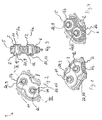
Figuren 1, 2, 3 und 4 : DieFiguren 1 bis 4 zeigen eine separat vormontierte Baueinheit 1 aus zwei schalenförmigen Lagerplatten 2 und 3 und mit einem Paar Planetenräder 5 und 6, die miteinander im Zahneingriff stehen und um ihre jeweilige Rotationsachse 5a und 6a drehbar sind. DieFiguren 1 und 2 zeigen verschiedene Ansichten der Baueinheit 1 aus der an einem Ende einzelne Zähne einer Verzahnung 5b des einen Planetenrads 5 und aus dem anderen Ende einzelne Zähne einer Verzahnung 6b hervorstehen.Figur 3 zeigt einen Längsschnitt entlang der Rotationsachsen 5a und 6a nach der Linie III - III ausFigur 1 , der zeigt, wie die im Zahneingriff befindlichen Planetenräder 5 und 6 jeweils auf Zapfen 20 in Form von Planetenbolzen 9 und 10 gelagert sind. Die Planetenbolzen 9 und 10 sind im Bild axial links und rechts der Planetenräder jeweils in Aufnahmen 11 bzw. 12 drehbar gelagert.Figur 4 zeigt die einseitig geöffnete Baueinheit 1, bei der die schalenförmigen Lagerplatte 3 entfernt wurde, jedoch die untere Lagerplatte 2 die Planetenräder 5 und 6 noch im Zahneingriff hält. -
Figuren 5, 6 und 7 : DieFiguren 5 bis 7 zeigen einen Planetentrieb 4, der aus einem Hohlrad 7, einem Sonnenrad 8 und aus drei der Baueinheiten 1 nach dem Beispiel aus denFiguren 1 bis 4 gebildet ist. DieFiguren 5 und 6 zeigen den Planetentrieb 4 in verschiedenen Ansichten, aus denen hervorgeht, dass die Baueinheiten 1 gemeinsam so an einem Planetenträger 13 befestigt sind, dass die Verzahnungen 6a der Planetenräder 6 einer jeden Baueinheit 1 mit einer Verzahnung 8a des Sonnenrades 8 sowie die Verzahnungen 5a der Planetenräder 5 einer jeden Baueinheit mit einer Verzahnung 7a des Hohlrades im Zahneingriff stehen. Hohlrad 7 und Planetenträger 13 sind um die inFigur 1 senkrecht ins Bild hineinstoßende Rotationsachse 13a relativ zueinander beweglich, wobei in dieser Darstellung offen gelassen ist, ob eines der Elmente, entweder das Hohlrad 7 oder der Planetenträger 13 auch gegenüber einer Umgebung festgehalten sein kann.Figur 7 zeigt den Planetentrieb 4, in dem von jeder Baueinheit 1 eine Lagerplatte 3 entfernt wurde, so dass erkennbar ist, dass ein erster Satz 14 drei der Planetenräder 5 und ein zweiter Satz 15 drei der Planetenräder 6 aufweist. Jeweils ein Planetenrad 5 bildet mit einem Planetenrad 6 in einer Baueinheit 1 ein miteinander verzahntes Paar. -
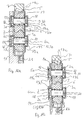
Figuren 11a und 11 b : DieFiguren 11 a und 11 b zeigen mögliche alternative Ausgestaltungen des in denFiguren 5, 6 und 7 dargestellten Planetentriebs 4 in Schnitten entlang der Rotationsachsen 5a und 6a nach der Linie XI - XI ausFigur 5 . - Der Planetenträger 13 ist in der mit
Figur 11a dargestellten Ausgestaltung der Erfindung einteilig und massiv, beispielsweise aus Stahl oder aus einer Leichtmetalllegierung abgebildet. Der Planetenträger 13 weist zwei zylindrische Aufnahmen 13c auf, in denen jeweils ein Bund 2a der Lagerplatte 2 steckt. Die Lagerplatte 2 ist zumindest umfangsgerichtet um die Rotationsachse 13a des jeweiligen Planetenträgers 13 relativ unbeweglich an dem Planetenträger 13 gehalten, in dem diese mit den Bunden 2a mittels Press- oder Passsitz in den Aufnahmen 13c sitzt und / oder mit Schrauben 21 an den Planetenträger 13 geschraubt ist. - Die Lagerplatte 3 weist die Bunde 3a auf, die den Bunden 2a axial konzentrisch gegenüber liegen. Die die Lagerplatten 2 und 3 sind beispielsweise durch Nieten miteinander verbunden. Der jeweilige Bund 2a oder 3a ist Lagersitz für jeweils ein Wälzlager 18 vom Lagertyp eines Kugellagers. Mittels der Wälzlager 18 sind die Zapfen 20 in Form von Planetenbolzen 9 und 10 drehbar in den Lagerplatten 2 und 3 gelagert. Auf den Planetenbolzen 9 ist mittels jeweils eines Wälzlagers 19 je ein Planetenrad 5 und auf den Planetenbolzen 10 mittels eines Wälzlagers 19 je ein Planetenrad 6 um die Rotationsachsen 5a bzw. 6a relativ zu den Lagerplatten 2 und 3 und zu dem Planetenträger 13 gelagert. Die Wälzlager 19 sind vom Lagertyp Nadellager mit zwei Reihen 19a und 19b Nadeln. Die Nadeln sind in Käfigen 19c geführt.
- Der Planetenträger 13 ist in der mit
Figur 11b dargestellten Ausgestaltung der Erfindung ein- oder zweiteilig aus Stahlblech abgebildet, wobei nur die im Bild axiale linke Hälfte 13b des Planetenträgers 13 sichtbar ist. Der Planetenträger 13 weist zwei zylindrische Aufnahmen 13c auf, in denen jeweils ein Bund 2a der Lagerplatte 2 steckt. Die Lagerplatte 3 weist die Bunde 3a auf, die den Bunden 2a axial konzentrisch gegenüber liegen. Die die Lagerplatten 2 und 3 sind beispielsweise durch Nieten 22 miteinander verbunden und die Baueinheit 1 ist an den Planetenträger 13 geschraubt. Der jeweilige Bund 2a oder 3a ist Lagersitz für jeweils ein Wälzlager 18 vom Lagertyp eines Kugellagers. Mittels der Wälzlager 18 sind die Zapfen 20 in Form von Planetenbolzen 9 und 10 drehbar in den Lagerplatten 2 und 3 gelagert. Auf den Planetenbolzen 9 ist mittels jeweils eines Wälzlagers 19 je ein Planetenrad 5 und auf den Planetenbolzen 10 mittels eines Wälzlagers 19 je ein Planetenrad 6 um die Rotationsachsen 5a bzw. 6a relativ zu den Lagerplatten 2 und 3 und zu dem Planetenträger 13 gelagert. Die Wälzlager 19 sind vom Lagertyp Nadellager mit zwei Reihen 19a und 19b Nadeln. Die Nadeln sind in Käfigen 19c geführt. -
Figuren 8, 9 und 10 DieFiguren 8 bis 10 : zeigen einen Planetentrieb 16, in dem wie in dem Planetentrieb 4 drei der Baueinheiten 1 verbaut sind. DieFiguren 8 und 9 zeigen den Planetentrieb 16 in verschiedenen Ansichten, woraus erkennbar ist, das dieser aus einem Planetenträger 17 einem Hohlrad 7 und aus einem Sonnenrad 8 gebildet ist. Jede der Baueinheiten 1 ist aus zwei Lagerplatten 2 und 3, jeweils einem Planetenrad 5 eines ersten Satzes 14 aus drei Planetenrädern 5, jeweils einem Planetenrad 6 eines zweiten Satzes 15 aus drei Planetenrädern 6 und aus Planetenbolzen 9 und 10 gebildet. - Der Planetenträger 17 ist zweiteilig aus zwei Hälften 17a und 17b gebildet, wie aus
Figur 10 , einer Darstellung des Planetentriebs 16 im Schnitt entlang der Rotationsachsen 5a und 6a nach der Linie X - X ausFigur 8 , hervorgeht. Jede der Hälften 17a und 17b weist zwei zylindrisch ausgebildete Aufnahmen 17c auf, in denen jeweils ein Bund 2a oder 3a einer der Lagerplatten 2 bzw. 3 der axial von den Hälften 17a und 17b eingefassten jeweiligen Baueinheit 1 mit Passsitz oder Presssitz steckt, so dass die Lagerplatten 2 und 3 zumindest umfangsgerichtet um eine Rotationsachse 17d des jeweiligen Planetenträgers 17 relativ unbeweglich an dem Planetenträger 17 gehalten ist.. Der jeweilige Bund 2a oder 3a ist Lagersitz für jeweils ein Wälzlager 18 vom Lagertyp eines Kugellagers. Mittels der Wälzlager 18 sind die Zapfen 20 in Form von Planetenbolzen 9 und 10 drehbar in den Lagerplatten 2 und 3 gelagert. Auf den Planetenbolzen 9 ist mittels jeweils eines Wälzlagers 19 je ein Planetenrad 5 und auf den Planetenbolzen 10 mittels eines Wälzlagers 19 je ein Planetenrad 6 um die Rotationsachsen 5a bzw. 6a relativ zu den Lagerplatten 2 und 3 und zu dem Planetenträger 17 gelagert. Die Wälzlager 19 sind vom Lagertyp Nadellager mit zwei Reihen 19a und 19b Nadeln. Die Nadeln sind in Käfigen 19c geführt. -
Figuren 12 und 13 : DieFiguren 12 und 13 zeigen mögliche alternative Ausgestaltungen einer Baueinheit 23 bzw. 28 in Schnitten entlang der Rotationsachsen 24a und 25a bzw. 29a und 30a. - Die Baueinheit 23 nach
Figur 12 ist aus einer Lagerplatte 26 und einer Lagerplatte 27, Planetenbolzen 9 und 10 sowie Planetenrädern 24 und 25 gebildet. Jede der Lagerplatten 26 bzw. 27 weist zwei zylindrische Aufnahmen 26a bzw. 27a auf, in denen jeweils ein Zapfen 20 in Form eines Planetenbolzens 9 bzw. eines Planetenbolzens 10 drehbar gleitgelagert ist. Die die Lagerplatten 26 und 27 sind durch Niete 22 miteinander verbunden. Auf den Planetenbolzen 9 ist je ein Planetenrad 24 und auf den Planetenbolzen 10 je ein Planetenrad 25 um die Rotationsachsen 24a bzw. 25a relativ drehbar zu den Lagerplatten 26 und 27 gelagert. - Die Baueinheit 28 nach
Figur 13 ist aus einer Lagerplatte 26 und einer Lagerplatte 27, Wellenzapfen 31 und Planetenrädern 29 und 30 gebildet. Jede der Lagerplatten 26 bzw. 27 weist zwei zylindrische Aufnahmen 26a bzw. 27a auf, in denen jeweils ein Zapfen 20 in Form eines Wellenzapfens 31 drehbar gleitgelagert ist. Die die Lagerplatten 26 und 27 sind durch Niete 22 miteinander verbunden. Planetenräder 29 bzw. 30 weisen jeweils im Bild axial links und rechts je einen der Wellenzapfen 31 auf, welche einteilig mit den Planetenrädern 29 bzw. 30 ausgebildet sind. -
1 Baueinheit 16 Planetentrieb 2 Lagerplatte 17 Planetenträger 2a Bund 17a Hälfte 3 Lagerplatte 17b Hälfte 3a Bund 17c Aufnahme 4 Planetentrieb 17d Rotationsachse 5 Planetenrad 18 Wälzlager 5a Rotationsachse 19 Wälzlager 5b Verzahnung 19a Reihe Nadeln 6 Planetenrad 19b Reihe Nadeln 6a Rotationsachse 19c Käfig 6b Verzahnung 20 Zapfen 7 Hohlrad 21 Schraube 7a Verzahnung 22 Niet 8 Sonnenrad 23 Baueinheit 8a Planetenbolzen 24 Planetenrad 9 Planetenbolzen 24a Rotationsachse 10 Planetenbolzen 25 Planetenrad 11 Aufnahme 25a Rotationsachse 12 Aufnahme 26 Lagerplatte 13 Planetenträger 27 Lagerplatte 13a Rotationsachse 28 Baueinheit 13b Hälfte 29 Planetenrad 13c Aufnahme 29a Rotationsachse 14 erster Satz 30 Planetenrad 15 zweiter Satz 30a Rotationsachse 31 Wellenzapfen
Claims (9)
- Planetentrieb (4, 16) wenigstens mit einem ersten Satz (14) Planetenräder (5), mit einem zweiten Satz (15) Planetenräder (6), mit mindestens einem für beide Planetensätze (14, 15) gemeinsamen Planetenträger (13, 17) und mit einem Hohlrad (7), wobei jedes Planetenrad (5) des ersten Satzes (14) mit einem Planetenrad (6) des zweiten Satzes (15) ein miteinander im Zahneingriff stehendes Paar bildet, und wobei die Planetenräder (5, 6) jedes Paares separat zu dem Planetenträger (13, 17) axial zwischen zwei zum Planetenträger (13, 17) separaten Lagerplatten (2, 3) um die jeweilige eigene Rotationsachse (5a, 6a) drehbar gelagert und im Zahneingriff zueinander angeordnet sind, dadurch gekennzeichnet, dass die Planetenräder (5, 6) mindestens eines der Paare relativ zu dem Planetenträger (13, 17) jeweils um eine axial ausgerichtete Rotationsachse (5a, 6a) drehbar und miteinander im Zahneingriff stehend mit Zapfen (20) in den Lagerplatten (2, 3, 26, 27) drehbar gelagert und dabei an den Lagerplatten (2, 3) gehalten sind, wobei wenigstens eine der Lagerplatte n (2, 3), an denen das Paar gehalten ist, zumindest umfangsgerichtet um eine Rotationsachse (13a, 17d) des jeweiligen Planetenträgers (13, 17) relativ unbeweglich zum Planetenträger (13, 17) an dem Planetenträger (13, 17) befestigt ist.
- Planetentrieb nach Anspruch 1, dadurch gekennzeichnet, dass wobei jedes der Paare jeweils zwischen zwei Lagerplatten (2, 3) an den Lagerplatten (2, 3) gehalten ist.
- Planetentrieb nach Anspruch 1, dadurch gekennzeichnet, dass die Lagerplatten miteinander verbunden sind.
- Planetentrieb nach Anspruch 1, dadurch gekennzeichnet, dass die Planetenräder (5, 6) jeden Paares separat zu dem Planetenträger (13, 17) axial zwischen zwei zum Planetenträger (13, 17) separaten der Lagerplatten (2, 3) um die jeweilige eigene Rotationsachse (5a, 6a) drehbar gelagert und im Zahneingriff zueinander an jeder der zwei Lagerplatten (2, 3) gehalten sind und dass beide Lagerplatten (2, 3) an dem Planetenträger (13, 17) befestigt sind.
- Planetentrieb nach Anspruch 4, dadurch gekennzeichnet, dass wenigstens eine der Lagerplatten (2, 3) schalenförmig gestaltet und mit der anderen Lagerplatte (2, 3) zu einem Gehäuse verbunden ist und das Paar Planetenräder (5, 6) so einschließt, dass zumindest ein Teil einer Verzahnung (5b) des ersten Planetenrades (5) und ein Teil einer Verzahnung (6b) des zweiten Planetenrades (6) von außen frei zugänglich sind.
- Planetentrieb nach Anspruch 5, dadurch gekennzeichnet, dass beide Lagerplatten (2, 3) schalenförmig ausgebildet und miteinander verbunden sind.
- Baueinheit (1) für einen Planetentrieb (4, 16) nach Anspruch 1, gebildet aus wenigstens zwei Lagerplatte n (2, 3) und einem Paar im Zahneingriff stehender Planetenräder (5, 6, 24, 25, 29, 30), wobei die Planetenräder (5, 6, 24, 25, 29, 30) zwischen den Lagerplatten (2, 3) angeordnet und mit Zapfen (20) in den Lagerplatten (2, 3, 26, 27) drehbar gelagert sind, und wobei die Baueinheit (1) separat zum Planetenträger (13, 17) vormontiert ist.
- Baueinheit 1 nach Anspruch 7, dadurch gekennzeichnet, dass die Zapfen (20) an dem jeweiligen Planetenrad (29, 30) ausgebildete und axial abstehende Wellenzapfen (21) sind.
- Baueinheit nach Anspruch 7, dadurch gekennzeichnet , dass die Zapfen (20) Planetenbolzen (9, 10) sind, auf denen jeweils mindestens ein Planetenrad (5, 6, 24, 25) eines Paares drehbar gelagert ist.
Applications Claiming Priority (1)
| Application Number | Priority Date | Filing Date | Title |
|---|---|---|---|
| DE201010048824 DE102010048824A1 (de) | 2010-10-18 | 2010-10-18 | Planetentrieb mit einem ersten Satz Planetenräder und mit einem zweiten Satz Planetenräder und eine Baueinheit in einem derartigen Planetentrieb |
Publications (2)
| Publication Number | Publication Date |
|---|---|
| EP2441982A1 EP2441982A1 (de) | 2012-04-18 |
| EP2441982B1 true EP2441982B1 (de) | 2013-06-05 |
Family
ID=45474493
Family Applications (1)
| Application Number | Title | Priority Date | Filing Date |
|---|---|---|---|
| EP20110172517 Not-in-force EP2441982B1 (de) | 2010-10-18 | 2011-07-04 | Planetentrieb mit einem ersten Satz Planetenräder und mit einem zweiten Satz Planetenräder und eine Baueinheit in einem derartigen Planetentrieb |
Country Status (2)
| Country | Link |
|---|---|
| EP (1) | EP2441982B1 (de) |
| DE (1) | DE102010048824A1 (de) |
Families Citing this family (1)
| Publication number | Priority date | Publication date | Assignee | Title |
|---|---|---|---|---|
| DE102013226526A1 (de) * | 2013-12-18 | 2015-06-18 | Zf Friedrichshafen Ag | Bolzensitz mit optimierter Druckverteilung |
Family Cites Families (7)
| Publication number | Priority date | Publication date | Assignee | Title |
|---|---|---|---|---|
| JPH051718Y2 (de) * | 1987-10-15 | 1993-01-18 | ||
| FR2644859B1 (fr) * | 1989-03-24 | 1991-07-12 | Rapid Sa | Dispositif elastique de maintien sensiblement sans jeux de l'axe de rotation d'au moins un element mecanique tournant dans ou sur un autre element |
| JP2527161Y2 (ja) * | 1989-03-28 | 1997-02-26 | ジャトコ 株式会社 | 遊星歯車装置のキャリア組立体 |
| FR2652137B1 (fr) * | 1989-09-15 | 1993-11-26 | Rapid Sa | Cage a galets, pignons ou analogues. |
| DE4029373A1 (de) | 1990-09-15 | 1992-03-19 | Ford Werke Ag | Anlaufscheibenanordnung fuer planetenraeder eines planetenradtraegers |
| JPH0522928U (ja) * | 1991-03-15 | 1993-03-26 | 栃木富士産業株式会社 | 遊星歯車機構 |
| DE102009032286B4 (de) | 2008-12-18 | 2022-01-05 | Schaeffler Technologies AG & Co. KG | Stirnraddifferenzial mit positiver und negativer Profilverschiebung an den Sonnenrädern |
-
2010
- 2010-10-18 DE DE201010048824 patent/DE102010048824A1/de not_active Withdrawn
-
2011
- 2011-07-04 EP EP20110172517 patent/EP2441982B1/de not_active Not-in-force
Also Published As
| Publication number | Publication date |
|---|---|
| EP2441982A1 (de) | 2012-04-18 |
| DE102010048824A1 (de) | 2012-04-19 |
Similar Documents
| Publication | Publication Date | Title |
|---|---|---|
| EP1567786B1 (de) | Verfahren zur verlustarmen drehmomentüberleitung in planetengetrieben | |
| DE69426448T2 (de) | Zylindrisches zahnrad für ausseren zahneingriff | |
| DE1951427C3 (de) | Ins Langsame übersetzendes Getriebe | |
| EP2565495B1 (de) | Getriebevorrichtung mit Stützbolzen für ein Fahrzeug | |
| DE102014010154B4 (de) | Serie von Untersetzungsgetrieben | |
| DE102015014087A1 (de) | Schräglager und Getriebe mit Anlaufscheibe | |
| DE102021212217A1 (de) | Getriebe für ein Fahrzeug sowie Antriebsstrang mit einem solchen Getriebe | |
| DE102015223914B4 (de) | Umlaufrädergetriebe mit Untersetzungsstufe für eine Kraftfahrzeugantriebseinheit | |
| DE102013101864A1 (de) | Mehrstufiges Getriebe | |
| DE102012221823A1 (de) | Getriebeeinheit mit Plusgetriebesatz | |
| DE102012221825A1 (de) | Getriebeeinheit mit Plusgetriebesatz | |
| DE102013209310A1 (de) | Schaltbares Planetengetriebe | |
| DE102021104649A1 (de) | Lenkungsaktuator für eine Hinterachslenkung und Verfahren zur Montage eines Lenkungsaktuators | |
| DE102012205946A1 (de) | Getriebeeinrichtung, insbesondere für eine Windkraftanlage | |
| EP2441982B1 (de) | Planetentrieb mit einem ersten Satz Planetenräder und mit einem zweiten Satz Planetenräder und eine Baueinheit in einem derartigen Planetentrieb | |
| CH618777A5 (en) | Planetary transmission, in particular for driving a plurality of closely spaced rolls | |
| EP3460293A1 (de) | Antriebsanordnung, umfassend einen hochdrehenden elektromotor und ein zahnradgetriebe | |
| WO2015083040A2 (de) | Planeten-schraubenrad-getriebe | |
| DE102013216793A1 (de) | Hochübersetzendes Umlaufrädergetriebe, insbesondere Stell- oder Aktuatorgetriebe | |
| DE102018130497B4 (de) | Planetenbaugruppe sowie Getriebeanordnung mit der Planetenbaugruppe | |
| WO2017092748A1 (de) | Lageranordnung für einen stufenplaneten, sowie hiermit ausgestattetes umlaufrädergetriebe für eine kraftfahrzeugantriebseinheit | |
| EP3519227B1 (de) | Achsgetriebe für ein kraftfahrzeug | |
| DE2910602A1 (de) | Einer arbeitsmaschine oder einem fahrzeugantrieb vorgeschaltetes planetengetriebe | |
| EP3770464A1 (de) | Planetengetriebe | |
| DE102018108540A1 (de) | Getriebeunterbaugruppe, Getriebebaugruppe als Getriebeanordnung für eine elektrisch antreibbare Achse eines Fahrzeugs sowie elektrisch antreibbare Achse |
Legal Events
| Date | Code | Title | Description |
|---|---|---|---|
| PUAI | Public reference made under article 153(3) epc to a published international application that has entered the european phase |
Free format text: ORIGINAL CODE: 0009012 |
|
| 17P | Request for examination filed |
Effective date: 20110704 |
|
| AK | Designated contracting states |
Kind code of ref document: A1 Designated state(s): AL AT BE BG CH CY CZ DE DK EE ES FI FR GB GR HR HU IE IS IT LI LT LU LV MC MK MT NL NO PL PT RO RS SE SI SK SM TR |
|
| AX | Request for extension of the european patent |
Extension state: BA ME |
|
| 17Q | First examination report despatched |
Effective date: 20120420 |
|
| RIC1 | Information provided on ipc code assigned before grant |
Ipc: F16H 57/08 20060101AFI20121114BHEP |
|
| GRAP | Despatch of communication of intention to grant a patent |
Free format text: ORIGINAL CODE: EPIDOSNIGR1 |
|
| GRAS | Grant fee paid |
Free format text: ORIGINAL CODE: EPIDOSNIGR3 |
|
| GRAA | (expected) grant |
Free format text: ORIGINAL CODE: 0009210 |
|
| AK | Designated contracting states |
Kind code of ref document: B1 Designated state(s): AL AT BE BG CH CY CZ DE DK EE ES FI FR GB GR HR HU IE IS IT LI LT LU LV MC MK MT NL NO PL PT RO RS SE SI SK SM TR |
|
| REG | Reference to a national code |
Ref country code: GB Ref legal event code: FG4D Free format text: NOT ENGLISH |
|
| REG | Reference to a national code |
Ref country code: CH Ref legal event code: EP |
|
| REG | Reference to a national code |
Ref country code: AT Ref legal event code: REF Ref document number: 615854 Country of ref document: AT Kind code of ref document: T Effective date: 20130615 |
|
| REG | Reference to a national code |
Ref country code: IE Ref legal event code: FG4D Free format text: LANGUAGE OF EP DOCUMENT: GERMAN |
|
| REG | Reference to a national code |
Ref country code: DE Ref legal event code: R096 Ref document number: 502011000851 Country of ref document: DE Effective date: 20130801 |
|
| PG25 | Lapsed in a contracting state [announced via postgrant information from national office to epo] |
Ref country code: SI Free format text: LAPSE BECAUSE OF FAILURE TO SUBMIT A TRANSLATION OF THE DESCRIPTION OR TO PAY THE FEE WITHIN THE PRESCRIBED TIME-LIMIT Effective date: 20130605 Ref country code: FI Free format text: LAPSE BECAUSE OF FAILURE TO SUBMIT A TRANSLATION OF THE DESCRIPTION OR TO PAY THE FEE WITHIN THE PRESCRIBED TIME-LIMIT Effective date: 20130605 Ref country code: ES Free format text: LAPSE BECAUSE OF FAILURE TO SUBMIT A TRANSLATION OF THE DESCRIPTION OR TO PAY THE FEE WITHIN THE PRESCRIBED TIME-LIMIT Effective date: 20130916 Ref country code: NO Free format text: LAPSE BECAUSE OF FAILURE TO SUBMIT A TRANSLATION OF THE DESCRIPTION OR TO PAY THE FEE WITHIN THE PRESCRIBED TIME-LIMIT Effective date: 20130905 Ref country code: SE Free format text: LAPSE BECAUSE OF FAILURE TO SUBMIT A TRANSLATION OF THE DESCRIPTION OR TO PAY THE FEE WITHIN THE PRESCRIBED TIME-LIMIT Effective date: 20130605 Ref country code: LT Free format text: LAPSE BECAUSE OF FAILURE TO SUBMIT A TRANSLATION OF THE DESCRIPTION OR TO PAY THE FEE WITHIN THE PRESCRIBED TIME-LIMIT Effective date: 20130605 Ref country code: GR Free format text: LAPSE BECAUSE OF FAILURE TO SUBMIT A TRANSLATION OF THE DESCRIPTION OR TO PAY THE FEE WITHIN THE PRESCRIBED TIME-LIMIT Effective date: 20130906 |
|
| REG | Reference to a national code |
Ref country code: NL Ref legal event code: VDEP Effective date: 20130605 |
|
| REG | Reference to a national code |
Ref country code: LT Ref legal event code: MG4D |
|
| PG25 | Lapsed in a contracting state [announced via postgrant information from national office to epo] |
Ref country code: HR Free format text: LAPSE BECAUSE OF FAILURE TO SUBMIT A TRANSLATION OF THE DESCRIPTION OR TO PAY THE FEE WITHIN THE PRESCRIBED TIME-LIMIT Effective date: 20130605 Ref country code: RS Free format text: LAPSE BECAUSE OF FAILURE TO SUBMIT A TRANSLATION OF THE DESCRIPTION OR TO PAY THE FEE WITHIN THE PRESCRIBED TIME-LIMIT Effective date: 20130605 Ref country code: BG Free format text: LAPSE BECAUSE OF FAILURE TO SUBMIT A TRANSLATION OF THE DESCRIPTION OR TO PAY THE FEE WITHIN THE PRESCRIBED TIME-LIMIT Effective date: 20130905 |
|
| PG25 | Lapsed in a contracting state [announced via postgrant information from national office to epo] |
Ref country code: LV Free format text: LAPSE BECAUSE OF FAILURE TO SUBMIT A TRANSLATION OF THE DESCRIPTION OR TO PAY THE FEE WITHIN THE PRESCRIBED TIME-LIMIT Effective date: 20130605 |
|
| BERE | Be: lapsed |
Owner name: SCHAEFFLER TECHNOLOGIES A.G. & CO. KG Effective date: 20130731 |
|
| PG25 | Lapsed in a contracting state [announced via postgrant information from national office to epo] |
Ref country code: IS Free format text: LAPSE BECAUSE OF FAILURE TO SUBMIT A TRANSLATION OF THE DESCRIPTION OR TO PAY THE FEE WITHIN THE PRESCRIBED TIME-LIMIT Effective date: 20131005 Ref country code: PT Free format text: LAPSE BECAUSE OF FAILURE TO SUBMIT A TRANSLATION OF THE DESCRIPTION OR TO PAY THE FEE WITHIN THE PRESCRIBED TIME-LIMIT Effective date: 20131007 Ref country code: EE Free format text: LAPSE BECAUSE OF FAILURE TO SUBMIT A TRANSLATION OF THE DESCRIPTION OR TO PAY THE FEE WITHIN THE PRESCRIBED TIME-LIMIT Effective date: 20130605 Ref country code: CZ Free format text: LAPSE BECAUSE OF FAILURE TO SUBMIT A TRANSLATION OF THE DESCRIPTION OR TO PAY THE FEE WITHIN THE PRESCRIBED TIME-LIMIT Effective date: 20130605 Ref country code: SK Free format text: LAPSE BECAUSE OF FAILURE TO SUBMIT A TRANSLATION OF THE DESCRIPTION OR TO PAY THE FEE WITHIN THE PRESCRIBED TIME-LIMIT Effective date: 20130605 |
|
| PG25 | Lapsed in a contracting state [announced via postgrant information from national office to epo] |
Ref country code: PL Free format text: LAPSE BECAUSE OF FAILURE TO SUBMIT A TRANSLATION OF THE DESCRIPTION OR TO PAY THE FEE WITHIN THE PRESCRIBED TIME-LIMIT Effective date: 20130605 Ref country code: RO Free format text: LAPSE BECAUSE OF FAILURE TO SUBMIT A TRANSLATION OF THE DESCRIPTION OR TO PAY THE FEE WITHIN THE PRESCRIBED TIME-LIMIT Effective date: 20130605 Ref country code: NL Free format text: LAPSE BECAUSE OF FAILURE TO SUBMIT A TRANSLATION OF THE DESCRIPTION OR TO PAY THE FEE WITHIN THE PRESCRIBED TIME-LIMIT Effective date: 20130605 |
|
| RAP2 | Party data changed (patent owner data changed or rights of a patent transferred) |
Owner name: SCHAEFFLER TECHNOLOGIES GMBH & CO. KG |
|
| REG | Reference to a national code |
Ref country code: DE Ref legal event code: R081 Ref document number: 502011000851 Country of ref document: DE Owner name: SCHAEFFLER TECHNOLOGIES AG & CO. KG, DE Free format text: FORMER OWNER: SCHAEFFLER TECHNOLOGIES AG & CO. KG, 91074 HERZOGENAURACH, DE Effective date: 20140213 Ref country code: DE Ref legal event code: R081 Ref document number: 502011000851 Country of ref document: DE Owner name: SCHAEFFLER TECHNOLOGIES GMBH & CO. KG, DE Free format text: FORMER OWNER: SCHAEFFLER TECHNOLOGIES AG & CO. KG, 91074 HERZOGENAURACH, DE Effective date: 20140213 |
|
| PG25 | Lapsed in a contracting state [announced via postgrant information from national office to epo] |
Ref country code: MC Free format text: LAPSE BECAUSE OF FAILURE TO SUBMIT A TRANSLATION OF THE DESCRIPTION OR TO PAY THE FEE WITHIN THE PRESCRIBED TIME-LIMIT Effective date: 20130605 |
|
| PLBE | No opposition filed within time limit |
Free format text: ORIGINAL CODE: 0009261 |
|
| STAA | Information on the status of an ep patent application or granted ep patent |
Free format text: STATUS: NO OPPOSITION FILED WITHIN TIME LIMIT |
|
| REG | Reference to a national code |
Ref country code: IE Ref legal event code: MM4A |
|
| REG | Reference to a national code |
Ref country code: FR Ref legal event code: ST Effective date: 20140331 |
|
| PG25 | Lapsed in a contracting state [announced via postgrant information from national office to epo] |
Ref country code: DK Free format text: LAPSE BECAUSE OF FAILURE TO SUBMIT A TRANSLATION OF THE DESCRIPTION OR TO PAY THE FEE WITHIN THE PRESCRIBED TIME-LIMIT Effective date: 20130605 Ref country code: BE Free format text: LAPSE BECAUSE OF NON-PAYMENT OF DUE FEES Effective date: 20130731 |
|
| 26N | No opposition filed |
Effective date: 20140306 |
|
| PG25 | Lapsed in a contracting state [announced via postgrant information from national office to epo] |
Ref country code: FR Free format text: LAPSE BECAUSE OF NON-PAYMENT OF DUE FEES Effective date: 20130805 Ref country code: IT Free format text: LAPSE BECAUSE OF FAILURE TO SUBMIT A TRANSLATION OF THE DESCRIPTION OR TO PAY THE FEE WITHIN THE PRESCRIBED TIME-LIMIT Effective date: 20130605 |
|
| REG | Reference to a national code |
Ref country code: DE Ref legal event code: R097 Ref document number: 502011000851 Country of ref document: DE Effective date: 20140306 |
|
| PG25 | Lapsed in a contracting state [announced via postgrant information from national office to epo] |
Ref country code: IE Free format text: LAPSE BECAUSE OF NON-PAYMENT OF DUE FEES Effective date: 20130704 |
|
| REG | Reference to a national code |
Ref country code: CH Ref legal event code: PL |
|
| REG | Reference to a national code |
Ref country code: DE Ref legal event code: R081 Ref document number: 502011000851 Country of ref document: DE Owner name: SCHAEFFLER TECHNOLOGIES AG & CO. KG, DE Free format text: FORMER OWNER: SCHAEFFLER TECHNOLOGIES GMBH & CO. KG, 91074 HERZOGENAURACH, DE Effective date: 20150126 |
|
| PG25 | Lapsed in a contracting state [announced via postgrant information from national office to epo] |
Ref country code: LI Free format text: LAPSE BECAUSE OF NON-PAYMENT OF DUE FEES Effective date: 20140731 Ref country code: CH Free format text: LAPSE BECAUSE OF NON-PAYMENT OF DUE FEES Effective date: 20140731 |
|
| PG25 | Lapsed in a contracting state [announced via postgrant information from national office to epo] |
Ref country code: SM Free format text: LAPSE BECAUSE OF FAILURE TO SUBMIT A TRANSLATION OF THE DESCRIPTION OR TO PAY THE FEE WITHIN THE PRESCRIBED TIME-LIMIT Effective date: 20130605 |
|
| PG25 | Lapsed in a contracting state [announced via postgrant information from national office to epo] |
Ref country code: TR Free format text: LAPSE BECAUSE OF FAILURE TO SUBMIT A TRANSLATION OF THE DESCRIPTION OR TO PAY THE FEE WITHIN THE PRESCRIBED TIME-LIMIT Effective date: 20130605 Ref country code: CY Free format text: LAPSE BECAUSE OF FAILURE TO SUBMIT A TRANSLATION OF THE DESCRIPTION OR TO PAY THE FEE WITHIN THE PRESCRIBED TIME-LIMIT Effective date: 20130605 Ref country code: MT Free format text: LAPSE BECAUSE OF FAILURE TO SUBMIT A TRANSLATION OF THE DESCRIPTION OR TO PAY THE FEE WITHIN THE PRESCRIBED TIME-LIMIT Effective date: 20130605 |
|
| PG25 | Lapsed in a contracting state [announced via postgrant information from national office to epo] |
Ref country code: HU Free format text: LAPSE BECAUSE OF FAILURE TO SUBMIT A TRANSLATION OF THE DESCRIPTION OR TO PAY THE FEE WITHIN THE PRESCRIBED TIME-LIMIT; INVALID AB INITIO Effective date: 20110704 Ref country code: LU Free format text: LAPSE BECAUSE OF NON-PAYMENT OF DUE FEES Effective date: 20130704 Ref country code: MK Free format text: LAPSE BECAUSE OF FAILURE TO SUBMIT A TRANSLATION OF THE DESCRIPTION OR TO PAY THE FEE WITHIN THE PRESCRIBED TIME-LIMIT Effective date: 20130605 |
|
| GBPC | Gb: european patent ceased through non-payment of renewal fee |
Effective date: 20150704 |
|
| PG25 | Lapsed in a contracting state [announced via postgrant information from national office to epo] |
Ref country code: GB Free format text: LAPSE BECAUSE OF NON-PAYMENT OF DUE FEES Effective date: 20150704 |
|
| REG | Reference to a national code |
Ref country code: AT Ref legal event code: MM01 Ref document number: 615854 Country of ref document: AT Kind code of ref document: T Effective date: 20160704 |
|
| PG25 | Lapsed in a contracting state [announced via postgrant information from national office to epo] |
Ref country code: AT Free format text: LAPSE BECAUSE OF NON-PAYMENT OF DUE FEES Effective date: 20160704 |
|
| PGFP | Annual fee paid to national office [announced via postgrant information from national office to epo] |
Ref country code: DE Payment date: 20170929 Year of fee payment: 7 |
|
| PG25 | Lapsed in a contracting state [announced via postgrant information from national office to epo] |
Ref country code: AL Free format text: LAPSE BECAUSE OF FAILURE TO SUBMIT A TRANSLATION OF THE DESCRIPTION OR TO PAY THE FEE WITHIN THE PRESCRIBED TIME-LIMIT Effective date: 20130605 |
|
| REG | Reference to a national code |
Ref country code: DE Ref legal event code: R119 Ref document number: 502011000851 Country of ref document: DE |
|
| PG25 | Lapsed in a contracting state [announced via postgrant information from national office to epo] |
Ref country code: DE Free format text: LAPSE BECAUSE OF NON-PAYMENT OF DUE FEES Effective date: 20190201 |
|
| P01 | Opt-out of the competence of the unified patent court (upc) registered |
Effective date: 20230522 |