EP2429246B1 - Reverse link power control in an orthogonal system - Google Patents
Reverse link power control in an orthogonal system Download PDFInfo
- Publication number
- EP2429246B1 EP2429246B1 EP11192795.0A EP11192795A EP2429246B1 EP 2429246 B1 EP2429246 B1 EP 2429246B1 EP 11192795 A EP11192795 A EP 11192795A EP 2429246 B1 EP2429246 B1 EP 2429246B1
- Authority
- EP
- European Patent Office
- Prior art keywords
- received
- packet
- effective
- rpot
- setpoint
- Prior art date
- Legal status (The legal status is an assumption and is not a legal conclusion. Google has not performed a legal analysis and makes no representation as to the accuracy of the status listed.)
- Expired - Lifetime
Links
Images


Classifications
-
- H—ELECTRICITY
- H04—ELECTRIC COMMUNICATION TECHNIQUE
- H04W—WIRELESS COMMUNICATION NETWORKS
- H04W52/00—Power management, e.g. Transmission Power Control [TPC] or power classes
- H04W52/04—Transmission power control [TPC]
- H04W52/06—TPC algorithms
- H04W52/14—Separate analysis of uplink or downlink
-
- H—ELECTRICITY
- H04—ELECTRIC COMMUNICATION TECHNIQUE
- H04W—WIRELESS COMMUNICATION NETWORKS
- H04W52/00—Power management, e.g. Transmission Power Control [TPC] or power classes
- H04W52/04—Transmission power control [TPC]
- H04W52/30—Transmission power control [TPC] using constraints in the total amount of available transmission power
- H04W52/36—Transmission power control [TPC] using constraints in the total amount of available transmission power with a discrete range or set of values, e.g. step size, ramping or offsets
- H04W52/367—Power values between minimum and maximum limits, e.g. dynamic range
-
- H—ELECTRICITY
- H04—ELECTRIC COMMUNICATION TECHNIQUE
- H04W—WIRELESS COMMUNICATION NETWORKS
- H04W52/00—Power management, e.g. Transmission Power Control [TPC] or power classes
- H04W52/04—Transmission power control [TPC]
- H04W52/06—TPC algorithms
- H04W52/12—Outer and inner loops
-
- H—ELECTRICITY
- H04—ELECTRIC COMMUNICATION TECHNIQUE
- H04W—WIRELESS COMMUNICATION NETWORKS
- H04W52/00—Power management, e.g. Transmission Power Control [TPC] or power classes
- H04W52/04—Transmission power control [TPC]
- H04W52/06—TPC algorithms
- H04W52/14—Separate analysis of uplink or downlink
- H04W52/146—Uplink power control
-
- H—ELECTRICITY
- H04—ELECTRIC COMMUNICATION TECHNIQUE
- H04W—WIRELESS COMMUNICATION NETWORKS
- H04W52/00—Power management, e.g. Transmission Power Control [TPC] or power classes
- H04W52/04—Transmission power control [TPC]
- H04W52/18—TPC being performed according to specific parameters
- H04W52/20—TPC being performed according to specific parameters using error rate
-
- H—ELECTRICITY
- H04—ELECTRIC COMMUNICATION TECHNIQUE
- H04W—WIRELESS COMMUNICATION NETWORKS
- H04W52/00—Power management, e.g. Transmission Power Control [TPC] or power classes
- H04W52/04—Transmission power control [TPC]
- H04W52/18—TPC being performed according to specific parameters
- H04W52/24—TPC being performed according to specific parameters using SIR [Signal to Interference Ratio] or other wireless path parameters
-
- H—ELECTRICITY
- H04—ELECTRIC COMMUNICATION TECHNIQUE
- H04W—WIRELESS COMMUNICATION NETWORKS
- H04W52/00—Power management, e.g. Transmission Power Control [TPC] or power classes
- H04W52/04—Transmission power control [TPC]
- H04W52/18—TPC being performed according to specific parameters
- H04W52/28—TPC being performed according to specific parameters using user profile, e.g. mobile speed, priority or network state, e.g. standby, idle or non-transmission
- H04W52/286—TPC being performed according to specific parameters using user profile, e.g. mobile speed, priority or network state, e.g. standby, idle or non-transmission during data packet transmission, e.g. high speed packet access [HSPA]
-
- H—ELECTRICITY
- H04—ELECTRIC COMMUNICATION TECHNIQUE
- H04W—WIRELESS COMMUNICATION NETWORKS
- H04W52/00—Power management, e.g. Transmission Power Control [TPC] or power classes
- H04W52/04—Transmission power control [TPC]
- H04W52/30—Transmission power control [TPC] using constraints in the total amount of available transmission power
- H04W52/36—Transmission power control [TPC] using constraints in the total amount of available transmission power with a discrete range or set of values, e.g. step size, ramping or offsets
-
- H—ELECTRICITY
- H04—ELECTRIC COMMUNICATION TECHNIQUE
- H04W—WIRELESS COMMUNICATION NETWORKS
- H04W52/00—Power management, e.g. Transmission Power Control [TPC] or power classes
- H04W52/04—Transmission power control [TPC]
- H04W52/38—TPC being performed in particular situations
- H04W52/48—TPC being performed in particular situations during retransmission after error or non-acknowledgment
Definitions
- the present invention relates generally to communications, and more specifically to techniques for determining reverse link power control in an orthogonal communication system.
- Frequency-Hopping Orthogonal Frequency Division Multiple Access In Frequency-Hopping Orthogonal Frequency Division Multiple Access (FH-OFDMA) system, bandwidth is evenly divided into a number of orthogonal sub-carriers. Each user is given a number of these OFDM sub-carriers. In FH-OFDMA, users will also be hopping (i.e., the subset of OFDM carriers assigned to each user changes over time) across the whole bandwidth. All users within the same sector or cell are orthogonal to each other and hence cause no interference to each other.
- FH-OFDMA Frequency-Hopping Orthogonal Frequency Division Multiple Access
- FH-OFDMA is an efficient multiplexing technique for high data rate transmission over wireless channels.
- SNR Signal-to-Noise Ratio
- a packet retransmission mechanism e.g., H-ARQ is often used to help avoid such inefficiency.
- a closed-loop power control is often employed to ensure that sufficient SNR (i.e., SNR required to close the communication link) is received at the base station.
- SNR i.e., SNR required to close the communication link
- rate and power adaptation makes the design of a power control loop for a system with retransmissions a nontrivial task.
- a method of reverse link power control comprises transmitting a packet, determining whether the packet has been received without error, decreasing an effective carrier-to-interference (C/I) setpoint if the packet has been received without error, and increasing the effective C/I setpoint if the packet has not been received without error.
- C/I carrier-to-interference
- a method of reverse link power control further comprises determining whether a Received Power Over Thermal (RpOT) is less than a maximum Received Power Over Thermal (RpOT max ). In an aspect, a method of reverse link power control further comprises issuing a down command if the RpOT is not greater than the RpOT max .
- RpOT Received Power Over Thermal
- RpOT max maximum Received Power Over Thermal
- a method of reverse link power control further comprises determining whether an effective carrier-to-interference ratio (C/I) is less than an effective carrier-to-interference ratio for the setpoint (C/I sp ). In an aspect, a method of reverse link power control further comprises determining whether a Received Power Over Thermal (RpOT) is less than a minimum Received Power Over Thermal (RpOT min ).
- C/I effective carrier-to-interference ratio
- RpOT Received Power Over Thermal
- a method of reverse link power control further comprises issuing a down command if the effective carrier-to-interference ratio (C/I) is not less than the effective carrier-to-interference ratio for the setpoint (C/I sp ) or the Received Power OverThermal (RpOT) is not less than the minimum Received Power Over Thermal (RpOT min ).
- C/I effective carrier-to-interference ratio
- RpOT Received Power OverThermal
- a method of reverse link power control further comprises issuing a up command if the effective carrier-to-interference ratio (C/I) is less than the effective carrier-to-interference ratio for the setpoint (C/I sp ) and the Received Power Over Thermal (RpOT) is less than the minimum Received Power Over Thermal (RpOT m i n ).
- US 2003/081538 discloses a multiple-access OFDM-CDMA system where data spreading is performed in the frequency domain by spreading each data stream with a respective spreading code selected from a set of available spreading codes.
- system resources may be allocated and de-allocated to users (e.g., spreading codes may be assigned to users as needed, and transmit power may be allocated to users).
- Variable rate data for each user may be supported via a combination of spreading adjustment and transmit power scaling.
- Interference control techniques are also provided to improve system performance via power control of the downlink and/or uplink transmissions to achieve the desired level of performance while minimizing interference.
- WO 2004/025869 discloses a method and apparatus for determining the data rate of a reverse link communication.
- An embodiment includes transmitting at a null rate on the communication channel only when the station is not transmitting voice, signaling, or data.
- An embodiment includes determining a maximum requested rate based on the normalized average pilot transmit power and the pilot reference value, and determining the timing of the rate request.
- the steps of determining whether the packet has been received without error, decreasing an effective carrier-to-interference (C/I) setpoint if the packet has been received without error, and increasing the effective C/I setpoint if the packet has not been received without error comprise an outer loop power control.
- method of reverse link power control further comprises disabling the outer loop power control if the Received Power Over Thermal (RpOT) is less than or equal to the minimum Received Power Over Thermal (RpOT min ) or if the Received Power Over Thermal (RpOT) is greater than or equal to the maximum Received Power Over Thermal RpOT max .
- method of reverse link power control further comprises enabling the outer loop power control if the Received Power Over Thermal (RpOT) is greater than the minimum Received Power Over Thermal (RpOT min ) and the Received Power Over Thermal (RpOT) is less than the maximum Received Power Over Thermal RpOT max .
- a wireless communications device comprises means for transmitting a packet, means for determining whether the packet has been received without error, means for decreasing an effective carrier-to-interference (C/I) setpoint if the packet has been received without error, and means for increasing the effective C/I setpoint if the packet has not been received without error.
- C/I carrier-to-interference
- a processor is programmed to execute a method of estimating interference in a wireless communication system, the method comprising transmitting a packet, determining whether the packet has been received without error, decreasing an effective carrier-to-interference (C/I) setpoint if the packet has been received without error, and increasing the effective C/I setpoint if the packet has not been received without error.
- C/I carrier-to-interference
- a computer readable media embodying a method of reverse link power control comprises transmitting a packet, determining whether the packet has been received without error, decreasing an effective carrier-to-interference (C/I) setpoint if the packet has been received without error, and increasing the effective C/I setpoint if the packet has not been received without error.
- C/I carrier-to-interference
- the techniques described herein for performance based rank prediction may be used for various communication systems such as a Code Division Multiple Access (CDMA) system, a Wideband CDMA (WCDMA) system, a direct sequence CDMA (DS-CDMA) system, a Time Division Multiple Access (TDMA) system, a Frequency Division Multiple Access (FDMA) system, a High Speed Downlink Packet Access (HSDPA) system, an orthogonal frequency division multiplexing (OFDM)-based system, an Orthogonal Frequency Division Multiple Access (OFDMA) system, a single-input single-output (SISO) system, a multiple-input multiple-output (MIMO) system, and so on.
- CDMA Code Division Multiple Access
- WCDMA Wideband CDMA
- DS-CDMA direct sequence CDMA
- TDMA Time Division Multiple Access
- FDMA Frequency Division Multiple Access
- HSDPA High Speed Downlink Packet Access
- OFDM orthogonal frequency division multiplexing
- OFDMA Orthogonal
- OFDM is a multi-carrier modulation technique that effectively partitions the overall system bandwidth into multiple (NF) orthogonal subbands. These subbands are also referred to as tones, subcarriers, bins, and frequency channels. With OFDM, each subband is associated with a respective subcarrier that may be modulated with data. Up to NF modulation symbols may be transmitted on the NF subbands in each OFDM symbol period. Prior to transmission, these modulation symbols are transformed to the time-domain using an NF-point inverse fast Fourier transform (IFFT) to obtain a "transformed" symbol that contains NF chips.
- IFFT inverse fast Fourier transform
- An OFDMA system utilizes OFDM and can support multiple users simultaneously.
- data for each user is transmitted using a specific frequency hopping (FH) sequence assigned to the user.
- the FH sequence indicates the specific subband to use for data transmission in each hop period.
- Multiple data transmissions for multiple users may be sent simultaneously using different FH sequences.
- FH sequences are defined to be orthogonal to one another so that only one data transmission uses each subband in each hop period.
- a power control loop can be broken into two parts: an inner loop and an outer loop.
- a base station issues an UP/DOWN power control command as dictated by an inner loop to regulate the user's transmit power such that the desired quantity (such as received signal power, signal-to-interference-and-noise ratio (SINR), etc.) set by the power control outer loop is maintained.
- the outer loop dynamically adjusts this set-point so that the specified quality-of-service (QoS) is met, irrespective of the changing channel conditions.
- QoS quality-of-service
- IS-95 and CDMA2000 use a packet error rate (PER) as a QoS metric of choice.
- PER packet error rate
- the power control loop regulates the transmit power such that the PER is near the target setpoint (e.g. 1%).
- a Packet-Error-Rate-based (PER-based) power control algorithm attempts to minimize the transmit power while trying to maintain the target packet error rate. As the maximum number of transmissions allowed increases, the required transmit power decreases (assuming the packet size remains the same). Although the users transmit power has decreased, throughput has also decreased.
- PER-based Packet-Error-Rate-based
- FIG. 1 shows a wireless multiple-access communication system 100 in accordance with an embodiment.
- System 100 includes a number of base stations 110 that support communication for a number of wireless terminals 120.
- a base station is a fixed station used for communicating with the terminals and may also be referred to as an access point, a Node B, or some other terminology.
- Terminals 120 are typically dispersed throughout the system, and each terminal may be fixed or mobile.
- a terminal may also be referred to as a mobile station, a user equipment (UE), a wireless communication device, or some other terminology.
- Each terminal may communicate with one or more base stations on the forward and reverse links at any given moment. This depends on whether the terminal is active, whether soft handoff is supported, and whether the terminal is in soft handoff. For simplicity, FIG. 1 only shows transmissions on the reverse link.
- a system controller 130 couples to base stations 110, provides coordination and control for these base stations, and further controls the routing of data for the terminals served by these base stations.
- H-ARQ hybrid-ARQ
- This algorithm is designed to work well for both best-effort traffic (e.g., ftp, download, etc.) and latency-sensitive Constant Bit Rate (CBR) traffic (e.g., voice, multimedia, etc.).
- best-effort traffic e.g., ftp, download, etc.
- CBR Constant Bit Rate
- the proposed algorithm mitigates the problem of rate loss due to coupling between power control and H-ARQ.
- the proposed power control algorithm attempts to minimize the user's transmit power while still satisfying the packet error rate and latency constraint.
- the same underlying power control algorithm and interface can be used for both best-effort and latency-sensitive CBR traffic.
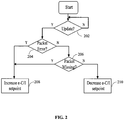
- FIG. 2 shows a flowchart 200 of an outer loop power control in accordance with an embodiment.
- the goal of the outer loop is to set a target effective carrier-to-interference (C/I) for an inner loop to track.
- An effective C/I is used instead of, for instance, an average C/I.
- Effective C/I is a better measure of the channel condition than average C/I in an FH-OFDMA system.
- Effective SNR is (approximately) proportional to the geometric mean of the SNRs averaged over all tones.
- the outer loop is updated when (i) there is a packet error or (ii) a packet is decoded correctly. Because of retransmissions, the outer-loop may not be updated every packet arrival instance.
- a packet is considered in error if it has not been successfully decoded after the specified maximum number of transmissions is reached or if its latency exceeds a specified latency limit.
- Latency includes both queuing delay and transmission delay.
- the receiver can detect that some packets have been dropped at the transmitter by detecting that packets are received out of sequence. These missing packets (once detected) are treated as packet errors. Missing packets can only be detected once the next packet in the sequence is decoded correctly at the receiver. In essence, corrupted packets, dropped packets and packets with excessive latency are declared as packet errors and the outer loop dynamically adjusts the effective C/I setpoint to maintain the packet error rate at a target value. By choosing the step sizes in adjusting the effective C/I setpoint properly, the target PER can be controlled to a desired value.
- step 202 a check is made to determine whether the setpoint is to be updated. If not, then the flow of control goes back to step 202 on the next iteration. If the setpoint is to be updated, then the flow of control proceeds to step 204.
- step 204 a check is made to determine whether there is a packet error. If there is no packet error, then the flow of control proceeds to step 206. Otherwise, the flow of control proceeds to step 208.
- step 206 a check is made to determine whether a packet is missing. If the packet is missing, then the flow of control proceeds to step 208 and the effective C/I setpoint is increased. Otherwise, the flow of control proceeds to step 210 and the effective C/I setpoint is decreased.
- FIG. 3 shows a flowchart 300 of an inner loop power control in accordance with an embodiment.
- the outer loop can be disabled when data is not present.
- only inner loop control is enabled when data is not present.
- the inner loop is updated periodically (e.g., every few hops/slots).
- the base station measures the received signal power and the effective C/I over the measurement interval.
- the inner loop attempts to maintain the target effective C/I set by the outer loop, while still satisfying a R p OT constraint (i.e., operating R p OT should be between R p OTmin and R p OTmax).
- the Received Power Over Thermal (RpOT) is defined as the ratio between the received signal power (P) and thermal noise (No).
- the inner loop of this proposed algorithm tries to satisfy both the effective C/I and R p OT targets.
- Set points (e-C/I sp , R p OT min , R p OT max ) are user specific. Different Quality of Service (QoS) users may have different RpOT min,max constraints. Updates are also user specific.
- QoS Quality of Service
- R p OT min and R p OT max can be determined according to QoS.
- R p OT min and R p OT max can be set equal to each other.
- the outer loop update is disabled in accordance with an embodiment. This is to prevent the effective C/I setpoint from being incremented or decremented indefinitely.
- R p OT does not depend on interference power from other users
- the power control loop is inherently stable (i.e., no indefinite power race between users).
- transmit power can be traded off for data rate.
- the power control loop may drive the transmit power to a very low level, as it may be all that is needed to satisfy the specified packet error rate requirement. This leads to a lower throughput, as discussed previously.
- R p OT By enforcing the operating range of R p OT, users can essentially choose to tradeoff between data rate and transmit power (e.g., users can enjoy a higher rate from an early termination by transmitting at higher power).
- R p OTmin helps protect against unnecessary rate loss
- R p OTmax helps ensure stable operation.
- R p OTmin R p OTmax
- the outer loop is essentially disabled. Effectively, the base station regulates the user's transmit power such that the target R p OT is met.
- This setting may be used in supporting best-effort traffic, where a user can always benefit from having a higher data rate.
- step 302 a check is made to determine whether the inner loop is to be updated. If not, then the flow of control goes back to step 302 on the next iteration. If the inner loop is to be updated, then the flow of control proceeds to step 304.
- step 304 a check is made to determine whether R p OT > R p OTmax. If yes, then the flow of control proceeds to step 306 and a DOWN command is issued by the base station. If not, then the flow of control proceeds to step 308.
- step 308 a check is made to determine whether an effective C/I is less than an effective C/I sp or R p OT ⁇ R p OT min .
- Effective C/I sp is the effective C/I for a setpoint. If yes, then the flow of control proceeds to step 310 and the base station issues an UP command. If no, then the flow of control proceeds to step 306 and the base station issues a DOWN command.
- a hysteresis function is added to the update functions of the outer and inner loops 200, 300 of figures 2 and 3 , respectively.
- the hysteresis function helps prevent the system from getting into a limit cycle.
- a packet error automatically results in an UP command to speed up the recovery (assuming, of course, that the R p OT constraint is not violated).
- the outer loop when only a control channel is present, the outer loop is disabled while continuing to execute the inner loop. When a data channel comes back, the operation of the outer loop can seamlessly be resumed. Thus, same underlying power control loop is used for both the control and data channels.
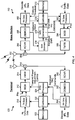
- FIG. 4 shows a block diagram of an embodiment of a base station 110x and a terminal 120x.
- a transmit (TX) data processor 510 receives and processes (e.g., formats, codes, interleaves, and modulates) reverse link (RL) traffic data and provides modulation symbols for the traffic data.
- TX data processor 510 also processes control data (e.g., CQI) from a controller 520 and provides modulation symbols for the control data.
- a modulator (MOD) 512 processes the modulation symbols for traffic and control data and pilot symbols and provides a sequence of complex-valued chips. The processing by TX data processor 510 and modulator 512 is dependent on the system.
- modulator 512 may perform OFDM modulation if the system utilizes OFDM.
- a transmitter unit (TMTR) 514 conditions (e.g., converts to analog, amplifies, filters, and frequency upconverts) the sequence of chips and generates a reverse link signal, which is routed through a duplexer (D) 516 and transmitted via an antenna 518.
- TMTR transmitter unit
- D duplexer
- the reverse link signal from terminal 120x is received by an antenna 552, routed through a duplexer 554, and provided to a receiver unit (RCVR) 556.
- Receiver unit 556 conditions (e.g., filters, amplifies, and frequency downconverts) the received signal and further digitizes the conditioned signal to obtain a stream of data samples.
- a demodulator (DEMOD) 558 processes the data samples to obtain symbol estimates.
- a receive (RX) data processor 560 then processes (e.g., deinterleaves and decodes) the symbol estimates to obtain decoded data for terminal 120x.
- RX data processor 560 also performs erasure detection and provides to a controller 570 the status of each received codeword used for power control.
- the processing by demodulator 558 and RX data processor 560 is complementary to the processing performed by modulator 512 and TX data processor 510, respectively.
- the processing for a forward link transmission may be performed similarly to that described above for the reverse link.
- the processing for reverse link and forward link transmissions is typically specified by the system.
- an SNR estimator 574 estimates the received SNR for terminal 120x and provides the received SNR to a TPC generator 576.
- TPC generator 576 also receives the target SNR and generates TPC commands for terminal 120x.
- the TPC commands are processed by a TX data processor 582, further processed by a modulator 584, conditioned by a transmitter unit 586, routed through duplexer 554, and transmitted via antenna 552 to terminal 120x.
- the forward link signal from base station 110x is received by antenna 518, routed through duplexer 516, conditioned and digitized by a receiver unit 540, processed by a demodulator 542, and further processed by an RX data processor 544 to obtain received TPC commands.
- a TPC processor 524 detects the received TPC commands to obtain TPC decisions, which are used to generate a transmit power adjustment control.
- Modulator 512 receives the control from TPC processor 524 and adjusts the transmit power for the reverse link transmission. Forward link power control may be achieved in a similar manner.
- Controllers 520 and 570 direct the operations of various processing units within terminal 120x and base station 110x, respectively. Controller 520 and 570 may also perform various functions for erasure detection and power control for the forward link and reverse link. For example, each controller may implement the SNR estimator, TPC generator, and target SNR adjustment unit for its link. Controller 570 and RX data processor 560 may also implement processes 200 and 300 in FIGS. 2 and 3 . Memory units 522 and 572 store data and program codes for controllers 520 and 570, respectively.
- the erasure detection and power control techniques described herein may be implemented by various means. For example, these techniques may be implemented in hardware, software, or a combination thereof.
- the processing units used to perform erasure detection and/or power control may be implemented within one or more application specific integrated circuits (ASICs), digital signal processors (DSPs), digital signal processing devices (DSPDs), programmable logic devices (PLDs), field programmable gate arrays (FPGAs), processors, controllers, micro-controllers, microprocessors, other electronic units designed to perform the functions described herein, or a combination thereof.
- ASICs application specific integrated circuits
- DSPs digital signal processors
- DSPDs digital signal processing devices
- PLDs programmable logic devices
- FPGAs field programmable gate arrays
- processors controllers, micro-controllers, microprocessors, other electronic units designed to perform the functions described herein, or a combination thereof.
- the techniques described herein may be implemented with modules (e.g., procedures, functions, and so on) that perform the functions described herein.
- the software codes may be stored in a memory unit (e.g., memory unit 572 in FIG. 4 ) and executed by a processor (e.g., controller 570).
- the memory unit may be implemented within the processor or external to the processor, in which case it can be communicatively coupled to the processor via various means as is known in the art.
- the present invention provides a method of reverse link power control, comprising:
- the determining whether the packet has been received without error may involve determining that there is no packet error and that the packet is not missing.
- the method may further comprise: transmitting a negative acknowledgment (NACK) messages for data packets not received.
- NACK negative acknowledgment
- the method may further comprise: retransmitting said data packets not received in accordance with said NACK messages.
- Said data packets may be transmitted over one or more time slots.
- the method may further comprise determining whether a Received Power Over Thermal (RpOT) is greater than a maximum Received Power Over Thermal (RpOT max ).
- the Received Power Over Thermal may be the ratio between the received signal power and thermal noise.
- the method may further comprise issuing a down command if the RpOT is not greater than the RpOT max .
- the method may further comprise determining whether an effective carrier-to-interference ratio (C/I) is less than an effective carrier-to- interference ratio for the setpoint (C/I sp ).
- the method may further comprise determining whether a Received Power Over Thermal (RpOT) is less than a minimum Received Power Over Thermal (RpOT min ).
- the method may further comprise issuing a down command if the effective carrier-to-interference ratio (C/I) is not less than the effective carrier-to- interference ratio for the setpoint (C/I sp ) or the Received Power Over Thermal (RpOT) is not less than the minimum Received Power Over Thermal (RpOT min ).
- C/I effective carrier-to-interference ratio
- RpOT Received Power Over Thermal
- the method may further comprise issuing an up command if the effective carrier-to-interference ratio (C/I) is less than the effective carrier-to- interference ratio for the setpoint (C/I sp ) and the Received Power Over Thermal (RpOT) is less than the minimum Received Power Over Thermal (RpOT min ).
- C/I effective carrier-to-interference ratio
- RpOT Received Power Over Thermal
- the steps of determining whether the packet has been received without error; decreasing an effective carrier-to-interference (C/I) setpoint if the packet has been received without error; and increasing the effective C/I setpoint if the packet has not been received without error may comprise an outer loop power control.
- the outer loop power control may be disabled if the Received Power Over Thermal (RpOT) is less than or equal to the minimum Received Power Over Thermal (RpOT min ).
- the outer loop power control may be disabled if the Received Power Over Thermal (RpOT) is greater than or equal to the maximum Received Power Over Thermal RpOT max .
- the outer loop power control may be enabled if the Received Power Over Thermal (RpOT) is greater than the minimum Received Power Over Thermal (RpOT min ) and the Received Power Over Thermal (RpOT) is less than the maximum Received Power Over Thermal RpOT max .
- the present invention also provides a wireless communications device, comprising: means for transmitting a packet; means for determining whether the packet has been received without error; means for decreasing an effective carrier-to-interference (C/I) setpoint if the packet has been received without error; and means for increasing the effective C/I setpoint if the packet has not been received without error.
- a wireless communications device comprising: means for transmitting a packet; means for determining whether the packet has been received without error; means for decreasing an effective carrier-to-interference (C/I) setpoint if the packet has been received without error; and means for increasing the effective C/I setpoint if the packet has not been received without error.
- C/I carrier-to-interference
- the wireless communications device may further comprise means for determining whether a Received Power Over Thermal (RpOT) is greater than a maximum Received Power Over Thermal (RpOT max ).
- RpOT Received Power Over Thermal
- the wireless communications device may further comprise issuing a down command if the RpOT is not greater than the RpOT max .
- the present invention also provides a processor programmed to execute a method of estimating interference in a wireless communication system, the method comprising: transmitting a packet; determining whether the packet has been received without error; decreasing an effective carrier-to-interference (C/I) setpoint if the packet has been received without error; and increasing the effective C/I setpoint if the packet has not been received without error.
- a processor programmed to execute a method of estimating interference in a wireless communication system, the method comprising: transmitting a packet; determining whether the packet has been received without error; decreasing an effective carrier-to-interference (C/I) setpoint if the packet has been received without error; and increasing the effective C/I setpoint if the packet has not been received without error.
- C/I carrier-to-interference
- the method may further comprise determining whether a Received Power Over Thermal (RpOT) is greater than a maximum Received Power Over Thermal (RpOT max ).
- the method may further comprise issuing a down command if the RpOT is not greater than the RpOT max .
- the present invention also provides a computer readable media embodying a method of reverse link power control, the method comprising: transmitting a packet; determining whether the packet has been received without error; decreasing an effective carrier-to-interference (C/I) setpoint if the packet has been received without error; and increasing the effective C/I setpoint if the packet has not been received without error.
- C/I carrier-to-interference
- the computer readable media may embody a method of reverse link power control, the method further comprising determining whether a Received Power Over Thermal (RpOT) is greater than a maximum Received Power Over Thermal (RpOT max ).
- RpOT Received Power Over Thermal
- the computer readable media may embody a method of reverse link power control, the method further comprising issuing a down command if the RpOT is not greater than the RpOT max.
Landscapes
- Engineering & Computer Science (AREA)
- Computer Networks & Wireless Communication (AREA)
- Signal Processing (AREA)
- Mobile Radio Communication Systems (AREA)
- Radio Relay Systems (AREA)
Applications Claiming Priority (3)
| Application Number | Priority Date | Filing Date | Title |
|---|---|---|---|
| US58982304P | 2004-07-20 | 2004-07-20 | |
| US11/022,348 US7594151B2 (en) | 2004-06-18 | 2004-12-22 | Reverse link power control in an orthogonal system |
| EP05776325A EP1769589A1 (en) | 2004-07-20 | 2005-07-19 | Reverse link power control in an orthogonal system |
Related Parent Applications (2)
| Application Number | Title | Priority Date | Filing Date |
|---|---|---|---|
| EP05776325.2 Division | 2005-07-19 | ||
| EP05776325A Division EP1769589A1 (en) | 2004-07-20 | 2005-07-19 | Reverse link power control in an orthogonal system |
Publications (2)
| Publication Number | Publication Date |
|---|---|
| EP2429246A1 EP2429246A1 (en) | 2012-03-14 |
| EP2429246B1 true EP2429246B1 (en) | 2017-04-26 |
Family
ID=35169608
Family Applications (2)
| Application Number | Title | Priority Date | Filing Date |
|---|---|---|---|
| EP11192795.0A Expired - Lifetime EP2429246B1 (en) | 2004-07-20 | 2005-07-19 | Reverse link power control in an orthogonal system |
| EP05776325A Withdrawn EP1769589A1 (en) | 2004-07-20 | 2005-07-19 | Reverse link power control in an orthogonal system |
Family Applications After (1)
| Application Number | Title | Priority Date | Filing Date |
|---|---|---|---|
| EP05776325A Withdrawn EP1769589A1 (en) | 2004-07-20 | 2005-07-19 | Reverse link power control in an orthogonal system |
Country Status (13)
| Country | Link |
|---|---|
| US (2) | US7594151B2 (enExample) |
| EP (2) | EP2429246B1 (enExample) |
| JP (1) | JP4499786B2 (enExample) |
| KR (1) | KR100881545B1 (enExample) |
| CN (1) | CN101023597B (enExample) |
| AU (1) | AU2005267163B2 (enExample) |
| BR (1) | BRPI0513699B1 (enExample) |
| CA (1) | CA2574561C (enExample) |
| IL (1) | IL180829A0 (enExample) |
| MX (1) | MX2007000812A (enExample) |
| RU (1) | RU2355110C2 (enExample) |
| TW (1) | TWI322586B (enExample) |
| WO (1) | WO2006012376A1 (enExample) |
Families Citing this family (29)
| Publication number | Priority date | Publication date | Assignee | Title |
|---|---|---|---|---|
| US7376879B2 (en) | 2001-10-19 | 2008-05-20 | Interdigital Technology Corporation | MAC architecture in wireless communication systems supporting H-ARQ |
| US8018945B2 (en) | 2004-04-29 | 2011-09-13 | Interdigital Technology Corporation | Method and apparatus for forwarding non-consecutive data blocks in enhanced uplink transmissions |
| US8452316B2 (en) | 2004-06-18 | 2013-05-28 | Qualcomm Incorporated | Power control for a wireless communication system utilizing orthogonal multiplexing |
| US7594151B2 (en) | 2004-06-18 | 2009-09-22 | Qualcomm, Incorporated | Reverse link power control in an orthogonal system |
| US7197692B2 (en) | 2004-06-18 | 2007-03-27 | Qualcomm Incorporated | Robust erasure detection and erasure-rate-based closed loop power control |
| US7536626B2 (en) | 2004-06-18 | 2009-05-19 | Qualcomm Incorporated | Power control using erasure techniques |
| KR20060038131A (ko) * | 2004-10-29 | 2006-05-03 | 삼성전자주식회사 | Fh-ofdma 방식을 사용하는 통신 시스템에서상향링크 스케줄링 방법 |
| US8942639B2 (en) | 2005-03-15 | 2015-01-27 | Qualcomm Incorporated | Interference control in a wireless communication system |
| US8848574B2 (en) | 2005-03-15 | 2014-09-30 | Qualcomm Incorporated | Interference control in a wireless communication system |
| US20060221847A1 (en) * | 2005-03-29 | 2006-10-05 | Dacosta Behram M | Method and apparatus for selecting transmission modulation rates in wireless devices for A/V streaming applications |
| CN101331698B (zh) | 2005-10-27 | 2012-07-18 | 高通股份有限公司 | 用于估计无线通信系统中的反向链路负载的方法和设备 |
| US8588201B2 (en) * | 2005-11-15 | 2013-11-19 | Intel Corporation | Method and apparatus for improving RF coverage area in a wireless network |
| US8260340B2 (en) * | 2006-02-17 | 2012-09-04 | Alcatel Lucent | Methods of reverse link power control |
| EP2466762A1 (en) | 2006-02-28 | 2012-06-20 | Rotani Inc. | Methods and apparatus for overlapping mimo antenna physical sectors |
| US20080117849A1 (en) * | 2006-09-08 | 2008-05-22 | Qualcomm Incorporated | Method and apparatus for interaction of fast other sector interference (osi) with slow osi |
| US8670777B2 (en) | 2006-09-08 | 2014-03-11 | Qualcomm Incorporated | Method and apparatus for fast other sector interference (OSI) adjustment |
| US8442572B2 (en) | 2006-09-08 | 2013-05-14 | Qualcomm Incorporated | Method and apparatus for adjustments for delta-based power control in wireless communication systems |
| KR100833731B1 (ko) * | 2006-10-20 | 2008-05-29 | 엘지노텔 주식회사 | 이동국의 이동 가능성의 예측에 기초한 핸드 오버 수행방법 |
| KR100981505B1 (ko) | 2007-02-05 | 2010-09-10 | 삼성전자주식회사 | 통신 시스템에서의 전력 제어 장치 및 방법 |
| KR100924964B1 (ko) * | 2007-10-15 | 2009-11-06 | 포스데이타 주식회사 | 무선 통신 시스템에서 상향링크 전력 제어 장치 및 방법 |
| KR100991792B1 (ko) | 2007-12-31 | 2010-11-04 | 엘지전자 주식회사 | 협력적 다중 입출력 방식 신호 송수신 방법 |
| CN102090117B (zh) * | 2008-06-26 | 2015-04-08 | 株式会社Ntt都科摩 | 闭环发送功率控制方法和基站装置、终端装置 |
| CN101483909B (zh) | 2009-02-06 | 2011-03-02 | 中兴通讯股份有限公司 | 基于多载波的反向功率控制方法 |
| CN101860949B (zh) * | 2009-04-10 | 2013-07-10 | 电信科学技术研究院 | 一种多载波系统下确定发射功率的方法、系统和装置 |
| KR101636382B1 (ko) * | 2009-09-28 | 2016-07-20 | 삼성전자주식회사 | 계층-셀 통신 시스템 또는 다중-셀 통신 시스템에서 사용자 스케쥴링 및 송신 전력 제어 방법 및 상기 방법을 위한 장치 |
| US9014069B2 (en) * | 2012-11-07 | 2015-04-21 | Qualcomm Incorporated | Methods and apparatus for communication mode selection based on content type |
| US11418422B1 (en) * | 2021-02-08 | 2022-08-16 | Mellanox Technologies, Ltd. | Received-signal rate detection |
| US20240314632A1 (en) * | 2023-03-14 | 2024-09-19 | Dell Products, L.P. | Dynamic packet re-ordering, discarding, and flow switching |
| US12418494B2 (en) | 2023-03-14 | 2025-09-16 | Dell Products L.P. | Dynamic packet re-ordering, discarding, and flow switching |
Family Cites Families (155)
| Publication number | Priority date | Publication date | Assignee | Title |
|---|---|---|---|---|
| US4539684A (en) | 1983-01-07 | 1985-09-03 | Motorola, Inc. | Automatic frame synchronization recovery utilizing a sequential decoder |
| US4908827A (en) | 1987-07-27 | 1990-03-13 | Tiw Systems, Inc. | Forward error correction system |
| US5301364A (en) | 1988-11-30 | 1994-04-05 | Motorola, Inc. | Method and apparatus for digital automatic gain control in a receiver |
| US5267262A (en) | 1989-11-07 | 1993-11-30 | Qualcomm Incorporated | Transmitter power control system |
| RU2001531C1 (ru) * | 1990-09-04 | 1993-10-15 | Воронежский научно-исследовательский институт св зи | Способ радиосв зи |
| WO1993015070A1 (fr) * | 1992-01-31 | 1993-08-05 | Chugai Seiyaku Kabushiki Kaisha | Cristal d'hydrate de derive d'acide quinolonecarboxylique |
| WO1994018756A1 (en) | 1993-02-11 | 1994-08-18 | Motorola, Inc. | Method and apparatus for controlling a power level of a subscriber unit of a wireless communication system |
| US5396516A (en) | 1993-02-22 | 1995-03-07 | Qualcomm Incorporated | Method and system for the dynamic modification of control paremeters in a transmitter power control system |
| US5669066A (en) | 1993-05-14 | 1997-09-16 | Telefonaktiebolaget Lm Ericsson | Dynamic control of transmitting power at a transmitter and attenuation at a receiver |
| US5406613A (en) * | 1993-06-29 | 1995-04-11 | Pacific Communication Sciences, Inc. | Method and apparatus for reducing power consumption in cellular telephone by adaptively determining the reliability of the reception of a received message block |
| SE503548C2 (sv) | 1993-10-01 | 1996-07-01 | Telia Ab | Anordning i OFDM fleranvändarsystem |
| US5469471A (en) | 1994-02-01 | 1995-11-21 | Qualcomm Incorporated | Method and apparatus for providing a communication link quality indication |
| US5727033A (en) | 1994-11-30 | 1998-03-10 | Lucent Technologies Inc. | Symbol error based power control for mobile telecommunication system |
| US5722063A (en) | 1994-12-16 | 1998-02-24 | Qualcomm Incorporated | Method and apparatus for increasing receiver immunity to interference |
| US5961588A (en) | 1996-02-22 | 1999-10-05 | Alcatel Usa Sourcing, L.P. | Handling of commands passed between the server and client stations of a telecommunications system |
| US5815507A (en) * | 1996-04-15 | 1998-09-29 | Motorola, Inc. | Error detector circuit for digital receiver using variable threshold based on signal quality |
| US5774785A (en) | 1996-06-20 | 1998-06-30 | Telefonaktiebolaget Lm Ericsson | Adaptive quality adjustment |
| US5996103A (en) | 1996-07-31 | 1999-11-30 | Samsung Information Systems America | Apparatus and method for correcting errors in a communication system |
| US6047189A (en) * | 1996-10-11 | 2000-04-04 | Arraycomm, Inc. | Adaptive method for channel assignment in a cellular communication system |
| DE19646371A1 (de) | 1996-11-09 | 1998-05-14 | Bosch Gmbh Robert | Verfahren und Anordnung zum Verbessern der Übertragungsqualität in einem Punkt-zu-Mehrpunkt Funkübertragungssystem |
| US6075974A (en) | 1996-11-20 | 2000-06-13 | Qualcomm Inc. | Method and apparatus for adjusting thresholds and measurements of received signals by anticipating power control commands yet to be executed |
| US5956642A (en) | 1996-11-25 | 1999-09-21 | Telefonaktiebolaget L M Ericsson | Adaptive channel allocation method and apparatus for multi-slot, multi-carrier communication system |
| US5996110A (en) | 1996-12-16 | 1999-11-30 | Motorola, Inc. | Method and apparatus for decoding a data packet |
| WO1998030057A1 (en) | 1996-12-27 | 1998-07-09 | Ntt Mobile Communications Network Inc. | Call acceptance control method for cdma mobile radio communication system and mobile station device |
| US6128339A (en) | 1997-02-13 | 2000-10-03 | Samsung Electronics Co., Ltd. | Apparatus and method for masking video data errors |
| US5933768A (en) | 1997-02-28 | 1999-08-03 | Telefonaktiebolaget L/M Ericsson | Receiver apparatus, and associated method, for receiving a receive signal transmitted upon a channel susceptible to interference |
| KR100243425B1 (ko) * | 1997-07-10 | 2000-02-01 | 곽치영 | 씨디엠에이 무선가입자망 시스템의 순방향 트래픽 채널 전력제어 방법 및 장치 |
| US6188678B1 (en) | 1997-08-07 | 2001-02-13 | Qualcomm Inc. | Method and apparatus for adaptive closed loop power control using open loop measurements |
| US6418320B2 (en) | 1997-08-12 | 2002-07-09 | Nec Corporation | Mobile station and a method of reducing interference among radio channels in the mobile station |
| US6101179A (en) | 1997-09-19 | 2000-08-08 | Qualcomm Incorporated | Accurate open loop power control in a code division multiple access communication system |
| US6012160A (en) * | 1997-10-03 | 2000-01-04 | Ericsson Inc. | Method for protecting important data bits using less important data bits |
| US6353907B1 (en) | 1997-10-29 | 2002-03-05 | At&T Corp. | Incremental redundancy radio link protocol |
| US6574211B2 (en) * | 1997-11-03 | 2003-06-03 | Qualcomm Incorporated | Method and apparatus for high rate packet data transmission |
| US6154659A (en) * | 1997-12-24 | 2000-11-28 | Nortel Networks Limited | Fast forward link power control in a code division multiple access system |
| US6112325A (en) | 1998-01-23 | 2000-08-29 | Dspc Technologies, Ltd. | Method and device for detecting rate |
| US6181738B1 (en) * | 1998-02-13 | 2001-01-30 | Northern Telecom Limited | Reverse link power control using a frame quality metric |
| US6895245B2 (en) | 1998-03-06 | 2005-05-17 | Telefonaktiebolaget Lm Ericssion(Publ) | Telecommunications interexchange measurement transfer |
| US6144841A (en) * | 1998-03-10 | 2000-11-07 | Nortel Networks Corporation | Method and system for managing forward link power control within a code-division multiple access mobile telephone communication network |
| KR19990088052A (ko) | 1998-05-06 | 1999-12-27 | 다니엘 태그리아페리, 라이조 캐르키, 모링 헬레나 | 다중반송파광대역시디엠에이시스템에서의전력제어를제공하는방법및장치 |
| KR20000013025A (ko) | 1998-08-01 | 2000-03-06 | 윤종용 | 이동통신 시스템의 순방향 초기 송신전력 제어장치 및 방법 |
| US6597705B1 (en) | 1998-09-10 | 2003-07-22 | Qualcomm Incorporated | Method and apparatus for distributed optimal reverse link scheduling of resources, such as a rate and power in a wireless communication system |
| KR100277071B1 (ko) * | 1998-09-15 | 2001-01-15 | 윤종용 | 셀룰러시스템의역방향전력제어방법 |
| KR200228664Y1 (ko) | 1998-09-15 | 2001-10-25 | 윤종용 | 공기조화기용실내기 |
| US6449463B1 (en) | 1998-10-29 | 2002-09-10 | Qualcomm, Incorporated | Variable loop gain in double loop power control systems |
| US6717976B1 (en) | 1998-12-21 | 2004-04-06 | Nortel Networks Ltd. | Method and apparatus for signal to noise power ratio estimation in a multi sub-channel CDMA receiver |
| KR100276814B1 (ko) | 1998-12-31 | 2001-01-15 | 윤종용 | 이동통신시스템에서 구성복호기의 상태값 정규화 장치 및방법 |
| RU2163053C2 (ru) * | 1999-01-26 | 2001-02-10 | Государственное унитарное предприятие Воронежский научно-исследовательский институт связи | Линия радиосвязи |
| KR100651457B1 (ko) | 1999-02-13 | 2006-11-28 | 삼성전자주식회사 | 부호분할다중접속 이동통신시스템의 불연속 전송모드에서 연속적인 외부순환 전력제어장치 및 방법 |
| JP3968190B2 (ja) | 1999-03-06 | 2007-08-29 | 松下電器産業株式会社 | 送受信装置 |
| US6628956B2 (en) | 1999-03-15 | 2003-09-30 | Telefonaktiebolaget Lm Ericsson (Publ) | Adaptive power control in a radio communications systems |
| US6334047B1 (en) | 1999-04-09 | 2001-12-25 | Telefonaktiebolaget Lm Ericsson (Publ) | Adaptive power control in a mobile radio communications system |
| GB9913697D0 (en) | 1999-06-11 | 1999-08-11 | Adaptive Broadband Ltd | Dynamic channel allocation in a wireless network |
| US6603746B1 (en) * | 1999-06-18 | 2003-08-05 | Nortel Networks Limited | Method and apparatus for controlling transmitted power in a wireless communications system |
| EP1108294B1 (en) | 1999-06-28 | 2004-05-12 | Samsung Electronics Co., Ltd. | Apparatus and method of controlling forward link power when in discontinuous transmission mode in a mobile communication system |
| US6611507B1 (en) | 1999-07-30 | 2003-08-26 | Nokia Corporation | System and method for effecting information transmission and soft handoff between frequency division duplex and time division duplex communications systems |
| US6560774B1 (en) * | 1999-09-01 | 2003-05-06 | Microsoft Corporation | Verifier to check intermediate language |
| US6208699B1 (en) * | 1999-09-01 | 2001-03-27 | Qualcomm Incorporated | Method and apparatus for detecting zero rate frames in a communications system |
| US6807164B1 (en) * | 1999-09-14 | 2004-10-19 | Telefonaktiebolaget Lm Ericsson (Publ) | Power control in a CDMA mobile communication system |
| WO2001020808A2 (en) | 1999-09-14 | 2001-03-22 | Telefonaktiebolaget Lm Ericsson (Publ) | Power control in a cdma mobile communication system |
| US6968201B1 (en) * | 1999-10-06 | 2005-11-22 | Lucent Technologies, Inc. | Method and apparatus for controlling reverse link interference rise and power control instability in a wireless system |
| US6446236B1 (en) * | 1999-10-13 | 2002-09-03 | Maxtor Corporation | Reading encoded information subject to random and transient errors |
| US6519705B1 (en) * | 1999-12-15 | 2003-02-11 | At&T Corp. | Method and system for power control in wireless networks using interference prediction with an error margin |
| US6393276B1 (en) | 2000-01-12 | 2002-05-21 | Telefonaktiebolaget Lm Ericsson | Mobile station assisted forward link open loop power and rate control in a CDMA system |
| US7590095B2 (en) * | 2000-02-14 | 2009-09-15 | Qualcomm Incorporated | Method and apparatus for power control of multiple channels in a wireless communication system |
| JP2003522578A (ja) | 2000-02-18 | 2003-07-29 | アーゴス インク | 不均質組織における空間的に平均された励起−発光マップの生成 |
| JP3480710B2 (ja) * | 2000-03-28 | 2003-12-22 | 松下電器産業株式会社 | 送信電力制御装置及び送信電力制御方法 |
| US6721373B1 (en) * | 2000-03-29 | 2004-04-13 | Tioga Technologies Ltd. | Multi-tone receiver and a method for operating the same |
| JP2001285193A (ja) * | 2000-03-29 | 2001-10-12 | Oki Electric Ind Co Ltd | 送信電力制御方式 |
| US6493331B1 (en) | 2000-03-30 | 2002-12-10 | Qualcomm Incorporated | Method and apparatus for controlling transmissions of a communications systems |
| US6711150B1 (en) * | 2000-04-07 | 2004-03-23 | Telefonktiebolaget L.M. Ericsson | System and method for data burst communications in a CDMA network |
| FR2808158B1 (fr) | 2000-04-19 | 2002-06-07 | Mitsubishi Electric Inf Tech | Methode de controle de puissance dans un systeme de telecommunication |
| US20020036958A1 (en) | 2000-07-24 | 2002-03-28 | Hidenori Wada | Optical element, optical head, optical recording/reproducing apparatus and optical recording/reproducing method |
| KR100374338B1 (ko) | 2000-04-26 | 2003-03-03 | 삼성전자주식회사 | 이동통신시스템의 기지국 시스템에서 전용제어채널전력제어를 지원하기 위한 방법 |
| KR100860804B1 (ko) | 2000-05-01 | 2008-09-30 | 인터디지탈 테크날러지 코포레이션 | 다중 하향 링크 시간 슬롯에 대한 스펙트럼 확산 시분할사용자 장치 |
| US6791954B1 (en) | 2000-06-12 | 2004-09-14 | Lucent Technologies Inc. | Method for enhanced power control by adaptively adjusting an amount of change in a target signal-to-noise ratio |
| KR100434459B1 (ko) * | 2000-06-27 | 2004-06-05 | 삼성전자주식회사 | 이동통신 시스템에서 패킷의 전송 제어방법 및 장치 |
| US6950669B2 (en) * | 2000-07-05 | 2005-09-27 | Telefonaktiebolaget Lm Ericsson (Publ) | Power control algorithm for packet data based on queue/channel utilization |
| JP2002026747A (ja) | 2000-07-13 | 2002-01-25 | Matsushita Electric Ind Co Ltd | 無線通信端末装置及び送信電力制御方法 |
| AU7593601A (en) | 2000-07-14 | 2002-01-30 | Atabok Inc | Controlling and managing digital assets |
| JP3622649B2 (ja) * | 2000-08-29 | 2005-02-23 | Kddi株式会社 | Cdma移動通信システムのセルカバレッジ評価方法 |
| US6801759B1 (en) | 2000-09-25 | 2004-10-05 | Qualcomm, Incorporated | Method and apparatus for power control in a wireless communication system |
| EP1325660B1 (en) | 2000-10-09 | 2008-08-27 | Nokia Corporation | Radio resource management |
| US7072315B1 (en) | 2000-10-10 | 2006-07-04 | Adaptix, Inc. | Medium access control for orthogonal frequency-division multiple-access (OFDMA) cellular networks |
| US6597923B1 (en) | 2000-10-23 | 2003-07-22 | Telefonaktiebolaget L.M. Ericsson (Publ.) | Method and apparatus for transmitter power control |
| US6609008B1 (en) | 2000-11-09 | 2003-08-19 | Qualcomm Incoporated | Method and apparatus for controlling signal power level in a communication system |
| US7236793B2 (en) | 2001-01-31 | 2007-06-26 | Ipr Licensing, Inc. | Queuing far/far service requests in wireless network |
| US7245922B2 (en) | 2001-02-01 | 2007-07-17 | Telefonaktiebolaget Lm Ericsson (Publ) | Method and apparatus for controlling quality of service for multiple services through power setting |
| EP1811804B1 (en) | 2001-02-12 | 2011-04-27 | LG Electronics Inc. | Controlling data transmission rate on the reverse link for each mobile station in a dedicated manner |
| US8199696B2 (en) | 2001-03-29 | 2012-06-12 | Qualcomm Incorporated | Method and apparatus for power control in a wireless communication system |
| US7158504B2 (en) | 2001-05-21 | 2007-01-02 | Lucent Technologies, Inc. | Multiple mode data communication system and method and forward and/or reverse link control channel structure |
| EP1402693A1 (en) | 2001-05-23 | 2004-03-31 | Nortel Networks Limited | Channel estimation in cdma communications systems using both lower power pilot channel and higher power data channel |
| US6983153B2 (en) * | 2001-06-07 | 2006-01-03 | Qualcomm Incorporated | Method and apparatus for congestion control in a wireless communication system |
| US6751444B1 (en) | 2001-07-02 | 2004-06-15 | Broadstorm Telecommunications, Inc. | Method and apparatus for adaptive carrier allocation and power control in multi-carrier communication systems |
| JP3730885B2 (ja) | 2001-07-06 | 2006-01-05 | 株式会社日立製作所 | 誤り訂正ターボ符号の復号器 |
| JP3607643B2 (ja) | 2001-07-13 | 2005-01-05 | 松下電器産業株式会社 | マルチキャリア送信装置、マルチキャリア受信装置、およびマルチキャリア無線通信方法 |
| GB2378858B (en) | 2001-08-18 | 2005-07-13 | Motorola Inc | Minimisation of interference in cellular communications systems |
| US20030081538A1 (en) | 2001-10-18 | 2003-05-01 | Walton Jay R. | Multiple-access hybrid OFDM-CDMA system |
| KR100915275B1 (ko) | 2001-11-05 | 2009-09-03 | 가부시키가이샤 히타치세이사쿠쇼 | 무선 통신 시스템 및 그 통신 제어 방법 및 무선 통신기 |
| US6952591B2 (en) * | 2001-11-20 | 2005-10-04 | Lucent Technologies Inc. | Uplink power control algorithm |
| JP3788506B2 (ja) | 2001-11-21 | 2006-06-21 | 日本電気株式会社 | 無線基地局、移動局と無線受信装置およびsir推定方法と送信電力制御方法およびプログラム |
| RU2214690C2 (ru) | 2001-12-26 | 2003-10-20 | Государственное конструкторское бюро аппаратно-программных систем "Связь" Всероссийского НИИ "Градиент" | Способ восстановления переданных информационных сигналов после прохождения их через канал связи |
| KR100630128B1 (ko) | 2002-03-23 | 2006-09-27 | 삼성전자주식회사 | 고속 순방향 패킷 접속 방식을 사용하는 이동통신시스템에서 역방향 전력 제어를 위한 파일럿 신호필드 위치정보 결정장치 및 방법 |
| JP2004064142A (ja) | 2002-07-24 | 2004-02-26 | Ntt Docomo Inc | 送信電力制御方法、これに用いて好適な無線通信システム、無線基地局及び移動局 |
| US7418241B2 (en) * | 2002-08-09 | 2008-08-26 | Qualcomm Incorporated | System and techniques for enhancing the reliability of feedback in a wireless communications system |
| JP4043322B2 (ja) * | 2002-09-06 | 2008-02-06 | 三菱電機株式会社 | 再送制御方法および通信装置 |
| US7630321B2 (en) | 2002-09-10 | 2009-12-08 | Qualcomm Incorporated | System and method for rate assignment |
| US8504054B2 (en) | 2002-09-10 | 2013-08-06 | Qualcomm Incorporated | System and method for multilevel scheduling |
| GB0222999D0 (en) | 2002-10-04 | 2002-11-13 | Ip Access Ltd | Cellular radio telecommunication systems |
| TWI332326B (en) * | 2002-10-17 | 2010-10-21 | Interdigital Tech Corp | Power control for communications systems utilizing high speed shared channels |
| US7477920B2 (en) | 2002-10-25 | 2009-01-13 | Intel Corporation | System and method for automatically configuring and integrating a radio base station into an existing wireless cellular communication network with full bi-directional roaming and handover capability |
| US8107885B2 (en) | 2002-10-30 | 2012-01-31 | Motorola Mobility, Inc. | Method and apparatus for providing a distributed architecture digital wireless communication system |
| CN1225857C (zh) * | 2002-12-05 | 2005-11-02 | 华为技术有限公司 | 一种移动通信系统中速率控制方法 |
| JP4102738B2 (ja) | 2002-12-17 | 2008-06-18 | 日本電気株式会社 | 光ディスクの信号品質評価方法、品質評価装置、および、光ディスク装置 |
| CN100459755C (zh) | 2002-12-27 | 2009-02-04 | Nxp股份有限公司 | 具有功率控制的移动终端与方法 |
| US7254158B2 (en) | 2003-05-12 | 2007-08-07 | Qualcomm Incorporated | Soft handoff with interference cancellation in a wireless frequency hopping communication system |
| US7012912B2 (en) | 2003-05-14 | 2006-03-14 | Qualcomm Incorporated | Power control and scheduling in an OFDM system |
| US7224993B2 (en) * | 2003-05-15 | 2007-05-29 | Lucent Technologies Inc. | Power control method with DTX frame detection for a communication channel |
| WO2005020490A1 (en) | 2003-08-13 | 2005-03-03 | Flarion Technologies, Inc. | Methods and apparatus of power control in wireless communication systems |
| US7346314B2 (en) | 2003-08-15 | 2008-03-18 | Telefonaktiebolaget Lm Ericsson (Publ) | Forward link transmit power control based on observed command response |
| JP4322593B2 (ja) | 2003-08-20 | 2009-09-02 | Necインフロンティア株式会社 | 無線端末制御方法 |
| US7007306B2 (en) * | 2003-11-04 | 2006-03-07 | Bacou-Dalloz Eye & Face Protection, Inc. | Face shield assembly |
| US7302276B2 (en) | 2003-11-25 | 2007-11-27 | Telefonaktiebolaget L M Ericsson (Publ) | Method and system for determining uplink/downlink path-loss difference |
| US7359727B2 (en) | 2003-12-16 | 2008-04-15 | Intel Corporation | Systems and methods for adjusting transmit power in wireless local area networks |
| US7493133B2 (en) | 2004-02-05 | 2009-02-17 | Qualcomm, Incorporated | Power control in ad-hoc wireless networks |
| US7310526B2 (en) | 2004-02-06 | 2007-12-18 | Nec Laboratories America, Inc. | Load-aware handoff and site selection scheme |
| US7668561B2 (en) | 2004-02-27 | 2010-02-23 | Qualcomm Incorporated | Apparatus and method for controlling reverse link interference among access terminals in wireless communications |
| US7730381B2 (en) | 2004-06-09 | 2010-06-01 | Qualcomm Incorporated | Erasure detection and power control for a transport channel with unknown format in a wireless communication system |
| US8452316B2 (en) | 2004-06-18 | 2013-05-28 | Qualcomm Incorporated | Power control for a wireless communication system utilizing orthogonal multiplexing |
| US7197692B2 (en) | 2004-06-18 | 2007-03-27 | Qualcomm Incorporated | Robust erasure detection and erasure-rate-based closed loop power control |
| US7594151B2 (en) | 2004-06-18 | 2009-09-22 | Qualcomm, Incorporated | Reverse link power control in an orthogonal system |
| WO2006004968A2 (en) | 2004-06-30 | 2006-01-12 | Neocific, Inc. | Methods and apparatus for power control in multi-carrier wireless systems |
| EP1786128A1 (en) | 2004-08-30 | 2007-05-16 | Matsushita Electric Industrial Co., Ltd. | Peak power suppressing apparatus and peak power suppressing method |
| CN101031963B (zh) | 2004-09-16 | 2010-09-15 | 法国电信 | 处理有噪声的声音信号的方法以及实现该方法的装置 |
| JP4647612B2 (ja) | 2004-09-17 | 2011-03-09 | パナソニック株式会社 | 送信制御フレーム生成装置および送信制御装置 |
| US7623490B2 (en) | 2004-12-22 | 2009-11-24 | Qualcomm Incorporated | Systems and methods that utilize a capacity-based signal-to-noise ratio to predict and improve mobile communication |
| US7974352B2 (en) | 2004-12-28 | 2011-07-05 | Sharp Kabushiki Kaisha | Wireless transmitter, wireless receiver and wireless communication system |
| US20060171326A1 (en) | 2005-02-03 | 2006-08-03 | Autocell Laboratories, Inc. | Remedial actions for interference in wireless LANs |
| WO2006087797A1 (ja) | 2005-02-18 | 2006-08-24 | Fujitsu Limited | 基地局及び該基地局における干渉低減方法 |
| US7512412B2 (en) | 2005-03-15 | 2009-03-31 | Qualcomm, Incorporated | Power control and overlapping control for a quasi-orthogonal communication system |
| US8942639B2 (en) | 2005-03-15 | 2015-01-27 | Qualcomm Incorporated | Interference control in a wireless communication system |
| US7742444B2 (en) | 2005-03-15 | 2010-06-22 | Qualcomm Incorporated | Multiple other sector information combining for power control in a wireless communication system |
| US8848574B2 (en) | 2005-03-15 | 2014-09-30 | Qualcomm Incorporated | Interference control in a wireless communication system |
| US7400887B2 (en) | 2005-03-17 | 2008-07-15 | Lucent Technologies Inc. | Method for estimating the downlink capacity in a spread spectrum wireless communications system |
| US8660095B2 (en) | 2005-07-21 | 2014-02-25 | Qualcomm Incorporated | Reverse link transmit power control in a wireless communication system |
| KR100714945B1 (ko) | 2005-10-12 | 2007-05-07 | 엘지노텔 주식회사 | 오에프디엠에이 시스템에서의 부채널 할당 장치 및 방법 |
| WO2007050908A1 (en) | 2005-10-27 | 2007-05-03 | Qualcomm Incorporated | A method and apparatus for reporting cqi in a wireless communication system |
| US8700082B2 (en) | 2006-01-05 | 2014-04-15 | Qualcomm Incorporated | Power control utilizing multiple rate interference indications |
| CN102638330B (zh) | 2006-04-25 | 2015-05-20 | Lg电子株式会社 | 在无线通信系统中传送信号的方法 |
| US8023574B2 (en) | 2006-05-05 | 2011-09-20 | Intel Corporation | Method and apparatus to support scalability in a multicarrier network |
| CN102970739A (zh) | 2006-06-13 | 2013-03-13 | 高通股份有限公司 | 无线通信系统的功率控制 |
| KR200427165Y1 (ko) | 2006-07-03 | 2006-09-20 | 이영래 | 복층식 화분 정리대 |
| US20080045260A1 (en) | 2006-08-15 | 2008-02-21 | Tarik Muharemovic | Power Settings for the Sounding Reference signal and the Scheduled Transmission in Multi-Channel Scheduled Systems |
| US20080117849A1 (en) | 2006-09-08 | 2008-05-22 | Qualcomm Incorporated | Method and apparatus for interaction of fast other sector interference (osi) with slow osi |
| US7917164B2 (en) | 2007-01-09 | 2011-03-29 | Alcatel-Lucent Usa Inc. | Reverse link power control |
| WO2009058971A2 (en) | 2007-11-02 | 2009-05-07 | Interdigital Patent Holdings, Inc. | Power control for combined dynamically and persistently scheduled pusch in e-utra |
-
2004
- 2004-12-22 US US11/022,348 patent/US7594151B2/en active Active
-
2005
- 2005-07-19 AU AU2005267163A patent/AU2005267163B2/en not_active Ceased
- 2005-07-19 JP JP2007522717A patent/JP4499786B2/ja not_active Expired - Fee Related
- 2005-07-19 EP EP11192795.0A patent/EP2429246B1/en not_active Expired - Lifetime
- 2005-07-19 MX MX2007000812A patent/MX2007000812A/es active IP Right Grant
- 2005-07-19 EP EP05776325A patent/EP1769589A1/en not_active Withdrawn
- 2005-07-19 KR KR1020077003197A patent/KR100881545B1/ko not_active Expired - Fee Related
- 2005-07-19 CN CN2005800314008A patent/CN101023597B/zh not_active Expired - Lifetime
- 2005-07-19 BR BRPI0513699-7A patent/BRPI0513699B1/pt active IP Right Grant
- 2005-07-19 CA CA2574561A patent/CA2574561C/en not_active Expired - Lifetime
- 2005-07-19 RU RU2007106107/09A patent/RU2355110C2/ru active
- 2005-07-19 WO PCT/US2005/025803 patent/WO2006012376A1/en not_active Ceased
- 2005-07-20 TW TW094124508A patent/TWI322586B/zh not_active IP Right Cessation
-
2007
- 2007-01-21 IL IL180829A patent/IL180829A0/en unknown
-
2009
- 2009-07-16 US US12/504,085 patent/US7962826B2/en not_active Expired - Lifetime
Non-Patent Citations (1)
| Title |
|---|
| None * |
Also Published As
| Publication number | Publication date |
|---|---|
| BRPI0513699B1 (pt) | 2019-04-24 |
| MX2007000812A (es) | 2007-04-02 |
| JP4499786B2 (ja) | 2010-07-07 |
| AU2005267163B2 (en) | 2009-03-05 |
| CA2574561A1 (en) | 2006-02-02 |
| EP1769589A1 (en) | 2007-04-04 |
| TW200627829A (en) | 2006-08-01 |
| CN101023597A (zh) | 2007-08-22 |
| KR100881545B1 (ko) | 2009-02-02 |
| RU2007106107A (ru) | 2008-08-27 |
| RU2355110C2 (ru) | 2009-05-10 |
| US7594151B2 (en) | 2009-09-22 |
| US20060002346A1 (en) | 2006-01-05 |
| TWI322586B (en) | 2010-03-21 |
| JP2008507910A (ja) | 2008-03-13 |
| CA2574561C (en) | 2011-12-13 |
| BRPI0513699A (pt) | 2008-05-13 |
| KR20070039588A (ko) | 2007-04-12 |
| AU2005267163A1 (en) | 2006-02-02 |
| EP2429246A1 (en) | 2012-03-14 |
| IL180829A0 (en) | 2007-06-03 |
| WO2006012376A1 (en) | 2006-02-02 |
| US7962826B2 (en) | 2011-06-14 |
| CN101023597B (zh) | 2011-11-23 |
| US20090274232A1 (en) | 2009-11-05 |
Similar Documents
| Publication | Publication Date | Title |
|---|---|---|
| EP2429246B1 (en) | Reverse link power control in an orthogonal system | |
| JP5575847B2 (ja) | サービングセクタ干渉ブロードキャスト及び対応する逆方向リンクトラヒック電力制御 | |
| KR100949018B1 (ko) | 통신 시스템에서 전력 제어 및 서비스 품질(qos) 구현 | |
| CN101933377B (zh) | 在指定给无线通信设备的两个或更多个载波之间分配发射功率 | |
| EP1522154B1 (en) | Adaptive gain adjustment control with feedback | |
| KR20180051421A (ko) | 무선 통신 시스템에서 빔 동작을 위한 전력 헤드룸 보고를 트리거링하는 방법 및 장치 | |
| JP2010503344A5 (enExample) | ||
| EP1440533A2 (en) | Adaptive rate control for an ofdm communication system | |
| JP2010518787A (ja) | Lteのためのプリアンブルに基づくアップリンク電力制御 | |
| CN101171814A (zh) | 无线通信系统中的干扰控制 | |
| HK1105722A (en) | Reverse link power control in an orthogonal system |
Legal Events
| Date | Code | Title | Description |
|---|---|---|---|
| 17P | Request for examination filed |
Effective date: 20111209 |
|
| AC | Divisional application: reference to earlier application |
Ref document number: 1769589 Country of ref document: EP Kind code of ref document: P |
|
| AK | Designated contracting states |
Kind code of ref document: A1 Designated state(s): AT BE BG CH CY CZ DE DK EE ES FI FR GB GR HU IE IS IT LI LT LU LV MC NL PL PT RO SE SI SK TR |
|
| PUAI | Public reference made under article 153(3) epc to a published international application that has entered the european phase |
Free format text: ORIGINAL CODE: 0009012 |
|
| 17Q | First examination report despatched |
Effective date: 20120927 |
|
| GRAP | Despatch of communication of intention to grant a patent |
Free format text: ORIGINAL CODE: EPIDOSNIGR1 |
|
| RIC1 | Information provided on ipc code assigned before grant |
Ipc: H04W 52/12 20090101ALI20161111BHEP Ipc: H04W 52/14 20090101AFI20161111BHEP Ipc: H04W 52/20 20090101ALI20161111BHEP Ipc: H04W 52/36 20090101ALI20161111BHEP Ipc: H04W 52/28 20090101ALI20161111BHEP Ipc: H04W 52/24 20090101ALI20161111BHEP Ipc: H04W 52/48 20090101ALI20161111BHEP |
|
| INTG | Intention to grant announced |
Effective date: 20161206 |
|
| GRAS | Grant fee paid |
Free format text: ORIGINAL CODE: EPIDOSNIGR3 |
|
| GRAA | (expected) grant |
Free format text: ORIGINAL CODE: 0009210 |
|
| AC | Divisional application: reference to earlier application |
Ref document number: 1769589 Country of ref document: EP Kind code of ref document: P |
|
| AK | Designated contracting states |
Kind code of ref document: B1 Designated state(s): AT BE BG CH CY CZ DE DK EE ES FI FR GB GR HU IE IS IT LI LT LU LV MC NL PL PT RO SE SI SK TR |
|
| REG | Reference to a national code |
Ref country code: GB Ref legal event code: FG4D |
|
| REG | Reference to a national code |
Ref country code: CH Ref legal event code: EP |
|
| REG | Reference to a national code |
Ref country code: AT Ref legal event code: REF Ref document number: 888856 Country of ref document: AT Kind code of ref document: T Effective date: 20170515 |
|
| REG | Reference to a national code |
Ref country code: IE Ref legal event code: FG4D |
|
| REG | Reference to a national code |
Ref country code: FR Ref legal event code: PLFP Year of fee payment: 13 |
|
| REG | Reference to a national code |
Ref country code: DE Ref legal event code: R096 Ref document number: 602005051843 Country of ref document: DE |
|
| REG | Reference to a national code |
Ref country code: NL Ref legal event code: MP Effective date: 20170426 |
|
| REG | Reference to a national code |
Ref country code: LT Ref legal event code: MG4D |
|
| REG | Reference to a national code |
Ref country code: AT Ref legal event code: MK05 Ref document number: 888856 Country of ref document: AT Kind code of ref document: T Effective date: 20170426 |
|
| PG25 | Lapsed in a contracting state [announced via postgrant information from national office to epo] |
Ref country code: NL Free format text: LAPSE BECAUSE OF FAILURE TO SUBMIT A TRANSLATION OF THE DESCRIPTION OR TO PAY THE FEE WITHIN THE PRESCRIBED TIME-LIMIT Effective date: 20170426 |
|
| PG25 | Lapsed in a contracting state [announced via postgrant information from national office to epo] |
Ref country code: AT Free format text: LAPSE BECAUSE OF FAILURE TO SUBMIT A TRANSLATION OF THE DESCRIPTION OR TO PAY THE FEE WITHIN THE PRESCRIBED TIME-LIMIT Effective date: 20170426 Ref country code: FI Free format text: LAPSE BECAUSE OF FAILURE TO SUBMIT A TRANSLATION OF THE DESCRIPTION OR TO PAY THE FEE WITHIN THE PRESCRIBED TIME-LIMIT Effective date: 20170426 Ref country code: LT Free format text: LAPSE BECAUSE OF FAILURE TO SUBMIT A TRANSLATION OF THE DESCRIPTION OR TO PAY THE FEE WITHIN THE PRESCRIBED TIME-LIMIT Effective date: 20170426 Ref country code: ES Free format text: LAPSE BECAUSE OF FAILURE TO SUBMIT A TRANSLATION OF THE DESCRIPTION OR TO PAY THE FEE WITHIN THE PRESCRIBED TIME-LIMIT Effective date: 20170426 Ref country code: GR Free format text: LAPSE BECAUSE OF FAILURE TO SUBMIT A TRANSLATION OF THE DESCRIPTION OR TO PAY THE FEE WITHIN THE PRESCRIBED TIME-LIMIT Effective date: 20170727 |
|
| PG25 | Lapsed in a contracting state [announced via postgrant information from national office to epo] |
Ref country code: IS Free format text: LAPSE BECAUSE OF FAILURE TO SUBMIT A TRANSLATION OF THE DESCRIPTION OR TO PAY THE FEE WITHIN THE PRESCRIBED TIME-LIMIT Effective date: 20170826 Ref country code: BG Free format text: LAPSE BECAUSE OF FAILURE TO SUBMIT A TRANSLATION OF THE DESCRIPTION OR TO PAY THE FEE WITHIN THE PRESCRIBED TIME-LIMIT Effective date: 20170726 Ref country code: PL Free format text: LAPSE BECAUSE OF FAILURE TO SUBMIT A TRANSLATION OF THE DESCRIPTION OR TO PAY THE FEE WITHIN THE PRESCRIBED TIME-LIMIT Effective date: 20170426 Ref country code: SE Free format text: LAPSE BECAUSE OF FAILURE TO SUBMIT A TRANSLATION OF THE DESCRIPTION OR TO PAY THE FEE WITHIN THE PRESCRIBED TIME-LIMIT Effective date: 20170426 Ref country code: LV Free format text: LAPSE BECAUSE OF FAILURE TO SUBMIT A TRANSLATION OF THE DESCRIPTION OR TO PAY THE FEE WITHIN THE PRESCRIBED TIME-LIMIT Effective date: 20170426 |
|
| REG | Reference to a national code |
Ref country code: DE Ref legal event code: R097 Ref document number: 602005051843 Country of ref document: DE |
|
| PG25 | Lapsed in a contracting state [announced via postgrant information from national office to epo] |
Ref country code: CZ Free format text: LAPSE BECAUSE OF FAILURE TO SUBMIT A TRANSLATION OF THE DESCRIPTION OR TO PAY THE FEE WITHIN THE PRESCRIBED TIME-LIMIT Effective date: 20170426 Ref country code: DK Free format text: LAPSE BECAUSE OF FAILURE TO SUBMIT A TRANSLATION OF THE DESCRIPTION OR TO PAY THE FEE WITHIN THE PRESCRIBED TIME-LIMIT Effective date: 20170426 Ref country code: SK Free format text: LAPSE BECAUSE OF FAILURE TO SUBMIT A TRANSLATION OF THE DESCRIPTION OR TO PAY THE FEE WITHIN THE PRESCRIBED TIME-LIMIT Effective date: 20170426 Ref country code: EE Free format text: LAPSE BECAUSE OF FAILURE TO SUBMIT A TRANSLATION OF THE DESCRIPTION OR TO PAY THE FEE WITHIN THE PRESCRIBED TIME-LIMIT Effective date: 20170426 Ref country code: RO Free format text: LAPSE BECAUSE OF FAILURE TO SUBMIT A TRANSLATION OF THE DESCRIPTION OR TO PAY THE FEE WITHIN THE PRESCRIBED TIME-LIMIT Effective date: 20170426 |
|
| PG25 | Lapsed in a contracting state [announced via postgrant information from national office to epo] |
Ref country code: IT Free format text: LAPSE BECAUSE OF FAILURE TO SUBMIT A TRANSLATION OF THE DESCRIPTION OR TO PAY THE FEE WITHIN THE PRESCRIBED TIME-LIMIT Effective date: 20170426 |
|
| REG | Reference to a national code |
Ref country code: CH Ref legal event code: PL |
|
| PLBE | No opposition filed within time limit |
Free format text: ORIGINAL CODE: 0009261 |
|
| STAA | Information on the status of an ep patent application or granted ep patent |
Free format text: STATUS: NO OPPOSITION FILED WITHIN TIME LIMIT |
|
| 26N | No opposition filed |
Effective date: 20180129 |
|
| REG | Reference to a national code |
Ref country code: IE Ref legal event code: MM4A |
|
| PG25 | Lapsed in a contracting state [announced via postgrant information from national office to epo] |
Ref country code: IE Free format text: LAPSE BECAUSE OF NON-PAYMENT OF DUE FEES Effective date: 20170719 Ref country code: CH Free format text: LAPSE BECAUSE OF NON-PAYMENT OF DUE FEES Effective date: 20170731 Ref country code: LI Free format text: LAPSE BECAUSE OF NON-PAYMENT OF DUE FEES Effective date: 20170731 |
|
| PG25 | Lapsed in a contracting state [announced via postgrant information from national office to epo] |
Ref country code: SI Free format text: LAPSE BECAUSE OF FAILURE TO SUBMIT A TRANSLATION OF THE DESCRIPTION OR TO PAY THE FEE WITHIN THE PRESCRIBED TIME-LIMIT Effective date: 20170426 |
|
| REG | Reference to a national code |
Ref country code: BE Ref legal event code: MM Effective date: 20170731 |
|
| REG | Reference to a national code |
Ref country code: FR Ref legal event code: PLFP Year of fee payment: 14 |
|
| PG25 | Lapsed in a contracting state [announced via postgrant information from national office to epo] |
Ref country code: LU Free format text: LAPSE BECAUSE OF NON-PAYMENT OF DUE FEES Effective date: 20170719 |
|
| PG25 | Lapsed in a contracting state [announced via postgrant information from national office to epo] |
Ref country code: BE Free format text: LAPSE BECAUSE OF NON-PAYMENT OF DUE FEES Effective date: 20170731 |
|
| PG25 | Lapsed in a contracting state [announced via postgrant information from national office to epo] |
Ref country code: MC Free format text: LAPSE BECAUSE OF FAILURE TO SUBMIT A TRANSLATION OF THE DESCRIPTION OR TO PAY THE FEE WITHIN THE PRESCRIBED TIME-LIMIT Effective date: 20170426 Ref country code: HU Free format text: LAPSE BECAUSE OF FAILURE TO SUBMIT A TRANSLATION OF THE DESCRIPTION OR TO PAY THE FEE WITHIN THE PRESCRIBED TIME-LIMIT; INVALID AB INITIO Effective date: 20050719 |
|
| PG25 | Lapsed in a contracting state [announced via postgrant information from national office to epo] |
Ref country code: CY Free format text: LAPSE BECAUSE OF NON-PAYMENT OF DUE FEES Effective date: 20170426 |
|
| PG25 | Lapsed in a contracting state [announced via postgrant information from national office to epo] |
Ref country code: TR Free format text: LAPSE BECAUSE OF FAILURE TO SUBMIT A TRANSLATION OF THE DESCRIPTION OR TO PAY THE FEE WITHIN THE PRESCRIBED TIME-LIMIT Effective date: 20170426 |
|
| PG25 | Lapsed in a contracting state [announced via postgrant information from national office to epo] |
Ref country code: PT Free format text: LAPSE BECAUSE OF FAILURE TO SUBMIT A TRANSLATION OF THE DESCRIPTION OR TO PAY THE FEE WITHIN THE PRESCRIBED TIME-LIMIT Effective date: 20170426 |
|
| PGFP | Annual fee paid to national office [announced via postgrant information from national office to epo] |
Ref country code: GB Payment date: 20240613 Year of fee payment: 20 |
|
| PGFP | Annual fee paid to national office [announced via postgrant information from national office to epo] |
Ref country code: FR Payment date: 20240613 Year of fee payment: 20 |
|
| PGFP | Annual fee paid to national office [announced via postgrant information from national office to epo] |
Ref country code: DE Payment date: 20240613 Year of fee payment: 20 |
|
| REG | Reference to a national code |
Ref country code: DE Ref legal event code: R071 Ref document number: 602005051843 Country of ref document: DE |
|
| REG | Reference to a national code |
Ref country code: GB Ref legal event code: PE20 Expiry date: 20250718 |