EP2425208B1 - Messelement - Google Patents
Messelement Download PDFInfo
- Publication number
- EP2425208B1 EP2425208B1 EP10708754.6A EP10708754A EP2425208B1 EP 2425208 B1 EP2425208 B1 EP 2425208B1 EP 10708754 A EP10708754 A EP 10708754A EP 2425208 B1 EP2425208 B1 EP 2425208B1
- Authority
- EP
- European Patent Office
- Prior art keywords
- region
- electrode
- deflection
- measuring element
- gate electrode
- Prior art date
- Legal status (The legal status is an assumption and is not a legal conclusion. Google has not performed a legal analysis and makes no representation as to the accuracy of the status listed.)
- Not-in-force
Links
Images

Classifications
-
- G—PHYSICS
- G01—MEASURING; TESTING
- G01D—MEASURING NOT SPECIALLY ADAPTED FOR A SPECIFIC VARIABLE; ARRANGEMENTS FOR MEASURING TWO OR MORE VARIABLES NOT COVERED IN A SINGLE OTHER SUBCLASS; TARIFF METERING APPARATUS; MEASURING OR TESTING NOT OTHERWISE PROVIDED FOR
- G01D5/00—Mechanical means for transferring the output of a sensing member; Means for converting the output of a sensing member to another variable where the form or nature of the sensing member does not constrain the means for converting; Transducers not specially adapted for a specific variable
- G01D5/12—Mechanical means for transferring the output of a sensing member; Means for converting the output of a sensing member to another variable where the form or nature of the sensing member does not constrain the means for converting; Transducers not specially adapted for a specific variable using electric or magnetic means
- G01D5/14—Mechanical means for transferring the output of a sensing member; Means for converting the output of a sensing member to another variable where the form or nature of the sensing member does not constrain the means for converting; Transducers not specially adapted for a specific variable using electric or magnetic means influencing the magnitude of a current or voltage
- G01D5/24—Mechanical means for transferring the output of a sensing member; Means for converting the output of a sensing member to another variable where the form or nature of the sensing member does not constrain the means for converting; Transducers not specially adapted for a specific variable using electric or magnetic means influencing the magnitude of a current or voltage by varying capacitance
- G01D5/241—Mechanical means for transferring the output of a sensing member; Means for converting the output of a sensing member to another variable where the form or nature of the sensing member does not constrain the means for converting; Transducers not specially adapted for a specific variable using electric or magnetic means influencing the magnitude of a current or voltage by varying capacitance by relative movement of capacitor electrodes
- G01D5/2412—Mechanical means for transferring the output of a sensing member; Means for converting the output of a sensing member to another variable where the form or nature of the sensing member does not constrain the means for converting; Transducers not specially adapted for a specific variable using electric or magnetic means influencing the magnitude of a current or voltage by varying capacitance by relative movement of capacitor electrodes by varying overlap
-
- H—ELECTRICITY
- H10—SEMICONDUCTOR DEVICES; ELECTRIC SOLID-STATE DEVICES NOT OTHERWISE PROVIDED FOR
- H10D—INORGANIC ELECTRIC SEMICONDUCTOR DEVICES
- H10D48/00—Individual devices not covered by groups H10D1/00 - H10D44/00
- H10D48/50—Devices controlled by mechanical forces, e.g. pressure
Definitions
- the invention relates to a measuring element.
- the invention relates to a micromechanical measuring element with an electrical output signal.
- Micromechanical measuring elements are used in sensors for a wide variety of applications.
- acceleration, rotation rate or pressure sensors can be micromechanically constructed.
- a measuring element comprises both mechanical and electrical structures, which may have a similar magnitude and together form an integrated, micro-electro-mechanical system (micro-electro-mechanical system, MEMS).
- MEMS micro-electro-mechanical system
- micro-electro-mechanical systems also include an actuator for parts of the mechanical structures, for example in yaw rate sensors, in which a force acting on a moving mass is to be determined.
- a micro-electromechanical resonator may also include such a drive.
- a relative deflection between mechanical elements is evaluated by at least one of the mechanical elements being at the same time also part of an electronic element which provides an output signal correlating with the mechanical deflection.
- Such a deflection can be on the order of the structures of which the measuring element is constructed.
- the deflection can z. B. determined by a deflection-dependent capacity is determined.
- a planar gate electrode of a field effect transistor may be mounted in parallel with a channel of the FET and deflected relative to the channel.
- the channel is limited by a source and a drain terminal of the field effect transistor.
- a voltage is applied between the source and the drain terminal and the gate electrode is electrically connected to the drain terminal, so that the field effect transistor is operated as current control.
- a current flow through the field effect transistor then changes as a function of the electric field, which is established on the basis of the voltage between the gate electrode and the channel. If the arrangement of the gate electrode and the channel changes, the current flow through the field effect transistor ultimately also changes.
- the capacitive measurement is suitable for MEMS sensors as there is virtually no reaction from the (deflection-dependent) current flow to the deflection of the electrode.
- the gate electrode and the channel are each shaped such that a region where the two overlap is linearly variable with respect to a deflection of the gate electrode.
- the size of the overlapping region changes, so that the electric field between the gate electrode and the channel changes, which controls the current flow through the field effect transistor.
- the deflection of the gate electrode can be determined based on the current flow through the field effect transistor.
- the U.S. Patent 6,220,096 B1 shows a micro-electromechanical acceleration sensor, the moving gate - uses field-effect transistors (MG-FET) of the type described in a differential interconnection to optimize a useful signal of the sensor.
- MG-FET field-effect transistors
- Measuring systems which process a sensor signal are usually intended to provide an output signal which is as linear as possible in relation to a quantity to be measured. For this reason, all elements of the system are usually designed with linear characteristics, so that sets the required linear relationship over the entire system. However, especially with complex systems comprising numerous processing elements, it is difficult to ensure the linearity of each element in required quality.
- the invention is therefore based on the object To provide a MEMS sensor, by means of which a detection and evaluation of a deflection can be improved.
- a device in which a signal is generated as a function of the occupancy of a substrate connected to the substrate and having an electric field.
- the substrate has a region of a source and a drain region, which is occupied by the band.
- a position detector in which a first actuator driven by an electric motor is moved via a fixed second actuator. By an electrode in the first actuator and semiconductor elements in the second actuator so an overlap can be determined.
- a position sensor in which a scanning unit can be moved over a substrate having a plurality of alternately introduced source and drain regions. The movement of the scanning unit over the substrate produces different pulses to detect certain positional or reference marks
- the invention is based on a measuring element based on a field effect transistor.
- the measuring element comprises a region arranged on a semiconductor substrate (for example a channel of a field-effect transistor) and an electrode by means of which the conductivity of the region can be influenced.
- the overlapping area between the gate electrode and the area has a width (parallel to the deflection direction) and a length (perpendicular to the deflection direction).
- An extent (area) of the overlap area depends on the deflection and the shapes of the overlapping elements. It is proposed to form the gate electrode and / or the region in such a way that the extent of the overlapping region is in a non-linear relationship with the deflection of the gate electrode. This can be effected by the gate electrode and / or the region having a shape different from a rectangle.
- the gate electrode may have a conventionally rectangular shape with edges parallel to or perpendicular to the direction of deflection, while the area may have a different shape than a rectangle. If the output signal is to run symmetrically to a value corresponding to a deflection of 0, then in the case of a rectangular gate electrode, the region in the positive deflection direction is to be mirror-inverted as well as in the negative deflection direction. The shape of the region is thus symmetrical to a symmetry axis extending perpendicular to the deflection direction and by a deflection of 0.
- both the gate electrode and the region may be others
- the shapes of region and gate electrode can also be reversed, or both the region and the gate electrode can have a different shape than a rectangle.
- the deviations from a conventional form of a parallelogram or a rectangle may be greater than production-related and in particular greater than about 3-5%.
- the gate electrode is rectangular and the region has a shape corresponding to a circle from which an upper and a lower region have been removed along two separating lines perpendicular to the direction of movement of the gate electrode.
- This embodiment is particularly suitable for use in a micro-electromechanical resonator.
- FIGS. 1 a and 1b show two different views of a basic structure of a measuring element 100 according to the principle of a MG-FETs.
- FIGS. 1 a and 1 b show two different views of a basic structure of a measuring element 100 according to the principle of a MG-FETs.
- right in the FIGS. 1 a and 1 b are coordinate systems (x, y, z) indicated to facilitate reference.
- Hidden edges in Fig. 1b are shown by broken lines.
- a measuring element 100 comprises a semiconductor substrate 110, on which a source terminal S and a drain terminal D are mounted, between which a region 120 extends.
- the measuring element 100 also includes an above (in the positive z-direction) of the region 120 mounted gate electrode G.
- the gate electrode G is arranged deflectable in the positive and negative y-direction. In this case, a distance between the gate electrode G and the region 120 remains constant, the deflection takes place only along the y-axis.
- a resilient arrangement which deflectably holds the gate electrode at a predetermined distance above the region 120 and causes restoring forces that vary with the displacement of the gate electrode G in the positive and negative y directions.
- the elastic connection may comprise micromechanical springs, for example. At a point of equilibrium of the restoring forces of the elastic connection in the positive and negative y-directions is an undeflected position of the gate electrode. In Fig. 1b the gate electrode is shown in this undeflected position.
- an electrical connection of the gate electrode G to the drain terminal D which may include, for example, the elastic assembly. Due to the electrical connection, the measuring element 100 is operated current-controlling.
- an electric field caused thereby in the region 120 enables a carrier to be moved between the source terminal S and the drain terminal D.
- the voltage between the gate electrode G and the source terminal S As well as the vertical distance between the gate electrode G and the region 120 constant, so is a mobility of carriers in the region of the region 120 only dependent on an extension of an overlap region 130 between the gate electrode G and the region 120.
- An output signal of the arrangement shown is basically determined by I DS ⁇ W / L.
- the gate electrode G may be deflected in the positive or negative y direction. In the given representation, this displacement may continue until the region 120 completely overlaps G or until the overlap reaches 0, other limits are also implementable. It can be seen that a non-linear relationship between a deflection of the gate electrode G with respect to the area 120 and the extent of the overlap area 130 exists.
- the overlap area 130 is defined in FIG. 1 by a length L extending in the x-direction and a width W extending in the y-direction.
- the length L along the y-direction is variable and defined as a function of the width W valid at the respective y-position. In other words, the course of the length L is indicated nonlinearly over the course of the width W.
- the extent of the overlapping region 130 results from its width W, which is proportional to the deflection of the gate electrode G, and the length L in its course over the overlapping region 130 (FIG. Fig. 1 b) .
- W width
- L length
- L length
- W width
- the shapes of the source terminal S and the drain terminal D correspond to a circular or elliptic segment, respectively.
- the region 120 as a whole has an area that approximately corresponds to a longitudinal section of a bin standing on the zx plane.
- L y L 0 2 - a 2 y 2 .
- a is the ratio of the radius of the ellipse (1 in the case of a circle).
- the present Example results from this requirement for the area 120, the described shape of the double-sided "capped” ellipse or the double-sided "capped” circle.
- the gate electrode may take other forms. Also, for example, a limitation, displacement or extension of the deflection of the gate electrode G with respect to the overlap region 130 is possible. Further, the gate electrode G may be perforated, for example.
- the measuring element 100 can also have a further region (not shown), which controls a conductivity of a further arrangement and is also swept by the gate electrode G. The wider area may be related to FIGS. 1 a and 1 b, for example, be arranged in the positive or negative x-direction.
- the source terminals S and the drain terminals D of the two channels can be interconnected, for example, in series or in a bridge circuit. These and similar measures known in the art can z. B. can be used to improve a measurement accuracy, increase a resolution and / or to implement a predetermined relationship between the output signal of the measuring element 100 with the deflection of G more accurately.
- the gate electrode G may also be part of a more complex micro-electromechanical arrangement with a plurality of movable elements.
- the gate electrode G may be attached to one or more of these elements and / or to the semiconductor substrate 110 by means of an elastic arrangement, and the movable elements may comprise springs.
- Fig. 2 shows a measuring device 200, which on the measuring element 100 from Fig. 1 based.
- the measuring device 200 comprises the measuring element 100, a further measuring element 210 and optionally a device 220 for signal processing, which comprises an operational amplifier 225 and a feedback resistor 230.
- the measuring element 210 is basically constructed identically to the measuring element 100 and in particular has identical dimensions, but in contrast to the measuring element 100 does not comprise any moving parts.
- a gate electrode of the measuring element 210 is fixed in a position that is at the measuring device 100 corresponds to an undeflected position of its gate electrode G.
- the gate electrodes are connected to the respective drain terminals D, so that both measuring elements 100 and 210 are operated current-controlling.
- the measuring elements 100 and 210 are connected in series and connected to two terminals VCC and GND of a DC voltage source (not shown).
- the measuring elements 100 and 210 are bipolar, therefore, a polarity of the DC voltage is irrelevant.
- an output signal can be tapped, which stands for the deflection of the gate electrode G in the measuring element 100 in a non-linear relationship.
- the combination of the measuring elements 100 and 210 in the manner shown compensates for constant errors, which are due, for example, to manufacturing inaccuracies of the measuring elements 100 and 210.
- the signal processing device 220 generates a voltage signal which varies with the deflection of the gate electrode G of the measuring element 100 in a manner known to the person skilled in the art by means of an operational amplifier 225 fed back by means of the feedback resistor 230.
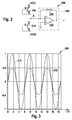
- FIG. 15 shows a diagram 300 which shows a relationship between a harmonic deflection 310 (broken line) of the gate electrode G of the measuring element 100 from the FIGS. 1a, 1b and an output signal 320 (solid line) of the signal processing means 220 Fig. 2 represents.
- a harmonic deflection 310 broken line
- an output signal 320 solid line
- the horizontal direction is a time course, in the vertical direction, a percentage deflection (with respect to 310) or a voltage (with respect to 320) plotted.
- the profile 310 of a sinusoidal, harmonic excursion of G causes an output voltage 320 corresponding to a symmetrical sawtooth or a trapezoid.
- This relationship stems from the particular shape of area 120 as a clipped circle or clipped ellipse, as in FIG Fig. 1b shown and described in more detail above.
- the sinusoidal, harmonic deflection 310 can be transmitted to the gate electrode G by a micromechanically structured actuator.
- a micromechanically structured actuator For example, by means of the measuring element 100 Fig. 1 with the help of a capacitive, piezoelectric, thermoelastic or magnetic drive a micro-electromechanical resonator can be constructed. According to its use, the resonator may be more or less damped, for example by gas confinement in a space in which the gate electrode G is deflectably arranged.
- the actuator and the in Fig. 2 Elements shown can form a micro-electro-mechanical signal generator that can be used in many ways. With such a signal generator, by varying the shapes of the gate electrode G and / or the region 120, a series of differently shaped periodic signals can be generated.
- the sensing element 100 can be used widely within micro-electro-mechanical and opto-micro-electro-mechanical devices.
- it may form a measuring device 200 together with further measuring elements 100, 210 and / or a device 220 for signal processing.
- a non-linearity of the signal processing device (and / or another signal processing device) can thus be compensated by the nonlinearity of the relationship between the deflection of the gate electrode G of the measuring element 100 and the current flow through the measuring element 100, so that overall There is an association between the deflection of the gate electrode G with respect to the region 120 and the output signal of the signal processing device.
- the measuring element 100 or the measuring device 200 may form a system or an assembly together with other mechanical, optical and / or electronic components.
- the measuring element 100 may be part of an initial sensor, a rotation rate sensor or a micromirror. In the latter case, there would be an opto-mechanical micro-electro-mechanical system (Micro-Opto-Mechanical System, MOEMS).
- MOEMS opto-mechanical micro-electro-mechanical system
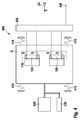
- FIG. 4 shows a resonator 400 in a FIGS. 1 a and 1 b corresponding representation.
- the resonator 400 comprises a substrate 110 with a plurality of source terminals S and drain terminals D, which delimit pairwise channels 120, a common electrode G, a processing device 220, springs 410, a drive 420, a damper 430 and an output 440th
- the processing device 220 is connected to the source terminals S and the drain terminals D and determines an output signal according to the above explanations, which provides them at the output 440.
- the electrode G is arranged in the z-direction over the channels 120 by means of the springs 410 and can be deflected by the drive 420 in the y-direction.
- the electrode G has recesses, so that the channels 120 more or less overlap with these depending on a deflection of the electrode G. Due to the overlapping of the electrode G with a plurality of channels 120, an increased sensitivity of the deflection measurement can be achieved in the illustrated resonator 400.
- At least one of the springs 410 serves at the same time as an electrical contact to an anchor element, not shown, for the resonator 400, which may carry, for example, the substrate 110 or may coincide therewith.
- the deflection of the electrode G is damped by means of the damper 430.
- This may be e.g. to act a friction or eddy current damper or the electrode G may be enclosed in a container with a gas of a predetermined pressure.
- the latter variant is particularly suitable for low attenuation in order to operate the resonator 400 at a high quality.
- the damping can also be effected by fluidic effects on the remaining movable structure and by "anchor loss".
- the damper 430 is omitted.
- the electrode G may be part of or associated with a micromirror.
- a micromirror system for example, an actual deflection of the electrode G can be determined on the basis of the signal provided at the output 440 and the drive 420 can be controlled accordingly in order to achieve a predetermined deflection of the electrode G.
- the electrode G may be part of an inertial system. The deflection of the electrode G can then be determined absolutely or as a function of a deflection of the electrode G induced by the drive 420, which allows conclusions to be drawn on a movement of the inertial system.
Landscapes
- Engineering & Computer Science (AREA)
- Power Engineering (AREA)
- Physics & Mathematics (AREA)
- General Physics & Mathematics (AREA)
- Micromachines (AREA)
- Junction Field-Effect Transistors (AREA)
- Peptides Or Proteins (AREA)
- Particle Formation And Scattering Control In Inkjet Printers (AREA)
Description
- Die Erfindung betrifft ein Messelement. Insbesondere betrifft die Erfindung ein mikromechanisches Messelement mit einem elektrischem Ausgangssignal.
- Mikromechanische Messelemente werden in Sensoren für verschiedenste Anwendungsbereiche eingesetzt. Beispielsweise können Beschleunigungs-, Drehraten- oder Drucksensoren mikromechanisch aufgebaut werden. Dabei umfasst ein solches Messelement sowohl mechanische als auch elektrische Strukturen, die eine ähnliche Größenordnung aufweisen können und miteinander ein integriertes, mikro-elektromechanisches System bilden (Micro-Electro-Mechanical System, MEMS). Gelegentlich umfassen solche mikro-elektromechanischen Systeme auch einen Aktuator für Teile der mechanischen Strukturen, beispielsweise in Drehratensensoren, in denen eine auf eine bewegte Masse wirkende Kraft bestimmt werden soll. Auch ein mikro-elektromechanischer Resonator kann einen solchen Antrieb umfassen.
- In einer Form mikro-elektromechanischer Messelemente wird eine relative Auslenkung zwischen mechanischen Elementen ausgewertet, indem wenigstens eines der mechanischen Elemente zugleich auch Teil eines elektronischen Elements ist, welches ein mit der mechanischen Auslenkung korrelierendes Ausgangssignal bereitstellt. Eine solche Auslenkung kann in der Größenordnung der Strukturen, aus denen das Messelement aufgebaut ist, liegen. Die Auslenkung kann z. B. bestimmt werden, indem eine auslenkungsabhängige Kapazität bestimmt wird.
- Beispielsweise kann bei der "Moving Gate" - Technik eine flächige Gate-Elektrode eines Feldeffekttransistors (FET) parallel zu einem Kanal des FET angebracht und relativ zum Kanal ausgelenkt werden. Der Kanal wird durch einen Source- und einen Drainanschluss des Feldeffekttransistors begrenzt. Dabei wird zwischen dem Source- und dem Drainanschluss eine Spannung angelegt und die Gate-Elektrode elektrisch mit dem Drainanschluss verbunden, so dass der Feldeffekttransistor als Stromsteuerung betrieben wird. Ein Stromfluss durch den Feldeffekttransistor ändert sich dann in Abhängigkeit des elektrischen Feldes, welches sich auf Grund der Spannung zwischen der Gate-Elektrode und dem Kanal einstellt. Ändert sich die Anordnung von Gate-Elektrode und Kanal, so ändert sich letztlich auch der Stromfluss durch den Feldeffekttransistor. Die kapazitive Messung bietet sich für MEMS-Messaufnehmer an, da hier praktisch keine Rückwirkung von dem (auslenkungsabhängigen) Stromfluss auf die Auslenkung der Elektrode stattfindet. Gewöhnlich sind die Gate-Elektrode und der Kanal jeweils so geformt, dass ein Bereich, in dem sich die beiden überlappen, zu einer Auslenkung der Gate-Elektrode linear veränderlich ist. Durch die Auslenkung verändert sich die Größe des überlappenden Bereichs, so dass sich das elektrische Feld zwischen Gate-Elektrode und Kanale verändert, welches den Stromfluss durch den Feldeffekttransistor steuert. Somit kann die Auslenkung der Gate-Elektrode anhand des Stromflusses durch den Feldeffekttransistor bestimmt werden.
- Das
US-Patent 6,220,096 B1 zeigt einen mikro-elektromechanischen Beschleunigungssensor, der Moving Gate - Feldeffekttransistoren (MG-FET) der beschriebenen Art in einer differentiellen Verschaltung verwendet, um ein Nutzsignal des Sensors zu optimieren. - Messsysteme, die ein Sensorsignal verarbeiten, sollen üblicherweise ein Ausgangssignal bereitstellen, das in einem möglichst linearen Zusammenhang mit einer zu messenden Größe stehen. Aus diesem Grund werden gewöhnlich alle Elemente des Systems mit linearen Kennlinien ausgelegt, so dass sich über das gesamte System der geforderte lineare Zusammenhang einstellt. Insbesondere bei komplexen, zahlreiche verarbeitende Elemente umfassenden Systemen ist es jedoch schwierig, die Linearität jedes einzelnen Elements in erforderlicher Qualität sicher zu stellen. Der Erfindung liegt daher die Aufgabe zu Grunde, einen MEMS-Sensor bereitzustellen, mit Hilfe dessen eine Erfassung und Auswertung einer Auslenkung verbessert werden kann.
- Aus der Schrift
US 5,457,368 A ist eine Vorrichtung bekannt, bei dem ein Signal in Abhängigkeit der Belegung eines mit dem Substrat verbundenen und ein elektrisches Feld aufweisenden Bandes erzeugt wird. Das Substrat weist dabei einen Bereich einer Source und einer Drain Region auf, der durch das Band belegt wird. - Aus der Schrift
WO 2005/080921 A1 ist ein Positionsdetektor bekannt, bei dem ein mittels eines elektrischen Motor angetriebener erster Aktuator über einen feststehenden zweiten Aktuator bewegt wird. Durch eine Elektrode im ersten Aktuator und Halbleiterelemente im zweiten Aktuator kann so eine Überlappung festgestellt werden. - Aus der Schrift
EP 693 672 A1 - Diese Aufgabe wird gelöst durch ein Messelement nach Anspruch 1. Ansprüche 8 und 9 geben Messeinrichtungen an, die auf einem solchen Messelement basieren. Anspruch 11 definiert einen Resonator, der auf einer dieser Messeinrichtungen basiert. Unteransprüche geben weitere Ausgestaltungen bzw. Merkmale wieder.
- Die Erfindung geht von einem auf einem Feldeffekttransistor basierenden Messelement aus. Das Messelement umfasst einen auf einem Halbleitersubstrat angeordneten Bereich (beispielsweise ein Kanal eines Feldeffekttransistors) und eine Elektrode, mittels derer die Leitfähigkeit des Bereichs beeinflussbar ist. Der Überlappungsbereich zwischen der Gate-Elektrode und dem Bereich weist eine Breite (parallel zur Auslenkungsrichtung) und eine Länge (senkrecht zur Auslenkungsrichtung) auf. Eine Ausdehnung (Fläche) des Überlappungsbereichs ist von der Auslenkung und von den Formen der überlappenden Elemente abhängig. Es wird vorgeschlagen, die Gate-Elektrode und/oder den Bereich derart zu formen, dass die Ausdehnung des überlappenden Bereichs in einem nichtlinearen Zusammenhang mit der Auslenkung der Gate-Elektrode steht. Dies kann dadurch bewirkt werden, dass die Gate-Elektrode und/oder der Bereich eine von einem Rechteck verschiedene Form aufweist.
- In einer Ausführungsform kann beispielsweise die Gate-Elektrode eine konventionell rechteckige Form mit parallel bzw. senkrecht zur Auslenkungsrichtung verlaufenden Kanten aufweisen, während der Bereich eine von einem Rechteck verschiedene Form aufweist. Soll das Ausgangssignal symmetrisch zu einem einer Auslenkung von 0 entsprechenden Wert verlaufen, so ist bei rechteckiger Gate-Elektrode der Bereich in positiver Auslenkungsrichtung spiegelbildlich ebenso auszuformen wie in negativer Auslenkungsrichtung. Die Form des Bereichs ist also symmetrisch zu einer senkrecht zur Auslenkungsrichtung und durch eine Auslenkung von 0 verlaufenden Symmetrieachse. In alternativen Ausführungsformen können sowohl die Gate-Elektrode als auch der Bereich auch andere Formen annehmen, insbesondere können die Formen von Bereich und Gate-Elektrode auch vertauscht werden oder sowohl Bereich als auch Gate-Elektrode eine von einem Rechteck verschiedene Form aufweisen. Die Abweichungen von einer konventionellen Form eines Parallelogramms oder eines Rechtecks können größer als fertigungstechnisch bedingt und insbesondere größer als ca. 3-5% sein.
- In einer Ausführungsform ist die Gate-Elektrode rechteckig und der Bereich weist eine Form auf, die einem Kreis entspricht, von dem ein oberer und ein unterer Bereich entlang zweier senkrecht zur Bewegungsrichtung der Gate-Elektrode verlaufender Trennlinien entfernt wurden. Diese Ausführungsform eignet sich insbesondere zum Einsatz in einem mikro-elektromechanischen Resonator.
- Die Erfindung wird nun mit Bezug auf die beigefügten Zeichnungen näher beschrieben, wobei
-
Fign. 1 a und 1 b unterschiedliche Ansichten eines Messelements auf der Basis eines MG-FETs; -
Fig. 2 eine Messvorrichtung auf der Basis des Messelements ausFig. 1 ; -
Fig. 3 ein Diagramm 300 zeigt, welches die Auswirkung der Geometrie des Bereichs 120 ausFig. 1 in der Messvorrichtung ausFig. 2 , und -
Fig. 4 einen Resonator auf der Basis des Messelements ausFig. 1 darstellt. - Gleiche bzw. einander entsprechende Elemente tragen in allen Figuren gleiche Bezugszeichen.
-
Fign. 1 a und 1 b zeigen zwei unterschiedliche Ansichten eines prinzipiellen Aufbaus eines Messelements 100 nach dem Prinzip eines MG-FETs. Jeweils rechts in denFign. 1 a und 1 b sind Koordinatensysteme (x, y, z) angegeben, um eine Bezugnahme zu erleichtern. Verdeckte Kanten inFig. 1b sind mittels unterbrochener Linien dargestellt. - Ein Messelement 100 umfasst ein Halbleitersubstrat 110, auf dem ein Sourceanschluss S und ein Drainanschluss D angebracht sind, zwischen denen sich ein Bereich 120 erstreckt. Das Messelement 100 umfasst außerdem eine oberhalb (in positiver z-Richtung) des Bereichs 120 angebrachte Gate-Elektrode G. Die Gate-Elektrode G ist in positiver und negativer y-Richtung auslenkbar angeordnet. Dabei bleibt ein Abstand zwischen der Gate-Elektrode G und dem Bereich 120 konstant, die Auslenkung findet nur entlang der y-Achse statt.
- Nicht dargestellt ist eine elastische Anordnung, welche die Gate-Elektrode in einem vorbestimmten Abstand auslenkbar über dem Bereich 120 hält und Rückstellkräfte bewirkt, die mit der Auslenkung der Gate-Elektrode G in positiver und negativer y-Richtung veränderlich sind. Die elastische Verbindung kann beispielsweise mikromechanische Federn umfassen. In einem Punkt eines Gleichgewichts der Rückstellkräfte der elastischen Verbindung in positiver und negativer y-Richtung befindet sich eine unausgelenkte Position der Gate-Elektrode. In
Fig. 1b ist die Gate-Elektrode in dieser unausgelenkten Position dargestellt. - Ebenfalls nicht dargestellt ist eine elektrische Verbindung der Gate-Elektrode G mit dem Drainanschluss D, die beispielsweise die elastische Anordnung umfassen kann. Durch die elektrische Verbindung wird das Messelement 100 stromsteuernd betrieben.
- Wird eine Spannung zwischen der Gate-Elektrode G und Sourceanschluss S angelegt, so ermöglicht ein dadurch hervorgerufenes elektrisches Feld im Bereich 120 ein Bewegen von Ladungsträgern zwischen dem Sourceanschluss S und dem Drainanschluss D. Sind die Spannung zwischen der Gate-Elektrode G und dem Sourceanschluss S sowie der vertikale Abstand zwischen der Gate-Elektrode G und dem Bereich 120 konstant, so ist eine Beweglichkeit von Ladungsträgern im Bereich des Bereichs 120 nur von einer Ausdehnung eines Überlappungsbereichs 130 zwischen der Gate-Elektrode G und dem Bereich 120 abhängig. Ein Ausgangssignal der gezeigten Anordnung bestimmt sich grundsätzlich nach IDS∼W/L.
- Aus der in
Fig. 1b dargestellten unausgelenkten Position kann die Gate-Elektrode G in positiver oder negativer y-Richtung ausgelenkt werden. In der gegebenen Darstellung kann diese Auslenkung fortgeführt werden, bis der Bereich 120 vollständig mit G überlappt bzw. bis die Überlappung den Wert 0 erreicht, andere Grenzen sind ebenfalls implementierbar. Es ist zu erkennen, dass ein nichtlinearer Zusammenhang zwischen einer Auslenkung der Gate-Elektrode G bezüglich des Bereichs 120 und der Ausdehnung des Überlappungsbereichs 130 existiert. Der Überlappungsbereich 130 ist in durch eine in x-Richtung verlaufende Länge L und eine in y-Richtung verlaufende Breite W bestimmt. Dabei ist die Länge L entlang der y-Richtung variabel und in Abhängigkeit der an der jeweiligen y-Stelle geltenden Breite W definiert. Anders ausgedrückt ist der Verlauf der Länge L nichtlinear über den Verlauf der Breite W angegeben. - Die Ausdehnung des Überlappungsbereichs 130 ergibt sich aus seiner Breite W, die proportional zur Auslenkung der Gate-Elektrode G ist, und der Länge L in dessen Verlauf über den Überlappungsbereich 130 (
Fig. 1 b) . Der Zusammenhang zwischen der Auslenkung der Gate-Elektrode G und der Ausdehnung des Überlappungsbereichs 130 ist nichtlinear, weil L in seinem Verlauf in y-Richtung von W nichtlinear abhängt. Mithin ist der Verlauf der Ausdehnung des Überlappungsbereichs 130 über eine Auslenkung der Gate-Elektrode G nichtlinear und damit auch der Zusammenhang zwischen der Auslenkung und dem Stromfluss durch das Messelement 100 nichtlinear. - Im vorliegenden Beispiel (s.
Fig. 1 b) entsprechen die Formen des Sourceanschlusses S und des Drainanschlusses D jeweils einem Kreis- bzw. Ellipsensegment. Der Bereich 120 weist dadurch insgesamt eine Fläche auf, die etwa einem Längsschnitt einer auf der zx-Ebene stehenden Tonne entspricht. Anders ausgedrückt geht die Form des Bereichs 120 aus einem Kreis oder einer Ellipse in der xy-Ebene hervor, von der ein oberes und ein unteres (bzgl. y) Ende abgetrennt wurden, wobei die Trennlinien parallel zur x-Richtung und in gleichem Abstand zur y-Achse an der Stelle y=0 verlaufen. Die Länge L des Bereichs 120 in ihrem Verlauf über die y-Richtung ist beschrieben als:


- In weiteren Ausführungsformen kann die Gate-Elektrode auch andere Formen annehmen. Auch ist beispielsweise eine Begrenzung, Verschiebung oder Erweiterung der Auslenkung der Gate-Elektrode G bezüglich des Überlappungsbereichs 130 möglich. Ferner kann die Gate-Elektrode G beispielsweise perforiert sein. Das Messelement 100 kann auch einen weiteren Bereich (nicht dargestellt) aufweisen, der eine Leitfähigkeit einer weiteren Anordnung steuert undebenfalls von der Gate-Elektrode G überstrichen wird. Der weitere Bereich kann mit Bezug auf
Fign. 1 a und 1 b beispielsweise in positiver oder negativer x-Richtung angeordnet sein. Die Sourceanschlüsse S und die Drainanschlüsse D der beiden Kanäle können beispielsweise in Serie oder in einer Brückenschaltung miteinander verschaltet sein. Diese und ähnliche, dem Fachmann bekannte Maßnahmen können z. B. dazu verwendet werden, eine Messgenauigkeit zu verbessern, eine Auflösung zu erhöhen und/oder einen vorbestimmten Zusammenhang zwischen dem Ausgangssignal des Messelements 100 mit der Auslenkung von G genauer zu implementieren. - Die Gate-Elektrode G kann auch Teil einer komplexeren mikro-elektromechanischen Anordnung mit mehreren beweglichen Elementen sein. Die Gate-Elektrode G kann mittels einer elastischen Anordnung an einem oder mehreren dieser Elemente und/oder am Halbleitersubstrat 110 befestigt sein, und die beweglichen Elemente können Federn umfassen.
-
Fig. 2 zeigt eine Messeinrichtung 200, die auf dem Messelement 100 ausFig. 1 basiert. Die Messeinrichtung 200 umfasst das Messelement 100, ein weiteres Messelement 210 sowie optional eine Einrichtung 220 zur Signalverarbeitung, die einen Operationsverstärker 225 und einen Rückkopplungswiderstand 230 umfasst. - Das Messelement 210 ist grundsätzlich identisch zum Messelement 100 aufgebaut und weist insbesondere identische Abmessungen auf, umfasst jedoch im Gegensatz zum Messelement 100 keine beweglichen Teile. Eine Gate-Elektrode des Messelements 210 ist in einer Position fixiert, die an der Messeinrichtung 100 einer unausgelenkten Position von dessen Gate-Elektrode G entspricht. Bei beiden Messelementen 100 und 210 sind die Gate-Elektroden mit den jeweiligen Drainanschlüssen D verbunden, so dass beide Messelemente 100 und 210 stromsteuernd betrieben werden. Die Messelemente 100 und 210 sind in Serie geschaltet und mit zwei Anschlüssen VCC und GND einer Gleichspannungsquelle (nicht dargestellt) verbunden. Die Messelemente 100 und 210 sind bipolar, daher ist eine Polung der Gleichspannung ohne Belang. An einem Abgriff A zwischen den beiden Messelementen 100 und 210 ist ein Ausgangssignal abgreifbar, welches zur Auslenkung der Gate-Elektrode G im Messelement 100 in einem nichtlinearen Zusammenhang steht.
- Durch die Kombination der Messelemente 100 und 210 in der gezeigten Weise werden konstante Fehler, die beispielsweise auf Fertigungsungenauigkeiten der Messelemente 100 und 210 zurückzuführen sind, kompensiert. Die Einrichtung 220 zur Signalverarbeitung erzeugt auf eine dem Fachmann bekannte Weise durch einen mittels des Rückkopplungswiderstands 230 rückgekoppelten Operationsverstärkers 225 aus dem am Abgriff A anliegenden Signal ein mit der Auslenkung der Gate-Elektrode G des Messelements 100 veränderliches Spannungssignal.
-
Fig. 3 zeigt ein Diagramm 300, welches einen Zusammenhang zwischen einer harmonischen Auslenkung 310 (unterbrochene Linie) der Gate-Elektrode G des Messelements 100 aus denFign. 1a, 1b und einem Ausgangssignal 320 (durchgezogene Linie) der Einrichtung 220 zur Signalverarbeitung ausFig. 2 darstellt. In horizontaler Richtung ist ein zeitlicher Verlauf, in vertikaler Richtung eine prozentuale Auslenkung (bzgl. 310) bzw. eine Spannung (bzgl. 320) angetragen. - Es ist zu sehen, dass der Verlauf 310 einer sinusförmigen, harmonischen Auslenkung von G eine Ausgangsspannung 320 bewirkt, die einem symmetrischen Sägezahn bzw. einem Trapez entspricht. Dieser Zusammenhang rührt von der besonderen Form des Bereichs 120 als gekappter Kreis oder gekappte Ellipse, wie in
Fig. 1b gezeigt und oben genauer beschrieben ist. - Die sinusförmige, harmonischen Auslenkung 310 kann von einem mikromechanisch aufgebauten Aktuator auf die Gate-Elektrode G übertragen werden. Beispielsweise kann mittels des Messelements 100 aus
Fig. 1 mit Hilfe eines kapazitiven, piezo-elektrischen, thermoelastischen oder magnetischen Antriebs ein mikro-elektromechanischer Resonator aufgebaut werden. Entsprechend seiner Verwendung kann der Resonator mehr oder weniger gedämpft sein, beispielsweise durch Gaseinschluss in einem Raum, in welchem die Gate-Elektrode G auslenkbar angeordnet ist. - Der Aktuator und die in
Fig. 2 dargestellten Elemente können einen mikro-elektromechanischen Signalgenerator bilden, der sich vielseitig einsetzen lässt. Mit einem solchen Signalgenerator lässt sich durch Variation der Formen der Gate-Elektrode G und/oder des Bereichs 120 eine Reihe verschieden geformter periodischer Signale generieren. - Das Messelement 100 kann vielseitig innerhalb von mikro-elektromechanischen und opto-mikro-elektromechanischen Bauelementen verwendet werden. Insbesondere kann es zusammen mit weiteren Messelementen 100, 210 und/oder einer Einrichtung 220 zur Signalverarbeitung eine Messeinrichtung 200 bilden. Eine Nichtlinearität der Einrichtung 220 zur Signalverarbeitung (und/oder einer anderen Einrichtung zur Signalverarbeitung) kann somit durch die Nichtlinearität des Zusammenhangs zwischen der Auslenkung der Gate-Elektrode G des Messelements 100 und dem Stromfluss durch das Messelement 100 kompensiert werden, so dass insgesamt ein linearer Zusammenhang zwischen der Auslenkung der Gate-Elektrode G gegenüber dem Bereich 120 und dem Ausgangssignal der Einrichtung zur Signalverarbeitung besteht.
- Das Messelement 100 bzw. die Messeinrichtung 200 kann zusammen mit anderen mechanischen, optischen und/oder elektronischen Komponenten ein System oder eine Baugruppe bilden. Beispielsweise kann das Messelement 100 Teil eines Initialsensors, eines Drehratensensors oder eines Mikrospiegels sein. In letzterem Fall läge ein opto-mechanisches mikro-elektromechanisches System (Micro-Opto-Mechanical System, MOEMS) vor.
-
Figur 4 zeigt einen Resonator 400 in einer denFiguren 1 a und 1 b entsprechenden Darstellung. InFigur 4 rechts ist ein entsprechendes Koordinatensystem angegeben. Der Resonator 400 umfasst ein Substrat 110 mit mehreren Sourceanschlüssen S und Drainanschlüssen D, die paarweise Kanäle 120 begrenzen, eine gemeinsame Elektrode G, eine Verarbeitungseinrichtung 220, Federn 410, einem Antrieb 420, einem Dämpfer 430 und einem Ausgang 440. - Die Verarbeitungseinrichtung 220 ist mit den Sourceanschlüssen S und den Drainanschlüssen D verbunden und bestimmt entsprechend obigen Erläuterungen ein Ausgangssignal, das sie am Ausgang 440 bereitstellt. Die Elektrode G ist mittels der Federn 410 in z-Richtung über den Kanälen 120 angeordnet und kann von dem Antrieb 420 in y-Richtung ausgelenkt werden. Die Elektrode G weist Aussparungen auf, so dass die Kanäle 120 in Abhängigkeit einer Auslenkung der Elektrode G mehr oder minder mit diesen überlappen. Durch die Überlappung der Elektrode G mit mehreren Kanälen 120 kann im dargestellten Resonator 400 eine erhöhte Empfindlichkeit der Auslenkungsmessung erzielt werden.
- Wenigstens eine der Federn 410 dient gleichzeitig als elektrischer Kontakt an ein nicht gezeigtes Ankerelement für den Resonator 400, das beispielsweise das Substrat 110 tragen oder mit diesem zusammenfallen kann. Die Auslenkung der Elektrode G wird mittels des Dämpfers 430 gedämpft. Dabei kann es sich z.B. um einen Reibungs- oder Wirbelstromdämpfer handeln oder die Elektrode G kann in einem Behältnis mit einem Gas eines vorbestimmten Drucks eingeschlossen sein. Letztere Variante eignet sich besonders für schwache Dämpfungen, um den Resonator 400 bei einer hohen Güte zu betreiben. Die Dämpfung kann auch durch fluidische Effekte an der verbleibenden beweglichen Struktur und durch Materialdämpfung ("anchor loss") bewirkt werden. Gegebenenfalls wird der Dämpfer 430 weggelassen.
- Die Elektrode G kann Teil eines Mikrospiegels oder mit einem solchen verbunden sein. In einem Mikrospiegel-System kann beispielsweise eine tatsächliche Auslenkung der Elektrode G anhand des am Ausgang 440 bereitgestellten Signals bestimmt und der Antrieb 420 entsprechend angesteuert werden, um eine vorbestimmte Auslenkung der Elektrode G zu erzielen. In einer weiteren Ausführungsform kann die Elektrode G Teil eines Inertialsystems sein. Die Auslenkung der Elektrode G kann dann absolut oder in Abhängigkeit einer durch den Antrieb 420 induzierten Auslenkung der Elektrode G bestimmt werden, was Rückschlüsse auf eine Bewegung des Inertialsystems zulässt.
Claims (13)
- Messelement (100), welches ausgelegt ist eine Auslenkung aufzunehmen, folgendes umfassend:- einen auf einem Halbleitersubstrat (110) angeordneten Bereich (120), der sich zwischen einem Sourceanschluss (S) und einem Drainanschluss (D) erstreckt, und eine Elektrode (G), welche ausgelegt ist die Leitfähigkeit des Bereichs (120) zu beeinflussen;- wobei die Elektrode (G) bezüglich dem Bereich (120) derart auslenkbar angebracht ist, dass sich zwischen der Elektrode (G) und dem Bereich (120) ein Überlappungsbereich (130) ergibt, der eine mit einer Auslenkung der Elektrode (G) veränderliche Ausdehnung aufweist,- wobei das Ausgangssignal des Messelements (100) von der Leitfähigkeit des Bereichs (120) abhängt und durch die Änderung der Ausdehnung des Überlappungsbereichs (130) steuerbar ist,- der Bereich und/oder die Elektrode derart ausgebildet sind, dass die Änderung der Ausdehnung des Überlappungsbereichs (130) mit der Auslenkung der Elektrode (G) in einem nichtlinearen Zusammenhang steht, so dass eine Änderung des Ausgangssignals des Messelements (100) in einem nichtlinearen Zusammenhang mit der Auslenkung derElektrode (G) steht wobei• die Elektrode (G) oberhalb des Bereichs (120) angebracht ist, wobei der Abstand zwischen der Elektrode (G) und dem Bereich (120) konstant bleibt, und• eine Oberfläche des Bereichs (120) durch eine in einer Auslenkungsrichtung y der Elektrode (G) verlaufende Breite W und eine senkrecht dazu verlaufende Länge L der Elektrode (G) bestimmt ist und es gilt:

- Messelement (100) nach Anspruch 1, dadurch gekennzeichnet dass sich die Elektrode (G) und der Bereich (120) beabstandet angeordnet sind.
- Messelement (100) nach Anspruch 1, wobei die Länge (L) des Bereichs (120) nicht konstant über die Breite (W) des Bereichs (120) verläuft.
- Messelement (100) nach einem der vorhergehenden Ansprüche, wobei der Drainanschluss (D) und/oder der Sourceanschluss (S) eine Randlinie des Bereichs (120) in Form eines Ellipsensegments aufweist.
- Messelement (100) nach Anspruch 1, dadurch gekennzeichnet dass der Bereich (120) eine variable Länge L zwischen dem Drainanschluss (D) und dem Sourceanschluss (S) aufweist, wobei für die Länge L in Abhängigkeit von der Auslenkungsrichtung y der Elektrode (G) gilt:

- Messelement (100) nach einem der Ansprüche 1 bis 5, wobei der Bereich (120) der Kanal eines Feldeffekttransistors ist und von der Elektrode (G) bei deren Auslenkung zumindest teilweise überstrichen wird.
- Messelement (100) nach einem der Ansprüche 1 bis 6, wobei die Elektrode (G) perforiert ist.
- Messelement (100) nach einem der Ansprüche 1 bis 7, wobei die Elektrode (G) Teil eines Mikrospiegels oder eines Inertialsensors ist.
- Messelement (100) nach einem der Ansprüche 1 bis 8, ferner umfassend ein elastisches Element (410), mittels dessen die Elektrode (G) auslenkbar am Halbleitersubstrat (110) angebracht ist.
- Messelement (100) nach einem der Ansprüche 1 bis 9 wobei eine Elektrode (G) mehreren Kanälen (120) zugeordnet ist.
- Resonator (400), umfassend
ein Messelement (100), welches ausgelegt ist eine Auslenkung aufzunehmen, nach einem der Ansprüche 1 bis 10, und einen Antrieb (420), wobei das Messelement umfasst:- einen auf einem Halbleitersubstrat (110) angeordneten Bereich (120)), der sich zwischen einem Sourceanschluss (S) und einem Drainanschluss (D) erstreckt, und eine Elektrode (G), welche ausgelegt ist die Leitfähigkeit des Bereichs (120) zu beeinflussen;- wobei die Elektrode (G) bezüglich dem Bereich (120) derart auslenkbar angebracht ist, dass sich zwischen der Elektrode (G) und dem Bereich (120) ein Überlappungsbereich (130) ergibt, der eine mit einer Auslenkung der Elektrode (G) veränderliche Ausdehnung aufweist,- wobei das Ausgangssignal des Messelements (100) von der Leitfähigkeit des Bereichs (120) abhängt und durch die Änderung der Ausdehnung des Überlappungsbereichs (130) steuerbar ist,- der Bereich und/oder die Elektrode derart ausgebildet sind, dass die Änderung der Ausdehnung des Überlappungsbereichs (130) mit der Auslenkung der Elektrode (G) in einem nichtlinearen Zusammenhang steht, so dass eine Änderung des Ausgangssignals des Messelements (100) in einem nichtlinearen Zusammenhang mit der Auslenkung der Elektrode (G) stehtwobei• die Elektrode (G) oberhalb des Bereichs (120) angebracht ist, wobei der Abstand zwischen der Elektrode (G)und dem Bereich (120) konstant bleibt, und• eine Oberfläche des Bereichs (120) durch eine in einer Auslenkungsrichtung y der Elektrode (G) verlaufende Breite W und eine senkrecht dazu verlaufende Länge L der Elektrode (G) bestimmt ist und es gilt: • wobei der Antrieb (420) die Elektrode (G) periodisch auslenkt.
 - Resonator (400) nach Anspruch 11, dadurch gekennzeichnet, dass wenigstens zwei Messelemente (100) vorgesehen sind, wobei die Messelemente (100) ein gemeinsames Halbleitersubstrat (110) mit mehreren Sourceanschlüssen (S) und Drainanschlüssen (D), die paarweise Bereiche (120) begrenzen, und eine gemeinsame Elektrode (G) aufweisen, wobei eine Verarbeitungseinheit (220) vorgesehen ist, welche mit den den Sourceanschlüssen (S) und den Drainanschlüssen (D) verbunden sind und ein Ausgangssignal in Abhängigkeit von der Auslenkung der Elektrode (G) in Form eines nichtlinearen Zusammenhangs bereitstellt.
- Resonator nach Anspruch 12, dadurch gekennzeichnet, dass der Antrieb (420) eine sinusförmige, harmonische Auslenkung (310) auf die Elektrode (G) überträgt, wobei die Verarbeitungseinheit (220) in Abhängigkeit dieser sinusförmigen Auslenkung (310) eine Ausgangsspannung (320) bewirkt, die einen symmetrischen Sägezahn bzw. einem Trapez entspricht..
Applications Claiming Priority (2)
| Application Number | Priority Date | Filing Date | Title |
|---|---|---|---|
| DE102009002723A DE102009002723A1 (de) | 2009-04-29 | 2009-04-29 | Messelement |
| PCT/EP2010/052527 WO2010124889A2 (de) | 2009-04-29 | 2010-03-01 | Messelement |
Publications (2)
| Publication Number | Publication Date |
|---|---|
| EP2425208A2 EP2425208A2 (de) | 2012-03-07 |
| EP2425208B1 true EP2425208B1 (de) | 2016-05-11 |
Family
ID=42813536
Family Applications (1)
| Application Number | Title | Priority Date | Filing Date |
|---|---|---|---|
| EP10708754.6A Not-in-force EP2425208B1 (de) | 2009-04-29 | 2010-03-01 | Messelement |
Country Status (4)
| Country | Link |
|---|---|
| US (1) | US9086302B2 (de) |
| EP (1) | EP2425208B1 (de) |
| DE (1) | DE102009002723A1 (de) |
| WO (1) | WO2010124889A2 (de) |
Families Citing this family (4)
| Publication number | Priority date | Publication date | Assignee | Title |
|---|---|---|---|---|
| DE102009045422B4 (de) | 2009-10-07 | 2024-05-02 | Robert Bosch Gmbh | Sensoranordnung und Verfahren zum Betrieb einer Sensoranordnung |
| DE102011075541A1 (de) | 2011-05-10 | 2012-11-15 | Robert Bosch Gmbh | Auswerteschaltung für Feldeffekttransistor mit beweglicher Gatestruktur |
| DE102012202783A1 (de) * | 2012-02-23 | 2013-08-29 | Robert Bosch Gmbh | Mikromechanische Sensorvorrichtung mit beweglichem Gate und entsprechendes Herstellungsverfahren |
| US12253391B2 (en) | 2018-05-24 | 2025-03-18 | The Research Foundation For The State University Of New York | Multielectrode capacitive sensor without pull-in risk |
Citations (2)
| Publication number | Priority date | Publication date | Assignee | Title |
|---|---|---|---|---|
| EP0693672A1 (de) * | 1994-07-01 | 1996-01-24 | Dr. Johannes Heidenhain GmbH | Längen- oder Winkelmesseinrichtung |
| WO2005080921A1 (en) * | 2004-02-19 | 2005-09-01 | Eaton Automotive B.V. | Mechatronic control system |
Family Cites Families (5)
| Publication number | Priority date | Publication date | Assignee | Title |
|---|---|---|---|---|
| US4157462A (en) * | 1977-10-26 | 1979-06-05 | General Motors Corporation | Sensor |
| US5457368A (en) * | 1993-03-09 | 1995-10-10 | University Of Utah Research Foundation | Mechanical/electrical displacement transducer |
| US5198740A (en) * | 1989-10-04 | 1993-03-30 | University Of Utah Research Foundation | Sliding contact mechanical/electrical displacement transducer |
| EP0700065B1 (de) * | 1994-08-31 | 2001-09-19 | AT&T Corp. | Feldemissionsvorrichtung und Verfahren zur Herstellung |
| US6220096B1 (en) | 1997-03-20 | 2001-04-24 | Interscience, Inc. | Differential wideband vibration |
-
2009
- 2009-04-29 DE DE102009002723A patent/DE102009002723A1/de not_active Withdrawn
-
2010
- 2010-03-01 US US13/258,570 patent/US9086302B2/en active Active
- 2010-03-01 WO PCT/EP2010/052527 patent/WO2010124889A2/de not_active Ceased
- 2010-03-01 EP EP10708754.6A patent/EP2425208B1/de not_active Not-in-force
Patent Citations (2)
| Publication number | Priority date | Publication date | Assignee | Title |
|---|---|---|---|---|
| EP0693672A1 (de) * | 1994-07-01 | 1996-01-24 | Dr. Johannes Heidenhain GmbH | Längen- oder Winkelmesseinrichtung |
| WO2005080921A1 (en) * | 2004-02-19 | 2005-09-01 | Eaton Automotive B.V. | Mechatronic control system |
Also Published As
| Publication number | Publication date |
|---|---|
| EP2425208A2 (de) | 2012-03-07 |
| WO2010124889A3 (de) | 2011-01-13 |
| WO2010124889A4 (de) | 2011-04-14 |
| WO2010124889A2 (de) | 2010-11-04 |
| DE102009002723A1 (de) | 2010-11-04 |
| US20120025277A1 (en) | 2012-02-02 |
| US9086302B2 (en) | 2015-07-21 |
Similar Documents
| Publication | Publication Date | Title |
|---|---|---|
| EP2389561B1 (de) | Drehratensensor | |
| EP1373831B1 (de) | Drehratensensor | |
| DE102012200929B4 (de) | Mikromechanische Struktur und Verfahren zur Herstellung einer mikromechanischen Struktur | |
| EP1377797B1 (de) | Drehratensensor | |
| WO2008074538A1 (de) | Beschleunigungssensor mit kammelektroden | |
| DE102009000606A1 (de) | Mikromechanische Strukturen | |
| DE102008040855A1 (de) | Dreiachsiger Beschleunigungssensor | |
| DE102017219901B3 (de) | Mikromechanischer z-Inertialsensor | |
| DE102013212059B4 (de) | Mikromechanischer Inertialsensor | |
| DE112013002514T5 (de) | Sensorvorrichtung | |
| DE102008054749A1 (de) | Drehratensensor und Verfahren zum Betrieb eines Drehratensensors | |
| DE102009045420B4 (de) | Drehratensensor, Drehratensensoranordnung und Verfahren zum Betrieb eines Drehratensensors | |
| WO2010124889A2 (de) | Messelement | |
| DE102013216935A1 (de) | Drehratensensor mit voreingestelltem Quadratur-Offset | |
| DE102009028343A1 (de) | Sensorelement und Verfahren zum Betrieb eines Sensorelements | |
| DE102008040567B4 (de) | Verfahren zum Betrieb eines Sensormoduls und Sensormodul | |
| DE112006003699B4 (de) | Auslenkbares mikromechanisches System sowie dessen Verwendung | |
| DE19744292A1 (de) | Elektrostatischer Aktor und Sensor | |
| DE19813941A1 (de) | Mikromechanischer Beschleunigungssensor | |
| DE102020210121A1 (de) | Mikromechanisches System, Verfahren zum Betreiben eines mikromechanischen Systems | |
| DE102010038919B4 (de) | Mikromechanisches System | |
| DE4431232A1 (de) | Integrierbares Feder-Masse-System | |
| EP1332374A1 (de) | Verfahren und vorrichtung zum elektrischen nullpunktabgleich für ein mikromechanisches bauelement | |
| DE102010039236B4 (de) | Sensoranordnung und Verfahren zum Abgleich einer Sensoranordnung | |
| DE102017219933A1 (de) | Drehratensensor mit einem eine Haupterstreckungsebene aufweisenden Substrat, Herstellungsverfahren für einen Drehratensensor |
Legal Events
| Date | Code | Title | Description |
|---|---|---|---|
| PUAI | Public reference made under article 153(3) epc to a published international application that has entered the european phase |
Free format text: ORIGINAL CODE: 0009012 |
|
| 17P | Request for examination filed |
Effective date: 20111129 |
|
| AK | Designated contracting states |
Kind code of ref document: A2 Designated state(s): AT BE BG CH CY CZ DE DK EE ES FI FR GB GR HR HU IE IS IT LI LT LU LV MC MK MT NL NO PL PT RO SE SI SK SM TR |
|
| DAX | Request for extension of the european patent (deleted) | ||
| 17Q | First examination report despatched |
Effective date: 20150511 |
|
| GRAP | Despatch of communication of intention to grant a patent |
Free format text: ORIGINAL CODE: EPIDOSNIGR1 |
|
| INTG | Intention to grant announced |
Effective date: 20151216 |
|
| GRAS | Grant fee paid |
Free format text: ORIGINAL CODE: EPIDOSNIGR3 |
|
| GRAA | (expected) grant |
Free format text: ORIGINAL CODE: 0009210 |
|
| AK | Designated contracting states |
Kind code of ref document: B1 Designated state(s): AT BE BG CH CY CZ DE DK EE ES FI FR GB GR HR HU IE IS IT LI LT LU LV MC MK MT NL NO PL PT RO SE SI SK SM TR |
|
| REG | Reference to a national code |
Ref country code: GB Ref legal event code: FG4D Free format text: NOT ENGLISH |
|
| REG | Reference to a national code |
Ref country code: CH Ref legal event code: EP |
|
| REG | Reference to a national code |
Ref country code: AT Ref legal event code: REF Ref document number: 799010 Country of ref document: AT Kind code of ref document: T Effective date: 20160515 |
|
| REG | Reference to a national code |
Ref country code: IE Ref legal event code: FG4D Free format text: LANGUAGE OF EP DOCUMENT: GERMAN |
|
| REG | Reference to a national code |
Ref country code: DE Ref legal event code: R096 Ref document number: 502010011649 Country of ref document: DE |
|
| REG | Reference to a national code |
Ref country code: LT Ref legal event code: MG4D |
|
| REG | Reference to a national code |
Ref country code: NL Ref legal event code: MP Effective date: 20160511 |
|
| PG25 | Lapsed in a contracting state [announced via postgrant information from national office to epo] |
Ref country code: NO Free format text: LAPSE BECAUSE OF FAILURE TO SUBMIT A TRANSLATION OF THE DESCRIPTION OR TO PAY THE FEE WITHIN THE PRESCRIBED TIME-LIMIT Effective date: 20160811 Ref country code: LT Free format text: LAPSE BECAUSE OF FAILURE TO SUBMIT A TRANSLATION OF THE DESCRIPTION OR TO PAY THE FEE WITHIN THE PRESCRIBED TIME-LIMIT Effective date: 20160511 Ref country code: FI Free format text: LAPSE BECAUSE OF FAILURE TO SUBMIT A TRANSLATION OF THE DESCRIPTION OR TO PAY THE FEE WITHIN THE PRESCRIBED TIME-LIMIT Effective date: 20160511 Ref country code: NL Free format text: LAPSE BECAUSE OF FAILURE TO SUBMIT A TRANSLATION OF THE DESCRIPTION OR TO PAY THE FEE WITHIN THE PRESCRIBED TIME-LIMIT Effective date: 20160511 |
|
| PG25 | Lapsed in a contracting state [announced via postgrant information from national office to epo] |
Ref country code: HR Free format text: LAPSE BECAUSE OF FAILURE TO SUBMIT A TRANSLATION OF THE DESCRIPTION OR TO PAY THE FEE WITHIN THE PRESCRIBED TIME-LIMIT Effective date: 20160511 Ref country code: GR Free format text: LAPSE BECAUSE OF FAILURE TO SUBMIT A TRANSLATION OF THE DESCRIPTION OR TO PAY THE FEE WITHIN THE PRESCRIBED TIME-LIMIT Effective date: 20160812 Ref country code: LV Free format text: LAPSE BECAUSE OF FAILURE TO SUBMIT A TRANSLATION OF THE DESCRIPTION OR TO PAY THE FEE WITHIN THE PRESCRIBED TIME-LIMIT Effective date: 20160511 Ref country code: SE Free format text: LAPSE BECAUSE OF FAILURE TO SUBMIT A TRANSLATION OF THE DESCRIPTION OR TO PAY THE FEE WITHIN THE PRESCRIBED TIME-LIMIT Effective date: 20160511 Ref country code: PT Free format text: LAPSE BECAUSE OF FAILURE TO SUBMIT A TRANSLATION OF THE DESCRIPTION OR TO PAY THE FEE WITHIN THE PRESCRIBED TIME-LIMIT Effective date: 20160912 Ref country code: ES Free format text: LAPSE BECAUSE OF FAILURE TO SUBMIT A TRANSLATION OF THE DESCRIPTION OR TO PAY THE FEE WITHIN THE PRESCRIBED TIME-LIMIT Effective date: 20160511 |
|
| PG25 | Lapsed in a contracting state [announced via postgrant information from national office to epo] |
Ref country code: RO Free format text: LAPSE BECAUSE OF FAILURE TO SUBMIT A TRANSLATION OF THE DESCRIPTION OR TO PAY THE FEE WITHIN THE PRESCRIBED TIME-LIMIT Effective date: 20160511 Ref country code: EE Free format text: LAPSE BECAUSE OF FAILURE TO SUBMIT A TRANSLATION OF THE DESCRIPTION OR TO PAY THE FEE WITHIN THE PRESCRIBED TIME-LIMIT Effective date: 20160511 Ref country code: SK Free format text: LAPSE BECAUSE OF FAILURE TO SUBMIT A TRANSLATION OF THE DESCRIPTION OR TO PAY THE FEE WITHIN THE PRESCRIBED TIME-LIMIT Effective date: 20160511 Ref country code: DK Free format text: LAPSE BECAUSE OF FAILURE TO SUBMIT A TRANSLATION OF THE DESCRIPTION OR TO PAY THE FEE WITHIN THE PRESCRIBED TIME-LIMIT Effective date: 20160511 Ref country code: CZ Free format text: LAPSE BECAUSE OF FAILURE TO SUBMIT A TRANSLATION OF THE DESCRIPTION OR TO PAY THE FEE WITHIN THE PRESCRIBED TIME-LIMIT Effective date: 20160511 |
|
| REG | Reference to a national code |
Ref country code: DE Ref legal event code: R097 Ref document number: 502010011649 Country of ref document: DE |
|
| PG25 | Lapsed in a contracting state [announced via postgrant information from national office to epo] |
Ref country code: SM Free format text: LAPSE BECAUSE OF FAILURE TO SUBMIT A TRANSLATION OF THE DESCRIPTION OR TO PAY THE FEE WITHIN THE PRESCRIBED TIME-LIMIT Effective date: 20160511 Ref country code: PL Free format text: LAPSE BECAUSE OF FAILURE TO SUBMIT A TRANSLATION OF THE DESCRIPTION OR TO PAY THE FEE WITHIN THE PRESCRIBED TIME-LIMIT Effective date: 20160511 |
|
| PLBE | No opposition filed within time limit |
Free format text: ORIGINAL CODE: 0009261 |
|
| STAA | Information on the status of an ep patent application or granted ep patent |
Free format text: STATUS: NO OPPOSITION FILED WITHIN TIME LIMIT |
|
| REG | Reference to a national code |
Ref country code: FR Ref legal event code: PLFP Year of fee payment: 8 |
|
| 26N | No opposition filed |
Effective date: 20170214 |
|
| PG25 | Lapsed in a contracting state [announced via postgrant information from national office to epo] |
Ref country code: SI Free format text: LAPSE BECAUSE OF FAILURE TO SUBMIT A TRANSLATION OF THE DESCRIPTION OR TO PAY THE FEE WITHIN THE PRESCRIBED TIME-LIMIT Effective date: 20160511 |
|
| REG | Reference to a national code |
Ref country code: CH Ref legal event code: PL |
|
| GBPC | Gb: european patent ceased through non-payment of renewal fee |
Effective date: 20170301 |
|
| PG25 | Lapsed in a contracting state [announced via postgrant information from national office to epo] |
Ref country code: MC Free format text: LAPSE BECAUSE OF FAILURE TO SUBMIT A TRANSLATION OF THE DESCRIPTION OR TO PAY THE FEE WITHIN THE PRESCRIBED TIME-LIMIT Effective date: 20160511 |
|
| REG | Reference to a national code |
Ref country code: IE Ref legal event code: MM4A |
|
| PG25 | Lapsed in a contracting state [announced via postgrant information from national office to epo] |
Ref country code: LU Free format text: LAPSE BECAUSE OF NON-PAYMENT OF DUE FEES Effective date: 20170301 |
|
| PG25 | Lapsed in a contracting state [announced via postgrant information from national office to epo] |
Ref country code: LI Free format text: LAPSE BECAUSE OF NON-PAYMENT OF DUE FEES Effective date: 20170331 Ref country code: GB Free format text: LAPSE BECAUSE OF NON-PAYMENT OF DUE FEES Effective date: 20170301 Ref country code: IE Free format text: LAPSE BECAUSE OF NON-PAYMENT OF DUE FEES Effective date: 20170301 Ref country code: CH Free format text: LAPSE BECAUSE OF NON-PAYMENT OF DUE FEES Effective date: 20170331 |
|
| REG | Reference to a national code |
Ref country code: BE Ref legal event code: MM Effective date: 20170331 |
|
| REG | Reference to a national code |
Ref country code: FR Ref legal event code: PLFP Year of fee payment: 9 |
|
| REG | Reference to a national code |
Ref country code: AT Ref legal event code: MM01 Ref document number: 799010 Country of ref document: AT Kind code of ref document: T Effective date: 20170301 |
|
| PG25 | Lapsed in a contracting state [announced via postgrant information from national office to epo] |
Ref country code: BE Free format text: LAPSE BECAUSE OF NON-PAYMENT OF DUE FEES Effective date: 20170331 |
|
| PG25 | Lapsed in a contracting state [announced via postgrant information from national office to epo] |
Ref country code: AT Free format text: LAPSE BECAUSE OF NON-PAYMENT OF DUE FEES Effective date: 20170301 |
|
| PG25 | Lapsed in a contracting state [announced via postgrant information from national office to epo] |
Ref country code: MT Free format text: LAPSE BECAUSE OF FAILURE TO SUBMIT A TRANSLATION OF THE DESCRIPTION OR TO PAY THE FEE WITHIN THE PRESCRIBED TIME-LIMIT Effective date: 20160511 |
|
| PG25 | Lapsed in a contracting state [announced via postgrant information from national office to epo] |
Ref country code: HU Free format text: LAPSE BECAUSE OF FAILURE TO SUBMIT A TRANSLATION OF THE DESCRIPTION OR TO PAY THE FEE WITHIN THE PRESCRIBED TIME-LIMIT; INVALID AB INITIO Effective date: 20100301 |
|
| PG25 | Lapsed in a contracting state [announced via postgrant information from national office to epo] |
Ref country code: BG Free format text: LAPSE BECAUSE OF FAILURE TO SUBMIT A TRANSLATION OF THE DESCRIPTION OR TO PAY THE FEE WITHIN THE PRESCRIBED TIME-LIMIT Effective date: 20160511 |
|
| PG25 | Lapsed in a contracting state [announced via postgrant information from national office to epo] |
Ref country code: CY Free format text: LAPSE BECAUSE OF NON-PAYMENT OF DUE FEES Effective date: 20160511 |
|
| PG25 | Lapsed in a contracting state [announced via postgrant information from national office to epo] |
Ref country code: MK Free format text: LAPSE BECAUSE OF FAILURE TO SUBMIT A TRANSLATION OF THE DESCRIPTION OR TO PAY THE FEE WITHIN THE PRESCRIBED TIME-LIMIT Effective date: 20160511 |
|
| PG25 | Lapsed in a contracting state [announced via postgrant information from national office to epo] |
Ref country code: TR Free format text: LAPSE BECAUSE OF FAILURE TO SUBMIT A TRANSLATION OF THE DESCRIPTION OR TO PAY THE FEE WITHIN THE PRESCRIBED TIME-LIMIT Effective date: 20160511 |
|
| PG25 | Lapsed in a contracting state [announced via postgrant information from national office to epo] |
Ref country code: IS Free format text: LAPSE BECAUSE OF FAILURE TO SUBMIT A TRANSLATION OF THE DESCRIPTION OR TO PAY THE FEE WITHIN THE PRESCRIBED TIME-LIMIT Effective date: 20160911 |
|
| PGFP | Annual fee paid to national office [announced via postgrant information from national office to epo] |
Ref country code: FR Payment date: 20220322 Year of fee payment: 13 |
|
| PGFP | Annual fee paid to national office [announced via postgrant information from national office to epo] |
Ref country code: IT Payment date: 20220331 Year of fee payment: 13 |
|
| PGFP | Annual fee paid to national office [announced via postgrant information from national office to epo] |
Ref country code: DE Payment date: 20230524 Year of fee payment: 14 |
|
| PG25 | Lapsed in a contracting state [announced via postgrant information from national office to epo] |
Ref country code: FR Free format text: LAPSE BECAUSE OF NON-PAYMENT OF DUE FEES Effective date: 20230331 |
|
| PG25 | Lapsed in a contracting state [announced via postgrant information from national office to epo] |
Ref country code: IT Free format text: LAPSE BECAUSE OF NON-PAYMENT OF DUE FEES Effective date: 20230301 |
|
| REG | Reference to a national code |
Ref country code: DE Ref legal event code: R119 Ref document number: 502010011649 Country of ref document: DE |
|
| PG25 | Lapsed in a contracting state [announced via postgrant information from national office to epo] |
Ref country code: DE Free format text: LAPSE BECAUSE OF NON-PAYMENT OF DUE FEES Effective date: 20241001 |
|
| PG25 | Lapsed in a contracting state [announced via postgrant information from national office to epo] |
Ref country code: DE Free format text: LAPSE BECAUSE OF NON-PAYMENT OF DUE FEES Effective date: 20241001 |