EP2418077A1 - Matériau enduit de résine et son procédé de fabrication - Google Patents
Matériau enduit de résine et son procédé de fabrication Download PDFInfo
- Publication number
- EP2418077A1 EP2418077A1 EP20110170857 EP11170857A EP2418077A1 EP 2418077 A1 EP2418077 A1 EP 2418077A1 EP 20110170857 EP20110170857 EP 20110170857 EP 11170857 A EP11170857 A EP 11170857A EP 2418077 A1 EP2418077 A1 EP 2418077A1
- Authority
- EP
- European Patent Office
- Prior art keywords
- layer
- microspheres
- resin
- coated material
- material according
- Prior art date
- Legal status (The legal status is an assumption and is not a legal conclusion. Google has not performed a legal analysis and makes no representation as to the accuracy of the status listed.)
- Withdrawn
Links
- 239000000463 material Substances 0.000 title claims abstract description 50
- 229920005989 resin Polymers 0.000 title claims abstract description 20
- 239000011347 resin Substances 0.000 title claims abstract description 20
- 238000004519 manufacturing process Methods 0.000 title claims abstract description 10
- 238000000034 method Methods 0.000 title description 7
- 239000004005 microsphere Substances 0.000 claims abstract description 35
- 229920003002 synthetic resin Polymers 0.000 claims abstract description 32
- 239000002952 polymeric resin Substances 0.000 claims abstract description 29
- 238000000576 coating method Methods 0.000 claims abstract description 20
- 239000011248 coating agent Substances 0.000 claims abstract description 17
- 229920000103 Expandable microsphere Polymers 0.000 claims abstract description 14
- 239000000123 paper Substances 0.000 claims abstract description 8
- 230000009471 action Effects 0.000 claims abstract description 7
- 239000004604 Blowing Agent Substances 0.000 claims abstract description 6
- 239000003795 chemical substances by application Substances 0.000 claims abstract description 6
- 239000000049 pigment Substances 0.000 claims abstract description 6
- 239000000839 emulsion Substances 0.000 claims abstract description 5
- 239000002985 plastic film Substances 0.000 claims abstract description 5
- 229920006255 plastic film Polymers 0.000 claims abstract description 5
- 238000009835 boiling Methods 0.000 claims abstract description 4
- 239000004744 fabric Substances 0.000 claims abstract description 4
- 239000007788 liquid Substances 0.000 claims abstract description 4
- 239000006224 matting agent Substances 0.000 claims abstract description 4
- 229920001296 polysiloxane Polymers 0.000 claims abstract description 4
- 239000006254 rheological additive Substances 0.000 claims abstract description 4
- 238000010438 heat treatment Methods 0.000 claims description 13
- 239000000203 mixture Substances 0.000 claims description 11
- 230000008961 swelling Effects 0.000 claims description 9
- 229920005749 polyurethane resin Polymers 0.000 claims description 6
- 229920000178 Acrylic resin Polymers 0.000 claims description 5
- 239000004925 Acrylic resin Substances 0.000 claims description 5
- 238000009834 vaporization Methods 0.000 claims description 5
- 230000008016 vaporization Effects 0.000 claims description 5
- 238000004806 packaging method and process Methods 0.000 claims description 4
- 229920000915 polyvinyl chloride Polymers 0.000 claims description 4
- 239000004800 polyvinyl chloride Substances 0.000 claims description 4
- 239000004753 textile Substances 0.000 claims description 4
- 230000003750 conditioning effect Effects 0.000 claims description 2
- 239000002759 woven fabric Substances 0.000 claims description 2
- 229920000642 polymer Polymers 0.000 abstract 2
- 239000010410 layer Substances 0.000 description 61
- 230000000694 effects Effects 0.000 description 19
- 239000002184 metal Substances 0.000 description 7
- 229910052751 metal Inorganic materials 0.000 description 7
- 239000006185 dispersion Substances 0.000 description 6
- 238000009472 formulation Methods 0.000 description 5
- 239000002344 surface layer Substances 0.000 description 5
- 230000003287 optical effect Effects 0.000 description 4
- 229920002635 polyurethane Polymers 0.000 description 4
- 239000004814 polyurethane Substances 0.000 description 4
- 229920002994 synthetic fiber Polymers 0.000 description 4
- 239000003086 colorant Substances 0.000 description 3
- 239000000047 product Substances 0.000 description 3
- 238000011084 recovery Methods 0.000 description 3
- 239000000057 synthetic resin Substances 0.000 description 3
- XEEYBQQBJWHFJM-UHFFFAOYSA-N Iron Chemical compound [Fe] XEEYBQQBJWHFJM-UHFFFAOYSA-N 0.000 description 2
- 238000005034 decoration Methods 0.000 description 2
- 238000004049 embossing Methods 0.000 description 2
- 239000006260 foam Substances 0.000 description 2
- PCHJSUWPFVWCPO-UHFFFAOYSA-N gold Chemical compound [Au] PCHJSUWPFVWCPO-UHFFFAOYSA-N 0.000 description 2
- 229910052737 gold Inorganic materials 0.000 description 2
- 239000010931 gold Substances 0.000 description 2
- 230000019612 pigmentation Effects 0.000 description 2
- 239000000126 substance Substances 0.000 description 2
- 229920001944 Plastisol Polymers 0.000 description 1
- NIXOWILDQLNWCW-UHFFFAOYSA-N acrylic acid group Chemical group C(C=C)(=O)O NIXOWILDQLNWCW-UHFFFAOYSA-N 0.000 description 1
- 230000008859 change Effects 0.000 description 1
- 230000000295 complement effect Effects 0.000 description 1
- 238000005520 cutting process Methods 0.000 description 1
- 230000000994 depressogenic effect Effects 0.000 description 1
- 230000000916 dilatatory effect Effects 0.000 description 1
- 238000006073 displacement reaction Methods 0.000 description 1
- 238000001035 drying Methods 0.000 description 1
- 229910000267 dualite Inorganic materials 0.000 description 1
- 239000000975 dye Substances 0.000 description 1
- 238000005530 etching Methods 0.000 description 1
- 239000012467 final product Substances 0.000 description 1
- 239000012530 fluid Substances 0.000 description 1
- 238000007373 indentation Methods 0.000 description 1
- 229910052742 iron Inorganic materials 0.000 description 1
- 239000004816 latex Substances 0.000 description 1
- 229920000126 latex Polymers 0.000 description 1
- 239000010985 leather Substances 0.000 description 1
- 239000007791 liquid phase Substances 0.000 description 1
- 239000003960 organic solvent Substances 0.000 description 1
- 239000004999 plastisol Substances 0.000 description 1
- 239000011527 polyurethane coating Substances 0.000 description 1
- 238000007639 printing Methods 0.000 description 1
- 230000008569 process Effects 0.000 description 1
- 230000000717 retained effect Effects 0.000 description 1
- 229920006395 saturated elastomer Polymers 0.000 description 1
- 238000007650 screen-printing Methods 0.000 description 1
- 229910052709 silver Inorganic materials 0.000 description 1
- 239000004332 silver Substances 0.000 description 1
- 239000002356 single layer Substances 0.000 description 1
- 230000007480 spreading Effects 0.000 description 1
- 238000003892 spreading Methods 0.000 description 1
- 239000000758 substrate Substances 0.000 description 1
- 238000010408 sweeping Methods 0.000 description 1
- 230000008719 thickening Effects 0.000 description 1
Images

Classifications
-
- B—PERFORMING OPERATIONS; TRANSPORTING
- B32—LAYERED PRODUCTS
- B32B—LAYERED PRODUCTS, i.e. PRODUCTS BUILT-UP OF STRATA OF FLAT OR NON-FLAT, e.g. CELLULAR OR HONEYCOMB, FORM
- B32B5/00—Layered products characterised by the non- homogeneity or physical structure, i.e. comprising a fibrous, filamentary, particulate or foam layer; Layered products characterised by having a layer differing constitutionally or physically in different parts
- B32B5/18—Layered products characterised by the non- homogeneity or physical structure, i.e. comprising a fibrous, filamentary, particulate or foam layer; Layered products characterised by having a layer differing constitutionally or physically in different parts characterised by features of a layer of foamed material
-
- B—PERFORMING OPERATIONS; TRANSPORTING
- B32—LAYERED PRODUCTS
- B32B—LAYERED PRODUCTS, i.e. PRODUCTS BUILT-UP OF STRATA OF FLAT OR NON-FLAT, e.g. CELLULAR OR HONEYCOMB, FORM
- B32B27/00—Layered products comprising a layer of synthetic resin
- B32B27/04—Layered products comprising a layer of synthetic resin as impregnant, bonding, or embedding substance
-
- B—PERFORMING OPERATIONS; TRANSPORTING
- B32—LAYERED PRODUCTS
- B32B—LAYERED PRODUCTS, i.e. PRODUCTS BUILT-UP OF STRATA OF FLAT OR NON-FLAT, e.g. CELLULAR OR HONEYCOMB, FORM
- B32B27/00—Layered products comprising a layer of synthetic resin
- B32B27/06—Layered products comprising a layer of synthetic resin as the main or only constituent of a layer, which is next to another layer of the same or of a different material
-
- B—PERFORMING OPERATIONS; TRANSPORTING
- B32—LAYERED PRODUCTS
- B32B—LAYERED PRODUCTS, i.e. PRODUCTS BUILT-UP OF STRATA OF FLAT OR NON-FLAT, e.g. CELLULAR OR HONEYCOMB, FORM
- B32B27/00—Layered products comprising a layer of synthetic resin
- B32B27/06—Layered products comprising a layer of synthetic resin as the main or only constituent of a layer, which is next to another layer of the same or of a different material
- B32B27/08—Layered products comprising a layer of synthetic resin as the main or only constituent of a layer, which is next to another layer of the same or of a different material of synthetic resin
-
- B—PERFORMING OPERATIONS; TRANSPORTING
- B32—LAYERED PRODUCTS
- B32B—LAYERED PRODUCTS, i.e. PRODUCTS BUILT-UP OF STRATA OF FLAT OR NON-FLAT, e.g. CELLULAR OR HONEYCOMB, FORM
- B32B27/00—Layered products comprising a layer of synthetic resin
- B32B27/06—Layered products comprising a layer of synthetic resin as the main or only constituent of a layer, which is next to another layer of the same or of a different material
- B32B27/10—Layered products comprising a layer of synthetic resin as the main or only constituent of a layer, which is next to another layer of the same or of a different material of paper or cardboard
-
- B—PERFORMING OPERATIONS; TRANSPORTING
- B32—LAYERED PRODUCTS
- B32B—LAYERED PRODUCTS, i.e. PRODUCTS BUILT-UP OF STRATA OF FLAT OR NON-FLAT, e.g. CELLULAR OR HONEYCOMB, FORM
- B32B27/00—Layered products comprising a layer of synthetic resin
- B32B27/12—Layered products comprising a layer of synthetic resin next to a fibrous or filamentary layer
-
- B—PERFORMING OPERATIONS; TRANSPORTING
- B32—LAYERED PRODUCTS
- B32B—LAYERED PRODUCTS, i.e. PRODUCTS BUILT-UP OF STRATA OF FLAT OR NON-FLAT, e.g. CELLULAR OR HONEYCOMB, FORM
- B32B27/00—Layered products comprising a layer of synthetic resin
- B32B27/30—Layered products comprising a layer of synthetic resin comprising vinyl (co)polymers; comprising acrylic (co)polymers
- B32B27/304—Layered products comprising a layer of synthetic resin comprising vinyl (co)polymers; comprising acrylic (co)polymers comprising vinyl halide (co)polymers, e.g. PVC, PVDC, PVF, PVDF
-
- B—PERFORMING OPERATIONS; TRANSPORTING
- B32—LAYERED PRODUCTS
- B32B—LAYERED PRODUCTS, i.e. PRODUCTS BUILT-UP OF STRATA OF FLAT OR NON-FLAT, e.g. CELLULAR OR HONEYCOMB, FORM
- B32B27/00—Layered products comprising a layer of synthetic resin
- B32B27/30—Layered products comprising a layer of synthetic resin comprising vinyl (co)polymers; comprising acrylic (co)polymers
- B32B27/308—Layered products comprising a layer of synthetic resin comprising vinyl (co)polymers; comprising acrylic (co)polymers comprising acrylic (co)polymers
-
- B—PERFORMING OPERATIONS; TRANSPORTING
- B32—LAYERED PRODUCTS
- B32B—LAYERED PRODUCTS, i.e. PRODUCTS BUILT-UP OF STRATA OF FLAT OR NON-FLAT, e.g. CELLULAR OR HONEYCOMB, FORM
- B32B27/00—Layered products comprising a layer of synthetic resin
- B32B27/40—Layered products comprising a layer of synthetic resin comprising polyurethanes
-
- B—PERFORMING OPERATIONS; TRANSPORTING
- B32—LAYERED PRODUCTS
- B32B—LAYERED PRODUCTS, i.e. PRODUCTS BUILT-UP OF STRATA OF FLAT OR NON-FLAT, e.g. CELLULAR OR HONEYCOMB, FORM
- B32B29/00—Layered products comprising a layer of paper or cardboard
- B32B29/002—Layered products comprising a layer of paper or cardboard as the main or only constituent of a layer, which is next to another layer of the same or of a different material
-
- B—PERFORMING OPERATIONS; TRANSPORTING
- B32—LAYERED PRODUCTS
- B32B—LAYERED PRODUCTS, i.e. PRODUCTS BUILT-UP OF STRATA OF FLAT OR NON-FLAT, e.g. CELLULAR OR HONEYCOMB, FORM
- B32B5/00—Layered products characterised by the non- homogeneity or physical structure, i.e. comprising a fibrous, filamentary, particulate or foam layer; Layered products characterised by having a layer differing constitutionally or physically in different parts
- B32B5/02—Layered products characterised by the non- homogeneity or physical structure, i.e. comprising a fibrous, filamentary, particulate or foam layer; Layered products characterised by having a layer differing constitutionally or physically in different parts characterised by structural features of a fibrous or filamentary layer
- B32B5/024—Woven fabric
-
- B—PERFORMING OPERATIONS; TRANSPORTING
- B32—LAYERED PRODUCTS
- B32B—LAYERED PRODUCTS, i.e. PRODUCTS BUILT-UP OF STRATA OF FLAT OR NON-FLAT, e.g. CELLULAR OR HONEYCOMB, FORM
- B32B5/00—Layered products characterised by the non- homogeneity or physical structure, i.e. comprising a fibrous, filamentary, particulate or foam layer; Layered products characterised by having a layer differing constitutionally or physically in different parts
- B32B5/02—Layered products characterised by the non- homogeneity or physical structure, i.e. comprising a fibrous, filamentary, particulate or foam layer; Layered products characterised by having a layer differing constitutionally or physically in different parts characterised by structural features of a fibrous or filamentary layer
- B32B5/026—Knitted fabric
-
- B—PERFORMING OPERATIONS; TRANSPORTING
- B32—LAYERED PRODUCTS
- B32B—LAYERED PRODUCTS, i.e. PRODUCTS BUILT-UP OF STRATA OF FLAT OR NON-FLAT, e.g. CELLULAR OR HONEYCOMB, FORM
- B32B2255/00—Coating on the layer surface
- B32B2255/26—Polymeric coating
-
- B—PERFORMING OPERATIONS; TRANSPORTING
- B32—LAYERED PRODUCTS
- B32B—LAYERED PRODUCTS, i.e. PRODUCTS BUILT-UP OF STRATA OF FLAT OR NON-FLAT, e.g. CELLULAR OR HONEYCOMB, FORM
- B32B2264/00—Composition or properties of particles which form a particulate layer or are present as additives
-
- B—PERFORMING OPERATIONS; TRANSPORTING
- B32—LAYERED PRODUCTS
- B32B—LAYERED PRODUCTS, i.e. PRODUCTS BUILT-UP OF STRATA OF FLAT OR NON-FLAT, e.g. CELLULAR OR HONEYCOMB, FORM
- B32B2307/00—Properties of the layers or laminate
- B32B2307/40—Properties of the layers or laminate having particular optical properties
- B32B2307/402—Coloured
-
- Y—GENERAL TAGGING OF NEW TECHNOLOGICAL DEVELOPMENTS; GENERAL TAGGING OF CROSS-SECTIONAL TECHNOLOGIES SPANNING OVER SEVERAL SECTIONS OF THE IPC; TECHNICAL SUBJECTS COVERED BY FORMER USPC CROSS-REFERENCE ART COLLECTIONS [XRACs] AND DIGESTS
- Y10—TECHNICAL SUBJECTS COVERED BY FORMER USPC
- Y10T—TECHNICAL SUBJECTS COVERED BY FORMER US CLASSIFICATION
- Y10T156/00—Adhesive bonding and miscellaneous chemical manufacture
- Y10T156/10—Methods of surface bonding and/or assembly therefor
-
- Y—GENERAL TAGGING OF NEW TECHNOLOGICAL DEVELOPMENTS; GENERAL TAGGING OF CROSS-SECTIONAL TECHNOLOGIES SPANNING OVER SEVERAL SECTIONS OF THE IPC; TECHNICAL SUBJECTS COVERED BY FORMER USPC CROSS-REFERENCE ART COLLECTIONS [XRACs] AND DIGESTS
- Y10—TECHNICAL SUBJECTS COVERED BY FORMER USPC
- Y10T—TECHNICAL SUBJECTS COVERED BY FORMER US CLASSIFICATION
- Y10T428/00—Stock material or miscellaneous articles
- Y10T428/24—Structurally defined web or sheet [e.g., overall dimension, etc.]
- Y10T428/24802—Discontinuous or differential coating, impregnation or bond [e.g., artwork, printing, retouched photograph, etc.]
- Y10T428/24893—Discontinuous or differential coating, impregnation or bond [e.g., artwork, printing, retouched photograph, etc.] including particulate material
-
- Y—GENERAL TAGGING OF NEW TECHNOLOGICAL DEVELOPMENTS; GENERAL TAGGING OF CROSS-SECTIONAL TECHNOLOGIES SPANNING OVER SEVERAL SECTIONS OF THE IPC; TECHNICAL SUBJECTS COVERED BY FORMER USPC CROSS-REFERENCE ART COLLECTIONS [XRACs] AND DIGESTS
- Y10—TECHNICAL SUBJECTS COVERED BY FORMER USPC
- Y10T—TECHNICAL SUBJECTS COVERED BY FORMER US CLASSIFICATION
- Y10T428/00—Stock material or miscellaneous articles
- Y10T428/25—Web or sheet containing structurally defined element or component and including a second component containing structurally defined particles
- Y10T428/254—Polymeric or resinous material
-
- Y—GENERAL TAGGING OF NEW TECHNOLOGICAL DEVELOPMENTS; GENERAL TAGGING OF CROSS-SECTIONAL TECHNOLOGIES SPANNING OVER SEVERAL SECTIONS OF THE IPC; TECHNICAL SUBJECTS COVERED BY FORMER USPC CROSS-REFERENCE ART COLLECTIONS [XRACs] AND DIGESTS
- Y10—TECHNICAL SUBJECTS COVERED BY FORMER USPC
- Y10T—TECHNICAL SUBJECTS COVERED BY FORMER US CLASSIFICATION
- Y10T442/00—Fabric [woven, knitted, or nonwoven textile or cloth, etc.]
- Y10T442/20—Coated or impregnated woven, knit, or nonwoven fabric which is not [a] associated with another preformed layer or fiber layer or, [b] with respect to woven and knit, characterized, respectively, by a particular or differential weave or knit, wherein the coating or impregnation is neither a foamed material nor a free metal or alloy layer
Definitions
- the present invention relates to a new material made by coating for the binding and packaging fields.
- the present invention also relates to the method of manufacturing the new material, as well as to its use and to an article comprising said material.
- the coating can be done directly, by spreading the prepared paste on the support, or by the "transfer” method: in this case, the formulated resin, still in liquid phase, is deposited on a non-stick paper, smooth or grained, the support is deposited by simple contact on the layer which has just been coated, and the assembly is thermally fixed by passing through a drying tunnel.
- graining the surface, applied in recovery can modify it and give it a "veined" design reminiscent of that of natural skin. All these methods are widely known and used.
- the industrial products thus produced are generally used as cover material in the bookbinding, packaging and all decoration applications of a given medium, the appearance and feel of which must be changed.
- a complementary operation implemented very commonly on these materials is that of thermal marking: a metal tool is machined or melted in such a way that it reveals, in relief, the impression of a graphic model that the user wishes to print hollow on the surface to decorate.
- the tool is brought to a temperature of 120-150 ° C, depending on the surface to be marked, then it is applied under a strong pressure, for a short time, on the material synthetic.
- the principle is that of "hot iron marking” applied to hides and skins.
- a decorative film can be inserted between the heated tool and the material to decorate: the pre-printed decoration or deposited on the film then refers to the synthetic material, giving it the appearance of the decorative film. Multicolored prints, or gold, silver or metallic markings, with countless decorative effects, are thus obtained.
- the present invention aims to provide a new material that avoids all or part of the aforementioned drawbacks.
- the subject of the invention is a coated material comprising a support covered with at least one layer of polymer resin, characterized in that said resin comprises heat-expandable microspheres.
- the coated material comprises an inner layer of polymeric resin free of microspheres.
- the coated material comprises an outer layer on which a pattern is formed.
- the microspheres comprise a polymeric shell enclosing a swelling agent capable of expanding said shell under the action of heat.
- the blowing agent is a low boiling gas or liquid.
- This agent has the property of swelling under the action of heat and dilating the shell "like a balloon".
- these microspheres can grow up to forty times over their original size.
- the support is chosen from: paper, cardboard, a nonwoven, a plastic film, a textile support, a woven fabric, a knitted fabric or a mixture thereof.
- said polymer resin layer is chosen from: an acrylic resin, a polyvinyl chloride resin, a polyurethane resin or a mixture thereof.
- said polymer resin layer further comprises an agent chosen from: a rheological additive, pigments, a matting agent, a silicone-based emulsion or a mixture thereof.
- the invention relates to a coated material comprising a support covered with at least one outer layer of polymer resin comprising heat-expandable microspheres, characterized in that said outer layer comprises at least one polyurethane resin.
- step i) comprises producing a microsphere-free polymeric resin inner layer and an outer polymeric resin layer comprising said microspheres.
- the heating is carried out using a laser beam and / or a heated relief tool.
- the laser is computer controlled and is usually of the same type as plotter cutting lasers.
- the laser beam will thus draw the selected pattern by scanning the support.
- the embossed tool is usually a metal tool on which is engraved the pattern to reproduce.
- the method according to the invention thus makes it possible, with a raised tool (metal) or, more specifically, in the absence of such a tool, a thermal marking in relief or hollow, having a different color from that of the virgin surface.
- a "two-tone" effect specific to thermo-reactive materials is thus obtained.
- the surface thus marked has a very pleasant touch.
- the heating temperature is between 120 ° C. and 130 ° C., so as to obtain a relief pattern by inflation of the microspheres or equal to or greater than 150 ° C. (for example of the order of 150 ° C. C-160 ° C), so as to obtain a hollow pattern by crushing or vaporization of the resin layer comprising the expandable microspheres.
- a laser beam is used to obtain this graphic effect, the adjustment of the power of the beam making it possible either to obtain a pattern in relief by inflating the microspheres, or to obtain a hollow etching by vaporization of the resin layer comprising the expandable microspheres.
- These different settings make it possible to obtain the appropriate temperatures in order to allow either a swelling of the microspheres or a vaporization of the outer layer.
- the power and the scanning speed of the beam can be adjusted so that the temperature reached by the resin coated during the passage of the beam triggers the expansion of the microspheres.
- This operation causes the portion touched by the beam to swell with great precision, and the swept surface is transformed into a foam having a much lighter color than the part of the resin remained intact, and an extremely soft feel, pronounced of a suede skin.
- a different setting of the power of the laser beam can vaporize the surface layer (outer layer), and dig deep to reveal a coated layer (inner layer), usually color, print and / or different material, and located under the first layer: it is thus possible selectively to show, according to a given model, an inner layer having a color or a totally different appearance from that of the outer surface.
- the programming of the scanning of the laser beam thus makes it possible to combine on the same coated material a thermal marking in hollow or in relief.
- a marking with a heating tool it is possible to obtain a marking with a heating tool, then obtain in recovery on other parts of the coated material a raised or recessed marking by programmed scanning of a laser beam.
- An object of the present invention also relates to a product or article comprising the aforementioned coated material.
- Another object of the present invention relates to the use of a coated material as described above, for packaging, conditioning or connecting products or articles.
- one or more coatings directly or by transfer, on a support of any kind, such as paper, cardboard, a nonwoven, a plastic film or a textile support , woven or knitted is or are made.
- a coating makes it possible to produce a layer.
- several coatings make it possible to produce several layers which are superimposed on each other.
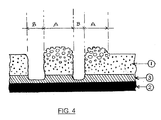
- a coating was made to obtain a layer 1 on a support 2 while on the figure 4 two coatings were made in order to obtain an inner layer 3 and an outer layer 1, the inner layer 3 being underlying the outer layer 1.
- a support 2 coated with a coagulated polyurethane coating is preferably used. This polymer resin indeed gives the final product a softer feel.
- the outer layer 1 of the coated material comprises heat-expandable microspheres.
- This outer layer 1 can be made from any type of synthetic resins: acrylic, polyvinyl chloride ... these resins can be in aqueous dispersion or organic solution.
- polyurethane resins are used. They give the outer layer 1 coated a soft and slippery touch, reminiscent of a natural leather.
- This polyurethane resin is preferably in aqueous dispersion, for ecological reasons, and even more advantageously, it is mixed with an acrylic resin to lower the cost of manufacture and in particular the cost of the formulation of the resin.
- the resin is prepared for coating by chemical thickening, and its viscosity is brought to the value adapted to the coating device retained (doctor blade, reverse-roll, rotary frame ).
- a formulation for the outer layer 1 is produced using a polyurethane resin in aqueous dispersion, cut with 10% acrylic resin. These two resins are thickened by adding a rheological additive. Then, this formulation is pigmented with pigments compatible with the aqueous dispersion, such as the pigments from Dystar. A matting agent is then added, as well as a silicone emulsion to improve the feel of the coating. Finally, thermo-reactive microspheres compatible with aqueous emulsions, for example EXPANCEL® from AKZO NOBEL or DUALITE® from HENKEL, are added so as to represent approximately 25% to 50%, and preferred way of the order of 40% of the formulation of the outer layer.
- EXPANCEL® from AKZO NOBEL or DUALITE® from HENKEL
- microspheres are selected from the category compatible with aqueous dispersions, for example EXPANCEL® WU from AZKO NOBEL.
- the microspheres may have a size less than 30 microns, such as of the order of 5 to 30 microns with an initialization temperature of the expansion of the order of 120 to 140 ° C.
- an outer layer having a heat-reactive surface is obtained.
- this surface is then etched by scanning a computer-controlled laser beam.
- the model / pattern to be reproduced is digitized and the corresponding file is introduced into the computer controlling the laser.
- the laser used is a "plotter" type machine from the company GCC, reference SPIRIT ® having a maximum power of 25 W
- the passage of the beam causes not a swelling of the microspheres, but a vaporization on the surface of the outer layer creating hollow B, as illustrated on the figure 3 . It should be noted that a too powerful thermal effect destroys the material, whereas a too weak effect causes an insufficient expansion.
- the marking of the pattern / pattern also depends on the scanning speed of the beam: the higher the speed, the smaller the thermal effect. It must be sufficient to allow the material to warm up.
- the skilled person can refine the marking in relief and recessed.
- Other parameters also make it possible to refine the marking, as the nature of the prepared coating, the scanning characteristics (in fact, the more lines will be scanned to form an image, the more it will be fine and precise), as well as the position of the focal length of the beam relative to the surface of the outer layer: the effect is maximum and precise with a focal length positioned on the surface (outer layer) to be etched, and it is lessened and more "fuzzy" in the opposite case.
- the focusing of the beam is slightly off-center with respect to the surface to be marked: a difference of 2 to 4 mm. This reduces the thermal effect and avoids burning the coated layer.
- the machine described above comprises a laser controlled by a plotter, whose operation is similar to that of a plotter. However, it is also possible to use lasers type "galvo", much faster, on which the movement of the laser beam is controlled by a set of moving mirrors, and no longer by the mechanical movement of a carrier arm.
- an optical sensor detects on the surface to mark marks that have been printed thereon, and the laser performs its engraving work by locating itself compared to a pre-existing printed drawing.
- This possibility finds application in the case where the outer surface of the synthetic resin containing the microspheres has been printed before being subjected to the laser beam.
- This printing can be of all types: screen printing, offset or hot stamping by the traditional method (heated tool and presence or not of a decorative film). In this case, a chosen pattern is printed or subjected to pressurized hot stamping by transferring, in a first step, onto the printed surface markers readable by an optical sensor.
- the printed surface is placed on a laser machine equipped with an optical registration system. Then, the portions of the printed pattern that the user wishes embossed by swelling the microspheres are selectively subjected to the action of the laser beam to be activated. If the user wants a recessed marking, it is done the same except that the power of the laser is increased.
- a decorated surface, combining a printed effect or a hollow heat marking, and parts of the pattern that appear in relief, in two different colors from that of the original surface ( Fig. 3 ) is obtained.
- a coated material composed of at least two distinct layers is obtained ( figure 4 ), ie it comprises an outer layer comprising the expandable microspheres and an inner layer, underlying the outer layer and free of microspheres.
- the inner layer may be of the same chemical nature as the surface layer, but generally has a different color or appearance: it may be colored, printed or metallized.
- the characteristics of the laser beam - and more particularly its power - are set for a given model depending on the desired effect: the beam will sweep the model to achieve with a variable power according to the selected parts.
- the power will be adapted to the swelling of the microspheres contained in the surface layer, and a raised pattern will be obtained, while on other parts of the same pattern, swept by a beam of higher power, the outer layer will be vaporized so as to reveal, without piercing it, the inner layer.
- Example of embodiment of this variant On a support of paper saturated with the latex of 90 g / m 2 is coated an inner layer of polyurethane in pigmentation OR 50 g / m 2 , itself covered by an outer layer of polyurethane, pigmentation BROWN, containing the microspheres, of 75-80 g / m 2 .
- the raised parts (A) were obtained by scanning at 25% of the power and 100% of the speed, while the recessed parts (B), which reveal the gold layer under -concente, were obtained by a scan at 100% of the power and 50% of the speed.
- the beam was defocused by 0.8 cm from the surface to be etched.
- microspheres makes it possible to obtain a marking effect in relief or in relief, as a function of the temperature of the heating tool: at a low temperature, close to 120 ° -130 ° C., the parts of the surface layer in contact with the reliefs of the heating tool will, after marking, swelling "in relief” and a lighter color than that of the initial surface; at a higher temperature, equal to or greater than 150-160 ° C, the effect obtained will be that of traditional hollow marking, the swelling of the microspheres being thwarted by the application of the heating tool.
- the use for example of an intermediate hot stamping film, colored or metallized provides the effect traditionally obtained with this type of application.
Landscapes
- Engineering & Computer Science (AREA)
- Textile Engineering (AREA)
- Laminated Bodies (AREA)
Abstract
Description
- La présente invention concerne un nouveau matériau réalisé par enduction destiné aux domaines de la reliure et du packaging. La présente invention se rapporte également au procédé de fabrication du nouveau matériau, ainsi qu'à son utilisation et à un article comprenant ledit matériau.
- De nombreuses matières synthétiques, obtenues le plus souvent par enduction (procédé consistant à appliquer une mince couche de matière sous forme fluide ou poudreuse sur un substrat) de résines polymères, présentent la propriété de changer de coloris lorsqu'elles sont soumises à un marquage thermique. Ces matières sont généralement à base de supports en papier, en carton, en non-tissé ou de supports textiles qui sont recouverts d'une ou plusieurs couches de résines polymères. En effet, ces matières sont obtenues par enduction sur le support choisi de résines acryliques ou polyuréthanes, en dispersion aqueuse ou en solution dans des solvants organiques, ou encore de plastisols à base de polychlorure de vinyle. L'enduction peut se faire en direct, en étalant la pâte préparée sur le support, ou bien par la méthode de « transfert » : dans ce cas, la résine formulée, encore en phase liquide, est déposée sur un papier anti-adhérent, lisse ou grainé, le support est déposé par simple contact sur la couche qui vient d'être enduite, et l'ensemble est fixé thermiquement par passage dans un tunnel de séchage. Dans le cas d'une enduction directe, un grainage de la surface, appliqué en reprise, peut modifier celle-ci et lui conférer un dessin « veiné » rappelant celui de la peau naturelle. Tous ces procédés sont largement connus et mis en oeuvre.
- Les produits industriels ainsi fabriqués sont généralement utilisés comme matière de couvrure dans les industries de la reliure, de l'emballage et dans toutes les applications de décoration d'un support donné, dont il convient de modifier l'aspect et le toucher.
- Une opération complémentaire mise en oeuvre très couramment sur ces matières est celle du marquage thermique : un outil métallique est usiné ou fondu de façon telle qu'il laisse apparaître, en relief, l'empreinte d'un modèle graphique que l'utilisateur souhaite imprimer en creux sur la surface à décorer. L'outil est porté à une température voisine de 120-150°C, fonction de la surface à marquer, puis il est appliqué sous une forte pression, pendant un temps assez court, sur la matière synthétique. Le principe est celui du « marquage au fer chaud », appliqué sur des cuirs et des peaux. Un film décoratif peut être inséré entre l'outil chauffé et la matière à décorer : le décor pré-imprimé ou déposé sur le film se reporte alors sur la matière synthétique, lui conférant l'aspect du film décoratif. Des impressions multicolores, ou des marquages dorés, argentés ou métallisés, présentant d'innombrables effets décoratifs, sont ainsi obtenus.
- La même opération de marquage thermique, mise en oeuvre sans utilisation du film décoratif, permet l'obtention d'un marquage en creux, du même coloris que celui de la matière non marquée, ce qui est souvent insuffisamment visible.
- Il est également possible de disposer de matières synthétiques qui présentent la propriété de changer de coloris - en général, elles deviennent plus foncées - sous l'action de la chaleur qui leur est appliquée pendant le marquage thermique. Cette propriété est le plus souvent obtenue en incorporant dans la résine polymère enduite des pigments dont le coloris se modifie de façon permanente lorsqu'ils sont chauffés, ou encore de disposer de résines polymères modifiées de façon à présenter par elles-mêmes cette propriété. Dans ces conditions, c'est à dire sans film décoratif - et donc de façon moins onéreuse -, un marquage en creux présentant une teinte plus foncée que celle de la matière vierge, et donc parfaitement visible, est obtenu. Cet aspect décoratif, obtenu par brunissement thermique d'une matière synthétique, est très recherché dans les domaines de la reliure et des industries graphiques.
- Cette technique présente toutefois l'inconvénient de nécessiter la fabrication d'un outil reproduisant l'empreinte du modèle recherché ; cet outil est onéreux ce qui confère un prix élevé aux séries fabriquées en petit nombre et il doit être périodiquement remplacé dans le cas de multiples marquages. Le changement d'outil sur la machine de marquage est par ailleurs assez long, en raison de la température atteinte par l'outil. L'effet obtenu est par ailleurs toujours en creux, la matière décorée étant enfoncée lors de l'opération de marquage thermique.
- La présente invention a pour but de proposer un nouveau matériau qui évite tout ou partie des inconvénients précités.
- A cet effet, l'invention a pour objet un matériau enduit comprenant un support recouvert d'au moins une couche en résine polymère, caractérisé en ce que ladite résine comprend des microsphères expansibles à la chaleur.
- De préférence, le matériau enduit comprend une couche interne en résine polymère exempte de microsphères.
- Avantageusement, le matériau enduit comprend une couche externe sur laquelle est formé un motif.
- De manière préférée, les microsphères comportent une coquille polymère enfermant un agent gonflant apte à dilater ladite coquille sous l'action de la chaleur.
- En particulier, l'agent gonflant est un gaz ou un liquide à bas point d'ébullition. Cet agent présente la propriété de gonfler sous l'action de la chaleur et de dilater la coquille « comme un ballon ». Ainsi, ces microsphères peuvent grossir jusqu'à quarante fois par rapport à leur taille initiale.
- Préférentiellement, le support est choisi parmi : du papier, du carton, un non-tissé, un film plastique, un support textile, un tissé, un tricoté ou un de leurs mélanges.
- Selon une caractéristique de l'invention, ladite couche de résine polymère est choisie parmi : une résine acrylique, une résine poly-chlorure de vinyle, une résine polyuréthane ou un de leurs mélanges. En particulier, ladite couche de résine polymère comprend en outre un agent choisi parmi : un additif rhéologique, des pigments, un agent matant, une émulsion à base de silicones ou un de leurs mélanges.
- En particulier, l'invention concerne un matériau enduit comprenant un support recouvert d'au moins une couche externe en résine polymère comprenant des microsphères expansibles à la chaleur, caractérisé en ce que ladite couche externe comporte au moins une résine en polyuréthane.
- La présente invention a également pour objet, un procédé de fabrication d'un matériau enduit tel que décrit ci-dessus, comprenant les étapes consistant à :
- i) réaliser au moins une couche sur un support par enduction à partir d'une résine polymère comprenant des microsphères expansibles à la chaleur, de sorte à obtenir une couche en résine polymère comprenant lesdites microsphères,
- ii) réaliser sur ladite couche au moins un motif à l'aide de moyens de chauffage sélectifs, permettant par chauffage et/ou pression, l'expansion desdites microsphères.
- De préférence, l'étape i) comprend la réalisation d'une couche interne en résine polymère exempte de microsphères et d'une couche externe en résine polymère comprenant lesdites microsphères.
- De manière avantageuse, le chauffage est réalisé à l'aide d'un faisceau laser et/ou d'un outil en relief chauffant.
- Généralement, le laser est piloté par ordinateur et est usuellement du type identique aux lasers de découpe pour table traçante. Le faisceau laser va ainsi dessiner par balayage du support le motif choisi. Tandis que l'outil en relief est généralement un outil métallique sur lequel est gravé le motif à reproduire.
- Le procédé selon l'invention permet ainsi de réaliser, avec un outil en relief (métallique) ou, plus spécifiquement, en l'absence d'un tel outil, un marquage thermique en relief ou en creux, présentant un coloris différent de celui de la surface vierge. Un effet en « deux-tons » propre aux matières thermo-réactives est ainsi obtenu. La surface ainsi marquée présente par ailleurs un toucher très agréable.
- Cette solution est en outre applicable aux grandes et aux petites séries. Elle permet l'obtention d'une gravure très précise et conduit à des effets graphiques complètement originaux, ouvrant de multiples possibilités nouvelles dans le domaine des industries graphiques.
- Selon une première variante, la température de chauffage se situe entre 120°C et 130°C, de sorte à obtenir un motif en relief par gonflage des microsphères ou égale ou supérieure à 150°C (par exemple de l'ordre de 150°C-160°C), de sorte à obtenir un motif en creux par écrasement ou vaporisation de la couche en résine comprenant les microsphères expansibles.
- Dans une première variante de l'invention, il est possible de dessiner des motifs sur une couche de résine polymère externe comprenant les microsphères expansibles, en utilisant un outil métallique en relief, usiné ou fondu, tel qu'il est aujourd'hui pratiqué de façon classique.
- Selon une seconde variante, on utilise un faisceau laser pour obtenir cet effet graphique, le réglage de la puissance du faisceau permettant, soit d'obtenir un motif en relief par gonflage des microsphères, soit d'obtenir une gravure en creux par vaporisation de la couche en résine comprenant les microsphères expansibles. Ces différents réglages permettent d'obtenir les températures adéquates afin de permettre soit un gonflement des microsphères, soit une vaporisation de la couche externe.
- Ainsi, la puissance et la vitesse de balayage du faisceau peuvent être réglées de façon à ce que la température atteinte par la résine enduite lors du passage du faisceau enclenche l'expansion des microsphères. Cette opération provoque un gonflement de la partie touchée par le faisceau, avec une grande précision, et la surface balayée se transforme en une mousse présentant un coloris beaucoup plus pâle que la partie de la résine restée intacte, et un toucher extrêmement doux, rappelant celui d'une peau en daim. Ou alors, un réglage différent de la puissance du faisceau laser permet de vaporiser la couche de surface (couche externe), et de la creuser en profondeur jusqu'à révéler une couche enduite (couche interne), généralement de couleur, impression et/ou matière différente, et située sous la première couche : on peut ainsi faire apparaître sélectivement, selon un modèle donné, une couche interne présentant un coloris ou un aspect totalement différent de celui de la surface externe.
- La programmation du balayage du faisceau laser permet ainsi de combiner sur un même matériau enduit un marquage thermique en creux ou en relief. Dans un premier temps, il est possible d'obtenir un marquage avec un outil chauffant, puis d'obtenir en reprise sur d'autres parties du matériau enduit un marquage en relief ou en creux par balayage programmé d'un faisceau laser.
- Un but de la présente invention concerne également un produit ou article comprenant le matériau enduit susmentionné.
- Un autre but de la présente invention se rapporte à l'utilisation d'un matériau enduit tel que décrit ci-dessus, pour emballer, conditionner ou relier des produits ou articles.
- L'invention sera mieux comprise, et d'autres buts, détails, caractéristiques et avantages de celle-ci apparaîtront plus clairement au cours de la description suivante d'un mode de réalisation particulier de l'invention et d'exemples illustratifs, donnés uniquement à titre illustratif et non limitatif, en référence aux dessins annexés.
- Sur ces dessins:
- la
figure 1 représente une vue en coupe longitudinale d'un matériau enduit selon un mode de réalisation de la présente invention comprenant un support recouvert par une seule couche de résine polymère comprenant des microsphères ; - la
figure 2 représente une vue en coupe longitudinale du matériau de lafigure 1 après marquage en relief; - la
figure 3 représente une vue en coupe longitudinale du matériau de lafigure 2 après marquage en creux ; - et la
figure 4 représente une vue en coupe longitudinale d'un matériau enduit selon une variante de réalisation dans laquelle le matériau comprend un support recouvert d'une première couche dit couche interne, exempte de microsphères, et recouverte elle-même d'une seconde couche, dite couche externe, cette dernière couche comprenant des microsphères. - Afin d'obtenir le matériau enduit selon la présente invention, une ou plusieurs enductions, en direct ou par transfert, sur un support de nature quelconque, tel que du papier, du carton, un non-tissé, un film plastique ou un support textile, tissé ou tricoté est ou sont réalisées. Chaque enduction permet de réaliser une couche. Ainsi plusieurs enductions permettent de réaliser plusieurs couches qui se superposent les unes aux autres. Par exemple sur les
figures 1 à 3 , une enduction a été réalisé afin d'obtenir une couche 1 sur un support 2 tandis que sur lafigure 4 deux enductions ont été réalisées afin d'obtenir une couche interne 3 et une couche externe 1, la couche interne 3 étant sous-jacente à la couche externe 1. Dans le cas d'un support 2 tissé ou non-tissé, un support 2 recouvert d'une enduction polyuréthane coagulée est de préférence utilisée. Cette résine polymère confère en effet au produit final un toucher plus moelleux. Dans le cadre de la présente invention, la couche externe 1 du matériau enduit comporte des microsphères expansibles à la chaleur. - Cette couche externe 1 peut être réalisée à partir de tout type de résines synthétiques : acryliques, poly-chlorure de vinyle... ces résines pouvant être en dispersion aqueuse ou en solution organique. Dans un aspect préféré de l'invention, des résines polyuréthanes sont utilisées. Elles donnent en effet à la couche externe 1 enduite un toucher doux et glissant, rappelant celui d'un cuir naturel. Cette résine polyuréthane est préférentiellement en dispersion aqueuse, pour des raisons écologiques, et de manière encore plus avantageuse, elle est mélangée à une résine acrylique pour abaisser le coût de la fabrication et en particulier le coût de la formulation de la résine. Par exemple, la résine est préparée pour l'enduction par épaississement chimique, et sa viscosité est portée à la valeur adaptée au dispositif d'enduction retenu (racle sur cylindre, reverse-roll, cadre rotatif...). Généralement une viscosité voisine de 500 Poises est souhaitée. La formulation de la résine est en outre pigmentée au coloris souhaité par addition de colorants adaptés à la formule. Enfin, est incorporée à la formule, avant enduction, une certaine quantité des microsphères expansibles susmentionnées.
- A titre d'exemple une formulation pour la couche externe 1 est réalisée à l'aide d'une résine polyuréthane en dispersion aqueuse, coupée par 10 % de résine acrylique. Ces deux résines sont épaissies par ajout d'un additif rhéologique. Puis, cette formulation est pigmentée par des pigments compatibles avec la dispersion aqueuse, tels que les pigments de la société DYSTAR. Un agent matant est ensuite additionné, ainsi qu'une émulsion de silicones visant à améliorer le toucher de l'enduction. Enfin, des microsphères thermo-réactives compatibles avec les émulsions aqueuses, par exemple de l'EXPANCEL® de la société AKZO NOBEL ou du DUALITE® de la société HENKEL, sont ajoutées de sorte à représenter environ de 25% à 50%, et de manière préférée de l'ordre de 40% de la formulation de la couche externe. Ces microsphères sont choisies dans la catégorie compatible avec les dispersions aqueuses, par exemple les EXPANCEL® WU d'AZKO NOBEL. En particulier, les microsphères pourront présenter une dimension inférieure à 30 microns, telle que de l'ordre de 5 à 30 microns avec une température d'initialisation de l'expansion de l'ordre de 120 à 140°C. Ainsi, une couche externe présentant une surface thermo-réactive est obtenue.
- Selon un premier mode de réalisation, cette surface est ensuite gravée par balayage d'un faisceau laser piloté par ordinateur. Dans un premier temps, le modèle/motif à reproduire est numérisé et le fichier correspondant est introduit dans l'ordinateur pilotant le laser. A titre d'exemple, le laser utilisé est une machine de type « plotter » de la société GCC, de référence SPIRIT ® présentant une puissance maximale de 25 W
- Lorsque ce laser est réglé à une puissance de l'ordre 5 W à 6,2W, c'est-à-dire à une puissance assez faible (permettant d'obtenir un température de l'ordre de 120-130°C), le passage du faisceau provoque alors, à l'endroit précis du contact avec la surface enduite, l'expansion des microsphères contenues dans la couche de résine synthétique, donnant ainsi naissance à un marquage en relief A (
figure 2 à 4 ) reproduisant le modèle/motif numérisé. Cet effet est représenté en particulier à lafigure 2 . L'expansion des microsphères transforme en mousse la résine enduite, et change fortement son coloris, qui conserve la même nuance, mais devient beaucoup plus clair en raison de la dilatation de la surface. On retrouve ainsi l'effet « deux-tons » recherché dans ce type de marquage thermique. Cette expansion de la couche externe enduite modifie également son toucher. Dans le cas d'une résine enduite en polyuréthane, un toucher doux et agréable, rappelant beaucoup celui d'une peau en daim, est obtenu. - Lorsque le laser est réglé à une puissance de l'ordre 20 W à 25W, c'est à dire à une puissance assez forte (permettant d'obtenir un température égale ou supérieure à 150-160°C), le passage du faisceau provoque non plus un gonflement des microsphères, mais une vaporisation en surface de la couche externe créant des creux B, comme cela est illustré sur la
figure 3 . Il est à noter, qu'un effet thermique trop puissant détruit la matière, alors qu'un effet trop faible provoque une expansion insuffisante. - Le marquage du modèle/motif dépend également de la vitesse de balayage du faisceau : plus la vitesse est grande et plus l'effet thermique ponctuel est faible. Elle doit être en effet suffisante pour permettre à la matière de s'échauffer. Ainsi, en fonction du paramétrage de la puissance et de la vitesse de balayage, l'homme du métier pourra peaufiner le marquage en relief et en creux. D'autres paramètres permettent également de peaufiner le marquage, comme la nature de l'enduction préparée, les caractéristiques de balayage (en effet, plus il y aura de lignes balayées pour former une image, plus celle-ci sera fine et précise), ainsi que la position de la focale du faisceau par rapport à la surface de la couche externe : l'effet est maximum et précis avec une focale positionnée sur la surface (couche externe) à graver, et il est amoindri et plus « flou » dans le cas contraire. Préférentiellement, la focalisation du faisceau est légèrement décentrée par rapport à la surface à marquer : un écart de 2 à 4 mm. Ceci permet de réduire l'effet thermique et d'éviter de brûler la couche enduite.
- La machine décrite ci-dessus comporte un laser commandé par un plotter, dont le fonctionnement est semblable à celui d'une table traçante. Toutefois, il est également possible d'utiliser des lasers de type « galvo », beaucoup plus rapides, sur lesquels le déplacement du faisceau laser est commandé par un jeu de miroirs mobiles, et non plus par le déplacement mécanique d'un bras porteur.
- Il est également possible d'utiliser un faisceau laser dont le déplacement est assujetti à un système de repérage optique : un capteur optique détecte sur la surface à marquer des repères qui y ont été imprimés, et le laser réalise son travail de gravure en se repérant par rapport à un dessin imprimé préexistant. Cette possibilité trouve une application dans le cas où la surface externe de la résine synthétique contenant les microsphères a été imprimée avant d'être soumise au faisceau laser. Cette impression peut être de tous types : sérigraphie, offset ou marquage à chaud par le procédé traditionnel (outil chauffé et présence, ou non, d'un film décoratif). Dans ce cas, un motif choisi est imprimé ou soumis à un marquage à chaud sous pression en reportant, dans une première étape, sur la surface imprimée des repères lisibles par un capteur optique. Dans une seconde étape, la surface imprimée est placée sur une machine laser équipée d'un système de repérage optique. Puis, les parties du motif imprimé que l'utilisateur souhaite en relief par gonflement des microsphères sont soumises sélectivement à l'action du faisceau laser pour être activées. Si l'utilisateur souhaite un marquage en creux, il est procédé de même hormis que la puissance du laser est augmentée. Ainsi, une surface décorée, combinant un effet imprimé ou un marquage thermique en creux, et des parties du motif qui apparaissent en relief, dans deux coloris différents de celui de la surface d'origine (
fig. 3 ) est obtenue. - Dans une seconde variante de l'invention, un matériau enduit composé d'au moins deux couches distinctes est obtenu (
figure 4 ), c'est à dire qu'il comprend une couche externe comportant les microsphères expansibles et une couche interne, sous-jacente à la couche externe et exempte de microsphères. La couche interne peut être de même nature chimique que la couche de surface, mais elle présente généralement un coloris ou un aspect différent : elle peut être colorée, imprimée ou métallisée. Les caractéristiques du faisceau laser - et plus particulièrement sa puissance - sont réglées pour un modèle donné en fonction de l'effet recherché : le faisceau balaiera ainsi le modèle à réaliser avec une puissance variable selon les parties sélectionnées. Sur certaines parties, la puissance sera adaptée au gonflement des microsphères contenues dans la couche de surface, et un motif en relief sera obtenu, alors que sur d'autres parties du même motif, balayées par un faisceau de puissance supérieure, la couche externe sera vaporisée de façon à révéler, sans la percer, la couche interne. - Exemple de réalisation de cette variante : Sur un support en papier saturé au latex de 90 g/m2 est enduite une couche interne en polyuréthane en pigmentation OR de 50 g/m2, elle-même recouverte par une couche externe en polyuréthane, pigmentation BRUN, contenant les microsphères, de 75-80 g/m2. En utilisant le faisceau laser susmentionné, les parties en relief (A) ont été obtenues par un balayage à 25 % de la puissance et 100 % de la vitesse, tandis que les parties en creux (B), qui font apparaître la couche dorée sous-jacente, ont été obtenues par un balayage à 100 % de la puissance et 50 % de la vitesse. Lors du marquage, le faisceau était défocalisé de 0,8 cm par rapport à la surface à graver.
- L'effet ainsi obtenu, en un seul passage et sans outil métallique usiné, combine des zones en relief présentant un coloris plus clair que celui de la couche de surface vierge, et des zones gravées en creux, sur lesquelles l'aspect et le coloris différents de la couche sous-jacente deviennent visibles. Bien évidemment, ces deux effets, en creux et en relief, peuvent être obtenus indépendamment l'un de l'autre.
- Enfin, il est également possible de réaliser le marquage en relief ou en creux par l'intermédiaire des outils métalliques classiques connus de l'homme du métier, tels qu'un outil métallique en relief, usiné ou fondu. La présence de microsphères permet d'obtenir un effet de marquage en creux ou en relief, en fonction de la température de l'outil chauffant : à une température basse, voisine de 120-130°C, les parties de la couche de surface venues en contact avec les reliefs de l'outil chauffant présenteront, après marquage, un gonflement « en relief » et un coloris plus clair que celui de la surface initiale ; à une température plus élevée, égale ou supérieure à 150-160°C, l'effet obtenu sera celui du marquage en creux traditionnel, le gonflement des microsphères étant contrarié par l'application de l'outil chauffant. Dans ce second cas, l'utilisation par exemple d'un film intermédiaire de marquage à chaud, coloré ou métallisé, permet d'obtenir l'effet traditionnellement obtenu avec ce type d'application.
- Il est évidemment possible de combiner sur un même motif un marquage thermique « en creux », réalisé dans un premier temps avec un outil chauffant, et de réaliser en reprise sur d'autres parties du modèle un marquage en relief ou en creux par balayage programmé d'un faisceau laser
- Bien que l'invention ait été décrite en liaison avec plusieurs modes de réalisation particuliers, il est bien évident qu'elle n'y est nullement limitée et qu'elle comprend tous les équivalents techniques des moyens décrits ainsi que leurs combinaisons si celles-ci entrent dans le cadre de invention.
Claims (14)
- Matériau enduit comprenant un support recouvert d'au moins une couche en résine polymère, caractérisé en ce que ladite résine comprend des microsphères expansibles à la chaleur.
- Matériau enduit selon la revendication 1, comprenant au moins une couche interne en résine polymère exempte de microsphères.
- Matériau enduit selon l'une des revendications précédente, comprenant une couche externe sur laquelle est formé un motif.
- Matériau enduit selon l'une des revendications précédentes, dans lequel les microsphères comportent une coquille polymère enfermant un agent gonflant apte à dilater ladite coquille sous l'action de la chaleur.
- Matériau enduit selon la revendication 4, dans lequel l'agent gonflant est un gaz ou un liquide à bas point d'ébullition.
- Matériau selon l'une des revendications précédentes, dans lequel le support est choisi parmi : du papier, du carton, un non-tissé, un film plastique, un support textile, un tissé, un tricoté ou un de leurs mélanges.
- Matériau selon l'une des revendications précédentes, dans lequel ladite couche de résine polymère est choisie parmi : une résine acrylique, une résine poly-chlorure de vinyle, une résine polyuréthane ou un de leurs mélanges.
- Matériau enduit selon la revendication 7, dans lequel ladite couche de résine polymère comprend en outre un agent choisi parmi : un additif rhéologique, des pigments, un agent matant, une émulsion à base de silicones ou un de leurs mélanges.
- Procédé de fabrication d'un matériau enduit selon l'une des revendications 3 à 8, comprenant les étapes consistant à :i) réaliser au moins une couche sur un support par enduction à partir d'une résine polymère comprenant des microsphères expansibles à la chaleur, de sorte à obtenir une couche en résine polymère comprenant lesdites microsphères,ii) réaliser sur ladite couche au moins un motif à l'aide de moyens de chauffage sélectifs, permettant par chauffage et/ou pression, l'expansion desdites microsphères.
- Procédé de fabrication selon la revendication 9, dans lequel l'étape i) comprend la réalisation d'une couche interne en résine polymère exempte de microsphères et d'une couche externe en résine polymère comprenant lesdites micro sphères.
- Procédé de fabrication selon l'une des revendications 9 et 10, dans lequel le chauffage est réalisé à l'aide d'un faisceau laser et/ou d'un outil en relief chauffant.
- Procédé de fabrication selon l'une des revendications 9 à 11, dans lequel la température de chauffage se situe entre 120°C et 130°C, de sorte à obtenir un motif en relief par gonflage des microsphères ou égale ou supérieure à 150°C, de sorte à obtenir un motif en creux par vaporisation de la couche en résine comprenant les microsphères expansibles.
- Produit ou article comprenant le matériau enduit selon l'une des revendications 1 à 8.
- Utilisation d'un matériau enduit selon l'une des revendications 1 à 8, pour emballer, conditionner ou relier des produits ou articles.
Applications Claiming Priority (1)
| Application Number | Priority Date | Filing Date | Title |
|---|---|---|---|
| FR1054958A FR2961429B1 (fr) | 2010-06-22 | 2010-06-22 | Materiau enduit de resine et son procede de fabrication |
Publications (1)
| Publication Number | Publication Date |
|---|---|
| EP2418077A1 true EP2418077A1 (fr) | 2012-02-15 |
Family
ID=43425842
Family Applications (1)
| Application Number | Title | Priority Date | Filing Date |
|---|---|---|---|
| EP20110170857 Withdrawn EP2418077A1 (fr) | 2010-06-22 | 2011-06-22 | Matériau enduit de résine et son procédé de fabrication |
Country Status (3)
| Country | Link |
|---|---|
| US (1) | US20120015162A1 (fr) |
| EP (1) | EP2418077A1 (fr) |
| FR (1) | FR2961429B1 (fr) |
Cited By (2)
| Publication number | Priority date | Publication date | Assignee | Title |
|---|---|---|---|---|
| WO2016166489A1 (fr) * | 2015-04-16 | 2016-10-20 | Chomarat Textiles Industries | Procede de transfert a chaud sur textile et complexe multicouche expansible pour ce procede |
| CN112457144A (zh) * | 2020-12-11 | 2021-03-09 | 湖北航天化学技术研究所 | 一种含交联氟聚物包覆层的hmx炸药微球及其制备方法 |
Families Citing this family (18)
| Publication number | Priority date | Publication date | Assignee | Title |
|---|---|---|---|---|
| CN104669757B (zh) | 2010-09-10 | 2018-01-09 | 汉高知识产权控股有限责任公司 | 具有隔离性能的改进粘合剂 |
| US9771499B2 (en) | 2010-09-10 | 2017-09-26 | Henkel IP & Holding GmbH | Adhesive having structural integrity and insulative properties |
| US9657200B2 (en) | 2012-09-27 | 2017-05-23 | Henkel IP & Holding GmbH | Waterborne adhesives for reduced basis weight multilayer substrates and use thereof |
| WO2013150916A1 (fr) * | 2012-04-02 | 2013-10-10 | 東海興業株式会社 | Article moulé par injection et procédé de production de cet article |
| US9273230B2 (en) | 2012-11-16 | 2016-03-01 | Henkel IP & Holding GmbH | Hot melt assist waterborne adhesives and use thereof |
| MX377092B (es) | 2013-11-27 | 2025-03-07 | Henkel Ag & Co Kgaa | Adhesivo para articulos de aislamiento. |
| US9707799B2 (en) | 2014-03-19 | 2017-07-18 | The Procter & Gamble Company | Process for printing and securing three-dimensional pattern on non-fibrous substrates and article comprising non-fibrous surface having three-dimensional pattern thereon |
| PL3172282T3 (pl) | 2014-07-23 | 2021-02-22 | Henkel Ag & Co. Kgaa | Rozszerzalne kompozycje powłokowe i ich zastosowanie |
| CN105691846B (zh) * | 2016-02-06 | 2018-11-30 | 刘军 | 一种食品包装容器及其制备方法 |
| CN105946234A (zh) * | 2016-06-16 | 2016-09-21 | 东莞市联洲知识产权运营管理有限公司 | 一种基于3d打印的蕾丝面料及其制备方法 |
| JP6536604B2 (ja) * | 2017-03-07 | 2019-07-03 | カシオ計算機株式会社 | 造形物の製造方法 |
| RU2770849C2 (ru) | 2017-07-18 | 2022-04-22 | ХЕНКЕЛЬ АйПи ЭНД ХОЛДИНГ ГМБХ | Диэлектрическое нагревание вспениваемых композиций |
| US12157619B2 (en) | 2017-08-25 | 2024-12-03 | Henkel Ag & Co. Kgaa | Process for forming improved protective eco-friendly pouch and packaging and products made therefrom |
| MX2020001943A (es) | 2017-08-25 | 2020-09-28 | Henkel IP & Holding GmbH | Proceso para formar bolsa y empaque ecologicamente amigables protectores ecologicos y productos hechos de los mismos. |
| US20190233664A1 (en) * | 2018-01-30 | 2019-08-01 | Matt Industries | Haptic coating |
| EP3527361A1 (fr) | 2018-02-16 | 2019-08-21 | Henkel AG & Co. KGaA | Procédé de fabrication d'un substrat multicouche |
| TWM611527U (zh) * | 2020-03-02 | 2021-05-11 | 大陸商立訊精密工業股份有限公司 | 具識別殼體的傳輸線、車用充電器、以及電源適配器 |
| MX2022008639A (es) * | 2021-01-13 | 2022-08-10 | Plus Kk | Metodo para fabricar pieza decorativa de resina sintetica termoplastica. |
Citations (5)
| Publication number | Priority date | Publication date | Assignee | Title |
|---|---|---|---|---|
| GB2033395A (en) * | 1978-11-03 | 1980-05-21 | Reed International Ltd | Production of Foamed Sheet Materials |
| EP0304550A2 (fr) * | 1987-08-26 | 1989-03-01 | OPTIPLAST Gesellschaft für Kunststoffspezialbeschichtungen mbH i.G. | Procédé de fabrication de dessins ou revêtements à trois dimensions sur des substrats en papier, textiles et/ou feuilles plastiques |
| FR2673209A3 (fr) * | 1991-02-26 | 1992-08-28 | Elce Ets | Procede pour realiser un support presentant des proprietes anti-glisse et support ainsi obtenu. |
| JPH0820661A (ja) * | 1994-07-04 | 1996-01-23 | Toyo Cloth Kk | オレフィン系装丁用シートの製造方法 |
| EP0887382A1 (fr) * | 1997-06-26 | 1998-12-30 | Elf Atochem S.A. | Formulations pour l'obtention directe de feuilles expansées, calandrées ou laminées, procédé de fabrication de ces feuilles à l'aide de ces formulations et les feuilles correspondantes obtenues |
Family Cites Families (4)
| Publication number | Priority date | Publication date | Assignee | Title |
|---|---|---|---|---|
| US3615972A (en) * | 1967-04-28 | 1971-10-26 | Dow Chemical Co | Expansible thermoplastic polymer particles containing volatile fluid foaming agent and method of foaming the same |
| US4094685A (en) * | 1976-07-23 | 1978-06-13 | Polymerics, Inc. | Expandable polymeric coating compositions |
| US6806018B2 (en) * | 2002-03-25 | 2004-10-19 | Macdermid Graphic Arts, Inc. | Processless digitally imaged printing plate using microspheres |
| US20080057295A1 (en) * | 2006-09-01 | 2008-03-06 | Fina Technology, Inc. | Engravable board |
-
2010
- 2010-06-22 FR FR1054958A patent/FR2961429B1/fr not_active Expired - Fee Related
-
2011
- 2011-06-21 US US13/165,120 patent/US20120015162A1/en not_active Abandoned
- 2011-06-22 EP EP20110170857 patent/EP2418077A1/fr not_active Withdrawn
Patent Citations (5)
| Publication number | Priority date | Publication date | Assignee | Title |
|---|---|---|---|---|
| GB2033395A (en) * | 1978-11-03 | 1980-05-21 | Reed International Ltd | Production of Foamed Sheet Materials |
| EP0304550A2 (fr) * | 1987-08-26 | 1989-03-01 | OPTIPLAST Gesellschaft für Kunststoffspezialbeschichtungen mbH i.G. | Procédé de fabrication de dessins ou revêtements à trois dimensions sur des substrats en papier, textiles et/ou feuilles plastiques |
| FR2673209A3 (fr) * | 1991-02-26 | 1992-08-28 | Elce Ets | Procede pour realiser un support presentant des proprietes anti-glisse et support ainsi obtenu. |
| JPH0820661A (ja) * | 1994-07-04 | 1996-01-23 | Toyo Cloth Kk | オレフィン系装丁用シートの製造方法 |
| EP0887382A1 (fr) * | 1997-06-26 | 1998-12-30 | Elf Atochem S.A. | Formulations pour l'obtention directe de feuilles expansées, calandrées ou laminées, procédé de fabrication de ces feuilles à l'aide de ces formulations et les feuilles correspondantes obtenues |
Cited By (5)
| Publication number | Priority date | Publication date | Assignee | Title |
|---|---|---|---|---|
| WO2016166489A1 (fr) * | 2015-04-16 | 2016-10-20 | Chomarat Textiles Industries | Procede de transfert a chaud sur textile et complexe multicouche expansible pour ce procede |
| FR3035126A1 (fr) * | 2015-04-16 | 2016-10-21 | Chomarat Textiles Ind | Complexe multicouche expansible pour transfert a chaud sur textile |
| US10309056B2 (en) | 2015-04-16 | 2019-06-04 | Chomarat Textiles Industries | Method for heat transfer onto textiles and expansible multilayer complex therefor |
| CN112457144A (zh) * | 2020-12-11 | 2021-03-09 | 湖北航天化学技术研究所 | 一种含交联氟聚物包覆层的hmx炸药微球及其制备方法 |
| CN112457144B (zh) * | 2020-12-11 | 2021-11-05 | 湖北航天化学技术研究所 | 一种含交联氟聚物包覆层的hmx炸药微球及其制备方法 |
Also Published As
| Publication number | Publication date |
|---|---|
| FR2961429A1 (fr) | 2011-12-23 |
| FR2961429B1 (fr) | 2014-02-21 |
| US20120015162A1 (en) | 2012-01-19 |
Similar Documents
| Publication | Publication Date | Title |
|---|---|---|
| EP2418077A1 (fr) | Matériau enduit de résine et son procédé de fabrication | |
| EP0913271B1 (fr) | Procédé automatique d'impression en continu de motifs multicolores sur un film flocké thermocollant ou soudable par haute fréquence, film obtenu par ce procédé, procédé d'application de ce film sur un support à décorer et support décoré obtenu par ce procédé | |
| EP2000250B1 (fr) | Procédé de découpe au laser d'un motif pour décoration d'articles textiles | |
| US9090118B2 (en) | Water pressure transfer method, a transfer film for water pressure transfer and a water pressure transfer article | |
| US5902667A (en) | Impressed emblem and method | |
| EP3283684B1 (fr) | Procede de transfert a chaud sur textile et complexe multicouche expansible pour ce procede | |
| EP0296108A1 (fr) | Procédé de fabrication d'un objet en une matière thermoplastique comportant un motif décoratif | |
| KR101395449B1 (ko) | 장식 박막이 전체적으로 전이된 미용재료 원단과 그 제조방법 및 미용재료 원단을 이용한 미용 스티커 | |
| FR2827529A1 (fr) | Article a revetement imitant les goutelettes et son procede de fabrication | |
| WO2006045763A2 (fr) | Articles decores | |
| CN100542835C (zh) | 植绒转印膜及制作方法和其在承印物上形成图案的方法 | |
| KR100473221B1 (ko) | 합성피혁으로 제작된 원단 표면에 소정의 무늬를 형성하는방법 및 이 방법에 의해 만들어진 합성피혁 원단 | |
| EP0757724B1 (fr) | Procede de realisation de motifs en relief sur du cuir ou analogue | |
| US20080289748A1 (en) | Method of applying a design | |
| FR2575698A1 (fr) | Procede de fabrication de materiau en forme de feuilles reconstituant l'aspect de materiaux nobles naturels, tels que peaux de reptiles | |
| KR20210083139A (ko) | 칼라 디자인을 가지는 큐브코너형 재귀반사물의 제조방법 및 그러한 재귀반사물의 구조 | |
| FR2550242A1 (fr) | Procede de fabrication de papiers peints a motif tridimensionnel destines au revetement decoratif de surfaces et papiers peints fabriques suivant ce procede | |
| JP2008246870A (ja) | 装飾樹脂シートとその製造方法 | |
| JP4605611B2 (ja) | 樹脂成形品の加飾方法 | |
| EP2298985A1 (fr) | Procédé de fabrication d'un complexe textile comportant une couche d'enduction présentant des motifs localisés, et complexe obtenu par un tel procédé | |
| FR2841574A1 (fr) | Procede de fabrication d'une feuille portant un motif en relief recouverte d'une couche lui conferant un effet de profondeur | |
| BE624673A (fr) | ||
| FR2534945A1 (fr) | Procede de decoration polychrome des cuirs ou analogues | |
| FR3133154A1 (fr) | Procédé de décoration de surfaces, et film décoratif obtenu par un tel procédé | |
| WO2000047423A1 (fr) | Procede de decoration d'un film plastique par transfert-sublimation, et produit ainsi obtenu |
Legal Events
| Date | Code | Title | Description |
|---|---|---|---|
| AK | Designated contracting states |
Kind code of ref document: A1 Designated state(s): AL AT BE BG CH CY CZ DE DK EE ES FI FR GB GR HR HU IE IS IT LI LT LU LV MC MK MT NL NO PL PT RO RS SE SI SK SM TR |
|
| AX | Request for extension of the european patent |
Extension state: BA ME |
|
| PUAI | Public reference made under article 153(3) epc to a published international application that has entered the european phase |
Free format text: ORIGINAL CODE: 0009012 |
|
| RIN1 | Information on inventor provided before grant (corrected) |
Inventor name: LION, RAPHAEL Inventor name: LION, ALEXANDRE |
|
| 17P | Request for examination filed |
Effective date: 20120726 |
|
| 17Q | First examination report despatched |
Effective date: 20121018 |
|
| GRAP | Despatch of communication of intention to grant a patent |
Free format text: ORIGINAL CODE: EPIDOSNIGR1 |
|
| INTG | Intention to grant announced |
Effective date: 20160502 |
|
| STAA | Information on the status of an ep patent application or granted ep patent |
Free format text: STATUS: THE APPLICATION IS DEEMED TO BE WITHDRAWN |
|
| 18D | Application deemed to be withdrawn |
Effective date: 20160913 |