EP2416747B1 - Absorbierendes wundpflaster zur umhüllung von gliedgelenken - Google Patents
Absorbierendes wundpflaster zur umhüllung von gliedgelenken Download PDFInfo
- Publication number
- EP2416747B1 EP2416747B1 EP10714357.0A EP10714357A EP2416747B1 EP 2416747 B1 EP2416747 B1 EP 2416747B1 EP 10714357 A EP10714357 A EP 10714357A EP 2416747 B1 EP2416747 B1 EP 2416747B1
- Authority
- EP
- European Patent Office
- Prior art keywords
- wound dressing
- absorbent
- dressing according
- dressing
- sheet
- Prior art date
- Legal status (The legal status is an assumption and is not a legal conclusion. Google has not performed a legal analysis and makes no representation as to the accuracy of the status listed.)
- Active
Links
Images
Classifications
-
- A—HUMAN NECESSITIES
- A61—MEDICAL OR VETERINARY SCIENCE; HYGIENE
- A61F—FILTERS IMPLANTABLE INTO BLOOD VESSELS; PROSTHESES; DEVICES PROVIDING PATENCY TO, OR PREVENTING COLLAPSING OF, TUBULAR STRUCTURES OF THE BODY, e.g. STENTS; ORTHOPAEDIC, NURSING OR CONTRACEPTIVE DEVICES; FOMENTATION; TREATMENT OR PROTECTION OF EYES OR EARS; BANDAGES, DRESSINGS OR ABSORBENT PADS; FIRST-AID KITS
- A61F13/00—Bandages or dressings; Absorbent pads
- A61F13/06—Bandages or dressings; Absorbent pads specially adapted for feet or legs; Corn-pads; Corn-rings
-
- A—HUMAN NECESSITIES
- A61—MEDICAL OR VETERINARY SCIENCE; HYGIENE
- A61F—FILTERS IMPLANTABLE INTO BLOOD VESSELS; PROSTHESES; DEVICES PROVIDING PATENCY TO, OR PREVENTING COLLAPSING OF, TUBULAR STRUCTURES OF THE BODY, e.g. STENTS; ORTHOPAEDIC, NURSING OR CONTRACEPTIVE DEVICES; FOMENTATION; TREATMENT OR PROTECTION OF EYES OR EARS; BANDAGES, DRESSINGS OR ABSORBENT PADS; FIRST-AID KITS
- A61F13/00—Bandages or dressings; Absorbent pads
- A61F13/10—Bandages or dressings; Absorbent pads specially adapted for fingers, hands or arms; Finger-stalls; Nail-protectors
-
- A—HUMAN NECESSITIES
- A61—MEDICAL OR VETERINARY SCIENCE; HYGIENE
- A61F—FILTERS IMPLANTABLE INTO BLOOD VESSELS; PROSTHESES; DEVICES PROVIDING PATENCY TO, OR PREVENTING COLLAPSING OF, TUBULAR STRUCTURES OF THE BODY, e.g. STENTS; ORTHOPAEDIC, NURSING OR CONTRACEPTIVE DEVICES; FOMENTATION; TREATMENT OR PROTECTION OF EYES OR EARS; BANDAGES, DRESSINGS OR ABSORBENT PADS; FIRST-AID KITS
- A61F13/00—Bandages or dressings; Absorbent pads
- A61F13/06—Bandages or dressings; Absorbent pads specially adapted for feet or legs; Corn-pads; Corn-rings
- A61F13/064—Bandages or dressings; Absorbent pads specially adapted for feet or legs; Corn-pads; Corn-rings for feet
-
- A—HUMAN NECESSITIES
- A61—MEDICAL OR VETERINARY SCIENCE; HYGIENE
- A61F—FILTERS IMPLANTABLE INTO BLOOD VESSELS; PROSTHESES; DEVICES PROVIDING PATENCY TO, OR PREVENTING COLLAPSING OF, TUBULAR STRUCTURES OF THE BODY, e.g. STENTS; ORTHOPAEDIC, NURSING OR CONTRACEPTIVE DEVICES; FOMENTATION; TREATMENT OR PROTECTION OF EYES OR EARS; BANDAGES, DRESSINGS OR ABSORBENT PADS; FIRST-AID KITS
- A61F13/00—Bandages or dressings; Absorbent pads
- A61F13/15—Absorbent pads, e.g. sanitary towels, swabs or tampons for external or internal application to the body; Supporting or fastening means therefor; Tampon applicators
- A61F13/53—Absorbent pads, e.g. sanitary towels, swabs or tampons for external or internal application to the body; Supporting or fastening means therefor; Tampon applicators characterised by the absorbing medium
- A61F13/531—Absorbent pads, e.g. sanitary towels, swabs or tampons for external or internal application to the body; Supporting or fastening means therefor; Tampon applicators characterised by the absorbing medium having a homogeneous composition through the thickness of the pad
- A61F13/532—Absorbent pads, e.g. sanitary towels, swabs or tampons for external or internal application to the body; Supporting or fastening means therefor; Tampon applicators characterised by the absorbing medium having a homogeneous composition through the thickness of the pad inhomogeneous in the plane of the pad
- A61F13/5323—Absorbent pads, e.g. sanitary towels, swabs or tampons for external or internal application to the body; Supporting or fastening means therefor; Tampon applicators characterised by the absorbing medium having a homogeneous composition through the thickness of the pad inhomogeneous in the plane of the pad having absorbent material located in discrete regions, e.g. pockets
Definitions
- the present invention relates to absorbent wound dressings. More particularly, the present invention relates to wound dressings that are adapted to be wrapped around wounds on or near jointed limbs.
- Standard wound dressings can be cut or folded in an attempt to cover jointed limbs and to conform to the shape of the wound, but the requirement for handling before application to the patient inevitably compromises the sterility of the dressing itself. Indeed, the more irregular the wound, the greater amount of prior manipulation is required and the less wound coverage is achieved. Adhesive dressings are more effective at covering an irregularly shaped wound area such as a wound on a jointed limb because the adhesive retains the dressings in place. However, removal of such dressings often causes further wound trauma. In other known dressing designs a dressing sheet is made up of absorbent compartments that are designed to be cut or torn along predefined lines of weakness in order to adapt the dressings to different shaped wounds. However, these suffer from the same sterility problems as standard wound dressings.
- WO 00/42957 A1 discloses an absorbent bandage comprising a leg portion adapted to fit around the lower leg of a patient, a foot portion adapted to fit around the foot of a patient and a heel portion connecting the leg portion and the foot portion.
- a non-adhesive absorbent wound dressing for application about a jointed limb, the wound dressing having a first portion adapted to conform to and wrap around an upper part of the limb, a second portion adapted to conform to and wrap around a lower part of the limb, and a hinge portion between said first portion and said second portion, said hinge portion in use lying adjacent to the joint of the limb; wherein the dressing comprises a porous wound contact sheet and a substantially liquid-impermeable backing sheet, the wound contact sheet and the backing sheet being bonded together at their periphery and along lines that define a plurality of pockets in both the first portion and the second portion, the pockets containing absorbent material.
- the dressing of the present invention is advantageous primarily because it can be applied securely to an irregularly-shaped jointed limb, with a smaller amount of manipulation than is required for standard dressings. This considerably reduces the chances of compromising dressing sterility and introducing a pathogenic contaminant.
- the hinge portion in use lying adjacent to the joint of the limb and the generally flexible nature of the dressing allow the dressing to flex as the joint flexes. In this way, complete wound coverage is achieved throughout the whole range of free limb movement. This means that the patient can achieve mobility faster than if standard dressings were applied and mobility has been shown to improve blood circulation to the wound and improve wound healing.
- the absorbent material contained within the pockets is able to absorb wound exudate, and because the first and second portions are sub-divided into a plurality of pockets, the absorbed wound exudate is held within those pockets. This reduces the tendency of the absorbent material to slump to the bottom of the dressing under the influence of gravity, which would otherwise be a particular problem where the dressing is disposed, in use, in an upright configuration.
- the dressing of the invention is further advantageous because it is able to absorb and contain large amounts of wound exudate. This reduces the number of dressing changes that are required, which in turn reduces both clinical costs and nursing time. As large amounts of fluid are absorbed, maceration of the wound is prevented and patient comfort is improved. Once the dressing has reached its capacity for absorbing fluid, it can be removed and replaced quickly, without causing further trauma to the wound site (which is a problem with most standard dressings).
- the wound contact sheet is preferably a fluid-permeable material.
- the wound contact sheet may comprise a woven or non-woven fabric, formed of synthetic or natural materials.
- the wound contact sheet is a non-woven sheet formed from a blend of polyester and viscose fibres.
- the wound contact sheet may be perforated in order to expedite the transport of fluid.
- the wound contact sheet is formed with a regular array of perforations across its full extent. Such perforations may be circular or non-circular in shape, or irregularly-shaped, and typically have a size of from 50 ⁇ m to 10mm, more commonly from 0.1 mm to 1.5mm.
- the backing sheet is impermeable to liquid, or substantially so, so that wound exudate is retained within the dressing, but is preferably vapour-permeable.
- the backing sheet may comprise a film of material. Suitable backing sheet materials include plastics, such as polyethylene and polyurethane.
- the backing sheet material may have a degree of elasticity.
- the wound contact sheet and the backing sheet are preferably bonded together at the perimeter of each sheet and along lines extending from the perimeter of each sheet.
- the material of the wound contact sheet and the backing sheet includes a fusible component so that the bonds can be formed by the application of heat and pressure.
- the fabric may be a non-woven fabric containing both fusible (such as polyester or polypropylene) and non-fusible (such as cellulose) fibres.
- the bonding may be achieved by the use of adhesives, stitching, or any other method known in the art.
- a plurality of internal recesses, described herein as pockets, are defined by bonds between the wound contact sheet and the backing sheet that extend across the dressing.
- the pockets may have any suitable shape.
- the pockets may be generally square, rectangular or triangular, or may have a less regular shape, eg an irregular quadrilateral shape.
- the absorbent material preferably comprises any material that absorbs liquid, such as wound fluid.
- absorbent material substantially fills each pocket.
- the absorbent material is preferably formed into a sheet, mat or pad.
- the sheet, mat or pad of absorbent material is preferably shaped and dimensioned such that it occupies substantially the whole of the pocket within which it is contained.
- the absorbent materials are typically those types commonly referred to as “superabsorbers” or “superabsorbent materials”. Such materials are typically polymers that are capable of absorbing and retaining extremely large quantities of fluid relative to their own mass.
- such materials absorb aqueous solutions through hydrogen bonding with the water molecule, and may absorb up to 200, 400, or 500 times or more their weight of fluid.
- polyacrylates ie salts of polyacrylic acid.
- the sodium salt of polyacrylic acid cross-linked sodium polyacrylate
- acrylic acid blended with sodium hydroxide in the presence of an initiator.
- superabsorbent polymers include polyacrylamide copolymer, ethylene maleic anhydride copolymer, cross-linked carboxymethylcellulose, polyvinylalcohol copolymers, cross-linked polyethylene oxide, starch-grafted copolymers of polyacrylonitrile, and others.
- alginate ie salts of alginic acid.
- alginate ie salts of alginic acid.
- Alginic acid is a linear copolymer with homopolymeric blocks of (1-4)-linked ⁇ -D-mannuronate and its C-5 epimer ⁇ -L-guluronate residues, covalently linked together in different sequences or blocks.
- Alginates that are particularly suitable for use in the present invention are calcium alginate and sodium alginate.
- the absorbent material has the form of a sheet, mat or pad.
- the sheet, mat or pad may be formed from an absorbent material, or the sheet, mat or pad may be of a material that does not itself absorb fluid (or which has a relatively low absorptive capacity) but which acts as a carrier for a superabsorbent material.
- particles of superabsorbent polymer may be entrapped in the sheet, mat or pad, which may be of formed from fibres of a synthetic or natural material, eg cellulose. Suitable materials include those available under the trade name GELOK from Gelok International Corporation P.O. Box 69, Pine Lake Industrial Park, Dunbridge, Ohio 43414-0069 USA.
- the absorbent material may alternatively be of the form described in GB Patent Application No. 0905341.4 , ie a laminate of a layer of absorbent material and a layer of reinforcing material. Such a laminate may be formed by ultrasonic welding of the layers together at a plurality of weld points.
- Both the first portion and the second portion comprise a plurality of pockets.
- the first and second portions may differ in size and may comprise differing numbers of pockets.
- Each of the first and second portions preferably comprise at least three pockets, more preferably at least four.
- the number of pockets in each of the first and second portions is, however, preferably no more than ten, more preferably no more than eight.
- the absolute and relative dimensions of the first and second portions of the dressing will depend on the particular part of the body to which the dressing is intended to be applied. For instance, for application about a knee or elbow joint, the first and second portions may be comparable in size, the ratio of the areas of first and second portions being less than 3:1 or less than 2:1. For application about a wrist or ankle joint, where the parts of the body to which the first and second portions are applied are substantially different in size (ie the forearm and hand, or the lower leg and foot), on the other hand, the first portion may be substantially greater in extent than the second portion. In such a case, the ratio of the surface areas of the first and second portions may be greater than 3:1 or greater than 4:1 or greater than 5:1.
- a currently preferred embodiment of the dressing according to the invention is intended for application to the lower leg and foot, about the ankle joint.
- the first portion of the dressing is wrapped, in use, about the lower leg, and the second portion is wrapped around the foot.
- the hinge portion lies adjacent to the patient's heel.
- the hinge portion between the first and second portions comprises a bonded area which extends across the dressing, from one point on the perimeter of the dressing to another.
- the hinge portion thus represents a fold line about which the first portion and the second portion can be folded towards one another.
- the hinge portion is preferably of reduced dimension relative to the parts of the first and second portions adjacent to it.
- the first and second portions of the dressing may have the same overall width, or different overall widths, depending on the intended manner and site of application of the dressing. Where, as is most common, the hinge portion is of lesser width, the width of the hinge portion may be up to 75%, or up to 60%, or up to 50% that of the first and/or second portion.
- the wound dressing is most preferably sterile so as not to introduce infective agents into the wound. Where the materials used are sensitive to heat, sterilisation methods using heat or pressure are not suitable. A more preferred method of sterilisation may be gamma irradiation or chemical sterilisation using agents such as ethylene oxide, both of which are widely used for the sterilisation of medical equipment.
- the wound dressing is packaged in a microorganism-impermeable container.
- the wound dressing of the invention may also comprise a carbonised deodoriser or an anti-microbial material.
- a preferred form of antimicrobial material is silver.
- Such materials may be included as inner layers of a composite absorbent material.
- wound contact sheet may also absorb some wound fluid.
- the overall absorbing capacity of the dressing may therefore be somewhat greater than the absorbtive capacity of the absorbent material included within each pocket.
- the dressing according to the invention may be any generally planar shape that is dimensioned and configured to conform to a jointed limb.
- the dressing is configured to conform to and wrap around any upper part of any limb, any lower part of any such limb, and any joint positioned between any such upper and lower parts.
- the wound contact sheet of the hinge portion preferably lies adjacent to the joint of a limb (eg an ankle).
- the hinge portion may also lie adjacent to a non-hinged part of the body or joint which is maintained in substantially static configuration, such as a knee joint held bent by an external brace.
- the first portion is wrapped around the upper part of the limb (eg a lower leg), and the second portion is wrapped around the lower part of the limb (eg a foot).
- the dressing can be manipulated to adapt to the three-dimensional form of the part of the body to which it is applied.
- the dressing is preferably of sufficient dimensions that opposing edges may be wrapped around the limb to which the dressing is applied, and overlapped.
- the dressing according to the invention is preferably held in place using surgical tape, hook and loop fixation, or other type of fixative.
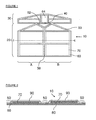
- an embodiment of the absorbent dressing according to the invention is shown and is generally designated 10.
- the dressing has a shape suitable for application to the lower leg and foot, around an ankle joint.
- the first portion of the dressing according to the invention is that generally designated 20.
- the second portion of the dressing according to the invention is that generally designated 30.
- a hinge portion 40 is positioned between the first and second portions 20, 30.
- the dressing 10 comprises a wound contact sheet 80, absorbent material 70 and a backing sheet 90, as shown in Figure 2 which is cross-sectional view on line c-c in Figure 1 .
- the wound contact sheet 80 is formed of a non-woven blend of polyester and viscose, perforated across its whole extent with perforations of approximate size 1 mm.
- the backing sheet is a liquid-impermeable but vapour-permeable polyethylene film.
- the absorbent material 70 comprises a mechanically bonded cellulose pad containing particles of superabsorbent polymer.
- the backing sheet 90 and the wound contact sheet 80 have the same overall shape and dimensions, and are superimposed on top of one another and bonded at the perimeter of the dressing and at a number of other positions within the periphery of the dressing, as indicated by the bonds 50.
- the bonds 50 are created by the application of heat and pressure, and define pockets 60.
- Each pocket contains absorbent material 70 which substantially fills each pocket 60.
- the dressing 10 is symmetrical about its centre line (vertical as depicted in Figure 1 ), the sides (denoted A and B) of each of the first and second portions 20,30 being formed as a pair of wings that can be wrapped around a limb to which the dressing is applied.
- the first portion 20 is formed with seven pockets 60, and the second portion with five pockets 60. Compartmentalisation of the first and second portions 20,30 into discrete pockets 60 is beneficial in that the absorbent material contained within each pocket 60 is less liable to slumping, which reduces the frequency with which the dressing must be changed, as well as improving its conformability and comfort for the patient.
- the wound contact sheet 80 is permeable to fluid and is in contact with the wound. As such, the wound contact sheet 80 is able to transport wound exudate to the absorbent 70.
- the absorbent 70 may absorb many times, eg several hundred times, its own weight in wound exudate.
- the backing sheet 90 is impermeable to fluid and permeable to vapour, so that wound exudate is retained within the dressing 10 whilst vapour is allowed to escape.
- the materials of the dressing 10 are flexible and therefore the dressing 10 can be adapted to conform to and wrap around a jointed limb.
- the embodiment of the dressing 10 depicted in the drawings is dimensioned and configured for application to a patient's lower leg and foot.
- the dressing 10 is positioned such that the hinge portion 40 is located adjacent the patient's heel.
- the wings of the first portion 20 are then wrapped around the patient's lower leg (calf) and overlapped, and the wings of the second portion 30 are wrapped around the patient's foot and overlapped.
- the dressing 10 may then be secured by means of surgical tapes or the like.
- the dressing itself may incorporate suitable fastenings, such as hook-and-loop or adhesive fasteners.
- a 44-year old man was chosen as the subject of the clinical study. He was admitted to the medical unit generally very unwell and was suffering from liver failure, cardiac myopathy, and renal failure. His lower limbs were grossly oedematous and the skin had begun to beak down in the week prior to admission. He presented with superficial ulceration to both legs which were heavily contaminated with Pseudomonas. Both limbs, from the level of the knees down, were leaking copious amounts of fluid, both from the ulcer beds and the skin pores. This leakage was causing maceration, increasing ulcer size and excruciating pain to the man.
- a first line treatment was employed to combat the Pseudomonas infection but this was increasingly difficult due to the deteriorating medical condition of the patient and the fact that he was unable to tolerate most dressing/topical treatments or compression due to the levels of pain experienced.
- the aim of the initial management therefore was to promote comfort while preventing further maceration and subsequent ulcer expansion.
- a dressing according to the invention generally taking the form of the embodiment depicted in Figures 1 and 2 was applied and within two days the nurses reported a reduction in dressing change frequency to only once a day. They also reported that the dressing held all the exudate, with strike-through being seen only after 24 hours. Furthermore the dressings were very easy to use and dressing changes were mostly pain free.
Landscapes
- Health & Medical Sciences (AREA)
- Engineering & Computer Science (AREA)
- Biomedical Technology (AREA)
- Heart & Thoracic Surgery (AREA)
- Vascular Medicine (AREA)
- Life Sciences & Earth Sciences (AREA)
- Animal Behavior & Ethology (AREA)
- General Health & Medical Sciences (AREA)
- Public Health (AREA)
- Veterinary Medicine (AREA)
- Materials For Medical Uses (AREA)
- Absorbent Articles And Supports Therefor (AREA)
Claims (15)
- Nichtklebender absorbierender Wundverband zur Anwendung um ein gelenkiges Körperglied, wobei der Wundverband Folgendes hat: einen ersten Abschnitt, der ausgeführt ist, um an einem oberen Teil des Körperglieds anzuliegen und sich um es zu wickeln, einen zweiten Abschnitt, der ausgeführt ist, um an einem unteren Teil des Körperglieds anzuliegen und sich um es zu wickeln, und einen Gelenkabschnitt zwischen dem genannten ersten Abschnitt und dem genannten zweiten Abschnitt, wobei der genannte Gelenkabschnitt im Gebrauch neben dem Gelenk des Körpergliedes liegt,
wobei der Verband ein poröses flächiges Wundkontaktelement und ein im Wesentlichen flüssigkeitsundurchlässiges flächiges Stützelement aufweist, wobei das flächige Wundkontaktelement und das flächige Stützelement an ihrem Umfang und entlang Linien, die eine Vielzahl von Taschen in dem ersten Abschnitt und in dem zweiten Abschnitt definieren, zusammengefügt sind, wobei die Taschen absorbierendes Material enthalten. - Absorbierender Wundverband nach Anspruch 1, wobei das flächige Wundkontaktelement eine Webware oder einen Vliesstoff aufweist.
- Absorbierender Wundverband nach einem der vorhergehenden Ansprüche, wobei das flächige Wundkontaktelement über sein ganzes Ausmaß mit einer regelmäßigen Anordnung von Perforationen ausgebildet ist.
- Absorbierender Wundverband nach einem der vorhergehenden Ansprüche, wobei das flächige Stützelement wasserdampfdurchlässig ist.
- Absorbierender Wundverband nach einem der vorhergehenden Ansprüche, wobei das flächige Stützelement eine Kunststofffolie umfasst.
- Absorbierender Wundverband nach Anspruch 5, wobei der Kunststoff Polyurethan oder Polyethylen ist.
- Absorbierender Wundverband nach einem der vorhergehenden Ansprüche, wobei das absorbierende Material als flächiges Stück, Matte oder Polster ausgebildet ist.
- Absorbierender Wundverband nach Anspruch 7, wobei das flächige Stück, die Matte oder das Polster aus absorbierendem Material so geformt und dimensioniert ist, dass es im Wesentlichen die ganze Tasche einnimmt, in der es enthalten ist.
- Absorbierender Wundverband nach einem der vorhergehenden Ansprüche, wobei das absorbierende Material ein Superabsorber ist.
- Absorbierender Wundverband nach Anspruch 9, wobei der Superabsorber aus einem oder mehreren der folgenden ausgewählt ist: Polyacrylate, Polyacrylamid-Copolymere, Ethylen-Maleinsäureanhydrid-Copolymere, vernetzte Carboxymethylcellulose, Polyvinylalkohol-Copolymere, vernetzte Polyethylenoxide, Stärke-Polyacrylnitril-Copolymere, Calciumaginat und Natriumalginate.
- Absorbierender Wundverband nach Anspruch 7, wobei das flächige Stück, die Matte oder das Polster aus einem Material herstellt ist, das als Träger für einen Superabsorber dient.
- Absorbierender Wundverband nach einem der vorhergehenden Ansprüche, wobei der erste und der zweite Abschnitt jeweils wenigstens drei Taschen und höchstens zehn Taschen aufweisen.
- Absorbierender Wundverband nach einem der vorhergehenden Ansprüche, wobei die Flächen des ersten und des zweiten Abschnitts im Verhältnis von mehr als 3:1 zueinander stehen.
- Absorbierender Wundverband nach einem der vorhergehenden Ansprüche, wobei der Gelenkabschnitt zwischen dem ersten und dem zweiten Abschnitt eine zusammengefügte Fläche umfasst, die sich von einem Punkt am Umfang des Verbands zum anderen über den Verband erstreckt.
- Absorbierender Wundverband nach einem der vorhergehenden Ansprüche, wobei der Gelenkabschnitt im Verhältnis zu den an ihn angrenzenden Teilen des ersten und des zweiten Abschnitts kleinere Abmessungen hat.
Applications Claiming Priority (2)
| Application Number | Priority Date | Filing Date | Title |
|---|---|---|---|
| GBGB0906056.7A GB0906056D0 (en) | 2009-04-08 | 2009-04-08 | Absorbent wound dressing for wrapping around jointed limbs |
| PCT/GB2010/050608 WO2010116193A2 (en) | 2009-04-08 | 2010-04-08 | Absorbent wound dressing for wrapping around jointed limbs |
Publications (2)
| Publication Number | Publication Date |
|---|---|
| EP2416747A2 EP2416747A2 (de) | 2012-02-15 |
| EP2416747B1 true EP2416747B1 (de) | 2014-02-12 |
Family
ID=40750280
Family Applications (1)
| Application Number | Title | Priority Date | Filing Date |
|---|---|---|---|
| EP10714357.0A Active EP2416747B1 (de) | 2009-04-08 | 2010-04-08 | Absorbierendes wundpflaster zur umhüllung von gliedgelenken |
Country Status (6)
| Country | Link |
|---|---|
| US (2) | US10195087B2 (de) |
| EP (1) | EP2416747B1 (de) |
| CA (1) | CA2758006C (de) |
| DK (1) | DK2416747T3 (de) |
| GB (1) | GB0906056D0 (de) |
| WO (1) | WO2010116193A2 (de) |
Families Citing this family (41)
| Publication number | Priority date | Publication date | Assignee | Title |
|---|---|---|---|---|
| EP1982678B1 (de) | 2003-02-12 | 2019-03-27 | The Procter and Gamble Company | Bequeme Windel |
| ATE455528T1 (de) | 2003-02-12 | 2010-02-15 | Procter & Gamble | Saugfähiger kern für einen saugfähigen artikel |
| GB2454301B (en) | 2007-06-18 | 2012-03-28 | Procter & Gamble | Disposable absorbent article with sealed absorbent core with substantially continuously distributed absorbent particulate polymer material |
| WO2008155699A1 (en) | 2007-06-18 | 2008-12-24 | The Procter & Gamble Company | Disposable absorbent article with substantially continuously distributed absorbent particulate polymer material and method |
| CA2722538C (en) | 2008-04-29 | 2014-08-12 | The Procter & Gamble Company | Process for making an absorbent core with strain resistant core cover |
| EP2329803B1 (de) | 2009-12-02 | 2019-06-19 | The Procter & Gamble Company | Vorrichtungen und verfahren zum transportieren von teilchenförmigem material |
| PL2532332T5 (pl) | 2011-06-10 | 2018-07-31 | The Procter And Gamble Company | Pieluszka jednorazowego użytku o zredukowanym połączeniu pomiędzy wkładem chłonnym a warstwą spodnią |
| PL3287110T3 (pl) | 2011-06-10 | 2019-08-30 | The Procter And Gamble Company | Sposób wytwarzania struktur chłonnych do wyrobów chłonnych |
| CA2838432C (en) | 2011-06-10 | 2018-02-27 | The Procter & Gamble Company | Absorbent structure for absorbent articles |
| EP2717822B1 (de) | 2011-06-10 | 2019-06-05 | The Procter and Gamble Company | Saugfähiger kern für einen saugfähigen einwegartikel |
| EP2532328B1 (de) | 2011-06-10 | 2014-02-26 | The Procter and Gamble Company | Verfahren und Vorrichtung zum Herstellen von Absorptionsstrukturen mit Absorptionsmaterial |
| RU2568565C2 (ru) | 2011-06-10 | 2015-11-20 | Дзе Проктер Энд Гэмбл Компани | Одноразовые подгузники |
| EP2532329B1 (de) | 2011-06-10 | 2018-09-19 | The Procter and Gamble Company | Verfahren und vorrichtung zum herstellen von absorptionsstrukturen mit absorptionsmaterial |
| AU2012244285A1 (en) * | 2012-11-01 | 2014-05-15 | MARX, Raymond MR | Absorbent wrap for a limb |
| EP2919737B1 (de) | 2012-11-13 | 2018-12-26 | The Procter and Gamble Company | Saugfähige artikel mit kanälen und signalen |
| US10639215B2 (en) | 2012-12-10 | 2020-05-05 | The Procter & Gamble Company | Absorbent articles with channels and/or pockets |
| US8979815B2 (en) | 2012-12-10 | 2015-03-17 | The Procter & Gamble Company | Absorbent articles with channels |
| EP2740452B1 (de) | 2012-12-10 | 2021-11-10 | The Procter & Gamble Company | Saugfähiger Artikel mit hohem Anteil an Absorptionsmaterial |
| US9216116B2 (en) | 2012-12-10 | 2015-12-22 | The Procter & Gamble Company | Absorbent articles with channels |
| US9216118B2 (en) | 2012-12-10 | 2015-12-22 | The Procter & Gamble Company | Absorbent articles with channels and/or pockets |
| EP2740450B1 (de) | 2012-12-10 | 2025-12-31 | The Procter & Gamble Company | Saugfähiger Artikel mit hohem Anteil an Superabsorptionsmaterial |
| EP2740449B1 (de) | 2012-12-10 | 2019-01-23 | The Procter & Gamble Company | Saugfähiger artikel mit hohem anteil an absorptionsmaterial |
| GB2512841B (en) | 2013-04-08 | 2020-07-15 | Brightwake Ltd | Absorbent wound dressings |
| EP2813201B1 (de) | 2013-06-14 | 2017-11-01 | The Procter and Gamble Company | Saugfähiger Artikel und saugfähiger Kern mit Kanalformung bei Nässe |
| US9987176B2 (en) | 2013-08-27 | 2018-06-05 | The Procter & Gamble Company | Absorbent articles with channels |
| CN110013386B (zh) | 2013-08-27 | 2021-10-01 | 宝洁公司 | 具有通道的吸收制品 |
| MX2016003391A (es) | 2013-09-16 | 2016-06-24 | Procter & Gamble | Articulos absorbentes con canales y señales. |
| US11207220B2 (en) | 2013-09-16 | 2021-12-28 | The Procter & Gamble Company | Absorbent articles with channels and signals |
| EP2851048B1 (de) | 2013-09-19 | 2018-09-05 | The Procter and Gamble Company | Absorbierende Kerne mit materialfreien Bereichen |
| US9789009B2 (en) | 2013-12-19 | 2017-10-17 | The Procter & Gamble Company | Absorbent articles having channel-forming areas and wetness indicator |
| EP2905001B1 (de) | 2014-02-11 | 2017-01-04 | The Procter and Gamble Company | Verfahren und Vorrichtung zum Herstellen von absorbierenden Strukturen mit Kanälen |
| ES2643577T3 (es) | 2014-05-27 | 2017-11-23 | The Procter & Gamble Company | Núcleo absorbente con diseño de material absorbente |
| EP2949300B1 (de) | 2014-05-27 | 2017-08-02 | The Procter and Gamble Company | Saugfähiger Kern mit saugfähiger Materialstruktur |
| WO2016149252A1 (en) | 2015-03-16 | 2016-09-22 | The Procter & Gamble Company | Absorbent articles with improved strength |
| JP2018508292A (ja) | 2015-03-16 | 2018-03-29 | ザ プロクター アンド ギャンブル カンパニー | 改善されたコアを有する吸収性物品 |
| MX2017014428A (es) | 2015-05-12 | 2018-04-10 | Procter & Gamble | Articulo absorbente con adhesivo mejorado del nucleo al lienzo inferior. |
| CN107683126A (zh) | 2015-05-29 | 2018-02-09 | 宝洁公司 | 具有槽和润湿指示标记的吸收制品 |
| EP3167859B1 (de) | 2015-11-16 | 2020-05-06 | The Procter and Gamble Company | Absorbierende kerne mit materialfreien bereichen |
| EP3238676B1 (de) | 2016-04-29 | 2019-01-02 | The Procter and Gamble Company | Saugkern mit profilierter verteilung von absorbierendem material |
| EP3238678B1 (de) | 2016-04-29 | 2019-02-27 | The Procter and Gamble Company | Saugfähiger kern mit transversalen faltlinien |
| WO2021116863A1 (en) * | 2019-12-10 | 2021-06-17 | Systagenix Wound Management, Limited | Customizable superabsorbent dressing |
Family Cites Families (35)
| Publication number | Priority date | Publication date | Assignee | Title |
|---|---|---|---|---|
| US1845630A (en) | 1929-02-16 | 1932-02-16 | William M Scholl | Medical dressing |
| US2331271A (en) * | 1938-07-09 | 1943-10-05 | John E Gilchrist | Catamenial bandage |
| GB905341A (en) | 1957-12-28 | 1962-09-05 | Arthur Kolbus | Book-back glueing and drying machine |
| US4360015A (en) | 1981-05-14 | 1982-11-23 | Hartford Corporation | Multilayer absorbent structure |
| US4401113A (en) | 1981-09-14 | 1983-08-30 | Incorvaia Anthony I | Sponge splint compression dressing |
| SE431934B (sv) | 1981-12-11 | 1984-03-12 | Carl Gustaf Kamme | Absorptionskropp med semipermeabelt membran |
| DE8504357U1 (de) | 1985-02-14 | 1985-05-15 | Weihermüller & Voigtmann GmbH & Co KG, 8580 Bayreuth | Epicondylitis-bandage |
| US4699823A (en) | 1985-08-21 | 1987-10-13 | Kimberly-Clark Corporation | Non-layered absorbent insert having Z-directional superabsorbent concentration gradient |
| USD307184S (en) | 1987-06-15 | 1990-04-10 | Mcconnell Bernard E | Hand traction wrap |
| US5264218A (en) * | 1989-10-25 | 1993-11-23 | C. R. Bard, Inc. | Modifiable, semi-permeable, wound dressing |
| US5129391A (en) * | 1990-03-29 | 1992-07-14 | M.S.C.M., Inc. | Thermal packs |
| GB9021910D0 (en) | 1990-10-09 | 1990-11-21 | Smith & Nephew | Wound dressing |
| US5437621A (en) | 1992-11-19 | 1995-08-01 | Marmon Holdings, Inc. | Medical dressing of a multilayered material |
| GB9301258D0 (en) | 1993-01-22 | 1993-03-17 | Courtaulds Plc | Use of absorbent fibre |
| US5538500A (en) * | 1995-02-08 | 1996-07-23 | Peterson; Donald A. | Postoperative wound dressing |
| US5704905A (en) | 1995-10-10 | 1998-01-06 | Jensen; Ole R. | Wound dressing having film-backed hydrocolloid-containing adhesive layer with linear depressions |
| US5827213A (en) | 1995-10-19 | 1998-10-27 | Ole R. Jensen | Heel and elbow dressing |
| EP2036581B1 (de) | 1998-07-01 | 2012-06-27 | ConvaTec Limited | Wundenverbände und zur Verwendung darin geeignete Materialien |
| GB9901085D0 (en) | 1999-01-20 | 1999-03-10 | Tudorose Decorative Trims Limi | Bandage |
| GB2350280B (en) | 1999-05-26 | 2003-05-28 | Johnson & Johnson Medical Ltd | Wound dressing support |
| AR025300A1 (es) | 1999-08-23 | 2002-11-20 | Kimberly Clark Co | Un articulo absorbente descartable con capacidad para respirar en humedo incrementada. |
| GB2357286B (en) | 1999-12-14 | 2003-11-05 | Johnson & Johnson Medical Ltd | Shaped wound dressings |
| CA2323382C (en) * | 2000-10-17 | 2004-04-13 | Pharma Mag Inc. | Wound dressing |
| GB2375485B (en) | 2001-05-14 | 2005-02-02 | Johnson & Johnson Medical Ltd | A wound dressing |
| US20050118383A1 (en) * | 2001-05-25 | 2005-06-02 | Cargill Lynn E. | Multi-layer structure for supporting dispersed super absorbent polymeric material |
| GB0210233D0 (en) | 2002-05-03 | 2002-06-12 | Acordis Speciality Fibres Ltd | Wound dressings |
| GB2389794A (en) | 2002-06-19 | 2003-12-24 | Johnson & Johnson Medical Ltd | Wound dressing with variable shape |
| US6838589B2 (en) | 2003-02-19 | 2005-01-04 | 3M Innovative Properties Company | Conformable wound dressing |
| US7049478B1 (en) | 2004-03-16 | 2006-05-23 | Patricia Ann Smith | Tri-lobe planar heel wound dressing |
| US8663144B2 (en) * | 2004-03-22 | 2014-03-04 | Farrow Medical Innovations Holdings Llc | Modular compression device and method of assembly |
| EP1776966A1 (de) * | 2005-10-21 | 2007-04-25 | The Procter and Gamble Company | Absorbierender Artikel mit erhöhter Fähigkeit proteinhaltige oder seröse Körperflüssigkeiten zu absorbieren und zurückhalten |
| US7807661B2 (en) * | 2005-12-08 | 2010-10-05 | 3M Innovative Properties Company | Silver ion releasing articles and methods of manufacture |
| US7858838B2 (en) | 2006-08-10 | 2010-12-28 | 3M Innovative Properties Company | Conformable wound dressing |
| GB0710846D0 (en) | 2007-06-06 | 2007-07-18 | Bristol Myers Squibb Co | A wound dressing |
| US20080312573A1 (en) | 2007-06-13 | 2008-12-18 | Mildred Loween Chappell | Chappell self adhesive medical wrap |
-
2009
- 2009-04-08 GB GBGB0906056.7A patent/GB0906056D0/en not_active Ceased
-
2010
- 2010-04-08 DK DK10714357.0T patent/DK2416747T3/en active
- 2010-04-08 EP EP10714357.0A patent/EP2416747B1/de active Active
- 2010-04-08 WO PCT/GB2010/050608 patent/WO2010116193A2/en not_active Ceased
- 2010-04-08 CA CA2758006A patent/CA2758006C/en not_active Expired - Fee Related
- 2010-04-08 US US13/263,619 patent/US10195087B2/en active Active
-
2018
- 2018-12-21 US US16/229,907 patent/US11452642B2/en active Active
Also Published As
| Publication number | Publication date |
|---|---|
| US10195087B2 (en) | 2019-02-05 |
| WO2010116193A3 (en) | 2010-12-02 |
| US11452642B2 (en) | 2022-09-27 |
| US20190133831A1 (en) | 2019-05-09 |
| EP2416747A2 (de) | 2012-02-15 |
| GB0906056D0 (en) | 2009-05-20 |
| US20120022479A1 (en) | 2012-01-26 |
| WO2010116193A2 (en) | 2010-10-14 |
| CA2758006C (en) | 2017-07-25 |
| CA2758006A1 (en) | 2010-10-14 |
| DK2416747T3 (en) | 2014-03-24 |
Similar Documents
| Publication | Publication Date | Title |
|---|---|---|
| US11452642B2 (en) | Absorbent wound dressing for wrapping around jointed limbs | |
| US12502456B2 (en) | Wound dressing | |
| CA2056598C (en) | Wound dressing having a roll configuration | |
| CA2186781C (en) | Medical articles | |
| CA2921164C (en) | Wound care article having an essentially polygonal or ellipsoid base surface and at least one recess arranged on one side | |
| CA2092714C (en) | Wound dressing | |
| US20110237994A1 (en) | Void-filling wound dressing | |
| US20140121627A1 (en) | Compressive dressing and production process thereof | |
| KR20180129609A (ko) | 상처 드레싱 | |
| GB2525494A (en) | Wound dressing | |
| JP7769460B2 (ja) | 改良型傷治療用部材 | |
| WO2015040177A1 (en) | Device | |
| CZ36840U1 (cs) | Krycí prostředek | |
| ES2575784T3 (es) | Apósito para heridas mejorado | |
| JPH073655U (ja) | 術後用の体外排液吸収パッド |
Legal Events
| Date | Code | Title | Description |
|---|---|---|---|
| PUAI | Public reference made under article 153(3) epc to a published international application that has entered the european phase |
Free format text: ORIGINAL CODE: 0009012 |
|
| 17P | Request for examination filed |
Effective date: 20111104 |
|
| AK | Designated contracting states |
Kind code of ref document: A2 Designated state(s): AT BE BG CH CY CZ DE DK EE ES FI FR GB GR HR HU IE IS IT LI LT LU LV MC MK MT NL NO PL PT RO SE SI SK SM TR |
|
| DAX | Request for extension of the european patent (deleted) | ||
| GRAP | Despatch of communication of intention to grant a patent |
Free format text: ORIGINAL CODE: EPIDOSNIGR1 |
|
| INTG | Intention to grant announced |
Effective date: 20130826 |
|
| GRAS | Grant fee paid |
Free format text: ORIGINAL CODE: EPIDOSNIGR3 |
|
| GRAA | (expected) grant |
Free format text: ORIGINAL CODE: 0009210 |
|
| AK | Designated contracting states |
Kind code of ref document: B1 Designated state(s): AT BE BG CH CY CZ DE DK EE ES FI FR GB GR HR HU IE IS IT LI LT LU LV MC MK MT NL NO PL PT RO SE SI SK SM TR |
|
| REG | Reference to a national code |
Ref country code: GB Ref legal event code: FG4D |
|
| REG | Reference to a national code |
Ref country code: CH Ref legal event code: EP |
|
| REG | Reference to a national code |
Ref country code: AT Ref legal event code: REF Ref document number: 651810 Country of ref document: AT Kind code of ref document: T Effective date: 20140215 |
|
| REG | Reference to a national code |
Ref country code: DK Ref legal event code: T3 Effective date: 20140320 |
|
| REG | Reference to a national code |
Ref country code: NL Ref legal event code: T3 Ref country code: IE Ref legal event code: FG4D |
|
| REG | Reference to a national code |
Ref country code: DE Ref legal event code: R096 Ref document number: 602010013507 Country of ref document: DE Effective date: 20140327 |
|
| REG | Reference to a national code |
Ref country code: SE Ref legal event code: TRGR |
|
| REG | Reference to a national code |
Ref country code: AT Ref legal event code: MK05 Ref document number: 651810 Country of ref document: AT Kind code of ref document: T Effective date: 20140212 |
|
| REG | Reference to a national code |
Ref country code: LT Ref legal event code: MG4D |
|
| PG25 | Lapsed in a contracting state [announced via postgrant information from national office to epo] |
Ref country code: IS Free format text: LAPSE BECAUSE OF FAILURE TO SUBMIT A TRANSLATION OF THE DESCRIPTION OR TO PAY THE FEE WITHIN THE PRESCRIBED TIME-LIMIT Effective date: 20140612 Ref country code: LT Free format text: LAPSE BECAUSE OF FAILURE TO SUBMIT A TRANSLATION OF THE DESCRIPTION OR TO PAY THE FEE WITHIN THE PRESCRIBED TIME-LIMIT Effective date: 20140212 Ref country code: NO Free format text: LAPSE BECAUSE OF FAILURE TO SUBMIT A TRANSLATION OF THE DESCRIPTION OR TO PAY THE FEE WITHIN THE PRESCRIBED TIME-LIMIT Effective date: 20140512 |
|
| PG25 | Lapsed in a contracting state [announced via postgrant information from national office to epo] |
Ref country code: CY Free format text: LAPSE BECAUSE OF FAILURE TO SUBMIT A TRANSLATION OF THE DESCRIPTION OR TO PAY THE FEE WITHIN THE PRESCRIBED TIME-LIMIT Effective date: 20140212 Ref country code: PT Free format text: LAPSE BECAUSE OF FAILURE TO SUBMIT A TRANSLATION OF THE DESCRIPTION OR TO PAY THE FEE WITHIN THE PRESCRIBED TIME-LIMIT Effective date: 20140612 Ref country code: AT Free format text: LAPSE BECAUSE OF FAILURE TO SUBMIT A TRANSLATION OF THE DESCRIPTION OR TO PAY THE FEE WITHIN THE PRESCRIBED TIME-LIMIT Effective date: 20140212 Ref country code: ES Free format text: LAPSE BECAUSE OF FAILURE TO SUBMIT A TRANSLATION OF THE DESCRIPTION OR TO PAY THE FEE WITHIN THE PRESCRIBED TIME-LIMIT Effective date: 20140212 |
|
| PG25 | Lapsed in a contracting state [announced via postgrant information from national office to epo] |
Ref country code: HR Free format text: LAPSE BECAUSE OF FAILURE TO SUBMIT A TRANSLATION OF THE DESCRIPTION OR TO PAY THE FEE WITHIN THE PRESCRIBED TIME-LIMIT Effective date: 20140212 Ref country code: LV Free format text: LAPSE BECAUSE OF FAILURE TO SUBMIT A TRANSLATION OF THE DESCRIPTION OR TO PAY THE FEE WITHIN THE PRESCRIBED TIME-LIMIT Effective date: 20140212 Ref country code: BE Free format text: LAPSE BECAUSE OF FAILURE TO SUBMIT A TRANSLATION OF THE DESCRIPTION OR TO PAY THE FEE WITHIN THE PRESCRIBED TIME-LIMIT Effective date: 20140212 |
|
| PG25 | Lapsed in a contracting state [announced via postgrant information from national office to epo] |
Ref country code: EE Free format text: LAPSE BECAUSE OF FAILURE TO SUBMIT A TRANSLATION OF THE DESCRIPTION OR TO PAY THE FEE WITHIN THE PRESCRIBED TIME-LIMIT Effective date: 20140212 Ref country code: RO Free format text: LAPSE BECAUSE OF FAILURE TO SUBMIT A TRANSLATION OF THE DESCRIPTION OR TO PAY THE FEE WITHIN THE PRESCRIBED TIME-LIMIT Effective date: 20140212 Ref country code: CZ Free format text: LAPSE BECAUSE OF FAILURE TO SUBMIT A TRANSLATION OF THE DESCRIPTION OR TO PAY THE FEE WITHIN THE PRESCRIBED TIME-LIMIT Effective date: 20140212 |
|
| REG | Reference to a national code |
Ref country code: DE Ref legal event code: R097 Ref document number: 602010013507 Country of ref document: DE |
|
| PG25 | Lapsed in a contracting state [announced via postgrant information from national office to epo] |
Ref country code: LU Free format text: LAPSE BECAUSE OF FAILURE TO SUBMIT A TRANSLATION OF THE DESCRIPTION OR TO PAY THE FEE WITHIN THE PRESCRIBED TIME-LIMIT Effective date: 20140408 Ref country code: PL Free format text: LAPSE BECAUSE OF FAILURE TO SUBMIT A TRANSLATION OF THE DESCRIPTION OR TO PAY THE FEE WITHIN THE PRESCRIBED TIME-LIMIT Effective date: 20140212 Ref country code: SK Free format text: LAPSE BECAUSE OF FAILURE TO SUBMIT A TRANSLATION OF THE DESCRIPTION OR TO PAY THE FEE WITHIN THE PRESCRIBED TIME-LIMIT Effective date: 20140212 Ref country code: MC Free format text: LAPSE BECAUSE OF FAILURE TO SUBMIT A TRANSLATION OF THE DESCRIPTION OR TO PAY THE FEE WITHIN THE PRESCRIBED TIME-LIMIT Effective date: 20140212 |
|
| REG | Reference to a national code |
Ref country code: CH Ref legal event code: PL |
|
| PLBE | No opposition filed within time limit |
Free format text: ORIGINAL CODE: 0009261 |
|
| STAA | Information on the status of an ep patent application or granted ep patent |
Free format text: STATUS: NO OPPOSITION FILED WITHIN TIME LIMIT |
|
| 26N | No opposition filed |
Effective date: 20141113 |
|
| PG25 | Lapsed in a contracting state [announced via postgrant information from national office to epo] |
Ref country code: CH Free format text: LAPSE BECAUSE OF NON-PAYMENT OF DUE FEES Effective date: 20140430 Ref country code: LI Free format text: LAPSE BECAUSE OF NON-PAYMENT OF DUE FEES Effective date: 20140430 |
|
| REG | Reference to a national code |
Ref country code: DE Ref legal event code: R097 Ref document number: 602010013507 Country of ref document: DE Effective date: 20141113 |
|
| PG25 | Lapsed in a contracting state [announced via postgrant information from national office to epo] |
Ref country code: IT Free format text: LAPSE BECAUSE OF FAILURE TO SUBMIT A TRANSLATION OF THE DESCRIPTION OR TO PAY THE FEE WITHIN THE PRESCRIBED TIME-LIMIT Effective date: 20140212 |
|
| PG25 | Lapsed in a contracting state [announced via postgrant information from national office to epo] |
Ref country code: SI Free format text: LAPSE BECAUSE OF FAILURE TO SUBMIT A TRANSLATION OF THE DESCRIPTION OR TO PAY THE FEE WITHIN THE PRESCRIBED TIME-LIMIT Effective date: 20140212 |
|
| PG25 | Lapsed in a contracting state [announced via postgrant information from national office to epo] |
Ref country code: MT Free format text: LAPSE BECAUSE OF FAILURE TO SUBMIT A TRANSLATION OF THE DESCRIPTION OR TO PAY THE FEE WITHIN THE PRESCRIBED TIME-LIMIT Effective date: 20140212 |
|
| REG | Reference to a national code |
Ref country code: FR Ref legal event code: PLFP Year of fee payment: 7 |
|
| PG25 | Lapsed in a contracting state [announced via postgrant information from national office to epo] |
Ref country code: SM Free format text: LAPSE BECAUSE OF FAILURE TO SUBMIT A TRANSLATION OF THE DESCRIPTION OR TO PAY THE FEE WITHIN THE PRESCRIBED TIME-LIMIT Effective date: 20140212 |
|
| PG25 | Lapsed in a contracting state [announced via postgrant information from national office to epo] |
Ref country code: BG Free format text: LAPSE BECAUSE OF FAILURE TO SUBMIT A TRANSLATION OF THE DESCRIPTION OR TO PAY THE FEE WITHIN THE PRESCRIBED TIME-LIMIT Effective date: 20140212 Ref country code: GR Free format text: LAPSE BECAUSE OF FAILURE TO SUBMIT A TRANSLATION OF THE DESCRIPTION OR TO PAY THE FEE WITHIN THE PRESCRIBED TIME-LIMIT Effective date: 20140513 |
|
| PG25 | Lapsed in a contracting state [announced via postgrant information from national office to epo] |
Ref country code: TR Free format text: LAPSE BECAUSE OF FAILURE TO SUBMIT A TRANSLATION OF THE DESCRIPTION OR TO PAY THE FEE WITHIN THE PRESCRIBED TIME-LIMIT Effective date: 20140212 Ref country code: HU Free format text: LAPSE BECAUSE OF FAILURE TO SUBMIT A TRANSLATION OF THE DESCRIPTION OR TO PAY THE FEE WITHIN THE PRESCRIBED TIME-LIMIT; INVALID AB INITIO Effective date: 20100408 |
|
| REG | Reference to a national code |
Ref country code: FR Ref legal event code: PLFP Year of fee payment: 8 |
|
| REG | Reference to a national code |
Ref country code: FR Ref legal event code: PLFP Year of fee payment: 9 |
|
| PG25 | Lapsed in a contracting state [announced via postgrant information from national office to epo] |
Ref country code: MK Free format text: LAPSE BECAUSE OF FAILURE TO SUBMIT A TRANSLATION OF THE DESCRIPTION OR TO PAY THE FEE WITHIN THE PRESCRIBED TIME-LIMIT Effective date: 20140212 |
|
| P01 | Opt-out of the competence of the unified patent court (upc) registered |
Effective date: 20230524 |
|
| PGFP | Annual fee paid to national office [announced via postgrant information from national office to epo] |
Ref country code: DK Payment date: 20250307 Year of fee payment: 16 |
|
| PGFP | Annual fee paid to national office [announced via postgrant information from national office to epo] |
Ref country code: DE Payment date: 20250313 Year of fee payment: 16 |
|
| PGFP | Annual fee paid to national office [announced via postgrant information from national office to epo] |
Ref country code: SE Payment date: 20260312 Year of fee payment: 17 |
|
| PGFP | Annual fee paid to national office [announced via postgrant information from national office to epo] |
Ref country code: GB Payment date: 20260218 Year of fee payment: 17 |
|
| PGFP | Annual fee paid to national office [announced via postgrant information from national office to epo] |
Ref country code: IE Payment date: 20260218 Year of fee payment: 17 |
|
| PGFP | Annual fee paid to national office [announced via postgrant information from national office to epo] |
Ref country code: FI Payment date: 20260311 Year of fee payment: 17 |
|
| PGFP | Annual fee paid to national office [announced via postgrant information from national office to epo] |
Ref country code: NL Payment date: 20260312 Year of fee payment: 17 |
|
| PGFP | Annual fee paid to national office [announced via postgrant information from national office to epo] |
Ref country code: FR Payment date: 20260218 Year of fee payment: 17 |