EP2409286B1 - Verfahren und system zur quantifizierung technischer kompetenzen - Google Patents
Verfahren und system zur quantifizierung technischer kompetenzen Download PDFInfo
- Publication number
- EP2409286B1 EP2409286B1 EP10754196.3A EP10754196A EP2409286B1 EP 2409286 B1 EP2409286 B1 EP 2409286B1 EP 10754196 A EP10754196 A EP 10754196A EP 2409286 B1 EP2409286 B1 EP 2409286B1
- Authority
- EP
- European Patent Office
- Prior art keywords
- user
- data
- task
- surgical
- level
- Prior art date
- Legal status (The legal status is an assumption and is not a legal conclusion. Google has not performed a legal analysis and makes no representation as to the accuracy of the status listed.)
- Active
Links
Images


Classifications
-
- G—PHYSICS
- G09—EDUCATION; CRYPTOGRAPHY; DISPLAY; ADVERTISING; SEALS
- G09B—EDUCATIONAL OR DEMONSTRATION APPLIANCES; APPLIANCES FOR TEACHING, OR COMMUNICATING WITH, THE BLIND, DEAF OR MUTE; MODELS; PLANETARIA; GLOBES; MAPS; DIAGRAMS
- G09B23/00—Models for scientific, medical, or mathematical purposes, e.g. full-sized devices for demonstration purposes
- G09B23/28—Models for scientific, medical, or mathematical purposes, e.g. full-sized devices for demonstration purposes for medicine
-
- A—HUMAN NECESSITIES
- A61—MEDICAL OR VETERINARY SCIENCE; HYGIENE
- A61B—DIAGNOSIS; SURGERY; IDENTIFICATION
- A61B34/00—Computer-aided surgery; Manipulators or robots specially adapted for use in surgery
- A61B34/10—Computer-aided planning, simulation or modelling of surgical operations
-
- G—PHYSICS
- G09—EDUCATION; CRYPTOGRAPHY; DISPLAY; ADVERTISING; SEALS
- G09B—EDUCATIONAL OR DEMONSTRATION APPLIANCES; APPLIANCES FOR TEACHING, OR COMMUNICATING WITH, THE BLIND, DEAF OR MUTE; MODELS; PLANETARIA; GLOBES; MAPS; DIAGRAMS
- G09B19/00—Teaching not covered by other main groups of this subclass
-
- G—PHYSICS
- G09—EDUCATION; CRYPTOGRAPHY; DISPLAY; ADVERTISING; SEALS
- G09B—EDUCATIONAL OR DEMONSTRATION APPLIANCES; APPLIANCES FOR TEACHING, OR COMMUNICATING WITH, THE BLIND, DEAF OR MUTE; MODELS; PLANETARIA; GLOBES; MAPS; DIAGRAMS
- G09B5/00—Electrically-operated educational appliances
-
- G—PHYSICS
- G09—EDUCATION; CRYPTOGRAPHY; DISPLAY; ADVERTISING; SEALS
- G09B—EDUCATIONAL OR DEMONSTRATION APPLIANCES; APPLIANCES FOR TEACHING, OR COMMUNICATING WITH, THE BLIND, DEAF OR MUTE; MODELS; PLANETARIA; GLOBES; MAPS; DIAGRAMS
- G09B5/00—Electrically-operated educational appliances
- G09B5/02—Electrically-operated educational appliances with visual presentation of the material to be studied, e.g. using film strip
-
- G—PHYSICS
- G09—EDUCATION; CRYPTOGRAPHY; DISPLAY; ADVERTISING; SEALS
- G09B—EDUCATIONAL OR DEMONSTRATION APPLIANCES; APPLIANCES FOR TEACHING, OR COMMUNICATING WITH, THE BLIND, DEAF OR MUTE; MODELS; PLANETARIA; GLOBES; MAPS; DIAGRAMS
- G09B7/00—Electrically-operated teaching apparatus or devices working with questions and answers
Definitions
- the invention is in the field of surgical training.
- Various systems that involve a human-machine interface can involve human motions that are random in nature.
- a person performing a repeatable task multiple times often generates different motion measurements (e.g., forces, velocities, positions, etc.) despite the fact that the measurements represent the same task performed with the same level of skill.
- skill modeling should uncover and measure the underlying characteristics of skill hidden in measurable motion data.
- a teleoperated robotic surgical system such as the da Vinci® Surgical System commercialized by Intuitive Surgical, Inc.
- a skilled operator may perform a particular task many times when using a teleoperated robotic surgical system, even though the operator exhibits many small motion characteristic variations among the many task performances. And, an operator with a less proficient skill level will often exhibit motion characteristics when performing the particular task that are significantly different from the skilled operator's motion characteristics for the task.
- US-A-2007/172803 describes a method for assessing surgical skill using Markov modelling techniques to compare data with models corresponding to various levels of skill.
- Markov Modeling of Minimally Invasive Surgery Based on Tool/Tissue Interaction and Force/Torque Signatures for Evaluating Surgical Skills describes a method for analysing surgical procedures using Markov modelling. Tasks are segmented to the level of sub-tasks representing tool/tissue interactions.
- What is desired is a way to identify how an unskilled or lesser skilled operator's motion characteristics compare with a skilled operator's motion characteristics so that the unskilled or lesser skilled operator's task proficiency can be objectively quantified.
- What is also desired is a way to provide an objective quantification of an operator's skill level that can be used to help train the operator to perform at a higher skill level.
- the method further comprises: annotating, using the at least one comparing module, the at least one surgical task as being at a novice level, and intermediate level, or an expert level.
- the teaching can take place without any human supervisor.
- the level of clinical expertise of the at least one user is distinguished using comparisons of various underlying models.
- any task where skill is developed under physical movement can be quantified.
- the method further comprises: collecting, using at least one user interface for the surgical robot, data indicating how at least one skilled user performs at least one surgical task; collecting, using the at least one user interface, data indicating how at least one other user performs the at least one surgical task; comparing, using the at least one comparing module, the collected data for the at least one skilled user to the collected data for the at least one other user to determine the clinical skill level of the at least one other user; and, outputting, using the at least one user interface, the clinical skill level of the at least one other user.
- a computer program comprising computer program code for enabling a computer to carry out the method of the first aspect, wherein said program is run on a computer.
- a system and method are provided for quantifying technical skill.
- Data can be collected for a surgical task that a user performs.
- the data can then be compared to other data for the same surgical task.
- the level of expertise of the user can then be determined based on the comparing, and the clinical skill of the user can be quantified.
- data indicating how a skilled user performs a surgical task can be collected, and this data can be compared to collected data indicating how a second user performs the surgical task so as to determine the second user's clinical skill.
- the collected data indicating how a skilled user performs a surgical task can be used to train the second user.
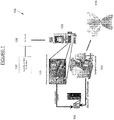
- FIGURE 1 illustrates a surgical system 100, according to one embodiment.
- the surgical system 100 can be the da Vinci® Surgical System, commercialized by Intuitive Surgical, Inc. Additional information on the da Vinci® Surgical System can be found in, e.g., U.S. Patents No. 6,441,577 (filed Apr. 3, 2001 ; disclosing "Manipulator Positioning Linkage for Robotic Surgery") and 7,155,315 (filed Dec. 12, 2005 ; disclosing "Camera Referenced Control in a Minimally Invasive Surgical Apparatus).
- da Vinci® Surgical System can be used in one embodiment, those of ordinary skill in the art will see that any surgical system can be used. Those of ordinary skill in the art will also see that there are other ways to collect data, and that example uses can be in many fields other than surgery, including but not limited to: rehabilitation, driving, and/or operating machinery.
- the surgical system 100 can include a surgeon's console 105, a vision cart 125, and a patient side cart 110.
- These main system 100 components may be interconnected in various ways, such as by electrical or optical cabling, or by wireless connections.
- Electronic data processing necessary to operate system 100 may be centralized in one of the main components, or it may be distributed among two or more of the main components (a reference to an electronic data processor, a computer, or a similar term, therefore, can include one or more actual hardware, firmware, or software components that may be used to produce a particular computational result).
- the patient side cart 110 can include one or more robotic manipulators and one or more movable surgical instrument components associated with such manipulators, such as the ones illustrated in FIGURE 13.
- FIGURE 13 illustrates various possible kinematic components and their associated movements (e.g., degrees of freedom, which may be variously defined as pitch, yaw, roll, insertion/withdrawal, grip, and the like) and also illustrative joints that may be associated with degrees of freedom for these components.
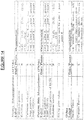
- FIGURE 14 illustrates possible parameters (data points) relating to these degrees of freedom, as well as other system components (e.g., kinematic parameters such as joint position and velocity, Cartesian position and velocity, rotation matrix values, etc.
- the surgical system may include an application programming interface (API), which may be accessed via an Ethernet connection on, e.g., an interface 115 on surgeon's console 105 or on another system component.
- API application programming interface
- Various system 100 parameters such as those identified with reference to FIGURE 14 , may be monitored and recorded (stored, archived, etc.) via the API.
- Video data collected by an endoscopic imaging system mounted on patient side cart 110 may be processed through vision cart 125 and output to the surgeon at surgeon's console 105.
- the video data may be stereoscopic (e.g., left and right eye channels, so as to give the illusion of depth in an apparent three-dimensional (3-D) image) or it may be monoscopic.
- the video data may be accessed via one or more video output ports in system 100, such as video output connectors located on interface 115.
- the accessed video data may be recorded, and the video data recording may be synchronized with data output via the API so that system parameters being monitored and video data may be recorded and stored as synchronized with one another.
- system 100 includes a computer 135, which may be a platform separate from and connected to one or more of the other system 100 components, or which may be integral with one or more of the other system 100 components.
- a quantifying skill computer application 130 can be stored in a memory to be accessed and executed by computer 135.
- FIGURE 9 illustrates details of the quantifying skill computer application 130, which can include a user interface 910, a comparing module 915, a modeling module 905, a teaching module 920, and a segmenting module 925.
- the user interface 910 can be used to interact with the user.
- the user interface 910 can display the motions and sub- motions that were tracked for a test, and also indicate which group that text was classified as, as well as disclosing the data behind that classification.
- the segmenting module 925 can be used to segment data from a procedure into surgemes and dexemes. The formula used to segment the data is described in more detail below.
- the comparing module 915 can be utilized to compare the data from a test user with data representing expert data, intermediate data, or novice data (or any level of expertise), and determine which level the test user should be designated as, based on the test user's movement data.
- the modeling module 905 can model movements of a particular skill level (e.g., an expert surgeon). For example, the modeling module 905 can take data that represents movements of an expert user and model those movements.
- the teaching module 920 can be utilized to teach a user how to do a particular task or sub-task. For example, the teaching module 920 can utilize the data modeling the movements of an expert and use that modeled data to train a user. The data modeling the movements of an expert can be obtained from the modeling module 905.
- Collected data can be encrypted and transferred to an attached portable cartridge (e.g., coupled to computer 135; not shown) using a cartridge drive at the end of a data collection session. Many recorded procedures carried out by one or more persons can be stored on the cartridge.
- the data from the cartridge can be uploaded to a secure repository (e.g., via a network or internetwork, such as the Internet), or the data from the cartridge drive can be physically sent to another system for storage and/or analysis.
- the collected data can be transferred from computer 135 directly via network or internetwork to a computer at another location for storage and/or analysis.
- An anonymized list of users that use the surgical system 100 can be maintained, and each user can be assigned a unique ID.
- the collected and archived data can use the unique ID so that the user can be identified only by the unique ID when doing further analysis.
- Archived data can be segmented at various granularity levels for a particular trial, task, or procedure.
- the archived data may be segmented into trial (e.g., procedure level) data, surgeme (e.g., prodecure sub-task level) data, or dexeme (e.g., particular motion component of sub-task level) data.
- trial e.g., procedure level
- surgeme e.g., prodecure sub-task level
- dexeme e.g., particular motion component of sub-task level
- Archived data can be securely stored. In one embodiment, only users or entities participating in the data collection may access the archived data.
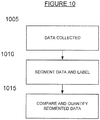
- FIGURE 10 illustrates a method for quantifying technical skill.
- data can be gathered from one or more surgical systems that are used to perform surgical procedures.
- a telerobotic surgical system such as the da Vinci® Surgical System can be utilized.
- the data is segmented and labeled.
- the segmented data can be compared to other segmented data and analyzed. The analyzed data can then be utilized to quantify the skill of the users of the surgical system. Details related to these elements are described in more detail below.
- data can be gathered from one or more surgical systems that one or more surgeons use to perform surgical procedures.
- motion data can be gathered from surgeons who have different expertise levels as the surgeons perform surgical tasks using the one or more surgical systems.
- a telerobotic surgical system can be used to perform a trial (e.g., procedure) that involves a suturing task (e.g., surgical joining of two surfaces).
- Data can be collected using the telerobotic surgical system.
- the data can comprise multiple positions, rotation angles, and velocities of the surgeon console master manipulators and/or the patient side manipulators of the telerobotic surgical system.
- the gathered data may also include video data collected from the surgical system during the trial or a portion of the trial, as described above.
- the trial data can be segmented and/or labeled.
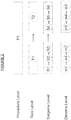
- FIGURE 2 illustrates various levels that can be used to segment (break up) a procedure, according to one embodiment.
- recorded data can be segmented into trial (e.g., procedure) data, task data, surgeme (e.g., sub-task) data, or dexeme (e.g., motion of sub-task) data. Skill evaluation and training can be done at each level.
- P1 can be the trial or procedure level (e.g., radical prostatectomy, hysterectomy, mitral valve repair).
- T1 and T2 are illustrative of various task levels (e.g., suturing), which are tasks that need to be done in the procedure.
- S1-S6 are illustrative of surgeme levels (e.g., needle pulling), which are sub- tasks needed for a task. As shown in FIGURE 2 , for example, task T1 is segmented into surgemes S1-S3, and task T2 is segmented into surgemes S4-S6.
- M1-M6 are illustrative of various dexeme levels, which are motion elements of a sub-task (dexemes represent small dextrous motions). Dexemes can be used to distinguish temporal sub-gestures of a single gesture, as well as stylistic variations between samples of the same gesture.
- some gestures in a suturing task can be more indicative of expertise than other gestures, such as pulling thread.
- Such fine grained assessment can lead to better automatic surgical assessment and training.
- surgeme S2 is segmented into dexemes M1, M4, and M2
- surgeme S5 is segmented into dexemes M5, M4, and M3.
- a particular dexeme may be a component of a single surgeme, or it may be a component of two or more surgemes.
- any relatively finer grained segment may be a component of only one or more than one relatively courser grained segment of the next highest level.
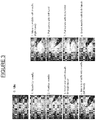
- FIGURE 3 illustrates how various surgemes can be manually segmented and labeled, according to one embodiment.
- FIGURE 3 illustrates an example of nine surgemes associated with a suturing task (not necessarily in order), with their respective labels. The following motion labels are provided to the nine surgemes: (0) idle position, (1) reach for needle, (2) position needle, (3) insert needle through tissue, (4) transfer needle from left to right hand, (5) move to center with needle in right hand, (6) pull suture with left hand, (7) pull suture with right hand, and (8) orient needle with both hands (the idle state may or may not be considered a surgeme; idle time doing nothing may be a characteristic that is desirable to monitor).
- the data is manually segmented and labeled.
- the surgemes can then be manually segmented into dexemes.
- the data can be automatically segmented into surgemes.
- the motion data can be automatically segmented by normalizing the data and projecting it to a lower dimension using linear discrimination analysis (LDA).
- LDA linear discrimination analysis
- a Bayes classifier can then decide the most likely surgeme present for each data in the lower dimension based on learned probabilities from training labeled data sets. For more information on how the data can be automatically segmented, see H. Lin et al., "Towards Automatic Skill Evaluation: Detection and Segmentation of Robot- Assisted Surgical Motions", Computer Aided Surgery, Sept. 2006, 11(5): 220-230 (2006 ).
- this automatic classification can be checked for accuracy.
- and ⁇ t ⁇ [ i ] for all t ⁇ [ b ⁇ i , ⁇ i ].
- the surgemes can also be automatically segmented using other methods.
- the motion data can be automatically segmented by normalizing the data and projecting it to a lower dimension using linear discrimination analysis (LDA), as described above. Then, the lower dimension data x t can be plugged in the following formula and run for every possible value for ⁇ (which can represent every type of way to segment the lower dimension data).
- LDA linear discrimination analysis
- S ⁇ denotes the hidden states of the model for surgeme ⁇
- s ' ) are the transition probabilities between these states
- N ( ⁇ ; ⁇ s , ⁇ s ) is a multivariate Gaussian density with mean ⁇ s and covariance ⁇ s associated with state s ⁇ S ⁇ .
- the value of ⁇ that gives the maximum value of P is the segmentation that is used for the surgemes.
- q t j ] is the output probability of symbol v k being emitted by state j; and the initial conditions of the system ⁇ .
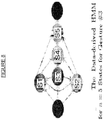
- FIGURE 8 illustrates a 5 state HMM for a particular surgeme corresponding to the act of "inserting needle through the tissue", according to one embodiment.
- Individual dexemes corresponding to HMM states a, b, c, d, and e can be isolated. It can then be determined that certain dexemes (e.g., a, b, c ) constitute rotating of the right hand patient-side wrist to drive the needle from the entry to the exit. In addition, it can be determined that, for example, the dexeme c movement, which corresponds to a sub-gesture where the surgeon hesitates/retracts while pushing the needle to the exit point, was from mostly novice surgeons.
- the segmented data produced in accordance with 1010 in FIGURE 10 can be used to identify the most likely skill model to have produced certain segmented data. For example, once the data has been segmented into a sequence of surgemes or dexemes, this sequence O test can be compared to various skill level models ⁇ e (expert), ⁇ i (intermediate), and ⁇ n (novice).
- the motion labels can be used to explore appropriate ways for evaluating the skill of the motions.
- the time per task (including the time per surgeme and dexeme) can be compared.
- idle motion time at the start and end of the trial (motion (0)) does not need to be used for data analysis.
- the motions, the timing of the motions, and the sequence of motions executed by the user can be used to make conclusions about the relative skill of a user that is performing each trial.
- FIGURE 4 illustrates the difference between the movements of experts, intermediates, and novice surgeons. As the surgeon's skill increases, the graph of his or her movements shows that the movements become more directed. In this example, the expert surgeon (shown as graphs (a) and (d)) accomplishes a task using fewer movements, whereas the novice surgeon (shown as graphs (c) and (f)) made more errors during the task and thus used extraneous motions and started over.
- FIGURE 4 also illustrates that an idle surgeme during a task may represent an error (e.g., dropping a needle), and so may be significant to a skill level analysis. Thus an otherwise substantially similar surgeme may be assigned a separate label, or it may be identified as significant because of its position in a sequence of surgemes.
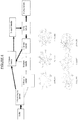
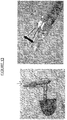
- FIGURE 5 illustrates typical transitions between surgemes during a sample trial.
- the transitions between surgemes reveals immediate differences in the approach taken between experts and novices. Experts can use one particular pattern of motions repeatedly throughout the task. Consequently, users who have a relatively higher skill level can create more directed transition graphs than users who have a relatively lower skill level. For example, after pushing the needle through simulated tissue from the target entry point to the target exit point, as shown in the top portion of FIGURE 5 , an expert's trials can show the suture is pulled taut with the left tool, and then the needle is handled to the right tool for another round of positioning and insertion (this sequence is represented as surgemes 6, 4, 2, 3 in the bottom portion of FIGURE 5 ).
- FIGURE 5 illustrates that the duration of a sequence of one or more surgemes can be measured.
- the average time for surgemes 4, 6, and 7 on a per-trial basis for experts was 13.34 seconds. This same statistic for intermediates and novices were 20.11 and 16.48 seconds, respectively. It thus can be concluded that choosing to pull the suture in two steps was less time-efficient. Additionally, it can be shown that by choosing to pull the suture to the right across the wound with the right instrument, intermediate and novice surgeons place undue stress on the tissue that ought to be avoided.
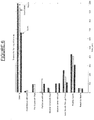
- FIGURE 6 illustrates an embodiment in which the time for various surgeme motions is analyzed. For example, less experienced surgeons typically spent more time positioning and inserting the needle (surgeme motions 2 and 3, respectively) than experts, particularly to guide the needle tip to emerge through the marked exit point. In one case, manual analysis revealed that experts spent a per-trial average of 28.04 seconds using motions 2 and 3 collectively, intermediates 48.51 seconds, and novices 56.59 seconds.
- FIGURE 6 another indicator of skill was that experts hardly used intermediate positioning surgemes, such as motion 5 (move to center with right hand), motion 7 (pulling suture with right hand), and motion 8 (orienting the needle with both tools), which are shown by the bottom bars associated with each surgeme in FIGURE 6 .
- intermediate positioning surgemes such as motion 5 (move to center with right hand), motion 7 (pulling suture with right hand), and motion 8 (orienting the needle with both tools), which are shown by the bottom bars associated with each surgeme in FIGURE 6 .
- intermediates used this two hand orienting motion surgeme twelve times and required fewer motions to complete a task more quickly than surgeons with even less skill.
- Such economy of motion is often subjectively gauged for surgical skill evaluation, and it is now objectively shown in accordance with the analysis embodiment illustrated in FIGURE 6 .
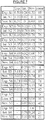
- FIGURE 7 illustrates an example embodiment analysis of isolated surgeme classification systems that have been correctly identified.
- FIGURE 7 sets forth eight surgemes, and how they were classified, and how that classification compared to training classifications. Reading across the rows indicates how many times each surgeme motion was correctly recognized and how many times it was mistaken for another skill level. For example, expert surgeme 1 was correctly recognized 8 times and mistaken for intermediate 2 times and novice 2 times. In particular, with respect to surgeme 1, the expert level for surgeme 1 was correctly classified as an expert level 50 % of the time, incorrectly classified as an intermediate level 28% of the time, and incorrectly classified as a novice level 22% of the time.
- the intermediate level for surgeme 1 was correctly classified as an intermediate level 67% of the time, incorrectly classified as an expert level 33% of the time, and incorrectly classified as a novice level 0% of the time.
- the novice level for surgeme 1 was correctly classified as a novice level 69% of the time, incorrectly classified as an expert level 31% of the time, and incorrectly classified as an intermediate level 0% of the time.
- FIGURE 7 there are no models for surgeme motion 5, 7, and 8 of an expert, and no models for surgeme motion 4 of an intermediate, because in this example, these surgeme motions were never used by these expertise groups.
- surgemes 2, 3, 4 there were higher recognition rates for surgemes where experts performed more efficiently than novices (surgemes 2, 3, 4) than surgemes that experts did not use (surgemes 5, 7, 8).
- surgemes 1, 7, 8 For the surgemes that experts did not use, intermediates and novices were commonly misclassified with each other, suggesting that they performed these surgemes very similarly.
- Surgemes 1 (66.8% overall; 67% expert; 75% intermediate; 50% novice) and 6 (66.8% overall; 65% expert; 92% intermediate; 50% novice) were difficult to classify correctly, indicating that certain surgemes are not as discriminative of skill as others.
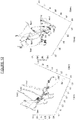
- the left side portion of FIGURE 12 illustrates the Cartesian positions of the right hand of an expert performing a four-throw suturing task
- the right side portion of FIGURE 12 illustrates the Cartesian positions of the right hand of a novice performing the same four-throw suturing task.
- Various colors and/or marks along the position lines may be associated with the various surgemes each surgeon used during the task. This figure graphically illustrates the many differences in movement between a surgeon with an expert skill level and a surgeon with a novice skill level.
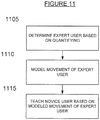
- FIGURE 11 illustrates a method based on the information learned by the quantifying skill application 130 of teaching a user how to perform a surgical task with more proficiency, according to one embodiment.
- information about how an expert surgeon performs a procedure or task e.g., at the surgeme or dexeme level
- the movement of the expert surgeon is modeled using modeling module 905.
- a user is taught, using the teaching module 920, the movements of an expert surgeon using the modeled movements found at the expert surgeon level. For example, the user may be shown how his or her movements compare with an expert's movements by viewing analysis data as illustrated by the various embodiments described herein.
- either a single expert's motions or a composite of expert motions may be "played back" (with or without associated video) via a powered master manipulator, so that a novice may lightly grasp the manipulator and follow along to kinesthetically experience how the expert moves.
- a simulated motion of an expert's tool can be displayed in the surgeon's console to allow the novice to follow along by moving a simulated or real tool to mimic the expert's tool motion.
- surgemes or dexemes are identified as particularly difficult to learn, such surgemes or dexemes can be repeatedly played back to the novice and or monitored as the novice practices the movements until a skill level assessment comparable to the expert's is achieved. And, novice surgeons are motivated to achieve assessment level scores comparable to an expert's.
- Particular tasks, surgemes, and/or dexemes can be identified for each trainee to practice and master, and the analysis features in accordance with aspects of this invention allow the trainee to quickly assess performance.
Landscapes
- Engineering & Computer Science (AREA)
- Physics & Mathematics (AREA)
- General Physics & Mathematics (AREA)
- Theoretical Computer Science (AREA)
- Business, Economics & Management (AREA)
- Educational Administration (AREA)
- Educational Technology (AREA)
- Health & Medical Sciences (AREA)
- General Health & Medical Sciences (AREA)
- Medical Informatics (AREA)
- Mathematical Optimization (AREA)
- Medicinal Chemistry (AREA)
- Algebra (AREA)
- Computational Mathematics (AREA)
- Mathematical Analysis (AREA)
- Chemical & Material Sciences (AREA)
- Mathematical Physics (AREA)
- Pure & Applied Mathematics (AREA)
- Surgery (AREA)
- Life Sciences & Earth Sciences (AREA)
- Entrepreneurship & Innovation (AREA)
- Public Health (AREA)
- Nuclear Medicine, Radiotherapy & Molecular Imaging (AREA)
- Biomedical Technology (AREA)
- Heart & Thoracic Surgery (AREA)
- Molecular Biology (AREA)
- Animal Behavior & Ethology (AREA)
- Robotics (AREA)
- Veterinary Medicine (AREA)
- Instructional Devices (AREA)
- Medical Treatment And Welfare Office Work (AREA)
- Automatic Analysis And Handling Materials Therefor (AREA)
- Image Analysis (AREA)
- Measurement Of The Respiration, Hearing Ability, Form, And Blood Characteristics Of Living Organisms (AREA)
Claims (7)
- Verfahren zur Quantifizierung klinischer Kompetenzen mindestens eines Benutzers, umfassend:Sammeln von Bewegungsdaten, die in mindestens einer Datenbank zu speichern sind, wobei sich die Bewegungsdaten auf mindestens eine chirurgische Aufgabe (T1; T2) beziehen, die von mindestens einem Benutzer unter Verwendung mindestens eines chirurgischen Roboters (110) erledigt wird;Segmentieren (1010) der chirurgischen Bewegungsdaten in mehrfache Surgeme (S1-S6) und mehrfache Dexeme (M1-M6), wobei jedes Surgem eine Unteraufgabe der chirurgischen Aufgabe umfasst und jedes Dexem eine jeweilige Bewegungskomponente der Unteraufgabe umfasst, und wobei das Segmentieren der Bewegungsdaten in Surgeme und Dexeme das Normalisieren der Bewegungsdaten, deren Projizieren auf eine niedere Dimension unter Verwendung von linearer Diskriminanzanalyse und das Anwenden der folgenden Formel auf die niederen Dimensionsdaten xt für jeden möglichen Wert von σ umfasst:
 Vergleichen (1005) der Bewegungsdaten für die mindestens eine chirurgische Aufgabe mit anderen Bewegungsdaten für mindestens eine andere ähnliche chirurgische Aufgabe unter Verwendung mindestens eines Vergleichsmoduls (915);Quantifizieren (1015) der klinischen Kompetenz des mindestens einen Benutzers, unter Verwendung des mindestens einen Vergleichsmoduls (915), auf Basis des Vergleichs der Bewegungsdaten für die mindestens eine chirurgische Aufgabe mit den anderen Bewegungsdaten für die mindestens eine andere ähnliche chirurgische Aufgabe;Bestimmen, unter Benutzung des mindestens einen Vergleichsmoduls (915), mindestens eines Expertenbenutzers auf Basis des Vergleichs;Modellieren (1110), unter Verwendung mindestens eines Modellierungsmoduls (905), mindestens einer Bewegung des mindestens einen Expertenbenutzers in Bezug auf die Surgeme und Dexeme;Lehren (1115), unter Verwendung mindestens eines Lehrmoduls (920), mindestens eines Anfängerbenutzers auf Basis mindestens einer modellierten Bewegung des mindestens einen Expertenbenutzers durch Anleiten mindestens einer Bewegung des Anfängerbenutzers auf Basis der modellierten Bewegung des Expertenbenutzers.
 - Verfahren nach Anspruch 1, ferner umfassend:
Annotieren, unter Verwendung des mindestens einen Vergleichsmoduls (915), der mindestens einen chirurgischen Aufgabe als auf einem Anfängerniveau, und Zwischenniveau, oder einem Expertenniveau befindlich. - Verfahren nach Anspruch 1, wobei das Lehren (1115) ohne eine menschliche Aufsichtskraft erfolgen kann.
- Verfahren nach einem der Ansprüche 1 bis 3, wobei das Niveau der klinischen Expertise des mindestens einen Benutzers unter Verwendung von Vergleichen verschiedener zugrunde liegender Modelle unterschieden wird.
- Verfahren nach einem der Ansprüche 1 bis 4, wobei jede Aufgabe, bei der Kompetenzen unter körperlicher Bewegung entwickelt werden, quantifiziert werden kann.
- Verfahren nach einem der Ansprüche 1 bis 5, ferner umfassend:Sammeln, unter Verwendung mindestens einer Benutzeroberfläche (115) für den chirurgischen Roboter (110), von Daten, die angeben, wie mindestens ein kompetenter Benutzer mindestens eine chirurgische Aufgabe durchführt;Sammeln, unter Verwendung der mindestens einen Benutzeroberfläche (115), von Daten, die angeben, wie mindestens ein anderer Benutzer die mindestens eine chirurgische Aufgabe durchführt;Vergleichen, unter Verwendung des mindestens einen Vergleichsmoduls (915), der gesammelten Daten für den mindestens einen kompetenten Benutzer mit den gesammelten Daten für den mindestens einen anderen Benutzer, um das klinische Kompetenzniveau des mindestens einen anderen Benutzers zu bestimmen; undAusgeben, unter Verwendung der mindestens einen Benutzeroberfläche (115), des klinischen Kompetenzniveaus des mindestens einen anderen Benutzers.
- Computerprogramm umfassend Computerprogrammcode, um einem Computer zu ermöglichen, ein Verfahren nach einem der Ansprüche 1 bis 6 auszuführen, wobei das Programm auf einem Computer (135) läuft.
Applications Claiming Priority (2)
| Application Number | Priority Date | Filing Date | Title |
|---|---|---|---|
| US16200709P | 2009-03-20 | 2009-03-20 | |
| PCT/US2010/028025 WO2010108128A2 (en) | 2009-03-20 | 2010-03-19 | Method and system for quantifying technical skill |
Publications (3)
| Publication Number | Publication Date |
|---|---|
| EP2409286A2 EP2409286A2 (de) | 2012-01-25 |
| EP2409286A4 EP2409286A4 (de) | 2015-03-04 |
| EP2409286B1 true EP2409286B1 (de) | 2018-09-05 |
Family
ID=42740264
Family Applications (1)
| Application Number | Title | Priority Date | Filing Date |
|---|---|---|---|
| EP10754196.3A Active EP2409286B1 (de) | 2009-03-20 | 2010-03-19 | Verfahren und system zur quantifizierung technischer kompetenzen |
Country Status (6)
| Country | Link |
|---|---|
| US (4) | US9196176B2 (de) |
| EP (1) | EP2409286B1 (de) |
| JP (1) | JP5726850B2 (de) |
| KR (1) | KR101914303B1 (de) |
| CN (1) | CN102362302B (de) |
| WO (1) | WO2010108128A2 (de) |
Families Citing this family (74)
| Publication number | Priority date | Publication date | Assignee | Title |
|---|---|---|---|---|
| US8556807B2 (en) * | 2006-12-21 | 2013-10-15 | Intuitive Surgical Operations, Inc. | Hermetically sealed distal sensor endoscope |
| US8814779B2 (en) | 2006-12-21 | 2014-08-26 | Intuitive Surgical Operations, Inc. | Stereoscopic endoscope |
| EP3392863B1 (de) | 2010-10-01 | 2020-04-22 | Applied Medical Resources Corporation | Tragbarer laparoskopischer trainer |
| US20140287393A1 (en) * | 2010-11-04 | 2014-09-25 | The Johns Hopkins University | System and method for the evaluation of or improvement of minimally invasive surgery skills |
| JP2014506695A (ja) * | 2011-01-30 | 2014-03-17 | ミレイ,ラム スリカンス | 技術評価 |
| US9026247B2 (en) | 2011-03-30 | 2015-05-05 | University of Washington through its Center for Communication | Motion and video capture for tracking and evaluating robotic surgery and associated systems and methods |
| ES2640005T3 (es) | 2011-10-21 | 2017-10-31 | Applied Medical Resources Corporation | Estructura de tejido simulado para entrenamiento quirúrgico |
| KR101953187B1 (ko) | 2011-12-20 | 2019-02-28 | 어플라이드 메디컬 리소시스 코포레이션 | 어드밴스드 수술 시뮬레이션 |
| JP5938987B2 (ja) * | 2012-03-28 | 2016-06-22 | ソニー株式会社 | 情報処理装置、情報処理方法及びプログラム |
| WO2013154764A1 (en) * | 2012-04-11 | 2013-10-17 | Eastern Virginia Medical School | Automated intelligent mentoring system (aims) |
| US9148443B2 (en) | 2012-07-06 | 2015-09-29 | University of Washington through its Center for Commericalization | Enhanced security and safety in telerobotic systems |
| KR20150037987A (ko) | 2012-08-03 | 2015-04-08 | 어플라이드 메디컬 리소시스 코포레이션 | 수술 트레이닝용 모조 스테플링 및 에너지 기반 결찰 |
| US20140051049A1 (en) | 2012-08-17 | 2014-02-20 | Intuitive Surgical Operations, Inc. | Anatomical model and method for surgical training |
| KR102105979B1 (ko) | 2012-09-26 | 2020-05-04 | 어플라이드 메디컬 리소시스 코포레이션 | 복강경 절차들을 위한 수술 훈련 모델 |
| AU2013323603B2 (en) | 2012-09-27 | 2017-01-19 | Applied Medical Resources Corporation | Surgical training model for laparoscopic procedures |
| US10121391B2 (en) | 2012-09-27 | 2018-11-06 | Applied Medical Resources Corporation | Surgical training model for laparoscopic procedures |
| US10679520B2 (en) | 2012-09-27 | 2020-06-09 | Applied Medical Resources Corporation | Surgical training model for laparoscopic procedures |
| CA2885326A1 (en) | 2012-09-28 | 2014-04-03 | Applied Medical Resources Corporation | Surgical training model for laparoscopic procedures |
| JP6315712B2 (ja) | 2012-09-28 | 2018-04-25 | アプライド メディカル リソーシーズ コーポレイション | 経管的腹腔鏡下手技のための外科用訓練モデル |
| JP6306024B2 (ja) * | 2012-10-01 | 2018-04-04 | コーニンクレッカ フィリップス エヌ ヴェKoninklijke Philips N.V. | デバイス形状センシングを用いた臨床意思決定支援及びトレーニングシステム |
| US9070306B2 (en) * | 2012-11-02 | 2015-06-30 | Digital Surgicals Pte. Ltd. | Apparatus, method and system for microsurgical suture training |
| WO2014134597A1 (en) | 2013-03-01 | 2014-09-04 | Applied Medical Resources Corporation | Advanced surgical simulation constructions and methods |
| CA3139494A1 (en) | 2013-05-15 | 2014-11-20 | Applied Medical Resources Corporation | Hernia model |
| KR102420272B1 (ko) | 2013-06-18 | 2022-07-13 | 어플라이드 메디컬 리소시스 코포레이션 | 수술 절차들을 가르치고 실습하기 위한 담낭 모델 |
| US10198966B2 (en) | 2013-07-24 | 2019-02-05 | Applied Medical Resources Corporation | Advanced first entry model for surgical simulation |
| US9548002B2 (en) | 2013-07-24 | 2017-01-17 | Applied Medical Resources Corporation | First entry model |
| JP6659547B2 (ja) | 2013-12-20 | 2020-03-04 | インテュイティブ サージカル オペレーションズ, インコーポレイテッド | 医療処置トレーニングのためのシミュレータシステム |
| ES3048176T3 (en) | 2014-03-26 | 2025-12-09 | Applied Med Resources | Simulated dissectible tissue |
| JP6238840B2 (ja) * | 2014-06-09 | 2017-11-29 | オリンパス株式会社 | 医療業務支援装置 |
| CN105321415A (zh) * | 2014-08-01 | 2016-02-10 | 卓思生命科技有限公司 | 一种手术模拟系统及方法 |
| US10668353B2 (en) | 2014-08-11 | 2020-06-02 | Icuemotion Llc | Codification and cueing system for sport and vocational activities |
| KR102615540B1 (ko) | 2014-11-13 | 2023-12-19 | 어플라이드 메디컬 리소시스 코포레이션 | 시뮬레이션된 조직 모델들 및 방법들 |
| KR20250033336A (ko) | 2015-02-19 | 2025-03-07 | 어플라이드 메디컬 리소시스 코포레이션 | 시뮬레이션된 조직 구조체들 및 방법들 |
| EP3288487B1 (de) * | 2015-04-29 | 2020-07-22 | Dentsply Sirona Inc. | System und verfahren zur schulung von zahnärzten in endodontischen behandlungstechniken |
| JP2018514805A (ja) | 2015-05-14 | 2018-06-07 | アプライド メディカル リソーシーズ コーポレイション | 電気手術トレーニングおよびシミュレーション用の合成組織構造 |
| KR102323336B1 (ko) * | 2015-05-15 | 2021-11-08 | 마코 서지컬 코포레이션 | 로봇식 의료 절차에 대한 지침을 제공하기 위한 시스템들 및 방법들 |
| CN107106246B (zh) | 2015-05-21 | 2019-09-24 | 奥林巴斯株式会社 | 医疗用机械手系统 |
| US12512017B2 (en) | 2015-05-27 | 2025-12-30 | Applied Medical Resources Corporation | Surgical training model for laparoscopic procedures |
| EP3304526B1 (de) * | 2015-05-27 | 2023-07-05 | Applied Medical Resources Corporation | Modell für chirurgisches training von laparoskopischen eingriffen |
| EP4571775A3 (de) | 2015-06-09 | 2025-08-20 | Intuitive Surgical Operations, Inc. | Konfiguration eines chirurgischen systems mit atlas von chirurgischen eingriffen |
| CA2988767A1 (en) | 2015-06-09 | 2016-12-15 | Applied Medical Resources Corporation | Hysterectomy model |
| ES3053258T3 (en) | 2015-07-16 | 2026-01-21 | Applied Med Resources | Simulated dissectable tissue |
| WO2017015438A1 (en) | 2015-07-22 | 2017-01-26 | Applied Medical Resources Corporation | Appendectomy model |
| US10854104B2 (en) | 2015-08-28 | 2020-12-01 | Icuemotion Llc | System for movement skill analysis and skill augmentation and cueing |
| CA3025540A1 (en) | 2015-10-02 | 2017-04-06 | Applied Medical Resources Corporation | Hysterectomy model |
| KR20180068336A (ko) | 2015-11-12 | 2018-06-21 | 인튜어티브 서지컬 오퍼레이션즈 인코포레이티드 | 훈련 또는 보조 기능들을 갖는 수술 시스템 |
| AU2016358076A1 (en) | 2015-11-20 | 2018-04-12 | Applied Medical Resources Corporation | Simulated dissectible tissue |
| CN105608945B (zh) * | 2016-03-04 | 2018-07-20 | 南昌大学 | 一种沉浸式自适应位姿虚拟手术训练平台 |
| WO2018005301A1 (en) | 2016-06-27 | 2018-01-04 | Applied Medical Resources Corporation | Simulated abdominal wall |
| CN109313928B (zh) * | 2016-06-30 | 2022-03-25 | 奥林巴斯株式会社 | 医疗信息提供系统以及医疗信息提供方法 |
| RU2641612C2 (ru) * | 2016-07-04 | 2018-01-18 | Акционерное общество Центральное конструкторское бюро аппаратостроения | Тренажер-манипулятор для подготовки операторов комплексов вооружения |
| EP3538012B1 (de) | 2016-11-11 | 2025-04-23 | Intuitive Surgical Operations, Inc. | Telebetriebenes chirurgisches system mit instrumentensteuerung auf basis des kompetenzniveaus des chirurgen |
| AU2018220845B2 (en) | 2017-02-14 | 2023-11-23 | Applied Medical Resources Corporation | Laparoscopic training system |
| WO2018156544A1 (en) | 2017-02-23 | 2018-08-30 | Applied Medical Resources Corporation | Synthetic tissue structures for electrosurgical training and simulation |
| RU2662379C1 (ru) * | 2017-03-20 | 2018-07-25 | Акционерное общество "Ульяновский механический завод" | Пункт управления занятиями по подготовке боевых расчетов зенитного ракетного комплекса |
| RU2657708C1 (ru) * | 2017-04-17 | 2018-06-14 | Федеральное государственное бюджетное образовательное учреждение высшего образования "Морской государственный университет имени адмирала Г.И. Невельского" | Тренажерный комплекс для подготовки судоводителей |
| RU2666039C1 (ru) * | 2017-06-20 | 2018-09-05 | Общество с ограниченной ответственностью "Научно-технический центр компьютерных технологий "Тор" (ООО "НТЦКТ "Тор") | Комплексная тренажерная система для подготовки специалистов противовоздушной обороны |
| EP3649633A4 (de) * | 2017-07-06 | 2021-03-10 | Icuemotion LLC | Systeme und verfahren für datengesteuertes bewegungsfähigkeitstraining |
| US11213353B2 (en) | 2017-08-22 | 2022-01-04 | Covidien Lp | Systems and methods for planning a surgical procedure and evaluating the performance of a surgical procedure |
| KR101862360B1 (ko) * | 2017-12-28 | 2018-06-29 | (주)휴톰 | 수술결과에 대한 피드백 제공방법 및 프로그램 |
| KR102529023B1 (ko) * | 2018-08-10 | 2023-05-08 | 카와사키 주코교 카부시키 카이샤 | 트레이닝 처리 장치, 중개 장치, 트레이닝 시스템 및 트레이닝 처리 방법 |
| JP7384575B2 (ja) * | 2018-08-10 | 2023-11-21 | 川崎重工業株式会社 | 情報処理装置、仲介装置、シミュレートシステム、情報処理方法及びプログラム |
| JP7103078B2 (ja) * | 2018-08-31 | 2022-07-20 | オムロン株式会社 | 作業支援装置、作業支援方法及び作業支援プログラム |
| WO2020163352A1 (en) * | 2019-02-05 | 2020-08-13 | Smith & Nephew, Inc. | Computer-assisted arthroplasty system |
| JPWO2020213484A1 (de) * | 2019-04-19 | 2020-10-22 | ||
| CN112489541A (zh) * | 2019-09-12 | 2021-03-12 | 吴文钧 | 医疗训练的多媒体辅助系统 |
| DE102019216560B4 (de) * | 2019-10-28 | 2022-01-13 | Robert Bosch Gmbh | Verfahren und Vorrichtung zum Trainieren von Manipulationsfertigkeiten eines Robotersystems |
| WO2022014255A1 (en) * | 2020-07-14 | 2022-01-20 | Sony Group Corporation | Determination of surgical performance level |
| US12541733B2 (en) | 2020-12-21 | 2026-02-03 | Icuemotion Llc | Assessment and augmentation system for open motor skills |
| CN113017830A (zh) * | 2021-02-23 | 2021-06-25 | 刘睿 | 一种基于视频识别的显微外科吻合操作评分系统 |
| WO2022204083A1 (en) * | 2021-03-25 | 2022-09-29 | The Johns Hopkins University | Systems and methods for assessing surgical skill |
| US20230372013A1 (en) * | 2022-05-18 | 2023-11-23 | Cilag Gmbh International | Aggregation of patient, procedure, surgeon, and facility pre-surgical data and population and adaptation of a starting procedure plan template |
| JPWO2024242048A1 (de) * | 2023-05-19 | 2024-11-28 | ||
| CN122121819A (zh) * | 2023-11-01 | 2026-05-29 | 奥瑞斯健康公司 | 用于实施定制化用户培训程序的机器人外科系统和方法 |
Family Cites Families (26)
| Publication number | Priority date | Publication date | Assignee | Title |
|---|---|---|---|---|
| US5766016A (en) | 1994-11-14 | 1998-06-16 | Georgia Tech Research Corporation | Surgical simulator and method for simulating surgical procedure |
| US5682886A (en) | 1995-12-26 | 1997-11-04 | Musculographics Inc | Computer-assisted surgical system |
| DE69940850D1 (de) * | 1998-08-04 | 2009-06-18 | Intuitive Surgical Inc | Gelenkvorrichtung zur Positionierung eines Manipulators für Robotik-Chirurgie |
| US6852107B2 (en) * | 2002-01-16 | 2005-02-08 | Computer Motion, Inc. | Minimally invasive surgical training using robotics and tele-collaboration |
| JP3660521B2 (ja) | 1999-04-02 | 2005-06-15 | 株式会社モリタ製作所 | 医療実習装置及び医療用実習評価方法 |
| US6424885B1 (en) * | 1999-04-07 | 2002-07-23 | Intuitive Surgical, Inc. | Camera referenced control in a minimally invasive surgical apparatus |
| US6386882B1 (en) * | 1999-11-10 | 2002-05-14 | Medtronic, Inc. | Remote delivery of software-based training for implantable medical device systems |
| JP3769469B2 (ja) * | 2001-03-28 | 2006-04-26 | 株式会社東芝 | 操作訓練用装置 |
| AU2002250512A1 (en) | 2001-04-05 | 2002-10-21 | The Regents Of The University Of California | Robotic device for locomotor training |
| DE10130485C2 (de) | 2001-06-25 | 2003-06-26 | Robert Riener | Programmierbarer Gelenksimulator |
| WO2003030724A2 (en) * | 2001-10-12 | 2003-04-17 | University Of Utah Research Foundation | Anesthesia drug monitor |
| EP1501406A4 (de) * | 2002-04-16 | 2006-08-30 | Philip C Noble | Computergestützte schulungsverfahren für chirurgische eingriffe |
| JP2004046102A (ja) * | 2002-05-12 | 2004-02-12 | Morita Mfg Co Ltd | ネットワーク対応型医療用診療実習シミュレーション装置 |
| JP4292837B2 (ja) * | 2002-07-16 | 2009-07-08 | 日本電気株式会社 | パターン特徴抽出方法及びその装置 |
| JP2004348095A (ja) | 2003-03-26 | 2004-12-09 | National Institute Of Advanced Industrial & Technology | トレーニングシステム |
| KR20040084243A (ko) * | 2003-03-27 | 2004-10-06 | 학교법인 경희대학교 | 인공고관절 가상 시술 시뮬레이션 시스템 |
| JP3735672B2 (ja) | 2003-07-22 | 2006-01-18 | 国立大学法人岐阜大学 | リハビリテーション訓練技術教育装置 |
| JP4378127B2 (ja) | 2003-07-23 | 2009-12-02 | キヤノン株式会社 | 駆動伝達部材の軸心位置決め方法 |
| WO2006016348A1 (en) * | 2004-08-13 | 2006-02-16 | Haptica Limited | A method and system for generating a surgical training module |
| US20070172803A1 (en) * | 2005-08-26 | 2007-07-26 | Blake Hannaford | Skill evaluation |
| CN100493460C (zh) * | 2007-04-12 | 2009-06-03 | 中国人民解放军第三军医大学第一附属医院 | 一种虚拟经食道超声心动图系统 |
| CN101049248A (zh) | 2007-05-18 | 2007-10-10 | 西安工业大学 | 光磁电复合导航手术定位装置和方法 |
| CN201156345Y (zh) * | 2008-01-10 | 2008-11-26 | 傅强 | 内窥镜微创手术仿真系统 |
| US20100167253A1 (en) * | 2008-12-31 | 2010-07-01 | Haptica Ltd. | Surgical training simulator |
| US20130157239A1 (en) * | 2011-12-16 | 2013-06-20 | Board Of Regents Of The Nevada System Of Higher Education, On Behalf Of The University Of Nevada | Augmented reality tele-mentoring (art) platform for laparoscopic training |
| WO2016109575A1 (en) * | 2014-12-29 | 2016-07-07 | Help Me See Inc. | Surgical simulator system and method |
-
2010
- 2010-03-19 JP JP2012501005A patent/JP5726850B2/ja active Active
- 2010-03-19 EP EP10754196.3A patent/EP2409286B1/de active Active
- 2010-03-19 CN CN201080013001.XA patent/CN102362302B/zh active Active
- 2010-03-19 KR KR1020117024589A patent/KR101914303B1/ko active Active
- 2010-03-19 US US13/257,517 patent/US9196176B2/en active Active
- 2010-03-19 WO PCT/US2010/028025 patent/WO2010108128A2/en not_active Ceased
-
2015
- 2015-10-07 US US14/877,588 patent/US9691290B2/en active Active
-
2017
- 2017-04-19 US US15/491,640 patent/US10008129B2/en active Active
-
2018
- 2018-05-04 US US15/971,328 patent/US20180253994A1/en not_active Abandoned
Non-Patent Citations (1)
| Title |
|---|
| None * |
Also Published As
| Publication number | Publication date |
|---|---|
| US20170221385A1 (en) | 2017-08-03 |
| WO2010108128A2 (en) | 2010-09-23 |
| CN102362302B (zh) | 2016-01-06 |
| US20180253994A1 (en) | 2018-09-06 |
| US10008129B2 (en) | 2018-06-26 |
| EP2409286A4 (de) | 2015-03-04 |
| US20120189996A1 (en) | 2012-07-26 |
| KR20120013955A (ko) | 2012-02-15 |
| JP5726850B2 (ja) | 2015-06-03 |
| CN102362302A (zh) | 2012-02-22 |
| EP2409286A2 (de) | 2012-01-25 |
| WO2010108128A3 (en) | 2011-01-13 |
| JP2012521568A (ja) | 2012-09-13 |
| KR101914303B1 (ko) | 2018-11-01 |
| US9196176B2 (en) | 2015-11-24 |
| US9691290B2 (en) | 2017-06-27 |
| US20160098933A1 (en) | 2016-04-07 |
Similar Documents
| Publication | Publication Date | Title |
|---|---|---|
| US10008129B2 (en) | Systems for quantifying clinical skill | |
| Reiley et al. | Task versus subtask surgical skill evaluation of robotic minimally invasive surgery | |
| CN103299355B (zh) | 用于微创手术技能的评估或改进的系统和方法 | |
| Rosen et al. | Markov modeling of minimally invasive surgery based on tool/tissue interaction and force/torque signatures for evaluating surgical skills | |
| Balazs Vagvolgyi et al. | Automatic recognition of surgical motions using statistical modeling for capturing variability | |
| JP6169562B2 (ja) | サンプルタスク軌跡を分析する、コンピュータで実現される方法、および、サンプルタスク軌跡を分析するシステム | |
| Gao et al. | Jhu-isi gesture and skill assessment working set (jigsaws): A surgical activity dataset for human motion modeling | |
| US20070172803A1 (en) | Skill evaluation | |
| US20110020779A1 (en) | Skill evaluation using spherical motion mechanism | |
| Leong et al. | HMM assessment of quality of movement trajectory in laparoscopic surgery | |
| Menegozzo et al. | Surgical gesture recognition with time delay neural network based on kinematic data | |
| US20230298482A1 (en) | Determination of surgical performance level | |
| Reiley et al. | Decomposition of robotic surgical tasks: an analysis of subtasks and their correlation to skill | |
| Wang et al. | Uncertainty-aware self-supervised learning for cross-domain technical skill assessment in robot-assisted surgery | |
| Su et al. | Cutting skill assessment by motion analysis using deep learning and spatial marker tracking | |
| Hendricks et al. | Exploring the limitations and implications of the JIGSAWS dataset for robot-assisted surgery | |
| US20240038097A1 (en) | Surgical instrument | |
| Murphy | Towards objective surgical skill evaluation with hidden Markov model-based motion recognition | |
| Chen et al. | Visual modelling and evaluation of surgical skill | |
| Selvaggio et al. | Physics-based task classification of da vinci robot surgical procedures | |
| Rosen et al. | Objective evaluation of laparoscopic surgical skills using hidden Markov models based on haptic information and tool/tissue interactions | |
| Oshima et al. | Development of a suture training simulator with quantitative evaluation function | |
| Tonetti | Laparoscopy skills characterization through the learner's gesture analysis on training simulators | |
| Selvaggio et al. | Task classification of robotic surgical reconstructive procedures using force measurements | |
| French | Motion Analysis through Crowd-sourced Assessment and Feature Design with Applications to Surgical Technical Skill Evaluation |
Legal Events
| Date | Code | Title | Description |
|---|---|---|---|
| PUAI | Public reference made under article 153(3) epc to a published international application that has entered the european phase |
Free format text: ORIGINAL CODE: 0009012 |
|
| 17P | Request for examination filed |
Effective date: 20111018 |
|
| AK | Designated contracting states |
Kind code of ref document: A2 Designated state(s): AT BE BG CH CY CZ DE DK EE ES FI FR GB GR HR HU IE IS IT LI LT LU LV MC MK MT NL NO PL PT RO SE SI SK SM TR |
|
| DAX | Request for extension of the european patent (deleted) | ||
| A4 | Supplementary search report drawn up and despatched |
Effective date: 20150129 |
|
| RIC1 | Information provided on ipc code assigned before grant |
Ipc: G09B 9/00 20060101ALI20150123BHEP Ipc: G09B 5/02 20060101AFI20150123BHEP |
|
| 17Q | First examination report despatched |
Effective date: 20160801 |
|
| STAA | Information on the status of an ep patent application or granted ep patent |
Free format text: STATUS: EXAMINATION IS IN PROGRESS |
|
| GRAP | Despatch of communication of intention to grant a patent |
Free format text: ORIGINAL CODE: EPIDOSNIGR1 |
|
| STAA | Information on the status of an ep patent application or granted ep patent |
Free format text: STATUS: GRANT OF PATENT IS INTENDED |
|
| INTG | Intention to grant announced |
Effective date: 20180314 |
|
| GRAS | Grant fee paid |
Free format text: ORIGINAL CODE: EPIDOSNIGR3 |
|
| GRAA | (expected) grant |
Free format text: ORIGINAL CODE: 0009210 |
|
| STAA | Information on the status of an ep patent application or granted ep patent |
Free format text: STATUS: THE PATENT HAS BEEN GRANTED |
|
| AK | Designated contracting states |
Kind code of ref document: B1 Designated state(s): AT BE BG CH CY CZ DE DK EE ES FI FR GB GR HR HU IE IS IT LI LT LU LV MC MK MT NL NO PL PT RO SE SI SK SM TR |
|
| REG | Reference to a national code |
Ref country code: GB Ref legal event code: FG4D |
|
| REG | Reference to a national code |
Ref country code: CH Ref legal event code: EP |
|
| REG | Reference to a national code |
Ref country code: AT Ref legal event code: REF Ref document number: 1038761 Country of ref document: AT Kind code of ref document: T Effective date: 20180915 |
|
| REG | Reference to a national code |
Ref country code: IE Ref legal event code: FG4D |
|
| REG | Reference to a national code |
Ref country code: DE Ref legal event code: R096 Ref document number: 602010053340 Country of ref document: DE |
|
| REG | Reference to a national code |
Ref country code: NL Ref legal event code: MP Effective date: 20180905 |
|
| REG | Reference to a national code |
Ref country code: LT Ref legal event code: MG4D |
|
| PG25 | Lapsed in a contracting state [announced via postgrant information from national office to epo] |
Ref country code: BG Free format text: LAPSE BECAUSE OF FAILURE TO SUBMIT A TRANSLATION OF THE DESCRIPTION OR TO PAY THE FEE WITHIN THE PRESCRIBED TIME-LIMIT Effective date: 20181205 Ref country code: SE Free format text: LAPSE BECAUSE OF FAILURE TO SUBMIT A TRANSLATION OF THE DESCRIPTION OR TO PAY THE FEE WITHIN THE PRESCRIBED TIME-LIMIT Effective date: 20180905 Ref country code: LT Free format text: LAPSE BECAUSE OF FAILURE TO SUBMIT A TRANSLATION OF THE DESCRIPTION OR TO PAY THE FEE WITHIN THE PRESCRIBED TIME-LIMIT Effective date: 20180905 Ref country code: NO Free format text: LAPSE BECAUSE OF FAILURE TO SUBMIT A TRANSLATION OF THE DESCRIPTION OR TO PAY THE FEE WITHIN THE PRESCRIBED TIME-LIMIT Effective date: 20181205 Ref country code: FI Free format text: LAPSE BECAUSE OF FAILURE TO SUBMIT A TRANSLATION OF THE DESCRIPTION OR TO PAY THE FEE WITHIN THE PRESCRIBED TIME-LIMIT Effective date: 20180905 |
|
| REG | Reference to a national code |
Ref country code: AT Ref legal event code: MK05 Ref document number: 1038761 Country of ref document: AT Kind code of ref document: T Effective date: 20180905 |
|
| PG25 | Lapsed in a contracting state [announced via postgrant information from national office to epo] |
Ref country code: LV Free format text: LAPSE BECAUSE OF FAILURE TO SUBMIT A TRANSLATION OF THE DESCRIPTION OR TO PAY THE FEE WITHIN THE PRESCRIBED TIME-LIMIT Effective date: 20180905 Ref country code: ES Free format text: LAPSE BECAUSE OF FAILURE TO SUBMIT A TRANSLATION OF THE DESCRIPTION OR TO PAY THE FEE WITHIN THE PRESCRIBED TIME-LIMIT Effective date: 20180905 Ref country code: HR Free format text: LAPSE BECAUSE OF FAILURE TO SUBMIT A TRANSLATION OF THE DESCRIPTION OR TO PAY THE FEE WITHIN THE PRESCRIBED TIME-LIMIT Effective date: 20180905 |
|
| PG25 | Lapsed in a contracting state [announced via postgrant information from national office to epo] |
Ref country code: IT Free format text: LAPSE BECAUSE OF FAILURE TO SUBMIT A TRANSLATION OF THE DESCRIPTION OR TO PAY THE FEE WITHIN THE PRESCRIBED TIME-LIMIT Effective date: 20180905 Ref country code: PL Free format text: LAPSE BECAUSE OF FAILURE TO SUBMIT A TRANSLATION OF THE DESCRIPTION OR TO PAY THE FEE WITHIN THE PRESCRIBED TIME-LIMIT Effective date: 20180905 Ref country code: CZ Free format text: LAPSE BECAUSE OF FAILURE TO SUBMIT A TRANSLATION OF THE DESCRIPTION OR TO PAY THE FEE WITHIN THE PRESCRIBED TIME-LIMIT Effective date: 20180905 Ref country code: EE Free format text: LAPSE BECAUSE OF FAILURE TO SUBMIT A TRANSLATION OF THE DESCRIPTION OR TO PAY THE FEE WITHIN THE PRESCRIBED TIME-LIMIT Effective date: 20180905 Ref country code: RO Free format text: LAPSE BECAUSE OF FAILURE TO SUBMIT A TRANSLATION OF THE DESCRIPTION OR TO PAY THE FEE WITHIN THE PRESCRIBED TIME-LIMIT Effective date: 20180905 Ref country code: NL Free format text: LAPSE BECAUSE OF FAILURE TO SUBMIT A TRANSLATION OF THE DESCRIPTION OR TO PAY THE FEE WITHIN THE PRESCRIBED TIME-LIMIT Effective date: 20180905 Ref country code: AT Free format text: LAPSE BECAUSE OF FAILURE TO SUBMIT A TRANSLATION OF THE DESCRIPTION OR TO PAY THE FEE WITHIN THE PRESCRIBED TIME-LIMIT Effective date: 20180905 Ref country code: IS Free format text: LAPSE BECAUSE OF FAILURE TO SUBMIT A TRANSLATION OF THE DESCRIPTION OR TO PAY THE FEE WITHIN THE PRESCRIBED TIME-LIMIT Effective date: 20190105 |
|
| PG25 | Lapsed in a contracting state [announced via postgrant information from national office to epo] |
Ref country code: PT Free format text: LAPSE BECAUSE OF FAILURE TO SUBMIT A TRANSLATION OF THE DESCRIPTION OR TO PAY THE FEE WITHIN THE PRESCRIBED TIME-LIMIT Effective date: 20190105 Ref country code: SK Free format text: LAPSE BECAUSE OF FAILURE TO SUBMIT A TRANSLATION OF THE DESCRIPTION OR TO PAY THE FEE WITHIN THE PRESCRIBED TIME-LIMIT Effective date: 20180905 Ref country code: SM Free format text: LAPSE BECAUSE OF FAILURE TO SUBMIT A TRANSLATION OF THE DESCRIPTION OR TO PAY THE FEE WITHIN THE PRESCRIBED TIME-LIMIT Effective date: 20180905 |
|
| REG | Reference to a national code |
Ref country code: DE Ref legal event code: R097 Ref document number: 602010053340 Country of ref document: DE |
|
| PLBE | No opposition filed within time limit |
Free format text: ORIGINAL CODE: 0009261 |
|
| STAA | Information on the status of an ep patent application or granted ep patent |
Free format text: STATUS: NO OPPOSITION FILED WITHIN TIME LIMIT |
|
| PG25 | Lapsed in a contracting state [announced via postgrant information from national office to epo] |
Ref country code: DK Free format text: LAPSE BECAUSE OF FAILURE TO SUBMIT A TRANSLATION OF THE DESCRIPTION OR TO PAY THE FEE WITHIN THE PRESCRIBED TIME-LIMIT Effective date: 20180905 |
|
| 26N | No opposition filed |
Effective date: 20190606 |
|
| PG25 | Lapsed in a contracting state [announced via postgrant information from national office to epo] |
Ref country code: SI Free format text: LAPSE BECAUSE OF FAILURE TO SUBMIT A TRANSLATION OF THE DESCRIPTION OR TO PAY THE FEE WITHIN THE PRESCRIBED TIME-LIMIT Effective date: 20180905 |
|
| PG25 | Lapsed in a contracting state [announced via postgrant information from national office to epo] |
Ref country code: MC Free format text: LAPSE BECAUSE OF FAILURE TO SUBMIT A TRANSLATION OF THE DESCRIPTION OR TO PAY THE FEE WITHIN THE PRESCRIBED TIME-LIMIT Effective date: 20180905 |
|
| REG | Reference to a national code |
Ref country code: CH Ref legal event code: PL |
|
| PG25 | Lapsed in a contracting state [announced via postgrant information from national office to epo] |
Ref country code: LU Free format text: LAPSE BECAUSE OF NON-PAYMENT OF DUE FEES Effective date: 20190319 |
|
| REG | Reference to a national code |
Ref country code: BE Ref legal event code: MM Effective date: 20190331 |
|
| PG25 | Lapsed in a contracting state [announced via postgrant information from national office to epo] |
Ref country code: CH Free format text: LAPSE BECAUSE OF NON-PAYMENT OF DUE FEES Effective date: 20190331 Ref country code: LI Free format text: LAPSE BECAUSE OF NON-PAYMENT OF DUE FEES Effective date: 20190331 Ref country code: IE Free format text: LAPSE BECAUSE OF NON-PAYMENT OF DUE FEES Effective date: 20190319 |
|
| PG25 | Lapsed in a contracting state [announced via postgrant information from national office to epo] |
Ref country code: BE Free format text: LAPSE BECAUSE OF NON-PAYMENT OF DUE FEES Effective date: 20190331 |
|
| PG25 | Lapsed in a contracting state [announced via postgrant information from national office to epo] |
Ref country code: TR Free format text: LAPSE BECAUSE OF FAILURE TO SUBMIT A TRANSLATION OF THE DESCRIPTION OR TO PAY THE FEE WITHIN THE PRESCRIBED TIME-LIMIT Effective date: 20180905 |
|
| PG25 | Lapsed in a contracting state [announced via postgrant information from national office to epo] |
Ref country code: MT Free format text: LAPSE BECAUSE OF NON-PAYMENT OF DUE FEES Effective date: 20190319 |
|
| PG25 | Lapsed in a contracting state [announced via postgrant information from national office to epo] |
Ref country code: CY Free format text: LAPSE BECAUSE OF FAILURE TO SUBMIT A TRANSLATION OF THE DESCRIPTION OR TO PAY THE FEE WITHIN THE PRESCRIBED TIME-LIMIT Effective date: 20180905 |
|
| PG25 | Lapsed in a contracting state [announced via postgrant information from national office to epo] |
Ref country code: GR Free format text: LAPSE BECAUSE OF FAILURE TO SUBMIT A TRANSLATION OF THE DESCRIPTION OR TO PAY THE FEE WITHIN THE PRESCRIBED TIME-LIMIT Effective date: 20180905 |
|
| PG25 | Lapsed in a contracting state [announced via postgrant information from national office to epo] |
Ref country code: HU Free format text: LAPSE BECAUSE OF FAILURE TO SUBMIT A TRANSLATION OF THE DESCRIPTION OR TO PAY THE FEE WITHIN THE PRESCRIBED TIME-LIMIT; INVALID AB INITIO Effective date: 20100319 |
|
| PG25 | Lapsed in a contracting state [announced via postgrant information from national office to epo] |
Ref country code: MK Free format text: LAPSE BECAUSE OF FAILURE TO SUBMIT A TRANSLATION OF THE DESCRIPTION OR TO PAY THE FEE WITHIN THE PRESCRIBED TIME-LIMIT Effective date: 20180905 |
|
| P01 | Opt-out of the competence of the unified patent court (upc) registered |
Effective date: 20230523 |
|
| PGFP | Annual fee paid to national office [announced via postgrant information from national office to epo] |
Ref country code: GB Payment date: 20260327 Year of fee payment: 17 |
|
| PGFP | Annual fee paid to national office [announced via postgrant information from national office to epo] |
Ref country code: DE Payment date: 20260327 Year of fee payment: 17 |
|
| PGFP | Annual fee paid to national office [announced via postgrant information from national office to epo] |
Ref country code: FR Payment date: 20260325 Year of fee payment: 17 |