EP2399958A1 - Composite conductive polymer composition, method for producing same, solution containing the composition, and use of the composition - Google Patents
Composite conductive polymer composition, method for producing same, solution containing the composition, and use of the composition Download PDFInfo
- Publication number
- EP2399958A1 EP2399958A1 EP10743775A EP10743775A EP2399958A1 EP 2399958 A1 EP2399958 A1 EP 2399958A1 EP 10743775 A EP10743775 A EP 10743775A EP 10743775 A EP10743775 A EP 10743775A EP 2399958 A1 EP2399958 A1 EP 2399958A1
- Authority
- EP
- European Patent Office
- Prior art keywords
- meth
- acrylate
- group
- conductive polymer
- monomer
- Prior art date
- Legal status (The legal status is an assumption and is not a legal conclusion. Google has not performed a legal analysis and makes no representation as to the accuracy of the status listed.)
- Granted
Links
- 0 *C1C(*)CN(*)C1 Chemical compound *C1C(*)CN(*)C1 0.000 description 1
Classifications
-
- H—ELECTRICITY
- H01—ELECTRIC ELEMENTS
- H01B—CABLES; CONDUCTORS; INSULATORS; SELECTION OF MATERIALS FOR THEIR CONDUCTIVE, INSULATING OR DIELECTRIC PROPERTIES
- H01B1/00—Conductors or conductive bodies characterised by the conductive materials; Selection of materials as conductors
- H01B1/06—Conductors or conductive bodies characterised by the conductive materials; Selection of materials as conductors mainly consisting of other non-metallic substances
- H01B1/12—Conductors or conductive bodies characterised by the conductive materials; Selection of materials as conductors mainly consisting of other non-metallic substances organic substances
- H01B1/124—Intrinsically conductive polymers
- H01B1/127—Intrinsically conductive polymers comprising five-membered aromatic rings in the main chain, e.g. polypyrroles, polythiophenes
-
- C—CHEMISTRY; METALLURGY
- C08—ORGANIC MACROMOLECULAR COMPOUNDS; THEIR PREPARATION OR CHEMICAL WORKING-UP; COMPOSITIONS BASED THEREON
- C08L—COMPOSITIONS OF MACROMOLECULAR COMPOUNDS
- C08L57/00—Compositions of unspecified polymers obtained by reactions only involving carbon-to-carbon unsaturated bonds
- C08L57/06—Homopolymers or copolymers containing elements other than carbon and hydrogen
-
- C—CHEMISTRY; METALLURGY
- C08—ORGANIC MACROMOLECULAR COMPOUNDS; THEIR PREPARATION OR CHEMICAL WORKING-UP; COMPOSITIONS BASED THEREON
- C08F—MACROMOLECULAR COMPOUNDS OBTAINED BY REACTIONS ONLY INVOLVING CARBON-TO-CARBON UNSATURATED BONDS
- C08F220/00—Copolymers of compounds having one or more unsaturated aliphatic radicals, each having only one carbon-to-carbon double bond, and only one being terminated by only one carboxyl radical or a salt, anhydride ester, amide, imide or nitrile thereof
- C08F220/02—Monocarboxylic acids having less than ten carbon atoms; Derivatives thereof
- C08F220/10—Esters
- C08F220/26—Esters containing oxygen in addition to the carboxy oxygen
-
- C—CHEMISTRY; METALLURGY
- C08—ORGANIC MACROMOLECULAR COMPOUNDS; THEIR PREPARATION OR CHEMICAL WORKING-UP; COMPOSITIONS BASED THEREON
- C08F—MACROMOLECULAR COMPOUNDS OBTAINED BY REACTIONS ONLY INVOLVING CARBON-TO-CARBON UNSATURATED BONDS
- C08F220/00—Copolymers of compounds having one or more unsaturated aliphatic radicals, each having only one carbon-to-carbon double bond, and only one being terminated by only one carboxyl radical or a salt, anhydride ester, amide, imide or nitrile thereof
- C08F220/02—Monocarboxylic acids having less than ten carbon atoms; Derivatives thereof
- C08F220/10—Esters
- C08F220/38—Esters containing sulfur
- C08F220/382—Esters containing sulfur and containing oxygen, e.g. 2-sulfoethyl (meth)acrylate
-
- C—CHEMISTRY; METALLURGY
- C08—ORGANIC MACROMOLECULAR COMPOUNDS; THEIR PREPARATION OR CHEMICAL WORKING-UP; COMPOSITIONS BASED THEREON
- C08G—MACROMOLECULAR COMPOUNDS OBTAINED OTHERWISE THAN BY REACTIONS ONLY INVOLVING UNSATURATED CARBON-TO-CARBON BONDS
- C08G61/00—Macromolecular compounds obtained by reactions forming a carbon-to-carbon link in the main chain of the macromolecule
- C08G61/12—Macromolecular compounds containing atoms other than carbon in the main chain of the macromolecule
-
- C—CHEMISTRY; METALLURGY
- C08—ORGANIC MACROMOLECULAR COMPOUNDS; THEIR PREPARATION OR CHEMICAL WORKING-UP; COMPOSITIONS BASED THEREON
- C08G—MACROMOLECULAR COMPOUNDS OBTAINED OTHERWISE THAN BY REACTIONS ONLY INVOLVING UNSATURATED CARBON-TO-CARBON BONDS
- C08G73/00—Macromolecular compounds obtained by reactions forming a linkage containing nitrogen with or without oxygen or carbon in the main chain of the macromolecule, not provided for in groups C08G12/00 - C08G71/00
- C08G73/02—Polyamines
- C08G73/026—Wholly aromatic polyamines
- C08G73/0266—Polyanilines or derivatives thereof
-
- C—CHEMISTRY; METALLURGY
- C08—ORGANIC MACROMOLECULAR COMPOUNDS; THEIR PREPARATION OR CHEMICAL WORKING-UP; COMPOSITIONS BASED THEREON
- C08L—COMPOSITIONS OF MACROMOLECULAR COMPOUNDS
- C08L101/00—Compositions of unspecified macromolecular compounds
- C08L101/12—Compositions of unspecified macromolecular compounds characterised by physical features, e.g. anisotropy, viscosity or electrical conductivity
-
- C—CHEMISTRY; METALLURGY
- C08—ORGANIC MACROMOLECULAR COMPOUNDS; THEIR PREPARATION OR CHEMICAL WORKING-UP; COMPOSITIONS BASED THEREON
- C08L—COMPOSITIONS OF MACROMOLECULAR COMPOUNDS
- C08L33/00—Compositions of homopolymers or copolymers of compounds having one or more unsaturated aliphatic radicals, each having only one carbon-to-carbon double bond, and only one being terminated by only one carboxyl radical, or of salts, anhydrides, esters, amides, imides or nitriles thereof; Compositions of derivatives of such polymers
- C08L33/04—Homopolymers or copolymers of esters
- C08L33/14—Homopolymers or copolymers of esters of esters containing halogen, nitrogen, sulfur, or oxygen atoms in addition to the carboxy oxygen
-
- C—CHEMISTRY; METALLURGY
- C08—ORGANIC MACROMOLECULAR COMPOUNDS; THEIR PREPARATION OR CHEMICAL WORKING-UP; COMPOSITIONS BASED THEREON
- C08L—COMPOSITIONS OF MACROMOLECULAR COMPOUNDS
- C08L65/00—Compositions of macromolecular compounds obtained by reactions forming a carbon-to-carbon link in the main chain; Compositions of derivatives of such polymers
-
- C—CHEMISTRY; METALLURGY
- C08—ORGANIC MACROMOLECULAR COMPOUNDS; THEIR PREPARATION OR CHEMICAL WORKING-UP; COMPOSITIONS BASED THEREON
- C08L—COMPOSITIONS OF MACROMOLECULAR COMPOUNDS
- C08L79/00—Compositions of macromolecular compounds obtained by reactions forming in the main chain of the macromolecule a linkage containing nitrogen with or without oxygen or carbon only, not provided for in groups C08L61/00 - C08L77/00
- C08L79/02—Polyamines
-
- H—ELECTRICITY
- H01—ELECTRIC ELEMENTS
- H01B—CABLES; CONDUCTORS; INSULATORS; SELECTION OF MATERIALS FOR THEIR CONDUCTIVE, INSULATING OR DIELECTRIC PROPERTIES
- H01B1/00—Conductors or conductive bodies characterised by the conductive materials; Selection of materials as conductors
- H01B1/06—Conductors or conductive bodies characterised by the conductive materials; Selection of materials as conductors mainly consisting of other non-metallic substances
- H01B1/12—Conductors or conductive bodies characterised by the conductive materials; Selection of materials as conductors mainly consisting of other non-metallic substances organic substances
-
- H—ELECTRICITY
- H01—ELECTRIC ELEMENTS
- H01B—CABLES; CONDUCTORS; INSULATORS; SELECTION OF MATERIALS FOR THEIR CONDUCTIVE, INSULATING OR DIELECTRIC PROPERTIES
- H01B1/00—Conductors or conductive bodies characterised by the conductive materials; Selection of materials as conductors
- H01B1/06—Conductors or conductive bodies characterised by the conductive materials; Selection of materials as conductors mainly consisting of other non-metallic substances
- H01B1/12—Conductors or conductive bodies characterised by the conductive materials; Selection of materials as conductors mainly consisting of other non-metallic substances organic substances
- H01B1/124—Intrinsically conductive polymers
- H01B1/128—Intrinsically conductive polymers comprising six-membered aromatic rings in the main chain, e.g. polyanilines, polyphenylenes
-
- H—ELECTRICITY
- H01—ELECTRIC ELEMENTS
- H01G—CAPACITORS; CAPACITORS, RECTIFIERS, DETECTORS, SWITCHING DEVICES, LIGHT-SENSITIVE OR TEMPERATURE-SENSITIVE DEVICES OF THE ELECTROLYTIC TYPE
- H01G11/00—Hybrid capacitors, i.e. capacitors having different positive and negative electrodes; Electric double-layer [EDL] capacitors; Processes for the manufacture thereof or of parts thereof
- H01G11/22—Electrodes
- H01G11/30—Electrodes characterised by their material
- H01G11/48—Conductive polymers
-
- H—ELECTRICITY
- H01—ELECTRIC ELEMENTS
- H01M—PROCESSES OR MEANS, e.g. BATTERIES, FOR THE DIRECT CONVERSION OF CHEMICAL ENERGY INTO ELECTRICAL ENERGY
- H01M4/00—Electrodes
- H01M4/02—Electrodes composed of, or comprising, active material
- H01M4/36—Selection of substances as active materials, active masses, active liquids
- H01M4/60—Selection of substances as active materials, active masses, active liquids of organic compounds
- H01M4/602—Polymers
- H01M4/606—Polymers containing aromatic main chain polymers
- H01M4/608—Polymers containing aromatic main chain polymers containing heterocyclic rings
-
- C—CHEMISTRY; METALLURGY
- C08—ORGANIC MACROMOLECULAR COMPOUNDS; THEIR PREPARATION OR CHEMICAL WORKING-UP; COMPOSITIONS BASED THEREON
- C08G—MACROMOLECULAR COMPOUNDS OBTAINED OTHERWISE THAN BY REACTIONS ONLY INVOLVING UNSATURATED CARBON-TO-CARBON BONDS
- C08G2261/00—Macromolecular compounds obtained by reactions forming a carbon-to-carbon link in the main chain of the macromolecule
- C08G2261/30—Monomer units or repeat units incorporating structural elements in the main chain
- C08G2261/32—Monomer units or repeat units incorporating structural elements in the main chain incorporating heteroaromatic structural elements in the main chain
- C08G2261/322—Monomer units or repeat units incorporating structural elements in the main chain incorporating heteroaromatic structural elements in the main chain non-condensed
- C08G2261/3221—Monomer units or repeat units incorporating structural elements in the main chain incorporating heteroaromatic structural elements in the main chain non-condensed containing one or more nitrogen atoms as the only heteroatom, e.g. pyrrole, pyridine or triazole
-
- C—CHEMISTRY; METALLURGY
- C08—ORGANIC MACROMOLECULAR COMPOUNDS; THEIR PREPARATION OR CHEMICAL WORKING-UP; COMPOSITIONS BASED THEREON
- C08G—MACROMOLECULAR COMPOUNDS OBTAINED OTHERWISE THAN BY REACTIONS ONLY INVOLVING UNSATURATED CARBON-TO-CARBON BONDS
- C08G2261/00—Macromolecular compounds obtained by reactions forming a carbon-to-carbon link in the main chain of the macromolecule
- C08G2261/30—Monomer units or repeat units incorporating structural elements in the main chain
- C08G2261/32—Monomer units or repeat units incorporating structural elements in the main chain incorporating heteroaromatic structural elements in the main chain
- C08G2261/322—Monomer units or repeat units incorporating structural elements in the main chain incorporating heteroaromatic structural elements in the main chain non-condensed
- C08G2261/3223—Monomer units or repeat units incorporating structural elements in the main chain incorporating heteroaromatic structural elements in the main chain non-condensed containing one or more sulfur atoms as the only heteroatom, e.g. thiophene
-
- C—CHEMISTRY; METALLURGY
- C08—ORGANIC MACROMOLECULAR COMPOUNDS; THEIR PREPARATION OR CHEMICAL WORKING-UP; COMPOSITIONS BASED THEREON
- C08G—MACROMOLECULAR COMPOUNDS OBTAINED OTHERWISE THAN BY REACTIONS ONLY INVOLVING UNSATURATED CARBON-TO-CARBON BONDS
- C08G2261/00—Macromolecular compounds obtained by reactions forming a carbon-to-carbon link in the main chain of the macromolecule
- C08G2261/50—Physical properties
- C08G2261/51—Charge transport
-
- C—CHEMISTRY; METALLURGY
- C08—ORGANIC MACROMOLECULAR COMPOUNDS; THEIR PREPARATION OR CHEMICAL WORKING-UP; COMPOSITIONS BASED THEREON
- C08G—MACROMOLECULAR COMPOUNDS OBTAINED OTHERWISE THAN BY REACTIONS ONLY INVOLVING UNSATURATED CARBON-TO-CARBON BONDS
- C08G2261/00—Macromolecular compounds obtained by reactions forming a carbon-to-carbon link in the main chain of the macromolecule
- C08G2261/70—Post-treatment
- C08G2261/79—Post-treatment doping
- C08G2261/794—Post-treatment doping with polymeric dopants
-
- Y—GENERAL TAGGING OF NEW TECHNOLOGICAL DEVELOPMENTS; GENERAL TAGGING OF CROSS-SECTIONAL TECHNOLOGIES SPANNING OVER SEVERAL SECTIONS OF THE IPC; TECHNICAL SUBJECTS COVERED BY FORMER USPC CROSS-REFERENCE ART COLLECTIONS [XRACs] AND DIGESTS
- Y02—TECHNOLOGIES OR APPLICATIONS FOR MITIGATION OR ADAPTATION AGAINST CLIMATE CHANGE
- Y02E—REDUCTION OF GREENHOUSE GAS [GHG] EMISSIONS, RELATED TO ENERGY GENERATION, TRANSMISSION OR DISTRIBUTION
- Y02E60/00—Enabling technologies; Technologies with a potential or indirect contribution to GHG emissions mitigation
- Y02E60/10—Energy storage using batteries
-
- Y—GENERAL TAGGING OF NEW TECHNOLOGICAL DEVELOPMENTS; GENERAL TAGGING OF CROSS-SECTIONAL TECHNOLOGIES SPANNING OVER SEVERAL SECTIONS OF THE IPC; TECHNICAL SUBJECTS COVERED BY FORMER USPC CROSS-REFERENCE ART COLLECTIONS [XRACs] AND DIGESTS
- Y02—TECHNOLOGIES OR APPLICATIONS FOR MITIGATION OR ADAPTATION AGAINST CLIMATE CHANGE
- Y02E—REDUCTION OF GREENHOUSE GAS [GHG] EMISSIONS, RELATED TO ENERGY GENERATION, TRANSMISSION OR DISTRIBUTION
- Y02E60/00—Enabling technologies; Technologies with a potential or indirect contribution to GHG emissions mitigation
- Y02E60/13—Energy storage using capacitors
Definitions
- the invention relates to a composite conductive polymer composition, a method of manufacturing the same, a solution containing the composition, and a use of the composition, and more specifically relates to a composite conductive polymer composition which is obtained by doping, with a polymer compound, a ⁇ -conjugated polymer whose monomer component is aniline, thiophene, pyrrole, or like an aromatic or a heterocyclic compound having an alkoxy group in order to solubilize the ⁇ -conjugated polymer to a solvent, a method of manufacturing the same, a solution containing the composition, and a use of the composition for an electrode for a dye-sensitized solar cell or an antistatic film.
- the polymer having extended ⁇ -conjugation has high planarity in the polymer chain, and thus the tendency of the crystallization or stacking of the polymer chains is high because of the affinity of the n-bonds.
- doping of the ⁇ -conjugated polymer with a dopant enhances the planarity and the affinity by the ⁇ -conjugation, and thus enhances the tendency of the stacking. Therefore, it was a difficult problem to enhance the solubility (by heat or solvent) of the ⁇ -conjugated polymer while enhancing the electric conductivity.
- Patent Document 1 a polymer in which an alkyl group, an alkoxy group, or the like is introduced on the side chain of a ⁇ -conjugated polymer.
- doping is necessary to enhance the electric conductivity to ten to the negative fifth power (s ⁇ m) or less, at which the polymer can be called a conductor.
- the doping enhances the planarity and the ⁇ -conjugation affinity, and thus there occurs a problem that sufficient solubility to a solvent cannot be achieved.
- the polymer is soluble to a solvent or meltable by heat, and in addition a self-supported film or self-supported molded body with sufficient electric conductivity after molding or film formation can be obtained.
- a polymer film is formed on a substrate by direct electropolymerization or vapor exposure to provide conductivity to the substrate, or thin film polymerization is performed by immersing the substrate in a solution of an oxidizing agent and a conductive polymer precursor monomer, followed by heating and so on. Thereafter, the obtained polymer film is processed by doping and so on.
- the substrate needs to be semiconductor or conductor to perform the electropolymerization, and the corrosion resistance to the electrolyte is also required, and therefore, the choice of the substrate is limited.
- the thin film polymerization by direct vapor requires that an oxidizing agent exists uniformly on a thin film which is a polymerization field, and is not satisfactory in terms of the film formation control.
- microasperity is formed on the surface in order to increases he surface area, and it is difficult to form a conductive polymer on a sufficiently uniform surface.
- Patent Document 2 discloses a method of manufacturing poly (3,4-di-substituted thiophene) by use of 3,4-di-substituted thiophene, an inorganic ferric salt and an oxidizing agent.
- Patent Document 3 discloses a water dispersible powder including a polymer T mainly having repeating thiophene units and at least one other polyanion polymer P.
- the method in Patent Document 2 is a method of obtaining powder or a method of performing oxidative polymerization directly on the target surface, and thus it is impossible to dissolve the polymer obtained by the method in a solvent or water.
- the product obtained by the method in Patent Document 3 is just a water dispersible dispersoid, and is not soluble to an organic solvent at the molecular level
- Patent Document 4 disclose a method of providing a microdispersoid solution at nano level by pulverizing polyaniline, which is essentially insoluble to a solvent, to nano level, and co-dispersing, to a sovent, the pulverized polyaniline with a dispersant of a sulfonic acid anion emulsifier such as SDS (dodecylbenzenesulfonic acid) or PTS (para-toluenesulfonic acid) having high affinity to polyaniline and a solvent.
- a sulfonic acid anion emulsifier such as SDS (dodecylbenzenesulfonic acid) or PTS (para-toluenesulfonic acid) having high affinity to polyaniline and a solvent.
- the polyaniline is not substantially dissolved in the solvent, and thus the surface of the coating film is uneven, and it is not possible to form a self-supported film (also referred to as a homogeneous film.
- a self-supported film also referred to as a homogeneous film. This mean a film formed by itself and without forming pinholes), and therefore it is not possible to form a film after coating unless combined with a binder.
- Patent Document 5 discloses a polythiophene solution containing, in water or a mixed solvent of water and an organic solvent miscible to water, polythiophene having a molecular weight of 2,000 to 500,000 and obtained by oxidation chemical polymerization in the present of a polyanion of a polystyrene sulfonic acid, and a polyanion having a molecular weight of 2,000 to 500,000 and derived from a polystyrene sulfonic acid.
- the Patent Document proposes a method of manufacturing poly(ethylenedioxide-substituted thiophene) (PEDOT) which is soluble or dispersible to water or an alcohol solvent by use of oxidative polymerization in the present of polystyrene sulfonic acid (PSS) and an oxidizing agent.
- PEDOT poly(ethylenedioxide-substituted thiophene)
- PSS polystyrene sulfonic acid
- the obtained PEDOT/PSS is dispersed in water, but not completely dissolved, and thus it is difficult to suppress partial stacking between PEDOTs, and therefore dissolution of the conductive polymer was insufficient.
- the polystyrene sulfonic acid shown in the Patent Document it is difficult to use a solvent other than a solvent having a strong ion dissociation property or water.
- a sulfonic acid group acts as a dopant group or a water-soluble functional group, but does not substantially have affinity or compatibility to the monomer.
- Patent Document 6 disclose a method of forming an organic solution by performing oxidative polymerization of aniline or aniline derivative in a solvent containing an organic acid or inorganic acid in the present of a strongly hydrophobic anionic surfactant, followed by precipitation, isolation, and purification, and thereafter performing extraction by use of an organic solvent immiscible to water.
- the emulsifier used in the Patent Document is a low-molecular sulfonic acid-based, and aniline is hydrochlorinated before polymerization, thereafter the aniline salt is subjected to salt substitution by use of a sulfonic acid-based emulsifier.
- the emulsifier used in the Patent Document is a low-molecular sulfonic acid-based, and aniline is hydrochlorinated before polymerization, thereafter the aniline salt is subjected to salt substitution by use of a sulfonic acid-based emulsifier.
- sufficient salt exchange is hard to occur, and therefore polyanion obtained by the synthetic method of the Patent Document is insoluble to a solvent, and thus only solvent dispersion in a micro dispersing state is obtained, which is problematic.
- the sulfonic acid-based emulsifier is used in an equivalent molar amount to aniline, and thus 50% or more of the emulsifier remains unused for doping, and the unused emulsifier needs to be removed upon use. Therefore, the washing process is complicated, which is problematic. Furthermore, it is very difficult to design the low-molecular emulsifier in a way to introduce a function to enhance solubility to a solution, and a function to suppress the stacking of polyaniline. Even though polyaniline is dissolved temporarily in a solvent, micro-agglomeration due to the stacking (crystallization of PANI) occurs shortly, which is problematic.
- the present inventors conducted the re-test and confirmed that according to the method of the Patent Document, the localization of an alkoxyl group in the aniline derivative having an alkoxyl group, and chemical and structural relaxation of affinity at quinoimide binding position and amino binding position of the polyaniline are insufficient, and therefore the stacking is not suppressed.
- Patent Document 7 discloses a method of emulsifying a solution obtained by dissolving, in water or an organic solvent, (A) a monomer having a sulfonic acid functional group and a radical polymerizable functional group, and (B) a monomer of aniline or the derivatives thereof; introducing, in the monomer (B), a sulfonic acid structure derived from the monomer (A), and thereafter polymerize the monomers (A) and (B) in the present of a polymerization initiator to obtain a conductive polymer with the polymer of (B) and the polymer of (B) intertwined.
- Patent Document 8 discloses a conductive polyaniline composition containing (a) a protonated and substituted or unsubstituted polyaniline complex and (b) a compound having a phenolic hydroxyl group, which is dissolved in an organic solvent substantially immiscible to water.
- the conditions for the solvent effective in the Patent Document cannot be applied to a solvent somewhat miscible to water.
- the applicable monomer needs to be highly oil-soluble or needs to have a highly oil-soluble alkyl group. Therefore, for a monomer having a hydrophilic substituent such as an alkoxyl group, sufficient function cannot be expected under the conditions of the polymerization solvent and the dopant compound representing a sulfonic acid group.
- the conductive polymer composition can be used for a counter electrode for a dye-sensitized solar cell and an antistatic film.
- Patent Document 10 discloses a counter electrode for a dye-sensitized solar cell having a conductive polymer layer on a plastic film provided with a transparent conductive layer.
- the conductive polymer layer is formed by applying a dispersion containing a conductive polymer, and removing the solvent.
- the conductive polymer is a layer in which fine particles are dispersed, and thus the adherence to the transparent conductive layer is low, and thus it is necessary to enhance the surface energy of the transparent conductive layer by plasma treatment or the like.
- polystyrene sulfonic acid is used as a dispersant in Examples of the Patent Document. In this case, there exists a free sulfonic acid which does not contribute to doping of the conductive polymer, and thus the solvent becomes an aqueous solution.
- the range of choice of the solvent and the film substrate surface is very broad, and thus pinholes due to nonuniformity of the conductive polymer coating film easily occur.
- the coating film because the polarity of the coating film is high due to the remaining sulfonic acid group, the coating film has low durability to acetonitrile and an ionic liquid which are commonly used as a electrolyte solution, and therefore peeling of the coating film easily occurs. Because of such causes, there occurs a problem that a transparent conductive film is corroded by iodine in the electrolyte. Therefore, the conductive polymer layer has a problem in the long-tem stability as a counter electrode, and thus is insufficient to replace a platinum counter electrode with.
- Patent Document 11 discloses an antistatic film obtained by applying antistatic material containing a polythiophene compound, acidic polymer and sugar alcohol on a thermoplastic resin film.
- the antistatic material contains a sugar alcohol as an essential component, and thus the transparency and antistatic property of the obtained antistatic film is good.
- acidic polymer such as polystyrene sulfonic acid
- the antistatic film continuously absorbs moisture, and therefore the adherence and the antistatic property can deteriorate, which is problematic.
- the purpose of the present invention is to provide a conductive polymer composition which is excellent in solubility to a solvent, and can be used to form a self-supported film by itself, i.e. a homogeneous membrane or molded body without pinholes, and a method of manufacturing the same.
- the present inventors have re-tested and researched on the aforementioned prior art to solve the aforementioned problems, and clarified the facts that following factors are necessary from the start of the conductive polymer synthesis to purification and redissolution to a solvent.
- the present inventors have found that when a polymer compound obtained by copolymerizing specific monomers is used as an additive upon polymerization of a ⁇ -conjugated polymer, the polymer compound exerts a function as an emulsifier to uniformize the polymerization field, and also exerts a function as a doping agent, and in addition provides a suitable steric hinderance to the ⁇ -conjugated polymer, and thus it is possible to obtain a composite conductive polymer composition which is excellent in solubility to a specific solvent.
- the present inventors have found that the aforementioned conductive polymer composition can be used for a counter electrode for a dye-sensitized solar cell and an antistatic film. Thus, the present invention has been completed.
- the present invention provides a composite conductive polymer composition obtained by doping a ⁇ -conjugated polymer (B) with a polymer compound (A); wherein the polymer compound (A) is obtained by polymerizing the following components (a-1) to (a-3):
- the present invention provides a method of method of manufacturing a composite conductive polymer composition
- a method of method of manufacturing a composite conductive polymer composition comprising the steps of mixing a polymer compound (A) and a compound selected from the aforementioned formulas (I) to (III) in an electrolytic solvent, followed by chemical oxidative polymerization by use of an oxidizing agent;, wherein the polymer compound (A) is obtained by polymerizing the following components (a-1) to (a-3):
- the present invention provides a composite conductive polymer composition solution obtained by dissolving the aforementioned composite conductive polymer composition in an aromatic solvent, an ester-based solvent or a ketone-based solvent in an amount of 0.1 to 10 mass%.
- the present invention provides a counter electrode for a dye-sensitized solar cell obtained from the aforementioned composite conductive polymer composition.
- the present invention provides an antistatic film obtained from the aforementioned composite conductive polymer composition
- the composite conductive polymer obtained by polymerization by the effect of an oxidizing agent in the presence of the polymer compound of the invention stably dissolves in an aromatic solvent, an ester-based solvent, or a ketone-based solvent.
- the polymer compound (A) used in the invention can be manufactured by polymerizing, according to a common procedure, a component (a-1) monomer having a sulfonic acid group and a polymerizable vinyl group, a component (a-2) polar monomer having a hydrophilic group and a polymerizable vinyl group, and a component (a-3) polymerizable monomer other than these components in the presence of a polymerization initiator.
- the component (a-1) monomer having a sulfonic acid group and a polymerizable vinyl group is a monomer having a styrenesulfonic acid group, a sulfoethyl group, or like a sulfonic acid group, and examples thereof include styrenesulfonic acid; sodium styrenesulfonate, potassium styrenesulfonate, calcium styrenesulfonate, and like stryrenesulfonate salts; 2-sulfoethyl (meth)acrylate; and sodium 2-sulfoethyl (meth)acrylate, potassium 2-sulfoethyl (meth)acrylate, calcium 2-sulfoethyl (meth)acrylate, and like 2-sulfoethyl (meth)acrylate salts.
- the component (a-2) polar monomer having a hydrophilic group and a polymerizable vinyl group is a monomer whose pH is larger than 5.5 and smaller than 8.0 (5.5 ⁇ pH ⁇ 8.0) when the monomer is dissolved in distillated water of pH 7.0 at the room temperature in a concentration of 0.1 mmol/1.
- Examples thereof include acrylic acid, methacrylic acid, 2-(methacryloyloxy)ethylsuccinic acid, maleic acid (maleic anhydride), 2-hydroxyethyl (meth)acrylate, 2-hydroxypropyl (meth)acrylate, 4-hydroxybutyl (meth)acrylate, 2-acetoacetoxyethyl (meth)acrylate, methoxyethyl (meth)acrylate, ethoxyethyl (meth)acrylate, butoxyethyl (meth)acrylate, ethylcarbitol (meth)acrylate, methoxytriethyleneglycol (meth)acrylate, methoxypolyethyleneglycol (meth)acrylate, ⁇ -(meth)acryloyloxyethyl hydrogen succinate.
- examples of the component (a-3) polymerizable monomer other than the monomers (a-1) and (a-2) include a monomer having an aromatic group or an alicyclic group and a polymerizable vinyl group; and an alkyl methacrylate.
- Examples of the monomer having an aromatic group or an alicyclic group and a polymerizable vinyl group include benzyl (meth)acrylate, phenoxyethyl (meth)acrylate, 2-(methyl phthalate)ethyl (meth)acrylate, 2-(ethyl phthalate)ethyl (meth)acrylate, cyclohexyl (meth)acrylate, dicyclopentanyl (meth)acrylate, dicyclopentanyloxyethyl (meth)acrylate, dicyclopentenyl (meth)acrylate, dicyclopentenyloxyethyl (meth)acrylate, isobornyl (meth)acrylate, t-butylcyclohexyl (meth)acrylate, cyclohexyl (meth)acrylate, (meth)acrylate morpholine, pentamethylpiperidinyl methacrylate, tetramethylpiperidinyl methacrylate, 1-adam
- alkyl methacrylate examples include methyl (meth)acrylate, ethyl (meth)acrylate, n-propyl (meth)acrylate, i-propyl (meth)acrylate, n-butyl (meth)acrylate, i-butyl (meth)acrylate, i-propyl (meth)acrylate, n-pentyl (meth)acrylate, i-pentyl (meth)acrylate, t-butyl (meth)acrylate, 2-ethylhexyl (meth)acrylate, isooctyl (meth)acrylate, lauryl (meth)acrylate, stearyl (meth)acrylate.
- the amount of the component (a-1) is 20 to 60 mol%, and preferably 30 to 40 mol%
- the amount of the component (a-2) is 20 to 60 mol%, and preferably 30 to 40 mol%
- the amount of the component (a-3) is 20 to 60 mol%, and preferably 30 to 40 mol%.
- the molar ratio of the monomer (a-1), the monomer (a-2), and, the monomer (a-3) is important.
- the polymer compound of the invention appropriately balances the emulsifying capacity depending on the polarity of the respective monomers upon the polymerization of the conductive polymer, the stability of the polymerization of the conductive polymer, the affinity to the conductive polymer backbone which influences the doping ratio, and so on, and influences the conductive polymer composition, and makes it soluble to a solvent.
- Polymerization of the component (a-1), the component (a-2), and the monomer (a-3) can be performed through a publicly-known method.
- the manufacturing can be performed by mixing the respective components, and adding a polymerization initiator thereto, and initiating polymerization by heating, light irradiation and so on.
- a polymerization method for manufacturing the aforementioned polymer compound (A) is not in particular limited as long as the method can be performed in a state that the component (a-2) does not separate from the monomer mixture.
- Examples of the methods include a solution polymerization method, a bulk polymerization method, and a precipitation polymerization method.
- the polymerization initiator used for the polymerization reaction is not in particular limited as long as it is soluble to the aforementioned respective components and the solvent used in the reaction.
- the polymerization initiator include benzoyl peroxide (BPO), and like oil-soluble peroxide thermal polymerization initiators, azobisisobutyronitrile (AIBN), and like oil-soluble azo thermal polymerization initiators, and azobis-cyano valeric acid (ACVA), and like water-soluble azo thermal polymerization initiators.
- ammonium persulfate, potassium persulfate, and like water-soluble peroxide thermal polymerization initiators; hydrogen peroxide water, and so on can be used.
- ferrocene, amines, and like redox reagents can be used in combination.
- the range of use of these polymerization initiators is 0.001 to 0.1 mol per 1 mole of the aforementioned compound.
- the polymerization initiator can be used in any of one-time addition, dropwise addition, and sequential addition. Furthermore, in the case of bulk polymerization or solution polymerization by use of a small amount of a solvent (50 wt% or less with respect to the monomer), a polymerization method by the combination of mercaptan and metallocene (Patent Document 9) is possible.
- examples of the solvent used for the aforementioned polymerization reaction include methanol, ethanol, isopropyl alcohol, butanol, and like alcohol-based solvents; acetone, methyl ethyl ketone, methyl isobutyl ketone, and like ketone-based solvents; methyl cellosolve, ethyl cellosolve, propyleneglycol methyl ether, propyleneglycol ethyl ether, and like glycol-based solvents; and methyl lactate, ethyl acetate, ethyl lactate, and like ester-based solvents.
- a chain transfer agent can be used with the polymerization initiator during the polymerization, and the chain transfer agent can be used to adjust the molecular weight.
- Any chain transfer agent can be used as long as it is soluble to the aforementioned monomer and the solvent, and examples of the chain transfer agent include dodecylmercaptan, heptylmercaptan, and like alkylthiols; mercaptopropionic acid (BMPA), and like water-soluble thiols each having a polar group; and ⁇ -styrene dimer (ASD), and like lipophilic radical suppressants.
- BMPA mercaptopropionic acid
- ASD ⁇ -styrene dimer
- the polymerization reaction is preferably performed at a temperature equal to or below the boiling point of the solvent used (except the case of bulk polymerization), for example at approx. 65 deg. C to 80 deg. C.
- the polymerization reaction is preferably performed at 25 deg. C to 80 deg. C.
- the thus obtained polymer is purified when necessary to obtain the polymer compound (A).
- An example of the purification method is a method of removing lipophilic low-molecular impurities and an unreacted monomer, and low-molecular impurities by use of lipophilic poor solvent such as hexane, and thereafter precipitating the polymer by use of water-soluble poor solvent such as acetonitrile or methanol to remove the water-soluble impurities and the residue.
- the reason why the purification is preferable is as follows.
- the polymer compound (A) is introduced into the conductive polymer composition as a doping agent and functions as a stacking suppressant and a solvent-solubilizing agent. Therefore, when a polymerization initiator residue, a monomer, an oligomer, an ununiform composition, and so on exist as residues after the polymerization, the function of the conductive polymer composition can deteriorates. Thus, these residues need to be removed. Then, as a result of the purification, there is obtained a solubilized state where a nonuniform radical polymer as in Patent Document 7 does not exist, and the composition of the uniform conductive polymer composition and the composition of the polymer compound (A) is uniformly compatibilized.
- the GPC weight-average molecular weight of the obtained polymer compound (A) is preferably 3,000 to 100,000.
- the weight-average molecular weight is less than 3,000, the function thereof as the polymer compound is insufficient.
- solubility thereof to the polymerization field (an acid aqueous solution) during the conductive polymer synthesis can be insufficient, and the solvent solubility of the polymer compound itself can decrease, and provide an adverse influence on the solubilizability of the conductive polymer.
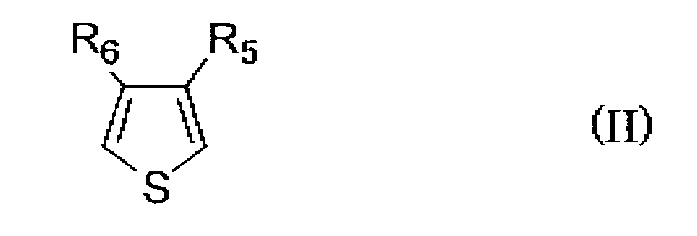
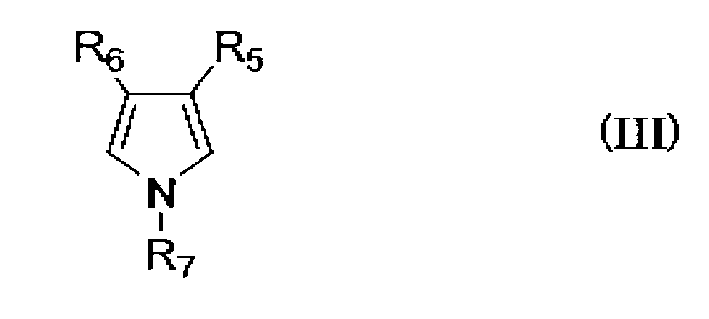
- the composite conductive polymer composition of the invention can be manufactured in the following way by use of the polymer compound (A) obtained by the aforementioned method. That is, the composite conductive polymer composition obtained by doping, with the polymer compound (A), the ⁇ -conjugated polymer (B) comprised of the compound represented by the formulas (I) to (III) as a monomer component can be obtained by dissolving the aforementioned polymer compound (A) in an electrolytic solvent; adding, to the obtained solution, the compound, represented by the formulas (I) to (III), which is a raw material for the ⁇ -conjugated polymer (B), and oxidizing it by an oxidizing agent.
- the compound represented by the formula (I) is aniline having an alkoxy group as a substituent.
- the compound include o-anisidine, p-anisidine, m-anisidine, methoxyaniline, and butoxyaniline.
- the compound represented by the formula (II) is thiophene having hydrogen, an alkoxy group or an alkylenedioxy group as a substituent.
- the compound include 3-methoxythiophene, 3,4-ethylenedioxythiophene, 3,4-propylenedioxythiophene, 3,4-dimethoxythiophene, 3,4-(2',2'-dimethylpropylene)dioxythiophene, and 3,4-(2',2'-diethylpropylene)dioxythiophene.
- the compound represented by the formula (III) is pyrrole having hydrogen, an alkoxy group or an alkylenedioxy group as a substituent.
- examples of the compound include 3,4-ethylenedioxypyrrole, and 3,4-propylenedioxypyrrole.
- One example of the specific method of manufacturing the composite conductive polymer composition according to the present inventive method is a method of, if necessary, acidifying ion-exchange water which is an electrolytic solvent; adding the above-obtained polymer compound (A) thereto; adding one or two or more of the raw material compounds represented by the formulas (I) to (III) thereto; and adding an oxidizing agent to cause oxidative polymerization.
- the polymer compound (A) to the ion-exchange water, acetone, methyl ethyl ketone, or like a ketone-based solvent; methanol, ethanol, isopropyl alcohol, or like an alcohol-based solvent; or like an organic solvent having high hydrophilicity may be used together.
- Examples of the acidic component to acidify the electrolytic solvent in the aforementioned reaction include hydrochloric acid, sulfuric acid, perchloric acid, periodic acid, iron(III) chloride, iron(III) sulfate, and the amount thereof is about 0.5 to 4.0 mol per 1 mol of the compound of the formulas (I) to (III)
- the oxidizing agent used for the reaction needs to be adjusted depending on the redox potential of the aromatic compound (monomer) forming the composite conductive polymer composition.
- the oxidizing agent include ammonium peroxodisulfate, potassium peroxodisulfate, sodium peroxodisulfate, iron(III) chloride, iron(III) sulfate, iron(III) tetrafluoroborate, iron(III) hexafluorophosphate, copper(II) sulfate, copper(II) chloride, copper(II) tetrafluoroborate, copper(II) hexafluorophosphate.
- the ratio of the polymer compound (A) and the compounds (I) to (III) depends on the property of the finally obtained composite conductive polymer composition, and thus cannot be simply determined.
- an example of the preferred range can be represented in the following way by the molar ratio of the number of the sulfonic acid group in the polymer compound (A) and the compounds (I) to (III).
- the polymer compound (A) may be included in such a way that the molar ratio of the sulfonic acid group in the polymer compound (A) is 0.3 to 1.5 per 1 mol of the compound selected from the formulas (I) to (III).
- the usage amount of the oxidizing agent is usually about 1.0 to 3.0 mol (the value when the oxidizing agent is assumed to be monovalent) per 1 mol of the compounds (I) to (III). However, depending on the degree of oxidation (degree of acidity), the usage amount may be 1 mol or less per 1 mol of the monomer. Such amount is sufficient for polymerization.
- the preferred range of the temperature for the polymerization reaction to obtain the composite conductive polymer composition can vary because the amount of heat generation after the oxidation reaction and the easiness of hydrogen removal depend on the kind of the compounds (I) to (III).
- the compound (I) when the compound (I) is used, 40 deg. C or less is preferable. When the compound (II) is used, 90 deg. C or less is preferable. When the compound (III) is used, 20 deg. C or less is preferable.
- reaction temperature In order to increase the molecular weight of the composite conductive polymer composition, the reaction temperature can be lowered and the reaction time can be elongated. In order to decrease the molecular weight, the reaction temperature and time can be changed in the opposite way.
- the thus obtained polymer is, as necessary, subjected to washing and so on, to obtain the composite conductive polymer composition which is the target object.
- this composition can dissolve in an aromatic solvent, an ester-based solvent and a ketone-based solvent in which the conventional conductive polymer composition did not dissolve.
- An example of the method of utilizing the thus obtained composite conductive polymer composition of the invention is to obtain a composite conductive polymer composition solution by uniformly dissolving the composition in an aromatic solvent, an ester-based solvent, or a ketone-based solvent.
- the composite conductive polymer composition solution can be used to form an uniform conductive membrane on a specific portion by applying the composite conductive polymer composition solution on a portion on which a conductive membrane is desired to be formed; and volatilizing the solvent in the composition by means of drying or the like.
- the aforementioned composite conductive polymer composition solution can be obtained preferably by dissolving the composite conductive polymer composition in benzene, toluene, xylene, or like an aromatic solvent, ethyl acetate, propyl acetate, butyl acetate, methyl lactate, ethyl lactate, or like an ester-based solvent, methyl ethyl ketone, cyclohexanon, cyclopentanone, or like a ketone-based solvent in an amount of about 0.1 to 10 mass%.
- the aforementioned composite conductive polymer composition solution may further contain benzyl alcohol, phenol, m-cresol, o-cresol, 2-naphthol, 1-naphthol, guaiacol, 2,6-dimethylphenol, or like an aromatic compound having a hydroxyl group, in order to improve the stability of the solution and the conductivity in a state of a coating film.
- These compounds are preferably added in an amount of about 50 to 500 parts by weight per 100 parts by weight of the solvent of the composite conductive polymer composition solution.
- the aforementioned composite conductive polymer composition solution may further contain, as a filler component, copper, silver, aluminum, platinum, or like a metal; titanium oxide, indium tin oxide, fluorine-doped tin oxide, alumina, silica, or like a metal oxide; conductive polymer composition, carbon nanotube (CNT), fullerene, carbon black, or like carbon powder or dispersoid, in order to improve the conductivity of the self-supported film as an antistatic coating material and improve the catalytic performance thereof as a counter electrode for a solar cell.
- These powder or dispersoid is preferably added in such a way that the solid content of the powder or dispersoid is about 0.01 to 50 parts by weight per 100 parts by weight of the solid content of the composite conductive polymer composition solution.
- the aforementioned composite conductive polymer composition can be used for an counter electrode for a dye-sensitized solar cell.
- the counter electrode for the dye-sensitized solar cell can be formed by laminating the composite conductive polymer composition on one side of a transparent substrate, or placing a transparent electrode on one side of a transparent substrate and laminating the composite conductive polymer composition on the transparent electrode.
- the counter electrode can be formed by laminating the composite conductive polymer composition on a metal foil and so on.
- the thickness of the composite conductive polymer composition is usually in the range of 0.01 1 to 100 ⁇ m and preferably in the range of 0.1 to 50 ⁇ m.
- a film or plate having a light transmittance of usually 50% or more, and preferably 80% or more may be used.
- the transparent substrate includes glass, and like inorganic transparent substrates; polyethylene terephthalate (PET), polycarbonate (PC), polyphenylene sulfide, polysulfone, polyester sulfone, polyalkyl (meth)acrylate, polyethylene naphthalate (PEN), polyether sulfone (PES), polycycloolefin, and like polymer transparent substrates.
- the metal foil include gold, platinum, silver, tin, copper, aluminum, stainless-steel, nickel, and like metal foils.
- the thickness of these transparent substrates is usually in the range of 200 to 7000 ⁇ m in the case of an inorganic transparent substrate, and usually in the range of 20 to 4000 ⁇ m, and preferably 20 to 2000 ⁇ m in the case of a polymer transparent substrate.
- the thickness is 0.1 ⁇ m to 1000 ⁇ m and preferably 1 ⁇ m to 500 ⁇ m in the case of a metal foil substrate.
- the polymer transparent substrate and metal foil substrate having such range of thickness can provide flexibility to the obtained dye-sensitized solar cell.
- a transparent electrode may be disposed on one side of the aforementioned transparent substrate.
- the transparent electrode used here include a film-shaped conductive metal electrode, a mesh-shaped conductive metal electrode.
- the aforementioned film-shaped conductive metal electrode is film-shaped and formed of tin oxide, tin-doped indium oxide (ITO), fluorine-doped tin oxide (FTO) or the like.
- the film-shaped conductive metal electrode can by formed by vapor deposition or sputtering of tin oxide, ITO, FTO or the like on the surface of the transparent substrate.
- the thickness of the film-shaped conductive metal electrode is usually in the range of 0.01 to 1 ⁇ m, and preferably in the range of 0.01 to 0.5 ⁇ m.
- the mesh-shaped conductive metal electrode is mesh-shaped and formed of copper, nickel, aluminum, or like conductive metal.
- the mesh-shaped conductive metal electrode can be formed by use of copper, nickel, aluminum, or like conductive metal etched, for example by photolithography, to form a mesh having the line width of 10 to 70 ⁇ m, and preferably 10 to 20 ⁇ m and the pitch width of usually 50 to 300 ⁇ m, and preferably 50 to 200 ⁇ m.
- the thickness of the conducting wire of the mesh-shaped conductive metal electrode is approximately the same as that of the conductive metal used, and is usually in the range of 8 to 150 ⁇ m, and preferably 8 to 15 ⁇ m.
- the mesh-shaped conductive metal electrode can be adhered to the surface of the transparent substrate by use of adhesive or the like.
- the method of laminating the composite conductive polymer composition on one side of the aforementioned transparent substrate or on the transparent electrode disposed on one side of the transparent substrate is, for example, a method of, one time or plural times, applying the aforementioned composite conductive polymer composition solution on one side of the aforementioned transparent substrate or on the transparent electrode disposed on one side of the transparent substrate; and removing the solvent in the solution.
- the aforementioned composite conductive polymer composition solution can be applied by use of a dip coater, a micro bar coater, a roll coater, a comma coater, a die coater, a gravure coater, or like a publicly-known coater.
- the solvent may be removed by use of natural drying by leaving as it is, forced drying under heating conditions by hot-air or infrared light, or like method.
- the aforementioned counter electrode for the dye-sensitized solar cell is excellent in productivity in that the aforementioned composite conductive polymer composition used for the counter electrode is soluble to an organic solvent, and thus is easier to be applied than a dispersion liquid in which a conventional composite conductive polymer composition is dispersed in an aqueous medium. Furthermore, it is possible to suppress corrosion deterioration which is caused by the acid aqueous solution in the counter electrode preparation stage.
- the aforementioned counter electrode for the dye-sensitized solar cell is excellent in adhesion to the aforementioned transparent substrate, transparent electrode, and metal foil and thus can be used for a long time because the aforementioned composite conductive polymer composition used for the electrode uses the polymer compound (A) obtained by copolymerizing the aforementioned component (a-1), component (a-2) and component (a-3) in a predetermined range.
- the aforementioned counter electrode for the dye-sensitized solar cell can be used for a long time because the use of the polymer compound (A) in the aforementioned composite conductive polymer composition, with reduced degree of acidity, obtained by copolymerizing the aforementioned component (a-1), component (a-2) and component (a-3) in a predetermined range suppresses corrosion of the transparent electrode (conductive metal) and improves durability to the electrolyte.
- the aforementioned counter electrode for the dye-sensitized solar cell can be supplied at a low price because the use of the composite conductive polymer film as an uniform oxidation resistance film enables the use of various metals. This is in contrast to the prior art in which an expensive platinum electrode has been used as an electrode having oxidation resistance to the electrolyte.
- the antistatic film can be obtained by (1) a method of melting-kneading the material by use of an extruder; and forming a film from the material by use of a T-die, or (2) a method of applying the aforementioned composite conductive polymer composition solution on one side or both sides of a film of thermoplastic resin, thermosetting resin, and glass; and removing the solvent in the solution to form an antistatic layer.
- thermoplastic resin used in the aforementioned antistatic film examples include polyolefin, polyvinyl chloride, polyvinylidene chloride, polystyrene, polyvinyl acetate, polytetrafluoro-ethylene, polyacrylonitrile-butadiene-styrene, polyacrylonitrile-styrene, polymethacryl, polyacryl, saturated polyester, polyamide, polycarbonate, modified polyphenylene ether, polyphenylene sulfide, polysulfone, polyarylate, liquid crystal polymer, polyether ether ketone, and polyamide-imide. Polymer alloy of these thermoplastic resins and thermoplastic elastomer are also included.
- thermosetting resin used in the aforementioned antistatic film examples include polyphenol, polyepoxy, unsaturated polyester, polyurethane, polyimide, polyurea, silicone resin, melamine resin, fluorine resin, alkyd resin.
- the surface resistance was measured by use of Low Resistivity Meter Loresta GP, PSP type probe manufactured by Dia Instruments Co., Ltd. and by the four-terminal four-probe method.
- the polymer solutions (A-2 to 14) were obtained by the method of the polymerization of the polymer compound as in Synthesis Example 1 except that the monomer and the polymerization solvent were changed as shown in Table 1.
- the polymer solution (A-1) obtained in Synthesis Example 1 is also shown in Table 1.
- the polymer compound powder AP-1 to 14 were obtained by one of the methods shown below from the polymer solution A-1 to 14 obtained in Synthesis Examples 1 and 2.
- the weight-average molecular weight (Mw) of the obtained powder measured by the gel permeation chromatography (GPC) is shown in Table 2.
- the total amount of the obtained polymer solution was moved to a 2000 cm 3 beaker, and acetone (600 g) was added thereto while stirring by a stirrer, and thereafter the stirring was stopped to obtain a precipitate.
- the precipitate was subjected to filtration under reduced pressure, and the residue was dried for 24 hours at 100 deg. C by use of a dryer, followed by pulverization by use of a mortar, to obtain powder of the polymer compound.
- the total amount of the obtained polymer solution was moved to a 2000 cm 3 beaker, and IPA (600 g) was added thereto while stirring by a stirrer, and thereafter the stirring was stopped to obtain a precipitate.
- the precipitate was subjected to filtration under reduced pressure, and the residue was dried for 24 hours at 100 deg. C by use of a dryer, followed by pulverization by use of a mortar, to obtain powder of the polymer compound.
- the total amount of the obtained polymer solution was moved to a 2000 cm 3 beaker, and ion-exchange water (100 g) and hexane (500 g) were added thereto while stirring by a stirrer, and thereafter the mixture was left still for 1 hour and a hexane layer containing impurities was removed.
- the solution in the aqueous layer side was moved to an evaporator, and IPA was distilled away.
- the total amount of the remaining liquid was moved to a 2000 cm 3 beaker, and acetone (400 g) was added thereto while stirring by a stirrer. Thereafter, the stirring was stopped to obtain a precipitate.
- the precipitate was subjected to filtration under reduced pressure, and the residue was dried for 24 hours at 100 deg. C by use of a dryer, followed by pulverization by use of a mortar, to obtain powder of the polymer compound.
- the polymer compound (AP-1) (3.3 g) which was obtained in Synthesis Example 3, ion-exchange water (500 g), 25% hydrochloric acid aqueous solution (1.46 g) was added to a four-neck flask with a volume of 1000 cm 3 and having a stirrer, a nitrogen gas introducing tube, a reflux condenser, an inlet and a thermometer. The mixture was heated to 60 deg. C, and was stirred for 3 hours, and thereafter was cooled to 25 deg. C. The solution in the flask was uniform and transparent.
- the composite conductive polymer composition (E-3) was obtained in the same way as in Example 2 except that the polymer compound (AP-2) (2.95 g) was replaced with the polymer compound (AP-3) (3.17 g).
- the composite conductive polymer composition (E-4) was obtained in the same way as in Example 2 except that the polymer compound (AP-2) (2.95 g) was replaced with the polymer compound (AP-4) (1.29 g) and ion-exchange water (500 g) was replaced with ion-exchange water (400 g) and 25 deg. C saturated saline (100 g).
- the composite conductive polymer composition (E-5) was obtained in the same way as in Example 2 except that the polymer compound (AP-2) (2.95 g) was replaced with the polymer compound (AP-5) (1.96 g).
- the composite conductive polymer composition (E-6) was obtained in the same way as in Example 2 except that the polymer compound (AP-2) (2.95 g) was replaced with the polymer compound (AP-6) (1.87 g).
- the polymer compound (AP-7) (3.30 g) which was obtained in Synthesis Example 3, ion-exchange water (500 g), 25% hydrochloric acid aqueous solution (1.46 g) was added to a four-neck flask with a volume of 1000 cm 3 and having a stirrer, a nitrogen gas introducing tube, a reflux condenser, an inlet and a thermometer. The mixture was heated to 60 deg. C, and was stirred for 3 hours, and thereafter was cooled to 25 deg. C. The solution in the flask was uniform and transparent.
- o-anisidine (1.23 g) was added to the solution in the flask, and the mixture was stirred to obtain an uniform emulsified liquid, and thereafter cooled to 0 deg. C.
- 3.00 g of ammonium persulfate was dissolved in ion-exchange water (30 g), and the solution was dripped over 2 hours in the flask at 0 deg. C. After the dripping, the polymerization reaction was continued for 48 hours at 0 deg. C.
- the composite conductive polymer composition (E-8) was obtained in the same way as in Example 7 except that the polymer compound (AP-7) (3.30 g) was replaced with the polymer compound (AP-8) (3.43 g) and o-anisidine 1.23 g was replaced with 3,4-ethylenedioxypyrrole (1.25 g).
- the comparative conductive polymer composition (C-1) was obtained in the same way as in Example 2 except that the polymer compound (AP-2) (2.95 g) was replaced with the polymer compound (AP-9) (4.34 g).
- Polymerization was peformed in the same way as in Example 2 except that the polymer compound (AP-2) (2.95 g) was replaced with the polymer compound (AP-10) (1.07 g).
- the comparative conductive polymer composition (C-3) was obtained in the same way as in Example 2 except that the polymer compound (AP-2) (2.95 g) was replaced with the polymer compound (AP-11) (1.44 g).
- the comparative conductive polymer composition (C-4) was obtained in the same way as in Example 2 except that the polymer compound (AP-2) (2.95 g) was replaced with the polymer compound (AP-12) (2.94 g).
- the comparative conductive polymer composition (C-5) was obtained in the same way as in Example 2 except that the polymer compound (AP-2) (2.95 g) was replaced with the polymer compound (AP-13) (6.34 g).
- the comparative conductive polymer composition (C-6) was obtained in the same way as in Example 2 except that the polymer compound (AP-2) (2.95 g) was replaced with the polymer compound (AP-14) (4.34 g).
- the composite conductive polymer composition obtained in Examples 1 to 8 and the comparative conductive polymer composition obtained in Comparative Examples 1 to 6 (E-1 to 8, C-1 to 6) (2g) and the solvent shown in Table 3 below were added to a 200 cm 3 beaker, and they were stirred and dissolved at room temperature to obtain a conductive polymer composition solution.
- the compositions C1 to C6 (Comparative Examples 7 to 12) did not dissolve in any one of the five kinds of solvents shown in Table 3, and did not dissolve in the mixture solvent thereof, and thus they existed in a micro-dispersion state.
- the conductive polymer composition solution or micro-dispersion was applied on a glass substrate by use of a doctor blade so that the thickness after drying was 10 ⁇ m, and dried.
- the state of the film and the measured surface resistance are shown in Table 4.
- a dye-sensitized solar cell element was manufactured by replacing the counter electrode (copper mesh electrode having openings) and the counter electrode substrate (PET film having a thickness of 80 ⁇ m) used in Example 1 of International Publication WO/2009/013942 with a product obtained by applying the composite conductive polymer composition solution prepared in Examples 1 to 4 or the conductive polymer composition solution prepared in Comparative Examples 2 by use of a doctor blade on a SUS foil, an ITO PEN film, a glass substrate, an ITO glass substrate or a FTO glass substrate so that the thickness after drying was 5 ⁇ m.
- the evaluation of the obtained dye-sensitized solar cell element was performed by use of a solar simulator YSS-80A manufactured by Yamashita Denso Corporation.
- the short-circuit current, open voltage, fill factor and power generation efficiency of the cell was evaluated by investigating the I-V characteristic under AM1.5 (1sun; 100 mW/cm 2 ) irradiation to an element having a cell area of 1 cm 2 .
- the result was shown in Table 1.
- the dye-sensitized solar cell element obtained by use of the composite conductive polymer composition of the invention exhibited high photoelectric conversion efficiency.
- An antistatic film was manufactured by adjusting, to 2.5%, the solid content of the composite conductive polymer composition solution prepared in Examples 1 to 2, and the conductive polymer composition solution prepared in Comparative Examples 4 to 5, and applying the adjusted solution on a glass substrate having a thickness of 1000 ⁇ m and a PET film substrate having a thickness of 100 ⁇ m, and removing the solvent by use of a hot-air dryer to form an antistatic layer.
- the thicknesses of the antistatic layers measured by Stylus Surface Profiler (Dektak 6 M: manufactured by ULVAC) were all approx. 25 nm.
- the surface resistance value of the obtained antistatic film was measured after leaving the antistatic film in the following conditions. The evaluations results are shown in Table 2.
- the antistatic film of the invention exhibited sufficient antistatic property even when it is used in hot and humid conditions.
- the composite conductive polymer composition of the invention use, as a doping agent, the polymer compound (A) comprised of three components of (a-1) a monomer having a sulfonic acid group and a polymerizable vinyl group, (a-2) a monomer having a polar group, and (a-3) a polymerizable monomer other than the components (a-1) and (a-2), and thus is stably soluble to an aromatic, ester-based, or ketone-based solvent or the like.
- the polymer compound (A) comprised of three components of (a-1) a monomer having a sulfonic acid group and a polymerizable vinyl group, (a-2) a monomer having a polar group, and (a-3) a polymerizable monomer other than the components (a-1) and (a-2), and thus is stably soluble to an aromatic, ester-based, or ketone-based solvent or the like.
- the thus-obtained composite conductive polymer composition is dissolved in an alcohol-based, glycol-based, or ether-based solvent in a transparent state to obtain a composite conductive polymer composition solution.
- This solution can be used to easily form a conductive membrane on a potion which requires conductivity, and thus can be used extremely advantageously in the field of electronic components and so on.
- an electrode for a dye-sensitized solar cell and an antistatic film obtained from the composite conductive polymer composition of the invention have excellent performance.
Landscapes
- Chemical & Material Sciences (AREA)
- Chemical Kinetics & Catalysis (AREA)
- Health & Medical Sciences (AREA)
- Medicinal Chemistry (AREA)
- Polymers & Plastics (AREA)
- Organic Chemistry (AREA)
- Engineering & Computer Science (AREA)
- Physics & Mathematics (AREA)
- Spectroscopy & Molecular Physics (AREA)
- Power Engineering (AREA)
- Materials Engineering (AREA)
- Microelectronics & Electronic Packaging (AREA)
- Electrochemistry (AREA)
- General Chemical & Material Sciences (AREA)
- Compositions Of Macromolecular Compounds (AREA)
- Polyoxymethylene Polymers And Polymers With Carbon-To-Carbon Bonds (AREA)
- Macromolecular Compounds Obtained By Forming Nitrogen-Containing Linkages In General (AREA)
- Photovoltaic Devices (AREA)
- Conductive Materials (AREA)
- Hybrid Cells (AREA)
Abstract

Description
- The invention relates to a composite conductive polymer composition, a method of manufacturing the same, a solution containing the composition, and a use of the composition, and more specifically relates to a composite conductive polymer composition which is obtained by doping, with a polymer compound, a π-conjugated polymer whose monomer component is aniline, thiophene, pyrrole, or like an aromatic or a heterocyclic compound having an alkoxy group in order to solubilize the π-conjugated polymer to a solvent, a method of manufacturing the same, a solution containing the composition, and a use of the composition for an electrode for a dye-sensitized solar cell or an antistatic film.
- In order to enhance conductivity of a π-conjugated polymer, it is necessary to dope the polymer with a dopant. However, the polymer having extended π-conjugation has high planarity in the polymer chain, and thus the tendency of the crystallization or stacking of the polymer chains is high because of the affinity of the n-bonds. In addition, doping of the π-conjugated polymer with a dopant enhances the planarity and the affinity by the π-conjugation, and thus enhances the tendency of the stacking. Therefore, it was a difficult problem to enhance the solubility (by heat or solvent) of the π-conjugated polymer while enhancing the electric conductivity.
- Here, there has been proposed a polymer in which an alkyl group, an alkoxy group, or the like is introduced on the side chain of a π-conjugated polymer (Patent Document 1). However, doping is necessary to enhance the electric conductivity to ten to the negative fifth power (s·m) or less, at which the polymer can be called a conductor. The doping enhances the planarity and the π-conjugation affinity, and thus there occurs a problem that sufficient solubility to a solvent cannot be achieved.
- In view of the use of the conductive polymer and in view of the easiness of the handling, it is desirable that the polymer is soluble to a solvent or meltable by heat, and in addition a self-supported film or self-supported molded body with sufficient electric conductivity after molding or film formation can be obtained. Conventionally, when these conductive polymers are used, a polymer film is formed on a substrate by direct electropolymerization or vapor exposure to provide conductivity to the substrate, or thin film polymerization is performed by immersing the substrate in a solution of an oxidizing agent and a conductive polymer precursor monomer, followed by heating and so on. Thereafter, the obtained polymer film is processed by doping and so on.
- However, the substrate needs to be semiconductor or conductor to perform the electropolymerization, and the corrosion resistance to the electrolyte is also required, and therefore, the choice of the substrate is limited. Furthermore, the thin film polymerization by direct vapor requires that an oxidizing agent exists uniformly on a thin film which is a polymerization field, and is not satisfactory in terms of the film formation control. In a polymer capacitor application, microasperity is formed on the surface in order to increases he surface area, and it is difficult to form a conductive polymer on a sufficiently uniform surface.
- There has been proposed several methods of dissolving a conductive polymer in an organic solvent. Patent Document 2 discloses a method of manufacturing poly (3,4-di-substituted thiophene) by use of 3,4-di-substituted thiophene, an inorganic ferric salt and an oxidizing agent. Patent Document 3 discloses a water dispersible powder including a polymer T mainly having repeating thiophene units and at least one other polyanion polymer P. However, the method in Patent Document 2 is a method of obtaining powder or a method of performing oxidative polymerization directly on the target surface, and thus it is impossible to dissolve the polymer obtained by the method in a solvent or water. Furthermore, the product obtained by the method in Patent Document 3 is just a water dispersible dispersoid, and is not soluble to an organic solvent at the molecular level
- Furthermore, various researches have been made for more direct method of nanodispersing to a solvent. Patent Document 4 disclose a method of providing a microdispersoid solution at nano level by pulverizing polyaniline, which is essentially insoluble to a solvent, to nano level, and co-dispersing, to a sovent, the pulverized polyaniline with a dispersant of a sulfonic acid anion emulsifier such as SDS (dodecylbenzenesulfonic acid) or PTS (para-toluenesulfonic acid) having high affinity to polyaniline and a solvent. However, the polyaniline is not substantially dissolved in the solvent, and thus the surface of the coating film is uneven, and it is not possible to form a self-supported film (also referred to as a homogeneous film. This mean a film formed by itself and without forming pinholes), and therefore it is not possible to form a film after coating unless combined with a binder.
- Furthermore, Patent Document 5 discloses a polythiophene solution containing, in water or a mixed solvent of water and an organic solvent miscible to water, polythiophene having a molecular weight of 2,000 to 500,000 and obtained by oxidation chemical polymerization in the present of a polyanion of a polystyrene sulfonic acid, and a polyanion having a molecular weight of 2,000 to 500,000 and derived from a polystyrene sulfonic acid.
- The Patent Document proposes a method of manufacturing poly(ethylenedioxide-substituted thiophene) (PEDOT) which is soluble or dispersible to water or an alcohol solvent by use of oxidative polymerization in the present of polystyrene sulfonic acid (PSS) and an oxidizing agent. However, the obtained PEDOT/PSS is dispersed in water, but not completely dissolved, and thus it is difficult to suppress partial stacking between PEDOTs, and therefore dissolution of the conductive polymer was insufficient. In addition, by use of the polystyrene sulfonic acid shown in the Patent Document, it is difficult to use a solvent other than a solvent having a strong ion dissociation property or water. Furthermore, a sulfonic acid group acts as a dopant group or a water-soluble functional group, but does not substantially have affinity or compatibility to the monomer. There is no functional group compatible with an alkoxyl group in order to control localization of an alkoxyl group of an aromatic or a heterocyclic compound, such as aniline, thiophene, or pyrrole, having an alkoxyl group and suppress the planarity of the π-conjugated polymer. Therefore, sufficient suppression of the stacking is difficult.
- Furthermore, Patent Document 6 disclose a method of forming an organic solution by performing oxidative polymerization of aniline or aniline derivative in a solvent containing an organic acid or inorganic acid in the present of a strongly hydrophobic anionic surfactant, followed by precipitation, isolation, and purification, and thereafter performing extraction by use of an organic solvent immiscible to water.
- However, the emulsifier used in the Patent Document is a low-molecular sulfonic acid-based, and aniline is hydrochlorinated before polymerization, thereafter the aniline salt is subjected to salt substitution by use of a sulfonic acid-based emulsifier. However, in reality, sufficient salt exchange is hard to occur, and therefore polyanion obtained by the synthetic method of the Patent Document is insoluble to a solvent, and thus only solvent dispersion in a micro dispersing state is obtained, which is problematic. In addition, the sulfonic acid-based emulsifier is used in an equivalent molar amount to aniline, and thus 50% or more of the emulsifier remains unused for doping, and the unused emulsifier needs to be removed upon use. Therefore, the washing process is complicated, which is problematic. Furthermore, it is very difficult to design the low-molecular emulsifier in a way to introduce a function to enhance solubility to a solution, and a function to suppress the stacking of polyaniline. Even though polyaniline is dissolved temporarily in a solvent, micro-agglomeration due to the stacking (crystallization of PANI) occurs shortly, which is problematic. Furthermore, the present inventors conducted the re-test and confirmed that according to the method of the Patent Document, the localization of an alkoxyl group in the aniline derivative having an alkoxyl group, and chemical and structural relaxation of affinity at quinoimide binding position and amino binding position of the polyaniline are insufficient, and therefore the stacking is not suppressed.
- Furthermore, Patent Document 7 discloses a method of emulsifying a solution obtained by dissolving, in water or an organic solvent, (A) a monomer having a sulfonic acid functional group and a radical polymerizable functional group, and (B) a monomer of aniline or the derivatives thereof; introducing, in the monomer (B), a sulfonic acid structure derived from the monomer (A), and thereafter polymerize the monomers (A) and (B) in the present of a polymerization initiator to obtain a conductive polymer with the polymer of (B) and the polymer of (B) intertwined.
- However, in the method of the Patent Document, because ammonium persulfate salt is used as a water-soluble oxidizing agent and a radical initiator, it is difficult in reality to obtain the ideal mesh structure of the vinyl-based polymer and polyaniline as mentioned in the specification. Therefore, according to the method of the Patent Document, there's a problem in reality that a substantial amount of vinyl polymer not containing PANI exists, and a dope monomer not incorporated in the vinyl polymer exists in PANI, and thus the obtained product is very nonuniform and unstable.
- For example, Patent Document 8 discloses a conductive polyaniline composition containing (a) a protonated and substituted or unsubstituted polyaniline complex and (b) a compound having a phenolic hydroxyl group, which is dissolved in an organic solvent substantially immiscible to water.
- However, the conditions for the solvent effective in the Patent Document cannot be applied to a solvent somewhat miscible to water. In addition, the applicable monomer needs to be highly oil-soluble or needs to have a highly oil-soluble alkyl group. Therefore, for a monomer having a hydrophilic substituent such as an alkoxyl group, sufficient function cannot be expected under the conditions of the polymerization solvent and the dopant compound representing a sulfonic acid group.
- By the way, the conductive polymer composition can be used for a counter electrode for a dye-sensitized solar cell and an antistatic film. Patent Document 10 discloses a counter electrode for a dye-sensitized solar cell having a conductive polymer layer on a plastic film provided with a transparent conductive layer.
- In the Patent Document, the conductive polymer layer is formed by applying a dispersion containing a conductive polymer, and removing the solvent. However, because the conductive polymer is a layer in which fine particles are dispersed, and thus the adherence to the transparent conductive layer is low, and thus it is necessary to enhance the surface energy of the transparent conductive layer by plasma treatment or the like. In addition, polystyrene sulfonic acid is used as a dispersant in Examples of the Patent Document. In this case, there exists a free sulfonic acid which does not contribute to doping of the conductive polymer, and thus the solvent becomes an aqueous solution. Therefore, when the solution is applied on a film substrate, the range of choice of the solvent and the film substrate surface is very broad, and thus pinholes due to nonuniformity of the conductive polymer coating film easily occur. In addition, because the polarity of the coating film is high due to the remaining sulfonic acid group, the coating film has low durability to acetonitrile and an ionic liquid which are commonly used as a electrolyte solution, and therefore peeling of the coating film easily occurs. Because of such causes, there occurs a problem that a transparent conductive film is corroded by iodine in the electrolyte. Therefore, the conductive polymer layer has a problem in the long-tem stability as a counter electrode, and thus is insufficient to replace a platinum counter electrode with.
- Furthermore, Patent Document 11 discloses an antistatic film obtained by applying antistatic material containing a polythiophene compound, acidic polymer and sugar alcohol on a thermoplastic resin film.
- However, in the Patent Document, the antistatic material contains a sugar alcohol as an essential component, and thus the transparency and antistatic property of the obtained antistatic film is good. However, because only acidic polymer such as polystyrene sulfonic acid is used as a doping agent to the polythiophene compound, the antistatic film continuously absorbs moisture, and therefore the adherence and the antistatic property can deteriorate, which is problematic.
-
- [Patent Document 1]
JP-A-2002-539287 - [Patent Document 2]
JP-A-H01-313521 - [Patent Document 3]
JP-A-2004-514753 - [Patent Document 4]
JP-A-2007-518859 - [Patent Document 5] Japanese Patent No.
2636968 - [Patent Document 6]
JP-A-2008-169255 - [Patent Document 7]
JP-A-2007-314606 - [Patent Document 8]
WO2005/052058 - [Patent Document 9]
JP-A-2000-344823 - [Patent Document 10]
JP-A-2006-155907 - [Patent Document 11]
JP-A-2008-179809 - So, the purpose of the present invention is to provide a conductive polymer composition which is excellent in solubility to a solvent, and can be used to form a self-supported film by itself, i.e. a homogeneous membrane or molded body without pinholes, and a method of manufacturing the same.
- The present inventors have re-tested and researched on the aforementioned prior art to solve the aforementioned problems, and clarified the facts that following factors are necessary from the start of the conductive polymer synthesis to purification and redissolution to a solvent.
- <1> It is necessary to use a sufficient amount of an electrolytic solvent in the polymerization field of a π-conjugated polymer and to stabilize and uniformize an anionic filed during oxidation.;
- <2> It is necessary to provide a field to control the stacking of the π-conjugated polymer during polymerization and to supply the monomer stably.;
- <3> The doping to the π-conjugated polymer proceeds actively in these polymerization field;
- <4> Precipitation from the initial polymerization field electrolytic solvent such as water is possible during the doping process;
- <5> The stacking of the main chain backbone of the π-conjugated polymer after the polymerization is prevented by a certain steric molecular hinderance;
- <6> The steric hinderance factor itself does not have a tendency to be crystallized, and can be dissolved in a solvent or by heat and so on.
- Then, as a result of the further investigation by the present inventors, it was found out that when a polymer compound obtained by copolymerizing specific monomers is used as an additive upon polymerization of a π-conjugated polymer, the polymer compound exerts a function as an emulsifier to uniformize the polymerization field, and also exerts a function as a doping agent, and in addition provides a suitable steric hinderance to the π-conjugated polymer, and thus it is possible to obtain a composite conductive polymer composition which is excellent in solubility to a specific solvent. In addition, the present inventors have found that the aforementioned conductive polymer composition can be used for a counter electrode for a dye-sensitized solar cell and an antistatic film. Thus, the present invention has been completed.
- The present invention provides a composite conductive polymer composition obtained by doping a π-conjugated polymer (B) with a polymer compound (A); wherein
the polymer compound (A) is obtained by polymerizing the following components (a-1) to (a-3): - (a-1) a monomer having a sulfonic acid group and a polymerizable vinyl group in an amount of 20 to 60 mol%,
- (a-2) a polar monomer having a hydrophilic group and a polymerizable vinyl group in an amount of 20 to 60 mol%, and
- (a-3) a polymerizable monomer other than the components (a-1) and (a-2) in an amount of 20 to 60 mol%; and
- Furthermore, the present invention provides a method of method of manufacturing a composite conductive polymer composition comprising the steps of mixing a polymer compound (A) and a compound selected from the aforementioned formulas (I) to (III) in an electrolytic solvent, followed by chemical oxidative polymerization by use of an oxidizing agent;, wherein the polymer compound (A) is obtained by polymerizing the following components (a-1) to (a-3):
- (a-1) a monomer having a sulfonic acid group and a polymerizable vinyl group in an amount of 20 to 60 mol%,
- (a-2) a polar monomer having a hydrophilic group and a polymerizable vinyl group in an amount of 20 to 60 mol%, and
- (a-3) a polymerizable monomer other than the components (a-1) and (a-2) in an amount of 20 to 60 mol%.
- Furthermore, the present invention provides a composite conductive polymer composition solution obtained by dissolving the aforementioned composite conductive polymer composition in an aromatic solvent, an ester-based solvent or a ketone-based solvent in an amount of 0.1 to 10 mass%.
- Furthermore, the present invention provides a counter electrode for a dye-sensitized solar cell obtained from the aforementioned composite conductive polymer composition.
- Furthermore, the present invention provides an antistatic film obtained from the aforementioned composite conductive polymer composition
- The composite conductive polymer obtained by polymerization by the effect of an oxidizing agent in the presence of the polymer compound of the invention stably dissolves in an aromatic solvent, an ester-based solvent, or a ketone-based solvent.
- Therefore, it is possible to easily form a conductive membrane by applying a solution obtained by dissolving the composite conductive polymer in a solvent to a portion requiring conductivity, followed by volatilization of the solvent and drying.
- The polymer compound (A) used in the invention can be manufactured by polymerizing, according to a common procedure, a component (a-1) monomer having a sulfonic acid group and a polymerizable vinyl group, a component (a-2) polar monomer having a hydrophilic group and a polymerizable vinyl group, and a component (a-3) polymerizable monomer other than these components in the presence of a polymerization initiator.
- The component (a-1) monomer having a sulfonic acid group and a polymerizable vinyl group is a monomer having a styrenesulfonic acid group, a sulfoethyl group, or like a sulfonic acid group, and examples thereof include styrenesulfonic acid; sodium styrenesulfonate, potassium styrenesulfonate, calcium styrenesulfonate, and like stryrenesulfonate salts; 2-sulfoethyl (meth)acrylate; and sodium 2-sulfoethyl (meth)acrylate, potassium 2-sulfoethyl (meth)acrylate, calcium 2-sulfoethyl (meth)acrylate, and like 2-sulfoethyl (meth)acrylate salts.
- The component (a-2) polar monomer having a hydrophilic group and a polymerizable vinyl group is a monomer whose pH is larger than 5.5 and smaller than 8.0 (5.5<pH<8.0) when the monomer is dissolved in distillated water of pH 7.0 at the room temperature in a concentration of 0.1 mmol/1. Examples thereof include acrylic acid, methacrylic acid, 2-(methacryloyloxy)ethylsuccinic acid, maleic acid (maleic anhydride), 2-hydroxyethyl (meth)acrylate, 2-hydroxypropyl (meth)acrylate, 4-hydroxybutyl (meth)acrylate, 2-acetoacetoxyethyl (meth)acrylate, methoxyethyl (meth)acrylate, ethoxyethyl (meth)acrylate, butoxyethyl (meth)acrylate, ethylcarbitol (meth)acrylate, methoxytriethyleneglycol (meth)acrylate, methoxypolyethyleneglycol (meth)acrylate, β-(meth)acryloyloxyethyl hydrogen succinate.
- Furthermore, examples of the component (a-3) polymerizable monomer other than the monomers (a-1) and (a-2) include a monomer having an aromatic group or an alicyclic group and a polymerizable vinyl group; and an alkyl methacrylate.
- Examples of the monomer having an aromatic group or an alicyclic group and a polymerizable vinyl group include benzyl (meth)acrylate, phenoxyethyl (meth)acrylate, 2-(methyl phthalate)ethyl (meth)acrylate, 2-(ethyl phthalate)ethyl (meth)acrylate, cyclohexyl (meth)acrylate, dicyclopentanyl (meth)acrylate, dicyclopentanyloxyethyl (meth)acrylate, dicyclopentenyl (meth)acrylate, dicyclopentenyloxyethyl (meth)acrylate, isobornyl (meth)acrylate, t-butylcyclohexyl (meth)acrylate, cyclohexyl (meth)acrylate, (meth)acrylate morpholine, pentamethylpiperidinyl methacrylate, tetramethylpiperidinyl methacrylate, 1-adamantyl (meth)acrylate, 2-methyl-2-adamantyl (meth)acrylate, 2-ethyl-2-adamantyl (meth)acrylate, 3-hydroxy-1-adamantyl (meth)acrylate, styrene, dimethylstyrene, naphthalene (meth)acrylate, vinylnaphthalene, vinylpyridine, N-vinylcarbazole, vinyl-N-ethylcarbazole, vinylfluorene.
- Examples of the alkyl methacrylate include methyl (meth)acrylate, ethyl (meth)acrylate, n-propyl (meth)acrylate, i-propyl (meth)acrylate, n-butyl (meth)acrylate, i-butyl (meth)acrylate, i-propyl (meth)acrylate, n-pentyl (meth)acrylate, i-pentyl (meth)acrylate, t-butyl (meth)acrylate, 2-ethylhexyl (meth)acrylate, isooctyl (meth)acrylate, lauryl (meth)acrylate, stearyl (meth)acrylate.
- In manufacturing the polymer compound (A) of the invention, the amount of the component (a-1) is 20 to 60 mol%, and preferably 30 to 40 mol%, the amount of the component (a-2) is 20 to 60 mol%, and preferably 30 to 40 mol%, and the amount of the component (a-3) is 20 to 60 mol%, and preferably 30 to 40 mol%.
- In manufacturing the polymer compound (A) used for the invention, the molar ratio of the monomer (a-1), the monomer (a-2), and, the monomer (a-3) is important. In other words, the polymer compound of the invention appropriately balances the emulsifying capacity depending on the polarity of the respective monomers upon the polymerization of the conductive polymer, the stability of the polymerization of the conductive polymer, the affinity to the conductive polymer backbone which influences the doping ratio, and so on, and influences the conductive polymer composition, and makes it soluble to a solvent.
- Polymerization of the component (a-1), the component (a-2), and the monomer (a-3) can be performed through a publicly-known method. For example, the manufacturing can be performed by mixing the respective components, and adding a polymerization initiator thereto, and initiating polymerization by heating, light irradiation and so on.
- A polymerization method for manufacturing the aforementioned polymer compound (A) is not in particular limited as long as the method can be performed in a state that the component (a-2) does not separate from the monomer mixture. Examples of the methods include a solution polymerization method, a bulk polymerization method, and a precipitation polymerization method.
- The polymerization initiator used for the polymerization reaction is not in particular limited as long as it is soluble to the aforementioned respective components and the solvent used in the reaction. Examples of the polymerization initiator include benzoyl peroxide (BPO), and like oil-soluble peroxide thermal polymerization initiators, azobisisobutyronitrile (AIBN), and like oil-soluble azo thermal polymerization initiators, and azobis-cyano valeric acid (ACVA), and like water-soluble azo thermal polymerization initiators. When the ratio of water in the solvent of the solution polymerization is large, ammonium persulfate, potassium persulfate, and like water-soluble peroxide thermal polymerization initiators; hydrogen peroxide water, and so on can be used. Furthermore, ferrocene, amines, and like redox reagents can be used in combination.
- The range of use of these polymerization initiators is 0.001 to 0.1 mol per 1 mole of the aforementioned compound. The polymerization initiator can be used in any of one-time addition, dropwise addition, and sequential addition. Furthermore, in the case of bulk polymerization or solution polymerization by use of a small amount of a solvent (50 wt% or less with respect to the monomer), a polymerization method by the combination of mercaptan and metallocene (Patent Document 9) is possible.
- In addition, examples of the solvent used for the aforementioned polymerization reaction include methanol, ethanol, isopropyl alcohol, butanol, and like alcohol-based solvents; acetone, methyl ethyl ketone, methyl isobutyl ketone, and like ketone-based solvents; methyl cellosolve, ethyl cellosolve, propyleneglycol methyl ether, propyleneglycol ethyl ether, and like glycol-based solvents; and methyl lactate, ethyl acetate, ethyl lactate, and like ester-based solvents.
- Furthermore, a chain transfer agent can be used with the polymerization initiator during the polymerization, and the chain transfer agent can be used to adjust the molecular weight. Any chain transfer agent can be used as long as it is soluble to the aforementioned monomer and the solvent, and examples of the chain transfer agent include dodecylmercaptan, heptylmercaptan, and like alkylthiols; mercaptopropionic acid (BMPA), and like water-soluble thiols each having a polar group; and α-styrene dimer (ASD), and like lipophilic radical suppressants.
- Furthermore, the polymerization reaction is preferably performed at a temperature equal to or below the boiling point of the solvent used (except the case of bulk polymerization), for example at approx. 65 deg. C to 80 deg. C. However, when bulk polymerization or polymerization performed by use of mercaptan and metallocene as in Patent Document 9 is employed, the polymerization reaction is preferably performed at 25 deg. C to 80 deg. C.
- The thus obtained polymer is purified when necessary to obtain the polymer compound (A). An example of the purification method is a method of removing lipophilic low-molecular impurities and an unreacted monomer, and low-molecular impurities by use of lipophilic poor solvent such as hexane, and thereafter precipitating the polymer by use of water-soluble poor solvent such as acetonitrile or methanol to remove the water-soluble impurities and the residue.
- The reason why the purification is preferable is as follows. The polymer compound (A) is introduced into the conductive polymer composition as a doping agent and functions as a stacking suppressant and a solvent-solubilizing agent. Therefore, when a polymerization initiator residue, a monomer, an oligomer, an ununiform composition, and so on exist as residues after the polymerization, the function of the conductive polymer composition can deteriorates. Thus, these residues need to be removed. Then, as a result of the purification, there is obtained a solubilized state where a nonuniform radical polymer as in Patent Document 7 does not exist, and the composition of the uniform conductive polymer composition and the composition of the polymer compound (A) is uniformly compatibilized.
- The GPC weight-average molecular weight of the obtained polymer compound (A) is preferably 3,000 to 100,000. When the weight-average molecular weight is less than 3,000, the function thereof as the polymer compound is insufficient. In contrast, when it is more than 100,000, the solubility thereof to the polymerization field (an acid aqueous solution) during the conductive polymer synthesis can be insufficient, and the solvent solubility of the polymer compound itself can decrease, and provide an adverse influence on the solubilizability of the conductive polymer.
- The composite conductive polymer composition of the invention can be manufactured in the following way by use of the polymer compound (A) obtained by the aforementioned method. That is, the composite conductive polymer composition obtained by doping, with the polymer compound (A), the π-conjugated polymer (B) comprised of the compound represented by the formulas (I) to (III) as a monomer component can be obtained by dissolving the aforementioned polymer compound (A) in an electrolytic solvent; adding, to the obtained solution, the compound, represented by the formulas (I) to (III), which is a raw material for the π-conjugated polymer (B), and oxidizing it by an oxidizing agent.
- Among the raw material compounds, the compound represented by the formula (I) is aniline having an alkoxy group as a substituent. Examples of the compound include o-anisidine, p-anisidine, m-anisidine, methoxyaniline, and butoxyaniline.
- Furthermore, the compound represented by the formula (II) is thiophene having hydrogen, an alkoxy group or an alkylenedioxy group as a substituent. Examples of the compound include 3-methoxythiophene, 3,4-ethylenedioxythiophene, 3,4-propylenedioxythiophene, 3,4-dimethoxythiophene, 3,4-(2',2'-dimethylpropylene)dioxythiophene, and 3,4-(2',2'-diethylpropylene)dioxythiophene.
- Furthermore, the compound represented by the formula (III) is pyrrole having hydrogen, an alkoxy group or an alkylenedioxy group as a substituent. Examples of the compound include 3,4-ethylenedioxypyrrole, and 3,4-propylenedioxypyrrole.
- One example of the specific method of manufacturing the composite conductive polymer composition according to the present inventive method is a method of, if necessary, acidifying ion-exchange water which is an electrolytic solvent; adding the above-obtained polymer compound (A) thereto; adding one or two or more of the raw material compounds represented by the formulas (I) to (III) thereto; and adding an oxidizing agent to cause oxidative polymerization. Depending on the solubility, of the polymer compound (A), to the ion-exchange water, acetone, methyl ethyl ketone, or like a ketone-based solvent; methanol, ethanol, isopropyl alcohol, or like an alcohol-based solvent; or like an organic solvent having high hydrophilicity may be used together.
- Examples of the acidic component to acidify the electrolytic solvent in the aforementioned reaction include hydrochloric acid, sulfuric acid, perchloric acid, periodic acid, iron(III) chloride, iron(III) sulfate, and the amount thereof is about 0.5 to 4.0 mol per 1 mol of the compound of the formulas (I) to (III)
- The oxidizing agent used for the reaction needs to be adjusted depending on the redox potential of the aromatic compound (monomer) forming the composite conductive polymer composition. Examples of the oxidizing agent include ammonium peroxodisulfate, potassium peroxodisulfate, sodium peroxodisulfate, iron(III) chloride, iron(III) sulfate, iron(III) tetrafluoroborate, iron(III) hexafluorophosphate, copper(II) sulfate, copper(II) chloride, copper(II) tetrafluoroborate, copper(II) hexafluorophosphate.
- The ratio of the polymer compound (A) and the compounds (I) to (III) depends on the property of the finally obtained composite conductive polymer composition, and thus cannot be simply determined. However, an example of the preferred range can be represented in the following way by the molar ratio of the number of the sulfonic acid group in the polymer compound (A) and the compounds (I) to (III).
- That is, the polymer compound (A) may be included in such a way that the molar ratio of the sulfonic acid group in the polymer compound (A) is 0.3 to 1.5 per 1 mol of the compound selected from the formulas (I) to (III).
- Furthermore, the usage amount of the oxidizing agent is usually about 1.0 to 3.0 mol (the value when the oxidizing agent is assumed to be monovalent) per 1 mol of the compounds (I) to (III). However, depending on the degree of oxidation (degree of acidity), the usage amount may be 1 mol or less per 1 mol of the monomer. Such amount is sufficient for polymerization.
- Furthermore, the preferred range of the temperature for the polymerization reaction to obtain the composite conductive polymer composition can vary because the amount of heat generation after the oxidation reaction and the easiness of hydrogen removal depend on the kind of the compounds (I) to (III).
- In general, when the compound (I) is used, 40 deg. C or less is preferable. When the compound (II) is used, 90 deg. C or less is preferable. When the compound (III) is used, 20 deg. C or less is preferable.
- In order to increase the molecular weight of the composite conductive polymer composition, the reaction temperature can be lowered and the reaction time can be elongated. In order to decrease the molecular weight, the reaction temperature and time can be changed in the opposite way.
- The thus obtained polymer is, as necessary, subjected to washing and so on, to obtain the composite conductive polymer composition which is the target object. As described later, this composition can dissolve in an aromatic solvent, an ester-based solvent and a ketone-based solvent in which the conventional conductive polymer composition did not dissolve.
- An example of the method of utilizing the thus obtained composite conductive polymer composition of the invention is to obtain a composite conductive polymer composition solution by uniformly dissolving the composition in an aromatic solvent, an ester-based solvent, or a ketone-based solvent. The composite conductive polymer composition solution can be used to form an uniform conductive membrane on a specific portion by applying the composite conductive polymer composition solution on a portion on which a conductive membrane is desired to be formed; and volatilizing the solvent in the composition by means of drying or the like.
- The aforementioned composite conductive polymer composition solution can be obtained preferably by dissolving the composite conductive polymer composition in benzene, toluene, xylene, or like an aromatic solvent, ethyl acetate, propyl acetate, butyl acetate, methyl lactate, ethyl lactate, or like an ester-based solvent, methyl ethyl ketone, cyclohexanon, cyclopentanone, or like a ketone-based solvent in an amount of about 0.1 to 10 mass%.
- Furthermore, the aforementioned composite conductive polymer composition solution may further contain benzyl alcohol, phenol, m-cresol, o-cresol, 2-naphthol, 1-naphthol, guaiacol, 2,6-dimethylphenol, or like an aromatic compound having a hydroxyl group, in order to improve the stability of the solution and the conductivity in a state of a coating film. These compounds are preferably added in an amount of about 50 to 500 parts by weight per 100 parts by weight of the solvent of the composite conductive polymer composition solution.
- Furthermore, the aforementioned composite conductive polymer composition solution may further contain, as a filler component, copper, silver, aluminum, platinum, or like a metal; titanium oxide, indium tin oxide, fluorine-doped tin oxide, alumina, silica, or like a metal oxide; conductive polymer composition, carbon nanotube (CNT), fullerene, carbon black, or like carbon powder or dispersoid, in order to improve the conductivity of the self-supported film as an antistatic coating material and improve the catalytic performance thereof as a counter electrode for a solar cell. These powder or dispersoid is preferably added in such a way that the solid content of the powder or dispersoid is about 0.01 to 50 parts by weight per 100 parts by weight of the solid content of the composite conductive polymer composition solution.
- Furthermore, the aforementioned composite conductive polymer composition can be used for an counter electrode for a dye-sensitized solar cell. When transparency is required, the counter electrode for the dye-sensitized solar cell can be formed by laminating the composite conductive polymer composition on one side of a transparent substrate, or placing a transparent electrode on one side of a transparent substrate and laminating the composite conductive polymer composition on the transparent electrode. When transparency is not required, the counter electrode can be formed by laminating the composite conductive polymer composition on a metal foil and so on. The thickness of the composite conductive polymer composition is usually in the range of 0.01 1 to 100 µm and preferably in the range of 0.1 to 50 µm.
- As the aforementioned transparent substrate, a film or plate having a light transmittance of usually 50% or more, and preferably 80% or more may be used. Examples of the transparent substrate includes glass, and like inorganic transparent substrates; polyethylene terephthalate (PET), polycarbonate (PC), polyphenylene sulfide, polysulfone, polyester sulfone, polyalkyl (meth)acrylate, polyethylene naphthalate (PEN), polyether sulfone (PES), polycycloolefin, and like polymer transparent substrates. Examples of the metal foil include gold, platinum, silver, tin, copper, aluminum, stainless-steel, nickel, and like metal foils.
- The thickness of these transparent substrates is usually in the range of 200 to 7000 µm in the case of an inorganic transparent substrate, and usually in the range of 20 to 4000 µm, and preferably 20 to 2000 µm in the case of a polymer transparent substrate. The thickness is 0.1 µm to 1000 µm and preferably 1 µm to 500 µm in the case of a metal foil substrate. The polymer transparent substrate and metal foil substrate having such range of thickness can provide flexibility to the obtained dye-sensitized solar cell.
- When necessary, a transparent electrode may be disposed on one side of the aforementioned transparent substrate. Examples of the transparent electrode used here include a film-shaped conductive metal electrode, a mesh-shaped conductive metal electrode.
- The aforementioned film-shaped conductive metal electrode is film-shaped and formed of tin oxide, tin-doped indium oxide (ITO), fluorine-doped tin oxide (FTO) or the like. The film-shaped conductive metal electrode can by formed by vapor deposition or sputtering of tin oxide, ITO, FTO or the like on the surface of the transparent substrate. The thickness of the film-shaped conductive metal electrode is usually in the range of 0.01 to 1 µm, and preferably in the range of 0.01 to 0.5 µm.
- On the other hand, the mesh-shaped conductive metal electrode is mesh-shaped and formed of copper, nickel, aluminum, or like conductive metal. Specifically, the mesh-shaped conductive metal electrode can be formed by use of copper, nickel, aluminum, or like conductive metal etched, for example by photolithography, to form a mesh having the line width of 10 to 70 µm, and preferably 10 to 20 µm and the pitch width of usually 50 to 300 µm, and preferably 50 to 200 µm. The thickness of the conducting wire of the mesh-shaped conductive metal electrode is approximately the same as that of the conductive metal used, and is usually in the range of 8 to 150 µm, and preferably 8 to 15 µm. The mesh-shaped conductive metal electrode can be adhered to the surface of the transparent substrate by use of adhesive or the like.
- In manufacturing the counter electrode of the aforementioned dye-sensitized solar cell, the method of laminating the composite conductive polymer composition on one side of the aforementioned transparent substrate or on the transparent electrode disposed on one side of the transparent substrate is, for example, a method of, one time or plural times, applying the aforementioned composite conductive polymer composition solution on one side of the aforementioned transparent substrate or on the transparent electrode disposed on one side of the transparent substrate; and removing the solvent in the solution.
- The aforementioned composite conductive polymer composition solution can be applied by use of a dip coater, a micro bar coater, a roll coater, a comma coater, a die coater, a gravure coater, or like a publicly-known coater.
- The solvent may be removed by use of natural drying by leaving as it is, forced drying under heating conditions by hot-air or infrared light, or like method.
- The aforementioned counter electrode for the dye-sensitized solar cell is excellent in productivity in that the aforementioned composite conductive polymer composition used for the counter electrode is soluble to an organic solvent, and thus is easier to be applied than a dispersion liquid in which a conventional composite conductive polymer composition is dispersed in an aqueous medium. Furthermore, it is possible to suppress corrosion deterioration which is caused by the acid aqueous solution in the counter electrode preparation stage.
- Furthermore, the aforementioned counter electrode for the dye-sensitized solar cell is excellent in adhesion to the aforementioned transparent substrate, transparent electrode, and metal foil and thus can be used for a long time because the aforementioned composite conductive polymer composition used for the electrode uses the polymer compound (A) obtained by copolymerizing the aforementioned component (a-1), component (a-2) and component (a-3) in a predetermined range.
- Furthermore, the aforementioned counter electrode for the dye-sensitized solar cell can be used for a long time because the use of the polymer compound (A) in the aforementioned composite conductive polymer composition, with reduced degree of acidity, obtained by copolymerizing the aforementioned component (a-1), component (a-2) and component (a-3) in a predetermined range suppresses corrosion of the transparent electrode (conductive metal) and improves durability to the electrolyte.
- In addition, the aforementioned counter electrode for the dye-sensitized solar cell can be supplied at a low price because the use of the composite conductive polymer film as an uniform oxidation resistance film enables the use of various metals. This is in contrast to the prior art in which an expensive platinum electrode has been used as an electrode having oxidation resistance to the electrolyte.
- Furthermore, by use of the aforementioned composite conductive polymer composition, it is possible to manufacture an antistatic film having low resistance because the aforementioned composite conductive polymer composition can be used to form a self-supported film by coating and drying by itself. In addition, when the composite conductive polymer composition is mixed with thermoplastic resin and/or thermosetting resin as necessary, the antistatic film can be obtained by (1) a method of melting-kneading the material by use of an extruder; and forming a film from the material by use of a T-die, or (2) a method of applying the aforementioned composite conductive polymer composition solution on one side or both sides of a film of thermoplastic resin, thermosetting resin, and glass; and removing the solvent in the solution to form an antistatic layer.
- Examples of the thermoplastic resin used in the aforementioned antistatic film include polyolefin, polyvinyl chloride, polyvinylidene chloride, polystyrene, polyvinyl acetate, polytetrafluoro-ethylene, polyacrylonitrile-butadiene-styrene, polyacrylonitrile-styrene, polymethacryl, polyacryl, saturated polyester, polyamide, polycarbonate, modified polyphenylene ether, polyphenylene sulfide, polysulfone, polyarylate, liquid crystal polymer, polyether ether ketone, and polyamide-imide. Polymer alloy of these thermoplastic resins and thermoplastic elastomer are also included.
- Examples of the thermosetting resin used in the aforementioned antistatic film include polyphenol, polyepoxy, unsaturated polyester, polyurethane, polyimide, polyurea, silicone resin, melamine resin, fluorine resin, alkyd resin.
- Furthermore, it is possible to form an antistatic film with reduced variation in the property under various environmental conditions with high or low humidity and high transparency by use of the polymer compound (A) obtained by copolymerizing the aforementioned component (a-1), component (a-2) and component (a-3) in a predetermined range.
- The present invention will be explained in more detail with reference to the following Examples, but the present invention is not limited by these Examples. The molecular weight and surface resistance value in the Examples and Comparative Examples are measured in the following way.
- The molecular weight was measured by GPC under the following conditions.
Apparatus Name: HLC-8120 (manufactured by Tosoh Corporation)
Column: GF-1G7B+GF-510HQ (Asahipak: registered trademark, manufactured by Showa Denko K.K.)
Reference Material: polystyrene and sodium polystyrenesulfonate
Sample Concentration: 1.0 mg/ml
Eluent: 50 millimole lithium chloride aqueous solution/CH3CN=60/40wt
Flow Rate: 0.6 ml/min
Column Temperature: 30 deg. C
Detector: UV254 nm - The surface resistance was measured by use of Low Resistivity Meter Loresta GP, PSP type probe manufactured by Dia Instruments Co., Ltd. and by the four-terminal four-probe method.
- Styrenesulfonic acid (NaSS) (25 g), 2-hydroxyethyl methacrylate (2-HEMA) (20 g), phenoxyethyl methacrylate (PEMA) (55 g), ion-exchange water (100 g), isopropyl alcohol (IPA) (100 g), methyl ethyl ketone (MEK) (150 g) were added to a four-neck flask with a volume of 1000 cm3 and having a stirrer, a nitrogen gas introducing tube, a reflux condenser, an inlet and a thermometer. While introducing nitrogen gas into the flask, and the mixture in the flask was heated to 70 deg. C. Thereafter, azobisisobutyronitrile (0.3 g) was added to the flask, and the polymerization reaction was conducted for 18 hours at 70 deg. C to obtain a polymer solution (A-1).
- The polymer solutions (A-2 to 14) were obtained by the method of the polymerization of the polymer compound as in Synthesis Example 1 except that the monomer and the polymerization solvent were changed as shown in Table 1. The polymer solution (A-1) obtained in Synthesis Example 1 is also shown in Table 1.
-
Table 1 Polymer Solution Monomer Composition Polymerization Medium Composition Nass 2-HEMA 2-EHMA PEMA FA-513M Water IPA MEK A-1 25 (20) 20 (25) - 55 (55) - 100 100 150 A-2 28 (20) 51 (60) - 21 (20) - 100 200 - A-3 26 (20) 33(40) - 41 (40) - 100 100 150 A-4 64 (60) 14 (20) - 18 (20) - 150 200 - A-5 42 (35) 15(20) - 43 (45) - 100 100 150 A-6 44 (35) 36(45) - 20 (20) - 150 200 - A-7 25 (21) 20(26) 29(25) 26 (28) - 100 100 150 A-8 24 (21) 22(31) 30(28) - 24(20) 100 150 150 A-9 19 (15) 21 (26) - 60 (59) - 100 100 150 A-10 77 (70) 14(20) - 9(10) - 100 200 - A-11 57 (50) 7(10) - 36 (40) - 100 150 150 A-12 28 (20) 61 (70) - 11 (10) - 100 200 - A-13 13 (10) 16(20) - 71 (70) - 100 150 150 A-14 19 (15) 12(15) - 69 (70) - 100 150 150 - The polymer compound powder AP-1 to 14 were obtained by one of the methods shown below from the polymer solution A-1 to 14 obtained in Synthesis Examples 1 and 2. The weight-average molecular weight (Mw) of the obtained powder measured by the gel permeation chromatography (GPC) is shown in Table 2.
- The total amount of the obtained polymer solution was moved to a 2000 cm3 beaker, and acetone (600 g) was added thereto while stirring by a stirrer, and thereafter the stirring was stopped to obtain a precipitate. The precipitate was subjected to filtration under reduced pressure, and the residue was dried for 24 hours at 100 deg. C by use of a dryer, followed by pulverization by use of a mortar, to obtain powder of the polymer compound.
- The total amount of the obtained polymer solution was moved to a 2000 cm3 beaker, and IPA (600 g) was added thereto while stirring by a stirrer, and thereafter the stirring was stopped to obtain a precipitate. The precipitate was subjected to filtration under reduced pressure, and the residue was dried for 24 hours at 100 deg. C by use of a dryer, followed by pulverization by use of a mortar, to obtain powder of the polymer compound.
- The total amount of the obtained polymer solution was moved to a 2000 cm3 beaker, and ion-exchange water (100 g) and hexane (500 g) were added thereto while stirring by a stirrer, and thereafter the mixture was left still for 1 hour and a hexane layer containing impurities was removed. The solution in the aqueous layer side was moved to an evaporator, and IPA was distilled away. Again, the total amount of the remaining liquid was moved to a 2000 cm3 beaker, and acetone (400 g) was added thereto while stirring by a stirrer. Thereafter, the stirring was stopped to obtain a precipitate. The precipitate was subjected to filtration under reduced pressure, and the residue was dried for 24 hours at 100 deg. C by use of a dryer, followed by pulverization by use of a mortar, to obtain powder of the polymer compound.
-
Table 2 Polymer Solution Purification Method Mw AP-1 A-1 A 50,000 AP-2 A-2 A 41,000 AP-3 A-3 A 45,000 AP-4 A-4 B 40,000 AP-5 A-5 A 44,000 AP-6 A-6 B 44,000 AP-7 A-7 A 42,000 AP-8 A-8 A 44,000 AP-9 A-9 A 47,000 AP-10 A-10 C 38,000 AP-11 A-11 C 42,000 AP-12 A-12 C 39,000 AP-13 A-13 A 44,000 AP-14 A-14 A 43,000 - The polymer compound (AP-1) (3.3 g) which was obtained in Synthesis Example 3, ion-exchange water (500 g), 25% hydrochloric acid aqueous solution (1.46 g) was added to a four-neck flask with a volume of 1000 cm3 and having a stirrer, a nitrogen gas introducing tube, a reflux condenser, an inlet and a thermometer. The mixture was heated to 60 deg. C, and was stirred for 3 hours, and thereafter was cooled to 25 deg. C. The solution in the flask was uniform and transparent.
- After that, 3,4-ethylenedioxythiophene (1.42 g) was added to the solution in the flask, and the mixture was stirred to obtain an uniform emulsified liquid, and thereafter heated to 80 deg. C. Then, 14.3 g of iron(III) sulfate n-hydrate was added to the flask, and the polymerization reaction was continued for 48 hours at 80 deg. C.
- After the polymerization reaction, the total amount of the reaction solution was filtered under reduced pressure, and the residue was moved to a 500 cm3 beaker, and thereafter acetonitrile (100 g) and ion-exchange water (100 g) were added thereto, and then the resultant mixture was stirred for 30 minutes, and was subjected to filtration under reduced pressure. The residues were dried under reduced pressure for 24 hours at 70 deg. C, to obtain a composite conductive polymer composition (E-1).
- The polymer compound (AP-2) (2.95 g) which was obtained in Synthesis Example 3, ion-exchange water (500 g), 25% hydrochloric acid aqueous solution (1.46 g) was added to a four-neck flask with a volume of 1000 cm3 and having a stirrer, a nitrogen gas introducing tube, a reflux condenser, an inlet and a thermometer. The mixture was heated to 60 deg. C, and was stirred for 3 hours, and thereafter was cooled to 25 deg. C. The solution in the flask was uniform and transparent.
- After that, 3,4-ethylenedioxythiophene (1.42 g) was added to the solution in the flask, and the mixture was stirred to obtain an uniform emulsified liquid, and thereafter heated to 80 deg. C. Then, 4.1 g of iron(III) chloride was dissolved in ion-exchange water (30 g), and the solution was dripped over 2 hours in the flask at 80 deg. C. After the dripping, the polymerization reaction was continued for 48 hours at 80 deg. C.
- After the polymerization reaction, the total amount of the reaction solution was filtered under reduced pressure, and the residue was moved to a 500 cm3 beaker, and thereafter ion-exchange water (100 g) were added thereto, and then the resultant mixture was stirred for 30 minutes, and was subjected to filtration under reduced pressure. These procedures were repeated two more times, and thereafter the residue was moved to a 500 cm3 beaker and acetonitrile (100g) was added thereto, and then the resultant mixture was stirred for 30 minutes, and was subjected to filtration under reduced pressure. The residues were dried under reduced pressure for 24 hours at 70 deg. C, to obtain a composite conductive polymer composition (E-2).
- The composite conductive polymer composition (E-3) was obtained in the same way as in Example 2 except that the polymer compound (AP-2) (2.95 g) was replaced with the polymer compound (AP-3) (3.17 g).
- The composite conductive polymer composition (E-4) was obtained in the same way as in Example 2 except that the polymer compound (AP-2) (2.95 g) was replaced with the polymer compound (AP-4) (1.29 g) and ion-exchange water (500 g) was replaced with ion-exchange water (400 g) and 25 deg. C saturated saline (100 g).
- The composite conductive polymer composition (E-5) was obtained in the same way as in Example 2 except that the polymer compound (AP-2) (2.95 g) was replaced with the polymer compound (AP-5) (1.96 g).
- The composite conductive polymer composition (E-6) was obtained in the same way as in Example 2 except that the polymer compound (AP-2) (2.95 g) was replaced with the polymer compound (AP-6) (1.87 g).
- The polymer compound (AP-7) (3.30 g) which was obtained in Synthesis Example 3, ion-exchange water (500 g), 25% hydrochloric acid aqueous solution (1.46 g) was added to a four-neck flask with a volume of 1000 cm3 and having a stirrer, a nitrogen gas introducing tube, a reflux condenser, an inlet and a thermometer. The mixture was heated to 60 deg. C, and was stirred for 3 hours, and thereafter was cooled to 25 deg. C. The solution in the flask was uniform and transparent.
- After that, o-anisidine (1.23 g) was added to the solution in the flask, and the mixture was stirred to obtain an uniform emulsified liquid, and thereafter cooled to 0 deg. C. Then, 3.00 g of ammonium persulfate was dissolved in ion-exchange water (30 g), and the solution was dripped over 2 hours in the flask at 0 deg. C. After the dripping, the polymerization reaction was continued for 48 hours at 0 deg. C.
- After the polymerization reaction, the total amount of the reaction solution was filtered under reduced pressure, and the residue was moved to a 500 cm3 beaker, and thereafter ion-exchange water (100 g) were added thereto, and then the resultant mixture was stirred for 30 minutes, and was subjected to filtration under reduced pressure. These procedures were repeated two more times, and thereafter the residue was moved to a 500 cm3 beaker and acetonitrile (100g) was added thereto, and then the resultant mixture was stirred for 30 minutes, and was subjected to filtration under reduced pressure. The residues were dried under reduced pressure for 24 hours at 70 deg. C, to obtain a composite conductive polymer composition (E-7).
- The composite conductive polymer composition (E-8) was obtained in the same way as in Example 7 except that the polymer compound (AP-7) (3.30 g) was replaced with the polymer compound (AP-8) (3.43 g) and o-anisidine 1.23 g was replaced with 3,4-ethylenedioxypyrrole (1.25 g).
- The comparative conductive polymer composition (C-1) was obtained in the same way as in Example 2 except that the polymer compound (AP-2) (2.95 g) was replaced with the polymer compound (AP-9) (4.34 g).
- Polymerization was peformed in the same way as in Example 2 except that the polymer compound (AP-2) (2.95 g) was replaced with the polymer compound (AP-10) (1.07 g).
- After the polymerization reaction, no solid precipitate was found from the polymerization solution. So, the total amount of the reaction solution was moved to an evaporator, and the reaction solution was heated and distilled under reduced pressure so as to reduce the volume to 50 g. Then, insoluble substances precipitated in the reaction solution. The resultant reaction solution was filtered under reduced pressure. Then, the residue was moved to a 200 cm3 beaker, ion-exchange water (50 g) was added thereto, and then the resultant mixture was stirred for 30 minutes, and was subjected to filtration under reduced pressure. Such water washing and filtration under reduced pressure was conducted one more time, and the residue was moved to a 200 cm3 beaker, and n-hexane (50 g) was added thereto, and the mixture was stirred for 30 minutes, and was subjected to filtration under reduced pressure. The residues were dried under reduced pressure for 24 hours at 70 deg. C, to obtain the comparative composite conductive polymer composition (C-2).
- The comparative conductive polymer composition (C-3) was obtained in the same way as in Example 2 except that the polymer compound (AP-2) (2.95 g) was replaced with the polymer compound (AP-11) (1.44 g).
- The comparative conductive polymer composition (C-4) was obtained in the same way as in Example 2 except that the polymer compound (AP-2) (2.95 g) was replaced with the polymer compound (AP-12) (2.94 g).
- The comparative conductive polymer composition (C-5) was obtained in the same way as in Example 2 except that the polymer compound (AP-2) (2.95 g) was replaced with the polymer compound (AP-13) (6.34 g).
- The comparative conductive polymer composition (C-6) was obtained in the same way as in Example 2 except that the polymer compound (AP-2) (2.95 g) was replaced with the polymer compound (AP-14) (4.34 g).
- The composite conductive polymer composition obtained in Examples 1 to 8 and the comparative conductive polymer composition obtained in Comparative Examples 1 to 6 (E-1 to 8, C-1 to 6) (2g) and the solvent shown in Table 3 below were added to a 200 cm3 beaker, and they were stirred and dissolved at room temperature to obtain a conductive polymer composition solution. The compositions C1 to C6 (Comparative Examples 7 to 12) did not dissolve in any one of the five kinds of solvents shown in Table 3, and did not dissolve in the mixture solvent thereof, and thus they existed in a micro-dispersion state.
- Thereafter, the conductive polymer composition solution or micro-dispersion was applied on a glass substrate by use of a doctor blade so that the thickness after drying was 10 µm, and dried. The state of the film and the measured surface resistance are shown in Table 4.
-
Table 3 Conductive Polymer Composition Solvent State of Solution To IPA MeOH EtAc MEK Ex. 9 E-1 91 9 - - - Blackish Green Uniform Solution Ex. 10 E-2 91 - 9 - - Blackish Green Uniform Solution Ex. 11 E-3 91 9 - - - Blackish Green Uniform Solution Ex. 12 E-4 - - 9 - 91 Blackish Green Uniform Solution Ex. 13 E-5 - - 9 91 - Blackish Green Uniform Solution Ex. 14 E-6 - - 9 - 91 Blackish Green Uniform Solution Ex. 15 E-7 91 - 9 - - Blackish Red Uniform Solution Ex. 16 E-8 91 9 - - - Black Uniform Solution Comp. Ex. 7 C-1 91 9 - - - Black Micro-Dispersion Comp. Ex. 8 C-2 91 9 - - - Black Micro-Dispersion Comp. Ex. 9 C-3 91 9 - - - Black Micro-Dispersion Comp. Ex. 10 C-4 91 9 - - - Black Micro-Dispersion Comp. Ex. 11 C-5 91 9 - - - Black Micro-Dispersion Comp. Ex. 12 C-6 91 9 - - - Black Micro-Dispersion -
Table 4 Film Resistance (/□) State of Coating Film Ex. 9 15kΩ Blackish Green Uniform Coating Film Ex. 10 15kΩ Blackish Green Uniform Coating Film Ex. 11 30kΩ Blackish Green Uniform Coating Film Ex. 12 25kΩ Blackish Green Uniform Coating Film Ex. 13 15kΩ Blackish Green Uniform Coating Film Ex. 14 20kΩ Blackish Green Uniform Coating Film Ex. 15 200kΩ Blackish Red Uniform Coating Film Ex. 16 350kΩ Black Uniform Coating Film Comp. Ex. 7 10MΩ or larger Black Irregular Film Comp. Ex. 8 10MΩ or larger Black Irregular Film Comp. Ex. 9 10MΩ or larger Black Irregular Film Comp. Ex. 10 10MΩ or larger Black Irregular Film Comp. Ex. 11 10MΩ or larger Black Irregular Film Comp. Ex. 12 10MΩ or larger Black Irregular Film - A dye-sensitized solar cell element was manufactured by replacing the counter electrode (copper mesh electrode having openings) and the counter electrode substrate (PET film having a thickness of 80 µm) used in Example 1 of International Publication
WO/2009/013942 with a product obtained by applying the composite conductive polymer composition solution prepared in Examples 1 to 4 or the conductive polymer composition solution prepared in Comparative Examples 2 by use of a doctor blade on a SUS foil, an ITO PEN film, a glass substrate, an ITO glass substrate or a FTO glass substrate so that the thickness after drying was 5 µm. - The evaluation of the obtained dye-sensitized solar cell element was performed by use of a solar simulator YSS-80A manufactured by Yamashita Denso Corporation. The short-circuit current, open voltage, fill factor and power generation efficiency of the cell was evaluated by investigating the I-V characteristic under AM1.5 (1sun; 100 mW/cm2) irradiation to an element having a cell area of 1 cm2. The result was shown in Table 1.
-
Table 5 Counter Counter and
Counter Electrode SubstrateShort-Circuit Current (Jsc/mA) Open Voltage (Vocv) Fill Factor (FF) Power Generation Efficiency (Eff/%) Ex. 17 ITO Glass Substrate + Composite Conductive Polymer Composition of Ex. 1 5.0 0.78 60 2.3 Ex. 18 ITO Glass Substrate + Composite Conductive Polymer Composition of Ex. 2 2.8 0.74 63 1.3 Ex. 19 SUS Foil + Composite Conductive Polymer Composition of Ex. 3 1.7 0.76 45 1.7 Ex. 20 ITO glass substrate + Composite Conductive Polymer Composition of Ex. 4 3.2 0.76 64 1.6 Ex. 21 FTO Glass Substrate + Composite Conductive Polymer Composition of Ex. 1 3.2 0.76 64 1.6 Ex. 22 ITO PEN Film + Composite Conductive Polymer Composition of Ex. 1 2.6 0.80 48 1.0 Ex. 23 Glass Substrate + Composite Conductive Polymer Composition of Ex. 1 1.1 0.74 67 0.5 Comp. Ex.13 ITO Glass Substrate + Conductive Polymer Composition of Comp. Ex. 2 1.3 0.80 10 0.1 Comp. Ex. 14 ITOGlass Substrate 1.3 0.56 7 0.05 Comp. Ex. 15 FTO Glass Substrate 1.3 0.56 7 0.05 - As shown above, the dye-sensitized solar cell element obtained by use of the composite conductive polymer composition of the invention exhibited high photoelectric conversion efficiency.
- An antistatic film was manufactured by adjusting, to 2.5%, the solid content of the composite conductive polymer composition solution prepared in Examples 1 to 2, and the conductive polymer composition solution prepared in Comparative Examples 4 to 5, and applying the adjusted solution on a glass substrate having a thickness of 1000 µm and a PET film substrate having a thickness of 100 µm, and removing the solvent by use of a hot-air dryer to form an antistatic layer. The thicknesses of the antistatic layers measured by Stylus Surface Profiler (Dektak 6 M: manufactured by ULVAC) were all approx. 25 nm.
- The surface resistance value of the obtained antistatic film was measured after leaving the antistatic film in the following conditions. The evaluations results are shown in Table 2.
- Conditions (1) : 192 hours at 23 deg. C and 50%RH
- Conditions (2) : 168 hours at 40 deg. C and 80%RH
-
Table 6 Antistatic Film Glass Substrate PET Film Substrate Condition (1) Condition (2) Condition (1) Condition (2) UP: State of Film DOWN: Surface Resistance (Ω/□) Ex.24 Composite Conductive Polymer Composition of Ex. 1 ○
3.33x10⁸○
3.20x10⁸○
9.45x10⁸○
1.02x109Ex.25 Composite Conductive Polymer Composition of Ex. 2 ○
4.20x10⁸○
4.49x10⁸○
1.25x10⁹○
1.33x10⁹Comp. Ex. 16 Conductive Polymer Composition of Comp. Ex. 5 ×
>1.00x10¹⁵×
>1.00x10¹⁵×
>1.00x10¹⁵×
>1.00x10¹⁵Comp. Ex. 17 Conductive Polymer Composition of Comp. Ex. 4 Dissolved in Water ○
2.30x10⁸×
>1.00x10¹⁵○
4.41x10⁸×
>1.00x10¹⁵ - As shown above, the antistatic film of the invention exhibited sufficient antistatic property even when it is used in hot and humid conditions.
- The composite conductive polymer composition of the invention use, as a doping agent, the polymer compound (A) comprised of three components of (a-1) a monomer having a sulfonic acid group and a polymerizable vinyl group, (a-2) a monomer having a polar group, and (a-3) a polymerizable monomer other than the components (a-1) and (a-2), and thus is stably soluble to an aromatic, ester-based, or ketone-based solvent or the like.
- Furthermore, the thus-obtained composite conductive polymer composition is dissolved in an alcohol-based, glycol-based, or ether-based solvent in a transparent state to obtain a composite conductive polymer composition solution. This solution can be used to easily form a conductive membrane on a potion which requires conductivity, and thus can be used extremely advantageously in the field of electronic components and so on.
- Furthermore, an electrode for a dye-sensitized solar cell and an antistatic film obtained from the composite conductive polymer composition of the invention have excellent performance.


at least one of R1 to R4 represent an alkoxy group having a carbon number of 1 to 10, and the other groups represent a hydrogen atom, an alkyl group having a carbon number of 1 to 10, or an alkoxy group having a carbon number of 1 to 10; at least one of R5 and R6 represent an alkoxy group having a carbon number of 1 to 10, and the other group represents a hydrogen atom, an alkyl group having a carbon number of 1 to 10 or an alkoxy group having a carbon number of 1 to 10, or R5 and R6 jointly represent an alkylenedioxy group having a carbon number of 1 to 8;
R7 represents a hydrogen atom, an alkyl group having a carbon number of 1 to 6, or an aromatic ring group.
Claims (22)
- A composite conductive polymer composition obtained by doping a π-conjugated polymer (B) with a polymer compound (A) ; wherein
the polymer compound (A) is obtained by polymerizing the following components (a-1) to (a-3):(a-1) a monomer having a sulfonic acid group and a polymerizable vinyl group in an amount of 20 to 60 mol%,(a-2) a polar monomer having a hydrophilic group and a polymerizable vinyl group in an amount of 20 to 60 mol%, and(a-3) a polymerizable monomer other than the components (a-1) and (a-2) in an amount of 20 to 60 mol%; andthe π-conjugated polymer (B) is obtained from a monomer compound selected from the formulas (I) to (III)


at least one of R1 to R4 represent an alkoxy group having a carbon number of 1 to 10, and the other groups represent a hydrogen atom, an alkyl group having a carbon number of 1 to 10, or an alkoxy group having a carbon number of 1 to 10; at least one of R5 and R6 represent an alkoxy group having a carbon number of 1 to 10, and the other group represents a hydrogen atom, an alkyl group having a carbon number of 1 to 10 or an alkoxy group having a carbon number of 1 to 10, or R5 and R6 jointly represent an alkylenedioxy group having a carbon number of 1 to 8;
R7 represents a hydrogen atom, an alkyl group having a carbon number of 1 to 6, or an aromatic ring group. - The composite conductive polymer composition of claim 1, wherein the component (a-1) monomer having a sulfonic acid group and a polymerizable vinyl group is selected from the group consisting of sodium styrenesulfonate, styrenesulfonic acid, sodium 2-sulfoethyl (meth)acrylate and 2-sulfoethyl (meth)acrylate.
- The composite conductive polymer composition of claim 1 or 2, wherein the component (a-2) polar monomer having a hydrophilic group and a polymerizable vinyl group is selected from acrylic acid, methacrylic acid, 2-(methacryloyloxy)ethylsuccinic acid, maleic acid (maleic anhydride), 2-hydroxyethyl (meth)acrylate, 2-hydroxypropyl (meth)acrylate, 4-hydroxybutyl (meth)acrylate, 2-acetoacetoxyethyl (meth)acrylate, methoxyethyl (meth)acrylate, ethoxyethyl (meth)acrylate, butoxyethyl (meth)acrylate, ethylcarbitol (meth)acrylate, methoxytriethyleneglycol (meth)acrylate, methoxypolyethyleneglycol (meth)acrylate, and β-(meth)acryloyloxyethyl hydrogen succinate.
- The composite conductive polymer composition of any one of claims 1 to 3, wherein the component (a-3) polymerizable monomer other than the components (a-1) and (a-2) is a monomer having an aromatic group or an alicyclic group and a polymerizable vinyl group.
- The composite conductive polymer composition of any one of claims 1 to 4, wherein the component (a-3) polymerizable monomer other than the components (a-1) and (a-2) is a monomer having an aromatic group or an alicyclic group and a polymerizable vinyl group, which is selected from the group consisting of benzyl (meth)acrylate, phenoxyethyl (meth)acrylate, 2-(meth)acryloyloxyethylphthalic acid, 2-(meth)acryloyloxyethylhexahydrophthalic acid, neopentyl glycol acrylate benzoate ester, 2-hydroxy-3-phenoxypropyl (meth)acrylate, hydroxyethyl o-phenol (meth)acrylate, o-phenylphenol glycidylether (meth)acrylate, cyclohexyl (meth)acrylate, isobornyl (meth)acrylate, dicyclopentanyl (meth)acrylate, dicyclopentanyloxyethyl (meth)acrylate, t-butylcyclohexyl (meth)acrylate, dicyclopentenyl (meth)acrylate, dicyclopentenyloxyethyl (meth)acrylate, pentamethylpiperidinyl (meth)acrylate, tetramethylpiperidinyl (meth)acrylate, 1-adamantyl (meth)acrylate, 2-methyl-2-adamantyl (meth)acrylate, 2-ethyl-2-adamantyl (meth)acrylate, 3-hydroxy-1-adamantyl (meth)acrylate, tetrahydrofurfuryl (meth)acrylate, vinylpyridine and (meth)acryloyloxy morpholine.
- The composite conductive polymer composition of any one of claims 1 to 3, wherein the component (a-3) polymerizable monomer other than the components (a-1) and (a-2) is an alkyl (meth)acrylate.
- The composite conductive polymer composition of any one of claims 1 to 3 and 6, wherein the component (a-3) polymerizable monomer other than the components (a-1) and (a-2) is an alkyl methacrylate selected from the group consisting of methyl (meth)acrylate, ethyl (meth)acrylate, n-propyl (meth)acrylate, i-propyl (meth)acrylate, n-butyl (meth)acrylate, i-butyl (meth)acrylate, i-propyl (meth)acrylate, t-butyl (meth)acrylate, n-pentyl (meth)acrylate, i-pentyl (meth)acrylate, 2-ethylhexyl (meth)acrylate, isooctyl (meth)acrylate, lauryl (meth)acrylate and stearyl (meth)acrylate.
- A method of manufacturing a composite conductive polymer composition comprising the steps of mixing a polymer compound (A) and a compound selected from the formulas (I) to (III)


the polymer compound (A) is obtained by polymerizing the following components (a-1) to (a-3):(a-1) a monomer having a sulfonic acid group and a polymerizable vinyl group in an amount of 20 to 60 mol%,(a-2) a polar monomer having a hydrophilic group and a polymerizable vinyl group in an amount of 20 to 60 mol%, and(a-3) a polymerizable monomer other than the components (a-1) and (a-2) in an amount of 20 to 60 mol%; andwherein, in the formulas (I) to (III),
at least one of R1 to R4 represent an alkoxy group having a carbon number of 1 to 10, and the other groups represent a hydrogen atom, an alkyl group having a carbon number of 1 to 10, or an alkoxy group having a carbon number of 1 to 10; at least one of R5 and R6 represent an alkoxy group having a carbon number of 1 to 10, and the other group represents a hydrogen atom, an alkyl group having a carbon number of 1 to 10 or an alkoxy group having a carbon number of 1 to 10, or R5 and R6 jointly represent an alkylenedioxy group having a carbon number of 1 to 8;
R7 represents a hydrogen atom, an alkyl group having a carbon number of 1 to 6, or an aromatic ring group. - The method of claim 8, wherein the component (a-1) monomer having a sulfonic acid group and a polymerizable vinyl group is selected from the group consisting of sodium styrenesulfonate, styrenesulfonic acid, sodium 2-sulfoethyl (meth)acrylate and 2-sulfoethyl (meth)acrylate.
- The method of claim 8 or 9, wherein the component (a-2) polar monomer having a hydrophilic group and a polymerizable vinyl group is selected from acrylic acid, methacrylic acid, 2-(methacryloyloxy)ethylsuccinic acid, maleic acid (maleic anhydride), 2-hydroxyethyl (meth)acrylate, 2-hydroxypropyl (meth)acrylate, 4-hydroxybutyl (meth)acrylate, 2-acetoacetoxyethyl (meth)acrylate, methoxyethyl (meth)acrylate, ethoxyethyl (meth)acrylate, butoxyethyl (meth)acrylate, ethylcarbitol (meth)acrylate, methoxytriethyleneglycol (meth)acrylate, methoxypolyethyleneglycol (meth)acrylate, and β-(meth)acryloyloxyethyl hydrogen succinate.
- The method of any one of claims 8 to 10, wherein the component (a-3) polymerizable monomer other than the components (a-1) and (a-2) is a monomer having an aromatic group or an alicyclic group and a polymerizable vinyl group.
- The method of any one of claims 8 to 11, wherein the component (a-3) polymerizable monomer other than the components (a-1) and (a-2) is a monomer having an aromatic group or an alicyclic group and a polymerizable vinyl group, which is selected from the group consisting of benzyl (meth)acrylate, phenoxyethyl (meth)acrylate, 2-(meth)acryloyloxyethylphthalic acid,
2-(meth)acryloyloxyethylhexahydrophthalic acid, neopentyl glycol acrylate benzoate ester, 2-hydroxy-3-phenoxypropyl (meth)acrylate, hydroxyethyl o-phenol (meth)acrylate, o-phenylphenol glycidylether (meth)acrylate, cyclohexyl (meth)acrylate, isobornyl (meth)acrylate, dicyclopentanyl (meth)acrylate, dicyclopentanyloxyethyl (meth)acrylate, t-butylcyclohexyl (meth)acrylate, dicyclopentenyl (meth)acrylate, dicyclopentenyloxyethyl (meth)acrylate, pentamethylpiperidinyl (meth)acrylate, tetramethylpiperidinyl (meth)acrylate, 1-adamantyl (meth)acrylate, 2-methyl-2-adamantyl (meth)acrylate, 2-ethyl-2-adamantyl (meth)acrylate, 3-hydroxy-1-adamantyl (meth)acrylate, tetrahydrofurfuryl (meth)acrylate, vinylpyridine and (meth)acryloyloxy morpholine. - The method of any one of claims 8 to 10, wherein the component (a-3) polymerizable monomer other than the components (a-1) and (a-2) is an alkyl methacrylate.
- The method of any one of claims 8 to 10 and 13, wherein the component (a-3) polymerizable monomer other than the components (a-1) and (a-2) is an alkyl methacrylate selected from the group consisting of methyl (meth)acrylate, ethyl (meth)acrylate, n-propyl (meth)acrylate, i-propyl (meth)acrylate, n-butyl (meth)acrylate, i-butyl (meth)acrylate, i-propyl (meth)acrylate, t-butyl (meth)acrylate, n-pentyl (meth)acrylate, i-pentyl (meth)acrylate, 2-ethylhexyl (meth)acrylate, isooctyl (meth)acrylate, lauryl (meth)acrylate and stearyl (meth)acrylate.
- The method of any one of claims 8 to 14, wherein the polymer compound (A) is mixed in such a way that the molar ratio of the sulfonic acid group in the polymer compound (A) is 0.3 to 1.5 per 1 mol of the compound selected from the formulas (I) to (III).
- The method of any one of claims 8 to 14, wherein the oxidizing agent is an oxidizing agent selected from the group consisting of ammonium peroxodisulfate, potassium peroxodisulfate, sodium peroxodisulfate, iron(III) chloride, iron(III) sulfate, iron(III) tetrafluoroborate, iron(III) hexafluorophosphate, copper(II) sulfate, copper(II) chloride, copper(II) tetrafluoroborate, copper(II) hexafluorophosphate, and ammonium oxodisulfate.
- The method of any one of claims 8 to 16, wherein the electrolytic solvent is ion-exchange water.
- The method of any one of claims 8 to 17, wherein the chemical oxidative polymerization is performed by adding an acidic component selected from hydrochloric acid, sulfuric acid, perchloric acid, periodic acid, iron(II) chloride, and iron(II) sulfate in an amount of 0.5 to 4.0 mol per 1 mol of the compound of the formulas (I) to (III).
- A composite conductive polymer composition solution obtained by dissolving the composite conductive polymer composition of any one of claims 1 to 7 in an aromatic solvent, ester-based solvents or ketone-based solvent in an amount of 0.1 to 10 mass%.
- The composite conductive polymer composition solution of claim 19, further comprising metal, oxidation metal, conductive polymer composition, carbon powder or dispersoid.
- A counter electrode for a dye-sensitized solar cell obtained from the composite conductive polymer composition of any one of claims 1 to 7.
- An antistatic film obtained from the composite conductive polymer composition of any one of claims 1 to 7.
Applications Claiming Priority (2)
| Application Number | Priority Date | Filing Date | Title |
|---|---|---|---|
| JP2009033644 | 2009-02-17 | ||
| PCT/JP2010/052353 WO2010095649A1 (en) | 2009-02-17 | 2010-02-17 | Composite conductive polymer composition, method for producing same, solution containing the composition, and use of the composition |
Publications (3)
| Publication Number | Publication Date |
|---|---|
| EP2399958A1 true EP2399958A1 (en) | 2011-12-28 |
| EP2399958A4 EP2399958A4 (en) | 2014-05-21 |
| EP2399958B1 EP2399958B1 (en) | 2016-09-07 |
Family
ID=42633929
Family Applications (1)
| Application Number | Title | Priority Date | Filing Date |
|---|---|---|---|
| EP10743775.8A Active EP2399958B1 (en) | 2009-02-17 | 2010-02-17 | Composite conductive polymer composition, method for producing same, solution containing the composition, and use of the composition |
Country Status (7)
| Country | Link |
|---|---|
| US (1) | US9058916B2 (en) |
| EP (1) | EP2399958B1 (en) |
| JP (1) | JP5435437B2 (en) |
| KR (1) | KR101295762B1 (en) |
| CN (1) | CN102224197B (en) |
| TW (1) | TWI448520B (en) |
| WO (1) | WO2010095649A1 (en) |
Cited By (7)
| Publication number | Priority date | Publication date | Assignee | Title |
|---|---|---|---|---|
| EP2452982A4 (en) * | 2009-07-08 | 2013-12-04 | Soken Kagaku Kk | ELECTRICALLY CONDUCTIVE POLYMER COMPOSITION AND PRODUCTION METHOD THEREOF |
| CN106024401A (en) * | 2016-05-06 | 2016-10-12 | 华中师范大学 | Manganese dioxide composite material and flexible supercapacitor prepared therefrom |
| CN106356201A (en) * | 2016-09-26 | 2017-01-25 | 桂林理工大学 | Preparation method and application of carbon fiber based nickel hydroxide composite material |
| CN106449181A (en) * | 2016-11-29 | 2017-02-22 | 桂林理工大学 | Preparation method of polypyrrole/graphene/tin dioxide composite material |
| CN106449182A (en) * | 2016-11-29 | 2017-02-22 | 桂林理工大学 | Preparation method of polyaniline/graphene/tin dioxide composite material |
| CN114381158A (en) * | 2020-10-22 | 2022-04-22 | 富士胶片商业创新有限公司 | Liquid composition, metallic luster film, and article |
| EP4570845A1 (en) * | 2023-12-13 | 2025-06-18 | Agfa-Gevaert Nv | Novel polythiophene/polyanion compositions |
Families Citing this family (29)
| Publication number | Priority date | Publication date | Assignee | Title |
|---|---|---|---|---|
| WO2010095652A1 (en) * | 2009-02-17 | 2010-08-26 | 綜研化学株式会社 | Composite conductive polymer composition, method for producing same, solution containing the composition, and use of the composition |
| US9034211B2 (en) * | 2009-02-17 | 2015-05-19 | Soken & Chemical & Engineering Co., Ltd. | Composite conductive polymer composition, method of manufacturing the same, solution containing the composition, use of the composition |
| WO2010095651A1 (en) * | 2009-02-17 | 2010-08-26 | 綜研化学株式会社 | Composite conductive polymer composition, method for producing same, solution containing the composition, and use of the composition |
| KR101942025B1 (en) | 2010-08-20 | 2019-01-24 | 로디아 오퍼레이션스 | Films containing electrically conductive polymers |
| KR101644681B1 (en) * | 2011-09-06 | 2016-08-01 | 데이카 가부시키가이샤 | Solid electrolytic capacitor |
| JP5919095B2 (en) * | 2012-05-31 | 2016-05-18 | 信越ポリマー株式会社 | Conductive polymer paint and conductive coating film |
| KR20220136489A (en) * | 2012-07-24 | 2022-10-07 | 미쯔비시 케미컬 주식회사 | Conductor, conductive composition, and laminate |
| TWI474034B (en) * | 2012-08-30 | 2015-02-21 | Nat Univ Tsing Hua | Porous thin film of variable transmittance and the preparation thereof |
| EP2980058B1 (en) * | 2013-03-29 | 2023-05-03 | Tokyo Ohka Kogyo Co., Ltd. | Composition containing vinyl-group-containing compound |
| CN103594197B (en) * | 2013-11-22 | 2016-01-20 | 东莞市瀛通电线有限公司 | A kind of preparation method of ultraviolet induction earphone cord and goods |
| CN103809827B (en) * | 2014-01-26 | 2016-08-24 | 南通中尧机电制造有限公司 | A kind of manufacture method of organic capacitive touch screen |
| WO2015133121A1 (en) * | 2014-03-05 | 2015-09-11 | パナソニックIpマネジメント株式会社 | Electrolytic capacitor and method for manufacturing same |
| CN104087092B (en) * | 2014-05-30 | 2016-08-24 | 航天材料及工艺研究所 | A kind of aqueous low solar absorptance anti-static coating preparation method |
| JP6639153B2 (en) * | 2015-08-27 | 2020-02-05 | テイカ株式会社 | Electrolytic capacitor |
| JP6580424B2 (en) * | 2015-09-01 | 2019-09-25 | テイカ株式会社 | Conductive polymer composition, dispersion thereof, production method thereof and use thereof |
| US9481764B1 (en) | 2015-10-13 | 2016-11-01 | The Boeing Company | Flow reactor synthesis of polymers |
| JP7426986B2 (en) | 2018-08-10 | 2024-02-02 | キョーセラ・エイブイエックス・コンポーネンツ・コーポレーション | Solid electrolytic capacitor containing polyaniline |
| US11114250B2 (en) | 2018-08-10 | 2021-09-07 | Avx Corporation | Solid electrolytic capacitor formed from conductive polymer particles |
| CN117912850A (en) | 2018-08-10 | 2024-04-19 | 京瓷Avx元器件公司 | Solid electrolytic capacitors comprising intrinsically conductive polymers |
| US11971659B2 (en) | 2018-10-08 | 2024-04-30 | Taiwan Semiconductor Manufacturing Co., Ltd. | Photoresist composition and method of forming photoresist pattern |
| JP7308405B2 (en) * | 2018-10-31 | 2023-07-14 | パナソニックIpマネジメント株式会社 | Electrolytic capacitor and method for manufacturing electrolytic capacitor |
| CN113196429A (en) | 2018-12-11 | 2021-07-30 | 阿维科斯公司 | Solid electrolytic capacitor containing intrinsically conductive polymer |
| DE112020004416T5 (en) | 2019-09-18 | 2022-06-15 | KYOCERA AVX Components Corporation | Solid electrolytic capacitor for use at high voltages |
| WO2021119065A1 (en) | 2019-12-10 | 2021-06-17 | Avx Corporation | Solid electrolytic capacitor containing a pre-coat and intrinsically conductive polymer |
| DE112020006024T5 (en) | 2019-12-10 | 2022-10-06 | KYOCERA AVX Components Corporation | Tantalum capacitor with increased stability |
| EP3835378A1 (en) * | 2019-12-13 | 2021-06-16 | Henkel AG & Co. KGaA | Two component (2k) curable adhesive composition |
| US11631548B2 (en) | 2020-06-08 | 2023-04-18 | KYOCERA AVX Components Corporation | Solid electrolytic capacitor containing a moisture barrier |
| CN112280009B (en) * | 2020-09-22 | 2023-01-31 | 合肥国轩高科动力能源有限公司 | Polythiophene compound, silicon negative electrode additive containing same and silicon negative electrode material |
| CN114974932B (en) * | 2022-05-31 | 2023-12-29 | 浙江理工大学 | Preparation method of silver-coated flexible composite film electrode based on sodium polystyrene sulfonate-polyaniline |
Family Cites Families (30)
| Publication number | Priority date | Publication date | Assignee | Title |
|---|---|---|---|---|
| JPS63214333A (en) | 1986-10-07 | 1988-09-07 | Dai Ichi Kogyo Seiyaku Co Ltd | Novel surface active agent |
| JPS6469621A (en) | 1987-09-10 | 1989-03-15 | Fuji Photo Film Co Ltd | Preparation of conductive polymer emulsion |
| DE3843412A1 (en) | 1988-04-22 | 1990-06-28 | Bayer Ag | NEW POLYTHIOPHENES, METHOD FOR THEIR PRODUCTION AND THEIR USE |
| EP0440957B1 (en) | 1990-02-08 | 1996-03-27 | Bayer Ag | New polythiophene dispersions, their preparation and their use |
| JP3078100B2 (en) * | 1992-03-18 | 2000-08-21 | 日本カーリット株式会社 | Water-dispersible polyaniline composition and method for producing the same |
| JP3310658B1 (en) | 1999-03-05 | 2002-08-05 | ケンブリッジ ディスプレイ テクノロジー リミテッド | Polymer synthesis method |
| US6489412B1 (en) | 1999-03-31 | 2002-12-03 | Soken Chemical & Engineering Co., Ltd. | Method for effecting bulk polymerization using a catalyst |
| JP4247399B2 (en) | 1999-03-31 | 2009-04-02 | 綜研化学株式会社 | Bulk polymerization catalyst and polymerization method using the catalyst |
| ATE495208T1 (en) | 2000-11-22 | 2011-01-15 | Strack H C Clevios Gmbh | DISPERSIBLE POLYMER POWDER |
| US7112368B2 (en) | 2001-11-06 | 2006-09-26 | E. I. Du Pont De Nemours And Company | Poly(dioxythiophene)/poly(acrylamidoalkyslufonic acid) complexes |
| JP2004307722A (en) * | 2003-04-09 | 2004-11-04 | Nippon Shokubai Co Ltd | Emulsion-type electrically conductive polymer composition and manufacturing method thereof |
| EP1918326B8 (en) | 2003-06-18 | 2010-05-26 | Shin-Etsu Polymer Co., Ltd. | Conductive composition |
| US7351359B2 (en) * | 2003-10-08 | 2008-04-01 | The Yokohama Rubber Co., Ltd. | Method for producing conductive polyaniline and organic polymer composition |
| EP1688462B1 (en) | 2003-11-28 | 2011-09-28 | Idemitsu Kosan Co., Ltd. | Conductive polyaniline composition, process for producing the same, and molded object thereof |
| DE102004003784B4 (en) | 2004-01-23 | 2011-01-13 | Ormecon Gmbh | Dispersion of intrinsically conductive polyaniline and their use |
| JP4647292B2 (en) * | 2004-11-25 | 2011-03-09 | 帝人デュポンフィルム株式会社 | Counter electrode of dye-sensitized solar cell and dye-sensitized solar cell using the same |
| US7645331B2 (en) * | 2005-10-25 | 2010-01-12 | Honeywell International Inc. | Heat transfer fluid compositions for cooling systems containing magnesium or magnesium alloys |
| JP2007314606A (en) | 2006-05-23 | 2007-12-06 | Tokai Rubber Ind Ltd | Process for producing conductive polymer and conductive polymer obtained thereby |
| US7582403B2 (en) | 2006-07-17 | 2009-09-01 | E. I. Du Pont De Nemours And Company | Metal compositions, thermal imaging donors and patterned multilayer compositions derived therefrom |
| EP2057699B1 (en) * | 2006-08-21 | 2018-10-17 | Agfa-Gevaert | Uv-photopolymerizable composition for producing organic conductive layers, patterns or prints |
| KR100810682B1 (en) | 2006-11-08 | 2008-03-07 | 제일모직주식회사 | Conductive polymer, conductive polymer copolymer composition, conductive polymer copolymer composition film, and organic photoelectric device using the same |
| JP2008179809A (en) | 2006-12-27 | 2008-08-07 | Toray Ind Inc | Antistatic material and antistatic film |
| JP2008169255A (en) | 2007-01-09 | 2008-07-24 | Noriyuki Kuramoto | Highly conductive polyaniline having excellent solubility and method for producing the same |
| KR101429654B1 (en) | 2007-07-25 | 2014-08-14 | 소켄 케미칼 앤드 엔지니어링 캄파니, 리미티드 | Dye-sensitized solar cell |
| US9034211B2 (en) * | 2009-02-17 | 2015-05-19 | Soken & Chemical & Engineering Co., Ltd. | Composite conductive polymer composition, method of manufacturing the same, solution containing the composition, use of the composition |
| WO2010095650A1 (en) | 2009-02-17 | 2010-08-26 | 綜研化学株式会社 | Complex conductive polymer composition, manufacturing method thereof, solution containing said composition, and applications for said composition |
| WO2010095652A1 (en) | 2009-02-17 | 2010-08-26 | 綜研化学株式会社 | Composite conductive polymer composition, method for producing same, solution containing the composition, and use of the composition |
| WO2010095651A1 (en) | 2009-02-17 | 2010-08-26 | 綜研化学株式会社 | Composite conductive polymer composition, method for producing same, solution containing the composition, and use of the composition |
| US9296921B2 (en) * | 2009-07-08 | 2016-03-29 | Soken Chemical & Engineering Co., Ltd. | Conductive polymer composition and process for preparing the same |
| CN102471593B (en) * | 2009-07-08 | 2014-06-04 | 综研化学株式会社 | Composition for solid electrolyte and solar cell using same |
-
2010
- 2010-02-17 WO PCT/JP2010/052353 patent/WO2010095649A1/en not_active Ceased
- 2010-02-17 JP JP2011500627A patent/JP5435437B2/en active Active
- 2010-02-17 KR KR1020117019383A patent/KR101295762B1/en active Active
- 2010-02-17 US US13/148,581 patent/US9058916B2/en not_active Expired - Fee Related
- 2010-02-17 EP EP10743775.8A patent/EP2399958B1/en active Active
- 2010-02-17 CN CN2010800079460A patent/CN102224197B/en active Active
- 2010-02-22 TW TW099105069A patent/TWI448520B/en active
Cited By (12)
| Publication number | Priority date | Publication date | Assignee | Title |
|---|---|---|---|---|
| EP2452982A4 (en) * | 2009-07-08 | 2013-12-04 | Soken Kagaku Kk | ELECTRICALLY CONDUCTIVE POLYMER COMPOSITION AND PRODUCTION METHOD THEREOF |
| US9296921B2 (en) | 2009-07-08 | 2016-03-29 | Soken Chemical & Engineering Co., Ltd. | Conductive polymer composition and process for preparing the same |
| CN106024401A (en) * | 2016-05-06 | 2016-10-12 | 华中师范大学 | Manganese dioxide composite material and flexible supercapacitor prepared therefrom |
| CN106024401B (en) * | 2016-05-06 | 2018-11-30 | 华中师范大学 | A kind of manganese dioxide composite material and flexible super capacitor prepared therefrom |
| CN106356201A (en) * | 2016-09-26 | 2017-01-25 | 桂林理工大学 | Preparation method and application of carbon fiber based nickel hydroxide composite material |
| CN106449181A (en) * | 2016-11-29 | 2017-02-22 | 桂林理工大学 | Preparation method of polypyrrole/graphene/tin dioxide composite material |
| CN106449182A (en) * | 2016-11-29 | 2017-02-22 | 桂林理工大学 | Preparation method of polyaniline/graphene/tin dioxide composite material |
| CN114381158A (en) * | 2020-10-22 | 2022-04-22 | 富士胶片商业创新有限公司 | Liquid composition, metallic luster film, and article |
| EP3988598A3 (en) * | 2020-10-22 | 2022-06-15 | FUJIFILM Business Innovation Corp. | Liquid composition, metallic luster film, and article |
| US11760833B2 (en) | 2020-10-22 | 2023-09-19 | Fujifilm Business Innovation Corp. | Liquid composition, metallic luster film, and article |
| EP4570845A1 (en) * | 2023-12-13 | 2025-06-18 | Agfa-Gevaert Nv | Novel polythiophene/polyanion compositions |
| WO2025125281A1 (en) * | 2023-12-13 | 2025-06-19 | Agfa-Gevaert Nv | Novel polythiophene/polyanion compositions |
Also Published As
| Publication number | Publication date |
|---|---|
| CN102224197B (en) | 2013-03-13 |
| TW201041989A (en) | 2010-12-01 |
| US9058916B2 (en) | 2015-06-16 |
| TWI448520B (en) | 2014-08-11 |
| JP5435437B2 (en) | 2014-03-05 |
| KR101295762B1 (en) | 2013-08-12 |
| KR20110107385A (en) | 2011-09-30 |
| EP2399958A4 (en) | 2014-05-21 |
| US20110309308A1 (en) | 2011-12-22 |
| WO2010095649A1 (en) | 2010-08-26 |
| JPWO2010095649A1 (en) | 2012-08-23 |
| EP2399958B1 (en) | 2016-09-07 |
| CN102224197A (en) | 2011-10-19 |
Similar Documents
| Publication | Publication Date | Title |
|---|---|---|
| EP2399958B1 (en) | Composite conductive polymer composition, method for producing same, solution containing the composition, and use of the composition | |
| EP2399957B1 (en) | Composite conductive polymer composition, method for producing same, solution containing the composition, and use of the composition | |
| TWI595036B (en) | Composite conductive polymer composition, method for producing the same, solution containing the composition, and use of the composition | |
| JP5869881B2 (en) | Composite conductive polymer solution and method for producing the same | |
| TWI595038B (en) | Composite conductive polymer composition, method for producing the same, solution containing the composition, and use of the composition | |
| EP2452983B1 (en) | Composition for solid electrolyte and solar cell using same | |
| JP5417629B2 (en) | Conductive polymer composition and method for producing the same |
Legal Events
| Date | Code | Title | Description |
|---|---|---|---|
| PUAI | Public reference made under article 153(3) epc to a published international application that has entered the european phase |
Free format text: ORIGINAL CODE: 0009012 |
|
| 17P | Request for examination filed |
Effective date: 20110803 |
|
| AK | Designated contracting states |
Kind code of ref document: A1 Designated state(s): AT BE BG CH CY CZ DE DK EE ES FI FR GB GR HR HU IE IS IT LI LT LU LV MC MK MT NL NO PL PT RO SE SI SK SM TR |
|
| DAX | Request for extension of the european patent (deleted) | ||
| REG | Reference to a national code |
Ref country code: DE Ref legal event code: R079 Ref document number: 602010036221 Country of ref document: DE Free format text: PREVIOUS MAIN CLASS: C08L0057060000 Ipc: C08G0061120000 |
|
| A4 | Supplementary search report drawn up and despatched |
Effective date: 20140424 |
|
| RIC1 | Information provided on ipc code assigned before grant |
Ipc: H01B 13/00 20060101ALI20140416BHEP Ipc: H01G 11/48 20130101ALI20140416BHEP Ipc: C08L 57/06 20060101ALI20140416BHEP Ipc: H01M 4/60 20060101ALI20140416BHEP Ipc: H01B 1/12 20060101ALI20140416BHEP Ipc: C08L 79/02 20060101ALI20140416BHEP Ipc: H01M 14/00 20060101ALI20140416BHEP Ipc: C08F 220/38 20060101ALI20140416BHEP Ipc: C08G 61/12 20060101AFI20140416BHEP Ipc: C08L 33/14 20060101ALI20140416BHEP Ipc: C08F 220/26 20060101ALI20140416BHEP Ipc: C08L 65/00 20060101ALI20140416BHEP Ipc: C08G 73/02 20060101ALI20140416BHEP |
|
| 17Q | First examination report despatched |
Effective date: 20150206 |
|
| GRAP | Despatch of communication of intention to grant a patent |
Free format text: ORIGINAL CODE: EPIDOSNIGR1 |
|
| GRAJ | Information related to disapproval of communication of intention to grant by the applicant or resumption of examination proceedings by the epo deleted |
Free format text: ORIGINAL CODE: EPIDOSDIGR1 |
|
| GRAP | Despatch of communication of intention to grant a patent |
Free format text: ORIGINAL CODE: EPIDOSNIGR1 |
|
| INTG | Intention to grant announced |
Effective date: 20151013 |
|
| RIN1 | Information on inventor provided before grant (corrected) |
Inventor name: MEGURO HIKARU Inventor name: OKAMOTO SHUJI Inventor name: KOBAYASHI FUMIAKI |
|
| INTG | Intention to grant announced |
Effective date: 20151023 |
|
| GRAS | Grant fee paid |
Free format text: ORIGINAL CODE: EPIDOSNIGR3 |
|
| GRAA | (expected) grant |
Free format text: ORIGINAL CODE: 0009210 |
|
| AK | Designated contracting states |
Kind code of ref document: B1 Designated state(s): AT BE BG CH CY CZ DE DK EE ES FI FR GB GR HR HU IE IS IT LI LT LU LV MC MK MT NL NO PL PT RO SE SI SK SM TR |
|
| REG | Reference to a national code |
Ref country code: GB Ref legal event code: FG4D |
|
| REG | Reference to a national code |
Ref country code: CH Ref legal event code: EP |
|
| REG | Reference to a national code |
Ref country code: IE Ref legal event code: FG4D |
|
| REG | Reference to a national code |
Ref country code: AT Ref legal event code: REF Ref document number: 826797 Country of ref document: AT Kind code of ref document: T Effective date: 20161015 |
|
| REG | Reference to a national code |
Ref country code: DE Ref legal event code: R096 Ref document number: 602010036221 Country of ref document: DE |
|
| REG | Reference to a national code |
Ref country code: LT Ref legal event code: MG4D |
|
| REG | Reference to a national code |
Ref country code: NL Ref legal event code: MP Effective date: 20160907 |
|
| PG25 | Lapsed in a contracting state [announced via postgrant information from national office to epo] |
Ref country code: HR Free format text: LAPSE BECAUSE OF FAILURE TO SUBMIT A TRANSLATION OF THE DESCRIPTION OR TO PAY THE FEE WITHIN THE PRESCRIBED TIME-LIMIT Effective date: 20160907 Ref country code: LT Free format text: LAPSE BECAUSE OF FAILURE TO SUBMIT A TRANSLATION OF THE DESCRIPTION OR TO PAY THE FEE WITHIN THE PRESCRIBED TIME-LIMIT Effective date: 20160907 Ref country code: FI Free format text: LAPSE BECAUSE OF FAILURE TO SUBMIT A TRANSLATION OF THE DESCRIPTION OR TO PAY THE FEE WITHIN THE PRESCRIBED TIME-LIMIT Effective date: 20160907 Ref country code: NO Free format text: LAPSE BECAUSE OF FAILURE TO SUBMIT A TRANSLATION OF THE DESCRIPTION OR TO PAY THE FEE WITHIN THE PRESCRIBED TIME-LIMIT Effective date: 20161207 |
|
| REG | Reference to a national code |
Ref country code: AT Ref legal event code: MK05 Ref document number: 826797 Country of ref document: AT Kind code of ref document: T Effective date: 20160907 |
|
| PG25 | Lapsed in a contracting state [announced via postgrant information from national office to epo] |
Ref country code: ES Free format text: LAPSE BECAUSE OF FAILURE TO SUBMIT A TRANSLATION OF THE DESCRIPTION OR TO PAY THE FEE WITHIN THE PRESCRIBED TIME-LIMIT Effective date: 20160907 Ref country code: LV Free format text: LAPSE BECAUSE OF FAILURE TO SUBMIT A TRANSLATION OF THE DESCRIPTION OR TO PAY THE FEE WITHIN THE PRESCRIBED TIME-LIMIT Effective date: 20160907 Ref country code: NL Free format text: LAPSE BECAUSE OF FAILURE TO SUBMIT A TRANSLATION OF THE DESCRIPTION OR TO PAY THE FEE WITHIN THE PRESCRIBED TIME-LIMIT Effective date: 20160907 Ref country code: GR Free format text: LAPSE BECAUSE OF FAILURE TO SUBMIT A TRANSLATION OF THE DESCRIPTION OR TO PAY THE FEE WITHIN THE PRESCRIBED TIME-LIMIT Effective date: 20161208 Ref country code: SE Free format text: LAPSE BECAUSE OF FAILURE TO SUBMIT A TRANSLATION OF THE DESCRIPTION OR TO PAY THE FEE WITHIN THE PRESCRIBED TIME-LIMIT Effective date: 20160907 |
|
| PG25 | Lapsed in a contracting state [announced via postgrant information from national office to epo] |
Ref country code: RO Free format text: LAPSE BECAUSE OF FAILURE TO SUBMIT A TRANSLATION OF THE DESCRIPTION OR TO PAY THE FEE WITHIN THE PRESCRIBED TIME-LIMIT Effective date: 20160907 Ref country code: EE Free format text: LAPSE BECAUSE OF FAILURE TO SUBMIT A TRANSLATION OF THE DESCRIPTION OR TO PAY THE FEE WITHIN THE PRESCRIBED TIME-LIMIT Effective date: 20160907 |
|
| PG25 | Lapsed in a contracting state [announced via postgrant information from national office to epo] |
Ref country code: IS Free format text: LAPSE BECAUSE OF FAILURE TO SUBMIT A TRANSLATION OF THE DESCRIPTION OR TO PAY THE FEE WITHIN THE PRESCRIBED TIME-LIMIT Effective date: 20170107 Ref country code: AT Free format text: LAPSE BECAUSE OF FAILURE TO SUBMIT A TRANSLATION OF THE DESCRIPTION OR TO PAY THE FEE WITHIN THE PRESCRIBED TIME-LIMIT Effective date: 20160907 Ref country code: SK Free format text: LAPSE BECAUSE OF FAILURE TO SUBMIT A TRANSLATION OF THE DESCRIPTION OR TO PAY THE FEE WITHIN THE PRESCRIBED TIME-LIMIT Effective date: 20160907 Ref country code: BE Free format text: LAPSE BECAUSE OF FAILURE TO SUBMIT A TRANSLATION OF THE DESCRIPTION OR TO PAY THE FEE WITHIN THE PRESCRIBED TIME-LIMIT Effective date: 20160907 Ref country code: SM Free format text: LAPSE BECAUSE OF FAILURE TO SUBMIT A TRANSLATION OF THE DESCRIPTION OR TO PAY THE FEE WITHIN THE PRESCRIBED TIME-LIMIT Effective date: 20160907 Ref country code: PT Free format text: LAPSE BECAUSE OF FAILURE TO SUBMIT A TRANSLATION OF THE DESCRIPTION OR TO PAY THE FEE WITHIN THE PRESCRIBED TIME-LIMIT Effective date: 20170109 Ref country code: BG Free format text: LAPSE BECAUSE OF FAILURE TO SUBMIT A TRANSLATION OF THE DESCRIPTION OR TO PAY THE FEE WITHIN THE PRESCRIBED TIME-LIMIT Effective date: 20161207 Ref country code: CZ Free format text: LAPSE BECAUSE OF FAILURE TO SUBMIT A TRANSLATION OF THE DESCRIPTION OR TO PAY THE FEE WITHIN THE PRESCRIBED TIME-LIMIT Effective date: 20160907 Ref country code: PL Free format text: LAPSE BECAUSE OF FAILURE TO SUBMIT A TRANSLATION OF THE DESCRIPTION OR TO PAY THE FEE WITHIN THE PRESCRIBED TIME-LIMIT Effective date: 20160907 |
|
| REG | Reference to a national code |
Ref country code: DE Ref legal event code: R097 Ref document number: 602010036221 Country of ref document: DE |
|
| PG25 | Lapsed in a contracting state [announced via postgrant information from national office to epo] |
Ref country code: IT Free format text: LAPSE BECAUSE OF FAILURE TO SUBMIT A TRANSLATION OF THE DESCRIPTION OR TO PAY THE FEE WITHIN THE PRESCRIBED TIME-LIMIT Effective date: 20160907 |
|
| PLBE | No opposition filed within time limit |
Free format text: ORIGINAL CODE: 0009261 |
|
| STAA | Information on the status of an ep patent application or granted ep patent |
Free format text: STATUS: NO OPPOSITION FILED WITHIN TIME LIMIT |
|
| PG25 | Lapsed in a contracting state [announced via postgrant information from national office to epo] |
Ref country code: DK Free format text: LAPSE BECAUSE OF FAILURE TO SUBMIT A TRANSLATION OF THE DESCRIPTION OR TO PAY THE FEE WITHIN THE PRESCRIBED TIME-LIMIT Effective date: 20160907 |
|
| 26N | No opposition filed |
Effective date: 20170608 |
|
| PG25 | Lapsed in a contracting state [announced via postgrant information from national office to epo] |
Ref country code: SI Free format text: LAPSE BECAUSE OF FAILURE TO SUBMIT A TRANSLATION OF THE DESCRIPTION OR TO PAY THE FEE WITHIN THE PRESCRIBED TIME-LIMIT Effective date: 20160907 |
|
| PG25 | Lapsed in a contracting state [announced via postgrant information from national office to epo] |
Ref country code: MC Free format text: LAPSE BECAUSE OF FAILURE TO SUBMIT A TRANSLATION OF THE DESCRIPTION OR TO PAY THE FEE WITHIN THE PRESCRIBED TIME-LIMIT Effective date: 20160907 |
|
| REG | Reference to a national code |
Ref country code: CH Ref legal event code: PL |
|
| PG25 | Lapsed in a contracting state [announced via postgrant information from national office to epo] |
Ref country code: CH Free format text: LAPSE BECAUSE OF NON-PAYMENT OF DUE FEES Effective date: 20170228 Ref country code: LI Free format text: LAPSE BECAUSE OF NON-PAYMENT OF DUE FEES Effective date: 20170228 |
|
| REG | Reference to a national code |
Ref country code: IE Ref legal event code: MM4A |
|
| REG | Reference to a national code |
Ref country code: FR Ref legal event code: ST Effective date: 20171031 |
|
| PG25 | Lapsed in a contracting state [announced via postgrant information from national office to epo] |
Ref country code: LU Free format text: LAPSE BECAUSE OF NON-PAYMENT OF DUE FEES Effective date: 20170217 |
|
| PG25 | Lapsed in a contracting state [announced via postgrant information from national office to epo] |
Ref country code: FR Free format text: LAPSE BECAUSE OF NON-PAYMENT OF DUE FEES Effective date: 20170228 |
|
| PG25 | Lapsed in a contracting state [announced via postgrant information from national office to epo] |
Ref country code: IE Free format text: LAPSE BECAUSE OF NON-PAYMENT OF DUE FEES Effective date: 20170217 |
|
| PG25 | Lapsed in a contracting state [announced via postgrant information from national office to epo] |
Ref country code: MT Free format text: LAPSE BECAUSE OF NON-PAYMENT OF DUE FEES Effective date: 20170217 |
|
| PG25 | Lapsed in a contracting state [announced via postgrant information from national office to epo] |
Ref country code: HU Free format text: LAPSE BECAUSE OF FAILURE TO SUBMIT A TRANSLATION OF THE DESCRIPTION OR TO PAY THE FEE WITHIN THE PRESCRIBED TIME-LIMIT; INVALID AB INITIO Effective date: 20100217 |
|
| PG25 | Lapsed in a contracting state [announced via postgrant information from national office to epo] |
Ref country code: CY Free format text: LAPSE BECAUSE OF NON-PAYMENT OF DUE FEES Effective date: 20160907 |
|
| PG25 | Lapsed in a contracting state [announced via postgrant information from national office to epo] |
Ref country code: MK Free format text: LAPSE BECAUSE OF FAILURE TO SUBMIT A TRANSLATION OF THE DESCRIPTION OR TO PAY THE FEE WITHIN THE PRESCRIBED TIME-LIMIT Effective date: 20160907 |
|
| PG25 | Lapsed in a contracting state [announced via postgrant information from national office to epo] |
Ref country code: TR Free format text: LAPSE BECAUSE OF FAILURE TO SUBMIT A TRANSLATION OF THE DESCRIPTION OR TO PAY THE FEE WITHIN THE PRESCRIBED TIME-LIMIT Effective date: 20160907 |
|
| PGFP | Annual fee paid to national office [announced via postgrant information from national office to epo] |
Ref country code: GB Payment date: 20210219 Year of fee payment: 12 |
|
| GBPC | Gb: european patent ceased through non-payment of renewal fee |
Effective date: 20220217 |
|
| PG25 | Lapsed in a contracting state [announced via postgrant information from national office to epo] |
Ref country code: GB Free format text: LAPSE BECAUSE OF NON-PAYMENT OF DUE FEES Effective date: 20220217 |
|
| PGFP | Annual fee paid to national office [announced via postgrant information from national office to epo] |
Ref country code: DE Payment date: 20260218 Year of fee payment: 17 |