EP2396021B1 - In vitro verwendung von notch-regulatoren zur modulation der immunantwort durch induktion/suppression von interleukin-22 - Google Patents
In vitro verwendung von notch-regulatoren zur modulation der immunantwort durch induktion/suppression von interleukin-22 Download PDFInfo
- Publication number
- EP2396021B1 EP2396021B1 EP10723482.5A EP10723482A EP2396021B1 EP 2396021 B1 EP2396021 B1 EP 2396021B1 EP 10723482 A EP10723482 A EP 10723482A EP 2396021 B1 EP2396021 B1 EP 2396021B1
- Authority
- EP
- European Patent Office
- Prior art keywords
- notch
- cells
- active
- signal
- interleukin
- Prior art date
- Legal status (The legal status is an assumption and is not a legal conclusion. Google has not performed a legal analysis and makes no representation as to the accuracy of the status listed.)
- Active
Links
Images




Classifications
-
- A—HUMAN NECESSITIES
- A61—MEDICAL OR VETERINARY SCIENCE; HYGIENE
- A61K—PREPARATIONS FOR MEDICAL, DENTAL OR TOILETRY PURPOSES
- A61K38/00—Medicinal preparations containing peptides
- A61K38/16—Peptides having more than 20 amino acids; Gastrins; Somatostatins; Melanotropins; Derivatives thereof
-
- A—HUMAN NECESSITIES
- A61—MEDICAL OR VETERINARY SCIENCE; HYGIENE
- A61P—SPECIFIC THERAPEUTIC ACTIVITY OF CHEMICAL COMPOUNDS OR MEDICINAL PREPARATIONS
- A61P1/00—Drugs for disorders of the alimentary tract or the digestive system
-
- A—HUMAN NECESSITIES
- A61—MEDICAL OR VETERINARY SCIENCE; HYGIENE
- A61P—SPECIFIC THERAPEUTIC ACTIVITY OF CHEMICAL COMPOUNDS OR MEDICINAL PREPARATIONS
- A61P1/00—Drugs for disorders of the alimentary tract or the digestive system
- A61P1/16—Drugs for disorders of the alimentary tract or the digestive system for liver or gallbladder disorders, e.g. hepatoprotective agents, cholagogues, litholytics
-
- A—HUMAN NECESSITIES
- A61—MEDICAL OR VETERINARY SCIENCE; HYGIENE
- A61P—SPECIFIC THERAPEUTIC ACTIVITY OF CHEMICAL COMPOUNDS OR MEDICINAL PREPARATIONS
- A61P17/00—Drugs for dermatological disorders
-
- A—HUMAN NECESSITIES
- A61—MEDICAL OR VETERINARY SCIENCE; HYGIENE
- A61P—SPECIFIC THERAPEUTIC ACTIVITY OF CHEMICAL COMPOUNDS OR MEDICINAL PREPARATIONS
- A61P29/00—Non-central analgesic, antipyretic or antiinflammatory agents, e.g. antirheumatic agents; Non-steroidal antiinflammatory drugs [NSAID]
-
- A—HUMAN NECESSITIES
- A61—MEDICAL OR VETERINARY SCIENCE; HYGIENE
- A61P—SPECIFIC THERAPEUTIC ACTIVITY OF CHEMICAL COMPOUNDS OR MEDICINAL PREPARATIONS
- A61P35/00—Antineoplastic agents
-
- A—HUMAN NECESSITIES
- A61—MEDICAL OR VETERINARY SCIENCE; HYGIENE
- A61P—SPECIFIC THERAPEUTIC ACTIVITY OF CHEMICAL COMPOUNDS OR MEDICINAL PREPARATIONS
- A61P43/00—Drugs for specific purposes, not provided for in groups A61P1/00-A61P41/00
Definitions
- helper T cells According to the diverse tasks of helper T cells, there are different subpopulations of these cells. They are characterized by the differential expression of soluble messengers, the cytokines.
- Th1 cells express cytokines that can direct the cellular immune response. These include interferon (IFN) gamma and tumor necrosis factor (TNF) alpha and beta. Th2 cells are necessary for humoral immune responses. Th2 cytokines include IL-4, IL-5, IL-10 and IL-13.
- Th17 cells Another subpopulation of T helper cells, the so-called Th17 cells, are characterized by the production of the cytokine IL-17 and also act pro-inflammatory.
- IL-22 does not affect leukocytes, but hepatocytes, keratinocytes or intestinal epithelial cells. IL-22 is involved in inflammatory processes as well as tissue repair and wound healing.
- IL-22 induces pro-inflammatory responses through the induction of cytokines, chemokines, and acute-phase proteins in many cell types.
- IL-22 induces the production of antimicrobial peptides such as b-defensins and S100 proteins. It can induce a strong antimicrobial response in vitro and is associated with various viral and bacterial infections.
- IL-22 has a protective effect on hepatitis or ulcerative colitis.
- IL-22 has been described predominantly as Th17 cytokine. However, IL-22 is also expressed by NK cells and by dendritic cells.
- IL-22 can be induced in Th cells by IL-23 and IL-6 while TGF-b is inhibitory.
- IL-23 is necessary for IL-22 expression. The molecular mechanisms are not yet known.
- the invention relates to an in vitro use of Notch regulators selected from the group comprising inducers of signal-active Notch molecules and / or Notch inhibitors, for the modification of interleukin-22 production in T cells.
- Notch regulators selected from the group comprising inducers of signal-active Notch molecules and / or Notch inhibitors, for the modification of interleukin-22 production in T cells.
- the T cells are selected from the group comprising naive T cells, memory T cells, proinflammatory Th1 cells, proinflammatory Th2 cells and pro-inflammatory Th17 cells. It was completely surprising that the regulation of the Notch signaling pathway in all these cells leads to the modulation of IL-22 production.
- Notch is always present in the cell in a latent form.
- the inducers of the signal-active Notch molecules selected from the group comprising activators for Notch, preferably Notch ligands, Notchligand protein, Notchligand fusion proteins, Notchligand fragments, Notchligand-expressing cells and / or stimulating anti-Notch antibodies and / or Notch receptors, preferably Notch receptor 1, -2, -3 or -4.
- activators for Notch preferably Notch ligands, Notchligand protein, Notchligand fusion proteins, Notchligand fragments, Notchligand-expressing cells and / or stimulating anti-Notch antibodies and / or Notch receptors, preferably Notch receptor 1, -2, -3 or -4.
- Endogenous Notch molecules have the advantage that they only have a specific effect on a cell. As a result, an exact regulation is possible.
- the Notch receptors are preferably selected from the group comprising Notch-1, -2, -3 and / or -4.
- the Notch ligands are preferably selected from the group comprising the Jagged family, in particular Jagged-1 and / or -2 and / or Delta-like family, in particular Delta-like-1, -2, and / or -4.
- Notch ligands from the Delta-like family in particular Delta-like4, cause IL-22 induction.
- pDC especially after stimulation with ligands of Toll-like receptors, preferably TLR 1-13 and particularly preferably TLR9, express particularly large amounts of delta-like 4 and under these conditions particularly efficiently induces the induction of IL-1. 22 in T cells effect.
- Notch ligand fragments or protein fragments are preferably those as described in U.S. Pat WO 2004/024764 A1 disclosed.
- the constructs and fragments of the Notch ligands disclosed therein can either be used for activation or inhibition of the Notch signaling pathway.
- the fragments Preferably, the fragments have substantially the same activity as the molecule from which they were recovered.
- the inhibitors of Notch activation selected from the group comprising recombinant proteins, protein fragments and / or peptides of Notch or Notchliganden, pharmacological inhibitors preferably gamma-secretase inhibitors, antibodies to Notch molecules to inhibit induction and / or expression of interleukin-22nd
- the invention relates to the in vitro use of inducers of the signal-active Notch molecules and / or signal-active Notch molecules for the generation of interleukin-22-producing T cells.
- T cells when contacted with signal-active Notch, express IL-22.
- inducers of the signal-active Notch molecules and / or signal-active Notch molecules for the induction and / or expression of interleukin-22.
- the T cells are brought into contact with signal-active Notch molecules. Activation of Notch induces IL-22 production of T cells.
- signal-active Notch-1, -2, -3 and / or -4 is overexpressed.
- This use leads to a particularly rapid increase in IL-22 production.
- Methods are known to those skilled in the art to induce the overexpression of certain proteins and to produce signal-active variants of proteins.
- Notch ligands are contacted with T cells, wherein the contacting is enhanced and / or induced by stimulation with cells, wherein the cells are selected from the group comprising antigen presenting cells, in particular about the stimulation the antigen-presenting cells with Toll-like receptors or CD40 and / or plasmacytoid dendritic cells, in particular by stimulation of plasmacytoid dendritic cells via Toll-like receptors or CD40.
- the ligands are molecules of the delta-like family, in particular delta-like4 and / or delta-like1.
- the TLRs are, in particular, molecules selected from the group comprising TLR-1, -2, -3, -4, -5, -6, -7, -8, -9, -10, -11 , -12 and / or -13.
- contacting with the Notch ligands takes place by stimulation with plasmacytoid dendritic cells, the contacting being intensified and / or induced in particular via TLR.
- Plasmacytoid dendritic cells express the Notch ligands Delta-like-1 and-4 particularly strongly.
- the invention relates to the use of inducers of signal-active Notch molecules and / or signal-active Notch molecules, wherein the generation of interleukin-22-producing T cells in vitro by stimulation with Notchligand protein, Notchligand fusion proteins, signal-active Notchligand fragments, Notchligand-expressing cells and / or carried out by introducing signal-active Notch by viral and / or non-viral transduction methods.
- inducers of signal-active Notch molecules and / or signal-active Notch molecules wherein the generation of interleukin-22-producing T cells in vitro by stimulation with Notchligand protein, Notchligand fusion proteins, signal-active Notchligand fragments, Notchligand-expressing cells and / or carried out by introducing signal-active Notch by viral and / or non-viral transduction methods.
- the uses according to the invention lead to greatly increased IL-22 expression rates.
- the invention relates to an in vitro method for generating interleukin-22-producing T cells.
- T cells are brought into contact with signal-active Notch molecules and thus the Notch signaling pathway is activated.
- the method is advantageous because it is particularly easy and efficient to use. The simple implementation saves costs, time and work steps.
- the invention relates to the use of inhibitors of Notch activation, selected from the group comprising recombinant proteins, protein fragments and / or peptides of Notch or Notchliganden, pharmacological inhibitors preferably gamma-secretase inhibitors, antibodies against Notch molecules Inhibition of induction and / or expression of interleukin-22.
- inhibitors of Notch activation selected from the group comprising recombinant proteins, protein fragments and / or peptides of Notch or Notchliganden, pharmacological inhibitors preferably gamma-secretase inhibitors, antibodies against Notch molecules Inhibition of induction and / or expression of interleukin-22.
- Pharmacological inhibitors of the Notch signaling pathway include in particular substances of the class gamma-secretase inhibitors.
- Notch signaling pathway other inhibitors of the Notch signaling pathway should be included, such as soluble Notch ligands, their fragments, fusion proteins or individual peptides as described in U.S. Pat WO2004 / 024764 disclosed.
- soluble Notch ligands their fragments, fusion proteins or individual peptides as described in U.S. Pat WO2004 / 024764 disclosed.
- naturally blocking antibodies are claimed against the Notch receptors with.
- the inhibition of Notch activation is also possible by transfecting the cells with negative regulators of the Notch signaling pathway.
- negative regulators of the Notch signaling pathway are preferred agents known to those skilled in the art.
- the use is characterized in that in antigen-presenting cells and / or dendritic cells, the expression of the Notch ligands of the delta-like family, in particular the ligands Delta-like1 and delta-like 4, is inhibited.
- the invention relates to the use of the method according to the invention for the induction of interleukin-22 in vitro.
- the advantageous embodiments of the invention have at least one or more of the advantages mentioned.
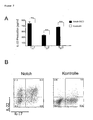
- Naive, ie antigen-inexperienced, helper T cells are activated in the presence of interleukin-12 (TH1) or without IL-12 in vitro and retrovirally transduced with active Notch. After 5 days, the cells are restimulated and the IL-22 mRNA expression analyzed. In some cases, after re-stimulation, IL-10 producing cells were isolated. Control cells hardly produce IL-22 under these conditions. Notch transduced T helper cells, on the other hand, produce high levels of IL-22, both under TH1 and under TH0 conditions. In addition, IL-22 is produced by both IL-10 positive and IL-10 negative Th cells ( FIG. 1 ).
- T helper cells are treated under TH1, TH2, THO conditions ( FIG. 2A ) or TH17 conditions ( FIG. 2B ) were activated in vitro and retrovirally transduced with active Notch. After 5 days, cells are restimulated and IL-22 expression is analyzed. In contrast to control-transduced T cells, Notch-transduced TH cells show strong IL-22 expression under all culture conditions, which is particularly pronounced in TH17 cells ( FIG. 2 ).
- Naive, ie, antigen-inexperienced, helper T cells are activated in vitro in the presence of interleukin-12 (TH1) and retrovirally transduced with active Notch (Notch-1 to Notch-4). After 5 days, the cells are restimulated and the IL-22 mRNA expression analyzed. It turns out that all four Notch isoforms are capable of inducing IL-22 ( FIG. 3 ).
- Naive, ie antigen-inexperienced, human T helper cells are co-cultured and activated with monocytes or with plasmacytoid dendritic cells.
- the pDCs or monocytes are activated by the TLR-9 agonist CpG.
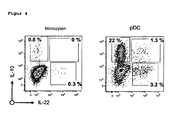
- cells are restimulated and IL-22 and IL-10 expression are analyzed. It has been found that plasmacytoid dendritic cells are able to induce the expression of IL-22 as well as IL-10 in Th cells ( FIG. 4 ).
- Naive, ie antigen-inexperienced, human T-helper cells are co-cultured and activated with plasmacytoid dendritic cells.
- the pDCs are activated by the TLR-9 agonist CpG.
- the Notch Siganlweg is inhibited by a specific inhibitor (g-secretase inhibitor) ( FIG. 5A ).
- the interaction of Notch with Jagged or with Dll-1 and Dll-4 is selectively inhibited by blocking antibodies ( FIG. 5B ).
- the cells are restimulated and the IL-22 expression analyzed. It has been shown that plasmacytoid dendritic cells are able to induce IL-22 expression in Th cells. This induction is dependent on Notch activity ( Figure 4A).
- this IL-22 expression is dependent on the ligands of the delta-like family, especially Dll-4 ( FIG. 5B ).
- Naive, ie, antigen-inexperienced, human T-helper cells are activated in the absence of antigen-presenting cells with microparticles loaded with stimulating anti-CD3 and anti-CD28 antibodies as well as increasing concentrations of recombinantly produced delta-like-4. After 5 days, the cells are restimulated and the IL-22 expression analyzed. It has been shown that the Notch ligand Dll4 leads concentration-dependently to the expression of IL-22 ( FIG. 6 ).
Landscapes
- Health & Medical Sciences (AREA)
- Life Sciences & Earth Sciences (AREA)
- Animal Behavior & Ethology (AREA)
- Chemical & Material Sciences (AREA)
- Veterinary Medicine (AREA)
- Public Health (AREA)
- Medicinal Chemistry (AREA)
- General Health & Medical Sciences (AREA)
- Pharmacology & Pharmacy (AREA)
- Organic Chemistry (AREA)
- General Chemical & Material Sciences (AREA)
- Chemical Kinetics & Catalysis (AREA)
- Engineering & Computer Science (AREA)
- Bioinformatics & Cheminformatics (AREA)
- Nuclear Medicine, Radiotherapy & Molecular Imaging (AREA)
- Gastroenterology & Hepatology (AREA)
- Proteomics, Peptides & Aminoacids (AREA)
- Immunology (AREA)
- Epidemiology (AREA)
- Rheumatology (AREA)
- Pain & Pain Management (AREA)
- Dermatology (AREA)
- Medicines That Contain Protein Lipid Enzymes And Other Medicines (AREA)
- Medicines Containing Material From Animals Or Micro-Organisms (AREA)
- Micro-Organisms Or Cultivation Processes Thereof (AREA)
Description
- Die Erfindung betrifft ein in vitro Verfahren zur gezielten Modulation der Interleukin-22 Expression von T-Zellen durch Beeinflussung des Notch-Signalweges. Die Erfindung beinhaltet:
- 1. die Möglichkeit zur Generierung von Interleukin(IL)-22-produzierenden T-Zellen, durch die Aktivierung des Notch-Signalweges;
- 2. die Möglichkeit der Inhibition der IL-22 Expression von T-Zellen durch die Inhibition des Notch-Signalweges.
- Den vielfältigen Aufgaben von T-Helfer-Zellen entsprechend, gibt es unterschiedliche Subpopulationen dieser Zellen. Sie zeichnen sich durch die differentielle Expression von löslichen Botenstoffen, den Zytokinen, aus.
- Eine Subpopulation von T-Helfer-Zellen, die sogenannten Th1-Zellen, exprimieren Zytokine, die die zelluläre Immunantwort dirigieren können. Hierzu gehören Interferon(IFN)-gamma und Tumor-Nekrose-Faktor (TNF)-alpha und -beta. Th2-Zellen sind notwendig für humorale Immunantworten. Zu den Th2-Zytokinen zählen IL-4, IL-5, IL-10 und IL-13. Eine weitere Subpopulation von T-Helfer-Zellen, die sogenannten Th17-Zellen, sind gekennzeichnet durch die Produktion des Zytokins IL-17 und wirken ebenfalls pro-inflammatorisch.
IL-22 wirkt nicht auf Leukozyten, sondern auf Hepatozyten, Keratinozyten oder auch Darmepithelzellen. IL-22 ist sowohl an Entzündungsprozessen als auch an der Gewebereparatur und Wundheilung beteiligt. - IL-22 induziert pro-inflammatorische Antworten durch die Induktion von Zytokinen, Chemokinen und Akute-Phase-Proteinen in vielen Zelltypen. Darüber hinaus induziert IL-22 die Produktion von antimikrobiellen Peptiden, wie b-Defensinen und S100 Proteinen. Es kann eine starke antimikrobielle Reaktion in vitro induzieren und ist mit verschiedenen viralen und bakteriellen Infektionen assoziiert.
- Die Funktion von IL-22 im Entzündungsgeschehen hängt entscheidend vom Zielgewebe ab. Obwohl einige Berichte über eine pro-inflammatorische pathogene Funktion von IL-22 vor allem in Entzündungsreaktionen der Haut existieren (IL-22 ist in psoriatischen Läsionen überexprimiert), wird in anderen Systemen eine protektive Wirkung gefunden. IL-22 wirkt bei Hepatitis oder ulzerierender Colitis protektiv.
- IL-22 wird bisher vorwiegend als Th17-Zytokin beschrieben. IL-22 wird jedoch auch von NK-Zellen und von dendritischen Zellen exprimiert.
- In vitro kann IL-22 in Th-Zellen durch IL-23 und IL-6 induziert werden, während TGF-b inhibierend wirkt. In vivo ist vor allem IL-23 für die IL-22 Expression notwendig. Die molekularen Mechanismen sind bisher nicht bekannt.
- Da IL-22 in vielen Prozessen - unter anderem im Krankheitsverlauf von unterschiedlichen Erkrankungen - eine Rolle spielt, war es die Aufgabe der Erfindung, die IL-22 Produktion in T-Zellen zu regulieren, insbesondere zu verstärken oder abzuschalten.
- Die Aufgabe konnte durch die Ausführungsformen der Ansprüche realisiert werden.
- In einer ersten Ausführungsform betrifft die Erfindung eine in vitro Verwendung von Notch-Regulatoren, ausgewählt aus der Gruppe umfassend Induktoren der signalaktiven Notch-Moleküle und/oder Notch-Inhibitoren, zur Modifikation der Interleukin-22-Produktion in T-Zellen.
- Es war völlig überraschend, dass über die Regulation des Notch-Signalwegs die Produktion von IL-22 in T-Zellen moduliert werden kann.
- Außerdem bevorzugt ist die Verwendung, dadurch gekennzeichnet, dass die T-Zellen ausgewählt sind aus der Gruppe umfassend naiven T-Zellen, Gedächtnis-T-Zellen, proinflammatorischen Th1-Zellen, proinflammatorische Th2-Zellen und proinflammatorische Th17-Zellen. Es war völlig überraschend, dass die Regulation des Notch-Signalwegs in all diesen Zellen zur Modulation der IL-22 Produktion führt.
- Notch ist in einer latenten Form immer in der Zelle vorhanden. Diese latente Form wird durch Aktivatoren in eine (signal)aktive (signalaktiv = aktiv) Form überführt. Dies geschieht im Falle des Notch-Rezeptors durch proteolytische Spaltung. Dies bedeutet gleichzeitig, dass die aktive Form eine andere Struktur/Beschaffenheit besitzt als die latente Form.
- Dadurch kann eine signalaktive Form auf zwei Wegen in die Zelle gebracht werden
- a) Durch physiologische Aktivierung der Rezeptoren: Aktivatoren für Notch sind nach dieser Definition die Notch-Liganden, Notchligand-Protein, Notchligand-Fusionsproteinen, Notchligand-Fragmente, Notchligand-exprimierenden Zellen und/oder stimulierende anti-Notch-Antikörper.
- b) Durch direkte Transfektion der Zellen mit der konstitutiv aktiven Form von Notch (Notch-intracellular domain (NICD)), bevorzugt Notch-Rezeptor-1, -2, -3 oder -4.
- Bevorzugt sind die Induktoren der signalaktiven Notch-Moleküle ausgewählt aus der Gruppe umfassend Aktivatoren für Notch, bevorzugt Notch-Liganden, Notchligand-Protein, Notchligand-Fusionsproteinen, Notchligand-Fragmente, Notchligand-exprimierenden Zellen und/oder stimulierende anti-Notch-Antikörper und/oder Notch-Rezeptoren, bevorzugt Notch-Rezeptor-1, -2, -3 oder -4.
- Außerdem vorteilhaft ist die Verwendung endogener Notch-Moleküle. Endogene Notch-Moleküle haben den Vorteil, dass sie nur spezifisch auf eine Zelle wirken. Dadurch ist eine exakte Regulation möglich.
- Die Notch-Rezeptoren sind bevorzugt ausgewählt aus der Gruppe umfassend Notch-1, -2, -3 und/oder -4.
- Die Notch-Liganden sind bevorzugt ausgewählt aus der Gruppe umfassend die Jagged-Familie, insbesondere Jagged-1 und/oder -2 und/oder Delta-like-Familie, insbesondere Delta-like-1, -2, und/oder -4.
- Es war dabei überraschend, dass die Notch-Liganden aus der Delta-like Familie, insbesondere Delta-like4, die IL-22 Induktion bewirken.
- Es war auch überraschend, dass pDC, insbesondere nach Stimulation mit Liganden der Toll-like-Rezeptoren, bevorzugt TLR 1-13 und insbesondere bevorzugt TLR9, besonders große Mengen an Delta-like 4 exprimieren und unter diesen Bedingungen besonders effizient die Induktion von IL-22 in T-Zellen bewirken.
- Notch-Ligand-Fragmente bzw. Protein-Fragmente sind bevorzugt solche, wie in der
WO 2004/024764 A1 offenbart. Die dort offenbarten Konstrukte und Fragmente der Notch-Liganden können entweder für eine Aktivierung oder Inhibition des Notch-Signalweges eingesetzt werden. Bevorzugt weisen die Fragmente im wesentlichen die gleiche Aktivität wie das Molekül auf, aus dem sie gewonnen wurden. - Bevorzugt sind die Inhibitoren der Notch-Aktivierung, ausgewählt aus der Gruppe umfassend rekombinante Proteine, Proteinfragmente und/oder Peptide von Notch oder Notchliganden, pharmakologischen Inhibitoren bevorzugt gamma-Sekretase-Inhibitoren, Antikörpern gegen Notch-Moleküle zur Hemmung der Induktion und/oder Expression von Interleukin-22.
- In eine bevorzugten Ausführungsform betrifft die Erfindung die in vitro Verwendung von Induktoren der signalaktiven Notch-Moleküle und/oder signalaktive Notch-Molekülen zur Generierung von Interleukin-22-produzierenden T-Zellen.
- Es war überraschend, dass T-Zellen, wenn sie mit signalaktivem Notch in Kontakt gebracht werden, IL-22 exprimieren.
- Außerdem bevorzugt ist die in vitro Verwendung von Induktoren der signalaktiven Notch-Moleküle.und/oder signalaktive Notch-Molekülen zur Induktion und/oder Expression von Interleukin-22.
- Besonders bevorzugt ist, dass die T-Zellen mit signalaktiven Notch-Molekülen in Kontakt gebracht werden. Durch die Aktivierung von Notch wird die IL-22 Produktion der T-Zellen induziert.
- Außerdem bevorzugt ist die Verwendung, wobei signalaktives Notch-1, -2, -3 und/oder -4 überexprimiert wird. Diese Verwendung führt zu einer besonders schnellen Erhöhung der IL-22 Produktion. Dem Fachmann sind Methoden bekannt, um die Überexpression von bestimmten Proteinen zu induzieren sowie signalaktive Varianten von Proteinen herzustellen.
- Außerdem vorteilhaft ist das In-Kontakt-Bringen von endogenen Notch-Molekülen mit Notch-Liganden. Der Fachmann kennt Methoden, um endogene Notch-Moleküle mit Notch-Liganden in Kontakt zu bringen, in der Weise, dass der Notch-Signalweg aktiviert wird.
- Außerdem bevorzugt ist die Verwendung, wobei Notch-Liganden mit T-Zellen in Kontakt gebracht werden, wobei das In-Kontakt-Bringen durch Stimulation mit Zellen verstärkt und/oder induziert wird, wobei die Zellen ausgewählt sind aus der Gruppe umfassend Antigenpräsentierende Zellen, insbesondere über die Stimulation der Antigen-präsentierenden Zellen mit Toll-like Rezeptoren oder CD40 und/oder plasmazytoiden dendritischen Zellen, insbesondere durch Stimulation der plasmazytoiden dendritischen Zellen über Toll-like Rezeptoren oder CD40.
- Dem Fachmann sind Methoden bekannt, um TLR zu aktivieren. Bevorzugt handelt es sich bei den Liganden um Moleküle der Delta-like Familie, insbesondere um Delta-like4 und/oder Delta-like1. Bei den TLR handelt es sich insbesondere um Moleküle, die ausgewählt sind aus der Gruppe umfassend TLR-1, -2, -3, -4, -5, -6, -7, -8, -9, -10, - 11, -12 und/oder -13.
- In einer besonders bevorzugten Ausführungsform der Erfindung erfolgt das In-Kontakt-Bringen mit den Notch-Liganden durch Stimulation mit plasmazytoiden dendritischen Zellen, wobei das In-Kontakt-Bringen insbesondere über TLR verstärkt und/oder induziert wird. Plasmazytoide dendritische Zellen exprimieren die Notch-Liganden Delta-like-1 und-4 besonders stark.
- In einer weiteren bevorzugten Ausführungsform betrifft die Erfindung die Verwendung von Induktoren der signalaktiven Notch-Moleküle und/oder signalaktive Notch-Moleküle, wobei die Generierung der Interleukin-22 produzierenden T-Zellen in vitro durch eine Stimulation mit Notchligand-Protein, Notchligand-Fusionsproteinen, signalaktiven Notchligand-Fragmenten, Notchligand-exprimierenden Zellen und/oder durch ein Einbringen von signalaktivem Notch durch virale und/oder nicht virale Transduktionsmethoden erfolgt. Die Verwendungen im Sinne der Erfindung führen zu stark erhöhten IL-22-Expressionsraten.
- In einer weiteren bevorzugten Ausführungsform betrifft die Erfindung ein in vitro Verfahren zur Generierung von Interleukin-22 produzierenden T-Zellen. Bei dem erfindungsgemäßen Verfahren werden T-Zellen mit signalaktiven Notch-Molekülen in Kontakt gebracht und der Notch-Signalweg somit aktiviert. Das Verfahren ist vorteilhaft, da es besonders einfach und effizient anzuwenden ist. Durch die einfache Umsetzung werden Kosten, Zeit und Arbeitsschritte gespart.
- In einer weiteren bevorzugten Ausführungsform betrifft die Erfindung die Verwendung von Inhibitoren der Notch-Aktivierung, ausgewählt aus der Gruppe umfassend rekombinante Proteine, Proteinfragmente und/oder Peptide von Notch oder Notchliganden, pharmakologischen Inhibitoren bevorzugt gamma-Sekretase-Inhibitoren, Antikörpern gegen Notch-Moleküle zur Hemmung der Induktion und/oder Expression von Interleukin-22.
- Pharmakologische Inhibitoren des Notch-Signalweges umfassen insbesondere Substanzen der Klasse der gamma-Sekretase-Inhibitoren.
- Darüber hinaus sind andere Inhibitoren des Notch-Signalweges einzuschließen, wie lösliche Notch-Liganden, deren Fragmente, Fusionsproteine oder einzelne Peptide wie in der
WO2004/024764 offenbart. Weiterhin sind insbesondere natürlich blockierende Antikörper gegen die Notch-Rezeptoren mit beansprucht. Die Inhibition der Notch-Aktivierung ist auch durch die Transfektion der Zellen mit negativen Regulatoren des Notch-Signalweges möglich. Hier sind Deltex, MINT, NRARP oder dominant negative Formen von Mastermind bevorzugte Mittel, die dem Fachmann bekannt sind. - Es war völlig überraschend, dass durch Blockade des Notch-Signalweges die IL-22 Produktion von T-Zellen, bevorzugt proinflammatorischen T-Zellen, verringert oder abgeschaltet wird.
- Bevorzugt ist die Verwendung dadurch gekennzeichnet, dass in Antigen-präsentierenden Zellen und/oder dendritischen Zellen die Expression der Notch-Liganden der Delta-like Familie, insbesondere der Liganden Delta-like1 und Delta-like 4, inhibiert ist.
- In einer weiteren bevorzugten Ausführungsform betrifft die Erfindung die Verwendung des erfindungsgemäßen Verfahrens zur Induktion von Interleukin-22 in vitro.
- Die Erfindung zeichnet sich durch folgende Vorteile aus:
- Abkehr vom technisch Üblichen
- neue Aufgabenstellung
- Vorliegen eines seit langem ungelösten dringenden Bedürfnisses für die Lösung des mit der Erfindung gelösten Problems
- bisheriges vergebliches Bemühen der Fachwelt
- die Einfachheit der Lösung spricht für erfinderische Tätigkeit, insbesondere da sie kompliziertere Lehren ersetzt
- Entwicklung der wissenschaftlichen Technik ging in eine andere Richtung
- entwicklungsstraffende Leistung
- Fehlvorstellungen der Fachwelt über die Lösung des entsprechenden Problems (Vorurteil)
- technischer Fortschritt, wie z. B.: Verbesserung, Leistungssteigerung, Verbilligung, Ersparnis an Zeit, Material, Arbeitsstufen, Kosten oder schwer beschaffbaren Rohstoffen, erhöhte Zuverlässigkeit, Beseitigung von Fehlern, Qualitätshebung, Wartungsfreiheit, größere Effektivität, höhere Ausbeute, Vermehrung der technischen Möglichkeiten, Bereitstellung eines weiteren Mittels, Eröffnung eines zweiten Weges, Eröffnung eines neuen Gebietes, erstmalige Lösung einer Aufgabe, Reservemittel, Alternativen, Möglichkeit der Rationalisierung, Automatisierung oder Miniaturisierung oder Bereichung des Arzneimittelschatzes
- glücklicher Griff, da aus einer Vielzahl von Möglichkeiten eine bestimmte gewählt wurde, deren Ergebnis nicht vorausgesagt werden konnte, daher handelt es sich um ein patentwürdigen glücklichen Griff)
- Irrtümer in der Fachliteratur bzw. sehr widersprüchliche Darstellung zum Erfindungsgegenstand
- junges Gebiet der Technik
- Kombinationserfindung, d.h. mehrere bekannte Elemente werden zu einer Kombination zusammengeführt, die einen überraschenden Effekt aufweist
- Lizenzvergabe
- Lob der Fachwelt und
- wirtschaftlicher Erfolg.
- Insbesondere die vorteilhaften Ausführungsformen der Erfindung weisen mindestens einen oder mehrere der genannten Vorteile auf.
- Im Weiteren soll die Erfindung anhand von Beispielen näher erläutert werden, ohne auf diese Beispiele beschränkt zu sein.
- Naive, d.h. Antigen-unerfahrene, T-Helfer-Zellen werden in Gegenwart von Interleukin-12 (TH1) oder ohne IL-12 in vitro aktiviert und mit aktivem Notch retroviral transduziert. Nach 5 Tagen werden die Zellen restimuliert und die IL-22-mRNA Expression analysiert. In einigen Fällen wurden nach der Re-Stimulation IL-10 produzierenden Zellen isoliert. Kontrollzellen produzieren unter diesen Bedingungen kaum IL-22. Notch-transduzierte T-Helferzellen hingegen produzieren große Mengen an IL-22, sowohl unter TH1 als auch unter TH0 Bedingungen. Darüber hinaus wird IL-22 sowohl von IL-10 positiven als auch von IL-10 negativen Th-Zellen produziert (
Figur 1 ). - Naive, d.h. Antigen-unerfahrene, T-Helfer-Zellen werden unter TH1-, TH2-, TH0-Bedingungen (
Figur 2A ) oder TH17-Bedingungen (Figur 2B ) in vitro aktiviert und mit aktivem Notch retroviral transduziert. Nach 5 Tagen werden die Zellen restimuliert und die IL-22-Expression analysiert. Im Gegensatz zu kontrolltransduzierten T-Zellen zeigen Notch-transduzierte TH-Zellen unter allen Kulturbedingungen eine starke IL-22 Expression, diese ist in TH17 Zellen besonders ausgeprägt (Figur 2 ). - Naive, d.h. Antigen-unerfahrene, T-Helfer-Zellen werden in Gegenwart von Interleukin-12 (TH1) in vitro aktiviert und mit aktivem Notch (Notch-1 bis Notch-4) retroviral transduziert. Nach 5 Tagen werden die Zellen restimuliert und die IL-22-mRNA Expression analysiert. Es zeigt sich, dass alle vier Notch-Isoformen zur Induktion von IL-22 in der Lage sind (
Figur 3 ). - Naive, d.h. Antigen-unerfahrene, humane T-Helfer-Zellen werden mit Monozyten oder mit plasmazytoiden dendritischen Zellen ko-kultiviert und aktiviert. Die pDCs oder Monozyten werden durch den TLR-9 Agonisten CpG aktivert. Nach 5 Tagen werden die Zellen restimuliert und die IL-22 und IL-10 Expression analysiert. Es zeigt sich, dass plasmazytoide dendritische Zellen in der Lage sind, in Th-Zellen die Expression von IL-22 wie auch IL-10 zu induzieren (
Figur 4 ). - Naive, d.h. Antigen-unerfahrene, humane T-Helfer-Zellen werden mit plasmazytoiden dendritischen Zellen ko-kultiviert und aktiviert. Die pDCs werden durch den TLR-9 Agonisten CpG aktivert. In einigen Ansätzen wird der Notch Siganlweg durch einen spezifischen Inhibitor (g-Sekretase-Inhibitor) inhibiert (
Figur 5A ). In einigen Ansätzen wird die Interaktion von Notch mit Jagged bzw. mit Dll-1 und Dll-4 selektiv durch blockierende Antikörper inhibiert (Figur 5B ). Nach 5 Tagen werden die Zellen restimuliert und die IL-22 Expression analysiert. Es zeigt sich, dass plasmazytoide dendritische Zellen in der Lage sind, in Th-Zellen eine IL-22 Expression zu induzieren. Diese Induktion ist abhängig von der Notch-Aktivität (Figur 4A). Weiterhin ist diese IL-22 Expression abhängig von den Liganden der Delta-like Familie, speziell von Dll-4 (Figur 5B ). - Naive, d.h. Antigen-unerfahrene, humane T-Helfer-Zellen werden in Abwesenheit von antigenpräsentierenden Zellen mit Mikropartikeln, die mit stimulierenden anti-CD3 und anti-CD28 Antikörpern sowie aufsteigenden Konzentrationen von rekombinant hergestelltem Delta-like-4 beladen sind, aktiviert. Nach 5 Tagen werden die Zellen restimuliert und die IL-22 Expression analysiert. Es zeigt sich, dass der Notch Ligand Dll4 konzentrationsabhängig zur Expression von IL-22 führt (
Figur 6 ).
Claims (13)
- In vitro Verwendung von Notch-Regulatoren, ausgewählt aus der Gruppe umfassend Induktoren der signalaktiven Notch-Moleküle und/oder Notch-Inhibitoren, zur Modulation der Interleukin-22-Produktion in T-Zellen.
- In vitro Verwendung von Induktoren der signalaktiven Notch-Moleküle und/oder signalaktive Notch-Molekülen zur Generierung von Interleukin-22-produzierenden T-Zellen.
- Verwendung nach Anspruch 1,
dadurch gekennzeichnet, dass
die T-Zellen ausgewählt sind aus der Gruppe umfassend naive T-Zellen, Gedächtnis-T-Zellen, proinflammatorische Th1-Zellen, proinflammatorische Th2-Zellen und proinflammatorische Th17-Zellen. - Verwendung nach Anspruch 1 oder 2,
dadurch gekennzeichnet, dass
die Induktion der signalaktiven Notch-Moleküle erfolgt durch(i) physiologische Aktivierung der Notch-Rezeptoren, bevorzugt durch Notch-Liganden, Notchligand-Protein, Notchligand-Fusionsproteinen, Notchligand-Fragmente, Notchligand-exprimierenden Zellen und/oder stimulierende anti-Notch-Antikörper und/oder(ii) Transfektion der T-Zellen mit der konstitutiv aktiven Form von Notch-Rezeptoren. - Verwendung nach mindestens einem der vorhergehenden Ansprüche,
dadurch gekennzeichnet, dass
die Notch-Moleküle endogene Notch-Moleküle sind. - Verwendung nach mindestens einem der vorhergehenden Ansprüche,
dadurch gekennzeichnet, dass
die Notch-Rezeptoren ausgewählt sind aus der Gruppe umfassend Notch-1, -2, -3 und/oder -4 und
die Notch-Liganden ausgewählt sind aus der Gruppe umfassend die Jagged-Familie, insbesondere Jagged-1 und/oder -2 und/oder Delta-like-Familie, insbesondere Delta-like-1, -2, und/oder -4. - Verwendung nach mindestens einem der vorhergehenden Ansprüche,
dadurch gekennzeichnet, dass
signalaktives Notch-1, -2, -3 und/oder -4 überexprimiert wird. - Verwendung nach mindestens einem der vorhergehenden Ansprüche,
dadurch gekennzeichnet, dass
Notch-Liganden mit T-Zellen in Kontakt gebracht werden, dadurch gekennzeichnet, dass
das in-Kontakt-Bringen durch Stimulation mit Zellen verstärkt und/oder induziert wird, wobei die Zellen ausgewählt sind aus der Gruppe umfassend Antigen-präsentierenden Zellen, insbesondere über die Stimulation der Antigen-präsentierenden Zellen mit Toll-like Rezeptoren oder CD40 und/oder plasmazytoiden dendritischen Zellen, insbesondere durch Stimulation der plasmazytoiden dendritischen Zellen über Toll-like Rezeptoren oder CD40. - Verwendung nach mindestens einem der vorhergehenden Ansprüche,
dadurch gekennzeichnet, dass
die Generierung der Interleukin-22 produzierenden T-Zellen in vitro durch eine Stimulation mit Notchligand-Protein, Notchligand-Fusionsproteinen, signalaktiven Notchligand-Fragmenten, Notchligand-exprimierenden Zellen und/oder durch ein Einbringen von signalaktivem Notch durch virale und/oder nicht virale Transduktionsmethoden erfolgt. - In vitro Verwendung von Induktoren der signalaktiven Notch-Moleküle und/oder signalaktiven Notch-Molekülen zur Induktion und/oder Expression von Interleukin-22.
- In vitro Verfahren zur Generierung von Interleukin-22 produzierenden T-Zellen,
dadurch gekennzeichnet, dass
T-Zellen mit signalaktiven Notch-Molekülen in Kontakt gebracht werden und der Notch-Signalweg aktiviert wird. - In vitro Verwendung von Inhibitoren der Notch-Aktivierung, ausgewählt aus der Gruppe umfassend rekombinante Proteine, Proteinfragmente und/oder Peptide von Notch oder Notchliganden, pharmakologischen Inhibitoren bevorzugt gamma-Sekretase-Inhibitoren, Antikörpern gegen Notch-Moleküle zur Hemmung der Induktion und/oder Expression von Interleukin-22.
- Verwendung nach Anspruch 12
dadurch gekennzeichnet, dass
in Antigen-präsentierenden Zellen und/oder dendritischen Zellen die Expression der Notch-Liganden der Delta-like Familie, insbesondere der Liganden Delta-like1 und Delta-like 4 inhibiert ist.
Applications Claiming Priority (2)
| Application Number | Priority Date | Filing Date | Title |
|---|---|---|---|
| DE102009009603 | 2009-02-16 | ||
| PCT/DE2010/000212 WO2010091679A2 (de) | 2009-02-16 | 2010-02-16 | Verwendung von notch-regulatoren zur modulation der immunantwort durch induktion/suppression von interleukin-22 |
Publications (2)
| Publication Number | Publication Date |
|---|---|
| EP2396021A2 EP2396021A2 (de) | 2011-12-21 |
| EP2396021B1 true EP2396021B1 (de) | 2015-08-19 |
Family
ID=42333256
Family Applications (1)
| Application Number | Title | Priority Date | Filing Date |
|---|---|---|---|
| EP10723482.5A Active EP2396021B1 (de) | 2009-02-16 | 2010-02-16 | In vitro verwendung von notch-regulatoren zur modulation der immunantwort durch induktion/suppression von interleukin-22 |
Country Status (4)
| Country | Link |
|---|---|
| US (1) | US8709710B2 (de) |
| EP (1) | EP2396021B1 (de) |
| DE (1) | DE112010000371A5 (de) |
| WO (1) | WO2010091679A2 (de) |
Families Citing this family (3)
| Publication number | Priority date | Publication date | Assignee | Title |
|---|---|---|---|---|
| WO2013177432A1 (en) * | 2012-05-23 | 2013-11-28 | The University Of Chicago | Methods of treating obesity |
| EP2970468B1 (de) | 2013-03-13 | 2021-07-07 | Novartis AG | Notch2-bindungsmoleküle zur behandlung von atemwegserkrankungen |
| WO2022165367A1 (en) * | 2021-01-29 | 2022-08-04 | Fred Hutchinson Cancer Research Center | Methods and compositions for enhancing cd4+ phenotype for adoptive t cell therapy |
Family Cites Families (6)
| Publication number | Priority date | Publication date | Assignee | Title |
|---|---|---|---|---|
| US6887475B1 (en) * | 1996-11-07 | 2005-05-03 | Lorantis Limited | Notch |
| EP1616958A3 (de) | 1996-11-07 | 2006-02-08 | Lorantis Limited | Notch-Liganden zur Verwendung in der Immuntherapie |
| GB9927328D0 (en) * | 1999-11-18 | 2000-01-12 | Lorantis Ltd | Immunotherapy |
| GB0112818D0 (en) | 2001-05-25 | 2001-07-18 | Lorantis Ltd | Conjugate |
| EP1410018A1 (de) | 2001-07-25 | 2004-04-21 | Lorantis Limited | Methode zur detektion von modulatoren von notch signaltransduktion |
| WO2008092445A2 (de) | 2007-01-30 | 2008-08-07 | Deutsches Rheuma-Forschungszentrum Berlin | Verfahren zur modulation der immunantwort durch aktivierung oder inaktivierung des notch und/oder stat4 signalweges |
-
2010
- 2010-02-16 WO PCT/DE2010/000212 patent/WO2010091679A2/de not_active Ceased
- 2010-02-16 DE DE112010000371T patent/DE112010000371A5/de not_active Withdrawn
- 2010-02-16 US US13/201,638 patent/US8709710B2/en active Active
- 2010-02-16 EP EP10723482.5A patent/EP2396021B1/de active Active
Also Published As
| Publication number | Publication date |
|---|---|
| US8709710B2 (en) | 2014-04-29 |
| US20120045458A1 (en) | 2012-02-23 |
| WO2010091679A2 (de) | 2010-08-19 |
| EP2396021A2 (de) | 2011-12-21 |
| WO2010091679A3 (de) | 2010-11-25 |
| DE112010000371A5 (de) | 2012-09-06 |
Similar Documents
| Publication | Publication Date | Title |
|---|---|---|
| Nakagomi et al. | Endothelial cells support survival, proliferation, and neuronal differentiation of transplanted adult ischemia-induced neural stem/progenitor cells after cerebral infarction | |
| DE102017127984B4 (de) | Verfahren für die Vermehrung und Aktivierung von γδ-T-Zellen | |
| DE60225310T2 (de) | Differenzierung vom gesamten knochenmark | |
| Tomita et al. | A comparison of neural differentiation and retinal transplantation with bone marrow‐derived cells and retinal progenitor cells | |
| DE60132429T2 (de) | Pluripotente aus von fettgewebe stammenden stromazellen erzeugte stammzellen und deren verwendung | |
| DE69738495T2 (de) | Verfahren zur regulation der angiogenese | |
| DE60029304T2 (de) | Aktivierung von regulatorischen t zellen durch ein alpha-melanocyten stimulierendes hormon | |
| Oh et al. | Hypoxia-preconditioned adipose tissue-derived mesenchymal stem cell increase the survival and gene expression of engineered neural stem cells in a spinal cord injury model | |
| WO1998021322A1 (de) | Design-prinzip für die konstruktion von expressionskonstrukten für die gentherapie | |
| DE112019000348B4 (de) | Umprogrammierte t-zellen ähnliche nk-zellen | |
| Muniswami et al. | Motor recovery after transplantation of bone marrow mesenchymal stem cells in rat models of spinal cord injury | |
| US20220118028A1 (en) | Cells expressing parathyroid hormone 1 receptor and uses thereof | |
| DE69529473T2 (de) | Gezielte t-lymfozyten | |
| DE69430975T2 (de) | Verfahren zur Herstellung von Proteinen | |
| Lee et al. | Human parathyroid hormone increases the mRNA expression of the IGF system and hematopoietic growth factors in osteoblasts, but does not influence expression in mesenchymal stem cells | |
| EP2115128A2 (de) | Verfahren zur modulation der immunantwort durch aktivierung oder inaktivierung des notch und/oder stat4 signalweges | |
| WO2004027428A1 (de) | Verfahren zum nachweis und zur isolierung von t-lymphozyten, die ein definiertes antigen erkennen | |
| Yang et al. | Effects of bone marrow stromal cell-conditioned medium on primary cultures of peripheral nerve tissues and cells | |
| WO2010091679A2 (de) | Verwendung von notch-regulatoren zur modulation der immunantwort durch induktion/suppression von interleukin-22 | |
| US9968782B2 (en) | Selective, directable electrotaxis of precursor cells with biphasic electrical stimulation | |
| Zhou et al. | Embryonic stem cells with GFP knocked into the dopamine transporter yield purified dopamine neurons in vitro and from knock-in mice | |
| JP7435942B2 (ja) | 神経幹細胞または神経前駆細胞からドーパミン神経細胞への分化方法 | |
| EP1981967A1 (de) | Mrna-transfektion von adulten progenitorzellen zur spezifischen gewebsregeneration | |
| EP1337625B1 (de) | Stammzellen, verfahren zu deren expansion in vitro sowie deren verwendung | |
| EP0857781A2 (de) | Promotor des humanen Endoglingens sowie seine Verwendung |
Legal Events
| Date | Code | Title | Description |
|---|---|---|---|
| PUAI | Public reference made under article 153(3) epc to a published international application that has entered the european phase |
Free format text: ORIGINAL CODE: 0009012 |
|
| 17P | Request for examination filed |
Effective date: 20110909 |
|
| AK | Designated contracting states |
Kind code of ref document: A2 Designated state(s): AT BE BG CH CY CZ DE DK EE ES FI FR GB GR HR HU IE IS IT LI LT LU LV MC MK MT NL NO PL PT RO SE SI SK SM TR |
|
| DAX | Request for extension of the european patent (deleted) | ||
| 17Q | First examination report despatched |
Effective date: 20140506 |
|
| GRAP | Despatch of communication of intention to grant a patent |
Free format text: ORIGINAL CODE: EPIDOSNIGR1 |
|
| INTG | Intention to grant announced |
Effective date: 20150312 |
|
| RIN1 | Information on inventor provided before grant (corrected) |
Inventor name: SCHEFFOLD, ALEXANDER Inventor name: HEINRICH, FREDERICK Inventor name: RUTZ, SASCHA |
|
| GRAS | Grant fee paid |
Free format text: ORIGINAL CODE: EPIDOSNIGR3 |
|
| GRAA | (expected) grant |
Free format text: ORIGINAL CODE: 0009210 |
|
| AK | Designated contracting states |
Kind code of ref document: B1 Designated state(s): AT BE BG CH CY CZ DE DK EE ES FI FR GB GR HR HU IE IS IT LI LT LU LV MC MK MT NL NO PL PT RO SE SI SK SM TR |
|
| RAP1 | Party data changed (applicant data changed or rights of an application transferred) |
Owner name: MILTENYI BIOTEC GMBH |
|
| REG | Reference to a national code |
Ref country code: GB Ref legal event code: FG4D Free format text: NOT ENGLISH |
|
| REG | Reference to a national code |
Ref country code: CH Ref legal event code: EP |
|
| REG | Reference to a national code |
Ref country code: IE Ref legal event code: FG4D Free format text: LANGUAGE OF EP DOCUMENT: GERMAN |
|
| REG | Reference to a national code |
Ref country code: AT Ref legal event code: REF Ref document number: 743311 Country of ref document: AT Kind code of ref document: T Effective date: 20150915 |
|
| REG | Reference to a national code |
Ref country code: DE Ref legal event code: R096 Ref document number: 502010010103 Country of ref document: DE |
|
| REG | Reference to a national code |
Ref country code: FR Ref legal event code: PLFP Year of fee payment: 7 |
|
| REG | Reference to a national code |
Ref country code: LT Ref legal event code: MG4D |
|
| REG | Reference to a national code |
Ref country code: NL Ref legal event code: MP Effective date: 20150819 |
|
| PG25 | Lapsed in a contracting state [announced via postgrant information from national office to epo] |
Ref country code: NO Free format text: LAPSE BECAUSE OF FAILURE TO SUBMIT A TRANSLATION OF THE DESCRIPTION OR TO PAY THE FEE WITHIN THE PRESCRIBED TIME-LIMIT Effective date: 20151119 Ref country code: LV Free format text: LAPSE BECAUSE OF FAILURE TO SUBMIT A TRANSLATION OF THE DESCRIPTION OR TO PAY THE FEE WITHIN THE PRESCRIBED TIME-LIMIT Effective date: 20150819 Ref country code: LT Free format text: LAPSE BECAUSE OF FAILURE TO SUBMIT A TRANSLATION OF THE DESCRIPTION OR TO PAY THE FEE WITHIN THE PRESCRIBED TIME-LIMIT Effective date: 20150819 Ref country code: GR Free format text: LAPSE BECAUSE OF FAILURE TO SUBMIT A TRANSLATION OF THE DESCRIPTION OR TO PAY THE FEE WITHIN THE PRESCRIBED TIME-LIMIT Effective date: 20151120 Ref country code: FI Free format text: LAPSE BECAUSE OF FAILURE TO SUBMIT A TRANSLATION OF THE DESCRIPTION OR TO PAY THE FEE WITHIN THE PRESCRIBED TIME-LIMIT Effective date: 20150819 |
|
| PG25 | Lapsed in a contracting state [announced via postgrant information from national office to epo] |
Ref country code: PT Free format text: LAPSE BECAUSE OF FAILURE TO SUBMIT A TRANSLATION OF THE DESCRIPTION OR TO PAY THE FEE WITHIN THE PRESCRIBED TIME-LIMIT Effective date: 20151221 Ref country code: SE Free format text: LAPSE BECAUSE OF FAILURE TO SUBMIT A TRANSLATION OF THE DESCRIPTION OR TO PAY THE FEE WITHIN THE PRESCRIBED TIME-LIMIT Effective date: 20150819 Ref country code: PL Free format text: LAPSE BECAUSE OF FAILURE TO SUBMIT A TRANSLATION OF THE DESCRIPTION OR TO PAY THE FEE WITHIN THE PRESCRIBED TIME-LIMIT Effective date: 20150819 Ref country code: ES Free format text: LAPSE BECAUSE OF FAILURE TO SUBMIT A TRANSLATION OF THE DESCRIPTION OR TO PAY THE FEE WITHIN THE PRESCRIBED TIME-LIMIT Effective date: 20150819 Ref country code: IS Free format text: LAPSE BECAUSE OF FAILURE TO SUBMIT A TRANSLATION OF THE DESCRIPTION OR TO PAY THE FEE WITHIN THE PRESCRIBED TIME-LIMIT Effective date: 20151219 |
|
| PG25 | Lapsed in a contracting state [announced via postgrant information from national office to epo] |
Ref country code: NL Free format text: LAPSE BECAUSE OF FAILURE TO SUBMIT A TRANSLATION OF THE DESCRIPTION OR TO PAY THE FEE WITHIN THE PRESCRIBED TIME-LIMIT Effective date: 20150819 |
|
| PG25 | Lapsed in a contracting state [announced via postgrant information from national office to epo] |
Ref country code: SK Free format text: LAPSE BECAUSE OF FAILURE TO SUBMIT A TRANSLATION OF THE DESCRIPTION OR TO PAY THE FEE WITHIN THE PRESCRIBED TIME-LIMIT Effective date: 20150819 Ref country code: IT Free format text: LAPSE BECAUSE OF FAILURE TO SUBMIT A TRANSLATION OF THE DESCRIPTION OR TO PAY THE FEE WITHIN THE PRESCRIBED TIME-LIMIT Effective date: 20150819 Ref country code: EE Free format text: LAPSE BECAUSE OF FAILURE TO SUBMIT A TRANSLATION OF THE DESCRIPTION OR TO PAY THE FEE WITHIN THE PRESCRIBED TIME-LIMIT Effective date: 20150819 Ref country code: DK Free format text: LAPSE BECAUSE OF FAILURE TO SUBMIT A TRANSLATION OF THE DESCRIPTION OR TO PAY THE FEE WITHIN THE PRESCRIBED TIME-LIMIT Effective date: 20150819 Ref country code: CZ Free format text: LAPSE BECAUSE OF FAILURE TO SUBMIT A TRANSLATION OF THE DESCRIPTION OR TO PAY THE FEE WITHIN THE PRESCRIBED TIME-LIMIT Effective date: 20150819 |
|
| REG | Reference to a national code |
Ref country code: DE Ref legal event code: R097 Ref document number: 502010010103 Country of ref document: DE |
|
| PG25 | Lapsed in a contracting state [announced via postgrant information from national office to epo] |
Ref country code: RO Free format text: LAPSE BECAUSE OF FAILURE TO SUBMIT A TRANSLATION OF THE DESCRIPTION OR TO PAY THE FEE WITHIN THE PRESCRIBED TIME-LIMIT Effective date: 20150819 Ref country code: BE Free format text: LAPSE BECAUSE OF NON-PAYMENT OF DUE FEES Effective date: 20160229 |
|
| PLBE | No opposition filed within time limit |
Free format text: ORIGINAL CODE: 0009261 |
|
| STAA | Information on the status of an ep patent application or granted ep patent |
Free format text: STATUS: NO OPPOSITION FILED WITHIN TIME LIMIT |
|
| 26N | No opposition filed |
Effective date: 20160520 |
|
| PG25 | Lapsed in a contracting state [announced via postgrant information from national office to epo] |
Ref country code: SI Free format text: LAPSE BECAUSE OF FAILURE TO SUBMIT A TRANSLATION OF THE DESCRIPTION OR TO PAY THE FEE WITHIN THE PRESCRIBED TIME-LIMIT Effective date: 20150819 |
|
| PG25 | Lapsed in a contracting state [announced via postgrant information from national office to epo] |
Ref country code: LU Free format text: LAPSE BECAUSE OF FAILURE TO SUBMIT A TRANSLATION OF THE DESCRIPTION OR TO PAY THE FEE WITHIN THE PRESCRIBED TIME-LIMIT Effective date: 20160216 Ref country code: MC Free format text: LAPSE BECAUSE OF FAILURE TO SUBMIT A TRANSLATION OF THE DESCRIPTION OR TO PAY THE FEE WITHIN THE PRESCRIBED TIME-LIMIT Effective date: 20150819 |
|
| REG | Reference to a national code |
Ref country code: CH Ref legal event code: PL |
|
| PG25 | Lapsed in a contracting state [announced via postgrant information from national office to epo] |
Ref country code: CH Free format text: LAPSE BECAUSE OF NON-PAYMENT OF DUE FEES Effective date: 20160229 Ref country code: LI Free format text: LAPSE BECAUSE OF NON-PAYMENT OF DUE FEES Effective date: 20160229 |
|
| REG | Reference to a national code |
Ref country code: IE Ref legal event code: MM4A |
|
| REG | Reference to a national code |
Ref country code: FR Ref legal event code: PLFP Year of fee payment: 8 |
|
| PG25 | Lapsed in a contracting state [announced via postgrant information from national office to epo] |
Ref country code: IE Free format text: LAPSE BECAUSE OF NON-PAYMENT OF DUE FEES Effective date: 20160216 |
|
| REG | Reference to a national code |
Ref country code: AT Ref legal event code: MM01 Ref document number: 743311 Country of ref document: AT Kind code of ref document: T Effective date: 20160216 |
|
| PG25 | Lapsed in a contracting state [announced via postgrant information from national office to epo] |
Ref country code: AT Free format text: LAPSE BECAUSE OF NON-PAYMENT OF DUE FEES Effective date: 20160216 |
|
| PG25 | Lapsed in a contracting state [announced via postgrant information from national office to epo] |
Ref country code: MT Free format text: LAPSE BECAUSE OF FAILURE TO SUBMIT A TRANSLATION OF THE DESCRIPTION OR TO PAY THE FEE WITHIN THE PRESCRIBED TIME-LIMIT Effective date: 20150819 |
|
| REG | Reference to a national code |
Ref country code: FR Ref legal event code: PLFP Year of fee payment: 9 |
|
| PG25 | Lapsed in a contracting state [announced via postgrant information from national office to epo] |
Ref country code: CY Free format text: LAPSE BECAUSE OF FAILURE TO SUBMIT A TRANSLATION OF THE DESCRIPTION OR TO PAY THE FEE WITHIN THE PRESCRIBED TIME-LIMIT Effective date: 20150819 Ref country code: SM Free format text: LAPSE BECAUSE OF FAILURE TO SUBMIT A TRANSLATION OF THE DESCRIPTION OR TO PAY THE FEE WITHIN THE PRESCRIBED TIME-LIMIT Effective date: 20150819 Ref country code: HU Free format text: LAPSE BECAUSE OF FAILURE TO SUBMIT A TRANSLATION OF THE DESCRIPTION OR TO PAY THE FEE WITHIN THE PRESCRIBED TIME-LIMIT; INVALID AB INITIO Effective date: 20100216 |
|
| PG25 | Lapsed in a contracting state [announced via postgrant information from national office to epo] |
Ref country code: TR Free format text: LAPSE BECAUSE OF FAILURE TO SUBMIT A TRANSLATION OF THE DESCRIPTION OR TO PAY THE FEE WITHIN THE PRESCRIBED TIME-LIMIT Effective date: 20150819 Ref country code: HR Free format text: LAPSE BECAUSE OF FAILURE TO SUBMIT A TRANSLATION OF THE DESCRIPTION OR TO PAY THE FEE WITHIN THE PRESCRIBED TIME-LIMIT Effective date: 20150819 Ref country code: MK Free format text: LAPSE BECAUSE OF FAILURE TO SUBMIT A TRANSLATION OF THE DESCRIPTION OR TO PAY THE FEE WITHIN THE PRESCRIBED TIME-LIMIT Effective date: 20150819 |
|
| PG25 | Lapsed in a contracting state [announced via postgrant information from national office to epo] |
Ref country code: BG Free format text: LAPSE BECAUSE OF FAILURE TO SUBMIT A TRANSLATION OF THE DESCRIPTION OR TO PAY THE FEE WITHIN THE PRESCRIBED TIME-LIMIT Effective date: 20150819 |
|
| REG | Reference to a national code |
Ref country code: DE Ref legal event code: R081 Ref document number: 502010010103 Country of ref document: DE Owner name: MILTENYI BIOTEC B.V. & CO. KG, DE Free format text: FORMER OWNER: MILTENYI BIOTEC GMBH, 51429 BERGISCH GLADBACH, DE |
|
| REG | Reference to a national code |
Ref country code: GB Ref legal event code: 732E Free format text: REGISTERED BETWEEN 20200528 AND 20200603 |
|
| PGFP | Annual fee paid to national office [announced via postgrant information from national office to epo] |
Ref country code: GB Payment date: 20260219 Year of fee payment: 17 |
|
| PGFP | Annual fee paid to national office [announced via postgrant information from national office to epo] |
Ref country code: DE Payment date: 20260218 Year of fee payment: 17 |
|
| PGFP | Annual fee paid to national office [announced via postgrant information from national office to epo] |
Ref country code: FR Payment date: 20260218 Year of fee payment: 17 |