EP2393545B1 - Percutaneous retrievable vascular filter - Google Patents
Percutaneous retrievable vascular filter Download PDFInfo
- Publication number
- EP2393545B1 EP2393545B1 EP10739084.1A EP10739084A EP2393545B1 EP 2393545 B1 EP2393545 B1 EP 2393545B1 EP 10739084 A EP10739084 A EP 10739084A EP 2393545 B1 EP2393545 B1 EP 2393545B1
- Authority
- EP
- European Patent Office
- Prior art keywords
- tube
- filter
- expandable
- legs
- leg
- Prior art date
- Legal status (The legal status is an assumption and is not a legal conclusion. Google has not performed a legal analysis and makes no representation as to the accuracy of the status listed.)
- Not-in-force
Links
- 230000002792 vascular Effects 0.000 title description 2
- 230000007246 mechanism Effects 0.000 description 17
- 208000010378 Pulmonary Embolism Diseases 0.000 description 12
- 239000000463 material Substances 0.000 description 11
- 238000000034 method Methods 0.000 description 11
- 239000013543 active substance Substances 0.000 description 10
- 210000001631 vena cava inferior Anatomy 0.000 description 10
- 229910052751 metal Inorganic materials 0.000 description 8
- 239000002184 metal Substances 0.000 description 8
- 208000007536 Thrombosis Diseases 0.000 description 6
- 210000002796 renal vein Anatomy 0.000 description 6
- 210000003191 femoral vein Anatomy 0.000 description 5
- 238000001914 filtration Methods 0.000 description 5
- 229910052760 oxygen Inorganic materials 0.000 description 5
- 206010051055 Deep vein thrombosis Diseases 0.000 description 4
- 206010047249 Venous thrombosis Diseases 0.000 description 4
- 238000013461 design Methods 0.000 description 4
- 238000003780 insertion Methods 0.000 description 4
- 230000037431 insertion Effects 0.000 description 4
- 229920000642 polymer Polymers 0.000 description 4
- 230000001028 anti-proliverative effect Effects 0.000 description 3
- 239000003146 anticoagulant agent Substances 0.000 description 3
- 239000003795 chemical substances by application Substances 0.000 description 3
- 239000003814 drug Substances 0.000 description 3
- 210000004731 jugular vein Anatomy 0.000 description 3
- 210000004072 lung Anatomy 0.000 description 3
- 230000005012 migration Effects 0.000 description 3
- 238000013508 migration Methods 0.000 description 3
- 230000035515 penetration Effects 0.000 description 3
- 239000000546 pharmaceutical excipient Substances 0.000 description 3
- 210000001519 tissue Anatomy 0.000 description 3
- 210000003462 vein Anatomy 0.000 description 3
- GVJHHUAWPYXKBD-UHFFFAOYSA-N (±)-α-Tocopherol Chemical compound OC1=C(C)C(C)=C2OC(CCCC(C)CCCC(C)CCCC(C)C)(C)CCC2=C1C GVJHHUAWPYXKBD-UHFFFAOYSA-N 0.000 description 2
- UUUHXMGGBIUAPW-UHFFFAOYSA-N 1-[1-[2-[[5-amino-2-[[1-[5-(diaminomethylideneamino)-2-[[1-[3-(1h-indol-3-yl)-2-[(5-oxopyrrolidine-2-carbonyl)amino]propanoyl]pyrrolidine-2-carbonyl]amino]pentanoyl]pyrrolidine-2-carbonyl]amino]-5-oxopentanoyl]amino]-3-methylpentanoyl]pyrrolidine-2-carbon Chemical compound C1CCC(C(=O)N2C(CCC2)C(O)=O)N1C(=O)C(C(C)CC)NC(=O)C(CCC(N)=O)NC(=O)C1CCCN1C(=O)C(CCCN=C(N)N)NC(=O)C1CCCN1C(=O)C(CC=1C2=CC=CC=C2NC=1)NC(=O)C1CCC(=O)N1 UUUHXMGGBIUAPW-UHFFFAOYSA-N 0.000 description 2
- FERIUCNNQQJTOY-UHFFFAOYSA-N Butyric acid Chemical compound CCCC(O)=O FERIUCNNQQJTOY-UHFFFAOYSA-N 0.000 description 2
- 108010035532 Collagen Proteins 0.000 description 2
- 102000008186 Collagen Human genes 0.000 description 2
- 229930105110 Cyclosporin A Natural products 0.000 description 2
- PMATZTZNYRCHOR-CGLBZJNRSA-N Cyclosporin A Chemical compound CC[C@@H]1NC(=O)[C@H]([C@H](O)[C@H](C)C\C=C\C)N(C)C(=O)[C@H](C(C)C)N(C)C(=O)[C@H](CC(C)C)N(C)C(=O)[C@H](CC(C)C)N(C)C(=O)[C@@H](C)NC(=O)[C@H](C)NC(=O)[C@H](CC(C)C)N(C)C(=O)[C@H](C(C)C)NC(=O)[C@H](CC(C)C)N(C)C(=O)CN(C)C1=O PMATZTZNYRCHOR-CGLBZJNRSA-N 0.000 description 2
- 108010036949 Cyclosporine Proteins 0.000 description 2
- 102000003974 Fibroblast growth factor 2 Human genes 0.000 description 2
- 108090000379 Fibroblast growth factor 2 Proteins 0.000 description 2
- 108010067306 Fibronectins Proteins 0.000 description 2
- 102000016359 Fibronectins Human genes 0.000 description 2
- HTTJABKRGRZYRN-UHFFFAOYSA-N Heparin Chemical compound OC1C(NC(=O)C)C(O)OC(COS(O)(=O)=O)C1OC1C(OS(O)(=O)=O)C(O)C(OC2C(C(OS(O)(=O)=O)C(OC3C(C(O)C(O)C(O3)C(O)=O)OS(O)(=O)=O)C(CO)O2)NS(O)(=O)=O)C(C(O)=O)O1 HTTJABKRGRZYRN-UHFFFAOYSA-N 0.000 description 2
- 102000004270 Peptidyl-Dipeptidase A Human genes 0.000 description 2
- 108090000882 Peptidyl-Dipeptidase A Proteins 0.000 description 2
- 239000000556 agonist Substances 0.000 description 2
- 238000004873 anchoring Methods 0.000 description 2
- 239000002260 anti-inflammatory agent Substances 0.000 description 2
- 229940121363 anti-inflammatory agent Drugs 0.000 description 2
- 230000000702 anti-platelet effect Effects 0.000 description 2
- 229940127219 anticoagulant drug Drugs 0.000 description 2
- 239000002246 antineoplastic agent Substances 0.000 description 2
- 239000000560 biocompatible material Substances 0.000 description 2
- 230000015572 biosynthetic process Effects 0.000 description 2
- 210000004204 blood vessel Anatomy 0.000 description 2
- 235000019994 cava Nutrition 0.000 description 2
- 229920002678 cellulose Polymers 0.000 description 2
- 229960001265 ciclosporin Drugs 0.000 description 2
- 239000011248 coating agent Substances 0.000 description 2
- 238000000576 coating method Methods 0.000 description 2
- 229920001436 collagen Polymers 0.000 description 2
- 229960003957 dexamethasone Drugs 0.000 description 2
- UREBDLICKHMUKA-CXSFZGCWSA-N dexamethasone Chemical compound C1CC2=CC(=O)C=C[C@]2(C)[C@]2(F)[C@@H]1[C@@H]1C[C@@H](C)[C@@](C(=O)CO)(O)[C@@]1(C)C[C@@H]2O UREBDLICKHMUKA-CXSFZGCWSA-N 0.000 description 2
- 238000002594 fluoroscopy Methods 0.000 description 2
- 239000003102 growth factor Substances 0.000 description 2
- 229920000669 heparin Polymers 0.000 description 2
- 229960002897 heparin Drugs 0.000 description 2
- 239000003112 inhibitor Substances 0.000 description 2
- 208000014674 injury Diseases 0.000 description 2
- 239000011159 matrix material Substances 0.000 description 2
- 239000000203 mixture Substances 0.000 description 2
- 238000012986 modification Methods 0.000 description 2
- 230000004048 modification Effects 0.000 description 2
- HLXZNVUGXRDIFK-UHFFFAOYSA-N nickel titanium Chemical compound [Ti].[Ti].[Ti].[Ti].[Ti].[Ti].[Ti].[Ti].[Ti].[Ti].[Ti].[Ni].[Ni].[Ni].[Ni].[Ni].[Ni].[Ni].[Ni].[Ni].[Ni].[Ni].[Ni].[Ni].[Ni] HLXZNVUGXRDIFK-UHFFFAOYSA-N 0.000 description 2
- 229910001000 nickel titanium Inorganic materials 0.000 description 2
- BASFCYQUMIYNBI-UHFFFAOYSA-N platinum Chemical compound [Pt] BASFCYQUMIYNBI-UHFFFAOYSA-N 0.000 description 2
- 229920001432 poly(L-lactide) Polymers 0.000 description 2
- 230000002685 pulmonary effect Effects 0.000 description 2
- 230000000306 recurrent effect Effects 0.000 description 2
- QFJCIRLUMZQUOT-HPLJOQBZSA-N sirolimus Chemical compound C1C[C@@H](O)[C@H](OC)C[C@@H]1C[C@@H](C)[C@H]1OC(=O)[C@@H]2CCCCN2C(=O)C(=O)[C@](O)(O2)[C@H](C)CC[C@H]2C[C@H](OC)/C(C)=C/C=C/C=C/[C@@H](C)C[C@@H](C)C(=O)[C@H](OC)[C@H](O)/C(C)=C/[C@@H](C)C(=O)C1 QFJCIRLUMZQUOT-HPLJOQBZSA-N 0.000 description 2
- 239000010935 stainless steel Substances 0.000 description 2
- 229910001220 stainless steel Inorganic materials 0.000 description 2
- 229940124597 therapeutic agent Drugs 0.000 description 2
- 230000001225 therapeutic effect Effects 0.000 description 2
- 230000008733 trauma Effects 0.000 description 2
- CGTADGCBEXYWNE-JUKNQOCSSA-N zotarolimus Chemical compound N1([C@H]2CC[C@@H](C[C@@H](C)[C@H]3OC(=O)[C@@H]4CCCCN4C(=O)C(=O)[C@@]4(O)[C@H](C)CC[C@H](O4)C[C@@H](/C(C)=C/C=C/C=C/[C@@H](C)C[C@@H](C)C(=O)[C@H](OC)[C@H](O)/C(C)=C/[C@@H](C)C(=O)C3)OC)C[C@H]2OC)C=NN=N1 CGTADGCBEXYWNE-JUKNQOCSSA-N 0.000 description 2
- 229950009819 zotarolimus Drugs 0.000 description 2
- FJLGEFLZQAZZCD-MCBHFWOFSA-N (3R,5S)-fluvastatin Chemical compound C12=CC=CC=C2N(C(C)C)C(\C=C\[C@@H](O)C[C@@H](O)CC(O)=O)=C1C1=CC=C(F)C=C1 FJLGEFLZQAZZCD-MCBHFWOFSA-N 0.000 description 1
- RKDVKSZUMVYZHH-UHFFFAOYSA-N 1,4-dioxane-2,5-dione Chemical compound O=C1COC(=O)CO1 RKDVKSZUMVYZHH-UHFFFAOYSA-N 0.000 description 1
- VOXZDWNPVJITMN-ZBRFXRBCSA-N 17β-estradiol Chemical compound OC1=CC=C2[C@H]3CC[C@](C)([C@H](CC4)O)[C@@H]4[C@@H]3CCC2=C1 VOXZDWNPVJITMN-ZBRFXRBCSA-N 0.000 description 1
- 102400000068 Angiostatin Human genes 0.000 description 1
- 108010079709 Angiostatins Proteins 0.000 description 1
- 108020000948 Antisense Oligonucleotides Proteins 0.000 description 1
- RVEWUBJVAHOGKA-WOYAITHZSA-N Arginine glutamate Chemical compound OC(=O)[C@@H](N)CCC(O)=O.OC(=O)[C@@H](N)CCCNC(N)=N RVEWUBJVAHOGKA-WOYAITHZSA-N 0.000 description 1
- XMWRBQBLMFGWIX-UHFFFAOYSA-N C60 fullerene Chemical class C12=C3C(C4=C56)=C7C8=C5C5=C9C%10=C6C6=C4C1=C1C4=C6C6=C%10C%10=C9C9=C%11C5=C8C5=C8C7=C3C3=C7C2=C1C1=C2C4=C6C4=C%10C6=C9C9=C%11C5=C5C8=C3C3=C7C1=C1C2=C4C6=C2C9=C5C3=C12 XMWRBQBLMFGWIX-UHFFFAOYSA-N 0.000 description 1
- OMFXVFTZEKFJBZ-UHFFFAOYSA-N Corticosterone Natural products O=C1CCC2(C)C3C(O)CC(C)(C(CC4)C(=O)CO)C4C3CCC2=C1 OMFXVFTZEKFJBZ-UHFFFAOYSA-N 0.000 description 1
- 244000000626 Daucus carota Species 0.000 description 1
- 229920002307 Dextran Polymers 0.000 description 1
- 102000016942 Elastin Human genes 0.000 description 1
- 108010014258 Elastin Proteins 0.000 description 1
- 102400001047 Endostatin Human genes 0.000 description 1
- 108010079505 Endostatins Proteins 0.000 description 1
- HKVAMNSJSFKALM-GKUWKFKPSA-N Everolimus Chemical compound C1C[C@@H](OCCO)[C@H](OC)C[C@@H]1C[C@@H](C)[C@H]1OC(=O)[C@@H]2CCCCN2C(=O)C(=O)[C@](O)(O2)[C@H](C)CC[C@H]2C[C@H](OC)/C(C)=C/C=C/C=C/[C@@H](C)C[C@@H](C)C(=O)[C@H](OC)[C@H](O)/C(C)=C/[C@@H](C)C(=O)C1 HKVAMNSJSFKALM-GKUWKFKPSA-N 0.000 description 1
- 108010037362 Extracellular Matrix Proteins Proteins 0.000 description 1
- 102000010834 Extracellular Matrix Proteins Human genes 0.000 description 1
- 108010073385 Fibrin Proteins 0.000 description 1
- 102000009123 Fibrin Human genes 0.000 description 1
- BWGVNKXGVNDBDI-UHFFFAOYSA-N Fibrin monomer Chemical compound CNC(=O)CNC(=O)CN BWGVNKXGVNDBDI-UHFFFAOYSA-N 0.000 description 1
- GHASVSINZRGABV-UHFFFAOYSA-N Fluorouracil Chemical compound FC1=CNC(=O)NC1=O GHASVSINZRGABV-UHFFFAOYSA-N 0.000 description 1
- 229940123457 Free radical scavenger Drugs 0.000 description 1
- 108010010803 Gelatin Proteins 0.000 description 1
- 206010061218 Inflammation Diseases 0.000 description 1
- 102000014150 Interferons Human genes 0.000 description 1
- 108010050904 Interferons Proteins 0.000 description 1
- 208000034693 Laceration Diseases 0.000 description 1
- 102000007547 Laminin Human genes 0.000 description 1
- 108010085895 Laminin Proteins 0.000 description 1
- 206010028980 Neoplasm Diseases 0.000 description 1
- MWUXSHHQAYIFBG-UHFFFAOYSA-N Nitric oxide Chemical class O=[N] MWUXSHHQAYIFBG-UHFFFAOYSA-N 0.000 description 1
- 102000000536 PPAR gamma Human genes 0.000 description 1
- 108010016731 PPAR gamma Proteins 0.000 description 1
- 208000031481 Pathologic Constriction Diseases 0.000 description 1
- 102000004211 Platelet factor 4 Human genes 0.000 description 1
- 108090000778 Platelet factor 4 Proteins 0.000 description 1
- 229920001244 Poly(D,L-lactide) Polymers 0.000 description 1
- 239000002202 Polyethylene glycol Substances 0.000 description 1
- RXUWDKBZZLIASQ-UHFFFAOYSA-N Puerarin Natural products OCC1OC(Oc2c(O)cc(O)c3C(=O)C(=COc23)c4ccc(O)cc4)C(O)C(O)C1O RXUWDKBZZLIASQ-UHFFFAOYSA-N 0.000 description 1
- 208000006193 Pulmonary infarction Diseases 0.000 description 1
- RYMZZMVNJRMUDD-UHFFFAOYSA-N SJ000286063 Natural products C12C(OC(=O)C(C)(C)CC)CC(C)C=C2C=CC(C)C1CCC1CC(O)CC(=O)O1 RYMZZMVNJRMUDD-UHFFFAOYSA-N 0.000 description 1
- QJJXYPPXXYFBGM-LFZNUXCKSA-N Tacrolimus Chemical compound C1C[C@@H](O)[C@H](OC)C[C@@H]1\C=C(/C)[C@@H]1[C@H](C)[C@@H](O)CC(=O)[C@H](CC=C)/C=C(C)/C[C@H](C)C[C@H](OC)[C@H]([C@H](C[C@H]2C)OC)O[C@@]2(O)C(=O)C(=O)N2CCCC[C@H]2C(=O)O1 QJJXYPPXXYFBGM-LFZNUXCKSA-N 0.000 description 1
- 229940122388 Thrombin inhibitor Drugs 0.000 description 1
- RTAQQCXQSZGOHL-UHFFFAOYSA-N Titanium Chemical compound [Ti] RTAQQCXQSZGOHL-UHFFFAOYSA-N 0.000 description 1
- YYSFXUWWPNHNAZ-FSDZSESISA-N Umirolimus Chemical compound C1[C@@H](OC)[C@H](OCCOCC)CC[C@H]1C[C@@H](C)[C@H]1OC(=O)[C@@H]2CCCCN2C(=O)C(=O)[C@](O)(O2)[C@H](C)CC[C@H]2C[C@H](OC)\C(C)=C\C=C\C=C/[C@@H](C)C[C@@H](C)C(=O)[C@H](OC)[C@H](O)/C(C)=C/[C@@H](C)C(=O)C1 YYSFXUWWPNHNAZ-FSDZSESISA-N 0.000 description 1
- 102400001284 Vessel dilator Human genes 0.000 description 1
- JXLYSJRDGCGARV-WWYNWVTFSA-N Vinblastine Natural products O=C(O[C@H]1[C@](O)(C(=O)OC)[C@@H]2N(C)c3c(cc(c(OC)c3)[C@]3(C(=O)OC)c4[nH]c5c(c4CCN4C[C@](O)(CC)C[C@H](C3)C4)cccc5)[C@@]32[C@H]2[C@@]1(CC)C=CCN2CC3)C JXLYSJRDGCGARV-WWYNWVTFSA-N 0.000 description 1
- 229930003427 Vitamin E Natural products 0.000 description 1
- 108010031318 Vitronectin Proteins 0.000 description 1
- 102100035140 Vitronectin Human genes 0.000 description 1
- SHGAZHPCJJPHSC-YCNIQYBTSA-N all-trans-retinoic acid Chemical compound OC(=O)\C=C(/C)\C=C\C=C(/C)\C=C\C1=C(C)CCCC1(C)C SHGAZHPCJJPHSC-YCNIQYBTSA-N 0.000 description 1
- 229910003481 amorphous carbon Inorganic materials 0.000 description 1
- 239000003242 anti bacterial agent Substances 0.000 description 1
- 230000001093 anti-cancer Effects 0.000 description 1
- 230000000340 anti-metabolite Effects 0.000 description 1
- 230000002927 anti-mitotic effect Effects 0.000 description 1
- 230000000118 anti-neoplastic effect Effects 0.000 description 1
- 229940088710 antibiotic agent Drugs 0.000 description 1
- 230000010100 anticoagulation Effects 0.000 description 1
- 229940100197 antimetabolite Drugs 0.000 description 1
- 239000002256 antimetabolite Substances 0.000 description 1
- 239000004599 antimicrobial Substances 0.000 description 1
- 239000003080 antimitotic agent Substances 0.000 description 1
- 229940034982 antineoplastic agent Drugs 0.000 description 1
- 239000003963 antioxidant agent Substances 0.000 description 1
- 235000006708 antioxidants Nutrition 0.000 description 1
- -1 antiproliferatives Substances 0.000 description 1
- 239000000074 antisense oligonucleotide Substances 0.000 description 1
- 238000012230 antisense oligonucleotides Methods 0.000 description 1
- FZCSTZYAHCUGEM-UHFFFAOYSA-N aspergillomarasmine B Natural products OC(=O)CNC(C(O)=O)CNC(C(O)=O)CC(O)=O FZCSTZYAHCUGEM-UHFFFAOYSA-N 0.000 description 1
- QVGXLLKOCUKJST-UHFFFAOYSA-N atomic oxygen Chemical compound [O] QVGXLLKOCUKJST-UHFFFAOYSA-N 0.000 description 1
- 108010090012 atrial natriuretic factor prohormone (31-67) Proteins 0.000 description 1
- 210000002469 basement membrane Anatomy 0.000 description 1
- 239000011230 binding agent Substances 0.000 description 1
- 229920000249 biocompatible polymer Polymers 0.000 description 1
- 235000005770 birds nest Nutrition 0.000 description 1
- 239000008280 blood Substances 0.000 description 1
- 210000004369 blood Anatomy 0.000 description 1
- 230000017531 blood circulation Effects 0.000 description 1
- 150000004648 butanoic acid derivatives Chemical class 0.000 description 1
- 201000011510 cancer Diseases 0.000 description 1
- 230000010261 cell growth Effects 0.000 description 1
- 239000001913 cellulose Substances 0.000 description 1
- 238000003486 chemical etching Methods 0.000 description 1
- DQLATGHUWYMOKM-UHFFFAOYSA-L cisplatin Chemical compound N[Pt](N)(Cl)Cl DQLATGHUWYMOKM-UHFFFAOYSA-L 0.000 description 1
- 229960004316 cisplatin Drugs 0.000 description 1
- 230000006835 compression Effects 0.000 description 1
- 238000007906 compression Methods 0.000 description 1
- 238000010276 construction Methods 0.000 description 1
- 229920001577 copolymer Polymers 0.000 description 1
- OMFXVFTZEKFJBZ-HJTSIMOOSA-N corticosterone Chemical compound O=C1CC[C@]2(C)[C@H]3[C@@H](O)C[C@](C)([C@H](CC4)C(=O)CO)[C@@H]4[C@@H]3CCC2=C1 OMFXVFTZEKFJBZ-HJTSIMOOSA-N 0.000 description 1
- 238000005520 cutting process Methods 0.000 description 1
- 230000003111 delayed effect Effects 0.000 description 1
- 238000011161 development Methods 0.000 description 1
- 229940039227 diagnostic agent Drugs 0.000 description 1
- 239000000032 diagnostic agent Substances 0.000 description 1
- 229940079593 drug Drugs 0.000 description 1
- 229920002549 elastin Polymers 0.000 description 1
- 238000009760 electrical discharge machining Methods 0.000 description 1
- 230000010102 embolization Effects 0.000 description 1
- 210000002889 endothelial cell Anatomy 0.000 description 1
- 230000003511 endothelial effect Effects 0.000 description 1
- 229930013356 epothilone Natural products 0.000 description 1
- HESCAJZNRMSMJG-KKQRBIROSA-N epothilone A Chemical class C/C([C@@H]1C[C@@H]2O[C@@H]2CCC[C@@H]([C@@H]([C@@H](C)C(=O)C(C)(C)[C@@H](O)CC(=O)O1)O)C)=C\C1=CSC(C)=N1 HESCAJZNRMSMJG-KKQRBIROSA-N 0.000 description 1
- 229960005309 estradiol Drugs 0.000 description 1
- 229930182833 estradiol Natural products 0.000 description 1
- 229960005167 everolimus Drugs 0.000 description 1
- 238000001125 extrusion Methods 0.000 description 1
- 230000002349 favourable effect Effects 0.000 description 1
- 229950003499 fibrin Drugs 0.000 description 1
- 230000003480 fibrinolytic effect Effects 0.000 description 1
- 230000010006 flight Effects 0.000 description 1
- 229960002949 fluorouracil Drugs 0.000 description 1
- 229960003765 fluvastatin Drugs 0.000 description 1
- 238000013467 fragmentation Methods 0.000 description 1
- 238000006062 fragmentation reaction Methods 0.000 description 1
- 229910003472 fullerene Inorganic materials 0.000 description 1
- WIGCFUFOHFEKBI-UHFFFAOYSA-N gamma-tocopherol Natural products CC(C)CCCC(C)CCCC(C)CCCC1CCC2C(C)C(O)C(C)C(C)C2O1 WIGCFUFOHFEKBI-UHFFFAOYSA-N 0.000 description 1
- 229920000159 gelatin Polymers 0.000 description 1
- 239000008273 gelatin Substances 0.000 description 1
- 235000019322 gelatine Nutrition 0.000 description 1
- 235000011852 gelatine desserts Nutrition 0.000 description 1
- PCHJSUWPFVWCPO-UHFFFAOYSA-N gold Chemical compound [Au] PCHJSUWPFVWCPO-UHFFFAOYSA-N 0.000 description 1
- 229910052737 gold Inorganic materials 0.000 description 1
- 239000010931 gold Substances 0.000 description 1
- 230000036541 health Effects 0.000 description 1
- 230000005802 health problem Effects 0.000 description 1
- 239000000017 hydrogel Substances 0.000 description 1
- 229960003444 immunosuppressant agent Drugs 0.000 description 1
- 239000003018 immunosuppressive agent Substances 0.000 description 1
- 239000007943 implant Substances 0.000 description 1
- 238000002513 implantation Methods 0.000 description 1
- 238000010348 incorporation Methods 0.000 description 1
- 208000015181 infectious disease Diseases 0.000 description 1
- 230000004054 inflammatory process Effects 0.000 description 1
- 230000004941 influx Effects 0.000 description 1
- 230000002452 interceptive effect Effects 0.000 description 1
- 229940079322 interferon Drugs 0.000 description 1
- JJTUDXZGHPGLLC-UHFFFAOYSA-N lactide Chemical compound CC1OC(=O)C(C)OC1=O JJTUDXZGHPGLLC-UHFFFAOYSA-N 0.000 description 1
- 230000007774 longterm Effects 0.000 description 1
- 210000003141 lower extremity Anatomy 0.000 description 1
- 238000003754 machining Methods 0.000 description 1
- 238000007726 management method Methods 0.000 description 1
- 238000004519 manufacturing process Methods 0.000 description 1
- 229910001092 metal group alloy Inorganic materials 0.000 description 1
- HPNSFSBZBAHARI-RUDMXATFSA-N mycophenolic acid Chemical compound OC1=C(C\C=C(/C)CCC(O)=O)C(OC)=C(C)C2=C1C(=O)OC2 HPNSFSBZBAHARI-RUDMXATFSA-N 0.000 description 1
- 239000002105 nanoparticle Substances 0.000 description 1
- 239000002840 nitric oxide donor Substances 0.000 description 1
- 239000000041 non-steroidal anti-inflammatory agent Substances 0.000 description 1
- 229940021182 non-steroidal anti-inflammatory drug Drugs 0.000 description 1
- 230000009972 noncorrosive effect Effects 0.000 description 1
- 239000001301 oxygen Substances 0.000 description 1
- 210000004197 pelvis Anatomy 0.000 description 1
- 230000002093 peripheral effect Effects 0.000 description 1
- 229910052697 platinum Inorganic materials 0.000 description 1
- 229920001606 poly(lactic acid-co-glycolic acid) Polymers 0.000 description 1
- 229920001223 polyethylene glycol Polymers 0.000 description 1
- 229920002635 polyurethane Polymers 0.000 description 1
- 239000004814 polyurethane Substances 0.000 description 1
- 229920003226 polyurethane urea Polymers 0.000 description 1
- 229920002689 polyvinyl acetate Polymers 0.000 description 1
- 239000011118 polyvinyl acetate Substances 0.000 description 1
- 229960005205 prednisolone Drugs 0.000 description 1
- OIGNJSKKLXVSLS-VWUMJDOOSA-N prednisolone Chemical compound O=C1C=C[C@]2(C)[C@H]3[C@@H](O)C[C@](C)([C@@](CC4)(O)C(=O)CO)[C@@H]4[C@@H]3CCC2=C1 OIGNJSKKLXVSLS-VWUMJDOOSA-N 0.000 description 1
- 230000002265 prevention Effects 0.000 description 1
- FYPMFJGVHOHGLL-UHFFFAOYSA-N probucol Chemical compound C=1C(C(C)(C)C)=C(O)C(C(C)(C)C)=CC=1SC(C)(C)SC1=CC(C(C)(C)C)=C(O)C(C(C)(C)C)=C1 FYPMFJGVHOHGLL-UHFFFAOYSA-N 0.000 description 1
- 229960003912 probucol Drugs 0.000 description 1
- 230000008569 process Effects 0.000 description 1
- 102000004196 processed proteins & peptides Human genes 0.000 description 1
- 108090000765 processed proteins & peptides Proteins 0.000 description 1
- 108090000623 proteins and genes Proteins 0.000 description 1
- HKEAFJYKMMKDOR-VPRICQMDSA-N puerarin Chemical compound O[C@@H]1[C@@H](O)[C@H](O)[C@@H](CO)O[C@H]1C1=C(O)C=CC(C2=O)=C1OC=C2C1=CC=C(O)C=C1 HKEAFJYKMMKDOR-VPRICQMDSA-N 0.000 description 1
- 230000007575 pulmonary infarction Effects 0.000 description 1
- 239000002516 radical scavenger Substances 0.000 description 1
- 208000037803 restenosis Diseases 0.000 description 1
- 229930002330 retinoic acid Natural products 0.000 description 1
- 230000002441 reversible effect Effects 0.000 description 1
- BPRHUIZQVSMCRT-VEUZHWNKSA-N rosuvastatin Chemical compound CC(C)C1=NC(N(C)S(C)(=O)=O)=NC(C=2C=CC(F)=CC=2)=C1\C=C\[C@@H](O)C[C@@H](O)CC(O)=O BPRHUIZQVSMCRT-VEUZHWNKSA-N 0.000 description 1
- 229960000672 rosuvastatin Drugs 0.000 description 1
- 230000009528 severe injury Effects 0.000 description 1
- RYMZZMVNJRMUDD-HGQWONQESA-N simvastatin Chemical compound C([C@H]1[C@@H](C)C=CC2=C[C@H](C)C[C@@H]([C@H]12)OC(=O)C(C)(C)CC)C[C@@H]1C[C@@H](O)CC(=O)O1 RYMZZMVNJRMUDD-HGQWONQESA-N 0.000 description 1
- 229960002855 simvastatin Drugs 0.000 description 1
- 239000007787 solid Substances 0.000 description 1
- 208000010110 spontaneous platelet aggregation Diseases 0.000 description 1
- 230000036262 stenosis Effects 0.000 description 1
- 208000037804 stenosis Diseases 0.000 description 1
- 239000002294 steroidal antiinflammatory agent Substances 0.000 description 1
- 230000003637 steroidlike Effects 0.000 description 1
- 150000003431 steroids Chemical class 0.000 description 1
- 230000004083 survival effect Effects 0.000 description 1
- 230000002459 sustained effect Effects 0.000 description 1
- 238000003786 synthesis reaction Methods 0.000 description 1
- 229920002994 synthetic fiber Polymers 0.000 description 1
- RCINICONZNJXQF-MZXODVADSA-N taxol Chemical compound O([C@@H]1[C@@]2(C[C@@H](C(C)=C(C2(C)C)[C@H](C([C@]2(C)[C@@H](O)C[C@H]3OC[C@]3([C@H]21)OC(C)=O)=O)OC(=O)C)OC(=O)[C@H](O)[C@@H](NC(=O)C=1C=CC=CC=1)C=1C=CC=CC=1)O)C(=O)C1=CC=CC=C1 RCINICONZNJXQF-MZXODVADSA-N 0.000 description 1
- 150000004579 taxol derivatives Chemical class 0.000 description 1
- 238000002560 therapeutic procedure Methods 0.000 description 1
- 239000003868 thrombin inhibitor Substances 0.000 description 1
- 229960000103 thrombolytic agent Drugs 0.000 description 1
- 230000002537 thrombolytic effect Effects 0.000 description 1
- 201000005665 thrombophilia Diseases 0.000 description 1
- 230000001732 thrombotic effect Effects 0.000 description 1
- 239000003803 thymidine kinase inhibitor Substances 0.000 description 1
- 229910052719 titanium Inorganic materials 0.000 description 1
- 239000010936 titanium Substances 0.000 description 1
- 238000012546 transfer Methods 0.000 description 1
- 229960001727 tretinoin Drugs 0.000 description 1
- 238000002604 ultrasonography Methods 0.000 description 1
- YYSFXUWWPNHNAZ-PKJQJFMNSA-N umirolimus Chemical compound C1[C@@H](OC)[C@H](OCCOCC)CC[C@H]1C[C@@H](C)[C@H]1OC(=O)[C@@H]2CCCCN2C(=O)C(=O)[C@](O)(O2)[C@H](C)CC[C@H]2C[C@H](OC)/C(C)=C/C=C/C=C/[C@@H](C)C[C@@H](C)C(=O)[C@H](OC)[C@H](O)/C(C)=C/[C@@H](C)C(=O)C1 YYSFXUWWPNHNAZ-PKJQJFMNSA-N 0.000 description 1
- 208000019553 vascular disease Diseases 0.000 description 1
- 210000003556 vascular endothelial cell Anatomy 0.000 description 1
- 210000005166 vasculature Anatomy 0.000 description 1
- 201000002282 venous insufficiency Diseases 0.000 description 1
- 229960003048 vinblastine Drugs 0.000 description 1
- JXLYSJRDGCGARV-XQKSVPLYSA-N vincaleukoblastine Chemical compound C([C@@H](C[C@]1(C(=O)OC)C=2C(=CC3=C([C@]45[C@H]([C@@]([C@H](OC(C)=O)[C@]6(CC)C=CCN([C@H]56)CC4)(O)C(=O)OC)N3C)C=2)OC)C[C@@](C2)(O)CC)N2CCC2=C1NC1=CC=CC=C21 JXLYSJRDGCGARV-XQKSVPLYSA-N 0.000 description 1
- 229960004528 vincristine Drugs 0.000 description 1
- OGWKCGZFUXNPDA-XQKSVPLYSA-N vincristine Chemical compound C([N@]1C[C@@H](C[C@]2(C(=O)OC)C=3C(=CC4=C([C@]56[C@H]([C@@]([C@H](OC(C)=O)[C@]7(CC)C=CCN([C@H]67)CC5)(O)C(=O)OC)N4C=O)C=3)OC)C[C@@](C1)(O)CC)CC1=C2NC2=CC=CC=C12 OGWKCGZFUXNPDA-XQKSVPLYSA-N 0.000 description 1
- OGWKCGZFUXNPDA-UHFFFAOYSA-N vincristine Natural products C1C(CC)(O)CC(CC2(C(=O)OC)C=3C(=CC4=C(C56C(C(C(OC(C)=O)C7(CC)C=CCN(C67)CC5)(O)C(=O)OC)N4C=O)C=3)OC)CN1CCC1=C2NC2=CC=CC=C12 OGWKCGZFUXNPDA-UHFFFAOYSA-N 0.000 description 1
- 235000019165 vitamin E Nutrition 0.000 description 1
- 229940046009 vitamin E Drugs 0.000 description 1
- 239000011709 vitamin E Substances 0.000 description 1
- 229960005080 warfarin Drugs 0.000 description 1
- PJVWKTKQMONHTI-UHFFFAOYSA-N warfarin Chemical compound OC=1C2=CC=CC=C2OC(=O)C=1C(CC(=O)C)C1=CC=CC=C1 PJVWKTKQMONHTI-UHFFFAOYSA-N 0.000 description 1
- 235000005765 wild carrot Nutrition 0.000 description 1
- 239000003357 wound healing promoting agent Substances 0.000 description 1
- PAPBSGBWRJIAAV-UHFFFAOYSA-N ε-Caprolactone Chemical compound O=C1CCCCCO1 PAPBSGBWRJIAAV-UHFFFAOYSA-N 0.000 description 1
Images










Classifications
-
- A—HUMAN NECESSITIES
- A61—MEDICAL OR VETERINARY SCIENCE; HYGIENE
- A61F—FILTERS IMPLANTABLE INTO BLOOD VESSELS; PROSTHESES; DEVICES PROVIDING PATENCY TO, OR PREVENTING COLLAPSING OF, TUBULAR STRUCTURES OF THE BODY, e.g. STENTS; ORTHOPAEDIC, NURSING OR CONTRACEPTIVE DEVICES; FOMENTATION; TREATMENT OR PROTECTION OF EYES OR EARS; BANDAGES, DRESSINGS OR ABSORBENT PADS; FIRST-AID KITS
- A61F2/00—Filters implantable into blood vessels; Prostheses, i.e. artificial substitutes or replacements for parts of the body; Appliances for connecting them with the body; Devices providing patency to, or preventing collapsing of, tubular structures of the body, e.g. stents
- A61F2/01—Filters implantable into blood vessels
-
- A—HUMAN NECESSITIES
- A61—MEDICAL OR VETERINARY SCIENCE; HYGIENE
- A61F—FILTERS IMPLANTABLE INTO BLOOD VESSELS; PROSTHESES; DEVICES PROVIDING PATENCY TO, OR PREVENTING COLLAPSING OF, TUBULAR STRUCTURES OF THE BODY, e.g. STENTS; ORTHOPAEDIC, NURSING OR CONTRACEPTIVE DEVICES; FOMENTATION; TREATMENT OR PROTECTION OF EYES OR EARS; BANDAGES, DRESSINGS OR ABSORBENT PADS; FIRST-AID KITS
- A61F2/00—Filters implantable into blood vessels; Prostheses, i.e. artificial substitutes or replacements for parts of the body; Appliances for connecting them with the body; Devices providing patency to, or preventing collapsing of, tubular structures of the body, e.g. stents
- A61F2/01—Filters implantable into blood vessels
- A61F2/0103—With centering means
-
- A—HUMAN NECESSITIES
- A61—MEDICAL OR VETERINARY SCIENCE; HYGIENE
- A61F—FILTERS IMPLANTABLE INTO BLOOD VESSELS; PROSTHESES; DEVICES PROVIDING PATENCY TO, OR PREVENTING COLLAPSING OF, TUBULAR STRUCTURES OF THE BODY, e.g. STENTS; ORTHOPAEDIC, NURSING OR CONTRACEPTIVE DEVICES; FOMENTATION; TREATMENT OR PROTECTION OF EYES OR EARS; BANDAGES, DRESSINGS OR ABSORBENT PADS; FIRST-AID KITS
- A61F2/00—Filters implantable into blood vessels; Prostheses, i.e. artificial substitutes or replacements for parts of the body; Appliances for connecting them with the body; Devices providing patency to, or preventing collapsing of, tubular structures of the body, e.g. stents
- A61F2/01—Filters implantable into blood vessels
- A61F2/011—Instruments for their placement or removal
-
- A—HUMAN NECESSITIES
- A61—MEDICAL OR VETERINARY SCIENCE; HYGIENE
- A61M—DEVICES FOR INTRODUCING MEDIA INTO, OR ONTO, THE BODY; DEVICES FOR TRANSDUCING BODY MEDIA OR FOR TAKING MEDIA FROM THE BODY; DEVICES FOR PRODUCING OR ENDING SLEEP OR STUPOR
- A61M25/00—Catheters; Hollow probes
- A61M25/01—Introducing, guiding, advancing, emplacing or holding catheters
-
- A—HUMAN NECESSITIES
- A61—MEDICAL OR VETERINARY SCIENCE; HYGIENE
- A61M—DEVICES FOR INTRODUCING MEDIA INTO, OR ONTO, THE BODY; DEVICES FOR TRANSDUCING BODY MEDIA OR FOR TAKING MEDIA FROM THE BODY; DEVICES FOR PRODUCING OR ENDING SLEEP OR STUPOR
- A61M29/00—Dilators with or without means for introducing media, e.g. remedies
-
- A—HUMAN NECESSITIES
- A61—MEDICAL OR VETERINARY SCIENCE; HYGIENE
- A61F—FILTERS IMPLANTABLE INTO BLOOD VESSELS; PROSTHESES; DEVICES PROVIDING PATENCY TO, OR PREVENTING COLLAPSING OF, TUBULAR STRUCTURES OF THE BODY, e.g. STENTS; ORTHOPAEDIC, NURSING OR CONTRACEPTIVE DEVICES; FOMENTATION; TREATMENT OR PROTECTION OF EYES OR EARS; BANDAGES, DRESSINGS OR ABSORBENT PADS; FIRST-AID KITS
- A61F2/00—Filters implantable into blood vessels; Prostheses, i.e. artificial substitutes or replacements for parts of the body; Appliances for connecting them with the body; Devices providing patency to, or preventing collapsing of, tubular structures of the body, e.g. stents
- A61F2/01—Filters implantable into blood vessels
- A61F2002/016—Filters implantable into blood vessels made from wire-like elements
-
- A—HUMAN NECESSITIES
- A61—MEDICAL OR VETERINARY SCIENCE; HYGIENE
- A61F—FILTERS IMPLANTABLE INTO BLOOD VESSELS; PROSTHESES; DEVICES PROVIDING PATENCY TO, OR PREVENTING COLLAPSING OF, TUBULAR STRUCTURES OF THE BODY, e.g. STENTS; ORTHOPAEDIC, NURSING OR CONTRACEPTIVE DEVICES; FOMENTATION; TREATMENT OR PROTECTION OF EYES OR EARS; BANDAGES, DRESSINGS OR ABSORBENT PADS; FIRST-AID KITS
- A61F2/00—Filters implantable into blood vessels; Prostheses, i.e. artificial substitutes or replacements for parts of the body; Appliances for connecting them with the body; Devices providing patency to, or preventing collapsing of, tubular structures of the body, e.g. stents
- A61F2/01—Filters implantable into blood vessels
- A61F2002/018—Filters implantable into blood vessels made from tubes or sheets of material, e.g. by etching or laser-cutting
-
- A—HUMAN NECESSITIES
- A61—MEDICAL OR VETERINARY SCIENCE; HYGIENE
- A61F—FILTERS IMPLANTABLE INTO BLOOD VESSELS; PROSTHESES; DEVICES PROVIDING PATENCY TO, OR PREVENTING COLLAPSING OF, TUBULAR STRUCTURES OF THE BODY, e.g. STENTS; ORTHOPAEDIC, NURSING OR CONTRACEPTIVE DEVICES; FOMENTATION; TREATMENT OR PROTECTION OF EYES OR EARS; BANDAGES, DRESSINGS OR ABSORBENT PADS; FIRST-AID KITS
- A61F2/00—Filters implantable into blood vessels; Prostheses, i.e. artificial substitutes or replacements for parts of the body; Appliances for connecting them with the body; Devices providing patency to, or preventing collapsing of, tubular structures of the body, e.g. stents
- A61F2/02—Prostheses implantable into the body
- A61F2/04—Hollow or tubular parts of organs, e.g. bladders, tracheae, bronchi or bile ducts
- A61F2/06—Blood vessels
- A61F2002/061—Blood vessels provided with means for allowing access to secondary lumens
-
- A—HUMAN NECESSITIES
- A61—MEDICAL OR VETERINARY SCIENCE; HYGIENE
- A61F—FILTERS IMPLANTABLE INTO BLOOD VESSELS; PROSTHESES; DEVICES PROVIDING PATENCY TO, OR PREVENTING COLLAPSING OF, TUBULAR STRUCTURES OF THE BODY, e.g. STENTS; ORTHOPAEDIC, NURSING OR CONTRACEPTIVE DEVICES; FOMENTATION; TREATMENT OR PROTECTION OF EYES OR EARS; BANDAGES, DRESSINGS OR ABSORBENT PADS; FIRST-AID KITS
- A61F2230/00—Geometry of prostheses classified in groups A61F2/00 - A61F2/26 or A61F2/82 or A61F9/00 or A61F11/00 or subgroups thereof
- A61F2230/0002—Two-dimensional shapes, e.g. cross-sections
- A61F2230/0028—Shapes in the form of latin or greek characters
- A61F2230/005—Rosette-shaped, e.g. star-shaped
-
- A—HUMAN NECESSITIES
- A61—MEDICAL OR VETERINARY SCIENCE; HYGIENE
- A61F—FILTERS IMPLANTABLE INTO BLOOD VESSELS; PROSTHESES; DEVICES PROVIDING PATENCY TO, OR PREVENTING COLLAPSING OF, TUBULAR STRUCTURES OF THE BODY, e.g. STENTS; ORTHOPAEDIC, NURSING OR CONTRACEPTIVE DEVICES; FOMENTATION; TREATMENT OR PROTECTION OF EYES OR EARS; BANDAGES, DRESSINGS OR ABSORBENT PADS; FIRST-AID KITS
- A61F2230/00—Geometry of prostheses classified in groups A61F2/00 - A61F2/26 or A61F2/82 or A61F9/00 or A61F11/00 or subgroups thereof
- A61F2230/0063—Three-dimensional shapes
- A61F2230/0073—Quadric-shaped
- A61F2230/0078—Quadric-shaped hyperboloidal
-
- A—HUMAN NECESSITIES
- A61—MEDICAL OR VETERINARY SCIENCE; HYGIENE
- A61F—FILTERS IMPLANTABLE INTO BLOOD VESSELS; PROSTHESES; DEVICES PROVIDING PATENCY TO, OR PREVENTING COLLAPSING OF, TUBULAR STRUCTURES OF THE BODY, e.g. STENTS; ORTHOPAEDIC, NURSING OR CONTRACEPTIVE DEVICES; FOMENTATION; TREATMENT OR PROTECTION OF EYES OR EARS; BANDAGES, DRESSINGS OR ABSORBENT PADS; FIRST-AID KITS
- A61F2230/00—Geometry of prostheses classified in groups A61F2/00 - A61F2/26 or A61F2/82 or A61F9/00 or A61F11/00 or subgroups thereof
- A61F2230/0063—Three-dimensional shapes
- A61F2230/0073—Quadric-shaped
- A61F2230/008—Quadric-shaped paraboloidal
Definitions
- the present invention relates to filters within a vessel.
- the present invention relates to vena cava filters which may be permanent or retrievable.
- Pulmonary embolism is a common health problem and a leading cause of death in all age groups. Most pulmonary emboli result from deep vein thrombosis (DVT) in the lower extremities or pelvis. The blood clots that form in another part of the body can migrate through the veins back to the heart and into the lungs, leading to a pulmonary infarct by depriving the blood and oxygen supply to a portion of the lung.
- DVT deep vein thrombosis
- An important risk factor for the development of DVT is venostasis; common scenarios include bedridden trauma patients and passengers on long airplane flights. Other causes of DVT are hypercoagulability and vessel wall inflammation. Corriere M, et al. Vena cava filters: an update. Future Cardiol. 2(6): 695-707 (2006 ).
- Untreated PE is associated with a high mortality rate, generally held to be about 30%, with 11% of patients dying within the first hour. Patients with recurrent PE are at much higher risk. However, when the condition is promptly treated, the survival rate increases significantly.
- Anticoagulant therapy such as heparin and warfarin, is the first line of treatment for PE.
- vena cava filters including inferior vena cava (IVC) filters, provide alternative protection from PE. Corriere M, et al.
- Vena cava filters an update. Future Cardiol. 2(6): 695-707 (2006 ).
- Vena cava filters are typically metal devices deployed under fluoroscopic guidance into the vena cava to prevent blood clots from migrating to the lungs.
- An IVC filter is usually placed below the level of the renal veins with the tip above the outflow of the renal veins. When the blood clot is captured in the top of the filter, it is then washed and lysed by the influx of the blood flow.
- vena cava filters While some vena cava filters are permanently placed in the patient, there are potential complications associated with long-term filter implantation, including thrombotic occlusion of the vena cava, filter migration, filter fragmentation and filter embolization. Mohan C, et al. Comparative efficacy and complications of vena caval filters. J. Vase. Surge. 21:235 - 246 (1995 ). See also U.S. Patent No. 7,261,731 . Nonpermanent filters, including temporary and retrievable filters, are recommended for patients having a limited period of risk for PE or the contraindication to anticoagulation. These types of filters are also recommended in adolescent and young-adult patients with normal life expectancy. Linsenmaier U et al.
- a vena cava filter in U.S. Patent No. 6,391,045 , comprises a set of helical filter-wires joined at a central region and terminating in free ends constructed to engage the vessel wall. A major mid-portion of the length of the free-ended wires are generally helical forming shape. Anchoring is accomplished by a separate assembly formed of struts and anchoring devices. A trapezoid supporting strut assembly and other means for providing linear engagement with the wall of the vena cava are also disclosed.
- U.S. Patent No. 6,059,825 discloses a retrievable vena cava filter formed of a single high-memory wire. The wire has a coiled cylindrical portion and a coiled conical portion.
- the coils of the cylindrical portion have a sufficiently large diameter contact the walls of the inferior vena cava with sufficient force to hold the coils in place against the inferior vena cava.
- the conical portion of the wire has a segment that aids in the removing of the filter from the vena.
- the vena cava filter of U.S. Patent No. 5,954,741 features an inflatable balloon at or near the distal end of an elongate flexible multiple-lumen core or stem. The balloon is deflated prior to insertion; it is inflated to become a filter when properly positioned in the vein, and finally it is deflated for removal purposes.
- Retrievable vena cava filters are designed with specific features, so depending on the individual situation, they may either be left in the vessel permanently or be retrieved. While the versatility of retrievable filters makes them favorable options, in clinical practice, a large number of the retrievable filters are prone to migration and tilt. Filters have been reported to migrate to the heart, pulmonary vasculature, and distally, along with subsequent vascular perforation due to filter strut extrusion. Cunliffe C, et al. A fatal complication of a vena cava filter associated with pulmonary thromboembolism. Am. J. Forensic. Med. Pathol. 29: 173-176 (2008 ). Filter tilt seriously reduces the filtering efficiency.
- the tilt of greater than 14 degrees from the longitudinal axis is considered to be associated with the increased incidence of recurrent PE.
- Joels C, et al. Complications of inferior vena cava filters. Am Surg. 69:654-659 (2003 ).
- the migration or tilt further makes it difficult or impossible to retrieve the filter.
- WO 02/071977A2 discloses a filter implant having a mesh which is supported by a number of struts. Further struts are provided. They are intended to be placed on an opposite side of a body aperture to the mesh in order to anchor the filter.
- a retrievable vena cava filter that has high filtering capacity with no impedance to flow, is securely fixed on the vena cava wall (non-migrating and non-tilting), and can be easily retrieved. It is also advantageous to develop a retrievable filter than can be deployed at the patient's bedside without the need of fluoroscopy.
- It is an object of the present invention to provide a filter as disclosed in the appended claims comprising a first tube having a plurality of a first set of slots, a plurality of a second set of slots, a plurality a third set of slots and a plurality of a fourth set of slots, a second tube having a plurality of a first set of expandable legs, a plurality of a second set of expandable legs, a plurality of a third set of expandable legs, and a plurality of a fourth set of expandable legs.
- Each leg of the first set and the second set has an end secured to the second tube and a free end. The free end of each leg in the first set is oriented in a direction opposite to the free end of each leg in the second set.
- Each leg of the third set and the fourth set comprises an expandable segment and has both ends secured to the second tube.
- Each slot of the first set on the first tube is positioned at a radial position allowing for deployment of the first set of expendable legs.
- Each slot of the second set on the first tube is positioned at a radial position for the deployment of the second set of expandable legs.
- Each slot of the third set has a radial position for the deployment of the third set of expandable legs and each slot of the fourth set has a radial position for the deployment of the fourth set of expandable legs.
- Each slot on the first tube is oriented parallel to the cylindrical axis of the first tube.
- the second tube's external diameter is less than the first tube's internal diameter. The second tube is inserted into the first tube.
- Each expandable leg of the first and second sets may be deployed, and a cage may be formed comprising expandable legs from the first and second sets.
- the cage may form a sphere shape when the expandable legs of the first and second set are deployed.
- Each expandable leg of the first set and the second set has at least one barb on the free end. When the filter is deployed, the barbs on the end of free legs may be inserted into a vessel wall.
- the expandable segment of each expandable leg in the third and the fourth sets may each form a curvilinear shape when deployed.
- a segment of each expandable leg of the third set and the fourth set may be attached or secured to a pin or a tube which lies within the second tube. At least one end of the first tube has at least one notch.
- Each of the expandable legs of the first and second sets may comprise memory metal.
- the expandable segments of the expandable legs of the third and the fourth sets may comprise memory metal.
- the number of expandable legs in each set may range from about 2 to about 20, from about 4 to about 15, from about 4 to about 10, from about 5 to about 10, about 4, about 5, or about 6.
- the number of expandable legs in the first set is four, A, B, C, and D
- the number of legs in the second set is four
- the number of legs in the third set is four
- the number of legs in the fourth set is four, M, N, O and P.
- the expandable legs in the first set are secured at radial positions along the second tube's circumference ranging from about 0° to about 90° for A, about 90° to about 180° for B, about 180° to about 270° for C, about 270° to about 360° for D.
- the radial positions of the first set of expandable legs, A, B, C and D may be symmetrical.
- the expandable legs in the second set are secured at radial positions along the second tube's circumference of about 0° to about 90° for E, about 90° to about 180° for F, about 180° to about 270° for G and about 270° to about 360° for H.
- the radial positions of the second set of expandable legs, E, F, G and H may be symmetrical.
- the radial positions of the second set of expandable legs do not correspond to the radial positions of the first set of expandable legs.
- the expandable legs in the third set are secured at radial positions along the second tube's circumference ranging from about 0° to about 90° for I, about 90° to about 180° for J, about 180° to about 270° for K, about 270° to about 360° for L.
- the radial positions of the third set of expandable legs, I, J, K and L may be symmetrical.
- the radial positions of the third set of expandable legs may be off-set from the radial positions of the first set of expandable legs.
- the expandable legs in the fourth set are secured at radial positions along the second tube's circumference ranging from about 0° to about 90° for M, about 90° to about 180° for N, about 180° to about 270° for O and about 270° to about 360° for P.
- the radial positions of the fourth set of expandable legs, M, N, O and P may be symmetrical.
- the radial positions of the fourth set of expandable legs may be off-set from the radial position of the second set of expandable legs.
- the present invention further discloses, as an example not forming part of the invention, a method for retrieving the filter comprising inserting a catheter into a vessel where the filter is positioned on the vessel wall, pushing a snare through the catheter until the snare grabs the notch, pulling back on the snare to exert tension on the filter, pushing the catheter over the snare and each expandable leg of the first set until each expandable leg retracts from the vessel wall, each expandable leg of the third and the fourth set straightens and each expandable leg of the second set retracts from vessel wall, encompassing the expandable legs of the first, second, third and fourth sets in the catheter and withdrawing the filter.
- there is one notch at each end of the tube for retrieval of the filter from either end.
- the filter may alternatively be retrieved from the other end using a similar mechanism.
- the present invention further provides a filter comprising a first tube having a plurality of a first set, a second set and a third set of slots, a second tube having a plurality of a first set, a second set and a third set of expandable legs.
- Each leg of the first set and the second set has an end secured to the second tube and a free end.
- the free end of each leg in the first set is oriented in a direction opposite to the free end of each leg in the second set.
- Each leg of the third set comprises an expandable segment and has both ends secured to the second tube.
- the first set of slots on the first tube are positioned at a radial position allowing for deployment of the first set of expandable legs, the second set of slots on the first tube are positioned for the deployment of the second set of expendable legs, and the third set of slots on the first tube are for the deployment of the expandable segment in each leg of the third set.
- Each slot on the first tube is oriented parallel to the cylindrical axis of the first tube.
- the second tube's external diameter is less than the first tube's internal diameter.
- the filter is formed by inserting the second tube into the first tube. At least one end of the first tube has at least one notch for retrieval of the filter.
- the present invention also discloses, as an example not forming part of the invention, a method for retrieving the filter comprising inserting a catheter into a vessel where the filter is positioned on the vessel wall, pushing a snare through the catheter until the snare grabs the notch, pulling back on the snare to exert tension on the filter, pushing the catheter over the snare and each expandable leg of the first set until each expandable leg retracts from the vessel wall, each expandable leg of the third set straightens and each expandable leg of the second set retracts from vessel wall, encompassing the expandable legs of the first, second, third and fourth sets in the catheter, and withdrawing the filter.
- the filter may alternatively be retrieved from the other end using a similar mechanism.
- the present invention further discloses, as an example not forming part of the invention, a filter comprising a first tube having a plurality of a first set of slots and a plurality of a second set of slots, a second tube having a plurality of a first set of expandable legs and a plurality of a second set of expandable legs.
- Each leg of the first set and the second set has an end secured to the second tube and a free end.
- the free end of each leg in the first set is oriented in a direction opposite to the free end of each leg in the second set.
- the first set of slots on the first tube are positioned at radial positions allowing for deployment of expandable legs of the first set.
- the second set of slots on the first tube are positioned at radial positions allowing for deployment of expandable legs of the second set.
- the slots are oriented parallel to the cylindrical axis of the first tube.
- the second tube's external diameter is less than the first tube's internal diameter.
- the filter is formed by inserting the second tube into the first tube. At least one end of the first tube has at least one notch for retrieval of the filter.
- the present invention also discloses, as an example not forming part of the invention, a method for retrieving the filter comprising inserting a catheter into a vessel where the filter is positioned on the vessel wall, pushing a snare through the catheter and the inner space of the second tube until the snare grabs the notch on the first tube proximal to the second set of expandable legs, pulling back on the snare to exert tension on the filter, pushing the catheter over each expandable leg of the first set until each expandable leg retracts from the vessel wall, pulling back on the snare to exert tension on the second set of expandable legs until each expandable leg of the second set retracts from vessel wall, encompassing the expandable legs of the first and second sets in the catheter, and withdrawing the filter.
- the filter may alternatively be retrieved from the other end using a similar mechanism.
- the present invention further discloses, as an example not forming part of the invention, a filter comprising a first tube having a plurality of a first set of slots and a plurality of a first set of expandable legs, a second tube having a plurality of a second set of slots and a plurality of a second set of expandable legs.
- Each leg of the first set has an end secured to the first tube and a free end.
- Each leg of the second set has an end secured to the second tube and a free end. The free end of each leg in the first set is oriented in a direction opposite to the free end of each leg in the second set.
- the first set of slots on the first tube are positioned at a radial position allowing for deployment of the second set of expandable legs on the second tube; the second set of slots on the second tube are positioned for the deployment of the first set of expendable legs on the first tube.
- Each slot is oriented parallel to the cylindrical axis of the tubes.
- the filter is formed by inserting the first set of expandable legs on the first tube into the second tube, and the second set of expandable legs on the second tube into the first tube, so that the first set of expandable legs on the first tube are deployed through the second set of slots on the second tube, and the second set of expandable legs on the second tube are deployed through the first set of slots on the first tube.
- At least one end of the first or second tube has at least one notch for retrieval of the filter.
- the present invention also provides a method for retrieving the filter comprising the steps of: inserting a catheter into a vessel where the filter is positioned on the vessel wall, pushing a snare through the catheter and the inner space of the filter until the snare grabs the notch on the second tube proximal to the second set of expandable legs, pulling back on the snare to exert tension on the filter, pushing the catheter over each expandable leg of the first set until each expandable leg of the first set retracts from the vessel wall, pulling back on the snare and the second tube to exert tension on the second set of expandable legs until each expandable leg of the second set retracts from vessel wall, encompassing the expandable legs of the first and second sets in the catheter, and withdrawing the filter.
- the filter may alternatively be retrieved from the other end using a similar mechanism.
- the present invention provides a vena cava filter (the "filter") which may be permanent or retrievable and which may be used for the temporary or permanent prevention of pulmonary embolism (PE).
- the filter can be inserted into the body percutaneously through a vein such as the femoral vein.
- the filter has a tube-within-tube structure that can yield semispheres which may or may not overlap upon deployment. Together the semispheres form a cage upon deployment.
- the filter is positioned within the vena cava at or below the juncture of the renal vein.
- the semi-spheres or cages of the filter ensure stable and non-migrating vena cava filtration. Because the semi-spheres are collapsible, the filter can easily be retrieved from the vena cava. Moreover, the design of the present filter makes it possible to retrieve the filter from either end.
- the filter is formed from a first tube and a second tube.
- the first tube has a plurality of a first set of slots, a plurality of a second set of slots, a plurality of a third set of slots and a plurality of a fourth set of slots.
- the second tube has a plurality of a first set of expandable legs, a plurality of a second set of expandable legs, a plurality of a third set of expandable legs, and a plurality of a fourth set of expandable legs.
- Each leg of the first set and the second set has an end secured to the second tube and a free end. The free end of each leg in the first set is oriented in a direction opposite to the free end of each leg in the second set.
- Each leg of the third set and the fourth set comprises an expandable segment and has both ends secured to the second tube.
- a segment of each expandable leg of the third set and the fourth set may be attached or secured to a pin or a tube which lies within the second tube.
- the radial position of one set of expandable legs may be off-set from the radial position of a different set of expandable legs or may be the same.
- the radial position of the third set of expandable legs may be off-set from the radial position of the first set of expandable legs or may be the same.
- the radial position of the fourth set of expandable legs may be off-set from the radial position of the second set of expandable legs or may be the same.
- Each slot of the first set of slots on the first tube is positioned at a radial position allowing for deployment of each expandable leg of the first set.
- Each slot of the second set of slots on the first tube is positioned at a radial position allowing for deployment of each expandable leg of the second set.
- Each slot of the third set of slots on the first tube being positioned at a radial position allowing for deployment of the expandable segment in each leg of the third set of expandable legs.
- Each slot of the fourth set of slots on the first tube being positioned at a radial position allowing for deployment of the expandable segment in each leg of the fourth set of expandable legs.
- Each slot on the first tube is oriented parallel to the cylindrical axis of the first tube.
- the second tube's external diameter is less than the first tube's internal diameter allowing the second tube to be inserted into the first tube.
- the diameter of the first tube may be the same as the diameter of the second tube or may be different.
- the number of expandable legs in the first set is four, A, B, C, and D
- the number of legs in the second set is four
- the number of legs in the third set is four
- the number of legs in the fourth set is four, M, N, O and P.
- the expandable legs in the first set are secured at radial positions along the second tube's circumference ranging from about 0° to about 90° for A, about 90° to about 180° for B, about 180° to about 270° for C, about 270° to about 360° for D.
- the radial positions of the first set of expandable legs are symmetrical, e.g., A is at 0°, B is at 90°, C is at 180° and D is at 270°.
- the radial positions of the first set of expandable legs may also be asymmetrical.
- the expandable legs in the third set are secured at radial positions along the second tube's circumference ranging from about 0° to about 90° for I, about 90° to about 180° for J, about 180° to about 270° for K, about 270° to about 360° for L.
- the radial positions of the third set of expandable legs, I, J, K and L may be symmetrical or asymmetrical.
- the radial positions of the third set of expandable legs may be off-set from the radial position of the first set of expandable legs.
- the third set of expandable legs are positioned at about 10° for I, about 100° for J, about 190° for K and about 280° for L.
- the radial positions of the third set of expandable legs may be the same as or may differ from the first set of expandable legs symmetrically or asymmetrically.
- the legs in the second set are secured at radial positions along the second tube's circumference ranging from about 0° to about 90° for E, about 90° to about 180° for F, about 180° to about 270° for G and about 270° to about 360° for H.
- the radial positions of the second set of expandable legs, E, F, G and H may be symmetrical or asymmetrical.
- the radial positions of the second set of expandable legs, E, F, G and H may be the same as or may differ from the radial positions of the first set of expandable legs, A, B, C and D.
- the expandable legs in the fourth set are secured at radial positions along the second tube's circumference ranging from about 0° to about 90° for M, about 90° to about 180° for N, about 180° to about 270° for O and about 270° to about 360° for P.
- the radial positions of the fourth set of expandable legs, M, N, O and P may be symmetrical or asymmetrical.
- the radial positions of the fourth set of expandable legs may be off-set from the radial position of the second set of expandable legs.
- the third set of expandable legs are positioned at about 10° for M, about 100° for N, about 190° for O and about 280° for P.
- the radial positions of the fourth set of expandable legs may be the same as or may differ from the second set of expandable legs symmetrically or asymmetrically.
- the radial positions of the second set of expandable legs may be the same as the radial positions of the first set of expendable legs or may be off-set.
- the radial positions of the fourth set of expandable legs may be the same as the radial positions of the third set of expandable legs or may be off-set.
- the radial positions of the second set of expandable legs are the same as the radial positions of the first set of expendable legs; the radial positions of the third set of expandable legs are off-set from the radial positions of the first set of expandable legs; and the radial positions of the fourth set of expandable legs are the same as the radial positions of the third set of expandable legs.
- each leg in the first set may be oriented in a direction opposite to the free end of each leg in the second set.
- the free end of each leg in the first set may be oriented in a direction the same as the direction of the free end of each leg in the second set.
- the present invention further provides a filter comprising a first tube having a plurality of a first set of slots, a plurality of a second set of slots and a plurality of a third set of slots, and a second tube having a plurality of a first set of expandable legs, a plurality of a second set of expandable legs and a plurality of a third set of expandable legs.
- Each leg of the first set and the second set has an end secured to the second tube and a free end.
- the free end of each leg in the first set is oriented in a direction opposite to the free end of each leg in the second set.
- Each leg of the third set comprises an expandable segment and has both ends secured to the second tube.
- the first set of slots on the first tube are positioned at radial positions allowing for deployment of the first set of expandable legs.
- the second set of slots on the first tube are positioned at radial positions allowing for the deployment of the second set of expendable legs.
- the third set of slots on the first tube are positioned at radial positions allowing for the deployment of the expandable segments of the third set.
- Each slot on the first tube is oriented parallel to the cylindrical axis of the first tube.
- the radial position of one set of expandable legs may be off-set from the radial position of a different set of expandable legs or may be the same.
- the radial positions of the second set of expandable legs may be the same as or be off-set from the radial positions of the first set of expandable legs.
- the radial positions of the third set of expandable legs may be the same as or be off-set from the radial positions of the first set of expandable legs.
- the radial positions of the second set of expandable legs are the same as the radial positions of the first set of expandable legs, and the radial positions of the third set of expandable legs are off-set from the radial positions of the first set of expandable legs.
- the second tube's external diameter is less than the first tube's internal diameter.
- the filter may be formed by inserting the second tube into the first tube.
- the diameter of the first tube may be the same as the diameter of the second tube in an example not forming part of the invention or may be different.
- the free end of each leg in the first set is oriented in a direction opposite to the free end of each leg in the second set.
- the free end of each leg in the first set may be oriented in a direction the same as the direction of the free end of each leg in the second set.
- the present invention also provides a filter comprising a first tube having a plurality of a first set of slots and a plurality of a second set of slots, and a second tube having a plurality of a first set of expandable legs, and a plurality of a second set of expandable legs.
- Each leg of the first set and the second set has an end secured to the second tube and a free end.
- the free end of each leg in the first set is oriented in a direction opposite to the free end of each leg in the second set.
- the first set of slots on the first tube are positioned at radial positions allowing for deployment of the first set of expandable legs.
- the second set of slots on the first tube are positioned at radial positions allowing for the deployment of the second set of expendable legs.
- Each slot on the first tube is oriented parallel to the cylindrical axis of the first tube.
- the radial positions of the second set of expandable legs may be the same as or be off-set from the radial positions of the first set of expandable legs. In one embodiment, the radial positions of the second set of expandable legs are the same as the radial positions of the first set of expandable legs.
- the second tube's external diameter may be less than the first tube's internal diameter.
- the filter may be formed by inserting the second tube into the first tube.
- the free end of each leg in the first set may be oriented in a direction opposite to the free end of each leg in the second set. Alternatively, the free end of each leg in the first set may be oriented in a direction the same as the direction of the free end of each leg in the second set.
- a cage may be formed comprising the expandable legs of the first and second sets.
- the cage may form a sphere shape when the expandable legs of the first and second sets are deployed.
- the expandable segments of the expandable legs in the third or fourth set may form a curvilinear shape when deployed.
- a segment of each expandable leg of the third or fourth set may be attached or secured to a pin or a tube which lies within the second tube.
- At least one end of the first tube has at least one notch.
- the filter Prior to insertion into the vena cava, the filter may be encased in a catheter.
- the free ends of each expandable leg may have at least one barb.
- the legs may have various shapes, including rectangular strips, wires, tubes, rods, threads, or any other desired structure.
- the legs may be straight, curved, tapered or have multiple angles. For example, the leg may be curved inward at its free end to reduce penetration into the vessel wall.
- the shape, configuration or dimension of various portions of each leg may vary or be the same.
- the shape, configuration, dimension or angle of different legs of the filter may be different or the same.
- the legs may be notched, barbed, hooked or in any other structure that anchors the legs in the vessel wall without interfering with the retrieval of the filter.
- the number of expandable legs in each set may range from 2 - 20, from 4 - 15, from 4 - 10, or from 5 - 10.
- the number of legs in each set may be three, four, five, six or any other number that is able to ensure the stability of the filter when deployed and efficient vena cava filtration.
- There may be an equal or unequal number of legs in each of the first, second, third and fourth sets.
- the legs may be positioned symmetrically or asymmetrically at radial positions along the circumference of the tube.
- the legs are positioned symmetrically, then the radial distance between each pair of legs, e.g., A-B and B-C is equal.
- the expandable legs may then be positioned at off-set intervals on the circumference different from the 45° intervals, i.e., 0° (360°), 45°, 90°, 135°, 180°, 225°, 270°, 315°.
- the present invention further provides a filter comprising a first tube having a plurality of a first set of slots and a plurality of a first set of expandable legs, and a second tube having a plurality of a second set of slots and a plurality of second set of expandable legs.
- Each leg of the first set has an end secured to the first tube and a free end.
- Each leg of the second set has an end secured to the second tube and a free end. The free end of each leg in the first set is oriented in a direction opposite to the free end of each leg in the second set.
- the first set of slots on the first tube are positioned at a radial position allowing for deployment of the second set of expandable legs on the second tube, the second set of slots on the second tube are positioned for the deployment of the first set of expendable legs on the first tube.
- Each slot is oriented parallel to the cylindrical axis of the tubes.
- the radial positions of the first set of slots are off-set from the radial positions of the first set of expandable legs on the first tube.
- the radial positions of the second set of slots are off-set from the radial positions of the second set of expandable legs on the second tube.
- the diameter of the first tube may be the same as the diameter of the second tube or may be different.
- the filter is formed by inserting the first set of expandable legs into the second tube, and the second set of expandable legs into the first tube, so that the first set of expandable legs on the first tube are deployed through the second set of slots on the second tube, and the second set of expandable legs on the second tube are deployed through the first set of slots on the first tube.
- the free end of each leg in the first set is oriented in a direction opposite to the free end of each leg in the second set.
- At least one end of the first or second tube has at least one notch for retrieval of the filter.
- a cage may be formed comprising the expandable legs of the first and second sets. The cage may form a sphere shape when the expandable legs of the first and second sets are deployed.
- one end of the first tube and/or one end of the second tube have at least one notch.
- the free end of each leg in the first set may be oriented in a direction opposite to the free end of each leg in the second set.
- the free end of each leg in the first set may be oriented in a direction the same as the direction of the free end of each leg in the second set.
- the filter comprises a plurality of a first set of expandable legs and a plurality of a second set of expandable legs.
- a plurality of legs divide the space within a vessel so as to capture clots of clinically meaningful dimensions that put a patient at risk.
- the free end of each leg in the first set is oriented in a direction opposite to the free end of each leg in the second set.
- the opposing direction of the legs help to capture clinically meaningful clots.
- the free end of each leg in the first set may be oriented in a direction the same as the direction of the free end of each leg in the second set.
- the radial positions of the second set of expandable legs are off-set from the radial positions of the first set of expandable legs.
- the off-set orientation optimizes clot capture.
- the number of legs in each set may be five, six or any other suitable number.
- the legs are connected by a central positioning bar to provide a discontinuous wall contact while optimizing clot capture.
- the two sets of legs optimize filtration while minimizing wall contact and maximizing clot capture.
- the lack of longitudinal connectors between legs of two sets provides discontinuous vessel wall contact, and reduces length of contact of the filter with the vessel wall.
- Either set of legs forms a curved shape, which may or may not be to the degree of sphere.
- a leg may be curved inward at its free end to reduce penetration into cava wall. Force load is distributed over the length of leg contacting vessel wall (i.e., greater than single point contact).
- the force projected by curved legs is less than the force to penetrate cava wall. Interrupted legs provide minimal wall incorporation.
- the shape and length of the legs help maintain "pivot-free" from the placement position (i.e., prevents relative re-positioning of filter) (self-centering filter).
- the width of the leg may be less than the width of the corresponding receiving slot in the outer tube.
- the positioning bar is a longitudinal bar which engages two sets of legs for positioning access for placement and retrieval. The positioning bar allows axial centering within the vessel, while preventing "axial tilt". The tolerance for inaccuracies in final deployment is less than acceptable clinical range (about 15° tolerance).
- the free end of the leg may have at least one barb, which serves as an anchor and minimizes tissue disruption.
- the entire deployment process of the filter can be controlled.
- the design of the filter provides tolerance for inaccuracies in final deployment in terms of clot trapping. Repositioning contact with device may be maintained, allowing repositioning of the filter.
- the filter may be retrieved through a femoral vein.
- the filter has a tube-within-tube structure, where the inner tube slides within the outer tube.
- the elements of the inner tube can be manipulated by changing the relative position of the two tubes (i.e., the legs on the inner tube expand through slots in the outer tube when properly positioned).
- the present filter comprises a plurality of a first set of expandable legs and a plurality of a second set of expandable legs. The free end of each leg in the first set is oriented in a direction opposite to the free end of each leg in the second set. The radial positions of the second set of expandable legs are off-set from the radial positions of the first set of expandable legs.
- the legs are connected by a central positioning bar. There is a closing mechanism on the inner tube.
- the closing mechanism is movable through slots in the outer tube, and, therefore, expands through slots to open legs on the inner tube and collapses within slots to close legs on the inner tube.
- the closing mechanism may control closing of the distal set of legs.
- the closing mechanism may protrude out of a portion of the proximal set of legs, and may get in touch with the catheter prior to the proximal set of legs does.
- the closing mechanism can be a plurality of legs which may form a curvilinear shape when deployed (e.g., formed in the shape of an egg beater).
- the closing mechanism may be a component formed in the shape of an L, a bicycle handle, a triangle, or any other suitable shape that facilitates the closing of at least one set of legs during retrieval of the filter.
- the triangle can be longer on one side and shorter on the other.
- the catheter first gets in touch with the taller side of the triangle, and then continues to push the triangle forward and into the slots of the outer tube. The triangle is further driven down by the catheter into the outer tube, thereby closing the distal set of legs.
- This filter provides good clinical utility in deployment and retrieval through easy manipulation and repositioning control.
- the tube may be pushed with a ratcheting system.
- a catheter covers both sets of legs in closed position during delivery. After filter is positioned in the vessel, the catheter is pulled back for leg opening.
- the catheter may have at least one radiopaque compression ring.
- the closing mechanism on the inner tube collapses within slots to close legs on the inner tube.
- a catheter is advanced to engage proximal closing mechanism to collapse distal legs first; the catheter is then advanced to collapse proximal legs and continues over collapsed distal legs.
- a ratchet control mechanism may be used to control the catheter.
- the filter comprises a plurality of a first set of expandable legs and a plurality of a second set of expandable legs.
- the free end of each leg in the first set is oriented in a direction opposite to the free end of each leg in the second set.
- the radial positions of the second set of expandable legs are off-set from the radial positions of the first set of expandable legs.
- the legs are connected by a central positioning bar.
- the snare extends from end of a tube, and is off axis (i.e., snare is not centered via the tube).
- the snare extends past distal legs and is pulled back to collapse distal legs.
- the catheter advances to collapse proximal legs and then extends over distal legs.
- the filter comprises two tubes, a first tube and a second tube that is inserted into the first tube to form the filter.
- the external diameter of the second tube is smaller than the internal diameter of the first tube.
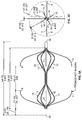
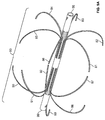
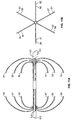
- the filter is formed from two sets of four expandable legs, the first expandable set, 1, 2, 3, 4 and the second expandable set, 5, 6, 7, 8. These expandable legs form a cage 9.
- the cage 9 may take the shape of a ball or sphere when deployed.
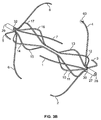
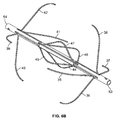
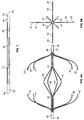
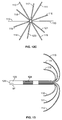
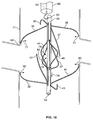
- the filter comprises a first set of expandable legs, 1, 2, 3, 4, a second set of expandable legs 5, 6, 7, 8, a third set of expandable legs 10, 11, 12, 13, and a fourth set of expandable legs 14, 15, 16, 17.
- the expandable segment of each leg in the third set 10, 11, 12, 13 and the expandable segment of each leg in the fourth set of legs 14, 15, 16, 17 may each form a curvilinear shape 18 and 19 when deployed ( Figure 1b ).
- the third set of expandable legs, 10, 11, 12, 13 are positioned at different radial points along the circumference of the first tube as compared with the first set of expandable legs, 1, 2, 3 and 4.
- the fourth set of expandable legs, 14, 15, 16 and 17 are positioned at different radial points along the circumference of the first tube as compared with the second set of expandable legs, 5, 6, 7 and 8.
- the second set of expandable legs, 5, 6, 7 and 8 are positioned at the same radial points as the first set of expandable legs, 1, 2, 3 and 4, while the fourth set of expandable legs, 14, 15, 16 and 17 are positioned at the same radial points as the third set of expandable legs, 10, 11, 12 and 13.
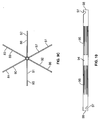
- FIGS 2a, b, c and d show various perspective views of the first tube.
- the first tube 20 contains a plurality of a first set of slots 21, a plurality of a second set of slots 22, a plurality of a third set of slots 23 and a plurality of a fourth set of slots 24.
- the slots are parallel to the long or cylindrical axis of the first tube.
- the first tube 20 has two ends, 25 and 26.
- the first set 21 and third set 23 of slots are positioned proximal to the end 25 of the first tube 20.
- the second 22 and the fourth 24 set of slots are positioned proximal to the end 26 of the first tube 20.
- the first set of slots may start at a position from the end 25 of the first tube from about 2 mm to about 15 mm, from about 4 mm to about 8 mm or from about 5 mm to about 7 mm or about 6 mm.
- Each slot of the first and second sets may range in length from about 4 mm to about 35 mm, from about 10 mm to about 25 mm, from about 15 mm to about 20 mm, or about 17 mm.
- the length of the first set of slots and the length of the second set of slots may be the same or may be different.
- the third and fourth set of slots may range in length from about 3 mm to about 30 mm, from about 5 mm to about 20 mm, from about 10 mm to about 18 mm, or about 15 mm.
- the length of the third set of slots and the length of the fourth set of slots may be the same or may be different.
- the first tube may have a length of about 35 mm to about 80 mm, from about 40 mm to about 70 mm, from about 45 mm to about 60 mm or about 50 mm.
- the internal diameter of the first tube may range from about 1.0 mm to about 1.6 mm, from about 1.2 mm to about 1.6 mm, from about 1.4 mm to about 1.5 mm or about 1.45 mm.
- the thickness of the first tube may range from about 0.4 mm to about 0.8 mm, from about 0.5 mm to about 0.7 mm, from about 0.5 mm to about 0.6 mm, or about 0.58 mm.
- the thickness of the first tube may be constant or may vary from one end to the other end. Either end of the first tube may be straight or beveled.
- FIGs 3a , b and c show various perspective views of the second tube.
- the second tube 27 comprises four sets of expandable legs and two ends 28, 29.
- the first set of expandable legs 1, 2, 3, 4, and the third set of expandable legs 10, 11, 12, 13, are secured proximal to the end 28 of the second tube 27.
- the second set of expandable legs 5, 6, 7, 8, and the fourth set of expandable legs 14, 15, 16, 17, are secured proximal to the end 29.
- the third set of expandable legs, 10, 11, 12, 13 are positioned at different radial points along the circumference of the second tube 27 as compared with the first set of expandable legs, 1, 2, 3 and 4.
- the fourth set of expandable legs, 14, 15, 16 and 17 are positioned at different radial points along the circumference of the second tube 27 as compared with the second set of expandable legs, 5, 6, 7 and 8.
- the second set of expandable legs, 5, 6, 7 and 8 are positioned at the same radial points along the circumference of the second tube 27 as the first set of expandable legs, 1, 2, 3 and 4, while the fourth set of expandable legs, 14, 15, 16 and 17 are positioned at the same radial points along the circumference of the second tube 27 as the third set of expandable legs, 10, 11, 12 and 13.
- the first set of expandable legs 1, 2, 3, 4 are secured at a point 30 which is proximal to end 28 on the second tube 27 .
- the second set of expandable legs 5, 6, 7, 8 are secured at a point 32 which is proximal to end 29 on the second tube 27.
- the length from point 30 to 28 and the length from point 32 to 29 range from about 2 mm to about 10 mm, from 3 mm to about 8 mm, from about 4 mm to about 7 mm or about 6 mm.
- the length from point 30 to 28 and the length from point 32 to 29 may be the same or be different.
- the free ends of the first set of expandable legs 1, 2, 3, 4 are in a direction opposite to the free ends of the second set of expandable legs 5, 6, 7 and 8.
- Each of the free ends of the first and second set of expandable legs 1, 2, 3, 4, and 5, 6, 7, 8 may have a barb 63 ( Figure 3b ).
- a solid pin or hollow tube 34 may be inserted in the second tube 27 and laser welded to the legs of the third and the fourth set of expandable legs ( Figure 4 ).
- the length of the pin 34 may range from about 2 mm to about 8 mm, from about 3 mm to about 6 mm, or about 4 mm.
- the first or second set of expandable legs may be secured at a point from about 2 mm to about 10 mm, from 3 mm to about 8 mm, from about 4 mm to about 7 mm or about 6 mm from the end of the second tube.
- the straight length of the third and the fourth set of expandable legs may be from about 5 mm to about 55 mm, from about 10 mm to about 50 mm, from about 20 mm to about 40 mm or about 30 mm.
- Each slot of the first set 21 on the first tube 20 is positioned at a radial position allowing for deployment of each expandable leg of the first set, 1, 2, 3, 4.
- Each slot of the second set 22 on the first tube 20 is positioned at a radial position allowing for deployment of each expandable leg of the second set 5, 6, 7, 8.
- Each slot of the third set 23 on the first tube 20 is positioned at a radial position allowing for deployment of the expandable segment in each leg of the third set of expandable legs 10, 11, 12, 13.
- Each slot of the fourth set 24 is positioned at a radial position allowing for deployment of the expandable segment in each leg of the fourth set 14, 15, 16, 17.
- the external diameter of the second tube is less than the internal diameter of the first tube.
- the filter of the present invention is assembled by inserting the second tube 27 into the first tube 20. All the expandable legs on the second tube are straight, i.e., not expanded, during insertion.
- the first and second sets of expandable legs on the second tube may have a length of about 10 mm to about 30 mm, from about 15 mm to about 25 mm or about 20 mm.
- the expandable legs of each set may have a width ranging from 0.05 mm to about 1.5 mm, from about 0.1 mm to about 1.0 mm, from about 0.3 mm to about 0.8 mm or about 0.35 mm.
- the width of the first and second sets of expandable legs may be constant or vary. For example, in one embodiment, the width of the first and second set of expandable legs may taper or narrow from the point where it is secured to the free end.
- the expanded diameter of the first and second set of expandable legs may range from 10 mm to about 45 mm, from about 15 mm to about 40 mm, from about 20 mm to about 36 mm or about 30 mm.
- the dimensions of the second tube may vary.
- the straight length of the second tube may range from about 25 mm to about 60 mm, from about 30 mm to about 50 mm or from about 35 mm to about 48 mm or about 45 mm.
- the external diameter of the second tube may vary from about 0.5 mm to about 1.5 mm, from about 0.8 mm to about 1.5 mm, from about 1.2 mm to about 1.5 mm, from 1.4 mm to about 1.5 mm or about 1.45 mm, provided that the external diameter of the second is less than the internal diameter of the first tube.
- the thickness of the second tube may range from about 0.3 mm to about 0.6 mm, from about 0.4 mm to about 0.5 mm or from about 0.4 mm to about 0.45 mm.
- the diameter of the first tube may be the same as the diameter of the second tube or may be different.
- Each of the free ends of the first and the second sets of expandable legs may have at least one barb.
- the barbs may assume various designs and angles.
- the angle between the barb and the free end of the leg where the barb is attached to may range from about 10 degrees to about 200 degrees, from about 40 degrees to about 200 degrees, from about 60 degrees to about 190 degrees, from about 90 degrees to about 180 degrees or from about 95 to about 105 degrees relative to a straight line set when the first set of expandable legs is in an undeployed position.
- the barbs can be any desired shape or configuration, the examples of which are shown in Figure 5 .
- the barb has a convex shape allowing it to bend on itself when the filter is deployed.
- the shape, configuration, dimension, angle and penetration depth of the barbs may vary between legs and may be present on some or all of the first and second set of expandable legs.
- the angle of the barbs is set such that the barbs will not penetrate into the vessel wall until the internal vessel dimension of at least about 18 mm has been encountered by the filter. It will be appreciated that one of ordinary skill in the art could select both the shape and the angle of the barb by routine experimentation and that the shape of the cage formed by the first and second set of expandable legs can be constrained to meet this requirement.
- a second embodiment of the present filter is shown in Figures 6a , b , c .
- the filter comprises two tubes, a first tube and a second tube that is inserted into the first tube to form the filter.
- the external diameter of the second tube is smaller than the internal diameter of the first tube.
- the filter is formed from two sets of four expandable legs, the first expandable set, 35, 36, 37, 38 and the second expandable set, 39, 40, 41, 42. These expandable legs form a cage 43.
- the cage 43 may take the shape of a ball or sphere when deployed.
- the filter comprises a first set of expandable legs, 35, 36, 37, 38, a second set of expandable legs 39, 40, 41, 42 and a third set of expandable legs 44, 45, 46, 47.
- the expandable segments of the third set of expandable legs form a curvilinear shape 48 when deployed.
- Figures 7 shows a perspective view of the first tube of the filter in Figure 6 .
- the first tube 49 contains a plurality of a first set of slots 50, a plurality of a second set of slots 51 and a plurality of a third set of slots 52 which are parallel to the long or cylindrical axis of the first tube.
- the first set of slots 50 are positioned closest to the end 53 of the first tube 49.
- the second set of slots 51 is positioned closest to the end 54 of the first tube 49.
- Each slot of the first and second sets may range in length from about 4 mm to about 35 mm, from about 10 mm to about 25 mm or from about 15 mm to about 20 mm or about 17 mm.
- the length of the first set of slots 50 and the second set of slots 51 may be the same or be different.
- the third set of slots may range in length from about 10 mm to about 55 mm, from about 20 mm to about 50 mm, from about 25 mm to about 40 mm, or about 30 mm.
- Figures 8a and b show various perspective views of the second tube which comprises three sets of expandable legs.
- the first set of expandable legs 35, 36, 37, 38 are attached or secured to the second tube 56 at position 57.
- the second tube 56 has two ends 58, 59.
- the second set of expandable legs 39, 40, 41, 42 are attached or secured to the second tube 56 at position 60.
- the two ends of each expandable leg of the third set 44, 45, 46, 47 are attached to the second tube 56 at positions 61, 62.
- the dimension from point 57 to end 58, and from point 60 to end 59 may be from about 2 mm to about 10 mm, from about 3 mm to about 9 mm, from about 4 mm to about 8 mm or about 6 mm.
- the dimension from point 57 to end 58 and the dimension from point 60 to end 59 may be same or be different.
- the dimension from point 61 to 57 and the dimension from point 62 to 60 may be from about 0 mm to about 20 mm, from about 3 mm to about 15 mm, from about 5 mm to about 10 mm or about 8 mm.
- the dimension from point 61 to 57 and the dimension from point 62 to 60 may be the same or be different.
- the straight length of the third set of expandable legs may be from about 5 mm to about 55 mm, from about 10 mm to about 50 mm, from about 20 mm to about 40 mm or about 30 mm.
- the third set of expandable legs, 44, 45, 46, 47 are positioned at different radial points along the circumference of the second tube 56 as compared with the first set of expandable legs, 35, 36, 37, 38.
- the second set of expandable legs, 39, 40, 41, 42 may be positioned at the same radial points along the circumference of the second tube 56 as compared with the first set of expandable legs, 35, 36, 37, 38.
- the free ends of the first set of expandable legs 35, 36, 37, 38 are in a direction opposite to the free ends of the second set of expandable legs 39, 40, 41, 42.
- Each of the free ends of the first and the second set of expandable legs 35, 36, 37, 38, and 39, 40, 41, 42 may have a barb 63.
- Each slot of the first set 50 on the first tube 49 is positioned at a radial position allowing for deployment of the first set of expendable legs, 35, 36, 37, 38.
- Each slot of the second set 51 on the first tube 49 is positioned at a radial position allowing for deployment of the second set of expendable legs 39, 40, 41, 42.
- Each slot of the third set 52 on the first tube 49 is positioned at a radial position for the deployment of the third set of expandable legs 44, 45, 46, 47.
- a filter not forming part of the invention is shown in Figures 9a , b , c .
- the filter comprises a first tube and a second tube that is inserted into the first tube.
- the external diameter of the second tube is smaller than the internal diameter of the first tube.
- the filter comprises a first set of expandable legs, 81, 82, 83, 84, 85, 86, a second set of expandable legs 87, 88, 89, 90, 91, 92.
- These expandable legs form a cage 93.
- the cage 93 may take the shape of a ball or sphere when deployed.
- Figure 10 shows a perspective view of the first tube of the filter in Figure 9 .
- the first tube 94 contains a plurality of a first set of slots 95, and a plurality of a second set of slots 96.
- the slots are parallel to the cylindrical axis of the first tube.
- the first set of slots 95 is positioned closest to the end 98 of the first tube 94.
- the second set of slots 96 is positioned closest to the end 99 of the first tube 94.
- the lengths of the first set of slots 95 and the second set of slots 96 may be the same or be different.
- FIGS 11 a and 11b show various perspective views of the second tube of the filter in Figure 9 .
- the second tube 100 has two ends 101, 102.
- the second tube is hollow and comprises two sets of expandable legs.
- the first set of expandable legs 81, 82, 83, 84, 85, 86 are attached or secured to the second tube 100 at position 103.
- the second set of expandable legs 87, 88, 89, 90, 91, 92 are attached or secured to the second tube 100 at position 104.
- the second set of expandable legs, 87, 88, 89, 90, 91, 92 are positioned at same radial points along the circumference of the second tube 100 as compared with the first set of expandable legs, 81, 82, 83, 84, 85, 86.
- the free ends of the first set of expandable legs 81, 82, 83, 84, 85, 86 are in a direction opposite to the free ends of the second set of expandable legs 87, 88, 89, 90, 91, 92.
- Each of the free ends of the first and the second set of expandable legs 81, 82, 83, 84, 85, 86, and 87, 88, 89, 90, 91, 92 may have a barb 63.
- Each slot of the first set 95 on the first tube 94 is positioned at a radial position allowing for deployment of the first set of expendable legs, 81, 82, 83, 84, 85, 86.
- Each slot of the second set 96 on the first tube 94 is positioned at a radial position allowing for deployment of the second set of expendable legs 87, 88, 89, 90, 91, 92.
- FIG. 12a , b , c A filter not forming part of the invention is shown in Figures 12a , b , c .
- the filter is formed from two tubes with two sets of six expandable legs, the first expandable set, 110, 111, 112, 113, 114, 115, and the second expandable set, 116, 117, 118, 119, 120, 121. These expandable legs form a cage 122.
- the cage 122 may take the shape of a ball or sphere when deployed.
- Figures 13 shows a perspective view of the first tube of the filter in Figure 12 .
- the first tube 123 contains a plurality of a first set of slots 124 which are parallel to the long or cylindrical axis of the first tube, and a plurality of a first set of expandable legs 110, 111, 112, 113, 114, 115. There is one notch 97 at the end 125 of the first tube 123.
- Figure 14 shows perspective view of the second tube.
- the second tube 126 contains a plurality of a second set of slots 127 which are parallel to the long or cylindrical axis of the second tube, and a plurality of a second set of expandable legs 116, 117, 118, 119, 120, 121. There is one notch 97 at the end 128 of the second tube 126.
- the length of the first set of slots 124 and the second set of slots 127 may be the same or be different.
- Each slot of the first set 124 on the first tube 123 is positioned at a radial position allowing for deployment of the second set of expendable legs, 116, 117, 118, 119, 120, 121 of the second tube 126.
- Each slot of the second set 127 on the second tube 126 is positioned at a radial position allowing for deployment of the first set of expendable legs 110, 111, 112, 113, 114, 115 of the first tube.
- the diameter of the first tube may be the same as the diameter of the second tube or may be different.
- the filter of the present invention may be deployed by any desired delivery system.
- Figure 15 shows the filter 64 which is deployed in the inferior vena cava 65 at or below the junction of the right 66 and left 67 renal veins.
- the diameter of the axially collapsed filter may range from about 0.8 mm to about 5.5 mm, from about 1.2 mm to about 4.5 mm, or from about 1.5 mm to about 3 mm, with one specific embodiment of about 2 mm.
- the diameter of the delivery system such as a delivery catheter, may range from about 0.8 mm to about 5.5 mm, from about 1.2 mm to about 4.5 mm, or from about 1.8 to about 3 mm.
- the collapsed filter is encased in a delivery catheter of about 6 French (2 mm) in diameter. In another embodiment, the filter is delivered by a delivery catheter of about 8 French (2.67 mm) in diameter.
- the filter may be deployed by a simple pin and pull delivery (see Cordis TrapEase Permanent Vena Cava Filter with the VisEase Angiographic Vessel Dilator [on-line].
- the filter may be placed in a vessel such as the inferior vena cava using ultrasound at a patient's bedside or under standard fluoroscopy. A catheter containing the undeployed filter is inserted and the filter extruded from the catheter. The filter then floats into place at or below the junction of the left and right renal vein.
- the filter assumes a position within the inferior vena cava at or near the junction of the left and right renal veins 66, 67 ( Figure 15 ).
- the first and second sets of expandable legs 1, 2, 3, 4 and 5, 6, 7, 8 form two hemispheres respectively in the vessel creating a cage or sphere 9.
- the barbs of the filter open and insert into the vessel wall when the width of the vessel wall exceeds the diameter of the filter.
- the barbs are on the ends of the legs which are on the outer curvature of the spheres.
- the sphere shape prevents barb deployment until the diameter of the blood vessel exceeds the deployment diameter for the barbs.
- the deployment diameter for the barbs may range from about 7 mm to about 20 mm, from about 10 mm to about 18 mm or about 15 mm.
- FIG. 16 illustrates retrieval of the filter shown in Figure 1 .
- a catheter 68 the internal dimension of which is greater than the external dimension of the first tube 20, is inserted into a vessel such as the jugular vein or femoral vein and moved to where the filter is positioned on the vessel wall.
- a snare 69 is pushed through the catheter until the snare grabs the notch 70 which is present on the first tube 20.
- the notch 70 is shown in this embodiment as a semicircular structure.
- the notch may have a variety of different structures such as a rectangular hole or a square hole as long as it permits efficient hooking of the filter 64 by a snare 69.
- the notch 70 may be positioned from about 2 mm to about 10 mm from the end 25, from about 4 mm to about 8 mm, from about 6 mm to about 8 mm and about 5 mm.
- the physician exerts tension on the filter 64 by pulling back on the snare 69.
- the tension exerted may be in the range of about 0.45 kilogram (kg) to about 5 kg, but the appropriate amount of tension may be determined by one of ordinary skill in the art based on clinical experience in the art.
- Various embodiments of the notch 70 are shown in Figure 17 ((a) - (e)).
- the notch 70 may assume many different shapes such as a hook (a), an L-shape (b), a T-shape (c), a reverse C-shape (d) and a semi-circular shape (e) as long as it permits secure capture by the snare 69.
- the snare may also take many different forms, such as a loop or a wire basket.
- the snare may be formed from several interconnected pieces of material or from a single piece of material.
- the snare may comprise a locking mechanism that locks once the snare grabs the notch on the filter.
- the catheter 68 is pushed over the snare, each leg of the first set of expandable legs 1, 2, 3, 4 and each leg of the third set of expandable legs 10, 11, 12, 13 until the barbs 63 dislodge from the vessel wall, each expandable leg of the first set 1, 2, 3, 4 retracts from the wall 71 of vena cava and move inwards 72. Meanwhile, as the catheter is pushed over the third set of expandable legs 10, 11, 12, 13, each expandable segment of the third set of expandable legs 10, 11, 12, 13 straightens 73 and pushes downwards away from the snare 69.
- Straightening of the third set of expandable legs creates a vector of force 74 which pushes the second tube 20 away from the snare 69 further creating a vector of force 75.
- the vector of force 75 straightens the expandable segment of the fourth set of expandable legs 14, 15, 16, 17 and also pushes the second set of expandable legs away from the vessel wall 71.
- the catheter 68 which encompasses the retracted filter, is then withdrawn from the vessel.
- the filter may also be retrieved from the other end 26 of the filter ( Figure 16 ).
- the method of retrieving the filter from the other end 26 is similar as set forth except that the catheter is pushed over the second set 5, 6, 7, 8 and fourth set 14, 15, 16, 17 of expandable legs.
- the second set of expandable legs 5, 6, 7, 8 retract from the vessel wall, and the fourth set of expandable legs 14, 15, 16, 17 straighten.
- Straightening of the fourth set of expandable legs pushes the second tube away from end 26, straightens the third set of expandable legs 10, 11, 12, 13, and pushes the first set of expandable legs 1, 2, 3, 4 away from the vessel wall.
- Figure 18 illustrates retrieval of the filter shown in Figure 6 .
- a catheter 68 the internal dimension of which is greater than the external dimension of the first tube 49, is inserted into a vessel such as the jugular vein or femoral vein and moved to where the filter is positioned on the vessel wall.
- a snare 69 is pushed through the catheter 68 until the snare grabs the notch 55.
- a notch structure is present on the first tube 49.
- the physician exerts tension on the filter by pulling back on the snare 69.
- the tension exerted may be in the range of about 0.45 kilogram (kg) to about 5 kg, but the appropriate amount of tension may be determined by one of ordinary skill in the art based on clinical experience in the art.
- the catheter 68 is pushed over the snare 69 and each leg of the first set of expandable legs 35, 36, 37, 38 until each expandable leg retracts from the wall 71 of vena cava.
- the barbs 63 dislodge from the vessel wall and move inwards 77.
- the catheter 68 further pushes over the expandable segments of the third set of expandable legs 44, 45, 46, 47 causing the expandable segments of the third set of expandable legs straighten 78 and push downwards away from the snare 69.
- the filter may be retrieved from the other end 54 of the filter ( Figure 18 ).
- the method of retrieving the filter from the other end 54 is similar as set forth except that the catheter is pushed over the second set 39, 40, 41, 42 of expandable legs.
- the second set of expandable legs 39, 40, 41, 42 retract from the vessel wall, and the third set of expandable legs 44, 45, 46, 47 straighten. Straightening of the third set of expandable legs pushes the second tube away from end 54, and the first set of expandable legs 35, 36, 37, 38 away from the vessel wall.
- Figure 19 illustrates retrieval of the filter shown in Figure 9 .
- a catheter 68 the internal dimension of which is greater than the external dimension of the first tube 94, is inserted into a vessel such as the jugular vein or femoral vein and moved to where the filter is positioned on the vessel wall.
- a snare 69 is pushed through the catheter 68 and the inner space of the second tube until the snare grabs the notch 97 closest to the end 99.
- the physician exerts tension on the filter by pulling back on the snare 69 and pushing the catheter 68.
- the catheter 68 is pushed over each leg of the first set of expandable legs 81, 82, 83, 84, 85, 86 until each expandable leg retracts from the wall 71 of vena cava.
- the barbs 63 dislodge from the vessel wall and move inwards 105.
- the first tube is pulled towards 106 the catheter, exerting tension on the second set of expandable legs 87, 88, 89, 90, 91, 92, causing the second set of expandable legs 87, 88, 89, 90, 91, 92 to move inwards 107, and retract from the vessel wall 71.
- the catheter 68 which encompasses the retracted filter, is then withdrawn from the vessel.
- the filter may be retrieved from the other end 99 of the filter ( Figure 19 ).
- the method of retrieving the filter from the other end 99 is similar as set forth except that a snare 69 is pushed through the catheter 68 and the second tube until the snare grabs the notch 97 closest to the end 98.
- the catheter is pushed over the second set 87, 88, 89, 90, 91, 92 of expandable legs.
- the second set of expandable legs 87, 88, 89, 90, 91, 92 retract from the vessel wall.
- the snare pulls back the first tube pushing the first set of expandable legs 81, 82, 83, 84, 95, 86 and the first set of expandable legs 81, 82, 83, 84, 85, 86 retract from the vessel wall.
- the filter shown in Figure 12 may be retrieved using a similar mechanism as shown in Figure 19 .
- the filter may be retrieved by the use of a snare and a catheter, or may be retrieved using a catheter and a ratchet control mechanism to control the catheter.
- the filter may be made of laser cut, self-expanding nitinol.
- the filter may also be made of any metal, such as titanium, platinum, gold, a metal alloy, such as stainless steel, or a memory metal.
- each of the expandable legs of the first and second sets comprise memory metal.
- the expandable segment of the expandable legs of the third and the fourth set comprises memory metal.
- the filter may further be made of any biocompatible material that is durable and non-corrosive.
- biocompatible material examples include a synthetic material such as polyurethanes, segmented polyurethane-urea/heparin, poly-L-lactic acid, cellulose ester, polyethylene glycol, polyvinyl acetate, dextran and gelatin, a naturally-occurring material such as basement membrane components such as collagen, elastin, laminin, fibronectin, vitronectin; fibrin, cellulose, and amorphous carbon, or fullerenes.
- the filter is made of biodegradable, bioabsorbable, bioerodable material and/or a mixture thereof.
- bioabsorbable material examples include copolymers of glycolide with lactide or ⁇ -caprolactone, and poly(p-dixanone).
- the filter may be made of a single material or different materials.
- the filter of the present invention may be manufactured in numerous ways.
- the filter may be formed from a single piece of material by removing various portions of a tube or pipe's wall to form the configurations described herein in an example not forming part of the invention.
- the filter is manufactured by connecting various segments together. Material from the tube wall may be removed using various techniques including laser (e.g. YAG laser), electrical discharge machining, mechanical machining, chemical etching (e.g. photo-fabrication), metal cutting, a combination thereof, or other well known techniques. See U.S. Patent No. 7,329,277 , U.S. Patent No. 5,879,381 , and U.S. Patent No. 6,117,165 .
- vena cava filters are preferred embodiments of the present invention
- filters within the scope of the invention may be placed in any desired blood vessel or endovascular structure.
- the filter may be placed via a femoral access point, jugular access point or any desired intravascular route.
- the filter may be placed in the body of the patient permanently or temporarily before being retrieved.
- the vascular endothelial cells or other tissues grow where the filter and vessel wall contact.
- severe damage may occur resulting in laceration or rupture of the vena cava, or at the very least, a focal disruption of the endothelial lining which may predispose to caval stenosis, thrombosis or occlusion.
- the free ends of the legs, other parts of the filter, or the entire filter can be coated with an antiproliferative agent to prohibit the tissue ingrowth, an anti-inflammatory agent or any desired pharmaceutically active agents.
- anti-proliferative agents examples include paclitaxel (taxol), paclitaxel derivatives, rapamycin (sirolimus), rapamycin derivatives (including everolimus, zotarolimus, biolimus and biolimus A-9), 5-fluorouracil, cisplatin, vinblastine, vincristine, epothilones, endostatin, angiostatin and thymidine kinase inhibitors or a combination thereof.
- anti-inflammatory agent examples include dexamethasone, corticosterone and prednisolone.
- pharmaceutically active agents that prevent or reduce thrombus formation include anticoagulants, antiplatelets and fibrinolytics.
- the pharmaceutically active agents include therapeutic agents and/or diagnostic agents.
- the therapeutic agents may comprise drugs that are used in the treatment of vascular disease, including artherosclerosis, restenosis, thrombosis.
- the pharmaceutically active agent may be antibiotics/antimicrobials, antiproliferatives, antineoplastics, antioxidants, endothelial cell growth factors, thrombin inhibitors, immunosuppressants, anti-platelet aggregation agents, collagen synthesis inhibitors, therapeutic antibodies, nitric oxide donors, antisense oligonucleotides, wound healing agents, therapeutic gene transfer constructs, peptides, proteins, extracellular matrix components, vasodialators, thrombolytics, anti-metabolites, growth factor agonists, antimitotics, stating, steroids, steroidal and non-steroidal anti-inflammatory agents, angiotensin converting enzyme (ACE) inhibitors, free radical scavengers, PPAR-gamma agonists and anti-cancer chemotherapeutic agents
- Examples of the pharmaceutically active agents in the present invention also include rosuvastatin, cyclosporin A (CSA), mycophenolic acid (MPA), retinoic acid, n-butyric acid, butyric acid derivatives, vitamin E, probucol, L-arginine-L- glutamate, tacrolimus (FK-506), puerarin, platelet factor 4, basic fibroblast growth factor (bFGF), fibronectin, simvastatin, fluvastatin, ABT-578, interferon, dexamethasone, dihydroepiandrosterone (DHEA) and estradiol.
- CSA cyclosporin A
- MPA mycophenolic acid
- retinoic acid retinoic acid
- n-butyric acid butyric acid derivatives
- vitamin E probucol
- L-arginine-L- glutamate tacrolimus
- FK-506 puerarin
- platelet factor 4 basic fibroblast growth factor
- any part of the filter or the entire filter can be coated with any desired pharmaceutically active agents.
- An excipient may be coated on the filter together with the pharmaceutically active agent.
- the examples of the excipient include binder, matrix, carrier, polymer, hydrogel and nanoparticle.
- the coating on the filter may be smooth, semi-porous or porous.
- the coating may be one layer or multiple layers.
- a pharmaceutically active agent or excipient may also be deposited in a defined structure of the filter, such as tubes, grooves, wells, bells, baskets, etc.
- a pharmaceutically active agent may also be incorporated into a biocompatible polymer matrix.
- Polymer matrices include polymers such as poly(lactide-co-glycolide); poly-DL-lactide, poly-L-lactide, and/or mixtures thereof and can be of various inherent viscosities and molecular weights.
- poly(DL lactide-co-glycolide) DLPLG, Birmingham Polymers Inc.
- the pharmaceutically active agent may be released in a sustained, delayed, spiked, controlled or any desired manner.
Landscapes
- Health & Medical Sciences (AREA)
- Life Sciences & Earth Sciences (AREA)
- Veterinary Medicine (AREA)
- Animal Behavior & Ethology (AREA)
- Engineering & Computer Science (AREA)
- Public Health (AREA)
- Biomedical Technology (AREA)
- Heart & Thoracic Surgery (AREA)
- General Health & Medical Sciences (AREA)
- Cardiology (AREA)
- Oral & Maxillofacial Surgery (AREA)
- Transplantation (AREA)
- Vascular Medicine (AREA)
- Hematology (AREA)
- Anesthesiology (AREA)
- Pulmonology (AREA)
- Biophysics (AREA)
- Surgical Instruments (AREA)
Applications Claiming Priority (3)
| Application Number | Priority Date | Filing Date | Title |
|---|---|---|---|
| US14948209P | 2009-02-03 | 2009-02-03 | |
| US18004109P | 2009-05-20 | 2009-05-20 | |
| PCT/US2010/023100 WO2010091118A1 (en) | 2009-02-03 | 2010-02-03 | Percutaneous retrievable vascular filter |
Publications (3)
| Publication Number | Publication Date |
|---|---|
| EP2393545A1 EP2393545A1 (en) | 2011-12-14 |
| EP2393545A4 EP2393545A4 (en) | 2013-12-11 |
| EP2393545B1 true EP2393545B1 (en) | 2016-07-20 |
Family
ID=42542370
Family Applications (1)
| Application Number | Title | Priority Date | Filing Date |
|---|---|---|---|
| EP10739084.1A Not-in-force EP2393545B1 (en) | 2009-02-03 | 2010-02-03 | Percutaneous retrievable vascular filter |
Country Status (7)
| Country | Link |
|---|---|
| EP (1) | EP2393545B1 (enExample) |
| JP (1) | JP5767976B2 (enExample) |
| KR (2) | KR20110126605A (enExample) |
| CN (1) | CN102307613B (enExample) |
| AU (1) | AU2010210614B2 (enExample) |
| CA (1) | CA2751466C (enExample) |
| WO (1) | WO2010091118A1 (enExample) |
Families Citing this family (44)
| Publication number | Priority date | Publication date | Assignee | Title |
|---|---|---|---|---|
| WO2009032834A1 (en) | 2007-09-07 | 2009-03-12 | Crusader Medical Llc | Percutaneous permanent retrievable vascular filter |
| US8795318B2 (en) | 2007-09-07 | 2014-08-05 | Merit Medical Systems, Inc. | Percutaneous retrievable vascular filter |
| US9402707B2 (en) | 2008-07-22 | 2016-08-02 | Neuravi Limited | Clot capture systems and associated methods |
| ES2683943T3 (es) | 2010-10-22 | 2018-09-28 | Neuravi Limited | Sistema de captura y extirpación de coágulos |
| US11259824B2 (en) | 2011-03-09 | 2022-03-01 | Neuravi Limited | Clot retrieval device for removing occlusive clot from a blood vessel |
| US12076037B2 (en) | 2011-03-09 | 2024-09-03 | Neuravi Limited | Systems and methods to restore perfusion to a vessel |
| ES3029850T3 (en) | 2011-03-09 | 2025-06-25 | Neuravi Ltd | A clot retrieval device for removing occlusive clot from a blood vessel |
| US8734480B2 (en) | 2011-08-05 | 2014-05-27 | Merit Medical Systems, Inc. | Vascular filter |
| US8740931B2 (en) | 2011-08-05 | 2014-06-03 | Merit Medical Systems, Inc. | Vascular filter |
| US9452039B2 (en) | 2012-02-23 | 2016-09-27 | Merit Medical Systems, Inc. | Vascular filter |
| CN107260361A (zh) * | 2012-07-25 | 2017-10-20 | 诺瓦特医疗有限公司 | 血管滤器装置 |
| US9433429B2 (en) | 2013-03-14 | 2016-09-06 | Neuravi Limited | Clot retrieval devices |
| EP2967610B1 (en) | 2013-03-14 | 2018-12-05 | Neuravi Limited | A clot retrieval device for removing occlusive clot from a blood vessel |
| US10201360B2 (en) | 2013-03-14 | 2019-02-12 | Neuravi Limited | Devices and methods for removal of acute blockages from blood vessels |
| WO2015021296A1 (en) | 2013-08-09 | 2015-02-12 | Merit Medical Systems, Inc. | Vascular filter delivery systems and methods |
| US9820844B2 (en) * | 2014-11-07 | 2017-11-21 | Cook Medical Technologies Llc | Double conical IVC filter |
| CN106999196B (zh) | 2014-11-26 | 2020-07-28 | 尼尔拉维有限公司 | 从血管除去阻塞性血栓的取血栓装置 |
| US10617435B2 (en) | 2014-11-26 | 2020-04-14 | Neuravi Limited | Clot retrieval device for removing clot from a blood vessel |
| US11253278B2 (en) | 2014-11-26 | 2022-02-22 | Neuravi Limited | Clot retrieval system for removing occlusive clot from a blood vessel |
| GB2534899B (en) * | 2015-02-04 | 2017-04-12 | Cook Medical Technologies Llc | Double ended vascular filter. |
| CN105520791A (zh) * | 2015-09-08 | 2016-04-27 | 上海宏普医疗器械有限公司 | 一种新型可回收腔静脉血栓过滤器 |
| CN105963047A (zh) * | 2016-03-07 | 2016-09-28 | 上海宏普医疗器械有限公司 | 一种新型可回收腔静脉血栓多重过滤器 |
| WO2018046408A2 (en) | 2016-09-06 | 2018-03-15 | Neuravi Limited | A clot retrieval device for removing occlusive clot from a blood vessel |
| CN108272530A (zh) * | 2017-03-06 | 2018-07-13 | 上海宏普医疗器械有限公司 | 一种双伞型可回收腔静脉血栓过滤器 |
| CN108283530A (zh) * | 2017-03-07 | 2018-07-17 | 上海宏普医疗器械有限公司 | 一种章鱼型可回收腔静脉滤器 |
| CN107007377B (zh) * | 2017-03-16 | 2019-09-10 | 杭州唯强医疗科技有限公司 | 多层过滤的腔静脉滤器 |
| US10842498B2 (en) | 2018-09-13 | 2020-11-24 | Neuravi Limited | Systems and methods of restoring perfusion to a vessel |
| US11406416B2 (en) | 2018-10-02 | 2022-08-09 | Neuravi Limited | Joint assembly for vasculature obstruction capture device |
| US11712231B2 (en) | 2019-10-29 | 2023-08-01 | Neuravi Limited | Proximal locking assembly design for dual stent mechanical thrombectomy device |
| US11517340B2 (en) | 2019-12-03 | 2022-12-06 | Neuravi Limited | Stentriever devices for removing an occlusive clot from a vessel and methods thereof |
| CN110882090A (zh) * | 2019-12-20 | 2020-03-17 | 成都迈德克科技有限公司 | 可回收腔静脉滤器 |
| US11871946B2 (en) | 2020-04-17 | 2024-01-16 | Neuravi Limited | Clot retrieval device for removing clot from a blood vessel |
| US11717308B2 (en) | 2020-04-17 | 2023-08-08 | Neuravi Limited | Clot retrieval device for removing heterogeneous clots from a blood vessel |
| US11730501B2 (en) | 2020-04-17 | 2023-08-22 | Neuravi Limited | Floating clot retrieval device for removing clots from a blood vessel |
| US11737771B2 (en) | 2020-06-18 | 2023-08-29 | Neuravi Limited | Dual channel thrombectomy device |
| US11937836B2 (en) | 2020-06-22 | 2024-03-26 | Neuravi Limited | Clot retrieval system with expandable clot engaging framework |
| US11439418B2 (en) | 2020-06-23 | 2022-09-13 | Neuravi Limited | Clot retrieval device for removing clot from a blood vessel |
| US11395669B2 (en) | 2020-06-23 | 2022-07-26 | Neuravi Limited | Clot retrieval device with flexible collapsible frame |
| CN113331988B (zh) * | 2020-07-08 | 2022-12-27 | 张文凯 | 一种可回收的腔静脉滤器 |
| US11864781B2 (en) | 2020-09-23 | 2024-01-09 | Neuravi Limited | Rotating frame thrombectomy device |
| US11937837B2 (en) | 2020-12-29 | 2024-03-26 | Neuravi Limited | Fibrin rich / soft clot mechanical thrombectomy device |
| US12029442B2 (en) | 2021-01-14 | 2024-07-09 | Neuravi Limited | Systems and methods for a dual elongated member clot retrieval apparatus |
| US12064130B2 (en) | 2021-03-18 | 2024-08-20 | Neuravi Limited | Vascular obstruction retrieval device having sliding cages pinch mechanism |
| US11974764B2 (en) | 2021-06-04 | 2024-05-07 | Neuravi Limited | Self-orienting rotating stentriever pinching cells |
Citations (1)
| Publication number | Priority date | Publication date | Assignee | Title |
|---|---|---|---|---|
| WO2000051500A1 (en) * | 1999-03-05 | 2000-09-08 | Board Of Regents, The University Of Texas System | Occlusion apparatus |
Family Cites Families (15)
| Publication number | Priority date | Publication date | Assignee | Title |
|---|---|---|---|---|
| DK151404C (da) * | 1984-05-23 | 1988-07-18 | Cook Europ Aps William | Sammenklappeligt filter til implantation i en patients blodkar |
| JP2573612Y2 (ja) * | 1991-12-30 | 1998-06-04 | ハナコメディカル株式会社 | 血栓濾過用フィルター |
| GB2290236B (en) | 1994-06-16 | 1998-08-05 | Roger Harrington Fox | Vena-cava filter |
| US20020058911A1 (en) * | 1999-05-07 | 2002-05-16 | Paul Gilson | Support frame for an embolic protection device |
| US6273901B1 (en) * | 1999-08-10 | 2001-08-14 | Scimed Life Systems, Inc. | Thrombosis filter having a surface treatment |
| JP2005508201A (ja) * | 2001-03-08 | 2005-03-31 | アトリテック, インコーポレイテッド | 心房フィルターインプラント |
| US7179275B2 (en) * | 2001-06-18 | 2007-02-20 | Rex Medical, L.P. | Vein filter |
| US8282668B2 (en) * | 2001-06-18 | 2012-10-09 | Rex Medical, L.P. | Vein filter |
| US7232462B2 (en) * | 2004-03-31 | 2007-06-19 | Cook Incorporated | Self centering delivery catheter |
| US7544202B2 (en) * | 2004-06-25 | 2009-06-09 | Angiodynamics, Inc. | Retrievable blood clot filter |
| US7749246B2 (en) * | 2004-09-27 | 2010-07-06 | Rex Medical, L.P. | Vein filter |
| US7794473B2 (en) * | 2004-11-12 | 2010-09-14 | C.R. Bard, Inc. | Filter delivery system |
| US9107733B2 (en) * | 2006-01-13 | 2015-08-18 | W. L. Gore & Associates, Inc. | Removable blood conduit filter |
| US20080275496A1 (en) * | 2007-05-01 | 2008-11-06 | Fleming James A | Crossover retrievable medical filter |
| WO2009032834A1 (en) * | 2007-09-07 | 2009-03-12 | Crusader Medical Llc | Percutaneous permanent retrievable vascular filter |
-
2010
- 2010-02-03 EP EP10739084.1A patent/EP2393545B1/en not_active Not-in-force
- 2010-02-03 CN CN201080006546.8A patent/CN102307613B/zh not_active Expired - Fee Related
- 2010-02-03 JP JP2011548423A patent/JP5767976B2/ja not_active Expired - Fee Related
- 2010-02-03 CA CA2751466A patent/CA2751466C/en not_active Expired - Fee Related
- 2010-02-03 KR KR1020117018094A patent/KR20110126605A/ko not_active Ceased
- 2010-02-03 KR KR1020177024940A patent/KR102080379B1/ko active Active
- 2010-02-03 WO PCT/US2010/023100 patent/WO2010091118A1/en not_active Ceased
- 2010-02-03 AU AU2010210614A patent/AU2010210614B2/en not_active Ceased
Patent Citations (1)
| Publication number | Priority date | Publication date | Assignee | Title |
|---|---|---|---|---|
| WO2000051500A1 (en) * | 1999-03-05 | 2000-09-08 | Board Of Regents, The University Of Texas System | Occlusion apparatus |
Also Published As
| Publication number | Publication date |
|---|---|
| WO2010091118A1 (en) | 2010-08-12 |
| JP2012516720A (ja) | 2012-07-26 |
| KR102080379B1 (ko) | 2020-04-13 |
| KR20110126605A (ko) | 2011-11-23 |
| CN102307613B (zh) | 2015-03-25 |
| JP5767976B2 (ja) | 2015-08-26 |
| EP2393545A1 (en) | 2011-12-14 |
| CA2751466A1 (en) | 2010-08-12 |
| CN102307613A (zh) | 2012-01-04 |
| CA2751466C (en) | 2017-01-24 |
| AU2010210614A1 (en) | 2011-08-25 |
| AU2010210614B2 (en) | 2015-06-25 |
| EP2393545A4 (en) | 2013-12-11 |
| KR20170104667A (ko) | 2017-09-15 |
Similar Documents
| Publication | Publication Date | Title |
|---|---|---|
| AU2010210614B2 (en) | Percutaneous retrievable vascular filter | |
| US8795318B2 (en) | Percutaneous retrievable vascular filter | |
| US9028525B2 (en) | Percutaneous retrievable vascular filter | |
| AU2020373059B2 (en) | Retrieval devices having protruding features for thrombectomy | |
| US8029529B1 (en) | Retrievable filter | |
| US7794473B2 (en) | Filter delivery system | |
| JP4073499B2 (ja) | 螺旋状のメッシュ体内プロテーゼ | |
| US9144484B2 (en) | Non-entangling vena cava filter | |
| EP1220648B1 (en) | Removable thrombus filter | |
| US8992504B2 (en) | Vena cava filter catheter and method of use | |
| US8998945B2 (en) | Methods and apparatus for filtering a body lumen | |
| US20080221657A1 (en) | Delivery system and method for vascular prosthesis | |
| JP2008515538A (ja) | 非短縮らせん状ステント | |
| CN110115608A (zh) | 用于心耳的封堵器 | |
| US9788932B2 (en) | Vascular filter | |
| US9724184B2 (en) | Filter with deployable anchors | |
| WO2025169220A1 (en) | Vascular filter | |
| CA3156969A1 (en) | Stents having protruding features for anchoring |
Legal Events
| Date | Code | Title | Description |
|---|---|---|---|
| PUAI | Public reference made under article 153(3) epc to a published international application that has entered the european phase |
Free format text: ORIGINAL CODE: 0009012 |
|
| 17P | Request for examination filed |
Effective date: 20110902 |
|
| AK | Designated contracting states |
Kind code of ref document: A1 Designated state(s): AT BE BG CH CY CZ DE DK EE ES FI FR GB GR HR HU IE IS IT LI LT LU LV MC MK MT NL NO PL PT RO SE SI SK SM TR |
|
| RAP1 | Party data changed (applicant data changed or rights of an application transferred) |
Owner name: MERIT MEDICAL SYSTEMS, INC. |
|
| DAX | Request for extension of the european patent (deleted) | ||
| A4 | Supplementary search report drawn up and despatched |
Effective date: 20131112 |
|
| RIC1 | Information provided on ipc code assigned before grant |
Ipc: A61F 2/01 20060101ALI20131106BHEP Ipc: A61M 29/00 20060101AFI20131106BHEP |
|
| 17Q | First examination report despatched |
Effective date: 20151113 |
|
| GRAP | Despatch of communication of intention to grant a patent |
Free format text: ORIGINAL CODE: EPIDOSNIGR1 |
|
| INTG | Intention to grant announced |
Effective date: 20160126 |
|
| GRAS | Grant fee paid |
Free format text: ORIGINAL CODE: EPIDOSNIGR3 |
|
| GRAA | (expected) grant |
Free format text: ORIGINAL CODE: 0009210 |
|
| AK | Designated contracting states |
Kind code of ref document: B1 Designated state(s): AT BE BG CH CY CZ DE DK EE ES FI FR GB GR HR HU IE IS IT LI LT LU LV MC MK MT NL NO PL PT RO SE SI SK SM TR |
|
| REG | Reference to a national code |
Ref country code: GB Ref legal event code: FG4D |
|
| REG | Reference to a national code |
Ref country code: CH Ref legal event code: EP |
|
| REG | Reference to a national code |
Ref country code: IE Ref legal event code: FG4D |
|
| REG | Reference to a national code |
Ref country code: AT Ref legal event code: REF Ref document number: 813541 Country of ref document: AT Kind code of ref document: T Effective date: 20160815 |
|
| REG | Reference to a national code |
Ref country code: DE Ref legal event code: R096 Ref document number: 602010034850 Country of ref document: DE |
|
| REG | Reference to a national code |
Ref country code: LT Ref legal event code: MG4D |
|
| REG | Reference to a national code |
Ref country code: NL Ref legal event code: MP Effective date: 20160720 |
|
| REG | Reference to a national code |
Ref country code: AT Ref legal event code: MK05 Ref document number: 813541 Country of ref document: AT Kind code of ref document: T Effective date: 20160720 |
|
| PG25 | Lapsed in a contracting state [announced via postgrant information from national office to epo] |
Ref country code: NL Free format text: LAPSE BECAUSE OF FAILURE TO SUBMIT A TRANSLATION OF THE DESCRIPTION OR TO PAY THE FEE WITHIN THE PRESCRIBED TIME-LIMIT Effective date: 20160720 Ref country code: HR Free format text: LAPSE BECAUSE OF FAILURE TO SUBMIT A TRANSLATION OF THE DESCRIPTION OR TO PAY THE FEE WITHIN THE PRESCRIBED TIME-LIMIT Effective date: 20160720 Ref country code: IT Free format text: LAPSE BECAUSE OF FAILURE TO SUBMIT A TRANSLATION OF THE DESCRIPTION OR TO PAY THE FEE WITHIN THE PRESCRIBED TIME-LIMIT Effective date: 20160720 Ref country code: FI Free format text: LAPSE BECAUSE OF FAILURE TO SUBMIT A TRANSLATION OF THE DESCRIPTION OR TO PAY THE FEE WITHIN THE PRESCRIBED TIME-LIMIT Effective date: 20160720 Ref country code: IS Free format text: LAPSE BECAUSE OF FAILURE TO SUBMIT A TRANSLATION OF THE DESCRIPTION OR TO PAY THE FEE WITHIN THE PRESCRIBED TIME-LIMIT Effective date: 20161120 Ref country code: LT Free format text: LAPSE BECAUSE OF FAILURE TO SUBMIT A TRANSLATION OF THE DESCRIPTION OR TO PAY THE FEE WITHIN THE PRESCRIBED TIME-LIMIT Effective date: 20160720 Ref country code: NO Free format text: LAPSE BECAUSE OF FAILURE TO SUBMIT A TRANSLATION OF THE DESCRIPTION OR TO PAY THE FEE WITHIN THE PRESCRIBED TIME-LIMIT Effective date: 20161020 |
|
| PG25 | Lapsed in a contracting state [announced via postgrant information from national office to epo] |
Ref country code: LV Free format text: LAPSE BECAUSE OF FAILURE TO SUBMIT A TRANSLATION OF THE DESCRIPTION OR TO PAY THE FEE WITHIN THE PRESCRIBED TIME-LIMIT Effective date: 20160720 Ref country code: PL Free format text: LAPSE BECAUSE OF FAILURE TO SUBMIT A TRANSLATION OF THE DESCRIPTION OR TO PAY THE FEE WITHIN THE PRESCRIBED TIME-LIMIT Effective date: 20160720 Ref country code: AT Free format text: LAPSE BECAUSE OF FAILURE TO SUBMIT A TRANSLATION OF THE DESCRIPTION OR TO PAY THE FEE WITHIN THE PRESCRIBED TIME-LIMIT Effective date: 20160720 Ref country code: GR Free format text: LAPSE BECAUSE OF FAILURE TO SUBMIT A TRANSLATION OF THE DESCRIPTION OR TO PAY THE FEE WITHIN THE PRESCRIBED TIME-LIMIT Effective date: 20161021 Ref country code: PT Free format text: LAPSE BECAUSE OF FAILURE TO SUBMIT A TRANSLATION OF THE DESCRIPTION OR TO PAY THE FEE WITHIN THE PRESCRIBED TIME-LIMIT Effective date: 20161121 Ref country code: ES Free format text: LAPSE BECAUSE OF FAILURE TO SUBMIT A TRANSLATION OF THE DESCRIPTION OR TO PAY THE FEE WITHIN THE PRESCRIBED TIME-LIMIT Effective date: 20160720 Ref country code: SE Free format text: LAPSE BECAUSE OF FAILURE TO SUBMIT A TRANSLATION OF THE DESCRIPTION OR TO PAY THE FEE WITHIN THE PRESCRIBED TIME-LIMIT Effective date: 20160720 Ref country code: BE Free format text: LAPSE BECAUSE OF FAILURE TO SUBMIT A TRANSLATION OF THE DESCRIPTION OR TO PAY THE FEE WITHIN THE PRESCRIBED TIME-LIMIT Effective date: 20160720 |
|
| REG | Reference to a national code |
Ref country code: DE Ref legal event code: R097 Ref document number: 602010034850 Country of ref document: DE |
|
| PG25 | Lapsed in a contracting state [announced via postgrant information from national office to epo] |
Ref country code: EE Free format text: LAPSE BECAUSE OF FAILURE TO SUBMIT A TRANSLATION OF THE DESCRIPTION OR TO PAY THE FEE WITHIN THE PRESCRIBED TIME-LIMIT Effective date: 20160720 Ref country code: RO Free format text: LAPSE BECAUSE OF FAILURE TO SUBMIT A TRANSLATION OF THE DESCRIPTION OR TO PAY THE FEE WITHIN THE PRESCRIBED TIME-LIMIT Effective date: 20160720 |
|
| PLBE | No opposition filed within time limit |
Free format text: ORIGINAL CODE: 0009261 |
|
| STAA | Information on the status of an ep patent application or granted ep patent |
Free format text: STATUS: NO OPPOSITION FILED WITHIN TIME LIMIT |
|
| PG25 | Lapsed in a contracting state [announced via postgrant information from national office to epo] |
Ref country code: BG Free format text: LAPSE BECAUSE OF FAILURE TO SUBMIT A TRANSLATION OF THE DESCRIPTION OR TO PAY THE FEE WITHIN THE PRESCRIBED TIME-LIMIT Effective date: 20161020 Ref country code: DK Free format text: LAPSE BECAUSE OF FAILURE TO SUBMIT A TRANSLATION OF THE DESCRIPTION OR TO PAY THE FEE WITHIN THE PRESCRIBED TIME-LIMIT Effective date: 20160720 Ref country code: SM Free format text: LAPSE BECAUSE OF FAILURE TO SUBMIT A TRANSLATION OF THE DESCRIPTION OR TO PAY THE FEE WITHIN THE PRESCRIBED TIME-LIMIT Effective date: 20160720 Ref country code: SK Free format text: LAPSE BECAUSE OF FAILURE TO SUBMIT A TRANSLATION OF THE DESCRIPTION OR TO PAY THE FEE WITHIN THE PRESCRIBED TIME-LIMIT Effective date: 20160720 Ref country code: CZ Free format text: LAPSE BECAUSE OF FAILURE TO SUBMIT A TRANSLATION OF THE DESCRIPTION OR TO PAY THE FEE WITHIN THE PRESCRIBED TIME-LIMIT Effective date: 20160720 |
|
| 26N | No opposition filed |
Effective date: 20170421 |
|
| PG25 | Lapsed in a contracting state [announced via postgrant information from national office to epo] |
Ref country code: SI Free format text: LAPSE BECAUSE OF FAILURE TO SUBMIT A TRANSLATION OF THE DESCRIPTION OR TO PAY THE FEE WITHIN THE PRESCRIBED TIME-LIMIT Effective date: 20160720 |
|
| PG25 | Lapsed in a contracting state [announced via postgrant information from national office to epo] |
Ref country code: MC Free format text: LAPSE BECAUSE OF FAILURE TO SUBMIT A TRANSLATION OF THE DESCRIPTION OR TO PAY THE FEE WITHIN THE PRESCRIBED TIME-LIMIT Effective date: 20160720 |
|
| REG | Reference to a national code |
Ref country code: CH Ref legal event code: PL |
|
| GBPC | Gb: european patent ceased through non-payment of renewal fee |
Effective date: 20170203 |
|
| PG25 | Lapsed in a contracting state [announced via postgrant information from national office to epo] |
Ref country code: LI Free format text: LAPSE BECAUSE OF NON-PAYMENT OF DUE FEES Effective date: 20170228 Ref country code: CH Free format text: LAPSE BECAUSE OF NON-PAYMENT OF DUE FEES Effective date: 20170228 |
|
| REG | Reference to a national code |
Ref country code: IE Ref legal event code: MM4A |
|
| REG | Reference to a national code |
Ref country code: FR Ref legal event code: ST Effective date: 20171031 |
|
| PG25 | Lapsed in a contracting state [announced via postgrant information from national office to epo] |
Ref country code: LU Free format text: LAPSE BECAUSE OF NON-PAYMENT OF DUE FEES Effective date: 20170203 |
|
| PG25 | Lapsed in a contracting state [announced via postgrant information from national office to epo] |
Ref country code: FR Free format text: LAPSE BECAUSE OF NON-PAYMENT OF DUE FEES Effective date: 20170228 |
|
| PG25 | Lapsed in a contracting state [announced via postgrant information from national office to epo] |
Ref country code: IE Free format text: LAPSE BECAUSE OF NON-PAYMENT OF DUE FEES Effective date: 20170203 Ref country code: GB Free format text: LAPSE BECAUSE OF NON-PAYMENT OF DUE FEES Effective date: 20170203 |
|
| PG25 | Lapsed in a contracting state [announced via postgrant information from national office to epo] |
Ref country code: MT Free format text: LAPSE BECAUSE OF NON-PAYMENT OF DUE FEES Effective date: 20170203 |
|
| PGFP | Annual fee paid to national office [announced via postgrant information from national office to epo] |
Ref country code: DE Payment date: 20190122 Year of fee payment: 10 |
|
| PG25 | Lapsed in a contracting state [announced via postgrant information from national office to epo] |
Ref country code: HU Free format text: LAPSE BECAUSE OF FAILURE TO SUBMIT A TRANSLATION OF THE DESCRIPTION OR TO PAY THE FEE WITHIN THE PRESCRIBED TIME-LIMIT; INVALID AB INITIO Effective date: 20100203 |
|
| PG25 | Lapsed in a contracting state [announced via postgrant information from national office to epo] |
Ref country code: CY Free format text: LAPSE BECAUSE OF NON-PAYMENT OF DUE FEES Effective date: 20160720 |
|
| PG25 | Lapsed in a contracting state [announced via postgrant information from national office to epo] |
Ref country code: MK Free format text: LAPSE BECAUSE OF FAILURE TO SUBMIT A TRANSLATION OF THE DESCRIPTION OR TO PAY THE FEE WITHIN THE PRESCRIBED TIME-LIMIT Effective date: 20160720 |
|
| PG25 | Lapsed in a contracting state [announced via postgrant information from national office to epo] |
Ref country code: TR Free format text: LAPSE BECAUSE OF FAILURE TO SUBMIT A TRANSLATION OF THE DESCRIPTION OR TO PAY THE FEE WITHIN THE PRESCRIBED TIME-LIMIT Effective date: 20160720 |
|
| REG | Reference to a national code |
Ref country code: DE Ref legal event code: R119 Ref document number: 602010034850 Country of ref document: DE |
|
| PG25 | Lapsed in a contracting state [announced via postgrant information from national office to epo] |
Ref country code: DE Free format text: LAPSE BECAUSE OF NON-PAYMENT OF DUE FEES Effective date: 20200901 |