EP2391732B1 - Methods using adaptors for nucleic acid constructs in transmembrane sequencing - Google Patents
Methods using adaptors for nucleic acid constructs in transmembrane sequencing Download PDFInfo
- Publication number
- EP2391732B1 EP2391732B1 EP10703325.0A EP10703325A EP2391732B1 EP 2391732 B1 EP2391732 B1 EP 2391732B1 EP 10703325 A EP10703325 A EP 10703325A EP 2391732 B1 EP2391732 B1 EP 2391732B1
- Authority
- EP
- European Patent Office
- Prior art keywords
- pore
- nucleic acid
- adaptor
- construct
- enzyme
- Prior art date
- Legal status (The legal status is an assumption and is not a legal conclusion. Google has not performed a legal analysis and makes no representation as to the accuracy of the status listed.)
- Active
Links
Images

Classifications
-
- C—CHEMISTRY; METALLURGY
- C12—BIOCHEMISTRY; BEER; SPIRITS; WINE; VINEGAR; MICROBIOLOGY; ENZYMOLOGY; MUTATION OR GENETIC ENGINEERING
- C12N—MICROORGANISMS OR ENZYMES; COMPOSITIONS THEREOF; PROPAGATING, PRESERVING, OR MAINTAINING MICROORGANISMS; MUTATION OR GENETIC ENGINEERING; CULTURE MEDIA
- C12N15/00—Mutation or genetic engineering; DNA or RNA concerning genetic engineering, vectors, e.g. plasmids, or their isolation, preparation or purification; Use of hosts therefor
- C12N15/09—Recombinant DNA-technology
- C12N15/11—DNA or RNA fragments; Modified forms thereof; Non-coding nucleic acids having a biological activity
-
- C—CHEMISTRY; METALLURGY
- C07—ORGANIC CHEMISTRY
- C07H—SUGARS; DERIVATIVES THEREOF; NUCLEOSIDES; NUCLEOTIDES; NUCLEIC ACIDS
- C07H21/00—Compounds containing two or more mononucleotide units having separate phosphate or polyphosphate groups linked by saccharide radicals of nucleoside groups, e.g. nucleic acids
- C07H21/04—Compounds containing two or more mononucleotide units having separate phosphate or polyphosphate groups linked by saccharide radicals of nucleoside groups, e.g. nucleic acids with deoxyribosyl as saccharide radical
-
- C—CHEMISTRY; METALLURGY
- C12—BIOCHEMISTRY; BEER; SPIRITS; WINE; VINEGAR; MICROBIOLOGY; ENZYMOLOGY; MUTATION OR GENETIC ENGINEERING
- C12Q—MEASURING OR TESTING PROCESSES INVOLVING ENZYMES, NUCLEIC ACIDS OR MICROORGANISMS; COMPOSITIONS OR TEST PAPERS THEREFOR; PROCESSES OF PREPARING SUCH COMPOSITIONS; CONDITION-RESPONSIVE CONTROL IN MICROBIOLOGICAL OR ENZYMOLOGICAL PROCESSES
- C12Q1/00—Measuring or testing processes involving enzymes, nucleic acids or microorganisms; Compositions therefor; Processes of preparing such compositions
- C12Q1/68—Measuring or testing processes involving enzymes, nucleic acids or microorganisms; Compositions therefor; Processes of preparing such compositions involving nucleic acids
- C12Q1/6869—Methods for sequencing
-
- C—CHEMISTRY; METALLURGY
- C12—BIOCHEMISTRY; BEER; SPIRITS; WINE; VINEGAR; MICROBIOLOGY; ENZYMOLOGY; MUTATION OR GENETIC ENGINEERING
- C12Q—MEASURING OR TESTING PROCESSES INVOLVING ENZYMES, NUCLEIC ACIDS OR MICROORGANISMS; COMPOSITIONS OR TEST PAPERS THEREFOR; PROCESSES OF PREPARING SUCH COMPOSITIONS; CONDITION-RESPONSIVE CONTROL IN MICROBIOLOGICAL OR ENZYMOLOGICAL PROCESSES
- C12Q2525/00—Reactions involving modified oligonucleotides, nucleic acids, or nucleotides
- C12Q2525/10—Modifications characterised by
- C12Q2525/121—Modifications characterised by incorporating both deoxyribonucleotides and ribonucleotides
Definitions
- the invention relates to methods of sequencing nucleic acids using adaptors.
- the adaptors are used to generate single stranded constructs of nucleic acid for sequencing purposes.
- Such constructs may contain both strands from a double stranded deoxyribonucleic acid (DNA) or ribonucleic acid (RNA) template.
- the invention also relates to methods of providing constructs.
- Stochastic detection is an approach to sensing that relies on the observation of individual binding events between analyte molecules and a receptor.
- Stochastic sensors can be created by placing a single pore of nanometer dimensions in an insulating membrane and measuring voltage-driven ionic transport through the pore in the presence of analyte molecules. The frequency of occurrence of fluctuations in the current reveals the concentration of an analyte that binds within the pore. The identity of an analyte is revealed through its distinctive current signature, notably the duration and extent of current block ( Braha, O., Walker, B., Cheley, S., Kasianowicz, J. J., Song, L., Gouaux, J. E., and Bayley, H. (1997) Chem.Biol. 4, 497-505 ; and Bayley, H., and Cremer, P. S. (2001) Nature 413, 226-230 ).
- the adaptors are particularly useful for sequencing double stranded DNA (dsDNA) and double stranded RNA (dsRNA).
- the adaptors may be used to generate single stranded constructs containing both the sense and antisense strands of the dsDNA or dsRNA.
- SEQ ID NO: 1 shows the polynucleotide sequence encoding one subunit of wild type ⁇ -hemolysin ( ⁇ -HL).
- SEQ ID NO: 5 shows the codon optimised polynucleotide sequence derived from the sbcB gene from E. coli. It encodes the exonuclease I enzyme (EcoExoI) from E. coli.
- Amino acids 10 to 18, 28 to 26, 47 to 50, 97 to 101, 133 to 136, 229 to 232, 243 to 251, 258 to 263, 298 to 302 and 308 to 311 form ⁇ -strands. All the other non-terminal amino acids, 19 to 27, 37 to 46, 51 to 59, 69, 79, 94 to 96102 to 106, 120 to 123, 129 to 132, 149 to 164, 173 to 181, 212, 222 to 228 233, 242, 252 to 257, 264 to 267, 287 to 297, 303 to 307, 312, 325, 353 to 361, 371, 372, 392 to 400, 455 and 456, form loops.
- Amino acids 36 to 40, 64 to 68, 93 to 96, 116 to 120, 133 to 135, 294 to 297, 321 to 325, 328 to 332, 352 to 355 and 359 to 363 form ⁇ -strands. All the other non-terminal amino acids, 34, 35, 41 to 43, 62, 63, 69 to 79, 90 to 92, 97 to 102, 112 to 115, 121 to 132, 141 to 147, 164 to 168, 184 to 188203 to 206, 218 to 222, 241, 253, 288 to 293, 298 to 301, 319, 320, 326, 327, 333 to 337, 351 to 358 and 364, form loops.
- SEQ ID NO: 12 shows a preferred nucleic acid linker.
- MAL is maleimide. This linker is used in combination with SEQ ID NO: 15.
- the adaptors have several advantages.
- the adaptors facilitate construction, purification and final release of a desired single stranded sequencing construct, which comprises both strands of a double stranded nucleic acid template. This ensures that, when the construct is sequenced, each position in the double stranded nucleic acid is not merely observed once, but is in fact interrogated twice. This gives greater certainty that each position in the nucleic acid has been observed and that the aggregate call for both bases at each position is of a greater quality score than would be possible with a single observation.
- the key advantage of the adaptors is that they allow each 'base pair' position of a double stranded template to be effectively interrogated twice as part of the same 'read event'. This ensures that the quality of the sequence generated is consequently very much higher, with a reduced potential for misidentified base calls, or completely missed bases.
- the nucleic acid can be deoxyribonucleic acid (DNA) or ribonucleic acid (RNA).
- the nucleic acid may include two strands of any synthetic nucleic acid known in the art, such as peptide nucleic acid (PNA), glycerol nucleic acid (GNA), threose nucleic acid (TNA), locked nucleic acid (LNA) or other synthetic polymers with nucleotide side chains.
- PNA peptide nucleic acid
- GNA glycerol nucleic acid
- TAA threose nucleic acid
- LNA locked nucleic acid
- the nucleic acid in the adaptor is chosen such that the adaptors are capable of ligating to the double stranded nucleic acid being sequenced.
- the region is formed by hybridization of two separate strands of single stranded nucleic acid.
- the two separate strands may be the same type of nucleic acid or different types of nucleic acid as long as they hybridise.
- the two separate strands can be any of the types of nucleic acid described above. Suitable conditions that allow hybridization of nucleic acids are discussed in more detail below.
- the region of double stranded nucleic acid is formed by hybridization of two separated regions of a single stranded nucleic acid such that the adaptor comprises a hairpin loop.
- the formation of hairpin loops is known in the art.
- the hairpin loop is typically formed from single stranded nucleic acid.
- the hairpin loop may be the same type of nucleic acid as that making up the region of double stranded nucleic acid.
- the hairpin loop may be a different type of nucleic acid from that making up the region of double stranded nucleic acid.
- the hairpin loop can be any of the types of nucleic acid described above.
- the hairpin loop may be involved in the differential selectability of the adaptors.
- the hairpin loop may comprise a selectable binding moiety.
- the hairpin loop may be any length.
- the hairpin loop is typically 50 or fewer bases, such as 40 or fewer bases, 30 or fewer bases, 20 or fewer bases or 10 or fewer bases, in length.
- the hairpin loop is preferably from about 1 to 50, from 2 to 40 or from 6 to 30 bases in length. Longer lengths of the hairpin loop, such as from 15 to 50 bases, are preferred if the loop is involved in the differential selectability of the adaptor. Similarly, shorter lengths of the hairpin loop, such as from 1 to 5 bases, are preferred if the loop is not involved in the differential selectability of the adaptor.
- Differential selection preferably involves differential or selective binding to a surface.
- two types of adaptors can of course be differentially selected if only one binds to surface A and only the other binds to surface B.
- Adaptors are therefore differentially selectable if they specifically bind to a surface.
- Adaptors specifically bind to a surface if they bind to the surface to a much greater degree than adaptors of a different type.
- the adaptors bind to a surface to which no other types of adaptor bind. Suitable surfaces are discussed in more detail below.
- the adaptors preferably comprise a selectable binding moiety.
- a selectable binding moiety is a moiety that can be selected on the basis of its binding properties.
- a selectable binding moiety is preferably a moiety that specifically binds to a surface.
- a selectable binding moiety specifically binds to a surface if it binds to the surface to a much greater degree than any other moiety used in the invention.
- the moiety preferably binds to a surface to which no other moiety used in the invention binds.
- the hairpin loop preferably comprises the selective binding moiety.
- the nucleic acid sequence is typically 12 or fewer bases, such as 10 or fewer bases, 8 or fewer bases or 6 or fewer bases, in length. It comprises a recognizable sequence that can be identified when a construct comprising the adaptor is sequenced in accordance with the invention. In adaptors that comprise a hairpin loop, the sequence will be identified as the adaptor part that links the two strands of nucleic acid to be interrogated is sequenced.
- the nucleic acid sequence preferably identifies the source of the two strands to which it is ligated.
- the adaptor allows multiplex sequence analysis of templates originating from separate individual sources. Each template is assigned a different adaptor, each of which comprises a nucleic acid sequence that allows identification of the source of the template.
- the adaptor may itself be capable of being cleaved or nicked.
- the adaptor may be cleaved or nicked without having to ligate to another adaptor.
- the region of double stranded nucleic acid may be capable of being cleaved or nicked and/or, the hairpin loop may be capable of being cleaved or nicked.
- Adaptors that are capable of being cleaved or nicked preferably contain one or more, such as two, three or more, cleavage or nick sites. Any cleavage or nick site may be used in accordance with the invention. Such sites include, but are not limited to, chemical cleavage or nick sites, RNA/DNA composite sites, non-natural bases (e.g. uracil) and restriction endonuclease recognition sites and homing endonuclease recognition sites.
- sites include, but are not limited to, chemical cleavage or nick sites, RNA/DNA composite sites, non-natural bases (e.g. uracil) and restriction endonuclease recognition sites and homing endonuclease recognition sites.
- Adaptors that are capable of being cleaved or nicked more preferably comprise one or more restriction or homing endonuclease recognition sites.
- Suitable restriction or homing endonuclease recognition sites are known in the art.
- Preferred homing endonuclease recognition sites include, but are not limited to, the following:
- Nucleic acid constructs for use as a sequencing template comprising a double stranded nucleic acid ligated to at least one adaptor are provided.
- the construct may comprise two adaptors, one ligated to each end of the double stranded nucleic acid.
- the construct may comprise any of the adaptors discussed above.
- Single stranded nucleic acid constructs for use as a sequencing template comprising two strands of nucleic acid covalently linked via an adaptor formed by hybridization between two separated regions of a single stranded nucleic acid and comprising a hairpin loop are provided.
- the two strands are typically derived from a double stranded nucleic acid, such as dsDNA or dsRNA.
- the construct may comprise any of the adaptors discussed above. Such constructs have several advantages as described above. It is necessary to denature the construct to yield a single stranded structure. Suitable conditions for denaturing nucleic acids are discussed in more detail below.
- the methods involve providing a single stranded nucleic acid comprising (i) two regions that are capable of hybridizing to one another and (ii) a loop-forming region that may be differentially selectable from that of another adaptor. These features are all discussed in detail above with reference to the adaptors.
- the nucleic acid is exposed to conditions which allow the two regions to hybridise and form a hairpin loop and thereby prepare the adaptor.
- HSPs high scoring sequence pair
- T some positive-valued threshold score
- Altschul et al, supra these initial neighbourhood word hits act as seeds for initiating searches to find HSP's containing them.
- the word hits are extended in both directions along each sequence for as far as the cumulative alignment score can be increased.
- Extensions for the word hits in each direction are halted when: the cumulative alignment score falls off by the quantity X from its maximum achieved value; the cumulative score goes to zero or below, due to the accumulation of one or more negative-scoring residue alignments; or the end of either sequence is reached.
- the BLAST algorithm parameters W, T and X determine the sensitivity and speed of the alignment.
- Hybridization can be carried out under low stringency conditions, for example in the presence of a buffered solution of 30 to 35% formamide, 1 M NaCl and 1 % SDS (sodium dodecyl sulfate) at 37°C followed by a wash in from 1X (0.1650 M Na+) to 2X (0.33 M Na+) SSC (standard sodium citrate) at 50°C.
- Hybridization can be carried out under moderate stringency conditions, for example in the presence of a buffer solution of 40 to 45% formamide, 1 M NaCl, and 1 % SDS at 37°C, followed by a wash in from 0.5X (0.0825 M Na+) to 1X (0.1650 M Na+) SSC at 55°C.
- Hybridization can be carried out under high stringency conditions, for example in the presence of a buffered solution of 50% formamide, 1 M NaCl, 1% SDS at 37°C, followed by a wash in 0.1X (0.0165 M Na+) SSC at 60°C.
- the methods of the invention are advantageous because each position in the double stranded nucleic acid is interrogated twice (i.e. once on each strand).
- the methods preferably involve sequencing double stranded nucleic acid containing or suspected of containing methylcytosine. If the adaptor comprises a nucleic acid sequence that identifies the source of the double stranded nucleic acid, this will also be recognised using the methods of the invention.
- the invention may improve the data quality of all existing second generation sequencing chemistries and next generation sequencing technologies in development.
- transmembrane pores can be used to sequence nucleic acid molecules.
- One way involves the use of an exonuclease enzyme, such as a deoxyribonuclease.
- the exonuclease enzyme is used to sequentially detach the nucleotides from a target nucleic strand. The nucleotides are then detected and discriminated by the pore in order of their release, thus reading the sequence of the original strand.
- a transmembrane pore is a pore that permits ions driven by an applied potential to flow from one side of a membrane to the other side of the membrane.
- the pore preferably permits nucleotides to flow from one side of a membrane to the other along the applied potential.
- the pore preferably allows a nucleic acid, such as DNA or RNA, to be pushed or pulled through the pore.
- the pore may be isolated, substantially isolated, purified or substantially purified.
- a pore is isolated or purified if it is completely free of any other components, such as lipids or other pores.
- a pore is substantially isolated if it is mixed with carriers or diluents which will not interfere with its intended use.
- a pore is substantially isolated or substantially purified if it present in a form that comprises less than 10%, less than 5%, less than 2% or less than 1% of other components, such as lipids or other pores.
- the pore is typically present in a lipid bilayer.
- the barrel or channel of the pore typically comprises amino acids that facilitate interaction with nucleotides or nucleic acids. These amino acids are preferably located near a constriction of the barrel or channel.
- the pore typically comprises one or more positively charged amino acids, such as arginine, lysine or histidine. These amino acids typically facilitate the interaction between the pore and nucleotides or nucleic acids.
- the nucleotide detection can be facilitated with an adaptor. This is discussed in more detail below.
- Pores for use in accordance with the invention can be ⁇ -barrel pores, ⁇ -helix bundle pores or solid state pores.
- ⁇ -barrel pores comprise a barrel or channel that is formed from ⁇ -strands.
- Suitable ⁇ -barrel pores include, but are not limited to, ⁇ -toxins, such as ⁇ -hemolysin, anthrax toxin and leukocidins, and outer membrane proteins/porins of bacteria, such as Mycobacterium smegmatis porin A (MspA), outer membrane porin F (OmpF), outer membrane porin G (OmpG), outer membrane phospholipase A and Neisseria autotransporter lipoprotein (NalP).
- ⁇ -helix bundle pores comprise a barrel or channel that is formed from ⁇ -helices.
- Suitable ⁇ -helix bundle pores include, but are not limited to, inner membrane proteins and ⁇ outer membrane proteins, such as WZA.
- Suitable solid state pores include, but are not limited to, silicon nitride pores, silicon dioxide pores and graphene pores. Other suitable solid state pores and methods of producing them are discussed in US Patent No. 6,464,842 , WO 03/003446 , WO 2005/061373 , US Patent No. 7,258,838 , US Patent No. 7,466,069 , US Patent No. 7,468,271 and US Patent No. 7,253,434 .
- the variant polypeptide may be at least 55%, at least 60%, at least 65%, at least 70%, at least 75%, at least 80%, at least 85%, at least 90% and more preferably at least 95%, 97% or 99% homologous based on amino acid identity to the amino acid sequence of SEQ ID NO: 2 or 4 over the entire sequence.
- Variants may fragments of SEQ ID NO: 2 or 4. Such fragments retain pore forming activity. Fragments may be at least 50, 100, 200 or 250 amino acids in length. A fragment preferably comprises the pore forming domain of SEQ ID NO: 2 or 4. Fragments typically include residues 119, 121, 135. 113 and 139 of SEQ ID NO: 2 or 4.
- One or more amino acids may be alternatively or additionally added to the polypeptides described above.
- An extension may be provided at the amino terminus or carboxy terminus of the amino acid sequence of SEQ ID NO: 2 or 4 or a variant or fragment thereof.
- the extension may be quite short, for example from 1 to 10 amino acids in length. Alternatively, the extension may be longer, for example up to 50 or 100 amino acids.
- a carrier protein may be fused to a pore or variant.
- the variant may be modified for example by the addition of histidine or aspartic acid residues to assist its identification or purification or by the addition of a signal sequence to promote their secretion from a cell where the polypeptide does not naturally contain such a sequence.
- the pore may be labelled with a revealing label.
- the revealing label may be any suitable label which allows the pore to be detected. Suitable labels include, but are not limited to, fluorescent molecules, radioisotopes, e.g. 125 I, 35 S, 14 C, enzymes, antibodies, antigens, polynucleotides and ligands such as biotin.
- the pore may be isolated from a pore producing organism, such as Staphylococcus aureus, or made synthetically or by recombinant means.
- the pore may be synthesised by in vitro translation and transcription.
- the amino acid sequence of the pore may be modified to include non-naturally occurring amino acids or to increase the stability of the pore.
- the pore is produced by synthetic means, such amino acids may be introduced during production.
- the pore may also be altered following either synthetic or recombinant production.
- the pore can be produced using standard methods known in the art. Polynucleotide sequences encoding a pore or pore subunit may be isolated and replicated using standard methods in the art. Polynucleotide sequences encoding a pore or pore subunit may be expressed in a bacterial host cell using standard techniques in the art. The pore may be produced in a cell by in situ expression of the polypeptide from a recombinant expression vector. The expression vector optionally carries an inducible promoter to control the expression of the polypeptide.
- a nucleic acid handling enzyme is a polypeptide that is capable of interacting with and modifiying at least one property of a nucleic acid.
- the enzyme may modify the nucleic acid by cleaving it to form individual nucleotides or shorter chains of nucleotides, such as di- or trinucleotides.
- the enzyme may modify the nucleic acid by orienting it or moving it to a specific position. Any of the nucleic acids discussed above may be handled by the enzyme.
- the nucleic acid handled by the enzyme is single stranded. Enzymes that handle single stranded nucleic acids may be used to sequence double stranded DNA as long as the double stranded DNA is chemically or thermally dissociated into a single strand before it is handled by the enzyme.
- the tertiary structure of the nucleic acid handling enzyme is known. Knowledge of the three dimensional structure of the enzyme allows modifications to be made to the enzyme to facilitate its function in the methods of the invention.
- the amino and carboxy terminii of the enzyme are preferably in close proximity.
- the amino and carboxy terminii of the enzyme are more preferably presented on same face of the enzyme.
- Such embodiments facilitate insertion of the enzyme into the sequence of the pore or pore subunit. For instance, if the amino and carboxy terminii of the enzyme are in close proximity, each can be attached by genetic fusion to adjacent amino acids in the sequence of the pore or pore subunit.
- the location and function of the active site of the enzyme is known. This prevents modifications being made to the active site that abolish the activity of the enzyme. It also allows the enzyme to be attached to the pore so that the enzyme handles the construct in such a way that a proportion of the nucleotides in the construct interacts with the pore. It is beneficial to position the active site of the enzyme as close as possible to the part of the pore that forms part of the opening of the barrel of channel of the pore, without the enzyme itself presenting a block to the flow of current. Knowledge of the way in which an enzyme may orient nucleic acids also allows an effective pore-enzyme construct to be designed.
- the enzyme also preferably retains at least partial activity at temperatures from 10 °C to 60 °C, such as at room temperature. This allows the construct to sequence nucleic acids at a variety of temperatures, including room temperature.
- the nucleic acid handling enzyme is preferably a nucleolytic enzyme.
- the nucleic acid handling enzyme is more preferably member of any of the Enzyme Classification (EC) groups 3.1.11, 3.1.13, 3.1.14, 3.1.15, 3.1.16, 3.1.21, 3.1.22, 3.1.25, 3.1.26, 3.1.27, 3.1.30 and 3.1.31.
- the nucleic acid handling enzyme is more preferably any one of the following enzymes:
- the enzyme is most preferably an exonuclease, such as a deoxyribonuclease, which cleave nucleic acids to form individual nucleotides.
- exodeoxyribonucleases are that they are active on both single stranded and double stranded DNA and hydrolyse bases either in the 5' - 3' or 3' - 5' direction.
- Preferred enzymes for use in the method include exonuclease I from E. coli (SEQ ID NO: 6) and RecJ from T. thermophilus (SEQ ID NO: 8) and variants thereof
- the exonuclease enzyme preferably comprises any of the sequences shown in SEQ ID NOs: 6 and 8 or a variant thereof.
- a variant of SEQ ID NO: 6 or 8 is an enzyme that has an amino acid sequence which varies from that of SEQ ID NO: 6 or 8 and which retains nucleic acid handling ability.
- the ability of a variant to handle nucleic acids can be assayed using any method known in the art. For instance, the variant or a pore having the variant attached thereto can be tested for their ability to handle specific sequences of nucleic acids.
- Variants may differ from SEQ ID NO: 6 or 8 to the same extent as variants of SEQ ID NO: 2 differ from SEQ ID NO: 2 or 4 as discussed above.
- the enzyme may be isolated from an enzyme-producing organism, such as E. coli, T. thermophilus or bacteriophage, or made synthetically or by recombinant means.
- the enzyme may be synthesised by in vitro translation and transcription as described above and below.
- the enzyme may be produced in large scale following purification as described above.
- the enzyme attached to the pore handles a construct in such a way that a proportion of the nucleotide in the construct interacts with the pore, preferably the barrel or channel of the pore. Nucleotides are then distinguished on the basis of the different ways in which they affect the current flowing through the pore during the interaction.
- Suitable enzymes include, but are not limited to, polymerases, nucleases, helicases and topoisomerases, such as gyrases.
- the enzyme is preferably attached to the pore at a site in close proximity to the opening of the barrel of channel of the pore.
- the enzyme is more preferably attached to the pore such that its active site is orientated towards the opening of the barrel of channel of the pore. This means that a proportion of the nucleotides of the construct is fed in the barrel or channel.
- the enzyme is preferably attached to the cis side of the pore.
- the pore is attached to the enzyme.
- the pore may be attached to the enzyme at more than one, such as two or three, points. Attaching the pore to the enzyme at more than one point can be used to constrain the mobility of the enzyme. For instance, multiple attachments may be used to constrain the freedom of the enzyme to rotate or its ability to move away from the pore or pore subunit.
- the pore may be in a monomeric form when it is attached to the enzyme (post expression modification).
- the pore may be an oligomeric pore when it is attached to an enzyme (post oligomerisation modification).
- the amino and carboxy terminal amino acids of the enzyme are in close proximity and are each attached to adjacent amino acids in the sequence of the pore or pore subunit.
- the enzyme is inserted into a loop region of the pore or pore subunit.
- the enzyme is inserted between amino acids, 18 and 19, 44 and 45 or 50 and 51 of SEQ ID NO: 2.
- the pore or pore subunit is chemically fused to the enzyme.
- a pore or pore subunit is chemically fused to an enzyme if the two parts are chemically attached, for instance via a linker molecule.
- Suitable methods include, but are not limited to, hex-his tag, Ni-NTA, biotin binding to streptavidin, antibody binding to an antigen, primary amine coupling, GST tags binding to glutathione, MBP tags binding to dextrin, Protein A binding to IgG, reaction between thiols, nucleic acid hybridization linkers and cysteine linkage. DNA hybridization linkers and cysteine linkage are discussed in more detail below.
- the pore or pore subunit is preferably covalently attached to the enzyme.
- the construct retains the nucleic acid handling ability of the enzyme, which is also typically provided by its secondary structural elements ( ⁇ -helices and ⁇ -strands) and tertiary structural elements.
- the enzyme is preferably genetically fused to the pore or pore subunit or inserted into the pore or pore subunit via residues or regions that does not affect its secondary or tertiary structure.
- the length, flexibility and hydrophilicity of the peptide or nucleic acid hybridization linkers are typically designed such that it does not to disturb the functions of the pore or pore subunit and enzyme.
- Preferred flexible peptide linkers are stretches of 2 to 20, such as 4, 6, 8, 10 or 16, serine and/or glycine amino acids. More preferred flexible linkers include (SG) 1 , (SG) 2 , (SG) 3 , (SG) 4 , (SG) 5 and (SG) 8 wherein S is serine and G is glycine.
- Preferred rigid linkers are stretches of 2 to 30, such as 4, 6, 8, 16 or 24, proline amino acids. More preferred rigid linkers include (P) 12 wherein P is proline.
- Preferred nucleic acid hybridization linkers correspond to the first 15, 25 or 35 nucleotides from the 5' end of SEQ ID NO: 10.
- the linker preferably also has TT at the 3' end to provide extra flexibility.
- the linkers have a group, such as maleimide, that allows the linker to be attached to the nucleic acid binding protein or surface.
- Maleimide modified oliognucleotides can be obtained commercially, for instance from ATDBio. More preferred linkers are shown in SEQ ID NOs: 11, 12 and 13. Complementary linkers are shown in SEQ ID NOs: 14, 15 and 16.
- SEQ ID NO: 11, 12 or 13 may be attached to one of the nucleic acid binding protein and surface and the complementary linker (SEQ ID NO: 14, 15 or 16 respectively) is attached to the other of the nucleic acid binding protein and surface.
- the nucleic acid binding protein and surface can then be attached together by hybridizing the linkers.
- Linkers may be attached to the pore or pore subunit first and then the enzyme, the enzyme first and then the pore or pore subunit or the enzyme and pore or pore subunit at the same time.
- the linker When the linker is attached to the pore or pore subunit, it may be a monomeric subunit, part of an oligomer of two or more monomers or part of complete oligomeric pore. It is preferred that the linker is reacted before any purification step to remove any unbound linker.
- a preferred method of attaching the pore or pore subunit to the enzyme is via cysteine linkage. This can be mediated by a bi-functional chemical linker or by a polypeptide linker with a terminal presented cysteine residue.
- ⁇ -HL SEQ ID NO: 2 lacks native cysteine residues so the introduction of a cysteine into the sequence of SEQ ID NO: 2 enables the controlled covalent attachment of the enzyme to the subunit.
- Cysteines can be introduced at various positions, such as position K8, T9 or N 17 of SEQ ID NO: 2 or at the carboxy terminus of SEQ ID NO: 2.
- Cross-linkage of pores, pore subunits or enzymes to themselves may be prevented by keeping the concentration of linker in a vast excess of the pore, pore subunit and/or enzyme.
- a "lock and key" arrangement may be used in which two linkers are used.
- click chemistry such as azide alkyne Huisgen cycloaddition, may be used to ensure that the pore or pore subunit only binds to the enzyme and not to itself and vice versa .
- the azide-PEG-maleimide and alkyne-PEG-maleimide linkers shown in Table 3 above are used. One is attached to the pore or pore subunit and the other is attached to the enzyme. This ensures that binding only occurs between the pore or pore subunit and the enzyme.
- the enzyme is preferably attached to a part of the pore or pore subunit that forms part of the cis side of a pore comprising the construct.
- the cis side is the grounded side by convention. If a hemolysin pore is inserted correctly into an elcetrophysiology apparatus, the Cap region is on the cis side. It is well known that, under a positive potential, nucleotides will migrate from the cis to the trans side of pores used for stochastic sensing.
- Positioning the enzyme at the cis side of a pore allows it to handle the construct such that a proportion of the nucleotides in the sequence enters the barrel or channel of the pore and interacts with it.
- at least 20%, at least 40%, at least 50%, at least 80% or at least 90% of the nucleotides in the sequence enters the barrel or channel of the pore and interacts with it.
- the site and method of covalent attachment is preferably selected such that mobility of the enzyme is constrained. This helps to ensure that the enzyme handles the construct in such a way that a proportion of the nucleotides in the construct interacts with the pore. For instance, constraining the ability of enzyme to move means that its active site can be permanently orientated towards the part of the pore or pore subunit that forms part of the opening of the barrel of channel of the pore.
- the mobility of the enzyme may be constrained by increasing the number of points at which the enzyme is attached to the pore or pore subunit and/or the use of specific linkers.
- the pore comprises a molecular adaptor that facilitates the interaction between the pore and the nucleotides or the construct.
- the presence of the adaptor improves the host-guest chemistry of the pore and nucleotides released from or present in the construct.
- the principles of host-guest chemistry are well-known in the art.
- the adaptor has an effect on the physical or chemical properties of the pore that improves its interaction with nucleotides.
- the adaptor typically alters the charge of the barrel or channel of the pore or specifically interacts with or binds to nucleotides thereby facilitating their interaction with the pore.
- the adaptor mediates the interaction between nucleotides released from or present in the construct and the pore.
- the nucleotides preferably reversibly bind to the pore via or in conjunction with the adaptor.
- the nucleotides most preferably reversibly bind to the pore via or in conjunction with the adaptor as they pass through the pore across the membrane.
- the nucleotides can also reversibly bind to the barrel or channel of the pore via or in conjunction with the adaptor as they pass through the pore across the membrane.
- the adaptor preferably constricts the barrel or channel so that it may interact with the nucleotides.
- Suitable adaptors include, but are not limited to, cyclodextrins, cyclic peptides and cucurbiturils.
- the adaptor is preferably a cyclodextrin or a derivative thereof.
- the adaptor is more preferably heptakis-6-amino- ⁇ -cyclodextrin (am 7 - ⁇ CD), 6-monodeoxy-6-monoamino- ⁇ -cyclodextrin (am 1 - ⁇ CD) or heptakis-(6-deoxy-6-guanidino)-cyclodextrin (gu 7 - ⁇ CD).
- Table 4 shows preferred combinations of pores and adaptors.
- the adaptor is preferably covalently attached to the pore.
- the adaptor can be covalently attached to the pore using any method known in the art.
- the adaptor may be attached directly to the pore.
- the adaptor is preferably attached to the pore using a bifunctional crosslinker. Suitable crosslinkers are well-known in the art.
- Preferred crosslinkers include 2,5-dioxopyrrolidin-1-yl 3-(pyridin-2-yldisulfanyl)propanoate, 2,5-dioxopyrrolidin-1-yl 4-(pyridin-2-yldisulfanyl)butanoate and 2,5-dioxopyrrolidin-1-yl 8-(pyridin-2-yldisulfanyl)octananoate.
- the most preferred crosslinker is succinimidyl 3-(2-pyridyldithio)propionate (SPDP).
- the adaptor is covalently attached to the bifunctional crosslinker before the adaptor/crosslinker complex is covalently attached to the pore but it is also possible to covalently attach the bifunctional crosslinker to the pore before the bifunctional crosslinker/pore complex is attached to the adaptor.
- the site of covalent attachment is selected such that the adaptor facilitates interaction of nucleotides released from or present in the construct with the pore and thereby allows detection of nucleotides.
- the correct orientation of the adaptor within the barrel or channel of the pore and the covalent attachment of adaptor to the pore can be facilitated using specific modifications to SEQ ID NO: 2.
- every subunit of the pore preferably has a glutamine at position 139 of SEQ ID NO: 2.
- One or more of the subunits of the pore may have an arginine at position 113 of SEQ ID NO: 2.
- One or more of the subunits of the pore may have a cysteine at position 119, 121 or 135 of SEQ ID NO: 2.
- the methods may be carried out using any suitable membrane/pore system in which a pore having a nucleic acid handling enzyme, such as an exonuclease, attached thereto is inserted into a membrane.
- the methods are typically carried out using (i) an artificial membrane comprising a pore having a nucleic acid handling enzyme, such as an exonuclease, attached thereto, (ii) an isolated, naturally occurring membrane comprising a pore having a nucleic acid handling enzyme, such as an exonuclease, attached thereto, or (iii) a cell expressing a pore having a nucleic acid handling enzyme, such as an exonuclease, attached thereto.
- the methods are preferably carried out using an artificial membrane.
- the membrane may comprise other transmembrane and/or intramembrane proteins as well as other molecules in addition to the modified pore.
- the membrane forms a barrier to the flow of ions, nucleotides and nucleic acids.
- the membrane is preferably a lipid bilayer.
- Lipid bilayers suitable for use in accordance with the invention can be made using methods known in the art. For example, lipid bilayer membranes can be formed using the method of Montal and Mueller (1972). Lipid bilayers can also be formed using the method described in International Application No. PCT/GB08/000563 and PCT/GB07/002856 .
- lipid bilayers formed from any membrane lipid including, but not limited to, phospholipids, glycolipids, cholesterol and mixtures thereof. Any of the lipids described in International Application No. PCT/GB08/000563 may be used.
- the nucleotide or construct may be contacted with the pore on either side of the membrane.
- the nucleotide or construct may be introduced to the pore on either side of the membrane.
- the nucleotide or construct is typically contacted with the side of the membrane on which the enzyme is attached to the pore. This allows the enzyme to handle the construct during the method.
- a proportion of the nucleotides of the construct interacts with the pore and/or adaptor as it passes across the membrane through the barrel or channel of the pore.
- the nucleotide may interact with the pore via or in conjunction with the adaptor, dissociate from the pore and remain on the same side of the membrane.
- the methods may involve the use of pores in which the orientation of the adaptor is fixed.
- the nucleotide is preferably contacted with the end of the pore towards which the adaptor is oriented. Most preferably, the nucleotide is contacted with the end of the pore towards which the portion of the adaptor that interacts with the nucleotide is orientated.
- the nucleotides may interact with the pore in any manner and at any site. As discussed above, the nucleotides preferably reversibly bind to the pore via or in conjunction with the adaptor. The nucleotides most preferably reversibly bind to the pore via or in conjunction with the adaptor as they pass through the pore across the membrane. The nucleotides can also reversibly bind to the barrel or channel of the pore via or in conjunction with the adaptor as they pass through the pore across the membrane.
- the methods may be carried out using any apparatus that is suitable for investigating a membrane/pore system in which a pore having a nucleic acid handling enzyme attached thereto is inserted into a membrane.
- the methods may be carried out using any apparatus that is suitable for stochastic sensing.
- the apparatus comprises a chamber comprising an aqueous solution and a barrier that separates the chamber into two sections.
- the barrier has an aperture in which the membrane containing the pore is formed.
- the nucleotide or construct may be contacted with the pore by introducing the nucleic acid into the chamber.
- the nucleic acid may be introduced into either of the two sections of the chamber, but is preferably introduced into the section of the chamber containing the enzyme.
- the methods may be carried out using the apparatus described in International Application No. PCT/GB08/000562 .
- the methods involve measuring the current passing through the pore during interaction with the nucleotides. Therefore the apparatus also comprises an electrical circuit capable of applying a potential and measuring an electrical signal across the membrane and pore.
- the methods may be carried out using a patch clamp or a voltage clamp.
- the methods preferably involves the use of a voltage clamp.
- the methods of the invention involve the measuring of a current passing through the pore during interaction with nucleotides of a construct. Suitable conditions for measuring ionic currents through transmembrane pores are known in the art and disclosed in the Examples. The method is carried out with a voltage applied across the membrane and pore. The voltage used is typically from -400mV to +400mV.
- the voltage used is preferably in a range having a lower limit selected from -400 mV, -300mV, -200 mV, -150 mV, -100 mV, -50 mV, -20mV and 0 mV and an upper limit independently selected from +10 mV, + 20 mV, +50 mV, +100 mV, +150 mV, +200 mV, +300 mV and +400 mV.
- the voltage used is more preferably in the range 120mV to 170mV. It is possible to increase discrimination between different nucleotides by a pore of the invention by varying the applied potential.
- the methods are carried out in the presence of any alkali metal chloride salt.
- the salt is present in the aqueous solution in the chamber. Potassium chloride (KCl), sodium chloride (NaCl) or caesium chloride (CsCl) is typically used. KCl is preferred.
- the salt concentration is typically from 0.1 to 2.5M, from 0.3 to 1.9M, from 0.5 to 1.8M, from 0.7 to 1.7M, from 0.9 to 1.6M or from 1M to 1.4M.
- High salt concentrations provide a high signal to noise ratio and allow for currents indicative of the presence of a nucleotide to be identified against the background of normal current fluctations. However, lower salt concentrations may have to be used so that the enzyme is capable of functioning.
- the methods are typically carried out in the presence of a buffer.
- the buffer is present in the aqueous solution in the chamber. Any buffer may be used in the methods.
- One suitable buffer is Tris-HCl buffer.
- the methods are typically carried out at a pH of from 4.0 to 10.0, from 4.5 to 9.5, from 5.0 to 9.0, from 5.5 to 8.8, from 6.0 to 8.7 or from 7.0 to 8.8 or 7.5 to 8.5.
- the pH used is preferably about 7.5.
- lipid bilayer to divide two different concentrations of salt solution, a low salt concentration of salt on the enzyme side and a higher concentration on the opposite side.
- This approach is to use 200 mM of KCl on the cis side of the membrane and 500 mM KCl in the trans chamber. At these conditions, the conductance through the pore is expected to be roughly equivalent to 400 mM KCl under normal conditions, and the enzyme only experiences 200 mM if placed on the cis side.
- Another possible benefit of using asymmetric salt conditions is the osmotic gradient induced across the pore.
- the methods of sequencing involve contacting the construct with a pore having an exonuclease enzyme, such as deoxyribonuclease, attached thereto. Any of the exonuclease enzymes discussed above may be used in the method.
- the exonuclease releases individual nucleotides from one end of the construct.
- Exonucleases are enzymes that typically latch onto one end of a nucleic acid sequence and digest the sequence one nucleotide at a time from that end. The exonuclease can digest the nucleic acid in the 5' to 3' direction or 3' to 5' direction.
- the end of the nucleic acid to which the exonuclease binds is typically determined through the choice of enzyme used and/or using methods known in the art. Hydroxyl groups or cap structures at either end of the nucleic acid sequence may typically be used to prevent or facilitate the binding of the exonuclease to a particular end of the nucleic acid sequence.
- the method involves contacting the construct with the exonuclease so that the nucleotides are digested from the end of the construct at a rate that allows identification of a proportion of nucleotides as discussed above.
- Methods for doing this are well known in the art. For example, Edman degradation is used to successively digest single amino acids from the end of polypeptide such that they may be identified using High Performance Liquid Chromatography (HPLC).
- HPLC High Performance Liquid Chromatography
- a homologous method may be used in the present invention.
- a suitable rate of activity of the exonuclease in the method of sequencing involves digestion of from 0.5 to 1000 nucleotides per second, from 0.6 to 500 nucleotides per second, 0.7 to 200 nucleotides per second, from 0.8 to 100 nucleotides per second, from 0.9 to 50 nucleotides per second or 1 to 20 or 10 nucleotides per second.
- the rate is preferably 1, 10, 100, 500 or 1000 nucleotides per second.
- a suitable rate of exonuclease activity can be achieved in various ways. For example, variant exonucleases with a reduced or improved optimal rate of activity may be used in accordance with the invention.
- Strand sequencing involves the controlled and stepwise translocation of nucleic acid polymers through a pore.
- DNA handling enzymes are suitable for use in this application provided they hydrolyse, polymerise or process single stranded DNA or RNA.
- Preferred enzymes are polymerases, nucleases, helicases and topoisomerases, such as gyrases.
- the enzyme moiety is not required to be in as close a proximity to the pore lumen as for individual nucleotide sequencing as there is no potential for disorder in the series in which nucleotides reach the sensing moiety of the pore.
- the two strategies for single strand DNA sequencing are the translocation of the DNA through the nanopore, both cis to trans and trans to cis, either with or against an applied potential.
- the most advantageous mechanism for strand sequencing is the controlled translocation of single strand DNA through the nanopore with an applied potential.
- Exonucleases that act progressively or processively on double stranded DNA can be used on the cis side of the pore to feed the remaining single strand through under an applied potential or the trans side under a reverse potential.
- a helicase that unwinds the double stranded DNA can also be used in a similar manner.
- sequencing applications that require strand translocation against an applied potential, but the DNA must be first "caught" by the enzyme under a reverse or no potential.
- the single strand DNA exonucleases or single strand DNA dependent polymerases can act as molecular motors to pull the recently translocated single strand back through the pore in a controlled stepwise manner, trans to cis, against the applied potential.
- the desired template is generated by the ligation of artificial hairpin adaptors (referred to in this document as "Type I adaptor” and “Type II adaptor”) to the blunt ends of the double stranded (dsDNA) template fragments.
- the adaptors are artificial, chemically synthesised DNA sequences that are designed to facilitate construction, purification and final release of the desired single stranded sequencing template. Being artificial sequences, these adaptors have a great degree of flexibility in their actual sequence and therefore functionality can be built into the sequences used.
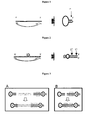
- the Type I adaptor ( Figure 1 ) is synthesised as a single stranded DNA (ssDNA) oligonucleotide in which the 5' terminal nucleotides are complementary to the 3' terminal nucleotides such that under appropriate conditions, an intra molecular hybridisation occurs, generating a blunt-ended 'hairpin loop' of DNA with a dsDNA region and a ssDNA 'bubble' region.
- the double stranded hybridised region is terminated with (for example) a sequence of bases which represent one half of the recognition sequence of a 'rare cutting' restriction endonuclease.
- the 'bubble' region is a single stranded sequence that can provides a hybridisable 'hook' for capture of the structure, and any ligation products containing the structure, onto a support surface or bead which is equipped with the complementary ssDNA sequence.
- the 'bubble' region may also contain a sequence that identifies a particular Type I adaptor from another otherwise identical Type I adaptor, and thus enables the multiplex analysis of ligation products derived from template DNAs from different individuals.
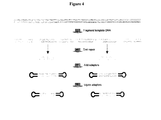
- the Type II adaptor ( Figure 2 ) is not unlike the Type I adaptor in gross structure, being the product of an intra molecular hybridisation of a long oligonucleotide.
- the structure formed has a terminal end that also describes half of the palindromic rare-cutting restriction enzyme present at the terminal end of the Type I adaptor hairpin.
- the double stranded region of the Type II adaptor contains the recognition sequence of a distinct rare-cutting restriction endonuclease (2 ry in Figure 2 ).
- the adaptor may also contain a sequence that can be used to identify the adaptor and is situated between the end describing half of the palindromic rare-cutting restriction enzyme (1 ry in Figure 2 ) and the recognition sequence of the distinct rare-cutting restriction endonuclease (2 ry in Figure 2 ).
- the bubble region of single stranded DNA of the Type II adaptor can be markedly smaller than that of the Type I adaptor, as although it also harbours a selectable marker, this is in the form of a [Biotin-dT], which enables the capture of any ligation products containing a Type II adaptor onto a surface of immobilised streptavidin.
- sequencing template may be prepared in a number of ways.
- An established method is the random fragmentation and end repair of the sheared DNA to blunt ends; it is an accepted and reliable method, and the proposed template generation scheme presumes that this will be the method of choice.
- the technique described could be modified to accommodate other methods of fragmentation that generate alternative termini, including 'sticky' ends.
- the fragments of sheared DNA will be equipped with a 5' PO 4 and a 3' OH on both strands.
- Dephosphorylation of the template would prevent concatamerisation of the template fragments, but would present a challenge of then having to repair the nicks left upon ligation of the 5' phosphorylated adaptors.
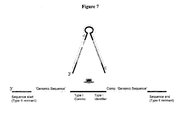
- Use of excess concentrations of the adaptors with phosphorylated template DNA will limit the possibility of template:template ligations, but will mean that a large number of ligation products devoid of inserted template will be created ( Figure 3 and Figure 4 ).
- the secondary restriction enzyme will cleave those bound fragments within the captured Type II adaptor sequence, whether the product of the ligation has just one Type II adaptor or both ends have a Type II adaptor.
- the release products are either the desired covalently closed structures (2/3 rds of all released structures will be this form) or will be linearised sequences derived from the Type II:template:Type II ligation products (1/3 rd of the released products will be this form).
- the non-closed end of the desired covalently closed structure will be derived from the Type II adaptor and may contain a sequence that may be used to identify that adaptor.
- the above purification scheme has the attraction of being automatable, and in delivering only one species of product: that desired for the sequencing reaction.
- This product can be released from the immobilised anti-Type I adaptor bubble plate by a simple alkali wash, after which the denatured template DNA ( Figure 6 ) might be neutralised in the presence of, for example, a buffer solution containing E.coli single stranded binding protein, which when bound to the denatured ssDNA will maintain its single stranded form; a prerequisite for maintaining the processivity of the E. coli Exonuclease I.
Landscapes
- Chemical & Material Sciences (AREA)
- Life Sciences & Earth Sciences (AREA)
- Organic Chemistry (AREA)
- Health & Medical Sciences (AREA)
- Engineering & Computer Science (AREA)
- Proteomics, Peptides & Aminoacids (AREA)
- Wood Science & Technology (AREA)
- Zoology (AREA)
- Genetics & Genomics (AREA)
- Molecular Biology (AREA)
- Biochemistry (AREA)
- Biotechnology (AREA)
- General Health & Medical Sciences (AREA)
- Bioinformatics & Cheminformatics (AREA)
- General Engineering & Computer Science (AREA)
- Microbiology (AREA)
- Biophysics (AREA)
- Physics & Mathematics (AREA)
- Immunology (AREA)
- Analytical Chemistry (AREA)
- Biomedical Technology (AREA)
- Plant Pathology (AREA)
- Measuring Or Testing Involving Enzymes Or Micro-Organisms (AREA)
- Preparation Of Compounds By Using Micro-Organisms (AREA)
Applications Claiming Priority (2)
| Application Number | Priority Date | Filing Date | Title |
|---|---|---|---|
| US14873709P | 2009-01-30 | 2009-01-30 | |
| PCT/GB2010/000160 WO2010086622A1 (en) | 2009-01-30 | 2010-01-29 | Adaptors for nucleic acid constructs in transmembrane sequencing |
Publications (2)
| Publication Number | Publication Date |
|---|---|
| EP2391732A1 EP2391732A1 (en) | 2011-12-07 |
| EP2391732B1 true EP2391732B1 (en) | 2015-05-27 |
Family
ID=42083949
Family Applications (1)
| Application Number | Title | Priority Date | Filing Date |
|---|---|---|---|
| EP10703325.0A Active EP2391732B1 (en) | 2009-01-30 | 2010-01-29 | Methods using adaptors for nucleic acid constructs in transmembrane sequencing |
Country Status (9)
| Country | Link |
|---|---|
| US (7) | US20120058468A1 (https=) |
| EP (1) | EP2391732B1 (https=) |
| JP (1) | JP5843614B2 (https=) |
| KR (1) | KR101797773B1 (https=) |
| CN (1) | CN102369298B (https=) |
| AU (1) | AU2010209528B2 (https=) |
| BR (1) | BRPI1007214A8 (https=) |
| CA (1) | CA2750879C (https=) |
| WO (1) | WO2010086622A1 (https=) |
Families Citing this family (94)
| Publication number | Priority date | Publication date | Assignee | Title |
|---|---|---|---|---|
| EP4230747A3 (en) | 2008-03-28 | 2023-11-15 | Pacific Biosciences Of California, Inc. | Compositions and methods for nucleic acid sequencing |
| US20110229877A1 (en) | 2008-07-07 | 2011-09-22 | Oxford Nanopore Technologies Limited | Enzyme-pore constructs |
| WO2010036287A1 (en) * | 2008-09-24 | 2010-04-01 | Pacific Biosciences Of California, Inc. | Intermittent detection during analytical reactions |
| GB0820927D0 (en) | 2008-11-14 | 2008-12-24 | Isis Innovation | Method |
| EP2391732B1 (en) | 2009-01-30 | 2015-05-27 | Oxford Nanopore Technologies Limited | Methods using adaptors for nucleic acid constructs in transmembrane sequencing |
| GB0905140D0 (en) | 2009-03-25 | 2009-05-06 | Isis Innovation | Method |
| KR101939420B1 (ko) | 2011-02-11 | 2019-01-16 | 옥스포드 나노포어 테크놀로지즈 리미티드 | 돌연변이체 세공 |
| US9347929B2 (en) | 2011-03-01 | 2016-05-24 | The Regents Of The University Of Michigan | Controlling translocation through nanopores with fluid wall |
| EP4737389A2 (en) | 2011-05-27 | 2026-05-06 | Oxford Nanopore Technologies PLC | Coupling method |
| JP6298404B2 (ja) * | 2011-07-25 | 2018-03-20 | オックスフォード ナノポール テクノロジーズ リミテッド | 膜貫通ポアを用いる二重鎖ポリヌクレオチド配列決定のためのヘアピンループ方法 |
| WO2013036668A1 (en) | 2011-09-06 | 2013-03-14 | Gen-Probe Incorporated | Circularized templates for sequencing |
| EP3620533B1 (en) * | 2011-09-06 | 2023-01-18 | Gen-Probe Incorporated | Closed nucleic acid structures |
| JP6457811B2 (ja) | 2011-09-23 | 2019-01-23 | オックスフォード ナノポール テクノロジーズ リミテッド | ポリマー単位を含むポリマーの解析 |
| CN104039979B (zh) * | 2011-10-21 | 2016-08-24 | 牛津纳米孔技术公司 | 使用孔和Hel308解旋酶表征目标多核苷酸的酶方法 |
| US9404147B2 (en) | 2011-12-19 | 2016-08-02 | Gen-Probe Incorporated | Closed nucleic acid structures |
| US9617591B2 (en) | 2011-12-29 | 2017-04-11 | Oxford Nanopore Technologies Ltd. | Method for characterising a polynucleotide by using a XPD helicase |
| AU2012360244B2 (en) | 2011-12-29 | 2018-08-23 | Oxford Nanopore Technologies Limited | Enzyme method |
| CN107828877A (zh) | 2012-01-20 | 2018-03-23 | 吉尼亚科技公司 | 基于纳米孔的分子检测与测序 |
| IN2014DN06796A (https=) | 2012-02-15 | 2015-05-22 | Oxford Nanopore Tech Ltd | |
| CN104321441B (zh) | 2012-02-16 | 2016-10-19 | 牛津楠路珀尔科技有限公司 | 聚合物的测量的分析 |
| WO2013123442A1 (en) | 2012-02-17 | 2013-08-22 | Fred Hutchinson Cancer Research Center | Compositions and methods for accurately identifying mutations |
| EP3305918B1 (en) | 2012-03-05 | 2020-06-03 | President and Fellows of Harvard College | Methods for epigenetic sequencing |
| PT2828218T (pt) | 2012-03-20 | 2020-11-11 | Univ Washington Through Its Center For Commercialization | Métodos para baixar a taxa de erro da sequenciação paralela massiva de adn utilizando sequenciação duplex de consensus |
| KR102083695B1 (ko) | 2012-04-10 | 2020-03-02 | 옥스포드 나노포어 테크놀로지즈 리미티드 | 돌연변이체 리세닌 기공 |
| WO2013184905A1 (en) | 2012-06-06 | 2013-12-12 | Myriad Genetics, Inc. | Hereditary cancer genes |
| GB2559073A (en) | 2012-06-08 | 2018-07-25 | Pacific Biosciences California Inc | Modified base detection with nanopore sequencing |
| US11155860B2 (en) | 2012-07-19 | 2021-10-26 | Oxford Nanopore Technologies Ltd. | SSB method |
| JP6429773B2 (ja) | 2012-07-19 | 2018-11-28 | オックスフォード ナノポール テクノロジーズ リミテッド | 酵素構築物 |
| CA2879261C (en) | 2012-07-19 | 2022-12-06 | Oxford Nanopore Technologies Limited | Modified helicases |
| EP2880186B1 (en) * | 2012-08-03 | 2019-02-06 | University Of Washington Through Its Center For Commercialization | Compositions and methods for improving nanopore sequencing |
| US9551023B2 (en) | 2012-09-14 | 2017-01-24 | Oxford Nanopore Technologies Ltd. | Sample preparation method |
| WO2014072703A1 (en) | 2012-11-06 | 2014-05-15 | Oxford Nanopore Technologies Limited | Quadruplex method |
| GB201222928D0 (en) | 2012-12-19 | 2013-01-30 | Oxford Nanopore Tech Ltd | Analysis of a polynucleotide |
| EP2953524B1 (en) | 2013-02-06 | 2018-08-01 | Freenome Holdings Inc. | Systems and methods for early disease detection and real-time disease monitoring |
| US9557292B2 (en) | 2013-02-25 | 2017-01-31 | The Regents Of The University Of Michigan | Nanopore-based determination of protein charge, shape, volume, rotational diffusion coefficient, and dipole moment |
| CA2901545C (en) | 2013-03-08 | 2019-10-08 | Oxford Nanopore Technologies Limited | Use of spacer elements in a nucleic acid to control movement of a helicase |
| GB201314695D0 (en) | 2013-08-16 | 2013-10-02 | Oxford Nanopore Tech Ltd | Method |
| GB201318465D0 (en) | 2013-10-18 | 2013-12-04 | Oxford Nanopore Tech Ltd | Method |
| GB201313477D0 (en) | 2013-07-29 | 2013-09-11 | Univ Leuven Kath | Nanopore biosensors for detection of proteins and nucleic acids |
| CN117947149A (zh) | 2013-10-18 | 2024-04-30 | 牛津纳米孔科技公开有限公司 | 经修饰的酶 |
| GB201406151D0 (en) | 2014-04-04 | 2014-05-21 | Oxford Nanopore Tech Ltd | Method |
| GB201406155D0 (en) | 2014-04-04 | 2014-05-21 | Oxford Nanopore Tech Ltd | Method |
| CN111534504B (zh) | 2014-01-22 | 2024-06-21 | 牛津纳米孔科技公开有限公司 | 将一个或多个多核苷酸结合蛋白连接到靶多核苷酸的方法 |
| CA2931140C (en) * | 2014-02-05 | 2022-08-30 | Fraunhofer-Gesellschaft Zur Forderung Der Angewandten Forschung E.V. | Error-free sequencing of dna |
| GB201403096D0 (en) | 2014-02-21 | 2014-04-09 | Oxford Nanopore Tech Ltd | Sample preparation method |
| WO2015150786A1 (en) | 2014-04-04 | 2015-10-08 | Oxford Nanopore Technologies Limited | Method for characterising a double stranded nucleic acid using a nano-pore and anchor molecules at both ends of said nucleic acid |
| US20150298091A1 (en) | 2014-04-21 | 2015-10-22 | President And Fellows Of Harvard College | Systems and methods for barcoding nucleic acids |
| GB201417712D0 (en) | 2014-10-07 | 2014-11-19 | Oxford Nanopore Tech Ltd | Method |
| EP3137490B1 (en) | 2014-05-02 | 2021-01-27 | Oxford Nanopore Technologies Limited | Mutant pores |
| EP3169799B1 (en) | 2014-07-15 | 2019-09-04 | Qiagen Sciences, LLC | Semi-random barcodes for nucleic acid analysis |
| CA2959220A1 (en) | 2014-09-01 | 2016-03-10 | Vib Vzw | Mutant csgg pores |
| EP3204511B1 (en) | 2014-10-07 | 2021-07-28 | Oxford Nanopore Technologies Limited | Mutant pores |
| GB201418159D0 (en) * | 2014-10-14 | 2014-11-26 | Oxford Nanopore Tech Ltd | Method |
| EP4397972A3 (en) | 2014-10-16 | 2024-10-09 | Oxford Nanopore Technologies PLC | Alignment mapping estimation |
| US10480026B2 (en) | 2014-10-17 | 2019-11-19 | Oxford Nanopore Technologies Ltd. | Method for nanopore RNA characterisation |
| GB201418469D0 (en) | 2014-10-17 | 2014-12-03 | Oxford Nanopore Tech Ltd | Method |
| WO2016082129A1 (zh) * | 2014-11-26 | 2016-06-02 | 深圳华大基因研究院 | 一种核酸的双接头单链环状文库的构建方法和试剂 |
| GB201502810D0 (en) | 2015-02-19 | 2015-04-08 | Oxford Nanopore Tech Ltd | Method |
| GB201502809D0 (en) | 2015-02-19 | 2015-04-08 | Oxford Nanopore Tech Ltd | Mutant pore |
| GB2550712B (en) | 2015-02-26 | 2021-01-13 | Hitachi High Tech Corp | Method for constructing hairpin-containing nucleic acid molecules for nanopore sequencing |
| WO2016166232A1 (en) | 2015-04-14 | 2016-10-20 | Katholieke Universiteit Leuven | Nanopores with internal protein adaptors |
| US11746367B2 (en) | 2015-04-17 | 2023-09-05 | President And Fellows Of Harvard College | Barcoding systems and methods for gene sequencing and other applications |
| CA3006792A1 (en) | 2015-12-08 | 2017-06-15 | Twinstrand Biosciences, Inc. | Improved adapters, methods, and compositions for duplex sequencing |
| AU2016369071B2 (en) | 2015-12-08 | 2022-05-19 | Katholieke Universiteit Leuven Ku Leuven Research & Development | Modified nanopores, compositions comprising the same, and uses thereof |
| CN108473933A (zh) | 2015-12-08 | 2018-08-31 | 昆塔波尔公司 | 使核酸移位通过纳米孔的方法 |
| US10438662B2 (en) | 2016-02-29 | 2019-10-08 | Iridia, Inc. | Methods, compositions, and devices for information storage |
| WO2017151680A2 (en) * | 2016-02-29 | 2017-09-08 | Dodo Omnidata, Inc. | Methods, compositions, and devices for information storage |
| US10859562B2 (en) | 2016-02-29 | 2020-12-08 | Iridia, Inc. | Methods, compositions, and devices for information storage |
| US10640822B2 (en) | 2016-02-29 | 2020-05-05 | Iridia, Inc. | Systems and methods for writing, reading, and controlling data stored in a polymer |
| CN116200476A (zh) | 2016-03-02 | 2023-06-02 | 牛津纳米孔科技公开有限公司 | 靶分析物测定方法、突变CsgG单体及其构筑体、及聚核苷酸和寡聚孔 |
| EP4397970A3 (en) | 2016-04-06 | 2024-10-09 | Oxford Nanopore Technologies PLC | Mutant pore |
| CN109196116B (zh) | 2016-05-25 | 2022-09-27 | 牛津纳米孔科技公开有限公司 | 一种表征靶多核苷酸的方法 |
| GB201609220D0 (en) | 2016-05-25 | 2016-07-06 | Oxford Nanopore Tech Ltd | Method |
| EP3464612B8 (en) | 2016-05-31 | 2024-12-11 | Switchback Systems, Inc. | Two-color nanopore sequencing |
| US11708574B2 (en) | 2016-06-10 | 2023-07-25 | Myriad Women's Health, Inc. | Nucleic acid sequencing adapters and uses thereof |
| CA3031812A1 (en) | 2016-08-19 | 2018-02-22 | Quantapore, Inc. | Optically-based nanopore sequencing using quenching agents |
| WO2018145041A1 (en) * | 2017-02-06 | 2018-08-09 | 10X Genomics, Inc. | Systems and methods for nucleic acid preparation |
| US10995333B2 (en) | 2017-02-06 | 2021-05-04 | 10X Genomics, Inc. | Systems and methods for nucleic acid preparation |
| WO2018183942A1 (en) * | 2017-03-31 | 2018-10-04 | Grail, Inc. | Improved library preparation and use thereof for sequencing-based error correction and/or variant identification |
| CN106939344B (zh) * | 2017-04-20 | 2020-04-21 | 北京迈基诺基因科技股份有限公司 | 用于二代测序的接头 |
| GB201707122D0 (en) | 2017-05-04 | 2017-06-21 | Oxford Nanopore Tech Ltd | Pore |
| US11981898B2 (en) * | 2017-06-16 | 2024-05-14 | Applied Stemcell, Inc. | Gene editing methods with increased knock-in efficiency |
| CN117106038B (zh) | 2017-06-30 | 2025-12-09 | 弗拉芒区生物技术研究所 | 新颖蛋白孔 |
| AU2018366213B2 (en) | 2017-11-08 | 2025-05-15 | Twinstrand Biosciences, Inc. | Reagents and adapters for nucleic acid sequencing and methods for making such reagents and adapters |
| EP3731959B1 (en) | 2017-12-29 | 2025-10-08 | Clear Labs, Inc. | Automated priming and library loading device |
| KR102342490B1 (ko) * | 2018-04-05 | 2021-12-24 | 한국한의학연구원 | 분자 인덱스된 바이설파이트 시퀀싱 |
| GB201805676D0 (en) * | 2018-04-05 | 2018-05-23 | Imperial Innovations Ltd | Compositions |
| GB201807793D0 (en) | 2018-05-14 | 2018-06-27 | Oxford Nanopore Tech Ltd | Method |
| BR112021000409A2 (pt) | 2018-07-12 | 2021-04-06 | Twinstrand Biosciences, Inc. | Métodos e reagentes para caracterizar edição genômica, expansão clonal e aplicações associadas |
| GB201819378D0 (en) | 2018-11-28 | 2019-01-09 | Oxford Nanopore Tech Ltd | Analysis of nanopore signal using a machine-learning technique |
| US11655465B1 (en) | 2019-05-02 | 2023-05-23 | Iridia, Inc. | Enzymes and systems for synthesizing DNA |
| US11837302B1 (en) | 2020-08-07 | 2023-12-05 | Iridia, Inc. | Systems and methods for writing and reading data stored in a polymer using nano-channels |
| US11248265B1 (en) | 2020-11-19 | 2022-02-15 | Clear Labs, Inc | Systems and processes for distinguishing pathogenic and non-pathogenic sequences from specimens |
| JP2024518135A (ja) * | 2021-05-16 | 2024-04-24 | ジェンエディットバイオ リミテッド | 標的化核酸濃縮方法、オフターゲット同定方法及び遺伝子編集効率評価方法 |
Citations (1)
| Publication number | Priority date | Publication date | Assignee | Title |
|---|---|---|---|---|
| WO2006020775A2 (en) * | 2004-08-13 | 2006-02-23 | Harvard University | An ultra high-throughput opti-nanopore dna readout platform |
Family Cites Families (191)
| Publication number | Priority date | Publication date | Assignee | Title |
|---|---|---|---|---|
| IE56026B1 (en) | 1982-10-19 | 1991-03-27 | Cetus Corp | Cysteine-depleted muteins of biologically active proteins |
| GB8924338D0 (en) | 1989-10-28 | 1989-12-13 | Atomic Energy Authority Uk | Electrodes |
| US5215899A (en) | 1989-11-09 | 1993-06-01 | Miles Inc. | Nucleic acid amplification employing ligatable hairpin probe and transcription |
| US5424413A (en) | 1992-01-22 | 1995-06-13 | Gen-Probe Incorporated | Branched nucleic acid probes |
| FR2703693B1 (fr) * | 1993-04-06 | 1995-07-13 | Pasteur Institut | Procédé rapide de détermination d'une séquence d'ADN et application au séquençage et au diagnostic. |
| US5714320A (en) * | 1993-04-15 | 1998-02-03 | University Of Rochester | Rolling circle synthesis of oligonucleotides and amplification of select randomized circular oligonucleotides |
| WO1994025616A1 (en) | 1993-04-28 | 1994-11-10 | Worcester Foundation For Experimental Biology | Cell-targeted lytic pore-forming agents |
| US5777078A (en) | 1993-04-28 | 1998-07-07 | Worcester Foundation For Experimental Biology | Triggered pore-forming agents |
| DE4320201A1 (de) | 1993-06-18 | 1995-01-12 | Asta Medica Ag | Verwendung von Cetrorelix und weiteren Nona- und Dekapeptiden zur Herstellung eines Arzneimittels zur Bekämpfung von Aids und zur Wachstumsstimulation |
| US5561043A (en) | 1994-01-31 | 1996-10-01 | Trustees Of Boston University | Self-assembling multimeric nucleic acid constructs |
| US7569341B2 (en) | 1994-01-31 | 2009-08-04 | Trustees Of Boston University | Nucleic acid directed immobilization arrays and methods of assembly |
| US6362002B1 (en) * | 1995-03-17 | 2002-03-26 | President And Fellows Of Harvard College | Characterization of individual polymer molecules based on monomer-interface interactions |
| US5795782A (en) | 1995-03-17 | 1998-08-18 | President & Fellows Of Harvard College | Characterization of individual polymer molecules based on monomer-interface interactions |
| US6395887B1 (en) | 1995-08-01 | 2002-05-28 | Yale University | Analysis of gene expression by display of 3'-end fragments of CDNAS |
| US5866336A (en) | 1996-07-16 | 1999-02-02 | Oncor, Inc. | Nucleic acid amplification oligonucleotides with molecular energy transfer labels and methods based thereon |
| AU8586298A (en) | 1997-07-25 | 1999-02-16 | University Of Massachusetts | Designed protein pores as components for biosensors |
| US6087099A (en) | 1997-09-08 | 2000-07-11 | Myriad Genetics, Inc. | Method for sequencing both strands of a double stranded DNA in a single sequencing reaction |
| US6127166A (en) | 1997-11-03 | 2000-10-03 | Bayley; Hagan | Molluscan ligament polypeptides and genes encoding them |
| JPH11137260A (ja) | 1997-11-06 | 1999-05-25 | Soyaku Gijutsu Kenkyusho:Kk | 抗インフルエンザウイルス環状ダンベル型rna−dnaキメラ化合物及び抗インフルエンザウイルス剤 |
| US6123819A (en) | 1997-11-12 | 2000-09-26 | Protiveris, Inc. | Nanoelectrode arrays |
| DE19826758C1 (de) | 1998-06-15 | 1999-10-21 | Soft Gene Gmbh | Darstellung von linearen kovalent geschlossenen DNA-Molekülen als Expressionskonstrukte |
| US6743605B1 (en) * | 1998-06-24 | 2004-06-01 | Enzo Life Sciences, Inc. | Linear amplification of specific nucleic acid sequences |
| US6787308B2 (en) | 1998-07-30 | 2004-09-07 | Solexa Ltd. | Arrayed biomolecules and their use in sequencing |
| US6235502B1 (en) | 1998-09-18 | 2001-05-22 | Molecular Staging Inc. | Methods for selectively isolating DNA using rolling circle amplification |
| US6267872B1 (en) | 1998-11-06 | 2001-07-31 | The Regents Of The University Of California | Miniature support for thin films containing single channels or nanopores and methods for using same |
| US6426231B1 (en) | 1998-11-18 | 2002-07-30 | The Texas A&M University System | Analyte sensing mediated by adapter/carrier molecules |
| WO2000034527A2 (en) | 1998-12-11 | 2000-06-15 | The Regents Of The University Of California | Targeted molecular bar codes |
| NO986133D0 (no) * | 1998-12-23 | 1998-12-23 | Preben Lexow | FremgangsmÕte for DNA-sekvensering |
| US7056661B2 (en) | 1999-05-19 | 2006-06-06 | Cornell Research Foundation, Inc. | Method for sequencing nucleic acid molecules |
| US7258838B2 (en) | 1999-06-22 | 2007-08-21 | President And Fellows Of Harvard College | Solid state molecular probe device |
| US6464842B1 (en) | 1999-06-22 | 2002-10-15 | President And Fellows Of Harvard College | Control of solid state dimensional features |
| EP2383776B1 (en) | 1999-06-22 | 2015-02-25 | President and Fellows of Harvard College | Solid state nanopore device for evaluating biopolymers |
| US7087729B1 (en) | 1999-06-29 | 2006-08-08 | University Health Network | Peptide conjugates for the stabilization of membrane proteins and interactions with biological membranes |
| WO2001012855A2 (en) | 1999-08-13 | 2001-02-22 | Yale University | Binary encoded sequence tags |
| US6274320B1 (en) * | 1999-09-16 | 2001-08-14 | Curagen Corporation | Method of sequencing a nucleic acid |
| US6682649B1 (en) | 1999-10-01 | 2004-01-27 | Sophion Bioscience A/S | Substrate and a method for determining and/or monitoring electrophysiological properties of ion channels |
| WO2001040516A2 (en) | 1999-12-02 | 2001-06-07 | Molecular Staging Inc. | Generation of single-strand circular dna from linear self-annealing segments |
| WO2001059453A2 (en) | 2000-02-11 | 2001-08-16 | The Texas A & M University System | Biosensor compositions and methods of use |
| US20020132978A1 (en) | 2000-03-21 | 2002-09-19 | Hans-Peter Gerber | VEGF-modulated genes and methods employing them |
| CA2404216A1 (en) | 2000-03-22 | 2001-09-27 | Curagen Corporation | Novel polypeptides, and nucleic acids encoding the same |
| US6596488B2 (en) * | 2000-03-30 | 2003-07-22 | City Of Hope | Tumor suppressor gene |
| US6387624B1 (en) | 2000-04-14 | 2002-05-14 | Incyte Pharmaceuticals, Inc. | Construction of uni-directionally cloned cDNA libraries from messenger RNA for improved 3′ end DNA sequencing |
| US7001792B2 (en) | 2000-04-24 | 2006-02-21 | Eagle Research & Development, Llc | Ultra-fast nucleic acid sequencing device and a method for making and using the same |
| US20020132350A1 (en) | 2000-09-14 | 2002-09-19 | Pioneer Hi-Bred International, Inc. | Targeted genetic manipulation using Mu bacteriophage cleaved donor complex |
| US6709861B2 (en) * | 2000-11-17 | 2004-03-23 | Lucigen Corp. | Cloning vectors and vector components |
| WO2002042496A2 (en) | 2000-11-27 | 2002-05-30 | The Regents Of The University Of California | Methods and devices for characterizing duplex nucleic acid molecules |
| US20020197618A1 (en) | 2001-01-20 | 2002-12-26 | Sampson Jeffrey R. | Synthesis and amplification of unstructured nucleic acids for rapid sequencing |
| US20030087232A1 (en) | 2001-01-25 | 2003-05-08 | Fred Christians | Methods for screening polypeptides |
| US7807408B2 (en) | 2001-03-19 | 2010-10-05 | President & Fellows Of Harvard College | Directed evolution of proteins |
| WO2003003446A2 (en) | 2001-06-27 | 2003-01-09 | President And Fellows Of Harvard College | Control of solid state dimensional features |
| US6863833B1 (en) | 2001-06-29 | 2005-03-08 | The Board Of Trustees Of The Leland Stanford Junior University | Microfabricated apertures for supporting bilayer lipid membranes |
| WO2003004992A2 (en) | 2001-07-03 | 2003-01-16 | The Regents Of The University Of California | Mammalian sweet and amino acid heterodimeric taste receptors |
| US6852492B2 (en) * | 2001-09-24 | 2005-02-08 | Intel Corporation | Nucleic acid sequencing by raman monitoring of uptake of precursors during molecular replication |
| AU2003214031A1 (en) | 2002-03-15 | 2003-09-29 | Nuevolution A/S | An improved method for synthesising templated molecules |
| EP1504114B1 (en) | 2002-05-10 | 2017-07-12 | The Texas A & M University System | Stochastic sensing through covalent interactions |
| US7253434B2 (en) | 2002-10-29 | 2007-08-07 | President And Fellows Of Harvard College | Suspended carbon nanotube field effect transistor |
| JP5025132B2 (ja) | 2002-10-29 | 2012-09-12 | プレジデント・アンド・フェローズ・オブ・ハーバード・カレッジ | カーボンナノチューブ素子の製造 |
| US7452699B2 (en) * | 2003-01-15 | 2008-11-18 | Dana-Farber Cancer Institute, Inc. | Amplification of DNA in a hairpin structure, and applications |
| EP1592810A2 (en) | 2003-02-12 | 2005-11-09 | Genizon Svenska AB | Methods and means for nucleic acid sequencing |
| US7745116B2 (en) | 2003-04-08 | 2010-06-29 | Pacific Biosciences Of California, Inc. | Composition and method for nucleic acid sequencing |
| US20100035254A1 (en) * | 2003-04-08 | 2010-02-11 | Pacific Biosciences Of California, Inc. | Composition and method for nucleic acid sequencing |
| US7163658B2 (en) | 2003-04-23 | 2007-01-16 | Rouvain Bension | Rapid sequencing of polymers |
| US7344882B2 (en) | 2003-05-12 | 2008-03-18 | Bristol-Myers Squibb Company | Polynucleotides encoding variants of the TRP channel family member, LTRPC3 |
| US20070122885A1 (en) | 2005-08-22 | 2007-05-31 | Fermalogic, Inc. | Methods of increasing production of secondary metabolites by manipulating metabolic pathways that include methylmalonyl-coa |
| WO2005056750A2 (en) * | 2003-12-11 | 2005-06-23 | Quark Biotech, Inc. | Inversion-duplication of nucleic acids and libraries prepared thereby |
| EP1708957B1 (en) | 2003-12-19 | 2009-05-06 | The President and Fellows of Harvard College | Analysis of molecules by translocation through a coated aperture |
| GB0400584D0 (en) | 2004-01-12 | 2004-02-11 | Solexa Ltd | Nucleic acid chacterisation |
| US7238485B2 (en) * | 2004-03-23 | 2007-07-03 | President And Fellows Of Harvard College | Methods and apparatus for characterizing polynucleotides |
| GB2413796B (en) | 2004-03-25 | 2006-03-29 | Global Genomics Ab | Methods and means for nucleic acid sequencing |
| US20050227239A1 (en) | 2004-04-08 | 2005-10-13 | Joyce Timothy H | Microarray based affinity purification and analysis device coupled with solid state nanopore electrodes |
| US7618778B2 (en) | 2004-06-02 | 2009-11-17 | Kaufman Joseph C | Producing, cataloging and classifying sequence tags |
| WO2005124888A1 (en) | 2004-06-08 | 2005-12-29 | President And Fellows Of Harvard College | Suspended carbon nanotube field effect transistor |
| US7700281B2 (en) | 2004-06-30 | 2010-04-20 | Usb Corporation | Hot start nucleic acid amplification |
| US20060086626A1 (en) | 2004-10-22 | 2006-04-27 | Joyce Timothy H | Nanostructure resonant tunneling with a gate voltage source |
| EP1842061A4 (en) | 2004-12-21 | 2009-05-13 | Texas A & M Univ Sys | HIGH-TEMPERATURE ION CHANNELS AND ION PORES |
| US7890268B2 (en) * | 2004-12-28 | 2011-02-15 | Roche Molecular Systems, Inc. | De-novo sequencing of nucleic acids |
| GB0505971D0 (en) | 2005-03-23 | 2005-04-27 | Isis Innovation | Delivery of molecules to a lipid bilayer |
| US7507575B2 (en) | 2005-04-01 | 2009-03-24 | 3M Innovative Properties Company | Multiplex fluorescence detection device having removable optical modules |
| ATE529734T1 (de) | 2005-04-06 | 2011-11-15 | Harvard College | Molekulare charakterisierung mit kohlenstoff- nanoröhrchen-steuerung |
| CA2615323A1 (en) | 2005-06-06 | 2007-12-21 | 454 Life Sciences Corporation | Paired end sequencing |
| US20070020640A1 (en) | 2005-07-21 | 2007-01-25 | Mccloskey Megan L | Molecular encoding of nucleic acid templates for PCR and other forms of sequence analysis |
| WO2007018601A1 (en) | 2005-08-02 | 2007-02-15 | Rubicon Genomics, Inc. | Compositions and methods for processing and amplification of dna, including using multiple enzymes in a single reaction |
| GB0523282D0 (en) * | 2005-11-15 | 2005-12-21 | Isis Innovation | Methods using pores |
| WO2007075987A2 (en) | 2005-12-22 | 2007-07-05 | Pacific Biosciences Of California, Inc. | Active surface coupled polymerases |
| US7932029B1 (en) * | 2006-01-04 | 2011-04-26 | Si Lok | Methods for nucleic acid mapping and identification of fine-structural-variations in nucleic acids and utilities |
| US20070224613A1 (en) | 2006-02-18 | 2007-09-27 | Strathmann Michael P | Massively Multiplexed Sequencing |
| US8673567B2 (en) | 2006-03-08 | 2014-03-18 | Atila Biosystems, Inc. | Method and kit for nucleic acid sequence detection |
| EP3239304B1 (en) | 2006-04-04 | 2020-08-19 | Keygene N.V. | High throughput detection of molecular markers based on aflp and high troughput sequencing |
| WO2007146158A1 (en) | 2006-06-07 | 2007-12-21 | The Trustees Of Columbia University In The City Of New York | Dna sequencing by nanopore using modified nucleotides |
| JP4876766B2 (ja) | 2006-08-10 | 2012-02-15 | トヨタ自動車株式会社 | 燃料電池 |
| CA2663047A1 (en) | 2006-09-06 | 2008-03-13 | Phase Bioscience, Inc. | Therapeutic elastin-like polypeptide (elp) fusion proteins |
| US20100311602A1 (en) | 2006-10-13 | 2010-12-09 | J. Craig Venter Institute, Inc. | Sequencing method |
| US8343746B2 (en) | 2006-10-23 | 2013-01-01 | Pacific Biosciences Of California, Inc. | Polymerase enzymes and reagents for enhanced nucleic acid sequencing |
| GB2445016B (en) | 2006-12-19 | 2012-03-07 | Microsaic Systems Plc | Microengineered ionisation device |
| US20110121840A1 (en) | 2007-02-20 | 2011-05-26 | Gurdial Singh Sanghera | Lipid Bilayer Sensor System |
| EP2156179B1 (en) | 2007-04-04 | 2021-08-18 | The Regents of The University of California | Methods for using a nanopore |
| WO2009035647A1 (en) | 2007-09-12 | 2009-03-19 | President And Fellows Of Harvard College | High-resolution molecular graphene sensor comprising an aperture in the graphene layer |
| GB2453377A (en) | 2007-10-05 | 2009-04-08 | Isis Innovation | Transmembrane protein pores and molecular adapters therefore. |
| KR101414713B1 (ko) | 2007-10-11 | 2014-07-03 | 삼성전자주식회사 | 리가제 및 엔도뉴클레아제의 존재하에서 롤링서클 증폭에의하여 표적 핵산을 증폭하는 방법 |
| GB0724736D0 (en) | 2007-12-19 | 2008-01-30 | Oxford Nanolabs Ltd | Formation of layers of amphiphilic molecules |
| WO2009084721A1 (en) | 2007-12-31 | 2009-07-09 | Fujirebio Inc. | Clusters of microresonators for cavity mode optical sensing |
| US8852864B2 (en) | 2008-01-17 | 2014-10-07 | Sequenom Inc. | Methods and compositions for the analysis of nucleic acids |
| US8263367B2 (en) * | 2008-01-25 | 2012-09-11 | Agency For Science, Technology And Research | Nucleic acid interaction analysis |
| US8231969B2 (en) | 2008-03-26 | 2012-07-31 | University Of Utah Research Foundation | Asymmetrically functionalized nanoparticles |
| WO2009120374A2 (en) * | 2008-03-28 | 2009-10-01 | Pacific Biosciences Of California, Inc. | Methods and compositions for nucleic acid sample preparation |
| EP4230747A3 (en) * | 2008-03-28 | 2023-11-15 | Pacific Biosciences Of California, Inc. | Compositions and methods for nucleic acid sequencing |
| US8628940B2 (en) | 2008-09-24 | 2014-01-14 | Pacific Biosciences Of California, Inc. | Intermittent detection during analytical reactions |
| WO2009132315A1 (en) | 2008-04-24 | 2009-10-29 | Life Technologies Corporation | Method of sequencing and mapping target nucleic acids |
| WO2009132124A2 (en) | 2008-04-24 | 2009-10-29 | The Trustees Of Columbia University In The City Of New York | Geometric patterns and lipid bilayers for dna molecule organization and uses thereof |
| US20110229877A1 (en) | 2008-07-07 | 2011-09-22 | Oxford Nanopore Technologies Limited | Enzyme-pore constructs |
| EP2310534B1 (en) | 2008-07-07 | 2018-09-05 | Oxford Nanopore Technologies Limited | Base-detecting pore |
| US20100092960A1 (en) | 2008-07-25 | 2010-04-15 | Pacific Biosciences Of California, Inc. | Helicase-assisted sequencing with molecular beacons |
| EP2334802A4 (en) | 2008-09-09 | 2012-01-25 | Life Technologies Corp | METHODS OF GENERATING SPECIFIC LIBRARIES OF GENES |
| US8481264B2 (en) * | 2008-09-19 | 2013-07-09 | Pacific Biosciences Of California, Inc. | Immobilized nucleic acid complexes for sequence analysis |
| CA2774710C (en) | 2008-09-22 | 2016-08-02 | University Of Washington | Msp nanopores and related methods |
| WO2010036287A1 (en) | 2008-09-24 | 2010-04-01 | Pacific Biosciences Of California, Inc. | Intermittent detection during analytical reactions |
| US8383369B2 (en) | 2008-09-24 | 2013-02-26 | Pacific Biosciences Of California, Inc. | Intermittent detection during analytical reactions |
| US9080211B2 (en) | 2008-10-24 | 2015-07-14 | Epicentre Technologies Corporation | Transposon end compositions and methods for modifying nucleic acids |
| CA2750054C (en) | 2008-10-24 | 2018-05-29 | Epicentre Technologies Corporation | Transposon end compositions and methods for modifying nucleic acids |
| US8486630B2 (en) | 2008-11-07 | 2013-07-16 | Industrial Technology Research Institute | Methods for accurate sequence data and modified base position determination |
| GB0820927D0 (en) | 2008-11-14 | 2008-12-24 | Isis Innovation | Method |
| AU2009325069B2 (en) | 2008-12-11 | 2015-03-19 | Pacific Biosciences Of California, Inc. | Classification of nucleic acid templates |
| KR20110125226A (ko) | 2009-01-30 | 2011-11-18 | 옥스포드 나노포어 테크놀로지즈 리미티드 | 혼성화 링커 |
| EP2391732B1 (en) | 2009-01-30 | 2015-05-27 | Oxford Nanopore Technologies Limited | Methods using adaptors for nucleic acid constructs in transmembrane sequencing |
| EP2396430B1 (en) | 2009-02-16 | 2013-05-01 | Epicentre Technologies Corporation | Template-independent ligation of single-stranded dna |
| AU2010215761B2 (en) | 2009-02-23 | 2017-04-06 | Cytomx Therapeutics, Inc | Proproteins and methods of use thereof |
| FR2943656A1 (fr) | 2009-03-25 | 2010-10-01 | Air Liquide | Procede et installation de production d'hydrogene mettant en oeuvre un compresseur thermocinetique |
| GB0905140D0 (en) | 2009-03-25 | 2009-05-06 | Isis Innovation | Method |
| US8986928B2 (en) | 2009-04-10 | 2015-03-24 | Pacific Biosciences Of California, Inc. | Nanopore sequencing devices and methods |
| CN102405410B (zh) | 2009-04-20 | 2014-06-25 | 牛津楠路珀尔科技有限公司 | 脂质双层传感器阵列 |
| GB0910302D0 (en) | 2009-06-15 | 2009-07-29 | Lumora Ltd | Nucleic acid amplification |
| US20120015821A1 (en) * | 2009-09-09 | 2012-01-19 | Life Technologies Corporation | Methods of Generating Gene Specific Libraries |
| US9127313B2 (en) | 2009-12-01 | 2015-09-08 | Oxford Nanopore Technologies Limited | Biochemical analysis instrument |
| US20120010085A1 (en) | 2010-01-19 | 2012-01-12 | Rava Richard P | Methods for determining fraction of fetal nucleic acids in maternal samples |
| FR2955773B1 (fr) | 2010-02-01 | 2017-05-26 | Commissariat Energie Atomique | Complexe moleculaire de ciblage des antigenes vers les cellules presentatrices d'antigene et ses applications pour la vaccination |
| KR20110100963A (ko) | 2010-03-05 | 2011-09-15 | 삼성전자주식회사 | 미세 유동 장치 및 이를 이용한 표적 핵산의 염기 서열 결정 방법 |
| EP2545183B1 (en) | 2010-03-10 | 2017-04-19 | Ibis Biosciences, Inc. | Production of single-stranded circular nucleic acid |
| US8652779B2 (en) | 2010-04-09 | 2014-02-18 | Pacific Biosciences Of California, Inc. | Nanopore sequencing using charge blockade labels |
| US20120244525A1 (en) | 2010-07-19 | 2012-09-27 | New England Biolabs, Inc. | Oligonucleotide Adapters: Compositions and Methods of Use |
| WO2012033524A2 (en) | 2010-09-07 | 2012-03-15 | The Regents Of The University Of California | Control of dna movement in a nanopore at one nucleotide precision by a processive enzyme |
| WO2012061832A1 (en) | 2010-11-05 | 2012-05-10 | Illumina, Inc. | Linking sequence reads using paired code tags |
| WO2012083249A2 (en) | 2010-12-17 | 2012-06-21 | The Trustees Of Columbia University In The City Of New York | Dna sequencing by synthesis using modified nucleotides and nanopore detection |
| CN103688131B (zh) | 2011-01-18 | 2019-04-02 | R·K·斯瓦密 | 用于三角形解的多用途仪器、称为三计量器的测量和几何应用 |
| WO2012098562A2 (en) | 2011-01-19 | 2012-07-26 | Panacea Biotec Limited | Liquid oral compositions of lanthanum salts |
| WO2012103545A1 (en) | 2011-01-28 | 2012-08-02 | Illumina, Inc. | Oligonucleotide replacement for di-tagged and directional libraries |
| US20120196279A1 (en) | 2011-02-02 | 2012-08-02 | Pacific Biosciences Of California, Inc. | Methods and compositions for nucleic acid sample preparation |
| KR101939420B1 (ko) | 2011-02-11 | 2019-01-16 | 옥스포드 나노포어 테크놀로지즈 리미티드 | 돌연변이체 세공 |
| EP4737389A2 (en) | 2011-05-27 | 2026-05-06 | Oxford Nanopore Technologies PLC | Coupling method |
| US20130017978A1 (en) | 2011-07-11 | 2013-01-17 | Finnzymes Oy | Methods and transposon nucleic acids for generating a dna library |
| US9145623B2 (en) | 2011-07-20 | 2015-09-29 | Thermo Fisher Scientific Oy | Transposon nucleic acids comprising a calibration sequence for DNA sequencing |
| JP6298404B2 (ja) | 2011-07-25 | 2018-03-20 | オックスフォード ナノポール テクノロジーズ リミテッド | 膜貫通ポアを用いる二重鎖ポリヌクレオチド配列決定のためのヘアピンループ方法 |
| US9632102B2 (en) | 2011-09-25 | 2017-04-25 | Theranos, Inc. | Systems and methods for multi-purpose analysis |
| JP6457811B2 (ja) | 2011-09-23 | 2019-01-23 | オックスフォード ナノポール テクノロジーズ リミテッド | ポリマー単位を含むポリマーの解析 |
| US9810704B2 (en) | 2013-02-18 | 2017-11-07 | Theranos, Inc. | Systems and methods for multi-analysis |
| US20140308661A1 (en) | 2011-09-25 | 2014-10-16 | Theranos, Inc. | Systems and methods for multi-analysis |
| CN104039979B (zh) | 2011-10-21 | 2016-08-24 | 牛津纳米孔技术公司 | 使用孔和Hel308解旋酶表征目标多核苷酸的酶方法 |
| AU2012360244B2 (en) | 2011-12-29 | 2018-08-23 | Oxford Nanopore Technologies Limited | Enzyme method |
| US9617591B2 (en) | 2011-12-29 | 2017-04-11 | Oxford Nanopore Technologies Ltd. | Method for characterising a polynucleotide by using a XPD helicase |
| NO2694769T3 (https=) | 2012-03-06 | 2018-03-03 | ||
| KR102083695B1 (ko) | 2012-04-10 | 2020-03-02 | 옥스포드 나노포어 테크놀로지즈 리미티드 | 돌연변이체 리세닌 기공 |
| GB2559073A (en) | 2012-06-08 | 2018-07-25 | Pacific Biosciences California Inc | Modified base detection with nanopore sequencing |
| TWI655213B (zh) | 2012-07-13 | 2019-04-01 | Menicon Co., Ltd. | 自我組織化肽衍生物的製造方法 |
| CA2879261C (en) | 2012-07-19 | 2022-12-06 | Oxford Nanopore Technologies Limited | Modified helicases |
| JP6429773B2 (ja) | 2012-07-19 | 2018-11-28 | オックスフォード ナノポール テクノロジーズ リミテッド | 酵素構築物 |
| US11155860B2 (en) | 2012-07-19 | 2021-10-26 | Oxford Nanopore Technologies Ltd. | SSB method |
| US9551023B2 (en) | 2012-09-14 | 2017-01-24 | Oxford Nanopore Technologies Ltd. | Sample preparation method |
| JP6375301B2 (ja) | 2012-10-26 | 2018-08-15 | オックスフォード ナノポール テクノロジーズ リミテッド | 液滴界面 |
| GB201313121D0 (en) | 2013-07-23 | 2013-09-04 | Oxford Nanopore Tech Ltd | Array of volumes of polar medium |
| WO2014074922A1 (en) | 2012-11-09 | 2014-05-15 | Stratos Genomics, Inc. | Concentrating a target molecule for sensing by a nanopore |
| US9683230B2 (en) | 2013-01-09 | 2017-06-20 | Illumina Cambridge Limited | Sample preparation on a solid support |
| US20140206842A1 (en) | 2013-01-22 | 2014-07-24 | Muhammed Majeed | Peptides Modified with Triterpenoids and Small Organic Molecules: Synthesis and use in Cosmeceutical |
| GB201318465D0 (en) | 2013-10-18 | 2013-12-04 | Oxford Nanopore Tech Ltd | Method |
| GB201314695D0 (en) | 2013-08-16 | 2013-10-02 | Oxford Nanopore Tech Ltd | Method |
| CA2901545C (en) | 2013-03-08 | 2019-10-08 | Oxford Nanopore Technologies Limited | Use of spacer elements in a nucleic acid to control movement of a helicase |
| US9708658B2 (en) | 2013-03-19 | 2017-07-18 | New England Biolabs, Inc. | Enrichment of target sequences |
| EP3936222A1 (en) | 2013-08-30 | 2022-01-12 | University of Washington through its Center for Commercialization | Selective modification of polymer subunits to improve nanopore-based analysis |
| GB201406151D0 (en) | 2014-04-04 | 2014-05-21 | Oxford Nanopore Tech Ltd | Method |
| CN117947149A (zh) | 2013-10-18 | 2024-04-30 | 牛津纳米孔科技公开有限公司 | 经修饰的酶 |
| CN111534504B (zh) | 2014-01-22 | 2024-06-21 | 牛津纳米孔科技公开有限公司 | 将一个或多个多核苷酸结合蛋白连接到靶多核苷酸的方法 |
| GB201403096D0 (en) | 2014-02-21 | 2014-04-09 | Oxford Nanopore Tech Ltd | Sample preparation method |
| WO2015148567A1 (en) | 2014-03-24 | 2015-10-01 | Bernick David L | Molecular adapter for capture and manipulation of transfer rna |
| CN106715693A (zh) | 2014-06-13 | 2017-05-24 | 伊卢米纳剑桥有限公司 | 用于制备序列文库的方法和组合物 |
| US10017759B2 (en) | 2014-06-26 | 2018-07-10 | Illumina, Inc. | Library preparation of tagged nucleic acid |
| CN112430641A (zh) | 2014-06-30 | 2021-03-02 | 亿明达股份有限公司 | 使用单侧转座的方法和组合物 |
| WO2016022557A1 (en) | 2014-08-05 | 2016-02-11 | Twist Bioscience Corporation | Cell free cloning of nucleic acids |
| EP3633047B1 (en) | 2014-08-19 | 2022-12-28 | Pacific Biosciences of California, Inc. | Method of sequencing nucleic acids based on an enrichment of nucleic acids |
| GB201418159D0 (en) | 2014-10-14 | 2014-11-26 | Oxford Nanopore Tech Ltd | Method |
| GB2550712B (en) | 2015-02-26 | 2021-01-13 | Hitachi High Tech Corp | Method for constructing hairpin-containing nucleic acid molecules for nanopore sequencing |
| GB201609220D0 (en) | 2016-05-25 | 2016-07-06 | Oxford Nanopore Tech Ltd | Method |
| CN107488656B (zh) | 2016-06-13 | 2020-07-17 | 陆欣华 | 一种核酸等温自扩增方法 |
| GB201807793D0 (en) | 2018-05-14 | 2018-06-27 | Oxford Nanopore Tech Ltd | Method |
-
2010
- 2010-01-29 EP EP10703325.0A patent/EP2391732B1/en active Active
- 2010-01-29 AU AU2010209528A patent/AU2010209528B2/en active Active
- 2010-01-29 US US13/147,159 patent/US20120058468A1/en not_active Abandoned
- 2010-01-29 BR BRPI1007214A patent/BRPI1007214A8/pt active IP Right Grant
- 2010-01-29 CN CN201080015405.2A patent/CN102369298B/zh active Active
- 2010-01-29 KR KR1020117020030A patent/KR101797773B1/ko active Active
- 2010-01-29 CA CA2750879A patent/CA2750879C/en active Active
- 2010-01-29 JP JP2011546954A patent/JP5843614B2/ja active Active
- 2010-01-29 WO PCT/GB2010/000160 patent/WO2010086622A1/en not_active Ceased
-
2016
- 2016-12-27 US US15/390,806 patent/US20170321266A1/en not_active Abandoned
-
2018
- 2018-02-27 US US15/906,964 patent/US11459606B2/en active Active
-
2019
- 2019-03-25 US US16/363,444 patent/US11352664B2/en active Active
- 2019-09-12 US US16/568,781 patent/US20200002761A1/en not_active Abandoned
-
2022
- 2022-08-24 US US17/821,950 patent/US20230065890A1/en not_active Abandoned
-
2024
- 2024-12-06 US US18/972,028 patent/US20250179570A1/en active Pending
Patent Citations (1)
| Publication number | Priority date | Publication date | Assignee | Title |
|---|---|---|---|---|
| WO2006020775A2 (en) * | 2004-08-13 | 2006-02-23 | Harvard University | An ultra high-throughput opti-nanopore dna readout platform |
Non-Patent Citations (1)
| Title |
|---|
| JEFFREY COMER ET AL: "Microscopic Mechanics of Hairpin DNA Translocation through Synthetic Nanopores", BIOPHYSICAL JOURNAL, vol. 96, no. 2, 21 January 2009 (2009-01-21), pages 593 - 608, XP055013823, ISSN: 0006-3495, DOI: 10.1016/j.bpj.2008.09.023 * |
Also Published As
| Publication number | Publication date |
|---|---|
| WO2010086622A8 (en) | 2012-01-19 |
| US20230065890A1 (en) | 2023-03-02 |
| US20200002761A1 (en) | 2020-01-02 |
| CN102369298B (zh) | 2017-03-22 |
| JP2012516146A (ja) | 2012-07-19 |
| CA2750879C (en) | 2018-05-22 |
| US11352664B2 (en) | 2022-06-07 |
| EP2391732A1 (en) | 2011-12-07 |
| US11459606B2 (en) | 2022-10-04 |
| US20120058468A1 (en) | 2012-03-08 |
| US20190376132A1 (en) | 2019-12-12 |
| US20250179570A1 (en) | 2025-06-05 |
| JP5843614B2 (ja) | 2016-01-13 |
| WO2010086622A1 (en) | 2010-08-05 |
| AU2010209528B2 (en) | 2015-10-01 |
| KR20110111507A (ko) | 2011-10-11 |
| KR101797773B1 (ko) | 2017-11-15 |
| AU2010209528A1 (en) | 2011-08-18 |
| US20180291440A1 (en) | 2018-10-11 |
| US20170321266A1 (en) | 2017-11-09 |
| CN102369298A (zh) | 2012-03-07 |
| BRPI1007214A8 (pt) | 2022-12-20 |
| CA2750879A1 (en) | 2010-08-05 |
| BRPI1007214A2 (pt) | 2019-04-09 |
Similar Documents
| Publication | Publication Date | Title |
|---|---|---|
| US20250179570A1 (en) | Adaptors for nucleic acid constructs in transmembrane sequencing | |
| US20250215490A1 (en) | Method for sequencing a heteropolymeric target nucleic acid sequence | |
| US11560589B2 (en) | Enzyme stalling method | |
| US9447152B2 (en) | Base-detecting pore | |
| US20200131549A1 (en) | Polynucleotide modification methods | |
| EP2682460A1 (en) | Enzyme-pore constructs | |
| CN102482330A (zh) | 酶突变体 |
Legal Events
| Date | Code | Title | Description |
|---|---|---|---|
| PUAI | Public reference made under article 153(3) epc to a published international application that has entered the european phase |
Free format text: ORIGINAL CODE: 0009012 |
|
| 17P | Request for examination filed |
Effective date: 20110823 |
|
| AK | Designated contracting states |
Kind code of ref document: A1 Designated state(s): AT BE BG CH CY CZ DE DK EE ES FI FR GB GR HR HU IE IS IT LI LT LU LV MC MK MT NL NO PL PT RO SE SI SK SM TR |
|
| DAX | Request for extension of the european patent (deleted) | ||
| 17Q | First examination report despatched |
Effective date: 20121129 |
|
| GRAP | Despatch of communication of intention to grant a patent |
Free format text: ORIGINAL CODE: EPIDOSNIGR1 |
|
| INTG | Intention to grant announced |
Effective date: 20141216 |
|
| GRAS | Grant fee paid |
Free format text: ORIGINAL CODE: EPIDOSNIGR3 |
|
| GRAA | (expected) grant |
Free format text: ORIGINAL CODE: 0009210 |
|
| AK | Designated contracting states |
Kind code of ref document: B1 Designated state(s): AT BE BG CH CY CZ DE DK EE ES FI FR GB GR HR HU IE IS IT LI LT LU LV MC MK MT NL NO PL PT RO SE SI SK SM TR |
|
| REG | Reference to a national code |
Ref country code: GB Ref legal event code: FG4D |
|
| REG | Reference to a national code |
Ref country code: CH Ref legal event code: EP Ref country code: CH Ref legal event code: NV Representative=s name: R.A. EGLI AND CO, PATENTANWAELTE, CH |
|
| REG | Reference to a national code |
Ref country code: AT Ref legal event code: REF Ref document number: 728907 Country of ref document: AT Kind code of ref document: T Effective date: 20150615 |
|
| REG | Reference to a national code |
Ref country code: IE Ref legal event code: FG4D |
|
| REG | Reference to a national code |
Ref country code: DE Ref legal event code: R096 Ref document number: 602010024885 Country of ref document: DE Effective date: 20150709 |
|
| REG | Reference to a national code |
Ref country code: NL Ref legal event code: T3 |
|
| REG | Reference to a national code |
Ref country code: AT Ref legal event code: MK05 Ref document number: 728907 Country of ref document: AT Kind code of ref document: T Effective date: 20150527 |
|
| REG | Reference to a national code |
Ref country code: LT Ref legal event code: MG4D |
|
| PG25 | Lapsed in a contracting state [announced via postgrant information from national office to epo] |
Ref country code: FI Free format text: LAPSE BECAUSE OF FAILURE TO SUBMIT A TRANSLATION OF THE DESCRIPTION OR TO PAY THE FEE WITHIN THE PRESCRIBED TIME-LIMIT Effective date: 20150527 Ref country code: HR Free format text: LAPSE BECAUSE OF FAILURE TO SUBMIT A TRANSLATION OF THE DESCRIPTION OR TO PAY THE FEE WITHIN THE PRESCRIBED TIME-LIMIT Effective date: 20150527 Ref country code: PT Free format text: LAPSE BECAUSE OF FAILURE TO SUBMIT A TRANSLATION OF THE DESCRIPTION OR TO PAY THE FEE WITHIN THE PRESCRIBED TIME-LIMIT Effective date: 20150928 Ref country code: ES Free format text: LAPSE BECAUSE OF FAILURE TO SUBMIT A TRANSLATION OF THE DESCRIPTION OR TO PAY THE FEE WITHIN THE PRESCRIBED TIME-LIMIT Effective date: 20150527 Ref country code: LT Free format text: LAPSE BECAUSE OF FAILURE TO SUBMIT A TRANSLATION OF THE DESCRIPTION OR TO PAY THE FEE WITHIN THE PRESCRIBED TIME-LIMIT Effective date: 20150527 Ref country code: NO Free format text: LAPSE BECAUSE OF FAILURE TO SUBMIT A TRANSLATION OF THE DESCRIPTION OR TO PAY THE FEE WITHIN THE PRESCRIBED TIME-LIMIT Effective date: 20150827 |
|
| PG25 | Lapsed in a contracting state [announced via postgrant information from national office to epo] |
Ref country code: BG Free format text: LAPSE BECAUSE OF FAILURE TO SUBMIT A TRANSLATION OF THE DESCRIPTION OR TO PAY THE FEE WITHIN THE PRESCRIBED TIME-LIMIT Effective date: 20150827 Ref country code: IS Free format text: LAPSE BECAUSE OF FAILURE TO SUBMIT A TRANSLATION OF THE DESCRIPTION OR TO PAY THE FEE WITHIN THE PRESCRIBED TIME-LIMIT Effective date: 20150927 Ref country code: AT Free format text: LAPSE BECAUSE OF FAILURE TO SUBMIT A TRANSLATION OF THE DESCRIPTION OR TO PAY THE FEE WITHIN THE PRESCRIBED TIME-LIMIT Effective date: 20150527 Ref country code: GR Free format text: LAPSE BECAUSE OF FAILURE TO SUBMIT A TRANSLATION OF THE DESCRIPTION OR TO PAY THE FEE WITHIN THE PRESCRIBED TIME-LIMIT Effective date: 20150828 Ref country code: LV Free format text: LAPSE BECAUSE OF FAILURE TO SUBMIT A TRANSLATION OF THE DESCRIPTION OR TO PAY THE FEE WITHIN THE PRESCRIBED TIME-LIMIT Effective date: 20150527 |
|
| REG | Reference to a national code |
Ref country code: FR Ref legal event code: PLFP Year of fee payment: 7 |
|
| PG25 | Lapsed in a contracting state [announced via postgrant information from national office to epo] |
Ref country code: DK Free format text: LAPSE BECAUSE OF FAILURE TO SUBMIT A TRANSLATION OF THE DESCRIPTION OR TO PAY THE FEE WITHIN THE PRESCRIBED TIME-LIMIT Effective date: 20150527 Ref country code: EE Free format text: LAPSE BECAUSE OF FAILURE TO SUBMIT A TRANSLATION OF THE DESCRIPTION OR TO PAY THE FEE WITHIN THE PRESCRIBED TIME-LIMIT Effective date: 20150527 |
|
| PG25 | Lapsed in a contracting state [announced via postgrant information from national office to epo] |
Ref country code: CZ Free format text: LAPSE BECAUSE OF FAILURE TO SUBMIT A TRANSLATION OF THE DESCRIPTION OR TO PAY THE FEE WITHIN THE PRESCRIBED TIME-LIMIT Effective date: 20150527 Ref country code: RO Free format text: LAPSE BECAUSE OF NON-PAYMENT OF DUE FEES Effective date: 20150527 Ref country code: PL Free format text: LAPSE BECAUSE OF FAILURE TO SUBMIT A TRANSLATION OF THE DESCRIPTION OR TO PAY THE FEE WITHIN THE PRESCRIBED TIME-LIMIT Effective date: 20150527 Ref country code: SK Free format text: LAPSE BECAUSE OF FAILURE TO SUBMIT A TRANSLATION OF THE DESCRIPTION OR TO PAY THE FEE WITHIN THE PRESCRIBED TIME-LIMIT Effective date: 20150527 |
|
| REG | Reference to a national code |
Ref country code: DE Ref legal event code: R097 Ref document number: 602010024885 Country of ref document: DE |
|
| PLBE | No opposition filed within time limit |
Free format text: ORIGINAL CODE: 0009261 |
|
| STAA | Information on the status of an ep patent application or granted ep patent |
Free format text: STATUS: NO OPPOSITION FILED WITHIN TIME LIMIT |
|
| PG25 | Lapsed in a contracting state [announced via postgrant information from national office to epo] |
Ref country code: IT Free format text: LAPSE BECAUSE OF FAILURE TO SUBMIT A TRANSLATION OF THE DESCRIPTION OR TO PAY THE FEE WITHIN THE PRESCRIBED TIME-LIMIT Effective date: 20150527 |
|
| 26N | No opposition filed |
Effective date: 20160301 |
|
| PG25 | Lapsed in a contracting state [announced via postgrant information from national office to epo] |
Ref country code: BE Free format text: LAPSE BECAUSE OF NON-PAYMENT OF DUE FEES Effective date: 20160131 Ref country code: SI Free format text: LAPSE BECAUSE OF FAILURE TO SUBMIT A TRANSLATION OF THE DESCRIPTION OR TO PAY THE FEE WITHIN THE PRESCRIBED TIME-LIMIT Effective date: 20150527 |
|
| PG25 | Lapsed in a contracting state [announced via postgrant information from national office to epo] |
Ref country code: BE Free format text: LAPSE BECAUSE OF FAILURE TO SUBMIT A TRANSLATION OF THE DESCRIPTION OR TO PAY THE FEE WITHIN THE PRESCRIBED TIME-LIMIT Effective date: 20150527 Ref country code: LU Free format text: LAPSE BECAUSE OF FAILURE TO SUBMIT A TRANSLATION OF THE DESCRIPTION OR TO PAY THE FEE WITHIN THE PRESCRIBED TIME-LIMIT Effective date: 20160129 |
|
| PG25 | Lapsed in a contracting state [announced via postgrant information from national office to epo] |
Ref country code: MC Free format text: LAPSE BECAUSE OF FAILURE TO SUBMIT A TRANSLATION OF THE DESCRIPTION OR TO PAY THE FEE WITHIN THE PRESCRIBED TIME-LIMIT Effective date: 20150527 |
|
| REG | Reference to a national code |
Ref country code: IE Ref legal event code: MM4A |
|
| REG | Reference to a national code |
Ref country code: FR Ref legal event code: PLFP Year of fee payment: 8 |
|
| PG25 | Lapsed in a contracting state [announced via postgrant information from national office to epo] |
Ref country code: IE Free format text: LAPSE BECAUSE OF NON-PAYMENT OF DUE FEES Effective date: 20160129 |
|
| PG25 | Lapsed in a contracting state [announced via postgrant information from national office to epo] |
Ref country code: SE Free format text: LAPSE BECAUSE OF FAILURE TO SUBMIT A TRANSLATION OF THE DESCRIPTION OR TO PAY THE FEE WITHIN THE PRESCRIBED TIME-LIMIT Effective date: 20150527 |
|
| PG25 | Lapsed in a contracting state [announced via postgrant information from national office to epo] |
Ref country code: MT Free format text: LAPSE BECAUSE OF FAILURE TO SUBMIT A TRANSLATION OF THE DESCRIPTION OR TO PAY THE FEE WITHIN THE PRESCRIBED TIME-LIMIT Effective date: 20150527 |
|
| REG | Reference to a national code |
Ref country code: FR Ref legal event code: PLFP Year of fee payment: 9 |
|
| PG25 | Lapsed in a contracting state [announced via postgrant information from national office to epo] |
Ref country code: CY Free format text: LAPSE BECAUSE OF FAILURE TO SUBMIT A TRANSLATION OF THE DESCRIPTION OR TO PAY THE FEE WITHIN THE PRESCRIBED TIME-LIMIT Effective date: 20150527 Ref country code: SM Free format text: LAPSE BECAUSE OF FAILURE TO SUBMIT A TRANSLATION OF THE DESCRIPTION OR TO PAY THE FEE WITHIN THE PRESCRIBED TIME-LIMIT Effective date: 20150527 Ref country code: HU Free format text: LAPSE BECAUSE OF FAILURE TO SUBMIT A TRANSLATION OF THE DESCRIPTION OR TO PAY THE FEE WITHIN THE PRESCRIBED TIME-LIMIT; INVALID AB INITIO Effective date: 20100129 |
|
| PG25 | Lapsed in a contracting state [announced via postgrant information from national office to epo] |
Ref country code: MT Free format text: LAPSE BECAUSE OF FAILURE TO SUBMIT A TRANSLATION OF THE DESCRIPTION OR TO PAY THE FEE WITHIN THE PRESCRIBED TIME-LIMIT Effective date: 20160131 Ref country code: MK Free format text: LAPSE BECAUSE OF FAILURE TO SUBMIT A TRANSLATION OF THE DESCRIPTION OR TO PAY THE FEE WITHIN THE PRESCRIBED TIME-LIMIT Effective date: 20150527 Ref country code: TR Free format text: LAPSE BECAUSE OF FAILURE TO SUBMIT A TRANSLATION OF THE DESCRIPTION OR TO PAY THE FEE WITHIN THE PRESCRIBED TIME-LIMIT Effective date: 20150527 |
|
| P01 | Opt-out of the competence of the unified patent court (upc) registered |
Effective date: 20230331 |
|
| REG | Reference to a national code |
Ref country code: CH Ref legal event code: U11 Free format text: ST27 STATUS EVENT CODE: U-0-0-U10-U11 (AS PROVIDED BY THE NATIONAL OFFICE) Effective date: 20260201 |
|
| PGFP | Annual fee paid to national office [announced via postgrant information from national office to epo] |
Ref country code: NL Payment date: 20260126 Year of fee payment: 17 |
|
| PGFP | Annual fee paid to national office [announced via postgrant information from national office to epo] |
Ref country code: GB Payment date: 20260127 Year of fee payment: 17 |
|
| PGFP | Annual fee paid to national office [announced via postgrant information from national office to epo] |
Ref country code: DE Payment date: 20260128 Year of fee payment: 17 |
|
| PGFP | Annual fee paid to national office [announced via postgrant information from national office to epo] |
Ref country code: FR Payment date: 20260126 Year of fee payment: 17 |
|
| PGFP | Annual fee paid to national office [announced via postgrant information from national office to epo] |
Ref country code: CH Payment date: 20260201 Year of fee payment: 17 |