EP2391695B1 - Procède intégré d'oxydation, réduction et gazéification pour production de gaz de synthèse et d'énergie en boucle chimique - Google Patents
Procède intégré d'oxydation, réduction et gazéification pour production de gaz de synthèse et d'énergie en boucle chimique Download PDFInfo
- Publication number
- EP2391695B1 EP2391695B1 EP10705901.6A EP10705901A EP2391695B1 EP 2391695 B1 EP2391695 B1 EP 2391695B1 EP 10705901 A EP10705901 A EP 10705901A EP 2391695 B1 EP2391695 B1 EP 2391695B1
- Authority
- EP
- European Patent Office
- Prior art keywords
- gasification
- reduction
- zone
- reactor
- oxidation
- Prior art date
- Legal status (The legal status is an assumption and is not a legal conclusion. Google has not performed a legal analysis and makes no representation as to the accuracy of the status listed.)
- Not-in-force
Links
Images



Classifications
-
- C—CHEMISTRY; METALLURGY
- C01—INORGANIC CHEMISTRY
- C01B—NON-METALLIC ELEMENTS; COMPOUNDS THEREOF; METALLOIDS OR COMPOUNDS THEREOF NOT COVERED BY SUBCLASS C01C
- C01B3/00—Hydrogen; Gaseous mixtures containing hydrogen; Separation of hydrogen from mixtures containing it; Purification of hydrogen; Reversible storage of hydrogen
- C01B3/02—Production of hydrogen; Production of gaseous mixtures containing hydrogen
- C01B3/32—Production of hydrogen; Production of gaseous mixtures containing hydrogen by reaction of gaseous or liquid organic compounds with gasifying agents, e.g. water, carbon dioxide or air
- C01B3/34—Production of hydrogen; Production of gaseous mixtures containing hydrogen by reaction of gaseous or liquid organic compounds with gasifying agents, e.g. water, carbon dioxide or air by reaction of hydrocarbons with gasifying agents
- C01B3/38—Production of hydrogen; Production of gaseous mixtures containing hydrogen by reaction of gaseous or liquid organic compounds with gasifying agents, e.g. water, carbon dioxide or air by reaction of hydrocarbons with gasifying agents using catalysts
- C01B3/42—Production of hydrogen; Production of gaseous mixtures containing hydrogen by reaction of gaseous or liquid organic compounds with gasifying agents, e.g. water, carbon dioxide or air by reaction of hydrocarbons with gasifying agents using catalysts using moving solid particles, e.g. fluidised bed technique
-
- C—CHEMISTRY; METALLURGY
- C01—INORGANIC CHEMISTRY
- C01B—NON-METALLIC ELEMENTS; COMPOUNDS THEREOF; METALLOIDS OR COMPOUNDS THEREOF NOT COVERED BY SUBCLASS C01C
- C01B3/00—Hydrogen; Gaseous mixtures containing hydrogen; Separation of hydrogen from mixtures containing it; Purification of hydrogen; Reversible storage of hydrogen
- C01B3/02—Production of hydrogen; Production of gaseous mixtures containing hydrogen
- C01B3/32—Production of hydrogen; Production of gaseous mixtures containing hydrogen by reaction of gaseous or liquid organic compounds with gasifying agents, e.g. water, carbon dioxide or air
- C01B3/34—Production of hydrogen; Production of gaseous mixtures containing hydrogen by reaction of gaseous or liquid organic compounds with gasifying agents, e.g. water, carbon dioxide or air by reaction of hydrocarbons with gasifying agents
- C01B3/48—Production of hydrogen; Production of gaseous mixtures containing hydrogen by reaction of gaseous or liquid organic compounds with gasifying agents, e.g. water, carbon dioxide or air by reaction of hydrocarbons with gasifying agents followed by reaction of water vapour with carbon monoxide
-
- C—CHEMISTRY; METALLURGY
- C10—PETROLEUM, GAS OR COKE INDUSTRIES; TECHNICAL GASES CONTAINING CARBON MONOXIDE; FUELS; LUBRICANTS; PEAT
- C10J—PRODUCTION OF PRODUCER GAS, WATER-GAS, SYNTHESIS GAS FROM SOLID CARBONACEOUS MATERIAL, OR MIXTURES CONTAINING THESE GASES; CARBURETTING AIR OR OTHER GASES
- C10J3/00—Production of combustible gases containing carbon monoxide from solid carbonaceous fuels
- C10J3/72—Other features
- C10J3/725—Redox processes
-
- C—CHEMISTRY; METALLURGY
- C10—PETROLEUM, GAS OR COKE INDUSTRIES; TECHNICAL GASES CONTAINING CARBON MONOXIDE; FUELS; LUBRICANTS; PEAT
- C10K—PURIFYING OR MODIFYING THE CHEMICAL COMPOSITION OF COMBUSTIBLE GASES CONTAINING CARBON MONOXIDE
- C10K3/00—Modifying the chemical composition of combustible gases containing carbon monoxide to produce an improved fuel, e.g. one of different calorific value, which may be free from carbon monoxide
- C10K3/02—Modifying the chemical composition of combustible gases containing carbon monoxide to produce an improved fuel, e.g. one of different calorific value, which may be free from carbon monoxide by catalytic treatment
- C10K3/04—Modifying the chemical composition of combustible gases containing carbon monoxide to produce an improved fuel, e.g. one of different calorific value, which may be free from carbon monoxide by catalytic treatment reducing the carbon monoxide content, e.g. water-gas shift [WGS]
-
- C—CHEMISTRY; METALLURGY
- C01—INORGANIC CHEMISTRY
- C01B—NON-METALLIC ELEMENTS; COMPOUNDS THEREOF; METALLOIDS OR COMPOUNDS THEREOF NOT COVERED BY SUBCLASS C01C
- C01B2203/00—Integrated processes for the production of hydrogen or synthesis gas
- C01B2203/02—Processes for making hydrogen or synthesis gas
- C01B2203/0205—Processes for making hydrogen or synthesis gas containing a reforming step
- C01B2203/0227—Processes for making hydrogen or synthesis gas containing a reforming step containing a catalytic reforming step
- C01B2203/0233—Processes for making hydrogen or synthesis gas containing a reforming step containing a catalytic reforming step the reforming step being a steam reforming step
-
- C—CHEMISTRY; METALLURGY
- C01—INORGANIC CHEMISTRY
- C01B—NON-METALLIC ELEMENTS; COMPOUNDS THEREOF; METALLOIDS OR COMPOUNDS THEREOF NOT COVERED BY SUBCLASS C01C
- C01B2203/00—Integrated processes for the production of hydrogen or synthesis gas
- C01B2203/02—Processes for making hydrogen or synthesis gas
- C01B2203/0283—Processes for making hydrogen or synthesis gas containing a CO-shift step, i.e. a water gas shift step
-
- C—CHEMISTRY; METALLURGY
- C01—INORGANIC CHEMISTRY
- C01B—NON-METALLIC ELEMENTS; COMPOUNDS THEREOF; METALLOIDS OR COMPOUNDS THEREOF NOT COVERED BY SUBCLASS C01C
- C01B2203/00—Integrated processes for the production of hydrogen or synthesis gas
- C01B2203/10—Catalysts for performing the hydrogen forming reactions
- C01B2203/1041—Composition of the catalyst
-
- C—CHEMISTRY; METALLURGY
- C01—INORGANIC CHEMISTRY
- C01B—NON-METALLIC ELEMENTS; COMPOUNDS THEREOF; METALLOIDS OR COMPOUNDS THEREOF NOT COVERED BY SUBCLASS C01C
- C01B2203/00—Integrated processes for the production of hydrogen or synthesis gas
- C01B2203/10—Catalysts for performing the hydrogen forming reactions
- C01B2203/1041—Composition of the catalyst
- C01B2203/1047—Group VIII metal catalysts
- C01B2203/1052—Nickel or cobalt catalysts
-
- C—CHEMISTRY; METALLURGY
- C01—INORGANIC CHEMISTRY
- C01B—NON-METALLIC ELEMENTS; COMPOUNDS THEREOF; METALLOIDS OR COMPOUNDS THEREOF NOT COVERED BY SUBCLASS C01C
- C01B2203/00—Integrated processes for the production of hydrogen or synthesis gas
- C01B2203/10—Catalysts for performing the hydrogen forming reactions
- C01B2203/1041—Composition of the catalyst
- C01B2203/1047—Group VIII metal catalysts
- C01B2203/1052—Nickel or cobalt catalysts
- C01B2203/1058—Nickel catalysts
-
- C—CHEMISTRY; METALLURGY
- C01—INORGANIC CHEMISTRY
- C01B—NON-METALLIC ELEMENTS; COMPOUNDS THEREOF; METALLOIDS OR COMPOUNDS THEREOF NOT COVERED BY SUBCLASS C01C
- C01B2203/00—Integrated processes for the production of hydrogen or synthesis gas
- C01B2203/10—Catalysts for performing the hydrogen forming reactions
- C01B2203/1041—Composition of the catalyst
- C01B2203/1076—Copper or zinc-based catalysts
-
- C—CHEMISTRY; METALLURGY
- C01—INORGANIC CHEMISTRY
- C01B—NON-METALLIC ELEMENTS; COMPOUNDS THEREOF; METALLOIDS OR COMPOUNDS THEREOF NOT COVERED BY SUBCLASS C01C
- C01B2203/00—Integrated processes for the production of hydrogen or synthesis gas
- C01B2203/12—Feeding the process for making hydrogen or synthesis gas
- C01B2203/1205—Composition of the feed
- C01B2203/1211—Organic compounds or organic mixtures used in the process for making hydrogen or synthesis gas
- C01B2203/1235—Hydrocarbons
- C01B2203/1247—Higher hydrocarbons
-
- C—CHEMISTRY; METALLURGY
- C01—INORGANIC CHEMISTRY
- C01B—NON-METALLIC ELEMENTS; COMPOUNDS THEREOF; METALLOIDS OR COMPOUNDS THEREOF NOT COVERED BY SUBCLASS C01C
- C01B2203/00—Integrated processes for the production of hydrogen or synthesis gas
- C01B2203/80—Aspect of integrated processes for the production of hydrogen or synthesis gas not covered by groups C01B2203/02 - C01B2203/1695
- C01B2203/84—Energy production
-
- C—CHEMISTRY; METALLURGY
- C01—INORGANIC CHEMISTRY
- C01B—NON-METALLIC ELEMENTS; COMPOUNDS THEREOF; METALLOIDS OR COMPOUNDS THEREOF NOT COVERED BY SUBCLASS C01C
- C01B2203/00—Integrated processes for the production of hydrogen or synthesis gas
- C01B2203/80—Aspect of integrated processes for the production of hydrogen or synthesis gas not covered by groups C01B2203/02 - C01B2203/1695
- C01B2203/86—Carbon dioxide sequestration
-
- C—CHEMISTRY; METALLURGY
- C10—PETROLEUM, GAS OR COKE INDUSTRIES; TECHNICAL GASES CONTAINING CARBON MONOXIDE; FUELS; LUBRICANTS; PEAT
- C10J—PRODUCTION OF PRODUCER GAS, WATER-GAS, SYNTHESIS GAS FROM SOLID CARBONACEOUS MATERIAL, OR MIXTURES CONTAINING THESE GASES; CARBURETTING AIR OR OTHER GASES
- C10J2300/00—Details of gasification processes
- C10J2300/16—Integration of gasification processes with another plant or parts within the plant
- C10J2300/164—Integration of gasification processes with another plant or parts within the plant with conversion of synthesis gas
- C10J2300/1656—Conversion of synthesis gas to chemicals
- C10J2300/1659—Conversion of synthesis gas to chemicals to liquid hydrocarbons
-
- Y—GENERAL TAGGING OF NEW TECHNOLOGICAL DEVELOPMENTS; GENERAL TAGGING OF CROSS-SECTIONAL TECHNOLOGIES SPANNING OVER SEVERAL SECTIONS OF THE IPC; TECHNICAL SUBJECTS COVERED BY FORMER USPC CROSS-REFERENCE ART COLLECTIONS [XRACs] AND DIGESTS
- Y02—TECHNOLOGIES OR APPLICATIONS FOR MITIGATION OR ADAPTATION AGAINST CLIMATE CHANGE
- Y02P—CLIMATE CHANGE MITIGATION TECHNOLOGIES IN THE PRODUCTION OR PROCESSING OF GOODS
- Y02P30/00—Technologies relating to oil refining and petrochemical industry
Definitions
- the chemical loop which is under development and which can be classified in the oxyfuel combustion category, has the advantage of producing combustion fumes. free of nitrogen from combustion air.
- the fumes would consist only of CO 2 and water vapor, which, once cooled, below 100 ° C and free of condensed water, would consist of pure CO 2 that can be sequestered.
- Chemical Looping Combustion offers significant potential for energy efficiency and cost reduction. This process avoids the energy penalty related to the separation of oxygen from the air. It is based on the oxygen transfer capacity of certain materials such as metal oxides.
- An air reactor is used to oxidize the oxygen carriers prepared in the form of fine particles which are then transferred into a fuel reactor where they are reduced by fuel combustion.
- the air reactor then being a fast fluidization type reactor at the top of which the flow of oxygen-depleted air and the particles are separated by a cyclone, the particles descending by gravity in the fuel reactor consists of a dense fluidized bed, where an overflow performs the reinjection of the solids at the bottom of the riser, while the combustion gases composed mainly of CO 2 and H 2 O are evacuated by the sky from this dense fluidized bed.
- the chemical loop allows for a total combustion of the fuel and produce fumes containing mainly CO 2 while maximizing the energy produced.
- Patent FR 2,850,156 describes the principle of chemical loop combustion in a process dedicated to coal combustion.
- the document US 2007/703526 discloses an improvement of the chemical loop in an integrated combustion oil hydrocarbon conversion facility for CO2 capture, comprising a catalytic cracking reactor in the presence of fluidized catalysts and a regenerator of the coke combustion catalysts deposited thereon.
- the regenerator is an oxygen carrier reduction reactor, and is fed with solid fuel and / or also petroleum residues comprising catalysts provided with coke.
- the reduction reactor is associated with an oxidation reactor.
- the oxygen carrier circulates between the two reactors.
- the reduction reactor is a circulating fluidized bed, which is fluidized with water vapor and / or recycled CO 2 and / or SO 2. This patent describes a process with an arrangement of three reactors. However, the oxidizing masses only circulate between two reactors and the objective is the total combustion of the fuel.
- the document W02007 / 082089A2 consists of a three-step process that highlights the use of metal oxide recirculation for hydrogen production.
- a first reactor a total combustion of the fuel makes it possible to produce CO2, H2O.
- the production of hydrogen is carried out by reoxidation of the metal oxide with steam. This embodiment imposes significant steam flows and therefore the need to heat and evaporate a large amount of water before introduction into the oxidation reactor, resulting in limits in the energy balance.
- the production of hydrogen can be carried out by gasification: the patent application W02008 / 036902 describes, for example, a hydrocarbon gasification process, which is carried out in a conventional arrangement of two reaction zones.
- synthesis gas synthesis gas
- the required residence time of the reagents is therefore important. This directly affects the sizes of the installations and more specifically the sizes of the reactors involved, which entails high investment costs.
- the present invention makes it possible to solve most of the disadvantages mentioned above and proposes an optimized integrated process in terms of energy cost and equipment, for the simultaneous production of synthesis gas and energy.
- the invention is based on the production of the synthesis gas in a gasification reaction zone situated between the air reactor (or oxidation reaction zone) and the fuel reactor (or reduction reaction zone), by using the catalytic capacity of the metal oxides to lower the temperature as well as the endothermicity of the gasification and increase the rate of reactions favoring the production of a concentrated H2 / CO mixture at the outlet.
- the air reactor R1 is used here to oxidize the reduced metal oxides and provide energy in an amount at least equal to the energy required for the activation of the reduction and gasification reactions. no production of synthesis gas or hydrogen is produced in this reactor.
- the reduction and gasification reactions take place in two distinct reaction zones of the chemical loop of the process according to the invention, respectively R2 and R3.
- the use of the catalytic capacity of the oxygen carriers and, more specifically, the metals they contain makes it possible to accelerate the kinetics of the reactions that take place in the gasification reactor and to reduce the reaction temperatures in the reactor. the gasification reactor, by decreasing the activation energy. The necessary residence time of the reagents is reduced. This directly affects the size of the plants and more specifically the reactor sizes involved. The reduction of the operating temperatures in the gasification reactor induces a better energy balance and a reduction of the investment costs due to the lowering of the constraints. thermo-mechanical on materials.
- the two reaction zones R2 and R3 may be located in two separate reactors, or be two separate reaction zones in the same reactor.
- the oxygen O 2 necessary for the gasification can be provided at least partly by the metal oxides when they are partially reduced and / or by supplying the gaseous CO 2 / H 2 O mixture coming from the reduction reaction zone R2.
- exportable surplus energy is recovered by heat exchange within the reaction zones or on the gaseous effluents.
- the feedstock supplying the gasification zone R3 is a solid feedstock
- separation between the ashes and the metal oxide particles from the gasification zone R3 is advantageously effected and the reduction zone R1 is fed with the particles. of separate metal oxides.
- At least a portion of the CO + H2 synthesis gas produced in the gasification zone R3 is introduced into the reduction reactor.
- the gases produced in the gasification zone are, after purification, intended to feed at least partly a fuel cell.
- the gases produced in the gasification zone are, after purification, intended to feed at least in part a Fischer Tropsch type hydrocarbon synthesis unit or a methanol synthesis unit or a dimethyl ether synthesis unit. .
- the invention relates to an integrated oxidation, reduction and gasification process for the production of synthesis gas in a chemical loop.
- This optimized method of chemical looping combustion (or CLC: Chemical Looping Combustion) is suitable for the combustion of liquid hydrocarbons and especially heavy and / or extra-heavy residues or bituminous and includes a gasification of liquid or solid fuels, which allows the production, simultaneous or not, of hydrogen (or synthesis gas) and energy in the same chemical loop.
- Energy production may be limited to the energy needs of the chemical loop (energy self-sufficiency), or exceed these needs and allow external valorization of the excess energy produced.
- Chemical loop combustion involves contacting a hydrocarbon feedstock with a metal oxide at a high temperature.
- the metal oxide then gives up some of the oxygen it contains, which participates in the combustion of hydrocarbons.
- the fumes mainly contain carbon oxides, water and possibly hydrogen. Indeed, it is not necessary to put the air in contact with the hydrocarbon and the smoke is therefore mainly composed of combustion gases and possibly a dilution gas used for the transport and fluidization of the particles (by example of water vapor). It is thus possible to produce fumes that are mostly free of nitrogen and contain high CO 2 contents (greater than 90% by volume), making it possible to envisage capture and then storage of CO 2 .
- the metal oxide that participated in the combustion is then transported to another reaction chamber where it is brought into contact with air to be reoxidized. If the particles returning from the combustion zone are fuel-free, the gases coming from this reaction zone are predominantly free of CO 2 -which is then only present in trace amounts, for example at concentrations below 1 to 2% by volume - and consists essentially of oxygen-depleted air, following the oxidation of the metal particles.
- the charges that can be used for the chemical loop combustion are generally hydrocarbons (natural gas, liquid petroleum charges, preferably petroleum residues characterized by the fact that less than 10% of these residues have their boiling point under the conditions atmospheric concentrations above 350 ° C, or conversion residues, generally from hydroconversion processes or asphalts, residues of the deasphalting process, or solid charges such as coal or coke from coking processes).
- hydrocarbons natural gas, liquid petroleum charges, preferably petroleum residues characterized by the fact that less than 10% of these residues have their boiling point under the conditions atmospheric concentrations above 350 ° C, or conversion residues, generally from hydroconversion processes or asphalts, residues of the deasphalting process, or solid charges such as coal or coke from coking processes).
- metal oxides in contact with the fuel. These metal oxides are generally either contained in ore particles or in particles resulting from industrial processes (residues of the iron and steel or mining industry, catalysts of the used chemical or refining industry). It is also possible to use synthetic materials such as, for example, alumina or silica-alumina supports on which metals which can be oxidized (nickel oxide, for example) have been deposited.
- the metal oxides that can be used to carry out the chemical loop combustion are generally oxides of Fe, Ti, Ni, Cu, Mg, Mn, Co, V, used alone or as a mixture. These metals may be in the form of natural ores (such as ilmenite) or deposited on a synthetic support or spent catalyst. Preferably, these solids are packaged in the form of powder, Sauter diameter preferably between 30 and 500 microns, and grain density of between 1400 and 8000 kg / m3, preferably between 1400 and 5000 kg / m3.
- the quantity of oxygen theoretically available varies considerably and can reach high values close to 30%.
- the maximum oxygen capacity actually available generally does not exceed more than 20% of the oxygen present.
- the ability of these materials to yield oxygen thus does not exceed globally not more than a few percent by weight of the particles and varies considerably from one oxide to another, generally from 0.1 to 15%, and often from 0 to 15%. , 3 and 13% by weight.
- the use of a fluidized bed is therefore particularly advantageous for conducting combustion.
- the finely divided oxide particles circulate more easily in the combustion and oxidation reaction chambers, and between these enclosures, if the particles are given the properties of a fluid (fluidization).
- An oxygen carrier is characterized by its oxygen transport capacity, that is to say the amount of oxygen that this carrier will be able to exchange with the reaction medium between its most oxidized state and the least reversibly oxidized state.
- X is defined as the fraction of the total oxygen transfer capacity remaining in the oxide and ⁇ X as a fraction of the total oxygen transfer capacity.
- An oxygen carrier is a solid which, in addition to its capacity to transport oxygen, will be able to spontaneously release its oxygen in gaseous form into the reaction medium without the latter being necessarily reducing.
- Chemical loop combustion is used to produce energy, in the form of steam or electricity, for example.
- the heat of combustion of the load is similar to that encountered in conventional combustion. This corresponds to the sum of the heats of reduction and oxidation in the chemical loop.
- the distribution between the heats of reduction and oxidation strongly depends on the metal oxides used to drive the combustion by chemical loop. In some cases, exothermicity is distributed between oxidation and metal reduction. In other cases, the oxidation is highly exothermic and the reduction is endothermic. In all cases, the sum of the oxidation and reduction heats is equal to the heat of combustion of the fuel.
- the heat is extracted by exchangers located inside, on the wall or in the appendix of the combustion and / or oxidation chambers, on the flue gas lines, or on the metal oxide transfer lines.
- the integrated process according to the invention allows the simultaneous production of synthesis gas and energy in the same chemical loop.
- the process according to the invention is carried out in at least one chemical loop comprising at least three distinct reaction zones of oxidation R1, reduction R2 and gasification R3.
- the energy released by the oxidation of the metal oxides in the oxidation reaction zone R1 is greater than the sum of the energies required for the gasification and reduction reactions which occur respectively in the zone.
- the energy released by the oxidation of the oxygen carrier in the "air reactor” R1 is at least equal to the sums of the energies required for the gasification and reduction reactions: thus, the energy released by the oxidation of the oxygen carrier in the "air reactor” R1 can provide the energy required for the activation of the gasification reactions (R3) and reduction (R2), but also to possibly provide a usable energy both in the process and from the point of view of energy production to the outside (heat and / or electricity).
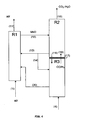
- the figure 1 represents the sequence of circulation of solids between the reaction zones (in this case constituted by reactors).
- a flow rate of metal oxides flows from the oxidation reactor (or “air reactor”) (R1) supplied with air via a line (1) to the reduction reactor (or “oil reactor”) (R2) where the reaction takes place. combustion of the charge by reduction of the MeO oxygen-carrying materials in their maximum oxidation state, that is to say 0.8 ⁇ X ⁇ 1 and preferably 0.95 ⁇ X ⁇ 1, for a specific duration generally from 1 to 15 minutes.
- the metal oxides at the outlet of the reduction reactor R2 are partially in metallic form, with 0 ⁇ X ⁇ 0.5 and preferably 0 ⁇ X ⁇ 0.1, after reaction between the oxygen existing in their structure and the solid and / or liquid and / or gaseous fuel arriving via a line (2).
- These reduced forms MeO 1-x metal oxides circulate through a line (3) of the fuel reactor (R2) to the gasification reactor (R3) where a gasification reaction of a solid and / or liquid fuel arriving via a line ( 4) takes place.
- This gasification step is catalyzed by the reduced metal oxides MeO 1-x ' for which 0 ⁇ X ⁇ 0.5, and preferably 0 ⁇ X ⁇ 0.1.
- the gasification reactor is fed with an oxidizing gas such as CO 2 or H 2 O and / or a mixture H 2 O, CO 2 originating at least in part from the combustion reaction taking place in the reactor R2.
- the gasification reactor (R3) is thus supplied by a line (5) with at least a portion of the CO 2 , H 2 O and / or the CO 2 / H 2 O mixture coming from the stack of the reduction reactor (R2) .
- the remaining portion of the CO 2 , H 2 O and / or CO 2 / H 2 O mixture is sent via a line (6) to a condenser C to separate the CO 2 from the water.
- the water thus separated can thus supply a line (7) with a WGS water gas shift unit which makes it possible to produce a CO2 / H2 mixture from the synthesis gas arriving via a line (8) from the reactor R3.
- the solid particles are sent via a line (10) to a separator S in order to separate the ashes from the metal oxides MeO 1 -x which are sent to the reactor R1.
- the device can also be completed by sulfur treatment units in H 2 S and / or SO 2 form if the fuel contains sulfur as well as a CO 2 - H 2 separation unit. These devices are not shown in the figures.
- the gases will be purified to desulphurize the fumes using the methods known to those skilled in the art to achieve the specifications required for downstream applications of the process described in the invention.
- reactor fuel reactor R2 is carried out the reduction of materials known as “oxygen-carrying materials” by contact between the materials and the liquid fuel and / or gas and / or solid arriving via line (2).
- gasification reactor R3 the gasification of a liquid or solid residue (for example) which is recovered in the form of synthesis gas is carried out.
- CO / H2 at conditions (temperature, pressure, number of moles of water per mole of fuel) required for gasification and in the presence of reduced MeO 1-x materials which have catalytic properties.
- the reduced MeO 1-x materials are oxidized by air, so as to return to their most oxidized state for which 0.8 ⁇ X ⁇ 1.0, and preferably 0, 95 ⁇ X ⁇ 1.
- the figure 2 represents a use of the process according to the invention in which the stream (8) from R3 is sent to a Fischer-Tropsch FT unit in order to produce an HC hydrocarbon stream.
- the water from the condenser C is evacuated by the line (7).
- the figure 3 represents a variant of the process described on the figure 1 wherein a portion of the stream from the WGS water gas shift unit feeds a PC fuel cell. Possibly part of the synthesis gas from reactor R3 via line (8) also feeds the fuel cell to produce electricity and / or heat.
- the figure 4 represents the configuration in which the gasification reaction and the reduction reaction are carried out in the same reactor, in two separate reaction zones R3 and R2.
- the oxidizing mass in its most oxidized form (12) enters the reduction zone R2 where it is brought into contact with the gases (19) coming from the zone R3 containing at least partly a mixture (CO, H2 ) which will be oxidized to CO2, H2O.
- the oxidizing masses will also complete the combustion of hydrocarbons from the zone R3 present in the gas phase (19).
- the fumes of R2 are discharged through a conduit (16) and essentially contain water and CO2. The water can then be condensed and the CO 2 sent transported to a storage place after a possible post-treatment allowing for example to purify the CO 2 by desulfurizing the fumes.
- the oxidizing masses of the zone R2 are then directed to the zone R3 in which the combustion of the fuel (4) is carried out by the lines (15) or (14). Part of the oxidizing masses may optionally be returned to the air reactor (R1).
- One of the features of the invention consists in arranging the zones R2 and R3 one above the other. It is then possible thanks to particular devices to allow all the gases from R3 to pass into R2 and the solids from R2 to flow into R3 so that the fuel contacts the counter-current oxidizing mass as represented on the figure 4 .
- These particular devices well known to those skilled in the art are for example internal such as perforated plates or baffles.
- the figure 5 represents the process according to the invention in the same configuration as the figure 1 , in the case of the example given below.
- the reactions in the "air” (R1), fuel (R2) and gasification (R3) reactors take place at a temperature of between 700 ° C. and 1200 ° C., very preferably between 750 and 950 ° C.
- the residence time of the metal oxides in the fuel reactor (R2) depends on the nature of the fuel and can be estimated generally between 30 s and 10 minutes, preferably between 1 and 8 minutes.
- the residence time of the metal oxides in the air reactor (R1) depends on the oxidation state and / or reduction of these oxides and can be estimated generally between 30 seconds and 10 minutes, preferably between 1 and 3 minutes. .
- the residence time of the metal oxides in the gasification reactor depends on the nature of the fuel to be gasified and can be estimated generally between 1 and 20 minutes, preferably between 1.5 minutes and 10 minutes.
- the invention makes it possible, by using chemical looping oxidizing masses, to combine the production of energy and the production of hydrogen (or more generally of synthesis gas) in the same chemical loop.
- the chemical loop of the process according to the invention makes it possible not only to produce the energy necessary for the production of synthesis gas, but possibly also to produce exploitable energy in the form of heat and / or electricity.
- the optional addition of a portion of the synthesis gas produced in the gasification reactor to the reduction reactor induces exothermic reactions in this reactor, further promoting the balance. overall energy efficiency of the invention ( Figure 1 , (11)).
- the process according to the invention allows the use of the catalytic capacity of the reduced metal oxides at the outlet of the reduction reactor (R2) in the gasification reaction (R3).
- the gasification reaction is thus catalyzed by the metal oxides, without external catalyst supply.
- the process according to the invention makes it possible to inject heavy charges directly into contact with the oxygen carrier in the reduction reactor ("fuel reactor" R2).
- the integrated method according to the invention finally makes it possible to avoid residence times of the solid fuels / metal oxides important in the reduction reactor ("reactor fuel”) which are generally of the order of 15 to 20 minutes. Indeed, these residence times are important and usually involve large size reactors.
- the operating conditions considered at each stage are the following:
- the system is considered to be in energy equilibrium, however the system has a dynamic character since the solid oxygen carrier circulates continuously between the different reactors of the system.
- This value does not take into account the catalytic activity of the solid and represents a high estimate of the energy required for gasification.
Landscapes
- Chemical & Material Sciences (AREA)
- Chemical Kinetics & Catalysis (AREA)
- Organic Chemistry (AREA)
- Combustion & Propulsion (AREA)
- Engineering & Computer Science (AREA)
- Inorganic Chemistry (AREA)
- General Health & Medical Sciences (AREA)
- Health & Medical Sciences (AREA)
- Oil, Petroleum & Natural Gas (AREA)
- General Chemical & Material Sciences (AREA)
- Hydrogen, Water And Hydrids (AREA)
- Industrial Gases (AREA)
- Organic Low-Molecular-Weight Compounds And Preparation Thereof (AREA)
- Carbon And Carbon Compounds (AREA)
Priority Applications (1)
| Application Number | Priority Date | Filing Date | Title |
|---|---|---|---|
| PL10705901T PL2391695T3 (pl) | 2009-01-30 | 2010-01-28 | Zintegrowany sposób utleniania, redukcji i gazyfikacji do wytwarzania gazu syntezowego i energii w pętli chemicznej |
Applications Claiming Priority (2)
| Application Number | Priority Date | Filing Date | Title |
|---|---|---|---|
| FR0900390A FR2941689B1 (fr) | 2009-01-30 | 2009-01-30 | Procede integre d'oxydation, reduction et gazeification pour production de gaz de synthese en boucle chimique |
| PCT/FR2010/000069 WO2010086529A1 (fr) | 2009-01-30 | 2010-01-28 | Procède intégré d'oxydation, réduction et gazéification pour production de gaz de synthèse et d'énergie en boucle chimique |
Publications (2)
| Publication Number | Publication Date |
|---|---|
| EP2391695A1 EP2391695A1 (fr) | 2011-12-07 |
| EP2391695B1 true EP2391695B1 (fr) | 2013-06-26 |
Family
ID=41110831
Family Applications (1)
| Application Number | Title | Priority Date | Filing Date |
|---|---|---|---|
| EP10705901.6A Not-in-force EP2391695B1 (fr) | 2009-01-30 | 2010-01-28 | Procède intégré d'oxydation, réduction et gazéification pour production de gaz de synthèse et d'énergie en boucle chimique |
Country Status (10)
| Country | Link |
|---|---|
| US (1) | US8916128B2 (pl) |
| EP (1) | EP2391695B1 (pl) |
| CN (1) | CN102300962A (pl) |
| AU (1) | AU2010209592A1 (pl) |
| CA (1) | CA2750693A1 (pl) |
| ES (1) | ES2424802T3 (pl) |
| FR (1) | FR2941689B1 (pl) |
| PL (1) | PL2391695T3 (pl) |
| WO (1) | WO2010086529A1 (pl) |
| ZA (1) | ZA201105428B (pl) |
Cited By (1)
| Publication number | Priority date | Publication date | Assignee | Title |
|---|---|---|---|---|
| CN106675655A (zh) * | 2016-12-06 | 2017-05-17 | 西安交通大学 | 一种基于钙基载碳体的生物质化学链气化制氢装置及方法 |
Families Citing this family (49)
| Publication number | Priority date | Publication date | Assignee | Title |
|---|---|---|---|---|
| WO2010037011A2 (en) | 2008-09-26 | 2010-04-01 | The Ohio State University | Conversion of carbonaceous fuels into carbon free energy carriers |
| AU2010292310B2 (en) * | 2009-09-08 | 2017-01-12 | The Ohio State University Research Foundation | Synthetic fuels and chemicals production with in-situ CO2 capture |
| EP2475613B1 (en) | 2009-09-08 | 2017-05-03 | The Ohio State University Research Foundation | Integration of reforming/water splitting and electrochemical systems for power generation with integrated carbon capture |
| FR2955918B1 (fr) * | 2010-02-01 | 2012-08-03 | Cotaver | Procede et systeme de production d'une source d'energie thermodynamique par la conversion de co2 sur des matieres premieres carbonees |
| FR2955854B1 (fr) | 2010-02-01 | 2014-08-08 | Cotaver | Procede et systeme de production d'hydrogene a partir de matiere premiere carbonee |
| FR2955865B1 (fr) | 2010-02-01 | 2012-03-16 | Cotaver | Procede de recyclage du dioxyde de carbone (co2) |
| FR2955866B1 (fr) | 2010-02-01 | 2013-03-22 | Cotaver | Procede et systeme d'approvisionnement en energie thermique d'un systeme de traitement thermique et installation mettant en oeuvre un tel systeme |
| CA2816800C (en) | 2010-11-08 | 2019-01-08 | The Ohio State University | Circulating fluidized bed with moving bed downcomers and gas sealing between reactors |
| EP2484971A1 (en) | 2011-02-04 | 2012-08-08 | Paul Scherrer Institut | A process and a system for the gasification and/or combustion of biomass and/or coal with an at least partial carbon dioxide separation |
| WO2012155059A1 (en) | 2011-05-11 | 2012-11-15 | The Ohio State University | Oxygen carrying materials |
| AU2012253328B2 (en) | 2011-05-11 | 2017-05-25 | Ohio State Innovation Foundation | Systems for converting fuel |
| FR2980258B1 (fr) * | 2011-09-20 | 2017-12-29 | Ifp Energies Now | Procede de combustion en boucle chimique avec elimination des cendres et fines dans la zone de reduction et installation utilisant un tel procede |
| FR2983488B1 (fr) * | 2011-12-02 | 2013-11-15 | IFP Energies Nouvelles | Procede de combustion en boucle chimique avec elimination des cendres et fines en sortie de la zone d'oxydation et installation utilisant un tel procede |
| FR2983489B1 (fr) | 2011-12-02 | 2013-11-15 | IFP Energies Nouvelles | Procede de combustion en boucle chimique avec elimination en phase diluee des cendres et finess dans la zone d'oxydation et installation utilisant un tel procede |
| FR2985517B1 (fr) * | 2012-01-11 | 2018-05-18 | Ifp Energies Now | Procede integre de gazeification et combustion indirecte de charges hydrocarbonees solides en boucle chimique |
| FR2986800B1 (fr) | 2012-02-09 | 2015-01-30 | Cotaver | Procede, systeme et installation de traitement de matieres hydrocarbonees liquides et/ou pateuses |
| US9909756B2 (en) | 2012-11-30 | 2018-03-06 | Saudi Arabian Oil Company | Staged chemical looping process with integrated oxygen generation |
| US10144640B2 (en) | 2013-02-05 | 2018-12-04 | Ohio State Innovation Foundation | Methods for fuel conversion |
| CN103087776B (zh) * | 2013-02-18 | 2014-09-03 | 上海锅炉厂有限公司 | 一种基于化学链燃烧的干煤粉加压气流床气化方法与装置 |
| US9616403B2 (en) | 2013-03-14 | 2017-04-11 | Ohio State Innovation Foundation | Systems and methods for converting carbonaceous fuels |
| US9481837B2 (en) * | 2013-03-15 | 2016-11-01 | The Babcock & Wilcox Company | Chemical looping processes for partial oxidation of carbonaceous fuels |
| FR3004126B1 (fr) * | 2013-04-05 | 2016-01-01 | IFP Energies Nouvelles | Procede et dispositif de combustion par boucle chimique de charges hydrocarbonees liquides |
| KR101458872B1 (ko) | 2013-07-03 | 2014-11-07 | 한국에너지기술연구원 | 서로 다른 산소공여입자를 사용하는 매체 순환 연소방법 및 장치 |
| US20150238915A1 (en) | 2014-02-27 | 2015-08-27 | Ohio State Innovation Foundation | Systems and methods for partial or complete oxidation of fuels |
| NO338230B1 (no) * | 2014-04-03 | 2016-08-08 | Sinvent As | Fullstendig integrert redoks-assistert gassifisering (RAG) for produktiv konvertering av karbonholdig materiale |
| US9790437B2 (en) * | 2014-10-09 | 2017-10-17 | Saudi Arabian Oil Company | Integrated heavy liquid fuel coking with chemical looping concept |
| FR3030018B1 (fr) * | 2014-12-12 | 2017-01-20 | Ifp Energies Now | Installation et procede de combustion par oxydo-reduction en boucle chimique d'une charge hydrocarbonee gazeuse avec pre-reformage catalytique de la charge |
| FR3029906B1 (fr) * | 2014-12-12 | 2017-01-13 | Ifp Energies Now | Procede et installation de combustion par oxydo-reduction en boucle chimique d'une charge hydrocarbonee gazeuse avec vaporeformage catalytique intermediaire de la charge |
| FR3029979B1 (fr) * | 2014-12-12 | 2019-04-05 | IFP Energies Nouvelles | Procede et installation de combustion par oxydo-reduction en boucle chimique d'une charge hydrocarbonee gazeuse avec reformage catalytique in situ de la charge |
| US9902615B2 (en) | 2015-07-14 | 2018-02-27 | The Babcock & Wilcox Company | Syngas production via cyclic reduction and oxidation of metal oxides |
| CN109195696B (zh) | 2016-04-12 | 2022-04-26 | 俄亥俄州立创新基金会 | 从含碳燃料化学循环生产合成气 |
| CN106190195B (zh) | 2016-06-29 | 2019-01-25 | 清华大学 | 一种生物质热解-化学链燃烧制备高纯氢气的装置及方法 |
| EP3648881B1 (en) | 2017-07-31 | 2023-10-25 | Ohio State Innovation Foundation | Reactor system with unequal reactor assembly operating pressures |
| US10549236B2 (en) | 2018-01-29 | 2020-02-04 | Ohio State Innovation Foundation | Systems, methods and materials for NOx decomposition with metal oxide materials |
| US11413574B2 (en) | 2018-08-09 | 2022-08-16 | Ohio State Innovation Foundation | Systems, methods and materials for hydrogen sulfide conversion |
| US11549432B2 (en) | 2018-09-21 | 2023-01-10 | King Fahd University Of Petroleum And Minerals | Integrated chemical looping combustion system and method for power generation and carbon dioxide capture |
| KR20200039499A (ko) | 2018-10-07 | 2020-04-16 | 정동규 | 화학적순환연소 방식과 연계한 합성가스 발전용 가스화공정 |
| CN109401789B (zh) * | 2018-11-07 | 2024-07-12 | 华南农业大学 | 一种生物质化学链气化重整梯级制取合成气和富氢气体的装置及方法 |
| US12134560B2 (en) | 2019-01-17 | 2024-11-05 | Ohio State Innovation Foundation | Systems, methods and materials for stable phase syngas generation |
| WO2020175426A1 (ja) * | 2019-02-27 | 2020-09-03 | 国立大学法人東北大学 | 炭化水素低温改質システム、並びに水素及び/又は合成ガスの低温での製造方法 |
| WO2020210396A1 (en) | 2019-04-09 | 2020-10-15 | Ohio State Innovation Foundation | Alkene generation using metal sulfide particles |
| US11371394B2 (en) | 2019-07-03 | 2022-06-28 | King Fahd University Of Petroleum And Minerals | Methods and systems for diesel fueled CLC for efficient power generation and CO2 capture |
| WO2021034888A1 (en) | 2019-08-19 | 2021-02-25 | Ohio State Innovation Foundation | Mesoporous support-immobilized metal oxide-based nanoparticles |
| AU2020340961A1 (en) | 2019-09-03 | 2022-03-24 | Ohio State Innovation Foundation | Redox reaction facilitated carbon dioxide capture from flue gas and conversion to carbon monoxide |
| US11591531B2 (en) | 2020-08-21 | 2023-02-28 | ExxonMobil Technology and Engineering Company | Conversion of catalytic coke into synthetic gas from a fluid catalytic cracking (FCC) process using a chemical looping system and methods related thereto |
| US12370520B2 (en) * | 2020-11-10 | 2025-07-29 | University Of Connecticut | Scheduling of semi-batch chemical-looping reactors |
| US11667728B1 (en) * | 2022-03-02 | 2023-06-06 | David T. Camp | Reactor and processes for endothermic reactions at high temperatures |
| CN115851316B (zh) * | 2022-12-06 | 2026-02-24 | 江苏省电力试验研究院有限公司 | 一种基于生物质气化的电-热-氢三联供装置及方法 |
| WO2025043107A1 (en) * | 2023-08-23 | 2025-02-27 | Ohio State Innovation Foundation | Systems, methods, and techniques for co 2 capture and high-purity syngas generation |
Family Cites Families (8)
| Publication number | Priority date | Publication date | Assignee | Title |
|---|---|---|---|---|
| US4272399A (en) * | 1979-09-21 | 1981-06-09 | Monsanto Company | Conversion of carbon-containing materials to synthesis gas |
| US6669917B2 (en) * | 2001-07-31 | 2003-12-30 | General Electric Co. | Process for converting coal into fuel cell quality hydrogen and sequestration-ready carbon dioxide |
| FR2850156B1 (fr) * | 2003-01-16 | 2005-12-30 | Alstom Switzerland Ltd | Installation de combustion avec recuperation de co2 |
| US20070082089A1 (en) | 2003-09-22 | 2007-04-12 | Stephanie Krammer | Vitamin containing pet food compositions |
| US7767191B2 (en) * | 2003-12-11 | 2010-08-03 | The Ohio State University | Combustion looping using composite oxygen carriers |
| CA2881661A1 (en) | 2006-01-12 | 2007-07-19 | The Ohio State University | Systems and methods of converting fuel |
| US7824574B2 (en) | 2006-09-21 | 2010-11-02 | Eltron Research & Development | Cyclic catalytic upgrading of chemical species using metal oxide materials |
| US20080134666A1 (en) * | 2006-12-11 | 2008-06-12 | Parag Prakash Kulkarni | Systems and Methods Using an Unmixed Fuel Processor |
-
2009
- 2009-01-30 FR FR0900390A patent/FR2941689B1/fr not_active Expired - Fee Related
-
2010
- 2010-01-28 CN CN2010800064130A patent/CN102300962A/zh active Pending
- 2010-01-28 EP EP10705901.6A patent/EP2391695B1/fr not_active Not-in-force
- 2010-01-28 WO PCT/FR2010/000069 patent/WO2010086529A1/fr not_active Ceased
- 2010-01-28 US US13/146,982 patent/US8916128B2/en not_active Expired - Fee Related
- 2010-01-28 CA CA2750693A patent/CA2750693A1/fr not_active Abandoned
- 2010-01-28 PL PL10705901T patent/PL2391695T3/pl unknown
- 2010-01-28 AU AU2010209592A patent/AU2010209592A1/en not_active Abandoned
- 2010-01-28 ES ES10705901T patent/ES2424802T3/es active Active
-
2011
- 2011-07-22 ZA ZA2011/05428A patent/ZA201105428B/en unknown
Cited By (2)
| Publication number | Priority date | Publication date | Assignee | Title |
|---|---|---|---|---|
| CN106675655A (zh) * | 2016-12-06 | 2017-05-17 | 西安交通大学 | 一种基于钙基载碳体的生物质化学链气化制氢装置及方法 |
| CN106675655B (zh) * | 2016-12-06 | 2019-06-11 | 西安交通大学 | 一种基于钙基载碳体的生物质化学链气化制氢装置及方法 |
Also Published As
| Publication number | Publication date |
|---|---|
| PL2391695T3 (pl) | 2013-11-29 |
| EP2391695A1 (fr) | 2011-12-07 |
| AU2010209592A1 (en) | 2011-08-18 |
| CN102300962A (zh) | 2011-12-28 |
| FR2941689B1 (fr) | 2011-02-18 |
| US8916128B2 (en) | 2014-12-23 |
| WO2010086529A1 (fr) | 2010-08-05 |
| WO2010086529A9 (fr) | 2011-09-29 |
| ZA201105428B (en) | 2012-03-28 |
| CA2750693A1 (fr) | 2010-08-05 |
| ES2424802T3 (es) | 2013-10-08 |
| FR2941689A1 (fr) | 2010-08-06 |
| US20110303875A1 (en) | 2011-12-15 |
Similar Documents
| Publication | Publication Date | Title |
|---|---|---|
| EP2391695B1 (fr) | Procède intégré d'oxydation, réduction et gazéification pour production de gaz de synthèse et d'énergie en boucle chimique | |
| EP2246293B1 (fr) | Procédé intégré de production d'énergie et/ou de gaz de synthèse par production d'oxygène in situ, combustion et gazéification en boucle chimique | |
| EP2802638B1 (fr) | Procédé integre de gazeification et combustion indirecte de charges hydrocarbonees solides en boucle chimique | |
| EP2454525B1 (fr) | Procede de combustion en boucle chimique avec controle independant de la circulation des solides | |
| CN104024148B (zh) | 氢的制造方法 | |
| CN104428401B (zh) | 具有双重淬火的两阶段气化 | |
| CN107001950B (zh) | 重质液体燃料焦化和化学链概念的整合 | |
| US20150005399A1 (en) | Method and device for producing synthetic gas and method and device for synthesizing liquid fuel | |
| CN101668832A (zh) | 液态燃料原料生产方法 | |
| EP3230415B1 (fr) | Procédé et installation de combustion par oxydo-réduction en boucle chimique d'une charge hydrocarbonée gazeuse avec reformage catalytique in situ de la charge | |
| WO2011131867A2 (fr) | Procédé intégré de traitement et de gazéification de charges bitumineuses en combustion en boucle chimique | |
| EP2539273A1 (fr) | Procede de production gaz de synthese | |
| WO2014044940A1 (fr) | Procédé de reduction du dioxyde de carbone en monoxyde de carbone par des oxydes de vanadium | |
| EP4085119A1 (fr) | Procede integre de conversion thermique d'une charge hydrocarbonee lourde et de combustion indirecte en boucle chimique d'oxydo-reduction pour la production de flux hydrocarbones et le captage du coproduit | |
| FR2960943A1 (fr) | Procede integre d'oxycombustion et de production d'oxygene par boucle chimique | |
| Çelik et al. | DiscoverChemical Engineering | |
| CA2861050A1 (fr) | Procede integre de gazeification et combustion indirecte de charges hydrocarbonees solides en boucle chimique | |
| JP6248987B2 (ja) | 有機物質の低分子化方法 |
Legal Events
| Date | Code | Title | Description |
|---|---|---|---|
| PUAI | Public reference made under article 153(3) epc to a published international application that has entered the european phase |
Free format text: ORIGINAL CODE: 0009012 |
|
| 17P | Request for examination filed |
Effective date: 20110830 |
|
| AK | Designated contracting states |
Kind code of ref document: A1 Designated state(s): AT BE BG CH CY CZ DE DK EE ES FI FR GB GR HR HU IE IS IT LI LT LU LV MC MK MT NL NO PL PT RO SE SI SK SM TR |
|
| DAX | Request for extension of the european patent (deleted) | ||
| REG | Reference to a national code |
Ref country code: DE Ref legal event code: R079 Ref document number: 602010008047 Country of ref document: DE Free format text: PREVIOUS MAIN CLASS: C10J0003000000 Ipc: C01B0003420000 |
|
| GRAP | Despatch of communication of intention to grant a patent |
Free format text: ORIGINAL CODE: EPIDOSNIGR1 |
|
| RIC1 | Information provided on ipc code assigned before grant |
Ipc: C01B 3/42 20060101AFI20130109BHEP Ipc: C10J 3/72 20060101ALI20130109BHEP Ipc: C01B 3/48 20060101ALI20130109BHEP Ipc: C10J 3/00 20060101ALI20130109BHEP |
|
| GRAS | Grant fee paid |
Free format text: ORIGINAL CODE: EPIDOSNIGR3 |
|
| GRAA | (expected) grant |
Free format text: ORIGINAL CODE: 0009210 |
|
| AK | Designated contracting states |
Kind code of ref document: B1 Designated state(s): AT BE BG CH CY CZ DE DK EE ES FI FR GB GR HR HU IE IS IT LI LT LU LV MC MK MT NL NO PL PT RO SE SI SK SM TR |
|
| REG | Reference to a national code |
Ref country code: GB Ref legal event code: FG4D Free format text: NOT ENGLISH |
|
| REG | Reference to a national code |
Ref country code: CH Ref legal event code: EP |
|
| REG | Reference to a national code |
Ref country code: AT Ref legal event code: REF Ref document number: 618614 Country of ref document: AT Kind code of ref document: T Effective date: 20130715 |
|
| REG | Reference to a national code |
Ref country code: IE Ref legal event code: FG4D Free format text: LANGUAGE OF EP DOCUMENT: FRENCH |
|
| REG | Reference to a national code |
Ref country code: DE Ref legal event code: R096 Ref document number: 602010008047 Country of ref document: DE Effective date: 20130822 |
|
| REG | Reference to a national code |
Ref country code: ES Ref legal event code: FG2A Ref document number: 2424802 Country of ref document: ES Kind code of ref document: T3 Effective date: 20131008 |
|
| PG25 | Lapsed in a contracting state [announced via postgrant information from national office to epo] |
Ref country code: SE Free format text: LAPSE BECAUSE OF FAILURE TO SUBMIT A TRANSLATION OF THE DESCRIPTION OR TO PAY THE FEE WITHIN THE PRESCRIBED TIME-LIMIT Effective date: 20130626 Ref country code: LT Free format text: LAPSE BECAUSE OF FAILURE TO SUBMIT A TRANSLATION OF THE DESCRIPTION OR TO PAY THE FEE WITHIN THE PRESCRIBED TIME-LIMIT Effective date: 20130626 Ref country code: GR Free format text: LAPSE BECAUSE OF FAILURE TO SUBMIT A TRANSLATION OF THE DESCRIPTION OR TO PAY THE FEE WITHIN THE PRESCRIBED TIME-LIMIT Effective date: 20130927 Ref country code: FI Free format text: LAPSE BECAUSE OF FAILURE TO SUBMIT A TRANSLATION OF THE DESCRIPTION OR TO PAY THE FEE WITHIN THE PRESCRIBED TIME-LIMIT Effective date: 20130626 Ref country code: NO Free format text: LAPSE BECAUSE OF FAILURE TO SUBMIT A TRANSLATION OF THE DESCRIPTION OR TO PAY THE FEE WITHIN THE PRESCRIBED TIME-LIMIT Effective date: 20130926 Ref country code: SI Free format text: LAPSE BECAUSE OF FAILURE TO SUBMIT A TRANSLATION OF THE DESCRIPTION OR TO PAY THE FEE WITHIN THE PRESCRIBED TIME-LIMIT Effective date: 20130626 |
|
| REG | Reference to a national code |
Ref country code: AT Ref legal event code: MK05 Ref document number: 618614 Country of ref document: AT Kind code of ref document: T Effective date: 20130626 |
|
| REG | Reference to a national code |
Ref country code: LT Ref legal event code: MG4D |
|
| PG25 | Lapsed in a contracting state [announced via postgrant information from national office to epo] |
Ref country code: HR Free format text: LAPSE BECAUSE OF FAILURE TO SUBMIT A TRANSLATION OF THE DESCRIPTION OR TO PAY THE FEE WITHIN THE PRESCRIBED TIME-LIMIT Effective date: 20130626 Ref country code: BG Free format text: LAPSE BECAUSE OF FAILURE TO SUBMIT A TRANSLATION OF THE DESCRIPTION OR TO PAY THE FEE WITHIN THE PRESCRIBED TIME-LIMIT Effective date: 20130926 |
|
| REG | Reference to a national code |
Ref country code: PL Ref legal event code: T3 |
|
| REG | Reference to a national code |
Ref country code: NL Ref legal event code: VDEP Effective date: 20130626 |
|
| PG25 | Lapsed in a contracting state [announced via postgrant information from national office to epo] |
Ref country code: LV Free format text: LAPSE BECAUSE OF FAILURE TO SUBMIT A TRANSLATION OF THE DESCRIPTION OR TO PAY THE FEE WITHIN THE PRESCRIBED TIME-LIMIT Effective date: 20130626 |
|
| PG25 | Lapsed in a contracting state [announced via postgrant information from national office to epo] |
Ref country code: IS Free format text: LAPSE BECAUSE OF FAILURE TO SUBMIT A TRANSLATION OF THE DESCRIPTION OR TO PAY THE FEE WITHIN THE PRESCRIBED TIME-LIMIT Effective date: 20131026 Ref country code: CZ Free format text: LAPSE BECAUSE OF FAILURE TO SUBMIT A TRANSLATION OF THE DESCRIPTION OR TO PAY THE FEE WITHIN THE PRESCRIBED TIME-LIMIT Effective date: 20130626 Ref country code: PT Free format text: LAPSE BECAUSE OF FAILURE TO SUBMIT A TRANSLATION OF THE DESCRIPTION OR TO PAY THE FEE WITHIN THE PRESCRIBED TIME-LIMIT Effective date: 20131028 Ref country code: EE Free format text: LAPSE BECAUSE OF FAILURE TO SUBMIT A TRANSLATION OF THE DESCRIPTION OR TO PAY THE FEE WITHIN THE PRESCRIBED TIME-LIMIT Effective date: 20130626 Ref country code: SK Free format text: LAPSE BECAUSE OF FAILURE TO SUBMIT A TRANSLATION OF THE DESCRIPTION OR TO PAY THE FEE WITHIN THE PRESCRIBED TIME-LIMIT Effective date: 20130626 Ref country code: AT Free format text: LAPSE BECAUSE OF FAILURE TO SUBMIT A TRANSLATION OF THE DESCRIPTION OR TO PAY THE FEE WITHIN THE PRESCRIBED TIME-LIMIT Effective date: 20130626 Ref country code: CY Free format text: LAPSE BECAUSE OF FAILURE TO SUBMIT A TRANSLATION OF THE DESCRIPTION OR TO PAY THE FEE WITHIN THE PRESCRIBED TIME-LIMIT Effective date: 20130731 |
|
| PG25 | Lapsed in a contracting state [announced via postgrant information from national office to epo] |
Ref country code: RO Free format text: LAPSE BECAUSE OF FAILURE TO SUBMIT A TRANSLATION OF THE DESCRIPTION OR TO PAY THE FEE WITHIN THE PRESCRIBED TIME-LIMIT Effective date: 20130626 Ref country code: NL Free format text: LAPSE BECAUSE OF FAILURE TO SUBMIT A TRANSLATION OF THE DESCRIPTION OR TO PAY THE FEE WITHIN THE PRESCRIBED TIME-LIMIT Effective date: 20130626 |
|
| PG25 | Lapsed in a contracting state [announced via postgrant information from national office to epo] |
Ref country code: CY Free format text: LAPSE BECAUSE OF FAILURE TO SUBMIT A TRANSLATION OF THE DESCRIPTION OR TO PAY THE FEE WITHIN THE PRESCRIBED TIME-LIMIT Effective date: 20130626 |
|
| PG25 | Lapsed in a contracting state [announced via postgrant information from national office to epo] |
Ref country code: DK Free format text: LAPSE BECAUSE OF FAILURE TO SUBMIT A TRANSLATION OF THE DESCRIPTION OR TO PAY THE FEE WITHIN THE PRESCRIBED TIME-LIMIT Effective date: 20130626 |
|
| PLBE | No opposition filed within time limit |
Free format text: ORIGINAL CODE: 0009261 |
|
| STAA | Information on the status of an ep patent application or granted ep patent |
Free format text: STATUS: NO OPPOSITION FILED WITHIN TIME LIMIT |
|
| PGFP | Annual fee paid to national office [announced via postgrant information from national office to epo] |
Ref country code: IT Payment date: 20140122 Year of fee payment: 5 |
|
| 26N | No opposition filed |
Effective date: 20140327 |
|
| REG | Reference to a national code |
Ref country code: DE Ref legal event code: R097 Ref document number: 602010008047 Country of ref document: DE Effective date: 20140327 |
|
| BERE | Be: lapsed |
Owner name: IFP Effective date: 20140131 Owner name: TOTAL S.A. Effective date: 20140131 |
|
| PG25 | Lapsed in a contracting state [announced via postgrant information from national office to epo] |
Ref country code: LU Free format text: LAPSE BECAUSE OF FAILURE TO SUBMIT A TRANSLATION OF THE DESCRIPTION OR TO PAY THE FEE WITHIN THE PRESCRIBED TIME-LIMIT Effective date: 20140128 |
|
| REG | Reference to a national code |
Ref country code: CH Ref legal event code: PL |
|
| PG25 | Lapsed in a contracting state [announced via postgrant information from national office to epo] |
Ref country code: CH Free format text: LAPSE BECAUSE OF NON-PAYMENT OF DUE FEES Effective date: 20140131 Ref country code: LI Free format text: LAPSE BECAUSE OF NON-PAYMENT OF DUE FEES Effective date: 20140131 |
|
| REG | Reference to a national code |
Ref country code: IE Ref legal event code: MM4A |
|
| PG25 | Lapsed in a contracting state [announced via postgrant information from national office to epo] |
Ref country code: IE Free format text: LAPSE BECAUSE OF NON-PAYMENT OF DUE FEES Effective date: 20140128 Ref country code: BE Free format text: LAPSE BECAUSE OF NON-PAYMENT OF DUE FEES Effective date: 20140131 |
|
| PG25 | Lapsed in a contracting state [announced via postgrant information from national office to epo] |
Ref country code: MC Free format text: LAPSE BECAUSE OF FAILURE TO SUBMIT A TRANSLATION OF THE DESCRIPTION OR TO PAY THE FEE WITHIN THE PRESCRIBED TIME-LIMIT Effective date: 20130626 |
|
| PG25 | Lapsed in a contracting state [announced via postgrant information from national office to epo] |
Ref country code: IT Free format text: LAPSE BECAUSE OF NON-PAYMENT OF DUE FEES Effective date: 20150128 |
|
| REG | Reference to a national code |
Ref country code: FR Ref legal event code: PLFP Year of fee payment: 7 |
|
| PG25 | Lapsed in a contracting state [announced via postgrant information from national office to epo] |
Ref country code: MT Free format text: LAPSE BECAUSE OF FAILURE TO SUBMIT A TRANSLATION OF THE DESCRIPTION OR TO PAY THE FEE WITHIN THE PRESCRIBED TIME-LIMIT Effective date: 20130626 |
|
| PGFP | Annual fee paid to national office [announced via postgrant information from national office to epo] |
Ref country code: PL Payment date: 20151223 Year of fee payment: 7 |
|
| PG25 | Lapsed in a contracting state [announced via postgrant information from national office to epo] |
Ref country code: SM Free format text: LAPSE BECAUSE OF FAILURE TO SUBMIT A TRANSLATION OF THE DESCRIPTION OR TO PAY THE FEE WITHIN THE PRESCRIBED TIME-LIMIT Effective date: 20130626 |
|
| PGFP | Annual fee paid to national office [announced via postgrant information from national office to epo] |
Ref country code: ES Payment date: 20160111 Year of fee payment: 7 Ref country code: DE Payment date: 20160201 Year of fee payment: 7 |
|
| PGFP | Annual fee paid to national office [announced via postgrant information from national office to epo] |
Ref country code: GB Payment date: 20160127 Year of fee payment: 7 Ref country code: FR Payment date: 20160112 Year of fee payment: 7 |
|
| PG25 | Lapsed in a contracting state [announced via postgrant information from national office to epo] |
Ref country code: TR Free format text: LAPSE BECAUSE OF FAILURE TO SUBMIT A TRANSLATION OF THE DESCRIPTION OR TO PAY THE FEE WITHIN THE PRESCRIBED TIME-LIMIT Effective date: 20130626 Ref country code: HU Free format text: LAPSE BECAUSE OF FAILURE TO SUBMIT A TRANSLATION OF THE DESCRIPTION OR TO PAY THE FEE WITHIN THE PRESCRIBED TIME-LIMIT; INVALID AB INITIO Effective date: 20100128 |
|
| REG | Reference to a national code |
Ref country code: DE Ref legal event code: R119 Ref document number: 602010008047 Country of ref document: DE |
|
| GBPC | Gb: european patent ceased through non-payment of renewal fee |
Effective date: 20170128 |
|
| REG | Reference to a national code |
Ref country code: FR Ref legal event code: ST Effective date: 20170929 |
|
| PG25 | Lapsed in a contracting state [announced via postgrant information from national office to epo] |
Ref country code: FR Free format text: LAPSE BECAUSE OF NON-PAYMENT OF DUE FEES Effective date: 20170131 |
|
| PG25 | Lapsed in a contracting state [announced via postgrant information from national office to epo] |
Ref country code: GB Free format text: LAPSE BECAUSE OF NON-PAYMENT OF DUE FEES Effective date: 20170128 Ref country code: DE Free format text: LAPSE BECAUSE OF NON-PAYMENT OF DUE FEES Effective date: 20170801 |
|
| PG25 | Lapsed in a contracting state [announced via postgrant information from national office to epo] |
Ref country code: ES Free format text: LAPSE BECAUSE OF NON-PAYMENT OF DUE FEES Effective date: 20170129 |
|
| PG25 | Lapsed in a contracting state [announced via postgrant information from national office to epo] |
Ref country code: MK Free format text: LAPSE BECAUSE OF FAILURE TO SUBMIT A TRANSLATION OF THE DESCRIPTION OR TO PAY THE FEE WITHIN THE PRESCRIBED TIME-LIMIT Effective date: 20130626 |
|
| PG25 | Lapsed in a contracting state [announced via postgrant information from national office to epo] |
Ref country code: PL Free format text: LAPSE BECAUSE OF NON-PAYMENT OF DUE FEES Effective date: 20170128 |
|
| REG | Reference to a national code |
Ref country code: ES Ref legal event code: FD2A Effective date: 20181107 |