EP2391290B1 - Messmarkendesign und nachweis zur lokalisation eines operationsinstruments in aufnahmen - Google Patents
Messmarkendesign und nachweis zur lokalisation eines operationsinstruments in aufnahmen Download PDFInfo
- Publication number
- EP2391290B1 EP2391290B1 EP09801614.0A EP09801614A EP2391290B1 EP 2391290 B1 EP2391290 B1 EP 2391290B1 EP 09801614 A EP09801614 A EP 09801614A EP 2391290 B1 EP2391290 B1 EP 2391290B1
- Authority
- EP
- European Patent Office
- Prior art keywords
- marker
- tool
- image
- features
- data
- Prior art date
- Legal status (The legal status is an assumption and is not a legal conclusion. Google has not performed a legal analysis and makes no representation as to the accuracy of the status listed.)
- Active
Links
Images











Classifications
-
- A—HUMAN NECESSITIES
- A61—MEDICAL OR VETERINARY SCIENCE; HYGIENE
- A61B—DIAGNOSIS; SURGERY; IDENTIFICATION
- A61B34/00—Computer-aided surgery; Manipulators or robots specially adapted for use in surgery
- A61B34/30—Surgical robots
-
- A—HUMAN NECESSITIES
- A61—MEDICAL OR VETERINARY SCIENCE; HYGIENE
- A61B—DIAGNOSIS; SURGERY; IDENTIFICATION
- A61B34/00—Computer-aided surgery; Manipulators or robots specially adapted for use in surgery
- A61B34/20—Surgical navigation systems; Devices for tracking or guiding surgical instruments, e.g. for frameless stereotaxis
-
- A—HUMAN NECESSITIES
- A61—MEDICAL OR VETERINARY SCIENCE; HYGIENE
- A61B—DIAGNOSIS; SURGERY; IDENTIFICATION
- A61B34/00—Computer-aided surgery; Manipulators or robots specially adapted for use in surgery
- A61B34/30—Surgical robots
- A61B34/37—Leader-follower robots
-
- A—HUMAN NECESSITIES
- A61—MEDICAL OR VETERINARY SCIENCE; HYGIENE
- A61B—DIAGNOSIS; SURGERY; IDENTIFICATION
- A61B90/00—Instruments, implements or accessories specially adapted for surgery or diagnosis and not covered by any of the groups A61B1/00 - A61B50/00, e.g. for luxation treatment or for protecting wound edges
-
- A—HUMAN NECESSITIES
- A61—MEDICAL OR VETERINARY SCIENCE; HYGIENE
- A61B—DIAGNOSIS; SURGERY; IDENTIFICATION
- A61B90/00—Instruments, implements or accessories specially adapted for surgery or diagnosis and not covered by any of the groups A61B1/00 - A61B50/00, e.g. for luxation treatment or for protecting wound edges
- A61B90/90—Identification means for patients or instruments, e.g. tags
- A61B90/94—Identification means for patients or instruments, e.g. tags coded with symbols, e.g. text
-
- B—PERFORMING OPERATIONS; TRANSPORTING
- B25—HAND TOOLS; PORTABLE POWER-DRIVEN TOOLS; MANIPULATORS
- B25J—MANIPULATORS; CHAMBERS PROVIDED WITH MANIPULATION DEVICES
- B25J13/00—Controls for manipulators
- B25J13/08—Controls for manipulators by means of sensing devices, e.g. viewing or touching devices
-
- B—PERFORMING OPERATIONS; TRANSPORTING
- B25—HAND TOOLS; PORTABLE POWER-DRIVEN TOOLS; MANIPULATORS
- B25J—MANIPULATORS; CHAMBERS PROVIDED WITH MANIPULATION DEVICES
- B25J19/00—Accessories fitted to manipulators, e.g. for monitoring, for viewing; Safety devices combined with or specially adapted for use in connection with manipulators
- B25J19/02—Sensing devices
- B25J19/04—Viewing devices
-
- H—ELECTRICITY
- H04—ELECTRIC COMMUNICATION TECHNIQUE
- H04N—PICTORIAL COMMUNICATION, e.g. TELEVISION
- H04N23/00—Cameras or camera modules comprising electronic image sensors; Control thereof
- H04N23/45—Cameras or camera modules comprising electronic image sensors; Control thereof for generating image signals from two or more image sensors being of different type or operating in different modes, e.g. with a CMOS sensor for moving images in combination with a charge-coupled device [CCD] for still images
-
- A—HUMAN NECESSITIES
- A61—MEDICAL OR VETERINARY SCIENCE; HYGIENE
- A61B—DIAGNOSIS; SURGERY; IDENTIFICATION
- A61B34/00—Computer-aided surgery; Manipulators or robots specially adapted for use in surgery
- A61B34/20—Surgical navigation systems; Devices for tracking or guiding surgical instruments, e.g. for frameless stereotaxis
- A61B2034/2046—Tracking techniques
- A61B2034/2055—Optical tracking systems
-
- A—HUMAN NECESSITIES
- A61—MEDICAL OR VETERINARY SCIENCE; HYGIENE
- A61B—DIAGNOSIS; SURGERY; IDENTIFICATION
- A61B34/00—Computer-aided surgery; Manipulators or robots specially adapted for use in surgery
- A61B34/20—Surgical navigation systems; Devices for tracking or guiding surgical instruments, e.g. for frameless stereotaxis
- A61B2034/2046—Tracking techniques
- A61B2034/2065—Tracking using image or pattern recognition
-
- A—HUMAN NECESSITIES
- A61—MEDICAL OR VETERINARY SCIENCE; HYGIENE
- A61B—DIAGNOSIS; SURGERY; IDENTIFICATION
- A61B90/00—Instruments, implements or accessories specially adapted for surgery or diagnosis and not covered by any of the groups A61B1/00 - A61B50/00, e.g. for luxation treatment or for protecting wound edges
- A61B90/39—Markers, e.g. radio-opaque or breast lesions markers
- A61B2090/3937—Visible markers
-
- A—HUMAN NECESSITIES
- A61—MEDICAL OR VETERINARY SCIENCE; HYGIENE
- A61B—DIAGNOSIS; SURGERY; IDENTIFICATION
- A61B90/00—Instruments, implements or accessories specially adapted for surgery or diagnosis and not covered by any of the groups A61B1/00 - A61B50/00, e.g. for luxation treatment or for protecting wound edges
- A61B90/39—Markers, e.g. radio-opaque or breast lesions markers
- A61B2090/3983—Reference marker arrangements for use with image guided surgery
Definitions
- Minimally-invasive surgical techniques are aimed at reducing the amount of extraneous tissue that is damaged during diagnostic or surgical procedures, thereby reducing patient recovery time, discomfort, and deleterious side effects.
- the average length of a hospital stay for standard surgery may be shortened significantly using minimally invasive surgical techniques.
- patient recovery times, patient discomfort, surgical side effects, and time away from work may also be reduced with minimally-invasive surgery.
- a common form of minimally-invasive surgery is endoscopy, and a common form of endoscopy is laparoscopy, which is minimally-invasive inspection and surgery inside the abdominal cavity.
- laparoscopy In standard laparoscopic surgery, a patient's abdomen is insufflated with gas, and cannula sleeves are passed through small (approximately 1.27 cm (1/2 inch) or less) incisions to provide entry ports for laparoscopic instruments.
- Laparoscopic surgical instruments generally include a laparoscope or an endoscope (for viewing the surgical field), and working tools.
- the working tools are similar to those used in conventional (open) surgery, except that the working end or end effector of each tool is separated from its handle by an extension tube.
- end effector means the actual working part of the surgical instrument and can include clamps, graspers, scissors, staplers, and needle holders, for example.
- the surgeon passes these working tools or instruments through cannula sleeves to an internal surgical site and manipulates them from outside the abdomen.
- the surgeon views the procedure by means of a monitor that displays an image of the surgical site taken from the laparoscope.
- Similar endoscopic techniques are employed in, e.g., arthroscopy, retroperitoneoscopy, pelviscopy, nephroscopy, cystoscopy, cisternoscopy, sinoscopy, hysteroscopy, urethroscopy, and the like.
- Minimally-invasive telesurgical robotic systems are being developed to increase a surgeon's dexterity when working within an internal surgical site, as well as to allow a surgeon to operate on a patient from a remote location.
- the surgeon is often provided with an image of the surgical site at a control console. While viewing a three-dimensional (3-D) image of the surgical site on a suitable viewer or display, the surgeon performs the surgical procedures on the patient by manipulating master input or control devices of the control console. Each of the master input devices controls the motion of a servomechanically operated surgical instrument.
- the telesurgical system can provide mechanical actuation and control of a variety of surgical instruments or tools having end effectors that perform various functions for the surgeon, e.g., holding or driving a needle, grasping a blood vessel, dissecting tissue, or the like, in response to manipulation of the master input devices.
- the surgeon may manipulate the tool so that its end effector is moved outside of the endoscope's field of view, or the end effector may become difficult to see due to occlusion by fluids or other intervening objects. In such cases it would be useful to be able to provide assistance to the surgeon in locating and/or identifying the end effector on the workstation's display screen.
- Accurate information regarding a tool's 3-D pose can be used to provide this assistance. In general, accurate information of a tool's 3-D pose is important for a number of image guided surgical and user interface applications.
- kinematics-based pose information with image-derived pose information.
- Such a fusion of tool tracking information can provide the advantages of both types of data without the associated disadvantages.
- kinematics joint data are usually available at a very high update rate
- a kinematics estimated pose may not be very accurate due to error accumulation at each joint, with errors in joints located farther away from the tool having a greater impact on accuracy.
- image-derived tool pose estimation can be highly accurate, but may run at a slower update rate that what is useful for many real-time applications. By correcting the higher-update kinematics-pose estimation using the more accurate image-derived tool pose estimation, a more accurate higher-update tool pose estimation can be obtained.
- an optical tracker is used to track the position of a marker assembly that is attached to a location on the surgical instrument outside the patient's body.
- the optical tracker requires a dedicated stereo camera and dedicated lighting, which take space in an already crowded operating room. Attaching such optical trackers also reduces the range of motion of the robotic arms due to the potential for collision. There can also be some level of error that results from propagating the 3-D pose to the surgical tool tip. Additional problems include: the extra space required, limited visibility range, the added hardware setup in the operating room, and cost.
- Another approach uses an electromagnetic tracker, which has its own associated disadvantages. For example, most surgical instruments have metal parts that can cause distortion, which can vary in time due to changes in distances between an electromagnetic tracker attached to one tool tip and metal components of an adjacent surgical tool. An electromagnetic tracker also involves extra cost.
- a 3-D pose can be solved by starting with the known features of an object and matching these features with their two-dimensional (2-D) correspondence in the image.
- Features such as point and line segments are commonly used.
- Determination of the 3-D pose of a rigid body from a single 2-D image is referred to as "pose estimation” in computer vision (see introduction in Christophe Doignon, "Scene Reconstruction, Pose Estimation and Tracking," 2007 ).
- pose estimation in computer vision
- the problem is known as "perspective-n-point,” where n is the number of correspondences.
- Three non-collinear points provides four solutions. Four or more non-collinear points provides a unique solution.
- Determination of the 3-D pose of a rigid object using a stereo camera can be accomplished using two approaches.
- the determination of the 3-D pose can be approached as an optimization problem where the 3-D pose is selected that provides the best fit between the projected 3-D points with the image correspondences in both images.
- image points in both views can be used to determine corresponding 3-D points using stereo triangulation and relative pose is determined by solving a rigid transformation between the determined 3-D points and corresponding model points.
- an image-derived estimate is only available when the object's features are within the field of view of the imaging device(s) and they can be extracted.
- Some of the factors that may prevent the extraction of features include: occlusion of the features by anatomical structure or other instruments, degenerated image quality caused by fast instrument or camera motion (i.e., motion blur), adverse lighting conditions (e.g., saturation when the light is too strong, lack of contrast when the light is too weak, strong specularity due to the relative geometric configurations of the light source, instrument, and imaging device), and complex background clutter.
- More reliable image-derived tool pose estimation would, therefore, be beneficial in order to increase the rate at which highly accurate tool pose estimates are available, which in turn may help to provide more accurate overall tool tracking. Accordingly, improved methods and systems providing improved image-derived tool pose estimates would be desirable, particularly those with reduced sensitivities to adverse conditions, such as occlusions, motion blur, and adverse lighting conditions.
- US 6 434 416 discloses a surgical microscope including first sensing means which senses the three-dimensional position of the microscope, with an operating site as the origin. Second sensing means which senses the three-dimensional position of a surgical instrument with respect to the microscope. On the basis of the sensing results of the first sensing means and second sensing means, computing means calculates the three-dimensional position of the surgical instrument, with the operating site as the origin.
- US 2008/285724 discloses an X-ray diagnostic imaging system comprising a plurality of coded 2D and/or 3D markers associated with surfaces of system components.
- the position and coding of at least some of the coded markers can be determined by a position detection system.
- a coded marker is assigned a reference point having a known position on the surface of the system component.
- the positions of the system components in space can be calculated based at least in part on a reference point network determined from the position of the individual reference points measured with the position detection system.
- the coded markers represent information with a data matrix code (DMC).
- DMC data matrix code
- Kosaka A et. al, "Augmented Reality System for Surgical Navigation Using Robust Target Vision", 2000 discloses a vision-based augmented reality system for surgical navigation, which estimates the 3D pose of surgical tools, utilizing specially designed code markers and Kalman filter-based position updating.
- the vision system copes with occlusion and rapid change of illumination.
- the augmented reality system super-imposes the 3D object wireframe onto the live viewing image taken from the surgical microscope as well as displaying other navigation information, while allowing the surgeons to change its zoom and focus for viewing.
- improved systems for performing 3-D tool tracking using image-derived data from one or more tool located reference features are provided as set out in the amended claims.
- the use of one or more reference features can provide for improved image-derived tool pose estimation by supplying one or more features that can be more reliably imaged and processed.
- Effective and reliable image-derived tool pose estimation can be particularly useful during minimally-invasive surgery, where accurate and reliable tool tracking can provide a number of advantages, such as to provide assistance to a surgeon in locating an occluded or out-of-view tool.
- the disclosed systems, methods, and tools can be used in a wide variety of applications, both inside and outside a human body, as well as in non-surgical tool tracking applications. In general, accurate information of a tool's 3-D pose is important for a number of image-guided and user interface applications.
- the method includes: capturing a first image of a tool that includes multiple features defining a first marker, where at least one of the features of the first marker includes an identification feature; determining a position for the first marker by processing the first image; determining an identification for the first marker by using the at least one identification feature by processing the first image; and determining a tool state for the tool by using the position and the identification of the first marker.
- a robotic surgical method for determining a tool state for an imaged tool can involve a number of options.
- the first marker can include redundant features defining error-checking data and/or check-sum data
- the method can include: processing the first image to detect the redundant features and read the error-checking data and/or check-sum data; and validating the identification of the first marker by verifying that the first marker identification is consistent with the error-checking data and/or check-sum data.
- Some options involve a tool having two or more markers.
- Each of the two or more markers can have at least one identification feature associated with an identification that differs from other markers on the tool.
- the first image can include a second marker of the tool.
- a method can include: determining a position for the second marker by processing the first image; and determining the identification of the second marker by processing the first image; determining a tool state for the tool by using the second marker position, the second marker identification, and the predetermined positional relationship data associated with the second marker.
- a method can include steps that can be used where the second marker is obscured in the first image, such as: moving the tool after determining the tool state by using the first marker; capturing a second image of the moved tool where the first marker is obscured but the second marker is not obscured; determining a position for the second marker by processing the second image; determining the identification of the second marker by processing the second image; and determining a moved tool state for the tool using the second marker position, the second marker identification, and the predetermined positional relationship data associated with the second marker.
- stereo images of a tool For example, a stereo-imaging device, such as a stereoscopic endoscope, can be used to capture a first and second image of the surgical tool, which can be processed so as to determine 3-D positional data for the first marker.
- a tool state can be determined in three dimensions or more.
- each marker can have at least one localizer feature, and at least one identification feature at a known positional relationship relative to at least one localizer feature.
- the position of the first marker can be determined by using the localizer feature and the orientation feature.
- the identification of the first marker can be determined by identifying at least one localizer feature of the first marker and reading the identification feature according to the known positional relationship between the localizer feature and the identification feature.
- a method can include: processing the first image so as to identify the at least one localizer feature; selecting an candidate identity for the first marker; generating a candidate view of a marker having the candidate identity by using the identified at least one localizer feature; and comparing the candidate view with the first image so as to verify that the selected candidate identity is the first marker identity.
- Selecting a candidate identity for the first marker can include generating an estimated pose for the surgical tool by using at least one prior tool state from a prior image of the tool or joint data from a robotic actuation system effectuating movement of the tool.
- the candidate identity can be selected so as to result in a candidate pose for the surgical tool that is within a predetermined deviation of the estimated pose for the surgical tool.
- a method can include processing an image containing multiple surgical tools, where each surgical tool has an identity.
- An identity can be associated with an imaged tool having the first marker by verifying that the candidate identity for the first marker results in a candidate pose that is within a predetermined deviation of the estimated pose for the surgical tool having the first marker.
- MSER Maximum Stable Extremal Region
- adaptive thresholding can be used.
- a robotic surgical system that can be used for determining a tool state for an imaged tool.
- the system includes: a surgical tool having multiple features defining a first marker, with the plurality of the features including an identification feature defining first information and redundant information, the first information identifying the first marker and the redundant information also identifying the first marker; an imaging device for capturing a first image of the tool during use and outputting first image data in response thereto; and a processor coupled with the imaging device and adapted to process the first image so as to: determine positional data for the first marker; determine an identification of the first marker by using the first information of the identification feature; validate the identification of the first marker by using the redundant information of the identification feature; and determine tool state data for the imaged tool by using the positional data for the first marker and the validated identification of the first marker.
- a robotic surgery system for determining a tool state for an imaged tool can include optional components and/or variations.
- a system can include a tangible medium that includes machine-readable instructions executable by the processor for processing a captured image.
- a system can include an input for non-endoscopically derived tool state data that is derived from robotic joints supporting the tool, and the processor can be configured to process the non-endoscopically derived tool state information and the image-derived tool state information for tracking the state of the tool.
- the imaging device can be adapted to capture a second image of the surgical tool at substantially the same time as the first image and output second image data in response thereto.
- the processor can be configured so as to determine 3-D positional data for the first marker by processing the first and second image data.
- the imaging device can include a stereoscopic endoscope.
- the redundant information can include error-checking data.
- the processor can be configured to process the first captured image data so as to: read the error-checking data in the redundant information; and validate the identification of the first marker by verifying that the first marker identification is consistent with the error-checking data.
- Error checking data can include check-sum data and the processor can be configured to process the first image data so as to read the check-sum data.
- the processor can validate the identification of the first marker by verifying that the first information and the redundant information are consistent with the check-sum data.
- Markers can have various configurations.
- at least one marker can include at least one localizer feature that is shared with an adjacent marker.
- the features of one or more markers can be arranged in a 2-D pattern.
- One or more markers can use circles or comers as localizer features.
- the comers can include saddle points.
- One or more markers can include three localizer features.
- One or more markers can include four localizer features.
- One or more marker can include four circles and a bar as localizer features.
- a marker can include text, which can be modified to increase positional data or discriminative features.
- Optional components and/or variations can involve multiple markers. Multiple markers can be distributed around a tool and the processor can include data for each marker indicating an associated marker identification and an associated predetermined positional relationship between the marker and a joint of the surgical tool. Multiple markers can have identification features that differ sufficiently for the processor to determine the identification of the markers encompassed within the first image.
- a processor can use the determined 3-D pose to modify a displayed image of the tool in a variety of ways.
- the displayed image can be modified so that the added reference features are less visually obtrusive, or are "erased” entirely by altering portions of the images corresponding to the reference features.
- the surgery system includes an imaging device for capturing an image of the surgical tool during use and a processor coupled with the imaging device for processing the captured image so as to determine image-derived positional information for the surgical tool.
- the surgical tool includes multiple markers, where each marker has at least one identification feature. The identification features of each marker differ sufficiently for the surgery system to discriminate between the markers based on images encompassing the markers.
- the method includes capturing a first image of a surgical tool, the surgical tool including multiple features defining multiple markers where each marker has a predetermined positional relationship with the surgical tool, the first image including one of the markers; determining a position for the imaged marker by processing the first image; generating an estimated tool state for the tool by using at least one prior tool state from a prior image of the tool or joint data from a robotic actuation system effectuating movement of the tool; and determining a tool state for the tool using the position of the imaged marker, the predetermined positional relationship between the surgical tool and the imaged marker, and the estimated tool state for the tool.
- a surgical robotic tool tracking method includes: directing illuminating light from a light source onto a robotic surgical tool within a patient body where the illuminating light includes a visible light spectrum, the tool including a plurality of primitive features having known positions on the tool, and where each feature includes a spherical reflective surface; capturing stereo images of a plurality of the primitive features when the tool is within the patient body, the stereo images being captured by a stereo image capture device adjacent the illumination source so that the illumination light reflected from the imaged primitive features towards the image capture device substantially aligns with spherical centers of the surfaces of the imaged primitive features; and determining a position for the tool by processing the stereo images so as to locate the spherical centers of the imaged primitive features by using the reflected light.
- a surgical robotic tool tracking method can involve a number of options. Determining a position for the tool by processing the image can be accomplished so as to identify at least one of the primitive features by using specular reflected light. The stereo images can be processed so as to determine 3-D positional data for the spherical centers of the imaged primitive features.
- a constellation algorithm can be used to identify a pattern of primitive features in the first image.
- a method can include generating an estimated tool state for the tool by using at least one prior tool state from a prior image of the tool or joint data from a robotic actuation system effecting movement of the tool, and using the estimated tool state in the constellation algorithm.
- a method can include: capturing stereo images for multiple time points; generating an estimated tool state for the multiple time points; and rejecting any incompatible pattern detection using a robust estimation technique, which can be a Random Sample Consensus (RANSAC) technique.
- RANSAC Random Sample Consensus
- a model based image signature can be used in the identification of a primitive feature in an image.
- a method can include: processing the stereo images so as to identify a natural feature of the tool in both of the images; determine a 3-D position for the identified natural feature; and determine an image-derived tool state by using the 3-D position for the natural feature in combination with the 3-D positional data for the imaged primitive features.
- a method can include generating an estimated tool state for the tool by using at least one prior tool state from a prior image of the tool or joint data from a robotic actuation system effecting movement of the tool, and using the estimated tool state to reject an incompatible pattern detection.
- At least one of the primitive feature can include convex or concave spherical reflective surface aligned with a joint axis of the tool and the reflective surface can be defined by a joint structure.
- the system includes: a robotic surgical tool having multiple primitive features having known positions on the tool, where each feature includes a spherical reflective surface; a light source oriented to transmit illumination light within a patient body; a stereo image capture device adjacent the illumination source so that the illumination light reflected from the primitive features toward the image capture device substantially aligns with a spherical centers of the spherical surfaces; and a processor coupled with the image capture device and configured for determining a position for the tool by processing stereo images so as to locate the spherical centers of the primitive features by using the reflected light.
- a minimally-invasive robotic surgery system can involve a number of options.
- a system can include a tangible medium that includes machine-readable instructions executable by the processor for processing the stereo images.
- the processor can be configured to determine a position for the tool by processing the stereo images so as to identify at least one of the multiple primitive features by using specular reflected light.
- a primitive feature can be aligned with a joint axis of the tool and can include a reflective spherical surface defined by a joint structure.
- the processor can be further configured so as to determine 3-D positional data for the spherical centers of the imaged primitive features by processing the stereo images.
- the imaging device can include a stereoscopic endoscope.
- a spherical reflective surface can include a convex or concave surface.
- a surgical tool for use with a robotic surgery system.
- the system includes: a stereo imaging device for capturing stereo images of the surgical tool during use; and a processor coupled with the imaging device for processing the captured stereo images so as to determine image-derived positional information for the surgical tool.
- the surgical tool includes multiple primitive features with each primitive feature including a spherical reflective surface.
- an object tracking system includes: an object having multiple primitive features with each primitive feature including a spherical reflective surface; a light source oriented to transmit illumination light toward the object; a stereo image capture device for capturing stereo images of the object, the image device being disposed adjacent the illumination source so that illumination light reflected from a plurality of the primitive features towards the image capture device substantially aligns with spherical centers of the spherical surfaces, the image device outputting image data for the stereo images; and a processor coupled with the image capture device and configured to process the image data so as to: determine 3-D position data for three or more of the imaged primitive features; and determine a position for the tool by processing the 3-D position data.
- the method includes: using a stereoscopic endoscope to capture stereo images of three or more of the primitive features, the stereo images including a first image and a second image; extracting at least three primitive feature images from the first image; extracting at least three primitive feature images from the second image; determining correspondences between extracted primitive feature images by using image signatures; using the determined correspondences to determine 3-D positions for at least three of the primitive features; identifying a pattern of extracted primitive feature images that corresponds to a pattern of the tool primitive features; and estimating a pose for the surgical tool by using the identified pattern and the determined 3-D positions.
- improved methods and systems are provided for three-dimensional (3-D) object tracking using image-derived data from one or more object located reference features. Such methods and systems can be particularly advantageous when employed for tracking surgical tools during minimally-invasive robotic surgery.
- a “feature” is a general term used to denote whatever useful information can be extracted from an image.
- a “primitive feature” is used to denote small or simple features that can be extracted locally from an image (e.g., a salient blob, a small circle, a dot, a bar, etc.).
- a primitive feature is in contrast with a “composite feature”, where multiple primitive features are used to create a composite feature.
- a “marker” is some discernible (typically visible) pattern used for locating an object or computing the pose of an object. A marker can be composed of multiple primitive features.
- a “tool state” is a general term used to denote any information relating to a tool, such as pose (position and orientation), as well as related information for any articulated parts of the tool or any robotic or positioning system used to manipulate the tool.
- a tool state can include the pose of the tool, robotic joint parameters of a robotic actuation system used to effectuate movement of the tool, articulated end effecter positions, velocity of the tool, acceleration of the tool, forces on the tool, and the like.
- a “localizer feature” is a feature that can be processed so as to provide positional information for the feature. Multiple primitive localizer features can be processed so as to provide position and orientation (i.e., alignment) information for the rest of the features of a pattern.
- a "model” is a general term used to refer to any prior knowledge of the physical tool being tracked. This can include a physical model, a virtual model, the locations of the features on the tool and their properties, and the like.
- a tool-located reference feature provides at least one feature that can be more easily detected within an image.
- Some tool use environments such as minimally-invasive robotic surgery, present challenges to the use of image-derived tool tracking, such as the presence of bodily fluids on the tool and/or the presence of cauterization vapors, which can result in partial or total occlusion of the tool.
- image-derived tool tracking such as the presence of bodily fluids on the tool and/or the presence of cauterization vapors, which can result in partial or total occlusion of the tool.
- multiple reference features can be used to define a marker that includes position/orientation information and/or identification information.
- position/orientation information With sufficient position/orientation information, a 3-D pose (position and orientation) of an object (e.g., tool) can be determined.
- Position and orientation information can be included within a single marker, or it can be included within a combination of markers.
- Identification information can be used to relate an imaged marker with associated positional relationship data for that imaged marker and the object. Such identification can be used to distinguish between imaged markers where multiple markers features are used on the object.
- a tool can include multiple markers distributed around the tool so as to provide reference features regardless of the particular orientation of the tool during use.
- Any single marker in a collection of markers can include a number of features so as to provide positional and orientation information for the determination of the 3-D pose of the tool.
- Any particular marker in a collection of markers can include identification features associated with an identification for the particular marker.
- the redundancy provided by multiple markers can contribute to a more accurate pose estimation by providing multiple pose estimations that can be averaged so as to reduce random error that may arise during feature localization.
- a marker can include redundant features defining error-checking data.
- the error-checking data can be checked for consistency with a identification for the marker so as to validate the determined identification.
- the redundant features can include check-sum data, which can be used to guard against misidentification due to occlusion (or non-imaging in general) of one or more marker features.
- the explicit error-checking mechanism provides confidence in the detection of such markers by reducing the chance of falsely detecting a marker from background clutter, or accidental alignment of markers close by, to a very low probability.
- a determined 3-D pose can be used to modify a displayed image of the tool in a variety of ways.
- the displayed image can be modified so that the added reference features are less visually obtrusive or are "erased” entirely by altering portions of the images located at the reference features.
- FIG. 1 provides an appropriate starting point for a discussion of the present invention.
- FIG. 1 is a plan view illustration of a Minimally-Invasive Robotic Surgical (MIRS) system 10, typically used for performing a minimally-invasive diagnostic or surgical procedure on a Patient 12 who is lying on an Operating table 14.
- the system can include a Surgeon's Console 16 for use by a Surgeon 18 during the procedure.
- One or more Assistants 20 may also participate in the procedure.
- the MIRS system 10 can further include a Patient Side Cart 22 (surgical robot), and a Vision Cart 24.
- the Patient Side Cart 22 can manipulate at least one removably coupled instrument or tool assembly 26 (hereinafter simply referred to as a "tool") through a minimally invasive incision in the body of the Patient 12 while the Surgeon 18 views the surgical site through the Console 16.
- An image of the surgical site can be obtained by an endoscope 28, such as a stereoscopic endoscope, which can be manipulated by the Patient Side Cart 22 so as to orient the endoscope 28.
- the Vision Cart 24 can be used to process the images of the surgical site for subsequent display to the Surgeon 18 through the Surgeon's Console 16.
- the number of surgical tools 26 used at one time will generally depend on the diagnostic or surgical procedure and the space constraints within the operating room, among other factors.
- an Assistant 20 may remove the tool 26 no longer being used at the time from the Patient Side Cart 22 and replace it with another tool 26 from a tray 30 in the operating room.
- An illustrative example of system 10 is the da Vinci® Surgical System manufactured by Intuitive Surgical, Inc., Sunnyvale, California.
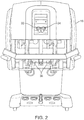
- FIG. 2 is a front view of the Surgeon's Console 16.
- the Surgeon's Console 16 includes a left eye display 32 and a right eye display 34 for presenting the Surgeon 18 with a coordinated stereo view of the surgical site that enables depth perception.
- the Console 16 further includes one or more control devices 36, which in turn cause the Patient Side Cart 22 (shown in FIG. 1 ) to manipulate one or more tools.
- control devices 36 will provide the same degrees of freedom as their associated tools 26 (shown in FIG. 1 ) so as to provide the Surgeon with telepresence, or the perception that the control devices 36 are integral with the tools 26 so that the Surgeon has a strong sense of directly controlling the tools 26.
- position, force, and tactile feedback sensors are preferably employed to transmit position, force, and tactile sensations from the tools 26 back to the Surgeon's hands through the control devices 36.
- the Surgeon's Console 16 is usually located in the same room as the patient so that the Surgeon may directly monitor the procedure, be physically present if necessary, and speak to an Assistant directly rather than over the telephone or other communication medium. However, it will be understood that the Surgeon can be located in a different room, a different building, or other remote location from the Patient, thus allowing for remote surgical procedures.
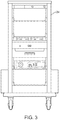
- FIG. 3 is a front view of a Vision Cart 24.
- a Vision Cart 24 can be coupled with the endoscope 28 and can include a processor to process captured images for subsequent display, such as to a Surgeon on the Surgeon's Console or on any other suitable display located locally and/or remotely.
- the Vision Cart 24 can process the captured images so as to present the Surgeon with coordinated stereo images of the surgical site.
- Such coordination can include alignment between the opposing images and can include adjusting the stereo working distance of the stereoscopic endoscope.
- image processing can include the use of previously determined camera calibration parameters so as to compensate for imaging errors of the image capture device, such as optical aberrations. Exemplary details of some of the possible image processing that can used are described in numerous patents and patent applications assigned to Intuitive Surgical, Inc., including, for example U.S. Pat. No. 7,277,120 (filed Mar. 7, 2004 ).
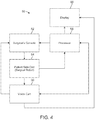
- FIG. 4 diagrammatically illustrates a robotic surgery system 50 (such as MIRS system 10 of FIG. 1 ), showing communication paths between components.
- Surgeon's Console 52 (such as Surgeon's Console 16 in FIG. 1 ) can be used by a Surgeon to control a Patient Side Cart (Surgical Robot) 54 (such as Patent Side Cart 22 in FIG. 1 ) during a minimally-invasive procedure.
- the Patient Side Cart 54 can use an imaging device, such as a stereoscopic endoscope, to capture images of the procedure site and output the captured images to a Vision Cart 56 (such as Vision Cart 24 in FIG. 1 ).
- a Vision Cart 56 can process the captured images in a variety of ways prior to any subsequent display.
- the Patient Side Cart 54 can output the captured images for processing outside the Vision Cart 56.
- the Patient Side Cart 54 can output the captured images to a processor 58, which can be used to process the captured images.
- the images can also be processed by a combination the Vision Cart 56 and the processor 58, which can be coupled together so as to process the captured images jointly, sequentially, and/or combinations thereof.
- One or more separate displays 60 can also be coupled with the processor 58 and/or the Vision Cart 56 for local and/or remote display of images, such as images of the procedure site, or any other related images.
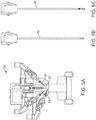
- FIGS. 5A , 5B , and 5C show a Patient Side Cart 22, an 8 mm shaft surgical tool 62, and a 5 mm shaft surgical tool 64, respectively.
- Surgical tools 62 and 64 are examples of surgical tools 26.
- the Patient Side Cart 22 shown provides for the manipulation of three surgical tools 26 and an imaging device 28, such as a stereoscopic endoscope used for the capture of images of the site of the procedure. Manipulation is provided by robotic mechanisms having a number of robotic joints.
- the imaging device 28 and the surgical tools 26 e.g., the end effectors 66
- Images of the surgical site can include images of distal ends of the surgical tools 26 when they are positioned within the field of view of the imaging device 28.
- FIG. 6 diagrammatically illustrates relative differences between a kinematics-estimated surgical tool pose 70, an image-derived estimated surgical tool pose 72, and a true surgical tool pose 74.
- accurate information of a tool's 3-D pose is important for a number of image-guided surgical and user-interface applications.
- kinematic joint sensor data is used to estimate the tool's 3-D pose, a significant amount of error can be introduced. Although many sources of error exist, such as random sensor noise, a predominant portion of this error can be attributed to offset error, which arises due to fixed differences between a kinematic joint's true position and a kinematic joint's indicated position as indicated by kinematic joint sensor data.
- a kinematics-estimated pose 70 can deviate significantly from a true pose 74 for the surgical tool.
- a kinematics-estimated tool pose for an exemplary surgical robot may differ from a true pose for the tool by up to 10 to 15 mm on a well-calibrated system, and even more if the system has not been recently and/or accurately calibrated.
- An image-derived tool pose estimate 72 can be significantly more accurate than a raw kinematics-estimated tool pose 70. This increased accuracy is diagrammatically illustrated in FIG. 6 by the relatively small positional difference between the image-derived tool pose 72 and the true tool pose 74 shown.
- an image-derived tool pose 72 may be available at a significantly lower rate (e.g., less than or equal to approximately 30 frames per second) than a raw kinematics-estimated tool pose (e.g., updated at an approximately 1333Hz rate) due to a number of factors, such as required image processing times, and at certain times it may not be available at all where the tool is outside the view of the imaging device, or is occluded for some reason, such as by patient tissue, by patient bodily fluids, and/or by opaque or translucent vapors due to cauterization, or the like.
- a significantly lower rate e.g., less than or equal to approximately 30 frames per second
- a raw kinematics-estimated tool pose e.g., updated at an approximately 1333Hz rate
- FIG. 7 diagrammatically illustrates variations with time between various estimated poses and the true pose 76 of a tool.
- a raw kinematics estimate 78 for a pose for the tool can deviate significantly from the true pose 76.
- a predominant portion of this deviation may be associated with a fixed offset error, which is illustrated by way of the substantially constant offset between the raw kinematics estimate 78 and the true pose 76.
- the raw kinematics-estimated pose 78 can be available at a high rate, such as 1333 times per second.
- an image-derived pose estimate 80 may be available at a lower rate, but can be relatively accurate.
- a combination of kinematics-estimated poses and image-derived estimated poses can be used to determine a true pose estimate 82, which may track the true pose 76 relatively well. Details of the use of a combination of raw kinematics-estimated poses and image-derived estimated poses for the determination of a true pose estimate 82 are described in numerous patents and patent applications assigned to Intuitive Surgical, Inc. including, for example in U.S. Pat. App. Pub. No. 2006/0258938 A1 (filed May 16, 2005 ).
- FIG. 8 illustrates variations that can occur in the portion of a surgical instrument 84 (e.g., the tool 26) that may be within view of an imaging device 86, such as the stereoscopic endoscope 28.
- the imaging device 86 can include two overlapping fields of view 88 used to capture images of the procedure site and any surgical instrument portion within a field of view 88.
- a greater portion of the surgical instrument 84 may be included within the captured image, but the relative size of any imaged tool feature(s) will be smaller as compared with the field of view as a whole.
- a relatively smaller portion may be included within the captured image, but the relative size of any imaged tool feature(s) will be larger as compared with the field of view as a whole.
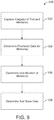
- FIG. 9 is a flow diagram of a tool tracking method 100 employing imaging of one or more markers attached to a tool.
- a tool such as the tool 26, can include one or more markers so as to provide features that can be imaged and processed to provide an image-derived tool pose estimate.
- step 102 one or more images of the tool and marker are captured.
- the captured image(s) can be a single image obtained through the use of a mono-vision imaging device or stereo images obtained with a stereo-vision imaging device, such as a stereo endoscope.
- the captured image(s) are processed so as to determine positional data associated with one or more marker(s).
- the positional data can include the location of one or more marker features within the image(s).
- the image can be processed in step 106 to determine the identification of one or more of the markers.
- a marker can contain one or more identification features that can be imaged and subsequently processed to determine the identification of the marker.
- the positional data and any identification can be used to determine tool state data, such as the tool's 3-D pose. Additional information, such as relative positional data between a marker and the tool can be used during the determination of tool state data. For example, relative 3-D pose offset data (offset position and offset orientation) between the 3-D pose of the marker and the 3-D pose of the tool can provide the relative positional data.
- the tool state data determined in step 108 can be rejected if it is insufficiently consistent with an expected tool state data range.
- an estimated 3-D pose for the tool can be generated by using a prior image of the tool or joint data from a robotic actuation system effecting movement of the tool. This estimated 3-D pose can be compared with the tool state data determined in step 108 so as to verify that they are consistent with each other. Any inconsistency can be evaluated to determine whether to reject the determined tool state data as being an outlier.
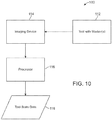
- FIG. 10 diagrammatically illustrates a system 110 for tracking a tool with marker(s) 112.
- the system includes at least one tool with a marker(s) 112, similar to the tool 26.
- An imaging device 114 such as the stereoscopic endoscope 28, is used to capture one or more image(s) of the tool with marker(s) 112.
- the imaging device 114 is coupled with a processor 116 and transfers image data to the processor 116 in response to imaging the tool with marker(s) 112.
- the processor 116 is configured to process the received image data so as to generate tool state data 118, which can include an estimated 3-D pose for the tool with marker(s) 112.
- FIG. 11 is a flow diagram of a tool tracking method 120 for determining a tool state showing steps for processing stereo images of markers and raw kinematics data to generate a corrected kinematics-estimated tool state using an image-derived 3-D pose offset, in accordance with an embodiment. Because of the higher update rate of the joint sensor data used to generate an estimated tool state from raw kinematics data 124 as compared to an image-derived estimated tool state, an image-derived pose offset can be combined with an estimated tool state from raw kinematics to generate a corrected kinematics estimated tool state.
- a series of corrected kinematics estimated tool states can be generated using a single pose offset combined with a corresponding series of estimated tool states from raw kinematics data 124.
- the pose offset can be updated over time in response to new image data 122.
- the determination of a pose offset starts in step 126 with the acquisition of image data of the tool with marker(s) and corresponding raw kinematics data 124 for the tool with marker(s).
- the image data 122 can include left image data and right image data, but it should be understood that a single image of one or more marker features can be processed so as to generate image-derived positional information useful in generating a pose offset.
- the location within an image of a single marker feature can be compared with an expected location within the image for the single marker feature so as to generate a one-dimensional (1-D) correction for the previous pose offset.
- the raw kinematics data 124 can include basic sensor data, such as kinematic joint position parameters, and/or can include a current raw kinematics-derived tool state.
- a marker in step 128, the left image and the right image are processed so as to detect marker features.
- the position of the marker(s) feature(s) within the left image and the position of the marker(s) feature(s) within the right image are used in step 130 to generate 3-D coordinates for the marker(s) feature(s).
- 3-D coordinates for the marker(s) feature(s).
- a marker can include at least one identification feature that can be processed to determine the identification of the marker.
- the 3-D coordinates for the marker(s) features(s) can be processed in combination with any identification(s) of markers(s) so as to determine an image-derived tool state.
- images of a number of markers can be used to provide sufficient pose information for determining a 3-D pose for the tool, it can be advantageous for a single marker to contain a sufficient number of features for determining a 3-D pose for the tool. Additionally, it can be advantageous for each marker on a tool to have an identification that differs from neighboring markers. With such a marker, an image-derived tool state can be determined by determining the 3-D pose of the marker, determining the identification of the marker, and using data regarding how the identified marker is positioned and oriented on the tool.
- features from a combination of markers can be combined to determine the 3-D pose of the combination of markers, which can be combined with data regarding how the features from the combination of markers are positioned and oriented on the tool.
- a corrected kinematics estimated tool state (from a previously determined pose offset) can be compared against the image-derived estimated tool state so as to reject any image-derived estimated tool states that differ too much from the corrected kinematics estimated tool state.
- the pose offset is determined so that it can be combined with a raw kinematics data 124 estimated tool state to obtain a corrected kinematics estimated tool state.
- the pose offset can be calculated as a difference between an estimate of the true tool pose (shown in FIG. 7 ) and a corresponding raw kinematics data 124 estimated tool state for substantially the same point in time.
- the pose offset can be calculated as a difference between an image-derived estimated tool state and a corresponding raw kinematics data 124 estimated tool state for substantially the same point in time.
- a corrected kinematics based tool state is determined.
- a single pose offset can be used to correct one or more raw kinematics data 124 based tool states so as to compensate when raw kinematics data 124 based tool states are available at a higher rate as compared to image-derived tool states.
- the corrected kinematics can then be provided back to the start of the process (step 126), where the "fetched" current image and kinematics data can include image data, raw kinematics data, and the current pose offset and/or corrected kinematics data.
- a marker design (i) provides sufficient constraint for tool pose estimation; (ii) is distinguishable under various realistic conditions (e.g., viewpoint, lighting) and under various realistic backgrounds; (iii) works with different operational ranges of the tool; (iv) is resilient and/or robust to partial occlusions; (v) is visually acceptable; (vi) is easily manufactured; (vii) is compact enough to allow the use of multiple markers within the space provided (e.g., enough to supply a sufficient level of redundancy), and (viii) can be extracted by an image analysis algorithm
- One-dimensional (1-D) and two-dimensional (2-D) markers can provide a number of advantageous aspects. These include: (i) the use of separate localizer and identification features that support more efficient detection and parsing; (ii) the use of explicit coding schemes for primitive feature locations; (iii) the use of explicit error checking and error correction; (iv) the ability to create a large number of different patterns; (v) the use of a compact marker with dense information; and (vi) the use of a "hypothesize and test" detection algorithm framework, which scales very well with the total number of marker patterns.
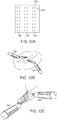
- FIGS. 12A, 12B, and 12C illustrate a marker design 140, tools 146 employing the marker design 140 operating at a far range from the imaging device, and a tool employing the marker design 140 operating in close range to the imaging device, respectively.
- the marker design 140 of FIG. 12A includes three groups of identical patterns 142 that can be placed at 120-degree intervals around a tool shaft. Each pattern 142 has 16 circles in 8 rows and 2 columns on a yellow background. Each pattern 142 can be aligned with the longitudinal axis of a tool shaft so that all of the center points of the 16 circles reside on a single plane. The two columns of circles 144 are spaced relatively closer as compared to the spacing between each pattern 142.
- This differential spacing can be used to identify the specific pattern 142 in an image. Since the three patterns 142 are arranged around a tool at 120-degree intervals, there may be a sufficient differential between identical images of the overall marker 140, given the inherent level of accuracy of a corrected kinematics estimated tool state, to discriminate between imaged patterns 142.
- Marker 140 provides an example how marker features, such as the identical patterns 142 shown, can be arranged so as to present features that can be imaged so as to determine a tool state.
- Drawbacks of this marker design include: (i) the yellow background is very bright under surgical illumination and appears intrusive; (ii) although the marker 140 covers the end of the instrument shaft, in most cases it is not fully visible during surgery; (iii) there is a need to rely on the assumption that the maximum error in an estimated tool roll angle is less than 60 degrees to associate the image observation with one of the three patterns 142; and (iv) it is difficult to add more markers on another part of the instrument since the markers are difficult to differentiate.
- FIGS. 13A, 13B , and 13C illustrate three embodiments of a 2-D marker 150, 170, 190 that can be used on a tool for tracking the tool's state.
- a 2-D marker includes primitive features arranged in two dimensions. Some of the features can serve as localizer features, and the other features can serve as identification features. Localizer features provide positional or orientation information to determine pose/alignment of the marker, and the identification features are used to differentiate different markers. The identification features can follow a certain coding scheme and can include redundant information for error checking and/or correction.
- By using compact 2-D markers multiple markers can be arranged in different ways to fit the geometric shapes of different tools.
- the markers can also be arranged at different locations on the tool shaft to cope with different operational ranges.
- the markers can also be used to estimate the roll of the tool or instrument. Compared to multiple 1-D patterns stacked together, a 2-D marker pattern may advantageously provide better information compactness and locality.
- These 2-D self-discriminative markers have been designed to meet a number of considerations.
- the size of the markers has been selected to be as small as possible, given the constraint of image resolution.
- These 2-D markers do not rely on a specific color, because color can be an unreliable feature due to dependence on lighting and white balance. Additionally, some colors can be visually intrusive.
- These 2-D markers were designed to include features that could be reliably detected in images, because some features are easier to detect than others.
- these 2-D markers were designed to include localizer shapes (the black circles 152, 154, 156, 158; 172, 174, 176, 178; the black bar 160; 180; and the saddle points 192) and a number of information bits or identification features (nine gray dots 162 in FIG. 13A , thirteen gray dots 182 in FIG. 13B , and the 16 dots 194 in FIG. 13C ).
- localizer shapes the black circles 152, 154, 156, 158; 172, 174, 176, 178; the black bar 160; 180; and the saddle points 192
- a number of information bits or identification features no gray dots 162 in FIG. 13A , thirteen gray dots 182 in FIG. 13B , and the 16 dots 194 in FIG. 13C .
- a circle was chosen as a localizer shape because its topology (a dark blob inside a bright blob, or vice versa) is invariant to view point and it usually does not appear in the background. Other such features include certain corners, especially a saddle point 192 as shown in FIG. 13C .
- the marker designs do not restrict how the information bits 162, 182, 194 (identification features) are used, they can be divided into data and error checking bits. The presence or absence of the dots corresponding to data bits can be used to designate a number of unique codes (or identifications). The presence or absence of the gray dots corresponding to error checking bits can be used to validate a code or identification determination.
- the size of the marker patterns 150, 170, 190 were selected considering a desired working distance range for minimally-invasive robotic surgery. However, it is appreciated that if the instrument usually works closer or farther away from an imaging device, the size of the pattern could be made smaller or larger accordingly.
- the markers 150 and 170 shown in FIGS. 13A and 13B include a white background and dark features, as can be seen in subsequent figures, a dark background with white features was selected based on clinical feedback on the visual experience. However, it is appreciated that a white background and dark features can also be used.
- the 3-D geometry of the pattern (the 3-D coordinates of all the circles and dots in a local coordinate system) is fixed and known. If a single image is used to provide 2-D coordinates, coordinates of four points are sufficient to determine the pose of the marker (and hence the tool). If stereo images are used to provide 3-D coordinates, coordinates of three points are sufficient to determine the pose of the instrument. Accordingly, the design of these 2-D markers 150 and 170 includes four circles, thereby providing a sufficient number for either single image or stereo image processing. The dots can also be used for object pose estimation. Also, although the markers can be placed on a tool in any number of different orientations, it is presently preferred that the markers be placed so that the vertical direction aligns with the instrument axial direction.
- the marker designs 150 and 170 of FIGS. 13A and 13B represent two separate design versions, with the design version of FIG. 13B representing an improved version after experiments. Although the overall size of the pattern did not change, a number of differences exist. The number of information bits 162 and 182 (or identification features) was increased from nine to thirteen, which effectively increased the number of unique patterns. The number of columns for the information bits 162 and 182 increased from three to four, which provided for a more efficient use of limited space. Because it was observed that many typical viewing directions in robotic surgery led to more severe foreshortening of the tool image in the axial direction than in the lateral direction, the pattern of FIG. 13B includes larger vertical spacing between the information bits 182 than horizontal spacing. The rows of the information bits 182 in the pattern of FIG.
- 13B are also interleaved, which also helps alleviate foreshortening relative to a non-interleaved pattern.
- the diameter of the information bits 162 and 182 (dots) and the thickness of the circles were also reduced, which resulted from an observation that the testing vision system usually dilated bright features. Accordingly, the features were made thinner to maintain isolation.
- the information bits 162, 182, 194 in these 2-D patterns can be used in a variety of ways, such as using a number for identification bits and the remaining number for error checking/correction bits.
- the partition between identification bits and error checking/correction bits and their arrangement are flexible and can be determined based upon the specific application requirements. One may use fewer numbers of bits for error checking/correction if the imaging situation is less challenging.
- the thirteen information bits of the marker of FIG. 13B are separated into six bits used to carry identification information (resulting in 64 unique codes), with the remaining seven bits used for error checking/correction. Among the seven error checking/correction bits, six can be set to be the inverse of the identification bits, and the remaining bit can be used as checksum data.
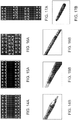
- FIGS. 14A , 14B , 15A , 15B , 16A , 16B , 17A , and 17B show four different multiple marker patterns by themselves and as applied to specific robotic tool instruments.
- FIGS. 14A and 14B respectively illustrate 2-D markers that can be used for an 8 mm (diameter, same convention for other instruments) instrument shaft and an 8 mm instrument shaft with the markers.
- FIGS. 15A and 15B respectively illustrate 2-D markers that can be used for a 10 mm instrument shaft and a 10 mm instrument shaft with the markers.
- FIGS. 16A and 16B respectively illustrate 2-D markers that can be used for a 5 mm instrument shaft and a 5 mm instrument shaft with the markers.
- FIGS. 17A and 17B respectively illustrate a 2-D markers that can be used for an ultrasound transducer and an ultrasound transducer with the markers.
- multiple rows of patterns can be shifted by a half a pattern to ensure some pattern is fully visible at any angle.
- a variety of approaches can be used to extract marker features from images and process the extracted information to determine image-derived tool pose estimates.
- possible approaches can include a top-down approach, a bottom-up approach, and combined top-down/bottom-up approach.
- 2-D images can be rendered from a 3-D model of the instrument at a given pose, and the rendered images can be compared with the real input images to evaluate how well they match.
- the pose that gives the best matching score is the best solution.
- a bottom-up approach tries to find some local feature in the image and then compute the solution.
- a bottom-up approach can apply to scenarios where salient local features can be extracted and grouped easily, often under some assumptions or using some heuristics. Since local features are more likely to have ambiguity, markers or background color can be added to ensure the robustness of the method.
- a bottom-up approach is generally more computationally efficient than a top-down approach, since the features can be computed locally and the approach does not involve search or iterative optimization.
- a combined top-down/bottom-up approach can be used that integrates the advantages of both of the above two classes of methods.
- a bottom-up approach can be used to report a finite number of hypotheses, which are then tested and verified using a top-down method. This type of method has sometimes been called "hypothesize and test.”
- FIG. 18 is a flow diagram of a method 200 for processing stereoscopic endoscope images of tool tracking markers.
- left image data 202 and right image data 204 are processed to extract primitive image features.
- Primary image features refers to visually salient features that can be detected locally, such as blobs and corners.
- a blob is a small patch with sufficient contrast with respect to its surroundings.
- a corner is the intersection of two edges.
- a Maximum Stable Extremal Region (MSER) approach provides an excellent way to detect blobs at an affordable cost.
- MSER is based on a very minimal assumption of boundary contrast and is therefore able to detect salient regions (blobs) of any size, and any shape.
- MSER is based on a very minimal assumption of boundary contrast and is therefore able to detect salient regions (blobs) of any size, and any shape.
- An alternative feature (blob) detector approach is to use adaptive thresholding plus connected component analysis.
- the threshold used for binarization is computed adaptively according to the mean grey value of its neighborhood.
- the kernel convolution to compute the mean at each pixel can be implemented using integral image for fast mean within a rectangular window.
- adaptive thresholding is that it works for a fixed scale. For multiple scales, it has to be run multiple times at different scales. One may also consider to run adaptive thresholding and connected component analysis in a pyramid fashion.
- a learning-based approach is also available for dot detection that considers the fine appearance of the dot to disambiguate with background dots (see D. Claus and A. W. Fitzgibbon, "Reliable fiducial detection in natural scenes," In Proc. European Conf. Computer Vision, 2004 ). This approach could be used for more complex marker patterns than dots.
- the output from a blob detector is a list of blobs from the image. It can be much faster to analyze these blobs than all the image pixels.
- We detected circles by a simple heuristics that the centroid of a bright blob is inside the bounding box of a dark blob and the bounding box of the dark blob is fully contained by the bounding box of the bright blob. There may be better ways to detect bars and circles (e.g., by analyzing their higher order moments). Since our overall method is tolerant to the errors in the lower level processing, we have found these methods to be sufficient.
- the extracted features are grouped. Grouping refers to the process of establishing correspondences between the extracted primitive features and the object being imaged, such as a particular marker. This process also needs to account for extracted features that belong to the background instead of the object.
- the primitive feature grouping relies on knowledge of the marker's configuration to assemble extracted features into groups of features belonging to any particular marker.
- the grouped features of the left image data 202 are matched with corresponding grouped features of the right image data 204.
- the stereo image matched features can be processed to determine 3-D data for the features.
- the 3-D data for the features can be processed so as to identify the marker and determine a 3-D pose for the marker (data 214), which can then be used to determine a 3-D pose for the tool having the marker.
- FIG. 19 is a flow diagram of a method 220 that can be used for processing stereo images of tool tracking markers (embodiments of which are shown in FIGS. 13A and 13B ).
- Method 220 follows a "hypothesize and test" framework.
- step 226 the left image data 222 and the right image data 224 can be processed to extract primitive features, which can be accomplished using a variety of methods, such as an above-described method.
- step 228 some of the extracted primitive features are processed so as to generate one or more localizer hypotheses (for one or more markers) by identifying one or more primitive features that exhibit characteristics of one or more marker localizer features.
- a localizer hypothesis is a tentative assumption that one or more extracted primitive features correspond to one or more localizer features in a marker.
- One or more localizer features can be used to determine positional and at least partial orientation of the marker. For example, in the 2-D markers of FIGS 13A and 13B , the four circles and the bar can be used as localizer features. With these 2-D markers, the extracted primitive features (or the image data in general) can be processed to look for two circles (designated in FIGS.
- step 230 the extracted primitive features are processed so as to generate one or more full pattern hypotheses.
- a full pattern hypothesis is a tentative assumption that multiple primitive features correspond to one or more marker features that can be used to determine the basic position and orientation of the marker pattern within the image, which can be skewed or foreshortened as determined by the 3-D pose of the marker relative to the imaging device.
- the localizer hypothesis (the identified circles “0" and “1” with the bar in between) can be used as a starting point to search for the remaining localizer circles (designated in FIGS. 13A and 13B as "2" and "3").
- the search can look for all the compatible localizer "2" and "3" features within a search area defined by a minimum and a maximum pattern skew, and a minimum and a maximum pattern aspect ratio.
- the "2" and “3" circles do not have bar between them, which can be used to aid in their identification.
- the combination of the localizer hypothesis and the identified "2" and “3” localizer circles can be used generate a full pattern hypothesis.
- the full pattern hypothesis can also be checked to see if its perspective is less than a maximum value, by which the consistency of skew and aspect ratio can be checked.
- step 232 one or more of the generated full pattern hypotheses are verified by processing the image features so as to identify the marker.
- the generation of a full pattern hypothesis provides information regarding the position and orientation of a marker pattern within the image. This information can be used to orient or align candidate marker patterns with the imaged pattern.
- the imaged patterns and the aligned candidate marker patterns can then be checked for consistency. Where consistency exists, the imaged marker pattern can be identified as the candidate marker pattern. For example, with the 2-D marker patterns of FIGS.
- the location of detected 2-D blobs within a full pattern hypothesis can be compared with locations of information bits set to "1" (i.e., physically present) of a candidate marker pattern model that has been aligned with the full pattern hypothesis.
- the alignment of a candidate marker pattern with a marker image can be accomplished by estimating the 3-D pose of the marker relative to the imaging device and aligning a candidate marker with the estimated pose.
- Pose estimation computes the 3-D pose of the marker by knowledge of the 3-D geometry of the marker and its 2-D projections in the image.
- the imaging device calibration is used in the pose estimation process using known methods.
- the pose estimation can be accomplished using the locations within the image of the four localizer circles.
- the 3-D coordinates of a candidate marker's features can be determined and be projected into the image using the known image device calibration. The pixels at these image locations can be checked to decide if there is a dot at that location.
- the alignment of a candidate marker pattern with a marker image can also be accomplished by homography.
- Four 2-D point correspondences define a plane perspective transformation (i.e., homography), which contains all the possible transformations of a plane under perspective transformation.
- a plane approximation can be useful for a wide range of viewpoints.
- This approach involves an approximation that the marker features reside on a plane, which provides a simplified process for aligning a candidate marker pattern with a marker image.
- the image locations for the dots can be based on the image locations of the four circles by assuming the pattern is attached to a plane through a plane perspective transformation (see R.
- the exact 3-D geometry of the marker does not need to be known (e.g., it does not matter if the marker is attached to a 5 mm, a 8 mm, or a 10 mm tool shaft) and therefore allows markers to be attached to different instrument geometries at the same time. These flexibilities may not be critical in a surgical instrument tracking application but may enable other applications.
- Marker design is closely related to how marker features are detected from images.
- the design of marker embodiments disclosed herein and feature detection methods disclosed herein have been co-evolved for better overall system performance. For example, with respect to the 2-D marker patterns of FIGS. 13A and 13B , if the bar between the localizer circles "0" and "1" did not exist, the specific details of the detection method would likely need to be modified. However, it is appreciated that a wide variety of marker patterns and corresponding marker feature detection methods can be practice and still be within the scope of the present invention.
- FIGS. 20A , 20B , 20C , 20D , and 20E illustrate the method of FIG. 19 as applied to the 2-D marker of FIG. 13B .
- the bright circles in the image are detected (as shown by the crosshair annotations).
- two localizer hypotheses are formed using adjacent bright circles that have aligned bars.
- a full pattern hypothesis is formed by identifying the designated bright circles by searching relative to the associated localizer hypothesis.
- a candidate marker pattern is aligned with the image full pattern hypothesis and the location of candidate marker pattern features relative to the image are determined. The determined locations are used to check the image to see if corresponding detected features are present.
- FIG. 20E illustrates an exemplary pattern identification code for a verified candidate marker pattern.
- any existing pose estimates such as a raw kinematics pose estimate or a corrected kinematics pose estimate, may be used to limit the number of candidate marker patterns.
- the detected marker features may be used directly to determine an identification of a marker pattern by determining directly what marker pattern features are present and which are not present.
- Marker patterns can be arranged on a tool in a variety of ways for a variety of purposes. For example, markers can be arranged at multiple locations on a tool so as to provide for multiple operational ranges.
- FIGS. 21A and 21B illustrate a robotic surgical tool having two circumferential bands of markers that are separated by an axial distance along the tool shaft. In FIG. 21A , the tool is being operated close to the imaging device, thereby placing one of the bands of markers outside the view. In FIG. 21B , the tool is being operated farther away from the imaging device, thereby placing both bands of markers within the view. As shown in FIG. 21B , the features in the marker band closest to the imaging device are larger than the features in the marker band farthest from the imaging device.
- the band of markers disposed closest to the distal operating end of the surgical tool can provide distinct features for imaging when the other band is out of view.
- One-dimensional (1-D) markers can be used to determine instrument pose.
- a 1-D marker includes primitive features arranged in one dimension. Some of the features can serve as localizer features, and the rest of the features can serve as identification features. Similar to 2-D markers, localizer features can be used to provide positional or orientation information to determine the pose/alignment of the marker, and identification features can be used to differentiate different markers. Identification features can follow a coding scheme and can include redundant information for error checking and/or correction.
- FIGS. 22A , 22B , and 22C illustrate 1-D markers, which employ dots, or a combination of circles and dots.
- FIG. 22A illustrates a 1-D marker 240 that includes dots forming a straight line.
- marker 240 employs dots that are either present (i.e., set to "1") or absent (i.e., set to "0").
- Marker 240 includes a start pattern 242, an end pattern 244, and a center portion 246 having 12 data bits. These 12 data bits can be used in a variety of ways, such as by using some of the data bits as identification bits and some of the data bits as error checking/correction bits, which can include one or more checksum data bits.
- the start pattern 242 and the end pattern 244 can be delineated by adjacent blank areas 248.
- One-dimensional patterns have advantages and disadvantages.
- an advantage of using a 1-D pattern is that it works for very thin instruments, such as a needle where a 2-D pattern would not work.
- a disadvantage of a 1-D pattern is that a single 1-D marker does not give the full six-dimensional pose for the object. At least two non-collinear markers are required for a full six-dimensional pose. For very thin objects, the axial roll is not typically observable, so the five-dimensional pose provided by a single 1-D marker is already the most that can be typically obtained.
- FIG. 22B illustrates an image of a surgical tool 250 having 1-D markers 240, showing three such markers 240 placed in alignment with the surgical tool's shaft axis.
- the marker When attaching a 1-D marker to a cylindrical surface, the marker can be aligned with the axis of the cylinder, which results in the marker being disposed along a straight line in 3-D space.
- Such markers may be particularly advantageous when used on relatively small diameter tool shafts, where more 1-D markers can typically be arranged around the shaft than comparable 2-D markers.
- one concern with a 1-D marker is the length that it requires on an instrument shaft, which may become an issue at close operational ranges that may result in part of a 1-D marker being out of view.
- FIG. 22C illustrates a modified version of the 1-D marker 240 of FIG. 22A .
- Marker 260 incorporates circular features 262 that can be used as localizer features similar to the localizer features of the 2-D markers of FIGS. 13A and 13B described above.
- the use of the circle features 262 may help to reduce the length of the pattern, thereby providing a better close range pattern.
- Dots 264 can be used for marker identification and error checking/correction data.
- FIG. 22D illustrates an alternative version of the 1-D marker 260 of FIG. 22C .
- Marker 265 incorporates a combination of circular features 266 and bar features 268. Circular features 266 can be used as localizer features and bar features 268 can be used for marker identification and error checking/correction data.
- a difference between dots 264 of marker 260 and bar features 268 of marker 265 is that with marker 265 information is coded by the positions of the transitions between dark and bright regions, whereas marker 260 uses the positions of the centers of the dots to carry information.
- FIG. 23 is a flow diagram of a method 270 that can be used for processing stereo images of one or more 1-D tool tracking markers (embodiments of which are shown in FIGS. 22A , 22B , and 22C ).
- left image data 272 and right image data 274 can be processed to extract 2-D blobs (i.e., features), which can be accomplished using approaches as described above with reference to the extraction of 2-D blobs from 2-D markers (see FIG. 19 and related discussion).
- the extracted blobs are grouped into lines. Line grouping can be performed using a Random Sample Consensus (RANSAC) approach by extracting multiple straight lines from all the detected feature points. (For details of Random Sample Consensus, refer to M.
- RANSAC Random Sample Consensus
- one or more lines are rectified.
- Line rectification refers to removing the perspective effect on the line to restore the metric relationship of the information bits (e.g., dots).
- the vanishing point of the lines parallel to the shaft is sufficient to rectify the line.
- There are a number of ways to obtain the location of the vanishing point For example, if there are more than one visible linear markers on the shaft, the vanishing point is the intersection of these lines.
- images of points with equal or known spaces can be used to compute the vanishing point. (See, for example, FIG. 22C for examples of linear markers having equally spaced circles.)
- one or more markers are identified. Marker identification can involve locating the start and end patterns and then reading the data bits to identify the pattern. It is appreciated that the coding scheme can be designed so as to encode sufficient redundancy for error checking. Where some data bits have been used for error checking, the error checking bits can be read to validate the identification. As discussed above, the error checking data bits can include at least one data bit used as checksum data.
- step 282 When a stereo camera is used, once a marker (1-D or 2-D) has been identified, the 3-D reconstruction of step 282 becomes a simple step. The correspondences between the imaged features in both the left and right images are known at this state, and only triangulation is needed. The resulting 3-D marker feature locations can then be used in combination with the known relative spatial arrangement of the marker features relative to the tool to determine a 3-D pose for the tool.
- a tool such as the surgical tool 26, can be configured to include a configuration marker so as to provide multiple primitive features that can be detected within an image.
- An individual primitive feature is usually not sufficient to serve as a marker because it may not be unique and does not provide enough geometric constraints to determine object pose.
- a number of primitive features can be used to form a pattern having a unique configuration in 3-D space, which is herein referred to as a "configuration marker.”
- the pattern i.e., configuration
- Three non-collinear features extracted from stereo images provides sufficient information to determine pose for the tool. However, having more features than the minimum requirement can be beneficial in gaining more confidence in detection and better accuracy in pose determination.
- the shape or appearance of the primitive features can be identical (e.g., circular disks of the same size), can include a few variations, or can be unique. As such, a wide variety of primitive features can be used, such as circles, dots, bars, corners, etc. Where the primitive features used include some level of variations, the resulting differences in appearance can be used to help match image locations for particular features between two stereoscopic images (i.e., using feature signatures during feature matching) and the images with the model (i.e., using feature signatures invariant or less sensitive to viewpoint and lighting changes).
- a reflective spherical surface has the nice property that it appears as a bright spot irrespective of viewpoint as long as a light source and an imaging device are aligned along a common direction, as is typically the case with endoscopic imaging during minimally-invasive robotic surgery.
- the center of the bright spot also coincides with the projection of the center of the spherical surface.
- a reflective spherical surface can be either concave or convex. In most cases, a reflective spherical surface may produce a bright spot with sufficient contrast with respect to its background to allow detection in an image for a variety of viewpoints and distances.
- FIG. 24 illustrates a primitive feature 300 that includes a concave spherical surface and that is being illuminated/imaged from three directions.
- the spherical surface 302 of the marker 300 has a center point 304 through which illumination light that is reflected directly back towards the imaging device travels. Illumination light that does not travel substantially through the center point is reflected away from the illumination/imaging direction.
- Some natural features on a tool may also appear as salient visual features in captured images. These natural features may provide additional image-derived information regarding the 3-D pose of a tool. Examples of such natural features for an exemplary surgical tool can include the end of a bolt having an approximately spherical surface, and the end of a hinge of an articulated instrument having a reflective concave spherical surface. Such natural features may form stable bright blobs in images similar to those of artificial markers. However, for many tools, such natural features by themselves may not provide a sufficient number of features to form patterns distinctive enough to be extracted against a cluttered background. By introducing artificial primitive features in conjunction with such natural features, sufficient distinctiveness can be achieved. The use of existing natural features helps reduce the number of artificial features added and therefore reduces the changes (such as appearance) to the mechanical device to be tracked.
- FIG. 25 illustrates a primitive feature 320 that includes a convex spherical surface 322 and that is being illuminated/imaged from three directions. Similar to the primitive feature of FIG. 24 , the spherical surface 322 has a center point 324 through which illumination light that is reflected directly back towards the imaging device travels. Illumination light that does not travel substantially through the center point is reflected away from the illumination/imaging direction.
- Reflective convex spherical surfaces may be more suitable for surgical applications than concave reflective spherical surfaces in that blood (or any fluid or substance in general) may be more easily trapped in concave recesses, which may cause a concave primitive feature to lose its contrast with adjacent areas of the tool, or become darker than adjacent areas depending on the amount of blood trapped.
- a reflective convex spherical surface is less likely to trap blood.
- the interaction of the reflective convex spherical surface and tissue may help keep the surface clean, which may help it to produce a bright spot even in a heavy blood field.
- FIGS. 26A and 26B show surgical tools having primitive features with reflective spherical surfaces. These surgical tools are for use without any special illumination, but instead are for use with an existing stereo imaging system used by a surgeon to view a procedure site in an exemplary robotic surgery system. This use is in contrast with existing systems that use controlled active infra-red (IR) illumination, which ensures that only the marker points are bright in the view, which significantly simplifies related image processing and estimation.
- IR active infra-red
- the use of an existing stereo imaging system avoids the added system complexity associated with controlled active IR illumination.
- these surgical tools have primitive features placed on their distal clevis, it is appreciated that primitive features can be placed at other locations, such as on the instrument shaft and/or the proximal clevis. It may be advantageous to select locations that are not prone to reflective image saturation.
- FIG. 27 is a flow diagram of a tool tracking method 340 that employs processing of stereo images of a tool having a configuration marker.
- the method makes use of the geometric invariance between the primitive features in three-dimensional space, therefore stereo matching/3-D reconstruction is performed first.
- left image data 342 and right image data 344 can be separately processed so as to extract primitive features that exhibit a qualifying amount of contrast relative to adjacent areas (i.e., bright spots).
- the extracted primitive image features are processed so as to identify "image signatures" that are consistent with the primitive features used.
- “Signatures” can be extracted for every primitive image feature. Where the primitive features used are identical in shape, their image signatures may be substantially similar. Where the primitive features used have shape or appearance variations, the resulting differences in appearance can be used to help associate a particular primitive feature with a particular primitive image feature, such as a bright spot.
- a primitive image feature signature can be extracted from the primitive image feature (i.e., image patch) around the feature point.
- a simple feature signature approach is to use the extracted primitive image feature (image patch) itself as used in traditional stereo.
- HOG Histogram of Gradient
- step 350 features in the two stereo images (i.e., left image and right image) are matched.
- Different signatures approaches may require different matching methods. For example, normalized correlation is used for an image patch signature (see David Forsyth and Jean Ponce, "Computer Vision A Modern Approach," page 240, Prentice Hall, 2003 ). With an HOG signature, it has been proposed to use the relative matching score as a measure of confidence, which may likely be a useful approach.
- Epipolar constraint can be used to constrain the matching only on a straight line (see R. Hartley and A. Zisserman, “Multiple View Geometry in Computer Vision," Cambridge University Press, 2000 ). Where multiple good matches exist, all can be kept for processing in the next step.
- the matched features are used to generate 3-D coordinates by using stereo triangulation.
- model based signatures may be used in step 354.
- Matching feature signatures between image and model is expected to be more difficult than matching feature signatures between left and right stereo images, since stereo images have similar viewpoints, illumination, and epipolar constraint.
- the features may need to be invariant to viewpoint and lighting conditions. If identical primitive features are used, it may be more difficult to match against a model.
- primitive features can be designed to have shapes (and resulting appearances) that are easy to match under large viewpoint variations.
- One approach is to rely on topological properties that are invariant to viewpoint change.
- An example is a circle, such as described above with reference to 1- and 2-D markers.
- a primitive feature can use multiple bright dots inside a dark dot. Even if not all of the dots are matched with a model, or even if the matches are not unique, partial matching can be useful in feature grouping.
- step 352 the matched features are used to perform three-dimensional feature grouping so that the correspondence of the observed features with features in the model is established (i.e., to get identified marker points in 3-D 358).
- the process uses 3-D positions of the features and optionally their matching score with the model primitive features and/or optionally prior knowledge on the instrument pose.
- Step 352 can be performed by a "Constellation algorithm.”
- the Constellation algorithm performed is an efficient Bayesian approach for 3-D grouping based on geometric constraint, appearance constraint, and other prior pose information on the object pose (i.e., prior object pose data 356).
- the use of appearance constraint is an option if the geometric constraint is insufficient.
- the output of the Constellation algorithm is the label for each observed feature, taking values from one of the model primitive features or background clutter. Random Sample Consensus (RANSAC) is used at the end to enforce the rigidity constraint.
- RASAC Random Sample Consensus
- the input nodes contains an unknown number of patterns. Missing data and background nodes can exist.
- O [ o l , ... , o m ] to be the ownership of each input node; o i ⁇ [0, t]. It is possible that we know a priori knowledge of the ownership of each input node. The prior ownership knowledge can be from local node observation (independent of other nodes) or other sources.
- q i ( l ) denotes the probability of input node i corresponds to model label l.
- q i (0) should be set to be a small probability.
- ⁇ is the measurement noise of the distance between nodes and ⁇ is a background likelihood which should be lower than the likelihood of a true match.
- the prior knowledge on the pose of the object can be used as the following.
- the prior on translation can be represented in the prior q( ) since this knowledge can be applied to each individual node.
- the prior on rotation can be represented in the pair-wise potential ⁇ ( ) by the relative orientation of two nodes.
- the joint probability function, equation (1), is in a form of a combination of local potentials and pair-wise potentials.
- This problem can be solved efficiently using the belief propagation (BP) algorithm.
- the algorithm gives the marginal distribution (ownership) of each node as output. In these particular cases, the interconnection of the nodes can form loops.
- This class of method is referred to as loopy belief propagation (see K. Murphy, Y. Weiss, and M. Jordan, "Loopy-belief propagation for approximate inference: An empirical study," In UAI, volume 15, pages 467-475, 1999 ). It shows very good empirical result even though the optimality is not proven.
- the BP algorithm see Judea Pearl, "Probabilistic Reasoning in Intelligent Systems: Networks of Plausible Inference," Morgan Kaufmann, 1988 .
- a discernible marker that includes text and/or one or more symbols can be used for tool tracking.
- Such a discernible marker can include a wide range of text and symbols.
- a discernible marker can include a company name, a company trademark symbol, a product name, a product trademark symbol, a component name, and/or a user name.
- a discernible marker can use a variety of colors set on a variety of backgrounds.
- text and/or symbols may be light colored (such as white) set against a dark background (such as black), and vice-versa.
- FIGS. 28A and 28B illustrate some exemplary discernible tool markers. It can be advantageous to use a discernible marker that is familiar to a human user. Familiar information tends to blend well with the scene and may cause less distraction to users compared to other markers with similar information content.
- Discernible markers can include local features that can be used for object pose estimation.
- Standard text can be used as markers.
- some modifications to the font can increase the number of stable features (e.g., corner points), create features that are highly discriminative against background (e.g., a corner within a "checkerboard” pattern or array, or a saddle point), and/or enable more efficient detection methods.
- a marker can include text and/or a symbol that is constructed from a number of rectangular elements selected from a rectangular "checkerboard" array. The selected elements can have a color or a range of colors, and the unselected elements can have a contrasting color or range of colors.
- Local patterns of the selected and/or unselected elements can provide a local feature that can be imaged and processed so as to determine position and/or identification information for the local feature.
- Such local patterns can include a variety of patterns.
- a local pattern can include variations in the rectangles themselves (e.g., such as size, aspect ratio, color, etc.), variations in local combinations of rectangles (e.g., such as at corners), variations in lines, and variations in scale (e.g., markers at multiple scales or markers within markers).
- FIGS. 29A , 29B , 29C , 29D , 29E , 29F , 29G , and 29H illustrate some exemplary approaches that can be used to incorporate positional and/or identification information within a discernible marker.
- FIG. 29A illustrates variations in local combinations of rectangles that can be used at text corner locations. Three exemplary corner types are shown, specifically corner type 1 360, corner type 2 362, and corner type 3 364. Although three are shown, additional corner types can be formulated using four adjacent grid squares. Additionally, other combinations of grid squares can be used to formulate patterns that can be imaged and processed so as to be identified (e.g., a 3 by 3 pattern, a 3 by 2 pattern, etc.).
- FIGS. 29A , 29B , 29C , 29D , 29E , 29F , 29G , and 29H illustrate some exemplary approaches that can be used to incorporate positional and/or identification information within a discernible marker.
- FIG. 29A illustrates variations in local combinations of rectangles that can
- FIGS. 29B and 29C illustrate discernible text constructed using rectangular features selected from a 2-D array (i.e., checkerboard array) of rectangular primatives.
- FIG. 29D illustrates how a discernible text marker can be configured to have more corner features while still being readable.
- FIGS. 29E and 29F illustrate how a variation in the amount of overlap between adjacent rectangles can be used to change the appearance of the resulting text ( FIG. 29E having no overlap and FIG. 29F having slight overlap, which makes the "cross" point/saddle point look like a cross point). Such an overlap may help compensate where an imaging system dilates the white area(s).
- FIGS. 29G and 29H illustrates discernible text markers having features at multiple scales. Unlike the marker shown in FIG. 29G , the marker shown in FIG. 29H does not include a second level that is readily discernible by a human viewer, which may be advantageous in certain situations.
- FIGS. 30A , 30B , 30C , and 30D illustrate some additional exemplary discernible marker designs.
- Marker 370 is similar to marker 190 (shown in FIG. 13C ), but information dots 194 are replaced with discernible letters 372.
- Marker 380 is similar to marker 370, but has been extended to multiple rows.
- Marker 390 is an example where the text background 392 differs from its surroundings 394 so that the rectangular structure of the text background can be used to provide alignment.
- Marker 400 is similar to marker 390, but includes four corners 402 having saddle points, which are more distinctive relative to surroundings.
- Marker 410 illustrates the use of a portion of text as a localizer, such as the letter "V" 412 shown, and the rest of the text for identification and/or verification (i.e., error checking/correction).
- the part(s) chosen for a localizer(s) can be enlarged or modified with more visual features to ensure they can be detected reliably from images.
- Marker 420 illustrates the use of added localizer features, such as circles 422, that are blended with the text.
- FIG. 31 is a flow diagram of a tool tracking method 430 that employs processing of an image of a tool having a discernible marker.
- the method 430 produces matched feature points that can be used to estimate a three-dimensional pose for a tool using above described methods.
- step 434 feature detection
- feature points e.g., corners
- a discernable marker can be configured to boost the number of such stable features, such as by using a rectangular font or by including zigzagged strokes (e.g., see FIG. 29D ).
- a variety of approaches can be used for feature detection.
- One such approach is to use a corner detector. (See C. Harris and M. Stephens (1988), "A combined corner and edge detector," in Proceedings of the 4th Alvey Vision Conference: pages 147-151 .)
- Another approach is to locate distinctive image features from scale-invariant keypoints. (See D. Lowe (2004), “Distinctive Image Features from Scale-Invariant Keypoints,” in International Journal of Computer Vision, 2004 .)
- a description of the neighborhood around a feature point(s) is determined.
- a variety of approaches can be used for feature description.
- One such approach is to use adaptive thresholding to convert a gray scale image to a binary image and use Shape Context as the descriptor.
- Shape Context As the descriptor.
- Another approach is to use Histogram of Orientation as the descriptor on a gray scale image. (see D. Lowe (2004), “Distinctive Image Features from Scale-Invariant Keypoints,” in International Journal of Computer Vision, 2004 ).
- step 438 feature matching
- individual feature points are matched against feature points from images of models using model features with descriptions data 450.
- the model feature with descriptions data 450 can be formulated off-line (using 442) by processing model image data 444 so as to detect (step 446) and generate descriptions (step 448) for model features, which can be accomplished using the above described approaches.
- a number of model images from various viewpoints can be used to facilitate the matching of markers viewed at different viewpoints.
- step 440 feature grouping
- the matched features are grouped so as to enforce geometric constraints among the matched points.
- Pose estimation and robust estimation can be used during the grouping of the feature points and can provide for outlier rejection of inconsistent feature points.
- the resulting matched feature points data 452 can be used for tool state estimation using above-described methods.
- Pose data from multiple time instances can be used in the determination of an object's pose. For example, different video frames over time can provide extra constraint on the pose of an object, such as a minimally invasive surgical instrument, that can be used to help outliers which are not consistent with the constraint.
- an object such as a minimally invasive surgical instrument
- Kinematic constrains can also be used in the determination of an object's pose.
- the surgical instruments are inserted into the patient body through insertion points on the body wall. These insertion points are fixed and surgical tools are constrained to pass through these points.
- Such insertion point constraint implies that the surgical tool's axes at different times intersect at a common point. Accordingly, a tool pose whose axis does not pass through the insertion point can be classified as an outlier and therefore discarded by using a robust estimation technique, such as RANSAC.
- kinematics joint data can also be used in the determination of an object's pose.
- kinematics joint data can also be used in the determination of an object's pose.
- U.S. Pat. App. Pub. No. 2006/0258938 A1 See commonly owned U.S. Pat. App. Pub. No. 2006/0258938 A1 .
- Pose data for multiple tools for multiple time instances can be used to identify a tool in an image of two or more tools. For example, when two or more tools in an image have identical markers, an image-derived pose for one of the tools can be compared with an estimated pose for that tool.
- the estimated pose can be generated by using at least one prior tool state from a prior image of the tool or joint data from a robotic actuation system effectuating movement of the tool. Where the imaged-derived tool pose is within a predetermined deviation of the estimated pose, the identity of the tool can be confirmed.
Landscapes
- Health & Medical Sciences (AREA)
- Engineering & Computer Science (AREA)
- Surgery (AREA)
- Life Sciences & Earth Sciences (AREA)
- Robotics (AREA)
- Public Health (AREA)
- Nuclear Medicine, Radiotherapy & Molecular Imaging (AREA)
- Biomedical Technology (AREA)
- Heart & Thoracic Surgery (AREA)
- Medical Informatics (AREA)
- Molecular Biology (AREA)
- Animal Behavior & Ethology (AREA)
- General Health & Medical Sciences (AREA)
- Veterinary Medicine (AREA)
- Pathology (AREA)
- Oral & Maxillofacial Surgery (AREA)
- Mechanical Engineering (AREA)
- Human Computer Interaction (AREA)
- Multimedia (AREA)
- Signal Processing (AREA)
- Manipulator (AREA)
- Endoscopes (AREA)
- Image Processing (AREA)
Claims (13)
- Roboter-Chirurgiesystem 10, das Folgendes umfasst:ein chirurgisches Instrument (26, 146, 250) mit mehreren Merkmalen, die eine erste Markierung (140, 150, 170, 190, 240, 260, 265) definieren, wobei die mehreren Merkmale ein Identifikationsmerkmal umfassen, das erste Informationen und redundante Informationen definiert, wobei die ersten Informationen die erste Markierung (140, 150, 170, 190, 240, 260, 265) identifizieren und die redundanten Informationen ebenfalls die erste Markierung (140, 150, 170, 190, 240, 260, 265) identifizieren;ein Bilderfassungsgerät (28, 86, 114) zum Erfassen eines ersten Bildes des genannten Instruments (26, 146, 250) während des Gebrauchs und zum Ausgeben von ersten Bilddaten als Reaktion darauf; undeinen mit dem Bilderfassungsgerät (28, 86, 114) gekoppelten Prozessor (58, 116), wobei der Prozessor (58, 116) zum Verarbeiten der genannten erfassten ersten Bilddaten ausgelegt ist zum:Bestimmen von Positionsdaten für die erste Markierung (140, 150, 170, 190, 240, 260, 265);Bestimmen einer Identifikation der ersten Markierung (140, 150, 170, 190, 240, 260, 265) anhand der ersten Informationen des Identifikationsmerkmals;Validieren der Identifikation der ersten Markierung (140, 150, 170, 190, 240, 260, 265) anhand der redundanten Informationen des Identifikationsmerkmals; undBestimmen von Instrumentenzustandsdaten für das abgebildete Instrument (26, 146, 250) anhand der genannten ersten Markierungspositionsdaten und der genannten validierten Identifikation der ersten Markierung (140, 150, 170, 190, 240, 260, 265).
- System (10) nach Anspruch 1, das ferner ein materielles Medium umfasst, das maschinenlesbare Befehle umfasst, die von dem genannten Prozessor zum Verarbeiten des genannten erfassten ersten Bildes ausgeführt werden können.
- System (10) nach Anspruch 1, das ferner einen Eingang für nicht endoskopisch gewonnene Instrumentenzustandsdaten umfasst, wobei die nicht endoskopisch gewonnenen Instrumentenzustandsdaten von Robotergelenken gewonnen wurden, die das Instrument (26, 146, 250) tragen, und wobei der Prozessor (58, 116) ferner zum Verarbeiten der nicht endoskopisch gewonnenen Instrumentenzustandsinformationen und der bildgewonnenen Instrumentenzustandsinformationen zum Verfolgen des Zustands des Instruments (26, 146, 250) konfiguriert ist.
- System (10) nach Anspruch 1, wobei das Bilderzeugungsgerät (28, 86, 114) zum Erfassen eines zweiten Bildes im Wesentlichen zur selben Zeit wie das erste Bild und zum Ausgeben von zweiten Bilddaten als Reaktion darauf ausgelegt ist, und wobei der Prozessor (58, 116) ferner so konfiguriert ist, dass er dreidimensionale Positionsdaten für die erste Markierung (140, 150, 170, 190, 240, 260, 265) durch Verarbeiten der ersten und zweiten Bilddaten bestimmt;
und wobei das Bilderzeugungsgerät (28, 86, 114) vorzugsweise ein stereoskopisches Endoskop (28) umfasst. - System (10) nach Anspruch 1, wobei die redundanten Informationen Fehlerprüfdaten beinhalten und wobei der Prozessor (58, 116) ferner zum Verarbeiten der genannten erfassten ersten Bilddaten konfiguriert ist, um die Identifikation der ersten Markierung (140, 150, 170, 190, 240, 260, 265) zu validieren durch:Lesen der Fehlerprüfdaten in den redundanten Informationen; undValidieren der Identifikation der ersten Markierung (140, 150, 170, 190, 240, 260, 265) durch Verifizieren, dass die erste Markierungsidentifikation mit den Fehlerprüfdaten übereinstimmt.
- System (10) nach Anspruch 5, wobei die Fehlerprüfdaten Prüfsummendaten beinhalten und wobei der Prozessor (58, 116) ferner zum Verarbeiten der genannten ersten Bilddaten konfiguriert ist, um die Prüfsummendaten zu lesen; und Validieren der Identifikation der ersten Markierung (140, 150, 170, 190, 240, 260, 265) durch Verifizieren, dass die ersten Informationen und die redundanten Informationen mit den Prüfsummendaten übereinstimmen.
- System (10) nach Anspruch 6, wobei die ersten Informationen ein erstes Muster von Punkten umfassen, das die erste Markierung (140, 150, 170, 190, 240, 260, 265) anhand der An- oder Abwesenheit von Punkten in einem vordefinierten Feld von Punkten identifiziert, um eine erste binäre Zahl anzuzeigen, die redundanten Informationen ein zweites Muster von Punkten umfassen, das die erste Markierung (140, 150, 170, 190, 240, 260, 265) anhand der An- oder Abwesenheit von Punkten in dem vordefinierten Feld von Punkten identifiziert, um eine zweite binäre Zahl anzuzeigen, und die Prüfsummendaten eine von der ersten und zweiten binären Zahl gewonnene dritte binäre Zahl anzeigen.
- System (10) nach Anspruch 7, wobei die Bits der zweiten binären Zahl jeweils so gesetzt werden, dass sie eine Umkehr entsprechender Bits der ersten binären Zahl sind.
- System (10) nach Anspruch 1, wobei mehrere Markierungen um das Instrument (26, 146, 250) herum verteilt sind, wobei der Prozessor (58, 116) Daten für jede Markierung umfasst, die eine assoziierte Markierungsidentifikation und eine assoziierte Positionsbeziehung zwischen der Markierung und einem Gelenk des chirurgischen Instruments (26) anzeigen, und wobei die Markierungen Identifikationsmerkmale haben, die sich für den Prozessor (58, 116) ausreichend unterscheiden, um die Identifikation der innerhalb des ersten Bilds umfassten Markierungen zu bestimmen.
- System (10) nach Anspruch 9, wobei wenigstens eine der Markierungen wenigstens ein Lokalisierungsmerkmal (262) umfasst, das gemeinsam mit einer benachbarten Markierung benutzt wird.
- System (10) nach Anspruch 9, wobei die Merkmale jeder der Markierungen in einem zweidimensionalen Muster angeordnet sind.
- System (10) nach Anspruch 11, wobei jede der Markierungen mehrere Kreise (152, 154, 156, 158, 172, 174, 176, 178) als Lokalisierungsmerkmale benutzt; oder
wobei jede der Markierungen drei Lokalisierungsmerkmale umfasst; oder
wobei jede der Markierungen vier Lokalisierungsmerkmale umfasst; oder
wobei jede der Markierungen vier Kreise (152, 154, 156, 158, 172, 174, 176, 178) und einen Balken (160, 180) als Lokalisierungsmerkmale umfasst; oder
wobei jede der Markierungen mehrere Ecken als Lokalisierungsmerkmale benutzt und wobei die Ecken vorzugsweise Sattelpunkte (192) umfassen. - System (10) nach Anspruch 1, wobei der Prozessor mit einem Display (32, 34, 60) gekoppelt ist und der Prozessor (58, 116) zum Ausgeben von modifizierten ersten Bilddaten an das Display (32, 34, 60) konfiguriert ist, die einen Teil des ersten Bildes entsprechend einem Referenzmerkmal verändern.
Applications Claiming Priority (3)
| Application Number | Priority Date | Filing Date | Title |
|---|---|---|---|
| US20408408P | 2008-12-31 | 2008-12-31 | |
| US12/428,657 US9526587B2 (en) | 2008-12-31 | 2009-04-23 | Fiducial marker design and detection for locating surgical instrument in images |
| PCT/US2009/068395 WO2010078009A1 (en) | 2008-12-31 | 2009-12-17 | Fiducial marker design and detection for locating surgical instrument in images |
Publications (2)
| Publication Number | Publication Date |
|---|---|
| EP2391290A1 EP2391290A1 (de) | 2011-12-07 |
| EP2391290B1 true EP2391290B1 (de) | 2020-02-05 |
Family
ID=42285779
Family Applications (1)
| Application Number | Title | Priority Date | Filing Date |
|---|---|---|---|
| EP09801614.0A Active EP2391290B1 (de) | 2008-12-31 | 2009-12-17 | Messmarkendesign und nachweis zur lokalisation eines operationsinstruments in aufnahmen |
Country Status (5)
| Country | Link |
|---|---|
| US (1) | US9526587B2 (de) |
| EP (1) | EP2391290B1 (de) |
| KR (1) | KR101650161B1 (de) |
| CN (1) | CN102341055A (de) |
| WO (1) | WO2010078009A1 (de) |
Cited By (2)
| Publication number | Priority date | Publication date | Assignee | Title |
|---|---|---|---|---|
| WO2021245649A1 (en) * | 2020-06-02 | 2021-12-09 | Visionsense Ltd. | System and method for determining tool positioning, and fiducial marker therefore |
| EP4209992A4 (de) * | 2020-09-01 | 2024-02-28 | Ankon Technologies Co., Ltd | Automatisches identifizierungsverfahren und identifizierungssystem für magen-darm-marker |
Families Citing this family (264)
| Publication number | Priority date | Publication date | Assignee | Title |
|---|---|---|---|---|
| US8073528B2 (en) | 2007-09-30 | 2011-12-06 | Intuitive Surgical Operations, Inc. | Tool tracking systems, methods and computer products for image guided surgery |
| US10555775B2 (en) | 2005-05-16 | 2020-02-11 | Intuitive Surgical Operations, Inc. | Methods and system for performing 3-D tool tracking by fusion of sensor and/or camera derived data during minimally invasive robotic surgery |
| US9867669B2 (en) * | 2008-12-31 | 2018-01-16 | Intuitive Surgical Operations, Inc. | Configuration marker design and detection for instrument tracking |
| US7907166B2 (en) * | 2005-12-30 | 2011-03-15 | Intuitive Surgical Operations, Inc. | Stereo telestration for robotic surgery |
| US12357400B2 (en) | 2006-06-29 | 2025-07-15 | Intuitive Surgical Operations, Inc. | Synthetic representation of a surgical robot |
| US8620473B2 (en) | 2007-06-13 | 2013-12-31 | Intuitive Surgical Operations, Inc. | Medical robotic system with coupled control modes |
| US9469034B2 (en) | 2007-06-13 | 2016-10-18 | Intuitive Surgical Operations, Inc. | Method and system for switching modes of a robotic system |
| EP2173269B1 (de) | 2008-01-09 | 2012-11-07 | Stryker Leibinger GmbH & Co. KG | Stereotaktische computergestützte chirurgie auf basis einer dreidimensionalen visualisierung |
| US8723795B2 (en) | 2008-04-24 | 2014-05-13 | Oblong Industries, Inc. | Detecting, representing, and interpreting three-space input: gestural continuum subsuming freespace, proximal, and surface-contact modes |
| US12239396B2 (en) | 2008-06-27 | 2025-03-04 | Intuitive Surgical Operations, Inc. | Medical robotic system providing an auxiliary view including range of motion limitations for articulatable instruments extending out of a distal end of an entry guide |
| JP2010082188A (ja) * | 2008-09-30 | 2010-04-15 | Olympus Corp | 手術マニピュレータシステム |
| US8184880B2 (en) | 2008-12-31 | 2012-05-22 | Intuitive Surgical Operations, Inc. | Robust sparse image matching for robotic surgery |
| US8830224B2 (en) | 2008-12-31 | 2014-09-09 | Intuitive Surgical Operations, Inc. | Efficient 3-D telestration for local robotic proctoring |
| US8594841B2 (en) * | 2008-12-31 | 2013-11-26 | Intuitive Surgical Operations, Inc. | Visual force feedback in a minimally invasive surgical procedure |
| US8939894B2 (en) | 2009-03-31 | 2015-01-27 | Intuitive Surgical Operations, Inc. | Three-dimensional target devices, assemblies and methods for calibrating an endoscopic camera |
| US12266040B2 (en) | 2009-03-31 | 2025-04-01 | Intuitive Surgical Operations, Inc. | Rendering tool information as graphic overlays on displayed images of tools |
| WO2011047467A1 (en) * | 2009-10-20 | 2011-04-28 | Imris Inc. | Imaging system using markers |
| US10588647B2 (en) * | 2010-03-01 | 2020-03-17 | Stryker European Holdings I, Llc | Computer assisted surgery system |
| US10524741B2 (en) * | 2010-03-31 | 2020-01-07 | Koninklijke Philips N.V. | Automated identification of an anatomy part |
| AU2010357460B2 (en) | 2010-07-16 | 2013-10-31 | Stryker European Operations Holdings Llc | Surgical targeting system and method |
| WO2012112250A1 (en) | 2011-02-15 | 2012-08-23 | Intuitive Surgical Operations, Inc. | Indicator for knife location in a stapling or vessel sealing instrument |
| US9259289B2 (en) | 2011-05-13 | 2016-02-16 | Intuitive Surgical Operations, Inc. | Estimation of a position and orientation of a frame used in controlling movement of a tool |
| US9554763B2 (en) | 2011-10-28 | 2017-01-31 | Navigate Surgical Technologies, Inc. | Soft body automatic registration and surgical monitoring system |
| US8938282B2 (en) | 2011-10-28 | 2015-01-20 | Navigate Surgical Technologies, Inc. | Surgical location monitoring system and method with automatic registration |
| US11304777B2 (en) | 2011-10-28 | 2022-04-19 | Navigate Surgical Technologies, Inc | System and method for determining the three-dimensional location and orientation of identification markers |
| US9566123B2 (en) | 2011-10-28 | 2017-02-14 | Navigate Surgical Technologies, Inc. | Surgical location monitoring system and method |
| US9585721B2 (en) | 2011-10-28 | 2017-03-07 | Navigate Surgical Technologies, Inc. | System and method for real time tracking and modeling of surgical site |
| US9198737B2 (en) | 2012-11-08 | 2015-12-01 | Navigate Surgical Technologies, Inc. | System and method for determining the three-dimensional location and orientation of identification markers |
| US12070365B2 (en) | 2012-03-28 | 2024-08-27 | Navigate Surgical Technologies, Inc | System and method for determining the three-dimensional location and orientation of identification markers |
| US20130261433A1 (en) * | 2012-03-28 | 2013-10-03 | Navident Technologies, Inc. | Haptic simulation and surgical location monitoring system and method |
| KR20130121521A (ko) * | 2012-04-27 | 2013-11-06 | 주식회사 고영테크놀러지 | 환부 및 수술도구의 트랙킹 방법 |
| US11871901B2 (en) | 2012-05-20 | 2024-01-16 | Cilag Gmbh International | Method for situational awareness for surgical network or surgical network connected device capable of adjusting function based on a sensed situation or usage |
| US11786324B2 (en) * | 2012-06-21 | 2023-10-17 | Globus Medical, Inc. | Surgical robotic automation with tracking markers |
| EP2884879B1 (de) | 2012-08-14 | 2020-01-08 | Intuitive Surgical Operations, Inc. | Systeme und verfahren zur registrierung mehrerer sichtsysteme |
| JP6250673B2 (ja) | 2012-08-15 | 2017-12-20 | インテュイティブ サージカル オペレーションズ, インコーポレイテッド | 手動でのロボットアームの運動によって制御される可動な手術用装着プラットフォーム |
| WO2014048447A1 (en) | 2012-09-27 | 2014-04-03 | Stryker Trauma Gmbh | Rotational position determination |
| DE102012217942A1 (de) * | 2012-10-01 | 2014-06-12 | Siemens Aktiengesellschaft | Medizinisches Instrument, Medizinsystem und Verfahren zur Darstellung der Position einer Ortsmarke |
| JP2016506260A (ja) * | 2012-12-14 | 2016-03-03 | ザ トラスティーズ オブ コロンビア ユニバーシティ イン ザ シティオブ ニューヨークThe Trustees Of Columbia University In The City Of New York | ロボット手術器具のマーカーレス追跡 |
| US20140188440A1 (en) | 2012-12-31 | 2014-07-03 | Intuitive Surgical Operations, Inc. | Systems And Methods For Interventional Procedure Planning |
| WO2014145026A2 (en) * | 2013-03-15 | 2014-09-18 | Lantos Technologies, Inc. | Inflatable membrane for fluorescent imaging and improvements in dye materials |
| JP6363165B2 (ja) | 2013-03-15 | 2018-07-25 | インテュイティブ サージカル オペレーションズ, インコーポレイテッド | 介入器具を追跡するための形状センサーシステム及びこのシステムの使用方法 |
| CA2907554A1 (en) * | 2013-03-18 | 2014-09-25 | Navigate Surgical Technologies, Inc. | Method for determining the location and orientation of a fiducial reference |
| US12514678B2 (en) | 2013-03-18 | 2026-01-06 | Navigate Surgical Technologies, Inc. | System and method for determining the three-dimensional location and orientation of identification markers |
| KR102117273B1 (ko) | 2013-03-21 | 2020-06-01 | 삼성전자주식회사 | 수술 로봇 시스템 및 그 제어 방법 |
| US20160045276A1 (en) * | 2013-04-04 | 2016-02-18 | The Board Of Trustees Of The University Of Illinois | Systems and methods for identifying instruments |
| KR20140126473A (ko) * | 2013-04-23 | 2014-10-31 | 삼성전자주식회사 | 마커 및 이를 이용한 수술 도구 포즈 추정 방법 |
| US9489738B2 (en) | 2013-04-26 | 2016-11-08 | Navigate Surgical Technologies, Inc. | System and method for tracking non-visible structure of a body with multi-element fiducial |
| EP3033025A1 (de) | 2013-08-13 | 2016-06-22 | Navigate Surgical Technologies Inc. | Verfahren zur bestimmung der lage und der orientierung einer bezugsmarkenreferenz |
| US9456122B2 (en) | 2013-08-13 | 2016-09-27 | Navigate Surgical Technologies, Inc. | System and method for focusing imaging devices |
| EP3048555B1 (de) * | 2013-09-20 | 2020-07-15 | Fujitsu Limited | Bildverarbeitungsvorrichtung, bildverarbeitungsverfahren und bildverarbeitungsprogramm |
| KR101532717B1 (ko) * | 2013-09-24 | 2015-07-01 | 주식회사 고영테크놀러지 | 환자 트래킹 마커 및 이를 이용한 환자 트래킹 시스템 |
| EP3052042B1 (de) * | 2013-10-04 | 2019-11-27 | Stryker Corporation | System zur interaktion mit einem objekt |
| US9724795B2 (en) * | 2013-11-07 | 2017-08-08 | Apex Brands, Inc. | Tooling system with visual identification of attached component |
| US9622720B2 (en) | 2013-11-27 | 2017-04-18 | Clear Guide Medical, Inc. | Ultrasound system with stereo image guidance or tracking |
| US8880151B1 (en) * | 2013-11-27 | 2014-11-04 | Clear Guide Medical, Llc | Surgical needle for a surgical system with optical recognition |
| KR101527176B1 (ko) | 2013-12-09 | 2015-06-09 | (주)미래컴퍼니 | 수술 로봇 장치 및 수술 로봇 장치의 제어 방법 |
| US20150223899A1 (en) * | 2014-02-11 | 2015-08-13 | Brian Kieser | Method of manufacturing a structurally encoded implantable device |
| JP6278747B2 (ja) * | 2014-02-28 | 2018-02-14 | オリンパス株式会社 | マニピュレータのキャリブレーション方法、マニピュレータ、およびマニピュレータシステム |
| EP3610820B1 (de) | 2014-03-17 | 2023-08-02 | Intuitive Surgical Operations, Inc. | Verfahren und vorrichtungen zur tischstellungsverfolgung mithilfe von bezugsmarkern |
| CN106163416B (zh) * | 2014-04-11 | 2020-08-07 | 皇家飞利浦有限公司 | 用于配备有传感器的针的自动配置检测 |
| US11504192B2 (en) | 2014-10-30 | 2022-11-22 | Cilag Gmbh International | Method of hub communication with surgical instrument systems |
| CN107072740B (zh) * | 2014-11-21 | 2020-05-22 | 思外科有限公司 | 视觉跟踪系统和跟踪识别器间传输数据的可见光通信系统 |
| WO2016086005A1 (en) | 2014-11-25 | 2016-06-02 | Lantos Technologies Inc. | Air removal and fluid transfer from a closed system |
| US10376181B2 (en) * | 2015-02-17 | 2019-08-13 | Endochoice, Inc. | System for detecting the location of an endoscopic device during a medical procedure |
| EP3265010B1 (de) * | 2015-03-05 | 2022-11-02 | Think Surgical, Inc. | Verfahren zur auffindung und verfolgung einer werkzeugachse |
| US20160278864A1 (en) * | 2015-03-19 | 2016-09-29 | Medtronic Navigation, Inc. | Apparatus And Method For Instrument And Gesture Based Image Guided Surgery |
| US10499996B2 (en) | 2015-03-26 | 2019-12-10 | Universidade De Coimbra | Methods and systems for computer-aided surgery using intra-operative video acquired by a free moving camera |
| CN107690302B (zh) | 2015-04-06 | 2019-12-24 | 直观外科手术操作公司 | 在图像引导的外科手术中的配准补偿的系统和方法 |
| WO2017050761A1 (en) * | 2015-09-21 | 2017-03-30 | Navigate Surgical Technologies, Inc. | System and method for determining the three-dimensional location and orientation of identification markers |
| US10122989B2 (en) | 2015-10-09 | 2018-11-06 | Lantos Technologies, Inc. | Custom earbud scanning and fabrication |
| WO2017139591A1 (en) | 2016-02-12 | 2017-08-17 | Intuitive Surgical Operations, Inc. | Systems and methods of pose estimation and calibration of perspective imaging system in image guided surgery |
| WO2017144934A1 (en) | 2016-02-26 | 2017-08-31 | Trophy | Guided surgery apparatus and method |
| WO2017151734A1 (en) * | 2016-03-01 | 2017-09-08 | Mirus Llc | Systems and methods for position and orientation tracking of anatomy and surgical instruments |
| KR101820682B1 (ko) | 2016-08-09 | 2018-01-23 | 주식회사 고영테크놀러지 | 옵티컬 트래킹용 마커, 옵티컬 트래킹 시스템 및 옵티컬 트래킹 방법 |
| US10413373B2 (en) * | 2016-08-16 | 2019-09-17 | Ethicon, Llc | Robotic visualization and collision avoidance |
| WO2018049196A1 (en) | 2016-09-09 | 2018-03-15 | GYS Tech, LLC d/b/a Cardan Robotics | Methods and systems for display of patient data in computer-assisted surgery |
| US20180092698A1 (en) * | 2016-10-04 | 2018-04-05 | WortheeMed, Inc. | Enhanced Reality Medical Guidance Systems and Methods of Use |
| EP3544538B1 (de) * | 2016-11-23 | 2022-01-05 | Clear Guide Medical, Inc. | System zur navigation von interventionellen instrumenten |
| US11998282B2 (en) | 2016-12-16 | 2024-06-04 | Intuitive Surgical Operations, Inc. | Systems and methods for teleoperated control of an imaging instrument |
| WO2018118772A1 (en) | 2016-12-19 | 2018-06-28 | Lantos Technologies, Inc. | Manufacture of inflatable membranes |
| US10244926B2 (en) | 2016-12-28 | 2019-04-02 | Auris Health, Inc. | Detecting endolumenal buckling of flexible instruments |
| CN108261167B (zh) * | 2017-01-03 | 2019-12-03 | 上银科技股份有限公司 | 内视镜操控系统 |
| US10357325B2 (en) | 2017-01-16 | 2019-07-23 | The Aga Khan University | Detection of surgical instruments on surgical tray |
| US10509513B2 (en) | 2017-02-07 | 2019-12-17 | Oblong Industries, Inc. | Systems and methods for user input device tracking in a spatial operating environment |
| US10605875B2 (en) * | 2017-08-28 | 2020-03-31 | Synaptive Medical (Barbados) Inc. | Contrast system and methods for reflective markers |
| WO2019079467A2 (en) * | 2017-10-19 | 2019-04-25 | Intuitive Surgical Operations, Inc. | SYSTEMS AND METHODS FOR ILLUMINATION OF PATIENT ANATOMY IN A TELEOPERATIONAL SYSTEM |
| US11510741B2 (en) | 2017-10-30 | 2022-11-29 | Cilag Gmbh International | Method for producing a surgical instrument comprising a smart electrical system |
| US11317919B2 (en) | 2017-10-30 | 2022-05-03 | Cilag Gmbh International | Clip applier comprising a clip crimping system |
| US11801098B2 (en) | 2017-10-30 | 2023-10-31 | Cilag Gmbh International | Method of hub communication with surgical instrument systems |
| US11311342B2 (en) | 2017-10-30 | 2022-04-26 | Cilag Gmbh International | Method for communicating with surgical instrument systems |
| US11911045B2 (en) | 2017-10-30 | 2024-02-27 | Cllag GmbH International | Method for operating a powered articulating multi-clip applier |
| US11291510B2 (en) | 2017-10-30 | 2022-04-05 | Cilag Gmbh International | Method of hub communication with surgical instrument systems |
| US11141160B2 (en) | 2017-10-30 | 2021-10-12 | Cilag Gmbh International | Clip applier comprising a motor controller |
| US11564756B2 (en) | 2017-10-30 | 2023-01-31 | Cilag Gmbh International | Method of hub communication with surgical instrument systems |
| US11229436B2 (en) | 2017-10-30 | 2022-01-25 | Cilag Gmbh International | Surgical system comprising a surgical tool and a surgical hub |
| US11051836B2 (en) | 2017-10-30 | 2021-07-06 | Cilag Gmbh International | Surgical clip applier comprising an empty clip cartridge lockout |
| CN108030551B (zh) * | 2017-12-06 | 2020-02-18 | 上海波城医疗科技有限公司 | 手术机械臂行程校正系统及方法 |
| US11510736B2 (en) | 2017-12-14 | 2022-11-29 | Auris Health, Inc. | System and method for estimating instrument location |
| US11069012B2 (en) | 2017-12-28 | 2021-07-20 | Cilag Gmbh International | Interactive surgical systems with condition handling of devices and data capabilities |
| US11666331B2 (en) | 2017-12-28 | 2023-06-06 | Cilag Gmbh International | Systems for detecting proximity of surgical end effector to cancerous tissue |
| US11540855B2 (en) | 2017-12-28 | 2023-01-03 | Cilag Gmbh International | Controlling activation of an ultrasonic surgical instrument according to the presence of tissue |
| US11529187B2 (en) | 2017-12-28 | 2022-12-20 | Cilag Gmbh International | Surgical evacuation sensor arrangements |
| US11179175B2 (en) | 2017-12-28 | 2021-11-23 | Cilag Gmbh International | Controlling an ultrasonic surgical instrument according to tissue location |
| US11419667B2 (en) | 2017-12-28 | 2022-08-23 | Cilag Gmbh International | Ultrasonic energy device which varies pressure applied by clamp arm to provide threshold control pressure at a cut progression location |
| US12376855B2 (en) | 2017-12-28 | 2025-08-05 | Cilag Gmbh International | Safety systems for smart powered surgical stapling |
| US11559308B2 (en) | 2017-12-28 | 2023-01-24 | Cilag Gmbh International | Method for smart energy device infrastructure |
| US10944728B2 (en) | 2017-12-28 | 2021-03-09 | Ethicon Llc | Interactive surgical systems with encrypted communication capabilities |
| US10932872B2 (en) | 2017-12-28 | 2021-03-02 | Ethicon Llc | Cloud-based medical analytics for linking of local usage trends with the resource acquisition behaviors of larger data set |
| US11744604B2 (en) | 2017-12-28 | 2023-09-05 | Cilag Gmbh International | Surgical instrument with a hardware-only control circuit |
| US11818052B2 (en) | 2017-12-28 | 2023-11-14 | Cilag Gmbh International | Surgical network determination of prioritization of communication, interaction, or processing based on system or device needs |
| US11602393B2 (en) | 2017-12-28 | 2023-03-14 | Cilag Gmbh International | Surgical evacuation sensing and generator control |
| US11857152B2 (en) | 2017-12-28 | 2024-01-02 | Cilag Gmbh International | Surgical hub spatial awareness to determine devices in operating theater |
| US20190201087A1 (en) | 2017-12-28 | 2019-07-04 | Ethicon Llc | Smoke evacuation system including a segmented control circuit for interactive surgical platform |
| US11324557B2 (en) | 2017-12-28 | 2022-05-10 | Cilag Gmbh International | Surgical instrument with a sensing array |
| US20190206569A1 (en) | 2017-12-28 | 2019-07-04 | Ethicon Llc | Method of cloud based data analytics for use with the hub |
| US12096916B2 (en) | 2017-12-28 | 2024-09-24 | Cilag Gmbh International | Method of sensing particulate from smoke evacuated from a patient, adjusting the pump speed based on the sensed information, and communicating the functional parameters of the system to the hub |
| US10595887B2 (en) | 2017-12-28 | 2020-03-24 | Ethicon Llc | Systems for adjusting end effector parameters based on perioperative information |
| US11109866B2 (en) | 2017-12-28 | 2021-09-07 | Cilag Gmbh International | Method for circular stapler control algorithm adjustment based on situational awareness |
| US11589888B2 (en) | 2017-12-28 | 2023-02-28 | Cilag Gmbh International | Method for controlling smart energy devices |
| US11969216B2 (en) | 2017-12-28 | 2024-04-30 | Cilag Gmbh International | Surgical network recommendations from real time analysis of procedure variables against a baseline highlighting differences from the optimal solution |
| US11432885B2 (en) | 2017-12-28 | 2022-09-06 | Cilag Gmbh International | Sensing arrangements for robot-assisted surgical platforms |
| US11291495B2 (en) | 2017-12-28 | 2022-04-05 | Cilag Gmbh International | Interruption of energy due to inadvertent capacitive coupling |
| US11308075B2 (en) * | 2017-12-28 | 2022-04-19 | Cilag Gmbh International | Surgical network, instrument, and cloud responses based on validation of received dataset and authentication of its source and integrity |
| US10943454B2 (en) | 2017-12-28 | 2021-03-09 | Ethicon Llc | Detection and escalation of security responses of surgical instruments to increasing severity threats |
| US11678881B2 (en) | 2017-12-28 | 2023-06-20 | Cilag Gmbh International | Spatial awareness of surgical hubs in operating rooms |
| US11179208B2 (en) | 2017-12-28 | 2021-11-23 | Cilag Gmbh International | Cloud-based medical analytics for security and authentication trends and reactive measures |
| US11633237B2 (en) | 2017-12-28 | 2023-04-25 | Cilag Gmbh International | Usage and technique analysis of surgeon / staff performance against a baseline to optimize device utilization and performance for both current and future procedures |
| US20190201112A1 (en) | 2017-12-28 | 2019-07-04 | Ethicon Llc | Computer implemented interactive surgical systems |
| US11832840B2 (en) | 2017-12-28 | 2023-12-05 | Cilag Gmbh International | Surgical instrument having a flexible circuit |
| US11311306B2 (en) | 2017-12-28 | 2022-04-26 | Cilag Gmbh International | Surgical systems for detecting end effector tissue distribution irregularities |
| US11213359B2 (en) | 2017-12-28 | 2022-01-04 | Cilag Gmbh International | Controllers for robot-assisted surgical platforms |
| WO2019133144A1 (en) | 2017-12-28 | 2019-07-04 | Ethicon Llc | Detection and escalation of security responses of surgical instruments to increasing severity threats |
| US11364075B2 (en) | 2017-12-28 | 2022-06-21 | Cilag Gmbh International | Radio frequency energy device for delivering combined electrical signals |
| US11234756B2 (en) | 2017-12-28 | 2022-02-01 | Cilag Gmbh International | Powered surgical tool with predefined adjustable control algorithm for controlling end effector parameter |
| US11672605B2 (en) | 2017-12-28 | 2023-06-13 | Cilag Gmbh International | Sterile field interactive control displays |
| US11051876B2 (en) | 2017-12-28 | 2021-07-06 | Cilag Gmbh International | Surgical evacuation flow paths |
| US10918310B2 (en) | 2018-01-03 | 2021-02-16 | Biosense Webster (Israel) Ltd. | Fast anatomical mapping (FAM) using volume filling |
| US11864728B2 (en) | 2017-12-28 | 2024-01-09 | Cilag Gmbh International | Characterization of tissue irregularities through the use of mono-chromatic light refractivity |
| US11257589B2 (en) | 2017-12-28 | 2022-02-22 | Cilag Gmbh International | Real-time analysis of comprehensive cost of all instrumentation used in surgery utilizing data fluidity to track instruments through stocking and in-house processes |
| US11304720B2 (en) | 2017-12-28 | 2022-04-19 | Cilag Gmbh International | Activation of energy devices |
| US11998193B2 (en) | 2017-12-28 | 2024-06-04 | Cilag Gmbh International | Method for usage of the shroud as an aspect of sensing or controlling a powered surgical device, and a control algorithm to adjust its default operation |
| US11786245B2 (en) | 2017-12-28 | 2023-10-17 | Cilag Gmbh International | Surgical systems with prioritized data transmission capabilities |
| US12396806B2 (en) | 2017-12-28 | 2025-08-26 | Cilag Gmbh International | Adjustment of a surgical device function based on situational awareness |
| US12127729B2 (en) | 2017-12-28 | 2024-10-29 | Cilag Gmbh International | Method for smoke evacuation for surgical hub |
| US11304699B2 (en) | 2017-12-28 | 2022-04-19 | Cilag Gmbh International | Method for adaptive control schemes for surgical network control and interaction |
| US11273001B2 (en) | 2017-12-28 | 2022-03-15 | Cilag Gmbh International | Surgical hub and modular device response adjustment based on situational awareness |
| US11446052B2 (en) | 2017-12-28 | 2022-09-20 | Cilag Gmbh International | Variation of radio frequency and ultrasonic power level in cooperation with varying clamp arm pressure to achieve predefined heat flux or power applied to tissue |
| US10695081B2 (en) | 2017-12-28 | 2020-06-30 | Ethicon Llc | Controlling a surgical instrument according to sensed closure parameters |
| US11160605B2 (en) | 2017-12-28 | 2021-11-02 | Cilag Gmbh International | Surgical evacuation sensing and motor control |
| US10966791B2 (en) | 2017-12-28 | 2021-04-06 | Ethicon Llc | Cloud-based medical analytics for medical facility segmented individualization of instrument function |
| US11464559B2 (en) | 2017-12-28 | 2022-10-11 | Cilag Gmbh International | Estimating state of ultrasonic end effector and control system therefor |
| US11389164B2 (en) | 2017-12-28 | 2022-07-19 | Cilag Gmbh International | Method of using reinforced flexible circuits with multiple sensors to optimize performance of radio frequency devices |
| US11464535B2 (en) | 2017-12-28 | 2022-10-11 | Cilag Gmbh International | Detection of end effector emersion in liquid |
| US11423007B2 (en) * | 2017-12-28 | 2022-08-23 | Cilag Gmbh International | Adjustment of device control programs based on stratified contextual data in addition to the data |
| US11786251B2 (en) | 2017-12-28 | 2023-10-17 | Cilag Gmbh International | Method for adaptive control schemes for surgical network control and interaction |
| JP2021509061A (ja) | 2017-12-28 | 2021-03-18 | エシコン エルエルシーEthicon LLC | 状況認識に基づく外科用デバイスの機能の調節 |
| US11147607B2 (en) | 2017-12-28 | 2021-10-19 | Cilag Gmbh International | Bipolar combination device that automatically adjusts pressure based on energy modality |
| US11896322B2 (en) | 2017-12-28 | 2024-02-13 | Cilag Gmbh International | Sensing the patient position and contact utilizing the mono-polar return pad electrode to provide situational awareness to the hub |
| US11056244B2 (en) | 2017-12-28 | 2021-07-06 | Cilag Gmbh International | Automated data scaling, alignment, and organizing based on predefined parameters within surgical networks |
| US11304745B2 (en) | 2017-12-28 | 2022-04-19 | Cilag Gmbh International | Surgical evacuation sensing and display |
| US20190201090A1 (en) | 2017-12-28 | 2019-07-04 | Ethicon Llc | Capacitive coupled return path pad with separable array elements |
| US11132462B2 (en) | 2017-12-28 | 2021-09-28 | Cilag Gmbh International | Data stripping method to interrogate patient records and create anonymized record |
| US10892995B2 (en) | 2017-12-28 | 2021-01-12 | Ethicon Llc | Surgical network determination of prioritization of communication, interaction, or processing based on system or device needs |
| US11284936B2 (en) | 2017-12-28 | 2022-03-29 | Cilag Gmbh International | Surgical instrument having a flexible electrode |
| US11304763B2 (en) | 2017-12-28 | 2022-04-19 | Cilag Gmbh International | Image capturing of the areas outside the abdomen to improve placement and control of a surgical device in use |
| US10849697B2 (en) | 2017-12-28 | 2020-12-01 | Ethicon Llc | Cloud interface for coupled surgical devices |
| US11202570B2 (en) | 2017-12-28 | 2021-12-21 | Cilag Gmbh International | Communication hub and storage device for storing parameters and status of a surgical device to be shared with cloud based analytics systems |
| US11424027B2 (en) | 2017-12-28 | 2022-08-23 | Cilag Gmbh International | Method for operating surgical instrument systems |
| US11969142B2 (en) | 2017-12-28 | 2024-04-30 | Cilag Gmbh International | Method of compressing tissue within a stapling device and simultaneously displaying the location of the tissue within the jaws |
| US11266468B2 (en) | 2017-12-28 | 2022-03-08 | Cilag Gmbh International | Cooperative utilization of data derived from secondary sources by intelligent surgical hubs |
| US11559307B2 (en) | 2017-12-28 | 2023-01-24 | Cilag Gmbh International | Method of robotic hub communication, detection, and control |
| US10892899B2 (en) | 2017-12-28 | 2021-01-12 | Ethicon Llc | Self describing data packets generated at an issuing instrument |
| US11571234B2 (en) | 2017-12-28 | 2023-02-07 | Cilag Gmbh International | Temperature control of ultrasonic end effector and control system therefor |
| US11076921B2 (en) | 2017-12-28 | 2021-08-03 | Cilag Gmbh International | Adaptive control program updates for surgical hubs |
| US10898622B2 (en) | 2017-12-28 | 2021-01-26 | Ethicon Llc | Surgical evacuation system with a communication circuit for communication between a filter and a smoke evacuation device |
| US20190201113A1 (en) | 2017-12-28 | 2019-07-04 | Ethicon Llc | Controls for robot-assisted surgical platforms |
| US11832899B2 (en) | 2017-12-28 | 2023-12-05 | Cilag Gmbh International | Surgical systems with autonomously adjustable control programs |
| US11937769B2 (en) | 2017-12-28 | 2024-03-26 | Cilag Gmbh International | Method of hub communication, processing, storage and display |
| US11410259B2 (en) | 2017-12-28 | 2022-08-09 | Cilag Gmbh International | Adaptive control program updates for surgical devices |
| US11278281B2 (en) | 2017-12-28 | 2022-03-22 | Cilag Gmbh International | Interactive surgical system |
| US10758310B2 (en) | 2017-12-28 | 2020-09-01 | Ethicon Llc | Wireless pairing of a surgical device with another device within a sterile surgical field based on the usage and situational awareness of devices |
| US11903601B2 (en) | 2017-12-28 | 2024-02-20 | Cilag Gmbh International | Surgical instrument comprising a plurality of drive systems |
| US11317937B2 (en) | 2018-03-08 | 2022-05-03 | Cilag Gmbh International | Determining the state of an ultrasonic end effector |
| US11253315B2 (en) | 2017-12-28 | 2022-02-22 | Cilag Gmbh International | Increasing radio frequency to create pad-less monopolar loop |
| US11896443B2 (en) | 2017-12-28 | 2024-02-13 | Cilag Gmbh International | Control of a surgical system through a surgical barrier |
| US11659023B2 (en) | 2017-12-28 | 2023-05-23 | Cilag Gmbh International | Method of hub communication |
| US11771487B2 (en) | 2017-12-28 | 2023-10-03 | Cilag Gmbh International | Mechanisms for controlling different electromechanical systems of an electrosurgical instrument |
| US12458351B2 (en) | 2017-12-28 | 2025-11-04 | Cilag Gmbh International | Variable output cartridge sensor assembly |
| US11166772B2 (en) | 2017-12-28 | 2021-11-09 | Cilag Gmbh International | Surgical hub coordination of control and communication of operating room devices |
| US10987178B2 (en) | 2017-12-28 | 2021-04-27 | Ethicon Llc | Surgical hub control arrangements |
| US12062442B2 (en) | 2017-12-28 | 2024-08-13 | Cilag Gmbh International | Method for operating surgical instrument systems |
| US11612444B2 (en) | 2017-12-28 | 2023-03-28 | Cilag Gmbh International | Adjustment of a surgical device function based on situational awareness |
| US11100631B2 (en) | 2017-12-28 | 2021-08-24 | Cilag Gmbh International | Use of laser light and red-green-blue coloration to determine properties of back scattered light |
| US11376002B2 (en) | 2017-12-28 | 2022-07-05 | Cilag Gmbh International | Surgical instrument cartridge sensor assemblies |
| US11096693B2 (en) | 2017-12-28 | 2021-08-24 | Cilag Gmbh International | Adjustment of staple height of at least one row of staples based on the sensed tissue thickness or force in closing |
| US11576677B2 (en) | 2017-12-28 | 2023-02-14 | Cilag Gmbh International | Method of hub communication, processing, display, and cloud analytics |
| US11419630B2 (en) | 2017-12-28 | 2022-08-23 | Cilag Gmbh International | Surgical system distributed processing |
| US10856942B2 (en) * | 2018-03-02 | 2020-12-08 | Ethicon Llc | System and method for closed-loop surgical tool homing |
| US11986233B2 (en) | 2018-03-08 | 2024-05-21 | Cilag Gmbh International | Adjustment of complex impedance to compensate for lost power in an articulating ultrasonic device |
| US12303159B2 (en) | 2018-03-08 | 2025-05-20 | Cilag Gmbh International | Methods for estimating and controlling state of ultrasonic end effector |
| US11259830B2 (en) | 2018-03-08 | 2022-03-01 | Cilag Gmbh International | Methods for controlling temperature in ultrasonic device |
| US11399858B2 (en) | 2018-03-08 | 2022-08-02 | Cilag Gmbh International | Application of smart blade technology |
| US11129611B2 (en) | 2018-03-28 | 2021-09-28 | Cilag Gmbh International | Surgical staplers with arrangements for maintaining a firing member thereof in a locked configuration unless a compatible cartridge has been installed therein |
| US11090047B2 (en) | 2018-03-28 | 2021-08-17 | Cilag Gmbh International | Surgical instrument comprising an adaptive control system |
| US11259806B2 (en) | 2018-03-28 | 2022-03-01 | Cilag Gmbh International | Surgical stapling devices with features for blocking advancement of a camming assembly of an incompatible cartridge installed therein |
| US11471156B2 (en) | 2018-03-28 | 2022-10-18 | Cilag Gmbh International | Surgical stapling devices with improved rotary driven closure systems |
| US11278280B2 (en) | 2018-03-28 | 2022-03-22 | Cilag Gmbh International | Surgical instrument comprising a jaw closure lockout |
| US11207067B2 (en) | 2018-03-28 | 2021-12-28 | Cilag Gmbh International | Surgical stapling device with separate rotary driven closure and firing systems and firing member that engages both jaws while firing |
| US10973520B2 (en) | 2018-03-28 | 2021-04-13 | Ethicon Llc | Surgical staple cartridge with firing member driven camming assembly that has an onboard tissue cutting feature |
| US11096688B2 (en) | 2018-03-28 | 2021-08-24 | Cilag Gmbh International | Rotary driven firing members with different anvil and channel engagement features |
| US11219453B2 (en) | 2018-03-28 | 2022-01-11 | Cilag Gmbh International | Surgical stapling devices with cartridge compatible closure and firing lockout arrangements |
| US11576739B2 (en) * | 2018-07-03 | 2023-02-14 | Covidien Lp | Systems, methods, and computer-readable media for detecting image degradation during surgical procedures |
| JP7376569B2 (ja) * | 2018-07-31 | 2023-11-08 | インテュイティブ サージカル オペレーションズ, インコーポレイテッド | ロボット操作手術器具の位置を追跡システムおよび方法 |
| US10413364B1 (en) | 2018-08-08 | 2019-09-17 | Sony Corporation | Internal organ localization of a subject for providing assistance during surgery |
| CN113164149A (zh) * | 2018-08-13 | 2021-07-23 | 博迪维仁医疗有限公司 | 使用数字计算机断层扫描的多视图姿态估计的方法和系统 |
| CN109109018B (zh) * | 2018-09-13 | 2021-09-14 | 上海微创医疗机器人(集团)股份有限公司 | 用于检测机械臂上传感设备工作状态的装置及方法、机械臂和医疗机器人 |
| US11113837B2 (en) * | 2019-10-25 | 2021-09-07 | 7-Eleven, Inc. | Sensor mapping to a global coordinate system |
| US11720766B2 (en) * | 2018-12-28 | 2023-08-08 | Packsize Llc | Systems and methods for text and barcode reading under perspective distortion |
| FR3092747A1 (fr) * | 2019-02-14 | 2020-08-21 | Sylorus Robotics | Installation pour la chirurgie robotique du rachis |
| US11464511B2 (en) | 2019-02-19 | 2022-10-11 | Cilag Gmbh International | Surgical staple cartridges with movable authentication key arrangements |
| US11298130B2 (en) | 2019-02-19 | 2022-04-12 | Cilag Gmbh International | Staple cartridge retainer with frangible authentication key |
| US11357503B2 (en) | 2019-02-19 | 2022-06-14 | Cilag Gmbh International | Staple cartridge retainers with frangible retention features and methods of using same |
| US11369377B2 (en) | 2019-02-19 | 2022-06-28 | Cilag Gmbh International | Surgical stapling assembly with cartridge based retainer configured to unlock a firing lockout |
| US11317915B2 (en) | 2019-02-19 | 2022-05-03 | Cilag Gmbh International | Universal cartridge based key feature that unlocks multiple lockout arrangements in different surgical staplers |
| WO2020226832A1 (en) | 2019-05-06 | 2020-11-12 | Apple Inc. | Device, method, and computer-readable medium for presenting computer-generated reality files |
| EP4300430A3 (de) | 2019-05-06 | 2024-03-06 | Apple Inc. | Vorrichtung, verfahren und grafische benutzeroberfläche zum erstellen von cgr-dateien |
| KR102275385B1 (ko) * | 2019-05-16 | 2021-07-09 | 주식회사 데카사이트 | 증강현실을 이용한 의료 기구 자세 추적 시스템 및 방법 |
| US11602258B2 (en) * | 2019-05-31 | 2023-03-14 | Intuitive Surgical Operations, Inc. | Surgical instruments and systems and methods for determining condition information thereof |
| USD964564S1 (en) | 2019-06-25 | 2022-09-20 | Cilag Gmbh International | Surgical staple cartridge retainer with a closure system authentication key |
| USD952144S1 (en) | 2019-06-25 | 2022-05-17 | Cilag Gmbh International | Surgical staple cartridge retainer with firing system authentication key |
| USD950728S1 (en) | 2019-06-25 | 2022-05-03 | Cilag Gmbh International | Surgical staple cartridge |
| CN110464469B (zh) * | 2019-09-10 | 2020-12-01 | 深圳市精锋医疗科技有限公司 | 手术机器人及末端器械的控制方法、控制装置、存储介质 |
| EP4041048B1 (de) | 2019-10-07 | 2025-01-01 | S&N Orion Prime, S.A. | Systeme und verfahren zur änderung der blickrichtung bei videogesteuerten klinischen verfahren mittels echtzeit-bildverarbeitung |
| US12268459B2 (en) * | 2019-11-26 | 2025-04-08 | Intuitive Surgical Operations, Inc. | Physical medical element affixation systems, methods, and materials |
| EP4161427A1 (de) * | 2020-06-08 | 2023-04-12 | Mazor Robotics Ltd. | Robotische referenzrahmen zur navigation |
| JP2023530111A (ja) * | 2020-06-11 | 2023-07-13 | モノグラム・オーサピディクス・インコーポレイテッド | ナビゲーション及び/又はロボットによる追跡の方法及びシステム |
| KR102426925B1 (ko) * | 2020-06-23 | 2022-07-29 | (주)휴톰 | 3d 시뮬레이션을 활용한 수술로봇의 동작 정보를 획득하는 방법 및 프로그램 |
| CN115803153A (zh) | 2020-06-30 | 2023-03-14 | 马佐尔机器人有限公司 | 时间间隔的机器人参考系 |
| CN111821025B (zh) * | 2020-07-21 | 2022-05-13 | 腾讯科技(深圳)有限公司 | 空间定位方法、装置、设备、存储介质以及导航棒 |
| CN112043381B (zh) * | 2020-08-24 | 2025-06-03 | 雅客智慧(北京)科技有限公司 | 手术导航系统及其识别方法 |
| CN112043397B (zh) * | 2020-10-08 | 2021-09-24 | 深圳市精锋医疗科技有限公司 | 手术机器人及其运动错误检测方法、检测装置 |
| CN112515695B (zh) * | 2020-12-02 | 2024-05-10 | 上海西门子医疗器械有限公司 | Ct机系统及其状态监测方法 |
| WO2022174240A1 (en) * | 2021-02-11 | 2022-08-18 | Siemens Healthcare Diagnostics Inc. | Apparatus and methods for aligning a robotic arm with a sample tube carrier |
| CN116940284A (zh) | 2021-03-10 | 2023-10-24 | 直观外科手术操作公司 | 用于配准术中图像数据的系统和方法 |
| US12274513B2 (en) | 2021-05-03 | 2025-04-15 | Mazor Robotics Ltd. | Devices, methods, and systems for robot-assisted surgery |
| IL308460A (en) * | 2021-05-12 | 2024-01-01 | Ncam Tech Limited | CAMERA BAR TRACKING METHODS, AND RELATED METHODS, SYSTEMS AND COMPUTER PROGRAM PRODUCTS |
| CN115731289A (zh) * | 2021-08-31 | 2023-03-03 | 术锐(上海)科技有限公司 | 用于确定物体的位姿的方法和手术机器人系统 |
| CN113496512B (zh) * | 2021-09-06 | 2021-12-17 | 北京字节跳动网络技术有限公司 | 用于内窥镜的组织腔体定位方法、装置、介质及设备 |
| CN115946105A (zh) * | 2021-10-09 | 2023-04-11 | 术锐(上海)科技有限公司 | 操作臂的控制方法和手术机器人系统 |
| CN113974837B (zh) * | 2021-11-02 | 2023-09-19 | 武汉联影智融医疗科技有限公司 | 末端工具的识别系统、方法、末端工具和手术机器人系统 |
| US11311346B1 (en) * | 2021-11-24 | 2022-04-26 | Bh2 Innovations Inc. | Systems and methods for automated control of medical instruments using artificial intelligence |
| WO2023102422A1 (en) * | 2021-12-01 | 2023-06-08 | Smith & Nephew, Inc. | Bone reamer video based navigation |
| US20230255705A1 (en) * | 2022-02-16 | 2023-08-17 | Covidien Lp | System and method for calibrating a surgical instrument |
| DE102022104138A1 (de) | 2022-02-22 | 2023-08-24 | Karl Storz Se & Co. Kg | Medizinische Bildgebungsvorrichtung, medizinisches System, Verfahren zum Betrieb einer medizinischen Bildgebungsvorrichtung und Verfahren zur medizinischen Bildgebung |
| CN115346039A (zh) * | 2022-08-19 | 2022-11-15 | 上海微创医疗机器人(集团)股份有限公司 | 手术器械定位方法、手术机器人、设备和介质 |
| EP4389050A1 (de) | 2022-12-22 | 2024-06-26 | Ecential Robotics | Verfolgungsanordnung und robotersystem |
| KR102952893B1 (ko) * | 2023-01-03 | 2026-04-15 | 재단법인대구경북과학기술원 | 모션 캡처를 위한 패턴 마커 |
| US20240374318A1 (en) * | 2023-05-12 | 2024-11-14 | Stryker Corporation | Systems, devices, and methods for determining positions of surgical tools in endoscopic images |
| CN117243699B (zh) * | 2023-11-14 | 2024-03-15 | 杭州三坛医疗科技有限公司 | 一种移位检测方法及装置 |
| WO2025122593A1 (en) * | 2023-12-04 | 2025-06-12 | Freenav, Inc. | Multimodal apparatus, system, and methods of installation and use for tracking of an object |
| CN117745826B (zh) * | 2023-12-21 | 2024-09-06 | 武汉星巡智能科技有限公司 | 基于文本角点检测的学习陪护方法、装置、机器人及介质 |
| CN117956670A (zh) * | 2024-03-26 | 2024-04-30 | 有方(合肥)医疗科技有限公司 | 成像控制方法、装置、成像系统及可读存储介质 |
| CN118340584A (zh) * | 2024-03-29 | 2024-07-16 | 深圳技术大学 | 一种主从设备控制系统及其控制方法 |
| US20250359943A1 (en) * | 2024-05-21 | 2025-11-27 | Fujifilm Corporation | Medical instrument, medical support device, and medical support program |
Family Cites Families (35)
| Publication number | Priority date | Publication date | Assignee | Title |
|---|---|---|---|---|
| US4614366A (en) * | 1983-11-18 | 1986-09-30 | Exactident, Inc. | Nail identification wafer |
| US6405072B1 (en) * | 1991-01-28 | 2002-06-11 | Sherwood Services Ag | Apparatus and method for determining a location of an anatomical target with reference to a medical apparatus |
| US5662111A (en) * | 1991-01-28 | 1997-09-02 | Cosman; Eric R. | Process of stereotactic optical navigation |
| US6167295A (en) * | 1991-01-28 | 2000-12-26 | Radionics, Inc. | Optical and computer graphic stereotactic localizer |
| US6006126A (en) * | 1991-01-28 | 1999-12-21 | Cosman; Eric R. | System and method for stereotactic registration of image scan data |
| US6675040B1 (en) * | 1991-01-28 | 2004-01-06 | Sherwood Services Ag | Optical object tracking system |
| US5417210A (en) * | 1992-05-27 | 1995-05-23 | International Business Machines Corporation | System and method for augmentation of endoscopic surgery |
| EP0997109B1 (de) * | 1993-04-26 | 2003-06-18 | ST. Louis University | Anzeige der Lage einer chirurgischen Sonde |
| US5836869A (en) * | 1994-12-13 | 1998-11-17 | Olympus Optical Co., Ltd. | Image tracking endoscope system |
| US6122541A (en) * | 1995-05-04 | 2000-09-19 | Radionics, Inc. | Head band for frameless stereotactic registration |
| JP4101951B2 (ja) * | 1998-11-10 | 2008-06-18 | オリンパス株式会社 | 手術用顕微鏡 |
| US6468265B1 (en) * | 1998-11-20 | 2002-10-22 | Intuitive Surgical, Inc. | Performing cardiac surgery without cardioplegia |
| US6720988B1 (en) | 1998-12-08 | 2004-04-13 | Intuitive Surgical, Inc. | Stereo imaging system and method for use in telerobotic systems |
| US6826423B1 (en) * | 1999-01-04 | 2004-11-30 | Midco-Medical Instrumentation And Diagnostics Corporation | Whole body stereotactic localization and immobilization system |
| US8004229B2 (en) * | 2005-05-19 | 2011-08-23 | Intuitive Surgical Operations, Inc. | Software center and highly configurable robotic systems for surgery and other uses |
| US6493573B1 (en) * | 1999-10-28 | 2002-12-10 | Winchester Development Associates | Method and system for navigating a catheter probe in the presence of field-influencing objects |
| EP1246564A1 (de) * | 2000-01-10 | 2002-10-09 | Super Dimension Ltd. | Verfahren und systeme zur durchführung medizinischer prozeduren mit bezug auf projektzierten und gespeicherten bildern |
| US20030210812A1 (en) * | 2002-02-26 | 2003-11-13 | Ali Khamene | Apparatus and method for surgical navigation |
| US7206627B2 (en) * | 2002-03-06 | 2007-04-17 | Z-Kat, Inc. | System and method for intra-operative haptic planning of a medical procedure |
| US8010180B2 (en) * | 2002-03-06 | 2011-08-30 | Mako Surgical Corp. | Haptic guidance system and method |
| US7831292B2 (en) * | 2002-03-06 | 2010-11-09 | Mako Surgical Corp. | Guidance system and method for surgical procedures with improved feedback |
| US6978167B2 (en) * | 2002-07-01 | 2005-12-20 | Claron Technology Inc. | Video pose tracking system and method |
| US6826257B2 (en) * | 2002-09-13 | 2004-11-30 | Beekley Corporation | Device and method for margin marking of radiography specimens |
| WO2005009220A2 (en) * | 2003-07-21 | 2005-02-03 | Johns Hopkins University | Registration of ultrasound to fluoroscopy for real time optimization of radiation implant procedures |
| EP1691666B1 (de) * | 2003-12-12 | 2012-05-30 | University of Washington | Katheterskop-3d-führung und schnittstellensystem |
| US7634374B2 (en) | 2004-04-26 | 2009-12-15 | Orthosoft Inc. | Method for permanent calibration based on actual measurement |
| US10555775B2 (en) * | 2005-05-16 | 2020-02-11 | Intuitive Surgical Operations, Inc. | Methods and system for performing 3-D tool tracking by fusion of sensor and/or camera derived data during minimally invasive robotic surgery |
| US9867669B2 (en) * | 2008-12-31 | 2018-01-16 | Intuitive Surgical Operations, Inc. | Configuration marker design and detection for instrument tracking |
| US8320612B2 (en) | 2005-06-09 | 2012-11-27 | Naviswiss Ag | System and method for the contactless determination and measurement of a spatial position and/or a spatial orientation of bodies, method for the calibration and testing, in particular, medical tools as well as patterns or structures on, in particular, medical tools |
| US20070167702A1 (en) * | 2005-12-30 | 2007-07-19 | Intuitive Surgical Inc. | Medical robotic system providing three-dimensional telestration |
| DE112007000340T5 (de) * | 2006-02-09 | 2008-12-18 | Northern Digital Inc., Waterloo | Retroreflektierende Markenverfolgungssysteme |
| EP1854425A1 (de) * | 2006-05-11 | 2007-11-14 | BrainLAB AG | Medizintechnische Positionsbestimmung mit redundanten Positionserfassungseinrichtungen und Prioritätsgewichtung für die Positionserfassungseinrichtungen |
| US8320991B2 (en) * | 2006-12-01 | 2012-11-27 | Medtronic Navigation Inc. | Portable electromagnetic navigation system |
| US7903883B2 (en) * | 2007-03-30 | 2011-03-08 | Microsoft Corporation | Local bi-gram model for object recognition |
| DE102007021185B4 (de) * | 2007-05-05 | 2012-09-20 | Ziehm Imaging Gmbh | Röntgendiagnostikeinrichtung mit einer Vielzahl kodierter Marken und ein Verfahren zur Bestimmung der Lage von Einrichtungsteilen der Röntgendiagnostikeinrichtung |
-
2009
- 2009-04-23 US US12/428,657 patent/US9526587B2/en active Active
- 2009-12-17 CN CN2009801577687A patent/CN102341055A/zh active Pending
- 2009-12-17 WO PCT/US2009/068395 patent/WO2010078009A1/en not_active Ceased
- 2009-12-17 EP EP09801614.0A patent/EP2391290B1/de active Active
- 2009-12-17 KR KR1020117017600A patent/KR101650161B1/ko active Active
Non-Patent Citations (1)
| Title |
|---|
| None * |
Cited By (2)
| Publication number | Priority date | Publication date | Assignee | Title |
|---|---|---|---|---|
| WO2021245649A1 (en) * | 2020-06-02 | 2021-12-09 | Visionsense Ltd. | System and method for determining tool positioning, and fiducial marker therefore |
| EP4209992A4 (de) * | 2020-09-01 | 2024-02-28 | Ankon Technologies Co., Ltd | Automatisches identifizierungsverfahren und identifizierungssystem für magen-darm-marker |
Also Published As
| Publication number | Publication date |
|---|---|
| EP2391290A1 (de) | 2011-12-07 |
| CN102341055A (zh) | 2012-02-01 |
| US9526587B2 (en) | 2016-12-27 |
| KR20110118639A (ko) | 2011-10-31 |
| KR101650161B1 (ko) | 2016-08-23 |
| WO2010078009A1 (en) | 2010-07-08 |
| US20100168562A1 (en) | 2010-07-01 |
Similar Documents
| Publication | Publication Date | Title |
|---|---|---|
| US12251170B2 (en) | Configuration marker design and detection for instrument tracking | |
| EP2391290B1 (de) | Messmarkendesign und nachweis zur lokalisation eines operationsinstruments in aufnahmen | |
| Doignon et al. | Segmentation and guidance of multiple rigid objects for intra-operative endoscopic vision | |
| Reiter et al. | Feature classification for tracking articulated surgical tools | |
| Grasa et al. | Visual SLAM for handheld monocular endoscope | |
| EP2687185B1 (de) | Verfahren und System zur Durchführung von 3-D-Werkzeugverfolgung durch Fusion von Daten, die von einem Sensor und/oder einer Kamera bei einer minimalinvasiven robotergestützten Operation abgeleitet wurden | |
| US8971597B2 (en) | Efficient vision and kinematic data fusion for robotic surgical instruments and other applications | |
| WO2014093824A1 (en) | Markerless tracking of robotic surgical tools | |
| CA3041707A1 (en) | Method of real-time tracking of moving/flexible surfaces | |
| Baek et al. | Robust visual tracking of robotic forceps under a microscope using kinematic data fusion | |
| Payandeh | Visual Tracking in Conventional Minimally Invasive Surgery | |
| US20230233272A1 (en) | System and method for determining tool positioning, and fiducial marker therefore | |
| Lu et al. | Vision-Based Real-Time Tracking of Surgical Robot Instruments and Soft Tissues by Fusing Near-Infrared and RGBD Imaging | |
| Gennaro | Vision-based Approaches for Surgical Tool Pose Estimation in Minimally Invasive Robotic Surgery | |
| Bagheri et al. | Semi-automatic 3-D pose estimation of laparoscopic tools to generate 3-D labeled database by developing a graphical user interface | |
| Reiter | Assistive visual tools for surgery | |
| Sun et al. | Estimation of incision patterns based on visual tracking of surgical tools in minimally invasive surgery | |
| Allan et al. | Detection and Localization of Instruments in Minimally Invasive Surgery | |
| Farag et al. | Computer Assisted Radiology and Surgery (CARS-2004) |
Legal Events
| Date | Code | Title | Description |
|---|---|---|---|
| PUAI | Public reference made under article 153(3) epc to a published international application that has entered the european phase |
Free format text: ORIGINAL CODE: 0009012 |
|
| 17P | Request for examination filed |
Effective date: 20110729 |
|
| AK | Designated contracting states |
Kind code of ref document: A1 Designated state(s): AT BE BG CH CY CZ DE DK EE ES FI FR GB GR HR HU IE IS IT LI LT LU LV MC MK MT NL NO PL PT RO SE SI SK SM TR |
|
| DAX | Request for extension of the european patent (deleted) | ||
| 17Q | First examination report despatched |
Effective date: 20150511 |
|
| RAP1 | Party data changed (applicant data changed or rights of an application transferred) |
Owner name: INTUITIVE SURGICAL OPERATIONS INC. |
|
| RAP1 | Party data changed (applicant data changed or rights of an application transferred) |
Owner name: INTUITIVE SURGICAL OPERATIONS, INC. |
|
| RIN1 | Information on inventor provided before grant (corrected) |
Inventor name: NOWLIN, WILLIAM C. Inventor name: HOFFMAN, BRIAN D. Inventor name: ZHAO, WENYI Inventor name: ZHAO, TAO Inventor name: HALABE,DANIEL J. |
|
| RIN1 | Information on inventor provided before grant (corrected) |
Inventor name: HOFFMAN, BRIAN D. Inventor name: ZHAO, WENYI Inventor name: HALABE,DANIEL J. Inventor name: ZHAO, TAO Inventor name: NOWLIN, WILLIAM C. |
|
| REG | Reference to a national code |
Ref country code: DE Ref legal event code: R079 Ref document number: 602009061109 Country of ref document: DE Free format text: PREVIOUS MAIN CLASS: A61B0019000000 Ipc: A61B0090000000 |
|
| RIC1 | Information provided on ipc code assigned before grant |
Ipc: A61B 90/94 20160101ALI20190606BHEP Ipc: A61B 34/20 20160101ALI20190606BHEP Ipc: A61B 34/30 20160101ALI20190606BHEP Ipc: A61B 90/00 20160101AFI20190606BHEP Ipc: A61B 34/37 20160101ALI20190606BHEP |
|
| GRAP | Despatch of communication of intention to grant a patent |
Free format text: ORIGINAL CODE: EPIDOSNIGR1 |
|
| STAA | Information on the status of an ep patent application or granted ep patent |
Free format text: STATUS: GRANT OF PATENT IS INTENDED |
|
| INTG | Intention to grant announced |
Effective date: 20190717 |
|
| GRAS | Grant fee paid |
Free format text: ORIGINAL CODE: EPIDOSNIGR3 |
|
| GRAA | (expected) grant |
Free format text: ORIGINAL CODE: 0009210 |
|
| STAA | Information on the status of an ep patent application or granted ep patent |
Free format text: STATUS: THE PATENT HAS BEEN GRANTED |
|
| AK | Designated contracting states |
Kind code of ref document: B1 Designated state(s): AT BE BG CH CY CZ DE DK EE ES FI FR GB GR HR HU IE IS IT LI LT LU LV MC MK MT NL NO PL PT RO SE SI SK SM TR |
|
| REG | Reference to a national code |
Ref country code: GB Ref legal event code: FG4D |
|
| REG | Reference to a national code |
Ref country code: AT Ref legal event code: REF Ref document number: 1229395 Country of ref document: AT Kind code of ref document: T Effective date: 20200215 |
|
| REG | Reference to a national code |
Ref country code: DE Ref legal event code: R096 Ref document number: 602009061109 Country of ref document: DE |
|
| REG | Reference to a national code |
Ref country code: IE Ref legal event code: FG4D |
|
| REG | Reference to a national code |
Ref country code: CH Ref legal event code: EP |
|
| REG | Reference to a national code |
Ref country code: NL Ref legal event code: MP Effective date: 20200205 |
|
| PG25 | Lapsed in a contracting state [announced via postgrant information from national office to epo] |
Ref country code: PT Free format text: LAPSE BECAUSE OF FAILURE TO SUBMIT A TRANSLATION OF THE DESCRIPTION OR TO PAY THE FEE WITHIN THE PRESCRIBED TIME-LIMIT Effective date: 20200628 Ref country code: NO Free format text: LAPSE BECAUSE OF FAILURE TO SUBMIT A TRANSLATION OF THE DESCRIPTION OR TO PAY THE FEE WITHIN THE PRESCRIBED TIME-LIMIT Effective date: 20200505 Ref country code: FI Free format text: LAPSE BECAUSE OF FAILURE TO SUBMIT A TRANSLATION OF THE DESCRIPTION OR TO PAY THE FEE WITHIN THE PRESCRIBED TIME-LIMIT Effective date: 20200205 |
|
| REG | Reference to a national code |
Ref country code: LT Ref legal event code: MG4D |
|
| PG25 | Lapsed in a contracting state [announced via postgrant information from national office to epo] |
Ref country code: GR Free format text: LAPSE BECAUSE OF FAILURE TO SUBMIT A TRANSLATION OF THE DESCRIPTION OR TO PAY THE FEE WITHIN THE PRESCRIBED TIME-LIMIT Effective date: 20200506 Ref country code: IS Free format text: LAPSE BECAUSE OF FAILURE TO SUBMIT A TRANSLATION OF THE DESCRIPTION OR TO PAY THE FEE WITHIN THE PRESCRIBED TIME-LIMIT Effective date: 20200605 Ref country code: HR Free format text: LAPSE BECAUSE OF FAILURE TO SUBMIT A TRANSLATION OF THE DESCRIPTION OR TO PAY THE FEE WITHIN THE PRESCRIBED TIME-LIMIT Effective date: 20200205 Ref country code: BG Free format text: LAPSE BECAUSE OF FAILURE TO SUBMIT A TRANSLATION OF THE DESCRIPTION OR TO PAY THE FEE WITHIN THE PRESCRIBED TIME-LIMIT Effective date: 20200505 Ref country code: SE Free format text: LAPSE BECAUSE OF FAILURE TO SUBMIT A TRANSLATION OF THE DESCRIPTION OR TO PAY THE FEE WITHIN THE PRESCRIBED TIME-LIMIT Effective date: 20200205 Ref country code: LV Free format text: LAPSE BECAUSE OF FAILURE TO SUBMIT A TRANSLATION OF THE DESCRIPTION OR TO PAY THE FEE WITHIN THE PRESCRIBED TIME-LIMIT Effective date: 20200205 |
|
| PG25 | Lapsed in a contracting state [announced via postgrant information from national office to epo] |
Ref country code: NL Free format text: LAPSE BECAUSE OF FAILURE TO SUBMIT A TRANSLATION OF THE DESCRIPTION OR TO PAY THE FEE WITHIN THE PRESCRIBED TIME-LIMIT Effective date: 20200205 |
|
| PG25 | Lapsed in a contracting state [announced via postgrant information from national office to epo] |
Ref country code: LT Free format text: LAPSE BECAUSE OF FAILURE TO SUBMIT A TRANSLATION OF THE DESCRIPTION OR TO PAY THE FEE WITHIN THE PRESCRIBED TIME-LIMIT Effective date: 20200205 Ref country code: ES Free format text: LAPSE BECAUSE OF FAILURE TO SUBMIT A TRANSLATION OF THE DESCRIPTION OR TO PAY THE FEE WITHIN THE PRESCRIBED TIME-LIMIT Effective date: 20200205 Ref country code: RO Free format text: LAPSE BECAUSE OF FAILURE TO SUBMIT A TRANSLATION OF THE DESCRIPTION OR TO PAY THE FEE WITHIN THE PRESCRIBED TIME-LIMIT Effective date: 20200205 Ref country code: CZ Free format text: LAPSE BECAUSE OF FAILURE TO SUBMIT A TRANSLATION OF THE DESCRIPTION OR TO PAY THE FEE WITHIN THE PRESCRIBED TIME-LIMIT Effective date: 20200205 Ref country code: DK Free format text: LAPSE BECAUSE OF FAILURE TO SUBMIT A TRANSLATION OF THE DESCRIPTION OR TO PAY THE FEE WITHIN THE PRESCRIBED TIME-LIMIT Effective date: 20200205 Ref country code: SK Free format text: LAPSE BECAUSE OF FAILURE TO SUBMIT A TRANSLATION OF THE DESCRIPTION OR TO PAY THE FEE WITHIN THE PRESCRIBED TIME-LIMIT Effective date: 20200205 Ref country code: EE Free format text: LAPSE BECAUSE OF FAILURE TO SUBMIT A TRANSLATION OF THE DESCRIPTION OR TO PAY THE FEE WITHIN THE PRESCRIBED TIME-LIMIT Effective date: 20200205 Ref country code: SM Free format text: LAPSE BECAUSE OF FAILURE TO SUBMIT A TRANSLATION OF THE DESCRIPTION OR TO PAY THE FEE WITHIN THE PRESCRIBED TIME-LIMIT Effective date: 20200205 |
|
| REG | Reference to a national code |
Ref country code: DE Ref legal event code: R097 Ref document number: 602009061109 Country of ref document: DE |
|
| REG | Reference to a national code |
Ref country code: AT Ref legal event code: MK05 Ref document number: 1229395 Country of ref document: AT Kind code of ref document: T Effective date: 20200205 |
|
| PLBE | No opposition filed within time limit |
Free format text: ORIGINAL CODE: 0009261 |
|
| STAA | Information on the status of an ep patent application or granted ep patent |
Free format text: STATUS: NO OPPOSITION FILED WITHIN TIME LIMIT |
|
| 26N | No opposition filed |
Effective date: 20201106 |
|
| PG25 | Lapsed in a contracting state [announced via postgrant information from national office to epo] |
Ref country code: IT Free format text: LAPSE BECAUSE OF FAILURE TO SUBMIT A TRANSLATION OF THE DESCRIPTION OR TO PAY THE FEE WITHIN THE PRESCRIBED TIME-LIMIT Effective date: 20200205 Ref country code: AT Free format text: LAPSE BECAUSE OF FAILURE TO SUBMIT A TRANSLATION OF THE DESCRIPTION OR TO PAY THE FEE WITHIN THE PRESCRIBED TIME-LIMIT Effective date: 20200205 |
|
| PG25 | Lapsed in a contracting state [announced via postgrant information from national office to epo] |
Ref country code: PL Free format text: LAPSE BECAUSE OF FAILURE TO SUBMIT A TRANSLATION OF THE DESCRIPTION OR TO PAY THE FEE WITHIN THE PRESCRIBED TIME-LIMIT Effective date: 20200205 Ref country code: SI Free format text: LAPSE BECAUSE OF FAILURE TO SUBMIT A TRANSLATION OF THE DESCRIPTION OR TO PAY THE FEE WITHIN THE PRESCRIBED TIME-LIMIT Effective date: 20200205 |
|
| REG | Reference to a national code |
Ref country code: CH Ref legal event code: PL |
|
| GBPC | Gb: european patent ceased through non-payment of renewal fee |
Effective date: 20201217 |
|
| PG25 | Lapsed in a contracting state [announced via postgrant information from national office to epo] |
Ref country code: MC Free format text: LAPSE BECAUSE OF FAILURE TO SUBMIT A TRANSLATION OF THE DESCRIPTION OR TO PAY THE FEE WITHIN THE PRESCRIBED TIME-LIMIT Effective date: 20200205 |
|
| REG | Reference to a national code |
Ref country code: BE Ref legal event code: MM Effective date: 20201231 |
|
| PG25 | Lapsed in a contracting state [announced via postgrant information from national office to epo] |
Ref country code: LU Free format text: LAPSE BECAUSE OF NON-PAYMENT OF DUE FEES Effective date: 20201217 Ref country code: FR Free format text: LAPSE BECAUSE OF NON-PAYMENT OF DUE FEES Effective date: 20201231 Ref country code: IE Free format text: LAPSE BECAUSE OF NON-PAYMENT OF DUE FEES Effective date: 20201217 |
|
| PG25 | Lapsed in a contracting state [announced via postgrant information from national office to epo] |
Ref country code: LI Free format text: LAPSE BECAUSE OF NON-PAYMENT OF DUE FEES Effective date: 20201231 Ref country code: CH Free format text: LAPSE BECAUSE OF NON-PAYMENT OF DUE FEES Effective date: 20201231 Ref country code: GB Free format text: LAPSE BECAUSE OF NON-PAYMENT OF DUE FEES Effective date: 20201217 |
|
| PG25 | Lapsed in a contracting state [announced via postgrant information from national office to epo] |
Ref country code: TR Free format text: LAPSE BECAUSE OF FAILURE TO SUBMIT A TRANSLATION OF THE DESCRIPTION OR TO PAY THE FEE WITHIN THE PRESCRIBED TIME-LIMIT Effective date: 20200205 Ref country code: MT Free format text: LAPSE BECAUSE OF FAILURE TO SUBMIT A TRANSLATION OF THE DESCRIPTION OR TO PAY THE FEE WITHIN THE PRESCRIBED TIME-LIMIT Effective date: 20200205 Ref country code: CY Free format text: LAPSE BECAUSE OF FAILURE TO SUBMIT A TRANSLATION OF THE DESCRIPTION OR TO PAY THE FEE WITHIN THE PRESCRIBED TIME-LIMIT Effective date: 20200205 |
|
| PG25 | Lapsed in a contracting state [announced via postgrant information from national office to epo] |
Ref country code: MK Free format text: LAPSE BECAUSE OF FAILURE TO SUBMIT A TRANSLATION OF THE DESCRIPTION OR TO PAY THE FEE WITHIN THE PRESCRIBED TIME-LIMIT Effective date: 20200205 |
|
| PG25 | Lapsed in a contracting state [announced via postgrant information from national office to epo] |
Ref country code: BE Free format text: LAPSE BECAUSE OF NON-PAYMENT OF DUE FEES Effective date: 20201231 |
|
| PGFP | Annual fee paid to national office [announced via postgrant information from national office to epo] |
Ref country code: DE Payment date: 20231227 Year of fee payment: 15 |
|
| REG | Reference to a national code |
Ref country code: DE Ref legal event code: R119 Ref document number: 602009061109 Country of ref document: DE |
|
| PG25 | Lapsed in a contracting state [announced via postgrant information from national office to epo] |
Ref country code: DE Free format text: LAPSE BECAUSE OF NON-PAYMENT OF DUE FEES Effective date: 20250701 |