EP2389187B1 - Sorbic and benzoic acid and derivatives thereof enhance the activity of a neuropharmaceutical - Google Patents
Sorbic and benzoic acid and derivatives thereof enhance the activity of a neuropharmaceutical Download PDFInfo
- Publication number
- EP2389187B1 EP2389187B1 EP10733788.3A EP10733788A EP2389187B1 EP 2389187 B1 EP2389187 B1 EP 2389187B1 EP 10733788 A EP10733788 A EP 10733788A EP 2389187 B1 EP2389187 B1 EP 2389187B1
- Authority
- EP
- European Patent Office
- Prior art keywords
- benzoic acid
- sorbic acid
- disclosure
- acid salt
- disorder
- Prior art date
- Legal status (The legal status is an assumption and is not a legal conclusion. Google has not performed a legal analysis and makes no representation as to the accuracy of the status listed.)
- Active
Links
Images


Classifications
-
- A—HUMAN NECESSITIES
- A61—MEDICAL OR VETERINARY SCIENCE; HYGIENE
- A61K—PREPARATIONS FOR MEDICAL, DENTAL OR TOILETRY PURPOSES
- A61K31/00—Medicinal preparations containing organic active ingredients
- A61K31/33—Heterocyclic compounds
- A61K31/395—Heterocyclic compounds having nitrogen as a ring hetero atom, e.g. guanethidine or rifamycins
- A61K31/435—Heterocyclic compounds having nitrogen as a ring hetero atom, e.g. guanethidine or rifamycins having six-membered rings with one nitrogen as the only ring hetero atom
- A61K31/47—Quinolines; Isoquinolines
-
- A—HUMAN NECESSITIES
- A61—MEDICAL OR VETERINARY SCIENCE; HYGIENE
- A61K—PREPARATIONS FOR MEDICAL, DENTAL OR TOILETRY PURPOSES
- A61K31/00—Medicinal preparations containing organic active ingredients
- A61K31/11—Aldehydes
-
- A—HUMAN NECESSITIES
- A61—MEDICAL OR VETERINARY SCIENCE; HYGIENE
- A61K—PREPARATIONS FOR MEDICAL, DENTAL OR TOILETRY PURPOSES
- A61K31/00—Medicinal preparations containing organic active ingredients
- A61K31/12—Ketones
-
- A—HUMAN NECESSITIES
- A61—MEDICAL OR VETERINARY SCIENCE; HYGIENE
- A61K—PREPARATIONS FOR MEDICAL, DENTAL OR TOILETRY PURPOSES
- A61K31/00—Medicinal preparations containing organic active ingredients
- A61K31/13—Amines
-
- A—HUMAN NECESSITIES
- A61—MEDICAL OR VETERINARY SCIENCE; HYGIENE
- A61K—PREPARATIONS FOR MEDICAL, DENTAL OR TOILETRY PURPOSES
- A61K31/00—Medicinal preparations containing organic active ingredients
- A61K31/16—Amides, e.g. hydroxamic acids
-
- A—HUMAN NECESSITIES
- A61—MEDICAL OR VETERINARY SCIENCE; HYGIENE
- A61K—PREPARATIONS FOR MEDICAL, DENTAL OR TOILETRY PURPOSES
- A61K31/00—Medicinal preparations containing organic active ingredients
- A61K31/16—Amides, e.g. hydroxamic acids
- A61K31/165—Amides, e.g. hydroxamic acids having aromatic rings, e.g. colchicine, atenolol, progabide
- A61K31/167—Amides, e.g. hydroxamic acids having aromatic rings, e.g. colchicine, atenolol, progabide having the nitrogen of a carboxamide group directly attached to the aromatic ring, e.g. lidocaine, paracetamol
-
- A—HUMAN NECESSITIES
- A61—MEDICAL OR VETERINARY SCIENCE; HYGIENE
- A61K—PREPARATIONS FOR MEDICAL, DENTAL OR TOILETRY PURPOSES
- A61K31/00—Medicinal preparations containing organic active ingredients
- A61K31/185—Acids; Anhydrides, halides or salts thereof, e.g. sulfur acids, imidic, hydrazonic or hydroximic acids
- A61K31/19—Carboxylic acids, e.g. valproic acid
-
- A—HUMAN NECESSITIES
- A61—MEDICAL OR VETERINARY SCIENCE; HYGIENE
- A61K—PREPARATIONS FOR MEDICAL, DENTAL OR TOILETRY PURPOSES
- A61K31/00—Medicinal preparations containing organic active ingredients
- A61K31/185—Acids; Anhydrides, halides or salts thereof, e.g. sulfur acids, imidic, hydrazonic or hydroximic acids
- A61K31/19—Carboxylic acids, e.g. valproic acid
- A61K31/192—Carboxylic acids, e.g. valproic acid having aromatic groups, e.g. sulindac, 2-aryl-propionic acids, ethacrynic acid
-
- A—HUMAN NECESSITIES
- A61—MEDICAL OR VETERINARY SCIENCE; HYGIENE
- A61K—PREPARATIONS FOR MEDICAL, DENTAL OR TOILETRY PURPOSES
- A61K31/00—Medicinal preparations containing organic active ingredients
- A61K31/185—Acids; Anhydrides, halides or salts thereof, e.g. sulfur acids, imidic, hydrazonic or hydroximic acids
- A61K31/19—Carboxylic acids, e.g. valproic acid
- A61K31/195—Carboxylic acids, e.g. valproic acid having an amino group
- A61K31/196—Carboxylic acids, e.g. valproic acid having an amino group the amino group being directly attached to a ring, e.g. anthranilic acid, mefenamic acid, diclofenac, chlorambucil
-
- A—HUMAN NECESSITIES
- A61—MEDICAL OR VETERINARY SCIENCE; HYGIENE
- A61K—PREPARATIONS FOR MEDICAL, DENTAL OR TOILETRY PURPOSES
- A61K31/00—Medicinal preparations containing organic active ingredients
- A61K31/21—Esters, e.g. nitroglycerine, selenocyanates
- A61K31/215—Esters, e.g. nitroglycerine, selenocyanates of carboxylic acids
- A61K31/22—Esters, e.g. nitroglycerine, selenocyanates of carboxylic acids of acyclic acids, e.g. pravastatin
-
- A—HUMAN NECESSITIES
- A61—MEDICAL OR VETERINARY SCIENCE; HYGIENE
- A61K—PREPARATIONS FOR MEDICAL, DENTAL OR TOILETRY PURPOSES
- A61K31/00—Medicinal preparations containing organic active ingredients
- A61K31/21—Esters, e.g. nitroglycerine, selenocyanates
- A61K31/215—Esters, e.g. nitroglycerine, selenocyanates of carboxylic acids
- A61K31/235—Esters, e.g. nitroglycerine, selenocyanates of carboxylic acids having an aromatic ring attached to a carboxyl group
-
- A—HUMAN NECESSITIES
- A61—MEDICAL OR VETERINARY SCIENCE; HYGIENE
- A61K—PREPARATIONS FOR MEDICAL, DENTAL OR TOILETRY PURPOSES
- A61K31/00—Medicinal preparations containing organic active ingredients
- A61K31/21—Esters, e.g. nitroglycerine, selenocyanates
- A61K31/215—Esters, e.g. nitroglycerine, selenocyanates of carboxylic acids
- A61K31/235—Esters, e.g. nitroglycerine, selenocyanates of carboxylic acids having an aromatic ring attached to a carboxyl group
- A61K31/24—Esters, e.g. nitroglycerine, selenocyanates of carboxylic acids having an aromatic ring attached to a carboxyl group having an amino or nitro group
- A61K31/245—Amino benzoic acid types, e.g. procaine, novocaine
-
- A—HUMAN NECESSITIES
- A61—MEDICAL OR VETERINARY SCIENCE; HYGIENE
- A61K—PREPARATIONS FOR MEDICAL, DENTAL OR TOILETRY PURPOSES
- A61K31/00—Medicinal preparations containing organic active ingredients
- A61K31/21—Esters, e.g. nitroglycerine, selenocyanates
- A61K31/27—Esters, e.g. nitroglycerine, selenocyanates of carbamic or thiocarbamic acids, meprobamate, carbachol, neostigmine
-
- A—HUMAN NECESSITIES
- A61—MEDICAL OR VETERINARY SCIENCE; HYGIENE
- A61K—PREPARATIONS FOR MEDICAL, DENTAL OR TOILETRY PURPOSES
- A61K31/00—Medicinal preparations containing organic active ingredients
- A61K31/33—Heterocyclic compounds
- A61K31/335—Heterocyclic compounds having oxygen as the only ring hetero atom, e.g. fungichromin
- A61K31/35—Heterocyclic compounds having oxygen as the only ring hetero atom, e.g. fungichromin having six-membered rings with one oxygen as the only ring hetero atom
-
- A—HUMAN NECESSITIES
- A61—MEDICAL OR VETERINARY SCIENCE; HYGIENE
- A61K—PREPARATIONS FOR MEDICAL, DENTAL OR TOILETRY PURPOSES
- A61K31/00—Medicinal preparations containing organic active ingredients
- A61K31/33—Heterocyclic compounds
- A61K31/38—Heterocyclic compounds having sulfur as a ring hetero atom
- A61K31/382—Heterocyclic compounds having sulfur as a ring hetero atom having six-membered rings, e.g. thioxanthenes
-
- A—HUMAN NECESSITIES
- A61—MEDICAL OR VETERINARY SCIENCE; HYGIENE
- A61K—PREPARATIONS FOR MEDICAL, DENTAL OR TOILETRY PURPOSES
- A61K31/00—Medicinal preparations containing organic active ingredients
- A61K31/33—Heterocyclic compounds
- A61K31/395—Heterocyclic compounds having nitrogen as a ring hetero atom, e.g. guanethidine or rifamycins
- A61K31/435—Heterocyclic compounds having nitrogen as a ring hetero atom, e.g. guanethidine or rifamycins having six-membered rings with one nitrogen as the only ring hetero atom
- A61K31/438—The ring being spiro-condensed with carbocyclic or heterocyclic ring systems
-
- A—HUMAN NECESSITIES
- A61—MEDICAL OR VETERINARY SCIENCE; HYGIENE
- A61K—PREPARATIONS FOR MEDICAL, DENTAL OR TOILETRY PURPOSES
- A61K31/00—Medicinal preparations containing organic active ingredients
- A61K31/33—Heterocyclic compounds
- A61K31/395—Heterocyclic compounds having nitrogen as a ring hetero atom, e.g. guanethidine or rifamycins
- A61K31/435—Heterocyclic compounds having nitrogen as a ring hetero atom, e.g. guanethidine or rifamycins having six-membered rings with one nitrogen as the only ring hetero atom
- A61K31/44—Non condensed pyridines; Hydrogenated derivatives thereof
- A61K31/445—Non condensed piperidines, e.g. piperocaine
-
- A—HUMAN NECESSITIES
- A61—MEDICAL OR VETERINARY SCIENCE; HYGIENE
- A61K—PREPARATIONS FOR MEDICAL, DENTAL OR TOILETRY PURPOSES
- A61K31/00—Medicinal preparations containing organic active ingredients
- A61K31/33—Heterocyclic compounds
- A61K31/395—Heterocyclic compounds having nitrogen as a ring hetero atom, e.g. guanethidine or rifamycins
- A61K31/55—Heterocyclic compounds having nitrogen as a ring hetero atom, e.g. guanethidine or rifamycins having seven-membered rings, e.g. azelastine, pentylenetetrazole
- A61K31/551—Heterocyclic compounds having nitrogen as a ring hetero atom, e.g. guanethidine or rifamycins having seven-membered rings, e.g. azelastine, pentylenetetrazole having two nitrogen atoms, e.g. dilazep
- A61K31/5513—1,4-Benzodiazepines, e.g. diazepam or clozapine
-
- A—HUMAN NECESSITIES
- A61—MEDICAL OR VETERINARY SCIENCE; HYGIENE
- A61K—PREPARATIONS FOR MEDICAL, DENTAL OR TOILETRY PURPOSES
- A61K33/00—Medicinal preparations containing inorganic active ingredients
-
- A—HUMAN NECESSITIES
- A61—MEDICAL OR VETERINARY SCIENCE; HYGIENE
- A61K—PREPARATIONS FOR MEDICAL, DENTAL OR TOILETRY PURPOSES
- A61K36/00—Medicinal preparations of undetermined constitution containing material from algae, lichens, fungi or plants, or derivatives thereof, e.g. traditional herbal medicines
- A61K36/16—Ginkgophyta, e.g. Ginkgoaceae (Ginkgo family)
-
- A—HUMAN NECESSITIES
- A61—MEDICAL OR VETERINARY SCIENCE; HYGIENE
- A61K—PREPARATIONS FOR MEDICAL, DENTAL OR TOILETRY PURPOSES
- A61K45/00—Medicinal preparations containing active ingredients not provided for in groups A61K31/00 - A61K41/00
- A61K45/06—Mixtures of active ingredients without chemical characterisation, e.g. antiphlogistics and cardiaca
-
- A—HUMAN NECESSITIES
- A61—MEDICAL OR VETERINARY SCIENCE; HYGIENE
- A61P—SPECIFIC THERAPEUTIC ACTIVITY OF CHEMICAL COMPOUNDS OR MEDICINAL PREPARATIONS
- A61P25/00—Drugs for disorders of the nervous system
Definitions
- This invention pertains the field of neuropsychiatry, and in particular neuropsychiatric disorders.
- Schizophrenia Alzheimer's Disease, autism, depression, benign forgetfulness, childhood learning disorders, close head injury, and attention deficit disorder (ADD), dementia, mild cognitive impairment, ataxia, spinocerebellar degeneration, Parkinson's disease, obsessive compulsive disorder (OCD), substance abuse, and substance dependence are examples of neuropsychiatric disorders.
- Autism for example, is a developmental mental disorder characterized by autistic behavior, social failure, and language delay.
- Alzheimer's Disease is a form of dementia that typically involves progressive mental deterioration, manifested by memory loss, confusion, and disorientation.
- Alzheimer's Disease typically is treated by acetylcholine esterase inhibitors such as tacrine hydrochloride or donepezil.
- Attention Deficit Disorder is a disorder that is most prevalent in children and is associated with increased motor activity and a decreased attention span. Attention Deficit Disorder commonly is treated by administration of psychostimulants or other medications such as Ritalin, Dexedrin, or atomoxetin. Depression is a clinical syndrome that includes a persistent sad mood or loss of interest in activities, which persists for at least two weeks in the absence of treatment. Conventional therapeutics include serotonin uptake inhibitors (e.g., PROZAC®), monoamine oxidase inhibitors, and tricyclic antidepressants.
- PROZAC® serotonin uptake inhibitors
- schizophrenia represents a group of neuropsychiatry disorders characterized by dysfunctions of the thinking process, such as delusions, hallucinations, and extensive withdrawal of the patient's interests from other people. Approximately one percent of the worldwide population is afflicted with schizophrenia, and this disorder is accompanied by high morbidity and mortality rates.
- Conventional antipsychotic drugs which act on the dopamine D2, receptor, can be used to treat the positive symptoms of schizophrenia, such as delusion and hallucination.
- conventional antipsychotic drugs and the new atypical antipsychotic drugs, which act on the dopamine D2, and 5HT2 serotonin receptor are limited in their ability to treat cognitive deficits and negative symptoms such as affect blunting (i.e., lack of facial expressions), anergia, and social withdrawal.
- Conventional neuropharmaceutical drugs are often commercially available as the salts or esters (e.g., benzoic acid salt or ester or sorbic acid salt or ester) of the active neuropharmaceutical compounds.
- salts or esters e.g., benzoic acid salt or ester or sorbic acid salt or ester
- 7,094,930 discloses a benzoic acid salt of sertraline (a selective serotonin reuptake inhibitor (SSRI)) and the use thereof for treating a number of diseases or conditions, including among others: aggression disorders; panic disorders; obsessive-compulsive disorder; cognitive disorders, dementias such as Alzheimer's type dementia; depression disorders; learning disorders; attention deficit disorder and attention deficit hyperactivity disorder; psychotic conditions such as schizophrenia; and substance-abuse disorders.
- SSRI selective serotonin reuptake inhibitor
- US patent application publication No. 2005/272,721 discloses benzoic acid salt of olanzapine (a serotonin and dopamine receptor) and the use thereof for treating schizophrenia.
- 2008/045,512 discloses a benzoic acid salt of 4-(5-methyl-oxazolo[4,5-b]-pyridin-2-yl)-1,4-diazabicyclo[3.2.2]nonane (a nicotinic acetylcholine receptors (nAChRs) agonist) and the use thereof for treating among others: schizophrenia; cognitive and attention deficit symptoms of Alzheimer's disease.
- German patent application publication No. DE 4,043,273 discloses benzoic acid salt of lithium (a known therapeutic for Alzheimer's disease) and the use thereof for treating and preventing Alzheimer's disease.
- this disclosure pertains to "combination" pharmaceutical compositions comprising a benzoic acid , benzoic acid salt, benzoic acid ester or other benzoic acid derivative, and/or a sorbic acid, sorbic acid salt, sorbic acid ester, or other sorbic acid derivative and a neuropharmaceutical (e.g., an antipsychotic drug (e.g., risperidone, olanzapine, etc.), and antidepressant (e.g., sertraline, fluoxetine hydrochloride, etc.), a psychotropic medication for attention deficit and hyperactivity disorder (e.g., Ritalin, Dexedrine, Atomoxetine, etc.), a psychotropic medication for dementia (e.g., Aricept, memantine), and the like).
- a neuropharmaceutical e.g., an antipsychotic drug (e.g., risperidone, olanzapine, etc.), and antidepressant (e.g.,
- the benzoic acid, benzoic acid salt, benzoic acid ester or other benzoic acid derivative, and/or a sorbic acid, sorbic acid salt, sorbic acid ester, or other sorbic acid derivative is present in an amount sufficient to increase the efficacy of the neuropharmaceutical.
- the benzoic acid is provided as a benzoic acid salt (e.g. sodium benzoate, potassium benzoate, calcium benzoate, etc.).
- the benzoic acid, benzoic acid salt, or derivative thereof is selected from the group consisting of benzoic acid, sodium benzoate, potassium benzoate, calcium benzoate, 2-aminobenzoate, 3-aminobenzoate, and 4-aminobenzoate.
- the sorbic acid is provided as a sorbic acid salt (e.g., sodium sorbate, potassium sorbate, calcium sorbate, etc.).
- the sorbic acid, sorbic acid salt, sorbic acid ester, and/or sorbic acid derivative is selected from the group consisting of sorbic acid, sodium sorbate, potassium sorbate, calcium sorbate, sorbohydroxamic acid, a sorbic aldehyde, a sorbic acid-thiol adduct, 8-quinolinylsorbate, and m-nitrosorbanilide.
- the ratio of benzoic acid, benzoic acid salt, or benzoic acid derivative and/or sorbic acid, sorbic acid salt, or sorbic acid derivative to neuropharmaceutical is stoichiometrically greater than 2:1, greater than 3:1, greater than 4:1 greater than 5:1, greater than 6:1, greater than 7:1, greater than 8:1, greater than 9:1, or greater than 10:1 or 20:1.
- the neuropharmaceutical is selected from the group consisting of an antidepressant, an antipsychotic, a phsychostimulant, a mood stablizer, an anxiolytic, an ADHD therapeutic, and an Alzheimer's disease therapeutic.
- the neuropharmaceutical is an antipsychotic drug (e.g., butyrophenone, phenothiazine, fluphenazine, perphenazine, prochlorperazine, thioridazine, trifluoperazine, mesoridazine, promazine, triflupromazine, levomepromazine, promethazine, thioxanthene, chlorprothixene, flupenthixol, thiothixene, zuclopenthixol, clozapine, olanzapine, risperidone, quetiapine, ziprasidone, amisulpride, asenapine, paliperidone, aripiprazole, a dopamine partial agonist, lamotrigine, memantine, tetrabenazine, cannabidiol, and/or LY2140023).
- an antipsychotic drug e.g., butyrophenone,
- the neuropharmaceutical is an antidepressant drug (e.g., a monoamine oxidase inhibitor (MAOI), a tricyclic antidepressant (TCA), a tetracyclic antidepressant (TeCA), a selective serotonin reuptake inhibitor (SSRI), and a serotonin- norepinephrine reuptake inhibitor (SNRI).
- an antidepressant drug e.g., a monoamine oxidase inhibitor (MAOI), a tricyclic antidepressant (TCA), a tetracyclic antidepressant (TeCA), a selective serotonin reuptake inhibitor (SSRI), and a serotonin- norepinephrine reuptake inhibitor (SNRI).
- the neuropharmaceutical is an ADHD medication (e.g., Ritalin, Dexedrine, Atomoxetine, and the like).
- the neuropharmaceutical is a medication for improving
- a neuropsychiatric disorder e.g., schizophrenia, depression, attention deficit disorder, mild cognitive impairment, dementia, attention deficit hyperactivity disorder (ADHD), bipolar disorder, and the like.
- the methods typically involve administering to a subject in need thereof a benzoic acid, benzoic acid salt, or benzoic acid derivative and/or a sorbic acid, sorbic acid salt, or sorbic acid derivative in an amount sufficient to mitigate one or more symptoms of a neuropsychiatric disorder.
- the method comprises administering to the subject the benzoic acid, benzoic acid salt, or benzoic acid derivative and/or a sorbic acid, sorbic acid salt, or sorbic acid derivative in conjunction with a neuropharmaceutical, where the benzoic acid, benzoic acid salt, or benzoic acid derivative and/or a sorbic acid, sorbic acid salt, or sorbic acid derivative is administered in an amount sufficient to increase the efficacy of the neuropharmaceutical.
- the benzoic acid, benzoic acid salt, benzoic acid ester, or derivative thereof and/or a sorbic acid, sorbic acid salt, sorbic acid ester, or derivative thereof and the neuropharmaceutical are administered simultaneously (i.e., separately or in a combined formulation).
- the benzoic acid, benzoic acid salt, benzoic acid ester, or derivative thereof and/or a sorbic acid, sorbic acid salt, sorbic acid ester, or derivative thereof is administered before or after the neuropharmaceutical.
- the benzoic acid is provided as a benzoic acid salt (e.g. sodium benzoate, potassium benzoate, calcium benzoate, etc.).
- the benzoic acid, benzoic acid salt, or derivative thereof is selected from the group consisting of benzoic acid, sodium benzoate, potassium benzoate, calcium benzoate, 2-aminobenzoate, 3-aminobenzoate, and 4-aminobenzoate.
- the sorbic acid is provided as a sorbic acid salt (e.g., sodium sorbate, potassium sorbate, calcium sorbate, etc.).
- the sorbic acid, sorbic acid salt, sorbic acid ester, and/or sorbic acid derivative is selected from the group consisting of sorbic acid, sodium sorbate, potassium sorbate, calcium sorbate, sorbohydroxamic acid, a sorbic aldehyde, a sorbic acid-thiol adduct, 8-quinolinylsorbate, and m-nitrosorbanilide.
- the ratio of benzoic acid, benzoic acid salt, or benzoic acid derivative and/or sorbic acid, sorbic acid salt, or sorbic acid derivative to neuropharmaceutical is stoichiometrically greater than 2:1, greater than 3:1, greater than 4:1 greater than 5:1, greater than 6:1, greater than 7:1, greater than 8:1, greater than 9: 1 , or greater than 10: 1 or 20: 1.
- the neuropharmaceutical is selected from the group consisting of an antidepressant, an antipsychotic, a psychostimulant, a mood stablizer, an anxiolytic, an ADHD therapeutic, and an Alzheimer's disease therapeutic.
- the neuropsychiatric disorder is schizophrenia and/or bipolar disorder
- the neuropharmaceutical is an antipsychotic drug (e.g., butyrophenone, phenothiazine, fluphenazine, perphenazine, prochlorperazine, thioridazine, trifluoperazine, mesoridazine, promazine, triflupromazine, levomepromazine, promethazine, thioxanthene, chlorprothixene, flupenthixol, thiothixene, zuclopenthixol, clozapine, olanzapine, risperidone, quetiapine, ziprasidone, amisulpride, asenapine, paliperidone, aripiprazole, a dopamine partial agonist, lamotrigine, memantine, tetrabenazine, cannabidiol, and/or LY21
- the neuropsychiatry disorder is depression
- the neuropharmaceutical is an antidepressant drug (e.g., a monoamine oxidase inhibitor (MAOI), a tricyclic antidepressant (TCA), a tetracyclic antidepressant (TeCA), a selective serotonin reuptake inhibitor (SSRI), and a serotonin-norepinephrine reuptake inhibitor (SNRI).
- the neuropsychiatric disorder is ADHD and the neuropharmaceutical is an ADHD medication (e.g., ritalin, dexedrine, atomoxetine, and the like).
- the neuropsychiatric disorder is characterized by loss in cognition and/or neurodegeneration (e.g. Alzheimer's disease), and the neuropharmaceutical is a medication for improving cognition and/or inhibiting neurodegeneration (e.g., Aricept. memantine, etc.).
- the subject is a human diagnosed having or as at risk for a neuropsychiatric disorder.
- the subject is a non-human mammal (e.g., a canine, a feline, an equine, etc.).
- the methods are performed prophylactically, or therapeutically.
- benzoic acid, benzoic acid salt, or benzoic acid derivative and/or a sorbic acid, sorbic acid salt, or sorbic acid derivative as active agents in the manufacture of medicaments for the treatment of a neuropsychiatric disorder are provided where the benzoic acid, benzoic acid salt, benzoic acid ester, or benzoic acid derivative and/or a sorbic acid, sorbic acid salt, sorbic acid ester or sorbic acid derivative is present in an amount effective to mitigate one or more symptoms of the neuropsychiatric disorder are also provided.
- benzoic acid, benzoic acid salt, or benzoic acid derivative and/or a sorbic acid, sorbic acid salt, or sorbic acid derivative in combination with a neuropharmaceutical in the manufacture of a medicament for the treatment of a neuropsychiatric disorder where the benzoic acid, benzoic acid salt, or benzoic acid derivative and/or a sorbic acid, sorbic acid salt, or sorbic acid derivative is present in an amount sufficient to increase the efficacy of the neuropharmaceutical are provided.
- the benzoic acid, benzoic acid salt, benzoic acid ester, and/or benzoic acid derivative is a benzoic acid salt.
- the benzoic acid, benzoic acid salt, benzoic acid ester, and/or benzoic acid derivative is selected from the group consisting of benzoic acid, sodium benzoate, potassium benzoate, calcium benzoate, 2- aminobenzoate, 3-aminobenzoate, and 4-aminobenzoate.
- the sorbic acid, sorbic acid salt, sorbic acid ester, and/or sorbic acid derivative is a sorbic acid salt.
- the sorbic acid, sorbic acid salt, sorbic acid ester, and/or sorbic acid derivative is selected from the group consisting of sorbic acid, sodium sorbate, potassium sorbate, calcium sorbate, sorbohydroxamic acid, a sorbic aldehyde, a sorbic acid- thiol adduct, 8-quinolinylsorbate, and m-nitrosorbanilide.
- the neuropharmaceutical when present, includes any one or more of the neuropharmaceuticals described herein.
- this disclosure pertains to the discovery that administration of any two or all three of (i) an NMDA (N-methyl-D-aspartate)-Enhancer, and/or (ii) a glycine transporter inhibitor, and/or (iii) a D-amino Acid Oxidase Inhibitor (DAAOI) to a subject having or at high risk for a neuropsychiatric disorder, provides substantially greater efficacy at reducing or eliminating symptoms of the disorder than previously known single-agent therapeutic regimes.
- this disclosure also provides pharmacological compositions comprising any two or all three agents in combination and methods utilizing such combined formulations.
- a pharmaceutical composition (and method of use thereof) where the composition comprises a D-amino Acid Oxidase Inhibitor (DAAOI) (e.g., benzoic acid, benzoic acid salt, or benzoic acid derivative and/or a sorbic acid, sorbic acid salt, or sorbic acid derivative) and/or an NMDA enhancer and/or a glycine transporter inhibitor.
- DAAOI D-amino Acid Oxidase Inhibitor
- a pharmaceutical composition is provided where the composition comprises a benzoic acid, benzoic acid salt, or benzoic acid derivative and/or a sorbic acid, sorbic acid salt, or sorbic acid derivative; and an NMDA enhancer.
- a pharmaceutical composition comprising a benzoic acid, benzoic acid salt, or benzoic acid derivative and/or a sorbic acid, sorbic acid salt, or sorbic acid derivative; and a glycine transporter inhibitor.
- a pharmaceutical composition is provided where the composition comprises a benzoic acid, benzoic acid salt, or benzoic acid derivative and/or a sorbic acid, sorbic acid salt, or sorbic acid derivative; an NMDA enhancer; and a glycine transporter inhibitor.
- the D-amino Acid Oxidase Inhibitor comprises benzoic acid, benzoic acid salt, or benzoic acid derivative and/or a sorbic acid, sorbic acid salt, or sorbic acid derivative alone together with each other, or alone or together with each other and an additional DAAO inhibitor described herein.
- the NMDA enhancer when present, comprises one or more NMDA enhancers described herein.
- the glycine transporter inhibitor when present comprises one or more glycine transporter inhibitors described herein.
- compositions comprise an additional neuropharmaceutical, e.g., an antipsychotic, an antidepressant, a psychostimulant, a mood stabilizer, an anxiolytic, an Alzheimer's disease therapeutic, and/or other psychotropic.
- an additional neuropharmaceutical e.g., an antipsychotic, an antidepressant, a psychostimulant, a mood stabilizer, an anxiolytic, an Alzheimer's disease therapeutic, and/or other psychotropic.
- the additional therapeutic agent is one or more agents selected from the neuropharmaceuticals described herein (e.g., diazepam, bromazepam, prazepam, chlordiazepoxide, clobazam, estazolam, flurazepam, clonazepam, temazepam, triazolam, alprazolam, midazolam, brotizolam, nitrazepam, flunitrazepam, oxazepam, quazepam, lorazepam, temazepam, triazolam, Zolpidem, zopiclone, zaleplon, chlorpromazine, thioridazine, mesoridazine, fluphenazine, perphenazine, trifluoperazine, thiothixene, haloperidol, loxapine, molindone, clozapine, risperidone, olan, alan,
- any of the compositions described herein is formulated as a unit dosage formulation.
- the active agent(s) comprising the composition are independently formulated as salts, esters, or prodrugs.
- the composition is formulated for administration by a route selected from the group consisting of oral administration, transdermal administration, transnasal administration, intramuscular administration, rectal administration, intravenous administration, intrathecal administration, intraperitoneal administration, administration in a subcutaneous depot formulation, and administration as an inhalant.
- the methods typically involve administering to a subject in need thereof a benzoic acid, benzoic acid salt, or benzoic acid derivative and/or a sorbic acid, sorbic acid salt, or sorbic acid derivative in conjunction with an NMDA enhancer and/or a glycine transporter inhibitor.
- the composition comprises any of the drug combinations described herein.
- the neuropsychiatric disorder is schizophrenia.
- the neuropsychiatric disorder is bipolar disorder or mania, or hypomania.
- the neuropsychiatric disorder is mild cognitive impairment, Alzheimer's disease and/or Parkinson's disease and/or dementia.
- the neuropsychiatric disorder is ataxia and/or spinocerebellar degeneration.
- the neuropsychiatric disorder is autism or Asperger's disorder.
- the neuropsychiatric disorder is depression or dysthymia.
- the neuropsychiatric disorder is benign forgetfulness or mild cognitive impairment.
- the neuropsychiatric disorder is a childhood learning disorder (e.g., attention deficit disorder).
- the neuropsychiatric disorder is close head injury.
- the neuropsychiatric disorder is anxiety disorders including obsessive compulsive disorder, generalized anxiety disorder, panic disorder, phobia, social phobia.
- the neuropsychiatric disorder is close post-traumatic stress disorder.
- the neuropsychiatric disorder is substance abuse and/or substance dependence.
- any of the uses and/or methods described herein expressly exclude one or more neuropsychiatric disorders selected from the group consisting of schizophrenia, bipolar disorder, Alzheimer's disease, Parkinson's disease, dementia, ataxia, spinocerebellar degeneration, ADD, ADHD, depression, and mild cognitive impairment.
- the use benzoic acid, salt, ester, or other benzoic acid derivative and/or sorbic acid, salt, ester, or other sorbic acid derivative in the treatment of neurodegenerative conditions e.g., Alzheimer's disease, senile dementia of the Alzheimer type, etc.
- the use benzoic acid, salt, ester, or other benzoic acid derivative in the treatment of neurodegenerative conditions e.g., Alzheimer's disease, senile dementia of the Alzheimer type, etc.
- neuropsychiatry disorder refers to a disease having a pathophysiological component of attenuated NMDA receptor-mediated neurotransmission.
- disorders includeschizophrenia, bipolar disorder, Alzheimer's disease, dementia, autism, Asperger's disorder, depression, benign forgetfulness, mild cognitive impairment, childhood learning disorders, close head injury, ataxia, spinocerebellar degeneration, Parkinson's disease, general anxiety disorder, panic disorder, obsessive compulsive disorder, phobia including social phobia, substance abuse, substance dependence, and attention deficit disorder.
- schizophrenia refers to a psychiatric disorder that includes at least two of the following: delusions, hallucinations, disorganized speech, grossly disorganized or catatonic behavior, or negative symptoms. Patients can be diagnosed as schizophrenic using the DSMIV criteria (APA, 1994, Diagnostic and Statistical Manual of 30 Mental Disorders (Fourth Edition), Washington, D.C .).
- Bipolar disorder or manic-depressive disorder is a psychiatric diagnosis that describes a category of mood disorders defined by the presence of one or more episodes of abnormally elevated mood clinically referred to as mania or, if milder, hypomania. Individuals who experience manic episodes also commonly experience depressive episodes or symptoms, or mixed episodes in which features of both mania and depression are present at the same time. These episodes are usually separated by periods of "normal" mood, but in some individuals, depression and mania may rapidly alternate, known as rapid cycling. Extreme manic episodes can sometimes lead to psychotic symptoms such as delusions and hallucinations.
- the disorder has been subdivided into bipolar I, bipolar II, cyclothymia, and other types, based on the nature and severity of mood episodes experienced; the range is often described as the bipolar spectrum.
- Patients can be diagnosed as having bipolar disorder using the DSMIV criteria.
- Alzheimer's Disease refers to a progressive mental deterioration manifested by memory loss, confusion and disorientation beginning in late middle life and typically resulting in death in five to ten years.
- Pathologically, Alzheimer's Disease can be characterized by thickening, conglutination, and distortion of the intracellular neurofibrils, neurofibrillary tangles and senile plaques composed of granular or filamentous argentophilic masses with an amyloid core. Methods for diagnosing Alzheimer's Disease are known in the art.
- NINCDS-ADRDA Alzheimer's Disease and Related Disorders Association
- NINCDS-ADRDA National Institute of Neurological and Communicative Disorders and Stroke- Alzheimer's Disease- and the Alzheimer's Disease and Related Disorders Association
- ADAS- cog Alzheimer's Disease Assessment Scale-cognitive subscale
- Dementia is the progressive decline in cognitive function due to damage or disease in the brain beyond what might be expected from normal aging. Patients can be diagnosed as suffering from dementia by using the DSM-IV criteria. Dementia also includes mild cognitive impairment (MCI, also known as incipient dementia, or isolated memory impairment) which is a diagnosis given to individuals who have cognitive impairments beyond that expected for their age and education, but that do not interfere significantly with their daily activities. It is considered to be the boundary or transitional stage between normal aging and dementia. These individuals tend to progress to probable Alzheimer's disease at a rate of approximately 10% to 15% per year. A dditionally, when individuals have impairments in domains other than memory it is classified as non-amnestic single- or multiple-domain MCI and these individuals are believed to be more likely to convert to other dementias ⁇ i.e. dementia with Lewy bodies).
- MCI mild cognitive impairment
- incipient dementia or isolated memory impairment
- autism refers to a state of mental introversion characterized by morbid self-absorption, social failure, language delay, and stereotyped behavior. Patients can be diagnosed as suffering from autism by using the DSM-IV criteria.
- Asperger's disorder is an autism spectrum disorder, and people with it therefore show significant difficulties in social interaction, along with restricted and repetitive patterns of behavior and interests. It differs from other autism spectrum disorders by its relative preservation of linguistic and cognitive development. Although not required for diagnosis, physical clumsiness and atypical use of language are frequently reported. Patients can be diagnosed as suffering from Asperger's disorder by using the DSM-IV criteria.
- depression refers to a clinical syndrome that includes a persistent sad mood or loss of interest in activities, which lasts for at least two weeks in the absence of treatment.
- the DSM-IV criteria can be used to diagnose patients as suffering from depression.
- Benign forgetfulness refers to a mild tendency to be unable to retrieve or recall information that was once registered, learned, and stored in memory (e.g., an inability to remember where one placed one's keys or parked one's car). Benign forgetfulness typically affects individuals after 40 years of age and can be recognized by standard assessment instruments such as the Wechsler Memory Scale (Russell (1975) J. Consult Clin. Psychol. 43: 800-809 ).
- childhood learning disorders refers to an impaired ability to learn, as experienced by certain children. Such learning disorders can be diagnosed by using the DSM-IV criteria.
- close head injury refers to a clinical condition after head injury or trauma which condition can be characterized by cognitive and memory impairment. Such a condition can be diagnosed as "amnestic disorder due to a general medical condition" according to DSM-IV.
- ADHD attention deficit disorder
- D-serine and D-alanine refer to the D isomers of the amino acids serine and alanine, respectively. As D isomers, rather than L isomers, these amino acids are not naturally found in proteins.
- “Negative” symptoms of schizophrenia include affect blunting, anergia, alogia and social withdrawal, which can be measured using SANS (the Scales for the Assessment of Negative Symptoms; see Andreasen (1983) Scales for the Assessment of Negative Symptoms (SANS), Iowa City, Iowa ).
- PANSS Positive and Negative Syndrome Scale
- “Cognitive” symptoms of schizophrenia include impairment in obtaining, organizing, and using intellectual knowledge which can be measured by the Positive and Negative Syndrome Scale-cognitive subscale (PANSS-cognitive subscale) ( Lindenmayer et al. (1994) /. Nerv. Ment. Dis. 182: 631-638 ) or with cognitive tasks such as the Wisconsin Card Sorting Test and battery of Measurement and Treatment Research to Improve Cognition in Schizophrenia (MATRICS, "www.matrics.ucla.edu/matrics-psychometrics- frame.htm”).
- PANSS-cognitive subscale Positive and Negative Syndrome Scale-cognitive subscale
- MATRICS "www.matrics.ucla.edu/matrics-psychometrics- frame.htm”
- A"full" agonist of the NMDA receptor is a compound that produces a maximal response at full receptor occupancy.
- a "partial" agonist of the NMDA receptor is a compound that produces a lower maximal response at full receptor occupancy than do full agonists.
- a "glycine uptake inhibitor of the NMDA receptor” is a compound that inhibits the re-uptake of glycine and increases the availability of glycine for the NMDA receptor ⁇ e.g., N-methylglycine).
- the phrase "in conjunction with" when used in reference to the use of one or more drugs (active agents) described herein indicates that the drug(s) and the active agent(s) are administered so that there is at least some chronological overlap in their physiological activity on the organism.
- the active agent(s) can be administered simultaneously and/or sequentially. In sequential administration there may even be some substantial delay ⁇ e.g., minutes or even hours or days) before administration of the second moiety as long as the first administered drug/agent has exerted some physiological alteration on the organism when the second administered agent is administered or becomes active in the organism.
- enhancing the in vivo activity indicates that the agents, when administered in conjunction with a pharmaceutical produce a greater biological response in the organism than the same dosage administered without the agent.
- mammal includes essentially any mammal including, but not limited to dogs, cats, sheep, cattle, horses, goats, mice, rats, rabbits, hamsters, pigs, monkeys and other non-human primates, and humans. Thus, veterinary as well as medical applications of this disclosure are contemplated.
- Antaxia is a neurological sign and symptom consisting of gross lack of coordination of muscle movements.
- “Spinocerebellar degeneration” refers to a group of genetic disorders characterized by slowly progressive incoordination of gait and often associated with poor coordination of hands, speech, and eye movements. Frequently, atrophy of the cerebellum occurs. As with other forms of ataxia, results in unsteady and clumsy motion of the body due to a failure of the fine coordination of muscle movements, along with other symptoms.
- Parkinson's disease belongs to a group of chronic and progressive conditions called movement disorders. It is characterized by muscle rigidity, tremor, a slowing of physical movement (bradykinesia) and, in extreme cases, a loss of physical movement (akinesia).
- the primary symptoms are the results of decreased stimulation of the motor cortex by the basal ganglia, normally caused by the insufficient formation and action of dopamine, which is produced in the dopaminergic neurons of the brain. Secondary symptoms may include high level cognitive dysfunction and subtle language problems.
- Obsessive compulsive disorder is a mental disorder most commonly characterized by a intrusive, repetitive thoughts resulting in compulsive behaviors and mental acts that the person feels driven to perform, according to rules that must be applied rigidly, aimed at preventing some imagined dreaded event; however, these behaviors or mental acts are not connected to the imagined dreaded event. Patients can be diagnosed as having obsessive compulsive disorder using the DSMIV criteria.
- GAD Generalized anxiety disorder
- DSM-IV Generalized anxiety disorder
- Panic disorder is an anxiety disorder characterized by recurring severe panic attacks. It may also include significant behavioral change lasting at least a month and of ongoing worry about the implications or concern about having other attacks. The latter are called anticipatory attacks. Patients can be diagnosed as suffering from panic disorder by using the DSM-IV criteria.
- Phobia is an intense and persistent fear of certain situations, activities, things, animals, or people.
- the main symptom of this disorder is the excessive and unreasonable desire to avoid the feared subject.
- a diagnosis under one of the anxiety disorders can be made. Patients can be diagnosed as suffering from phobia by using the DSM-IV criteria.
- Social Phobia is anxiety (emotional discomfort, fear, apprehension, or worry) about social situations, interactions with others, and being evaluated or scrutinized by other people. It occurs early in childhood as a normal part of the development of social functioning, but may go unnoticed until adolescence or may surface in adulthood. People vary in how often they experience social anxiety and in which kinds of situations. Patients can be diagnosed as suffering from social phobia by using the DSM-IV criteria.
- Subject abuse the disorder is characterized by a pattern of continued pathological use of a medication, non-medically indicated drug or toxin, that results in repeated adverse social consequences related to drug use, such as failure to meet work, family, or school obligations, interpersonal conflicts, or legal problems.
- the substance can be, but not limited to: Alcohol, Amphetamine (or amphetamine-like), Cannabis, Cocaine, Hallucinogen, Inhalant, Nicotine, Opioid, Phencyclidine (or phencyclidine-like), Sedative, hypnotic, or anxiolytic or Polysubstance dependence.
- Patients can be diagnosed as substance abuse using the DSMIV criteria (APA, 1994, Diagnostic and Statistical Manual of Mental Disorders (Fourth Edition), Washington, D. C ).
- the substance can be, but not limited to: Alcohol, Amphetamine (or amphetamine-like), Cannabis, Cocaine, Hallucinogen, Inhalant, Nicotine, Opioid, Phencyclidine (or phencyclidine-like), Sedative, hypnotic, or anxiolytic or Polysubstance dependence.
- Substance dependence can be diagnosed with physiological dependence, evidence of tolerance or withdrawal. Patients can be diagnosed as substance dependence using the DSMIV criteria (APA, 1994, Diagnostic and Statistical Manual of 30 Mental Disorders (Fourth Edition), Washington, D. C ).
- a “neuropharmaceutical” refers to a drug used to treat neuropsychiatric, neuropsychological, or nervous- system disorders including, but not limited to depression, schizophrenial, bipolar disorder, attention deficit hyperactivity disorder (ADHD), schizophrenia, Alzheimer's disease, and the like.
- Figure 1 The difference of startle responses between the initial and the last group of trials of single acoustic stimulus were considered the amount of habituation.
- Combination treatments (right) induce a stronger habituation effect than benzoate (left) or sarcosine treatment alone (middle). However, the effect of benzoate is close to the effect seen in the combination treatment.
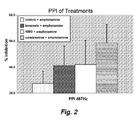
- FIG. 2 Four groups of 10 mice each were treated with sarcosine (200 mg/kg), benzoate (100 mg/kg), a combination of both sarcosine and benzoate (same doses as the individual treatment), or with vehicle for one week before the test. The mice continued to receive the drug until one week later when amphetamatine (10 mg/kg) was administered 30 minutes before the experiments. For PPI, stronger prepulse inhibited pulse response more (inhibition of 525 Hz>487Hz>468Hz). Amphetamine disrupted the inhibition in all treatments.
- Figure 3 Six weeks of adjunctive benzoate vs. placebo treatment in patients receiving risperidone treatment, at weeks 0, 2, 4, and 6, respectively.
- BE benzoate, PANSS total, Positive and Negative Syndrome Scale total score; PANSS-positive, Positive and Negative Syndrome Scale-positive subscale score; SANS, Scales for the Assessment of Negative symptoms.
- a neuropsychiatric disorder particularly a disorder characterized by a deficit inneurotransmission via the NMDA receptor
- a neuropsychiatric disorder particularly a disorder characterized by a deficit inneurotransmission via the NMDA receptor
- a deficit inneurotransmission via the NMDA receptor e.g., schizophrenia, bipolar disorder, Alzheimer's Disease, dementia, mild cognitive impairment, autism, Asperger's disorder, depression, benign forgetfulness, childhood learning disorders, close head injury, and attention deficit disorder, ataxia, spinocerebellar degeneration, Parkinson's disease, obsessive compulsive disorder (OCD), phobia, social phobia, substance abuse, and substance dependence.
- OCD obsessive compulsive disorder
- compositions and methods described herein pertain to the use of "combination" therapies, where the subjects are administered a combination of one or more neuropharmaceuticals (e.g., an antipsychotic, an antidepressant, a phsychostimulant, a mood stablizer, an anxiolytic, an Alzheimer's disease therapeutic, other psychotropics), and/or an NMDA (N-methyl-D-aspartate)-Enhancer, and/or a glycine transporter inhibitor, and/or a D-amino Acid Oxidase Inhibitor (DAAOI).
- neuropharmaceuticals e.g., an antipsychotic, an antidepressant, a phsychostimulant, a mood stablizer, an anxiolytic, an Alzheimer's disease therapeutic, other psychotropics
- NMDA N-methyl-D-aspartate
- DAAOI D-amino Acid Oxidase Inhibitor
- the combination therapy comprises a combination of an NMDA (N- methyl-D-aspartate)-Enhancer, and/or a Glycine Transporter Inhibitor, and/or a DAAOI inhibitor.
- NMDA N- methyl-D-aspartate
- DAAOI DAAOI inhibitor
- the administration of at least two of these agents in conjunction with each other is contemplated, and in certain examples of the disclosure, the administration of all three agents in conjunction with each other is contemplated.
- the agents can be utilized individually as well.
- compositions that provide a prophylactically or therapeutically active amount of benzoic acid, a benzoic acid salt, a benzoic acid ester, or other benzoic acid derivative, and/or sorbic acid, a sorbic acid salt, a sorbic acid ester, or other sorbic acid derivative are provided.
- such compositions can be used for the treatment of a neuropsychiatric disorder and/or for the manufacture for a medicament for the treatment of a neuropsychiatric disorder.
- the DAAOI comprises benzoic acid, a benzoic acid salt, a benzoic acid ester, or other benzoic acid derivative, and/or sorbic acid, a sorbic acid salt, a sorbic acid ester, or other sorbic acid derivative.
- compositions comprising a combination of benzoic acid, a benzoic acid salt, a benzoic acid ester, or other benzoic acid derivative, and/or sorbic acid, a sorbic acid salt, a sorbic acid ester, or other sorbic acid derivative, and a neuropharmaceutical (e.g., an antipsychotic, an antidepressant, an ADHD medication, etc.) are contemplated.
- a neuropharmaceutical e.g., an antipsychotic, an antidepressant, an ADHD medication, etc.
- kits comprising of benzoic acid, a benzoic acid salt, a benzoic acid ester, or other benzoic acid derivative, and/or sorbic acid, a sorbic acid salt, a sorbic acid ester, or other sorbic acid derivative are contemplated.
- the DAAOI and the neuropharmaceutical can be provided in separate containers. In certain examples of the disclosure the DAAOI and the neuropharmaceutical can be provided in the same container (e.g., as a combined/compound formulation).
- a DAAOI alone, especially a benzoic acid, benzoic acid salt, benzoic acid ester or other benzoic acid derivative and/or sorbic acid, a sorbic acid salt, a sorbic acid ester or other sorbic acid derivative can result in unexpected and surprising improvement in subjects diagnosed with a neuropsychiatric disorders.
- a benzoic acid salt, or other derivative and/or a sorbic acid, salt, or other derivative in the treatment of a neuropsychiatric disorder e.g., schizophrenia, bipolar disorder, Alzheimer's disease, dementia, autism, Asperger's disorder, depression, benign forgetfulness, mild cognitive impairment, childhood learning disorders, close head injury, ataxia, spinocerebellar degeneration, Parkinson's disease, general anxiety disorder, panic disorder, obsessive compulsive disorder, phobia including social phobia, substance abuse, substance dependence, attention deficit disorder, etc.
- a neuropsychiatric disorder e.g., schizophrenia, bipolar disorder, Alzheimer's disease, dementia, autism, Asperger's disorder, depression, benign forgetfulness, mild cognitive impairment, childhood learning disorders, close head injury, ataxia, spinocerebellar degeneration, Parkinson's disease, general anxiety disorder, panic disorder, obsessive compulsive disorder, phobia including social phobia, substance abuse, substance dependence, attention deficit disorder, etc.
- medicaments comprising a benzoic acid, benzoic acid salt, benzoic acid ester or other benzoic acid derivative and/or sorbic acid, a sorbic acid salt, a sorbic acid ester or other sorbic acid derivative in an amount sufficient to mitigate one or more symptoms of a neuropsychiatric disorder are contemplated.
- combination treatment(s), e.g., a benzoic acid, benzoic acid salt, benzoic acid ester or other benzoic acid derivative and/or sorbic acid, a sorbic acid salt, a sorbic acid ester or other sorbic acid derivative in combination with one or more neuropharmaceuticals results in unexpected and surprising improvement in subjects diagnosed with a neuropsychiatric disorders.
- methods comprising the administration of benzoic acid, a benzoic acid salt, a benzoic acid ester, or other benzoic acid derivative, and/or sorbic acid, a sorbic acid salt, a sorbic acid ester, or other sorbic acid derivative, in conjunction with one or more neuropharmaceuticals are contemplated.
- medicaments comprising a benzoic acid, benzoic acid salt, benzoic acid ester or other benzoic acid derivative and/or sorbic acid, a sorbic acid salt, a sorbic acid ester or other sorbic acid derivative and one or more neuropharmaceuticals (e.g., agents for the treatment of a condition such as schizophrenia, bipolar disorder, Alzheimer's disease, dementia, autism, Asperger's disorder, depression, benign forgetfulness, mild cognitive impairment, childhood learning disorders, close head injury, ataxia, spinocerebellar degeneration, Parkinson's disease, general anxiety disorder, panic disorder, obsessive compulsive disorder, phobia including social phobia, substance abuse, substance dependence, attention deficit disorder, etc.) are contemplated.
- neuropharmaceuticals e.g., agents for the treatment of a condition such as schizophrenia, bipolar disorder, Alzheimer's disease, dementia, autism, Asperger's disorder, depression, benign forgetfulness, mild cognitive impairment, childhood learning disorders, close head injury, ataxia,
- the benzoic acid, benzoic acid salt, benzoic acid ester, or other benzoic acid derivative, and/or sorbic acid, sorbic acid salt, sorbic acid ester, or other sorbic acid derivative is provided in the method or medicament in an amount sufficient to enhance the efficacy of the neuropharmaceutical.
- the DAAOI enhances the levels of both D-serine and D-alanine which are agonists of NMDA receptor and have been shown by the inventor to be beneficial for patients with schizophrenia and other disorders. It can help a wide variety of patients with cognitive impairment and other mental or behavioral symptoms.
- the combination therapies boost the NMDA and/or neuropharmaceutical activity and benefit subjects more than single agent treatments (e.g., antipsychotic drug, antidepressant, anxiolytic, mood stabilizer, psychotropic medication for attention deficit and hyperactivity disorder, drug for dementia, and the like).
- “combination" therapies are contemplated, where the subjects are administered a benzoic acid, a benzoic acid salt, a benzoic acid ester, or another benzoic acid derivative, and/or a sorbic acid, a sorbic acid salt, sorbic acid ester, or another sorbic acid derivative, in conjunction with a neuropharmaceutical (e.g., a therapeutic agent selected from the group consisting of an antipsychotic, an antidepressant, a phsychostimulant, a mood stabilizer, an anxiolytic, an Alzheimer's disease therapeutic, and/or other psychotropic for the treatment of a neuropsychiatric disorder).
- a neuropharmaceutical e.g., a therapeutic agent selected from the group consisting of an antipsychotic, an antidepressant, a phsychostimulant, a mood stabilizer, an anxiolytic, an Alzheimer's disease therapeutic, and/or other psychotropic for the treatment of a neuropsychi
- the neuropharmaceutical used in the "combination" treatment is an antipsychotic drug.
- the antipsychotic drug is a drug selected from the group consisting of butyrophenone (e.g,.
- Haloperidol HALDOL®
- phenothiazine e.g., chlorpromazine (THORAZINE®)), fluphenazine (PROLIXIN®), perphenazine (TRILAFON®), prochlorperazine (COMPAZINE®), thioridazine (MELLARIL®), trifluoperazine (STELAZINE®), mesoridazine, promazine, triflupromazine (VESPRIN®), levomepromazine (NOZINAN®), promethazine (PHENERGAN®), thioxanthene (e.g., chlorprothixene, flupenthixol (DEPIXOL®, FLUANXOL®), thiothixene (NA VANE®), zuclopenthixol (CLOPIXOL®, ACUPHASE®), clozapine (CLOZARIL®), olanzapine (ZYPREXA®), ris
- the neuropharmaceutical used in the "combination treatment” comprises an antidepressant and/or mood stabilizer.
- the antidepressant comprises a monoamine oxidase inhibitor (MAOI), a tricyclic antidepressant (TCA), a tetracyclic antidepressant (TeCA), a selective serotonin reuptake inhibitor (SSRI), a noradrenergic and specific serotonergic antidepressant (NASSA), a norepinephrine (noradrenaline) reuptake inhibitor, a norepinephrine-dopamine reuptake inhibitor, and/or a serotonin-norepinephrine reuptake inhibitor (SNRI).
- MAOI monoamine oxidase inhibitor
- TCA tricyclic antidepressant
- TeCA tetracyclic antidepressant
- SSRI selective serotonin reuptake inhibitor
- NASSA noradrenergic and specific se
- the antidepressant is a drug selected from the group consisting of a tricyclic antidepressant (e.g., IMIPRAMINE® and variants), a selective serotonin reuptake inhibitor (SSRI) (e.g., fluoxetine (PROZAC®), paroxetine (PAXIL®, SEROXAT®), escitalopram (LEXAPRO®, ESIPRAM®), citalopram (CELEXA®), sertraline (ZOLOFT®), fluvoxamine (LUVOX®)), a serotonin-norepinephrine reuptake inhibitor (SNRI) (e.g., venlafaxine (EFFEXOR®)), milnacipram and duloxetine(CYMBALTA®), a noradrenergic and specific serotonergic antidepressant (NASSA) (e.g., mirtazapine (AVANZA®, ZISPIN®, REMERON®), a noradrene
- the neuropharmaceutical used in the "combination treatment” comprises an agent for the treatment of ADD and/or ADHD.
- suitable ADHD medications include, but are not limited to an ADHD medication selected from the group consisting of Statins Amphetamine, Modafinil, Desoxyn, Methamphetamine, cocaine, arecoline, Dexmethylphenidate (Focalin, Focalin XR), dextroamphetamine (Dexedrine, Dexedrine Spansules, Dextroamphetamine ER, Dextrostat), methylphenidate (Concerta, Daytrana, Metadate CD, Metadate ER, Methylin, Methylin ER, Ritalin, Ritalin-LA, Ritalin-SR), lisdexamfetamine dimesylate (Vyvanse), mixed salts amphetamine (Adderall, Adderall X
- the neuropharmaceutical used in the "combination treatment” can include, but is not limited to an agent selected from the group consisting of Donepezil, Tacrine, Rivastigmine, memantine (AXURA®, AKATINOL®, NAMEND A®, EBIXA®, ABIXA®), aricept, physostigmine, nicotine, arecoline, huperzine alpha, selegiline, rilutek® (riluzole), vitamine c, vitamine e, carotenoids, ginkgo biloba, and the like.
- an agent selected from the group consisting of Donepezil, Tacrine, Rivastigmine, memantine (AXURA®, AKATINOL®, NAMEND A®, EBIXA®, ABIXA®), aricept, physostigmine, nicotine, arecoline, huperzine alpha, selegiline, rilutek® (riluzol
- the benzoic acid, benzoic acid salt, or derivative thereof, and/or sorbic acid, a sorbic acid salt, or a derivative thereof can be administered separately before, after, or simultaneously with one or more the neuropharmaceuticals.
- the benzoic acid, benzoic acid salt, or derivative thereof, and/or sorbic acid, a sorbic acid salt, or a derivative thereof can be provided in one formulation and the neuropharmaceutical(s) in another formulation.
- benzoic acid, benzoic acid salt, or derivative thereof, and/or sorbic acid, a sorbic acid salt, or a derivative thereof is administered simultaneously with the neuropharmaceuticals they can be provided as a combined formulation. Accordingly, in certain examples of the disclosure, corresponding combination therapeutics are also provided.
- a pharmaceutical composition comprising a benzoic acid, benzoic acid salt, benzoic acid ester, or other benzoic acid derivative and/or sorbic acid, a sorbic acid salt, a sorbic acid ester, or other sorbic acid derivative and a neuropharmaceutical (e.g, an antidepressant, an anxiolytic, an antipsychotic drug, etc.), where the benzoic acid, benzoic acid salt, benzoic acid ester, or other benzoic acid derivative and/or sorbic acid, a sorbic acid salt, a sorbic acid ester, or other sorbic acid is present in an amount sufficient to increase the efficacy of neuropharmaceutical (e.g., risperidone, olanzapine, etc.).
- neuropharmaceutical e.g., risperidone, olanzapine, etc.
- formulations comprising a benzoic acid, benzoic acid salt, or derivative thereof (e.g., a benzoate, and/or sorbic acid, sorbic acid salt, or a derivative thereof (e.g., a sorbate); and an antidepressant drug, where the benzoic acid ,benzoic acid salt, or derivative thereof, and/or thereof, and/or sorbic acid, sorbic acid salt, or a derivative thereof, is present in a concentration sufficient to increase the efficacy of the antidepressant drug (e.g., sertraline hydrochloride, fluoxetine hydrochloride, etc.).
- an antidepressant drug e.g., sertraline hydrochloride, fluoxetine hydrochloride, etc.
- formulations comprising the benzoic acid, benzoic acid salt, benzoic acid ester, or other benzoic acid derivative, and/or sorbic acid, sorbic acid salt, sorbic acid ester, or other sorbic acid derivative, and a neuropharmaceutical e.g., as described above.
- the benzoic acid, benzoic acid salt, benzoic acid ester, or other benzoic acid derivative, and/or sorbic acid, sorbic acid salt, sorbic acid ester, or other sorbic acid derivative is present in an amount sufficient to increase the efficacy of the neuropharmaceutical (e.g., Aricept, memantine, etc.).
- the combination formulation for the treatment of schizophrenia, bipolar disorder, and the like comprises a combination of benzoic acid, benzoic acid salt, benzoic acid ester, or other benzoic acid derivative, and/or sorbic acid, sorbic acid salt, sorbic acid ester, or other sorbic acid derivative and an antipsychotic drug.
- Suitable antipsychotic drugs include, but are not limited to the antipsychotic drugs described above.
- the combination formulation for the treatment of schizophrenia, bipolar disorder, and the like comprises a combination of depression, panic disorder, social phobial, GAD, and the like comprises a combination of benzoic acid, benzoic acid salt, benzoic acid ester, or other benzoic acid derivative, and/or sorbic acid, sorbic acid salt, sorbic acid ester, or other sorbic acid derivative and an antidepressant and/or mood stabilizer.
- Suitable antidepressants and mood stabilizers include, but are not limited to the antidepressants and mood stabilizers described above.
- the combination formulation for the treatment of ADD and/or ADHD, and the like comprises a combination of benzoic acid, benzoic acid salt, benzoic acid ester, or other benzoic acid derivative, and/or sorbic acid, sorbic acid salt, sorbic acid ester, or other sorbic acid derivative and an agent for the treatment of ADD and/or ADHD.
- Suitable agents for the treatment of ADD and/or ADHD include, but are not limited to the agents for the treatment of ADD and/or ADHD described above.
- the combination formulation for the treatment of a cognitive disorder, and/or a condition characterized by neurodegeneration comprises a combination of benzoic acid, benzoic acid salt, benzoic acid ester, or other benzoic acid derivative, and/or sorbic acid, sorbic acid salt, sorbic acid ester, or other sorbic acid derivative and an agent for the treatment of a cognitive disorder, and/or a condition characterized by neurodegeneration.
- Suitable agents for the treatment of a cognitive disorder, and/or a condition characterized by neurodegeneration include, but are not limited to the agents for the treatment of a cognitive disorder, and/or a condition characterized by neurodegeneration described above.
- the benzoic acid, benzoic acid salt, or derivative thereof e.g., a benzoate
- sorbic acid, a sorbic acid salt, or a derivative thereof is present in an amount sufficient to enhance therapeutic efficacy of the neuropharmaceutical rather than as a preservative, and/or melting point lowering agent, and/or stabilizer, and/or a lubricant, and/or a stabilizer, etc.
- the benzoic acid, benzoic acid salt, or derivative thereof, and/or sorbic acid, sorbic acid salt, or a derivative thereof is an active agent.
- the benzoic acid, benzoic acid salt, benzoic acid ester, or other benzoic acid derivative, and/or sorbic acid, sorbic acid salt, sorbic acid ester, or other sorbic acid derivative is not substantially present as an acid addition salt of the neuropharmaceutical (or at least the majority of the benzoic or sorbic acid or derivative thereof) is not present as an acid salt addition salt of the neuropharmaceutical.
- the benzoic acid, benzoic acid salt, benzoic acid ester, or other benzoic acid derivative, and/or sorbic acid, sorbic acid salt, sorbic acid ester, or other sorbic acid derivative, (or at least the majority of the benzoic or sorbic acid or derivative thereof) is not present as a co-crystal of the neuropharmaceutical.
- the ratio of benzoic acid, benzoic acid salt, benzoic acid ester, or other benzoic acid derivative, and/or sorbic acid, sorbic acid salt, sorbic acid ester, or other sorbic acid derivative, to neuropharmaceutical is stoichiometrically greater than 2:1, preferably greater than about 3:1, 4:1, 5:1, 6;1, 7:1, 8:1, 9;1, 10:1, 15:1, or 20:1.
- the benzoic acid, benzoic acid salt, benzoic acid ester, or other benzoic acid derivative, and/or sorbic acid, sorbic acid salt, sorbic acid ester, or other sorbic acid derivative, combinations expressly exclude a psychoactive pharmaceutical other than an antipsychotic and/or antidepressant and/or therapeutic for attention deficit and hyperactivity disorder and/or therapeutic for dementia.
- the benzoic acid, benzoic acid salt, benzoic acid ester, or other benzoic acid derivative, and/or sorbic acid, sorbic acid salt, sorbic acid ester, or other sorbic acid derivative, is typically provided in an amount sufficient to improve the therapeutic efficacy of the neuropharmaceutical (e.g, antipsychotic and/or antidepressant and/or therapeutic for attention deficit and hyperactivity disorder and/or therapeutic for dementia).
- the neuropharmaceutical e.g, antipsychotic and/or antidepressant and/or therapeutic for attention deficit and hyperactivity disorder and/or therapeutic for dementia.
- typical dosages of the benzoic acid, benzoic acid salt, benzoic acid ester, or other benzoic acid derivative, and/or sorbic acid, sorbic acid salt, sorbic acid ester, or other sorbic acid derivative range from range is from about 5 mg, to about 500 grams, more preferably about 25 mg to about 400, 300 grams, 200 grams, or 100 grams, still more preferably about 50 mg to 50 or to 100 or 150 grams.
- neuropsychiatric disorders present with cognitive deficits, behavioral and mental symptoms.
- the various treatment strategies described herein can be applied to most if not all of them including, for example, learning disorder, attention deficit and hyperactivity disorder, schizophrenia, bipolar disorder, depression, Alzheimer's Disease, autism, benign forgetfulness, close head injury, dementia, mild cognitive impairment, ataxia, spinocerebellar degeneration, Parkinson's disease, obsessive compulsive disorder (OCD), phobia, social phobia, generalized anxiety disorder (GAD), panic disorder, substance abuse, and substance dependence.
- the treatments described herein can be used in veterinary applications (e.g., to canines, felines, equines, bovines, porcines, etc.) with treatment of household pets (e.g., canine, feline) being of considerable interest.
- veterinary applications e.g., to canines, felines, equines, bovines, porcines, etc.
- household pets e.g., canine, feline
- the combination treatments described herein can improve cognition in animal models of learning and model of schizophrenia, depression, anxiety, and the like.
- the treatment methods of the disclosure entail administering to a subject in need thereof (e.g., a patient diagnosed as having or at risk for a neuropsychiatric disorder) one or more a pharmaceutical compositions containing a therapeutically effective amount(s) of (i) an NMDA (N-methyl-D-aspartate)-Enhancer, and/or (ii) a glycine transporter inhibitor, and/or (iii) a D-amino Acid Oxidase Inhibitor (DAAOI).
- a subject in need thereof e.g., a patient diagnosed as having or at risk for a neuropsychiatric disorder
- agents can be administered separately (simultaneously or sequentially), in a single "combination" formulation, or in simultaneously or sequentially a combination formulation comprising two agents and a second formulation comprising a single agent.
- the effective doses of the active agent(s) can vary, depending upon factors such as the condition of the patient, the severity of the symptoms of the disorder, and the manner in which the pharmaceutical composition is administered.
- the effective unit dose of typical compounds include: DAAOI (e.g., benzoate, range of 50 mg-150 grams), NMDA enhancers (D-serine, range of 50 mg-50 grams; D-alanine, range 1-150 grams), glycine transporter inhibitor (for example: sarcone, range 50 mg-50 grams); including DAAOI+NMDA enhancer, DAAOI+glycine transporter inhibitor, NMDA enhancers +glycine transporter inhibitor or three classes of compound together.
- DAAOI e.g., benzoate, range of 50 mg-150 grams
- NMDA enhancers D-serine, range of 50 mg-50 grams
- D-alanine range 1-150 grams
- glycine transporter inhibitor for example: sarcone, range 50 mg-50 grams
- DAAOI+NMDA enhancer DAAOI+glycine transporter inhibitor
- NMDA enhancers +glycine transporter inhibitor or three classes of compound together.
- effective doses of each of the active agent(s) ranges from 1 mg, 10 mg, 50 mg, 100 mg, 250 mg, or 500 mg, 300 g, 200g, 150 g, 100 g, 50 g, 25 g, 10g, 5 g, or 1 g depending of factors including, but not limited to 150 g.
- the compounds and compositions of the present disclosure can be administered to a patient at dosage levels in the range of about 0.1 to about 1,000 mg per day. For a normal human adult having a body weight of about 70 kilograms, it is estimated that a dosage in the range of about 0.01 to about 100 mg per kilogram of body weight per day is sufficient. The specific dosage used, however, can vary.
- the dosage can depend on a numbers of factors including the requirements of the patient, the severity of the condition being treated, and the pharmacological activity of the compound being used.
- the determination of optimum dosages for a particular patient is well-known to those skilled in the art.
- the amount of active ingredient(s) that may be combined with the carrier materials to produce a single dosage form will vary depending upon the host treated and the particular mode of administration. It will be understood, however, that the specific dose level for any particular patient will depend upon a variety of factors including the activity of the specific compound(s) employed, the age, body weight, general health, sex, diet, time of administration, route of administration, and rate of excretion, drug combination and the severity of the particular disease undergoing therapy.
- appropriate dosages of the active agent(s) can readily be determined by those of ordinary skill in the art of medicine by monitoring the patient for signs of disease amelioration or inhibition, and increasing or decreasing the dosage and/or frequency of treatment as desired.
- an amount equivalent to a dosage of about 10 mg to about 50g /day, more preferably about 10 mg to about 10 g/day is administered to a patient in need of such treatment.
- the dosage can be in an amount of 10 mg, 50 mg, 100 mg, 200 mg, 300 mg, such as 150 to 300 mg (e.g., 175 mg, 200 mg, 225 mg, or 250 mg).
- treatment continues for at least one week and can continue for several years or life-long as needed to control the subject's symptoms.
- compositions can be administered to the subject (e.g., patient) by any, or a combination, of several routes, such as oral, intravenous, trans-mucosal (e.g., nasal, vaginal, etc.), pulmonary, transdermal, transnasal, ocular, buccal, sublingual, intraperitoneal, intrathecal, intramuscular, or long term depot preparation.
- routes such as oral, intravenous, trans-mucosal (e.g., nasal, vaginal, etc.), pulmonary, transdermal, transnasal, ocular, buccal, sublingual, intraperitoneal, intrathecal, intramuscular, or long term depot preparation.
- solid compositions for oral administration can contain suitable carriers or excipients, such as corn starch, gelatin, lactose, acacia, sucrose, microcrystalline cellulose, kaolin, mannitol, dicalcium phosphate, calcium carbonate, sodium chloride, lipids, alginic acid, or ingredients for controlled slow release.
- suitable carriers or excipients such as corn starch, gelatin, lactose, acacia, sucrose, microcrystalline cellulose, kaolin, mannitol, dicalcium phosphate, calcium carbonate, sodium chloride, lipids, alginic acid, or ingredients for controlled slow release.
- Disintegrators include, without limitation, micro-crystalline cellulose, corn starch, sodium starch glycolate and alginic acid.
- Tablet binders that can be used include, without limitation, acacia, methylcellulose, sodium carboxymethylcellulose, polyvinylpyrrolidone (Povidone), hydroxypropyl methylcellulose, sucrose, starch
- liquid compositions for oral administration prepared in water or other aqueous vehicles can include solutions, emulsions, syrups, and elixirs containing, together with the active compound(s), wetting agents, sweeteners, coloring agents, and flavoring agents.
- Various liquid and powder compositions can be prepared by conventional methods for inhalation into the lungs of the patient to be treated.
- injectable compositions can contain various carriers such as vegetable oils, dimethylacetamide, dimethylformamide, ethyl lactate, ethyl carbonate, isopropyl myristate, ethanol, polyols (glycerol, propylene glycol, liquid polyethylene glycol, and the like).
- the compounds may be administered by the drip method, whereby a pharmaceutical composition containing the active compound(s) and a physiologically acceptable excipient is infused.
- Physiologically acceptable excipients may include, for example, 5% dextrose, 0.9% saline, Ringer's solution or other suitable excipients.
- a sterile composition of a suitable soluble salt form of the compound can be dissolved and administered in a pharmaceutical excipient such as Water-for- Injection, 0.9% saline, or 5% glucose solution, or depot forms of the compounds (e.g., decanoate, palmitate, undecylenic, enanthate) can be dissolved in sesame oil.
- a pharmaceutical excipient such as Water-for- Injection, 0.9% saline, or 5% glucose solution
- depot forms of the compounds e.g., decanoate, palmitate, undecylenic, enanthate
- the pharmaceutical composition can be formulated as a chewing gum, lollipop, or the like.
- such formulations contain at least two of the following three active agent(s): (i) an NMDA (N-methyl-D-aspartate)-Enhancer, and/or (ii) a glycine transporter inhibitor, and/or (iii) a D-amino Acid Oxidase Inhibitor (DAAOI).
- all three active agent(s) are present in a single formulation.
- the different components can be segregated, for example, in different layers of a tablet, in different microbeads/microcapsules, and the like.
- two of more of the active agents are intermixed and/or suspended, e.g., in a single excipient.
- the different active agent(s) will be provided each in a therapeutically effective dose.
- D-amino Acid Oxidase Inhibitor (DAAOI)
- DAAOIs D-amino Acid Oxidase Inhibitors
- Suitable DAAO inhibitors include, for example, but are not limited to benzoic acid and derivatives, sorbic acid and derivatives, 2-oxo-3-pentynoate; Aminoguanidine (Guanylhydrazine; Carbamimidic hydrazide; Pimagedine; GER 11; Hydrazinecarboximidamide) or hydrochloride salt (Guanylhydrazine hydrochloride), bicarbonate salt, nitrate salt, sulfate (2:1) salt, sulfate (1:1) salt, and hemisulfate salt thereof; benzoic acid; sodium benzoate; 2- aminobenzoate; 3-aminobenzoate; 4-aminobenzoate (p-aminobenzoate, PABA, Vitamin Bx, Vitamin H1); Methylglyoxal bis(
- Phenothiazine (Thiodiphenylamine, 10H-Phenothiazine, AFI-Tiazin, Agrazine, Antiverm, Dibenzo-1,4-thiazine); 3,4-Dihydro-2H-1,4-thiazine-3,5-dicarboxylic acid (3,4-Dhtca, CAS#86360-62-5); Nifurtimox (Nifurtimox[BANrINN], 1-((5-Nitrofurfurylidene)amino)-2-methyltetrahydro-1,4-thiazine-4,4-dioxide, 3-Methyl-4-(51-nitrofurylidene-amino)-tetrahydro-4H-1,4-thiazine-1,1-dioxide, BAY 2502, 4-((5-Nitrofurfurylidene)amino)-3-methylthiomorpholine 1,1-dioxide); 3-(1-
- preferred DAAOIs include, but are not limited to a benzoic acid , benzoic acid salt, benzoic acid ester and/ or a derivative thereof, and/or sorbic acid, a sorbic acid salt, or a derivative thereof.
- Illustrative benzoic acid salts include, but are not limited to sodium benzoate, potassium benzoate, calcium benzoate, lithium benzoate, magnesium benzoate, zinc benzoate, and the like.
- the benzoate is selected from the group consisting of benzoic acid; sodium benzoate; 2- aminobenzoate; 3-aminobenzoate; 4-aminobenzoate (p-aminobenzoate, PABA, Vitamin Bx, Vitamin H1, and benzo[d]isoxazol-3-ol derivatives ⁇ see, e.g., U.S. Patent 7,166,725 , PCT Publication WO 03/047558 , and US Patent Publication No: 2003/0185754 A1 , and the like.
- the compounds discloses in U.S. Patent 7,166,725 , PCT Publication WO 03/047558 , and US Patent Publication No: 2003/0185754 A1 are expressly excluded.
- Illustrative sorbic acid (2,4-hexadienoic acid) salts include, but are not limited to sodium sorbate, potassium sorbate, calcium sorbate.
- Other sorbic acid derivatives include, but are not limited to sorbohydroxamic acid, sorbic aldehyde, sorbic acid-thiol adducts, 8-quinolinylsorbate, m-nitrosorbanilide, and the like.
- NMDA enhancers suitable for use in certain methods of the present disclosure are well known to those of skill in the art.
- Suitable NMDA enhancers include, for example, but are not limited to D-alanine, a salt of D-alanine, an ester of D-alanine, an alkylated D- alanine, a precursor of D-alanine, D-serine, a salt of D-serine, an alkylated D-serine, a precursor of D-serine, D-cycloserine, a salt of D-cycloserine, an ester of D-cycloserine, a precursor of D-cycloserine, an alkylated D-cycloserine, N,N-dimethylglycine, a salt of N,N-dimethylglycine, an ester of N,N-dimethylglycine, an alkylated N,N-dimethylglycine, and N,N,N-tri
- the composition is substantially free of D- cycloserine when the agonist is D-alanine, a salt of D-alanine, an ester of D-alanine, an alkylated D-alanine, or a precursor of D-alanine; and when the agonist is D-cycloserine, a salt of D-cycloserine, an ester of D-cycloserine, a precursor of D-cycloserine, or alkylated D-cycloserine, the pharmaceutical composition comprises an amount of the agonist equivalent to 105-500 mg of D-cycloserine.
- Glycine transporter inhibitors suitable for use in the methods of the present disclosure are well known to those of skill in the art.
- Suitable glycine transporter inhibitors include, but are not limited to sarcosine (N-methyl glycine), N-[3-(4'-fluorophenyl)-3-(4'-phenylphenoxy)propyl] sarcosine, (+)N[3-(4'-fluorophenyl)-3-(4'-phenylphenoxy)propyl]sarcosine (NFPS), pyridyl, pyridazinyl, pyrimidinyl and pyrazinyl piperidine compunds ⁇ see, e.g., WO/2005/094514 , Pinard et al.
- glycine transporter inhibitors include, but are not limited to N- ⁇ 3-[5-Cyano-1-(4-fluorophenyl)-1,3-dihydroisobenzofuran-1-yl]-1-propyl ⁇ glycine ethyl ester, N- ⁇ 3-[5-Cyano-1-(4-fluorophenyl)-1,3-dihydroisobenzofuran-l-yl]-1-propyl ⁇ -N-methylglycine ethyl ester, N- ⁇ 3-[5-Cyano-1-(4-fluorophenyl)-1,3-dihydroisobenzofuran-1-yl]-1-propyl ⁇ gl ycine, N- ⁇ 3-[5-Cyano-1-(4-fluorophenyl)-1,3-dihydroisobenzofuran-1-yl]-1-propyl ⁇ -N-methylglycine, N-
- the methods can involve administering additional neuropharmaceuticals and other therapeutic agents instead of or in conjunction with the agents described above.
- such agents include, but are not limited to diazepam, bromazepam, prazepam, Chlordiazepoxide, Clobazam, Estazolam, Flurazepam,Clonazepam, Temazepam, Triazolam, Alprazolam, Midazolam, Brotizolam, Nitrazepam, Flunitrazepam, Oxazepam, Quazepam, Lorazepam, Temazepam, Triazolam, Zolpidem, Zopiclone, Zaleplon, Chlorpromazine, Thioridazine, Mesoridazine, Fluphenazine, Perphenazine, Trifluoperazine, Thiothixene, Haloperidol, Loxapine, Molindone, Clozapine, Risperidone, Olanzapine, Quetiapine, Haloperidol decanoate, Fluphenazine decano
- the agents described herein e.g., benzoic acid, benzoic acid salt, or derivative thereof and/or sorbic acid, sorbic acid salt, or derivative thereof
- a neuropharmaceutical e.g., as described herein
- the agents are commercially available in suitable pharmaceutically acceptable formulations.
- the agents e.g., benzoic acid, benzoic acid salt, benzoic acid ester, or other benzoic acid derivative and/or sorbic acid, sorbic acid salt, sorbic acid ester, or other sorbic acid derivative, and neuropharmaceutical (e.g., antidepressant, antipsychotic, phsychostimulant, mood stablizers, anxiolytic, ADHD therapeutic, Alzheimer's disease therapeutic, and other psychotropics etc.) are provided as a combined formulations for administration by any of a variety of modalities including, but not limited to oral administration, rectal administration, injection, transdermal administration, subcutaneous depot administration, transnasal administration, and the like.
- neuropharmaceutical e.g., antidepressant, antipsychotic, phsychostimulant, mood stablizers, anxiolytic, ADHD therapeutic, Alzheimer's disease therapeutic, and other psychotropics etc.
- the active agent(s) e.g., benzoic acid, salt or derivative, and/or sorbic acid, salt, or derivative, and antipsychotic
- the active agent(s) can be combined with one or more excipients and used in the form of ingestible tablets, buccal tablets, troches, capsules, elixirs, suspensions, syrups, wafers, and the like.
- wafer formulations for example, different layers comprising the wafer can contain different agents.
- time-release capsules can comprise multiple active agents.
- Such compositions and preparations are typically formulated to deliver the desired concentration of agent(s) over the desired time period.
- the active agents can be combined into a single injectable formulation.
- kits treating (e.g., mitigating one or more symptoms of) a neuropsychiatric disorder.
- the kits preferably comprise a container or containers containing the combinations of active agents described herein, either a separate formulations or as a single “combined" formulation.
- the agent(s) can be provided in a unit dosage formulation (e.g. suppository, tablet, caplet, patch, etc.) and/or may be optionally combined with one or more pharmaceutically acceptable excipients.
- kits comprise benzoic acid, a benzoic acid salt, or a derivative thereof and/or sorbic acid, a sorbic acid salt, or a derivative thereof, and a neuropharmaceutical (e.g., an antipsychotic).
- the agents can be in separate containers or in the same container.
- kits optionally include labeling and/or instructional materials providing directions (i.e., protocols) for the practice of the methods or use of the "therapeutics” or “prophylactics” of this disclosure.
- Preferred instructional materials describe the use of combinations of agents as described herein to mitigate symptom(s) of a neuropsychiatric disorder and/or to prevent the onset or increase of one or more of such symptoms in an individual at risk for such a disorder.
- the instructional materials can also, optionally, teach preferred dosages/therapeutic regiment, counter indications and the like.
- instructional materials typically comprise written or printed materials they are not limited to such. Any medium capable of storing such instructions and communicating them to an end user is contemplated by this disclosure. Such media include, but are not limited to electronic storage media (e.g., magnetic discs, tapes, cartridges, chips), optical media (e.g., CD ROM), and the like. Such media may include addresses to internet sites that provide such instructional materials.
- electronic storage media e.g., magnetic discs, tapes, cartridges, chips
- optical media e.g., CD ROM
- Such media may include addresses to internet sites that provide such instructional materials.
- the startle response is comprised of a constellation of reflexes elicited by sudden relatively intense stimuli. It offers many advantages as a behavioral measure of central nervous system activity when elicited by acoustic (noise burst), electrical (cutaneous), tactile (air puff), or visual (light flash) stimuli.
- the startle reflex has served as a tool for studying fundamental properties of nervous function of complex behavioral states and cognitive processes.
- the forebrain modulates several forms of startle plasticity including the habituation and PPI. Changes in startle magnitude through repeated stimulus presentations- habituation and sensitization-represent the simple forms of learning. Quantification of startle habituation and sensitization in rodent has direct physiological relevance to human CNS function. In fact, the most well accepted animal physiology models for schizophrenia are startle habituation and PPI.
- startle magnitude is reduced when the pulse stimulus is preceded 30 to 500 msec by a weak prepulse.
- This inhibition ("gating") of a motor response elicited by a weak sensory event, termed PPI provides an operational measure of sensorimotor gating.
- Prepulse stimuli of 3, 6, or 12 dB above the 70 dB background noise inhibit the startle response elicited by 120-dB pulse stimuli.
- Prestimuli used in intramodal studies of sensorimotor gating of acoustic startle are by the delivery of a discrete acoustic prepulse several msec before the startle pulse, with an intensity below startle threshold. Holding the interval between the prepulse and pulse stimuli constant at 100 msec typically yields suitable levels of PPI, ranging from 20% to 80% inhibition.
- the three prepulse stimuli were with a duration of 20 msec.
- the following metrics were determined: 1) Average response magnitude on pulse-only trials 1 to 6 and 32 to 36; 2)Average response magnitude in each of the four trial types between trials 7 and 31 inclusively (i.e., ten pulse- only trials and five each of the three prepulse variations).
- the first block of pulse-only trials were analyzed as measures of startle reactivity.
- the first and last blocks of pulse-only trials were analyzed together in a repeated measure ANOVA to assess habituation of acoustic startle across the test session.
- mice Male 129 SVE adult mice were first tested at baseline. Four groups of 10 mice each were treated with sarcosine (200 mg/kg), benzoate (100 mg/kg), a combination of both sarcosine and benzoate (same doses as the individual treatment), or with vehicle for one week before the test. The mice continued to receive the drug until one week later when amphetamatine (10 mg/kg) was administered 30 minutes before the experiments.
- the combination treatment corrected the amphetamine- induced disruption of habituation back to normal state while single treatment of NMG or benzoate partially correct the deficit ( Figure 1 , right group).
- the effect of benzoate, however, is better than sarcosine and close to effect seen in the combination treatment.
- Schizophrenia is a devastating mental disorder with high morbidity and mortality, affecting about 1% of the population worldwide. Furthermore, care for schizophrenia is extremely expensive in terms of direct and indirect costs. Clinical manifestation of schizophrenia consists of three domains: positive symptoms, negative symptoms, and neuropsychological deficits that are poorly addressed today.
- the research protocol was approved by the Institutional Review Boards (IRB) of the institute. Patients were screened and evaluated by the research psychiatrists. After complete description of the study to the subjects, written informed consent was obtained in line with the IRB's guidelines. The Structured Clinical Interview for DSM-IV was conducted for the diagnosis.
- Patients entered into this study if they 1) were physically healthy and had all laboratory assessments (including urine/blood routine, biochemical tests, and electrocardiograph) within normal limits, 2) aged 18-60 years, 3) satisfied DSM-IV criteria for schizophrenia (2), 4) had no DSM-IV diagnosis of substance (including alcohol) abuse or dependence, 5) consistently symptomatic without fluctuation and the antipsychotic doses were unchanged for at least 3 months, and 6) had a minimum baseline total score of 60 on the Positive and Negative Syndrome Scale (PANSS) (3).
- PANSS Positive and Negative Syndrome Scale
- the dosing for the concurrent antipsychotics was an optimal dosing strategy which minimize side effects, especially extrapyramidal side effects (EPS), and can still yield favorable efficacy.
- EPS extrapyramidal side effects
- patients' antipsychotic doses remained constant for at least three months prior to the enrollment of the study and remained on the same antipsychotic regimens for the study period. All patients are treated with atypical antipsychotics, risperidone in majority.
- the primary outcome measures were psychopathology changes measured by PANSS (3) and, Scales for the Assessment of Negative symptoms (SANS) (4) total scores, Quality of Life scale (10 items for inpatient use) (1, 5), and Global Assessment of Function (Axis V in DSM IV) (2).
- SANS Scales for the Assessment of Negative symptoms
- a secondary analysis aimed to explore whether the positive results (if any) from the PANSS or SANS were due to a general effect on all components or to an effect on a specific component(s).
- RBC risperidone-benzoate combination
- the animals were subjected to the forced swim test (FST).
- FST forced swim test
- the method of the FST has been used in previous animal studies of depression, which was modified by Cryan from the Porsolt's FST. (Porsolt et al, 1977; Cryan et al, 2002)
- the test was performed using a acrylic cylinder (diameter, 20 cm; height, 40 cm) filled to a height of 30 cm with 25°C water. Rats were processed to a 15-min conditioning swim. Following 24h after their first exposure, the rats were again placed in the swim apparatus for 5 min. The behavior of rats was observed 5 min after the administration of various drug treatments or 0.9% saline (control).
- the table indicates the scores on the behavioral scales of FST in three treatment groups. As can be seen, both sodium benzoate and potassium sorbate decrease the duration of immobility significantly as compared to the vehicle control group.
Landscapes
- Health & Medical Sciences (AREA)
- Life Sciences & Earth Sciences (AREA)
- Veterinary Medicine (AREA)
- General Health & Medical Sciences (AREA)
- Public Health (AREA)
- Animal Behavior & Ethology (AREA)
- Medicinal Chemistry (AREA)
- Chemical & Material Sciences (AREA)
- Pharmacology & Pharmacy (AREA)
- Epidemiology (AREA)
- Emergency Medicine (AREA)
- Natural Medicines & Medicinal Plants (AREA)
- Engineering & Computer Science (AREA)
- Pain & Pain Management (AREA)
- Microbiology (AREA)
- Inorganic Chemistry (AREA)
- Mycology (AREA)
- Medical Informatics (AREA)
- Botany (AREA)
- Biotechnology (AREA)
- Alternative & Traditional Medicine (AREA)
- Neurosurgery (AREA)
- Chemical Kinetics & Catalysis (AREA)
- General Chemical & Material Sciences (AREA)
- Neurology (AREA)
- Nuclear Medicine, Radiotherapy & Molecular Imaging (AREA)
- Biomedical Technology (AREA)
- Organic Chemistry (AREA)
- Bioinformatics & Cheminformatics (AREA)
- Acyclic And Carbocyclic Compounds In Medicinal Compositions (AREA)
- Medicines That Contain Protein Lipid Enzymes And Other Medicines (AREA)
- Pharmaceuticals Containing Other Organic And Inorganic Compounds (AREA)
Priority Applications (4)
| Application Number | Priority Date | Filing Date | Title |
|---|---|---|---|
| EP15192644.1A EP3006024B1 (en) | 2009-01-20 | 2010-01-19 | Benzoic acid or salts thereof to enhance the activity of a neuropharmaceutical |
| EP15192647.4A EP3006023B1 (en) | 2009-01-20 | 2010-01-19 | Sorbic acid and derivatives thereof to enhance the activity of a neuropharmaceutical |
| HRP20170089TT HRP20170089T1 (hr) | 2009-01-20 | 2010-01-19 | Sorbinska i benzojeva kiselina i njihovi derivati pojačavaju aktivnost neurofarmaceutskog proizvoda |
| DK15192644.1T DK3006024T3 (da) | 2009-01-20 | 2010-01-19 | Benzoesyre eller salte deraf til forstærkning af aktiviteten af et neurofarmaceutisk lægemiddel |
Applications Claiming Priority (2)
| Application Number | Priority Date | Filing Date | Title |
|---|---|---|---|
| US14593109P | 2009-01-20 | 2009-01-20 | |
| PCT/US2010/021420 WO2010085452A1 (en) | 2009-01-20 | 2010-01-19 | Sorbic and benzoic acid and derivatives thereof enhance the activity of a neuropharmaceutical |
Related Child Applications (4)
| Application Number | Title | Priority Date | Filing Date |
|---|---|---|---|
| EP15192644.1A Division-Into EP3006024B1 (en) | 2009-01-20 | 2010-01-19 | Benzoic acid or salts thereof to enhance the activity of a neuropharmaceutical |
| EP15192644.1A Division EP3006024B1 (en) | 2009-01-20 | 2010-01-19 | Benzoic acid or salts thereof to enhance the activity of a neuropharmaceutical |
| EP15192647.4A Division-Into EP3006023B1 (en) | 2009-01-20 | 2010-01-19 | Sorbic acid and derivatives thereof to enhance the activity of a neuropharmaceutical |
| EP15192647.4A Division EP3006023B1 (en) | 2009-01-20 | 2010-01-19 | Sorbic acid and derivatives thereof to enhance the activity of a neuropharmaceutical |
Publications (3)
| Publication Number | Publication Date |
|---|---|
| EP2389187A1 EP2389187A1 (en) | 2011-11-30 |
| EP2389187A4 EP2389187A4 (en) | 2013-12-04 |
| EP2389187B1 true EP2389187B1 (en) | 2016-11-16 |
Family
ID=42354348
Family Applications (3)
| Application Number | Title | Priority Date | Filing Date |
|---|---|---|---|
| EP10733788.3A Active EP2389187B1 (en) | 2009-01-20 | 2010-01-19 | Sorbic and benzoic acid and derivatives thereof enhance the activity of a neuropharmaceutical |
| EP15192644.1A Active EP3006024B1 (en) | 2009-01-20 | 2010-01-19 | Benzoic acid or salts thereof to enhance the activity of a neuropharmaceutical |
| EP15192647.4A Active EP3006023B1 (en) | 2009-01-20 | 2010-01-19 | Sorbic acid and derivatives thereof to enhance the activity of a neuropharmaceutical |
Family Applications After (2)
| Application Number | Title | Priority Date | Filing Date |
|---|---|---|---|
| EP15192644.1A Active EP3006024B1 (en) | 2009-01-20 | 2010-01-19 | Benzoic acid or salts thereof to enhance the activity of a neuropharmaceutical |
| EP15192647.4A Active EP3006023B1 (en) | 2009-01-20 | 2010-01-19 | Sorbic acid and derivatives thereof to enhance the activity of a neuropharmaceutical |
Country Status (12)
| Country | Link |
|---|---|
| US (5) | US9649304B2 (enExample) |
| EP (3) | EP2389187B1 (enExample) |
| JP (1) | JP5675650B2 (enExample) |
| CN (1) | CN102292094B (enExample) |
| AU (1) | AU2010206886B2 (enExample) |
| BR (1) | BRPI1007173A2 (enExample) |
| CA (2) | CA3037010A1 (enExample) |
| DK (2) | DK3006024T3 (enExample) |
| ES (2) | ES2615884T3 (enExample) |
| HR (2) | HRP20170089T1 (enExample) |
| MX (3) | MX353752B (enExample) |
| WO (1) | WO2010085452A1 (enExample) |
Families Citing this family (45)
| Publication number | Priority date | Publication date | Assignee | Title |
|---|---|---|---|---|
| MX353752B (es) | 2009-01-20 | 2018-01-26 | Los Angeles Biomedical Res Inst Harbor Ucla Medical Ct | Los ácidos sórbico y benzoico y sus derivados aumentan la actividad de un neurofármaco. |
| WO2011017319A1 (en) * | 2009-08-03 | 2011-02-10 | University Of Pittsburgh - Of The Commonwealth System Of Higher Education | Methods of treating disorders associated with protein polymerization |
| US9072772B2 (en) | 2009-11-05 | 2015-07-07 | University of Pittsburgh—of the Commonwealth System of Higher Education | Methods of treating disorders associated with protein aggregation |
| US8809617B2 (en) | 2009-11-05 | 2014-08-19 | The University of Pittsburgh—Of the Commonwealth System of Higher Education | Automated high-content live animal drug screening using C. elegans |
| JP5751109B2 (ja) * | 2011-09-20 | 2015-07-22 | ニプロ株式会社 | 生体試料中の馬尿酸およびメチル馬尿酸のそれぞれの濃度を測定する方法 |
| WO2014025814A1 (en) * | 2012-08-06 | 2014-02-13 | S1 Pharmaceuticals, Inc. | Treatment regimens |
| US9265458B2 (en) | 2012-12-04 | 2016-02-23 | Sync-Think, Inc. | Application of smooth pursuit cognitive testing paradigms to clinical drug development |
| US9380976B2 (en) | 2013-03-11 | 2016-07-05 | Sync-Think, Inc. | Optical neuroinformatics |
| WO2014168727A1 (en) * | 2013-03-15 | 2014-10-16 | Shire Llc | Fixed dose combination treatment for schizophrenia |
| KR102162073B1 (ko) * | 2014-03-24 | 2020-10-07 | 가오슝 창 궁 메모리얼 하스피털 | 치매 또는 경도 인지 장애의 예방 또는 치료용 조성물의 제조에 사용하는 벤조산염의 용도 |
| JP7001593B2 (ja) | 2015-08-11 | 2022-01-19 | コグノア, インコーポレイテッド | 人工知能およびユーザ入力を用いて発達進度を判定するための方法および装置 |
| US11972336B2 (en) | 2015-12-18 | 2024-04-30 | Cognoa, Inc. | Machine learning platform and system for data analysis |
| US10653639B2 (en) | 2016-05-16 | 2020-05-19 | Cv Sciences, Inc. | Pharmaceutical formulations containing cannabidiol and nicotine for treating smokeless tobacco addiction |
| CA3027290A1 (en) * | 2016-06-13 | 2017-12-21 | Syneurx International (Taiwan) Corp. | Use of lithium benzoate for treating central nervous system disorders |
| ES2936094T3 (es) * | 2016-06-13 | 2023-03-14 | Syneurx Int Taiwan Corp | Cocristales de benzoato de sodio y usos de los mismos |
| RU2765625C2 (ru) | 2016-06-13 | 2022-02-01 | Сайньюрекс Интернэшнл (Тайвань) Корп. | Сокристаллы бензоата лития и их применения |
| CA3037531A1 (en) * | 2016-09-23 | 2018-03-29 | Delpor, Inc. | Compositions for small molecule therapeutic agent compounds |
| US10336679B2 (en) * | 2016-10-24 | 2019-07-02 | Syneurx International (Taiwan) Corp. | Polymorphic forms of sodium benzoate and uses thereof |
| US11369579B2 (en) | 2016-10-24 | 2022-06-28 | Syneurx International (Taiwan) Corp. | Polymorphic forms of sodium benzoate and uses thereof |
| CN118609834A (zh) * | 2016-11-14 | 2024-09-06 | 科格诺亚公司 | 用于评估发育状况并提供覆盖度和可靠性控制的方法和装置 |
| TW201827051A (zh) * | 2016-12-02 | 2018-08-01 | 美商神經性分泌生物科學公司 | 戊苯那嗪(valbenazine)於治療精神分裂症或情感性精神分裂症之用途 |
| ES3001152T3 (es) | 2016-12-20 | 2025-03-04 | Lts Lohmann Therapie Systeme Ag | Sistema terapéutico transdérmico que contiene asenapina y polisiloxano o poliisobutileno |
| PL3338768T3 (pl) | 2016-12-20 | 2020-05-18 | Lts Lohmann Therapie-Systeme Ag | Transdermalny system terapeutyczny zawierający asenapinę |
| AU2018219846A1 (en) | 2017-02-09 | 2019-09-12 | Cognoa, Inc. | Platform and system for digital personalized medicine |
| TWI626043B (zh) * | 2017-06-13 | 2018-06-11 | 心悅生醫股份有限公司 | 苯甲酸鋰用於治療中樞神經系統疾病的用途 |
| US11033512B2 (en) | 2017-06-26 | 2021-06-15 | Lts Lohmann Therapie-Systeme Ag | Transdermal therapeutic system containing asenapine and silicone acrylic hybrid polymer |
| JP6550426B2 (ja) * | 2017-07-26 | 2019-07-24 | カオシュン・チャン・グン・メモリアル・ホスピタル | 認知症または軽度認知障害を予防または治療する組成物を製造するための安息香酸塩の使用 |
| US12459965B2 (en) | 2017-10-09 | 2025-11-04 | Compass Pathfinder Limited | Preparation of psilocybin, different polymorphic forms, intermediates, formulations and their use |
| GB2571696B (en) | 2017-10-09 | 2020-05-27 | Compass Pathways Ltd | Large scale method for the preparation of Psilocybin and formulations of Psilocybin so produced |
| KR20250110361A (ko) | 2017-10-10 | 2025-07-18 | 뉴로크린 바이오사이언시즈 인코퍼레이티드 | 특정 vmat2 억제제의 투여 방법 |
| US10098861B1 (en) * | 2017-10-24 | 2018-10-16 | Syneurx International (Taiwan) Corp. | Pharmaceutical composition comprising sodium benzoate compound and clozapine, and uses thereof |
| US11826326B2 (en) * | 2017-11-22 | 2023-11-28 | Excelsior Pharmatech Labs | Benzoic acid or a salt and derivative thereof for use in preventing or treating depression |
| JP7268026B2 (ja) | 2017-12-05 | 2023-05-02 | サノビオン ファーマシューティカルズ インク | 非ラセミ混合物およびその使用 |
| MX2020005517A (es) | 2017-12-05 | 2020-11-09 | Sunovion Pharmaceuticals Inc | Formas cristalinas y metodos de produccion de las mismas. |
| KR102802121B1 (ko) | 2018-06-20 | 2025-05-02 | 에르테에스 로만 테라피-시스테메 아게 | 아세나핀을 함유하는 경피 치료 시스템 |
| CN118806732A (zh) | 2018-06-20 | 2024-10-22 | 罗曼治疗系统股份公司 | 含有阿塞那平的透皮治疗系统 |
| KR102051624B1 (ko) * | 2018-11-30 | 2019-12-02 | 아밀로이드솔루션 주식회사 | 트리플루프로마진 또는 이의 약학적으로 허용가능한 염을 유효성분으로 포함하는 퇴행성 뇌질환 치료용 약학 조성물 |
| BR112021018770A2 (pt) | 2019-03-22 | 2022-02-15 | Cognoa Inc | Métodos e dispositivos de terapia digital personalizada |
| WO2020212951A1 (en) | 2019-04-17 | 2020-10-22 | Compass Pathfinder Limited | Methods for treating anxiety disorders, headache disorders, and eating disorders with psilocybin |
| US11160758B2 (en) | 2019-06-04 | 2021-11-02 | Sunovion Pharmaceuticals Inc. | Modified release formulations and uses thereof |
| CN119949562A (zh) * | 2020-03-27 | 2025-05-09 | 深圳市合瑞生物科技有限公司 | 组合物及其制品 |
| CA3180941C (en) | 2020-06-01 | 2024-01-02 | Rajaram Samant | Novel synergistic medicinal compositions for treating dysfunctional d-serine signaling |
| US20240374544A1 (en) * | 2021-08-30 | 2024-11-14 | Lts Lohmann Therapie-Systeme Ag | Transdermal therapeutic system for the transdermal administration of guanfacine comprising guanfacine and a mono-carboxylic acid |
| CA3241282A1 (en) * | 2021-12-16 | 2023-06-22 | Kalipada PAHAN | Benzoic acid salts for treatment of nervous system injuries and disorders |
| US20240120050A1 (en) * | 2022-10-07 | 2024-04-11 | Insight Direct Usa, Inc. | Machine learning method for predicting a health outcome of a patient using video and audio analytics |
Family Cites Families (39)
| Publication number | Priority date | Publication date | Assignee | Title |
|---|---|---|---|---|
| US3498989A (en) * | 1969-04-16 | 1970-03-03 | American Home Prod | Certain 8-substituted-2-alkyl-3-benzoyl esters of ecgonine and derivatives thereof |
| US3870715A (en) | 1972-03-09 | 1975-03-11 | Nikolaus R Hansl | Substituted amino ethyl meta benzoic acid esters |
| US4041174A (en) * | 1974-08-16 | 1977-08-09 | Rom-Amer Pharmaceuticals, Ltd. | Method of treating depression |
| US5204356A (en) | 1985-07-24 | 1993-04-20 | Glaxo Group Limited | Treatment of anxiety |
| US6150354A (en) | 1987-01-15 | 2000-11-21 | Bonnie Davis | Compounds for the treatment of Alzheimer's disease |
| GB8819494D0 (en) * | 1988-08-16 | 1988-09-21 | Ucb Sa | Use of 2-amino-4-morpholino-6-propyl-1 3 5-triazines for preparation of psychotropic medicaments |
| US6746678B1 (en) | 1991-02-22 | 2004-06-08 | Howard K. Shapiro | Method of treating neurological diseases and etiologically related symptomology using carbonyl trapping agents in combination with medicaments |
| FR2700117B1 (fr) | 1993-01-07 | 1995-02-03 | Rhone Poulenc Rorer Sa | Application d'anticonvulsivants dans le traitement de la maladie de Parkinson et des syndromes parkinsoniens. |
| DE4340273A1 (de) * | 1993-11-26 | 1995-06-01 | Karla Dr Lehmann | Arzneimittel zur Prophylaxe des Morbus Alzheimer und zur Verhütung des Fortschreitens dieser Erkrankung |
| US5453425A (en) | 1994-07-11 | 1995-09-26 | Janssen Pharmaceutica N.V. | Risperidone oral formulation |
| US6362226B2 (en) * | 1999-12-08 | 2002-03-26 | Vanderbilt University | Modulation of in vivo glutamine and glycine levels in the treatment of autism |
| US20040156872A1 (en) * | 2000-05-18 | 2004-08-12 | Elan Pharma International Ltd. | Novel nimesulide compositions |
| AU8174001A (en) | 2000-07-21 | 2002-02-05 | Lundbeck & Co As H | Novel compounds and their use as glycine transport inhibitors |
| WO2002014286A1 (en) | 2000-08-14 | 2002-02-21 | Teva Pharmaceutical Industries Ltd. | Preparation of risperidone |
| US20030185754A1 (en) | 2001-01-16 | 2003-10-02 | Genset, S.A. | Treatment of CNS disorders using D-amino acid oxidase and D-aspartate oxidase antagonists |
| MXPA03006321A (es) | 2001-01-16 | 2003-10-06 | Genset Sa | Tratamiento de trastornos del sistema nervioso central usando antagonistas de d-aminoacido oxidasa y d-aspartato oxidasa. |
| US20030162825A1 (en) * | 2001-11-09 | 2003-08-28 | Sepracor Inc. | D-amino acid oxidase inhibitors for learning and memory |
| AU2002339696A1 (en) | 2001-12-03 | 2003-06-17 | Genset S.A. | Treatment of cns disorders using d-amino acid oxidase and d-aspartate oxidase inhibitors |
| US20070053976A1 (en) * | 2002-05-17 | 2007-03-08 | Eisai R & D Management Co., Ltd. | Novel combination of drugs as antidepressant |
| US7053122B2 (en) * | 2002-08-09 | 2006-05-30 | Pfizer Inc | Therapeutic use of aryl amino acid derivatives |
| US7273889B2 (en) * | 2002-09-25 | 2007-09-25 | Innovative Drug Delivery Systems, Inc. | NMDA receptor antagonist formulation with reduced neurotoxicity |
| GEP20094759B (en) * | 2002-10-24 | 2009-08-25 | Merz Pharma Gmbh & Co Kgaa | Combination therapy using 1-aminocyclohexane derivatives and acetylcholinesterase inhibitors |
| WO2004065348A1 (en) * | 2003-01-23 | 2004-08-05 | Pfizer Products Inc. | Pharmaceutically acceptable salts of sertraline and pharmaceutical compositions thereof |
| JP2007502332A (ja) * | 2003-05-30 | 2007-02-08 | マイクロバイア インコーポレイテッド | 記憶および認知保護法 |
| EP1628660A4 (en) | 2003-06-02 | 2010-06-02 | Samaritan Pharmaceuticals Inc | METHOD AND COMPOSITIONS FOR MODULATING THE CORTISOL SERUM MIRRORS |
| CN101798291A (zh) * | 2003-12-29 | 2010-08-11 | 塞普拉科公司 | 苯并[d]异噁唑-3-醇DAAO抑制剂 |
| WO2005070938A1 (en) * | 2004-01-27 | 2005-08-04 | Synthon B.V. | Stable salts of olanzapine |
| CA2556870C (en) * | 2004-02-18 | 2014-01-28 | Timothy J. Barberich | Dopamine-agonist combination therapy for improving sleep quality |
| JP4756031B2 (ja) | 2004-03-24 | 2011-08-24 | メルク・シャープ・エンド・ドーム・コーポレイション | ヘテロアリールピペリジングリシン輸送体インヒビター |
| JP2007536228A (ja) * | 2004-05-06 | 2007-12-13 | サイデックス・インコーポレイテッド | セルトラリンおよびスルホアルキルエーテルシクロデキストリンを含有するテイストマスク製剤 |
| WO2006096439A2 (en) | 2005-03-04 | 2006-09-14 | Boehringer Ingelheim International Gmbh | Pharmaceutical compositions for the treatment and/or prevention of schizophrenia and related diseases |
| WO2006129160A2 (en) * | 2005-06-01 | 2006-12-07 | Aurobindo Pharma Limited | Stable aqueous oral solution of risperidone |
| US20110045065A1 (en) | 2005-07-11 | 2011-02-24 | Ashok Vasantray Vyas | Substance having antioxidant, geroprotective and anti-ischemic activity and method for the preparation thereof |
| US7811604B1 (en) | 2005-11-14 | 2010-10-12 | Barr Laboratories, Inc. | Non-effervescent, orally disintegrating solid pharmaceutical dosage forms comprising clozapine and methods of making and using the same |
| EP1976495A2 (en) * | 2006-01-06 | 2008-10-08 | Aarhus Universitet | Compounds acting on the serotonin transporter |
| GB0603181D0 (en) * | 2006-02-17 | 2006-03-29 | Merck Sharp & Dohme | Treatment of neurodegenerative and psychiatric diseases |
| US20080045512A1 (en) * | 2006-08-09 | 2008-02-21 | Pfizer Inc. | Benzoate salt of 4-(5-methyl-oxazolo[4,5-b]-pyridin-2-yl)-1,4-diazabicyclo[3.2.2]nonane |
| WO2008034087A2 (en) | 2006-09-15 | 2008-03-20 | Xenoport, Inc. | Treating schizophrenia with combinations of levodopa and an antipsychotic agent |
| MX353752B (es) | 2009-01-20 | 2018-01-26 | Los Angeles Biomedical Res Inst Harbor Ucla Medical Ct | Los ácidos sórbico y benzoico y sus derivados aumentan la actividad de un neurofármaco. |
-
2010
- 2010-01-19 MX MX2011007712A patent/MX353752B/es active IP Right Grant
- 2010-01-19 JP JP2011546429A patent/JP5675650B2/ja not_active Expired - Fee Related
- 2010-01-19 EP EP10733788.3A patent/EP2389187B1/en active Active
- 2010-01-19 EP EP15192644.1A patent/EP3006024B1/en active Active
- 2010-01-19 HR HRP20170089TT patent/HRP20170089T1/hr unknown
- 2010-01-19 AU AU2010206886A patent/AU2010206886B2/en not_active Ceased
- 2010-01-19 MX MX2017002152A patent/MX380715B/es unknown
- 2010-01-19 MX MX2017002151A patent/MX374638B/es unknown
- 2010-01-19 WO PCT/US2010/021420 patent/WO2010085452A1/en not_active Ceased
- 2010-01-19 CN CN2010800050053A patent/CN102292094B/zh active Active
- 2010-01-19 ES ES10733788.3T patent/ES2615884T3/es active Active
- 2010-01-19 DK DK15192644.1T patent/DK3006024T3/da active
- 2010-01-19 US US12/689,957 patent/US9649304B2/en not_active Expired - Fee Related
- 2010-01-19 ES ES15192644T patent/ES2731228T3/es active Active
- 2010-01-19 EP EP15192647.4A patent/EP3006023B1/en active Active
- 2010-01-19 DK DK10733788.3T patent/DK2389187T3/en active
- 2010-01-19 CA CA3037010A patent/CA3037010A1/en active Pending
- 2010-01-19 CA CA2750028A patent/CA2750028C/en active Active
- 2010-01-19 BR BRPI1007173A patent/BRPI1007173A2/pt not_active IP Right Cessation
-
2014
- 2014-11-24 US US14/552,298 patent/US9675604B2/en active Active
-
2017
- 2017-01-19 US US15/409,775 patent/US10149845B2/en active Active
- 2017-01-19 US US15/409,655 patent/US10039730B2/en active Active
-
2018
- 2018-11-21 US US16/197,674 patent/US11529342B2/en active Active
-
2019
- 2019-05-21 HR HRP20190933TT patent/HRP20190933T1/hr unknown
Non-Patent Citations (3)
| Title |
|---|
| FERRARIS DANNA ET AL: "D-Amino Acid Oxidase Inhibitors", JOURNAL OF MEDICINAL CHEMISTRY, vol. 51, no. 12, June 2008 (2008-06-01), pages 3357 - 3359, XP055204564, ISSN: 0022-2623, DOI: 10.1021/jm800200u * |
| SMITH S M ET AL: "The behavioral and neurochemical effects of a novel D-amino acid oxidase inhibitor compound 8 [4H-thieno [3,2-b]pyrrole-5-carboxylic acid] and D-serine", JOURNAL OF PHARMACOLOGY AND EXPERIMENTAL THERAPEUTICS, AMERICAN SOCIETY FOR PHARMACOLOGY AND EXPERIMENTAL THERAPEUTICS, US, vol. 328, no. 3, March 2009 (2009-03-01), pages 921 - 930, XP009126779, ISSN: 0022-3565, DOI: 10.1124/JPET.108.147884 * |
| SPAREY T ET AL: "The discovery of fused pyrrole carboxylic acids as novel, potent d-amino acid oxidase (DAO) inhibitors", BIOORGANIC & MEDICINAL CHEMISTRY LETTERS, PERGAMON, AMSTERDAM, NL, vol. 18, no. 11, June 2008 (2008-06-01), pages 3386 - 3391, XP022711233, ISSN: 0960-894X, [retrieved on 20080413], DOI: 10.1016/J.BMCL.2008.04.020 * |
Also Published As
Similar Documents
| Publication | Publication Date | Title |
|---|---|---|
| US11529342B2 (en) | Sorbic and benzoic acid and derivatives thereof enhance the activity of a neuropharmaceutical | |
| WO2009018368A1 (en) | Combination treatment of nmda (n-methyl-d-aspartate)-enhancer, glycine transporter inhibitor, d-amino acid oxidase inhibitor (daaoi) for neuropsychiatric disorders | |
| AU2025202077A1 (en) | Therapeutic agents for neurodegenerative diseases | |
| JP2024516421A (ja) | Mdma鏡像異性体 | |
| CA3153305A1 (en) | Methods for treating neurological disorders with ?1a-ar partial agonists | |
| US20190350914A1 (en) | Pridopidine for treating drug induced dyskinesias | |
| KR102549684B1 (ko) | 신경퇴행성 질병에 대한 치료제 | |
| EP1545546B1 (en) | Treatment of dyskinesia with 2,3-benzodiazepines | |
| WO2023215338A1 (en) | Compositions and methods for treating cluster headache | |
| WO2012171653A1 (en) | Sarizotan for use in the treatment of attention deficit hyperactivity disorder (adhd) |
Legal Events
| Date | Code | Title | Description |
|---|---|---|---|
| PUAI | Public reference made under article 153(3) epc to a published international application that has entered the european phase |
Free format text: ORIGINAL CODE: 0009012 |
|
| 17P | Request for examination filed |
Effective date: 20110819 |
|
| AK | Designated contracting states |
Kind code of ref document: A1 Designated state(s): AT BE BG CH CY CZ DE DK EE ES FI FR GB GR HR HU IE IS IT LI LT LU LV MC MK MT NL NO PL PT RO SE SI SK SM TR |
|
| DAX | Request for extension of the european patent (deleted) | ||
| REG | Reference to a national code |
Ref country code: DE Ref legal event code: R079 Ref document number: 602010038034 Country of ref document: DE Free format text: PREVIOUS MAIN CLASS: A61K0036540000 Ipc: A61K0031192000 |
|
| RIC1 | Information provided on ipc code assigned before grant |
Ipc: A61P 25/28 20060101ALI20131024BHEP Ipc: A61K 31/22 20060101ALI20131024BHEP Ipc: A61K 31/235 20060101ALI20131024BHEP Ipc: A61P 25/18 20060101ALI20131024BHEP Ipc: A61P 25/22 20060101ALI20131024BHEP Ipc: A61P 25/24 20060101ALI20131024BHEP Ipc: A61P 25/00 20060101ALI20131024BHEP Ipc: A61P 25/26 20060101ALI20131024BHEP Ipc: A61K 31/245 20060101ALI20131024BHEP Ipc: A61K 31/196 20060101ALI20131024BHEP Ipc: A61K 31/192 20060101AFI20131024BHEP Ipc: A61K 31/19 20060101ALI20131024BHEP Ipc: A61K 45/06 20060101ALI20131024BHEP |
|
| A4 | Supplementary search report drawn up and despatched |
Effective date: 20131105 |
|
| 17Q | First examination report despatched |
Effective date: 20150730 |
|
| GRAP | Despatch of communication of intention to grant a patent |
Free format text: ORIGINAL CODE: EPIDOSNIGR1 |
|
| INTG | Intention to grant announced |
Effective date: 20160629 |
|
| RAP1 | Party data changed (applicant data changed or rights of an application transferred) |
Owner name: LOS ANGELES BIOMEDICAL RESEARCH INSTITUTE AT HARBO |
|
| GRAS | Grant fee paid |
Free format text: ORIGINAL CODE: EPIDOSNIGR3 |
|
| GRAA | (expected) grant |
Free format text: ORIGINAL CODE: 0009210 |
|
| AK | Designated contracting states |
Kind code of ref document: B1 Designated state(s): AT BE BG CH CY CZ DE DK EE ES FI FR GB GR HR HU IE IS IT LI LT LU LV MC MK MT NL NO PL PT RO SE SI SK SM TR |
|
| REG | Reference to a national code |
Ref country code: GB Ref legal event code: FG4D |
|
| REG | Reference to a national code |
Ref country code: CH Ref legal event code: EP |
|
| REG | Reference to a national code |
Ref country code: IE Ref legal event code: FG4D |
|
| REG | Reference to a national code |
Ref country code: AT Ref legal event code: REF Ref document number: 845231 Country of ref document: AT Kind code of ref document: T Effective date: 20161215 |
|
| REG | Reference to a national code |
Ref country code: DE Ref legal event code: R096 Ref document number: 602010038034 Country of ref document: DE |
|
| REG | Reference to a national code |
Ref country code: DE Ref legal event code: R096 Ref document number: 602010038034 Country of ref document: DE |
|
| REG | Reference to a national code |
Ref country code: HR Ref legal event code: TUEP Ref document number: P20170089 Country of ref document: HR |
|
| REG | Reference to a national code |
Ref country code: FR Ref legal event code: PLFP Year of fee payment: 8 |
|
| REG | Reference to a national code |
Ref country code: CH Ref legal event code: NV Representative=s name: MICHELI AND CIE SA, CH |
|
| REG | Reference to a national code |
Ref country code: DK Ref legal event code: T3 Effective date: 20170214 |
|
| REG | Reference to a national code |
Ref country code: NL Ref legal event code: FP |
|
| PG25 | Lapsed in a contracting state [announced via postgrant information from national office to epo] |
Ref country code: LV Free format text: LAPSE BECAUSE OF FAILURE TO SUBMIT A TRANSLATION OF THE DESCRIPTION OR TO PAY THE FEE WITHIN THE PRESCRIBED TIME-LIMIT Effective date: 20161116 |
|
| REG | Reference to a national code |
Ref country code: SE Ref legal event code: TRGR |
|
| REG | Reference to a national code |
Ref country code: HR Ref legal event code: T1PR Ref document number: P20170089 Country of ref document: HR |
|
| REG | Reference to a national code |
Ref country code: LT Ref legal event code: MG4D |
|
| REG | Reference to a national code |
Ref country code: NO Ref legal event code: T2 Effective date: 20161116 |
|
| REG | Reference to a national code |
Ref country code: AT Ref legal event code: MK05 Ref document number: 845231 Country of ref document: AT Kind code of ref document: T Effective date: 20161116 |
|
| PG25 | Lapsed in a contracting state [announced via postgrant information from national office to epo] |
Ref country code: GR Free format text: LAPSE BECAUSE OF FAILURE TO SUBMIT A TRANSLATION OF THE DESCRIPTION OR TO PAY THE FEE WITHIN THE PRESCRIBED TIME-LIMIT Effective date: 20170217 Ref country code: LT Free format text: LAPSE BECAUSE OF FAILURE TO SUBMIT A TRANSLATION OF THE DESCRIPTION OR TO PAY THE FEE WITHIN THE PRESCRIBED TIME-LIMIT Effective date: 20161116 |
|
| PG25 | Lapsed in a contracting state [announced via postgrant information from national office to epo] |
Ref country code: PT Free format text: LAPSE BECAUSE OF FAILURE TO SUBMIT A TRANSLATION OF THE DESCRIPTION OR TO PAY THE FEE WITHIN THE PRESCRIBED TIME-LIMIT Effective date: 20170316 Ref country code: AT Free format text: LAPSE BECAUSE OF FAILURE TO SUBMIT A TRANSLATION OF THE DESCRIPTION OR TO PAY THE FEE WITHIN THE PRESCRIBED TIME-LIMIT Effective date: 20161116 Ref country code: PL Free format text: LAPSE BECAUSE OF FAILURE TO SUBMIT A TRANSLATION OF THE DESCRIPTION OR TO PAY THE FEE WITHIN THE PRESCRIBED TIME-LIMIT Effective date: 20161116 Ref country code: BE Free format text: LAPSE BECAUSE OF NON-PAYMENT OF DUE FEES Effective date: 20170131 |
|
| REG | Reference to a national code |
Ref country code: ES Ref legal event code: FG2A Ref document number: 2615884 Country of ref document: ES Kind code of ref document: T3 Effective date: 20170608 |
|
| PG25 | Lapsed in a contracting state [announced via postgrant information from national office to epo] |
Ref country code: RO Free format text: LAPSE BECAUSE OF FAILURE TO SUBMIT A TRANSLATION OF THE DESCRIPTION OR TO PAY THE FEE WITHIN THE PRESCRIBED TIME-LIMIT Effective date: 20161116 Ref country code: EE Free format text: LAPSE BECAUSE OF FAILURE TO SUBMIT A TRANSLATION OF THE DESCRIPTION OR TO PAY THE FEE WITHIN THE PRESCRIBED TIME-LIMIT Effective date: 20161116 Ref country code: CZ Free format text: LAPSE BECAUSE OF FAILURE TO SUBMIT A TRANSLATION OF THE DESCRIPTION OR TO PAY THE FEE WITHIN THE PRESCRIBED TIME-LIMIT Effective date: 20161116 |
|
| REG | Reference to a national code |
Ref country code: SK Ref legal event code: T3 Ref document number: E 23325 Country of ref document: SK |
|
| REG | Reference to a national code |
Ref country code: DE Ref legal event code: R097 Ref document number: 602010038034 Country of ref document: DE |
|
| PG25 | Lapsed in a contracting state [announced via postgrant information from national office to epo] |
Ref country code: SM Free format text: LAPSE BECAUSE OF FAILURE TO SUBMIT A TRANSLATION OF THE DESCRIPTION OR TO PAY THE FEE WITHIN THE PRESCRIBED TIME-LIMIT Effective date: 20161116 Ref country code: BG Free format text: LAPSE BECAUSE OF FAILURE TO SUBMIT A TRANSLATION OF THE DESCRIPTION OR TO PAY THE FEE WITHIN THE PRESCRIBED TIME-LIMIT Effective date: 20170216 Ref country code: BE Free format text: LAPSE BECAUSE OF FAILURE TO SUBMIT A TRANSLATION OF THE DESCRIPTION OR TO PAY THE FEE WITHIN THE PRESCRIBED TIME-LIMIT Effective date: 20161116 |
|
| PLBE | No opposition filed within time limit |
Free format text: ORIGINAL CODE: 0009261 |
|
| STAA | Information on the status of an ep patent application or granted ep patent |
Free format text: STATUS: NO OPPOSITION FILED WITHIN TIME LIMIT |
|
| PG25 | Lapsed in a contracting state [announced via postgrant information from national office to epo] |
Ref country code: MC Free format text: LAPSE BECAUSE OF FAILURE TO SUBMIT A TRANSLATION OF THE DESCRIPTION OR TO PAY THE FEE WITHIN THE PRESCRIBED TIME-LIMIT Effective date: 20161116 |
|
| 26N | No opposition filed |
Effective date: 20170817 |
|
| PG25 | Lapsed in a contracting state [announced via postgrant information from national office to epo] |
Ref country code: SI Free format text: LAPSE BECAUSE OF FAILURE TO SUBMIT A TRANSLATION OF THE DESCRIPTION OR TO PAY THE FEE WITHIN THE PRESCRIBED TIME-LIMIT Effective date: 20161116 |
|
| REG | Reference to a national code |
Ref country code: FR Ref legal event code: PLFP Year of fee payment: 9 |
|
| PG25 | Lapsed in a contracting state [announced via postgrant information from national office to epo] |
Ref country code: MT Free format text: LAPSE BECAUSE OF NON-PAYMENT OF DUE FEES Effective date: 20170119 |
|
| REG | Reference to a national code |
Ref country code: HR Ref legal event code: ODRP Ref document number: P20170089 Country of ref document: HR Payment date: 20181129 Year of fee payment: 10 |
|
| PG25 | Lapsed in a contracting state [announced via postgrant information from national office to epo] |
Ref country code: HU Free format text: LAPSE BECAUSE OF FAILURE TO SUBMIT A TRANSLATION OF THE DESCRIPTION OR TO PAY THE FEE WITHIN THE PRESCRIBED TIME-LIMIT; INVALID AB INITIO Effective date: 20100119 |
|
| PG25 | Lapsed in a contracting state [announced via postgrant information from national office to epo] |
Ref country code: CY Free format text: LAPSE BECAUSE OF NON-PAYMENT OF DUE FEES Effective date: 20161116 |
|
| PG25 | Lapsed in a contracting state [announced via postgrant information from national office to epo] |
Ref country code: MK Free format text: LAPSE BECAUSE OF FAILURE TO SUBMIT A TRANSLATION OF THE DESCRIPTION OR TO PAY THE FEE WITHIN THE PRESCRIBED TIME-LIMIT Effective date: 20161116 |
|
| REG | Reference to a national code |
Ref country code: HR Ref legal event code: ODRP Ref document number: P20170089 Country of ref document: HR Payment date: 20200116 Year of fee payment: 11 |
|
| PG25 | Lapsed in a contracting state [announced via postgrant information from national office to epo] |
Ref country code: TR Free format text: LAPSE BECAUSE OF FAILURE TO SUBMIT A TRANSLATION OF THE DESCRIPTION OR TO PAY THE FEE WITHIN THE PRESCRIBED TIME-LIMIT Effective date: 20161116 |
|
| PG25 | Lapsed in a contracting state [announced via postgrant information from national office to epo] |
Ref country code: IS Free format text: LAPSE BECAUSE OF FAILURE TO SUBMIT A TRANSLATION OF THE DESCRIPTION OR TO PAY THE FEE WITHIN THE PRESCRIBED TIME-LIMIT Effective date: 20170316 |
|
| REG | Reference to a national code |
Ref country code: HR Ref legal event code: ODRP Ref document number: P20170089 Country of ref document: HR Payment date: 20210105 Year of fee payment: 12 |
|
| REG | Reference to a national code |
Ref country code: HR Ref legal event code: ODRP Ref document number: P20170089 Country of ref document: HR Payment date: 20220105 Year of fee payment: 13 |
|
| PGFP | Annual fee paid to national office [announced via postgrant information from national office to epo] |
Ref country code: SK Payment date: 20230102 Year of fee payment: 14 Ref country code: SE Payment date: 20221123 Year of fee payment: 14 Ref country code: NO Payment date: 20221129 Year of fee payment: 14 Ref country code: IE Payment date: 20221128 Year of fee payment: 14 |
|
| REG | Reference to a national code |
Ref country code: HR Ref legal event code: ODRP Ref document number: P20170089 Country of ref document: HR Payment date: 20230104 Year of fee payment: 14 |
|
| PGFP | Annual fee paid to national office [announced via postgrant information from national office to epo] |
Ref country code: LU Payment date: 20230124 Year of fee payment: 14 Ref country code: FI Payment date: 20230118 Year of fee payment: 14 Ref country code: ES Payment date: 20230223 Year of fee payment: 14 Ref country code: DK Payment date: 20230126 Year of fee payment: 14 Ref country code: CH Payment date: 20230125 Year of fee payment: 14 |
|
| PGFP | Annual fee paid to national office [announced via postgrant information from national office to epo] |
Ref country code: HR Payment date: 20230104 Year of fee payment: 14 |
|
| PGFP | Annual fee paid to national office [announced via postgrant information from national office to epo] |
Ref country code: NL Payment date: 20230124 Year of fee payment: 14 |
|
| PGFP | Annual fee paid to national office [announced via postgrant information from national office to epo] |
Ref country code: DE Payment date: 20240111 Year of fee payment: 15 Ref country code: GB Payment date: 20240111 Year of fee payment: 15 |
|
| PGFP | Annual fee paid to national office [announced via postgrant information from national office to epo] |
Ref country code: IT Payment date: 20240119 Year of fee payment: 15 Ref country code: FR Payment date: 20240112 Year of fee payment: 15 |
|
| REG | Reference to a national code |
Ref country code: HR Ref legal event code: PBON Ref document number: P20170089 Country of ref document: HR Effective date: 20240119 |
|
| REG | Reference to a national code |
Ref country code: DK Ref legal event code: EBP Effective date: 20240131 |
|
| REG | Reference to a national code |
Ref country code: CH Ref legal event code: PL |
|
| REG | Reference to a national code |
Ref country code: SE Ref legal event code: EUG |
|
| REG | Reference to a national code |
Ref country code: NL Ref legal event code: MM Effective date: 20240201 |
|
| REG | Reference to a national code |
Ref country code: SK Ref legal event code: MM4A Ref document number: E 23325 Country of ref document: SK Effective date: 20240119 |
|
| PG25 | Lapsed in a contracting state [announced via postgrant information from national office to epo] |
Ref country code: LU Free format text: LAPSE BECAUSE OF NON-PAYMENT OF DUE FEES Effective date: 20240119 |
|
| PG25 | Lapsed in a contracting state [announced via postgrant information from national office to epo] |
Ref country code: LU Free format text: LAPSE BECAUSE OF NON-PAYMENT OF DUE FEES Effective date: 20240119 |
|
| PG25 | Lapsed in a contracting state [announced via postgrant information from national office to epo] |
Ref country code: HR Free format text: LAPSE BECAUSE OF NON-PAYMENT OF DUE FEES Effective date: 20240119 Ref country code: FI Free format text: LAPSE BECAUSE OF NON-PAYMENT OF DUE FEES Effective date: 20240119 |
|
| PG25 | Lapsed in a contracting state [announced via postgrant information from national office to epo] |
Ref country code: NL Free format text: LAPSE BECAUSE OF NON-PAYMENT OF DUE FEES Effective date: 20240201 |
|
| PG25 | Lapsed in a contracting state [announced via postgrant information from national office to epo] |
Ref country code: CH Free format text: LAPSE BECAUSE OF NON-PAYMENT OF DUE FEES Effective date: 20240131 |
|
| PG25 | Lapsed in a contracting state [announced via postgrant information from national office to epo] |
Ref country code: SK Free format text: LAPSE BECAUSE OF NON-PAYMENT OF DUE FEES Effective date: 20240119 |
|
| PG25 | Lapsed in a contracting state [announced via postgrant information from national office to epo] |
Ref country code: SK Free format text: LAPSE BECAUSE OF NON-PAYMENT OF DUE FEES Effective date: 20240119 Ref country code: NO Free format text: LAPSE BECAUSE OF NON-PAYMENT OF DUE FEES Effective date: 20240131 Ref country code: NL Free format text: LAPSE BECAUSE OF NON-PAYMENT OF DUE FEES Effective date: 20240201 Ref country code: HR Free format text: LAPSE BECAUSE OF NON-PAYMENT OF DUE FEES Effective date: 20240119 Ref country code: FI Free format text: LAPSE BECAUSE OF NON-PAYMENT OF DUE FEES Effective date: 20240119 Ref country code: CH Free format text: LAPSE BECAUSE OF NON-PAYMENT OF DUE FEES Effective date: 20240131 |
|
| PG25 | Lapsed in a contracting state [announced via postgrant information from national office to epo] |
Ref country code: DK Free format text: LAPSE BECAUSE OF NON-PAYMENT OF DUE FEES Effective date: 20240131 |
|
| PG25 | Lapsed in a contracting state [announced via postgrant information from national office to epo] |
Ref country code: IE Free format text: LAPSE BECAUSE OF NON-PAYMENT OF DUE FEES Effective date: 20240119 |
|
| PG25 | Lapsed in a contracting state [announced via postgrant information from national office to epo] |
Ref country code: IE Free format text: LAPSE BECAUSE OF NON-PAYMENT OF DUE FEES Effective date: 20240119 Ref country code: DK Free format text: LAPSE BECAUSE OF NON-PAYMENT OF DUE FEES Effective date: 20240131 |
|
| REG | Reference to a national code |
Ref country code: ES Ref legal event code: FD2A Effective date: 20250228 |
|
| PG25 | Lapsed in a contracting state [announced via postgrant information from national office to epo] |
Ref country code: ES Free format text: LAPSE BECAUSE OF NON-PAYMENT OF DUE FEES Effective date: 20240120 |
|
| REG | Reference to a national code |
Ref country code: DE Ref legal event code: R119 Ref document number: 602010038034 Country of ref document: DE |
|
| GBPC | Gb: european patent ceased through non-payment of renewal fee |
Effective date: 20250119 |
|
| PG25 | Lapsed in a contracting state [announced via postgrant information from national office to epo] |
Ref country code: DE Free format text: LAPSE BECAUSE OF NON-PAYMENT OF DUE FEES Effective date: 20250801 |
|
| PG25 | Lapsed in a contracting state [announced via postgrant information from national office to epo] |
Ref country code: SE Free format text: LAPSE BECAUSE OF NON-PAYMENT OF DUE FEES Effective date: 20240120 |
|
| PG25 | Lapsed in a contracting state [announced via postgrant information from national office to epo] |
Ref country code: GB Free format text: LAPSE BECAUSE OF NON-PAYMENT OF DUE FEES Effective date: 20250119 |
|
| PG25 | Lapsed in a contracting state [announced via postgrant information from national office to epo] |
Ref country code: FR Free format text: LAPSE BECAUSE OF NON-PAYMENT OF DUE FEES Effective date: 20250131 |