EP2386331B1 - Fluorine insolubilizers and methods of producing same - Google Patents
Fluorine insolubilizers and methods of producing same Download PDFInfo
- Publication number
- EP2386331B1 EP2386331B1 EP11250515.1A EP11250515A EP2386331B1 EP 2386331 B1 EP2386331 B1 EP 2386331B1 EP 11250515 A EP11250515 A EP 11250515A EP 2386331 B1 EP2386331 B1 EP 2386331B1
- Authority
- EP
- European Patent Office
- Prior art keywords
- fluorine
- mass
- hydrated lime
- phosphoric acid
- hap
- Prior art date
- Legal status (The legal status is an assumption and is not a legal conclusion. Google has not performed a legal analysis and makes no representation as to the accuracy of the status listed.)
- Active
Links
Images



Classifications
-
- A—HUMAN NECESSITIES
- A62—LIFE-SAVING; FIRE-FIGHTING
- A62D—CHEMICAL MEANS FOR EXTINGUISHING FIRES OR FOR COMBATING OR PROTECTING AGAINST HARMFUL CHEMICAL AGENTS; CHEMICAL MATERIALS FOR USE IN BREATHING APPARATUS
- A62D3/00—Processes for making harmful chemical substances harmless or less harmful, by effecting a chemical change in the substances
- A62D3/30—Processes for making harmful chemical substances harmless or less harmful, by effecting a chemical change in the substances by reacting with chemical agents
- A62D3/33—Processes for making harmful chemical substances harmless or less harmful, by effecting a chemical change in the substances by reacting with chemical agents by chemical fixing the harmful substance, e.g. by chelation or complexation
-
- A—HUMAN NECESSITIES
- A62—LIFE-SAVING; FIRE-FIGHTING
- A62D—CHEMICAL MEANS FOR EXTINGUISHING FIRES OR FOR COMBATING OR PROTECTING AGAINST HARMFUL CHEMICAL AGENTS; CHEMICAL MATERIALS FOR USE IN BREATHING APPARATUS
- A62D2101/00—Harmful chemical substances made harmless, or less harmful, by effecting chemical change
- A62D2101/20—Organic substances
- A62D2101/22—Organic substances containing halogen
-
- A—HUMAN NECESSITIES
- A62—LIFE-SAVING; FIRE-FIGHTING
- A62D—CHEMICAL MEANS FOR EXTINGUISHING FIRES OR FOR COMBATING OR PROTECTING AGAINST HARMFUL CHEMICAL AGENTS; CHEMICAL MATERIALS FOR USE IN BREATHING APPARATUS
- A62D2101/00—Harmful chemical substances made harmless, or less harmful, by effecting chemical change
- A62D2101/40—Inorganic substances
- A62D2101/49—Inorganic substances containing halogen
Definitions
- This invention relates to fluorine insolubilizing agents (hereinafter referred to as fluorine insolubilizers) and methods of producing them. It has been a common practice to use a fluorine insolubilizer to insolubilize fluorine in soil or drainage and also in waste gypsum for the purpose of environmental preservation. This invention relates to such fluorine insolubilizers and improvements in their production methods.
- Examples of conventionally known fluorine insolubilizer include not only aluminum compounds and calcium compounds of many kinds but also phosphates of various kinds such as sodium phosphate (Na 3 PO 4 ), disodium hydrogen phosphate (Na 2 HPO 4 ), sodium dihydrogen phosphate (NaH 2 PO 4 ), calcium hydrogen phosphate dihydrate (CaHPO 4 •2H 2 O), apatite hydroxide (Ca 5 PO 4 ) 3 OH, also referred to as hydroxy apatite), as disclosed, for example, in Japanese Patent Publications Tokkai 2005-305387 , 2006-341196 , 2007-216156 and 2010-53266 , Journal of the European Ceramic Society 26 (2006) 767-770 and Bunseki Kagaku 34 (1985) 732-735 .
- WO 2010/041330 is disclosed calcium hydrogen phosphate dihydrate as fluorine insolubilising agent for treating polluted soil.
- the present invention for accomplishing the aforementioned objects relates to fluorine insolubilizers characterizing as comprising calcium hydrogen phosphate dihydrate in an amount of 95-40 mass % and apatite hydroxide in an amount of 5-60 mass % for a total of 100 mass %.
- This invention also relates to a method of producing such a fluorine insolubilizer characterized as comprising the steps of gradually adding an aqueous solution of phosphoric acid with stirring to an aqueous dispersion of hydrated lime by taking 5 minutes or more such that their molar ratio (phosphoric acid/hydrated lime) would be 1/1 - 1/1.5, thereby causing a reaction, and separating a solid component from this reaction system.
- Fluorine insolubilizers according to this invention are explained first. Fluorine insolubilizers according to this invention are characterized as comprising calcium hydrogen phosphate dihydrate (hereinafter simply referred to as DCPD) and apatite hydroxide (hereinafter simply referred to as HAP).
- DCPD calcium hydrogen phosphate dihydrate
- HAP apatite hydroxide
- DCPD for industrial use is usually produced by causing an aqueous solution of hydrated lime and phosphoric acid to react within an aqueous medium adjusted to pH4-5, and since methods of using various additives in such a reaction have been known (as disclosed in Japanese Patent Publications Tokkai 63-215505 , 6-191808 , 6-298505 , 7-2504 , 7-10511 and 8-165108 ), those made by such known methods may be utilized.
- HAP since many kinds of HAP of various grades including both those naturally available and those chemically synthesized are commercially obtainable, they may be usable for fluorine insolubilizers of this invention but those specially manufactured may also be used.
- Industrially, HAP is usually produced by mixing an aqueous solution of calcium salts such as an aqueous solution of calcium nitrite with an aqueous solution of phosphoric acid and adjusting its pH to about 8-9. Those produced by such a conventional method may also be used.
- DCPD possesses a fair capability of fluorine insolubilization although not quite sufficient but the fluorine insolubilization capability of HAP is lower than fluorine insolubilization of DCPD. If DCPD and HAP are used at a specific ratio, however, a high level of fluorine insolubilization capability not predictable from that of not only HAP but also that of DCPD can be obtained. This is because if DCPD and HAP are used at this specific ratio, both work synergistically, converting fluorine sufficiently into apatite fluoride in a short time so as to insolubilize it.
- Fluorine insolubilizers according to this invention are characterized as comprising DCPD in an amount of 95-40 mass % and HAP in an amount of 5-60 mass % for a total of 100 mass %. If DCPD and HAP are used together at this ratio, fluorine can be sufficiently converted into apatite fluoride and insolubilized. For a similar reason, fluorine insolubilizers according to this invention comprising DCPD in an amount of 90-60 mass % and HAP in an amount of 10-40 mass % for a total of 100 mass % are preferable and those comprising DCPD in an amount of 90-80 mass % and HAP in an amount of 10-20 mass % for a total of 100 mass % are even more preferable. In either case, it does not particularly matter if some other components which inevitably come to be included during the course of production of DCPD and HAP are also included.
- DCPD is crystalline but HAP may be crystalline or non-crystalline. Their crystalline characteristics can be ascertained by X-ray diffraction (XRD), thermogravimetry/differential thermoanalysis (TG/DTA) and scanning electron microscopic (SEM) observation.
- XRD X-ray diffraction
- TG/DTA thermogravimetry/differential thermoanalysis
- SEM scanning electron microscopic
- fluorine insolubilizers according to this invention can be produced by mixing commercially available DCPD with commercially available HAP at a specific ratio described above, it is preferable to produce them according to a method of this invention because fluorine insolubilizers with improved capability can be obtained.
- hydrated lime (Ca(OH) 2 ) and phosphoric acid (H 3 PO 4 ) are caused to react in an aqueous medium.
- hydrated lime is used under a limited condition for obtaining fluorine insolubilizers always under a stable condition.
- phosphoric acid not only those of a so-called agent-level and those for food additives but also industrial phosphoric acid with a lower purity as well as waste phosphoric acid may be used.
- hydrated lime and phosphoric acid are caused to react in an aqueous medium.
- This reaction is caused by gradually adding an aqueous solution of phosphoric acid to an aqueous dispersion (aqueous suspension) of hydrated lime with stirring for 5 minutes or more.
- the sequence and time of addition when causing the reaction between both are important because a fluorine insolubilizer of a high capability cannot be obtained by adding an aqueous dispersion of hydrated lime to an aqueous solution of phosphoric acid.
- an aqueous solution of phosphoric acid is added gradually to an aqueous dispersion of hydrated lime with stirring over 5 minutes, and more preferably slowly by taking 20-60 minutes.
- an aqueous solution of phosphoric acid is added gradually to an aqueous dispersion of hydrated lime with stirring over 5 minutes at a molar ratio (phosphoric acid/hydrated lime) of 1/1-1/1.5 for causing a reaction.
- a fluorine insolubilizer of a high capability can be obtained by thus gradually adding an aqueous solution of phosphoric acid to an aqueous dispersion of hydrated lime at a molar ratio of 1/1-1/1.5 and more preferably at a molar ratio of 1/1.1-1/1.2.
- concentration of the aqueous dispersion of hydrated lime or the concentration of the aqueous solution of phosphoric acid to be used is not particular limitation imposed on the concentration of the aqueous dispersion of hydrated lime or the concentration of the aqueous solution of phosphoric acid to be used but it is preferable to use an aqueous solution of hydrated lime with molar concentration of 0.3-3 mols/dm 3 and an aqueous solution of phosphoric acid with molar concentration of 0.5-10 mols/dm 3 .
- temperature is usually set at 70°C or below but it is preferable to set it at 10-40°C. This is for obtaining a fluorine insolubilizer of a high capability.
- this invention impose any particular limitation on the pH value for the reaction between hydrated lime and phosphoric acid in an aqueous medium but it is preferable to adjust the pH value of the reaction system after the reaction to 4.50-8.00, more preferably to 5.00-7.50 and even more preferably to 5.50-7.00. If the pH of the reaction system is 4.50-8.00 after the reaction, there is no need to newly adjust it but if otherwise, a fluorine insolubilizer of a high capability can be obtained by adding an alkaline aqueous solution such as an aqueous solution of sodium hydroxide to adjust the pH as described above.
- a solid component is separated from the reaction system by filtration or by centrifugation.
- the separated solid component is washed with water and dried, if necessary, to obtain a fluorine insolubilizer.
- Fluorine insolubilizers obtained by a method of this invention have a high fluorine insolubilization capability, sufficiently insolubilizing fluorine in soil, drainage and waste materials such as discarded gypsum in a short time, insolubilizing as apatite fluoride.
- the reason for the high fluorine insolubilization capability of fluorine insolubilizers obtained by a method of this invention is believed to be that DCPD with fine and complicated surface structure and non-crystalline HAP are generated simultaneously at the ratio of the fluorine insolubilizers according to this invention such that they act synergistically for insolubilizing fluorine.
- Fluorine insolubilizers according to this invention have the merits of sufficiently insolubilizing fluorine in soil, drainage and waste materials in a short time.
- DCPD Commercially available DCPD for industrial use (Daini Rinsan Calcium (tradename) produced by Nippon Kagaku Kogyo) was used as fluorine insolubilizer.
- the same DCPD for industrial use used in Comparison Example 1 and synthesized non-crystalline HAP were mixed at the ratios of 95/5, 90/10, 80/20, 70/30, 60/40, 40/60 and 20/80 (in %) and each mixture was used as fluorine insolubilizer.
- the synthesized non-crystalline HAP was obtained as follows. An aqueous dispersion of hydrated lime (0.835 mols as hydrated lime) was placed inside a reactor vessel and after an aqueous solution of phosphoric acid (0.50 mols as phosphoric acid) was gradually added to it over 30 minutes by using a constant rate pump with stirring, the stirring was further continued for 30 minutes.
- the temperature of the reaction system was 30°C, pH was 7.00 and the molar ratio of phosphoric acid to hydrated lime was 1/1.67.
- the reaction system was filtered and the solid component separated by filtration was dried. The dried object was analyzed by X-ray diffraction and thermogravimetry/differential thermoanalysis and found to be non-crystalline HAP.
- Non-crystalline HAP synthesized as in Test Examples 1-6 and Comparison Example 2 was used as fluorine insolubilizer.
- Each of the fluorine insolubilizers prepared for the examples in Part 1 O.5g was added to an aqueous solution 500ml with fluorine density 20.0mg/L prepared by using a commercially available fluorine liquid and they were mixed together at 25°C for one hour or six hours. Each mixture was suction-filtered and the fluorine concentration of the filtered liquid was obtained by ion chromatograph. Details of each fluorine insolubilizer and the test results are shown together in Table 1. The test results are also shown in Fig. 1 . On the horizontal axis of Fig. 1 , the mass % of 100/0 corresponds to Comparison 3 and that of 0/100 corresponds to Comparison Example 1.
- DCPD for use as food additive
- Rhinsan-Suiso Calcium (tradename) produced by Taihei Kagaku Sangyosha) was used as fluorine insolubilizer.
- the same DCPD for use as food additive used in Comparison Example 4 and synthesized non-crystalline HAP were mixed at the ratios of 95/5, 90/10, 80/20, 70/30, 60/40, 40/60 and 20/80 (in %) and each mixture was used as fluorine insolubilizer.
- the synthesized non-crystalline HAP was obtained as follows. An aqueous dispersion of hydrated lime (0.835 mols as hydrated lime) was placed inside a reactor vessel and after an aqueous solution of phosphoric acid (0.50 mols as phosphoric acid) was gradually added to it over 30 minutes by using a constant rate pump with stirring, the stirring was further continued for 30 minutes.
- the temperature of the reaction system was 30°C, pH was 7.00 and the molar ratio of phosphoric acid to hydrated lime was 1/1.67.
- the reaction system was filtered and the solid component separated by filtration was dried. The dried object was analyzed by X-ray diffraction and thermogravimetry/differential thermoanalysis and found to be non-crystalline HAP.
- Non-crystalline HAP synthesized as in Test Examples 7-12 and Comparison Example 5 was used as fluorine insolubilizer.
- DCPD Commercially available DCPD for industrial use (Daini Rinsan Calcium (tradename) produced by Nippon Kagaku Kogyo) was used as fluorine insolubilizer.
- DCPD for use as food additive
- Rhinsan-Suiso Calcium (tradename) produced by Taihei Kagaku Sangyosha) was used as fluorine insolubilizer.
- aqueous dispersion of hydrated lime (0.60 mols as hydrated lime) was placed in a reaction vessel and after an aqueous solution of phosphoric acid (1.0 mol as phosphoric acid) was gradually added to it over 30 minutes with stirring by using a constant rate pump, the stirring was continued further for 30 minutes.
- the temperature of the reaction system was 30°C, pH was 4.87 and the molar ratio of phosphoric acid to hydrated lime was 1/0.60.
- the reaction system was filtered and the solid component separated by filtration was dried.
- the dried object was analyzed by X-ray diffraction and thermogravimetry/differential thermoanalysis and found to contain DCPD and non-crystalline HAP in a total amount of 95.5% and at a mass ratio (DCPD/Non-crystalline HAP) of 100/0. This dried object was used as fluorine insolubilizer.
- a reaction was caused by gradually adding an aqueous solution of phosphoric acid to an aqueous dispersion of hydrated lime in the same way as in Comparison Example 13 except that the molar ratio between phosphoric acid and hydrated lime was changed as shown in Table 5.
- the solid component was separated from the reaction system and dried, and the dried object thus obtained was used as fluorine insolubilizer.
- Hydrated lime 55.5g (0.75 mols as hydrated lime) was dispersed in pure water 300g to prepare an aqueous dispersion of hydrated lime and placed in a reactor vessel. After an aqueous solution of phosphoric acid of purity 75% for industrial use 65.3g (0.50 mols as phosphoric acid) was gradually added to this reactor vessel while stirring the aqueous dispersion of hydrated lime inside the reactor vessel by using a constant rate pump for 5 minutes, the stirring was further continued for 60 minutes.
- the temperature of the reaction system was 30°C, pH was 5.90, and the molar ratio of phosphoric acid to hydrated lime was 1/1.5.
- the reaction system was filtered and the solid component separated by filtration was dried at 40°C to obtain a dried object.
- the dried object was analyzed by X-ray diffraction and thermogravimetry/differential thermoanalysis and found to contain DCPD and non-crystalline HAP in a total amount of 88.0% and at a mass ratio (DCPD/Non-crystalline HAP) of 51.4/36.6. This dried object was used as fluorine insolubilizer.
- Dried objects were obtained similarly as in Test Example 31 except that aqueous solution of phosphoric acid for industrial use was added to aqueous solution of hydrated lime over 10 minutes, 20 minutes, 30 minutes and 45 minutes instead of 5 minutes and these dried objects thus obtained were used as fluorine insolubilizers.
- Hydrated lime 55.5g (0.75 mols as hydrated lime) was dispersed in pure water 300g to prepare an aqueous dispersion of hydrated lime and placed in a reactor vessel. After an aqueous solution of phosphoric acid of purity 75% for industrial use 65.3g (0.50 mols as phosphoric acid) was added at once to this reactor vessel while stirring the aqueous dispersion of hydrated lime inside the reactor vessel, the stirring was further continued for 60 minutes.
- the temperature of the reaction system was 30°C, pH was 6.10, and the molar ratio of phosphoric acid to hydrated lime was 1/1.5.
- the reaction system was filtered and the solid component separated by filtration was dried at 40°C to obtain a dried object. The dried object was used as fluorine insolubilizer.
- a dried object was obtained similarly as in Test Example 31 except that calcium carbonate 75.1g (0.75 mols as calcium carbonate) was used instead of hydrated lime 55.5g (0.75 mols as hydrated lime), and was used as fluorine insolubilizer.
- a dried object was obtained similarly as in Comparison Example 16 except that calcium carbonate 75.1g (0.75 mols as calcium carbonate) was used instead of hydrated lime 55.5g (0.75 mols as hydrated lime), and was used as fluorine insolubilizer.
- Hydrated lime 55.5g (0.75 mols as hydrated lime) was dispersed in pure water 300g to prepare an aqueous dispersion of hydrated lime.
- An aqueous solution of phosphoric acid of purity 75% for industrial use 65.3g (0.50 mols as phosphoric acid) was placed inside a reactor vessel and after the aforementioned aqueous dispersion of hydrated lime was gradually added to it over 10 minutes by using a constant rate pump while the aqueous dispersion was being stirred, the stirring was further continued for 60 minutes.
- the temperature of the reaction system was 30°C, pH was 5.90, and the molar ratio of phosphoric acid to hydrated lime was 1/1.5.
- the reaction system was filtered and the solid component separated by filtration was dried to obtain a dried object. The dried object thus obtained was used as fluorine insolubilizer.
- a dried object was obtained similarly as in Comparison Example 19 except that aqueous dispersion of hydrated lime was added to aqueous solution of phosphoric acid over 20 minutes instead of 10 minutes and was used as fluorine insolubilizer.
- Hydrated lime 46.3g (0.62 mols as hydrated lime) was dispersed in pure water 300g to prepare an aqueous dispersion of hydrated lime and placed in a reactor vessel. After an aqueous solution of phosphoric acid of purity 75% for industrial use 65.3g (0.50 mols as phosphoric acid) was added gradually to this reactor vessel over 20 minutes by using a constant rate pump while stirring the aqueous dispersion of hydrated lime inside the reactor vessel, the stirring was further continued for 60 minutes.
- the temperature of the reaction system was 30°C, pH was 5.20, and the molar ratio of phosphoric acid to hydrated lime was 1/1.24.
- a dried object was obtained similarly as in Test Example 36 except that hydrated lime 46.3g (0.62 mols as hydrated lime) was used instead of hydrated lime 55.5g (0.75 mols), and was used as fluorine insolubilizer.
- Dried objects were obtained similarly as in Test Example 37 except that the pH value of the reaction system was adjusted to 5.50, 7.00 and 8.00, instead of 6.50, and were used as fluorine insolubilizers.
- a dried object was obtained similarly as in Test Example 36 except that hydrated lime 28.1g (0.38 mols as hydrated lime) was used instead of hydrated lime 46.3g (0.62 mols), and was used as fluorine insolubilizer.
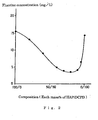
- fluorine insolubilizers of each Test Example according to this invention can insolubilize fluorine within such a short time as one hour to an elution concentration as low as 10mg/L or less and preferably 5mg/L or less.
Landscapes
- Health & Medical Sciences (AREA)
- General Health & Medical Sciences (AREA)
- Toxicology (AREA)
- Chemical & Material Sciences (AREA)
- Chemical Kinetics & Catalysis (AREA)
- General Chemical & Material Sciences (AREA)
- Business, Economics & Management (AREA)
- Emergency Management (AREA)
- Removal Of Specific Substances (AREA)
- Processing Of Solid Wastes (AREA)
- Solid-Sorbent Or Filter-Aiding Compositions (AREA)
- Soil Conditioners And Soil-Stabilizing Materials (AREA)
Description
- This invention relates to fluorine insolubilizing agents (hereinafter referred to as fluorine insolubilizers) and methods of producing them. It has been a common practice to use a fluorine insolubilizer to insolubilize fluorine in soil or drainage and also in waste gypsum for the purpose of environmental preservation. This invention relates to such fluorine insolubilizers and improvements in their production methods.
- Examples of conventionally known fluorine insolubilizer include not only aluminum compounds and calcium compounds of many kinds but also phosphates of various kinds such as sodium phosphate (Na3PO4), disodium hydrogen phosphate (Na2HPO4), sodium dihydrogen phosphate (NaH2PO4), calcium hydrogen phosphate dihydrate (CaHPO4•2H2O), apatite hydroxide (Ca5PO4)3OH, also referred to as hydroxy apatite), as disclosed, for example, in Japanese Patent Publications
Tokkai 2005-305387 2006-341196 2007-216156 2010-53266 WO 2010/041330 is disclosed calcium hydrogen phosphate dihydrate as fluorine insolubilising agent for treating polluted soil. - These conventional fluorine insolubilizers, however, have problems in that their ability to insolubilize fluorine is not sufficient and especially that they take too long a time for insolubilizing fluorine.
- It is therefore an object of this invention to provide fluorine insolubilizers capable of insolubilizing fluorine sufficiently in a short time and methods of producing such fluorine insolubilizers.
- The present invention for accomplishing the aforementioned objects relates to fluorine insolubilizers characterizing as comprising calcium hydrogen phosphate dihydrate in an amount of 95-40 mass % and apatite hydroxide in an amount of 5-60 mass % for a total of 100 mass %. This invention also relates to a method of producing such a fluorine insolubilizer characterized as comprising the steps of gradually adding an aqueous solution of phosphoric acid with stirring to an aqueous dispersion of hydrated lime by taking 5 minutes or more such that their molar ratio (phosphoric acid/hydrated lime) would be 1/1 - 1/1.5, thereby causing a reaction, and separating a solid component from this reaction system.
-
-
Fig. 1 is a graph that shows the performance characteristic of a fluorine insolubilizer of this invention. -
Fig. 2 is a graph that shows the performance characteristic of another fluorine insolubilizer of this invention. -
Fig. 3 is a graph that shows the performance characteristic of still another fluorine insolubilizer of this invention. -
Fig. 4 is a graph that shows the performance characteristic of still another fluorine insolubilizer of this invention. -
Fig. 5 is a graph that shows the performance characteristic of still another fluorine insolubilizer of this invention. - Fluorine insolubilizers according to this invention are explained first. Fluorine insolubilizers according to this invention are characterized as comprising calcium hydrogen phosphate dihydrate (hereinafter simply referred to as DCPD) and apatite hydroxide (hereinafter simply referred to as HAP).
- Since various kinds of DCPD not only for industrial use but also for cosmetics, additives to food items and medical use are commercially available, they may be used for fluorine insolubilizers according to this invention, but those specially produced may also be used. DCPD for industrial use is usually produced by causing an aqueous solution of hydrated lime and phosphoric acid to react within an aqueous medium adjusted to pH4-5, and since methods of using various additives in such a reaction have been known (as disclosed in Japanese Patent Publications
Tokkai 63-215505 6-191808 6-298505 7-2504 7-10511 8-165108 - As for HAP, since many kinds of HAP of various grades including both those naturally available and those chemically synthesized are commercially obtainable, they may be usable for fluorine insolubilizers of this invention but those specially manufactured may also be used. Industrially, HAP is usually produced by mixing an aqueous solution of calcium salts such as an aqueous solution of calcium nitrite with an aqueous solution of phosphoric acid and adjusting its pH to about 8-9. Those produced by such a conventional method may also be used.
- According to tests carried out by the inventors herein, DCPD possesses a fair capability of fluorine insolubilization although not quite sufficient but the fluorine insolubilization capability of HAP is lower than fluorine insolubilization of DCPD. If DCPD and HAP are used at a specific ratio, however, a high level of fluorine insolubilization capability not predictable from that of not only HAP but also that of DCPD can be obtained. This is because if DCPD and HAP are used at this specific ratio, both work synergistically, converting fluorine sufficiently into apatite fluoride in a short time so as to insolubilize it.
- Fluorine insolubilizers according to this invention are characterized as comprising DCPD in an amount of 95-40 mass % and HAP in an amount of 5-60 mass % for a total of 100 mass %. If DCPD and HAP are used together at this ratio, fluorine can be sufficiently converted into apatite fluoride and insolubilized. For a similar reason, fluorine insolubilizers according to this invention comprising DCPD in an amount of 90-60 mass % and HAP in an amount of 10-40 mass % for a total of 100 mass % are preferable and those comprising DCPD in an amount of 90-80 mass % and HAP in an amount of 10-20 mass % for a total of 100 mass % are even more preferable. In either case, it does not particularly matter if some other components which inevitably come to be included during the course of production of DCPD and HAP are also included.
- For the fluorine insolubilizers according to this invention, DCPD is crystalline but HAP may be crystalline or non-crystalline. Their crystalline characteristics can be ascertained by X-ray diffraction (XRD), thermogravimetry/differential thermoanalysis (TG/DTA) and scanning electron microscopic (SEM) observation. For the fluorine insolubilizers according to this invention, non-crystalline HAP is preferable because fluorine insolubilizers with higher capability can be obtained than if crystalline HAP is used.
- Next, methods of producing fluorine insolubilizers according to this invention (hereinafter referred to as the methods of this invention) will be explained. Although fluorine insolubilizers according to this invention can be produced by mixing commercially available DCPD with commercially available HAP at a specific ratio described above, it is preferable to produce them according to a method of this invention because fluorine insolubilizers with improved capability can be obtained. According to a method of this invention, hydrated lime (Ca(OH)2) and phosphoric acid (H3PO4) are caused to react in an aqueous medium. According to a method of this invention, hydrated lime is used under a limited condition for obtaining fluorine insolubilizers always under a stable condition. As for phosphoric acid, not only those of a so-called agent-level and those for food additives but also industrial phosphoric acid with a lower purity as well as waste phosphoric acid may be used.
- According to a method of this invention, as described above, hydrated lime and phosphoric acid are caused to react in an aqueous medium. This reaction is caused by gradually adding an aqueous solution of phosphoric acid to an aqueous dispersion (aqueous suspension) of hydrated lime with stirring for 5 minutes or more. The sequence and time of addition when causing the reaction between both are important because a fluorine insolubilizer of a high capability cannot be obtained by adding an aqueous dispersion of hydrated lime to an aqueous solution of phosphoric acid. When an aqueous solution of phosphoric acid is added to an aqueous dispersion of hydrated lime, too, a fluorine insolubilizer of a high capability cannot be obtained if the total amount of the aqueous solution of phosphoric acid is added all at once. According to a method of this invention, as explained above, an aqueous solution of phosphoric acid is added gradually to an aqueous dispersion of hydrated lime with stirring over 5 minutes, and more preferably slowly by taking 20-60 minutes.
- According to a method of this invention, as explained above, an aqueous solution of phosphoric acid is added gradually to an aqueous dispersion of hydrated lime with stirring over 5 minutes at a molar ratio (phosphoric acid/hydrated lime) of 1/1-1/1.5 for causing a reaction. A fluorine insolubilizer of a high capability can be obtained by thus gradually adding an aqueous solution of phosphoric acid to an aqueous dispersion of hydrated lime at a molar ratio of 1/1-1/1.5 and more preferably at a molar ratio of 1/1.1-1/1.2.
- There is no particular limitation imposed on the concentration of the aqueous dispersion of hydrated lime or the concentration of the aqueous solution of phosphoric acid to be used but it is preferable to use an aqueous solution of hydrated lime with molar concentration of 0.3-3 mols/dm3 and an aqueous solution of phosphoric acid with molar concentration of 0.5-10 mols/dm3. When they are caused to react, temperature is usually set at 70°C or below but it is preferable to set it at 10-40°C. This is for obtaining a fluorine insolubilizer of a high capability.
- Neither does this invention impose any particular limitation on the pH value for the reaction between hydrated lime and phosphoric acid in an aqueous medium but it is preferable to adjust the pH value of the reaction system after the reaction to 4.50-8.00, more preferably to 5.00-7.50 and even more preferably to 5.50-7.00. If the pH of the reaction system is 4.50-8.00 after the reaction, there is no need to newly adjust it but if otherwise, a fluorine insolubilizer of a high capability can be obtained by adding an alkaline aqueous solution such as an aqueous solution of sodium hydroxide to adjust the pH as described above.
- After a reaction is caused by gradually adding an aqueous solution of phosphoric acid to an aqueous dispersion of hydrated lime with stirring according to a method of this invention, a solid component is separated from the reaction system by filtration or by centrifugation. The separated solid component is washed with water and dried, if necessary, to obtain a fluorine insolubilizer.
- Fluorine insolubilizers obtained by a method of this invention have a high fluorine insolubilization capability, sufficiently insolubilizing fluorine in soil, drainage and waste materials such as discarded gypsum in a short time, insolubilizing as apatite fluoride. The reason for the high fluorine insolubilization capability of fluorine insolubilizers obtained by a method of this invention is believed to be that DCPD with fine and complicated surface structure and non-crystalline HAP are generated simultaneously at the ratio of the fluorine insolubilizers according to this invention such that they act synergistically for insolubilizing fluorine.
- Fluorine insolubilizers according to this invention have the merits of sufficiently insolubilizing fluorine in soil, drainage and waste materials in a short time.
- In what follows, the invention will be described in terms of test examples but they are not intended to limit the scope of the invention. In the following test examples and comparison examples, "part" will mean "mass part" and "%" will mean "mass %".
- Commercially available DCPD for industrial use (Daini Rinsan Calcium (tradename) produced by Nippon Kagaku Kogyo) was used as fluorine insolubilizer.
- The same DCPD for industrial use used in Comparison Example 1 and synthesized non-crystalline HAP were mixed at the ratios of 95/5, 90/10, 80/20, 70/30, 60/40, 40/60 and 20/80 (in %) and each mixture was used as fluorine insolubilizer. In the above, the synthesized non-crystalline HAP was obtained as follows. An aqueous dispersion of hydrated lime (0.835 mols as hydrated lime) was placed inside a reactor vessel and after an aqueous solution of phosphoric acid (0.50 mols as phosphoric acid) was gradually added to it over 30 minutes by using a constant rate pump with stirring, the stirring was further continued for 30 minutes. The temperature of the reaction system was 30°C, pH was 7.00 and the molar ratio of phosphoric acid to hydrated lime was 1/1.67. The reaction system was filtered and the solid component separated by filtration was dried. The dried object was analyzed by X-ray diffraction and thermogravimetry/differential thermoanalysis and found to be non-crystalline HAP.
- Non-crystalline HAP synthesized as in Test Examples 1-6 and Comparison Example 2 was used as fluorine insolubilizer.
- Each of the fluorine insolubilizers prepared for the examples in Part 1 O.5g was added to an aqueous solution 500ml with fluorine density 20.0mg/L prepared by using a commercially available fluorine liquid and they were mixed together at 25°C for one hour or six hours. Each mixture was suction-filtered and the fluorine concentration of the filtered liquid was obtained by ion chromatograph. Details of each fluorine insolubilizer and the test results are shown together in Table 1. The test results are also shown in
Fig. 1 . On the horizontal axis ofFig. 1 , the mass % of 100/0 corresponds to Comparison 3 and that of 0/100 corresponds to Comparison Example 1.Table 1 Composition Fluorine concentration (mg/L) Evaluation DCPD (%) HAP (%) Reaction time (hour) 0 1 6 CE-1 100 0 20.0 13.3 1.21 C TE-1 95 5 20.0 6.00 1.55 B TE-2 90 10 20.0 3.68 1.33 A TE-3 80 20 20.0 3.44 1.33 A TE-4 70 30 20.0 3.87 1.63 A TE-5 60 40 20.0 4.85 1.97 A TE-6 40 60 20.0 8.70 3.65 B CE-2 20 80 20.0 12.3 7.78 C CE-3 0 100 20.0 15.0 12.7 C In Table 1:
A: Fluorine concentration was less than 5.0mg/L after one hour and less than 3.0mg/L after six hours
B: Fluorine concentration was less than 10.0mg/L after one hour and less than 5.0mg/L after six hours
C: Fluorine concentration was 1 0.0mg/L or more after one hour - Commercially available DCPD for use as food additive (Rinsan-Suiso Calcium (tradename) produced by Taihei Kagaku Sangyosha) was used as fluorine insolubilizer.
- The same DCPD for use as food additive used in Comparison Example 4 and synthesized non-crystalline HAP were mixed at the ratios of 95/5, 90/10, 80/20, 70/30, 60/40, 40/60 and 20/80 (in %) and each mixture was used as fluorine insolubilizer. In the above, the synthesized non-crystalline HAP was obtained as follows. An aqueous dispersion of hydrated lime (0.835 mols as hydrated lime) was placed inside a reactor vessel and after an aqueous solution of phosphoric acid (0.50 mols as phosphoric acid) was gradually added to it over 30 minutes by using a constant rate pump with stirring, the stirring was further continued for 30 minutes. The temperature of the reaction system was 30°C, pH was 7.00 and the molar ratio of phosphoric acid to hydrated lime was 1/1.67. The reaction system was filtered and the solid component separated by filtration was dried. The dried object was analyzed by X-ray diffraction and thermogravimetry/differential thermoanalysis and found to be non-crystalline HAP.
- Non-crystalline HAP synthesized as in Test Examples 7-12 and Comparison Example 5 was used as fluorine insolubilizer.
- Each fluorine insolubilizer obtained in Part 2 was tested and evaluated as in Part 1. Details of each fluorine insolubilizer and the test results are shown together in Table 2. The test results are also shown in
Fig. 2 . On the horizontal axis ofFig. 2 , the mass % of 100/0 corresponds to Comparison 6 and that of 0/100 corresponds to Comparison Example 4.Table 2 Composition Fluorine concentration (mg/L) Evaluation DCPD (%) HAP (%) Reaction time (hour) 0 1 6 CE-4 100 0 20.0 14.2 1.23 C TE-7 95 5 20.0 6.80 1.56 B TE-8 90 10 20.0 4.10 1.49 A TE-9 80 20 20.0 3.55 1.38 A TE-10 70 30 20.0 3.92 1.67 A TE-11 60 40 20.0 4.98 2.08 A TE-12 40 60 20.0 8.97 3.79 B CE-5 20 80 20.0 13.1 7.91 C CE-6 0 100 20.0 15.0 12.7 C - Commercially available DCPD for industrial use (Daini Rinsan Calcium (tradename) produced by Nippon Kagaku Kogyo) was used as fluorine insolubilizer.
- The same DCPD for industrial use used in Comparison Example 7 and commercially available crystalline HAP were mixed at the ratios of 95/5, 90/10, 80/20, 70/30, 60/40, 40/60 and 20/80 (in %) and each mixture was used as fluorine insolubilizer. As crystalline HAP, HAP-100 (tradename) produced by Taihei Kagaku Sangyosha was used.
- Commercially available crystalline HAP as in Test Examples 13-18 and Comparison Example 8 was used as fluorine insolubilizer.
- Each fluorine insolubilizer obtained in Part 3 was tested and evaluated as in Part 1. Details of each fluorine insolubilizer and the test results are shown together in Table 3. The test results are also shown in
Fig. 3 . On the horizontal axis ofFig. 3 , the mass % of 100/0 corresponds to Comparison 9 and that of 0/100 corresponds to Comparison Example 7.Table 3 Composition Fluorine concentration (mg/L) Evaluation DCPD (%) HAP (%) Reaction time (hour) 0 1 6 CE-7 100 0 20.0 13.3 1.21 C TE-13 95 5 20.0 7.00 2.27 B TE-14 90 10 20.0 4.11 1.62 A TE-15 80 20 20.0 3.78 1.40 A TE-16 70 30 20.0 4.58 2.22 A TE-17 60 40 20.0 4.90 2.85 A TE-18 40 60 20.0 9.10 4.93 B CE-8 20 80 20.0 13.8 11.9 C CE-9 0 100 20.0 17.5 16.8 C - Commercially available DCPD for use as food additive (Rinsan-Suiso Calcium (tradename) produced by Taihei Kagaku Sangyosha) was used as fluorine insolubilizer.
- The same DCPD for use as food additive used in Comparison Example 4 and commercially available crystalline HAP were mixed at the ratios of 95/5, 90/10, 80/20, 70/30, 60/40, 40/60 and 20/80 (in %) and each mixture was used as fluorine insolubilizer. As commercially available crystalline HAP, HAP-100 (tradename) produced by Taihei Kagaku Sangyosha was used.
- Commercially available crystalline HAP as in Test Examples 19-24 and Comparison Example 11 was used as fluorine insolubilizer.
- Each fluorine insolubilizer obtained in Part 4 was tested and evaluated as in Part 1. Details of each fluorine insolubilizer and the test results are shown together in Table 4. The test results are also shown in
Fig. 4 . On the horizontal axis ofFig. 4 , the mass % of 100/0 corresponds to Comparison 12 and that of 0/100 corresponds to Comparison Example 10.Table 4 Composition Fluorine concentration (mg/L) Evaluation DCPD (%) HAP (%) Reaction time (hour) 0 1 6 CE-10 100 0 20.0 14.2 1.23 C TE-19 95 5 20.0 7.20 2.39 B TE-20 90 10 20.0 4.26 1.77 A TE-21 80 20 20.0 3.98 1.50 A TE-22 70 30 20.0 4.64 2.78 A TE-23 60 40 20.0 4.95 2.93 A TE-24 40 60 20.0 9.80 4.97 B CE-11 20 80 20.0 14.5 12.1 C CE-12 0 100 20.0 17.5 16.8 C - An aqueous dispersion of hydrated lime (0.60 mols as hydrated lime) was placed in a reaction vessel and after an aqueous solution of phosphoric acid (1.0 mol as phosphoric acid) was gradually added to it over 30 minutes with stirring by using a constant rate pump, the stirring was continued further for 30 minutes. The temperature of the reaction system was 30°C, pH was 4.87 and the molar ratio of phosphoric acid to hydrated lime was 1/0.60. The reaction system was filtered and the solid component separated by filtration was dried. The dried object was analyzed by X-ray diffraction and thermogravimetry/differential thermoanalysis and found to contain DCPD and non-crystalline HAP in a total amount of 95.5% and at a mass ratio (DCPD/Non-crystalline HAP) of 100/0. This dried object was used as fluorine insolubilizer.
- A reaction was caused by gradually adding an aqueous solution of phosphoric acid to an aqueous dispersion of hydrated lime in the same way as in Comparison Example 13 except that the molar ratio between phosphoric acid and hydrated lime was changed as shown in Table 5. The solid component was separated from the reaction system and dried, and the dried object thus obtained was used as fluorine insolubilizer.
- Each fluorine insolubilizer obtained in
Part 5 was tested and evaluated as in Part 1. Details of each fluorine insolubilizer and the test results are shown together in Table 5. The test results are also shown inFig. 5 . On the horizontal axis ofFig. 5 , the mass % (HAP+HAP in DCPD/DCPD) of 91.5/8.5 corresponds toComparison 15 and that of 0/100 corresponds to Comparison Example 13.Table 5 Phosphoric acid/hydrat ed lime used (molar ratio) Total % of DCPD+HAP Composition in DCPD+HAP Fluorine concentration (mg/L) Evaluation DCPD (%) HAP (%) Reaction time (hour) 0 1 6 CE-13 1/0.6 95.5 100 0 20.0 17.3 16.8 C CE-14 1/0.8 94.2 99.7 0.3 20.0 11.7 1.0 C TE-25 1/1.0 93.2 94.5 5.5 20.0 6.4 1.0 B TE-26 1/1.1 93.0 89.9 10.1 20.0 2.6 1.2 A TE-27 1/1.2 92.0 77.6 22.4 20.0 2.8 1.4 A TE-28 1/1.3 91.6 66.3 33.7 20.0 4.8 2.5 A TE-29 1/1.4 88.7 52.3 47.7 20.0 7.0 3.7 B TE-30 1/1.5 84.5 41.7 58.3 20.0 9.2 4.7 B CE-15 1/1.6 76.8 8.5 91.5 20.0 15.8 8.5 C - Hydrated lime 55.5g (0.75 mols as hydrated lime) was dispersed in pure water 300g to prepare an aqueous dispersion of hydrated lime and placed in a reactor vessel. After an aqueous solution of phosphoric acid of purity 75% for industrial use 65.3g (0.50 mols as phosphoric acid) was gradually added to this reactor vessel while stirring the aqueous dispersion of hydrated lime inside the reactor vessel by using a constant rate pump for 5 minutes, the stirring was further continued for 60 minutes. The temperature of the reaction system was 30°C, pH was 5.90, and the molar ratio of phosphoric acid to hydrated lime was 1/1.5. The reaction system was filtered and the solid component separated by filtration was dried at 40°C to obtain a dried object. The dried object was analyzed by X-ray diffraction and thermogravimetry/differential thermoanalysis and found to contain DCPD and non-crystalline HAP in a total amount of 88.0% and at a mass ratio (DCPD/Non-crystalline HAP) of 51.4/36.6. This dried object was used as fluorine insolubilizer.
- Dried objects were obtained similarly as in Test Example 31 except that aqueous solution of phosphoric acid for industrial use was added to aqueous solution of hydrated lime over 10 minutes, 20 minutes, 30 minutes and 45 minutes instead of 5 minutes and these dried objects thus obtained were used as fluorine insolubilizers.
- Hydrated lime 55.5g (0.75 mols as hydrated lime) was dispersed in pure water 300g to prepare an aqueous dispersion of hydrated lime and placed in a reactor vessel. After an aqueous solution of phosphoric acid of purity 75% for industrial use 65.3g (0.50 mols as phosphoric acid) was added at once to this reactor vessel while stirring the aqueous dispersion of hydrated lime inside the reactor vessel, the stirring was further continued for 60 minutes. The temperature of the reaction system was 30°C, pH was 6.10, and the molar ratio of phosphoric acid to hydrated lime was 1/1.5. The reaction system was filtered and the solid component separated by filtration was dried at 40°C to obtain a dried object. The dried object was used as fluorine insolubilizer.
- A dried object was obtained similarly as in Test Example 31 except that calcium carbonate 75.1g (0.75 mols as calcium carbonate) was used instead of hydrated lime 55.5g (0.75 mols as hydrated lime), and was used as fluorine insolubilizer.
- A dried object was obtained similarly as in Comparison Example 16 except that calcium carbonate 75.1g (0.75 mols as calcium carbonate) was used instead of hydrated lime 55.5g (0.75 mols as hydrated lime), and was used as fluorine insolubilizer.
- Hydrated lime 55.5g (0.75 mols as hydrated lime) was dispersed in pure water 300g to prepare an aqueous dispersion of hydrated lime. An aqueous solution of phosphoric acid of purity 75% for industrial use 65.3g (0.50 mols as phosphoric acid) was placed inside a reactor vessel and after the aforementioned aqueous dispersion of hydrated lime was gradually added to it over 10 minutes by using a constant rate pump while the aqueous dispersion was being stirred, the stirring was further continued for 60 minutes. The temperature of the reaction system was 30°C, pH was 5.90, and the molar ratio of phosphoric acid to hydrated lime was 1/1.5. The reaction system was filtered and the solid component separated by filtration was dried to obtain a dried object. The dried object thus obtained was used as fluorine insolubilizer.
- A dried object was obtained similarly as in Comparison Example 19 except that aqueous dispersion of hydrated lime was added to aqueous solution of phosphoric acid over 20 minutes instead of 10 minutes and was used as fluorine insolubilizer.
- Each fluorine insolubilizer obtained in Part 6 was tested and evaluated as in Part 1. Details and test results of each fluorine insolubilizer are shown together in Table 6.
Table 6 Kind of Ca salt Time (min) Phosphoric acid /hydrated lime used (molar ratio) pH Total % of DCPD +HAP Composition in DCPD+HAP Fluorine concentration (mg/L) Evalu ation DCPD (%) HAP (%) Reaction time (hour) 0 1 6 TE-31 *1 5 1/1.5 5.90 88.0 51.4 36.6 20.0 3.8 1.2 A TE-32 *1 10 1/1.5 5.90 87.5 51.7 35.8 20.0 2.9 1.2 A TE-33 *1 20 1/1.5 5.90 88.5 53.2 35.3 20.0 3.0 1.1 A TE-34 *1 30 1/1.5 5.95 88.7 53.8 34.9 20.0 2.9 1.1 A TE-35 *1 45 1/1.5 6.00 89.2 55.1 34.1 20.0 2.8 1.1 A CE-16 *1 0 1/1.5 6.10 - - - 20.0 10.5 1.6 C CE-17 *2 5 1/1.5 6.35 - - - 20.0 18.9 15.3 C CE-18 *2 0 1/1.5 6.40 - - - 20.0 19.6 16.1 C CE-19 *1 Δ10 1/1.5 6.05 - - - 20.0 19.1 14.9 C CE-20 *1 Δ20 1/1.5 6.00 - - - 20.0 19.1 14.3 C In Table 6:
*1: Ca(OH)2
*2: CaCO3
Δ: Time for gradually adding aqueous dispersion of hydrated lime to aqueous solution of phosphoric acid for industrial use - Hydrated lime 46.3g (0.62 mols as hydrated lime) was dispersed in pure water 300g to prepare an aqueous dispersion of hydrated lime and placed in a reactor vessel. After an aqueous solution of phosphoric acid of purity 75% for industrial use 65.3g (0.50 mols as phosphoric acid) was added gradually to this reactor vessel over 20 minutes by using a constant rate pump while stirring the aqueous dispersion of hydrated lime inside the reactor vessel, the stirring was further continued for 60 minutes. The temperature of the reaction system was 30°C, pH was 5.20, and the molar ratio of phosphoric acid to hydrated lime was 1/1.24. After an aqueous solution of sodium hydroxide was added to the reaction system to adjust its pH to 6.50, the reaction system was filtered and the solid component separated by filtration was dried at 40°C to obtain a dried object. The dried object was analyzed by X-ray diffraction and thermogravimetry/differential thermoanalysis and found to contain DCPD and non-crystalline HAP in a total amount of 91.0% and at a mass ratio (DCPD/Non-crystalline HAP) of 55.2/35.8. This dried object was used as fluorine insolubilizer.
- A dried object was obtained similarly as in Test Example 36 except that hydrated lime 46.3g (0.62 mols as hydrated lime) was used instead of hydrated lime 55.5g (0.75 mols), and was used as fluorine insolubilizer.
- Dried objects were obtained similarly as in Test Example 37 except that the pH value of the reaction system was adjusted to 5.50, 7.00 and 8.00, instead of 6.50, and were used as fluorine insolubilizers.
- A dried object was obtained similarly as in Test Example 36 except that hydrated lime 28.1g (0.38 mols as hydrated lime) was used instead of hydrated lime 46.3g (0.62 mols), and was used as fluorine insolubilizer.
- Each fluorine insolubilizer obtained in Part 7 was tested and evaluated as in Part 1. Details and test results of each fluorine insolubilizer are shown together in Table 7.
Table 7 Time (min) Phosphoric acid /hydrated lime used (molar ratio) pH Total % of DCPD +HAP Composition in DCPD+HAP Fluorine concentration (mg/L) Evaluation DCPD (%) HAP (%) After 1 hour After 6 hours TE-36 20 1/1.24 6.50 91.0 55.2 35.8 2.9 1.1 A TE-37 20 1/1.5 6.50 91.5 56.1 35.4 2.9 1.0 A TE-38 20 1/1.5 5.50 91.8 56.0 35.8 2.9 1.0 A TE-39 20 1/1.5 7.00 91.0 55.3 35.7 2.9 1.1 A TE-40 20 1/1.5 8.00 89.6 54.1 35.5 3.4 1.2 A CE-21 20 1/6.76 6.50 - - - 19.8 19.8 C - As can be understood from the results of Tables 1-7, fluorine insolubilizers of each Test Example according to this invention can insolubilize fluorine within such a short time as one hour to an elution concentration as low as 10mg/L or less and preferably 5mg/L or less.
Claims (11)
- A fluorine insolubilizer comprising calcium hydrogen phosphate dihydrate in an amount of 95-40 mass % and apatite hydroxide in an amount of 5-60 mass % for a total of 100 mass %.
- The fluorine insolubilizer of claim 1 comprising calcium hydrogen phosphate dihydrate in an amount of 90-60 mass % and apatite hydroxide in an amount of 10-40 mass % for a total of 100 mass %.
- The fluorine insolubilizer of claim 1 comprising calcium hydrogen phosphate dihydrate in an amount of 90-80 mass % and apatite hydroxide in an amount of 10-20 mass % for a total of 100 mass %.
- The fluorine insolubilizer of any of claims 1 to 3 wherein the apatite hydroxide is non-crystalline.
- A method of producing fluorine insolubilizer, said method comprising the steps of:causing a reaction by adding an aqueous solution of phosphoric acid gradually over 5 minutes or more to an aqueous dispersion of hydrated lime while stirring such that the phosphoric acid and the hydrated lime will have a molar ratio of 1/1-1/1.5; andseparating from reaction system of said reaction a solid component that contains calcium hydrogen phosphate dihydrate in an amount of 95-40 mass % and apatite hydroxide in an amount of 5-60 mass % for a total of 100 mass %.
- The method of claim 5 wherein the aqueous solution of phosphoric acid is gradually added over 20-60 minutes to the aqueous dispersion of hydrated lime.
- The method of claim 6 wherein the aqueous solution of phosphoric acid is gradually added to the aqueous dispersion of hydrated lime such that the phosphoric acid and the hydrated lime will have a molar ratio of 1/1.1-1/1.2.
- The method of Claim 7 wherein the aqueous dispersion of hydrated lime has molar concentration in the range of 0.3-3 mols/dm3 and the aqueous solution of phosphoric acid has molar concentration in the range of 0.5-10 mols/dm3.
- The method of Claim 8 further comprising the step of adjusting the pH value of reaction system to 4.50-8.00 after causing a reaction by adding the aqueous solution of phosphoric acid to the aqueous dispersion of hydrated lime.
- The method of Claim 9 wherein the reaction is caused under a condition of temperature in the range of 10-40°C.
- A method of producing a fluorine insolubilizer, said method comprising the step of mixing calcium hydrogen phosphate dihydrate in an amount of 95-40 mass % and apatite hydroxide in an amount of 5-60 mass % to total 100 mass %.
Applications Claiming Priority (2)
| Application Number | Priority Date | Filing Date | Title |
|---|---|---|---|
| JP2010108542 | 2010-05-10 | ||
| JP2010199480A JP5584915B2 (en) | 2010-05-10 | 2010-09-07 | Fluorine insolubilizing agent and method for producing the same |
Publications (2)
| Publication Number | Publication Date |
|---|---|
| EP2386331A1 EP2386331A1 (en) | 2011-11-16 |
| EP2386331B1 true EP2386331B1 (en) | 2013-05-01 |
Family
ID=44583645
Family Applications (1)
| Application Number | Title | Priority Date | Filing Date |
|---|---|---|---|
| EP11250515.1A Active EP2386331B1 (en) | 2010-05-10 | 2011-05-10 | Fluorine insolubilizers and methods of producing same |
Country Status (5)
| Country | Link |
|---|---|
| US (1) | US8333908B2 (en) |
| EP (1) | EP2386331B1 (en) |
| JP (1) | JP5584915B2 (en) |
| KR (1) | KR101753219B1 (en) |
| CN (1) | CN102240669B (en) |
Families Citing this family (5)
| Publication number | Priority date | Publication date | Assignee | Title |
|---|---|---|---|---|
| CZ308164B6 (en) * | 2012-12-07 | 2020-02-05 | Vysoká škola chemicko-technologická v Praze | Protective barrier system of repositories against leaks of toxic substances |
| JP5874695B2 (en) * | 2013-08-01 | 2016-03-02 | 栗田工業株式会社 | Detoxification method for solid waste containing heavy metals |
| JP6406937B2 (en) * | 2014-09-04 | 2018-10-17 | チヨダウーテ株式会社 | Fluorine insolubilizer |
| JP7315160B2 (en) * | 2019-02-19 | 2023-07-26 | 独立行政法人国立高等専門学校機構 | Fluorine insolubilizer, method for producing same, treated gypsum, method for treating fluorine-containing contaminated soil and contaminated water |
| JP6993481B1 (en) | 2020-08-31 | 2022-01-13 | 新田ゼラチン株式会社 | Method for Producing Modified Calcium Hydrogen Phosphate Dihydrate |
Family Cites Families (14)
| Publication number | Priority date | Publication date | Assignee | Title |
|---|---|---|---|---|
| JPH0615405B2 (en) | 1987-03-02 | 1994-03-02 | 株式会社東洋ストウフア−・ケミカル | Calcium hydrogen phosphate dihydrate and method for producing the same |
| DE4122960C2 (en) | 1991-07-11 | 1994-03-31 | Benckiser Knapsack Ladenburg | Process for the preparation of coarse-grained dicalcium phosphate anhydride |
| JP3005883B2 (en) | 1992-12-28 | 2000-02-07 | 富士化学工業株式会社 | Method for producing calcium hydrogen phosphate and excipient using the same |
| DE4306673A1 (en) | 1993-03-04 | 1994-09-08 | Hoechst Ag | Process for the preparation of a dicalcium phosphate dihydrate suitable for use in toothpastes |
| JP2514157B2 (en) | 1993-08-24 | 1996-07-10 | 株式会社東洋ストウファー・ケミカル | Method for producing calcium hydrogen phosphate dihydrate |
| JP3611353B2 (en) | 1994-12-08 | 2005-01-19 | 東ソー・ファインケム株式会社 | Aggregated crystal calcium hydrogen phosphate dihydrate and process for producing the same |
| KR20010112202A (en) * | 2001-11-30 | 2001-12-20 | 김재종 | The advanced treatment method for fluorine-contained waste water using hydroxy apatite and the disposal apparatus thereof |
| JP4417667B2 (en) | 2003-07-10 | 2010-02-17 | カヤバ工業株式会社 | Seal structure and gas spring |
| JP2005305387A (en) * | 2004-04-26 | 2005-11-04 | Japan Organo Co Ltd | Method for treating fluorine polluted soil |
| JP4540554B2 (en) | 2005-06-09 | 2010-09-08 | オルガノ株式会社 | Treatment method of fluorine-contaminated soil |
| JP4434156B2 (en) * | 2006-02-17 | 2010-03-17 | 独立行政法人国立高等専門学校機構 | Treatment method of fluorine-contaminated soil |
| JP2009220032A (en) * | 2008-03-17 | 2009-10-01 | Taiheiyo Cement Corp | Insolubilization material |
| JP2010053266A (en) | 2008-08-29 | 2010-03-11 | Gifu Univ | Greening base material having insolublizing function of soil polluting metal |
| CN102176983A (en) * | 2008-10-10 | 2011-09-07 | 独立行政法人国立高等专门学校机构 | Fluorine insolubilizing agent, gypsum with elution of fluorine contained therein being reduced, and method for treating soil contaminated with fluirine |
-
2010
- 2010-09-07 JP JP2010199480A patent/JP5584915B2/en active Active
-
2011
- 2011-05-04 US US13/100,480 patent/US8333908B2/en active Active
- 2011-05-09 KR KR1020110043481A patent/KR101753219B1/en active Active
- 2011-05-10 EP EP11250515.1A patent/EP2386331B1/en active Active
- 2011-05-10 CN CN201110119589.3A patent/CN102240669B/en active Active
Also Published As
| Publication number | Publication date |
|---|---|
| CN102240669A (en) | 2011-11-16 |
| JP5584915B2 (en) | 2014-09-10 |
| KR101753219B1 (en) | 2017-07-04 |
| JP2011256356A (en) | 2011-12-22 |
| CN102240669B (en) | 2015-01-14 |
| KR20110124158A (en) | 2011-11-16 |
| US8333908B2 (en) | 2012-12-18 |
| US20110272638A1 (en) | 2011-11-10 |
| EP2386331A1 (en) | 2011-11-16 |
Similar Documents
| Publication | Publication Date | Title |
|---|---|---|
| EP2386331B1 (en) | Fluorine insolubilizers and methods of producing same | |
| US6495156B2 (en) | Biocements having improved compressive strength | |
| EP1042252B1 (en) | Method for making apatite ceramics, in particular for biological use | |
| EP3064286B1 (en) | Use of an insolubilizing material for specific hazardous substance and method for insolubilizing specific hazardous substance with same | |
| CA2438742A1 (en) | A new calcium phosphate cement composition and a method for the preparation thereof | |
| CA2493224A1 (en) | Alkali metal hydrogen phosphates as precursors for phosphate-containing electrochemical active materials | |
| KR20170008261A (en) | Process for producing a calcium phosphate reactant, reactant obtained and use thereof in the purification of liquid effluents | |
| US8440737B2 (en) | Composition for injectable cement useful as bone replacement | |
| CA2529418C (en) | Bone substitute material for medical use and method for producing the same | |
| WO2006115398B1 (en) | Method of improving the osteoinductivity of calcium phosphate | |
| WO2006076426A3 (en) | Multi-purpose bio-material composition | |
| JP3468250B2 (en) | Treatment of alkaline fly ash | |
| JP4151822B2 (en) | Method for producing gypsum with reduced fluorine eluting | |
| KR20090020568A (en) | Method for preparing hydroxyl apatite | |
| JP6406937B2 (en) | Fluorine insolubilizer | |
| JP4319283B2 (en) | Hydraulic calcium phosphate cement composition | |
| EP0850666A1 (en) | Method of decomposing polychlorobiphenyls | |
| WADHWANI | THE MECHANISM OF FLUORINE REMOVAL BY CALCIUM SALTS-PART II | |
| JP2007181758A (en) | Solid waste treatment method and treatment chemical | |
| JPH10109014A (en) | Acidic gas removing agent having heavy metal fixing performance and its production | |
| Takamatsu et al. | Enhanced reactivity of apatite composite derived by phosphate treatment of gypsum with fluoride ions | |
| Kongkaew et al. | Influence of calcium carbonate and calcium oxide on the synthesis of tetracalcium phosphate bioceramic. | |
| JP2006341196A (en) | Treatment method for fluorine-contaminated soil | |
| JP2009262034A (en) | Method of fixing soluble fluorine ion in paper sludge incineration ash and soil conditioner using the same | |
| JPWO2011064836A1 (en) | Method for producing calcium hydrogen phosphate dihydrate and fluorine insolubilizing agent |
Legal Events
| Date | Code | Title | Description |
|---|---|---|---|
| 17P | Request for examination filed |
Effective date: 20110523 |
|
| AK | Designated contracting states |
Kind code of ref document: A1 Designated state(s): AL AT BE BG CH CY CZ DE DK EE ES FI FR GB GR HR HU IE IS IT LI LT LU LV MC MK MT NL NO PL PT RO RS SE SI SK SM TR |
|
| AX | Request for extension of the european patent |
Extension state: BA ME |
|
| PUAI | Public reference made under article 153(3) epc to a published international application that has entered the european phase |
Free format text: ORIGINAL CODE: 0009012 |
|
| RAP1 | Party data changed (applicant data changed or rights of an application transferred) |
Owner name: CHIYODA UTE CO., LTD. |
|
| RAP1 | Party data changed (applicant data changed or rights of an application transferred) |
Owner name: CHIYODA UTE CO., LTD. |
|
| RIC1 | Information provided on ipc code assigned before grant |
Ipc: A62D 3/33 20070101AFI20120924BHEP |
|
| GRAP | Despatch of communication of intention to grant a patent |
Free format text: ORIGINAL CODE: EPIDOSNIGR1 |
|
| GRAS | Grant fee paid |
Free format text: ORIGINAL CODE: EPIDOSNIGR3 |
|
| GRAA | (expected) grant |
Free format text: ORIGINAL CODE: 0009210 |
|
| AK | Designated contracting states |
Kind code of ref document: B1 Designated state(s): AL AT BE BG CH CY CZ DE DK EE ES FI FR GB GR HR HU IE IS IT LI LT LU LV MC MK MT NL NO PL PT RO RS SE SI SK SM TR |
|
| REG | Reference to a national code |
Ref country code: GB Ref legal event code: FG4D |
|
| REG | Reference to a national code |
Ref country code: CH Ref legal event code: EP Ref country code: AT Ref legal event code: REF Ref document number: 609523 Country of ref document: AT Kind code of ref document: T Effective date: 20130515 |
|
| REG | Reference to a national code |
Ref country code: IE Ref legal event code: FG4D |
|
| REG | Reference to a national code |
Ref country code: DE Ref legal event code: R096 Ref document number: 602011001550 Country of ref document: DE Effective date: 20130704 |
|
| REG | Reference to a national code |
Ref country code: AT Ref legal event code: MK05 Ref document number: 609523 Country of ref document: AT Kind code of ref document: T Effective date: 20130501 |
|
| REG | Reference to a national code |
Ref country code: NL Ref legal event code: VDEP Effective date: 20130501 |
|
| REG | Reference to a national code |
Ref country code: LT Ref legal event code: MG4D |
|
| PG25 | Lapsed in a contracting state [announced via postgrant information from national office to epo] |
Ref country code: GR Free format text: LAPSE BECAUSE OF FAILURE TO SUBMIT A TRANSLATION OF THE DESCRIPTION OR TO PAY THE FEE WITHIN THE PRESCRIBED TIME-LIMIT Effective date: 20130802 Ref country code: ES Free format text: LAPSE BECAUSE OF FAILURE TO SUBMIT A TRANSLATION OF THE DESCRIPTION OR TO PAY THE FEE WITHIN THE PRESCRIBED TIME-LIMIT Effective date: 20130812 Ref country code: PT Free format text: LAPSE BECAUSE OF FAILURE TO SUBMIT A TRANSLATION OF THE DESCRIPTION OR TO PAY THE FEE WITHIN THE PRESCRIBED TIME-LIMIT Effective date: 20130902 Ref country code: AT Free format text: LAPSE BECAUSE OF FAILURE TO SUBMIT A TRANSLATION OF THE DESCRIPTION OR TO PAY THE FEE WITHIN THE PRESCRIBED TIME-LIMIT Effective date: 20130501 Ref country code: IS Free format text: LAPSE BECAUSE OF FAILURE TO SUBMIT A TRANSLATION OF THE DESCRIPTION OR TO PAY THE FEE WITHIN THE PRESCRIBED TIME-LIMIT Effective date: 20130901 Ref country code: FI Free format text: LAPSE BECAUSE OF FAILURE TO SUBMIT A TRANSLATION OF THE DESCRIPTION OR TO PAY THE FEE WITHIN THE PRESCRIBED TIME-LIMIT Effective date: 20130501 Ref country code: NO Free format text: LAPSE BECAUSE OF FAILURE TO SUBMIT A TRANSLATION OF THE DESCRIPTION OR TO PAY THE FEE WITHIN THE PRESCRIBED TIME-LIMIT Effective date: 20130801 Ref country code: LT Free format text: LAPSE BECAUSE OF FAILURE TO SUBMIT A TRANSLATION OF THE DESCRIPTION OR TO PAY THE FEE WITHIN THE PRESCRIBED TIME-LIMIT Effective date: 20130501 Ref country code: SE Free format text: LAPSE BECAUSE OF FAILURE TO SUBMIT A TRANSLATION OF THE DESCRIPTION OR TO PAY THE FEE WITHIN THE PRESCRIBED TIME-LIMIT Effective date: 20130501 Ref country code: SI Free format text: LAPSE BECAUSE OF FAILURE TO SUBMIT A TRANSLATION OF THE DESCRIPTION OR TO PAY THE FEE WITHIN THE PRESCRIBED TIME-LIMIT Effective date: 20130501 |
|
| PG25 | Lapsed in a contracting state [announced via postgrant information from national office to epo] |
Ref country code: HR Free format text: LAPSE BECAUSE OF FAILURE TO SUBMIT A TRANSLATION OF THE DESCRIPTION OR TO PAY THE FEE WITHIN THE PRESCRIBED TIME-LIMIT Effective date: 20130501 Ref country code: BG Free format text: LAPSE BECAUSE OF FAILURE TO SUBMIT A TRANSLATION OF THE DESCRIPTION OR TO PAY THE FEE WITHIN THE PRESCRIBED TIME-LIMIT Effective date: 20130801 Ref country code: CY Free format text: LAPSE BECAUSE OF FAILURE TO SUBMIT A TRANSLATION OF THE DESCRIPTION OR TO PAY THE FEE WITHIN THE PRESCRIBED TIME-LIMIT Effective date: 20130501 Ref country code: RS Free format text: LAPSE BECAUSE OF FAILURE TO SUBMIT A TRANSLATION OF THE DESCRIPTION OR TO PAY THE FEE WITHIN THE PRESCRIBED TIME-LIMIT Effective date: 20130501 Ref country code: PL Free format text: LAPSE BECAUSE OF FAILURE TO SUBMIT A TRANSLATION OF THE DESCRIPTION OR TO PAY THE FEE WITHIN THE PRESCRIBED TIME-LIMIT Effective date: 20130501 |
|
| PG25 | Lapsed in a contracting state [announced via postgrant information from national office to epo] |
Ref country code: LV Free format text: LAPSE BECAUSE OF FAILURE TO SUBMIT A TRANSLATION OF THE DESCRIPTION OR TO PAY THE FEE WITHIN THE PRESCRIBED TIME-LIMIT Effective date: 20130501 |
|
| PG25 | Lapsed in a contracting state [announced via postgrant information from national office to epo] |
Ref country code: CZ Free format text: LAPSE BECAUSE OF FAILURE TO SUBMIT A TRANSLATION OF THE DESCRIPTION OR TO PAY THE FEE WITHIN THE PRESCRIBED TIME-LIMIT Effective date: 20130501 Ref country code: DK Free format text: LAPSE BECAUSE OF FAILURE TO SUBMIT A TRANSLATION OF THE DESCRIPTION OR TO PAY THE FEE WITHIN THE PRESCRIBED TIME-LIMIT Effective date: 20130501 Ref country code: EE Free format text: LAPSE BECAUSE OF FAILURE TO SUBMIT A TRANSLATION OF THE DESCRIPTION OR TO PAY THE FEE WITHIN THE PRESCRIBED TIME-LIMIT Effective date: 20130501 Ref country code: MC Free format text: LAPSE BECAUSE OF FAILURE TO SUBMIT A TRANSLATION OF THE DESCRIPTION OR TO PAY THE FEE WITHIN THE PRESCRIBED TIME-LIMIT Effective date: 20130501 Ref country code: SK Free format text: LAPSE BECAUSE OF FAILURE TO SUBMIT A TRANSLATION OF THE DESCRIPTION OR TO PAY THE FEE WITHIN THE PRESCRIBED TIME-LIMIT Effective date: 20130501 Ref country code: BE Free format text: LAPSE BECAUSE OF FAILURE TO SUBMIT A TRANSLATION OF THE DESCRIPTION OR TO PAY THE FEE WITHIN THE PRESCRIBED TIME-LIMIT Effective date: 20130501 |
|
| REG | Reference to a national code |
Ref country code: IE Ref legal event code: MM4A |
|
| PG25 | Lapsed in a contracting state [announced via postgrant information from national office to epo] |
Ref country code: RO Free format text: LAPSE BECAUSE OF FAILURE TO SUBMIT A TRANSLATION OF THE DESCRIPTION OR TO PAY THE FEE WITHIN THE PRESCRIBED TIME-LIMIT Effective date: 20130501 Ref country code: IT Free format text: LAPSE BECAUSE OF FAILURE TO SUBMIT A TRANSLATION OF THE DESCRIPTION OR TO PAY THE FEE WITHIN THE PRESCRIBED TIME-LIMIT Effective date: 20130501 Ref country code: NL Free format text: LAPSE BECAUSE OF FAILURE TO SUBMIT A TRANSLATION OF THE DESCRIPTION OR TO PAY THE FEE WITHIN THE PRESCRIBED TIME-LIMIT Effective date: 20130501 |
|
| PLBE | No opposition filed within time limit |
Free format text: ORIGINAL CODE: 0009261 |
|
| STAA | Information on the status of an ep patent application or granted ep patent |
Free format text: STATUS: NO OPPOSITION FILED WITHIN TIME LIMIT |
|
| 26N | No opposition filed |
Effective date: 20140204 |
|
| PG25 | Lapsed in a contracting state [announced via postgrant information from national office to epo] |
Ref country code: IE Free format text: LAPSE BECAUSE OF NON-PAYMENT OF DUE FEES Effective date: 20130510 |
|
| REG | Reference to a national code |
Ref country code: DE Ref legal event code: R097 Ref document number: 602011001550 Country of ref document: DE Effective date: 20140204 |
|
| REG | Reference to a national code |
Ref country code: CH Ref legal event code: PL |
|
| PG25 | Lapsed in a contracting state [announced via postgrant information from national office to epo] |
Ref country code: CH Free format text: LAPSE BECAUSE OF NON-PAYMENT OF DUE FEES Effective date: 20140531 Ref country code: LI Free format text: LAPSE BECAUSE OF NON-PAYMENT OF DUE FEES Effective date: 20140531 |
|
| PG25 | Lapsed in a contracting state [announced via postgrant information from national office to epo] |
Ref country code: MT Free format text: LAPSE BECAUSE OF FAILURE TO SUBMIT A TRANSLATION OF THE DESCRIPTION OR TO PAY THE FEE WITHIN THE PRESCRIBED TIME-LIMIT Effective date: 20130501 |
|
| PG25 | Lapsed in a contracting state [announced via postgrant information from national office to epo] |
Ref country code: SM Free format text: LAPSE BECAUSE OF FAILURE TO SUBMIT A TRANSLATION OF THE DESCRIPTION OR TO PAY THE FEE WITHIN THE PRESCRIBED TIME-LIMIT Effective date: 20130501 |
|
| PG25 | Lapsed in a contracting state [announced via postgrant information from national office to epo] |
Ref country code: TR Free format text: LAPSE BECAUSE OF FAILURE TO SUBMIT A TRANSLATION OF THE DESCRIPTION OR TO PAY THE FEE WITHIN THE PRESCRIBED TIME-LIMIT Effective date: 20130501 |
|
| PG25 | Lapsed in a contracting state [announced via postgrant information from national office to epo] |
Ref country code: HU Free format text: LAPSE BECAUSE OF FAILURE TO SUBMIT A TRANSLATION OF THE DESCRIPTION OR TO PAY THE FEE WITHIN THE PRESCRIBED TIME-LIMIT; INVALID AB INITIO Effective date: 20110510 Ref country code: LU Free format text: LAPSE BECAUSE OF NON-PAYMENT OF DUE FEES Effective date: 20130510 Ref country code: MK Free format text: LAPSE BECAUSE OF FAILURE TO SUBMIT A TRANSLATION OF THE DESCRIPTION OR TO PAY THE FEE WITHIN THE PRESCRIBED TIME-LIMIT Effective date: 20130501 |
|
| REG | Reference to a national code |
Ref country code: FR Ref legal event code: PLFP Year of fee payment: 6 |
|
| REG | Reference to a national code |
Ref country code: FR Ref legal event code: PLFP Year of fee payment: 7 |
|
| REG | Reference to a national code |
Ref country code: FR Ref legal event code: PLFP Year of fee payment: 8 |
|
| PG25 | Lapsed in a contracting state [announced via postgrant information from national office to epo] |
Ref country code: AL Free format text: LAPSE BECAUSE OF FAILURE TO SUBMIT A TRANSLATION OF THE DESCRIPTION OR TO PAY THE FEE WITHIN THE PRESCRIBED TIME-LIMIT Effective date: 20130501 |
|
| REG | Reference to a national code |
Ref country code: FR Ref legal event code: PLFP Year of fee payment: 13 |
|
| PGFP | Annual fee paid to national office [announced via postgrant information from national office to epo] |
Ref country code: DE Payment date: 20250402 Year of fee payment: 15 |
|
| PGFP | Annual fee paid to national office [announced via postgrant information from national office to epo] |
Ref country code: GB Payment date: 20250401 Year of fee payment: 15 |
|
| PGFP | Annual fee paid to national office [announced via postgrant information from national office to epo] |
Ref country code: FR Payment date: 20250401 Year of fee payment: 15 |