EP2383034A1 - Verfahren zum erhalt von festen mikro- oder nanoteilchen - Google Patents
Verfahren zum erhalt von festen mikro- oder nanoteilchen Download PDFInfo
- Publication number
- EP2383034A1 EP2383034A1 EP09836113A EP09836113A EP2383034A1 EP 2383034 A1 EP2383034 A1 EP 2383034A1 EP 09836113 A EP09836113 A EP 09836113A EP 09836113 A EP09836113 A EP 09836113A EP 2383034 A1 EP2383034 A1 EP 2383034A1
- Authority
- EP
- European Patent Office
- Prior art keywords
- pressure
- nanoparticles
- solid
- process according
- micro
- Prior art date
- Legal status (The legal status is an assumption and is not a legal conclusion. Google has not performed a legal analysis and makes no representation as to the accuracy of the status listed.)
- Granted
Links
Images




Classifications
-
- A—HUMAN NECESSITIES
- A61—MEDICAL OR VETERINARY SCIENCE; HYGIENE
- A61K—PREPARATIONS FOR MEDICAL, DENTAL OR TOILETRY PURPOSES
- A61K9/00—Medicinal preparations characterised by special physical form
- A61K9/14—Particulate form, e.g. powders, Processes for size reducing of pure drugs or the resulting products, Pure drug nanoparticles
-
- A—HUMAN NECESSITIES
- A61—MEDICAL OR VETERINARY SCIENCE; HYGIENE
- A61K—PREPARATIONS FOR MEDICAL, DENTAL OR TOILETRY PURPOSES
- A61K9/00—Medicinal preparations characterised by special physical form
- A61K9/48—Preparations in capsules, e.g. of gelatin, of chocolate
- A61K9/50—Microcapsules having a gas, liquid or semi-solid filling; Solid microparticles or pellets surrounded by a distinct coating layer, e.g. coated microspheres, coated drug crystals
- A61K9/51—Nanocapsules; Nanoparticles
-
- A—HUMAN NECESSITIES
- A61—MEDICAL OR VETERINARY SCIENCE; HYGIENE
- A61K—PREPARATIONS FOR MEDICAL, DENTAL OR TOILETRY PURPOSES
- A61K9/00—Medicinal preparations characterised by special physical form
- A61K9/14—Particulate form, e.g. powders, Processes for size reducing of pure drugs or the resulting products, Pure drug nanoparticles
- A61K9/16—Agglomerates; Granulates; Microbeadlets ; Microspheres; Pellets; Solid products obtained by spray drying, spray freeze drying, spray congealing,(multiple) emulsion solvent evaporation or extraction
- A61K9/1682—Processes
- A61K9/1688—Processes resulting in pure drug agglomerate optionally containing up to 5% of excipient
-
- A—HUMAN NECESSITIES
- A61—MEDICAL OR VETERINARY SCIENCE; HYGIENE
- A61K—PREPARATIONS FOR MEDICAL, DENTAL OR TOILETRY PURPOSES
- A61K9/00—Medicinal preparations characterised by special physical form
- A61K9/48—Preparations in capsules, e.g. of gelatin, of chocolate
- A61K9/50—Microcapsules having a gas, liquid or semi-solid filling; Solid microparticles or pellets surrounded by a distinct coating layer, e.g. coated microspheres, coated drug crystals
- A61K9/51—Nanocapsules; Nanoparticles
- A61K9/5192—Processes
-
- B—PERFORMING OPERATIONS; TRANSPORTING
- B01—PHYSICAL OR CHEMICAL PROCESSES OR APPARATUS IN GENERAL
- B01D—SEPARATION
- B01D9/00—Crystallisation
- B01D9/005—Selection of auxiliary, e.g. for control of crystallisation nuclei, of crystal growth, of adherence to walls; Arrangements for introduction thereof
- B01D9/0054—Use of anti-solvent
-
- B—PERFORMING OPERATIONS; TRANSPORTING
- B01—PHYSICAL OR CHEMICAL PROCESSES OR APPARATUS IN GENERAL
- B01J—CHEMICAL OR PHYSICAL PROCESSES, e.g. CATALYSIS OR COLLOID CHEMISTRY; THEIR RELEVANT APPARATUS
- B01J13/00—Colloid chemistry, e.g. the production of colloidal materials or their solutions, not otherwise provided for; Making microcapsules or microballoons
- B01J13/0095—Preparation of aerosols
Definitions
- This invention provides a process to obtain solid micro- or nanoparticles with a homogenous structure from a microemulsion.
- the invention provides a process which allows to obtain solid micro- or nanoparticles of a homogenous structure, with a size of a particles of less than 10 ⁇ m in which the solid processed compound reveals the nature, e.g., crystalline, amorphous, polymorphic, etc..., typical of the original compound. According to the invention process, sizes as small as 500 nm can be obtained.
- the invention provides a process to obtain for obtaining solid micro- or nanoparticles with an aspect ratio close to the unity (1), i.e., with a substantially spheroidal morphology.
- racemic ibuprofen and S-ibuprofen have also been micronized using the process RESS.
- Particles of pure ibuprofen strongly agglomerated and coagulated which consist of primary particles of 100-500 nm with irregular shapes.
- the synthesis of the particles is done by an anti-solvent effect of the CO 2 ("anti-solvent gas", GAS) over an emulsion of the solute to be precipitated.
- GAS anti-solvent gas
- This methodology has been developed by Zhang et al., and comprises two stages: In the first stage, an emulsion of water in a non-polar solvent (usually isooctane) is prepared which contains the solute to be precipitated and a surfactant, both dissolved. The second stage consists in the precipitation of the particles when the emulsion comes into contact with the CO 2 .
- This methodology is described, e.g., J. Zhang, B. Han, X. Zhang, J. He, Z. Liu, T. Jiang, G. Yang, Chem Eur. J. 2002, 8, 17, 3879 .
- the second methodology is based in the precipitation of particles from the extraction by CO 2 of the non-polar solvent which is a part of the emulsion.
- This methodology has been developed by " Ferro Corporation " ( US2004071781 ).
- the synthesis of the particles also comprises two stages. In the first one, called preparation of the emulsion, the solute to be precipitated is dissolved in a non-polar saturated solvent with water. On the other hand, the surfactant is dissolved in saturated water with the same non-polar solvent. Next, both solutions are mixed to form an emulsion. Finally, the resulting emulsion is homogenized in a homogenizer. In the second stage, the precipitation of the particles takes place.
- the emulsion is pulverized through a nozzle in an extraction column through which CO 2 circulates in a counter-current flow.
- the emulsion droplets come into contact with the CO 2 , and it extracts the non-polar solvent from the emulsion.
- the particles will precipitate into fine particles suspended in the aqueous phase. Therefore, through this technology the precipitation of the particles takes place by the extracting effect of the non-polar solvent which causes the precipitation.
- Inserm Inst Nat Sante & Rech Medicale WO2007072106
- This process is based in the extraction of the organic solvent of the emulsion by the CO 2 , upon changing it from critical conditions to a liquid state.
- the particles' synthesis comprises the preparation of an emulsion, and the solidification of the discontinuous phase to form the particles.
- the emulsion will be made up by a compressed fluid (continuous phase), and a solvent which will contain the solute to be precipitated dissolved (discontinuous phase).
- the compressed fluid will extract the solvent from the discontinuous phase, upon changing from critical conditions to liquid state, therefore precipitating the particles.
- the third particle precipitation methodology is based on the use of emulsions made up of water as a discontinuous medium and CO 2 as the continuous medium ("water-in-CO 2 emulsions").
- this methodology there can be two types of different precipitations.
- In the first place there is the one developed by "Ferro Corporation” ( W02004110603 ) which is based in the pulverization of an emulsion made up of water and CO 2 within a reactor, and a later elimination of the solvents so as to finally obtain the particles.
- the synthesis comprises three stages. In the first one, an emulsion is prepared.
- the continuous phase will be made up by compressed fluid or supercritical (CO 2 ), and the discontinuous phase by a solution (preferably aqueous) of the solute to be precipitated and/or reacted.
- a solution preferably aqueous
- the emulsion is pulverized through a nozzle forming small droplets of emulsion.
- the compressed fluid and the organic solvent from the droplets is eliminated which leads to the precipitation of the particles.
- second place is the use of emulsions made up of water as a discontinuous medium and CO 2 as the continuous medium.
- the method of precipitation is based in the precipitation of the particles from a mixture of two emulsions water/CO 2 .
- the synthesis of the particles comprises two stages: In a first stage two emulsions are prepared.
- the continuous phase is made up of compressed fluid or supercritical (CO 2 ), and the discontinuous phase by the solution (preferable aqueous) of the solute to be precipitated and/or reacted.
- the two emulsions are mixed and their components react precipitating the particles.
- the article by C.A. Fernandez, C.M. Wai, Small 2006, 2, 11, 1266 describes how to obtain the silver nanoparticles through this methodology.
- this invention provides a process to obtain solid micro- or nanoparticles from a microemulsion.
- the microemulsions are characterized in that they are thermodynamically stable; they form spontaneously with the average diameter of the nanometric droplets and by being transparent or bluish translucent.
- the process to obtain the solid micro- or nanoparticles is based on providing a microemulsion which includes water (H 2 O), an organic solvent or a mixture of organic solvents, a solid compound C and a fluid compound B, where said micro- or nanoparticles obtained posses a homogenous structure with a particle size that can reach values as low as 500 nm.
- the precipitation of the solid micro- or nanoparticles is done by the anti-solvent effect of water without requiring a highly effective agitation system.
- the process of the invention allows to directly obtain micro- or nanoparticles of a homogenous structure, which manifest the very own properties of the nature of the initial product, e.g., crystallinity, amorphousness, polymorphism, etc..., in the processed product and optionally have an aspect ratio close to the unity (1), i.e., have a substantially spheroidal morphology, and size of particle comprised between 10 ⁇ m and 500 nm.
- a first aspect of this invention is to provide a new process to obtain solid micro- or nanoparticles of a homogenous structure.
- Said process comprises preparing a mixture which includes an organic solvent or a mixture of organic solvents, a solid compound C and water (H 2 O), and obtain a microemulsion by adding a fluid B, and increasing the pressure until reaching a first pressure (P 1 ) where the predetermined supersaturation value ( ⁇ ) of the solid compound C is lower or equal to 1.
- a variation of said first pressure (P 1 ) to a second pressure (P 2 ) allows to modify the solvent effect of water (H 2 O) in said first pressure (P 1 ) to an anti-solvent in said second pressure (P 2 ) which causes the precipitation of solid micro- or nanoparticles of a homogenous structure;
- they can be isolated and collected at said second pressure (P 2 ) said solid micro- or nanoparticles using conventional methods.
- micro- or nanoparticles with an improved stability are provided, i.e., with a lower risk of degradation or structural change during their storage, less reactivity and greater stability to mechanical or thermal stress, besides a lower sensibility to humidity.
- a second aspect of this invention is the use of said improved micro- or nanoparticles in a composition which also comprises other acceptable pharmaceutical excipients.
- solid micro- or nanoparticles of a homogenous structure, crystalline and with an aspect ratio close to the unity can be obtained, i.e., of a spheroidal morphology, which makes them useful to applications where the structure and morphology of the particles has a decisive influence for their administration.
- a third aspect of this invention is the use of said micro- or nanoparticles of homogenous structure and with an aspect ratio close to the unity for the preparation of aerosols based on active principles of use via inhalation or for preparing suspensions of a therapeutically active principles which have low hydrosolubility and bioavailability.
- fluid B refers to a fluid which at atmospheric pressure and room temperature is a gas and which at a first pressure (P 1 ), greater than atmospheric pressure, is miscible with the organic solvent, and immiscible or partially miscible with water.
- P 1 first pressure
- said fluid B is selected from CO 2 and Freon.
- said fluid B does not act as a supercritical fluid in any of the stages defined in the attached claims.
- organic solvent refers to any polar or apolar organic solvent or mixture of both that is miscible with CO 2 at a first pressure (P 1 ), higher than the atmospheric pressure, and miscible with water at atmospheric pressure.
- said organic solvent can be selected from the group comprised by: monohydric alcohols such as methanol, ethanol, 1-propanol, 2-propanol, 1-butanol, 1-hexanol, 1-octanol and trifluoroethanol, polyhydric alcohols such as propylene glycol, PEG 400, and 1,3-propanediol; ethers such as tetrahydrofuran (THF), and diethyl ether, alkanes such as decalin, isooctane, and mineral oil; aromatics such as benzene, toluene, chlorobenzene, and pyridine, amides such as n-methyl pyrrolidone (NMP), and N,N-dimethylformamide (DMF); esters such as ethyl acetate, propyl acetate, and methyl acetate, 1,2-dichloroethane, and 1,1,1-trichloroethane,
- surface active agents refers to an anionic, cationic or neutral agents which can be selected among an emulsifying agent, surface agent, stabilizing, protective colloid and, more preferably, from among, the polyethylene glycols (PEGs), the polysorbates, poloxamer, ascorbyl palmitate, lecithin, hexadecyltrimethylammonium bromide (CTAB), sulphates, sulfonates, phosphates, carboxylates, and sulfosuccinates.
- PEGs polyethylene glycols
- CTAB hexadecyltrimethylammonium bromide
- PEG6000 polyethylene glycols 6000
- AOT bis (2-ethylhexyl) sodium sulfosuccinates
- SDS sodium dodecyl sulphate
- aspect ratio refers to a value close to 1, where said value has the sole purpose of defining a particle commonly called of a spheroidal morphology.
- the aspect ratio can be commonly defined as the relationship between the length and height of the particle, where the length is the greatest distance when measured between two points of the perimeter of the projection of the particle independent of its orientation and width is the greatest distance between two points contained in the intersection of one of the perpendicular axis to the length and perimeter according with the process defined in S.Almeida-Prieto, J. Blanco-Mendez, F.J.
- solid compound C refers to a substance or mixture of solid substances, selected from a drug, explosive, colorant, pigment, cosmetic, polymer, catalyst, chemical product for the agriculture or other particle or substance completely insoluble in water, and susceptible to being dissolved at the pressure at which the value of supersaturation ( ⁇ ) is less than or equal to 1, where the temperature is within the margins described later according to the invention.
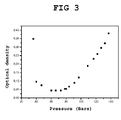
- the formation of micro- or nanoparticles can be monitored and controlled by analysing the turbidity of the system, in turn induced by successive pressure changes and mole fraction of CO 2 (X CO2 ) in the system.
- the turbidity of the system can be measured by optic density.
- the optic density (OD) is defined as the absorbance of an optic element at a determined wavelength in which the system does not absorb, and by unit of optical path or distance.
- the optical density is a property used in the invention to detect variations of the supersaturation value ( ⁇ ) in the system when ⁇ 1, and of the supramolecular organization of its components.
- the "on-line" monitoring of the system is done by means of a UV visible Spectrophotometer.
- a process is provided to obtain micro- or nanoparticles with a homogenous structure.
- the process according to the first aspect of the invention comprises:
- the transition from one to another is determined by the phase changes observed through variations in the optic density.
- stages a) and c) the nature of the solvent will determine the existence of one or more liquid phases, depending on if it is a polar or non-polar organic solvent or mixtures of both or of more than one of them.
- a polar solvent when used there is a unique liquid phase. If a non-apolar solvent is used, there will be more than one liquid phases determined by optic density.
- the mixture of stage a) is prepared at atmospheric pressure and room temperature.
- the temperature of the process regardless of the stage, can be comprised between -50°C and 200°C, and yet more preferably between 20°C and 50°C.
- stages a) and b) can be carried out simultaneously.
- the process continues to stage c).
- the increase in pressure of the container to the first pressure (P 1 ) in stage b) can be carried out whether by adding fluid B, the use of mechanical means such as, e.g., a piston inside the container, or by adding an inert gas, such as for example N 2 .
- the pressure variation in stage c) to a second pressure (P 2 ) can be done in the same way.
- a surfactant in stage a) improves the stability of the final dispersion even more, which is capable of favouring the control of the nucleation processes and crystalline growth, thus, obtaining still smaller particle sizes and narrower size distributions.
- the microemulsion formed in said stage b) comprises an organic phase saturated with water, where said organic phase is formed by said fluid B, said organic solvent or a mixture of organic solvents and said solid compound C and optionally, said surfactant.
- the authors of this invention have found that the final characteristics of the micro- or nanoparticles obtained do not depend in the effectiveness of agitation as is the case in the technologies described to date, but rather the degree of homogenous distribution of water in the microemulsion obtained which after a variation in the pressure (stage c)) causes the water to act as an anti-solvent and causes the precipitation of the solid micro- or nanoparticles. Therefore, the process of this invention represents a considerable change in the line followed up to now for obtaining finely divided particles based mostly in that a higher agitation or homogenization of the solution that contains the solid to be precipitated provides a smaller sized particle.
- the anti-solvent effect of water in determined pressure conditions and in an adequate medium, a microemulsion allows to obtain solid micro- or nanoparticles of a homogenous structure whose micro- or nanoparticles also manifest the initial properties of the nature of the organic compound to be precipitated.
- the second pressure (P 2 ) is greater than the first pressure (P 1 ), and the precipitation is a reversible phenomenon.
- the second pressure (P 2 ) when the pressure variation in stage c) is negative, i.e. ⁇ P ⁇ 0, the second pressure (P 2 ) is lower than the first pressure (P 1 ) and the precipitation is an irreversible phenomenon.
- the organic solvent when ⁇ P>0 the organic solvent can be selected from a polar or non-polar solvent and when ⁇ P ⁇ 0 the organic solvent is a polar solvent.
- the micro- or nanoparticles are collected at said second pressure (P 2 ) by conventional means.
- said particles can be isolated and collected, e.g., by filtration and also when ⁇ P ⁇ 0 they can be collected over a water current so that a suspension of said particles is obtained.
- Said suspension has application in the preparation of a medicine preferably by oral, intravenous or mucosal administration.
- stage c With the pressure variation (stage c) of the microemulsion the behaviour of the water is modified, which goes from acting as a solvent at P 1 to acting as an anti-solvent at P 2 which causes the precipitation of the solid micro- or nanoparticles with a homogenous structure.
- said solid micro- or nanoparticles are also crystalline.
- said solid micro- or nanoparticles have an aspect ratio considerably equal to the unity (1).
- micro- or nanoparticles are provided with an excellent aspect ratio-property.
- micro- or nanoparticles with improved structural characteristics can be obtained such as, e.g., a greater crystallinity, which confers greater stability during storage, fluidity and less tendency to absorb humidity.
- adding fluid B, for example CO 2 in the process of the invention and unlike those of the techniques described to date, does not cause the precipitation of the solid compound C in the form of finely divided particles.
- the process of the invention provides a new technology for obtaining solid micro- or nanoparticles where fluid B is not responsible for the precipitation, nor is it used in supercritical state in any stage of the process. It is believed that the anti-solvent effect of water at P 2 and the conditions in which the precipitation occurs favour a nucleation and growth of crystalline structure with a substantially spheroidal morphology.
- the new process provides unexpected properties to the micro- or nanoparticles obtained, properties not described in the state of the art at said micro- or nanoscale.
- crystallinity and therefore, the absence of an amorphous solid in, e.g. a pharmaceutical product is of great importance because it is considered that formulas that contain amorphous forms are less stable than the crystalline solid and, therefore, carry a risk regarding its preservation of the properties of the material during storage.
- These partial or completely amorphous materials usually have greater reactivity and are unstable to mechanical and thermal stress and have a greater tendency to absorb water.
- Morphology is a highly determining property in the preparation and administration of, for example, a medicine which already has special effect in the properties of pharmaceutical formulation such as fluidity and compactness.
- the more regular and similar to the spherical form is the morphology of the particles the greater their fluidity in aerosol formulas, such as the ones used for oral administration.
- the particles obtained have a narrow volumetric size distribution and an average associated sphere diameter of less than 10 ⁇ m, generally less than 1 ⁇ m.
- the size of the particle obtained with the process defined in the invention is comprised between 10 ⁇ m and 500 nm, preferably between 3 ⁇ m and 800 nm, more preferable between 1 ⁇ m and 700 nm.
- the micro- or nanoparticles obtained according to the first aspect of the invention are of a great interest in the preparation of a composition which also comprises other acceptable pharmaceutical excipients where the structure and morphology of the micro- or nanoparticles is a determining factor for their application.
- micro- or nanoparticles obtained are of special interest in the preparation of an aerosol for inhaled administration of medicines destined to the treatment of pulmonary diseases, or of other formulas where the purpose is to increase the bioavailability of active substances with low water solubility.
- Example 1 Obtaining nanoparticles of ibuprofen through the process of the invention when ⁇ P ⁇ 0 (without surfactant)
- the supply of CO 2 is closed and the adding of N 2 begins through the uppermost part of the reactor through valve 6, to maintain the pressure P1 constant at 100 bar within the reactor during the depressurization process of the microemulsion.
- the evaporation of CO 2 causes the water to again manifest its new anti-solvent characteristic over the dissolved ibuprofen in the organic phase, causing its precipitation.
- the precipitated particles are washed with CO 2 at 40Bar.
- the mother liquors are collected in container 15 through valve 14.
- the size of the particle of the ibuprofen compound was determined through a scanning electron microscope (SEM).
- SEM scanning electron microscope
- the distribution of particle sizes of the collected solid phase in filter 13 have an average of 740 nm with a standard deviation of 100 nm. It was observed through X-ray powder diffraction that the particles obtained are crystalline, and by using the scanning electron microscope (SEM) that they have a homogenous spheroidal morphology (see Figure 5A ). The output of the process is of 86%.
- a second filter to collect the possible solids that did not dissolve in the microemulsion obtained at pressure P1; said filter is represented in Figure 2 as filter 11 .
- Example 2 Obtaining nanoparticles of ibuprofen through the process of the invention when ⁇ P ⁇ 0 (in presence of a surfactant PEG6000 dissolved in the aqueous phase)
- a mixing reactor 7 of 300mL capacity 170mL of a solution of the ibuprofen compound in acetone with a relative concentration of 63% and 90mL of an aqueous solution which contains 10% in weight of the surfactant PEG6000, are introduced, obtaining a suspension of the drug in the acetone-water mixture. Over this suspension CO 2 is added with a volume of flow of 7Kg/hr until the pressure P1 of reactor 7 reaches 100bar. The temperature is kept constant throughout the entire process at 35°C. At these conditions, this system is formed by a transparent microemulsion consisting of the system ibuprofen/acetone/water/PEG6000/CO 2 .
- the microemulsion is left to stabilize at P1 and 35°C during 15 minutes (see Figure 2 ).
- the supply of CO 2 is closed and the adding of N 2 begins through the uppermost part of the reactor 7 through valve 6, to maintain the pressure P1 constant at 100Bars within the reactor during the depressurization process of the microemulsion.
- the evaporation of CO 2 causes the water to again manifest its new anti-solvent characteristic over the dissolved ibuprofen in the organic phase, causing its precipitation.
- the precipitated particles are washed with CO 2 at 40Bar.
- the mother liquors are collected in container 15 through valve 14.
- the size of the particle of the ibuprofen compound was determined through a scanning electron microscope (SEM).
- SEM scanning electron microscope
- the distribution of particle sizes of the collected solid phase in filter 13 have an average of 680nm with a standard deviation of 110nm. It was observed through X-ray powder diffraction that the particles obtained are crystalline, and by using the scanning electron microscope (SEM) that they have a homogenous spheroidal morphology (see Figure 5B ).
- the output of the process is of 81%.
- filter 11 there is a second filter to collect the possible solids that did not dissolve in the microemulsion obtained at pressure P1; said filter is represented in Figure 2 as filter 11.
- Example 3 Obtaining nanoparticles of ibuprofen through the process of the invention when ⁇ P>0 (without surfactant)
- a mixing reactor 7 of 300mL capacity 170mL of a solution of the ibuprofen compound in acetone with a relative concentration of 63% and 90mL of H 2 O are introduced, obtaining a suspension of the drug in the acetone-water mixture. Over this suspension CO 2 is added with a volume of flow of 7Kg/hr until the pressure P1 of reactor 7 reaches 100bar. The temperature is kept constant throughout the entire process at 35°C. At these conditions, this system is formed by a transparent microemulsion consisting of the system ibuprofen/acetone/water/CO 2 . The microemulsion is left to stabilize at P1 and 35°C during 15 minutes (see Figure 2 ).
- the increase in pressure from P1 to P2 stimulates the water to again manifest its new anti-solvent effect over the solute present in the system solute/organic solvent/water/CO 2 , causing its precipitation.
- the precipitated solid is filtered over filter 11 at pressure P2.
- the precipitation of the mother liquors is done through valve 12 and they are collected in tank 15, after passing through filter 13 and valve 14.
- the solid collected in filter 11 is washed with CO 2 at 40Bar.
- the size of the particle of the ibuprofen compound was determined through a scanning electron microscope (SEM).
- the distribution of particle sizes of the collected solid phase in filter 11 have an average of 940nm with a standard deviation of 300nm. It was observed through X-ray powder diffraction that the particles obtained are crystalline, and by using the scanning electron microscope (SEM) that they have a homogenous spheroidal morphology. The output of the process is of 20%.
- Example 4 Obtaining nanoparticles of ibuprofen through the process of the invention when ⁇ P>0 (in presence of a surfactant PEG6000 dissolved in the aqueous phase)
- a mixing reactor 7 of 300mL capacity 170mL of a solution of the ibuprofen compound in acetone with a relative concentration of 63% and 90mL of an aqueous solution which contains 10% in weight of surfactant PEG6000, are introduced, obtaining a suspension of the drug in the acetone-water mixture. Over this suspension CO 2 is added with a volume of flow of 7Kg/hr until the pressure P1 of reactor 7 reaches 100bar. The temperature is kept constant throughout the entire process at 35°C. At these conditions, this system is formed by a transparent microemulsion consisting of the system ibuprofen / acetone / water / PEG6000 / CO 2 .
- the microemulsion is left to stabilize at P1 and 35°C during 15 minutes (see Figure 2 ).
- the increase in pressure from P1 to P2 stimulates the water to again manifest its new anti-solvent effect over the solute present in the system solute/organic solvent/water/PEG6000/CO 2 , causing its precipitation.
- the precipitated solid is filtered over filter 11 at pressure P2.
- the precipitation of the mother liquors is done through valve 12 and they are collected in tank 15, after passing through filter 13 and valve 14.
- the solid collected in filter 11 is washed with CO 2 at 40Bar.
- the size of the particle of the ibuprofen compound was determined through a scanning electron microscope (SEM).
- SEM scanning electron microscope
- the distribution of particle sizes of the collected solid phase in filter 11 have an average of 935nm with a standard deviation of 460nm. It was observed through X-ray powder diffraction that the particles obtained are crystalline, and by using the scanning electron microscope (SEM) that they have a homogenous spheroidal morphology .
- the output of the process is of 21%. (See Figure 6C )
Landscapes
- Health & Medical Sciences (AREA)
- Chemical & Material Sciences (AREA)
- Bioinformatics & Cheminformatics (AREA)
- Engineering & Computer Science (AREA)
- Animal Behavior & Ethology (AREA)
- Public Health (AREA)
- Veterinary Medicine (AREA)
- General Health & Medical Sciences (AREA)
- Life Sciences & Earth Sciences (AREA)
- Epidemiology (AREA)
- Pharmacology & Pharmacy (AREA)
- Medicinal Chemistry (AREA)
- Organic Chemistry (AREA)
- Chemical Kinetics & Catalysis (AREA)
- Optics & Photonics (AREA)
- Nanotechnology (AREA)
- Biomedical Technology (AREA)
- Dispersion Chemistry (AREA)
- Physics & Mathematics (AREA)
- Crystallography & Structural Chemistry (AREA)
- Medicinal Preparation (AREA)
- Physical Or Chemical Processes And Apparatus (AREA)
- Acyclic And Carbocyclic Compounds In Medicinal Compositions (AREA)
Applications Claiming Priority (2)
| Application Number | Priority Date | Filing Date | Title |
|---|---|---|---|
| ES200803753A ES2342140B1 (es) | 2008-12-30 | 2008-12-30 | Procedimiento para la obtencion de micro- o nanoparticulas solidas |
| PCT/ES2009/070485 WO2010076360A1 (es) | 2008-12-30 | 2009-11-06 | Procedimiento para la obtención de micro - o nanopartículas sólidas |
Publications (3)
| Publication Number | Publication Date |
|---|---|
| EP2383034A1 true EP2383034A1 (de) | 2011-11-02 |
| EP2383034A4 EP2383034A4 (de) | 2013-06-19 |
| EP2383034B1 EP2383034B1 (de) | 2014-08-13 |
Family
ID=42260540
Family Applications (1)
| Application Number | Title | Priority Date | Filing Date |
|---|---|---|---|
| EP09836113.2A Active EP2383034B1 (de) | 2008-12-30 | 2009-11-06 | Verfahren zum erhalt von festen mikro- oder nanoteilchen |
Country Status (5)
| Country | Link |
|---|---|
| US (1) | US8613953B2 (de) |
| EP (1) | EP2383034B1 (de) |
| CA (1) | CA2748682C (de) |
| ES (2) | ES2342140B1 (de) |
| WO (1) | WO2010076360A1 (de) |
Families Citing this family (2)
| Publication number | Priority date | Publication date | Assignee | Title |
|---|---|---|---|---|
| CN113200846B (zh) * | 2021-04-23 | 2022-04-22 | 浙江新和成股份有限公司 | 一种高松密度布洛芬球形晶体的制备方法及其产品 |
| CN116460302A (zh) * | 2023-04-20 | 2023-07-21 | 西北大学 | 一种无表面活性剂微乳液制备超细银粉的方法 |
Family Cites Families (9)
| Publication number | Priority date | Publication date | Assignee | Title |
|---|---|---|---|---|
| SE9804001D0 (sv) * | 1998-11-23 | 1998-11-23 | Astra Ab | New process |
| AU3465901A (en) * | 2000-03-03 | 2001-09-17 | Boehringer Ingelheim Pharma | Material processing by repeated solvent expansion-contraction |
| ES2170008B1 (es) * | 2000-08-25 | 2003-05-01 | Soc Es Carburos Metalicos Sa | Procedimiento para la precipitacion de particulas solidas finamente divididas. |
| US7276190B2 (en) * | 2001-07-02 | 2007-10-02 | Micro & Nano Materials Sagl | Process for the production of micro and/or nano particles |
| DE10248619A1 (de) * | 2002-10-18 | 2004-04-29 | Bayer Ag | Verfahren zur Herstellung pulverförmiger Wirkstoff-Formulierungen mit kompressiblen Fluiden |
| ES2265262B1 (es) * | 2005-01-31 | 2008-03-01 | Activery Biotech, S.L.(Titular Al 50%) | Procedimiento para la obtencion de sistemas micro- y nanodispersos. |
| WO2007009986A2 (en) * | 2005-07-19 | 2007-01-25 | Activery Biotech, S.L. | Process for obtaining a composite |
| ES2292300B1 (es) * | 2005-07-19 | 2009-02-16 | Sociedad Española De Carburos Metalicos, S.A.(Titular Al 50%) | Procedimiento para la obtencion de un material compuesto. |
| EP2061583B1 (de) * | 2006-09-14 | 2019-04-10 | Yissum Research Development Company, of The Hebrew University of Jerusalem | Organische nanopartikel, erhalten aus mikroemulsionen durch lösungsmittelverdampfung |
-
2008
- 2008-12-30 ES ES200803753A patent/ES2342140B1/es not_active Expired - Fee Related
-
2009
- 2009-11-06 WO PCT/ES2009/070485 patent/WO2010076360A1/es not_active Ceased
- 2009-11-06 CA CA2748682A patent/CA2748682C/en active Active
- 2009-11-06 EP EP09836113.2A patent/EP2383034B1/de active Active
- 2009-11-06 ES ES09836113.2T patent/ES2523725T3/es active Active
- 2009-11-06 US US13/142,764 patent/US8613953B2/en not_active Expired - Fee Related
Also Published As
| Publication number | Publication date |
|---|---|
| EP2383034B1 (de) | 2014-08-13 |
| ES2342140A1 (es) | 2010-07-01 |
| ES2342140B1 (es) | 2011-05-17 |
| CA2748682A1 (en) | 2010-07-08 |
| US8613953B2 (en) | 2013-12-24 |
| EP2383034A4 (de) | 2013-06-19 |
| US20120004308A1 (en) | 2012-01-05 |
| WO2010076360A1 (es) | 2010-07-08 |
| CA2748682C (en) | 2016-06-28 |
| ES2523725T3 (es) | 2014-12-01 |
Similar Documents
| Publication | Publication Date | Title |
|---|---|---|
| Türk | Manufacture of submicron drug particles with enhanced dissolution behaviour by rapid expansion processes | |
| Geetha et al. | Various techniques for preparation of nanosuspension-a review | |
| JP5207432B2 (ja) | アンチ溶媒凝固プロセス | |
| KR100508910B1 (ko) | 불용성약물방출 | |
| Ali et al. | Preparation of hydrocortisone nanosuspension through a bottom-up nanoprecipitation technique using microfluidic reactors | |
| Kakran et al. | Preparation of nanoparticles of poorly water-soluble antioxidant curcumin by antisolvent precipitation methods | |
| de Paz et al. | Formulation of β-carotene with soybean lecithin by PGSS (Particles from Gas Saturated Solutions)-drying | |
| De Zordi et al. | Applications of supercritical fluids to enhance the dissolution behaviors of Furosemide by generation of microparticles and solid dispersions | |
| Paisana et al. | Production and stabilization of olanzapine nanoparticles by rapid expansion of supercritical solutions (RESS) | |
| Tenorio et al. | Controlled submicro particle formation of ampicillin by supercritical antisolvent precipitation | |
| Rehman et al. | Solubility and precipitation of nicotinic acid in supercritical carbon dioxide | |
| Zhang et al. | Micronization of silybin by the emulsion solvent diffusion method | |
| Venkatesh et al. | Nanosuspensions: ideal approach for the drug delivery of poorly water soluble drugs | |
| Melzig et al. | Formation of long-term stable amorphous ibuprofen nanoparticles via antisolvent melt precipitation (AMP) | |
| Junior et al. | Production and computational fluid dynamics-based modeling of PMMA nanoparticles impregnated with ivermectin by a supercritical antisolvent process | |
| EP2383034B1 (de) | Verfahren zum erhalt von festen mikro- oder nanoteilchen | |
| ES2265262B1 (es) | Procedimiento para la obtencion de sistemas micro- y nanodispersos. | |
| Massias et al. | Supercritical carbon dioxide solubility measurement and modelling for effective size reduction of nifedipine particles for transdermal application | |
| Chafidz et al. | Formation of fine particles using supercritical fluid (SCF) process: Short review | |
| Mezzomo et al. | Nanosizing of sodium ibuprofen by SAS method | |
| US8142814B2 (en) | Method and apparatus for supercritical fluid assisted particle production | |
| Sinha et al. | Can the cavi-precipitation process be exploited to generate smaller size drug nanocrystal? | |
| Motwani et al. | Advances in Solubility Enhancement of Poorly Soluble Drugs in Pharmaceutical Development: A Review of Current Techniques and Strategies | |
| Caputo et al. | Use of urea as habit modifier in the supercritical antisolvent micronization of sulfathiazole | |
| Ali et al. | Drug nanocrystals: emerging trends in pharmaceutical industries |
Legal Events
| Date | Code | Title | Description |
|---|---|---|---|
| PUAI | Public reference made under article 153(3) epc to a published international application that has entered the european phase |
Free format text: ORIGINAL CODE: 0009012 |
|
| 17P | Request for examination filed |
Effective date: 20110725 |
|
| AK | Designated contracting states |
Kind code of ref document: A1 Designated state(s): AT BE BG CH CY CZ DE DK EE ES FI FR GB GR HR HU IE IS IT LI LT LU LV MC MK MT NL NO PL PT RO SE SI SK SM TR |
|
| DAX | Request for extension of the european patent (deleted) | ||
| A4 | Supplementary search report drawn up and despatched |
Effective date: 20130517 |
|
| RIC1 | Information provided on ipc code assigned before grant |
Ipc: B01D 11/00 20060101ALI20130513BHEP Ipc: B01J 13/00 20060101ALI20130513BHEP Ipc: A61K 9/14 20060101ALI20130513BHEP Ipc: B01F 3/00 20060101ALI20130513BHEP Ipc: A61K 9/51 20060101AFI20130513BHEP |
|
| REG | Reference to a national code |
Ref country code: DE Ref legal event code: R079 Ref document number: 602009026052 Country of ref document: DE Free format text: PREVIOUS MAIN CLASS: B01J0013000000 Ipc: A61K0009510000 |
|
| RIC1 | Information provided on ipc code assigned before grant |
Ipc: B01J 13/00 20060101ALI20130809BHEP Ipc: B01D 11/00 20060101ALI20130809BHEP Ipc: B01F 3/00 20060101ALI20130809BHEP Ipc: A61K 9/14 20060101ALI20130809BHEP Ipc: A61K 9/51 20060101AFI20130809BHEP |
|
| GRAP | Despatch of communication of intention to grant a patent |
Free format text: ORIGINAL CODE: EPIDOSNIGR1 |
|
| RAP1 | Party data changed (applicant data changed or rights of an application transferred) |
Owner name: CENTRO DE INVESTIGACION BIOMEDICA EN RED EN BIOING Owner name: CONSEJO SUPERIOR DE INVESTIGACIONES CIENTIFICAS (C |
|
| INTG | Intention to grant announced |
Effective date: 20140312 |
|
| GRAS | Grant fee paid |
Free format text: ORIGINAL CODE: EPIDOSNIGR3 |
|
| GRAA | (expected) grant |
Free format text: ORIGINAL CODE: 0009210 |
|
| AK | Designated contracting states |
Kind code of ref document: B1 Designated state(s): AT BE BG CH CY CZ DE DK EE ES FI FR GB GR HR HU IE IS IT LI LT LU LV MC MK MT NL NO PL PT RO SE SI SK SM TR |
|
| REG | Reference to a national code |
Ref country code: GB Ref legal event code: FG4D |
|
| REG | Reference to a national code |
Ref country code: CH Ref legal event code: EP Ref country code: AT Ref legal event code: REF Ref document number: 681728 Country of ref document: AT Kind code of ref document: T Effective date: 20140815 |
|
| REG | Reference to a national code |
Ref country code: IE Ref legal event code: FG4D |
|
| REG | Reference to a national code |
Ref country code: DE Ref legal event code: R096 Ref document number: 602009026052 Country of ref document: DE Effective date: 20140925 |
|
| REG | Reference to a national code |
Ref country code: ES Ref legal event code: FG2A Ref document number: 2523725 Country of ref document: ES Kind code of ref document: T3 Effective date: 20141201 |
|
| REG | Reference to a national code |
Ref country code: NL Ref legal event code: VDEP Effective date: 20140813 |
|
| REG | Reference to a national code |
Ref country code: AT Ref legal event code: MK05 Ref document number: 681728 Country of ref document: AT Kind code of ref document: T Effective date: 20140813 |
|
| REG | Reference to a national code |
Ref country code: LT Ref legal event code: MG4D |
|
| PG25 | Lapsed in a contracting state [announced via postgrant information from national office to epo] |
Ref country code: SE Free format text: LAPSE BECAUSE OF FAILURE TO SUBMIT A TRANSLATION OF THE DESCRIPTION OR TO PAY THE FEE WITHIN THE PRESCRIBED TIME-LIMIT Effective date: 20140813 Ref country code: FI Free format text: LAPSE BECAUSE OF FAILURE TO SUBMIT A TRANSLATION OF THE DESCRIPTION OR TO PAY THE FEE WITHIN THE PRESCRIBED TIME-LIMIT Effective date: 20140813 Ref country code: LT Free format text: LAPSE BECAUSE OF FAILURE TO SUBMIT A TRANSLATION OF THE DESCRIPTION OR TO PAY THE FEE WITHIN THE PRESCRIBED TIME-LIMIT Effective date: 20140813 Ref country code: BG Free format text: LAPSE BECAUSE OF FAILURE TO SUBMIT A TRANSLATION OF THE DESCRIPTION OR TO PAY THE FEE WITHIN THE PRESCRIBED TIME-LIMIT Effective date: 20141113 Ref country code: NO Free format text: LAPSE BECAUSE OF FAILURE TO SUBMIT A TRANSLATION OF THE DESCRIPTION OR TO PAY THE FEE WITHIN THE PRESCRIBED TIME-LIMIT Effective date: 20141113 Ref country code: PT Free format text: LAPSE BECAUSE OF FAILURE TO SUBMIT A TRANSLATION OF THE DESCRIPTION OR TO PAY THE FEE WITHIN THE PRESCRIBED TIME-LIMIT Effective date: 20141215 Ref country code: GR Free format text: LAPSE BECAUSE OF FAILURE TO SUBMIT A TRANSLATION OF THE DESCRIPTION OR TO PAY THE FEE WITHIN THE PRESCRIBED TIME-LIMIT Effective date: 20141114 |
|
| REG | Reference to a national code |
Ref country code: CH Ref legal event code: NV Representative=s name: BOHEST AG, CH Ref country code: CH Ref legal event code: PFUS Owner name: CONSEJO SUPERIOR DE INVESTIGACIONES CIENTIFICA, ES Free format text: FORMER OWNER: CONSEJO SUPERIOR DE INVESTIGACIONES CIENTIFICAS (CSIC), ES |
|
| PG25 | Lapsed in a contracting state [announced via postgrant information from national office to epo] |
Ref country code: CY Free format text: LAPSE BECAUSE OF FAILURE TO SUBMIT A TRANSLATION OF THE DESCRIPTION OR TO PAY THE FEE WITHIN THE PRESCRIBED TIME-LIMIT Effective date: 20140813 Ref country code: LV Free format text: LAPSE BECAUSE OF FAILURE TO SUBMIT A TRANSLATION OF THE DESCRIPTION OR TO PAY THE FEE WITHIN THE PRESCRIBED TIME-LIMIT Effective date: 20140813 Ref country code: HR Free format text: LAPSE BECAUSE OF FAILURE TO SUBMIT A TRANSLATION OF THE DESCRIPTION OR TO PAY THE FEE WITHIN THE PRESCRIBED TIME-LIMIT Effective date: 20140813 Ref country code: AT Free format text: LAPSE BECAUSE OF FAILURE TO SUBMIT A TRANSLATION OF THE DESCRIPTION OR TO PAY THE FEE WITHIN THE PRESCRIBED TIME-LIMIT Effective date: 20140813 Ref country code: IS Free format text: LAPSE BECAUSE OF FAILURE TO SUBMIT A TRANSLATION OF THE DESCRIPTION OR TO PAY THE FEE WITHIN THE PRESCRIBED TIME-LIMIT Effective date: 20141213 |
|
| PG25 | Lapsed in a contracting state [announced via postgrant information from national office to epo] |
Ref country code: NL Free format text: LAPSE BECAUSE OF FAILURE TO SUBMIT A TRANSLATION OF THE DESCRIPTION OR TO PAY THE FEE WITHIN THE PRESCRIBED TIME-LIMIT Effective date: 20140813 |
|
| PG25 | Lapsed in a contracting state [announced via postgrant information from national office to epo] |
Ref country code: DK Free format text: LAPSE BECAUSE OF FAILURE TO SUBMIT A TRANSLATION OF THE DESCRIPTION OR TO PAY THE FEE WITHIN THE PRESCRIBED TIME-LIMIT Effective date: 20140813 Ref country code: CZ Free format text: LAPSE BECAUSE OF FAILURE TO SUBMIT A TRANSLATION OF THE DESCRIPTION OR TO PAY THE FEE WITHIN THE PRESCRIBED TIME-LIMIT Effective date: 20140813 Ref country code: RO Free format text: LAPSE BECAUSE OF FAILURE TO SUBMIT A TRANSLATION OF THE DESCRIPTION OR TO PAY THE FEE WITHIN THE PRESCRIBED TIME-LIMIT Effective date: 20140813 Ref country code: EE Free format text: LAPSE BECAUSE OF FAILURE TO SUBMIT A TRANSLATION OF THE DESCRIPTION OR TO PAY THE FEE WITHIN THE PRESCRIBED TIME-LIMIT Effective date: 20140813 Ref country code: SK Free format text: LAPSE BECAUSE OF FAILURE TO SUBMIT A TRANSLATION OF THE DESCRIPTION OR TO PAY THE FEE WITHIN THE PRESCRIBED TIME-LIMIT Effective date: 20140813 |
|
| REG | Reference to a national code |
Ref country code: DE Ref legal event code: R097 Ref document number: 602009026052 Country of ref document: DE |
|
| PG25 | Lapsed in a contracting state [announced via postgrant information from national office to epo] |
Ref country code: PL Free format text: LAPSE BECAUSE OF FAILURE TO SUBMIT A TRANSLATION OF THE DESCRIPTION OR TO PAY THE FEE WITHIN THE PRESCRIBED TIME-LIMIT Effective date: 20140813 |
|
| PLBE | No opposition filed within time limit |
Free format text: ORIGINAL CODE: 0009261 |
|
| STAA | Information on the status of an ep patent application or granted ep patent |
Free format text: STATUS: NO OPPOSITION FILED WITHIN TIME LIMIT |
|
| PG25 | Lapsed in a contracting state [announced via postgrant information from national office to epo] |
Ref country code: LU Free format text: LAPSE BECAUSE OF FAILURE TO SUBMIT A TRANSLATION OF THE DESCRIPTION OR TO PAY THE FEE WITHIN THE PRESCRIBED TIME-LIMIT Effective date: 20141106 Ref country code: MC Free format text: LAPSE BECAUSE OF FAILURE TO SUBMIT A TRANSLATION OF THE DESCRIPTION OR TO PAY THE FEE WITHIN THE PRESCRIBED TIME-LIMIT Effective date: 20140813 Ref country code: BE Free format text: LAPSE BECAUSE OF NON-PAYMENT OF DUE FEES Effective date: 20141130 |
|
| 26N | No opposition filed |
Effective date: 20150515 |
|
| REG | Reference to a national code |
Ref country code: IE Ref legal event code: MM4A |
|
| REG | Reference to a national code |
Ref country code: FR Ref legal event code: PLFP Year of fee payment: 7 |
|
| PG25 | Lapsed in a contracting state [announced via postgrant information from national office to epo] |
Ref country code: IE Free format text: LAPSE BECAUSE OF NON-PAYMENT OF DUE FEES Effective date: 20141106 |
|
| PG25 | Lapsed in a contracting state [announced via postgrant information from national office to epo] |
Ref country code: SI Free format text: LAPSE BECAUSE OF FAILURE TO SUBMIT A TRANSLATION OF THE DESCRIPTION OR TO PAY THE FEE WITHIN THE PRESCRIBED TIME-LIMIT Effective date: 20140813 |
|
| PG25 | Lapsed in a contracting state [announced via postgrant information from national office to epo] |
Ref country code: SM Free format text: LAPSE BECAUSE OF FAILURE TO SUBMIT A TRANSLATION OF THE DESCRIPTION OR TO PAY THE FEE WITHIN THE PRESCRIBED TIME-LIMIT Effective date: 20140813 |
|
| PG25 | Lapsed in a contracting state [announced via postgrant information from national office to epo] |
Ref country code: HU Free format text: LAPSE BECAUSE OF FAILURE TO SUBMIT A TRANSLATION OF THE DESCRIPTION OR TO PAY THE FEE WITHIN THE PRESCRIBED TIME-LIMIT; INVALID AB INITIO Effective date: 20091106 Ref country code: BE Free format text: LAPSE BECAUSE OF FAILURE TO SUBMIT A TRANSLATION OF THE DESCRIPTION OR TO PAY THE FEE WITHIN THE PRESCRIBED TIME-LIMIT Effective date: 20140813 Ref country code: MT Free format text: LAPSE BECAUSE OF FAILURE TO SUBMIT A TRANSLATION OF THE DESCRIPTION OR TO PAY THE FEE WITHIN THE PRESCRIBED TIME-LIMIT Effective date: 20140813 Ref country code: TR Free format text: LAPSE BECAUSE OF FAILURE TO SUBMIT A TRANSLATION OF THE DESCRIPTION OR TO PAY THE FEE WITHIN THE PRESCRIBED TIME-LIMIT Effective date: 20140813 |
|
| REG | Reference to a national code |
Ref country code: FR Ref legal event code: PLFP Year of fee payment: 8 |
|
| REG | Reference to a national code |
Ref country code: FR Ref legal event code: PLFP Year of fee payment: 9 |
|
| PG25 | Lapsed in a contracting state [announced via postgrant information from national office to epo] |
Ref country code: MK Free format text: LAPSE BECAUSE OF FAILURE TO SUBMIT A TRANSLATION OF THE DESCRIPTION OR TO PAY THE FEE WITHIN THE PRESCRIBED TIME-LIMIT Effective date: 20140813 |
|
| REG | Reference to a national code |
Ref country code: FR Ref legal event code: PLFP Year of fee payment: 10 |
|
| PGFP | Annual fee paid to national office [announced via postgrant information from national office to epo] |
Ref country code: DE Payment date: 20241112 Year of fee payment: 16 |
|
| PGFP | Annual fee paid to national office [announced via postgrant information from national office to epo] |
Ref country code: GB Payment date: 20241107 Year of fee payment: 16 |
|
| PGFP | Annual fee paid to national office [announced via postgrant information from national office to epo] |
Ref country code: FR Payment date: 20241111 Year of fee payment: 16 |
|
| PGFP | Annual fee paid to national office [announced via postgrant information from national office to epo] |
Ref country code: IT Payment date: 20241112 Year of fee payment: 16 |
|
| PGFP | Annual fee paid to national office [announced via postgrant information from national office to epo] |
Ref country code: CH Payment date: 20241201 Year of fee payment: 16 |
|
| PGFP | Annual fee paid to national office [announced via postgrant information from national office to epo] |
Ref country code: ES Payment date: 20250429 Year of fee payment: 16 |