EP2377861A1 - Wasserlösliche Bis-triazinyl-pyridine, -bipyridine und terpyridine, deren Synthese und Verwendung - Google Patents
Wasserlösliche Bis-triazinyl-pyridine, -bipyridine und terpyridine, deren Synthese und Verwendung Download PDFInfo
- Publication number
- EP2377861A1 EP2377861A1 EP10004105A EP10004105A EP2377861A1 EP 2377861 A1 EP2377861 A1 EP 2377861A1 EP 10004105 A EP10004105 A EP 10004105A EP 10004105 A EP10004105 A EP 10004105A EP 2377861 A1 EP2377861 A1 EP 2377861A1
- Authority
- EP
- European Patent Office
- Prior art keywords
- bis
- triazin
- actinides
- iii
- sulfophenyl
- Prior art date
- Legal status (The legal status is an assumption and is not a legal conclusion. Google has not performed a legal analysis and makes no representation as to the accuracy of the status listed.)
- Granted
Links
- 238000003786 synthesis reaction Methods 0.000 title abstract description 8
- 230000015572 biosynthetic process Effects 0.000 title abstract description 7
- XKYZSRCYRUIYJS-UHFFFAOYSA-N 4-[2-(triazin-4-yl)pyridin-3-yl]triazine Chemical class C=1C=NN=NC=1C1=CC=CN=C1C1=CC=NN=N1 XKYZSRCYRUIYJS-UHFFFAOYSA-N 0.000 title description 2
- 229910052768 actinide Inorganic materials 0.000 claims abstract description 51
- 150000001255 actinides Chemical class 0.000 claims abstract description 51
- 238000000034 method Methods 0.000 claims abstract description 50
- 229910052747 lanthanoid Inorganic materials 0.000 claims abstract description 27
- 150000002602 lanthanoids Chemical class 0.000 claims abstract description 27
- 239000008139 complexing agent Substances 0.000 claims abstract description 26
- 239000008346 aqueous phase Substances 0.000 claims abstract description 20
- 239000007864 aqueous solution Substances 0.000 claims abstract description 10
- 238000010668 complexation reaction Methods 0.000 claims abstract description 9
- 238000000605 extraction Methods 0.000 claims description 40
- -1 5,6-di (sulfophenyl) -1,2,4-triazin-3-yl Chemical group 0.000 claims description 16
- 239000000243 solution Substances 0.000 claims description 16
- OKKJLVBELUTLKV-UHFFFAOYSA-N Methanol Chemical compound OC OKKJLVBELUTLKV-UHFFFAOYSA-N 0.000 claims description 15
- GRYLNZFGIOXLOG-UHFFFAOYSA-N Nitric acid Chemical compound O[N+]([O-])=O GRYLNZFGIOXLOG-UHFFFAOYSA-N 0.000 claims description 12
- 229910017604 nitric acid Inorganic materials 0.000 claims description 12
- LXQXZNRPTYVCNG-UHFFFAOYSA-N americium atom Chemical compound [Am] LXQXZNRPTYVCNG-UHFFFAOYSA-N 0.000 claims description 9
- BWSRLMFHGZNSGI-UHFFFAOYSA-N 2-[3-[6-[5,6-bis(2-sulfophenyl)-1,2,4-triazin-3-yl]pyridin-2-yl]-6-(2-sulfophenyl)-1,2,4-triazin-5-yl]benzenesulfonic acid Chemical class OS(=O)(=O)C1=CC=CC=C1C1=NN=C(C=2N=C(C=CC=2)C=2N=C(C(C=3C(=CC=CC=3)S(O)(=O)=O)=NN=2)C=2C(=CC=CC=2)S(O)(=O)=O)N=C1C1=CC=CC=C1S(O)(=O)=O BWSRLMFHGZNSGI-UHFFFAOYSA-N 0.000 claims description 7
- SNFKJUPNLXIVGX-UHFFFAOYSA-N 2-[3-[6-[6-[5,6-bis(2-sulfophenyl)-1,2,4-triazin-3-yl]pyridin-2-yl]pyridin-2-yl]-6-(2-sulfophenyl)-1,2,4-triazin-5-yl]benzenesulfonic acid Chemical compound OS(=O)(=O)C1=CC=CC=C1C1=NN=C(C=2N=C(C=CC=2)C=2N=C(C=CC=2)C=2N=C(C(C=3C(=CC=CC=3)S(O)(=O)=O)=NN=2)C=2C(=CC=CC=2)S(O)(=O)=O)N=C1C1=CC=CC=C1S(O)(=O)=O SNFKJUPNLXIVGX-UHFFFAOYSA-N 0.000 claims description 7
- 229910052685 Curium Inorganic materials 0.000 claims description 7
- 229910052695 Americium Inorganic materials 0.000 claims description 6
- 229910052781 Neptunium Inorganic materials 0.000 claims description 6
- 229910052778 Plutonium Inorganic materials 0.000 claims description 6
- LFNLGNPSGWYGGD-UHFFFAOYSA-N neptunium atom Chemical compound [Np] LFNLGNPSGWYGGD-UHFFFAOYSA-N 0.000 claims description 6
- OYEHPCDNVJXUIW-UHFFFAOYSA-N plutonium atom Chemical compound [Pu] OYEHPCDNVJXUIW-UHFFFAOYSA-N 0.000 claims description 6
- 238000012958 reprocessing Methods 0.000 claims description 6
- MAHACDPJCRWPOT-UHFFFAOYSA-N 3-[6-(5,6-diphenyl-1,2,4-triazin-3-yl)pyridin-2-yl]-5,6-diphenyl-1,2,4-triazine Chemical compound C1=CC=CC=C1C1=NN=C(C=2N=C(C=CC=2)C=2N=C(C(C=3C=CC=CC=3)=NN=2)C=2C=CC=CC=2)N=C1C1=CC=CC=C1 MAHACDPJCRWPOT-UHFFFAOYSA-N 0.000 claims description 5
- QLALOYQHAJMDDE-UHFFFAOYSA-N 3-[6-[6-(5,6-diphenyl-1,2,4-triazin-3-yl)pyridin-2-yl]pyridin-2-yl]-5,6-diphenyl-1,2,4-triazine Chemical compound C1=CC=CC=C1C1=NN=C(C=2N=C(C=CC=2)C=2N=C(C=CC=2)C=2N=C(C(C=3C=CC=CC=3)=NN=2)C=2C=CC=CC=2)N=C1C1=CC=CC=C1 QLALOYQHAJMDDE-UHFFFAOYSA-N 0.000 claims description 5
- 239000000284 extract Substances 0.000 claims description 5
- 239000003758 nuclear fuel Substances 0.000 claims description 5
- 238000002360 preparation method Methods 0.000 claims description 5
- QAOWNCQODCNURD-UHFFFAOYSA-N Sulfuric acid Chemical compound OS(O)(=O)=O QAOWNCQODCNURD-UHFFFAOYSA-N 0.000 claims description 4
- 239000003795 chemical substances by application Substances 0.000 claims description 4
- 239000012043 crude product Substances 0.000 claims description 4
- AKEJUJNQAAGONA-UHFFFAOYSA-N sulfur trioxide Chemical compound O=S(=O)=O AKEJUJNQAAGONA-UHFFFAOYSA-N 0.000 claims description 4
- 239000002798 polar solvent Substances 0.000 claims description 3
- KEQGZUUPPQEDPF-UHFFFAOYSA-N 1,3-dichloro-5,5-dimethylimidazolidine-2,4-dione Chemical compound CC1(C)N(Cl)C(=O)N(Cl)C1=O KEQGZUUPPQEDPF-UHFFFAOYSA-N 0.000 claims description 2
- 238000006243 chemical reaction Methods 0.000 claims description 2
- XTHPWXDJESJLNJ-UHFFFAOYSA-N chlorosulfonic acid Substances OS(Cl)(=O)=O XTHPWXDJESJLNJ-UHFFFAOYSA-N 0.000 claims description 2
- LNOPIUAQISRISI-UHFFFAOYSA-N n'-hydroxy-2-propan-2-ylsulfonylethanimidamide Chemical compound CC(C)S(=O)(=O)CC(N)=NO LNOPIUAQISRISI-UHFFFAOYSA-N 0.000 claims description 2
- 239000002738 chelating agent Substances 0.000 claims 2
- 125000001997 phenyl group Chemical group [H]C1=C([H])C([H])=C(*)C([H])=C1[H] 0.000 claims 1
- 238000006277 sulfonation reaction Methods 0.000 claims 1
- 238000000926 separation method Methods 0.000 abstract description 13
- 238000004519 manufacturing process Methods 0.000 abstract description 3
- 239000013522 chelant Substances 0.000 abstract 1
- 230000000536 complexating effect Effects 0.000 abstract 1
- VRZYWIAVUGQHKB-UHFFFAOYSA-N 2-[2-(dioctylamino)-2-oxoethoxy]-n,n-dioctylacetamide Chemical compound CCCCCCCCN(CCCCCCCC)C(=O)COCC(=O)N(CCCCCCCC)CCCCCCCC VRZYWIAVUGQHKB-UHFFFAOYSA-N 0.000 description 19
- 239000012074 organic phase Substances 0.000 description 19
- KBPLFHHGFOOTCA-UHFFFAOYSA-N 1-Octanol Chemical compound CCCCCCCCO KBPLFHHGFOOTCA-UHFFFAOYSA-N 0.000 description 10
- 239000000047 product Substances 0.000 description 9
- FAPWRFPIFSIZLT-UHFFFAOYSA-M Sodium chloride Chemical compound [Na+].[Cl-] FAPWRFPIFSIZLT-UHFFFAOYSA-M 0.000 description 8
- 238000009826 distribution Methods 0.000 description 8
- 239000002253 acid Substances 0.000 description 7
- 239000003350 kerosene Substances 0.000 description 7
- XLYOFNOQVPJJNP-UHFFFAOYSA-N water Substances O XLYOFNOQVPJJNP-UHFFFAOYSA-N 0.000 description 7
- 239000000203 mixture Substances 0.000 description 6
- 230000007935 neutral effect Effects 0.000 description 6
- 150000003839 salts Chemical class 0.000 description 6
- 239000000126 substance Substances 0.000 description 5
- 230000000694 effects Effects 0.000 description 4
- 239000012071 phase Substances 0.000 description 4
- HFKVKGYQGDZBTJ-UHFFFAOYSA-N 3-[4-[[bis[(1-tert-butyltriazol-4-yl)methyl]amino]methyl]triazol-1-yl]propan-1-ol Chemical compound N1=NN(C(C)(C)C)C=C1CN(CC=1N=NN(C=1)C(C)(C)C)CC1=CN(CCCO)N=N1 HFKVKGYQGDZBTJ-UHFFFAOYSA-N 0.000 description 3
- OAKJQQAXSVQMHS-UHFFFAOYSA-N Hydrazine Chemical compound NN OAKJQQAXSVQMHS-UHFFFAOYSA-N 0.000 description 3
- HEMHJVSKTPXQMS-UHFFFAOYSA-M Sodium hydroxide Chemical compound [OH-].[Na+] HEMHJVSKTPXQMS-UHFFFAOYSA-M 0.000 description 3
- 150000001875 compounds Chemical class 0.000 description 3
- SEGLCEQVOFDUPX-UHFFFAOYSA-N di-(2-ethylhexyl)phosphoric acid Chemical compound CCCCC(CC)COP(O)(=O)OCC(CC)CCCC SEGLCEQVOFDUPX-UHFFFAOYSA-N 0.000 description 3
- 238000002474 experimental method Methods 0.000 description 3
- 230000004992 fission Effects 0.000 description 3
- 150000002500 ions Chemical class 0.000 description 3
- 239000011541 reaction mixture Substances 0.000 description 3
- 239000002904 solvent Substances 0.000 description 3
- XKRFYHLGVUSROY-UHFFFAOYSA-N Argon Chemical compound [Ar] XKRFYHLGVUSROY-UHFFFAOYSA-N 0.000 description 2
- JUJWROOIHBZHMG-UHFFFAOYSA-N Pyridine Chemical group C1=CC=NC=C1 JUJWROOIHBZHMG-UHFFFAOYSA-N 0.000 description 2
- 208000019155 Radiation injury Diseases 0.000 description 2
- 229910052770 Uranium Inorganic materials 0.000 description 2
- 239000003929 acidic solution Substances 0.000 description 2
- 150000007513 acids Chemical class 0.000 description 2
- 125000003118 aryl group Chemical group 0.000 description 2
- 239000003153 chemical reaction reagent Substances 0.000 description 2
- 239000007788 liquid Substances 0.000 description 2
- 230000007774 longterm Effects 0.000 description 2
- 230000003647 oxidation Effects 0.000 description 2
- 238000007254 oxidation reaction Methods 0.000 description 2
- 238000003608 radiolysis reaction Methods 0.000 description 2
- 238000004064 recycling Methods 0.000 description 2
- 239000007787 solid Substances 0.000 description 2
- 239000002915 spent fuel radioactive waste Substances 0.000 description 2
- 125000000020 sulfo group Chemical group O=S(=O)([*])O[H] 0.000 description 2
- 230000002195 synergetic effect Effects 0.000 description 2
- DNYWZCXLKNTFFI-UHFFFAOYSA-N uranium Chemical compound [U][U][U][U][U][U][U][U][U][U][U][U][U][U][U][U][U][U][U][U][U][U][U][U][U][U][U][U][U][U][U][U][U][U][U][U][U][U][U][U][U][U][U][U][U][U][U][U][U][U][U][U][U][U][U][U][U][U][U][U][U][U][U][U][U][U][U][U][U][U][U][U][U][U][U][U][U][U][U][U][U][U][U][U][U][U][U][U][U][U][U][U][U][U][U][U][U][U][U][U][U][U][U][U][U][U][U][U][U][U][U][U][U][U] DNYWZCXLKNTFFI-UHFFFAOYSA-N 0.000 description 2
- JFJNVIPVOCESGZ-UHFFFAOYSA-N 2,3-dipyridin-2-ylpyridine Chemical group N1=CC=CC=C1C1=CC=CN=C1C1=CC=CC=N1 JFJNVIPVOCESGZ-UHFFFAOYSA-N 0.000 description 1
- PAWQVTBBRAZDMG-UHFFFAOYSA-N 2-(3-bromo-2-fluorophenyl)acetic acid Chemical compound OC(=O)CC1=CC=CC(Br)=C1F PAWQVTBBRAZDMG-UHFFFAOYSA-N 0.000 description 1
- ROFVEXUMMXZLPA-UHFFFAOYSA-N Bipyridyl Chemical group N1=CC=CC=C1C1=CC=CC=N1 ROFVEXUMMXZLPA-UHFFFAOYSA-N 0.000 description 1
- 229910052693 Europium Inorganic materials 0.000 description 1
- 229910002651 NO3 Inorganic materials 0.000 description 1
- NHNBFGGVMKEFGY-UHFFFAOYSA-N Nitrate Chemical compound [O-][N+]([O-])=O NHNBFGGVMKEFGY-UHFFFAOYSA-N 0.000 description 1
- OAICVXFJPJFONN-UHFFFAOYSA-N Phosphorus Chemical compound [P] OAICVXFJPJFONN-UHFFFAOYSA-N 0.000 description 1
- 239000012736 aqueous medium Substances 0.000 description 1
- 229910052786 argon Inorganic materials 0.000 description 1
- 230000003139 buffering effect Effects 0.000 description 1
- 238000004364 calculation method Methods 0.000 description 1
- 150000001768 cations Chemical class 0.000 description 1
- 150000004697 chelate complex Chemical class 0.000 description 1
- 238000004587 chromatography analysis Methods 0.000 description 1
- 238000003776 cleavage reaction Methods 0.000 description 1
- 238000002485 combustion reaction Methods 0.000 description 1
- 230000001419 dependent effect Effects 0.000 description 1
- 238000011161 development Methods 0.000 description 1
- OGPBJKLSAFTDLK-UHFFFAOYSA-N europium atom Chemical compound [Eu] OGPBJKLSAFTDLK-UHFFFAOYSA-N 0.000 description 1
- LNBHUCHAFZUEGJ-UHFFFAOYSA-N europium(3+) Chemical compound [Eu+3] LNBHUCHAFZUEGJ-UHFFFAOYSA-N 0.000 description 1
- 238000001704 evaporation Methods 0.000 description 1
- 230000008020 evaporation Effects 0.000 description 1
- 239000000706 filtrate Substances 0.000 description 1
- 239000006260 foam Substances 0.000 description 1
- 239000000446 fuel Substances 0.000 description 1
- 238000001730 gamma-ray spectroscopy Methods 0.000 description 1
- 125000005842 heteroatom Chemical group 0.000 description 1
- 239000003446 ligand Substances 0.000 description 1
- 229910052751 metal Inorganic materials 0.000 description 1
- 239000002184 metal Substances 0.000 description 1
- 238000010327 methods by industry Methods 0.000 description 1
- 238000006386 neutralization reaction Methods 0.000 description 1
- 238000009376 nuclear reprocessing Methods 0.000 description 1
- 238000009377 nuclear transmutation Methods 0.000 description 1
- 150000002903 organophosphorus compounds Chemical class 0.000 description 1
- UEZVMMHDMIWARA-UHFFFAOYSA-M phosphonate Chemical compound [O-]P(=O)=O UEZVMMHDMIWARA-UHFFFAOYSA-M 0.000 description 1
- 229910052698 phosphorus Inorganic materials 0.000 description 1
- 239000011574 phosphorus Substances 0.000 description 1
- WJWSFWHDKPKKES-UHFFFAOYSA-N plutonium uranium Chemical compound [U].[Pu] WJWSFWHDKPKKES-UHFFFAOYSA-N 0.000 description 1
- 238000012545 processing Methods 0.000 description 1
- 150000003222 pyridines Chemical class 0.000 description 1
- 230000002285 radioactive effect Effects 0.000 description 1
- 238000011084 recovery Methods 0.000 description 1
- 238000001953 recrystallisation Methods 0.000 description 1
- 238000012552 review Methods 0.000 description 1
- 230000007017 scission Effects 0.000 description 1
- 238000012360 testing method Methods 0.000 description 1
- 238000001149 thermolysis Methods 0.000 description 1
- 239000002699 waste material Substances 0.000 description 1
Images

Classifications
-
- C—CHEMISTRY; METALLURGY
- C07—ORGANIC CHEMISTRY
- C07D—HETEROCYCLIC COMPOUNDS
- C07D401/00—Heterocyclic compounds containing two or more hetero rings, having nitrogen atoms as the only ring hetero atoms, at least one ring being a six-membered ring with only one nitrogen atom
- C07D401/14—Heterocyclic compounds containing two or more hetero rings, having nitrogen atoms as the only ring hetero atoms, at least one ring being a six-membered ring with only one nitrogen atom containing three or more hetero rings
-
- C—CHEMISTRY; METALLURGY
- C01—INORGANIC CHEMISTRY
- C01F—COMPOUNDS OF THE METALS BERYLLIUM, MAGNESIUM, ALUMINIUM, CALCIUM, STRONTIUM, BARIUM, RADIUM, THORIUM, OR OF THE RARE-EARTH METALS
- C01F17/00—Compounds of rare earth metals
- C01F17/10—Preparation or treatment, e.g. separation or purification
- C01F17/17—Preparation or treatment, e.g. separation or purification involving a liquid-liquid extraction
-
- C—CHEMISTRY; METALLURGY
- C01—INORGANIC CHEMISTRY
- C01F—COMPOUNDS OF THE METALS BERYLLIUM, MAGNESIUM, ALUMINIUM, CALCIUM, STRONTIUM, BARIUM, RADIUM, THORIUM, OR OF THE RARE-EARTH METALS
- C01F17/00—Compounds of rare earth metals
- C01F17/20—Compounds containing only rare earth metals as the metal element
- C01F17/276—Nitrates
-
- C—CHEMISTRY; METALLURGY
- C01—INORGANIC CHEMISTRY
- C01G—COMPOUNDS CONTAINING METALS NOT COVERED BY SUBCLASSES C01D OR C01F
- C01G56/00—Compounds of transuranic elements
- C01G56/001—Preparation involving a liquid-liquid extraction, an adsorption or an ion-exchange
-
- C—CHEMISTRY; METALLURGY
- C22—METALLURGY; FERROUS OR NON-FERROUS ALLOYS; TREATMENT OF ALLOYS OR NON-FERROUS METALS
- C22B—PRODUCTION AND REFINING OF METALS; PRETREATMENT OF RAW MATERIALS
- C22B60/00—Obtaining metals of atomic number 87 or higher, i.e. radioactive metals
- C22B60/02—Obtaining thorium, uranium, or other actinides
- C22B60/0295—Obtaining thorium, uranium, or other actinides obtaining other actinides except plutonium
-
- C—CHEMISTRY; METALLURGY
- C22—METALLURGY; FERROUS OR NON-FERROUS ALLOYS; TREATMENT OF ALLOYS OR NON-FERROUS METALS
- C22B—PRODUCTION AND REFINING OF METALS; PRETREATMENT OF RAW MATERIALS
- C22B60/00—Obtaining metals of atomic number 87 or higher, i.e. radioactive metals
- C22B60/02—Obtaining thorium, uranium, or other actinides
- C22B60/04—Obtaining plutonium
-
- G—PHYSICS
- G21—NUCLEAR PHYSICS; NUCLEAR ENGINEERING
- G21C—NUCLEAR REACTORS
- G21C19/00—Arrangements for treating, for handling, or for facilitating the handling of, fuel or other materials which are used within the reactor, e.g. within its pressure vessel
- G21C19/42—Reprocessing of irradiated fuel
- G21C19/44—Reprocessing of irradiated fuel of irradiated solid fuel
- G21C19/46—Aqueous processes, e.g. by using organic extraction means, including the regeneration of these means
-
- G—PHYSICS
- G21—NUCLEAR PHYSICS; NUCLEAR ENGINEERING
- G21F—PROTECTION AGAINST X-RADIATION, GAMMA RADIATION, CORPUSCULAR RADIATION OR PARTICLE BOMBARDMENT; TREATING RADIOACTIVELY CONTAMINATED MATERIAL; DECONTAMINATION ARRANGEMENTS THEREFOR
- G21F9/00—Treating radioactively contaminated material; Decontamination arrangements therefor
- G21F9/04—Treating liquids
- G21F9/06—Processing
- G21F9/12—Processing by absorption; by adsorption; by ion-exchange
-
- Y—GENERAL TAGGING OF NEW TECHNOLOGICAL DEVELOPMENTS; GENERAL TAGGING OF CROSS-SECTIONAL TECHNOLOGIES SPANNING OVER SEVERAL SECTIONS OF THE IPC; TECHNICAL SUBJECTS COVERED BY FORMER USPC CROSS-REFERENCE ART COLLECTIONS [XRACs] AND DIGESTS
- Y02—TECHNOLOGIES OR APPLICATIONS FOR MITIGATION OR ADAPTATION AGAINST CLIMATE CHANGE
- Y02E—REDUCTION OF GREENHOUSE GAS [GHG] EMISSIONS, RELATED TO ENERGY GENERATION, TRANSMISSION OR DISTRIBUTION
- Y02E30/00—Energy generation of nuclear origin
- Y02E30/30—Nuclear fission reactors
-
- Y—GENERAL TAGGING OF NEW TECHNOLOGICAL DEVELOPMENTS; GENERAL TAGGING OF CROSS-SECTIONAL TECHNOLOGIES SPANNING OVER SEVERAL SECTIONS OF THE IPC; TECHNICAL SUBJECTS COVERED BY FORMER USPC CROSS-REFERENCE ART COLLECTIONS [XRACs] AND DIGESTS
- Y02—TECHNOLOGIES OR APPLICATIONS FOR MITIGATION OR ADAPTATION AGAINST CLIMATE CHANGE
- Y02W—CLIMATE CHANGE MITIGATION TECHNOLOGIES RELATED TO WASTEWATER TREATMENT OR WASTE MANAGEMENT
- Y02W30/00—Technologies for solid waste management
- Y02W30/50—Reuse, recycling or recovery technologies
Definitions
- the present invention relates to molecules or complexing agents for the selective complexation of actinides in aqueous solution and the use of these molecules in the extraction of actinides in the recycling of nuclear fuels.
- Burnt nuclear fuels contain radionuclides, some with a very long half-life.
- the transurans such as plutonium, neptunium, americium and curium are responsible for much of the long-term radiotoxicity.
- processes for the selective extraction of the transuranium neptunium, plutonium, americium and curium are being developed.
- the required separation of the usually trivalent actinides from the chemically similar lanthanides represents the key step.
- BTP alkylated bis-triazinyl-pyridines
- Modolo and Odoj describe aromatic dithiophosphinic acids as complexing agents, which achieve a good separation of lanthanides and actinides in a synergistic mixture with organophosphates, even at high nitric acid concentration (G. Modolo, R. Odoj, Synergistic selective extraction of actinides (III) on lanthanides from nitric acid using new aromatic diorganyldithiophosphinic acids and neutral organophosphorus compounds. Solvent Extr. Ion Exch. 1999, 17 (1), 33-53 ). However, these have the disadvantage that, due to the additional heteroatoms (phosphorus), solid secondary wastes are formed during the thermolysis. It would be desirable, however, that combustion only produces gaseous products.
- a simplification of these schemes involves merging the DIAMEX and SANEX processes.
- actinides and lanthanides are extracted from the PUREX raffinate into an organic phase, but unlike in the DIAMEX process, they are not extracted back together. Subsequently, only the actinides are selectively extracted from the loaded organic phase.
- the actinides could be kept in suitably selective complexing agents in aqueous solution before the lanthanides are separated with lipophilic complexing agents in the organic phase.
- new hydrophilic complexing agents are required, which, in contrast to the TALSPEAK process, selectively complex even at higher acidity, so that the use of buffer substances is no longer necessary.
- actinides is understood in particular to mean actinides in oxidized form.
- the oxidation states of the actinides are (III), (IV), (V) or (VI). Preferably, they are present in the oxidation state (III).
- the pyridine group contains no or one SO 3 H group
- the bipyridine group has no, one or two SO 3 H groups
- in the case of the SO 3 -Ph- BTTP contains the terpyridine group no, one, two or three SO 3 H groups.
- p, m, n 0; 1
- the sulfo group of the sulfophenyl radicals is in the 4-position.
- the molecular groups accordingly comprise 2,6-bis (5,6-di (4-sulfophenyl) -1,2,4-triazin-3-yl) pyridines 6,6'-bis (5,6-di (4-sulfophenyl ) -1,2,4-triazin-3-yl) -2,2'-bipyridines and 6,6 '' - bis (5,6-di (4-sulfophenyl) -1,2,4-triazine 3-yl) -2,2 ': 6', 2 "-terpyridines
- the pyridine rings if they carry a sulfo group, are sulfonated in the 4-position.
- the reaction may be terminated, for example, by removal of excess SO 3 and subsequent neutralization.
- the crude product obtained in this synthesis is extracted with a polar solvent.
- the polar solvent is methanol.
- the crude product that has been extracted can also be used directly as a product mixture for further use.
- the SO 3 -Ph-BTP, SO 3 -Ph-BTBP or SO 3 -Ph-BTTP according to the invention are good ligands for selectively forming a water-soluble chelate complex with actinides in preference to lanthanides.
- the use of SO 3 -Ph-BTP, SO 3 -Ph-BTBP or SO 3 -Ph-BTTP, as well as the product mixture of the synthesis as a complexing agent for the selective complexation of actinides in aqueous solution is another part of the present invention. Preferred is their use in nitric acid solution having an acid strength of 0.01 mol / L to 3 mol / L.
- molecules of the invention for the complexation of actinides incurred in the reprocessing process of nuclear fuel rods.
- actinides include, in particular, isotopes of the actinides americium, curium, neptunium and / or plutonium.
- molecules according to the invention are isomerically pure SO 3 -Ph-BTP, SO 3 -Ph-BTBP and SO 3 -Ph-BTTP, as well as mixtures of these molecules or the crude product of the synthesis.
- This process has the advantage that the current DIAMEX-SANEX process is reduced by one process step, since one does not have to back-extract lanthanides and actinides together into an aqueous phase, but selectively back-extracts the actinides directly from the organic extract with the aid of the complexing agent according to the invention. This selective back-extraction can take place in acidic solution without having to add neutral salts or buffer substances.
- lipophilic complexing agents used in step a) are TODGA (N, N, N ', N'-tetra-n-octyl diglycolamide) or D2EHPA (di- (2-ethylhexyl) phosphoric acid).
- TODGA N, N, N ', N'-tetra-n-octyl diglycolamide
- D2EHPA di- (2-ethylhexyl) phosphoric acid
- all lipophilic complexing agents are possible, which can extract lanthanides and actinides in the organic phase.
- an organic solution is provided, as obtained in the DIAMEX process.
- the aqueous phase contains nitric acid.
- fuel rods are dissolved in nitric acid for further processing.
- step c) For extraction in step c) and for separation in step d) of the process according to the invention, all methods available to the person skilled in the art can be used.
- Fig. 1 is the process of reprocessing nuclear fuel rods in Europe according to the DIAMEX-SANEX process. It can be seen that after the extraction of uranium and plutonium (PUREX) an aqueous nitric acid raffinate is obtained (by adapting the PUREX process, neptunium can also be extracted). In addition to lanthanides and lighter fission products, this raffinate contains the minor actinides, mainly americium and curium. Lanthanides and actinides are first extracted together in the DIAMEX process by means of nonspecific complexing agents, such as TODGA or D2EHPA, into an organic phase. The remaining cleavage products remain in aqueous solution. As a second step in the DIAMEX process, the lanthanides and actinides are back-extracted into a new aqueous phase before being fed to selective actinide extraction (SANEX).
- SESX selective actinide extraction
- the lanthanides remain in the organic phase and can be separated. An expensive SANEX process is therefore unnecessary, which is associated with cost savings.
- the SO 3 -Ph-BTP, SO 3 -Ph-BTBP and SO 3 -Ph-BTTP can either be recovered or thermally disposed of.
- SO 3 -Ph-BTBP was prepared from 6,6'-bis (5,6-diphenyl-1,2,4-triazin-3-yl) -2,2'-bipyridine analogous to SO 3 -Ph-BTP. Solubility in water> 0.1 mol / L.
- SO 3 -Ph-BTP and SO 3 -Ph-BTBP were found to be particularly suitable for the complexation of americium (III) (as a representative of actinides) in nitric acid, which occurs selectively over europium (III) (as a representative of the lanthanides).
- americium (III) as a representative of actinides
- europium (III) as a representative of the lanthanides.
- the aqueous complexation according to equation 1 or equation 2 with the extraction according to equation 3 or 4, which with a low-selective extractant such as TODGA ( N, N, N ', N'- tetra-n-octyl-diglycolamide; Equation 3) or D2EHPA (di- (2-ethylhexyl) phosphoric acid; Equation 4) is in competition.
- Table 1 shows the effect of SO 3 -Ph-BTP on the extraction of Am (III) and Eu (III) with TODGA, a solvating extractant (see Equation 3). Without SO 3 -Ph-BT, both Am (III) and Eu (III) are extracted; the distribution ratios increase according to Equation 3 with the HNO 3 concentration. Addition of SO 3 -Ph-BTP suppresses the extraction of Am (III), while the extraction of Eu (III) is significantly less affected. This is due to the preferential complexation of Am (III) with SO 3 -Ph-BTP in the aqueous phase.
- Table 2 shows the effect of SO 3 -Ph-BTP on the extraction of Am (III) and Eu (III) with D2EHPA, a liquid cation exchanger (see Equation 4). While at low acid strength in the absence of SO 3 -Ph-BTP both Am (III) and Eu (III) are extracted, SO 3 -Ph-BTP significantly suppresses the extraction of Am (III) more than that of Eu (III) ; the separation factor was SF Eu (III) / Am (III)> 3000.
- Organic phase 0.1 mol / L D2EHPA in kerosene.
- Aqueous phase ⁇ sup> 241 ⁇ / sup> Am (III) + ⁇ sup> 152 ⁇ / sup> Eu (III) in HNO ⁇ sub> 3 ⁇ / sub>.
- SO 3 -Ph-BTP, SO 3 -Ph-BTBP and SO 3 -Ph-BTTP are hydrophilic complexing agents are available which actinides preferred over the lanthanides first time, in greatly nitrate solutions complex without added that neutral salts or buffer substances Need to become.
Landscapes
- Chemical & Material Sciences (AREA)
- Organic Chemistry (AREA)
- Engineering & Computer Science (AREA)
- Life Sciences & Earth Sciences (AREA)
- Geology (AREA)
- Inorganic Chemistry (AREA)
- Physics & Mathematics (AREA)
- Materials Engineering (AREA)
- Mechanical Engineering (AREA)
- Metallurgy (AREA)
- Manufacturing & Machinery (AREA)
- General Life Sciences & Earth Sciences (AREA)
- Environmental & Geological Engineering (AREA)
- General Engineering & Computer Science (AREA)
- High Energy & Nuclear Physics (AREA)
- Analytical Chemistry (AREA)
- Plasma & Fusion (AREA)
- Pyridine Compounds (AREA)
Abstract
Description
- Die vorliegende Erfindung betrifft Moleküle bzw. Komplexbildner zur selektiven Komplexierung von Actiniden in wässriger Lösung sowie die Verwendung dieser Moleküle bei der Extraktion von Actiniden bei der Rezyklierung von Kernbrennstoffen.
- Abgebrannte Kernbrennstoffe enthalten Radionuklide mit teilweise sehr langer Halbwertszeit. Insbesondere die Transurane wie Plutonium, Neptunium, Americium und Curium sind für einen Großteil der Langzeitradiotoxizität verantwortlich. Im Rahmen der Abtrennungs- und Transmutationsstrategie zur Reduktion der Langzeitradiotoxizität abgebrannter Kernbrennstoffe werden Prozesse zur selektiven Extraktion der Transurane Neptunium, Plutonium, Americium und Curium entwickelt. In diesem Zusammenhang stellt die erforderliche Trennung der zumeist dreiwertig vorliegenden Actiniden von den chemisch ähnlichen Lanthaniden den Schlüsselschritt dar.
- Im Stand der Technik sind verschiedene Extraktionsmittel für Actiniden bekannt.
-
DE 198 10 895 C1 beschreibt die Verwendung von alkylierten Bis-triazinyl-pyridinen (BTP), die als lipophile Komplexbildner in der organischen Phase eingesetzt werden. Die BTP-Moleküle haben allerdings den Nachteil, dass sie eine geringe Stabilität gegenüber Salpetersäure aufweisen. Diese Stabilität gegenüber Salpetersäure ist wesentlich, da abgebrannte Kernbrennstäbe bei der Wiederaufarbeitung in heißer Salpetersäure aufgelöst werden. Die BTP-Verbindungen haben den weiteren Nachteil, dass sie nicht ausreichend radiolysestabil sind, was eine Rezyklierung erschwert. - In dem Artikel von A. Geist, C. Hill, G. Modolo, M.R.St.J. Foreman, M. Weigl, K. Gompper, M.J. Hudson, C. Madic, 6,6'-Bis(5,5,8,8-tetramethyl-5,6,7,8-tetrahydro-benzo-[1,2,4]triazin-3-yl)[2,2']bipyridine, an effective extracting agent for the separation of americium(III) and curium(III) from the lanthanides. Solvent Extr. Ion Exch. 2006, 24 (4), 463-483 werden alkylierte Bis-triazinyl-bipyridyle (BTBP) als Komplexbildner für Actiniden vorgestellt. Diese Moleküle weisen jedoch eine zu langsame Extraktionskinetik auf und eine zu geringe Radiolysestabilität auf. Die Verwendung der BTBP ist ähnlich wie die der BTP auf die Komplexierung der Actiniden in der organischen Phase beschränkt.
- Modolo und Odoj beschreiben aromatische Dithiophosphinsäuren als Komplexbildner, die in synergistischer Mischung mit Organophosphaten eine gute Auftrennung von Lanthaniden und Actiniden auch bei hoher Salpetersäurekonzentration erreichen (G. Modolo, R. Odoj, Synergistic selective extraction of actinides(III) over lanthanides from nitric acid using new aromatic diorganyldithiophosphinic acids and neutral organophosphorus compounds. Solvent Extr. Ion Exch. 1999, 17 (1), 33-53). Diese haben allerdings den Nachteil, dass aufgrund der zusätzlichen Heteroatome (Phosphor) bei der Thermolyse feste Sekundärabfälle entstehen. Wünschenswert wäre allerdings, dass bei der Verbrennung nur gasförmige Produkte entstehen.
- In der europäischen Wiederaufarbeitung nach dem DIAMEX-SANEX-Konzept (Diamide Extraction, Selective Actinide Extraction) werden nach Abtrennung von Uran, Plutonium und ggf. Neptunium im sog. PUREX-Prozess (Plutonium-Uranium Recovery by Extraction) zunächst Actiniden und Lanthaniden gemeinsam aus dem PUREX-Raffinat abgetrennt (DIAMEX-Prozess). Anschließend werden Actiniden von den Lanthaniden getrennt (SANEX-Prozess).
- Eine Vereinfachung diese Schemas sieht eine Zusammenlegung der DIAMEX- und der SANEX-Prozesse vor. Dazu werden zunächst, wie im DIAMEX-Prozess, Actiniden und Lanthaniden aus dem PUREX-Raffinat in eine organische Phase extrahiert, aber anders als im DIAMEX-Prozess nicht gemeinsam rückextrahiert. Anschließend werden aus der beladenen organischen Phase selektiv nur die Actiniden rückextrahiert.
- Prinzipiell geht dieses Verfahren auf den vor 45 Jahren entwickelten sog. TALSPEAK-Prozess (Trivalent Actinide - Lanthanide Separation by Phosphorous Reagent Extraction from Aqueous Komplexes) (B. Weaver, F.A. Kappelmann, TALSPEAK: a new method of separating americium and curium from the lanthanides by extraction from an aqueous solution of an aminopolyacetic acid complex with a monoacidic organophosphate or phosphonate. ORNL-3559, Oak Ridge National Laboratory, 1964 und M. Nilsson, K. Nash, A Review of the development and operational characteristics of the TALSPEAK process. Solvent Extr. Ion Exch. 2007, 25 (6), 665-701)) zurück. Dieses Verfahren besitzt einige Nachteile. Die verwendeten selektiven Komplexbildner sind nur in einem Bereich niedriger Säurestärke (etwa pH > 3) effektiv, was die Verwendung von Pufferreagenzien erfordert. Weiterhin müssen bei der Verwendung eines solvatisierenden Extraktionsmittels die Lanthaniden entweder durch Zugabe von Neutralsalz (z.B. Ammoniumnitrat) oder durch Zusatz eines zweiten, in diesem pH-Bereich effektiven Extraktionsmittels in der organischen Phase gehalten werden (C. Heres et al., Proc. GLOBAL 2009, Paris Sept. 2009).
- Es wäre also wünschenswert, das aufwändige DIAMEX-SANEX-Verfahren durch eine direkte Rückextraktion der Actiniden aus der organischen Phase des DIAMEX-Raffinats zu vereinfachen. Alternativ könnten die Actiniden durch entsprechend selektive Komplexbildner in wässriger Lösung gehalten werden, bevor man die Lanthaniden mit lipophilen Komplexbildnern in die organische Phase abtrennt. Hierzu bedarf es allerdings neuer hydrophiler Komplexbildner, die im Gegensatz zum TALSPEAK-Prozess, auch bei höherer Säurestärke selektiv komplexieren, sodass der Einsatz von Puffersubstanzen nicht mehr notwendig ist.
- Ausgehend hiervon ist es die Aufgabe der Erfindung, neue hydrophile Komplexierungsmittel vorzustellen, welche die Probleme des Stands der Technik überwinden. Insbesondere sollen sie selektiv Actiniden gegen die chemisch ähnlichen Lanthaniden komplexieren. Ein Herstellungsverfahren für die Komplexierungsmittel wird ebenfalls vorgeschlagen. Darüber hinaus ist es Aufgabe der Erfindung, eine Verwendung dieser Moleküle im Bereich der Actinidenextraktion vorzustellen. Weiterhin ist es Aufgabe der Erfindung selektive Extraktionsverfahren für Actiniden vorzuschlagen, die die Prozessschritte aus dem Stand der Technik reduzieren und vereinfachen.
- Die Aufgabe wird durch die in Anspruch 1 beanspruchten Moleküle, deren Herstellungsverfahren nach Anspruch 3 und das Verfahrensprodukt nach Anspruch 6 gelöst. Weitere Lösungen der Aufgabe sind in der Verwendung gemäß Anspruch 7 und dem Extraktionsverfahren nach Anspruch 9 beansprucht. Bevorzugte Ausführungsformen der Moleküle, deren Herstellung und Verwendung sowie des Extraktionsverfahrens sind in den rückbezogenen Ansprüchen beschrieben.
- Im Rahmen der vorliegenden Erfindung sind unter der Bezeichnung "Actiniden" insbesondere Actiniden in oxidierter Form zu verstehen. Die Oxidationsstufen der Actiniden, wie sie auch bei der nuklearen Wiederaufarbeitung vorzufinden sind, liegen bei (III), (IV), (V) oder (VI). Bevorzugter Weise liegen sie in der Oxidationsstufe (III) vor.
- Die Erfindung umfasst 2,6-Bis(5,6-di(sulfophenyl)-1,2,4-triazin-3-yl)pyridine (SO3-Ph-BTP), 6,6'-Bis(5,6-di(sulfophenyl)-1,2,4-triazin-3-yl)-2,2'-bipyridine (SO3-Ph-BTBP) und /oder 6,6" -Bis(5,6-di(sulfophenyl)-1,2,4-triazin-3-yl)-2,2':6',2" -terpyridine (SO3-Ph-BTTP) nach der allgemeinen Strukturformel (I)

- Bei den erfindungsgemäßen SO3-Ph-BTP enthält die Pyridingruppe keine oder eine SO3H-Gruppe, bei den SO3-Ph-BTBP hat die Bipyridingruppe keine, eine oder zwei SO3H-Gruppen und bei den SO3-Ph-BTTP enthält die Terpyridingruppe keine, eine, zwei oder drei SO3H-Gruppen.
- Konkret umfasst es Pyridine nach den Strukturformeln (II) bis (III), Bipyridine nach den Strukturformeln (IV) bis (VI) und Terpyridine nach der Strukturformel (VII).

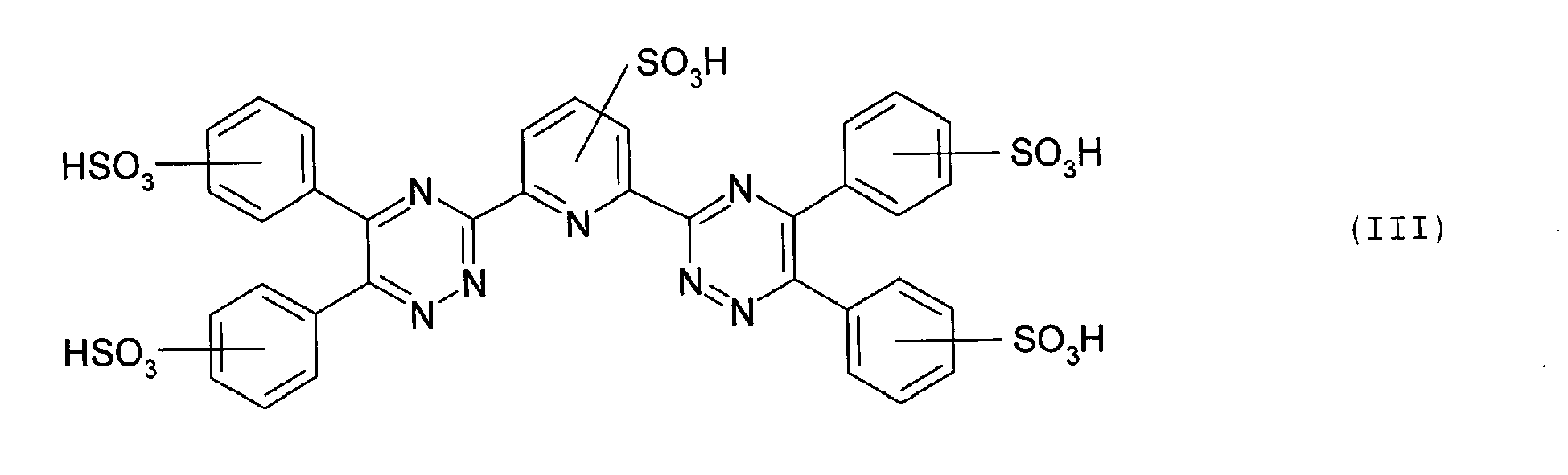


- In einer bevorzugten Ausführung der erfindungsgemäßen Moleküle befindet sich die Sulfo-Gruppe der Sulfophenylreste in 4-Position. Die Molekülgruppen umfassen demgemäß 2,6-Bis(5,6-di(4-sulfophenyl)-1,2,4-triazin-3-yl)pyridine 6,6'-Bis(5,6-di(4-sulfophenyl)-1,2,4-triazin-3-yl)-2,2'-bipyridine bzw. 6,6''-Bis(5,6-di(4-sulfophenyl)-1,2,4-triazin-3-yl)-2,2':6',2" -terpyridine. In einer weiteren Ausführung sind auch die Pyridinringe, sofern sie eine Sulfogruppe tragen, in 4-Position sulfoniert.
- Zur Herstellung der erfindungsgemäßen 2,6-Bis(5,6-di(sulfophenyl)-1,2,4-triazin-3-yl)pyridin (SO3-Ph-BTP), 6,6'-Bis(5,6-di(sulfophenyl)-1,2,4-triazin-3-yl)-2,2'-bipyridin (SO3-Ph-BTBP) und 6,6''-Bis(5,6-di(sulfophenyl)-1,2,4-triazin-3-yl)-2,2':6',2''-terpyridin (SO3-Ph-BTTP) werden die nach dem Stand der Technik hergestellten 2,6-Bis(5,6-diphenyl-1,2,4-triazin-3-yl)pyridin (BTP), 6,6'-Bis(5,6-diphenyl-1,2,4-triazin-3-yl)-2,2'-bipyridin (BTBP) oder 6,6"-Bis(5,6-di(phenyl)-l,2,4-triazin-3-yl)-2,2':6',2''-terpyridin (BTTP) mit einem bekannten Sulfonierungsmittel aus der Gruppe Schwefelsäure, Oleum, Chlorsulfonsäure, Sulfamidsäure oder Schwefeltrioxid umgesetzt. In einer bevorzugten Ausführung der Synthese werden die BTP, BTBP oder BTTP in Oleum umgesetzt. Das Reaktionsgemisch wird vorzugsweise auf 100°C bis 170°C erhitzt und über mehrere Minuten, bevorzugt 5 min - 30 min, bei dieser Temperatur gerührt. Fakultativ kann das Reaktionsgemisch zwischenzeitlich auch über eine mehrtägige, bevorzugt zweitägige, Phase bei Raumtemperatur ruhen.
- Die Reaktion kann beispielsweise durch Entfernen von überschüssigen SO3 und anschließender Neutralisierung beendet werden. In einer bevorzugten Ausführung der Synthese wird das Rohprodukt, das bei dieser Synthese erhalten wird, mit einem polaren Lösungsmittel extrahiert. Besonders bevorzugt ist das polare Lösungsmittel Methanol. Typischer weise erhält man somit ein Produktgemisch aus unterschiedlich sulfonierten SO3-Ph-BTP, SO3-Ph-BTBP oder SO3-Ph-BTTP, die entweder nach einer dem Fachmann bekannten Methode, z.B. chromatographisch, durch Umkristallieren etc., aufgetrennt werden kann. Das Rohprodukt, das extrahiert wurde, kann auch direkt als Produktgemisch einer weiteren Verwendung zugeführt werden.
- Die auf Basis des beschriebenen Verfahrens hergestellten Verbindungen 2,6-Bis(5,6-di(sulfophenyl)-1,2,4-triazin-3-yl)pyridine, 6,6'-Bis(5,6-di(sulfophenyl)-1,2,4-triazin-3-yl)-2,2'-bipyridine und 6,6''-Bis(5,6-di(sulfophenyl)-1,2,4-triazin-3-yl)-2,2':6',2"-terpyridine sind ebenfalls Bestandteil dieser Erfindung.
- Die erfindungsgemäßen SO3-Ph-BTP, SO3-Ph-BTBP oder SO3-Ph-BTTP sind gute Liganden, um mit Actiniden selektiv gegenüber Lanthaniden einen wasserlöslichen Chelatkomplex zu bilden. Die Verwendung von SO3-Ph-BTP, SO3-Ph-BTBP oder SO3-Ph-BTTP, sowie das Produktgemisch aus der Synthese als Komplexbildner zur selektiven Komplexierung von Actiniden in wässriger Lösung ist ein weiterer Teil der vorliegenden Erfindung. Bevorzugt ist deren Verwendung in salpetersaurer Lösung mit einer Säurestärke von 0,01 mol/L bis 3 mol/L.
- Weiterhin ist eine bevorzugte Verwendung der erfindungsgemäßen Moleküle zur Komplexierung von Actiniden, die beim Wiederaufarbeitungsprozess von Kernbrennstäben anfallen. Hierzu gehören insbesondere Isotope der Actiniden Americium, Curium, Neptunium und/oder Plutonium. Erfindungsgemäße Moleküle sind in diesem Zusammenhang isomerenreine SO3-Ph-BTP, SO3-Ph-BTBP und SO3-Ph-BTTP, als auch Gemische dieser Moleküle bzw. das Rohprodukt der Synthese.
- Die Erfindung umfasst weiterhin ein Verfahren zur selektiven Extraktion von Actiniden umfassend folgende Verfahrensschritte:
- a) Bereitstellen einer organischen Lösung enthaltend Lanthaniden und Actiniden, die mit Hilfe eines lipophilen Komplexierungsmittels gelöst sind,
- b) Zugabe eines erfindungsgemäßen SO3-Ph-BTP, SO3-Ph-BTBP oder SO3-Ph-BTTP bzw. ein Gemisch derselben in wässriger Lösung,
- c) Rückextraktion der Actiniden in die wässrige Phase,
- d) Abtrennen der wässrigen Phase.
- Dieses Verfahren hat den Vorteil, dass der aktuelle DIAMEX-SANEX-Prozess um einen Prozessschritt reduziert wird, da man Lanthaniden und Actiniden nicht gemeinsam in eine wässrige Phase rückextrahieren muss, sondern selektiv die Actiniden mit Hilfe des erfindungsgemäßen Komplexierungsmittels direkt aus dem organischen Extrakt rückextrahiert. Diese selektive Rückextraktion kann in saurer Lösung stattfinden, ohne dass Neutralsalze oder Puffersubstanzen hinzugefügt werden müssen.
- Beispiele für in Schritt a) eingesetzte lipophile Komplexierungsmittel sind TODGA (N,N,N',N'-Tetra-n-octyl-diglycolamid) oder D2EHPA (Di-(2-ethylhexyl)phosphorsäure). Generell sind aber alle lipophilen Komplexbildner möglich, die Lanthaniden und Actiniden in die organische Phase extrahieren können. Bevorzugt wird in Schritt a) eine organische Lösung bereitgestellt, wie sie im DIAMEX-Prozess anfällt.
- In einer weiteren bevorzugten Ausführung des erfindungsgemäßen Verfahrens enthält die wässrige Phase Salpetersäure. Im technischen Wiederaufarbeitungsprozess werden Brennstäbe zur weiteren Verarbeitung in Salpetersäure aufgelöst. Da die erfindungsgemäßen SO3-Ph-BTP, SO3-Ph-BTBP oder SO3-Ph-BTTP, welche beim Verfahren als hydrophile Komplexbildner eingesetzt werden, einerseits eine gute Säurestabilität aufweisen und andererseits in Salpetersäure wirksam sind, ist deren Einsatz unter den technischen Vorraussetzungen ohne Einsatz von Puffersubstanzen oder Neutralsalzen möglich.
- Zur Extraktion in Schritt c) und zur Abtrennung im Schritt d) des erfindungsgemäßen Verfahrens können sämtliche dem Fachmann zur Verfügung stehenden Verfahren verwendet werden.
- Die Erfindung wird im Folgenden anhand der Beispiele und der Figuren erläutert.
-
Fig. 1 Schematischer Prozessverlauf im DIAMEX-SANEX-Prozess nach dem Stand der Technik. -
Fig. 2 Schematischer Prozessverlauf bei der erfindungsgemäßen Rückextraktion der Actiniden. - In
Fig. 1 ist der in Europa vorgesehene Prozess der Wiederaufarbeitung von Kernbrennstäben nach dem DIAMEX-SANEX-Verfahren dargestellt. Es ist zu erkennen, dass nach der Uran-und Plutonium-Extraktion (PUREX) ein wässriges salpetersaures Raffinat erhalten wird (Durch Adaption des PUREX-Prozesses kann auch zusätzlich Neptunium extrahiert werden). Dieses Raffinat enthält neben Lanthaniden und leichteren Spaltprodukten die minoren Actiniden, hauptsächlich Americium und Curium. Lanthaniden und Actiniden werden im DIAMEX-Prozess zunächst gemeinsam mittels unspezifischen Komplexbildnern, wie TODGA oder D2EHPA, in eine organische Phase extrahiert. Die übrigen Spaltprodukte verbleiben in wässriger Lösung. Als zweiter Schritt im DIAMEX-Prozess werden die Lanthaniden und Actiniden in eine neue wässrige Phase zurückextrahiert, bevor sie der selektiven Actiniden Extraktion (SANEX) zugeführt werden. - In
Fig. 2 ist nun dargestellt, in wiefern das aktuelle Verfahren mittels den erfindungsgemäßen Komplexbildnern SO3-Ph-BTP, SO3-Ph-BTBP bzw. SO3-Ph-BTTP vereinfacht werden kann. Da diese Komplexbildner wasserlöslich und säurestabil sind und darüber hinaus die Actiniden selektiv gegenüber den Lanthaniden komplexieren, kann der DIAMEX-Prozess abgekürzt werden. Anstatt der gemeinsamen Rückextraktion in wässriges Milieu, werden nur die Actiniden in Anwesenheit der erfindungsgemäßen Komplexbildner SO3-Ph-BTP, SO3-Ph-BTBP bzw. SO3-Ph-BTTP selektiv rückextrahiert. Diese selektive Rückextraktion kann in saurer Lösung stattfinden, ohne dass Neutralsalze oder Puffersubstanzen hinzugefügt werden müssen. - Die Lanthaniden verbleiben in der organischen Phase und können abgetrennt werden. Ein aufwändiges SANEX-Verfahren wird somit überflüssig, was mit Kosteneinsparungen verbunden ist. Die SO3-Ph-BTP, SO3-Ph-BTBP und SO3-Ph-BTTP können entweder zurückgewonnen oder thermisch entsorgt werden.
- Zunächst wurde nach literaturbekannten Vorschriften 2,6-Bis(5,6-diphenyl-1,2,4-triazin-3-yl)pyridin bzw. 6,6'-Bis(5,6-diphenyl-1,2,4-triazin-3-yl)-2,2'-bipyridin synthetisiert.
- 6 mL Oleum wurden auf 100 °C erhitzt. Dazu wurde langsam 1 g (1.85 mmol) 2,6-Bis(5,6-diphenyl-1,2,4-triazin-3-yl)pyridin zugegeben und 15 min. auf 170 °C erhitzt. Es wurde 3 Std. bei 120 °C gerührt, zwei Tage bei Raumtemperatur stehengelassen und anschließend einige Minuten auf 170 °C erhitzt. Es wurde auf 150 °C abgekühlt und so lange Argon eingeblasen bis keine weißen Dämpfe mehr entstanden. Die honigartige Masse wurde auf ca. 50 °C abgekühlt. Es wurde langsam gesättigte NaCl-Lösung zugegeben bis kein Schaum mehr gebildet wurde. Es wurde wenig Wasser zugegeben und die Reaktionsmischung mit konzentrierter NaOH-Lösung basisch gemacht. Anschließend wurde mit HCl-Lösung leicht angesäuert und die Flüssigkeit abgedampft.
- Der Abdampfrückstand wurde 3-mal mit 25 mL Methanol ausgekocht. Der ausgekochte Rückstand (weißes Salz) wurde verworfen. Die Methanolphase wurde filtriert und das Filtrat eingedampft. Der Rückstand wurde noch 2-mal mit Methanol ausgekocht und eingedampft.
- Graugrüner Feststoff, Ausbeute 1.25 g (78.5 %), Schmelzpunkt >350 °C. Löslichkeit in Wasser > 0.1 mol/L.
- SO3-Ph-BTBP wurde aus 6,6'-Bis(5,6-diphenyl-1,2,4-triazin-3-yl)-2,2'-bipyridin analog zu SO3-Ph-BTP hergestellt. Löslichkeit in Wasser > 0.1 mol/L.
- Es wurde der Einfluss von SO3-Ph-BTP und SO3-Ph-BTBP auf die Verteilungsverhältnisse von Am(III) und Eu(III) bei der Extraktion mit TODGA bzw. D2EHPA bestimmt. Aus allen Versuchen wurden die Verteilungsverhältnisse (Verhältnis der organischen zur wässrigen Konzentration) von Am(III) und Eu(III) mittels Gamma-Spektrometrie bestimmt. Die Berechnung der Verteilungsverhältnisse DM ergibt sich aus den Zählraten des Gammazählers, welcher die radioaktiven 241Am (III) - und 152Eu(III) - Isotope in volumengleichen Proben der wässrigen bzw. der organischen Phase erfasst gem. der Gleichung DM=[M]org/[M]aq, wobei die Konzentration des Metalls M aus [M]=Zählrate/Volumen berechnet wird.
- SO3-Ph-BTP und SO3-Ph-BTBP zeigten sich als besonders geeignet zur Komplexierung von Americium(III) (als Vertreter der Actiniden) in Salpetersäure, welche selektiv gegenüber Europium(III) (als Vertreter der Lanthaniden) erfolgt. Dabei steht die wässrige Komplexierung gemäß Gleichung 1 bzw. Gleichung 2 mit der Extraktion gemäß Gleichung 3 bzw. 4, welche mit einem gering selektiven Extraktionsmittel wie z.B. TODGA (N,N,N',N'-Tetra-n-octyl-diglycolamid; Gleichung 3) oder D2EHPA (Di-(2-ethylhexyl)phosphorsäure; Gleichung 4) erfolgt, in Konkurrenz.
-


- Da SO3-Ph-BTP und SO3-Ph-BTBP Americium(III) deutlich stärker komplexieren als Europium(III), wird letzteres nunmehr besser extrahiert als ersteres.
- Es wurden 291Am(III) und 152Eu(III) (je ca. 1 kBq/mL) aus 0.09 / 0.18 / 0.44 / 0.88 / 1.8 mol/L HNO3 in eine organische Phase bestehend aus (0.2 mol/L TODGA + 5 % vol. 1-Octanol in Kerosin) extrahiert. Parallel zu diesem Versuch wurde eine Extraktion unter analogen Bedingungen durchgeführt mit dem Unterschied, dass wässrige Phase zusätzlich 10 mmol/L SO3-Ph-BTP enthielt.
- Tabelle 1 zeigt den Einfluss von SO3-Ph-BTP auf die Extraktion von Am(III) und Eu(III) mit TODGA, einem solvatisierenden Extraktionsmittel (vgl. Gleichung 3). Ohne SO3-Ph-BT werden sowohl Am(III) als auch Eu(III) extrahiert; die Verteilungsverhältnisse steigen gemäß Gleichung 3 mit der HNO3-Konzentration an. Zugabe von SO3-Ph-BTP unterdrückt die Extraktion von Am(III), während die Extraktion von Eu(III) wesentlich geringer beeinflusst wird. Dies ist auf die bevorzugte Komplexierung von Am(III) mit SO3-Ph-BTP in der wässrigen Phase zurückzuführen. Unter den gegebenen experimentellen Bedingungen wird also aus ca. 0.1-0.5 mol/L HNO3 Eu(III) extrahiert, während Am(III) hauptsächlich in der wässrigen Phase verbleibt. Der Trennfaktor SFEu(III)/Am(III) = DEu(III) / DAm(III) liegt im Bereich von 500-1000, während er ohne SO3-Ph-BTP etwa bei 7 liegt.
Tabelle 1. Extraktion von Am(III) und Eu(III) mit TODGA, Einfluss der Zugabe von 10 mmol/L SO3-Ph-BTP zur wässrigen Phase. Organische Phase: 0.2 mol/L TODGA + 5 % vol. 1-Octanol in Kerosin. Wässrige Phase: 241Am(III) + 152Eu(III) in HNO3 [HNO3]
[mol/L]DAm(III)
[SO3-Ph-TP] mmol/LDEu(III)
[SO3-Ph-BTP] mmol/LSFEu(III)/Am(III)
[SO3-Ph-TP] mmol/L0 10 0 10 0 10 0,09 3.3 1.1·10-3 23.4 1.2 7.1 1100 0,18 12.4 0.014 89 11.9 7.2 850 0,44 83 0.35 390 180 4.7 510 0,88 530 4.5 > 103 > 103 - > 220 1,8 2100 90 > 103 > 103 - > 11 - Es wurden 241Am(III) und 152Eu(III) (je ca. 1 kBq/mL) aus 0.045 / 0.09 / 0.18 / 0.44 mol/L HNO3 in eine organische Phase bestehend aus (0.1 mol/L D2EHPA in Kerosin) extrahiert. Die wässrige Phase enthielt entweder 0 oder 10 mmol/L SO3-Ph-BTP
- Tabelle 2 zeigt den Einfluss von SO3-Ph-BTP auf die Extraktion von Am(III) und Eu(III) mit D2EHPA, einem flüssigen Kationenaustauscher (vgl. Gleichung 4). Während bei niedriger Säurestärke in Abwesenheit von SO3-Ph-BTP sowohl Am(III) als auch Eu(III) extrahiert werden, unterdrückt SO3-Ph-BTP die Extraktion von Am(III) deutlich stärker als die von Eu(III); der Trennfaktor betrug SFEu(III)/Am(III) > 3000.
Tabelle 2. Extraktion von Am(III) und Eu(III) mit D2EHPA, Einfluss der Zugabe von SO3-Ph-BTP zur wässrigen Phase. Organische Phase: 0.1 mol/L D2EHPA in Kerosin. Wässrige Phase: 241Am(III) + 152Eu(III) in HNO3. [HNO3]
[mol/L]DAm(III)
[SO3-Ph-BTP] mmol/LDEu(III)
[SO3-Ph-BTP] mmol/LSFEu(III)/Am(III)
[SO3-Ph-BTP] mmol/L0 10 0 10 0 10 0.045 14.7 1.10-3 380 5.3 26 5200 0.09 1.4 4.10-4 59 1.4 42 3400 0.18 0.14 5.10-5 6.0 0.37 44 7000 0.44 6.10-3 < d.l. 0.23 0.06 37 - - Einem inaktiven Simulat eines PUREX-Raffinats wurden 241Am(III) und I52Eu(III) (je ca. 1 kBq/mL) zugegeben. Es wurde in eine organische Phase bestehend aus (0.2 mol/L TODGA + 5 % vol. 1-Octanol in Kerosin) extrahiert. Ein Aliquot der beladenen organischen Phase wurde in Wasser rückextrahiert, ein anderes Aliquot in eine Lösung von 10 mmol/L SO3-Ph-BTP in Wasser.
- Durch den entsprechenden Versuch in Beispiel 5 wurde folgendes gezeigt: Es wurden zunächst Am(III) und Eu(III) mit Verteilungsverhältnissen > 1000 aus der Simulatlösung extrahiert. Nach Rückextraktion mit Wasser betrugen die Verteilungsverhältnisse DAM(III) = 23 und DEu(III) = 180, der Trennfaktor SFEu(III)/Am(III) = 7.5. Nach Rückextraktion in eine Lösung von 10 mmol/L SO3-Ph-BTP in Wasser betrugen die Verteilungsverhältnisse jedoch DAm(III) = 0.059 und DEu(III) = 49, der Trennfaktor SFEU(III)/Am(III) = 830.
- Dies bedeutet aus prozesstechnischer Sicht, dass auch, wie in einem entsprechenden Trennprozess vorgesehen, zunächst Am(III) und Eu(III) gemeinsam aus HNO3 extrahiert werden können und anschließend Am(III) selektiv in eine Lösung bestehend aus HNO3 und SO3-Ph-BT rückextrahiert werden kann.
- Es wurden 241Am(III) und 152Eu(III) (je ca. 1 kBq/mL) aus 0.5 mol/L HNO3 in eine organische Phase bestehend aus (0.2 mol/L TODGA + 5 % vol. 1-Octanol in Kerosin) extrahiert. Die wässrige Phase enthielt entweder 0 mmol/L oder 10 mmol/L SO3-Ph-BTBP.
- Die Ergebnisse für den Einfluss von SO3-Ph-BTBP auf die Extraktion von Am(III) und Eu(III) mit TODGA sind in Tabelle 3 zusammengefasst. Während sowohl Am(III) als auch Eu(III) aus 0.5 mol/L HNO3 extrahiert werden, unterdrückt die Zugabe von 10 mmol/L SO3-Ph-BTBP zur wässrigen Phase die Extraktion von Am(III). Die Extraktion von Eu(III) wird kaum beeinflusst. Diese Ergebnisse sind vergleichbar mit den mit SO3-Ph-BTP erzielten.
Tabelle 3. Extraktion von Am(III) und Eu(III) mit TODGA, Einfluss der Zugabe von SO3-Ph-BTBP zur wässrigen Phase. Organische Phase: 0.2 mol/L TODGA + 5 % vol. 1-Octanol in Kerosin. Wässrige Phase: 241Am(III) + 152Eu(III) in 0.5 mol/L HNO3. [SO3-Ph-BTBP] DAm(III) DEu(III) SFEu(III)/Am(III) 0 120 900 7.5 10 mmol/L 0.33 150 450 - Mit den erfindungsgemäßen Verbindungen SO3-Ph-BTP, SO3-Ph-BTBP und SO3-Ph-BTTP stehen hydrophile Komplexbildner zur Verfügung, welche Actiniden bevorzugt gegenüber den Lanthaniden erstmalig auch in stark salpetersauren Lösungen komplexieren, ohne dass Neutralsalze oder Puffersubstanzen hinzugefügt werden müssen.
-
PUREX Plutonium-Uranium Recovery by Extraction DIAMEX Diamide Extraction SANEX Selective Actinide Extraction BTP 2,6-Bis(5,6-diphenyl-1,2,4-triazin-3-yl)pyridin BTBP 6,6'-Bis(5,6-diphenyl-1,2,4-triazin-3-yl)-2,2'-bipyridin BTTP 6,6"-Bis(5,6-di(phenyl)-1,2,4-triazin-3-yl)-2, 2':6',2"-terpyridine SO3-Ph-BTP 2,6-Bis(5,6-di(sulfophenyl)-1,2,4-triazin-3-yl)pyridine SO3-Ph-BTBP 6,6'-Bis(5, 6-di(sulfophenyl)-1, 2, 4-triazin-3-yl)-2,2'-bipyridine SO3-Ph-BTTP 6,6"-Bis(5,6-di(sulfophenyl)-1,2,4-triazin-3-yl)-2,2':6',2"-terpyridine TODGA N,N,N',N'-Tetra-n-octyl-diglycolamid D2EHPA Di-(2-ethylhexyl)phosphorsäure Ln Lanthaniden An Actiniden FP Spaltprodukte außer Lanthaniden (fission pro-ducts) DM Verteilungsverhältnis DM=[M]org/[M]aq, wobei [M]~Zählrate/Volumen SFEu(III)/Am(III) Trennfaktor (DEu(III) / DAM(III))
Claims (11)
- Komplexbildner enthaltend 2,6-Bis(5,6-di(sulfophenyl)-1,2,4-triazin-3-yl)pyridine, 6,6'-Bis(5,6-di(sulfophenyl)-1,2,4-triazin-3-yl)-2,2'-bipyridine und /oder 6, 6" - Bis(5,6-di(sulfophenyl)-1,2,4-triazin-3-yl)-2,2':6',2" - terpyridine nach der allgemeinen Formel (I)

- Moleküle nach Anspruch 1, wobei die SO3H-Gruppen der jeweiligen Phenylgruppen in 4-Position (4-Sulfophenyl) sind.
- Verfahren zur Herstellung von 2,6-Bis(5,6-di(sulfophenyl)-1,2,4-triazin-3-yl)pyridine, 6,6'-Bis(5,6-di(sulfophenyl)-1,2,4-triazin-3-yl)-2,2'-bipyridine und 6,6"-Bis(5,6-di(sulfophenyl)-1,2,4-triazin-3-yl)-2,2':6',2"-terpyridine nach Anspruch 1 oder 2 durch Sulfonierung von 2,6-Bis(5,6-diphenyl-1,2,4-triazin-3-yl)pyridin, 6,6'-Bis(5,6-diphenyl-1,2,4-triazin-3-yl)-2,2'-bipyridin oder 6,6" -Bis(5,6-diphenyl-1,2,4-triazin-3-yl)-2,2':6',2" -terpyridine mittels eines Sulfonierungsmittels aus der Gruppe Schwefelsäure, Oleum, Chlorsulfonsäure, Sulfamidsäure oder Schwefeltrioxid.
- Verfahren nach Anspruch 3, wobei das Sulfonierungsmittel Oleum ist und die Umsetzung bei 100°C bis 170°C stattfindet.
- Verfahren nach Anspruch 3 oder 4, wobei das Rohprodukt mit einem polaren Lösungsmittel, vorzugsweise Methanol, extrahiert wird.
- Komplexbildner enthaltend 2,6-Bis(5,6-di(sulfophenyl)-1,2,4-triazin-3-yl)pyridine, 6,6'-Bis(5, 6-di(sulfophenyl)-1,2,4-triazin-3-yl)-2,2'-bipyridine und /oder 6,6"-Bis(5,6-di(sulfophenyl)-1,2,4-triazin-3-yl)-2,2':6',2"-terpyridine, die nach einem der Ansprüche 3 bis 5 hergestellt wurden.
- Verwendung von Komplexbildnern nach Anspruch 1, 2 oder 6 zur selektiven Komplexierung von Actiniden in wässriger Lösung.
- Verwendung nach Anspruch 7, wobei die Actiniden Plutonium, Americium, Curium und/oder Neptunium sind
- Verfahren zur selektiven Extraktion von Actiniden umfassend folgende Verfahrensschritte:a) Bereitstellen einer organischen Lösung enthaltend Lanthaniden und Actiniden, die mit Hilfe eines lipophilen Komplexierungsmittels gelöst sind,b) Zugabe eines Komplexbildners nach Anspruch 1, 2 oder 6 in wässriger Lösung,c) Rückextraktion der Actiniden in die wässrige Phase,d) Abtrennen der wässrigen Phase.
- Verfahren nach Anspruch 9, wobei die wässrige Lösung Salpetersäure enthält.
- Verfahren nach Anspruch 9 oder 10, wobei die organische Lösung enthaltend Lanthaniden und Actiniden ein Extrakt der Wiederaufarbeitung von Kernbrennstoffen ist.
Priority Applications (1)
| Application Number | Priority Date | Filing Date | Title |
|---|---|---|---|
| EP10004105.2A EP2377861B1 (de) | 2010-04-17 | 2010-04-17 | Wasserlösliche Bis-triazinyl-pyridine, -bipyridine und terpyridine, deren Synthese und Verwendung |
Applications Claiming Priority (1)
| Application Number | Priority Date | Filing Date | Title |
|---|---|---|---|
| EP10004105.2A EP2377861B1 (de) | 2010-04-17 | 2010-04-17 | Wasserlösliche Bis-triazinyl-pyridine, -bipyridine und terpyridine, deren Synthese und Verwendung |
Publications (2)
| Publication Number | Publication Date |
|---|---|
| EP2377861A1 true EP2377861A1 (de) | 2011-10-19 |
| EP2377861B1 EP2377861B1 (de) | 2013-12-04 |
Family
ID=42246034
Family Applications (1)
| Application Number | Title | Priority Date | Filing Date |
|---|---|---|---|
| EP10004105.2A Not-in-force EP2377861B1 (de) | 2010-04-17 | 2010-04-17 | Wasserlösliche Bis-triazinyl-pyridine, -bipyridine und terpyridine, deren Synthese und Verwendung |
Country Status (1)
| Country | Link |
|---|---|
| EP (1) | EP2377861B1 (de) |
Cited By (3)
| Publication number | Priority date | Publication date | Assignee | Title |
|---|---|---|---|---|
| CN103539775A (zh) * | 2012-07-12 | 2014-01-29 | 中国科学院大连化学物理研究所 | 联吡啶桥联双三嗪化合物及其制备方法 |
| CN105854842A (zh) * | 2016-05-19 | 2016-08-17 | 浙江大学 | 一种从水相吸附分离钼的方法 |
| CN116789645A (zh) * | 2023-05-12 | 2023-09-22 | 中核四0四有限公司 | 一种公斤级水溶性含氮锕系元素萃取剂的制备方法 |
Citations (2)
| Publication number | Priority date | Publication date | Assignee | Title |
|---|---|---|---|---|
| EP0070226A1 (de) * | 1981-07-09 | 1983-01-19 | COMMISSARIAT A L'ENERGIE ATOMIQUE Etablissement de Caractère Scientifique Technique et Industriel | Verfahren zur Trennung von dreiwertigen Aktiniden von dreiwertigen Lanthaniden, in einer sauren wässerigen Lösung |
| DE19810895C1 (de) | 1998-03-13 | 2000-05-11 | Karlsruhe Forschzent | Verfahren zur Trennung der Transpultoniden von den Spaltlanthaniden durch selektive Extraktion |
-
2010
- 2010-04-17 EP EP10004105.2A patent/EP2377861B1/de not_active Not-in-force
Patent Citations (2)
| Publication number | Priority date | Publication date | Assignee | Title |
|---|---|---|---|---|
| EP0070226A1 (de) * | 1981-07-09 | 1983-01-19 | COMMISSARIAT A L'ENERGIE ATOMIQUE Etablissement de Caractère Scientifique Technique et Industriel | Verfahren zur Trennung von dreiwertigen Aktiniden von dreiwertigen Lanthaniden, in einer sauren wässerigen Lösung |
| DE19810895C1 (de) | 1998-03-13 | 2000-05-11 | Karlsruhe Forschzent | Verfahren zur Trennung der Transpultoniden von den Spaltlanthaniden durch selektive Extraktion |
Non-Patent Citations (8)
| Title |
|---|
| A. GEIST; C. HILL; G. MODOLO; M.R.ST.J. FOREMAN; M. WEIGL; K. GOMPPER; M.J. HUDSON; C. MADIC: "6,6'-Bis(5,5,8,8-tetramethyl-5,6,7,8-tetrahydro-benzo-[1,2,4]triazin-3-yl)[2,2']bipyridine, an effective extracting agent for the separation of americium(III) and curium(III) from the lanthanides", SOLVENT EXTR. ION EXCH., vol. 24, no. 4, 2006, pages 463 - 483, XP009134625, DOI: doi:10.1080/07366290600761936 |
| C. HERES ET AL., PROC. GLOBAL 2009, September 2009 (2009-09-01) |
| CRYBERG, RICHARD L. ET AL: "Sulfonation of bathophenanthroline and bathocuproine", PROCEEDINGS OF THE IOWA ACADEMY OF SCIENCE , 70, 184-7 CODEN: PIAIA9; ISSN: 0085-2236, 1963, XP009135493 * |
| G. MODOLO; R. ODOJ: "Synergistic selective extraction of actini- des(III) over lanthanides from nitric acid using new aromatic diorganyldithiophosphinic acids and neutral organophosphorus compounds", SOLVENT EXTR. ION EXCH., vol. 17, no. 1, 1999, pages 33 - 53 |
| M. NILSSON; K. NASH: "A Review of the development and operational characteristics of the TALSPEAK process", SOLVENT EXTR. ION EXCH., vol. 25, no. 6, 2007, pages 665 - 701, XP009135215, DOI: doi:10.1080/07366290701634636 |
| MODOLO G ET AL: "SYNERGISTIC SELECTIVE EXTRACTION OF ACTINIDES(III) OVER LANTHANIDES FROM NITRIC ACID USING NEW AROMATIC DIORGANYLDITHIOPHOSPHINIC ACIDS AND NEUTRAL ORGANOPHOSPHORUS COMPOUNDS", SOLVENT EXTRACTION AND ION EXCHANGE, DEKKER, NEW YORK, NY, US, vol. 17, no. 1, 1 January 1999 (1999-01-01), pages 33 - 53, XP009041958, ISSN: 0736-6299 * |
| NILSSON M ET AL: "Review article: A review of the development and operational characteristics of the TALSPEAK process", SOLVENT EXTRACTION AND ION EXCHANGE NOVEMBER 2007 TAYLOR AND FRANCIS INC. US, vol. 25, no. 6, November 2007 (2007-11-01), pages 665 - 701, XP009135215, DOI: 10.1080/07366290701634636 * |
| TRAISTER, GEORGE L. ET AL: "Water-soluble sulfonated chromogenic reagents of the ferroin type and determination of iron and copper in water, blood serum, and beer with the tetraammonium salt of 2,4-bis(5,6-diphenyl-1,2,4-triazin-3-yl)pyridinetetrasulfonic acid", ANALYTICAL CHEMISTRY , 48(8), 1216-20 CODEN: ANCHAM; ISSN: 0003-2700, 1976, XP002589534 * |
Cited By (3)
| Publication number | Priority date | Publication date | Assignee | Title |
|---|---|---|---|---|
| CN103539775A (zh) * | 2012-07-12 | 2014-01-29 | 中国科学院大连化学物理研究所 | 联吡啶桥联双三嗪化合物及其制备方法 |
| CN105854842A (zh) * | 2016-05-19 | 2016-08-17 | 浙江大学 | 一种从水相吸附分离钼的方法 |
| CN116789645A (zh) * | 2023-05-12 | 2023-09-22 | 中核四0四有限公司 | 一种公斤级水溶性含氮锕系元素萃取剂的制备方法 |
Also Published As
| Publication number | Publication date |
|---|---|
| EP2377861B1 (de) | 2013-12-04 |
Similar Documents
| Publication | Publication Date | Title |
|---|---|---|
| DE69307733T2 (de) | Calix-[4]-arene-bis-kronen, ihre herstellung und ihre anwendung zur selektiven extrahierung von cäsium und aktiniden | |
| DE2610948B2 (de) | Verfahren zur Gewinnung von Molybdän -99 aus mit Neutronen bestrahlter, spaltbare Stoffe und Spaltprodukte enthaltender Matrix | |
| US7622090B2 (en) | Method for separating uranium (VI) from actinides(IV) and/or actinides (VI) and its uses | |
| DE2638802A1 (de) | Extraktionsverfahren zur aktinidengewinnung und -trennung | |
| DE69804321T2 (de) | Abtrennung von aktinoiden und lanthanoiden durch flüssig-flüssig extraktion mittels calixarene-verbindungen | |
| DE4220207A1 (de) | Kombiniertes transuran-strontium-auszugsverfahren | |
| EP2377861B1 (de) | Wasserlösliche Bis-triazinyl-pyridine, -bipyridine und terpyridine, deren Synthese und Verwendung | |
| US5826161A (en) | Process for the selective separation of actinides (III) and lanthanides (III) | |
| DE3408029C2 (de) | ||
| DE2449589A1 (de) | Verfahren zur erhoehung der lebensdauer von zur wiederaufarbeitung abgebrannter kernbrenn- und/oder brutstoffe verwendeten extraktionsmitteln | |
| DE2451595A1 (de) | Verfahren zur trennung von uran von einer uranylionen und verunreinigende kationen enthaltenden waessrigen fluessigkeit | |
| CH659954A5 (de) | Verfahren zur anreicherung und abtrennung von schweren wasserstoff-isotopen aus diese enthaltenden stoffstroemen durch isotopenaustausch. | |
| DE3028024A1 (de) | Verfahren zum abtrennen von plutoniumen aus waessrigen, schwefelsauren loesungen | |
| DE3346405C2 (de) | ||
| DE2620065A1 (de) | Verfahren zur herstellung von titandioxid | |
| EP1664359B1 (de) | Verfahren zur trennung von dreiwertigem americium von dreiwertigem curium | |
| DE2601766A1 (de) | Verfahren zur selektiven rueckgewinnung von cadmium aus cadmiumhaltigem abfall | |
| DE2610947C3 (de) | Verfahren zur Gewinnung von Molybdän-99 aus mit Neutronen bestrahlter, spaltbare Stoffe und Spaltprodukte enthaltender Matrix | |
| DE69207302T2 (de) | Verfahren zur Trennung der Aktiniden von Lanthaniden durch selektive Extraktion der Aktinide in einem Propandiamid-enthaltenden organischen Lösungsmittel | |
| DE102009003783A1 (de) | Alkylierte Bis-Pyrazolylpyridine zur selektiven Extraktion von Actiniden(III) | |
| EP0032184A1 (de) | Verfahren zur Gewinnung von Uran bzw. Uranverbindungen aus Phosphorsäure | |
| DE3211286C2 (de) | ||
| DE2952476C2 (de) | Verfahren zur Gewinnung von Uranverbindungen aus wäßriger Uran enthaltender Phosphorsäure | |
| EP1019552B1 (de) | Verfahren zur trennung von dreiwertigen actiniden von mindestens einem dreiwertigen lanthanid mit (bis)aryldithiophosphiniger säure als extraktionsmittel und einem organo-phosphat als synergisten | |
| DE1916114C3 (de) | Verfahren zur Abtrennung von Transplutoniumelementen und seltenen Erden von Spaltprodukten aus einer wässrigen Lösung |
Legal Events
| Date | Code | Title | Description |
|---|---|---|---|
| AK | Designated contracting states |
Kind code of ref document: A1 Designated state(s): AT BE BG CH CY CZ DE DK EE ES FI FR GB GR HR HU IE IS IT LI LT LU LV MC MK MT NL NO PL PT RO SE SI SK SM TR |
|
| AX | Request for extension of the european patent |
Extension state: AL BA ME RS |
|
| PUAI | Public reference made under article 153(3) epc to a published international application that has entered the european phase |
Free format text: ORIGINAL CODE: 0009012 |
|
| 17P | Request for examination filed |
Effective date: 20120404 |
|
| 17Q | First examination report despatched |
Effective date: 20120716 |
|
| GRAP | Despatch of communication of intention to grant a patent |
Free format text: ORIGINAL CODE: EPIDOSNIGR1 |
|
| RIC1 | Information provided on ipc code assigned before grant |
Ipc: G21C 19/46 20060101ALI20130621BHEP Ipc: C22B 60/04 20060101ALI20130621BHEP Ipc: G21F 9/12 20060101ALI20130621BHEP Ipc: C22B 60/02 20060101ALI20130621BHEP Ipc: C01F 17/00 20060101ALI20130621BHEP Ipc: C01G 56/00 20060101ALI20130621BHEP Ipc: C07D 401/14 20060101AFI20130621BHEP |
|
| INTG | Intention to grant announced |
Effective date: 20130710 |
|
| RIN1 | Information on inventor provided before grant (corrected) |
Inventor name: GEIST, ANDREAS Inventor name: MUELLICH, UDO Inventor name: ZEVACO, THOMAS |
|
| GRAS | Grant fee paid |
Free format text: ORIGINAL CODE: EPIDOSNIGR3 |
|
| GRAA | (expected) grant |
Free format text: ORIGINAL CODE: 0009210 |
|
| AK | Designated contracting states |
Kind code of ref document: B1 Designated state(s): AT BE BG CH CY CZ DE DK EE ES FI FR GB GR HR HU IE IS IT LI LT LU LV MC MK MT NL NO PL PT RO SE SI SK SM TR |
|
| REG | Reference to a national code |
Ref country code: GB Ref legal event code: FG4D Free format text: NOT ENGLISH |
|
| REG | Reference to a national code |
Ref country code: CH Ref legal event code: EP |
|
| REG | Reference to a national code |
Ref country code: IE Ref legal event code: FG4D Free format text: LANGUAGE OF EP DOCUMENT: GERMAN Ref country code: AT Ref legal event code: REF Ref document number: 643500 Country of ref document: AT Kind code of ref document: T Effective date: 20140115 |
|
| REG | Reference to a national code |
Ref country code: DE Ref legal event code: R096 Ref document number: 502010005528 Country of ref document: DE Effective date: 20140130 |
|
| REG | Reference to a national code |
Ref country code: NL Ref legal event code: VDEP Effective date: 20131204 |
|
| PG25 | Lapsed in a contracting state [announced via postgrant information from national office to epo] |
Ref country code: NL Free format text: LAPSE BECAUSE OF FAILURE TO SUBMIT A TRANSLATION OF THE DESCRIPTION OR TO PAY THE FEE WITHIN THE PRESCRIBED TIME-LIMIT Effective date: 20131204 Ref country code: SE Free format text: LAPSE BECAUSE OF FAILURE TO SUBMIT A TRANSLATION OF THE DESCRIPTION OR TO PAY THE FEE WITHIN THE PRESCRIBED TIME-LIMIT Effective date: 20131204 Ref country code: HR Free format text: LAPSE BECAUSE OF FAILURE TO SUBMIT A TRANSLATION OF THE DESCRIPTION OR TO PAY THE FEE WITHIN THE PRESCRIBED TIME-LIMIT Effective date: 20131204 Ref country code: NO Free format text: LAPSE BECAUSE OF FAILURE TO SUBMIT A TRANSLATION OF THE DESCRIPTION OR TO PAY THE FEE WITHIN THE PRESCRIBED TIME-LIMIT Effective date: 20140304 Ref country code: FI Free format text: LAPSE BECAUSE OF FAILURE TO SUBMIT A TRANSLATION OF THE DESCRIPTION OR TO PAY THE FEE WITHIN THE PRESCRIBED TIME-LIMIT Effective date: 20131204 Ref country code: LT Free format text: LAPSE BECAUSE OF FAILURE TO SUBMIT A TRANSLATION OF THE DESCRIPTION OR TO PAY THE FEE WITHIN THE PRESCRIBED TIME-LIMIT Effective date: 20131204 |
|
| REG | Reference to a national code |
Ref country code: LT Ref legal event code: MG4D |
|
| PG25 | Lapsed in a contracting state [announced via postgrant information from national office to epo] |
Ref country code: CY Free format text: LAPSE BECAUSE OF FAILURE TO SUBMIT A TRANSLATION OF THE DESCRIPTION OR TO PAY THE FEE WITHIN THE PRESCRIBED TIME-LIMIT Effective date: 20131204 Ref country code: LV Free format text: LAPSE BECAUSE OF FAILURE TO SUBMIT A TRANSLATION OF THE DESCRIPTION OR TO PAY THE FEE WITHIN THE PRESCRIBED TIME-LIMIT Effective date: 20131204 |
|
| PG25 | Lapsed in a contracting state [announced via postgrant information from national office to epo] |
Ref country code: EE Free format text: LAPSE BECAUSE OF FAILURE TO SUBMIT A TRANSLATION OF THE DESCRIPTION OR TO PAY THE FEE WITHIN THE PRESCRIBED TIME-LIMIT Effective date: 20131204 Ref country code: IS Free format text: LAPSE BECAUSE OF FAILURE TO SUBMIT A TRANSLATION OF THE DESCRIPTION OR TO PAY THE FEE WITHIN THE PRESCRIBED TIME-LIMIT Effective date: 20140404 |
|
| PG25 | Lapsed in a contracting state [announced via postgrant information from national office to epo] |
Ref country code: ES Free format text: LAPSE BECAUSE OF FAILURE TO SUBMIT A TRANSLATION OF THE DESCRIPTION OR TO PAY THE FEE WITHIN THE PRESCRIBED TIME-LIMIT Effective date: 20131204 Ref country code: CZ Free format text: LAPSE BECAUSE OF FAILURE TO SUBMIT A TRANSLATION OF THE DESCRIPTION OR TO PAY THE FEE WITHIN THE PRESCRIBED TIME-LIMIT Effective date: 20131204 Ref country code: PL Free format text: LAPSE BECAUSE OF FAILURE TO SUBMIT A TRANSLATION OF THE DESCRIPTION OR TO PAY THE FEE WITHIN THE PRESCRIBED TIME-LIMIT Effective date: 20131204 Ref country code: RO Free format text: LAPSE BECAUSE OF FAILURE TO SUBMIT A TRANSLATION OF THE DESCRIPTION OR TO PAY THE FEE WITHIN THE PRESCRIBED TIME-LIMIT Effective date: 20131204 Ref country code: PT Free format text: LAPSE BECAUSE OF FAILURE TO SUBMIT A TRANSLATION OF THE DESCRIPTION OR TO PAY THE FEE WITHIN THE PRESCRIBED TIME-LIMIT Effective date: 20140404 Ref country code: SK Free format text: LAPSE BECAUSE OF FAILURE TO SUBMIT A TRANSLATION OF THE DESCRIPTION OR TO PAY THE FEE WITHIN THE PRESCRIBED TIME-LIMIT Effective date: 20131204 |
|
| REG | Reference to a national code |
Ref country code: DE Ref legal event code: R097 Ref document number: 502010005528 Country of ref document: DE |
|
| PLBE | No opposition filed within time limit |
Free format text: ORIGINAL CODE: 0009261 |
|
| STAA | Information on the status of an ep patent application or granted ep patent |
Free format text: STATUS: NO OPPOSITION FILED WITHIN TIME LIMIT |
|
| PG25 | Lapsed in a contracting state [announced via postgrant information from national office to epo] |
Ref country code: DK Free format text: LAPSE BECAUSE OF FAILURE TO SUBMIT A TRANSLATION OF THE DESCRIPTION OR TO PAY THE FEE WITHIN THE PRESCRIBED TIME-LIMIT Effective date: 20131204 |
|
| 26N | No opposition filed |
Effective date: 20140905 |
|
| PG25 | Lapsed in a contracting state [announced via postgrant information from national office to epo] |
Ref country code: LU Free format text: LAPSE BECAUSE OF FAILURE TO SUBMIT A TRANSLATION OF THE DESCRIPTION OR TO PAY THE FEE WITHIN THE PRESCRIBED TIME-LIMIT Effective date: 20140417 Ref country code: MC Free format text: LAPSE BECAUSE OF FAILURE TO SUBMIT A TRANSLATION OF THE DESCRIPTION OR TO PAY THE FEE WITHIN THE PRESCRIBED TIME-LIMIT Effective date: 20131204 |
|
| REG | Reference to a national code |
Ref country code: CH Ref legal event code: PL |
|
| REG | Reference to a national code |
Ref country code: DE Ref legal event code: R097 Ref document number: 502010005528 Country of ref document: DE Effective date: 20140905 |
|
| REG | Reference to a national code |
Ref country code: IE Ref legal event code: MM4A |
|
| PG25 | Lapsed in a contracting state [announced via postgrant information from national office to epo] |
Ref country code: LI Free format text: LAPSE BECAUSE OF NON-PAYMENT OF DUE FEES Effective date: 20140430 Ref country code: CH Free format text: LAPSE BECAUSE OF NON-PAYMENT OF DUE FEES Effective date: 20140430 |
|
| PG25 | Lapsed in a contracting state [announced via postgrant information from national office to epo] |
Ref country code: SI Free format text: LAPSE BECAUSE OF FAILURE TO SUBMIT A TRANSLATION OF THE DESCRIPTION OR TO PAY THE FEE WITHIN THE PRESCRIBED TIME-LIMIT Effective date: 20131204 |
|
| PG25 | Lapsed in a contracting state [announced via postgrant information from national office to epo] |
Ref country code: IT Free format text: LAPSE BECAUSE OF FAILURE TO SUBMIT A TRANSLATION OF THE DESCRIPTION OR TO PAY THE FEE WITHIN THE PRESCRIBED TIME-LIMIT Effective date: 20131204 |
|
| REG | Reference to a national code |
Ref country code: FR Ref legal event code: PLFP Year of fee payment: 6 |
|
| PG25 | Lapsed in a contracting state [announced via postgrant information from national office to epo] |
Ref country code: IE Free format text: LAPSE BECAUSE OF NON-PAYMENT OF DUE FEES Effective date: 20140417 |
|
| PGFP | Annual fee paid to national office [announced via postgrant information from national office to epo] |
Ref country code: GB Payment date: 20150423 Year of fee payment: 6 Ref country code: DE Payment date: 20150422 Year of fee payment: 6 |
|
| PGFP | Annual fee paid to national office [announced via postgrant information from national office to epo] |
Ref country code: FR Payment date: 20150422 Year of fee payment: 6 |
|
| PG25 | Lapsed in a contracting state [announced via postgrant information from national office to epo] |
Ref country code: MT Free format text: LAPSE BECAUSE OF FAILURE TO SUBMIT A TRANSLATION OF THE DESCRIPTION OR TO PAY THE FEE WITHIN THE PRESCRIBED TIME-LIMIT Effective date: 20131204 |
|
| PG25 | Lapsed in a contracting state [announced via postgrant information from national office to epo] |
Ref country code: SM Free format text: LAPSE BECAUSE OF FAILURE TO SUBMIT A TRANSLATION OF THE DESCRIPTION OR TO PAY THE FEE WITHIN THE PRESCRIBED TIME-LIMIT Effective date: 20131204 |
|
| REG | Reference to a national code |
Ref country code: AT Ref legal event code: MM01 Ref document number: 643500 Country of ref document: AT Kind code of ref document: T Effective date: 20150417 |
|
| PG25 | Lapsed in a contracting state [announced via postgrant information from national office to epo] |
Ref country code: GR Free format text: LAPSE BECAUSE OF FAILURE TO SUBMIT A TRANSLATION OF THE DESCRIPTION OR TO PAY THE FEE WITHIN THE PRESCRIBED TIME-LIMIT Effective date: 20140305 Ref country code: BG Free format text: LAPSE BECAUSE OF FAILURE TO SUBMIT A TRANSLATION OF THE DESCRIPTION OR TO PAY THE FEE WITHIN THE PRESCRIBED TIME-LIMIT Effective date: 20131204 |
|
| PG25 | Lapsed in a contracting state [announced via postgrant information from national office to epo] |
Ref country code: BE Free format text: LAPSE BECAUSE OF FAILURE TO SUBMIT A TRANSLATION OF THE DESCRIPTION OR TO PAY THE FEE WITHIN THE PRESCRIBED TIME-LIMIT Effective date: 20140430 Ref country code: TR Free format text: LAPSE BECAUSE OF FAILURE TO SUBMIT A TRANSLATION OF THE DESCRIPTION OR TO PAY THE FEE WITHIN THE PRESCRIBED TIME-LIMIT Effective date: 20131204 Ref country code: HU Free format text: LAPSE BECAUSE OF FAILURE TO SUBMIT A TRANSLATION OF THE DESCRIPTION OR TO PAY THE FEE WITHIN THE PRESCRIBED TIME-LIMIT; INVALID AB INITIO Effective date: 20100417 |
|
| PG25 | Lapsed in a contracting state [announced via postgrant information from national office to epo] |
Ref country code: AT Free format text: LAPSE BECAUSE OF NON-PAYMENT OF DUE FEES Effective date: 20150417 |
|
| REG | Reference to a national code |
Ref country code: DE Ref legal event code: R119 Ref document number: 502010005528 Country of ref document: DE |
|
| GBPC | Gb: european patent ceased through non-payment of renewal fee |
Effective date: 20160417 |
|
| REG | Reference to a national code |
Ref country code: FR Ref legal event code: ST Effective date: 20161230 |
|
| PG25 | Lapsed in a contracting state [announced via postgrant information from national office to epo] |
Ref country code: GB Free format text: LAPSE BECAUSE OF NON-PAYMENT OF DUE FEES Effective date: 20160417 Ref country code: FR Free format text: LAPSE BECAUSE OF NON-PAYMENT OF DUE FEES Effective date: 20160502 Ref country code: DE Free format text: LAPSE BECAUSE OF NON-PAYMENT OF DUE FEES Effective date: 20161101 |
|
| PG25 | Lapsed in a contracting state [announced via postgrant information from national office to epo] |
Ref country code: MK Free format text: LAPSE BECAUSE OF FAILURE TO SUBMIT A TRANSLATION OF THE DESCRIPTION OR TO PAY THE FEE WITHIN THE PRESCRIBED TIME-LIMIT Effective date: 20131204 |