EP2367277A2 - Power conversion apparatus - Google Patents
Power conversion apparatus Download PDFInfo
- Publication number
- EP2367277A2 EP2367277A2 EP11157112A EP11157112A EP2367277A2 EP 2367277 A2 EP2367277 A2 EP 2367277A2 EP 11157112 A EP11157112 A EP 11157112A EP 11157112 A EP11157112 A EP 11157112A EP 2367277 A2 EP2367277 A2 EP 2367277A2
- Authority
- EP
- European Patent Office
- Prior art keywords
- power conversion
- conversion apparatus
- main circuit
- wiring
- capacitor
- Prior art date
- Legal status (The legal status is an assumption and is not a legal conclusion. Google has not performed a legal analysis and makes no representation as to the accuracy of the status listed.)
- Withdrawn
Links
Images





Classifications
-
- H—ELECTRICITY
- H02—GENERATION; CONVERSION OR DISTRIBUTION OF ELECTRIC POWER
- H02M—APPARATUS FOR CONVERSION BETWEEN AC AND AC, BETWEEN AC AND DC, OR BETWEEN DC AND DC, AND FOR USE WITH MAINS OR SIMILAR POWER SUPPLY SYSTEMS; CONVERSION OF DC OR AC INPUT POWER INTO SURGE OUTPUT POWER; CONTROL OR REGULATION THEREOF
- H02M7/00—Conversion of AC power input into DC power output; Conversion of DC power input into AC power output
- H02M7/003—Constructional details, e.g. physical layout, assembly, wiring or busbar connections
-
- H—ELECTRICITY
- H01—ELECTRIC ELEMENTS
- H01G—CAPACITORS; CAPACITORS, RECTIFIERS, DETECTORS, SWITCHING DEVICES, LIGHT-SENSITIVE OR TEMPERATURE-SENSITIVE DEVICES OF THE ELECTROLYTIC TYPE
- H01G2/00—Details of capacitors not covered by a single one of groups H01G4/00-H01G11/00
- H01G2/02—Mountings
- H01G2/04—Mountings specially adapted for mounting on a chassis
-
- H—ELECTRICITY
- H01—ELECTRIC ELEMENTS
- H01G—CAPACITORS; CAPACITORS, RECTIFIERS, DETECTORS, SWITCHING DEVICES, LIGHT-SENSITIVE OR TEMPERATURE-SENSITIVE DEVICES OF THE ELECTROLYTIC TYPE
- H01G2/00—Details of capacitors not covered by a single one of groups H01G4/00-H01G11/00
- H01G2/08—Cooling arrangements; Heating arrangements; Ventilating arrangements
-
- H—ELECTRICITY
- H01—ELECTRIC ELEMENTS
- H01G—CAPACITORS; CAPACITORS, RECTIFIERS, DETECTORS, SWITCHING DEVICES, LIGHT-SENSITIVE OR TEMPERATURE-SENSITIVE DEVICES OF THE ELECTROLYTIC TYPE
- H01G4/00—Fixed capacitors; Processes of their manufacture
- H01G4/002—Details
- H01G4/224—Housing; Encapsulation
-
- H—ELECTRICITY
- H01—ELECTRIC ELEMENTS
- H01G—CAPACITORS; CAPACITORS, RECTIFIERS, DETECTORS, SWITCHING DEVICES, LIGHT-SENSITIVE OR TEMPERATURE-SENSITIVE DEVICES OF THE ELECTROLYTIC TYPE
- H01G4/00—Fixed capacitors; Processes of their manufacture
- H01G4/002—Details
- H01G4/228—Terminals
Definitions
- the disclosed embodiments relate to a power conversion apparatus that performs power conversion using a switching circuit.
- a power conversion apparatus that performs power conversion using a switching circuit including a semiconductor switch such as an IGBT.
- a voltage-type inverter that converts a DC voltage into an AC voltage using a switching circuit and outputs the AC voltage.
- a smoothing capacitor is provided between a DC power source and the switching circuit to smooth a voltage (for example, refer to Japanese Patent Laid-Open Publication No. 2007-221892 ).
- the smoothing capacitor is called a main circuit capacitor and is connected to the switching circuit through a bus bar.
- a high frequency ripple current and the like flow through the bus bar that connects the main circuit capacitor to the switching circuit, causing heat by a skin effect.
- impedance in a high frequency region should be considered and eventually becomes a main factor that generates a surge voltage at the time of switching of the switching circuit.
- the disclosed technology has been made to solve the above problem occurring in the related art, and therefore, an object of the disclosed technology is to shorten a connection distance between a main circuit capacitor and a switching circuit.
- a power conversion apparatus comprises a switching circuit including semiconductor switches, and a main circuit capacitor connected between a DC power source and the switching circuit.
- the main circuit capacitor includes a capacitor element, first wiring members that connect the DC power source to the switching circuit, and second wiring members that connect the capacitor element to the switching circuit. The capacitor element, the first wiring members, and the second wiring members are received in a case.
- a power conversion apparatus can shorten a connection distance between a main circuit capacitor and a switching circuit.
- Fig. 1 is a diagram illustrating the circuit configuration of the power conversion apparatus according to the first embodiment.
- a power conversion apparatus 1 illustrated in Fig. 1 includes an inverter unit 20 that converts a DC voltage, which is input from a DC power source 2 to first connection portions 101 and 102 serving as input terminals, into a three-phase AC voltage and outputs the three-phase AC voltage to a three-phase motor M from output terminals provided to an output terminal block 40.
- the first connection portion 101 is connected to a negative side of the DC power source 2 and the first connection portion 102 is connected to a positive side of the DC power source 2.
- the inverter unit 20 is a switching circuit provided with switching element sections 20a to 20c including a pair of serially connected semiconductor switches, respectively.
- Each of the switching element sections 20a to 20c is controlled based on a driving signal which is input from a control device 3 to connectors 22.
- a semiconductor switch constituting each of the switching element sections 20a to 20c for example, a power semiconductor element such as an IGBT or a MOSFET is used. Furthermore, a reflux diode is connected to each semiconductor switch.
- a current detector 30 is provided between the inverter unit 20 and the output terminal block 40 to detect a value of a current flowing from each of the switching element sections 20a to 20c to the three-phase motor M.
- the control device 3 inputs a driving signal according to a detection result and the like obtained by the current detector 30 to the connectors 22.
- the power conversion apparatus 1 includes a main circuit capacitor 10 provided between the DC power source 2 and the inverter unit 20 to smooth a voltage.
- the main circuit capacitor 10 includes a plurality of capacitor elements, and for example, has capacitance capable of smoothing a high frequency ripple and the like.
- the main circuit capacitor 10 may be configured as one capacitor element.
- Fig. 2 is a diagram explaining the relationship between internal wirings of the main circuit capacitor 10.
- the main circuit capacitor 10 includes a plurality of capacitor elements 121, 121, ..., first wiring members 13 and 14, and second wiring members 15 and 16.
- the first wiring members 13 and 14 are wiring members that connect the DC power source 2 to the switching element sections 20a to 20c through the first connection portions 101 and 102 and second connection portions 103 and 104, respectively.
- the second wiring members 15 and 16 are wiring members that connect the capacitor elements 121, 121, ... to the switching element sections 20a to 20c through the second connection portions 103 and 104.
- the first wiring members 13 and 14 and the second wiring members 15 and 16 are arranged in a case of the main circuit capacitor 10, so that it is possible to shorten a wiring distance between the main circuit capacitor 10 and the switching element sections 20a to 20c.
- first wiring members 13 and 14, which are paths through which a DC component mainly flows, and the second wiring members 15 and 16, which are paths through which an AC component mainly flows, are provided as separate members, so that heat generated by a current can be distributed. Consequently, the switching element sections 20a to 20c can be less affected by heat generated by the wiring members.
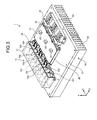
- Fig. 3 is a perspective view illustrating the external appearance of the power conversion apparatus 1 according to the first embodiment.
- the capacitor elements 121 arranged in the main circuit capacitor 10 are indicated by dotted lines.
- the power conversion apparatus 1 As illustrated in Fig. 3 , the power conversion apparatus 1 according to the first embodiment is provided with a heat sink 50 including on a flat base 51 and a plurality of cooling fins 52 formed downward from the base 51. Furthermore, the power conversion apparatus 1 includes the main circuit capacitor 10, the inverter unit 20, the current detector 30, and the output terminal block 40, which are provided on the upper surface of the base 51 of the heat sink 50.
- the inverter unit 20 includes a printed wiring board 21 provided thereon with the connectors 22 through which the driving signal is transmitted/received to/from the printed wiring board 21. Furthermore, a semiconductor switch provided on the rear surface of the printed wiring board 21 makes contact with the upper surface of the base 51 of the heat sink 50, and is cooled by the heat sink 50.
- the inverter unit 20 is provided with DC input terminal sections 24 and AC output terminal sections 23.
- the main circuit capacitor 10 is connected to the DC input terminal sections 24 and output terminals of the output terminal block 40 are connected to the AC output terminal sections 23 through the current detector 30.
- the main circuit capacitor 10 includes a box-shaped case 17 formed with an opening facing the inverter unit 20.
- the above-described capacitor elements 121, 121, ..., first wiring members 13 and 14, and second wiring members 15 and 16 are arranged.
- a part of the first connection portions 101 and 102 and a part of the second connection portions 103 and 104 protrude from the opening of the case 17.
- connection portions 103 and 104 serve as connection portions to each of the switching element sections 20a to 20c of the inverter unit 20 and are directly connected to input terminals of the DC input terminal sections 24. Consequently, it is possible to shorten the connection distance between the main circuit capacitor 10 and each of the switching element sections 20a to 20c.
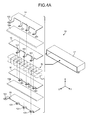
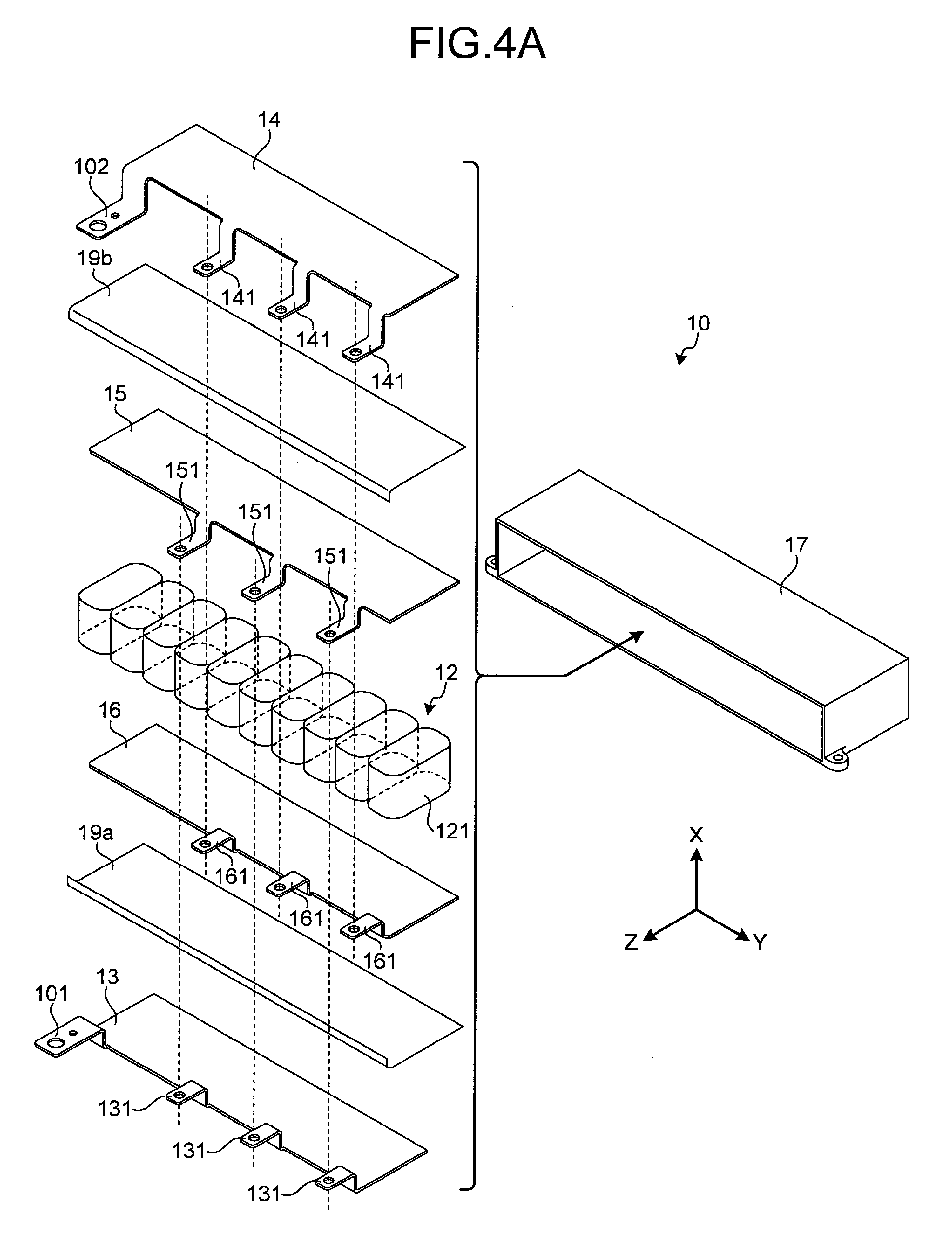
- Fig. 4A is an exploded perspective view of the main circuit capacitor 10 according to the first embodiment.
- an X axis direction is defined as an upper and low direction
- a Y axis direction is defined as a right and left direction
- a Z axis direction is defined as a front and rear direction.
- it is for illustrative purposes only and is not intended to limit the present embodiment.
- the case 17 of the main circuit capacitor 10 is provided therein with a structure in which a plurality of members are stacked.
- the case 17 receives a structure in which the first wiring member 13, an insulating member 19a, the second wiring member 16, a capacitor element unit 12, the second wiring member 15, an insulating member 19b, and the first wiring member 14 are sequentially stacked.
- a positive voltage of the DC power source 2 is applied to the first wiring member 14 and the second wiring member 16
- a negative voltage of the DC power source 2 is applied to the first wiring member 13 and the second wiring member 15.
- they may be called 'a negative-side first wiring member 13,' 'a positive-side first wiring member 14,' 'a negative-side second wiring member 15,' and 'a positive-side second wiring member 16.
- the capacitor element unit 12 includes the plurality of capacitor elements 121, 121, ....
- a positive electrode and a negative electrode of each capacitor element 121 are vertically arranged, and the plurality of capacitor elements 121, 121, ... are arranged to be transversely adjacent to one another.
- the negative electrode is positioned at an upper surface side of each capacitor element 121 and the positive electrode is positioned at a lower surface side of each capacitor element 121.
- each capacitor element 121 is bonded to the upper surface of the positive-side second wiring member 16 by soldering and the like.
- the negative electrode of each capacitor element 121 is bonded to the lower surface of the negative-side second wiring member 15 by soldering and the like.
- the second wiring members 15 and 16, for example, are thin plate-like members such as copper bus bars with conductivity, and have sizes approximately the same as that of the upper surface of the capacitor element unit 12 in the front, rear, left and right directions.
- the negative-side second wiring member 15 is provided at one end thereof with three second connection pieces 151, 151 and 151 each having an L shape when viewed from the side while being transversely spaced apart from one another at a predetermined interval.
- the positive-side second wiring member 16 is provided at one end thereof with three second connection pieces 161, 161 and 161 each having an L shape when viewed from the side while being transversely spaced apart from one another at a predetermined interval.
- the negative-side first wiring member 13 is stacked below the lower surface of the positive-side second wiring member 16 through the insulating member 19a.
- the positive-side first wiring member 14 is stacked above the upper surface of the negative-side second wiring member 15 through the insulating member 19b.
- the insulating members 19a and 19b are plate or film-like members with non-conductivity.
- the first wiring members 13 and 14 are thin plate-like members with conductivity such as copper bus bars, and have sizes approximately the same as that of the upper surface of the capacitor element unit 12 in the front, rear, left and right directions.
- the negative-side first wiring member 13 is provided at one end thereof with one first connection portion 101 and three second connection pieces 131, 131 and 131 each having an L shape when viewed from the side while being transversely spaced apart from one another at a predetermined interval.
- the positive-side first wiring member 14 is provided at one end thereof with one first connection portion 102 and three second connection pieces 141, 141 and 141 each having an L shape when viewed from the side while being transversely spaced apart from one another at a predetermined interval.
- the second connection pieces 131, 131 and 131 provided at one end of the negative-side first wiring member 13 are provided to overlap the second connection pieces 151, 151 and 151 provided at one end of the negative-side second wiring member 15. Furthermore, the second connection pieces 141, 141 and 141 provided at one end of the positive-side first wiring member 14 are provided to overlap the second connection pieces 161, 161 and 161 provided at one end of the positive-side second wiring member 16.
- the second connection portions 103, 103 and 103 are formed by the second connection pieces 131, 131 and 131 and the second connection pieces 151, 151 and 151, respectively.
- the second connection portions 104, 104 and 104 are formed by the second connection pieces 141, 141 and 141 and the second connection pieces 161, 161 and 161, respectively.
- the second connection portions 103, 103 and 103 are spaced apart from the second connection portions 104, 104 and 104 at a predetermined interval such that they do not make contact with one another.
- the negative-side first wiring member 13, the insulating member 19a, the positive-side second wiring member 16, the capacitor element unit 12, the negative-side second wiring member 15, the insulating member 19b, and the positive-side first wiring member 14 are stacked, thereby forming the second connection portions 103, 103, 103 and 104, 104, 104.
- the second connection portions 103, 103, 103 and 104, 104, 104 are connection portions in which connection portions between the main circuit capacitor 10 and the switching element sections 20a to 20c are integrally formed with connection portions between the DC power source 2 and the switching element sections 20a to 20c.
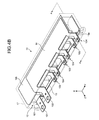
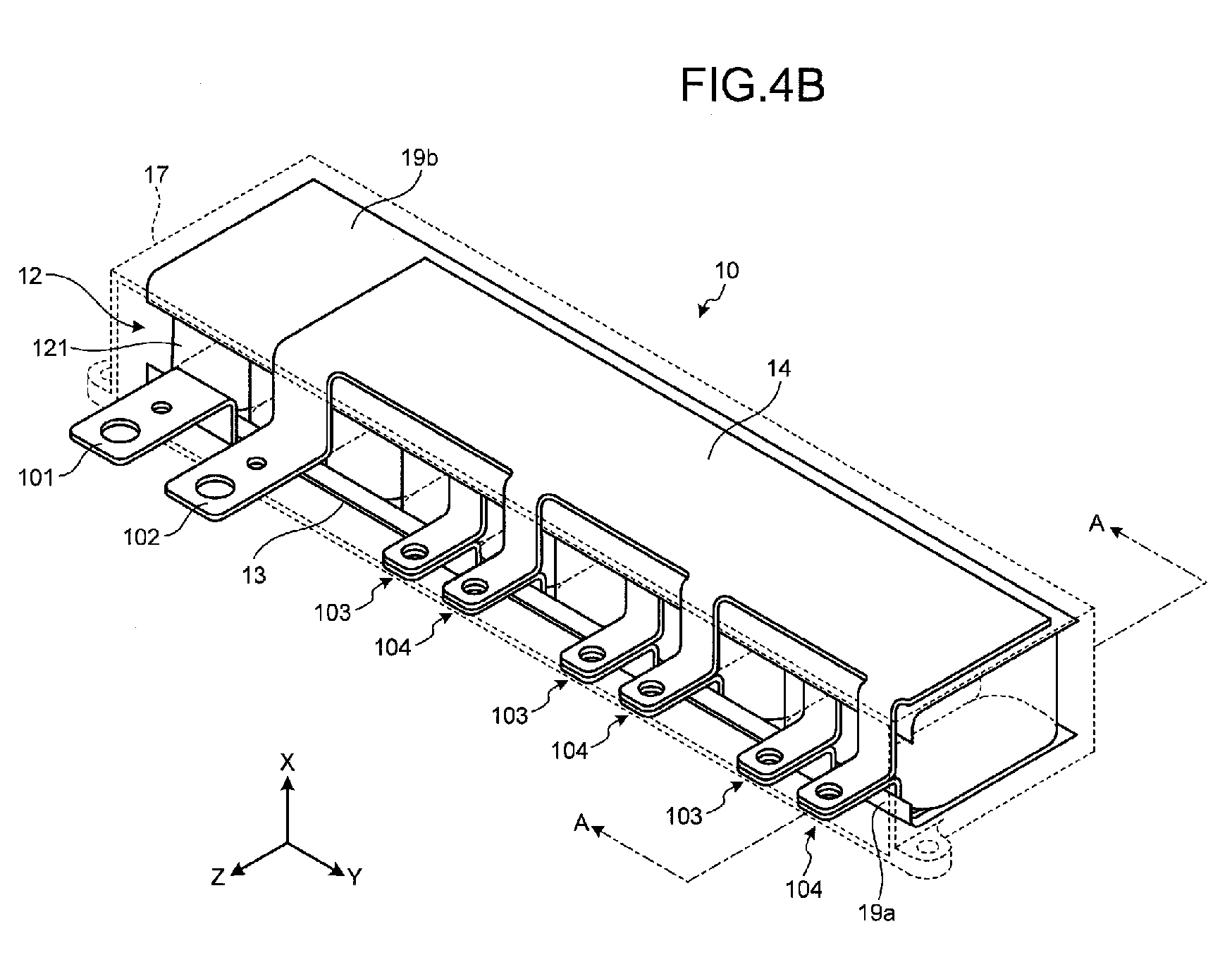
- Fig. 4B is a see-through view explaining an inside of the case 17 of the main circuit capacitor 10.
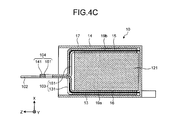
- Fig. 4C is sectional view taken along line A-A of Fig. 4B .
- the main circuit capacitor 10 has a structure which is assembled by stacking negative-side first wiring member 13, the insulating member 19a, the positive-side second wiring member 16, the capacitor element unit 12, the negative-side second wiring member 15, the insulating member 19b, and the positive-side first wiring member 14, wherein the structure is arranged in the case 17.
- the first wiring members 13 and 14 that connect the DC power source 2 to the switching element sections 20a to 20c and the second wiring members 15 and 16 that connect the capacitor element unit 12 to the switching element sections 20a to 20c are arranged in the case 17.
- the six connection portions 103, 103, 103 and 104, 104, 104 necessary for a connection to the switching element sections 20a to 20c are arranged at the opening-side of the case 17. Consequently, a wiring distance between the main circuit capacitor 10 and the switching element sections 20a to 20c can be shortened. As a result, it is possible to reduce the amount of generated heat and impedance in the second connection portions 103, 103, 103 and 104, 104, 104 which connect the main circuit capacitor 10 to the switching element sections 20a to 20c.
- a high frequency ripple current of a carrier frequency component flows through the wirings, which connect the main circuit capacitor 10 to the switching element sections 20a to 20c, by the operation of the switching element sections 20a to 20c, causing heat by a skin effect.
- the amount of generated heat is large, it may affect the main circuit capacitor 10 and the switching element sections 20a to 20c which are peripheral circuits.
- a surge voltage may be generated at the time of switching of the switching element sections 20a to 20c.
- the capacitor elements 121 are connected to the switching element sections 20a to 20c through the second connection portions 103, 103, 103 and 104, 104, 104. Since the wiring distance between the main circuit capacitor 10 and the switching element sections 20a to 20c is short, the power conversion apparatus 1 can suppress a surge voltage or a large heat generation at the connection portions between the main circuit capacitor 10 and the switching element sections 20a to 20c. Furthermore, in the power conversion apparatus 1, the connection distance between the main circuit capacitor 10 and the switching element sections 20a to 20c is shortened, so that the weight and manufacturing cost of the power conversion apparatus 1 can be reduced.
- first wiring members 13 and 14 and the second wiring members 15 and 16 are formed of a thin plate-like member and the insulating members 19a and 19b are also formed of a thin-plate or film-like member. Consequently, as illustrated in Fig. 4C , the effect on the length in the vertical direction (the X direction) of the main circuit capacitor 10 is small, and the main circuit capacitor 10 can be prevented from increasing in size.
- the sizes in the front, rear, left and right directions of the first wiring members 13 and 14, the second wiring members 15 and 16, and the insulating members 19a and 19b are approximately the same as the sizes of the upper and lower surfaces of the capacitor element unit 12.
- the power conversion apparatus 1 for example, it is possible to suppress the effect on the length in the front and rear directions and right and left directions of the case 17.
- the sizes in the front, rear, left and right directions of the first wiring members 13 and 14 and the second wiring members 15 and 16 are approximately the same as the sizes of the upper and lower surfaces of the capacitor element unit 12.
- impedance of the first wiring members 13 and 14 and the second wiring members 15 and 16 can be more effectively reduced. Consequently, in the power conversion apparatus 1, a surge voltage or a large heat generation can be more effectively suppressed.
- the first wiring members 13 and 14, which are paths through which a DC component mainly flows, and the second wiring members 15 and 16, which are paths through which an AC component mainly flows, are provided as separate members, so that heat generated by a current can be distributed. Consequently, in the power conversion apparatus 1, the switching element sections 20a to 20c can be less affected by heat generated by the wiring members.
- the power conversion apparatus according to the second embodiment is substantially identical to the power conversion apparatus 1 according to the first embodiment, except for the configuration of a main circuit capacitor.
- the main circuit capacitor of the power conversion apparatus according to the second embodiment will be described in detail with reference to Figs. 5A to 5C .
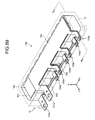
- Fig. 5A is an exploded perspective view of a main circuit capacitor 10a according to the second embodiment
- Fig. 5B is a see-through view explaining an inside of a case 17 of the main circuit capacitor 10a
- Fig. 5C is sectional view taken along line B-B of Fig. 5B .
- the main circuit capacitor 10a is assembled by stacking a positive-side first wiring member 14a, a positive-side second wiring member 16a, a capacitor element unit 12a, a negative-side second wiring member 15a, and a negative-side first wiring member 13a, and is arranged in the case 17.
- the second wiring members 15a and 16a have the same configurations as those of the second wiring members 15 and 16 according to the first embodiment illustrated in Fig. 4A , except that formation positions of second connection pieces 151a and 161a are different from those of the second connection pieces 151 and 161.
- the first wiring members 13a and 14a and the second wiring members 15a and 16a are thin plate-like members with conductivity such as copper bus bars, and have sizes approximately the same as that of the upper surface of the capacitor element unit 12a.
- the negative-side first wiring member 13a is arranged in opposition to the first wiring member 13 according to the first embodiment illustrated in Fig. 4A .
- the negative-side first wiring member 13a is provided at one end thereof with one first connection portion 101a and three second connection pieces 131a, 131a and 131a each having an L shape when viewed from the side while being transversely spaced apart from one another at a predetermined interval.
- the positive-side first wiring member 14a is arranged in opposition to the first wiring member 14 according to the first embodiment illustrated in Fig. 4A .
- the positive-side first wiring member 14a is provided at one end thereof with one first connection portion 102a and three second connection pieces 141a, 141a and 141a each having an L shape when viewed from the side while being transversely spaced apart from one another at a predetermined interval.
- the second connection pieces 131a, 131a and 131a provided at one end of the negative-side first wiring member 13a are provided to overlap the second connection pieces 151a, 151a and 151a provided at one end of the negative-side second wiring member 15a. Furthermore, the second connection pieces 141a, 141a and 141a provided at one end of the positive-side first wiring member 14a are provided to overlap the second connection pieces 161a, 161a and 161a provided at one end of the positive-side second wiring member 16a.
- the second connection portions 103a, 103a and 103a are formed by the second connection pieces 131a, 131a and 131a and the second connection pieces 151a, 151a and 151a, respectively.
- the second connection portions 104a, 104a and 104a are formed by the second connection pieces 141a, 141a and 141a and the second connection pieces 161a, 161a and 161a, respectively.
- the second connection portions 103a, 103a and 103a are spaced apart from the second connection portions 104a, 104a and 104a at a predetermined interval such that they do not make contact with one another.
- the main circuit capacitor 10 according to the first embodiment has a structure in which the first wiring member and the second wiring member with different polarities of applied voltages are stacked via the insulating member.
- the first wiring member and the second wiring member with the same polarity of applied voltages are stacked.
- the power conversion apparatus according to the second embodiment similarly to the power conversion apparatus 1 according to the first embodiment, it is possible to shorten the wiring distance between the main circuit capacitor 10 and the switching element sections 20a to 20c. Consequently, in the power conversion apparatus according to the second embodiment, it is possible to reduce the amount of generated heat and impedance at connection portions between the main circuit capacitor 10 and each of the switching element sections 20a to 20c.
- the power conversion apparatus according to the third embodiment has the same configuration as that of the power conversion apparatus 1 illustrated in Fig. 3 , except for a difference in the configuration of connection places of a DC power source 2.
- Fig. 6 is a perspective view illustrating the external appearance of a power conversion apparatus 1b according to the third embodiment.
- an input terminal block 71 and a connection terminal block 73 are provided on the upper surface of a base 51.
- the input terminal block 71 is provided adjacent to an output terminal block 40 and the connection terminal block 73 is provided at a position facing first connection portions 101 and 102 protruding from a main circuit capacitor 10.
- a pair of wiring members 72 and 72 with conductivity are installed between the input terminal block 71 and the connection terminal block 73, and end portions of the connection terminal block 73 in the wiring members 72 and 72 are connected to the first connection portions 101 and 102, respectively.
- an end portion of the input terminal block 71 in the wiring members 72 serves as a connection portion to the DC power source 2
- an output part of an AC voltage and an input part of a DC voltage can be provided adjacent to each other. Consequently, in the power conversion apparatus 1b, for example, when wiring cables are connected to the output part of the AC voltage and the input part of the DC voltage, the wiring cables can be easily installed.
- the input part of the DC voltage can be arranged close to one side of the base 51.
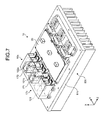
- Fig. 7 is a perspective view illustrating the external appearance of the power conversion apparatus 1c according to the fourth embodiment.
- capacitor elements 121 arranged in the main circuit capacitor 10c are indicated by dotted lines.
- the power conversion apparatus 1c has the same configuration as that of the power conversion apparatus 1 illustrated in Fig. 3 , except that the configuration of the main circuit capacitor 10c and a size of a heat sink 50c are different from those of the power conversion apparatus 1 illustrated in Fig. 3 .
- the configuration of the main circuit capacitor 10c and the size of the heat sink 50c will be described.
- a pair of input terminal blocks 171 and 172 are provided on the upper surface of a case 17c of the main circuit capacitor 10c, and first connection portions 101c and 102c serving as connection portions to the DC power source 2 (refer to Fig. 1 ) are provided on the upper surfaces of the input terminal blocks 171 and 172.
- the internal structure of the main circuit capacitor 10c will be described in detail later with reference to Figs. 8A to 8C .
- the first connection portions 101c and 102c are provided on the upper surface of the case 17c. Consequently, in power conversion apparatus 1c, a space occupied by the main circuit capacitor 10c on the upper surface of a base 51c is reduced, as compared with the structure (refer to Fig. 3 ) in which the first connection portions 101 and 102 are provided adjacent to the second connection portions 103 and 104 in the right and left direction.
- the power conversion apparatus 1c can be configured by the heat sink 50c provided with the base 51c having an upper surface smaller than that of the base 51 illustrated in Fig. 3 , the power conversion apparatus 1c can be further fabricated in a small size as compared with the power conversion apparatus 1.
- Fig. 8A is an exploded perspective view of the main circuit capacitor 10c according to the fourth embodiment.
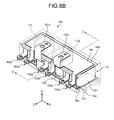
- Fig. 8B is a see-through view explaining an inside of the case 17c of the main circuit capacitor 10c according to the fourth embodiment.
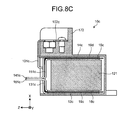
- Fig. 8C is sectional view taken along line C-C of Fig. 8B .
- the case 17c of the main circuit capacitor 10c receives a structure in which a plurality of members are stacked.
- a stack structure in the main circuit capacitor 10c is basically identical to the stack structure of the main circuit capacitor 10 according to the first embodiment. That is, the case 17c receives a structure in which a first wiring member 13c, an insulating member 19c, a second wiring member 16c, a capacitor element unit 12c, a second wiring member 15c, an insulating member 19d, and a first wiring member 14c are stacked.
- the insulating members 19c and 19d are plate or film-like members with conductivity, similarly to the insulating members 19a and 19b.
- the first connection portions 101c and 102c are formed as follows.
- the first wiring member 13c is provided at one end thereof with one first connection portion 101c and three second connection pieces 131c, 131c and 131c.
- the first connection portion 101c is provided between the second connection pieces 131c and 131c, and has a substantially J shape formed by folding an intermediate portion thereof backward when viewed from the sectional side such that the front end portion of the first connection portion 101c is positioned on the upper surface of the case 17c as illustrated in Fig. 8C when the first wiring member 13c is received in the case 17c.
- the first connection portion 101c extends approximately at a right angle from one end of the first wiring member 13c and is folded backward in the substantially J shape when viewed from the sectional side, so that the front end portion of the first connection portion 101c is positioned on the upper surface of the case 17c. Consequently, in the power conversion apparatus 1c, it is possible to reduce a portion of the first connection portion 101c, which protrudes from the opening of the case 17c. As a result, in the power conversion apparatus 1c, it is possible to expand a space between the main circuit capacitor 10c and an inverter unit 20, and to further reduce the probability of a contact between the first connection portion 101c and other members.
- the first wiring member 14c is provided at one end thereof with one first connection portion 102c and three second connection pieces 141c, 141c and 141c.
- the first connection portion 102c is provided between the second connection pieces 141c and 141c, and has a substantially J shape formed by folding an intermediate portion thereof backward when viewed from the sectional side such that the front end portion of the first connection portion 102c is positioned on the upper surface of the case 17c as illustrated in Fig. 8C when the first wiring member 14c is received in the case 17c.
- the first connection portion 102c is provided between the second connection pieces 141c, the width in the right and left directions of the first wiring member 14c can be reduced in the power conversion apparatus 1c.
- the second connection pieces 131c, 131c and 131c are provided to overlap second connection pieces 151c, 151c and 151c provided to one end of the second wiring member 15c, thereby forming second connection portions 103c, 103c and 103c as illustrated in Fig. 8B .
- the second connection pieces 141c, 141c and 141c are provided to overlap second connection pieces 161c, 161c and 161c provided to one end of the second wiring member 16c, thereby forming second connection portions 104c, 104c and 104c as illustrated in Fig. 8B .
- the first connection portions 101c and 102c are drawn out between the second connection portions 103c and 104c and positioned on a plane different from that of the second connection portions 103c and 104c.
- a space occupied by the main circuit capacitor 10c on the upper surface of the base 51c is reduced, so that the main circuit capacitor 10c can be further fabricated in a small size, as compared with the power conversion apparatus 1 illustrated in Fig. 3 , in which the first connection portions 101c and 102c and the second connection portions 103c and 104c are arranged in a row on the same plane.
- the first connection portions 101c and 102c are drawn out from the front side (the opening side) of the case 17c toward the upper surface of the case 17c. However, they may be drawn out from the lateral side or rear side of the case 17c toward the upper surface of the case 17c.
- the main circuit capacitors having a structure in which the first wiring member and the second wiring member with different polarities of applied voltages are stacked via the insulating member have been described as an example.
- the main circuit capacitor is not limited thereto. That is, similarly to the power conversion apparatus 10a according to the second embodiment, the structure in which the first wiring member and the second wiring member with the same polarity of applied voltages are stacked can be applied to the third and fourth embodiments.
- the negative electrode is positioned at the upper surface side of each capacitor element 121 and the positive electrode is positioned at the lower surface side of each capacitor element 121.
- the positive electrode may be positioned at the upper surface side of each capacitor element 121 and the negative electrode is positioned at the lower surface side of each capacitor element 121.
- the first connection portions have polarities opposite to those in the examples according to the first to fourth embodiments.
- electrodes are provided to the upper surface side and the lower surface side of each capacitor element 121.
- the positions of the electrodes are not limited thereto.
- the positive electrode and the negative electrode may be provided to anyone of the upper surface side and the lower surface side of each capacitor element 121. In such a case, all the first wiring members and the second wiring members are stacked at the side where the electrodes are provided, so that the first wiring members and the second wiring members can be arranged in the case.
- the case of the main circuit capacitor is formed at the whole front side thereof with an opening.
- the opening may be formed only in a part of the front side of the case such that only the first connection portion and the second connection portion are exposed.
- the first connection portion and the second connection portion are configured to protrude from the case. However, for example, if there is no problem in an assembling process and the like, the first connection portion and the second connection portion may not protrude therefrom.
- the present embodiment is not limited to the copper bus bar if the first wiring member and the second wiring member are configured by a thin plate-like conductive member.
- the insulating members 19a to 19d may be formed of materials if the materials can maintain an insulation property in the range of the performance of the power conversion apparatus.
- all second connection portions are configured to protrude from the same direction.
- some of the second connection portions may be configured to protrude from other directions.
- an example in which the inverter unit for converting a DC voltage into an AC voltage is used as the switching circuit has been described.
- a converter unit for converting an AC voltage into a DC voltage may be arranged.
- the technology disclosed in the present embodiment can also be applied to a power conversion apparatus that converts a DC voltage into a multi-phase AC voltage other than a three-phase AC voltage. Furthermore, the technology disclosed in the present embodiment can also be applied to a power conversion apparatus that outputs an AC voltage to an arbitrary load other than a three-phase motor.
- each second connection piece is formed in an L shape when viewed from the side view.
- the second connection piece may have various shapes if it protrudes from the case of the main circuit capacitor.
- the second connection pieces provided to the first wiring member and the first wiring member may be formed on the same plane, and the second connection pieces provided to the second wiring member and the first wiring member may be formed on the same plane.
- the DC input terminal sections of the inverter unit are held by the second connection pieces formed at opposite positions and having the same polarity, so that the main circuit capacitor is connected to the inverter unit.
- the first wiring member or the second wiring member provided at one end thereof with the second connection pieces is easily formed by die-cutting without using a press process in the manufacturing process. Consequently, the number of manufacturing steps can be reduced.
- a power conversion apparatus disclosed in the present invention, it is possible to shorten a connection distance between a main circuit capacitor and a switching circuit.
Landscapes
- Engineering & Computer Science (AREA)
- Power Engineering (AREA)
- Microelectronics & Electronic Packaging (AREA)
- Manufacturing & Machinery (AREA)
- Inverter Devices (AREA)
Abstract
A power conversion apparatus (1) includes a switching circuit (20) including semiconductor switches (20a to 20c), and a main circuit capacitor (10) connected between a DC power source (2) and the switching circuit (20). The main circuit capacitor (10) includes a capacitor element (121), first wiring members (13, 14) that connect the DC power source (2) to the switching circuit (20), and second wiring members (15, 16) that connect the capacitor element (121) to the switching circuit (20). The capacitor element (121), the first wiring members (13, 14), and the second wiring members (15, 16) are received in a case.
Description
- The disclosed embodiments relate to a power conversion apparatus that performs power conversion using a switching circuit.
- Conventionally, there has been disclosed a power conversion apparatus that performs power conversion using a switching circuit including a semiconductor switch such as an IGBT. For example, as the power conversion apparatus, there has been disclosed a voltage-type inverter that converts a DC voltage into an AC voltage using a switching circuit and outputs the AC voltage.
- In the power conversion apparatus, a smoothing capacitor is provided between a DC power source and the switching circuit to smooth a voltage (for example, refer to Japanese Patent Laid-Open Publication No.
2007-221892 - However, for example, a high frequency ripple current and the like flow through the bus bar that connects the main circuit capacitor to the switching circuit, causing heat by a skin effect. Furthermore, as the length of the bus bar increases, impedance in a high frequency region should be considered and eventually becomes a main factor that generates a surge voltage at the time of switching of the switching circuit.
- In this regard, it is preferable to shorten the length of the bus bar that connects the main circuit capacitor to the switching circuit.
- The disclosed technology has been made to solve the above problem occurring in the related art, and therefore, an object of the disclosed technology is to shorten a connection distance between a main circuit capacitor and a switching circuit.
- A power conversion apparatus according to an aspect of embodiments comprises a switching circuit including semiconductor switches, and a main circuit capacitor connected between a DC power source and the switching circuit. The main circuit capacitor includes a capacitor element, first wiring members that connect the DC power source to the switching circuit, and second wiring members that connect the capacitor element to the switching circuit. The capacitor element, the first wiring members, and the second wiring members are received in a case.
- According to an aspect of the embodiment, a power conversion apparatus can shorten a connection distance between a main circuit capacitor and a switching circuit.
-
-
Fig. 1 is a diagram illustrating the circuit configuration of a power conversion apparatus according to a first embodiment. -
Fig. 2 is a diagram explaining the relationship between internal wirings of a main circuit capacitor according to a first embodiment. -
Fig. 3 is a perspective view illustrating the external appearance of a power conversion apparatus according to a first embodiment. -
Fig. 4A is an exploded perspective view of a main circuit capacitor according to a first embodiment. -
Fig. 4B is a see-through view explaining an inside of a case of a main circuit capacitor according to a first embodiment. -
Fig. 4C is a sectional view taken along line A-A ofFig. 4B . -
Fig. 5A is an exploded perspective view of a main circuit capacitor according to a second embodiment. -
Fig. 5B is a see-through view explaining an inside of a case of a main circuit capacitor according to a second embodiment. -
Fig. 5C is a sectional view taken along line B-B ofFig. 5B . -
Fig. 6 is a perspective view illustrating the external appearance of a power conversion apparatus according to a third embodiment. -
Fig. 7 is a perspective view illustrating the external appearance of a power conversion apparatus according to a fourth embodiment. -
Fig. 8A is an exploded perspective view of a main circuit capacitor according to a fourth embodiment. -
Fig. 8B is a see-through view explaining an inside of a case of a main circuit capacitor according to a fourth embodiment. -
Fig. 8C is a sectional view taken along line C-C ofFig. 8B . - Hereinafter, a power conversion apparatus according to embodiments of the present disclosure will be described in detail. In addition, the embodiments disclosed below are not intended to limit the present invention.
- First, the circuit configuration of a power conversion apparatus according to a first embodiment will be described with reference to
Fig. 1. Fig. 1 is a diagram illustrating the circuit configuration of the power conversion apparatus according to the first embodiment. - A power conversion apparatus 1 illustrated in
Fig. 1 includes aninverter unit 20 that converts a DC voltage, which is input from aDC power source 2 tofirst connection portions output terminal block 40. In addition, thefirst connection portion 101 is connected to a negative side of theDC power source 2 and thefirst connection portion 102 is connected to a positive side of theDC power source 2. - The
inverter unit 20 is a switching circuit provided withswitching element sections 20a to 20c including a pair of serially connected semiconductor switches, respectively. Each of theswitching element sections 20a to 20c is controlled based on a driving signal which is input from acontrol device 3 toconnectors 22. In addition, as the semiconductor switch constituting each of theswitching element sections 20a to 20c, for example, a power semiconductor element such as an IGBT or a MOSFET is used. Furthermore, a reflux diode is connected to each semiconductor switch. - Furthermore, a
current detector 30 is provided between theinverter unit 20 and theoutput terminal block 40 to detect a value of a current flowing from each of theswitching element sections 20a to 20c to the three-phase motor M. Thecontrol device 3 inputs a driving signal according to a detection result and the like obtained by thecurrent detector 30 to theconnectors 22. - In addition, the power conversion apparatus 1 includes a
main circuit capacitor 10 provided between theDC power source 2 and theinverter unit 20 to smooth a voltage. Themain circuit capacitor 10 includes a plurality of capacitor elements, and for example, has capacitance capable of smoothing a high frequency ripple and the like. In addition, themain circuit capacitor 10 may be configured as one capacitor element. - Here, the configuration of the
main circuit capacitor 10 will be described with reference toFig. 2. Fig. 2 is a diagram explaining the relationship between internal wirings of themain circuit capacitor 10. - As illustrated in
Fig. 2 , themain circuit capacitor 10 includes a plurality ofcapacitor elements wiring members second wiring members first wiring members DC power source 2 to theswitching element sections 20a to 20c through thefirst connection portions second connection portions second wiring members capacitor elements switching element sections 20a to 20c through thesecond connection portions - In addition, as will be described later, the
first wiring members second wiring members main circuit capacitor 10, so that it is possible to shorten a wiring distance between themain circuit capacitor 10 and theswitching element sections 20a to 20c. - Moreover, the
first wiring members second wiring members element sections 20a to 20c can be less affected by heat generated by the wiring members. - Hereinafter, an overall structure of the power conversion apparatus 1 will be described with reference to
Fig. 3 , and then a detailed structure of themain circuit capacitor 10 will be described.Fig. 3 is a perspective view illustrating the external appearance of the power conversion apparatus 1 according to the first embodiment. In addition, inFig. 3 , thecapacitor elements 121 arranged in themain circuit capacitor 10 are indicated by dotted lines. - As illustrated in
Fig. 3 , the power conversion apparatus 1 according to the first embodiment is provided with aheat sink 50 including on aflat base 51 and a plurality of coolingfins 52 formed downward from thebase 51. Furthermore, the power conversion apparatus 1 includes themain circuit capacitor 10, theinverter unit 20, thecurrent detector 30, and theoutput terminal block 40, which are provided on the upper surface of thebase 51 of theheat sink 50. - The
inverter unit 20 includes a printedwiring board 21 provided thereon with theconnectors 22 through which the driving signal is transmitted/received to/from the printedwiring board 21. Furthermore, a semiconductor switch provided on the rear surface of the printedwiring board 21 makes contact with the upper surface of thebase 51 of theheat sink 50, and is cooled by theheat sink 50. - Furthermore, the
inverter unit 20 is provided with DCinput terminal sections 24 and ACoutput terminal sections 23. Themain circuit capacitor 10 is connected to the DCinput terminal sections 24 and output terminals of theoutput terminal block 40 are connected to the ACoutput terminal sections 23 through thecurrent detector 30. - The
main circuit capacitor 10 includes a box-shapedcase 17 formed with an opening facing theinverter unit 20. In thecase 17, the above-describedcapacitor elements first wiring members second wiring members first connection portions second connection portions case 17. - The
second connection portions element sections 20a to 20c of theinverter unit 20 and are directly connected to input terminals of the DCinput terminal sections 24. Consequently, it is possible to shorten the connection distance between themain circuit capacitor 10 and each of the switchingelement sections 20a to 20c. - Hereinafter, the internal structure of the
main circuit capacitor 10 capable of shortening the connection distance to each of the switchingelement sections 20a to 20c will be described in detail with reference toFigs. 4A to 4C .Fig. 4A is an exploded perspective view of themain circuit capacitor 10 according to the first embodiment. In addition, in the following description, an X axis direction is defined as an upper and low direction, a Y axis direction is defined as a right and left direction, and a Z axis direction is defined as a front and rear direction. However, it is for illustrative purposes only and is not intended to limit the present embodiment. - As illustrated in
Fig. 4A , thecase 17 of themain circuit capacitor 10 is provided therein with a structure in which a plurality of members are stacked. In detail, thecase 17 receives a structure in which thefirst wiring member 13, an insulatingmember 19a, thesecond wiring member 16, acapacitor element unit 12, thesecond wiring member 15, an insulatingmember 19b, and thefirst wiring member 14 are sequentially stacked. - In addition, a positive voltage of the
DC power source 2 is applied to thefirst wiring member 14 and thesecond wiring member 16, and a negative voltage of theDC power source 2 is applied to thefirst wiring member 13 and thesecond wiring member 15. To facilitate the understanding of the description, they may be called 'a negative-side first wiringmember 13,' 'a positive-side first wiringmember 14,' 'a negative-side second wiringmember 15,' and 'a positive-sidesecond wiring member 16.' - The
capacitor element unit 12 includes the plurality ofcapacitor elements capacitor element 121 are vertically arranged, and the plurality ofcapacitor elements capacitor element 121 and the positive electrode is positioned at a lower surface side of eachcapacitor element 121. - The positive electrode of each
capacitor element 121 is bonded to the upper surface of the positive-sidesecond wiring member 16 by soldering and the like. The negative electrode of eachcapacitor element 121 is bonded to the lower surface of the negative-side second wiringmember 15 by soldering and the like. Thesecond wiring members capacitor element unit 12 in the front, rear, left and right directions. - The negative-side second wiring
member 15 is provided at one end thereof with threesecond connection pieces second wiring member 16 is provided at one end thereof with threesecond connection pieces - When the
second wiring members case 17, front ends of the sixsecond connection pieces case 17. - The negative-side first wiring
member 13 is stacked below the lower surface of the positive-sidesecond wiring member 16 through the insulatingmember 19a. The positive-side first wiringmember 14 is stacked above the upper surface of the negative-side second wiringmember 15 through the insulatingmember 19b. The insulatingmembers - The positive-side
second wiring member 16 and the negative-side first wiringmember 13, which have polarities different from each other, are electrically insulated from each other by the insulatingmember 19a. Furthermore, the negative-side second wiringmember 15 and the positive-side first wiringmember 14, which have polarities different from each other, are electrically insulated from each other by the insulatingmember 19b. - The
first wiring members capacitor element unit 12 in the front, rear, left and right directions. The negative-side first wiringmember 13 is provided at one end thereof with onefirst connection portion 101 and threesecond connection pieces member 14 is provided at one end thereof with onefirst connection portion 102 and threesecond connection pieces - The
second connection pieces member 13 are provided to overlap thesecond connection pieces member 15. Furthermore, thesecond connection pieces member 14 are provided to overlap thesecond connection pieces second wiring member 16. - The
second connection portions Fig. 3 ) are formed by thesecond connection pieces second connection pieces second connection portions Fig. 3 ) are formed by thesecond connection pieces second connection pieces second connection portions second connection portions - As described above, the negative-side first wiring
member 13, the insulatingmember 19a, the positive-sidesecond wiring member 16, thecapacitor element unit 12, the negative-side second wiringmember 15, the insulatingmember 19b, and the positive-side first wiringmember 14 are stacked, thereby forming thesecond connection portions second connection portions main circuit capacitor 10 and the switchingelement sections 20a to 20c are integrally formed with connection portions between theDC power source 2 and the switchingelement sections 20a to 20c. Thus, the power conversion apparatus 1 can be fabricated in a small size and the assembling work efficiency thereof can be improved. -
Fig. 4B is a see-through view explaining an inside of thecase 17 of themain circuit capacitor 10.Fig. 4C is sectional view taken along line A-A ofFig. 4B . As illustrated inFigs. 4B and4C , themain circuit capacitor 10 has a structure which is assembled by stacking negative-side first wiringmember 13, the insulatingmember 19a, the positive-sidesecond wiring member 16, thecapacitor element unit 12, the negative-side second wiringmember 15, the insulatingmember 19b, and the positive-side first wiringmember 14, wherein the structure is arranged in thecase 17. - That is, the
first wiring members DC power source 2 to theswitching element sections 20a to 20c and thesecond wiring members capacitor element unit 12 to theswitching element sections 20a to 20c are arranged in thecase 17. The sixconnection portions switching element sections 20a to 20c are arranged at the opening-side of thecase 17. Consequently, a wiring distance between themain circuit capacitor 10 and the switchingelement sections 20a to 20c can be shortened. As a result, it is possible to reduce the amount of generated heat and impedance in thesecond connection portions main circuit capacitor 10 to theswitching element sections 20a to 20c. - That is, a high frequency ripple current of a carrier frequency component flows through the wirings, which connect the
main circuit capacitor 10 to theswitching element sections 20a to 20c, by the operation of the switchingelement sections 20a to 20c, causing heat by a skin effect. When the amount of generated heat is large, it may affect themain circuit capacitor 10 and the switchingelement sections 20a to 20c which are peripheral circuits. Furthermore, when a high frequency ripple current flows between themain circuit capacitor 10 and the switchingelement sections 20a to 20c, since impedance of a wiring part should be considered as the length of the wiring part increases, a surge voltage may be generated at the time of switching of the switchingelement sections 20a to 20c. - On the other hand, in the power conversion apparatus 1, the
capacitor elements 121 are connected to theswitching element sections 20a to 20c through thesecond connection portions main circuit capacitor 10 and the switchingelement sections 20a to 20c is short, the power conversion apparatus 1 can suppress a surge voltage or a large heat generation at the connection portions between themain circuit capacitor 10 and the switchingelement sections 20a to 20c. Furthermore, in the power conversion apparatus 1, the connection distance between themain circuit capacitor 10 and the switchingelement sections 20a to 20c is shortened, so that the weight and manufacturing cost of the power conversion apparatus 1 can be reduced. - Moreover, the
first wiring members second wiring members members Fig. 4C , the effect on the length in the vertical direction (the X direction) of themain circuit capacitor 10 is small, and themain circuit capacitor 10 can be prevented from increasing in size. - In addition, in the power conversion apparatus 1, the sizes in the front, rear, left and right directions of the
first wiring members second wiring members members capacitor element unit 12. Thus, in the power conversion apparatus 1, for example, it is possible to suppress the effect on the length in the front and rear directions and right and left directions of thecase 17. - Furthermore, in the power conversion apparatus 1, the sizes in the front, rear, left and right directions of the
first wiring members second wiring members capacitor element unit 12. Thus, in the power conversion apparatus 1, impedance of thefirst wiring members second wiring members - Furthermore, in the power conversion apparatus 1, the
first wiring members second wiring members element sections 20a to 20c can be less affected by heat generated by the wiring members. - Next, a power conversion apparatus according to the second embodiment will be described. The power conversion apparatus according to the second embodiment is substantially identical to the power conversion apparatus 1 according to the first embodiment, except for the configuration of a main circuit capacitor. Hereinafter, the main circuit capacitor of the power conversion apparatus according to the second embodiment will be described in detail with reference to
Figs. 5A to 5C . -
Fig. 5A is an exploded perspective view of amain circuit capacitor 10a according to the second embodiment,Fig. 5B is a see-through view explaining an inside of acase 17 of themain circuit capacitor 10a, andFig. 5C is sectional view taken along line B-B ofFig. 5B . - As illustrated in
Fig. 5A , themain circuit capacitor 10a according to the second embodiment is assembled by stacking a positive-side first wiringmember 14a, a positive-sidesecond wiring member 16a, acapacitor element unit 12a, a negative-sidesecond wiring member 15a, and a negative-side first wiringmember 13a, and is arranged in thecase 17. - The
second wiring members second wiring members Fig. 4A , except that formation positions ofsecond connection pieces second connection pieces first wiring members second wiring members Fig. 4A , thefirst wiring members second wiring members capacitor element unit 12a. - The negative-side first wiring
member 13a is arranged in opposition to thefirst wiring member 13 according to the first embodiment illustrated inFig. 4A . The negative-side first wiringmember 13a is provided at one end thereof with onefirst connection portion 101a and threesecond connection pieces member 14a is arranged in opposition to thefirst wiring member 14 according to the first embodiment illustrated inFig. 4A . The positive-side first wiringmember 14a is provided at one end thereof with onefirst connection portion 102a and threesecond connection pieces - The
second connection pieces member 13a are provided to overlap thesecond connection pieces second wiring member 15a. Furthermore, thesecond connection pieces member 14a are provided to overlap thesecond connection pieces second wiring member 16a. - The
second connection portions Fig. 5B ) are formed by thesecond connection pieces second connection pieces second connection portions Fig. 5B ) are formed by thesecond connection pieces second connection pieces second connection portions second connection portions - As described above, differently from the
main circuit capacitor 10 according to the first embodiment, in themain circuit capacitor 10a according to the second embodiment, the positive-side and the negative-side first wiring members are arranged at different positions. That is, themain circuit capacitor 10 according to the first embodiment has a structure in which the first wiring member and the second wiring member with different polarities of applied voltages are stacked via the insulating member. However, in themain circuit capacitor 10a according to the second embodiment, the first wiring member and the second wiring member with the same polarity of applied voltages are stacked. - With such a configuration, as illustrated in
Fig. 5C , no insulating member is required between thefirst wiring member 13a and thesecond wiring member 15a, and between thefirst wiring member 14a and thesecond wiring member 16a. Consequently, the manufacturing cost is reduced, and themain circuit capacitor 10a can be further fabricated in a small size by the thicknesses of the insulatingmembers main circuit capacitor 10 illustrated inFig. 4B . - Furthermore, in the power conversion apparatus according to the second embodiment, similarly to the power conversion apparatus 1 according to the first embodiment, it is possible to shorten the wiring distance between the
main circuit capacitor 10 and the switchingelement sections 20a to 20c. Consequently, in the power conversion apparatus according to the second embodiment, it is possible to reduce the amount of generated heat and impedance at connection portions between themain circuit capacitor 10 and each of the switchingelement sections 20a to 20c. - Next, a power conversion apparatus according to the third embodiment will be described. The power conversion apparatus according to the third embodiment has the same configuration as that of the power conversion apparatus 1 illustrated in
Fig. 3 , except for a difference in the configuration of connection places of aDC power source 2. -
Fig. 6 is a perspective view illustrating the external appearance of apower conversion apparatus 1b according to the third embodiment. As illustrated inFig. 6 , in thepower conversion apparatus 1b, aninput terminal block 71 and aconnection terminal block 73 are provided on the upper surface of abase 51. Theinput terminal block 71 is provided adjacent to anoutput terminal block 40 and theconnection terminal block 73 is provided at a position facingfirst connection portions main circuit capacitor 10. - In the
power conversion apparatus 1b, a pair ofwiring members input terminal block 71 and theconnection terminal block 73, and end portions of theconnection terminal block 73 in thewiring members first connection portions - In this way, in the
power conversion apparatus 1b, since an end portion of theinput terminal block 71 in thewiring members 72 serves as a connection portion to theDC power source 2, an output part of an AC voltage and an input part of a DC voltage can be provided adjacent to each other. Consequently, in thepower conversion apparatus 1b, for example, when wiring cables are connected to the output part of the AC voltage and the input part of the DC voltage, the wiring cables can be easily installed. Furthermore, in thepower conversion apparatus 1b, in addition to the output part of the AC voltage, the input part of the DC voltage can be arranged close to one side of thebase 51. Thus, in thepower conversion apparatus 1b, for example, when a wiring cable is connected to the input part of the DC voltage, it is possible to prevent the wiring cable from making contact with aheat sink 50 where heat is generated. - Next, a
power conversion apparatus 1c according to the fourth embodiment will be described.Fig. 7 is a perspective view illustrating the external appearance of thepower conversion apparatus 1c according to the fourth embodiment. In addition, inFig. 7 ,capacitor elements 121 arranged in themain circuit capacitor 10c are indicated by dotted lines. - The
power conversion apparatus 1c has the same configuration as that of the power conversion apparatus 1 illustrated inFig. 3 , except that the configuration of themain circuit capacitor 10c and a size of aheat sink 50c are different from those of the power conversion apparatus 1 illustrated inFig. 3 . Hereinafter, the configuration of themain circuit capacitor 10c and the size of theheat sink 50c will be described. - As illustrated in
Fig. 7 , inpower conversion apparatus 1c, a pair of input terminal blocks 171 and 172 are provided on the upper surface of acase 17c of themain circuit capacitor 10c, andfirst connection portions Fig. 1 ) are provided on the upper surfaces of the input terminal blocks 171 and 172. The internal structure of themain circuit capacitor 10c will be described in detail later with reference toFigs. 8A to 8C . - As described above, in
power conversion apparatus 1c, thefirst connection portions case 17c. Consequently, inpower conversion apparatus 1c, a space occupied by themain circuit capacitor 10c on the upper surface of abase 51c is reduced, as compared with the structure (refer toFig. 3 ) in which thefirst connection portions second connection portions - In this way, since the
power conversion apparatus 1c can be configured by theheat sink 50c provided with thebase 51c having an upper surface smaller than that of the base 51 illustrated inFig. 3 , thepower conversion apparatus 1c can be further fabricated in a small size as compared with the power conversion apparatus 1. - Next, the
main circuit capacitor 10c will be described with reference toFig. 8A. Fig. 8A is an exploded perspective view of themain circuit capacitor 10c according to the fourth embodiment.Fig. 8B is a see-through view explaining an inside of thecase 17c of themain circuit capacitor 10c according to the fourth embodiment.Fig. 8C is sectional view taken along line C-C ofFig. 8B . - As illustrated in
Fig. 8A , thecase 17c of themain circuit capacitor 10c receives a structure in which a plurality of members are stacked. A stack structure in themain circuit capacitor 10c is basically identical to the stack structure of themain circuit capacitor 10 according to the first embodiment. That is, thecase 17c receives a structure in which afirst wiring member 13c, an insulatingmember 19c, asecond wiring member 16c, acapacitor element unit 12c, asecond wiring member 15c, an insulatingmember 19d, and afirst wiring member 14c are stacked. The insulatingmembers members - In the
main circuit capacitor 10c, since front end portions of thefirst connection portions case 17c, thefirst connection portions first wiring members - The
first wiring member 13c is provided at one end thereof with onefirst connection portion 101c and threesecond connection pieces first connection portion 101c is provided between thesecond connection pieces first connection portion 101c is positioned on the upper surface of thecase 17c as illustrated inFig. 8C when thefirst wiring member 13c is received in thecase 17c. - As illustrated in
Fig. 8C , thefirst connection portion 101c extends approximately at a right angle from one end of thefirst wiring member 13c and is folded backward in the substantially J shape when viewed from the sectional side, so that the front end portion of thefirst connection portion 101c is positioned on the upper surface of thecase 17c. Consequently, in thepower conversion apparatus 1c, it is possible to reduce a portion of thefirst connection portion 101c, which protrudes from the opening of thecase 17c. As a result, in thepower conversion apparatus 1c, it is possible to expand a space between themain circuit capacitor 10c and aninverter unit 20, and to further reduce the probability of a contact between thefirst connection portion 101c and other members. - Furthermore, in the same manner as the above, the
first wiring member 14c is provided at one end thereof with onefirst connection portion 102c and threesecond connection pieces first connection portion 102c is provided between thesecond connection pieces first connection portion 102c is positioned on the upper surface of thecase 17c as illustrated inFig. 8C when thefirst wiring member 14c is received in thecase 17c. As described above, since thefirst connection portion 102c is provided between thesecond connection pieces 141c, the width in the right and left directions of thefirst wiring member 14c can be reduced in thepower conversion apparatus 1c. - In addition, the
second connection pieces second connection pieces second wiring member 15c, thereby formingsecond connection portions Fig. 8B . Furthermore, thesecond connection pieces second connection pieces second wiring member 16c, thereby formingsecond connection portions Fig. 8B . - As described above, in the
main circuit capacitor 10c according to the fourth embodiment, thefirst connection portions second connection portions second connection portions main circuit capacitor 10c, a space occupied by themain circuit capacitor 10c on the upper surface of thebase 51c is reduced, so that themain circuit capacitor 10c can be further fabricated in a small size, as compared with the power conversion apparatus 1 illustrated inFig. 3 , in which thefirst connection portions second connection portions - In the fourth embodiment, the
first connection portions case 17c toward the upper surface of thecase 17c. However, they may be drawn out from the lateral side or rear side of thecase 17c toward the upper surface of thecase 17c. - That is, even when the
first connection portions case 17c, they are folded and bent toward the upper surface of thecase 17c along the external appearance of thecase 17c, so that a space occupied by themain circuit capacitor 10c on the upper surface of thebase 51c is reduced. - Furthermore, in the power conversion apparatuses according to the third and fourth embodiments, the main circuit capacitors having a structure in which the first wiring member and the second wiring member with different polarities of applied voltages are stacked via the insulating member have been described as an example. However, the main circuit capacitor is not limited thereto. That is, similarly to the
power conversion apparatus 10a according to the second embodiment, the structure in which the first wiring member and the second wiring member with the same polarity of applied voltages are stacked can be applied to the third and fourth embodiments. - Furthermore, in the power conversion apparatuses according to the first to fourth embodiments, the negative electrode is positioned at the upper surface side of each
capacitor element 121 and the positive electrode is positioned at the lower surface side of eachcapacitor element 121. However, the positive electrode may be positioned at the upper surface side of eachcapacitor element 121 and the negative electrode is positioned at the lower surface side of eachcapacitor element 121. In such a case, the first connection portions have polarities opposite to those in the examples according to the first to fourth embodiments. Furthermore, electrodes are provided to the upper surface side and the lower surface side of eachcapacitor element 121. However, the positions of the electrodes are not limited thereto. For example, the positive electrode and the negative electrode may be provided to anyone of the upper surface side and the lower surface side of eachcapacitor element 121. In such a case, all the first wiring members and the second wiring members are stacked at the side where the electrodes are provided, so that the first wiring members and the second wiring members can be arranged in the case. - Furthermore, in the power conversion apparatuses according to the first to fourth embodiments, the case of the main circuit capacitor is formed at the whole front side thereof with an opening. However, the opening may be formed only in a part of the front side of the case such that only the first connection portion and the second connection portion are exposed. Furthermore, in the power conversion apparatuses according to the first to fourth embodiments, the first connection portion and the second connection portion are configured to protrude from the case. However, for example, if there is no problem in an assembling process and the like, the first connection portion and the second connection portion may not protrude therefrom.
- Furthermore, in the power conversion apparatuses according to the first to fourth embodiments, an example in which the first wiring member and the second wiring member are configured by a copper bus bar has been described. However, the present embodiment is not limited to the copper bus bar if the first wiring member and the second wiring member are configured by a thin plate-like conductive member. Furthermore, the insulating
members 19a to 19d may be formed of materials if the materials can maintain an insulation property in the range of the performance of the power conversion apparatus. - Furthermore, in the power conversion apparatuses according to the first to fourth embodiments, all second connection portions are configured to protrude from the same direction. However, some of the second connection portions may be configured to protrude from other directions. Furthermore, in the power conversion apparatuses according to the first to fourth embodiments, an example in which the inverter unit for converting a DC voltage into an AC voltage is used as the switching circuit has been described. However, instead of the inverter unit, a converter unit for converting an AC voltage into a DC voltage may be arranged.
- In addition, the technology disclosed in the present embodiment can also be applied to a power conversion apparatus that converts a DC voltage into a multi-phase AC voltage other than a three-phase AC voltage. Furthermore, the technology disclosed in the present embodiment can also be applied to a power conversion apparatus that outputs an AC voltage to an arbitrary load other than a three-phase motor.
- Furthermore, in the previous embodiments, a case where each second connection piece is formed in an L shape when viewed from the side view has been described. However, the second connection piece may have various shapes if it protrudes from the case of the main circuit capacitor.
- For example, the second connection pieces provided to the first wiring member and the first wiring member may be formed on the same plane, and the second connection pieces provided to the second wiring member and the first wiring member may be formed on the same plane. In such a case, the DC input terminal sections of the inverter unit are held by the second connection pieces formed at opposite positions and having the same polarity, so that the main circuit capacitor is connected to the inverter unit.
- The first wiring member or the second wiring member provided at one end thereof with the second connection pieces is easily formed by die-cutting without using a press process in the manufacturing process. Consequently, the number of manufacturing steps can be reduced.
- According to an embodiment of a power conversion apparatus disclosed in the present invention, it is possible to shorten a connection distance between a main circuit capacitor and a switching circuit.
Claims (7)
- A power conversion apparatus (1) comprising:a switching circuit (20) including semiconductor switches (20a to 20c); anda main circuit capacitor (10) connected between a DC power source (2) and the switching circuit (20),wherein the main circuit capacitor (10) includes:a capacitor element (121);first wiring members (13, 14) that connect the DC power source (2) to the switching circuit (20); andsecond wiring members (15, 16) that connect the capacitor element (121) to the switching circuit (20),wherein the capacitor element (121), the first wiring members (13, 14), and the second wiring members (15, 16) are received in a case (17).
- The power conversion apparatus (1) according to claim 1,
wherein the first wiring members (13, 14) and the second wiring members (15, 16) are stacked. - The power conversion apparatus (1) according to claim 2,
wherein the first wiring members (13, 14) and the second wiring members (15, 16), which have polarities different from one another, are stacked via insulating members (19a, 19b). - The power conversion apparatus (1) according to claim 2,
wherein the first wiring members (13, 14) and the second wiring members (15, 16), which have the same polarity, are stacked. - The power conversion apparatus (1) according to any one of claims 2 to 4,
wherein connection pieces provided to the first wiring members (13, 14) and the second wiring members (15, 16), which have the same polarity, are stacked to be connected to the switching circuit (20). - The power conversion apparatus (1) according to any one of claims 1 to 5,
wherein terminal blocks (171, 172) connected to the DC power source (2) are provided on the case (17). - The power conversion apparatus (1) according to any one of claims 1 to 5, further comprising:an output terminal block (40) that outputs an AC voltage converted by the switching circuit (20),wherein a terminal block (71) connected to the DC power source (2) is provided adjacent to the output terminal block (40).
Applications Claiming Priority (2)
| Application Number | Priority Date | Filing Date | Title |
|---|---|---|---|
| JP2010061149 | 2010-03-17 | ||
| JP2011002402A JP5740986B2 (en) | 2010-03-17 | 2011-01-07 | Power converter |
Publications (1)
| Publication Number | Publication Date |
|---|---|
| EP2367277A2 true EP2367277A2 (en) | 2011-09-21 |
Family
ID=44260222
Family Applications (1)
| Application Number | Title | Priority Date | Filing Date |
|---|---|---|---|
| EP11157112A Withdrawn EP2367277A2 (en) | 2010-03-17 | 2011-03-07 | Power conversion apparatus |
Country Status (5)
| Country | Link |
|---|---|
| US (1) | US8902612B2 (en) |
| EP (1) | EP2367277A2 (en) |
| JP (1) | JP5740986B2 (en) |
| KR (1) | KR101546993B1 (en) |
| CN (1) | CN102195501B (en) |
Cited By (5)
| Publication number | Priority date | Publication date | Assignee | Title |
|---|---|---|---|---|
| EP3073627A4 (en) * | 2013-11-20 | 2016-12-21 | Nissan Motor | ENERGY CONVERTING APPARATUS |
| WO2018041486A1 (en) * | 2016-08-29 | 2018-03-08 | Bayerische Motoren Werke Aktiengesellschaft | Electrode cooled capacitor assembly |
| EP3723108A1 (en) * | 2019-04-12 | 2020-10-14 | Karma Automotive LLC | Integrated dc busbar and dc-link capacitor |
| FR3109490A1 (en) * | 2020-04-21 | 2021-10-22 | Valeo Siemens Eautomotive France Sas | Electrical assembly comprising a power module and a capacitive module, as well as an indexing member |
| WO2024017991A1 (en) * | 2022-07-21 | 2024-01-25 | Zf Friedrichshafen Ag | Modular intermediate circuit capacitor and power converter comprising such an intermediate circuit capacitor |
Families Citing this family (35)
| Publication number | Priority date | Publication date | Assignee | Title |
|---|---|---|---|---|
| JP5550927B2 (en) * | 2010-01-29 | 2014-07-16 | 本田技研工業株式会社 | Power converter |
| FR2985597B1 (en) * | 2012-01-05 | 2014-10-24 | Valeo Equip Electr Moteur | CAPACITY ASSEMBLY DEVICE FOR ELECTRONIC CONVERTER |
| DE102012201754A1 (en) * | 2012-02-07 | 2013-08-08 | Zf Friedrichshafen Ag | Capacitor i.e. film capacitor, for energy supply device for electric motor to drive e.g. electric vehicle for passenger transport, has bus bars and contact rails electrically conductively connected with capacitor unit's electrode terminals |
| DE102012201752A1 (en) * | 2012-02-07 | 2013-08-08 | Zf Friedrichshafen Ag | Capacitor for use in electronic circuit arrangement of hybrid vehicle, has busbars electrically insulated from each other and provided with respective contact lugs, where one of lugs has hole and/or opening for accommodating contact pin |
| JP6039356B2 (en) * | 2012-10-22 | 2016-12-07 | 日立オートモティブシステムズ株式会社 | Power converter |
| JP5978151B2 (en) * | 2013-02-27 | 2016-08-24 | 日立オートモティブシステムズ株式会社 | Power converter |
| JP6186143B2 (en) * | 2013-03-13 | 2017-08-23 | 日立オートモティブシステムズ株式会社 | Power converter |
| JP5932704B2 (en) * | 2013-04-04 | 2016-06-08 | 株式会社日本自動車部品総合研究所 | Power converter |
| JP6098402B2 (en) * | 2013-07-03 | 2017-03-22 | 株式会社デンソー | Power converter |
| JP6070581B2 (en) * | 2014-01-15 | 2017-02-01 | 三菱電機株式会社 | Terminal block and power conversion device including the terminal block |
| DE102014201631B4 (en) * | 2014-01-30 | 2022-02-03 | Robert Bosch Gmbh | Arrangement for contacting electrical components |
| CN105981283B (en) * | 2014-02-07 | 2018-11-09 | 三菱电机株式会社 | Power conversion device |
| JP6291599B2 (en) * | 2015-06-26 | 2018-03-14 | 株式会社日立製作所 | Power converter |
| DE102015113873B3 (en) * | 2015-08-21 | 2016-07-14 | Semikron Elektronik Gmbh & Co. Kg | Power electronic assembly with capacitor device |
| EP3370255A4 (en) * | 2015-10-28 | 2019-06-26 | Mitsubishi Electric Corporation | POWER CONVERSION DEVICE |
| JP6521850B2 (en) * | 2015-12-08 | 2019-05-29 | 三菱重工サーマルシステムズ株式会社 | Capacitor unit and power converter |
| US10175269B2 (en) | 2016-05-31 | 2019-01-08 | Fuji Electric Co., Ltd. | Current detector |
| JP6723141B2 (en) * | 2016-11-11 | 2020-07-15 | 三菱重工サーマルシステムズ株式会社 | Capacitor unit, electric compressor |
| JP6723142B2 (en) * | 2016-11-11 | 2020-07-15 | 三菱重工サーマルシステムズ株式会社 | Capacitor unit, electric compressor |
| WO2018173520A1 (en) * | 2017-03-21 | 2018-09-27 | パナソニックIpマネジメント株式会社 | Capacitor |
| JP6926638B2 (en) * | 2017-04-27 | 2021-08-25 | 富士電機株式会社 | Power converter |
| DE112018000105T5 (en) | 2017-04-27 | 2019-05-29 | Fuji Electric Co., Ltd. | ELECTRONIC COMPONENT AND POWER CONVERSION DEVICE |
| DE102018103166A1 (en) * | 2017-11-21 | 2019-06-06 | Tdk Electronics Ag | capacitor |
| CN111630616B (en) * | 2017-11-21 | 2022-04-05 | Tdk电子股份有限公司 | Very low inductance busbars for capacitor assemblies |
| DE202017107643U1 (en) * | 2017-12-15 | 2018-01-11 | Sma Solar Technology Ag | inverter |
| FR3076175B1 (en) * | 2017-12-22 | 2020-01-10 | Valeo Siemens Eautomotive France Sas | REMOTE WALL ELECTRICAL EQUIPMENT |
| CN111937290B (en) * | 2018-04-03 | 2024-07-30 | 株式会社电装 | Power conversion device and capacitor module |
| USD895549S1 (en) * | 2018-12-18 | 2020-09-08 | Ademco Inc. | Heat pump controller |
| WO2020157563A2 (en) * | 2019-01-29 | 2020-08-06 | Appleton Grp, Llc | A heat-absorbing-and-dissipating jacket for a terminal of an electrical device |
| JP7052783B2 (en) * | 2019-08-27 | 2022-04-12 | 株式会社デンソー | Energized part for power conversion circuit |
| DE102019213153A1 (en) * | 2019-08-30 | 2021-03-04 | Siemens Energy Global GmbH & Co. KG | Intermediate circuit capacitor with latent heat storage |
| DE102019218953A1 (en) * | 2019-12-05 | 2021-06-10 | Robert Bosch Gmbh | Electronic circuit unit |
| JP7601301B2 (en) * | 2020-11-30 | 2024-12-17 | ニデックエレシス株式会社 | Capacitor module, inverter module and motor unit |
| US20240006125A1 (en) * | 2022-06-30 | 2024-01-04 | Tdk Electronics Ag | Metallized Film DC-Link High Power Capacitors for High Frequency Applications |
| DE102023003413A1 (en) * | 2023-08-18 | 2024-08-29 | Mercedes-Benz Group AG | Device for electrically contacting a capacitor |
Citations (1)
| Publication number | Priority date | Publication date | Assignee | Title |
|---|---|---|---|---|
| JP2007221892A (en) | 2006-02-15 | 2007-08-30 | Honda Motor Co Ltd | Power converter |
Family Cites Families (16)
| Publication number | Priority date | Publication date | Assignee | Title |
|---|---|---|---|---|
| JP3221270B2 (en) * | 1995-03-10 | 2001-10-22 | 株式会社日立製作所 | Power conversion device and snubber device |
| JP3382074B2 (en) * | 1995-11-07 | 2003-03-04 | 株式会社東芝 | Power converter |
| US5694301A (en) * | 1996-05-02 | 1997-12-02 | Chrysler Corporation | Power structure construction (DC bus cross straps) |
| JP3637741B2 (en) * | 1997-09-16 | 2005-04-13 | 富士電機システムズ株式会社 | Power converter |
| JP4038899B2 (en) * | 1998-11-04 | 2008-01-30 | 株式会社デンソー | Inverter with built-in capacitor for power smoothing |
| JP2001352766A (en) * | 2000-06-05 | 2001-12-21 | Toshiba Corp | Power unit |
| DE10153748A1 (en) * | 2001-10-31 | 2003-05-22 | Siemens Ag | Converter unit in modular design |
| JP2003319665A (en) * | 2002-04-19 | 2003-11-07 | Toyota Motor Corp | Power converter |
| US6822850B2 (en) * | 2002-09-27 | 2004-11-23 | Rockwell Automation Technologies, Inc. | Laminated bus bar for use with a power conversion configuration |
| JP2005012940A (en) * | 2003-06-19 | 2005-01-13 | Toshiba Corp | Inverter device |
| JP4538359B2 (en) * | 2005-03-31 | 2010-09-08 | 株式会社日立産機システム | Electrical circuit module |
| US7477505B2 (en) * | 2005-10-18 | 2009-01-13 | General Hydrogen Corporation | Capacitor bank for electrical generator |
| MX2008012609A (en) * | 2006-03-30 | 2008-12-16 | Mitsubishi Electric Corp | ENERGY CONVERSION DEVICE AND ITS MANUFACTURING METHOD. |
| JP4564937B2 (en) * | 2006-04-27 | 2010-10-20 | 日立オートモティブシステムズ株式会社 | Electric circuit device, electric circuit module, and power conversion device |
| JP2008295238A (en) * | 2007-05-25 | 2008-12-04 | Mitsubishi Electric Corp | Power converter |
| JP5099433B2 (en) * | 2008-02-21 | 2012-12-19 | アイシン・エィ・ダブリュ株式会社 | Drive unit control unit |
-
2011
- 2011-01-07 JP JP2011002402A patent/JP5740986B2/en not_active Expired - Fee Related
- 2011-02-28 KR KR1020110017707A patent/KR101546993B1/en not_active Expired - Fee Related
- 2011-03-01 CN CN201110048793.0A patent/CN102195501B/en not_active Expired - Fee Related
- 2011-03-07 EP EP11157112A patent/EP2367277A2/en not_active Withdrawn
- 2011-03-10 US US13/044,572 patent/US8902612B2/en not_active Expired - Fee Related
Patent Citations (1)
| Publication number | Priority date | Publication date | Assignee | Title |
|---|---|---|---|---|
| JP2007221892A (en) | 2006-02-15 | 2007-08-30 | Honda Motor Co Ltd | Power converter |
Cited By (9)
| Publication number | Priority date | Publication date | Assignee | Title |
|---|---|---|---|---|
| EP3073627A4 (en) * | 2013-11-20 | 2016-12-21 | Nissan Motor | ENERGY CONVERTING APPARATUS |
| US9859810B2 (en) | 2013-11-20 | 2018-01-02 | Nissan Motor Co., Ltd. | Power converter |
| WO2018041486A1 (en) * | 2016-08-29 | 2018-03-08 | Bayerische Motoren Werke Aktiengesellschaft | Electrode cooled capacitor assembly |
| US11404216B2 (en) | 2016-08-29 | 2022-08-02 | Bayerische Motoren Werke Aktiengesellschaft | Electrode cooled capacitor assembly |
| EP3723108A1 (en) * | 2019-04-12 | 2020-10-14 | Karma Automotive LLC | Integrated dc busbar and dc-link capacitor |
| FR3109490A1 (en) * | 2020-04-21 | 2021-10-22 | Valeo Siemens Eautomotive France Sas | Electrical assembly comprising a power module and a capacitive module, as well as an indexing member |
| CN113541508A (en) * | 2020-04-21 | 2021-10-22 | 法雷奥西门子新能源汽车法国股份公司 | Electrical assembly comprising a power module, a capacitive module and an indexing member |
| EP3902382A1 (en) * | 2020-04-21 | 2021-10-27 | Valeo Siemens eAutomotive France SAS | Electrical assembly comprising a power module and a capacitive module, as well as an indexing member |
| WO2024017991A1 (en) * | 2022-07-21 | 2024-01-25 | Zf Friedrichshafen Ag | Modular intermediate circuit capacitor and power converter comprising such an intermediate circuit capacitor |
Also Published As
| Publication number | Publication date |
|---|---|
| KR101546993B1 (en) | 2015-08-24 |
| US20110228508A1 (en) | 2011-09-22 |
| US8902612B2 (en) | 2014-12-02 |
| CN102195501B (en) | 2015-03-11 |
| CN102195501A (en) | 2011-09-21 |
| KR20110104879A (en) | 2011-09-23 |
| JP5740986B2 (en) | 2015-07-01 |
| JP2011217594A (en) | 2011-10-27 |
Similar Documents
| Publication | Publication Date | Title |
|---|---|---|
| US8902612B2 (en) | Power conversion apparatus | |
| US7869193B2 (en) | Power conversion apparatus | |
| US10153708B2 (en) | Three-level power converter | |
| EP3246945A1 (en) | Power module with low stray inductance | |
| US11087924B2 (en) | Capacitor, particularly intermediate circuit capacitor for a multiphase system | |
| JP2013219892A (en) | Power conversion device | |
| CN102142783A (en) | Power converter | |
| US20160218615A1 (en) | Semiconductor stack for converter with snubber capacitors | |
| JP2005176555A (en) | Power converter | |
| EP3611835B1 (en) | Electric power conversion device | |
| JP2021141638A (en) | Power converter | |
| CN104380587B (en) | Power conversion device | |
| JP2016139702A (en) | Capacitor mounting structure and power converter | |
| CN112055938B (en) | Power conversion device and power conversion unit | |
| CN114496955B (en) | Power conversion device | |
| JP5869207B2 (en) | Circuit component mounting structure and its mounting board | |
| US20230307332A1 (en) | Power Semiconductor Module and Method for Producing a Power Semiconductor Module | |
| JP2019140722A (en) | Power conversion device | |
| JP5605291B2 (en) | Semiconductor module and power converter using the same | |
| JP2015130441A (en) | Capacitor block | |
| JP2015018856A (en) | Semiconductor power module | |
| CN223167821U (en) | Capacitor laminated busbar and frequency converter | |
| US20240098926A1 (en) | Switching module, power conversion device, and manufacturing method for power conversion device | |
| JP7533740B2 (en) | Power Conversion Equipment | |
| JP2024129187A (en) | Power Conversion Equipment |
Legal Events
| Date | Code | Title | Description |
|---|---|---|---|
| PUAI | Public reference made under article 153(3) epc to a published international application that has entered the european phase |
Free format text: ORIGINAL CODE: 0009012 |
|
| AK | Designated contracting states |
Kind code of ref document: A2 Designated state(s): AL AT BE BG CH CY CZ DE DK EE ES FI FR GB GR HR HU IE IS IT LI LT LU LV MC MK MT NL NO PL PT RO RS SE SI SK SM TR |
|
| AX | Request for extension of the european patent |
Extension state: BA ME |
|
| STAA | Information on the status of an ep patent application or granted ep patent |
Free format text: STATUS: THE APPLICATION HAS BEEN WITHDRAWN |
|
| 18W | Application withdrawn |
Effective date: 20160705 |