EP2364798A1 - Granulated powder and method for producing granulated powder - Google Patents
Granulated powder and method for producing granulated powder Download PDFInfo
- Publication number
- EP2364798A1 EP2364798A1 EP11155966A EP11155966A EP2364798A1 EP 2364798 A1 EP2364798 A1 EP 2364798A1 EP 11155966 A EP11155966 A EP 11155966A EP 11155966 A EP11155966 A EP 11155966A EP 2364798 A1 EP2364798 A1 EP 2364798A1
- Authority
- EP
- European Patent Office
- Prior art keywords
- granulated powder
- powder
- granulated
- metal powder
- organic binder
- Prior art date
- Legal status (The legal status is an assumption and is not a legal conclusion. Google has not performed a legal analysis and makes no representation as to the accuracy of the status listed.)
- Granted
Links
Images

Classifications
-
- B—PERFORMING OPERATIONS; TRANSPORTING
- B22—CASTING; POWDER METALLURGY
- B22F—WORKING METALLIC POWDER; MANUFACTURE OF ARTICLES FROM METALLIC POWDER; MAKING METALLIC POWDER; APPARATUS OR DEVICES SPECIALLY ADAPTED FOR METALLIC POWDER
- B22F1/00—Metallic powder; Treatment of metallic powder, e.g. to facilitate working or to improve properties
- B22F1/14—Treatment of metallic powder
- B22F1/148—Agglomerating
Definitions
- the present invention relates to a granulated powder and a method for producing the same.
- a compression molding method in which a mixture of a metal powder and an organic binder is filled in a given molding die, followed by compression, thereby obtaining a molded body in a given shape has been known.
- the obtained molded body is subjected to a degreasing treatment of removing the organic binder and a firing treatment of sintering the metal powder, thereby forming a metal sintered body.
- Such a technique is an exemplary powder metallurgy technique, and a large amount of a metal sintered body in a complicated shape can be produced according to the shape of the molding die. Therefore, such a technique has been widely spread in many industrial fields.
- a fine powder having an average particle diameter of 10 ⁇ m or less is sometimes used as the metal powder.
- a fine powder has low fluidity, and therefore has a poor filling property in a molding die. Therefore, a mixture of a metal powder and an organic binder is granulated into particles having a larger particle size to improve the fluidity thereof.
- a plurality of particles in the metal powder are bound to one another by the organic binder, thereby forming a granulated powder having a larger particle size.
- the granulated powder has higher fluidity than the metal powder, and therefore has an excellent filling property in a molding die, and thus, a dense molded body and a dense sintered body can be produced.
- JP-A-2005-154847 discloses a method for obtaining a sintered body by compression molding a granulated powder of a metal powder and firing the resulting molded body at a high temperature of 1200°C or higher.
- a firing furnace which can be used at a temperature of 1200°C or higher needs a special heat resistant structure, and therefore is expensive, and also has a high running cost.
- the firing temperature is decreased, the density of the resulting sintered body is decreased, and a problem arises in that the sintered body has a poor mechanical property.
- a granulated powder containing a plurality of metal particles bound to one another by an organic binder, wherein the organic binder contains polyvinyl alcohol or a derivative thereof and a polyol, preferably a glycol, and the ratio of the apparent density of the granulated powder to the true density of the metal particles is from 20% to 50%.
- a granulated powder which is favorably sintered even if it is fired at a relatively low temperature and is capable of producing a sintered body having a high density can be obtained.
- the polyol is preferably glycerin.
- glycerin has a relatively small molecular weight and also has a high hydroxyl group content, and therefore easily enters between the molecules of polyethylene glycol. Moreover, glycerin contains a lot of sites which contribute to hydrogen bond formation, and therefore contributes to the densification of the granulated powder. Further, glycerin has a moderate viscosity, and therefore can further increase the binding property of the metal powder at the time of granulation and the shape retaining property of the molded body.
- the amount of the polyol is preferably from 0.01 to 0.2 parts by weight based on 100 parts by weight of the metal particles.
- the granulated powder can be densified in a beneficial manner, and therefore a sintered body having a high density can be obtained. Further this preferred embodiment can prevent the occurrence of spring back which is the result of accumulation of stress in the molded body during compression molding and relief of the accumulated stress after completion of molding accompanied by deformation.
- the organic binder preferably further contains an organic amine or a derivative thereof.
- the organic amine is spontaneously adsorbed onto the surfaces of the particles of the metal powder to reduce the interparticle friction, thereby accelerating the densification of the granulated powder.
- the organic amine adsorbed onto the surfaces of the particles reduces the chance of contact between the particles and the outside air, and therefore, the weather resistance of the particles can be increased.
- the organic amine is preferably at least one of an alkylamine, a cycloalkylamine, an alkanolamine, and a derivative thereof.
- the amount of the organic amine is preferably from 0.001 to 5 parts by weight based on 100 parts by weight of the metal particles.
- the content of the organic binder in the granulated powder is preferably from 0. 1 to 20% by weight.
- the disintegrating property at the time of molding and the shape retaining property of the molded body after molding can be increased.
- a sintered body having a high density and excellent dimensional accuracy can be obtained.
- a method for producing a granulated powder including allowing a metal powder to tumble and/or flow while supplying a solution of an organic binder containing polyvinyl alcohol or a derivative thereof and a polyol, thereby granulating the metal powder.
- a granulated powder which is favorably sintered even if it is fired at a relatively low temperature and is capable of producing a sintered body having a high density can be easily produced.
- the solution of the organic binder is preferably supplied by spraying.
- the shape and size of the granulated powder can be made uniform. As a result, a granulated powder having a uniform particle size distribution can be obtained.
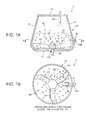
- FIGS. 1A and 1B are schematic views showing a structure of a tumbling granulator to be used in a method for producing a granulated powder according to the invention.
- FIG. 2 is a graph showing the distribution of molded bodies obtained using the granulated powders obtained in the respective Examples with the horizontal axis representing the addition amount of glycerin and the vertical axis representing a molding density.
- the granulated powder according to the invention contains a metal powder and an organic binder, and is obtained by binding a plurality of metal particles in the metal powder by the organic binder.
- the organic binder to be used in the invention contains polyvinyl alcohol or a derivative thereof and a polyol. Further, the ratio of the apparent density of the granulated powder according to the invention to the true density of the metal powder (a metal material constituting the metal powder) is from 20% to 50%.
- Such a granulated powder is favorably sintered even if it is fired at a relatively low temperature and is capable of producing a sintered body having a high density. Therefore, it has an advantage that a firing furnace which does not have a special heat resistant structure, is inexpensive, and has low running cost can be used.
- the metal powder is not particularly limited, however, examples thereof include Mg, Al, Ti, V, Cr, Mn, Fe, Co, Ni, Cu, Zn, Y, Zr, Nb, Mo, Pd, Ag, In, Sn, Ta, W, and alloys thereof.
- the metal powder a powder of any of a variety of Fe-based alloys such as stainless steel, dies steel, high-speed tool steel, low-carbon steel, Fe-Ni alloy, and Fe-Ni-Co alloy is preferably used. Since such an Fe-based alloy has an excellent mechanical property, a sintered body obtained using this Fe-based alloy powder has an excellent mechanical property and can be used in a wide range of applications.
- Fe-based alloys such as stainless steel, dies steel, high-speed tool steel, low-carbon steel, Fe-Ni alloy, and Fe-Ni-Co alloy is preferably used. Since such an Fe-based alloy has an excellent mechanical property, a sintered body obtained using this Fe-based alloy powder has an excellent mechanical property and can be used in a wide range of applications.
- stainless steel examples include SUS 304, SUS 316, SUS 317, SUS 329, SUS 410, SUS 430, SUS 440, and SUS 630.
- the average particle diameter of the metal powder is preferably from 1 to 30 ⁇ m, more preferably from 3 to 20 ⁇ m, further more preferably from 3 to 10 ⁇ m,
- the metal powder having such a particle diameter is capable of producing a sufficiently dense sintered body in the end while avoiding a decrease in the compressibility at the time of molding.
- the metal powder may be liable to aggregate and the compressibility at the time of molding may be significantly decreased.
- the average particle diameter exceeds the above upper limit, a space between the particles of the powder may be too large, and the densification of the finally obtained sintered body may be insufficient.
- the tap density of the metal powder to be used in the invention is, in the case of, for example, an Fe-based alloy powder, preferably 3.5 g/cm 3 or more, more preferably 3.8 g/cm 3 or more.
- an interparticle filling property is increased in a beneficial manner. Therefore, a particularly dense sintered body can be obtained.
- the specific surface area of the metal powder to be used in the invention is not particularly limited, however, it is preferably 0.15 m 2 /g or more, more preferably 0.2m 2 /g or more, further more preferably 0.3 m 2 /g or more.
- the surface activity surface energy
- sintering can be easily performed even if lower energy is applied. Accordingly, sintering can be achieved in a shorter time when sintering the molded body. As a result, the sintered body can be densified even if the molded body is fired at a low temperature.
- Such a metal powder may be, for example, produced by any method, however, a metal powder produced by, for example, an atomization method (a water atomization method, a gas atomization method, a high-speed spinning water atomization method, etc.), a reduction method, a carbonyl method, a pulverization method, or the like can be used.
- an atomization method a water atomization method, a gas atomization method, a high-speed spinning water atomization method, etc.
- a reduction method a carbonyl method, a pulverization method, or the like
- a metal powder produced by an atomization method is preferably used as the metal powder.
- the atomization method it is possible to efficiently produce a metal powder having an extremely small average particle diameter as described above. Further, it is possible to obtain a metal powder having a uniform particle diameter and a small variation in particle diameter. Accordingly, by using such a metal powder, air holes can be reliably prevented from being generated in the sintered body, and the density can be improved.
- the metal powder produced by an atomization method has a spherical shape relatively close to a true sphere, and therefore has excellent dispersibility and fluidity in the binder. Therefore, when the granulated powder is filled in a molding die to effect molding, the filling property can be increased, and a dense sintered body can be obtained in the end.
- the organic binder contains polyvinyl alcohol (PVA) or a derivative thereof and a polyol.
- PVA polyvinyl alcohol
- the distance between metal particles is sufficiently reduced, and therefore, at the time of performing degreasing and firing, sintering is initiated at a lower temperature in a shorter time. Therefore, a firing furnace which does not have a special heat resistant structure, is relatively inexpensive, and has low running cost can be used, and a sintered body having a high density can be efficiently produced.
- polyvinyl alcohol or a derivative thereof and a polyol are uniformly mixed regardless of the mixing ratio of both components. This is because the hydroxyl groups of both molecules are attracted to each other by a hydrogen bond so that the distance between molecules is reduced. It is considered that in particular, the molecule of the polyol enters between the molecules of polyvinyl alcohol and contributes to the reduction of the distance between the molecules of polyvinyl alcohol. Moreover, the above-mentioned organic binder is promptly decomposed at a relatively low temperature, and therefore, hardly functions as an inhibitory factor for sintering. Due to this, it is considered that the molded body obtained by molding the granulated powder according to the invention is sintered at a lower temperature in a shorter time.
- these organic binder molecules are attracted also to the particles of the metal powder by a hydrogen bond. This is because a hydroxyl group is exposed on the surfaces of the particles of the metal powder, and therefore a hydrogen bond is formed between this hydroxyl group and the hydroxyl group of the organic binder molecule. As a result, it is considered that the distance between the particles of the metal powder is reduced, so that the granulated powder is densified, and also the resulting sintered body is densified.
- the granulated powder according to the invention becomes dense and has a high apparent density.
- the ratio of the apparent density (g/cm 3 ) of the granulated powder according to the invention to the true density (g/cm 3 ) of the metal powder is from 20% to 50%.
- Such a granulated powder is favorably sintered even if it is fired at a relatively low temperature and is capable of producing a sintered body having a high density. Therefore, it has an advantage that a firing furnace which does not have a special heat resistant structure, is inexpensive, and has low running cost can be used.
- the amount of a plasticizer or a lubricant which has been used in the related art for increasing a sintering density can be reduced, or the use of such an additive can be stopped. Therefore, by the reduction or omission of the addition of such an additive, a decrease in the sintering density can be prevented, and the sintering density can be further increased, and also the cost can be reduced.
- the shrinkage ratio at the time of sintering is decreased by that much.
- the dimension of the sintered body hardly deviates from a target value, and the dimensional accuracy of the sintered body can be increased. That is, according to the invention, a sintered body having a high dimensional accuracy can be obtained.
- polyvinyl alcohol or a derivative thereof one having a weight-average molecular weight of from about 2000 to 200000 is preferably used, and one having a weight-average molecular weight of from about 5000 to 150000 is more preferably used.
- Polyvinyl alcohol having such a weight-average molecular weight is most suitable as the organic binder in terms of viscosity and thermal decomposability. That is, such polyvinyl alcohol can achieve the binding property of the metal powder at the time of granulation and the disintegrating property at the time of molding and the shape retaining property of the molded body after molding to a high level. As a result, by using the granulated powder according to the invention, a sintered body having a high density and excellent dimensional accuracy can be obtained.
- the derivative of polyvinyl alcohol refers to one obtained by substituting a hydrogen atom attached to a carbon atom with any of various functional groups, and examples of the functional group include an alkyl group, a silyl group, and an acrylate group.
- examples of the polyol include ethylene glycol, propylene glycol, butylene glycol, hexylene glycol, pentane diol, hexane diol, heptane diol, diethylene glycol, dipropylene glycol, and glycerin. These polyols can be used alone or in combination of two or more.
- glycerin is preferred as the polyol to be used in the invention.
- polyols glycerin has a relatively small molecular weight and also has a high hydroxyl group content. Therefore, glycerin easily enters between the molecules of polyethylene glycol, and also the site which contributes to hydrogen bond formation is increased as the hydroxyl group content is increased, and therefore the granulated powder may be densified even further.
- glycerin has a moderate viscosity, and therefore can further increase the binding property of the metal powder at the time of granulation and the shape retaining property of the molded body.
- the polyol is added in an amount of preferably from 0.01 to 0.2 parts by weight, more preferably from 0.01 to 0. 1 parts by weight based on 100 parts by weight of the metal powder.
- the polyol in such an addition amount, the granulated powder can be particularly densified.
- the addition amount of the polyol is less than the above-mentioned lower limit, the density of the granulated powder and also the density of the sintered body may be decreased.
- the addition amount of the polyol exceeds the above-mentioned upper limit, the density of the granulated powder may also be decreased, and a phenomenon, a so-called "spring back" in which stress is accumulated in the molded body during compression molding and the residual stress after completion of molding is relieved accompanied by deformation may be increased. Therefore, the dimensional accuracy of the sintered body may be decreased or cracking or the like may occur.
- the polxol is added in an amount of preferably from 0.005 to 2% by weight, more preferably from 0.01 to 1% by weight, further more preferably from 0.02 to 0.5% by weight based on the amount of polyvinyl alcohol or a derivative thereof.
- This preferred embodiment allows for a higher extent of densification of the granulated powder due to the reduction of the distance between the molecules of polyvinyl alcohol by the polyol and the sufficient disintegrating property of the granulated powder at the time of molding.
- the organic binder preferably contains an organic amine or a derivative thereof other than the above-mentioned components.
- an organic amine or a derivative thereof in the organic binder, the fluidity and weather resistance of the metal powder can be increased.
- This organic amine contains an amino group in each molecule, and this amino group is spontaneously adsorbed onto the surfaces of the particles of the metal powder, and therefore, the interparticle friction can be reduced.
- the fluidity of the metal powder is increased and the distance between the particles is reduced.
- the organic amine beneficially contributes to the densification of the granulated powder.
- the organic amine adsorbed onto the surfaces of the particles reduces the chance of contact between the particles and the outside air, and therefore, the particles can be protected from oxygen, moisture, and the like, and the weather resistance of the particles is enhanced.
- the adsorption of the amino group onto the surfaces of the particles is considered to be due to an interaction between the lone pair of electrons of the amino group which is a polar group and an adsorption site of the surfaces of the particles of the metal powder.
- Examples of such an organic amine include alkylamines, cycloalkylamines, alkanolamines, allylamines, arylamines, alkoxyamines, and derivatives thereof. Among these, particularly, at least one of alkylamines, cycloalkylamines, alkanolamines, and derivatives thereof is preferably used. These amines contribute to further densification of the granulated powder.
- alkylamine examples include monoalkylamines such as n-hexylamine, n-heptylamine, n-octylamine (normal-octylamine), and 2-ethylhexylamine; dialkylamines such as diisobutylamine; and trialkylamines such as diisopropylethylamine.
- cycloalkylamine examples include cyclohexylamine and dicyclohexylamine.
- alkanolamine examples include monoethanolamine, diethanolamine, triethanolamine, monopropanolamine, dipropanolamine, tripropanolamine, N,N-dimethylethanolamine, N,N-diethylethanolamine, N-aminoethylethanolamine, N-methylethanolamine, and N-methyldiethanolamine.
- the derivative of such an organic amine although it is not particularly limited, preferably, a nitrite of an organic amine, a carboxylate of an organic amine, a chromate of an organic amine, an acetate of an organic amine, or the like can be used.
- Such an organic amine is preferably added in an amount of from 0.001 to 5 parts by weight, more preferably from 0.005 to 1 part by weight based on 100 parts by weight of the metal powder.
- the organic binder may contain for example, polyvinylpyrrolidone (PVP), stearic acid, ethylenebisstearamide, an ethylene-vinyl copolymer, paraffin, wax, sodium alginate, agar, gum Arabic, a resin, sucrose, or the like other than the above-mentioned components.
- PVP polyvinylpyrrolidone
- stearic acid stearic acid
- ethylenebisstearamide an ethylene-vinyl copolymer
- paraffin ethylene-vinyl copolymer
- paraffin ethylene-vinyl copolymer
- wax sodium alginate
- agar agar
- gum Arabic a resin
- sucrose sucrose
- an additive such as a phthalic acid ester (such as DOP, DEP, or DBP), an adipic acid ester, a trimellitic acid ester, or a sebacic acid ester may be added as needed.
- an antioxidant such as sodium metabisulfite, sodium metabisulfite, sodium metabisulfite, sodium metabisulfite, sodium metabisulfite, sodium metabisulfite, sodium metabisulfite, sodium metabisulfite, sodium metabisulfite, sodium metabisulfite, sodium metabisulfite, sodium metabisulfite, sodium metabisulfite, sodium metabisulfite, sodium metabisulfite, sodium metabisulfite, sodium metabisulfite, sodium metabisulfite, sodium metabisulfite, sodium metabisulfite, sodium metabisulfite, sodium metabisulfite, sodium metabisulfite, sodium metabisulfite, sodium metabisulfite, sodium metabisulfite, sodium metabisulfite, sodium metabisulfite, sodium metabisulfite, sodium metabisulfite, sodium metabisulfite, sodium metabisulfite, sodium metabisulfite, sodium metabisulfite, sodium metabisulfite
- the total content of the polyvinyl alcohol or the derivative thereof and the polyol in the organic binder is preferably 80% by weight or more, more preferably 90% by weight or more. By allowing the content thereof to fall within the above range, a granulated powder having a sufficiently high density can be obtained.
- the granulated powder according to the invention contains the above-mentioned metal powder and organic binder.
- the content of the organic binder in the granulated powder is preferably from 0.1 to 20% by weight, more preferably from 0.3 to 3% by weight, further more preferably from 0.5 to 2.5% by weight.
- the ratio of the apparent density of the granulated powder to the true density of the metal powder is from 20% to 50%.
- the apparent density of the granulated powder refers to a ratio of the mass to the volume of the granulated powder in a state where the powder is naturally filled, and can be determined according to Test Method for Apparent Density of Metal Powders specified in JIS Z 2504.
- the true density of the metal powder refers to a true density of the metal material constituting the metal powder.
- the densification of the granulated powder is achieved, and the granulated powder in which the ratio of the apparent density to the true density of the metal powder falls within the above range can be obtained.
- a granulated powder is capable of forming a molded body having a high molding density when it is molded, and also is capable of forming a sintered body having a high sintering density. Further, the shrinkage ratio at the time of sintering can be reduced, and therefore, the dimensional accuracy of the sintered body can be increased.
- the ratio of the apparent density of the granulated powder according to the invention to the true density of the metal powder is in the above range, however, it is preferably from 25% to 45%, more preferably from 30% to 40%.
- the ratio of the apparent density is lower than the above lower limit, the densification of the granulated powder is insufficient, and the sintering property at a low temperature is significantly decreased.
- the ratio of the apparent density exceeds the above upper limit, the granulated powder is excessively densified, and a moderate disintegrating property at the time of molding cannot be obtained, and therefore, the shape retaining property of the molded body is decreased.
- each particle of the granulated powder according to the invention greatly affects the fluidity and the filling property.
- the shape of each particle of the granulated powder is preferably a shape close to a true sphere.
- FIGS. 1A and 1B are schematic views showing a structure of a tumbling granulator to be used in the method for producing a granulated powder according to the invention:
- FIG. 1A is a vertical cross-sectional view of the tumbling granulator; and
- FIG. 1B is a cross-sectional view taken along the line A-A of FIG. 1A .
- a tumbling granulator 1 is provided with a treatment vessel 10 for performing granulation, a blade 20 and a cross screw 30 installed in the treatment vessel 10, and a spray nozzle 40.
- the treatment vessel 10 has a bottom portion 11 and a side wall portion 12 vertically provided from the bottom portion 11.
- the side wall portion 12 has a conical shape (for example, a circular truncated cone tube shape) in which the inner and outer diameters gradually increase from the top to the bottom. Since the treatment vessel 10 (side wall portion 12) has such a shape, an air current can be formed in the treatment vessel 10 such that a powder blown up by the blade 20 at the outer periphery of the treatment vessel 10 falls at the center of the treatment vessel 10. As a result, the powder can be uniformly treated, and therefore, a granulated powder having a sharp particle size distribution can be efficiently produced.
- the treatment vessel 10 has an opening on the top, and a lid 13 is attached thereto so as to close the opening.
- the blade 20 has a base portion 23, and three rotary vanes 21, which are fixed to the base portion 23 at one end thereof and are arranged radially at approximately equal intervals.
- a through-hole 110 is provided, and a rotary drive shaft 22 is inserted into this through-hole 110.
- the upper end of the rotary drive shaft 22 is fixed to the base portion 23 and the lower end thereof is connected to a rotary driving source (not shown). Then, the rotary drive shaft 22 is rotationally driven in the forward reverse directions by this rotary driving source, thereby rotating the blade 20.
- each of the rotary vanes 21 is fixed inclined with respect to the rotary drive shaft 22 such that it is inclined downwardly toward the front side in the rotating direction of the blade 20. According to this configuration, as the blade 20 rotates, the powder can be effectively thrown up and an air current as described above can be formed.
- a through-hole 130 is provided, and a rotary drive shaft 31 is inserted into this through-hole 130.
- One end of the rotary drive shaft 31 is fixed to the cross screw 30, and the other end thereof is connected to a rotary driving source (not shown). Then, the rotary drive shaft 31 is rotationally driven in the forward reverse directions by this rotary driving source, thereby rotating the cross screw 30.
- the spray nozzle 40 is provided such that it pierces the lid 13 attached to the treatment vessel 10, and a supply port is located in the treatment vessel 10. According to this configuration, a solvent can be sprayed in the treatment vessel 10. By spraying a solvent from the spray nozzle 40, a descending air current is formed in the vicinity of the spray nozzle 40.
- the method for producing a granulated powder using the tumbling granulator 1 is one example of the method for producing a granulated powder according to the invention, and it is a matter of course that the method for producing a granulated powder according to the invention is not limited thereto.
- the method for producing a granulated powder according to this embodiment includes allowing a metal powder to tumble and/or flow while supplying a solution of an organic binder (a binder solution), thereby granulating the metal powder.
- a metal powder is fed in the inside of the treatment vessel 10 of the tumbling granulator 1 as described above. Then, by stirring the metal powder with the blade 20, the metal powder is allowed to tumble and/or flow.
- the binder solution is sprayed from the spray nozzle 40.
- the binder solution in the mist form wets the metal powder and also binds the particles of the metal powder.
- the metal powder is granulated, whereby a granulated powder 80 is obtained.
- This granulated powder 80 gradually moves (tumbles) toward the outer periphery (toward the side wall portion 12) of the treatment vessel 10 as the blade 20 rotates and also is thrown up above by the rotary vanes 21.
- the thrown-up granulated powder 80 falls at the center of the treatment vessel 10 and is allowed to tumble again by the blade 20.
- the granulated powder is properly shaped, whereby the granulated power 80 having a shape close to a true sphere is formed. Accordingly, a dense granulated powder in which the distance between the particles is short can be obtained.
- the binder solution may be supplied by any method, for example, by placing the binder solution in the treatment vessel 10 in advance, etc., however, it is preferred that the binder solution is sprayed from the top as shown in FIG. 1A .
- the right amount of the binder solution is supplied uniformly to the granulated powder 80 thrown-up by the blade 20, and therefore, the shape and size of the granulated powder 80 can be made uniform.
- the granulated powder 80 by allowing the granulated powder 80 to come in contact with the binder solution while floating in the air, the entire surface of the particles of the granulated powder 80 is wetted uniformly, and therefore, the uniformity becomes more prominent. As a result, the granulated powder 80 having a uniform particle size distribution can be obtained.
- solvent to be used in the binder solution examples include inorganic solvents such as water, carbon disulfide, and carbon tetrachloride; and organic solvents including ketone-based solvents such as methyl ethyl ketone (MEK), acetone, diethyl ketone, methyl isobutyl ketone (MIBK), methyl isopropyl ketone (MIPK), cyclohexanone, 3-heptanone, and 4-heptanone; alcohol-based solvents such as methanol, ethanol, n-propanol, isopropanol, n-butanol, i-butanol, t-butanol, 3-methyl-1-butanol, 1-pentanol, 2-pentanol, n-hexanol, cyclohexanol, 1-heptanol, 1-octanol, 2-octanol, 2-methoxyethanol, allyl alcohol
- the number of rotations per unit time (hereinafter simply referred to as "rotation speed") of the blade 20 is not particularly limited as long as it can ensure at least tumbling of the granulated powder 80, however, for example, it is preferably from about 50 to 500 rpm, more preferably from about 100 to 300 rpm. If the rotation speed of the blade 20 falls within the above range, the granulated powder 80 can be allowed to efficiently tumble and granulation can be efficiently performed. Further, a moderately consolidated state is obtained, and therefore, a granulated powder having a higher apparent density can be obtained. As a result, the granulated powder 80 which is denser and has a particularly narrow particle size distribution can be obtained.
- the rotation speed of the blade 20 is less than the above lower limit, tumbling or throwing-up of the granulated powder 80 may be insufficient, which may cause uneven granulation. Further, consolidation may be insufficient and the granulated powder 80 having a low apparent density may be formed, and also the granulated powder 80 which has not a spherical shape but an irregular shape with low fluidity may be formed. On the other hand, if the rotation speed of the blade 20 exceeds the above upper limit, the granulated particles may be crushed more than necessary by the blade 20, and a powder, the granulation of which does not proceed, may be increased.
- the number of rotations per unit time of the cross screw 30 at the time of granulation is not particularly limited, however, it is preferably from about 50 to 3500 rpm, more preferably from about 100 to 3000 rpm. According to this configuration, particles having a large particle diameter can be crushed while preventing excessive crushing of the particles so that the particle diameter can be made uniform.
- the supply rate of the binder solution is not particularly limited, however, for example, it is preferred from 20 to 1000 g/min, more preferably from 30 to 800 g/min, further more preferably from 50 to 600 g/min.
- the supply rate of the binder solution falls within the above range, binding (granulation) of the metal powder by the binder solution is uniformly performed and the particle size distribution of the resulting granulated powder can be made sharper.
- the supply rate of the binder solution is less than the above lower limit, uneven granulation may be caused.
- the supply rate of the binder solution exceeds the above upper limit, the granulation may proceed excessively. As a result, the resulting granulated powder may have a wide particle size distribution.
- the concentration of the organic binder in the binder solution is preferably from 0.5 to 20% by weight, more preferably from 1 to 15% by weight, further more preferably from 2 to 10% by weight.
- the treatment time (stirring time) for granulation is not particularly limited, however, it is preferably from 1 to 90 minutes, more preferably from 2 to 85 minutes, further more preferably from 3 to 80 minutes. According to this configuration, ungranulated metal powder can be prevented from remaining, and the particle size distribution of the resulting granulated powder can be made sufficiently sharp.
- the treatment time for granulation is less than the above lower limit, a relatively large amount of a powder having a small particle diameter (ungranulated metal powder, etc.) may remain.
- a solvent may be directly applied to a powder having a relatively large particle diameter (a lump of a powder which does not tumble or flow) to cause uneven granulation.
- a solvent which can dissolve the organic binder may be sprayed (supplied) to the granulated powder as needed. According to this configuration, the granulated powder having a more uniform shape and size can be formed.
- the granulated powder can be formed as described above.
- a technique common to a tumbling granulation method, a fluidized bed granulation method, and a tumbling fluidized bed granulation method which are examples of the granulation method is described in the above, however, the granulation method is not limited to these, and a spray drying method or the like can also be used.
- the use of the granulated powder according to the invention is not particularly limited, however, it can be preferably used in, for example, the production of a molded body containing the granulated powder, particularly the production of a sintered body obtained by sintering the molded body containing the granulated powder.
- the granulated powder according to the invention as described above is molded using a press molding machine, whereby a molded body having a desired shape and dimension is produced.
- the granulated powder according to the invention itself is dense and has a high filling property. Therefore, a molded body having a high density can be produced, and a sintered body having a high density and a low shrinkage ratio can be obtained in the end.
- the shape and dimension of the molded body to be produced are determined in expectation of shrinkage due to the subsequent degreasing and sintering treatments.
- the molding method is not limited to press molding, and compression molding, injection molding, or the like may be employed.
- the molded body obtained in the above-mentioned molding step is subjected to a degreasing treatment (binder removal treatment), whereby a degreased body is obtained.
- the degreasing treatment is not particularly limited, however, it can be performed by a heat treatment in a non-oxidative atmosphere, for example, under vacuum or a reduced pressure (for example, 1 x 10 -1 to 1 x 10 -6 Torr), or in a gas such as nitrogen, argon, hydrogen, or dissociated ammonia.
- the condition for the heat treatment slightly varies depending on the decomposition initiation temperature of the organic binder or the like, however, the heat treatment is preferably performed at a temperature of about 100°C to 750°C for about 0.5 to 40 hours, more preferably performed at a temperature of about 150°C to 700°C for about 1 to 24 hours.
- the degreasing by such a heat treatment may be performed by being divided into a plurality of steps (stages) for various purposes (for example, for the purpose of reducing the degreasing time, etc.).
- stages for various purposes (for example, for the purpose of reducing the degreasing time, etc.).
- a method in which degreasing is performed at a low temperature in the former half and at a high temperature in the latter half a method in which degreasing at a low temperature and degreasing at a high temperature are alternately repeated, or the like can be used.
- the degreased body obtained in the above-mentioned degreasing treatment is fired in a firing furnace to effect sintering, whereby a desired sintered body is obtained.
- the metal powder constituting the granulated powder is dispersed to cause grain growth, and a sintered body which is dense as a whole, in other words, has a high density and a low porosity can be obtained.
- the firing temperature at the time of firing slightly varies depending on the composition of the granulated powder or the like, however, for example, in the case of using an Fe-based alloy powder, the firing temperature is preferably 900°C or higher but lower than 1200°C, more preferably from 1000°C to 1180°C.
- the firing temperature falls within the above range, a sintered body can be efficiently produced using a firing furnace which does not have a special heat resistant structure, is relatively inexpensive, and has low running cost.
- the firing temperature is lower than the above lower limit, sintering of the metal powder does not sufficiently proceed, and the porosity of a finally obtained sintered body may be increased, and therefore, a sufficient mechanical strength may not be obtained.
- the firing temperature exceeds the above upper limit, a firing furnace which has a special heat resistant structure is needed, and therefore, ease of firing is reduced.
- the time of holding the maximum temperature during firing is preferably from about 0.5 to 8 hours, more preferably from about 0.75 to 5 hours.
- the firing atmosphere is not particularly limited, however, a reduced pressure (vacuum) atmosphere or a non-oxidative atmosphere is preferred. According to this configuration, deterioration of properties due to metal oxidation can be prevented.
- a preferred firing atmosphere is a reduced pressure (vacuum) atmosphere at 1 Torr or less (more preferably at 1 x 10 -2 to 1 x 10 -6 Torr), an inert gas atmosphere of nitrogen, argon, or the like at 1 to 760 Torr, or a hydrogen gas atmosphere at 1 to 760 Torr.
- the firing atmosphere may be changed in the course of firing.
- the initial firing atmosphere is set to a reduced pressure (vacuum) atmosphere at 1 x 10 -2 to 1 x 10 -6 Torr, which can be changed to an inert gas atmosphere as described above in the course of firing.
- the firing may be performed in two or more stages. For example, a first firing and a second firing, in which the firing conditions are different such that the firing temperature in the second firing is set to higher than that in the first firing, may be performed.
- the thus obtained sintered body may be used for any purpose, and as the use thereof, various machine parts and the like can be exemplified.
- the relative density of the thus obtained sintered body varies depending on the use thereof or the like, however, for example, it is expected to be more than 93%, preferably 94% or more.
- Such a sintered body has a particularly excellent mechanical property. Further, by using the granulated powder according to the invention, even if it is fired at a low temperature, such a sintered body having an excellent mechanical property can be efficiently produced.
- an additional step can be added as needed.
- the device to be used in the method for producing a granulated powder according to the invention is not limited to one described in the above embodiment.
- a tumbling granulator which performs granulation by a fluidizing action
- a tumbling fluidized bed granulator which performs granulation by a tumbling and fluidizing action
- a spray drying apparatus which performs spray drying, or the like may be used.
- a 2% Ni-Fe alloy powder (true density: 7.827 g/cm 3 , manufactured by Epson Atmix Corporation) having an average particle diameter of 6 ⁇ m produced by a water atomization method was prepared.
- the composition of the 2% Ni-Fe is as follows: C: 0.4 to 0.6% by mass, Si: 0.35% by mass or less, Mn: 0.8% by mass or less, P: 0.03% by mass or less, S: 0.045% by mass or less, Ni: 1.5 to 2.5% by mass, Cr: 0.2% by mass or less, and Fe: remainder.
- polyvinyl alcohol (RS-1717, manufactured by Kuraray Co., Ltd.), glycerin (manufactured by Wako Pure Chemical Industries), and an alkylamine derivative (acetate) were prepared.
- a solvent ion exchanged water was prepared. Incidentally, the addition amount of the solvent was set to 50 g per gram of the organic binder. Further, the saponification degree of the polyvinyl alcohol was 93 and the polymerization degree thereof was 1700.
- polyvinyl alcohol, glycerin, and the organic amine were mixed in ion exchanged water, and the resulting mixture was cooled to room temperature, whereby a binder solution was prepared.
- the addition amounts of the polyvinyl alcohol, glycerin, and alkylamine derivative were set to 0.8 parts by weight, 0.01 parts by weight, and 0.1 parts by weight based on 100 parts by weight of the metal powder, respectively.
- the starting material powder was placed in a treatment vessel of a tumbling granulator (VG-25, manufactured by Powrex Corporation). Then, the starting material powder was allowed to tumble under the following condition while spraying the binder solution from a spray nozzle of the tumbling granulator. By doing this, a granulated powder having an average particle diameter of 75 ⁇ m was obtained.
- Tumbling condition Rotation speed of blade: 200 rpm
- Rotation speed of cross screw 2500 rpm
- Supply rate of binder solution 200 g/min Granulation time: 90 min
- Granulated powders were obtained in the same manner as in Example 1 except that the addition amount of glycerin was changed as shown in Table 1, respectively.
- Granulated powders were obtained in the same manner as in Example 3 except that the addition amount of the organic amine was changed as shown in Table 1, respectively.
- Granulated powders were obtained in the same manner as in Example 3 except that the addition amount of polyvinyl alcohol was changed as shown in Table 2, respectively.
- a granulated powder was obtained in the same manner as in Example 3 except that the addition of the organic amine was omitted.
- Granulated powders were obtained in the same manner as in Example 1 except that the composition and the addition amount of the polyol or the composition and the addition amount of the organic amine were changed as shown in Table 2, respectively.
- Granulated powders were obtained in the same manner as in Example 22 and Example 3, respectively, except that the composition of the metal powder was changed to SUS-316L (true density: 7.98 g/cm 3 ).
- Granulated powders were obtained in the same manner as in Example 1 except that the organic binder was prepared using only polyvinyl alcohol (the addition of glycerin and the alkylamine derivative was omitted) and the addition amount thereof was changed as shown in Table 2, respectively.
- a granulated powder was obtained in the same manner as in Comparative Example 1 except that polyvinylpyrrolidone was used in place of polyvinyl alcohol.
- a granulated powder was obtained in the same manner as in Comparative Example 4 except that glycerin and the alkylamine derivative were further added to the organic binder.
- a granulated powder was obtained in the same manner as in Example 28 except that the organic binder was prepared using only polyvinyl alcohol (the addition of glycerin and the alkylamine derivative was omitted).
- Molding condition Molding method: press molding method Molding shape: cube with a side of 20 mm Molding pressure: 600 MPa (6 t/cm2)
- Firing condition Firing temperature: 1150°C Firing time: 3 hours Firing atmosphere: reduced pressure Ar atmosphere Atmospheric pressure: 1.3 kPa (10 Torr)
- the density of the obtained sintered body was measured by a method according to the Archimedes method specified in JIS Z 2501. Further, the relative density of the sintered body was calculated from the measured sintering density and the true density of the metal powder.
- the width dimension of the obtained sintered body was measured using a micrometer. Then, evaluation was performed for the measurements according to the following evaluation criteria based on the "Permissible Deviations in Widths Without Tolerance” specified in JIS B 0411 (Permissible Deviations in Dimensions Without Tolerance Indication for Metallic Sintered Products).
- the width of the sintered body refers to a dimension in the direction orthogonal to the direction of compression at the time of press molding.
- Table 1 Metal powder Organic binder Ratio of organic binder in granulated powder Evaluation results Polyvinyl alcohol Polyol Organic amine Ratio of apparent density to true density Molding density Sintering density Relative density Dimensional accuracy 100 parts by weight Composition Parts by weight Composition Parts by weight Composition Parts by weight % by weight % g/cm 3 g/cm 3 % -
- Example 1 2% Ni-Fe PVA 0.8 Glycerin 0.01 Alkylamine derivative 0.1 090 29.4 6.47 7.42 94.8 B
- Example 2 2% Ni-Fe PVA 0 8 Glycerin 0.03 Alkylamine derivative 0.1 0.92 32.2 6.49 7.45 95.2
- a Example 3 2% Ni-Fe PVA 0.8 Glycerin 0.05 Alkylamine derivative 0.1 0.94 35.0 6.52 7.48 95.6
- Example 4 2% Ni-Fe PVA 0.8 Glycerin 0.07 Alky
- each of the molded bodies and the sintered bodies obtained using the granulated powders obtained in the respective Examples has a high density.
- the molding density and the sintering density can be specifically increased by using glycerin as the polyol, optimizing the content of the polyol, and so on.
- FIG. 2 is a graph showing the distribution of the molded bodies obtained using the granulated powders obtained in Examples 1 to 9 with the horizontal axis representing the addition amount of polyol and the vertical axis representing the molding density.
- the molding density can be particularly increased when the addition amount of the polyol falls within a range from 0.01 to 0.2 parts by weight based on 100 parts by weight of the metal powder.
- the sintered bodies obtained using the granulated powders obtained in the respective Examples have excellent dimensional accuracy.
- a sintered body was obtained by changing the firing temperature from 1150°C to 1250°C.
- the sintering density of the resulting sintered body was 7.41 g/cm 3 , which was equivalent to that of the sintered body obtained using the granulated powder obtained in Example 1. From this result, it was revealed that according to the invention, a granulated powder can be favorably sintered even when it is sintered at a relatively low temperature using a firing furnace which is widely used and inexpensive.
Landscapes
- Powder Metallurgy (AREA)
- Glanulating (AREA)
- Cell Electrode Carriers And Collectors (AREA)
- Compositions Of Macromolecular Compounds (AREA)
Abstract
Description
- The present invention relates to a granulated powder and a method for producing the same.
- As a method for molding a metal powder, a compression molding method in which a mixture of a metal powder and an organic binder is filled in a given molding die, followed by compression, thereby obtaining a molded body in a given shape has been known. The obtained molded body is subjected to a degreasing treatment of removing the organic binder and a firing treatment of sintering the metal powder, thereby forming a metal sintered body. Such a technique is an exemplary powder metallurgy technique, and a large amount of a metal sintered body in a complicated shape can be produced according to the shape of the molding die. Therefore, such a technique has been widely spread in many industrial fields.
- In the compression molding method, first, it is necessary to fill a metal powder in a molding die as tightly as possible. It is because if there is a space in the molding die, this space remains in the resulting molded body as a hole, resulting in deteriorating the denseness of the metal sintered body in the end.
- However, as the metal powder, a fine powder having an average particle diameter of 10 µm or less is sometimes used. Such a fine powder has low fluidity, and therefore has a poor filling property in a molding die. Therefore, a mixture of a metal powder and an organic binder is granulated into particles having a larger particle size to improve the fluidity thereof. When the mixture is granulated, a plurality of particles in the metal powder are bound to one another by the organic binder, thereby forming a granulated powder having a larger particle size. The granulated powder has higher fluidity than the metal powder, and therefore has an excellent filling property in a molding die, and thus, a dense molded body and a dense sintered body can be produced.
- For example,
JP-A-2005-154847 - However, a firing furnace which can be used at a temperature of 1200°C or higher needs a special heat resistant structure, and therefore is expensive, and also has a high running cost.
- On the other hand, if the firing temperature is decreased, the density of the resulting sintered body is decreased, and a problem arises in that the sintered body has a poor mechanical property.
- For this reason, there is a need for providing a granulated powder which is favorably sintered even if it is fired at a relatively low temperature and which is capable of producing a sintered body having a high density, and for providing a method for producing a granulated powder capable of easily producing such a granulated powder.
- This problem is solved by the provision of a granulated powder containing a plurality of metal particles bound to one another by an organic binder, wherein the organic binder contains polyvinyl alcohol or a derivative thereof and a polyol, preferably a glycol, and the ratio of the apparent density of the granulated powder to the true density of the metal particles is from 20% to 50%.
- According to this configuration, a granulated powder which is favorably sintered even if it is fired at a relatively low temperature and is capable of producing a sintered body having a high density can be obtained.
- In accordance with the aspect of the invention, the polyol is preferably glycerin.
- Among polyols glycol is preferred, and glycerin has a relatively small molecular weight and also has a high hydroxyl group content, and therefore easily enters between the molecules of polyethylene glycol. Moreover, glycerin contains a lot of sites which contribute to hydrogen bond formation, and therefore contributes to the densification of the granulated powder. Further, glycerin has a moderate viscosity, and therefore can further increase the binding property of the metal powder at the time of granulation and the shape retaining property of the molded body.
- In accordance with the aspect of the invention, the amount of the polyol is preferably from 0.01 to 0.2 parts by weight based on 100 parts by weight of the metal particles.
- In this preferred embodiment, the granulated powder can be densified in a beneficial manner, and therefore a sintered body having a high density can be obtained. Further this preferred embodiment can prevent the occurrence of spring back which is the result of accumulation of stress in the molded body during compression molding and relief of the accumulated stress after completion of molding accompanied by deformation.
- In accordance with the aspect of the invention, the organic binder preferably further contains an organic amine or a derivative thereof.
- In this preferred embodiment, the organic amine is spontaneously adsorbed onto the surfaces of the particles of the metal powder to reduce the interparticle friction, thereby accelerating the densification of the granulated powder. In addition to this, the organic amine adsorbed onto the surfaces of the particles reduces the chance of contact between the particles and the outside air, and therefore, the weather resistance of the particles can be increased.
- In a particularly preferred embodiment, the organic amine is preferably at least one of an alkylamine, a cycloalkylamine, an alkanolamine, and a derivative thereof.
- These preferred organic amines allow for further acceleration of the densification of the granulated powder.
- The amount of the organic amine is preferably from 0.001 to 5 parts by weight based on 100 parts by weight of the metal particles.
- According to this configuration, the densification of the granulated powder and the improvement of the weather resistance are further enhanced.
- In another preferred embodiment, the content of the organic binder in the granulated powder is preferably from 0. 1 to 20% by weight.
- In this preferred embodiment, the disintegrating property at the time of molding and the shape retaining property of the molded body after molding can be increased. As a result, a sintered body having a high density and excellent dimensional accuracy can be obtained.
- In accordance with another aspect of the invention, there is provided a method for producing a granulated powder including allowing a metal powder to tumble and/or flow while supplying a solution of an organic binder containing polyvinyl alcohol or a derivative thereof and a polyol, thereby granulating the metal powder.
- According to this method, a granulated powder which is favorably sintered even if it is fired at a relatively low temperature and is capable of producing a sintered body having a high density can be easily produced.
- In the method of the invention, the solution of the organic binder is preferably supplied by spraying.
- According to this preferred embodiment, since the right amount of the binder solution is supplied uniformly to the granulated powder, the shape and size of the granulated powder can be made uniform. As a result, a granulated powder having a uniform particle size distribution can be obtained.
- The invention will be described with reference to the accompanying drawings, wherein like numbers reference like elements.
-
FIGS. 1A and 1B are schematic views showing a structure of a tumbling granulator to be used in a method for producing a granulated powder according to the invention. -
FIG. 2 is a graph showing the distribution of molded bodies obtained using the granulated powders obtained in the respective Examples with the horizontal axis representing the addition amount of glycerin and the vertical axis representing a molding density. - Hereinafter, the granulated powder and the method for producing a granulated powder according to the invention will be described in detail by way of preferred embodiments with reference to the accompanying drawings. Needless to say, the invention also encompasses combinations of the preferred embodiments described hereinafter, and such combinations represent particularly preferred embodiments of the invention.
- The granulated powder according to the invention contains a metal powder and an organic binder, and is obtained by binding a plurality of metal particles in the metal powder by the organic binder.
- Further, the organic binder to be used in the invention contains polyvinyl alcohol or a derivative thereof and a polyol. Further, the ratio of the apparent density of the granulated powder according to the invention to the true density of the metal powder (a metal material constituting the metal powder) is from 20% to 50%.
- Such a granulated powder is favorably sintered even if it is fired at a relatively low temperature and is capable of producing a sintered body having a high density. Therefore, it has an advantage that a firing furnace which does not have a special heat resistant structure, is inexpensive, and has low running cost can be used.
- Hereinafter, the granulated powder according to the invention will be described in detail.
- The metal powder is not particularly limited, however, examples thereof include Mg, Al, Ti, V, Cr, Mn, Fe, Co, Ni, Cu, Zn, Y, Zr, Nb, Mo, Pd, Ag, In, Sn, Ta, W, and alloys thereof.
- Among these, as the metal powder, a powder of any of a variety of Fe-based alloys such as stainless steel, dies steel, high-speed tool steel, low-carbon steel, Fe-Ni alloy, and Fe-Ni-Co alloy is preferably used. Since such an Fe-based alloy has an excellent mechanical property, a sintered body obtained using this Fe-based alloy powder has an excellent mechanical property and can be used in a wide range of applications.
- Examples of the stainless steel include SUS 304, SUS 316, SUS 317, SUS 329, SUS 410, SUS 430, SUS 440, and SUS 630.
- Further, the average particle diameter of the metal powder is preferably from 1 to 30 µm, more preferably from 3 to 20 µm, further more preferably from 3 to 10 µm, The metal powder having such a particle diameter is capable of producing a sufficiently dense sintered body in the end while avoiding a decrease in the compressibility at the time of molding.
- Incidentally, if the average particle diameter is less than the above lower limit, the metal powder may be liable to aggregate and the compressibility at the time of molding may be significantly decreased. On the other hand, if the average particle diameter exceeds the above upper limit, a space between the particles of the powder may be too large, and the densification of the finally obtained sintered body may be insufficient.
- Further, the tap density of the metal powder to be used in the invention is, in the case of, for example, an Fe-based alloy powder, preferably 3.5 g/cm3 or more, more preferably 3.8 g/cm3 or more. When the metal powder has a high tap density as described above, at the time of obtaining the granulated powder, an interparticle filling property is increased in a beneficial manner. Therefore, a particularly dense sintered body can be obtained.
- Further, the specific surface area of the metal powder to be used in the invention is not particularly limited, however, it is preferably 0.15 m2/g or more, more preferably 0.2m2/g or more, further more preferably 0.3 m2/g or more. When the metal powder has a large specific surface area as described above, the surface activity (surface energy) is increased, and therefore, sintering can be easily performed even if lower energy is applied. Accordingly, sintering can be achieved in a shorter time when sintering the molded body. As a result, the sintered body can be densified even if the molded body is fired at a low temperature.
- Such a metal powder may be, for example, produced by any method, however, a metal powder produced by, for example, an atomization method (a water atomization method, a gas atomization method, a high-speed spinning water atomization method, etc.), a reduction method, a carbonyl method, a pulverization method, or the like can be used.
- In particular, a metal powder produced by an atomization method is preferably used as the metal powder. By the atomization method, it is possible to efficiently produce a metal powder having an extremely small average particle diameter as described above. Further, it is possible to obtain a metal powder having a uniform particle diameter and a small variation in particle diameter. Accordingly, by using such a metal powder, air holes can be reliably prevented from being generated in the sintered body, and the density can be improved.
- Further, the metal powder produced by an atomization method has a spherical shape relatively close to a true sphere, and therefore has excellent dispersibility and fluidity in the binder. Therefore, when the granulated powder is filled in a molding die to effect molding, the filling property can be increased, and a dense sintered body can be obtained in the end.
- According to the invention, as described above, the organic binder contains polyvinyl alcohol (PVA) or a derivative thereof and a polyol.
- Incidentally, in an existing granulated powder, a high apparent density could not be realized. It is considered that this is because the distance between particles of a metal powder could not be sufficiently reduced. In particular, when the particle diameter of the metal powder was small, the metal powder was bulky, and the above tendency was more prominent.
- On the other hand, by using the above-mentioned organic binder, when the metal powder and the organic binder are mixed and the resulting mixture is granulated to form a granulated powder, the assembling property of the metal powder is increased, and a granulated powder having a high apparent density can be obtained.
- In the thus densified granulated powder, the distance between metal particles is sufficiently reduced, and therefore, at the time of performing degreasing and firing, sintering is initiated at a lower temperature in a shorter time. Therefore, a firing furnace which does not have a special heat resistant structure, is relatively inexpensive, and has low running cost can be used, and a sintered body having a high density can be efficiently produced.
- Examples of the reason why the granulated powder according to the invention exhibits the above-mentioned effect include the following points.
- First, polyvinyl alcohol or a derivative thereof and a polyol are uniformly mixed regardless of the mixing ratio of both components. This is because the hydroxyl groups of both molecules are attracted to each other by a hydrogen bond so that the distance between molecules is reduced. It is considered that in particular, the molecule of the polyol enters between the molecules of polyvinyl alcohol and contributes to the reduction of the distance between the molecules of polyvinyl alcohol. Moreover, the above-mentioned organic binder is promptly decomposed at a relatively low temperature, and therefore, hardly functions as an inhibitory factor for sintering. Due to this, it is considered that the molded body obtained by molding the granulated powder according to the invention is sintered at a lower temperature in a shorter time.
- Further, it is considered that these organic binder molecules are attracted also to the particles of the metal powder by a hydrogen bond. This is because a hydroxyl group is exposed on the surfaces of the particles of the metal powder, and therefore a hydrogen bond is formed between this hydroxyl group and the hydroxyl group of the organic binder molecule. As a result, it is considered that the distance between the particles of the metal powder is reduced, so that the granulated powder is densified, and also the resulting sintered body is densified.
- For the above reasons, the granulated powder according to the invention becomes dense and has a high apparent density. Specifically, the ratio of the apparent density (g/cm3) of the granulated powder according to the invention to the true density (g/cm3) of the metal powder is from 20% to 50%. Such a granulated powder is favorably sintered even if it is fired at a relatively low temperature and is capable of producing a sintered body having a high density. Therefore, it has an advantage that a firing furnace which does not have a special heat resistant structure, is inexpensive, and has low running cost can be used.
- In addition, the amount of a plasticizer or a lubricant which has been used in the related art for increasing a sintering density can be reduced, or the use of such an additive can be stopped. Therefore, by the reduction or omission of the addition of such an additive, a decrease in the sintering density can be prevented, and the sintering density can be further increased, and also the cost can be reduced.
- Incidentally, as the granulated powder is densified to such an extent that the apparent density falls within the above range, the shrinkage ratio at the time of sintering is decreased by that much. As a result, the dimension of the sintered body hardly deviates from a target value, and the dimensional accuracy of the sintered body can be increased. That is, according to the invention, a sintered body having a high dimensional accuracy can be obtained.
- As the polyvinyl alcohol or a derivative thereof, one having a weight-average molecular weight of from about 2000 to 200000 is preferably used, and one having a weight-average molecular weight of from about 5000 to 150000 is more preferably used. Polyvinyl alcohol having such a weight-average molecular weight is most suitable as the organic binder in terms of viscosity and thermal decomposability. That is, such polyvinyl alcohol can achieve the binding property of the metal powder at the time of granulation and the disintegrating property at the time of molding and the shape retaining property of the molded body after molding to a high level. As a result, by using the granulated powder according to the invention, a sintered body having a high density and excellent dimensional accuracy can be obtained.
- Incidentally, the derivative of polyvinyl alcohol refers to one obtained by substituting a hydrogen atom attached to a carbon atom with any of various functional groups, and examples of the functional group include an alkyl group, a silyl group, and an acrylate group.
- On the other hand, examples of the polyol include ethylene glycol, propylene glycol, butylene glycol, hexylene glycol, pentane diol, hexane diol, heptane diol, diethylene glycol, dipropylene glycol, and glycerin. These polyols can be used alone or in combination of two or more.
- Among these, glycerin is preferred as the polyol to be used in the invention. Among polyols, glycerin has a relatively small molecular weight and also has a high hydroxyl group content. Therefore, glycerin easily enters between the molecules of polyethylene glycol, and also the site which contributes to hydrogen bond formation is increased as the hydroxyl group content is increased, and therefore the granulated powder may be densified even further. In addition, glycerin has a moderate viscosity, and therefore can further increase the binding property of the metal powder at the time of granulation and the shape retaining property of the molded body.
- The polyol is added in an amount of preferably from 0.01 to 0.2 parts by weight, more preferably from 0.01 to 0. 1 parts by weight based on 100 parts by weight of the metal powder. By adding the polyol in such an addition amount, the granulated powder can be particularly densified.
- Incidentally, if the addition amount of the polyol is less than the above-mentioned lower limit, the density of the granulated powder and also the density of the sintered body may be decreased. On the other hand, if the addition amount of the polyol exceeds the above-mentioned upper limit, the density of the granulated powder may also be decreased, and a phenomenon, a so-called "spring back" in which stress is accumulated in the molded body during compression molding and the residual stress after completion of molding is relieved accompanied by deformation may be increased. Therefore, the dimensional accuracy of the sintered body may be decreased or cracking or the like may occur.
- Further, the polxol is added in an amount of preferably from 0.005 to 2% by weight, more preferably from 0.01 to 1% by weight, further more preferably from 0.02 to 0.5% by weight based on the amount of polyvinyl alcohol or a derivative thereof. This preferred embodiment allows for a higher extent of densification of the granulated powder due to the reduction of the distance between the molecules of polyvinyl alcohol by the polyol and the sufficient disintegrating property of the granulated powder at the time of molding.
- Further, the organic binder preferably contains an organic amine or a derivative thereof other than the above-mentioned components. By incorporating an organic amine or a derivative thereof in the organic binder, the fluidity and weather resistance of the metal powder can be increased. This organic amine contains an amino group in each molecule, and this amino group is spontaneously adsorbed onto the surfaces of the particles of the metal powder, and therefore, the interparticle friction can be reduced. As a result, the fluidity of the metal powder is increased and the distance between the particles is reduced. In this manner, the organic amine beneficially contributes to the densification of the granulated powder. In addition, the organic amine adsorbed onto the surfaces of the particles reduces the chance of contact between the particles and the outside air, and therefore, the particles can be protected from oxygen, moisture, and the like, and the weather resistance of the particles is enhanced.
- Incidentally, the adsorption of the amino group onto the surfaces of the particles is considered to be due to an interaction between the lone pair of electrons of the amino group which is a polar group and an adsorption site of the surfaces of the particles of the metal powder.
- Examples of such an organic amine include alkylamines, cycloalkylamines, alkanolamines, allylamines, arylamines, alkoxyamines, and derivatives thereof. Among these, particularly, at least one of alkylamines, cycloalkylamines, alkanolamines, and derivatives thereof is preferably used. These amines contribute to further densification of the granulated powder.
- Examples of the alkylamine include monoalkylamines such as n-hexylamine, n-heptylamine, n-octylamine (normal-octylamine), and 2-ethylhexylamine; dialkylamines such as diisobutylamine; and trialkylamines such as diisopropylethylamine.
- Examples of the cycloalkylamine include cyclohexylamine and dicyclohexylamine.
- Examples of the alkanolamine include monoethanolamine, diethanolamine, triethanolamine, monopropanolamine, dipropanolamine, tripropanolamine, N,N-dimethylethanolamine, N,N-diethylethanolamine, N-aminoethylethanolamine, N-methylethanolamine, and N-methyldiethanolamine.
- Further, as the derivative of such an organic amine, although it is not particularly limited, preferably, a nitrite of an organic amine, a carboxylate of an organic amine, a chromate of an organic amine, an acetate of an organic amine, or the like can be used.
- Such an organic amine is preferably added in an amount of from 0.001 to 5 parts by weight, more preferably from 0.005 to 1 part by weight based on 100 parts by weight of the metal powder. By adding the organic amine in such an addition amount, the granulated powder can be further densified and the weather resistance of the granulated powder can be further increased.
- Incidentally, the organic binder may contain for example, polyvinylpyrrolidone (PVP), stearic acid, ethylenebisstearamide, an ethylene-vinyl copolymer, paraffin, wax, sodium alginate, agar, gum Arabic, a resin, sucrose, or the like other than the above-mentioned components.
- Further, to the organic binder, an additive such as a phthalic acid ester (such as DOP, DEP, or DBP), an adipic acid ester, a trimellitic acid ester, or a sebacic acid ester may be added as needed.
- Further, as the additive, an antioxidant, a degreasing accelerator, a surfactant, or the like may be added other than the above-mentioned components.
- Incidentally, the total content of the polyvinyl alcohol or the derivative thereof and the polyol in the organic binder is preferably 80% by weight or more, more preferably 90% by weight or more. By allowing the content thereof to fall within the above range, a granulated powder having a sufficiently high density can be obtained.
- The granulated powder according to the invention contains the above-mentioned metal powder and organic binder. The content of the organic binder in the granulated powder is preferably from 0.1 to 20% by weight, more preferably from 0.3 to 3% by weight, further more preferably from 0.5 to 2.5% by weight. By allowing the content of the organic binder to fall within the above range, the binding between the metal powder particles and the sufficient densification of the granulated powder can be achieved. Further, by using such a granulated powder, the disintegrating property at the time of molding and the shape retaining property of the molded body after molding can be increased. As a result, a sintered body having a high density and excellent dimensional accuracy can be obtained.
- In the granulated powder according to the invention, as described above, the ratio of the apparent density of the granulated powder to the true density of the metal powder is from 20% to 50%. The apparent density of the granulated powder refers to a ratio of the mass to the volume of the granulated powder in a state where the powder is naturally filled, and can be determined according to Test Method for Apparent Density of Metal Powders specified in JIS Z 2504. On the other hand, the true density of the metal powder refers to a true density of the metal material constituting the metal powder.
- By using the organic binder as described above, the densification of the granulated powder is achieved, and the granulated powder in which the ratio of the apparent density to the true density of the metal powder falls within the above range can be obtained. Such a granulated powder is capable of forming a molded body having a high molding density when it is molded, and also is capable of forming a sintered body having a high sintering density. Further, the shrinkage ratio at the time of sintering can be reduced, and therefore, the dimensional accuracy of the sintered body can be increased.
- The ratio of the apparent density of the granulated powder according to the invention to the true density of the metal powder is in the above range, however, it is preferably from 25% to 45%, more preferably from 30% to 40%.
- If the ratio of the apparent density is lower than the above lower limit, the densification of the granulated powder is insufficient, and the sintering property at a low temperature is significantly decreased. On the other hand, if the ratio of the apparent density exceeds the above upper limit, the granulated powder is excessively densified, and a moderate disintegrating property at the time of molding cannot be obtained, and therefore, the shape retaining property of the molded body is decreased.
- Further, the shape of each particle of the granulated powder according to the invention greatly affects the fluidity and the filling property. From this viewpoint, the shape of each particle of the granulated powder is preferably a shape close to a true sphere.
- Subsequently, an embodiment of the method for producing a granulated powder according to the invention will be described.
- Hereinafter, prior to the description of the method for producing a granulated powder, a granulator to be used in this production method will be described.
-
FIGS. 1A and 1B are schematic views showing a structure of a tumbling granulator to be used in the method for producing a granulated powder according to the invention:FIG. 1A is a vertical cross-sectional view of the tumbling granulator; andFIG. 1B is a cross-sectional view taken along the line A-A ofFIG. 1A . - A tumbling
granulator 1 is provided with atreatment vessel 10 for performing granulation, ablade 20 and across screw 30 installed in thetreatment vessel 10, and aspray nozzle 40. - As shown in
FIG. 1A , thetreatment vessel 10 has abottom portion 11 and aside wall portion 12 vertically provided from thebottom portion 11. Theside wall portion 12 has a conical shape (for example, a circular truncated cone tube shape) in which the inner and outer diameters gradually increase from the top to the bottom. Since the treatment vessel 10 (side wall portion 12) has such a shape, an air current can be formed in thetreatment vessel 10 such that a powder blown up by theblade 20 at the outer periphery of thetreatment vessel 10 falls at the center of thetreatment vessel 10. As a result, the powder can be uniformly treated, and therefore, a granulated powder having a sharp particle size distribution can be efficiently produced. - Further, the
treatment vessel 10 has an opening on the top, and alid 13 is attached thereto so as to close the opening. - The
blade 20 has abase portion 23, and threerotary vanes 21, which are fixed to thebase portion 23 at one end thereof and are arranged radially at approximately equal intervals. - Further, in the center of the
bottom portion 11 of thetreatment vessel 10, a through-hole 110 is provided, and arotary drive shaft 22 is inserted into this through-hole 110. - The upper end of the
rotary drive shaft 22 is fixed to thebase portion 23 and the lower end thereof is connected to a rotary driving source (not shown). Then, therotary drive shaft 22 is rotationally driven in the forward reverse directions by this rotary driving source, thereby rotating theblade 20. - Further, each of the
rotary vanes 21 is fixed inclined with respect to therotary drive shaft 22 such that it is inclined downwardly toward the front side in the rotating direction of theblade 20. According to this configuration, as theblade 20 rotates, the powder can be effectively thrown up and an air current as described above can be formed. - In the
side wall portion 12 of thetreatment vessel 10, a through-hole 130 is provided, and arotary drive shaft 31 is inserted into this through-hole 130. - One end of the
rotary drive shaft 31 is fixed to thecross screw 30, and the other end thereof is connected to a rotary driving source (not shown). Then, therotary drive shaft 31 is rotationally driven in the forward reverse directions by this rotary driving source, thereby rotating thecross screw 30. - The
spray nozzle 40 is provided such that it pierces thelid 13 attached to thetreatment vessel 10, and a supply port is located in thetreatment vessel 10. According to this configuration, a solvent can be sprayed in thetreatment vessel 10. By spraying a solvent from thespray nozzle 40, a descending air current is formed in the vicinity of thespray nozzle 40. - Here, the operation of the tumbling
granulator 1 as described above, that is, the method for producing a granulated powder using the tumblinggranulator 1 will be described. The method for producing a granulated powder using the tumblinggranulator 1 is one example of the method for producing a granulated powder according to the invention, and it is a matter of course that the method for producing a granulated powder according to the invention is not limited thereto. - Subsequently, the method for producing a granulated powder will be described.
- The method for producing a granulated powder according to this embodiment includes allowing a metal powder to tumble and/or flow while supplying a solution of an organic binder (a binder solution), thereby granulating the metal powder.
- First, a metal powder is fed in the inside of the
treatment vessel 10 of the tumblinggranulator 1 as described above. Then, by stirring the metal powder with theblade 20, the metal powder is allowed to tumble and/or flow. - Concurrently with this, the binder solution is sprayed from the
spray nozzle 40. The binder solution in the mist form wets the metal powder and also binds the particles of the metal powder. As a result, the metal powder is granulated, whereby agranulated powder 80 is obtained. Thisgranulated powder 80 gradually moves (tumbles) toward the outer periphery (toward the side wall portion 12) of thetreatment vessel 10 as theblade 20 rotates and also is thrown up above by therotary vanes 21. The thrown-upgranulated powder 80 falls at the center of thetreatment vessel 10 and is allowed to tumble again by theblade 20. When a series of processes as described above is repeated, the granulated powder is properly shaped, whereby thegranulated power 80 having a shape close to a true sphere is formed. Accordingly, a dense granulated powder in which the distance between the particles is short can be obtained. - Further, in such a granulation process, when the particles during granulation come in contact with the
rotating cross screw 30, particles having a large particle diameter (particles in which the degree of granulation progress is high) are crushed. By doing this, excessive granulation is prevented, and the particle size distribution of the granulated powder is controlled to be narrow. - Incidentally, the binder solution may be supplied by any method, for example, by placing the binder solution in the
treatment vessel 10 in advance, etc., however, it is preferred that the binder solution is sprayed from the top as shown inFIG. 1A . By doing this, the right amount of the binder solution is supplied uniformly to thegranulated powder 80 thrown-up by theblade 20, and therefore, the shape and size of thegranulated powder 80 can be made uniform. In particular, by allowing thegranulated powder 80 to come in contact with the binder solution while floating in the air, the entire surface of the particles of thegranulated powder 80 is wetted uniformly, and therefore, the uniformity becomes more prominent. As a result, thegranulated powder 80 having a uniform particle size distribution can be obtained. - Examples of the solvent to be used in the binder solution include inorganic solvents such as water, carbon disulfide, and carbon tetrachloride; and organic solvents including ketone-based solvents such as methyl ethyl ketone (MEK), acetone, diethyl ketone, methyl isobutyl ketone (MIBK), methyl isopropyl ketone (MIPK), cyclohexanone, 3-heptanone, and 4-heptanone; alcohol-based solvents such as methanol, ethanol, n-propanol, isopropanol, n-butanol, i-butanol, t-butanol, 3-methyl-1-butanol, 1-pentanol, 2-pentanol, n-hexanol, cyclohexanol, 1-heptanol, 1-octanol, 2-octanol, 2-methoxyethanol, allyl alcohol, furfuryl alcohol, and phenol; ether-based solvents such as diethyl ether, dipropyl ether, diisopropyl ether, dibutyl ether, 1,2-dimethoxyethane (DME), 1,4-dioxane, tetrahydrofuran (THF), tetrahydropyran (THP), anisole, diethylene glycol dimethyl ether (diglyme), and 2-methoxyethanol; cellosolve-based solvents such as methyl cellosolve, ethyl cellosolve, and phenyl cellosolve; aliphatic hydrocarbon-based solvents such as hexane, pentane, heptane, cyclohexane, methyl cyclohexane, octane, didecane, methylcyclohexene, and isoprene; aromatic hydrocarbon-based solvents such as toluene, xylene, benzene, ethylbenzene, and naphthalene; aromatic heterocyclic compound-based solvents such as pyridine, pyrazine, furan, pyrrole, thiophene, 2-methylpyridine, 3-methylpyridine, 4-methylpyridine, and furfuryl alcohol; amide-based solvents such as N,N-dimethylformamide (DMF) and N,N-dimethylacetoamide (DMA); halogen compound-based solvents such as dichloromethane, chloroform, 1,2-dichloroethane, trichloroethylene, and chlorobenzene; ester-based solvents such as acetylacetone, ethyl acetate, methyl acetate, isopropyl acetate, isobutyl acetate, isopentyl acetate, ethyl chloroaceate, butyl chloroacetate, isobutyl chloroacetate, ethyl formate, isobutyl formate, ethyl acrylate, methyl methacrylate, and ethyl benzoate; amine-based solvents such as trimethylamine, hexylamine, triethylamine, and aniline; nitrile-based solvents such as acrylonitrile and acetonitrile; nitro-based solvents such as nitromethane and nitroethane; and aldehyde-based solvents such as acetoaldehyde, propione aldehyde, butyl aldehyde, pentanal, and acrylaldehyde. These can be used alone or in admixture of two or more.
- Incidentally, the number of rotations per unit time (hereinafter simply referred to as "rotation speed") of the
blade 20 is not particularly limited as long as it can ensure at least tumbling of thegranulated powder 80, however, for example, it is preferably from about 50 to 500 rpm, more preferably from about 100 to 300 rpm. If the rotation speed of theblade 20 falls within the above range, thegranulated powder 80 can be allowed to efficiently tumble and granulation can be efficiently performed. Further, a moderately consolidated state is obtained, and therefore, a granulated powder having a higher apparent density can be obtained. As a result, thegranulated powder 80 which is denser and has a particularly narrow particle size distribution can be obtained. - On the other hand, if the rotation speed of the
blade 20 is less than the above lower limit, tumbling or throwing-up of thegranulated powder 80 may be insufficient, which may cause uneven granulation. Further, consolidation may be insufficient and thegranulated powder 80 having a low apparent density may be formed, and also thegranulated powder 80 which has not a spherical shape but an irregular shape with low fluidity may be formed. On the other hand, if the rotation speed of theblade 20 exceeds the above upper limit, the granulated particles may be crushed more than necessary by theblade 20, and a powder, the granulation of which does not proceed, may be increased. - Further, the number of rotations per unit time of the
cross screw 30 at the time of granulation is not particularly limited, however, it is preferably from about 50 to 3500 rpm, more preferably from about 100 to 3000 rpm. According to this configuration, particles having a large particle diameter can be crushed while preventing excessive crushing of the particles so that the particle diameter can be made uniform. - Further, the supply rate of the binder solution is not particularly limited, however, for example, it is preferred from 20 to 1000 g/min, more preferably from 30 to 800 g/min, further more preferably from 50 to 600 g/min. When the supply rate of the binder solution falls within the above range, binding (granulation) of the metal powder by the binder solution is uniformly performed and the particle size distribution of the resulting granulated powder can be made sharper.
- However, if the supply rate of the binder solution is less than the above lower limit, uneven granulation may be caused. On the other hand, if the supply rate of the binder solution exceeds the above upper limit, the granulation may proceed excessively. As a result, the resulting granulated powder may have a wide particle size distribution.
- Further, the concentration of the organic binder in the binder solution is preferably from 0.5 to 20% by weight, more preferably from 1 to 15% by weight, further more preferably from 2 to 10% by weight.
- Incidentally, the treatment time (stirring time) for granulation is not particularly limited, however, it is preferably from 1 to 90 minutes, more preferably from 2 to 85 minutes, further more preferably from 3 to 80 minutes. According to this configuration, ungranulated metal powder can be prevented from remaining, and the particle size distribution of the resulting granulated powder can be made sufficiently sharp.
- However, if the treatment time for granulation is less than the above lower limit, a relatively large amount of a powder having a small particle diameter (ungranulated metal powder, etc.) may remain. On the other hand, if the treatment time for granulation exceeds the above upper limit, a solvent may be directly applied to a powder having a relatively large particle diameter (a lump of a powder which does not tumble or flow) to cause uneven granulation.
- Further, a solvent which can dissolve the organic binder may be sprayed (supplied) to the granulated powder as needed. According to this configuration, the granulated powder having a more uniform shape and size can be formed.
- The granulated powder can be formed as described above.
- Incidentally, a technique common to a tumbling granulation method, a fluidized bed granulation method, and a tumbling fluidized bed granulation method, which are examples of the granulation method is described in the above, however, the granulation method is not limited to these, and a spray drying method or the like can also be used.
- Further, the use of the granulated powder according to the invention is not particularly limited, however, it can be preferably used in, for example, the production of a molded body containing the granulated powder, particularly the production of a sintered body obtained by sintering the molded body containing the granulated powder.
- Hereinafter, one example of the method for producing a sintered body will be described.
- First, the granulated powder according to the invention as described above is molded using a press molding machine, whereby a molded body having a desired shape and dimension is produced. The granulated powder according to the invention itself is dense and has a high filling property. Therefore, a molded body having a high density can be produced, and a sintered body having a high density and a low shrinkage ratio can be obtained in the end.
- Incidentally, the shape and dimension of the molded body to be produced are determined in expectation of shrinkage due to the subsequent degreasing and sintering treatments. Further, the molding method is not limited to press molding, and compression molding, injection molding, or the like may be employed.
- The molded body obtained in the above-mentioned molding step is subjected to a degreasing treatment (binder removal treatment), whereby a degreased body is obtained. The degreasing treatment is not particularly limited, however, it can be performed by a heat treatment in a non-oxidative atmosphere, for example, under vacuum or a reduced pressure (for example, 1 x 10⁻¹ to 1 x 10⁻⁶ Torr), or in a gas such as nitrogen, argon, hydrogen, or dissociated ammonia. In this case, the condition for the heat treatment slightly varies depending on the decomposition initiation temperature of the organic binder or the like, however, the heat treatment is preferably performed at a temperature of about 100°C to 750°C for about 0.5 to 40 hours, more preferably performed at a temperature of about 150°C to 700°C for about 1 to 24 hours.
- Further, the degreasing by such a heat treatment may be performed by being divided into a plurality of steps (stages) for various purposes (for example, for the purpose of reducing the degreasing time, etc.). In this case, for example, a method in which degreasing is performed at a low temperature in the former half and at a high temperature in the latter half, a method in which degreasing at a low temperature and degreasing at a high temperature are alternately repeated, or the like can be used.
- Incidentally, it is not necessary to completely remove the organic binder by the degreasing treatment, and for example, a part thereof may remain at the time of completion of the degreasing treatment.
- The degreased body obtained in the above-mentioned degreasing treatment is fired in a firing furnace to effect sintering, whereby a desired sintered body is obtained. By this firing, the metal powder constituting the granulated powder is dispersed to cause grain growth, and a sintered body which is dense as a whole, in other words, has a high density and a low porosity can be obtained.
- The firing temperature at the time of firing slightly varies depending on the composition of the granulated powder or the like, however, for example, in the case of using an Fe-based alloy powder, the firing temperature is preferably 900°C or higher but lower than 1200°C, more preferably from 1000°C to 1180°C. When the firing temperature falls within the above range, a sintered body can be efficiently produced using a firing furnace which does not have a special heat resistant structure, is relatively inexpensive, and has low running cost. Incidentally, if the firing temperature is lower than the above lower limit, sintering of the metal powder does not sufficiently proceed, and the porosity of a finally obtained sintered body may be increased, and therefore, a sufficient mechanical strength may not be obtained. On the other hand, if the firing temperature exceeds the above upper limit, a firing furnace which has a special heat resistant structure is needed, and therefore, ease of firing is reduced.
- Further, the time of holding the maximum temperature during firing is preferably from about 0.5 to 8 hours, more preferably from about 0.75 to 5 hours.
- Further, the firing atmosphere is not particularly limited, however, a reduced pressure (vacuum) atmosphere or a non-oxidative atmosphere is preferred. According to this configuration, deterioration of properties due to metal oxidation can be prevented. A preferred firing atmosphere is a reduced pressure (vacuum) atmosphere at 1 Torr or less (more preferably at 1 x 10⁻² to 1 x 10⁻⁶ Torr), an inert gas atmosphere of nitrogen, argon, or the like at 1 to 760 Torr, or a hydrogen gas atmosphere at 1 to 760 Torr.
- The firing atmosphere may be changed in the course of firing. For example, the initial firing atmosphere is set to a reduced pressure (vacuum) atmosphere at 1 x 10⁻² to 1 x 10⁻⁶ Torr, which can be changed to an inert gas atmosphere as described above in the course of firing.
- Further, the firing may be performed in two or more stages. For example, a first firing and a second firing, in which the firing conditions are different such that the firing temperature in the second firing is set to higher than that in the first firing, may be performed.
- Incidentally, the thus obtained sintered body may be used for any purpose, and as the use thereof, various machine parts and the like can be exemplified.
- The relative density of the thus obtained sintered body varies depending on the use thereof or the like, however, for example, it is expected to be more than 93%, preferably 94% or more. Such a sintered body has a particularly excellent mechanical property. Further, by using the granulated powder according to the invention, even if it is fired at a low temperature, such a sintered body having an excellent mechanical property can be efficiently produced.
- Hereinabove, the invention is described based on preferred embodiments, however, the invention is not limited to these.
- For example, in the method for producing a granulated powder, an additional step can be added as needed.
- Further, the device to be used in the method for producing a granulated powder according to the invention is not limited to one described in the above embodiment. For example, in the above embodiment, the case where a tumbling granulator is used is described, however, a fluidized bed granulator which performs granulation by a fluidizing action, a tumbling fluidized bed granulator which performs granulation by a tumbling and fluidizing action, a spray drying apparatus which performs spray drying, or the like may be used.
- 1) First, as a starting material powder, a 2% Ni-Fe alloy powder (true density: 7.827 g/cm3, manufactured by Epson Atmix Corporation) having an average particle diameter of 6 µm produced by a water atomization method was prepared. Incidentally, the composition of the 2% Ni-Fe is as follows: C: 0.4 to 0.6% by mass, Si: 0.35% by mass or less, Mn: 0.8% by mass or less, P: 0.03% by mass or less, S: 0.045% by mass or less, Ni: 1.5 to 2.5% by mass, Cr: 0.2% by mass or less, and Fe: remainder.
- 2) On the other hand, as an organic binder, polyvinyl alcohol (RS-1717, manufactured by Kuraray Co., Ltd.), glycerin (manufactured by Wako Pure Chemical Industries), and an alkylamine derivative (acetate) were prepared. Further, as a solvent, ion exchanged water was prepared. Incidentally, the addition amount of the solvent was set to 50 g per gram of the organic binder. Further, the saponification degree of the polyvinyl alcohol was 93 and the polymerization degree thereof was 1700.
- Subsequently, polyvinyl alcohol, glycerin, and the organic amine were mixed in ion exchanged water, and the resulting mixture was cooled to room temperature, whereby a binder solution was prepared. Incidentally, the addition amounts of the polyvinyl alcohol, glycerin, and alkylamine derivative were set to 0.8 parts by weight, 0.01 parts by weight, and 0.1 parts by weight based on 100 parts by weight of the metal powder, respectively.
- 3) Subsequently, the starting material powder was placed in a treatment vessel of a tumbling granulator (VG-25, manufactured by Powrex Corporation). Then, the starting material powder was allowed to tumble under the following condition while spraying the binder solution from a spray nozzle of the tumbling granulator. By doing this, a granulated powder having an average particle diameter of 75 µm was obtained.
Tumbling condition
Rotation speed of blade: 200 rpm
Rotation speed of cross screw: 2500 rpm
Supply rate of binder solution: 200 g/min
Granulation time: 90 min - Granulated powders were obtained in the same manner as in Example 1 except that the addition amount of glycerin was changed as shown in Table 1, respectively.
- Granulated powders were obtained in the same manner as in Example 3 except that the addition amount of the organic amine was changed as shown in Table 1, respectively.
- Granulated powders were obtained in the same manner as in Example 3 except that the addition amount of polyvinyl alcohol was changed as shown in Table 2, respectively.
- A granulated powder was obtained in the same manner as in Example 3 except that the addition of the organic amine was omitted.
- Granulated powders were obtained in the same manner as in Example 1 except that the composition and the addition amount of the polyol or the composition and the addition amount of the organic amine were changed as shown in Table 2, respectively.
- Granulated powders were obtained in the same manner as in Example 22 and Example 3, respectively, except that the composition of the metal powder was changed to SUS-316L (true density: 7.98 g/cm3).
- Granulated powders were obtained in the same manner as in Example 1 except that the organic binder was prepared using only polyvinyl alcohol (the addition of glycerin and the alkylamine derivative was omitted) and the addition amount thereof was changed as shown in Table 2, respectively.
- A granulated powder was obtained in the same manner as in Comparative Example 1 except that polyvinylpyrrolidone was used in place of polyvinyl alcohol.
- A granulated powder was obtained in the same manner as in Comparative Example 4 except that glycerin and the alkylamine derivative were further added to the organic binder.
- A granulated powder was obtained in the same manner as in Example 28 except that the organic binder was prepared using only polyvinyl alcohol (the addition of glycerin and the alkylamine derivative was omitted).
- The apparent density of each of the granulated powders obtained in the respective Examples and Comparative Examples was measured. Then, the ratio thereof to the true density of each metal powder was calculated.
- Each of the granulated powders obtained in the respective Examples and Comparative Examples was molded under the following molding condition.
Molding condition
Molding method: press molding method
Molding shape: cube with a side of 20 mm
Molding pressure: 600 MPa (6 t/cm2) - Subsequently, the dimension and weight of the obtained molded body were measured, and the molding density was calculated from the measurements.
- Subsequently, the obtained molded body was degreased under the following degreasing condition.
Degreasing condition
Degreasing temperature: 600°C
Degreasing time: 1 hour
Degreasing atmosphere: hydrogen gas atmosphere - Subsequently, the obtained degreased body was fired under the following firing condition, whereby a sintered body was obtained.
Firing condition
Firing temperature: 1150°C
Firing time: 3 hours
Firing atmosphere: reduced pressure Ar atmosphere
Atmospheric pressure: 1.3 kPa (10 Torr) - Subsequently, the density of the obtained sintered body was measured by a method according to the Archimedes method specified in JIS Z 2501. Further, the relative density of the sintered body was calculated from the measured sintering density and the true density of the metal powder.
- Subsequently, the width dimension of the obtained sintered body was measured using a micrometer. Then, evaluation was performed for the measurements according to the following evaluation criteria based on the "Permissible Deviations in Widths Without Tolerance" specified in JIS B 0411 (Permissible Deviations in Dimensions Without Tolerance Indication for Metallic Sintered Products).
- Incidentally, the width of the sintered body refers to a dimension in the direction orthogonal to the direction of compression at the time of press molding.
Evaluation Criteria - A: Grade is fine (tolerance is ±0.1 mm or less)
- B: Grade is medium (tolerance exceeds ±0.1 mm but is 0.2 mm or less)
- C: Grade is coarse (tolerance exceeds ±0.2 mm but is 0.5 mm or less)
- D: Outside the permissible tolerance
- Hereinafter, the results of the evaluation items described in 2.1 to 2.4 are shown in Tables 1 and 2.
Table 1 Metal powder Organic binder Ratio of organic binder in granulated powder Evaluation results Polyvinyl alcohol Polyol Organic amine Ratio of apparent density to true density Molding density Sintering density Relative density Dimensional accuracy 100 parts by weight Composition Parts by weight Composition Parts by weight Composition Parts by weight % by weight % g/cm3 g/cm3 % - Example 1 2% Ni-Fe PVA 0.8 Glycerin 0.01 Alkylamine derivative 0.1 090 29.4 6.47 7.42 94.8 B Example 2 2% Ni-Fe PVA 0 8 Glycerin 0.03 Alkylamine derivative 0.1 0.92 32.2 6.49 7.45 95.2 A Example 3 2% Ni-Fe PVA 0.8 Glycerin 0.05 Alkylamine derivative 0.1 0.94 35.0 6.52 7.48 95.6 A Example 4 2% Ni-Fe PVA 0.8 Glycerin 0.07 Alkylamine derivative 01 0.96 29.4 6.47 7.42 94.8 A Example 5 2% Ni-Fe PVA 0.8 Glycerin 0.1 Alkylamine derivative 0.1 0.99 24.7 6.43 7.37 94.2 B Example 6 2% Ni-Fe PVA 08 Glycerin 0.2 Alkylamine derivative 0.1 1.09 23.1 6.42 7.36 94.0 B Example 7 2% Ni-Fe PVA 0.8 Glycerin 0.3 Alkylamine derivative 0.1 1.19 21.9 6.40 7.34 93.8 B Example 8 2% Ni-Fe PVA 0.8 Glycerin 0.5 Alkylamine derivative 0.1 1.38 22.8 6.41 7.35 93.9 B Example 9 2% Ni-Fe PVA 0.8 Glycerin 0.7 Alkylamine derivative 0.1 1.57 22 8 6.41 7.35 93.9 C Example 10 2% Ni-Fe PVA 08 Glycerin 0.05 Alkylamine derivative 0.001 0.84 30.4 6,45 7.43 94.9 B Example 11 2% Ni-Fe PVA 0.8 Glycerin 0.05 Alkylamine derivative 0.005 0.85 33.2 6.49 7.45 95.2 A Example 12 2% Ni-Fe PVA 0.8 Glycerin 0.05 Alkylamine derivative 0,01 0.85 34.1 6.51 7.48 95.6 A Example 13 2% Ni-Fe PVA 0.8 Glycerin 0.05 Alkylamine derivatives 0.5 1.33 35.4 6.54 7.50 95.8 A Example 14 2% Ni-Fe PVA 0.8 Glycerin 0.05 Alkylamine derivative 1 1.82 35.1 6.53 7.49 95.7 A Example 15 2% Ni-Fe PVA 0.8 Glycerin 0,05 Alkylamine derivative 5 5.53 31.6 6.45 7.41 94.7 B Table 2 Metal powder Organic binder Ratio of organic binder in granulated powder Evaluation results Polyvinyl alcohol Polyol Organic amine Ratio of apparent density to true density Molding density Sintering density Relative density Dimensional accuracy 100 parts by weight Composition Parts by weight Composition Parts by weight Composition Parts by weight % by weight % g/cm3 g/cm3 % - Example 16 2%Ni-Fe PVA 0.1 Glycerin 0.05 Alkylamine derivative 0.1 0.25 40.3 6.39 7.34 93.8 B Example 17 2%Ni-Fe PVA 0.2 Glycerin 0.05 Alkylamine derivative 0.1 0.35 36.8 6.47 7.42 94.8 A Example 18 2%Ni-Fe PVA 0.5 Glycerin 0,05 Alkylamine derivative 0.1 0.65 35.9 6.50 7.45 95.2 A Example 19 2% Ni-Fe PVA 1 Glycerin 0.05 Alkylamine derivatives 0.1 1.14 24.3 6.51 7.47 95.4 A Example 20 2% Ni-Fe PVA 2 Glycerin 0.05 Alkylamine derivative 0.1 2.10 21.1 6.43 7.37 94.2 B Example 21 2%Ni-Fe PVA 3 Glycerin 005 Alkylamine derivative 0.1 3.05 20.3 6.24 7.31 93.4 B Example 22 2% Ni-Fe PVA 0.8 Glycerin 0.05 - - 0.84 29.4 6.44 7.42 94.8 B Example 23 2% Ni-Fe PVA 0.8 Ethylene glycol 0,05 Alkylamine derivative 0.1 0.94 25.6 6.48 7.38 94.3 B Example 24 2% Ni-Fe PVA 0.8 Propylene glycol Propylene glycol 0.05 Alkylamine derivative 01 0.94 27.5 6.49 7.40 94.5 B Example 25 2% Ni-Fe PVA 0.8 Glycerin 0.05 Cycloalkylami ne derivative 0.1 0.94 23 8 6.46 7.36 94.0 B Example 26 2% Ni-Fe PVA 0.8 Glycerin 0.05 Alkanolamine derivative 0.1 0.94 22.8 6.45 7.35 93.9 B Example 27 SUS-316L PVA 0.8 Glycerin 0.05 - - 0.84 30.4 - 7.56 94.7 B Example 28 SUS-316L PVA 0.8 Glycerin 0.05 Alkylamine derivative 0.1 0.94 47.2 - 7.61 95.4 A Comparative Example 1 2%Ni-Fe PVA 0.8 - - - - 0.79 17.2 6.45 7.29 93.1 C Comparative Example 2 2% NI-Fe PVA 0.05 - - - - 0.05 54.1 6.47 6.95 88.8 D Comparative Example 3 2% Ni-Fe PVA 3.5 - - - - 3.38 9.3 6.14 6.54 83.6 D Comparative Example 4 2% Ni-Fe PVA 0.8 - - - - 0.79 16.3 6.27 7.10 90.7 D Comparative Example 5 2% Ni-Fe PVA 0.8 Glycerin 0.05 Alkylamine derivative 0.1 0.94 15.4 6.25 7.06 90.2 D Comparative Example 6 SUS-316L PVA 0.8 - - - - 0.79 18.7 - 7.32 91.7 C - As is apparent from Tables 1 and 2, it was confirmed that each of the molded bodies and the sintered bodies obtained using the granulated powders obtained in the respective Examples has a high density. In particular, it was revealed that the molding density and the sintering density can be specifically increased by using glycerin as the polyol, optimizing the content of the polyol, and so on.
-
FIG. 2 is a graph showing the distribution of the molded bodies obtained using the granulated powders obtained in Examples 1 to 9 with the horizontal axis representing the addition amount of polyol and the vertical axis representing the molding density. - Also from
FIG. 2 , it was confirmed that the molding density can be particularly increased when the addition amount of the polyol falls within a range from 0.01 to 0.2 parts by weight based on 100 parts by weight of the metal powder. - Further, it was also confirmed that the sintered bodies obtained using the granulated powders obtained in the respective Examples have excellent dimensional accuracy.
- On the other hand, by using the granulated powder obtained in Comparative Example 1, a sintered body was obtained by changing the firing temperature from 1150°C to 1250°C. The sintering density of the resulting sintered body was 7.41 g/cm3, which was equivalent to that of the sintered body obtained using the granulated powder obtained in Example 1. From this result, it was revealed that according to the invention, a granulated powder can be favorably sintered even when it is sintered at a relatively low temperature using a firing furnace which is widely used and inexpensive.
Claims (9)
- A granulated powder, comprising a plurality of metal particles bound to one another by an organic binder, wherein the organic binder contains polyvinyl alcohol or a derivative thereof and a polyol, and a ratio of the apparent density of the granulated powder to a true density of the metal particles is from 20% to 50%.
- The granulated powder according to claim 1, wherein the polyol is glycerin.
- The granulated powder according to claim 1 or 2, wherein an amount of the polyol is from 0.01 to 0.2 parts by weight based on 100 parts by weight of the metal particles.
- The granulated powder according to any one of claims 1 to 3, wherein the organic binder further contains an organic amine or a derivative thereof.
- The granulated powder according to claim 4, wherein the organic amine is at least one of an alkylamine, a cycloalkylamine, an alkanolamine, and a derivative thereof .
- The granulated powder according to claim 4 or 5, wherein the addition amount of the organic amine is from 0.001 to 5 parts by weight based on 100 parts by weight of the metal particles.
- The granulated powder according to any one of claims 1 to 6, wherein a content of the organic binder in the granulated powder is from 0.1 to 20% by weight.
- A method for producing a granulated powder according to any one of claims 1 to 7, comprising:providing a metal powder while tumbling or flowing the metal powder, simultaneously supplying a solution of an organic binder to the metal powder, wherein the organic binder contains: polyvinyl alcohol or a derivative thereof, and a polyol, to granulate the metal powder.
- The method for producing a granulated powder according to claim 8, wherein the solution of the organic binder is supplied by spraying.
Applications Claiming Priority (1)
| Application Number | Priority Date | Filing Date | Title |
|---|---|---|---|
| JP2010043027A JP5544928B2 (en) | 2010-02-26 | 2010-02-26 | Granulated powder and method for producing granulated powder |
Publications (2)
| Publication Number | Publication Date |
|---|---|
| EP2364798A1 true EP2364798A1 (en) | 2011-09-14 |
| EP2364798B1 EP2364798B1 (en) | 2014-10-08 |
Family
ID=44170583
Family Applications (1)
| Application Number | Title | Priority Date | Filing Date |
|---|---|---|---|
| EP11155966.2A Not-in-force EP2364798B1 (en) | 2010-02-26 | 2011-02-25 | Granulated powder and method for producing granulated powder |
Country Status (5)
| Country | Link |
|---|---|
| US (1) | US20110209575A1 (en) |
| EP (1) | EP2364798B1 (en) |
| JP (1) | JP5544928B2 (en) |
| CN (1) | CN102166648B (en) |
| ES (1) | ES2526141T3 (en) |
Cited By (3)
| Publication number | Priority date | Publication date | Assignee | Title |
|---|---|---|---|---|
| WO2013108259A1 (en) * | 2012-01-19 | 2013-07-25 | Yissum Research Development Company Of The Hebrew University Of Jerusalem Ltd. | Metals doped with organic materials |
| WO2014040792A1 (en) | 2012-09-11 | 2014-03-20 | Robert Bosch Gmbh | Sinter-pressing part and method for the production thereof |
| WO2018149567A1 (en) | 2017-02-16 | 2018-08-23 | Robert Bosch Gmbh | Method for press sintering steel component, press-sintered steel component, and use of a special steel powder as a starting material for producing same |
Families Citing this family (17)
| Publication number | Priority date | Publication date | Assignee | Title |
|---|---|---|---|---|
| KR101198619B1 (en) * | 2011-11-11 | 2012-11-07 | 주식회사 신승 | Method for Manufacturing of briquettes using coal and finecoal |
| TWI522192B (en) * | 2012-07-31 | 2016-02-21 | 台耀科技股份有限公司 | Method of producing pressed-and-sintered workpiece and workpiece thereof |
| CN102814500B (en) * | 2012-08-09 | 2014-04-09 | 山东鼎成新材料有限公司 | Method for manufacturing high-density product with stainless steel powder |
| US9475945B2 (en) * | 2013-10-03 | 2016-10-25 | Kennametal Inc. | Aqueous slurry for making a powder of hard material |
| JP6273869B2 (en) * | 2014-01-31 | 2018-02-07 | セイコーエプソン株式会社 | Method for manufacturing molded body and method for manufacturing structure |
| JP6311615B2 (en) * | 2015-01-05 | 2018-04-18 | セイコーエプソン株式会社 | Metal powder for powder metallurgy, compound, granulated powder and sintered body |
| WO2016199576A1 (en) * | 2015-06-08 | 2016-12-15 | 住友電気工業株式会社 | Granulated powder and method for manufacturing granulated powder |
| CN105149601A (en) * | 2015-09-29 | 2015-12-16 | 四川有色金源粉冶材料有限公司 | Manufacturing method for high-gravity alloy feed |
| JP6919229B2 (en) * | 2017-02-28 | 2021-08-18 | セイコーエプソン株式会社 | Composition for manufacturing three-dimensional modeled object and manufacturing method of three-dimensional modeled object |
| CN110248751A (en) * | 2017-04-28 | 2019-09-17 | 惠普发展公司,有限责任合伙企业 | Metal constructs material particulate |
| US11643710B2 (en) * | 2018-02-21 | 2023-05-09 | Jfe Steel Corporation | Mixed powder for powder metallurgy |
| CN110627490B (en) * | 2019-10-25 | 2022-02-01 | 中冶武汉冶金建筑研究院有限公司 | Preparation method and application of environment-friendly self-flow aluminum-silicon refractory injection molding material |
| CN111069589B (en) * | 2019-12-23 | 2022-05-24 | 东睦新材料集团股份有限公司 | Preparation method of granulation powder for aluminum alloy, aluminum alloy and preparation method of aluminum alloy |
| CN112044356A (en) * | 2020-09-16 | 2020-12-08 | 无锡斯贝尔磁性材料有限公司 | Spray tower capable of remarkably improving utilization rate of MnZn ferrite powder and application method thereof |
| CN112719262B (en) * | 2020-12-29 | 2022-10-25 | 上海富驰高科技股份有限公司 | Tungsten alloy granulating material for high-speed pressing and preparation method thereof |
| CN113427001A (en) * | 2021-06-22 | 2021-09-24 | 上海森永工程设备有限公司 | Method for preparing porous sintered body and porous sintered body |
| CN115895515B (en) * | 2022-11-15 | 2025-11-07 | 中国兵器科学研究院宁波分院 | Hydrosol for special alloy powder and preparation method thereof |
Citations (4)
| Publication number | Priority date | Publication date | Assignee | Title |
|---|---|---|---|---|
| US4483905A (en) * | 1980-03-06 | 1984-11-20 | Hoganas Ag | Homogeneous iron based powder mixtures free of segregation |
| EP0659508A2 (en) * | 1993-12-27 | 1995-06-28 | Sumitomo Special Metals Company Limited | Fabrication methods and equipment for granulated powders |
| JP2005154847A (en) | 2003-11-26 | 2005-06-16 | Seiko Epson Corp | Raw material powder for sintering or granulated powder for sintering and sintered body thereof |
| JP2007231396A (en) * | 2006-03-03 | 2007-09-13 | Tdk Corp | Method for producing granule and method for producing rare earth sintered magnet |
Family Cites Families (11)
| Publication number | Priority date | Publication date | Assignee | Title |
|---|---|---|---|---|
| US4277288A (en) * | 1978-10-06 | 1981-07-07 | Ciba-Geigy Corporation | Fluidized granulation of pigments using organic granulating assistant |
| DE3048086A1 (en) * | 1980-12-19 | 1982-07-15 | Bayer Ag, 5090 Leverkusen | AGGLOMERED FERROMAGNETIC IRON PARTICLES |
| JPH03165827A (en) * | 1989-11-24 | 1991-07-17 | Asuku:Kk | Method for granulating inorganic powder |
| JPH04222627A (en) * | 1990-12-21 | 1992-08-12 | Powrex:Kk | Granulation method using stirring type tumbling and fluidizing apparatus |
| US5575830A (en) * | 1994-12-21 | 1996-11-19 | Sumitomo Special Metals Co., Ltd. | Fabrication methods and equipment for granulated powders |
| JPH08107034A (en) * | 1994-09-14 | 1996-04-23 | Sumitomo Special Metals Co Ltd | Manufacture of r-fe-b sintered permanent magnet |
| JP2002294308A (en) * | 2001-03-30 | 2002-10-09 | Daido Steel Co Ltd | Granulated powder, sintered body, and production method thereof |
| JP2006206944A (en) * | 2005-01-26 | 2006-08-10 | Seiko Epson Corp | Method for producing granulated powder and granulated powder |
| US8268093B2 (en) * | 2006-05-18 | 2012-09-18 | Hitachi Metals, Ltd. | R-Fe-B porous magnet and method for producing the same |
| JP4880491B2 (en) * | 2007-02-05 | 2012-02-22 | 日立粉末冶金株式会社 | Granulated powder for mold forming, method for producing the same, and method for producing sintered parts using the granulated powder |
| JP5320843B2 (en) * | 2008-06-18 | 2013-10-23 | セイコーエプソン株式会社 | Compound for metal powder injection molding and method for producing sintered body |
-
2010
- 2010-02-26 JP JP2010043027A patent/JP5544928B2/en not_active Expired - Fee Related
-
2011
- 2011-02-24 CN CN201110045491.8A patent/CN102166648B/en not_active Expired - Fee Related
- 2011-02-25 EP EP11155966.2A patent/EP2364798B1/en not_active Not-in-force
- 2011-02-25 ES ES11155966.2T patent/ES2526141T3/en active Active
- 2011-02-28 US US13/036,133 patent/US20110209575A1/en not_active Abandoned
Patent Citations (5)
| Publication number | Priority date | Publication date | Assignee | Title |
|---|---|---|---|---|
| US4483905A (en) * | 1980-03-06 | 1984-11-20 | Hoganas Ag | Homogeneous iron based powder mixtures free of segregation |
| US4483905B1 (en) * | 1980-03-06 | 1997-02-04 | Hoeganaes Ab | Homogeneous iron based powder mixtures free of segregation |
| EP0659508A2 (en) * | 1993-12-27 | 1995-06-28 | Sumitomo Special Metals Company Limited | Fabrication methods and equipment for granulated powders |
| JP2005154847A (en) | 2003-11-26 | 2005-06-16 | Seiko Epson Corp | Raw material powder for sintering or granulated powder for sintering and sintered body thereof |
| JP2007231396A (en) * | 2006-03-03 | 2007-09-13 | Tdk Corp | Method for producing granule and method for producing rare earth sintered magnet |
Non-Patent Citations (1)
| Title |
|---|
| KONDOH K ET AL: "EFFECT OF GRANULATING CONDITIONS ON CHARACTERISTICS OF WET GRANULATED ALUMINIUM ALLOY POWDER", POWDER METALLURGY, MANEY PUBLISHING, LONDON, GB, vol. 43, no. 1, 1 January 2000 (2000-01-01), pages 63 - 68, XP000932917, ISSN: 0032-5899, DOI: 10.1179/003258900665817 * |
Cited By (4)
| Publication number | Priority date | Publication date | Assignee | Title |
|---|---|---|---|---|
| WO2013108259A1 (en) * | 2012-01-19 | 2013-07-25 | Yissum Research Development Company Of The Hebrew University Of Jerusalem Ltd. | Metals doped with organic materials |
| WO2014040792A1 (en) | 2012-09-11 | 2014-03-20 | Robert Bosch Gmbh | Sinter-pressing part and method for the production thereof |
| DE102012216052A1 (en) | 2012-09-11 | 2014-04-10 | Robert Bosch Gmbh | Sintered pressing part and method for producing such |
| WO2018149567A1 (en) | 2017-02-16 | 2018-08-23 | Robert Bosch Gmbh | Method for press sintering steel component, press-sintered steel component, and use of a special steel powder as a starting material for producing same |
Also Published As
| Publication number | Publication date |
|---|---|
| EP2364798B1 (en) | 2014-10-08 |
| US20110209575A1 (en) | 2011-09-01 |
| JP5544928B2 (en) | 2014-07-09 |
| JP2011179051A (en) | 2011-09-15 |
| ES2526141T3 (en) | 2015-01-07 |
| CN102166648B (en) | 2016-01-13 |
| CN102166648A (en) | 2011-08-31 |
Similar Documents
| Publication | Publication Date | Title |
|---|---|---|
| EP2364798B1 (en) | Granulated powder and method for producing granulated powder | |
| EP2366475B1 (en) | Granulated powder and method for producing granulated powder | |
| EP2364799A1 (en) | Granulated powder and method for producing granulated powder | |
| CN104889379B (en) | Metal powder for powder metallurgy, composite, granulated powder, and sintered body | |
| KR101649584B1 (en) | Method of heat-resistant parts manufacturing using metal granule powder | |
| KR101632381B1 (en) | Method of producing an iron-based metal parts using iron-based metal powder granules | |
| CN114985743A (en) | Titanium powder for powder injection molding and preparation method and product thereof | |
| CN118404085A (en) | Adhesive spraying 3D printing method | |
| US9410250B2 (en) | Discharge surface treatment electrode and method of manufacturing the same | |
| AU4229799A (en) | Aqueous molding compositions for powders of stainless steel, intermetallic compounds and/or metal matrix composites | |
| CN112517902A (en) | Recovery method of metal injection molding waste | |
| WO2011136246A1 (en) | Electrode to be used in discharge surface treatment, and process for production thereof | |
| JP4702308B2 (en) | Method for manufacturing sintered body | |
| JP4735403B2 (en) | Method for producing granulated powder | |
| CN117139631A (en) | A binder jet 3D printing forming method for refractory metals | |
| JP2006206944A (en) | Method for producing granulated powder and granulated powder | |
| JP3631330B2 (en) | Method for producing rare earth sintered permanent magnet | |
| JP2007216127A (en) | Method for producing granulated powder and granulated powder | |
| CN108526477B (en) | Preparation method of WC-Co hard alloy mixture | |
| JP6222518B2 (en) | Method for producing RTB-based sintered magnet | |
| KR102715642B1 (en) | Composite lubricant for powder metallurgy and manufacturing method thereof | |
| JPH0917674A (en) | Rare earth sintered magnet manufacturing method | |
| JP2000199001A (en) | Powder for producing high-density sintered body and method for producing high-density sintered body | |
| JPH0917673A (en) | Rare earth sintered magnet manufacturing method | |
| JP3540389B2 (en) | Method for producing sintered R-Fe-B permanent magnet |
Legal Events
| Date | Code | Title | Description |
|---|---|---|---|
| PUAI | Public reference made under article 153(3) epc to a published international application that has entered the european phase |
Free format text: ORIGINAL CODE: 0009012 |
|
| AK | Designated contracting states |
Kind code of ref document: A1 Designated state(s): AL AT BE BG CH CY CZ DE DK EE ES FI FR GB GR HR HU IE IS IT LI LT LU LV MC MK MT NL NO PL PT RO RS SE SI SK SM TR |
|
| AX | Request for extension of the european patent |
Extension state: BA ME |
|
| 17P | Request for examination filed |
Effective date: 20120207 |
|
| 17Q | First examination report despatched |
Effective date: 20130426 |
|
| GRAP | Despatch of communication of intention to grant a patent |
Free format text: ORIGINAL CODE: EPIDOSNIGR1 |
|
| INTG | Intention to grant announced |
Effective date: 20140520 |
|
| GRAS | Grant fee paid |
Free format text: ORIGINAL CODE: EPIDOSNIGR3 |
|
| GRAA | (expected) grant |
Free format text: ORIGINAL CODE: 0009210 |
|
| AK | Designated contracting states |
Kind code of ref document: B1 Designated state(s): AL AT BE BG CH CY CZ DE DK EE ES FI FR GB GR HR HU IE IS IT LI LT LU LV MC MK MT NL NO PL PT RO RS SE SI SK SM TR |
|
| REG | Reference to a national code |
Ref country code: GB Ref legal event code: FG4D |
|
| REG | Reference to a national code |
Ref country code: CH Ref legal event code: EP Ref country code: AT Ref legal event code: REF Ref document number: 690323 Country of ref document: AT Kind code of ref document: T Effective date: 20141015 |
|
| REG | Reference to a national code |
Ref country code: IE Ref legal event code: FG4D |
|
| REG | Reference to a national code |
Ref country code: DE Ref legal event code: R096 Ref document number: 602011010357 Country of ref document: DE Effective date: 20141120 |
|
| REG | Reference to a national code |
Ref country code: SE Ref legal event code: TRGR |
|
| REG | Reference to a national code |
Ref country code: ES Ref legal event code: FG2A Ref document number: 2526141 Country of ref document: ES Kind code of ref document: T3 Effective date: 20150107 |
|
| REG | Reference to a national code |
Ref country code: NL Ref legal event code: VDEP Effective date: 20141008 |
|
| REG | Reference to a national code |
Ref country code: AT Ref legal event code: MK05 Ref document number: 690323 Country of ref document: AT Kind code of ref document: T Effective date: 20141008 |
|
| REG | Reference to a national code |
Ref country code: LT Ref legal event code: MG4D |
|
| PG25 | Lapsed in a contracting state [announced via postgrant information from national office to epo] |
Ref country code: NL Free format text: LAPSE BECAUSE OF FAILURE TO SUBMIT A TRANSLATION OF THE DESCRIPTION OR TO PAY THE FEE WITHIN THE PRESCRIBED TIME-LIMIT Effective date: 20141008 |
|
| PG25 | Lapsed in a contracting state [announced via postgrant information from national office to epo] |
Ref country code: FI Free format text: LAPSE BECAUSE OF FAILURE TO SUBMIT A TRANSLATION OF THE DESCRIPTION OR TO PAY THE FEE WITHIN THE PRESCRIBED TIME-LIMIT Effective date: 20141008 Ref country code: IS Free format text: LAPSE BECAUSE OF FAILURE TO SUBMIT A TRANSLATION OF THE DESCRIPTION OR TO PAY THE FEE WITHIN THE PRESCRIBED TIME-LIMIT Effective date: 20150208 Ref country code: PT Free format text: LAPSE BECAUSE OF FAILURE TO SUBMIT A TRANSLATION OF THE DESCRIPTION OR TO PAY THE FEE WITHIN THE PRESCRIBED TIME-LIMIT Effective date: 20150209 Ref country code: NO Free format text: LAPSE BECAUSE OF FAILURE TO SUBMIT A TRANSLATION OF THE DESCRIPTION OR TO PAY THE FEE WITHIN THE PRESCRIBED TIME-LIMIT Effective date: 20150108 Ref country code: LT Free format text: LAPSE BECAUSE OF FAILURE TO SUBMIT A TRANSLATION OF THE DESCRIPTION OR TO PAY THE FEE WITHIN THE PRESCRIBED TIME-LIMIT Effective date: 20141008 |
|
| PG25 | Lapsed in a contracting state [announced via postgrant information from national office to epo] |
Ref country code: HR Free format text: LAPSE BECAUSE OF FAILURE TO SUBMIT A TRANSLATION OF THE DESCRIPTION OR TO PAY THE FEE WITHIN THE PRESCRIBED TIME-LIMIT Effective date: 20141008 Ref country code: LV Free format text: LAPSE BECAUSE OF FAILURE TO SUBMIT A TRANSLATION OF THE DESCRIPTION OR TO PAY THE FEE WITHIN THE PRESCRIBED TIME-LIMIT Effective date: 20141008 Ref country code: CY Free format text: LAPSE BECAUSE OF FAILURE TO SUBMIT A TRANSLATION OF THE DESCRIPTION OR TO PAY THE FEE WITHIN THE PRESCRIBED TIME-LIMIT Effective date: 20141008 Ref country code: PL Free format text: LAPSE BECAUSE OF FAILURE TO SUBMIT A TRANSLATION OF THE DESCRIPTION OR TO PAY THE FEE WITHIN THE PRESCRIBED TIME-LIMIT Effective date: 20141008 Ref country code: AT Free format text: LAPSE BECAUSE OF FAILURE TO SUBMIT A TRANSLATION OF THE DESCRIPTION OR TO PAY THE FEE WITHIN THE PRESCRIBED TIME-LIMIT Effective date: 20141008 Ref country code: GR Free format text: LAPSE BECAUSE OF FAILURE TO SUBMIT A TRANSLATION OF THE DESCRIPTION OR TO PAY THE FEE WITHIN THE PRESCRIBED TIME-LIMIT Effective date: 20150109 Ref country code: RS Free format text: LAPSE BECAUSE OF FAILURE TO SUBMIT A TRANSLATION OF THE DESCRIPTION OR TO PAY THE FEE WITHIN THE PRESCRIBED TIME-LIMIT Effective date: 20141008 |
|
| PG25 | Lapsed in a contracting state [announced via postgrant information from national office to epo] |
Ref country code: BE Free format text: LAPSE BECAUSE OF NON-PAYMENT OF DUE FEES Effective date: 20150228 |
|
| REG | Reference to a national code |
Ref country code: DE Ref legal event code: R097 Ref document number: 602011010357 Country of ref document: DE |
|
| PG25 | Lapsed in a contracting state [announced via postgrant information from national office to epo] |
Ref country code: EE Free format text: LAPSE BECAUSE OF FAILURE TO SUBMIT A TRANSLATION OF THE DESCRIPTION OR TO PAY THE FEE WITHIN THE PRESCRIBED TIME-LIMIT Effective date: 20141008 Ref country code: DK Free format text: LAPSE BECAUSE OF FAILURE TO SUBMIT A TRANSLATION OF THE DESCRIPTION OR TO PAY THE FEE WITHIN THE PRESCRIBED TIME-LIMIT Effective date: 20141008 Ref country code: CZ Free format text: LAPSE BECAUSE OF FAILURE TO SUBMIT A TRANSLATION OF THE DESCRIPTION OR TO PAY THE FEE WITHIN THE PRESCRIBED TIME-LIMIT Effective date: 20141008 Ref country code: RO Free format text: LAPSE BECAUSE OF FAILURE TO SUBMIT A TRANSLATION OF THE DESCRIPTION OR TO PAY THE FEE WITHIN THE PRESCRIBED TIME-LIMIT Effective date: 20141008 Ref country code: SK Free format text: LAPSE BECAUSE OF FAILURE TO SUBMIT A TRANSLATION OF THE DESCRIPTION OR TO PAY THE FEE WITHIN THE PRESCRIBED TIME-LIMIT Effective date: 20141008 |
|
| PLBE | No opposition filed within time limit |
Free format text: ORIGINAL CODE: 0009261 |
|
| STAA | Information on the status of an ep patent application or granted ep patent |
Free format text: STATUS: NO OPPOSITION FILED WITHIN TIME LIMIT |
|
| PG25 | Lapsed in a contracting state [announced via postgrant information from national office to epo] |
Ref country code: IT Free format text: LAPSE BECAUSE OF FAILURE TO SUBMIT A TRANSLATION OF THE DESCRIPTION OR TO PAY THE FEE WITHIN THE PRESCRIBED TIME-LIMIT Effective date: 20141008 |
|
| 26N | No opposition filed |
Effective date: 20150709 |
|
| PG25 | Lapsed in a contracting state [announced via postgrant information from national office to epo] |
Ref country code: LU Free format text: LAPSE BECAUSE OF FAILURE TO SUBMIT A TRANSLATION OF THE DESCRIPTION OR TO PAY THE FEE WITHIN THE PRESCRIBED TIME-LIMIT Effective date: 20150225 |
|
| REG | Reference to a national code |
Ref country code: CH Ref legal event code: PL |
|
| PG25 | Lapsed in a contracting state [announced via postgrant information from national office to epo] |
Ref country code: CH Free format text: LAPSE BECAUSE OF NON-PAYMENT OF DUE FEES Effective date: 20150228 Ref country code: LI Free format text: LAPSE BECAUSE OF NON-PAYMENT OF DUE FEES Effective date: 20150228 Ref country code: MC Free format text: LAPSE BECAUSE OF FAILURE TO SUBMIT A TRANSLATION OF THE DESCRIPTION OR TO PAY THE FEE WITHIN THE PRESCRIBED TIME-LIMIT Effective date: 20141008 |
|
| REG | Reference to a national code |
Ref country code: IE Ref legal event code: MM4A |
|
| REG | Reference to a national code |
Ref country code: FR Ref legal event code: ST Effective date: 20151030 |
|
| PG25 | Lapsed in a contracting state [announced via postgrant information from national office to epo] |
Ref country code: IE Free format text: LAPSE BECAUSE OF NON-PAYMENT OF DUE FEES Effective date: 20150225 |
|
| PG25 | Lapsed in a contracting state [announced via postgrant information from national office to epo] |
Ref country code: FR Free format text: LAPSE BECAUSE OF NON-PAYMENT OF DUE FEES Effective date: 20150302 Ref country code: SI Free format text: LAPSE BECAUSE OF FAILURE TO SUBMIT A TRANSLATION OF THE DESCRIPTION OR TO PAY THE FEE WITHIN THE PRESCRIBED TIME-LIMIT Effective date: 20141008 |
|
| PG25 | Lapsed in a contracting state [announced via postgrant information from national office to epo] |
Ref country code: MT Free format text: LAPSE BECAUSE OF FAILURE TO SUBMIT A TRANSLATION OF THE DESCRIPTION OR TO PAY THE FEE WITHIN THE PRESCRIBED TIME-LIMIT Effective date: 20141008 |
|
| PG25 | Lapsed in a contracting state [announced via postgrant information from national office to epo] |
Ref country code: BG Free format text: LAPSE BECAUSE OF FAILURE TO SUBMIT A TRANSLATION OF THE DESCRIPTION OR TO PAY THE FEE WITHIN THE PRESCRIBED TIME-LIMIT Effective date: 20141008 Ref country code: SM Free format text: LAPSE BECAUSE OF FAILURE TO SUBMIT A TRANSLATION OF THE DESCRIPTION OR TO PAY THE FEE WITHIN THE PRESCRIBED TIME-LIMIT Effective date: 20141008 Ref country code: HU Free format text: LAPSE BECAUSE OF FAILURE TO SUBMIT A TRANSLATION OF THE DESCRIPTION OR TO PAY THE FEE WITHIN THE PRESCRIBED TIME-LIMIT; INVALID AB INITIO Effective date: 20110225 |
|
| PG25 | Lapsed in a contracting state [announced via postgrant information from national office to epo] |
Ref country code: TR Free format text: LAPSE BECAUSE OF FAILURE TO SUBMIT A TRANSLATION OF THE DESCRIPTION OR TO PAY THE FEE WITHIN THE PRESCRIBED TIME-LIMIT Effective date: 20141008 |
|
| PG25 | Lapsed in a contracting state [announced via postgrant information from national office to epo] |
Ref country code: MK Free format text: LAPSE BECAUSE OF FAILURE TO SUBMIT A TRANSLATION OF THE DESCRIPTION OR TO PAY THE FEE WITHIN THE PRESCRIBED TIME-LIMIT Effective date: 20141008 |
|
| PG25 | Lapsed in a contracting state [announced via postgrant information from national office to epo] |
Ref country code: AL Free format text: LAPSE BECAUSE OF FAILURE TO SUBMIT A TRANSLATION OF THE DESCRIPTION OR TO PAY THE FEE WITHIN THE PRESCRIBED TIME-LIMIT Effective date: 20141008 |
|
| PGFP | Annual fee paid to national office [announced via postgrant information from national office to epo] |
Ref country code: ES Payment date: 20240304 Year of fee payment: 14 |
|
| PGFP | Annual fee paid to national office [announced via postgrant information from national office to epo] |
Ref country code: DE Payment date: 20231229 Year of fee payment: 14 Ref country code: GB Payment date: 20240108 Year of fee payment: 14 |
|
| PGFP | Annual fee paid to national office [announced via postgrant information from national office to epo] |
Ref country code: SE Payment date: 20240103 Year of fee payment: 14 |
|
| REG | Reference to a national code |
Ref country code: DE Ref legal event code: R119 Ref document number: 602011010357 Country of ref document: DE |
|
| REG | Reference to a national code |
Ref country code: SE Ref legal event code: EUG |
|
| GBPC | Gb: european patent ceased through non-payment of renewal fee |
Effective date: 20250225 |
|
| PG25 | Lapsed in a contracting state [announced via postgrant information from national office to epo] |
Ref country code: DE Free format text: LAPSE BECAUSE OF NON-PAYMENT OF DUE FEES Effective date: 20250902 |
|
| PG25 | Lapsed in a contracting state [announced via postgrant information from national office to epo] |
Ref country code: GB Free format text: LAPSE BECAUSE OF NON-PAYMENT OF DUE FEES Effective date: 20250225 |
|
| REG | Reference to a national code |
Ref country code: ES Ref legal event code: FD2A Effective date: 20260401 |
|
| PG25 | Lapsed in a contracting state [announced via postgrant information from national office to epo] |
Ref country code: ES Free format text: LAPSE BECAUSE OF NON-PAYMENT OF DUE FEES Effective date: 20250226 |