EP2360235B1 - Photobioreactor for a large-scale marine microalgal culture using semi-permeable membrane - Google Patents
Photobioreactor for a large-scale marine microalgal culture using semi-permeable membrane Download PDFInfo
- Publication number
- EP2360235B1 EP2360235B1 EP09830518.8A EP09830518A EP2360235B1 EP 2360235 B1 EP2360235 B1 EP 2360235B1 EP 09830518 A EP09830518 A EP 09830518A EP 2360235 B1 EP2360235 B1 EP 2360235B1
- Authority
- EP
- European Patent Office
- Prior art keywords
- photobioreactor
- culturing
- culturing bag
- bag
- microalgae
- Prior art date
- Legal status (The legal status is an assumption and is not a legal conclusion. Google has not performed a legal analysis and makes no representation as to the accuracy of the status listed.)
- Active
Links
Images

Classifications
-
- C—CHEMISTRY; METALLURGY
- C12—BIOCHEMISTRY; BEER; SPIRITS; WINE; VINEGAR; MICROBIOLOGY; ENZYMOLOGY; MUTATION OR GENETIC ENGINEERING
- C12M—APPARATUS FOR ENZYMOLOGY OR MICROBIOLOGY; APPARATUS FOR CULTURING MICROORGANISMS FOR PRODUCING BIOMASS, FOR GROWING CELLS OR FOR OBTAINING FERMENTATION OR METABOLIC PRODUCTS, i.e. BIOREACTORS OR FERMENTERS
- C12M23/00—Constructional details, e.g. recesses, hinges
- C12M23/56—Floating elements
-
- C—CHEMISTRY; METALLURGY
- C12—BIOCHEMISTRY; BEER; SPIRITS; WINE; VINEGAR; MICROBIOLOGY; ENZYMOLOGY; MUTATION OR GENETIC ENGINEERING
- C12M—APPARATUS FOR ENZYMOLOGY OR MICROBIOLOGY; APPARATUS FOR CULTURING MICROORGANISMS FOR PRODUCING BIOMASS, FOR GROWING CELLS OR FOR OBTAINING FERMENTATION OR METABOLIC PRODUCTS, i.e. BIOREACTORS OR FERMENTERS
- C12M21/00—Bioreactors or fermenters specially adapted for specific uses
- C12M21/02—Photobioreactors
-
- C—CHEMISTRY; METALLURGY
- C12—BIOCHEMISTRY; BEER; SPIRITS; WINE; VINEGAR; MICROBIOLOGY; ENZYMOLOGY; MUTATION OR GENETIC ENGINEERING
- C12M—APPARATUS FOR ENZYMOLOGY OR MICROBIOLOGY; APPARATUS FOR CULTURING MICROORGANISMS FOR PRODUCING BIOMASS, FOR GROWING CELLS OR FOR OBTAINING FERMENTATION OR METABOLIC PRODUCTS, i.e. BIOREACTORS OR FERMENTERS
- C12M23/00—Constructional details, e.g. recesses, hinges
- C12M23/02—Form or structure of the vessel
- C12M23/14—Bags
Definitions
- the present disclosure relates to a photobioreactor for mass-culturing marine microalgae.
- microalgae In recent times, there is a rising interest in the photosynthesis of microorganisms or microalgae due to functional diversity. Also, studies with respect to the photosynthesis of microorganisms or microalgae are researched in various fields.
- the microalgae are being actively used in studies for reducing carbon dioxide which has become an object of attention in recent years due to environment pollution such as global warming.
- the microalgae are being utilized for studies related to the production of bio-energy such as biodiesel, bio-ethanol, and hydrogen gas, which are in the spotlight as sustainable energy sources in preparation for the running out of fossil fuels.
- a photobioreactor having various shapes and installed in an indoor space is used as the culturing equipment for culturing the microalgae.
- the photobioreactor is formed of glass such as expensive Pyrex which increases transmittance of light and capable of sterilising or advanced materials thereof.
- the photobioreactor includes an artificial lighting unit.
- more capital and technologies should be invested to manufacture the photobioreactor, and much costs for maintaining/repairing and operating the photobioreactor are required after the photobioreactor is manufactured. It is expensive to expand the scale of the photobioreactor, and also, the photobioreactor involves spatial restrictions because a wide space is required for the photobioreactor.
- culture media for culturing the microalgae should be supplied and periodically replaced.
- excreta generated when the microalgae are grown and metabolites disturbing the growth of the marine microalgae should be removed. That is, there are limitations that manufacturing costs are increased and the spatial restrictions occur. In addition, the manpower, equipment and costs for managing and operating the photobioreactor are required.
- the photobioreactor is adequate for producing expensive products such as medical supplies, reagents, high-quality chemicals, and health food supplements, the photobioreactor is not the realistically appropriate way for commercial large scale culture of inexpensive products such as bio-energy in which the economic feasibility is very important.
- the limitation related to the costs and space may act as stumbling blocks by which it is difficult to utilize the microalgae to produce useful products including bio-energy or remove carbon dioxide.
- the development of the culturing technologies which cheaply and easily mass-culture the microalgae is urgently needed.
- WO 2008/134010 discloses the features of the pre-characterizing portion of claim 1.
- the present disclosure provides a photobioreactor for easily and economically mass-culturing marine microalgae using a semi-permeable membrane, which is manufactured at a low cost and free from the spatial restrictions, and also, significantly reduces manpower and costs required for operating the photobioreactor without producing, supplying, and replacing the culture media.
- the present invention provides a photobioreactor for mass-culturing marine microalgae using a semi-permeable membrane, which is installed in a floating type on a water level or immersed at a predetermined depth from the water level to mass-culture isolated marine microalgae, the photobioreactor comprising: a culturing bag formed of the semi-permeable membrane wherethrough seawater may pass, but the marine microalgae can not pass, the culturing bag being configured to provide a three-dimensional culturing space for accommodating the marine microalgae; and a floating unit connected to the culturing bag to dispose the culturing bag near the sea level, thereby exposing the culturing bag to sunlight, characterized in that: the floating unit has at least one pair of connection points spaced a predetermined distance from each other, the culturing bag has a long length and a narrow width and connected to the pair of connection points through one rope connected to each of both ends of a length direction of the culturing bag
- the photobioreactor may further include a form maintaining frame disposed inside or outside the culturing bag to maintain a three-dimensional shape of the culturing bag.
- the culturing bag may have a long cylindrical shape and be connected to the floating unit in a state where the culturing bag is laid parallel to a water level.
- the culturing bag may have a central portion having a cylindrical shape and a pair of cone-shaped portions on both ends of the central portion, and the rope may be connected to an apex of each of the cone-shaped portions.
- the photobioreactor may further include a fixing unit fixed to a sea bottom in a state where the fixing unit is connected to the floating unit.
- FIG. 1 is a schematic view of an exemplary photobioreactor.
- a photobioreactor for mass-culturing marine microalgae using a semi-permeable membrane is installed in the sea to significantly overcome a spatial restriction due to its large scale. That is, a floating-type photobioreactor is installed on the sea to mass-culture marine microalgae while isolating the marine microalgae from each other.
- the photobioreactor includes a culturing bag 10-1 and a floating unit 30 connected to the culturing bag 10-1 to dispose the culturing bag 10-1 near a water level, thereby exposing the culturing bag 10-1 to sunlight.
- the culturing bag 10-1 is made of a semi-permeable membrane which allows seawater to pass through, but prevents passing through of the marine microalgae. Also, the culturing bag 10-1 is three-dimensionally formed to provide a culturing space for accumulating the marine microalgae.
- the culturing bag 10-1 further includes a form maintaining frame 20 which is disposed inside or outside the culturing bag 10-1 to maintain a three-dimensional shape of the culturing bag 10-1. Thus, the culturing bag 10-1 may be stably maintained in shape.
- the culturing bag 10-1 is manufactured using the semi-permeable membrane which allows the seawater to pass through and allows the marine microalgae to be blocked.
- passing through of the seawater means that nutritive salts dissolved in the seawater can be used as nutrients required for culturing the marine microalgae.
- excreta generated during growth of the marine microalgae and metabolites disturbing the growth of the marine microalgae may be dissolved in the seawater to remove the excreta and metabolites together with the seawater.
- the marine microalgae may be adequately cultured in number to easily harvest the cultured microalgae.
- the floating unit 30 is a unit for locating the culturing bag 10-1 near the water level to expose the culturing bag 10-1 to the sunlight. As shown in FIG. 1 , the floating unit 30 includes a pair of floating members 35 spaced from each other and a connection frame 37 connecting the floating members 35 to each other while maintaining a predetermined distance between the pair of floating members 35.
- the floating unit 30 is not limited to the above-described structure. For example, the floating unit 30 may be variously changed in size and shape according to those of the culturing bag 10-1.
- FIG. 2 is a schematic view of a photobioreactor in accordance with a first exemplary embodiment.
- a photobioreactor in accordance with a first exemplary embodiment includes a floating unit 30 having at least two pairs of connection points spaced a predetermined distance from each other and two culturing bags 10-6.
- Each of the two culturing bags 10-6 has a long length and a narrow width.
- the two culturing bags 10-6 are respectively connected to the pair of connection points through ropes 25 connected to both ends of a length direction of each of the culturing bags 10-6.
- the floating unit 30 comprises a pair of floating members 35 spaced from each other and a connection frame 37 connecting the pair of floating members 35 to each other while maintaining a predetermined distance between the floating members 35.
- Connection rings 39 which play the role of connecting points are connected between facing surfaces of the floating members 35.
- the floating unit 30 is not limited to the above-described shape.
- the floating unit 30 may be changed in shape and size according to those of the culturing bag 10-6.
- the photobioreactor in accordance with the current embodiment includes a fixing unit 70 hung at the floating unit 30.
- a weight is not hung at the culturing bag 10-6.
- the culturing bag 10-6 since the culturing bag 10-6 has the long length and narrow width, the culturing bag 10-6 is connected to each of the connection rings 39 facing each other through the rope 25 connected to both ends of the length direction of the culturing bag 10-6, and a weight is not connected to the culturing bag 10-6, the culturing bag 10-6 may be freely overturned by a wave or a flow of seawater.
- marine microalgae Since the culturing bag 10-6 is freely overturned by the wave and the flow of seawater, marine microalgae may be uniformly distributed within the culturing bag 10-6 without separately supplying gas to cause a mixing operation by bubbles. Thus, culturing environments of the marine microalgae may be excellently maintained.
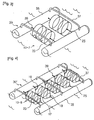
- FIG. 3 is a schematic view of a photobioreactor in accordance with a second exemplary embodiment.
- a photobioreactor in accordance with a second exemplary embodiment includes a culturing bag 10-7 having a long cylindrical shape and connected to a floating unit 30 in a state where it is laid in parallel to a water level.
- the culturing bag 10-7 may be freely overturned by a wave or a flow of seawater.
- FIG. 4 is a schematic view of a photobioreactor in accordance with an third exemplary embodiment.
- a photobioreactor in accordance with an third exemplary embodiment includes a culturing bag 10-8 which has a central portion having a cylindrical shape and a pair of cone-shaped portions disposed on both ends of the central portion having the cylindrical shape.
- the culturing bag 10-8 is connected to a floating unit 30' through a rope 25 connected to an apex of each of the cone-shaped portions.
- the culturing bag 10-8 in accordance with the current embodiment, the culturing bag 10-8 may be more freely overturned by a wave or a flow of seawater when compared to that in accordance with the seventh exemplary embodiment.
- the floating unit 30' may be expanded in a length direction thereof. Also, a plurality of connection rings 39 is provided to the floating unit 30'. Thus, the culturing bag 10-8 may be connected to the pair of connection rings 39 to expand a scale thereof. Although not shown, the floating unit 30' may be expanded in a width direction thereof. Thus, it is assumed that the photobioreactor may be increased in scale to increase commercial mass-culture of the marine microalgae.
- the photobioreactor for mass-culturing the marine microalgae using a semi-permeable membrane in accordance with the exemplary embodiments may be utilized for mass-culturing the microalgae in the following processes.
- the photobioreactor in accordance with the exemplary embodiments may be applied for the whole microalgae which are cultured in seawater.
- the photobioreactor is adopted for commercially mass-culturing the marine microalgae so as to produce bio-energy.
- carbon dioxide that is a main culprit of environment pollution related to global warmthing may be reduced in quantity.
- the photobioreactor may be sustainable.
- the nutrients contained in the seawater may be introduced through the semi-permeable membrane to remove the excreta and the metabolites disturbing the growth of the marine microalgae.
- the manpower and costs of managing and operating the photobioreactor may be significantly reduced.
- the manufacturing costs of the photobioreactor may be significantly inexpensive when compared to those of a photobioreactor in accordance with a related art.
- the photobioreactor may utilize the wide sea as an installation place to overcome commercial and spatial restrictions which act as stumbling blocks of the scale expansion that is necessary for mass-culturing the microalgae. That is, the most important thing in the photobioreactor is to transmit optical energy.
- the photobioreactor in accordance with the exemplary embodiments may be installed in the seawater in which a ratio of surface area per unit volume can be unlimitedly expanded to enable the volume of the photobioreactor to be easily expanded in a horizontal direction even though the photobioreactor is increase the ratio of surface area per unit volume, i.e., the scale expansion of the photobioreactor is realized.
- the scale of the photobioreactor may be expanded in a vertical direction, different kinds of microalgae may be cultured at the same time according to a depth of seawater. That is, the depth at which the culturing bag is disposed may be adjusted to secure conditions adequate for growing the microalgae or producing metabolites.
- the photobioreactor for mass-culturing the marine microalgae using the semi-permeable membrane may affect the development of marine resources in our country because earth's surface covered by sea is so much greater than the dry land, i.e., Korea is surrounded by water on three sides. That is, the photobioreactor may have utilities in which utilization efficiency of national land may be maximized by using wider sea than the relatively narrow national land.
- the photobioreactor may be manufactured at a low cost and free from the spatial restrictions, thereby enabling the expansion of the photobioreactor in both the horizontal and vertical directions. Furthermore, the manpower and costs for managing and operating the photobioreactor may be significantly reduced without producing, supplying, and replacing the culture media to easily and economically mass-culture the microalgae. Thus, the photobioreactor may enable the mass production of useful products including bio-energy and removes stumbling blocks of the commercial mass-production while mass-producing the useful products including the bio-energy.
- the marine microalgae may be automatically cultured without separately replacing the culture media in the seawater.
- the photobioreactor may be industrially utilized in various fields such as fungus bodies, functional health foods, animal feeds, removal of carbon dioxide, and production of biodiesel.
- the photobioreactor may be used for removing waste organic matters such as domestic wastewater, industrial wastewater, and livestock wastewater.
Landscapes
- Health & Medical Sciences (AREA)
- Life Sciences & Earth Sciences (AREA)
- Engineering & Computer Science (AREA)
- Chemical & Material Sciences (AREA)
- Zoology (AREA)
- Organic Chemistry (AREA)
- Bioinformatics & Cheminformatics (AREA)
- Wood Science & Technology (AREA)
- Biotechnology (AREA)
- Genetics & Genomics (AREA)
- Biochemistry (AREA)
- Microbiology (AREA)
- General Engineering & Computer Science (AREA)
- General Health & Medical Sciences (AREA)
- Biomedical Technology (AREA)
- Sustainable Development (AREA)
- Clinical Laboratory Science (AREA)
- Molecular Biology (AREA)
- Apparatus Associated With Microorganisms And Enzymes (AREA)
- Botany (AREA)
- Cell Biology (AREA)
- Medicinal Chemistry (AREA)
- Tropical Medicine & Parasitology (AREA)
- Virology (AREA)
- Micro-Organisms Or Cultivation Processes Thereof (AREA)
Description
- This application claims priority of Korean Patent Application No.
10-2008-0121700 filed on December 3, 2008 - The present disclosure relates to a photobioreactor for mass-culturing marine microalgae.
- In recent times, there is a rising interest in the photosynthesis of microorganisms or microalgae due to functional diversity. Also, studies with respect to the photosynthesis of microorganisms or microalgae are researched in various fields. The microalgae are being actively used in studies for reducing carbon dioxide which has become an object of attention in recent years due to environment pollution such as global warming. In addition, the microalgae are being utilized for studies related to the production of bio-energy such as biodiesel, bio-ethanol, and hydrogen gas, which are in the spotlight as sustainable energy sources in preparation for the running out of fossil fuels.
- However, it should be necessary to mass-culture the microalgae at a high concentration so that carbon dioxide is significantly removed in quantity using the microalgae and useful products such as the bio-energy are mass-produced. Thus, technologies related to construction of large-scale culturing equipment are necessarily required.
- In a related art, a photobioreactor having various shapes and installed in an indoor space is used as the culturing equipment for culturing the microalgae. The photobioreactor is formed of glass such as expensive Pyrex which increases transmittance of light and capable of sterilising or advanced materials thereof. Also, the photobioreactor includes an artificial lighting unit. Thus, more capital and technologies should be invested to manufacture the photobioreactor, and much costs for maintaining/repairing and operating the photobioreactor are required after the photobioreactor is manufactured. It is expensive to expand the scale of the photobioreactor, and also, the photobioreactor involves spatial restrictions because a wide space is required for the photobioreactor. Furthermore, culture media for culturing the microalgae should be supplied and periodically replaced. Also, excreta generated when the microalgae are grown and metabolites disturbing the growth of the marine microalgae should be removed. That is, there are limitations that manufacturing costs are increased and the spatial restrictions occur. In addition, the manpower, equipment and costs for managing and operating the photobioreactor are required.
- Thus, when considering that it is very important to secure economic feasibility for commercial mass-culture firstly, it costs much to manufacture and maintain/repair the photobioreactor when a scale of the photobioreactor is expanded. In addition, the culture of the microalgae using the related-art photobioreactor in which a wide space is required and operation costs related to an operation of a lighting unit, preparation of culture media, and replacement of the culture media are involved does not provide a realistically appropriate way, in which the economic feasibility should be considered, for commercially mass-culturing the microalgae even though the culture of the microalgae is adequate for small scale culture which is an object of study. However, although the photobioreactor is adequate for producing expensive products such as medical supplies, reagents, high-quality chemicals, and health food supplements, the photobioreactor is not the realistically appropriate way for commercial large scale culture of inexpensive products such as bio-energy in which the economic feasibility is very important.
- As described above, the limitation related to the costs and space may act as stumbling blocks by which it is difficult to utilize the microalgae to produce useful products including bio-energy or remove carbon dioxide. Thus, the development of the culturing technologies which cheaply and easily mass-culture the microalgae is urgently needed.
-
WO 2008/134010 discloses the features of the pre-characterizing portion of claim 1. - The present disclosure provides a photobioreactor for easily and economically mass-culturing marine microalgae using a semi-permeable membrane, which is manufactured at a low cost and free from the spatial restrictions, and also, significantly reduces manpower and costs required for operating the photobioreactor without producing, supplying, and replacing the culture media.
- The present invention provides a photobioreactor for mass-culturing marine microalgae using a semi-permeable membrane, which is installed in a floating type on a water level or immersed at a predetermined depth from the water level to mass-culture isolated marine microalgae, the photobioreactor comprising: a culturing bag formed of the semi-permeable membrane wherethrough seawater may pass, but the marine microalgae can not pass, the culturing bag being configured to provide a three-dimensional culturing space for accommodating the marine microalgae; and a floating unit connected to the culturing bag to dispose the culturing bag near the sea level, thereby exposing the culturing bag to sunlight, characterized in that: the floating unit has at least one pair of connection points spaced a predetermined distance from each other, the culturing bag has a long length and a narrow width and connected to the pair of connection points through one rope connected to each of both ends of a length direction of the culturing bag, and the culturing bag may be freely overturned by movement of a wave or seawater.
- The photobioreactor may further include a form maintaining frame disposed inside or outside the culturing bag to maintain a three-dimensional shape of the culturing bag.
- The culturing bag may have a long cylindrical shape and be connected to the floating unit in a state where the culturing bag is laid parallel to a water level.
- The culturing bag may have a central portion having a cylindrical shape and a pair of cone-shaped portions on both ends of the central portion, and the rope may be connected to an apex of each of the cone-shaped portions.
- The photobioreactor may further include a fixing unit fixed to a sea bottom in a state where the fixing unit is connected to the floating unit.
- Exemplary embodiments can be understood in more detail from the following description taken in conjunction with the accompanying drawings, in which:
-
FIG. 1 is a schematic view of an exemplary photobioreactor -
FIG. 2 is a schematic view of a photobioreactor in accordance with a first exemplary embodiment; -
FIG. 3 is a schematic view of a photobioreactor in accordance with a second exemplary embodiment; and -
FIG. 4 is a schematic view of a photobioreactor in accordance with an third exemplary embodiment. - Hereinafter, specific embodiments will be described in detail with reference to the accompanying drawings.
-
FIG. 1 is a schematic view of an exemplary photobioreactor. - As shown in
FIG 1 , a photobioreactor for mass-culturing marine microalgae using a semi-permeable membrane is installed in the sea to significantly overcome a spatial restriction due to its large scale. That is, a floating-type photobioreactor is installed on the sea to mass-culture marine microalgae while isolating the marine microalgae from each other. - Referring to
FIG. 1 , the photobioreactor includes a culturing bag 10-1 and afloating unit 30 connected to the culturing bag 10-1 to dispose the culturing bag 10-1 near a water level, thereby exposing the culturing bag 10-1 to sunlight. - Particularly, the culturing bag 10-1 is made of a semi-permeable membrane which allows seawater to pass through, but prevents passing through of the marine microalgae. Also, the culturing bag 10-1 is three-dimensionally formed to provide a culturing space for accumulating the marine microalgae. The culturing bag 10-1 further includes a
form maintaining frame 20 which is disposed inside or outside the culturing bag 10-1 to maintain a three-dimensional shape of the culturing bag 10-1. Thus, the culturing bag 10-1 may be stably maintained in shape. - The culturing bag 10-1 is manufactured using the semi-permeable membrane which allows the seawater to pass through and allows the marine microalgae to be blocked. In particular, passing through of the seawater means that nutritive salts dissolved in the seawater can be used as nutrients required for culturing the marine microalgae. Thus, it is unnecessary to supply separate culture media for culturing the marine microalgae. Also, excreta generated during growth of the marine microalgae and metabolites disturbing the growth of the marine microalgae may be dissolved in the seawater to remove the excreta and metabolites together with the seawater. Thus, it is unnecessary to perform a separate cleaning process for removing the excreta and the metabolites disturbing the growth of the marine microalgae. In addition, it is also unnecessary to replace the culture media. Furthermore, carbon dioxide dissolved in the seawater may be used for photosynthesis occurring during the growth of the marine microalgae. Also, the oxygen generated as a byproduct by the photosynthesis may pass through the semi-permeable membrane and be discharged to the atmosphere. Also, blocking the marine microalgae means that the marine microalgae can be cultured within only a manageable limited space. Thus, it may prevent marine pollution due to the mass propagation from occurring. In addition, the marine microalgae may be adequately cultured in number to easily harvest the cultured microalgae.
- The floating
unit 30 is a unit for locating the culturing bag 10-1 near the water level to expose the culturing bag 10-1 to the sunlight. As shown inFIG. 1 , thefloating unit 30 includes a pair of floatingmembers 35 spaced from each other and aconnection frame 37 connecting the floatingmembers 35 to each other while maintaining a predetermined distance between the pair of floatingmembers 35. However, thefloating unit 30 is not limited to the above-described structure. For example, thefloating unit 30 may be variously changed in size and shape according to those of the culturing bag 10-1. -
FIG. 2 is a schematic view of a photobioreactor in accordance with a first exemplary embodiment. - Referring to
FIG. 2 , a photobioreactor in accordance with a first exemplary embodiment includes a floatingunit 30 having at least two pairs of connection points spaced a predetermined distance from each other and two culturing bags 10-6. Each of the two culturing bags 10-6 has a long length and a narrow width. Also, the two culturing bags 10-6 are respectively connected to the pair of connection points throughropes 25 connected to both ends of a length direction of each of the culturing bags 10-6. - In the current embodiment, the floating
unit 30 comprises a pair of floatingmembers 35 spaced from each other and aconnection frame 37 connecting the pair of floatingmembers 35 to each other while maintaining a predetermined distance between the floatingmembers 35. Connection rings 39 which play the role of connecting points are connected between facing surfaces of the floatingmembers 35. Here, the floatingunit 30 is not limited to the above-described shape. For example, the floatingunit 30 may be changed in shape and size according to those of the culturing bag 10-6. - Also, the photobioreactor in accordance with the current embodiment includes a fixing
unit 70 hung at the floatingunit 30. Here, a weight is not hung at the culturing bag 10-6. - As described above, since the culturing bag 10-6 has the long length and narrow width, the culturing bag 10-6 is connected to each of the connection rings 39 facing each other through the
rope 25 connected to both ends of the length direction of the culturing bag 10-6, and a weight is not connected to the culturing bag 10-6, the culturing bag 10-6 may be freely overturned by a wave or a flow of seawater. - Since the culturing bag 10-6 is freely overturned by the wave and the flow of seawater, marine microalgae may be uniformly distributed within the culturing bag 10-6 without separately supplying gas to cause a mixing operation by bubbles. Thus, culturing environments of the marine microalgae may be excellently maintained.
-
FIG. 3 is a schematic view of a photobioreactor in accordance with a second exemplary embodiment. - Referring to
FIG. 3 , a photobioreactor in accordance with a second exemplary embodiment includes a culturing bag 10-7 having a long cylindrical shape and connected to a floatingunit 30 in a state where it is laid in parallel to a water level. In this case, the culturing bag 10-7 may be freely overturned by a wave or a flow of seawater. -
FIG. 4 is a schematic view of a photobioreactor in accordance with an third exemplary embodiment. - Referring to
FIG. 4 , a photobioreactor in accordance with an third exemplary embodiment includes a culturing bag 10-8 which has a central portion having a cylindrical shape and a pair of cone-shaped portions disposed on both ends of the central portion having the cylindrical shape. Here, the culturing bag 10-8 is connected to a floating unit 30' through arope 25 connected to an apex of each of the cone-shaped portions. In the culturing bag 10-8 in accordance with the current embodiment, the culturing bag 10-8 may be more freely overturned by a wave or a flow of seawater when compared to that in accordance with the seventh exemplary embodiment. - As shown in
FIG. 4 , in a photobioreactor in accordance with a third exemplary embodiment, the floating unit 30' may be expanded in a length direction thereof. Also, a plurality of connection rings 39 is provided to the floating unit 30'. Thus, the culturing bag 10-8 may be connected to the pair of connection rings 39 to expand a scale thereof. Although not shown, the floating unit 30' may be expanded in a width direction thereof. Thus, it is assumed that the photobioreactor may be increased in scale to increase commercial mass-culture of the marine microalgae. - As described above, the photobioreactor for mass-culturing the marine microalgae using a semi-permeable membrane in accordance with the exemplary embodiments may be utilized for mass-culturing the microalgae in the following processes.
- First, the photobioreactor in accordance with the exemplary embodiments may be applied for the whole microalgae which are cultured in seawater. Particularly, the photobioreactor is adopted for commercially mass-culturing the marine microalgae so as to produce bio-energy. In this case, carbon dioxide that is a main culprit of environment pollution related to global wanning may be reduced in quantity. As a result, the photobioreactor may be sustainable.
- Also, the nutrients contained in the seawater may be introduced through the semi-permeable membrane to remove the excreta and the metabolites disturbing the growth of the marine microalgae. Thus, since it is unnecessary to supply and replace the separate culture media, the manpower and costs of managing and operating the photobioreactor may be significantly reduced.
- Also, the manufacturing costs of the photobioreactor may be significantly inexpensive when compared to those of a photobioreactor in accordance with a related art. Furthermore, the photobioreactor may utilize the wide sea as an installation place to overcome commercial and spatial restrictions which act as stumbling blocks of the scale expansion that is necessary for mass-culturing the microalgae. That is, the most important thing in the photobioreactor is to transmit optical energy. Thus, when this is considered as one of facts by which the scale expansion of the photobioreactor is difficult, the photobioreactor in accordance with the exemplary embodiments may be installed in the seawater in which a ratio of surface area per unit volume can be unlimitedly expanded to enable the volume of the photobioreactor to be easily expanded in a horizontal direction even though the photobioreactor is increase the ratio of surface area per unit volume, i.e., the scale expansion of the photobioreactor is realized.
- Furthermore, since the scale of the photobioreactor may be expanded in a vertical direction, different kinds of microalgae may be cultured at the same time according to a depth of seawater. That is, the depth at which the culturing bag is disposed may be adjusted to secure conditions adequate for growing the microalgae or producing metabolites.
- As described above, the photobioreactor for mass-culturing the marine microalgae using the semi-permeable membrane may affect the development of marine resources in our country because earth's surface covered by sea is so much greater than the dry land, i.e., Korea is surrounded by water on three sides. That is, the photobioreactor may have utilities in which utilization efficiency of national land may be maximized by using wider sea than the relatively narrow national land.
- As described above, since the photobioreactor for mass-culturing the marine microalgae using the semi-permeable membrane is provided, the photobioreactor may be manufactured at a low cost and free from the spatial restrictions, thereby enabling the expansion of the photobioreactor in both the horizontal and vertical directions. Furthermore, the manpower and costs for managing and operating the photobioreactor may be significantly reduced without producing, supplying, and replacing the culture media to easily and economically mass-culture the microalgae. Thus, the photobioreactor may enable the mass production of useful products including bio-energy and removes stumbling blocks of the commercial mass-production while mass-producing the useful products including the bio-energy.
- In the photobioreactor in accordance with the exemplary embodiments, the marine microalgae may be automatically cultured without separately replacing the culture media in the seawater. Thus, the photobioreactor may be industrially utilized in various fields such as fungus bodies, functional health foods, animal feeds, removal of carbon dioxide, and production of biodiesel. In addition, the photobioreactor may be used for removing waste organic matters such as domestic wastewater, industrial wastewater, and livestock wastewater.
- Although the photobioreactor for mass-culturing marine microalgae using the semi-permeable membrane has been described with reference to the specific embodiments, it is not limited thereto. Therefore, it will be readily understood by those skilled in the art that various modifications and changes can be made thereto without departing from the scope of the present invention which is defined by the appended claims.
Claims (5)
- A photobioreactor for mass-culturing marine microalgae using a semi-permeable membrane, which is installed in a floating type on a water level or immersed at a predetermined depth from the water level to mass-culture isolated marine microalgae, the photobioreactor comprising:a culturing bag (10-6; 10-7; 10-8) formed of the semi-permeable membrane wherethrough seawater may pass, but the marine microalgae can not pass, the culturing bag being configured to provide a three-dimensional culturing space for accommodating the marine microalgae; anda floating unit (30) connected to the culturing bag to dispose the culturing bag near the sea level, thereby exposing the culturing bag to sunlight,characterized in that:the floating unit has at least one pair of connection points (39) spaced a predetermined distance from each other,the culturing bag has a long length and a narrow width and connected to the pair of connection points through one rope (25) connected to each of both ends of a length direction of the culturing bag, andthe culturing bag may be freely overturned by movement of a wave or seawater.
- The photobioreactor of claim 1, further comprising a form maintaining frame (20) disposed inside or outside the culturing bag to maintain a three-dimensional shape of the culturing bag.
- The photobioreactor of claim 1, wherein the culturing bag has a long cylindrical shape and is connected to the floating unit in a state where the culturing bag is laid parallel to a water level.
- The photobioreactor of claim 3, wherein the culturing bag has a central portion having a cylindrical shape and a pair of cone-shaped portions on both ends of the central portion, and the rope is connected to an apex of each of the cone-shaped portions.
- The photobioreactor of claim 1 to 4, further comprising a fixing unit (70) fixed to a sea bottom in a state where the fixing unit is connected to the floating unit.
Applications Claiming Priority (2)
| Application Number | Priority Date | Filing Date | Title |
|---|---|---|---|
| KR1020080121700A KR100991373B1 (en) | 2008-12-03 | 2008-12-03 | Photoreactor for Mass Culture of Marine Microalgae Using Semi-Permeable Membrane |
| PCT/KR2009/005109 WO2010064780A1 (en) | 2008-12-03 | 2009-09-09 | Photobioreactor for a large-scale marine microalgal culture using half-transmitting film |
Publications (3)
| Publication Number | Publication Date |
|---|---|
| EP2360235A1 EP2360235A1 (en) | 2011-08-24 |
| EP2360235A4 EP2360235A4 (en) | 2013-01-16 |
| EP2360235B1 true EP2360235B1 (en) | 2016-09-07 |
Family
ID=42233414
Family Applications (1)
| Application Number | Title | Priority Date | Filing Date |
|---|---|---|---|
| EP09830518.8A Active EP2360235B1 (en) | 2008-12-03 | 2009-09-09 | Photobioreactor for a large-scale marine microalgal culture using semi-permeable membrane |
Country Status (7)
| Country | Link |
|---|---|
| US (1) | US9181520B2 (en) |
| EP (1) | EP2360235B1 (en) |
| JP (1) | JP5204315B2 (en) |
| KR (1) | KR100991373B1 (en) |
| CN (1) | CN102307985B (en) |
| ES (1) | ES2592378T3 (en) |
| WO (1) | WO2010064780A1 (en) |
Families Citing this family (50)
| Publication number | Priority date | Publication date | Assignee | Title |
|---|---|---|---|---|
| CN102498200B (en) | 2009-07-28 | 2014-11-26 | 焦耳无限科技公司 | Photobioreactors, solar energy gathering systems, and thermal control methods |
| JP2011254766A (en) * | 2010-06-10 | 2011-12-22 | Sumitomo Heavy Ind Ltd | Photosynthetic microalgae culture apparatus |
| WO2012020425A1 (en) * | 2010-07-20 | 2012-02-16 | Panduranga Revankar Krishna Prasad | A devise for large scale cell culture in a sea based bio reactor |
| KR101446040B1 (en) * | 2010-08-09 | 2014-10-02 | 인하대학교 산학협력단 | Photobioreactor structured to pitch and roll itself |
| KR101447929B1 (en) * | 2010-08-09 | 2014-10-14 | 인하대학교 산학협력단 | Photobioreactor equipped with photocatalysts and method for cultivating photosynthetic microalgae using the same |
| KR101484576B1 (en) * | 2010-08-09 | 2015-01-21 | 인하대학교 산학협력단 | Photobioreactor with internal partition |
| KR101237039B1 (en) * | 2010-12-06 | 2013-02-25 | 한국해양과학기술원 | Cultivating system for phytoplankton |
| US8689482B2 (en) * | 2011-02-07 | 2014-04-08 | College Of William And Mary | Apparatus and method for producing and harvesting algae |
| JP2015521042A (en) * | 2012-05-17 | 2015-07-27 | エス. レッドフォード,ダニエル | Aquatic-based microalgae production equipment |
| KR101388241B1 (en) | 2012-09-07 | 2014-04-23 | 한국생명공학연구원 | Cultivating and harvesting method of attached microalgae from the wastewater and utilizing as the biomass thereof |
| WO2014038753A1 (en) * | 2012-09-07 | 2014-03-13 | 한국생명공학연구원 | Method for cultivating and harvesting adhesive microalgae from sewage or waste water to utilize same as biomass |
| WO2014074770A2 (en) | 2012-11-09 | 2014-05-15 | Heliae Development, Llc | Balanced mixotrophy methods |
| WO2014074772A1 (en) | 2012-11-09 | 2014-05-15 | Heliae Development, Llc | Mixotrophic, phototrophic, and heterotrophic combination methods and systems |
| KR101727632B1 (en) * | 2013-04-05 | 2017-04-17 | 인하대학교 산학협력단 | Photobioreactor for photosynthetic microbial mass cultures |
| WO2014209935A2 (en) * | 2013-06-27 | 2014-12-31 | Philippidis George | Floating photobioreactor system comprising a floating photobioreactor and an integrated paddle wheel and an airlift and methods of use |
| TWI487787B (en) * | 2013-07-23 | 2015-06-11 | 國立中山大學 | Light-guiding photobioreactor |
| KR101394216B1 (en) * | 2013-09-24 | 2014-05-14 | 한국해양과학기술원 | The culture method of microalgae using sea water |
| EP3066186B1 (en) * | 2013-11-08 | 2017-10-11 | Phytolutions GmbH | Photobioreactor and photobioreactor farm |
| CN103805500A (en) * | 2014-02-21 | 2014-05-21 | 杭州鑫伟低碳技术研发有限公司 | Offing microalgae cultivation device and cultivation method |
| EP3133148A4 (en) * | 2014-04-18 | 2017-10-25 | Inha-Industry Partnership Institute | Method for mass culturing photosynthetic microalgae by additionally supplying environmental water |
| KR101594245B1 (en) * | 2014-05-27 | 2016-02-17 | 인하대학교 산학협력단 | Textile-hydrogel composite semipermeable membrane and cultivating microalgae using the same |
| KR101742050B1 (en) | 2014-06-27 | 2017-05-31 | 우영희 | Double layer photosynthesis biomass production apparatus |
| US9155248B1 (en) * | 2014-11-24 | 2015-10-13 | William R. Becker | Apparatus and method for harvesting plankton and other biomass from a dead zone |
| CN104774746A (en) * | 2015-03-27 | 2015-07-15 | 沈阳航空航天大学 | Freshwater microalgae coastal sealing culture system |
| KR101692269B1 (en) * | 2015-04-20 | 2017-01-04 | 인하대학교 산학협력단 | A photobioreactor for mass production of microalgae |
| GB201521136D0 (en) * | 2015-12-01 | 2016-01-13 | Arborea Ltd | Device |
| FR3056600B1 (en) * | 2016-09-27 | 2020-10-02 | Suez Groupe | DEVICE FOR EXPOSURE TO THE LIGHT OF AN ALGAL SOLUTION, PHOTOBIOREACTOR AND ASSOCIATED START-UP PROCEDURE |
| US10584310B2 (en) * | 2017-03-08 | 2020-03-10 | Ivan Araujo Dayrell | Integrated system to produce microalgae |
| US11240977B2 (en) | 2017-07-24 | 2022-02-08 | Elliott A. Gruskin | Compact photobioreactor with built-in lights |
| CN107384801A (en) * | 2017-08-21 | 2017-11-24 | 李彤 | Closing biological membrane type cultural method for industrialized production microalgae |
| FR3075822B1 (en) | 2017-12-27 | 2025-03-14 | Emmanuel Poirmeur | METHOD FOR TRANSFORMING AN ORGANIC SUBSTRATE IN IMMERSION |
| CN109536383A (en) * | 2018-08-31 | 2019-03-29 | 雷云飞 | A kind of activity of microalgae cytotrophy repairs the production line of liquid |
| CN109439549A (en) * | 2018-12-22 | 2019-03-08 | 无棣鲁东大学海洋研究院 | The method and both culturing microalgae system of cultivating microalgae in a kind of ocean deepwater area |
| WO2020161711A1 (en) * | 2019-02-08 | 2020-08-13 | Ramot At Tel Aviv University Ltd. | Device and method for free floating macroalgae cultivation offshore |
| CN110499245B (en) * | 2019-08-08 | 2023-06-23 | 浙江万里学院 | Microalgae in-situ expansion culture system for shellfish culture pond and use method thereof |
| CN113046229A (en) * | 2019-12-26 | 2021-06-29 | 云南爱尔发生物技术股份有限公司 | Cavity type photobioreactor in microalgae culture system |
| US11716972B2 (en) * | 2020-01-27 | 2023-08-08 | Alex J. Maile | Floating seaweed clip |
| CN112625891A (en) * | 2020-12-29 | 2021-04-09 | 深圳大学 | Large-scale photobioreactor floating in wide water area |
| CN112680331A (en) * | 2020-12-29 | 2021-04-20 | 深圳大学 | Photobioreactor operating in large water body |
| CN112877179A (en) * | 2021-03-12 | 2021-06-01 | 大连理工大学 | Wave amplification device for culturing microalgae |
| WO2022216422A1 (en) * | 2021-04-08 | 2022-10-13 | Premium Oceanic Inc. | Systems and methods for deepwater photobioreactor |
| JP7827741B2 (en) | 2021-04-08 | 2026-03-10 | ブルー・エボリューション・インコーポレイテッド | Photobioreactor systems and methods |
| US12264304B2 (en) * | 2021-04-08 | 2025-04-01 | Premium Oceanic Inc. | Systems and methods for deepwater photobioreactor |
| WO2022264118A1 (en) * | 2021-06-15 | 2022-12-22 | Varakin Konstantin | Systems and methods for using algae pools for carbon dioxide capturing |
| CN113443721B (en) * | 2021-08-30 | 2021-11-09 | 南通鑫铭环保技术有限公司 | Fixed microalgae purifier for natural water and purification process thereof |
| US11505772B1 (en) | 2022-01-06 | 2022-11-22 | Premium Oceanic Inc. | Systems and methods for conversion of a biomass into biofuel using a geothermal heat source |
| EP4460546A1 (en) | 2022-01-06 | 2024-11-13 | Blue Evolution, Inc. | Systems and methods for conversion of a biomass into biofuel using a geothermal heat source technical field |
| KR102757808B1 (en) | 2022-09-30 | 2025-01-22 | 전현진 | Photosynthetic microorganism incubator |
| CN115404168B (en) * | 2022-11-01 | 2023-05-12 | 山东滨州八匹马塑料化纤制品有限公司 | Marine microalgae cultivation method |
| MY209428A (en) * | 2022-12-29 | 2025-07-08 | Petroliam Nasional Berhad Petronas | System and process for algae cultivation |
Family Cites Families (15)
| Publication number | Priority date | Publication date | Assignee | Title |
|---|---|---|---|---|
| US4086161A (en) * | 1976-12-13 | 1978-04-25 | Robert Edward Burton | Ecological system and method |
| JPS61111636A (en) * | 1984-11-07 | 1986-05-29 | 森 敬 | Fish gathering and breeding apparatus |
| JPS61119125A (en) * | 1984-11-15 | 1986-06-06 | 森 敬 | Fish breeding apparatus |
| US4888912A (en) * | 1988-07-12 | 1989-12-26 | Murray David P | Nutrient depleting envelopes containing aquatic plants |
| US5528856A (en) * | 1995-02-15 | 1996-06-25 | Landmark Reclamation, Inc. | Biomass impoundment management system for purifying water |
| JP3253235B2 (en) * | 1995-06-22 | 2002-02-04 | 石川島播磨重工業株式会社 | Floating photosynthetic reactor |
| JP3248829B2 (en) * | 1995-06-22 | 2002-01-21 | 石川島播磨重工業株式会社 | Flexible floating photosynthetic reactor |
| CN2225133Y (en) * | 1995-06-26 | 1996-04-24 | 洪慧修 | Cultivating box for aquatic product |
| JPH10118689A (en) | 1996-10-23 | 1998-05-12 | Mitsui Eng & Shipbuild Co Ltd | Water purification equipment for lakes and marshes |
| JP2004113003A (en) * | 2002-09-24 | 2004-04-15 | Baba Shoten:Kk | Crawl apparatus and method for culturing in crawl |
| KR100490641B1 (en) * | 2003-12-16 | 2005-05-19 | 인하대학교 산학협력단 | Multiple layer photobioreactors and method for culturing photosynthetic microorganisms using them |
| JP2007330215A (en) * | 2006-06-19 | 2007-12-27 | Electric Power Dev Co Ltd | Microalgae culture equipment |
| EP2152848A2 (en) | 2007-04-27 | 2010-02-17 | Greenfuel Technologies Corporation | Photobioreactor systems positioned on bodies of water |
| US8409845B2 (en) * | 2008-12-05 | 2013-04-02 | The United States of America as represented by the Administrator of the National Aeronautics & Space Administration (NASA) | Algae bioreactor using submerged enclosures with semi-permeable membranes |
| CN102498200B (en) * | 2009-07-28 | 2014-11-26 | 焦耳无限科技公司 | Photobioreactors, solar energy gathering systems, and thermal control methods |
-
2008
- 2008-12-03 KR KR1020080121700A patent/KR100991373B1/en not_active Expired - Fee Related
-
2009
- 2009-09-09 JP JP2011539441A patent/JP5204315B2/en active Active
- 2009-09-09 US US13/132,157 patent/US9181520B2/en active Active
- 2009-09-09 CN CN200980156076.0A patent/CN102307985B/en active Active
- 2009-09-09 ES ES09830518.8T patent/ES2592378T3/en active Active
- 2009-09-09 EP EP09830518.8A patent/EP2360235B1/en active Active
- 2009-09-09 WO PCT/KR2009/005109 patent/WO2010064780A1/en not_active Ceased
Also Published As
| Publication number | Publication date |
|---|---|
| US20110247262A1 (en) | 2011-10-13 |
| JP2012510292A (en) | 2012-05-10 |
| CN102307985B (en) | 2014-05-07 |
| EP2360235A1 (en) | 2011-08-24 |
| WO2010064780A1 (en) | 2010-06-10 |
| CN102307985A (en) | 2012-01-04 |
| ES2592378T3 (en) | 2016-11-29 |
| US9181520B2 (en) | 2015-11-10 |
| AU2009323248A1 (en) | 2011-06-30 |
| EP2360235A4 (en) | 2013-01-16 |
| JP5204315B2 (en) | 2013-06-05 |
| KR100991373B1 (en) | 2010-11-02 |
| KR20100063260A (en) | 2010-06-11 |
Similar Documents
| Publication | Publication Date | Title |
|---|---|---|
| US9181520B2 (en) | Photobioreactor for mass-culturing marine microalgae using semi-permeable membrane | |
| Shen et al. | Microalgae mass production methods | |
| Zittelli et al. | Photobioreactors for microalgal biofuel production | |
| Zhu et al. | Bicarbonate-based carbon capture and algal production system on ocean with floating inflatable-membrane photobioreactor | |
| CN103409321A (en) | Microalgae suspension-adhesion mixed culture and separated harvesting method based on suspended carrier | |
| KR101087616B1 (en) | Photobioreactor for Bulk Culture of Marine Microalgae with Combined Power Plant | |
| KR101517838B1 (en) | Method for cultivating photosynthetic microalgae by co-cultivation | |
| US12075735B2 (en) | Kelp growth apparatus and method for kelp harvesting | |
| CN102191179A (en) | Method for culturing marine oil-producing microalgae | |
| KR101194545B1 (en) | Systemic equipments to produce bioenergy using microalgae and biodiesel produced by the same | |
| KR101437724B1 (en) | A culture medium of microalgae that is used for producing bio oil | |
| EP3013938A2 (en) | Floating photobioreactor system comprising a floating photobioreactor and an integrated paddle wheel and an airlift and methods of use | |
| US20120107452A1 (en) | Aeration systems for horizontal photobioreactors | |
| KR20240011371A (en) | Method for culturing microalgae | |
| TWI457073B (en) | Microalgae cultivation module including circular tube-shaped cultivation bag | |
| CN102586078A (en) | Microalgae cultivation system and method | |
| CN202465661U (en) | Microalgae breeding tubular membrane device | |
| CN204125447U (en) | The culture apparatus that a kind of micro-algae autotrophy and heterotrophism combine | |
| CN102465087B (en) | System and method for culturing photosynthetic microorganisms | |
| CN202272864U (en) | Reaction zone device for optical energy biological culture system and photoreactor with reaction zone device | |
| KR101315886B1 (en) | Polyhedron-type photobioreactor | |
| Pupo et al. | Conceptual design of photobioreactor for algae cultivation | |
| CN202265567U (en) | Integrated photosynthetic microorganism culture system | |
| KR101547684B1 (en) | Offshore structure plant for manufacturing microalgae biofuel | |
| CN107022474A (en) | A kind of wiper and microalgae culturing device adopting |
Legal Events
| Date | Code | Title | Description |
|---|---|---|---|
| PUAI | Public reference made under article 153(3) epc to a published international application that has entered the european phase |
Free format text: ORIGINAL CODE: 0009012 |
|
| 17P | Request for examination filed |
Effective date: 20110617 |
|
| AK | Designated contracting states |
Kind code of ref document: A1 Designated state(s): AT BE BG CH CY CZ DE DK EE ES FI FR GB GR HR HU IE IS IT LI LT LU LV MC MK MT NL NO PL PT RO SE SI SK SM TR |
|
| DAX | Request for extension of the european patent (deleted) | ||
| A4 | Supplementary search report drawn up and despatched |
Effective date: 20121214 |
|
| RIC1 | Information provided on ipc code assigned before grant |
Ipc: C12M 3/00 20060101AFI20121210BHEP |
|
| GRAP | Despatch of communication of intention to grant a patent |
Free format text: ORIGINAL CODE: EPIDOSNIGR1 |
|
| RIC1 | Information provided on ipc code assigned before grant |
Ipc: C12M 1/09 20060101ALI20160301BHEP Ipc: C12M 1/00 20060101ALI20160301BHEP Ipc: C12M 3/00 20060101AFI20160301BHEP |
|
| INTG | Intention to grant announced |
Effective date: 20160318 |
|
| GRAS | Grant fee paid |
Free format text: ORIGINAL CODE: EPIDOSNIGR3 |
|
| GRAA | (expected) grant |
Free format text: ORIGINAL CODE: 0009210 |
|
| AK | Designated contracting states |
Kind code of ref document: B1 Designated state(s): AT BE BG CH CY CZ DE DK EE ES FI FR GB GR HR HU IE IS IT LI LT LU LV MC MK MT NL NO PL PT RO SE SI SK SM TR |
|
| REG | Reference to a national code |
Ref country code: GB Ref legal event code: FG4D |
|
| REG | Reference to a national code |
Ref country code: CH Ref legal event code: EP |
|
| REG | Reference to a national code |
Ref country code: FR Ref legal event code: PLFP Year of fee payment: 8 |
|
| REG | Reference to a national code |
Ref country code: IE Ref legal event code: FG4D |
|
| REG | Reference to a national code |
Ref country code: AT Ref legal event code: REF Ref document number: 826893 Country of ref document: AT Kind code of ref document: T Effective date: 20161015 |
|
| REG | Reference to a national code |
Ref country code: DE Ref legal event code: R096 Ref document number: 602009041043 Country of ref document: DE |
|
| PGFP | Annual fee paid to national office [announced via postgrant information from national office to epo] |
Ref country code: GB Payment date: 20160907 Year of fee payment: 8 |
|
| REG | Reference to a national code |
Ref country code: ES Ref legal event code: FG2A Ref document number: 2592378 Country of ref document: ES Kind code of ref document: T3 Effective date: 20161129 |
|
| REG | Reference to a national code |
Ref country code: LT Ref legal event code: MG4D |
|
| REG | Reference to a national code |
Ref country code: NL Ref legal event code: MP Effective date: 20160907 |
|
| PG25 | Lapsed in a contracting state [announced via postgrant information from national office to epo] |
Ref country code: FI Free format text: LAPSE BECAUSE OF FAILURE TO SUBMIT A TRANSLATION OF THE DESCRIPTION OR TO PAY THE FEE WITHIN THE PRESCRIBED TIME-LIMIT Effective date: 20160907 Ref country code: LT Free format text: LAPSE BECAUSE OF FAILURE TO SUBMIT A TRANSLATION OF THE DESCRIPTION OR TO PAY THE FEE WITHIN THE PRESCRIBED TIME-LIMIT Effective date: 20160907 Ref country code: NO Free format text: LAPSE BECAUSE OF FAILURE TO SUBMIT A TRANSLATION OF THE DESCRIPTION OR TO PAY THE FEE WITHIN THE PRESCRIBED TIME-LIMIT Effective date: 20161207 Ref country code: HR Free format text: LAPSE BECAUSE OF FAILURE TO SUBMIT A TRANSLATION OF THE DESCRIPTION OR TO PAY THE FEE WITHIN THE PRESCRIBED TIME-LIMIT Effective date: 20160907 |
|
| REG | Reference to a national code |
Ref country code: AT Ref legal event code: MK05 Ref document number: 826893 Country of ref document: AT Kind code of ref document: T Effective date: 20160907 |
|
| PG25 | Lapsed in a contracting state [announced via postgrant information from national office to epo] |
Ref country code: BE Free format text: LAPSE BECAUSE OF NON-PAYMENT OF DUE FEES Effective date: 20160930 Ref country code: SE Free format text: LAPSE BECAUSE OF FAILURE TO SUBMIT A TRANSLATION OF THE DESCRIPTION OR TO PAY THE FEE WITHIN THE PRESCRIBED TIME-LIMIT Effective date: 20160907 Ref country code: LV Free format text: LAPSE BECAUSE OF FAILURE TO SUBMIT A TRANSLATION OF THE DESCRIPTION OR TO PAY THE FEE WITHIN THE PRESCRIBED TIME-LIMIT Effective date: 20160907 Ref country code: NL Free format text: LAPSE BECAUSE OF FAILURE TO SUBMIT A TRANSLATION OF THE DESCRIPTION OR TO PAY THE FEE WITHIN THE PRESCRIBED TIME-LIMIT Effective date: 20160907 Ref country code: GR Free format text: LAPSE BECAUSE OF FAILURE TO SUBMIT A TRANSLATION OF THE DESCRIPTION OR TO PAY THE FEE WITHIN THE PRESCRIBED TIME-LIMIT Effective date: 20161208 |
|
| REG | Reference to a national code |
Ref country code: DE Ref legal event code: R119 Ref document number: 602009041043 Country of ref document: DE |
|
| PG25 | Lapsed in a contracting state [announced via postgrant information from national office to epo] |
Ref country code: EE Free format text: LAPSE BECAUSE OF FAILURE TO SUBMIT A TRANSLATION OF THE DESCRIPTION OR TO PAY THE FEE WITHIN THE PRESCRIBED TIME-LIMIT Effective date: 20160907 Ref country code: RO Free format text: LAPSE BECAUSE OF FAILURE TO SUBMIT A TRANSLATION OF THE DESCRIPTION OR TO PAY THE FEE WITHIN THE PRESCRIBED TIME-LIMIT Effective date: 20160907 |
|
| REG | Reference to a national code |
Ref country code: CH Ref legal event code: PL |
|
| PG25 | Lapsed in a contracting state [announced via postgrant information from national office to epo] |
Ref country code: SK Free format text: LAPSE BECAUSE OF FAILURE TO SUBMIT A TRANSLATION OF THE DESCRIPTION OR TO PAY THE FEE WITHIN THE PRESCRIBED TIME-LIMIT Effective date: 20160907 Ref country code: AT Free format text: LAPSE BECAUSE OF FAILURE TO SUBMIT A TRANSLATION OF THE DESCRIPTION OR TO PAY THE FEE WITHIN THE PRESCRIBED TIME-LIMIT Effective date: 20160907 Ref country code: SM Free format text: LAPSE BECAUSE OF FAILURE TO SUBMIT A TRANSLATION OF THE DESCRIPTION OR TO PAY THE FEE WITHIN THE PRESCRIBED TIME-LIMIT Effective date: 20160907 Ref country code: PL Free format text: LAPSE BECAUSE OF FAILURE TO SUBMIT A TRANSLATION OF THE DESCRIPTION OR TO PAY THE FEE WITHIN THE PRESCRIBED TIME-LIMIT Effective date: 20160907 Ref country code: BG Free format text: LAPSE BECAUSE OF FAILURE TO SUBMIT A TRANSLATION OF THE DESCRIPTION OR TO PAY THE FEE WITHIN THE PRESCRIBED TIME-LIMIT Effective date: 20161207 Ref country code: CZ Free format text: LAPSE BECAUSE OF FAILURE TO SUBMIT A TRANSLATION OF THE DESCRIPTION OR TO PAY THE FEE WITHIN THE PRESCRIBED TIME-LIMIT Effective date: 20160907 Ref country code: IS Free format text: LAPSE BECAUSE OF FAILURE TO SUBMIT A TRANSLATION OF THE DESCRIPTION OR TO PAY THE FEE WITHIN THE PRESCRIBED TIME-LIMIT Effective date: 20170107 Ref country code: BE Free format text: LAPSE BECAUSE OF FAILURE TO SUBMIT A TRANSLATION OF THE DESCRIPTION OR TO PAY THE FEE WITHIN THE PRESCRIBED TIME-LIMIT Effective date: 20160907 Ref country code: PT Free format text: LAPSE BECAUSE OF FAILURE TO SUBMIT A TRANSLATION OF THE DESCRIPTION OR TO PAY THE FEE WITHIN THE PRESCRIBED TIME-LIMIT Effective date: 20170109 |
|
| REG | Reference to a national code |
Ref country code: IE Ref legal event code: MM4A |
|
| PLBE | No opposition filed within time limit |
Free format text: ORIGINAL CODE: 0009261 |
|
| STAA | Information on the status of an ep patent application or granted ep patent |
Free format text: STATUS: NO OPPOSITION FILED WITHIN TIME LIMIT |
|
| PG25 | Lapsed in a contracting state [announced via postgrant information from national office to epo] |
Ref country code: IE Free format text: LAPSE BECAUSE OF NON-PAYMENT OF DUE FEES Effective date: 20160909 Ref country code: LI Free format text: LAPSE BECAUSE OF NON-PAYMENT OF DUE FEES Effective date: 20160930 Ref country code: DE Free format text: LAPSE BECAUSE OF NON-PAYMENT OF DUE FEES Effective date: 20170401 Ref country code: CH Free format text: LAPSE BECAUSE OF NON-PAYMENT OF DUE FEES Effective date: 20160930 Ref country code: DK Free format text: LAPSE BECAUSE OF FAILURE TO SUBMIT A TRANSLATION OF THE DESCRIPTION OR TO PAY THE FEE WITHIN THE PRESCRIBED TIME-LIMIT Effective date: 20160907 |
|
| REG | Reference to a national code |
Ref country code: FR Ref legal event code: PLFP Year of fee payment: 9 |
|
| 26N | No opposition filed |
Effective date: 20170608 |
|
| PG25 | Lapsed in a contracting state [announced via postgrant information from national office to epo] |
Ref country code: LU Free format text: LAPSE BECAUSE OF NON-PAYMENT OF DUE FEES Effective date: 20160909 Ref country code: SI Free format text: LAPSE BECAUSE OF FAILURE TO SUBMIT A TRANSLATION OF THE DESCRIPTION OR TO PAY THE FEE WITHIN THE PRESCRIBED TIME-LIMIT Effective date: 20160907 |
|
| GBPC | Gb: european patent ceased through non-payment of renewal fee |
Effective date: 20170909 |
|
| PG25 | Lapsed in a contracting state [announced via postgrant information from national office to epo] |
Ref country code: CY Free format text: LAPSE BECAUSE OF FAILURE TO SUBMIT A TRANSLATION OF THE DESCRIPTION OR TO PAY THE FEE WITHIN THE PRESCRIBED TIME-LIMIT Effective date: 20160907 Ref country code: HU Free format text: LAPSE BECAUSE OF FAILURE TO SUBMIT A TRANSLATION OF THE DESCRIPTION OR TO PAY THE FEE WITHIN THE PRESCRIBED TIME-LIMIT; INVALID AB INITIO Effective date: 20090909 |
|
| PG25 | Lapsed in a contracting state [announced via postgrant information from national office to epo] |
Ref country code: MK Free format text: LAPSE BECAUSE OF FAILURE TO SUBMIT A TRANSLATION OF THE DESCRIPTION OR TO PAY THE FEE WITHIN THE PRESCRIBED TIME-LIMIT Effective date: 20160907 Ref country code: TR Free format text: LAPSE BECAUSE OF FAILURE TO SUBMIT A TRANSLATION OF THE DESCRIPTION OR TO PAY THE FEE WITHIN THE PRESCRIBED TIME-LIMIT Effective date: 20160907 Ref country code: MT Free format text: LAPSE BECAUSE OF NON-PAYMENT OF DUE FEES Effective date: 20160930 Ref country code: MC Free format text: LAPSE BECAUSE OF FAILURE TO SUBMIT A TRANSLATION OF THE DESCRIPTION OR TO PAY THE FEE WITHIN THE PRESCRIBED TIME-LIMIT Effective date: 20160907 |
|
| PG25 | Lapsed in a contracting state [announced via postgrant information from national office to epo] |
Ref country code: GB Free format text: LAPSE BECAUSE OF NON-PAYMENT OF DUE FEES Effective date: 20170909 |
|
| REG | Reference to a national code |
Ref country code: FR Ref legal event code: PLFP Year of fee payment: 10 |
|
| PGFP | Annual fee paid to national office [announced via postgrant information from national office to epo] |
Ref country code: IT Payment date: 20250825 Year of fee payment: 17 |
|
| PGFP | Annual fee paid to national office [announced via postgrant information from national office to epo] |
Ref country code: FR Payment date: 20250703 Year of fee payment: 17 |
|
| PGFP | Annual fee paid to national office [announced via postgrant information from national office to epo] |
Ref country code: ES Payment date: 20251016 Year of fee payment: 17 |