EP2358922B1 - Konversionsschichten für zinkhaltige oberflächen - Google Patents
Konversionsschichten für zinkhaltige oberflächen Download PDFInfo
- Publication number
- EP2358922B1 EP2358922B1 EP09760833.5A EP09760833A EP2358922B1 EP 2358922 B1 EP2358922 B1 EP 2358922B1 EP 09760833 A EP09760833 A EP 09760833A EP 2358922 B1 EP2358922 B1 EP 2358922B1
- Authority
- EP
- European Patent Office
- Prior art keywords
- group
- acid
- use according
- linear
- branched
- Prior art date
- Legal status (The legal status is an assumption and is not a legal conclusion. Google has not performed a legal analysis and makes no representation as to the accuracy of the status listed.)
- Not-in-force
Links
- 0 *c(c(*)c1*)c(*)c(*)c1[N+]([O-])=O Chemical compound *c(c(*)c1*)c(*)c(*)c1[N+]([O-])=O 0.000 description 5
- AZQWKYJCGOJGHM-UHFFFAOYSA-N O=C(C=C1)C=CC1=O Chemical compound O=C(C=C1)C=CC1=O AZQWKYJCGOJGHM-UHFFFAOYSA-N 0.000 description 1
- QIGBRXMKCJKVMJ-UHFFFAOYSA-N Oc(cc1)ccc1O Chemical compound Oc(cc1)ccc1O QIGBRXMKCJKVMJ-UHFFFAOYSA-N 0.000 description 1
Classifications
-
- C—CHEMISTRY; METALLURGY
- C23—COATING METALLIC MATERIAL; COATING MATERIAL WITH METALLIC MATERIAL; CHEMICAL SURFACE TREATMENT; DIFFUSION TREATMENT OF METALLIC MATERIAL; COATING BY VACUUM EVAPORATION, BY SPUTTERING, BY ION IMPLANTATION OR BY CHEMICAL VAPOUR DEPOSITION, IN GENERAL; INHIBITING CORROSION OF METALLIC MATERIAL OR INCRUSTATION IN GENERAL
- C23C—COATING METALLIC MATERIAL; COATING MATERIAL WITH METALLIC MATERIAL; SURFACE TREATMENT OF METALLIC MATERIAL BY DIFFUSION INTO THE SURFACE, BY CHEMICAL CONVERSION OR SUBSTITUTION; COATING BY VACUUM EVAPORATION, BY SPUTTERING, BY ION IMPLANTATION OR BY CHEMICAL VAPOUR DEPOSITION, IN GENERAL
- C23C22/00—Chemical surface treatment of metallic material by reaction of the surface with a reactive liquid, leaving reaction products of surface material in the coating, e.g. conversion coatings, passivation of metals
- C23C22/05—Chemical surface treatment of metallic material by reaction of the surface with a reactive liquid, leaving reaction products of surface material in the coating, e.g. conversion coatings, passivation of metals using aqueous solutions
- C23C22/06—Chemical surface treatment of metallic material by reaction of the surface with a reactive liquid, leaving reaction products of surface material in the coating, e.g. conversion coatings, passivation of metals using aqueous solutions using aqueous acidic solutions with pH less than 6
- C23C22/07—Chemical surface treatment of metallic material by reaction of the surface with a reactive liquid, leaving reaction products of surface material in the coating, e.g. conversion coatings, passivation of metals using aqueous solutions using aqueous acidic solutions with pH less than 6 containing phosphates
- C23C22/08—Orthophosphates
- C23C22/12—Orthophosphates containing zinc cations
- C23C22/17—Orthophosphates containing zinc cations containing also organic acids
-
- C—CHEMISTRY; METALLURGY
- C23—COATING METALLIC MATERIAL; COATING MATERIAL WITH METALLIC MATERIAL; CHEMICAL SURFACE TREATMENT; DIFFUSION TREATMENT OF METALLIC MATERIAL; COATING BY VACUUM EVAPORATION, BY SPUTTERING, BY ION IMPLANTATION OR BY CHEMICAL VAPOUR DEPOSITION, IN GENERAL; INHIBITING CORROSION OF METALLIC MATERIAL OR INCRUSTATION IN GENERAL
- C23C—COATING METALLIC MATERIAL; COATING MATERIAL WITH METALLIC MATERIAL; SURFACE TREATMENT OF METALLIC MATERIAL BY DIFFUSION INTO THE SURFACE, BY CHEMICAL CONVERSION OR SUBSTITUTION; COATING BY VACUUM EVAPORATION, BY SPUTTERING, BY ION IMPLANTATION OR BY CHEMICAL VAPOUR DEPOSITION, IN GENERAL
- C23C22/00—Chemical surface treatment of metallic material by reaction of the surface with a reactive liquid, leaving reaction products of surface material in the coating, e.g. conversion coatings, passivation of metals
- C23C22/05—Chemical surface treatment of metallic material by reaction of the surface with a reactive liquid, leaving reaction products of surface material in the coating, e.g. conversion coatings, passivation of metals using aqueous solutions
- C23C22/06—Chemical surface treatment of metallic material by reaction of the surface with a reactive liquid, leaving reaction products of surface material in the coating, e.g. conversion coatings, passivation of metals using aqueous solutions using aqueous acidic solutions with pH less than 6
- C23C22/07—Chemical surface treatment of metallic material by reaction of the surface with a reactive liquid, leaving reaction products of surface material in the coating, e.g. conversion coatings, passivation of metals using aqueous solutions using aqueous acidic solutions with pH less than 6 containing phosphates
- C23C22/08—Orthophosphates
- C23C22/10—Orthophosphates containing oxidants
-
- C—CHEMISTRY; METALLURGY
- C23—COATING METALLIC MATERIAL; COATING MATERIAL WITH METALLIC MATERIAL; CHEMICAL SURFACE TREATMENT; DIFFUSION TREATMENT OF METALLIC MATERIAL; COATING BY VACUUM EVAPORATION, BY SPUTTERING, BY ION IMPLANTATION OR BY CHEMICAL VAPOUR DEPOSITION, IN GENERAL; INHIBITING CORROSION OF METALLIC MATERIAL OR INCRUSTATION IN GENERAL
- C23F—NON-MECHANICAL REMOVAL OF METALLIC MATERIAL FROM SURFACE; INHIBITING CORROSION OF METALLIC MATERIAL OR INCRUSTATION IN GENERAL; MULTI-STEP PROCESSES FOR SURFACE TREATMENT OF METALLIC MATERIAL INVOLVING AT LEAST ONE PROCESS PROVIDED FOR IN CLASS C23 AND AT LEAST ONE PROCESS COVERED BY SUBCLASS C21D OR C22F OR CLASS C25
- C23F11/00—Inhibiting corrosion of metallic material by applying inhibitors to the surface in danger of corrosion or adding them to the corrosive agent
-
- C—CHEMISTRY; METALLURGY
- C23—COATING METALLIC MATERIAL; COATING MATERIAL WITH METALLIC MATERIAL; CHEMICAL SURFACE TREATMENT; DIFFUSION TREATMENT OF METALLIC MATERIAL; COATING BY VACUUM EVAPORATION, BY SPUTTERING, BY ION IMPLANTATION OR BY CHEMICAL VAPOUR DEPOSITION, IN GENERAL; INHIBITING CORROSION OF METALLIC MATERIAL OR INCRUSTATION IN GENERAL
- C23C—COATING METALLIC MATERIAL; COATING MATERIAL WITH METALLIC MATERIAL; SURFACE TREATMENT OF METALLIC MATERIAL BY DIFFUSION INTO THE SURFACE, BY CHEMICAL CONVERSION OR SUBSTITUTION; COATING BY VACUUM EVAPORATION, BY SPUTTERING, BY ION IMPLANTATION OR BY CHEMICAL VAPOUR DEPOSITION, IN GENERAL
- C23C2222/00—Aspects relating to chemical surface treatment of metallic material by reaction of the surface with a reactive medium
- C23C2222/10—Use of solutions containing trivalent chromium but free of hexavalent chromium
Definitions
- the invention relates to the corrosion protection of metallic materials, in particular of those which are provided with a conversion layer.
- the coating of the metallic workpiece to be protected with a coating of another metal is a widely used and established method in the art.
- the coating metal can behave in the corrosive medium either electrochemically nobler or less noble than the material base metal alone. If the coating metal behaves less noble, it acts as a sacrificial anode in the corrosive medium in the sense of cathodic protection against the base metal. Although this is associated with the formation of corrosion products of the coating metal protection function is indeed desirable, but the corrosion products of the coating often lead even to undesirable decorative and often to functional impairments of the workpiece.
- so-called conversion layers are often used especially on cathodically protective base coating metals such as zinc and its alloys. These are reaction products of the base metal which are insoluble in aqueous media over a wide pH range with the reaction solution.
- conversion layers are, for example, so-called phosphating and chromating.
- phosphating the layer to be protected is dipped in an acidic solution containing phosphate ions.
- the acidic medium leads to the partial dissolution of zinc from the coating.
- the liberated Zn 2+ cations form a sparingly soluble zinc phosphate layer on the surface with the phosphate ions of the reaction solution. Since zinc phosphate layers themselves form only a comparatively poor corrosion protection, but an excellent primer for this applied paints and paints are their main application in the function as a primer for coatings and paints.
- the surface to be treated is dipped in an acidic solution containing chromium (VI) ions.
- chromium (VI) ions For example, if it is a zinc surface, some of the zinc will dissolve.
- chromium (VI) is reduced to chromium (III), which in the hydrogenation more alkaline surface film u.a. as chromium (III) hydroxide or as sparingly soluble ⁇ -oxo or ⁇ -hydroxo-bridged chromium (III) complex is deposited.
- sparingly soluble zinc chromate (VI) is formed. Overall, a tightly closed, very well protects against corrosion attack by electrolytes conversion coating on the zinc surface.
- chromium (VI) compounds are distinguished by their high carcinogenic potential, so that it is necessary to replace the processes associated with these compounds.
- chromating processes with hexavalent chromium compounds a large number of processes have now been established which use different complexes of trivalent chromium compounds.
- a decisive step in the course of the deposition is a reaction by which the pH at the interface of the zinc surface or zinc-containing surface to the solution increases to such an extent that the deposition of the conversion layer takes place.
- Chromium (III) is not suitable in the sense described above as an oxidizing agent for zinc. Reduction to chromium (II) is possible due to redox potential, but does not increase the pH at the interface. It is therefore necessary, in order to build up a conversion layer from an aqueous acidic solution of chromium (III) ions, to additionally add a suitable oxidizing agent which increases the concentration of zinc ions as well as the pH at the zinc or zinc alloy interface in that the components of the conversion layer which are soluble in the inside of the solution in solution on the metal surface are converted into a sparingly soluble hydrolysis form.
- Nitrate is first reduced to nitrite under the usual reaction conditions of the treatment solutions.
- nitrite is in the acidic medium of the treatment solutions, the pH is usually between pH 1 and pH 3.5, not stable but tends to disproportionation in nitrate and nitrogen monoxide: 3NO 2 - + 2H 3 O + ⁇ NO 3 - + 2NO + 3H 2 O
- Nitrogen oxides are toxic gases and must be extracted by suction above the surface of the solution.
- the patent EP 1 816 234 A1 describes an aqueous reaction solution and a process for passivating zinc and zinc alloys.
- the reaction solutions contain nicotinic acid, its salts or their derivatives. From such reaction solutions, colored passivation layers are produced on zinc and zinc alloys. Nicotinic acid is not suitable as an oxidizing agent in chromium (III) -containing treatment solutions for producing conversion coatings on zinc-containing surfaces.
- the patent EP 1 970 470 A1 describes chromium (VI) -free black passivations for zinc-containing surfaces, which can contain as complexing agents carboxylic acid derivatives of pyridine. Such carboxylic acid derivatives of pyridine can not act as oxidizing agents in such solutions.
- the patents EP 1 005 578 B1 and GB 715,607 describe methods for producing phosphating layers.
- the accelerators used here are organic nitro compounds and organic N-oxides.
- the phosphating layers described here are porous and therefore offer no corrosion protection.
- These criteria are met by the organic oxidizing agents of the invention selected from aliphatic nitro compounds, aromatic nitro compounds, N-oxides and quinones. Substitution of nitrates by water-soluble, organic oxidants does not result in gaseous, toxic reaction products.
- nitrate ions can be present in the solution without the negative properties being problematic.
- the solution does not contain nitrate.
- Suitable classes of compounds are e.g. Nitrobenzoic acids, nitrosalicylic acids, nitrophenols, dinitrophenols, trinitrophenols, nitropropionic acid, pyridine N-oxides, morpholine N-oxides and benzoquinones.
- Suitable compounds in the meaning of the invention are therefore, e.g. m-nitrobenzoic acid, 2-hydroxy-5-nitrobenzoic acid, 3,5-dinitrosalicylic acid, 2,4-dinitrophenol, m-nitrobenzenesulfonic acid, N-methylmorpholine N-oxide, pyridine N-oxide and p-benzoquinone.
- Equation 1 Examples of reduction reactions of suitable organic oxidants in an acidic medium.
- Another advantage of the components of the invention is that they have no free nitrate and thus can be used in solutions for the production of conversion layers containing dyes with amino groups.
- the disadvantage of the use of nitrate ions known in the art for producing the conversion layer is that the nitrate is reduced to nitrite. This nitrite can undergo diazotization reactions in the strongly acidic solution to form the conversion layer with amino-containing dyes, which react to undefined dye products, which no longer give the desired surface color of the conversion layer. Such reactions go organically bound NO groups according to the formulas I. - III. not a.
- Aqueous treatment solutions according to the invention contain between 0.2 g / l and 20 g / l chromium (III), preferably between 0.5 g / l and 15 g / l chromium (III) ions and more preferably between 1 g / l and 5 g / l chromium (III) ions.
- no Cr (VI) salts are added to the solution.
- anions for example, methanesulfonate, sulfate, hydrogen sulfate, borates, and the anions of acidic boric acid esters, phosphate, hydrogen phosphate, dihydrogen phosphate, nitrate, nitrite, chloride, iodide, fluoride, hexafluorosilicate, hexafluorotitanate, tetrafluoroborate, hexafluoroantimonate, hexafluorophosphate, phosphate, hydrogen phosphate, dihydrogen phosphate or contain corresponding anions of esters of phosphoric acid.
- Chromium (III) may be added to the solutions either in the form of a chromium (III) salt, e.g. basic chromium (III) sulfate, chromium (III) hydroxide, chromium (III) dihydrogen phosphate, chromium (III) chloride, potassium chromium (III) sulfate, or chromium (III) salts of organic acids, e.g. Chromium (III) methanesulfonate, chromium (III) citrate are added.
- a chromium (III) salt e.g. basic chromium (III) sulfate, chromium (III) hydroxide, chromium (III) dihydrogen phosphate, chromium (III) chloride, potassium chromium (III) sulfate, or chromium (III) salts of organic acids, e.g. Chromium (III) methanesulfon
- complexing agents can be used, such as polycarboxylic acids, hydroxycarboxylic acids, hydroxypolycarboxylic acids, aminocarboxylic acids or hydroxyphosphonic acids.
- carboxylic acids are oxalic, malonic, succinic, glutaric, adipic, pimelic, suberic, sebacic, maleic, phthalic, terephthalic, tartaric, citric, malic, ascorbic, ethylenedinitrilotetraacetic, tetrahydrofuran-2-carboxylic, maleic, ethylenediaminetetraacetic, diethylenediaminepentaacetic acid , Nitrilotriacetic acid, lactic acid, adipic acid, 4-aminohippuric acid, 4-aminobenzoic acid, 5-aminoisophthalic acid, L-aspartic acid, L-glutamine, L-glutamic acid, alanine, beta-alanine, L-arginine
- the concentration of complexing agents in The treatment solutions may be between 0.05 g / l and the solubility limit of the complexing agents.
- the treatment solutions may further comprise one or more surfactants such as e.g. Oxo-alcohol ethoxylates (eg Lugalvan ON110, BASF), fatty alcohol ethoxylates (eg Ethylan CPG 660, Julius Hoesch GmbH), or surfactants with fluorinated radicals (eg Novec FC-4432, 3M) and between 0.01 g / l and 10 g / l of another Metal ions or metalloidion such as Sc, Y, Ti, Zr, Mo, W, Mn, Fe, Co, Ni, Zn, B, Al, Si, P.
- surfactants such as e.g. Oxo-alcohol ethoxylates (eg Lugalvan ON110, BASF), fatty alcohol ethoxylates (eg Ethylan CPG 660, Julius Hoesch GmbH), or surfactants with fluorinated radicals (eg Novec FC-4432, 3M) and between 0.01
- An aqueous treatment solution is prepared which contains 3.0 g / l Cr 3+ (from chromium (III) chloride hexahydrate), 2 g / l Co 2+ (from cobalt sulfate heptahydrate) and 8 g / l PO 4 3- (from ortho Phosphoric acid) and 2.5 g / l Fe 2+ (from iron (III) sulfate heptahydrate) and a compound of the invention or nitrate according to Comparative Example shown in Table 1 contains.
- the treatment solution is adjusted to a pH of 1.6 with nitric acid / sodium hydroxide.
Landscapes
- Chemical & Material Sciences (AREA)
- Engineering & Computer Science (AREA)
- Materials Engineering (AREA)
- Mechanical Engineering (AREA)
- Metallurgy (AREA)
- Organic Chemistry (AREA)
- General Chemical & Material Sciences (AREA)
- Chemical Kinetics & Catalysis (AREA)
- Chemical Treatment Of Metals (AREA)
Description
- Die Erfindung betrifft den Korrosionsschutz von metallischen Werkstoffen, insbesondere von solchen, die mit einer Konversionsschicht versehen sind.
- Zum Schutz metallischer Werkstoffoberflächen vor korrosiven Umwelteinflüssen stehen im Stand der Technik unterschiedliche Methoden zur Verfügung. Die Beschichtung des zu schützenden metallischen Werkstücks mit einem Überzug aus einem anderen Metall ist dabei eine in der Technik weit verbreitete und etablierte Methode. Das Beschichtungsmetall kann sich im korrodierenden Medium dabei entweder elektrochemisch edler oder unedler verhalten als das Werkstoffgrundmetall alleine. Verhält sich das Beschichtungsmetall unedeler, so fungiert es im korrodierenden Medium im Sinne eines kathodischen Korrosionsschutzes gegenüber dem Basismetall als Opferanode. Diese mit der Bildung von Korrosionsprodukten des Überzugmetalls verbundene Schutzfunktion ist damit zwar erwünscht, die Korrosionsprodukte des Überzugs führen aber oft selbst zu unerwünschten dekorativen und nicht selten auch zu funktionellen Beeinträchtigungen des Werkstücks. Um die Korrosion des Überzugmetalls zu reduzieren bzw. möglichst lange zu verhindern, werden speziell auf kathodisch schützenden unedlen Überzugsmetallen wie z.B. Zink sowie dessen Legierungen oft sogenannte Konversionsschichten eingesetzt. Hierbei handelt es sich um in wässrigen Medien in einem weiten pH-Bereich unlösliche Reaktionsprodukte des unedlen Beschichtungsmetalls mit der Reaktionslösung. Beispiele für diese sogenannten Konversionsschichten sind z.B. sogenannte Phosphatierungen und Chromatierungen. Im Falle von Phosphatierungen wird die zu schützende Schicht in eine Phosphationen enthaltende saure Lösung getaucht. Das saure Medium führt zur partiellen Auflösung von Zink aus der Beschichtung. Prinzipiell bilden die freigesetzten Zn2+-Kationen mit den Phosphationen der Reaktionslösung eine schwerlösliche Zinkphosphatschicht auf der Oberfläche aus. Da Zinkphosphatschichten selbst nur einen vergleichsweise schlechten Korrosionsschutz ausbilden, aber ein ausgezeichneter Haftgrund für hierauf aufgebrachte Lacke und Farben sind, liegt ihr Anwendungsschwerpunkt in der Funktion als Grundierung für Lackierungen und Anstriche.
- Im Falle von Chromatierungen wird die zu behandelnde Oberfläche in eine saure, Chrom(VI)-Ionen enthaltende Lösung getaucht. Handelt es sich beispielsweise um eine Zink-Oberfläche, so löst sich ein Teil des Zinks auf. Unter den hierbei herrschenden reduzierenden Bedingungen wird Chrom(VI) zu Chrom(III) reduziert, das in dem durch die Wasserstoffentwicklung alkalischeren Oberflächenfilm u.a. als Chrom(III)-hydroxid bzw. als schwerlöslicher µ-Oxo- oder µ-Hydroxo-verbrückter Chrom(III)-Komplex abgeschieden wird. Parallel wird schwerlösliches Zinkchromat(VI) gebildet. Insgesamt entsteht ein dicht geschlossener, sehr gut vor dem Korrosionsangriff durch Elektrolyte schützender Konversions-Überzug auf der Zinkoberfläche.
- Chrom(VI)-Verbindungen zeichnen sich neben ihrer akuten Toxizität durch ihr hohes karzinogenes Potential aus, so dass ein Ersatz der mit diesen Verbindungen einhergehenden Verfahren notwendig ist. Als Ersatz für Chromatierungsverfahren mit sechswertigen Chromverbindungen haben sich mittlerweile eine Vielzahl von Verfahren etabliert, die unterschiedliche Komplexe dreiwertiger Chromverbindungen verwenden. Ein entscheidender Schritt im Laufe der Abscheidung besteht in einer Reaktion, durch die der pH-Wert an der Grenzfläche der Zinkoberfläche oder zinkhaltigen Oberfläche zur Lösung soweit ansteigt, dass die Abscheidung der Konversionsschicht erfolgt.
- Chrom(III) eignet sich nicht im oben beschriebenen Sinne als Oxidationsmittel für Zink. Eine Reduktion zu Chrom(II) ist zwar aufgrund der Redoxpotentiale möglich, führt aber nicht zum Anstieg des pH-Wertes an der Grenzfläche. Es ist daher erforderlich, zum Aufbau einer Konversionsschicht aus einer wässrigen sauren Lösung von Chrom(III)-Ionen zusätzlich ein geeignetes Oxidationsmittel zuzugeben, das an der Grenzfläche Zink- bzw. Zinklegierung-Lösung die Konzentration von Zinkionen wie auch den pH-Wert soweit erhöht, dass die beim pH-Wert im Lösungsinneren löslichen Komponenten der Konversionsschicht auf der Metalloberfläche in eine schwerlösliche Hydrolyseform überführt werden.
- Um Chrom(VI)-freie Behandlungslösungen zu realisieren, wurden Peroxide wie Wasserstoffperoxid oder Peroxodisulfate als Oxidationsmittel vorgeschlagen (
US 4,384,902 ,US 4,349,392 ). Wasserstoffperoxid ist bei den sauren pH-Werten kein hinreichend starkes Oxidationsmittel um Chrom(III) zu Chrom(VI) zu oxidieren. - Breite Anwendung als Oxidationsmittel, das Zink oxidiert, zur Anhebung des pH-Wertes beiträgt und Chrom(III) unter den Bedingungen der Behandlungslösungen nicht oxidiert, hat Nitrat gefunden (
EP 0 907 762 B1 ,EP 1 318 214 A1 ,WO 2004/072325 A1 ). - Nitrat wird unter den üblichen Reaktionsbedingungen der Behandlungslösungen zunächst zum Nitrit reduziert.
NO3 - + Zn + 2 H3O+ ⇄ NO2 - + Zn2+ + 3 H2O
bzw. das so gebildete Nitrit als aktiveres Oxidationsmittel weiter entsprechend
2 NO2 - + 4 H3O+ + Zn ⇄ 2 NO↑ + 6 H2O + Zn2+
zum Stickstoffmonoxid.
2 NO3 - + 3 Zn + 8 H3O+ ⇄ 2 NO↑ + 3 Zn2+ + 12 H2O
- Weiterhin ist Nitrit im sauren Milieu der Behandlungslösungen, der pH-Wert liegt üblicherweise zwischen pH 1 und pH 3.5, nicht stabil sondern neigt zur Disproportionierung in Nitrat und Stickstoffmonoxid:
3 NO2 - + 2 H3O+ ⇄ NO3 - + 2 NO↑ + 3 H2O
- Sowohl die Reduktion von Nitrit wie auch die Disproportionierung von Nitrit in der sauren Lösung führt damit zur Freisetzung von Stickstoffmonoxid. Stickstoffoxide sind toxische Gase und müssen unbedingt oberhalb der Lösungsoberfläche abgesaugt werden.
- Die Patentschrift
EP 1 816 234 A1 beschreibt eine wässrige Reaktionslösung und ein Verfahren zur Passivierung von Zink und Zinklegierungen. Die Reaktionslösungen enthalten Nicotinsäure, deren Salze oder deren Derivate. Aus derartigen Reaktionslösungen werden farbige Passivierungsschichten auf Zink und Zinklegierungen erzeugt. Nicotinsäure ist nicht als Oxidationsmittel in Chrom(III)-haltigen Behandlungslösungen zur Erzeugung von Konversionsschichten auf Zink-haltigen Oberflächen geeignet. - Die Patentschrift
EP 1 970 470 A1 beschreibt Chrom(VI)-freie Schwarzpassivierungen für Zink-haltige Oberflächen, die als Komplexbildner Carbonsäurederivate des Pyridins enthalten können. Derartige Carbonsäurederivate des Pyridins können in solchen Lösungen nicht als Oxidationsmittel wirken. - Die Patentschriften
EP 1 005 578 B1 undGB 715,607 - Es ist Aufgabe der vorliegenden Erfindung, ein Oxidationsmittel zur Verfügung zu stellen, das die oben dargelegten Kriterien bezüglich Zinkoxidation, Oxoniumionenverbrauch sowie Reaktivität gegenüber Chrom(III) erfüllt, nicht aber zur Bildung toxischer Gase führt. Diese Kriterien werden durch die erfindungsgemäßen organischen Oxidationsmittel, ausgewählt aus aliphatischen Nitroverbindungen, aromatischen Nitroverbindungen, N-Oxiden und Chinonen erfüllt. Der Ersatz von Nitraten durch wasserlösliche, organische Oxidationsmittel führt nicht zu gasförmigen, toxischen Reaktionsprodukten.
- In geringer Konzentration können Nitrationen in der Lösung vorliegen, ohne dass die negativen Eigenschaften problematisch sind. Bevorzugt enthält die Lösung jedoch kein Nitrat.
- Diese Aufgabe wird durch die Verwendung einer wässrigen Behandlungslösung zur Erzeugung von im wesentlichen Chrom(VI)-freien schwarzen Konversionsschichten auf Zink- oder Zinklegierungsschichten, gelöst, die unter anderem die folgenden Komponenten enthält:
- mindestens eine Cr3+-Ionen Quelle und
- mindestens eine organische Verbindung ausgewählt aus der Gruppe enthaltend
- a) ein Wasserstoffatom oder eine Alkylgruppe mit 1 bis 10 Kohlenstoffatomen, linear oder verzweigt oder
- b) eine -NR2, -NO2, -COOR, -OR, -SO3R Gruppe mit R = -H oder Alkylgruppe mit 1 bis 5 Kohlenstoffatomen, linear oder verzweigt, darstellen, wobei Methlyl-, Ethyl-, n-Propyl- und Isopropyl besonders bevorzugt sind
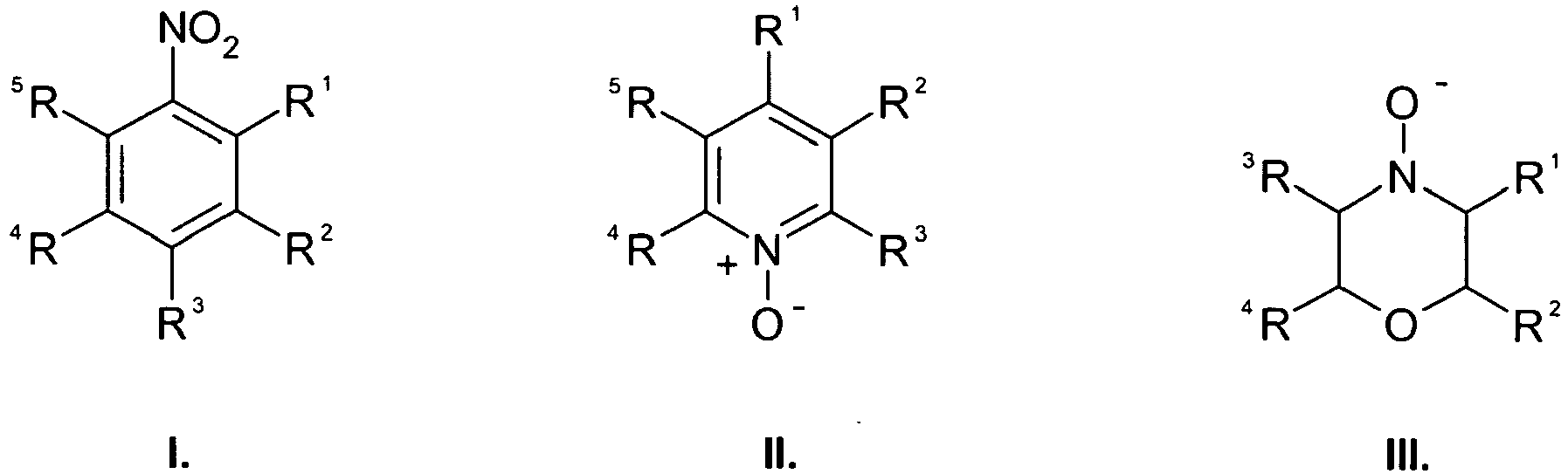
- Bevorzugte organische Verbindungen werden aus der Gruppe bestehend aus Verbindungen gemäß den Formeln I., III., IV. und V. ausgewählt wobei R1 bis R5 unabhängig voneinander
- a) ein Wasserstoffatom oder eine Alkylgruppe mit 1 bis 10 Kohlenstoffatomen, linear oder verzweigt oder
- b) eine -NR2, -NO2, -COOR, -OR, -SO3R Gruppe mit R = -H oder Alkylgruppe mit 1 bis 5 Kohlenstoffatomen, linear oder verzweigt, darstellen, wobei Methlyl-, Ethyl-, n-Propyl- und Isopropyl besonders bevorzugt sind mit der Maßgabe, dass 0 bis 2 Reste R1 bis R5 ausgewählt sind aus der Gruppe b).
- Besonders bevorzugte organische Verbindungen werden aus der Gruppe bestehend aus Verbindungen gemäß Formel I. ausgewählt, wobei R1 bis R5 unabhängig voneinander
- a) ein Wasserstoffatom oder eine Alkylgruppe mit 1 bis 10 Kohlenstoffatomen, linear oder verzweigt oder
- b) eine -NR2, -NO2, -COOR, -OR, -SO3R Gruppe mit R = -H oder Alkylgruppe mit 1 bis 5 Kohlenstoffatomen, linear oder verzweigt, darstellen, wobei Methlyl-, Ethyl-, n-Propyl- und Isopropyl besonders bevorzugt sind
- Beispiele für geeignete Verbindungsklassen sind z.B. Nitrobenzoesäuren, Nitrosalicylsäuren, Nitrophenole, Dinitrophenole, Trinitrophenole, Nitropropionsäure, Pyridin-N-oxide, Morpholin-N-oxide sowie Benzochinone. Geeignete Verbindungen im Sinne der Erfindung sind daher z.B. m-Nitrobenzoesäure, 2-Hydroxy-5-nitrobenzoesäure, 3,5-Dinitrosalicylsäure, 2,4-Dinitrophenol, m-Nitrobenzolsulfonsäure, N-Methylmorpholin-N-oxid, Pyridin-N-oxid sowie p-Benzochinon.
- Überraschenderweise stellte sich weiterhin heraus, dass bei Verwendung organischer Oxidationsmittel wie Chinonen, N-Oxiden sowie aromatischer Nitroverbindungen wie Nitrobenzoesäuren, Nitrophenolen, insbesondere Nitrobenzolsulfonsäuren wie z.B. m-Nitrobenzolsulfonsäure der Korrosionsschutz der erzeugten Konversionsschichten signifikant über dem liegt, der durch entsprechende nitrathaltige Passivierungen erreicht werden kann. Dies gilt insbesondere für Konversionsschichten, die durch Einbau von Metallpartikeln von Eisen, Cobalt oder Nickel oder Partikeln schwarzer bzw. schwärzender Metallverbindungen von Verbindungen der genannten Metalle schwarz bzw. dunkel pigmentiert sind.
- Höchstwahrscheinlich ist dies neben einer anderen Kinetik der Zinkoxidation und damit des Konversionsschichtwachstums auch auf korrosionsinhibierende Eigenschaften der in der Passivierungsschicht mit abgeschiedenen bzw. adsorbierten Reduktionsprodukte der organischen Oxidationsmittel, die ihrerseits gute Reduktionsmittel sind, zurückzuführen. Beispiele für mögliche Reduktionsreaktionen sind in Gleichung 1 angegeben.
-


- Ein weiterer Vorteil der erfindungsgemäßen Komponenten besteht darin, dass sie keine freies Nitrat aufweisen und damit in Lösungen zur Erzeugung von Konversionsschichten eingesetzt werden können, die Farbstoffe mit Aminogruppen enthalten. Der Nachteil der im Stand der Technik bekannten Verwendung von Nitrationen zur Erzeugung der Konversionsschicht besteht darin, dass das Nitrat zu Nitrit reduziert wird. Dieses Nitrit kann in der stark sauren Lösung zur Bildung der Konversionsschicht mit aminohaltigen Farbstoffen Diazotierungsreaktionen eingehen, die zu undefinierten Farbstoffprodukten reagieren, die nicht mehr die gewünschte Oberflächenfarbe der Konversionsschicht ergeben. Solche Reaktionen gehen organisch gebundene NO-Gruppen gemäß der Formeln I. - III. nicht ein.
- Erfindungsgemäße wässrige Behandlungslösungen enthalten zwischen 0.2 g/l und 20 g/l Chrom(III), bevorzugt zwischen 0.5 g/l und 15 g/l Chrom(III)-Ionen und besonders bevorzugt zwischen 1 g/l und 5 g/l Chrom(III)-Ionen. Zu der Lösung werden keine Cr(VI)-Salze gegeben. Als Anionen können beispielsweise Methansulfonat, Sulfat, Hydrogensulfat, Borate, sowie die Anionen saurer Borsäureester, Phosphat, Hydrogenphosphat, Dihydrogenphosphat, Nitrat, Nitrit, Chlorid, Iodid, Fluorid, Hexafluorosilikat, Hexafluorotitanat, Tetrafluoroborat, Hexafluoroantimonat, Hexafluorphosphat, Phosphat, Hydrogenphosphat, Dihydrogenphosphat bzw. entsprechende Anionen von Estern der Phosphorsäure enthalten. Chrom(III) kann den Lösungen entweder in Form eines Chrom(III)-Salzes wie z.B. basisches Chrom(III)-sulfat, Chrom(III)-hydroxid, Chrom(III)-dihydrogenphosphat, Chrom(III)-chlorid, Kaliumchrom(III)-sulfat oder Chrom(III)-Salzen organischer Säuren wie z.B. Chrom(III)-methansulfonat, Chrom(III)-citrat zugegeben werden.
- Daneben können Komplexbildner eingesetzt werden wie z.B. Polycarbonsäuren, Hydroxycarbonsäuren, Hydroxypolycarbonsäuren, Aminocarbonsäuren oder Hydroxyphosphonsäuren. Beispiele für mögliche Carbonsäuren sind Oxalsäure, Malonsäure, Bernsteinsäure, Glutarsäure, Adipinsäure, Pimelinsäure, Korksäure, Azelainsäure, Sebazinsäure, Maleinsäure, Phthalsäure, Terephthalsäure, Weinsäure, Citronensäure, Äpfelsäure, Ascorbinsäure, Ethylendinitrilotetraessigsäure, Tetrahydrofuran-2-carbonsäure, Maleinsäure, Ethylendiamintetraessigsäure, Diethylendiaminpentaessigsäure, Nitrilotriessigsäure, Milchsäure, Adipinsäure, 4-Aminohippursäure, 4-Aminobezoesäure, 5-Aminoisophthalsäure, L-Asparaginsäure, L-Glutamin, L-Glutaminsäure, Alanin, beta-Alanin, L-Arginin, L-Asparagin, L- Alanin, N,N-Bis(2-hydroxyethyl)-glycin, L-Cystein, L-Cystin, Glutathion, Glycin, Glycylglycin, L-Histidin, L-Hydroxyprolin, L-Isoleucin, L-Leucin, L-Lysin, L-Methionin, L-Ornithin, L-Phenylalanin, L-Prolin, L-Serin, L-Tyrosin, L-Tryptophan, L-Threonin, L-Valin, N-[Tris(hydroxymethyl)-methyl]-glycin, L-Citrullin, N-Acetyl-L-cystein, N-(2-Acetamindo)-iminodiessigsäure, 1,2-Cyclohexeylen-dinitrilotetraessigsäure, D(+)-Biotin, L-Norleucin, 5-Aminolävulinsäure, DL-Methionin, 3-Aminobenzoesäure, 6-Aminohexansäure, Acetylendicarbonsäure, Pyridin-2,3-dicarbonsäure, (-)-Chinasäure, 4-Amino-2-hydroxybenzoesäure, Pyridin-2,6-dicarbonsäure, Pyridin-2-carbonsäure, Pyrazin-2,3-dicarbonsäure, Pyrazin-2-carbonsäure, Pyridin-4-carbonsäure, 3,5-Diyhdroxybenzoesäure, 2,4-Dihydroxybenzoesäure, Sebacinsäure, Benzol-1,3,5-tricarbonsäure, Furan-2-carbonsäure, Methylenbernsteinsäure, DL-Mandelsäure, DLalpha-Aminophenylessigsäure, DL-Tropasäure, 2,2'-Thiodiessigsäure, 3,3'-Thiodipropionsäure, 3-(2-Furyl)-acrylsäure, Piperidin-4-carbonsäure, 4-Guanidinobenzoesäure, L-Homoserin, trans-Propen-1,2,3-tricarbonsäure, (R)-(-)-Citramalsäure, (3-Hydroxyphenyl)-essigsäure, 4-Hydroxychinolin-2-carbonsäure, N-Acetyl-L-glutaminsäure, N-Acetyl-DL-valin, 4-Aminohippursäure, 2,6-Dihydroxybenzoesäure, 4-(Dimethylamino)-benzoesäure, Glucuronsäure, Citrazinsäure, Indol-3-carbonsäure, Indol-5-carbonsäure, Butan-1,2,3,4-tetracarbonsäure, DL-Leucin, 2,2-Bis-(hydroxymethyl)-propionsäure, Chinlin-2,4-dicarbonsäure, 2-Aminopyridin-3-carbonsäure, 5-Amino-2-hydroxybenzoesäure, Anthranilsäure, Benzol-1,2,4-tricarbonsäure, 3,5-Diaminobenzoesäure, 4,8-Dihydroxychinolin-2-carbonsäure, 3,3-Dimethylglutarsäure, trans,trans-2,4-Haxadiensäure, 3-Hydroxybuttersäure, o-Hydroxyhippursäure, (4-Hydroxyphenyl)-essigsäure, Imidazol-4-acrylsäure, Indol-2-carbonsäure, Indol-3-propionsäure, Mercaptobernsteinsäure, 3-Oxoglutarsäure, Pyridin-2,4-dicarbonsäure, Pyridin-3,5-dicarbonsäure, 2-Methylalanin, 2-Sulfobenzoesäure, Pyridin-2,5-dicarbonsäure, Gluconsäure, 4-Aminobenzoesäure, (-)-Shikiminsäure, Chinaldinsäure, 5-Hydroxyisophthalsäure, Pyrazol-3,5-dicarbonsäuren, Pyridin-3,4-dicarbonsäure, 1,2-Diaminopropan-tetraessigsäure, 2-Pyridylessigsäure,D-Norvalin, 2-Methylglutarsäure, 2,3-Dibrombernsteinsäure, 3-Methylglutarsäure, (2-Hydroxyphenyl)essigsäure, 3,4-Dihydroxybenzoesäure, Diglycolsäure, Propan-1,2,3-tricarbonsäure, 2,3-Dimethylaminopropionsäure, 2,5-Dihydroxybenzoesäure, 2-Hydroxyisobuttersäure, Phenylbemsteinsäure, N-Phenylglycin, 1-Aminocylcohexancarbonsäure, Sarcosin, Tropasäure, Azelainsäure, Brenzschleimsäure, sowie Schleimsäure. Es können neben den Säuren auch alle Anhydride, Salze, Nitrile u.a. Verbindungen, die im sauren Milieu als Quelle für die Carbonsäuren fungieren können eingesetzt werden. Beispiele chiraler Verbindungen sind nicht auf die angegebene Konfiguration beschränkt; es können auch Diasteromere, Enantiomere oder Racemate der angegebenen Verbindungen eingesetzt werden.
- Diese Aufzählung möglicher Komplexbildner gibt lediglich Beispiele für geeignete Verbindungen, begrenzt die Gruppe der erfindungsgemäß einsetzbaren Substanzen aber nicht auf die genannten Substanzen. Die Konzentration der Komplexbildner in den Behandlungslösungen kann zwischen 0.05 g/l und der Löslichkeitsgrenze der Komplexbildner liegen.
- Die Behandlungslösungen können ferner weiterhin eine oder mehrere oberflächenaktive Substanzen wie z.B. Oxo-alkoholethoxylate (z.B. Lugalvan ON110, BASF), Fettalkoholethoxylate (z.B. Ethylan CPG 660, Julius Hoesch GmbH), oder Tenside mit fluorierten Resten (z.B. Novec FC-4432, 3M) und zwischen 0.01 g/l und 10 g/l eines weiteren Metallions oder Metalloidion wie z.B. Sc, Y, Ti, Zr, Mo, W, Mn, Fe, Co, Ni, Zn, B, Al, Si, P enthalten.
- Es wird eine wässrige Behandlungslösung angesetzt, die 3.0 g/l Cr3+ (aus Chrom(III)-chlorid Hexahydrat), 2 g/l Co2+ (aus Cobaltsulfat Heptahydrat) sowie 8 g/l PO4 3- (aus ortho-Phosphorsäure) und 2.5 g/l Fe2+ (aus Eisen(III)-sulfat Heptahydrat) sowie eine erfindungsgemäße Verbindung bzw. Nitrat gemäß Vergleichsbeispiel gemäß Tabelle 1 enthält. Die Behandlungslösung wird mit Salpetersäure / Natriumhydroxid auf einen pH-Wert von 1.6 eingestellt. In einem alkalischen Verzinkungsverfahren (Protolux 3000, Atotech Deutschland GmbH) wird ein Blech aus niedriglegiertem Stahl mit 10 µm Zink beschichtet. Das Blech wird in 0.3 Gew.%iger Salpetersäure für 10 s aktiviert, dreifach mit demin. Wasser gespült und für 60 s in die oben beschriebene Behandlungslösung getaucht. Die Lösung wird hierbei gerührt. Nach Entnehmen des Bleches wird dieses mit demin. Wasser dreifach gespült und bei 80 °C für 10 min im Umluftofen getrocknet. Das schwarze Blech zeigt im neutralen Salzsprühnebeltest nach DIN EN ISO 9227 nach 6 h erste Ansätze zur Zinkkorrosion. Ein analog hergestelltes Blech wird mit einer organisch-silikatischen Versiegelung (z.B. Corrosil Plus 501, Atotech Deutschland GmbH) behandelt und im Umluftofen bei 80 °C für 10 min getrocknet. Das Blech wird im neutralen Salzsprühnebeltest nach DIN EN ISO 9227 geprüft. Die Zeitdauer in h, bis erste Anzeichen von Zinkkorrosion erkennbar sind, ist in Tabelle 1 wiedergegeben.
Tabelle 1: Versuche mit Konversionsschichten Versuch Nr. Erfindungsgemäße Verbindung Menge / g/l Korrosionstest 1 Nitrobenzolsulfonsäure (Natriumsalz) 9.3 96 h 2 Pyridin-N-oxid 10.0 96 h 3 Benzochinon 6.0 96 h 4 (Vergleich) Natriumnitrat 3.5 48 h

Claims (10)
- Verwendung mindestens einer organischen Verbindung, ausgewählt aus der Gruppe enthaltend:

 a) ein Wasserstoffatom oder eine Alkylgruppe mit 1 bis 10 Kohlenstoffatomen, linear oder verzweigt oderb) eine -NR2, -NO2, -COOR, -OR, -SO3R Gruppe mit R = -H oder Alkylgruppe mit 1 bis 5 Kohlenstoffatomen, linear oder verzweigt, darstellen,und der Maßgabe, dass 0 bis 2 Reste R1 bis R5 ausgewählt sind aus der Gruppe b)
in einer Cr3+-Ionen haltigen, wässrigen Behandlungslösung zur Erzeugung von im wesentlichen Chrom(VI)-freien Konversionsschichten auf Zink- oder Zinklegierungsschichten
zur Vermeidung der Bildung von Stickstoffoxiden bei der Abscheidung der Konversionsschichten. - Verwendung gemäß Anspruch 1, dadurch gekennzeichnet, dass die organische Verbindung ausgewählt ist aus der Gruppe umfassend

 a) ein Wasserstoffatom oder eine Alkylgruppe mit 1 bis 10 Kohlenstoffatomen, linear oder verzweigt oderb) eine -NR2, -NO2, -COOR, -OR, -SO3R Gruppe mit R = -H oder Alkylgruppe mit 1 bis 5 Kohlenstoffatomen, linear oder verzweigt, darstellen,und der Maßgabe, dass 0 bis 2 Reste R1 bis R5 ausgewählt sind aus der Gruppe b).
 - Verwendung gemäß einem der vorstehenden Ansprüche, dadurch gekennzeichnet, dass die organische Verbindung ausgewählt ist aus der Gruppe umfassend
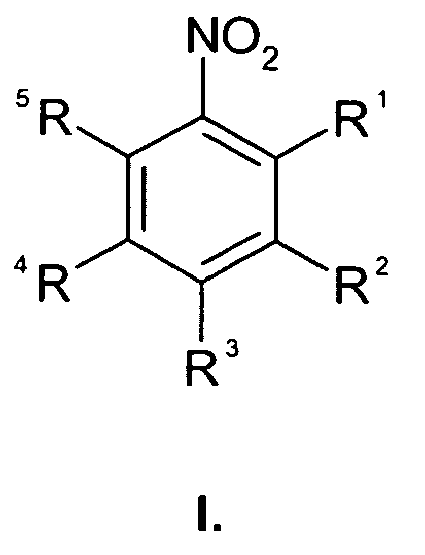 a) ein Wasserstoffatom oder eine Alkylgruppe mit 1 bis 10 Kohlenstoffatomen, linear oder verzweigt oderb) eine -NR2, -NO2, -COOR, -OR, -SO3R Gruppe mit R = -H oder Alkylgruppe mit 1 bis 5 Kohlenstoffatomen, linear oder verzweigt, darstellen,und der Maßgabe, dass 0 bis 2 Reste R1 bis R5 ausgewählt sind aus der Gruppe b).
 - Verwendung gemäß einem der vorstehenden Ansprüche, dadurch gekennzeichnet, dass die organische Verbindung ausgewählt ist aus der Gruppe enthaltend m-Nitrobenzoesäure, 2-Hydroxy-5-nitrobenzoesäure, 3,5-Dinitrosalicylsäure, 2,4-Dinitrophenol, m-Nitrobenzolsulfonsäure, N-Methylmorpholin-N-oxid, Pyridin-N-oxid, und p-Benzochinon.
- Verwendung gemäß einem der vorstehenden Ansprüche, dadurch gekennzeichnet, dass die Konzentration der organischen Verbindungen I. - V. zwischen 30 mg/l und 30 g/l der Substanz liegen.
- Verwendung gemäß einem der vorstehenden Ansprüche, dadurch gekennzeichnet, dass die Behandlungslösung zwischen 0.2 g/l und 20 g/l Chrom(III)-Ionen enthält.
- Verwendung gemäß einem der vorstehenden Ansprüche, dadurch gekennzeichnet, dass die Behandlungslösung mindestens ein Anion ausgewählt aus der Gruppe enthaltend Methansulfonat, Sulfat, Hydrogensulfat, Borat, saure Borsäureester, Phosphat, Hydrogenphosphat, Dihydrogenphosphat, Chlorid, Iodid, Fluorid, Nitrat, Hexafluorosilikat, Hexafluorotitanat, Tetrafluoroborat, Hexafluoroantimonat, Hexafluorphosphat, Phosphat, Hydrogenphosphat, Dihydrogenphosphat und Anionen von Estern der Phosphorsäure enthalten.
- Verwendung gemäß einem der vorstehenden Ansprüche, dadurch gekennzeichnet, dass die Behandlungslösung weiterhin mindestens ein Metall oder Metalloid ausgewählt aus der Gruppe enthaltend Sc, Y, Ti, Zr, Mo, W, Mn, Fe, Co, Ni, Zn, B, Al, Si, P in einer Konzentration zwischen 0.01 und 10 g/l enthält.
- Verwendung gemäß einem der vorstehenden Ansprüche, dadurch gekennzeichnet, dass die Behandlungslösung zwischen 0.05 g/l 20 g/l mindestens einen Komplexbildner ausgewählt aus der Gruppe enthaltend Polycarbonsäuren, Hydroxycarbonsäuren, Hydroxypolycarbonsäure, Aminocarbonsäuren oder Hydroxyphosphonsäuren enthält.
- Verwendung gemäß einem der vorstehenden Ansprüche, dadurch gekennzeichnet, dass die Behandlungslösung einen pH-Wert zwischen pH 0.1 und pH 7 aufweist.
Priority Applications (1)
| Application Number | Priority Date | Filing Date | Title |
|---|---|---|---|
| PL09760833T PL2358922T3 (pl) | 2008-11-27 | 2009-11-23 | Powłoki konwersyjne dla powierzchni zawierających cynk |
Applications Claiming Priority (2)
| Application Number | Priority Date | Filing Date | Title |
|---|---|---|---|
| DE102008044143A DE102008044143B4 (de) | 2008-11-27 | 2008-11-27 | Wässrige Behandlungslösung und Verfahren zur Erzeugung von Konversionsschichten für zinkhaltige Oberflächen |
| PCT/EP2009/065646 WO2010060883A1 (de) | 2008-11-27 | 2009-11-23 | Konversionsschichten für zinkhaltige oberflächen |
Publications (2)
| Publication Number | Publication Date |
|---|---|
| EP2358922A1 EP2358922A1 (de) | 2011-08-24 |
| EP2358922B1 true EP2358922B1 (de) | 2016-01-27 |
Family
ID=41479326
Family Applications (1)
| Application Number | Title | Priority Date | Filing Date |
|---|---|---|---|
| EP09760833.5A Not-in-force EP2358922B1 (de) | 2008-11-27 | 2009-11-23 | Konversionsschichten für zinkhaltige oberflächen |
Country Status (9)
| Country | Link |
|---|---|
| US (1) | US20110217476A1 (de) |
| EP (1) | EP2358922B1 (de) |
| JP (1) | JP5562347B2 (de) |
| KR (1) | KR20110089304A (de) |
| CN (1) | CN102227516B (de) |
| DE (1) | DE102008044143B4 (de) |
| ES (1) | ES2565839T3 (de) |
| PL (1) | PL2358922T3 (de) |
| WO (1) | WO2010060883A1 (de) |
Families Citing this family (10)
| Publication number | Priority date | Publication date | Assignee | Title |
|---|---|---|---|---|
| US9499700B2 (en) * | 2010-09-14 | 2016-11-22 | Yuken Industry Co., Ltd. | Finishing agent for chemical conversion coating and method for producing same |
| WO2016104703A1 (ja) * | 2014-12-26 | 2016-06-30 | ディップソール株式会社 | 亜鉛又は亜鉛合金基材用3価クロム化成処理液及び化成皮膜 |
| US20160348245A1 (en) * | 2015-05-28 | 2016-12-01 | Macdermid, Incorporated | Method of Pretreatment for Electroless Plating |
| EP3156518A1 (de) * | 2015-10-14 | 2017-04-19 | Helmholtz-Zentrum Geesthacht Zentrum für Material- und Küstenforschung GmbH | Korrosionsschutz-zusammensetzung für magnesium und magnesiumlegierungen |
| CN105937031B (zh) * | 2016-06-29 | 2018-10-30 | 周少霞 | 一种热镀锌板用钝化液的制备方法 |
| US12486579B2 (en) | 2018-01-30 | 2025-12-02 | Prc-Desoto International, Inc. | Systems and methods for treating a metal substrate |
| KR101998606B1 (ko) * | 2018-11-21 | 2019-07-10 | 주식회사 지에스켐텍 | 아연-니켈 도금용 3가 크로메이트계 흑색 내식성 향상제 및 이를 이용한 아연-니켈 도금층의 표면처리방법 |
| US20220411934A1 (en) * | 2019-12-20 | 2022-12-29 | Atotech Deutschland GmbH & Co. KG | Passivation composition and method for depositing a chromium-comprising passivation layer on a zinc or zinc-nickel coated substrate |
| GB2603194A (en) | 2021-02-01 | 2022-08-03 | Henkel Ag & Co Kgaa | Improved cr(iii) based dry-in-place coating composition for zinc coated steel |
| CN114592186B (zh) * | 2022-04-27 | 2024-03-12 | 上海库曜新材料有限公司 | 一种锌粉的无铬钝化方法 |
Family Cites Families (14)
| Publication number | Priority date | Publication date | Assignee | Title |
|---|---|---|---|---|
| GB715607A (en) * | 1948-07-23 | 1954-09-15 | Pyrene Co Ltd | Improvements in or relating to the coating of ferrous surfaces |
| DE1933013C3 (de) * | 1969-06-28 | 1978-09-21 | Gerhard Collardin Gmbh, 5000 Koeln | Verfahren zur Erzeugung von Schutzschichten auf Aluminium, Eisen und Zink mittels komplexe Fluoride enthaltender Lösungen |
| US4349392A (en) | 1981-05-20 | 1982-09-14 | Occidental Chemical Corporation | Trivalent chromium passivate solution and process |
| US4384902A (en) | 1981-06-15 | 1983-05-24 | Occidental Chemical Corporation | Trivalent chromium passivate composition and process |
| DE19615664A1 (de) | 1996-04-19 | 1997-10-23 | Surtec Produkte Und Systeme Fu | Chrom(VI)freie Chromatschicht sowie Verfahren zu ihrer Herstellung |
| CA2300276A1 (en) * | 1997-08-06 | 1999-02-18 | Henkel Kommanditgesellschaft Auf Aktien | Phosphating method accelerated by n-oxides |
| JP3332373B1 (ja) | 2001-11-30 | 2002-10-07 | ディップソール株式会社 | 亜鉛及び亜鉛合金めっき上に六価クロムフリー防錆皮膜を形成するための処理溶液、六価クロムフリー防錆皮膜及びその形成方法。 |
| US20040156999A1 (en) | 2003-02-07 | 2004-08-12 | Pavco, Inc. | Black trivalent chromium chromate conversion coating |
| DE102005025830B4 (de) * | 2005-06-02 | 2010-04-08 | Walter Hillebrand Gmbh & Co. Kg Galvanotechnik | Zink-Nickel-Schwarzpassivierung und Verfahren zur Passivierung |
| JP5198727B2 (ja) * | 2005-10-07 | 2013-05-15 | ディップソール株式会社 | 亜鉛又は亜鉛合金上に黒色の6価クロムフリー化成皮膜を形成するための処理溶液 |
| PL1816234T3 (pl) * | 2006-01-31 | 2009-10-30 | Atotech Deutschland Gmbh | Reakcyjny roztwór wodny oraz metoda pasywacji cynku i stopów cynku |
| ATE509138T1 (de) * | 2007-03-05 | 2011-05-15 | Atotech Deutschland Gmbh | Chrom(vi)-freie schwarzpassivierung für zink- haltige oberflächen |
| JP5584922B2 (ja) * | 2007-12-19 | 2014-09-10 | ディップソール株式会社 | 亜鉛又は亜鉛合金めっき上に3価クロム化成処理皮膜を形成させるための3価クロム化成処理液 |
| DE102008000600B4 (de) * | 2008-03-11 | 2010-05-12 | Chemetall Gmbh | Verfahren zur Beschichtung von metallischen Oberflächen mit einem Passivierungsmittel, das Passivierungsmittel, die hiermit erzeugte Beschichtung und ihre Verwendung |
-
2008
- 2008-11-27 DE DE102008044143A patent/DE102008044143B4/de not_active Expired - Fee Related
-
2009
- 2009-11-23 WO PCT/EP2009/065646 patent/WO2010060883A1/de not_active Ceased
- 2009-11-23 EP EP09760833.5A patent/EP2358922B1/de not_active Not-in-force
- 2009-11-23 JP JP2011537953A patent/JP5562347B2/ja not_active Expired - Fee Related
- 2009-11-23 US US13/125,357 patent/US20110217476A1/en not_active Abandoned
- 2009-11-23 CN CN200980147454.9A patent/CN102227516B/zh not_active Expired - Fee Related
- 2009-11-23 KR KR1020117011981A patent/KR20110089304A/ko not_active Ceased
- 2009-11-23 PL PL09760833T patent/PL2358922T3/pl unknown
- 2009-11-23 ES ES09760833.5T patent/ES2565839T3/es active Active
Also Published As
| Publication number | Publication date |
|---|---|
| DE102008044143A1 (de) | 2010-06-02 |
| EP2358922A1 (de) | 2011-08-24 |
| US20110217476A1 (en) | 2011-09-08 |
| DE102008044143B4 (de) | 2011-01-13 |
| CN102227516B (zh) | 2015-07-22 |
| PL2358922T3 (pl) | 2016-07-29 |
| ES2565839T3 (es) | 2016-04-07 |
| JP2012509994A (ja) | 2012-04-26 |
| KR20110089304A (ko) | 2011-08-05 |
| CN102227516A (zh) | 2011-10-26 |
| WO2010060883A1 (de) | 2010-06-03 |
| JP5562347B2 (ja) | 2014-07-30 |
Similar Documents
| Publication | Publication Date | Title |
|---|---|---|
| DE102008044143B4 (de) | Wässrige Behandlungslösung und Verfahren zur Erzeugung von Konversionsschichten für zinkhaltige Oberflächen | |
| EP1970470B1 (de) | Chrom(VI)-freie Schwarzpassivierung für Zink-haltige Oberflächen | |
| EP2014793B1 (de) | Korrosionsschutzbehandlung für Konversionsschichten | |
| EP3455392A1 (de) | Konversionsschichten für metallische oberflächen | |
| US20050178475A9 (en) | Corrosion resistant trivalent chromium phosphated chemical conversion coatings | |
| EP1944390B1 (de) | Behandlungslösung zur bildung eines schwarzen, von sechswertigem chrom freien films durch chemische konversionsbeschichtung auf zink oder zinklegierung | |
| KR102077559B1 (ko) | 광택유지 안정성이 우수한 아연 도금용 3가 크로메이트계 흑색 내식성 향상제, 이의 제조방법 및 이를 이용한 아연 도금층의 표면처리방법 | |
| KR102077555B1 (ko) | 아연-니켈 도금용 3가 크로메이트계 유색 내식성 향상제, 이의 제조방법 및 이를 이용한 아연-니켈 도금층의 표면처리방법 | |
| EP1816234B1 (de) | Wässrige Reaktionslösung und Verfahren zur Passivierung von Zink- und Zinklegierungen | |
| KR20050052215A (ko) | 아연 도금재 내식성 향상을 위한 3가 크롬 크로메이트코팅용액 조성물 및 그 제조방법 | |
| EP2319957B1 (de) | Schwarzpassivierung von Zink- und Zinkeisenschichten | |
| EP2309027B1 (de) | Behandlungslösung zur Erzeugung Chrom- und Cobalt-freier schwarzer Konversionsschichten | |
| DE102011013319B4 (de) | Zusammensetzung und Anwendungslösung zum Passivieren von Zink und seinen Legierungen | |
| DE10305449A1 (de) | Pigmenthaltiges Stoffgemisch zur Erzeugung farbiger Passivierungsschichten | |
| KR101655426B1 (ko) | 아연-니켈계 합금의 방청처리용 3가 크로메이트 조성물 및 그의 제조방법 | |
| EP3889318B1 (de) | Verfahren zur herstellung einer schwarzpassivierungsschicht auf einer zink-eisen-legierung und schwarzpassivierungszusammensetzung | |
| JP6158648B2 (ja) | クロムフリー化成処理液および化成処理方法 | |
| EP4715087A1 (de) | Zusammensetzung zur schwarzwertigen chromumwandlungsbehandlung und verfahren zur herstellung eines mit einem umwandlungsbeschichtungsfilm ausgestatteten elements | |
| CN121451167A (zh) | 一种热镀锌钝化液及其制备方法和应用 |
Legal Events
| Date | Code | Title | Description |
|---|---|---|---|
| PUAI | Public reference made under article 153(3) epc to a published international application that has entered the european phase |
Free format text: ORIGINAL CODE: 0009012 |
|
| 17P | Request for examination filed |
Effective date: 20110616 |
|
| AK | Designated contracting states |
Kind code of ref document: A1 Designated state(s): AT BE BG CH CY CZ DE DK EE ES FI FR GB GR HR HU IE IS IT LI LT LU LV MC MK MT NL NO PL PT RO SE SI SK SM TR |
|
| DAX | Request for extension of the european patent (deleted) | ||
| RAP1 | Party data changed (applicant data changed or rights of an application transferred) |
Owner name: ATOTECH DEUTSCHLAND GMBH |
|
| GRAP | Despatch of communication of intention to grant a patent |
Free format text: ORIGINAL CODE: EPIDOSNIGR1 |
|
| INTG | Intention to grant announced |
Effective date: 20151006 |
|
| GRAS | Grant fee paid |
Free format text: ORIGINAL CODE: EPIDOSNIGR3 |
|
| GRAA | (expected) grant |
Free format text: ORIGINAL CODE: 0009210 |
|
| AK | Designated contracting states |
Kind code of ref document: B1 Designated state(s): AT BE BG CH CY CZ DE DK EE ES FI FR GB GR HR HU IE IS IT LI LT LU LV MC MK MT NL NO PL PT RO SE SI SK SM TR |
|
| REG | Reference to a national code |
Ref country code: GB Ref legal event code: FG4D Free format text: NOT ENGLISH |
|
| REG | Reference to a national code |
Ref country code: CH Ref legal event code: EP |
|
| REG | Reference to a national code |
Ref country code: AT Ref legal event code: REF Ref document number: 772764 Country of ref document: AT Kind code of ref document: T Effective date: 20160215 |
|
| REG | Reference to a national code |
Ref country code: IE Ref legal event code: FG4D Free format text: LANGUAGE OF EP DOCUMENT: GERMAN |
|
| REG | Reference to a national code |
Ref country code: DE Ref legal event code: R096 Ref document number: 502009012096 Country of ref document: DE |
|
| REG | Reference to a national code |
Ref country code: ES Ref legal event code: FG2A Ref document number: 2565839 Country of ref document: ES Kind code of ref document: T3 Effective date: 20160407 |
|
| REG | Reference to a national code |
Ref country code: LT Ref legal event code: MG4D |
|
| REG | Reference to a national code |
Ref country code: NL Ref legal event code: MP Effective date: 20160127 |
|
| PG25 | Lapsed in a contracting state [announced via postgrant information from national office to epo] |
Ref country code: NL Free format text: LAPSE BECAUSE OF FAILURE TO SUBMIT A TRANSLATION OF THE DESCRIPTION OR TO PAY THE FEE WITHIN THE PRESCRIBED TIME-LIMIT Effective date: 20160127 |
|
| PG25 | Lapsed in a contracting state [announced via postgrant information from national office to epo] |
Ref country code: GR Free format text: LAPSE BECAUSE OF FAILURE TO SUBMIT A TRANSLATION OF THE DESCRIPTION OR TO PAY THE FEE WITHIN THE PRESCRIBED TIME-LIMIT Effective date: 20160428 Ref country code: FI Free format text: LAPSE BECAUSE OF FAILURE TO SUBMIT A TRANSLATION OF THE DESCRIPTION OR TO PAY THE FEE WITHIN THE PRESCRIBED TIME-LIMIT Effective date: 20160127 Ref country code: NO Free format text: LAPSE BECAUSE OF FAILURE TO SUBMIT A TRANSLATION OF THE DESCRIPTION OR TO PAY THE FEE WITHIN THE PRESCRIBED TIME-LIMIT Effective date: 20160427 Ref country code: HR Free format text: LAPSE BECAUSE OF FAILURE TO SUBMIT A TRANSLATION OF THE DESCRIPTION OR TO PAY THE FEE WITHIN THE PRESCRIBED TIME-LIMIT Effective date: 20160127 |
|
| PG25 | Lapsed in a contracting state [announced via postgrant information from national office to epo] |
Ref country code: SE Free format text: LAPSE BECAUSE OF FAILURE TO SUBMIT A TRANSLATION OF THE DESCRIPTION OR TO PAY THE FEE WITHIN THE PRESCRIBED TIME-LIMIT Effective date: 20160127 Ref country code: PT Free format text: LAPSE BECAUSE OF FAILURE TO SUBMIT A TRANSLATION OF THE DESCRIPTION OR TO PAY THE FEE WITHIN THE PRESCRIBED TIME-LIMIT Effective date: 20160527 Ref country code: LT Free format text: LAPSE BECAUSE OF FAILURE TO SUBMIT A TRANSLATION OF THE DESCRIPTION OR TO PAY THE FEE WITHIN THE PRESCRIBED TIME-LIMIT Effective date: 20160127 Ref country code: LV Free format text: LAPSE BECAUSE OF FAILURE TO SUBMIT A TRANSLATION OF THE DESCRIPTION OR TO PAY THE FEE WITHIN THE PRESCRIBED TIME-LIMIT Effective date: 20160127 Ref country code: IS Free format text: LAPSE BECAUSE OF FAILURE TO SUBMIT A TRANSLATION OF THE DESCRIPTION OR TO PAY THE FEE WITHIN THE PRESCRIBED TIME-LIMIT Effective date: 20160527 |
|
| REG | Reference to a national code |
Ref country code: DE Ref legal event code: R097 Ref document number: 502009012096 Country of ref document: DE |
|
| PG25 | Lapsed in a contracting state [announced via postgrant information from national office to epo] |
Ref country code: EE Free format text: LAPSE BECAUSE OF FAILURE TO SUBMIT A TRANSLATION OF THE DESCRIPTION OR TO PAY THE FEE WITHIN THE PRESCRIBED TIME-LIMIT Effective date: 20160127 Ref country code: DK Free format text: LAPSE BECAUSE OF FAILURE TO SUBMIT A TRANSLATION OF THE DESCRIPTION OR TO PAY THE FEE WITHIN THE PRESCRIBED TIME-LIMIT Effective date: 20160127 |
|
| REG | Reference to a national code |
Ref country code: FR Ref legal event code: PLFP Year of fee payment: 8 |
|
| PG25 | Lapsed in a contracting state [announced via postgrant information from national office to epo] |
Ref country code: RO Free format text: LAPSE BECAUSE OF FAILURE TO SUBMIT A TRANSLATION OF THE DESCRIPTION OR TO PAY THE FEE WITHIN THE PRESCRIBED TIME-LIMIT Effective date: 20160127 Ref country code: SM Free format text: LAPSE BECAUSE OF FAILURE TO SUBMIT A TRANSLATION OF THE DESCRIPTION OR TO PAY THE FEE WITHIN THE PRESCRIBED TIME-LIMIT Effective date: 20160127 Ref country code: SK Free format text: LAPSE BECAUSE OF FAILURE TO SUBMIT A TRANSLATION OF THE DESCRIPTION OR TO PAY THE FEE WITHIN THE PRESCRIBED TIME-LIMIT Effective date: 20160127 |
|
| PLBE | No opposition filed within time limit |
Free format text: ORIGINAL CODE: 0009261 |
|
| STAA | Information on the status of an ep patent application or granted ep patent |
Free format text: STATUS: NO OPPOSITION FILED WITHIN TIME LIMIT |
|
| 26N | No opposition filed |
Effective date: 20161028 |
|
| PG25 | Lapsed in a contracting state [announced via postgrant information from national office to epo] |
Ref country code: BG Free format text: LAPSE BECAUSE OF FAILURE TO SUBMIT A TRANSLATION OF THE DESCRIPTION OR TO PAY THE FEE WITHIN THE PRESCRIBED TIME-LIMIT Effective date: 20160427 Ref country code: BE Free format text: LAPSE BECAUSE OF NON-PAYMENT OF DUE FEES Effective date: 20161130 Ref country code: SI Free format text: LAPSE BECAUSE OF FAILURE TO SUBMIT A TRANSLATION OF THE DESCRIPTION OR TO PAY THE FEE WITHIN THE PRESCRIBED TIME-LIMIT Effective date: 20160127 |
|
| REG | Reference to a national code |
Ref country code: CH Ref legal event code: PL |
|
| GBPC | Gb: european patent ceased through non-payment of renewal fee |
Effective date: 20161123 |
|
| PG25 | Lapsed in a contracting state [announced via postgrant information from national office to epo] |
Ref country code: LI Free format text: LAPSE BECAUSE OF NON-PAYMENT OF DUE FEES Effective date: 20161130 Ref country code: CH Free format text: LAPSE BECAUSE OF NON-PAYMENT OF DUE FEES Effective date: 20161130 |
|
| REG | Reference to a national code |
Ref country code: IE Ref legal event code: MM4A |
|
| PG25 | Lapsed in a contracting state [announced via postgrant information from national office to epo] |
Ref country code: LU Free format text: LAPSE BECAUSE OF NON-PAYMENT OF DUE FEES Effective date: 20161130 |
|
| REG | Reference to a national code |
Ref country code: FR Ref legal event code: PLFP Year of fee payment: 9 |
|
| PG25 | Lapsed in a contracting state [announced via postgrant information from national office to epo] |
Ref country code: IE Free format text: LAPSE BECAUSE OF NON-PAYMENT OF DUE FEES Effective date: 20161123 Ref country code: GB Free format text: LAPSE BECAUSE OF NON-PAYMENT OF DUE FEES Effective date: 20161123 |
|
| REG | Reference to a national code |
Ref country code: AT Ref legal event code: MM01 Ref document number: 772764 Country of ref document: AT Kind code of ref document: T Effective date: 20161123 |
|
| PG25 | Lapsed in a contracting state [announced via postgrant information from national office to epo] |
Ref country code: AT Free format text: LAPSE BECAUSE OF NON-PAYMENT OF DUE FEES Effective date: 20161123 |
|
| REG | Reference to a national code |
Ref country code: BE Ref legal event code: MM Effective date: 20161130 |
|
| PG25 | Lapsed in a contracting state [announced via postgrant information from national office to epo] |
Ref country code: HU Free format text: LAPSE BECAUSE OF FAILURE TO SUBMIT A TRANSLATION OF THE DESCRIPTION OR TO PAY THE FEE WITHIN THE PRESCRIBED TIME-LIMIT; INVALID AB INITIO Effective date: 20091123 Ref country code: CY Free format text: LAPSE BECAUSE OF FAILURE TO SUBMIT A TRANSLATION OF THE DESCRIPTION OR TO PAY THE FEE WITHIN THE PRESCRIBED TIME-LIMIT Effective date: 20160127 |
|
| PG25 | Lapsed in a contracting state [announced via postgrant information from national office to epo] |
Ref country code: MK Free format text: LAPSE BECAUSE OF FAILURE TO SUBMIT A TRANSLATION OF THE DESCRIPTION OR TO PAY THE FEE WITHIN THE PRESCRIBED TIME-LIMIT Effective date: 20160127 Ref country code: TR Free format text: LAPSE BECAUSE OF FAILURE TO SUBMIT A TRANSLATION OF THE DESCRIPTION OR TO PAY THE FEE WITHIN THE PRESCRIBED TIME-LIMIT Effective date: 20160127 Ref country code: MC Free format text: LAPSE BECAUSE OF FAILURE TO SUBMIT A TRANSLATION OF THE DESCRIPTION OR TO PAY THE FEE WITHIN THE PRESCRIBED TIME-LIMIT Effective date: 20160127 |
|
| PG25 | Lapsed in a contracting state [announced via postgrant information from national office to epo] |
Ref country code: MT Free format text: LAPSE BECAUSE OF FAILURE TO SUBMIT A TRANSLATION OF THE DESCRIPTION OR TO PAY THE FEE WITHIN THE PRESCRIBED TIME-LIMIT Effective date: 20160127 |
|
| PGFP | Annual fee paid to national office [announced via postgrant information from national office to epo] |
Ref country code: DE Payment date: 20191121 Year of fee payment: 11 |
|
| PGFP | Annual fee paid to national office [announced via postgrant information from national office to epo] |
Ref country code: FR Payment date: 20191120 Year of fee payment: 11 Ref country code: IT Payment date: 20191128 Year of fee payment: 11 Ref country code: ES Payment date: 20191220 Year of fee payment: 11 |
|
| PGFP | Annual fee paid to national office [announced via postgrant information from national office to epo] |
Ref country code: CZ Payment date: 20201120 Year of fee payment: 12 |
|
| PGFP | Annual fee paid to national office [announced via postgrant information from national office to epo] |
Ref country code: PL Payment date: 20201113 Year of fee payment: 12 |
|
| REG | Reference to a national code |
Ref country code: DE Ref legal event code: R119 Ref document number: 502009012096 Country of ref document: DE |
|
| PG25 | Lapsed in a contracting state [announced via postgrant information from national office to epo] |
Ref country code: IT Free format text: LAPSE BECAUSE OF NON-PAYMENT OF DUE FEES Effective date: 20201123 Ref country code: FR Free format text: LAPSE BECAUSE OF NON-PAYMENT OF DUE FEES Effective date: 20201130 |
|
| PG25 | Lapsed in a contracting state [announced via postgrant information from national office to epo] |
Ref country code: DE Free format text: LAPSE BECAUSE OF NON-PAYMENT OF DUE FEES Effective date: 20210601 |
|
| REG | Reference to a national code |
Ref country code: ES Ref legal event code: FD2A Effective date: 20220202 |
|
| PG25 | Lapsed in a contracting state [announced via postgrant information from national office to epo] |
Ref country code: ES Free format text: LAPSE BECAUSE OF NON-PAYMENT OF DUE FEES Effective date: 20201124 |
|
| PG25 | Lapsed in a contracting state [announced via postgrant information from national office to epo] |
Ref country code: CZ Free format text: LAPSE BECAUSE OF NON-PAYMENT OF DUE FEES Effective date: 20211123 |
|
| PG25 | Lapsed in a contracting state [announced via postgrant information from national office to epo] |
Ref country code: PL Free format text: LAPSE BECAUSE OF NON-PAYMENT OF DUE FEES Effective date: 20211123 |