EP2355211B1 - Aktives Negativelektrodenmaterial mit Nanometall-Partikeln und superleitfähigen Nanopartikeln und Lithiumbatterie mit dem aktiven Negativelektrodenmaterial - Google Patents
Aktives Negativelektrodenmaterial mit Nanometall-Partikeln und superleitfähigen Nanopartikeln und Lithiumbatterie mit dem aktiven Negativelektrodenmaterial Download PDFInfo
- Publication number
- EP2355211B1 EP2355211B1 EP10194487.4A EP10194487A EP2355211B1 EP 2355211 B1 EP2355211 B1 EP 2355211B1 EP 10194487 A EP10194487 A EP 10194487A EP 2355211 B1 EP2355211 B1 EP 2355211B1
- Authority
- EP
- European Patent Office
- Prior art keywords
- sheets
- active material
- electrode active
- negative electrode
- carbon atoms
- Prior art date
- Legal status (The legal status is an assumption and is not a legal conclusion. Google has not performed a legal analysis and makes no representation as to the accuracy of the status listed.)
- Active
Links
Images




Classifications
-
- H—ELECTRICITY
- H01—ELECTRIC ELEMENTS
- H01M—PROCESSES OR MEANS, e.g. BATTERIES, FOR THE DIRECT CONVERSION OF CHEMICAL ENERGY INTO ELECTRICAL ENERGY
- H01M4/00—Electrodes
- H01M4/02—Electrodes composed of, or comprising, active material
- H01M4/13—Electrodes for accumulators with non-aqueous electrolyte, e.g. for lithium-accumulators; Processes of manufacture thereof
- H01M4/133—Electrodes based on carbonaceous material, e.g. graphite-intercalation compounds or CFx
-
- H—ELECTRICITY
- H01—ELECTRIC ELEMENTS
- H01M—PROCESSES OR MEANS, e.g. BATTERIES, FOR THE DIRECT CONVERSION OF CHEMICAL ENERGY INTO ELECTRICAL ENERGY
- H01M10/00—Secondary cells; Manufacture thereof
- H01M10/05—Accumulators with non-aqueous electrolyte
- H01M10/052—Li-accumulators
- H01M10/0525—Rocking-chair batteries, i.e. batteries with lithium insertion or intercalation in both electrodes; Lithium-ion batteries
-
- H—ELECTRICITY
- H01—ELECTRIC ELEMENTS
- H01M—PROCESSES OR MEANS, e.g. BATTERIES, FOR THE DIRECT CONVERSION OF CHEMICAL ENERGY INTO ELECTRICAL ENERGY
- H01M4/00—Electrodes
- H01M4/02—Electrodes composed of, or comprising, active material
- H01M4/13—Electrodes for accumulators with non-aqueous electrolyte, e.g. for lithium-accumulators; Processes of manufacture thereof
- H01M4/134—Electrodes based on metals, Si or alloys
-
- H—ELECTRICITY
- H01—ELECTRIC ELEMENTS
- H01M—PROCESSES OR MEANS, e.g. BATTERIES, FOR THE DIRECT CONVERSION OF CHEMICAL ENERGY INTO ELECTRICAL ENERGY
- H01M4/00—Electrodes
- H01M4/02—Electrodes composed of, or comprising, active material
- H01M4/62—Selection of inactive substances as ingredients for active masses, e.g. binders, fillers
-
- H—ELECTRICITY
- H01—ELECTRIC ELEMENTS
- H01M—PROCESSES OR MEANS, e.g. BATTERIES, FOR THE DIRECT CONVERSION OF CHEMICAL ENERGY INTO ELECTRICAL ENERGY
- H01M4/00—Electrodes
- H01M4/02—Electrodes composed of, or comprising, active material
- H01M4/13—Electrodes for accumulators with non-aqueous electrolyte, e.g. for lithium-accumulators; Processes of manufacture thereof
- H01M4/139—Processes of manufacture
- H01M4/1393—Processes of manufacture of electrodes based on carbonaceous material, e.g. graphite-intercalation compounds or CFx
-
- H—ELECTRICITY
- H01—ELECTRIC ELEMENTS
- H01M—PROCESSES OR MEANS, e.g. BATTERIES, FOR THE DIRECT CONVERSION OF CHEMICAL ENERGY INTO ELECTRICAL ENERGY
- H01M4/00—Electrodes
- H01M4/02—Electrodes composed of, or comprising, active material
- H01M4/13—Electrodes for accumulators with non-aqueous electrolyte, e.g. for lithium-accumulators; Processes of manufacture thereof
- H01M4/139—Processes of manufacture
- H01M4/1395—Processes of manufacture of electrodes based on metals, Si or alloys
-
- Y—GENERAL TAGGING OF NEW TECHNOLOGICAL DEVELOPMENTS; GENERAL TAGGING OF CROSS-SECTIONAL TECHNOLOGIES SPANNING OVER SEVERAL SECTIONS OF THE IPC; TECHNICAL SUBJECTS COVERED BY FORMER USPC CROSS-REFERENCE ART COLLECTIONS [XRACs] AND DIGESTS
- Y02—TECHNOLOGIES OR APPLICATIONS FOR MITIGATION OR ADAPTATION AGAINST CLIMATE CHANGE
- Y02E—REDUCTION OF GREENHOUSE GAS [GHG] EMISSIONS, RELATED TO ENERGY GENERATION, TRANSMISSION OR DISTRIBUTION
- Y02E60/00—Enabling technologies; Technologies with a potential or indirect contribution to GHG emissions mitigation
- Y02E60/10—Energy storage using batteries
Definitions
- the present invention relates to a negative electrode active material including nanometal particles and super-conductive nanoparticles and a lithium battery including the negative electrode active material.
- lithium secondary batteries have drawn attention for use as power sources for portable, small electronic devices.
- the lithium secondary batteries use an organic electrolyte
- the lithium secondary batteries have a discharge voltage that is twice or greater than that of conventional batteries using an aqueous alkali electrolyte, and thus have high energy density.
- Lithium-transition metal oxides such as LiCoO 2 , LiMn 2 O 4 , LiNi 1-x Co x O 2 (0 ⁇ x ⁇ 1), which have a structure that allows intercalation of lithium ions, are typically used as positive electrode active materials for lithium secondary batteries.
- Carbonaceous materials in various forms such as artificial graphite, natural graphite and hard carbon, which allow intercalation and deintercalation of lithium ions, and non-carbonaceous materials, such as silicon (Si), have been studied for use as negative electrode active materials.
- Non-carbonaceous materials exhibit a very high capacity that is ten times or greater than that of graphite.
- the cycle lifetime characteristics thereof deteriorate due to volumetric expansion and shrinkage of the negative electrode active material during charging and discharging.
- US2009/0117467 discloses a nano-scaled graphene platelet-based composite material composition for use as an electrode.
- the composition comprises: (a) micron- or nanometer-scaled particles or coating which are capable of absorbing and desorbing lithium ions; and (b) a plurality of nano-scaled graphene platelets, wherein a platelet comprises a graphene sheet or a stack of graphene sheets having a platelet thickness less than 100 nm; wherein at least one of the particles or coating is physically attached or chemically bonded to at least one of the graphene platelets.
- a negative electrode active material including: nanometal particles and super-conductive nanoparticles, each of the super-conductive nanoparticles including n polycyclic nano-sheets, each of the n polycyclic nano-sheets including hexagonal rings, each of the hexagonal rings including 6 interconnected carbon atoms, each of the hexagonal rings being fused to at least another one of the hexagonal rings, the hexagonal rings of each of the n polycyclic nano-sheets being arranged substantially in a plane, the n polycyclic nano-sheets being stacked in a direction normal to the plane, n being an integer in the range of 2 to 100, and each of the super-conductive nanoparticles having first and second carbon atoms respectively located in the n polycyclic nano-sheets, the first carbon atom being regarded as the origin A (0, 0, 0) of an x, y, z coordinate system and the second carbon atom having a coordinate B (a, b, c); a and b
- the negative electrode active material has a median particle diameter in the range of 3 ⁇ m to 60 ⁇ m, and the diameter of the nanometal particle is in the range of 300 nm to 500 nm.
- the nanometal particle may include a material selected from the group consisting of silicon (Si), tin (Sn), nickel (Ni), and mixtures thereof.
- the adjacent bonded carbon atoms in each of the n polycyclic nano-sheets may be bonded to each other by sp 2 hybridized bonds.
- Each of the n polycyclic nano-sheets may have a thickness equal to a diameter of one of the carbon atoms ⁇ 1 nm.
- n may be an integer in the range of 2 to 10.
- the coordinate c may have a median value 50 times as large as the diameter of one of the carbon atoms ⁇ 10 nm.
- the coordinate c may have a median value in the range of about 0.1 nm to about 50 nm.
- the coordinate c may have a median value in the range of about 0.1 nm to about 20 nm.
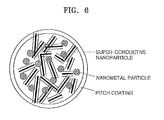
- the negative electrode active material may be pitch-coated.
- a lithium battery including: a positive electrode including a positive electrode active material; a negative electrode including a negative electrode active material including nanometal particles and super-conductive nanoparticles; and an electrolyte, each of the super-conductive nanoparticles including n polycyclic nano-sheets, each of the n polycyclic nano-sheets including hexagonal rings, each of the hexagonal rings including 6 interconnected carbon atoms, each of the hexagonal rings being fused to at least another one of the hexagonal rings, the hexagonal rings of each of the n polycyclic nano-sheets being arranged substantially in a plane, the n polycyclic nano-sheets being stacked in a direction normal to the plane, n being an integer in the range of 2 to 100, and each of the super-conductive nanoparticles having first and second carbon atoms respectively located in the n polycyclic nano-sheets, the first carbon atom being regarded as the origin A (0, 0, 0) of an x, y,
- the negative electrode active material has a median particle diameter in the range of 3 ⁇ m to 60 ⁇ m, and the diameter of the nanometal particle is in the range of 300 nm to 500 nm.
- the nanometal particle may include a material selected from the group consisting of silicon (Si), tin (Sn), nickel (Ni), and mixtures thereof.
- Adjacent bonded carbon atoms in each of the n polycyclic nano-sheets may be bonded to each other by sp 2 hybridized bonds.
- Each of the n polycyclic nano-sheets may have a thickness equal to a diameter of one of the carbon atoms ⁇ 1 nm.
- n may be an integer in the range of 2 to 10.
- the coordinate c may have a value 50 times as large as the diameter of one of the carbon atoms ⁇ 10 nm.
- the coordinate c may have a value in the range of about 0.1 nm to about 50 nm.
- the coordinate c may have a value in the range of about 0.1 nm to about 20 nm.
- the negative electrode active material may be pitch-coated.
- first element when referred to as being "on" a second element, it can be directly on the second element or be indirectly on the second element with one or more intervening elements interposed therebetween.
- first element when referred to as being "on" a second element, it can be directly on the second element or be indirectly on the second element with one or more intervening elements interposed therebetween.
- second element when a first element is referred to as being "on" a second element, it can be directly on the second element or be indirectly on the second element with one or more intervening elements interposed therebetween.
- Like reference numerals designate like elements throughout the specification.
- silicon (Si), tin (Sn), and nickel (Ni)-based active materials have high theoretical capacity, they cannot be applied to lithium batteries due to volume expansion of the negative electrode active material and precipitation of lithium (Li) during charging and discharging.
- Si silicon
- tin (Sn) tin
- Ni nickel
- a negative electrode active material according to an embodiment of the present invention includes super-conductive nanoparticles coated with a high-capacity negative electrode material.
- the negative electrode active material may have excellent capacity and lifetime characteristics.
- FIGURE 1 schematically shows a super-conductive nanoparticle 10 according to an embodiment of the present invention.
- the super-conductive nanoparticle 10 generally has a substantially planar shape.
- the super-conductive nanoparticle 10 may have a planar shape, it may also have an irregular shape and in alternative embodiments it may have various other suitable shapes, for example a bent shape and a planar shape having one end rolled.
- the planar shape of the super-conductive nanoparticle 10 will be easily understood from the descriptions of the super-conductive nanoparticle 10 with reference to FIGURES 1 to 4 , a SEM image of the super-conductive nanoparticle powder shown in FIGURE 8A , and a TEM image of the super-conductive nanoparticles shown in FIGURE 8B .
- the super-conductive nanoparticle 10 includes n polycyclic nano-sheets, each of the n polycyclic nano-sheets including hexagonal rings, each of the hexagonal rings including 6 interconnected carbon atoms, the hexagonal rings being fused to another one of the hexagonal rings, the hexagonal rings of each of the n polycyclic nano-sheets being arranged substantially in a plane, and the n polycyclic nano-sheets being stacked in a direction normal to the plane.
- each of the hexagonal rings including 6 interconnected carbon atoms indicates hexagonal rings with carbon atoms located at the vertices of a hexagon.
- the hexagonal ring refers to a 6-membered carbon ring.
- Each polycyclic nano-sheet includes a plurality of 6-membered carbon rings fused to each other to form a honeycomb structure arranged substantially in a plane.
- the wording "arranged substantially in a plane” indicates that a plurality of 6-membered carbon rings are fused to each other and extend in a single plane (e.g. the plurality of 6-membered carbon rings extend in a horizontal direction not in a vertical direction).
- hexagonal rings each of the hexagonal rings including 6 interconnected carbon atoms, each of the hexagonal rings being fused to at least another one of the hexagonal rings, the hexagonal rings of each of the polycyclic nano-sheets being arranged substantially in a plane
- FIGURE 2 schematically shows a molecular level enlarged diagram of the dotted circle shown as T 1 in FIGURE 1 .
- the plurality of 6-membered carbon rings are fused to each other to form a honeycomb structure without space between the 6-membered carbon rings, and this honeycomb structure extends in a single plane (e.g. a horizontal direction).
- carbon atoms are located at the vertices of the 6-membered carbon ring.
- Adjacent carbon atoms in the polycyclic nano-sheet may be bonded to each other by sp 2 hybridized bonds.
- a resonance structure may be formed in the 6-membered carbon ring so that movement of electrons through the polycyclic nano-sheet may be facilitated.
- each of the n polycyclic nano-sheets may have a thickness equal to a diameter of one of the carbon atoms ⁇ 1 nm.
- the polycyclic nano-sheet since the polycyclic nano-sheet has a thickness equal to the "diameter of the carbon atom ⁇ 1 nm", the polycyclic nano-sheet may be bent, one end of the polycyclic nano-sheet may be rolled, or the polycyclic nano-sheet may have crystallographic defects.
- the super-conductive nanoparticle 10 has a structure including n polycyclic nano-sheets that are stacked as described above.
- the n polycyclic nano-sheets are stacked in a direction normal to the plane in which the plurality of 6-membered carbon rings are fused to each other.
- FIGURE 2 schematically shows a molecular level enlarged diagram of region T 1 delimited by a dotted circle in FIGURE 1 .
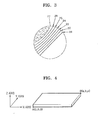
- FIGURE 3 schematically shows a molecular level enlarged diagram of region T 2 delimited by a dotted circle in FIGURE 1 .
- the n polycyclic nano-sheets may include a first polycyclic nano-sheet, a second polycyclic nano-sheet, a third polycyclic nano-sheet, ..., an n-2 th polycyclic nano-sheet, an n-1 st polycyclic nano-sheet, and an n th polycyclic nano-sheet according to the stacked order.
- the super-conductive nanoparticle 10 may have a structure including a first polycyclic nano-sheet 21, a second polycyclic nano-sheet 22, a third polycyclic nano-sheet 23, a fourth polycyclic nano-sheet 24, a fifth polycyclic nano-sheet 25, a sixth polycyclic nano-sheet 26, and a seventh polycyclic nano-sheet 27 which are stacked.
- the first polycyclic nano-sheet 21 to the seventh polycyclic nano-sheet 27 are stacked in a vertical direction normal to the plane in which the plurality of 6-membered carbon rings are fused to each other, and arranged as shown in FIGURE 2 .
- n may be an integer in the range of 2 to 100, for example 2 to 80, 2 to 70, 2 to 40, 2 to 20, or 2 to 10.
- each of the super-conductive nanoparticles 10 has first and second carbon atoms respectively located in the n polycyclic nano-sheets, the first carbon atom being regarded as the origin A (0, 0, 0) of an x, y, z coordinate system, the second carbon atom being a coordinate B (a, b, c), a and b being each independently equal to or less than 10 ⁇ m, and c being equal to or less than 100 nm.
- a distance L 1 may be greater than or equal to a distance L 2 .
- L 1 indicates a distance between the first and second carbon atoms
- L 2 indicates a distance between a third carbon atom that is selected from the carbon atoms of the n polycyclic nano-sheets except for the polycyclic nano-sheets having the first and the second carbon atoms and a fourth carbon atom that is selected from the carbon atoms of the n polycyclic nano-sheets except for the polycyclic nano-sheets having the first, second, and third carbon atoms. That is, the first and second carbon atoms are selected from the carbon atoms of the polycyclic nano-sheets such that the distance between the first and second carbon atoms is the longest.
- the first carbon atom of the super-conductive nanoparticle 10 of FIGURE 1 may be located at the A 1 position, and the second carbon atom may be located at the B 1 position.
- the first carbon atom located at A 1 of FIGURE 1 is regarded as the origin A (0, 0, 0) of an x, y, z coordinate system
- the second carbon atom located at B 1 of FIGURE 1 is regarded as a coordinate B (a, b, c).
- a virtual polyhedron e.g. a cube or a cuboid having a maximum length between coordinates A and B is shown.
- a”, “b”, and “c” respectively correspond to a width, a length, and a height of a virtual polyhedron shown in FIGURE 4 .
- “a”, “b”, and “c” may be regarded as a width, a length, and a height of the virtual polyhedron that is densely filled with the n polycyclic nano-sheets of FIGURE 1 .
- Coordinates a and b may be each independently equal to or less than 10 ⁇ m, for example, a and b may be in the range of about 1 to about 10 ⁇ m.
- Coordinate c may be 50 times as large as the diameter of the carbon atom ⁇ 10 nm.
- “50 times as large as the diameter of the carbon atom” indicates that the super-conductive nanoparticle 10 may include up to 50 polycyclic nano-sheets, and " ⁇ 10 nm” indicates that the polycyclic nano-sheets may be bent, one end of the polycyclic nano-sheets may be rolled, or the polycyclic nanosheets may contain crystallographic defects.
- Coordinate c may be equal to or less than 100 nm, for example, c may range from about 0.1 to about 100 nm, about 0.1 to about 90 nm, about 0.1 to about 50 nm, or about 0.1 to about 20 nm.
- a lithium battery including the negative electrode active material according to the current embodiment may have excellent capacity and lifetime characteristics.
- a super-conductive nanoparticle powder includes a plurality of individual super-conductive nanoparticles. Each of the super-conductive nanoparticles contained in the super-conductive nanoparticle powder is defined as described above.
- the plurality of super-conductive nanoparticles contained in the super-conductive nanoparticle powder may have different shapes and sizes.
- the super-conductive nanoparticle powder may be defined according to the descriptions of the super-conductive nanoparticles above and the size distribution of the super-conductive nanoparticles contained in the super-conductive nanoparticle powder.
- the super-conductive nanoparticle powder may have "a", "b", and "c" which are defined with respect to each of the super-conductive nanoparticles, wherein a, b, and c may be defined as d 50 thereof.
- the definition of d 50 is apparent to those of skill in the art.
- d 50 of a and b of the super-conductive nanoparticles may be each independently equal to or less than 10 ⁇ m, for example, d 50 may be in the range of about 1 to about 10 ⁇ m.
- d 50 of c of the super-conductive nanoparticle powder may be 50 times as large as the diameter of the carbon atom ⁇ 10 nm.
- the "50 times as large as the diameter of the carbon atom” indicates that each of the super-conductive nanoparticles contained in the super-conductive nanoparticle powder may include up to 50 polycyclic nano-sheets, and " ⁇ 10 nm” indicates that each of the polycyclic nano-sheets contained in the super-conductive nanoparticle powder may be bent, one end of each polycyclic nano-sheet may be rolled, or each polycyclic nano-sheet may contain crystallographic defects.
- the d 50 of c of the super-conductive nanoparticle powder may be equal to or less than 100 nm, for example, d 50 may be in the range of about 0.1 to about 100 nm, about 0.1 to about 90 nm, about 0.1 to about 50 nm, or about 0.1 to 20 nm, but is not limited thereto.
- the super-conductive nanoparticle powder may be prepared using graphite as a starting material.
- a method of preparing the super-conductive nanoparticle powder may include swelling graphite, adding a solvent to the swollen graphite, pulverizing the swollen graphite in the solvent, and removing the solvent from the pulverized powder. This will now be described in further detail.
- graphite is swollen by heat-treatment, and gas generated therefrom is removed.
- expanded graphite may be used as a starting material.
- the temperature for swelling the graphite may be in the range of about 400 to about 600°C, and the heat-treatment may be performed for about 30 minutes to about 2 hours, but the present embodiment is not limited thereto. If the temperature and time for the heat-treatment is within the range described above, the graphite may be swollen enough to obtain a super-conductive nanoparticle powder having "c" or "d 50 of c" satisfying the ranges described above without substantial damage to the carbon-carbon bonds.
- Gas generated while the graphite swells may be removed.
- the gas generated may be an oxide formed by binding impurities contained in graphite, e.g., atoms and molecules other than carbon, to oxygen, or the like.
- the gas may be SO 2 . Since impurities contained in the graphite may be removed by calcination during the swelling of the graphite, purity of the super-conductive nanoparticle powder may be improved.
- a solvent is then added to the swollen graphite, and the swollen graphite in the solvent is pulverized.
- Any suitable solvent that does not substantially react with the swollen graphite but provides flowability may be used.
- the solvent may be an alcohol, such as ethanol.
- the swollen graphite is pulverized in the solvent as described above.
- the swollen graphite may be pulverized using various suitable methods, for example, using a homogenizer or a micro fluidizer.
- the pulverization process may be repeated several times, for example, twice or more, using different methods.
- the swollen graphite may be mixed with any suitable acid before pulverizing the swollen graphite, or any other suitable modifications may be made.
- a and/or b of the super-conductive nanoparticle may be controlled according to the number of time the pulverization process is carried out using a micro fluidizer.
- the solvent is removed to obtain the super-conductive nanoparticle powder.
- the solvent may be removed using various suitable methods, which may be selected according to the physical properties of the solvent, such as boiling point.
- the pulverized resultant may be filtered, washed, and heat-treated at 80°C.
- a nanometal particle contained in a negative electrode active material may be a material selected from the group consisting of silicon (Si), tin (Sn), nickel (Ni), and any mixture thereof.
- the diameter of the nanometal particle is in the range of 300 nm to 500 nm.
- the diameter of the nanometal particle is within the range described above, the destruction of the negative electrode active material due to volumetric expansion caused by Si during charging and discharging may be efficiently reduced.
- the diameter of the negative electrode active material including the nanometal particles and the super-conductive nanoparticles is in the range of 3 to 60 ⁇ m.
- the ultimate specific surface area may be in the range of about 3 to about 20 m 2 /g which is suitable for making slurry and treatment.
- SEI solid electrolyte interface
- the surface of the negative electrode active material may be pitch-coated.
- a lithium battery according to an embodiment of the present invention includes: a positive electrode including a positive electrode active material; a negative electrode including a negative electrode active material including nanometal particles and super-conductive nanoparticles; and an electrolyte.
- the positive electrode may include a current collector and a positive electrode active material layer formed on the current collector.
- a compound lithiumated intercalation compound, which allows reversible intercalation and deintercalation of lithium, may be used as the positive electrode active material contained in the positive electrode. Examples
- the positive electrode active material may include compounds represented by the following formulae.
- Li a A 1-b X b D 2 (where 0.95 ⁇ a ⁇ 1.1, and 0 ⁇ b ⁇ 0.5); Li a E 1-b X b O 2-c D c (where 0.95 ⁇ a ⁇ 1.1, 0 ⁇ b ⁇ 0.5, and 0 ⁇ c ⁇ 0.05); LiE 2-b X b O 4-c D c (where 0 ⁇ b ⁇ 0.5 and 0 ⁇ c ⁇ 0.05); Li a Ni 1-b-c Co b B c D ⁇ (where 0.95 ⁇ a ⁇ 1.1, 0 ⁇ b ⁇ 0.5, 0 ⁇ c ⁇ 0.05, and 0 ⁇ 2); Li a Ni 1-b-c Co b X c O 2- ⁇ M ⁇ (where 0.95 ⁇ a ⁇ 1.1, 0 ⁇ b ⁇ 0.5, 0 ⁇ c ⁇ 0.05, and 0 ⁇ 2); Li a Ni 1-b-c Co b X c O 2- ⁇ M 2 (where 0.95 ⁇ a ⁇ 1.1, 0 ⁇ b ⁇ 0.5, 0 ⁇ c ⁇ 0.05, and 0 ⁇ 2); Li a Ni 1-b-c Co
- A is selected from the group consisting of nickel (Ni), cobalt (Co), manganese (Mn), and combinations thereof;
- X is selected from the group consisting of aluminum (A1), nickel (Ni), cobalt (Co), manganese (Mn), chromium (Cr), iron (Fe), magnesium (Mg), strontium (Sr), vanadium (V), a rare earth element, and combinations thereof;
- D is selected from the group consisting of oxygen (O), fluorine (F), sulfur (S), phosphorus (P), and combinations thereof;
- E is selected from the group consisting of cobalt (Co), manganese (Mn), and combinations thereof;
- M is selected from the group consisting of fluorine (F), sulfur (S), phosphorus (P), and combinations thereof;
- G is selected from the group consisting of aluminum (A1), chromium (Cr), manganese (Mn), iron (Fe), magnesium (Mg), lanthanum (La), cerium (Ce
- the positive electrode active material may be lithium titanate.
- the lithium titanate may include a spinel-type lithium titanate, an anatase-type lithium titanate, and a ramsdellite-type lithium titanate based on the crystalline structure.
- the positive electrode active material may be represented by the formula Li 4-x Ti 5 O 12 (0 ⁇ x ⁇ 3).
- the positive electrode active material may be Li 4 Ti 5 O 12 .
- a lithium electrode may be used as the positive electrode, which may be referred to as a half cell.
- the above compounds may have a surface coating layer.
- a mixture of a compound not having a coating layer and a compound having a coating layer, the compounds being selected from the above group may be used.
- the coating layer may include a compound of a coating element selected from the group consisting of oxides, hydroxides, oxyhydroxides, oxycarbonates, and hydroxycarbonates of the coating element.
- the compounds for the coating layer may be amorphous or crystalline.
- the coating element contained in the coating layer may be magnesium (Mg), aluminum (A1), cobalt (Co), potassium (K), sodium (Na), calcium (Ca), silicon (Si), titanium (Ti), vanadium (V), tin (Sn), germanium (Ge), gallium (Ga), boron (B), arsenic (As), zirconium (Zr), or one or more mixtures thereof.
- the coating layer may be formed using any suitable method, for example, a spray coating method, a dipping method, or the like, which does not adversely affect the physical properties of the positive electrode active material when a compound of such a coating element is used. This is apparent to those of skill in the art, and thus a detailed description thereof will not be provided.
- the positive electrode active material layer may further include a binder.
- the binder contained in the positive electrode active material layer functions to strongly bind positive electrode active material particles together and to the current collector.
- the binder may include, polyvinyl alcohol, carboxymethyl cellulose, hydroxypropyl cellulose, diacetyl cellulose, polyvinyl chloride, carboxylated polyvinyl chloride, polyvinyl fluoride, and a polymer having ethylene oxide, polyvinylpyrrolidone, polyurethane, polytetrafluoroethylene, polyvinylidene fluoride, polyethylene, polypropylene, styrene-butadiene rubber (SBR), acrylated SBR, epoxy resin, nylon, and the like.
- SBR styrene-butadiene rubber
- A1 may be used as the current collector.
- the positive electrode is manufactured by mixing the positive electrode active material and the binder (and may optionally include a conducting agent) in a solvent to prepare a positive electrode active material composition and by coating the positive electrode active material composition on the current collector.
- the method of manufacturing the positive electrode is obvious to those of ordinary skill in the art, and thus a detailed description thereof will not be provided.
- the solvent may be N-methylpyrrolidone, or the like.
- the negative electrode active material may include nanometal particles and super-conductive nanoparticles, the types and sizes of which are described above.
- the negative electrode active material may have a diameter in the range of about 3 ⁇ m to about 60 ⁇ m, and the surface of the negative electrode active material may be pitch-coated.
- the negative electrode active material may further include a binder and a solvent that is the same as that of the positive electrode active material, described above.
- the negative electrode active material may include a material selected from the group consisting of carbon black, ketjen black, acetylene black, artificial graphite, natural graphite, copper powder, nickel powder, aluminum powder, and polyphenylene, as a conducting agent.
- a plasticizer may be added to the positive electrode active material composition and the negative electrode active material composition to produce pores inside the electrode plates.
- the electrolyte may include a nonaqueous organic solvent and a lithium salt.
- the nonaqueous organic solvent may serve as a medium for the movement of ions associated with electrochemical reactions in lithium batteries.
- the nonaqueous organic solvent may include a carbonate solvent, an ester solvent, an ether solvent, a ketone solvent, an alcohol solvent, or an aprotic solvent.
- Examples of the carbonate solvent available as the nonaqueous organic solvent may include dimethyl carbonate (DMC), diethyl carbonate (DEC), dipropyl carbonate (DPC), methylpropyl carbonate (MPC), ethylpropyl carbonate (EPC), ethylmethyl carbonate (EMC), ethylene carbonate (EC), propylene carbonate (PC), butylene carbonate (BC), and the like.
- ester solvent may include methyl acetate, ethyl acetate, n-propyl acetate, dimethyl acetate, methyl propionate, ethyl propionate, ⁇ -butyrrolactone, decanolide, valerolactone, mevalonolactone, caprolactone, and the like.
- ether solvent available as the nonaqueous organic solvent may include dibutyl ether, tetraglyme, diglyme, dimethoxyethane, 2-methyltetrahydrofuran, tetrahydrofuran, and the like.
- ketone solvent available as the nonaqueous organic solvent may include cyclohexanone, and the like.
- Examples of the alcohol solvent available as the nonaqueous organic solvent may include ethyl alcohol, isopropyl alcohol, and the like.
- Examples of the aprotic solvent may include nitriles, such as R-CN (where R is a straight, branched or cyclic C2-C20 hydrocarbon group, which may have a double-bonded aromatic ring or an ether bond); amides, such as dimethylformamide; dioxolanes, such as 1,3-dioxolane; sulfolanes, and the like.
- the nonaqueous organic solvent may be used alone. Alternatively, at least two of the nonaqueous organic solvents may be used in combination. In this case, a mixing ratio of the at least two of the nonaqueous organic solvents may appropriately vary according to the performance of the lithium battery, which is obvious to those of ordinary skill in the art.
- the lithium salt contained in the electrolytic solution is dissolved in the organic solvent and provides lithium ions for the lithium battery to operate and facilitates the migration of lithium ions between the positive electrode and the negative electrode.
- the lithium salt may include a supporting electrolyte salt selected from the group consisting of LiPF 6 , LiBF 4 , LiSbF 6 , LiAsF 6 , LiN(SO 2 C 2 F 5 ) 2 , Li(CF 3 SO 2 ) 2 N, LiC 4 F 9 SO 3 , LiClO 4 , LiAlO 2 , LiAlCl 4 , LiN(C x F 2x+1 SO 2 )(C ⁇ F 2y+1 SO 2 ), where x and y are natural numbers, LiCl, LiI and LiB(C 2 O 4 ) 2 , and lithium bis(oxalato) borate (LiBOB).
- a supporting electrolyte salt selected from the group consisting of LiPF 6 , LiBF 4 , LiSbF 6 , LiAsF 6 , LiN(SO 2 C 2 F 5 ) 2 , Li(CF 3 SO 2 ) 2 N, LiC 4 F 9 SO 3 , LiClO 4
- the concentration of the lithium salt may be in the range of about 0.1 to about 2.0 M. If the concentration of the lithium salt is within the above range, the electrolyte may have a suitable conductivity and viscosity, and thus may exhibit excellent performance, allowing lithium ions to effectively migrate.
- a separator may be between the positive electrode and the negative electrode according to the type of the lithium battery.
- the separator may be a monolayer, or the separator may be a multilayer including at least two layers formed of polyethylene, polypropylene, and/or polyvinylidene fluoride.
- the multilayer may be a mixed multilayer.
- the separator may be a two-layered separator including polyethylene and polypropylene layers, a three-layered separator including polyethylene, polypropylene and polyethylene layers, a three-layered separator including polypropylene, polyethylene and polypropylene layers.
- Lithium batteries may be classified as lithium ion batteries, lithium ion polymer batteries or lithium polymer batteries according to the types of separator and electrolyte.
- a lithium battery may be classified as a cylindrical type, a rectangular type, a coin type, or a pouch type according to the shape of the battery; and may be also classified as a bulk type or a thin film type according to the size of battery.
- the lithium batteries may be configured as a primary battery or a secondary battery. Methods of manufacturing these batteries are known in the field, and detailed descriptions thereof will not be repeated.
- a lithium battery 100 includes: a positive electrode 114; a negative electrode 112; a separator 113 between the positive electrode 114 and the negative electrode 112; an electrolyte impregnated into the positive electrode 114, the negative electrode 112, and the separator 113; a battery case 120; and a sealing member 140 sealing the battery case 120.
- the lithium battery 100 of FIGURE 5 may be manufactured by stacking the positive electrode 114, the negative electrode 112, and the separator 113 upon one another, winding the stack in a spiral form, and inserting the wound stack into the battery case 140.
- FIGURE 8A is a scanning electron microscope (SEM) image of the super-conductive nanoparticle powder according to preparation example 1.
- SEM scanning electron microscope
- FIGURE 8B is a transmission electron microscope (TEM) image of super-conductive nanoparticles contained in the super-conductive nanoparticle powder prepared according to preparation example 1.
- the ellipse corresponds to the dotted circle T 2 of FIGURE 1 .
- the thickness of the super-conductive nanoparticle distinguished by the ellipse was identified to be about 10 nm.
- the super-conductive nanoparticle prepared as described above had a coordinate c of about 10 nm, wherein c was defined above with reference to FIGURES 1 and 4 .
- the size distribution of super-conductive nanoparticles contained in the super-conductive nanoparticle powder was evaluated using a Melvern, Hydro2000 sample dispersion unit, and the results are shown in FIGURE 9 .
- d 10 , d 50 , and d 90 of a and b of the super-conductive nanoparticle powder were respectively 2.1 ⁇ m, 4.11 ⁇ m, and 7.16 ⁇ m, wherein a and b are defined above with reference to FIGURES 1 and 4 .
- a Si particle powder having a diameter of about 300 nm, the super-conductive nanoparticle powder, polyvinylidene fluoride as a binder were mixed in N-methylpyrrolidone solvent at a weight ratio of 25:70:5 to prepare a negative electrode active material slurry.
- the negative electrode active material slurry was coated on an aluminum (Al)-foil to form a thin plate with a thickness of 90 ⁇ m, dried at 135°C for 3 hours or more, and pressed to have a thickness of 70 ⁇ m.
- the negative electrode plate was punched in a circle with a size of 13 ⁇ , and the weight thereof was recorded. Then, the negative electrode was processed so as to be suitable for welding, and the weight thereof was recorded.
- the resultant was welded in a lower portion of a 2016 coin cell and evacuated in a vacuum oven at 250°C for 5 hours.
- PVdF as a binder
- NCM(Li(Ni 0.5 Co 0.2 Mn 0.3 )O 2 ) as an active material
- denka black as a conducting agent were mixed in a weight ratio of 5:90:5 using N-methylpyrrolidone solvent to prepare a positive electrode active material slurry.
- a positive electrode was prepared using the positive electrode active material slurry in the same manner as in the preparation of the negative electrode.
- EC ethylene carbonate
- EMC ethylmethyl carbonate
- a lithium battery was prepared in the same manner as in Example 1, except that Si particle powder having a diameter in the range of about 5 to about 10 ⁇ m was used instead of Si nanoparticle powder.
- a lithium battery was prepared in the same manner as in Example 1, except that graphite (MAG, Hitachi) was used instead of the super-conductive nanoparticle powder.
- the lithium batteries prepared according to Examples 1 and Comparative Examples 1 and 2 were charged with 0.01 V in a constant current (CC)/constant voltage (CV) mode at a rate of 0.2 C (0.01 C cut-off charging) and discharged with 1.1 V at a rate of 0.2 C (1.1 V cut-off discharging). After one cycle of charging and discharging, capacities of the lithium batteries and efficiency of the charging and discharging were evaluated. Then, charging and discharging were repeated 50 times while the charging and discharging rates were fixed at 0.2 C, the capacities of the lithium batteries and efficiency of the charging and discharging were evaluated, and the results are shown in FIGURES 10 and 11 .
- the lithium battery prepared according to Example 1 had better charging and discharging efficiency than the lithium batteries prepared according to Comparative Examples 1 and 2.
- the lithium battery including the nanometal particles and the super-conductive nanoparticles according to the one or more of the above embodiments of the present invention have high capacity and efficiency.
Landscapes
- Chemical & Material Sciences (AREA)
- Engineering & Computer Science (AREA)
- Chemical Kinetics & Catalysis (AREA)
- Electrochemistry (AREA)
- General Chemical & Material Sciences (AREA)
- Materials Engineering (AREA)
- Manufacturing & Machinery (AREA)
- Battery Electrode And Active Subsutance (AREA)
- Secondary Cells (AREA)
- Carbon And Carbon Compounds (AREA)
Claims (13)
- Aktives Material einer negativen Elektrode, umfassend Nanometallteilchen und supraleitende Nanoteilchen,
wobei jedes der supraleitenden Nanoteilchen n polycyclische Nano-Flächengebilde umfasst,
jedes der n polycyclischen Nano-Flächengebilde hexagonale Ringe umfasst,
jeder der hexagonalen Ringe 6 miteinander verbundene Kohlenstoffatome umfasst, jeder der hexagonalen Ringe an wenigstens einen anderen der hexagonalen Ringe ankondensiert ist,
die hexagonalen Ringe jedes der n polycyclischen Nano-Flächengebilde in einer Ebene angeordnet sind,
die n polycyclischen Nano-Flächengebilde in einer zu der Ebene senkrechten Richtung gestapelt sind,
n eine ganze Zahl im Bereich von 2 bis 100 ist und
jedes der supraleitenden Nanoteilchen erste bzw. zweite Kohlenstoffatome aufweist, die sich in den n polycyclischen Nano-Flächengebilden befinden, wobei das erste Kohlenstoffatom als Ursprung A (o, o, o) eines x-y-z-Koordinatensystems angesehen wird und das zweite Kohlenstoffatom eine Koordinate B (a, b, c) aufweist, d50 von a und b jeweils unabhängig gleich oder kleiner als 10 µm ist und d50 von c gleich oder kleiner als 100 nm ist, L1 einen Abstand zwischen den ersten und zweiten Kohlenstoffatomen angibt, L2 einen Abstand zwischen einem dritten Kohlenstoffatom und einem vierten Kohlenstoffatom angibt und L1 gleich oder größer als L2 ist, das dritte Kohlenstoffatom ausgewählt ist aus den Kohlenstoffatomen der n polycyclischen Nano-Flächengebilde mit Ausnahme der polycyclischen Nano-Flächengebilde mit den ersten und den zweiten Kohlenstoffatomen und das vierte Kohlenstoffatom ausgewählt ist aus den Kohlenstoffatomen der n polycyclischen Nano-Flächengebilde mit Ausnahme der polycyclischen Nano-Flächengebilde mit den ersten, zweiten und dritten Kohlenstoffatomen, wobei das aktive Material der negativen Elektrode einen Durchmesser im Bereich von 3 µm bis 60 µm aufweist, dadurch gekennzeichnet, dass jedes der Nanometallteilchen einen Durchmesser im Bereich von 300 nm bis 500 nm aufweist. - Aktives Material einer negativen Elektrode nach Anspruch 1, wobei das Nanometallteilchen ein aus der Gruppe bestehend aus Silicium (Si), Zinn (Sn), Nickel (Ni) und Gemischen derselben ausgewähltes Material umfasst.
- Aktives Material einer negativen Elektrode nach Anspruch 1 oder Anspruch 2, wobei die benachbarten gebundenen Kohlenstoffatome in jedem der n polycyclischen Nano-Flächengebilde über sp2-hybridisierte Bindungen aneinander gebunden sind.
- Aktives Material einer negativen Elektrode nach einem vorangehenden Anspruch, wobei jedes der n polycyclischen Nano-Flächengebilde eine Dicke gleich einem Durchmesser eines der Kohlenstoffatome ±1 nm aufweist.
- Aktives Material einer negativen Elektrode nach einem vorangehenden Anspruch, wobei n eine ganze Zahl im Bereich von 2 bis 10 ist.
- Lithiumbatterie, umfassend:eine positive Elektrode, umfassend ein aktives Material der positiven Elektrode;eine negative Elektrode, umfassend ein aktives Material der negativen Elektrode, umfassend Nanometallteilchen und supraleitende Nanoteilchen,wobei jedes der supraleitenden Nanoteilchen n polycyclische Nano-Flächengebilde umfasst,jedes der n polycyclischen Nano-Flächengebilde hexagonale Ringe umfasst,jeder der hexagonalen Ringe 6 miteinander verbundene Kohlenstoffatome umfasst,jeder der hexagonalen Ringe an wenigstens einen anderen der hexagonalen Ringe ankondensiert ist,die hexagonalen Ringe jedes der n polycyclischen Nano-Flächengebilde in einer Ebene angeordnet sind,die n polycyclischen Nano-Flächengebilde in einer zu der Ebene senkrechten Richtung gestapelt sind,n eine ganze Zahl im Bereich von 2 bis 100 ist undjedes der supraleitenden Nanoteilchen erste bzw. zweite Kohlenstoffatome aufweist, die sich in den n polycyclischen Nano-Flächengebilden befinden, wobei das erste Kohlenstoffatom als Ursprung A (o, o, o) eines x-y-z-Koordinatensystems angesehen wird und das zweite Kohlenstoffatom eine Koordinate B (a, b, c) aufweist, d50 von a und b jeweils unabhängig gleich oder kleiner als 10 µm ist und d50 c gleich oder kleiner als 100 nm ist, L1 einen Abstand zwischen den ersten und zweiten Kohlenstoffatomen angibt, L2 einen Abstand zwischen einem dritten Kohlenstoffatom und einem vierten Kohlenstoffatom angibt, L1 gleich oder größer als L2 ist, das dritte Kohlenstoffatom ausgewählt ist aus den Kohlenstoffatomen der n polycyclischen Nano-Flächengebilde mit Ausnahme der polycyclischen Nano-Flächengebilde mit den ersten und den zweiten Kohlenstoffatomen und das vierte Kohlenstoffatom ausgewählt ist aus den Kohlenstoffatomen der n polycyclischen Nano-Flächengebilde mit Ausnahme der polycyclischen Nano-Flächengebilde mit den ersten, zweiten und dritten Kohlenstoffatomen, wobei das aktive Material der negativen Elektrode einen Durchmesser im Bereich von 3 µm bis 60 µm aufweist; undeinen Elektrolyten, dadurch gekennzeichnet, dass jedes der Nanometallteilchen einen Durchmesser im Bereich von 300 nm bis 500 nm aufweist.
- Lithiumbatterie nach Anspruch 6, wobei das Nanometallteilchen ein aus der Gruppe bestehend aus Silicium (Si), Zinn (Sn), Nickel (Ni) und Gemischen derselben ausgewähltes Material umfasst.
- Lithiumbatterie nach einem von Anspruch 6 oder Anspruch 7, wobei die benachbarten gebundenen Kohlenstoffatome in jedem der polycyclischen Nano-Flächengebilde über sp2-hybridisierte Bindungen aneinander gebunden sind.
- Lithiumbatterie nach einem der Ansprüche 6 bis 8, wobei jedes der n polycyclischen Nano-Flächengebilde eine Dicke gleich einem Durchmesser eines der Kohlenstoffatome ±1 nm aufweist.
- Lithiumbatterie nach einem der Ansprüche 6 bis 9, wobei n eine ganze Zahl im Bereich von 2 bis 10 ist.
- Aktives Material einer negativen Elektrode nach einem der Ansprüche 1 bis 5 oder Lithiumbatterie nach einem der Ansprüche 6 bis 9, wobei d50 von c einen Wert aufweist, der 50 Mal so groß wie der Durchmesser eines der Kohlenstoffatome ±10 nm ist.
- Aktives Material einer negativen Elektrode nach einem der Ansprüche 1 bis 5 oder Lithiumbatterie nach einem der Ansprüche 6 bis 12, wobei d50 von c einen Wert im Bereich von 0,1 nm bis 50 nm aufweist, wobei vorzugsweise d50 von c einen Wert im Bereich von 0,1 nm bis 20 nm aufweist.
- Aktives Material einer negativen Elektrode nach einem der Ansprüche 1 bis 5 oder Lithiumbatterie nach einem der Ansprüche 6 bis 12, wobei das aktive Material der negativen Elektrode pechbeschichtet ist.
Applications Claiming Priority (1)
| Application Number | Priority Date | Filing Date | Title |
|---|---|---|---|
| KR1020100008018A KR101137374B1 (ko) | 2010-01-28 | 2010-01-28 | 나노 메탈 입자 및 수퍼 도전성 나노 입자를 포함하는 음극 활물질 및 이를 포함하는 리튬 전지 |
Publications (2)
| Publication Number | Publication Date |
|---|---|
| EP2355211A1 EP2355211A1 (de) | 2011-08-10 |
| EP2355211B1 true EP2355211B1 (de) | 2015-04-08 |
Family
ID=43856094
Family Applications (1)
| Application Number | Title | Priority Date | Filing Date |
|---|---|---|---|
| EP10194487.4A Active EP2355211B1 (de) | 2010-01-28 | 2010-12-10 | Aktives Negativelektrodenmaterial mit Nanometall-Partikeln und superleitfähigen Nanopartikeln und Lithiumbatterie mit dem aktiven Negativelektrodenmaterial |
Country Status (5)
| Country | Link |
|---|---|
| US (1) | US8530085B2 (de) |
| EP (1) | EP2355211B1 (de) |
| JP (1) | JP5253485B2 (de) |
| KR (1) | KR101137374B1 (de) |
| CN (1) | CN102142552B (de) |
Families Citing this family (8)
| Publication number | Priority date | Publication date | Assignee | Title |
|---|---|---|---|---|
| KR101137375B1 (ko) | 2010-02-09 | 2012-04-20 | 삼성에스디아이 주식회사 | 2차 입자 및 이를 구비한 리튬 전지 |
| FR2981643B1 (fr) * | 2011-10-25 | 2013-12-27 | Commissariat Energie Atomique | Procede de preparation d'un materiau composite silicium/carbone, materiau ainsi prepare, et electrode notamment electrode negative, comprenant ce materiau. |
| JP5903556B2 (ja) * | 2011-12-22 | 2016-04-13 | パナソニックIpマネジメント株式会社 | 非水電解液二次電池 |
| KR101718055B1 (ko) * | 2012-02-13 | 2017-03-20 | 삼성에스디아이 주식회사 | 음극 활물질 및 이를 포함하는 리튬 전지 |
| KR101739296B1 (ko) | 2012-09-20 | 2017-05-24 | 삼성에스디아이 주식회사 | 복합음극활물질, 이를 채용한 음극과 리튬전지 및 그 제조방법 |
| KR101730956B1 (ko) * | 2012-10-11 | 2017-04-27 | 삼성에스디아이 주식회사 | 음극 활물질, 그 제조방법 및 이를 포함하는 리튬 전지 |
| KR101739295B1 (ko) | 2012-11-26 | 2017-05-24 | 삼성에스디아이 주식회사 | 복합음극활물질, 이를 채용한 음극과 리튬전지 및 그 제조방법 |
| FR3013513B1 (fr) * | 2013-11-20 | 2016-01-15 | Commissariat Energie Atomique | Copolymere pour batterie bipolaire |
Family Cites Families (9)
| Publication number | Priority date | Publication date | Assignee | Title |
|---|---|---|---|---|
| US7094499B1 (en) | 2003-06-10 | 2006-08-22 | The United States Of America As Represented By The Administrator Of The National Aeronautics And Space Administration | Carbon materials metal/metal oxide nanoparticle composite and battery anode composed of the same |
| KR100830612B1 (ko) | 2006-05-23 | 2008-05-21 | 강원대학교산학협력단 | 리튬 이차 전지용 음극 활물질, 그의 제조 방법 및 그를포함하는 리튬 이차 전지 |
| EP2038218A1 (de) | 2006-05-31 | 2009-03-25 | Max-Planck-Gesellschaft zur Förderung der Wissenschaften e.V. | Poröses elektrisch leitfähiges kohlenstoffmaterial und verwendungen davon |
| CN1913200B (zh) | 2006-08-22 | 2010-05-26 | 深圳市贝特瑞电子材料有限公司 | 锂离子电池硅碳复合负极材料及其制备方法 |
| KR101375328B1 (ko) * | 2007-07-27 | 2014-03-19 | 삼성에스디아이 주식회사 | Si/C 복합물, 이를 포함하는 음극활물질 및 리튬전지 |
| US7745047B2 (en) * | 2007-11-05 | 2010-06-29 | Nanotek Instruments, Inc. | Nano graphene platelet-base composite anode compositions for lithium ion batteries |
| KR101002539B1 (ko) * | 2008-04-29 | 2010-12-17 | 삼성에스디아이 주식회사 | 리튬이차전지용 음극활물질 및 이를 포함하는 리튬이차전지 |
| US8936874B2 (en) | 2008-06-04 | 2015-01-20 | Nanotek Instruments, Inc. | Conductive nanocomposite-based electrodes for lithium batteries |
| CN101604750A (zh) * | 2009-07-09 | 2009-12-16 | 上海交通大学 | 一种锂离子电池负极材料的制备方法 |
-
2010
- 2010-01-28 KR KR1020100008018A patent/KR101137374B1/ko active Active
- 2010-09-03 US US12/876,084 patent/US8530085B2/en active Active
- 2010-12-06 JP JP2010271549A patent/JP5253485B2/ja active Active
- 2010-12-08 CN CN201010585336.0A patent/CN102142552B/zh active Active
- 2010-12-10 EP EP10194487.4A patent/EP2355211B1/de active Active
Also Published As
| Publication number | Publication date |
|---|---|
| US20110183202A1 (en) | 2011-07-28 |
| US8530085B2 (en) | 2013-09-10 |
| JP2011159622A (ja) | 2011-08-18 |
| CN102142552A (zh) | 2011-08-03 |
| JP5253485B2 (ja) | 2013-07-31 |
| CN102142552B (zh) | 2014-12-24 |
| KR101137374B1 (ko) | 2012-04-20 |
| KR20110088214A (ko) | 2011-08-03 |
| EP2355211A1 (de) | 2011-08-10 |
Similar Documents
| Publication | Publication Date | Title |
|---|---|---|
| EP2355225B1 (de) | Sekundärpartikel und Batterie mit Sekundärpartikel | |
| US9979014B2 (en) | Composite cathode active material, cathode and lithium battery comprising the same, and preparation method thereof | |
| US9601761B2 (en) | Composite cathode active material, method of preparing the composite cathode active material, and cathode and lithium battery each including the composite cathode active material | |
| US9564628B2 (en) | Composite cathode active material, and cathode and lithium battery each using the same | |
| US9350015B2 (en) | Anode active material, anode and lithium battery including the material, and method of preparing the material | |
| EP2325138A2 (de) | Leitfähiger Nanopartikel, leitfähiges Nanopartikelpulver und Lithiumbatterie mit dem Pulver | |
| US8530085B2 (en) | Negative electrode active material containing nanometal particles and super-conductive nanoparticles and lithium battery comprising the negative electrode active material | |
| US9105904B2 (en) | Composite anode active material, anode and lithium battery including the same, and method of preparing composite anode active material | |
| US9105920B2 (en) | Composite anode active material, anode and lithium battery containing the same, and method of preparing the composite anode active material | |
| US10930923B2 (en) | Topological quantum framework, composite anode active material, anode, lithium battery, semiconductor, and device comprising the topological quantum framework, and method of preparing the topological quantum framework | |
| EP2385569B1 (de) | Negatives Aktivmaterial und Lithiumbatterie | |
| KR20140023861A (ko) | 양극 활물질, 이의 제조 방법 및 이를 포함하는 이차 전지 | |
| US9252427B2 (en) | Negative active material, method of preparing the same, and lithium battery including the same | |
| WO2025249166A1 (ja) | 非水電解質二次電池 | |
| WO2025248932A1 (ja) | 非水電解液、及び非水電解質二次電池 |
Legal Events
| Date | Code | Title | Description |
|---|---|---|---|
| PUAI | Public reference made under article 153(3) epc to a published international application that has entered the european phase |
Free format text: ORIGINAL CODE: 0009012 |
|
| 17P | Request for examination filed |
Effective date: 20101210 |
|
| AK | Designated contracting states |
Kind code of ref document: A1 Designated state(s): AL AT BE BG CH CY CZ DE DK EE ES FI FR GB GR HR HU IE IS IT LI LT LU LV MC MK MT NL NO PL PT RO RS SE SI SK SM TR |
|
| AX | Request for extension of the european patent |
Extension state: BA ME |
|
| 17Q | First examination report despatched |
Effective date: 20120423 |
|
| REG | Reference to a national code |
Ref country code: DE Ref legal event code: R079 Ref document number: 602010023728 Country of ref document: DE Free format text: PREVIOUS MAIN CLASS: H01M0004134000 Ipc: H01M0004133000 |
|
| GRAP | Despatch of communication of intention to grant a patent |
Free format text: ORIGINAL CODE: EPIDOSNIGR1 |
|
| RIC1 | Information provided on ipc code assigned before grant |
Ipc: H01M 4/1395 20100101ALN20141020BHEP Ipc: H01M 10/0525 20100101ALI20141020BHEP Ipc: H01M 4/1393 20100101ALN20141020BHEP Ipc: H01M 4/133 20100101AFI20141020BHEP Ipc: H01M 4/62 20060101ALI20141020BHEP Ipc: H01M 4/134 20100101ALI20141020BHEP |
|
| INTG | Intention to grant announced |
Effective date: 20141114 |
|
| RIN1 | Information on inventor provided before grant (corrected) |
Inventor name: KIM, YOUNG-SU Inventor name: JOO, KYU-NAM Inventor name: LEE, SO-RA Inventor name: LEE, JONG-HEE Inventor name: KIM, DEOK-HYUN Inventor name: YU, YONG-MI Inventor name: KIM, JAE-MYUNG Inventor name: KIM, BEOM-KWON Inventor name: DO, SEAN Inventor name: CHUNG, GU-HYUN |
|
| GRAS | Grant fee paid |
Free format text: ORIGINAL CODE: EPIDOSNIGR3 |
|
| GRAA | (expected) grant |
Free format text: ORIGINAL CODE: 0009210 |
|
| AK | Designated contracting states |
Kind code of ref document: B1 Designated state(s): AL AT BE BG CH CY CZ DE DK EE ES FI FR GB GR HR HU IE IS IT LI LT LU LV MC MK MT NL NO PL PT RO RS SE SI SK SM TR |
|
| REG | Reference to a national code |
Ref country code: GB Ref legal event code: FG4D |
|
| REG | Reference to a national code |
Ref country code: CH Ref legal event code: EP |
|
| REG | Reference to a national code |
Ref country code: IE Ref legal event code: FG4D |
|
| REG | Reference to a national code |
Ref country code: AT Ref legal event code: REF Ref document number: 721150 Country of ref document: AT Kind code of ref document: T Effective date: 20150515 |
|
| REG | Reference to a national code |
Ref country code: DE Ref legal event code: R096 Ref document number: 602010023728 Country of ref document: DE Effective date: 20150521 |
|
| REG | Reference to a national code |
Ref country code: AT Ref legal event code: MK05 Ref document number: 721150 Country of ref document: AT Kind code of ref document: T Effective date: 20150408 |
|
| REG | Reference to a national code |
Ref country code: NL Ref legal event code: VDEP Effective date: 20150408 |
|
| REG | Reference to a national code |
Ref country code: LT Ref legal event code: MG4D |
|
| PG25 | Lapsed in a contracting state [announced via postgrant information from national office to epo] |
Ref country code: NL Free format text: LAPSE BECAUSE OF FAILURE TO SUBMIT A TRANSLATION OF THE DESCRIPTION OR TO PAY THE FEE WITHIN THE PRESCRIBED TIME-LIMIT Effective date: 20150408 |
|
| PG25 | Lapsed in a contracting state [announced via postgrant information from national office to epo] |
Ref country code: FI Free format text: LAPSE BECAUSE OF FAILURE TO SUBMIT A TRANSLATION OF THE DESCRIPTION OR TO PAY THE FEE WITHIN THE PRESCRIBED TIME-LIMIT Effective date: 20150408 Ref country code: NO Free format text: LAPSE BECAUSE OF FAILURE TO SUBMIT A TRANSLATION OF THE DESCRIPTION OR TO PAY THE FEE WITHIN THE PRESCRIBED TIME-LIMIT Effective date: 20150708 Ref country code: PT Free format text: LAPSE BECAUSE OF FAILURE TO SUBMIT A TRANSLATION OF THE DESCRIPTION OR TO PAY THE FEE WITHIN THE PRESCRIBED TIME-LIMIT Effective date: 20150810 Ref country code: HR Free format text: LAPSE BECAUSE OF FAILURE TO SUBMIT A TRANSLATION OF THE DESCRIPTION OR TO PAY THE FEE WITHIN THE PRESCRIBED TIME-LIMIT Effective date: 20150408 Ref country code: LT Free format text: LAPSE BECAUSE OF FAILURE TO SUBMIT A TRANSLATION OF THE DESCRIPTION OR TO PAY THE FEE WITHIN THE PRESCRIBED TIME-LIMIT Effective date: 20150408 Ref country code: ES Free format text: LAPSE BECAUSE OF FAILURE TO SUBMIT A TRANSLATION OF THE DESCRIPTION OR TO PAY THE FEE WITHIN THE PRESCRIBED TIME-LIMIT Effective date: 20150408 |
|
| REG | Reference to a national code |
Ref country code: FR Ref legal event code: PLFP Year of fee payment: 6 |
|
| PG25 | Lapsed in a contracting state [announced via postgrant information from national office to epo] |
Ref country code: AT Free format text: LAPSE BECAUSE OF FAILURE TO SUBMIT A TRANSLATION OF THE DESCRIPTION OR TO PAY THE FEE WITHIN THE PRESCRIBED TIME-LIMIT Effective date: 20150408 Ref country code: IS Free format text: LAPSE BECAUSE OF FAILURE TO SUBMIT A TRANSLATION OF THE DESCRIPTION OR TO PAY THE FEE WITHIN THE PRESCRIBED TIME-LIMIT Effective date: 20150808 Ref country code: LV Free format text: LAPSE BECAUSE OF FAILURE TO SUBMIT A TRANSLATION OF THE DESCRIPTION OR TO PAY THE FEE WITHIN THE PRESCRIBED TIME-LIMIT Effective date: 20150408 Ref country code: RS Free format text: LAPSE BECAUSE OF FAILURE TO SUBMIT A TRANSLATION OF THE DESCRIPTION OR TO PAY THE FEE WITHIN THE PRESCRIBED TIME-LIMIT Effective date: 20150408 Ref country code: GR Free format text: LAPSE BECAUSE OF FAILURE TO SUBMIT A TRANSLATION OF THE DESCRIPTION OR TO PAY THE FEE WITHIN THE PRESCRIBED TIME-LIMIT Effective date: 20150709 |
|
| REG | Reference to a national code |
Ref country code: DE Ref legal event code: R097 Ref document number: 602010023728 Country of ref document: DE |
|
| PG25 | Lapsed in a contracting state [announced via postgrant information from national office to epo] |
Ref country code: DK Free format text: LAPSE BECAUSE OF FAILURE TO SUBMIT A TRANSLATION OF THE DESCRIPTION OR TO PAY THE FEE WITHIN THE PRESCRIBED TIME-LIMIT Effective date: 20150408 Ref country code: EE Free format text: LAPSE BECAUSE OF FAILURE TO SUBMIT A TRANSLATION OF THE DESCRIPTION OR TO PAY THE FEE WITHIN THE PRESCRIBED TIME-LIMIT Effective date: 20150408 |
|
| PLBE | No opposition filed within time limit |
Free format text: ORIGINAL CODE: 0009261 |
|
| STAA | Information on the status of an ep patent application or granted ep patent |
Free format text: STATUS: NO OPPOSITION FILED WITHIN TIME LIMIT |
|
| PG25 | Lapsed in a contracting state [announced via postgrant information from national office to epo] |
Ref country code: PL Free format text: LAPSE BECAUSE OF FAILURE TO SUBMIT A TRANSLATION OF THE DESCRIPTION OR TO PAY THE FEE WITHIN THE PRESCRIBED TIME-LIMIT Effective date: 20150408 Ref country code: CZ Free format text: LAPSE BECAUSE OF FAILURE TO SUBMIT A TRANSLATION OF THE DESCRIPTION OR TO PAY THE FEE WITHIN THE PRESCRIBED TIME-LIMIT Effective date: 20150408 Ref country code: SK Free format text: LAPSE BECAUSE OF FAILURE TO SUBMIT A TRANSLATION OF THE DESCRIPTION OR TO PAY THE FEE WITHIN THE PRESCRIBED TIME-LIMIT Effective date: 20150408 Ref country code: RO Free format text: LAPSE BECAUSE OF NON-PAYMENT OF DUE FEES Effective date: 20150408 |
|
| 26N | No opposition filed |
Effective date: 20160111 |
|
| PG25 | Lapsed in a contracting state [announced via postgrant information from national office to epo] |
Ref country code: IT Free format text: LAPSE BECAUSE OF FAILURE TO SUBMIT A TRANSLATION OF THE DESCRIPTION OR TO PAY THE FEE WITHIN THE PRESCRIBED TIME-LIMIT Effective date: 20150408 |
|
| PG25 | Lapsed in a contracting state [announced via postgrant information from national office to epo] |
Ref country code: SI Free format text: LAPSE BECAUSE OF FAILURE TO SUBMIT A TRANSLATION OF THE DESCRIPTION OR TO PAY THE FEE WITHIN THE PRESCRIBED TIME-LIMIT Effective date: 20150408 Ref country code: BE Free format text: LAPSE BECAUSE OF NON-PAYMENT OF DUE FEES Effective date: 20151231 |
|
| PG25 | Lapsed in a contracting state [announced via postgrant information from national office to epo] |
Ref country code: MC Free format text: LAPSE BECAUSE OF FAILURE TO SUBMIT A TRANSLATION OF THE DESCRIPTION OR TO PAY THE FEE WITHIN THE PRESCRIBED TIME-LIMIT Effective date: 20150408 Ref country code: LU Free format text: LAPSE BECAUSE OF FAILURE TO SUBMIT A TRANSLATION OF THE DESCRIPTION OR TO PAY THE FEE WITHIN THE PRESCRIBED TIME-LIMIT Effective date: 20151210 |
|
| REG | Reference to a national code |
Ref country code: CH Ref legal event code: PL |
|
| PG25 | Lapsed in a contracting state [announced via postgrant information from national office to epo] |
Ref country code: BE Free format text: LAPSE BECAUSE OF FAILURE TO SUBMIT A TRANSLATION OF THE DESCRIPTION OR TO PAY THE FEE WITHIN THE PRESCRIBED TIME-LIMIT Effective date: 20150408 |
|
| REG | Reference to a national code |
Ref country code: IE Ref legal event code: MM4A |
|
| PG25 | Lapsed in a contracting state [announced via postgrant information from national office to epo] |
Ref country code: IE Free format text: LAPSE BECAUSE OF NON-PAYMENT OF DUE FEES Effective date: 20151210 Ref country code: LI Free format text: LAPSE BECAUSE OF NON-PAYMENT OF DUE FEES Effective date: 20151231 Ref country code: CH Free format text: LAPSE BECAUSE OF NON-PAYMENT OF DUE FEES Effective date: 20151231 |
|
| REG | Reference to a national code |
Ref country code: FR Ref legal event code: PLFP Year of fee payment: 7 |
|
| PG25 | Lapsed in a contracting state [announced via postgrant information from national office to epo] |
Ref country code: HU Free format text: LAPSE BECAUSE OF FAILURE TO SUBMIT A TRANSLATION OF THE DESCRIPTION OR TO PAY THE FEE WITHIN THE PRESCRIBED TIME-LIMIT; INVALID AB INITIO Effective date: 20101210 Ref country code: BG Free format text: LAPSE BECAUSE OF FAILURE TO SUBMIT A TRANSLATION OF THE DESCRIPTION OR TO PAY THE FEE WITHIN THE PRESCRIBED TIME-LIMIT Effective date: 20150408 Ref country code: SM Free format text: LAPSE BECAUSE OF FAILURE TO SUBMIT A TRANSLATION OF THE DESCRIPTION OR TO PAY THE FEE WITHIN THE PRESCRIBED TIME-LIMIT Effective date: 20150408 |
|
| PG25 | Lapsed in a contracting state [announced via postgrant information from national office to epo] |
Ref country code: SE Free format text: LAPSE BECAUSE OF FAILURE TO SUBMIT A TRANSLATION OF THE DESCRIPTION OR TO PAY THE FEE WITHIN THE PRESCRIBED TIME-LIMIT Effective date: 20150408 Ref country code: CY Free format text: LAPSE BECAUSE OF FAILURE TO SUBMIT A TRANSLATION OF THE DESCRIPTION OR TO PAY THE FEE WITHIN THE PRESCRIBED TIME-LIMIT Effective date: 20150408 |
|
| PG25 | Lapsed in a contracting state [announced via postgrant information from national office to epo] |
Ref country code: TR Free format text: LAPSE BECAUSE OF FAILURE TO SUBMIT A TRANSLATION OF THE DESCRIPTION OR TO PAY THE FEE WITHIN THE PRESCRIBED TIME-LIMIT Effective date: 20150408 Ref country code: MT Free format text: LAPSE BECAUSE OF FAILURE TO SUBMIT A TRANSLATION OF THE DESCRIPTION OR TO PAY THE FEE WITHIN THE PRESCRIBED TIME-LIMIT Effective date: 20150408 |
|
| REG | Reference to a national code |
Ref country code: FR Ref legal event code: PLFP Year of fee payment: 8 |
|
| PG25 | Lapsed in a contracting state [announced via postgrant information from national office to epo] |
Ref country code: MK Free format text: LAPSE BECAUSE OF FAILURE TO SUBMIT A TRANSLATION OF THE DESCRIPTION OR TO PAY THE FEE WITHIN THE PRESCRIBED TIME-LIMIT Effective date: 20150408 |
|
| PG25 | Lapsed in a contracting state [announced via postgrant information from national office to epo] |
Ref country code: AL Free format text: LAPSE BECAUSE OF FAILURE TO SUBMIT A TRANSLATION OF THE DESCRIPTION OR TO PAY THE FEE WITHIN THE PRESCRIBED TIME-LIMIT Effective date: 20150408 |
|
| P01 | Opt-out of the competence of the unified patent court (upc) registered |
Effective date: 20230528 |
|
| PGFP | Annual fee paid to national office [announced via postgrant information from national office to epo] |
Ref country code: DE Payment date: 20251126 Year of fee payment: 16 |
|
| PGFP | Annual fee paid to national office [announced via postgrant information from national office to epo] |
Ref country code: GB Payment date: 20251127 Year of fee payment: 16 |
|
| PGFP | Annual fee paid to national office [announced via postgrant information from national office to epo] |
Ref country code: FR Payment date: 20251128 Year of fee payment: 16 |