EP2344286B1 - Verfahren und vorrichtung zur ermittlung einer planheit eines metallbandes - Google Patents
Verfahren und vorrichtung zur ermittlung einer planheit eines metallbandes Download PDFInfo
- Publication number
- EP2344286B1 EP2344286B1 EP09736153.9A EP09736153A EP2344286B1 EP 2344286 B1 EP2344286 B1 EP 2344286B1 EP 09736153 A EP09736153 A EP 09736153A EP 2344286 B1 EP2344286 B1 EP 2344286B1
- Authority
- EP
- European Patent Office
- Prior art keywords
- metal strip
- measuring apparatus
- measuring device
- adjusting device
- measuring
- Prior art date
- Legal status (The legal status is an assumption and is not a legal conclusion. Google has not performed a legal analysis and makes no representation as to the accuracy of the status listed.)
- Not-in-force
Links
- 239000002184 metal Substances 0.000 title claims abstract description 217
- 238000000034 method Methods 0.000 title claims abstract description 54
- 230000002123 temporal effect Effects 0.000 claims description 3
- 230000000087 stabilizing effect Effects 0.000 claims 1
- 238000005096 rolling process Methods 0.000 description 33
- 238000005259 measurement Methods 0.000 description 8
- 238000009826 distribution Methods 0.000 description 7
- 238000005097 cold rolling Methods 0.000 description 5
- 238000001514 detection method Methods 0.000 description 5
- 238000004519 manufacturing process Methods 0.000 description 4
- 238000004891 communication Methods 0.000 description 3
- 238000011156 evaluation Methods 0.000 description 3
- 238000006073 displacement reaction Methods 0.000 description 2
- 238000005098 hot rolling Methods 0.000 description 2
- 230000010355 oscillation Effects 0.000 description 2
- 238000012545 processing Methods 0.000 description 2
- 230000004913 activation Effects 0.000 description 1
- 230000006978 adaptation Effects 0.000 description 1
- 238000000137 annealing Methods 0.000 description 1
- 230000015572 biosynthetic process Effects 0.000 description 1
- 239000011248 coating agent Substances 0.000 description 1
- 238000000576 coating method Methods 0.000 description 1
- 230000007797 corrosion Effects 0.000 description 1
- 238000005260 corrosion Methods 0.000 description 1
- 230000006735 deficit Effects 0.000 description 1
- 238000013461 design Methods 0.000 description 1
- 239000000428 dust Substances 0.000 description 1
- 230000005294 ferromagnetic effect Effects 0.000 description 1
- 239000003302 ferromagnetic material Substances 0.000 description 1
- 210000000629 knee joint Anatomy 0.000 description 1
- 238000013507 mapping Methods 0.000 description 1
- 239000000463 material Substances 0.000 description 1
- 230000003287 optical effect Effects 0.000 description 1
- 238000005457 optimization Methods 0.000 description 1
- 230000000149 penetrating effect Effects 0.000 description 1
- 230000005855 radiation Effects 0.000 description 1
- 230000006641 stabilisation Effects 0.000 description 1
- 238000011105 stabilization Methods 0.000 description 1
- 230000001360 synchronised effect Effects 0.000 description 1
- 238000002604 ultrasonography Methods 0.000 description 1
Images
Classifications
-
- B—PERFORMING OPERATIONS; TRANSPORTING
- B21—MECHANICAL METAL-WORKING WITHOUT ESSENTIALLY REMOVING MATERIAL; PUNCHING METAL
- B21B—ROLLING OF METAL
- B21B38/00—Methods or devices for measuring, detecting or monitoring specially adapted for metal-rolling mills, e.g. position detection, inspection of the product
- B21B38/02—Methods or devices for measuring, detecting or monitoring specially adapted for metal-rolling mills, e.g. position detection, inspection of the product for measuring flatness or profile of strips
-
- G—PHYSICS
- G01—MEASURING; TESTING
- G01B—MEASURING LENGTH, THICKNESS OR SIMILAR LINEAR DIMENSIONS; MEASURING ANGLES; MEASURING AREAS; MEASURING IRREGULARITIES OF SURFACES OR CONTOURS
- G01B11/00—Measuring arrangements characterised by the use of optical techniques
- G01B11/30—Measuring arrangements characterised by the use of optical techniques for measuring roughness or irregularity of surfaces
- G01B11/306—Measuring arrangements characterised by the use of optical techniques for measuring roughness or irregularity of surfaces for measuring evenness
Definitions
- the invention relates to a method and a device for determining a flatness of a metal strip under tension, in particular during cold or hot rolling, with at least one non-contact measuring device, wherein the at least one measuring device in a position with a distance and / or a spatial position relative to the top and / or bottom of the metal strip is arranged.
- the natural frequency of the metal strip is determined with the aid of at least one measuring device in several over the width of the metal strip arranged width sections, wherein the measuring device does not touch the metal strip and from the determined for the width sections natural frequencies a band tension distribution in the metal strip is determined as a measure of the flatness of the metal strip.
- German patent application no. 23 44 170 describes a method for determining the tensile stress distribution across the width of a cold-rolled strip by means of non-contact measurements made in the region of strip longitudinal zones in order to determine the flatness of the strip.
- the DE 198 03 260 A1 describes a device for measuring the tensile stress distribution in a metal strip with a deflection device for deflecting the metal strip, with a measuring device for measuring the deflection of the metal strip and with a computing device for calculating the tensile stress distribution as a function of the deflection of the metal strip, wherein the deflection device as a suction device for suction is formed of the metal strip.
- the DE 100 00 845 A1 discloses a method for noncontact flatness measurement of metal strips made of ferromagnetic materials which pass through strip processing lines or cold rolling mills.
- the DE 199 11 548 A1 describes a method for non-contact flatness measurement of metal strips, according to which longitudinal waves and / or transverse waves are sounded into the metal strip by means of ultrasound exposure whose transit times are measured and based on the changes in the sound velocities at least the longitudinal and / or transverse stress distribution of integrated over the strip thickness longitudinal stresses is measured. From the stress distribution, the corresponding longitudinal residual stress distribution and the resulting unevenness in the respective metal strip is determined.
- the DE 199 47 572 A1 discloses another method for determining the flatness of a strip of material using of at least two radiation sources and a plurality of detectors at a plurality of measuring points measured values are recorded.
- German patent application no. 24 58 606 There is already known a method and apparatus for detecting the flatness of a cold-rolled ferromagnetic strip using non-contact electromagnets.
- the magnets are arranged on a common carrier, which is adjustable perpendicular to the belt surface.
- a controller drive here in the form of a hydraulic cylinder which is connected to knee joints of a toggle lever drive, available.
- the part of the object to be assigned to the method is achieved by a method for determining a flatness of a metal strip under tension, wherein at least one measuring device is arranged in a position with a spacing and / or a spatial position relative to the top and / or bottom of the metal strip, and wherein at least one adjusting device connected to the at least one measuring device that the position of the at least one measuring device relative to the top and / or bottom of the metal strip is adjustable while the metal strip is moved under tension, wherein the position of the at least one measuring device relative to the top and / or bottom of the metal strip by means of at least one electromechanical Adjustment device in the form of a threaded spindle drive or by means of at least one adjustment in the form of a pneumatic or hydraulic wedge adjustment is adjusted.
- the part of the object to be assigned to the device is achieved by a device for determining a flatness of a moving metal strip under tension, in particular according to the method according to the invention, with at least one non-contact measuring device which is in a position with a distance and / or an orientation relative to the top and / or underside of the metal strip is arranged, wherein the device further comprises at least one adjusting device which is connected to the at least one measuring device such that the position of the at least one measuring device is adjustable relative to the top and / or bottom of the moving metal strip, wherein the Position of the at least one measuring device relative to the top and / or the underside of the metal strip by means of at least one electromechanical adjusting device in the form of a threaded spindle drive or by means of at least one adjusting device in the form of a pneumatic or h ydraulischen wedge adjustment is adjustable.
- the available measuring range of the transmitting and / or receiving units or sensors usually used in the at least one measuring device was not recognized as sufficient to compensate for all influences occurring in practice and to ensure a continuous flatness determination.
- a distance between the measuring device and the metal strip or areas of the metal strip lead to incorrect measurements in determining the flatness of the metal strip.
- a skew of a measuring device opposite the surface of the metal strip facing the measuring device also leads to incorrect measurements in the determination of the flatness, provided that the distances between the measuring device and the metal strip at the two sides of the metal strip substantially, i. by at least ⁇ 0.1 mm per meter width of a measuring device, differ from each other.
- a substantially parallel or only slightly oblique alignment of a longitudinal axis of an elongated measuring device with respect to an upper and / or underside of a metal strip is assumed. It lies for example, an oblique orientation or spatial position of a measuring device when the distance of an elongated measuring device to the metal strip across the width of the metal strip changes away. Furthermore, a substantially perpendicular alignment of the longitudinal axis of an elongated measuring device to a strip running direction is assumed, which usually requires no change in measuring operation.
- the method according to the invention and the device according to the invention enable a positionally accurate, continuous change or optimization of the position of at least one measuring device relative to the metal strip, while the metal strip is moved continuously. A standstill of the metal strip to change the position of the at least one measuring device is not required. This allows a quick and uncomplicated adaptation of the position of the measuring device to a specific metal strip or when changing to a different metal band geometry and / or metal strip quality.
- the method and the device according to the invention make it possible to improve the measuring accuracy in determining the flatness of the metal strip and an increased availability of the measurement due to an optimally positioned measuring device.
- Adjustment devices in the form of a threaded spindle drive or a pneumatic or hydraulic wedge adjustment allow automatic adjustment of the position of the measuring device, which can be caused in particular from a greater distance to the metal strip or the device.
- an electromechanical adjusting device in the form of a threaded spindle drive, particularly preferably a ball screw drive, permits particularly high positioning accuracies in the positioning of the measuring device and a very accurate reproducibility of an already set position.
- the setting of a threaded spindle drive is maintained even in the event of failure of the control, for example in the event of a power failure.
- a threaded spindle drive can act directly on the measuring device or allow a change in the position of the at least one measuring device in a preferred embodiment by means of a wedge adjustment.
- the threaded spindle drive thereby drives a wedge adjustment by a spindle of the threaded spindle drive is rotated into a wedge of the wedge adjustment in or out of this to set different wedge positions.
- a “wedge adjustment” is here and hereafter generally understood to mean an adjustment of the position of one or more wedges which act on a movably mounted measuring device, as a result of which a change in the position of the at least one measuring device is effected.
- the wedge is moved horizontally, wherein the inclined surface of the wedge acts on the measuring device and causes a vertical movement of the measuring device.
- An adjusting device in the form of a hydraulic wedge adjustment, in which a wedge is hydraulically driven usually requires a connection to a hydraulic line system, while an adjustment in the form of a pneumatic wedge adjustment in which a wedge is pneumatically driven, usually a connection to a pneumatic line system needed.
- the method according to the invention and the device according to the invention for flatness determination are particularly preferably used on metal strips which are processed in cold or hot rolling mills.
- an application to metal strips, which are processed in continuous systems, such as temper rolling mills or strip processing plants, etc., for example in annealing lines or coating lines, is advantageous.
- the position of the at least one measuring device is adjusted or adjustable by means of the at least one adjusting device relative to the upper side and / or the underside of the metal strip while the metal strip is being moved. This is easier to realize during the tape run than a change in the zero position of the metal band profile.
- the zero line of the metal strip for example by a height adjustment of rollers or the like, be adjustable.
- one measured value is detected or detectable by means of the at least one non-contact measuring device in a plurality of width sections arranged across a width of the metal strip, wherein the flatness of the metal strip is determined or can be determined from the measured values acquired.
- a suitable device for determining the flatness is on the DE 198 03 260 A or the DE 102 57 639 A1 directed.
- the term "next to each other" is intended here to include arrangements in which at least two measuring devices are arranged side by side and directly adjacent to each other, in which at least two measuring devices are arranged side by side and spaced from each other or where at least two measuring devices offset side by side, ie arranged overlapping in the direction of tape travel are.
- an optimum distance to the metal strip can be set for each of the juxtaposed measuring devices or sections thereof.
- the values detected by the juxtaposed measuring devices across the width of the metal strip are preferably combined to form a common data set, which differs from a data set that differs from a single measuring device is detected does not differ significantly.
- a measuring device has at least one, preferably a plurality of transmitting and / or receiving units. If a measuring device has a movable and an immovable section, the at least one transmitting and / or receiving unit is arranged in the movable section. By means of at least one sensor, measured values from which the flatness of the metal strip can be determined precisely and synchronously over the individual width sections can be detected.
- transmitting and / or receiving unit for each width section or for a plurality of width sections.
- the number of transmitting and / or receiving units can be greater, equal or smaller than the number of width sections.
- transmitting and / or receiving units are preferably mounted on a common measuring carriage, wherein the position of the transmitting and / or receiving units relative to the measuring carriage can be fixed or adjustable.
- the at least one adjusting device is designed such that the distance between the at least one measuring device to the top and / or bottom of the metal strip by at least ⁇ 5 mm, in particular by at least ⁇ 10 mm, is adjustable.
- the position of the measuring device via an adjustment, which is in the range of ⁇ 5 mm to ⁇ 50 mm, adjustable or height adjustable.
- a nominal value for the distance between a metal strip and a measuring device is usually in the range of 3.5 to 5 mm. However, other ranges for a target value may be advantageous to reliably determine the flatness of a metal strip.
- a measuring device is arranged to be movable overall or a measuring device has only one movable section comprising the at least one transmitting and / or receiving unit which is connected to a stationary mounted section.
- a seal is preferably arranged between the movable and the stationary mounted portion of a measuring device in order to prevent dust, steam, etc. from penetrating into the interior of the measuring device or being influenced by other influences affecting the operation of the device, which lead to corrosion, for example. to minimize, especially in the case that an interface between the stationary and movable portion of the measuring device in the range of sensitive components of the measuring device is arranged.
- Adjacent measuring devices are preferably arranged so that these or movable sections of these can be adjusted independently of each other in their position by means of at least one adjustment. But it can also be a mechanical connection between juxtaposed measuring devices or movable sections of these be present, which allows a change in position relative to each other.
- the mechanical connection is preferably provided in the form of a hinge, a hinge or the like.
- at least one adjusting device acts on at least one of the measuring devices or their movable section and / or the connection between altogether movable measuring devices or between their movable sections.
- An adjusting device is in particular designed such that the distance between the at least one measuring device to the top and / or bottom of the metal strip at each point with a positioning accuracy in the range of at least ⁇ 100 microns, in particular in the range of ⁇ 10 microns, is adjustable.
- an adjusting device used in the form of a hydraulic or pneumatic wedge adjustment it has proved to be advantageous if during and / or after the adjustment of the position of the at least one measuring device, a mechanical guidance and position stabilization of the at least one measuring device by means of at least one device for exercising a Counterpressure is applied to the measuring device, wherein the back pressure acts on the side facing away from the adjusting device of the measuring device. This increases the positioning accuracy in the positioning of the measuring device as well as a stability in the operation of the device.
- each adjusting device is assigned at least one device for the application of a counter-pressure.
- hydraulic, pneumatic or mechanical counter-pressure springs have proven themselves.
- a mechanical clamping by means of at least one cylinder rod has proved to be suitable for applying a back pressure.
- a mechanical fixation of the measuring device in this position is preferably carried out in order to prevent an unintentional displacement.
- a mechanical fixation is preferably realized by means of at least one clamping device.
- a clamping device is preferably provided via a movable hydraulic cylinder, which acts laterally on the measuring device and clamps them in their position.
- two clamping devices are used, which fix the two sides of the measuring device, which are associated with the edges of the metal strip.
- a distance between the metal strip and the at least one measuring device per width sections is detected in order to obtain the most accurate possible statement about the current position of the measuring device.
- the distances between the metal strip and the measuring device are detected in at least two width sections, which allow a statement regarding the distance between the two sides of the metal strip to the measuring device.
- the at least one measuring device preferably has the two edges or substantially the two edges of the metal strip assigned in each case at least one adjustment.
- a common or synchronous adjustment of two or more adjusting devices is preferably realized by a common drive, while a separate or asynchronous adjustment is realized by each adjusting is assigned in each case a separate, independent drive.
- the asynchronous adjustment of two adjusting devices makes it possible to compensate for an inclined position of an associated measuring device.
- the at least two adjustment preferably means for position detection, such as position sensor or encoders integrated.
- the detected by means of the devices for position detection positions of the adjustment are matched to each other and blocks or precluded an adjustment of the spatial position of the measuring device in the direction of an inadmissible and system damaging skew.
- each adjustment device is required, which can be moved relative to each other in their relative spatial position and / or tilted.
- the spatial position of at least one of the adjusting devices is variable, for example by a hinge, hinge or rail arrangement. But also each individual adjusting device or a selected group of adjusting devices can be made changeable in their spatial position.
- the detection of at least one distance between the metal strip and the measuring device in the region of the center of the metal strip has proven itself in order reliably to detect possible warping or folds in the metal strip.
- the device according to the invention preferably comprises at least one control unit in which setpoint values for the positioning of the measuring device are stored or can be determined, wherein a change of the detected position in the direction of the setpoint values can be undertaken by means of the at least one control unit.
- an evaluation unit is preferably integrated, with which the flatness determination is performed.
- an evaluation unit can also be present independently of the control unit and be connected to it only via a data line.
- the distances detected in the width sections are preferably transmitted to the at least one control unit, in which setpoint values for the positioning of the measuring device are stored or determined, wherein the at least one control unit causes a change in the position of the measuring device in the direction of the setpoint values as far as this is concerned is required.
- a setpoint is generated by manually or automatically generated data, which may be subjected to a calculation or evaluation routine.
- Setpoints can be stored for comparison purposes firmly in the device, in particular the control unit, and / or be regenerated at each required repositioning of the measuring device (s).
- the control unit preferably generates at least one control signal, which is used for manual and / or automatic activation of the at least one adjusting device.
- the at least one adjusting device is adjusted such that the at least one measuring device is protected against mechanical damage by the metal strip.
- the measuring device is driven in a safe parking position. This is particularly advantageous if a demolition of the metal strip occurs, the metal strip oscillates unacceptably strong, the preset by the adjustment adjustment for adjusting the position of the measuring device is no longer sufficient, an impermissible tilt of the measuring device would have to be set, etc., so that a Damage to the measuring device can be excluded.
- At least one desired value for positioning the measuring device is determined based on at least one process parameter, wherein the process parameter is a geometry of the metal strip and / or a quality of the metal strip and / or other process parameters, such as the position of a zero position of the metal strip, concerns.
- a device for position detection such as a position transmitter or rotary encoder
- a position transmitter or rotary encoder it has likewise proven itself, for example, if the position data acquired thereby are used as other process parameters by means of a serial data link (for example SSI or Profibus) or by means of pulse decoupling the at least one control unit is transmitted for display, calibration and control.
- a serial data link for example SSI or Profibus
- a process parameter is selected from the group comprising a hardness of the metal strip, an E-modulus of the metal strip, a thickness of the metal strip, a width of the metal strip, a tensile force on the metal strip and coordinates with respect to a spatial position or temporal sequence of the spatial position of a zero position of the metal strip , Furthermore, it is advantageous if a cross-sectional area of the metal strip, an amplitude and / or frequency of the vibration of the metal strip, the freely oscillating length of the metal strip, etc. are detected as process parameters and used for setpoint formation.
- the at least one process parameter can be detected manually and / or automatically, in particular by means of or in the control unit.
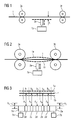
- Fig. 1 schematically shows a section of a rolling train in the side view.
- a metal strip 1, of which only one section is shown here is transported continuously under tension from a first rolling stand 3a in the direction of a second rolling stand 3b.
- a device for determining the flatness of the moving metal strip 1 is arranged by means of a non-contact measuring device 2a, which in this embodiment is arranged in a plurality of width sections b1, b2, b3, arranged over the width of the metal strip 1, b4, b5 (see FIG. 3 ) in each case a measured value is detected, and wherein the flatness of the metal strip 1 is determined from the detected measured values.
- the flatness determination is carried out in particular according to DE 198 03 260 A or the DE 102 57 639 A1 , but can also be done otherwise.
- the measuring device 2a is arranged in a position with a distance A perpendicular to the longitudinal axis of the metal strip 1 and the underside of the metal strip 1 aligns.
- the device further comprises two adjusting devices 7a, 7b (see also FIG. 3 ), which is so connected to the measuring device 2a, that the position of the measuring device 2a relative to the underside of the moving metal strip 1, as indicated by the double arrow, is adjustable.
- the adjusting devices 7a, 7b are the distance A and / or the spatial position of the measuring device 2a relative to the metal strip 1 changeable.
- the adjusting 7a, 7b are realized either by a respective threaded spindle drive or a pneumatic or hydraulic wedge adjustment (see FIGS. 7 to 10 ).
- Fig. 2 shows the schematic side view according to FIG. 1 including further details.
- the metal strip 1 is, as already in FIG. 1 , shown in its zero position, around which the metal strip 1 moves.
- the oscillation width of the metal strip 1 about the zero position is shown by the dashed lines 1a, 1b.
- the position of the measuring device 2a is set optimally by means of the adjusting devices 7a, 7b, whereby no collision with the oscillating metal strip 1 moving from the first rolling stand 3a in the direction of the second rolling stand 3b can occur.
- the measuring device 2a may also be arranged above the metal strip 1 or to the left or right of the antinode or otherwise displaced therefrom.
- FIG. 3 shows a schematic view of the arrangement according to FIG. 2 in cross section through the metal strip 1 at the level of the device comprising the measuring device 2a and the two adjusting devices 7a, 7b.
- the metal strip 1 is shown in its zero position, wherein the oscillation width of the metal strip 1 around the zero position on the dashed lines 1a, 1b is shown (see also FIG. 2 ).
- the measuring device 2a has five transmitting and / or receiving units 2a 'which are each assigned to a width section b1, b2, b3, b4, b5 of the metal strip 1 and are mounted on a common measuring slide 2a "'can be mounted stationary on the measuring slide 2a ", so that their position to each other not can be changed.
- the transmitting and / or receiving units 2a ' can be arranged on the measuring slide such that their position relative to each other, manually or preferably automatically, can be changed.
- the transmitting and / or receiving units 2a ' serve, in particular, for determining the flatness on the metal strip 1.
- a distance A1, A2, A3, A4, A5 in the respective width section b1, b2, b3, b4, b5 are determined, wherein the determined distance values serve to adjust the position of the measuring device 2a in the direction of a desired value.
- the transmitting and / or receiving units 2a ' preferably consist of optical sensors arranged in series.
- the sensors work without contact.
- the measuring device 2a may have only a single sensor. The measured values are recorded in particular over the entire width range and in all width sections b1, b2, b3, b4, b5 at the same time.
- the measuring slide 2a is connected at its two sides assigned to the edges of the metal strip 1 to a permanently mounted adjusting device 7a, 7b, each of which comprises a position indicator not shown separately here opposite the metal band 1 such that the distances A1, A2, A3, A4, A5 can be adjusted and optimized continuously or stepwise.
- An inclination of the measuring carriage 2a "with respect to the zero position of the metal strip 1 of, for example, ⁇ 1 mm can usually also be compensated for by means of the two adjusting devices 7a, 7b realized either by one threaded spindle drive or one each pneumatic or hydraulic wedge adjustment (see FIGS. 7 to 10 ).
- the maximum possible displacement V1, V2, on which the measuring device 2a can be moved in the direction of the underside of the metal strip 1 or away, is in FIG. 3 also shown.
- a change in position is effected at least by means of one of the adjusting devices 7a, 7b.
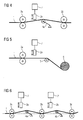
- FIG. 4 shows a schematic side view of another rolling mill arrangement with a looper 4a.
- a non-contact device for determining the flatness of the moving metal strip 1 comprising a measuring device 2a and an adjusting device 7 is arranged above the metal strip 1 between the first rolling stand 3a and the loop lifter 4a.
- a further device for determining the flatness of the moving metal strip 1 between the loop lifter 4a and the second rolling stand 3b can be arranged.
- Fig. 5 shows a schematic side view of another arrangement for carrying out a method with a deflection roller 5 and a reel 6, on which the metal strip 1 wound becomes.
- a device for determining the flatness of the moving metal strip 1 comprising a measuring device 2a and an adjusting device 7, for example in the form of a threaded spindle drive, is arranged above the metal strip 1 between the first rolling stand 3a and the reel 6.
- the deflection roller 5 is located between the first rolling stand 3a and the reel 6 or between the device for determining flatness and the reel 6.
- first rolling stand 3a and the device comprising the measuring device 2a may optionally a so-called, not shown here roll of tape, such as Bandessuh Trentsrolle, an Anticrimpingrolle, Anticrossbowrolle, a pinch roller and the like, be pivoted or levitated, which is placed on the top or bottom of the metal strip 1 and the position of the zero line of the metal strip 1 changed.
- roll of tape such as Bandessuh Trentsrolle, an Anticrimpingrolle, Anticrossbowrolle, a pinch roller and the like
- Fig. 6 shows a schematic side view of a multi-stand rolling mill arrangement for carrying out a method with a device for determining flatness, the two measuring devices 2a, 2b and two adjusting devices 7, 7 ', for example in the form of a threaded spindle drive comprises.
- the section of the rolling train shown here comprises the first rolling stand 3a, the second rolling stand 3b, a third rolling stand 3c and two loop lifters 4a, 4b, between the first rolling stand 3a and the second rolling stand 3b and between the second rolling stand 3b and the third rolling stand 3c each a loop lifter 4a, 4b is arranged.
- the measuring device 2a with the adjusting device 7 is located between the first rolling stand 3a and the loop lifter 4a, while the measuring device 2b with the adjusting device 7 'is located between the second rolling stand 3b and the loop lifter 4b.
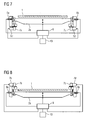
- Fig. 7 shows a schematic view of a first device for determining flatness and a metal strip 1 in cross section at the height of a measuring device 2a.
- the measuring device 2a is arranged vertically adjustable below the metal strip 1.
- the measuring device 2a is connected on both sides with a respective electromechanical adjusting device 7a, 7b, which are realized here in the form of on the side facing away from the metal strip 1 side of the measuring device 2a threaded spindle drives.
- the threaded spindle drives each comprise a drive motor 7a ', 7b' in the form of a servomotor.
- a control unit 9 not only undertakes the detection of measured data recorded with the measuring device 2a with regard to the belt tension or flatness, but also of distances measured between the measuring device 2a and the metal belt 1 over the width of the metal belt 1.
- the communication between the control unit 9 and the measuring device 2a is indicated only schematically by a connecting line between the two elements.
- the control unit 9 is connected to an optional input unit 10, for example in the form of a control panel.
- process parameters are input or fed via the input unit 10 and transmitted to the control unit 9.
- process parameters relating to the geometry of the metal strip 1, the nature or quality of the metal strip 1 as well as plant-related parameters, in particular regarding the zero position of the metal strip 1 in the rolling train are taken into account.
- the process parameters are used to provide or determine at least one desired value for the position of the measuring device 2a relative to the metal strip 1.
- the at least one desired value is then compared with the distance values measured by the measuring device 2a or the optionally determined position values therefrom and if required at least one control signal is generated and transmitted to the two adjusting devices 7a, 7b.
- the at least one control signal causes the actual value of the position of the measuring device 2a to be adjusted to the desired value by means of the adjusting devices 7a, 7b.
- the measuring device 2a is moved by means of the threaded spindle drives upwards in the direction of the metal strip 1 or away from the metal strip 1. To compensate for a tilt of the measuring device 2a relative to the metal strip 1 and a only one-sided or opposite movement on the threaded spindle drives is adjustable.
- clamping devices 8a, 8b here in the form of hydraulic clamping cylinders, are activated by means of the control unit 9, which fix the measuring device in its current position and secure against unintended changes in position.
- a change in the process parameters for example by a metal strip change, which is communicated to the control unit 9, in particular by means of the input unit 10
- at least one new setpoint for the position of the measuring device 2a is determined in the control unit 9, outputs a signal which causes a release of the clamping cylinder and the actual value of the position of the measuring device 2a by means of the adjusting devices 7a, 7b in the direction of the new at least one Setpoint changed.
- the hydraulic clamping cylinder can also be omitted.
- the communication between the control unit 9 and the individual components of the device for determining the flatness, such as the measuring device 2a, the adjusting devices 7a, 7b including the drive motors 7a ', 7b' and the clamping devices 8a, 8b, is shown only schematically.
- the operation of a hydraulic clamping cylinder requires a hydraulic line system, which has not been shown here for the sake of clarity.
- Fig. 8 shows a schematic view of a second device and a metal strip 1 in cross-section at the level of the measuring device 2a.
- the second device is in principle like the first device according to FIG. 7 built up.
- the adjusting devices 7a, 7b including the drive motors 7a ', 7b' are now on the side of the measuring device 2a, which faces the metal strip 1.
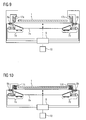
- Fig. 9 shows a schematic view of a third device for determining flatness and a metal strip 1 in cross-section at the level of the measuring device 2a.
- the measuring device 2a is also arranged vertically adjustable below the metal strip 1.
- the measuring device 2a is connected on both sides with a respective hydraulic adjusting device 7a, 7b, which is realized here in the form of a hydraulic wedge adjustment, which is located on the side facing away from the metal strip 1 of the measuring device 2a.
- a pneumatic wedge adjustment can be used.
- a wedge adjustment by means of a threaded spindle drive is alternatively usable, wherein the spindle of the threaded spindle drive into or out of the wedge to set different wedge positions.
- the displaceable wedges of the hydraulic wedge adjustment are controlled on both sides in each case with a proportional valve, which is controlled by means of an electronic analog output.
- the adjustment range of the wedges is for example in the range of ⁇ 50 mm. With an assumed slope of the wedge surfaces of 10% results in a proportional adjustment of the measuring device 2a of ⁇ 5 mm.
- the dimensions with regard to the adjustment range and the wedges are to be selected separately for the respective application and their parameters and are therefore listed here by way of example only.
- the measuring device 2a On the metal strip 1 facing side of the measuring device 2a are two devices 17a, 17b for exerting a back pressure on the measuring device 2a, here in the form of hydraulic impression cylinders, which increase the positioning accuracy of the system.
- the impression cylinders press the measuring device 2a permanently against the wedges of the hydraulic wedge adjustment.
- a control unit 9 and an optional input unit 10 take over in principle already FIG. 7 described tasks.
- the control unit 9 takes over the control of the hydraulic impression cylinder.
- the actual value of the position of the measuring device 2a is here also adapted to the desired value by means of the adjusting devices 7a, 7b.
- the measuring device 2a is moved by means of the hydraulic wedge adjustment upwards in the direction of the metal strip 1 or away from the metal strip 1.
- an inclined position of the measuring device 2a relative to the metal strip 1 is also an opposite movement of the two sides of the measuring device 2a via the hydraulic wedge adjustment adjustable.
- any desired clamping devices 8a, 8b here in the form of hydraulic clamping cylinders, are activated by means of the control unit 9, which fix the measuring device in its current position and secure it against unintentional changes in position.
- a change in the process parameters for example by a metal strip change, which is communicated to the control unit 9, for example by means of the input unit 10
- at least one new setpoint for the position of the measuring device 2a is determined in the control unit 9
- a control signal is output, which triggers a release of the clamping cylinder and the actual value of the position of the measuring device 2a is changed by means of the adjusting devices 7a, 7b in the direction of the new at least one desired value.
- the clamping devices 8a, 8b can also be omitted.
- the communication between the control unit 9 and the individual components of the third flatness measuring device, such as the measuring device 2a, the adjusting devices 7a, 7b, the devices 17a, 17b for exerting a backpressure in the form of hydraulic counter-pressure cylinders and the clamping devices 8a, 8b in the form of hydraulic Clamping cylinder, is like in FIG. 7 only shown schematically. It is obvious, for example, that the operation of a hydraulic impression cylinder and / or a hydraulic clamping cylinder requires a hydraulic line system, which has not been shown here for the sake of clarity.
- Fig. 10 shows a schematic view of a fourth device for determining flatness and a metal strip 1 in cross-section at the level of the measuring device 2a, which is constructed in principle as the third device according to FIG. 9 ,
- the hydraulic impression cylinders have been replaced by means 17c, 17d for the exercise of a back pressure in the form of mechanical counter-pressure springs, which require neither a control means of the control unit 9 nor a hydraulic line system.
Landscapes
- Physics & Mathematics (AREA)
- General Physics & Mathematics (AREA)
- Engineering & Computer Science (AREA)
- Mechanical Engineering (AREA)
- Length Measuring Devices With Unspecified Measuring Means (AREA)
Priority Applications (1)
| Application Number | Priority Date | Filing Date | Title |
|---|---|---|---|
| PL09736153T PL2344286T3 (pl) | 2008-10-31 | 2009-09-15 | Sposób i urządzenie do wyznaczania płaskości taśmy metalowej |
Applications Claiming Priority (2)
| Application Number | Priority Date | Filing Date | Title |
|---|---|---|---|
| DE102008054271 | 2008-10-31 | ||
| PCT/EP2009/061957 WO2010049209A1 (de) | 2008-10-31 | 2009-09-15 | Verfahren und vorrichtung zur ermittlung einer planheit eines metallbandes |
Publications (2)
| Publication Number | Publication Date |
|---|---|
| EP2344286A1 EP2344286A1 (de) | 2011-07-20 |
| EP2344286B1 true EP2344286B1 (de) | 2013-11-20 |
Family
ID=41600790
Family Applications (1)
| Application Number | Title | Priority Date | Filing Date |
|---|---|---|---|
| EP09736153.9A Not-in-force EP2344286B1 (de) | 2008-10-31 | 2009-09-15 | Verfahren und vorrichtung zur ermittlung einer planheit eines metallbandes |
Country Status (4)
| Country | Link |
|---|---|
| EP (1) | EP2344286B1 (pl) |
| CN (1) | CN102223959B (pl) |
| PL (1) | PL2344286T3 (pl) |
| WO (1) | WO2010049209A1 (pl) |
Families Citing this family (10)
| Publication number | Priority date | Publication date | Assignee | Title |
|---|---|---|---|---|
| EP2436459A1 (de) | 2010-09-29 | 2012-04-04 | Siemens Aktiengesellschaft | Vorrichtung und Verfahren zur Positionierung mindestens einer von zwei Gießrollen in einem kontinuierlichen Gießverfahren zur Herstellung eines Metallbands |
| CN102688890B (zh) * | 2011-03-25 | 2014-07-23 | 宝山钢铁股份有限公司 | 双机架平整机组带钢稳定防抖装置及控制方法 |
| EP2647949A1 (fr) * | 2012-04-04 | 2013-10-09 | Siemens VAI Metals Technologies GmbH | Méthode et dispositif de mesure de planéité d'un produit métallique |
| EP2692376B1 (de) | 2012-08-01 | 2019-04-03 | TecPharma Licensing AG | Injektionsvorrichtung mit einer helix- bzw. wendelförmigen Dosisskala |
| CN103017721B (zh) * | 2012-12-05 | 2015-07-15 | 山东科技大学 | 陶瓷涂布刮刀平面度误差测量装置及其测量方法 |
| CN105229413B (zh) * | 2013-05-14 | 2017-12-01 | 新日铁住金株式会社 | 板材的平面度测定方法、板材的平面度测定装置以及钢板的制造方法 |
| EP3599038A1 (de) | 2018-07-25 | 2020-01-29 | Primetals Technologies Austria GmbH | Verfahren und vorrichtung zur ermittlung der seitlichen bandkontur eines laufenden metallbandes |
| CN112683204B (zh) * | 2020-12-09 | 2022-10-21 | 安徽坤源铝业有限公司 | 一种铝板生产用检测装置 |
| EP4032629A1 (de) * | 2021-01-25 | 2022-07-27 | Primetals Technologies Germany GmbH | Planheitsmessung bei walzstrassen für aluminium |
| CN118670337B (zh) * | 2024-08-16 | 2024-10-25 | 济宁海富光学科技有限公司 | 一种手机盖板玻璃平整度检测装置及其检测方法 |
Family Cites Families (9)
| Publication number | Priority date | Publication date | Assignee | Title |
|---|---|---|---|---|
| AT329293B (de) * | 1974-01-15 | 1976-05-10 | Voest Ag | Verfahren zum erfassen der planheit eines kaltgewalzten ferromagnetischen bandes und vorrichtung zur durchfuhrung des verfahrens |
| FR2695049B1 (fr) * | 1992-09-03 | 1994-11-10 | Lorraine Laminage | Procédé et dispositif d'évaluation de la planéité d'une bande et ligne de fabrication d'une bande en continu comportant un dispositif d'évaluation de la planéité de la bande. |
| DE19758466B4 (de) * | 1997-03-11 | 2007-10-04 | Betriebsforschungsinstitut VDEh - Institut für angewandte Forschung GmbH | Planheits-Regelungssystem für Metallband |
| US6658947B1 (en) * | 2000-08-25 | 2003-12-09 | T. Sendzimir, Inc. | Strip flatness measuring device |
| DE10257639A1 (de) * | 2002-12-10 | 2004-07-08 | Siemens Ag | Verfahren und Vorrichtung zur Planheitsermittlung in einem Metallband unter zug |
| CN1282508C (zh) * | 2003-09-12 | 2006-11-01 | 张学庄 | 平直度自动测量方法及装置 |
| CN2822819Y (zh) * | 2005-07-16 | 2006-10-04 | 烟台鲁宝钢管有限责任公司 | 轧辊侧压量调整测量装置 |
| CN1857811B (zh) * | 2006-06-08 | 2010-10-06 | 宝钢工程技术集团有限公司 | 自动托卷定位装置及方法 |
| CN101241307A (zh) * | 2007-12-21 | 2008-08-13 | 上海微电子装备有限公司 | 具有大行程调节功能的调平调焦机构 |
-
2009
- 2009-09-15 PL PL09736153T patent/PL2344286T3/pl unknown
- 2009-09-15 EP EP09736153.9A patent/EP2344286B1/de not_active Not-in-force
- 2009-09-15 WO PCT/EP2009/061957 patent/WO2010049209A1/de not_active Ceased
- 2009-09-15 CN CN200980143244.2A patent/CN102223959B/zh not_active Expired - Fee Related
Also Published As
| Publication number | Publication date |
|---|---|
| PL2344286T3 (pl) | 2014-04-30 |
| EP2344286A1 (de) | 2011-07-20 |
| WO2010049209A1 (de) | 2010-05-06 |
| CN102223959A (zh) | 2011-10-19 |
| CN102223959B (zh) | 2015-04-01 |
Similar Documents
| Publication | Publication Date | Title |
|---|---|---|
| EP2344286B1 (de) | Verfahren und vorrichtung zur ermittlung einer planheit eines metallbandes | |
| EP2024110B1 (de) | Vorrichtung zum messen der breite und/oder der bandlage eines metallbandes oder einer bramme | |
| DE3881808T2 (de) | Verfahren zum Messen eines Walzenprofiles und Vorrichtung dafür. | |
| EP1961502B1 (de) | Verfahren sowie Vorrichtung zum Biegen von Werkstücken | |
| DE60204568T2 (de) | Verfahren zur einstellung der bahn einer abkantpresse | |
| EP2839951B1 (de) | Verfahren zur Herstellung einer mindestens einseitig kaschierten Wellpappebahn | |
| EP2825332A1 (de) | Vorrichtung zum richten von metallband | |
| DE2930005A1 (de) | Verfahren und einrichtung zum herstellen eines plattenmaterials, das eine gleichmaessige breite und eine laengsweise dickenaenderung hat | |
| EP4237788B1 (de) | Verfahren zum ermitteln der dicke eines materialbandes beim zuführen des materialbandes zur bearbeitungszone einer werkzeugmaschine | |
| EP0377796A2 (de) | Mess- und Ausrichteinrichtung an einer Rundschleifmaschine | |
| EP2519364B1 (de) | Verfahren zur regelung von seitenführungen eines metallbandes | |
| EP2270422A2 (de) | Vorrichtung zum Messen der Dicke einer laufenden Materialbahn | |
| AT508857B1 (de) | Verfahren zur bestimmung der dicke eines werkstückes mit einer biegemaschine | |
| DE4309294A1 (de) | Echtzeit-Fluchtfehlermeß- und Korrekturvorrichtung für Werkzeugmaschinen | |
| DE102019123836A1 (de) | Schrägwalzaggregat sowie Verfahren zum Anstellen des Walzkalibers eines Schrägwalzaggregats | |
| EP0399296A2 (de) | Automatisches Einrichten eines Universalwalzgerüstes nach dessen Umbau auf neue Profilformate | |
| EP3290154B1 (de) | Verfahren zur überwachung eines schleifprozesses | |
| DE69912162T2 (de) | Schleifmaschine | |
| DE602004012843T2 (de) | Vorrichtung und verfahren zum kalibrieren einer rollenrichtmaschine mittels eines instrumentierten stabs | |
| EP4082764B1 (de) | Verfahren und vorrichtung zur prüfung eines spänekuchens | |
| DE60105312T2 (de) | Verfahren zur echtzeiteinstellung einer richtmaschine | |
| AT515672B1 (de) | Biegepresse | |
| DE69223531T2 (de) | Verfahren zur zerstörungsfreien on-line-Messung einer Charakteristik eines kontinuierlich hergestellten Produktes und entsprechende Vorrichtung | |
| AT518486B1 (de) | Verfahren zur Messung der Massenverteilung | |
| DE69300271T2 (de) | Vorrichtung zur Detektion von Oberflächenfehlern in bewegten Metallstangen oder Draht. |
Legal Events
| Date | Code | Title | Description |
|---|---|---|---|
| PUAI | Public reference made under article 153(3) epc to a published international application that has entered the european phase |
Free format text: ORIGINAL CODE: 0009012 |
|
| 17P | Request for examination filed |
Effective date: 20110309 |
|
| AK | Designated contracting states |
Kind code of ref document: A1 Designated state(s): AT BE BG CH CY CZ DE DK EE ES FI FR GB GR HR HU IE IS IT LI LT LU LV MC MK MT NL NO PL PT RO SE SI SK SM TR |
|
| AX | Request for extension of the european patent |
Extension state: AL BA RS |
|
| DAX | Request for extension of the european patent (deleted) | ||
| RAP1 | Party data changed (applicant data changed or rights of an application transferred) |
Owner name: SIEMENS AKTIENGESELLSCHAFT |
|
| GRAP | Despatch of communication of intention to grant a patent |
Free format text: ORIGINAL CODE: EPIDOSNIGR1 |
|
| INTG | Intention to grant announced |
Effective date: 20130620 |
|
| GRAS | Grant fee paid |
Free format text: ORIGINAL CODE: EPIDOSNIGR3 |
|
| GRAA | (expected) grant |
Free format text: ORIGINAL CODE: 0009210 |
|
| AK | Designated contracting states |
Kind code of ref document: B1 Designated state(s): AT BE BG CH CY CZ DE DK EE ES FI FR GB GR HR HU IE IS IT LI LT LU LV MC MK MT NL NO PL PT RO SE SI SK SM TR |
|
| REG | Reference to a national code |
Ref country code: GB Ref legal event code: FG4D Free format text: NOT ENGLISH |
|
| REG | Reference to a national code |
Ref country code: CH Ref legal event code: EP |
|
| REG | Reference to a national code |
Ref country code: AT Ref legal event code: REF Ref document number: 641260 Country of ref document: AT Kind code of ref document: T Effective date: 20131215 |
|
| REG | Reference to a national code |
Ref country code: IE Ref legal event code: FG4D Free format text: LANGUAGE OF EP DOCUMENT: GERMAN |
|
| REG | Reference to a national code |
Ref country code: DE Ref legal event code: R096 Ref document number: 502009008378 Country of ref document: DE Effective date: 20140116 |
|
| REG | Reference to a national code |
Ref country code: SE Ref legal event code: TRGR |
|
| REG | Reference to a national code |
Ref country code: NL Ref legal event code: VDEP Effective date: 20131120 |
|
| REG | Reference to a national code |
Ref country code: LT Ref legal event code: MG4D |
|
| PG25 | Lapsed in a contracting state [announced via postgrant information from national office to epo] |
Ref country code: IS Free format text: LAPSE BECAUSE OF FAILURE TO SUBMIT A TRANSLATION OF THE DESCRIPTION OR TO PAY THE FEE WITHIN THE PRESCRIBED TIME-LIMIT Effective date: 20140320 Ref country code: LT Free format text: LAPSE BECAUSE OF FAILURE TO SUBMIT A TRANSLATION OF THE DESCRIPTION OR TO PAY THE FEE WITHIN THE PRESCRIBED TIME-LIMIT Effective date: 20131120 Ref country code: HR Free format text: LAPSE BECAUSE OF FAILURE TO SUBMIT A TRANSLATION OF THE DESCRIPTION OR TO PAY THE FEE WITHIN THE PRESCRIBED TIME-LIMIT Effective date: 20131120 Ref country code: FI Free format text: LAPSE BECAUSE OF FAILURE TO SUBMIT A TRANSLATION OF THE DESCRIPTION OR TO PAY THE FEE WITHIN THE PRESCRIBED TIME-LIMIT Effective date: 20131120 Ref country code: NL Free format text: LAPSE BECAUSE OF FAILURE TO SUBMIT A TRANSLATION OF THE DESCRIPTION OR TO PAY THE FEE WITHIN THE PRESCRIBED TIME-LIMIT Effective date: 20131120 Ref country code: NO Free format text: LAPSE BECAUSE OF FAILURE TO SUBMIT A TRANSLATION OF THE DESCRIPTION OR TO PAY THE FEE WITHIN THE PRESCRIBED TIME-LIMIT Effective date: 20140220 |
|
| REG | Reference to a national code |
Ref country code: PL Ref legal event code: T3 |
|
| PG25 | Lapsed in a contracting state [announced via postgrant information from national office to epo] |
Ref country code: ES Free format text: LAPSE BECAUSE OF FAILURE TO SUBMIT A TRANSLATION OF THE DESCRIPTION OR TO PAY THE FEE WITHIN THE PRESCRIBED TIME-LIMIT Effective date: 20131120 Ref country code: LV Free format text: LAPSE BECAUSE OF FAILURE TO SUBMIT A TRANSLATION OF THE DESCRIPTION OR TO PAY THE FEE WITHIN THE PRESCRIBED TIME-LIMIT Effective date: 20131120 |
|
| PG25 | Lapsed in a contracting state [announced via postgrant information from national office to epo] |
Ref country code: PT Free format text: LAPSE BECAUSE OF FAILURE TO SUBMIT A TRANSLATION OF THE DESCRIPTION OR TO PAY THE FEE WITHIN THE PRESCRIBED TIME-LIMIT Effective date: 20140320 |
|
| PG25 | Lapsed in a contracting state [announced via postgrant information from national office to epo] |
Ref country code: EE Free format text: LAPSE BECAUSE OF FAILURE TO SUBMIT A TRANSLATION OF THE DESCRIPTION OR TO PAY THE FEE WITHIN THE PRESCRIBED TIME-LIMIT Effective date: 20131120 |
|
| REG | Reference to a national code |
Ref country code: DE Ref legal event code: R097 Ref document number: 502009008378 Country of ref document: DE |
|
| PG25 | Lapsed in a contracting state [announced via postgrant information from national office to epo] |
Ref country code: RO Free format text: LAPSE BECAUSE OF FAILURE TO SUBMIT A TRANSLATION OF THE DESCRIPTION OR TO PAY THE FEE WITHIN THE PRESCRIBED TIME-LIMIT Effective date: 20131120 Ref country code: CZ Free format text: LAPSE BECAUSE OF FAILURE TO SUBMIT A TRANSLATION OF THE DESCRIPTION OR TO PAY THE FEE WITHIN THE PRESCRIBED TIME-LIMIT Effective date: 20131120 Ref country code: SK Free format text: LAPSE BECAUSE OF FAILURE TO SUBMIT A TRANSLATION OF THE DESCRIPTION OR TO PAY THE FEE WITHIN THE PRESCRIBED TIME-LIMIT Effective date: 20131120 |
|
| PLBE | No opposition filed within time limit |
Free format text: ORIGINAL CODE: 0009261 |
|
| STAA | Information on the status of an ep patent application or granted ep patent |
Free format text: STATUS: NO OPPOSITION FILED WITHIN TIME LIMIT |
|
| PG25 | Lapsed in a contracting state [announced via postgrant information from national office to epo] |
Ref country code: DK Free format text: LAPSE BECAUSE OF FAILURE TO SUBMIT A TRANSLATION OF THE DESCRIPTION OR TO PAY THE FEE WITHIN THE PRESCRIBED TIME-LIMIT Effective date: 20131120 |
|
| 26N | No opposition filed |
Effective date: 20140821 |
|
| REG | Reference to a national code |
Ref country code: DE Ref legal event code: R097 Ref document number: 502009008378 Country of ref document: DE Effective date: 20140821 |
|
| PG25 | Lapsed in a contracting state [announced via postgrant information from national office to epo] |
Ref country code: SI Free format text: LAPSE BECAUSE OF FAILURE TO SUBMIT A TRANSLATION OF THE DESCRIPTION OR TO PAY THE FEE WITHIN THE PRESCRIBED TIME-LIMIT Effective date: 20131120 |
|
| PG25 | Lapsed in a contracting state [announced via postgrant information from national office to epo] |
Ref country code: MC Free format text: LAPSE BECAUSE OF FAILURE TO SUBMIT A TRANSLATION OF THE DESCRIPTION OR TO PAY THE FEE WITHIN THE PRESCRIBED TIME-LIMIT Effective date: 20131120 Ref country code: LU Free format text: LAPSE BECAUSE OF FAILURE TO SUBMIT A TRANSLATION OF THE DESCRIPTION OR TO PAY THE FEE WITHIN THE PRESCRIBED TIME-LIMIT Effective date: 20140915 |
|
| REG | Reference to a national code |
Ref country code: CH Ref legal event code: PL |
|
| GBPC | Gb: european patent ceased through non-payment of renewal fee |
Effective date: 20140915 |
|
| REG | Reference to a national code |
Ref country code: IE Ref legal event code: MM4A |
|
| PG25 | Lapsed in a contracting state [announced via postgrant information from national office to epo] |
Ref country code: BE Free format text: LAPSE BECAUSE OF NON-PAYMENT OF DUE FEES Effective date: 20140930 |
|
| PG25 | Lapsed in a contracting state [announced via postgrant information from national office to epo] |
Ref country code: CH Free format text: LAPSE BECAUSE OF NON-PAYMENT OF DUE FEES Effective date: 20140930 Ref country code: LI Free format text: LAPSE BECAUSE OF NON-PAYMENT OF DUE FEES Effective date: 20140930 Ref country code: GB Free format text: LAPSE BECAUSE OF NON-PAYMENT OF DUE FEES Effective date: 20140915 |
|
| REG | Reference to a national code |
Ref country code: DE Ref legal event code: R081 Ref document number: 502009008378 Country of ref document: DE Owner name: PRIMETALS TECHNOLOGIES GERMANY GMBH, DE Free format text: FORMER OWNER: SIEMENS AKTIENGESELLSCHAFT, 80333 MUENCHEN, DE |
|
| PG25 | Lapsed in a contracting state [announced via postgrant information from national office to epo] |
Ref country code: IE Free format text: LAPSE BECAUSE OF NON-PAYMENT OF DUE FEES Effective date: 20140915 Ref country code: IT Free format text: LAPSE BECAUSE OF FAILURE TO SUBMIT A TRANSLATION OF THE DESCRIPTION OR TO PAY THE FEE WITHIN THE PRESCRIBED TIME-LIMIT Effective date: 20131120 |
|
| REG | Reference to a national code |
Ref country code: FR Ref legal event code: PLFP Year of fee payment: 7 |
|
| REG | Reference to a national code |
Ref country code: AT Ref legal event code: MM01 Ref document number: 641260 Country of ref document: AT Kind code of ref document: T Effective date: 20140915 |
|
| REG | Reference to a national code |
Ref country code: FR Ref legal event code: TP Owner name: PRIMETALS TECHNOLOGIES GERMANY GMBH, DE Effective date: 20151105 |
|
| PG25 | Lapsed in a contracting state [announced via postgrant information from national office to epo] |
Ref country code: AT Free format text: LAPSE BECAUSE OF NON-PAYMENT OF DUE FEES Effective date: 20140915 |
|
| PG25 | Lapsed in a contracting state [announced via postgrant information from national office to epo] |
Ref country code: SM Free format text: LAPSE BECAUSE OF FAILURE TO SUBMIT A TRANSLATION OF THE DESCRIPTION OR TO PAY THE FEE WITHIN THE PRESCRIBED TIME-LIMIT Effective date: 20131120 |
|
| PG25 | Lapsed in a contracting state [announced via postgrant information from national office to epo] |
Ref country code: MT Free format text: LAPSE BECAUSE OF FAILURE TO SUBMIT A TRANSLATION OF THE DESCRIPTION OR TO PAY THE FEE WITHIN THE PRESCRIBED TIME-LIMIT Effective date: 20131120 Ref country code: GR Free format text: LAPSE BECAUSE OF FAILURE TO SUBMIT A TRANSLATION OF THE DESCRIPTION OR TO PAY THE FEE WITHIN THE PRESCRIBED TIME-LIMIT Effective date: 20140221 Ref country code: BG Free format text: LAPSE BECAUSE OF FAILURE TO SUBMIT A TRANSLATION OF THE DESCRIPTION OR TO PAY THE FEE WITHIN THE PRESCRIBED TIME-LIMIT Effective date: 20131120 Ref country code: CY Free format text: LAPSE BECAUSE OF FAILURE TO SUBMIT A TRANSLATION OF THE DESCRIPTION OR TO PAY THE FEE WITHIN THE PRESCRIBED TIME-LIMIT Effective date: 20131120 |
|
| PG25 | Lapsed in a contracting state [announced via postgrant information from national office to epo] |
Ref country code: HU Free format text: LAPSE BECAUSE OF FAILURE TO SUBMIT A TRANSLATION OF THE DESCRIPTION OR TO PAY THE FEE WITHIN THE PRESCRIBED TIME-LIMIT; INVALID AB INITIO Effective date: 20090915 |
|
| REG | Reference to a national code |
Ref country code: FR Ref legal event code: PLFP Year of fee payment: 8 |
|
| PGFP | Annual fee paid to national office [announced via postgrant information from national office to epo] |
Ref country code: PL Payment date: 20160823 Year of fee payment: 8 Ref country code: FR Payment date: 20160921 Year of fee payment: 8 |
|
| PGFP | Annual fee paid to national office [announced via postgrant information from national office to epo] |
Ref country code: TR Payment date: 20160824 Year of fee payment: 8 |
|
| PG25 | Lapsed in a contracting state [announced via postgrant information from national office to epo] |
Ref country code: MK Free format text: LAPSE BECAUSE OF FAILURE TO SUBMIT A TRANSLATION OF THE DESCRIPTION OR TO PAY THE FEE WITHIN THE PRESCRIBED TIME-LIMIT Effective date: 20131120 |
|
| REG | Reference to a national code |
Ref country code: FR Ref legal event code: ST Effective date: 20180531 |
|
| PG25 | Lapsed in a contracting state [announced via postgrant information from national office to epo] |
Ref country code: FR Free format text: LAPSE BECAUSE OF NON-PAYMENT OF DUE FEES Effective date: 20171002 |
|
| PG25 | Lapsed in a contracting state [announced via postgrant information from national office to epo] |
Ref country code: PL Free format text: LAPSE BECAUSE OF NON-PAYMENT OF DUE FEES Effective date: 20170915 |
|
| REG | Reference to a national code |
Ref country code: DE Ref legal event code: R081 Ref document number: 502009008378 Country of ref document: DE Owner name: PRIMETALS TECHNOLOGIES GERMANY GMBH, DE Free format text: FORMER OWNER: PRIMETALS TECHNOLOGIES GERMANY GMBH, 91052 ERLANGEN, DE |
|
| PGFP | Annual fee paid to national office [announced via postgrant information from national office to epo] |
Ref country code: DE Payment date: 20200925 Year of fee payment: 12 |
|
| PGFP | Annual fee paid to national office [announced via postgrant information from national office to epo] |
Ref country code: SE Payment date: 20200925 Year of fee payment: 12 |
|
| REG | Reference to a national code |
Ref country code: DE Ref legal event code: R119 Ref document number: 502009008378 Country of ref document: DE |
|
| REG | Reference to a national code |
Ref country code: SE Ref legal event code: EUG |
|
| PG25 | Lapsed in a contracting state [announced via postgrant information from national office to epo] |
Ref country code: SE Free format text: LAPSE BECAUSE OF NON-PAYMENT OF DUE FEES Effective date: 20210916 Ref country code: DE Free format text: LAPSE BECAUSE OF NON-PAYMENT OF DUE FEES Effective date: 20220401 |
|
| PG25 | Lapsed in a contracting state [announced via postgrant information from national office to epo] |
Ref country code: TR Free format text: LAPSE BECAUSE OF NON-PAYMENT OF DUE FEES Effective date: 20170915 |