EP2339402A1 - Lithographic printing plate precursor and method of preparing lithographic printing plate - Google Patents
Lithographic printing plate precursor and method of preparing lithographic printing plate Download PDFInfo
- Publication number
- EP2339402A1 EP2339402A1 EP10197142A EP10197142A EP2339402A1 EP 2339402 A1 EP2339402 A1 EP 2339402A1 EP 10197142 A EP10197142 A EP 10197142A EP 10197142 A EP10197142 A EP 10197142A EP 2339402 A1 EP2339402 A1 EP 2339402A1
- Authority
- EP
- European Patent Office
- Prior art keywords
- group
- printing plate
- lithographic printing
- formula
- plate precursor
- Prior art date
- Legal status (The legal status is an assumption and is not a legal conclusion. Google has not performed a legal analysis and makes no representation as to the accuracy of the status listed.)
- Withdrawn
Links
- 238000007639 printing Methods 0.000 title claims abstract description 268
- 239000002243 precursor Substances 0.000 title claims abstract description 159
- 238000000034 method Methods 0.000 title claims abstract description 60
- 150000001875 compounds Chemical class 0.000 claims abstract description 96
- 229920000642 polymer Polymers 0.000 claims abstract description 92
- 238000011161 development Methods 0.000 claims abstract description 65
- 229920001577 copolymer Polymers 0.000 claims abstract description 52
- 239000000178 monomer Substances 0.000 claims abstract description 45
- 239000011230 binding agent Substances 0.000 claims abstract description 42
- 239000011203 carbon fibre reinforced carbon Substances 0.000 claims abstract description 30
- CREMABGTGYGIQB-UHFFFAOYSA-N carbon carbon Chemical compound C.C CREMABGTGYGIQB-UHFFFAOYSA-N 0.000 claims abstract description 27
- 238000012545 processing Methods 0.000 claims abstract description 27
- 239000003505 polymerization initiator Substances 0.000 claims abstract description 20
- 239000010410 layer Substances 0.000 claims description 150
- -1 carboxylate anion Chemical class 0.000 claims description 139
- 125000004435 hydrogen atom Chemical group [H]* 0.000 claims description 129
- 125000004432 carbon atom Chemical group C* 0.000 claims description 119
- 125000000217 alkyl group Chemical group 0.000 claims description 75
- 125000003118 aryl group Chemical group 0.000 claims description 67
- 150000003839 salts Chemical class 0.000 claims description 53
- 125000002947 alkylene group Chemical group 0.000 claims description 50
- 125000001424 substituent group Chemical group 0.000 claims description 48
- 125000002887 hydroxy group Chemical group [H]O* 0.000 claims description 39
- 239000011241 protective layer Substances 0.000 claims description 33
- 230000001235 sensitizing effect Effects 0.000 claims description 31
- 125000005843 halogen group Chemical group 0.000 claims description 25
- QGZKDVFQNNGYKY-UHFFFAOYSA-O Ammonium Chemical compound [NH4+] QGZKDVFQNNGYKY-UHFFFAOYSA-O 0.000 claims description 23
- 125000000524 functional group Chemical group 0.000 claims description 19
- 229910052757 nitrogen Inorganic materials 0.000 claims description 17
- 125000000732 arylene group Chemical group 0.000 claims description 16
- 229920005989 resin Polymers 0.000 claims description 14
- 239000011347 resin Substances 0.000 claims description 14
- 125000000542 sulfonic acid group Chemical group 0.000 claims description 14
- 229910021645 metal ion Inorganic materials 0.000 claims description 12
- ABLZXFCXXLZCGV-UHFFFAOYSA-N phosphonic acid group Chemical group P(O)(O)=O ABLZXFCXXLZCGV-UHFFFAOYSA-N 0.000 claims description 12
- 238000010521 absorption reaction Methods 0.000 claims description 11
- 229910019142 PO4 Inorganic materials 0.000 claims description 8
- 125000004093 cyano group Chemical group *C#N 0.000 claims description 8
- 239000010452 phosphate Substances 0.000 claims description 8
- XYFCBTPGUUZFHI-UHFFFAOYSA-O phosphonium Chemical compound [PH4+] XYFCBTPGUUZFHI-UHFFFAOYSA-O 0.000 claims description 8
- 125000002270 phosphoric acid ester group Chemical group 0.000 claims description 8
- 229910052698 phosphorus Inorganic materials 0.000 claims description 8
- 229920002037 poly(vinyl butyral) polymer Polymers 0.000 claims description 8
- 239000006096 absorbing agent Substances 0.000 claims description 7
- 229920005749 polyurethane resin Polymers 0.000 claims description 7
- 229920000058 polyacrylate Polymers 0.000 claims description 6
- 239000003094 microcapsule Substances 0.000 claims description 5
- 150000002891 organic anions Chemical class 0.000 claims description 5
- 150000001449 anionic compounds Chemical class 0.000 claims description 4
- 229910001412 inorganic anion Inorganic materials 0.000 claims description 4
- 125000003903 2-propenyl group Chemical group [H]C([*])([H])C([H])=C([H])[H] 0.000 claims description 3
- QAOWNCQODCNURD-UHFFFAOYSA-L Sulfate Chemical compound [O-]S([O-])(=O)=O QAOWNCQODCNURD-UHFFFAOYSA-L 0.000 claims description 3
- 239000000126 substance Substances 0.000 abstract description 35
- 230000007935 neutral effect Effects 0.000 abstract description 6
- 125000002496 methyl group Chemical group [H]C([H])([H])* 0.000 description 121
- 230000018109 developmental process Effects 0.000 description 62
- 125000001495 ethyl group Chemical group [H]C([H])([H])C([H])([H])* 0.000 description 61
- 239000000243 solution Substances 0.000 description 61
- 239000000975 dye Substances 0.000 description 59
- 239000011248 coating agent Substances 0.000 description 51
- 238000000576 coating method Methods 0.000 description 51
- XLYOFNOQVPJJNP-UHFFFAOYSA-N water Substances O XLYOFNOQVPJJNP-UHFFFAOYSA-N 0.000 description 50
- 230000000052 comparative effect Effects 0.000 description 43
- 125000001931 aliphatic group Chemical group 0.000 description 34
- 238000011282 treatment Methods 0.000 description 34
- 125000001140 1,4-phenylene group Chemical group [H]C1=C([H])C([*:2])=C([H])C([H])=C1[*:1] 0.000 description 31
- 125000001797 benzyl group Chemical group [H]C1=C([H])C([H])=C(C([H])=C1[H])C([H])([H])* 0.000 description 25
- 229920002451 polyvinyl alcohol Polymers 0.000 description 25
- 235000019422 polyvinyl alcohol Nutrition 0.000 description 25
- 239000000463 material Substances 0.000 description 24
- 239000004372 Polyvinyl alcohol Substances 0.000 description 23
- 239000002253 acid Substances 0.000 description 22
- 239000000203 mixture Substances 0.000 description 22
- 238000006116 polymerization reaction Methods 0.000 description 22
- 238000004321 preservation Methods 0.000 description 22
- 239000002245 particle Substances 0.000 description 20
- 239000004094 surface-active agent Substances 0.000 description 20
- 125000004123 n-propyl group Chemical group [H]C([H])([H])C([H])([H])C([H])([H])* 0.000 description 18
- 125000004108 n-butyl group Chemical group [H]C([H])([H])C([H])([H])C([H])([H])C([H])([H])* 0.000 description 16
- ZWEHNKRNPOVVGH-UHFFFAOYSA-N 2-Butanone Chemical compound CCC(C)=O ZWEHNKRNPOVVGH-UHFFFAOYSA-N 0.000 description 15
- 125000003710 aryl alkyl group Chemical group 0.000 description 15
- 150000002430 hydrocarbons Chemical class 0.000 description 15
- 229910052782 aluminium Inorganic materials 0.000 description 14
- 150000003254 radicals Chemical class 0.000 description 14
- 125000000954 2-hydroxyethyl group Chemical group [H]C([*])([H])C([H])([H])O[H] 0.000 description 13
- IAYPIBMASNFSPL-UHFFFAOYSA-N Ethylene oxide Chemical group C1CO1 IAYPIBMASNFSPL-UHFFFAOYSA-N 0.000 description 13
- 150000001450 anions Chemical group 0.000 description 13
- 230000015572 biosynthetic process Effects 0.000 description 13
- 235000014113 dietary fatty acids Nutrition 0.000 description 13
- 239000000194 fatty acid Substances 0.000 description 13
- 229930195729 fatty acid Natural products 0.000 description 13
- 125000004029 hydroxymethyl group Chemical group [H]OC([H])([H])* 0.000 description 13
- 125000004184 methoxymethyl group Chemical group [H]C([H])([H])OC([H])([H])* 0.000 description 13
- 239000000049 pigment Substances 0.000 description 13
- 238000002360 preparation method Methods 0.000 description 13
- 239000007787 solid Substances 0.000 description 13
- OKKJLVBELUTLKV-UHFFFAOYSA-N Methanol Chemical compound OC OKKJLVBELUTLKV-UHFFFAOYSA-N 0.000 description 12
- 150000003384 small molecules Chemical class 0.000 description 12
- 239000011734 sodium Substances 0.000 description 12
- ARXJGSRGQADJSQ-UHFFFAOYSA-N 1-methoxypropan-2-ol Chemical compound COCC(C)O ARXJGSRGQADJSQ-UHFFFAOYSA-N 0.000 description 11
- LFQSCWFLJHTTHZ-UHFFFAOYSA-N Ethanol Chemical compound CCO LFQSCWFLJHTTHZ-UHFFFAOYSA-N 0.000 description 11
- XAGFODPZIPBFFR-UHFFFAOYSA-N aluminium Chemical compound [Al] XAGFODPZIPBFFR-UHFFFAOYSA-N 0.000 description 11
- 239000007864 aqueous solution Substances 0.000 description 11
- RTZKZFJDLAIYFH-UHFFFAOYSA-N ether Substances CCOCC RTZKZFJDLAIYFH-UHFFFAOYSA-N 0.000 description 11
- 238000007788 roughening Methods 0.000 description 11
- 229910052708 sodium Inorganic materials 0.000 description 11
- 125000002993 cycloalkylene group Chemical group 0.000 description 10
- 125000005156 substituted alkylene group Chemical group 0.000 description 10
- 229920003171 Poly (ethylene oxide) Polymers 0.000 description 9
- HEMHJVSKTPXQMS-UHFFFAOYSA-M Sodium hydroxide Chemical compound [OH-].[Na+] HEMHJVSKTPXQMS-UHFFFAOYSA-M 0.000 description 9
- 125000003545 alkoxy group Chemical group 0.000 description 9
- 239000003795 chemical substances by application Substances 0.000 description 9
- 239000006185 dispersion Substances 0.000 description 9
- 238000011156 evaluation Methods 0.000 description 9
- 238000010438 heat treatment Methods 0.000 description 9
- 229910052700 potassium Inorganic materials 0.000 description 9
- QGKMIGUHVLGJBR-UHFFFAOYSA-M (4z)-1-(3-methylbutyl)-4-[[1-(3-methylbutyl)quinolin-1-ium-4-yl]methylidene]quinoline;iodide Chemical compound [I-].C12=CC=CC=C2N(CCC(C)C)C=CC1=CC1=CC=[N+](CCC(C)C)C2=CC=CC=C12 QGKMIGUHVLGJBR-UHFFFAOYSA-M 0.000 description 8
- NIXOWILDQLNWCW-UHFFFAOYSA-M Acrylate Chemical compound [O-]C(=O)C=C NIXOWILDQLNWCW-UHFFFAOYSA-M 0.000 description 8
- BVKZGUZCCUSVTD-UHFFFAOYSA-M Bicarbonate Chemical compound OC([O-])=O BVKZGUZCCUSVTD-UHFFFAOYSA-M 0.000 description 8
- BVKZGUZCCUSVTD-UHFFFAOYSA-L Carbonate Chemical compound [O-]C([O-])=O BVKZGUZCCUSVTD-UHFFFAOYSA-L 0.000 description 8
- 150000001732 carboxylic acid derivatives Chemical class 0.000 description 8
- 125000002843 carboxylic acid group Chemical group 0.000 description 8
- 150000001768 cations Chemical group 0.000 description 8
- 239000002736 nonionic surfactant Substances 0.000 description 8
- 239000003960 organic solvent Substances 0.000 description 8
- 230000036961 partial effect Effects 0.000 description 8
- 229920003169 water-soluble polymer Polymers 0.000 description 8
- VEXZGXHMUGYJMC-UHFFFAOYSA-N Hydrochloric acid Chemical compound Cl VEXZGXHMUGYJMC-UHFFFAOYSA-N 0.000 description 7
- KFZMGEQAYNKOFK-UHFFFAOYSA-N Isopropanol Chemical compound CC(C)O KFZMGEQAYNKOFK-UHFFFAOYSA-N 0.000 description 7
- NBIIXXVUZAFLBC-UHFFFAOYSA-N Phosphoric acid Chemical compound OP(O)(O)=O NBIIXXVUZAFLBC-UHFFFAOYSA-N 0.000 description 7
- 239000003513 alkali Substances 0.000 description 7
- 125000003368 amide group Chemical group 0.000 description 7
- 150000001408 amides Chemical class 0.000 description 7
- 125000004429 atom Chemical group 0.000 description 7
- 238000006243 chemical reaction Methods 0.000 description 7
- 230000007423 decrease Effects 0.000 description 7
- 238000001035 drying Methods 0.000 description 7
- 238000007127 saponification reaction Methods 0.000 description 7
- 239000002904 solvent Substances 0.000 description 7
- OZAIFHULBGXAKX-UHFFFAOYSA-N 2-(2-cyanopropan-2-yldiazenyl)-2-methylpropanenitrile Chemical compound N#CC(C)(C)N=NC(C)(C)C#N OZAIFHULBGXAKX-UHFFFAOYSA-N 0.000 description 6
- XEKOWRVHYACXOJ-UHFFFAOYSA-N Ethyl acetate Chemical compound CCOC(C)=O XEKOWRVHYACXOJ-UHFFFAOYSA-N 0.000 description 6
- LYCAIKOWRPUZTN-UHFFFAOYSA-N Ethylene glycol Chemical compound OCCO LYCAIKOWRPUZTN-UHFFFAOYSA-N 0.000 description 6
- CERQOIWHTDAKMF-UHFFFAOYSA-N Methacrylic acid Chemical compound CC(=C)C(O)=O CERQOIWHTDAKMF-UHFFFAOYSA-N 0.000 description 6
- 208000031481 Pathologic Constriction Diseases 0.000 description 6
- PPBRXRYQALVLMV-UHFFFAOYSA-N Styrene Chemical compound C=CC1=CC=CC=C1 PPBRXRYQALVLMV-UHFFFAOYSA-N 0.000 description 6
- QAOWNCQODCNURD-UHFFFAOYSA-N Sulfuric acid Chemical compound OS(O)(=O)=O QAOWNCQODCNURD-UHFFFAOYSA-N 0.000 description 6
- 125000004122 cyclic group Chemical group 0.000 description 6
- JHIVVAPYMSGYDF-UHFFFAOYSA-N cyclohexanone Chemical compound O=C1CCCCC1 JHIVVAPYMSGYDF-UHFFFAOYSA-N 0.000 description 6
- 230000000694 effects Effects 0.000 description 6
- 150000002148 esters Chemical class 0.000 description 6
- 150000002500 ions Chemical class 0.000 description 6
- 125000001997 phenyl group Chemical group [H]C1=C([H])C([H])=C(*)C([H])=C1[H] 0.000 description 6
- BDERNNFJNOPAEC-UHFFFAOYSA-N propan-1-ol Chemical compound CCCO BDERNNFJNOPAEC-UHFFFAOYSA-N 0.000 description 6
- 238000005406 washing Methods 0.000 description 6
- PEDCQBHIVMGVHV-UHFFFAOYSA-N Glycerine Chemical compound OCC(O)CO PEDCQBHIVMGVHV-UHFFFAOYSA-N 0.000 description 5
- 125000003277 amino group Chemical group 0.000 description 5
- 125000003178 carboxy group Chemical group [H]OC(*)=O 0.000 description 5
- 239000012986 chain transfer agent Substances 0.000 description 5
- 125000001449 isopropyl group Chemical group [H]C([H])([H])C([H])(*)C([H])([H])[H] 0.000 description 5
- 125000004430 oxygen atom Chemical group O* 0.000 description 5
- 239000006174 pH buffer Substances 0.000 description 5
- 239000000047 product Substances 0.000 description 5
- 239000004065 semiconductor Substances 0.000 description 5
- 230000035945 sensitivity Effects 0.000 description 5
- 150000005846 sugar alcohols Polymers 0.000 description 5
- 229910052717 sulfur Inorganic materials 0.000 description 5
- 125000004434 sulfur atom Chemical group 0.000 description 5
- XSQUKJJJFZCRTK-UHFFFAOYSA-N urea group Chemical group NC(=O)N XSQUKJJJFZCRTK-UHFFFAOYSA-N 0.000 description 5
- YXIWHUQXZSMYRE-UHFFFAOYSA-N 1,3-benzothiazole-2-thiol Chemical compound C1=CC=C2SC(S)=NC2=C1 YXIWHUQXZSMYRE-UHFFFAOYSA-N 0.000 description 4
- KBPLFHHGFOOTCA-UHFFFAOYSA-N 1-Octanol Chemical compound CCCCCCCCO KBPLFHHGFOOTCA-UHFFFAOYSA-N 0.000 description 4
- XLLIQLLCWZCATF-UHFFFAOYSA-N 2-methoxyethyl acetate Chemical compound COCCOC(C)=O XLLIQLLCWZCATF-UHFFFAOYSA-N 0.000 description 4
- NLHHRLWOUZZQLW-UHFFFAOYSA-N Acrylonitrile Chemical compound C=CC#N NLHHRLWOUZZQLW-UHFFFAOYSA-N 0.000 description 4
- 244000068988 Glycine max Species 0.000 description 4
- 235000010469 Glycine max Nutrition 0.000 description 4
- 239000004368 Modified starch Substances 0.000 description 4
- 229920000881 Modified starch Polymers 0.000 description 4
- AMQJEAYHLZJPGS-UHFFFAOYSA-N N-Pentanol Chemical compound CCCCCO AMQJEAYHLZJPGS-UHFFFAOYSA-N 0.000 description 4
- GRYLNZFGIOXLOG-UHFFFAOYSA-N Nitric acid Chemical compound O[N+]([O-])=O GRYLNZFGIOXLOG-UHFFFAOYSA-N 0.000 description 4
- 239000002202 Polyethylene glycol Substances 0.000 description 4
- 229920002472 Starch Polymers 0.000 description 4
- 125000004450 alkenylene group Chemical group 0.000 description 4
- 239000002280 amphoteric surfactant Substances 0.000 description 4
- 238000007743 anodising Methods 0.000 description 4
- 239000004202 carbamide Substances 0.000 description 4
- 150000001733 carboxylic acid esters Chemical class 0.000 description 4
- 239000003093 cationic surfactant Substances 0.000 description 4
- 239000007795 chemical reaction product Substances 0.000 description 4
- 238000004132 cross linking Methods 0.000 description 4
- 230000003247 decreasing effect Effects 0.000 description 4
- 230000006866 deterioration Effects 0.000 description 4
- 239000012153 distilled water Substances 0.000 description 4
- 230000005611 electricity Effects 0.000 description 4
- 239000008151 electrolyte solution Substances 0.000 description 4
- 239000012634 fragment Substances 0.000 description 4
- 150000004676 glycans Chemical class 0.000 description 4
- KWIUHFFTVRNATP-UHFFFAOYSA-N glycine betaine Chemical compound C[N+](C)(C)CC([O-])=O KWIUHFFTVRNATP-UHFFFAOYSA-N 0.000 description 4
- 125000001072 heteroaryl group Chemical group 0.000 description 4
- 239000001257 hydrogen Substances 0.000 description 4
- 229910052739 hydrogen Inorganic materials 0.000 description 4
- RKJUIXBNRJVNHR-UHFFFAOYSA-N indolenine group Chemical group N1=CCC2=CC=CC=C12 RKJUIXBNRJVNHR-UHFFFAOYSA-N 0.000 description 4
- 239000003999 initiator Substances 0.000 description 4
- 230000000977 initiatory effect Effects 0.000 description 4
- 229910052740 iodine Inorganic materials 0.000 description 4
- 125000005647 linker group Chemical group 0.000 description 4
- 235000019426 modified starch Nutrition 0.000 description 4
- 229910017604 nitric acid Inorganic materials 0.000 description 4
- 239000003921 oil Substances 0.000 description 4
- 125000000843 phenylene group Chemical group C1(=C(C=CC=C1)*)* 0.000 description 4
- 229920001223 polyethylene glycol Polymers 0.000 description 4
- 229920001282 polysaccharide Polymers 0.000 description 4
- 239000005017 polysaccharide Substances 0.000 description 4
- 239000001267 polyvinylpyrrolidone Substances 0.000 description 4
- 229920000036 polyvinylpyrrolidone Polymers 0.000 description 4
- 235000013855 polyvinylpyrrolidone Nutrition 0.000 description 4
- 238000005507 spraying Methods 0.000 description 4
- 239000008107 starch Substances 0.000 description 4
- 235000019698 starch Nutrition 0.000 description 4
- 238000003786 synthesis reaction Methods 0.000 description 4
- 125000000391 vinyl group Chemical class [H]C([*])=C([H])[H] 0.000 description 4
- XNWFRZJHXBZDAG-UHFFFAOYSA-N 2-METHOXYETHANOL Chemical compound COCCO XNWFRZJHXBZDAG-UHFFFAOYSA-N 0.000 description 3
- CSCPPACGZOOCGX-UHFFFAOYSA-N Acetone Chemical compound CC(C)=O CSCPPACGZOOCGX-UHFFFAOYSA-N 0.000 description 3
- IJGRMHOSHXDMSA-UHFFFAOYSA-N Atomic nitrogen Chemical compound N#N IJGRMHOSHXDMSA-UHFFFAOYSA-N 0.000 description 3
- BTBUEUYNUDRHOZ-UHFFFAOYSA-N Borate Chemical compound [O-]B([O-])[O-] BTBUEUYNUDRHOZ-UHFFFAOYSA-N 0.000 description 3
- 239000004215 Carbon black (E152) Substances 0.000 description 3
- 229920002134 Carboxymethyl cellulose Polymers 0.000 description 3
- 229920001353 Dextrin Polymers 0.000 description 3
- 239000004375 Dextrin Substances 0.000 description 3
- UFHFLCQGNIYNRP-UHFFFAOYSA-N Hydrogen Chemical compound [H][H] UFHFLCQGNIYNRP-UHFFFAOYSA-N 0.000 description 3
- DGAQECJNVWCQMB-PUAWFVPOSA-M Ilexoside XXIX Chemical compound C[C@@H]1CC[C@@]2(CC[C@@]3(C(=CC[C@H]4[C@]3(CC[C@@H]5[C@@]4(CC[C@@H](C5(C)C)OS(=O)(=O)[O-])C)C)[C@@H]2[C@]1(C)O)C)C(=O)O[C@H]6[C@@H]([C@H]([C@@H]([C@H](O6)CO)O)O)O.[Na+] DGAQECJNVWCQMB-PUAWFVPOSA-M 0.000 description 3
- ZMXDDKWLCZADIW-UHFFFAOYSA-N N,N-Dimethylformamide Chemical compound CN(C)C=O ZMXDDKWLCZADIW-UHFFFAOYSA-N 0.000 description 3
- LRHPLDYGYMQRHN-UHFFFAOYSA-N N-Butanol Chemical compound CCCCO LRHPLDYGYMQRHN-UHFFFAOYSA-N 0.000 description 3
- YXFVVABEGXRONW-UHFFFAOYSA-N Toluene Chemical compound CC1=CC=CC=C1 YXFVVABEGXRONW-UHFFFAOYSA-N 0.000 description 3
- 238000007259 addition reaction Methods 0.000 description 3
- 239000000654 additive Substances 0.000 description 3
- 150000001338 aliphatic hydrocarbons Chemical class 0.000 description 3
- 229910052783 alkali metal Inorganic materials 0.000 description 3
- 125000003342 alkenyl group Chemical group 0.000 description 3
- 125000004453 alkoxycarbonyl group Chemical group 0.000 description 3
- 125000005037 alkyl phenyl group Chemical group 0.000 description 3
- 229910000147 aluminium phosphate Inorganic materials 0.000 description 3
- 150000001412 amines Chemical class 0.000 description 3
- 239000003945 anionic surfactant Substances 0.000 description 3
- 150000004945 aromatic hydrocarbons Chemical class 0.000 description 3
- 125000005161 aryl oxy carbonyl group Chemical group 0.000 description 3
- 125000004104 aryloxy group Chemical group 0.000 description 3
- 239000000987 azo dye Substances 0.000 description 3
- 229960003237 betaine Drugs 0.000 description 3
- 229910052799 carbon Inorganic materials 0.000 description 3
- 235000010948 carboxy methyl cellulose Nutrition 0.000 description 3
- 238000007334 copolymerization reaction Methods 0.000 description 3
- 235000019425 dextrin Nutrition 0.000 description 3
- 238000005516 engineering process Methods 0.000 description 3
- 238000005530 etching Methods 0.000 description 3
- 150000004665 fatty acids Chemical class 0.000 description 3
- 239000010419 fine particle Substances 0.000 description 3
- 229910052731 fluorine Inorganic materials 0.000 description 3
- 229930195733 hydrocarbon Natural products 0.000 description 3
- 230000007062 hydrolysis Effects 0.000 description 3
- 238000006460 hydrolysis reaction Methods 0.000 description 3
- 238000007654 immersion Methods 0.000 description 3
- 239000003112 inhibitor Substances 0.000 description 3
- 239000011229 interlayer Substances 0.000 description 3
- IQPQWNKOIGAROB-UHFFFAOYSA-N isocyanate group Chemical group [N-]=C=O IQPQWNKOIGAROB-UHFFFAOYSA-N 0.000 description 3
- 229910052751 metal Inorganic materials 0.000 description 3
- 239000002184 metal Substances 0.000 description 3
- 125000002950 monocyclic group Chemical group 0.000 description 3
- VLKZOEOYAKHREP-UHFFFAOYSA-N n-Hexane Chemical compound CCCCCC VLKZOEOYAKHREP-UHFFFAOYSA-N 0.000 description 3
- SGCOOLQXTVQUQF-UHFFFAOYSA-N naphthalen-1-ol;oxirane Chemical class C1CO1.C1=CC=C2C(O)=CC=CC2=C1 SGCOOLQXTVQUQF-UHFFFAOYSA-N 0.000 description 3
- 125000004433 nitrogen atom Chemical group N* 0.000 description 3
- 125000003367 polycyclic group Chemical group 0.000 description 3
- 230000008569 process Effects 0.000 description 3
- 238000010526 radical polymerization reaction Methods 0.000 description 3
- 239000011550 stock solution Substances 0.000 description 3
- 125000005504 styryl group Chemical group 0.000 description 3
- 150000003460 sulfonic acids Chemical class 0.000 description 3
- 238000012719 thermal polymerization Methods 0.000 description 3
- 125000003396 thiol group Chemical group [H]S* 0.000 description 3
- 229920002554 vinyl polymer Polymers 0.000 description 3
- 239000008096 xylene Substances 0.000 description 3
- BBMCTIGTTCKYKF-UHFFFAOYSA-N 1-heptanol Chemical compound CCCCCCCO BBMCTIGTTCKYKF-UHFFFAOYSA-N 0.000 description 2
- AAMTXHVZOHPPQR-UHFFFAOYSA-N 2-(hydroxymethyl)prop-2-enoic acid Chemical compound OCC(=C)C(O)=O AAMTXHVZOHPPQR-UHFFFAOYSA-N 0.000 description 2
- KKFDCBRMNNSAAW-UHFFFAOYSA-N 2-(morpholin-4-yl)ethanol Chemical compound OCCN1CCOCC1 KKFDCBRMNNSAAW-UHFFFAOYSA-N 0.000 description 2
- HCLJOFJIQIJXHS-UHFFFAOYSA-N 2-[2-[2-(2-prop-2-enoyloxyethoxy)ethoxy]ethoxy]ethyl prop-2-enoate Chemical compound C=CC(=O)OCCOCCOCCOCCOC(=O)C=C HCLJOFJIQIJXHS-UHFFFAOYSA-N 0.000 description 2
- ZNQVEEAIQZEUHB-UHFFFAOYSA-N 2-ethoxyethanol Chemical compound CCOCCO ZNQVEEAIQZEUHB-UHFFFAOYSA-N 0.000 description 2
- CNPVJWYWYZMPDS-UHFFFAOYSA-N 2-methyldecane Chemical compound CCCCCCCCC(C)C CNPVJWYWYZMPDS-UHFFFAOYSA-N 0.000 description 2
- SVTBMSDMJJWYQN-UHFFFAOYSA-N 2-methylpentane-2,4-diol Chemical compound CC(O)CC(C)(C)O SVTBMSDMJJWYQN-UHFFFAOYSA-N 0.000 description 2
- KUDUQBURMYMBIJ-UHFFFAOYSA-N 2-prop-2-enoyloxyethyl prop-2-enoate Chemical compound C=CC(=O)OCCOC(=O)C=C KUDUQBURMYMBIJ-UHFFFAOYSA-N 0.000 description 2
- CCTFMNIEFHGTDU-UHFFFAOYSA-N 3-methoxypropyl acetate Chemical compound COCCCOC(C)=O CCTFMNIEFHGTDU-UHFFFAOYSA-N 0.000 description 2
- YEJRWHAVMIAJKC-UHFFFAOYSA-N 4-Butyrolactone Chemical compound O=C1CCCO1 YEJRWHAVMIAJKC-UHFFFAOYSA-N 0.000 description 2
- 244000215068 Acacia senegal Species 0.000 description 2
- HRPVXLWXLXDGHG-UHFFFAOYSA-N Acrylamide Chemical compound NC(=O)C=C HRPVXLWXLXDGHG-UHFFFAOYSA-N 0.000 description 2
- LSNNMFCWUKXFEE-UHFFFAOYSA-M Bisulfite Chemical compound OS([O-])=O LSNNMFCWUKXFEE-UHFFFAOYSA-M 0.000 description 2
- 235000011960 Brassica ruvo Nutrition 0.000 description 2
- ZTQSAGDEMFDKMZ-UHFFFAOYSA-N Butyraldehyde Chemical compound CCCC=O ZTQSAGDEMFDKMZ-UHFFFAOYSA-N 0.000 description 2
- FBPFZTCFMRRESA-FSIIMWSLSA-N D-Glucitol Natural products OC[C@H](O)[C@H](O)[C@@H](O)[C@H](O)CO FBPFZTCFMRRESA-FSIIMWSLSA-N 0.000 description 2
- FBPFZTCFMRRESA-JGWLITMVSA-N D-glucitol Chemical compound OC[C@H](O)[C@@H](O)[C@H](O)[C@H](O)CO FBPFZTCFMRRESA-JGWLITMVSA-N 0.000 description 2
- YMWUJEATGCHHMB-UHFFFAOYSA-N Dichloromethane Chemical compound ClCCl YMWUJEATGCHHMB-UHFFFAOYSA-N 0.000 description 2
- IAZDPXIOMUYVGZ-UHFFFAOYSA-N Dimethylsulphoxide Chemical compound CS(C)=O IAZDPXIOMUYVGZ-UHFFFAOYSA-N 0.000 description 2
- WSFSSNUMVMOOMR-UHFFFAOYSA-N Formaldehyde Chemical compound O=C WSFSSNUMVMOOMR-UHFFFAOYSA-N 0.000 description 2
- 229920000084 Gum arabic Polymers 0.000 description 2
- OFOBLEOULBTSOW-UHFFFAOYSA-N Malonic acid Chemical compound OC(=O)CC(O)=O OFOBLEOULBTSOW-UHFFFAOYSA-N 0.000 description 2
- FXHOOIRPVKKKFG-UHFFFAOYSA-N N,N-Dimethylacetamide Chemical compound CN(C)C(C)=O FXHOOIRPVKKKFG-UHFFFAOYSA-N 0.000 description 2
- IMNFDUFMRHMDMM-UHFFFAOYSA-N N-Heptane Chemical compound CCCCCCC IMNFDUFMRHMDMM-UHFFFAOYSA-N 0.000 description 2
- SECXISVLQFMRJM-UHFFFAOYSA-N N-Methylpyrrolidone Chemical compound CN1CCCC1=O SECXISVLQFMRJM-UHFFFAOYSA-N 0.000 description 2
- 239000004677 Nylon Substances 0.000 description 2
- CTQNGGLPUBDAKN-UHFFFAOYSA-N O-Xylene Chemical compound CC1=CC=CC=C1C CTQNGGLPUBDAKN-UHFFFAOYSA-N 0.000 description 2
- CDBYLPFSWZWCQE-UHFFFAOYSA-L Sodium Carbonate Chemical compound [Na+].[Na+].[O-]C([O-])=O CDBYLPFSWZWCQE-UHFFFAOYSA-L 0.000 description 2
- UIIMBOGNXHQVGW-UHFFFAOYSA-M Sodium bicarbonate Chemical compound [Na+].OC([O-])=O UIIMBOGNXHQVGW-UHFFFAOYSA-M 0.000 description 2
- WYURNTSHIVDZCO-UHFFFAOYSA-N Tetrahydrofuran Chemical compound C1CCOC1 WYURNTSHIVDZCO-UHFFFAOYSA-N 0.000 description 2
- 101100020289 Xenopus laevis koza gene Proteins 0.000 description 2
- RJDOZRNNYVAULJ-UHFFFAOYSA-L [O--].[O--].[O--].[O--].[O--].[O--].[O--].[O--].[O--].[O--].[F-].[F-].[Mg++].[Mg++].[Mg++].[Al+3].[Si+4].[Si+4].[Si+4].[K+] Chemical compound [O--].[O--].[O--].[O--].[O--].[O--].[O--].[O--].[O--].[O--].[F-].[F-].[Mg++].[Mg++].[Mg++].[Al+3].[Si+4].[Si+4].[Si+4].[K+] RJDOZRNNYVAULJ-UHFFFAOYSA-L 0.000 description 2
- 239000000205 acacia gum Substances 0.000 description 2
- 235000010489 acacia gum Nutrition 0.000 description 2
- 230000002378 acidificating effect Effects 0.000 description 2
- 150000003926 acrylamides Chemical class 0.000 description 2
- 125000003647 acryloyl group Chemical group O=C([*])C([H])=C([H])[H] 0.000 description 2
- 125000002252 acyl group Chemical group 0.000 description 2
- 125000004423 acyloxy group Chemical group 0.000 description 2
- 238000012644 addition polymerization Methods 0.000 description 2
- 238000007754 air knife coating Methods 0.000 description 2
- 150000001340 alkali metals Chemical class 0.000 description 2
- 125000004414 alkyl thio group Chemical group 0.000 description 2
- 125000000304 alkynyl group Chemical group 0.000 description 2
- 125000004419 alkynylene group Chemical group 0.000 description 2
- LFVGISIMTYGQHF-UHFFFAOYSA-N ammonium dihydrogen phosphate Chemical compound [NH4+].OP(O)([O-])=O LFVGISIMTYGQHF-UHFFFAOYSA-N 0.000 description 2
- 238000013459 approach Methods 0.000 description 2
- 239000008346 aqueous phase Substances 0.000 description 2
- QVGXLLKOCUKJST-UHFFFAOYSA-N atomic oxygen Chemical compound [O] QVGXLLKOCUKJST-UHFFFAOYSA-N 0.000 description 2
- 239000002585 base Substances 0.000 description 2
- 150000007514 bases Chemical class 0.000 description 2
- 229940077388 benzenesulfonate Drugs 0.000 description 2
- QUKGYYKBILRGFE-UHFFFAOYSA-N benzyl acetate Chemical compound CC(=O)OCC1=CC=CC=C1 QUKGYYKBILRGFE-UHFFFAOYSA-N 0.000 description 2
- 229920001400 block copolymer Polymers 0.000 description 2
- 229910052794 bromium Inorganic materials 0.000 description 2
- 150000001721 carbon Chemical group 0.000 description 2
- 150000007942 carboxylates Chemical class 0.000 description 2
- 239000001913 cellulose Substances 0.000 description 2
- 229920002678 cellulose Polymers 0.000 description 2
- 229910052801 chlorine Inorganic materials 0.000 description 2
- 239000011247 coating layer Substances 0.000 description 2
- 238000006482 condensation reaction Methods 0.000 description 2
- 238000007766 curtain coating Methods 0.000 description 2
- MWKFXSUHUHTGQN-UHFFFAOYSA-N decan-1-ol Chemical compound CCCCCCCCCCO MWKFXSUHUHTGQN-UHFFFAOYSA-N 0.000 description 2
- 125000004663 dialkyl amino group Chemical group 0.000 description 2
- 125000004986 diarylamino group Chemical group 0.000 description 2
- FLKPEMZONWLCSK-UHFFFAOYSA-N diethyl phthalate Chemical compound CCOC(=O)C1=CC=CC=C1C(=O)OCC FLKPEMZONWLCSK-UHFFFAOYSA-N 0.000 description 2
- 238000003618 dip coating Methods 0.000 description 2
- 239000002270 dispersing agent Substances 0.000 description 2
- 238000009826 distribution Methods 0.000 description 2
- 238000005868 electrolysis reaction Methods 0.000 description 2
- 125000003700 epoxy group Chemical group 0.000 description 2
- FYUWIEKAVLOHSE-UHFFFAOYSA-N ethenyl acetate;1-ethenylpyrrolidin-2-one Chemical compound CC(=O)OC=C.C=CN1CCCC1=O FYUWIEKAVLOHSE-UHFFFAOYSA-N 0.000 description 2
- 239000000835 fiber Substances 0.000 description 2
- 235000011187 glycerol Nutrition 0.000 description 2
- 125000005842 heteroatom Chemical group 0.000 description 2
- 125000000623 heterocyclic group Chemical group 0.000 description 2
- ZSIAUFGUXNUGDI-UHFFFAOYSA-N hexan-1-ol Chemical compound CCCCCCO ZSIAUFGUXNUGDI-UHFFFAOYSA-N 0.000 description 2
- QNVRIHYSUZMSGM-UHFFFAOYSA-N hexan-2-ol Chemical compound CCCCC(C)O QNVRIHYSUZMSGM-UHFFFAOYSA-N 0.000 description 2
- 230000003993 interaction Effects 0.000 description 2
- 239000012948 isocyanate Substances 0.000 description 2
- 150000002513 isocyanates Chemical class 0.000 description 2
- 229910052744 lithium Inorganic materials 0.000 description 2
- 238000004519 manufacturing process Methods 0.000 description 2
- 150000002736 metal compounds Chemical class 0.000 description 2
- 229910044991 metal oxide Inorganic materials 0.000 description 2
- 150000004706 metal oxides Chemical class 0.000 description 2
- 125000001624 naphthyl group Chemical group 0.000 description 2
- ZWRUINPWMLAQRD-UHFFFAOYSA-N nonan-1-ol Chemical compound CCCCCCCCCO ZWRUINPWMLAQRD-UHFFFAOYSA-N 0.000 description 2
- 229920001778 nylon Polymers 0.000 description 2
- SJWFXCIHNDVPSH-UHFFFAOYSA-N octan-2-ol Chemical compound CCCCCCC(C)O SJWFXCIHNDVPSH-UHFFFAOYSA-N 0.000 description 2
- 150000007524 organic acids Chemical class 0.000 description 2
- 150000002894 organic compounds Chemical class 0.000 description 2
- VSXGXPNADZQTGQ-UHFFFAOYSA-N oxirane;phenol Chemical class C1CO1.OC1=CC=CC=C1 VSXGXPNADZQTGQ-UHFFFAOYSA-N 0.000 description 2
- 229910052760 oxygen Inorganic materials 0.000 description 2
- 239000001301 oxygen Substances 0.000 description 2
- VLTRZXGMWDSKGL-UHFFFAOYSA-M perchlorate Chemical compound [O-]Cl(=O)(=O)=O VLTRZXGMWDSKGL-UHFFFAOYSA-M 0.000 description 2
- 230000002093 peripheral effect Effects 0.000 description 2
- 239000012071 phase Substances 0.000 description 2
- 239000002798 polar solvent Substances 0.000 description 2
- 229920003229 poly(methyl methacrylate) Polymers 0.000 description 2
- 229920000172 poly(styrenesulfonic acid) Polymers 0.000 description 2
- 229920001707 polybutylene terephthalate Polymers 0.000 description 2
- 229920001451 polypropylene glycol Polymers 0.000 description 2
- 229940005642 polystyrene sulfonic acid Drugs 0.000 description 2
- 229920002689 polyvinyl acetate Polymers 0.000 description 2
- 239000011118 polyvinyl acetate Substances 0.000 description 2
- BWHMMNNQKKPAPP-UHFFFAOYSA-L potassium carbonate Chemical compound [K+].[K+].[O-]C([O-])=O BWHMMNNQKKPAPP-UHFFFAOYSA-L 0.000 description 2
- WVIICGIFSIBFOG-UHFFFAOYSA-N pyrylium Chemical class C1=CC=[O+]C=C1 WVIICGIFSIBFOG-UHFFFAOYSA-N 0.000 description 2
- 230000002829 reductive effect Effects 0.000 description 2
- 159000000000 sodium salts Chemical class 0.000 description 2
- 239000000600 sorbitol Substances 0.000 description 2
- 238000004528 spin coating Methods 0.000 description 2
- 239000007921 spray Substances 0.000 description 2
- 150000003440 styrenes Chemical class 0.000 description 2
- 125000005649 substituted arylene group Chemical group 0.000 description 2
- BDHFUVZGWQCTTF-UHFFFAOYSA-M sulfonate Chemical compound [O-]S(=O)=O BDHFUVZGWQCTTF-UHFFFAOYSA-M 0.000 description 2
- 150000003573 thiols Chemical class 0.000 description 2
- LDHQCZJRKDOVOX-UHFFFAOYSA-N trans-crotonic acid Natural products CC=CC(O)=O LDHQCZJRKDOVOX-UHFFFAOYSA-N 0.000 description 2
- 150000003673 urethanes Chemical class 0.000 description 2
- 125000006839 xylylene group Chemical group 0.000 description 2
- VCGRFBXVSFAGGA-UHFFFAOYSA-N (1,1-dioxo-1,4-thiazinan-4-yl)-[6-[[3-(4-fluorophenyl)-5-methyl-1,2-oxazol-4-yl]methoxy]pyridin-3-yl]methanone Chemical compound CC=1ON=C(C=2C=CC(F)=CC=2)C=1COC(N=C1)=CC=C1C(=O)N1CCS(=O)(=O)CC1 VCGRFBXVSFAGGA-UHFFFAOYSA-N 0.000 description 1
- JNYAEWCLZODPBN-JGWLITMVSA-N (2r,3r,4s)-2-[(1r)-1,2-dihydroxyethyl]oxolane-3,4-diol Chemical compound OC[C@@H](O)[C@H]1OC[C@H](O)[C@H]1O JNYAEWCLZODPBN-JGWLITMVSA-N 0.000 description 1
- MAYZWDRUFKUGGP-VIFPVBQESA-N (3s)-1-[5-tert-butyl-3-[(1-methyltetrazol-5-yl)methyl]triazolo[4,5-d]pyrimidin-7-yl]pyrrolidin-3-ol Chemical compound CN1N=NN=C1CN1C2=NC(C(C)(C)C)=NC(N3C[C@@H](O)CC3)=C2N=N1 MAYZWDRUFKUGGP-VIFPVBQESA-N 0.000 description 1
- ZGYIXVSQHOKQRZ-COIATFDQSA-N (e)-n-[4-[3-chloro-4-(pyridin-2-ylmethoxy)anilino]-3-cyano-7-[(3s)-oxolan-3-yl]oxyquinolin-6-yl]-4-(dimethylamino)but-2-enamide Chemical compound N#CC1=CN=C2C=C(O[C@@H]3COCC3)C(NC(=O)/C=C/CN(C)C)=CC2=C1NC(C=C1Cl)=CC=C1OCC1=CC=CC=N1 ZGYIXVSQHOKQRZ-COIATFDQSA-N 0.000 description 1
- MOWXJLUYGFNTAL-DEOSSOPVSA-N (s)-[2-chloro-4-fluoro-5-(7-morpholin-4-ylquinazolin-4-yl)phenyl]-(6-methoxypyridazin-3-yl)methanol Chemical compound N1=NC(OC)=CC=C1[C@@H](O)C1=CC(C=2C3=CC=C(C=C3N=CN=2)N2CCOCC2)=C(F)C=C1Cl MOWXJLUYGFNTAL-DEOSSOPVSA-N 0.000 description 1
- MYWOJODOMFBVCB-UHFFFAOYSA-N 1,2,6-trimethylphenanthrene Chemical compound CC1=CC=C2C3=CC(C)=CC=C3C=CC2=C1C MYWOJODOMFBVCB-UHFFFAOYSA-N 0.000 description 1
- WSLDOOZREJYCGB-UHFFFAOYSA-N 1,2-Dichloroethane Chemical compound ClCCCl WSLDOOZREJYCGB-UHFFFAOYSA-N 0.000 description 1
- NWUYHJFMYQTDRP-UHFFFAOYSA-N 1,2-bis(ethenyl)benzene;1-ethenyl-2-ethylbenzene;styrene Chemical compound C=CC1=CC=CC=C1.CCC1=CC=CC=C1C=C.C=CC1=CC=CC=C1C=C NWUYHJFMYQTDRP-UHFFFAOYSA-N 0.000 description 1
- BPXVHIRIPLPOPT-UHFFFAOYSA-N 1,3,5-tris(2-hydroxyethyl)-1,3,5-triazinane-2,4,6-trione Chemical compound OCCN1C(=O)N(CCO)C(=O)N(CCO)C1=O BPXVHIRIPLPOPT-UHFFFAOYSA-N 0.000 description 1
- APWRZPQBPCAXFP-UHFFFAOYSA-N 1-(1-oxo-2H-isoquinolin-5-yl)-5-(trifluoromethyl)-N-[2-(trifluoromethyl)pyridin-4-yl]pyrazole-4-carboxamide Chemical compound O=C1NC=CC2=C(C=CC=C12)N1N=CC(=C1C(F)(F)F)C(=O)NC1=CC(=NC=C1)C(F)(F)F APWRZPQBPCAXFP-UHFFFAOYSA-N 0.000 description 1
- 239000005968 1-Decanol Substances 0.000 description 1
- ZFPGARUNNKGOBB-UHFFFAOYSA-N 1-Ethyl-2-pyrrolidinone Chemical compound CCN1CCCC1=O ZFPGARUNNKGOBB-UHFFFAOYSA-N 0.000 description 1
- ABDDQTDRAHXHOC-QMMMGPOBSA-N 1-[(7s)-5,7-dihydro-4h-thieno[2,3-c]pyran-7-yl]-n-methylmethanamine Chemical compound CNC[C@@H]1OCCC2=C1SC=C2 ABDDQTDRAHXHOC-QMMMGPOBSA-N 0.000 description 1
- JOLQKTGDSGKSKJ-UHFFFAOYSA-N 1-ethoxypropan-2-ol Chemical compound CCOCC(C)O JOLQKTGDSGKSKJ-UHFFFAOYSA-N 0.000 description 1
- OAAZUWWNSYWWHG-UHFFFAOYSA-N 1-phenoxypropan-1-ol Chemical compound CCC(O)OC1=CC=CC=C1 OAAZUWWNSYWWHG-UHFFFAOYSA-N 0.000 description 1
- IBLKWZIFZMJLFL-UHFFFAOYSA-N 1-phenoxypropan-2-ol Chemical compound CC(O)COC1=CC=CC=C1 IBLKWZIFZMJLFL-UHFFFAOYSA-N 0.000 description 1
- WAPNOHKVXSQRPX-UHFFFAOYSA-N 1-phenylethanol Chemical compound CC(O)C1=CC=CC=C1 WAPNOHKVXSQRPX-UHFFFAOYSA-N 0.000 description 1
- VOBUAPTXJKMNCT-UHFFFAOYSA-N 1-prop-2-enoyloxyhexyl prop-2-enoate Chemical compound CCCCCC(OC(=O)C=C)OC(=O)C=C VOBUAPTXJKMNCT-UHFFFAOYSA-N 0.000 description 1
- MACMNSLOLFMQKL-UHFFFAOYSA-N 1-sulfanyltriazole Chemical compound SN1C=CN=N1 MACMNSLOLFMQKL-UHFFFAOYSA-N 0.000 description 1
- QEDJMOONZLUIMC-UHFFFAOYSA-N 1-tert-butyl-4-ethenylbenzene Chemical compound CC(C)(C)C1=CC=C(C=C)C=C1 QEDJMOONZLUIMC-UHFFFAOYSA-N 0.000 description 1
- JAAIPIWKKXCNOC-UHFFFAOYSA-N 1h-tetrazol-1-ium-5-thiolate Chemical compound SC1=NN=NN1 JAAIPIWKKXCNOC-UHFFFAOYSA-N 0.000 description 1
- AEQDJSLRWYMAQI-UHFFFAOYSA-N 2,3,9,10-tetramethoxy-6,8,13,13a-tetrahydro-5H-isoquinolino[2,1-b]isoquinoline Chemical compound C1CN2CC(C(=C(OC)C=C3)OC)=C3CC2C2=C1C=C(OC)C(OC)=C2 AEQDJSLRWYMAQI-UHFFFAOYSA-N 0.000 description 1
- RNIPJYFZGXJSDD-UHFFFAOYSA-N 2,4,5-triphenyl-1h-imidazole Chemical class C1=CC=CC=C1C1=NC(C=2C=CC=CC=2)=C(C=2C=CC=CC=2)N1 RNIPJYFZGXJSDD-UHFFFAOYSA-N 0.000 description 1
- VZSRBBMJRBPUNF-UHFFFAOYSA-N 2-(2,3-dihydro-1H-inden-2-ylamino)-N-[3-oxo-3-(2,4,6,7-tetrahydrotriazolo[4,5-c]pyridin-5-yl)propyl]pyrimidine-5-carboxamide Chemical compound C1C(CC2=CC=CC=C12)NC1=NC=C(C=N1)C(=O)NCCC(N1CC2=C(CC1)NN=N2)=O VZSRBBMJRBPUNF-UHFFFAOYSA-N 0.000 description 1
- BQDBORJXHYJUIV-UHFFFAOYSA-N 2-(2-bromophenyl)-2-[2-(2-bromophenyl)-4,5-diphenylimidazol-2-yl]-4,5-diphenylimidazole Chemical compound BrC1=CC=CC=C1C1(C2(N=C(C(=N2)C=2C=CC=CC=2)C=2C=CC=CC=2)C=2C(=CC=CC=2)Br)N=C(C=2C=CC=CC=2)C(C=2C=CC=CC=2)=N1 BQDBORJXHYJUIV-UHFFFAOYSA-N 0.000 description 1
- MYSSRTPFZFYMLM-UHFFFAOYSA-N 2-(2-chlorophenyl)-2-[2-(2-chlorophenyl)-4,5-bis(3-methoxyphenyl)imidazol-2-yl]-4,5-bis(3-methoxyphenyl)imidazole Chemical compound COC1=CC=CC(C=2C(=NC(N=2)(C=2C(=CC=CC=2)Cl)C2(N=C(C(=N2)C=2C=C(OC)C=CC=2)C=2C=C(OC)C=CC=2)C=2C(=CC=CC=2)Cl)C=2C=C(OC)C=CC=2)=C1 MYSSRTPFZFYMLM-UHFFFAOYSA-N 0.000 description 1
- GBOJZXLCJZDBKO-UHFFFAOYSA-N 2-(2-chlorophenyl)-2-[2-(2-chlorophenyl)-4,5-diphenylimidazol-2-yl]-4,5-diphenylimidazole Chemical compound ClC1=CC=CC=C1C1(C2(N=C(C(=N2)C=2C=CC=CC=2)C=2C=CC=CC=2)C=2C(=CC=CC=2)Cl)N=C(C=2C=CC=CC=2)C(C=2C=CC=CC=2)=N1 GBOJZXLCJZDBKO-UHFFFAOYSA-N 0.000 description 1
- GZMAAYIALGURDQ-UHFFFAOYSA-N 2-(2-hexoxyethoxy)ethanol Chemical compound CCCCCCOCCOCCO GZMAAYIALGURDQ-UHFFFAOYSA-N 0.000 description 1
- XXXFZKQPYACQLD-UHFFFAOYSA-N 2-(2-hydroxyethoxy)ethyl acetate Chemical compound CC(=O)OCCOCCO XXXFZKQPYACQLD-UHFFFAOYSA-N 0.000 description 1
- SMZOUWXMTYCWNB-UHFFFAOYSA-N 2-(2-methoxy-5-methylphenyl)ethanamine Chemical compound COC1=CC=C(C)C=C1CCN SMZOUWXMTYCWNB-UHFFFAOYSA-N 0.000 description 1
- GYQVIILSLSOFDA-UHFFFAOYSA-N 2-(2-methylphenyl)-2-[2-(2-methylphenyl)-4,5-diphenylimidazol-2-yl]-4,5-diphenylimidazole Chemical compound CC1=CC=CC=C1C1(C2(N=C(C(=N2)C=2C=CC=CC=2)C=2C=CC=CC=2)C=2C(=CC=CC=2)C)N=C(C=2C=CC=CC=2)C(C=2C=CC=CC=2)=N1 GYQVIILSLSOFDA-UHFFFAOYSA-N 0.000 description 1
- FNHQLSVILKHZNI-UHFFFAOYSA-N 2-(2-nitrophenyl)-2-[2-(2-nitrophenyl)-4,5-diphenylimidazol-2-yl]-4,5-diphenylimidazole Chemical compound [O-][N+](=O)C1=CC=CC=C1C1(C2(N=C(C(=N2)C=2C=CC=CC=2)C=2C=CC=CC=2)C=2C(=CC=CC=2)[N+]([O-])=O)N=C(C=2C=CC=CC=2)C(C=2C=CC=CC=2)=N1 FNHQLSVILKHZNI-UHFFFAOYSA-N 0.000 description 1
- JAHNSTQSQJOJLO-UHFFFAOYSA-N 2-(3-fluorophenyl)-1h-imidazole Chemical compound FC1=CC=CC(C=2NC=CN=2)=C1 JAHNSTQSQJOJLO-UHFFFAOYSA-N 0.000 description 1
- NIXOWILDQLNWCW-UHFFFAOYSA-N 2-Propenoic acid Natural products OC(=O)C=C NIXOWILDQLNWCW-UHFFFAOYSA-N 0.000 description 1
- XZSHETPTCXWJQQ-UHFFFAOYSA-N 2-[4,5-diphenyl-2-[2-(trifluoromethyl)phenyl]imidazol-2-yl]-4,5-diphenyl-2-[2-(trifluoromethyl)phenyl]imidazole Chemical compound FC(F)(F)C1=CC=CC=C1C1(C2(N=C(C(=N2)C=2C=CC=CC=2)C=2C=CC=CC=2)C=2C(=CC=CC=2)C(F)(F)F)N=C(C=2C=CC=CC=2)C(C=2C=CC=CC=2)=N1 XZSHETPTCXWJQQ-UHFFFAOYSA-N 0.000 description 1
- VPSXHKGJZJCWLV-UHFFFAOYSA-N 2-[4-[2-(2,3-dihydro-1H-inden-2-ylamino)pyrimidin-5-yl]-3-(1-ethylpiperidin-4-yl)oxypyrazol-1-yl]-1-(2,4,6,7-tetrahydrotriazolo[4,5-c]pyridin-5-yl)ethanone Chemical compound C1C(CC2=CC=CC=C12)NC1=NC=C(C=N1)C=1C(=NN(C=1)CC(=O)N1CC2=C(CC1)NN=N2)OC1CCN(CC1)CC VPSXHKGJZJCWLV-UHFFFAOYSA-N 0.000 description 1
- DXCXWVLIDGPHEA-UHFFFAOYSA-N 2-[4-[2-(2,3-dihydro-1H-inden-2-ylamino)pyrimidin-5-yl]-3-[(4-ethylpiperazin-1-yl)methyl]pyrazol-1-yl]-1-(2,4,6,7-tetrahydrotriazolo[4,5-c]pyridin-5-yl)ethanone Chemical compound C1C(CC2=CC=CC=C12)NC1=NC=C(C=N1)C=1C(=NN(C=1)CC(=O)N1CC2=C(CC1)NN=N2)CN1CCN(CC1)CC DXCXWVLIDGPHEA-UHFFFAOYSA-N 0.000 description 1
- VIYWVRIBDZTTMH-UHFFFAOYSA-N 2-[4-[2-[4-[2-(2-methylprop-2-enoyloxy)ethoxy]phenyl]propan-2-yl]phenoxy]ethyl 2-methylprop-2-enoate Chemical compound C1=CC(OCCOC(=O)C(=C)C)=CC=C1C(C)(C)C1=CC=C(OCCOC(=O)C(C)=C)C=C1 VIYWVRIBDZTTMH-UHFFFAOYSA-N 0.000 description 1
- APLNAFMUEHKRLM-UHFFFAOYSA-N 2-[5-[2-(2,3-dihydro-1H-inden-2-ylamino)pyrimidin-5-yl]-1,3,4-oxadiazol-2-yl]-1-(3,4,6,7-tetrahydroimidazo[4,5-c]pyridin-5-yl)ethanone Chemical compound C1C(CC2=CC=CC=C12)NC1=NC=C(C=N1)C1=NN=C(O1)CC(=O)N1CC2=C(CC1)N=CN2 APLNAFMUEHKRLM-UHFFFAOYSA-N 0.000 description 1
- FDSUVTROAWLVJA-UHFFFAOYSA-N 2-[[3-hydroxy-2,2-bis(hydroxymethyl)propoxy]methyl]-2-(hydroxymethyl)propane-1,3-diol;prop-2-enoic acid Chemical compound OC(=O)C=C.OC(=O)C=C.OC(=O)C=C.OC(=O)C=C.OC(=O)C=C.OCC(CO)(CO)COCC(CO)(CO)CO FDSUVTROAWLVJA-UHFFFAOYSA-N 0.000 description 1
- OJPDDQSCZGTACX-UHFFFAOYSA-N 2-[n-(2-hydroxyethyl)anilino]ethanol Chemical compound OCCN(CCO)C1=CC=CC=C1 OJPDDQSCZGTACX-UHFFFAOYSA-N 0.000 description 1
- MWGATWIBSKHFMR-UHFFFAOYSA-N 2-anilinoethanol Chemical compound OCCNC1=CC=CC=C1 MWGATWIBSKHFMR-UHFFFAOYSA-N 0.000 description 1
- POAOYUHQDCAZBD-UHFFFAOYSA-N 2-butoxyethanol Chemical compound CCCCOCCO POAOYUHQDCAZBD-UHFFFAOYSA-N 0.000 description 1
- YIWUKEYIRIRTPP-UHFFFAOYSA-N 2-ethylhexan-1-ol Chemical compound CCCCC(CC)CO YIWUKEYIRIRTPP-UHFFFAOYSA-N 0.000 description 1
- FLFWJIBUZQARMD-UHFFFAOYSA-N 2-mercapto-1,3-benzoxazole Chemical compound C1=CC=C2OC(S)=NC2=C1 FLFWJIBUZQARMD-UHFFFAOYSA-N 0.000 description 1
- 229940100555 2-methyl-4-isothiazolin-3-one Drugs 0.000 description 1
- TURITJIWSQEMDB-UHFFFAOYSA-N 2-methyl-n-[(2-methylprop-2-enoylamino)methyl]prop-2-enamide Chemical compound CC(=C)C(=O)NCNC(=O)C(C)=C TURITJIWSQEMDB-UHFFFAOYSA-N 0.000 description 1
- YBKWKURHPIBUEM-UHFFFAOYSA-N 2-methyl-n-[6-(2-methylprop-2-enoylamino)hexyl]prop-2-enamide Chemical compound CC(=C)C(=O)NCCCCCCNC(=O)C(C)=C YBKWKURHPIBUEM-UHFFFAOYSA-N 0.000 description 1
- IJSVVICYGLOZHA-UHFFFAOYSA-N 2-methyl-n-phenylprop-2-enamide Chemical compound CC(=C)C(=O)NC1=CC=CC=C1 IJSVVICYGLOZHA-UHFFFAOYSA-N 0.000 description 1
- 125000003229 2-methylhexyl group Chemical group [H]C([H])([H])C([H])([H])C([H])([H])C([H])([H])C([H])(C([H])([H])[H])C([H])([H])* 0.000 description 1
- XAADYWMRAXCFHY-UHFFFAOYSA-N 2-morpholin-4-ylprop-2-enamide Chemical compound NC(=O)C(=C)N1CCOCC1 XAADYWMRAXCFHY-UHFFFAOYSA-N 0.000 description 1
- 125000001622 2-naphthyl group Chemical group [H]C1=C([H])C([H])=C2C([H])=C(*)C([H])=C([H])C2=C1[H] 0.000 description 1
- QCDWFXQBSFUVSP-UHFFFAOYSA-N 2-phenoxyethanol Chemical compound OCCOC1=CC=CC=C1 QCDWFXQBSFUVSP-UHFFFAOYSA-N 0.000 description 1
- CUZKCNWZBXLAJX-UHFFFAOYSA-N 2-phenylmethoxyethanol Chemical compound OCCOCC1=CC=CC=C1 CUZKCNWZBXLAJX-UHFFFAOYSA-N 0.000 description 1
- VFZKVQVQOMDJEG-UHFFFAOYSA-N 2-prop-2-enoyloxypropyl prop-2-enoate Chemical compound C=CC(=O)OC(C)COC(=O)C=C VFZKVQVQOMDJEG-UHFFFAOYSA-N 0.000 description 1
- YLZOPXRUQYQQID-UHFFFAOYSA-N 3-(2,4,6,7-tetrahydrotriazolo[4,5-c]pyridin-5-yl)-1-[4-[2-[[3-(trifluoromethoxy)phenyl]methylamino]pyrimidin-5-yl]piperazin-1-yl]propan-1-one Chemical compound N1N=NC=2CN(CCC=21)CCC(=O)N1CCN(CC1)C=1C=NC(=NC=1)NCC1=CC(=CC=C1)OC(F)(F)F YLZOPXRUQYQQID-UHFFFAOYSA-N 0.000 description 1
- HCDMJFOHIXMBOV-UHFFFAOYSA-N 3-(2,6-difluoro-3,5-dimethoxyphenyl)-1-ethyl-8-(morpholin-4-ylmethyl)-4,7-dihydropyrrolo[4,5]pyrido[1,2-d]pyrimidin-2-one Chemical compound C=1C2=C3N(CC)C(=O)N(C=4C(=C(OC)C=C(OC)C=4F)F)CC3=CN=C2NC=1CN1CCOCC1 HCDMJFOHIXMBOV-UHFFFAOYSA-N 0.000 description 1
- PYSRRFNXTXNWCD-UHFFFAOYSA-N 3-(2-phenylethenyl)furan-2,5-dione Chemical compound O=C1OC(=O)C(C=CC=2C=CC=CC=2)=C1 PYSRRFNXTXNWCD-UHFFFAOYSA-N 0.000 description 1
- BYHQTRFJOGIQAO-GOSISDBHSA-N 3-(4-bromophenyl)-8-[(2R)-2-hydroxypropyl]-1-[(3-methoxyphenyl)methyl]-1,3,8-triazaspiro[4.5]decan-2-one Chemical compound C[C@H](CN1CCC2(CC1)CN(C(=O)N2CC3=CC(=CC=C3)OC)C4=CC=C(C=C4)Br)O BYHQTRFJOGIQAO-GOSISDBHSA-N 0.000 description 1
- WNEODWDFDXWOLU-QHCPKHFHSA-N 3-[3-(hydroxymethyl)-4-[1-methyl-5-[[5-[(2s)-2-methyl-4-(oxetan-3-yl)piperazin-1-yl]pyridin-2-yl]amino]-6-oxopyridin-3-yl]pyridin-2-yl]-7,7-dimethyl-1,2,6,8-tetrahydrocyclopenta[3,4]pyrrolo[3,5-b]pyrazin-4-one Chemical compound C([C@@H](N(CC1)C=2C=NC(NC=3C(N(C)C=C(C=3)C=3C(=C(N4C(C5=CC=6CC(C)(C)CC=6N5CC4)=O)N=CC=3)CO)=O)=CC=2)C)N1C1COC1 WNEODWDFDXWOLU-QHCPKHFHSA-N 0.000 description 1
- SRVXSISGYBMIHR-UHFFFAOYSA-N 3-[3-[3-(2-amino-2-oxoethyl)phenyl]-5-chlorophenyl]-3-(5-methyl-1,3-thiazol-2-yl)propanoic acid Chemical compound S1C(C)=CN=C1C(CC(O)=O)C1=CC(Cl)=CC(C=2C=C(CC(N)=O)C=CC=2)=C1 SRVXSISGYBMIHR-UHFFFAOYSA-N 0.000 description 1
- DQYSALLXMHVJAV-UHFFFAOYSA-M 3-heptyl-2-[(3-heptyl-4-methyl-1,3-thiazol-3-ium-2-yl)methylidene]-4-methyl-1,3-thiazole;iodide Chemical compound [I-].CCCCCCCN1C(C)=CS\C1=C\C1=[N+](CCCCCCC)C(C)=CS1 DQYSALLXMHVJAV-UHFFFAOYSA-M 0.000 description 1
- FQMIAEWUVYWVNB-UHFFFAOYSA-N 3-prop-2-enoyloxybutyl prop-2-enoate Chemical compound C=CC(=O)OC(C)CCOC(=O)C=C FQMIAEWUVYWVNB-UHFFFAOYSA-N 0.000 description 1
- BTXXTMOWISPQSJ-UHFFFAOYSA-N 4,4,4-trifluorobutan-2-one Chemical class CC(=O)CC(F)(F)F BTXXTMOWISPQSJ-UHFFFAOYSA-N 0.000 description 1
- BHJPEPMMKXNBKV-UHFFFAOYSA-N 4,4-dimethyl-1,3,2-dioxasilolane Chemical compound CC1(C)CO[SiH2]O1 BHJPEPMMKXNBKV-UHFFFAOYSA-N 0.000 description 1
- XOJWAAUYNWGQAU-UHFFFAOYSA-N 4-(2-methylprop-2-enoyloxy)butyl 2-methylprop-2-enoate Chemical compound CC(=C)C(=O)OCCCCOC(=O)C(C)=C XOJWAAUYNWGQAU-UHFFFAOYSA-N 0.000 description 1
- KVCQTKNUUQOELD-UHFFFAOYSA-N 4-amino-n-[1-(3-chloro-2-fluoroanilino)-6-methylisoquinolin-5-yl]thieno[3,2-d]pyrimidine-7-carboxamide Chemical compound N=1C=CC2=C(NC(=O)C=3C4=NC=NC(N)=C4SC=3)C(C)=CC=C2C=1NC1=CC=CC(Cl)=C1F KVCQTKNUUQOELD-UHFFFAOYSA-N 0.000 description 1
- DBCAQXHNJOFNGC-UHFFFAOYSA-N 4-bromo-1,1,1-trifluorobutane Chemical compound FC(F)(F)CCCBr DBCAQXHNJOFNGC-UHFFFAOYSA-N 0.000 description 1
- JHWGFJBTMHEZME-UHFFFAOYSA-N 4-prop-2-enoyloxybutyl prop-2-enoate Chemical compound C=CC(=O)OCCCCOC(=O)C=C JHWGFJBTMHEZME-UHFFFAOYSA-N 0.000 description 1
- IRPVABHDSJVBNZ-RTHVDDQRSA-N 5-[1-(cyclopropylmethyl)-5-[(1R,5S)-3-(oxetan-3-yl)-3-azabicyclo[3.1.0]hexan-6-yl]pyrazol-3-yl]-3-(trifluoromethyl)pyridin-2-amine Chemical compound C1=C(C(F)(F)F)C(N)=NC=C1C1=NN(CC2CC2)C(C2[C@@H]3CN(C[C@@H]32)C2COC2)=C1 IRPVABHDSJVBNZ-RTHVDDQRSA-N 0.000 description 1
- KCBWAFJCKVKYHO-UHFFFAOYSA-N 6-(4-cyclopropyl-6-methoxypyrimidin-5-yl)-1-[[4-[1-propan-2-yl-4-(trifluoromethyl)imidazol-2-yl]phenyl]methyl]pyrazolo[3,4-d]pyrimidine Chemical compound C1(CC1)C1=NC=NC(=C1C1=NC=C2C(=N1)N(N=C2)CC1=CC=C(C=C1)C=1N(C=C(N=1)C(F)(F)F)C(C)C)OC KCBWAFJCKVKYHO-UHFFFAOYSA-N 0.000 description 1
- ZCYVEMRRCGMTRW-UHFFFAOYSA-N 7553-56-2 Chemical compound [I] ZCYVEMRRCGMTRW-UHFFFAOYSA-N 0.000 description 1
- CYJRNFFLTBEQSQ-UHFFFAOYSA-N 8-(3-methyl-1-benzothiophen-5-yl)-N-(4-methylsulfonylpyridin-3-yl)quinoxalin-6-amine Chemical compound CS(=O)(=O)C1=C(C=NC=C1)NC=1C=C2N=CC=NC2=C(C=1)C=1C=CC2=C(C(=CS2)C)C=1 CYJRNFFLTBEQSQ-UHFFFAOYSA-N 0.000 description 1
- LPEKGGXMPWTOCB-UHFFFAOYSA-N 8beta-(2,3-epoxy-2-methylbutyryloxy)-14-acetoxytithifolin Natural products COC(=O)C(C)O LPEKGGXMPWTOCB-UHFFFAOYSA-N 0.000 description 1
- QTBSBXVTEAMEQO-UHFFFAOYSA-M Acetate Chemical compound CC([O-])=O QTBSBXVTEAMEQO-UHFFFAOYSA-M 0.000 description 1
- 241000251468 Actinopterygii Species 0.000 description 1
- 229910017048 AsF6 Inorganic materials 0.000 description 1
- LVDKZNITIUWNER-UHFFFAOYSA-N Bronopol Chemical compound OCC(Br)(CO)[N+]([O-])=O LVDKZNITIUWNER-UHFFFAOYSA-N 0.000 description 1
- DKPFZGUDAPQIHT-UHFFFAOYSA-N Butyl acetate Natural products CCCCOC(C)=O DKPFZGUDAPQIHT-UHFFFAOYSA-N 0.000 description 1
- MRABAEUHTLLEML-UHFFFAOYSA-N Butyl lactate Chemical compound CCCCOC(=O)C(C)O MRABAEUHTLLEML-UHFFFAOYSA-N 0.000 description 1
- ISBWNEKJSSLXOD-UHFFFAOYSA-N Butyl levulinate Chemical compound CCCCOC(=O)CCC(C)=O ISBWNEKJSSLXOD-UHFFFAOYSA-N 0.000 description 1
- HZRPIZSSEMKEEW-UHFFFAOYSA-N C1CO1.O=C1NC(=O)NC(=O)N1 Chemical compound C1CO1.O=C1NC(=O)NC(=O)N1 HZRPIZSSEMKEEW-UHFFFAOYSA-N 0.000 description 1
- VTYYLEPIZMXCLO-UHFFFAOYSA-L Calcium carbonate Chemical compound [Ca+2].[O-]C([O-])=O VTYYLEPIZMXCLO-UHFFFAOYSA-L 0.000 description 1
- OKTJSMMVPCPJKN-UHFFFAOYSA-N Carbon Chemical compound [C] OKTJSMMVPCPJKN-UHFFFAOYSA-N 0.000 description 1
- RWSOTUBLDIXVET-UHFFFAOYSA-N Dihydrogen sulfide Chemical class S RWSOTUBLDIXVET-UHFFFAOYSA-N 0.000 description 1
- QXNVGIXVLWOKEQ-UHFFFAOYSA-N Disodium Chemical class [Na][Na] QXNVGIXVLWOKEQ-UHFFFAOYSA-N 0.000 description 1
- 102000004190 Enzymes Human genes 0.000 description 1
- 108090000790 Enzymes Proteins 0.000 description 1
- 239000004593 Epoxy Substances 0.000 description 1
- IMROMDMJAWUWLK-UHFFFAOYSA-N Ethenol Chemical group OC=C IMROMDMJAWUWLK-UHFFFAOYSA-N 0.000 description 1
- JOYRKODLDBILNP-UHFFFAOYSA-N Ethyl urethane Chemical compound CCOC(N)=O JOYRKODLDBILNP-UHFFFAOYSA-N 0.000 description 1
- YCKRFDGAMUMZLT-UHFFFAOYSA-N Fluorine atom Chemical compound [F] YCKRFDGAMUMZLT-UHFFFAOYSA-N 0.000 description 1
- 229920002153 Hydroxypropyl cellulose Polymers 0.000 description 1
- WHXSMMKQMYFTQS-UHFFFAOYSA-N Lithium Chemical compound [Li] WHXSMMKQMYFTQS-UHFFFAOYSA-N 0.000 description 1
- 240000003183 Manihot esculenta Species 0.000 description 1
- 235000016735 Manihot esculenta subsp esculenta Nutrition 0.000 description 1
- NTIZESTWPVYFNL-UHFFFAOYSA-N Methyl isobutyl ketone Chemical compound CC(C)CC(C)=O NTIZESTWPVYFNL-UHFFFAOYSA-N 0.000 description 1
- UIHCLUNTQKBZGK-UHFFFAOYSA-N Methyl isobutyl ketone Natural products CCC(C)C(C)=O UIHCLUNTQKBZGK-UHFFFAOYSA-N 0.000 description 1
- JYXGIOKAKDAARW-UHFFFAOYSA-N N-(2-hydroxyethyl)iminodiacetic acid Chemical compound OCCN(CC(O)=O)CC(O)=O JYXGIOKAKDAARW-UHFFFAOYSA-N 0.000 description 1
- AYCPARAPKDAOEN-LJQANCHMSA-N N-[(1S)-2-(dimethylamino)-1-phenylethyl]-6,6-dimethyl-3-[(2-methyl-4-thieno[3,2-d]pyrimidinyl)amino]-1,4-dihydropyrrolo[3,4-c]pyrazole-5-carboxamide Chemical compound C1([C@H](NC(=O)N2C(C=3NN=C(NC=4C=5SC=CC=5N=C(C)N=4)C=3C2)(C)C)CN(C)C)=CC=CC=C1 AYCPARAPKDAOEN-LJQANCHMSA-N 0.000 description 1
- AKNUHUCEWALCOI-UHFFFAOYSA-N N-ethyldiethanolamine Chemical compound OCCN(CC)CCO AKNUHUCEWALCOI-UHFFFAOYSA-N 0.000 description 1
- LRYAPECLTRYCTR-UHFFFAOYSA-N NC(=O)C=C.NC(=O)C=C.NC(=O)C=C.NCCNCCN Chemical compound NC(=O)C=C.NC(=O)C=C.NC(=O)C=C.NCCNCCN LRYAPECLTRYCTR-UHFFFAOYSA-N 0.000 description 1
- 229930192627 Naphthoquinone Natural products 0.000 description 1
- IDRGFNPZDVBSSE-UHFFFAOYSA-N OCCN1CCN(CC1)c1ccc(Nc2ncc3cccc(-c4cccc(NC(=O)C=C)c4)c3n2)c(F)c1F Chemical compound OCCN1CCN(CC1)c1ccc(Nc2ncc3cccc(-c4cccc(NC(=O)C=C)c4)c3n2)c(F)c1F IDRGFNPZDVBSSE-UHFFFAOYSA-N 0.000 description 1
- BPQQTUXANYXVAA-UHFFFAOYSA-N Orthosilicate Chemical compound [O-][Si]([O-])([O-])[O-] BPQQTUXANYXVAA-UHFFFAOYSA-N 0.000 description 1
- 240000007594 Oryza sativa Species 0.000 description 1
- 235000007164 Oryza sativa Nutrition 0.000 description 1
- AMFGWXWBFGVCKG-UHFFFAOYSA-N Panavia opaque Chemical compound C1=CC(OCC(O)COC(=O)C(=C)C)=CC=C1C(C)(C)C1=CC=C(OCC(O)COC(=O)C(C)=C)C=C1 AMFGWXWBFGVCKG-UHFFFAOYSA-N 0.000 description 1
- RVGRUAULSDPKGF-UHFFFAOYSA-N Poloxamer Chemical compound C1CO1.CC1CO1 RVGRUAULSDPKGF-UHFFFAOYSA-N 0.000 description 1
- 239000004698 Polyethylene Substances 0.000 description 1
- ZLMJMSJWJFRBEC-UHFFFAOYSA-N Potassium Chemical compound [K] ZLMJMSJWJFRBEC-UHFFFAOYSA-N 0.000 description 1
- GOOHAUXETOMSMM-UHFFFAOYSA-N Propylene oxide Chemical group CC1CO1 GOOHAUXETOMSMM-UHFFFAOYSA-N 0.000 description 1
- JUJWROOIHBZHMG-UHFFFAOYSA-N Pyridine Chemical group C1=CC=NC=C1 JUJWROOIHBZHMG-UHFFFAOYSA-N 0.000 description 1
- 240000004274 Sarcandra glabra Species 0.000 description 1
- 235000010842 Sarcandra glabra Nutrition 0.000 description 1
- BUGBHKTXTAQXES-UHFFFAOYSA-N Selenium Chemical group [Se] BUGBHKTXTAQXES-UHFFFAOYSA-N 0.000 description 1
- 239000006087 Silane Coupling Agent Substances 0.000 description 1
- 239000004115 Sodium Silicate Substances 0.000 description 1
- 244000061456 Solanum tuberosum Species 0.000 description 1
- 235000002595 Solanum tuberosum Nutrition 0.000 description 1
- 229920000147 Styrene maleic anhydride Polymers 0.000 description 1
- CZMRCDWAGMRECN-UGDNZRGBSA-N Sucrose Chemical compound O[C@H]1[C@H](O)[C@@H](CO)O[C@@]1(CO)O[C@@H]1[C@H](O)[C@@H](O)[C@H](O)[C@@H](CO)O1 CZMRCDWAGMRECN-UGDNZRGBSA-N 0.000 description 1
- 229930006000 Sucrose Natural products 0.000 description 1
- YSMRWXYRXBRSND-UHFFFAOYSA-N TOTP Chemical compound CC1=CC=CC=C1OP(=O)(OC=1C(=CC=CC=1)C)OC1=CC=CC=C1C YSMRWXYRXBRSND-UHFFFAOYSA-N 0.000 description 1
- BOTDANWDWHJENH-UHFFFAOYSA-N Tetraethyl orthosilicate Chemical compound CCO[Si](OCC)(OCC)OCC BOTDANWDWHJENH-UHFFFAOYSA-N 0.000 description 1
- UWHCKJMYHZGTIT-UHFFFAOYSA-N Tetraethylene glycol, Natural products OCCOCCOCCOCCO UWHCKJMYHZGTIT-UHFFFAOYSA-N 0.000 description 1
- GSEJCLTVZPLZKY-UHFFFAOYSA-N Triethanolamine Chemical compound OCCN(CCO)CCO GSEJCLTVZPLZKY-UHFFFAOYSA-N 0.000 description 1
- ZJCCRDAZUWHFQH-UHFFFAOYSA-N Trimethylolpropane Chemical compound CCC(CO)(CO)CO ZJCCRDAZUWHFQH-UHFFFAOYSA-N 0.000 description 1
- DAKWPKUUDNSNPN-UHFFFAOYSA-N Trimethylolpropane triacrylate Chemical compound C=CC(=O)OCC(CC)(COC(=O)C=C)COC(=O)C=C DAKWPKUUDNSNPN-UHFFFAOYSA-N 0.000 description 1
- OKKRPWIIYQTPQF-UHFFFAOYSA-N Trimethylolpropane trimethacrylate Chemical compound CC(=C)C(=O)OCC(CC)(COC(=O)C(C)=C)COC(=O)C(C)=C OKKRPWIIYQTPQF-UHFFFAOYSA-N 0.000 description 1
- 239000007983 Tris buffer Substances 0.000 description 1
- 235000021307 Triticum Nutrition 0.000 description 1
- 244000098338 Triticum aestivum Species 0.000 description 1
- XTXRWKRVRITETP-UHFFFAOYSA-N Vinyl acetate Chemical compound CC(=O)OC=C XTXRWKRVRITETP-UHFFFAOYSA-N 0.000 description 1
- QYKIQEUNHZKYBP-UHFFFAOYSA-N Vinyl ether Chemical compound C=COC=C QYKIQEUNHZKYBP-UHFFFAOYSA-N 0.000 description 1
- 235000010724 Wisteria floribunda Nutrition 0.000 description 1
- 240000008042 Zea mays Species 0.000 description 1
- 235000005824 Zea mays ssp. parviglumis Nutrition 0.000 description 1
- 235000002017 Zea mays subsp mays Nutrition 0.000 description 1
- LXRZVMYMQHNYJB-UNXOBOICSA-N [(1R,2S,4R)-4-[[5-[4-[(1R)-7-chloro-1,2,3,4-tetrahydroisoquinolin-1-yl]-5-methylthiophene-2-carbonyl]pyrimidin-4-yl]amino]-2-hydroxycyclopentyl]methyl sulfamate Chemical compound CC1=C(C=C(S1)C(=O)C1=C(N[C@H]2C[C@H](O)[C@@H](COS(N)(=O)=O)C2)N=CN=C1)[C@@H]1NCCC2=C1C=C(Cl)C=C2 LXRZVMYMQHNYJB-UNXOBOICSA-N 0.000 description 1
- ULQMPOIOSDXIGC-UHFFFAOYSA-N [2,2-dimethyl-3-(2-methylprop-2-enoyloxy)propyl] 2-methylprop-2-enoate Chemical compound CC(=C)C(=O)OCC(C)(C)COC(=O)C(C)=C ULQMPOIOSDXIGC-UHFFFAOYSA-N 0.000 description 1
- JUDXBRVLWDGRBC-UHFFFAOYSA-N [2-(hydroxymethyl)-3-(2-methylprop-2-enoyloxy)-2-(2-methylprop-2-enoyloxymethyl)propyl] 2-methylprop-2-enoate Chemical compound CC(=C)C(=O)OCC(CO)(COC(=O)C(C)=C)COC(=O)C(C)=C JUDXBRVLWDGRBC-UHFFFAOYSA-N 0.000 description 1
- HVVWZTWDBSEWIH-UHFFFAOYSA-N [2-(hydroxymethyl)-3-prop-2-enoyloxy-2-(prop-2-enoyloxymethyl)propyl] prop-2-enoate Chemical compound C=CC(=O)OCC(CO)(COC(=O)C=C)COC(=O)C=C HVVWZTWDBSEWIH-UHFFFAOYSA-N 0.000 description 1
- DHKHKXVYLBGOIT-UHFFFAOYSA-N acetaldehyde Diethyl Acetal Chemical group CCOC(C)OCC DHKHKXVYLBGOIT-UHFFFAOYSA-N 0.000 description 1
- 238000006359 acetalization reaction Methods 0.000 description 1
- 150000001241 acetals Chemical group 0.000 description 1
- 229940022663 acetate Drugs 0.000 description 1
- YRKCREAYFQTBPV-UHFFFAOYSA-N acetylacetone Chemical group CC(=O)CC(C)=O YRKCREAYFQTBPV-UHFFFAOYSA-N 0.000 description 1
- 229920006322 acrylamide copolymer Polymers 0.000 description 1
- 125000005396 acrylic acid ester group Chemical group 0.000 description 1
- 229920006397 acrylic thermoplastic Polymers 0.000 description 1
- HFBMWMNUJJDEQZ-UHFFFAOYSA-N acryloyl chloride Chemical compound ClC(=O)C=C HFBMWMNUJJDEQZ-UHFFFAOYSA-N 0.000 description 1
- 230000000996 additive effect Effects 0.000 description 1
- 150000008044 alkali metal hydroxides Chemical class 0.000 description 1
- 229910052910 alkali metal silicate Inorganic materials 0.000 description 1
- 125000005194 alkoxycarbonyloxy group Chemical group 0.000 description 1
- 125000004448 alkyl carbonyl group Chemical group 0.000 description 1
- 125000005907 alkyl ester group Chemical group 0.000 description 1
- 150000005215 alkyl ethers Chemical class 0.000 description 1
- XPNGNIFUDRPBFJ-UHFFFAOYSA-N alpha-methylbenzylalcohol Natural products CC1=CC=CC=C1CO XPNGNIFUDRPBFJ-UHFFFAOYSA-N 0.000 description 1
- ANBBXQWFNXMHLD-UHFFFAOYSA-N aluminum;sodium;oxygen(2-) Chemical compound [O-2].[O-2].[Na+].[Al+3] ANBBXQWFNXMHLD-UHFFFAOYSA-N 0.000 description 1
- 150000001413 amino acids Chemical class 0.000 description 1
- 239000000908 ammonium hydroxide Substances 0.000 description 1
- 229940072049 amyl acetate Drugs 0.000 description 1
- PGMYKACGEOXYJE-UHFFFAOYSA-N anhydrous amyl acetate Natural products CCCCCOC(C)=O PGMYKACGEOXYJE-UHFFFAOYSA-N 0.000 description 1
- 125000000129 anionic group Chemical group 0.000 description 1
- 150000001454 anthracenes Chemical class 0.000 description 1
- 239000001000 anthraquinone dye Substances 0.000 description 1
- 239000002518 antifoaming agent Substances 0.000 description 1
- 239000007900 aqueous suspension Substances 0.000 description 1
- 238000000149 argon plasma sintering Methods 0.000 description 1
- 150000008365 aromatic ketones Chemical class 0.000 description 1
- 238000010420 art technique Methods 0.000 description 1
- 125000005129 aryl carbonyl group Chemical group 0.000 description 1
- 150000007860 aryl ester derivatives Chemical class 0.000 description 1
- 125000005110 aryl thio group Chemical group 0.000 description 1
- 235000015278 beef Nutrition 0.000 description 1
- ZYGHJZDHTFUPRJ-UHFFFAOYSA-N benzo-alpha-pyrone Natural products C1=CC=C2OC(=O)C=CC2=C1 ZYGHJZDHTFUPRJ-UHFFFAOYSA-N 0.000 description 1
- 150000001562 benzopyrans Chemical class 0.000 description 1
- 229940007550 benzyl acetate Drugs 0.000 description 1
- SHFLYPPECXRCFO-UHFFFAOYSA-N benzyl-dimethyl-octylazanium Chemical compound CCCCCCCC[N+](C)(C)CC1=CC=CC=C1 SHFLYPPECXRCFO-UHFFFAOYSA-N 0.000 description 1
- 238000007664 blowing Methods 0.000 description 1
- 229940063013 borate ion Drugs 0.000 description 1
- 125000005619 boric acid group Chemical group 0.000 description 1
- 150000001639 boron compounds Chemical class 0.000 description 1
- 239000000872 buffer Substances 0.000 description 1
- 239000001191 butyl (2R)-2-hydroxypropanoate Substances 0.000 description 1
- 229940043232 butyl acetate Drugs 0.000 description 1
- HJZGNWSIJASHMX-UHFFFAOYSA-N butyl acetate;ethane-1,2-diol Chemical compound OCCO.CCCCOC(C)=O HJZGNWSIJASHMX-UHFFFAOYSA-N 0.000 description 1
- 229940005460 butyl levulinate Drugs 0.000 description 1
- 239000006227 byproduct Substances 0.000 description 1
- 125000003917 carbamoyl group Chemical group [H]N([H])C(*)=O 0.000 description 1
- 125000005626 carbonium group Chemical group 0.000 description 1
- 150000001728 carbonyl compounds Chemical class 0.000 description 1
- 239000001768 carboxy methyl cellulose Substances 0.000 description 1
- 229920003064 carboxyethyl cellulose Polymers 0.000 description 1
- 229920003065 carboxyethylmethyl cellulose Polymers 0.000 description 1
- 125000000271 carboxylic acid salt group Chemical group 0.000 description 1
- 150000001735 carboxylic acids Chemical class 0.000 description 1
- 239000008112 carboxymethyl-cellulose Substances 0.000 description 1
- 239000004359 castor oil Substances 0.000 description 1
- 235000019438 castor oil Nutrition 0.000 description 1
- 230000015556 catabolic process Effects 0.000 description 1
- 125000002091 cationic group Chemical group 0.000 description 1
- 239000002738 chelating agent Substances 0.000 description 1
- MVPPADPHJFYWMZ-UHFFFAOYSA-N chlorobenzene Chemical compound ClC1=CC=CC=C1 MVPPADPHJFYWMZ-UHFFFAOYSA-N 0.000 description 1
- 239000003086 colorant Substances 0.000 description 1
- 239000013065 commercial product Substances 0.000 description 1
- 150000004696 coordination complex Chemical class 0.000 description 1
- 235000005822 corn Nutrition 0.000 description 1
- 235000001671 coumarin Nutrition 0.000 description 1
- 125000000332 coumarinyl group Chemical class O1C(=O)C(=CC2=CC=CC=C12)* 0.000 description 1
- LDHQCZJRKDOVOX-NSCUHMNNSA-N crotonic acid Chemical compound C\C=C\C(O)=O LDHQCZJRKDOVOX-NSCUHMNNSA-N 0.000 description 1
- 125000006165 cyclic alkyl group Chemical group 0.000 description 1
- 125000001511 cyclopentyl group Chemical group [H]C1([H])C([H])([H])C([H])([H])C([H])(*)C1([H])[H] 0.000 description 1
- 238000006731 degradation reaction Methods 0.000 description 1
- 238000005238 degreasing Methods 0.000 description 1
- 230000018044 dehydration Effects 0.000 description 1
- 238000006297 dehydration reaction Methods 0.000 description 1
- 238000006392 deoxygenation reaction Methods 0.000 description 1
- 238000000151 deposition Methods 0.000 description 1
- 230000008021 deposition Effects 0.000 description 1
- 238000013461 design Methods 0.000 description 1
- 230000002542 deteriorative effect Effects 0.000 description 1
- 125000005520 diaryliodonium group Chemical group 0.000 description 1
- 125000000664 diazo group Chemical group [N-]=[N+]=[*] 0.000 description 1
- 239000012954 diazonium Substances 0.000 description 1
- 150000001989 diazonium salts Chemical class 0.000 description 1
- XXJWXESWEXIICW-UHFFFAOYSA-N diethylene glycol monoethyl ether Chemical compound CCOCCOCCO XXJWXESWEXIICW-UHFFFAOYSA-N 0.000 description 1
- 229940075557 diethylene glycol monoethyl ether Drugs 0.000 description 1
- 238000009792 diffusion process Methods 0.000 description 1
- 238000010790 dilution Methods 0.000 description 1
- 239000012895 dilution Substances 0.000 description 1
- 239000000539 dimer Substances 0.000 description 1
- 239000004205 dimethyl polysiloxane Substances 0.000 description 1
- 235000013870 dimethyl polysiloxane Nutrition 0.000 description 1
- 229910001873 dinitrogen Inorganic materials 0.000 description 1
- BJZIJOLEWHWTJO-UHFFFAOYSA-H dipotassium;hexafluorozirconium(2-) Chemical compound [F-].[F-].[F-].[F-].[F-].[F-].[K+].[K+].[Zr+4] BJZIJOLEWHWTJO-UHFFFAOYSA-H 0.000 description 1
- SZXQTJUDPRGNJN-UHFFFAOYSA-N dipropylene glycol Chemical compound OCCCOCCCO SZXQTJUDPRGNJN-UHFFFAOYSA-N 0.000 description 1
- ODQWQRRAPPTVAG-GZTJUZNOSA-N doxepin Chemical compound C1OC2=CC=CC=C2C(=C/CCN(C)C)/C2=CC=CC=C21 ODQWQRRAPPTVAG-GZTJUZNOSA-N 0.000 description 1
- 238000000635 electron micrograph Methods 0.000 description 1
- 239000000839 emulsion Substances 0.000 description 1
- 239000003822 epoxy resin Substances 0.000 description 1
- 150000002170 ethers Chemical class 0.000 description 1
- SYGAXBISYRORDR-UHFFFAOYSA-N ethyl 2-(hydroxymethyl)prop-2-enoate Chemical compound CCOC(=O)C(=C)CO SYGAXBISYRORDR-UHFFFAOYSA-N 0.000 description 1
- 229940093499 ethyl acetate Drugs 0.000 description 1
- UHESRSKEBRADOO-UHFFFAOYSA-N ethyl carbamate;prop-2-enoic acid Chemical class OC(=O)C=C.CCOC(N)=O UHESRSKEBRADOO-UHFFFAOYSA-N 0.000 description 1
- HNPDNOZNULJJDL-UHFFFAOYSA-N ethyl n-ethenylcarbamate Chemical class CCOC(=O)NC=C HNPDNOZNULJJDL-UHFFFAOYSA-N 0.000 description 1
- STVZJERGLQHEKB-UHFFFAOYSA-N ethylene glycol dimethacrylate Substances CC(=C)C(=O)OCCOC(=O)C(C)=C STVZJERGLQHEKB-UHFFFAOYSA-N 0.000 description 1
- 229940117927 ethylene oxide Drugs 0.000 description 1
- 230000005281 excited state Effects 0.000 description 1
- 230000001747 exhibiting effect Effects 0.000 description 1
- 239000011737 fluorine Substances 0.000 description 1
- 125000002541 furyl group Chemical group 0.000 description 1
- 125000002791 glucosyl group Chemical group C1([C@H](O)[C@@H](O)[C@H](O)[C@H](O1)CO)* 0.000 description 1
- ZEMPKEQAKRGZGQ-XOQCFJPHSA-N glycerol triricinoleate Natural products CCCCCC[C@@H](O)CC=CCCCCCCCC(=O)OC[C@@H](COC(=O)CCCCCCCC=CC[C@@H](O)CCCCCC)OC(=O)CCCCCCCC=CC[C@H](O)CCCCCC ZEMPKEQAKRGZGQ-XOQCFJPHSA-N 0.000 description 1
- 230000005484 gravity Effects 0.000 description 1
- 150000008282 halocarbons Chemical class 0.000 description 1
- 230000020169 heat generation Effects 0.000 description 1
- NGAZZOYFWWSOGK-UHFFFAOYSA-N heptan-3-one Chemical compound CCCCC(=O)CC NGAZZOYFWWSOGK-UHFFFAOYSA-N 0.000 description 1
- MNWFXJYAOYHMED-UHFFFAOYSA-M heptanoate Chemical compound CCCCCCC([O-])=O MNWFXJYAOYHMED-UHFFFAOYSA-M 0.000 description 1
- FUZZWVXGSFPDMH-UHFFFAOYSA-M hexanoate Chemical compound CCCCCC([O-])=O FUZZWVXGSFPDMH-UHFFFAOYSA-M 0.000 description 1
- 229940051250 hexylene glycol Drugs 0.000 description 1
- XMBWDFGMSWQBCA-UHFFFAOYSA-N hydrogen iodide Chemical class I XMBWDFGMSWQBCA-UHFFFAOYSA-N 0.000 description 1
- 229920001477 hydrophilic polymer Polymers 0.000 description 1
- 230000005660 hydrophilic surface Effects 0.000 description 1
- 239000001863 hydroxypropyl cellulose Substances 0.000 description 1
- 235000010977 hydroxypropyl cellulose Nutrition 0.000 description 1
- 238000003384 imaging method Methods 0.000 description 1
- 230000006872 improvement Effects 0.000 description 1
- 230000005764 inhibitory process Effects 0.000 description 1
- 239000010954 inorganic particle Substances 0.000 description 1
- 229910017053 inorganic salt Inorganic materials 0.000 description 1
- 238000007689 inspection Methods 0.000 description 1
- 238000011835 investigation Methods 0.000 description 1
- 239000011630 iodine Substances 0.000 description 1
- MGFYSGNNHQQTJW-UHFFFAOYSA-N iodonium Chemical compound [IH2+] MGFYSGNNHQQTJW-UHFFFAOYSA-N 0.000 description 1
- 239000003456 ion exchange resin Substances 0.000 description 1
- 229920003303 ion-exchange polymer Polymers 0.000 description 1
- XEEYBQQBJWHFJM-UHFFFAOYSA-N iron Substances [Fe] XEEYBQQBJWHFJM-UHFFFAOYSA-N 0.000 description 1
- 229910052742 iron Inorganic materials 0.000 description 1
- 125000000959 isobutyl group Chemical group [H]C([H])([H])C([H])(C([H])([H])[H])C([H])([H])* 0.000 description 1
- LDHQCZJRKDOVOX-IHWYPQMZSA-N isocrotonic acid Chemical compound C\C=C/C(O)=O LDHQCZJRKDOVOX-IHWYPQMZSA-N 0.000 description 1
- ZFSLODLOARCGLH-UHFFFAOYSA-N isocyanuric acid Chemical compound OC1=NC(O)=NC(O)=N1 ZFSLODLOARCGLH-UHFFFAOYSA-N 0.000 description 1
- 125000001972 isopentyl group Chemical group [H]C([H])([H])C([H])(C([H])([H])[H])C([H])([H])C([H])([H])* 0.000 description 1
- 150000002576 ketones Chemical class 0.000 description 1
- 239000007788 liquid Substances 0.000 description 1
- VZCYOOQTPOCHFL-UPHRSURJSA-N maleic acid Chemical compound OC(=O)\C=C/C(O)=O VZCYOOQTPOCHFL-UPHRSURJSA-N 0.000 description 1
- 239000011976 maleic acid Substances 0.000 description 1
- 230000007246 mechanism Effects 0.000 description 1
- DZVCFNFOPIZQKX-LTHRDKTGSA-M merocyanine Chemical compound [Na+].O=C1N(CCCC)C(=O)N(CCCC)C(=O)C1=C\C=C\C=C/1N(CCCS([O-])(=O)=O)C2=CC=CC=C2O\1 DZVCFNFOPIZQKX-LTHRDKTGSA-M 0.000 description 1
- 125000005641 methacryl group Chemical group 0.000 description 1
- 229920003145 methacrylic acid copolymer Polymers 0.000 description 1
- 229940117841 methacrylic acid copolymer Drugs 0.000 description 1
- 125000005397 methacrylic acid ester group Chemical group 0.000 description 1
- 125000001434 methanylylidene group Chemical group [H]C#[*] 0.000 description 1
- OYWBQYZIJUAKIS-UHFFFAOYSA-N methyl 4-(2-methylprop-2-enoylamino)benzoate Chemical compound COC(=O)C1=CC=C(NC(=O)C(C)=C)C=C1 OYWBQYZIJUAKIS-UHFFFAOYSA-N 0.000 description 1
- CRVGTESFCCXCTH-UHFFFAOYSA-N methyl diethanolamine Chemical compound OCCN(C)CCO CRVGTESFCCXCTH-UHFFFAOYSA-N 0.000 description 1
- 229940057867 methyl lactate Drugs 0.000 description 1
- XJRBAMWJDBPFIM-UHFFFAOYSA-N methyl vinyl ether Chemical compound COC=C XJRBAMWJDBPFIM-UHFFFAOYSA-N 0.000 description 1
- 239000001923 methylcellulose Substances 0.000 description 1
- 235000010981 methylcellulose Nutrition 0.000 description 1
- LVHBHZANLOWSRM-UHFFFAOYSA-N methylenebutanedioic acid Natural products OC(=O)CC(=C)C(O)=O LVHBHZANLOWSRM-UHFFFAOYSA-N 0.000 description 1
- SNVLJLYUUXKWOJ-UHFFFAOYSA-N methylidenecarbene Chemical compound C=[C] SNVLJLYUUXKWOJ-UHFFFAOYSA-N 0.000 description 1
- BEGLCMHJXHIJLR-UHFFFAOYSA-N methylisothiazolinone Chemical compound CN1SC=CC1=O BEGLCMHJXHIJLR-UHFFFAOYSA-N 0.000 description 1
- 150000007522 mineralic acids Chemical class 0.000 description 1
- 238000002156 mixing Methods 0.000 description 1
- ZIUHHBKFKCYYJD-UHFFFAOYSA-N n,n'-methylenebisacrylamide Chemical compound C=CC(=O)NCNC(=O)C=C ZIUHHBKFKCYYJD-UHFFFAOYSA-N 0.000 description 1
- YKYONYBAUNKHLG-UHFFFAOYSA-N n-Propyl acetate Natural products CCCOC(C)=O YKYONYBAUNKHLG-UHFFFAOYSA-N 0.000 description 1
- YQCFXPARMSSRRK-UHFFFAOYSA-N n-[6-(prop-2-enoylamino)hexyl]prop-2-enamide Chemical compound C=CC(=O)NCCCCCCNC(=O)C=C YQCFXPARMSSRRK-UHFFFAOYSA-N 0.000 description 1
- QNILTEGFHQSKFF-UHFFFAOYSA-N n-propan-2-ylprop-2-enamide Chemical compound CC(C)NC(=O)C=C QNILTEGFHQSKFF-UHFFFAOYSA-N 0.000 description 1
- PSZYNBSKGUBXEH-UHFFFAOYSA-M naphthalene-1-sulfonate Chemical compound C1=CC=C2C(S(=O)(=O)[O-])=CC=CC2=C1 PSZYNBSKGUBXEH-UHFFFAOYSA-M 0.000 description 1
- 150000002791 naphthoquinones Chemical class 0.000 description 1
- 125000004957 naphthylene group Chemical group 0.000 description 1
- 238000006386 neutralization reaction Methods 0.000 description 1
- PXHVJJICTQNCMI-UHFFFAOYSA-N nickel Substances [Ni] PXHVJJICTQNCMI-UHFFFAOYSA-N 0.000 description 1
- 229910052759 nickel Inorganic materials 0.000 description 1
- 125000000449 nitro group Chemical group [O-][N+](*)=O 0.000 description 1
- 230000000269 nucleophilic effect Effects 0.000 description 1
- 125000002347 octyl group Chemical group [H]C([*])([H])C([H])([H])C([H])([H])C([H])([H])C([H])([H])C([H])([H])C([H])([H])C([H])([H])[H] 0.000 description 1
- 150000001451 organic peroxides Chemical class 0.000 description 1
- 229920000620 organic polymer Polymers 0.000 description 1
- 150000002916 oxazoles Chemical class 0.000 description 1
- 230000035515 penetration Effects 0.000 description 1
- WXZMFSXDPGVJKK-UHFFFAOYSA-N pentaerythritol Chemical compound OCC(CO)(CO)CO WXZMFSXDPGVJKK-UHFFFAOYSA-N 0.000 description 1
- 230000000737 periodic effect Effects 0.000 description 1
- 239000003208 petroleum Substances 0.000 description 1
- 238000005191 phase separation Methods 0.000 description 1
- 229960005323 phenoxyethanol Drugs 0.000 description 1
- WVDDGKGOMKODPV-ZQBYOMGUSA-N phenyl(114C)methanol Chemical compound O[14CH2]C1=CC=CC=C1 WVDDGKGOMKODPV-ZQBYOMGUSA-N 0.000 description 1
- 150000003009 phosphonic acids Chemical class 0.000 description 1
- 239000011574 phosphorus Substances 0.000 description 1
- XNGIFLGASWRNHJ-UHFFFAOYSA-N phthalic acid group Chemical group C(C=1C(C(=O)O)=CC=CC1)(=O)O XNGIFLGASWRNHJ-UHFFFAOYSA-N 0.000 description 1
- 239000001007 phthalocyanine dye Substances 0.000 description 1
- 239000004014 plasticizer Substances 0.000 description 1
- 229920000435 poly(dimethylsiloxane) Polymers 0.000 description 1
- 229920002401 polyacrylamide Polymers 0.000 description 1
- 229920006122 polyamide resin Polymers 0.000 description 1
- 229920000768 polyamine Polymers 0.000 description 1
- 238000006068 polycondensation reaction Methods 0.000 description 1
- 229920000647 polyepoxide Polymers 0.000 description 1
- 229920000728 polyester Polymers 0.000 description 1
- 229920001225 polyester resin Polymers 0.000 description 1
- 239000004645 polyester resin Substances 0.000 description 1
- 229920000573 polyethylene Polymers 0.000 description 1
- 229920001228 polyisocyanate Polymers 0.000 description 1
- 239000005056 polyisocyanate Substances 0.000 description 1
- 239000004926 polymethyl methacrylate Substances 0.000 description 1
- 229920002503 polyoxyethylene-polyoxypropylene Polymers 0.000 description 1
- 229920002635 polyurethane Polymers 0.000 description 1
- 239000004814 polyurethane Substances 0.000 description 1
- 239000011591 potassium Substances 0.000 description 1
- 229960003975 potassium Drugs 0.000 description 1
- 235000015497 potassium bicarbonate Nutrition 0.000 description 1
- 229910000028 potassium bicarbonate Inorganic materials 0.000 description 1
- 239000011736 potassium bicarbonate Substances 0.000 description 1
- 229910000027 potassium carbonate Inorganic materials 0.000 description 1
- 235000011181 potassium carbonates Nutrition 0.000 description 1
- TYJJADVDDVDEDZ-UHFFFAOYSA-M potassium hydrogencarbonate Chemical compound [K+].OC([O-])=O TYJJADVDDVDEDZ-UHFFFAOYSA-M 0.000 description 1
- 229940086066 potassium hydrogencarbonate Drugs 0.000 description 1
- 239000003755 preservative agent Substances 0.000 description 1
- 230000002335 preservative effect Effects 0.000 description 1
- 230000002250 progressing effect Effects 0.000 description 1
- FBCQUCJYYPMKRO-UHFFFAOYSA-N prop-2-enyl 2-methylprop-2-enoate Chemical compound CC(=C)C(=O)OCC=C FBCQUCJYYPMKRO-UHFFFAOYSA-N 0.000 description 1
- 230000001902 propagating effect Effects 0.000 description 1
- 229940090181 propyl acetate Drugs 0.000 description 1
- 125000001436 propyl group Chemical group [H]C([*])([H])C([H])([H])C([H])([H])[H] 0.000 description 1
- RUOJZAUFBMNUDX-UHFFFAOYSA-N propylene carbonate Chemical compound CC1COC(=O)O1 RUOJZAUFBMNUDX-UHFFFAOYSA-N 0.000 description 1
- LLHKCFNBLRBOGN-UHFFFAOYSA-N propylene glycol methyl ether acetate Chemical compound COCC(C)OC(C)=O LLHKCFNBLRBOGN-UHFFFAOYSA-N 0.000 description 1
- 239000008262 pumice Substances 0.000 description 1
- JEXVQSWXXUJEMA-UHFFFAOYSA-N pyrazol-3-one Chemical compound O=C1C=CN=N1 JEXVQSWXXUJEMA-UHFFFAOYSA-N 0.000 description 1
- 125000004076 pyridyl group Chemical group 0.000 description 1
- 125000001453 quaternary ammonium group Chemical group 0.000 description 1
- 150000003242 quaternary ammonium salts Chemical class 0.000 description 1
- 239000001008 quinone-imine dye Substances 0.000 description 1
- 239000007870 radical polymerization initiator Substances 0.000 description 1
- 239000002994 raw material Substances 0.000 description 1
- 230000009257 reactivity Effects 0.000 description 1
- 238000007670 refining Methods 0.000 description 1
- 238000010992 reflux Methods 0.000 description 1
- 230000027756 respiratory electron transport chain Effects 0.000 description 1
- 235000009566 rice Nutrition 0.000 description 1
- 239000010731 rolling oil Substances 0.000 description 1
- 238000000790 scattering method Methods 0.000 description 1
- 229910052711 selenium Inorganic materials 0.000 description 1
- XIIOFHFUYBLOLW-UHFFFAOYSA-N selpercatinib Chemical compound OC(COC=1C=C(C=2N(C=1)N=CC=2C#N)C=1C=NC(=CC=1)N1CC2N(C(C1)C2)CC=1C=NC(=CC=1)OC)(C)C XIIOFHFUYBLOLW-UHFFFAOYSA-N 0.000 description 1
- 229910052710 silicon Inorganic materials 0.000 description 1
- 239000010703 silicon Substances 0.000 description 1
- XGVXKJKTISMIOW-ZDUSSCGKSA-N simurosertib Chemical compound N1N=CC(C=2SC=3C(=O)NC(=NC=3C=2)[C@H]2N3CCC(CC3)C2)=C1C XGVXKJKTISMIOW-ZDUSSCGKSA-N 0.000 description 1
- 229910001388 sodium aluminate Inorganic materials 0.000 description 1
- 229910000030 sodium bicarbonate Inorganic materials 0.000 description 1
- 235000017557 sodium bicarbonate Nutrition 0.000 description 1
- 229910000029 sodium carbonate Inorganic materials 0.000 description 1
- 239000001509 sodium citrate Substances 0.000 description 1
- 239000000176 sodium gluconate Substances 0.000 description 1
- 235000012207 sodium gluconate Nutrition 0.000 description 1
- 229940005574 sodium gluconate Drugs 0.000 description 1
- GCLGEJMYGQKIIW-UHFFFAOYSA-H sodium hexametaphosphate Chemical compound [Na]OP1(=O)OP(=O)(O[Na])OP(=O)(O[Na])OP(=O)(O[Na])OP(=O)(O[Na])OP(=O)(O[Na])O1 GCLGEJMYGQKIIW-UHFFFAOYSA-H 0.000 description 1
- 235000019982 sodium hexametaphosphate Nutrition 0.000 description 1
- NTHWMYGWWRZVTN-UHFFFAOYSA-N sodium silicate Chemical compound [Na+].[Na+].[O-][Si]([O-])=O NTHWMYGWWRZVTN-UHFFFAOYSA-N 0.000 description 1
- 229910052911 sodium silicate Inorganic materials 0.000 description 1
- 238000010129 solution processing Methods 0.000 description 1
- 239000012798 spherical particle Substances 0.000 description 1
- 230000006641 stabilisation Effects 0.000 description 1
- 238000011105 stabilization Methods 0.000 description 1
- 239000007858 starting material Substances 0.000 description 1
- 238000003756 stirring Methods 0.000 description 1
- 238000005728 strengthening Methods 0.000 description 1
- 125000005760 substituted naphthylene group Chemical group 0.000 description 1
- 125000005650 substituted phenylene group Chemical group 0.000 description 1
- 238000006467 substitution reaction Methods 0.000 description 1
- 239000005720 sucrose Substances 0.000 description 1
- 125000000020 sulfo group Chemical group O=S(=O)([*])O[H] 0.000 description 1
- 229940117986 sulfobetaine Drugs 0.000 description 1
- 125000005420 sulfonamido group Chemical group S(=O)(=O)(N*)* 0.000 description 1
- RWSOTUBLDIXVET-UHFFFAOYSA-O sulfonium Chemical compound [SH3+] RWSOTUBLDIXVET-UHFFFAOYSA-O 0.000 description 1
- 230000003746 surface roughness Effects 0.000 description 1
- 238000004381 surface treatment Methods 0.000 description 1
- 239000003760 tallow Substances 0.000 description 1
- 239000008399 tap water Substances 0.000 description 1
- 235000020679 tap water Nutrition 0.000 description 1
- 125000000999 tert-butyl group Chemical group [H]C([H])([H])C(*)(C([H])([H])[H])C([H])([H])[H] 0.000 description 1
- ISXSCDLOGDJUNJ-UHFFFAOYSA-N tert-butyl prop-2-enoate Chemical compound CC(C)(C)OC(=O)C=C ISXSCDLOGDJUNJ-UHFFFAOYSA-N 0.000 description 1
- CBXCPBUEXACCNR-UHFFFAOYSA-N tetraethylammonium Chemical compound CC[N+](CC)(CC)CC CBXCPBUEXACCNR-UHFFFAOYSA-N 0.000 description 1
- YLQBMQCUIZJEEH-UHFFFAOYSA-N tetrahydrofuran Natural products C=1C=COC=1 YLQBMQCUIZJEEH-UHFFFAOYSA-N 0.000 description 1
- LFQCEHFDDXELDD-UHFFFAOYSA-N tetramethyl orthosilicate Chemical compound CO[Si](OC)(OC)OC LFQCEHFDDXELDD-UHFFFAOYSA-N 0.000 description 1
- 239000001577 tetrasodium phosphonato phosphate Substances 0.000 description 1
- UEUXEKPTXMALOB-UHFFFAOYSA-J tetrasodium;2-[2-[bis(carboxylatomethyl)amino]ethyl-(carboxylatomethyl)amino]acetate Chemical compound [Na+].[Na+].[Na+].[Na+].[O-]C(=O)CN(CC([O-])=O)CCN(CC([O-])=O)CC([O-])=O UEUXEKPTXMALOB-UHFFFAOYSA-J 0.000 description 1
- 238000005979 thermal decomposition reaction Methods 0.000 description 1
- 125000001544 thienyl group Chemical group 0.000 description 1
- 150000007944 thiolates Chemical class 0.000 description 1
- 238000004448 titration Methods 0.000 description 1
- 125000002088 tosyl group Chemical group [H]C1=C([H])C(=C([H])C([H])=C1C([H])([H])[H])S(*)(=O)=O 0.000 description 1
- 125000005424 tosyloxy group Chemical group S(=O)(=O)(C1=CC=C(C)C=C1)O* 0.000 description 1
- VZCYOOQTPOCHFL-UHFFFAOYSA-N trans-butenedioic acid Natural products OC(=O)C=CC(O)=O VZCYOOQTPOCHFL-UHFFFAOYSA-N 0.000 description 1
- 238000012546 transfer Methods 0.000 description 1
- 238000013519 translation Methods 0.000 description 1
- 125000005409 triarylsulfonium group Chemical group 0.000 description 1
- DQWPFSLDHJDLRL-UHFFFAOYSA-N triethyl phosphate Chemical compound CCOP(=O)(OCC)OCC DQWPFSLDHJDLRL-UHFFFAOYSA-N 0.000 description 1
- JLGLQAWTXXGVEM-UHFFFAOYSA-N triethylene glycol monomethyl ether Chemical compound COCCOCCOCCO JLGLQAWTXXGVEM-UHFFFAOYSA-N 0.000 description 1
- 239000013638 trimer Substances 0.000 description 1
- LENZDBCJOHFCAS-UHFFFAOYSA-N tris Chemical compound OCC(N)(CO)CO LENZDBCJOHFCAS-UHFFFAOYSA-N 0.000 description 1
- HRXKRNGNAMMEHJ-UHFFFAOYSA-K trisodium citrate Chemical compound [Na+].[Na+].[Na+].[O-]C(=O)CC(O)(CC([O-])=O)C([O-])=O HRXKRNGNAMMEHJ-UHFFFAOYSA-K 0.000 description 1
- 229940038773 trisodium citrate Drugs 0.000 description 1
- NQPDZGIKBAWPEJ-UHFFFAOYSA-N valeric acid Chemical compound CCCCC(O)=O NQPDZGIKBAWPEJ-UHFFFAOYSA-N 0.000 description 1
- 239000003643 water by type Substances 0.000 description 1
- 229920003176 water-insoluble polymer Polymers 0.000 description 1
- 229910000859 α-Fe Inorganic materials 0.000 description 1
Images

Classifications
-
- G—PHYSICS
- G03—PHOTOGRAPHY; CINEMATOGRAPHY; ANALOGOUS TECHNIQUES USING WAVES OTHER THAN OPTICAL WAVES; ELECTROGRAPHY; HOLOGRAPHY
- G03F—PHOTOMECHANICAL PRODUCTION OF TEXTURED OR PATTERNED SURFACES, e.g. FOR PRINTING, FOR PROCESSING OF SEMICONDUCTOR DEVICES; MATERIALS THEREFOR; ORIGINALS THEREFOR; APPARATUS SPECIALLY ADAPTED THEREFOR
- G03F7/00—Photomechanical, e.g. photolithographic, production of textured or patterned surfaces, e.g. printing surfaces; Materials therefor, e.g. comprising photoresists; Apparatus specially adapted therefor
- G03F7/004—Photosensitive materials
- G03F7/09—Photosensitive materials characterised by structural details, e.g. supports, auxiliary layers
- G03F7/11—Photosensitive materials characterised by structural details, e.g. supports, auxiliary layers having cover layers or intermediate layers, e.g. subbing layers
-
- B—PERFORMING OPERATIONS; TRANSPORTING
- B41—PRINTING; LINING MACHINES; TYPEWRITERS; STAMPS
- B41C—PROCESSES FOR THE MANUFACTURE OR REPRODUCTION OF PRINTING SURFACES
- B41C1/00—Forme preparation
- B41C1/10—Forme preparation for lithographic printing; Master sheets for transferring a lithographic image to the forme
- B41C1/1008—Forme preparation for lithographic printing; Master sheets for transferring a lithographic image to the forme by removal or destruction of lithographic material on the lithographic support, e.g. by laser or spark ablation; by the use of materials rendered soluble or insoluble by heat exposure, e.g. by heat produced from a light to heat transforming system; by on-the-press exposure or on-the-press development, e.g. by the fountain of photolithographic materials
-
- B—PERFORMING OPERATIONS; TRANSPORTING
- B41—PRINTING; LINING MACHINES; TYPEWRITERS; STAMPS
- B41C—PROCESSES FOR THE MANUFACTURE OR REPRODUCTION OF PRINTING SURFACES
- B41C1/00—Forme preparation
- B41C1/10—Forme preparation for lithographic printing; Master sheets for transferring a lithographic image to the forme
- B41C1/1008—Forme preparation for lithographic printing; Master sheets for transferring a lithographic image to the forme by removal or destruction of lithographic material on the lithographic support, e.g. by laser or spark ablation; by the use of materials rendered soluble or insoluble by heat exposure, e.g. by heat produced from a light to heat transforming system; by on-the-press exposure or on-the-press development, e.g. by the fountain of photolithographic materials
- B41C1/1016—Forme preparation for lithographic printing; Master sheets for transferring a lithographic image to the forme by removal or destruction of lithographic material on the lithographic support, e.g. by laser or spark ablation; by the use of materials rendered soluble or insoluble by heat exposure, e.g. by heat produced from a light to heat transforming system; by on-the-press exposure or on-the-press development, e.g. by the fountain of photolithographic materials characterised by structural details, e.g. protective layers, backcoat layers or several imaging layers
-
- B—PERFORMING OPERATIONS; TRANSPORTING
- B41—PRINTING; LINING MACHINES; TYPEWRITERS; STAMPS
- B41C—PROCESSES FOR THE MANUFACTURE OR REPRODUCTION OF PRINTING SURFACES
- B41C2201/00—Location, type or constituents of the non-imaging layers in lithographic printing formes
- B41C2201/02—Cover layers; Protective layers
-
- B—PERFORMING OPERATIONS; TRANSPORTING
- B41—PRINTING; LINING MACHINES; TYPEWRITERS; STAMPS
- B41C—PROCESSES FOR THE MANUFACTURE OR REPRODUCTION OF PRINTING SURFACES
- B41C2201/00—Location, type or constituents of the non-imaging layers in lithographic printing formes
- B41C2201/04—Intermediate layers
-
- B—PERFORMING OPERATIONS; TRANSPORTING
- B41—PRINTING; LINING MACHINES; TYPEWRITERS; STAMPS
- B41C—PROCESSES FOR THE MANUFACTURE OR REPRODUCTION OF PRINTING SURFACES
- B41C2201/00—Location, type or constituents of the non-imaging layers in lithographic printing formes
- B41C2201/06—Backcoats; Back layers
-
- B—PERFORMING OPERATIONS; TRANSPORTING
- B41—PRINTING; LINING MACHINES; TYPEWRITERS; STAMPS
- B41C—PROCESSES FOR THE MANUFACTURE OR REPRODUCTION OF PRINTING SURFACES
- B41C2201/00—Location, type or constituents of the non-imaging layers in lithographic printing formes
- B41C2201/10—Location, type or constituents of the non-imaging layers in lithographic printing formes characterised by inorganic compounds, e.g. pigments
-
- B—PERFORMING OPERATIONS; TRANSPORTING
- B41—PRINTING; LINING MACHINES; TYPEWRITERS; STAMPS
- B41C—PROCESSES FOR THE MANUFACTURE OR REPRODUCTION OF PRINTING SURFACES
- B41C2201/00—Location, type or constituents of the non-imaging layers in lithographic printing formes
- B41C2201/12—Location, type or constituents of the non-imaging layers in lithographic printing formes characterised by non-macromolecular organic compounds
-
- B—PERFORMING OPERATIONS; TRANSPORTING
- B41—PRINTING; LINING MACHINES; TYPEWRITERS; STAMPS
- B41C—PROCESSES FOR THE MANUFACTURE OR REPRODUCTION OF PRINTING SURFACES
- B41C2201/00—Location, type or constituents of the non-imaging layers in lithographic printing formes
- B41C2201/14—Location, type or constituents of the non-imaging layers in lithographic printing formes characterised by macromolecular organic compounds, e.g. binder, adhesives
-
- B—PERFORMING OPERATIONS; TRANSPORTING
- B41—PRINTING; LINING MACHINES; TYPEWRITERS; STAMPS
- B41C—PROCESSES FOR THE MANUFACTURE OR REPRODUCTION OF PRINTING SURFACES
- B41C2210/00—Preparation or type or constituents of the imaging layers, in relation to lithographic printing forme preparation
- B41C2210/04—Negative working, i.e. the non-exposed (non-imaged) areas are removed
-
- B—PERFORMING OPERATIONS; TRANSPORTING
- B41—PRINTING; LINING MACHINES; TYPEWRITERS; STAMPS
- B41C—PROCESSES FOR THE MANUFACTURE OR REPRODUCTION OF PRINTING SURFACES
- B41C2210/00—Preparation or type or constituents of the imaging layers, in relation to lithographic printing forme preparation
- B41C2210/06—Developable by an alkaline solution
-
- B—PERFORMING OPERATIONS; TRANSPORTING
- B41—PRINTING; LINING MACHINES; TYPEWRITERS; STAMPS
- B41C—PROCESSES FOR THE MANUFACTURE OR REPRODUCTION OF PRINTING SURFACES
- B41C2210/00—Preparation or type or constituents of the imaging layers, in relation to lithographic printing forme preparation
- B41C2210/08—Developable by water or the fountain solution
-
- B—PERFORMING OPERATIONS; TRANSPORTING
- B41—PRINTING; LINING MACHINES; TYPEWRITERS; STAMPS
- B41C—PROCESSES FOR THE MANUFACTURE OR REPRODUCTION OF PRINTING SURFACES
- B41C2210/00—Preparation or type or constituents of the imaging layers, in relation to lithographic printing forme preparation
- B41C2210/10—Developable by an acidic solution
-
- B—PERFORMING OPERATIONS; TRANSPORTING
- B41—PRINTING; LINING MACHINES; TYPEWRITERS; STAMPS
- B41C—PROCESSES FOR THE MANUFACTURE OR REPRODUCTION OF PRINTING SURFACES
- B41C2210/00—Preparation or type or constituents of the imaging layers, in relation to lithographic printing forme preparation
- B41C2210/22—Preparation or type or constituents of the imaging layers, in relation to lithographic printing forme preparation characterised by organic non-macromolecular additives, e.g. dyes, UV-absorbers, plasticisers
-
- B—PERFORMING OPERATIONS; TRANSPORTING
- B41—PRINTING; LINING MACHINES; TYPEWRITERS; STAMPS
- B41C—PROCESSES FOR THE MANUFACTURE OR REPRODUCTION OF PRINTING SURFACES
- B41C2210/00—Preparation or type or constituents of the imaging layers, in relation to lithographic printing forme preparation
- B41C2210/24—Preparation or type or constituents of the imaging layers, in relation to lithographic printing forme preparation characterised by a macromolecular compound or binder obtained by reactions involving carbon-to-carbon unsaturated bonds, e.g. acrylics, vinyl polymers
-
- B—PERFORMING OPERATIONS; TRANSPORTING
- B41—PRINTING; LINING MACHINES; TYPEWRITERS; STAMPS
- B41C—PROCESSES FOR THE MANUFACTURE OR REPRODUCTION OF PRINTING SURFACES
- B41C2210/00—Preparation or type or constituents of the imaging layers, in relation to lithographic printing forme preparation
- B41C2210/26—Preparation or type or constituents of the imaging layers, in relation to lithographic printing forme preparation characterised by a macromolecular compound or binder obtained by reactions not involving carbon-to-carbon unsaturated bonds
- B41C2210/266—Polyurethanes; Polyureas
Definitions
- the present invention relates to a lithographic printing plate precursor capable of undergoing a so-called direct plate making, which can be directly conducting plate making by scanning of laser beam based on digital signals, for example, from a computer, and a method of preparing a lithographic printing plate using the lithographic printing plate precursor.
- negative lithographic printing plate precursors have been widely known and ordinarily comprise a photosensitive layer (image-forming layer, image-recording layer) of, for example, a diazo resin-containing type, a photopolymerization type and a photo-crosslinking type on a hydrophilic support.
- a photosensitive layer image-forming layer, image-recording layer
- a transparent negative film original a lith film
- the lithographic printing plate precursor was exposed imagewise using an ultraviolet ray.
- the lithographic printing plate precursor is subjected to development processing. Specifically, a lithographic printing plate is obtained while leaving the photosensitive layer in the portion for forming the image area, the unnecessary other portion of the photosensitive layer is removed by dissolving with an alkaline developer to reveal the hydrophilic surface of support thereby forming the non-image area.
- alkali development processing has problems in view of safety and global environment. In order to cope with this situation, in recent years, development processing with a developer closer to neutral region or on-press development technique of conducting development processing on a printing machine has been developed.
- the photopolymerization type is most suitable from the standpoint of high-sensitivity.
- adhesion property of the photopolymerizable photosensitive layer to a support is not necessarily strong, disadvantages occur in that a solid image portion fails and in that a fine line or a highlight portion becomes thin or drops out, when a lithographic printing plate prepared therefrom is subjected to printing of high-speed and a large volume. Therefore, the photo-adhesion property between the photosensitive layer and the support is an important factor and a large number of investigations and developments have been made.
- JP-A-2006-239867 a lithographic printing plate precursor which contains a copolymer having a weight average molecular weight of 30,000 or more and containing a repeating unit having an ethylenically unsaturated bond and a repeating unit having a functional group capable of interacting with a surface of support and is capable of forming an image without undergoing alkali development is described.
- a negative lithographic printing plate precursor having on a support, a layer containing an organic resin fine particle and a photosensitive layer containing a sensitizing dye having an absorption maximum in a range from 350 to 450 nm.
- the organic resin for forming the organic resin fine particle a resin having a methacryl group connected with an ammonium structure in its side chain is described.
- the UV ink printing durability means printing durability in case of using UV ink.
- the UV ink is different from conventional ink and has high polarity and high viscosity and high tackiness.
- the UV ink tends to attack the image area and the printing durability using the UV ink ordinarily decreases in comparison with the printing durability using conventional ink. Therefore, it is an important problem to increase the UV ink printing durability.
- the chemical resistance means durability of the image area against a specific dampening water (fountain solution).
- Various kinds of the dampening waters for use at printing are present and the components thereof widely varied.
- the dampening water is ordinarily marketed as its stock solution and it is used after dilution.
- the stock solution of the specific dampening water is brought into contact with a lithographic printing plate before printing, the image area is dissolved or peeled to cause a problem of the generation of printing failure. Though the reason for this is not quite clear, it is presumed that an organic solvent contained in the specific dampening water may engage.
- An object of the present invention is to provide a lithographic printing plate precursor which exhibits good stain resistance, maintains the good stain resistance even when preserved for a long period of time, is excellent in printing durability, UV ink printing durability and chemical resistance, and is capable of conducting development processing with a developer close to neutral region or on-press development, and a method of preparing a lithographic printing plate using the lithographic printing plate precursor.
- the inventors have found that by incorporating a copolymer containing a repeating unit derived from a monomer having a specific hydrophilic-hydrophobic property and containing a carbon-carbon unsaturated double bond through a covalent bond into an intermediate layer, a good balance between the stain resistance, the stain resistance after preservation for a long period of time and the printing durability can be achieved and further surprisingly found that the UV ink printing durability and the chemical resistance are improved to complete the invention.
- the present invention includes the lithographic printing plate precursor and method of preparing a lithographic printing plate described below.
- R 1 a to R 3 a each represents a hydrogen atom, an alkyl group, a halogen atom or a cyano group.
- R 4 a each represents a hydrogen atom or a substituent having from 1 to 30 carbon atoms.
- R 5 a to R 7 a each represents a hydrogen atom, an alkyl group, -CO-O-Rx or -CO-N(Ry)(Rz).
- Rx represents an alkyl group.
- Ry and Rz each represents a hydrogen atom, an alkyl group or an aryl group.
- L 1 a and L 2 a each represents a single bond or a divalent connecting group.
- W 1 a and W 2 a each represents an alkylene group, an arylene group, -O-, -S-, -CO-, -N(Rw)-, -SO 2 - or a divalent connecting group composed of an appropriate combination of these groups.
- Rw represents a hydrogen atom, an alkyl group or an aryl group.
- X 1 a represents N or P.
- X 2 a represents an (n 3 a + 1) valent connecting group, provided that when n 3 a is 1, X 2 a represents a single bond.
- Y 1 a represents an organic or inorganic anion.
- n 1 a represents an integer from 0 to 2.
- n 3 a represents an integer from 1 to 4.
- R 1 b to R 3 b, R 4 b, R 5 b to R 7 b, L 1 b, L 2 b, W 1 b and W 2 b have the same meanings as R 1 a to R 3 a, R 4 a, R 5 a to R 7 a, L 1 a, L 2 a, W 1 a and W 2 a in formula (I), respectively.
- X 1 b represents an (n 2 b + 1) valent connecting group, provided that when n 2 b is 1, X 1 b represents a single bond.
- Y 1 b each represents a hydrogen atom, a hydroxy group or an alkyl group, provided that at least one of Y 1 b represents a hydroxy group.
- n 1 b represents an integer from 1 to 10.
- n 2 b represents an integer from 1 to 4.
- R 1 c to R 3 c, R 4 c, R 5 c to R 7 c, L 1 c, L 2 c, W 1 c and W 2 c have the same meanings as R 1 a to R 3 a, R 4 a, R 5 a to R 7 a, L 1 a, L 2 a, W 1 a and W 2 a in formula (I), respectively.
- n 1 c and n 2 c have the same meanings as n 1 b and n 2 b in formula (II), respectively.
- X 1 c represents an (n 2 c + 1) valent connecting group, provided that when n 2 c is 1, X 1 c represents a single bond.
- Y 1 c each represents a hydrogen atom, a hydroxy group, an alkyl group or a group represented by L 3 c-Q, provided that at least one of Y 1 c represents a group represented by L 3 c-Q.
- L 3 c represents a single bond or a divalent connecting group.
- Q represents -CO 2 M, -SO 3 M, -OSO 3 M, -OPO(OM 1 )(OM 2 ) or -PO(OM 3 )(OM 4 ).
- M, M 1 and M 3 each represents a monovalent metal ion or N + (R 0 ) 4 .
- M 2 and M 4 each represents a hydrogen atom, a monovalent metal ion or N + (R 0 ) 4 .
- R 0 each represents a hydrogen atom or an alkyl group.
- R 1 d to R 3 d, R 4 d, R 5 d to R 7 d, L 1 d, L 2 d, W 1 d, W 2 d, n 3 d and X 1 d have the same meanings as R 1 a to R 3 a, R 4 a, R 5 a to R 7 a, L 1 a, L 2 a, W 1 a, W 2 a, n 3 a and X 1 a in formula (I), respectively.
- L 3 d represents a divalent connecting group.
- X 2 d represents an (n 3 d + 1) valent connecting group, provided that when n 3 d is 1, X 2 d represents a single bond.
- Y 1 d represents -CO 2 - , -SO 3 - or -OPO(O - )(ORp).
- Rp represents an alkyl group.
- n 1 d represents 0 or 1.
- R 1 e to R 3 e, R 4 e, R 5 e to R 7 e, W 1 e, W 2 e and X 1 e have the same meanings as R 1 a to R 3 a, R 4 a, R 5 a to R 7 a, W 1 a, W 2 a and X 1 a in formula (I), respectively.
- L 1 e and L 2 e have the same meanings as L 1 a in formula (I), respectively.
- L 3 e has the same meaning as L 2 a in formula (I).
- n 1 e has the same meaning as n 2 b in formula (II).
- X 2 e represents an (n 1 e + 1) valent connecting group, provided that when n 1 e is 1, X 2 e represents a single bond.
- R 1 f to R 3 f, R 4 f, R 5 f to R 7 f, W 1 f, W 2 f, X 1 f, X 2 f and n 1 f to n 3 f have the same meanings as R 1 a to R 3 a, R 4 a, R 5 a to R 7 a, W 1 a, W 2 a, X 1 a, X 2 a and n 1 a to n 3 a in formula (I), respectively.
- L 1 f and L 2 f have the same meanings as L 1 a in formula (I), respectively.
- L 3 f has the same meaning as L 2 a in formula (I).
- a lithographic printing plate precursor which exhibits good stain resistance, maintains the good stain resistance even when preserved for a long period of time, is excellent in printing durability, UV ink printing durability and chemical resistance, and is capable of conducting development processing with a developer close to neutral region or on-press development can be provided. Further, using the lithographic printing plate precursor, a lithographic printing plate having the excellent properties can be obtained by a simple method.
- the lithographic printing plate precursor according to the invention comprises, in the following order, (1) a support, (2) an intermediate layer and (3) an image-forming layer containing (A) a polymerization initiator, (B) a polymerizable compound and (C) a binder polymer and the intermediate layer contains a copolymer containing a repeating unit (d1) derived from a monomer having a C log P value of -0.14 or less and containing a carbon-carbon unsaturated double bond through a covalent bond in its side chain.
- d1 a repeating unit derived from a monomer having a C log P value of -0.14 or less
- the term "in the following order” does not exclude the possibility that other layer(s) may be provided in between the support and the intermediate layer or between the intermediate layer and the image-forming layer.
- the lithographic printing plate precursor according to the invention exhibits the excellent performances described above are believed to be as follows. Specifically, since the specific repeating unit (d1) in the copolymer contained in the intermediate layer has a carbon-carbon unsaturated double bond, it has a function of causing a polymerization reaction with the image-forming layer in the exposed area to increase the adhesion property between the intermediate layer and the image-forming layer thereby increasing printing durability.
- the repeating unit having such a function has high hydrophobicity and rises a problem of deteriorating stain resistance of the unexposed area when incorporated in a large amount.
- the repeating unit (d1) since the repeating unit (d1) has hydrophilicity above a certain level, it is believed that the printing durability can be increased without the deterioration of stain resistance even when introduced in the large amount. Further, the factors of improving the UV ink printing durability and chemical resistance are believed to be as follows. Specifically, since the repeating unit (d1) has low affinity to UV ink or a specific dampening water, it is believed that the UV ink or specific dampening water hardly penetrates into the interface between the intermediate layer and the image-forming layer thereby improving the UV ink printing durability and chemical resistance.
- the intermediate layer of the lithographic printing plate precursor according to the invention contains a copolymer (hereinafter, also referred to as a "specific copolymer”) containing a repeating unit (d1) derived from a monomer having a C log P value of -0.14 or less and containing a carbon-carbon unsaturated double bond through a covalent bond in its side chain.
- a copolymer hereinafter, also referred to as a "specific copolymer”
- d1 derived from a monomer having a C log P value of -0.14 or less and containing a carbon-carbon unsaturated double bond through a covalent bond in its side chain.
- the monomer for forming the repeating unit (d1) in the specific copolymer has a feature that the C log P value thereof is -0.14 or less.
- the C log P value is a value calculated by a program "CLOGP" available from Daylight Chemical Information System, Inc.
- the program provides a value of "calculated log P" calculated by fragment approach of Hansch, Leo.
- the fragment approach is based on the chemical structure of a compound, and the chemical structure is divided into partial structures (fragments) and each share of log P assigned to the fragment are totalized to estimate the log P value of the compound. The details thereof are described in literatures shown below.
- a C log P value calculated using the program CLOGP v4.82 was used.
- the C log P value of the monomer for forming the repeating unit (d1) of the specific copolymer is -0.14 or less.
- the C log P value of the monomer is larger than -0.14, the stain resistance (particularly, stain resistance after preservation) of the non-image area deteriorates and it is impossible to achieve the good balance between the stain resistance and the printing durability, UV ink printing durability and chemical resistance.
- the lower limit of the C log P value of the monomer for forming the repeating unit (d1) is -10.
- the C log P value of the monomer is less than -10, the printing durability, UV ink printing durability and chemical resistance deteriorate although the satin resistance of the non-image area is good.
- the repeating unit derived from a monomer containing a carbon-carbon unsaturated double bond through a covalent bond at its side chain in the specific copolymer is described using a schematic view represented by formula (A) shown below.
- S 1 represents an atomic group for forming a main chain of the copolymer
- T 1 represents an (N + 1) valent connecting group.
- R 5 a to R 7 a have the same meanings as R 5 a to R 7 a in formula (I) shown below, respectively.
- the term "containing a carbon-carbon unsaturated double bond through a covalent bond" as used herein means that the connecting chain(s) included in the connecting group T 1 connecting S 1 and C 1 are all composed of the covalent bond(s).
- the repeating unit (d1) contains a structure of high hydrophilicity in order to obtain the desired hydrophilic-hydrophobic property.
- the term "contain” as used herein means that the structure of high hydrophilicity is connected to an atom constituting a main chain of the repeating unit (d1) through a covalent bond.
- the structure of high hydrophilicity may be present in any appropriate position of the repeating unit (d1). For instance, it may be present as a monovalent substituent, on an atom constituting the main chain, on an atom constituting the linking group or on an atom constituting the carbon-carbon unsaturated double bond or may be present in the connecting chain.
- the structure of high hydrophilicity may be any structures which can adjust the C log P of the monomer for forming the repeating unit (d1) to -0.14 or less.
- the structure of high hydrophilicity is particularly preferably a structure having a charge.
- the structures having a charge are preferred because they ordinarily exhibit a low C log P value, such as from -1.3 to -6.1.
- the structures having a charge include an anion structure, for example, an anion formed by eliminating a proton from a protonic acid, e.g., a sulfonic acid, a sulfuric acid, a phosphoric acid, a phosphonic acid, a carboxylic acid or an alcohol or a polyvalent anion, e.g., a borate or a silicate, and a cation structure, for example, an onium cation, e.g., a phosphonium or an ammonium.
- a metal ion and the cation structure described above are exemplified.
- the repeating unit has the cation structure
- a halide ion e.g., F - , Cl - , Br - or I -
- the repeating unit (d1) may have both the anion structure and the cation structure.
- a monovalent group for example, a hydroxy group or a cyano group
- a divalent connecting group for example, a (poly)ethyleneoxy group, an amido group, a urea group, an imido group or a bissulfonylimido group.
- the structure of high hydrophilicity is preferably a carboxylate anion, a sulfonate anion, a sulfate anion, a phosphate anion, a phosphonate anion, an ammonium cation, a phosphonium cation or a hydroxy group, more preferably, a sulfonate anion, a phosphate anion, an ammonium cation or a phosphonium cation, and particularly preferably a sulfonate anion or an ammonium cation.
- the repeating unit (d1) has both of a sulfonate anion, a phosphate anion or a carboxylate anion and an ammonium cation or a phosphonium cation.
- a repeating unit (d1') derived from a monomer having a C log P value of -0.16 or less and containing a carbon-carbon unsaturated double bond through a covalent bond at its side chain is preferred
- a repeating unit (d1") derived from a monomer having a C log P value of -1.0 or less and containing a carbon-carbon unsaturated double bond through a covalent bond at its side chain is more preferred
- a repeating unit (d1"') derived from a monomer having a C log P value of -1.5 or less and containing a carbon-carbon unsaturated double bond through a covalent bond at its side chain is particularly preferred.
- repeating unit (d1) for constituting the specific copolymer a repeating unit represented by any of formulae (I) to (VI) shown below is preferred.
- R 1 a to R 3 a each represents a hydrogen atom, an alkyl group, a halogen atom or a cyano group.
- R 4 a each represents a hydrogen atom or a substituent having from 1 to 30 carbon atoms.
- R 5 a to R 7 a each represents a hydrogen atom, an alkyl group, -CO-O-Rx or -CO-N(Ry)(Rz).
- Rx represents an alkyl group.
- Ry and Rz each represents a hydrogen atom, an alkyl group or an aryl group.
- L 1 a and L 2 a each represents a single bond or a divalent connecting group.
- W 1 a and W 2 a each represents an alkylene group, an arylene group, -O-, -S-, -CO-, -N(Rw)-, -SO 2 - or a divalent connecting group composed of an appropriate combination of these groups.
- Rw represents a hydrogen atom, an alkyl group or an aryl group.
- X 1 a represents N or P.
- X 2 a represents an (n 3 a + 1) valent connecting group, provided that when n 3 a is 1, X 2 a represents a single bond.
- Y 1 a represents an organic or inorganic anion.
- n 1 a represents an integer from 0 to 2.
- n 3 a represents an integer from 1 to 4.
- R 1 b to R 3 b, R 4 b, R 5 b to R 7 b, L 1 b, L 2 b, W 1 b and W 2 b have the same meanings as R 1 a to R 3 a, R 4 a, R 5 a to R 7 a, L 1 a, L 2 a, W 1 a and W 2 a in formula (I), respectively.
- X 1 b represents an (n 2 b + 1) valent connecting group, provided that when n 2 b is 1, X 1 b represents a single bond.
- Y 1 b each represents a hydrogen atom, a hydroxy group or an alkyl group, provided that at least one of Y 1 b represents a hydroxy group.
- n 1 b represents an integer from 1 to 10.
- n 2 b represents an integer from 1 to 4.
- R 1 c to R 3 c, R 4 c, R 5 c to R 7 c, L 1 c, L 2 c, W 1 c and W 2 c have the same meanings as R 1 a to R 3 a, R 4 a, R 5 a to R 7 a, L 1 a, L 2 a, W 1 z and W 2 a in formula (I), respectively.
- n 1 c and n 2 c have the same meanings as n 1 b and n 2 b in formula (II), respectively.
- X 1 c represent an (n 2 c + 1) valent connecting group, provided that when n 2 c is 1, X 1 c represents a single bond.
- Y 1 c each represents a hydrogen atom, a hydroxy group, an alkyl group or a group represented by L 3 c-Q, provided that at least one of Y 1 c represents a group represented by L 3 c-Q.
- L 3 c represents a single bond or a divalent connecting group.
- Q represents -CO 2 M, -SO 3 M, -OSO 3 M, -OPO(OM 1 )(OM 2 ) or -PO(OM 3 )(OM 4 ).
- M, M 1 and M 3 each represents a monovalent metal ion or N + (R 0 ) 4 .
- M 2 and M 4 each represents a hydrogen atom, a monovalent metal ion or N + (R 0 ) 4 .
- R 0 represents a hydrogen atom or an alkyl group.
- Rid to R 3 d, R 4 d, R 5 d to R 7 d, L 1 d, L 2 d, W 1 d, W 2 d, n 3 d and X 1 d have the same meanings as R 1 a to R 3 a, R 4 a, R 5 a to R 3 a, L 1 a, L 2 a, W 1 a, W 2 a, n 3 a and X 1 a in formula (I), respectively.
- L 3 d represents a divalent connecting group.
- X 2 d represents an (n 3 d + 1) valent connecting group, provided that when n 3 d is 1, X 2 d represents a single bond.
- Y 1 d represents -CO 2 - , -SO 3 - or -OPO(O - )(ORp).
- Rp represents an alkyl group.
- n 1 d represents 0 or 1.
- R 1 e to R 3 e, R 4 e, R 5 e to R 7 e, W 1 e, W 2 e and X 1 e have the same meanings as R 1 a to R 3 a, R 4 a, R 5 a to R 7 a, W 1 a, W 2 a and X 1 a in formula (I), respectively.
- L 1 e and L 2 e have the same meanings as L 1 a in formula (I), respectively.
- L 3 e has the same meaning as L 2 a in formula (I).
- n 1 e has the same meaning as n 2 b in formula (II)
- X 2 e represents an (n 1 e + 1) valent connecting group, provided that when n 1 e is 1, X 2 e represents a single bond.
- R 1 f to R 3 f, R 4 f, R 5 f to R 7 f, W 1 f, W 2 f, X 1 f, X 2 f and n 1 f to n 3 f have the same meanings as R 1 a to R 3 a, R 4 a, R 5 a to R 7 a, W 1 a, W 2 a, X 1 a, X 2 a and n 1 a to n 3 a in formula (I), respectively.
- L 1 f and L 2 f have the same meanings as L 1 a in formula (I), respectively.
- L 3 f has the same meaning as L 2 a in formula (I).
- the alkyl group for any one of R 1 a to R 3 a represents a straight-chain, branched or cyclic, substituted or unsubstituted alkyl group.
- a total number of carbon atoms of the alkyl group is preferably from 1 to 10.
- the alkyl group may have a substituent and examples of the substituent include a halogen atom, a hydroxy group, an alkoxy group, an alkoxycarbonyloxy group and an aryl group.
- R 1 a and R 2 a a hydrogen atom or a methyl group is preferred, and a hydrogen atom is more preferred.
- R 3 a a hydrogen atom, a methyl group, an ethyl group, a hydroxymethyl group, a methoxymethyl group or a methylcarbonyloxy group is preferred, and a hydrogen atom, a methyl group or a hydroxymethyl group is more preferred.
- the substituent having from 1 to 30 carbon atoms for R 4 a includes a straight-chain, branched or cyclic, substituted or unsubstituted alkyl group and a substituted or unsubstituted aryl group (preferably having from 6 to 30 carbon atoms).
- a straight-chain, branched or cyclic, substituted or unsubstituted alkyl group and a substituted or unsubstituted aryl group preferably having from 6 to 30 carbon atoms.
- an alkyl group having a total number of carbon atoms of 20 or less is preferred
- an alkyl group having a total number of carbon atoms of 10 or less is more preferred
- an alkyl group having a total number of carbon atoms of 5 or less is particularly preferred.
- alkyl group examples include a methyl group, an ethyl group, an n-propyl group, an isopropyl group, an n-butyl group and an isobutyl group.
- the alkyl group may have a substituent and examples of the substituent include an aryl group, a halogen atom, a hydroxy group and an alkoxy group.
- R 4 a represents an alkyl group
- -O- or -S- may be introduced between the carbon-carbon bond thereof.
- the aryl group may have a substituent and the examples of the substituent include a halogen atom, a hydroxy group and an alkoxy group.
- R 4 a When plural R 4 a are present, two R 4 a may be combined with each other to form a ring structure.
- R 4 a is preferably a hydrogen atom, a methyl group, an ethyl group, an n-propyl group, an n-butyl group, a -(CH 2 CH 2 O) p -Rt group (wherein p represents an integer from 1 to 4 and Rt represents a hydrogen atom or a methyl group) or an aralkyl group, more preferably a methyl group, an ethyl group, a -(CH 2 CH 2 O) p -Rt group or a substituted or unsubstituted benzyl group, and particularly preferably a methyl group, an ethyl group, a hydroxyethyl group or a substituted or unsubstituted benzyl group.
- the alkyl group for any one of R 5 a to R 7 a is same as the alkyl group for any one of R 1 a to R 3 a. Preferable examples thereof are also same as those for any one of R 1 a to R 3 a.
- the alkyl group for any one of Rx, Ry and Rz is same as the alkyl group for any one of R 1 a to R 3 a.
- the aryl group for any one of Ry and Rz may have a substituent and is preferably an aryl group having from 6 to 30 carbon atoms. Examples of the aryl group include a phenyl group and a naphthyl group.
- Rx include a methyl group, an ethyl group, an n-propyl group, an n-butyl group and a hydroxyethyl group.
- Rx or Rz include a hydrogen atom, a methyl group, an ethyl group, an n-propyl group, an n-butyl group and a hydroxyethyl group.
- R 5 a are same as those of R 3 a
- preferable examples of R 6 a and R 7 a are same as those of R 1 a and R 2 a.
- the divalent connecting group for L 1 a or L 2 a specifically includes an alkylene group, a cycloalkylene group, an arylene group, -O-, -S-, -CO-, -N(Rw)-, -SO 2 - and a divalent connecting group composed of an appropriate combination of these groups.
- L 1 a or L 2 a is preferably a single bond, an alkylene group having 10 or less carbon atoms, an arylene group, a cycloalkylene group having 10 or less carbon atoms, -O-, -CO-, -N(Rw)- or a divalent connecting group composed of an appropriate combination of these groups, and more preferably a single bond, an alkylene group having 6 or less carbon atoms, a 1,4-phenylene group, -O-, -CO-, -N(H)- or a divalent connecting group composed of an appropriate combination of these groups.
- W 1 a is preferably an alkylene group having 5 or less carbon atoms, a phenylene group, -O-, -S-, -CO-, -N(Rw)- or a divalent connecting group composed of an appropriate combination of these groups, more preferably a 1,4-phenylene group, -O-, -CO-, -N(Rw)- or a divalent connecting group composed of an appropriate combination of these groups, still more preferably -CO-O- or -CO-N(Rw)-, and particularly preferably -CO-N(H)-.
- W 2 a is preferably an alkylene group having 5 or less carbon atoms, a phenylene group, -O-, -S-, -CO-, -N(Rw)- or a divalent connecting group composed of an appropriate combination of these groups, more preferably an alkylene group having 3 or less carbon atoms, a 1,4-phenylene group, -O-, -CO-, -N(Rw)- or a divalent connecting group composed of an appropriate combination of these groups, still more preferably -O-CH 2 -, -N(Rw)-CH 2 -, -O-CO-O-CH 2 -, -O-CO-N(Rw)-CH 2 -, -N(Rw)-CO-O-CH 2 -, -N(Rw)-CO-O-CH 2 -, -N(Rw)-CO-O-CH 2 -, -N(Rw)-CO-O-CH 2 -,
- Rw is preferably a hydrogen atom, a methyl group, an ethyl group, an n-propyl group, an n-butyl group or a hydroxyethyl group, and more preferably a hydrogen atom, a methyl group or an ethyl group.
- X 1 a is preferably N.
- the (n 3 a + 1) valent connecting group for X 2 a is a residue formed by eliminating (n 3 a + 1) hydrogen atoms from a hydrocarbon having a total number of carbon atoms of 30 or less.
- the hydrocarbon includes an aliphatic hydrocarbon, an aromatic hydrocarbon and a combination thereof.
- the aliphatic hydrocarbon may be any of straight-chain, branched, monocyclic and polycyclic.
- the aromatic hydrocarbon may be either monocyclic or polycyclic.
- between an appropriate carbon-carbon bond of the hydrocarbon may be introduced -O-, -N(Rw)-, -S-, -CO-, -SO 2 - or a divalent connecting group composed of an appropriate combination of these groups.
- a total number of carbon atoms included in X 2 a is preferably 20 or less, and more preferably 10 or less.
- X 2 a is preferably a (n 3 a + 1) valent connecting group having a total number of carbon atoms of 20 or less, more preferably a (n 3 a + 1) valent connecting group having a total number of carbon atoms of 10 or less, and further more preferably a (n 3 a + 1) valent connecting group having a total number of carbon atoms of 5 or less.
- X 2 a is a single bond in case n 3 a is 1.
- the organic anion for Y 1 a includes, for example, an anion of an organic acid, for example, a carboxylic acid, a sulfonic acid, a phosphoric acid or a phosphonic acid and a borate.
- a total number of carbon atoms included in the organic anion is preferably 20 or less, more preferably 15 or less, and still more preferably 10 or less.
- the inorganic anion for Y 1 a includes, for example, PF 6 - , BF 4 - , AsF 6 - , SbF 6 - , Cl - , Br - or I - .
- Y 1 a is preferably a sulfonate anion, PF 6 - , BF 4 - , Cl - , Br - or I - , more preferably an alkylsulfonate anion which may have a substituent, an aromatic sulfonate anion which may have a substituent, PF 6 - , BF 4 - , Cl - , Br - or I - , and still more preferably a fluorinated alkylsulfonate anion, a benzenesulfonate anion which may have a substituent, Cl - or Br - .
- the substituent include a halogen atom, a hydroxy group, an alkyl group having 4 or less carbon atoms, a cyano group, a nitro group and a carboxyl group.
- n 1 a and n 2 a are preferably (1, 2) or (2, 1), and more preferably (2, 1), indicated in terms of (n 1 a, n 2 a).
- n 3 a is preferably 1 to 2, and more preferably 1.
- a number of the hydroxy groups for Y 1 b in formula (II) is preferably from 1 to 3, and more preferably from 1 to 2. However, when n 1 b is 1, the number of the hydroxy groups for Y 1 b in formulae (II) is 1, and when n 1 b is 2, the number of the hydroxy groups for Y 1 b in formulae (II) is 1 or 2.
- n 1 b is preferably from 1 to 5, more preferably from 1 to 3, and still more preferably from 1 to 2 n 2 b is preferably from 1 to 2, and more preferably 1.
- a number of the group represented by L 3 c-Q in formula (III) is preferably from 1 to 2, and more preferably 1.
- Q is preferably -SO 3 M, -OPO(OM 1 )(OM 2 ) or -PO(OM 3 )(OM 4 ), and more preferably SO 3 M.
- the monovalent metal ion for M includes elements in 1A group of the Periodic Table, preferably Li, Na or K, and more preferably, Na or K.
- R 0 each represents a hydrogen atom or an alkyl group.
- the descriptions (including preferred embodiments) with respect to the alkyl group are same as the descriptions (including preferred embodiments) with respect to the alkyl group for R 4 a in formula (I).
- R 0 is preferably a hydrogen atom, a methyl group, an ethyl group or a hydroxyethyl group.
- M is preferably Na, K, N + H 4 , N + (CH 3 ) 4 , N + (H)(CH 3 ) 3 , N + (C 2 H 5 ) 4 , N + (H)(C 2 H 5 ) 3 , N + (H) 2 (C 2 H 5 ) 2 , N + (CH 2 CH 2 OH) 4 , N + (H)(CH 2 CH 2 OH) 3 , N + (H) 2 (CH 2 CH 2 OH) 2 or N + (H) 3 (CH 2 CH 2 OH), more preferably Na, K, N + H 4 , N + (CH 3 ) 4 , N + (H)(CH 3 ) 3 , N + (C 2 H 5 ) 4 , N + (H)(C 2 H 5 ) 3 , N + (CH 2 CH 2 OH) 4 , N + (H)(CH 2 CH 2 OH) 3 , N + (CH 2 CH 2 OH) 4 , N + (H)(CH 2 CH 2
- Y 1 d is preferably -CO 2 - , -SO 3 - or -OPO(O - )(ORp), and more preferably -CO 2 - or -SO 3 - .
- Rp is preferably a methyl group, an ethyl group, an n-propyl group, an n-butyl group or a -(CH 2 CH 2 O) v -Rv group (wherein v represents an integer from 1 to 4 and Rv represents a methyl group or an ethyl group), and more preferably a methyl group, an ethyl group or a -(CH 2 CH 2 O) v -Rv group.
- n 1 d and n 2 d are preferably that (n 1 d, n 2 d) is (0, 2) or (1,1).
- W 1 a is -CO-O- or -CO-N(Rw)- and X 1 a is N in formula (I)
- W 1 b is -CO-O- or -CO-N(Rw)- in formula (I)
- W 1 c is -CO-O- or -CO-N(Rw)- and Q is -SO 3 M, -OPO(OM 1 )(OM 2 ) or -PO(OM 3 )(OM 4 )in formula (III)
- W 1 d is -CO-O- or -CO-N(Rw)-
- X 1 d is N and Y 1 d - is -CO 2 - , -SO 3 - or -OPO(O - )(ORp) in formula (VI)
- W 1 e is -CO-O- or -CO-N(Rw)- and X 1 e is N in formula (V), or
- repeating unit represented by formula (I) Specific examples of the repeating unit represented by formula (I) are set forth below together with the C log P value of a monomer (only a cation component thereof) which is a precursor of each repeating unit.
- Ts represents a tosyl group (p-toluenesulfonyl group: p-CH 3 C 6 H 4 SO 2 -).
- repeating unit represented by formula (II) are set forth below together with the C log P value of a monomer which is a precursor of each repeating unit.
- repeating unit represented by formula (III) Specific examples of the repeating unit represented by formula (III) are set forth below together with the C log P value of a monomer (only an anion component thereof) which is a precursor of each repeating unit.
- repeating unit represented by formula (IV) Specific examples of the repeating unit represented by formula (IV) are set forth below together with the C log P value of a monomer which is a precursor of each repeating unit.
- repeating unit represented by formula (V) Specific examples of the repeating unit represented by formula (V) are set forth below together with the C log P value of a monomer which is a precursor of each repeating unit.
- repeating unit represented by formula (VI) Specific examples of the repeating unit represented by formula (VI) are set forth below together with the C log P value of a monomer which is a precursor of each repeating unit.
- the molar ratio of the repeating unit (d1) in the specific copolymer is ordinarily from 1 to 95% by mole, preferably from 2 to 90% by mole, and more preferably from 4 to 80% by mole.
- the molar ratio is less than 1% by mole, the effects of the invention are not sufficiently exhibited.
- it exceeds 95% by mole the printing durability, UV ink printing durability and chemical resistance are deteriorated although the stain resistance in the non-image area is good.
- the specific copolymer according to the invention preferably contains (d2) a repeating unit having a functional group capable of interacting with a surface of support and (d3) a repeating unit having a hydrophilic group in addition to the repeating unit (d1). Further, the specific copolymer according to the invention may contain (d4) a repeating unit having at least one ethylenically unsaturated bond, which does not correspond to the repeating unit (d1).
- the functional group capable of interacting with a surface of support in the repeating unit (hereinafter, also referred to as "repeating unit (d2)") having a functional group capable of interacting with a surface of support includes, for example, a group capable of forming a covalent bond, an ionic bond, a hydrogen bond or the like or a group capable of undergoing interaction, for example, polar interaction, with metal, a metal oxide, a hydroxy group or the like present on a support subjected to anodizing treatment or hydrophilizing treatment.
- R 11 to R 13 each independently represents a hydrogen atom, an alkyl group, an aryl group, an alkynyl group or an alkenyl group
- M 1 and M 2 each independently represents a hydrogen atom, a metal atom or an ammonium group
- X" represents a counter anion
- a sulfonic acid group or a salt thereof, a phosphoric acid ester group or a salt thereof, a phosphonic acid group or a salt thereof, a boric acid group, a ⁇ -diketone group, for example, an acetylacetone group, or an onium salt group, for example, an ammonium group and a pyridinium group is preferably used.
- a sulfonic acid group or a salt thereof, a phosphoric acid ester group or a salt thereof, or a phosphonic acid group or a salt thereof is more preferred.
- repeating units (d2) Of the repeating units (d2), repeating units represented by formula (d2a) or (d2b) shown below are preferred.
- R 1 a to R 3 a each independently represents a hydrogen atom, an alkyl group having from 1 to 6 carbon atoms, -CH 2 -OH, -CH 2 -OR 112 , -CH 2 -O-CO-R 112 or a halogen atom, in which R 112 represents an alkyl group having from 1 to 10 carbon atoms, an aryl group having from 6 to 10 carbon atoms or an aralkyl group having from 7 to 20 carbon atoms.
- X 1 a represents -O-, -CO-, -CO-O-, -O-CO-, -NR 500 -, -NR 500 -CO- or -CO-NR 500 -.
- R 500 represents a hydrogen atom, an alkyl group, an aryl group or an aralkyl group.
- L 1 a represents -CO-, -O-, -NR 500 -, -S-, a divalent aliphatic group, a divalent aromatic group or a divalent connecting group composed of a combination of these groups.
- Q represents a functional group capable of interacting with a surface of support.
- R 1 b to R 3 b each independently represents a hydrogen atom, an alkyl group having from 1 to 6 carbon atoms, -CH 2 -OH, -CH 2 -OH 112 , -CH 2 -O-CO-R 112 or a halogen atom.
- L 1 b represents -CO-, -O-, NR 500 -, -S-, a divalent aliphatic group, a divalent aromatic group or a divalent connecting group composed of a combination of these groups.
- R 1 a, R 2 a, R 1 b, R 2 b each independently represents preferably a hydrogen atom, a methyl group or an ethyl group, and more preferably a hydrogen atom.
- R 3 a and R 3 b each independently represents preferably a hydrogen atom, a methyl group, -CH 2 -OH or -CH 2 -O-CO-(C 1 - to C 4 -alkyl), and more preferably a hydrogen atom, a methyl group, -CH 2 -OH or -CH 2 -O-CO-CH 3 .
- X 1 a represents preferably -CO-O- or -CO-NR 500 -, and more -CO-O- or -CO-NH-.
- L 1 a and L 1 b each independently represents preferably -O-, -S-, -CO-O-, -O-CO-, -CO-NR 500 -, -NR 500 -CO-, a divalent aliphatic group or a divalent connecting group composed of a combination of these groups, and more preferably -CO-O-, -O-CO-, -CO-NH-, -NH-CO-, a divalent aliphatic group or a divalent connecting group composed of a combination of these groups.
- Q represents preferably a phosphoric acid ester group or a salt thereof, a phosphonic acid group or a salt thereof, a sulfonic acid group or a salt thereof, a dicarboxylic acid (for example, imininodiacetic acid or phthalic acid) group or a salt thereof, or an ammonium group, and more preferably a phosphoric acid ester group or a salt thereof, a phosphonic acid group or a salt thereof, or an ammonium group.
- repeating unit represented by formula (d2a) or (d2b) are set forth below, but the invention should not be construed as being limited thereto.
- the repeating unit when a number of repeating unit of ethyleneoxy groups is indicated as "4.5"; the repeating unit means a mixture of repeating units wherein an average of the number of repeating unit of ethyleneoxy groups is 4.5.
- repeating units (d2) in particular, those having as the functional group capable of interacting with a surface of support, a sulfonic acid group or a salt thereof, a phosphoric acid ester group or a salt thereof, or a phosphonic acid group or a salt thereof are preferred, and those having a phosphoric acid ester group or a salt thereof, or a phosphonic acid group or a salt thereof are more preferred.
- the molar ratio of the repeating unit (d2) in the specific copolymer is ordinarily from 1 to 95% by mole, preferably from 5 to 90% by mole, and more preferably from 10 to 80% by mole.
- a hydrophilic group in the repeating unit (hereinafter, also referred to as "repeating unit (d3)") having a hydrophilic group includes, for example, a sulfonic acid group or a salt thereof, a carboxylic acid group or a salt thereof, an amido group, an ammonium group and a poly(ethyleneoxy) group.
- repeating units (d3) Of the repeating units (d3), repeating units represented by formula (d3a) or (d3b) shown below are preferred.
- R 1 c to R 3 c have the same meanings as R 1 a to R 3 a defined in formula (d2a) respectively.
- X 1 c has the same meaning as X 1 a defined in formula (d2a).
- L 1 c has the same meaning as L 1 a defined in formula (d2a).
- R 1 d to R 3 d have the same meanings as R 1 b to R 3 b defined in formula (d2b) respectively.
- L I d has the same meaning as L 1 b defined in formula (d2b).
- W represents a sulfonic acid group or a salt thereof, a carboxylic acid group or a salt thereof, an amido group, an ammonium group or a poly(ethyleneoxy) group.
- R 1 c, R 2 c, R 1 d, R 2 d each independently represents preferably a hydrogen atom, a methyl group or an ethyl group, and more preferably a hydrogen atom.
- R 3 c and R 3 d each independently represents preferably a hydrogen atom, a methyl group, -CH 2 -OH or -CH 2 -O-CO-(C 1 - to C 4 -alkyl), and more preferably a hydrogen atom, a methyl group, -CH 2 -OH or -CH 2 -O-CO-CH 3 .
- X 1 c represents preferably -CO-O- or-CO-NR 500 -, and more -CO-O- or-CO-NH-.
- L 1 c and L 1 d each independently represents preferably -O-, -S-, -CO-O-, -O-CO-, -CO-NR 500 -, -NR 500 -CO-, a divalent aliphatic group or a divalent connecting group composed of a combination of these groups, and more preferably -CO-O-, -O-CO-, -CO-NH-, -NH-CO-, a divalent aliphatic group or a divalent connecting group composed of a combination of these groups.
- W represents preferably a sulfonic acid group or a salt thereof, a carboxylic acid group or a salt thereof, an amido group or an ammonium group, and more preferably a sulfonic acid group or a salt thereof, a carboxylic acid salt group, an amido group or an ammonium group.
- repeating unit represented by formula (d3a) or (d3b) are set forth below, but the invention should not be construed as being limited thereto.
- the repeating unit when a number of repeating unit of ethyleneoxy groups is indicated as "4.5", the repeating unit means a mixture of repeating units wherein an average of the number of repeating unit of ethyleneoxy groups is 4.5.
- repeating unit having a hydrophilic group a repeating unit having a zwitterionic group is also preferred.
- the zwitterionic group means a group which has a positive charge and a negative charge and is neutral on the whole.
- the zwitterionic group preferably includes a group represented by formula (i) or (ii) shown below. From the standpoint of printing durability, the zwitterionic group is more preferably the group represented by formulae (i). In formula (i) or (ii), the left side indicates a site connecting to a main chain or side chain of the polymer.
- R 1 and R 2 each independently represents a hydrogen atom or a substituent having from 1 to 30 carbon atoms
- L 1 and L 2 each independently represents an organic connecting group
- A represents a carboxylate or a sulfonate
- B represents a substituent having a positive charge.
- R 1 and R 2 each independently represents a hydrogen atom or a substituent having from 1 to 30 carbon atoms.
- the substituent having from 1 to 30 carbon atoms is preferably a substituent having from 1 to 20 carbon atoms, more preferably a substituent having from 1 to 15 carbon atoms, and particularly preferably a substituent having from 1 to 8 carbon atoms.
- R 1 and R 2 each includes, for example, a straight-chain, branched or cyclic alkyl group, an aryl group or a heterocyclic group. R 1 and R 2 may be combined with each other to form a cyclic structure.
- alkyl group examples include a methyl group, an ethyl group, a propyl group, an octyl group, an isopropyl group, a tert-butyl group, an isopentyl group, a 2-ethylhexyl group, a 2-methylhexyl group and a cyclopentyl group.
- aryl group examples include a phenyl group, a 1-naphtyl group and a 2-naphthyl group.
- heterocyclic group examples include a furanyl group, a thiophenyl group and a pyridinyl group.
- These groups may have a substituent.
- substituents include a halogen atom (e.g., F, Cl, Br or I), a hydroxy group, a carboxyl group, an amino group, a cyano group, an aryl group, an alkoxy group, an aryloxy group, an acyl group, an alkoxycarbonyl group, an aryloxycarbonyl group, an acyloxy group, a monoalkylamino group, a dialkylamino group, a monoarylamino group and a diarylamino group.
- halogen atom e.g., F, Cl, Br or I
- R 1 and R 2 each particularly preferably represents a hydrogen atom, a methyl group or an ethyl group in view of the effect and ready availability.
- L 1 and L 2 each independently represents an organic connecting group.
- the organic connecting group include an alkylene group having from 1 to 20 carbon atoms and an arylene group, for example, a phenylene group or a xylylene group.
- the organic connecting groups shown below are exemplified.
- the organic connecting group may have a substituent, for example, a hydroxy group.
- A represents a carboxylate or a sulfonate.
- the anions shown below are exemplified.
- B represents a substituent having a positive charge, for example, an ammonium, a phosphonium, an iodonium or a sulfonium.
- the ammonium or phosphonium is preferred and the ammonium is particularly preferred.
- Examples of the substituent having a positive charge include a trimethylammonio group, a triethylammonio group, a tributylammonio group, a benzyldimethylammonio group, a diethylhexylammonio group, a (2-hydroxyethyl)dimethylammonio group, a pyridinio group, an N-methylimidazolio group, an N-acridinio group, a trimethylphosphonio group, a triethylphosphonio group and a triphenylphosphonio group.
- a positive charge and a negative charge of the zwitterionic group be present in the position corresponding to a side chain of the polymer.
- the repeating unit having a zwitterionic group is preferably represented by formula (A1) shown below.
- R 101 to R 103 each independently represents a hydrogen atom, an alkyl group having from 1 to 6 carbon atoms or a halogen atom.
- L represents a single bond or a divalent connecting group selected from the group consisting of -CO-, -O-, -NH-, a divalent aliphatic group, a divalent aromatic group and a combination thereof.
- L1 -CO-O-divalent aliphatic group- L2: -CO-O-divalent aromatic group- L3: -CO-NH-divalent aliphatic group- L4: -CO-NH-divalent aromatic group- L5: -CO-divalent aliphatic group- L6: -CO-divalent aromatic group- L7: -CO-divalent aliphatic group-CO-O-divalent aliphatic group- L8: -CO-divalent aliphatic group-O-CO-divalent aliphatic group- L9: -CO-divalent aromatic group-CO-O-divalent aliphatic group- L10: -CO-divalent aromatic group-O-CO-divalent aliphatic group- L11: -CO
- the divalent aliphatic group includes an alkylene group, a substituted alkylene group, an alkenylene group, a substituted alkenylene group, an alkinylene group, a substituted alkinylene group and a polyalkyleneoxy group.
- an alkylene group, a substituted alkylene group, an alkenylene group and a substituted alkenylene group are preferable, and an alkylene group and a substituted alkylene group are more preferred.
- a chain structure is preferable than a cyclic structure, and further a straight-chain structure is more preferable than a branched structure.
- a number of carbon atoms included in the divalent aliphatic group is preferably from 1 to 20, more preferably from 1 to 15, still more preferably from 1 to 12, yet still more preferably from 1 to 10, and most preferably from 1 to 8.
- substituent for the divalent aliphatic group examples include a halogen atom (e.g., F, Cl, Br or I), a hydroxy group, a carboxyl group, an amino group, a cyano group, an aryl group, an alkoxy group, an aryloxy group, an acyl group, an alkoxycarbonyl group, an aryloxycarbonyl group, an acyloxy group, a monoalkylamino group, a dialkylamino group, a monoarylamino group and a diarylamino group.
- halogen atom e.g., F, Cl, Br or I
- the divalent aromatic group includes an arylene group and a substituted arylene group. It preferably includes a phenylene group, a substituted phenylene group, a naphthylene group and a substituted naphthylene group.
- Examples of the substituent for the divalent aromatic group include an alkyl group in addition to the substituents described for the divalent aliphatic group described above.
- L1 to L16 are preferred.
- L is preferably a single bond, -CO-, a divalent aliphatic group, a divalent aromatic group or any one of L1 to L4.
- X represents a zwitterionic group.
- X is preferably the group represented by formula (i) or (ii) and preferred embodiments thereof are also same as those described in formulae (i) and (ii).
- repeating units (d3) in particular, those having as the hydrophilic group, a sulfonic acid group or a salt thereof, a carboxylic acid group or a salt thereof, an amido group, an ammonium group or a zwitterionic group are preferred, and those having a sulfonic acid group or a salt thereof, an amido group or a zwitterionic group are more preferred.
- the molar ratio of the repeating unit (d3) in the specific copolymer is ordinarily from 1 to 90% by mole, preferably from 5 to 80% by mole, and more preferably from 10 to 70% by mole.
- repeating unit (d4) having at least one ethylenically unsaturated bond which does not correspond to the repeating unit (d1) the repeating unit (d1)
- repeating units represented by formulae (d4a) to (d4c) shown below are preferred.
- R 1 e to R 3 e have the same meanings as R 1 a to R 3 a defined in formula (d2a) respectively.
- X 1 e has the same meanings as X 1 a defined in formula (d1a).
- L 1 e has the same meaning as L 1 a defined in formula (d2a).
- R 4 e to R 6 e each independently represents a hydrogen atom, an alkyl group having from 1 to 6 carbon atoms, a halogen atom, -CH 2 -OH, -CH 2 -OR 108 , -CH 2 -O-CO-R 108 , -CO-R 108 , -O-CO-R 108 , -CO-O-R 108 or -CO-N(R 109 )-R 108 , or R 4 e and R 5 e or R 5 e and R 6 e may be combined with each other to form a ring.
- R 1 f to R 3 f have the same meanings as R 1 a to R 3 a defined in formula (d2a) respectively.
- L 1 f has the same meaning as L 1 a defined in formula (d2a).
- R 4 f to R 6 f each independently represents a hydrogen atom, an alkyl group having from 1 to 6 carbon atoms, a halogen atom, -CH 2 -OH, -CH 2 -OR 108 , -CH 2 -O-CO-R 108 , -CO-R 108 , -O-CO-R 108 , -CO-O-R 108 or -CO-N(R 109 )-R 108 , or R 4 f and R 5 f or R 5 f and R 6 f may be combined with each other to form a ring.
- R 101 to R 103 each independently represents a hydrogen atom, an alkyl group having from 1 to 6 carbon atoms, -CH 2 -OH, -CH 2 -OR 112 , -CH 2 -O-CO-R 112 or a halogen atom.
- R 104 to R 106 each independently represents a hydrogen atom, an alkyl group having from 1 to 6 carbon atoms, a halogen atom, -CH 2 -OH, -CH 2 -OR 108 , -CH 2 -O-CO-R 108 , -CO-R 108 , -O-CO-R 108 , -CO-O-R 108 or -CO-N(R 109 )-R 108 , or R 104 and R 105 or R 105 and R 106 may be combined with each other to form a ring.
- R 107 represents a hydrogen atom, an alkyl group having from 1 to 10 carbon atoms, an aryl group having from 6 to 10 carbon atoms or an aralkyl group having from 7 to 20 carbon atoms.
- R 108 represents an alkyl group having from 1 to 10 carbon atoms or an aryl group having from 6 to 10 carbon atoms.
- R 109 represents a hydrogen atom, an alkyl group having from 1 to 10 carbon atoms or an aryl group having from 6 to 10 carbon atoms.
- R 112 represents an alkyl group having from 1 to 10 carbon atoms, an aryl group having from 6 to 10 carbon atoms or an aralkyl group having from 7 to 20 carbon atoms.
- L 101 represents -CO-, -O-, -S-, -N(R 109 )-, -SO 2 -, a divalent aliphatic group, a divalent aromatic group or a divalent connecting group composed of a combination of these groups.
- L 102 represents -CO-, -0-, -N(R 109 )-, a divalent aliphatic group, a divalent aromatic group or a divalent connecting group composed of a combination of these groups,
- m 101 represents an integer from 0 to 3.
- plural R 107 may be the same or different.
- X 101 represents -CO 2 - , -PO 3 H - , -O-PO 3 H - , -SO 3 - or -O-SO 3 - .
- Y 101 represents an n 101 valent connecting group, provided that it may be a hydrogen atom when n 101 is 1.
- n 101 represents an integer from 1 to 10, provided that a value of m 102 x n 101 is not zero.
- R 1 e, R 2 e, R 1 f, R 2 f each independently represents preferably a hydrogen atom, a methyl group or an ethyl group, and more preferably a hydrogen atom.
- R 3 e and R 3 f each independently represents preferably a hydrogen atom, a methyl group, -CH 2 -OH or -CH 2 -O-CO-(C 1 - to C 4 -alkyl), and more preferably a hydrogen atom, a methyl group, -CH 2 -OH or -CH 2 -O-CO-CH 3 .
- X 1 e represents preferably -CO-O- or -CO-NR 500 -, and more preferably -CO-O- or -CO-NH-.
- L 1 e and L 1 f each independently represents preferably -O-, -S-, -CO-O-, -O-CO-, -CO-NR 500 -, -NR 500 -CO-, a divalent aliphatic group or a divalent connecting group composed of a combination of these groups, more preferably -CO-O-, -O-CO-, -CO-NH-, -NH-CO-, a divalent aliphatic group or a divalent connecting group composed of a combination of these groups.
- R 4 e and R 4 f each independently represents preferably a hydrogen atom, a methyl group, -CH 2 -OH, -CH 2 -O-CO-(C 1 - to C 4 -alkyl), -CO-O-(C 1 - to C 4 -alkyl) or -CO-NH-(C 1 - to C 4 -alkyl), and more preferably a hydrogen atom, a methyl group, -CH 2 -OH, -CH 2 -O-CO-CH 3 , -CO-O-(C 1 - to C 2 -alkyl) or -CO-NH-(C 1 - to C 2 -alkyl).
- R 5 e, R 6 e, R 5 f and R 6 f each independently represents preferably a hydrogen atom, a methyl group or an ethyl group, and more preferably a hydrogen atom.
- R 101 and R 102 each independently represents preferably a hydrogen atom, a methyl group or an ethyl group, and more preferably a hydrogen atom.
- R 103 represents preferably a hydrogen atom, a methyl group, -CH 2 -OH or -CH 2 -O-CO-(C 1 - to C 4 -alkyl), and more preferably a hydrogen atom, a methyl group, -CH 2 -OH or -CH 2 -O-CO-CH 3 .
- R 104 represents preferably a hydrogen atom, a methyl group, -CH 2 -OH, -CH 2 -O-CO-(C 1 - to C 4 -alkyl), -CO-O-(C 1 - to C 4 -alkyl) or -CO-NH-(C 1 - to C 4 -alkyl), and more preferably a hydrogen atom, a methyl group, -CH 2 -OH, -CH 2 -O-CO-CH 3 , -CO-O-(C 1 - to C 2 -alkyl) or -CO-NH-(C 1 - to C 2 -alkyl).
- R 105 and R 106 each independently represents preferably a hydrogen atom, a methyl group or an ethyl group, and more preferably a hydrogen atom.
- R 107 represents preferably a hydrogen atom, a C 1 - to C 4 -alkyl group, a benzyl group, a (C 1 - to C 4 -alkyl substituted) phenylmethyl group, a (C 1 - to C 4 -alkoxy substituted) phenylmethyl group, a (C 1 - to C 4 -acyloxy substituted) phenylmethyl group or a (C 1 - to C 4 -alkoxycarbonyl substituted) phenylmethyl group, and more preferably a hydrogen atom, a methyl group, an ethyl group or a benzyl group.
- R 108 represents preferably a methyl group, an ethyl group, a n-propyl group, an iso-propyl group, a n-butyl group or a phenyl group, and more preferably a methyl group, an ethyl group or a n-propyl group.
- R 109 represents preferably a hydrogen atom, a methyl group, an ethyl group, a n-propyl group, an iso-propyl group, a n-butyl group or a phenyl group, and more preferably a hydrogen atom, a methyl group, an ethyl group or a n-propyl group.
- L 101 represents preferably -CO-O-L0-, -CO-NH-L0-, -divalent aromatic group- or -divalent aromatic group-L0-, and more preferably -CO-O-L0- or -CO-NH-L0-.
- L0 represents a divalent aliphatic group, a divalent aromatic group or a combination of these groups.
- L 102 represents preferably any one of La to Lr shown below, and more preferably La, Lb, Lf, Lg, Lh, Li, Lo, Lp or Lr.
- L0 has the same meaning as L0 defined above.
- a value of m 102 x n 101 is preferably from 1 to 6, and more preferably from 1 to 4.
- X 101 - represents preferably -CO 2 - , -PO 3 H - , -O-PO 3 H - or -SO 3 - , and more preferably -CO 2 - ,-O-PO 3 H - or -SO 3 - .
- Y 101 ordinarily represents an n 101 valent hydrocarbon residue, may include any of aliphatic and aromatic structures and may include any of straight-chain, branched and cyclic structures.
- the cyclic structure may be any of monocyclic and polycyclic structures.
- the carbon-carbon bond constituting the hydrocarbon residue may be interrupted with -CO-, -O-, -S-, -N(R 109 )-, -SO 2 - or a structure composed of a combination of these groups.
- Y 101 may be a hydrogen atom, when n 101 is 1.
- repeating unit represented by any one of formulae (d4a) to (d4c) are set forth below, but the invention should not be construed as being limited thereto.
- repeating units (d4) in particular, those having as the ethylenically unsaturated group, a (meth)acryloyl group, an aromatic group-substituted vinyl group or an allyl group are preferred, and those having a (meth)acryloyloxy group, a (meth)acryloylamido group or a phenyl group-substituted vinyl group (styryl group) are more preferred.
- the molar ratio of the repeating unit (d4) in the specific copolymer is ordinarily from 0.5 to 80% by mole, preferably from 2 to 65% by mole, and more preferably from 5 to 50% by mole.
- a weight ratio of the specific copolymer which is used in the smallest amount is preferably 1% by weight or more, more preferably 3% by weight or more, particularly preferably 5% by weight or more, based on the total weight of the specific copolymer.
- a polymer other than the specific copolymer according to the invention that is, a polymer which does not contain the repeating unit (d1) may be used as a mixture with the specific copolymer according to the invention.
- the polymer other than the specific copolymer includes, for example, polymer compounds having a crosslinkable group (preferably, an ethylenically unsaturated bond group), a functional group capable of interacting with a surface of support and a hydrophilic group described in JP-A-2005-125749 , JP-A-2006-239867 and JP-A-2006-215263 are exemplified.
- the total weight of the specific copolymer is preferably 3% by weight or more, more preferably 5% by weight or more, particularly preferably 10% by weight or more, based on the total weight of the components used in the intermediate layer.
- a weight average molecular weight of the specific copolymer according to the invention or the polymer other than the specific copolymer used in the intermediate layer is ordinarily from 2,000 to 1,000,000, preferably from 4,000 to 700,000, more preferably from 6,000 to 500,000, and most preferably from 7,000 to 400,000.
- the weight average molecular weight thereof is less than 2,000, good printing durability is not obtained.
- the weight average molecular weight thereof exceeds 1,000,000, a problem may arise in time-lapse stability, for example, occurrence of deposition or phase separation in a solution of the polymer with a lapse of time, or a problem, for example, degradation of the stain resistance may arise.
- a method for introduction of the carbon-carbon unsaturated double bond into the repeating unit (d1) in the specific copolymer according to the invention is not particularly restricted and specifically includes the following three methods: (1) Method where the carbon-carbon unsaturated double bond is introduced into a monomer and the monomer is polymerized to obtain a polymer, (2) Method where the carbon-carbon unsaturated double bond is introduced into a monomer as a precursor structure, the monomer is polymerized to obtain a polymer and then a conversion reaction is performed to generate the carbon-carbon unsaturated double bond, and (3) Method where a reactive functional group, for example, an active hydrogen is introduced into a monomer, the monomer is polymerized to obtain a polymer and then the reactive functional group is reacted with a compound having a functional group capable of forming a bond with the reactive functional group and a carbon-carbon unsaturated double bond to introduce the carbon-carbon unsaturated double bond.
- the method (1) is particularly effective in the case where polymerizability of the carbon-carbon unsaturated double bond is lower than that of the polymerizable group which reacts in the synthesis of polymer.
- the conversion reaction in the method (2) includes, for example, a release reaction with a base.
- the method of introducing the carbon-carbon unsaturated double bond in the method (3) includes, for example, a reaction of the active hydrogen in the polymer with (meth)acryloyl chloride, 2-isocyanatoethyl (meth)acrylate or the like.
- the by-product salt can be removed by passing through an ion-exchange resin, if desire.
- the rightmost repeating unit corresponds to the repeating unit (d1) according to the invention.
- Composition Ratio (% by mole) (in a left-to -right order) Molecular We ight (x 10 + ) D-1 45/50/5 8 D-2 80/15/5 10 D-3 D-4 40/50/10 45/45/ 10 12 7 D-5 30/60/10 9 D-6 50/40/10 13 D-7 40/45/15 10 D-8 50/45/5 13 D-9 50/40/10 10 D-10 45/45/10 8 D-11 60/25/15 2 D-12 55/30/15 3 D-13 60/20/20 25 D-14 45/40/15 35 D-15 40/40/20 4,5 D-16 45/35/20 5 D-17 55/20/25 15 D-18 45/30/25 25 D-19 50/25/25 15 D-20 40/40/20 35 D-21 45/25/30 2 D-22 40/35/25 2 D
- the intermediate layer may further contain a silane coupling agent having an addition polymerizable ethylenically unsaturated bond group described in JP-A-10-282679 , a phosphorus compound having an ethylenically unsaturated bond group described in JP-A-2-304441 , a compound having an ethylenically unsaturated bond group and a support adsorbing group described in JP-A-2005-238816 or the like.
- the intermediate layer may contain the surfactant described hereinafter with respect to the image-forming layer.
- a coating solution prepared by dissolving the component for the intermediate layer in a solvent is used.
- a solvent water and an organic solvent, for example, methanol, ethanol, propanol, isopropanol, ethylene glycol, hexylene glycol, tetrahydrofuran, dimethylformamide, 1-methyoxy-2-propanol, dimethylacetamide, dimethylsulfoxide, N-methylpyrrolidone or N-ethylpyrrolidone are exemplified and water and an alcohol are particularly preferred.
- the solvents may be used as a mixture.
- the concentration of the coating solution for intermediate layer is preferably from 0.001 to 10% by weight, more preferably from 0.01 to 5% by weight, and still more preferably from 0.05 to 1% by weight.
- known various methods can be used. For example, bar coater coating, spin coating, spray coating, curtain coating, dip coating, air knife coating, blade coating and roll coating are exemplified.
- the coating amount (solid content) of the intermediate layer is preferably from 0.1 to 100 mg/m 2 , and more preferably from 1 to 30 mg/m 2 .
- the image-forming layer (hereinafter, also referred to as a photosensitive layer) of the lithographic printing plate precursor according to the invention contains (A) a polymerization initiator,
- the photosensitive layer according to the invention contains a polymerization initiator (hereinafter, also referred to as an initiator compound).
- a radical polymerization initiator is preferably used.
- the initiator compound includes, for example, a trihalomethyl compound, a carbonyl compound, an organic peroxide, an azo compound, an azide compound, a metallocene compound, a hexaarylbiimidazole compound, an organic boron compound, a disulfone compound, an oxime ester compound, an onium salt and a iron arene complex.
- a trihalomethyl compound for example, a trihalomethyl compound, a carbonyl compound, an organic peroxide, an azo compound, an azide compound, a metallocene compound, a hexaarylbiimidazole compound, an organic boron compound, a disulfone compound, an oxime ester compound, an onium salt and a iron arene complex.
- at least one compound selected from the hexaarylbiimidazole compound, onium salt, trihalomethyl compound and metallocene compound is preferred, and the hexaarylbi
- the hexaarylbiimidazole compound includes, for example, lophine dimers described in European Patents 24,629 and 107,792 and U.S. Patent 4,410,621 , specifically, 2,2'-bis(o-chlorophenyl)-4,4',5,5'-tetraphenylbiimidazole, 2,2'-bis(o-bromophenyl)-4,4',5,5'-tetraphenylbiimidazole, 2,2'-bis(o,p-dichlorophenyl)-4,4',5,5'-tetraphenylbiimidazole, 2,2'-bis(o-chlorophenyl)-4,4',5,5'-tetra(m-methoxyphenyl)biimidazole, 2,2'-bis(o,o'-dichlorophenyl)-4,4',5,5'-tetraphenylbiimidazole, 2,2
- the hexaarylbiimidazole compound is particularly preferably used together with a sensitizing dye having an absorption maximum in a wavelength range from 300 to 450 nm.
- the onium salt preferably used in the invention includes a sulfonium salt, an iodonium salt and a diazonium salt. Particularly, a diaryliodonium salt and a triarylsulfonium salt are preferably used.
- the onium salt is particularly preferably used together with an infrared absorbing agent having an absorption maximum in a wavelength range from 750 to 1,400 nm.
- JP-A-2007-206217 polymerization initiators described in Paragraph Nos. [0071] to [0129] of JP-A-2007-206217 are preferably used.
- the polymerization initiators are preferably used individually or in combination of two or more thereof according to the invention.
- the amount of the polymerization initiator used in the photosensitive layer according to the invention is preferably from 0.01 to 20% by weight, more preferably from 0.1 to 15% by weight, still more preferably from 1.0 to 10% by weight, based on the total solid content of the photosensitive layer.
- the polymerizable compound for use in the photosensitive layer according to the invention is an addition-polymerizable compound having at least one ethylenically unsaturated double bond and it is selected from compounds having at least one, preferably two or more, terminal ethylenically unsaturated double bonds.
- the polymerizable compound has a chemical form, for example, a monomer, a prepolymer, specifically, a dimer, a trimer or an oligomer, or a mixture thereof.
- the monomer include unsaturated carboxylic acids (for example, acrylic acid, methacrylic acid, itaconic acid, crotonic acid, isocrotonic acid or maleic acid) and esters or amides thereof.
- esters of an unsaturated carboxylic acid with a polyhydric alcohol compound and amides of an unsaturated carboxylic acid with a polyvalent amine compound are used.
- An addition reaction product of an unsaturated carboxylic acid ester or amide having a nucleophilic substituent, for example, a hydroxy group, an amino group or a mercapto group, with a monofunctional or polyfunctional isocyanate or epoxy compound, or a dehydration condensation reaction product of the unsaturated carboxylic acid ester or amide with a monofunctional or polyfunctional carboxylic acid is also preferably used.
- an addition reaction product of an unsaturated carboxylic acid ester or amide having an electrophilic substituent for example, an isocyanate group or an epoxy group with a monofunctional or polyfunctional alcohol, amine or thiol, or a substitution reaction product of an unsaturated carboxylic acid ester or amide having a releasable substituent, for example, a halogen atom or a tosyloxy group with a monofunctional or polyfunctional alcohol, amine or thiol is also preferably used.
- compounds in which the unsaturated carboxylic acid described above is replaced by an unsaturated phosphonic acid, styrene, vinyl ether or the like can also be used.
- JP-T-2006-508380 the term "JP-T" as used herein means a published Japanese translation of a PCT patent application
- JP-A-2002-287344 JP-A-2008-256850
- JP-A-2001-342222 JP-A-9-179296
- JP-A-9-179297 JP-A-9-179298
- JP-A-2004-294935 JP-A-2006-243493
- JP-A-2002-275129 P-A-2003-64130
- JP-A-2003-280187 and JP-A-10-333321 the term "JP-T" as used herein means a published Japanese translation of a PCT patent application
- JP-A-2002-287344 JP-A-2008-256850
- JP-A-2001-342222 JP-A-9-179296
- JP-A-9-179297 JP-A-9-179298
- JP-A-2004-294935 JP-A-2006-24
- the monomer which is an ester of a polyhydric alcohol compound with an unsaturated carboxylic acid
- an acrylic acid ester for example, ethylene glycol diacrylate, 1,3-butanediol diacrylate, tetramethylene glycol diacrylate, propylene glycol diacrylate, trimethylolpropane triacrylate, hexanediol diacrylate, tetraethylene glycol diacrylate, pentaerythritol tetraacrylate, sorbitol triacrylate, isocyanuric acid ethylene oxide (EO) modified triacrylate and polyester acrylate oligomer.
- EO isocyanuric acid ethylene oxide
- Methacrylic acid ester for example, tetramethylene glycol dimethacrylate, neopentyl glycol dimethacrylate, trimethylolpropane trimethacrylate, ethylene glycol dimethacrylate, pentaerythritol trimethacrylate, bis[p-(3-methacryloxy-2-hydroxypropoxy)phenyl]dimethylmethane and bis[p-(methacryloxyethoxy)phenyl]dimethylmethane are exemplified.
- the monomer which is an amide of a polyvalent amine compound with an unsaturated carboxylic acid
- the monomer which is an amide of a polyvalent amine compound with an unsaturated carboxylic acid
- the monomer include methylene bisacrylamide, methylene bismethacrylamide, 1,6-hexamethylene bisacrylamide, 1,6-hexamethylene bismethacrylamide, diethylenetriamine trisacrylamide, xylylene bisacrylamide and xylylene bismethacrylamide.
- Urethane type addition-polymerizable compounds produced using an addition reaction between an isocyanate and a hydroxy group are also preferably used and specific examples thereof include vinylurethane compounds having two or more polymerizable vinyl groups per molecule obtained by adding a vinyl monomer containing a hydroxy group represented by formula (A) shown below to a polyisocyanate compound having two or more isocyanate groups per molecule, described in JP-B-48-41708 (the term "JP-B” as used herein means an "examined Japanese patent publication").
- CH 2 C(R 4 )COOCH 2 CH(R 5 )OH (A) wherein R 4 and R 5 each independently represents H or CH 3 .
- urethane acrylates described in JP-A-51-37193 , JP-B-2-32293 , JP-B-2-16765 , JP-A-2003-344997 and JP-A-2006-65210 urethane compounds having an ethylene oxide skeleton described in JP-B-58-49860 , JP-B-56-17654 , JP-B-62-39417 , JP-B-62-39418 , JP-A-2000-250211 and JP-A-2007-94138 , and urethane compounds having a hydrophilic group described in U.S. Patent 7,153,632 , JP-T-8-505958 , JP-A-2007-293221 and JP-A-2007-293223 are preferably used.
- the polymerizable compound is used preferably in a range from 5 to 75% by weight, more preferably in a range from 25 to 70% by weight, particularly preferably in a range from 30 to 60% by weight, based on the total solid content of the photosensitive layer.
- the photosensitive layer according to the invention contains a binder polymer.
- a binder polymer a polymer capable of holding the components of photosensitive layer on a support and capable of being removed by a developer is used.
- the binder polymer used includes, for example, a (meth)acrylic polymer, a polyurethane resin, a polyvinyl alcohol resin, a polyvinyl butyral resin, a polyvinyl formal resin, a polyamide resin, a polyester resin and an epoxy resin.
- a (meth)acrylic polymer, a polyurethane resin and a polyvinyl butyral resin are preferably used.
- (meth)acrylic polymer as used herein means a copolymer containing as a polymerization component, (meth)acrylic acid or a (meth)acrylic acid derivative, for example, a (meth)acrylate (including, for example, an alkyl ester, aryl ester and allyl ester), (meth)acrylamide or a (meth)acrylamide derivative.
- polyurethane resin as used herein means a polymer formed by a condensation reaction of a compound having two or more isocyanate groups and a compound having two or more hydroxy groups.
- polyvinyl butyral resin as used herein means a polymer synthesized by a reaction (acetalization reaction) of polyvinyl alcohol obtained by partial or full saponification of polyvinyl acetate with butylaldehyde under an acidic condition and includes a polymer wherein an acid group or the like is introduced by a method of reacting the remaining hydroxy group in the polymer with a compound having the acid group or the like.
- One preferred example of the (meth)acrylic polymer according to the invention is a copolymer containing a repeating unit having an acid group.
- the acid group include a carboxylic acid group, a sulfonic acid group, a phosphonic acid group, a phosphoric acid group and a sulfonamido group.
- a carboxylic acid group is preferred.
- the repeating unit having an acid group a repeating unit derived from (meth)acrylic acid or a repeating unit represented by formula (I) shown below is preferably used.
- R 1 represents a hydrogen atom or a methyl group
- R 2 represents a single bond or an n+1 valent connecting group
- A represents an oxygen atom or -NR 3 -
- R 3 represents a hydrogen atom or a monovalent hydrocarbon group having from 1 to 10 carbon atoms
- n represents an integer from 1 to 5.
- the connecting group represented by R 2 in formula (1) is constructed from a hydrogen atom, a carbon atom, an oxygen atom, a nitrogen atom, a sulfur atom and a halogen atom and preferably contains from 1 to 80 atoms.
- Specific examples of the connecting group include an alkylene group, a substituted alkylene group, an arylene group and a substituted arylene group.
- the connecting group may have a structure wherein a plurality of such divalent groups is connected to each other via any of an amido bond, an ether bond, a urethane bond, a urea bond and an ester bond.
- R 2 is preferably a single bond, an alkylene group, a substituted alkylene group or a group having a structure wherein a plurality of alkylene groups and/or substituted alkylene groups is connected to each other via any of an amido bond, an ether bond, a urethane bond, a urea bond and an ester bond, particularly preferably a single bond, an alkylene group having from 1 to 5 carbon atoms, a substituted alkylene group having from 1 to 5 carbon atoms or a group having a structure wherein a plurality of alkylene groups each having from 1 to 5 carbon atoms and/or substituted alkylene groups each having from 1 to 5 carbon atoms is connected to each other via any of an amido bond, an ether bond, a urethane bond, a urea bond and an ester bond, and most preferably a single bond, an alkylene group having from 1 to 3 carbon atoms, a substituted alkylene group having from 1 to 3 carbon
- substituents include a monovalent non-metallic atomic group exclusive of a hydrogen atom, for example, a halogen atom (e.g., -F, -Br, -Cl or -1), a hydroxy group, a cyano group, an alkoxy group, an aryloxy group, a mercapto group, an alkylthio group, an arylthio group, an alkylcarbonyl group, an arylcarbonyl group, a carboxyl group and a conjugate base group thereof, an alkoxycarbonyl group, an aryloxycarbonyl group, a carbamoyl group, an aryl group, an alkenyl group and an alkynyl group.
- a halogen atom e.g., -F, -Br, -Cl or -1
- a halogen atom e.g., -F, -Br, -Cl or -1
- R 3 is preferably a hydrogen atom or a hydrocarbon group having from 1 to 5 carbon atoms, more preferably a hydrogen atom or a hydrocarbon group having from 1 to 3 carbon atoms, and particularly preferably a hydrogen atom or a methyl group.
- n is preferably from 1 to 3, more preferably 1 or 2, and particularly preferably 1.
- a ratio (% by mole) of the copolymerization component having a carboxylic acid group in the total copolymerization components of the binder polymer is preferably from 1 to 70% in view of developing property. Considering good compatibility between the developing property and printing durability, it is more preferably from 1 to 50%, and particularly preferably from 1 to 30%.
- the binder polymer for use in the invention further contain a crosslinkable group.
- crosslinkable group means a group capable of crosslinking the binder polymer in the process of a radical polymerization reaction which is caused in the photosensitive layer, when the lithographic printing plate precursor is exposed to light.
- the crosslinkable group is not particularly restricted as long as it has such a function and includes, for example, an ethylenically unsaturated bonding group, an amino group or an epoxy group as a functional group capable of undergoing an addition polymerization reaction.
- a functional group capable of forming a radical upon irradiation with light may be used and such a crosslinkable group includes, for example, a thiol group and a halogen atom.
- the ethylenically unsaturated bonding group is preferred.
- the ethylenically unsaturated bonding group preferably includes a styryl group, a (meth)acryloyl group and an allyl group.
- a free radical (a polymerization initiating radical or a propagating radical in the process of polymerization of the polymerizable compound) is added to the crosslinkable functional group to cause an addition-polymerization between the polymers directly or through a polymerization chain of the polymerizable compound, as a result, crosslinking is formed between the polymer molecules to effect curing.
- an atom for example, a hydrogen atom on the carbon atom adjacent to the functional crosslinkable group
- the polymer radicals combine with each other to form crosslinking between the polymer molecules to effect curing.
- the content of the crosslinkable group (content of radical-polymerizable unsaturated double bond determined by iodine titration) in the binder polymer is preferably from 0.01 to 10.0 mmol, more preferably from 0.05 to 5.0 mmol, and particularly preferably from 0.1 to 2.0 mmol, per g of the binder polymer.
- the binder polymer for use in the invention may contain a polymerization unit of an alkyl (meth)acrylate or aralkyl (meth)acrylate, a polymerization unit of (meth)acrylamide or a derivative thereof, a polymerization unit of an ⁇ -hydroxymethylacrylate or a polymerization unit of a styrene derivative, in addition to the polymerization unit having an acid group and the polymerization unit having a crosslinkable group described above.
- the alkyl group in the alkyl (meth)acrylate is preferably an alkyl group having from 1 to 5 carbon atoms and more preferably a methyl group.
- the aralkyl (meth)acrylate includes, for example, benzyl (meth)acrylate.
- the (meth)acrylamide derivative includes, for example, N-isopropylacrylamide, N-phenylmethacrylamide, N-(4-methoxycarbonylphenyl)methacrylamide, N.N-dimethylacrylamide and morpholinoacrylamide.
- the ⁇ -hydroxymethylacrylate includes, for example, ethyl ⁇ -hydroxymethylacrylate and cyclohexyl ⁇ -hydroxymethylacrylate.
- the styrene derivative includes, for example, styrene and 4-tert-butylstyrene.
- Preferable examples of the polyurethane resin according to the invention include polyurethane resins described in Paragraph Nos. [0099] to [0210] of JP-A-2007-187836 , Paragraph Nos. [0019] to [0100] of JP-A-2008-276155 , Paragraph Nos. [0018] to [0107] of JP-A-2005-250438 , Paragraph Nos. [0021] to [0083] of JP-A-2005-250158 .
- polyvinyl butyral resin according to the invention include polyvinyl butyral resins described in Paragraph Nos. [0006] to [0013] of JP-A-2001-75279 .
- a part of the acidic groups in the binder polymer may be neutralized with a basic compound.
- the basic compound includes, for example, a basic nitrogen-containing compound, an alkali metal hydroxide or a quaternary ammonium hydroxide.
- the binder polymer preferably has a weight average molecular weight of 5,000 or more, more preferably from 10,000 to 300,000, and a number average molecular weight of 1,000 or more, more preferably from 2,000 to 250,000.
- the polydispersity is preferably from 1.1 to 10.
- the binder polymers may be used individually or in combination of two or more thereof.
- the content of the binder polymer is preferably from 5 to 75% by weight, more preferably from 10 to 70% by weight, still more preferably from 10 to 60% by weight, based on the total solid content of the photosensitive layer, from the standpoint of good strength of the image area and good image-forming property.
- the total content of the polymerizable compound and the binder polymer is preferably 90% by weight or less based on the total solid content of the photosensitive layer. When it exceeds 90% by weight, decrease in the sensitivity and deterioration in the developing property may be caused sometimes.
- the total content thereof is more preferably from 35 to 80% by weight.
- the photosensitive layer according to the invention contain a sensitizing dye.
- the sensitizing dye can be used without particular limitation as far as it absorbs light at the image exposure to form the excited state and provides energy to the polymerization initiator described hereinbefore with electron transfer, energy transfer or heat generation thereby increasing the polymerization initiation function.
- a sensitizing dye having an absorption maximum in a wavelength range from 300 to 450 nm or from 750 to 1,400 nm is preferably used.
- Examples of the sensitizing dye having an absorption maximum in a wavelength range from 300 to 450 nm include merocyanine dyes, benzopyranes, coumarins, aromatic ketones, anthracenes, styryls and oxazoles.
- a dye represented by formula (IX) shown below is more preferred in view of high sensitivity.
- A represents an aryl group which may have a substituent or a heteroaryl group which may have a substituent
- R 1 , R 2 and R 3 each independently represents a monovalent non-metallic atomic group, or A and R 1 or R 2 and R 3 may be combined with each other to form an aliphatic or aromatic ring.
- the monovalent non-metallic atomic group represented by any one of R 1 , R 2 and R 3 in formula (IX) preferably includes a hydrogen atom, a substituted or unsubstituted alkyl group, a substituted or unsubstituted alkenyl group, a substituted or unsubstituted aryl group, a substituted or unsubstituted heteroaryl group, a substituted or unsubstituted alkoxy group, a substituted or unsubstituted alkylthio group, a hydroxy group and a halogen atom.
- the aryl group and heteroaryl group represented by A in formula (IX) are same as the substituted or unsubstituted aryl group and substituted or unsubstituted heteroaryl group described for any one of R 1 , R 2 and R 3 , respectively.
- sensitizing dye compounds described in Paragraph Nos. [0047] to [0053] of JP-A-2007-58170 , Paragraph Nos. [0036] to [0037] of JP-A-2007-93866 and Paragraph Nos. [0042] to [0047] of JP-A-2007-72816 are preferably used.
- sensitizing dyes described in JP-A-2006-189604 , JP-A-2007-171406 , JP-A-2007-206216 , JP-A-2007-206217 , JP-A-2007-225701 , JP-A-2007-225702 , JP-A-2007-316582 and JP-A-2007-328243 are also preferably used.
- the sensitizing dye having an absorption maximum in a wavelength range from 750 to 1,400 (hereinafter, also referred to as an "infrared absorbing agent”) is described below.
- the infrared absorbing agent used is preferably a dye or pigment.
- the dye includes azo dyes, metal complex azo dyes, pyrazolone azo dyes, naphthoquinone dyes, anthraquinone dyes, phthalocyanine dyes, carbonium dyes, quinoneimine dyes, methine dyes, cyanine dyes, squarylium dyes, pyrylium salts and metal thiolate complexes.
- cyanine dyes cyanine dyes, squarylium dyes, pyrylium dyes, nickel thiolate complexes and indolenine cyanine dyes are particularly preferred. Further, cyanine dyes and indolenine cyanine dyes are more preferred. As particularly preferable examples of the dye, cyanine dyes represented by formula (a) shown below are exemplified.
- X 1 represents a hydrogen atom, a halogen atom, -NPh 2 , X 2 -L 1 or a group shown below.
- X 2 represents an oxygen atom, a nitrogen atom or a sulfur atom
- L 1 represents a hydrocarbon group having from 1 to 12 carbon atoms, an aryl group containing a hetero atom (a nitrogen atom, a sulfur atom, an oxygen atom, a halogen atom or a selenium atom) or a hydrocarbon group having from 1 to 12 carbon atoms and containing a hetero atom.
- Xa - has the same meaning as Za - defmed hereinafter.
- R a represents a hydrogen atom or a substituent selected from an alkyl group, an aryl group, a substituted or unsubstituted amino group and a halogen atom.
- R 1 and R 2 each independently represents a hydrocarbon group having from 1 to 12 carbon atoms. In view of the preservation stability of a coating solution for photosensitive layer, it is preferred that R 1 and R 2 each represent a hydrocarbon group having two or more carbon atoms. It is also preferred that R 1 and R 2 be combined with each other to form a ring. When the ring is formed, a 5-membered or 6-membered ring is particularly preferred.
- Ar 1 and Ar 2 which may be the same or different, each represents an aryl group which may have a substituent.
- the aryl group include groups derived from a benzene ring group and a naphthalene ring group.
- the substituent include a hydrocarbon group having 12 or less carbon atoms, a halogen atom and an alkoxy group having 12 or less carbon atoms.
- Y 1 and Y 2 which may be the same or different, each represents a sulfur atom or a dialkylmethylene group having 12 or less carbon atoms.
- R 3 and R 4 which may be the same or different, each represents a hydrocarbon group having 20 or less carbon atoms, which may have a substituent.
- the substituent include an alkoxy group having 12 or less carbon atoms, a carboxyl group and a sulfo group.
- R 5 , R 6 , R 7 and R 8 which may be the same or different, each represents a hydrogen atom or a hydrocarbon group having 12 or less carbon atoms. In view of the availability of raw materials, a hydrogen atom is preferred.
- Za - represents a counter anion. However, Za - is not necessary when the cyanine dye represented by formula (a) has an anionic substituent in the structure thereof and neutralization of charge is not needed.
- Preferable examples of the counter ion for Za - include a halide ion, a perchlorate ion, a tetrafluoroborate ion, a hexafluorophosphate ion and a sulfonate ion, and particularly preferable examples thereof include a perchlorate ion, a hexafluorophosphate ion and an arylsulfonate ion in view of the preservation stability of a coating solution for photosensitive layer.
- cyanine dye represented by formula (a) which can be suitably used in the invention, include compounds described in Paragraph Nos. [0017] to [0019] of JP-A-2001-133969 , Paragraph Nos. [0016] to [0021] of JP-A-2002-23360 and Paragraph Nos. [0012] to [0037] of JP-A-2002-40638 .
- compounds described in Paragraph Nos. [0034] to [0041] of JP-A-2002-278057 and Paragraph Nos. [0080] to [0086] of JP-A-2008-195018 are exemplified.
- compounds described in Paragraph Nos. [0035] to [0043] of JP-A-2007-90850 are exemplified.
- the infrared absorbing dyes may be used only one kind or two or more kinds in combination. Also, the infrared absorbing dye may be used together with an infrared absorbing agent other than the infrared absorbing dye, for example, a pigment.
- a pigment compounds described in Paragraph Nos. [0072] to [0076] of JP-A-2008-195018 are preferably used.
- the amount of the sensitizing dye added is preferably from 0.05 to 30 parts by weight, more preferably from 0.1 to 20 parts by weight, particularly preferably from 0.2 to 10 parts by weight, per 100 parts by weight of the total solid content of the photosensitive layer.
- the photosensitive layer preferably contains a chain transfer agent.
- the chain transfer agent is defined, for example, in Kobunshi Jiten (Polymer Dictionary), Third Edition, pages 683 to 684, edited by The Society of Polymer Science, Japan (2005 ).
- As the chain transfer agent for example, compounds having SH, PH, SiH or GeH in their molecules are used. The compound donates a hydrogen to a low active radical species to generate a radical or is oxidized and then deprotonized to generate a radical.
- a thiol compound for example, a 2-mereaptobenzimidazole, a 2-mercaptobenzothiazole, a 2-mercaptobenzoxazole, a 3-mercaptotriazole or a 5-mercaptotetrazole
- a thiol compound for example, a 2-mereaptobenzimidazole, a 2-mercaptobenzothiazole, a 2-mercaptobenzoxazole, a 3-mercaptotriazole or a 5-mercaptotetrazole
- the amount of the chain transfer agent added is preferably from 0.01 to 20 parts by weight, more preferably from 1 to 10 parts by weight, particularly preferably from 1 to 5 parts by weight, per 100 parts by weight of the total solid content of the photosensitive layer.
- various additives can be further incorporated, if desired.
- the additive include a surfactant for progressing the developing property and improving the surface state of coated layer, a microcapsule for providing good compatibility between developing property and printing durability, a hydrophilic polymer for improving the developing property and dispersion stability of microcapsule, a coloring agent or print-out agent for visually distinguishing the image area from the non-image area, a polymerization inhibitor for preventing undesirable thermal polymerization of the polymerizable compound during the production and preservation of the photosensitive layer, a higher fatty acid derivative for avoiding polymerization inhibition due to oxygen, a fine inorganic particle for increasing strength of the cured layer in the image area, a hydrophilic low molecular weight compound for improving the developing property, a co-sensitizer for increasing sensitivity, and a plasticizer for improving plasticity.
- JP-A-2004-310000 As the additives, known compounds, for example, compounds described in Paragraph Nos. [0161] to [0215] of JP-A-2007-20 &217, Paragraph No. [0067] of JP-T-2005-509192 and Paragraph Nos. [0023] to [0026] and [0059] to [0066] of JP-A-2004-310000 are used.
- surfactant surfactants which may be added to the developer described hereinafter may be used.
- hydrophobilizing precursors described in Paragraph Nos. [0093] to [0105] of JP-A-2009-172790 and microcapsules or microgels described in Paragraph Nos. [0196] to [0275] of JP-A-2009-29124 may be used.
- the photosensitive layer according to the invention is formed by dispersing or dissolving each of the necessary constituting components described above in a solvent to prepare a coating solution and coating the solution.
- the solvent used include, for example, methyl ethyl ketone, ethylene glycol monoethyl ether, 1-methoxy-2-propanol, 2-methoxyethyl acetate, 1-methoxy-2-propyl acetate and ⁇ -butyrolactone, but the invention should not be construed as being limited thereto.
- the solvents may be used individually or as a mixture.
- the solid content concentration of the coating solution is preferably from 1 to 50% by weight.
- the coating amount (solid content) of the photosensitive layer after the coating and drying is preferably from 0.3 to 3.0 g/m 2 .
- Various methods can be used for the coating. Examples of the method include bar coater coating, spin coating, spray coating, curtain coating, dip coating, air knife coating, blade coating and roll coating.
- a protective layer oxygen-blocking layer
- any water-soluble polymer and water-insoluble polymer can be appropriately selected to use.
- the polymers may be used in combination of two or more thereof, if desired.
- polyvinyl alcohol, a modified polyvinyl alcohol, polyvinyl pyrrolidone, a water-soluble cellulose derivative and poly(meth)acrylonitrile are exemplified.
- a water-soluble polymer compound relatively excellent in crystallizability is preferably used.
- the particularly preferred results can be obtained in the fundamental characteristics, for example, oxygen-blocking property and removability by development.
- Polyvinyl alcohol for use in the protective layer may be partially substituted with ester, ether or acetal as long as it contains unsubstituted vinyl alcohol units for achieving the necessary oxygen-blocking property and water solubility. Also, polyvinyl alcohol may partly have other copolymer component. Polyvinyl alcohol is obtained by hydrolysis of polyvinyl acetate. As the polyvinyl alcohol, those having a hydrolysis degree of 69.0 to 100% by mole and a polymerization repeating unit number of 300 to 2,400 are exemplified.
- polyvinyl alcohols can be used individually or as a mixture.
- the content of polyvinyl alcohol in the protective layer is preferably from 20 to 95% by weight, and more preferably from 30 to 90% by weight.
- modified polyvinyl alcohol can be preferably used.
- an acid-modified polyvinyl alcohol having a carboxylic acid group or a sulfonic acid group is preferably used.
- modified polyvinyl alcohols described in JP-A-2005-250216 and 3P-A-2006-25913 are preferably exemplified.
- the content thereof in the protective layer is ordinarily from 3.5 to 80% by weight, preferably from 10 to 60% by weight, and more preferably from 15 to 30% by weight.
- glycerin, dipropylene glycol or the like can be added in an amount corresponding to several % by weight of the material for the protective layer, for example, polyvinyl alcohol to provide flexibility.
- an anionic surfactant for example, sodium alkylsulfate or sodium alkylsulfonate
- an amphoteric surfactant for example, alkylaminocarboxylate and alkylaminodicarboxylate
- a nonionic surfactant for example, polyoxyethylene alkyl phenyl ether can be added in an amount corresponding to several % by weight of the material for the protective layer, for example, polyvinyl alcohol.
- an inorganic stratiform compound into the protective layer for the purpose of improving the oxygen-blocking property and property for protecting the surface of photosensitive layer.
- an inorganic stratiform compound fluorine based swellable synthetic mica, which is a synthetic inorganic stratiform compound, is particularly useful.
- inorganic stratiform compounds described in JP-A-2005-119273 are preferably exemplified.
- the coating amount of the protective layer is preferably in a range from 0.05 to 10 glm 2 in terms of the coating amount after drying.
- the protective layer contains the inorganic stratiform compound, it is more preferably in a range from 0.1 to 5 g/m 2
- the protective layer does not contain the inorganic stratiform compound, it is more preferably in a range from 0.5 to 5 g/m 2 .
- the support for use in the lithographic printing plate precursor according to the invention is not particularly restricted as long as it is a dimensionally stable plate-like hydrophilic support.
- an aluminum plate is preferred.
- the aluminum plate is preferably subjected to a surface treatment, for example, roughening treatment or anodizing treatment.
- the roughening treatment of the surface of the aluminum plate is conducted by various methods and includes, for example, mechanical roughening treatment, electrochemical roughening treatment (roughening treatment of electrochemically dissolving the surface) and chemical roughening treatment (roughening treatment of chemically dissolving the surface selectively).
- methods described in Paragraph Nos. [0241] to [0245] of JP-2007-206217 are preferably used.
- the center line average roughness of the support is preferably from 0.10 to 1.2 ⁇ m. In the range described above, good adhesion property to a layer provided on the support, good printing durability and good satin resistance are achieved.
- the color density of the support is preferably from 0.15 to 0.65 in terms of the reflection density value. In the range described above, good image-forming property by preventing halation at the image exposure and good aptitude for plate inspection after development are achieved.
- the thickness of the support is preferably from 0.1 to 0.6 mm, more preferably from 0.15 to 0.4 mm, and still more preferably from 0.2 to 0.3 mm.
- the lithographic printing plate precursor according to the invention in order to increase hydrophilicity of the non-image area and to prevent printing stain, it is preferred to conduct hydrophilizing treatment of the surface of support.
- the hydrophilizing treatment of the surface of support includes an alkali metal silicate treatment wherein the support is subjected to an immersion treatment or an electrolytic treatment in an aqueous solution, for example, of sodium silicate, a method of treating with potassium fluorozirconate and a method of treating with polyvinylphosphonic acid.
- An immersion treatment in an aqueous polyvinylphosphonic acid solution is preferably used.
- a backcoat layer can be provided on the back surface of the support, if desired.
- the backcoat layer preferably includes, for example, a coating layer comprising an organic polymer compound described in JP-A-5-45885 and a coating layer comprising a metal oxide obtained by hydrolysis and polycondensation of an organic metal compound or an inorganic metal compound described in JP-A-6-35174 .
- a coating layer comprising an organic polymer compound described in JP-A-5-45885 and a coating layer comprising a metal oxide obtained by hydrolysis and polycondensation of an organic metal compound or an inorganic metal compound described in JP-A-6-35174 .
- an alkoxy compound of silicon for example, Si(OCH 3 ) 4 , Si(OC 2 H 5 ) 4 , Si(OC 3 H 7 ) 4 or Si(OC 4 H 9 ) 4 is preferred since the starting material is inexpensive and easily available.
- the lithographic printing plate precursor according to the invention is exposed imagewise and then subjected to development processing to prepare a lithographic printing plate.
- the lithographic printing plate precursor is imagewise exposed with laser through a transparent original having a line image, a halftone dot image or the like, or imagewise exposed, for example, by scanning of laser beam based on digital data.
- the wavelength of the exposure light source is preferably from 300 to 450 nm or from 750 to 1,400 nm.
- the lithographic printing plate precursor having a photosensitive layer containing a sensitizing dye having an absorption maximum in the wavelength range is used.
- the lithographic printing plate precursor containing an infrared absorbing agent which is a sensitizing dye having an absorption maximum in the wavelength range is used.
- a semiconductor laser is preferably used.
- a solid laser or semiconductor laser emitting an infrared ray is preferably used.
- the exposure mechanism may be any of an internal drum system, an external drum system and a flat bed system.
- the development processing ordinarily includes (1) a method of developing with an alkali developer (having pH higher than 11), (2) a method of developing with a developer having pH of 2 to 11, and (3) a method of developing (on-press development) by supplying dampening water and ink on a printing machine.
- the method of developing with a developer having pH of 2 to 11 or the on-press development method is preferably used.
- the method of developing with a developer having pH of 2 to 11 is described in detail below.
- a protective layer is removed in a pre-water washing step, the alkali development is conducted, the alkali is removed by washing with water in a post-water washing step, gum solution treatment is conducted and drying is conducted in a drying step.
- the post-water washing step is not particularly necessary, and after conducting the development and gum solution treatment with one solution, the drying step can be performed.
- the pre-water washing step is also not particularly necessary and the removal of protective layer can also be conducted simultaneously with the development and gum solution treatment. It is preferred that after the development and gum treatment, the excess developer be removed using a squeeze roller, followed by conducting drying.
- the development processing of the lithographic printing plate precursor according to the invention is performed at temperature from 0 to 60°C, preferably from about 15 to about 40°C in a conventional manner, for example, by a method wherein the imagewise exposed lithographic printing plate precursor is immersed in the developer and rubbed with a brush or a method wherein the developer is sprayed to the imagewise exposed lithographic printing plate precursor and the lithographic printing plate precursor is rubbed with a brush.
- the development processing with the developer having pH of 2 to 11 is preferably performed by an automatic development processor equipped with a supplying means for the developer and a rubbing member.
- An automatic development processor using a rotating brush roller as the rubbing member is particularly preferred.
- the number of the rotating brush rollers is preferably two or more.
- the automatic development processor is preferably provided with a means for removing the excess developer, for example, a squeeze roller or a drying means, for example, a hot air apparatus, subsequently to the development processing means.
- the automatic development processor may be provided with a pre-heating means for conducting pre-heating treatment of dire lithographic printing plate precursor after image exposure prior to the development processing means.
- the developer which is an aqueous solution having pH of 2 to 11 for use in the development processing is preferably an aqueous solution containing water as the main component (containing 60% by weight or more of water).
- an aqueous solution containing a surfactant for example, an anionic, nonionic, cationic or amphoteric surfactant
- an aqueous solution containing a water-soluble polymer compound is preferred.
- An aqueous solution containing both the surfactant and the water-soluble polymer compound is also preferred.
- the pH of the developer is preferably from 5 to 10.7, more preferably from 6 to 10.5, and particularly preferably from 7.5 to 10.3.
- the anionic surfactant for use in the developer is not particularly limited and includes, for example, fatty acid salts, abietic acid salts, hydroxyalkanesulfonic acid salts, alkanesulfonic acid salts, dialkylsulfosuccinic acid salts, straight-chain alkylbenzenesulfonic acid salts, branched alkylbenzenesulfonic acid salts, alkylnaphthalenesulfonic acid salts, alkyldiphenylether (di)sulfonic acid salts, alkylphenoxy polyoxyethylene alkylsulfonic acid salts, polyoxyethylene alkylsulfophenyl ether salts, N-akl-N-oleyltaurine sodium salt, N-alkylsulfosuccinic acid monoamide disodium salts, petroleum sulfonic acid salts, sulfated castor oil, sulfated beef tallow oil, sulfate este
- the cationic surfactant for use in the developer is not particularly limited and conventionally known cationic surfactants can be used.
- Examples of the cationic surfactant include alkylamine salts, alkylimidazolinium salts, quaternary ammonium salts, polyoxyethylene alkyl amine salts and polyethylene polyamine derivatives.
- the nonionic surfactant for use in the developer is not particularly limited and includes, for example, polyethylene glycol type higher alcohol ethylene oxide adducts, alkylphenol ethylene oxide adducts, alkylnaphthol ethylene oxide adducts, phenol ethylene oxide adducts, naphthol ethylene oxide adducts, fatty acid ethylene oxide adducts, polyhydric alcohol fatty acid ester ethylene oxide adducts, higher alkylamine ethylene oxide adducts, fatty acid amide ethylene oxide adducts, ethylene oxide addacts of fat, polypropylene glycol ethylene oxide adducts, dimethylsiloxane-ethylene oxide block copolymers, dimethylsiloxane-(propylene oxide-ethylene oxide) block copolymers, fatty acid esters of polyhydric alcohol type glycerol, fatty acid esters of pentaerythritol, fatty acid esters of
- the amphoteric surfactant for use in the developer is not particularly limited and includes, for example, amine oxide type, for example, alkyldimethylamine oxide, betaine type, for example, alkyl betaine, and amino acid type, for example, sodium salt of alkylamino fatty acid.
- amine oxide type for example, alkyldimethylamine oxide
- betaine type for example, alkyl betaine
- amino acid type for example, sodium salt of alkylamino fatty acid.
- alkyldimethylamine oxide which may have a substituent alkyl carboxy betaine which may have a substituent
- alkyl sulfo betaine which may have a substituent
- Specific examples of the amphoteric surfactant include compounds represented by formula (2) in Paragraph No.
- JP-A-2008-203359 compounds represented by fonnulae (I), (II) and (VI) in Paragraph Nos. [0028] to [0030] of JP-A-2008-276166 and compounds described in Paragraph Nos. [0022] to [0029] of JP-A-2009-47927 .
- the content of the surfactant in the developer is preferably from 0.01 to 20% by weight, and more preferably from 0.1 to 10% by weight.
- the water-soluble polymer compound for use in the developer includes, for example, soybean polysaccharide, modified starch, gum arabic, dextrin, a cellulose derivative (for example, carboxymethyl cellulose, carboxyethyl cellulose or methyl cellulose) or a modified product thereof, pllulan, polyvinyl alcohol or a derivative thereof polyvinyl pyrrolidone, polyvinylsulfonic acid or a salt thereof, polystyrenesulfonic acid or a salt thereof, polyacrylamide, an acrylamide copolymer, a vinyl methyl ether/maleic anhydride copolymer, a vinyl acetate/maleic anhydride copolymer and a styrene/maleic anhydride copolymer.
- soybean polysaccharide modified starch, gum arabic, dextrin
- a cellulose derivative for example, carboxymethyl cellulose, carboxyethyl cellulose or methyl cellulose
- a modified product thereof pl
- soybean polysaccharide known soybean polysaccharide can be used.
- SOYAFIVE trade name, produced by Fuji Oil Co., Ltd.
- the soybean polysaccharide preferably used is that having viscosity in a range from 10 to 100 mPa/sec in the 10% by weight aqueous solution thereof.
- modified starch known modified starch can be used.
- the modified starch can be prepared, for example, by a method wherein starch, for example, of corn, potato, tapioca, rice or wheat is decomposed, for example, with an acid or an enzyme to an extent that the number of glucose residue per molecule is from 5 to 30 and then oxypropylene is added thereto in an alkali.
- the content of the water-soluble polymer compound in the developer is preferably from 0.1 to 20% by weight, and more preferably from 0.5 to 10% by weight.
- a pH buffer agent may further be incorporated.
- a pH buffer agent exhibiting a pH buffer function at pH of 2 to 11 is used without particular restriction.
- a weak alkaline buffer agent is preferably used and includes, for example, (a) a carbonate ion and a hydrogen carbonate ion, (b) a borate ion, (c) a water-soluble amine compound and an ion of the water-soluble amine compound, and combinations thereof.
- a carbonate and a hydrogen carbonate may be added to the developer or a carbonate ion and a hydrogen carbonate ion may be generated by adding a carbonate or a hydrogen carbonate to the developer and then adjusting the pH.
- the carbonate or hydrogen carbonate used is not particularly restricted and it is preferably an alkali metal salt thereof.
- the alkali metal include lithium, sodium and potassium and sodium is particularly preferable.
- the alkali metals may be used individually or in combination of two or more thereof.
- the total amount of the carbonate ion and hydrogen carbonate ion is preferably from 0.05 to 5 mole/I, more preferably from 0.07 to 2 mole/I, particularly preferably from 0.1 to 1 mole/I, in the developer.
- the developer may contain an organic solvent.
- an organic solvent for example, an aliphatic hydrocarbon (e.g., hexane, heptane, Isopar E, Isopar H, Isopar G (produced by Esso Chemical Co., Ltd.)), an aromatic hydrocarbon (e.g., toluene or xylene), a halogenated hydrocarbon (methylene dichloride, ethylene dichloride, trichlene or monochlorobenzene) or a polar solvent is exemplified.
- an aliphatic hydrocarbon e.g., hexane, heptane, Isopar E, Isopar H, Isopar G (produced by Esso Chemical Co., Ltd.
- an aromatic hydrocarbon e.g., toluene or xylene
- a halogenated hydrocarbon methylene dichloride, ethylene dichloride, trichlene or monochlorobenzene
- the polar solvent examples include an alcohol (e.g., methanol, ethanol, propanol, isopropanol, 1-butanol, 1-pentanol, 1-hexanol, 1-heptanol, 1-octanol, 2-octanol, 2-ethyl-l-hexanol, 1-nonanol; 1-decanol, benzyl alcohol, ethylene glycol monomethyl ether, 2-ethyoxyethanol, diethylene glycol monoethyl ether, diethylene glycol monohexyl ether, triethylene glycol monomethyl ether, propylene glycol monoethyl ether, propylene glycol monomethyl ether, polyethylene glycol monomethyl ether, polypropylene glycol, tetraethylene glycol, ethylene glycol monobutyl ether, ethylene glycol monobenzyl ether, ethylene glycol monophenyl ether, propylene glycol monophenyl ether, methyl phen
- the organic solvent When the organic solvent is insoluble in water, it may be employed by being solubilized in water using a surfactant or the like.
- the concentration of the organic solvent is desirably less than 40% by weight in view of safety and inflammability.
- the developer may contain a preservative, a chelating agent, a defoaming agent, an organic acid, an inorganic acid, an inorganic salt or the like in addition the components described above.
- a preservative e.g., a chelating agent, a defoaming agent, an organic acid, an inorganic acid, an inorganic salt or the like.
- compounds described in Paragraph Nos. [0266] to [0270] of JP-A-2007-206217 are preferably used.
- the developer can be used as a developer and a development replenisher for the exposed lithographic printing plate precursor. It is preferably applied to the automatic development processor as described above. In the case of conducting the development processing using an automatic development processor, the developer becomes fatigued in accordance with the processing amount, and hence the processing ability may be restored using a replenisher or a fish developer.
- an imagewise exposed lithographic printing plate precursor is supplied with oily ink and an aqueous component on a printing machine without undergoing any development processing, thereby removing an unexposed area of the photosensitive layer to conduct development.
- the imagewise exposure may be conducted on a printing machine.
- printing ink and dampening water for conventional lithographic printing are used respectively.
- the lithographic printing plate precursor may be heated its entire surface before the exposure, during the exposure or between the exposure and the development, if desired.
- the heating By the heating, the image-forming reaction in the photosensitive layer is accelerated and advantages, for example, improvement in the sensitivity and printing durability and stabilization of the sensitivity are achieved.
- the heating before the development is preferably performed under a mild condition of 150°C or lower. When the temperature is too high, a problem may arise sometimes in that the unexposed area is also cured.
- the heating after the development can be performed using very strong conditions and is ordinarily carried out in a temperature range from 100 to 500°C.
- the temperature is too low, a sufficient effect of strengthening the image may not be obtained, whereas when it is excessively high, problems of deterioration of the support and thermal decomposition of the image area may occur sometimes.
- An aluminum plate (material: JIS A 1050) having a thickness of 0.3 mm was subjected to a decreasing treatment at 50°C for 30 seconds using a 10% by weight aqueous sodium aluminate solution in order to remove rolling oil on the surface thereof and then grained the surface thereof using three nylon brushes embedded with bundles of nylon bristle having a diameter of 0.3 mm and an aqueous suspension (specific gravity: 1.1 g/m 3 ) of pumice having a median size of 25 ⁇ m, followed by thorough washing with water, The plate was subjected to etching by immersing in a 25% by weight aqueous sodium hydroxide solution of 45°C for 9 seconds, washed with water, then immersed in a 20% by weight aqueous nitric acid solution at 60°C for 20 seconds, and washed with water. The etching amount of the grained surface was about 3 g/m 2 .
- the electrolytic solution used was a 1% by weight aqueous nitric acid solution (containing 0.5% by weight of aluminum ion) and the temperature of electrolytic solution was 50°C.
- the electrochemical roughening treatment was conducted using an alternating current source, which provides a rectangular alternating current having a trapezoidal waveform such that the time TP necessary for the current value to reach the peak from zero was 0.8 msec and the duty ratio was 1:1, and using a carbon electrode as a counter electrode.
- a ferrite was used as an auxiliary anode.
- the current density was 30 A/dm 2 in terms of the peak value of the electric current and 5% of the electric current flowing from the electric source was divided to the auxiliary anode.
- the quantity of electricity in the nitric acid electrolysis was 175 C/dm 2 in terms of the quantity of electricity when the aluminum plate functioned as an anode. The plate was then washed with water by spraying.
- the plate was further subjected to an electrochemical roughening treatment in the same manner as in the nitric acid electrolysis above using as an electrolytic solution, a 0.5% by weight aqueous hydrochloric acid solution (containing 0.5% by weight of aluminum ion) having temperature of 50°C and under the condition that the quantity of electricity was 50 C/dm 2 in terms of the quantity of electricity when the aluminum plate functioned as an anode.
- the plate was then washed with water by spraying.
- the plate was then subjected to an anodizing treatment using as an electrolytic solution, a 15% by weight aqueous sulfuric acid solution (containing 0.5% by weight of aluminum ion) at a current density of 15 A/dm 2 to form a direct current anodized film of 2.5 g/m 2 , washed with water and dried.
- the center line average roughness (Ra indication according to JIS B0601) of the surface of Support 1 thus-obtained was measured using a stylus having a diameter of 2 ⁇ m and found to be 0.51 ⁇ m.
- Coating solution (1) for intermediate layer having the composition shown below was coated using a bar on Support 1 described above and dried in an oven at 80°C for 10 seconds to form an intermediate layer having a dry coating amount of 10 mg/m 2 .
- Coating solution (1) for photosensitive layer having the composition shown below was coated using a bar and dried in an oven at 70°C for 60 seconds to form a photosensitive layer having a dry coating amount of 1.1 g/m 2 .
- Coating solution (1) for protective layer having the composition shown below was coated using a bar so as to have a dry coating amount of 0.75 g/m 2 and dried at 125°C for 70 seconds to form a protective layer, thereby preparing Lithographic printing plate precursor 1.
- Lithographic printing plate precursors 2 to 50 and Comparative lithographic printing plate precursors 1 to 3 were prepared in the same manner as in the preparation of Lithographic printing plate precursor 1 except for changing the components used to those shown in Table A below, respectively. The respective components used are described below.
- Binder Polymer (3) Polyvinyl alcohol (weight average molecular weight: 50,000; saponification degree: 55%) Binder Polymer (3)
- Polyvinyl butyral (weight average molecular weight: 80,000; butyral ratio: 65% by mole; acetate ratio: less than 1% by mole)
- Methacrylic acid/methyl methacrylate copolymer weight average molecular weight: 50,000; molar ratio: 15/85)
- Binder Polymer (5) (weight average molecular weight: 80,000):
- Binder Polymer (6) (weight average molecular weight: 70,000):
- composition Ratio (% by mole) (in a left-to-right order) Molecular Weight (x10 4 ) DH-1 65/25/10 2 DH-2 65/25/10 2 DH-3 45/40/15 4 DH-4 45/50/5 7 DH-5 45/50/5 8.5
- Each of Lithographic printing plate precursors 1 to 50 and Comparative lithographic printing plate precursors 1 to 3 was subjected to image exposure by Violet semiconductor laser plate setter Vx9600 (equipped with InGaN semiconductor laser; emission: 405 nm ⁇ 10 nm/output: 30 mW) produced by FUJIFILM Electronic Imaging, Ltd.
- the image exposure was conducted at a resolution of 2,438 dpi with halftone dots of 50% using an FM screen (TAFFETA 20, produced by FUJIFILM Corp.) under condition of a plate surface exposure amount of 0.05 mJ/cm 2 .
- the exposed lithographic printing plate precursor was subjected to development processing in an automatic development processor having a structure as shown in Fig. 1 using each of Developers 1 to 3 having the composition shown below to prepare a lithographic printing plate (without heating).
- the automatic development processor had two rotating brush rollers.
- the first brush roller was a brush roller having an outer diameter of 90 mm and being implanted with fiber of polybutylene terephthalate (bristle diameter: 200 ⁇ m, bristle length: 17 mm), and the brush roller was rotated at 200 rpm (peripheral velocity at the tip of brush: 0.94 m/sec) in the same direction as the transporting direction of the lithographic printing plate precursor.
- the second brush roller was a brush roller having an outer diameter of 60 mm and being implanted with fiber of polybutylene terephthalate (bristle diameter: 200 ⁇ m, bristle length: 17 mm), and the brush roller was rotated at 200 rpm (peripheral velocity at the tip of brush: 0.63 m/sec) in the opposite direction to the transporting direction of the lithographic printing plate precursor.
- the transportation of the lithographic printing plate precursor was conducted at a transporting speed so as to regulate the immersion time (developing time) in the developer of 20 seconds.
- the developer was supplied on the surface of the lithographic printing plate precursor by showering from a spray pipe using a circulation pump.
- the tank volume for the developer was 10 liters.
- Developer (1) (pH: 9.7) Water 8329.8 g Sodium carbonate 130 g Sodium hydrogen carbonate 70 g
- Surfactant (NEWCOL B 13, produced by Nippon Nyukazai Co., Ltd.
- EU-3 dampening solution, produced by FUJIFILM Corp.
- TRANS-G (N) black ink produced by Dai-Nippon Ink & Chemicals, Inc.
- the 500th sheet of the printed material from the initiation of printing was picked up and the density of ink adhered on the non-image area was measured to relatively evaluate the stain resistance.
- the stain resistance was calculated according to the formula shown below using Comparative Example 1 as the criterion (100). When the value is larger, it is meant that the density of ink adhered on the non-image area is lower, that is, the stain resistance is better.
- Stain resistance (Ink density of non-image area on printed material from criterion lithographic printing plate)/(Ink density of non-image area on printed material from subject lithographic printing plate) x 100
- the lithographic printing plate precursor was preserved at 60°C for 3 days and then subjected to the exposure, development, printing and evaluation of stain resistance in the same manner as described above.
- the photosensitive layer was gradually abraded to cause decrease in the ink receptivity, resulting in decrease of ink density on a printed material.
- a number of printed materials obtained until the ink density (reflection density) decreased by 0.1 from that at the initiation of printing was determined to evaluate the printing durability.
- the printing durability was relatively evaluated by calculating according to the formula shown below using the number of printing sheets (10,000 sheets) of Comparative Example 1 as the criterion (100). When the value is larger, it is meant that the printing durability is higher.
- Printing durability (Number of printed materials of subject lithographic printing plate)/(Number of printed materials of criterion lithographic printing plate) x 100
- a stock solution of dampening water (VEGRA E794/858, produced by Vegra GmbH) and after 30 minutes the lithographic printing plate was washed with water.
- a Scotch brand tape (produced by 3M) was stuck on the dropped area of the lithographic printing plate and then the tape was peeled off.
- the dropped area of the lithographic printing plate was visually observed to evaluate the chemical resistance according to the following criteria. The symbol "A" indicates that the chemical resistance is best. A: The trace of the dropped area was not found. B: Although the trace of the dropped area was found, the halftone dots were not changed. C: The trace of the dropped area was found to be thin due to the decrease in density and the halftone dots also became thin.
- the lithographic printing plate precursor according to the invention can provide a lithographic printing plate excellent in the stain resistance, stain resistance after preservation, printing durability and chemical resistance in spite of one solution processing using the neutral to weak alkaline developer.
- Each of Lithographic printing plate precursors 1 to 50 and Comparative lithographic printing plate precursors 1 to 3 was subjected to the laser imagewise exposure in the same manner as in Example 1.
- the exposed lithographic printing plate precursor was put in an oven, heated the entire surface of the lithographic printing plate precursor by blowing hot air to maintain at 110°C for 15 seconds and then subjected to the development processing within 30 seconds in the same manner as in Example 1 to prepare a lithographic printing plate (with heating).
- the resulting lithographic printing plate was subjected to the evaluation of stain resistance, stain resistance after preservation, printing durability and chemical resistance in the same manner as in Example 1. The results obtained are shown in Table B.
- the lithographic printing plate precursor according to the invention can provide a lithographic printing plate excellent in the stain resistance, stain resistance after preservation, printing durability and chemical resistance, even when the heat treatment was conducted between the image exposure and development processing.
- An aluminum plate (material: 1050, refining: H16) having a thickness of 0.24 mm was immersed in an aqueous 5% by weight sodium hydroxide solution maintained at 65°C to conduct a degreasing treatment for one minute, followed by washed with water.
- the aluminum plate was immersed in an aqueous 10% by weight hydrochloric acid solution maintained at 25°C for one minute to neutralize, followed by washed with water.
- the aluminum plate was subjected to an electrolytic surface-roughening treatment with alternating current under condition of current density of 100 A/dm 2 in an aqueous 0.3% by weight hydrochloric acid solution at 25°C for 60 seconds and then subjected to a desmut treatment in an aqueous 5% by weight sodium hydroxide solution maintained at 60°C for 10 seconds.
- the aluminum plate was subjected to an anodizing treatment under condition of current density of 10 A/dm 2 and voltage of 15 V in an aqueous 15% by weight sulfuric acid solution at 25°C for one minute and then subjected to a hydrophilizing treatment using an aqueous 1% by weight polyvinyl phosphonic acid solution at 75°C to prepare Support 2.
- the surface roughness of the support was measured and found to be 0.44 ⁇ m (Ra indication according to JIS B0601).
- Coating solution (2) for photosensitive layer having the composition shown below was coated on the intermediate layer described above using a bar and dried in an oven at 90°C for 60 seconds to form a photosensitive layer having a dry coating amount of 1.3 g/m 2 .
- ⁇ Coating solution (2) for photosensitive layer> Binder Polymer (4) shown above 0.04 g Binder Polymer (5) shown above 0.30 g Polymerizable Compound (1) shown above 0.17 g Polymerizable Compound (2) shown above 0.51 g Sensitizing Dye (4) shown below 0.03 g Sensitizing Dye (5) shown below 0.015 g Sensitizing Dye (6) shown below 0.015 g Polymerization Initiator (1) shown above 0.13 g Chain Transfer Agent 0.01 g Mercaptobenzothiazole Dispersion of ⁇ -phthalocyanine pigment 0.40 g (pigment: 15 parts by weight; dispersing agent (allyl methacrylate/methacrylic acid copolymer (weight average molecular weight: 60,000, cop
- Coating solution (2) for protective layer having the composition shown below was coated on the photosensitive layer described above using a bar so as to have a dry coating amount of 1.2 g/m 2 and dried at 125°C for 70 seconds to form a protective layer, thereby preparing Lithographic printing plate precursor 51.
- Lithographic printing plate precursors 52 to 75 and Comparative lithographic printing plate precursors 4 and 5 were prepared in the same manner as in the preparation of Lithographic printing plate precursor 51 except for changing the polymer used in the intermediate layer to the compound shown in Table C below, respectively.
- Example 1 Using each of the lithographic printing plate precursors, the exposure, development, printing and evaluation were conducted in the same manner as in Example 1 with respect to Examples 101 to 125 and Comparative Examples 7 and 8. Also, the exposure, development, printing and evaluation were conducted in the same manner as in Example 51 with respect to Examples 126 to 150 and Comparative Examples 9 and 10. However, as the developer, Developer (3) described above was used. The results obtained are shown in Table C.
- the lithographic printing plate precursor according to the invention can provide a lithographic printing plate excellent in the stain resistance, stain resistance after preservation, printing durability and chemical resistance, in spite of the components of the photosensitive layer.
- Coating solution (2) for intermediate layer shown below was coated using a bar on Support 1 described above so as to have a dry coating amount of 20 mg/m 2 and dried in an oven at 80°C for 10 seconds to form an intermediate layer.
- ⁇ Coating solution (2) for intermediate layer> Polymer shown in Table D below 0.18 g Hydroxyethyliminodiacetic acid 0.10 g Methanol 55.24 g Water 6.15 g
- Coating solution (3) for photosensitive layer having the composition shown below was coated on the intermediate layer described above using a bar and dried in an oven at 100°C for 60 seconds to form a photosensitive layer having a dry coating amount of 1.0 g/m 2 .
- Coating solution (3) for photosensitive layer was prepared by mixing Photosensitive solution (1) shown below with Microgel solution (1) shown below just before the coating, followed by stirring.
- Binder Polymer (7) Infrared Absorbing Dye (1), Radical Generator (1), Hydrophilic Low Molecular Weight Compound (1), Phosphonium Compound (1), the ammonium group-containing polymer and Fluorine-Based Surfactant (1) are shown below.
- Binder Polymer (7) (weight average molecular weight: 70,000):
- An oil phase component was prepared by dissolving 10 g of adduct of trimethylol propane and xylene diisocyanate (TAKENTATE D-110N, produced by Mitsui Chemicals Polyurethanes, Inc.), 3.15 g of pentaerythritol triacrylate (SR444, produced by Nippon Kayaku Co., Ltd.) and 0.1 g of PIONIN A-41C (produced by Takemoto Oil & Fat Co., Ltd.) in 17 g of ethyl acetate.
- As an aqueous phase component 40 g of a 4% by weight aqueous solution of PVA-205 was prepared.
- the oil phase component and the aqueous phase component were mixed and emulsified using a homogenizer at 12,000 rpm for 10 minutes.
- the resulting emulsion was added to 25 g of distilled water and stirred at room temperature for 30 minutes and then at 50°C for 3 hours.
- the microgel liquid thus-obtained was diluted using distilled water so as to have the solid concentration of 15% by weight to prepare Microgel (1).
- the average particle size of the microgel was measured by a light scattering method and found to be 0.2 ⁇ m.
- Coating solution (3) for protective layer having the composition shown below was coated on the photosensitive layer described above using a bar and dried in an oven at 120°C for 60 seconds to form a protective layer having a dry coating amount of 0.15 g/m 2 , thereby preparing Lithographic printing plate precursor 76.
- Lithographic printing plate precursors 77 to 88 and 91 to 102 and Comparative lithographic printing plate precursors 6 and 7 were prepared in the same manner as in the preparation of Lithographic printing plate precursor 76 except for changing the polymer used in the intermediate layer to the compound shown in Table D below, respectively.
- the intermediate layer was formed in the same manner as in the preparation of Lithographic printing plate precursor 76 except for changing the polymer used in the intermediate layer to the compound shown in Table D below.
- Coating solution (4) for photosensitive layer shown below was coated on the intermediate layer described above using a bar and dried in an oven at 70°C for 60 seconds to form a photosensitive layer having a dry coating amount of 0.6 g/m 2 , thereby preparing Lithographic printing plate precursor 89.
- ⁇ Coating solution (4) for photosensitive layer> Aqueous dispersion of Fine polymer particle (1) shown below 20.0 g Infrared Absorbing Dye (2) shown below 0.2 g Polymerization initiator (IRGACURE 250, produced by Ciba Specialty Chemicals, Inc.) 0.5 g Polymerizable compound (SR-399, produced by Sartomer Co.) 1.50 g Mercapto-3-triazole 0.2 g BYK 336 (produced by BYK-Chemie GmbH) 0.4 g KLUCEL M (produced by Hercules Chemical Co., Inc.) 4.8 g ELVACITE 4026 (produced by Ineos Acrylics Inc.) 2.5 g n-Propanol 55.0 g 2-Butanone 17.0 g
- IRGACURE 250 (4-Methoxyphenyl)[4-(2-methylpropyl)phenyl]iodonium hexafluorophosphate (75% by weight propylene carbonate solution)
- SR-399 Dipentaerythritol pentaacrylate
- BYK 336 Modified dimethylpolysiloxane copolymer (25% by weight xylene/methoxypropyl acetate solution)
- KLUCEL M Hydroxypropyl cellulose (2% by weight aqueous solution)
- ELVACITE 4026 Highly branched polymethyl methacrylate (10% by weight 2-butanone solution)
- a stirrer, a thermometer, a dropping funnel, a nitrogen inlet tube and a reflux condenser were attached to a 1,000 ml four-neck flask and while carrying out deoxygenation by introduction of nitrogen gas, 10 g of polyethylene glycol methyl ether methacrylate (PEGMA, average number of ethylene glycol repeating units: 50), 200 g of distilled water and 200 g of n-propanol were charged therein and heated until the internal temperature reached 70°C.
- PEGMA polyethylene glycol methyl ether methacrylate
- the polymerization proceeded 38% or more to obtain Aqueous dispersion of Fine polymer particle (1) of PEGMA/St/AN (10/10/80 in a weight ratio).
- the particle size distribution of the fine polymer particle had the maximum value at the particle size of 150 nm.
- the particle size distribution was determined by taking an electron microphotograph of the fine polymer particle, measuring particle sizes of 5,000 fine particles in total on the photograph, and dividing a range from the largest value of the particle size measured to 0 on a logarithmic scale into 50 parts to obtain occurrence frequency of each particle size by plotting.
- a particle size of a spherical particle having a particle area equivalent to the particle area of the aspherical particle on the photograph was defined as the particle size.
- Each lithographic printing plate precursor was exposed by LUXEL PLATESETTER T-6000III equipped with an infrared semiconductor laser, produced by FUJIFILM Corp. under the conditions of a rotational number of an external drum of 1,000 rpm, a laser output of 70% and a resolution of 2,400 dpi.
- the exposed image contained a solid image and a 50% halftone dot chart of a 20 ⁇ m-dot FM screen.
- the exposed lithographic printing plate precursor was mounted without undergoing development processing on a plate cylinder of a printing machine (LITHRONE 26, produced by Komori Corp.).
- a printing machine LITHRONE 26, produced by Komori Corp.
- BEST CURE UV-BF-WRO Standard Black Ink produced by T&K TOKA Co., Ltd.
- the supply amount of the dampening water was reduced and the whole surface of the printing plate was contaminated with the ink. Then, the supply amount of the dampening water was increased and a number of the printing papers required until the ink was completely removed from the non-image area to obtain good printed material was measured.
- the stain resistance was relatively evaluated by calculating according to the formula shown below using Comparative lithographic printing plate precursor 6 as the criterion (100). When the value is larger, it is meant that the stain resistance is better.
- Stain resistance (Number of printed materials of criterion lithographic printing plate)/(Number of printed materials of subject lithographic printing plate) x 100
- the lithographic printing plate precursor was preserved at 60°C for 3 days and then the evaluation of stain resistance was conducted in the same manner as described above.
- the printing was continued. As increase in the number of printing sheets, the photosensitive layer was gradually abraded so that the ink density on a printed material decreased. A number of printed materials obtained until a value obtained by measuring a halftone dot area ratio of 50% halftone of FM screen on the printed material decreased by 5% from the value measured on the 100 th printed material was measured.
- the UV ink printing durability was relatively evaluated by calculating according to the formula shown below using
- UV ink printing durability Number of printed materials of subject lithographic printing plate / Number of printed materials of criterion lithographic printing plate x 100 TABLE D Lithographic Printing Plate Precursor Polymer in Intermediate Layer Coating Solution for ⁇ Photosensitive Layer Coating Solution for Protective Layer Stain Resistance Stain Resistance After Preservation UV Ink Printing Durability Example 151 76 D-1 3 3 160 150 130 Comparative Example 11 Comparative Precursor 6 DH-4 3 3 3 100 15 100 Comparative Example 12 Comparative Precursor 7 DH-5 3 3 100 20 80 Example 152 77 D-3 3 3 160 150 150 150 Example 153 78 D-6 3 3 170 160 130 Example 154 79 D-8 3 3 170 160 140 Example 155 80 D-9 3 3 160 150 160 Example 156 81 D-11 3 3 180 170 160 Example 157 82 D-12 3 3 170 160 160 160 Example 158 83 D-13 3 3 170 160 150 Example 159 84 D-14 3 3 170 160 150 Example 160 85 D-15 3 3 180 170 150 Example 161 86 D
- the lithographic printing plate precursor according to the invention can provide a lithographic printing plate excellent in the stain resistance, stain resistance after preservation and UV ink printing durability according to the on-press development method.
Landscapes
- Engineering & Computer Science (AREA)
- Physics & Mathematics (AREA)
- Architecture (AREA)
- Structural Engineering (AREA)
- General Physics & Mathematics (AREA)
- Optics & Photonics (AREA)
- Thermal Sciences (AREA)
- Manufacturing & Machinery (AREA)
- Materials For Photolithography (AREA)
- Printing Plates And Materials Therefor (AREA)
- Photosensitive Polymer And Photoresist Processing (AREA)
Abstract
Description
- The present invention relates to a lithographic printing plate precursor capable of undergoing a so-called direct plate making, which can be directly conducting plate making by scanning of laser beam based on digital signals, for example, from a computer, and a method of preparing a lithographic printing plate using the lithographic printing plate precursor.
- Heretofore, negative lithographic printing plate precursors have been widely known and ordinarily comprise a photosensitive layer (image-forming layer, image-recording layer) of, for example, a diazo resin-containing type, a photopolymerization type and a photo-crosslinking type on a hydrophilic support. In order to prepare a lithographic printing plate, it is ordinarily conducted that a transparent negative film original (a lith film) is placed on such a lithographic printing plate precursor and the lithographic printing plate precursor was exposed imagewise using an ultraviolet ray. However, such operations require a great deal of time and effort. In recent years, with the progress of image-forming techniques, a computer-to-plate technique has been developed wherein the plate making is conducted by laser exposure based on digitized data, for example, from a computer, directly to a lithographic printing plate precursor, without using the lith film. Also, lithographic printing plate precursors of high-sensitive laser recording system for use in such techniques have been developed.
- After the image exposure, the lithographic printing plate precursor is subjected to development processing. Specifically, a lithographic printing plate is obtained while leaving the photosensitive layer in the portion for forming the image area, the unnecessary other portion of the photosensitive layer is removed by dissolving with an alkaline developer to reveal the hydrophilic surface of support thereby forming the non-image area. Such alkali development processing has problems in view of safety and global environment. In order to cope with this situation, in recent years, development processing with a developer closer to neutral region or on-press development technique of conducting development processing on a printing machine has been developed.
- For the photosensitive layer used in the lithographic printing plate precursor of laser recording system, the photopolymerization type is most suitable from the standpoint of high-sensitivity. However, since adhesion property of the photopolymerizable photosensitive layer to a support is not necessarily strong, disadvantages occur in that a solid image portion fails and in that a fine line or a highlight portion becomes thin or drops out, when a lithographic printing plate prepared therefrom is subjected to printing of high-speed and a large volume. Therefore, the photo-adhesion property between the photosensitive layer and the support is an important factor and a large number of investigations and developments have been made.
- For instance, in
JP-A-2006-239867 - In
JP-A-2008-256742 - However, in the prior art techniques, it is difficult to achieve a good balance between stain resistance, particularly, stain resistance when the lithographic printing plate precursor is preserved for a long period of time, and printing durability. Further, UV ink printing durability and chemical resistance are also insufficient.
- The UV ink printing durability means printing durability in case of using UV ink. The UV ink is different from conventional ink and has high polarity and high viscosity and high tackiness. Thus, the UV ink tends to attack the image area and the printing durability using the UV ink ordinarily decreases in comparison with the printing durability using conventional ink. Therefore, it is an important problem to increase the UV ink printing durability.
- The chemical resistance means durability of the image area against a specific dampening water (fountain solution). Various kinds of the dampening waters for use at printing are present and the components thereof widely varied. The dampening water is ordinarily marketed as its stock solution and it is used after dilution. When the stock solution of the specific dampening water is brought into contact with a lithographic printing plate before printing, the image area is dissolved or peeled to cause a problem of the generation of printing failure. Though the reason for this is not quite clear, it is presumed that an organic solvent contained in the specific dampening water may engage.
- An object of the present invention is to provide a lithographic printing plate precursor which exhibits good stain resistance, maintains the good stain resistance even when preserved for a long period of time, is excellent in printing durability, UV ink printing durability and chemical resistance, and is capable of conducting development processing with a developer close to neutral region or on-press development, and a method of preparing a lithographic printing plate using the lithographic printing plate precursor.
- The inventors have found that by incorporating a copolymer containing a repeating unit derived from a monomer having a specific hydrophilic-hydrophobic property and containing a carbon-carbon unsaturated double bond through a covalent bond into an intermediate layer, a good balance between the stain resistance, the stain resistance after preservation for a long period of time and the printing durability can be achieved and further surprisingly found that the UV ink printing durability and the chemical resistance are improved to complete the invention.
- The present invention includes the lithographic printing plate precursor and method of preparing a lithographic printing plate described below.
- (1) A lithographic printing plate precursor comprising, in the following order, a support, an intermediate layer containing a copolymer containing a repeating unit derived from a monomer having a C log P value of -0.14 or less and containing a carbon-carbon unsaturated double bond through a covalent bond in its side chain and an image-forming layer containing (A) a polymerization initiator, (B) a polymerizable compound and (C) a binder polymer.
- (2) The lithographic printing plate precursor as described in (1) above, wherein the repeating unit contains at least one structure selected from a carboxylate anion, a sulfonate anion, a sulfate anion, a phosphate anion, a phosphonate anion, an ammonium cation, a phosphonium cation and a hydroxy group.
- (3) The lithographic printing plate precursor as described in (1) or (2) above, wherein the C log P value of the monomer for forming the repeating unit is -0.16 or less.
- (4) The lithographic printing plate precursor as described in any one of (1) to (3) above, wherein the repeating unit is a repeating unit represented by any of formulae (I) to (VI) shown below:

- The definition of each symbol in formula (I) is described below.
- R1a to R3a each represents a hydrogen atom, an alkyl group, a halogen atom or a cyano group. R4a each represents a hydrogen atom or a substituent having from 1 to 30 carbon atoms. R5a to R7a each represents a hydrogen atom, an alkyl group, -CO-O-Rx or -CO-N(Ry)(Rz). Rx represents an alkyl group.
- Ry and Rz each represents a hydrogen atom, an alkyl group or an aryl group.
- L1a and L2a each represents a single bond or a divalent connecting group.
- W1a and W2a each represents an alkylene group, an arylene group, -O-, -S-, -CO-, -N(Rw)-, -SO2- or a divalent connecting group composed of an appropriate combination of these groups. Rw represents a hydrogen atom, an alkyl group or an aryl group.
- X1a represents N or P.
- X2a represents an (n3a + 1) valent connecting group, provided that when n3a is 1, X2a represents a single bond.
- Y1a represents an organic or inorganic anion.
- n1a represents an integer from 0 to 2.
- n2a represents an integer from 1 to 3, provided that n1a + n2a = 3.
- n3a represents an integer from 1 to 4.
- The definition of each symbol in formula (II) is described below.
- R1b to R3b, R4b, R5b to R7b, L1b, L2b, W1b and W2b have the same meanings as R1a to R3a, R4a, R5a to R7a, L1a, L2a, W1a and W2a in formula (I), respectively.
- X1b represents an (n2b + 1) valent connecting group, provided that when n2b is 1, X1b represents a single bond.
- Y1b each represents a hydrogen atom, a hydroxy group or an alkyl group, provided that at least one of Y1b represents a hydroxy group.
- n1b represents an integer from 1 to 10.
- n2b represents an integer from 1 to 4.
- The definition of each symbol in formula (III) is described below.
- R1c to R3c, R4c, R5c to R7c, L1c, L2c, W1c and W2c have the same meanings as R1a to R3a, R4a, R5a to R7a, L1a, L2a, W1a and W2a in formula (I), respectively.
- n1c and n2c have the same meanings as n1b and n2b in formula (II), respectively.
- X1c represents an (n2c + 1) valent connecting group, provided that when n2c is 1, X1c represents a single bond.
- Y1c each represents a hydrogen atom, a hydroxy group, an alkyl group or a group represented by L3c-Q, provided that at least one of Y1c represents a group represented by L3c-Q.
- L3c represents a single bond or a divalent connecting group.
- Q represents -CO2M, -SO3M, -OSO3M, -OPO(OM1)(OM2) or -PO(OM3)(OM4).
- M, M1 and M3 each represents a monovalent metal ion or N+(R0)4.
- M2 and M4 each represents a hydrogen atom, a monovalent metal ion or N+(R0)4.
- R0 each represents a hydrogen atom or an alkyl group.
- The definition of each symbol in formula (IV) is described below.
- R1d to R3d, R4d, R5d to R7d, L1d, L2d, W1d, W2d, n3d and X1d have the same meanings as R1a to R3a, R4a, R5a to R7a, L1a, L2a, W1a, W2a, n3a and X1a in formula (I), respectively.
- L3d represents a divalent connecting group.
- X2d represents an (n3d + 1) valent connecting group, provided that when n3d is 1, X2d represents a single bond.
- Y1d represents -CO2 -, -SO3 - or -OPO(O-)(ORp).
- Rp represents an alkyl group.
- n1d represents 0 or 1.
- n2d represents 1 or 2, provided that n1d + n2d = 2.
- The definition of each symbol in formula (V) is described below.
- R1e to R3e, R4e, R5e to R7e, W1e, W2e and X1e have the same meanings as R1a to R3a, R4a, R5a to R7a, W1a, W2a and X1a in formula (I), respectively.
- L1e and L2e have the same meanings as L1a in formula (I), respectively.
- L3e has the same meaning as L2a in formula (I).
- n1e has the same meaning as n2b in formula (II).
- X2e represents an (n1e + 1) valent connecting group, provided that when n1e is 1, X2e represents a single bond.
- The definition of each symbol in formula (VI) is described below.
- R1f to R3f, R4f, R5f to R7f, W1f, W2f, X1f, X2f and n1f to n3f have the same meanings as R1a to R3a, R4a, R5a to R7a, W1a, W2a, X1a, X2a and n1a to n3a in formula (I), respectively.
- L1f and L2f have the same meanings as L1a in formula (I), respectively.
- L3f has the same meaning as L2a in formula (I).
- (5) The lithographic printing plate precursor as described in (4) above, wherein in formula (I), W1a is -CO-O- or -CO-N(Rw)-, and X1a is N; in formula (II), W1b is -CO-O- or -CO-N(Rw)-; in formula (III), W1c is -CO-O- or -CO-N(Rw)-, and Q is -SO3M, -OPO(OM1)(OM2) or -PO(OM3)(OM4); in formula (IV), W1d is -CO-O- or -CO-N(Rw)-, X1d is N, and Y1d is -CO2 -, -SO3 - or -OPO(O-)(ORp); in formula (V), W1e is -CO-O- or -CO-N(Rw)-, and X1e is N; or in formula (VI), W1f is -CO-O- or -CO-N(Rw)-, and X1f is N.
- (6) The lithographic printing plate precursor as described in any one of (1) to (5) above, wherein the C log P value of the monomer for forming the repeating unit is -1.0 or less.
- (7) The lithographic printing plate precursor as described in any one of (1) to (6) above, wherein the copolymer contains a repeating unit having as a functional group capable of interacting with a surface of the support, a sulfonic acid group or a salt thereof, a phosphoric acid ester group or a salt thereof or a phosphonic acid group or a salt thereof.
- (8) The lithographic printing plate precursor as described in any one of (1) to (7) above, wherein the image-forming layer further contains a sensitizing dye.
- (9) The lithographic printing plate precursor as described in (8) above, wherein the sensitizing dye is a sensitizing dye having an absorption maximum in a wavelength range from 300 to 450 nm.
- (10) The lithographic printing plate precursor as described in (8) above, wherein the sensitizing dye is an infrared absorbing agent.
- (11) The lithographic printing plate precursor as described in any one of (1) to (10) above, wherein the image-forming layer further contains a hydrophobilizing precursor.
- (12) The lithographic printing plate precursor as described in any one of (1) to (11) above, wherein the image-forming layer further contains at least one selected from a microcapsule and a microgel.
- (13) The lithographic printing plate precursor as described in any one of (1) to (12) above, wherein the binder polymer is a (meth)acrylic polymer, a polyurethane resin or a polyvinyl butyral resin.
- (14) The lithographic printing plate precursor as described in any one of (1) to (13) above, wherein the binder polymer has an ethylenically unsaturated bond group.
- (15) The lithographic printing plate precursor as described in any one of (1) to (14) above, which comprises a protective layer on the image-forming layer.
- (16) The lithographic printing plate precursor as described in (15) above, wherein the protective layer contains an inorganic stratiform compound.
- (17) A method of preparing a lithographic printing plate comprising a step of imagewise exposing a lithographic printing plate precursor comprising, in the following order, a support, an intermediate layer containing a copolymer containing a repeating unit derived from a monomer having a C log P value of -0.14 or less and containing a carbon-carbon unsaturated double bond through a covalent bond in its side chain and an image-forming layer containing (A) a polymerization initiator, (B) a polymerizable compound and (C) a binder polymer and a step of removing an unexposed area of the image-forming layer by supplying oily ink and an aqueous component on a printing machine to initiate printing without applying any development processing to the exposed lithographic printing plate precursor.
- (18) A method of preparing a lithographic printing plate comprising a step of imagewise exposing a lithographic printing plate precursor comprising, in the following order, a support, an intermediate layer containing a copolymer containing a repeating unit derived from a monomer having a C log P value of -0.14 or less and containing a carbon-carbon unsaturated double bond through a covalent bond in its side chain and an image-forming layer containing (A) a polymerization initiator, (B) a polymerizable compound and (C) a binder polymer and a step of removing an unexposed area of the image-forming layer by processing the exposed lithographic printing plate precursor with a developer having pH of 2 to 11.
- According to the present invention, a lithographic printing plate precursor which exhibits good stain resistance, maintains the good stain resistance even when preserved for a long period of time, is excellent in printing durability, UV ink printing durability and chemical resistance, and is capable of conducting development processing with a developer close to neutral region or on-press development can be provided. Further, using the lithographic printing plate precursor, a lithographic printing plate having the excellent properties can be obtained by a simple method.
-
-
Fig. 1 is a view schematically showing a structure of an automatic development processor. -
- 1:
- Rotating brush roller
- 2:
- Backing roller
- 3:
- Transport roller
- 4:
- Transport guide plate
- 5:
- Spray pipe
- 6:
- Pipe line
- 7:
- Filter
- 8:
- Plate supply table
- 9:
- Plate discharge table
- 10:
- Developer tank
- 11:
- Circulating pump
- 12:
- Lithographic printing plate precursor
- The lithographic printing plate precursor according to the invention comprises, in the following order, (1) a support, (2) an intermediate layer and (3) an image-forming layer containing (A) a polymerization initiator, (B) a polymerizable compound and (C) a binder polymer and the intermediate layer contains a copolymer containing a repeating unit (d1) derived from a monomer having a C log P value of -0.14 or less and containing a carbon-carbon unsaturated double bond through a covalent bond in its side chain. The term "in the following order" does not exclude the possibility that other layer(s) may be provided in between the support and the intermediate layer or between the intermediate layer and the image-forming layer.
- The factors on which the lithographic printing plate precursor according to the invention exhibits the excellent performances described above are believed to be as follows. Specifically, since the specific repeating unit (d1) in the copolymer contained in the intermediate layer has a carbon-carbon unsaturated double bond, it has a function of causing a polymerization reaction with the image-forming layer in the exposed area to increase the adhesion property between the intermediate layer and the image-forming layer thereby increasing printing durability. Heretofore, the repeating unit having such a function has high hydrophobicity and rises a problem of deteriorating stain resistance of the unexposed area when incorporated in a large amount. According to the invention, on the contrary, since the repeating unit (d1) has hydrophilicity above a certain level, it is believed that the printing durability can be increased without the deterioration of stain resistance even when introduced in the large amount. Further, the factors of improving the UV ink printing durability and chemical resistance are believed to be as follows. Specifically, since the repeating unit (d1) has low affinity to UV ink or a specific dampening water, it is believed that the UV ink or specific dampening water hardly penetrates into the interface between the intermediate layer and the image-forming layer thereby improving the UV ink printing durability and chemical resistance.
- The intermediate layer of the lithographic printing plate precursor according to the invention contains a copolymer (hereinafter, also referred to as a "specific copolymer") containing a repeating unit (d1) derived from a monomer having a C log P value of -0.14 or less and containing a carbon-carbon unsaturated double bond through a covalent bond in its side chain.
- The monomer for forming the repeating unit (d1) in the specific copolymer has a feature that the C log P value thereof is -0.14 or less.
- The C log P value is a value calculated by a program "CLOGP" available from Daylight Chemical Information System, Inc. The program provides a value of "calculated log P" calculated by fragment approach of Hansch, Leo. The fragment approach is based on the chemical structure of a compound, and the chemical structure is divided into partial structures (fragments) and each share of log P assigned to the fragment are totalized to estimate the log P value of the compound. The details thereof are described in literatures shown below. In the invention, a C log P value calculated using the program CLOGP v4.82 was used.
- A.J. Leo, Comprehensive Medicinal Chemistry, Vol. 4, C. Hansch, P.G. Sammens, J.B. Taylor and C.A. Ramsden, Eds., p.295, Pergamon Press, (1990).
- C. Hansch and A.J. Leo, Substituent Constants for Correlation Analysis in Chemistry and Biology, John Wiley & Sons.
- A.J. Leo, Calculating logPoct from Structure, Chem. Rev., 93, 1281-1306, (1993).
- The log P means a common logarithm of partition coefficient P, and is a physical property value indicating, as a quantitative value, how a certain organic compound is distributed at equilibrium in a two-phase system of oil (ordinarily, 1-octanol) and water and is represented by the following equation:

wherein Coil represents a mol concentration of the compound in the oil phase and Cwater represents a mol concentration of the compound in the aqueous phase. - As the value of log P increases in a positive direction from 0, solubility in oil increases. As an absolute value of the log P increases in a negative direction from 0, solubility in water increases. There is a negative correlation between the value of log P and a water-solubility of an organic compound, and the value is widely utilized as a parameter for estimating the hydrophilic-hydrophobic property of the organic compound.
- According to the invention, it is essential that the C log P value of the monomer for forming the repeating unit (d1) of the specific copolymer is -0.14 or less. When the C log P value of the monomer is larger than -0.14, the stain resistance (particularly, stain resistance after preservation) of the non-image area deteriorates and it is impossible to achieve the good balance between the stain resistance and the printing durability, UV ink printing durability and chemical resistance.
- The lower limit of the C log P value of the monomer for forming the repeating unit (d1) is -10. When the C log P value of the monomer is less than -10, the printing durability, UV ink printing durability and chemical resistance deteriorate although the satin resistance of the non-image area is good. Though the reason for this is not quite clear, it is presumed that when the C log P value of the monomer for forming the repeating unit (d1) decreases less than -10 (specifically, the hydrophilicity increases), a large difference in the hydrophilic-hydrophobic property arises among the carbon-carbon unsaturated double bond and the polymerizable compound in the image-forming layer to decrease the compatibility and thus, the polymerization reactivity between the intermediate layer and the image-forming layer (hereinafter, referred to as an interlayer) in the exposed area deteriorates or even when the interlayer polymerization proceeds, due to the excessively high hydrophilicity, the effect of improving the interlayer adhesion property in the image area is damaged.
- The repeating unit derived from a monomer containing a carbon-carbon unsaturated double bond through a covalent bond at its side chain in the specific copolymer is described using a schematic view represented by formula (A) shown below. In formula (A), C1=C2 represents a carbon-carbon unsaturated double bond, S1 represents an atomic group for forming a main chain of the copolymer, and T1 represents an (N + 1) valent connecting group. R5a to R7a have the same meanings as R5a to R7a in formula (I) shown below, respectively. The term "containing a carbon-carbon unsaturated double bond through a covalent bond" as used herein means that the connecting chain(s) included in the connecting group T1 connecting S1 and C1 are all composed of the covalent bond(s).

- It is desired that the repeating unit (d1) contains a structure of high hydrophilicity in order to obtain the desired hydrophilic-hydrophobic property. The term "contain" as used herein means that the structure of high hydrophilicity is connected to an atom constituting a main chain of the repeating unit (d1) through a covalent bond. Specifically, the structure of high hydrophilicity may be present in any appropriate position of the repeating unit (d1). For instance, it may be present as a monovalent substituent, on an atom constituting the main chain, on an atom constituting the linking group or on an atom constituting the carbon-carbon unsaturated double bond or may be present in the connecting chain.
- The structure of high hydrophilicity may be any structures which can adjust the C log P of the monomer for forming the repeating unit (d1) to -0.14 or less. The structure of high hydrophilicity is particularly preferably a structure having a charge. The structures having a charge are preferred because they ordinarily exhibit a low C log P value, such as from -1.3 to -6.1. Specific examples of the structures having a charge include an anion structure, for example, an anion formed by eliminating a proton from a protonic acid, e.g., a sulfonic acid, a sulfuric acid, a phosphoric acid, a phosphonic acid, a carboxylic acid or an alcohol or a polyvalent anion, e.g., a borate or a silicate, and a cation structure, for example, an onium cation, e.g., a phosphonium or an ammonium. In the case where the repeating unit has the anion structure, as a counter ion thereof, a metal ion and the cation structure described above are exemplified. In the case where the repeating unit has the cation structure, as a counter ion thereof, a halide ion (e.g., F-, Cl-, Br- or I-) and the anion structure described above are exemplified. Further, the repeating unit (d1) may have both the anion structure and the cation structure. In such a case, there may be a state where the anion structure and the cation structure act each other as the counter ions to form an intramolecular salt or a state where the anion structure and the cation structure have separate counter ions, respectively.
- Of the structures of high hydrophilicity, specific examples of those having no charge include a monovalent group, for example, a hydroxy group or a cyano group, and a divalent connecting group, for example, a (poly)ethyleneoxy group, an amido group, a urea group, an imido group or a bissulfonylimido group.
- The structure of high hydrophilicity is preferably a carboxylate anion, a sulfonate anion, a sulfate anion, a phosphate anion, a phosphonate anion, an ammonium cation, a phosphonium cation or a hydroxy group, more preferably, a sulfonate anion, a phosphate anion, an ammonium cation or a phosphonium cation, and particularly preferably a sulfonate anion or an ammonium cation.
- It is also preferred that the repeating unit (d1) has both of a sulfonate anion, a phosphate anion or a carboxylate anion and an ammonium cation or a phosphonium cation.
- As the repeating unit (d1) for constituting the specific copolymer, a repeating unit (d1') derived from a monomer having a C log P value of -0.16 or less and containing a carbon-carbon unsaturated double bond through a covalent bond at its side chain is preferred, a repeating unit (d1") derived from a monomer having a C log P value of -1.0 or less and containing a carbon-carbon unsaturated double bond through a covalent bond at its side chain is more preferred, and a repeating unit (d1"') derived from a monomer having a C log P value of -1.5 or less and containing a carbon-carbon unsaturated double bond through a covalent bond at its side chain is particularly preferred.
- As the repeating unit (d1) for constituting the specific copolymer, a repeating unit represented by any of formulae (I) to (VI) shown below is preferred.


- The definition of each symbol in formula (I) is described below.
- R1a to R3a each represents a hydrogen atom, an alkyl group, a halogen atom or a cyano group. R4a each represents a hydrogen atom or a substituent having from 1 to 30 carbon atoms. R5a to R7a each represents a hydrogen atom, an alkyl group, -CO-O-Rx or -CO-N(Ry)(Rz). Rx represents an alkyl group.
- Ry and Rz each represents a hydrogen atom, an alkyl group or an aryl group.
- L1a and L2a each represents a single bond or a divalent connecting group.
- W1a and W2a each represents an alkylene group, an arylene group, -O-, -S-, -CO-, -N(Rw)-, -SO2- or a divalent connecting group composed of an appropriate combination of these groups. Rw represents a hydrogen atom, an alkyl group or an aryl group.
- X1a represents N or P.
- X2a represents an (n3a + 1) valent connecting group, provided that when n3a is 1, X2a represents a single bond.
- Y1a represents an organic or inorganic anion.
- n1a represents an integer from 0 to 2.
- n2a represents an integer from 1 to 3, provided that n1a + n2a = 3.
- n3a represents an integer from 1 to 4.
- The definition of each symbol in formula (II) is described below.
- R1b to R3b, R4b, R5b to R7b, L1b, L2b, W1b and W2b have the same meanings as R1a to R3a, R4a, R5a to R7a, L1a, L2a, W1a and W2a in formula (I), respectively.
- X1b represents an (n2b + 1) valent connecting group, provided that when n2b is 1, X1b represents a single bond.
- Y1b each represents a hydrogen atom, a hydroxy group or an alkyl group, provided that at least one of Y1b represents a hydroxy group.
- n1b represents an integer from 1 to 10.
- n2b represents an integer from 1 to 4.
- The definition of each symbol in formula (III) is described below.
- R1c to R3c, R4c, R5c to R7c, L1c, L2c, W1c and W2c have the same meanings as R1a to R3a, R4a, R5a to R7a, L1a, L2a, W1z and W2a in formula (I), respectively.
- n1c and n2c have the same meanings as n1b and n2b in formula (II), respectively.
- X1c represent an (n2c + 1) valent connecting group, provided that when n2c is 1, X1c represents a single bond.
- Y1c each represents a hydrogen atom, a hydroxy group, an alkyl group or a group represented by L3c-Q, provided that at least one of Y1c represents a group represented by L3c-Q.
- L3c represents a single bond or a divalent connecting group.
- Q represents -CO2M, -SO3M, -OSO3M, -OPO(OM1)(OM2) or -PO(OM3)(OM4).
- M, M1 and M3 each represents a monovalent metal ion or N+(R0)4.
- M2 and M4 each represents a hydrogen atom, a monovalent metal ion or N+(R0)4.
- R0 represents a hydrogen atom or an alkyl group.
- The definition of each symbol in formula (IV) is described below.
- Rid to R3d, R4d, R5d to R7d, L1d, L2d, W1d, W2d, n3d and X1d have the same meanings as R1a to R3a, R4a, R5a to R3a, L1a, L2a, W1a, W2a, n3a and X1a in formula (I), respectively.
- L3d represents a divalent connecting group.
- X2d represents an (n3d + 1) valent connecting group, provided that when n3d is 1, X2d represents a single bond.
- Y1d represents -CO2 -, -SO3 - or -OPO(O-)(ORp).
- Rp represents an alkyl group.
- n1d represents 0 or 1.
- n2d represents 1 or 2, provided that n1d + n2d = 2.
- The definition of each symbol in formula (V) is described below.
- R1e to R3e, R4e, R5e to R7e, W1e, W2e and X1e have the same meanings as R1a to R3a, R4a, R5a to R7a, W1a, W2a and X1a in formula (I), respectively.
- L1e and L2e have the same meanings as L1a in formula (I), respectively.
- L3e has the same meaning as L2a in formula (I).
- n1e has the same meaning as n2b in formula (II)
- X2e represents an (n1e + 1) valent connecting group, provided that when n1e is 1, X2e represents a single bond.
- The definition of each symbol in formula (VI) is described below.
- R1f to R3f, R4f, R5f to R7f, W1f, W2f, X1f, X2f and n1f to n3f have the same meanings as R1a to R3a, R4a, R5a to R7a, W1a, W2a, X1a, X2a and n1a to n3a in formula (I), respectively.
- L1f and L2f have the same meanings as L1a in formula (I), respectively.
- L3f has the same meaning as L2a in formula (I).
- Formulae (I) to (VI) will be described in detail below.
- In formula (I), the alkyl group for any one of R1a to R3a represents a straight-chain, branched or cyclic, substituted or unsubstituted alkyl group. A total number of carbon atoms of the alkyl group is preferably from 1 to 10. The alkyl group may have a substituent and examples of the substituent include a halogen atom, a hydroxy group, an alkoxy group, an alkoxycarbonyloxy group and an aryl group.
- For any one of R1a and R2a, a hydrogen atom or a methyl group is preferred, and a hydrogen atom is more preferred. For R3a, a hydrogen atom, a methyl group, an ethyl group, a hydroxymethyl group, a methoxymethyl group or a methylcarbonyloxy group is preferred, and a hydrogen atom, a methyl group or a hydroxymethyl group is more preferred.
- The substituent having from 1 to 30 carbon atoms for R4a includes a straight-chain, branched or cyclic, substituted or unsubstituted alkyl group and a substituted or unsubstituted aryl group (preferably having from 6 to 30 carbon atoms). Among them, an alkyl group having a total number of carbon atoms of 20 or less is preferred, an alkyl group having a total number of carbon atoms of 10 or less is more preferred, and an alkyl group having a total number of carbon atoms of 5 or less is particularly preferred. Examples of the alkyl group include a methyl group, an ethyl group, an n-propyl group, an isopropyl group, an n-butyl group and an isobutyl group. The alkyl group may have a substituent and examples of the substituent include an aryl group, a halogen atom, a hydroxy group and an alkoxy group. Further, when R4a represents an alkyl group, -O- or -S- may be introduced between the carbon-carbon bond thereof. The aryl group may have a substituent and the examples of the substituent include a halogen atom, a hydroxy group and an alkoxy group.
- When plural R4a are present, two R4a may be combined with each other to form a ring structure.
- R4a is preferably a hydrogen atom, a methyl group, an ethyl group, an n-propyl group, an n-butyl group, a -(CH2CH2O)p-Rt group (wherein p represents an integer from 1 to 4 and Rt represents a hydrogen atom or a methyl group) or an aralkyl group, more preferably a methyl group, an ethyl group, a -(CH2CH2O)p-Rt group or a substituted or unsubstituted benzyl group, and particularly preferably a methyl group, an ethyl group, a hydroxyethyl group or a substituted or unsubstituted benzyl group.
- The alkyl group for any one of R5a to R7a is same as the alkyl group for any one of R1a to R3a. Preferable examples thereof are also same as those for any one of R1a to R3a.
- In the case where any one of R5a to R7a represents -CO-O-Rx or -CO-N(Ry)(Rz), the alkyl group for any one of Rx, Ry and Rz is same as the alkyl group for any one of R1a to R3a. The aryl group for any one of Ry and Rz may have a substituent and is preferably an aryl group having from 6 to 30 carbon atoms. Examples of the aryl group include a phenyl group and a naphthyl group.
- Preferable examples of Rx include a methyl group, an ethyl group, an n-propyl group, an n-butyl group and a hydroxyethyl group. Preferable examples of Ry or Rz include a hydrogen atom, a methyl group, an ethyl group, an n-propyl group, an n-butyl group and a hydroxyethyl group.
- Preferable examples of R5a are same as those of R3a, and preferable examples of R6a and R7a are same as those of R1a and R2a.
- The divalent connecting group for L1a or L2a specifically includes an alkylene group, a cycloalkylene group, an arylene group, -O-, -S-, -CO-, -N(Rw)-, -SO2- and a divalent connecting group composed of an appropriate combination of these groups. L1a or L2a is preferably a single bond, an alkylene group having 10 or less carbon atoms, an arylene group, a cycloalkylene group having 10 or less carbon atoms, -O-, -CO-, -N(Rw)- or a divalent connecting group composed of an appropriate combination of these groups, and more preferably a single bond, an alkylene group having 6 or less carbon atoms, a 1,4-phenylene group, -O-, -CO-, -N(H)- or a divalent connecting group composed of an appropriate combination of these groups.
- For W1a and W2a, W1a is preferably an alkylene group having 5 or less carbon atoms, a phenylene group, -O-, -S-, -CO-, -N(Rw)- or a divalent connecting group composed of an appropriate combination of these groups, more preferably a 1,4-phenylene group, -O-, -CO-, -N(Rw)- or a divalent connecting group composed of an appropriate combination of these groups, still more preferably -CO-O- or -CO-N(Rw)-, and particularly preferably -CO-N(H)-.
- W2a is preferably an alkylene group having 5 or less carbon atoms, a phenylene group, -O-, -S-, -CO-, -N(Rw)- or a divalent connecting group composed of an appropriate combination of these groups, more preferably an alkylene group having 3 or less carbon atoms, a 1,4-phenylene group, -O-, -CO-, -N(Rw)- or a divalent connecting group composed of an appropriate combination of these groups, still more preferably -O-CH2-, -N(Rw)-CH2-, -O-CO-O-CH2-, -O-CO-N(Rw)-CH2-, -N(Rw)-CO-O-CH2-, -N(Rw)-CO-N(Rw)-CH2-, -CO-O-, -CO-N(Rw)-, -CO-O-CH2-, -CO-N(Rw)-CH2- or -O-CO-CH2-, and particularly preferably -CO-O-, -CO-N(H)-, -CO-O-CH2- or -CO-N(H)-CH2-.
- The alkyl group and aryl group for Rw are same as the alkyl group and aryl group for Ry above respectively. Rw is preferably a hydrogen atom, a methyl group, an ethyl group, an n-propyl group, an n-butyl group or a hydroxyethyl group, and more preferably a hydrogen atom, a methyl group or an ethyl group.
- X1a is preferably N.
- The (n3a + 1) valent connecting group for X2a is a residue formed by eliminating (n3a + 1) hydrogen atoms from a hydrocarbon having a total number of carbon atoms of 30 or less. The hydrocarbon includes an aliphatic hydrocarbon, an aromatic hydrocarbon and a combination thereof. The aliphatic hydrocarbon may be any of straight-chain, branched, monocyclic and polycyclic. The aromatic hydrocarbon may be either monocyclic or polycyclic. Further, between an appropriate carbon-carbon bond of the hydrocarbon may be introduced -O-, -N(Rw)-, -S-, -CO-, -SO2- or a divalent connecting group composed of an appropriate combination of these groups. A total number of carbon atoms included in X2a is preferably 20 or less, and more preferably 10 or less. X2a is preferably a (n3a + 1) valent connecting group having a total number of carbon atoms of 20 or less, more preferably a (n3a + 1) valent connecting group having a total number of carbon atoms of 10 or less, and further more preferably a (n3a + 1) valent connecting group having a total number of carbon atoms of 5 or less. In this regard, X2a is a single bond in case n3a is 1.
- The organic anion for Y1a includes, for example, an anion of an organic acid, for example, a carboxylic acid, a sulfonic acid, a phosphoric acid or a phosphonic acid and a borate. A total number of carbon atoms included in the organic anion is preferably 20 or less, more preferably 15 or less, and still more preferably 10 or less. The inorganic anion for Y1a includes, for example, PF6 -, BF4 -, AsF6 -, SbF6 -, Cl-, Br- or I-. Y1a is preferably a sulfonate anion, PF6 -, BF4 -, Cl-, Br- or I-, more preferably an alkylsulfonate anion which may have a substituent, an aromatic sulfonate anion which may have a substituent, PF6 -, BF4 -, Cl-, Br- or I-, and still more preferably a fluorinated alkylsulfonate anion, a benzenesulfonate anion which may have a substituent, Cl- or Br-. Examples of the substituent include a halogen atom, a hydroxy group, an alkyl group having 4 or less carbon atoms, a cyano group, a nitro group and a carboxyl group.
- n1a and n2a are preferably (1, 2) or (2, 1), and more preferably (2, 1), indicated in terms of (n1a, n2a).
- n3a is preferably 1 to 2, and more preferably 1.
- With respect to the repeating unit represented by formula (I), preferable combinations of each partial stricture are set forth below.

Preferable Combination More Preferable Combination Particularly Preferable Combination R1a, R2a Hydrogen atom or Methyl group Hydrogen atom Hydrogen atom R3a Hydrogen atom, Methyl group, Ethyl group, Hydroxyethyl group, Methoxymethyl group or Methylcarbonyloxy group Hydrogen atom, Methyl group or Hydroxymethyl group Hydrogen atom or Methyl group R4a Hydrogen atom, Methyl group, Ethyl group, n-Propyl group, n-Butyl group,-(CH2CH2O)p-Rt group or Aralkyl group Methyl group, Ethyl group, -(CH2CH2O)p-Rt group or Substituted or unsubstituted benzyl group Methyl group, Ethyl group, Hydroxyethyl group or Substituted or unsubstituted benzyl group R5a Hydrogen atom, Methyl group, Ethyl group, Hydroxymethyl group, Methoxymethyl group or Methylcarbonyloxy group Hydrogen atom, Methyl group or Hydroxymethyl group Hydrogen atom or Methyl group R6a, R7a Hydrogen atom or Methyl group Hydrogen atom Hydrogen atom W1a 1,4-Phenylene group, -O-, -CO-, -N(Rw)- or Divalent connecting group composed of appropriate combination of these groups -CO-O- or -CO-N(Rw)- -CO-O-,-CO-N(H)- W2a Alkylene group having 3 or less carbon atoms, 1,4-Phenylene group, -O-, -CO-, -N(Rw)- or Divalent connecting group composed of appropriate combination of these groups -O-CH2-, -N(Rw)-CH2-, -O-CO-O-CH2-, -O-CO-N(Rw)-CH2-, -N(Rw)-CO-O-CH2-, -N(Rw)-CO-N(Rw)-CH2-, -CO-O-, -CO-N(Rw)-, -CO-O-CH2-, -CO-N(Rw)-CH2- or -O-CO-CH2- -CO-O-, -CO-N(H)-, -CO-O-CH2- or -CO-N(H)-CH2- L1a, L2a Single bond, Alkylene group having 10 or less carbon atoms, Arylene group, Cycloalkylene group having 10 or less carbon atoms, -O-, -CO-, -N(Rw)- or Divalent connecting group composed of appropriate combination of these groups Single bond, Alkylene group having 6 or less carbon atoms, 1,4-phenylene group, -O-, -CO-, -N(H)- or Divalent connecting group composed of appropriate combination of these groups Single bond, Alkylene group having 6 or less carbon atoms, 1,4-Phenylene group, -O-, -CO-, -N(H)- or Divalent connecting group composed of appropriate combination of these groups X1a N or P N N X2a (n3a + 1) Valent connecting group having total number of carbon atoms of 10 or less, provided that when n3a is 1, X2a represents single bond Single bond Single bond Y1a Sulfonate anion, PF6 -, BF4 -, Cl-, Br- or I- Alkylsulfonate anion which may have substituent, Aromatic sulfonate anion which may have substituent, PF6 -, BF4 -,Cl-, Br- or I-, Fluorinated alkylsulfonate anion, Benzenesulfonate anion which may have substituent, Cl- or Br-. (n1a, n2a) (1,2) or (2,1) (2,1) (2,1) n3a 1 to 2 1 1 - In formula (II), the descriptions (including preferred embodiments) with respect to R1b to R3b, R4b, R5b to R7b, L1b, L2b, W1b and W2b are same as the descriptions (including preferred embodiments) with respect to R1a to R3a, R4a, R5a to R7a, L1a, L2a, W1a and W2a in formula (I), respectively.
- The descriptions (including preferred embodiments) with respect to the (n2b + 1) valent connecting group for X1b are same as the descriptions (including preferred embodiments) with respect to the (n3a + 1) valent connecting group for X2a in formula (I) except for changing the (n3a + 1) valent to the (n2b + 1) valent.
- The descriptions (including preferred embodiments) with respect to the alkyl group for Y1b are same as the descriptions (including preferred embodiments) with respect to the alkyl group for R4a in formula (I). A number of the hydroxy groups for Y1b in formula (II) is preferably from 1 to 3, and more preferably from 1 to 2. However, when n1b is 1, the number of the hydroxy groups for Y1b in formulae (II) is 1, and when n1b is 2, the number of the hydroxy groups for Y1b in formulae (II) is 1 or 2.
- n1b is preferably from 1 to 5, more preferably from 1 to 3, and still more preferably from 1 to 2 n2b is preferably from 1 to 2, and more preferably 1.
- With respect to the repeating unit represented by formula (II), preferable combinations of each partial stricture are set forth below.

Preferable Combination More Preferable Combination Particularly Preferable Combination R1b, R2b Hydrogen atom or Methyl group Hydrogen atom Hydrogen atom R3b Hydrogen atom, Methyl group, Ethyl group, Hydroxymethyl group, Methoxymethyl group or Methylcarbonyloxy group Hydrogen atom, Methyl group or Hydroxymethyl group Hydrogen atom or Methyl group R4b Hydrogen atom, Methyl group, Ethyl group, n-Propyl group, n-Butyl group,-(CH2CH2O)p-Rt group or Aralkyl group Methyl group, Ethyl group, -(CH2CH2O)p-Rt group or Substituted or unsubstituted benzyl group Methyl group, Ethyl group, Hydroxyethyl group or Substituted or unsubstituted benzyl group R5b Hydrogen atom, Methyl group, Hydroxymethyl group, Methoxymethyl group or Methylcarbonyloxy group Hydrogen atom, Methyl group or Hydroxymethyl group Hydrogen atom or Methyl group R6b, R7b Hydrogen atom or Methyl group Hydrogen atom Hydrogen atom W1b 1,4-Phenylene group, -O-, -CO-, -N(Rw)- or Divalent connecting group composed of appropriate combination of these groups -CO-O- or -CO-N(Rw)- -CO-O-, -CO-N(H)- W2b Alkylene group having 3 or less carbon atoms, 1,4-Phenylene group, -O-, -CO-, -N(Rw)- or Divalent connecting group composed of appropriate combination of these groups -O-CH2-, -N(Rw)-CH2-, -O-CO-O-CH2-, -O-CO-N(Rw)-CH2-, -N(Rw)-CO-O-CH2-, -N(Rw)-CO-N(Rw)-CH2-, -CO-O-, -CO-N(Rw)-, -CO-O-CH2-, -CO-N(Rw)-CH2- or -O-CO-CH2- -CO-O-,-CO-N(H)-, -CO-O-CH2- or -CO-N(H)-CH2- L1b, L2b Single bond, Alkylene group having 10 or less carbon atoms, Arylene group, Cycloalkylene group having 10 or less carbon atoms, -O-, -CO-, -N(Rw)- or Divalent connecting group composed of appropriate combination of these groups Single bond, Alkylene group having 6 or less carbon atoms, 1,4-Phenylene group, -O-, -CO-, -N(Rw)- or Divalent connecting group composed of appropriate combination of these groups Single bond, Alkylene group having 6 or less carbon atoms, 1,4-Phenylene group, -O-, -CO-, -N(Rw)- or Divalent connecting group composed of appropriate combination of these groups X1b (n2b + 1) Valent connecting group having total number of carbon atoms of 10 or less, provided that when n2b is 1, X1b represents single bond Single bond Single bond Y1b (other than hydroxy group) Hydrogen atom, Methyl group, Ethyl group, n-Propyl group, n-Butyl group,-(CH2CH2O)p-Rt group or Aralkyl group Methyl group, Ethyl group, -(CH2CH2O)p-Rt group or Substituted or unsubstituted benzyl group Methyl group, Ethyl group, Hydroxyethyl group or Substituted or unsubstituted benzyl group Number of hydroxy group for Y1b in formula (II) 1 to 3 (provided that when n1b is 1, the number of hydroxy group is I, and when n1b is 2, the number of hydroxy group is 1 or 2) 1 to 2 (provided that when n1b is 1, the number of hydroxy group is 1, and when n1b is 2, the number of hydroxy group is 1 or 2) 1 to 2 (provided that when n1b is 1, the number of hydroxy group is 1, and when n1b is 2, the number of hydroxy group is 1 or 2) n1b 1 to 5 1 to 3 1 to 2 N2b 1 to 2 1 1 - In formula (III), the descriptions (including preferred embodiments) with respect to R1c to R3c, R4c, R5c to R7c, L1c, L2c, W1c and W2c are same as the descriptions (including preferred embodiments) with respect to R1a to R3a, R4m R5a to R7a, L1a, L2a, W1a and W2a in formula (I), respectively. The descriptions (including preferred embodiments) with respect to n1c and n2c are same as the descriptions (including preferred embodiments) with respect to n1b and n2b in formula (II), respectively.
- The descriptions (including preferred embodiments) with respect to the (n2c + 1) valent connecting group for X1c are same as the descriptions (including preferred embodiments) with respect to the (n2b + 1) valent connecting group for X1b in formulae (II) except for changing the (n2b + 1) valent to the (n2c + 1) valent.
- The descriptions (including preferred embodiments) with respect to the alkyl group for Y1c are same as the descriptions (including preferred embodiments) with respect to the alkyl group for R4a in formula (I). A number of the group represented by L3c-Q in formula (III) is preferably from 1 to 2, and more preferably 1.
- The descriptions (including preferred embodiments) with respect to the divalent connecting group for L3c are same as the descriptions (including preferred embodiments) with respect to the divalent connecting group for L2a in formula (I).
- Q is preferably -SO3M, -OPO(OM1)(OM2) or -PO(OM3)(OM4), and more preferably SO3M.
- The monovalent metal ion for M includes elements in 1A group of the Periodic Table, preferably Li, Na or K, and more preferably, Na or K. R0 each represents a hydrogen atom or an alkyl group. The descriptions (including preferred embodiments) with respect to the alkyl group are same as the descriptions (including preferred embodiments) with respect to the alkyl group for R4a in formula (I). R0 is preferably a hydrogen atom, a methyl group, an ethyl group or a hydroxyethyl group.
- M is preferably Na, K, N+H4, N+(CH3)4, N+(H)(CH3)3, N+(C2H5)4, N+(H)(C2H5)3, N+(H)2(C2H5)2, N+(CH2CH2OH)4, N+(H)(CH2CH2OH)3, N+(H)2(CH2CH2OH)2 or N+(H)3(CH2CH2OH), more preferably Na, K, N+H4, N+(CH3)4, N+(H)(CH3)3, N+(C2H5)4, N+(H)(C2H5)3, N+(CH2CH2OH)4, N+(H)(CH2CH2OH)3, N+(H)2(CH2CH2OH)2 or N+(H)2(CH2CH2OH), and particularly preferably Na, K, N+H4, N+(CH3)4, N+(C2H5)4, N+(H)(C2H5)3, N+(H)(CH2CH2OH)3 or N+(H)2(CH2CH2OH)2.
- The descriptions (including preferred embodiments) with respect to the monovalent metal ion for M1 or M3 and N+(R0)4 are same as the descriptions (including preferred embodiments) with respect to the monovalent metal ion for M and N+(R0)4, respectively.
- The descriptions (including preferred embodiments) with respect to the monovalent metal ion for M2 or M4 and N+(R0)4 are same as the descriptions (including preferred embodiments) with respect to the monovalent metal ion for M and N+(R0)4, respectively.
- With respect to the repeating unit represented by formula (III), preferable combinations of each partial stricture are set forth below.

Preferable Combination More Preferable Combination Particularly Preferable Combination R1c, R2c Hydrogen atom or Methyl group Hydrogen atom Hydrogen atom R3c Hydrogen atom, Methyl group, Ethyl group, Hydroxymethyl group, Methoxymethyl group or Methylcarbonyloxy group Hydrogen atom, Methyl group or Hydroxymethyl group Hydrogen atom or Methyl group R4c Hydrogen atom, Methyl group, Ethyl group, n-Propyl group, n-Butyl group,-(CH2CH2O)p-Rt group or Aralkyl group Methyl group, Ethyl group, -(CH2CH2O)p-Rt group or Substituted or unsubstituted benzyl group Methyl group, Ethyl group, Hydroxyethyl group or Substituted or unsubstituted benzyl group R5c Hydrogen atom, Methyl group, Ethyl group, Hydroxymethyl group, Methoxymethyl group or Methylcarbonyloxy group Hydrogen atom, Methyl group or Hydroxymethyl group Hydrogen atom or Methyl group R6c, R7c Hydrogen atom or Methyl group Hydrogen atom Hydrogen atom W1c 1,4-Phenylene group, -O-, -CO-, -N(Rw)-or Divalent connecting group composed of appropriate combination of these groups -CO-O- or -CO-N(Rw)- -CO-O- or -CO-N(H)- W2c Alkylene group having 3 or less carbon atoms, 1,4-Phenylene group, -O-, -CO-, -N(Rw)- or Divalent connecting group composed of appropriate combination of these groups -O-CH2-, -N(Rw)-CH2-, -O-CO-O-CH2-, -O-CO-N(Rw)-CH2-, -N(Rw)-CO-O-CH2-, -N(Rw)-CO-N(Rw)-CH2-, -CO-O-, -CO-N(Rw)-, -CO-O-CH2-, -CO-N(Rw)-CH2- or -O-CO-CH2- -CO-O-, -CO-N(H)-, -CO-O-CH2-or -CO-N(H)-CH2- L1c, L2c Single bond, Alkylene group having 10 or less carbon atoms, Arylene group, Cycloalkylene group having 10 or less carbon atoms, -O-, -CO-, -N(Rw)- or Divalent connecting group composed of appropriate combination of these groups Single bond, Alkylene group having 6 or less carbon atoms, 1,4-Phenylene group, -O-, -CO-, -N(H)- or Divalent connecting group composed of appropriate combination of these groups Single bond, Alkylene group having 6 or less carbon atoms, 1,4-Phenylene group, -O-, -CO-, -N(H)- or Divalent connecting group composed of appropriate combination of these groups X1c (n2c + 1) Valent connecting group having total number of carbon atoms of 10 or less, provided that when n2c is 1, X1c represents single bond Single bond Single bond Y1c (other than L3c-Q) group Hydrogen atom, Methyl group, Ethyl group, n-Propyl group, n-Butyl group,-(CH2CH2O)p-Rt group or Aralkyl group Methyl group, Ethyl group, -(CH2CH2O)p-Rt group or Substituted or unsubstituted benzyl group Methyl group, Ethyl group, Hydroxyethyl group or Substituted or unsubstituted benzyl group L3c-Q group in Y1c L3: Alkylene group having 10 or less carbon atoms, Arylene group, Cycloalkylene group having 10 or less carbon atoms, -O-, -CO-, -N(Rw)- or Divalent connecting group composed of appropriate combination of these groups Q: -SO3M, -OPO(OM1)(OM2) or -PO(OM3)(OM4) L3: Alkylene group having 6 or less carbon atoms, 1,4-Phenylene group, -O-, -CO-, -N(H)- or Divalent connecting group composed of appropriate combination of these groups Q: -SO3M L3: Alkylene group having 6 or less carbon atoms, 1,4-Phenylene group, -O-, -CO-, -N(H)- or Divalent connecting group composed of appropriate combination of these groups Q: -SO3M M Na, K, N+H4, N+(CH3)4, N+(H)(CH3)3, N+(C2H5)4, N+(H)(C2H5)3, N+(H)2(C2H5)2, N+(CH2CH2OH4)4, N+(H)(CH2CH2OH)3, N+(H)2(CH2CH2OH)2 or N+(H)3(CH2CH2OH) Na, K, N+H4 N+(CH3)4, N+(H)(CH3)3, N+(C2H5)4, N+(H)(C2H5)3, N+(CH2CH2OH)4, N+(H)(CH2CH2OH)3, N+(H)2(CH2CH2OH)2 or N+(H)3(CH2CH2OH) Na, K, N+H4, N+(CH3)4, N+(C2H5)4, N+(H)(C2H5)3, N+(H)(CH2CH2OH)3 or N+(H)2(CH2CH2OH)2 M1, M3 ditto ditto ditto M2, M4 ditto ditto ditto Number of 1 to 2 (provided that when n1c is 1, the 1 1 L3c-Q group in formula (III) number of L3c-Q group is 1) n1c 1 to 5 1 to 3 1 to 2 n2c 1 to 2 1 1 - In formula (IV), the descriptions (including preferred embodiments) with respect R1d to R3d, R4d, R5d to R3d, L1d, L2d, W1d, W2d, n3d and X1d are same as the descriptions (including preferred embodiments) with respect to R1a to R3a, R4a, R5a to R7a, L1a, L2a, W1a, W2a, n3a and X1a in formula (I), respectively.
- The descriptions (including preferred embodiments) with respect to the divalent connecting group for L3d are same as the descriptions (including preferred embodiments) with respect to the divalent connecting group for L3c in formula (III).
- The descriptions (including preferred embodiments) with respect to the (n3d + 1) valent connecting group for X2d are same as the descriptions (including preferred embodiments) with respect to the (n2b + 1) valent connecting group for X1b in formula (II) except for changing the (n2b + 1) valent to the (n3d + 1) valent.
- Y1d is preferably -CO2 -, -SO3 - or -OPO(O-)(ORp), and more preferably -CO2 - or -SO3 -.
- The descriptions (including preferred embodiments) with respect to the alkyl group for Rp are same as the descriptions (including preferred embodiments) with respect to the alkyl group for R4a in formula (1). Rp is preferably a methyl group, an ethyl group, an n-propyl group, an n-butyl group or a -(CH2CH2O)v-Rv group (wherein v represents an integer from 1 to 4 and Rv represents a methyl group or an ethyl group), and more preferably a methyl group, an ethyl group or a -(CH2CH2O)v-Rv group. n1d and n2d are preferably that (n1d, n2d) is (0, 2) or (1,1).
- With respect to the repeating unit represented by formula (IV), preferable combinations of each partial stricture are set forth below.

Preferably Combination More Preferable Combination Particularly Preferable Combination R1d, R2d Hydrogen atom or Methyl group Hydrogen atom Hydrogen atom R3d Hydrogen atom, Methyl group, Ethyl group, Hydroxymethyl group, Methoxymethyl group or Methylcarbonyloxy group Hydrogen atom, Methyl group or Hydroxymethyl group Hydrogen atom or Methyl group R4d Hydrogen atom, Methyl group, Ethyl group, n-Propyl group, n-Butyl group,-(CH2CH2O)p-Rt group or Aralkyl group Methyl group, Ethyl group, -(CH2CH2O)p-Rt group or Substituted or unsubstituted benzyl group Methyl group, Ethyl group, Hydroxyethyl group or Substituted or unsubstituted benzyl group R5d Hydrogen atom, Methyl group, Ethyl group, Hydroxymethyl group, Methoxymethyl group or Methylcarbonyloxy group Hydrogen atom, Methyl group or Hydroxymethyl group Hydrogen atom or Methyl group R6d, R7d Hydrogen atom or Methyl group Hydrogen atom Hydrogen atom W1d 1,4-phenylene group, -O-, -CO-, -N(Rw)- or Divalent connecting group composed of appropriate combination of these groups -CO-O-or-CO-N(Rw)- -CO-O-or-CO-N(H)- W2d Alkylene group having 3 or less carbon atoms, 1,4-Phenylene group, -O-, -CO-, -N(Rw)- or Divalent connecting group composed of appropriate combination of these groups -O-CH2-, -N(Rw)-CH2-, -O-CO-O-CH2-, -O-CO-N(Rw)-CH2-, N(Rw)-CO-O-CH2-, -N(Rw)-CO-N(Rw)-CH2-, -CO-O-, -CO-N(Rw)-, -CO-O-CH2-, -CO-N(Rw)-CH2- or -O-CO-CH2- -CO-O-, -CO-N(H)-, -CO-O-CH2- or -CO-N(H)-CH2- L1d, L2d Single bond, Alkylene group having 10 or less carbon atoms, Arylene group, Cycloalkylene group having 10 or less carbon atoms, -O-, -CO-, -N(Rw)- or Divalent connecting group composed of appropriate combination of these groups Single bond, Alkylene group having 6 or less carbon atoms, 1,4-Phenylene group, -O-, -CO-, -N(H)- or Divalent connecting group composed of appropriate combination of these groups Single bond, Alkylene group having 6 or less carbon atoms, 1,4-Phenylene group, -O-, -CO-, -N(H)- or Divalent connecting group composed of appropriate combination of these groups L3d Alkylene group having 10 or less carbon atoms, Arylene group, Cycloalkylene group having 10 or less carbon atoms, -O-, -CO-, -N(Rw)- or Divalent connecting group composed of appropriate combination of these groups Alkylene group having 6 or less carbon atoms, 1,4-Phenylene group, -O-, -CO-, -N(H)- or Divalent connecting group composed of appropriate combination of these groups Alkylene group having 6 or less carbon atoms, 1,4-Phenylene group, -O-, -CO-, -N(H)- or Divalent connecting group composed of appropriate combination of these groups X1d N or P N N X2d (n3d + 1) Valent connecting group having total number of carbon atoms of 10 or less, provided that when n3d is 1, X2d represents single bond Single bond Single bond Y1d- -CO2 -, -SO3 - or -OPO(O-)(ORp) -CO2 - or -SO3 - -CO2- or -SO3 - (n1d, n2d) (0,2) or (1,1) (0,2) or (1,1) (0,2) or (1,1) n3d 1 our 2 1 1 - In formula (V), the descriptions (including preferred embodiments) with respect to R1e to R3e, R4e, R5e to R7e, W1e, W2e and X1e are same as the descriptions (including preferred embodiments) with respect to R1a to R3a, R4a, R5a to R7a, W1a, W2a and X1a in formula (I), respectively. The descriptions (including preferred embodiments) with respect to L1e to L3e in the formula (V) are same as the descriptions (including preferred embodiments) with respect to L1a in formula (I).
- The descriptions (including preferred embodiments) with respect to the (n1e + 1) valent connecting group for X2e are same as the descriptions (including preferred embodiments) with respect to the (n2b +1) valent connecting group for X1b in formula (II) except for changing the (n2b + 1) valent to the (n1e+1) valent.
- With respect to the repeating unit represented by formula (V), preferable combinations of each partial stricture are set forth below.

Preferable Combination More Preferable Combination Particularly Preferable Combination R1e, R2e Hydrogen atom or Methyl group Hydrogen atom Hydrogen atom R3e Hydrogen atom, Methyl group, Ethyl group, Hydroxymethyl group, Methoxymethyl group or Methylcarbonyloxy group Hydrogen atom, Methyl group or Hydroxymethyl group Hydrogen atom or Methyl group R4e Hydrogen atom, Methyl group, Ethyl group, n-Propyl group, n-Butyl group,-(CH2CH2O)p-Rt group or Aralkyl group Methyl group, Ethyl group, -(CH2CH2O)p-Rt group or Substituted or unsubstituted benzyl group Methyl group, Ethyl group, Hydroxyethyl group or Substituted or unsubstituted benzyl group R5e Hydrogen atom, Methyl group, Ethyl group, Hydroxymethyl group, Methoxymethyl group or Methylcarbonyloxy group Hydrogen atom, Methyl group or Hydroxymethyl group Hydrogen atom or Methyl group R6e, R7e Hydrogen atom or Methyl group Hydrogen atom Hydrogen atom W1e 1,4-Phenylene group, -O-, -CO-, -N(Rw)- or Divalent connecting group composed of appropriate combination of these groups -CO-O- or -CO-N(Rw)- -CO-O- or-CO-N(H)- W2e Alkylene group having 3 or less carbon atoms, 1,4-Phenylene group, -O-, -CO-, -N(Rw)- or Divalent connecting group composed of appropriate combination of these groups -O-CH2, -N(Rw)-CH2-, -O-CO-O-CH2-, -O-CO-N(Rw)-CH2-, -N(Rw)-CO-O-CH2-, -N(Rw)-CO-N(Rw)-CH2-, -CO-O-, -CO-N(Rw)-, -CO-O-CH2-, -CO-N(Rw)-CH2- or -O-CO-CH2- -CO-O-, -CO-N(H)-, -CO-O-CH2- or -CO-N(H)-CH2- L1e, L2e, L3e Single bond, Alkylene group having 10 or less carbon atoms, Arylene group, Cycloalkylene group having 10 or less carbon atoms, -O-, -CO-, -N(Rw)- or Divalent connecting group composed of appropriate combination of these groups Single bond, Alkylene group having 6 or less carbon atoms, 1,4-Phenylene group, -O-, -CO-, -N(H)- or Divalent connecting group composed of appropriate combination of these groups Single bond, Alkylene group having 6 or less carbon atoms, 1,4-Phenylene group, -O-, -CO-, -N(H)- or Divalent connecting group composed of appropriate combination of these groups X1e N or P N N X2e (n1e +1) Valent connecting group having total number of carbon atoms of 10 or less, provided that when n1e is 1, X2e represents single bond (n1e + 1) Valent connecting group having total number of carbon atoms of 5 or less, provided that when n1e is 1, X2e represents single bond (n1e + 1) Valent connecting group having total number of carbon atoms of 5 or less, provided that when n1e is 1, X2e represents single bond n1e 1 or 2 1 or 2 1 or 2 - In formula (VI), the descriptions (including preferred embodiments) with respect to R1f to R3f, R4f, R5f to R7f, W1f, W2f, X1f, X2f and n3f are same as the descriptions (including preferred embodiments) with respect to R1a to R3a, R4a, R5a to R7a, W1a, W2a, X1a, X2a and n3a in formula (I), respectively. The descriptions (including preferred embodiments) with respect to L1f to L3f in formula (VI) are same as the descriptions (including preferred embodiments) with respect to L1a in formula (I). n1f and n2f are preferably that (n1f, n2f) is (0, 3), (1, 2) or (2,1).
- The descriptions (including preferred embodiments) with respect to the (n3f + 1) valent connecting group for X2f are same as the descriptions (including preferred embodiments) with respect to the (n2b + 1) valent connecting group for X1b in formula (II) except for changing the (n2b + 1) valent to the (n3f + 1) valent.
- With respect to the repeating unit represented by formula (VI), preferable combinations of each partial stricture are set forth below.

Preferable Combination More Preferable Combination Particularly Preferable Combination R1f, R2f Hydrogen atom or Methyl group Hydrogen atom Hydrogen atom R3f Hydrogen atom, Methyl group, Ethyl group, Hydroxymethyl group, Methoxymethyl group or Methylcarbonyloxy group Hydrogen atom, Methyl group or Hydroxymethyl group Hydrogen atom or Methyl group R4f Hydrogen atom, Methyl group, Ethyl group, n-Propyl group, n-Butyl group,-(CH2CH2O)p-Rt group or Aralkyl group Methyl group, Ethyl group, -(CH2CH2O)p-Rt group or Substituted or unsubstituted benzyl group Methyl group, Ethyl group, Hydroxyethyl group or Substituted or unsubstituted benzyl group, R5f Hydrogen atom, Methyl group, Ethyl group, Hydroxymethyl group, Methoxymethyl group or Methylcarbonyloxy group Hydrogen atom, Methyl group or Hydroxymethyl group Hydrogen atom or Methyl group R6f, R7f Hydrogen atom or Methyl group Hydrogen atom Hydrogen atom W1f 1,4-Phenylene group, -O-, -CO-, -N(Rw)- or Divalent connecting group composed of appropriate combination of these groups -CO-O- or -CO-N(Rw)- -CO-O- or -CO-N(H)- W2f Alkylene group having 3 or less carbon atoms, 1,4-Phenylene group, -O-, -CO-, -N(Rw)- or Divalent connecting group composed of appropriate combination of these groups -4-CH2-, -N(Rw)-CH2-, -O-CO-O-CH2-, -O-CO-N(Rw)-CH2-, -N(Rw)-CO-O-CH2, -N(Rw)-CO-N(Rw)-CH2-, -CO-O-, -CO-N(Rw)-, -CC-O-CH2-, -CO-N(Rw)-CH2- or -O-CO-CH2- -CO-O-, -CO-N(H)-, -CO-O-CH2- or -CO-N(H)-CH2- L1f, L2f, L3f Single bond, Alkylene group having 10 or less carbon atoms, Arylene group, Cycloalkylene group having 10 or less carbon atoms, -O-, -CO-, -N(Rw)- or Divalent connecting group composed of appropriate combination of these groups Single bond, Alkylene group having 6 or less carbon atoms, 1,4-Phenylene group, -O-, -CO-, -N(H)- or Divalent connecting group composed of appropriate combination of these groups Single bond, Alkylene group having 6 or less carbon atoms, 1,4-Phenylene group, -O-, -CO-, -N(H)- or Divalent connecting group composed of appropriate combination of these groups X1f N or P N N X2f (n3f + 1) Valent connecting group having total number of carbon atoms of 10 or less, provided that when n3f is 1, X2f represents single bond Single bond Single bond (n1f, n2f) (0,3), (1,2) or (2,1) (0, 3), (1, 2) or (2, 1) (0,3), (1, 2) or (2, 1) n3f 1 or 2 1 1 - It is preferred in view of adjustment of hydrophilicity, ease of production or the like that W1a is -CO-O- or -CO-N(Rw)- and X1a is N in formula (I), W1b is -CO-O- or -CO-N(Rw)- in formula (I), W1c is -CO-O- or -CO-N(Rw)- and Q is -SO3M, -OPO(OM1)(OM2) or -PO(OM3)(OM4)in formula (III), W1d is -CO-O- or -CO-N(Rw)-, X1d is N and Y1d- is -CO2 -, -SO3 - or -OPO(O-)(ORp) in formula (VI), W1e is -CO-O- or -CO-N(Rw)- and X1e is N in formula (V), or W1f is -CO-O- or -CO-N(Rw)- and X1f is N in formula (VI).
- Specific examples of the repeating unit represented by formula (I) are set forth below together with the C log P value of a monomer (only a cation component thereof) which is a precursor of each repeating unit. Hereinafter, "Ts" represents a tosyl group (p-toluenesulfonyl group: p-CH3C6H4SO2-).


- Specific examples of the repeating unit represented by formula (II) are set forth below together with the C log P value of a monomer which is a precursor of each repeating unit.

- Specific examples of the repeating unit represented by formula (III) are set forth below together with the C log P value of a monomer (only an anion component thereof) which is a precursor of each repeating unit.


- Specific examples of the repeating unit represented by formula (IV) are set forth below together with the C log P value of a monomer which is a precursor of each repeating unit.

- Specific examples of the repeating unit represented by formula (V) are set forth below together with the C log P value of a monomer which is a precursor of each repeating unit.

- Specific examples of the repeating unit represented by formula (VI) are set forth below together with the C log P value of a monomer which is a precursor of each repeating unit.

- The molar ratio of the repeating unit (d1) in the specific copolymer is ordinarily from 1 to 95% by mole, preferably from 2 to 90% by mole, and more preferably from 4 to 80% by mole. When the molar ratio is less than 1% by mole, the effects of the invention are not sufficiently exhibited. When it exceeds 95% by mole, the printing durability, UV ink printing durability and chemical resistance are deteriorated although the stain resistance in the non-image area is good.
- The specific copolymer according to the invention preferably contains (d2) a repeating unit having a functional group capable of interacting with a surface of support and (d3) a repeating unit having a hydrophilic group in addition to the repeating unit (d1). Further, the specific copolymer according to the invention may contain (d4) a repeating unit having at least one ethylenically unsaturated bond, which does not correspond to the repeating unit (d1).
- The functional group capable of interacting with a surface of support in the repeating unit (hereinafter, also referred to as "repeating unit (d2)") having a functional group capable of interacting with a surface of support includes, for example, a group capable of forming a covalent bond, an ionic bond, a hydrogen bond or the like or a group capable of undergoing interaction, for example, polar interaction, with metal, a metal oxide, a hydroxy group or the like present on a support subjected to anodizing treatment or hydrophilizing treatment.
- Specific examples of the functional group capable of interacting with a surface of support are set forth below.

- In the formulae above, R11 to R13 each independently represents a hydrogen atom, an alkyl group, an aryl group, an alkynyl group or an alkenyl group, M1 and M2 each independently represents a hydrogen atom, a metal atom or an ammonium group, and X" represents a counter anion.
- As the functional group capable of interacting with a surface of support, for example, a sulfonic acid group or a salt thereof, a phosphoric acid ester group or a salt thereof, a phosphonic acid group or a salt thereof, a boric acid group, a β-diketone group, for example, an acetylacetone group, or an onium salt group, for example, an ammonium group and a pyridinium group is preferably used.
- A sulfonic acid group or a salt thereof, a phosphoric acid ester group or a salt thereof, or a phosphonic acid group or a salt thereof is more preferred.
- Of the repeating units (d2), repeating units represented by formula (d2a) or (d2b) shown below are preferred.

- In formulae (d2a) and (d2b), R1a to R3a each independently represents a hydrogen atom, an alkyl group having from 1 to 6 carbon atoms, -CH2-OH, -CH2-OR112, -CH2-O-CO-R112 or a halogen atom, in which R112 represents an alkyl group having from 1 to 10 carbon atoms, an aryl group having from 6 to 10 carbon atoms or an aralkyl group having from 7 to 20 carbon atoms. X1a represents -O-, -CO-, -CO-O-, -O-CO-, -NR500-, -NR500-CO- or -CO-NR500-. R500 represents a hydrogen atom, an alkyl group, an aryl group or an aralkyl group. L1a represents -CO-, -O-, -NR500-, -S-, a divalent aliphatic group, a divalent aromatic group or a divalent connecting group composed of a combination of these groups. Q represents a functional group capable of interacting with a surface of support. R1b to R3b each independently represents a hydrogen atom, an alkyl group having from 1 to 6 carbon atoms, -CH2-OH, -CH2-OH112, -CH2-O-CO-R112 or a halogen atom. L1b represents -CO-, -O-, NR500-, -S-, a divalent aliphatic group, a divalent aromatic group or a divalent connecting group composed of a combination of these groups.
- In formulae (d2a) and (d2b), R1a, R2a, R1b, R2b each independently represents preferably a hydrogen atom, a methyl group or an ethyl group, and more preferably a hydrogen atom.
- R3a and R3b each independently represents preferably a hydrogen atom, a methyl group, -CH2-OH or -CH2-O-CO-(C1- to C4-alkyl), and more preferably a hydrogen atom, a methyl group, -CH2-OH or -CH2-O-CO-CH3.
- X1a represents preferably -CO-O- or -CO-NR500-, and more -CO-O- or -CO-NH-.
- L1a and L1b each independently represents preferably -O-, -S-, -CO-O-, -O-CO-, -CO-NR500-, -NR500-CO-, a divalent aliphatic group or a divalent connecting group composed of a combination of these groups, and more preferably -CO-O-, -O-CO-, -CO-NH-, -NH-CO-, a divalent aliphatic group or a divalent connecting group composed of a combination of these groups.
- Q represents preferably a phosphoric acid ester group or a salt thereof, a phosphonic acid group or a salt thereof, a sulfonic acid group or a salt thereof, a dicarboxylic acid (for example, imininodiacetic acid or phthalic acid) group or a salt thereof, or an ammonium group, and more preferably a phosphoric acid ester group or a salt thereof, a phosphonic acid group or a salt thereof, or an ammonium group.
- Specific examples of the repeating unit represented by formula (d2a) or (d2b) are set forth below, but the invention should not be construed as being limited thereto. In the specific examples shown below, when a number of repeating unit of ethyleneoxy groups is indicated as "4.5"; the repeating unit means a mixture of repeating units wherein an average of the number of repeating unit of ethyleneoxy groups is 4.5.

- Of the repeating units (d2), in particular, those having as the functional group capable of interacting with a surface of support, a sulfonic acid group or a salt thereof, a phosphoric acid ester group or a salt thereof, or a phosphonic acid group or a salt thereof are preferred, and those having a phosphoric acid ester group or a salt thereof, or a phosphonic acid group or a salt thereof are more preferred.
- The molar ratio of the repeating unit (d2) in the specific copolymer is ordinarily from 1 to 95% by mole, preferably from 5 to 90% by mole, and more preferably from 10 to 80% by mole.
- A hydrophilic group in the repeating unit (hereinafter, also referred to as "repeating unit (d3)") having a hydrophilic group includes, for example, a sulfonic acid group or a salt thereof, a carboxylic acid group or a salt thereof, an amido group, an ammonium group and a poly(ethyleneoxy) group.
- Of the repeating units (d3), repeating units represented by formula (d3a) or (d3b) shown below are preferred.

- In formulae (d3a) and (d3b), R1c to R3c have the same meanings as R1a to R3a defined in formula (d2a) respectively. X1c has the same meaning as X1a defined in formula (d2a). L1c has the same meaning as L1a defined in formula (d2a). R1d to R3d have the same meanings as R1b to R3b defined in formula (d2b) respectively. LId has the same meaning as L1b defined in formula (d2b). W represents a sulfonic acid group or a salt thereof, a carboxylic acid group or a salt thereof, an amido group, an ammonium group or a poly(ethyleneoxy) group.
- In formulae (d3a) and (d3b), R1c, R2c, R1d, R2d each independently represents preferably a hydrogen atom, a methyl group or an ethyl group, and more preferably a hydrogen atom.
- R3c and R3d each independently represents preferably a hydrogen atom, a methyl group, -CH2-OH or -CH2-O-CO-(C1- to C4-alkyl), and more preferably a hydrogen atom, a methyl group, -CH2-OH or -CH2-O-CO-CH3.
- X1c represents preferably -CO-O- or-CO-NR500-, and more -CO-O- or-CO-NH-.
- L1c and L1d each independently represents preferably -O-, -S-, -CO-O-, -O-CO-, -CO-NR500-, -NR500-CO-, a divalent aliphatic group or a divalent connecting group composed of a combination of these groups, and more preferably -CO-O-, -O-CO-, -CO-NH-, -NH-CO-, a divalent aliphatic group or a divalent connecting group composed of a combination of these groups.
- W represents preferably a sulfonic acid group or a salt thereof, a carboxylic acid group or a salt thereof, an amido group or an ammonium group, and more preferably a sulfonic acid group or a salt thereof, a carboxylic acid salt group, an amido group or an ammonium group.
- Specific examples of the repeating unit represented by formula (d3a) or (d3b) are set forth below, but the invention should not be construed as being limited thereto. In the specific examples shown below, when a number of repeating unit of ethyleneoxy groups is indicated as "4.5", the repeating unit means a mixture of repeating units wherein an average of the number of repeating unit of ethyleneoxy groups is 4.5.


- Moreover, as the repeating unit having a hydrophilic group, a repeating unit having a zwitterionic group is also preferred.
- The zwitterionic group means a group which has a positive charge and a negative charge and is neutral on the whole. The zwitterionic group preferably includes a group represented by formula (i) or (ii) shown below. From the standpoint of printing durability, the zwitterionic group is more preferably the group represented by formulae (i). In formula (i) or (ii), the left side indicates a site connecting to a main chain or side chain of the polymer.

- In formulae (i) and (ii), R1 and R2 each independently represents a hydrogen atom or a substituent having from 1 to 30 carbon atoms, L1 and L2 each independently represents an organic connecting group, A represents a carboxylate or a sulfonate, and B represents a substituent having a positive charge.
- In formula (i), R1 and R2 each independently represents a hydrogen atom or a substituent having from 1 to 30 carbon atoms. The substituent having from 1 to 30 carbon atoms is preferably a substituent having from 1 to 20 carbon atoms, more preferably a substituent having from 1 to 15 carbon atoms, and particularly preferably a substituent having from 1 to 8 carbon atoms. More specifically, R1 and R2 each includes, for example, a straight-chain, branched or cyclic alkyl group, an aryl group or a heterocyclic group. R1 and R2 may be combined with each other to form a cyclic structure.
- Examples of the alkyl group include a methyl group, an ethyl group, a propyl group, an octyl group, an isopropyl group, a tert-butyl group, an isopentyl group, a 2-ethylhexyl group, a 2-methylhexyl group and a cyclopentyl group. Examples of the aryl group include a phenyl group, a 1-naphtyl group and a 2-naphthyl group. Examples of the heterocyclic group include a furanyl group, a thiophenyl group and a pyridinyl group.
- These groups may have a substituent. Examples of the substituent include a halogen atom (e.g., F, Cl, Br or I), a hydroxy group, a carboxyl group, an amino group, a cyano group, an aryl group, an alkoxy group, an aryloxy group, an acyl group, an alkoxycarbonyl group, an aryloxycarbonyl group, an acyloxy group, a monoalkylamino group, a dialkylamino group, a monoarylamino group and a diarylamino group.
- R1 and R2 each particularly preferably represents a hydrogen atom, a methyl group or an ethyl group in view of the effect and ready availability.
- L1 and L2 each independently represents an organic connecting group. Specific examples of the organic connecting group include an alkylene group having from 1 to 20 carbon atoms and an arylene group, for example, a phenylene group or a xylylene group. Specifically, the organic connecting groups shown below are exemplified. The organic connecting group may have a substituent, for example, a hydroxy group.

- In formula (i), A represents a carboxylate or a sulfonate. Specifically, The anions shown below are exemplified.

- In formula (ii), B represents a substituent having a positive charge, for example, an ammonium, a phosphonium, an iodonium or a sulfonium. The ammonium or phosphonium is preferred and the ammonium is particularly preferred. Examples of the substituent having a positive charge include a trimethylammonio group, a triethylammonio group, a tributylammonio group, a benzyldimethylammonio group, a diethylhexylammonio group, a (2-hydroxyethyl)dimethylammonio group, a pyridinio group, an N-methylimidazolio group, an N-acridinio group, a trimethylphosphonio group, a triethylphosphonio group and a triphenylphosphonio group.
- In particular, it is preferred that in the repeating unit a positive charge and a negative charge of the zwitterionic group be present in the position corresponding to a side chain of the polymer.
- In the invention, specifically, the repeating unit having a zwitterionic group is preferably represented by formula (A1) shown below.

- In formula (A1), R101 to R103 each independently represents a hydrogen atom, an alkyl group having from 1 to 6 carbon atoms or a halogen atom. L represents a single bond or a divalent connecting group selected from the group consisting of -CO-, -O-, -NH-, a divalent aliphatic group, a divalent aromatic group and a combination thereof.
- Specific examples of the combination of groups represented by L are set forth below. In each of the specific examples shown below, the left side connects to the main chain and the right side connects to X.
L1 : -CO-O-divalent aliphatic group- L2: -CO-O-divalent aromatic group- L3: -CO-NH-divalent aliphatic group- L4: -CO-NH-divalent aromatic group- L5: -CO-divalent aliphatic group- L6: -CO-divalent aromatic group- L7: -CO-divalent aliphatic group-CO-O-divalent aliphatic group- L8: -CO-divalent aliphatic group-O-CO-divalent aliphatic group- L9: -CO-divalent aromatic group-CO-O-divalent aliphatic group- L10: -CO-divalent aromatic group-O-CO-divalent aliphatic group- L11: -CO-divalent aliphatic group-CO-O-divalent aromatic group- L12: -CO-divalent aliphatic group-O-CO-divalent aromatic group- L13: -CO-divalent aromatic group-CO-O-divalent aromatic group- L14: -CO-divalent aromatic group-O-CO-divalent aromatic group- L15: -CO-O-divalent aromatic group-O-CO-NH-divalent aliphatic group- L16: -CO-O-divalent aliphatic group-O-CO-NH-divalent aliphatic group- - The divalent aliphatic group includes an alkylene group, a substituted alkylene group, an alkenylene group, a substituted alkenylene group, an alkinylene group, a substituted alkinylene group and a polyalkyleneoxy group. Among them, an alkylene group, a substituted alkylene group, an alkenylene group and a substituted alkenylene group are preferable, and an alkylene group and a substituted alkylene group are more preferred.
- Of the divalent aliphatic groups, a chain structure is preferable than a cyclic structure, and further a straight-chain structure is more preferable than a branched structure. A number of carbon atoms included in the divalent aliphatic group is preferably from 1 to 20, more preferably from 1 to 15, still more preferably from 1 to 12, yet still more preferably from 1 to 10, and most preferably from 1 to 8.
- Examples of the substituent for the divalent aliphatic group include a halogen atom (e.g., F, Cl, Br or I), a hydroxy group, a carboxyl group, an amino group, a cyano group, an aryl group, an alkoxy group, an aryloxy group, an acyl group, an alkoxycarbonyl group, an aryloxycarbonyl group, an acyloxy group, a monoalkylamino group, a dialkylamino group, a monoarylamino group and a diarylamino group.
- The divalent aromatic group includes an arylene group and a substituted arylene group. It preferably includes a phenylene group, a substituted phenylene group, a naphthylene group and a substituted naphthylene group.
- Examples of the substituent for the divalent aromatic group include an alkyl group in addition to the substituents described for the divalent aliphatic group described above.
- Of L1 to L16 described above, L1 to L4 are preferred.
- L is preferably a single bond, -CO-, a divalent aliphatic group, a divalent aromatic group or any one of L1 to L4.
- In formula (A1), X represents a zwitterionic group. X is preferably the group represented by formula (i) or (ii) and preferred embodiments thereof are also same as those described in formulae (i) and (ii).
- Of the repeating units (d3), in particular, those having as the hydrophilic group, a sulfonic acid group or a salt thereof, a carboxylic acid group or a salt thereof, an amido group, an ammonium group or a zwitterionic group are preferred, and those having a sulfonic acid group or a salt thereof, an amido group or a zwitterionic group are more preferred.
- The molar ratio of the repeating unit (d3) in the specific copolymer is ordinarily from 1 to 90% by mole, preferably from 5 to 80% by mole, and more preferably from 10 to 70% by mole.
- As the repeating unit (hereinafter, also referred to as "repeating unit (d4)") having at least one ethylenically unsaturated bond which does not correspond to the repeating unit (d1) the repeating unit (d1), repeating units represented by formulae (d4a) to (d4c) shown below are preferred.

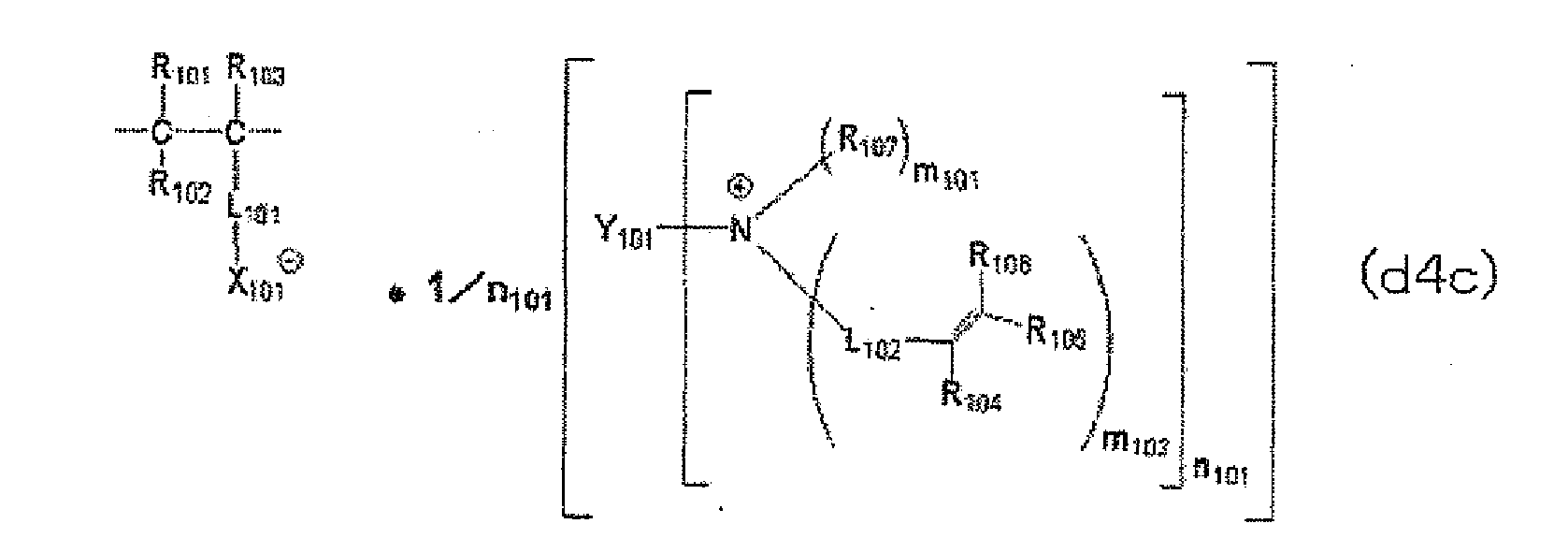
- In formulae (d4a) to (d4c), R1e to R3e have the same meanings as R1a to R3a defined in formula (d2a) respectively. X1e has the same meanings as X1a defined in formula (d1a). L1e has the same meaning as L1a defined in formula (d2a). R4e to R6e each independently represents a hydrogen atom, an alkyl group having from 1 to 6 carbon atoms, a halogen atom, -CH2-OH, -CH2-OR108, -CH2-O-CO-R108, -CO-R108, -O-CO-R108, -CO-O-R108 or -CO-N(R109)-R108, or R4e and R5e or R5e and R6e may be combined with each other to form a ring.
- R1f to R3f have the same meanings as R1a to R3a defined in formula (d2a) respectively. L1f has the same meaning as L1a defined in formula (d2a). R4f to R6f each independently represents a hydrogen atom, an alkyl group having from 1 to 6 carbon atoms, a halogen atom, -CH2-OH, -CH2-OR108, -CH2-O-CO-R108, -CO-R108, -O-CO-R108, -CO-O-R108 or -CO-N(R109)-R108, or R4f and R5f or R5f and R6f may be combined with each other to form a ring.
- R101 to R103 each independently represents a hydrogen atom, an alkyl group having from 1 to 6 carbon atoms, -CH2-OH, -CH2-OR112, -CH2-O-CO-R112 or a halogen atom. R104 to R106 each independently represents a hydrogen atom, an alkyl group having from 1 to 6 carbon atoms, a halogen atom, -CH2-OH, -CH2-OR108, -CH2-O-CO-R108, -CO-R108, -O-CO-R108, -CO-O-R108 or -CO-N(R109)-R108, or R104 and R105 or R105 and R106 may be combined with each other to form a ring. R107 represents a hydrogen atom, an alkyl group having from 1 to 10 carbon atoms, an aryl group having from 6 to 10 carbon atoms or an aralkyl group having from 7 to 20 carbon atoms. R108 represents an alkyl group having from 1 to 10 carbon atoms or an aryl group having from 6 to 10 carbon atoms. R109 represents a hydrogen atom, an alkyl group having from 1 to 10 carbon atoms or an aryl group having from 6 to 10 carbon atoms. R112 represents an alkyl group having from 1 to 10 carbon atoms, an aryl group having from 6 to 10 carbon atoms or an aralkyl group having from 7 to 20 carbon atoms. L101 represents -CO-, -O-, -S-, -N(R109)-, -SO2-, a divalent aliphatic group, a divalent aromatic group or a divalent connecting group composed of a combination of these groups. L102 represents -CO-, -0-, -N(R109)-, a divalent aliphatic group, a divalent aromatic group or a divalent connecting group composed of a combination of these groups, m101 represents an integer from 0 to 3. m102 represents an integer from 1 to 3, provided that m101 + m102 = 3. When m101 is 2 or more, plural R107 may be the same or different. When m102 is 2 or more, plural R104 to R106 and L102 may be the same or different. X101 represents -CO2 -, -PO3H-, -O-PO3H-, -SO3 - or -O-SO3 -. Y101 represents an n101 valent connecting group, provided that it may be a hydrogen atom when n101 is 1. n101 represents an integer from 1 to 10, provided that a value of m102 x n101 is not zero.
- In formulae (d4a) to (d4c), R1e, R2e, R1f, R2f each independently represents preferably a hydrogen atom, a methyl group or an ethyl group, and more preferably a hydrogen atom.
- R3e and R3f each independently represents preferably a hydrogen atom, a methyl group, -CH2-OH or -CH2-O-CO-(C1- to C4-alkyl), and more preferably a hydrogen atom, a methyl group, -CH2-OH or -CH2-O-CO-CH3.
- X1e represents preferably -CO-O- or -CO-NR500-, and more preferably -CO-O- or -CO-NH-.
- L1e and L1f each independently represents preferably -O-, -S-, -CO-O-, -O-CO-, -CO-NR500-, -NR500-CO-, a divalent aliphatic group or a divalent connecting group composed of a combination of these groups, more preferably -CO-O-, -O-CO-, -CO-NH-, -NH-CO-, a divalent aliphatic group or a divalent connecting group composed of a combination of these groups.
- R4e and R4f each independently represents preferably a hydrogen atom, a methyl group, -CH2-OH, -CH2-O-CO-(C1- to C4-alkyl), -CO-O-(C1- to C4-alkyl) or -CO-NH-(C1- to C4-alkyl), and more preferably a hydrogen atom, a methyl group, -CH2-OH, -CH2-O-CO-CH3, -CO-O-(C1- to C2-alkyl) or -CO-NH-(C1- to C2-alkyl).
- R5e, R6e, R5f and R6f each independently represents preferably a hydrogen atom, a methyl group or an ethyl group, and more preferably a hydrogen atom.
- R101 and R102 each independently represents preferably a hydrogen atom, a methyl group or an ethyl group, and more preferably a hydrogen atom.
- R103 represents preferably a hydrogen atom, a methyl group, -CH2-OH or -CH2-O-CO-(C1- to C4-alkyl), and more preferably a hydrogen atom, a methyl group, -CH2-OH or -CH2-O-CO-CH3.
- R104 represents preferably a hydrogen atom, a methyl group, -CH2-OH, -CH2-O-CO-(C1- to C4-alkyl), -CO-O-(C1- to C4-alkyl) or -CO-NH-(C1- to C4-alkyl), and more preferably a hydrogen atom, a methyl group, -CH2-OH, -CH2-O-CO-CH3, -CO-O-(C1- to C2-alkyl) or -CO-NH-(C1- to C2-alkyl).
- R105 and R106 each independently represents preferably a hydrogen atom, a methyl group or an ethyl group, and more preferably a hydrogen atom.
- R107 represents preferably a hydrogen atom, a C1- to C4-alkyl group, a benzyl group, a (C1- to C4-alkyl substituted) phenylmethyl group, a (C1- to C4-alkoxy substituted) phenylmethyl group, a (C1- to C4-acyloxy substituted) phenylmethyl group or a (C1- to C4-alkoxycarbonyl substituted) phenylmethyl group, and more preferably a hydrogen atom, a methyl group, an ethyl group or a benzyl group.
- R108 represents preferably a methyl group, an ethyl group, a n-propyl group, an iso-propyl group, a n-butyl group or a phenyl group, and more preferably a methyl group, an ethyl group or a n-propyl group.
- R109 represents preferably a hydrogen atom, a methyl group, an ethyl group, a n-propyl group, an iso-propyl group, a n-butyl group or a phenyl group, and more preferably a hydrogen atom, a methyl group, an ethyl group or a n-propyl group.
- L101 represents preferably -CO-O-L0-, -CO-NH-L0-, -divalent aromatic group- or -divalent aromatic group-L0-, and more preferably -CO-O-L0- or -CO-NH-L0-. L0 represents a divalent aliphatic group, a divalent aromatic group or a combination of these groups.
- L102 represents preferably any one of La to Lr shown below, and more preferably La, Lb, Lf, Lg, Lh, Li, Lo, Lp or Lr. In La to Lr, L0 has the same meaning as L0 defined above.
La: -L0-O-CO- Lb: -L0-NH-CO- Lc: -L0-O- Ld: -L0-CO-O- Le: -L0-O-CO-O- Lf -L0-O-CH2- Lg: -L0-CO-O-CH2- Lh: -L0-O-CO-O-CH2- Li: -L0-O-CO-NH-L0-O-CO- Lj: -L0-O-CO-L0-O-CO- Lk: -L0-O-CO-L0-NH-CO- L1: -L0-CO-O-L0-O-CO- Lm: -L0-CO-O-L0-NH-CO- Ln: -L0-divalent aromatic group- Lo: -O-CO-divalent aromatic group- Lp: -O-CO-L0-divalent aromatic group- Lq: -CO-O-divalent aromatic group- Lr: -CO-O-L0-divalent aromatic group- - With respect to m101, m102 and n101, a value of m102 x n101, is preferably from 1 to 6, and more preferably from 1 to 4.
- X101 - represents preferably -CO2 -, -PO3H-, -O-PO3H- or -SO3 -, and more preferably -CO2 -,-O-PO3H- or -SO3 -.
- Y101 ordinarily represents an n101 valent hydrocarbon residue, may include any of aliphatic and aromatic structures and may include any of straight-chain, branched and cyclic structures. The cyclic structure may be any of monocyclic and polycyclic structures. The carbon-carbon bond constituting the hydrocarbon residue may be interrupted with -CO-, -O-, -S-, -N(R109)-, -SO2- or a structure composed of a combination of these groups. However, Y101 may be a hydrogen atom, when n101 is 1.
- Specific examples of the repeating unit represented by any one of formulae (d4a) to (d4c) are set forth below, but the invention should not be construed as being limited thereto.
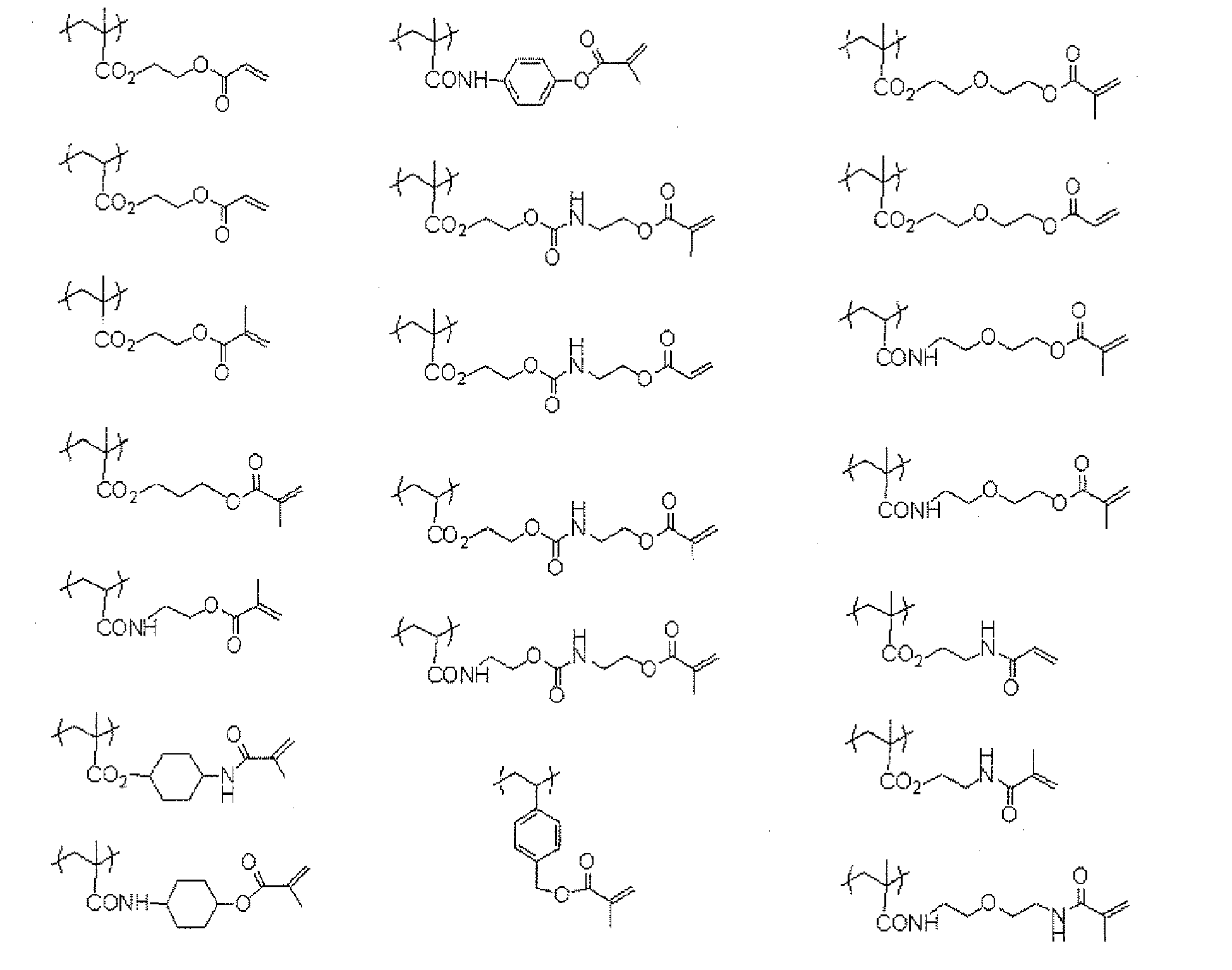

- Of the repeating units (d4), in particular, those having as the ethylenically unsaturated group, a (meth)acryloyl group, an aromatic group-substituted vinyl group or an allyl group are preferred, and those having a (meth)acryloyloxy group, a (meth)acryloylamido group or a phenyl group-substituted vinyl group (styryl group) are more preferred.
- The molar ratio of the repeating unit (d4) in the specific copolymer is ordinarily from 0.5 to 80% by mole, preferably from 2 to 65% by mole, and more preferably from 5 to 50% by mole.
- With respect to the specific copolymer according to the invention, two or more kinds of the copolymers having different structures may be used as a mixture. In the case of using as a mixture, a weight ratio of the specific copolymer which is used in the smallest amount is preferably 1% by weight or more, more preferably 3% by weight or more, particularly preferably 5% by weight or more, based on the total weight of the specific copolymer.
- Further, in the intermediate layer, a polymer other than the specific copolymer according to the invention, that is, a polymer which does not contain the repeating unit (d1) may be used as a mixture with the specific copolymer according to the invention. The polymer other than the specific copolymer includes, for example, polymer compounds having a crosslinkable group (preferably, an ethylenically unsaturated bond group), a functional group capable of interacting with a surface of support and a hydrophilic group described in
JP-A-2005-125749 JP-A-2006-239867 JP-A-2006-215263 - A weight average molecular weight of the specific copolymer according to the invention or the polymer other than the specific copolymer used in the intermediate layer is ordinarily from 2,000 to 1,000,000, preferably from 4,000 to 700,000, more preferably from 6,000 to 500,000, and most preferably from 7,000 to 400,000. When the weight average molecular weight thereof is less than 2,000, good printing durability is not obtained. On the other hand, when the weight average molecular weight thereof exceeds 1,000,000, a problem may arise in time-lapse stability, for example, occurrence of deposition or phase separation in a solution of the polymer with a lapse of time, or a problem, for example, degradation of the stain resistance may arise.
- Although the specific copolymer according to the invention is able to synthesize by any hitherto known method, a radical polymerization method is preferably used for the synthesis thereof Ordinary radical polymerization methods are described, for example, in
Shin Kobunshi Jikkengaku 3, Kobunshi no Gosei to Hanno 1, (New Polymer Experimentation 3, Synthesis and Reaction of Polymer 1), edited by The Society of Polymer Science, Japan, (Kyoritsu Shuppan Co., Ltd. - A method for introduction of the carbon-carbon unsaturated double bond into the repeating unit (d1) in the specific copolymer according to the invention is not particularly restricted and specifically includes the following three methods: (1) Method where the carbon-carbon unsaturated double bond is introduced into a monomer and the monomer is polymerized to obtain a polymer, (2) Method where the carbon-carbon unsaturated double bond is introduced into a monomer as a precursor structure, the monomer is polymerized to obtain a polymer and then a conversion reaction is performed to generate the carbon-carbon unsaturated double bond, and (3) Method where a reactive functional group, for example, an active hydrogen is introduced into a monomer, the monomer is polymerized to obtain a polymer and then the reactive functional group is reacted with a compound having a functional group capable of forming a bond with the reactive functional group and a carbon-carbon unsaturated double bond to introduce the carbon-carbon unsaturated double bond. The method (1) is particularly effective in the case where polymerizability of the carbon-carbon unsaturated double bond is lower than that of the polymerizable group which reacts in the synthesis of polymer. The conversion reaction in the method (2) includes, for example, a release reaction with a base. The method of introducing the carbon-carbon unsaturated double bond in the method (3) includes, for example, a reaction of the active hydrogen in the polymer with (meth)acryloyl chloride, 2-isocyanatoethyl (meth)acrylate or the like. In the case where the specific copolymer according to the invention is obtained by the method (2) or (3), the by-product salt can be removed by passing through an ion-exchange resin, if desire.
- Specific examples of the specific copolymer according to the invention are set forth below, but the invention should not be construed as being limited thereto. In each of the specific examples, the rightmost repeating unit corresponds to the repeating unit (d1) according to the invention.
Composition Ratio (% by mole) (in a left-to -right order) Molecular We ight (x 10+) 
D-1 45/50/5 8 
D-2 80/15/5 10 
D-3
D-440/50/10
45/45/ 1012
7
D-5 30/60/10 9 
D-6 50/40/10 13 
D-7 40/45/15 10 
D-8 50/45/5 13 
D-9 50/40/10 10 
D-10 45/45/10 8 
D-11 60/25/15 2 
D-12 55/30/15 3 
D-13 60/20/20 25 
D-14 45/40/15 35 
D-15 40/40/20 4,5 
D-16 45/35/20 5 
D-17 55/20/25 15 
D-18 45/30/25 25 
D-19 50/25/25 15 
D-20 40/40/20 35 
D-21 45/25/30 2 
D-22 40/35/25 2 
D-23 40/35/25 25 
D-24 40/25/35 35 
D-25 35/35/30 1.5 
D-26 35/30/35 2 
D-27 35/30/35 1 
D-28 40/25/35 25 
D-29 35/30/36 15 
D-30 40/30/30 2 
D-31 40/25/35 0.8 
D-32 30/30/40 06 
D-34 40/30/30 2 
D-35 50/15/35 2.5 
D-36 45/25/30 2 
D-37 45/15/40 3 5 
D-38 45/20/35 2 
D-39 50/20/30 1 5 
D-40 40/15/45 35 
D-41 50/15/35 4 5 
D-42 45/15/40 5 
D-43 45/15/40 3 
D-44 40/15/45 3 
D-45 30/25/45 5 5 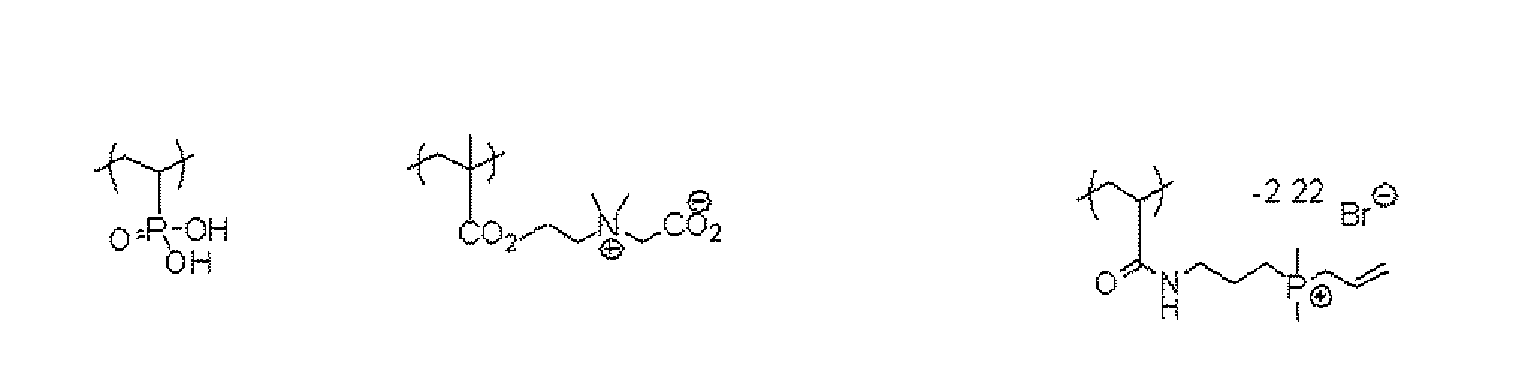
D-46 45/35/20 5 5 
D-47 45/35/20 5 
D-48 55/35/10 2 5 
D-49 55/35/10 2 5 
D-50 55/35/10 3 
D-51 55/25/20 1 
D-52 55/25/20 1 
D-53 50/20/30 2.5 
D-54 50/20/30 2.5 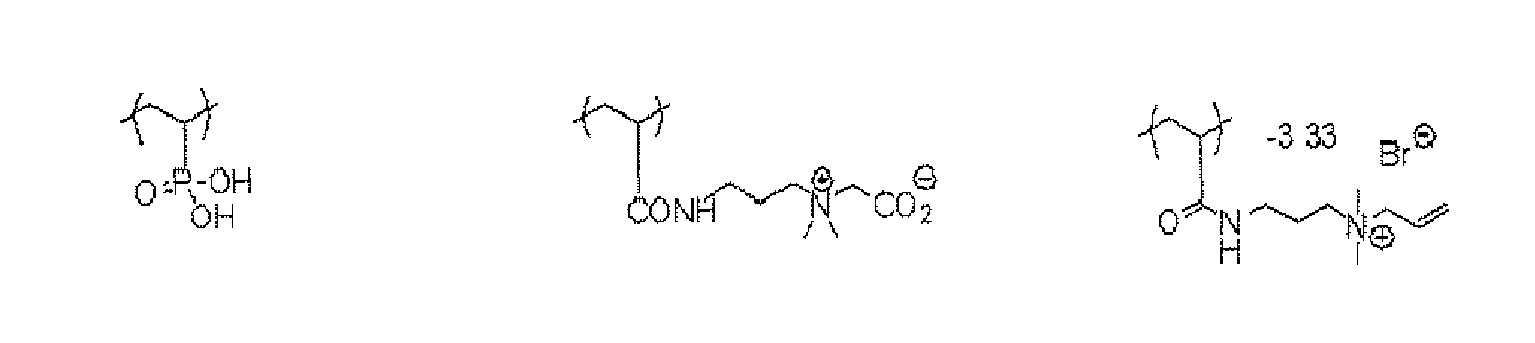
D-55 50/25/25 5 5 
D-56 50/25/25 6 
D-57 50/25/25 6 5 
D-58 50/25/25 6 
D-59 50/25/25 45 
D-60 50/25/25 55 
D-61 40/20/40 15 
D-62 40/20/40 2 
D-63 40/20/40 2.5 
D-64 40/20/40 2 
D-65 40/20/40 1.5 
D-66 50/25/25 0.35 
D-67 50/25/25 0.65 
D-68 50/25/25 4 
D-69 60/40 25 
D-70 55/45 15 - The intermediate layer may further contain a silane coupling agent having an addition polymerizable ethylenically unsaturated bond group described in
JP-A-10-282679 JP-A-2-304441 JP-A-2005-238816 - In order to form the intermediate layer on a support, a coating solution prepared by dissolving the component for the intermediate layer in a solvent is used. As the solvent, water and an organic solvent, for example, methanol, ethanol, propanol, isopropanol, ethylene glycol, hexylene glycol, tetrahydrofuran, dimethylformamide, 1-methyoxy-2-propanol, dimethylacetamide, dimethylsulfoxide, N-methylpyrrolidone or N-ethylpyrrolidone are exemplified and water and an alcohol are particularly preferred. The solvents may be used as a mixture.
- The concentration of the coating solution for intermediate layer is preferably from 0.001 to 10% by weight, more preferably from 0.01 to 5% by weight, and still more preferably from 0.05 to 1% by weight. In order to coat the coating solution for intermediate layer on a support, known various methods can be used. For example, bar coater coating, spin coating, spray coating, curtain coating, dip coating, air knife coating, blade coating and roll coating are exemplified.
- The coating amount (solid content) of the intermediate layer is preferably from 0.1 to 100 mg/m2, and more preferably from 1 to 30 mg/m2.
- The image-forming layer (hereinafter, also referred to as a photosensitive layer) of the lithographic printing plate precursor according to the invention contains (A) a polymerization initiator,
- (B) a polymerizable compound and (C) a binder polymer.
- (A) Polymerization initiator
- The photosensitive layer according to the invention contains a polymerization initiator (hereinafter, also referred to as an initiator compound). In the invention, a radical polymerization initiator is preferably used.
- As the initiator compound, initiator compounds known to those skilled in the art can be used without limitation. Specifically, the initiator compound includes, for example, a trihalomethyl compound, a carbonyl compound, an organic peroxide, an azo compound, an azide compound, a metallocene compound, a hexaarylbiimidazole compound, an organic boron compound, a disulfone compound, an oxime ester compound, an onium salt and a iron arene complex. Among them, at least one compound selected from the hexaarylbiimidazole compound, onium salt, trihalomethyl compound and metallocene compound is preferred, and the hexaarylbiimidazole compound is particularly preferred.
- The hexaarylbiimidazole compound includes, for example, lophine dimers described in European Patents
24,629 107,792 U.S. Patent 4,410,621 , specifically, 2,2'-bis(o-chlorophenyl)-4,4',5,5'-tetraphenylbiimidazole,
2,2'-bis(o-bromophenyl)-4,4',5,5'-tetraphenylbiimidazole,
2,2'-bis(o,p-dichlorophenyl)-4,4',5,5'-tetraphenylbiimidazole,
2,2'-bis(o-chlorophenyl)-4,4',5,5'-tetra(m-methoxyphenyl)biimidazole,
2,2'-bis(o,o'-dichlorophenyl)-4,4',5,5'-tetraphenylbiimidazole,
2,2'-bis(o-nitrophenyl)-4,4',5,5'-tetraphenylbiimidazole,
2,2'-bis(o-methylphenyl)-4,4',5,5'-tetraphenylbiimidazole and
2,2'-bis(o-trifluoromethylphenyl)-4,4',5,5'-tetraphenylbiimidazole. - The hexaarylbiimidazole compound is particularly preferably used together with a sensitizing dye having an absorption maximum in a wavelength range from 300 to 450 nm.
- The onium salt preferably used in the invention includes a sulfonium salt, an iodonium salt and a diazonium salt. Particularly, a diaryliodonium salt and a triarylsulfonium salt are preferably used. The onium salt is particularly preferably used together with an infrared absorbing agent having an absorption maximum in a wavelength range from 750 to 1,400 nm.
- In addition, polymerization initiators described in Paragraph Nos. [0071] to [0129] of
JP-A-2007-206217 - The polymerization initiators are preferably used individually or in combination of two or more thereof according to the invention.
- The amount of the polymerization initiator used in the photosensitive layer according to the invention is preferably from 0.01 to 20% by weight, more preferably from 0.1 to 15% by weight, still more preferably from 1.0 to 10% by weight, based on the total solid content of the photosensitive layer.
- The polymerizable compound for use in the photosensitive layer according to the invention is an addition-polymerizable compound having at least one ethylenically unsaturated double bond and it is selected from compounds having at least one, preferably two or more, terminal ethylenically unsaturated double bonds. The polymerizable compound has a chemical form, for example, a monomer, a prepolymer, specifically, a dimer, a trimer or an oligomer, or a mixture thereof. Examples of the monomer include unsaturated carboxylic acids (for example, acrylic acid, methacrylic acid, itaconic acid, crotonic acid, isocrotonic acid or maleic acid) and esters or amides thereof. Preferably, esters of an unsaturated carboxylic acid with a polyhydric alcohol compound and amides of an unsaturated carboxylic acid with a polyvalent amine compound are used. An addition reaction product of an unsaturated carboxylic acid ester or amide having a nucleophilic substituent, for example, a hydroxy group, an amino group or a mercapto group, with a monofunctional or polyfunctional isocyanate or epoxy compound, or a dehydration condensation reaction product of the unsaturated carboxylic acid ester or amide with a monofunctional or polyfunctional carboxylic acid is also preferably used. Moreover, an addition reaction product of an unsaturated carboxylic acid ester or amide having an electrophilic substituent, for example, an isocyanate group or an epoxy group with a monofunctional or polyfunctional alcohol, amine or thiol, or a substitution reaction product of an unsaturated carboxylic acid ester or amide having a releasable substituent, for example, a halogen atom or a tosyloxy group with a monofunctional or polyfunctional alcohol, amine or thiol is also preferably used. In addition, compounds in which the unsaturated carboxylic acid described above is replaced by an unsaturated phosphonic acid, styrene, vinyl ether or the like can also be used.
- These polymerizable compounds are described, for example, in
JP-T-2006-508380 JP-A-2002-287344 JP-A-2008-256850 JP-A-2001-342222 JP-A-9-179296 JP-A-9-179297 JP-A-9-179298 JP-A-2004-294935 JP-A-2006-243493 JP-A-2002-275129 P-A-2003-64130 JP-A-2003-280187 JP-A-10-333321 - Specific examples of the monomer, which is an ester of a polyhydric alcohol compound with an unsaturated carboxylic acid, include, as an acrylic acid ester, for example, ethylene glycol diacrylate, 1,3-butanediol diacrylate, tetramethylene glycol diacrylate, propylene glycol diacrylate, trimethylolpropane triacrylate, hexanediol diacrylate, tetraethylene glycol diacrylate, pentaerythritol tetraacrylate, sorbitol triacrylate, isocyanuric acid ethylene oxide (EO) modified triacrylate and polyester acrylate oligomer. As a Methacrylic acid ester, for example, tetramethylene glycol dimethacrylate, neopentyl glycol dimethacrylate, trimethylolpropane trimethacrylate, ethylene glycol dimethacrylate, pentaerythritol trimethacrylate, bis[p-(3-methacryloxy-2-hydroxypropoxy)phenyl]dimethylmethane and bis[p-(methacryloxyethoxy)phenyl]dimethylmethane are exemplified. Specific examples of the monomer, which is an amide of a polyvalent amine compound with an unsaturated carboxylic acid, include methylene bisacrylamide, methylene bismethacrylamide, 1,6-hexamethylene bisacrylamide, 1,6-hexamethylene bismethacrylamide, diethylenetriamine trisacrylamide, xylylene bisacrylamide and xylylene bismethacrylamide.
- Urethane type addition-polymerizable compounds produced using an addition reaction between an isocyanate and a hydroxy group are also preferably used and specific examples thereof include vinylurethane compounds having two or more polymerizable vinyl groups per molecule obtained by adding a vinyl monomer containing a hydroxy group represented by formula (A) shown below to a polyisocyanate compound having two or more isocyanate groups per molecule, described in
JP-B-48-41708
CH2=C(R4)COOCH2CH(R5)OH (A)
wherein R4 and R5 each independently represents H or CH3. - Also, urethane acrylates described in
JP-A-51-37193 JP-B-2-32293 JP-B-2-16765
JP-A-2003-344997 JP-A-2006-65210 JP-B-58-49860 JP-B-56-17654 JP-B-62-39417 JP-B-62-39418 JP-A-2000-250211 JP-A-2007-94138 U.S. Patent 7,153,632 ,JP-T-8-505958 JP-A-2007-293221 JP-A-2007-293223 - Details of the method of using the polymerizable compound, for example, selection of the structure, individual or combination use or an amount added, can be appropriately determined in accordance with the characteristic design of the final lithographic printing plate precursor. The polymerizable compound is used preferably in a range from 5 to 75% by weight, more preferably in a range from 25 to 70% by weight, particularly preferably in a range from 30 to 60% by weight, based on the total solid content of the photosensitive layer.
- The photosensitive layer according to the invention contains a binder polymer. As the binder polymer, a polymer capable of holding the components of photosensitive layer on a support and capable of being removed by a developer is used. The binder polymer used includes, for example, a (meth)acrylic polymer, a polyurethane resin, a polyvinyl alcohol resin, a polyvinyl butyral resin, a polyvinyl formal resin, a polyamide resin, a polyester resin and an epoxy resin. In particular, a (meth)acrylic polymer, a polyurethane resin and a polyvinyl butyral resin are preferably used.
- The term "(meth)acrylic polymer" as used herein means a copolymer containing as a polymerization component, (meth)acrylic acid or a (meth)acrylic acid derivative, for example, a (meth)acrylate (including, for example, an alkyl ester, aryl ester and allyl ester), (meth)acrylamide or a (meth)acrylamide derivative. The term "polyurethane resin" as used herein means a polymer formed by a condensation reaction of a compound having two or more isocyanate groups and a compound having two or more hydroxy groups. The term "polyvinyl butyral resin" as used herein means a polymer synthesized by a reaction (acetalization reaction) of polyvinyl alcohol obtained by partial or full saponification of polyvinyl acetate with butylaldehyde under an acidic condition and includes a polymer wherein an acid group or the like is introduced by a method of reacting the remaining hydroxy group in the polymer with a compound having the acid group or the like.
- One preferred example of the (meth)acrylic polymer according to the invention is a copolymer containing a repeating unit having an acid group. Examples of the acid group include a carboxylic acid group, a sulfonic acid group, a phosphonic acid group, a phosphoric acid group and a sulfonamido group. Particularly, a carboxylic acid group is preferred. As the repeating unit having an acid group, a repeating unit derived from (meth)acrylic acid or a repeating unit represented by formula (I) shown below is preferably used.

- In formula (I), R1 represents a hydrogen atom or a methyl group, R2 represents a single bond or an n+1 valent connecting group, A represents an oxygen atom or -NR3-, wherein R3 represents a hydrogen atom or a monovalent hydrocarbon group having from 1 to 10 carbon atoms, and n represents an integer from 1 to 5.
- The connecting group represented by R2 in formula (1) is constructed from a hydrogen atom, a carbon atom, an oxygen atom, a nitrogen atom, a sulfur atom and a halogen atom and preferably contains from 1 to 80 atoms. Specific examples of the connecting group include an alkylene group, a substituted alkylene group, an arylene group and a substituted arylene group. The connecting group may have a structure wherein a plurality of such divalent groups is connected to each other via any of an amido bond, an ether bond, a urethane bond, a urea bond and an ester bond. R2 is preferably a single bond, an alkylene group, a substituted alkylene group or a group having a structure wherein a plurality of alkylene groups and/or substituted alkylene groups is connected to each other via any of an amido bond, an ether bond, a urethane bond, a urea bond and an ester bond, particularly preferably a single bond, an alkylene group having from 1 to 5 carbon atoms, a substituted alkylene group having from 1 to 5 carbon atoms or a group having a structure wherein a plurality of alkylene groups each having from 1 to 5 carbon atoms and/or substituted alkylene groups each having from 1 to 5 carbon atoms is connected to each other via any of an amido bond, an ether bond, a urethane bond, a urea bond and an ester bond, and most preferably a single bond, an alkylene group having from 1 to 3 carbon atoms, a substituted alkylene group having from 1 to 3 carbon atoms or a group having a structure wherein a plurality of alkylene groups each having from 1 to 3 carbon atoms and/or substituted alkylene groups each having from 1 to 3 carbon atoms is connected to each other via any of an amido bond, an ether bond, a urethane bond, a urea bond and an ester bond.
- Examples of the substituent include a monovalent non-metallic atomic group exclusive of a hydrogen atom, for example, a halogen atom (e.g., -F, -Br, -Cl or -1), a hydroxy group, a cyano group, an alkoxy group, an aryloxy group, a mercapto group, an alkylthio group, an arylthio group, an alkylcarbonyl group, an arylcarbonyl group, a carboxyl group and a conjugate base group thereof, an alkoxycarbonyl group, an aryloxycarbonyl group, a carbamoyl group, an aryl group, an alkenyl group and an alkynyl group.
- R3 is preferably a hydrogen atom or a hydrocarbon group having from 1 to 5 carbon atoms, more preferably a hydrogen atom or a hydrocarbon group having from 1 to 3 carbon atoms, and particularly preferably a hydrogen atom or a methyl group. n is preferably from 1 to 3, more preferably 1 or 2, and particularly preferably 1.
- A ratio (% by mole) of the copolymerization component having a carboxylic acid group in the total copolymerization components of the binder polymer is preferably from 1 to 70% in view of developing property. Considering good compatibility between the developing property and printing durability, it is more preferably from 1 to 50%, and particularly preferably from 1 to 30%.
- It is preferred that the binder polymer for use in the invention further contain a crosslinkable group. The term "crosslinkable group" as used herein means a group capable of crosslinking the binder polymer in the process of a radical polymerization reaction which is caused in the photosensitive layer, when the lithographic printing plate precursor is exposed to light. The crosslinkable group is not particularly restricted as long as it has such a function and includes, for example, an ethylenically unsaturated bonding group, an amino group or an epoxy group as a functional group capable of undergoing an addition polymerization reaction. Also, a functional group capable of forming a radical upon irradiation with light may be used and such a crosslinkable group includes, for example, a thiol group and a halogen atom. Among them, the ethylenically unsaturated bonding group is preferred. The ethylenically unsaturated bonding group preferably includes a styryl group, a (meth)acryloyl group and an allyl group.
- In the binder polymer, for example, a free radical (a polymerization initiating radical or a propagating radical in the process of polymerization of the polymerizable compound) is added to the crosslinkable functional group to cause an addition-polymerization between the polymers directly or through a polymerization chain of the polymerizable compound, as a result, crosslinking is formed between the polymer molecules to effect curing. Alternatively, an atom (for example, a hydrogen atom on the carbon atom adjacent to the functional crosslinkable group) in the polymer is withdrawn by a free radical to produce a polymer radical and the polymer radicals combine with each other to form crosslinking between the polymer molecules to effect curing.
- The content of the crosslinkable group (content of radical-polymerizable unsaturated double bond determined by iodine titration) in the binder polymer is preferably from 0.01 to 10.0 mmol, more preferably from 0.05 to 5.0 mmol, and particularly preferably from 0.1 to 2.0 mmol, per g of the binder polymer.
- The binder polymer for use in the invention may contain a polymerization unit of an alkyl (meth)acrylate or aralkyl (meth)acrylate, a polymerization unit of (meth)acrylamide or a derivative thereof, a polymerization unit of an α-hydroxymethylacrylate or a polymerization unit of a styrene derivative, in addition to the polymerization unit having an acid group and the polymerization unit having a crosslinkable group described above. The alkyl group in the alkyl (meth)acrylate is preferably an alkyl group having from 1 to 5 carbon atoms and more preferably a methyl group. The aralkyl (meth)acrylate includes, for example, benzyl (meth)acrylate. The (meth)acrylamide derivative includes, for example, N-isopropylacrylamide, N-phenylmethacrylamide, N-(4-methoxycarbonylphenyl)methacrylamide, N.N-dimethylacrylamide and morpholinoacrylamide. The α-hydroxymethylacrylate includes, for example, ethyl α-hydroxymethylacrylate and cyclohexyl α-hydroxymethylacrylate. The styrene derivative includes, for example, styrene and 4-tert-butylstyrene.
- Preferable examples of the polyurethane resin according to the invention include polyurethane resins described in Paragraph Nos. [0099] to [0210] of
JP-A-2007-187836 JP-A-2008-276155 JP-A-2005-250438 JP-A-2005-250158 - Preferable examples of the polyvinyl butyral resin according to the invention include polyvinyl butyral resins described in Paragraph Nos. [0006] to [0013] of
JP-A-2001-75279 - A part of the acidic groups in the binder polymer may be neutralized with a basic compound. The basic compound includes, for example, a basic nitrogen-containing compound, an alkali metal hydroxide or a quaternary ammonium hydroxide.
- The binder polymer preferably has a weight average molecular weight of 5,000 or more, more preferably from 10,000 to 300,000, and a number average molecular weight of 1,000 or more, more preferably from 2,000 to 250,000. The polydispersity (weight average molecular weight/number average molecular weight) is preferably from 1.1 to 10.
- The binder polymers may be used individually or in combination of two or more thereof. The content of the binder polymer is preferably from 5 to 75% by weight, more preferably from 10 to 70% by weight, still more preferably from 10 to 60% by weight, based on the total solid content of the photosensitive layer, from the standpoint of good strength of the image area and good image-forming property.
- The total content of the polymerizable compound and the binder polymer is preferably 90% by weight or less based on the total solid content of the photosensitive layer. When it exceeds 90% by weight, decrease in the sensitivity and deterioration in the developing property may be caused sometimes. The total content thereof is more preferably from 35 to 80% by weight.
- It is preferred that the photosensitive layer according to the invention contain a sensitizing dye. The sensitizing dye can be used without particular limitation as far as it absorbs light at the image exposure to form the excited state and provides energy to the polymerization initiator described hereinbefore with electron transfer, energy transfer or heat generation thereby increasing the polymerization initiation function. In particular, a sensitizing dye having an absorption maximum in a wavelength range from 300 to 450 nm or from 750 to 1,400 nm is preferably used.
- Examples of the sensitizing dye having an absorption maximum in a wavelength range from 300 to 450 nm include merocyanine dyes, benzopyranes, coumarins, aromatic ketones, anthracenes, styryls and oxazoles.
- Of the sensitizing dyes having an absorption maximum in a wavelength range from 300 to 450 nm, a dye represented by formula (IX) shown below is more preferred in view of high sensitivity.

- In formula (IX), A represents an aryl group which may have a substituent or a heteroaryl group which may have a substituent, X represents an oxygen atom, a sulfur atom or =N(R3), and R1, R2 and R3 each independently represents a monovalent non-metallic atomic group, or A and R1 or R2 and R3 may be combined with each other to form an aliphatic or aromatic ring.
- The monovalent non-metallic atomic group represented by any one of R1, R2 and R3 in formula (IX) preferably includes a hydrogen atom, a substituted or unsubstituted alkyl group, a substituted or unsubstituted alkenyl group, a substituted or unsubstituted aryl group, a substituted or unsubstituted heteroaryl group, a substituted or unsubstituted alkoxy group, a substituted or unsubstituted alkylthio group, a hydroxy group and a halogen atom.
- The aryl group and heteroaryl group represented by A in formula (IX) are same as the substituted or unsubstituted aryl group and substituted or unsubstituted heteroaryl group described for any one of R1, R2 and R3, respectively.
- As specific examples of the sensitizing dye, compounds described in Paragraph Nos. [0047] to [0053] of
JP-A-2007-58170 JP-A-2007-93866 JP-A-2007-72816 - Further, sensitizing dyes described in
JP-A-2006-189604 JP-A-2007-171406 JP-A-2007-206216 JP-A-2007-206217 JP-A-2007-225701 JP-A-2007-225702 JP-A-2007-316582 JP-A-2007-328243 - The sensitizing dye having an absorption maximum in a wavelength range from 750 to 1,400 (hereinafter, also referred to as an "infrared absorbing agent") is described below. The infrared absorbing agent used is preferably a dye or pigment.
- As the dye, commercially available dyes and known dyes described in literatures, for example, Senryo Binran (Dye Handbook) compiled by The Society of Synthetic Organic Chemistry, Japan (1970) can be used. Specifically, the dyes includes azo dyes, metal complex azo dyes, pyrazolone azo dyes, naphthoquinone dyes, anthraquinone dyes, phthalocyanine dyes, carbonium dyes, quinoneimine dyes, methine dyes, cyanine dyes, squarylium dyes, pyrylium salts and metal thiolate complexes.
- Of the dyes, cyanine dyes, squarylium dyes, pyrylium dyes, nickel thiolate complexes and indolenine cyanine dyes are particularly preferred. Further, cyanine dyes and indolenine cyanine dyes are more preferred. As particularly preferable examples of the dye, cyanine dyes represented by formula (a) shown below are exemplified.

- In formulae (a), X1 represents a hydrogen atom, a halogen atom, -NPh2, X2-L1 or a group shown below. X2 represents an oxygen atom, a nitrogen atom or a sulfur atom, L1 represents a hydrocarbon group having from 1 to 12 carbon atoms, an aryl group containing a hetero atom (a nitrogen atom, a sulfur atom, an oxygen atom, a halogen atom or a selenium atom) or a hydrocarbon group having from 1 to 12 carbon atoms and containing a hetero atom. Xa- has the same meaning as Za- defmed hereinafter. Ra represents a hydrogen atom or a substituent selected from an alkyl group, an aryl group, a substituted or unsubstituted amino group and a halogen atom.

- R1 and R2 each independently represents a hydrocarbon group having from 1 to 12 carbon atoms. In view of the preservation stability of a coating solution for photosensitive layer, it is preferred that R1 and R2 each represent a hydrocarbon group having two or more carbon atoms. It is also preferred that R1 and R2 be combined with each other to form a ring. When the ring is formed, a 5-membered or 6-membered ring is particularly preferred.
- Ar1 and Ar2, which may be the same or different, each represents an aryl group which may have a substituent. Preferable examples of the aryl group include groups derived from a benzene ring group and a naphthalene ring group. Preferable examples of the substituent include a hydrocarbon group having 12 or less carbon atoms, a halogen atom and an alkoxy group having 12 or less carbon atoms. Y1 and Y2, which may be the same or different, each represents a sulfur atom or a dialkylmethylene group having 12 or less carbon atoms. R3 and R4, which may be the same or different, each represents a hydrocarbon group having 20 or less carbon atoms, which may have a substituent. Preferable examples of the substituent include an alkoxy group having 12 or less carbon atoms, a carboxyl group and a sulfo group. R5, R6, R7 and R8, which may be the same or different, each represents a hydrogen atom or a hydrocarbon group having 12 or less carbon atoms. In view of the availability of raw materials, a hydrogen atom is preferred. Za- represents a counter anion. However, Za- is not necessary when the cyanine dye represented by formula (a) has an anionic substituent in the structure thereof and neutralization of charge is not needed. Preferable examples of the counter ion for Za- include a halide ion, a perchlorate ion, a tetrafluoroborate ion, a hexafluorophosphate ion and a sulfonate ion, and particularly preferable examples thereof include a perchlorate ion, a hexafluorophosphate ion and an arylsulfonate ion in view of the preservation stability of a coating solution for photosensitive layer.
- Specific examples of the cyanine dye represented by formula (a), which can be suitably used in the invention, include compounds described in Paragraph Nos. [0017] to [0019] of
JP-A-2001-133969 JP-A-2002-23360 JP-A-2002-40638 JP-A-2002-278057 JP-A-2008-195018 JP-A-2007-90850 - Further, compounds described in Paragraph Nos. [0008] to [0009] of
JP-A-5-5005 JP-A-2001-222101 - The infrared absorbing dyes may be used only one kind or two or more kinds in combination. Also, the infrared absorbing dye may be used together with an infrared absorbing agent other than the infrared absorbing dye, for example, a pigment. As the pigment, compounds described in Paragraph Nos. [0072] to [0076] of
JP-A-2008-195018 - As the pigment, commercially available pigments and pigments described in Colour Index (C.I.), Saishin Ganryo Binran (Handbook of the Newest Pigments) compiled by Pigment Technology Society of Japan (1977), Saishin Ganryo Oyou Gijutsu (Newest Application on Technologies for Pigments), CMC Publishing Co., Ltd. (1986) and Insatsu Ink Gijutsu (Printing Ink.Technology), CMC Publishing Co., Ltd. (1984) can be utilized.
- The amount of the sensitizing dye added is preferably from 0.05 to 30 parts by weight, more preferably from 0.1 to 20 parts by weight, particularly preferably from 0.2 to 10 parts by weight, per 100 parts by weight of the total solid content of the photosensitive layer.
- The photosensitive layer preferably contains a chain transfer agent. The chain transfer agent is defined, for example, in Kobunshi Jiten (Polymer Dictionary), Third Edition, pages 683 to 684, edited by The Society of Polymer Science, Japan (2005). As the chain transfer agent, for example, compounds having SH, PH, SiH or GeH in their molecules are used. The compound donates a hydrogen to a low active radical species to generate a radical or is oxidized and then deprotonized to generate a radical. In the photosensitive layer according to the invention, a thiol compound (for example, a 2-mereaptobenzimidazole, a 2-mercaptobenzothiazole, a 2-mercaptobenzoxazole, a 3-mercaptotriazole or a 5-mercaptotetrazole) is preferably used.
- The amount of the chain transfer agent added is preferably from 0.01 to 20 parts by weight, more preferably from 1 to 10 parts by weight, particularly preferably from 1 to 5 parts by weight, per 100 parts by weight of the total solid content of the photosensitive layer.
- Into the photosensitive layer, various additives can be further incorporated, if desired. Examples of the additive include a surfactant for progressing the developing property and improving the surface state of coated layer, a microcapsule for providing good compatibility between developing property and printing durability, a hydrophilic polymer for improving the developing property and dispersion stability of microcapsule, a coloring agent or print-out agent for visually distinguishing the image area from the non-image area, a polymerization inhibitor for preventing undesirable thermal polymerization of the polymerizable compound during the production and preservation of the photosensitive layer, a higher fatty acid derivative for avoiding polymerization inhibition due to oxygen, a fine inorganic particle for increasing strength of the cured layer in the image area, a hydrophilic low molecular weight compound for improving the developing property, a co-sensitizer for increasing sensitivity, and a plasticizer for improving plasticity. As the additives, known compounds, for example, compounds described in Paragraph Nos. [0161] to [0215] of
JP-A-2007-20 JP-T-2005-509192 JP-A-2004-310000 - Further, hydrophobilizing precursors described in Paragraph Nos. [0093] to [0105] of
JP-A-2009-172790 JP-A-2009-29124 - The photosensitive layer according to the invention is formed by dispersing or dissolving each of the necessary constituting components described above in a solvent to prepare a coating solution and coating the solution. The solvent used include, for example, methyl ethyl ketone, ethylene glycol monoethyl ether, 1-methoxy-2-propanol, 2-methoxyethyl acetate, 1-methoxy-2-propyl acetate and γ-butyrolactone, but the invention should not be construed as being limited thereto. The solvents may be used individually or as a mixture. The solid content concentration of the coating solution is preferably from 1 to 50% by weight.
- The coating amount (solid content) of the photosensitive layer after the coating and drying is preferably from 0.3 to 3.0 g/m2. Various methods can be used for the coating. Examples of the method include bar coater coating, spin coating, spray coating, curtain coating, dip coating, air knife coating, blade coating and roll coating.
- In the lithographic printing plate precursor according to the invention, a protective layer (oxygen-blocking layer) is preferably provided on the photosensitive layer in order to prevent diffusion and penetration of oxygen which inhibits the polymerization reaction at the time of exposure. As a material for use in the protective layer, any water-soluble polymer and water-insoluble polymer can be appropriately selected to use. The polymers may be used in combination of two or more thereof, if desired. Specifically, for example, polyvinyl alcohol, a modified polyvinyl alcohol, polyvinyl pyrrolidone, a water-soluble cellulose derivative and poly(meth)acrylonitrile are exemplified. Among them, a water-soluble polymer compound relatively excellent in crystallizability is preferably used. Specifically, when polyvinyl alcohol is used as a main component, the particularly preferred results can be obtained in the fundamental characteristics, for example, oxygen-blocking property and removability by development.
- Polyvinyl alcohol for use in the protective layer may be partially substituted with ester, ether or acetal as long as it contains unsubstituted vinyl alcohol units for achieving the necessary oxygen-blocking property and water solubility. Also, polyvinyl alcohol may partly have other copolymer component. Polyvinyl alcohol is obtained by hydrolysis of polyvinyl acetate. As the polyvinyl alcohol, those having a hydrolysis degree of 69.0 to 100% by mole and a polymerization repeating unit number of 300 to 2,400 are exemplified. Specific examples thereof include PVA-102, PVA-103, PVA-105, PVA-110, PVA-117, PVA-117H, PVA-120, PVA-124, PVA-124H, PVA-CS, PVA-CST, PVA-HC, PVA-203, PVA-204, PVA-205, PVA-210, PVA-217, PVA-220, PVA-224, PVA-235, PVA-217EE, PVA-217E, PVA-220E, PVA-224E, PVA-403, PVA-405, PVA-420, PVA-424H, PVA-505, PVA-617, PVA-613, PVA-706 and L-8 (produced by Kuraray Co., Ltd.). The polyvinyl alcohols can be used individually or as a mixture. The content of polyvinyl alcohol in the protective layer is preferably from 20 to 95% by weight, and more preferably from 30 to 90% by weight.
- Also, known modified polyvinyl alcohol can be preferably used. Particularly, an acid-modified polyvinyl alcohol having a carboxylic acid group or a sulfonic acid group is preferably used. Specifically, modified polyvinyl alcohols described in
JP-A-2005-250216 3P-A-2006-25913 - When the polyvinyl alcohol is used as a mixture with other material, as the other materials mixed, a modified polyvinyl alcohol, polyvinyl pyrrolidone or a modified product thereof is preferred from the viewpoint of the oxygen-blocking property and removability by development. The content thereof in the protective layer is ordinarily from 3.5 to 80% by weight, preferably from 10 to 60% by weight, and more preferably from 15 to 30% by weight.
- As other component of the protective layer, glycerin, dipropylene glycol or the like can be added in an amount corresponding to several % by weight of the material for the protective layer, for example, polyvinyl alcohol to provide flexibility. Further, an anionic surfactant, for example, sodium alkylsulfate or sodium alkylsulfonate, an amphoteric surfactant, for example, alkylaminocarboxylate and alkylaminodicarboxylate, or a nonionic surfactant, for example, polyoxyethylene alkyl phenyl ether can be added in an amount corresponding to several % by weight of the material for the protective layer, for example, polyvinyl alcohol.
- Further, it is also preferred to incorporate an inorganic stratiform compound into the protective layer for the purpose of improving the oxygen-blocking property and property for protecting the surface of photosensitive layer. Of the inorganic stratiform compounds, fluorine based swellable synthetic mica, which is a synthetic inorganic stratiform compound, is particularly useful. Specifically, inorganic stratiform compounds described in
JP-A-2005-119273 - The coating amount of the protective layer is preferably in a range from 0.05 to 10 glm2 in terms of the coating amount after drying. When the protective layer contains the inorganic stratiform compound, it is more preferably in a range from 0.1 to 5 g/m2, and when the protective layer does not contain the inorganic stratiform compound, it is more preferably in a range from 0.5 to 5 g/m2.
- The support for use in the lithographic printing plate precursor according to the invention is not particularly restricted as long as it is a dimensionally stable plate-like hydrophilic support. Particularly, an aluminum plate is preferred. In advance of the use of an aluminum plate, the aluminum plate is preferably subjected to a surface treatment, for example, roughening treatment or anodizing treatment. The roughening treatment of the surface of the aluminum plate is conducted by various methods and includes, for example, mechanical roughening treatment, electrochemical roughening treatment (roughening treatment of electrochemically dissolving the surface) and chemical roughening treatment (roughening treatment of chemically dissolving the surface selectively). With respect to the treatments, methods described in Paragraph Nos. [0241] to [0245] of
JP-2007-206217 - The center line average roughness of the support is preferably from 0.10 to 1.2 µm. In the range described above, good adhesion property to a layer provided on the support, good printing durability and good satin resistance are achieved.
- The color density of the support is preferably from 0.15 to 0.65 in terms of the reflection density value. In the range described above, good image-forming property by preventing halation at the image exposure and good aptitude for plate inspection after development are achieved.
- The thickness of the support is preferably from 0.1 to 0.6 mm, more preferably from 0.15 to 0.4 mm, and still more preferably from 0.2 to 0.3 mm.
- As for the lithographic printing plate precursor according to the invention, in order to increase hydrophilicity of the non-image area and to prevent printing stain, it is preferred to conduct hydrophilizing treatment of the surface of support.
- The hydrophilizing treatment of the surface of support includes an alkali metal silicate treatment wherein the support is subjected to an immersion treatment or an electrolytic treatment in an aqueous solution, for example, of sodium silicate, a method of treating with potassium fluorozirconate and a method of treating with polyvinylphosphonic acid. An immersion treatment in an aqueous polyvinylphosphonic acid solution is preferably used.
- A backcoat layer can be provided on the back surface of the support, if desired. The backcoat layer preferably includes, for example, a coating layer comprising an organic polymer compound described in
JP-A-5-45885 JP-A-6-35174 - The lithographic printing plate precursor according to the invention is exposed imagewise and then subjected to development processing to prepare a lithographic printing plate.
- The lithographic printing plate precursor is imagewise exposed with laser through a transparent original having a line image, a halftone dot image or the like, or imagewise exposed, for example, by scanning of laser beam based on digital data.
- The wavelength of the exposure light source is preferably from 300 to 450 nm or from 750 to 1,400 nm. In case of exposing with light of 300 to 450 nm, the lithographic printing plate precursor having a photosensitive layer containing a sensitizing dye having an absorption maximum in the wavelength range is used. In case of exposing with light of 750 to 1,440 nm, the lithographic printing plate precursor containing an infrared absorbing agent which is a sensitizing dye having an absorption maximum in the wavelength range is used. As the light source of 300 to 450 nm, a semiconductor laser is preferably used. As the light source of 750 to 1,400 nm, a solid laser or semiconductor laser emitting an infrared ray is preferably used. The exposure mechanism may be any of an internal drum system, an external drum system and a flat bed system.
- The development processing ordinarily includes (1) a method of developing with an alkali developer (having pH higher than 11), (2) a method of developing with a developer having pH of 2 to 11, and (3) a method of developing (on-press development) by supplying dampening water and ink on a printing machine.
- In the method of preparing a lithographic printing plate according to the invention, the method of developing with a developer having pH of 2 to 11 or the on-press development method is preferably used.
- First, the method of developing with a developer having pH of 2 to 11 is described in detail below. According to a conventional developing process using the alkali developer as in the method (I), it is necessary that a protective layer is removed in a pre-water washing step, the alkali development is conducted, the alkali is removed by washing with water in a post-water washing step, gum solution treatment is conducted and drying is conducted in a drying step. On the contrary, according to the method of developing using the developer having pH of 2 to 11, it is possible to conduct the development and gum solution treatment at the same time by incorporating a surfactant or a water-soluble polymer compound into the developer. Thus, the post-water washing step is not particularly necessary, and after conducting the development and gum solution treatment with one solution, the drying step can be performed. Moreover, the pre-water washing step is also not particularly necessary and the removal of protective layer can also be conducted simultaneously with the development and gum solution treatment. It is preferred that after the development and gum treatment, the excess developer be removed using a squeeze roller, followed by conducting drying.
- The development processing of the lithographic printing plate precursor according to the invention is performed at temperature from 0 to 60°C, preferably from about 15 to about 40°C in a conventional manner, for example, by a method wherein the imagewise exposed lithographic printing plate precursor is immersed in the developer and rubbed with a brush or a method wherein the developer is sprayed to the imagewise exposed lithographic printing plate precursor and the lithographic printing plate precursor is rubbed with a brush.
- The development processing with the developer having pH of 2 to 11 is preferably performed by an automatic development processor equipped with a supplying means for the developer and a rubbing member. An automatic development processor using a rotating brush roller as the rubbing member is particularly preferred. The number of the rotating brush rollers is preferably two or more. Further, the automatic development processor is preferably provided with a means for removing the excess developer, for example, a squeeze roller or a drying means, for example, a hot air apparatus, subsequently to the development processing means. Further, the automatic development processor may be provided with a pre-heating means for conducting pre-heating treatment of dire lithographic printing plate precursor after image exposure prior to the development processing means.
- The developer which is an aqueous solution having pH of 2 to 11 for use in the development processing is preferably an aqueous solution containing water as the main component (containing 60% by weight or more of water). In particular, an aqueous solution containing a surfactant (for example, an anionic, nonionic, cationic or amphoteric surfactant) or an aqueous solution containing a water-soluble polymer compound is preferred. An aqueous solution containing both the surfactant and the water-soluble polymer compound is also preferred. The pH of the developer is preferably from 5 to 10.7, more preferably from 6 to 10.5, and particularly preferably from 7.5 to 10.3.
- The anionic surfactant for use in the developer is not particularly limited and includes, for example, fatty acid salts, abietic acid salts, hydroxyalkanesulfonic acid salts, alkanesulfonic acid salts, dialkylsulfosuccinic acid salts, straight-chain alkylbenzenesulfonic acid salts, branched alkylbenzenesulfonic acid salts, alkylnaphthalenesulfonic acid salts, alkyldiphenylether (di)sulfonic acid salts, alkylphenoxy polyoxyethylene alkylsulfonic acid salts, polyoxyethylene alkylsulfophenyl ether salts, N-akl-N-oleyltaurine sodium salt, N-alkylsulfosuccinic acid monoamide disodium salts, petroleum sulfonic acid salts, sulfated castor oil, sulfated beef tallow oil, sulfate ester slats of fatty acid alkyl ester, alkyl sulfate ester salts, polyoxyethylene alkyl ether sulfate ester salts, fatty acid monoglyceride sulfate ester salts, polyoxyethylene alkyl phenyl ether sulfate ester salts, polyoxyethylene styryl phenyl ether sulfate ester salts, alkyl phosphate ester salts, polyoxyethylene alkyl ether phosphate ester salts, polyoxyethylene alkyl phenyl ether phosphate ester salts, partially saponified products of styrene-maleic anhydride copolymer, partially saponified products of olefin-maleic anhydride copolymer and naphthalene sulfonate formalin condensates. Of the compounds, alkylbenzenesulfonic acid salts, alkylnaphthalenesulfonic acid salts and alkyldiphenylether (di)sulfonic acid salts are particularly preferably used.
- The cationic surfactant for use in the developer is not particularly limited and conventionally known cationic surfactants can be used. Examples of the cationic surfactant include alkylamine salts, alkylimidazolinium salts, quaternary ammonium salts, polyoxyethylene alkyl amine salts and polyethylene polyamine derivatives.
- The nonionic surfactant for use in the developer is not particularly limited and includes, for example, polyethylene glycol type higher alcohol ethylene oxide adducts, alkylphenol ethylene oxide adducts, alkylnaphthol ethylene oxide adducts, phenol ethylene oxide adducts, naphthol ethylene oxide adducts, fatty acid ethylene oxide adducts, polyhydric alcohol fatty acid ester ethylene oxide adducts, higher alkylamine ethylene oxide adducts, fatty acid amide ethylene oxide adducts, ethylene oxide addacts of fat, polypropylene glycol ethylene oxide adducts, dimethylsiloxane-ethylene oxide block copolymers, dimethylsiloxane-(propylene oxide-ethylene oxide) block copolymers, fatty acid esters of polyhydric alcohol type glycerol, fatty acid esters of pentaerythritol, fatty acid esters of sorbitol and sorbitan, fatty acid esters of sucrose, alkyl ethers of polyhydric alcohols and fatty acid amides of alkanolamines. Of the compounds, those having an aromatic ring and an ethylene oxide chain are preferred and alkyl-substituted or unsubstituted phenol ethylene oxide adducts and alkyl-substituted or unsubstituted naphthol ethylene oxide adducts are more preferred.
- The amphoteric surfactant for use in the developer is not particularly limited and includes, for example, amine oxide type, for example, alkyldimethylamine oxide, betaine type, for example, alkyl betaine, and amino acid type, for example, sodium salt of alkylamino fatty acid. In particular, alkyldimethylamine oxide which may have a substituent, alkyl carboxy betaine which may have a substituent and alkyl sulfo betaine which may have a substituent are preferably used. Specific examples of the amphoteric surfactant include compounds represented by formula (2) in Paragraph No. [0256] of
JP-A-2008-203359 JP-A-2008-276166 JP-A-2009-47927 - Two or more of the surfactants may be used in combination. The content of the surfactant in the developer is preferably from 0.01 to 20% by weight, and more preferably from 0.1 to 10% by weight.
- The water-soluble polymer compound for use in the developer includes, for example, soybean polysaccharide, modified starch, gum arabic, dextrin, a cellulose derivative (for example, carboxymethyl cellulose, carboxyethyl cellulose or methyl cellulose) or a modified product thereof, pllulan, polyvinyl alcohol or a derivative thereof polyvinyl pyrrolidone, polyvinylsulfonic acid or a salt thereof, polystyrenesulfonic acid or a salt thereof, polyacrylamide, an acrylamide copolymer, a vinyl methyl ether/maleic anhydride copolymer, a vinyl acetate/maleic anhydride copolymer and a styrene/maleic anhydride copolymer.
- As the soybean polysaccharide, known soybean polysaccharide can be used. For example, as a commercial product, SOYAFIVE (trade name, produced by Fuji Oil Co., Ltd.) is available and various grade products can be used. The soybean polysaccharide preferably used is that having viscosity in a range from 10 to 100 mPa/sec in the 10% by weight aqueous solution thereof.
- As the modified starch, known modified starch can be used. The modified starch can be prepared, for example, by a method wherein starch, for example, of corn, potato, tapioca, rice or wheat is decomposed, for example, with an acid or an enzyme to an extent that the number of glucose residue per molecule is from 5 to 30 and then oxypropylene is added thereto in an alkali.
- Two or more of the water-soluble polymer compounds may be used in combination. The content of the water-soluble polymer compound in the developer is preferably from 0.1 to 20% by weight, and more preferably from 0.5 to 10% by weight.
- Into the developer, a pH buffer agent may further be incorporated. As the pH buffer agent, a pH buffer agent exhibiting a pH buffer function at pH of 2 to 11 is used without particular restriction. In the invention, a weak alkaline buffer agent is preferably used and includes, for example, (a) a carbonate ion and a hydrogen carbonate ion, (b) a borate ion, (c) a water-soluble amine compound and an ion of the water-soluble amine compound, and combinations thereof. By the function of the pH buffer agent, fluctuation of the pH of developer is prevented even when the developer is used for a long period of time. As a result, for example, the deterioration of developing property resulting from the fluctuation of pH and the occurrence of development scum can be restrained. The combination of a carbonate ion and a hydrogen carbonate ion is particularly preferred.
- In order for a carbonate ion and a hydrogen carbonate ion to be present in the developer, a carbonate and a hydrogen carbonate may be added to the developer or a carbonate ion and a hydrogen carbonate ion may be generated by adding a carbonate or a hydrogen carbonate to the developer and then adjusting the pH. The carbonate or hydrogen carbonate used is not particularly restricted and it is preferably an alkali metal salt thereof. Examples of the alkali metal include lithium, sodium and potassium and sodium is particularly preferable. The alkali metals may be used individually or in combination of two or more thereof.
- The total amount of the carbonate ion and hydrogen carbonate ion is preferably from 0.05 to 5 mole/I, more preferably from 0.07 to 2 mole/I, particularly preferably from 0.1 to 1 mole/I, in the developer.
- The developer may contain an organic solvent. As the organic solvent, for example, an aliphatic hydrocarbon (e.g., hexane, heptane, Isopar E, Isopar H, Isopar G (produced by Esso Chemical Co., Ltd.)), an aromatic hydrocarbon (e.g., toluene or xylene), a halogenated hydrocarbon (methylene dichloride, ethylene dichloride, trichlene or monochlorobenzene) or a polar solvent is exemplified. Examples of the polar solvent include an alcohol (e.g., methanol, ethanol, propanol, isopropanol, 1-butanol, 1-pentanol, 1-hexanol, 1-heptanol, 1-octanol, 2-octanol, 2-ethyl-l-hexanol, 1-nonanol; 1-decanol, benzyl alcohol, ethylene glycol monomethyl ether, 2-ethyoxyethanol, diethylene glycol monoethyl ether, diethylene glycol monohexyl ether, triethylene glycol monomethyl ether, propylene glycol monoethyl ether, propylene glycol monomethyl ether, polyethylene glycol monomethyl ether, polypropylene glycol, tetraethylene glycol, ethylene glycol monobutyl ether, ethylene glycol monobenzyl ether, ethylene glycol monophenyl ether, propylene glycol monophenyl ether, methyl phenyl carbinol, n-amyl alcohol or methylamyl alcohol), a ketone (e.g., acetone, methyl ethyl ketone, ethyl butyl ketone, methyl isobutyl ketone or cyclohexanone), an ester (e.g., ethyl acetate, propyl acetate, butyl acetate, amyl acetate, benzyl acetate, methyl lactate, butyl lactate, ethylene glycol monobutyl acetate, polyethylene glycol monomethyl ether acetate, diethylene glycol acetate, diethyl phthalate or butyl levulinate) and others (e.g., triethyl phosphate, tricresyl phosphate, N-phenylethanolamine, N-phenyldiethanolamine, N-methyldiethanolamine, N-ethyldiethanolamine, 4-(2-hydroxyethyl)morpholine, N,N-dimethylacetamide or N-methylpyrrolidone). Two or more organic solvents may be used in combination in the developer
- When the organic solvent is insoluble in water, it may be employed by being solubilized in water using a surfactant or the like. In the case where the developer contains an organic solvent, the concentration of the organic solvent is desirably less than 40% by weight in view of safety and inflammability.
- The developer may contain a preservative, a chelating agent, a defoaming agent, an organic acid, an inorganic acid, an inorganic salt or the like in addition the components described above. Specifically, compounds described in Paragraph Nos. [0266] to [0270] of
JP-A-2007-206217 - The developer can be used as a developer and a development replenisher for the exposed lithographic printing plate precursor. It is preferably applied to the automatic development processor as described above. In the case of conducting the development processing using an automatic development processor, the developer becomes fatigued in accordance with the processing amount, and hence the processing ability may be restored using a replenisher or a fish developer.
- Next, the on-press development method is described in detail below. According to the on-press development method, an imagewise exposed lithographic printing plate precursor is supplied with oily ink and an aqueous component on a printing machine without undergoing any development processing, thereby removing an unexposed area of the photosensitive layer to conduct development. The imagewise exposure may be conducted on a printing machine. In order to prevent that the aqueous component is contaminated with the components of the photosensitive layer removed, it is preferred to supply an oily ink first For the oily ink and aqueous component, printing ink and dampening water for conventional lithographic printing are used respectively.
- In me method of preparing a lithographic printing plate according to the invention, the lithographic printing plate precursor may be heated its entire surface before the exposure, during the exposure or between the exposure and the development, if desired. By the heating, the image-forming reaction in the photosensitive layer is accelerated and advantages, for example, improvement in the sensitivity and printing durability and stabilization of the sensitivity are achieved. For the purpose of increasing the image strength and printing durability, it is also effective to perform entire surface after-heating or entire surface exposure to the image after the development. Ordinarily, the heating before the development is preferably performed under a mild condition of 150°C or lower. When the temperature is too high, a problem may arise sometimes in that the unexposed area is also cured. On the other hand, the heating after the development can be performed using very strong conditions and is ordinarily carried out in a temperature range from 100 to 500°C. When the temperature is too low, a sufficient effect of strengthening the image may not be obtained, whereas when it is excessively high, problems of deterioration of the support and thermal decomposition of the image area may occur sometimes.
- The present invention will be described in more detail with reference to the following examples, but the invention should not be construed as being limited thereto.
- An aluminum plate (material: JIS A 1050) having a thickness of 0.3 mm was subjected to a decreasing treatment at 50°C for 30 seconds using a 10% by weight aqueous sodium aluminate solution in order to remove rolling oil on the surface thereof and then grained the surface thereof using three nylon brushes embedded with bundles of nylon bristle having a diameter of 0.3 mm and an aqueous suspension (specific gravity: 1.1 g/m3) of pumice having a median size of 25 µm, followed by thorough washing with water, The plate was subjected to etching by immersing in a 25% by weight aqueous sodium hydroxide solution of 45°C for 9 seconds, washed with water, then immersed in a 20% by weight aqueous nitric acid solution at 60°C for 20 seconds, and washed with water. The etching amount of the grained surface was about 3 g/m2.
- Then, using an alternating current of 60 Hz, an electrochemical roughening treatment was continuously carried out on the plate. The electrolytic solution used was a 1% by weight aqueous nitric acid solution (containing 0.5% by weight of aluminum ion) and the temperature of electrolytic solution was 50°C. The electrochemical roughening treatment was conducted using an alternating current source, which provides a rectangular alternating current having a trapezoidal waveform such that the time TP necessary for the current value to reach the peak from zero was 0.8 msec and the duty ratio was 1:1, and using a carbon electrode as a counter electrode. A ferrite was used as an auxiliary anode. The current density was 30 A/dm2 in terms of the peak value of the electric current and 5% of the electric current flowing from the electric source was divided to the auxiliary anode. The quantity of electricity in the nitric acid electrolysis was 175 C/dm2 in terms of the quantity of electricity when the aluminum plate functioned as an anode. The plate was then washed with water by spraying.
- The plate was further subjected to an electrochemical roughening treatment in the same manner as in the nitric acid electrolysis above using as an electrolytic solution, a 0.5% by weight aqueous hydrochloric acid solution (containing 0.5% by weight of aluminum ion) having temperature of 50°C and under the condition that the quantity of electricity was 50 C/dm2 in terms of the quantity of electricity when the aluminum plate functioned as an anode. The plate was then washed with water by spraying. The plate was then subjected to an anodizing treatment using as an electrolytic solution, a 15% by weight aqueous sulfuric acid solution (containing 0.5% by weight of aluminum ion) at a current density of 15 A/dm2 to form a direct current anodized film of 2.5 g/m2, washed with water and dried. The center line average roughness (Ra indication according to JIS B0601) of the surface of Support 1 thus-obtained was measured using a stylus having a diameter of 2 µm and found to be 0.51 µm.
- Coating solution (1) for intermediate layer having the composition shown below was coated using a bar on Support 1 described above and dried in an oven at 80°C for 10 seconds to form an intermediate layer having a dry coating amount of 10 mg/m2.
-
Polymer shown in Table A below 0.017 g Methanol 9.00 g Water 1.00 g - On the intermediate layer described above, Coating solution (1) for photosensitive layer having the composition shown below was coated using a bar and dried in an oven at 70°C for 60 seconds to form a photosensitive layer having a dry coating amount of 1.1 g/m2. On the photosensitive layer, Coating solution (1) for protective layer having the composition shown below was coated using a bar so as to have a dry coating amount of 0.75 g/m2 and dried at 125°C for 70 seconds to form a protective layer, thereby preparing Lithographic printing plate precursor 1.
-
Binder Polymer (1) 0.48 g Methacrylic acid/methyl methacrylate copolymer (weight average molecular weight: 40,000, molar ratio: 30/70) Polymerizable Compound (1) shown below 0.54 g Sensitizing Dye (1) shown below 0.06 g Polymerization Initiator (1) shown below 0.08 g Co-Sensitizer (1) shown below 0.47 g Dispersion of ε-phthalocyanine pigment 0.40 g [pigment: 15 parts by weight; dispersing agent (Binder Polymer (1)): 10 parts by weight; solvent: (cyclohexanone/methoxypropyl acetate/1-methoxy-2-propanol =15 parts by weight/20 parts by weight/40 parts by weight)] Thermal polymerization inhibitor 0.01 g N-Nitrosophenylhydroxylamine aluminum salt Fluorine-Based Surfactant (1) shown below (weight average molecular weight: 11,000) 0.001 g Polyoxyethylene-polyoxypropylene condensate 0.04 g (PLURONIC L44, produced by ADEKA Corp.) Tetraethylamine hydrochloride 0.01 g 1-Methoxy-2-propanol 3.5 g Methyl ethyl ketone 8.0 g 


<Coating solution (1) for protective layer> Polyvinyl alcohol (saponification degree: 98% by mole; polymerization degree: 500) 40 g Polyvinyl pyrrolidone (weight average molecular weight 50,000) 5 g Vinyl pyrrolidone/vinyl acetate (1/1) copolymer (weight average molecular weight: 70,000) 0.5 g Surfactant (EMALEX 710, produced by Nihon-Emulsion Co., Ltd.) 0.5 g Water 950 g - Lithographic
printing plate precursors 2 to 50 and Comparative lithographic printing plate precursors 1 to 3 were prepared in the same manner as in the preparation of Lithographic printing plate precursor 1 except for changing the components used to those shown in Table A below, respectively. The respective components used are described below. - Polyvinyl alcohol (weight average molecular weight: 50,000; saponification degree: 55%) Binder Polymer (3)
- Polyvinyl butyral (weight average molecular weight: 80,000; butyral ratio: 65% by mole; acetate ratio: less than 1% by mole)
- Methacrylic acid/methyl methacrylate copolymer (weight average molecular weight: 50,000; molar ratio: 15/85)
-

-

-

-

-

-

-

-

-

-

-
Composition Ratio (% by mole) (in a left-to-right order) Molecular Weight (x104) 
DH-1 65/25/10 2 
DH-2 65/25/10 2 
DH-3 45/40/15 4 
DH-4 45/50/5 7 
DH-5 45/50/5 8.5 - Each of Lithographic printing plate precursors 1 to 50 and Comparative lithographic printing plate precursors 1 to 3 was subjected to image exposure by Violet semiconductor laser plate setter Vx9600 (equipped with InGaN semiconductor laser; emission: 405 nm ± 10 nm/output: 30 mW) produced by FUJIFILM Electronic Imaging, Ltd. The image exposure was conducted at a resolution of 2,438 dpi with halftone dots of 50% using an FM screen (TAFFETA 20, produced by FUJIFILM Corp.) under condition of a plate surface exposure amount of 0.05 mJ/cm2.
- Then, the exposed lithographic printing plate precursor was subjected to development processing in an automatic development processor having a structure as shown in
Fig. 1 using each of Developers 1 to 3 having the composition shown below to prepare a lithographic printing plate (without heating). The automatic development processor had two rotating brush rollers. The first brush roller was a brush roller having an outer diameter of 90 mm and being implanted with fiber of polybutylene terephthalate (bristle diameter: 200 µm, bristle length: 17 mm), and the brush roller was rotated at 200 rpm (peripheral velocity at the tip of brush: 0.94 m/sec) in the same direction as the transporting direction of the lithographic printing plate precursor. The second brush roller was a brush roller having an outer diameter of 60 mm and being implanted with fiber of polybutylene terephthalate (bristle diameter: 200µm, bristle length: 17 mm), and the brush roller was rotated at 200 rpm (peripheral velocity at the tip of brush: 0.63 m/sec) in the opposite direction to the transporting direction of the lithographic printing plate precursor. The transportation of the lithographic printing plate precursor was conducted at a transporting speed so as to regulate the immersion time (developing time) in the developer of 20 seconds. - The developer was supplied on the surface of the lithographic printing plate precursor by showering from a spray pipe using a circulation pump. The tank volume for the developer was 10 liters.
Developer (1) (pH: 9.7) Water 8329.8 g Sodium carbonate 130 g Sodium hydrogen carbonate 70 g Surfactant (NEWCOL B 13, produced by Nippon Nyukazai Co., Ltd. (naphthol ethyleneoxide adduct)) 500 g Gum arabic (Mw: 200,000) 250 g Hydroxy-alkylated starch (PENON JE66, produced by Nippon Starch Chemical Co., Ltd.) 700 g Ammonium primary phosphate 20 g 2-Bromo-2-nitropropane-1,3-diol 0.1 g 2-Methyl-4-isothiazolin-3 -one 0.1 g Developer (2) (pH: 9.7) Water 8260 g Potassium carbonate 150 g Potassium hydrogen carbonate 80 g Surfactant (ELEMINOL MON, produced by Sanyo Chemical Industries, Ltd. (sodium alkyldiphenyl ether disulfonate) (calculated in terms of 100%)) 350 g Yellow dextrin (AKADAMA DEXTRIN 102, produced by Nippon Starch Chemical Co., Ltd.) 800 g Ammonium primary phosphate 180 g Sodium hexametaphosphate 180 g Developer (3) (pH: 7.0) Water 88.6 g Nonionic Surfactant (W-1) shown below 2.4 g Nonionic Surfactant (W-2) shown below 2.4 g Nonionic surfactant (EMALEX 710, produced by Nihon Emulsion Co., Ltd.) 1.0 g Phenoxypropanol 1.0 g Octanol 0.6 g N-(2-Hydroxyethyl)morpholine 1.0 g Triethanolamine 0.5 g Sodium gluconate 1.0 g Trisodium citrate 0.5 g Tetrasodium ethylenediaminetetraacetate 0.05 g Polystyrenesulfonic acid (VERSA TL77 (30% solution) produced by Alco Chemical Inc.) 1.0 g (pH was adjusted to 7.0 by adding phosphoric acid) -
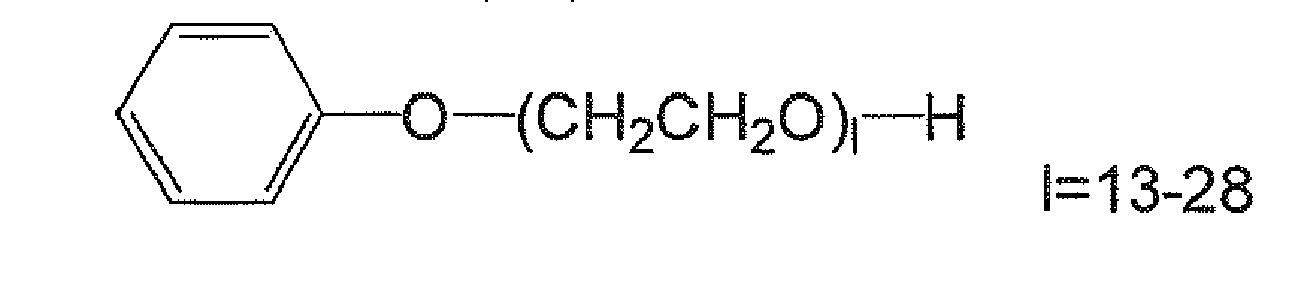
-

- The lithographic printing plate thus-obtained was mounted on a printing machine (SOR-M, produced by Heidelberg) and printing was performed at a printing speed of 6,000 sheets per hour using dampening water (EU-3 (etching solution, produced by FUJIFILM Corp.))/water/isopropyl alcohol = 1/89/10 (by volume ratio)) and TRANS-G (N) black ink (produced by Dai-Nippon Ink & Chemicals, Inc.).
- With each lithographic printing plate precursor, stain resistance, stain resistance after preservation, printing durability and chemical resistance were evaluated in the manner described below. The results obtained are shown in Table A.
- The 500th sheet of the printed material from the initiation of printing was picked up and the density of ink adhered on the non-image area was measured to relatively evaluate the stain resistance. Specifically, the stain resistance was calculated according to the formula shown below using Comparative Example 1 as the criterion (100). When the value is larger, it is meant that the density of ink adhered on the non-image area is lower, that is, the stain resistance is better.
- Stain resistance = (Ink density of non-image area on printed material from criterion lithographic printing plate)/(Ink density of non-image area on printed material from subject lithographic printing plate) x 100
- The lithographic printing plate precursor was preserved at 60°C for 3 days and then subjected to the exposure, development, printing and evaluation of stain resistance in the same manner as described above. As the criterion (100), the stain resistance of Comparative Example 1 without preservation was used.
- As increase in the number of printing sheets according to the printing described above, the photosensitive layer was gradually abraded to cause decrease in the ink receptivity, resulting in decrease of ink density on a printed material. A number of printed materials obtained until the ink density (reflection density) decreased by 0.1 from that at the initiation of printing was determined to evaluate the printing durability. Specifically, the printing durability was relatively evaluated by calculating according to the formula shown below using the number of printing sheets (10,000 sheets) of Comparative Example 1 as the criterion (100). When the value is larger, it is meant that the printing durability is higher.
- Printing durability = (Number of printed materials of subject lithographic printing plate)/(Number of printed materials of criterion lithographic printing plate) x 100
- On the lithographic printing plate obtained by the exposure and development described above was dropped a stock solution of dampening water (VEGRA E794/858, produced by Vegra GmbH) and after 30 minutes the lithographic printing plate was washed with water. A Scotch brand tape (produced by 3M) was stuck on the dropped area of the lithographic printing plate and then the tape was peeled off. The dropped area of the lithographic printing plate was visually observed to evaluate the chemical resistance according to the following criteria. The symbol "A" indicates that the chemical resistance is best.
A: The trace of the dropped area was not found.
B: Although the trace of the dropped area was found, the halftone dots were not changed.
C: The trace of the dropped area was found to be thin due to the decrease in density and the halftone dots also became thin.
D: The dropped area itself became white.TABLE A Lithographic Printing Plate Precursor Polymer in Intermediate Layer Polymerization Initiator Polymerizable Compound Binder Polymer Sensitizing Dye Co-Sensitizer Developer Stain Resistance Stain Resistance After Preservation Printing Durability Chemical Resistance Example 1 1 D-1 1 1 1 1 1 1 170 150 120 A Comparative Example 1 Comparative Precursor 1 DH-1 1 1 1 1 1 1 100 10 100 C Comparative Example 2 Comparative Precursor 2 DH-2 1 1 1 1 1 1 100 20 80 D Example 2 2 D-3 1 1 6 1 3 1 170 160 140 A Example 3 3 D-6 1 1 4 3 1 1 180 170 120 A Example 4 4 D-8 2 1 1 2 1 1 180 170 130 A Example 5 5 D-9 1 1 2 1 2 2 170 160 150 A Example 6 6 D-11 1 1 1 1 1 1 190 180 150 A Example 7 7 D-12 1 1 6 1 1 2 180 170 150 A Example 8 8 D-13 1 2 5 3 4 1 180 170 140 A Example 9 9 D-14 1 1 1 1 1 1 180 170 140 A Example 10 10 D-15 2 1 3 2 1 1 190 180 140 A Example 11 11 D-18 1 1 1 1 1 1 180 170 150 A Example 12 12 D-21 1 1 1 1 3 1 180 170 120 A Example 13 13 D-23 1 3 5 3 1 1 190 180 120 A Example 14 14 D-24 1 1 1 1 1 1 180 170 150 A Comparative Example 2 Comparative Precursor 3 DH-3 1 1 1 1 1 1 180 170 70 C Example 15 15 D-27 1 1 1 1 2 1 190 180 150 A Example 16 16 D-29 1 1 4 3 1 2 200 190 140 A Example 17 17 D-31 2 1 1 2 1 1 200 190 140 A Example 18 18 D-32 1 1 1 1 1 1 200 190 150 A Example 20 20 D-35 2 1 1 2 1 1 200 190 130 A Example 21 21 D-36 1 1 1 1 1 1 210 200 140 A Example 22 22 D-39 1 2 4 3 1 2 210 200 140 A Example 23 23 D-41 1 1 1 1 3 1 210 190 120 A Example 24 24 D-43 1 1 1 1 1 2 210 200 140 A Example 25 25 D-45 1 1 1 1 1 1 210 200 120 A Example 26 26 D-46 1 1 1 1 1 1 170 170 120 A Example 27 27 D-47 1 1 1 1 1 1 170 160 120 A Example 28 28 D-48 1 1 1 1 1 1 170 160 140 A Example 29 29 D-49 1 1 1 1 1 1 180 170 140 A Example 30 30 D-50 1 1 1 1 1 1 190 180 140 A Example 31 31 D-51 1 1 1 1 1 1 180 170 120 A Example 32 32 D-52 1 1 1 1 1 1 180 170 120 A Example 33 33 D-53 1 1 1 1 1 1 180 170 120 A Example 34 34 D-54 1 1 1 1 1 1 180 170 140 A Example 35 35 D-55 1 1 1 1 1 1 180 170 130 A Example 36 36 D-56 1 1 1 1 1 1 180 170 130 A Example 37 37 D-57 1 1 1 1 1 1 180 170 120 A Example 38 38 D-58 1 1 1 1 1 1 180 170 120 A Example 39 39 D-59 1 1 1 1 1 1 180 170 120 C Example 40 40 D-60 1 1 1 1 1 1 180 170 130 A Example 41 41 D-61 1 1 1 1 1 1 210 200 130 A Example 42 42 D-62 1 1 1 1 1 1 200 190 130 A Example 43 43 D-63 1 1 1 1 1 1 200 190 130 A Example 44 44 D-64 1 1 1 1 1 1 180 170 130 A Example 45 45 D-65 1 1 1 1 1 1 190 180 130 A Example 46 46 D-66 1 1 1 1 1 1 160 150 130 A Example 47 47 D-67 1 1 1 1 1 1 170 160 140 A Example 48 48 D-68 1 1 1 1 1 1 180 170 150 A Example 49 49 D-69 1 1 1 1 1 1 190 180 160 A Example 50 50 D-70 1 1 1 1 1 1 210 200 160 A - As is apparent from the results shown in Table A, the lithographic printing plate precursor according to the invention can provide a lithographic printing plate excellent in the stain resistance, stain resistance after preservation, printing durability and chemical resistance in spite of one solution processing using the neutral to weak alkaline developer.
- Each of Lithographic printing plate precursors 1 to 50 and Comparative lithographic printing plate precursors 1 to 3 was subjected to the laser imagewise exposure in the same manner as in Example 1. Within 30 seconds after the laser imagewise exposure, the exposed lithographic printing plate precursor was put in an oven, heated the entire surface of the lithographic printing plate precursor by blowing hot air to maintain at 110°C for 15 seconds and then subjected to the development processing within 30 seconds in the same manner as in Example 1 to prepare a lithographic printing plate (with heating). The resulting lithographic printing plate was subjected to the evaluation of stain resistance, stain resistance after preservation, printing durability and chemical resistance in the same manner as in Example 1. The results obtained are shown in Table B.
TABLE B Lithographic Printing Plate Precursor Polymer in Intermediate Layer Stain Resistance Stain Resistance after Preservation Printing Durability Chemical Resistance Example 51 1 D-1 160 150 130 A Comparative Example 4 Comparative Precursor 1 DH-1 95 10 110 C Comparative Example 5 Comparative Precursor 2 DH-2 95 20 90 C Example 52 2 D-3 160 150 150 A Example 53 3 D-6 170 160 130 A Example 54 4 D-8 170 160 140 A Example 55 5 D-9 160 150 160 A Example 56 6 D-11 180 170 160 A Example 57 7 D-12 170 160 160 A Example 58 8 D-13 170 160 150 A Example 59 9 D-14 170 160 150 A Example 60 10 D-15 180 170 150 A Example 61 11 D-18 170 160 160 A Example 62 12 D-21 170 160 130 A Example 63 13 D-23 180 170 130 A Example 64 14 D-24 170 160 160 A Comparative Example 6 Comparative Precursor 3 DH-3 170 160 80 C Example 65 15 D-27 180 170 160 A Example 66 16 D-29 190 180 150 A Example 67 17 D-31 190 180 150 A Example 68 18 D-32 190 180 160 A Example 70 20 D-35 190 180 140 A Example 71 21 D-36 200 190 150 A Example 72 22 D-39 200 190 150 A Example 73 23 D-41 200 180 130 A Example 74 24 D-43 200 190 150 A Example 75 25 D-45 200 190 130 A Example 76 26 D-46 160 160 130 A Example 77 27 D-47 160 150 130 A Example 78 28 D-48 160 150 150 A Example 79 29 D-49 170 160 150 A Example 80 30 D-50 180 170 150 A Example 81 31 D-51 170 160 130 A Example 82 32 D-52 170 160 130 A Example 83 33 D-53 170 160 130 A Example 84 34 D-54 170 160 150 A Example 85 35 D-55 170 160 140 A Example 86 36 D-56 170 160 140 A Example 87 37 D-57 170 160 130 A Example 88 38 D-58 170 160 130 A Example 89 39 D-59 170 160 130 A Example 90 40 D-60 170 160 140 A Example 91 41 D-61 200 190 140 A Example 92 42 D-62 190 180 140 A Example 93 43 D-63 190 180 140 A Example 94 44 D-64 170 160 140 A Example 95 45 D-65 180 170 140 A Example 96 46 D-66 150 140 140 A Example 97 47 D-67 160 150 150 A Example 98 48 D-68 170 160 160 A Example 99 49 D-69 180 170 170 A Example 100 50 D-70 200 190 170 A - As is apparent from the results shown in Table B, the lithographic printing plate precursor according to the invention can provide a lithographic printing plate excellent in the stain resistance, stain resistance after preservation, printing durability and chemical resistance, even when the heat treatment was conducted between the image exposure and development processing.
- An aluminum plate (material: 1050, refining: H16) having a thickness of 0.24 mm was immersed in an aqueous 5% by weight sodium hydroxide solution maintained at 65°C to conduct a degreasing treatment for one minute, followed by washed with water. The aluminum plate was immersed in an aqueous 10% by weight hydrochloric acid solution maintained at 25°C for one minute to neutralize, followed by washed with water. Subsequently, the aluminum plate was subjected to an electrolytic surface-roughening treatment with alternating current under condition of current density of 100 A/dm2 in an aqueous 0.3% by weight hydrochloric acid solution at 25°C for 60 seconds and then subjected to a desmut treatment in an aqueous 5% by weight sodium hydroxide solution maintained at 60°C for 10 seconds. The aluminum plate was subjected to an anodizing treatment under condition of current density of 10 A/dm2 and voltage of 15 V in an aqueous 15% by weight sulfuric acid solution at 25°C for one minute and then subjected to a hydrophilizing treatment using an aqueous 1% by weight polyvinyl phosphonic acid solution at 75°C to prepare
Support 2. The surface roughness of the support was measured and found to be 0.44 µm (Ra indication according to JIS B0601). - On
support 2 described above was formed the intermediate layer in the same manner as in Lithographic printing plate precursor 1. - Coating solution (2) for photosensitive layer having the composition shown below was coated on the intermediate layer described above using a bar and dried in an oven at 90°C for 60 seconds to form a photosensitive layer having a dry coating amount of 1.3 g/m2.
<Coating solution (2) for photosensitive layer> Binder Polymer (4) shown above 0.04 g Binder Polymer (5) shown above 0.30 g Polymerizable Compound (1) shown above 0.17 g Polymerizable Compound (2) shown above 0.51 g Sensitizing Dye (4) shown below 0.03 g Sensitizing Dye (5) shown below 0.015 g Sensitizing Dye (6) shown below 0.015 g Polymerization Initiator (1) shown above 0.13 g Chain Transfer Agent 0.01 g Mercaptobenzothiazole Dispersion of ε-phthalocyanine pigment 0.40 g (pigment: 15 parts by weight; dispersing agent (allyl methacrylate/methacrylic acid copolymer (weight average molecular weight: 60,000, copolymerization molar ratio: 83/17)): 10 parts by weight; cyclohexanone: 15 parts by weight) Thermal polymerization inhibitor 0.01 g N-Nitrosophenylhydroxylamine aluminum salt Fluorine-Based Surfactant (1) shown above (weight average molecular weight: 11,000) 0.001 g 1-Methoxy-2-propanol 3.5 g Methyl ethyl ketone 8.0 g -

-

-

- Coating solution (2) for protective layer having the composition shown below was coated on the photosensitive layer described above using a bar so as to have a dry coating amount of 1.2 g/m2 and dried at 125°C for 70 seconds to form a protective layer, thereby preparing Lithographic printing plate precursor 51.
<Coating solution (2) for protective layer> PVA-205 (partially hydrolyzed polyvinyl alcohol, produced by Kuraray Co., Ltd. (saponification degree: 86.5 to 89.5% by mole; viscosity: 4.6 to 5.4 mPa·s in a 4% by weight aqueous solution at 20°C)) 0.658 g PVA-105 (fully hydrolyzed polyvinyl alcohol, produced by Kuraray Co., Ltd. (saponification degree: 98.0 to 99.0% by mole; viscosity: 5.2 to 6.0 mPa·s in a 4% by weight aqueous solution at 20°C)] 0.142 g Vinyl pyrrolidone/vinyl acetate (1/1) copolymer (weight average molecular weight: 70,000) 0.001 g Surfactant (EMALEX 710, produced by Nihon Emulsion Co., Ltd.) 0.002 g Water 13 g - Lithographic printing plate precursors 52 to 75 and Comparative lithographic printing plate precursors 4 and 5 were prepared in the same manner as in the preparation of Lithographic printing plate precursor 51 except for changing the polymer used in the intermediate layer to the compound shown in Table C below, respectively.
- Using each of the lithographic printing plate precursors, the exposure, development, printing and evaluation were conducted in the same manner as in Example 1 with respect to Examples 101 to 125 and Comparative Examples 7 and 8. Also, the exposure, development, printing and evaluation were conducted in the same manner as in Example 51 with respect to Examples 126 to 150 and Comparative Examples 9 and 10. However, as the developer, Developer (3) described above was used. The results obtained are shown in Table C.
TABLE C Lithographic Printing Plate Precursor Polymer in Intermediate Layer Stain Resistance Stain Resistance After Preservation Printing Durability Chemical Resistance Stain Resistance Stain Resistance After Preservation Printing Durability Chemical Resistance Example 101 51 D-1 160 150 110 A Example 126 150 140 120 A Comparative Example 7 Comparative Precursor 4 DH-1 100 20 110 D Comparative Example 9 90 10 120 C Comparative Example 8 Comparative Precursor 5 DH-2 80 20 110 D Comparative Example 10 70 10 120 C Example 102 52 D-3 160 150 130 A Example 127 150 140 140 A Example 103 53 D-6 170 160 110 A Example 128 160 150 120 A Example 104 54 D-8 170 160 120 A Example 129 160 150 130 A Example 105 55 D-9 160 150 140 A Example 130 150 140 150 A Example 106 56 D-11 180 170 140 A Example 131 170 160 150 A Example 107 57 D-12 170 160 140 A Example 132 160 150 150 A Example 108 58 D-13 170 160 130 A Example 133 160 150 140 A Example 109 59 D-14 170 160 130 A Example 134 160 150 140 A Example 110 60 D-15 180 170 130 A Example 135 170 160 140 A Example 111 61 D-18 170 160 140 A Example 136 160 150 150 A Example 112 62 D-21 170 160 110 A Example 137 160 150 120 A Example 113 63 D-23 180 170 110 A Example 138 170 160 120 A Example 114 64 D-24 170 160 140 A Example 939 160 150 150 A Example 115 65 D-27 180 170 140 A Example 140 170 160 150 A Example 116 66 D-29 190 180 130 A Example 141 180 170 140 A Example 117 67 D-31 190 180 130 A Example 142 180 170 140 A Example 118 68 D-32 190 180 140 A Example 143 180 170 150 A Example 120 70 D-35 190 180 120 A Example 145 180 170 130 A Example 121 71 D-36 200 190 130 A Example 146 190 180 140 A Example 122 72 D-39 200 190 130 A Example 147 190 180 140 A Example 123 73 D-41 200 180 110 A Example 148 190 170 120 A Example 124 74 D-43 200 190 130 A Example 149 190 180 140 A Example 125 75 D-45 200 190 110 A Example 150 190 180 120 A - As is apparent from the results shown in Table C, the lithographic printing plate precursor according to the invention can provide a lithographic printing plate excellent in the stain resistance, stain resistance after preservation, printing durability and chemical resistance, in spite of the components of the photosensitive layer.
- Coating solution (2) for intermediate layer shown below was coated using a bar on Support 1 described above so as to have a dry coating amount of 20 mg/m2 and dried in an oven at 80°C for 10 seconds to form an intermediate layer.
<Coating solution (2) for intermediate layer> Polymer shown in Table D below 0.18 g Hydroxyethyliminodiacetic acid 0.10 g Methanol 55.24 g Water 6.15 g - Coating solution (3) for photosensitive layer having the composition shown below was coated on the intermediate layer described above using a bar and dried in an oven at 100°C for 60 seconds to form a photosensitive layer having a dry coating amount of 1.0 g/m2.
- Coating solution (3) for photosensitive layer was prepared by mixing Photosensitive solution (1) shown below with Microgel solution (1) shown below just before the coating, followed by stirring.
<Photosensitive solution (1)> Binder Polymer (7) shown above 0.240 g Infrared Absorbing Dye (1) shown below 0.030 g Radical Generator (1) shown below 0.162 g Radical polymerizable compound (Tris(acryloyloxyethyl) isocyanurate (NK ESTER A-9300, produced by Shin-Nakamura Chemical Co., Ltd.)) 0.192 g Hydrophilic low molecular weight compound (Tris(2-hydroxyethyl) isocyanurate) 0.062 g Hydrophilic Low Molecular Weight Compound (1) shown below 0.050 g Oil-sensitizing agent (Phosphonium Compound (I) shown below) 0.055 g Oil-sensitizing agent (Benzyl dimethyl octyl ammonium PF6 salt 0.018 g Oil-sensitizing agent (Ammonium group-containing polymer shown below (reduced specific viscosity: 44 cSt/g/ml)) 0.035 g Fluorine-Based Surfactant (1) shown below 0.008 g 2-Butanone 1.091 g 1-Methoxy-2-propanol 8.609 g <Microgel solution (1)> Microgel (1) shown below 2.640 g Distilled water 2.425 g - The structures of Binder Polymer (7), Infrared Absorbing Dye (1), Radical Generator (1), Hydrophilic Low Molecular Weight Compound (1), Phosphonium Compound (1), the ammonium group-containing polymer and Fluorine-Based Surfactant (1) are shown below.
-

-
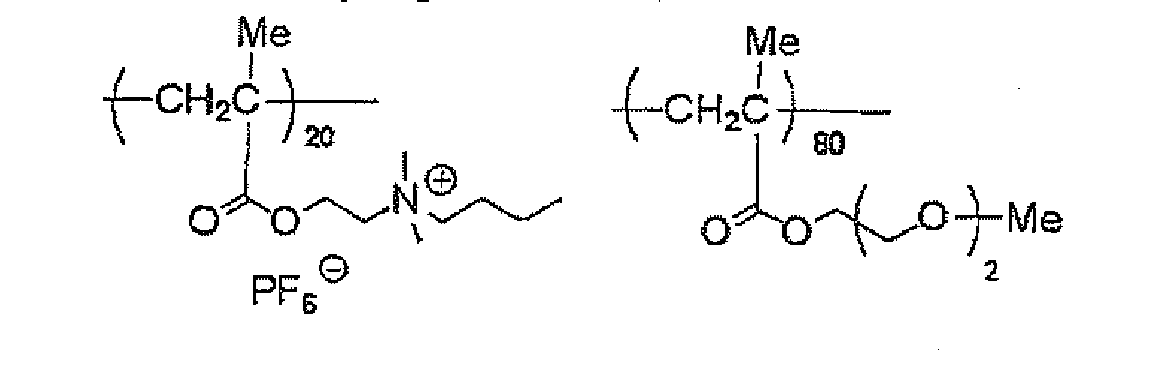
-

-

-

-

-

- An oil phase component was prepared by dissolving 10 g of adduct of trimethylol propane and xylene diisocyanate (TAKENTATE D-110N, produced by Mitsui Chemicals Polyurethanes, Inc.), 3.15 g of pentaerythritol triacrylate (SR444, produced by Nippon Kayaku Co., Ltd.) and 0.1 g of PIONIN A-41C (produced by Takemoto Oil & Fat Co., Ltd.) in 17 g of ethyl acetate. As an aqueous phase component, 40 g of a 4% by weight aqueous solution of PVA-205 was prepared. The oil phase component and the aqueous phase component were mixed and emulsified using a homogenizer at 12,000 rpm for 10 minutes. The resulting emulsion was added to 25 g of distilled water and stirred at room temperature for 30 minutes and then at 50°C for 3 hours. The microgel liquid thus-obtained was diluted using distilled water so as to have the solid concentration of 15% by weight to prepare Microgel (1). The average particle size of the microgel was measured by a light scattering method and found to be 0.2 µm.
- Coating solution (3) for protective layer having the composition shown below was coated on the photosensitive layer described above using a bar and dried in an oven at 120°C for 60 seconds to form a protective layer having a dry coating amount of 0.15 g/m2, thereby preparing Lithographic printing plate precursor 76.
<Coating solution (3) for protective layer> Dispersion of Inorganic stratiform compound (1) shown below 1.5 g Polyvinyl alcohol (CKS 50, produced by Nippon Synthetic Chemical Industry Co., Ltd., sulfonic acid-modified, saponification degree: 99% by mole or more, polymerization degree: 300, aqueous 6% by weight solution) 0.55 g Polyvinyl alcohol (PVA-405, produced by Kuraray Co., Ltd., saponification degree: 81.5 % by mole, polymerization degree: 500, aqueous 6% by weight solution) 0.03 g Surfactant (EMALEX 710, produced by Nihon Emulsion Co., Ltd., aqueous 1% by weight solution) 0.86 g Ion-exchanged water 6.0 g - To 193.6 g of ion-exchanged water was added 6.4 g of synthetic mica (SOMASIF ME-100, produced by CO-OP Chemical Co., Ltd.) and the mixture was dispersed using a homogenizer until an average particle size (according to a laser scattering method) became 3 µm to prepare Dispersion of Inorganic stratiform compound (1). The aspect ratio of the particle thus-dispersed was 100 or more.
- Lithographic printing plate precursors 77 to 88 and 91 to 102 and Comparative lithographic
printing plate precursors - The intermediate layer was formed in the same manner as in the preparation of Lithographic printing plate precursor 76 except for changing the polymer used in the intermediate layer to the compound shown in Table D below.
- Coating solution (4) for photosensitive layer shown below was coated on the intermediate layer described above using a bar and dried in an oven at 70°C for 60 seconds to form a photosensitive layer having a dry coating amount of 0.6 g/m2, thereby preparing Lithographic printing plate precursor 89.
<Coating solution (4) for photosensitive layer> Aqueous dispersion of Fine polymer particle (1) shown below 20.0 g Infrared Absorbing Dye (2) shown below 0.2 g Polymerization initiator (IRGACURE 250, produced by Ciba Specialty Chemicals, Inc.) 0.5 g Polymerizable compound (SR-399, produced by Sartomer Co.) 1.50 g Mercapto-3-triazole 0.2 g BYK 336 (produced by BYK-Chemie GmbH) 0.4 g KLUCEL M (produced by Hercules Chemical Co., Inc.) 4.8 g ELVACITE 4026 (produced by Ineos Acrylics Inc.) 2.5 g n-Propanol 55.0 g 2-Butanone 17.0 g - The compounds indicated using their trade names in the coating solution for photosensitive layer above are shown below.
IRGACURE 250: (4-Methoxyphenyl)[4-(2-methylpropyl)phenyl]iodonium hexafluorophosphate (75% by weight propylene carbonate solution)
SR-399: Dipentaerythritol pentaacrylate
BYK 336: Modified dimethylpolysiloxane copolymer (25% by weight xylene/methoxypropyl acetate solution)
KLUCEL M: Hydroxypropyl cellulose (2% by weight aqueous solution)
ELVACITE 4026: Highly branched polymethyl methacrylate (10% by weight 2-butanone solution) -

- A stirrer, a thermometer, a dropping funnel, a nitrogen inlet tube and a reflux condenser were attached to a 1,000 ml four-neck flask and while carrying out deoxygenation by introduction of nitrogen gas, 10 g of polyethylene glycol methyl ether methacrylate (PEGMA, average number of ethylene glycol repeating units: 50), 200 g of distilled water and 200 g of n-propanol were charged therein and heated until the internal temperature reached 70°C. Then, a mixture of 10 g of styrene (St), 80 g of acrylonitrile (AN) and 0.8 g of 2,2'-azobisisobutyronitrile previously prepared was dropwise added to the flask over a period of one hour. After the completion of the dropwise addition, the reaction was continued as it was for 5 hours. Then, 0.4 g of 2,2'-azobisisobutyronitrile was added and the internal temperature was raised to 80°C. Thereafter, 0.5 g of 2,2'-azobisisobutyronitrile was added over a period of 6 hours. At the stage after reacting for 20 hours in total, the polymerization proceeded 38% or more to obtain Aqueous dispersion of Fine polymer particle (1) of PEGMA/St/AN (10/10/80 in a weight ratio). The particle size distribution of the fine polymer particle had the maximum value at the particle size of 150 nm.
- The particle size distribution was determined by taking an electron microphotograph of the fine polymer particle, measuring particle sizes of 5,000 fine particles in total on the photograph, and dividing a range from the largest value of the particle size measured to 0 on a logarithmic scale into 50 parts to obtain occurrence frequency of each particle size by plotting. With respect to the aspherical particle, a particle size of a spherical particle having a particle area equivalent to the particle area of the aspherical particle on the photograph was defined as the particle size.
- With each lithographic printing plate precursor, stain resistance, stain resistance after preservation and UV ink printing durability were evaluated in the manner described below. The results obtained are shown in Table D.
- Each lithographic printing plate precursor was exposed by LUXEL PLATESETTER T-6000III equipped with an infrared semiconductor laser, produced by FUJIFILM Corp. under the conditions of a rotational number of an external drum of 1,000 rpm, a laser output of 70% and a resolution of 2,400 dpi. The exposed image contained a solid image and a 50% halftone dot chart of a 20 µm-dot FM screen.
- The exposed lithographic printing plate precursor was mounted without undergoing development processing on a plate cylinder of a printing machine (LITHRONE 26, produced by Komori Corp.). Using dampening water (ECOLITY-2 (produced by FUJIFILM Corp.)/tap water = 2/98 (volume ratio)) and BEST CURE UV-BF-WRO Standard Black Ink (produced by T&K TOKA Co., Ltd.), the dampening water and ink were supplied according to the standard automatic printing start method of LITHRONE 26 to conduct printing on 100 sheets of TOKUBISHI ART PAPER (76.5 kg) at a printing speed of 10,000 sheets per hour.
- After the completion of the on-press development of the unexposed area of the photosensitive layer on the printing machine, the supply amount of the dampening water was reduced and the whole surface of the printing plate was contaminated with the ink. Then, the supply amount of the dampening water was increased and a number of the printing papers required until the ink was completely removed from the non-image area to obtain good printed material was measured. The stain resistance was relatively evaluated by calculating according to the formula shown below using Comparative lithographic
printing plate precursor 6 as the criterion (100). When the value is larger, it is meant that the stain resistance is better. - Stain resistance = (Number of printed materials of criterion lithographic printing plate)/(Number of printed materials of subject lithographic printing plate) x 100
- The lithographic printing plate precursor was preserved at 60°C for 3 days and then the evaluation of stain resistance was conducted in the same manner as described above. As the criterion (100), the stain resistance of Comparative lithographic
printing plate precursor 6 without preservation was used. When the value is larger, it is meant that the stain resistance after preservation is better. - After the evaluation of stain resistance, the printing was continued. As increase in the number of printing sheets, the photosensitive layer was gradually abraded so that the ink density on a printed material decreased. A number of printed materials obtained until a value obtained by measuring a halftone dot area ratio of 50% halftone of FM screen on the printed material decreased by 5% from the value measured on the 100th printed material was measured. The UV ink printing durability was relatively evaluated by calculating according to the formula shown below using
-

TABLE D Lithographic Printing Plate Precursor Polymer in Intermediate Layer Coating Solution for <Photosensitive Layer Coating Solution for Protective Layer Stain Resistance Stain Resistance After Preservation UV Ink Printing Durability Example 151 76 D-1 3 3 160 150 130 Comparative Example 11 Comparative Precursor 6 DH-4 3 3 100 15 100 Comparative Example 12 Comparative Precursor 7 DH-5 3 3 100 20 80 Example 152 77 D-3 3 3 160 150 150 Example 153 78 D-6 3 3 170 160 130 Example 154 79 D-8 3 3 170 160 140 Example 155 80 D-9 3 3 160 150 160 Example 156 81 D-11 3 3 180 170 160 Example 157 82 D-12 3 3 170 160 160 Example 158 83 D-13 3 3 170 160 150 Example 159 84 D-14 3 3 170 160 150 Example 160 85 D-15 3 3 180 170 150 Example 161 86 D-18 3 3 170 160 160 Example 162 87 D-21 3 3 170 160 130 Example 163 88 D-23 3 3 180 170 130 Example 164 89 D-23 4 None 180 170 130 Example 166 91 D-24 3 3 170 160 160 Example 167 92 D-27 3 3 180 170 160 Example 168 93 D-29 3 3 190 180 150 Example 169 94 D-31 3 3 190 180 150 Example 170 95 D-32 3 3 190 180 Example 172 97 D-35 3 3 190 180 140 Example 173 98 D-36 3 3 200 190 150 Example 174 99 D-39 3 3 200 190 150 Example 175 100 D-41 3 3 200 180 130 Example 176 101 D-43 3 3 200 190 150 Example 177 102 D-45 3 3 200 190 130 - As is apparent from the results shown in Table D, the lithographic printing plate precursor according to the invention can provide a lithographic printing plate excellent in the stain resistance, stain resistance after preservation and UV ink printing durability according to the on-press development method.


Claims (18)
- A lithographic printing plate precursor comprising, in the following order:a support;an intermediate layer comprising a copolymer containing a repeating unit derived from a monomer having a C log P value of -0.14 or less and containing a carbon-carbon unsaturated double bond through a covalent bond in a side chain of the monomer; andan image-forming layer comprising (A) a polymerization initiator, (B) a polymerizable compound and (C) a binder polymer.
- The lithographic printing plate precursor as claimed in claim 1, wherein the repeating unit comprises at least one structure selected from a carboxylate anion, a sulfonate anion, a sulfate anion, a phosphate anion, a phosphonate anion, an ammonium cation, a phosphonium cation and a hydroxy group.
- The lithographic printing plate precursor as claimed in claim 1 or 2, wherein the C log P value of the monomer for forming the repeating unit is -0.16 or less.
- The lithographic printing plate precursor as claimed in any one of claims 1 to 3, wherein the repeating unit is a repeating unit represented by one of the following formulae (I) to (VI):


R1a to R3a each represents a hydrogen atom, an alkyl group, a halogen atom or a cyano group, R4a each represents a hydrogen atom or a substituent having from 1 to 30 carbon atoms, R5a to R7a each represents a hydrogen atom, an alkyl group, -CO-O-Rx or -CO-N(Ry)(Rz), Rx represents an allyl group,
Ry and Rz each represents a hydrogen atom, an alkyl group or an aryl group,
L1a and L2a each represents a single bond or a divalent connecting group,
W1a and W2a each represents an alkylene group, an arylene group, -O-, -S-, -CO-, -N(Rw)-, -SO2- or a divalent connecting group composed of an appropriate combination of these groups, Rw represents a hydrogen atom, an alkyl group or an aryl group,
X1a represents N or P,
X2a represents an (n3a+1) valent connecting group, provided that when n3a is 1, X2a represents a single bond,
Y1a represents an organic or inorganic anion,
n1a represents an integer from 0 to 2,
n2a represents an integer from 1 to 3, provided that n1a + n2a = 3,
n3a represents an integer from 1 to 4;
in the formula (II),
R1b to R3b, R4b, R5b to R7b, L1b, L2b, W1b and W2b have the same meanings as R1a to R3a, R4a, R5a to R7a, L1a, L2a, W1a and W2a in the formula (I), respectively,
X1b represents an (n2b + 1) valent connecting group, provided that when n2b is 1, X1b represents a single bond,
Y1b each represents a hydrogen atom, a hydroxy group or an alkyl group, provided that at least one of Y1b represents a hydroxy group,
n1b represents an integer from 1 to 10,
n2b represents an integer from 1 to 4;
in the formula (III),
R1c to R3c, R4c, R5c to R7c, L1c, L2c, W1c and W2c have the same meanings as R1a to R3a, R4a, R5a to R7a, L1a, L2a, W1a and W2a in the formula (I), respectively,
n1c and n2c have the same meanings as n1b and n2b in the formula (II), respectively, X1c represents an (n2c + 1) valent connecting group, provided that when n2c is I, X1c represents a single bond,
Y1c each represents a hydrogen atom, a hydroxy group, an alkyl group or a group represented by L3c-Q, provided that at least one of Y1c represents a group represented by L3c-Q,
L3c represents a single bond or a divalent connecting group,
Q represents -CO2M-SO3M, -OSO3M, -OPO(OM1)(OM2) or -PO(OM3)(OM4), M, M1 and M3 each represents a monovalent metal ion or N+(R0)4,
M2 and M4 each represents a hydrogen atom, a monovalent metal ion or N+(R0)4,
R0 each represents a hydrogen atom or an alkyl group; in the formula (IV),
R1d to R3d, R4d, R5d to R7d, L1d, L2d, W1d, W2d, n3d and X1d have the same meanings as R1a to R3a, R4a, R5a to R7a, L1a, L2a, W1a, W2a, n3a and X1a in the formula (I), respectively,
L3d represents a divalent connecting group,
X2d represents an (n3d + 1) valent connecting group, provided that when n3d is 1, X2d represents a single bond,
Y1d represents -CO2 -, -SO3 - or -OPO(O)(ORp),
Rp represents an alkyl group,
n1d represents 0 or 1,
n2d represents 1 or 2, provided that n1d + n2d = 2; in the formula (V),
R1e to R3e, R4e, R5e to R7e, W1e, W2e and X1e have the same meanings as R1a to R3a, R4a, R5a to R7a, W1a, W2a and X1a in the formula (I), respectively,
L1e and L2e have the same meanings as L1a in the formula (I), respectively,
L3e has the same meaning as L2a in the formula (I),
n1e has the same meaning as n2b in the formula (II),
X2e represents an (n1e + 1) valent connecting group, provided that when n1e is 1, X2e represents a single bond; and in the formula (VI),
R1f to R3f, R4f, R5f to R7f, W1f, W2f, X1f, X2f and n1f to n3f have the same meanings as R1a to R3a, R4a, R5a to R7a, W1a, W2a, X1a, X2a and n1a to n3a in the formula (I), respectively,
L1f and L2f have the same meanings as L1a in the formula (I), respectively,
L3f has the same meaning as L2a in the formula (I). - The lithographic printing plate precursor as claimed in claim 4, wherein in the formula (I), W1a is -CO-O- or -CO-N(Rw)-, and X1a is N; in formula (II), W1b is -CO-O- or -CO-N(Rw)-; in formula (III), W1c is -CO-O- or -CO-N(Rw)-, and Q is -SO3M, -OPO(OM1)(OM2) or -PO(OM3)(OM4); in formula (IV), W1d is -CO-O- or -CO-N(Rw)-, X1d is N, and Y1d is -CO2 -, -SO3 - or -OPO(O-)(ORp); in formula (V), W1e is -CO-O- or -CO-N(Rw)-, and X1e is N; or in formula (VI), W1f is -CO-O- or -CO-N(Rw)-, and X1f is N.
- The lithographic printing plate precursor as claimed in any one of claims 1 to 5, wherein the C log P value of the monomer for forming the repeating unit is -1.0 or less.
- The lithographic printing plate precursor as claimed in any one of claims 1 to 6, wherein the copolymer contains a repeating unit having as a functional group capable of interacting with a surface of the support, a sulfonic acid group or a salt thereof, a phosphoric acid ester group or a salt thereof or a phosphonic acid group or a salt thereof
- The lithographic printing plate precursor as claimed in any one of claims 1 to 7, wherein the image-forming layer further comprises a sensitizing dye.
- The lithographic printing plate precursor as claimed in claim 8, wherein the sensitizing dye is a sensitizing dye having an absorption maximum in a wavelength range from 300 to 450 nm.
- The lithographic printing plate precursor as claimed in claim 8, wherein the sensitizing dye is an infrared absorbing agent.
- The lithographic printing plate precursor as claimed in any one of claims 1 to 10, wherein the image-forming layer further comprises a hydrophobilizing precursor.
- The lithographic printing plate precursor as claimed in any one of claims 1 to 11, wherein the image-forming layer further comprises at least one selected from a microcapsule and a microgel.
- The lithographic printing plate precursor as claimed in any one of claims 1 to 12, wherein the binder polymer is a (meth)acrylic polymer, a polyurethane resin or a polyvinyl butyral resin.
- The lithographic printing plate precursor as claimed in any one of claims 1 to 13, wherein the binder polymer has an ethylenically unsaturated bond group.
- The lithographic printing plate precursor as claimed in any one of claims 1 to 14, which further comprises a protective layer, so that the support, the intermediate layer, the image-forming layer and the protective layer are provided in this order.
- The lithographic printing plate precursor as claimed in claim 15, wherein the protective layer comprises an inorganic stratiform compound.
- A method of preparing a lithographic printing plate comprising:imagewise exposing a lithographic printing plate precursor comprising, in the following order, a support, an intermediate layer containing a copolymer containing a repeating unit derived from a monomer having a C log P value of -0.14 or less and containing a carbon-carbon unsaturated double bond through a covalent bond in a side chain of the monomer and an image-forming layer containing (A) a polymerization initiator, (B) a polymerizable compound and (C) a binder polymer; andremoving an unexposed area of the image-forming layer by supplying oily ink and an aqueous component on a printing machine to initiate printing without applying any development processing to the exposed lithographic printing plate precursor.
- A method of preparing a lithographic printing plate comprising:imagewise exposing a lithographic printing plate precursor comprising, in the following order, a support, an intermediate layer containing a copolymer containing a repeating unit derived from a monomer having a C log P value of -0.14 or less and containing a carbon-carbon unsaturated double bond through a covalent bond in a side chain of the monomer and an image-forming layer containing (A) a polymerization initiator, (B) a polymerizable compound and (C) a binder polymer; andremoving an unexposed area of the image-forming layer by processing the exposed lithographic printing plate precursor with a developer having pH of 2 to 11.
Applications Claiming Priority (1)
| Application Number | Priority Date | Filing Date | Title |
|---|---|---|---|
| JP2009298571 | 2009-12-28 |
Publications (1)
| Publication Number | Publication Date |
|---|---|
| EP2339402A1 true EP2339402A1 (en) | 2011-06-29 |
Family
ID=43875342
Family Applications (1)
| Application Number | Title | Priority Date | Filing Date |
|---|---|---|---|
| EP10197142A Withdrawn EP2339402A1 (en) | 2009-12-28 | 2010-12-28 | Lithographic printing plate precursor and method of preparing lithographic printing plate |
Country Status (2)
| Country | Link |
|---|---|
| EP (1) | EP2339402A1 (en) |
| JP (1) | JP5624880B2 (en) |
Cited By (6)
| Publication number | Priority date | Publication date | Assignee | Title |
|---|---|---|---|---|
| EP2383612A1 (en) * | 2010-04-30 | 2011-11-02 | Fujifilm Corporation | Lithographic printing plate precursor and plate making method thereof |
| EP2367056A3 (en) * | 2010-03-15 | 2012-11-28 | Fujifilm Corporation | Method of preparing lithographic printing plate |
| US9352602B2 (en) | 2011-09-30 | 2016-05-31 | Fujifilm Corporation | Lithographic printing plate precursor and method for producing lithographic printing plate |
| CN111018745A (en) * | 2019-12-12 | 2020-04-17 | 吉林奥来德光电材料股份有限公司 | Compound for packaging film, organic film packaging material and packaging film |
| CN111164115A (en) * | 2017-10-18 | 2020-05-15 | 富士胶片株式会社 | Curable composition, film, cured product, and medical parts |
| US11396568B2 (en) * | 2017-10-18 | 2022-07-26 | Fujifilm Corporation | Curable composition, film, cured product, and medical member |
Families Citing this family (4)
| Publication number | Priority date | Publication date | Assignee | Title |
|---|---|---|---|---|
| JP5745371B2 (en) * | 2011-09-07 | 2015-07-08 | 富士フイルム株式会社 | Preparation of lithographic printing plate precursor and lithographic printing plate |
| JP5463346B2 (en) * | 2011-12-26 | 2014-04-09 | 富士フイルム株式会社 | Planographic printing plate making method |
| JP5882874B2 (en) * | 2012-11-02 | 2016-03-09 | クラレノリタケデンタル株式会社 | Phosphate ester compound and polymerizable composition containing the same |
| JP7778342B2 (en) * | 2021-08-12 | 2025-12-02 | Kjケミカルズ株式会社 | Polymerizable compound containing phosphorylcholine group or its analogous group, method for producing the compound, polymer, and resin composition using the compound |
Citations (72)
| Publication number | Priority date | Publication date | Assignee | Title |
|---|---|---|---|---|
| JPS4841708B1 (en) | 1970-01-13 | 1973-12-07 | ||
| JPS5137193A (en) | 1974-09-25 | 1976-03-29 | Toyo Boseki | |
| EP0024629A2 (en) | 1979-08-14 | 1981-03-11 | E.I. Du Pont De Nemours And Company | Photoimaging composition comprising a 2,4,5-triphenylimidazolyl dimer and at least one compound selected from the group consisting of a leuco dye and a polymerizable ethylenically unsaturated monomer |
| JPS5617654B2 (en) | 1970-12-28 | 1981-04-23 | ||
| US4410621A (en) | 1981-04-03 | 1983-10-18 | Toyo Boseki Kabushiki Kaisha | Photosensitive resin containing a combination of diphenyl-imiazolyl dimer and a heterocyclic mercaptan |
| JPS5849860B2 (en) | 1973-12-07 | 1983-11-07 | ヘキスト アクチェンゲゼルシャフト | Kouji Yugosei Fuchsia Yazairiyo |
| EP0107792A1 (en) | 1982-09-27 | 1984-05-09 | Mitsubishi Kasei Corporation | Photopolymerizable compositions |
| JPS6239418B2 (en) | 1978-05-20 | 1987-08-22 | Hoechst Ag | |
| JPS6239417B2 (en) | 1978-05-20 | 1987-08-22 | Hoechst Ag | |
| JPH0216765B2 (en) | 1980-09-29 | 1990-04-18 | Hoechst Ag | |
| JPH0232293B2 (en) | 1980-12-22 | 1990-07-19 | Hoechst Ag | |
| JPH02304441A (en) | 1989-05-18 | 1990-12-18 | Fuji Photo Film Co Ltd | Photosensitive planographic printing plate |
| JPH055005A (en) | 1991-04-26 | 1993-01-14 | Kyowa Hakko Kogyo Co Ltd | Photopolymerization initiator and photopolymerizable composition containing the same |
| JPH0545885A (en) | 1991-08-19 | 1993-02-26 | Fuji Photo Film Co Ltd | Photosensitive planographic printing plate |
| JPH0635174A (en) | 1992-07-16 | 1994-02-10 | Fuji Photo Film Co Ltd | Photosensitive planographic printing plate and processing method for the same |
| JPH08505958A (en) | 1993-01-20 | 1996-06-25 | アグファ−ゲヴェルト ナームロゼ ベンノートチャップ | Highly sensitive photopolymerizable composition and method for obtaining images therewith |
| JPH09179296A (en) | 1995-12-22 | 1997-07-11 | Mitsubishi Chem Corp | Photopolymerizable composition |
| JPH09179298A (en) | 1995-12-22 | 1997-07-11 | Mitsubishi Chem Corp | Photopolymerizable composition |
| JPH09179297A (en) | 1995-12-22 | 1997-07-11 | Mitsubishi Chem Corp | Photopolymerizable composition |
| JPH10282679A (en) | 1997-04-08 | 1998-10-23 | Fuji Photo Film Co Ltd | Negative type photosensitive planographic printing plate |
| JPH10333321A (en) | 1997-06-03 | 1998-12-18 | Mitsubishi Chem Corp | Printed development photosensitive lithographic printing plate and plate making method |
| JP2000250211A (en) | 1999-03-01 | 2000-09-14 | Fuji Photo Film Co Ltd | Photopolymerizable composition |
| JP2001022210A (en) | 1999-07-12 | 2001-01-26 | Konica Corp | Fixing device |
| JP2001133969A (en) | 1999-11-01 | 2001-05-18 | Fuji Photo Film Co Ltd | Negative type original plate of planographic printing plate |
| JP2001342222A (en) | 2000-03-30 | 2001-12-11 | Mitsubishi Chemicals Corp | Photocurable composition, low birefringence optical member and method for producing the same |
| JP2002023360A (en) | 2000-07-12 | 2002-01-23 | Fuji Photo Film Co Ltd | Negative type image recording material |
| JP2002275129A (en) | 2001-03-14 | 2002-09-25 | Fuji Photo Film Co Ltd | Radical-polymerizable compound |
| JP2002278057A (en) | 2001-01-15 | 2002-09-27 | Fuji Photo Film Co Ltd | Negative type image recording material and cyanine dye |
| JP2002287344A (en) | 2001-03-27 | 2002-10-03 | Fuji Photo Film Co Ltd | Photopolymerizable planographic printing plate |
| JP2003064130A (en) | 2001-08-29 | 2003-03-05 | Fuji Photo Film Co Ltd | Photo-polymerizable composition |
| JP2003280187A (en) | 2002-03-25 | 2003-10-02 | Fuji Photo Film Co Ltd | Photopolymerizable composition |
| JP2003344997A (en) | 2002-04-29 | 2003-12-03 | Agfa Gevaert Nv | Radiation-sensitive mixture and recording material produced therewith |
| JP2004294935A (en) | 2003-03-28 | 2004-10-21 | Mitsubishi Paper Mills Ltd | Photosensitive composition and photosensitive lithographic printing plate material |
| JP2004310000A (en) | 2003-02-20 | 2004-11-04 | Fuji Photo Film Co Ltd | Polymerizable composition and lithographic printing original plate using the same |
| JP2005014294A (en) * | 2003-06-24 | 2005-01-20 | Fuji Photo Film Co Ltd | Original plate of planographic printing plate and planographic printing method |
| JP2005509192A (en) | 2001-11-09 | 2005-04-07 | コダック・ポリクローム・グラフィックス・エルエルシー | High-speed negative thermal printing plate |
| JP2005119273A (en) | 2003-09-24 | 2005-05-12 | Fuji Photo Film Co Ltd | Lithographic printing original plate and lithographic printing method |
| JP2005125749A (en) | 2003-09-30 | 2005-05-19 | Fuji Photo Film Co Ltd | Planographic printing plate precursor and planographic printing method |
| JP2005238816A (en) | 2003-07-22 | 2005-09-08 | Fuji Photo Film Co Ltd | Original plate for lithographic printing plate, and lithographic printing method |
| JP2005250216A (en) | 2004-03-05 | 2005-09-15 | Fuji Photo Film Co Ltd | Original plate for negative planographic printing plate and method of manufacturing planographic printing plate |
| JP2006025913A (en) | 2004-07-13 | 2006-02-02 | Olympus Corp | Medical equipment |
| JP2006065210A (en) | 2004-08-30 | 2006-03-09 | Fuji Photo Film Co Ltd | Photosensitive lithographic printing plate |
| JP2006508380A (en) | 2002-11-28 | 2006-03-09 | コダック ポリクロウム グラフィクス ゲゼルシャフト ミット ベシュレンクテル ハフツング | Radiation sensitive element |
| JP2006189604A (en) | 2005-01-06 | 2006-07-20 | Konica Minolta Medical & Graphic Inc | Photopolymerizable composition, photosensitive lithographic printing plate material and method for making lithographic printing plate |
| JP2006215263A (en) | 2005-02-03 | 2006-08-17 | Fuji Photo Film Co Ltd | Planographic printing plate precursor |
| JP2006239867A (en) | 2005-02-28 | 2006-09-14 | Fuji Photo Film Co Ltd | Original lithographic printing plate and lithographic printing method |
| JP2006243493A (en) | 2005-03-04 | 2006-09-14 | Fuji Photo Film Co Ltd | Photosensitive lithographic printing plate |
| US7153632B1 (en) | 2005-08-03 | 2006-12-26 | Eastman Kodak Company | Radiation-sensitive compositions and imageable materials |
| JP2007058170A (en) | 2005-07-25 | 2007-03-08 | Fujifilm Corp | Planographic printing plate preparation method and planographic printing plate precursor |
| EP1767352A2 (en) * | 2005-09-27 | 2007-03-28 | FUJIFILM Corporation | Lithographic printing plate precursor and lithographic printing method |
| JP2007094138A (en) | 2005-09-29 | 2007-04-12 | Fujifilm Corp | Planographic printing plate precursor and plate making method |
| JP2007093866A (en) | 2005-09-28 | 2007-04-12 | Fujifilm Corp | Photosensitive composition and planographic printing plate precursor |
| JP2007090850A (en) | 2005-08-29 | 2007-04-12 | Fujifilm Corp | Planographic printing plate precursor, lithographic printing method, and novel cyanine dye |
| JP2007171406A (en) | 2005-12-20 | 2007-07-05 | Fujifilm Corp | Planographic printing plate preparation method and planographic printing plate precursor |
| JP2007187836A (en) | 2006-01-12 | 2007-07-26 | Fujifilm Corp | Planographic printing plate precursor |
| JP2007206217A (en) | 2006-01-31 | 2007-08-16 | Fujifilm Corp | Planographic printing plate preparation method and planographic printing plate precursor |
| JP2007206216A (en) | 2006-01-31 | 2007-08-16 | Fujifilm Corp | Planographic printing plate preparation method and planographic printing plate precursor |
| JP2007225702A (en) | 2006-02-21 | 2007-09-06 | Fujifilm Corp | Preparation method of lithographic printing plate |
| JP2007225701A (en) | 2006-02-21 | 2007-09-06 | Fujifilm Corp | Preparation method of lithographic printing plate |
| JP2007293221A (en) | 2006-03-31 | 2007-11-08 | Fujifilm Corp | Preparation method of lithographic printing plate and lithographic printing plate precursor |
| JP2007293223A (en) | 2006-03-31 | 2007-11-08 | Fujifilm Corp | Photosensitive composition, planographic printing plate precursor and planographic printing method |
| JP2007316582A (en) | 2005-12-02 | 2007-12-06 | Fujifilm Corp | Planographic printing plate preparation method and planographic printing plate precursor |
| JP2007328243A (en) | 2006-06-09 | 2007-12-20 | Fujifilm Corp | Planographic printing plate preparation method and planographic printing plate precursor |
| JP2008195018A (en) | 2007-02-15 | 2008-08-28 | Fujifilm Corp | Planographic printing plate precursor and planographic printing method |
| JP2008203359A (en) | 2007-02-16 | 2008-09-04 | Fujifilm Corp | Preparation method of lithographic printing plate |
| JP2008256850A (en) | 2007-04-03 | 2008-10-23 | Mitsubishi Chemicals Corp | Photopolymerizable composition |
| JP2008256742A (en) | 2007-03-30 | 2008-10-23 | Fujifilm Corp | Lithographic printing plate precursor and method of preparing lithographic printing plate |
| JP2008276166A (en) | 2006-09-29 | 2008-11-13 | Fujifilm Corp | Development processing solution for lithographic printing plate and plate making method of lithographic printing plate |
| JP2009029124A (en) | 2007-07-02 | 2009-02-12 | Fujifilm Corp | Planographic printing plate precursor and printing method using the same |
| JP2009047927A (en) | 2007-08-20 | 2009-03-05 | Fujifilm Corp | Development processing solution for lithographic printing plate and plate making method of lithographic printing plate |
| JP2009172790A (en) | 2008-01-22 | 2009-08-06 | Fujifilm Corp | Planographic printing plate precursor and its plate making method |
| JP2009222928A (en) * | 2008-03-14 | 2009-10-01 | Fujifilm Corp | Negative lithographic printing plate precursor |
Family Cites Families (1)
| Publication number | Priority date | Publication date | Assignee | Title |
|---|---|---|---|---|
| JP4456964B2 (en) * | 2004-09-13 | 2010-04-28 | 富士フイルム株式会社 | Planographic printing plate precursor |
-
2010
- 2010-12-28 JP JP2010294340A patent/JP5624880B2/en not_active Expired - Fee Related
- 2010-12-28 EP EP10197142A patent/EP2339402A1/en not_active Withdrawn
Patent Citations (72)
| Publication number | Priority date | Publication date | Assignee | Title |
|---|---|---|---|---|
| JPS4841708B1 (en) | 1970-01-13 | 1973-12-07 | ||
| JPS5617654B2 (en) | 1970-12-28 | 1981-04-23 | ||
| JPS5849860B2 (en) | 1973-12-07 | 1983-11-07 | ヘキスト アクチェンゲゼルシャフト | Kouji Yugosei Fuchsia Yazairiyo |
| JPS5137193A (en) | 1974-09-25 | 1976-03-29 | Toyo Boseki | |
| JPS6239418B2 (en) | 1978-05-20 | 1987-08-22 | Hoechst Ag | |
| JPS6239417B2 (en) | 1978-05-20 | 1987-08-22 | Hoechst Ag | |
| EP0024629A2 (en) | 1979-08-14 | 1981-03-11 | E.I. Du Pont De Nemours And Company | Photoimaging composition comprising a 2,4,5-triphenylimidazolyl dimer and at least one compound selected from the group consisting of a leuco dye and a polymerizable ethylenically unsaturated monomer |
| JPH0216765B2 (en) | 1980-09-29 | 1990-04-18 | Hoechst Ag | |
| JPH0232293B2 (en) | 1980-12-22 | 1990-07-19 | Hoechst Ag | |
| US4410621A (en) | 1981-04-03 | 1983-10-18 | Toyo Boseki Kabushiki Kaisha | Photosensitive resin containing a combination of diphenyl-imiazolyl dimer and a heterocyclic mercaptan |
| EP0107792A1 (en) | 1982-09-27 | 1984-05-09 | Mitsubishi Kasei Corporation | Photopolymerizable compositions |
| JPH02304441A (en) | 1989-05-18 | 1990-12-18 | Fuji Photo Film Co Ltd | Photosensitive planographic printing plate |
| JPH055005A (en) | 1991-04-26 | 1993-01-14 | Kyowa Hakko Kogyo Co Ltd | Photopolymerization initiator and photopolymerizable composition containing the same |
| JPH0545885A (en) | 1991-08-19 | 1993-02-26 | Fuji Photo Film Co Ltd | Photosensitive planographic printing plate |
| JPH0635174A (en) | 1992-07-16 | 1994-02-10 | Fuji Photo Film Co Ltd | Photosensitive planographic printing plate and processing method for the same |
| JPH08505958A (en) | 1993-01-20 | 1996-06-25 | アグファ−ゲヴェルト ナームロゼ ベンノートチャップ | Highly sensitive photopolymerizable composition and method for obtaining images therewith |
| JPH09179297A (en) | 1995-12-22 | 1997-07-11 | Mitsubishi Chem Corp | Photopolymerizable composition |
| JPH09179298A (en) | 1995-12-22 | 1997-07-11 | Mitsubishi Chem Corp | Photopolymerizable composition |
| JPH09179296A (en) | 1995-12-22 | 1997-07-11 | Mitsubishi Chem Corp | Photopolymerizable composition |
| JPH10282679A (en) | 1997-04-08 | 1998-10-23 | Fuji Photo Film Co Ltd | Negative type photosensitive planographic printing plate |
| JPH10333321A (en) | 1997-06-03 | 1998-12-18 | Mitsubishi Chem Corp | Printed development photosensitive lithographic printing plate and plate making method |
| JP2000250211A (en) | 1999-03-01 | 2000-09-14 | Fuji Photo Film Co Ltd | Photopolymerizable composition |
| JP2001022210A (en) | 1999-07-12 | 2001-01-26 | Konica Corp | Fixing device |
| JP2001133969A (en) | 1999-11-01 | 2001-05-18 | Fuji Photo Film Co Ltd | Negative type original plate of planographic printing plate |
| JP2001342222A (en) | 2000-03-30 | 2001-12-11 | Mitsubishi Chemicals Corp | Photocurable composition, low birefringence optical member and method for producing the same |
| JP2002023360A (en) | 2000-07-12 | 2002-01-23 | Fuji Photo Film Co Ltd | Negative type image recording material |
| JP2002278057A (en) | 2001-01-15 | 2002-09-27 | Fuji Photo Film Co Ltd | Negative type image recording material and cyanine dye |
| JP2002275129A (en) | 2001-03-14 | 2002-09-25 | Fuji Photo Film Co Ltd | Radical-polymerizable compound |
| JP2002287344A (en) | 2001-03-27 | 2002-10-03 | Fuji Photo Film Co Ltd | Photopolymerizable planographic printing plate |
| JP2003064130A (en) | 2001-08-29 | 2003-03-05 | Fuji Photo Film Co Ltd | Photo-polymerizable composition |
| JP2005509192A (en) | 2001-11-09 | 2005-04-07 | コダック・ポリクローム・グラフィックス・エルエルシー | High-speed negative thermal printing plate |
| JP2003280187A (en) | 2002-03-25 | 2003-10-02 | Fuji Photo Film Co Ltd | Photopolymerizable composition |
| JP2003344997A (en) | 2002-04-29 | 2003-12-03 | Agfa Gevaert Nv | Radiation-sensitive mixture and recording material produced therewith |
| JP2006508380A (en) | 2002-11-28 | 2006-03-09 | コダック ポリクロウム グラフィクス ゲゼルシャフト ミット ベシュレンクテル ハフツング | Radiation sensitive element |
| JP2004310000A (en) | 2003-02-20 | 2004-11-04 | Fuji Photo Film Co Ltd | Polymerizable composition and lithographic printing original plate using the same |
| JP2004294935A (en) | 2003-03-28 | 2004-10-21 | Mitsubishi Paper Mills Ltd | Photosensitive composition and photosensitive lithographic printing plate material |
| JP2005014294A (en) * | 2003-06-24 | 2005-01-20 | Fuji Photo Film Co Ltd | Original plate of planographic printing plate and planographic printing method |
| JP2005238816A (en) | 2003-07-22 | 2005-09-08 | Fuji Photo Film Co Ltd | Original plate for lithographic printing plate, and lithographic printing method |
| JP2005119273A (en) | 2003-09-24 | 2005-05-12 | Fuji Photo Film Co Ltd | Lithographic printing original plate and lithographic printing method |
| JP2005125749A (en) | 2003-09-30 | 2005-05-19 | Fuji Photo Film Co Ltd | Planographic printing plate precursor and planographic printing method |
| JP2005250216A (en) | 2004-03-05 | 2005-09-15 | Fuji Photo Film Co Ltd | Original plate for negative planographic printing plate and method of manufacturing planographic printing plate |
| JP2006025913A (en) | 2004-07-13 | 2006-02-02 | Olympus Corp | Medical equipment |
| JP2006065210A (en) | 2004-08-30 | 2006-03-09 | Fuji Photo Film Co Ltd | Photosensitive lithographic printing plate |
| JP2006189604A (en) | 2005-01-06 | 2006-07-20 | Konica Minolta Medical & Graphic Inc | Photopolymerizable composition, photosensitive lithographic printing plate material and method for making lithographic printing plate |
| JP2006215263A (en) | 2005-02-03 | 2006-08-17 | Fuji Photo Film Co Ltd | Planographic printing plate precursor |
| JP2006239867A (en) | 2005-02-28 | 2006-09-14 | Fuji Photo Film Co Ltd | Original lithographic printing plate and lithographic printing method |
| JP2006243493A (en) | 2005-03-04 | 2006-09-14 | Fuji Photo Film Co Ltd | Photosensitive lithographic printing plate |
| JP2007058170A (en) | 2005-07-25 | 2007-03-08 | Fujifilm Corp | Planographic printing plate preparation method and planographic printing plate precursor |
| US7153632B1 (en) | 2005-08-03 | 2006-12-26 | Eastman Kodak Company | Radiation-sensitive compositions and imageable materials |
| JP2007090850A (en) | 2005-08-29 | 2007-04-12 | Fujifilm Corp | Planographic printing plate precursor, lithographic printing method, and novel cyanine dye |
| EP1767352A2 (en) * | 2005-09-27 | 2007-03-28 | FUJIFILM Corporation | Lithographic printing plate precursor and lithographic printing method |
| JP2007093866A (en) | 2005-09-28 | 2007-04-12 | Fujifilm Corp | Photosensitive composition and planographic printing plate precursor |
| JP2007094138A (en) | 2005-09-29 | 2007-04-12 | Fujifilm Corp | Planographic printing plate precursor and plate making method |
| JP2007316582A (en) | 2005-12-02 | 2007-12-06 | Fujifilm Corp | Planographic printing plate preparation method and planographic printing plate precursor |
| JP2007171406A (en) | 2005-12-20 | 2007-07-05 | Fujifilm Corp | Planographic printing plate preparation method and planographic printing plate precursor |
| JP2007187836A (en) | 2006-01-12 | 2007-07-26 | Fujifilm Corp | Planographic printing plate precursor |
| JP2007206217A (en) | 2006-01-31 | 2007-08-16 | Fujifilm Corp | Planographic printing plate preparation method and planographic printing plate precursor |
| JP2007206216A (en) | 2006-01-31 | 2007-08-16 | Fujifilm Corp | Planographic printing plate preparation method and planographic printing plate precursor |
| JP2007225701A (en) | 2006-02-21 | 2007-09-06 | Fujifilm Corp | Preparation method of lithographic printing plate |
| JP2007225702A (en) | 2006-02-21 | 2007-09-06 | Fujifilm Corp | Preparation method of lithographic printing plate |
| JP2007293221A (en) | 2006-03-31 | 2007-11-08 | Fujifilm Corp | Preparation method of lithographic printing plate and lithographic printing plate precursor |
| JP2007293223A (en) | 2006-03-31 | 2007-11-08 | Fujifilm Corp | Photosensitive composition, planographic printing plate precursor and planographic printing method |
| JP2007328243A (en) | 2006-06-09 | 2007-12-20 | Fujifilm Corp | Planographic printing plate preparation method and planographic printing plate precursor |
| JP2008276166A (en) | 2006-09-29 | 2008-11-13 | Fujifilm Corp | Development processing solution for lithographic printing plate and plate making method of lithographic printing plate |
| JP2008195018A (en) | 2007-02-15 | 2008-08-28 | Fujifilm Corp | Planographic printing plate precursor and planographic printing method |
| JP2008203359A (en) | 2007-02-16 | 2008-09-04 | Fujifilm Corp | Preparation method of lithographic printing plate |
| JP2008256742A (en) | 2007-03-30 | 2008-10-23 | Fujifilm Corp | Lithographic printing plate precursor and method of preparing lithographic printing plate |
| JP2008256850A (en) | 2007-04-03 | 2008-10-23 | Mitsubishi Chemicals Corp | Photopolymerizable composition |
| JP2009029124A (en) | 2007-07-02 | 2009-02-12 | Fujifilm Corp | Planographic printing plate precursor and printing method using the same |
| JP2009047927A (en) | 2007-08-20 | 2009-03-05 | Fujifilm Corp | Development processing solution for lithographic printing plate and plate making method of lithographic printing plate |
| JP2009172790A (en) | 2008-01-22 | 2009-08-06 | Fujifilm Corp | Planographic printing plate precursor and its plate making method |
| JP2009222928A (en) * | 2008-03-14 | 2009-10-01 | Fujifilm Corp | Negative lithographic printing plate precursor |
Non-Patent Citations (11)
| Title |
|---|
| "Busshitsu Kogaku Koza, Kobunshi Gosei Kagaku", TOKYO DENKI. UNIVERSITY PRESS |
| "Insatsu Ink Gijutsu", 1984, CMC PUBLISHING CO., LTD. |
| "Kobunshi Jiten", 2005, THE SOCIETY OF POLYMER SCIENCE, pages: 683 - 684 |
| "New Polymer Experimentation 3, Synthesis and Reaction of Polymer 1", KYORITSU SHUPPAN CO., LTD. |
| "Saishin Ganryo Binran", 1977, PIGMENT TECHNOLOGY SOCIETY OF JAPAN, article "Colour Index (C.I.)" |
| "Saishin Ganryo Oyou Gijutsu", 1986, CMC PUBLISHING CO., LTD. |
| "Shin Jikken Kagaku Koza 19, Kobunshi Kagaku", MARUZEN CO., LTD. |
| A.J. LEO: "Calculating logPoct from Structure", CHEM. REV., vol. 93, 1993, pages 1281 - 1306 |
| A.J. LEO: "Comprehensive Medicinal Chemistry", vol. 4, 1990, PERGAMON PRESS, pages: 295 |
| C. HANSCH; A.J. LEO: "Substituent Constants for Correlation Analysis in Chemistry and Biology", JOHN WILEY & SONS |
| THE SOCIETY OF SYNTHETIC ORGANIC CHEMISTRY, 1970 |
Cited By (9)
| Publication number | Priority date | Publication date | Assignee | Title |
|---|---|---|---|---|
| EP2367056A3 (en) * | 2010-03-15 | 2012-11-28 | Fujifilm Corporation | Method of preparing lithographic printing plate |
| EP2383612A1 (en) * | 2010-04-30 | 2011-11-02 | Fujifilm Corporation | Lithographic printing plate precursor and plate making method thereof |
| US9352602B2 (en) | 2011-09-30 | 2016-05-31 | Fujifilm Corporation | Lithographic printing plate precursor and method for producing lithographic printing plate |
| CN111164115A (en) * | 2017-10-18 | 2020-05-15 | 富士胶片株式会社 | Curable composition, film, cured product, and medical parts |
| US11130831B2 (en) | 2017-10-18 | 2021-09-28 | Fujifilm Corporation | Curable composition, film, cured product, and medical member |
| CN111164115B (en) * | 2017-10-18 | 2021-11-23 | 富士胶片株式会社 | Curable composition, film, cured product, and medical member |
| US11396568B2 (en) * | 2017-10-18 | 2022-07-26 | Fujifilm Corporation | Curable composition, film, cured product, and medical member |
| CN111018745A (en) * | 2019-12-12 | 2020-04-17 | 吉林奥来德光电材料股份有限公司 | Compound for packaging film, organic film packaging material and packaging film |
| CN111018745B (en) * | 2019-12-12 | 2022-03-15 | 吉林奥来德光电材料股份有限公司 | Compound for packaging film, organic film packaging material and packaging film |
Also Published As
| Publication number | Publication date |
|---|---|
| JP5624880B2 (en) | 2014-11-12 |
| JP2011154366A (en) | 2011-08-11 |
Similar Documents
| Publication | Publication Date | Title |
|---|---|---|
| EP2339401B1 (en) | Method of preparing lithographic printing plate | |
| EP2339402A1 (en) | Lithographic printing plate precursor and method of preparing lithographic printing plate | |
| EP2576231B1 (en) | Lithographic printing plate precursor, plate making method thereof and novel polymer compound | |
| EP2226681B1 (en) | Lithographic printing plate precursor and method of preparing lithographic printing plate | |
| US9144964B2 (en) | Process for making lithographic printing plate | |
| EP2168765B1 (en) | Lithographic printing plate precursor and process for producing lithographic printing plate | |
| EP2680074A1 (en) | Process of producing lithographic printing plate | |
| EP2644380B1 (en) | Lithographic printing plate precursor | |
| EP2275258B1 (en) | Method of preparing lithographic printing plate | |
| US9186878B2 (en) | Process for making lithographic printing plate | |
| EP2383612B1 (en) | Lithographic printing plate precursor and plate making method thereof | |
| EP2261033A1 (en) | Method of preparing lithographic printing plate | |
| EP2565714B1 (en) | Lithographic printing plate precursor and method of preparing lithographic printing plate using the same | |
| EP2441783B1 (en) | Lithographic printing plate precursor and lithographic printing method | |
| JP2009237332A (en) | Original plate of planographic printing plate | |
| EP2302461B1 (en) | Method of preparing lithographic printing plate | |
| WO2012127698A1 (en) | Lithographic printing plate precursor and plate making method thereof | |
| EP2354851B1 (en) | Lithographic printing plate precursor and method of preparing lithographic printing plate | |
| EP2219074A1 (en) | Processing solution for developing lithographic printing plate precursor and method of preparing lithographic printing plate | |
| EP2302462B1 (en) | Method of preparing a lithographic printing plate | |
| EP2275257A2 (en) | Lithographic printing plate precursor and method of preparing lithographic printing plate |
Legal Events
| Date | Code | Title | Description |
|---|---|---|---|
| PUAI | Public reference made under article 153(3) epc to a published international application that has entered the european phase |
Free format text: ORIGINAL CODE: 0009012 |
|
| AK | Designated contracting states |
Kind code of ref document: A1 Designated state(s): AL AT BE BG CH CY CZ DE DK EE ES FI FR GB GR HR HU IE IS IT LI LT LU LV MC MK MT NL NO PL PT RO RS SE SI SK SM TR |
|
| AX | Request for extension of the european patent |
Extension state: BA ME |
|
| 17P | Request for examination filed |
Effective date: 20111229 |
|
| 17Q | First examination report despatched |
Effective date: 20150812 |
|
| GRAP | Despatch of communication of intention to grant a patent |
Free format text: ORIGINAL CODE: EPIDOSNIGR1 |
|
| INTG | Intention to grant announced |
Effective date: 20160503 |
|
| STAA | Information on the status of an ep patent application or granted ep patent |
Free format text: STATUS: THE APPLICATION IS DEEMED TO BE WITHDRAWN |
|
| 18D | Application deemed to be withdrawn |
Effective date: 20160914 |