EP2324943A1 - Pure-aluminum structural material with high specific strength solidified and molded by giant-strain processing method - Google Patents
Pure-aluminum structural material with high specific strength solidified and molded by giant-strain processing method Download PDFInfo
- Publication number
- EP2324943A1 EP2324943A1 EP09804756A EP09804756A EP2324943A1 EP 2324943 A1 EP2324943 A1 EP 2324943A1 EP 09804756 A EP09804756 A EP 09804756A EP 09804756 A EP09804756 A EP 09804756A EP 2324943 A1 EP2324943 A1 EP 2324943A1
- Authority
- EP
- European Patent Office
- Prior art keywords
- aluminum
- die
- shaped bent
- temperature
- pressure applied
- Prior art date
- Legal status (The legal status is an assumption and is not a legal conclusion. Google has not performed a legal analysis and makes no representation as to the accuracy of the status listed.)
- Withdrawn
Links
Images



Classifications
-
- B—PERFORMING OPERATIONS; TRANSPORTING
- B22—CASTING; POWDER METALLURGY
- B22F—WORKING METALLIC POWDER; MANUFACTURE OF ARTICLES FROM METALLIC POWDER; MAKING METALLIC POWDER; APPARATUS OR DEVICES SPECIALLY ADAPTED FOR METALLIC POWDER
- B22F3/00—Manufacture of workpieces or articles from metallic powder characterised by the manner of compacting or sintering; Apparatus specially adapted therefor ; Presses and furnaces
- B22F3/20—Manufacture of workpieces or articles from metallic powder characterised by the manner of compacting or sintering; Apparatus specially adapted therefor ; Presses and furnaces by extruding
- B22F3/204—Continuous compaction with axial pressure and without reduction of section
-
- B—PERFORMING OPERATIONS; TRANSPORTING
- B22—CASTING; POWDER METALLURGY
- B22F—WORKING METALLIC POWDER; MANUFACTURE OF ARTICLES FROM METALLIC POWDER; MAKING METALLIC POWDER; APPARATUS OR DEVICES SPECIALLY ADAPTED FOR METALLIC POWDER
- B22F1/00—Metallic powder; Treatment of metallic powder, e.g. to facilitate working or to improve properties
- B22F1/10—Metallic powder containing lubricating or binding agents; Metallic powder containing organic material
- B22F1/105—Metallic powder containing lubricating or binding agents; Metallic powder containing organic material containing inorganic lubricating or binding agents, e.g. metal salts
-
- C—CHEMISTRY; METALLURGY
- C22—METALLURGY; FERROUS OR NON-FERROUS ALLOYS; TREATMENT OF ALLOYS OR NON-FERROUS METALS
- C22C—ALLOYS
- C22C1/00—Making non-ferrous alloys
- C22C1/04—Making non-ferrous alloys by powder metallurgy
- C22C1/05—Mixtures of metal powder with non-metallic powder
- C22C1/051—Making hard metals based on borides, carbides, nitrides, oxides or silicides; Preparation of the powder mixture used as the starting material therefor
-
- C—CHEMISTRY; METALLURGY
- C22—METALLURGY; FERROUS OR NON-FERROUS ALLOYS; TREATMENT OF ALLOYS OR NON-FERROUS METALS
- C22C—ALLOYS
- C22C21/00—Alloys based on aluminium
-
- B—PERFORMING OPERATIONS; TRANSPORTING
- B22—CASTING; POWDER METALLURGY
- B22F—WORKING METALLIC POWDER; MANUFACTURE OF ARTICLES FROM METALLIC POWDER; MAKING METALLIC POWDER; APPARATUS OR DEVICES SPECIALLY ADAPTED FOR METALLIC POWDER
- B22F3/00—Manufacture of workpieces or articles from metallic powder characterised by the manner of compacting or sintering; Apparatus specially adapted therefor ; Presses and furnaces
- B22F3/20—Manufacture of workpieces or articles from metallic powder characterised by the manner of compacting or sintering; Apparatus specially adapted therefor ; Presses and furnaces by extruding
- B22F2003/202—Manufacture of workpieces or articles from metallic powder characterised by the manner of compacting or sintering; Apparatus specially adapted therefor ; Presses and furnaces by extruding with back pressure
-
- B—PERFORMING OPERATIONS; TRANSPORTING
- B22—CASTING; POWDER METALLURGY
- B22F—WORKING METALLIC POWDER; MANUFACTURE OF ARTICLES FROM METALLIC POWDER; MAKING METALLIC POWDER; APPARATUS OR DEVICES SPECIALLY ADAPTED FOR METALLIC POWDER
- B22F3/00—Manufacture of workpieces or articles from metallic powder characterised by the manner of compacting or sintering; Apparatus specially adapted therefor ; Presses and furnaces
- B22F3/20—Manufacture of workpieces or articles from metallic powder characterised by the manner of compacting or sintering; Apparatus specially adapted therefor ; Presses and furnaces by extruding
- B22F2003/208—Warm or hot extruding
-
- Y—GENERAL TAGGING OF NEW TECHNOLOGICAL DEVELOPMENTS; GENERAL TAGGING OF CROSS-SECTIONAL TECHNOLOGIES SPANNING OVER SEVERAL SECTIONS OF THE IPC; TECHNICAL SUBJECTS COVERED BY FORMER USPC CROSS-REFERENCE ART COLLECTIONS [XRACs] AND DIGESTS
- Y10—TECHNICAL SUBJECTS COVERED BY FORMER USPC
- Y10T—TECHNICAL SUBJECTS COVERED BY FORMER US CLASSIFICATION
- Y10T428/00—Stock material or miscellaneous articles
- Y10T428/12—All metal or with adjacent metals
- Y10T428/12229—Intermediate article [e.g., blank, etc.]
Definitions
- the present invention relates to a pure-aluminum structural material with high specific strength obtained by consolidation using the giant straining process, as well as a method for manufacturing the same.
- Patent Literature 1 Japanese Patent Laid-open No. 2007-84876 ; Patent Literature 2, Japanese Patent Laid-open No. 2007-98243 ; and Patent Literature 3, Japanese Patent Laid-open No. Hei 8-81718 ). These methods are used primarily in the recycling business, etc.
- Another method is to pressurize aluminum or an alloy thereof using a pressurizing rod, without heating and melting aluminum/alloy, so as to generate plastic flow of aluminum/alloy and then mold it into bars (Patent Literature 4, Japanese Patent Laid-open No. 2003-181431 ; and Patent Literature 5, Japanese Patent Laid-open No. 2003-181431 ). Both methods are intended for recycling purposes. If aluminum is used as a structural material, in many cases aluminum alloy is manufactured and used, as explained later.
- Patent Literature 6 Japanese Patent Laid-open No. Sho 63-211507
- superconductor used as high-purity aluminum tape Patent Literature 7, Japanese Patent Laid-open No. Hei 4-277605
- aluminum superconductor wire Patent Literature 8
- Japanese Patent Laid-open No. Hei 5-74235 Japanese Patent Laid-open No. Hei 5-74235
- Patent Literature 9 Japanese Patent Laid-open No. Hei 7-166283 .
- aluminum is a material offering excellent properties and therefore significant efforts have been made.
- Patent Literature 11 Japanese Patent Laid-open No. 63-241103
- Patent Literature 12 Japanese Patent Laid-open No. Hei 8-41571 , Japanese Patent No. 3367269 ; and Patent Literature 13, Japanese Patent Laid-open No. Hei 6-271955 ).
- Patent Literature 14 Japanese Patent Laid-open No. 2007-84889 .
- no active effort is made to uniformly disperse stearic acid in the alloy material, aluminum fine powder or other form of alloy material.
- specifics of this strain are not clearly indicated and there is no mention of giant strain, either.
- dispersion-reinforced metal-based composite materials each constituted by a metal dispersion medium of composite material containing uniformly dispersed metal, metal compound or ceramic particles or whiskers or other dispersion reinforcement material.
- Various methods are available to manufacture such dispersion-reinforced metal-based composite materials, like those specified below.
- High-pressure casting method Create a pre-form of dispersion reinforcement material and add molten alloy, which will be used as a dispersion medium of composite material, to the pre-form by means of pressurization/impregnation.
- Powder processing method Pulverize alloy, which will be used as a dispersion medium of composite material, and mix the obtained alloy powder with dispersion reinforcement material, followed by pressurization and extrusion to inter-connect alloy powder particles.
- Mechanical alloying method Pulverize alloy, which will be used as a dispersion medium of composite material, and mix the obtained alloy powder with dispersion reinforcement material, followed by mechanical kneading.
- Molten metal method Prepare alloy, which will be used as a dispersion medium of composite material, in liquid phase and then add dispersion reinforcement material and mix them together under agitation.
- Solidification or half-melting method (hereinafter simply referred to as "semi-solidification method"): Prepare alloy, which will be used as a dispersion medium of composite material, in mixed solid-liquid phase and then add dispersion reinforcement material and mix them together under agitation.
- the high-pressure casting method where a pre-form of dispersion reinforcement material is created as well as the powder processing method and mechanical alloying method where alloy powder is used, are not desirable because the process is complicated and long. It is also pointed out that these manufacturing methods cannot be easily adopted to manufacture large composite materials (Patent Literature 16, Japanese Patent Laid-open No. Hei 6-172891 ).
- a method to heat metal pieces to a half-molten state or fully molten state for use in injection molding has advantages including the ability to net-shape the metal safely and the ability to easily and integrally form a metal-based composite material offering excellent dispersibility by utilizing the agitation effect of a screw.
- reinforcement material must be uniformly dispersed among metal pieces as the mixture is supplied to the injection molding machine.
- Various methods can be considered to achieve this supply condition.
- metal pieces can be introduced simultaneously with ceramic particles, whiskers or other reinforcement material from the hopper of the injection molding machine, or metal material and reinforcement material can be mixed and compression-molded first and then extrusion-molded into pellets for use in injection molding (Patent Literature 18, Japanese Patent Laid-open No. Hei 6-238422 ).
- Patent Literature 18 Japanese Patent Laid-open No. Hei 6-238422 .
- Another invention is based on the assumption that no effective method has been found so far to uniformly disperse reinforcement material in the matrix metal material prior to injection molding of metal-based composite material and supply the obtained dispersion mixture material at low cost; to be specific, this invention relates to using a ball mill to mix matrix metal material and reinforcement material as small pieces or particles to cause reinforcement material to adhere to matrix metal material, followed by sifting the mixture to screen out pieces or particles of a specified size or larger so that the remaining pieces/particles can be used as the material which is then heated to a half-molten state or fully molten state for use in injection molding (Patent Literature 19, Japanese Patent Laid-open No. 9-295122 , Japanese Patent No. 3011885 ).
- a method for manufacturing a member having Al-based intermetallic compound-reinforced complex part is also known, wherein such manufacturing method is characterized by the fact that powders of component elements of an intermetallic compound which will be used as reinforcement particles are weighed and mixed together based on stoichiometric composition and then the mixture is mechanically alloyed to obtain precursor complex powder in which the aforementioned component elements are mechanically incorporated and alloyed but not yet forming an intermetallic compound, after which pure Al powder or Al alloy powder is added to this precursor complex powder and the mixture is mechanically alloyed again to obtain MA processed powder in which the aforementioned precursor complex is finely and uniformly dispersed in Al of the aforementioned pure Al powder or Al alloy powder, after which this MA processed powder is pressurized and formed to create a pre-form of reinforcement complex part in which the aforementioned precursor complex is solid-soluted in the aforementioned Al, and then the pre-form is degassed and pre-heated and placed in dies, after which molten Al alloy is cast and
- intermetallic compound-based composite materials a method to manufacture intermetallic compound powder beforehand by means of mechanical alloying (MA), etc., and then process it under conditions of high temperature and high pressure by means of hot press (HP) or hot isostatic press (HIP) together with fibers and/or particles that are to become reinforcement materials.
- HP hot press
- HIP hot isostatic press
- mechanical alloying is known to be an effective pre-treatment means for sintering, injection molding, etc.
- One of the inventors of the present invention recognized that obtaining a structural material using high-purity aluminum was very important and based on this recognition, manufactured an aluminum structural material constituted by aluminum and unavoidable impurities, wherein such material is obtained by using non-molten aluminum fine powder as the material and filling the material in an L-shaped bent die, after which pressures are applied to the material from one direction and the other direction of the die to cause the material to pass through a hole in the bent die, thereby adding giant strain to the material (Non-patent Literature 1, Scripta Materialia 53 (2005) pp.1225-1229 ). Unfortunately, however, this structural material did not achieve satisfactory results in terms of Vickers hardness and other characteristic.
- the object of the present invention is to provide a structural material using novel, high-purity aluminum offering desired characteristics of structural material, which is produced by using fine aluminum powder as the material, as well as a method for manufacturing such structural material.
- the inventors of the present invention worked toward achieving the aforementioned object and discovered the following, and consequently achieved the aforementioned object.
- the aluminum structural material conforming to the present invention which is constituted by aluminum, aluminum carbide and unavoidable impurities except aluminum and aluminum carbide and obtained from a material produced by mechanically and uniformly dispersing stearic acid in fine aluminum powder, is such that stearic acid is uniformly dispersed in fine aluminum powder and the obtained material is filled in an L-shaped die, with pressure applied multiple times to the L-shaped die to allow consolidation and introduction of strong strain to be achieved at the same time and at a lower temperature, and therefore the target structural material can be manufactured while maintaining the excellent properties of the material.
- the produced material is heated to high temperature, the material undergoes solid-state reaction and ceramic particles constituted by aluminum carbide (Al 4 C 3 ) are produced. These ceramic particles help obtain a structural material that maintains high hardness at high temperatures. Also, the obtained structural material can retain high compressive stress in a state of increased compressive strain.
- a structural material having these properties and constituted by novel aluminum is obtained.
- An aluminum structural material conforming to the present invention constituted by aluminum, aluminum carbide and unavoidable impurities except aluminum and aluminum carbide, is a material obtained by uniformly mixing and dispersing stearic acid in fine aluminum powder and is characterized in that the material is filled in an L-shaped bent die at a temperature and pressures are applied to the material from one direction and the other direction of the die in such a way that the pressure applied to the material from one direction of the die is greater than the pressure applied to the material from the other direction of the die, to cause the material to pass through a hole in the L-shaped bent die, thereby obtaining such structural material that has been given and accumulated giant strain.
- fine aluminum powder fine aluminum powder obtained by any standard manufacturing method is used. For example, a product of ECKA Granules in Australia can be used.
- fine aluminum powder particles manufactured by the atomization method can be re-pulverized and used. The purity is 99.7 percent by weight or more for aluminum, 0.10 percent by weight or less for silicon, 0.20 percent by weight or less for iron, and 0.02 percent by weight or less for other components.
- the material is obtained by uniformly dispersing stearic acid in fine aluminum powder.
- Stearic acid is known as higher fatty acid and solid at normal temperature.
- the ratio of stearic acid and fine aluminum powder shall be in a range of 2 percent by weight to 10 percent by weight of fine aluminum powder, based on weight ratio. If fine aluminum powder is less than 2 percent by weight, sufficient effects cannot be expected. If fine aluminum powder exceeds 10 percent by weight, on the other hand, there won't be any particular effects even when the mixing ratio of stearic acid is increased.
- fine aluminum powder and stearic acid are mixed by an agitation and grinding mixing means to manufacture the target material.
- fine aluminum powder is ground in the presence of stearic acid so that fine aluminum powder and stearic acid are mixed and dispersed uniformly.
- a ball mill may be used.
- a tumbling mill or dry attritor capable of agitation and mixing can also be used.
- Fine aluminum powder and solid stearic acid are filled in the cylindrical, rotatable storage part of a ball mill in the presence of the ball, and the cylindrical storage part is rotated to cause fine aluminum powder to be ground by the action of the ball in the presence of stearic acid, thereby allowing fine aluminum powder and stearic acid to be mixed and dispersed uniformly to manufacture the target material.
- the aforementioned agitation and grinding mixing process takes three to eight hours. If a tumbling mill is used, fine aluminum powder and solid stearic acid are processed by causing the tumbling ball mill to rotate or rotate while also revolving around the axis, so as to obtain a material in which stearic acid is uniformly dispersed in fine aluminum powder through the agitation and grinding mixing process.
- the ball mill is also called "planetary mill.”
- planetary mill When a dry attritor is used, fine aluminum powder and solid stearic acid are filled in the machine's cylindrical container and centrifugal force is applied to cause stearic acid to uniformly disperse in fine aluminum powder through the agitation and grinding mixing process. This agitation and grinding mixing takes three to eight hours.
- a material conforming to the present invention is obtained by the following operations. It is obtained as a material which is produced by uniformly mixing and dispersing stearic acid in fine aluminum powder and which is characterized in that the material is filled in an L-shaped bent die at a temperature and pressures are applied from one direction and the other direction of the die in such a way that the pressure applied to the material from one direction of the die is greater than the pressure applied to the material from the other direction of the die, to cause the material to pass through a hole in the L-shaped bent die, so that the material is given and accumulates giant strain.
- the obtained material contains aluminum, aluminum carbide and unavoidable impurities except aluminum and aluminum carbide.
- the material that has been given and accumulated giant strain can be obtained by causing the processed material to pass through the hole in the L-shaped bent die multiple times so that the material will exhibit improved properties.
- the following methods are available: (1) Cause the material to pass through the hole in the L-shaped bent die so that the material is given and accumulates giant strain, and then re-circulate the material to one direction of the die and cause it to pass through the hole in the L-shaped bent die, or (2) fill the material in the L-shaped bent die at the temperature from the other direction to one direction of the die, and then change the pressure application mode and cause the material to pass through the hole in the L-shaped bent die, to obtain the material characterized below.
- the method (1) above is explained below. Fill the aforementioned material in the L-shaped bent die at the temperature and apply pressures to the material from one direction and the other direction of the die wherein the pressure applied to the material from the one direction of the die is greater than the pressure applied to the material from the other direction of the die, to cause the material to pass through the hole of the L-shaped bent die so that the material is given and accumulates giant strain, after which the material thus given and accumulated giant strain after passing through the hole of the L-shaped bent die is re-circulated and supplied to the one direction of the die, to be filled in the L-shaped bent die at the temperature, and then pressures are applied to the material from the one direction and the other direction of the die wherein the pressure applied to the material from the one direction of the die is greater than the pressure applied to the material from the other direction of the die, to cause the material to pass through the hole of the L-shaped bent die so that the material is given and accumulates giant strain, and the above is repeated.
- Re-circulating the material to the one direction of the die means that the material, which has been given and accumulated giant strain after passing through the hole of the L-shaped bent die, is taken out and supplied to the one direction of the die using a pipe or other connection means so that the material is again filled in the L-shaped bent die at the temperature as before and then pressures are applied to the material from the one direction and the other direction of the die wherein the pressure applied to the material from the one direction of the die is greater than the pressure applied to the material from the other direction of the die, and the above is repeated. In this case, the pressure application mode is not changed.
- the method (2) above is explained below. Fill the material, obtained by uniformly dispersing stearic acid in fine aluminum powder, in the L-shaped bent die at the temperature and apply pressures to the material from the one direction and the other direction of the die wherein the pressure applied to the material from the one direction of the die is greater than the pressure applied to the material from the other direction of the die, to cause the material to pass through the hole of the L-shaped bent die so as to obtain a structural material that has been given and accumulated giant strain, after which the material thus given and accumulated giant strain is supplied to the die from the other direction to the one direction of the die, to be filled in the L-shaped bent die at the temperature, and then pressures are applied to the material from the one direction and the other direction of the die wherein the pressure applied to the material from the one direction of the die is smaller than the pressure applied to the material from the other direction of the die, to cause the material to pass through the hole of the L-shaped bent die so that the material is given and accumulates giant strain.
- the aforementioned operation can be repeated, as explained specifically below.
- the aforementioned material that has been given and accumulated giant strain is supplied to the die from the other direction to the one direction of the die, to be filled in the L-shaped bent die at the temperature, and then pressures are applied to the material from the one direction and the other direction of the die wherein the pressure applied to the material from the one direction of the die is smaller than the pressure applied to the material from the other direction of the die, to cause the material to pass through the hole of the L-shaped bent die from the other direction to the one direction of the die so that the material is given and accumulates giant strain.
- the material is taken out from the one direction of the die, it is supplied to the other direction of the die, to be filled in the L-shaped bent die at the temperature, and then pressures are applied to the material from the one direction and the other direction of the die wherein the pressure applied to the material from the one direction of the die is greater than the pressure applied to the material from the other direction of the die, to cause the material to pass through the hole of the L-shaped bent die from the one direction to the other direction of the die so that the material is given and accumulates giant strain, and this material is taken out from the other direction of the die.
- the material is supplied to the die from the other direction to the one direction of the die, to be filled in the L-shaped bent die at the temperature, and then pressures are applied to the material from the one direction and the other direction of the die wherein the pressure applied to the material from the one direction of the die is smaller than the pressure applied to the material from the other direction of the die, to cause the material to pass through the hole of the L-shaped bent die from the other direction to the one direction of the die so that the material is given and accumulates giant strain.
- a material having desired properties of structural material can be obtained.
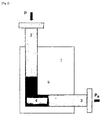
- an apparatus 1 shown in Fig. 2 can be used.
- Material 4 obtained by uniformly dispersing stearic acid in fine aluminum powder is supplied from one direction 2 of an L-shaped die, to be filled in the L-shaped die.
- pressures P, PB are applied from one direction 2 and the other direction 3 of the L-shaped die, respectively.
- pressure P is greater than PB.
- PB the material is pressurized while being filled in the L-shaped bent die. Accordingly, the material receives pressure as it passes through a hole 5 in the bent die, being given giant strain and changing to a material of high hardness and this harder material is extruded.
- a pressure of 100 MPa is applied for PB and a greater pressure is applied for P.
- the pressure of 100 MPa is adopted for PB based on experience, as this pressure setting has been proven sufficiently.
- the pressure to be adopted need not be excessively high, but if it is too low, not enough pressure may generate to push back the material as it is pressurized while being filled in the L-shaped die. It is also believed that the specific settings, including pressures P, PB, are affected significantly by the material used, number of times the material is passed, lubrication, and temperature, and mutual slipping of powder particles is likely to have considerable impact, and therefore you should remember that these settings change according to various conditions.
- Material 4 obtained by uniformly dispersing stearic acid in fine aluminum powder is supplied from the other direction 3 of the L-shaped die, to be filled in the L-shaped die.
- pressures P, PB are applied from one direction 2 and the other direction 3 of the L-shaped die, respectively.
- pressure PB is greater than P.
- P the material is pressurized while being filled in the L-shaped bent die. Accordingly, the material receives pressure as it passes through the hole 5 in the bent die, being given giant strain and changing to a material of high hardness and this harder material is extruded.
- a pressure of 100 MPa is applied for P and a greater pressure is applied for PB.
- the pressure of 100 MPa is adopted for P based on experience, as this pressure setting has been proven sufficiently.
- the pressure to be adopted need not be excessively high, but if it is too low, not enough pressure may generate to push back the material as it is pressurized while being filled in the L-shaped die.
- the specific settings, including pressures P, PB are affected significantly by the material used, number of times the material is passed, lubrication, temperature, and mutual slipping of powder particles is likely to have considerable impact, and therefore it should be noted that these settings change according to various conditions. In light of the above, tests have been conducted based on P settings of as low as 50 MPa and as high as 200 MPa or so.
- the illustrated L-shaped die has right angles at the bend.
- a desired bend angle can be selected as deemed appropriate, but the greatest strain can be added when the bend is set at right angles.
- the L-shaped bend of the L-shaped die may be curved.
- giant strain can be added to the entire structural material. Fill the material in the L-shaped bent die and then apply pressures to it from one direction and the other direction of the die to cause the material to pass through the hole in the bent die, thereby giving giant strain to the resulting material, and this structural material is taken out from the other direction (one pass) and supplied to one direction of the die, to be filled again in the L-shaped bent die, after which pressures are applied from one direction and the other direction of the die to cause the material to pass through the hole in the bent die, thereby giving greater strain to the material, and this material is taken out from the other direction (two passes), and the same operation is repeated (three passes, four passes, and so on, according to the number of repetitions).
- the structural material is a circular cylinder, it is effective to repeat this operation by changing the angle of material relative to the plane to which it is supplied. For example, assume the initial angle is 90 degrees. In the second operation, the angle is changed by 90 degrees. When the angle is changed by 90 degrees, the operation can be repeated by a number of times corresponding to an integer multiple of 4, such as four times (four passes), eight times (eight passes) or 12 times (12 passes), so that giant strain can be added uniformly across the material. If the angle is changed by 120 degrees, the operation can be repeated by a number of times corresponding to an integer multiple of 3. If the structural material is a prism, the angle is changed by different amounts such as 90 degrees and 180 degrees.
- the angle can be changed by 30 degrees, 60 degrees, 120 degrees or 180 degrees, where it is effective to repeat the operation by an integer multiple of 12, 6, 3 or 2, respectively.
- the structural material can be designed so that the core part can be removed, in which case the aforementioned material obtained by uniformly dispersing stearic acid in fine aluminum powder is filled in the L-shaped bent die in a manner fixed around the core part, and then the same operation as explained above is performed, because this way giant strain can be added to the entire hollow structural material.
- the structural material is hollow, it can be obtained as a hollow circular cylinder, hollow prism, hollow hexagonal cylinder or other similar shape.
- the operation of changing to a structural material the aforementioned material obtained by uniformly dispersing stearic acid in fine aluminum powder cannot be achieved simply by applying pressure, but it also requires heating the material to a specified temperature to cause change.
- melting operation is not performed and therefore the L-shaped die must be heated to a temperature at which consolidation can be attained with the material, obtained by uniformly dispersing stearic acid in fine aluminum powder, under the aforementioned pressurization condition.
- the material is generally heated to around 400°C in conventional processes.
- the inventors of the present invention made a new discovery that, as specified by the operation explained herein, the same result can be achieved by heating to lower temperatures in a range of 60°C to 350°C, or more preferably in a range of 100°C to 350°C.
- heating is implemented as explained below.
- the aforementioned temperature shall be in a range of 60°C to 350°C, or preferably in a range of 100°C to 350°C. If the temperature is below 60°C, sufficient consolidation cannot be achieved. If the temperature exceeds 350°C, on the other hand, consolidation itself is feasible, but it simply means use of unnecessarily high temperatures resulting in unnecessarily high temperature operation.
- the material can be kept at its temperature in the L-shaped bent die. This makes sure the material is filled in the L-shaped bent die under the condition of temperature. Pressures are applied to the material from the one direction and the other direction of the die wherein the pressure applied to the material from the one direction of the die is greater than the pressure applied to the material from the other direction of the die, to cause the material to pass through the hole of the L-shaped bent die from the one direction to the other direction of the die. As it passes the hole in the L-shaped bent die, the material is given and accumulates giant strain.
- the aforementioned temperature of material or higher is between 400°C and 500°C. If this temperature is below 400°C, the temperature cannot be maintained sufficiently. If the temperature exceeds 500°C, on the other hand, maintaining the temperature itself is feasible, but it simply means use of unnecessarily high temperatures resulting in unnecessarily high temperature operation.
- the material After the material is taken out from the other direction of the die, it is supplied to the one direction of the die, to be filled in the L-shaped bent die at the temperature, after which pressures are applied to the material from the one direction and the other direction of the die wherein the pressure applied to the material from the one direction of the die is smaller than the pressure applied to the material from the other direction of the die.
- the structural material travels from the other direction of the die to the one direction of the die by passing through the hole in the L-shaped bent die, and the resulting structural material that has been given and accumulated giant strain is taken out. The above operation is repeated multiple times. As the material passes through the hole in the L-shaped bent die, it is given and accumulates giant strain.
- the aforementioned temperature shall be in a range of 60°C to 350°C, or preferably in a range of 100°C to 350°C. If the temperature is below 60°C, sufficient consolidation cannot be achieved. If the temperature exceeds 350°C, on the other hand, consolidation itself is feasible, but it simply means use of unnecessarily high temperatures resulting in unnecessarily high temperature operation.
- external heating is provided as explained below.
- provide external heating by heating the L-shaped bent die, in which the material is filled at the temperature, from the outside.
- the temperature of this external heating is between 400°C and 500°C. If this temperature is below 40°C, the temperature cannot be maintained sufficiently. If the temperature exceeds 350°C, on the other hand, maintaining the temperature itself is feasible, but it simply means use of unnecessarily high temperatures resulting in unnecessarily high temperature operation.
- Fig. 5 is an X-ray diffraction profile showing that even when a material obtained without uniformly dispersing stearic acid in fine aluminum powder is pressurized under the aforementioned condition at a temperature of 100°C and heated to between 400°C and 500°C which is above the temperature, solid-state reaction does not occur between aluminum and stearic acid.
- Fig. 6 is an X-ray diffraction profile showing that when a solid molded product which is constituted by aluminum and stearic acid and has been heated to the aforementioned temperature of 100°C is heated to between 400°C and 500°C which is above the temperature, solid-state reaction occurs between aluminum and stearic acid and aluminum carbide (Al 4 C 3 ) is produced. It has been confirmed that a structural material of high hardness whose Vickers hardness exceeds 125HV can be obtained through continuous heating at 400°C.
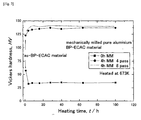
- Fig. 3 shows that four hours of heating resulted in increased hardness in cases of four passes and eight passes. The hardness achieved after eight passes is greater than that achieved after four passes. Also note that in Fig. 3 , the results of the material subjected to four passes without grinding mixing and agitation in the ball mill (0h MM) indicates that if powder and stearic acid are not ground and mixed, the Vickers hardness of the consolidation molded material that has been produced by passing the material through the L-shaped die will not increase even when it is subsequently heated to a range of 400°C to 500°C.
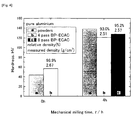
- Fig. 4 shows the hardness comparison results of: a material obtained by heating the L-shaped die to a temperature at which consolidation is possible, under the aforementioned pressurization condition of fine aluminum powder, without agitation and mixing in a ball mill beforehand; a material obtained by agitation and mixing for four hours in a ball mill, followed by four passes while heating the L-shaped die to a temperature at which consolidation is possible; and a material obtained by agitation and mixing for four hours in a ball mill, followed by eight passes while heating the L-shaped die to a temperature at which consolidation is possible.
- the highest relative density is achieved by the material obtained by heating the L-shaped die to a temperature at which consolidation is possible, under the aforementioned pressurization condition of fine aluminum powder, without agitation and mixing in a ball mill beforehand; the next higher relative density is achieved by the material obtained by agitation and mixing for four hours in a ball mill, followed by eight passes while heating the L-shaped die to a temperature at which consolidation is possible; and the lowest relative density is achieved by the material obtained by agitation and mixing for four hours in a ball mill, followed by four passes while heating the L-shaped die to a temperature at which consolidation is possible.
- the relative densities of the two materials that were given agitation and mixing for four hours in a ball mill are not higher than the relative density of the material obtained by heating the L-shaped die to a temperature at which consolidation is possible, under the aforementioned pressurization condition of fine aluminum powder, without agitation and mixing in a ball mill beforehand.
- Fig. 7 shows the relationship of compressive stress and compressive strain, illustrating the comparison results of: a material obtained by heating the L-shaped die to a temperature at which consolidation is possible, under the aforementioned pressurization condition of fine aluminum powder, without agitation and mixing in a ball mill beforehand; a material obtained by agitation and mixing for four hours in a ball mill, followed by four passes while heating the L-shaped die to a temperature at which consolidation is possible; and a material obtained by agitation and mixing for four hours in a ball mill, followed by eight passes while heating the L-shaped die to a temperature at which consolidation is possible.
- the aluminum structural materials obtained according to the present invention constituted by aluminum, aluminum carbide and unavoidable impurities except aluminum and aluminum carbide, were measured for Vickers hardness and tested for compression according to the methods described below.
- Vickers hardness was measured by polishing the surface of each consolidation molded material and then taking seven measurements using a Vickers hardness tester at a test load of 1 kg and holding time of 15 seconds, to obtain an average of measured values.
- the compression test was conducted in room temperature at an initial rate of strain of 4.76 ⁇ 10 -3 s -1 on test pieces of circular cylinder with a diameter of 3 mm and height of 3.5 mm that were obtained by machining each material from the longitudinal direction.
- the purity is 99.7 percent by weight or more for aluminum, 0.10 percent by weight or less for silicon, 0.20 percent by weight or less for iron, and 0.02 percent by weight or less for other components.
- the material shown in Fig. 1 was used, whose particle size distribution as measured by a Coulter LS 130 laser diffraction system indicated that the maximum particle size was 100 ⁇ m and at least 90% of all particles had a size of 60 ⁇ m or less.
- stearic acid a product made by Kanto Chemical Co., Ltd., which is solid at room temperature, was used. Stearic acid was used by an amount corresponding to 2.5 percent by weight relative to fine aluminum powder.
- a material constituted by fine aluminum powder in which stearic acid was uniformly mixed was obtained by grinding and mixing both for four hours in a ball mill.
- Fig. 6 shows the X-ray diffraction patterns of a consolidation molded material which was obtained from powder agitated or mixed for four hours in a ball mill, after four passes under heating at 400°C.
- This X-ray diffraction profile shows occurrence of solid-state reaction in the material, or specifically that the consolidation molded material constituted by the material heated to a temperature of 100°C underwent solid-state reaction between aluminum and stearic acid, resulting in production of aluminum carbide (Al 4 C 3 ).
- Al 4 C 3 aluminum carbide
- a structural material of high hardness whose Vickers hardness exceeds 125HV can be obtained by heating at a temperature of 100°C and then heating continuously at 400°C.
- Fig. 3 shows how heating for four hours at a temperature of 100°C resulted in increased hardness after four passes and eight passes, respectively. The hardness achieved after eight passes was higher than the hardness achieved after four passes. Also evident from Fig.
- Fig. 4 shows the comparison results of a material obtained without agitation and mixing in a ball mill on one hand, and a material obtained by agitation and mixing for four hours in a ball mill on the other, based on Vickers hardness.
- the material obtained by agitation and mixing for four hours in a ball mill had a higher level of Vickers hardness.
- Comparative Example A material produced by a conventional method using fine aluminum powder was filled in an L-shaped bent die and then pressures were applied from one direction and the other direction of the die to cause the material to pass through a hole in the bent die.
- the Vickers hardness values of the obtained structural material to which giant strain was added are shown below. (Note that only fine aluminum powder was processed, which is different from the materials used in examples which were obtained by uniformly dispersing stearic acid in aluminum fine powder.) Specifics are reported by the inventors of the present invention in Scripta Materialia 53 (2005) pp.1225-1229 .
- the present invention has the potential to be applied and used as a means for improving the properties of non-aluminum metals as structural materials.
Landscapes
- Chemical & Material Sciences (AREA)
- Engineering & Computer Science (AREA)
- Mechanical Engineering (AREA)
- Materials Engineering (AREA)
- Metallurgy (AREA)
- Organic Chemistry (AREA)
- Inorganic Chemistry (AREA)
- Manufacturing & Machinery (AREA)
- Powder Metallurgy (AREA)
- Manufacture Of Alloys Or Alloy Compounds (AREA)
Abstract
Description
- The present invention relates to a pure-aluminum structural material with high specific strength obtained by consolidation using the giant straining process, as well as a method for manufacturing the same.
- Traditionally various methods have been used to develop methods for manufacturing aluminum materials. For example, aluminum is heated and melted and then thermally treated. In any method whereby aluminum is heated and melted to manufacture molten aluminum, ground aluminum is melted and recovered (
Patent Literature 1, Japanese Patent Laid-open No.2007-84876 Patent Literature 2, Japanese Patent Laid-open No.2007-98243 Patent Literature 3, Japanese Patent Laid-open No.Hei 8-81718 Patent Literature 4, Japanese Patent Laid-open No.2003-181431 Patent Literature 5, Japanese Patent Laid-open No.2003-181431
If aluminum is recycled and used as a structural material, technologies to recover aluminum, currently existing in a non-alloy form, and improve its properties as a structural material are required. The inventors of the present invention believe that material processing technologies designed to make aluminum usable as a structural material will meet greater demand in the future. - If aluminum is used as a functional material, the following inventions are known: A specific type of single crystal or crystalline structure (
Patent Literature 6, Japanese Patent Laid-open No.Sho 63-211507 Hei 4-277605 Patent Literature 8, Japanese Patent Laid-open No.Hei 5-74235 Hei 7-166283 - Active efforts are being made to develop alloys containing aluminum. Among alloys currently manufactured, one alloy is known which is sintered/processed aluminum-based alloy that contains Al4C3 (
Patent Literature 10, Japanese Patent Laid-open No.62-238344
Another method is to put pressure on powder while also turning the powder around the rotational axis to add shearing force to the powder in order to crush and consolidate the powder (Patent Literature 11, Japanese Patent Laid-open No.63-241103 Hei 8-41571 3367269 Hei 6-271955 2007-84889
Under these methods, however, no active effort is made to uniformly disperse stearic acid in the alloy material, aluminum fine powder or other form of alloy material. Also, while an operation to create strain in the obtained alloy is described, specifics of this strain are not clearly indicated and there is no mention of giant strain, either.
Another method is known whereby stearic acid is used as a solid lubricant to manufacture an alloy by means of powder metallurgy and then the manufactured alloy is compressed and sintered to obtain a sintered aluminum alloy (Patent Literature 15, Published Japanese Translation of PCT International Patent Application No.Hei 11-504388 - Efforts are underway to develop dispersion-reinforced metal-based composite materials, each constituted by a metal dispersion medium of composite material containing uniformly dispersed metal, metal compound or ceramic particles or whiskers or other dispersion reinforcement material. Various methods are available to manufacture such dispersion-reinforced metal-based composite materials, like those specified below.
High-pressure casting method: Create a pre-form of dispersion reinforcement material and add molten alloy, which will be used as a dispersion medium of composite material, to the pre-form by means of pressurization/impregnation.
Powder processing method: Pulverize alloy, which will be used as a dispersion medium of composite material, and mix the obtained alloy powder with dispersion reinforcement material, followed by pressurization and extrusion to inter-connect alloy powder particles.
Mechanical alloying method: Pulverize alloy, which will be used as a dispersion medium of composite material, and mix the obtained alloy powder with dispersion reinforcement material, followed by mechanical kneading.
Molten metal method: Prepare alloy, which will be used as a dispersion medium of composite material, in liquid phase and then add dispersion reinforcement material and mix them together under agitation.
Semi-solidification or half-melting method (hereinafter simply referred to as "semi-solidification method"): Prepare alloy, which will be used as a dispersion medium of composite material, in mixed solid-liquid phase and then add dispersion reinforcement material and mix them together under agitation.
Generally among the aforementioned methods for manufacturing composite materials, the high-pressure casting method where a pre-form of dispersion reinforcement material is created, as well as the powder processing method and mechanical alloying method where alloy powder is used, are not desirable because the process is complicated and long. It is also pointed out that these manufacturing methods cannot be easily adopted to manufacture large composite materials (Patent Literature 16, Japanese Patent Laid-open No.Hei 6-172891 - In relation to the aforementioned mechanical alloying, a method to use mechanical alloying in a pre-treatment step, instead of mechanically kneading the alloy element mixture, is known.
There is a manufacturing method to form an intermetallic compound of aluminum and titanium by means of mechanical alloying and then add the resulting powder mixture to aluminum powder and mix them together, after which the powder mixture is compacted and then the obtained compact is sintered in an inert atmosphere to obtain an aluminum sintered material (Patent Literature 17, Japanese Patent Laid-open No.Hei 4-331
A method to heat metal pieces to a half-molten state or fully molten state for use in injection molding has advantages including the ability to net-shape the metal safely and the ability to easily and integrally form a metal-based composite material offering excellent dispersibility by utilizing the agitation effect of a screw. When the aforementioned metal-based composite material is injection-molded, however, reinforcement material must be uniformly dispersed among metal pieces as the mixture is supplied to the injection molding machine. Various methods can be considered to achieve this supply condition. For example, metal pieces can be introduced simultaneously with ceramic particles, whiskers or other reinforcement material from the hopper of the injection molding machine, or metal material and reinforcement material can be mixed and compression-molded first and then extrusion-molded into pellets for use in injection molding (Patent Literature 18, Japanese Patent Laid-open No.Hei 6-238422
Another invention is based on the assumption that no effective method has been found so far to uniformly disperse reinforcement material in the matrix metal material prior to injection molding of metal-based composite material and supply the obtained dispersion mixture material at low cost; to be specific, this invention relates to using a ball mill to mix matrix metal material and reinforcement material as small pieces or particles to cause reinforcement material to adhere to matrix metal material, followed by sifting the mixture to screen out pieces or particles of a specified size or larger so that the remaining pieces/particles can be used as the material which is then heated to a half-molten state or fully molten state for use in injection molding (Patent Literature 19, Japanese Patent Laid-open No.9-295122 3011885
A method for manufacturing a member having Al-based intermetallic compound-reinforced complex part is also known, wherein such manufacturing method is characterized by the fact that powders of component elements of an intermetallic compound which will be used as reinforcement particles are weighed and mixed together based on stoichiometric composition and then the mixture is mechanically alloyed to obtain precursor complex powder in which the aforementioned component elements are mechanically incorporated and alloyed but not yet forming an intermetallic compound, after which pure Al powder or Al alloy powder is added to this precursor complex powder and the mixture is mechanically alloyed again to obtain MA processed powder in which the aforementioned precursor complex is finely and uniformly dispersed in Al of the aforementioned pure Al powder or Al alloy powder, after which this MA processed powder is pressurized and formed to create a pre-form of reinforcement complex part in which the aforementioned precursor complex is solid-soluted in the aforementioned Al, and then the pre-form is degassed and pre-heated and placed in dies, after which molten Al alloy is cast and the precursor complex being dispersed in the pre-form is caused to react under the heat of the aforementioned molten metal to produce an intermetallic compound, so that this intermetallic compound is dispersed finely in the Al matrix of the aforementioned reinforcement complex part while the base Al of the pre-form and molten Al are strongly bonded together, to finally cause the aforementioned reinforcement complex part to integrally bond with the surface of material of the part formed by the aforementioned molten metal (Patent Literature 20, Japanese Patent Laid-open No.Hei 8-3660 3417666
Another method is available whereby carbon nano-material 11 and metal powder 12 are pre-mixed and then the carbon nano-material 11 and metal powder 12 are kneaded fully according to the mechanical alloying method to obtain carbon nano-composite metal powder 13 looking like the metal powder 12 on which countless particles of carbon nano-material 11 are sprinkled, after which the carbon nano-composite metal powder 13 is filled in dies 15 and the filled carbon nano-composite metal powder 13 is pressurized and compacted at temperatures that are kept at 150°C or so, to obtain a pre-molded product 17 (Patent Literature 21, Japanese Patent Laid-open No.2007-154246 - Among methods for manufacturing intermetallic compound-based composite materials is a method to manufacture intermetallic compound powder beforehand by means of mechanical alloying (MA), etc., and then process it under conditions of high temperature and high pressure by means of hot press (HP) or hot isostatic press (HIP) together with fibers and/or particles that are to become reinforcement materials.
These conventional manufacturing methods have problems. To manufacture a fine intermetallic compound-based composite material, for example, there is a need to use a powder metallurgic manufacturing method, primarily the HP method or HIP method, to apply high temperature/high pressure to sinter an intermetallic compound to ensure fineness of the resulting composite material. This puts limitations on the performance and scale of the manufacturing apparatus and makes it extremely difficult to manufacture composite materials of large or complex shapes, while also making it impossible to perform near net shaping by considering the final shape of product, and consequently mechanical processing is required in a subsequent step.
Another problem is that intermetallic compound powder must be synthesized beforehand by means of MA, etc., in a pre-treatment step, which makes the manufacturing process multi-staged and complex. For this and other reasons mentioned above, the conventional manufacturing methods involving mechanical alloying (MA) are criticized for requiring multi-staged processes and high-temperature/high-pressure conditions and consequently extremely high cost and energy, among others (Patent Literature 22, Japanese Patent Laid-open No.2005-2331 - Based on the above, mechanical alloying is known to be an effective pre-treatment means for sintering, injection molding, etc.
- As explained above, aluminum does not have sufficient strength, etc., required of material and a general approach has been to improve strength by means of alloying and other methods. If the material process is to be streamlined or product will be recycled, however, non-composited aluminum is an extremely desirable material. Accordingly, it is an important challenge to improve the material properties of aluminum, and such improvement is also an important challenge in the development of industry.
One of the inventors of the present invention recognized that obtaining a structural material using high-purity aluminum was very important and based on this recognition, manufactured an aluminum structural material constituted by aluminum and unavoidable impurities, wherein such material is obtained by using non-molten aluminum fine powder as the material and filling the material in an L-shaped bent die, after which pressures are applied to the material from one direction and the other direction of the die to cause the material to pass through a hole in the bent die, thereby adding giant strain to the material (Non-patent Literature 1, Scripta Materialia 53 (2005) pp.1225-1229). Unfortunately, however, this structural material did not achieve satisfactory results in terms of Vickers hardness and other characteristic. - Patent Literature 1: Japanese Patent Laid-open No.
2007-84876 - Patent Literature 2: Japanese Patent Laid-open No.
2007-98243 - Patent Literature 3: Japanese Patent Laid-open No.
Hei 8-81718 - Patent Literature 4: Japanese Patent Laid-open No.
2003-181431 - Patent Literature 5: Japanese Patent Laid-open No.
2003-181431 - Patent Literature 6: Japanese Patent Laid-open No.
Sho 63-211507 - Patent Literature 7: Japanese Patent Laid-open No.
Hei 4-277605 - Patent Literature 8: Japanese Patent Laid-open No.
Hei 5-74235 - Patent Literature 9: Japanese Patent Laid-open No.
Hei 7-166283 - Patent Literature 10: Japanese Patent Laid-open No.
62-238344 - Patent Literature 11: Japanese Patent Laid-open No.
63-241103 - Patent Literature 12: Japanese Patent Laid-open No.
Hei 8-41571 3367269 - Patent Literature 13: Japanese Patent Laid-open No.
Hei 6-271955 - Patent Literature 14: Japanese Patent Laid-open No.
2007-84889 - Patent Literature 15: Published Japanese Translation of PCT International Patent Application No.
Hei 11-504388 - Patent Literature 16: Japanese Patent Laid-open No.
Hei 6-172891 - Patent Literature 17: Japanese Patent Laid-open No.
Hei 4-331 - Patent Literature 18: Japanese Patent Laid-open No.
Hei 6-238422 - Patent Literature 19: Japanese Patent Laid-open No.
Hei 9-295122 3011885 - Patent Literature 20: Japanese Patent Laid-open No.
Hei 8-3660 3417666 - Patent Literature 21: Japanese Patent Laid-open No.
2007-154246 - Patent Literature 22: Japanese Patent Laid-open No.
2005-2331 - Non-patent Literature 1: Scripta Materialia 53 (2005) pp.1225-1229
- The object of the present invention is to provide a structural material using novel, high-purity aluminum offering desired characteristics of structural material, which is produced by using fine aluminum powder as the material, as well as a method for manufacturing such structural material.
- The inventors of the present invention worked toward achieving the aforementioned object and discovered the following, and consequently achieved the aforementioned object.
- (1) Prepare fine aluminum powder material containing aluminum and unavoidable impurities, and fill this material in an L-shaped bent die and without melting the material, apply pressures to the material from one direction and the other direction of the die to cause the material to pass through a hole in the bent die, thereby adding giant strain to the material. By repeating this operation, the material is given and accumulates giant strain and exhibits desirable characteristics of structural material.
- (2) Prepare fine aluminum powder material containing aluminum and unavoidable impurities, and before causing fine aluminum powder to pass through the hole in the die by applying pressures from one direction and the other direction of the die, uniformly mix and disperse stearic acid in fine aluminum powder and use the resulting mixture as a raw material.
- (3) The operation to uniformly mix and disperse stearic acid in fine aluminum powder in (2) above is performed by an agitation mixing means.
- (4) It is effective that the agitation mixing means in (3) above is a ball mill.
- (5) The operation in (1) above is described below in greater detail:
- Prepare fine aluminum powder material containing aluminum and unavoidable impurities, fill this material in an L-shaped bent die at a temperature, apply pressures to the material from one direction and the other direction of the die wherein the pressure applied to the material from the one direction of the die is greater than the pressure applied to the material from the other direction of the die, to cause the material to pass through a hole of the L-shaped bent die, thereby allowing the material to be given and accumulate giant strain, after which the material is supplied to the aforementioned die from the one direction in a re-circulating manner, to be filled in the L-shaped bent die at the temperature, and then pressures are applied to the material from the one direction and the other direction of the die wherein the pressure applied to the material from the one direction of the die is greater than the pressure applied to the material from the other direction of the die, to cause the material to pass through the hole of the L-shaped bent die, thereby allowing the material to be given and accumulate giant strain. By repeating this operation, the material is given and accumulates giant strain and exhibits desirable characteristics of a structural material.
- (6) It is possible to perform the operation in (1) above first and then perform the following operation as specified below:
- Prepare fine aluminum powder material in which stearic acid is uniformly dispersed, fill this material in an L-shaped bent die at a temperature, apply pressures to the material from one direction and the other direction of the die wherein the pressure applied to the material from the one direction of the die is greater than the pressure applied to the material from the other direction of the die, to cause the material to pass through the hole of the L-shaped bent die, thereby allowing the material to be given and accumulate giant strain, after which the material that has been given/accumulated giant strain is supplied to the die from the other direction to the one direction of the die, to be filled in the L-shaped bent die at the temperature, and then pressures are applied to the material from the one direction and the other direction of the die wherein the pressure applied to the material from the one direction of the die is smaller than the pressure applied to the material from the other direction of the die, to cause the material to pass through the hole of the L-shaped bent die, thereby allowing the material to be given and accumulate giant strain.
By repeating this operation, the material is given and accumulates giant strain and exhibits desirable characteristics of structural material.
- Prepare fine aluminum powder material in which stearic acid is uniformly dispersed, fill this material in an L-shaped bent die at a temperature, apply pressures to the material from one direction and the other direction of the die wherein the pressure applied to the material from the one direction of the die is greater than the pressure applied to the material from the other direction of the die, to cause the material to pass through the hole of the L-shaped bent die, thereby allowing the material to be given and accumulate giant strain, after which the material that has been given/accumulated giant strain is supplied to the die from the other direction to the one direction of the die, to be filled in the L-shaped bent die at the temperature, and then pressures are applied to the material from the one direction and the other direction of the die wherein the pressure applied to the material from the one direction of the die is smaller than the pressure applied to the material from the other direction of the die, to cause the material to pass through the hole of the L-shaped bent die, thereby allowing the material to be given and accumulate giant strain.
- (7) In (5) or (6) above, the material must be filled in the L-shaped bent die at the temperature. To do this, heat the material to the temperature or higher from outside the aforementioned L-shaped bent die.
- The aluminum structural material conforming to the present invention, which is constituted by aluminum, aluminum carbide and unavoidable impurities except aluminum and aluminum carbide and obtained from a material produced by mechanically and uniformly dispersing stearic acid in fine aluminum powder, is such that stearic acid is uniformly dispersed in fine aluminum powder and the obtained material is filled in an L-shaped die, with pressure applied multiple times to the L-shaped die to allow consolidation and introduction of strong strain to be achieved at the same time and at a lower temperature, and therefore the target structural material can be manufactured while maintaining the excellent properties of the material. When the produced material is heated to high temperature, the material undergoes solid-state reaction and ceramic particles constituted by aluminum carbide (Al4C3) are produced. These ceramic particles help obtain a structural material that maintains high hardness at high temperatures. Also, the obtained structural material can retain high compressive stress in a state of increased compressive strain. A structural material having these properties and constituted by novel aluminum is obtained.
-
- [
Fig. 1 ] Diagram showing a particle size distribution of fine aluminum powder. - [
Fig. 2 ] Diagram showing an apparatus conforming to the present invention. - [
Fig. 3 ] Diagram showing that by heating at a temperature of 100°C and then heating continuously at 400°C which is above the temperature, a very hard structural material whose Vickers hardness exceeds 125HV can be obtained. - [
Fig. 4 ] Diagram showing the results of comparing a material obtained without agitation and mixing in a ball mill on one hand, and a material that has been agitated and mixed for four hours in a ball mill on the other, based on Vickers hardness. - [
Fig. 5 ] X-ray diffraction profile showing that even when a material obtained without agitation and mixing in a ball mill is pressurized at a temperature of 100°C to obtain a structural material and then the obtained structural material is heated to 400°C which is above the temperature, solid-state reaction does not occur in the material. (Solid-state reaction has not occurred in the material.) - [
Fig. 6 ] X-ray diffraction profile showing that when a material that has been agitated and mixed for four hours in a ball mill is pressurized at a temperature of 100°C to obtain a structural material and then the obtained structural material is heated to 400°C which is above the temperature, solid-state reaction occurs in the material. - [
Fig. 7 ] Diagram showing relationship of compressive stress and compressive strain, illustrating the measured results of: a material obtained by agitation and mixing for four hours in a ball mill, followed by four passes while heating an L-shaped die at a temperature at which consolidation is possible; a material obtained by agitation and mixing for four hours in a ball mill, followed by eight passes while heating an L-shaped die at a temperature at which consolidation is possible; and a material obtained without pre-agitation and mixing in a ball mill but only through heating in an L-shaped die at a temperature at which consolidation is possible in a condition of fine aluminum powder receiving the aforementioned pressures. - An aluminum structural material conforming to the present invention, constituted by aluminum, aluminum carbide and unavoidable impurities except aluminum and aluminum carbide, is a material obtained by uniformly mixing and dispersing stearic acid in fine aluminum powder and is characterized in that the material is filled in an L-shaped bent die at a temperature and pressures are applied to the material from one direction and the other direction of the die in such a way that the pressure applied to the material from one direction of the die is greater than the pressure applied to the material from the other direction of the die, to cause the material to pass through a hole in the L-shaped bent die, thereby obtaining such structural material that has been given and accumulated giant strain.
- For the fine aluminum powder, fine aluminum powder obtained by any standard manufacturing method is used. For example, a product of ECKA Granules in Australia can be used. For this fine aluminum powder, fine aluminum powder particles manufactured by the atomization method can be re-pulverized and used.
The purity is 99.7 percent by weight or more for aluminum, 0.10 percent by weight or less for silicon, 0.20 percent by weight or less for iron, and 0.02 percent by weight or less for other components. - When a Coulter LS 130 laser diffraction system was used to measure the particle size distribution of fine aluminum powder, the maximum particle size was 100 µm and at least 90% of all particles had a size of 60 µm or less. The diffraction result is shown in
Fig. 1 . - Preparation of the material, which is to be used in processing, is significant.
The material is obtained by uniformly dispersing stearic acid in fine aluminum powder. Stearic acid is known as higher fatty acid and solid at normal temperature. - The ratio of stearic acid and fine aluminum powder shall be in a range of 2 percent by weight to 10 percent by weight of fine aluminum powder, based on weight ratio.
If fine aluminum powder is less than 2 percent by weight, sufficient effects cannot be expected. If fine aluminum powder exceeds 10 percent by weight, on the other hand, there won't be any particular effects even when the mixing ratio of stearic acid is increased. - If these components are simply mixed, stearic acid and fine aluminum powder distributed unevenly are observed, whereas what is required is a state where both of them are mixed together uniformly.
Accordingly, fine aluminum powder and stearic acid are mixed by an agitation and grinding mixing means to manufacture the target material. To be specific, fine aluminum powder is ground in the presence of stearic acid so that fine aluminum powder and stearic acid are mixed and dispersed uniformly.
For the aforementioned agitation mixing means, a ball mill may be used. As an agitation mixing means, a tumbling mill or dry attritor capable of agitation and mixing can also be used. - Fine aluminum powder and solid stearic acid are filled in the cylindrical, rotatable storage part of a ball mill in the presence of the ball, and the cylindrical storage part is rotated to cause fine aluminum powder to be ground by the action of the ball in the presence of stearic acid, thereby allowing fine aluminum powder and stearic acid to be mixed and dispersed uniformly to manufacture the target material.
The aforementioned agitation and grinding mixing process takes three to eight hours.
If a tumbling mill is used, fine aluminum powder and solid stearic acid are processed by causing the tumbling ball mill to rotate or rotate while also revolving around the axis, so as to obtain a material in which stearic acid is uniformly dispersed in fine aluminum powder through the agitation and grinding mixing process. This agitation and grinding mixing takes three to eight hours. The ball mill is also called "planetary mill."
When a dry attritor is used, fine aluminum powder and solid stearic acid are filled in the machine's cylindrical container and centrifugal force is applied to cause stearic acid to uniformly disperse in fine aluminum powder through the agitation and grinding mixing process. This agitation and grinding mixing takes three to eight hours. - A material conforming to the present invention is obtained by the following operations.
It is obtained as a material which is produced by uniformly mixing and dispersing stearic acid in fine aluminum powder and which is characterized in that the material is filled in an L-shaped bent die at a temperature and pressures are applied from one direction and the other direction of the die in such a way that the pressure applied to the material from one direction of the die is greater than the pressure applied to the material from the other direction of the die, to cause the material to pass through a hole in the L-shaped bent die, so that the material is given and accumulates giant strain. The obtained material contains aluminum, aluminum carbide and unavoidable impurities except aluminum and aluminum carbide. - In the aforementioned process, the material that has been given and accumulated giant strain can be obtained by causing the processed material to pass through the hole in the L-shaped bent die multiple times so that the material will exhibit improved properties. The following methods are available:
(1) Cause the material to pass through the hole in the L-shaped bent die so that the material is given and accumulates giant strain, and then re-circulate the material to one direction of the die and cause it to pass through the hole in the L-shaped bent die, or (2) fill the material in the L-shaped bent die at the temperature from the other direction to one direction of the die, and then change the pressure application mode and cause the material to pass through the hole in the L-shaped bent die, to obtain the material characterized below. - The method (1) above is explained below. Fill the aforementioned material in the L-shaped bent die at the temperature and apply pressures to the material from one direction and the other direction of the die wherein the pressure applied to the material from the one direction of the die is greater than the pressure applied to the material from the other direction of the die, to cause the material to pass through the hole of the L-shaped bent die so that the material is given and accumulates giant strain, after which the material thus given and accumulated giant strain after passing through the hole of the L-shaped bent die is re-circulated and supplied to the one direction of the die, to be filled in the L-shaped bent die at the temperature, and then pressures are applied to the material from the one direction and the other direction of the die wherein the pressure applied to the material from the one direction of the die is greater than the pressure applied to the material from the other direction of the die, to cause the material to pass through the hole of the L-shaped bent die so that the material is given and accumulates giant strain, and the above is repeated.
Re-circulating the material to the one direction of the die means that the material, which has been given and accumulated giant strain after passing through the hole of the L-shaped bent die, is taken out and supplied to the one direction of the die using a pipe or other connection means so that the material is again filled in the L-shaped bent die at the temperature as before and then pressures are applied to the material from the one direction and the other direction of the die wherein the pressure applied to the material from the one direction of the die is greater than the pressure applied to the material from the other direction of the die, and the above is repeated.
In this case, the pressure application mode is not changed. - The method (2) above is explained below. Fill the material, obtained by uniformly dispersing stearic acid in fine aluminum powder, in the L-shaped bent die at the temperature and apply pressures to the material from the one direction and the other direction of the die wherein the pressure applied to the material from the one direction of the die is greater than the pressure applied to the material from the other direction of the die, to cause the material to pass through the hole of the L-shaped bent die so as to obtain a structural material that has been given and accumulated giant strain, after which the material thus given and accumulated giant strain is supplied to the die from the other direction to the one direction of the die, to be filled in the L-shaped bent die at the temperature, and then pressures are applied to the material from the one direction and the other direction of the die wherein the pressure applied to the material from the one direction of the die is smaller than the pressure applied to the material from the other direction of the die, to cause the material to pass through the hole of the L-shaped bent die so that the material is given and accumulates giant strain.
- The aforementioned operation can be repeated, as explained specifically below. The aforementioned material that has been given and accumulated giant strain is supplied to the die from the other direction to the one direction of the die, to be filled in the L-shaped bent die at the temperature, and then pressures are applied to the material from the one direction and the other direction of the die wherein the pressure applied to the material from the one direction of the die is smaller than the pressure applied to the material from the other direction of the die, to cause the material to pass through the hole of the L-shaped bent die from the other direction to the one direction of the die so that the material is given and accumulates giant strain. After the material is taken out from the one direction of the die, it is supplied to the other direction of the die, to be filled in the L-shaped bent die at the temperature, and then pressures are applied to the material from the one direction and the other direction of the die wherein the pressure applied to the material from the one direction of the die is greater than the pressure applied to the material from the other direction of the die, to cause the material to pass through the hole of the L-shaped bent die from the one direction to the other direction of the die so that the material is given and accumulates giant strain, and this material is taken out from the other direction of the die.
The material is supplied to the die from the other direction to the one direction of the die, to be filled in the L-shaped bent die at the temperature, and then pressures are applied to the material from the one direction and the other direction of the die wherein the pressure applied to the material from the one direction of the die is smaller than the pressure applied to the material from the other direction of the die, to cause the material to pass through the hole of the L-shaped bent die from the other direction to the one direction of the die so that the material is given and accumulates giant strain. By repeating this operation, a material having desired properties of structural material can be obtained. - As a specific apparatus to perform the aforementioned operation, an
apparatus 1 shown inFig. 2 can be used.
Material 4 obtained by uniformly dispersing stearic acid in fine aluminum powder is supplied from onedirection 2 of an L-shaped die, to be filled in the L-shaped die.
Next, pressures P, PB are applied from onedirection 2 and theother direction 3 of the L-shaped die, respectively.
Here, pressure P is greater than PB.
By applying PB, the material is pressurized while being filled in the L-shaped bent die. Accordingly, the material receives pressure as it passes through ahole 5 in the bent die, being given giant strain and changing to a material of high hardness and this harder material is extruded.
To give one example of pressure application, a pressure of 100 MPa is applied for PB and a greater pressure is applied for P. The pressure of 100 MPa is adopted for PB based on experience, as this pressure setting has been proven sufficiently. The pressure to be adopted need not be excessively high, but if it is too low, not enough pressure may generate to push back the material as it is pressurized while being filled in the L-shaped die. It is also believed that the specific settings, including pressures P, PB, are affected significantly by the material used, number of times the material is passed, lubrication, and temperature, and mutual slipping of powder particles is likely to have considerable impact, and therefore you should remember that these settings change according to various conditions.
In light of the above, tests have been conducted based on PB settings of as low as 50 MPa and as high as 200 MPa or so.
When tested at a setting as high as 200 MPa, the pressure application mode was reversed after the material had been initially obtained.
When the material was passed four times through thehole 5 in the die, the maximum value of P was 750 MPa when PB was 100 MPa.
When the material was passed eight times through thehole 5 in the bent die, the maximum value of P was 1000 MPa when PB was 100 MPa. Accordingly, a pressure up to 1000 MPa can be adopted for P.
It is clear from the changes in material properties according to changes in PB and P values that the relative density of obtained structural material does not change much. - The operation in which the pressure application mode is changed is explained below.
Material 4 obtained by uniformly dispersing stearic acid in fine aluminum powder is supplied from theother direction 3 of the L-shaped die, to be filled in the L-shaped die.
Next, pressures P, PB are applied from onedirection 2 and theother direction 3 of the L-shaped die, respectively.
Here, pressure PB is greater than P.
By applying P, the material is pressurized while being filled in the L-shaped bent die. Accordingly, the material receives pressure as it passes through thehole 5 in the bent die, being given giant strain and changing to a material of high hardness and this harder material is extruded.
To give one example of pressure application, a pressure of 100 MPa is applied for P and a greater pressure is applied for PB.
The pressure of 100 MPa is adopted for P based on experience, as this pressure setting has been proven sufficiently. The pressure to be adopted need not be excessively high, but if it is too low, not enough pressure may generate to push back the material as it is pressurized while being filled in the L-shaped die. It is also believed that the specific settings, including pressures P, PB, are affected significantly by the material used, number of times the material is passed, lubrication, temperature, and mutual slipping of powder particles is likely to have considerable impact, and therefore it should be noted that these settings change according to various conditions.
In light of the above, tests have been conducted based on P settings of as low as 50 MPa and as high as 200 MPa or so.
When tested at a setting as high as 200 MPa, the pressure application mode was reversed after the material had been initially obtained.
When the material was passed four times through thehole 5 in the die, the maximum value of PB was 750 MPa when P was 100 MPa.
When the material was passed eight times through thehole 5 in the die, the maximum value of PB was 1000 MPa when P was 100 MPa. Accordingly, a pressure up to 1000 MPa can be adopted for PB.
It is clear from the changes in material properties according to changes in PB and P values that the relative density of obtained structural material does not change much. - The illustrated L-shaped die has right angles at the bend. A desired bend angle can be selected as deemed appropriate, but the greatest strain can be added when the bend is set at right angles. The L-shaped bend of the L-shaped die may be curved.
- By repeating the operation of adding giant strain to the material to obtain the target structural material, giant strain can be added to the entire structural material.
Fill the material in the L-shaped bent die and then apply pressures to it from one direction and the other direction of the die to cause the material to pass through the hole in the bent die, thereby giving giant strain to the resulting material, and this structural material is taken out from the other direction (one pass) and supplied to one direction of the die, to be filled again in the L-shaped bent die, after which pressures are applied from one direction and the other direction of the die to cause the material to pass through the hole in the bent die, thereby giving greater strain to the material, and this material is taken out from the other direction (two passes), and the same operation is repeated (three passes, four passes, and so on, according to the number of repetitions).
If the structural material is a circular cylinder, it is effective to repeat this operation by changing the angle of material relative to the plane to which it is supplied. For example, assume the initial angle is 90 degrees. In the second operation, the angle is changed by 90 degrees. When the angle is changed by 90 degrees, the operation can be repeated by a number of times corresponding to an integer multiple of 4, such as four times (four passes), eight times (eight passes) or 12 times (12 passes), so that giant strain can be added uniformly across the material. If the angle is changed by 120 degrees, the operation can be repeated by a number of times corresponding to an integer multiple of 3.
If the structural material is a prism, the angle is changed by different amounts such as 90 degrees and 180 degrees.
If the structural material is a hexagonal cylinder, the angle can be changed by 30 degrees, 60 degrees, 120 degrees or 180 degrees, where it is effective to repeat the operation by an integer multiple of 12, 6, 3 or 2, respectively.
The structural material can be designed so that the core part can be removed, in which case the aforementioned material obtained by uniformly dispersing stearic acid in fine aluminum powder is filled in the L-shaped bent die in a manner fixed around the core part, and then the same operation as explained above is performed, because this way giant strain can be added to the entire hollow structural material.
If the structural material is hollow, it can be obtained as a hollow circular cylinder, hollow prism, hollow hexagonal cylinder or other similar shape. - The operation of changing to a structural material the aforementioned material obtained by uniformly dispersing stearic acid in fine aluminum powder cannot be achieved simply by applying pressure, but it also requires heating the material to a specified temperature to cause change. By assuming an operation that will melt fine aluminum powder to obtain a uniform aluminum structural material, it is necessary to heat fine aluminum powder to the melting temperature of fine aluminum powder or higher.
Under the operation proposed by the present invention, melting operation is not performed and therefore the L-shaped die must be heated to a temperature at which consolidation can be attained with the material, obtained by uniformly dispersing stearic acid in fine aluminum powder, under the aforementioned pressurization condition.
To achieve this, the material is generally heated to around 400°C in conventional processes. The inventors of the present invention made a new discovery that, as specified by the operation explained herein, the same result can be achieved by heating to lower temperatures in a range of 60°C to 350°C, or more preferably in a range of 100°C to 350°C. - When the structural material obtained in (1) above is re-circulated, heating is implemented as explained below.
Fill the aforementioned material in the L-shaped bent die at the temperature and apply pressures to the material from the one direction and the other direction of the die wherein the pressure applied to the material from the one direction of the die is greater than the pressure applied to the material from the other direction of the die, to cause the material to pass through the hole of the L-shaped bent die so as to obtain a structural material that has been given and accumulated giant strain, after which the material thus given and accumulated giant strain after passing through the hole of the L-shaped bent die is re-circulated and supplied to the one direction of the die, to be filled in the L-shaped bent die at the temperature, and then pressures are applied to the material from the one direction and the other direction of the die wherein the pressure applied to the material from the one direction of the die is greater than the pressure applied to the material from the other direction of the die, to cause the material to pass through the hole of the L-shaped bent die so as to obtain a structural material that has been given and accumulated giant strain, and the above is repeated. - The aforementioned temperature shall be in a range of 60°C to 350°C, or preferably in a range of 100°C to 350°C.
If the temperature is below 60°C, sufficient consolidation cannot be achieved. If the temperature exceeds 350°C, on the other hand, consolidation itself is feasible, but it simply means use of unnecessarily high temperatures resulting in unnecessarily high temperature operation. - To maintain the aforementioned temperature, heat the L-shaped bent die from the outside at the temperature of material or higher. This way, the material can be kept at its temperature in the L-shaped bent die. This makes sure the material is filled in the L-shaped bent die under the condition of temperature.
Pressures are applied to the material from the one direction and the other direction of the die wherein the pressure applied to the material from the one direction of the die is greater than the pressure applied to the material from the other direction of the die, to cause the material to pass through the hole of the L-shaped bent die from the one direction to the other direction of the die.
As it passes the hole in the L-shaped bent die, the material is given and accumulates giant strain. - The aforementioned temperature of material or higher is between 400°C and 500°C.
If this temperature is below 400°C, the temperature cannot be maintained sufficiently. If the temperature exceeds 500°C, on the other hand, maintaining the temperature itself is feasible, but it simply means use of unnecessarily high temperatures resulting in unnecessarily high temperature operation. - When the material that has been given and accumulated giant strain after passing through the hole in the L-shaped bent die is supplied to the die from the other direction to one direction of the die in the reversed operation in (2) above, heating is implemented as explained below.
Fill the aforementioned material, obtained by uniformly dispersing stearic acid in fine aluminum powder, in the L-shaped bent die at the temperature. Apply pressures to the material from the one direction and the other direction of the die wherein the pressure applied to the material from the one direction of the die is greater than the pressure applied to the material from the other direction of the die. The structural material travels from the one direction of the die to the one direction of the die by passing through the hole of the L-shaped die, and thus giant strain is given to and accumulated in the material.
After the material is taken out from the other direction of the die, it is supplied to the one direction of the die, to be filled in the L-shaped bent die at the temperature, after which pressures are applied to the material from the one direction and the other direction of the die wherein the pressure applied to the material from the one direction of the die is smaller than the pressure applied to the material from the other direction of the die.
The structural material travels from the other direction of the die to the one direction of the die by passing through the hole in the L-shaped bent die, and the resulting structural material that has been given and accumulated giant strain is taken out.
The above operation is repeated multiple times. As the material passes through the hole in the L-shaped bent die, it is given and accumulates giant strain. - The aforementioned temperature shall be in a range of 60°C to 350°C, or preferably in a range of 100°C to 350°C. If the temperature is below 60°C, sufficient consolidation cannot be achieved. If the temperature exceeds 350°C, on the other hand, consolidation itself is feasible, but it simply means use of unnecessarily high temperatures resulting in unnecessarily high temperature operation.
- To maintain the aforementioned temperature, external heating is provided as explained below. To be specific, provide external heating by heating the L-shaped bent die, in which the material is filled at the temperature, from the outside.
- The temperature of this external heating is between 400°C and 500°C.
If this temperature is below 40°C, the temperature cannot be maintained sufficiently. If the temperature exceeds 350°C, on the other hand, maintaining the temperature itself is feasible, but it simply means use of unnecessarily high temperatures resulting in unnecessarily high temperature operation. -
Fig. 5 is an X-ray diffraction profile showing that even when a material obtained without uniformly dispersing stearic acid in fine aluminum powder is pressurized under the aforementioned condition at a temperature of 100°C and heated to between 400°C and 500°C which is above the temperature, solid-state reaction does not occur between aluminum and stearic acid. -
Fig. 6 is an X-ray diffraction profile showing that when a solid molded product which is constituted by aluminum and stearic acid and has been heated to the aforementioned temperature of 100°C is heated to between 400°C and 500°C which is above the temperature, solid-state reaction occurs between aluminum and stearic acid and aluminum carbide (Al4C3) is produced.
It has been confirmed that a structural material of high hardness whose Vickers hardness exceeds 125HV can be obtained through continuous heating at 400°C. -
Fig. 3 shows that four hours of heating resulted in increased hardness in cases of four passes and eight passes. The hardness achieved after eight passes is greater than that achieved after four passes. Also note that inFig. 3 , the results of the material subjected to four passes without grinding mixing and agitation in the ball mill (0h MM) indicates that if powder and stearic acid are not ground and mixed, the Vickers hardness of the consolidation molded material that has been produced by passing the material through the L-shaped die will not increase even when it is subsequently heated to a range of 400°C to 500°C. -
Fig. 4 shows the hardness comparison results of: a material obtained by heating the L-shaped die to a temperature at which consolidation is possible, under the aforementioned pressurization condition of fine aluminum powder, without agitation and mixing in a ball mill beforehand; a material obtained by agitation and mixing for four hours in a ball mill, followed by four passes while heating the L-shaped die to a temperature at which consolidation is possible; and a material obtained by agitation and mixing for four hours in a ball mill, followed by eight passes while heating the L-shaped die to a temperature at which consolidation is possible.
From the viewpoint of relative density, the highest relative density is achieved by the material obtained by heating the L-shaped die to a temperature at which consolidation is possible, under the aforementioned pressurization condition of fine aluminum powder, without agitation and mixing in a ball mill beforehand; the next higher relative density is achieved by the material obtained by agitation and mixing for four hours in a ball mill, followed by eight passes while heating the L-shaped die to a temperature at which consolidation is possible; and the lowest relative density is achieved by the material obtained by agitation and mixing for four hours in a ball mill, followed by four passes while heating the L-shaped die to a temperature at which consolidation is possible.
As far as this result is concerned, the relative densities of the two materials that were given agitation and mixing for four hours in a ball mill are not higher than the relative density of the material obtained by heating the L-shaped die to a temperature at which consolidation is possible, under the aforementioned pressurization condition of fine aluminum powder, without agitation and mixing in a ball mill beforehand. -
Fig. 7 shows the relationship of compressive stress and compressive strain, illustrating the comparison results of: a material obtained by heating the L-shaped die to a temperature at which consolidation is possible, under the aforementioned pressurization condition of fine aluminum powder, without agitation and mixing in a ball mill beforehand; a material obtained by agitation and mixing for four hours in a ball mill, followed by four passes while heating the L-shaped die to a temperature at which consolidation is possible; and a material obtained by agitation and mixing for four hours in a ball mill, followed by eight passes while heating the L-shaped die to a temperature at which consolidation is possible.
With the material obtained by heating the L-shaped die to a temperature at which consolidation is possible, under the aforementioned pressurization condition of fine aluminum powder, without agitation and mixing in a ball mill beforehand, increased strain did not result in notable increase in compressive stress, meaning that the stress is not expected to increase much under compression and that sufficient properties desirable of structural material cannot be achieved.
On the other hand, a comparison of the material obtained by agitation and mixing for four hours in a ball mill, followed by eight passes while heating the L-shaped die to a temperature at which consolidation is possible, and the material obtained by agitation and mixing for four hours in a ball mill, followed by four passes while heating the L-shaped die to a temperature at which consolidation is possible, finds that the former demonstrated a slightly higher level of stress and that the stress values of both materials are at least two and a half times as high as those of the material obtained by heating the L-shaped die to a temperature at which consolidation is possible, under the aforementioned pressurization condition of fine aluminum powder, without agitation and mixing in a ball mill beforehand.
The compressive stress increases as the compressive strain increases, which indicates that sufficient properties desirable of structural material can be achieved. - From the above results, a structural material obtained according to the present invention is characterized as follows:
- An aluminum structural material conforming to the present invention, constituted by aluminum, aluminum carbide and unavoidable impurities except aluminum and aluminum carbide and obtained from a material which in turn is obtained by mechanically and uniformly dispersing stearic acid in fine aluminum powder, has such properties that: when the material obtained by uniformly dispersing stearic acid in fine aluminum powder is filled in an L-shaped die and passed through the L-shaped die four times or eight times, the compressive strain increases along with the compressive stress (
Fig. 7 ); and that when the material is heated for 10 to 100 hours, its hardness can be maintained at a high level (Fig. 3 ). If the heating time is only four hours or so, not much difference is found in terms of hardness increase (Fig. 4 ). - When the produced structural material is heated to high temperatures, solid-state reaction is induced in the material and ceramic particles constituted by aluminum carbide (Al4C3) are produced. These ceramic particles help obtain a structural material that maintains high hardness at high temperatures.
- Specific examples of the present invention are given below. It should be noted, however, that the present invention is not at all limited to these examples.
The aluminum structural materials obtained according to the present invention, constituted by aluminum, aluminum carbide and unavoidable impurities except aluminum and aluminum carbide, were measured for Vickers hardness and tested for compression according to the methods described below.
Vickers hardness was measured by polishing the surface of each consolidation molded material and then taking seven measurements using a Vickers hardness tester at a test load of 1 kg and holding time of 15 seconds, to obtain an average of measured values.
The compression test was conducted in room temperature at an initial rate of strain of 4.76 × 10⁻³ s-1 on test pieces of circular cylinder with a diameter of 3 mm and height of 3.5 mm that were obtained by machining each material from the longitudinal direction. - (1) Components and Preparation of Material The purity is 99.7 percent by weight or more for aluminum, 0.10 percent by weight or less for silicon, 0.20 percent by weight or less for iron, and 0.02 percent by weight or less for other components. (Material made by ECKA Granules)
The material shown inFig. 1 was used, whose particle size distribution as measured by a Coulter LS 130 laser diffraction system indicated that the maximum particle size was 100 µm and at least 90% of all particles had a size of 60 µm or less.
For stearic acid, a product made by Kanto Chemical Co., Ltd., which is solid at room temperature, was used.
Stearic acid was used by an amount corresponding to 2.5 percent by weight relative to fine aluminum powder.
A material constituted by fine aluminum powder in which stearic acid was uniformly mixed was obtained by grinding and mixing both for four hours in a ball mill. - (2) Synthesis of Structural Material
- (a) 10 g of the material, obtained by uniformly dispersing stearic acid in fine aluminum powder, was filled in an L-shaped bent die (of rectangular shape of 9 mm x 9 mm in size), and pressure P of 200 MPa and pressure PB of 100 MPa were applied from one direction and the other direction of the die, respectively, after which the material was taken out from the L-shaped die.
This material was supplied in a circulating manner by changing the angle relative to the plane of the L-shaped die by 90 degrees, and this operation was repeated for four passes and eight passes. - (b) In the above operation, the material was passed through a hole in the bent die at the temperature by applying pressures from one direction and the other direction of the die. The structural material obtained at a temperature of 100°C was checked for the items explained below by means of X-ray diffraction.
- (3) Enhanced Hardness of Structural Material
It was found that by causing the material to pass through the hole in the bent die by applying pressures from one direction and the other direction of the die at the temperature and then heating to an even higher temperature the obtained material that has been given giant strain, the hardness of the consolidation molded structural material can be increased.
Fig. 6 shows the X-ray diffraction patterns of a consolidation molded material which was obtained from powder agitated or mixed for four hours in a ball mill, after four passes under heating at 400°C. This X-ray diffraction profile shows occurrence of solid-state reaction in the material, or specifically that the consolidation molded material constituted by the material heated to a temperature of 100°C underwent solid-state reaction between aluminum and stearic acid, resulting in production of aluminum carbide (Al4C3).
As shown inFig. 3 , a structural material of high hardness whose Vickers hardness exceeds 125HV can be obtained by heating at a temperature of 100°C and then heating continuously at 400°C.Fig. 3 shows how heating for four hours at a temperature of 100°C resulted in increased hardness after four passes and eight passes, respectively. The hardness achieved after eight passes was higher than the hardness achieved after four passes. Also evident fromFig. 3 is that when the material not ground, mixed or agitated in a ball mill (0h MM) was made into consolidation molded material through the L-shaped die and then heated at a temperature between 400°C and 500°C, its Vickers hardness did not increase because powder and stearic acid did not undergo grinding and mixing.
Fig. 4 shows the comparison results of a material obtained without agitation and mixing in a ball mill on one hand, and a material obtained by agitation and mixing for four hours in a ball mill on the other, based on Vickers hardness.
When compared to the material obtained without agitation and mixing in a ball mill, the material obtained by agitation and mixing for four hours in a ball mill had a higher level of Vickers hardness. - Comparative Example A material produced by a conventional method using fine aluminum powder was filled in an L-shaped bent die and then pressures were applied from one direction and the other direction of the die to cause the material to pass through a hole in the bent die. The Vickers hardness values of the obtained structural material to which giant strain was added are shown below. (Note that only fine aluminum powder was processed, which is different from the materials used in examples which were obtained by uniformly dispersing stearic acid in aluminum fine powder.)
Specifics are reported by the inventors of the present invention in Scripta Materialia 53 (2005) pp.1225-1229. - Initial state (kg/mm2) = 23.5
- After 1 pass (kg/mm2) = 32.3
- After 4 passes (kg/mm2) = 52.7
- To examine the relationship of compressive stress and compressive strain, measurement was performed on: a material obtained by agitation and mixing for four hours in a ball mill, followed by four passes while heating the L-shaped die to a temperature at which consolidation is possible; a material obtained by agitation and mixing for four hours in a ball mill, followed by eight passes while heating the L-shaped die to a temperature at which consolidation is possible; and a material obtained by heating the L-shaped die to a temperature at which consolidation is possible, under the aforementioned pressurization condition of fine aluminum powder, without agitation and mixing in a ball mill beforehand. The results are shown in
Fig. 7 .
With the material obtained by heating the L-shaped die to a temperature at which consolidation is possible, under the aforementioned pressurization condition of fine aluminum powder, without agitation and mixing in a ball mill beforehand, increased strain did not result in notable increase in compressive stress, meaning that the stress is not expected to increase much under compression and that sufficient properties desirable of structural material cannot be achieved.
On the other hand, a comparison of the material obtained by agitation and mixing for four hours in a ball mill, followed by eight passes while heating the L-shaped die to a temperature at which consolidation is possible, and the material obtained by agitation and mixing for four hours in a ball mill, followed by four passes while heating the L-shaped die to a temperature at which consolidation is possible, finds that the former demonstrated a slightly higher level of stress, or specifically around 500 MPa at 4 to 7 εc/%. In contrast, the material obtained by heating the L-shaped die to a temperature at which consolidation is possible, under the aforementioned pressurization condition of fine aluminum powder, without agitation and mixing in a ball mill beforehand, had stress values of approx. 200 MPa, lower than those of the aforementioned two materials. - The present invention has the potential to be applied and used as a means for improving the properties of non-aluminum metals as structural materials.
Claims (18)
- An aluminum structural material constituted by aluminum, aluminum carbide and unavoidable impurities except aluminum and aluminum carbide, wherein a material obtained by uniformly mixing and dispersing stearic acid in fine aluminum powder is filled in an L-shaped bent die at a temperature, and pressures are applied to the material from one direction and the other direction of the die wherein the pressure applied to the material from the one direction of the die is greater than the pressure applied to the material from the other direction of the die, to cause the material to pass through a hole of the L-shaped bent die so that the material is given and accumulates giant strain.
- The aluminum structural material constituted by aluminum, aluminum carbide and unavoidable impurities except aluminum and aluminum carbide according to Claim 1, wherein the material obtained by uniformly mixing and dispersing stearic acid in fine aluminum powder is such that an agitation mixing means of fine aluminum powder and stearic acid is used to uniformly disperse stearic acid in fine aluminum powder.
- The aluminum structural material constituted by aluminum, aluminum carbide and unavoidable impurities except aluminum and aluminum carbide according to Claim 2, wherein the agitation mixing means is a ball mill.
- The aluminum structural material constituted by aluminum, aluminum carbide and unavoidable impurities except aluminum and aluminum carbide according to Claim 1, wherein the material is filled in the L-shaped bent die at the temperature, pressures are applied to the material from one direction and the other direction of the die wherein the pressure applied to the material from the one direction of the die is greater than the pressure applied to the material from the other direction of the die, to cause the material to pass through the hole of the L-shaped bent die so that the material is given and accumulates giant strain, after which the material, which has been given and accumulated giant strain after passing through the hole of the L-shaped bent die, is re-circulated and supplied to the one direction of the die, to be filled in the L-shaped bent die at the temperature, and then pressures are applied to the material from the one direction and the other direction of the die wherein the pressure applied to the material from the one direction of the die is greater than the pressure applied to the material from the other direction of the die, to cause the material to pass through the hole of the L-shaped bent die so that the material is given and accumulates giant strain, and the above is repeated.
- The aluminum structural material constituted by aluminum, aluminum carbide and unavoidable impurities except aluminum and aluminum carbide according to Claim 1, wherein the temperature is in a range of 60°C to 350°C.
- The aluminum structural material constituted by aluminum, aluminum carbide and unavoidable impurities except aluminum and aluminum carbide according to Claim 1, wherein the material is filled in the L-shaped bent die at the temperature, pressures are applied to the material from one direction and the other direction of the die wherein the pressure applied to the material from the one direction of the die is greater than the pressure applied to the material from the other direction of the die, to cause the material to pass through the hole of the L-shaped bent die so that the material is given and accumulates giant strain, after which the material, which has been given and accumulated giant strain after passing through the hole of the L-shaped bent die, is removed and re-circulated and supplied to the one direction of the die, to be filled in the L-shaped bent die, which is then heated from the outside at the temperature or higher, and then pressures are applied to the material from the one direction and the other direction of the die wherein the pressure applied to the material from the one direction of the die is greater than the pressure applied to the material from the other direction of the die, to cause the material to pass through the hole of the L-shaped bent die so that the material is given and accumulates giant strain.
- The aluminum structural material constituted by aluminum, aluminum carbide and unavoidable impurities except aluminum and aluminum carbide according to Claim 6, wherein the heating of the L-shaped bent die from the outside at the temperature or higher is implemented at a temperature in a range of 400°C to 500°C.
- The aluminum structural material constituted by aluminum, aluminum carbide and unavoidable impurities except aluminum and aluminum carbide according to Claim 1, wherein the aluminum structural material constituted by aluminum, aluminum carbide and unavoidable impurities except aluminum and aluminum carbide has a shape selected from a sheet, circular cylinder, prism, hexagonal cylinder, hollow circular cylinder, hollow prism and hollow hexagonal cylinder.
- The aluminum structural material constituted by aluminum, aluminum carbide and unavoidable impurities except aluminum and aluminum carbide according to Claim 1, wherein the Vickers hardness of the aluminum structural material constituted by aluminum, aluminum carbide and unavoidable impurities except aluminum and aluminum carbide is 125HV or higher.
- An aluminum structural material constituted by aluminum, aluminum carbide and unavoidable impurities except aluminum and aluminum carbide, wherein a material obtained by uniformly dispersing stearic acid in fine aluminum powder is filled in an L-shaped bent die at a temperature, and pressures are applied to the material from one direction and the other direction of the die wherein the pressure applied to the material from the one direction of the die is greater than the pressure applied to the material from the other direction of the die, to cause the material to pass through a hole of the L-shaped bent die so that the material is given and accumulates giant strain, after which the material, which has been given and accumulated giant strain, is supplied to the die from the other direction to the one direction of the die, to be filled in the L-shaped bent die at the temperature, and then pressures are applied to the material from the one direction and the other direction of the die wherein the pressure applied to the material from the one direction of the die is smaller than the pressure applied to the material from the other direction of the die, to cause the material to pass through the hole of the L-shaped bent die so that the material is given and accumulates giant strain.
- The aluminum structural material constituted by aluminum, aluminum carbide and unavoidable impurities except aluminum and aluminum carbide according to Claim 10, wherein the material obtained by uniformly dispersing stearic acid in fine aluminum powder is such that an agitation mixing means of fine aluminum powder and stearic acid is used to uniformly disperse stearic acid in fine aluminum powder.
- The aluminum structural material constituted by aluminum, aluminum carbide and unavoidable impurities except aluminum and aluminum carbide according to Claim 11, wherein the agitation mixing means is a ball mill.
- The aluminum structural material constituted by aluminum, aluminum carbide and unavoidable impurities except aluminum and aluminum carbide according to Claim 10, wherein the temperature is in a range from 60°C to 350°C.
- The aluminum structural material constituted by aluminum, aluminum carbide and unavoidable impurities except aluminum and aluminum carbide according to Claim 10, wherein the material that has been given and accumulated giant strain is supplied to the die from the other direction to the one direction of the die, to be filled in the L-shaped bent die at the temperature, and then pressures are applied to the material from the one direction and the other direction of the die wherein the pressure applied to the material from the one direction of the die is smaller than the pressure applied to the material from the other direction of the die, to cause the material to pass through the hole of the L-shaped bent die so that the material is given and accumulates giant strain, and the material is removed from the one direction of the die and then filled in the L-shaped bent die at the temperature, and pressures are applied to the material from the one direction and the other direction of the die wherein the pressure applied to the material from the one direction of the die is greater than the pressure applied to the material from the other direction of the die, to cause the material to pass through the hole of the L-shaped bent die so that the material is given and accumulates giant strain, after which the material is supplied to the die from the other direction to the one direction of the die, to be filled in the L-shaped bent die at the temperature, and then pressures are applied to the material from the one direction and the other direction of the die wherein the pressure applied to the material from the one direction of the die is smaller than the pressure applied to the material from the other direction of the die, to cause the material to pass through the hole of the L-shaped bent die so that the material is given and accumulates giant strain, and the above is repeated.
- The aluminum structural material constituted by aluminum, aluminum carbide and unavoidable impurities except aluminum and aluminum carbide according to Claim 10, wherein the material that has been given and accumulated giant strain is supplied to the die from the other direction to the one direction of the die, to be filled in the L-shaped bent die at the temperature, and then pressures are applied to the material from the one direction and the other direction of the die wherein the pressure applied to the material from the one direction of the die is smaller than the pressure applied to the material from the other direction of the die, to cause the material to pass through the hole of the L-shaped bent die so that the material is given and accumulates giant strain, where the L-shaped bent die is heated from the outside at the temperature or higher and in this condition the material obtained by uniformly dispersing stearic acid in fine aluminum powder is filled in the L-shaped bent die at the temperature, after which pressures are applied to the material from the one direction and the other direction of the die wherein the pressure applied to the material from the one direction of the die is greater than the pressure applied to the material from the other direction of the die, to cause the material to pass through the hole of the L-shaped bent die so that the material is given giant strain.
- The aluminum structural material constituted by aluminum, aluminum carbide and unavoidable impurities except aluminum and aluminum carbide according to Claim 15, wherein the heating of the L-shaped bent die from the outside at the temperature or higher is implemented at a temperature in a range of 400°C to 500°C.
- The aluminum structural material constituted by aluminum, aluminum carbide and unavoidable impurities except aluminum and aluminum carbide according to Claim 10, wherein the aluminum structural material constituted by aluminum, aluminum carbide and unavoidable impurities except aluminum and aluminum carbide has a shape selected from a sheet, circular cylinder, prism, hexagonal cylinder, hollow circular cylinder, hollow prism and hollow hexagonal cylinder.
- The aluminum structural material constituted by aluminum, aluminum carbide and unavoidable impurities except aluminum and aluminum carbide according to Claim 10, wherein the Vickers hardness of the aluminum structural material constituted by aluminum, aluminum carbide and unavoidable impurities except aluminum and aluminum carbide is 125HV or higher.
Applications Claiming Priority (2)
| Application Number | Priority Date | Filing Date | Title |
|---|---|---|---|
| JP2008205386 | 2008-08-08 | ||
| PCT/JP2009/003795 WO2010016269A1 (en) | 2008-08-08 | 2009-08-07 | Pure-aluminum structural material with high specific strength solidified and molded by giant-strain processing method |
Publications (2)
| Publication Number | Publication Date |
|---|---|
| EP2324943A1 true EP2324943A1 (en) | 2011-05-25 |
| EP2324943A4 EP2324943A4 (en) | 2014-04-23 |
Family
ID=41663496
Family Applications (1)
| Application Number | Title | Priority Date | Filing Date |
|---|---|---|---|
| EP09804756.6A Withdrawn EP2324943A4 (en) | 2008-08-08 | 2009-08-07 | PURE ALUMINUM STRUCTURAL MATERIAL WITH HIGH SOLIDIFIED HIGH STRENGTH RESISTANCE AND MOLDED BY A HIGH DEFORMATION PROCESSING PROCESS |
Country Status (4)
| Country | Link |
|---|---|
| US (1) | US20110189497A1 (en) |
| EP (1) | EP2324943A4 (en) |
| JP (1) | JP5392727B2 (en) |
| WO (1) | WO2010016269A1 (en) |
Families Citing this family (1)
| Publication number | Priority date | Publication date | Assignee | Title |
|---|---|---|---|---|
| US8357251B2 (en) * | 2010-07-30 | 2013-01-22 | United Technologies Corporation | Powder processing method |
Family Cites Families (25)
| Publication number | Priority date | Publication date | Assignee | Title |
|---|---|---|---|---|
| US4758273A (en) * | 1984-10-23 | 1988-07-19 | Inco Alloys International, Inc. | Dispersion strengthened aluminum alloys |
| US4643780A (en) * | 1984-10-23 | 1987-02-17 | Inco Alloys International, Inc. | Method for producing dispersion strengthened aluminum alloys and product |
| US4624705A (en) * | 1986-04-04 | 1986-11-25 | Inco Alloys International, Inc. | Mechanical alloying |
| JPH07118216B2 (en) | 1987-02-26 | 1995-12-18 | 住友電気工業株式会社 | Sound and image equipment conductors |
| JPH0617490B2 (en) | 1987-03-27 | 1994-03-09 | 有限会社イデアリサ−チ | Solidification method of crushing / fixing powder containing mainly metal |
| JPH04331A (en) | 1990-04-16 | 1992-01-06 | Fujitsu Ltd | Manufacture of aluminum combined sintered body |
| JP2997121B2 (en) | 1991-02-20 | 2000-01-11 | 古河電気工業株式会社 | Aluminum stabilized superconducting wire |
| JP2768844B2 (en) | 1991-03-06 | 1998-06-25 | 株式会社東芝 | Superconductor and superconducting coil |
| JP3190754B2 (en) | 1992-12-07 | 2001-07-23 | 株式会社レオテック | Manufacturing method of composite material |
| JPH06271955A (en) | 1993-01-21 | 1994-09-27 | Toyota Central Res & Dev Lab Inc | Production of aluminum alloy |
| JP3160112B2 (en) | 1993-02-19 | 2001-04-23 | マツダ株式会社 | Method for manufacturing composite metal member |
| US5573861A (en) | 1993-07-06 | 1996-11-12 | Sumitomo Chemical Co., Ltd. | High purity aluminum conductor used at ultra low temperature |
| JP3367269B2 (en) * | 1994-05-24 | 2003-01-14 | 株式会社豊田中央研究所 | Aluminum alloy and method for producing the same |
| JP3417666B2 (en) | 1994-06-15 | 2003-06-16 | スズキ株式会社 | Member having Al-based intermetallic compound reinforced composite part and method of manufacturing the same |
| JPH0881718A (en) | 1994-09-14 | 1996-03-26 | Bernd Dr Kos | Method of obtaining metal phase from dispersion mixture comprising light metal and nonmetallic component |
| AUPN273695A0 (en) | 1995-05-02 | 1995-05-25 | University Of Queensland, The | Aluminium alloy powder blends and sintered aluminium alloys |
| JP3011885B2 (en) | 1996-05-03 | 2000-02-21 | 株式会社日本製鋼所 | Manufacturing method of metal matrix composite material |
| JP2003181431A (en) | 2001-12-14 | 2003-07-02 | Univ Nagoya | Waste treatment method and waste treatment device |
| JP4635475B2 (en) | 2003-05-21 | 2011-02-23 | 三菱化学株式会社 | Aliphatic polyester and method for producing the same |
| JP4401976B2 (en) * | 2004-02-05 | 2010-01-20 | トピー工業株式会社 | Compression molded body, extrusion molded article, and method for producing magnesium composite material |
| JP4444187B2 (en) * | 2005-08-11 | 2010-03-31 | トピー工業株式会社 | Method for producing compression molded body |
| JP2007084889A (en) | 2005-09-22 | 2007-04-05 | Aisin Seiki Co Ltd | Aluminum alloy and method for producing the same |
| JP2007084876A (en) | 2005-09-22 | 2007-04-05 | Tsutomu Matsuzaki | Waste aluminum recycling method and processing equipment |
| JP2007098243A (en) | 2005-10-03 | 2007-04-19 | Susumu Iketani | Metal aluminum recovery equipment and aluminum dross recycling system |
| JP4299295B2 (en) | 2005-12-02 | 2009-07-22 | 日精樹脂工業株式会社 | Method for producing carbon nanocomposite metal molded product |
-
2009
- 2009-08-07 EP EP09804756.6A patent/EP2324943A4/en not_active Withdrawn
- 2009-08-07 JP JP2010523770A patent/JP5392727B2/en not_active Expired - Fee Related
- 2009-08-07 US US13/058,145 patent/US20110189497A1/en not_active Abandoned
- 2009-08-07 WO PCT/JP2009/003795 patent/WO2010016269A1/en not_active Ceased
Non-Patent Citations (2)
| Title |
|---|
| Masahiro Kubota et al.: "Bulk Al Materials from Back Pressure Equal Channel Angular Consolidation of Mechanically Milled Particles", Materials Science Forum, vol. 584-586 17 June 2008 (2008-06-17), pages 428-433, XP002721385, Retrieved from the Internet: URL:http://www.scientific.net/MSF.584-586.428 [retrieved on 2014-03-10] * |
| See also references of WO2010016269A1 * |
Also Published As
| Publication number | Publication date |
|---|---|
| WO2010016269A1 (en) | 2010-02-11 |
| EP2324943A4 (en) | 2014-04-23 |
| JPWO2010016269A1 (en) | 2012-01-19 |
| US20110189497A1 (en) | 2011-08-04 |
| JP5392727B2 (en) | 2014-01-22 |
Similar Documents
| Publication | Publication Date | Title |
|---|---|---|
| US4915605A (en) | Method of consolidation of powder aluminum and aluminum alloys | |
| KR101197581B1 (en) | Metal matrix composites and method thereof | |
| KR101237122B1 (en) | Titanium alloy microstructural refinement method and high temperature-high strain superplastic forming of titanium alloys | |
| Naseri et al. | Optimizing the strength and electrical conductivity of graphene reinforced Cu–Cr–Zr alloy fabricated by powder metallurgy and spark plasma sintering | |
| US4797155A (en) | Method for making metal matrix composites | |
| Okoro et al. | Evaluation of the sinterability, densification behaviour and microhardness of spark plasma sintered multiwall carbon nanotubes reinforced Ti6Al4V nanocomposites | |
| US5632827A (en) | Aluminum alloy and process for producing the same | |
| Kondoh et al. | Magnesium matrix composite with solid-state synthesized Mg2Si dispersoids | |
| EP1897638A1 (en) | Raw magnesium-alloy powder material, magnesium alloy with high proof stress, process for producing raw magnesium-alloy powder material, and process for producing magnesium alloy with high proof stress | |
| JP2008195978A (en) | Magnesium-based composite material | |
| CN109868380B (en) | Preparation method of multi-scale precipitation strengthening magnesium alloy material | |
| CN111057923B (en) | GR/N-SiCPComposite reinforced magnesium-based composite material and preparation method thereof | |
| WO2010026793A1 (en) | Magnesium-based composite material having ti particles dispersed therein, and method for production thereof | |
| CN116590564A (en) | A kind of aluminum matrix composite material and preparation method thereof | |
| US20110189497A1 (en) | Pure-aluminum structural material with high specific strength consolidated by giant-strain processing method | |
| JP4401976B2 (en) | Compression molded body, extrusion molded article, and method for producing magnesium composite material | |
| TWI899275B (en) | Aluminium material and method for producing an aluminium material | |
| US5494541A (en) | Production of aluminum alloy | |
| Gazawi et al. | Microstructure and mechanical properties of ultrafine structured Al-4wt% Cu-(2.5-10) vol.% SiC nanocomposites produced by powder consolidation using powder compact extrusion | |
| JP2013001987A (en) | Magnesium-based composite material | |
| CN111057893B (en) | GR-reinforced magnesium alloy matrix composite wire and preparation method | |
| Hui et al. | Effects of deformation on microstructures and properties of submicron crystalline Cu-5% Cr alloy | |
| Sajjadi et al. | Evaluation of characteristics of interfacial phases produced in Al/Ni3Al composite during manufacturing | |
| Tsuzuki et al. | In-situ solid-state synthesis of Mg composite with Mg2Si dispersoids | |
| WO2025177258A1 (en) | Scalable manufacturing process for manufacturing high-electrical conductivity aluminum-graphene (al-gr) and aluminum-carbon nanotube (al-cnt) metal matrix composites (mmcs) |
Legal Events
| Date | Code | Title | Description |
|---|---|---|---|
| PUAI | Public reference made under article 153(3) epc to a published international application that has entered the european phase |
Free format text: ORIGINAL CODE: 0009012 |
|
| 17P | Request for examination filed |
Effective date: 20110308 |
|
| AK | Designated contracting states |
Kind code of ref document: A1 Designated state(s): AT BE BG CH CY CZ DE DK EE ES FI FR GB GR HR HU IE IS IT LI LT LU LV MC MK MT NL NO PL PT RO SE SI SK SM TR |
|
| AX | Request for extension of the european patent |
Extension state: AL BA RS |
|
| DAX | Request for extension of the european patent (deleted) | ||
| A4 | Supplementary search report drawn up and despatched |
Effective date: 20140325 |
|
| RIC1 | Information provided on ipc code assigned before grant |
Ipc: B22F 3/02 20060101ALI20140314BHEP Ipc: B22F 3/17 20060101AFI20140314BHEP Ipc: B22F 3/16 20060101ALI20140314BHEP Ipc: B22F 3/20 20060101ALI20140314BHEP Ipc: C22C 1/05 20060101ALI20140314BHEP |
|
| STAA | Information on the status of an ep patent application or granted ep patent |
Free format text: STATUS: THE APPLICATION HAS BEEN WITHDRAWN |
|
| 18W | Application withdrawn |
Effective date: 20140417 |