EP2321451B1 - High throughput electroblowing process - Google Patents
High throughput electroblowing process Download PDFInfo
- Publication number
- EP2321451B1 EP2321451B1 EP09792294.2A EP09792294A EP2321451B1 EP 2321451 B1 EP2321451 B1 EP 2321451B1 EP 09792294 A EP09792294 A EP 09792294A EP 2321451 B1 EP2321451 B1 EP 2321451B1
- Authority
- EP
- European Patent Office
- Prior art keywords
- process according
- fibers
- blowing gas
- polymer solution
- spinneret
- Prior art date
- Legal status (The legal status is an assumption and is not a legal conclusion. Google has not performed a legal analysis and makes no representation as to the accuracy of the status listed.)
- Active
Links
Images
Classifications
-
- D—TEXTILES; PAPER
- D01—NATURAL OR MAN-MADE THREADS OR FIBRES; SPINNING
- D01D—MECHANICAL METHODS OR APPARATUS IN THE MANUFACTURE OF ARTIFICIAL FILAMENTS, THREADS, FIBRES, BRISTLES OR RIBBONS
- D01D5/00—Formation of filaments, threads, or the like
-
- D—TEXTILES; PAPER
- D01—NATURAL OR MAN-MADE THREADS OR FIBRES; SPINNING
- D01D—MECHANICAL METHODS OR APPARATUS IN THE MANUFACTURE OF ARTIFICIAL FILAMENTS, THREADS, FIBRES, BRISTLES OR RIBBONS
- D01D5/00—Formation of filaments, threads, or the like
- D01D5/0007—Electro-spinning
- D01D5/0015—Electro-spinning characterised by the initial state of the material
- D01D5/003—Electro-spinning characterised by the initial state of the material the material being a polymer solution or dispersion
- D01D5/0038—Electro-spinning characterised by the initial state of the material the material being a polymer solution or dispersion the fibre formed by solvent evaporation, i.e. dry electro-spinning
-
- D—TEXTILES; PAPER
- D01—NATURAL OR MAN-MADE THREADS OR FIBRES; SPINNING
- D01D—MECHANICAL METHODS OR APPARATUS IN THE MANUFACTURE OF ARTIFICIAL FILAMENTS, THREADS, FIBRES, BRISTLES OR RIBBONS
- D01D5/00—Formation of filaments, threads, or the like
- D01D5/0007—Electro-spinning
- D01D5/0061—Electro-spinning characterised by the electro-spinning apparatus
- D01D5/0069—Electro-spinning characterised by the electro-spinning apparatus characterised by the spinning section, e.g. capillary tube, protrusion or pin
-
- D—TEXTILES; PAPER
- D01—NATURAL OR MAN-MADE THREADS OR FIBRES; SPINNING
- D01F—CHEMICAL FEATURES IN THE MANUFACTURE OF ARTIFICIAL FILAMENTS, THREADS, FIBRES, BRISTLES OR RIBBONS; APPARATUS SPECIALLY ADAPTED FOR THE MANUFACTURE OF CARBON FILAMENTS
- D01F6/00—Monocomponent artificial filaments or the like of synthetic polymers; Manufacture thereof
- D01F6/02—Monocomponent artificial filaments or the like of synthetic polymers; Manufacture thereof from homopolymers obtained by reactions only involving carbon-to-carbon unsaturated bonds
- D01F6/04—Monocomponent artificial filaments or the like of synthetic polymers; Manufacture thereof from homopolymers obtained by reactions only involving carbon-to-carbon unsaturated bonds from polyolefins
-
- D—TEXTILES; PAPER
- D01—NATURAL OR MAN-MADE THREADS OR FIBRES; SPINNING
- D01F—CHEMICAL FEATURES IN THE MANUFACTURE OF ARTIFICIAL FILAMENTS, THREADS, FIBRES, BRISTLES OR RIBBONS; APPARATUS SPECIALLY ADAPTED FOR THE MANUFACTURE OF CARBON FILAMENTS
- D01F6/00—Monocomponent artificial filaments or the like of synthetic polymers; Manufacture thereof
- D01F6/02—Monocomponent artificial filaments or the like of synthetic polymers; Manufacture thereof from homopolymers obtained by reactions only involving carbon-to-carbon unsaturated bonds
- D01F6/08—Monocomponent artificial filaments or the like of synthetic polymers; Manufacture thereof from homopolymers obtained by reactions only involving carbon-to-carbon unsaturated bonds from polymers of halogenated hydrocarbons
- D01F6/10—Monocomponent artificial filaments or the like of synthetic polymers; Manufacture thereof from homopolymers obtained by reactions only involving carbon-to-carbon unsaturated bonds from polymers of halogenated hydrocarbons from polyvinyl chloride or polyvinylidene chloride
-
- D—TEXTILES; PAPER
- D04—BRAIDING; LACE-MAKING; KNITTING; TRIMMINGS; NON-WOVEN FABRICS
- D04H—MAKING TEXTILE FABRICS, e.g. FROM FIBRES OR FILAMENTARY MATERIAL; FABRICS MADE BY SUCH PROCESSES OR APPARATUS, e.g. FELTS, NON-WOVEN FABRICS; COTTON-WOOL; WADDING ; NON-WOVEN FABRICS FROM STAPLE FIBRES, FILAMENTS OR YARNS, BONDED WITH AT LEAST ONE WEB-LIKE MATERIAL DURING THEIR CONSOLIDATION
- D04H3/00—Non-woven fabrics formed wholly or mainly of yarns or like filamentary material of substantial length
- D04H3/08—Non-woven fabrics formed wholly or mainly of yarns or like filamentary material of substantial length characterised by the method of strengthening or consolidating
- D04H3/16—Non-woven fabrics formed wholly or mainly of yarns or like filamentary material of substantial length characterised by the method of strengthening or consolidating with bonds between thermoplastic filaments produced in association with filament formation, e.g. immediately following extrusion
Definitions
- the present invention relates to a process for forming a fibrous web from a high throughput electroblowing process.
- Solution spinning processes are frequently used to manufacture fibers and nonwoven fabrics, and in some cases have the advantage of high throughputs, such that the fibers or fabrics can be made in large, commercially viable quantities. These processes can be used to make fibrous webs that are useful in medical garments, filters and other end uses that require a selective barrier. The performance of these types of fibrous webs can be enhanced with the utilization of fibers with small diameters.
- a type of solution spinning called electroblowing produces very fine fibers by spinning a polymer solution through a spinning nozzle in combination with a blowing gas and in the presence of an electric field.
- WO 2007/022390 A1 describes a fiber spinning process using an electrically conductive polymer-containing liquid stream wherein the liquid stream is either a polymer solution or a molten polymer.
- the present invention is a fiber spinning process comprising the steps of providing a polymer solution, which comprises at least one polymer dissolved in at least one solvent with a vapor pressure of at least about 6 kPa at 25°C, to a spinneret, issuing the polymer solution in combination with a blowing gas in a direction away from at least one spinning nozzle in the spinneret and in the presence of an electric field wherein the polymer solution is discharged through the spinning nozzle at a discharge rate between about 6 to about 100 ml/min/hole, forming fibers, and collecting the fibers on a collector, wherein the solvent is selected from the group consisting of pentane, hexane, heptane, cyclohexane, methylcyclohexane, and benzene.
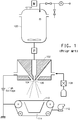
- Fig. 1 is a schematic of a prior art electroblowing apparatus useful for preparing a fibrous web according to the invention.
- the present invention relates to solvent-spun webs and fabrics for a variety of customer end-use applications, such as filtration media, energy storage separators, protective apparel and the like.
- the present invention uses an electroblowing process to spin a polymer dissolved in a high vapor pressure solvent at a high rate of throughput into fibers and webs.
- FIG. 1 is a schematic diagram of an electroblowing apparatus useful for carrying out the process of the present invention using electroblowing (or "electro-blown spinning") as described in International Publication Number WO2003/080905 .
- This prior art electroblowing method comprises feeding a solution of a polymer in a solvent from a storage tank 100, through a spinneret 102, to a spinning nozzle 104 to which a high voltage is applied, while compressed gas or blowing gas is directed toward the polymer solution through a blowing gas nozzle 106 as the polymer solution exits the spinning nozzle 104 to form fibers, and collecting the fibers into a web on a grounded collector 110 under vacuum created by vacuum chamber 114 and blower 112.
- the collection apparatus is preferably a moving collection belt positioned within the electrostatic field between the spinneret 102 and the collector 110. After being collected, the fiber layer is directed to and wound onto a wind-up roll on the downstream side of the collector 110.
- the fibrous web can be deposited onto any of a variety of porous scrim materials arranged on the moving collection belt, such as spunbonded nonwovens, meltblown nonwovens, needle punched nonwovens, woven fabrics, knit fabrics, apertured films, paper and combinations thereof.
- a secondary gas can contact the fibers downstream from the spinneret to help drive off solvent from the fiber.
- the secondary gas can be positioned to impinge the fibers or can be used as a sweeping gas to help remove solvent from the general spinning area.
- solvents with high vapor pressure can be used.
- solvents with vapor pressures of at least 6 kPa at 25°C are used, preferably of at least 10 kPa at 25°C and more preferably of at least 20 kPa at 25°C.
- Suitable solvents with high vapor pressure are the hydrocarbons pentane (68.3), hexane (20.2), heptane (6.1), cyclohexane (13), methylcyclohexane (6.1), and benzene (12.3), where the numbers in parentheses are the vapor pressures of these solvents at 25°C in units of kPa.
- the vapor pressure data was obtained from " Organic Solvents”. Volume 2, fourth edition, by John Riddick, William Bunger, and Theodore Sakano, John Wiley & Sons, 1986 or from the DIPPR® database of physical properties of solvents.
- the polymer solution can be spun at a temperature of about 0°C to the boiling point of the solvent.
- solvents can be used to prepare polymer solutions that can be spun at a discharge rate between 6 to 100 ml/min/hole, more advantageously between 10 to 100 ml/min/hole, and most advantageously between 20 to 100 ml/min/hole.
- the polymer(s) that can be used in making fiber layers in accordance with the process of the present invention are not particularly limited, provided that they are substantially soluble in the selected solvent at the desired concentration and can be spun into fibers by the process described herein.
- these polymers generally include hydrocarbon polymers.
- hydrocarbon polymers suitable for the present invention include polyolefins, polydienes, polystyrene and blends thereof.
- polyolefins include polyethylene, polypropylene, poly(1-butene), poly(4-methyl-1-pentene), and blends, mixtures and copolymers thereof.
- polysulfones examples include polycarbonates, poly(meth)acrylates, cellulose esters, polyvinylchlorides, and blends thereof.
- poly(meth)acrylates include polymethylacrylate and polymethylmethacrylate.
- cellulose esters include cellulose triacetate.
- polyesters include polyethylene therephthalate, polypropylene therephthalate, polybutylene therephthalate, poly(epsilon-caprolactone), poly(DL-lactic acid) and poly(L-lactide).
- the blowing gas can be selected from the group of air, nitrogen, argon, helium, carbon dioxide, hydrocarbons, halocarbons, halohydrocarbons and mixtures thereof.
- the blowing gas is injected at a flow velocity of 50 to 340 m/sec and a temperature from about ambient to 300°C.
- the fibers produced have a number average fiber diameter preferably less than 1,000 nanometers, more preferably less than 800 nanometers and most preferably less than 500 nanometers.
- the fibers can be continuous or discontinuous.
- the fibers can have an essentially round cross section shape.
- the electric field can have a voltage potential of about 10 to about 100 kV.
- the electric field can be used to create a corona charge.
- the fibers can be collected into a fibrous web comprising round cross section, weakly interacting polymer fibers having a number average fiber diameter less than about 1,000 nanometers.
- the secondary gas can be selected from the group of air, nitrogen, argon, helium, carbon dioxide, hydrocarbons, halocarbons, halohydrocarbons and mixtures thereof.
- the secondary gas is injected at a flow velocity of 50 to 340 m/sec and a temperature from about ambient to 300°C.
- Fiber Diameter was determined as follows. Two to three scanning electron microscope (SEM) images were taken of each fine fiber layer sample. The diameter of clearly distinguishable fine fibers were measured from the photographs and recorded. Defects were not included (i.e., lumps of fine fibers, polymer drops, intersections of fine fibers). The number average fiber diameter from about 50 to 300 counts for each sample was calculated.
- a 9 wt% solution of polymethylmethacrylate (PMMA) was dissolved in acetone (vapor pressure of 24.2 kPa at 25°C) at room temperature.
- a magnetic stirrer was used to agitate the solution.
- the homogeneous solution was transferred to a sealed glass container and transported to the spin chamber.
- the solution was transferred into the reservoir of the spin chamber and sealed.
- a spinneret with a 0.254 mm inside diameter single spinning nozzle was used.
- a drum collector was used to collect the sample.
- the spinneret was placed at a negative potential of 100 kV.
- the collector was grounded.
- the distance from the spinning nozzle exit to the collector surface was 51 cm. Air was used for the blowing gas.
- Nitrogen was used for the secondary gas to control the relative humidity and the temperature in the spin chamber.
- the flow of nitrogen was sufficient to avoid the concentration of the solvent vapor in the spin chamber exceeding the lower explosion limit.
- the relative humidity was controlled to be less than 11%.
- the spin chamber temperature was close to 23 °C for the duration of the experiment.
- a nitrogen pressure of 0.2044 MPa was used to maintain a solution flow rate of 6.7 ml/min/hole.
- the blowing gas was controlled to maintain an exit velocity on the order of 67 m/sec.
- the blowing gas temperature was close to 23 °C. Fiber was visible in the plume soon after the solution flow was initiated. Fiber was deposited in a swath on the drum. The number average fiber diameter of the fibers was measured to be 393 nanometers.
- a 9 wt% solution of polystyrene was dissolved in dichloromethane (vapor pressure of 58.1 kPa at 25°C) at room temperature.
- a magnetic stirrer was used to agitate the solution.
- the homogeneous solution was transferred to a sealed glass container and transported to the spin chamber.
- the solution was transferred into the reservoir of the spin chamber and sealed.
- a spinneret with a 0.406 mm inside diameter single spinning nozzle was used.
- a drum collector was used to collect the sample.
- the spinneret was placed at a negative potential of 100 kV.
- the collector was grounded.
- the distance from the spinning nozzle exit to the collector surface was 95 cm.
- Air was used for the blowing gas. Air was used for the secondary gas to control the relative humidity and the temperature in the spin chamber.
- the flow of air was sufficient to avoid the concentration of the solvent vapor in the spin chamber exceeding the lower explosion limit.
- the relative humidity was controlled to be less than 11%.
- the spin chamber temperature was close to 32 °C for the duration of the experiment.
- a nitrogen pressure of 0.515 MPa was used to maintain a solution flow rate of 34.3 ml/min/hole.
- the blowing gas was controlled to maintain an exit velocity on the order of 150 m/sec.
- the blowing gas temperature was close to 24 °C. Fiber was visible in the plume soon after the solution flow was initiated. Fiber was deposited in a swath on the drum. The number average fiber diameter of the fibers was measured to be 335 nanometers.
- a 9 wt% solution of polystyrene was dissolved in dichloromethane (vapor pressure of 58.1 kPa at 25°C) at room temperature.
- a magnetic stirrer was used to agitate the solution.
- the homogeneous solution was transferred to a sealed glass container and transported to the spin chamber.
- the solution was transferred into the reservoir of the spin chamber and sealed.
- a spinneret with a 0.406 mm inside diameter single spinning nozzle was used.
- a drum collector was used to collect the sample.
- the spinneret was placed at a negative potential of 100 kV.
- the collector was grounded.
- the distance from the spinning nozzle exit to the collector surface was 114 cm.
- Air was used for the blowing gas. Air was used for the secondary gas to control the relative humidity and the temperature in the spin chamber.
- the flow of air was sufficient to avoid the concentration of the solvent vapor in the spin chamber exceeding the lower explosion limit.
- the relative humidity was controlled to be less than 11 %.
- the spin chamber temperature was close to 37 °C for the duration of the experiment.
- a nitrogen pressure of 0.77 MPa was used to maintain a solution flow rate of 57.1 ml/min/hole.
- the blowing gas was controlled to maintain an exit velocity on the order of 150 m/sec.
- the blowing gas temperature was close to 24 °C. Fiber was visible in the plume soon after the solution flow was initiated. Fiber was deposited in a swath on the drum. The number average fiber diameter of the fibers was measured to be 630 nanometers.
- Engage 8400 an ethylene octene copolymer
- methylcyclohexane vapor pressure of 6.1 kPa at 25°C
- a magnetic stirrer was used to agitate the hot solution.
- the homogeneous solution was transferred to a sealed glass container and transported to the spin chamber.
- the solution was transferred into the reservoir of the spin chamber and sealed.
- a spinneret with a 0.4064 mm inside diameter single spinning nozzle was used.
- a drum collector was used to collect the sample.
- the spinneret was placed at a negative potential of 100 kV.
- the collector was grounded. The distance from the spinning nozzle exit to the collector surface was 30 cm.
- Air was used for the blowing gas.
- Nitrogen was used for the secondary gas to control the relative humidity and the temperature in the spin chamber. The flow of nitrogen was sufficient to avoid the concentration of the solvent vapor in the spin chamber exceeding the lower explosion limit. The relative humidity was controlled to be less than 9%.
- the spin chamber temperature was close to 29 °C for the duration of the experiment.
- a nitrogen pressure of 0.308 MPa was used to maintain a solution flow rate of 12.6 ml/min/hole.
- the blowing gas was controlled to maintain an exit velocity on the order of 156 m/sec.
- the blowing gas temperature was close to 28 °C.
Landscapes
- Engineering & Computer Science (AREA)
- Textile Engineering (AREA)
- Mechanical Engineering (AREA)
- Chemical & Material Sciences (AREA)
- Dispersion Chemistry (AREA)
- Chemical Kinetics & Catalysis (AREA)
- General Chemical & Material Sciences (AREA)
- Spinning Methods And Devices For Manufacturing Artificial Fibers (AREA)
- Nonwoven Fabrics (AREA)
Priority Applications (1)
| Application Number | Priority Date | Filing Date | Title |
|---|---|---|---|
| EP18206666.2A EP3470556B1 (en) | 2008-09-05 | 2009-09-08 | High throughput electroblowing process |
Applications Claiming Priority (2)
| Application Number | Priority Date | Filing Date | Title |
|---|---|---|---|
| US19110208P | 2008-09-05 | 2008-09-05 | |
| PCT/US2009/056157 WO2010028326A1 (en) | 2008-09-05 | 2009-09-08 | High throughput electroblowing process |
Related Child Applications (1)
| Application Number | Title | Priority Date | Filing Date |
|---|---|---|---|
| EP18206666.2A Division EP3470556B1 (en) | 2008-09-05 | 2009-09-08 | High throughput electroblowing process |
Publications (2)
| Publication Number | Publication Date |
|---|---|
| EP2321451A1 EP2321451A1 (en) | 2011-05-18 |
| EP2321451B1 true EP2321451B1 (en) | 2018-12-19 |
Family
ID=41343361
Family Applications (2)
| Application Number | Title | Priority Date | Filing Date |
|---|---|---|---|
| EP09792294.2A Active EP2321451B1 (en) | 2008-09-05 | 2009-09-08 | High throughput electroblowing process |
| EP18206666.2A Active EP3470556B1 (en) | 2008-09-05 | 2009-09-08 | High throughput electroblowing process |
Family Applications After (1)
| Application Number | Title | Priority Date | Filing Date |
|---|---|---|---|
| EP18206666.2A Active EP3470556B1 (en) | 2008-09-05 | 2009-09-08 | High throughput electroblowing process |
Country Status (7)
| Country | Link |
|---|---|
| US (1) | US20100059906A1 (enExample) |
| EP (2) | EP2321451B1 (enExample) |
| JP (1) | JP5480903B2 (enExample) |
| KR (1) | KR20110050557A (enExample) |
| CN (1) | CN102144054A (enExample) |
| BR (1) | BRPI0913530A2 (enExample) |
| WO (1) | WO2010028326A1 (enExample) |
Families Citing this family (9)
| Publication number | Priority date | Publication date | Assignee | Title |
|---|---|---|---|---|
| CN102115025B (zh) * | 2011-01-07 | 2012-12-26 | 山东理工大学 | 采用超声聚焦微喷制备聚苯乙烯微球微阵列的方法 |
| CN102071542B (zh) * | 2011-02-22 | 2012-08-29 | 天津工业大学 | 一种聚合物纳微纤维非织造布的制备方法 |
| CN102121173B (zh) * | 2011-02-22 | 2012-05-30 | 天津工业大学 | 一种超细纤维非织造布吸音隔热材料的制备方法 |
| JP2016053232A (ja) * | 2014-09-04 | 2016-04-14 | 富士フイルム株式会社 | ナノファイバ製造方法 |
| CN104372422A (zh) * | 2014-11-07 | 2015-02-25 | 江西先材纳米纤维科技有限公司 | 快速制备蓬松聚合物纳米纤维的装置及方法 |
| US11926939B2 (en) | 2017-10-30 | 2024-03-12 | Lg Chem, Ltd. | Super absorbent polymer non-woven fabric and preparation method of the same |
| KR102099662B1 (ko) * | 2017-11-09 | 2020-04-13 | 단국대학교 천안캠퍼스 산학협력단 | 환자맞춤형 조직공학을 위한 섬유 스캐폴드의 제조방법 |
| KR102548151B1 (ko) * | 2021-09-23 | 2023-06-28 | 한국과학기술원 | 전기 방사 조성물 및 이를 이용한 생분해성 필터 멤브레인 |
| CN116815335B (zh) * | 2023-08-30 | 2023-11-24 | 江苏青昀新材料有限公司 | 一种闪蒸纺丝液储存的金属膜储能器及闪蒸纺丝系统 |
Family Cites Families (19)
| Publication number | Priority date | Publication date | Assignee | Title |
|---|---|---|---|---|
| GB1522605A (en) * | 1974-09-26 | 1978-08-23 | Ici Ltd | Preparation of fibrous sheet product |
| JPH03220305A (ja) * | 1989-11-21 | 1991-09-27 | I C I Japan Kk | 静電紡糸の製造方法 |
| US6183670B1 (en) * | 1997-09-23 | 2001-02-06 | Leonard Torobin | Method and apparatus for producing high efficiency fibrous media incorporating discontinuous sub-micron diameter fibers, and web media formed thereby |
| US6713011B2 (en) * | 2001-05-16 | 2004-03-30 | The Research Foundation At State University Of New York | Apparatus and methods for electrospinning polymeric fibers and membranes |
| US6520425B1 (en) * | 2001-08-21 | 2003-02-18 | The University Of Akron | Process and apparatus for the production of nanofibers |
| KR100549140B1 (ko) * | 2002-03-26 | 2006-02-03 | 이 아이 듀폰 디 네모아 앤드 캄파니 | 일렉트로-브로운 방사법에 의한 초극세 나노섬유 웹제조방법 |
| US20030215624A1 (en) * | 2002-04-05 | 2003-11-20 | Layman John M. | Electrospinning of vinyl alcohol polymer and copolymer fibers |
| KR100491228B1 (ko) * | 2003-02-24 | 2005-05-24 | 김학용 | 나노섬유로 구성된 연속상 필라멘트의 제조방법 |
| ES2629693T3 (es) * | 2003-03-07 | 2017-08-14 | Virginia Commonwealth University | Métodos y materiales fenólicos electroprocesados |
| US8066932B2 (en) * | 2003-09-05 | 2011-11-29 | Board of Supervisors of Louisiana State Universtiy and Agricultural and Mechanical College, on behalf of The University of New Orleans | Process of fabricating nanofibers by reactive electrospinning |
| US7662332B2 (en) * | 2003-10-01 | 2010-02-16 | The Research Foundation Of State University Of New York | Electro-blowing technology for fabrication of fibrous articles and its applications of hyaluronan |
| US20060012084A1 (en) * | 2004-07-13 | 2006-01-19 | Armantrout Jack E | Electroblowing web formation process |
| US7887311B2 (en) * | 2004-09-09 | 2011-02-15 | The Research Foundation Of State University Of New York | Apparatus and method for electro-blowing or blowing-assisted electro-spinning technology |
| US8222166B2 (en) * | 2004-10-06 | 2012-07-17 | The Research Foundation Of State University Of New York | High flux and low fouling filtration media |
| US7846374B2 (en) * | 2004-11-05 | 2010-12-07 | E. I. Du Pont De Nemours And Company | Blowing gases in electroblowing process |
| US20060135020A1 (en) * | 2004-12-17 | 2006-06-22 | Weinberg Mark G | Flash spun web containing sub-micron filaments and process for forming same |
| US8808608B2 (en) * | 2004-12-27 | 2014-08-19 | E I Du Pont De Nemours And Company | Electroblowing web formation process |
| US7582247B2 (en) * | 2005-08-17 | 2009-09-01 | E. I. Du Pont De Nemours And Company | Electroblowing fiber spinning process |
| US8211353B2 (en) * | 2008-09-05 | 2012-07-03 | E. I. Du Pont De Nemours And Company | Fiber spinning process using a weakly interacting polymer |
-
2009
- 2009-09-03 US US12/553,603 patent/US20100059906A1/en not_active Abandoned
- 2009-09-08 CN CN200980134737XA patent/CN102144054A/zh active Pending
- 2009-09-08 KR KR1020117007758A patent/KR20110050557A/ko not_active Ceased
- 2009-09-08 EP EP09792294.2A patent/EP2321451B1/en active Active
- 2009-09-08 BR BRPI0913530A patent/BRPI0913530A2/pt not_active IP Right Cessation
- 2009-09-08 JP JP2011526256A patent/JP5480903B2/ja active Active
- 2009-09-08 WO PCT/US2009/056157 patent/WO2010028326A1/en not_active Ceased
- 2009-09-08 EP EP18206666.2A patent/EP3470556B1/en active Active
Also Published As
| Publication number | Publication date |
|---|---|
| US20100059906A1 (en) | 2010-03-11 |
| WO2010028326A1 (en) | 2010-03-11 |
| KR20110050557A (ko) | 2011-05-13 |
| EP3470556B1 (en) | 2020-06-10 |
| JP2012502197A (ja) | 2012-01-26 |
| CN102144054A (zh) | 2011-08-03 |
| BRPI0913530A2 (pt) | 2019-09-24 |
| JP5480903B2 (ja) | 2014-04-23 |
| EP3470556A1 (en) | 2019-04-17 |
| EP2321451A1 (en) | 2011-05-18 |
Similar Documents
| Publication | Publication Date | Title |
|---|---|---|
| EP3470556B1 (en) | High throughput electroblowing process | |
| JP5480904B2 (ja) | 弱相互作用性ポリマーを用いる繊維紡糸法 | |
| JP4076556B2 (ja) | 不織布およびその製造方法 | |
| KR101519169B1 (ko) | 용융 방사에 의한 나노섬유의 제조 | |
| JP5483878B2 (ja) | 液体ろ過のためのろ材 | |
| CN105899275B (zh) | 作为空气过滤介质的驻极体纳米纤维网 | |
| KR101730663B1 (ko) | 부직 중합체성 웨브 | |
| BRPI0617575A2 (pt) | meio de filtragem coalescente e processo de remoÇço de aerossàis lÍquidos, àleo e/ou Água de um fluxo de gÁs | |
| CN105658859A (zh) | 驻极体纳米纤维网 | |
| Zhuang et al. | Preparation of polyacrylonitrile nanofibers by solution blowing process | |
| KR20260046180A (ko) | 여과 매체를 위한 다공성 막 | |
| US10208408B2 (en) | Method for manufacturing ultrafine fiber | |
| JP5305960B2 (ja) | 極細繊維不織布の製造方法、及びその製造装置 | |
| WO2016081937A1 (en) | In-situ charging fiber spinning method for producing a nonwoven electret | |
| CN121752346A (zh) | 用于制造过滤介质的纳米颗粒进料系统 | |
| CN121752347A (zh) | 用于制造结合纳米颗粒的过滤介质的系统 |
Legal Events
| Date | Code | Title | Description |
|---|---|---|---|
| PUAI | Public reference made under article 153(3) epc to a published international application that has entered the european phase |
Free format text: ORIGINAL CODE: 0009012 |
|
| 17P | Request for examination filed |
Effective date: 20110209 |
|
| AK | Designated contracting states |
Kind code of ref document: A1 Designated state(s): AT BE BG CH CY CZ DE DK EE ES FI FR GB GR HR HU IE IS IT LI LT LU LV MC MK MT NL NO PL PT RO SE SI SK SM TR |
|
| AX | Request for extension of the european patent |
Extension state: AL BA RS |
|
| DAX | Request for extension of the european patent (deleted) | ||
| 17Q | First examination report despatched |
Effective date: 20161010 |
|
| STAA | Information on the status of an ep patent application or granted ep patent |
Free format text: STATUS: EXAMINATION IS IN PROGRESS |
|
| GRAP | Despatch of communication of intention to grant a patent |
Free format text: ORIGINAL CODE: EPIDOSNIGR1 |
|
| STAA | Information on the status of an ep patent application or granted ep patent |
Free format text: STATUS: GRANT OF PATENT IS INTENDED |
|
| INTG | Intention to grant announced |
Effective date: 20180627 |
|
| GRAS | Grant fee paid |
Free format text: ORIGINAL CODE: EPIDOSNIGR3 |
|
| GRAA | (expected) grant |
Free format text: ORIGINAL CODE: 0009210 |
|
| STAA | Information on the status of an ep patent application or granted ep patent |
Free format text: STATUS: THE PATENT HAS BEEN GRANTED |
|
| AK | Designated contracting states |
Kind code of ref document: B1 Designated state(s): AT BE BG CH CY CZ DE DK EE ES FI FR GB GR HR HU IE IS IT LI LT LU LV MC MK MT NL NO PL PT RO SE SI SK SM TR |
|
| REG | Reference to a national code |
Ref country code: GB Ref legal event code: FG4D |
|
| REG | Reference to a national code |
Ref country code: CH Ref legal event code: EP |
|
| RAP2 | Party data changed (patent owner data changed or rights of a patent transferred) |
Owner name: E. I. DU PONT DE NEMOURS AND COMPANY |
|
| REG | Reference to a national code |
Ref country code: IE Ref legal event code: FG4D |
|
| REG | Reference to a national code |
Ref country code: DE Ref legal event code: R096 Ref document number: 602009056311 Country of ref document: DE |
|
| REG | Reference to a national code |
Ref country code: AT Ref legal event code: REF Ref document number: 1078820 Country of ref document: AT Kind code of ref document: T Effective date: 20190115 |
|
| REG | Reference to a national code |
Ref country code: NL Ref legal event code: MP Effective date: 20181219 |
|
| PG25 | Lapsed in a contracting state [announced via postgrant information from national office to epo] |
Ref country code: LV Free format text: LAPSE BECAUSE OF FAILURE TO SUBMIT A TRANSLATION OF THE DESCRIPTION OR TO PAY THE FEE WITHIN THE PRESCRIBED TIME-LIMIT Effective date: 20181219 Ref country code: HR Free format text: LAPSE BECAUSE OF FAILURE TO SUBMIT A TRANSLATION OF THE DESCRIPTION OR TO PAY THE FEE WITHIN THE PRESCRIBED TIME-LIMIT Effective date: 20181219 Ref country code: FI Free format text: LAPSE BECAUSE OF FAILURE TO SUBMIT A TRANSLATION OF THE DESCRIPTION OR TO PAY THE FEE WITHIN THE PRESCRIBED TIME-LIMIT Effective date: 20181219 Ref country code: BG Free format text: LAPSE BECAUSE OF FAILURE TO SUBMIT A TRANSLATION OF THE DESCRIPTION OR TO PAY THE FEE WITHIN THE PRESCRIBED TIME-LIMIT Effective date: 20190319 Ref country code: NO Free format text: LAPSE BECAUSE OF FAILURE TO SUBMIT A TRANSLATION OF THE DESCRIPTION OR TO PAY THE FEE WITHIN THE PRESCRIBED TIME-LIMIT Effective date: 20190319 Ref country code: LT Free format text: LAPSE BECAUSE OF FAILURE TO SUBMIT A TRANSLATION OF THE DESCRIPTION OR TO PAY THE FEE WITHIN THE PRESCRIBED TIME-LIMIT Effective date: 20181219 |
|
| REG | Reference to a national code |
Ref country code: LT Ref legal event code: MG4D |
|
| REG | Reference to a national code |
Ref country code: AT Ref legal event code: MK05 Ref document number: 1078820 Country of ref document: AT Kind code of ref document: T Effective date: 20181219 |
|
| PG25 | Lapsed in a contracting state [announced via postgrant information from national office to epo] |
Ref country code: GR Free format text: LAPSE BECAUSE OF FAILURE TO SUBMIT A TRANSLATION OF THE DESCRIPTION OR TO PAY THE FEE WITHIN THE PRESCRIBED TIME-LIMIT Effective date: 20190320 Ref country code: SE Free format text: LAPSE BECAUSE OF FAILURE TO SUBMIT A TRANSLATION OF THE DESCRIPTION OR TO PAY THE FEE WITHIN THE PRESCRIBED TIME-LIMIT Effective date: 20181219 |
|
| PG25 | Lapsed in a contracting state [announced via postgrant information from national office to epo] |
Ref country code: NL Free format text: LAPSE BECAUSE OF FAILURE TO SUBMIT A TRANSLATION OF THE DESCRIPTION OR TO PAY THE FEE WITHIN THE PRESCRIBED TIME-LIMIT Effective date: 20181219 |
|
| PG25 | Lapsed in a contracting state [announced via postgrant information from national office to epo] |
Ref country code: PL Free format text: LAPSE BECAUSE OF FAILURE TO SUBMIT A TRANSLATION OF THE DESCRIPTION OR TO PAY THE FEE WITHIN THE PRESCRIBED TIME-LIMIT Effective date: 20181219 Ref country code: PT Free format text: LAPSE BECAUSE OF FAILURE TO SUBMIT A TRANSLATION OF THE DESCRIPTION OR TO PAY THE FEE WITHIN THE PRESCRIBED TIME-LIMIT Effective date: 20190419 Ref country code: CZ Free format text: LAPSE BECAUSE OF FAILURE TO SUBMIT A TRANSLATION OF THE DESCRIPTION OR TO PAY THE FEE WITHIN THE PRESCRIBED TIME-LIMIT Effective date: 20181219 Ref country code: ES Free format text: LAPSE BECAUSE OF FAILURE TO SUBMIT A TRANSLATION OF THE DESCRIPTION OR TO PAY THE FEE WITHIN THE PRESCRIBED TIME-LIMIT Effective date: 20181219 Ref country code: IT Free format text: LAPSE BECAUSE OF FAILURE TO SUBMIT A TRANSLATION OF THE DESCRIPTION OR TO PAY THE FEE WITHIN THE PRESCRIBED TIME-LIMIT Effective date: 20181219 |
|
| PG25 | Lapsed in a contracting state [announced via postgrant information from national office to epo] |
Ref country code: RO Free format text: LAPSE BECAUSE OF FAILURE TO SUBMIT A TRANSLATION OF THE DESCRIPTION OR TO PAY THE FEE WITHIN THE PRESCRIBED TIME-LIMIT Effective date: 20181219 Ref country code: SK Free format text: LAPSE BECAUSE OF FAILURE TO SUBMIT A TRANSLATION OF THE DESCRIPTION OR TO PAY THE FEE WITHIN THE PRESCRIBED TIME-LIMIT Effective date: 20181219 Ref country code: SM Free format text: LAPSE BECAUSE OF FAILURE TO SUBMIT A TRANSLATION OF THE DESCRIPTION OR TO PAY THE FEE WITHIN THE PRESCRIBED TIME-LIMIT Effective date: 20181219 Ref country code: EE Free format text: LAPSE BECAUSE OF FAILURE TO SUBMIT A TRANSLATION OF THE DESCRIPTION OR TO PAY THE FEE WITHIN THE PRESCRIBED TIME-LIMIT Effective date: 20181219 Ref country code: IS Free format text: LAPSE BECAUSE OF FAILURE TO SUBMIT A TRANSLATION OF THE DESCRIPTION OR TO PAY THE FEE WITHIN THE PRESCRIBED TIME-LIMIT Effective date: 20190419 |
|
| REG | Reference to a national code |
Ref country code: DE Ref legal event code: R097 Ref document number: 602009056311 Country of ref document: DE |
|
| PLBE | No opposition filed within time limit |
Free format text: ORIGINAL CODE: 0009261 |
|
| STAA | Information on the status of an ep patent application or granted ep patent |
Free format text: STATUS: NO OPPOSITION FILED WITHIN TIME LIMIT |
|
| PG25 | Lapsed in a contracting state [announced via postgrant information from national office to epo] |
Ref country code: DK Free format text: LAPSE BECAUSE OF FAILURE TO SUBMIT A TRANSLATION OF THE DESCRIPTION OR TO PAY THE FEE WITHIN THE PRESCRIBED TIME-LIMIT Effective date: 20181219 Ref country code: AT Free format text: LAPSE BECAUSE OF FAILURE TO SUBMIT A TRANSLATION OF THE DESCRIPTION OR TO PAY THE FEE WITHIN THE PRESCRIBED TIME-LIMIT Effective date: 20181219 |
|
| 26N | No opposition filed |
Effective date: 20190920 |
|
| PG25 | Lapsed in a contracting state [announced via postgrant information from national office to epo] |
Ref country code: SI Free format text: LAPSE BECAUSE OF FAILURE TO SUBMIT A TRANSLATION OF THE DESCRIPTION OR TO PAY THE FEE WITHIN THE PRESCRIBED TIME-LIMIT Effective date: 20181219 |
|
| PG25 | Lapsed in a contracting state [announced via postgrant information from national office to epo] |
Ref country code: TR Free format text: LAPSE BECAUSE OF FAILURE TO SUBMIT A TRANSLATION OF THE DESCRIPTION OR TO PAY THE FEE WITHIN THE PRESCRIBED TIME-LIMIT Effective date: 20181219 |
|
| PG25 | Lapsed in a contracting state [announced via postgrant information from national office to epo] |
Ref country code: MC Free format text: LAPSE BECAUSE OF FAILURE TO SUBMIT A TRANSLATION OF THE DESCRIPTION OR TO PAY THE FEE WITHIN THE PRESCRIBED TIME-LIMIT Effective date: 20181219 |
|
| REG | Reference to a national code |
Ref country code: CH Ref legal event code: PL |
|
| PG25 | Lapsed in a contracting state [announced via postgrant information from national office to epo] |
Ref country code: LI Free format text: LAPSE BECAUSE OF NON-PAYMENT OF DUE FEES Effective date: 20190930 Ref country code: LU Free format text: LAPSE BECAUSE OF NON-PAYMENT OF DUE FEES Effective date: 20190908 Ref country code: IE Free format text: LAPSE BECAUSE OF NON-PAYMENT OF DUE FEES Effective date: 20190908 Ref country code: CH Free format text: LAPSE BECAUSE OF NON-PAYMENT OF DUE FEES Effective date: 20190930 |
|
| REG | Reference to a national code |
Ref country code: BE Ref legal event code: MM Effective date: 20190930 |
|
| PG25 | Lapsed in a contracting state [announced via postgrant information from national office to epo] |
Ref country code: BE Free format text: LAPSE BECAUSE OF NON-PAYMENT OF DUE FEES Effective date: 20190930 |
|
| PG25 | Lapsed in a contracting state [announced via postgrant information from national office to epo] |
Ref country code: CY Free format text: LAPSE BECAUSE OF FAILURE TO SUBMIT A TRANSLATION OF THE DESCRIPTION OR TO PAY THE FEE WITHIN THE PRESCRIBED TIME-LIMIT Effective date: 20181219 |
|
| PG25 | Lapsed in a contracting state [announced via postgrant information from national office to epo] |
Ref country code: HU Free format text: LAPSE BECAUSE OF FAILURE TO SUBMIT A TRANSLATION OF THE DESCRIPTION OR TO PAY THE FEE WITHIN THE PRESCRIBED TIME-LIMIT; INVALID AB INITIO Effective date: 20090908 Ref country code: MT Free format text: LAPSE BECAUSE OF FAILURE TO SUBMIT A TRANSLATION OF THE DESCRIPTION OR TO PAY THE FEE WITHIN THE PRESCRIBED TIME-LIMIT Effective date: 20181219 |
|
| PG25 | Lapsed in a contracting state [announced via postgrant information from national office to epo] |
Ref country code: MK Free format text: LAPSE BECAUSE OF FAILURE TO SUBMIT A TRANSLATION OF THE DESCRIPTION OR TO PAY THE FEE WITHIN THE PRESCRIBED TIME-LIMIT Effective date: 20181219 |
|
| REG | Reference to a national code |
Ref country code: DE Ref legal event code: R081 Ref document number: 602009056311 Country of ref document: DE Owner name: DUPONT SAFETY & CONSTRUCTION, INC., WILMINGTON, US Free format text: FORMER OWNER: E.I. DU PONT DE NEMOURS AND COMPANY, WILMINGTON, DEL., US |
|
| REG | Reference to a national code |
Ref country code: GB Ref legal event code: 732E Free format text: REGISTERED BETWEEN 20221027 AND 20221102 |
|
| P01 | Opt-out of the competence of the unified patent court (upc) registered |
Effective date: 20230528 |
|
| PGFP | Annual fee paid to national office [announced via postgrant information from national office to epo] |
Ref country code: DE Payment date: 20250730 Year of fee payment: 17 |
|
| PGFP | Annual fee paid to national office [announced via postgrant information from national office to epo] |
Ref country code: GB Payment date: 20250731 Year of fee payment: 17 |
|
| PGFP | Annual fee paid to national office [announced via postgrant information from national office to epo] |
Ref country code: FR Payment date: 20250808 Year of fee payment: 17 |