EP2319485B1 - Gilbfreie Haarbehandlungsmittel mit Aminosilikonen - Google Patents
Gilbfreie Haarbehandlungsmittel mit Aminosilikonen Download PDFInfo
- Publication number
- EP2319485B1 EP2319485B1 EP10178819.8A EP10178819A EP2319485B1 EP 2319485 B1 EP2319485 B1 EP 2319485B1 EP 10178819 A EP10178819 A EP 10178819A EP 2319485 B1 EP2319485 B1 EP 2319485B1
- Authority
- EP
- European Patent Office
- Prior art keywords
- preparation according
- preceding patent
- content
- hair
- preparation
- Prior art date
- Legal status (The legal status is an assumption and is not a legal conclusion. Google has not performed a legal analysis and makes no representation as to the accuracy of the status listed.)
- Not-in-force
Links
- 229920013822 aminosilicone Polymers 0.000 title claims description 26
- 238000004383 yellowing Methods 0.000 title claims description 17
- 229920000435 poly(dimethylsiloxane) Polymers 0.000 claims description 32
- 235000010262 sodium metabisulphite Nutrition 0.000 claims description 28
- DBVJJBKOTRCVKF-UHFFFAOYSA-N Etidronic acid Chemical compound OP(=O)(O)C(O)(C)P(O)(O)=O DBVJJBKOTRCVKF-UHFFFAOYSA-N 0.000 claims description 25
- 238000002360 preparation method Methods 0.000 claims description 24
- HRZFUMHJMZEROT-UHFFFAOYSA-L sodium disulfite Chemical compound [Na+].[Na+].[O-]S(=O)S([O-])(=O)=O HRZFUMHJMZEROT-UHFFFAOYSA-L 0.000 claims description 22
- 239000012530 fluid Substances 0.000 claims description 16
- 239000011734 sodium Substances 0.000 claims description 15
- 150000001412 amines Chemical class 0.000 claims description 12
- 239000004530 micro-emulsion Substances 0.000 claims description 12
- -1 jojoba oil Substances 0.000 claims description 10
- 239000002537 cosmetic Substances 0.000 claims description 9
- 125000000956 methoxy group Chemical group [H]C([H])([H])O* 0.000 claims description 9
- 229910052708 sodium Inorganic materials 0.000 claims description 8
- 125000002091 cationic group Chemical group 0.000 claims description 6
- 235000015112 vegetable and seed oil Nutrition 0.000 claims description 6
- 239000008158 vegetable oil Substances 0.000 claims description 6
- 239000008163 avocado oil Substances 0.000 claims description 5
- 235000021302 avocado oil Nutrition 0.000 claims description 5
- WBZKQQHYRPRKNJ-UHFFFAOYSA-L disulfite Chemical compound [O-]S(=O)S([O-])(=O)=O WBZKQQHYRPRKNJ-UHFFFAOYSA-L 0.000 claims description 5
- 229940119170 jojoba wax Drugs 0.000 claims description 5
- KCXVZYZYPLLWCC-UHFFFAOYSA-N EDTA Chemical compound OC(=O)CN(CC(O)=O)CCN(CC(O)=O)CC(O)=O KCXVZYZYPLLWCC-UHFFFAOYSA-N 0.000 claims description 4
- 150000001875 compounds Chemical class 0.000 claims description 4
- 239000000419 plant extract Substances 0.000 claims description 4
- DGAQECJNVWCQMB-PUAWFVPOSA-M Ilexoside XXIX Chemical compound C[C@@H]1CC[C@@]2(CC[C@@]3(C(=CC[C@H]4[C@]3(CC[C@@H]5[C@@]4(CC[C@@H](C5(C)C)OS(=O)(=O)[O-])C)C)[C@@H]2[C@]1(C)O)C)C(=O)O[C@H]6[C@@H]([C@H]([C@@H]([C@H](O6)CO)O)O)O.[Na+] DGAQECJNVWCQMB-PUAWFVPOSA-M 0.000 claims description 3
- 239000003093 cationic surfactant Substances 0.000 claims description 3
- 150000004985 diamines Chemical class 0.000 claims description 3
- 241001116389 Aloe Species 0.000 claims description 2
- 244000068485 Convallaria majalis Species 0.000 claims description 2
- 235000009046 Convallaria majalis Nutrition 0.000 claims description 2
- 235000019486 Sunflower oil Nutrition 0.000 claims description 2
- 235000011399 aloe vera Nutrition 0.000 claims description 2
- 239000010480 babassu oil Substances 0.000 claims description 2
- 238000002844 melting Methods 0.000 claims description 2
- 230000008018 melting Effects 0.000 claims description 2
- XAEFZNCEHLXOMS-UHFFFAOYSA-M potassium benzoate Chemical compound [K+].[O-]C(=O)C1=CC=CC=C1 XAEFZNCEHLXOMS-UHFFFAOYSA-M 0.000 claims description 2
- 229920005573 silicon-containing polymer Polymers 0.000 claims description 2
- 239000002600 sunflower oil Substances 0.000 claims description 2
- 239000003676 hair preparation Substances 0.000 claims 2
- 125000003277 amino group Chemical group 0.000 claims 1
- 239000000839 emulsion Substances 0.000 description 26
- GLDOVTGHNKAZLK-UHFFFAOYSA-N octadecan-1-ol Chemical compound CCCCCCCCCCCCCCCCCCO GLDOVTGHNKAZLK-UHFFFAOYSA-N 0.000 description 22
- LXCFILQKKLGQFO-UHFFFAOYSA-N methylparaben Chemical compound COC(=O)C1=CC=C(O)C=C1 LXCFILQKKLGQFO-UHFFFAOYSA-N 0.000 description 17
- QELSKZZBTMNZEB-UHFFFAOYSA-N propylparaben Chemical compound CCCOC(=O)C1=CC=C(O)C=C1 QELSKZZBTMNZEB-UHFFFAOYSA-N 0.000 description 17
- JVTAAEKCZFNVCJ-UHFFFAOYSA-N lactic acid Chemical compound CC(O)C(O)=O JVTAAEKCZFNVCJ-UHFFFAOYSA-N 0.000 description 16
- 229960004585 etidronic acid Drugs 0.000 description 15
- BXWNKGSJHAJOGX-UHFFFAOYSA-N n-hexadecyl alcohol Natural products CCCCCCCCCCCCCCCCO BXWNKGSJHAJOGX-UHFFFAOYSA-N 0.000 description 14
- 229920001296 polysiloxane Polymers 0.000 description 14
- 239000000203 mixture Substances 0.000 description 12
- 235000010270 methyl p-hydroxybenzoate Nutrition 0.000 description 11
- PEDCQBHIVMGVHV-UHFFFAOYSA-N Glycerine Chemical compound OCC(O)CO PEDCQBHIVMGVHV-UHFFFAOYSA-N 0.000 description 10
- FAPWRFPIFSIZLT-UHFFFAOYSA-M Sodium chloride Chemical compound [Na+].[Cl-] FAPWRFPIFSIZLT-UHFFFAOYSA-M 0.000 description 10
- WWVIUVHFPSALDO-UHFFFAOYSA-N n-[3-(dimethylamino)propyl]octadecanamide Chemical compound CCCCCCCCCCCCCCCCCC(=O)NCCCN(C)C WWVIUVHFPSALDO-UHFFFAOYSA-N 0.000 description 10
- 229960000541 cetyl alcohol Drugs 0.000 description 8
- 238000009472 formulation Methods 0.000 description 8
- 239000004310 lactic acid Substances 0.000 description 8
- 235000014655 lactic acid Nutrition 0.000 description 8
- 229940001584 sodium metabisulfite Drugs 0.000 description 8
- GOQYKNQRPGWPLP-UHFFFAOYSA-N n-heptadecyl alcohol Natural products CCCCCCCCCCCCCCCCCO GOQYKNQRPGWPLP-UHFFFAOYSA-N 0.000 description 7
- HWGNBUXHKFFFIH-UHFFFAOYSA-I pentasodium;[oxido(phosphonatooxy)phosphoryl] phosphate Chemical compound [Na+].[Na+].[Na+].[Na+].[Na+].[O-]P([O-])(=O)OP([O-])(=O)OP([O-])([O-])=O HWGNBUXHKFFFIH-UHFFFAOYSA-I 0.000 description 7
- 244000025272 Persea americana Species 0.000 description 6
- 235000004433 Simmondsia californica Nutrition 0.000 description 6
- KRKNYBCHXYNGOX-UHFFFAOYSA-N citric acid Chemical compound OC(=O)CC(O)(C(O)=O)CC(O)=O KRKNYBCHXYNGOX-UHFFFAOYSA-N 0.000 description 6
- 235000013305 food Nutrition 0.000 description 6
- 239000004292 methyl p-hydroxybenzoate Substances 0.000 description 6
- 229960002216 methylparaben Drugs 0.000 description 6
- 229940049292 n-(3-(dimethylamino)propyl)octadecanamide Drugs 0.000 description 6
- 239000003921 oil Substances 0.000 description 6
- 235000019198 oils Nutrition 0.000 description 6
- 239000002304 perfume Substances 0.000 description 6
- 235000010232 propyl p-hydroxybenzoate Nutrition 0.000 description 6
- 239000004405 propyl p-hydroxybenzoate Substances 0.000 description 6
- 229960003415 propylparaben Drugs 0.000 description 6
- 239000004296 sodium metabisulphite Substances 0.000 description 6
- PUAQLLVFLMYYJJ-UHFFFAOYSA-N 2-aminopropiophenone Chemical compound CC(N)C(=O)C1=CC=CC=C1 PUAQLLVFLMYYJJ-UHFFFAOYSA-N 0.000 description 5
- WOWHHFRSBJGXCM-UHFFFAOYSA-M cetyltrimethylammonium chloride Chemical compound [Cl-].CCCCCCCCCCCCCCCC[N+](C)(C)C WOWHHFRSBJGXCM-UHFFFAOYSA-M 0.000 description 5
- 230000003750 conditioning effect Effects 0.000 description 5
- 235000013870 dimethyl polysiloxane Nutrition 0.000 description 5
- FODTZLFLDFKIQH-FSVGXZBPSA-N gamma-Oryzanol (TN) Chemical compound C1=C(O)C(OC)=CC(\C=C\C(=O)O[C@@H]2C([C@@H]3CC[C@H]4[C@]5(C)CC[C@@H]([C@@]5(C)CC[C@@]54C[C@@]53CC2)[C@H](C)CCC=C(C)C)(C)C)=C1 FODTZLFLDFKIQH-FSVGXZBPSA-N 0.000 description 5
- FSYKKLYZXJSNPZ-UHFFFAOYSA-N sarcosine Chemical compound C[NH2+]CC([O-])=O FSYKKLYZXJSNPZ-UHFFFAOYSA-N 0.000 description 5
- 239000011780 sodium chloride Substances 0.000 description 5
- IREAODMQYCOAGP-UHFFFAOYSA-N 3-(hexadecanoylamino)propyl-trimethylazanium;chloride Chemical compound [Cl-].CCCCCCCCCCCCCCCC(=O)NCCC[N+](C)(C)C IREAODMQYCOAGP-UHFFFAOYSA-N 0.000 description 4
- 229920004482 WACKER® Polymers 0.000 description 4
- 229940081733 cetearyl alcohol Drugs 0.000 description 4
- 239000004205 dimethyl polysiloxane Substances 0.000 description 4
- 235000011187 glycerol Nutrition 0.000 description 4
- 239000003446 ligand Substances 0.000 description 4
- 239000002994 raw material Substances 0.000 description 4
- 239000000126 substance Substances 0.000 description 4
- FFRBMBIXVSCUFS-UHFFFAOYSA-N 2,4-dinitro-1-naphthol Chemical compound C1=CC=C2C(O)=C([N+]([O-])=O)C=C([N+]([O-])=O)C2=C1 FFRBMBIXVSCUFS-UHFFFAOYSA-N 0.000 description 3
- XMSXQFUHVRWGNA-UHFFFAOYSA-N Decamethylcyclopentasiloxane Chemical compound C[Si]1(C)O[Si](C)(C)O[Si](C)(C)O[Si](C)(C)O[Si](C)(C)O1 XMSXQFUHVRWGNA-UHFFFAOYSA-N 0.000 description 3
- WSFSSNUMVMOOMR-UHFFFAOYSA-N Formaldehyde Chemical compound O=C WSFSSNUMVMOOMR-UHFFFAOYSA-N 0.000 description 3
- 235000008673 Persea americana Nutrition 0.000 description 3
- 235000011236 Persea americana var americana Nutrition 0.000 description 3
- DNIAPMSPPWPWGF-UHFFFAOYSA-N Propylene glycol Chemical compound CC(O)CO DNIAPMSPPWPWGF-UHFFFAOYSA-N 0.000 description 3
- 241000221095 Simmondsia Species 0.000 description 3
- 244000044822 Simmondsia californica Species 0.000 description 3
- 239000003795 chemical substances by application Substances 0.000 description 3
- 239000003086 colorant Substances 0.000 description 3
- 230000003766 combability Effects 0.000 description 3
- 229940086555 cyclomethicone Drugs 0.000 description 3
- 229940008099 dimethicone Drugs 0.000 description 3
- 229940071106 ethylenediaminetetraacetate Drugs 0.000 description 3
- 238000000034 method Methods 0.000 description 3
- LVDXDNDMOQYDMZ-UHFFFAOYSA-N 2-[2-(2-phenylmethoxypropoxy)propoxy]propyl tetradecanoate Chemical compound CCCCCCCCCCCCCC(=O)OCC(C)OCC(C)OCC(C)OCc1ccccc1 LVDXDNDMOQYDMZ-UHFFFAOYSA-N 0.000 description 2
- FPKBRMRMNGYJLA-UHFFFAOYSA-M 2-hydroxyethyl-methyl-bis(2-octadecanoyloxyethyl)azanium;methyl sulfate Chemical compound COS([O-])(=O)=O.CCCCCCCCCCCCCCCCCC(=O)OCC[N+](C)(CCO)CCOC(=O)CCCCCCCCCCCCCCCCC FPKBRMRMNGYJLA-UHFFFAOYSA-M 0.000 description 2
- 239000004322 Butylated hydroxytoluene Substances 0.000 description 2
- NLZUEZXRPGMBCV-UHFFFAOYSA-N Butylhydroxytoluene Chemical compound CC1=CC(C(C)(C)C)=C(O)C(C(C)(C)C)=C1 NLZUEZXRPGMBCV-UHFFFAOYSA-N 0.000 description 2
- DWAQJAXMDSEUJJ-UHFFFAOYSA-M Sodium bisulfite Chemical compound [Na+].OS([O-])=O DWAQJAXMDSEUJJ-UHFFFAOYSA-M 0.000 description 2
- HEMHJVSKTPXQMS-UHFFFAOYSA-M Sodium hydroxide Chemical class [OH-].[Na+] HEMHJVSKTPXQMS-UHFFFAOYSA-M 0.000 description 2
- LSNNMFCWUKXFEE-UHFFFAOYSA-N Sulfurous acid Chemical compound OS(O)=O LSNNMFCWUKXFEE-UHFFFAOYSA-N 0.000 description 2
- 239000003963 antioxidant agent Substances 0.000 description 2
- 125000002511 behenyl group Chemical group [H]C([*])([H])C([H])([H])C([H])([H])C([H])([H])C([H])([H])C([H])([H])C([H])([H])C([H])([H])C([H])([H])C([H])([H])C([H])([H])C([H])([H])C([H])([H])C([H])([H])C([H])([H])C([H])([H])C([H])([H])C([H])([H])C([H])([H])C([H])([H])C([H])([H])C([H])([H])[H] 0.000 description 2
- 235000010354 butylated hydroxytoluene Nutrition 0.000 description 2
- 229960003431 cetrimonium Drugs 0.000 description 2
- 229960002788 cetrimonium chloride Drugs 0.000 description 2
- 230000008859 change Effects 0.000 description 2
- 239000003638 chemical reducing agent Substances 0.000 description 2
- RXKJFZQQPQGTFL-UHFFFAOYSA-N dihydroxyacetone Chemical compound OCC(=O)CO RXKJFZQQPQGTFL-UHFFFAOYSA-N 0.000 description 2
- 238000002845 discoloration Methods 0.000 description 2
- 229940030620 distearoylethyl hydroxyethylmonium methosulfate Drugs 0.000 description 2
- 239000000975 dye Substances 0.000 description 2
- 150000002191 fatty alcohols Chemical class 0.000 description 2
- 238000011010 flushing procedure Methods 0.000 description 2
- 239000011521 glass Substances 0.000 description 2
- 230000006872 improvement Effects 0.000 description 2
- BDAGIHXWWSANSR-UHFFFAOYSA-N methanoic acid Natural products OC=O BDAGIHXWWSANSR-UHFFFAOYSA-N 0.000 description 2
- YLGXILFCIXHCMC-JHGZEJCSSA-N methyl cellulose Chemical compound COC1C(OC)C(OC)C(COC)O[C@H]1O[C@H]1C(OC)C(OC)C(OC)OC1COC YLGXILFCIXHCMC-JHGZEJCSSA-N 0.000 description 2
- 235000016709 nutrition Nutrition 0.000 description 2
- 229940037624 palmitamidopropyltrimonium chloride Drugs 0.000 description 2
- 125000000913 palmityl group Chemical group [H]C([*])([H])C([H])([H])C([H])([H])C([H])([H])C([H])([H])C([H])([H])C([H])([H])C([H])([H])C([H])([H])C([H])([H])C([H])([H])C([H])([H])C([H])([H])C([H])([H])C([H])([H])C([H])([H])[H] 0.000 description 2
- 229920000642 polymer Polymers 0.000 description 2
- 229940095106 ppg-3 benzyl ether myristate Drugs 0.000 description 2
- 125000002924 primary amino group Chemical group [H]N([H])* 0.000 description 2
- 235000010267 sodium hydrogen sulphite Nutrition 0.000 description 2
- 235000011121 sodium hydroxide Nutrition 0.000 description 2
- LSNNMFCWUKXFEE-UHFFFAOYSA-L sulfite Chemical class [O-]S([O-])=O LSNNMFCWUKXFEE-UHFFFAOYSA-L 0.000 description 2
- 239000004753 textile Substances 0.000 description 2
- 229940077400 trideceth-12 Drugs 0.000 description 2
- 235000013311 vegetables Nutrition 0.000 description 2
- XMVBHZBLHNOQON-UHFFFAOYSA-N 2-butyl-1-octanol Chemical compound CCCCCCC(CO)CCCC XMVBHZBLHNOQON-UHFFFAOYSA-N 0.000 description 1
- OSCJHTSDLYVCQC-UHFFFAOYSA-N 2-ethylhexyl 4-[[4-[4-(tert-butylcarbamoyl)anilino]-6-[4-(2-ethylhexoxycarbonyl)anilino]-1,3,5-triazin-2-yl]amino]benzoate Chemical compound C1=CC(C(=O)OCC(CC)CCCC)=CC=C1NC1=NC(NC=2C=CC(=CC=2)C(=O)NC(C)(C)C)=NC(NC=2C=CC(=CC=2)C(=O)OCC(CC)CCCC)=N1 OSCJHTSDLYVCQC-UHFFFAOYSA-N 0.000 description 1
- OYINQIKIQCNQOX-UHFFFAOYSA-M 2-hydroxybutyl(trimethyl)azanium;chloride Chemical compound [Cl-].CCC(O)C[N+](C)(C)C OYINQIKIQCNQOX-UHFFFAOYSA-M 0.000 description 1
- FVEWVVDBRQZLSJ-QTWKXRMISA-N 2-hydroxyethyl-dimethyl-[3-[[(2r,3s,4r,5r)-2,3,4,5,6-pentahydroxyhexanoyl]amino]propyl]azanium;chloride Chemical compound [Cl-].OCC[N+](C)(C)CCCNC(=O)[C@H](O)[C@@H](O)[C@H](O)[C@H](O)CO FVEWVVDBRQZLSJ-QTWKXRMISA-N 0.000 description 1
- KLMGMPDXSPSCOC-UHFFFAOYSA-N 2-undecoxyethanol Chemical compound CCCCCCCCCCCOCCO KLMGMPDXSPSCOC-UHFFFAOYSA-N 0.000 description 1
- XXBAQTDVRLRXEV-UHFFFAOYSA-N 3-tetradecoxypropan-1-ol Chemical compound CCCCCCCCCCCCCCOCCCO XXBAQTDVRLRXEV-UHFFFAOYSA-N 0.000 description 1
- OSWFIVFLDKOXQC-UHFFFAOYSA-N 4-(3-methoxyphenyl)aniline Chemical compound COC1=CC=CC(C=2C=CC(N)=CC=2)=C1 OSWFIVFLDKOXQC-UHFFFAOYSA-N 0.000 description 1
- LSNNMFCWUKXFEE-UHFFFAOYSA-M Bisulfite Chemical compound OS([O-])=O LSNNMFCWUKXFEE-UHFFFAOYSA-M 0.000 description 1
- 235000007866 Chamaemelum nobile Nutrition 0.000 description 1
- 244000303965 Cyamopsis psoralioides Species 0.000 description 1
- 102000011782 Keratins Human genes 0.000 description 1
- 108010076876 Keratins Proteins 0.000 description 1
- 244000042664 Matricaria chamomilla Species 0.000 description 1
- 235000007232 Matricaria chamomilla Nutrition 0.000 description 1
- 239000006096 absorbing agent Substances 0.000 description 1
- 125000003545 alkoxy group Chemical group 0.000 description 1
- 229940070718 behentrimonium Drugs 0.000 description 1
- YSJGOMATDFSEED-UHFFFAOYSA-M behentrimonium chloride Chemical compound [Cl-].CCCCCCCCCCCCCCCCCCCCCC[N+](C)(C)C YSJGOMATDFSEED-UHFFFAOYSA-M 0.000 description 1
- 229940075506 behentrimonium chloride Drugs 0.000 description 1
- 230000033228 biological regulation Effects 0.000 description 1
- 229940095259 butylated hydroxytoluene Drugs 0.000 description 1
- 229940096584 c12-15 pareth-3 Drugs 0.000 description 1
- 239000013522 chelant Substances 0.000 description 1
- 239000002738 chelating agent Substances 0.000 description 1
- 238000006388 chemical passivation reaction Methods 0.000 description 1
- MRUAUOIMASANKQ-UHFFFAOYSA-N cocamidopropyl betaine Chemical compound CCCCCCCCCCCC(=O)NCCC[N+](C)(C)CC([O-])=O MRUAUOIMASANKQ-UHFFFAOYSA-N 0.000 description 1
- 229940073507 cocamidopropyl betaine Drugs 0.000 description 1
- 230000004456 color vision Effects 0.000 description 1
- 239000008139 complexing agent Substances 0.000 description 1
- 230000007812 deficiency Effects 0.000 description 1
- 230000001419 dependent effect Effects 0.000 description 1
- 238000010586 diagram Methods 0.000 description 1
- 229940120503 dihydroxyacetone Drugs 0.000 description 1
- 238000004043 dyeing Methods 0.000 description 1
- 230000007613 environmental effect Effects 0.000 description 1
- 239000000835 fiber Substances 0.000 description 1
- 210000003811 finger Anatomy 0.000 description 1
- 235000019253 formic acid Nutrition 0.000 description 1
- 235000021384 green leafy vegetables Nutrition 0.000 description 1
- 230000003806 hair structure Effects 0.000 description 1
- 239000001866 hydroxypropyl methyl cellulose Substances 0.000 description 1
- 235000010979 hydroxypropyl methyl cellulose Nutrition 0.000 description 1
- 229920003088 hydroxypropyl methyl cellulose Polymers 0.000 description 1
- UFVKGYZPFZQRLF-UHFFFAOYSA-N hydroxypropyl methyl cellulose Chemical compound OC1C(O)C(OC)OC(CO)C1OC1C(O)C(O)C(OC2C(C(O)C(OC3C(C(O)C(O)C(CO)O3)O)C(CO)O2)O)C(CO)O1 UFVKGYZPFZQRLF-UHFFFAOYSA-N 0.000 description 1
- MTNDZQHUAFNZQY-UHFFFAOYSA-N imidazoline Chemical class C1CN=CN1 MTNDZQHUAFNZQY-UHFFFAOYSA-N 0.000 description 1
- 229910052744 lithium Inorganic materials 0.000 description 1
- 238000005259 measurement Methods 0.000 description 1
- 229910052751 metal Inorganic materials 0.000 description 1
- 239000002184 metal Substances 0.000 description 1
- 239000011368 organic material Substances 0.000 description 1
- 230000003647 oxidation Effects 0.000 description 1
- 238000007254 oxidation reaction Methods 0.000 description 1
- 229910052700 potassium Inorganic materials 0.000 description 1
- 239000000843 powder Substances 0.000 description 1
- 229940116987 ppg-3 myristyl ether Drugs 0.000 description 1
- 239000003755 preservative agent Substances 0.000 description 1
- 230000002335 preservative effect Effects 0.000 description 1
- 230000008569 process Effects 0.000 description 1
- 229940097319 quaternium-22 Drugs 0.000 description 1
- 230000009467 reduction Effects 0.000 description 1
- 238000009877 rendering Methods 0.000 description 1
- 230000008439 repair process Effects 0.000 description 1
- 150000003839 salts Chemical class 0.000 description 1
- 125000000467 secondary amino group Chemical group [H]N([*:1])[*:2] 0.000 description 1
- 230000035807 sensation Effects 0.000 description 1
- 230000001953 sensory effect Effects 0.000 description 1
- 239000003381 stabilizer Substances 0.000 description 1
- CSABAZBYIWDIDE-UHFFFAOYSA-N sulfino hydrogen sulfite Chemical compound OS(=O)OS(O)=O CSABAZBYIWDIDE-UHFFFAOYSA-N 0.000 description 1
- CXVGEDCSTKKODG-UHFFFAOYSA-N sulisobenzone Chemical compound C1=C(S(O)(=O)=O)C(OC)=CC(O)=C1C(=O)C1=CC=CC=C1 CXVGEDCSTKKODG-UHFFFAOYSA-N 0.000 description 1
- 229960000368 sulisobenzone Drugs 0.000 description 1
- 239000004094 surface-active agent Substances 0.000 description 1
- 150000003512 tertiary amines Chemical class 0.000 description 1
- DHQZXBINJKHIPR-UHFFFAOYSA-J tetrapotassium;1,1-diphosphonatoethanol Chemical compound [K+].[K+].[K+].[K+].[O-]P(=O)([O-])C(O)(C)P([O-])([O-])=O DHQZXBINJKHIPR-UHFFFAOYSA-J 0.000 description 1
- KWXLCDNSEHTOCB-UHFFFAOYSA-J tetrasodium;1,1-diphosphonatoethanol Chemical compound [Na+].[Na+].[Na+].[Na+].[O-]P(=O)([O-])C(O)(C)P([O-])([O-])=O KWXLCDNSEHTOCB-UHFFFAOYSA-J 0.000 description 1
- 210000003813 thumb Anatomy 0.000 description 1
- 230000000699 topical effect Effects 0.000 description 1
- UMQCZSNKDUWJRI-UHFFFAOYSA-M tris(2-hydroxyethyl)-octadecylazanium;chloride Chemical compound [Cl-].CCCCCCCCCCCCCCCCCC[N+](CCO)(CCO)CCO UMQCZSNKDUWJRI-UHFFFAOYSA-M 0.000 description 1
- XLYOFNOQVPJJNP-UHFFFAOYSA-N water Substances O XLYOFNOQVPJJNP-UHFFFAOYSA-N 0.000 description 1
- 238000005303 weighing Methods 0.000 description 1
Images
Classifications
-
- A—HUMAN NECESSITIES
- A61—MEDICAL OR VETERINARY SCIENCE; HYGIENE
- A61K—PREPARATIONS FOR MEDICAL, DENTAL OR TOILETRY PURPOSES
- A61K8/00—Cosmetics or similar toiletry preparations
- A61K8/18—Cosmetics or similar toiletry preparations characterised by the composition
- A61K8/30—Cosmetics or similar toiletry preparations characterised by the composition containing organic compounds
- A61K8/55—Phosphorus compounds
-
- A—HUMAN NECESSITIES
- A61—MEDICAL OR VETERINARY SCIENCE; HYGIENE
- A61K—PREPARATIONS FOR MEDICAL, DENTAL OR TOILETRY PURPOSES
- A61K8/00—Cosmetics or similar toiletry preparations
- A61K8/18—Cosmetics or similar toiletry preparations characterised by the composition
- A61K8/19—Cosmetics or similar toiletry preparations characterised by the composition containing inorganic ingredients
- A61K8/23—Sulfur; Selenium; Tellurium; Compounds thereof
-
- A—HUMAN NECESSITIES
- A61—MEDICAL OR VETERINARY SCIENCE; HYGIENE
- A61K—PREPARATIONS FOR MEDICAL, DENTAL OR TOILETRY PURPOSES
- A61K8/00—Cosmetics or similar toiletry preparations
- A61K8/18—Cosmetics or similar toiletry preparations characterised by the composition
- A61K8/72—Cosmetics or similar toiletry preparations characterised by the composition containing organic macromolecular compounds
- A61K8/84—Cosmetics or similar toiletry preparations characterised by the composition containing organic macromolecular compounds obtained by reactions otherwise than those involving only carbon-carbon unsaturated bonds
- A61K8/89—Polysiloxanes
- A61K8/896—Polysiloxanes containing atoms other than silicon, carbon, oxygen and hydrogen, e.g. dimethicone copolyol phosphate
- A61K8/898—Polysiloxanes containing atoms other than silicon, carbon, oxygen and hydrogen, e.g. dimethicone copolyol phosphate containing nitrogen, e.g. amodimethicone, trimethyl silyl amodimethicone or dimethicone propyl PG-betaine
-
- A—HUMAN NECESSITIES
- A61—MEDICAL OR VETERINARY SCIENCE; HYGIENE
- A61Q—SPECIFIC USE OF COSMETICS OR SIMILAR TOILETRY PREPARATIONS
- A61Q5/00—Preparations for care of the hair
- A61Q5/12—Preparations containing hair conditioners
Definitions
- the present invention relates to hair-free hair treatment compositions with aminosilicones and in particular hair rinses.
- Hair rinses are used for care after cleansing the hair.
- Conventional hair rinses are formulated based on cationic surfactants such as cetyl trimethyl ammonium chloride and fatty alcohols such as cetyl and / or stearyl alcohol.
- cationic surfactants such as cetyl trimethyl ammonium chloride and fatty alcohols such as cetyl and / or stearyl alcohol.
- this combination alone is not sufficient for a suitable conditioning care of hair such as suppleness, combability and shine.
- silicones such as long-chain polydimethylsiloxanes are used more frequently.
- Even more substantive are silicones containing primary and secondary amino groups in the side chain. In a mud formulation at pHs of 3 to 5, these groups are protonated so that the cationic nature of the silicone results in increased conditioning performance.
- a disadvantage is dependent on the aminosilicone type with increasing time yellowing of cosmetic formulations containing aminosilicones (also known as amodimethicones).
- the yellowing of cosmetic formulations containing amodimethicones, especially amodimethicone fluids, is a known challenge in cosmetics and in textile chemistry ( Lacasse, K .; Baumann, W. in Textile Chemicals Environmental Data and Facts. Springer Verlag, 2004, p.387 .)
- Cause is the oxidation of amines (CRC oxidation inhibition in Organic Materials, Volume II).
- Chelating ligands such as EDTA (ethylenediaminetetraacetate) or antioxidants such as BHT (butylated hydroxytoluene derivatives) can only slow down the yellowing process and not eliminate it.
- Manufacturers such as Dow Corning or Blue Star are developing amino functionalized silicones such as Dow Corning 8500 Conditioning Agent (Bis (C13-C15 alkoxy) PG-Amodimethicone or Mirasil HALS Amino Silicones ADMH 45 and ADMH 50 (INCI: Propoxytetramethylpiperidinyl dimethicone) to minimize yellowing
- Dow Corning 8500 Conditioning Agent Bis (C13-C15 alkoxy) PG-Amodimethicone or Mirasil HALS Amino Silicones ADMH 45 and ADMH 50 (INCI: Propoxytetramethylpiperidinyl dimethicone) to minimize yellowing
- the yellowing of amines results in the potential for unsuitable amine-substituted silicone
- Na-disulfite Na 2 S 2 O 5
- NaHSO 3 sodium bisulfite
- EP-0198788A2 discloses the increase in storage stability of mixtures of amines and imidazolinium compounds by a bisulfite.
- EP 1679061B1 discloses a conditioning composition having a hair treating compound and a dye, a chelator and a UV absorber.
- EP 0 622 070 B1 discloses a powder blend with a formaldehyde and / or formic acid releasing compound having skin-tanning properties and a sulfite-forming agent and optionally a stabilizer.
- EP 0 752 842 discloses an artificial skin tanning preparation with dihydroxyacetone in a topical carrier with metabisulfite, sulfite or bisulfite salts.
- JP 2008143817 discloses an emulsion formulation containing, in addition to amino-modified silicones, hydroxyethane diphosphonic acid and / or its salts to counteract the yellowing of the formulation. Such preparations are preferably used for hair repair and hair treatment.
- metabisulfite is The Merck Index, Tenth Edition (1983), Sodium Metabisulfite, Entry 8476, p.1237 , Sodium Suflite, Entry 8528, and Sodium Bisulfite, Entry 8419, p.1231.
- Etidronic acid is known under the trade name Turpinal SL by Henkel, Thermphos Trading.
- Further chelated ligands according to the invention are Tetrasodium Etidronate (Turpinal 4 NL, Henkel) as well as Tetrapotassium Etidronate (Wayhib-RW, Arch Chemicals).
- rinses with etidronic acid and Na disulfite were characterized by an improved rinsability. It is desired by the consumer to have a well-groomed hair sensation without weighing the hair, which is to be ensured by an optimal rinsability of the hair care product.
- Cationic amines especially tertiary amines can be formulated in combination with fatty alcohols such as cetyl and stearyl alcohol to a rich, creamy rinse base.
- fatty alcohols such as cetyl and stearyl alcohol
- Such basic mud formulas were formulated with amidomines and various amino silicones were added.
- the combination of two aminosilicone fluids - Dow Corning AP-8087 and Dow Corning 2-8566 proved to be particularly advantageous. Combability and care properties on 2h Bleached 2g strands of hair.
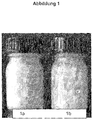
- this formulation showed a strong yellowing especially after 180 days at room temperature and 40 ° C in the incubator, as on illustration 1 you can see.
- the L * a * b * color space is a measuring room in which all perceptible colors are contained (Beuth-Verlag: DIN 6174: Colorimetric determination of color dimensions and color distances in approximately uniform CIELAB color space (edition DIN 6174: 2007-10; July 15, 2009)).
- DIN 6174 Colorimetric determination of color dimensions and color distances in approximately uniform CIELAB color space (edition DIN 6174: 2007-10; July 15, 2009)).
- DIN 6174 Colorimetric determination of color dimensions and color distances in approximately uniform CIELAB color space (edition DIN 6174: 2007-10; July 15, 2009)
- One of the most important features of the L * a * b * color model is its device independence, that is, the colors are defined independently of the nature of their generation and rendering technique.
- the L * a * b * color space is described by a three-dimensional coordinate system.
- the a * axis describes the green or red portion of a color, with negative values for green and positive values for red.
- the b * axis describes the blue or yellow part of a color, with negative values for blue and positive values for yellow.
- the scales of the a * axis and the b * axis include a number range of -150 to +100 and -100 to +150, notwithstanding that there is no perceptible correspondence for some values. Since the color perception was taken into account in the creation of this color space, the resulting color body is non-uniform at Cartesian coordinates.
- the L * axis describes the brightness (luminance) of the color with values from 0 to 100.
- the b * axis describes the blue or yellow part of a color, with negative values for blue and positive values for yellow, so that higher value for b * means an increase in yellowness.
- Hair rinses are used for care after cleansing the hair.
- An important factor is the sensor of the rinsing during the application to the hair as well as the rinsability of the product. Flushing should result in a pleasant hair feeling in wet hair, but should not complain the hair during rinsing. The consumer should no longer feel the product on their hair, but the hair should be well-groomed and soft.
- the "flushability" of a product is defined as follows: With the thumb and index / middle finger of one hand, it is felt when rinsing out how easily the product can be washed out of the hair of the strand. The time (in seconds) that elapses until no product is left is noted.
- the preparation contains at most 0.1% of dyes. It is further preferred if a cationic surfactant is contained. Particularly preferred in rinses is stearamidopropyl dimethylamine as a cationic care substance. A particularly preferred mud formula additionally contains coco-betaines in a content of 0.85% by weight as a further surfactant.
- one or more fatty compounds having a melting point above 40 ° C are included. It is further preferred if the aminosilicone contains 0.5 to 2.5 mol% of amines. It is further preferred if the preparation is a hair conditioner. It is further preferred if two different amino silicones are contained. It is further preferred if the second Aminosilikon is present as a fluid having a viscosity of 1000cst to 6000cst, preferably from 1000cst to 5000cst. Also suitable are aminosilicones with viscosities higher than 10,000cs. Amino silicones may be present as fluid and emulsion, but more preferably as fluids.
- the second aminosilicone is present as a microemulsion of a cationic amino-functionalized silicone polymer having a viscosity of 10,000 cs. It is further preferred if amino-functionalized bis-hydroxy / methoxy amodimethicones of the formula where R represents -OH or -OCH 3 and R 'is having a viscosity of 5000cP and an amine content of 0.5 mol% diamine - Dow Corning AP-8087 or amodimethicone, this is an amino-functionalized polydimethylsiloxane having a high amine content (2.3% mole amine) present as a fluid and having a viscosity of 3500 cSt become.
- the content of vegetable oils and of plant extracts taken together is at most 1% by weight. It is further preferred if the content of vegetable oils is at most 1% by weight.
- the invention also includes the use of sodium disulfite and etidronic acid to prevent the yellowing of hair cosmetic preparations with amino silicones.
- Further hair care example formulations according to the invention are shown here: All concentration data are understood as weight percentages. Hair conditioner: 7 8th 9 10 11 12 13 14 15 1 methylparaben 0.25 0.25 0.25 0.25 0.25 0.25 0.25 0.25 0.25 0.25 0.25 0.25 0.25 2 Propylparaben 0.1 0.1 0.1 0.1 0.1 0.1 0.1 0.1 0.1 0.1 0.1 0.1 0.1 0.1 0.1 0.1 0.1 0.1 3 Aqua Ad.100 Ad.100 Ad.
Landscapes
- Health & Medical Sciences (AREA)
- Life Sciences & Earth Sciences (AREA)
- Veterinary Medicine (AREA)
- Animal Behavior & Ethology (AREA)
- General Health & Medical Sciences (AREA)
- Public Health (AREA)
- Birds (AREA)
- Epidemiology (AREA)
- Dermatology (AREA)
- Chemical & Material Sciences (AREA)
- Inorganic Chemistry (AREA)
- Cosmetics (AREA)
- Compositions Of Macromolecular Compounds (AREA)
Description
- Die vorliegende Erfindung betrifft gilbfreie Haarbehandlungsmittel mit Aminosilikonen und insbesondere Haarspülungen.
- Haarspülungen werden zur Pflege nach der Reinigung der Haare angewendet. Übliche Haarspülungen werden auf Basis von kationischen Tensiden wie beispielsweise Cetyl Trimethyl Ammonium Chlorid und Fettalkoholen wie Cetyl und/oder Stearylalkohol formuliert. Allein reicht diese Kombination jedoch nicht für eine geeignete konditionierende Pflege an Haaren wie unter anderem Geschmeidigkeit, Kämmbarkeit und Glanz aus. Aus diesem Grund werden häufiger Silikone wie beispielsweise langkettige Polydimethylsiloxane eingesetzt. Noch substantiver sind Silikone, die primäre und sekundäre Aminogruppen in der Seitenkette enthalten. In einer Spülungsformulierung bei pH-Werten von 3 bis 5 sind diese Gruppen protoniert, so dass die kationische Natur des Silikons zu einer erhöhten Konditionierleistung führt. Nachteilig ist abhängig vom Aminosilikon-Typ eine mit der Zeit zunehmende Vergilbung von kosmetischen Formulierungen, die Aminosilikone (bekannt auch als Amodimethicone) enthalten. Die Vergilbung von kosmetischen Formulierungen, die Amodimethicone, besonders Amodimethicone Fluide enthalten, ist eine bekannte Herausforderung in der Kosmetik und in der Textilchemie (Lacasse, K.; Baumann, W. in Textile Chemicals Environmental Data and Facts. Springer Verlag, 2004, S.387.) Ursache ist die Oxidierung von Aminen (CRC-Oxidation Inhibition in Organic Materials, Volume-II). Chelat Liganden wie EDTA (Ethylendiamintetraacetat) oder Antioxidantien wie BHT (Butylierte Hydroxytoluol-Derivate) können den Vergilbungsprozess nur verlangsamen und nicht beseitigen. Hersteller wie z.B. Dow Corning oder Blue Star entwickeln amino funktionalisierte Silikone, wie Dow Corning 8500 Conditioning Agent (Bis(C13-C15 Alkoxy)PG-Amodimethicone oder Mirasil HALS Aminosilikone ADMH 45 und ADMH 50 (INCI: Propoxytetramethylpiperidinyl Dimethicone) um die Vergilbung zu minimieren. Die Vergilbung von Aminen führt dazu, dass möglich vielversprechende aminsubstituierte Silikone entweder nicht zum Einsatz kommen oder nur in geringen Einsatzkonzentrationen verwendet werden können. Häufig werden Marktprodukte eingefärbt (lila, rot, braun, gelb) um die Vergilbung zu kaschieren. Die Verhinderung der Vergilbung von Aminosilikon bietet Vorteile für kosmetische Formulierungen, weil eine größere Bandbreite an aminhaltigen Silikonen verwendet werden kann.
Der Stand der Technik kennt Na-disulfit (Na2S2O5). Es ist gut wasserlöslich und bildet dort Natriumbisulfit NaHSO3 (aq.). Die Substanz ist im Annex der Kosmetikverordnung als Konservierungsmittel gelistet. -
EP-0198788A2 offenbart die Erhöhung der Lagerstabilität von Mischungen aus Aminen und Imidazoliniumverbindungen durch ein Bisulfit. -
EP 1 714 634 offenbart ein Haarbehandlungs-Kit, umfassend - mindestens ein Kompartiment, welches ein Mittel beinhaltet, das mindestens einen Komplexbildner enthält;
- mindestens ein vom ersten Kompartiment verschiedenes Färbekompartiment, welches Mittel zum Färben von keratinhaltigen Fasern, insbesondere menschlichen Haaren, enthält.
-
EP 1679061B1 offenbart eine Konditionierzubereitung mit einer Haarbehandlungsverbindung und einem Farbstoff, einem Chelator und einem UV-Absorber. -
EP 0 622 070 B1 offenbart eine Pulvermischung mit einer Formaldehyd und/oder Ameisensäure freisetzenden Verbindung mit hautbräunenden Eigenschaften und ein Sulfitionen bildendes Agens und gegebenenfalls einen Stabilisator. -
EP 0 752 842 offenbart eine künstliche Hautbräunungszubereitung mit Dihydroxyaceton in einem topischen Träger mit Metabisulfit-, Sulfit- oder Hydrogensulfitsalzen.
JP 2008143817 - Weiterer Stand der Technik findet sich in
WO 1998019665 ,EP 0 198 788A2 ,EP 1 287 051 B1 ,US 20070062653 ,EP 1 289 478 ,EP 0 859 587 B1 ,EP 0 617 953 B1 ,WO 2002102334 A2 und inEP 1 586 298 B1 . - All dies konnte die Mängel des Standes der Technik nicht beseitigen. Überraschend und für den Fachmann nicht vorhersehbar hat sich nun herausgestellt, dass eine haarkosmetische Zubereitung enthaltend Aminosilikone, Natriumdisulfit (auch Sodium Metabisulfite genannt) und Etidronsäure und oder deren Natrium- oder Kaliumsalz den Mängeln des Standes der Technik abhilft. Die Kombination von dem Reduktionsmittel Natriumdisulfit (Na2S2O5) mit dem Chelat-Liganden Etidronsäure in einer Haarpflegeformel, besonders in einer Haarspülung, verhindert die Vergilbung von Aminosilikonen über einen Beobachtungszeitraum von 120 Tagen bei Raumtemperatur und 40°C im Brutschrank. Im Wechseltemperaturschrank (-10°C bis 40°C im 12 Std.-Wechsel), Kühlschrank bei +6°C und im Eisschrank bei -10°C wurde ebenfalls standardgemäß 28 Tage geprüft und es kam zu keiner Verfärbung. Mit dem Einsatz von Etidronsäure findet eine Vergilbung bereits nach 14 Tagen statt und mit Natrium-disulfit wurde bei 40°C im Brutschrank eine anfängliche Vergilbung ab 30 Tagen festgestellt. Natrium-disulfit wird mit dem Handelsnamen Natriumdisulfit food grade (E223) von Biesterfeld angeboten (Hersteller BASF) und ist für diese Erfindung bevorzugt. Weitere geeignete Sulfite sind die Akali-Metall-Sulfite (Li, Na, K). Eine gute Referenz für Metabisulfit ist The Merck Index, Tenth Edition (1983), Sodium Metabisulfite, Entry 8476, p.1237, Sodium Suflite, Entry 8528, and Sodium Bisulfite, Entry 8419, p.1231. Etidronsäure ist unter dem Handelsnamen Turpinal SL von Henkel, Thermphos Trading bekannt. Weitere erfindungsgemäße Chelat-Liganden sind Tetrasodium Etidronate (Turpinal 4 NL, Henkel) sowie auch Tetrapotassium Etidronate (Wayhib-RW, Arch Chemicals). Weiterhin hat sich überraschenderweise gezeigt, dass Spülungen mit Etidronsäure und Na-disulfit sich durch eine verbesserte Ausspülbarkeit auszeichneten. Es ist vom Verbraucher erwünscht ein gepflegtes Haargefühl ohne Beschwerung der Haare zu haben, die durch eine optimale Ausspülbarkeit des Haarpflegeprodukts zu gewährleisten ist.
- Kationische Amine, insbesondere tertiäre Amine lassen sich in Kombination mit Fettalkoholen wie Cetyl und Stearyl Alkohol zu einer reichhaltigen, cremigen Spülungsgrundlage formulieren. Solche Basis-Spülungsformeln wurden mit Amidominen formuliert und verschiedenste Aminosilikone wurden dazugesetzt. Gemäß dieser Erfindung erwies sich die Kombination von zwei Aminosilikonfluiden - Dow Corning AP-8087 und Dow Corning 2-8566 als besonders vorteilhaft bez. Kämmbarkeit und Pflegeeigenschaften an 2Std. gebleichten 2g Haarsträhnen. Jedoch zeigte diese Formulierung eine starke Vergilbung besonders nach 180 Tagen bei Raumtemperatur und 40°C im Brutschrank, wie auf
Abbildung 1 zu sehen ist. - Alle Angaben in % in diesem Dokument sind Gew.%, sofern nicht anders angegeben.
-
Abbildung 1 zeigt eine Spülung mit Aminosilikonen 1.0 % AP-8087 & 0.5% DC 2-8566 gemäß Formel 1(Tabelle 1).
(Spülungen sind in Weithalsflaschen, 30mL, Klarglas, Gewinde: GL32, Mit Verschluss 1 - Hersteller Rixius gelagert) - 1a: RT - 180 Tage Lagerung bei 25°C; L*: 57.0, a*:-2.1, b*: 2.6
- 1b: B40 - 180 Tage Lagerung im Brutschrank bei 40°C; L*: 56.6, a*:-2.6, b*: 4.1
- Der L*a*b*-Farbraum ist ein Messraum in dem alle wahrnehmbaren Farben enthalten sind (Beuth-Verlag: DIN 6174: Farbmetrische Bestimmung von Farbmaßzahlen und Farbabständen im angenähert gleichförmigen CIELAB-Farbenraum (Ausgabe DIN 6174:2007-10; abgerufen am 15. Juli 2009)). Eine der wichtigsten Eigenschaften des L*a*b*-Farbmodells ist seine Geräteunabhängigkeit, das heißt, die Farben werden unabhängig von der Art ihrer Erzeugung und Wiedergabetechnik definiert.
- Der L*a*b*-Farbraum wird durch ein dreidimensionales Koordinatensystem beschrieben. Die a*-Achse beschreibt den Grün- oder Rotanteil einer Farbe, wobei negative Werte für Grün und positive Werte für Rot stehen. Die b*-Achse beschreibt den Blau- oder Gelbanteil einer Farbe, wobei negative Werte für Blau und positive Werte für Gelb stehen. Die Skalen der a*-Achse und der b*-Achse umfassen einen Zahlenbereich von -150 bis +100 und -100 bis +150, ungeachtet dessen, dass es für einige Werte keine wahrnehmbare Entsprechung gibt. Da die Farbwhrnehmung bei der Erstellung dieses Farbraumes berücksichtigt wurde, ist der daraus resultierende Farbkörper bei kartesischen Koordinaten ungleichförmig.
- Die L*-Achse beschreibt die Helligkeit (Luminanz) der Farbe mit Werten von 0 bis 100.
- Im Vergleich zum ursprünglichen XYZ-Raum der CIE-Normfarbtafel ist im a*-b*-System der Grünbereich kleiner, während der Purpur-Blau-Cyanbereich größer ist.
- Einen ungefähren Eindruck davon soll die Kurvenschar im a*-b*-Diagramm geben. Während Gelb und Grün Werte bis zu 150 erreichen können, belegen Rot und Blau Zahlenwerte nur bis 100.
- Verschiedene Chelatliganden haben zu keiner Verminderung der Vergilbung geführt. Verschiedene Antioxidantien haben ebenfalls keine Verbesserung gebracht.
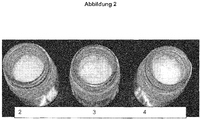
- Der Einsatz vom Reduktionsmittel Na-Disulfit (0.15%)aktiv führte zu einer deutlichen Verbesserung wie in
Abbildung 2 zu sehen ist. Zusatz von 0.18% aktiv Etidronsäure C2H8O7P2 (Turpinal SL, Thermphos Trading) zu der Formel enthaltend Na-Disulfit (0.15%) führte zu keiner Vergilbung der Formel im Beobachtungszeitraum von 120 Tagen. Die Etidronsäure allein war nicht ausreichend für die Verhinderung der Vergilbung (sieheAbbildung 2 ). -
Abbildung 2 zeigt Spülungen mit Aminosilikonen AP-8087 & DC 2-8566 gemäß Formel 1 (Tabelle 1) bei 40°C Lagerung im Brutschrank 120 Tage. (Spülungen sind in Weithalsflaschen, 30mL, Klarglas, Gewinde: GL32, Mit Verschluss 1 - Hersteller Rixius gelagert) - 2: 0.15% Na2S2O6 L*: 60.7, a*:-2.8, b*: 0.8
- 3: 0.18% C2H8O7P2 L*: 56.6, a*:-2.4, b*: 3.2
- 4: 0.18% C2HsO7P2 + 0.15% Na2S2O6 L*: 56.9, a*:-3.3, b*: 0.5
- Die b*-Achse beschreibt den Blau- oder Gelbanteil einer Farbe, wobei negative Werte für Blau und positive Werte für Gelb stehen, so dass höhere Wert für b* eine Erhöhung der Vergilbung bedeutet.
inci 1 4 1 Methylparaben 0,25 0,25 2 Propylparaben 0,10 0,10 3 Aqua . Ad.100 Ad.100 4 Cetyl Alcohol 2,20 2,20 5 Lactic Acid 0,84 0,76 6 Sodium Chloride 0,01 0,01 7 Stearyl Alcohol 4,40 4,40 8 Etidronic Acid 0,30 9 Oryzanol 0,05 0,05 10 Coco Betaine 0,85 0,85 11 Stearamidopropyl Dimethylamine 2,20 2,20 12 Amodimethicone 0,50 0,50 13 Sodium Metabisulfite 0,15 14 Bis-Hydroxy/Methoxy Amodimethicone 1,00 1,00 15 Perfume 0,70 0,70 Ausspülbarkeit (Zeit, Sekunden, Mittelwert) 22 14 Tabelle 3. Handelsnamen der Silikone (% aktiv Hauptkomponente): 12 Dow Corning 2-8566, 100% 14 Dow Corning AP-8087, 100% - Haarspülungen werden zur Pflege nach der Reinigung der Haare angewendet. Ein wichtiger Faktor ist die Sensorik der Spülung während des Auftragens auf das Haar sowie auch die Ausspülbarkeit des Produktes. Eine Spülung sollte zu einem angenehmen Haargefühl im nassen Haar führen, jedoch das Haar nicht während des Ausspülens beschweren. Der Verbraucher sollte das Produkt nicht mehr auf dem Haar spüren, jedoch sollte das Haar gepflegt und weich sein. Die "Ausspülbarkeit" eines Produkts wird im Sinne dieser Schrift wie folgt festgelegt: Mit dem Daumen und Zeige/Mittelfinger einer Hand wird erfühlt beim Ausspülen, wie leicht sich das Produkt aus den Haaren der Strähne auswaschen lässt. Die Zeit (in Sekunden) die vergeht, bis kein Produkt mehr zu fühlen ist, wird notiert. Von einem Expertenteam wurden zunächst zwei haarkonditionierende Formeln (je 0,4mL Produkt wird auf zwei 2std. gebleichten, 2g Haarsträhnen von der Firma Kerling aufgetragen, 1min lang massiert, 30Sekunden lang einwirken gelassen und danach ausgespült. Die Ausspülzeit wird notiert.) mit und ohne (aktiv: 0.18% C2H8O7P2 + 0.15% Na2S2O5) evaluiert (Tabelle 3). Bei der sensorischen Bewertung wird eine 10er Skala verwendet bei der 10 den höchsten Wert darstellt. Formel 4 wurde 8 Sekunden schneller ausgespült als Formel 1 bei nahezu gleichbleibenden Haarpflegeeigenschaften (Gleitvermögen, Haarstruktur während der ganzen Anwendung, Nasskämmbarkeit) bis auf die Produkt Reichhaltigkeit, die um einen Punkt abfällt.
- Bevorzugt ist es, wenn die Zubereitung höchstens 0,1% Farbstoffe enthält. Weiter bevorzugt ist es, wenn ein kationisches Tensid enthalten ist. Bevorzugt ist in Spülungen besonders Stearamidopropyl Dimethylamine als kationischer Pflegestoff. Eine besonders bevorzugte Spülungsformel enthält als ein weiteres Tensid zusätzlich Coco-Betaine in einem Gehalt von 0.85 Gew.%.
- Weiter bevorzugt ist es, wenn eine oder mehrere Fettverbindungen mit einem Schmelzpunkt oberhalb von 40°C enthalten sind. Weiter bevorzugt ist es, wenn das Aminosilikon 0.5 - 2.5 mol% Amine enthält. Weiter bevorzugt ist es, wenn die Zubereitung eine Haarspülung ist. Weiter bevorzugt ist es, wenn zwei verschiedene Aminosilikone enthalten sind. Weiter bevorzugt ist es, wenn das zweite Aminosilikon als Fluid mit einer Viskosität von 1000cst bis 6000cst, vorzugsweise von 1000cst bis 5000cst vorliegt. Geeignet sind aber auch Aminosilkone mit Viskositäten höher als 10,000cs. Aminosilikone können als Fluid und Emulsion vorliegen, aber besonders bevorzugt als Fluide. Besonders bevorzugt ist es, wenn das zweite Aminosilikon als Microemulsion von einem kationischen amino-functionalisertien Silikonpolymer mit einer Viskosität von 10,000cs vorliegt. Weiter bevorzugt ist es, wenn als Aminosilikone Amino-funktionalisiertes Bis-Hydroxy/Methoxy Amodimethicone der Formel


- Amodimethicone wird durch folgende Struktur gekennzeichnet:

- Weiter bevorzugt ist es, wenn 0.10 bis 0.5 Gew.% besonders bevorzugt 0.15 bis 0.2 Gew.% Na-disulfit jeweils bezogen auf den Aktivgehalt enthalten sind. Weiter bevorzugt ist es, wenn der Gehalt an Etidronsäure wenigstens dem Gehalt an Na-disulfit entspricht. Weiter bevorzugt ist es, wenn der Gehalt an EDTA höchstens 0,01 Gew.% beträgt. Weiter bevorzugt ist es, wenn der Gehalt an pflanzlichen Ölen gewählt aus der Gruppe Sonnenblumenöl, Babassuöl, Jojobaöl, Avocadoöl höchstens 1 Gew.% beträgt. Weiter bevorzugt ist es, wenn der Gehalt an pflanzlichen Extrakten gewählt aus der Gruppe hydrolysierte Seide, Aloe, Kamille, lily of the valley höchstens 1 Gew.% beträgt. Weiter bevorzugt ist es, wenn der Gehalt an pflanzlichen Ölen und an pflanzlichen Extrakten zusammengenommen höchstens 1 Gew.% beträgt. Weiter bevorzugt ist es, wenn der Gehalt an pflanzlichen Ölen höchstens 1 Gew.% beträgt. Die Erfindung umfasst auch die Verwendung von Natriumdisulfit und Etidronsäure zur Verhinderung des Vergilbens haarkosmetischer Zubereitungen mit Aminosilikonen.
- Bevorzugt ist es, wenn folgende Aminosilikonfluide eingesetzt werden:
- angeboten von der Gesellschaft Dow Corning:
- Fluide: 2-8566, AP 6087 , AP 6088, DC 8040 Fluid, DC 8822A Fluid, DC 8803 & 8813 Polymers, 7-6030, AP-8104,AP 8201;
- Emulsionen: CE-8170 AF Microemulsion, 2-8177, 2-8194 Microemulsion, 9224 Emulsion, 939, 949, 959,DC 5-7113 Quat Microemulsion,DC 5-7070 Emulsion, DC CE-8810, CE 8401Emulsion, CE-1619, Dow Corning Toray SS-3551, Dow Corning Toray SS-3552;
- angeboten von der Gesellschaft Wacker:
- Wacker Belsil ADM 652, ADM 656, 1100, 1600, 1650 (Fluide); ADM 6060 (lineare Amodimethicone) Emulsion; ADM 6057 E (verzweigt, Amodimethicone) Emulsion; ADM 8020 VP (Micro emulsion); SLM 28040 (Micro emulsion);
- angeboten von der Gesellschaft Momentive:
- Silsoft 331, SF1708, SME 253 & 254 (Emulsion), SM2125 (Emulsion), SM 2658 (Emulsion), Silsoft Q (Emulsion);
- angeboten von der Gesellschaft Shin-Etsu:
- KF-889, KF-867S, KF-8004, X-52-2265 (Emulsion);
- angeboten von der Gesellschaft Siltech Silicones:
- Siltech E-2145, Siltech E-2145-35;
- angeboten von der Gesellschaft Evonik Industries:
- Abil T Quat 60.
- Besonders bevorzugt ist es, wenn die Silikonkombinationen AP-8087; Bis-Hydroxy/Methoxy Amodimethicone, Viscosity: 5000cP, Amine content: 0.5mol % diamine oder DC 2-8566: Amodimethicone; Viscosity: 3500cSt, Amine Content: 2.3 % mole amine % eingesetzt werden. Weitere Erfindungsgemäße Haarpflege Beispielsformulierungen sind hier abgebildet: Alle Konzentrationsangaben verstehen sich als Gewichtsanteile in %.
Haarspülung: 7 8 9 10 11 12 13 14 15 1 Methylparaben 0,25 0,25 0,25 0,25 0,25 0,25 0,25 0,25 0,25 2 Propylparaben 0,1 0,1 0,1 0,1 0,1 0,1 0,1 0,1 0,1 3 Aqua Ad.100 Ad.100 Ad. 100 Ad.100 Ad.100 Ad.100 Ad.100 Ad. 100 Ad.100 4 Citric Acid 0,01 0,01 5 Cetearyl Alcohol 3,5 4,44 6 Cetyl Alcohol 2,5 2,5 2,5 2,5 2 2,5 2,5 7 Lactic Acid 0,76 0,76 0,78 0,76 0,76 0,73 0,75 8 Glycerin 5 9 Sodium Hydroxide 0,03 0,03 10 Sodium Chloride 0,01 0,01 0,01 0,01 0,01 0,01 0,01 11 Stearyl Alcohol 4,8 4,8 4,8 4,8 4 4,8 4,8 12 Cetrimonium Chloride 2 13 Distearoylethyl Hydroxy-ethylmonium Methosulfate 2,86 14 Oryzanol 0,05 0,05 0,05 0,05 0,05 0,05 0,05 0,05 15 Palmitamidopropyltrimonium Chloride 1,66 0,415 16 Coco Betaine 0,85 0,85 0,85 0,85 0,85 0,85 0,85 17 Stearamidopropyl Dimethylamine 2 1,5 2 2,2 2 2,2 2 18 Silicone Quaternium-16 + Undeceth-11 + Butyloctanol + Undeceth-5 5 5 5 5 5 7,5 19 Silicone Quaternium-22 + PPG-3 Myristyl Ether 7,7 20 Behentrimonium Methosulfate 2,73 21 Dimethicone 1,54 3,08 2,31 2,5 22 PPG-3 Benzyl Ether Myristate 2 23 Persea Gratissima (Avocado) Oil 0,1 24 Simmondsia Chinensis (Jojoba)Oil 0,1 25 Amodimethicone 0,5 1 1 26 Bis-Hydroxy/Methoxy Amodimethicone 0,5 0,5 27 Parfum 0,7 0,7 0,7 0,7 0,7 0,7 0,7 0,7 0,7 28 Sodium Metabisulfite 0,15 0,15 0,2 0,15, 0,1 0,15 0,2 0,2 0,1 29 Etidronic Acid 0,25 0,18 0,3 0,3 0,18 0,3 0,3 0,4 0,3 Tabelle 4. Handelsnamen der Rohstoffe (% aktiv Hauptkomponente): 1 Nipagin M, Clariant, 99.5% 2 Nipasol M, Clariant, 99.5% 4 DSM Nutritional Products Europe, 100% 5 Nafol 1618-JA Sasol, 100% 6 Nacol 16-95, Sasol , 95% 7 100366 Milchsäure 90, reinst DAB, Merck, 90% 8 Glycerol EP, vegetable, Spiga Nord, 99.7% 11 Lanette 18, Cognis , 100% 12 CTAC 6025 KC, KCl, 25% 13 Dehyquart F 75, Cognis, 69.935% 14 Gamma -Oryzanol, Biesterfeld, 98% 15 Varisoft PATC, Evonik Goldschmidt, 60% 16 Dehyton AB 30, Cognis, 31% 17 Tego Amid S18, Evonik Goldschmidt, 100% 18 DC 5-7113, Dow Corning, 22% 19 Abil T Quat 60, Evonik, 65%silicone 20 Incroquat Behenyl TMS-50, Croda, 55% 21 DC 5-7139 emulsion, 65% 22 Crodamol STS, Croda, 100% 23 Avocadoöl raffiniert, Gustav Heess, 100% 24 Jojobaöl Goldgelb, Gustav Heess, 100% 25 DC 2-8566, Dow Corning, 100% 26 AP-8087, Dow Corning, 100% 28 Natriumdisulfit food grade (E223), Biesterfeld 29 Turpinal SL, Thermphos Trading, 60% Comb-In Cream: 14 15 16 1 Amodimethicone + Trideceth-12 + Cetrimonium Chloride 1,5 2 Methylparaben 0,25 0,25 0,25 3 Propylparaben 0,1 0,1 0,1 4 Aqua Ad.100 Ad. 100 Ad.100 5 Citric Acid 0,01 0,01 0,01 6 Cetearyl Alcohol 3,5 3,0 3,5 7 Glycerin 9,0 5,0 9,0 8 Sodium Hydroxide 0,025 0,025 0,025 9 Hydroxypropyl Methylcellulose 0,25 0,25 10 Cetearyl Alcohol + Behentrimonium Chloride 1,0 11 Cetyl Alcohol 1,5 12 Cetrimonium Chloride 0,5 13 Distearoylethyl Hydroxyethylmonium Methosulfate + Cetearyl Alcohol 2,5 2,50 14 Oryzanol 0,01 0,01 0,01 15 Cyclomethicone 1,0 1,0 16 Palmitamidopropyltrimonium Chloride + Propylene Glycol 1,0 1,0 17 Dimethicone + Cocamidopropyl Betaine + C12-15 Pareth-3 + Guar Hydroxypropyltrimonium Chloride 0,5 18 Amodimethicone 1,5 1,0 19 Benzophenone-4 0,25 20 Persea Gratissima (Avocado) Oil 0,1 21 Simmondsia Chinensis (Jojoba)Oil 0,1 22 Parfum 0,7 0,7 0,7 23 Sodium Metabisulfite 0,15 0,15 0,15 24 Etidronic Acid 0,18 0,18 0,18 Tabelle 5: Handelsnamen der Rohstoffe (% aktiv Hauptkomponente): 1 Dow Corning 959 Cationic Emulsion, 50% 2 Nipagin M, Clariant, 99.5% 3 Nipasol M, Clariant, 99.5% 5 DSM Nutritional Products Europe, 100% 6 Nafol 1618-JA Sasol, 100% 7 Glycerol EP, vegetable, Spiga Nord, 99.7% 9 Tylose E 707002, SE Tylose, 100% 10 Incroquat Behenyl TMC-25, HA 42212, Croda, 25% 11 Nacol 16-95, Sasol , 95% 12 CTAC 6025 KC, KCl, 25% 13 Dehyquart F 75, Cognis, 69.935% 14 Gamma -Oryzanol, Biesterfeld, 98% 15 Dow Corning 245 Fluid, 100% 16 Varisoft PATC, Evonik Goldschmidt, 60% 17 DC 5-7139 emulsion, 65% 18 Wacker-Belsil ADM 8020 VP, 15% 19 Uvasorb S 5, 3 V Sigma, 100% 20 Avocadoöl raffiniert, Gustav Heess, 100% 21 Jojobaöl Goldgelb, Gustav Heess, 100% 23 Natriumdisulfit food grade (E223), Biesterfeld 24 Turpinal SL, Thermphos Trading, 60% Kur: 14 15 1 Amodimethicone + Trideceth-12 + Cetrimonium Chloride 2,0 2 Methylparaben 0,25 0,25 3 Propylparaben 0,1 0,1 4 Aqua Ad.100 Ad.100 5 Cetyl Alcohol 3,5 2,9 6 Stearyl Alcohol 6,0 5,0 7 Coco-Betaine 0,85 0,85 8 Cyclomethicone 1,5 9 Cyclomethicone + Dimethiconol 2,0 10 Bis-Hydroxy/Methoxy Amodimethicone 1,0 1,0 11 PPG-3 Benzyl Ether Myristate 2,0 12 Stearamidopropyl Dimethylamine 1,5 2,0 13 Lactic Acid 0,77 0,80 14 Sodium Chloride 0,01 0,01 15 Oryzanol 0,05 0,05 16 Persea Gratissima (Avocado) Oil 0,1 17 Simmondsia Chinensis (Jojoba)Oil 0,1 18 Parfum 0,7 0,7 19 Sodium Metabisulfite 0,15 0,15 20 Etidronic Acid 0,18 0,18 Tabelle 6: Handelsnamen der Rohstoffe (% aktiv Hauptkomponente): 1 Dow Corning 959 Cationic Emulsion, 50% 2 Nipagin M, Clariant, 99.5% 3 Nipasol M, Clariant, 99.5% 5 Nacol 16-95, Sasol , 95% 6 Lanette 18, Cognis , 100% 7 Dehyton AB 30, Cognis, 31% 8 Dow Corning 245 Fluid, 100% 10 AP-8087, Dow Corning, 100% 11 Crodamol STS, Croda, 100% 12 Tego Amid S18, Evonik Goldschmidt, 100% 13 100366 Milchsäure 90, reinst DAB, Merck, 90% 15 Gamma -Oryzanol, Biesterfeld, 98% 16 Avocadoöl raffiniert, Gustav Heess, 100% 17 Jojobaöl Goldgelb, Gustav Heess, 100% 19 Natriumdisulfit food grade (E223), Biesterfeld 20 Turpinal SL, Thermphos Trading, 60%
| inci | 1 [Gew.%] | 2 [Gew.%] | 3 [Gew.%] | 4 [Gew.%] | |
| 1 | Methylparaben | 0,25 | 0,25 | 0,25 | 0,25 |
| 2 | Propylparaben | 0,10 | 0,10 | 0,10 | 0,10 |
| 3 | Aqua | Ad.100 | Ad.100 | Ad.100 | Ad.100 |
| 4 | Cetyl Alcohol | 2,20 | 2,20 | 2,20 | 2,20 |
| 5 | Lactic Acid | 0,84 | 0,80 | 0,76 | 0,76 |
| 6 | Sodium Chloride | 0,01 | 0,01 | 0,01 | 0,01 |
| 7 | Stearyl Alcohol | 4,40 | 4,40 | 4,40 | 4,40 |
| 8 | Etidronic Acid | 0,30 | 0,30 | ||
| 9 | Oryzanol | 0,05 | 0,05 | 0,05 | 0,05 |
| 10 | Coco Betaine | 0,85 | 0,85 | 0,85 | 0,85 |
| 11 | Stearamidopropyl Dimethylamine | 2,20 | 2,20 | 2,20 | 2,20 |
| 12 | Amodimethicone | 0,50 | 0,50 | 0,50 | 0,50 |
| 13 | Sodium Metabisulfite | 0,15 | 0,15 | ||
| 14 | Bis-Hydroxy/Methoxy Amodimethicone | 1,00 | 1,00 | 1,00 | 1,00 |
| 15 | Perfume | 0,70 | 0,70 | 0,70 | 0,70 |
| Tabelle 1 | ||
| Handelsnamen der Rohstoffe (% aktiv Hauptkomponente): | ||
| 1 | Nipagin M, Clariant, 99.5% | |
| 2 | Nipasol M, Clariant, 99.5% | |
| 4 | Nacol 16-95, Sasol , 95% | |
| 5 | 100366 Milchsäure 90, reinst DAB, Merck, 90% | |
| 7 | Lanette 18, Cognis , 100% | |
| 8 | Turpinal SL, Henkel or, Thermphos Trading, 60% | |
| 9 | Gamma -Oryzanol, Biesterfeld, 98% | |
| 10 | Dehyton AB 30, Cognis, 31% | |
| 11 | Tego Amid S18, Evonik Goldschmidt, 100% | |
| 12 | Dow Corning 2-8566, 100% | |
| 13 | Natriumdisulfit food grade (E223), Biesterfeld | |
| 14 | Dow Corning AP-8087, 100% | |
Claims (18)
- Haarkosmetische Zubereitung enthaltend Aminosilikone, Natriumdisulfit und Etidronsäure und oder deren Natrium- oder Kaliumsalz.
- Zubereitung nach Anspruch 1 dadurch gekennzeichnet, dass höchstens 0,1% Farbstoffe enthält.
- Zubereitung nach einem der vorangehenden Patentansprüche dadurch gekennzeichnet, dass ein kationisches Tensid enthalten ist.
- Zubereitung nach einem der vorangehenden Patentansprüche dadurch gekennzeichnet, dass eine oder mehrere Fettverbindungen mit einem Schmelzpunkt oberhalb von 40 °C enthalten ist.
- Zubereitung nach einem der vorangehenden Patentansprüche dadurch gekennzeichnet, dass das Aminosilikon 0.5 -2.5 mol% Aminogruppen enthält.
- Zubereitung nach einem der vorangehenden Patentansprüche dadurch gekennzeichnet, dass sie eine Haarspülung ist.
- Zubereitung nach einem der vorangehenden Patentansprüche dadurch gekennzeichnet, dass zwei verschiedene Aminosilikone enthalten sind.
- Zubereitung nach Anspruch 7 dadurch gekennzeichnet, dass das zweite Aminosilikon als Fluid mit einer Viskosität von 1000cst bis 6000cst, vorzugsweise von 1000cst bis 5000cst vorliegt.
- Zubereitung nach Anspruch 7 dadurch gekennzeichnet, dass das zweite Aminosilikon als Microemulsion von einem kationischen amino-functionalisertien Silikonpolymer mit einer Viskosität von 10,000cs vorliegt.
- Zubereitung nach einem der vorangehenden Patentansprüche dadurch gekennzeichnet, dass als Aminosilikone Amino-funktionalisiertes Bis-Hydroxy/Methoxy Amodimethicone der Formel


- Zubereitung nach einem der vorangehenden Patentansprüche dadurch gekennzeichnet, dass 0.10-0.5 Gew.% besonders bevorzugt 0.15 bis 0.2 Gew. % Na-disulfit jeweils bezogen auf den Aktivgehalt enthalten sind.
- Zubereitung nach einem der vorangehenden Patentansprüche dadurch gekennzeichnet, dass der Gehalt an Etidronsäure wenigstens dem Gehalt an Na-disulfit entspricht.
- Zubereitung nach einem der vorangehenden Patentansprüche dadurch gekennzeichnet, dass der Gehalt an EDTA höchstens 0,01 Gew.% beträgt.
- Zubereitung nach einem der vorangehenden Patentansprüche dadurch gekennzeichnet, dass der Gehalt an pflanzlichen Ölen gewählt aus der Gruppe Sonnenblumenöl, Babassuöl, Jojobaöl, Avocadoöl höchstens 1 Gew.% beträgt.
- Zubereitung nach einem der vorangehenden Patentansprüche dadurch gekennzeichnet, dass der Gehalt an pflanzlichen Extrakten gewählt aus der Gruppe hydrolysierte Seide, Aloe, Kamille, lily of the valley höchstens 1 Gew.% beträgt.
- Zubereitung nach einem der Patentansprüche 14 und 15 dadurch gekennzeichnet, dass der Gehalt an pflanzlichen Ölen und an pflanzlichen Extrakten zusammengenommen höchstens 1 Gew.% beträgt.
- Zubereitung nach einem der vorangehenden Patentansprüche dadurch gekennzeichnet, dass der Gehalt an pflanzlichen Ölen höchstens 1 Gew.% beträgt.
- Verwendung von Natriumdisulfit und Etidronsäure zur Verhinderung des Vergilbens haarkosmetischer Zubereitungen mit Aminosilikonen.
Applications Claiming Priority (1)
| Application Number | Priority Date | Filing Date | Title |
|---|---|---|---|
| DE102009048978A DE102009048978A1 (de) | 2009-10-09 | 2009-10-09 | Gilbfreie Haarbehandlungsmittel mit Aminosilikonen |
Publications (3)
| Publication Number | Publication Date |
|---|---|
| EP2319485A2 EP2319485A2 (de) | 2011-05-11 |
| EP2319485A3 EP2319485A3 (de) | 2015-11-04 |
| EP2319485B1 true EP2319485B1 (de) | 2018-03-07 |
Family
ID=43734638
Family Applications (1)
| Application Number | Title | Priority Date | Filing Date |
|---|---|---|---|
| EP10178819.8A Not-in-force EP2319485B1 (de) | 2009-10-09 | 2010-09-23 | Gilbfreie Haarbehandlungsmittel mit Aminosilikonen |
Country Status (2)
| Country | Link |
|---|---|
| EP (1) | EP2319485B1 (de) |
| DE (1) | DE102009048978A1 (de) |
Families Citing this family (2)
| Publication number | Priority date | Publication date | Assignee | Title |
|---|---|---|---|---|
| DE102011110100A1 (de) | 2011-08-12 | 2013-02-14 | Evonik Goldschmidt Gmbh | Verfahren zu Herstellungen von Polysiloxanen mit stickstoffhaltigen Gruppen |
| DE102012203239A1 (de) * | 2012-03-01 | 2013-09-05 | Henkel Ag & Co. Kgaa | Haarpflegemittel mit ausgewählten Riechstoffen und ausgewählten Amodimethiconen |
Citations (5)
| Publication number | Priority date | Publication date | Assignee | Title |
|---|---|---|---|---|
| EP0198788A2 (de) | 1985-04-19 | 1986-10-22 | Sherex Chemical Company, Inc. | Stabilisator für Amin/quaternäres Ammonium-Mischungen |
| WO1995026178A1 (en) | 1994-03-29 | 1995-10-05 | The Procter & Gamble Company | Artifical tanning compositions having improved stability |
| EP1321131A2 (de) | 2001-12-22 | 2003-06-25 | Henkel Kommanditgesellschaft auf Aktien | Farberhaltung |
| WO2005102253A1 (de) | 2004-04-26 | 2005-11-03 | Henkel Kommanditgesellschaft Auf Aktien | Haarfärbemittel enthaltend organosilikon-copolymere mit aminogruppen und polyoxyalkylengruppen sowie deren verwendung |
| JP2008143817A (ja) | 2006-12-08 | 2008-06-26 | Milbon Co Ltd | 乳化型化粧料組成物 |
Family Cites Families (18)
| Publication number | Priority date | Publication date | Assignee | Title |
|---|---|---|---|---|
| DE3334226A1 (de) * | 1983-09-22 | 1985-04-11 | Basf Ag, 6700 Ludwigshafen | Verfahren zur stabilisierung verduennter waessriger polymerloesungen von hochmolekularen homo- und copolymerisaten auf basis wasserloeslicher ethylenisch ungesaettigter verbindungen |
| JPH01233277A (ja) * | 1988-03-15 | 1989-09-19 | Mitsui Norin Kk | 水溶液中におけるカテキン類の安定化方法 |
| US5328685A (en) | 1993-03-30 | 1994-07-12 | Helene Curtis, Inc. | Clear conditioning composition |
| DE4314083A1 (de) | 1993-04-29 | 1994-11-03 | Merck Patent Gmbh | Hautfärbende Pulvermischung |
| AU4580896A (en) | 1996-02-28 | 1997-09-04 | Procter & Gamble Company, The | Mild hair conditioning compositions |
| EP0941053B1 (de) | 1996-11-04 | 2002-09-04 | Children's Hospital Medical Center | Aufhellendes hautpflegemittel |
| EP1123374B1 (de) * | 1998-10-23 | 2005-12-28 | The Procter & Gamble Company | Zusammensetzung und verfahren zur textilpflege |
| DE19962869A1 (de) * | 1999-12-24 | 2001-06-28 | Henkel Kgaa | Verringerung der Haarschädigung bei oxidativen Prozessen |
| US6355720B1 (en) | 2000-05-12 | 2002-03-12 | Johnson Polymer, Inc. | Latex formulations with reduced yellowing |
| IT1318571B1 (it) | 2000-06-09 | 2003-08-27 | Farmaka Srl | Composizioni cosmetiche per la cura del cuoio capelluto e dei capelli. |
| FR2814475A1 (fr) * | 2000-09-27 | 2002-03-29 | Protex | Procede pour reduire le jaunissement d'articles textiles traites avec des agents de finissage a base d'huile amino silicone |
| WO2002078661A2 (en) * | 2001-03-20 | 2002-10-10 | The Procter & Gamble Company | Oxidizing compositions comprising a phosphonic acid type chelant and a conditioning agent and methods of treating hair |
| EP1269974A1 (de) | 2001-06-18 | 2003-01-02 | Unilever Plc | Haarformungszusammensetzungen |
| JP4184312B2 (ja) | 2004-04-15 | 2008-11-19 | 花王株式会社 | 毛髪化粧料 |
| EP1679061B2 (de) | 2004-12-16 | 2011-04-27 | KPSS-Kao Professional Salon Services GmbH | Stabilisierung der Färbung der Haarkonditionierungsmittel |
| DE102005013438A1 (de) | 2005-03-21 | 2006-09-28 | Henkel Kgaa | Haarbehandlungs-Kit mit Komplexbildnern |
| US8246780B2 (en) | 2005-09-19 | 2012-08-21 | Nalco Company | Methods for enhancing brightness and resistance to thermal yellowing of bleached kraft pulp and paper |
| JP2008297246A (ja) * | 2007-05-31 | 2008-12-11 | Lion Corp | 化粧料組成物及び化粧料組成物の保存安定化方法 |
-
2009
- 2009-10-09 DE DE102009048978A patent/DE102009048978A1/de not_active Withdrawn
-
2010
- 2010-09-23 EP EP10178819.8A patent/EP2319485B1/de not_active Not-in-force
Patent Citations (5)
| Publication number | Priority date | Publication date | Assignee | Title |
|---|---|---|---|---|
| EP0198788A2 (de) | 1985-04-19 | 1986-10-22 | Sherex Chemical Company, Inc. | Stabilisator für Amin/quaternäres Ammonium-Mischungen |
| WO1995026178A1 (en) | 1994-03-29 | 1995-10-05 | The Procter & Gamble Company | Artifical tanning compositions having improved stability |
| EP1321131A2 (de) | 2001-12-22 | 2003-06-25 | Henkel Kommanditgesellschaft auf Aktien | Farberhaltung |
| WO2005102253A1 (de) | 2004-04-26 | 2005-11-03 | Henkel Kommanditgesellschaft Auf Aktien | Haarfärbemittel enthaltend organosilikon-copolymere mit aminogruppen und polyoxyalkylengruppen sowie deren verwendung |
| JP2008143817A (ja) | 2006-12-08 | 2008-06-26 | Milbon Co Ltd | 乳化型化粧料組成物 |
Non-Patent Citations (4)
| Title |
|---|
| ANONYMOUS: "Schweflige Säure, Wikipedia", 10 May 2018 (2018-05-10), XP055536219, Retrieved from the Internet <URL:https://de.wikipedia.org/wiki/Schweflige_Säure> |
| DATABASE GNPD [O] 1 March 2007 (2007-03-01), SNC - INDUSTRIA DE COSMETICOS: "Hair Color Cream", XP055536193, Database accession no. 679865 |
| DATABASE GNPD [O] 5 August 2004 (2004-08-05), HOYU: "Favourite Colour Hair Colourant", XP055536212, Database accession no. 289539 |
| DATABASE GNPD 23 September 2009 (2009-09-23), HOYU: "Hair Colour", XP055536201, Database accession no. 1177104 |
Also Published As
| Publication number | Publication date |
|---|---|
| EP2319485A2 (de) | 2011-05-11 |
| DE102009048978A1 (de) | 2011-04-14 |
| EP2319485A3 (de) | 2015-11-04 |
Similar Documents
| Publication | Publication Date | Title |
|---|---|---|
| JP6416754B2 (ja) | 脂肪アルコール、カチオン性界面活性剤及びn−アシル−n−メチルグルカミンを含む組成物 | |
| DE60301960T2 (de) | Kosmetische Haarzusammensetzung enthaltend Cetyl PEG/PPG-10/1 Dimethicon und ein Ceramid | |
| EP2070515B1 (de) | Zusammensetzung zum Konditionieren von Keratinfasern | |
| US20090041711A1 (en) | Conditioning composition for keratin fibres | |
| EP1228748B1 (de) | Haarpflegemittel mit diquaternären Silikonpolymeren | |
| DE102008030131A1 (de) | Silikone-freie Konditioniermittel für keratinhaltige Fasern | |
| EP2229933A1 (de) | Kosmetische zusammensetzung für das haar | |
| DE102011017519A1 (de) | Kosmetische Zubereitung zur Färbung von Haaren | |
| EP2138156B1 (de) | Haarkonditionierende Zubereitung mit einer besonderen Mischung kationischer Konditioniermittel | |
| US20060135393A1 (en) | Mild cleansing composition | |
| EP1787636B1 (de) | Haarkonditionierungszusammensetzung | |
| DE19536420A1 (de) | Haarspülzusammensetzung | |
| EP2008642B1 (de) | Haarkonditioniermittel enthaltend Polyquaternium-37 | |
| EP2319485B1 (de) | Gilbfreie Haarbehandlungsmittel mit Aminosilikonen | |
| WO2018059766A1 (de) | Verbessert konditionierende haarbehandlungsmittel mit auswaschschutz | |
| EP1787635B1 (de) | Haarkonditionierungszusammensetzung | |
| DE602004007281T2 (de) | Stabilisierung der Färbung der Haarkonditionierungsmittel | |
| EP2621464B1 (de) | Pflegeprodukte zum schützen colorierter haare mit silikonharzen | |
| EP0914080B1 (de) | Mittel und verfahren zum färben und tönen keratinischer fasern | |
| EP1923043A1 (de) | Antischuppen konditionierendes Mittel | |
| EP3518883A1 (de) | Verbessert konditionierende haarbehandlungsmittel mit auswaschschutz | |
| EP2552548B1 (de) | Ausspülhaarbehandlungsmittel mit niedrig- bis mittelviskosen polydimethylsiloxanen | |
| WO2016139122A1 (de) | Haarbehandlungsmittel enthaltend methionylmethionin und kationische tenside | |
| EP1719546B1 (de) | Haarkonditionierungszusammensetzung | |
| WO2015086269A1 (de) | Verfahren und kit zum glätten und färben von haaren mit verbesserter grauabdeckung und verbesserter waschbeständigkeit |
Legal Events
| Date | Code | Title | Description |
|---|---|---|---|
| PUAI | Public reference made under article 153(3) epc to a published international application that has entered the european phase |
Free format text: ORIGINAL CODE: 0009012 |
|
| AK | Designated contracting states |
Kind code of ref document: A2 Designated state(s): AL AT BE BG CH CY CZ DE DK EE ES FI FR GB GR HR HU IE IS IT LI LT LU LV MC MK MT NL NO PL PT RO SE SI SK SM TR |
|
| AX | Request for extension of the european patent |
Extension state: BA ME RS |
|
| PUAL | Search report despatched |
Free format text: ORIGINAL CODE: 0009013 |
|
| AK | Designated contracting states |
Kind code of ref document: A3 Designated state(s): AL AT BE BG CH CY CZ DE DK EE ES FI FR GB GR HR HU IE IS IT LI LT LU LV MC MK MT NL NO PL PT RO SE SI SK SM TR |
|
| AX | Request for extension of the european patent |
Extension state: BA ME RS |
|
| RIC1 | Information provided on ipc code assigned before grant |
Ipc: A61Q 5/12 20060101ALI20150930BHEP Ipc: A61K 8/55 20060101ALI20150930BHEP Ipc: A61K 8/23 20060101AFI20150930BHEP Ipc: A61K 8/898 20060101ALI20150930BHEP |
|
| 17P | Request for examination filed |
Effective date: 20160504 |
|
| RBV | Designated contracting states (corrected) |
Designated state(s): AL AT BE BG CH CY CZ DE DK EE ES FI FR GB GR HR HU IE IS IT LI LT LU LV MC MK MT NL NO PL PT RO SE SI SK SM TR |
|
| GRAP | Despatch of communication of intention to grant a patent |
Free format text: ORIGINAL CODE: EPIDOSNIGR1 |
|
| INTG | Intention to grant announced |
Effective date: 20170719 |
|
| GRAJ | Information related to disapproval of communication of intention to grant by the applicant or resumption of examination proceedings by the epo deleted |
Free format text: ORIGINAL CODE: EPIDOSDIGR1 |
|
| GRAJ | Information related to disapproval of communication of intention to grant by the applicant or resumption of examination proceedings by the epo deleted |
Free format text: ORIGINAL CODE: EPIDOSDIGR1 |
|
| INTG | Intention to grant announced |
Effective date: 20170719 |
|
| GRAP | Despatch of communication of intention to grant a patent |
Free format text: ORIGINAL CODE: EPIDOSNIGR1 |
|
| INTC | Intention to grant announced (deleted) | ||
| INTG | Intention to grant announced |
Effective date: 20171019 |
|
| GRAS | Grant fee paid |
Free format text: ORIGINAL CODE: EPIDOSNIGR3 |
|
| GRAA | (expected) grant |
Free format text: ORIGINAL CODE: 0009210 |
|
| AK | Designated contracting states |
Kind code of ref document: B1 Designated state(s): AL AT BE BG CH CY CZ DE DK EE ES FI FR GB GR HR HU IE IS IT LI LT LU LV MC MK MT NL NO PL PT RO SE SI SK SM TR |
|
| REG | Reference to a national code |
Ref country code: GB Ref legal event code: FG4D Free format text: NOT ENGLISH |
|
| REG | Reference to a national code |
Ref country code: CH Ref legal event code: EP Ref country code: AT Ref legal event code: REF Ref document number: 975772 Country of ref document: AT Kind code of ref document: T Effective date: 20180315 |
|
| REG | Reference to a national code |
Ref country code: DE Ref legal event code: R096 Ref document number: 502010014718 Country of ref document: DE |
|
| REG | Reference to a national code |
Ref country code: IE Ref legal event code: FG4D Free format text: LANGUAGE OF EP DOCUMENT: GERMAN |
|
| REG | Reference to a national code |
Ref country code: NL Ref legal event code: MP Effective date: 20180307 |
|
| REG | Reference to a national code |
Ref country code: LT Ref legal event code: MG4D |
|
| PG25 | Lapsed in a contracting state [announced via postgrant information from national office to epo] |
Ref country code: ES Free format text: LAPSE BECAUSE OF FAILURE TO SUBMIT A TRANSLATION OF THE DESCRIPTION OR TO PAY THE FEE WITHIN THE PRESCRIBED TIME-LIMIT Effective date: 20180307 Ref country code: CY Free format text: LAPSE BECAUSE OF FAILURE TO SUBMIT A TRANSLATION OF THE DESCRIPTION OR TO PAY THE FEE WITHIN THE PRESCRIBED TIME-LIMIT Effective date: 20180307 Ref country code: LT Free format text: LAPSE BECAUSE OF FAILURE TO SUBMIT A TRANSLATION OF THE DESCRIPTION OR TO PAY THE FEE WITHIN THE PRESCRIBED TIME-LIMIT Effective date: 20180307 Ref country code: NO Free format text: LAPSE BECAUSE OF FAILURE TO SUBMIT A TRANSLATION OF THE DESCRIPTION OR TO PAY THE FEE WITHIN THE PRESCRIBED TIME-LIMIT Effective date: 20180607 Ref country code: FI Free format text: LAPSE BECAUSE OF FAILURE TO SUBMIT A TRANSLATION OF THE DESCRIPTION OR TO PAY THE FEE WITHIN THE PRESCRIBED TIME-LIMIT Effective date: 20180307 Ref country code: HR Free format text: LAPSE BECAUSE OF FAILURE TO SUBMIT A TRANSLATION OF THE DESCRIPTION OR TO PAY THE FEE WITHIN THE PRESCRIBED TIME-LIMIT Effective date: 20180307 |
|
| PG25 | Lapsed in a contracting state [announced via postgrant information from national office to epo] |
Ref country code: GR Free format text: LAPSE BECAUSE OF FAILURE TO SUBMIT A TRANSLATION OF THE DESCRIPTION OR TO PAY THE FEE WITHIN THE PRESCRIBED TIME-LIMIT Effective date: 20180608 Ref country code: BG Free format text: LAPSE BECAUSE OF FAILURE TO SUBMIT A TRANSLATION OF THE DESCRIPTION OR TO PAY THE FEE WITHIN THE PRESCRIBED TIME-LIMIT Effective date: 20180607 Ref country code: LV Free format text: LAPSE BECAUSE OF FAILURE TO SUBMIT A TRANSLATION OF THE DESCRIPTION OR TO PAY THE FEE WITHIN THE PRESCRIBED TIME-LIMIT Effective date: 20180307 Ref country code: SE Free format text: LAPSE BECAUSE OF FAILURE TO SUBMIT A TRANSLATION OF THE DESCRIPTION OR TO PAY THE FEE WITHIN THE PRESCRIBED TIME-LIMIT Effective date: 20180307 |
|
| PG25 | Lapsed in a contracting state [announced via postgrant information from national office to epo] |
Ref country code: MT Free format text: LAPSE BECAUSE OF FAILURE TO SUBMIT A TRANSLATION OF THE DESCRIPTION OR TO PAY THE FEE WITHIN THE PRESCRIBED TIME-LIMIT Effective date: 20180307 |
|
| PG25 | Lapsed in a contracting state [announced via postgrant information from national office to epo] |
Ref country code: AL Free format text: LAPSE BECAUSE OF FAILURE TO SUBMIT A TRANSLATION OF THE DESCRIPTION OR TO PAY THE FEE WITHIN THE PRESCRIBED TIME-LIMIT Effective date: 20180307 Ref country code: RO Free format text: LAPSE BECAUSE OF FAILURE TO SUBMIT A TRANSLATION OF THE DESCRIPTION OR TO PAY THE FEE WITHIN THE PRESCRIBED TIME-LIMIT Effective date: 20180307 Ref country code: PL Free format text: LAPSE BECAUSE OF FAILURE TO SUBMIT A TRANSLATION OF THE DESCRIPTION OR TO PAY THE FEE WITHIN THE PRESCRIBED TIME-LIMIT Effective date: 20180307 Ref country code: NL Free format text: LAPSE BECAUSE OF FAILURE TO SUBMIT A TRANSLATION OF THE DESCRIPTION OR TO PAY THE FEE WITHIN THE PRESCRIBED TIME-LIMIT Effective date: 20180307 Ref country code: EE Free format text: LAPSE BECAUSE OF FAILURE TO SUBMIT A TRANSLATION OF THE DESCRIPTION OR TO PAY THE FEE WITHIN THE PRESCRIBED TIME-LIMIT Effective date: 20180307 Ref country code: IT Free format text: LAPSE BECAUSE OF FAILURE TO SUBMIT A TRANSLATION OF THE DESCRIPTION OR TO PAY THE FEE WITHIN THE PRESCRIBED TIME-LIMIT Effective date: 20180307 |
|
| PG25 | Lapsed in a contracting state [announced via postgrant information from national office to epo] |
Ref country code: SM Free format text: LAPSE BECAUSE OF FAILURE TO SUBMIT A TRANSLATION OF THE DESCRIPTION OR TO PAY THE FEE WITHIN THE PRESCRIBED TIME-LIMIT Effective date: 20180307 Ref country code: CZ Free format text: LAPSE BECAUSE OF FAILURE TO SUBMIT A TRANSLATION OF THE DESCRIPTION OR TO PAY THE FEE WITHIN THE PRESCRIBED TIME-LIMIT Effective date: 20180307 Ref country code: SK Free format text: LAPSE BECAUSE OF FAILURE TO SUBMIT A TRANSLATION OF THE DESCRIPTION OR TO PAY THE FEE WITHIN THE PRESCRIBED TIME-LIMIT Effective date: 20180307 |
|
| REG | Reference to a national code |
Ref country code: DE Ref legal event code: R026 Ref document number: 502010014718 Country of ref document: DE |
|
| PLBI | Opposition filed |
Free format text: ORIGINAL CODE: 0009260 |
|
| PLAX | Notice of opposition and request to file observation + time limit sent |
Free format text: ORIGINAL CODE: EPIDOSNOBS2 |
|
| PG25 | Lapsed in a contracting state [announced via postgrant information from national office to epo] |
Ref country code: PT Free format text: LAPSE BECAUSE OF FAILURE TO SUBMIT A TRANSLATION OF THE DESCRIPTION OR TO PAY THE FEE WITHIN THE PRESCRIBED TIME-LIMIT Effective date: 20180709 |
|
| 26 | Opposition filed |
Opponent name: HENKEL AG & CO. KGAA Effective date: 20181204 |
|
| PG25 | Lapsed in a contracting state [announced via postgrant information from national office to epo] |
Ref country code: DK Free format text: LAPSE BECAUSE OF FAILURE TO SUBMIT A TRANSLATION OF THE DESCRIPTION OR TO PAY THE FEE WITHIN THE PRESCRIBED TIME-LIMIT Effective date: 20180307 |
|
| PG25 | Lapsed in a contracting state [announced via postgrant information from national office to epo] |
Ref country code: SI Free format text: LAPSE BECAUSE OF FAILURE TO SUBMIT A TRANSLATION OF THE DESCRIPTION OR TO PAY THE FEE WITHIN THE PRESCRIBED TIME-LIMIT Effective date: 20180307 |
|
| PLBB | Reply of patent proprietor to notice(s) of opposition received |
Free format text: ORIGINAL CODE: EPIDOSNOBS3 |
|
| PG25 | Lapsed in a contracting state [announced via postgrant information from national office to epo] |
Ref country code: MC Free format text: LAPSE BECAUSE OF FAILURE TO SUBMIT A TRANSLATION OF THE DESCRIPTION OR TO PAY THE FEE WITHIN THE PRESCRIBED TIME-LIMIT Effective date: 20180307 |
|
| REG | Reference to a national code |
Ref country code: CH Ref legal event code: PL |
|
| GBPC | Gb: european patent ceased through non-payment of renewal fee |
Effective date: 20180923 |
|
| REG | Reference to a national code |
Ref country code: BE Ref legal event code: MM Effective date: 20180930 |
|
| PLCK | Communication despatched that opposition was rejected |
Free format text: ORIGINAL CODE: EPIDOSNREJ1 |
|
| REG | Reference to a national code |
Ref country code: IE Ref legal event code: MM4A |
|
| PG25 | Lapsed in a contracting state [announced via postgrant information from national office to epo] |
Ref country code: LU Free format text: LAPSE BECAUSE OF NON-PAYMENT OF DUE FEES Effective date: 20180923 |
|
| REG | Reference to a national code |
Ref country code: DE Ref legal event code: R100 Ref document number: 502010014718 Country of ref document: DE |
|
| PG25 | Lapsed in a contracting state [announced via postgrant information from national office to epo] |
Ref country code: IE Free format text: LAPSE BECAUSE OF NON-PAYMENT OF DUE FEES Effective date: 20180923 |
|
| PG25 | Lapsed in a contracting state [announced via postgrant information from national office to epo] |
Ref country code: BE Free format text: LAPSE BECAUSE OF NON-PAYMENT OF DUE FEES Effective date: 20180930 Ref country code: FR Free format text: LAPSE BECAUSE OF NON-PAYMENT OF DUE FEES Effective date: 20180930 Ref country code: CH Free format text: LAPSE BECAUSE OF NON-PAYMENT OF DUE FEES Effective date: 20180930 Ref country code: LI Free format text: LAPSE BECAUSE OF NON-PAYMENT OF DUE FEES Effective date: 20180930 |
|
| PLBN | Opposition rejected |
Free format text: ORIGINAL CODE: 0009273 |
|
| STAA | Information on the status of an ep patent application or granted ep patent |
Free format text: STATUS: OPPOSITION REJECTED |
|
| PG25 | Lapsed in a contracting state [announced via postgrant information from national office to epo] |
Ref country code: GB Free format text: LAPSE BECAUSE OF NON-PAYMENT OF DUE FEES Effective date: 20180923 |
|
| 27O | Opposition rejected |
Effective date: 20190628 |
|
| REG | Reference to a national code |
Ref country code: AT Ref legal event code: MM01 Ref document number: 975772 Country of ref document: AT Kind code of ref document: T Effective date: 20180923 |
|
| PG25 | Lapsed in a contracting state [announced via postgrant information from national office to epo] |
Ref country code: AT Free format text: LAPSE BECAUSE OF NON-PAYMENT OF DUE FEES Effective date: 20180923 |
|
| PG25 | Lapsed in a contracting state [announced via postgrant information from national office to epo] |
Ref country code: TR Free format text: LAPSE BECAUSE OF FAILURE TO SUBMIT A TRANSLATION OF THE DESCRIPTION OR TO PAY THE FEE WITHIN THE PRESCRIBED TIME-LIMIT Effective date: 20180307 |
|
| PG25 | Lapsed in a contracting state [announced via postgrant information from national office to epo] |
Ref country code: HU Free format text: LAPSE BECAUSE OF FAILURE TO SUBMIT A TRANSLATION OF THE DESCRIPTION OR TO PAY THE FEE WITHIN THE PRESCRIBED TIME-LIMIT; INVALID AB INITIO Effective date: 20100923 |
|
| PG25 | Lapsed in a contracting state [announced via postgrant information from national office to epo] |
Ref country code: MK Free format text: LAPSE BECAUSE OF NON-PAYMENT OF DUE FEES Effective date: 20180307 |
|
| PG25 | Lapsed in a contracting state [announced via postgrant information from national office to epo] |
Ref country code: IS Free format text: LAPSE BECAUSE OF FAILURE TO SUBMIT A TRANSLATION OF THE DESCRIPTION OR TO PAY THE FEE WITHIN THE PRESCRIBED TIME-LIMIT Effective date: 20180707 |
|
| PGFP | Annual fee paid to national office [announced via postgrant information from national office to epo] |
Ref country code: DE Payment date: 20200930 Year of fee payment: 11 |
|
| REG | Reference to a national code |
Ref country code: DE Ref legal event code: R119 Ref document number: 502010014718 Country of ref document: DE |
|
| PG25 | Lapsed in a contracting state [announced via postgrant information from national office to epo] |
Ref country code: DE Free format text: LAPSE BECAUSE OF NON-PAYMENT OF DUE FEES Effective date: 20220401 |