EP2313430B1 - Muteins of hngal and related proteins with affinity for a given target - Google Patents
Muteins of hngal and related proteins with affinity for a given target Download PDFInfo
- Publication number
- EP2313430B1 EP2313430B1 EP09769304.8A EP09769304A EP2313430B1 EP 2313430 B1 EP2313430 B1 EP 2313430B1 EP 09769304 A EP09769304 A EP 09769304A EP 2313430 B1 EP2313430 B1 EP 2313430B1
- Authority
- EP
- European Patent Office
- Prior art keywords
- mutein
- hngal
- sequence
- amino acid
- muteins
- Prior art date
- Legal status (The legal status is an assumption and is not a legal conclusion. Google has not performed a legal analysis and makes no representation as to the accuracy of the status listed.)
- Active
Links
Images





Classifications
-
- C—CHEMISTRY; METALLURGY
- C07—ORGANIC CHEMISTRY
- C07K—PEPTIDES
- C07K14/00—Peptides having more than 20 amino acids; Gastrins; Somatostatins; Melanotropins; Derivatives thereof
- C07K14/435—Peptides having more than 20 amino acids; Gastrins; Somatostatins; Melanotropins; Derivatives thereof from animals; from humans
- C07K14/46—Peptides having more than 20 amino acids; Gastrins; Somatostatins; Melanotropins; Derivatives thereof from animals; from humans from vertebrates
- C07K14/47—Peptides having more than 20 amino acids; Gastrins; Somatostatins; Melanotropins; Derivatives thereof from animals; from humans from vertebrates from mammals
-
- A—HUMAN NECESSITIES
- A61—MEDICAL OR VETERINARY SCIENCE; HYGIENE
- A61K—PREPARATIONS FOR MEDICAL, DENTAL OR TOILETRY PURPOSES
- A61K47/00—Medicinal preparations characterised by the non-active ingredients used, e.g. carriers or inert additives; Targeting or modifying agents chemically bound to the active ingredient
- A61K47/50—Medicinal preparations characterised by the non-active ingredients used, e.g. carriers or inert additives; Targeting or modifying agents chemically bound to the active ingredient the non-active ingredient being chemically bound to the active ingredient, e.g. polymer-drug conjugates
- A61K47/51—Medicinal preparations characterised by the non-active ingredients used, e.g. carriers or inert additives; Targeting or modifying agents chemically bound to the active ingredient the non-active ingredient being chemically bound to the active ingredient, e.g. polymer-drug conjugates the non-active ingredient being a modifying agent
- A61K47/56—Medicinal preparations characterised by the non-active ingredients used, e.g. carriers or inert additives; Targeting or modifying agents chemically bound to the active ingredient the non-active ingredient being chemically bound to the active ingredient, e.g. polymer-drug conjugates the non-active ingredient being a modifying agent the modifying agent being an organic macromolecular compound, e.g. an oligomeric, polymeric or dendrimeric molecule
- A61K47/59—Medicinal preparations characterised by the non-active ingredients used, e.g. carriers or inert additives; Targeting or modifying agents chemically bound to the active ingredient the non-active ingredient being chemically bound to the active ingredient, e.g. polymer-drug conjugates the non-active ingredient being a modifying agent the modifying agent being an organic macromolecular compound, e.g. an oligomeric, polymeric or dendrimeric molecule obtained otherwise than by reactions only involving carbon-to-carbon unsaturated bonds, e.g. polyureas or polyurethanes
- A61K47/60—Medicinal preparations characterised by the non-active ingredients used, e.g. carriers or inert additives; Targeting or modifying agents chemically bound to the active ingredient the non-active ingredient being chemically bound to the active ingredient, e.g. polymer-drug conjugates the non-active ingredient being a modifying agent the modifying agent being an organic macromolecular compound, e.g. an oligomeric, polymeric or dendrimeric molecule obtained otherwise than by reactions only involving carbon-to-carbon unsaturated bonds, e.g. polyureas or polyurethanes the organic macromolecular compound being a polyoxyalkylene oligomer, polymer or dendrimer, e.g. PEG, PPG, PEO or polyglycerol
-
- A—HUMAN NECESSITIES
- A61—MEDICAL OR VETERINARY SCIENCE; HYGIENE
- A61K—PREPARATIONS FOR MEDICAL, DENTAL OR TOILETRY PURPOSES
- A61K51/00—Preparations containing radioactive substances for use in therapy or testing in vivo
- A61K51/02—Preparations containing radioactive substances for use in therapy or testing in vivo characterised by the carrier, i.e. characterised by the agent or material covalently linked or complexing the radioactive nucleus
- A61K51/04—Organic compounds
- A61K51/08—Peptides, e.g. proteins, carriers being peptides, polyamino acids, proteins
- A61K51/081—Peptides, e.g. proteins, carriers being peptides, polyamino acids, proteins the protein being an albumin, e.g. human serum albumin [HSA], bovine serum albumin [BSA], ovalbumin
-
- A—HUMAN NECESSITIES
- A61—MEDICAL OR VETERINARY SCIENCE; HYGIENE
- A61K—PREPARATIONS FOR MEDICAL, DENTAL OR TOILETRY PURPOSES
- A61K51/00—Preparations containing radioactive substances for use in therapy or testing in vivo
- A61K51/02—Preparations containing radioactive substances for use in therapy or testing in vivo characterised by the carrier, i.e. characterised by the agent or material covalently linked or complexing the radioactive nucleus
- A61K51/04—Organic compounds
- A61K51/08—Peptides, e.g. proteins, carriers being peptides, polyamino acids, proteins
- A61K51/088—Peptides, e.g. proteins, carriers being peptides, polyamino acids, proteins conjugates with carriers being peptides, polyamino acids or proteins
-
- A—HUMAN NECESSITIES
- A61—MEDICAL OR VETERINARY SCIENCE; HYGIENE
- A61P—SPECIFIC THERAPEUTIC ACTIVITY OF CHEMICAL COMPOUNDS OR MEDICINAL PREPARATIONS
- A61P35/00—Antineoplastic agents
-
- C—CHEMISTRY; METALLURGY
- C07—ORGANIC CHEMISTRY
- C07H—SUGARS; DERIVATIVES THEREOF; NUCLEOSIDES; NUCLEOTIDES; NUCLEIC ACIDS
- C07H21/00—Compounds containing two or more mononucleotide units having separate phosphate or polyphosphate groups linked by saccharide radicals of nucleoside groups, e.g. nucleic acids
- C07H21/04—Compounds containing two or more mononucleotide units having separate phosphate or polyphosphate groups linked by saccharide radicals of nucleoside groups, e.g. nucleic acids with deoxyribosyl as saccharide radical
-
- C—CHEMISTRY; METALLURGY
- C12—BIOCHEMISTRY; BEER; SPIRITS; WINE; VINEGAR; MICROBIOLOGY; ENZYMOLOGY; MUTATION OR GENETIC ENGINEERING
- C12N—MICROORGANISMS OR ENZYMES; COMPOSITIONS THEREOF; PROPAGATING, PRESERVING, OR MAINTAINING MICROORGANISMS; MUTATION OR GENETIC ENGINEERING; CULTURE MEDIA
- C12N15/00—Mutation or genetic engineering; DNA or RNA concerning genetic engineering, vectors, e.g. plasmids, or their isolation, preparation or purification; Use of hosts therefor
- C12N15/09—Recombinant DNA-technology
- C12N15/10—Processes for the isolation, preparation or purification of DNA or RNA
- C12N15/1034—Isolating an individual clone by screening libraries
- C12N15/1037—Screening libraries presented on the surface of microorganisms, e.g. phage display, E. coli display
-
- C—CHEMISTRY; METALLURGY
- C07—ORGANIC CHEMISTRY
- C07K—PEPTIDES
- C07K2319/00—Fusion polypeptide
- C07K2319/01—Fusion polypeptide containing a localisation/targetting motif
-
- C—CHEMISTRY; METALLURGY
- C07—ORGANIC CHEMISTRY
- C07K—PEPTIDES
- C07K2319/00—Fusion polypeptide
- C07K2319/20—Fusion polypeptide containing a tag with affinity for a non-protein ligand
-
- C—CHEMISTRY; METALLURGY
- C07—ORGANIC CHEMISTRY
- C07K—PEPTIDES
- C07K2319/00—Fusion polypeptide
- C07K2319/40—Fusion polypeptide containing a tag for immunodetection, or an epitope for immunisation
Definitions
- the lipocalins share unusually low levels of overall sequence conservation, often with sequence identities of less than 20%. In strong contrast, their overall folding pattern is highly conserved.
- the central part of the lipocalin structure consists of a single eight-stranded anti-parallel ⁇ -sheet closed back on itself to form a continuously hydrogen-bonded ⁇ -barrel.
- One end of the barrel is sterically blocked by the N-terminal peptide segment that runs across its bottom as well as three peptide loops connecting the ⁇ -strands.
- the other end of the ⁇ -barrel is open to the solvent and encompasses a target-binding site, which is formed by four peptide loops.
- the PCT publication WO 2005/19256 discloses muteins of tear lipocalin with at least one binding site for different or the same target ligand and provides a method for the generation of such muteins of human tear lipocalin.
- certain amino acid stretches within the primary sequence of tear lipocalin, in particular the loop regions comprising amino acids 7-14, 24-36, 41-49, 53-66, 69-77, 79-84, 87-98, and 103-110 of mature human tear lipocalin are subjected to mutagenesis in order to generate muteins with binding affinities.
- the resulting muteins have binding affinities for the selected ligand (K D ) in the nanomolar range.
- DOTA 1,4,7,10-tetra-azacylcododecane-N,N',N",N'''-tetraacetic acid
- DTPA diethylenetriamine pentaacetic acid
- radionuclides of the rare earth elements such as Y 3+ or Lu 3+ or similar trivalent metal ions, e.g. In 3+ or Bi 3+ .
- human neutrophil gelatinase-associated lipocalin or "hNGAL” or “lipocalin 2" or “Lcn2” as used herein to refer to the mature hNGAL with the SWISS-PROT Data Bank Accession Number P80188.
- the amino acid sequence of human neutrophil gelatinase-associated lipocalin is set forth in SEQ ID NO: 1.
- the terms "rat ⁇ 2 -microglobulin-related protein” or “A2m” and “mouse 24p3/uterocalin” or “24p3” as used in the present application refer to mature A2m or 24p3 with the SWISS-PROT Data Bank Accession Numbers P31052 and P11672, respectively.
- the given target may be any desired non-natural target/ligand.
- non-natural ligand refers to any compound, which does not bind to native mature hNGAL under physiological conditions.
- the target (ligand) may be any chemical compound in free or conjugated form which exhibits features of an immunological hapten, for example, a small organic molecule, such as a metal-chelating agent, or a peptide, for example of 2 to about 25 or about 30 or about 35 amino acids length (see below).
- peptide refers to a dipeptide or an oligopeptide with of 2-40, 2-35, 2-30, 2-25, 2-20, 2-15 or 2-10 amino acid residues.
- the peptide may be a naturally occurring or synthetic peptide and may comprise - besides the 20 naturally occurring L-amino acids - D-amino acids, non-naturally occurring amino acids and amino acid analogs.
- an amino acid residue is replaced with a chemically similar amino acid residue.
- conservative substitutions are the replacements among the members of the following groups: 1) alanine, serine, and threonine; 2) aspartic acid and glutamic acid; 3) asparagine and glutamine; 4) arginine and lysine; 5) isoleucine, leucine, methionine, and valine; and 6) phenylalanine, tyrosine, and tryptophan.
- instead of replacing single amino acid residues it is also possible to either insert or delete one or more continuous amino acids of the primary structure of hNGAL as long as these deletions or insertion result in a stable folded/functional mutein.
- the complex formation between the respective mutein and its ligand is influenced by many different factors such as the concentrations of the respective binding partners, the presence of competitors, pH and the ionic strength of the buffer system used, and the experimental method used for determination of the dissociation constant K D (for example fluorescence titration, competition ELISA or surface plasmon resonance, just to name a few) or even the mathematical algorithm which is used for evaluation of the experimental data.
- the mutein comprises with respect to the mature hNGAL wild type amino acid sequence the amino acid replacements:
- conservative substitutions are the replacements among the members of the following groups: 1) alanine, serine, and threonine; 2) aspartic acid and glutamic acid; 3) asparagine and glutamine; 4) arginine and lysine; 5) isoleucine, leucine, methionine, and valine; and 6) phenylalanine, tyrosine, and tryptophan.
- an hNGAL mutein described herein with any appropriate chemical substance or enzyme, which directly or indirectly generates a detectable compound or signal in a chemical, physical, optical, or enzymatic reaction.
- An example for a physical reaction and at the same time optical reaction/marker is the emission of fluorescence upon irradiation.
- Alkaline phosphatase, horseradish peroxidase or ⁇ -galactosidase are examples of enzyme labels (and at the same time optical labels) which catalyze the formation of chromogenic reaction products.
- an Fc part of an immunoglobulin a CH3 domain of an immunoglobulin, a CH4 domain of an immunoglobulin, albumin or a fragment thereof, an albumin binding peptide, or an albumin binding protein, transferrin to name only a few.
- the albumin binding protein may be a bacterial albumin binding protein, an antibody, an antibody fragment including domain antibodies (see US patent 6,696,245 , for example), or a lipocalin mutein with binding activity for albumin. Accordingly, suitable conjugation partners for extending the half-life of a lipocalin mutein of the invention include albumin ( Osborn et al. (2002) J. Pharmacol. Exp. Ther.
- the muteins can be genetically fused to the N or C terminus, or both, of non-glycosylated transferrin.
- Non-glycosylated transferrin has a half-life of 14-17 days, and a transferrin fusion protein will similarly have an extended half-life.
- the transferrin carrier also provides high bioavailability, biodistribution and circulating stability. This technology is commercially available from BioRexis (BioRexis Pharmaceutical Corporation, PA, USA). Recombinant human transferrin (DeltaFerrinTM) for use as a protein stabilizer is also commercially available from Novozymes Delta Ltd. (Nottingham, UK).
- artificial amino acids may be introduced by mutagenesis.
- such artificial amino acids are designed to be more reactive and thus to facilitate the conjugation to the desired moiety.
- an artificial amino acid that may be introduced via an artificial tRNA is para-acetyl-phenylalanine.
- the fusion partner may confer new characteristics to the inventive lipocalin mutein such as enzymatic activity or binding affinity for other molecules.
- suitable fusion proteins are alkaline phosphatase, horseradish peroxidase, gluthation-S-transferase, the albumin-binding domain of protein G, protein A, antibody fragments, oligomerization domains, lipocalin muteins of same or different binding specificity (which results in the formation of "duocalins", cf. Schlehuber, S., and Skerra, A. (2001), Duocalins, engineered ligand-binding proteins with dual specificity derived from the lipocalin fold.Biol. Chem. 382, 1335-1342 ), or toxins.
- the present invention also relates to nucleic acid molecules (DNA and RNA) comprising nucleotide sequences coding for muteins as defined in the claims. Since the degeneracy of the genetic code permits substitutions of certain codons by other codons specifying the same amino acid, the invention is not limited to a specific nucleic acid molecule encoding a mutein of the invention but includes all nucleic acid molecules comprising nucleotide sequences encoding a mutein as defined in the claims.
- a nucleic acid molecule such as DNA
- An operable linkage is a linkage in which the regulatory sequence elements and the sequence to be expressed are connected in a way that enables gene expression.
- the precise nature of the regulatory regions necessary for gene expression may vary among species, but in general these regions comprise a promoter which, in prokaryotes, contains both the promoter per se , i.e.
- the nucleic acid molecules of the invention can also be part of a vector or any other kind of cloning vehicle, such as a plasmid, a phagemid, a phage, a baculovirus, a cosmid or an artificial chromosome.
- Such cloning vehicles can include, aside from the regulatory sequences described above and a nucleic acid sequence encoding a lipocalin mutein of the invention, replication and control sequences derived from a species compatible with the host cell that is used for expression as well as selection markers conferring a selectable phenotype on transformed or transfected cells. Large numbers of suitable cloning vectors are known in the art, and are commercially available.
- Also disclosed in context of the present invention is a method for the production of a mutein of the invention, wherein the mutein, a fragment of the mutein or a fusion protein of the mutein and another polypeptide is produced starting from the nucleic acid coding for the mutein by means of genetic engineering methods.
- the method can be carried out in vivo in a bacterial or eucaryotic host organism and then isolated from this host organism or its culture. It is also possible to produce a protein in vitro, for example by use of an in vitro translation system.
- the isolated phasmids can then be subjected to selection by incubation with the desired target, wherein the target is presented in a form allowing at least temporary immobilization of those phagemids which carry muteins with the desired binding activity as fusion proteins in their coat.
- the target can, for example, be conjugated with a carrier protein such as serum albumin and be bound via this carrier protein to a protein binding surface, for example polystyrene.
- a carrier protein such as serum albumin
- Microtiter plates suitable for ELISA techniques or so-called "immuno-sticks" can preferrably be used for such an immobilization of the target.
- conjugates of the target with other binding groups, such as biotin can be used.
- the mutein and/or the target may be immobilized on a suitable solid phase.
- hNGAL muteins of the invention for complex formation with a given non-natural ligand or target.
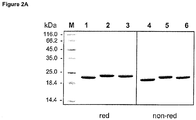
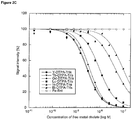
- Fig. 2B depicts binding activity in the ELISA.
- a microtiter plate was coated with the purified hNGAL variants, captured via an antibody specific for the Strep- tag II, and incubated with a dilution series of the Y ⁇ DTPA-DIG (small molecule) conjugate, followed by detection wiith anti-DIG Fab/AP and pNPP substrate (signal intensity is given in mOD/min).
- Recombinant wild type hNGAL revealed negligible signals in this assay (not shown).
- the hNGAL variant from the last maturation step, C26 was immobilized at a significantly lower density (100 vs. 250 nM with a capture antibody concentration of 2.5 vs. 10 ⁇ g/ml).
- Fig. 2E depicts the kinetic real time analysis of hNGAL variant CL31 measured on a Biacore instrument at a flow rate of 25 ⁇ l/min.
- the measured signal is shown as a gray line and the fitted curve as a black line in each case.
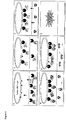
- Fig. 4(D) The radionuclide-DTPA complex is bound by the tumor-associated fusion protein while excess complex is rapidly excreted via the kidney.
- Fig. 4(E) Local decay of the bound radionuclide leads to efficient cell death in the tumor, also taking advantage of a bystander effect.
- Fig. 4(D*) Application of a bivalent version of the Me ⁇ DPTA complex leads to tighter binding at the tumor site via an avidity effect, thus allowing a prolonged retardation of the radionuclide.
- Y-DTPA-Tris conjugate was prepared for co-crystallization with hNGAL variants by incubating 528 ⁇ g (750 nmol) p -SCN-Bn-CHX-A"-DTPA in 100 ⁇ L 100 mM tris(hydroxymethyl)aminomethane (Tris; >99.9 %, AppliChem, Darmstadt, Germany) / HCl, pH 8.0, over night at room temperature - to achieve thiourea formation - and adding 227 ⁇ g (750 nmol) Y 3+ , resulting in a final ligand concentration of 7.5 mM.
- Tris tris(hydroxymethyl)aminomethane
- a combinatorial library of hNGAL variants was generated on the basis of the cloned cDNA ( Breustedt et al. (2006) Biochim. Biophys. Acta 1764, 161-173 ), which carried the amino acid substitutions Cys87Ser, to remove the single unpaired thiol side chain ( Goetz et al. (2000) Biochemistry 39, 1935-1941 ), as well as Gln28His and Thrl45Ala to introduce two unique Bst XI restriction sites with noncompatible overhangs, thus permitting unidirectional cloning of the mutagenized central gene cassette. Mutagenesis and polymerase chain reaction (PCR) assembly of this region was performed according to published strategy ( Beste et al. (1999) Proc. Natl.
- Example 3 Selection of hNGAL variants with affinity to metal chelate complex, Y ⁇ p- NH 2 -Bn-CHX-A"-DTPA by phage display and colony screening
- a culture of E. coli XL1-Blue transformed with the pNGAL35 library was infected with VCS-M13 helper phages (Stratagene, Amsterdam Zuidoost, The Netherlands), whereby biosynthesis of the hNGAL-pIII fusion protein was induced with 25 ⁇ g/L anhydrotetracycline (Acros, Geel, Belgium) following published protocols (Beste et al., supra ; Schlehuber et al., supra ).
- a filter sandwich colony screening assay was performed, whereby the hNGAL-ABD fusion proteins are released from the live colonies plated on a hydrophilic filter membrane and functionally captured on an underlying second membrane coated with human serum albumin (HSA) (Schlehuber et al., supra ).
- HSA human serum albumin
- This membrane was probed with 150 nM Tb ⁇ DTPA-BSA-DIG - or the corresponding RNase conjugate - in PBS/T for 1 h, followed by development with an anti-DIG Fab/alkaline phosphatase (AP) conjugate (Roche Diagnostics) and chromogenic staining according to the published protocol.
- AP anti-DIG Fab/alkaline phosphatase
- DTPA conjugates not charged with a metal ion were used as negative control and, to avoid erroneous signals arising from trace metal ion contamination, the high purity 0.1 M ammonium acetate buffer (>99.9 %), pH 7.1, was employed.
- the corresponding Bst XI cassette was subjected to error-prone PCR as described further below, followed by phagemid display.
- 10 11 recombinant phagemids were incubated for 1 h with ImmunoSticks that had been coated with 25 ⁇ g/ml of Tb ⁇ DTPA-RNase conjugate for the first cycle and with 10 ⁇ g/ml of Tb ⁇ DTPA-RNase conjugate for the second to fourth cycles.
- the corresponding Bst XI cassette was subjected to error-prone PCR (see below), followed by phagemid display, however, under conditions of limiting off-rate.
- 10 12 phagemids were incubated for 1 h at room temperature with ImmunoSticks that had been coated with 10 ⁇ g/ml of Y ⁇ DTPA-RNase conjugate.
- the sticks were incubated with 800 ⁇ L of a 500 ⁇ M solution of the free metal chelate complex, Y ⁇ p -NH 2 -Bn-CHX-A"-DTPA, in PBS for 30 min at room temperature to achieve competition.
- remaining bound phagemids were eluted under acid conditions as above. In this case, three selection cycles were carried out in total.
- the mutagenized hNGAL libraries were directly applied to the colony screen, yet under increasingly stringent conditions, by lowering the concentration of the Tb/Y ⁇ DTPA-RNase-DIG conjugate from 50 nM to 5 nM.
- the strictly monovalent Tb/Y ⁇ DTPA-DIG small molecule conjugate at concentrations of 20 nM to 1 nM was applied.
- a competitive colony screen was performed by incubating the second membrane first for 1 h with 10 nM Y ⁇ DTPA-DIG and then, after washing three times with PBS/T, with 10 ⁇ M of the free complex Y ⁇ p -NH 2 -Bn-CHX-A"-DTPA, followed by washing, detection, and staining as above.
- the 20 ⁇ l reaction mixture contained 10 ng template DNA, 25 ⁇ M of each the dNTP analogues 8-oxo-dGTP(8-oxo-2'-deoxyguanosine-5'-triphosphate) and dPTP(6-(2-deoxy- ⁇ -D-ribofuranosyl)-3,4-dihydro-8H-pyrimido-[4,5-c][1,2]-oxazine-7-one-5'-triphosphate) (both from TriLink, San Diego, CA), 500 ⁇ M conventional dNTPs, 0.5 ⁇ M flanking primers P5 and P6, 2 mM MgCl 2 , and 2.5 units of Taq DNA polymerase.
- Example 5 Targeted random mutagenesis of amino acid subsets in the first hNGAL variant
- primers P5 SEQ ID NO:15
- mut77back 5'-GGA ACC TGG AAC AAA AGT CAT GGT CAG GTA SNN ACA CTT CTT TTT CCT AAA CCT G-3' (SEQ ID NO:20)
- primers mut79for SEQ ID NO:18
- mut136back 5'-GCC AGC TCC TTG GTT CTC CCG AGG AGS NNG ATG GAG AAG TAC TCC CT-3' (SEQ ID NO:21).
- the two fragments were assembled using the primers P5 and P6 (SEQ ID NO:15 and 16).
- primers mut33for 5'-CAA TTC CAT GGG AAG TGG TAT NNS GTA GGT CGG GCA GGG-3' (SEQ ID NO:22), and mut54back, 5'-CTT CTT TCA GCT CAT AGA TSN NGG CGG TCA TCT TTT GCG G-3' (SEQ ID NO:23), were applied in a PCR using pNGAL15-Tb7.N9.N34 as template.
- a second PCR fragment was amplified using primers mut136for, 5'-ATC TAT GAG CTG AAA GAA G-3' (SEQ ID NO:24), and mut136back (SEQ ID NO:21).
- both PCR fragments were assembled with the flanking primers P5 (SEQ ID NO:15) and P6 (SEQ ID NO:16).
- the mutagenized DNA fragment was subcloned on pNGAL38 for subsequent colony screen.
- coli K12 TG1 (Gibson (1984) Studies on the Epstein-Barr virus genome, Cambridge University, England) that was cured from its episome using acridinium orange with the plasmids pNGAL14 (Breustedt et al., supra) and pNGAL15 for the wild type hNGAL and its variants, respectively, both encoding a fusion of the OmpA signal peptide with the mature hNGAL protein and the C-terminal Strep-tag II, whereby the latter carries the two non-compatible BstXI restriction sites for unidirectional subcloning of the mutated gene cassette.
- Example 7 Measurement of binding activity for the Me ⁇ DTPA group in an ELISA
- a fluorimetric AP substrate was used.
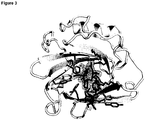
- the hNGAL variants Tb7.14 (SEQ ID NO:4) and Tb7.N9 (SEQ ID NO:6) were concentrated to 18 and 25 mg/ml, respectively, using 10 kDa cut-off Ultrafree concentrators (Millipore, Billerica, MA) and sterile filtered with a 0.45 mm Costar Spin-X centrifuge unit (Corning, Corning, NY). Both proteins were crystallized using the hanging drop vapour-diffusion technique ( Mc Pherson, Crystallization of biological macromolecules, Cold Spring Harbor, N.Y. Cold Spring Harbor Larboratory Press ).
- Tb7.14 For crystallization of Tb7.14, 1 ⁇ l solution of the apo-protein was mixed with 1 ⁇ l reservoir solution, comprising 2 M (NH 4 ) 2 SO 4 , 200 mM Li 2 SO 4 , 100 mM Tris/HCl, pH 7.0. Crystals of space group P4 1 2 1 2 with three molecules per asymmetric unit were obtained after 6 weeks at 20 °C. Tb7.N9 (SEQ ID NO:6) was crystallized at a final protein concentration of 22 mg/mL (1.1 mM) after adding a slight excess of Y ⁇ DTPA-Tris (1.6 mM).
- 1 ⁇ l protein/ligand solution was diluted with 1 ⁇ l water and mixed with 1 ⁇ l reservoir solution, comprising 22 % (w/v) PEG 3350, 100 mM Bis-tris/HCl, pH 5.5. Crystals of space group P4 1 2 1 2 with two protein chains per asymmetric unit were obtained after one week at 20 °C. Crystals of the two hNGAL variants were soaked in the corresponding precipitant solution supplemented with 30 and 20 % (v/v) glycerol, respectively, prior to freezing in liquid nitrogen.
- Tb7 SEQ ID NO:2
- Table 2 Sequence analysis of 16 selected clones revealed that 7 of these had an identical sequence, which was named Tb7 (SEQ ID NO:2) ( Table 2 ), whereas the remaining clones showed very similar sequences, with up to 4 amino acid exchanges compared with Tb7.
- Binding activity was first investigated in an EISA for the Tb ⁇ DTPA-RNase A conjugate that had also served during the selection procedure (see Materials & Methods).
- the variant Tb7 showed a strong and metal-dependent signal ( Fig. 2B ) with an apparent affinity in the low nanomolar range (74.5 ⁇ 7.8 nM) whereas wild-type hNGAL exhibited no measurable binding activity.
- a second generation library was constructed by error-prone PCR of the central gene cassette (flanked by the two Bst XI restriction sites at amino acid positions 25-29 and 141-145) in the presence of deoxynucleotide analogues (Zaccolo et al, supra ), followed by four cycles of phagemid display and colony screening under more stringent conditions (cf. above).
- DNA sequencing of 10 clones from the colony screen giving rise to the most intense signals for Tb ⁇ DTPA binding showed that nine of them carried the amino acid substitution Ile80Thr, together with one or two additional substitutions at positions 65, 71, 73, 74, 75, 116 or 135.
- the Y ⁇ DTPA-DIG conjugate was applied as target (i.e. switching from Tb 3+ to the medically more relevant Y 3+ ), whereas selection at positions 79/80 and 125/127 was performed with Tb ⁇ DPTA-RNase-DIG conjugate.
- the binding activity of the hNGAL variants for the small soluble chelate ligand was further investigated in a competition ELISA using microtiter plates coated with Tb ⁇ DTPA-RNase and Me ⁇ p -NH 2 -Bn-CHX-A"-DTPA as free ligand competitor, using Tb 3+ and Y 3+ as well as other trivalent metal ions. These measurements showed nice inhibition curves for the Tb 3+ /Y 3+ -charged chelate complex expecially in case of the variants Tb7.N9, Yd5, and C26 resulting from the affinity maturation. In contrast, the binding activity of Tb7 for the immobilized ligand was probably too weak to yield a proper competition effect.
Landscapes
- Health & Medical Sciences (AREA)
- Life Sciences & Earth Sciences (AREA)
- Chemical & Material Sciences (AREA)
- Organic Chemistry (AREA)
- General Health & Medical Sciences (AREA)
- Genetics & Genomics (AREA)
- Molecular Biology (AREA)
- Engineering & Computer Science (AREA)
- Proteomics, Peptides & Aminoacids (AREA)
- Medicinal Chemistry (AREA)
- Biochemistry (AREA)
- Veterinary Medicine (AREA)
- Pharmacology & Pharmacy (AREA)
- Animal Behavior & Ethology (AREA)
- Public Health (AREA)
- Zoology (AREA)
- Biotechnology (AREA)
- Physics & Mathematics (AREA)
- Bioinformatics & Cheminformatics (AREA)
- Epidemiology (AREA)
- Biomedical Technology (AREA)
- Biophysics (AREA)
- General Engineering & Computer Science (AREA)
- Wood Science & Technology (AREA)
- Optics & Photonics (AREA)
- Crystallography & Structural Chemistry (AREA)
- Toxicology (AREA)
- Plant Pathology (AREA)
- Virology (AREA)
- Microbiology (AREA)
- Gastroenterology & Hepatology (AREA)
- Chemical Kinetics & Catalysis (AREA)
- Nuclear Medicine, Radiotherapy & Molecular Imaging (AREA)
- General Chemical & Material Sciences (AREA)
- Peptides Or Proteins (AREA)
- Medicinal Preparation (AREA)
- Medicines That Contain Protein Lipid Enzymes And Other Medicines (AREA)
- Medicines Containing Antibodies Or Antigens For Use As Internal Diagnostic Agents (AREA)
- Preparation Of Compounds By Using Micro-Organisms (AREA)
- Micro-Organisms Or Cultivation Processes Thereof (AREA)
Priority Applications (2)
| Application Number | Priority Date | Filing Date | Title |
|---|---|---|---|
| EP18167640.4A EP3381933B1 (en) | 2008-06-24 | 2009-06-24 | Muteins of hngal and related proteins with affinity for a given target |
| DK18167640.4T DK3381933T3 (da) | 2008-06-24 | 2009-06-24 | Muteiner af hngal og relaterede proteiner med affinitet til et givet mål |
Applications Claiming Priority (2)
| Application Number | Priority Date | Filing Date | Title |
|---|---|---|---|
| US7517508P | 2008-06-24 | 2008-06-24 | |
| PCT/EP2009/057925 WO2009156456A1 (en) | 2008-06-24 | 2009-06-24 | Muteins of hngal and related proteins with affinity for a given target |
Related Child Applications (1)
| Application Number | Title | Priority Date | Filing Date |
|---|---|---|---|
| EP18167640.4A Division EP3381933B1 (en) | 2008-06-24 | 2009-06-24 | Muteins of hngal and related proteins with affinity for a given target |
Publications (2)
| Publication Number | Publication Date |
|---|---|
| EP2313430A1 EP2313430A1 (en) | 2011-04-27 |
| EP2313430B1 true EP2313430B1 (en) | 2018-05-02 |
Family
ID=41256028
Family Applications (2)
| Application Number | Title | Priority Date | Filing Date |
|---|---|---|---|
| EP09769304.8A Active EP2313430B1 (en) | 2008-06-24 | 2009-06-24 | Muteins of hngal and related proteins with affinity for a given target |
| EP18167640.4A Active EP3381933B1 (en) | 2008-06-24 | 2009-06-24 | Muteins of hngal and related proteins with affinity for a given target |
Family Applications After (1)
| Application Number | Title | Priority Date | Filing Date |
|---|---|---|---|
| EP18167640.4A Active EP3381933B1 (en) | 2008-06-24 | 2009-06-24 | Muteins of hngal and related proteins with affinity for a given target |
Country Status (7)
| Country | Link |
|---|---|
| US (2) | US8420051B2 (enExample) |
| EP (2) | EP2313430B1 (enExample) |
| JP (1) | JP5711118B2 (enExample) |
| AU (1) | AU2009264214B2 (enExample) |
| CA (1) | CA2729322C (enExample) |
| DK (1) | DK3381933T3 (enExample) |
| WO (1) | WO2009156456A1 (enExample) |
Families Citing this family (30)
| Publication number | Priority date | Publication date | Assignee | Title |
|---|---|---|---|---|
| WO2006115633A2 (en) | 2005-04-22 | 2006-11-02 | University Of Washington | Cyanine-chlorotoxin conjugate and method for intra-operative fluorescent visualization of cancer |
| WO2009140599A1 (en) | 2008-05-15 | 2009-11-19 | Transmolecular, Inc. | Treatment of metastatic tumors |
| EP2313430B1 (en) * | 2008-06-24 | 2018-05-02 | Technische Universität München | Muteins of hngal and related proteins with affinity for a given target |
| EP2990798B1 (en) * | 2009-12-07 | 2019-09-25 | Pieris Pharmaceuticals GmbH | Muteins of human lipocalin 2 (lcn2, hngal) with affinity for a given target |
| CN106995493B (zh) | 2010-02-04 | 2021-09-24 | 卫材公司 | 氯毒素多肽和结合物及其应用 |
| ES2601182T3 (es) | 2010-05-11 | 2017-02-14 | Fred Hutchinson Cancer Research Center | Variantes de clorotoxina, conjugados y métodos para su utilización |
| JP2013529907A (ja) * | 2010-05-24 | 2013-07-25 | ザ トラスティーズ オブ コロンビア ユニヴァーシティ イン ザ シティ オブ ニューヨーク | Ngalタンパク質変異体及びその使用 |
| AU2011290751B2 (en) * | 2010-08-16 | 2015-08-13 | Pieris Ag | Binding proteins for Hepcidin |
| CA2817779C (en) * | 2010-11-15 | 2019-02-19 | Pieris Ag | Muteins of human lipocalin 2 with affinity for glypican-3 (gpc3) |
| US9758554B2 (en) | 2012-01-31 | 2017-09-12 | Technische Universitaet Muenchen | Muteins of α1m lipocalin and method of production therefor |
| US20140122522A1 (en) * | 2012-10-26 | 2014-05-01 | Google Inc. | Method for providing users with help from their contacts while searching the web |
| WO2014081980A2 (en) | 2012-11-21 | 2014-05-30 | The Trustees Of Columbia University In The City Of New York | Mutant ngal proteins and uses thereof |
| CN105189540A (zh) | 2012-12-10 | 2015-12-23 | 弗莱德哈钦森癌症研究中心 | 含脂质运载蛋白融合伴侣 |
| CA2891557A1 (en) | 2013-03-26 | 2014-05-22 | Pieris Ag | Novel specific-binding polypeptides and uses thereof |
| US11559580B1 (en) | 2013-09-17 | 2023-01-24 | Blaze Bioscience, Inc. | Tissue-homing peptide conjugates and methods of use thereof |
| EP3102224B1 (en) | 2013-12-20 | 2019-02-20 | NephroGenesis, LLC. | Apparatuses for kidney dialysis and lipocalin protein for use in the prevention or treatment of uremia by dialysis |
| AU2015261968B2 (en) | 2014-05-22 | 2018-11-22 | Pieris Pharmaceuticals Gmbh | Novel specific-binding polypeptides and uses thereof |
| MX384075B (es) * | 2015-01-28 | 2025-03-14 | Pieris Pharmaceuticals Gmbh | Nuevas proteínas específicas para la angiogénesis. |
| WO2016131804A1 (en) | 2015-02-18 | 2016-08-25 | Sanofi | Novel proteins specific for pyoverdine and pyochelin |
| CN114316067A (zh) * | 2015-05-04 | 2022-04-12 | 皮里斯制药有限公司 | 抗癌融合多肽 |
| ES2932425T3 (es) | 2015-05-04 | 2023-01-19 | Pieris Pharmaceuticals Gmbh | Proteínas específicas para CD137 |
| MX390894B (es) | 2015-05-18 | 2025-03-21 | Pieris Pharmaceuticals Gmbh | Polipéptido de fusión anti-cáncer. |
| BR112017020961A2 (pt) | 2015-05-18 | 2018-07-10 | Pieris Pharmaceuticals Gmbh | muteína, molécula de ácido nucleico, célula hospedeira, método de produção de uma muteína e método de ligação |
| EP3115371A1 (en) | 2015-07-07 | 2017-01-11 | Sanofi | Fusion molecules |
| EP3115066A1 (en) | 2015-07-07 | 2017-01-11 | Technische Universität München | Novel psma-specific binding proteins |
| SG10201911499TA (en) | 2015-11-30 | 2020-01-30 | Pieris Australia Pty Ltd | Novel anti-angiogenic fusion polypeptides |
| TW201725212A (zh) * | 2015-12-10 | 2017-07-16 | 第一三共股份有限公司 | 特異性於降鈣素基因相關胜肽的新穎蛋白 |
| CA3021011A1 (en) | 2016-04-15 | 2017-10-19 | Blaze Bioscience, Inc. | Methods of treating breast cancer |
| CA3022751A1 (en) * | 2016-05-04 | 2017-11-09 | Navigo Proteins Gmbh | Targeted compounds for the site-specific coupling of chemical moieties comprising a peptide linker |
| ES3015117T3 (en) | 2016-08-29 | 2025-04-29 | Fred Hutchinson Cancer Center | Chelating platform for delivery of radionuclides |
Family Cites Families (22)
| Publication number | Priority date | Publication date | Assignee | Title |
|---|---|---|---|---|
| JPH01215289A (ja) | 1988-02-22 | 1989-08-29 | Toa Nenryo Kogyo Kk | 遺伝子組換えによる正常ヒト血清アルブミンaの製造方法 |
| FR2649991B2 (fr) | 1988-08-05 | 1994-03-04 | Rhone Poulenc Sante | Utilisation de derives stables du plasmide pkd1 pour l'expression et la secretion de proteines heterologues dans les levures du genre kluyveromyces |
| US5124471A (en) | 1990-03-26 | 1992-06-23 | The United States Of America As Represented By The Secretary Of The Department Of Health And Human Services | Bifunctional dtpa-type ligand |
| US5756825A (en) | 1992-09-08 | 1998-05-26 | Safavy; Ahmad | Hydroxamic acid-based bifunctional chelating compounds |
| US5728553A (en) | 1992-09-23 | 1998-03-17 | Delta Biotechnology Limited | High purity albumin and method of producing |
| US5908621A (en) | 1995-11-02 | 1999-06-01 | Schering Corporation | Polyethylene glycol modified interferon therapy |
| US6620413B1 (en) | 1995-12-27 | 2003-09-16 | Genentech, Inc. | OB protein-polymer chimeras |
| DE19742706B4 (de) | 1997-09-26 | 2013-07-25 | Pieris Proteolab Ag | Lipocalinmuteine |
| GB9722131D0 (en) | 1997-10-20 | 1997-12-17 | Medical Res Council | Method |
| CA2233725A1 (en) | 1998-03-31 | 1999-09-30 | Hemosol Inc. | Hemoglobin-hydroxyethyl starch complexes |
| DK1087778T3 (da) | 1998-06-08 | 2005-12-19 | Hoffmann La Roche | Anvendelse af PEG-IFN-alfa og Ribavirin til behandling af kronisk hepatitis C |
| US6403564B1 (en) | 1998-10-16 | 2002-06-11 | Schering Corporation | Ribavirin-interferon alfa combination therapy for eradicating detectable HCV-RNA in patients having chronic hepatitis C infection |
| DE19926068C1 (de) | 1999-06-08 | 2001-01-11 | Arne Skerra | Muteine des Bilin-Bindungsproteins |
| CA2440582A1 (en) | 2001-03-09 | 2002-10-03 | Dyax Corp. | Serum albumin binding moieties |
| WO2003029462A1 (en) | 2001-09-27 | 2003-04-10 | Pieris Proteolab Ag | Muteins of human neutrophil gelatinase-associated lipocalin and related proteins |
| US7118915B2 (en) | 2001-09-27 | 2006-10-10 | Pieris Proteolab Ag | Muteins of apolipoprotein D |
| WO2005019255A1 (en) | 2003-08-25 | 2005-03-03 | Pieris Proteolab Ag | Muteins of tear lipocalin |
| WO2005019254A1 (en) | 2003-08-25 | 2005-03-03 | Pieris Proteolab Ag | Muteins of a bilin-binding protein with affinity for a given target |
| US7517508B2 (en) | 2004-07-26 | 2009-04-14 | Isoray Medical, Inc. | Method of separating and purifying Yttrium-90 from Strontium-90 |
| US7892827B2 (en) | 2004-11-26 | 2011-02-22 | Pieris Ag | Compound with affinity for the cytotoxic T lymphocyte-associated antigen (CTLA-4) |
| US20070191272A1 (en) | 2005-09-27 | 2007-08-16 | Stemmer Willem P | Proteinaceous pharmaceuticals and uses thereof |
| EP2313430B1 (en) * | 2008-06-24 | 2018-05-02 | Technische Universität München | Muteins of hngal and related proteins with affinity for a given target |
-
2009
- 2009-06-24 EP EP09769304.8A patent/EP2313430B1/en active Active
- 2009-06-24 WO PCT/EP2009/057925 patent/WO2009156456A1/en not_active Ceased
- 2009-06-24 EP EP18167640.4A patent/EP3381933B1/en active Active
- 2009-06-24 DK DK18167640.4T patent/DK3381933T3/da active
- 2009-06-24 AU AU2009264214A patent/AU2009264214B2/en active Active
- 2009-06-24 CA CA2729322A patent/CA2729322C/en active Active
- 2009-06-24 JP JP2011514065A patent/JP5711118B2/ja active Active
- 2009-06-24 US US12/737,240 patent/US8420051B2/en active Active
-
2013
- 2013-04-09 US US13/859,119 patent/US9040020B2/en active Active
Non-Patent Citations (2)
| Title |
|---|
| ARNE SKERRA: "Alternative binding proteins: Anticalins - harnessing the structural plasticity of the lipocalin ligand pocket to engineer novel binding activities", FEBS JOURNAL, vol. 275, no. 11, 24 June 2008 (2008-06-24), pages 2677 - 2683, XP055099855, ISSN: 1742-464X, DOI: 10.1111/j.1742-4658.2008.06439.x * |
| KJELDSEN L ET AL: "Human neutrophil gelatinase-associated lipocalin and homologous proteins in rat and mouse", BIOCHIMICA ET BIOPHYSICA ACTA. PROTEIN STRUCTURE AND MOLECULAR ENZYMOLOGY, ELSEVIER, AMSTERDAM; NL, vol. 1482, no. 1-2, 18 October 2000 (2000-10-18), pages 272 - 283, XP004279080, ISSN: 0167-4838, DOI: 10.1016/S0167-4838(00)00152-7 * |
Also Published As
| Publication number | Publication date |
|---|---|
| AU2009264214A1 (en) | 2009-12-30 |
| CA2729322A1 (en) | 2009-12-30 |
| US20130316962A1 (en) | 2013-11-28 |
| AU2009264214B2 (en) | 2013-06-06 |
| EP3381933A1 (en) | 2018-10-03 |
| EP3381933B1 (en) | 2020-06-03 |
| WO2009156456A1 (en) | 2009-12-30 |
| DK3381933T3 (da) | 2020-08-03 |
| US20110262353A1 (en) | 2011-10-27 |
| JP5711118B2 (ja) | 2015-04-30 |
| US8420051B2 (en) | 2013-04-16 |
| CA2729322C (en) | 2020-05-26 |
| JP2011525354A (ja) | 2011-09-22 |
| EP2313430A1 (en) | 2011-04-27 |
| US9040020B2 (en) | 2015-05-26 |
Similar Documents
| Publication | Publication Date | Title |
|---|---|---|
| EP2313430B1 (en) | Muteins of hngal and related proteins with affinity for a given target | |
| US11827681B2 (en) | Muteins of human lipocalin 2 (Lcn2, hNGAL) with affinity for a given target | |
| US11628222B2 (en) | CD71 binding fibronectin type III domains | |
| RS58839B1 (sr) | Muteini lipokalina u suzama koji vezuju il-4 r alfa | |
| US9598476B2 (en) | Nucleic acid molecules encoding muteins of human tear lipocalin which bind PCSK9 | |
| US20250129137A1 (en) | Cd71 binding fibronectin type iii domains | |
| AU2013224694B2 (en) | MUTEINS OF hNGAL AND RELATED PROTEINS WITH AFFINITY FOR A GIVEN TARGET |
Legal Events
| Date | Code | Title | Description |
|---|---|---|---|
| PUAI | Public reference made under article 153(3) epc to a published international application that has entered the european phase |
Free format text: ORIGINAL CODE: 0009012 |
|
| 17P | Request for examination filed |
Effective date: 20110124 |
|
| AK | Designated contracting states |
Kind code of ref document: A1 Designated state(s): AT BE BG CH CY CZ DE DK EE ES FI FR GB GR HR HU IE IS IT LI LT LU LV MC MK MT NL NO PL PT RO SE SI SK TR |
|
| AX | Request for extension of the european patent |
Extension state: AL BA RS |
|
| 17Q | First examination report despatched |
Effective date: 20140428 |
|
| GRAP | Despatch of communication of intention to grant a patent |
Free format text: ORIGINAL CODE: EPIDOSNIGR1 |
|
| INTG | Intention to grant announced |
Effective date: 20171116 |
|
| GRAS | Grant fee paid |
Free format text: ORIGINAL CODE: EPIDOSNIGR3 |
|
| GRAA | (expected) grant |
Free format text: ORIGINAL CODE: 0009210 |
|
| AK | Designated contracting states |
Kind code of ref document: B1 Designated state(s): AT BE BG CH CY CZ DE DK EE ES FI FR GB GR HR HU IE IS IT LI LT LU LV MC MK MT NL NO PL PT RO SE SI SK TR |
|
| AX | Request for extension of the european patent |
Extension state: AL BA RS |
|
| REG | Reference to a national code |
Ref country code: GB Ref legal event code: FG4D |
|
| REG | Reference to a national code |
Ref country code: CH Ref legal event code: EP Ref country code: AT Ref legal event code: REF Ref document number: 995143 Country of ref document: AT Kind code of ref document: T Effective date: 20180515 |
|
| REG | Reference to a national code |
Ref country code: DE Ref legal event code: R096 Ref document number: 602009052113 Country of ref document: DE Ref country code: IE Ref legal event code: FG4D |
|
| REG | Reference to a national code |
Ref country code: DE Ref legal event code: R096 Ref document number: 602009052113 Country of ref document: DE |
|
| REG | Reference to a national code |
Ref country code: FR Ref legal event code: PLFP Year of fee payment: 10 |
|
| REG | Reference to a national code |
Ref country code: NL Ref legal event code: MP Effective date: 20180502 |
|
| REG | Reference to a national code |
Ref country code: LT Ref legal event code: MG4D |
|
| PG25 | Lapsed in a contracting state [announced via postgrant information from national office to epo] |
Ref country code: ES Free format text: LAPSE BECAUSE OF FAILURE TO SUBMIT A TRANSLATION OF THE DESCRIPTION OR TO PAY THE FEE WITHIN THE PRESCRIBED TIME-LIMIT Effective date: 20180502 Ref country code: NO Free format text: LAPSE BECAUSE OF FAILURE TO SUBMIT A TRANSLATION OF THE DESCRIPTION OR TO PAY THE FEE WITHIN THE PRESCRIBED TIME-LIMIT Effective date: 20180802 Ref country code: LT Free format text: LAPSE BECAUSE OF FAILURE TO SUBMIT A TRANSLATION OF THE DESCRIPTION OR TO PAY THE FEE WITHIN THE PRESCRIBED TIME-LIMIT Effective date: 20180502 Ref country code: SE Free format text: LAPSE BECAUSE OF FAILURE TO SUBMIT A TRANSLATION OF THE DESCRIPTION OR TO PAY THE FEE WITHIN THE PRESCRIBED TIME-LIMIT Effective date: 20180502 Ref country code: FI Free format text: LAPSE BECAUSE OF FAILURE TO SUBMIT A TRANSLATION OF THE DESCRIPTION OR TO PAY THE FEE WITHIN THE PRESCRIBED TIME-LIMIT Effective date: 20180502 Ref country code: BG Free format text: LAPSE BECAUSE OF FAILURE TO SUBMIT A TRANSLATION OF THE DESCRIPTION OR TO PAY THE FEE WITHIN THE PRESCRIBED TIME-LIMIT Effective date: 20180802 |
|
| PG25 | Lapsed in a contracting state [announced via postgrant information from national office to epo] |
Ref country code: NL Free format text: LAPSE BECAUSE OF FAILURE TO SUBMIT A TRANSLATION OF THE DESCRIPTION OR TO PAY THE FEE WITHIN THE PRESCRIBED TIME-LIMIT Effective date: 20180502 Ref country code: LV Free format text: LAPSE BECAUSE OF FAILURE TO SUBMIT A TRANSLATION OF THE DESCRIPTION OR TO PAY THE FEE WITHIN THE PRESCRIBED TIME-LIMIT Effective date: 20180502 Ref country code: HR Free format text: LAPSE BECAUSE OF FAILURE TO SUBMIT A TRANSLATION OF THE DESCRIPTION OR TO PAY THE FEE WITHIN THE PRESCRIBED TIME-LIMIT Effective date: 20180502 Ref country code: GR Free format text: LAPSE BECAUSE OF FAILURE TO SUBMIT A TRANSLATION OF THE DESCRIPTION OR TO PAY THE FEE WITHIN THE PRESCRIBED TIME-LIMIT Effective date: 20180803 |
|
| REG | Reference to a national code |
Ref country code: AT Ref legal event code: MK05 Ref document number: 995143 Country of ref document: AT Kind code of ref document: T Effective date: 20180502 |
|
| PG25 | Lapsed in a contracting state [announced via postgrant information from national office to epo] |
Ref country code: PT Free format text: LAPSE BECAUSE OF FAILURE TO SUBMIT A TRANSLATION OF THE DESCRIPTION OR TO PAY THE FEE WITHIN THE PRESCRIBED TIME-LIMIT Effective date: 20180903 |
|
| PG25 | Lapsed in a contracting state [announced via postgrant information from national office to epo] |
Ref country code: SK Free format text: LAPSE BECAUSE OF FAILURE TO SUBMIT A TRANSLATION OF THE DESCRIPTION OR TO PAY THE FEE WITHIN THE PRESCRIBED TIME-LIMIT Effective date: 20180502 Ref country code: RO Free format text: LAPSE BECAUSE OF FAILURE TO SUBMIT A TRANSLATION OF THE DESCRIPTION OR TO PAY THE FEE WITHIN THE PRESCRIBED TIME-LIMIT Effective date: 20180502 Ref country code: EE Free format text: LAPSE BECAUSE OF FAILURE TO SUBMIT A TRANSLATION OF THE DESCRIPTION OR TO PAY THE FEE WITHIN THE PRESCRIBED TIME-LIMIT Effective date: 20180502 Ref country code: DK Free format text: LAPSE BECAUSE OF FAILURE TO SUBMIT A TRANSLATION OF THE DESCRIPTION OR TO PAY THE FEE WITHIN THE PRESCRIBED TIME-LIMIT Effective date: 20180502 Ref country code: AT Free format text: LAPSE BECAUSE OF FAILURE TO SUBMIT A TRANSLATION OF THE DESCRIPTION OR TO PAY THE FEE WITHIN THE PRESCRIBED TIME-LIMIT Effective date: 20180502 Ref country code: PL Free format text: LAPSE BECAUSE OF FAILURE TO SUBMIT A TRANSLATION OF THE DESCRIPTION OR TO PAY THE FEE WITHIN THE PRESCRIBED TIME-LIMIT Effective date: 20180502 Ref country code: CZ Free format text: LAPSE BECAUSE OF FAILURE TO SUBMIT A TRANSLATION OF THE DESCRIPTION OR TO PAY THE FEE WITHIN THE PRESCRIBED TIME-LIMIT Effective date: 20180502 |
|
| REG | Reference to a national code |
Ref country code: DE Ref legal event code: R097 Ref document number: 602009052113 Country of ref document: DE |
|
| PG25 | Lapsed in a contracting state [announced via postgrant information from national office to epo] |
Ref country code: IT Free format text: LAPSE BECAUSE OF FAILURE TO SUBMIT A TRANSLATION OF THE DESCRIPTION OR TO PAY THE FEE WITHIN THE PRESCRIBED TIME-LIMIT Effective date: 20180502 |
|
| PLBE | No opposition filed within time limit |
Free format text: ORIGINAL CODE: 0009261 |
|
| STAA | Information on the status of an ep patent application or granted ep patent |
Free format text: STATUS: NO OPPOSITION FILED WITHIN TIME LIMIT |
|
| REG | Reference to a national code |
Ref country code: IE Ref legal event code: MM4A |
|
| 26N | No opposition filed |
Effective date: 20190205 |
|
| PG25 | Lapsed in a contracting state [announced via postgrant information from national office to epo] |
Ref country code: IE Free format text: LAPSE BECAUSE OF NON-PAYMENT OF DUE FEES Effective date: 20180624 |
|
| PG25 | Lapsed in a contracting state [announced via postgrant information from national office to epo] |
Ref country code: SI Free format text: LAPSE BECAUSE OF FAILURE TO SUBMIT A TRANSLATION OF THE DESCRIPTION OR TO PAY THE FEE WITHIN THE PRESCRIBED TIME-LIMIT Effective date: 20180502 |
|
| PG25 | Lapsed in a contracting state [announced via postgrant information from national office to epo] |
Ref country code: MT Free format text: LAPSE BECAUSE OF NON-PAYMENT OF DUE FEES Effective date: 20180624 |
|
| PG25 | Lapsed in a contracting state [announced via postgrant information from national office to epo] |
Ref country code: TR Free format text: LAPSE BECAUSE OF FAILURE TO SUBMIT A TRANSLATION OF THE DESCRIPTION OR TO PAY THE FEE WITHIN THE PRESCRIBED TIME-LIMIT Effective date: 20180502 |
|
| PG25 | Lapsed in a contracting state [announced via postgrant information from national office to epo] |
Ref country code: HU Free format text: LAPSE BECAUSE OF FAILURE TO SUBMIT A TRANSLATION OF THE DESCRIPTION OR TO PAY THE FEE WITHIN THE PRESCRIBED TIME-LIMIT; INVALID AB INITIO Effective date: 20090624 |
|
| PG25 | Lapsed in a contracting state [announced via postgrant information from national office to epo] |
Ref country code: MK Free format text: LAPSE BECAUSE OF NON-PAYMENT OF DUE FEES Effective date: 20180502 Ref country code: CY Free format text: LAPSE BECAUSE OF FAILURE TO SUBMIT A TRANSLATION OF THE DESCRIPTION OR TO PAY THE FEE WITHIN THE PRESCRIBED TIME-LIMIT Effective date: 20180502 |
|
| PG25 | Lapsed in a contracting state [announced via postgrant information from national office to epo] |
Ref country code: IS Free format text: LAPSE BECAUSE OF FAILURE TO SUBMIT A TRANSLATION OF THE DESCRIPTION OR TO PAY THE FEE WITHIN THE PRESCRIBED TIME-LIMIT Effective date: 20180902 |
|
| P01 | Opt-out of the competence of the unified patent court (upc) registered |
Free format text: CASE NUMBER: UPC_APP_410038/2023 Effective date: 20230508 |
|
| PGFP | Annual fee paid to national office [announced via postgrant information from national office to epo] |
Ref country code: MC Payment date: 20250624 Year of fee payment: 17 |
|
| PGFP | Annual fee paid to national office [announced via postgrant information from national office to epo] |
Ref country code: DE Payment date: 20250618 Year of fee payment: 17 |
|
| PGFP | Annual fee paid to national office [announced via postgrant information from national office to epo] |
Ref country code: GB Payment date: 20250618 Year of fee payment: 17 |
|
| PGFP | Annual fee paid to national office [announced via postgrant information from national office to epo] |
Ref country code: LU Payment date: 20250627 Year of fee payment: 17 Ref country code: BE Payment date: 20250618 Year of fee payment: 17 |
|
| PGFP | Annual fee paid to national office [announced via postgrant information from national office to epo] |
Ref country code: FR Payment date: 20250624 Year of fee payment: 17 |
|
| PGFP | Annual fee paid to national office [announced via postgrant information from national office to epo] |
Ref country code: CH Payment date: 20250701 Year of fee payment: 17 |