EP2312028A1 - Partial knitting method and fabric - Google Patents
Partial knitting method and fabric Download PDFInfo
- Publication number
- EP2312028A1 EP2312028A1 EP09758082A EP09758082A EP2312028A1 EP 2312028 A1 EP2312028 A1 EP 2312028A1 EP 09758082 A EP09758082 A EP 09758082A EP 09758082 A EP09758082 A EP 09758082A EP 2312028 A1 EP2312028 A1 EP 2312028A1
- Authority
- EP
- European Patent Office
- Prior art keywords
- knitting
- stitch
- turn
- flechage
- course
- Prior art date
- Legal status (The legal status is an assumption and is not a legal conclusion. Google has not performed a legal analysis and makes no representation as to the accuracy of the status listed.)
- Granted
Links
Images




Classifications
-
- D—TEXTILES; PAPER
- D04—BRAIDING; LACE-MAKING; KNITTING; TRIMMINGS; NON-WOVEN FABRICS
- D04B—KNITTING
- D04B1/00—Weft knitting processes for the production of fabrics or articles not dependent on the use of particular machines; Fabrics or articles defined by such processes
- D04B1/22—Weft knitting processes for the production of fabrics or articles not dependent on the use of particular machines; Fabrics or articles defined by such processes specially adapted for knitting goods of particular configuration
- D04B1/24—Weft knitting processes for the production of fabrics or articles not dependent on the use of particular machines; Fabrics or articles defined by such processes specially adapted for knitting goods of particular configuration wearing apparel
Definitions
- the present invention relates to a flechage knitting method made up of forward knitting and backward knitting, and knitted fabric formed by this knitting method.
- Patent Document 1 there is disclosed a knitting method of knitted fabric in which flechage knitting is performed in a neckline portion of a sweater to form a neck hole, and then, a collar portion is formed where the neck hole is formed.
- Fig. 1 is an overall diagram of a sweater 100 made up of a front body 20 and a back body 30.
- This sweater 100 has a neckline portion 41, which forms a neck hole, and a collar portion 40 formed in this neckline portion 41.
- Fig. 7 is a knitting process chart for forming the neckline portion 41 and the collar portion 40 on the left side of a paper face of the front body 20 in the sweater 10 by conventional flechage knitting.
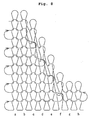
- Fig. 8 is a loop diagram of the knitted fabric formed by this knitting process. In Fig.
- a numeric character in the left column denotes a number of a knitting step
- the middle column denotes a knitting direction of the knitted fabric in the knitted step
- the right column denotes a knitting state of the knitted fabric.
- a black circle in the right column denotes a stitch formed in the knitted step
- a white circle denotes a stitch held in a knitting needle
- a V letter denotes a tuck
- a black triangle denotes a yarn feeder.
- FB in the right column in Fig. 7 denotes a front needle bed
- BB denotes a back needle bed
- alphabets denote knitting needles.
- Stitches knitted with the knitting needles of these alphabets in Fig. 7 are the stitches arranged above the alphabets in Fig. 8 .
- Figs. 7 and 8 a state where a rib structure is knitted using FB and BB is described.
- the flechage knitting starts to be performed from a state in step S00 (a lowest knitting course in Fig. 8 ).
- the flechage knitting is made up of forward knitting (step S01) and backward knitting (step S02), and when the yarn feeder turns back, tuck is performed so as not to produce a hole at a position of a turn-back end in the knitted fabric.
- This flechage knitting is performed while sequentially displacing the turn-back position, so that the knitting needle of the end portion in a knitting width is sequentially passed over in the knitting to be put into a non-operating state (steps S03 to S08), by which the neckline portion 41 in Fig. 1 is formed.
- the knitting to the stitches (including the tucks) held in the knitting needles is carried out (step S09) to thereby form the collar portion 40 of the sweater.
- the knitted fabric portion where the flechage knitting is not performed inhibits the knitted fabric portion which is being newly formed by performing the flechage knitting from going down below the needle bed gap. Consequently, as the number of times of flechage knitting becomes larger, stitches held in the knitting needles in the portion where the flechage knitting is performed become pushed upward, which causes a possibility that knitting operation (particularly, knock-over) cannot be performed.
- the present invention has been made in light of the above-described circumustances, and one object thereof is to provide a flechage knitting method capable of increasing the number of courses in which the flechage knitting can be performed, as compared with the conventional flechage knitting using tuck. Moreover, another object of the present invention is to provide a flechage knitting method capable of forming knitted fabric in which a border portion between a knitted fabric portion subjected to the flechage knitting and a knitted fabric portion adjoining this knitted fabric is inconspicuous.
- the present invention is a flechage knitting method for performing flechage knitting made up of forward knitting and backward knitting, using a flat knitting machine that includes at least a pair of front and back needle beds and is capable of transferring a stitch between the front and back needle beds.
- the flechage knitting method of the present invention includes performing first flechage knitting made up of first forward knitting and first backward knitting on a base course, the first flechage knitting includes the following steps:
- the order of steps involved in the foregoing first flechage knitting may be selected so that the first yarn hooked portion connecting the stitch at the dead end of the first forward knitting and the stitch at the starting point of the first backward knitting is wound around the first turn-back point stitch of the base course.
- the order is such that the transferring step ⁇ the forward knitting step ⁇ the returning step ⁇ the backward knitting step or such that the forward knitting step ⁇ the transferring step ⁇ the backward knitting step ⁇ the returning step.
- second flechage knitting made up of second forward knitting and second backward knitting may be performed right after the first flechage knitting.
- the second flechage knitting preferably includes the following steps.
- the order of steps involved in the foregoing second flechage knitting may be also selected as in the first flechage knitting. Specifically, it can be considered that the order is such that the transferring step ⁇ the forward knitting step ⁇ the returning step ⁇ the backward knitting step or such that the forward knitting step ⁇ the transferring step ⁇ the backward knitting step ⁇ the returning step.
- the order may be also selected so that the second yarn hooked portion connecting the stitch at the dead end of the second forward knitting and the stitch at the starting point of the second backward knitting is wound around the second turn-back point stitch of the base course.
- the flechage knitting method of the present invention it is preferable to further include a step of knitting one course to stitches held in the needle bed after finishing the flechage knitting, wherein in this knitting course, miss knitting is performed at a position of a stitch connecting to the first turn-back point stitch in a wale direction.
- Knitted fabric of the present invention is formed using a flat knitting machine having at least a pair of front and back needle beds and being capable of transferring a stitch between the front and back needle beds, and has a first flechage knitting portion made up of a first forward knitting course and a first backward knitting course on a base course.
- the knitted fabric includes: a first turn-back point stitch which is one of stitches of the base course; a stitch at a dead end of the first forward knitting course, the stitch being formed on a stitch next to the first turn-back point stitch; a stitch at a starting point of the first backward knitting course, the stitch being formed on the stitch at the dead end; and a first yarn hooked portion extending from the stitch at the dead end to wind one time around the first turn-back point stitch and then connect to the stitch at the starting point.
- a first turn-back point stitch which is one of stitches of the base course
- a stitch at a dead end of the first forward knitting course the stitch being formed on a stitch next to the first turn-back point stitch
- a stitch at a starting point of the first backward knitting course the stitch being formed on the stitch at the dead end
- a first yarn hooked portion extending from the stitch at the dead end to wind one time around the first turn-back point stitch and then connect to the stitch at the starting point.
- the knitted fabric of the present invention may further include a second flechage knitting portion that is formed on the first flechage knitting portion, and is made up of a second forward knitting course and a second backward knitting course.
- the knitted fabric includes: a second turn-back point stitch adjoining the first turn-back point stitch on an opposite side of the first flechage knitting portion, among the stitches in the base course; a stitch at a dead end of the second forward knitting course, the stitch being formed on the first turn-back point stitch; a stitch at a starting point of the second backward knitting course, the stitch being formed on the stitch at the dead end; and a second yarn hooked portion extending from the stitch at the dead end to wind one time around the second turn-back point stitch and then connect to the stitch at the starting point.
- the turn back from the forward knitting to the backward knitting is performed by winding the yarn hooked portion connecting the stitch at the dead end of the forward knitting and the stitch at the starting point of the backward knitting around the turn-back point stitch serving as an origin of the turn back. Since this yarn hooked portion is not held in the knitting needle in the knitting process, it has a relatively large movable margin. Moreover, although the turn-back point stitch around which the yarn hooked portion is wound is hooked in the knitting needle, no knitting yarn but this stitch is hooked in the same needle, which gives a movable margin to the turn-back point stitch as well.
- the knitted fabric portion where the flechage knitting is not performed hardly inhibits the knitted fabric portion that are newly formed by performing the flechage knitting from going down below the needle bed gap.
- the number of times of the flechage knitting can be increased, thereby enhancing a degree of freedom in designing the knitted fabric.
- the turn-back portion is inconspicuous.
- the turn-back point stitch is pulled in the knitting width direction by the yarn hooked portion, there may be a slight clearance between the turn-back point stitch and the stitch adjoining this stitch.
- miss knitting is performed with the knitting needle holding the first turn-back point stitch, the first turn-back point stitch is pulled up in the wale direction, which makes the clearance vertically long and thus, inconspicuous.
- the configuration in which the two turn-back point stitches are arranged side by side brings about the similar effect.
- the reason why the first turn-back point stitch is pulled up in the wale direction as described above is that the miss knitting decreases the number of stitches continuous to the first turn-back point stitch on the upper side in the wale direction by one.
- Embodiments 1, 2 preferred embodiments of the present invention are described in detail with reference to the drawings.
- the sweater 100 being tubular knitted fabric made up of the front body 20 and the back body 30 as shown in Fig. 1 .
- This sweater 100 is formed with the collar portion 40 at the neckline portion 41, and for the knitting of this neckline portion 41 and the collar portion 40, flechage knitting of the present invention is used.
- the flechage knitting method of the present invention can be applied to any knitted fabric having a portion in which the flechage knitting is performed, and thus, an application object is not limited to the tubular knitted fabric.
- the flat knitting machine is a flat knitting machine having at least a pair of front and back needle beds extending in a traverse direction and disposed opposite to each other in a cross direction.
- a two-bed flat knitting machine including a front needle bed (hereinafter, referred to as FB), and a back needle bed (hereinafter, referred to as BB), a four-bed flat knitting machine further including two needle beds opposite to each other above the front and back needle beds, and the like can be cited.
- the front body 20 is knitted up to a position 50 at a lower end of the collar portion 40, and an outline of the neckline portion 41 is formed by flechage knitting.
- the collar portion 40 is knitted on stitches making up the neckline portion 41.
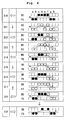
- Fig. 2 is a knitting process chart showing the flechage knitting in the neckline portion 41 and the knitting of the collar portion 40 in the sweater 100 (up-down thin arrows in the middle column and in the right column denote transfer).
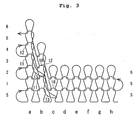
- Fig. 3 is a loop diagram of knitted fabric formed by the knitting process in Fig. 2 , and numeric characters arranged on the right and on the left in Fig. 3 denote the order of knitting a knitting course of interest.
- the way of viewing these Figs. 2 , 3 ( Figs. 4 , 5 described later) is the same as that of Figs. 7 , 8 referred to in the description of Background Art.
- Figs. 2 , 3 illustrate a rib structure where front stitches and back stitches are formed as they coexist using FB and BB, in which the numbers of knitting courses and stitches are smaller than actual knitted fabric for convenience of description.
- Step S0 in Fig. 2 shows a state where the knitting up to the position 50 at the lower end of the collar portion 40 in the sweater 100 shown in Fig. 1 is finished.
- a knitting course S (refer to Fig. 3 ), which is knitted in step S0 to serve as a base course, has a rib structure.
- step S0 initial first flechage knitting made up of first forward knitting and first backward knitting is carried out. Stitches given reference numerals in the following description are shown with the reference numerals in Fig. 3 .
- a stitch held in a knitting needle c of BB (a first turn-back point stitch 18) among stitches of the knitting course S is transferred to a knitting needle c of opposite FB (step S1).
- This knitting needle c of BB is located one ahead of a knitting needle b in a movement direction of the knitting, in which the knitting needle b will be at a position as a dead end of a first forward knitting course formed in step S2.
- step S2 the first forward knitting to form stitches with knitting needles a, b of FB is performed (step S2), by which a knitting course 1 in Fig. 3 is formed.
- the yarn feeder passes over a position of the knitting needle c so that a knitting yarn extending from a stitch 11 at the dead end of the knitting course 1, which is held in knitting needle b, (a first yarn hooked portion 13) crosses the transferred first turn-back point stitch 18 (the knitting needle c of FB) in a knitting width direction.
- the first turn-back point stitch 18 transferred to the knitting needle c of FB in step S1 is returned to the knitting needle c of BB (step S3), and the first backward knitting is performed (step S4).
- a stitch 12 at a starting point of the first backward knitting is formed on the stitch 11 at the dead end of the first forward knitting, which is held in the knitting needle b.
- the first flechage knitting portion made up of the knitting course 1 and a knitting course 2 in Fig. 3 is formed, and the first yarn hooked portion 13 connecting the stitch 11 at the dead end of the knitting course 1 formed by the first forward knitting and the stitch 12 at the starting point of the knitting course 2 formed by the first backward knitting is wound by one turn around the first turn-back point stitch 18 held in the knitting needle c of the knitting course S.
- the yarn hooked portion 13 in the first flechage knitting portion is not held in the knitting needle, it has a relatively large movable margin.
- the turn-back point stitch 18 around which the yarn hooked portion 13 is wound also has a movable margin, because although it is hooked on the knitting needle, no knitting yarn other than this stitch is hooked on the same knitting needle. Consequently, the knitted fabric portion subjected to the flechage knitting is hardly inhibited from going down below a needle bed gap by a knitted fabric portion where the flechage knitting is not performed.
- the first flechage knitting is carried out again with the knitting course 2 in Fig 3 serving as a base course to knit the knitting courses 3, 4.
- the next turn-back point stitch 18 (which is also the stitch 12 at the starting point in steps S1 to S4) is a stitch knitted in FB. Consequently, similar to the yarn hooked portion 13 in steps S1 to S4, in order to wind the yarn hooked portion 13 in steps S5 to S8 from an inner side (an inner side of the tube) to an outer side, the order of the steps involved in the first flechage knitting is changed.
- the knitting is performed in the order of the forward knitting step (step S5) ⁇ the transferring step (step S6) ⁇ the backward knitting step (step S7) ⁇ a returning step (step S8) to thereby knit the knitting courses 3, 4 in Fig. 3 .
- the knitted fabric portion where the flechage knitting is not performed since there is a movable margin in each of the yarn hooked portion 13 and the turn-back point stitch 18, the knitted fabric portion where the flechage knitting is not performed hardly inhibits the knitted fabric portion subjected to the flechage knitting from going down below the needle bed gap.
- step SF the knitting is finally performed by one course to the stitches held in the knitting needles of the needle bed (step SF), and then the formation of the collar portion with a knitting course 5 serving as a first knitting course is started.
- the above-described knitting in step S1 to S4 and knitting in step S5 to S8 may be appropriately combined and repeated a required number of times.
- the number of times of flechage knitting can be made larger than the case where the conventional flechage knitting method is used. As a result, a sweater with a deep neckline portion can be knitted.
- the need to transfer the stitches between the front and back needle beds arises.
- the stitch of the turn-back portion is also to be transferred.
- the knitting yarn hooked doubly in the knitting needle of the turn-back portion is transferred, which causes a possibility of failing the transfer.
- the transfer in the turn-back portion can be performed easily.
- Embodiment 2 a flechage knitting method for arranging two turn-back point stitches as origins of the turn-back side by side in the knitting width direction is described with reference to the drawings.
- Fig. 4 is a knitting process chart showing flechage knitting in the neckline portion 41 and the knitting of the collar portion 40 in the sweater 100.
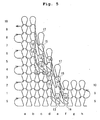
- Fig. 5 is a loop diagram of knitted fabric formed by the knitting process in Fig. 4 .
- step S10 of Fig. 4 a state where a rib structure is knitted up to the position of the lower end 50 of the collar portion 40 in Fig. 1 , using FB and BB is shown. This allows a base course (knitting course S) in Fig. 5 to be knitted.
- step S10 the flechage knitting starts to be carried out so as to form the neckline portion 41.
- the flechage knitting is made up of the first flechage knitting in steps S11 to S14 and second flechage knitting in step S15 to step S18.
- the first flechage knitting is carried out in accordance with a similar procedure to the first flechage knitting in Embodiment 1. That is, it is carried out in the order of the transferring step (step S11) ⁇ the forward knitting step (step S12) ⁇ the returning step (step S13) ⁇ the backward knitting step (step S14).
- the knitting course 1 and the knitting course 2 in Fig. 5 are knitted, and the first yarn hooked portion 13 connecting the stitch 11 at the dead end of the knitting course 1 formed by the first forward knitting and the stitch 12 at the starting point of the knitting course 2 formed by the first backward knitting is wound by one turn around the first turn-back point stitch 18 of the knitting course S.
- the stitch 12 at the starting point of the knitting course 2 is formed in a wale direction continuous to the stitch 11 at the dead end of the knitting course 1.
- the stitch 11 at the dead end is formed in the wale direction continuous to a stitch on the left of the first turn-back point stitch 18 in the knitting course S.
- step S15 the second flechage knitting in steps S15 to S18 is carried out.
- This second flechage knitting is also carried out in the order of the transfer step (step S15) ⁇ the forward knitting step (step S16) ⁇ the returning step (step S17) ⁇ the backward knitting step (step S18).
- the knitting course 3 and the knitting course 4 in Fig. 5 are knitted, and a second yarn hooked portion 16 connecting a stitch 14 at a dead end of the knitting course 3 formed by second forward knitting and a stitch 15 at a starting point of the knitting course 4 formed by second backward knitting is wound by one turn around a second turn-back point stitch 19 of the knitting course S.
- the stitch 14 at the dead end of the knitting course 3 is formed in the wale direction continuous to the first turn-back point stitch 18 in the knitting course S.
- the stitch 15 at the starting point of the knitting course 4 is formed in the wale direction continuous to the stitch 14 at the dead end of the knitting course 3.
- the flechage knitting in the above-described steps S11 to S18 is repeated a required number of times to form the neckline portion 41 of the actual knitted fabric, by which the neckline portion 41 of the sweater 100 in Fig. 1 is completed.
- the yarn hooked portions 13, 16 as the turn-back portions are simply wound around the turn-back point stitches 18, 19, respectively. Consequently, since the knitted fabric portion where the flechage knitting is not performed hardly inhibits the knitted fabric portion subjected to the flechage knitting from going down below the needle bed gap, the number of times of flechage knitting can be made larger than that of the conventional example.
- step S1F in which the formation of the collar portion 40 is started in the knitting needles c, e with each of which the first turn-back point stitch 18 is formed, miss knitting is performed.
- This knitting allows the stitch 14 at the dead end formed in the wale direction continuous to the first turn-back point stitch 18 and the stitch 15 at the starting point to be pulled by a stitch 17 above the stitch 15 at the starting point by two knitting courses (i.e., a course 10), as shown in Fig. 5 .
- the first turn-back point stitch 18 pulled to the left side in the knitting width direction by the yarn hooked portion 13 is also pulled in the wale direction at the same time, and thus, a clearance produced between the first turn-back point stitch 18 and the second turn-back point stitch 19 adjoining this stitch 18 becomes vertically long, which makes the clearance inconspicuous.
- the second turn-back point stitch 19 is also pulled obliquely upward by the second yarn hooked portion 16 connecting from the stitch 14 at the dead end to the stitch 15 at the starting point, a clearance between the second turn-back point stitch 19 and the stitch adjoining this second turn-back point stitch 19 in the right direction of a paper face becomes vertically long, which makes the clearance inconspicuous.
- Fig. 6 shows enlarged photographs of the turn-back portions of the knitted fabric, (A) showing the knitted fabric using the flechage knitting method of the present invention, and (B) showing the knitted fabric using the conventional flechage knitting method.
- the turn-back portions are conspicuous, while in the knitted fabric using the flechage knitting method of the present invention, the turn-back portions are not so conspicuous.
- the turn-back portions in a region of back stitches are remarkably conspicuous, while in the knitted fabric of the present invention, the turn-back portions are vague and inconspicuous.
- Embodiments of the present invention are not limited to the above-described embodiments, but can be modified within the scope not departing from the gist of the present invention as needed.
- the knitted fabric to which the flechage knitting of the present invention is applied may be a sheet of knitted fabric instead of being tubular.
- the portion to which the flechage knitting is applied is not limited to the neckline portion, but may be, for example, a gore portion, a shoulder line portion or the like.
- the portion to which the flechage knitting is applied may have a rib structure different from that in the embodiments (e.g., a rib structure of 2 ⁇ 2), or may have a structure other than the rib structure, for example, a structure of plain knitting.
Landscapes
- Engineering & Computer Science (AREA)
- Textile Engineering (AREA)
- Knitting Of Fabric (AREA)
- Woven Fabrics (AREA)
Abstract
Description
- The present invention relates to a flechage knitting method made up of forward knitting and backward knitting, and knitted fabric formed by this knitting method.
- Conventionally, in knitting of knitted fabric, a flechage knitting method made up of forward knitting and backward knitting has been performed. For example, in
Patent Document 1, there is disclosed a knitting method of knitted fabric in which flechage knitting is performed in a neckline portion of a sweater to form a neck hole, and then, a collar portion is formed where the neck hole is formed. -
Fig. 1 is an overall diagram of asweater 100 made up of afront body 20 and aback body 30. Thissweater 100 has aneckline portion 41, which forms a neck hole, and acollar portion 40 formed in thisneckline portion 41.Fig. 7 is a knitting process chart for forming theneckline portion 41 and thecollar portion 40 on the left side of a paper face of thefront body 20 in thesweater 10 by conventional flechage knitting.Fig. 8 is a loop diagram of the knitted fabric formed by this knitting process. InFig. 7 , in three columns arranged in a horizontal direction, a numeric character in the left column denotes a number of a knitting step, the middle column denotes a knitting direction of the knitted fabric in the knitted step, and the right column denotes a knitting state of the knitted fabric. Moreover, a black circle in the right column denotes a stitch formed in the knitted step, a white circle denotes a stitch held in a knitting needle, a V letter denotes a tuck, and a black triangle denotes a yarn feeder. Moreover, FB in the right column inFig. 7 denotes a front needle bed, BB denotes a back needle bed, and alphabets denote knitting needles. Stitches knitted with the knitting needles of these alphabets inFig. 7 are the stitches arranged above the alphabets inFig. 8 . InFigs. 7 and8 , a state where a rib structure is knitted using FB and BB is described. - In the above-described conventional knitting process, the flechage knitting starts to be performed from a state in step S00 (a lowest knitting course in
Fig. 8 ). The flechage knitting is made up of forward knitting (step S01) and backward knitting (step S02), and when the yarn feeder turns back, tuck is performed so as not to produce a hole at a position of a turn-back end in the knitted fabric. This flechage knitting is performed while sequentially displacing the turn-back position, so that the knitting needle of the end portion in a knitting width is sequentially passed over in the knitting to be put into a non-operating state (steps S03 to S08), by which theneckline portion 41 inFig. 1 is formed. The knitting to the stitches (including the tucks) held in the knitting needles is carried out (step S09) to thereby form thecollar portion 40 of the sweater. -
- Patent Document 1: Japanese Examined Laid-Open Publication No.
2006-111996 - However, in the above-described conventional flechage knitting method, when the number of times of the flechage knitting becomes large, the knitting becomes difficult, and thus, the number of times of the flechage knitting is limited. Consequently, for example, when the conventional flechage knitting is used for the knitting of the neckline portion of the sweater, the design of the neckline portion is restricted to a shallow neckline.
- In a process of performing the flechage knitting, in a portion in which the flechage knitting is performed (a region of knitting needles a to e in
Fig. 8 ) in a knitted fabric, new stitches are being formed, so that the portion is going down below a needle bed gap located between front and back needle beds. In contrast, a portion where the flechage knitting is not performed (a region of knitting needles f to h inFig. 8 ) remains held in the needle bed. Particularly, in the case of conventional flechage knitting using the tuck, in the portion where the flechage knitting is not performed, a knitting yarn is held doubly in one knitting needle, so that there is little movable margin of the knitting yarn in this portion. That is, the knitted fabric portion where the flechage knitting is not performed inhibits the knitted fabric portion which is being newly formed by performing the flechage knitting from going down below the needle bed gap. Consequently, as the number of times of flechage knitting becomes larger, stitches held in the knitting needles in the portion where the flechage knitting is performed become pushed upward, which causes a possibility that knitting operation (particularly, knock-over) cannot be performed. - Moreover, in the knitted fabric knitted by using the conventional flechage knitting, since as shown in
Fig. 8 , double stitches by the tuck are formed in a border portion between the knitted fabric portion formed by the flechage knitting and the knitted fabric adjoining this knitted fabric portion, the border portion is so conspicuous that appearance of the knitted fabric may be spoiled. - The present invention has been made in light of the above-described circumustances, and one object thereof is to provide a flechage knitting method capable of increasing the number of courses in which the flechage knitting can be performed, as compared with the conventional flechage knitting using tuck. Moreover, another object of the present invention is to provide a flechage knitting method capable of forming knitted fabric in which a border portion between a knitted fabric portion subjected to the flechage knitting and a knitted fabric portion adjoining this knitted fabric is inconspicuous.
- The present invention is a flechage knitting method for performing flechage knitting made up of forward knitting and backward knitting, using a flat knitting machine that includes at least a pair of front and back needle beds and is capable of transferring a stitch between the front and back needle beds. The flechage knitting method of the present invention includes performing first flechage knitting made up of first forward knitting and first backward knitting on a base course, the first flechage knitting includes the following steps:
- (A) transferring a first turn-back point stitch to an empty needle of an opposite needle bed, the first turn-back point stitch being a stitch, in a forward knitting direction, one ahead of a stitch where a stitch at a dead end of the first forward knitting is to be formed, among stitches in the base course (transferring step).
- (B) performing the first forward knitting, and crossing a first yarn hooked portion connecting to the stitch at the dead end of the first forward knitting with the first turn-back point stitch in a knitting width direction (forward knitting step).
- (C) returning the first turn-back point stitch transferred to the empty needle, to a knitting needle of the opposite needle bed (returning step).
- (D) forming a new stitch on the stitch at the dead end of the first forward knitting to perform the first backward knitting with this stitch serving as a starting point, by which the first yarn hooked portion connecting the stitch at the dead end of the first forward knitting and the stitch at the starting point of the first backward knitting is wound around the first turn-back point stitch in the base course (backward knitting step).
- The order of steps involved in the foregoing first flechage knitting may be selected so that the first yarn hooked portion connecting the stitch at the dead end of the first forward knitting and the stitch at the starting point of the first backward knitting is wound around the first turn-back point stitch of the base course. Specifically, it can be considered that the order is such that the transferring step → the forward knitting step → the returning step → the backward knitting step or such that the forward knitting step → the transferring step → the backward knitting step → the returning step.
- In accordance with one aspect of the flechage knitting method of the present invention, second flechage knitting made up of second forward knitting and second backward knitting may be performed right after the first flechage knitting. In this case, the second flechage knitting preferably includes the following steps.
- (E) transferring a second turn-back point stitch to an empty needle of the opposite needle bed, the second turn-back point stitch being a stitch, in the forward knitting direction, two ahead of the stitch where the stitch at the dead end of the first forward knitting is formed, among the stitches of the base course (transferring step).
- (F) performing the second forward knitting with a position of the first turn-back point stitch serving as a dead end, and crossing a second yarn hooked portion connecting to a stitch at the dead end of the second forward knitting with the second turn-back point stitch in the knitting width direction (forward knitting step).
- (G) returning the second turn-back point stitch transferred to the empty needle, to a knitting needle of the opposite needle bed (returning step).
- (H) forming a new stitch on the stitch at the dead end of the second forward knitting to perform the second backward knitting with this stitch serving as a starting point, by which the second yarn hooked portion connecting the stitch at the dead end of the second forward knitting and the stitch at the starting point of the second backward knitting is wound around the second turn-back point stitch in the base course (backward knitting step).
- The order of steps involved in the foregoing second flechage knitting may be also selected as in the first flechage knitting. Specifically, it can be considered that the order is such that the transferring step → the forward knitting step → the returning step → the backward knitting step or such that the forward knitting step → the transferring step → the backward knitting step → the returning step.
- For the process involved in the second flechage knitting in this flechage knitting method, as in the first flechage knitting, the order may be also selected so that the second yarn hooked portion connecting the stitch at the dead end of the second forward knitting and the stitch at the starting point of the second backward knitting is wound around the second turn-back point stitch of the base course.
- As one aspect of the flechage knitting method of the present invention, it is preferable to further include a step of knitting one course to stitches held in the needle bed after finishing the flechage knitting, wherein in this knitting course, miss knitting is performed at a position of a stitch connecting to the first turn-back point stitch in a wale direction.
- Knitted fabric of the present invention is formed using a flat knitting machine having at least a pair of front and back needle beds and being capable of transferring a stitch between the front and back needle beds, and has a first flechage knitting portion made up of a first forward knitting course and a first backward knitting course on a base course. The knitted fabric includes: a first turn-back point stitch which is one of stitches of the base course; a stitch at a dead end of the first forward knitting course, the stitch being formed on a stitch next to the first turn-back point stitch; a stitch at a starting point of the first backward knitting course, the stitch being formed on the stitch at the dead end; and a first yarn hooked portion extending from the stitch at the dead end to wind one time around the first turn-back point stitch and then connect to the stitch at the starting point.
- As one aspect of the knitted fabric of the present invention, it may further include a second flechage knitting portion that is formed on the first flechage knitting portion, and is made up of a second forward knitting course and a second backward knitting course. The knitted fabric includes: a second turn-back point stitch adjoining the first turn-back point stitch on an opposite side of the first flechage knitting portion, among the stitches in the base course; a stitch at a dead end of the second forward knitting course, the stitch being formed on the first turn-back point stitch; a stitch at a starting point of the second backward knitting course, the stitch being formed on the stitch at the dead end; and a second yarn hooked portion extending from the stitch at the dead end to wind one time around the second turn-back point stitch and then connect to the stitch at the starting point.
- According to the flechage knitting method of the present invention, the turn back from the forward knitting to the backward knitting is performed by winding the yarn hooked portion connecting the stitch at the dead end of the forward knitting and the stitch at the starting point of the backward knitting around the turn-back point stitch serving as an origin of the turn back. Since this yarn hooked portion is not held in the knitting needle in the knitting process, it has a relatively large movable margin. Moreover, although the turn-back point stitch around which the yarn hooked portion is wound is hooked in the knitting needle, no knitting yarn but this stitch is hooked in the same needle, which gives a movable margin to the turn-back point stitch as well. Consequently, according to the flechage knitting method of the present invention, as compared with the conventional flechage knitting using the tuck, the knitted fabric portion where the flechage knitting is not performed hardly inhibits the knitted fabric portion that are newly formed by performing the flechage knitting from going down below the needle bed gap. As a result, the number of times of the flechage knitting can be increased, thereby enhancing a degree of freedom in designing the knitted fabric.
- Moreover, in the knitted fabric knitted by the flechage knitting method of the present invention, since the stitches are not doubled in the turn-back portion, the turn-back portion is inconspicuous.
- Since the turn-back point stitch is pulled in the knitting width direction by the yarn hooked portion, there may be a slight clearance between the turn-back point stitch and the stitch adjoining this stitch. However, when in a first knitting course knitted after finishing the flechage knitting, miss knitting is performed with the knitting needle holding the first turn-back point stitch, the first turn-back point stitch is pulled up in the wale direction, which makes the clearance vertically long and thus, inconspicuous. The configuration in which the two turn-back point stitches are arranged side by side brings about the similar effect. The reason why the first turn-back point stitch is pulled up in the wale direction as described above is that the miss knitting decreases the number of stitches continuous to the first turn-back point stitch on the upper side in the wale direction by one.
-
-
Fig. 1 is an overall diagram of a sweater having turn-back portions. -
Fig. 2 is a knitting process chart of flechage knitting according toEmbodiment 1. -
Fig. 3 is a loop diagram of knitted fabric formed by the knitting process ofEmbodiment 1. -
Fig. 4 is a knitting process chart of flechage knitting according toEmbodiment 2. -
Fig. 5 is a loop diagram of knitted fabric formed by the knitting process ofEmbodiment 2. -
Fig. 6(A) and (B) are enlarged photographs of the turn-back portions, (A) showing knitted fabric using a flechage knitting method of the present invention, and (B) showing knitted fabric using a conventional flechage knitting method. -
Fig. 7 is a knitting process chart of the conventional flechage knitting method. -
Fig. 8 is a loop diagram of the knitted fabric formed by the conventional knitting process. - Next, preferred embodiments (
Embodiments 1, 2) of the present invention are described in detail with reference to the drawings. In both ofEmbodiments sweater 100 is knitted are described, thesweater 100 being tubular knitted fabric made up of thefront body 20 and theback body 30 as shown inFig. 1 . Thissweater 100 is formed with thecollar portion 40 at theneckline portion 41, and for the knitting of thisneckline portion 41 and thecollar portion 40, flechage knitting of the present invention is used. Obviously, the flechage knitting method of the present invention can be applied to any knitted fabric having a portion in which the flechage knitting is performed, and thus, an application object is not limited to the tubular knitted fabric. - First, a flat knitting machine used in these embodiments is described. The flat knitting machine is a flat knitting machine having at least a pair of front and back needle beds extending in a traverse direction and disposed opposite to each other in a cross direction. As the above-described flat knitting machine, a two-bed flat knitting machine including a front needle bed (hereinafter, referred to as FB), and a back needle bed (hereinafter, referred to as BB), a four-bed flat knitting machine further including two needle beds opposite to each other above the front and back needle beds, and the like can be cited.
- In order to knit the
collar portion 40 of thesweater 100 as shown inFig. 1 , using the above-described flat knitting machine, thefront body 20 is knitted up to aposition 50 at a lower end of thecollar portion 40, and an outline of theneckline portion 41 is formed by flechage knitting. Thecollar portion 40 is knitted on stitches making up theneckline portion 41. In the following description, only the formation of theneckline portion 41 on the left side of a paper face inFig. 1 and the formation of thecollar portion 40 following this are schematically described. -
Fig. 2 is a knitting process chart showing the flechage knitting in theneckline portion 41 and the knitting of thecollar portion 40 in the sweater 100 (up-down thin arrows in the middle column and in the right column denote transfer). Moreover,Fig. 3 is a loop diagram of knitted fabric formed by the knitting process inFig. 2 , and numeric characters arranged on the right and on the left inFig. 3 denote the order of knitting a knitting course of interest. The way of viewing theseFigs. 2 ,3 (Figs. 4 ,5 described later) is the same as that ofFigs. 7 ,8 referred to in the description of Background Art.Figs. 2 ,3 (Figs. 4 ,5 described later) illustrate a rib structure where front stitches and back stitches are formed as they coexist using FB and BB, in which the numbers of knitting courses and stitches are smaller than actual knitted fabric for convenience of description. - Step S0 in
Fig. 2 shows a state where the knitting up to theposition 50 at the lower end of thecollar portion 40 in thesweater 100 shown inFig. 1 is finished. A knitting course S (refer toFig. 3 ), which is knitted in step S0 to serve as a base course, has a rib structure. - In order to start to form the neckline portion in the state of step S0, initial first flechage knitting made up of first forward knitting and first backward knitting is carried out. Stitches given reference numerals in the following description are shown with the reference numerals in
Fig. 3 . - First, when the first flechage knitting starts to be performed, a stitch held in a knitting needle c of BB (a first turn-back point stitch 18) among stitches of the knitting course S is transferred to a knitting needle c of opposite FB (step S1). This knitting needle c of BB is located one ahead of a knitting needle b in a movement direction of the knitting, in which the knitting needle b will be at a position as a dead end of a first forward knitting course formed in step S2.
- Next, the first forward knitting to form stitches with knitting needles a, b of FB is performed (step S2), by which a
knitting course 1 inFig. 3 is formed. At this time, the yarn feeder passes over a position of the knitting needle c so that a knitting yarn extending from a stitch 11 at the dead end of theknitting course 1, which is held in knitting needle b, (a first yarn hooked portion 13) crosses the transferred first turn-back point stitch 18 (the knitting needle c of FB) in a knitting width direction. - The first turn-
back point stitch 18 transferred to the knitting needle c of FB in step S1 is returned to the knitting needle c of BB (step S3), and the first backward knitting is performed (step S4). At this time, astitch 12 at a starting point of the first backward knitting is formed on the stitch 11 at the dead end of the first forward knitting, which is held in the knitting needle b. - In these steps S1 to S4, the first flechage knitting portion made up of the
knitting course 1 and aknitting course 2 inFig. 3 is formed, and the first yarn hookedportion 13 connecting the stitch 11 at the dead end of theknitting course 1 formed by the first forward knitting and thestitch 12 at the starting point of theknitting course 2 formed by the first backward knitting is wound by one turn around the first turn-back point stitch 18 held in the knitting needle c of the knitting course S. - Since the yarn hooked
portion 13 in the first flechage knitting portion is not held in the knitting needle, it has a relatively large movable margin. Moreover, the turn-back point stitch 18 around which the yarn hookedportion 13 is wound also has a movable margin, because although it is hooked on the knitting needle, no knitting yarn other than this stitch is hooked on the same knitting needle. Consequently, the knitted fabric portion subjected to the flechage knitting is hardly inhibited from going down below a needle bed gap by a knitted fabric portion where the flechage knitting is not performed. - Next, according to a procedure shown in steps S5 to S8 in
Fig. 2 , the first flechage knitting is carried out again with theknitting course 2 inFig 3 serving as a base course to knit theknitting courses stitch 12 at the starting point in steps S1 to S4) is a stitch knitted in FB. Consequently, similar to the yarn hookedportion 13 in steps S1 to S4, in order to wind the yarn hookedportion 13 in steps S5 to S8 from an inner side (an inner side of the tube) to an outer side, the order of the steps involved in the first flechage knitting is changed. Specifically, the knitting is performed in the order of the forward knitting step (step S5) → the transferring step (step S6) → the backward knitting step (step S7) → a returning step (step S8) to thereby knit theknitting courses Fig. 3 . In the knitting in these steps S5 to S8 as well, since there is a movable margin in each of the yarn hookedportion 13 and the turn-back point stitch 18, the knitted fabric portion where the flechage knitting is not performed hardly inhibits the knitted fabric portion subjected to the flechage knitting from going down below the needle bed gap. - When the flechage knitting of the required number of times is finished, the knitting is finally performed by one course to the stitches held in the knitting needles of the needle bed (step SF), and then the formation of the collar portion with a
knitting course 5 serving as a first knitting course is started. In aknitting course 6 and after, a predetermined number of courses are knitted to form the collar portion following theknitting course 5. - When the flechage knitting is further performed in addition to the knitting courses shown in
Figs. 2 ,3 , the above-described knitting in step S1 to S4 and knitting in step S5 to S8 may be appropriately combined and repeated a required number of times. As described before, according to the flechage knitting method of the present embodiment, since the knitted fabric portion where the flechage knitting is not performed hardly inhibits the knitted fabric portion subjected to the flechage knitting from going down below the needle bed gap, the number of times of flechage knitting can be made larger than the case where the conventional flechage knitting method is used. As a result, a sweater with a deep neckline portion can be knitted. - Generally, when the tubular knitted fabric having a rib structure is formed, the need to transfer the stitches between the front and back needle beds arises. In the case where the flechage knitting is performed in this tubular knitted fabric, the stitch of the turn-back portion is also to be transferred. In the conventional flechage knitting, the knitting yarn hooked doubly in the knitting needle of the turn-back portion is transferred, which causes a possibility of failing the transfer. In contrast, according to the flechage knitting of the present embodiment, since the tuck is not performed, the transfer in the turn-back portion can be performed easily.
- In
Embodiment 2, a flechage knitting method for arranging two turn-back point stitches as origins of the turn-back side by side in the knitting width direction is described with reference to the drawings. -
Fig. 4 is a knitting process chart showing flechage knitting in theneckline portion 41 and the knitting of thecollar portion 40 in thesweater 100. Moreover,Fig. 5 is a loop diagram of knitted fabric formed by the knitting process inFig. 4 . - First, in step S10 of
Fig. 4 , a state where a rib structure is knitted up to the position of thelower end 50 of thecollar portion 40 inFig. 1 , using FB and BB is shown. This allows a base course (knitting course S) inFig. 5 to be knitted. - In the state in step S10, the flechage knitting starts to be carried out so as to form the
neckline portion 41. The flechage knitting is made up of the first flechage knitting in steps S11 to S14 and second flechage knitting in step S15 to step S18. - The first flechage knitting is carried out in accordance with a similar procedure to the first flechage knitting in
Embodiment 1. That is, it is carried out in the order of the transferring step (step S11) → the forward knitting step (step S12) → the returning step (step S13) → the backward knitting step (step S14). - According to these steps S11 to S14, the
knitting course 1 and theknitting course 2 inFig. 5 are knitted, and the first yarn hookedportion 13 connecting the stitch 11 at the dead end of theknitting course 1 formed by the first forward knitting and thestitch 12 at the starting point of theknitting course 2 formed by the first backward knitting is wound by one turn around the first turn-back point stitch 18 of the knitting course S. Thestitch 12 at the starting point of theknitting course 2 is formed in a wale direction continuous to the stitch 11 at the dead end of theknitting course 1. Moreover, the stitch 11 at the dead end is formed in the wale direction continuous to a stitch on the left of the first turn-back point stitch 18 in the knitting course S. - Next, the second flechage knitting in steps S15 to S18 is carried out. This second flechage knitting is also carried out in the order of the transfer step (step S15) → the forward knitting step (step S16) → the returning step (step S17) → the backward knitting step (step S18).
- According to these steps S15 to S18, the
knitting course 3 and theknitting course 4 inFig. 5 are knitted, and a second yarn hookedportion 16 connecting a stitch 14 at a dead end of theknitting course 3 formed by second forward knitting and astitch 15 at a starting point of theknitting course 4 formed by second backward knitting is wound by one turn around a second turn-back point stitch 19 of the knitting course S. The stitch 14 at the dead end of theknitting course 3 is formed in the wale direction continuous to the first turn-back point stitch 18 in the knitting course S. Moreover, thestitch 15 at the starting point of theknitting course 4 is formed in the wale direction continuous to the stitch 14 at the dead end of theknitting course 3. - The flechage knitting in the above-described steps S11 to S18 is repeated a required number of times to form the
neckline portion 41 of the actual knitted fabric, by which theneckline portion 41 of thesweater 100 inFig. 1 is completed. In the flechage knitting of the present embodiment, as inEmbodiment 1, the yarn hookedportions - Further, in the present embodiment, in step S1F in which the formation of the
collar portion 40 is started, in the knitting needles c, e with each of which the first turn-back point stitch 18 is formed, miss knitting is performed. This knitting allows the stitch 14 at the dead end formed in the wale direction continuous to the first turn-back point stitch 18 and thestitch 15 at the starting point to be pulled by astitch 17 above thestitch 15 at the starting point by two knitting courses (i.e., a course 10), as shown inFig. 5 . That is, the first turn-back point stitch 18 pulled to the left side in the knitting width direction by the yarn hookedportion 13 is also pulled in the wale direction at the same time, and thus, a clearance produced between the first turn-back point stitch 18 and the second turn-back point stitch 19 adjoining thisstitch 18 becomes vertically long, which makes the clearance inconspicuous. Moreover, since the second turn-back point stitch 19 is also pulled obliquely upward by the second yarn hookedportion 16 connecting from the stitch 14 at the dead end to thestitch 15 at the starting point, a clearance between the second turn-back point stitch 19 and the stitch adjoining this second turn-back point stitch 19 in the right direction of a paper face becomes vertically long, which makes the clearance inconspicuous. - Finally, the knitted fabric formed by the flechage knitting method of the present invention and the knitted fabric formed by the conventional flechage knitting are compared.
Fig. 6 shows enlarged photographs of the turn-back portions of the knitted fabric, (A) showing the knitted fabric using the flechage knitting method of the present invention, and (B) showing the knitted fabric using the conventional flechage knitting method. - As is obvious from
Fig. 6 , in the knitted fabric using the conventional flechage knitting method, the turn-back portions are conspicuous, while in the knitted fabric using the flechage knitting method of the present invention, the turn-back portions are not so conspicuous. Particularly, in the conventional knitted fabric, the turn-back portions in a region of back stitches are remarkably conspicuous, while in the knitted fabric of the present invention, the turn-back portions are vague and inconspicuous. - Embodiments of the present invention are not limited to the above-described embodiments, but can be modified within the scope not departing from the gist of the present invention as needed. For example, the knitted fabric to which the flechage knitting of the present invention is applied may be a sheet of knitted fabric instead of being tubular. Moreover, the portion to which the flechage knitting is applied is not limited to the neckline portion, but may be, for example, a gore portion, a shoulder line portion or the like. Furthermore, the portion to which the flechage knitting is applied may have a rib structure different from that in the embodiments (e.g., a rib structure of 2 × 2), or may have a structure other than the rib structure, for example, a structure of plain knitting.
-
- 100
- sweater
- 20
- front body
- 30
- back body
- 40
- collar portion
- 41
- neckline portion
- 50
- position,at a lower end of a collar portion
- S1 to S10
- knitting course
- 11
- stitch at a dead end (first forward knitting)
- 12
- stitch at a starting point (first backward knitting)
- 13
- first yarn hooked portion
- 18
- first turn-back point stitch
- 14
- stitch at a dead end (second forward knitting)
- 15
- stitch at a starting point (second backward knitting)
- 16
- second yarn hooked portion
- 19
- second turn-back point stitch
- 17
- stitch of a
knitting course 10
Claims (5)
- A flechage knitting method for performing flechage knitting made up of forward knitting and backward knitting, using a flat knitting machine that includes at least a pair of front and back needle beds and is capable of transferring a stitch between the front and back needle beds, the method including performing first flechage knitting made up of first forward knitting and first backward knitting on a base course,
the first flechage knitting comprising the steps of:(A) transferring a first turn-back point stitch to an empty needle of an opposite needle bed, the first turn-back point stitch being a stitch, in a forward knitting direction, one ahead of a stitch where a stitch at a dead end of the first forward knitting is to be formed, among stitches in the base course;(B) performing the first forward knitting, and crossing a first yarn hooked portion connecting to the stitch at the dead end of the first forward knitting with the first turn-back point stitch in a knitting width direction;(C) returning the first turn-back point stitch transferred to the empty needle, to a knitting needle of the opposite needle bed; and(D) forming a new stitch on the stitch at the dead end of the first forward knitting to perform the first backward knitting with this stitch serving as a starting point, by which the first yarn hooked portion connecting the stitch at the dead end of the first forward knitting and the stitch at the starting point of the first backward knitting is wound around the first turn-back point stitch in the base course. - The flechage knitting method according to claim 1, wherein second flechage knitting made up of second forward knitting and second backward knitting is performed after the first flechage knitting,
the second flechage knitting comprising the steps of:(E) transferring a second turn-back point stitch to an empty needle of the opposite needle bed, the second turn-back point stitch being a stitch, in the forward knitting direction, two ahead of the stitch where the stitch at the dead end of the first forward knitting is formed, among the stitches of the base course;(F) performing the second forward knitting with a position of the first turn-back point stitch serving as a dead end, and crossing a second yarn hooked portion connecting to a stitch at the dead end of the second forward knitting with the second turn-back point stitch in the knitting width direction;(G) returning the second turn-back point stitch transferred to the empty needle, to a knitting needle of the opposite needle bed; and(H) forming a new stitch on the stitch at the dead end of the second forward knitting to perform the second backward knitting with this stitch serving as a starting point, by which the second yarn hooked portion connecting the stitch at the dead end of the second forward knitting and the stitch at the starting point of the second backward knitting is wound around the second turn-back point stitch in the base course. - The flechage knitting method according to claim 1 or claim 2, further comprising the step of knitting one course to stitches held in the needle bed after finishing the flechage knitting,
wherein in this knitting course, miss knitting is performed at a position of a stitch in a wale direction connecting to the first turn-back point stitch. - Knitted fabric that is formed using a flat knitting machine having at least a pair of front and back needle beds and being capable of transferring a stitch between the front and back needle beds, and has a first flechage knitting portion made up of a first forward knitting course and a first backward knitting course on a base course, the knitted fabric comprising:a first turn-back point stitch which is one of stitches of the base course;
a stitch at a dead end of the first forward knitting course, the stitch being formed on a stitch next to the first turn-back point stitch;
a stitch at a starting point of the first backward knitting course, the stitch being formed on the stitch at the dead end; and
a first yarn hooked portion extending from the stitch at the dead end to wind one time around the first turn-back point stitch and then connect to the stitch at the starting point. - The knitted fabric according to claim 4, further comprising a second flechage knitting portion that is formed on the first flechage knitting portion, and is made up of a second forward knitting course and a second backward knitting course, the knitted fabric comprising:a second turn-back point stitch adjoining the first turn-back point stitch on an opposite side of the first flechage knitting portion, among the stitches in the base course;a stitch at a dead end of the second forward knitting course, the stitch being formed on the first turn-back point stitch;a stitch at a starting point of the second backward knitting course, the stitch being formed on the stitch at the dead end; anda second yarn hooked portion extending from the stitch at the dead end to wind one time around the second turn-back point stitch and then connect to the stitch at the starting point.
Applications Claiming Priority (2)
| Application Number | Priority Date | Filing Date | Title |
|---|---|---|---|
| JP2008148353 | 2008-06-05 | ||
| PCT/JP2009/002418 WO2009147815A1 (en) | 2008-06-05 | 2009-06-01 | Partial knitting method and fabric |
Publications (3)
| Publication Number | Publication Date |
|---|---|
| EP2312028A1 true EP2312028A1 (en) | 2011-04-20 |
| EP2312028A4 EP2312028A4 (en) | 2015-03-11 |
| EP2312028B1 EP2312028B1 (en) | 2016-03-09 |
Family
ID=41397898
Family Applications (1)
| Application Number | Title | Priority Date | Filing Date |
|---|---|---|---|
| EP09758082.3A Active EP2312028B1 (en) | 2008-06-05 | 2009-06-01 | Partial knitting method and fabric |
Country Status (4)
| Country | Link |
|---|---|
| EP (1) | EP2312028B1 (en) |
| JP (1) | JP5362717B2 (en) |
| CN (1) | CN102057092B (en) |
| WO (1) | WO2009147815A1 (en) |
Cited By (1)
| Publication number | Priority date | Publication date | Assignee | Title |
|---|---|---|---|---|
| EP2565309A3 (en) * | 2011-09-01 | 2013-04-10 | Shima Seiki Mfg., Ltd | Flechage knitting method, and knitted fabric |
Families Citing this family (10)
| Publication number | Priority date | Publication date | Assignee | Title |
|---|---|---|---|---|
| JP2012251262A (en) * | 2011-06-03 | 2012-12-20 | Shima Seiki Mfg Ltd | Knitting method of knitted fabric and knitted fabric |
| CN102747521B (en) * | 2012-07-24 | 2013-10-02 | 宁波慈星股份有限公司 | Small-pattern weaving method using three-color point jacquards as basic tissues |
| JP2014025159A (en) * | 2012-07-25 | 2014-02-06 | Shima Seiki Mfg Ltd | Method for knitting knitted fabric |
| JP5980152B2 (en) * | 2013-03-19 | 2016-08-31 | 株式会社島精機製作所 | Knitting method of knitted fabric |
| CN104831458B (en) * | 2015-04-24 | 2016-11-30 | 广东溢达纺织有限公司 | Weft knitting rib fabric and weaving method and application |
| JP6541621B2 (en) * | 2016-06-06 | 2019-07-10 | 株式会社島精機製作所 | Method of knitting tubular knitted fabric, and tubular knitted fabric |
| JP7357581B2 (en) * | 2020-04-10 | 2023-10-06 | 株式会社島精機製作所 | Knitting method of tubular knitted fabric and tubular knitted fabric |
| CN113818131B (en) * | 2021-10-23 | 2023-01-31 | 嘉兴市蒂维时装有限公司 | Knitting method for improving unevenness of sleeves and cuffs of fully-formed lantern and knitted fabric |
| CN114164548B (en) * | 2021-12-31 | 2023-03-31 | 嘉兴市蒂维时装有限公司 | Knitting method for improving full-forming jag curling and fabric |
| CN117026480B (en) * | 2023-08-04 | 2025-05-16 | 嘉兴市蒂维时装有限公司 | Knitting method of full-formed dense needle tissue and knitted fabric |
Family Cites Families (6)
| Publication number | Priority date | Publication date | Assignee | Title |
|---|---|---|---|---|
| TW480299B (en) * | 2000-01-26 | 2002-03-21 | Shima Seiki Mfg | Method of knitting neck portion of knit wear by weft knitting machine and the knit wear |
| TW490521B (en) * | 2000-06-02 | 2002-06-11 | Shima Seiki Mfg | Method of knitting neck portion of knit wear by flat knitting machine and the knit wear |
| JP4002870B2 (en) * | 2003-08-08 | 2007-11-07 | 株式会社島精機製作所 | Method for knitting a tubular knitted fabric having a stripe pattern and a tubular knitted fabric having a stripe pattern |
| JP4336287B2 (en) * | 2004-10-13 | 2009-09-30 | 株式会社島精機製作所 | V-neck knitwear knitted by flat knitting machine and its knitting method |
| JP4336298B2 (en) * | 2004-12-09 | 2009-09-30 | 株式会社島精機製作所 | Knitting method of knitted fabric, knitting program for knitting knitted fabric |
| EP1942215B1 (en) * | 2005-09-09 | 2014-06-11 | Shima Seiki Mfg., Ltd | Method of knitting knit wear with collar |
-
2009
- 2009-06-01 EP EP09758082.3A patent/EP2312028B1/en active Active
- 2009-06-01 WO PCT/JP2009/002418 patent/WO2009147815A1/en not_active Ceased
- 2009-06-01 CN CN2009801210080A patent/CN102057092B/en active Active
- 2009-06-01 JP JP2010515757A patent/JP5362717B2/en active Active
Cited By (2)
| Publication number | Priority date | Publication date | Assignee | Title |
|---|---|---|---|---|
| EP2565309A3 (en) * | 2011-09-01 | 2013-04-10 | Shima Seiki Mfg., Ltd | Flechage knitting method, and knitted fabric |
| KR101329124B1 (en) | 2011-09-01 | 2013-11-14 | 가부시키가이샤 시마세이키 세이사쿠쇼 | Partial knitting method and fabric |
Also Published As
| Publication number | Publication date |
|---|---|
| CN102057092A (en) | 2011-05-11 |
| WO2009147815A1 (en) | 2009-12-10 |
| EP2312028B1 (en) | 2016-03-09 |
| JP5362717B2 (en) | 2013-12-11 |
| JPWO2009147815A1 (en) | 2011-10-20 |
| CN102057092B (en) | 2012-08-29 |
| EP2312028A4 (en) | 2015-03-11 |
Similar Documents
| Publication | Publication Date | Title |
|---|---|---|
| EP2312028B1 (en) | Partial knitting method and fabric | |
| EP2634299B1 (en) | Knitting method of knitted fabric with fringe | |
| JP4852093B2 (en) | Method for knitting tubular knitted fabric and tubular knitted fabric | |
| JP4252751B2 (en) | Striped pattern knitting method for tubular knitted fabric and its knitted fabric | |
| US6672113B2 (en) | Method of knitting neck of knit wear by weft knitting machine and knit designing device for producing the method of knitting the neck | |
| JP4852092B2 (en) | Method for forming additional stitches and knitted fabric in which additional stitches are formed on the inner side of the knitting width direction end of the knitted fabric | |
| KR101903572B1 (en) | Method for knitting tubular knitted fabric and tubular knitted fabric | |
| EP2990511B1 (en) | Method for forming knitted fabric | |
| JPWO2001061092A1 (en) | Method for knitting striped tubular knitted fabric and knitted fabric | |
| EP1605082B1 (en) | Knitting method for knitting fabric | |
| EP1408145B1 (en) | Knitting fabric having novel set up structure and method of knitting it | |
| EP2366820A1 (en) | Knitting method of V-neck peak and knitwear having V-neck | |
| CN102965802A (en) | Flechage knitting method, and knitted fabric | |
| JP4848374B2 (en) | Method for knitting knitwear having a collar | |
| EP1211341B1 (en) | Welt-seaming method excellent in stretchability | |
| EP1829995B1 (en) | Knitwear knitted by weft knitting machine and method of knitting the same | |
| CN106987989A (en) | The fixing means of stocking yarn | |
| EP1908867B1 (en) | Method of knitting knitwear having an open part in a tubular body part | |
| EP0940491A2 (en) | A widening method | |
| EP2418310B1 (en) | Joining method of adjacent knitted fabric parts, and knitted fabric | |
| EP2397588B1 (en) | Inner widening method | |
| JP2008303489A (en) | Knitting method for knit fabric, and knit fabric | |
| JP2010133055A (en) | Method for knitting knitted fabric | |
| EP2431510A1 (en) | Method of knitting tubular fabric, and tubular fabric | |
| JP3010484B2 (en) | Inner reduction method using flat knitting machine |
Legal Events
| Date | Code | Title | Description |
|---|---|---|---|
| PUAI | Public reference made under article 153(3) epc to a published international application that has entered the european phase |
Free format text: ORIGINAL CODE: 0009012 |
|
| 17P | Request for examination filed |
Effective date: 20110104 |
|
| AK | Designated contracting states |
Kind code of ref document: A1 Designated state(s): AT BE BG CH CY CZ DE DK EE ES FI FR GB GR HR HU IE IS IT LI LT LU LV MC MK MT NL NO PL PT RO SE SI SK TR |
|
| AX | Request for extension of the european patent |
Extension state: AL BA RS |
|
| DAX | Request for extension of the european patent (deleted) | ||
| A4 | Supplementary search report drawn up and despatched |
Effective date: 20150210 |
|
| RIC1 | Information provided on ipc code assigned before grant |
Ipc: D04B 7/00 20060101ALI20150204BHEP Ipc: D04B 1/00 20060101AFI20150204BHEP Ipc: D04B 1/24 20060101ALI20150204BHEP |
|
| GRAP | Despatch of communication of intention to grant a patent |
Free format text: ORIGINAL CODE: EPIDOSNIGR1 |
|
| INTG | Intention to grant announced |
Effective date: 20150820 |
|
| GRAS | Grant fee paid |
Free format text: ORIGINAL CODE: EPIDOSNIGR3 |
|
| GRAA | (expected) grant |
Free format text: ORIGINAL CODE: 0009210 |
|
| AK | Designated contracting states |
Kind code of ref document: B1 Designated state(s): AT BE BG CH CY CZ DE DK EE ES FI FR GB GR HR HU IE IS IT LI LT LU LV MC MK MT NL NO PL PT RO SE SI SK TR |
|
| REG | Reference to a national code |
Ref country code: GB Ref legal event code: FG4D |
|
| REG | Reference to a national code |
Ref country code: AT Ref legal event code: REF Ref document number: 779616 Country of ref document: AT Kind code of ref document: T Effective date: 20160315 Ref country code: CH Ref legal event code: EP |
|
| REG | Reference to a national code |
Ref country code: IE Ref legal event code: FG4D |
|
| REG | Reference to a national code |
Ref country code: DE Ref legal event code: R096 Ref document number: 602009036678 Country of ref document: DE |
|
| REG | Reference to a national code |
Ref country code: LT Ref legal event code: MG4D |
|
| REG | Reference to a national code |
Ref country code: NL Ref legal event code: MP Effective date: 20160309 |
|
| PG25 | Lapsed in a contracting state [announced via postgrant information from national office to epo] |
Ref country code: FI Free format text: LAPSE BECAUSE OF FAILURE TO SUBMIT A TRANSLATION OF THE DESCRIPTION OR TO PAY THE FEE WITHIN THE PRESCRIBED TIME-LIMIT Effective date: 20160309 Ref country code: GR Free format text: LAPSE BECAUSE OF FAILURE TO SUBMIT A TRANSLATION OF THE DESCRIPTION OR TO PAY THE FEE WITHIN THE PRESCRIBED TIME-LIMIT Effective date: 20160610 Ref country code: ES Free format text: LAPSE BECAUSE OF FAILURE TO SUBMIT A TRANSLATION OF THE DESCRIPTION OR TO PAY THE FEE WITHIN THE PRESCRIBED TIME-LIMIT Effective date: 20160309 Ref country code: NO Free format text: LAPSE BECAUSE OF FAILURE TO SUBMIT A TRANSLATION OF THE DESCRIPTION OR TO PAY THE FEE WITHIN THE PRESCRIBED TIME-LIMIT Effective date: 20160609 Ref country code: HR Free format text: LAPSE BECAUSE OF FAILURE TO SUBMIT A TRANSLATION OF THE DESCRIPTION OR TO PAY THE FEE WITHIN THE PRESCRIBED TIME-LIMIT Effective date: 20160309 |
|
| REG | Reference to a national code |
Ref country code: AT Ref legal event code: MK05 Ref document number: 779616 Country of ref document: AT Kind code of ref document: T Effective date: 20160309 |
|
| PG25 | Lapsed in a contracting state [announced via postgrant information from national office to epo] |
Ref country code: LT Free format text: LAPSE BECAUSE OF FAILURE TO SUBMIT A TRANSLATION OF THE DESCRIPTION OR TO PAY THE FEE WITHIN THE PRESCRIBED TIME-LIMIT Effective date: 20160309 Ref country code: LV Free format text: LAPSE BECAUSE OF FAILURE TO SUBMIT A TRANSLATION OF THE DESCRIPTION OR TO PAY THE FEE WITHIN THE PRESCRIBED TIME-LIMIT Effective date: 20160309 Ref country code: NL Free format text: LAPSE BECAUSE OF FAILURE TO SUBMIT A TRANSLATION OF THE DESCRIPTION OR TO PAY THE FEE WITHIN THE PRESCRIBED TIME-LIMIT Effective date: 20160309 Ref country code: PL Free format text: LAPSE BECAUSE OF FAILURE TO SUBMIT A TRANSLATION OF THE DESCRIPTION OR TO PAY THE FEE WITHIN THE PRESCRIBED TIME-LIMIT Effective date: 20160309 Ref country code: SE Free format text: LAPSE BECAUSE OF FAILURE TO SUBMIT A TRANSLATION OF THE DESCRIPTION OR TO PAY THE FEE WITHIN THE PRESCRIBED TIME-LIMIT Effective date: 20160309 |
|
| PG25 | Lapsed in a contracting state [announced via postgrant information from national office to epo] |
Ref country code: EE Free format text: LAPSE BECAUSE OF FAILURE TO SUBMIT A TRANSLATION OF THE DESCRIPTION OR TO PAY THE FEE WITHIN THE PRESCRIBED TIME-LIMIT Effective date: 20160309 Ref country code: IS Free format text: LAPSE BECAUSE OF FAILURE TO SUBMIT A TRANSLATION OF THE DESCRIPTION OR TO PAY THE FEE WITHIN THE PRESCRIBED TIME-LIMIT Effective date: 20160709 |
|
| PG25 | Lapsed in a contracting state [announced via postgrant information from national office to epo] |
Ref country code: AT Free format text: LAPSE BECAUSE OF FAILURE TO SUBMIT A TRANSLATION OF THE DESCRIPTION OR TO PAY THE FEE WITHIN THE PRESCRIBED TIME-LIMIT Effective date: 20160309 Ref country code: SK Free format text: LAPSE BECAUSE OF FAILURE TO SUBMIT A TRANSLATION OF THE DESCRIPTION OR TO PAY THE FEE WITHIN THE PRESCRIBED TIME-LIMIT Effective date: 20160309 Ref country code: CZ Free format text: LAPSE BECAUSE OF FAILURE TO SUBMIT A TRANSLATION OF THE DESCRIPTION OR TO PAY THE FEE WITHIN THE PRESCRIBED TIME-LIMIT Effective date: 20160309 Ref country code: RO Free format text: LAPSE BECAUSE OF FAILURE TO SUBMIT A TRANSLATION OF THE DESCRIPTION OR TO PAY THE FEE WITHIN THE PRESCRIBED TIME-LIMIT Effective date: 20160309 Ref country code: PT Free format text: LAPSE BECAUSE OF FAILURE TO SUBMIT A TRANSLATION OF THE DESCRIPTION OR TO PAY THE FEE WITHIN THE PRESCRIBED TIME-LIMIT Effective date: 20160711 |
|
| REG | Reference to a national code |
Ref country code: DE Ref legal event code: R097 Ref document number: 602009036678 Country of ref document: DE |
|
| PG25 | Lapsed in a contracting state [announced via postgrant information from national office to epo] |
Ref country code: BE Free format text: LAPSE BECAUSE OF FAILURE TO SUBMIT A TRANSLATION OF THE DESCRIPTION OR TO PAY THE FEE WITHIN THE PRESCRIBED TIME-LIMIT Effective date: 20160309 |
|
| PLBE | No opposition filed within time limit |
Free format text: ORIGINAL CODE: 0009261 |
|
| STAA | Information on the status of an ep patent application or granted ep patent |
Free format text: STATUS: NO OPPOSITION FILED WITHIN TIME LIMIT |
|
| PG25 | Lapsed in a contracting state [announced via postgrant information from national office to epo] |
Ref country code: DK Free format text: LAPSE BECAUSE OF FAILURE TO SUBMIT A TRANSLATION OF THE DESCRIPTION OR TO PAY THE FEE WITHIN THE PRESCRIBED TIME-LIMIT Effective date: 20160309 Ref country code: MC Free format text: LAPSE BECAUSE OF FAILURE TO SUBMIT A TRANSLATION OF THE DESCRIPTION OR TO PAY THE FEE WITHIN THE PRESCRIBED TIME-LIMIT Effective date: 20160309 |
|
| REG | Reference to a national code |
Ref country code: CH Ref legal event code: PL |
|
| 26N | No opposition filed |
Effective date: 20161212 |
|
| PG25 | Lapsed in a contracting state [announced via postgrant information from national office to epo] |
Ref country code: BG Free format text: LAPSE BECAUSE OF FAILURE TO SUBMIT A TRANSLATION OF THE DESCRIPTION OR TO PAY THE FEE WITHIN THE PRESCRIBED TIME-LIMIT Effective date: 20160609 |
|
| GBPC | Gb: european patent ceased through non-payment of renewal fee |
Effective date: 20160609 |
|
| REG | Reference to a national code |
Ref country code: IE Ref legal event code: MM4A |
|
| REG | Reference to a national code |
Ref country code: FR Ref legal event code: ST Effective date: 20170228 |
|
| PG25 | Lapsed in a contracting state [announced via postgrant information from national office to epo] |
Ref country code: CH Free format text: LAPSE BECAUSE OF NON-PAYMENT OF DUE FEES Effective date: 20160630 Ref country code: FR Free format text: LAPSE BECAUSE OF NON-PAYMENT OF DUE FEES Effective date: 20160630 Ref country code: LI Free format text: LAPSE BECAUSE OF NON-PAYMENT OF DUE FEES Effective date: 20160630 |
|
| PG25 | Lapsed in a contracting state [announced via postgrant information from national office to epo] |
Ref country code: IE Free format text: LAPSE BECAUSE OF NON-PAYMENT OF DUE FEES Effective date: 20160601 Ref country code: SI Free format text: LAPSE BECAUSE OF FAILURE TO SUBMIT A TRANSLATION OF THE DESCRIPTION OR TO PAY THE FEE WITHIN THE PRESCRIBED TIME-LIMIT Effective date: 20160309 Ref country code: GB Free format text: LAPSE BECAUSE OF NON-PAYMENT OF DUE FEES Effective date: 20160609 |
|
| PG25 | Lapsed in a contracting state [announced via postgrant information from national office to epo] |
Ref country code: CY Free format text: LAPSE BECAUSE OF FAILURE TO SUBMIT A TRANSLATION OF THE DESCRIPTION OR TO PAY THE FEE WITHIN THE PRESCRIBED TIME-LIMIT Effective date: 20160309 Ref country code: HU Free format text: LAPSE BECAUSE OF FAILURE TO SUBMIT A TRANSLATION OF THE DESCRIPTION OR TO PAY THE FEE WITHIN THE PRESCRIBED TIME-LIMIT; INVALID AB INITIO Effective date: 20090601 |
|
| PG25 | Lapsed in a contracting state [announced via postgrant information from national office to epo] |
Ref country code: LU Free format text: LAPSE BECAUSE OF NON-PAYMENT OF DUE FEES Effective date: 20160601 Ref country code: MK Free format text: LAPSE BECAUSE OF FAILURE TO SUBMIT A TRANSLATION OF THE DESCRIPTION OR TO PAY THE FEE WITHIN THE PRESCRIBED TIME-LIMIT Effective date: 20160309 Ref country code: MT Free format text: LAPSE BECAUSE OF NON-PAYMENT OF DUE FEES Effective date: 20160630 Ref country code: TR Free format text: LAPSE BECAUSE OF FAILURE TO SUBMIT A TRANSLATION OF THE DESCRIPTION OR TO PAY THE FEE WITHIN THE PRESCRIBED TIME-LIMIT Effective date: 20160309 |
|
| PGFP | Annual fee paid to national office [announced via postgrant information from national office to epo] |
Ref country code: DE Payment date: 20250402 Year of fee payment: 17 |
|
| PGFP | Annual fee paid to national office [announced via postgrant information from national office to epo] |
Ref country code: IT Payment date: 20250522 Year of fee payment: 17 |