EP2305608A1 - Process for producing ito particles, ito powder, coating material for transparent electroconductive material, and transparent electroconductive film - Google Patents
Process for producing ito particles, ito powder, coating material for transparent electroconductive material, and transparent electroconductive film Download PDFInfo
- Publication number
- EP2305608A1 EP2305608A1 EP09794358A EP09794358A EP2305608A1 EP 2305608 A1 EP2305608 A1 EP 2305608A1 EP 09794358 A EP09794358 A EP 09794358A EP 09794358 A EP09794358 A EP 09794358A EP 2305608 A1 EP2305608 A1 EP 2305608A1
- Authority
- EP
- European Patent Office
- Prior art keywords
- ito
- organic solvent
- tin
- particles
- indium
- Prior art date
- Legal status (The legal status is an assumption and is not a legal conclusion. Google has not performed a legal analysis and makes no representation as to the accuracy of the status listed.)
- Granted
Links
Images




Classifications
-
- C—CHEMISTRY; METALLURGY
- C01—INORGANIC CHEMISTRY
- C01G—COMPOUNDS CONTAINING METALS NOT COVERED BY SUBCLASSES C01D OR C01F
- C01G19/00—Compounds of tin
-
- B—PERFORMING OPERATIONS; TRANSPORTING
- B82—NANOTECHNOLOGY
- B82Y—SPECIFIC USES OR APPLICATIONS OF NANOSTRUCTURES; MEASUREMENT OR ANALYSIS OF NANOSTRUCTURES; MANUFACTURE OR TREATMENT OF NANOSTRUCTURES
- B82Y30/00—Nanotechnology for materials or surface science, e.g. nanocomposites
-
- C—CHEMISTRY; METALLURGY
- C01—INORGANIC CHEMISTRY
- C01G—COMPOUNDS CONTAINING METALS NOT COVERED BY SUBCLASSES C01D OR C01F
- C01G15/00—Compounds of gallium, indium or thallium
-
- C—CHEMISTRY; METALLURGY
- C09—DYES; PAINTS; POLISHES; NATURAL RESINS; ADHESIVES; COMPOSITIONS NOT OTHERWISE PROVIDED FOR; APPLICATIONS OF MATERIALS NOT OTHERWISE PROVIDED FOR
- C09D—COATING COMPOSITIONS, e.g. PAINTS, VARNISHES OR LACQUERS; FILLING PASTES; CHEMICAL PAINT OR INK REMOVERS; INKS; CORRECTING FLUIDS; WOODSTAINS; PASTES OR SOLIDS FOR COLOURING OR PRINTING; USE OF MATERIALS THEREFOR
- C09D5/00—Coating compositions, e.g. paints, varnishes or lacquers, characterised by their physical nature or the effects produced; Filling pastes
- C09D5/03—Powdery paints
- C09D5/032—Powdery paints characterised by a special effect of the produced film, e.g. wrinkle, pearlescence, matt finish
-
- C—CHEMISTRY; METALLURGY
- C09—DYES; PAINTS; POLISHES; NATURAL RESINS; ADHESIVES; COMPOSITIONS NOT OTHERWISE PROVIDED FOR; APPLICATIONS OF MATERIALS NOT OTHERWISE PROVIDED FOR
- C09D—COATING COMPOSITIONS, e.g. PAINTS, VARNISHES OR LACQUERS; FILLING PASTES; CHEMICAL PAINT OR INK REMOVERS; INKS; CORRECTING FLUIDS; WOODSTAINS; PASTES OR SOLIDS FOR COLOURING OR PRINTING; USE OF MATERIALS THEREFOR
- C09D5/00—Coating compositions, e.g. paints, varnishes or lacquers, characterised by their physical nature or the effects produced; Filling pastes
- C09D5/24—Electrically-conducting paints
-
- C—CHEMISTRY; METALLURGY
- C09—DYES; PAINTS; POLISHES; NATURAL RESINS; ADHESIVES; COMPOSITIONS NOT OTHERWISE PROVIDED FOR; APPLICATIONS OF MATERIALS NOT OTHERWISE PROVIDED FOR
- C09D—COATING COMPOSITIONS, e.g. PAINTS, VARNISHES OR LACQUERS; FILLING PASTES; CHEMICAL PAINT OR INK REMOVERS; INKS; CORRECTING FLUIDS; WOODSTAINS; PASTES OR SOLIDS FOR COLOURING OR PRINTING; USE OF MATERIALS THEREFOR
- C09D7/00—Features of coating compositions, not provided for in group C09D5/00; Processes for incorporating ingredients in coating compositions
- C09D7/40—Additives
- C09D7/60—Additives non-macromolecular
- C09D7/61—Additives non-macromolecular inorganic
-
- C—CHEMISTRY; METALLURGY
- C09—DYES; PAINTS; POLISHES; NATURAL RESINS; ADHESIVES; COMPOSITIONS NOT OTHERWISE PROVIDED FOR; APPLICATIONS OF MATERIALS NOT OTHERWISE PROVIDED FOR
- C09D—COATING COMPOSITIONS, e.g. PAINTS, VARNISHES OR LACQUERS; FILLING PASTES; CHEMICAL PAINT OR INK REMOVERS; INKS; CORRECTING FLUIDS; WOODSTAINS; PASTES OR SOLIDS FOR COLOURING OR PRINTING; USE OF MATERIALS THEREFOR
- C09D7/00—Features of coating compositions, not provided for in group C09D5/00; Processes for incorporating ingredients in coating compositions
- C09D7/40—Additives
- C09D7/66—Additives characterised by particle size
- C09D7/67—Particle size smaller than 100 nm
-
- C—CHEMISTRY; METALLURGY
- C09—DYES; PAINTS; POLISHES; NATURAL RESINS; ADHESIVES; COMPOSITIONS NOT OTHERWISE PROVIDED FOR; APPLICATIONS OF MATERIALS NOT OTHERWISE PROVIDED FOR
- C09D—COATING COMPOSITIONS, e.g. PAINTS, VARNISHES OR LACQUERS; FILLING PASTES; CHEMICAL PAINT OR INK REMOVERS; INKS; CORRECTING FLUIDS; WOODSTAINS; PASTES OR SOLIDS FOR COLOURING OR PRINTING; USE OF MATERIALS THEREFOR
- C09D7/00—Features of coating compositions, not provided for in group C09D5/00; Processes for incorporating ingredients in coating compositions
- C09D7/40—Additives
- C09D7/70—Additives characterised by shape, e.g. fibres, flakes or microspheres
-
- C—CHEMISTRY; METALLURGY
- C01—INORGANIC CHEMISTRY
- C01P—INDEXING SCHEME RELATING TO STRUCTURAL AND PHYSICAL ASPECTS OF SOLID INORGANIC COMPOUNDS
- C01P2002/00—Crystal-structural characteristics
- C01P2002/50—Solid solutions
- C01P2002/52—Solid solutions containing elements as dopants
- C01P2002/54—Solid solutions containing elements as dopants one element only
-
- C—CHEMISTRY; METALLURGY
- C01—INORGANIC CHEMISTRY
- C01P—INDEXING SCHEME RELATING TO STRUCTURAL AND PHYSICAL ASPECTS OF SOLID INORGANIC COMPOUNDS
- C01P2002/00—Crystal-structural characteristics
- C01P2002/70—Crystal-structural characteristics defined by measured X-ray, neutron or electron diffraction data
- C01P2002/72—Crystal-structural characteristics defined by measured X-ray, neutron or electron diffraction data by d-values or two theta-values, e.g. as X-ray diagram
-
- C—CHEMISTRY; METALLURGY
- C01—INORGANIC CHEMISTRY
- C01P—INDEXING SCHEME RELATING TO STRUCTURAL AND PHYSICAL ASPECTS OF SOLID INORGANIC COMPOUNDS
- C01P2004/00—Particle morphology
- C01P2004/01—Particle morphology depicted by an image
- C01P2004/04—Particle morphology depicted by an image obtained by TEM, STEM, STM or AFM
-
- C—CHEMISTRY; METALLURGY
- C01—INORGANIC CHEMISTRY
- C01P—INDEXING SCHEME RELATING TO STRUCTURAL AND PHYSICAL ASPECTS OF SOLID INORGANIC COMPOUNDS
- C01P2004/00—Particle morphology
- C01P2004/60—Particles characterised by their size
- C01P2004/64—Nanometer sized, i.e. from 1-100 nanometer
-
- C—CHEMISTRY; METALLURGY
- C01—INORGANIC CHEMISTRY
- C01P—INDEXING SCHEME RELATING TO STRUCTURAL AND PHYSICAL ASPECTS OF SOLID INORGANIC COMPOUNDS
- C01P2004/00—Particle morphology
- C01P2004/80—Particles consisting of a mixture of two or more inorganic phases
- C01P2004/82—Particles consisting of a mixture of two or more inorganic phases two phases having the same anion, e.g. both oxidic phases
- C01P2004/84—Particles consisting of a mixture of two or more inorganic phases two phases having the same anion, e.g. both oxidic phases one phase coated with the other
-
- C—CHEMISTRY; METALLURGY
- C01—INORGANIC CHEMISTRY
- C01P—INDEXING SCHEME RELATING TO STRUCTURAL AND PHYSICAL ASPECTS OF SOLID INORGANIC COMPOUNDS
- C01P2006/00—Physical properties of inorganic compounds
- C01P2006/40—Electric properties
-
- C—CHEMISTRY; METALLURGY
- C08—ORGANIC MACROMOLECULAR COMPOUNDS; THEIR PREPARATION OR CHEMICAL WORKING-UP; COMPOSITIONS BASED THEREON
- C08K—Use of inorganic or non-macromolecular organic substances as compounding ingredients
- C08K3/00—Use of inorganic substances as compounding ingredients
- C08K3/18—Oxygen-containing compounds, e.g. metal carbonyls
- C08K3/20—Oxides; Hydroxides
- C08K3/22—Oxides; Hydroxides of metals
-
- C—CHEMISTRY; METALLURGY
- C08—ORGANIC MACROMOLECULAR COMPOUNDS; THEIR PREPARATION OR CHEMICAL WORKING-UP; COMPOSITIONS BASED THEREON
- C08K—Use of inorganic or non-macromolecular organic substances as compounding ingredients
- C08K9/00—Use of pretreated ingredients
- C08K9/02—Ingredients treated with inorganic substances
Definitions
- the present invention relates to a producingmethod of an indium-tin-oxide containing tin (described as ITO hereafter), and ITO powder, a coating material for a transparent electroconductive material containing the ITO powder, and a transparent electroconductive film formed by using the coating material.
- ITO indium-tin-oxide containing tin
- An electroconductive film containing ITO exhibits a high light-shielding performance to a visible light and electroconductivity, and therefore is used as a transparent electrode film such as each kind of display device and a solar cell.
- a film formation method of this transparent electroconductive film a physical vapor deposition method such as a sputtering method using an ITO target, and a coating method for coating a dispersion liquid of ITO particles and an organic compound of tin and indium, are known.
- an ITO film formation method by physical vapor deposition such as a sputtering method using an ITO target is widely used, from a viewpoint of low electric resistance, high visible ray transmissivity, and chemical stability.
- a slight amount of the ITO target is actually used as a transparent electrode, due to adhesion loss of ITO to an inside of a sputtering apparatus during film formation and etchingloss during formation of wiring, or the like.
- a major part of the used ITO target is regenerated by recycling.
- regeneration lead time exists, and therefore as an actual problem, it is necessary to secure a larger amount of indium raw material than an amount used as wiring.
- renewal of a film formation apparatus is required, so as to enlarge the size of the ITO target and a vacuum chamber, etc., in accordance with a rapid demand expansion of a large-sized thin television.
- the ITO film obtained by a coating method has a slightly low electroconductivity compared with the ITO film formed by a physical method such as a sputtering method, it has an advantage that it can be formed to have a large area or a complicated shape withoutusing an expensive apparatus such as a vacuum apparatus, thus reducing a film formation cost.
- a technique of forming and wiring of a transparent electroconductive film has been focused recently, wherein the transparent electroconductive film is formed and wired by turning the ITO particles into coating materials and directly coating a surface of a substrate with the ITO particles and heating the ITO particles in the atmosphere. If this method is used, use efficiency of the indium raw material can be increased, and also an electrode with a large area can be manufactured by using a printing technique, and therefore this is a technique that has drawing attention in recent years.
- alkali such as ammonia and caustic soda
- patent document 1 discloses a method of generating a cubic or rectangular parallelepiped indium hydroxide particles with extremely good crystallinity by heating the indium hydroxide at 110°C, and further adding tin chloride and a basic precipitant to thereby obtain indium hydroxide, tin hydroxide precipitates, and further increasing crystallinity by hydrothermally treating the indium hydroxide and the tin hydroxide precipitates in a pressurized vessel, and thereafter applying heat treatment thereto at a high temperature of 500°C or more, to thereby obtain the ITO particles with good crystallinity.
- Patent document 2 discloses a method of dissolving indium salt and tin salt into an organic solvent, and thereafter adding alkali aqueous solution thereto to thereby generate indium hydroxide and tin hydroxide, then drying a mixture of the obtained indium hydroxide and tin hydroxide, and thereafter applying heat treatment thereto.
- Patent document 3 discloses a method of obtaining the ITO particles by applying heat treatment to tin-containing indium hydroxide in an organic solvent at a temperature of 240°C or more.
- the preset invention provides a promising techniqueof turning ITO particles into coating materials, and directly coating a surface of a substrate with the coating material, and thereafter forming and wiring an ITO film by a process of applying a heat treatment thereto in the atmosphere at a relatively low temperature.
- tin-containing indium hydroxide with good crystallinity is obtained by applying heat treatment at 100°C or less to a product produced by adding basic salt to inorganic salt containing indium and tin in an aqueous solution and applying hydrothermal treatment thereto at 200°C or more, and further the ITO particles with good crystallinity are obtained by drying the tin-containing indium hydroxide and thereafter applying heat treatment to this dried material.
- a hydrothermal treatmentunder pressure in an autoclave although indium hydroxide and indium oxyhydroxide can be generated, indium oxide is hardly generated. Accordingly, in order to obtain the ITO particles, it is necessary to dry a product after hydrothermal treatment, and thereafter apply heat treatment to this product.
- heat treatment is applied, in a state of reducing an aggregation of primary particles, by mixing the indium hydroxide and the tin hydroxide in the organic solvent.
- this method similarly to a conventional producing method of the ITO particles, it is indispensable to perform the step of applying heat treatment at 500°C or more in the atmosphere. Therefore, a phenomenonthat ITO particles are sintered and coarsened can not be avoided.
- the ITO particles are turned into coating materials, which are obtained through the step of applying heat treatment in the air or in the atmosphere, it is extremely difficult to obtain the ITO coating material with good dispersability, even if the ITO particles are dispersed as they are. Therefore, in order to obtain a good dispersabiltiy of the ITO particles, a pulverization/dispersion step of secondary particles of the ITO is necessary.
- a pulverization/dispersion is not sufficient and the ITO film is formed by ITO coating materials containing coarse ITO particles, the dispersability of the ITO particles and transparency of a coating film are deteriorated, thus increasing turbidity of the coating film.
- patent document 3 discloses a method of producing indium oxide containing tin, by dispersing the product produced by adding the basic salt to the inorganic salt containing indium and tin and heating the organic solvent with the product dispersed therein at a temperature of 240°C or more.
- a heating temperature during film formation is desired to be 250°C or less and further 200°C or less, because a softening point of glass or a heat resistant temperature of other electronic member is in the vicinity of 300°C. Accordingly, when the organic solvent of 240°C or more is used as a solvent of the ITO coating liquid, it is difficult to easily evaporate the organic solvent during film formation, and the solvent needs to be replaced with a solvent with a low boiling point. In addition, since a complete solvent replacement is extremely difficult, there is a problem that a film is inhibited from being formed at a low temperature, due to a residue of an organic material having a high boiling point. Therefore, according to this producing method, in order to obtain a dispersion liquid with ITO particles dispersed in the organic solvent having a boiling point of less than 240°C, the replacement of the solvent is needed after synthesizing the ITO particles.
- an object of the present invention is to provide ITO powder and a producing method of the same, capable of obtaining a transparent electromagnetic film with good crystallinity by a simple treating method even at a low heating temperature, without throughaheating process in the atmosphere which disadvantageously causes sintering among the ITO particles to coarsen the ITO particles.
- Further object of the present invention is to provide ITO powder with no residue of the organic solvent even in a case of sintering at a low temperature and a producing method of the same, when a film is formed by using a coating material for an electroconductive material containing the ITO powder, without an essential requirement of using a solvent having a high boiling point as a solvent used in the producing step of the ITO powder.
- inventors of the present invention achieve a new structure that a precursorcontaining indium and tin is formed in an organic solvent, being an organic solvent with a low boiling point, and next by applying treatment to the precursor and the organic solvent under pressure, ITO particles are generated in a particle dispersion liquid comprising the organic solvent with a low boiling point.
- a first structure of the presentinvention is a producing method of ITO particles, comprising:
- a second structure of the present invention is the producingmethod of the ITO particles according to the first structure, wherein the organic solvent containsone or more OH groups per one molecule and having a boiling point of less than 240°C.
- a third structure of thepresentinvention is the producing method of the ITO particles according to the first structure, wherein the organic solvent contains one or more OH groups per one molecule and has a boiling point of less than 200°C.
- a fourth structure of the present invention is the producing method of the ITO particles according to any one of the first to third structures, wherein in the second step, an amount of the precursor containing indium and tin and an amount of water contained in the mixture of the organic solvent are less than 15 mass%.
- a fifth structure of the present invention is the producingmethod of the ITO particles according to any one of the first to fourth structures, wherein the organic solvent is a hydrophilic organic solvent.
- a sixth structure of the present invention is the producing method of the ITO particles according to any one of the first to fifth structures, wherein the organic solvent is a solvent of one kind or more containing at least polyol.
- a seventh structure of the present invention is the producing method of the ITO particles according to any one of the first to sixth structures, wherein the organic solvent is a solvent of one kind or more containing at least ethylene glycol.
- An eighth structure is ITO powder wherein an average primary particle diameter obtained from a TEM photograph is 10nm or more and 100nm or less.
- a ninth structure of the present invention is the ITO powder according to the eighth structure, wherein a value of "(an average primary particle diameterobtained from the TEM photograph) / (crystallite diameter calculated from (222) plane of indium oxide obtained from the XRD diffraction peak)" is 0.8 or more and 1.2 or less.
- a tenth structure of the presentinvention is the ITO powder according to eighth or ninth structure, wherein there is no crystal boundary in particles.
- An eleventh structure of the presentinvention is the ITO powder according to any one of the eighth to tenth structures, wherein each particle that constitutes the ITO powder has a cubic or rectangular parallelepiped shape.
- a twelfth structure of the present invention is a coating material for a transparent electroconductive material, which contains the ITO particles produced by the producing method of the ITO particles according to any one of the first to seventh structures, or the ITO powder according to any one of the eighth to eleventh structures.
- a thirteenth structure of the present invention is a transparent electroconductive film, which is produced by using the coating material for the transparent electroconductive material according to the twelfth structure.
- ITO particles can be produced without through a heating process in the atmosphere which disadvantageously causes sintering among the ITO particles to coarsen the ITO particles.
- ITO powder can be produced, which is suitable for a coating material for a transparent electroconductive material without using a solvent with a high boiling point as a solvent used in a manufacturing process of the ITO powder.
- ITO particles that constitute the ITO POWDER suitable for a coating material for a transparent electroconductive material according to the present invention will be described.
- An average primary particle diameter measured from a TEM image of the ITO particles that constitute the ITO powder according to the present invention is 10nm or more and 100nm or less. This is because by setting the average primary particle diameter to 10nm or more, increase of the number of contacts of particles per unit area is suppressed during film coating, thus also suppressing an increase of a contact resistance.
- each ITO particle that constitutes the ITO powder has a cubic or rectangular parallelepiped shape, crystallinity of the ITO particle is higher than the crystallinity of a spherical particle. Then, it is possible to form an ITO film with the coating film made more closely minute by regularly arranging the cubic or rectangular parallelepiped ITO particles, rather than by arranging spherical ITO particles, and a film with low electric resistance value can be obtained.
- the value close to 1.0 is considered to show that each ITO particle itself is a particle closed to a single crystal, and specifically show that the value is 0.8 or more, 1.2 or less, and further preferably 0.9 or more, and 1.1 or less.
- the particles that constitute the ITO powder according to the present invention are particles with extremely good crystallinity wherein there is no crystal boundary in one particle, and a film with high electroconductivity and low resistance can be formed.
- the solution containing the indium and tin is an indium salt solution with indium concentration set to 0.1 to 4.0mol/L, preferably 0.2 to 2.0mol/L.
- an addition amount of tin salt is set to 5 to 20mol% with respect to indium.
- an organic solvent having at least one or more OH groups per one molecule is preferable.
- alcohols and particularly polyhydric alcohols are preferable, and further preferably ethylene glycol and diethylene glycol can be given.
- the organic solvent is not limited thereto, and polyhydric alcohols or its derivative with a boiling point of its organic solvent being 100°C to 300°C or less, and further preferably 250°C or less, may be used, or ionic liquid may also be used.
- the organic solvent has at least one or more OH groups per one molecule, or in a case of ionic one, it is easy to homogeneously dissolve the raw material salt, and homogeneous reactivity is improved during neutralization and heat treatment.
- the organic solvents not only one kind of the organic solvents but two kinds of them may be mixed and used.
- a hydrophilic water-soluble solvent capable of dissolving water of 50 volume% or more is used.
- a heating temperature during film formation is desired to be 250°C or less, and further preferably 200°C or less, because a softening point of glass and a heat resisting temperature of other electronic component are in the vicinity of 300°C.
- the heating temperature during film formation is desired to be 250°C or less and further preferably 200°C or less.
- the boiling point of the used organic solvent is preferably less than 240°C, because the organic solvent is easily vaporized during film formation, and is therefore further preferably less than 200°C.
- the boiling point of the organic solvent is preferably 100°C or more.
- the organic solvent used for generating the ITO particles of this embodiment has preferably one or more OH groups per one molecule.
- the organic solvent having one or more OH groups per one molecule an effect different from the aforementionedeffect can be exhibited. This is an effect of missing oxygen by robbing and reducing of O (oxygen) from tin-containing indium oxide by the OH group that exists in the organic solvent. Owing to the generated missing oxygen, carrier is generated in the generated ITO particles, and therefore electroconductivity is improved.
- polyol having two or more OH groups per one molecule is preferable as the organic solvent.
- the indium salt dissolved into the solution can be obtained by dissolving a solution into the organic solvent, the solution being obtained by dissolving anhydride crystal salt of indium of at least one kind selected from a group consisting of In 2 (C 2 O 4 ) 3 , InCl 3 , In(NO 3 ) 3 , and In 2 (SO 4 ) 3 , or crystal salt of hydrate such as In (NO 3 ) 3 ⁇ 3H 2 I, InCl 3 ⁇ 4H 2 O, In 2 (SO 4 ) 3 ⁇ 9H 2 O, or indium metal into H 2 C 2 O 4 , HNO 3 , HCl, H 2 SO 4 , etc.
- the anhydride crystal salt is most preferably used.
- the tin salt dissolved into the solution can be obtained by dissolving a solution into the organic solvent, the solution being obtained by dissolving anhydride crystal salt of at least one kind selected from a group consisting of Sn 2 (C2O 4 ) 3 , SnCl 2 , SnCl 4 , Sn(NO 3 ) 2 , and SnSO 4, or crystal salt of hydrate such as Sn(NO 3 ) 3 ⁇ 3H 2 O, SnCl 3 ⁇ 2H 2 O, SnCl 4 ⁇ 5H 2 O, Sn(SO 4 ) 2 ⁇ 2H 2 O, or tin metal into H 2 C 2 O 4 HNO 3 , HCl, H 2 SO 4 , etc.
- anhydride crystal salt of at least one kind selected from a group consisting of Sn 2 (C2O 4 ) 3 , SnCl 2 , SnCl 4 , Sn(NO 3 ) 2 , and SnSO 4, or crystal salt of hydrate such as
- organic tin such as tetramethyl tin, tetrabutyl tin may be used by being dissolved into the organic solvent.
- anhydride crystal salt or organic tin is preferably used as the used tin salt.
- the organic tin should be handled with care, and therefore the anhydride tin crystal salt is preferably used.
- Indium concentration in the solution containing indium and tin is adjusted to be 0.1 to 4.0mol/L, and preferably 0.2 to 2.0mol/Lbefore neutralization reaction. This is because indium concentration of 0.1mol/L or more is preferable from a viewpoint of productivity. Also, indium concentration of 4.0mol/L or less allows the indium salt to be dissolved into the organic solvent without being left and the indium salt exists homogeneously in the organic solvent in a solution during heating treatment as will be described later, thus making it easy to produce a particle having a uniform particle diameter.
- Basic salt dissolved into the solution can be obtained by dissolving at least one kind of basic salt selected from a group consisting of NaOH, KOH, NH 4 OH, NH 3 , NH 4 HCO 3 , and (NH 4 ) 2 CO 3 into the aforementioned organic solvent. Note that among these basic salts, NaOH, (NH 4 ) 2 CO 3 is preferably used.
- a liquid temperature of the solution containing indium and tin is maintained in a range of 5°C to 95°C, and preferably 10°C to 50°C. Then, the solution containing the basic salt is added into the solution kept warm with an addition time of within 24 hours and preferably within a range of 1 minute to 120 minutes, to thereby generate a precipitation solution containing indium hydroxide-tin hydroxide precipitant (described as "tin-containing indium hydroxide” hereafter in some cases.).
- the basic salt is added up to 0.5 to 100 equivalent and preferably 1.0 to 10 equivalent of the indium salt, to thereby generate the precipitation solution of the indium hydroxide in the organic solvent.
- heat treatment (treatment in an Autoclave) is applied to the obtained tin-containing indium hydroxide precipitation solution in an air-tightly closedvessel.
- solid-liquid separation is performed to the tin-containing indium hydroxide particles from the precipitation solution, so that the processing is shifted to the heat treatment (treatment in the Autoclave) without drying the particles.
- the heat treatment temperature is set in a range of 200°C to 300°C
- the treatment time is set in a range of 30 minutes to 200 hours.
- the heat treatment temperature is set to 200°C or more and is preferably set to 220°C or more
- long time heating can be avoided.
- pressure in the air-tightly closed vessel is increased under high temperature condition. Therefore, when the heating temperature is 300°C or less, the pressure during reaction is not excessively high, thus preferably requiring no special apparatus.
- a water amount contained in the tin-containing indium hydroxide precipitation solution which is subjected to heat treatment in the air-tightly closed vessel is set to 15mass% or less. When the water amount is 15 mass% or less, the tin-containing indium hydroxide with high purity can be obtained. For the same reason, the water amount is further preferably set to 5 mass% or less.
- the solid-liquid separation and washing are performed after heat treatment, to thereby obtain slurry of the ITO powder.
- the slurry of the ITO powder may be sent to the producing step of thecoating material for the transparent electroconductive film, being the next step, or may be sent to the producing step of the coating material for the transparent electroconductive film, being the next step, after drying the particles once so as to be formed into the ITO powder.
- a mantle heater, a ribbon heater, and an oil bath, etc. can be given as a heating apparatus used in this embodiment.
- Various heating apparatus can be used, provided that heating up to 300°C is possible.
- a reactor used in this embodiment is requested to have a function of keeping an air-tight state even under a pressure of a vapor pressure of 300°C of the used solvent.
- the ITO particles according to this embodiment thus obtained are the ITO particles that constitute the ITO powder suitable for the aforementioned coating material for the transparent electroconductive material according to the present invention.
- ITO particles of this embodiment are blue-based particles and the ITO particles having missing oxygen are generated.
- the ITO particles having the missing oxygen have improved electroconductivity because the carrier is generated in the ITO particles.
- the ITO particles not having the missing oxygen are generally white or yellow particles, they are turned into green or blue-based particles by having missing oxygen.
- the coating material for the transparent electroconductive filmaccording to the presentinvention can be produced by dispersing the ITO powder or the slurry of the ITO powder of the present invention into the solvent. At this time, the concentration of the ITO powder in this coating material for the transparent electroconductive film may be adjusted in a range of 5 to 25 mass%.
- a medium in a liquid state in which the ITO powder or the slurry of the ITO powder according to this embodiment is dispersed not only the aforementioned organic solvent used for reaction, but also organic solvents such as alcohol, ketone, ether, ester, toluene, and cyclohexane may be used, or pure water may also be used. Further, a surface-active agent or a dispersant such as a coupling agent may also be used together.
- Various base materials can be coated with the coating material for the transparent electroconductive films of the present invention such as substrates including ceramic and glass, etc., and an organic film. Further, generation of unevenness is not observed during coating of thecoating material for the transparent coating film.
- the glass substrate is rotated by a spin coater.
- the coating material for the transparent electroconductive film of the present invention is dripped thereto to coat the glass substrate.
- the glass substrate is taken out and dried, and then is rotated again by the spin coater, to thereby drip an overcoat material.
- the obtained glass substrate after overcoat is dried and thereafter the temperature is increased up to, for example, 250°C in the atmosphere, and then the glass substrate is held for 20 minutes and is naturally cooled, to thereby obtain the glass substrate with transparent electroconductive film formed thereon.
- the obtained glass substrate with transparent electroconductive film formed thereon exhibits excellent electroconductivity, although the heating temperature is about 250°C.
- indium tri chloride tetrahydrate:1.72g and tin tetrachloride pentahydrate:0.22g were weighed, so that indium was set to 0.25mol/L and tin was set to 0.025mol/L in ethylene glycol 25mL. Ethylene glycol:25mL was added little by little while stirring both salts, to thereby adjust the solution containing indium and tin. Further, as a solution of 3 equivalent of indium, NaOH:2.25g was weighed, so that NaOH was set to 2.25mol/L in the ethylene glycol:25mL. The ethylene glycol:25mL was added little by little while dissolving the NaOH, to thereby adjust a basic solution.
- Ethylene glycol solution:10mL of sodium hydroxide was mixed and reacted in ethylene glycol solution:10mL of tin chloride and indium chloride while setting a liquid temperature not exceeding 30°C, to thereby obtain a suspending solution:20mL of ethylene glycol-tin containing indium hydroxide.
- This suspending solution was set in an Auto clave and was heated at 250°C for 12 hours.
- a precipitate was separately collected by using a centrifugal separator from a precipitation solution after heating. Then, the collected precipitate was dispersed by ethanol and thereafter the precipitate was separately collected again by using the centrifugal separator, to thereby obtain ITO powder according to example 1.
- An average particle diameter of the ITO particle (primary particle) that constitutes the ITO powder was computed by measuring a size (corresponding to a long side when the particle on the photograph is close to a square, and a diameter when it is close to a circular shape) of each particle of 100 ITO particles (primary particles) not overlapped on one another in the TEM photograph and calculating its average value.
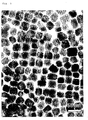
- the TEM image (174,000 magnifications) of the ITO particles is shown in FIG. 1 .
- Each one of the generated ITO particles is a spherical, cubic or rectangular parallelepiped particle with a size (average particle diameter) of 14.4nm.
- Results of measuring XRD spectrum of the ITO powder is shown in FIG.8 . It was found that the obtained diffraction pattern coincides with a diffractionpattern of indium oxide and was composed of a single composition of the indium oxide having a cubic crystal system.
- ethylene glycol aqueous solution:10mL of sodium hydroxide:2.25mol/L was mixed and reacted in ethylene glycol solution:10mL of indium tri chloride tetrahydrate:0.25mol/L and tin tetrachloride pentahydrate:0.025mol/L, to thereby obtain a suspending solution of tin-containing indium hydroxide-ethylene glycol suspending solution:20mL.
- This suspending solution was set in an Auto clave and was heated at 250°C for 24 hours. A precipitate was separately collected by using a centrifugal separator from a precipitation solution after heating. Then, the collected precipitate was dispersed by ethanol and thereafter the precipitate was separately collected again by using the centrifugal separator, to thereby obtain ITO powder according to example 2.
- the generated ITO particle had a spherical, cubic or rectangular parallelepiped shape, with a size (average particle diameter) of 17.2nm. Further, when the XRD spectrum was measured, it was found that the ITO particles werecomposed of a single composition of indium oxide, each particle having the crystallite diameter of 17.3nm.
- the TEM image (174,000 magnifications) of the ITO particles is shown in FIG.2 .
- ethylene glycol aqueous solution:10mL of sodium hydroxide:2.25mol/L was mixed and reacted in ethylene glycol solution:10mL of indium tri chloride tetrahydrate:0.25mol/L and tin tetrachloride pentahydrate:0.025mol/L, to thereby obtain tin-containing indium hydroxide-ethylene glycol suspending solution:20mL.
- This suspending solution was set in an Auto clave and was heated at 250°C for 96 hours. A precipitate was separately collected by using the centrifugal separator from the precipitation solution after heating. Then, the collected precipitate was dispersed by ethanol and thereafter the precipitate was separately collected again by using the centrifugal separator, to thereby obtain ITO powder according to example 3.
- the ITO particle (primary particle) of the example 3 had a spherical, cubic or rectangular parallelepiped shape, with a size (average particle diameter) of 23.0nm. Further, when the XRD spectrum was measured, it was found that the ITO particles werecomposed of a single composition of indium oxide with the crystallite diameter being 25.3nm.
- the TEM image (174,000 magnifications) of the ITO particles is shown in FIG.3 .
- further expanded TEM photograph (300,000 magnifications) of the ITO particles of the example 3 is shown in FIG. 4 . Regular moire fringes are observed in the particles, and there is no grain boundary in association with dislocation. Therefore, it was found that the particles were composed of a single crystal. A value of "(average primary particle diameter obtained from the TEM photograph) / (crystallite diameter calculated from (222) plane of indium oxide)" was 0.91.
- the solvent of the example 1 is substituted with water from ethylene glycol.
- indium tri chloride tetrahydrate:1.72g and tin tetrachloride pentahydrate:0.22g were weighed, so that indium was set to 0.25mol/L and tin was set to 0.025mol/L.
- Pure water: 25mL was added little by little while stirring both salts, to therebyadjust the aqueous solution containing indium and tin.
- NaOH:2.25g was weighed, so that NaOH was set to 2.25mol/L.
- the pure water:25mL was added little by little while dissolving the NaOH, to thereby adjust the basic solution.
- the particles of the comparative example 1 were cubic or rectangular parallelepiped particles, each having a size (average particle diameter) of 40nm.
- the particles were composed of not a single composition of indium oxide but indium oxyhydroxide.
- the TEM image of the ITO particles (174,000 magnifications) is shown in FIG. 7 .
- the solvent of the example 1 is substituted with a mixed solvent of ethylene glycol and water.
- a solution containing indium and tin indium tri chloride:tetrahydrate 1.72g, tin tetrachloride pentahydrate:0.22g, and pure water:5mL were weighed, so that indium was set to 0.25mol/L and tin was set to 0.025mol/L. Then, a total solution was set to 25mL by adding ethylene glycol little by little while stirring both salts and pure water, to therebyadjust the water-ethylene glycol solution containing indium and tin.
- NaOH:2.25g and pure water:5mL were weighed so that NaOH was set to 2.25mol/L, as a basic solution of 3.0 equivalent of indium. Then, a total solution was set to 25mL by adding ethylene glycol little by little to the NaOH and pure water, to there by adjust the basic water-ethylene glycol solution.
- the generated particles of the comparative example 2 were cubic or rectangular parallelepiped particles, each having a size (average particle diameter) of 23nm.
- the XRD spectrum was measured, it was found that the particles were composed of not a single composition of indium oxide but indium oxyhydroxide.
- the water contained in the tin-containing indium hydroxide precipitation solution which is subjected to heat treatment in the air-tightly closed vessel is less than 15 mass%, it can be considered that the oxide of indium and tin is generated. Further, the particle size (average particle diameter) obtained from the TEM observation with extension of a heat treatment time and the crystallite diameter obtained from XRD are increased, and it can be considered that a particle growth occurs. In the example 3 in which the heat treatment was performed for 96 hours, the ITO particles each having a cubic or rectangular parallelepiped shape were generated, and it was found that the ITO particles with extremely excellent crystallinity were formed, with extension of the heat treatment time.
- the solvent of the example 1 is substituted with diethylene glycol from ethylene glycol.
- diethylene glycol solution:25mL of the indium tri chloride tetrahydrate:0.25mol/L and tin tetrachloride pentahydrate:0.025mol/L diethylene glycol solution 25mL of sodium hydroxide 2.25mol/L were prepared. Both solutions, each being 10mL, were respectively mixed and reacted, to thereby obtain diethylene glycol suspending solution:20mL of tin-containing indium hydroxide. Then, the precipitation solution was set in the Auto clave and was heated at 250°C for 12 hours.
- a precipitate was separately collected by using the centrifugal separator from the precipitation solution after heating. Then, the collected precipitate was dispersed by ethanol and thereafter the precipitate was separately collected again by using the centrifugal separator, to thereby obtain ITO powder according to the example 4.
- the ITO particles of the example 4 were cubic or rectangular parallelepiped particles, each having a size (average particle diameter) of 28.7nm.
- the TEM image of the ITO particles is shown in FIG.5 . Further, when the XRD spectrum was measured, it was found that the particles were composed of a single composition of indium oxide with a crystallite diameter being 28.7nm. A value of "(average primary particle diameter obtained from the TEM photograph) / (crystallite diameter calculated from (222) plane of indium oxide obtained from XRD diffraction peak)" was 1.0.
- the solvent of the example 1 is substituted with 1-butanolfrom ethylene glycol.
- 1-butanol solution:25mL of the indium tri chloride tetrahydrate:0.25mol/L and tin tetrachloride pentahydrate:0.025mol/L, and 1-butanolsolution:25mL of sodium hydroxide 2.25mol/L were prepared. Both solutions, each being 10mL, were respectively mixed and reacted, to thereby obtain 1-butanol suspending solution:20mL of tin-containing indium hydroxide.Then, the precipitation solution was set in the Auto clave and was heated at 250°C for 12 hours.
- a precipitate was separately collected by using the centrifugal separator from the precipitation solution after heating. Then, the collected precipitate was dispersed by ethanol and thereafter the precipitate was separately collected again by using the centrifugal separator, to thereby obtain ITO powder according to the example 5.
- the ITO particles of the example 5 were spherical shaped particles each having a size (average particle diameter) of 11. 5nm. Further, when the XRD spectrum was measured, it was found that the particles were composed of a single composition of indium oxide, each particle having the crystallite diameter of 10.0nm. A value of "(average primary particle diameter obtained from the TEM photograph) / (crystallite diameter calculated from (222) plane of indium oxide obtained from the XRD diffraction peak)" was 1.15.
- Example 6 shows an example of adjusting the ITO powder by changing the heat treatment temperature of the example 1.
- the ITO powder of the example 6 was adjusted by the same method as the example 1, excluding a point that a temperature of a heating process was changed from 250°C to 220°C.
- the ITO particles (primary particles) of the example 6 were spherical shaped particles each having a size (average particle diameter) of 11.5nm. Further, when the XRD spectrum was measured, it was found that the particles werecomposed of a single composition of indium oxide, each particle having the crystallite diameter of 13.8nm. A value of "(average primary particle diameter obtained from the TEM photograph) / (crystallite diameter calculated from (222) plane of indium oxide obtained from the XRD diffraction peak)" was 0.83.
- Example 7 shows an example of adjusting the ITO powder by substituting indium salt of the example 1 with indium nitrate.
- the ITO powder of the example 7 was adjusted in the same method as the example 1, excluding a point that the indium salt was substituted with indium nitrate from indium chloride.
- the ITO particles (primary particles) of the example 7 were spherical shaped particles each having a size (average particle diameter) of 14.4nm. Further, when the XRD spectrum was measured, it was found that the particles were composed ofa single composition of indium oxide, each particle having the crystallite diameter of 16.4nm. A value of "(average primary particle diameter obtained from the TEM photograph)/(crystallite diameter calculated from (222) plane of indium oxide obtained from the XRD diffraction peak)" was 0.88.
- Example 8 shows an example of adjusting the ITO powder by substituting the basic salt of the example 1 with ammonium carbonate.
- the ITO powder of the example 8 was adjusted in the same method as the example 1, excluding a point that the basic salt was changed from sodium hydroxide:2.25mol/L to ammonium carbonate:1.125mol/L.
- the ITO particles (primary particles) of the example 7 were spherical particles each having a size (average particle diameter) of 23nm. Further, when the XRD spectrum was measured, it was found that the particles were composed of a single composition of indium oxide with each crystallite diameter being 22.8nm. A value of "(average primary particle diameter obtained from the TEM photograph) / (crystallite diameter calculated from (222) plane of indium oxide obtained from the XRD diffraction peak)" was 1.01.
- the ITO powder suitable for the coating material for the transparent electroconductive material of the present invention could be obtained with excellent crystallinity equivalent to that of the example 1, even if the indium salt was substituted with nitrate salt, and basic salt was substituted with ammonium carbonate.
- indium tri chloride tetrahydrate and tin tetrachloride pentahydrate were weighed, so that indium was set to 0.5mol/L and tin was set to 0.05mol/L in ethylene glycol: 25mL.
- Ethylene glycol:25mL was added little by little while stirring both salts, to therebyadjust the solution containing indium and tin.
- NaOH was weighed so that NaOH concentration in the ethylene glycol:25mL was set to 1.00mol/L.
- Ethylene glycol:25mL was added to the weighed NaOH little by little, to thereby adjusta basic solution.
- the basic solution:10mL was mixed and reacted in the solution:10mL containing the indium and tin while setting the liquid temperature not exceeding 30°C, to thereby obtain a suspending solution:20mL of ethylene glycol-tin containing indium hydroxide.
- This suspending solution was set in the Auto clave and was heated at 250°C for 96 hours.
- a precipitate was separately collected by using the centrifugal separator from the precipitation solution after heating. Then, the collected precipitate was dispersed by ethanol and thereafter the precipitate was separately collected again by using the centrifugal separator, to thereby obtain ITO powder according to example 9.
- each particle has the cubic or rectangular parallelepiped shape having a size (average particle diameter) of 48.2nm.
- the XRD spectrum of the ITO particles was measured, it was found that the particles were composed of a single composition with the crystallite diameter being 47.5nm.
- the TEM image of the ITO particles is shown in FIG.6 . Further, a value of "(an average primary particle diameter obtained from the TEM photograph)/(crystallite diameter calculated from (222) plane of indium oxide obtained from the XRD diffraction peak)" was 1.01.
Landscapes
- Chemical & Material Sciences (AREA)
- Engineering & Computer Science (AREA)
- Organic Chemistry (AREA)
- Materials Engineering (AREA)
- Wood Science & Technology (AREA)
- Life Sciences & Earth Sciences (AREA)
- Inorganic Chemistry (AREA)
- Nanotechnology (AREA)
- General Physics & Mathematics (AREA)
- Crystallography & Structural Chemistry (AREA)
- Physics & Mathematics (AREA)
- Condensed Matter Physics & Semiconductors (AREA)
- Composite Materials (AREA)
- Conductive Materials (AREA)
- Non-Insulated Conductors (AREA)
- Pigments, Carbon Blacks, Or Wood Stains (AREA)
- Paints Or Removers (AREA)
Abstract
Description
- The present invention relates to a producingmethod of an indium-tin-oxide containing tin (described as ITO hereafter), and ITO powder, a coating material for a transparent electroconductive material containing the ITO powder, and a transparent electroconductive film formed by using the coating material.
- An electroconductive film containing ITO exhibits a high light-shielding performance to a visible light and electroconductivity, and therefore is used as a transparent electrode film such as each kind of display device and a solar cell. As a film formation method of this transparent electroconductive film, a physical vapor deposition method such as a sputtering method using an ITO target, and a coating method for coating a dispersion liquid of ITO particles and an organic compound of tin and indium, are known.
- Generally, an ITO film formation method by physical vapor deposition such as a sputtering method using an ITO target is widely used, from a viewpoint of low electric resistance, high visible ray transmissivity, and chemical stability. However, in the present sputtering film formation method, only a slight amount of the ITO target is actually used as a transparent electrode, due to adhesion loss of ITO to an inside of a sputtering apparatus during film formation and etchingloss during formation of wiring, or the like. A major part of the used ITO target is regenerated by recycling. However, in this case, regeneration lead time exists, and therefore as an actual problem, it is necessary to secure a larger amount of indium raw material than an amount used as wiring. Further, in the sputtering film formation method, renewal of a film formation apparatus is required, so as to enlarge the size of the ITO target and a vacuum chamber, etc., in accordance with a rapid demand expansion of a large-sized thin television.
- Meanwhile, although the ITO film obtained by a coating method has a slightly low electroconductivity compared with the ITO film formed by a physical method such as a sputtering method, it has an advantage that it can be formed to have a large area or a complicated shape withoutusing an expensive apparatus such as a vacuum apparatus, thus reducing a film formation cost. Then, a technique of forming and wiring of a transparent electroconductive film has been focused recently, wherein the transparent electroconductive film is formed and wired by turning the ITO particles into coating materials and directly coating a surface of a substrate with the ITO particles and heating the ITO particles in the atmosphere. If this method is used, use efficiency of the indium raw material can be increased, and also an electrode with a large area can be manufactured by using a printing technique, and therefore this is a technique that has drawing attention in recent years.
- Meanwhile, as a producingmethod of the ITO particles that constitute the ITO powder used for turning the ITO film, a method of adding and neutralizing/precipitating alkali such as ammonia and caustic soda in an aqueous solution containing indium ion such as indium chloride aqueous solution and tin ion such as tin chloride aqueous solution to thereby generate indium hydroxide containing tin, and applying heat treatment (sintering) thereto at a high temperature of 500°C or more in the atmosphere or reduced atmosphere to thereby cause crystallization.
- Further, patent document 1 discloses a method of generating a cubic or rectangular parallelepiped indium hydroxide particles with extremely good crystallinity by heating the indium hydroxide at 110°C, and further adding tin chloride and a basic precipitant to thereby obtain indium hydroxide, tin hydroxide precipitates, and further increasing crystallinity by hydrothermally treating the indium hydroxide and the tin hydroxide precipitates in a pressurized vessel, and thereafter applying heat treatment thereto at a high temperature of 500°C or more, to thereby obtain the ITO particles with good crystallinity.
- Meanwhile, a method of using an organic material is also disclosed as a method of obtaining the ITO particles. Patent document 2 discloses a method of dissolving indium salt and tin salt into an organic solvent, and thereafter adding alkali aqueous solution thereto to thereby generate indium hydroxide and tin hydroxide, then drying a mixture of the obtained indium hydroxide and tin hydroxide, and thereafter applying heat treatment thereto.
Patent document 3 discloses a method of obtaining the ITO particles by applying heat treatment to tin-containing indium hydroxide in an organic solvent at a temperature of 240°C or more. -
- Patent document 1:
Japanese Patent Laid Open Publication No.2008-222467
(Japanese Patent Application No.2007-060558 - Patent document 2:
Japanese Patent Laid Open Publication No.03-54114 - Patent document 3:
Japanese Patent Laid Open Publication No.2007-269617 - As described above, the preset invention provides a promising techniqueof turning ITO particles into coating materials, and directly coating a surface of a substrate with the coating material, and thereafter forming and wiring an ITO film by a process of applying a heat treatment thereto in the atmosphere at a relatively low temperature.
- However, in the patent document 1, tin-containing indium hydroxide with good crystallinity is obtained by applying heat treatment at 100°C or less to a product produced by adding basic salt to inorganic salt containing indium and tin in an aqueous solution and applying hydrothermal treatment thereto at 200°C or more, and further the ITO particles with good crystallinity are obtained by drying the tin-containing indium hydroxide and thereafter applying heat treatment to this dried material. However, in a hydrothermal treatmentunder pressure in an autoclave, although indium hydroxide and indium oxyhydroxide can be generated, indium oxide is hardly generated. Accordingly, in order to obtain the ITO particles, it is necessary to dry a product after hydrothermal treatment, and thereafter apply heat treatment to this product.
- Further, in the patent document 2, heat treatment is applied, in a state of reducing an aggregation of primary particles, by mixing the indium hydroxide and the tin hydroxide in the organic solvent. In this method as well, similarly to a conventional producing method of the ITO particles, it is indispensable to perform the step of applying heat treatment at 500°C or more in the atmosphere. Therefore, a phenomenonthat ITO particles are sintered and coarsened can not be avoided.
- Further, when the ITO particles are turned into coating materials, which are obtained through the step of applying heat treatment in the air or in the atmosphere, it is extremely difficult to obtain the ITO coating material with good dispersability, even if the ITO particles are dispersed as they are. Therefore, in order to obtain a good dispersabiltiy of the ITO particles, a pulverization/dispersion step of secondary particles of the ITO is necessary.
When the aforementioned pulverization/dispersion is not sufficient and the ITO film is formed by ITO coating materials containing coarse ITO particles, the dispersability of the ITO particles and transparency of a coating film are deteriorated, thus increasing turbidity of the coating film.
Meanwhile, when a beads mill is used in the aforementioned pulverization/dispersion step, there is a problem that productivity is reduced due to requiredpulverization time, and also electroconductivity characteristic of the obtained coating film is deteriorated by a mixture of impurities into the ITO coating materials due to contamination from a media such as beads. - Meanwhile, as a method of producingindium oxide particles in the organic solvent,
patent document 3 discloses a method of producing indium oxide containing tin, by dispersing the product produced by adding the basic salt to the inorganic salt containing indium and tin and heating the organic solvent with the product dispersed therein at a temperature of 240°C or more. By this method, although an ITO coating liquid with good dispersability can be produced, the organic solvent containing the product needs to be treated at a high temperature, and therefore the organic solvent having a high boiling point of at least 240°C or more needs to be absolutely used. Here, as a film formation temperature for producing the ITO film from the ITO coating liquid, a heating temperature during film formation is desired to be 250°C or less and further 200°C or less, because a softening point of glass or a heat resistant temperature of other electronic member is in the vicinity of 300°C. Accordingly, when the organic solvent of 240°C or more is used as a solvent of the ITO coating liquid, it is difficult to easily evaporate the organic solvent during film formation, and the solvent needs to be replaced with a solvent with a low boiling point. In addition, since a complete solvent replacement is extremely difficult, there is a problem that a film is inhibited from being formed at a low temperature, due to a residue of an organic material having a high boiling point.
Therefore, according to this producing method, in order to obtain a dispersion liquid with ITO particles dispersed in the organic solvent having a boiling point of less than 240°C, the replacement of the solvent is needed after synthesizing the ITO particles. - In view of the above-described problem, an object of the present invention is to provide ITO powder and a producing method of the same, capable of obtaining a transparent electromagnetic film with good crystallinity by a simple treating method even at a low heating temperature, without throughaheating process in the atmosphere which disadvantageously causes sintering among the ITO particles to coarsen the ITO particles. Further object of the present invention is to provide ITO powder with no residue of the organic solvent even in a case of sintering at a low temperature and a producing method of the same, when a film is formed by using a coating material for an electroconductive material containing the ITO powder, without an essential requirement of using a solvent having a high boiling point as a solvent used in the producing step of the ITO powder.
- As a result of a study on solving the above-described problem, inventors of the present invention achieve a new structure that a precursorcontaining indium and tin is formed in an organic solvent, being an organic solvent with a low boiling point, and next by applying treatment to the precursor and the organic solvent under pressure, ITO particles are generated in a particle dispersion liquid comprising the organic solvent with a low boiling point.
- Namely, in order to solve the above-described problem, a first structure of the presentinvention is a producing method of ITO particles, comprising:
- a first step of dissolving salt containing indium and salt containing tin into an organic solvent, then adding to this organic solvent, an organic solvent containing a basic precipitant, to thereby manufacture a mixture of a precursor containing indium and tin, and the organic solvent; and
- a second step of applying heat treatment to the mixture of the precursor containing indium and tin, and the organic solvent in a pressurizing vessel at 200°C or more and 300°C or less, to thereby generate ITO particles.
- A second structure of the present invention is the producingmethod of the ITO particles according to the first structure, wherein the organic solvent containsone or more OH groups per one molecule and having a boiling point of less than 240°C.
- A third structure of thepresentinvention is the producing method of the ITO particles according to the first structure, wherein the organic solvent contains one or more OH groups per one molecule and has a boiling point of less than 200°C.
- A fourth structure of the present invention is the producing method of the ITO particles according to any one of the first to third structures, wherein in the second step, an amount of the precursor containing indium and tin and an amount of water contained in the mixture of the organic solvent are less than 15 mass%.
- A fifth structure of the present invention is the producingmethod of the ITO particles according to any one of the first to fourth structures, wherein the organic solvent is a hydrophilic organic solvent.
- A sixth structure of the present invention is the producing method of the ITO particles according to any one of the first to fifth structures, wherein the organic solvent is a solvent of one kind or more containing at least polyol.
- A seventh structure of the present invention is the producing method of the ITO particles according to any one of the first to sixth structures, wherein the organic solvent is a solvent of one kind or more containing at least ethylene glycol.
- An eighth structure is ITO powder wherein an average primary particle diameter obtained from a TEM photograph is 10nm or more and 100nm or less.
- A ninth structure of the present invention is the ITO powder according to the eighth structure, wherein a value of "(an average primary particle diameterobtained from the TEM photograph) / (crystallite diameter calculated from (222) plane of indium oxide obtained from the XRD diffraction peak)" is 0.8 or more and 1.2 or less.
- A tenth structure of the presentinvention is the ITO powder according to eighth or ninth structure, wherein there is no crystal boundary in particles.
- An eleventh structure of the presentinvention is the ITO powder according to any one of the eighth to tenth structures, wherein each particle that constitutes the ITO powder has a cubic or rectangular parallelepiped shape.
- A twelfth structure of the present invention is a coating material for a transparent electroconductive material, which contains the ITO particles produced by the producing method of the ITO particles according to any one of the first to seventh structures, or the ITO powder according to any one of the eighth to eleventh structures.
- A thirteenth structure of the present invention is a transparent electroconductive film, which is produced by using the coating material for the transparent electroconductive material according to the twelfth structure.
- According to the present invention, ITO particles can be produced without through a heating process in the atmosphere which disadvantageously causes sintering among the ITO particles to coarsen the ITO particles. Further, according to the present invention, ITO powder can be produced, which is suitable for a coating material for a transparent electroconductive material without using a solvent with a high boiling point as a solvent used in a manufacturing process of the ITO powder.
-
-
FIG.1 is a TEM image of ITO powder according to example 1. -
FIG.2 is a TEM image of ITO powder according to example 2. -
FIG.3 is a TEM image of ITO powder according to example 3. -
FIG.4 is a high magnification image of the ITO powder according to the example 3. -
FIG.5 is a TEM image of ITO powder according to example 4. -
FIG.6 is a TEM image of ITO powder according to example 9. -
FIG.7 is a TEM image of ITO powder according to comparative example 1. -
FIG. 8 shows a pattern of an XRD spectrum of the ITO powder according to the example 1. - ITO particles that constitute the ITO POWDER suitable for a coating material for a transparent electroconductive material according to the present invention will be described.
An average primary particle diameter measured from a TEM image of the ITO particles that constitute the ITO powder according to the present invention is 10nm or more and 100nm or less. This is because by setting the average primary particle diameter to 10nm or more, increase of the number of contacts of particles per unit area is suppressed during film coating, thus also suppressing an increase of a contact resistance. Meanwhile, this is because by setting the average primary particle diameter to 100nm or less, a sintering temperature of the particles is decreased, thus allowing the particles to be sintered at a low temperature if the average primary particle diameter is 100nm or less, and allowing a homogeneous film to be produced. - Further, if each ITO particle that constitutes the ITO powder has a cubic or rectangular parallelepiped shape, crystallinity of the ITO particle is higher than the crystallinity of a spherical particle.
Then, it is possible to form an ITO film with the coating film made more closely minute by regularly arranging the cubic or rectangular parallelepiped ITO particles, rather than by arranging spherical ITO particles, and a film with low electric resistance value can be obtained. - Further, in the ITO particles that constitute the ITO powder suitable for the coating material for the transparent electroconductive material according to the present invention, a value of "(average primary particle diameter obtained from the TEM photograph)/(crystallite diameter calculated from (222) plane of indium oxide obtained from (XRD diffraction peak)" which is obtained by dividing an ITO particle (primary particle) diameter observed from the TEM image by a crystallite diameter calculated from (222) plane of indium oxide obtained from an XRD spectrum, is closed to 1.0. This is because the value close to 1.0 is considered to show that each ITO particle itself is a particle closed to a single crystal, and specifically show that the value is 0.8 or more, 1.2 or less, and further preferably 0.9 or more, and 1.1 or less. Also this is because as a result, the particles that constitute the ITO powder according to the present invention are particles with extremely good crystallinity wherein there is no crystal boundary in one particle, and a film with high electroconductivity and low resistance can be formed.
- Next, the manufacturing method of the ITO powder according to the present invention will be described.
First, a solution containing indium and tin is prepared. The solution containing the indium and tin is an indium salt solution with indium concentration set to 0.1 to 4.0mol/L, preferably 0.2 to 2.0mol/L. In this solution, an addition amount of tin salt is set to 5 to 20mol% with respect to indium. - As a solvent of a solution with indium salt and tin salt dissolved therein, an organic solvent having at least one or more OH groups per one molecule is preferable. Specifically, alcohols and particularly polyhydric alcohols are preferable, and further preferably ethylene glycol and diethylene glycol can be given. However, the organic solvent is not limited thereto, and polyhydric alcohols or its derivative with a boiling point of its organic solvent being 100°C to 300°C or less, and further preferably 250°C or less, may be used, or ionic liquid may also be used.
- It appears that this is because owing to hydrophilic indium salt and tin salt, being starting raw materials, the organic solvent has at least one or more OH groups per one molecule, or in a case of ionic one, it is easy to homogeneously dissolve the raw material salt, and homogeneous reactivity is improved during neutralization and heat treatment. Of course, not only one kind of the organic solvents but two kinds of them may be mixed and used. Further preferably, a hydrophilic water-soluble solvent capable of dissolving water of 50 volume% or more is used.
- As a film forming temperature to be set for the coating liquid of ITO to ITO film, a heating temperature during film formation is desired to be 250°C or less, and further preferably 200°C or less, because a softening point of glass and a heat resisting temperature of other electronic component are in the vicinity of 300°C. The heating temperature during film formation is desired to be 250°C or less and further preferably 200°C or less. The boiling point of the used organic solvent is preferably less than 240°C, because the organic solvent is easily vaporized during film formation, and is therefore further preferably less than 200°C. However, if the boiling point of the organic solvent is excessively low, pressure during reaction and heating is excessively high, thus requiring a high pressure vessel based on the pressure and increasing a facility cost. Accordingly, from this viewpoint, the boiling point of the organic solvent is preferably 100°C or more.
- As described above, the organic solvent used for generating the ITO particles of this embodiment has preferably one or more OH groups per one molecule. By the organic solvent having one or more OH groups per one molecule, an effect different from the aforementionedeffect can be exhibited. This is an effect of missing oxygen by robbing and reducing of O (oxygen) from tin-containing indium oxide by the OH group that exists in the organic solvent. Owing to the generated missing oxygen, carrier is generated in the generated ITO particles, and therefore electroconductivity is improved.
Here, from a viewpoint of a compound having many OH groups, polyol having two or more OH groups per one molecule is preferable as the organic solvent. - The indium salt dissolved into the solution can be obtained by dissolving a solution into the organic solvent, the solution being obtained by dissolving anhydride crystal salt of indium of at least one kind selected from a group consisting of In2(C2O4)3, InCl3, In(NO3)3, and In2(SO4)3, or crystal salt of hydrate such as In (NO3)3 · 3H2I, InCl3 · 4H2O, In2(SO4)3 · 9H2O, or indium metal into H2C2O4, HNO3, HCl, H2SO4, etc. However, from a viewpoint of reducing contained waterin the organic solvent, the anhydride crystal salt is most preferably used.
- The tin salt dissolved into the solution can be obtained by dissolving a solution into the organic solvent, the solution being obtained by dissolving anhydride crystal salt of at least one kind selected from a group consisting of Sn2(C2O4)3, SnCl2, SnCl4, Sn(NO3)2, and SnSO4, or crystal salt of hydrate such as Sn(NO3)3· 3H2O, SnCl3 · 2H2O, SnCl4 · 5H2O, Sn(SO4)2 · 2H2O, or tin metal into H2C2O4 HNO3, HCl, H2SO4, etc. Further, organic tin such as tetramethyl tin, tetrabutyl tin may be used by being dissolved into the organic solvent.
From a viewpoint of reducing the contained water in the organic solvent, anhydride crystal salt or organic tin is preferably used as the used tin salt. However, the organic tin should be handled with care, and therefore the anhydride tin crystal salt is preferably used. - Indium concentration in the solution containing indium and tin is adjusted to be 0.1 to 4.0mol/L, and preferably 0.2 to 2.0mol/Lbefore neutralization reaction. This is because indium concentration of 0.1mol/L or more is preferable from a viewpoint of productivity. Also, indium concentration of 4.0mol/L or less allows the indium salt to be dissolved into the organic solvent without being left and the indium salt exists homogeneously in the organic solvent in a solution during heating treatment as will be described later, thus making it easy to produce a particle having a uniform particle diameter.
- Next, a solution containing the basic precipitant will be described.
Basic salt dissolved into the solution can be obtained by dissolving at least one kind of basic salt selected from a group consisting of NaOH, KOH, NH4OH, NH3, NH4HCO3, and (NH4)2CO3 into the aforementioned organic solvent. Note that among these basic salts, NaOH, (NH4)2CO3 is preferably used. - A liquid temperature of the solution containing indium and tin is maintained in a range of 5°C to 95°C, and preferably 10°C to 50°C. Then, the solution containing the basic salt is added into the solution kept warm with an addition time of within 24 hours and preferably within a range of 1 minute to 120 minutes, to thereby generate a precipitation solution containing indium hydroxide-tin hydroxide precipitant (described as "tin-containing indium hydroxide" hereafter in some cases.). The basic salt is added up to 0.5 to 100 equivalent and preferably 1.0 to 10 equivalent of the indium salt, to thereby generate the precipitation solution of the indium hydroxide in the organic solvent. As an addition amount of the basic salt is increased, rapid pH fluctuation occurs during precipitation, to thereby generate fine particles. Namely, 0.5 equivalent or more of theadditionamount of the basic salt is preferable because an unprecipitation amount is reduced. Meanwhile, even if 10 equivalent or more of the basic salt is added, the pH fluctuation during precipitation is not different so much from the case of 10 equivalent, and therefore 10 equivalent or less of the addition amount of the basic salt is sufficient.
- Next, in order to obtain the ITO particles from the generated tin-containing indium hydroxide particles, heat treatment (treatment in an Autoclave) is applied to the obtained tin-containing indium hydroxide precipitation solution in an air-tightly closedvessel. At this time, preferably, solid-liquid separation is performed to the tin-containing indium hydroxide particles from the precipitation solution, so that the processing is shifted to the heat treatment (treatment in the Autoclave) without drying the particles. This is because by shifting the heat treatment process without drying the tin-containing indium hydroxide particles, being precursors, generation of the agglomeration of the precursors in this stage can be avoided. As a result, preferably an increase of the agglomeration of the ITO particles can be avoided.
Further, preferably the heat treatment temperature is set in a range of 200°C to 300°C, and the treatment time is set in a range of 30 minutes to 200 hours. When the heat treatment temperature is set to 200°C or more and is preferably set to 220°C or more, long time heating can be avoided. However, pressure in the air-tightly closed vessel is increased under high temperature condition. Therefore, when the heating temperature is 300°C or less, the pressure during reaction is not excessively high, thus preferably requiring no special apparatus.
A water amount contained in the tin-containing indium hydroxide precipitation solution which is subjected to heat treatment in the air-tightly closed vessel, is set to 15mass% or less. When the water amount is 15 mass% or less, the tin-containing indium hydroxide with high purity can be obtained. For the same reason, the water amount is further preferably set to 5 mass% or less. - The solid-liquid separation and washing are performed after heat treatment, to thereby obtain slurry of the ITO powder. The slurry of the ITO powder may be sent to the producing step of thecoating material for the transparent electroconductive film, being the next step, or may be sent to the producing step of the coating material for the transparent electroconductive film, being the next step, after drying the particles once so as to be formed into the ITO powder. In any case, it is possible to expect effects such as a simple operation because a solvent with a high boiling point is not contained in the used organic solvent, and in addition, a film showing excellent electroconductivity can be formed at a heating temperature of 250°C or less even in the producing step of thecoating material for the transparent electroconductive film, being the next step, and in the step thereafter.
- For example, a mantle heater, a ribbon heater, and an oil bath, etc., can be given as a heating apparatus used in this embodiment. Various heating apparatus can be used, provided that heating up to 300°C is possible. Further, a reactor used in this embodiment is requested to have a function of keeping an air-tight state even under a pressure of a vapor pressure of 300°C of the used solvent.
- The ITO particles according to this embodiment thus obtained are the ITO particles that constitute the ITO powder suitable for the aforementioned coating material for the transparent electroconductive material according to the present invention.
- It is found that all ITO particles of this embodiment are blue-based particles and the ITO particles having missing oxygen are generated. The ITO particles having the missing oxygen have improved electroconductivity because the carrier is generated in the ITO particles. Although the ITO particles not having the missing oxygen are generally white or yellow particles, they are turned into green or blue-based particles by having missing oxygen.
- Next, explanation will be given for the production of thecoating material for the transparent electroconductive film using the ITO powder or the slurry of the ITO powder according to this embodiment.
The coating material for the transparent electroconductive filmaccording to the presentinvention can be produced by dispersing the ITO powder or the slurry of the ITO powder of the present invention into the solvent. At this time, the concentration of the ITO powder in this coating material for the transparent electroconductive film may be adjusted in a range of 5 to 25 mass%.
Further, as a medium in a liquid state in which the ITO powder or the slurry of the ITO powder according to this embodiment is dispersed, not only the aforementioned organic solvent used for reaction, but also organic solvents such as alcohol, ketone, ether, ester, toluene, and cyclohexane may be used, or pure water may also be used. Further, a surface-active agent or a dispersant such as a coupling agent may also be used together. - Various base materials can be coated with the coating material for the transparent electroconductive films of the present invention such as substrates including ceramic and glass, etc., and an organic film. Further, generation of unevenness is not observed during coating of thecoating material for the transparent coating film.
- Next, explanation will be given for an example of the film formation method of the transparent electroconductive film using thecoating material for the transparent electroconductive filmaccording to the present invention.
For example, when a film is formed on a glass substrate, the glass substrate is rotated by a spin coater. The coating material for the transparent electroconductive film of the present invention is dripped thereto to coat the glass substrate. After coating, the glass substrate is taken out and dried, and then is rotated again by the spin coater, to thereby drip an overcoat material. The obtained glass substrate after overcoat is dried and thereafter the temperature is increased up to, for example, 250°C in the atmosphere, and then the glass substrate is held for 20 minutes and is naturally cooled, to thereby obtain the glass substrate with transparent electroconductive film formed thereon. The obtained glass substrate with transparent electroconductive film formed thereon exhibits excellent electroconductivity, although the heating temperature is about 250°C. - Explanation will be given for the ITO particles that constitute the ITO powder suitable for the coating material for the transparent electroconductive material, and the producing method of the same, with reference to examples.
- As a solution containing indium and tin, indium tri chloride tetrahydrate:1.72g and tin tetrachloride pentahydrate:0.22g were weighed, so that indium was set to 0.25mol/L and tin was set to 0.025mol/L in ethylene glycol 25mL. Ethylene glycol:25mL was added little by little while stirring both salts, to thereby adjust the solution containing indium and tin.
Further, as a solution of 3 equivalent of indium, NaOH:2.25g was weighed, so that NaOH was set to 2.25mol/L in the ethylene glycol:25mL. The ethylene glycol:25mL was added little by little while dissolving the NaOH, to thereby adjust a basic solution. - Ethylene glycol solution:10mL of sodium hydroxide was mixed and reacted in ethylene glycol solution:10mL of tin chloride and indium chloride while setting a liquid temperature not exceeding 30°C, to thereby obtain a suspending solution:20mL of ethylene glycol-tin containing indium hydroxide.
This suspending solution was set in an Auto clave and was heated at 250°C for 12 hours. A precipitate was separately collected by using a centrifugal separator from a precipitation solution after heating. Then, the collected precipitate was dispersed by ethanol and thereafter the precipitate was separately collected again by using the centrifugal separator, to thereby obtain ITO powder according to example 1. - When shape observation was performed to the ITO powder according to the example 1 by using TEM (Transmission Electron Microscope), it was found that a generated particle had a spherical, cubic or rectangular parallelepiped shape.
An average particle diameter of the ITO particle (primary particle) that constitutes the ITO powder was computed by measuring a size (corresponding to a long side when the particle on the photograph is close to a square, and a diameter when it is close to a circular shape) of each particle of 100 ITO particles (primary particles) not overlapped on one another in the TEM photograph and calculating its average value. The TEM image (174,000 magnifications) of the ITO particles is shown inFIG. 1 . Note that regarding the size of the circular particle, a maximum length of the particle on the TEM photograph was partially measured, and its measured value was defined as a diameter (particle diameter).
Each one of the generated ITO particles is a spherical, cubic or rectangular parallelepiped particle with a size (average particle diameter) of 14.4nm. - Results of measuring XRD spectrum of the ITO powder is shown in
FIG.8 . It was found that the obtained diffraction pattern coincides with a diffractionpattern of indium oxide and was composed of a single composition of the indium oxide having a cubic crystal system. Further, a crystallite diameter of a sample of the example 1 was obtained by calculating intensity Int.(222) of a diffraction peak and a half-width B of a (222) diffraction peak wherein a peak appears at a 2θ angle of 29.0° to 31.0° (CuKα 1 light source), and by using Scherrer's formula Dx = 0.94λ/Bcosθ (wherein Dx is a crystallite size, λ is a wavelength (CuKα 1 light source) of X-ray used for measurement, B is a half width of the diffraction peak, and θ is a Bragg angle of the diffraction peak.), then 14.5nm was obtained.
A value of "(average primary particle diameter obtained from the TEM photograph)/(crystallite diameter calculated from (222) plane of indium oxide)" was 0.99. - In the same way as the example 1, ethylene glycol aqueous solution:10mL of sodium hydroxide:2.25mol/L was mixed and reacted in ethylene glycol solution:10mL of indium tri chloride tetrahydrate:0.25mol/L and tin tetrachloride pentahydrate:0.025mol/L, to thereby obtain a suspending solution of tin-containing indium hydroxide-ethylene glycol suspending solution:20mL. This suspending solution was set in an Auto clave and was heated at 250°C for 24 hours. A precipitate was separately collected by using a centrifugal separator from a precipitation solution after heating. Then, the collected precipitate was dispersed by ethanol and thereafter the precipitate was separately collected again by using the centrifugal separator, to thereby obtain ITO powder according to example 2.
- In the same way as the example 1, the generated ITO particle (primary particle) had a spherical, cubic or rectangular parallelepiped shape, with a size (average particle diameter) of 17.2nm. Further, when the XRD spectrum was measured, it was found that the ITO particles werecomposed of a single composition of indium oxide, each particle having the crystallite diameter of 17.3nm. The TEM image (174,000 magnifications) of the ITO particles is shown in
FIG.2 . - A value of "(Average primary particle diameter obtained from the TEM photograph) / (crystallite diameter calculated form (222) plane of indium oxide)" was 0.99.
- In the same way as the example 1, ethylene glycol aqueous solution:10mL of sodium hydroxide:2.25mol/L was mixed and reacted in ethylene glycol solution:10mL of indium tri chloride tetrahydrate:0.25mol/L and tin tetrachloride pentahydrate:0.025mol/L, to thereby obtain tin-containing indium hydroxide-ethylene glycol suspending solution:20mL. This suspending solution was set in an Auto clave and was heated at 250°C for 96 hours. A precipitate was separately collected by using the centrifugal separator from the precipitation solution after heating. Then, the collected precipitate was dispersed by ethanol and thereafter the precipitate was separately collected again by using the centrifugal separator, to thereby obtain ITO powder according to example 3.
- In the same way as the example 1, the ITO particle (primary particle) of the example 3 had a spherical, cubic or rectangular parallelepiped shape, with a size (average particle diameter) of 23.0nm. Further, when the XRD spectrum was measured, it was found that the ITO particles werecomposed of a single composition of indium oxide with the crystallite diameter being 25.3nm. The TEM image (174,000 magnifications) of the ITO particles is shown in
FIG.3 . In addition, further expanded TEM photograph (300,000 magnifications) of the ITO particles of the example 3 is shown inFIG. 4 . Regular moire fringes are observed in the particles, and there is no grain boundary in association with dislocation. Therefore, it was found that the particles were composed of a single crystal.
A value of "(average primary particle diameter obtained from the TEM photograph) / (crystallite diameter calculated from (222) plane of indium oxide)" was 0.91. - According to comparative example 1, the solvent of the example 1 is substituted with water from ethylene glycol.
As a solution containing indium and tin, indium tri chloride tetrahydrate:1.72g and tin tetrachloride pentahydrate:0.22g were weighed, so that indium was set to 0.25mol/L and tin was set to 0.025mol/L. Pure water: 25mL was added little by little while stirring both salts, to therebyadjust the aqueous solution containing indium and tin.
Further, as a basic solution of 3.0 equivalent of indium, NaOH:2.25g was weighed, so that NaOH was set to 2.25mol/L. The pure water:25mL was added little by little while dissolving the NaOH, to thereby adjust the basic solution. - Sodium hydroxide aqueous solution:10mL was mixed and reacted in aqueous solution:10mL of tin chloride and indium chloride while setting the liquid temperature not exceeding 30°C, to thereby obtain a suspending solution: 20mL of tin-containing indium hydroxide.
This suspending solution was set in the Auto clave and was heated at 250°C for 12 hours. A precipitate was separately collected by using the centrifugal separator from the precipitation solution after heating. Then, the collected precipitate was dispersed by ethanol and thereafter the precipitate was separately collected again by using the centrifugal separator, to thereby obtain ITO powder according to the comparative example 1. - In the same way as the example 1, the particles of the comparative example 1 (primary particles) were cubic or rectangular parallelepiped particles, each having a size (average particle diameter) of 40nm. However, when the XRD spectrum was measured, it was found that the particles were composed of not a single composition of indium oxide but indium oxyhydroxide. The TEM image of the ITO particles (174,000 magnifications) is shown in
FIG. 7 . - In comparative example 2, the solvent of the example 1 is substituted with a mixed solvent of ethylene glycol and water. As a solution containing indium and tin, indium tri chloride:tetrahydrate 1.72g, tin tetrachloride pentahydrate:0.22g, and pure water:5mL were weighed, so that indium was set to 0.25mol/L and tin was set to 0.025mol/L. Then, a total solution was set to 25mL by adding ethylene glycol little by little while stirring both salts and pure water, to therebyadjust the water-ethylene glycol solution containing indium and tin.
Further, NaOH:2.25g and pure water:5mL were weighed so that NaOH was set to 2.25mol/L, as a basic solution of 3.0 equivalent of indium. Then, a total solution was set to 25mL by adding ethylene glycol little by little to the NaOH and pure water, to there by adjust the basic water-ethylene glycol solution. - Basic water-ethylene glycol solution:10mL was mixed and reacted in water-ethylene glycol solution:10mL containing indium and tin while setting a liquid temperature not exceeding 30°C, to thereby obtain a suspending solutionof indium hydroxide containing tin-ethylene glycol solution:20mL.
This suspending solution was set in an Auto clave and was heated at 250°C for 12 hours. A precipitate was separately collected by using the centrifugal separator from the precipitation solution after heating. Then, the collected precipitate was dispersed by ethanol and thereafter the precipitate was separately collected again by using the centrifugal separator, to thereby obtain powder according to comparative example 2. - In the same way as the example 1, the generated particles of the comparative example 2 (primary particles) were cubic or rectangular parallelepiped particles, each having a size (average particle diameter) of 23nm. However, when the XRD spectrum was measured, it was found that the particles were composed of not a single composition of indium oxide but indium oxyhydroxide.
- Regarding ITO powders of examples 1, 2, 3, and powders of comparative examples 1, 2, measurement results of a reaction condition, TEM particle diameter, product phase obtained from the XRD spectrum, and crystallite diameter are shown in table 1.
- From the results of the table 1, it was found that the ITO particles were not generated if a solution containing 15 mass% or more of water was used as tin-containing indium hydroxide precipitation solution which was subjected to heat treatment in the air-tightly closed vessel. It can be considered that this is because if 15 mass% or more of water is contained in the tin-containing indium hydroxide precipitation solution which is subjected to heat treatment in the air-tightly closed vessel, change from the oxyhydroxide to oxide does not occur. In the examples 1 to 3 as well, hydrate is used as raw material salts of indium and tin, and therefore the solvent substantially contains water of about 2 mass%. However, oxide particles are generated after heat treatment. Therefore, if the water contained in the tin-containing indium hydroxide precipitation solution which is subjected to heat treatment in the air-tightly closed vessel, is less than 15 mass%, it can be considered that the oxide of indium and tin is generated.
Further, the particle size (average particle diameter) obtained from the TEM observation with extension of a heat treatment time and the crystallite diameter obtained from XRD are increased, and it can be considered that a particle growth occurs. In the example 3 in which the heat treatment was performed for 96 hours, the ITO particles each having a cubic or rectangular parallelepiped shape were generated, and it was found that the ITO particles with extremely excellent crystallinity were formed, with extension of the heat treatment time. - In example 4, the solvent of the example 1 is substituted with diethylene glycol from ethylene glycol.
In the same way as the example 1, diethylene glycol solution:25mL of the indium tri chloride tetrahydrate:0.25mol/L and tin tetrachloride pentahydrate:0.025mol/L, and diethylene glycol solution 25mL of sodium hydroxide 2.25mol/L were prepared.
Both solutions, each being 10mL, were respectively mixed and reacted, to thereby obtain diethylene glycol suspending solution:20mL of tin-containing indium hydroxide. Then, the precipitation solution was set in the Auto clave and was heated at 250°C for 12 hours.
A precipitate was separately collected by using the centrifugal separator from the precipitation solution after heating. Then, the collected precipitate was dispersed by ethanol and thereafter the precipitate was separately collected again by using the centrifugal separator, to thereby obtain ITO powder according to the example 4. - The ITO particles of the example 4 (primary particles) were cubic or rectangular parallelepiped particles, each having a size (average particle diameter) of 28.7nm. The TEM image of the ITO particles is shown in
FIG.5 . Further, when the XRD spectrum was measured, it was found that the particles were composed of a single composition of indium oxide with a crystallite diameter being 28.7nm.
A value of "(average primary particle diameter obtained from the TEM photograph) / (crystallite diameter calculated from (222) plane of indium oxide obtained from XRD diffraction peak)" was 1.0. - In example 5, the solvent of the example 1 is substituted with 1-butanolfrom ethylene glycol.
In the same way as the example 1, 1-butanol solution:25mL of the indium tri chloride tetrahydrate:0.25mol/L and tin tetrachloride pentahydrate:0.025mol/L, and 1-butanolsolution:25mL of sodium hydroxide 2.25mol/L were prepared.
Both solutions, each being 10mL, were respectively mixed and reacted, to thereby obtain 1-butanol suspending solution:20mL of tin-containing indium hydroxide.Then, the precipitation solution was set in the Auto clave and was heated at 250°C for 12 hours. A precipitate was separately collected by using the centrifugal separator from the precipitation solution after heating. Then, the collected precipitate was dispersed by ethanol and thereafter the precipitate was separately collected again by using the centrifugal separator, to thereby obtain ITO powder according to the example 5. - The ITO particles of the example 5 were spherical shaped particles each having a size (average particle diameter) of 11. 5nm. Further, when the XRD spectrum was measured, it was found that the particles were composed of a single composition of indium oxide, each particle having the crystallite diameter of 10.0nm.
A value of "(average primary particle diameter obtained from the TEM photograph) / (crystallite diameter calculated from (222) plane of indium oxide obtained from the XRD diffraction peak)" was 1.15. - Example 6 shows an example of adjusting the ITO powder by changing the heat treatment temperature of the example 1.
The ITO powder of the example 6 was adjusted by the same method as the example 1, excluding a point that a temperature of a heating process was changed from 250°C to 220°C. - The ITO particles (primary particles) of the example 6 were spherical shaped particles each having a size (average particle diameter) of 11.5nm. Further, when the XRD spectrum was measured, it was found that the particles werecomposed of a single composition of indium oxide, each particle having the crystallite diameter of 13.8nm.
A value of "(average primary particle diameter obtained from the TEM photograph) / (crystallite diameter calculated from (222) plane of indium oxide obtained from the XRD diffraction peak)" was 0.83. - Example 7 shows an example of adjusting the ITO powder by substituting indium salt of the example 1 with indium nitrate.
The ITO powder of the example 7 was adjusted in the same method as the example 1, excluding a point that the indium salt was substituted with indium nitrate from indium chloride. - The ITO particles (primary particles) of the example 7 were spherical shaped particles each having a size (average particle diameter) of 14.4nm. Further, when the XRD spectrum was measured, it was found that the particles were composed ofa single composition of indium oxide, each particle having the crystallite diameter of 16.4nm.
A value of "(average primary particle diameter obtained from the TEM photograph)/(crystallite diameter calculated from (222) plane of indium oxide obtained from the XRD diffraction peak)" was 0.88. - Example 8 shows an example of adjusting the ITO powder by substituting the basic salt of the example 1 with ammonium carbonate.
The ITO powder of the example 8 was adjusted in the same method as the example 1, excluding a point that the basic salt was changed from sodium hydroxide:2.25mol/L to ammonium carbonate:1.125mol/L. - The ITO particles (primary particles) of the example 7 were spherical particles each having a size (average particle diameter) of 23nm. Further, when the XRD spectrum was measured, it was found that the particles were composed of a single composition of indium oxide with each crystallite diameter being 22.8nm.
A value of "(average primary particle diameter obtained from the TEM photograph) / (crystallite diameter calculated from (222) plane of indium oxide obtained from the XRD diffraction peak)" was 1.01. - Regarding the ITO powder of examples 4 to 8, measurement results of the reaction condition, TEM particle diameter, product phase obtained from the XRD spectrum, and crystallite diameter are shown in table 1.
From data of the table 1, it was found that the ITO particles suitable for the coating material for the transparent electroconductive material of the present invention were generated, even if the solvent was substituted with alcohols. From data of the example 6, it was found that the ITO particles suitable for the coating material for the transparent electroconductive material of the present invention were generated even if the temperature of the heating process was decreased to 220°C. Further, from the results of the example 4, it was confirmed that the ITO particles suitable for the coating material for the transparent electroconductive material of the present invention were generated, even if the diethylene glycol was used as the solvent.
Further, it was found that the ITO powder suitable for the coating material for the transparent electroconductive material of the present invention could be obtained with excellent crystallinity equivalent to that of the example 1, even if the indium salt was substituted with nitrate salt, and basic salt was substituted with ammonium carbonate. -
[Table 1] Reaction condition Solvent Product TEM particles diameter(nm) Crystallite diameter(nm) Temp(°C) Time(h) Example 1 250 12 Ethylene glycol In2O3 14.4 14.5 Example 2 250 24 Ethylene glycol In2O3 17.2 17.3 Example 3 250 96 Ethylene glycol In2O3 23.0 25.3 Com.Ex.1 250 12 Water InOOH 40.0 - Com.Ex.2 250 12 Ethyleneglycol+water InOOH 23.0 - Example 4 250 12 Diethylene glycol In2O3 28.7 28.7 Example 5 250 12 Butanol In2O3 11.5 10.0 Example 6 220 12 Ethylene glycol In2O3 11.5 13.8 Example 7* 250 12 Ethylene glycol In2O3 14.4 16.4 Example 8** 250 12 Ethylene glycol In2O3 23.0 22.8 Example 9 250 96 Ethylene glycol In2O3 48.2 47.5 Com.: Comparative
Ex.: Example
Example 7*: indium salt is substituted with indium nitrate from indium chloride
Example 8**: basic salt is substituted with ammonium carbonate from sodium hydroxide - As a solution containing indium and tin, indium tri chloride tetrahydrate and tin tetrachloride pentahydrate were weighed, so that indium was set to 0.5mol/L and tin was set to 0.05mol/L in ethylene glycol: 25mL. Ethylene glycol:25mL was added little by little while stirring both salts, to therebyadjust the solution containing indium and tin.
Meanwhile, NaOH was weighed so that NaOH concentration in the ethylene glycol:25mL was set to 1.00mol/L. Ethylene glycol:25mL was added to the weighed NaOH little by little, to thereby adjusta basic solution. - The basic solution:10mL was mixed and reacted in the solution:10mL containing the indium and tin while setting the liquid temperature not exceeding 30°C, to thereby obtain a suspending solution:20mL of ethylene glycol-tin containing indium hydroxide.
This suspending solution was set in the Auto clave and was heated at 250°C for 96 hours. A precipitate was separately collected by using the centrifugal separator from the precipitation solution after heating. Then, the collected precipitate was dispersed by ethanol and thereafter the precipitate was separately collected again by using the centrifugal separator, to thereby obtain ITO powder according to example 9. - When the average particle diameter of the ITO particles (primary particles) of the ITO powder of the example 9 was measured in the same way as the example 1, it was found that each particle has the cubic or rectangular parallelepiped shape having a size (average particle diameter) of 48.2nm. Further, when the XRD spectrum of the ITO particles was measured, it was found that the particles were composed of a single composition with the crystallite diameter being 47.5nm. The TEM image of the ITO particles is shown in
FIG.6 .
Further, a value of "(an average primary particle diameter obtained from the TEM photograph)/(crystallite diameter calculated from (222) plane of indium oxide obtained from the XRD diffraction peak)" was 1.01.
Claims (13)
- A producing method of ITO particles, comprising:a first step of dissolving salt containing indium and salt containing tin into an organic solvent, then adding to this organic solvent, an organic solvent containing a basic precipitant, to thereby manufacture a mixture of a precursor containing indium and tin, and the organic solvent; anda second step of applying heat treatment to the mixture of the precursor containing indium and tin, and the organic solvent in a pressurizing vessel at 200°C or more and 300°C or less, to thereby generate ITO particles.
- The producing method of the ITO particles according to claim 1, wherein the organic solvent contains one or more OH groups per one molecule and having a boiling point of less than 240°C.
- The producing method of the ITO particles according to claim 1, wherein the organic solvent contains one or more OH groups per one molecule and has a boiling point of less than 200°C.
- The producing method of the ITO particles according to any one of claims 1 to 3, wherein in the second step, an amount of the precursor containing indium and tin and an amount of water contained in the mixture of the organic solvent are less than 15 mass%.
- The producing method of the ITO particles according to any one of claims 1 to 4, wherein the organic solvent is a hydrophilic organic solvent.
- The producing method of the.ITO particles according to any one of claims 1 to 5, wherein the organic solvent is a solvent of one kind or more containing at least polyol.
- The producing method of the ITO particles according to any one of claims 1 to 6, wherein the organic solvent is a solvent of one kind or more containing at least ethylene glycol.
- ITO powder, wherein an average primary particle diameter obtained from a TEM photograph is 10nm or more and 100nm or less.
- The ITO powder according to claim 8, wherein a value of "(an average primary particle diameter obtained from the TEM photograph)/(crystallite diameter calculated from (222) plane of indium oxide obtained from the XRD diffraction peak)" is 0.8 or more and 1.2 or less.
- The ITO powder according to claim 8 or 9, wherein there is no crystal boundary in particles.
- The ITO powder according to any one of claims 8 to 10, wherein each particle that constitutes the ITO powder has a cubic or rectangular parallelepiped shape.
- A coating material for a transparent electroconductive material, which contains the ITO particles produced by the producing method of the ITO particles according to any one of claims 1 to 7, or the ITO powder according to any one of claims 8 to 11.
- A transparent electroconductive film, which is produced by using the coating material for the transparent electroconductive material according to claim 12.
Applications Claiming Priority (4)
| Application Number | Priority Date | Filing Date | Title |
|---|---|---|---|
| JP2008179992 | 2008-07-10 | ||
| JP2009115212 | 2009-05-12 | ||
| JP2009148310A JP5472589B2 (en) | 2008-07-10 | 2009-06-23 | Production method of ITO particles |
| PCT/JP2009/061946 WO2010004912A1 (en) | 2008-07-10 | 2009-06-30 | Process for producing ito particles, ito powder, coating material for transparent electroconductive material, and transparent electroconductive film |
Publications (3)
| Publication Number | Publication Date |
|---|---|
| EP2305608A1 true EP2305608A1 (en) | 2011-04-06 |
| EP2305608A4 EP2305608A4 (en) | 2011-12-07 |
| EP2305608B1 EP2305608B1 (en) | 2017-04-05 |
Family
ID=41507028
Family Applications (1)
| Application Number | Title | Priority Date | Filing Date |
|---|---|---|---|
| EP09794358.3A Not-in-force EP2305608B1 (en) | 2008-07-10 | 2009-06-30 | Process for producing ito particles |
Country Status (4)
| Country | Link |
|---|---|
| US (1) | US8524122B2 (en) |
| EP (1) | EP2305608B1 (en) |
| JP (1) | JP5472589B2 (en) |
| WO (1) | WO2010004912A1 (en) |
Families Citing this family (11)
| Publication number | Priority date | Publication date | Assignee | Title |
|---|---|---|---|---|
| US20100144088A1 (en) * | 2008-12-05 | 2010-06-10 | Electronics And Telecommunications Research Institute | Method for forming metal oxide and method for forming transistor structure with the same |
| JP2012212642A (en) * | 2010-08-27 | 2012-11-01 | Sekisui Chem Co Ltd | Metal oxide particle dispersion composition |
| JP2012109088A (en) * | 2010-11-16 | 2012-06-07 | Sekisui Chem Co Ltd | Metal oxide semiconductor particle dispersion composition |
| WO2013008706A1 (en) * | 2011-07-13 | 2013-01-17 | エム・テクニック株式会社 | Method for manufacturing microparticles with regulated crystallite diameter |
| JP5706797B2 (en) * | 2011-10-20 | 2015-04-22 | 三井金属鉱業株式会社 | Tin-doped indium oxide particles |
| US20130171903A1 (en) * | 2012-01-03 | 2013-07-04 | Andrew Zsinko | Electroluminescent devices and their manufacture |
| JP2015078109A (en) * | 2013-09-10 | 2015-04-23 | トヨタ自動車株式会社 | METHOD FOR SYNTHESIZING ZnO:Ga NANOPARTICLES AND METHOD FOR PRODUCING ZnO:Ga FILM |
| JPWO2019138708A1 (en) * | 2018-01-15 | 2021-01-07 | 国立大学法人東北大学 | Method for Producing ITO Particles, Dispersion Solution and ITO Film |
| KR102461412B1 (en) * | 2018-01-15 | 2022-10-31 | 고쿠리츠다이가쿠호진 도호쿠다이가쿠 | ITO particles, dispersions, methods for producing ITO particles, methods for producing dispersions, and methods for producing ITO membranes |
| MX2022007986A (en) * | 2019-12-30 | 2022-07-11 | H C Starck Tungsten Gmbh | Process for producing tungsten metal powders. |
| CN118145965B (en) * | 2024-02-28 | 2026-06-12 | 福建阿石创新材料股份有限公司 | A method for preparing an indium oxide/tin hydroxide composite and an ITO target. |
Family Cites Families (12)
| Publication number | Priority date | Publication date | Assignee | Title |
|---|---|---|---|---|
| JP2776573B2 (en) | 1989-07-20 | 1998-07-16 | 住友金属鉱山株式会社 | Production method of indium oxide-tin oxide fine powder |
| JPH06232586A (en) * | 1993-01-29 | 1994-08-19 | Sumitomo Cement Co Ltd | Electromagnetic wave shielding film and manufacturing method thereof |
| KR100737657B1 (en) * | 1998-09-06 | 2007-07-09 | 라이브니츠-인스티투트 퓌어 노이에 마테리알리엔 게마인누찌게 게엠베하 | Process for preparing suspensions and powders based on indium tin oxide and uses thereof |
| JP4174281B2 (en) * | 2002-09-30 | 2008-10-29 | 富士フイルム株式会社 | Method for producing indium oxide fine particles |
| JP2004123403A (en) * | 2002-09-30 | 2004-04-22 | Fuji Photo Film Co Ltd | Method for manufacturing crystalline ito dispersion |
| JP4512940B2 (en) * | 2003-12-24 | 2010-07-28 | 三菱マテリアル株式会社 | Tin-doped indium oxide fine particle dispersion and method for producing the same, interlayer film for laminated glass having heat ray shielding properties using the dispersion, and laminated glass thereof |
| JP2006096636A (en) * | 2004-09-30 | 2006-04-13 | Fuji Photo Film Co Ltd | Crystalline metal oxide minute particle, its dispersion liquid, and their manufacturing method |
| JP2007060558A (en) | 2005-08-26 | 2007-03-08 | Canon Inc | Color processing method and apparatus, and image processing method |
| JP4617499B2 (en) * | 2006-03-31 | 2011-01-26 | Dowaエレクトロニクス株式会社 | ITO powder and manufacturing method thereof, coating material for transparent conductive material, and transparent conductive film |
| JP5233007B2 (en) | 2007-03-09 | 2013-07-10 | 国立大学法人東北大学 | Paint for transparent conductive material and method for producing transparent conductive film |
| JP5247078B2 (en) * | 2007-06-01 | 2013-07-24 | 旭化成株式会社 | Indium oxide fine particle dispersion |
| JP5589214B2 (en) * | 2007-10-01 | 2014-09-17 | Dowaエレクトロニクス株式会社 | ITO powder and manufacturing method thereof, coating material for transparent conductive material, and transparent conductive film |
-
2009
- 2009-06-23 JP JP2009148310A patent/JP5472589B2/en not_active Expired - Fee Related
- 2009-06-30 US US13/002,995 patent/US8524122B2/en not_active Expired - Fee Related
- 2009-06-30 EP EP09794358.3A patent/EP2305608B1/en not_active Not-in-force
- 2009-06-30 WO PCT/JP2009/061946 patent/WO2010004912A1/en not_active Ceased
Also Published As
| Publication number | Publication date |
|---|---|
| WO2010004912A1 (en) | 2010-01-14 |
| JP2010285332A (en) | 2010-12-24 |
| US8524122B2 (en) | 2013-09-03 |
| EP2305608A4 (en) | 2011-12-07 |
| EP2305608B1 (en) | 2017-04-05 |
| JP5472589B2 (en) | 2014-04-16 |
| US20110175041A1 (en) | 2011-07-21 |
Similar Documents
| Publication | Publication Date | Title |
|---|---|---|
| EP2305608B1 (en) | Process for producing ito particles | |
| JP5618229B2 (en) | ITO powder, method for producing ITO particles, coating for transparent conductive material and transparent conductive film | |
| JP5589214B2 (en) | ITO powder and manufacturing method thereof, coating material for transparent conductive material, and transparent conductive film | |
| JP2695605B2 (en) | Target and manufacturing method thereof | |
| CN109312207B (en) | Near-infrared shielding material fine particles, method for producing same, and near-infrared shielding material fine particle dispersion | |
| CN114981214A (en) | Near-infrared-absorbing material particles, near-infrared-absorbing material particle dispersion liquid, and near-infrared-absorbing material particle dispersion | |
| US5861112A (en) | Electro-conductive oxide particle and processes for its production | |
| JP5233007B2 (en) | Paint for transparent conductive material and method for producing transparent conductive film | |
| US20070248812A1 (en) | Yttrium oxide composition, method of preparing the same, and method of forming yttrium oxide layer using the same | |
| CN107140949B (en) | Preparation method of high-purity and high-sintering-activity indium tin oxide mixed powder | |
| CN117185917A (en) | A method for producing alkali-catalyzed ultrafine strontium titanyl oxalate and a method for producing strontium titanate | |
| JP4617499B2 (en) | ITO powder and manufacturing method thereof, coating material for transparent conductive material, and transparent conductive film | |
| WO2014029005A1 (en) | Method for continuous preparation of indium-tin coprecipitates and indium-tin-oxide nanopowders with substantially homogeneous indium/tin composition, controllable shape and particle size | |
| JP4982691B2 (en) | Sn-containing In oxide, method for producing the same, paint using the same, and conductive coating film | |
| JP5410124B2 (en) | Method for manufacturing dielectric material | |
| JP2012062239A (en) | Precursor water solution of barium titanate, water-soluble precursor and method for producing the same | |
| JP2013087027A (en) | Tin-doped indium oxide particle | |
| JP3324164B2 (en) | Indium oxide powder, method for producing the same, and method for producing ITO sintered body | |
| JP2005289737A (en) | Barium titanate fine particles and production method thereof | |
| JP4251448B2 (en) | Aluminum-substituted tin-containing indium oxide particles and method for producing the same, and conductive paint, conductive coating film and conductive sheet using the particles | |
| KR100455280B1 (en) | Method of preparing indium tin oxide(ITO) | |
| KR20250066258A (en) | Method of manufacturing 2-Dimensional Metal Oxide Nano Sheet capable of controlling Size | |
| JP2007269543A (en) | Ito powder and method for producing the same, ito conductive film coating, and transparent conductive film | |
| Wang et al. | Facile synthesis of Y2O3: MgO nanoparticles via sol-gel method | |
| Senna | Chemical powder technology—A new insight into atomic processes on the surface of fine particles |
Legal Events
| Date | Code | Title | Description |
|---|---|---|---|
| PUAI | Public reference made under article 153(3) epc to a published international application that has entered the european phase |
Free format text: ORIGINAL CODE: 0009012 |
|
| 17P | Request for examination filed |
Effective date: 20110113 |
|
| AK | Designated contracting states |
Kind code of ref document: A1 Designated state(s): AT BE BG CH CY CZ DE DK EE ES FI FR GB GR HR HU IE IS IT LI LT LU LV MC MK MT NL NO PL PT RO SE SI SK TR |
|
| AX | Request for extension of the european patent |
Extension state: AL BA RS |
|
| DAX | Request for extension of the european patent (deleted) | ||
| A4 | Supplementary search report drawn up and despatched |
Effective date: 20111107 |
|
| RIC1 | Information provided on ipc code assigned before grant |
Ipc: C01G 19/00 20060101AFI20111031BHEP Ipc: H01B 5/00 20060101ALI20111031BHEP Ipc: H01B 13/00 20060101ALI20111031BHEP Ipc: C09D 5/24 20060101ALI20111031BHEP Ipc: C09D 7/12 20060101ALI20111031BHEP Ipc: C09D 201/00 20060101ALI20111031BHEP Ipc: H01B 5/14 20060101ALI20111031BHEP |
|
| 17Q | First examination report despatched |
Effective date: 20150715 |
|
| GRAP | Despatch of communication of intention to grant a patent |
Free format text: ORIGINAL CODE: EPIDOSNIGR1 |
|
| INTG | Intention to grant announced |
Effective date: 20161026 |
|
| GRAS | Grant fee paid |
Free format text: ORIGINAL CODE: EPIDOSNIGR3 |
|
| GRAA | (expected) grant |
Free format text: ORIGINAL CODE: 0009210 |
|
| AK | Designated contracting states |
Kind code of ref document: B1 Designated state(s): AT BE BG CH CY CZ DE DK EE ES FI FR GB GR HR HU IE IS IT LI LT LU LV MC MK MT NL NO PL PT RO SE SI SK TR |
|
| REG | Reference to a national code |
Ref country code: GB Ref legal event code: FG4D |
|
| REG | Reference to a national code |
Ref country code: CH Ref legal event code: EP |
|
| REG | Reference to a national code |
Ref country code: AT Ref legal event code: REF Ref document number: 881634 Country of ref document: AT Kind code of ref document: T Effective date: 20170415 |
|
| REG | Reference to a national code |
Ref country code: IE Ref legal event code: FG4D |
|
| REG | Reference to a national code |
Ref country code: DE Ref legal event code: R096 Ref document number: 602009045262 Country of ref document: DE |
|
| REG | Reference to a national code |
Ref country code: NL Ref legal event code: MP Effective date: 20170405 |
|
| REG | Reference to a national code |
Ref country code: LT Ref legal event code: MG4D |
|
| REG | Reference to a national code |
Ref country code: AT Ref legal event code: MK05 Ref document number: 881634 Country of ref document: AT Kind code of ref document: T Effective date: 20170405 |
|
| PG25 | Lapsed in a contracting state [announced via postgrant information from national office to epo] |
Ref country code: NL Free format text: LAPSE BECAUSE OF FAILURE TO SUBMIT A TRANSLATION OF THE DESCRIPTION OR TO PAY THE FEE WITHIN THE PRESCRIBED TIME-LIMIT Effective date: 20170405 |
|
| PG25 | Lapsed in a contracting state [announced via postgrant information from national office to epo] |
Ref country code: FI Free format text: LAPSE BECAUSE OF FAILURE TO SUBMIT A TRANSLATION OF THE DESCRIPTION OR TO PAY THE FEE WITHIN THE PRESCRIBED TIME-LIMIT Effective date: 20170405 Ref country code: HR Free format text: LAPSE BECAUSE OF FAILURE TO SUBMIT A TRANSLATION OF THE DESCRIPTION OR TO PAY THE FEE WITHIN THE PRESCRIBED TIME-LIMIT Effective date: 20170405 Ref country code: AT Free format text: LAPSE BECAUSE OF FAILURE TO SUBMIT A TRANSLATION OF THE DESCRIPTION OR TO PAY THE FEE WITHIN THE PRESCRIBED TIME-LIMIT Effective date: 20170405 Ref country code: GR Free format text: LAPSE BECAUSE OF FAILURE TO SUBMIT A TRANSLATION OF THE DESCRIPTION OR TO PAY THE FEE WITHIN THE PRESCRIBED TIME-LIMIT Effective date: 20170706 Ref country code: NO Free format text: LAPSE BECAUSE OF FAILURE TO SUBMIT A TRANSLATION OF THE DESCRIPTION OR TO PAY THE FEE WITHIN THE PRESCRIBED TIME-LIMIT Effective date: 20170705 Ref country code: ES Free format text: LAPSE BECAUSE OF FAILURE TO SUBMIT A TRANSLATION OF THE DESCRIPTION OR TO PAY THE FEE WITHIN THE PRESCRIBED TIME-LIMIT Effective date: 20170405 Ref country code: LT Free format text: LAPSE BECAUSE OF FAILURE TO SUBMIT A TRANSLATION OF THE DESCRIPTION OR TO PAY THE FEE WITHIN THE PRESCRIBED TIME-LIMIT Effective date: 20170405 |
|
| PG25 | Lapsed in a contracting state [announced via postgrant information from national office to epo] |
Ref country code: SE Free format text: LAPSE BECAUSE OF FAILURE TO SUBMIT A TRANSLATION OF THE DESCRIPTION OR TO PAY THE FEE WITHIN THE PRESCRIBED TIME-LIMIT Effective date: 20170405 Ref country code: IS Free format text: LAPSE BECAUSE OF FAILURE TO SUBMIT A TRANSLATION OF THE DESCRIPTION OR TO PAY THE FEE WITHIN THE PRESCRIBED TIME-LIMIT Effective date: 20170805 Ref country code: PL Free format text: LAPSE BECAUSE OF FAILURE TO SUBMIT A TRANSLATION OF THE DESCRIPTION OR TO PAY THE FEE WITHIN THE PRESCRIBED TIME-LIMIT Effective date: 20170405 Ref country code: LV Free format text: LAPSE BECAUSE OF FAILURE TO SUBMIT A TRANSLATION OF THE DESCRIPTION OR TO PAY THE FEE WITHIN THE PRESCRIBED TIME-LIMIT Effective date: 20170405 Ref country code: BG Free format text: LAPSE BECAUSE OF FAILURE TO SUBMIT A TRANSLATION OF THE DESCRIPTION OR TO PAY THE FEE WITHIN THE PRESCRIBED TIME-LIMIT Effective date: 20170705 |
|
| REG | Reference to a national code |
Ref country code: DE Ref legal event code: R097 Ref document number: 602009045262 Country of ref document: DE |
|
| PG25 | Lapsed in a contracting state [announced via postgrant information from national office to epo] |
Ref country code: SK Free format text: LAPSE BECAUSE OF FAILURE TO SUBMIT A TRANSLATION OF THE DESCRIPTION OR TO PAY THE FEE WITHIN THE PRESCRIBED TIME-LIMIT Effective date: 20170405 Ref country code: MC Free format text: LAPSE BECAUSE OF FAILURE TO SUBMIT A TRANSLATION OF THE DESCRIPTION OR TO PAY THE FEE WITHIN THE PRESCRIBED TIME-LIMIT Effective date: 20170405 Ref country code: DK Free format text: LAPSE BECAUSE OF FAILURE TO SUBMIT A TRANSLATION OF THE DESCRIPTION OR TO PAY THE FEE WITHIN THE PRESCRIBED TIME-LIMIT Effective date: 20170405 Ref country code: RO Free format text: LAPSE BECAUSE OF FAILURE TO SUBMIT A TRANSLATION OF THE DESCRIPTION OR TO PAY THE FEE WITHIN THE PRESCRIBED TIME-LIMIT Effective date: 20170405 Ref country code: CZ Free format text: LAPSE BECAUSE OF FAILURE TO SUBMIT A TRANSLATION OF THE DESCRIPTION OR TO PAY THE FEE WITHIN THE PRESCRIBED TIME-LIMIT Effective date: 20170405 Ref country code: EE Free format text: LAPSE BECAUSE OF FAILURE TO SUBMIT A TRANSLATION OF THE DESCRIPTION OR TO PAY THE FEE WITHIN THE PRESCRIBED TIME-LIMIT Effective date: 20170405 |
|
| REG | Reference to a national code |
Ref country code: CH Ref legal event code: PL |
|
| PLBE | No opposition filed within time limit |
Free format text: ORIGINAL CODE: 0009261 |
|
| STAA | Information on the status of an ep patent application or granted ep patent |
Free format text: STATUS: NO OPPOSITION FILED WITHIN TIME LIMIT |
|
| PG25 | Lapsed in a contracting state [announced via postgrant information from national office to epo] |
Ref country code: IT Free format text: LAPSE BECAUSE OF FAILURE TO SUBMIT A TRANSLATION OF THE DESCRIPTION OR TO PAY THE FEE WITHIN THE PRESCRIBED TIME-LIMIT Effective date: 20170405 |
|
| 26N | No opposition filed |
Effective date: 20180108 |
|
| REG | Reference to a national code |
Ref country code: FR Ref legal event code: ST Effective date: 20180228 |
|
| REG | Reference to a national code |
Ref country code: IE Ref legal event code: MM4A |
|
| PG25 | Lapsed in a contracting state [announced via postgrant information from national office to epo] |
Ref country code: IE Free format text: LAPSE BECAUSE OF NON-PAYMENT OF DUE FEES Effective date: 20170630 Ref country code: CH Free format text: LAPSE BECAUSE OF NON-PAYMENT OF DUE FEES Effective date: 20170630 Ref country code: LI Free format text: LAPSE BECAUSE OF NON-PAYMENT OF DUE FEES Effective date: 20170630 Ref country code: LU Free format text: LAPSE BECAUSE OF NON-PAYMENT OF DUE FEES Effective date: 20170630 |
|
| REG | Reference to a national code |
Ref country code: BE Ref legal event code: MM Effective date: 20170630 |
|
| PG25 | Lapsed in a contracting state [announced via postgrant information from national office to epo] |
Ref country code: FR Free format text: LAPSE BECAUSE OF NON-PAYMENT OF DUE FEES Effective date: 20170630 Ref country code: SI Free format text: LAPSE BECAUSE OF FAILURE TO SUBMIT A TRANSLATION OF THE DESCRIPTION OR TO PAY THE FEE WITHIN THE PRESCRIBED TIME-LIMIT Effective date: 20170405 |
|
| PGFP | Annual fee paid to national office [announced via postgrant information from national office to epo] |
Ref country code: DE Payment date: 20180619 Year of fee payment: 10 |
|
| PG25 | Lapsed in a contracting state [announced via postgrant information from national office to epo] |
Ref country code: BE Free format text: LAPSE BECAUSE OF NON-PAYMENT OF DUE FEES Effective date: 20170630 |
|
| PG25 | Lapsed in a contracting state [announced via postgrant information from national office to epo] |
Ref country code: MT Free format text: LAPSE BECAUSE OF NON-PAYMENT OF DUE FEES Effective date: 20170630 |
|
| PGFP | Annual fee paid to national office [announced via postgrant information from national office to epo] |
Ref country code: GB Payment date: 20180627 Year of fee payment: 10 |
|
| PG25 | Lapsed in a contracting state [announced via postgrant information from national office to epo] |
Ref country code: HU Free format text: LAPSE BECAUSE OF FAILURE TO SUBMIT A TRANSLATION OF THE DESCRIPTION OR TO PAY THE FEE WITHIN THE PRESCRIBED TIME-LIMIT; INVALID AB INITIO Effective date: 20090630 |
|
| PG25 | Lapsed in a contracting state [announced via postgrant information from national office to epo] |
Ref country code: CY Free format text: LAPSE BECAUSE OF NON-PAYMENT OF DUE FEES Effective date: 20170405 |
|
| PG25 | Lapsed in a contracting state [announced via postgrant information from national office to epo] |
Ref country code: MK Free format text: LAPSE BECAUSE OF FAILURE TO SUBMIT A TRANSLATION OF THE DESCRIPTION OR TO PAY THE FEE WITHIN THE PRESCRIBED TIME-LIMIT Effective date: 20170405 |
|
| REG | Reference to a national code |
Ref country code: DE Ref legal event code: R119 Ref document number: 602009045262 Country of ref document: DE |
|
| GBPC | Gb: european patent ceased through non-payment of renewal fee |
Effective date: 20190630 |
|
| PG25 | Lapsed in a contracting state [announced via postgrant information from national office to epo] |
Ref country code: TR Free format text: LAPSE BECAUSE OF FAILURE TO SUBMIT A TRANSLATION OF THE DESCRIPTION OR TO PAY THE FEE WITHIN THE PRESCRIBED TIME-LIMIT Effective date: 20170405 |
|
| PG25 | Lapsed in a contracting state [announced via postgrant information from national office to epo] |
Ref country code: DE Free format text: LAPSE BECAUSE OF NON-PAYMENT OF DUE FEES Effective date: 20200101 Ref country code: GB Free format text: LAPSE BECAUSE OF NON-PAYMENT OF DUE FEES Effective date: 20190630 |
|
| PG25 | Lapsed in a contracting state [announced via postgrant information from national office to epo] |
Ref country code: PT Free format text: LAPSE BECAUSE OF FAILURE TO SUBMIT A TRANSLATION OF THE DESCRIPTION OR TO PAY THE FEE WITHIN THE PRESCRIBED TIME-LIMIT Effective date: 20170405 |