EP2292071B1 - System zum bereitstellen eines schnellen kommunikationsdienstes in einem in der luft befindlichen drahtlosen zellularen netz - Google Patents
System zum bereitstellen eines schnellen kommunikationsdienstes in einem in der luft befindlichen drahtlosen zellularen netz Download PDFInfo
- Publication number
- EP2292071B1 EP2292071B1 EP09763028.9A EP09763028A EP2292071B1 EP 2292071 B1 EP2292071 B1 EP 2292071B1 EP 09763028 A EP09763028 A EP 09763028A EP 2292071 B1 EP2292071 B1 EP 2292071B1
- Authority
- EP
- European Patent Office
- Prior art keywords
- ground
- aircraft
- radio frequency
- air
- communications
- Prior art date
- Legal status (The legal status is an assumption and is not a legal conclusion. Google has not performed a legal analysis and makes no representation as to the accuracy of the status listed.)
- Active
Links
- 230000006854 communication Effects 0.000 title claims description 148
- 238000004891 communication Methods 0.000 title claims description 148
- 230000001413 cellular effect Effects 0.000 title description 18
- 230000005540 biological transmission Effects 0.000 claims description 25
- 238000000034 method Methods 0.000 claims description 18
- 230000003213 activating effect Effects 0.000 claims 4
- 230000001502 supplementing effect Effects 0.000 claims 4
- 230000010267 cellular communication Effects 0.000 description 27
- 238000007726 management method Methods 0.000 description 9
- 238000010586 diagram Methods 0.000 description 8
- 238000002955 isolation Methods 0.000 description 6
- 239000002131 composite material Substances 0.000 description 5
- 238000001228 spectrum Methods 0.000 description 5
- 230000000694 effects Effects 0.000 description 4
- 230000002457 bidirectional effect Effects 0.000 description 3
- 239000000969 carrier Substances 0.000 description 3
- 230000002452 interceptive effect Effects 0.000 description 3
- 230000010287 polarization Effects 0.000 description 3
- 230000001934 delay Effects 0.000 description 2
- 238000005516 engineering process Methods 0.000 description 2
- 238000009434 installation Methods 0.000 description 2
- 238000005457 optimization Methods 0.000 description 2
- 238000000926 separation method Methods 0.000 description 2
- 102100028042 Alpha-2-HS-glycoprotein Human genes 0.000 description 1
- 101001060288 Homo sapiens Alpha-2-HS-glycoprotein Proteins 0.000 description 1
- 101100172132 Mus musculus Eif3a gene Proteins 0.000 description 1
- 230000001154 acute effect Effects 0.000 description 1
- 239000000654 additive Substances 0.000 description 1
- 230000000996 additive effect Effects 0.000 description 1
- 238000004458 analytical method Methods 0.000 description 1
- 230000008901 benefit Effects 0.000 description 1
- 230000007175 bidirectional communication Effects 0.000 description 1
- 239000003795 chemical substances by application Substances 0.000 description 1
- 230000006835 compression Effects 0.000 description 1
- 238000007906 compression Methods 0.000 description 1
- 230000007717 exclusion Effects 0.000 description 1
- 238000009499 grossing Methods 0.000 description 1
- 230000003287 optical effect Effects 0.000 description 1
- 230000008520 organization Effects 0.000 description 1
- 230000008569 process Effects 0.000 description 1
- 230000005855 radiation Effects 0.000 description 1
- 230000001105 regulatory effect Effects 0.000 description 1
- 238000009877 rendering Methods 0.000 description 1
- 238000013468 resource allocation Methods 0.000 description 1
- 238000007493 shaping process Methods 0.000 description 1
- 230000011664 signaling Effects 0.000 description 1
- 230000003595 spectral effect Effects 0.000 description 1
- 230000007480 spreading Effects 0.000 description 1
- 230000002123 temporal effect Effects 0.000 description 1
- 230000007704 transition Effects 0.000 description 1
Images



Classifications
-
- H—ELECTRICITY
- H04—ELECTRIC COMMUNICATION TECHNIQUE
- H04B—TRANSMISSION
- H04B7/00—Radio transmission systems, i.e. using radiation field
- H04B7/14—Relay systems
- H04B7/15—Active relay systems
- H04B7/185—Space-based or airborne stations; Stations for satellite systems
- H04B7/18502—Airborne stations
- H04B7/18506—Communications with or from aircraft, i.e. aeronautical mobile service
- H04B7/18508—Communications with or from aircraft, i.e. aeronautical mobile service with satellite system used as relay, i.e. aeronautical mobile satellite service
-
- H—ELECTRICITY
- H04—ELECTRIC COMMUNICATION TECHNIQUE
- H04B—TRANSMISSION
- H04B7/00—Radio transmission systems, i.e. using radiation field
- H04B7/14—Relay systems
- H04B7/15—Active relay systems
- H04B7/185—Space-based or airborne stations; Stations for satellite systems
- H04B7/18502—Airborne stations
- H04B7/18506—Communications with or from aircraft, i.e. aeronautical mobile service
-
- H—ELECTRICITY
- H04—ELECTRIC COMMUNICATION TECHNIQUE
- H04W—WIRELESS COMMUNICATION NETWORKS
- H04W16/00—Network planning, e.g. coverage or traffic planning tools; Network deployment, e.g. resource partitioning or cells structures
- H04W16/24—Cell structures
- H04W16/28—Cell structures using beam steering
-
- H—ELECTRICITY
- H04—ELECTRIC COMMUNICATION TECHNIQUE
- H04W—WIRELESS COMMUNICATION NETWORKS
- H04W16/00—Network planning, e.g. coverage or traffic planning tools; Network deployment, e.g. resource partitioning or cells structures
- H04W16/14—Spectrum sharing arrangements between different networks
-
- H—ELECTRICITY
- H04—ELECTRIC COMMUNICATION TECHNIQUE
- H04W—WIRELESS COMMUNICATION NETWORKS
- H04W72/00—Local resource management
- H04W72/50—Allocation or scheduling criteria for wireless resources
- H04W72/54—Allocation or scheduling criteria for wireless resources based on quality criteria
- H04W72/541—Allocation or scheduling criteria for wireless resources based on quality criteria using the level of interference
-
- H—ELECTRICITY
- H04—ELECTRIC COMMUNICATION TECHNIQUE
- H04W—WIRELESS COMMUNICATION NETWORKS
- H04W84/00—Network topologies
- H04W84/005—Moving wireless networks
Definitions
- This invention relates to cellular communications and, in particular, to a system that provides wireless subscriber stations, which are served by an airborne network, with high speed communications service.
- a typical Air-To-Ground cellular communications network (including the Ground-To-Air link) consists of a number of terrestrial (ground) base stations, each of which provides a radio frequency coverage area in a predetermined volume of space, radially arranged around the cell site transmitting antenna.
- This terrestrial base station uses an antenna pattern which is less sensitive to the reception of ground-originating or ground-reflected signals and which antenna pattern is transmissive only in a skyward direction.
- the terrestrial base stations are geographically distributed, generally following a typical cellular communications network layout.
- Terrestrial base stations can also be co-located near airports to enable network coverage when aircraft are on the ground; in this case, the antenna patterns are optimized for terrestrially located aircraft.
- Terrestrial base stations may provide either a single omni-cell of coverage using transceiver(s) associated with a single transmit and receive antenna system or multiple sectors within the cell of coverage, each with associated transceivers and the associated transmit and receive antennas.
- transceiver(s) associated with a single transmit and receive antenna system
- multiple sectors within the cell of coverage each with associated transceivers and the associated transmit and receive antennas.
- the use of the traditional bidirectional communication channels to serve an aircraft is a limitation on the total radio frequency spectrum available and, therefore, limits the total available call handling capacity in any single cell.
- the radio frequency communications link between the aircraft and the terrestrial base stations of the Air-To-Ground cellular communications network has limited capacity, represents a single point of failure, and represents a call handoff problem in terms of call handling capacity of the serving terrestrial cell sites.
- Multi-Link Aircraft Cellular System uses two substantially orthogonal polarizations to effectively double the capacity of a given spectral allocation. Further, if Walsh code domain separation is added, additional increases in the call handling capacity of the Air-To-Ground cellular communications network are realized.
- the implementation of the Multi-Link Aircraft Cellular System makes use of multiple physically separated antennas mounted on the aircraft, as well as the use of additional optional signal isolation and optimization techniques, to improve the call handling capacity of the Air-To-Ground cellular communications network.
- base station antenna pattern shaping in azimuth, in elevation, in altitude, or in multiple planes further segments the multi-dimensional spatial region into multiple sectors, thereby improving system capacity through spatial frequency re-use.
- All of the aforementioned capacity enhancement techniques are additive in nature. For example, using substantially orthogonal polarizations together with 6-sector azimuth base station antenna patterns has a linear multiplier effect on overall capacity of that given base station and associated aircraft. When the collective network capacity is considered, the smoothing or balancing of load peaks across multiple nodes provides enhanced peak load management from an overall systems perspective.
- the Air-To-Ground cellular communications network can increase its traffic (data and voice) handling capacity on a per aircraft basis by sharing its traffic load among more than one terrestrial cell or sector and by making use of multiple physically separated antennas mounted on the aircraft and base station antenna pattern sectoring, as well as the use of additional optional signal isolation and optimization techniques such as the use of orthogonal polarizations.
- US 6,529,706 B1 is directed to an aircraft satellite communications system for distributing Internet service and television programming from direct broadcast satellites to aircraft.
- the aircraft includes a direct broadcast satellite receiver system, an aircraft computer network, and back-channel communications system equipment.
- the direct broadcast satellites receive uplink direct broadcast satellite television programming and Internet service from a direct broadcast satellite ground station that includes a direct broadcast satellite television program source and an Internet interface.
- a back-channel communications system provides communications with the aircraft to provide interactive Internet service to the aircraft over the back-channel communications system.
- a telephone system is connected to a back-channel communications system ground station and to a switch center connected to the telephone system and the Internet.
- US 6,201,797 B1 relates to a method and a communications system in which a request for data transmitted by an airborne transmitter over a low-bandwidth air-to-ground communication system uplink and received by a ground-based receiver.
- the requested data is then transmitted over a high-bandwidth communication system downlink, such as a DBS satellite system downlink, preferably using an MPEG-2 compression technique, and received by an airborne receiver located on the same aircraft as the airborne transmitter.
- the received request for data is transmitted to a data network that contains the requested data, such as the Internet or a private data network, using circuit-switched techniques.
- the requested data includes one of video information, audio information and textual information.
- US 2004/095461 A1 provides a bidirectional video teleconferences on a mobile platform.
- a first video teleconference terminal is disposed on a mobile platform.
- a first local area network is arranged to provide network data services on the mobile platform and is arranged to communicate with the first video teleconference terminal.
- a second local area network is arranged to provide network data services and is arranged to communicate with a second video teleconference terminal.
- the first and second local area networks are in bidirectional packet data communications, and packets of video teleconference data are prioritized over packets of data for services other than video teleconferencing.
- US 2007/232299 A1 is directed to a network for providing high speed data communications.
- the network includes multiple terrestrial transmission stations that are located within overlapping communications range and a mobile receiver station.
- the terrestrial transmission stations provide a direct high speed data communications link with the mobile receiver station according to IEEE 802.16 Air Interface Standard in a mesh network configuration.
- US 7,107,062 B2 relates to a handoff management system maximizing the communications capacity available from terrestrial air-to-ground cellular networks, while also integrating communications capabilities from satellite air-to-ground cellular networks and terrestrial cellular communications networks.
- the communications capacity is maximized by dynamically allocating communications from the aircraft over multiple communications channels to multiple cells of the terrestrial air-to-ground cellular network, and to satellite air-to-ground cellular networks and terrestrial mobile networks. This approach effectively provides an increase in the call handling capacity available to any aircraft and permits a gradual transition of communications from one cell to the next cell, rather than requiring an abrupt handover of all traffic from the aircraft from one cell to the next cell.
- Air-To-Ground can increase its call handling capacity on a per aircraft basis by using a plurality of radio frequencies to simultaneously serve the traffic needs of the aircraft.
- This previously used process works by simultaneously communicating the aircraft's call traffic through more than one Air-To-Ground Radio Frequency communications link to multiple terrestrial cells or sectors (or sectors of a given cell). For each Radio Frequency spectrum allocation, spreading the call traffic over multiple Air-To-Ground Radio Frequency communications links to multiple terrestrial cells or sectors multiplies the call handling capacity to/from a given aircraft for each additional Radio Frequency link implemented.
- this architecture removes the single point of failure problem occasioned by a single Air-To-Ground Radio Frequency communications link, thereby rendering the network availability of the composite Air-To-Ground Radio Frequency communications link (consisting of multiple Air-To-Ground Radio Frequency links operating on different frequencies) substantially higher and more robust.
- the present Broadband Link System departs from the prior solutions by providing a specific implementation of the multiple radio frequency links described in the U.S. Patent No. 7,113,780 and makes use of an additional, separate high speed Broadband Ground-To-Air Data Channel to provide additional data communication capacity for the aircraft.
- This Broadband Ground-To-Air Data Channel can be uni-directional (Ground-To-Air) and directed via a focused beam to selected aircraft which are operational in the coverage area of the Broadband Ground-To-Air Data Channel to enable the passengers in the aircraft to retrieve multi-media data without transmission delays while their transmissions to the ground typically are processed by the Air-To-Ground Radio Frequency communications link.
- the Broadband Ground-To-Air Data Channel can be bi-directional if there is a need for high speed data communications in both directions and if proper spectrum resources are available.
- the routing of the various data transmissions on both the Air-To-Ground Radio Frequency communications link and the Broadband Ground-To-Air Data Channel are managed in a unified manner to maximize the utilization of the two transmission facilities.
- data traffic can be routed as needed to the most cost-effective and delay-free medium as a function of various Quality of Service (QoS) traffic parameters, as well as service subscription level for the associated passenger.
- QoS Quality of Service
- cell site and “cell” are sometimes loosely used in the literature; and the term “cell site” generally denotes the locations of the Base Transceiver Stations, while the term “cell” generally denotes the region of space which is served by a particular set of transceivers and associated antenna system at a cell site.
- a “sector” generally refers to the sector-shaped coverage area created when multiple directional antenna systems are used at a cell site to provide greater capacity and/or coverage by subdividing the nominally circular coverage area surrounding a cell site into a corresponding number of cells.
- cellular denotes a communication system which operates on the basis of dividing space into a plurality of volumetric sections or cells, and managing communications between wireless subscriber devices located in the cells and the associated transmitter-receiver pairs located at the cell site for each of these cells.
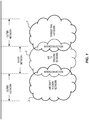
- Figure 1 illustrates, in block diagram form, the overall architecture of a composite Air-To-Ground Network 2 that interconnects an Aircraft In-Cabin Network 3 with the Terrestrial Network 1; and Figure 2 illustrates, in block diagram form, the key network building blocks for such a system which provides an Air-To-Ground Network 2 that interconnects an Aircraft In-Cabin Network 3 with a Terrestrial Network 1.
- Figures illustrate the basic concepts of the Air-To-Ground cellular communications network and, for the purpose of simplicity of illustration, do not comprise all of the elements found in a typical network.
- the overall concept illustrated in Figures 1 and 2 is that the provision of an "Inner Network” connects the two segments of the "Outer Network," comprising the Aircraft In-Cabin Network 3 and the Terrestrial Network 1. This is accomplished by the Inner Network transmitting both the subscriber traffic (comprising voice and/or other data) and the control information and feature set data between the Aircraft-In-Cabin Network 3 and the Terrestrial Network 1 thereby to enable the wireless subscriber devices that are located in the aircraft 103, 104 to receive services in non-terrestrial regions that are consistent with wireless communication services in the terrestrial (ground-based) networks.
- the Air-To-Ground Network 2 provides radio access between Aircraft-In-Cabin Network 3 and terrestrial communication infrastructure.
- This network usually is comprised of a set of Base Transceiver Stations 131, 133 and associated Base Station Controllers 132, 134 that are operated by the Air-To-Ground cellular communications network service provider, and which are connected to the cellular network 101 and then to the wire-line network 102 of the ground-based (terrestrial) communication network 1.
- the cellular network 101 consists of the traditional elements and, for the purpose of illustration, includes a Mobile Switching Center 121 with its associated Visitor Location Register, which is connected to the Home Location Register 125.
- the cellular network 101 provides interconnection of the voice traffic to the voice transmission segment of the wire-line network 102 which includes various components, including, but not limited to: Public Land Mobile Network, Public Switched Telephone Network, Integrated Services Digital Network, and other such functionalities.
- the cellular network 101 provides interconnection of the data traffic to the data transmission segments of the wire-line network 102 which includes various components, including, but not limited to: Internet, Public Switched Data Network, and other such functionalities.
- Implementation of the ground cellular network may not have separated voice and data parts.
- a preferred implementation is one where voice and data parts are integrated into a single communication network with managed Quality of Service (QoS) attributes for different traffic classes.
- QoS Quality of Service
- Such a network typically would be implemented over IP protocol stack with voice service implemented through Voice over IP (VoIP).
- the cellular communications between the wireless subscriber devices located in aircraft 103, 104 and the cellular network 101 and wire-line network 102 segments of the ground-based Communication Network 1 are transported via the Aircraft In-Cabin Network 3 and the Air-To-Ground Network 2 to the ground-based Base Transceiver Stations 131-133 and associated Base Station Controllers 132, 134 of the Air-To-Ground cellular communications network.
- the Air-To-Ground Network 2 shown in Figures 1 and 2 is clearly one that is based on wireless communications (radio frequency or optical) between the ground-based cellular communications network 101 and the wireless subscriber devices that are located in the aircraft 103, 104, with the preferred approach being that of a radio frequency connection 108, 109.
- This radio frequency connection 108, 109 takes on the form of a cellular topology where typically more than one cell describes the geographic footprint or coverage area of the composite Air-To-Ground Network 2.
- the Air-To Ground connection carries both subscriber traffic and native network signaling traffic.
- the Air-To-Ground Network 2 could be achieved through a wireless satellite connection 105-107 where radio frequency links 106, 107 are established between the aircraft 103, 104 and a satellite 105 and between the satellite 105 and the ground-based cellular communications network 101, respectively.
- These satellites 105 could be geosynchronous (appears to be stationary from an earth reference point) or moving, as is the case for Medium Earth Orbit (MEO) and Low Earth Orbit (LEO).
- MEO Medium Earth Orbit
- LEO Low Earth Orbit
- the link is typically unidirectional, that is from the satellite to the receiving platform, in this case an aircraft. In such a system, a link transmitting uni-directionally from the aircraft is needed to make the communication bi-directional.
- This link could be satellite or ground-based wireless in nature.
- the Air-To-Ground Network 2 can be viewed as the conduit through which the subscriber traffic and the control and network feature set data is transported between the Terrestrial Network 1 and the Aircraft-In-Cabin Network 3.
- the Air-To-Ground Network 2 can be implemented as a single radio frequency link (first frequency band) or multiple radio frequency links, with a portion of the signals being routed over different types of links, such as the Air-To-Ground Link 108 and the Satellite Link 105-107.
- first frequency band first frequency band
- multiple radio frequency links with a portion of the signals being routed over different types of links, such as the Air-To-Ground Link 108 and the Satellite Link 105-107.
- Air-To-Ground Radio Frequency communications links represents a fixed bandwidth resource.
- the capacity enhancement problem is even more complex since the Air-To-Ground cellular communications network serves airborne aircraft in a multi-dimensional space which has varying aircraft spatial densities; in particular, in and around airports the aircraft spatial density can be high. These aircraft are flying at high speeds incurring associated Doppler shift as well as time delay associated with large cell radii.
- the aircraft flight profiles include varying pitch-roll-yaw angles, different altitudes, and different velocities. Each aircraft appears as a single "node" from the perspective of the terrestrial base stations.
- each aircraft containing possibly hundreds of passengers, appears to the terrestrial base station(s) as a very large capacity, single point network load.
- Each unique passenger potentially has a wireless device which has specific data and/or voice requirements which, when multiplied by the number of passengers' wireless devices, can generate a significant traffic load on a per aircraft basis.
- High speed Broadband Ground-To-Air Data Channel operating at a second frequency band is capable of supporting high data rates.
- High data rates transform Air-To-Ground communication services and offer numerous data applications of high value to the flying public, airline industry, and government.
- this example of a typical high speed Broadband Ground-To-Air Data Channel the following description notes typical issues that must be resolved to implement an operational high speed Broadband Ground-To-Air Data Channel.
- the overview of the air interface organization for the high speed Broadband Ground-To-Air Data Channel is presented in Figure 3 , where essentially two different data communication links are used to support data communications with the aircraft.
- the first link is bi-directional, and it supports the present Air-To-Ground Radio Frequency communications link in the allocated Air-To-Ground frequency band (first frequency band).
- the other link is a uni-directional high speed Broadband Ground-To-Air Data Channel that operates in a second frequency band.
- Table 1 Spectrum allocation for the communication links Link Use ATG ground to plane Network access, mobility management, radio resource control, and broadband data ATG plane to ground Network access, mobility management, radio resource control, and broadband data Broadband High speed broadband data in ground to air direction
- the bi-directional Air-To-Ground Radio Frequency communications link is used to provide broadband data services and for mobility and radio resource management functions.
- this link may be based on 1 xEvDO Rev A standard, which is 1.25 MHz wide CDMA technology.
- the bi-directional link utilizes fixed beam antennas (either omni-directional or sectored) and provides blanket area coverage similar to that of a traditional terrestrial cellular system.
- An aircraft entering the coverage area of the Air-To-Ground Radio Frequency communications link detects the pilot signal of this link, and it registers and accesses the Air-To-Ground cellular communications network through the Air-To-Ground portion of this Air-To-Ground Radio Frequency communications link.
- the Air-To-Ground portion of this network carries resource allocation and mobility management traffic associated with the high speed Broadband Ground-To-Air Data Channel.
- the high speed Broadband Ground-To-Air Data Channel is managed in a different manner than the Air-To-Ground Radio Frequency communications link.
- the Air-To-Ground cellular communications network may 'decide' to utilize the Broadband Ground-To-Air Data Channel.
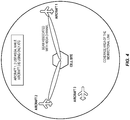
- the communication on this Broadband Ground-To-Air Data Channel is conducted through a separate antenna system that supports narrow beam steering. In this manner, the energy radiation in the HSGA band is tightly controlled and directed very narrowly towards the serviced aircraft as is illustrated in Figure 4 , where the Broadband Ground-To-Air Data Channel is implemented for Aircraft 1 and 2.
- the Broadband Ground-To-Air Data Channel is allocated only as a result of the resource management procedure and to aircraft that require high data rate throughput.
- the feedback channel required for the radio resource management of the Broadband Ground-To-Air Data Channel is provided through the Air-To-Ground link of the Air-To-Ground Radio Frequency communications link.
- the Broadband Ground-To-Air Data Channel needs to be able to match the coverage of the Air-To-Ground Radio Frequency communications link. Due to higher operating frequency, the path losses in the second frequency band are substantially higher. To overcome the losses, the Broadband Ground-To-Air Data Channel uses high gain beam steering antennas on both ends of the communication link. In addition, the following factors are considered in implementing the Broadband Ground-To-Air Data Channel:
- the interference from other systems to the aircraft typically produces much higher than the 3 dB noise rise whenever the airplane is in the vicinity of a populated (typically metropolitan area).
- base stations typically are sited 150 miles (about 230 km) away from the center of the population.
- Typical metropolitan areas can be assumed to have a radius of 100 km.
- These parameters result in a calculated noise rise due to interference which can be as high as 20 dB to 25 dB.
- the aircraft antenna array then must point to a distant base station at 230 km, and attenuate the interference from the ground to levels about 3 dB above the thermal noise.
- the EIRP from the Broadband Ground-To-Air Data Channel base station antennas may be somewhat larger than what is usually allowed in the unlicensed frequency bands.
- the regulatory transmitter power management rules are formulated so that they allow deployment of ground base stations that provide service to mobile terrestrial users.
- the deployment is largely unrestricted except for exclusion zones surrounding the grandfathered systems. Since base stations serve mobile terrestrial users, they are predominantly deployed in populated areas with a real possibility of more than one system operating within the band.
- deployment of the Broadband Ground-To-Air Data Channel is quite different. Since the service is provided to flying aircraft, the location of the base stations can be selected in the areas of very low population density.
- the Broadband Ground-To-Air Data Channel has a very limited impact on the utilization of the band throughout the country.
- the Broadband Ground-To-Air Data Channel base stations would utilize beam steering antennas with a high level of discrimination in both horizontal and vertical planes which will even further reduce the impact on other users in the band.
- the coexistence of the high speed Broadband Ground-To-Air Data Channel with other users of the unlicensed spectra is easily achieved.
- the signal from the Broadband Ground-To-Air Data Channel link side lobe scatter may interfere with other ground systems operating in the same band.
- the interference to the mobile devices is shown, but interference may be introduced to ground base stations of other systems as well.
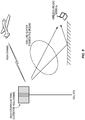
- the extent of the interference signal power density is a function of distance and for different beam steering antenna isolation values as shown in Figure 6 .
- the isolation value is defined as a difference in gain between the main beam and the aggregate gain of the side lobe scatter.
- the curves are generated assuming the path loss exponent of 3.2 (i.e., path loss slope of 32dB/dec).
- this distance may be estimated as 9.5, 13.5, and 19.5 miles for isolation values of 15dB, 10dB, and 5dB respectively.
- the system employs a contention protocol that allows its coexistence with other systems in the band.
- the forward link of the Air-To-Ground cellular communications network is based on multi-carrier communications.
- the proposed protocol can be implemented using any transmission scheme based on time-frequency resource blocks (referred to as chunks).
- the base station starts the transmission on a number of sub-carriers (or more generally time-frequency resource blocks) covering the entire intended transmission bandwidth (e.g., 10 MHz).
- the sub-carriers (or more generally time-frequency resource blocks) corresponding to this band are called sub-carriers of interest.
- Each base station periodically senses the environment. Any base station calls a sub-carrier (or more generally a time-frequency resource block) busy at time t, if
- the present Broadband Link System makes use of an additional, separate high speed Broadband Ground-To-Air Data Channel to provide additional data communication capacity for the aircraft.
- This Broadband Ground-To-Air Data Channel can be uni-directional (Ground-To-Air) to enable the passengers in the aircraft to retrieve multi-media data without transmission delays while their transmissions to the ground typically are processed by the Air-To-Ground Radio Frequency communications link.
Landscapes
- Engineering & Computer Science (AREA)
- Computer Networks & Wireless Communication (AREA)
- Signal Processing (AREA)
- Physics & Mathematics (AREA)
- Astronomy & Astrophysics (AREA)
- Aviation & Aerospace Engineering (AREA)
- General Physics & Mathematics (AREA)
- Mobile Radio Communication Systems (AREA)
- Radio Relay Systems (AREA)
Claims (22)
- System zum Bereitstellen von drahtlosen Kommunikationsdiensten für drahtlose Teilnehmergeräte, welche sich in einem Luftfahrzeug (103, 104) befinden, welches in einem ausgewählten Abdeckungsgebiet in Betrieb ist, aufweisend:
Ein bodenbasiertes Kommunikationsnetzwerk (1), welche eine Vielzahl von Basisstationen (131, 133) aufweist, welche sich auf dem Boden befinden, wobei jede Basisstation zumindest einen Sendeempfänger betreibt, um ein entsprechendes Abdeckungsgebiet zu erzeugen, welches drahtlose Kommunikationsdienste für drahtlose Teilnehmergeräte bereitstellt, welche sich in einem Luftfahrzeug befinden, welches in dem entsprechenden Abdeckungsgebiet in Betrieb ist, wobei der zumindest eine Sendeempfänger jeder Basisstation aufweist:Luft-zu-Boden-Radiofrequenzmittel zum Bereitstellen, über erste Antennensystemmittel, welche an jeder Basisstation angeordnet sind, zumindest einer bidirektionalen Radiofrequenzkommunikationsverbindung, welche bei einer ersten Radiofrequenz arbeitet und welche ein erste Bandbreite hat, zum Übertragen erster Kommunikationssignale zwischen dem Luftfahrzeug und dem zumindest einen Sendeempfänger, um den drahtlosen Teilnehmergeräten, welche sich in dem Luftfahrzeug befinden, zu ermöglichen, bidirektional über die zumindest eine bidirektionale Radiofrequenzkommunikationsverbindung zu kommunizieren; undBreitband-Boden-zu-Luft-Datenkanalmittel zum Herstellen, über zweite Antennensystemmittel, welche bei jeder Basisstation angeordnet sind, zumindest einer Boden-zu-Luft-Radiofrequenzkommunikationsverbindung mit dem Luftfahrzeug, welche bei einer zweiten Radiofrequenz arbeitet und welche eine zweite Bandbreite hat, welche größer ist als die erste Bandbreite, zum Ergänzen des Luft-zu-Boden-Radiofrequenzmittels, um durch jede Basisstation zusätzliche Datenkommunikationskapazität zum Übertragen von zweiten Kommunikationssignalen von dem zumindest einen Sendeempfänger zu dem Luftfahrzeug bereitzustellen, wobei das Breitband-Boden-zu-Luft-Datenkanalmittel Mittel zum Erzeugen zumindest eines gesteuerten, gerichteten Radiofrequenzstrahls aufweist, welcher über das zweite Antennensystem übertragen wird und welcher auf das Luftfahrzeug gerichtet ist. - System zum Bereitstellen von drahtlosen Kommunikationsdiensten nach Anspruch 1, wobei jede der Vielzahl von Basisstationen weiter aufweist:
Datenroutingmittel, in Antwort auf das Empfangen der zweiten Kommunikationssignale zur Übermittlung an das Luftfahrzeug, zum Aktivieren des Breitband-Boden-zu-Luft-Datenkanalmittels, um den zumindest einen gesteuerten, gerichteten Radiofrequenzstrahl zu erzeugen, welcher auf das Luftfahrzeug gerichtet ist, um die zweiten Kommunikationssignale von dem zumindest einen Sendeübertrager an das Luftfahrzeug über die zweiten Antennensystemmittel zu übertragen. - System zum Bereitstellen von drahtlosen Kommunikationsdiensten nach Anspruch 1, wobei jede der Vielzahl von Basisstationen weiter aufweist:
Datenroutingmittel, in Antwort auf Kommunikationssignale, welche zum Übermitteln an das Luftfahrzeug empfangen wurden, zum Aufteilen der empfangenen Kommunikationssignale zwischen dem Luft-zu-Boden-Radiofrequenzmittel und dem Breitband-Boden-zu-Luft-Datenkanalmittel. - System zum Bereitstellen von drahtlosen Kommunikationsdiensten nach Anspruch 1, wobei jede der Vielzahl von Basisstationen weiter aufweist:
Zugriffskonfliktprotokollmittel zum Regeln von gleichzeitigem Übermitteln der zweiten Kommunikationssignale auf dem Breitband-Boden-zu-Luft-Datenkanalmittel an eine Vielzahl von Luftfahrzeugen. - System zum Bereitstellen von drahtlosen Kommunikationsdiensten nach Anspruch 4, wobei das Breitband-Boden-zu-Luft-Datenkanalmittel eine Vielzahl von Trägersignalen implementiert und das Zugriffskonfliktprotokollmittel aufweist:
Belegte-Träger-Mittel zum periodischen Platzieren eines Belegten von den Trägersignalen in einem Ruhezustand, um einem Ruhenden der Trägersignale zu ermöglichen, zur Übertragung ausgewählt zu werden. - System zum Bereitstellen von drahtlosen Kommunikationsdiensten nach Anspruch 1, wobei die zweite Radiofrequenz des Breitband-Boden-zu-Luft-Datenkanalmittels höher ist als die erste Frequenz des Luft-zu-Boden-Radiofrequenzmittels.
- Verfahren zum Bereitstellen von drahtlosen Kommunikationsdiensten für drahtlose Teilnehmergeräte, welche sich in einem Luftfahrzeug (103, 104) befinden, welches in einem ausgewählten Abdeckungsgebiet in Betrieb ist, über ein bodenbasiertes Kommunikationsnetzwerk (1), welches eine Vielzahl von Basisstationen (131, 133) aufweist, welche sich auf dem Boden befinden, wobei jede Basisstation zumindest einen Sendeempfänger betreibt, um ein entsprechendes Abdeckungsgebiet zu erzeugen, welches drahtlose Kommunikationsdienste für drahtlose Teilnehmergeräte bereitstellt, welche sich in einem Luftfahrzeug befinden, welches in dem entsprechenden Abdeckungsgebiet in Betrieb ist, aufweisend:Bereitstellen bei jeder Basisstation und über ein erstes Antennensystem, welches an jeder Basisstation angeordnet ist, zumindest einer bidirektionalen Radiofrequenzkommunikationsverbindung, welche bei einer ersten Radiofrequenz arbeitet und welche ein erste Bandbreite hat, zum Übertragen erster Kommunikationssignale zwischen dem Luftfahrzeug und dem zumindest einen Sendeempfänger, um den drahtlosen Teilnehmergeräten, welche sich in dem Luftfahrzeug befinden, zu ermöglichen, bidirektional über die zumindest eine bidirektionale Luft-zu-Boden-Radiofrequenzkommunikationsverbindung zu kommunizieren; undHerstellen, bei jeder Basisstation und über ein zweites Antennensystem, welches bei jeder Basisstation angeordnet ist, zumindest einer Boden-zu-Luft-Radiofrequenzkommunikationsverbindung mit dem Luftfahrzeug, welche bei einer zweiten Radiofrequenz arbeitet und welche eine zweite Bandbreite hat, welche größer ist als die erste Bandbreite, zum Ergänzen des zumindest einen bidirektionalen Luft-zu-Boden-Radiofrequenzmittels, um durch jede Basisstation zusätzliche Datenkommunikationskapazität zum Übertragen von zweiten Kommunikationssignalen von dem zumindest einen Sendeempfänger zu dem Luftfahrzeug bereitzustellen, beinhaltend Erzeugen zumindest eines gesteuerten, gerichteten Radiofrequenzstrahls, welcher über das zweite Antennensystem übertragen wird und welcher auf das Luftfahrzeug gerichtet ist.
- Verfahren zum Bereitstellen von drahtlosen Kommunikationsdiensten nach Anspruch 7, weiter aufweisend:
Aktivieren, in Antwort auf das Empfangen der zweiten Kommunikationssignale zur Übermittlung an das Luftfahrzeug, den Schritt des Herstellens zumindest einer Boden-zu-Luft-Radiofrequenzkommunikationsverbindung, um den zumindest einen gesteuerten, gerichteten Radiofrequenzstrahl zu erzeugen, welcher auf das Luftfahrzeug gerichtet ist, um die zweiten Kommunikationssignale von dem zumindest einen Sendeempfänger über das zweite Antennensystem zu dem Luftfahrzeug zu übertragen. - Verfahren zum Bereitstellen von drahtlosen Kommunikationsdiensten nach Anspruch 7, weiter aufweisend:
Aufteilen, in Antwort auf Kommunikationssignale, welche zum Übermitteln an das Luftfahrzeug empfangen wurden, der empfangenen Kommunikationssignale zwischen der Luft-zu-Boden-Radiofrequenzverbindung und der Boden-zu-Luft-Radiofrequenzkommunikationsverbindung. - Verfahren zum Bereitstellen von drahtlosen Kommunikationsdiensten nach Anspruch 7, weiter aufweisend:
Regeln von gleichzeitigem Übermitteln der zweiten Kommunikationssignale auf der Boden-zu-Luft-Radiofrequenzkommunikationsverbindung an eine Vielzahl von Luftfahrzeugen. - Verfahren zum Bereitstellen von drahtlosen Kommunikationsdiensten nach Anspruch 10, wobei die Boden-zu-Luft-Radiofrequenzkommunikationsverbindung eine Vielzahl von Trägersignalen implementiert und der Schritt des Regelns aufweist:
periodisches Platzieren eines Belegten von den Trägersignalen in einem Ruhezustand, um einem Ruhenden der Trägersignale zu ermöglichen, zur Übertragung ausgewählt zu werden. - System zum Bereitstellen von drahtlosen Kommunikationsdiensten für drahtlose Teilnehmergeräte, welche sich in einer Vielzahl von Luftfahrzeugen (103, 104) befinden, welche in einem ausgewählten Abdeckungsgebiet in Betrieb sind, aufweisend:
ein bodenbasiertes Kommunikationsnetzwerk (1), welches eine Vielzahl von Basisstationen (131, 133) aufweist, welche sich auf dem Boden befinden, wobei jede Basisstation zumindest einen Sendeempfänger betreibt, um ein entsprechendes Abdeckungsgebiet zu erzeugen, welches drahtlose Kommunikationsdienste für drahtlose Teilnehmergeräte bereitstellt, welche sich in der Vielzahl von Luftfahrzeugen befinden, welche in dem entsprechenden Abdeckungsgebiet in Betrieb sind, wobei der zumindest eine Sendeempfänger jeder Basisstation aufweist:Luft-zu-Boden-Radiofrequenzmittel zum Bereitstellen, über erste Antennensystemmittel, welche an jeder Basisstation angeordnet sind, bidirektionale Radiofrequenzkommunikationsverbindungen, welche bei einer ersten Radiofrequenz arbeiten und welche ein erste Bandbreite haben, zum Übertragen erster Kommunikationssignale zwischen der Vielzahl von Luftfahrzeugen und dem zumindest einen Sendeempfänger, um den drahtlosen Teilnehmergeräten, welche sich in der Vielzahl von Luftfahrzeugen befinden, zu ermöglichen, bidirektional über die bidirektionalen Radiofrequenzkommunikationsverbindung zu kommunizieren; undBreitband-Boden-zu-Luft-Datenkanalmittel zum Herstellen, über zweite Antennensystemmittel, welche bei jeder Basisstation angeordnet sind, zumindest einer Boden-zu-Luft-Radiofrequenzkommunikationsverbindung mit einem ausgewählten Luftfahrzeug aus der Vielzahl von Luftfahrzeugen, welche bei einer zweiten Radiofrequenz arbeitet und welche eine zweite Bandbreite hat, welche größer ist als die erste Bandbreite, zum Ergänzen des Luft-zu-Boden-Radiofrequenzmittels, um durch jede Basisstation zusätzliche Datenkommunikationskapazität zum Übertragen von zweiten Kommunikationssignalen von dem zumindest einen Sendeempfänger zu dem ausgewählten Luftfahrzeug bereitzustellen, wobei das zweite Antennensystemmittel zum Erzeugen zumindest eines gesteuerten, gerichteten Radiofrequenzstrahls eingerichtet ist, welcher über das zweite Antennensystemmittel übertragen wird und welcher auf jedes der ausgewählten Luftfahrzeuge der Vielzahl von Luftfahrzeugen gerichtet ist. - System zum Bereitstellen von drahtlosen Kommunikationsdiensten nach Anspruch 12, wobei jede der Vielzahl von Basisstationen weiter aufweist:
Datenroutingmittel, in Antwort auf das Empfangen der zweiten Kommunikationssignale zur Übermittlung an das ausgewählte Luftfahrzeug, zum Aktivieren des Breitband-Boden-zu-Luft-Datenkanalmittels, um den zumindest einen gesteuerten, gerichteten Radiofrequenzstrahl zu erzeugen, welcher auf jedes der ausgewählten Luftfahrzeug gerichtet ist, um die zweiten Kommunikationssignale von dem zumindest einen Sendeübertrager an jedes der ausgewählten Luftfahrzeuge über die zweiten Antennensystemmittel zu übertragen. - System zum Bereitstellen von drahtlosen Kommunikationsdiensten nach Anspruch 12, wobei jede der Vielzahl von Basisstationen weiter aufweist:
Datenroutingmittel, in Antwort auf Kommunikationssignale, welche zum Übermitteln an das Luftfahrzeug empfangen wurden, zum Aufteilen der empfangenen Kommunikationssignale zwischen dem Luft-zu-Boden-Radiofrequenzmittel und dem Breitband-Boden-zu-Luft-Datenkanalmittel. - System zum Bereitstellen von drahtlosen Kommunikationsdiensten nach Anspruch 12, wobei jede der Vielzahl von Basisstationen weiter aufweist:
Zugriffskonfliktprotokollmittel zum Regeln von gleichzeitigem Übermitteln der zweiten Kommunikationssignale auf dem Breitband-Boden-zu-Luft-Datenkanalmittel an mehr als ein Luftfahrzeug. - System zum Bereitstellen von drahtlosen Kommunikationsdiensten nach Anspruch 15, wobei das Breitband-Boden-zu-Luft-Datenkanalmittel eine Vielzahl von Trägersignalen implementiert und das Zugriffskonfliktprotokollmittel aufweist:
Belegte-Träger-Mittel zum periodischen Platzieren eines Belegten von den Trägersignalen in einem Ruhezustand, um einem Ruhenden der Trägersignale zu ermöglichen, zur Übertragung ausgewählt zu werden. - System zum Bereitstellen von drahtlosen Kommunikationsdiensten nach Anspruch 12, wobei die zweite Radiofrequenz des Breitband-Boden-zu-Luft-Datenkanalmittels höher ist als die erste Frequenz des Luft-zu-Boden-Radiofrequenzmittels.
- Verfahren zum Bereitstellen von drahtlosen Kommunikationsdiensten für drahtlose Teilnehmergeräte, welche sich in einer Vielzahl von Luftfahrzeugen (103, 104) befinden, welche in einem ausgewählten Abdeckungsgebiet in Betrieb sind, über ein bodenbasiertes Kommunikationsnetzwerk (1), welches eine Vielzahl von Basisstationen (131, 133) aufweist, welche sich auf dem Boden befinden, wobei jede Basisstation zumindest einen Sendeempfänger betreibt, um ein entsprechendes Abdeckungsgebiet zu erzeugen, welches drahtlose Kommunikationsdienste für drahtlose Teilnehmergeräte bereitstellt, welche sich in einer Vielzahl von Luftfahrzeugen befinden, welches in einem entsprechenden Abdeckungsgebiet in Betrieb sind, aufweisend:Bereitstellen bei jeder Basisstation und über ein erstes Antennensystem, welches an jeder Basisstation angeordnet ist, zumindest einer bidirektionalen Radiofrequenzkommunikationsverbindung, welche bei einer ersten Radiofrequenz arbeitet und welche ein erste Bandbreite hat, zum Übertragen erster Kommunikationssignale zwischen jedem der Vielzahl von Luftfahrzeugen und dem zumindest einen Sendeempfänger, um den drahtlosen Teilnehmergeräten, welche sich in der Vielzahl von Luftfahrzeugen befinden, zu ermöglichen, bidirektional über die zumindest eine bidirektionale Luft-zu-Bodenradiofrequenzverbindung zu kommunizieren; undHerstellen, bei jeder Basisstation und über ein zweites Antennensystem, welches bei jeder Basisstation angeordnet ist, zumindest einer Boden-zu-Luft-Radiofrequenzkommunikationsverbindung mit einem ausgewählten Luftfahrzeug der Vielzahl von Luftfahrzeugen, welche bei einer zweiten Radiofrequenz arbeitet und welche eine zweite Bandbreite hat, welche größer ist als die erste Bandbreite, zum Ergänzen des zumindest einen bidirektionalen Luft-zu-Boden-Radiofrequenzmittels, um durch jede Basisstation zusätzliche Datenkommunikationskapazität zum Übertragen von zweiten Kommunikationssignalen von dem zumindest einen Sendeempfänger zu dem ausgewählten Luftfahrzeug bereitzustellen, beinhaltend Erzeugen zumindest eines gesteuerten, gerichteten Radiofrequenzstrahls, welcher über das zweite Antennensystem übertragen wird und welcher auf das ausgewählte Luftfahrzeug der Vielzahl von Luftfahrzeugen gerichtet ist.
- Verfahren zum Bereitstellen von drahtlosen Kommunikationsdiensten nach Anspruch 18, weiter aufweisend:
Aktivieren, in Antwort auf das Empfangen der zweiten Kommunikationssignale zur Übermittlung an das ausgewählte Luftfahrzeug, den Schritt des Herstellens zumindest einer Boden-zu-Luft-Radiofrequenzkommunikationsverbindung, um den zumindest einen gesteuerten, gerichteten Radiofrequenzstrahl zu erzeugen, welcher auf jedes der Vielzahl von Luftfahrzeugen gerichtet ist, um die zweiten Kommunikationssignale von dem zumindest einen Sendeempfänger zu jedem der ausgewählten Luftfahrzeuge über das zweite Antennensystem zu übertragen. - Verfahren zum Bereitstellen von drahtlosen Kommunikationsdiensten nach Anspruch 18, weiter aufweisend:
Aufteilen, in Antwort auf Kommunikationssignale, welche zum Übermitteln an die Vielzahl von Luftfahrzeugen empfangen wurden, der empfangenen Kommunikationssignale zwischen der Luft-zu-Boden-Radiofrequenzverbindung und der Boden-zu-Luft-Radiofrequenzkommunikationsverbindung. - Verfahren zum Bereitstellen von drahtlosen Kommunikationsdiensten nach Anspruch 18, weiter aufweisend:
Regeln von gleichzeitigem Übermitteln der zweiten Kommunikationssignale auf der Boden-zu-Luft-Radiofrequenzkommunikationsverbindung an mehr als ein Luftfahrzeug. - Verfahren zum Bereitstellen von drahtlosen Kommunikationsdiensten nach Anspruch 21, wobei die Boden-zu-Luft-Radiofrequenzkommunikationsverbindung eine Vielzahl von Trägersignalen implementiert und der Schritt des Regelns aufweist:
periodisches Platzieren eines Belegten von den Trägersignalen in einem Ruhezustand, um einem Ruhenden der Trägersignale zu ermöglichen, zur Übertragung ausgewählt zu werden.
Priority Applications (1)
| Application Number | Priority Date | Filing Date | Title |
|---|---|---|---|
| EP19217128.8A EP3651381B1 (de) | 2008-06-12 | 2009-03-30 | System zur bereitstellung eines hochschnellen kommunikationsdienstes in einem luftgestützten drahtlosen zellularen netzwerk |
Applications Claiming Priority (2)
| Application Number | Priority Date | Filing Date | Title |
|---|---|---|---|
| US12/137,995 US8914022B2 (en) | 1992-03-06 | 2008-06-12 | System for providing high speed communications service in an airborne wireless cellular network |
| PCT/US2009/038788 WO2009151735A1 (en) | 2008-06-12 | 2009-03-30 | System for providing high speed communications service in an airborne wireless cellular network |
Related Child Applications (2)
| Application Number | Title | Priority Date | Filing Date |
|---|---|---|---|
| EP19217128.8A Division EP3651381B1 (de) | 2008-06-12 | 2009-03-30 | System zur bereitstellung eines hochschnellen kommunikationsdienstes in einem luftgestützten drahtlosen zellularen netzwerk |
| EP19217128.8A Division-Into EP3651381B1 (de) | 2008-06-12 | 2009-03-30 | System zur bereitstellung eines hochschnellen kommunikationsdienstes in einem luftgestützten drahtlosen zellularen netzwerk |
Publications (3)
| Publication Number | Publication Date |
|---|---|
| EP2292071A1 EP2292071A1 (de) | 2011-03-09 |
| EP2292071A4 EP2292071A4 (de) | 2015-07-15 |
| EP2292071B1 true EP2292071B1 (de) | 2020-03-04 |
Family
ID=41421644
Family Applications (2)
| Application Number | Title | Priority Date | Filing Date |
|---|---|---|---|
| EP09763028.9A Active EP2292071B1 (de) | 2008-06-12 | 2009-03-30 | System zum bereitstellen eines schnellen kommunikationsdienstes in einem in der luft befindlichen drahtlosen zellularen netz |
| EP19217128.8A Active EP3651381B1 (de) | 2008-06-12 | 2009-03-30 | System zur bereitstellung eines hochschnellen kommunikationsdienstes in einem luftgestützten drahtlosen zellularen netzwerk |
Family Applications After (1)
| Application Number | Title | Priority Date | Filing Date |
|---|---|---|---|
| EP19217128.8A Active EP3651381B1 (de) | 2008-06-12 | 2009-03-30 | System zur bereitstellung eines hochschnellen kommunikationsdienstes in einem luftgestützten drahtlosen zellularen netzwerk |
Country Status (5)
| Country | Link |
|---|---|
| US (1) | US8914022B2 (de) |
| EP (2) | EP2292071B1 (de) |
| CN (2) | CN107070532B (de) |
| CA (1) | CA2727609C (de) |
| WO (1) | WO2009151735A1 (de) |
Families Citing this family (61)
| Publication number | Priority date | Publication date | Assignee | Title |
|---|---|---|---|---|
| US8914022B2 (en) | 1992-03-06 | 2014-12-16 | Gogo Llc | System for providing high speed communications service in an airborne wireless cellular network |
| US8442519B2 (en) * | 2003-12-07 | 2013-05-14 | Gogo Llc | Spectrum sharing between an aircraft-based air-to-ground communication system and existing geostationary satellite services |
| US8254913B2 (en) * | 2005-08-18 | 2012-08-28 | Smartsky Networks LLC | Terrestrial based high speed data communications mesh network |
| US8874477B2 (en) | 2005-10-04 | 2014-10-28 | Steven Mark Hoffberg | Multifactorial optimization system and method |
| EP2193612B1 (de) | 2007-09-24 | 2011-04-13 | Panasonic Avionics Corporation | Anordnung und verfahren zum empfang eines rundfunkinhalts auf einer mobilen plattform während der reise |
| US8811265B2 (en) | 2007-10-19 | 2014-08-19 | Honeywell International Inc. | Ad-hoc secure communication networking based on formation flight technology |
| US9264126B2 (en) | 2007-10-19 | 2016-02-16 | Honeywell International Inc. | Method to establish and maintain an aircraft ad-hoc communication network |
| US8570990B2 (en) | 2007-12-04 | 2013-10-29 | Honeywell International Inc. | Travel characteristics-based ad-hoc communication network algorithm selection |
| US9467221B2 (en) | 2008-02-04 | 2016-10-11 | Honeywell International Inc. | Use of alternate communication networks to complement an ad-hoc mobile node to mobile node communication network |
| US8190147B2 (en) * | 2008-06-20 | 2012-05-29 | Honeywell International Inc. | Internetworking air-to-air network and wireless network |
| US20090318138A1 (en) * | 2008-06-20 | 2009-12-24 | Honeywell International Inc. | System and method for in-flight wireless communication |
| US8509990B2 (en) | 2008-12-15 | 2013-08-13 | Panasonic Avionics Corporation | System and method for performing real-time data analysis |
| IL196856A0 (en) * | 2009-02-02 | 2009-12-24 | Deutsche Telekom Ag | System providing broadband communication between terrestrial stations and airplanes |
| US8402268B2 (en) | 2009-06-11 | 2013-03-19 | Panasonic Avionics Corporation | System and method for providing security aboard a moving platform |
| US9016627B2 (en) | 2009-10-02 | 2015-04-28 | Panasonic Avionics Corporation | System and method for providing an integrated user interface system at a seat |
| JP5602876B2 (ja) | 2009-12-14 | 2014-10-08 | パナソニック・アビオニクス・コーポレイション | 動的電力管理を行なうシステム及び方法 |
| EP2563661B1 (de) | 2010-04-27 | 2014-12-10 | Panasonic Avionics Corporation | Einsatzsystem und verfahren für benutzerschnittstellenvorrichtungen |
| WO2012034111A1 (en) | 2010-09-10 | 2012-03-15 | Panasonic Avionics Corporation | Integrated user interface system and method |
| US8578428B2 (en) * | 2011-08-23 | 2013-11-05 | Rockwell Collins, Inc. | Air-to-ground communications system and method |
| DE102011119892A1 (de) * | 2011-11-29 | 2013-05-29 | Airbus Operations Gmbh | LTE-4G an Bord von Flugzeugen |
| US8868069B2 (en) * | 2012-05-29 | 2014-10-21 | Sierra Wireless, Inc. | Airliner-mounted cellular base station |
| US10470095B2 (en) * | 2013-01-13 | 2019-11-05 | Qualcomm Incorporated | Method for air-to-ground data link antenna self calibration |
| CA2841685C (en) | 2013-03-15 | 2021-05-18 | Panasonic Avionics Corporation | System and method for providing multi-mode wireless data distribution |
| US9008669B2 (en) * | 2013-03-15 | 2015-04-14 | Smartsky Networks LLC | Wedge shaped cells in a wireless communication system |
| JP6542778B2 (ja) * | 2013-09-10 | 2019-07-10 | スマートスカイ ネットワークス エルエルシーSmartsky Networks Llc | 空対地無線通信ネットワークでの干渉軽減 |
| US9967020B2 (en) * | 2013-11-08 | 2018-05-08 | Gogo Llc | Facilitating communications between on-board electronic devices and terrestrial devices |
| US9197314B1 (en) | 2013-11-08 | 2015-11-24 | Gogo Llc | Data delivery to devices on vehicles using multiple forward links |
| US9326217B2 (en) * | 2013-11-08 | 2016-04-26 | Gogo Llc | Optimizing usage of modems for data delivery to devices on vehicles |
| US9577857B2 (en) * | 2013-11-08 | 2017-02-21 | Gogo Llc | Adaptive modulation in a hybrid vehicle communication system |
| US9369991B2 (en) | 2013-11-08 | 2016-06-14 | Gogo Llc | Hybrid communications for devices on vehicles |
| US9859972B2 (en) * | 2014-02-17 | 2018-01-02 | Ubiqomm Llc | Broadband access to mobile platforms using drone/UAV background |
| US9503956B2 (en) * | 2014-05-30 | 2016-11-22 | Gogo Llc | Systems and methods for facilitating communications originating from a non-terrestrial network |
| US9408129B2 (en) * | 2014-06-17 | 2016-08-02 | Gogo Llc | Multiple modem communication system and method for a mobile platform |
| US9596685B1 (en) * | 2014-08-21 | 2017-03-14 | Rockwell Collins, Inc. | Method and apparatus for high data rate high frequency data link (HDR-HFDL) |
| CN104579453B (zh) * | 2015-01-06 | 2018-10-09 | 中电科航空电子有限公司 | 一种机载无缝数据传输无线通信系统及其通信方法 |
| CR20180125A (es) * | 2015-07-31 | 2018-05-14 | Viasat Inc | Constelación de satélites de capacidad felxible |
| CN107925880B (zh) * | 2015-09-03 | 2022-02-01 | 索里安科技集团有限责任公司 | 采用蜂窝电话网络运行、控制和与无人空中飞行器和遥控驾驶飞行器通信的系统 |
| US9954598B2 (en) | 2015-11-03 | 2018-04-24 | Telefonaktiebolaget Lm Ericsson (Publ) | High capacity cellular communications system coverage of airborne mobile communications equipment |
| US9813969B2 (en) | 2015-11-03 | 2017-11-07 | Telefonaktiebolaget Lm Ericsson (Publ) | In-flight cellular communications system coverage of mobile communications equipment located in aircraft |
| US10111152B2 (en) * | 2015-12-09 | 2018-10-23 | Telefonaktiebolaget Lm Ericsson (Publ) | Cell selection for airborne mobile cellular communications equipment |
| JP7121372B2 (ja) * | 2016-04-18 | 2022-08-18 | ロンバス システムズ グループ, インコーポレイテッド | 2つの周波数帯域を使用した無人航空機との通信のためのシステム |
| US10318904B2 (en) | 2016-05-06 | 2019-06-11 | General Electric Company | Computing system to control the use of physical state attainment of assets to meet temporal performance criteria |
| CN109644043B (zh) * | 2016-05-20 | 2021-08-20 | 智慧天空网络有限公司 | 基于无线通信系统中有源天线的虚拟同心小区 |
| EP3533157B1 (de) | 2016-10-28 | 2021-05-05 | Telefonaktiebolaget LM Ericsson (publ) | Drahtloskommunikationsverbindungen zwischen luftgestützter und bodengestützter kommunikationsausrüstung |
| US10263690B2 (en) | 2017-08-01 | 2019-04-16 | Viasat, Inc. | Handover based on predicted network conditions |
| US10084529B1 (en) * | 2017-08-04 | 2018-09-25 | Rockwell Collins, Inc. | System and method for air-to-ground single frequency networking |
| WO2019049390A1 (ja) * | 2017-09-08 | 2019-03-14 | パナソニックIpマネジメント株式会社 | 通信装置、通信システム、及び通信方法 |
| US10873388B2 (en) * | 2018-06-12 | 2020-12-22 | Bombardier Inc. | System, device and method for switching air-to-ground antennas |
| EP4145948A1 (de) * | 2018-12-10 | 2023-03-08 | Google LLC | Duale benutzergerätekonnektivität mit einer terrestrischen basisstation und einem satelliten oder einer plattform mit hoher höhe |
| CN109544432A (zh) * | 2019-01-12 | 2019-03-29 | 乐宁宁 | 一种利用空中互联网实现航空公司航班运控的方法及装置 |
| WO2021007384A1 (en) * | 2019-07-10 | 2021-01-14 | Smartsky Networks LLC | Remote airport management services |
| US11076372B1 (en) * | 2020-02-24 | 2021-07-27 | Gogo Business Aviation Llc | Systems and methods for accessing an air-to-ground network |
| US11963203B2 (en) | 2021-01-06 | 2024-04-16 | Aura Network Systems, Inc. | Systems and methods for managing radio frequency spectrum in ground to aerial vehicle communications |
| JP7510574B2 (ja) * | 2021-02-05 | 2024-07-03 | エーエスティー アンド サイエンス エルエルシー | Gsm電話と直接通信する衛星通信gsmソリューション |
| JP2024512552A (ja) | 2021-03-22 | 2024-03-19 | オーラ ネットワーク システムズ, インコーポレイテッド | ビーム/ヌル形成アンテナ制御を用いる飛行計画のためのシステム及び方法 |
| US11652538B2 (en) * | 2021-03-31 | 2023-05-16 | AT&T Technical Services Company, Inc. | Reducing uplink interference induced by aerial user equipment |
| US12315378B2 (en) | 2021-06-01 | 2025-05-27 | Aura Network Systems, Inc. | Systems and methods for flight plan specific distributed ledger based aviation data link security |
| US11616565B2 (en) | 2021-06-30 | 2023-03-28 | Gogo Business Aviation Llc | Beam pointing fine tuning for vehicle-based antennas |
| EP4441724A1 (de) | 2022-01-13 | 2024-10-09 | Aura Network Systems, Inc. | Systeme und verfahren zur implementierung eines sprachrelais zur luftverkehrssteuerung für unbemannte flugzeugsysteme über ein luftfahrtnetzwerk |
| EP4548499A1 (de) | 2022-07-12 | 2025-05-07 | Aura Network Systems, Inc. | Systeme und verfahren zur kommunikationsressourcenplanung für boden-zu-luft-fahrzeug-kommunikation |
| CN121000324B (zh) * | 2025-10-22 | 2026-01-06 | 中国电子科技集团公司第七研究所 | 一种基于haps通信升空平台的频率规划选频方法 |
Family Cites Families (162)
| Publication number | Priority date | Publication date | Assignee | Title |
|---|---|---|---|---|
| US3659085A (en) | 1970-04-30 | 1972-04-25 | Sierra Research Corp | Computer determining the location of objects in a coordinate system |
| GB1559375A (en) | 1975-10-28 | 1980-01-16 | Plessey Co Ltd | Aircraft landing systems |
| CA1230648A (en) | 1984-07-13 | 1987-12-22 | Gerald P. Labedz | Cellular voice and data radiotelephone system |
| US5408515A (en) | 1988-04-29 | 1995-04-18 | Mobile Telecommunication Technologies | Ground-to-air telephone calling system and related method for directing a call to a particular passenger |
| US5651050A (en) | 1988-04-29 | 1997-07-22 | Mobile Telecommunication Technologies | Ground-to-air telephone calling system and related method for establishing a telephone link between a ground-based caller and a passenger on board an aircraft |
| JP2865675B2 (ja) | 1988-09-12 | 1999-03-08 | 株式会社日立製作所 | 通信ネットワーク制御方法 |
| US5123112A (en) | 1990-08-02 | 1992-06-16 | Gte Airfone Incorporated | Air-to-ground communication system |
| US5212804A (en) | 1990-08-02 | 1993-05-18 | Gte Airfone, Inc. | Communication system having multiple base stations and multiple mobile units |
| US5134709A (en) | 1990-12-14 | 1992-07-28 | At&T Bell Laboratories | Process and apparatus for flexible channel assignment in cellular radiotelephone systems |
| US6009330A (en) | 1992-01-27 | 1999-12-28 | Highwaymaster Communications, Inc. | Method and apparatus for call delivery to a mobile unit |
| US7062268B2 (en) | 1992-03-06 | 2006-06-13 | Aircell, Inc. | Overlapping spectrum cellular communication networks |
| US7113780B2 (en) * | 1992-03-06 | 2006-09-26 | Aircell, Inc. | System for integrating an airborne wireless cellular network with terrestrial wireless cellular networks and the public switched telephone network |
| US8914022B2 (en) | 1992-03-06 | 2014-12-16 | Gogo Llc | System for providing high speed communications service in an airborne wireless cellular network |
| US5832380A (en) | 1992-03-06 | 1998-11-03 | Aircell Incorporated | Nonterrestrial cellular mobile telecommunication system |
| US5878346A (en) | 1992-03-06 | 1999-03-02 | Aircell Incorporated | Nonterrestrial cellular mobile telecommunication network |
| US6788935B1 (en) | 1992-03-06 | 2004-09-07 | Aircell, Inc. | Aircraft-based network for wireless subscriber stations |
| US8060083B2 (en) | 2000-10-11 | 2011-11-15 | Gogo Llc | System for managing an aircraft-oriented emergency services call in an airborne wireless cellular network |
| US7107062B2 (en) | 1992-03-06 | 2006-09-12 | Aircell, Inc. | System for managing call handoffs between an aircraft and multiple cell sites |
| US5432841A (en) | 1992-07-10 | 1995-07-11 | Rimer; Neil A. | System for locating and communicating with mobile vehicles |
| US6393281B1 (en) | 1993-03-26 | 2002-05-21 | At&T Wireless Services Inc | Seamless hand-off for air-to-ground systems |
| US5590395A (en) | 1993-11-10 | 1996-12-31 | Motorola, Inc. | Satellite cellular network resource management method and apparatus |
| US5459469A (en) * | 1994-02-04 | 1995-10-17 | Stanford Telecommunications, Inc. | Air traffic surveillance and communication system |
| JPH07298340A (ja) | 1994-03-02 | 1995-11-10 | Fujitsu Ltd | 移動通信システムおよび移動局 |
| US5555444A (en) | 1994-03-11 | 1996-09-10 | Motorola, Inc. | Method and apparatus for predictive operation of a communication system |
| US5519761A (en) | 1994-07-08 | 1996-05-21 | Qualcomm Incorporated | Airborne radiotelephone communications system |
| US5659304A (en) | 1995-03-01 | 1997-08-19 | Eaton Corporation | System and method for collision warning based on dynamic deceleration capability using predicted road load |
| US5543779A (en) | 1995-03-09 | 1996-08-06 | Aspesi; Marc S. | EMI source detector |
| US5678174A (en) | 1995-04-24 | 1997-10-14 | Motorola | Communication system which predicts good opportunities for communication |
| US6104926A (en) | 1995-07-31 | 2000-08-15 | Gte Airfone, Incorporated | Call handoff |
| FR2737627B1 (fr) * | 1995-08-02 | 1997-10-03 | Europ Agence Spatiale | Systeme de transmission de signaux radioelectriques via un satellite de communication geostationnaire, notamment pour des communications avec des terminaux mobiles portables |
| US5848359A (en) | 1995-09-08 | 1998-12-08 | Motorola, Inc. | Hierarchical set of frequency reuse patterns allowing cellular air and land communication |
| US5826188A (en) | 1995-12-07 | 1998-10-20 | Motorola, Inc. | Method and apparatus for handing off calls between differing radio telecommunication networks |
| US5740535A (en) | 1996-01-19 | 1998-04-14 | Telefonaktiebolaget L M Ericsson (Publ) | Adaptive mobile station presence verification |
| US6324398B1 (en) | 1996-02-26 | 2001-11-27 | Lucent Technologies Inc. | Wireless telecommunications system having airborne base station |
| US5805683A (en) | 1996-04-17 | 1998-09-08 | At&T Corp | System and method for routing ground-to-air telephone calls |
| DE19628918C1 (de) | 1996-07-18 | 1997-07-31 | Daimler Benz Aerospace Airbus | Anordnung zum Erkennen einer hochfrequenten Störstrahlung |
| FR2755327B1 (fr) | 1996-10-28 | 1998-12-31 | Aerospatiale | Dispositif pour permettre l'utilisation dans un aeronef de moyens de radiocommunication |
| US6002944A (en) | 1996-11-04 | 1999-12-14 | Siemens Information And Communication Networks, Inc. | Vehicular telephone and method including an improved user interface |
| US5822680A (en) | 1996-11-07 | 1998-10-13 | Teledesic Llc | Frequency sharing for satellite communication system |
| JP2000517515A (ja) | 1996-11-11 | 2000-12-26 | ノキア テレコミュニケーションズ オサケユイチア | 航空用セルラーネットワーク |
| US5925092A (en) * | 1996-12-02 | 1999-07-20 | Motorola, Inc. | Satellite cluster with synchronized payload processors and method for use in space-based systems |
| US5950129A (en) | 1996-12-09 | 1999-09-07 | Telefonaktiebolaget Lm Ericsson (Publ) | Two-way in-flight radio telecommunication system and method |
| US6799037B1 (en) | 1996-12-12 | 2004-09-28 | Verizon Airfone Inc. | Method and apparatus for communication with a mobile unit |
| US6304762B1 (en) | 1996-12-23 | 2001-10-16 | Texas Instruments Incorporated | Point to multipoint communication system with subsectored upstream antennas |
| US6546426B1 (en) | 1997-03-21 | 2003-04-08 | International Business Machines Corporation | Method and apparatus for efficiently processing an audio and video data stream |
| US5995833A (en) | 1997-04-21 | 1999-11-30 | Gte Mobilnet Service Corp. | Control of telecommunication services for subscriber-provided radio communication devices residing in a miniature cellular environment |
| US5978653A (en) * | 1997-05-02 | 1999-11-02 | Motorola, Inc. | Method and apparatus for providing additional resources in a satellite communication system |
| US6910628B1 (en) | 1997-06-24 | 2005-06-28 | Richard P. Sehr | Travel system and methods utilizing multi-application airline passenger cards |
| US5956644A (en) | 1997-07-28 | 1999-09-21 | Motorola, Inc. | Multiple-user communication unit and method for operating in a satellite communication system |
| US5995805A (en) | 1997-10-17 | 1999-11-30 | Lockheed Martin Missiles & Space | Decision-theoretic satellite communications system |
| DE19753228A1 (de) | 1997-12-01 | 1999-06-02 | Cit Alcatel | Verfahren zum Aufbau einer Telekommunikationsverbindung zu Personen in abgeschlossenen Einrichtungen, wie etwa Personenbeförderungsmittel, sowie Telekommunikationssystem und -netzwerk |
| US6201797B1 (en) | 1997-12-12 | 2001-03-13 | At&T Wireless Services Inc. | High bandwidth delivery and internet access for airborne passengers |
| US6519266B1 (en) | 1998-01-05 | 2003-02-11 | Nortel Networks Limited | Layering of wireless packet data service |
| US6263206B1 (en) | 1998-02-02 | 2001-07-17 | At&T Corp | Method providing coordination of multiple call switching centers for a wireless service |
| US6195529B1 (en) | 1998-03-12 | 2001-02-27 | Joachim Linz | Transmission blocker for mobile radio stations and method for preventing transmission activities of a mobile radio station |
| US6144338A (en) | 1998-03-17 | 2000-11-07 | Prc Public Sector. Inc. | Predictive drop and load algorithm for an object-based geographical information system |
| US6643496B1 (en) | 1998-03-31 | 2003-11-04 | Canon Kabushiki Kaisha | System, method, and apparatus for adjusting packet transmission rates based on dynamic evaluation of network characteristics |
| US6880750B2 (en) | 1998-04-17 | 2005-04-19 | Randolph M. Pentel | Remote ordering device |
| US6040781A (en) | 1998-05-26 | 2000-03-21 | Motorola | Event reminder for a communication device |
| US6233448B1 (en) | 1998-07-22 | 2001-05-15 | Ericsson Inc. | System, method and apparatus for automatic feature activation/deactivation based upon positioning |
| US7131136B2 (en) | 2002-07-10 | 2006-10-31 | E-Watch, Inc. | Comprehensive multi-media surveillance and response system for aircraft, operations centers, airports and other commercial transports, centers and terminals |
| GB9909825D0 (en) | 1998-09-08 | 1999-06-23 | Airnet Global Holdings Limited | Communications system for aircraft |
| US6760778B1 (en) | 1998-09-09 | 2004-07-06 | At&T Wireless Services, Inc. | System and method for communication between airborne and ground-based entities |
| US6700902B1 (en) | 1998-10-19 | 2004-03-02 | Elster Electricity, Llc | Method and system for improving wireless data packet delivery |
| US6889042B2 (en) | 1998-10-28 | 2005-05-03 | Alcatel | Cellular mobile telephone system usable on board a passenger transport vehicle |
| US6614774B1 (en) | 1998-12-04 | 2003-09-02 | Lucent Technologies Inc. | Method and system for providing wireless mobile server and peer-to-peer services with dynamic DNS update |
| US6615052B1 (en) | 1998-12-08 | 2003-09-02 | Honeywell International Inc. | Radio frequency power control algorithm |
| US6577419B1 (en) | 1998-12-18 | 2003-06-10 | Christopher J. Hall | Optical-frequency communications system for aircraft |
| US6477152B1 (en) | 1998-12-30 | 2002-11-05 | Honeywell Inc. | Apparatus and method for data communications |
| US6567408B1 (en) | 1999-02-01 | 2003-05-20 | Redback Networks Inc. | Methods and apparatus for packet classification with multi-level data structure |
| US6545601B1 (en) | 1999-02-25 | 2003-04-08 | David A. Monroe | Ground based security surveillance system for aircraft and other commercial vehicles |
| US6392692B1 (en) | 1999-02-25 | 2002-05-21 | David A. Monroe | Network communication techniques for security surveillance and safety system |
| US6937597B1 (en) | 1999-02-26 | 2005-08-30 | Lucent Technologies Inc. | Signaling method for internet telephony |
| US6317435B1 (en) | 1999-03-08 | 2001-11-13 | Qualcomm Incorporated | Method and apparatus for maximizing the use of available capacity in a communication system |
| FR2791849B1 (fr) | 1999-03-31 | 2001-06-29 | Cit Alcatel | Noeud et station embarquee permettant d'etablir a tout moment une communication vers un passager d'un vehicule |
| US6418327B1 (en) | 1999-04-06 | 2002-07-09 | Spike Broadband Systems, Inc. | Methods and determining an optimum sector distribution within a coverage area of a wireless communication system |
| AU4242300A (en) | 1999-04-19 | 2000-11-02 | David N. Brotherston | Apparatus and method for providing products and services in a transport vehicle using a network of computers |
| JP3365340B2 (ja) | 1999-04-28 | 2003-01-08 | 日本電気株式会社 | データ転送システム及びその転送方法 |
| US7177939B2 (en) | 1999-05-14 | 2007-02-13 | Cingular Wireless Ii, Llc | Aircraft data communications services for users |
| US7020708B2 (en) | 1999-05-14 | 2006-03-28 | Cingular Wireless Ii, Llc | Aircraft data services |
| US6735633B1 (en) | 1999-06-01 | 2004-05-11 | Fast Forward Networks | System for bandwidth allocation in a computer network |
| US6263371B1 (en) | 1999-06-10 | 2001-07-17 | Cacheflow, Inc. | Method and apparatus for seaming of streaming content |
| US6148179A (en) | 1999-06-25 | 2000-11-14 | Harris Corporation | Wireless spread spectrum ground link-based aircraft data communication system for engine event reporting |
| US6570851B1 (en) | 1999-07-01 | 2003-05-27 | Nokia Telecommunications Oy | Receiver driven differentiated service marking for unicast and multicast applications |
| US7346677B1 (en) | 1999-07-02 | 2008-03-18 | Cisco Technology, Inc. | Method and apparatus for creating policies for policy-based management of quality of service treatments of network data traffic flows |
| CA2382128A1 (en) | 1999-08-27 | 2001-03-08 | Nokia Corporation | Mobile multimedia terminal for digital video broadcast |
| US6798772B2 (en) | 1999-09-07 | 2004-09-28 | Nortel Network Limited | Method for public access to private phone numbers and other telephonic peripherals using a caller access code |
| US6529706B1 (en) * | 1999-09-13 | 2003-03-04 | Rockwell Collins, Inc. | Aircraft satellite communications system for distributing internet service from direct broadcast satellites |
| US6580915B1 (en) | 1999-09-24 | 2003-06-17 | Kroll Family Trust | Aircraft internal EMI detection and location |
| US6810527B1 (en) | 1999-09-27 | 2004-10-26 | News America, Inc. | System and method for distribution and delivery of media context and other data to aircraft passengers |
| JP2001112051A (ja) | 1999-10-08 | 2001-04-20 | Ddi Corp | 通信トラヒック量予測装置を有する移動通信システム |
| MXPA02005701A (es) | 1999-12-08 | 2002-12-13 | Mci Worldcom Inc | Interfase de programacion de aplicacion de servidor de protocolo de iniciacion de sesion. |
| US6741841B1 (en) | 2000-01-28 | 2004-05-25 | Rockwell Collins | Dual receiver for a on-board entertainment system |
| US7599691B1 (en) | 2000-01-28 | 2009-10-06 | Rockwell Collins, Inc. | System and method for internet access on a mobile platform |
| US6944169B1 (en) | 2000-03-01 | 2005-09-13 | Hitachi America, Ltd. | Method and apparatus for managing quality of service in network devices |
| US6948003B1 (en) | 2000-03-15 | 2005-09-20 | Ensim Corporation | Enabling a service provider to provide intranet services |
| KR100689540B1 (ko) | 2000-03-20 | 2007-03-08 | 삼성전자주식회사 | 사설 아이피 네트워크를 통한 다중 통화 장치 및 방법 |
| MXPA02009652A (es) * | 2000-04-10 | 2004-05-17 | Aerovironment Inc | Sistema de comunicaciones. |
| US20020045444A1 (en) | 2000-04-14 | 2002-04-18 | Usher Martin Philip | Mobile telephony |
| US7526762B1 (en) | 2000-06-30 | 2009-04-28 | Nokia Corporation | Network with mobile terminals as browsers having wireless access to the internet and method for using same |
| ATE527764T1 (de) | 2000-08-02 | 2011-10-15 | Atc Tech Llc | Koordinierte wiederverwendung von frequenzen von einem irdischen system und einem satellitensystem. |
| US6735438B1 (en) | 2000-08-14 | 2004-05-11 | Sprint Spectrum, L.P. | Antenna for air-to-ground communication |
| AU2002231427A1 (en) | 2000-08-16 | 2002-02-25 | The Boeing Company | Method and apparatus for providing bi-directional data services and live television programming to mobile platforms |
| US7433836B1 (en) | 2000-09-01 | 2008-10-07 | Lucent Technologies Inc. | Enterprise information and communication system having a transaction management engine for managing bills vouchers purchases and email notifications |
| FR2814874B1 (fr) | 2000-10-03 | 2002-12-06 | Thomson Csf | Procede de selection d'une station sol au sein d'un reseau de telecommunication aeronautique |
| US6567052B1 (en) | 2000-11-21 | 2003-05-20 | Hughes Electronics Corporation | Stratospheric platform system architecture with adjustment of antenna boresight angles |
| US7231214B2 (en) | 2000-12-08 | 2007-06-12 | Harris Corporation | System and method for frequency re-use in a sectorized cell pattern in a wireless communication system |
| US20050088977A1 (en) | 2000-12-14 | 2005-04-28 | Nortel Networks Limited | Dynamic virtual private network (VPN) tunnel quality of service (QoS) treatment |
| US20020082912A1 (en) | 2000-12-22 | 2002-06-27 | Leon Batachia | Transactions between vendors and customers using push/pull model |
| US20020090931A1 (en) | 2001-01-11 | 2002-07-11 | Scott Papineau | Fly - safe operating mode for smart phone |
| US7027801B1 (en) | 2001-02-06 | 2006-04-11 | Nortel Networks Limited | Method delivering location-base targeted advertisements to mobile subscribers |
| FR2821707B1 (fr) | 2001-03-01 | 2003-05-23 | Cit Alcatel | Dispositif de radiotelephonie cellulaire utilisable a bord d'un vehicule |
| EP1261170A1 (de) | 2001-05-24 | 2002-11-27 | BRITISH TELECOMMUNICATIONS public limited company | Verfahren zur Bereitstellung des Netzzugriffs für ein mobiles Endgerät sowie entsprechendes Netz |
| US7570656B2 (en) * | 2001-06-18 | 2009-08-04 | Yitran Communications Ltd. | Channel access method for powerline carrier based media access control protocol |
| US20030032426A1 (en) | 2001-07-24 | 2003-02-13 | Gilbert Jon S. | Aircraft data and voice communications system and method |
| US20030046701A1 (en) * | 2001-08-31 | 2003-03-06 | O'donnell Mary E. | User interface for mobile platforms and related methods |
| US6757535B2 (en) | 2001-08-31 | 2004-06-29 | The Boeing Company | System and method for providing network addresses to mobile platforms |
| US20030046118A1 (en) | 2001-08-31 | 2003-03-06 | O'donnell Mary E. | Portal architecture for mobile platforms |
| US6873903B2 (en) | 2001-09-07 | 2005-03-29 | R. Michael Baiada | Method and system for tracking and prediction of aircraft trajectories |
| US7333887B2 (en) | 2003-08-08 | 2008-02-19 | Baiada R Michael | Method and system for tactical gate management by aviation entities |
| WO2003029922A2 (en) | 2001-10-01 | 2003-04-10 | Kline & Walker, Llc | Pfn/trac system faa upgrades for accountable remote and robotics control |
| US7003293B2 (en) | 2001-10-23 | 2006-02-21 | The Boeing Company | Network system having multiple subnets for a mobile platform |
| US20030084108A1 (en) | 2001-10-26 | 2003-05-01 | Majid Syed | System and method for providing a push gateway between consumer devices and remote content povider centers |
| US20030109245A1 (en) | 2001-11-05 | 2003-06-12 | Mccalmont Patti L | Routing of emergency calls based on geographic location of originating telephone end office |
| GB0128220D0 (en) | 2001-11-24 | 2002-01-16 | Koninkl Philips Electronics Nv | Location based delivery of service data |
| US7050755B2 (en) | 2002-01-24 | 2006-05-23 | Pctel Maryland, Inc. | Targeted mobile terminal communication blocker |
| US20050216938A1 (en) | 2002-05-14 | 2005-09-29 | Thales Avionics, Inc. | In-flight entertainment system with wireless communication among components |
| US6963292B1 (en) | 2002-05-15 | 2005-11-08 | Sprint Spectrum L.P. | System and method for reporting emergencies from an aircraft |
| US6735500B2 (en) | 2002-06-10 | 2004-05-11 | The Boeing Company | Method, system, and computer program product for tactile cueing flight control |
| US7321383B2 (en) * | 2002-07-19 | 2008-01-22 | The Boeing Company | Method and apparatus for bi-directional video teleconferencing on mobile platforms |
| US7206588B2 (en) | 2002-09-13 | 2007-04-17 | Matsushita Electric Industrial Co., Ltd. | Communication device and communication system |
| US20040102188A1 (en) | 2002-11-26 | 2004-05-27 | Boyer David G. | Automatic call forwarding on airplanes |
| US7068975B2 (en) | 2002-11-26 | 2006-06-27 | The Directv Group, Inc. | Systems and methods for sharing uplink bandwidth among satellites in a common orbital slot |
| GB2395843B (en) | 2002-11-29 | 2006-04-26 | Motorola Inc | Wireless subscriber communication unit and antenna arrangement therefor |
| US20040137840A1 (en) | 2003-01-15 | 2004-07-15 | La Chapelle Michael De | Bi-directional transponder apparatus and method of operation |
| US7142854B1 (en) | 2003-03-27 | 2006-11-28 | Honeywell International Inc. | In-flight communications system |
| US20050053026A1 (en) * | 2003-09-10 | 2005-03-10 | Arinc, Incorporated | Mobile airborne high-speed broadband communications systems and methods |
| CN100527682C (zh) | 2003-11-12 | 2009-08-12 | 株式会社日立制作所 | 会话QoS控制装置 |
| US20080090546A1 (en) | 2006-10-17 | 2008-04-17 | Richard Dickinson | Enhanced E911 network access for a call center using session initiation protocol (SIP) messaging |
| US7733881B2 (en) | 2004-05-25 | 2010-06-08 | Telefonaktiebolaget Lm Ericsson (Publ) | Automatic adaptation of quality of service over packet-switched networks |
| US20060009262A1 (en) | 2004-07-09 | 2006-01-12 | The Boeing Company | Avionic base station controller (ABSC) for aircraft-based cellular communications |
| US20060048196A1 (en) | 2004-08-30 | 2006-03-02 | Yau Frank C | Wireless interactive entertainment and information display network systems |
| US7620374B2 (en) | 2004-09-16 | 2009-11-17 | Harris Corporation | System and method of transmitting data from an aircraft |
| US7451309B2 (en) | 2004-09-17 | 2008-11-11 | At&T Intellectual Property L.P. | Signature specification for encrypted packet streams |
| US8116762B2 (en) | 2005-03-01 | 2012-02-14 | Qualcomm Incorporated | Method and system for providing aeronautical communication services |
| US8189481B2 (en) | 2005-04-08 | 2012-05-29 | Avaya, Inc | QoS-based routing for CE-based VPN |
| US20060229070A1 (en) | 2005-04-08 | 2006-10-12 | The Boeing Company | Soft handoff method and apparatus for mobile vehicles using directional antennas |
| CA2607123A1 (en) | 2005-05-02 | 2006-12-07 | Ecolane Finland Oy | Method and arrangement for arranging practical aspects of a demand responsive transport system |
| US7460866B2 (en) | 2005-08-18 | 2008-12-02 | Tecore, Inc. | Position location for airborne networks |
| US20070042773A1 (en) * | 2005-08-18 | 2007-02-22 | Alcorn Donald L | Broadband wireless communication system for in-flight aircraft |
| US8259566B2 (en) | 2005-09-20 | 2012-09-04 | Qualcomm Incorporated | Adaptive quality of service policy for dynamic networks |
| US8874477B2 (en) | 2005-10-04 | 2014-10-28 | Steven Mark Hoffberg | Multifactorial optimization system and method |
| US20070105600A1 (en) | 2005-11-08 | 2007-05-10 | Shantidev Mohanty | Techniques to communicate information between foreign agents and paging controllers |
| US20070161347A1 (en) * | 2006-01-10 | 2007-07-12 | Lucent Technologies, Inc. | Enabling a digital wireless service for a mobile station across two different wireless communications environments |
| JP4749915B2 (ja) | 2006-03-31 | 2011-08-17 | 株式会社日立製作所 | Sip交換システム |
| US8825070B2 (en) | 2006-05-24 | 2014-09-02 | Apple Inc. | Radio resource reservation for wireless networks |
| US7667645B2 (en) | 2006-05-25 | 2010-02-23 | The Boeing Company | GPS gyro calibration |
| US20070281680A1 (en) | 2006-06-05 | 2007-12-06 | Vish Raju | Method and system for extending services to cellular devices |
| US8837704B2 (en) | 2006-08-31 | 2014-09-16 | Microsoft Corporation | Client controlled dynamic call forwarding |
| US8630644B2 (en) | 2006-09-14 | 2014-01-14 | Apple Inc. | Circuit bearer control |
| JP2009021855A (ja) | 2007-07-12 | 2009-01-29 | Toshiba Corp | 中継装置、通信方法及び通信プログラム |
| US8763108B2 (en) | 2007-11-29 | 2014-06-24 | Qualcomm Incorporated | Flow classification for encrypted and tunneled packet streams |
-
2008
- 2008-06-12 US US12/137,995 patent/US8914022B2/en active Active
-
2009
- 2009-03-30 EP EP09763028.9A patent/EP2292071B1/de active Active
- 2009-03-30 EP EP19217128.8A patent/EP3651381B1/de active Active
- 2009-03-30 CN CN201710040070.3A patent/CN107070532B/zh active Active
- 2009-03-30 CA CA2727609A patent/CA2727609C/en active Active
- 2009-03-30 CN CN200980129376.XA patent/CN102217409B/zh active Active
- 2009-03-30 WO PCT/US2009/038788 patent/WO2009151735A1/en not_active Ceased
Non-Patent Citations (1)
| Title |
|---|
| None * |
Also Published As
| Publication number | Publication date |
|---|---|
| EP2292071A4 (de) | 2015-07-15 |
| US8914022B2 (en) | 2014-12-16 |
| CN102217409A (zh) | 2011-10-12 |
| US20080274734A1 (en) | 2008-11-06 |
| WO2009151735A1 (en) | 2009-12-17 |
| CN102217409B (zh) | 2017-02-08 |
| WO2009151735A8 (en) | 2011-07-14 |
| CN107070532A (zh) | 2017-08-18 |
| CN107070532B (zh) | 2020-08-11 |
| EP3651381A1 (de) | 2020-05-13 |
| CA2727609C (en) | 2016-11-08 |
| CA2727609A1 (en) | 2009-12-17 |
| EP2292071A1 (de) | 2011-03-09 |
| EP3651381B1 (de) | 2024-02-28 |
Similar Documents
| Publication | Publication Date | Title |
|---|---|---|
| EP2292071B1 (de) | System zum bereitstellen eines schnellen kommunikationsdienstes in einem in der luft befindlichen drahtlosen zellularen netz | |
| CN101263670B (zh) | 使用不对称前向和返回链路频率再用的卫星通信装置和方法 | |
| CN105375961B (zh) | 一种基于跳波束模式的卫星频段共享方法 | |
| CN107018514B (zh) | 基于飞行器的空对地通信系统与现有对地静止卫星服务之间的频谱共享 | |
| US10206161B2 (en) | Wireless communications system and method for managing and optimizing a wireless communications network | |
| CN101176367B (zh) | 通过蜂窝基站塔与飞机通信的布置、系统和方法 | |
| EP2268073B1 (de) | System und verfahren zur erzeugung einer drahtlosen picozelle | |
| Benzaghta et al. | UAV communications in integrated terrestrial and non-terrestrial networks | |
| CA2358608C (en) | Aircraft-based network for wireless subscriber stations | |
| CA2346476C (en) | Mobile subscriber station for terrestrial and non-terrestrial communication | |
| CN112039575B (zh) | 一种实现新建和已有ngso星座通信系统兼容共存的方法 | |
| CN104584455A (zh) | 空对地与地对地蜂窝通信的无线冲突消除 | |
| US7200360B1 (en) | Communication system as a secondary platform with frequency reuse | |
| Tadayon et al. | Inflight broadband connectivity using cellular networks | |
| CN118971942A (zh) | 一种跳波束资源分配方法及系统 | |
| KR101349228B1 (ko) | 위성 통신 시스템에서 서비스 제공 시스템 및 방법 | |
| EP3915293B1 (de) | Auswahl von dienstzellen | |
| HK1242061A1 (en) | System for providing high speed communications service in an airborne wireless cellular network | |
| HK1242061B (zh) | 用於在机载无线蜂窝网络中提供高速通信服务的系统 | |
| CN119727843A (zh) | 频谱资源确定方法、装置、系统及存储介质 | |
| HK1242104A1 (en) | Spectrum sharing between an aircraft-based air-to-ground communication system and existing geostationary satellite services | |
| HK1114290A (en) | System and method for creating a wireless picocell |
Legal Events
| Date | Code | Title | Description |
|---|---|---|---|
| PUAI | Public reference made under article 153(3) epc to a published international application that has entered the european phase |
Free format text: ORIGINAL CODE: 0009012 |
|
| 17P | Request for examination filed |
Effective date: 20110111 |
|
| AK | Designated contracting states |
Kind code of ref document: A1 Designated state(s): AT BE BG CH CY CZ DE DK EE ES FI FR GB GR HR HU IE IS IT LI LT LU LV MC MK MT NL NO PL PT RO SE SI SK TR |
|
| AX | Request for extension of the european patent |
Extension state: AL BA RS |
|
| RIN1 | Information on inventor provided before grant (corrected) |
Inventor name: CRUZ, JOSEPH, M. Inventor name: GORDON, WILLIAM, JAMES Inventor name: CHARI, ANAND, K. Inventor name: KOSTANIC, IVICA Inventor name: SAROKA, GRANT, HAROLD Inventor name: TAROKH, VAHID |
|
| RAP1 | Party data changed (applicant data changed or rights of an application transferred) |
Owner name: GOGO LLC |
|
| DAX | Request for extension of the european patent (deleted) | ||
| RA4 | Supplementary search report drawn up and despatched (corrected) |
Effective date: 20150616 |
|
| RIC1 | Information provided on ipc code assigned before grant |
Ipc: H04B 7/185 20060101AFI20150610BHEP |
|
| STAA | Information on the status of an ep patent application or granted ep patent |
Free format text: STATUS: EXAMINATION IS IN PROGRESS |
|
| 17Q | First examination report despatched |
Effective date: 20180207 |
|
| GRAP | Despatch of communication of intention to grant a patent |
Free format text: ORIGINAL CODE: EPIDOSNIGR1 |
|
| STAA | Information on the status of an ep patent application or granted ep patent |
Free format text: STATUS: GRANT OF PATENT IS INTENDED |
|
| INTG | Intention to grant announced |
Effective date: 20190410 |
|
| GRAJ | Information related to disapproval of communication of intention to grant by the applicant or resumption of examination proceedings by the epo deleted |
Free format text: ORIGINAL CODE: EPIDOSDIGR1 |
|
| STAA | Information on the status of an ep patent application or granted ep patent |
Free format text: STATUS: EXAMINATION IS IN PROGRESS |
|
| GRAS | Grant fee paid |
Free format text: ORIGINAL CODE: EPIDOSNIGR3 |
|
| STAA | Information on the status of an ep patent application or granted ep patent |
Free format text: STATUS: GRANT OF PATENT IS INTENDED |
|
| GRAP | Despatch of communication of intention to grant a patent |
Free format text: ORIGINAL CODE: EPIDOSNIGR1 |
|
| INTC | Intention to grant announced (deleted) | ||
| INTG | Intention to grant announced |
Effective date: 20190916 |
|
| GRAA | (expected) grant |
Free format text: ORIGINAL CODE: 0009210 |
|
| STAA | Information on the status of an ep patent application or granted ep patent |
Free format text: STATUS: THE PATENT HAS BEEN GRANTED |
|
| AK | Designated contracting states |
Kind code of ref document: B1 Designated state(s): AT BE BG CH CY CZ DE DK EE ES FI FR GB GR HR HU IE IS IT LI LT LU LV MC MK MT NL NO PL PT RO SE SI SK TR |
|
| REG | Reference to a national code |
Ref country code: GB Ref legal event code: FG4D |
|
| REG | Reference to a national code |
Ref country code: CH Ref legal event code: EP |
|
| REG | Reference to a national code |
Ref country code: AT Ref legal event code: REF Ref document number: 1241595 Country of ref document: AT Kind code of ref document: T Effective date: 20200315 |
|
| REG | Reference to a national code |
Ref country code: DE Ref legal event code: R096 Ref document number: 602009061354 Country of ref document: DE |
|
| REG | Reference to a national code |
Ref country code: IE Ref legal event code: FG4D |
|
| PG25 | Lapsed in a contracting state [announced via postgrant information from national office to epo] |
Ref country code: NO Free format text: LAPSE BECAUSE OF FAILURE TO SUBMIT A TRANSLATION OF THE DESCRIPTION OR TO PAY THE FEE WITHIN THE PRESCRIBED TIME-LIMIT Effective date: 20200604 Ref country code: FI Free format text: LAPSE BECAUSE OF FAILURE TO SUBMIT A TRANSLATION OF THE DESCRIPTION OR TO PAY THE FEE WITHIN THE PRESCRIBED TIME-LIMIT Effective date: 20200304 |
|
| REG | Reference to a national code |
Ref country code: NL Ref legal event code: MP Effective date: 20200304 |
|
| PG25 | Lapsed in a contracting state [announced via postgrant information from national office to epo] |
Ref country code: SE Free format text: LAPSE BECAUSE OF FAILURE TO SUBMIT A TRANSLATION OF THE DESCRIPTION OR TO PAY THE FEE WITHIN THE PRESCRIBED TIME-LIMIT Effective date: 20200304 Ref country code: LV Free format text: LAPSE BECAUSE OF FAILURE TO SUBMIT A TRANSLATION OF THE DESCRIPTION OR TO PAY THE FEE WITHIN THE PRESCRIBED TIME-LIMIT Effective date: 20200304 Ref country code: BG Free format text: LAPSE BECAUSE OF FAILURE TO SUBMIT A TRANSLATION OF THE DESCRIPTION OR TO PAY THE FEE WITHIN THE PRESCRIBED TIME-LIMIT Effective date: 20200604 Ref country code: HR Free format text: LAPSE BECAUSE OF FAILURE TO SUBMIT A TRANSLATION OF THE DESCRIPTION OR TO PAY THE FEE WITHIN THE PRESCRIBED TIME-LIMIT Effective date: 20200304 Ref country code: GR Free format text: LAPSE BECAUSE OF FAILURE TO SUBMIT A TRANSLATION OF THE DESCRIPTION OR TO PAY THE FEE WITHIN THE PRESCRIBED TIME-LIMIT Effective date: 20200605 |
|
| REG | Reference to a national code |
Ref country code: LT Ref legal event code: MG4D |
|
| PG25 | Lapsed in a contracting state [announced via postgrant information from national office to epo] |
Ref country code: NL Free format text: LAPSE BECAUSE OF FAILURE TO SUBMIT A TRANSLATION OF THE DESCRIPTION OR TO PAY THE FEE WITHIN THE PRESCRIBED TIME-LIMIT Effective date: 20200304 |
|
| PG25 | Lapsed in a contracting state [announced via postgrant information from national office to epo] |
Ref country code: EE Free format text: LAPSE BECAUSE OF FAILURE TO SUBMIT A TRANSLATION OF THE DESCRIPTION OR TO PAY THE FEE WITHIN THE PRESCRIBED TIME-LIMIT Effective date: 20200304 Ref country code: LT Free format text: LAPSE BECAUSE OF FAILURE TO SUBMIT A TRANSLATION OF THE DESCRIPTION OR TO PAY THE FEE WITHIN THE PRESCRIBED TIME-LIMIT Effective date: 20200304 Ref country code: SK Free format text: LAPSE BECAUSE OF FAILURE TO SUBMIT A TRANSLATION OF THE DESCRIPTION OR TO PAY THE FEE WITHIN THE PRESCRIBED TIME-LIMIT Effective date: 20200304 Ref country code: IS Free format text: LAPSE BECAUSE OF FAILURE TO SUBMIT A TRANSLATION OF THE DESCRIPTION OR TO PAY THE FEE WITHIN THE PRESCRIBED TIME-LIMIT Effective date: 20200704 Ref country code: CZ Free format text: LAPSE BECAUSE OF FAILURE TO SUBMIT A TRANSLATION OF THE DESCRIPTION OR TO PAY THE FEE WITHIN THE PRESCRIBED TIME-LIMIT Effective date: 20200304 Ref country code: ES Free format text: LAPSE BECAUSE OF FAILURE TO SUBMIT A TRANSLATION OF THE DESCRIPTION OR TO PAY THE FEE WITHIN THE PRESCRIBED TIME-LIMIT Effective date: 20200304 Ref country code: RO Free format text: LAPSE BECAUSE OF FAILURE TO SUBMIT A TRANSLATION OF THE DESCRIPTION OR TO PAY THE FEE WITHIN THE PRESCRIBED TIME-LIMIT Effective date: 20200304 Ref country code: PT Free format text: LAPSE BECAUSE OF FAILURE TO SUBMIT A TRANSLATION OF THE DESCRIPTION OR TO PAY THE FEE WITHIN THE PRESCRIBED TIME-LIMIT Effective date: 20200729 |
|
| REG | Reference to a national code |
Ref country code: CH Ref legal event code: PL |
|
| REG | Reference to a national code |
Ref country code: AT Ref legal event code: MK05 Ref document number: 1241595 Country of ref document: AT Kind code of ref document: T Effective date: 20200304 |
|
| RAP2 | Party data changed (patent owner data changed or rights of a patent transferred) |
Owner name: GOGO BUSINESS AVIATION LLC |
|
| REG | Reference to a national code |
Ref country code: DE Ref legal event code: R097 Ref document number: 602009061354 Country of ref document: DE |
|
| REG | Reference to a national code |
Ref country code: BE Ref legal event code: MM Effective date: 20200331 |
|
| PG25 | Lapsed in a contracting state [announced via postgrant information from national office to epo] |
Ref country code: MC Free format text: LAPSE BECAUSE OF FAILURE TO SUBMIT A TRANSLATION OF THE DESCRIPTION OR TO PAY THE FEE WITHIN THE PRESCRIBED TIME-LIMIT Effective date: 20200304 Ref country code: LU Free format text: LAPSE BECAUSE OF NON-PAYMENT OF DUE FEES Effective date: 20200330 |
|
| REG | Reference to a national code |
Ref country code: GB Ref legal event code: 732E Free format text: REGISTERED BETWEEN 20201210 AND 20201216 |
|
| PLBE | No opposition filed within time limit |
Free format text: ORIGINAL CODE: 0009261 |
|
| STAA | Information on the status of an ep patent application or granted ep patent |
Free format text: STATUS: NO OPPOSITION FILED WITHIN TIME LIMIT |
|
| REG | Reference to a national code |
Ref country code: DE Ref legal event code: R082 Ref document number: 602009061354 Country of ref document: DE Representative=s name: BARDEHLE PAGENBERG PARTNERSCHAFT MBB PATENTANW, DE Ref country code: DE Ref legal event code: R081 Ref document number: 602009061354 Country of ref document: DE Owner name: GOGO BUSINESS AVIATION LLC, BROOMFIELD, US Free format text: FORMER OWNER: GOGO LLC, ITASCA, ILL., US |
|
| PG25 | Lapsed in a contracting state [announced via postgrant information from national office to epo] |
Ref country code: IE Free format text: LAPSE BECAUSE OF NON-PAYMENT OF DUE FEES Effective date: 20200330 Ref country code: DK Free format text: LAPSE BECAUSE OF FAILURE TO SUBMIT A TRANSLATION OF THE DESCRIPTION OR TO PAY THE FEE WITHIN THE PRESCRIBED TIME-LIMIT Effective date: 20200304 Ref country code: IT Free format text: LAPSE BECAUSE OF FAILURE TO SUBMIT A TRANSLATION OF THE DESCRIPTION OR TO PAY THE FEE WITHIN THE PRESCRIBED TIME-LIMIT Effective date: 20200304 Ref country code: LI Free format text: LAPSE BECAUSE OF NON-PAYMENT OF DUE FEES Effective date: 20200331 Ref country code: AT Free format text: LAPSE BECAUSE OF FAILURE TO SUBMIT A TRANSLATION OF THE DESCRIPTION OR TO PAY THE FEE WITHIN THE PRESCRIBED TIME-LIMIT Effective date: 20200304 Ref country code: CH Free format text: LAPSE BECAUSE OF NON-PAYMENT OF DUE FEES Effective date: 20200331 |
|
| 26N | No opposition filed |
Effective date: 20201207 |
|
| PG25 | Lapsed in a contracting state [announced via postgrant information from national office to epo] |
Ref country code: SI Free format text: LAPSE BECAUSE OF FAILURE TO SUBMIT A TRANSLATION OF THE DESCRIPTION OR TO PAY THE FEE WITHIN THE PRESCRIBED TIME-LIMIT Effective date: 20200304 Ref country code: PL Free format text: LAPSE BECAUSE OF FAILURE TO SUBMIT A TRANSLATION OF THE DESCRIPTION OR TO PAY THE FEE WITHIN THE PRESCRIBED TIME-LIMIT Effective date: 20200304 Ref country code: BE Free format text: LAPSE BECAUSE OF NON-PAYMENT OF DUE FEES Effective date: 20200331 |
|
| PG25 | Lapsed in a contracting state [announced via postgrant information from national office to epo] |
Ref country code: TR Free format text: LAPSE BECAUSE OF FAILURE TO SUBMIT A TRANSLATION OF THE DESCRIPTION OR TO PAY THE FEE WITHIN THE PRESCRIBED TIME-LIMIT Effective date: 20200304 Ref country code: MT Free format text: LAPSE BECAUSE OF FAILURE TO SUBMIT A TRANSLATION OF THE DESCRIPTION OR TO PAY THE FEE WITHIN THE PRESCRIBED TIME-LIMIT Effective date: 20200304 Ref country code: CY Free format text: LAPSE BECAUSE OF FAILURE TO SUBMIT A TRANSLATION OF THE DESCRIPTION OR TO PAY THE FEE WITHIN THE PRESCRIBED TIME-LIMIT Effective date: 20200304 |
|
| PG25 | Lapsed in a contracting state [announced via postgrant information from national office to epo] |
Ref country code: MK Free format text: LAPSE BECAUSE OF FAILURE TO SUBMIT A TRANSLATION OF THE DESCRIPTION OR TO PAY THE FEE WITHIN THE PRESCRIBED TIME-LIMIT Effective date: 20200304 |
|
| P01 | Opt-out of the competence of the unified patent court (upc) registered |
Effective date: 20230525 |
|
| PGFP | Annual fee paid to national office [announced via postgrant information from national office to epo] |
Ref country code: DE Payment date: 20250319 Year of fee payment: 17 |
|
| PGFP | Annual fee paid to national office [announced via postgrant information from national office to epo] |
Ref country code: FR Payment date: 20250325 Year of fee payment: 17 |
|
| PGFP | Annual fee paid to national office [announced via postgrant information from national office to epo] |
Ref country code: GB Payment date: 20250321 Year of fee payment: 17 |