EP2290032A2 - Method of improving performance of refrigerant systems - Google Patents
Method of improving performance of refrigerant systems Download PDFInfo
- Publication number
- EP2290032A2 EP2290032A2 EP10194924A EP10194924A EP2290032A2 EP 2290032 A2 EP2290032 A2 EP 2290032A2 EP 10194924 A EP10194924 A EP 10194924A EP 10194924 A EP10194924 A EP 10194924A EP 2290032 A2 EP2290032 A2 EP 2290032A2
- Authority
- EP
- European Patent Office
- Prior art keywords
- heat transfer
- refrigerant
- acid
- lubricant
- working fluid
- Prior art date
- Legal status (The legal status is an assumption and is not a legal conclusion. Google has not performed a legal analysis and makes no representation as to the accuracy of the status listed.)
- Granted
Links
Images


Classifications
-
- C—CHEMISTRY; METALLURGY
- C09—DYES; PAINTS; POLISHES; NATURAL RESINS; ADHESIVES; COMPOSITIONS NOT OTHERWISE PROVIDED FOR; APPLICATIONS OF MATERIALS NOT OTHERWISE PROVIDED FOR
- C09K—MATERIALS FOR MISCELLANEOUS APPLICATIONS, NOT PROVIDED FOR ELSEWHERE
- C09K5/00—Heat-transfer, heat-exchange or heat-storage materials, e.g. refrigerants; Materials for the production of heat or cold by chemical reactions other than by combustion
- C09K5/02—Materials undergoing a change of physical state when used
- C09K5/04—Materials undergoing a change of physical state when used the change of state being from liquid to vapour or vice versa
- C09K5/041—Materials undergoing a change of physical state when used the change of state being from liquid to vapour or vice versa for compression-type refrigeration systems
- C09K5/044—Materials undergoing a change of physical state when used the change of state being from liquid to vapour or vice versa for compression-type refrigeration systems comprising halogenated compounds
- C09K5/045—Materials undergoing a change of physical state when used the change of state being from liquid to vapour or vice versa for compression-type refrigeration systems comprising halogenated compounds containing only fluorine as halogen
-
- C—CHEMISTRY; METALLURGY
- C10—PETROLEUM, GAS OR COKE INDUSTRIES; TECHNICAL GASES CONTAINING CARBON MONOXIDE; FUELS; LUBRICANTS; PEAT
- C10M—LUBRICATING COMPOSITIONS; USE OF CHEMICAL SUBSTANCES EITHER ALONE OR AS LUBRICATING INGREDIENTS IN A LUBRICATING COMPOSITION
- C10M105/00—Lubricating compositions characterised by the base-material being a non-macromolecular organic compound
- C10M105/08—Lubricating compositions characterised by the base-material being a non-macromolecular organic compound containing oxygen
- C10M105/32—Esters
- C10M105/38—Esters of polyhydroxy compounds
-
- C—CHEMISTRY; METALLURGY
- C10—PETROLEUM, GAS OR COKE INDUSTRIES; TECHNICAL GASES CONTAINING CARBON MONOXIDE; FUELS; LUBRICANTS; PEAT
- C10M—LUBRICATING COMPOSITIONS; USE OF CHEMICAL SUBSTANCES EITHER ALONE OR AS LUBRICATING INGREDIENTS IN A LUBRICATING COMPOSITION
- C10M171/00—Lubricating compositions characterised by purely physical criteria, e.g. containing as base-material, thickener or additive, ingredients which are characterised exclusively by their numerically specified physical properties, i.e. containing ingredients which are physically well-defined but for which the chemical nature is either unspecified or only very vaguely indicated
- C10M171/008—Lubricant compositions compatible with refrigerants
-
- C—CHEMISTRY; METALLURGY
- C09—DYES; PAINTS; POLISHES; NATURAL RESINS; ADHESIVES; COMPOSITIONS NOT OTHERWISE PROVIDED FOR; APPLICATIONS OF MATERIALS NOT OTHERWISE PROVIDED FOR
- C09K—MATERIALS FOR MISCELLANEOUS APPLICATIONS, NOT PROVIDED FOR ELSEWHERE
- C09K2205/00—Aspects relating to compounds used in compression type refrigeration systems
- C09K2205/24—Only one single fluoro component present
-
- C—CHEMISTRY; METALLURGY
- C10—PETROLEUM, GAS OR COKE INDUSTRIES; TECHNICAL GASES CONTAINING CARBON MONOXIDE; FUELS; LUBRICANTS; PEAT
- C10M—LUBRICATING COMPOSITIONS; USE OF CHEMICAL SUBSTANCES EITHER ALONE OR AS LUBRICATING INGREDIENTS IN A LUBRICATING COMPOSITION
- C10M2207/00—Organic non-macromolecular hydrocarbon compounds containing hydrogen, carbon and oxygen as ingredients in lubricant compositions
- C10M2207/28—Esters
- C10M2207/281—Esters of (cyclo)aliphatic monocarboxylic acids
-
- C—CHEMISTRY; METALLURGY
- C10—PETROLEUM, GAS OR COKE INDUSTRIES; TECHNICAL GASES CONTAINING CARBON MONOXIDE; FUELS; LUBRICANTS; PEAT
- C10M—LUBRICATING COMPOSITIONS; USE OF CHEMICAL SUBSTANCES EITHER ALONE OR AS LUBRICATING INGREDIENTS IN A LUBRICATING COMPOSITION
- C10M2207/00—Organic non-macromolecular hydrocarbon compounds containing hydrogen, carbon and oxygen as ingredients in lubricant compositions
- C10M2207/28—Esters
- C10M2207/282—Esters of (cyclo)aliphatic oolycarboxylic acids
-
- C—CHEMISTRY; METALLURGY
- C10—PETROLEUM, GAS OR COKE INDUSTRIES; TECHNICAL GASES CONTAINING CARBON MONOXIDE; FUELS; LUBRICANTS; PEAT
- C10M—LUBRICATING COMPOSITIONS; USE OF CHEMICAL SUBSTANCES EITHER ALONE OR AS LUBRICATING INGREDIENTS IN A LUBRICATING COMPOSITION
- C10M2207/00—Organic non-macromolecular hydrocarbon compounds containing hydrogen, carbon and oxygen as ingredients in lubricant compositions
- C10M2207/28—Esters
- C10M2207/283—Esters of polyhydroxy compounds
-
- C—CHEMISTRY; METALLURGY
- C10—PETROLEUM, GAS OR COKE INDUSTRIES; TECHNICAL GASES CONTAINING CARBON MONOXIDE; FUELS; LUBRICANTS; PEAT
- C10M—LUBRICATING COMPOSITIONS; USE OF CHEMICAL SUBSTANCES EITHER ALONE OR AS LUBRICATING INGREDIENTS IN A LUBRICATING COMPOSITION
- C10M2207/00—Organic non-macromolecular hydrocarbon compounds containing hydrogen, carbon and oxygen as ingredients in lubricant compositions
- C10M2207/28—Esters
- C10M2207/286—Esters of polymerised unsaturated acids
-
- C—CHEMISTRY; METALLURGY
- C10—PETROLEUM, GAS OR COKE INDUSTRIES; TECHNICAL GASES CONTAINING CARBON MONOXIDE; FUELS; LUBRICANTS; PEAT
- C10M—LUBRICATING COMPOSITIONS; USE OF CHEMICAL SUBSTANCES EITHER ALONE OR AS LUBRICATING INGREDIENTS IN A LUBRICATING COMPOSITION
- C10M2209/00—Organic macromolecular compounds containing oxygen as ingredients in lubricant compositions
- C10M2209/10—Macromolecular compoundss obtained otherwise than by reactions only involving carbon-to-carbon unsaturated bonds
- C10M2209/103—Polyethers, i.e. containing di- or higher polyoxyalkylene groups
- C10M2209/109—Polyethers, i.e. containing di- or higher polyoxyalkylene groups esterified
-
- C—CHEMISTRY; METALLURGY
- C10—PETROLEUM, GAS OR COKE INDUSTRIES; TECHNICAL GASES CONTAINING CARBON MONOXIDE; FUELS; LUBRICANTS; PEAT
- C10M—LUBRICATING COMPOSITIONS; USE OF CHEMICAL SUBSTANCES EITHER ALONE OR AS LUBRICATING INGREDIENTS IN A LUBRICATING COMPOSITION
- C10M2211/00—Organic non-macromolecular compounds containing halogen as ingredients in lubricant compositions
- C10M2211/02—Organic non-macromolecular compounds containing halogen as ingredients in lubricant compositions containing carbon, hydrogen and halogen only
- C10M2211/022—Organic non-macromolecular compounds containing halogen as ingredients in lubricant compositions containing carbon, hydrogen and halogen only aliphatic
-
- C—CHEMISTRY; METALLURGY
- C10—PETROLEUM, GAS OR COKE INDUSTRIES; TECHNICAL GASES CONTAINING CARBON MONOXIDE; FUELS; LUBRICANTS; PEAT
- C10M—LUBRICATING COMPOSITIONS; USE OF CHEMICAL SUBSTANCES EITHER ALONE OR AS LUBRICATING INGREDIENTS IN A LUBRICATING COMPOSITION
- C10M2211/00—Organic non-macromolecular compounds containing halogen as ingredients in lubricant compositions
- C10M2211/06—Perfluorinated compounds
-
- C—CHEMISTRY; METALLURGY
- C10—PETROLEUM, GAS OR COKE INDUSTRIES; TECHNICAL GASES CONTAINING CARBON MONOXIDE; FUELS; LUBRICANTS; PEAT
- C10N—INDEXING SCHEME ASSOCIATED WITH SUBCLASS C10M RELATING TO LUBRICATING COMPOSITIONS
- C10N2040/00—Specified use or application for which the lubricating composition is intended
-
- C—CHEMISTRY; METALLURGY
- C10—PETROLEUM, GAS OR COKE INDUSTRIES; TECHNICAL GASES CONTAINING CARBON MONOXIDE; FUELS; LUBRICANTS; PEAT
- C10N—INDEXING SCHEME ASSOCIATED WITH SUBCLASS C10M RELATING TO LUBRICATING COMPOSITIONS
- C10N2040/00—Specified use or application for which the lubricating composition is intended
- C10N2040/30—Refrigerators lubricants or compressors lubricants
-
- C—CHEMISTRY; METALLURGY
- C10—PETROLEUM, GAS OR COKE INDUSTRIES; TECHNICAL GASES CONTAINING CARBON MONOXIDE; FUELS; LUBRICANTS; PEAT
- C10N—INDEXING SCHEME ASSOCIATED WITH SUBCLASS C10M RELATING TO LUBRICATING COMPOSITIONS
- C10N2040/00—Specified use or application for which the lubricating composition is intended
- C10N2040/32—Wires, ropes or cables lubricants
-
- C—CHEMISTRY; METALLURGY
- C10—PETROLEUM, GAS OR COKE INDUSTRIES; TECHNICAL GASES CONTAINING CARBON MONOXIDE; FUELS; LUBRICANTS; PEAT
- C10N—INDEXING SCHEME ASSOCIATED WITH SUBCLASS C10M RELATING TO LUBRICATING COMPOSITIONS
- C10N2040/00—Specified use or application for which the lubricating composition is intended
- C10N2040/34—Lubricating-sealants
-
- C—CHEMISTRY; METALLURGY
- C10—PETROLEUM, GAS OR COKE INDUSTRIES; TECHNICAL GASES CONTAINING CARBON MONOXIDE; FUELS; LUBRICANTS; PEAT
- C10N—INDEXING SCHEME ASSOCIATED WITH SUBCLASS C10M RELATING TO LUBRICATING COMPOSITIONS
- C10N2040/00—Specified use or application for which the lubricating composition is intended
- C10N2040/36—Release agents or mold release agents
-
- C—CHEMISTRY; METALLURGY
- C10—PETROLEUM, GAS OR COKE INDUSTRIES; TECHNICAL GASES CONTAINING CARBON MONOXIDE; FUELS; LUBRICANTS; PEAT
- C10N—INDEXING SCHEME ASSOCIATED WITH SUBCLASS C10M RELATING TO LUBRICATING COMPOSITIONS
- C10N2040/00—Specified use or application for which the lubricating composition is intended
- C10N2040/38—Conveyors or chain belts
-
- C—CHEMISTRY; METALLURGY
- C10—PETROLEUM, GAS OR COKE INDUSTRIES; TECHNICAL GASES CONTAINING CARBON MONOXIDE; FUELS; LUBRICANTS; PEAT
- C10N—INDEXING SCHEME ASSOCIATED WITH SUBCLASS C10M RELATING TO LUBRICATING COMPOSITIONS
- C10N2040/00—Specified use or application for which the lubricating composition is intended
- C10N2040/40—Generators or electric motors in oil or gas winning field
-
- C—CHEMISTRY; METALLURGY
- C10—PETROLEUM, GAS OR COKE INDUSTRIES; TECHNICAL GASES CONTAINING CARBON MONOXIDE; FUELS; LUBRICANTS; PEAT
- C10N—INDEXING SCHEME ASSOCIATED WITH SUBCLASS C10M RELATING TO LUBRICATING COMPOSITIONS
- C10N2040/00—Specified use or application for which the lubricating composition is intended
- C10N2040/42—Flashing oils or marking oils
-
- C—CHEMISTRY; METALLURGY
- C10—PETROLEUM, GAS OR COKE INDUSTRIES; TECHNICAL GASES CONTAINING CARBON MONOXIDE; FUELS; LUBRICANTS; PEAT
- C10N—INDEXING SCHEME ASSOCIATED WITH SUBCLASS C10M RELATING TO LUBRICATING COMPOSITIONS
- C10N2040/00—Specified use or application for which the lubricating composition is intended
- C10N2040/44—Super vacuum or supercritical use
-
- C—CHEMISTRY; METALLURGY
- C10—PETROLEUM, GAS OR COKE INDUSTRIES; TECHNICAL GASES CONTAINING CARBON MONOXIDE; FUELS; LUBRICANTS; PEAT
- C10N—INDEXING SCHEME ASSOCIATED WITH SUBCLASS C10M RELATING TO LUBRICATING COMPOSITIONS
- C10N2040/00—Specified use or application for which the lubricating composition is intended
- C10N2040/50—Medical uses
Definitions
- This invention relates to a method or process of improving performance of refrigerant systems such as refrigerators and air conditioners that utilizes a working fluid.
- the working fluid consists essentially of a chlorine-free fluorogroup containing heat transfer fluid and a lubricant that is miscible and is otherwise compatible with the heat transfer fluid over the operating temperature of the system
- the heat transfer fluid is preferably a hydrofluorocarbon.
- the lubricant preferably comprises an ester formed from an alcohol containing at least two-OH groups and a carboxylic acid that is substantially or exclusively monovalent.
- Refrigerant systems such as refrigerators and air conditioners collectively consume enormous amounts of energy. Energy consumption of refrigerant systems is likely to increase as a result of the replacement of chlorinecontaining heat transfer fluids with chlorine-free organic heat transfer fluids for the purpose of protecting the ozone layer.
- R-22 difluoromonochloromethane
- a chlorinefree hydrofluorocarbon heat transfer fluid illustrates this problem.
- R-22 has very good thermodynamic properties resulting in a lower volume replacement per ton of refrigeration than other commercial heat transfer fluids. Accordingly: refrigerant systems utilizing R-22 require less energy than systems utilizing other heat transfer fluids including expected replacement heat transfer fluids for R ⁇ 22.
- working fluids consisting essentially of chlorinefree organic heat transfer fluids, preferably hydrofluorocarbons: and lubricants comprising ester base stocks or compounded esters.
- the ester lubricants are formed from alcohols containing at least two-OH groups and a carboxylic acid that is substantially or completely monovalent. At least part of the acid constituent is preferably formed from straight chain acids of three to six carbon atoms or acids of three to nine carbon atoms with at least one carbon bonded to three other carbon atoms.
- the esters are preferably formed from mixtures of alcohols and acids to utilize feedstocks of such mixtures.
- the lubricant may also comprise mixtures of esters.
- the lubricant can be formed from only the ester or an ester compounded with one or more additives.
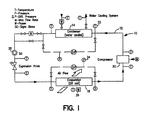
- FIG. 1 A typical refrigeration system to which this invention applies is illustrated by the schematic set forth in Figure 1 . Such systems would include air conditioners, refrigerators, freezers, soda fountain dispensers as well as other cooling devices.
- the schematic of the refrigeration system illustrates a typical operation cycle of a refrigeration apparatus 10 which includes the steps of compression, condensation, expansion and evaporation of a heat transfer fluid.
- compressed heat transfer fluid carrying some lubricant is discharged through a tube 12 to a condenser 14.
- the condensed heat transfer fluid and lubricant then pass to an expansion valve 16 and there to an evaporator 18.
- the evaporator 8 substantially vaporizes the heat transfer fluid and the vapor and liquid phases of the heat transfer fluid and the lubricant are conveyed through tube 12 to a compressor 20.
- thermocouple probes (T) 22 used to calculate evaporator energy transfer
- pressure transducers (P) 24 to measure the absolute pressure (P) and changes in pressure ( ⁇ P) at the condenser 14 and evaporator 18, a mass flow meter 26 to measure refrigerant flow rate and a sight glass 28.
- T thermocouple probes
- P pressure transducers
- ⁇ P changes in pressure
- the invention is believed to pertain to a substantial variety of heat transfer fluids including both chlorine-free and chlor ⁇ ne-containing organic compounds.
- hydrofluorocarbons are difluoromethane, pentafluoroethane, 1,1-difluoroethane, 1, 1. 1-trifluoroethane, 1,1,1,2-tetrafluoroethane, and mixtures thereof.
- the invention relates to lubricants that are miscible and compatible with a heat transfer fluid at all operating temperatures of a refrigerant system.
- lubricants that comprise or consist essentially of ester base stocks or esters compounded with additives.
- the esters suitable for this invention are esters of alcohols that contains at least 2, or more preferably at least 3,-OH groups in unesterified form.
- polyol ester lubricants intended to be miscible with chlorine-free fluoro-group containing organic compounds
- the use of certain polyols and acids and proportions of polyols and acids are preferred as disclosed here below. It is preferred, for example, with increasing preference in the order given, that for lower viscosity esters at least 62, 78, or 90 no % of the alcohol moieties of the esters according to this invention contain no more than 18, more preferably no more than 10, still more preferably no more than 8 carbon atoms.
- At least 62, 81, or 90 no, % of the alcohol moieties in the ester (s) contain at least one carbon atom bonded to four other carbon atoms by single bonds, or in other words, a "neo"carbon atom.
- % of the alcohol moieties for the esters are those derived from pentaerythritol, with the formula C- (CH 2 OH) 4 , from dipentaerythritol, with the formula (HOCH 2 ) 3 CCH 2 OCH 2 C (CH 2 OH) 3 and from (more commonly known as neopentyl glycol) with the formula (H 3 C) 2 C (CH 2 OH) 2 and from 2,2-dimethylol-1-butanol (more commonly known as"1,1,1-trimethylolpropane" or "TMP").
- At least 81, 90 or 98% of the alcohol moieties are derived from pentaerythritol or dipentaerythritol.
- higher viscosity ester lubricants it is preferred with increasing preference that at least 22. 33, 48 and 68 no. % of the alcohol moieties are derived from dipentaerythritol.
- Unsaturated as well as saturated alcohols may be used for esters according to this invention. Saturated alcohols are preferred. Also, substituted alcohols as well as unsubstituted alcohols may be used, but it is preferred that the alcohols used have no substituents other than alkoxy groups, fluoro groups, and/or chloro groups. As with the acids or acyl groups to be used for esters according to this invention, generally unsubstituted alcohols are more economical and are most preferred for that reason.
- the carboxylic acids used to make the ester preferably contain a sufficient fraction of acyl groups that satisfy at least one of the following two criteria.
- the acyl groups must either containing carbon atoms or less and include at least, one carbon atom bonded to three other carbon atoms by single bonds and/or be straight chain with three to six carbon atoms.
- the no. % of acyl groups meeting one or both of these criteria would be at least 33, 42, 60, 67, 86, or, for low viscosity lubricants, 92.
- the no.-% of acyl groups containing at least nine carbon atoms will not be greater than 81, or with increasing preference not greater than 67, 55, 45 or 33. It is also preferred that at least 90 no. % of the acyl groups in all the esters used according to the invention have no more than twenty carbon atoms each.
- Either pure esters or mixtures of esters meeting the above criteria may be effectively used in many embodiments of the invention.
- mixtures of esters are more economical, because they may be prepared from commercially available starting materials without costly purification as a prerequisite.
- mixtures of esters are preferred for performance reasons as well as economy.
- moderate to high viscosity lubricants it is preferred with increasing preference that at least 12. 16. 21, 29. 33 or 40 no. % of the acyl groups in the esters to be used for the invention contain at least 7, more preferably at least 8 and most preferable 9 carbon atoms each.
- the preferred acid with 8 carbons is 2-ethylhexanoic acid and with 9 carbon atoms is 3.5,5-trimethylhexanoic acid.
- a highly desirable constituent is the tetraester of pentaerythritol with an acid mixture of about 57 weight percent iso-or i-pentanoic acid, which for purposes of the specification is defined as a mixture of n-pentanoic acid, 2-methylbutanoic acid, and 3-methylbutanoic acid with about 43 weight percent 3. 5, 5-trimethylhexanoic acid. Additionally and independently, iso-or i-pentanoic acid may with increasing preference make up at least 3. 5. 7. 11 or 14 no. % as needed to improve the miscibility of the ester lubricant with the heat transfer fluid
- acids having 5, 7 and 9 carbon atoms. It is preferred with increasing preference that at least 60. 68, 75, 81. 92 and 98 no. % of the acyl groups have 5, 6. 7, 8. 9, 10. or more preferably 5, 7, or 9 carbon atoms and even more preferably have 5 or 9.
- substantially all of the acyl groups in the esters are preferably monovalent ones.
- some divalent acyl groups are preferred, as it is believed that esters containing two or more alcohol moieties joined by such divalent acyl groups, with all the other hydroxyl positions on the alcohols corresponding to those esterified by monoacyl groups, are particularly advantageous types of esters for use according to this invention.
- Alcohol moiety in any ester is defined herein as a connected part of the ester that would remain if all acyl groups were removed from the ester.
- esters may be denoted herein as an "acid moiety" in an ester). If one or more of the acyl groups in an ester is divalent, the ester is denoted herein as a “complex ester”: such esters preferably include two alcohol moieties, which may be the same or different, but are both of the type already described below. Esters according to the invention with only one alcohol moiety and with all monovalent acyl groups may be denoted herein as "single polyol esters".
- the ratio of monovalent and higher valency acids to be reacted is that too large a fraction of acids with more than one valence may result in an undesirable amount of high molecular weight polymer, in view of the fact that all or substantially all of the alcohol (s) to be reacted also have at least two reactive groups. For this reason, it is increasingly preferred that the ratio of equivalents from monovalent acids to the equivalents from divalent or higher valent acids reacted be at least 1. 1.76, or 2.69. Also, the amount of acyl groups with valence higher than 2 preferably is no more than 2 no. % of the total of all acyl groups.
- At least 55, 67.81 or 92 no. % of the divalentacyl groups in esters used according to this invention have from 4 to 12, or more preferably from 6-9 carbon atoms, and it is independently preferred, with increasing preference in the order given, that at least 55, 67, 81 or 92% of the monovalent acyl groups in the esters contain no more than 18, more preferably no more than 9, still more preferably no more than 7, carbon atoms
- the ratio of the no. % of acyl groups in the ester (s) that contain 8 or more carbon atoms and are unbranched to the no. % acyl-groups in the ester (s) that are both branched and contain not more than six, preferable not more than five, carbon atoms will not be greater than 1.56, more preferably not greater than 1.21, or still more preferably not greater than 1.00.
- Saturated and unsaturated acyl groups may both be used, but saturated ones are preferred. Also, substituted as well as unsubstituted acyl groups may be used in esters according to the invention, but it is preferred that the acyl groups have no substituents other than alkoxy, fluoro and/or chloro groups. Generally unsubstituted acryl groups are most economical and are most preferred for that reason.
- esters which form the lubricant composition of the invention it is possible to obtain the same esters by reacting acid derivatives such as acid anhydrides, acyl chlorides, and esters of the acids instead of reacting the acids themselves.
- acid derivatives such as acid anhydrides, acyl chlorides, and esters of the acids.
- the acids are generally preferred for economy and are exemplified herein, but it is to be understood that the esters defined herein by their reactive components with acids can be equally well obtained by reaction of alcohols with the corresponding acid derivatives.
- commercial isopentanoic acid normally contains about 65 weight % n-pentanoic acid and about 35 weight % of ⁇ sopentanoic acids selected from the group consisting of 2- methylbutandicacid and 3-methylbutanoic acid.
- reaction between the alcohol (s) and the acid (s) reactants of the respective esters proceeds more effectively if the quantity of acid charged to the reaction mixture initially is enough to provide an excess of 10-25% of equivalents of acid over the equivalents of alcohol reacted with the acid.
- an equivalent of acid is defined for the purposes of this description as the amount containing one gram equivalent weight of carboxyl groups, whereas an equivalent of alcohol is the amount containing one gram equivalent weight of hydroxyl groups.
- the composition of the mixture of acids and alcohols that have actually reacted can be determined by analysis of the ester product for its acyl group content.
- the acid reacted will be lower boiling than the alcohol (s) reacted and the product ester (s).
- the product is often ready for use as a lubricant blending stock according to this invention.
- the content of free acid in the product after the first vacuum distillation may be further reduced by treatment with epoxy esters, as taught in U. S. Patent 3,485.754 or by neutralization with any suitable alkaline material such as lime, alkali metal hydroxides, or alkali metal carbonates.
- the ester base stock described herein will function satisfactorily as a complete lubricant. It is generally preferable, however, for a complete lubricant to contain other materials generally known in the art as additives, such as oxidation resistance and thermal stability ⁇ mprovers, corrosion inhibitors, metal deactivators, lubricity additives, viscosity index ⁇ mprovers, pour and/or floc point depressants, detergents, dispersants, foam promoting agents. antifoarning agents, anti-wear and extreme pressure resistance additives and acid scavangers. Many additives may impart both anti-wear and extreme pressure resistance properties, or function both as a metal deactivator and a corrosion inhibitor. Cumulatively, all additives preferably do not exceed 8% by weight, or more preferably do not exceed 5% by weight. of the total compounded lubricant formulation.
- additives such as oxidation resistance and thermal stability ⁇ mprovers, corrosion inhibitors, metal deactivators, lubricity additives, viscosity
- An effective amount of the foregoing additive types is generally in the range of 0.01 to 5% for the antioxidant compound. 0.01 to 5% for the corrosion inhibitor component, from 0.001 to 5% for the metal deactivator component, from 0 5 to 5% for the lubricity additives, from 0.01 to 2% for each of the viscosity index improvers and pour and/or floc point depressants, from 0.1 to 5% for each of the detergents and dispersant, from 0.001 to 0.1% for foam promoting agents or anti-foam agents, and from 0.1-2% for the anti-wear and extreme pressure resistance components, and 0.05 to 2% for the acid scavenger.
- Suitable oxidation resistance and thermal stability improves are diphenyl-, dinaphthyl- and phenyl-naphtyl-amines, in which the phenol and naphthyl groups can be substituted, e. g., N. N'-diphenyl phenylenediamine, p-octyldiphenylamine, p, p-dioctyldiphenylamine, N-phenyl-1-naphthyl amine.
- cuprous metal deactivators examples include imidazole, benzamidazole. 2-mercaptobenzothiazole, 2,5-dimercaptothiadizaole, salicylidine-propylenediamine, pyrazole, benzotriazole, tolutriazole, 2-methylbenzamidazole, 3.5-dimethyl pyrazole, and methylene bis-benzotriazole.
- Benzotriazole derivatives are preferred.
- Other examples of more general metal deactivators and/or corrosion inhibitors include organic acids and their esters, metal salts, and anhydrides, such as n-oleyl-sarcosine, sorbitan monooleate, lead naphthenate, dodecenyl-succinic acid and its partial esters and amides, and 4-nonylphenoxy acetic acid; primacy, secondary, and tertiary aliphatic and cyloaliphatic amines and amine salts of organic and inorganic acids, such as oilsoluble alkylammonium carboxylates; heterocyclic nitrogen containing compounds, such as thiadiazoles, substituted imidazolines, and oxazolines: quinolines, quinones, and anthraquinones; propyl gallate: barium dinonyl naphthalene sulfonate: ester and amide derivatives and alkenyl succinic an
- Suitable lubricity additives includes siloxane polymers, polyoxyalkene polymers. polyalkyleneglycol and long chain derviative of fatty acids and natural oils, such as esters, amines, amides, imidazolines and borates.
- Suitable viscosity index improvers include polymethacrylates polybutenes, styrene-acrylate copolymers and ethylenepropylene copolymers
- pour point and/or floc point depressants examples include polymethacrylates such as methacrylate-ethylene-vinyl acetate terpolymers; alkylated naphthalene derivatives, and products of Friedel-Crafts catalyzed condensation of urea with naphthalene or phenols.
- Suitable detergents and/or dispersants include polybutenylsuccinic acid amides; polybutenyl phosphoric acid derivatives, long chain alkyl substituted aromatic sulfonic acids and their salts: and methyl salts of alkyl sulfides, of alkyl phenols, and of condensation products of alkyl phenols and aldehydes.
- Suitable anti-foam agents include silicone polymers, siloxane polymers and polyoxyalkene polymers and some acrylates.
- foam promoters include silicone polymers with a different molecular structure than the silicone polymers used as anti-foam agents, siloxane polymers and polyoxyalkene polymers.
- Suitable anti-wear and extreme pressure resistance agents include sulfurized fatty acids and fatty acid esters, such as sulfurized octyl tallate; sulfurized terpenes; sulfurized olefins; organopolysulfides: organo phosphorus derivatives including amine phosphates, alkyl acid phosphates, dialkyl phosphates, aminedithiophosphates, trialkyl and triaryl phosphorothionates, trialkyl and triaryl phosphines, and dialkylphosphites, such as amine salts of phosphoric acid monohexyl ester, amine salts of dinonylnaphthalene sulfonate, triphenyl phosphate, trinaphthyl phosphate, diphenyl cresyl and dicresyl phenylphosphates, naphthyl diphenyl phosphate, triphenylphosphorothionate; dithiocarbamates
- suitable acid scavengers are epoxy compounds having at least one epoxy compound in its molecule.
- Preferred acid scavengers are compounds having at least one glycidyl ester group including aliphatic glycidyl ethers such as propylene glycol, diglycidyl ether, neopentyl glycol diglycidyl ether.
- aromatic glycidyl ethers such as phenol glycidyl ether, cresyl glycidyl ether and glycidyl ether of bisphenol alkylene oxide adduct and polyalkylene glycol diglycidyl ether.
- aromatic glycidyl ethers such as phenol glycidyl ether, cresyl glycidyl ether and glycidyl ether of bisphenol alkylene oxide adduct and polyalkylene glycol diglycidyl ether.
- preferable constitutive alkylene groups are ethylene, propylene, butylene, etc. and the preferable molecular weight thereof is 1000 or less
- the lubricant base stock and lubricant be substantially free of such polyether polyols.
- substantially free it is meant that the compositions contain no more than about 10 % by weight, preferably no more than about 2.6 by weight and more preferably no more than about 1.2 % by weight of the materials noted.
- the selected heat transfer fluid and the lubricant components of the working fluid should have chemical characteristics and be present in such a portion to each other that the lubricant remains miscible with the heat transfer fluid over the entire range of working temperatures to which the working fluid is exposed during operation of a refrigeration system in which the working fluid is used.
- Such systems vary enormously in terms of their operating conditions. Accordingly it is often adequate if the working fluid remains miscible up to +30 °C. although it is increasingly more preferable if the working fluid remains miscible up to 45 °C 60 °C. 71 °C and at least 100 °C.
- Miscible working fluids consisting essentially of chlorine-free fluoro-group containing heat transfer fluids and blended ester lubricants can be obtained as described above. Miscibility over a temperature range for working fluids containing up to 1, 2, 4, 10 and 15% by weight of lubricant is successively more preferable.
- working fluids consisting essentially of a refrigerant heat transfer fluid and lubricant base stock or compounded lubricant is used in a process of operating refrigerant systems in such a manner that the working fluid improves performance of the refrigerant system.
- lubricant compositions according to this invention are generally the same as established in the art for lubricants to be used in refrigeration systems together with a heat transfer fluid, particularly for a fluorocarbon and/or chlorofluorocarbon heat transfer fluid.
- lubricants according to this invention have International Organization for Standardization ("ISO") viscosity grade numbers between 15 and 320.
- ISO International Organization for Standardization
- the viscosity ranges for some of the ISO viscosity grade numbers are given in Table 1. TABLE 1 ISO Viscosity Grade Number Viscosity Centistokes at Minimum Range in 40°.
- ester lubricant base stocks of the invention is described in further detail in the following examples.
- the amount of catalyst was from 0.02 to 0.1 % by weight of the weight of the total acid and alcohol reacted
- the reaction mixture was heated to a temperature between about 220 and 230 °C, and water from the resulting reaction was collected in the trap while refluxing acids were returned to the reaction mixture. Partial vacuum was maintained above the reaction mixture as necessary to achieve a reflux.
- the reaction mixture was sampled occasionally for determination of hydroxyl number, and after the hydroxyl number had fallen below 5.0 mg of KOH per gram of mixture, the majority of the excess acid was removed by distillation after applying the highest vacuum obtainable with the apparatus used, while lowering the temperature to about 190 C.
- the reaction mixture was then cooled, and any residual acidity was removed, if desired, by treatment with lime, sodium hydroxide, or epoxy esters.
- the resulting lubricant or lubricant base stock was dried and filtered before blending and phase compatibility testing.
- Example A Two refrigerant working fluids were tested in a vapor compression refrigeration system similar to that described in Figure 1 .
- One of these fluids (Example A) comprises a heat transfer fluid and a mineral oil lubricant known to be immiscible with the heat transfer fluid.
- the mineral oil is an iso 32 naphthentic refrigeration oil.
- the second working fluid (Example 1) comprises a lubricant comprising a polyol ester which is known to be miscible with the heat transfer fluid.
- the heat transfer fluid used in both Examples A and 1 is 1,1,1.2tetrafluoroethane (R134a).
- the polyol ester of Example 1 is formed from pentaerythritol and a mixture of 37 weight percent n-pentanoic acid, 20 weight percent of a mixture of 2-methylbutanoic acid and 3-methylbutanoic acid and 43 weight percent 3,5,5-trimethylhexanoic acid.
- the evaporator is a cross-flow refrigerant coil.
- the refrigerant flows through copper tubes, with air flowing across the tubes. Air-side heat transfer is enhanced with aluminum fins mounted on the copper tubes.
- the refrigeration system had a coil in which inside of the copper tubes is a smooth tube (smooth-tube coil) and the tests were conducted on this coil. Later tests were performed on an evaporator coil with microfin tubes (microfin-tube coil). Both coils have the same design capacity of 10.5 kW (3 tons), but they differ in physical characteristics as the microfin-tube coil is smaller than the smooth-tube coil.
- the smooth tube coil has 5/8 inch nominal outer diameter copper tubes with twelve fins per inch (12 fpi), while the microfin-tube coil has 3/8 inch copper tubes with 15 fpi.
- the microfin tube coil has around 25 percent smaller cross-sectional area than the smooth-tube coil oross-sectional area. Also, the volume of the microfin-tube coil on the refrigerant side is about 70 percent smaller than the same volume for the smooth-tube coil.
- the compressor is a hermetically-sealed constant-speed reciprocating type, designed to operate with HFC-134a refrigerant
- the compressor has accessible plugs for charging and draining lubricant so that oil changes can be performed while the compressor is still installed.
- thermoexpansion valve has a slow response time
- needle valve is the preferred device for flow rate control as described in Crown, S. W. HW Shapiro and M B. Pate. 1992.
- the needle valve can be directly controlled by the data acquisition system.
- Measureasuring devices used to quantitatively evaluate refrigeration system performance are also shown in Figure 1 .
- the sensors installed are thermocouple probes, pressure transducers, flow sensors, and a watt transducer. A detailed description of each of those sensors is provided below.
- Thermocouple probes are of the T type, and they are located before and after each of the components of the refrigeration system. All of the thermocouples were calibrated, and the uncertainty of their reading is ⁇ 0.21 ° (0 5 °F).
- thermocouple grids before and after the evaporator on the air flow side.
- Each grid consists of 18 thermocouples equally spaced across the heat exchanger cross-sectional area. The purpose of these grids is to accurately calculate evaporator energy transfer on the air side. Dry and wet bulb thermocouples are installed before and after the evaporator for the purpose of measuring the amount of moisture in the air steam.
- the refrigerant flow rate is measured with a mass flowmeter that was precalibrated by the manufacturer. For accurate flow rate measurements, it is required that refrigerant be in a liquid state at the outlet of the condenser, which is where the flowmeter is located. If the liquid phase requirement is met, the flowmeter can read actual flow rate with an uncertainty of ⁇ 0.0075 kg/min (0.0034 lbm/min).
- the air flow rate is measured with a Pitot-tube measuring station which uses a calibrated pressure transducer to measure dynamic pressure.
- the flow rate of the water lowing through the condenser is measured by a calibrated turbine flowmeter.
- the flowmeter can measure the water flow rate with an uncertainty of ⁇ 0.05 kg/min (0.0225 lbm/min).
- a watt transducer precalibrated by the manufacturer is used to measure compressor power consumption with a listed uncertainty of ⁇ 0.05 kW (4 Btu/min).
- the data acquisition system consists of a computer, an IEEE-488 GPIB (General Purpose Interface Bus) controller card, a computer addressable digital voltmeter, and two scanners.
- the GPIB controller card allowed for computer control of the scanners and the voltmeter. All of the instruments were connected to the data acquisition system, allowing constant updating of the system operating parameters and storing of the information in the computer memory.
- the system is first charged with refrigerant to an optimum amount.
- the condenser water was circulated at a constant volume flow rate by operating a pump at its maximum capacity.
- the air flow rate was set by adjusting the fan motor speed to achieve a constant air stream dynamic pressure.
- the condenser water temperature is controlled by mixing the chilled water with the condenser return water.
- the air inlet temperature was kept at a desired value by reheating the air leaving the evaporator by using a combination of a steam coil and an electric heater.
- the electric heater is used to accurately control the air temperature while the steam coil was used to produce the bulk of the cooling load.
- a needle valve was used to control the refrigerant flow rate through the system which in turn adjusts the amount of superheat at the compressor exist
- the experimental procedures adopted for charging the lubricant in the refrigerant system are important in order to ensure that the refrigerant lubricant in the compressor is of an acceptable purity.
- the lubricant oil change was performed in accordance with the tripleflush procedure outlined in Byrne J. J., M Shows and M. W. Abel. Investigation of flushing and cleanout methods for refrigeration equipment to ensure system compatibility . Final report. ARTI MLLR Project Number 660-52502.
- the tripleflush is a method for the removal of the mineral oil from an installation containing R-12 when it is retrofitted with HFC-134a. The same procedure was used in this project to replace the polyolester refrigerant lubricant with the mineral oil. The method requires three lubricant changes to remove any traces of residual mineral oil which reduces the residual oil to less than 1 percent by volume.
- Coefficient of performance is defined as the useful energy transfer (i. e., evaporator capacity) divided by the energy consumed.
- the coefficient of performance was measured for working fluids of Examples 1 and A for air inlet temperatures of 13 °C. 18 °C and 24 °C and for condenser water inlet temperatures of 18.5 °C. 24 °C, 32 °C and 40.5 °C. The results of these measurements are set forth in Table 2.
- the working fluid of Example 1 is identified as "POE lubricant" and the working fluid of Example A is identified as "Mineral Oil”.
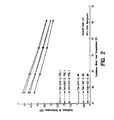
- Figure 2 also indicates that COP can vary greatly due to varying air and water temperatures. These differences are illustrated by establishing a reference point corresponding to an air temperature of 13°C and a water temperature of 18.5 °C It can then be observed that an increase in air temperature from the reference point of 13 °C to 24 °C. while keeping the same condenser water temperature, results in approximately a 25 percent COP increase. It the water temperature is increased from 18.5 °C to 40 °C then the COP decreases around 40 percent. Although changes in air and water inlet temperatures have a considerable effect on COP, at the temperature conditions tested, the COP for the refrigerant system was with only one exception higher with the miscible working fluid of Example 1,
- the results plotted in Figure 2 can also be presented as a percent difference as shown in Figure 3 .
- the percent COP difference, Cop df . is defined as the difference between the COPs for the miscible working fluid with the POE lubricant and the immiscible working fluid with the mineral oil divided by the COP for the miscible working fluid. The value is expressed as a percentage.
- the results plotted in Figure 3 also show that the system operating with the miscible working fluid (POE lubricant) has a larger COP than the system operating with the immiscible working fluid (Mineral oil).
- the percent differences are as high as 2.5 percent. It appears from Figure 3 that the largest percent differences correspond to the points with the highest evaporator temperature of 24 °C (75 °F) with the COP percent difference diminishing to a fraction of a percent as the evaporator air entering temperature decreases.
- the system operates more efficiently with the miscible working fluid (POE) lubricant then with the immiscible working fluid (MO) with the microfin-tube coil.
- POE miscible working fluid
- MO immiscible working fluid
- the COP data shows that there are energy savings related to the utilization of a miscible working fluid in the microfin tube system.
- Figure 4 also reveals substantial differences in COP due to variations in water and air temperatures. For instance the COP decreases for 25 percent if the water temperature is increased from 24 °C to 40 °C. and it also decreases for around 20 percent if the air temperature is reduced from 24 °C to 13 °C. Only for a condenser water temperature of 40 °C (105 F) are there no distinguishable difference among COP percent differences for different air temperatures. Yet, the COP for the refrigerant system was higher for the miscible working fluid of Example 1 for all test conditions.
- the percent COP difference, COP dif defined earlier, in formula (1) is obtained from the COP results set forth in Figure 4 .
- the COP dif results expressed in percentage are set forth in Figure 5 .
- the results demonstrate that the system operating with the miscible working fluid (POE lubricant) has a larger COP than the system operating with the immiscible working fluid (Mineral oil.
- the COP percent differences are as high as about 4.5 percent, and the largest percent difference correspond to the points with the highest evaporator temperature 24 °C (75 F) and the lowest condenser water temperature 24 °C (75 F).
- the COP percent difference appears to decrease with an increase in water temperature and a decrease in air temperature.
- the coefficient of performance was measured for the refrigeration apparatus described hereabove using a second miscible working fluid comprising 1,1 1 ,2-tetrafluoroethane heat transfer fluid and a second polyol ester lubricant (POE #2)
- the second polyol ester is formed from an alcohol mixture of 65 weight percent pentaerythritol and 35 weight percent dipentaerythritol and a mixture of straight chain acids of 5 to 10 carbon atoms present in the following ranges (53-63 no. % nC 5 ; 5-15 no. % nC 6 : 7-17 no. % nC 7 : 7-17 no. % nC 8 : 0-10 no % nC 9 and 0-10 no.
- Example 2 working fluid The conditions under which the coefficient of performance was measured for this Example 2 working fluid were the same as those for the working fluids of Examples 1 and A.
- the comparative results for COP for the miscible working fluids of Example 1 and 2 (expressed as POE #1 and #2) are shown in Figure 6 .
- the coefficient of performance result of the working fluids of Examples 1 and 2 are defined relative to the immiscible working fluid of Example A in terms of a percent differences in Figure 7 by calcuiating these differences according to formula (1).
- the COP percent differences for working fluids of Examples 1 and 2 i. e.. POE # 1 and POE #2
- the COP percent differences data indicate that the miscible working fluid of Example 2 improves the COP of a refrigerant system relative to the immiscible working fluid of Example A.
- the COP percent improvement for the miscible working fluid of Example 2 over the immiscible working fluid of Example A varied from 0.1 to 5.2%.
Landscapes
- Chemical & Material Sciences (AREA)
- Organic Chemistry (AREA)
- Chemical Kinetics & Catalysis (AREA)
- Engineering & Computer Science (AREA)
- Oil, Petroleum & Natural Gas (AREA)
- General Chemical & Material Sciences (AREA)
- Materials Engineering (AREA)
- Physics & Mathematics (AREA)
- Thermal Sciences (AREA)
- Combustion & Propulsion (AREA)
- Health & Medical Sciences (AREA)
- Emergency Medicine (AREA)
- Lubricants (AREA)
- Compression-Type Refrigeration Machines With Reversible Cycles (AREA)
- Sorption Type Refrigeration Machines (AREA)
Abstract
Description
- This invention relates to a method or process of improving performance of refrigerant systems such as refrigerators and air conditioners that utilizes a working fluid. The working fluid consists essentially of a chlorine-free fluorogroup containing heat transfer fluid and a lubricant that is miscible and is otherwise compatible with the heat transfer fluid over the operating temperature of the system The heat transfer fluid is preferably a hydrofluorocarbon. The lubricant preferably comprises an ester formed from an alcohol containing at least two-OH groups and a carboxylic acid that is substantially or exclusively monovalent.
- Refrigerant systems such as refrigerators and air conditioners collectively consume enormous amounts of energy. Energy consumption of refrigerant systems is likely to increase as a result of the replacement of chlorinecontaining heat transfer fluids with chlorine-free organic heat transfer fluids for the purpose of protecting the ozone layer.
- The replacement of R-22 (difluoromonochloromethane) with a chlorinefree hydrofluorocarbon heat transfer fluid illustrates this problem. R-22 has very good thermodynamic properties resulting in a lower volume replacement per ton of refrigeration than other commercial heat transfer fluids. Accordingly: refrigerant systems utilizing R-22 require less energy than systems utilizing other heat transfer fluids including expected replacement heat transfer fluids for R·22.
- An improvement in the performance of refrigerant systems would help alleviate the energy inefficiences resulting from the replacement of chlorinecontaining heat transfer fluids with better thermodynamic properties In fact even a small improvement in the performance of refrigerant systems can translate into large monetary savings given the enormous amounts of energy being consumed by these systems. Such improvements in performance would also benefit the environment as any reduction in energy requirements will reduce the adverse effect on the environment caused by energy production.
- Accordingly it is an object of this invention to improve the performance of refrigerant systems in terms of reducing their energy requirements. It is also an object to improve such performance with working fluids that are compatible with and remain stable in refrigerant systems over long periods of operation.
- It has now been found that the performance of a refrigerant system such as in air conditioners, refrigerators, freezers, soda fountain dispensers and other cooling devices is improved by using working fluids consisting essentially of a heat transfer fluid and lubricant that are miscible over the operating temperature range of the system. This finding applies to a refrigeration system consisting of an apparatus which includes a compressor, a condenser, an expansion device and evaporator in fluid flow relationship. A preferred apparatus is of the sealed compressor type wherein the lubricant which lubricates the moving parts of the refrigeration apparatus is miscible with the heat transfer fluid during the operation of the apparatus.
- This finding applies to working fluids consisting essentially of chlorinefree organic heat transfer fluids, preferably hydrofluorocarbons: and lubricants comprising ester base stocks or compounded esters. The ester lubricants are formed from alcohols containing at least two-OH groups and a carboxylic acid that is substantially or completely monovalent. At least part of the acid constituent is preferably formed from straight chain acids of three to six carbon atoms or acids of three to nine carbon atoms with at least one carbon bonded to three other carbon atoms.
- The esters are preferably formed from mixtures of alcohols and acids to utilize feedstocks of such mixtures. The lubricant may also comprise mixtures of esters. The lubricant can be formed from only the ester or an ester compounded with one or more additives.
- Other advantages of the present invention will be readily appreciated as the same becomes better understood by reference to the following detailed description when considered in connection with the accompanying drawings wherein:
-
FIG 1 shows a schematic of the refrigeration system used in the test program. -
FIG 2 is a graph showing coefficient of performances of a smooth tube-oil type refrigerant apparatus using a-miscible working fluid of Example 1 compared with coefficient of performance for the same apparatus using an immiscible working fluid of Example A. -
FIG 3 is a graph showing the percentage difference in coefficient of performances of a smooth tube type refrigerant apparatus using the miscible working fluid of Example 1 compared with coefficient of performance for the same apparatus using immiscible working fluid of Example A. -
FIG 4 is a graph showing coefficient of performances of a microfin tube type refrigerant apparatus using a miscible working fluid of Example 1, compared with coefficient of performance for the same apparatus using immiscible working fluid of Example A. -
FIG 5 is a graph showing the percentage difference of coefficient of performance of a microfin tube type refrigerant apparatus using a miscible working fluid of Example 1 compared with coefficient of performance for the same apparatus using immiscible working fluid of Example A. -
FIG 6 is a graph showing coefficient of performance of a microfin tube type refrigerant apparatus using miscible working fluids of Example 1 and 2. -
FIG 7 is a graph showing the percentage differences of coefficient of performance of a microfin tube type refrigerant apparatus using miscible working fluids of Examples 1 and 2 compared with coefficient of performance for the same apparatus using immiscible working fluid of Example A. - Except in the operating examples, or where otherwise expressly indicated, all numerical quantities in this description indicating amounts of material or conditions of reaction and/or use are to be understood as modified by the term "about" in defining the broadest scope of the invention. Practice of the invention within the boundaries corresponding to the exact quantities stated is preferable however.
- A typical refrigeration system to which this invention applies is illustrated by the schematic set forth in
Figure 1 . Such systems would include air conditioners, refrigerators, freezers, soda fountain dispensers as well as other cooling devices. The schematic of the refrigeration system illustrates a typical operation cycle of arefrigeration apparatus 10 which includes the steps of compression, condensation, expansion and evaporation of a heat transfer fluid. In theapparatus 10, compressed heat transfer fluid carrying some lubricant is discharged through atube 12 to acondenser 14. The condensed heat transfer fluid and lubricant then pass to an expansion valve 16 and there to anevaporator 18. Theevaporator 8 substantially vaporizes the heat transfer fluid and the vapor and liquid phases of the heat transfer fluid and the lubricant are conveyed throughtube 12 to acompressor 20. In thecompressor 20, the vapor is compressed and discharged throughtube 12 for recirculation through therefrigeration apparatus 10. The schematic also indicates the presence of thermocouple probes (T) 22 used to calculate evaporator energy transfer, pressure transducers (P) 24 to measure the absolute pressure (P) and changes in pressure (ΔP) at thecondenser 14 andevaporator 18, amass flow meter 26 to measure refrigerant flow rate and asight glass 28. In the refrigeration cycle illustrated byFigure 1 . the liquid phase of the heat transfer fluid and lubricant remain miscible. - The invention is believed to pertain to a substantial variety of heat transfer fluids including both chlorine-free and chloríne-containing organic compounds.
- Of particular interest are the chlorine-free ftuoro-group containing organic compounds, especially hydrofluorocarbons. The most preferred hydrofluorocarbons are difluoromethane, pentafluoroethane, 1,1-difluoroethane, 1, 1. 1-trifluoroethane, 1,1,1,2-tetrafluoroethane, and mixtures thereof.
- The invention relates to lubricants that are miscible and compatible with a heat transfer fluid at all operating temperatures of a refrigerant system. Of particular interest are lubricants that comprise or consist essentially of ester base stocks or esters compounded with additives. The esters suitable for this invention are esters of alcohols that contains at least 2, or more preferably at least 3,-OH groups in unesterified form.
- In the preparation of polyol ester lubricants intended to be miscible with chlorine-free fluoro-group containing organic compounds, the use of certain polyols and acids and proportions of polyols and acids are preferred as disclosed here below. It is preferred, for example, with increasing preference in the order given, that for lower viscosity esters at least 62, 78, or 90 no % of the alcohol moieties of the esters according to this invention contain no more than 18, more preferably no more than 10, still more preferably no more than 8 carbon atoms.
- Also independently, it is preferred, with increasing preference in the order given, that at least 62, 81, or 90 no, % of the alcohol moieties in the ester (s) contain at least one carbon atom bonded to four other carbon atoms by single bonds, or in other words, a "neo"carbon atom. Independently and preferably with increasing preference, at least 62, 81, 90 or 98 no. % of the alcohol moieties for the esters are those derived from pentaerythritol, with the formula C- (CH2OH)4, from dipentaerythritol, with the formula (HOCH2)3CCH2OCH2C (CH2OH)3 and from (more commonly known as neopentyl glycol) with the formula (H3C)2C (CH2OH)2 and from 2,2-dimethylol-1-butanol (more commonly known as"1,1,1-trimethylolpropane" or "TMP"). Independently and preferably with increasing preference at least 81, 90 or 98% of the alcohol moieties are derived from pentaerythritol or dipentaerythritol. When higher viscosity ester lubricants are needed it is preferred with increasing preference that at least 22. 33, 48 and 68 no. % of the alcohol moieties are derived from dipentaerythritol.
- Unsaturated as well as saturated alcohols may be used for esters according to this invention. Saturated alcohols are preferred. Also, substituted alcohols as well as unsubstituted alcohols may be used, but it is preferred that the alcohols used have no substituents other than alkoxy groups, fluoro groups, and/or chloro groups. As with the acids or acyl groups to be used for esters according to this invention, generally unsubstituted alcohols are more economical and are most preferred for that reason.
- The carboxylic acids used to make the ester preferably contain a sufficient fraction of acyl groups that satisfy at least one of the following two criteria. The acyl groups must either containing carbon atoms or less and include at least, one carbon atom bonded to three other carbon atoms by single bonds and/or be straight chain with three to six carbon atoms. In order for the esters to satisfy the miscibility requirements of the invention, it is preferable that at least 22 number percent (hereinafter "no %") of the acyl groups in the ester or ester mixtures that are lubricants and/or base stocks according to the ìnvention meet at least one of these criteria. With increasing preference in the order named the no. % of acyl groups meeting one or both of these criteria would be at least 33, 42, 60, 67, 86, or, for low viscosity lubricants, 92.
- Additionally and independently the no.-% of acyl groups containing at least nine carbon atoms will not be greater than 81, or with increasing preference not greater than 67, 55, 45 or 33. It is also preferred that at least 90 no. % of the acyl groups in all the esters used according to the invention have no more than twenty carbon atoms each.
- Either pure esters or mixtures of esters meeting the above criteria may be effectively used in many embodiments of the invention. Generally, mixtures of esters are more economical, because they may be prepared from commercially available starting materials without costly purification as a prerequisite. In one embodiment of the invention, mixtures of esters are preferred for performance reasons as well as economy. Where moderate to high viscosity lubricants are needed, it is preferred with increasing preference that at least 12. 16. 21, 29. 33 or 40 no. % of the acyl groups in the esters to be used for the invention contain at least 7, more preferably at least 8 and most preferable 9 carbon atoms each. The preferred acid with 8 carbons is 2-ethylhexanoic acid and with 9 carbon atoms is 3.5,5-trimethylhexanoic acid.
- A highly desirable constituent is the tetraester of pentaerythritol with an acid mixture of about 57 weight percent iso-or i-pentanoic acid, which for purposes of the specification is defined as a mixture of n-pentanoic acid, 2-methylbutanoic acid, and 3-methylbutanoic acid with about 43
weight percent 3. 5, 5-trimethylhexanoic acid. Additionally and independently, iso-or i-pentanoic acid may with increasing preference make up at least 3. 5. 7. 11 or 14 no. % as needed to improve the miscibility of the ester lubricant with the heat transfer fluid - Generally, mixtures of acids are preferred. For most purposes the preferred acids are acids having 5, 7 and 9 carbon atoms. It is preferred with increasing preference that at least 60. 68, 75, 81. 92 and 98 no. % of the acyl groups have 5, 6. 7, 8. 9, 10. or more preferably 5, 7, or 9 carbon atoms and even more preferably have 5 or 9.
- For lubricants and/or base stocks according to the invention in the lower viscosity ranges, substantially all of the acyl groups in the esters are preferably monovalent ones. For higher viscosity ranges, some divalent acyl groups are preferred, as it is believed that esters containing two or more alcohol moieties joined by such divalent acyl groups, with all the other hydroxyl positions on the alcohols corresponding to those esterified by monoacyl groups, are particularly advantageous types of esters for use according to this invention. (An "alcohol moiety" in any ester is defined herein as a connected part of the ester that would remain if all acyl groups were removed from the ester. An acyl group may be denoted herein as an "acid moiety" in an ester). If one or more of the acyl groups in an ester is divalent, the ester is denoted herein as a "complex ester": such esters preferably include two alcohol moieties, which may be the same or different, but are both of the type already described below. Esters according to the invention with only one alcohol moiety and with all monovalent acyl groups may be denoted herein as "single polyol esters".
- An independent constraint on the ratio between monovalent and higher valency acids to be reacted is that too large a fraction of acids with more than one valence may result in an undesirable amount of high molecular weight polymer, in view of the fact that all or substantially all of the alcohol (s) to be reacted also have at least two reactive groups. For this reason, it is increasingly preferred that the ratio of equivalents from monovalent acids to the equivalents from divalent or higher valent acids reacted be at least 1. 1.76, or 2.69. Also, the amount of acyl groups with valence higher than 2 preferably is no more than 2 no. % of the total of all acyl groups.
- It is preferred with increasing preference in the order given, that at least 55, 67.81 or 92 no. % of the divalentacyl groups in esters used according to this invention have from 4 to 12, or more preferably from 6-9 carbon atoms, and it is independently preferred, with increasing preference in the order given, that at least 55, 67, 81 or 92% of the monovalent acyl groups in the esters contain no more than 18, more preferably no more than 9, still more preferably no more than 7, carbon atoms
- Additionally and independently, it is desirable that for adequate solubility in highly fluorinated refrigerant heat transfer fluids, the ratio of the no. % of acyl groups in the ester (s) that contain 8 or more carbon atoms and are unbranched to the no. % acyl-groups in the ester (s) that are both branched and contain not more than six, preferable not more than five, carbon atoms will not be greater than 1.56, more preferably not greater than 1.21, or still more preferably not greater than 1.00.
- Saturated and unsaturated acyl groups may both be used, but saturated ones are preferred. Also, substituted as well as unsubstituted acyl groups may be used in esters according to the invention, but it is preferred that the acyl groups have no substituents other than alkoxy, fluoro and/or chloro groups. Generally unsubstituted acryl groups are most economical and are most preferred for that reason.
- Independently of all other preferences, it is increasingly more preferred that no more than 20. 14. 9. 5 and 2 no. % of the oxygen atoms in the esters to be used in a composition according to the invention be chemically bonded (as distinct from "hydrogen bonded") to a hydrogen atom.
- For each of the esters which form the lubricant composition of the invention, it is possible to obtain the same esters by reacting acid derivatives such as acid anhydrides, acyl chlorides, and esters of the acids instead of reacting the acids themselves. The acids are generally preferred for economy and are exemplified herein, but it is to be understood that the esters defined herein by their reactive components with acids can be equally well obtained by reaction of alcohols with the corresponding acid derivatives.
- Concerning the reactive components of the esters which form the lubricant composition of the invention, it is to be understood that although only the desired alcohols and acids are explicitly specified, some amount of the sort of ìmpurities formally present in technical or industrial grade products may be tolerable in most cases. For example, "tech pentaerythritol" (PE) normally contains on the order of 85-90 weight % of mono PE. along with 10·15 weight % of dipentaerythritol ("DPE") and 0-3% of tripentaerythritol ("TPE"), and is quite satisfactory for making high quality esters in many cases. Also, "commercial isopentanoic acid" normally contains about 65 weight % n-pentanoic acid and about 35 weight % of ìsopentanoic acids selected from the group consisting of 2- methylbutandicacid and 3-methylbutanoic acid.
- In practice, it has been found that reaction between the alcohol (s) and the acid (s) reactants of the respective esters proceeds more effectively if the quantity of acid charged to the reaction mixture initially is enough to provide an excess of 10-25% of equivalents of acid over the equivalents of alcohol reacted with the acid. (An equivalent of acid is defined for the purposes of this description as the amount containing one gram equivalent weight of carboxyl groups, whereas an equivalent of alcohol is the amount containing one gram equivalent weight of hydroxyl groups.) The composition of the mixture of acids and alcohols that have actually reacted can be determined by analysis of the ester product for its acyl group content.
- In making the ester product, according to this invention, the acid reacted will be lower boiling than the alcohol (s) reacted and the product ester (s). When this condition obtains, it is preferred to remove the bulk of any excess acid remaining at the end of the esterification reaction by distillation, most preferably at a low pressure such as 1-5 torr.
- After such vacuum distillation, the product is often ready for use as a lubricant blending stock according to this invention. If further refinement of the products is desired, the content of free acid in the product after the first vacuum distillation may be further reduced by treatment with epoxy esters, as taught in
U. S. Patent 3,485.754 or by neutralization with any suitable alkaline material such as lime, alkali metal hydroxides, or alkali metal carbonates. - If treatment with epoxy esters is used, excess epoxy esters may be removed by a second distillation under very low pressure, while the product of reaction between the epoxy ester and residual acid may be left behind in the product without harm. If alkali neutralization is used as the refinement method, subsequent washing with water, to remove any unreacted excess fatty acid neutralized by the alkali, is strongly preferred before using the product is forming a lubricant ester blend.
- Under some conditions of use, the ester base stock described herein will function satisfactorily as a complete lubricant. It is generally preferable, however, for a complete lubricant to contain other materials generally known in the art as additives, such as oxidation resistance and thermal stability ìmprovers, corrosion inhibitors, metal deactivators, lubricity additives, viscosity index ìmprovers, pour and/or floc point depressants, detergents, dispersants, foam promoting agents. antifoarning agents, anti-wear and extreme pressure resistance additives and acid scavangers. Many additives may impart both anti-wear and extreme pressure resistance properties, or function both as a metal deactivator and a corrosion inhibitor. Cumulatively, all additives preferably do not exceed 8% by weight, or more preferably do not exceed 5% by weight. of the total compounded lubricant formulation.
- An effective amount of the foregoing additive types is generally in the range of 0.01 to 5% for the antioxidant compound. 0.01 to 5% for the corrosion inhibitor component, from 0.001 to 5% for the metal deactivator component, from 0 5 to 5% for the lubricity additives, from 0.01 to 2% for each of the viscosity index improvers and pour and/or floc point depressants, from 0.1 to 5% for each of the detergents and dispersant, from 0.001 to 0.1% for foam promoting agents or anti-foam agents, and from 0.1-2% for the anti-wear and extreme pressure resistance components, and 0.05 to 2% for the acid scavenger.
- All these percentages are by weight and are based on the total weight of the lubricant composition. It is to be understood that more or less than the stated amounts of additives may be more suitable to particular circumstances or applications, and that a single molecular type or a mixture of types may be used for each type of additive component. The foregoing examples are intended to be merely illustrative and not limiting, except as circumscribed by the appended claims.
- Examples of suitable oxidation resistance and thermal stability improves are diphenyl-, dinaphthyl- and phenyl-naphtyl-amines, in which the phenol and naphthyl groups can be substituted, e. g., N. N'-diphenyl phenylenediamine, p-octyldiphenylamine, p, p-dioctyldiphenylamine, N-phenyl-1-naphthyl amine. N-phenyl-2-naphthyl amine, N- (p-dodecyl)-phenyl-2-napthyl amine, di-1-naphthylamine- and di-2-naphthylamine: phenothiazines such as Nalkylphenothiazines, imino (-bisbenzyl): and hindered phenols such as 6- (t-butyl) phenol. 4,4'-methylenebis (-2,6-di- (t-butyl) phenol), and the like.
- Examples of suitable cuprous metal deactivators are imidazole, benzamidazole. 2-mercaptobenzothiazole, 2,5-dimercaptothiadizaole, salicylidine-propylenediamine, pyrazole, benzotriazole, tolutriazole, 2-methylbenzamidazole, 3.5-dimethyl pyrazole, and methylene bis-benzotriazole.
- Benzotriazole derivatives are preferred. Other examples of more general metal deactivators and/or corrosion inhibitors include organic acids and their esters, metal salts, and anhydrides, such as n-oleyl-sarcosine, sorbitan monooleate, lead naphthenate, dodecenyl-succinic acid and its partial esters and amides, and 4-nonylphenoxy acetic acid; primacy, secondary, and tertiary aliphatic and cyloaliphatic amines and amine salts of organic and inorganic acids, such as oilsoluble alkylammonium carboxylates; heterocyclic nitrogen containing compounds, such as thiadiazoles, substituted imidazolines, and oxazolines: quinolines, quinones, and anthraquinones; propyl gallate: barium dinonyl naphthalene sulfonate: ester and amide derivatives and alkenyl succinic anhydrides or acids, dithiocarbamates, dithiophosphates, amine salts of alkyl acid phosphates and their derivatives.
- Examples of suitable lubricity additives includes siloxane polymers, polyoxyalkene polymers. polyalkyleneglycol and long chain derviative of fatty acids and natural oils, such as esters, amines, amides, imidazolines and borates.
- Examples of suitable viscosity index improvers include polymethacrylates polybutenes, styrene-acrylate copolymers and ethylenepropylene copolymers
- Examples of suitable pour point and/or floc point depressants include polymethacrylates such as methacrylate-ethylene-vinyl acetate terpolymers; alkylated naphthalene derivatives, and products of Friedel-Crafts catalyzed condensation of urea with naphthalene or phenols.
- Examples of suitable detergents and/or dispersants include polybutenylsuccinic acid amides; polybutenyl phosphoric acid derivatives, long chain alkyl substituted aromatic sulfonic acids and their salts: and methyl salts of alkyl sulfides, of alkyl phenols, and of condensation products of alkyl phenols and aldehydes.
- Examples of suitable anti-foam agents include silicone polymers, siloxane polymers and polyoxyalkene polymers and some acrylates.
- Examples of foam promoters include silicone polymers with a different molecular structure than the silicone polymers used as anti-foam agents, siloxane polymers and polyoxyalkene polymers.
- Examples of suitable anti-wear and extreme pressure resistance agents include sulfurized fatty acids and fatty acid esters, such as sulfurized octyl tallate; sulfurized terpenes; sulfurized olefins; organopolysulfides: organo phosphorus derivatives including amine phosphates, alkyl acid phosphates, dialkyl phosphates, aminedithiophosphates, trialkyl and triaryl phosphorothionates, trialkyl and triaryl phosphines, and dialkylphosphites, such as amine salts of phosphoric acid monohexyl ester, amine salts of dinonylnaphthalene sulfonate, triphenyl phosphate, trinaphthyl phosphate, diphenyl cresyl and dicresyl phenylphosphates, naphthyl diphenyl phosphate, triphenylphosphorothionate; dithiocarbamates, such as an antimony dialkyl dithiocarbamate; chlorinated and/or fluorinated hydrocarbons, and xanthates.
- Examples of suitable acid scavengers are epoxy compounds having at least one epoxy compound in its molecule. Preferred acid scavengers are compounds having at least one glycidyl ester group including aliphatic glycidyl ethers such as propylene glycol, diglycidyl ether, neopentyl glycol diglycidyl ether. 1.4-butanediol diglycidyl ether and 1-propanol diglycidyl ether: aromatic glycidyl ethers such as phenol glycidyl ether, cresyl glycidyl ether and glycidyl ether of bisphenol alkylene oxide adduct and polyalkylene glycol diglycidyl ether. In the diglycidyl ether of polyalkylene glycol or other alkylene oxide adducts, preferable constitutive alkylene groups are ethylene, propylene, butylene, etc. and the preferable molecular weight thereof is 1000 or less,
- Under some conditions of operation, it is believed that the presence in lubricants of the types of polyether polyols that have been prominent constituents of certain prior art lubricant base stocks reported to be useful with fluorocarbon refrigerant working fluids are less than optimally stable and or inadequately compatible with some of the most useful lubricant additives. Thus, in one embodiment of this invention, it is preferred that the lubricant base stock and lubricant be substantially free of such polyether polyols. By "substantially free", it is meant that the compositions contain no more than about 10 % by weight, preferably no more than about 2.6 by weight and more preferably no more than about 1.2 % by weight of the materials noted.
- In formulating a working fluid according to this invention, the selected heat transfer fluid and the lubricant components of the working fluid should have chemical characteristics and be present in such a portion to each other that the lubricant remains miscible with the heat transfer fluid over the entire range of working temperatures to which the working fluid is exposed during operation of a refrigeration system in which the working fluid is used. Such systems vary enormously in terms of their operating conditions. Accordingly it is often adequate if the working fluid remains miscible up to +30 °C. although it is increasingly more preferable if the working fluid remains miscible up to 45 °C 60 °C. 71 °C and at least 100 °C. Similary, it is often adequate if the working fluid remain miscible when chilled to 0 °C, although it is increasingly more preferable if the working fluid remain miscible down to 15°, -27° ,-42° ,-50°, -57° and -60 °C.
- Miscible working fluids consisting essentially of chlorine-free fluoro-group containing heat transfer fluids and blended ester lubricants can be obtained as described above. Miscibility over a temperature range for working fluids containing up to 1, 2, 4, 10 and 15% by weight of lubricant is successively more preferable.
- In the practice of the invention, working fluids consisting essentially of a refrigerant heat transfer fluid and lubricant base stock or compounded lubricant is used in a process of operating refrigerant systems in such a manner that the working fluid improves performance of the refrigerant system.
- The operable and preferred ranges of viscosity and variation of viscosity with temperature for lubricant compositions according to this invention are generally the same as established in the art for lubricants to be used in refrigeration systems together with a heat transfer fluid, particularly for a fluorocarbon and/or chlorofluorocarbon heat transfer fluid. In general, as noted above, it is preferred that lubricants according to this invention have International Organization for Standardization ("ISO") viscosity grade numbers between 15 and 320. The viscosity ranges for some of the ISO viscosity grade numbers are given in Table 1.
TABLE 1 ISO Viscosity Grade Number Viscosity Centistokes at Minimum Range in 40°. C maximum 2 1.98 2.42 3 2.88 3.53 5 4.14 5.06 7 6.12 748 10 9.00 11.0 15 13.5 165 22 19.8 242 32 28.8 35.2 46 41.4 50.6 68 61.2 74.8 100 135 165 150 135 165 220 198 242 320 288 352 460 414 506 680 612 748 1000 900 1100 1500 1350 1650 - The preparation of ester lubricant base stocks of the invention is described in further detail in the following examples.
- The alcohol and acid to be reacted, together with a suitable catalyst such as dibutyltin diacetate, tin oxalate, phosphoric acid, and/or tetrabutyl titanate, were charged into a round bottomed flask equipped with a stirrer, thermometer, nitrogen sparging means, condenser, and a recycle trap Acid was charged in about 15% molar excess over the alcohol. The amount of catalyst was from 0.02 to 0.1 % by weight of the weight of the total acid and alcohol reacted
- The reaction mixture was heated to a temperature between about 220 and 230 °C, and water from the resulting reaction was collected in the trap while refluxing acids were returned to the reaction mixture. Partial vacuum was maintained above the reaction mixture as necessary to achieve a reflux.
- The reaction mixture was sampled occasionally for determination of hydroxyl number, and after the hydroxyl number had fallen below 5.0 mg of KOH per gram of mixture, the majority of the excess acid was removed by distillation after applying the highest vacuum obtainable with the apparatus used, while lowering the temperature to about 190 C. The reaction mixture was then cooled, and any residual acidity was removed, if desired, by treatment with lime, sodium hydroxide, or epoxy esters. The resulting lubricant or lubricant base stock was dried and filtered before blending and phase compatibility testing.
- Two refrigerant working fluids were tested in a vapor compression refrigeration system similar to that described in
Figure 1 . One of these fluids (Example A) comprises a heat transfer fluid and a mineral oil lubricant known to be immiscible with the heat transfer fluid. The mineral oil is an iso 32 naphthentic refrigeration oil. The second working fluid (Example 1) comprises a lubricant comprising a polyol ester which is known to be miscible with the heat transfer fluid. The heat transfer fluid used in both Examples A and 1 is 1,1,1.2tetrafluoroethane (R134a). The polyol ester of Example 1 is formed from pentaerythritol and a mixture of 37 weight percent n-pentanoic acid, 20 weight percent of a mixture of 2-methylbutanoic acid and 3-methylbutanoic acid and 43weight percent - These refrigerant working fluids were tested in a vapor-compression refrigeration system similar to that used in actualbuildings. This system is designed to provide approximately 3 tons of refrigeration. The refrigeration system schematic is shown in
Figure 1 . The major components of the refrigeration system are as follows: - The evaporator is a cross-flow refrigerant coil. The refrigerant flows through copper tubes, with air flowing across the tubes. Air-side heat transfer is enhanced with aluminum fins mounted on the copper tubes.
- In the initial testing, the refrigeration system had a coil in which inside of the copper tubes is a smooth tube (smooth-tube coil) and the tests were conducted on this coil. Later tests were performed on an evaporator coil with microfin tubes (microfin-tube coil). Both coils have the same design capacity of 10.5 kW (3 tons), but they differ in physical characteristics as the microfin-tube coil is smaller than the smooth-tube coil. The smooth tube coil has 5/8 inch nominal outer diameter copper tubes with twelve fins per inch (12 fpi), while the microfin-tube coil has 3/8 inch copper tubes with 15 fpi. The microfin tube coil has around 25 percent smaller cross-sectional area than the smooth-tube coil oross-sectional area. Also, the volume of the microfin-tube coil on the refrigerant side is about 70 percent smaller than the same volume for the smooth-tube coil.
- The compressor is a hermetically-sealed constant-speed reciprocating type, designed to operate with HFC-134a refrigerant The compressor has accessible plugs for charging and draining lubricant so that oil changes can be performed while the compressor is still installed.
- There are two expansion devices installed in the refrigeration system, namely a thermostatic expansion valve and a needle valve. Since the thermoexpansion valve has a slow response time, the needle valve is the preferred device for flow rate control as described in Crown, S. W. HW Shapiro and M B. Pate. 1992. A comparison study of the thermal performance of R-12 and R-134a. "International Refrigeration Conference-Energy Efficiency and the New Refrigerants" (1): 187-196 (hereafter the "Crown et al article"). In addition, the needle valve can be directly controlled by the data acquisition system.
- Measuring devices used to quantitatively evaluate refrigeration system performance are also shown in
Figure 1 . The sensors installed are thermocouple probes, pressure transducers, flow sensors, and a watt transducer. A detailed description of each of those sensors is provided below. - Thermocouple probes are of the T type, and they are located before and after each of the components of the refrigeration system. All of the thermocouples were calibrated, and the uncertainty of their reading is ± 0.21 ° (0 5 °F).
- In addition, there are two thermocouple grids before and after the evaporator on the air flow side. Each grid consists of 18 thermocouples equally spaced across the heat exchanger cross-sectional area. The purpose of these grids is to accurately calculate evaporator energy transfer on the air side. Dry and wet bulb thermocouples are installed before and after the evaporator for the purpose of measuring the amount of moisture in the air steam.
- Four pressure transducers installed in the refrigeration system are used to measure absolute pressure. All of the pressure transducers were calibrated with a dead weight tester over the expected range of operation. The pressure transducer uncertainty is estimated to be ± 1.05 kPa (0.15 psia).
- The refrigerant flow rate is measured with a mass flowmeter that was precalibrated by the manufacturer. For accurate flow rate measurements, it is required that refrigerant be in a liquid state at the outlet of the condenser, which is where the flowmeter is located. If the liquid phase requirement is met, the flowmeter can read actual flow rate with an uncertainty of ±0.0075 kg/min (0.0034 lbm/min).
- The air flow rate is measured with a Pitot-tube measuring station which uses a calibrated pressure transducer to measure dynamic pressure.
- The flow rate of the water lowing through the condenser is measured by a calibrated turbine flowmeter. The flowmeter can measure the water flow rate with an uncertainty of ± 0.05 kg/min (0.0225 lbm/min).
- A watt transducer precalibrated by the manufacturer is used to measure compressor power consumption with a listed uncertainty of ± 0.05 kW (4 Btu/min).
- The data acquisition system consists of a computer, an IEEE-488 GPIB (General Purpose Interface Bus) controller card, a computer addressable digital voltmeter, and two scanners. The GPIB controller card allowed for computer control of the scanners and the voltmeter. All of the instruments were connected to the data acquisition system, allowing constant updating of the system operating parameters and storing of the information in the computer memory.
- In order to compare the system performance for different types of working fluids, testing and data taking must be done at the same operating conditions. Therefore, it was necessary to define an operating point by assigning values to the independent parameters. Six different parameters could be controlled during testing, and, as such, they can be considered to be independent parameters. Four out of six independent parameters were kept constant:
- 1. Superheat at the compressor inlet is necessary so that the refrigerant entering the compressor is in the vapor phase, thus preventing any damage to the compressor. The refrigerant vapor was superheated 7.5 °C (13.5 °F) above the saturation temperature corresponding to the suction pressure. This value is representative of the superheat used in the industry for refrigeration system applications
- 2. Refrigerant charge was investigated by operating the system over a wide range of conditions for the case of the POE lubricant. As the refrigerant charge was found to be an optimum at 3.6 kg (8 lbm), this same charge was used for all tests.
- 3. Condenser water flow rate was kept constant at a maximum value, which corresponds to approximately 80 kg/min (175 lbm/min) of water mass flow rate. At high water flow rates, the condenser performance becomes independent of the water flow rate magnitude due to a negligible thermal resistance between the water and the tube wall as described in incorpera F. P. and D. P. De Witt, 1990 Fundamentals of heat mass transfer, third edition, New York John Wiley & Sons. Thus, the water flow rate was removed as a variable during system testing and analysis, and as a result, the condenser performance becomes only a function of water inlet temperature, refrigerant flow rate, and refrigerant temperatures as described in the Crown et al article.
- 4. Air volumetric flow rate was kept constant at approximately 1.3 m3/sec (2400 CFM). This flow rate magnitude is close to the maximum achievable air flow rate in the test facility and is kept constant so that it is not a variable in this study.
- 5. Four different condenser water inlet temperatures were selected for investigating the refrigeration system performance. These temperatures are 18.5 °C (65 °F). 24 °C (75 °F), 32 °C (90 °F), and 40.5 °C (105 °F), and they correspond to water temperatures readily available and used in refrigeration applications.
- 6. The three different evaporator air inlet temperatures selected were 13 °C (55 °F). 18.5 °C (65 °F), and 24 °C(75 °F) which represent a wide range of working temperatures for air conditioning applications.
- Combinations of these two independent variables produced 12 different operating points representing a large range of operating conditions. Determining the refrigeration system performance over this large range of conditions is considered important for the working fluid baseline data for working fluids comprising the polyol ester (POE) lubricant of Example 1 and mineral oil of Example A.
- In order to control the six independent parameters referenced here above, the system is first charged with refrigerant to an optimum amount. The condenser water was circulated at a constant volume flow rate by operating a pump at its maximum capacity. The air flow rate was set by adjusting the fan motor speed to achieve a constant air stream dynamic pressure.
- In order to control the remaining three independent parameters simultaneously, the condenser water temperature is controlled by mixing the chilled water with the condenser return water. The air inlet temperature was kept at a desired value by reheating the air leaving the evaporator by using a combination of a steam coil and an electric heater. The electric heater is used to accurately control the air temperature while the steam coil was used to produce the bulk of the cooling load. Finally, a needle valve was used to control the refrigerant flow rate through the system which in turn adjusts the amount of superheat at the compressor exist
- After the steady state operation has been reached, the data were taken over an approximately 5 minute period. Multiple readings of several key parameters were taken in order to reduce any precision errors in instrumentation readings.
- These multiply readings were statistically processed to access the fluctuations in instrument readings.
- The experimental procedures adopted for charging the lubricant in the refrigerant system are important in order to ensure that the refrigerant lubricant in the compressor is of an acceptable purity.
- The lubricant oil change was performed in accordance with the tripleflush procedure outlined in Byrne J. J., M Shows and M. W. Abel. Investigation of flushing and cleanout methods for refrigeration equipment to ensure system compatibility. Final report. ARTI MLLR Project Number 660-52502. The tripleflush is a method for the removal of the mineral oil from an installation containing R-12 when it is retrofitted with HFC-134a. The same procedure was used in this project to replace the polyolester refrigerant lubricant with the mineral oil. The method requires three lubricant changes to remove any traces of residual mineral oil which reduces the residual oil to less than 1 percent by volume.
- An industry recognized indicator of refrigerant system performance is the coefficient of performance (COP). Coefficient of performance is defined as the useful energy transfer (i. e., evaporator capacity) divided by the energy consumed. The coefficient of performance was measured for working fluids of Examples 1 and A for air inlet temperatures of 13 °C. 18 °C and 24 °C and for condenser water inlet temperatures of 18.5 °C. 24 °C, 32 °C and 40.5 °C. The results of these measurements are set forth in Table 2. In Table 2. the working fluid of Example 1 is identified as "POE lubricant" and the working fluid of Example A is identified as "Mineral Oil".
- As shown in
Figure 2 the refrigerant system operation is more efficient with the POE lubricant than with the mineral oil. This is illustrated by the relatively higher unbroken lines representing COP results with the miscible working fluid of Example 1 (identified as "POE 1") is the dotted lines for the COP results for the immiscible working fluid of Example A (identified as "MO"). This result indicates that the performance of refrigerant systems is improved by the use of miscible refrigerant working fluids and that such performance improvement results in energy savings. -
Figure 2 also indicates that COP can vary greatly due to varying air and water temperatures. These differences are illustrated by establishing a reference point corresponding to an air temperature of 13°C and a water temperature of 18.5 °C It can then be observed that an increase in air temperature from the reference point of 13 °C to 24 °C. while keeping the same condenser water temperature, results in approximately a 25 percent COP increase. It the water temperature is increased from 18.5 °C to 40 °C then the COP decreases around 40 percent. Although changes in air and water inlet temperatures have a considerable effect on COP, at the temperature conditions tested, the COP for the refrigerant system was with only one exception higher with the miscible working fluid of Example 1, - The results plotted in
Figure 2 can also be presented as a percent difference as shown inFigure 3 . The percent COP difference, Copdf. is defined as the difference between the COPs for the miscible working fluid with the POE lubricant and the immiscible working fluid with the mineral oil divided by the COP for the miscible working fluid. The value is expressed as a percentage.
- Using this approach, the results plotted in
Figure 3 also show that the system operating with the miscible working fluid (POE lubricant) has a larger COP than the system operating with the immiscible working fluid (Mineral oil). The percent differences are as high as 2.5 percent. It appears fromFigure 3 that the largest percent differences correspond to the points with the highest evaporator temperature of 24 °C (75 °F) with the COP percent difference diminishing to a fraction of a percent as the evaporator air entering temperature decreases. - These results suggest that for an air conditioning application operating with air entering at 24 °C (75 °F) there is a $25 potential saving for every $1,000 spent on operating the refrigeration system using a miscible working fluid in the compressor in place of an immiscible working fluid.
- These tests were repeated for the microfin-tube coil in the same manner as for the smooth-tube coil. Specifically, effects of miscible and immiscible working fluids on coefficient of performance of the same refrigeration apparatus with a microfin coil used in place of the smooth-tube coil were investigated by comparing the refrigeration system operating points corresponding to the same independent parameters (i. e. refrigerant charge: air and water inlet temperatures; air and water flow rates, and amount of superheat at the compressor inlet). The data obtained are set forth in
Figure 4 and indicate similar system behavior for the two types of coils. - As with the smooth-tube coil. the system operates more efficiently with the miscible working fluid (POE) lubricant then with the immiscible working fluid (MO) with the microfin-tube coil. As already determined for the smoothtube coil. the COP data shows that there are energy savings related to the utilization of a miscible working fluid in the microfin tube system.
-
Figure 4 also reveals substantial differences in COP due to variations in water and air temperatures. For instance the COP decreases for 25 percent if the water temperature is increased from 24 °C to 40 °C. and it also decreases for around 20 percent if the air temperature is reduced from 24 °C to 13 °C. Only for a condenser water temperature of 40 °C (105 F) are there no distinguishable difference among COP percent differences for different air temperatures. Yet, the COP for the refrigerant system was higher for the miscible working fluid of Example 1 for all test conditions. - The percent COP difference, COPdif defined earlier, in formula (1) is obtained from the COP results set forth in
Figure 4 . The COPdif results expressed in percentage are set forth inFigure 5 . Using this approach, the results demonstrate that the system operating with the miscible working fluid (POE lubricant) has a larger COP than the system operating with the immiscible working fluid (Mineral oil. The COP percent differences are as high as about 4.5 percent, and the largest percent difference correspond to the points with the highest evaporator temperature 24 °C (75 F) and the lowest condenser water temperature 24 °C (75 F). The COP percent difference appears to decrease with an increase in water temperature and a decrease in air temperature. - These results suggest that for an air conditioning application operating with air entering at 24 °C (75 F). for every $1.000 spent on operating the refrigeration system there is a $45 potential saving in utilizing the miscible working fluid over the immiscible working fluid in the compressor. Accordingly, the possible energy savings related to usage of the miscible working fluid with the microfin-tube coil are even higher than the energy savings found for the smoothtube coil, This result is especially significant because micro-fin coils are being used increasingly in refrigerant systems.
- The coefficient of performance was measured for the refrigeration apparatus described hereabove using a second miscible working fluid comprising 1,1 1 ,2-tetrafluoroethane heat transfer fluid and a second polyol ester lubricant (POE #2) The second polyol ester is formed from an alcohol mixture of 65 weight percent pentaerythritol and 35 weight percent dipentaerythritol and a mixture of straight chain acids of 5 to 10 carbon atoms present in the following ranges (53-63 no. % nC5; 5-15 no. % nC6: 7-17 no. % nC7: 7-17 no. % nC8: 0-10 no % nC9 and 0-10 no. % nC10). The conditions under which the coefficient of performance was measured for this Example 2 working fluid were the same as those for the working fluids of Examples 1 and A. The comparative results for COP for the miscible working fluids of Example 1 and 2 (expressed as
POE # 1 and #2) are shown inFigure 6 . - The coefficient of performance result of the working fluids of Examples 1 and 2 are defined relative to the immiscible working fluid of Example A in terms of a percent differences in
Figure 7 by calcuiating these differences according to formula (1). The COP percent differences for working fluids of Examples 1 and 2 (i. e..POE # 1 and POE #2) are plotted inFigure 7 as functions of condenser water temperature and evaporator air temperature. The COP percent differences data indicate that the miscible working fluid of Example 2 improves the COP of a refrigerant system relative to the immiscible working fluid of Example A.
Specifically. the COP percent improvement for the miscible working fluid of Example 2 over the immiscible working fluid of Example A varied from 0.1 to 5.2%. These results suggest that for an air conditioning application operating with air entering at 13 C there is a $52 potential saving for every $1,000 spent on operating the refrigeration system using a miscible working fluid in the compressor in place of an immiscible working fluid. The COP percent improvement for the miscible working fluid of Example 1 over the immiscible working fluid of Example A varied from 1.6 to 4.7%. The COP percent difference values which are plotted inFigure 7 and discussed above are also given in Table 2. The fact that the COP percent differences are all positive and as high as 5.2% shows that for all test conditions, refrigerant system performance was improved with the use of miscible working fluids.Table 2: COP Percent Differences for two POE Lubricants. Tcond=23.9C Tcond=32.3C Tcond=40.6 C POE# 1 POE# 2POE# 1POE# 2POE# 1POE# 2Tair=13.0C 2.58 5.20 1.58 4.11 1.83 3.64 Tair=18 5C 3.79 3.83 2.10 3.49 1.99 Tair=24 0C 474 4.68 3.93 3.55 1.80
Claims (2)
- A process of improving the performance of a refrigerant system comprising a compressor, condenser, expansion device and evaporator the process comprising the step of employing in the system a working fluid consisting essentially of a heat transfer fluid and a lubricant that is miscible with the heat transfer fluid over the entire operating conditions of the system, wherein the heat transfer fluid is a chlorine-free fluoro-group organic heat transfer fluid. characterized in that the lubricant comprises an ester of alcohols that contain at least two-OH groups and at least one monocarboxylic acid. wherein at least 98% of the alcohol moieties in the ester are derived from pentaerythritol and dipentaerythritol and the acyl groups used to make the ester are derived from a mixture of about 43 wt. % 3,5,5-trimethylhexanoic acid, about 37 wt. % n-pentanotc acid and about 20 wt. % of a mixture of 2-methylbutanoic acid and 3-methylbutanoic acid
- The process according to claim 1 wherein the fluoro-group containing heat transfer fluid is selected from the group consisting of difluoromethane. pentafluoroethane, 1. 1-difluoroethane, 1.1.1-tetrafluoroethane. 1,1,1.2-tetrafluroethane. and mixtures thereof.
Applications Claiming Priority (2)
| Application Number | Priority Date | Filing Date | Title |
|---|---|---|---|
| US09/328,858 US20010019120A1 (en) | 1999-06-09 | 1999-06-09 | Method of improving performance of refrigerant systems |
| EP00938224A EP1198535B1 (en) | 1999-06-09 | 2000-06-08 | Method of improving performance of refrigerant systems |
Related Parent Applications (2)
| Application Number | Title | Priority Date | Filing Date |
|---|---|---|---|
| EP00938224.3 Division | 2000-06-08 | ||
| EP00938224A Division EP1198535B1 (en) | 1999-06-09 | 2000-06-08 | Method of improving performance of refrigerant systems |
Publications (3)
| Publication Number | Publication Date |
|---|---|
| EP2290032A2 true EP2290032A2 (en) | 2011-03-02 |
| EP2290032A3 EP2290032A3 (en) | 2013-11-20 |
| EP2290032B1 EP2290032B1 (en) | 2017-11-15 |
Family
ID=23282763
Family Applications (2)
| Application Number | Title | Priority Date | Filing Date |
|---|---|---|---|
| EP10194924.6A Expired - Lifetime EP2290032B1 (en) | 1999-06-09 | 2000-06-08 | Method of improving performance of refrigerant systems |
| EP00938224A Expired - Lifetime EP1198535B1 (en) | 1999-06-09 | 2000-06-08 | Method of improving performance of refrigerant systems |
Family Applications After (1)
| Application Number | Title | Priority Date | Filing Date |
|---|---|---|---|
| EP00938224A Expired - Lifetime EP1198535B1 (en) | 1999-06-09 | 2000-06-08 | Method of improving performance of refrigerant systems |
Country Status (17)
| Country | Link |
|---|---|
| US (2) | US20010019120A1 (en) |
| EP (2) | EP2290032B1 (en) |
| JP (1) | JP2003501614A (en) |
| KR (1) | KR100672118B1 (en) |
| CN (1) | CN1276960C (en) |
| AT (1) | ATE517961T1 (en) |
| AU (1) | AU5329600A (en) |
| BR (1) | BR0011375B1 (en) |
| CA (1) | CA2375742C (en) |
| CZ (1) | CZ20014360A3 (en) |
| HK (1) | HK1043146B (en) |
| MX (1) | MXPA01012160A (en) |
| NZ (1) | NZ515610A (en) |
| SI (1) | SI20748B (en) |
| SK (1) | SK287084B6 (en) |
| TR (1) | TR200103544T2 (en) |
| WO (1) | WO2000075258A1 (en) |
Families Citing this family (42)
| Publication number | Priority date | Publication date | Assignee | Title |
|---|---|---|---|---|
| US6505475B1 (en) | 1999-08-20 | 2003-01-14 | Hudson Technologies Inc. | Method and apparatus for measuring and improving efficiency in refrigeration systems |
| US8151587B2 (en) * | 2001-05-04 | 2012-04-10 | Hill Phoenix, Inc. | Medium temperature refrigerated merchandiser |
| JP3608655B2 (en) * | 2001-08-29 | 2005-01-12 | タイセイ株式会社 | Refrigeration capacity test method and apparatus |
| US20040099838A1 (en) * | 2002-08-08 | 2004-05-27 | Leck Thomas J | Refrigerant compositions comprising performance enhancing additives |
| US7802441B2 (en) | 2004-05-12 | 2010-09-28 | Electro Industries, Inc. | Heat pump with accumulator at boost compressor output |
| US7849700B2 (en) | 2004-05-12 | 2010-12-14 | Electro Industries, Inc. | Heat pump with forced air heating regulated by withdrawal of heat to a radiant heating system |
| JP4806967B2 (en) * | 2005-05-27 | 2011-11-02 | 日油株式会社 | Lubricating oil composition for refrigerator |
| BRPI0614172B1 (en) * | 2005-07-27 | 2016-04-26 | Lubrizol Corp | polyol ester lubricant base material |
| US7296465B2 (en) | 2005-11-22 | 2007-11-20 | Mks Instruments, Inc. | Vertical mount mass flow sensor |
| WO2008027594A2 (en) * | 2006-09-01 | 2008-03-06 | E. I. Du Pont De Nemours And Company | Phenol stabilizers for fluoroolefins |
| WO2008027517A1 (en) * | 2006-09-01 | 2008-03-06 | E. I. Du Pont De Nemours And Company | Thiol and thioether stabilizers for fluoroolefins |
| JP5572284B2 (en) * | 2007-02-27 | 2014-08-13 | Jx日鉱日石エネルギー株式会社 | Refrigerator oil and working fluid composition for refrigerator |
| JP2009074018A (en) * | 2007-02-27 | 2009-04-09 | Nippon Oil Corp | Refrigerator oil and working fluid composition for refrigerator |
| WO2008113865A1 (en) * | 2007-03-16 | 2008-09-25 | Jesus Izcara Zurro | Biodegradable dielectric fluid |
| JP5193485B2 (en) * | 2007-03-27 | 2013-05-08 | Jx日鉱日石エネルギー株式会社 | Refrigerator oil and working fluid composition for refrigerator |
| US20090061234A1 (en) * | 2007-09-04 | 2009-03-05 | Baker Hughes Incorporated | Method for Inhibiting Corrosion of Metal in Distillation Units Caused by Organic Acids |
| US20100282999A1 (en) * | 2007-10-29 | 2010-11-11 | Nippon Oil Corporation | Refrigerator oil and working fluid composition for refrigerating machine |
| US9481852B2 (en) * | 2008-01-24 | 2016-11-01 | The Lubrizol Corporation | High viscosity synthetic ester lubricant base stock blends |
| JP5612250B2 (en) * | 2008-03-07 | 2014-10-22 | 出光興産株式会社 | Lubricating oil composition for refrigerator |
| US8402778B2 (en) * | 2008-03-31 | 2013-03-26 | National Refrigerants, Inc. | Method for enhancing mineral oil miscibility and oil return |
| US8003003B2 (en) * | 2008-04-04 | 2011-08-23 | Dow Global Technologies Llc | Refrigerant composition |
| US8038899B2 (en) * | 2008-04-28 | 2011-10-18 | Honeywell International Inc. | Refrigerant compositions having a siloxane solubilizing agent |
| DE102008038429A1 (en) * | 2008-08-19 | 2010-02-25 | Erwin Dietz | Heat pump system operating method for air conditioning e.g. building, involves determining coefficient of performance, performance number, efficiency or analysis of refrigerant based on mass flow of refrigerant |
| US20100204838A1 (en) * | 2009-02-12 | 2010-08-12 | Liebert Corporation | Energy efficient air conditioning system and method utilizing variable capacity compressor and sensible heat ratio load matching |
| CN102317699B (en) * | 2009-02-20 | 2014-11-12 | 三菱电机株式会社 | Use-side unit and air conditioner |
| JP5848002B2 (en) * | 2010-01-18 | 2016-01-27 | Jx日鉱日石エネルギー株式会社 | Lubricating oil composition |
| JP5525877B2 (en) * | 2010-03-17 | 2014-06-18 | Jx日鉱日石エネルギー株式会社 | Refrigerator oil and working fluid composition for refrigerator |
| CN102062453B (en) * | 2010-12-17 | 2013-05-08 | 上海理工大学 | Domestic cold and hot all-in-one machine |
| JP5746886B2 (en) * | 2011-03-17 | 2015-07-08 | Jx日鉱日石エネルギー株式会社 | Refrigerator oil composition |
| TWI583784B (en) * | 2011-08-19 | 2017-05-21 | Kh Neochem Co Ltd | Pentaerythritol tetra ester |
| KR101901482B1 (en) * | 2011-12-27 | 2018-09-21 | 재팬 썬 오일 컴퍼니, 엘티디 | Refrigerator oil composition |
| JP5989989B2 (en) * | 2011-12-27 | 2016-09-07 | 日本サン石油株式会社 | Refrigerator oil composition |
| JP2015096470A (en) * | 2012-02-23 | 2015-05-21 | Khネオケム株式会社 | Mixed ester |
| KR101987631B1 (en) * | 2013-01-17 | 2019-06-12 | 제이엑스티지 에네루기 가부시키가이샤 | Refrigerating machine oil and working fluid composition for refrigerating machine |
| JP6086746B2 (en) * | 2013-02-14 | 2017-03-01 | アネスト岩田株式会社 | Power generation device and operation method thereof |
| US20160032209A1 (en) * | 2013-03-15 | 2016-02-04 | Trane International Inc. | Lubricant defoaming additives and compositions |
| WO2015109095A1 (en) * | 2014-01-16 | 2015-07-23 | Shrieve Chemical Products, Inc. | Desicating synthetic refrigeration lubricant composition |
| ES2962608T3 (en) | 2015-12-25 | 2024-03-20 | Nof Corp | Ester for refrigerator oils |
| US10705582B2 (en) * | 2016-03-24 | 2020-07-07 | Nec Corporation | Cooling apparatus, control method, and storage medium |
| US20190178545A1 (en) * | 2017-12-07 | 2019-06-13 | Dunan Microstaq, Inc. | Heating, ventilating, air conditioning, and refrigeration system with mass flow stabilization |
| US10648719B2 (en) * | 2017-12-14 | 2020-05-12 | Dunan Microstaq, Inc. | Heating, ventilating, air conditioning, and refrigeration system with simultaneous sub-cooling and superheat control |
| SI4219647T1 (en) | 2018-04-30 | 2025-04-30 | The Chemours Company Fc, Llc | Container comprising stabilized fluoroolefin compositions |
Family Cites Families (204)
| Publication number | Priority date | Publication date | Assignee | Title |
|---|---|---|---|---|
| USRE19265E (en) | 1934-08-07 | Heat transfer | ||
| US2035541A (en) | 1931-05-20 | 1936-03-31 | Gen Motors Corp | Absorbent working fluids |
| US2084950A (en) | 1935-03-26 | 1937-06-22 | Du Pont | Compression of fluorinated hydrocarbons |
| US2040902A (en) | 1935-04-18 | 1936-05-19 | Glenn F Zellhoefer | Absorption refrigeration |
| US2187388A (en) | 1935-09-06 | 1940-01-16 | Gen Motors Corp | Working fluid for refrigerating apparatus |
| GB644597A (en) | 1946-08-17 | 1950-10-11 | Bakelite Corp | Mixed esters |
| US2520612A (en) | 1947-01-08 | 1950-08-29 | Union Carbide & Carbon Corp | Diethers of polyoxyalkylene diols |
| US2628974A (en) | 1948-03-27 | 1953-02-17 | Texas Co | Polyester synthetic lubricants |
| US2548493A (en) | 1948-08-03 | 1951-04-10 | Standard Oil Dev Co | Esters of trimethyladipic acid |
| US2575195A (en) | 1948-10-01 | 1951-11-13 | Standard Oil Dev Co | Dibasic acid esters and method for producing them |
| US2575196A (en) | 1948-10-01 | 1951-11-13 | Standard Oil Dev Co | Mixed estirs of polyhydric alcohols and dibasic acids |
| US2717242A (en) | 1951-12-05 | 1955-09-06 | California Research Corp | Polyoxyalkylene lubricant composition |
| US2926139A (en) | 1952-11-08 | 1960-02-23 | Bayer Ag | Lubricants for refrigerating systems |
| US2852470A (en) | 1954-10-15 | 1958-09-16 | Gen Motors Corp | Refrigeration composition |
| US2807155A (en) | 1956-02-02 | 1957-09-24 | Gen Motors Corp | Working fluids in refrigeration apparatus |
| US3135785A (en) | 1956-12-19 | 1964-06-02 | Hercules Powder Co Ltd | Di(pentaerythritol trimonocarboxylate) alkylene dicarboxylate |
| US2962419A (en) | 1957-05-20 | 1960-11-29 | Heyden Newport Chemical Corp | Dietetic compositions |
| DE1768765U (en) | 1957-09-24 | 1958-06-19 | Iddy Jass | CUSHION FOR TREATMENT OF EYEBROWS AND LIPS. |
| GB910023A (en) | 1957-12-17 | 1962-11-07 | Sinclair Refining Co | Synthetic complex ester |
| BE576233A (en) | 1958-02-28 | |||
| US2961406A (en) | 1959-04-23 | 1960-11-22 | Hercules Powder Co Ltd | Pentaerythritol ester lubricants |
| GB894639A (en) | 1959-05-15 | 1962-04-26 | British Petroleum Co | Improvements relating to the preparation of esters |
| BE592532A (en) | 1959-07-02 | |||
| GB889067A (en) | 1959-10-09 | 1962-02-07 | British Petroleum Co | Preparation of esters |
| US3189629A (en) | 1960-11-21 | 1965-06-15 | Texaco Inc | Process for treating synthetic ester lubricants with aromatic isocyanates or aromatic thioisocyanates |
| US3194791A (en) | 1962-02-23 | 1965-07-13 | Eastman Kodak Co | Tin salts catalysts for polyesterification process |
| GB1028402A (en) | 1962-03-19 | 1966-05-04 | Exxon Research Engineering Co | Synthetic ester compositions |
| US3282971A (en) | 1963-06-19 | 1966-11-01 | Exxon Research Engineering Co | Fatty acid esters of polyhydric alcohols |
| US3341574A (en) | 1964-09-18 | 1967-09-12 | Celanese Corp | Di-(neopentylglycol mononeoheptanoate)azelate |
| US3328283A (en) | 1965-01-06 | 1967-06-27 | Petrolite Corp | Hydrocarbon inhibitors for use in oil refinery heat exchanger |
| US3328285A (en) | 1965-01-06 | 1967-06-27 | Petrolite Corp | Hydrocarbon inhibitor for use in heat exchangers of oil refinery equipment |
| US3309318A (en) | 1965-04-30 | 1967-03-14 | Emery Industries Inc | Blends of ester lubricants |
| US3523084A (en) | 1966-06-16 | 1970-08-04 | Sinclair Research Inc | Lubricating oil ester base composition containing liquid esters of neoalkyl polyols and neoalkyl fatty acids |
| US3441600A (en) | 1966-06-16 | 1969-04-29 | Sinclair Research Inc | Liquid esters of neoalkyl polyols and neoalkyl fatty acids |
| DE1594413A1 (en) | 1967-02-23 | 1970-05-06 | Erdoel Ag Hamburg Deutsche | Lubricating oils |
| FR2051665A1 (en) | 1969-07-10 | 1971-04-09 | Ethyl Corp | |
| US3778454A (en) | 1970-02-18 | 1973-12-11 | Ethyl Corp | Complex ester |
| FR2133515B2 (en) | 1970-12-03 | 1974-07-05 | Inst Francais Du Petrole | |
| US4155861A (en) | 1971-05-05 | 1979-05-22 | Studiengesellschaft Aktiengesellschaft | Ester lubricant |
| BE788865A (en) | 1971-09-15 | 1973-03-15 | Bayer Ag | HYDRAULIC LIQUIDS OF THE CARBONIC ACID ESTERS TYPE |
| US3855508A (en) | 1971-11-04 | 1974-12-17 | Sprague Electric Co | Electrical capacitors having substituted ester impregnants |
| US3894959A (en) | 1972-10-17 | 1975-07-15 | Exxon Research Engineering Co | Mixed carboxylic acid esters as electrical insulating oils |
| US4053491A (en) | 1973-01-22 | 1977-10-11 | Henkel Kommanditgesellschaft Auf Aktien | Branched-chain aliphatic ester oils |
| US4144183A (en) | 1973-01-22 | 1979-03-13 | Henkel Kommanditgesellschaft Auf Aktien | Mixed branched and straight chain ester oils |
| US3850824A (en) | 1973-05-17 | 1974-11-26 | Texaco Inc | Synthetic aircraft turbine oil |
| US4049563A (en) | 1973-06-18 | 1977-09-20 | Chevron Research Company | Jet engine oils containing extreme pressure additive |
| IT991051B (en) | 1973-07-09 | 1975-07-30 | Snam Progetti | ORGANIC ESTERS FOR LUBRICANT COMPOSITIONS |
| US3939201A (en) | 1973-11-09 | 1976-02-17 | Chevron Research Company | Esters |
| GB1460665A (en) | 1974-02-11 | 1977-01-06 | Ciba Geigy Ag | Transmission device |
| US3878112A (en) | 1974-05-23 | 1975-04-15 | Westinghouse Electric Corp | Lubricant-refrigerant system for centrifugal refrigeration compressors |
| FR2302290A1 (en) | 1975-02-27 | 1976-09-24 | Seppic Sa | Stabilising halogenated solvents against water hydrolysis - using diboric ester of diethanolamine or polymer thereof |
| JPS5921632B2 (en) | 1975-08-28 | 1984-05-21 | (株) 大一商会 | Pachinko machine management device |
| US4045376A (en) | 1976-04-23 | 1977-08-30 | Texaco Inc. | Synthetic turbine oils |
| US4113642A (en) | 1976-11-11 | 1978-09-12 | Henkel Kommanditgesellschaft Auf Aktien | High viscosity neutral polyester lubricants |
| US4199461A (en) | 1977-02-14 | 1980-04-22 | Chevron Research Company | Refrigeration oil containing wear-inhibiting amounts of an aryl phosphate-fatty acid combination |
| JPS5636570Y2 (en) | 1977-03-17 | 1981-08-28 | ||
| DE2713440A1 (en) | 1977-03-26 | 1978-09-28 | Bayer Ag | CARBONIC ACID ESTERS, THEIR PRODUCTION AND USE AS BASIC LUBRICANTS |
| US4159255A (en) | 1977-04-22 | 1979-06-26 | Westinghouse Electric Corp. | Modified castor oil lubricant for refrigerator systems employing halocarbon refrigerants |
| JPS53136170A (en) | 1977-05-02 | 1978-11-28 | Asahi Denka Kogyo Kk | Synthetic ester family working oil composite |
| JPS53140469A (en) | 1977-05-13 | 1978-12-07 | Nippon Oil Co Ltd | Component of high viscosity refrigerator oil |
| JPS5440260Y2 (en) | 1977-07-14 | 1979-11-28 | ||
| DE2758780A1 (en) | 1977-12-29 | 1979-07-12 | Bayer Ag | PENTAERYTHRITE CARBON ACID ESTER |
| US4175045A (en) | 1978-02-27 | 1979-11-20 | Stauffer Chemical Company | Compressor lubrication |
| US4263159A (en) | 1978-03-24 | 1981-04-21 | Stauffer Chemical Company | Automatic transmission fluid comprising esters derived from a particular monocarboxylic acid composition |
| JPS5815592Y2 (en) | 1978-05-15 | 1983-03-29 | 文化シヤツタ−株式会社 | stile binding device |
| US4320018A (en) | 1978-05-30 | 1982-03-16 | Texaco Inc. | Synthetic aircraft turbine oil |
| US4304678A (en) | 1978-09-11 | 1981-12-08 | Mobil Oil Corporation | Lubricant composition for reduction of fuel consumption in internal combustion engines |
| JPS5558298A (en) | 1978-10-25 | 1980-04-30 | Nippon Oil Co Ltd | Lubricating oil for rotary refrigerant compressor |
| US4359394A (en) | 1978-10-30 | 1982-11-16 | Thermo King Corporation | Thermally stable lubricants for refrigerator systems |
| DE2909517A1 (en) | 1979-03-10 | 1980-09-18 | Bayer Ag | METAL WORKING LUBRICANTS |
| US4302343A (en) | 1979-04-02 | 1981-11-24 | The Dow Chemical Company | Rotary screw compressor lubricants |
| JPS55145638U (en) | 1979-04-07 | 1980-10-20 | ||
| JPS6237074Y2 (en) | 1979-04-23 | 1987-09-21 | ||
| US4234497A (en) | 1979-04-30 | 1980-11-18 | Standard Lubricants, Inc. | Iso-palmitate polyol ester lubricants |
| JPS5927979Y2 (en) | 1979-07-16 | 1984-08-13 | 三菱電機株式会社 | welding equipment |
| JPS5929625Y2 (en) | 1979-08-30 | 1984-08-25 | 松下電器産業株式会社 | mixer |
| JPS5679175A (en) | 1979-11-30 | 1981-06-29 | Daikin Ind Ltd | Absorption refrigerant carrier composition |
| US4324676A (en) | 1980-01-21 | 1982-04-13 | The Dow Chemical Company | Compositions containing β-diketo chelating compounds |
| JPS592477B2 (en) | 1980-02-12 | 1984-01-18 | 三洋電機株式会社 | Absorption liquid for absorption refrigerators |
| JPS56131548U (en) | 1980-03-10 | 1981-10-06 | ||
| JPS56133241A (en) | 1980-03-24 | 1981-10-19 | Nippon Oil & Fats Co Ltd | Neopentyl polyol ester and refrigerator oil containing the same as base oil |
| JPS5710694A (en) | 1980-06-11 | 1982-01-20 | Mitsubishi Oil Co Ltd | Oil composition for refrigerator |
| JPS5778475U (en) | 1980-10-27 | 1982-05-14 | ||
| JPS57124664A (en) | 1981-01-28 | 1982-08-03 | Hitachi Ltd | Absorbing liquid for absorption type refrigerating machine |
| EP0062516B1 (en) | 1981-04-07 | 1985-08-07 | Matsushita Electric Industrial Co., Ltd. | Composition for absorption refrigeration |
| US4436641A (en) | 1981-05-21 | 1984-03-13 | Racon Incorporated | Refrigeration liquid with blue leak indicator and process of using same |
| JPS57193573A (en) | 1981-05-22 | 1982-11-27 | Mitsubishi Burlington | Anti-bacterial carpet and method |
| NL8102759A (en) | 1981-06-09 | 1983-01-03 | Unilever Nv | ESTERS LUBRICANTS. |
| IT1150700B (en) | 1982-03-19 | 1986-12-17 | Anic Spa | SYNTHESIS OF SUPERIOR ALCOHOL CARBONATES AND THEIR USE AS SYNTHETIC LUBRICANTS |
| JPS5973276U (en) | 1982-11-08 | 1984-05-18 | 山崎産業株式会社 | shoe cleaning mat |
| US4487874A (en) | 1983-04-14 | 1984-12-11 | Henkel Corporation | Polycarbonate processing |
| GB8321569D0 (en) | 1983-08-10 | 1983-09-14 | Ici Plc | Heat pumps |
| US4529531A (en) | 1984-02-22 | 1985-07-16 | Stauffer Chemical Company | Electrical contact lubricant composition and method of lubrication |
| US4530772A (en) | 1984-02-22 | 1985-07-23 | Stauffer Chemical Company | Method of electrical contact lubrication |
| US4719025A (en) | 1984-08-07 | 1988-01-12 | Toyota Jidosha Kabushiki Kaisha | Synthetic lubrication oil compositions |
| US4626959A (en) | 1984-09-04 | 1986-12-02 | Emhart Industries, Inc. | Dielectric fluid for metallized capacitors |
| JPH0428232Y2 (en) | 1984-09-28 | 1992-07-08 | ||
| US4780229A (en) | 1984-10-01 | 1988-10-25 | Akzo America Inc. | High temperature polyol ester/phosphate ester crankcase lubricant composition |
| US4758366A (en) | 1985-02-25 | 1988-07-19 | Widger Chemical Corporation | Polyhalogenated hydrocarbon refrigerants and refrigerant oils colored with fluorescent dyes and method for their use as leak detectors |
| JPS61181895U (en) | 1985-05-01 | 1986-11-13 | ||
| US4751012A (en) | 1985-12-23 | 1988-06-14 | The Dow Chemical Company | Lubricants for reciprocating air compressors |
| JPS62290795A (en) | 1986-06-11 | 1987-12-17 | Nippon Steel Corp | Cold rolling oil for steel plate |
| US4826633A (en) | 1986-10-16 | 1989-05-02 | Hatco Chemical Corporation | Synthetic lubricant base stock of monopentaerythritol and trimethylolpropane esters |
| DE3643935C2 (en) | 1986-12-22 | 1995-07-06 | Henkel Kgaa | Synthetic polyol esters |
| RO96079B1 (en) | 1986-12-22 | 1988-11-12 | Combinatul Petrochimic "Solventul" | Synthetic lubricant composition for refrigerating equipments |
| JPH0673247B2 (en) | 1987-01-30 | 1994-09-14 | 日本石油株式会社 | Flame retardant electrical equipment |
| DE3712132A1 (en) | 1987-04-10 | 1988-10-20 | Grill Max Gmbh | LUBRICANTS OR LUBRICANT CONCENTRATE |
| US4755316A (en) | 1987-10-23 | 1988-07-05 | Allied-Signal Inc. | Refrigeration lubricants |
| JP2545887B2 (en) | 1987-11-02 | 1996-10-23 | ダイキン工業株式会社 | Coolant |
| JP2585339B2 (en) | 1988-01-29 | 1997-02-26 | 出光興産株式会社 | Lubricating oil composition for CFC atmosphere |
| GB8806923D0 (en) | 1988-03-23 | 1988-04-27 | Ici Plc | Lubricants |
| ES2058368T3 (en) | 1988-04-06 | 1994-11-01 | Nippon Oil Co Ltd | LUBRICATING OIL COMPOSITIONS FOR REFRIGERATORS. |
| US4948525A (en) | 1988-04-06 | 1990-08-14 | Nippon Oil Co., Ltd. | Lubricating oil compositions for refrigerators |
| JP2556547B2 (en) | 1988-04-08 | 1996-11-20 | 株式会社ジャパンエナジー | Lubricating oil for CFC compressors for car air conditioners |
| JPH0662977B2 (en) | 1988-04-08 | 1994-08-17 | 株式会社共石製品技術研究所 | Refrigerant oil for CFC compressor |
| US5027606A (en) | 1988-05-27 | 1991-07-02 | Cpi Engineering Services, Inc. | Rotary displacement compression heat transfer systems incorporating highly fluorinated refrigerant-synthetic oil lubricant compositions |
| US4916914A (en) | 1988-05-27 | 1990-04-17 | Cpi Engineering Services, Inc. | Rotary displacement compression heat transfer systems incorporating highly fluorinated refrigerant-synthetic oil lubricant compositions |
| IT1227061B (en) | 1988-09-13 | 1991-03-14 | Lubritalia Spa | SAFETY HYDRODYNAMIC FLUIDS RESISTANT TO FLAME PROPAGATION AND WITH HIGH SELF-IGNITION TEMPERATURE AND PROCEDURE FOR THEIR PREPARATION. |
| US5354486A (en) | 1988-10-25 | 1994-10-11 | Ciba-Geigy Corporation | Phenol group-containing compounds as anti-oxidants in organic materials |
| US4927554A (en) | 1988-11-10 | 1990-05-22 | The Lubrizol Corporation | Liquid compositions containing organic sulfones and sulfoxides |
| US4938887A (en) | 1988-11-10 | 1990-07-03 | The Lubrizol Corporation | Liquid refrigerant compositions |
| US5023007A (en) | 1988-11-10 | 1991-06-11 | The Lubrizol Corporation | Liquid refrigerant compositions |
| EP0377122B1 (en) | 1988-12-06 | 1995-06-28 | Idemitsu Kosan Company Limited | Use of a specific polyoxyalkylene-glycol derivative as a lubricant for compression-type refrigerators and a method for effecting lubrication and a compression-type refrigerator system comprising it |
| US5008028A (en) | 1988-12-14 | 1991-04-16 | The Lubrizol Corporation | Liquid compositions containing carboxylic esters |
| US4851144A (en) | 1989-01-10 | 1989-07-25 | The Dow Chemical Company | Lubricants for refrigeration compressors |
| US5021180A (en) | 1989-01-18 | 1991-06-04 | The Dow Chemical Company | Polyglycol lubricants for refrigeration compressors |
| JP2588287B2 (en) | 1989-02-22 | 1997-03-05 | 日本石油株式会社 | Refrigeration oil composition |
| US4941986A (en) | 1989-03-16 | 1990-07-17 | The Lubrizol Corporation | Liquid compositions containing organic nitro compounds |
| BR9006748A (en) | 1989-04-25 | 1991-08-06 | Lubrizol Corp | NET REFRIGERATION COMPOSITION |
| US4963282A (en) | 1989-05-11 | 1990-10-16 | The Lubrizol Corporation | Liquid compositions containing thiocarbamates |
| US4944890A (en) | 1989-05-23 | 1990-07-31 | E. I. Du Pont De Nemours And Company | Compositions and process of using in refrigeration |
| US4900463A (en) | 1989-05-23 | 1990-02-13 | Allied-Signal Inc. | Refrigeration lubricant blends |
| JP2763589B2 (en) | 1989-05-31 | 1998-06-11 | 旭電化工業株式会社 | Lubricants for refrigerators |
| US4971712A (en) | 1989-06-02 | 1990-11-20 | E. I. Du Pont De Nemours And Company | Compositions for compression refrigeration and methods of using them |
| US5037570A (en) | 1989-06-02 | 1991-08-06 | E. I. Du Pont De Nemours And Company | Refrigeration compositions and process for using |
| JP2744470B2 (en) | 1989-06-09 | 1998-04-28 | 出光興産株式会社 | Lubricating oil composition |
| KR950005694B1 (en) | 1989-07-05 | 1995-05-29 | 가부시끼가이샤 교오세끼 세이힝기주쓰 겡뀨쇼 | Refrigeration lubricants |
| JP2525482B2 (en) | 1989-08-11 | 1996-08-21 | 日本石油株式会社 | Lubricating oil for refrigerator |
| JP2801703B2 (en) | 1989-09-01 | 1998-09-21 | 花王株式会社 | Refrigerating machine oil |
| US5032306A (en) | 1989-09-07 | 1991-07-16 | E. I. Du Pont De Nemours And Company | Fluorinated hydrocarbon lubricants for use with refrigerants in compression refrigeration |
| JPH07120564B2 (en) | 1989-10-02 | 1995-12-20 | 日本電解株式会社 | Conductive material with resistive layer and printed circuit board with resistive layer |
| US4959169A (en) | 1989-10-20 | 1990-09-25 | The Dow Chemical Company | Esterified polyglycol lubricants for refrigeration compressors |
| ES2060204T3 (en) | 1989-11-13 | 1994-11-16 | Idemitsu Kosan Co | USE OF A POLYESTER BASED SYNTHETIC LUBRICATING OIL AS A LUBRICANT IN REFRIGERATORS. |
| EP0430657A1 (en) | 1989-11-29 | 1991-06-05 | Asahi Denka Kogyo Kabushiki Kaisha | Lubricant for refrigerators |
| US5403503A (en) | 1989-12-14 | 1995-04-04 | Idemitsu Kosan Co., Ltd. | Refrigerator oil composition for hydrogen-containing hydrofluorocarbon refrigerant |
| US5053155A (en) | 1989-12-19 | 1991-10-01 | E. I. Du Pont De Nemours And Company | Compositions and process for use in refrigeration |
| DK0435253T3 (en) | 1989-12-28 | 1994-06-20 | Nippon Oil Co Ltd | Cooling oils for use with hydrogen-containing halogen carbon refrigerants |
| US6153118A (en) | 1989-12-28 | 2000-11-28 | Nippon Mitsubishi Oil Corp. | Fluid compositions containing refrigerator oils and chlorine-free fluorocarbon refrigerants |
| US5273410A (en) | 1989-12-28 | 1993-12-28 | Kabushiki Kaisha Toshiba | Compressor exhibiting an iron sulfide wear surface |
| JPH03217494A (en) | 1990-01-22 | 1991-09-25 | Kao Corp | Refrigerating machine oil |
| EP0629687A1 (en) | 1990-01-31 | 1994-12-21 | Tonen Corporation | Esters as lubricants for a haloalkane refrigerant |
| DE4006828A1 (en) | 1990-03-05 | 1991-09-12 | Hoechst Ag | Use of ester lubricating oils |
| DE4006827A1 (en) | 1990-03-05 | 1991-09-12 | Hoechst Ag | USE OF ESTER OILS AS LUBRICANTS FOR REFRIGERANT COMPRESSORS |
| JPH03275799A (en) | 1990-03-23 | 1991-12-06 | Asahi Denka Kogyo Kk | Refrigerating machine oil composition |
| US4992188A (en) | 1990-03-30 | 1991-02-12 | The Lubrizol Corporation | Tertiary amide-containing compositions for refrigeration systems |
| IL101719A (en) | 1990-04-19 | 1997-02-18 | Lubrizol Corp | Liquid refrigerant compositions containing complex carboxylic esters as lubricant |
| DE69102672T2 (en) | 1990-04-20 | 1994-12-01 | Nippon Oil Co Ltd | Use of synthetic lubricating oils in refrigerators. |
| AU640019B2 (en) | 1990-05-22 | 1993-08-12 | Unichema Chemie Bv | Lubricants |
| US5021179A (en) | 1990-07-12 | 1991-06-04 | Henkel Corporation | Lubrication for refrigerant heat transfer fluids |
| GB2247466B (en) | 1990-07-23 | 1994-11-16 | Castrol Ltd | Retrofilling mechanical vapour recompression heat transfer devices |
| US5447647A (en) | 1990-08-07 | 1995-09-05 | Nippon Oil Co., Ltd. | Synthetic lubricating oil |
| JP2573111B2 (en) | 1990-09-12 | 1997-01-22 | 花王 株式会社 | Composition for working fluid of refrigerator |
| JP2967574B2 (en) | 1990-11-16 | 1999-10-25 | 株式会社日立製作所 | Refrigeration equipment |
| JPH04225095A (en) | 1990-12-27 | 1992-08-14 | Matsushita Refrig Co Ltd | Refrigeration unit for refrigerator |
| EP0498152B1 (en) | 1991-01-17 | 1997-06-18 | Cpi Engineering Services, Inc. | Lubricant composition for fluorinated refrigerants |
| JP2901369B2 (en) | 1991-01-30 | 1999-06-07 | 株式会社日立製作所 | Refrigerator oil composition, refrigerant compressor and refrigeration device incorporating the same |
| DE4105956A1 (en) | 1991-02-26 | 1992-08-27 | Dea Mineraloel Ag | Lubricant used in refrigerators and air conditioners |
| CA2060685A1 (en) | 1991-03-04 | 1992-09-05 | Mahmood Sabahi | Ether-ester lubricant |
| JP2911629B2 (en) | 1991-03-29 | 1999-06-23 | 出光興産株式会社 | Refrigeration oil composition |
| JPH04332793A (en) | 1991-05-07 | 1992-11-19 | Sanyo Electric Co Ltd | Refrigerating machine oil composition |
| JP3142321B2 (en) | 1991-09-03 | 2001-03-07 | 日石三菱株式会社 | Refrigeration oil composition |
| DE69232218T2 (en) | 1991-10-11 | 2002-06-27 | Imperial Chemical Industries Plc, London | working fluids |
| JP3038062B2 (en) | 1991-10-15 | 2000-05-08 | 旭電化工業株式会社 | Lubricants for refrigerators |
| ZA928934B (en) | 1991-12-06 | 1994-05-19 | Exxon Chemical Patents Inc | Refrigeration working fluid compositions |
| WO1993012209A1 (en) | 1991-12-19 | 1993-06-24 | Exxon Research Engineering Co | Refrigeration working fluid |
| JP2999622B2 (en) | 1992-02-20 | 2000-01-17 | 日石三菱株式会社 | Refrigeration oil composition for fluorinated alkane refrigerant |
| JPH08503975A (en) | 1992-06-03 | 1996-04-30 | ヘンケル・コーポレイション | Polyol ester lubricant for heat transfer fluid of refrigerant |
| WO1993025629A2 (en) * | 1992-06-03 | 1993-12-23 | Henkel Corporation | Polyol ester lubricants for refrigerating compressors operating at high temperatures |
| DE69329028T2 (en) | 1992-06-03 | 2001-03-22 | Henkel Corp., Gulph Mills | POLYOLESTER AS A LUBRICANT FOR HIGH TEMPERATURE REFRIGERATION COMPRESSORS |
| US6183662B1 (en) | 1992-06-03 | 2001-02-06 | Henkel Corporation | Polyol ester lubricants, especially those compatible with mineral oils, for refrigerating compressors operating at high temperatures |
| US5976399A (en) | 1992-06-03 | 1999-11-02 | Henkel Corporation | Blended polyol ester lubricants for refrigerant heat transfer fluids |
| ATE184310T1 (en) | 1992-06-03 | 1999-09-15 | Henkel Corp | POLYOL/ESTER MIXTURE AS A LUBRICANT FOR HEAT TRANSFER FLUIDS IN REFRIGERANT SYSTEMS |
| JP2613526B2 (en) | 1992-07-04 | 1997-05-28 | 花王株式会社 | Composition for working fluid of refrigerator |
| DE69315637T2 (en) | 1992-08-05 | 1998-06-10 | Nippon Oil Co Ltd | Folding machine oil composition for fluoroalkane coolant |
| US5830833A (en) * | 1992-08-18 | 1998-11-03 | Rwe-Dea Aktiengesellschaft Fur Mineraloel Und Chemie And Texaco Deutschland Gmbh | Synthetic ester lubricants for refrigerator systems |
| JPH06100881A (en) | 1992-09-18 | 1994-04-12 | Kyoseki Seihin Gijutsu Kenkyusho:Kk | Refrigerator oil composition |
| IL108066A0 (en) | 1993-01-07 | 1994-04-12 | Exxon Chemical Patents Inc | Refrigeration working fluid compositions containing difluoroethane or pentafluoroethane |
| JP3219519B2 (en) | 1993-02-12 | 2001-10-15 | 三洋電機株式会社 | Refrigeration equipment |
| US5853609A (en) * | 1993-03-10 | 1998-12-29 | Henkel Corporation | Polyol ester lubricants for hermetically sealed refrigerating compressors |
| AU667010B2 (en) | 1993-03-25 | 1996-02-29 | Asahi Denka Kogyo Kabushiki Kaisha | Refrigerator lubricant and refrigerant composition containing the same |
| US5804096A (en) | 1993-05-27 | 1998-09-08 | Tonen Corporation | Refrigerating machine oil |
| US5858266A (en) | 1994-10-05 | 1999-01-12 | Idemitsu Kosan Co., Ltd. | Refrigerating machine oil composition |
| SG75080A1 (en) | 1994-11-29 | 2000-09-19 | Sanyo Electric Co | Refrigerating apparatus and lubricating oil composition |
| JPH08151590A (en) | 1994-11-30 | 1996-06-11 | Mitsubishi Oil Co Ltd | Refrigerating machine oil composition and compressor |
| US5648018A (en) | 1995-01-12 | 1997-07-15 | Albemarle Corporation | Ester/polyolefin refrigeration lubricant |
| JP3422869B2 (en) | 1995-01-27 | 2003-06-30 | 新日本石油株式会社 | Refrigeration oil composition that can be used for HCFC refrigerant and HFC refrigerant |
| JP3391798B2 (en) | 1995-09-25 | 2003-03-31 | 花王株式会社 | Ester compound and lubricating oil composition |
| ATE497529T1 (en) * | 1995-12-22 | 2011-02-15 | Cognis Ip Man Gmbh | USE OF POLYOLESTER BASED LUBRICANTS TO MINIMIZE WEAR ON ALUMINUM PARTS IN REFRIGERATORS |
| TW349119B (en) | 1996-04-09 | 1999-01-01 | Mitsubishi Gas Chemical Co | Polyol ester based-lubricant |
| US5705086A (en) | 1996-04-16 | 1998-01-06 | Mobil Oil Corporation | Refrigeration oils comprising esters of hindered alcohols |
| SE9602465D0 (en) | 1996-06-24 | 1996-06-24 | Perstorp Ab | A lubricant ester |
| GB9615086D0 (en) | 1996-07-18 | 1996-09-04 | Exxon Chemical Patents Inc | Carboxylic acid esters,and compositions comprising them |
| US5895778A (en) | 1997-08-25 | 1999-04-20 | Hatco Corporation | Poly(neopentyl polyol) ester based coolants and improved additive package |
| KR100288029B1 (en) | 1998-01-21 | 2001-04-16 | 다니구찌 이찌로오, 기타오카 다카시 | Lubricant composition for refrigerating machine employing HFC-32, HFC-125 or HFC-134a |
-
1999
- 1999-06-09 US US09/328,858 patent/US20010019120A1/en not_active Abandoned
-
2000
- 2000-06-08 WO PCT/US2000/015756 patent/WO2000075258A1/en not_active Ceased
- 2000-06-08 HK HK02104570.8A patent/HK1043146B/en not_active IP Right Cessation
- 2000-06-08 KR KR1020017015835A patent/KR100672118B1/en not_active Expired - Fee Related
- 2000-06-08 SK SK1710-2001A patent/SK287084B6/en not_active IP Right Cessation
- 2000-06-08 CN CNB008086117A patent/CN1276960C/en not_active Expired - Fee Related
- 2000-06-08 EP EP10194924.6A patent/EP2290032B1/en not_active Expired - Lifetime
- 2000-06-08 BR BRPI0011375-1A patent/BR0011375B1/en not_active IP Right Cessation
- 2000-06-08 AU AU53296/00A patent/AU5329600A/en not_active Abandoned
- 2000-06-08 SI SI200020027A patent/SI20748B/en active Search and Examination
- 2000-06-08 CZ CZ20014360A patent/CZ20014360A3/en unknown
- 2000-06-08 NZ NZ515610A patent/NZ515610A/en not_active IP Right Cessation
- 2000-06-08 MX MXPA01012160A patent/MXPA01012160A/en active IP Right Grant
- 2000-06-08 TR TR2001/03544T patent/TR200103544T2/en unknown
- 2000-06-08 CA CA002375742A patent/CA2375742C/en not_active Expired - Fee Related
- 2000-06-08 AT AT00938224T patent/ATE517961T1/en not_active IP Right Cessation
- 2000-06-08 JP JP2001502529A patent/JP2003501614A/en active Pending
- 2000-06-08 EP EP00938224A patent/EP1198535B1/en not_active Expired - Lifetime
-
2002
- 2002-05-20 US US10/151,458 patent/US7018558B2/en not_active Expired - Lifetime
Also Published As
| Publication number | Publication date |
|---|---|
| EP1198535A1 (en) | 2002-04-24 |
| CZ20014360A3 (en) | 2002-05-15 |
| SK17102001A3 (en) | 2002-08-06 |
| TR200103544T2 (en) | 2002-04-22 |
| NZ515610A (en) | 2004-01-30 |
| CA2375742C (en) | 2008-03-18 |
| KR20020015696A (en) | 2002-02-28 |
| HK1043146B (en) | 2011-10-21 |
| EP1198535B1 (en) | 2011-07-27 |
| EP2290032A3 (en) | 2013-11-20 |
| SI20748B (en) | 2012-05-31 |
| SK287084B6 (en) | 2009-11-05 |
| JP2003501614A (en) | 2003-01-14 |
| KR100672118B1 (en) | 2007-01-19 |
| CN1354776A (en) | 2002-06-19 |
| US7018558B2 (en) | 2006-03-28 |
| WO2000075258A1 (en) | 2000-12-14 |
| BR0011375A (en) | 2002-03-05 |
| ATE517961T1 (en) | 2011-08-15 |
| CA2375742A1 (en) | 2000-12-14 |
| MXPA01012160A (en) | 2002-07-30 |
| AU5329600A (en) | 2000-12-28 |
| US20010019120A1 (en) | 2001-09-06 |
| EP2290032B1 (en) | 2017-11-15 |
| US20030047707A1 (en) | 2003-03-13 |
| SI20748A (en) | 2002-06-30 |
| HK1043146A1 (en) | 2002-09-06 |
| BR0011375B1 (en) | 2011-11-29 |
| EP1198535A4 (en) | 2007-12-19 |
| CN1276960C (en) | 2006-09-27 |
Similar Documents
| Publication | Publication Date | Title |
|---|---|---|
| EP2290032B1 (en) | Method of improving performance of refrigerant systems | |
| KR100437554B1 (en) | Blended polyol ester lubricants for refrigerant heat transfer fluids | |
| EP0708173A1 (en) | Lubricant for regrigerant heat transfer fluids | |
| US6551524B2 (en) | Polyol ester lubricants, especially those compatible with mineral oils, for refrigerating compressors operating at high temperatures | |
| EP0883666B1 (en) | Use of polyol ester lubricants to minimize wear on aluminum parts in refrigeration equipment | |
| US20020055442A1 (en) | Method of reducing wear of metal surfaces and maintaining a hydrolytically stable environment in refrigeration equipment during the operation of such equipment | |
| HK1008789B (en) | Blended polyol ester lubricants for refrigerant heat transfer fluids | |
| HK1015403B (en) | Use of polyol ester lubricants to minimize wear on aluminum parts in refrigeration equipment | |
| HK1008680A (en) | Lubricant for regrigerant heat transfer fluids | |
| HK1008683A (en) | Lubricant for refrigerant heat transfer fluids |
Legal Events
| Date | Code | Title | Description |
|---|---|---|---|
| PUAI | Public reference made under article 153(3) epc to a published international application that has entered the european phase |
Free format text: ORIGINAL CODE: 0009012 |
|
| 17P | Request for examination filed |
Effective date: 20101214 |
|
| AC | Divisional application: reference to earlier application |
Ref document number: 1198535 Country of ref document: EP Kind code of ref document: P |
|
| AK | Designated contracting states |
Kind code of ref document: A2 Designated state(s): AT BE CH CY DE DK ES FI FR GB GR IE IT LI LU MC NL PT SE |
|
| PUAL | Search report despatched |
Free format text: ORIGINAL CODE: 0009013 |
|
| AK | Designated contracting states |
Kind code of ref document: A3 Designated state(s): AT BE CH CY DE DK ES FI FR GB GR IE IT LI LU MC NL PT SE |
|
| RIC1 | Information provided on ipc code assigned before grant |
Ipc: C10M 171/00 20060101ALI20131014BHEP Ipc: C09K 5/04 20060101AFI20131014BHEP |
|
| 17Q | First examination report despatched |
Effective date: 20140416 |
|
| GRAP | Despatch of communication of intention to grant a patent |
Free format text: ORIGINAL CODE: EPIDOSNIGR1 |
|
| INTG | Intention to grant announced |
Effective date: 20170620 |
|
| RAP1 | Party data changed (applicant data changed or rights of an application transferred) |
Owner name: COGNIS IP MANAGEMENT GMBH |
|
| RIN1 | Information on inventor provided before grant (corrected) |
Inventor name: SCHNUR, NICHOLAS E. Inventor name: BEIMESCH, BRUCE J. |
|
| GRAS | Grant fee paid |
Free format text: ORIGINAL CODE: EPIDOSNIGR3 |
|
| GRAA | (expected) grant |
Free format text: ORIGINAL CODE: 0009210 |
|
| AC | Divisional application: reference to earlier application |
Ref document number: 1198535 Country of ref document: EP Kind code of ref document: P |
|
| AK | Designated contracting states |
Kind code of ref document: B1 Designated state(s): AT BE CH CY DE DK ES FI FR GB GR IE IT LI LU MC NL PT SE |
|
| REG | Reference to a national code |
Ref country code: CH Ref legal event code: EP Ref country code: GB Ref legal event code: FG4D Ref country code: AT Ref legal event code: REF Ref document number: 946266 Country of ref document: AT Kind code of ref document: T Effective date: 20171115 |
|
| REG | Reference to a national code |
Ref country code: IE Ref legal event code: FG4D |
|
| REG | Reference to a national code |
Ref country code: DE Ref legal event code: R096 Ref document number: 60049742 Country of ref document: DE |
|
| REG | Reference to a national code |
Ref country code: AT Ref legal event code: MK05 Ref document number: 946266 Country of ref document: AT Kind code of ref document: T Effective date: 20171115 |
|
| PG25 | Lapsed in a contracting state [announced via postgrant information from national office to epo] |
Ref country code: NL Free format text: LAPSE BECAUSE OF FAILURE TO SUBMIT A TRANSLATION OF THE DESCRIPTION OR TO PAY THE FEE WITHIN THE PRESCRIBED TIME-LIMIT Effective date: 20171115 Ref country code: SE Free format text: LAPSE BECAUSE OF FAILURE TO SUBMIT A TRANSLATION OF THE DESCRIPTION OR TO PAY THE FEE WITHIN THE PRESCRIBED TIME-LIMIT Effective date: 20171115 Ref country code: ES Free format text: LAPSE BECAUSE OF FAILURE TO SUBMIT A TRANSLATION OF THE DESCRIPTION OR TO PAY THE FEE WITHIN THE PRESCRIBED TIME-LIMIT Effective date: 20171115 Ref country code: FI Free format text: LAPSE BECAUSE OF FAILURE TO SUBMIT A TRANSLATION OF THE DESCRIPTION OR TO PAY THE FEE WITHIN THE PRESCRIBED TIME-LIMIT Effective date: 20171115 |
|
| PG25 | Lapsed in a contracting state [announced via postgrant information from national office to epo] |
Ref country code: AT Free format text: LAPSE BECAUSE OF FAILURE TO SUBMIT A TRANSLATION OF THE DESCRIPTION OR TO PAY THE FEE WITHIN THE PRESCRIBED TIME-LIMIT Effective date: 20171115 Ref country code: GR Free format text: LAPSE BECAUSE OF FAILURE TO SUBMIT A TRANSLATION OF THE DESCRIPTION OR TO PAY THE FEE WITHIN THE PRESCRIBED TIME-LIMIT Effective date: 20180216 |
|
| PG25 | Lapsed in a contracting state [announced via postgrant information from national office to epo] |
Ref country code: DK Free format text: LAPSE BECAUSE OF FAILURE TO SUBMIT A TRANSLATION OF THE DESCRIPTION OR TO PAY THE FEE WITHIN THE PRESCRIBED TIME-LIMIT Effective date: 20171115 Ref country code: CY Free format text: LAPSE BECAUSE OF FAILURE TO SUBMIT A TRANSLATION OF THE DESCRIPTION OR TO PAY THE FEE WITHIN THE PRESCRIBED TIME-LIMIT Effective date: 20171115 |
|
| REG | Reference to a national code |
Ref country code: DE Ref legal event code: R097 Ref document number: 60049742 Country of ref document: DE |
|
| PG25 | Lapsed in a contracting state [announced via postgrant information from national office to epo] |
Ref country code: IT Free format text: LAPSE BECAUSE OF FAILURE TO SUBMIT A TRANSLATION OF THE DESCRIPTION OR TO PAY THE FEE WITHIN THE PRESCRIBED TIME-LIMIT Effective date: 20171115 |
|
| PLBE | No opposition filed within time limit |
Free format text: ORIGINAL CODE: 0009261 |
|
| STAA | Information on the status of an ep patent application or granted ep patent |
Free format text: STATUS: NO OPPOSITION FILED WITHIN TIME LIMIT |
|
| 26N | No opposition filed |
Effective date: 20180817 |
|
| REG | Reference to a national code |
Ref country code: DE Ref legal event code: R119 Ref document number: 60049742 Country of ref document: DE |
|
| REG | Reference to a national code |
Ref country code: CH Ref legal event code: PL |
|
| GBPC | Gb: european patent ceased through non-payment of renewal fee |
Effective date: 20180608 |
|
| REG | Reference to a national code |
Ref country code: BE Ref legal event code: MM Effective date: 20180630 |
|
| REG | Reference to a national code |
Ref country code: IE Ref legal event code: MM4A |
|
| PG25 | Lapsed in a contracting state [announced via postgrant information from national office to epo] |
Ref country code: LU Free format text: LAPSE BECAUSE OF NON-PAYMENT OF DUE FEES Effective date: 20180608 Ref country code: MC Free format text: LAPSE BECAUSE OF FAILURE TO SUBMIT A TRANSLATION OF THE DESCRIPTION OR TO PAY THE FEE WITHIN THE PRESCRIBED TIME-LIMIT Effective date: 20171115 |
|
| PG25 | Lapsed in a contracting state [announced via postgrant information from national office to epo] |
Ref country code: LI Free format text: LAPSE BECAUSE OF NON-PAYMENT OF DUE FEES Effective date: 20180630 Ref country code: IE Free format text: LAPSE BECAUSE OF NON-PAYMENT OF DUE FEES Effective date: 20180608 Ref country code: GB Free format text: LAPSE BECAUSE OF NON-PAYMENT OF DUE FEES Effective date: 20180608 Ref country code: DE Free format text: LAPSE BECAUSE OF NON-PAYMENT OF DUE FEES Effective date: 20190101 Ref country code: FR Free format text: LAPSE BECAUSE OF NON-PAYMENT OF DUE FEES Effective date: 20180630 Ref country code: CH Free format text: LAPSE BECAUSE OF NON-PAYMENT OF DUE FEES Effective date: 20180630 |
|
| PG25 | Lapsed in a contracting state [announced via postgrant information from national office to epo] |
Ref country code: BE Free format text: LAPSE BECAUSE OF NON-PAYMENT OF DUE FEES Effective date: 20180630 |
|
| PG25 | Lapsed in a contracting state [announced via postgrant information from national office to epo] |
Ref country code: PT Free format text: LAPSE BECAUSE OF FAILURE TO SUBMIT A TRANSLATION OF THE DESCRIPTION OR TO PAY THE FEE WITHIN THE PRESCRIBED TIME-LIMIT Effective date: 20171115 |