EP2289988A1 - Zusammensetzungen auf Basis von silanterminierten Polymeren - Google Patents
Zusammensetzungen auf Basis von silanterminierten Polymeren Download PDFInfo
- Publication number
- EP2289988A1 EP2289988A1 EP09168475A EP09168475A EP2289988A1 EP 2289988 A1 EP2289988 A1 EP 2289988A1 EP 09168475 A EP09168475 A EP 09168475A EP 09168475 A EP09168475 A EP 09168475A EP 2289988 A1 EP2289988 A1 EP 2289988A1
- Authority
- EP
- European Patent Office
- Prior art keywords
- silane
- composition according
- composition
- formula
- optionally
- Prior art date
- Legal status (The legal status is an assumption and is not a legal conclusion. Google has not performed a legal analysis and makes no representation as to the accuracy of the status listed.)
- Withdrawn
Links
- 239000003707 silyl modified polymer Substances 0.000 title claims description 3
- 150000001875 compounds Chemical class 0.000 title abstract description 13
- 239000000203 mixture Substances 0.000 claims abstract description 97
- 239000004215 Carbon black (E152) Substances 0.000 claims abstract description 16
- XLYOFNOQVPJJNP-UHFFFAOYSA-N water Substances O XLYOFNOQVPJJNP-UHFFFAOYSA-N 0.000 claims abstract description 15
- 125000003118 aryl group Chemical group 0.000 claims abstract description 6
- 229920001002 functional polymer Polymers 0.000 claims description 25
- 229930195733 hydrocarbon Natural products 0.000 claims description 14
- 125000004432 carbon atom Chemical group C* 0.000 claims description 13
- 238000001723 curing Methods 0.000 claims description 12
- 125000002496 methyl group Chemical group [H]C([H])([H])* 0.000 claims description 9
- 239000000565 sealant Substances 0.000 claims description 7
- 238000000576 coating method Methods 0.000 claims description 6
- 125000001495 ethyl group Chemical group [H]C([H])([H])C([H])([H])* 0.000 claims description 5
- 239000011248 coating agent Substances 0.000 claims description 4
- 125000000217 alkyl group Chemical group 0.000 claims description 3
- 238000010276 construction Methods 0.000 claims description 3
- 125000004122 cyclic group Chemical group 0.000 claims description 3
- 125000005842 heteroatom Chemical group 0.000 claims description 3
- 125000001449 isopropyl group Chemical group [H]C([H])([H])C([H])(*)C([H])([H])[H] 0.000 claims description 3
- 239000004839 Moisture curing adhesive Substances 0.000 claims description 2
- 229910052698 phosphorus Inorganic materials 0.000 claims description 2
- UWSYCPWEBZRZNJ-UHFFFAOYSA-N trimethoxy(2,4,4-trimethylpentyl)silane Chemical compound CO[Si](OC)(OC)CC(C)CC(C)(C)C UWSYCPWEBZRZNJ-UHFFFAOYSA-N 0.000 claims description 2
- 125000002947 alkylene group Chemical group 0.000 claims 1
- 229920000642 polymer Polymers 0.000 abstract description 47
- BLRPTPMANUNPDV-UHFFFAOYSA-N Silane Chemical compound [SiH4] BLRPTPMANUNPDV-UHFFFAOYSA-N 0.000 abstract description 19
- 229910000077 silane Inorganic materials 0.000 abstract description 10
- -1 that is Chemical class 0.000 description 47
- 229920005862 polyol Polymers 0.000 description 44
- 150000003077 polyols Chemical class 0.000 description 44
- 239000004814 polyurethane Substances 0.000 description 27
- 229920002635 polyurethane Polymers 0.000 description 27
- FZHAPNGMFPVSLP-UHFFFAOYSA-N silanamine Chemical compound [SiH3]N FZHAPNGMFPVSLP-UHFFFAOYSA-N 0.000 description 23
- 238000006243 chemical reaction Methods 0.000 description 18
- 229920001451 polypropylene glycol Polymers 0.000 description 17
- 239000000758 substrate Substances 0.000 description 17
- IQPQWNKOIGAROB-UHFFFAOYSA-N isocyanate group Chemical group [N-]=C=O IQPQWNKOIGAROB-UHFFFAOYSA-N 0.000 description 14
- 239000003054 catalyst Substances 0.000 description 13
- 239000003795 chemical substances by application Substances 0.000 description 13
- 229920003171 Poly (ethylene oxide) Polymers 0.000 description 12
- MTHSVFCYNBDYFN-UHFFFAOYSA-N diethylene glycol Chemical compound OCCOCCO MTHSVFCYNBDYFN-UHFFFAOYSA-N 0.000 description 12
- 150000002009 diols Chemical class 0.000 description 12
- 239000005056 polyisocyanate Substances 0.000 description 11
- 229920001228 polyisocyanate Polymers 0.000 description 11
- 125000002887 hydroxy group Chemical group [H]O* 0.000 description 10
- PEDCQBHIVMGVHV-UHFFFAOYSA-N Glycerine Chemical compound OCC(O)CO PEDCQBHIVMGVHV-UHFFFAOYSA-N 0.000 description 9
- 238000000034 method Methods 0.000 description 9
- KAKZBPTYRLMSJV-UHFFFAOYSA-N Butadiene Chemical compound C=CC=C KAKZBPTYRLMSJV-UHFFFAOYSA-N 0.000 description 8
- 239000000945 filler Substances 0.000 description 8
- BUZRAOJSFRKWPD-UHFFFAOYSA-N isocyanatosilane Chemical compound [SiH3]N=C=O BUZRAOJSFRKWPD-UHFFFAOYSA-N 0.000 description 8
- 239000000126 substance Substances 0.000 description 8
- 239000000853 adhesive Substances 0.000 description 7
- 230000001070 adhesive effect Effects 0.000 description 7
- 239000003921 oil Substances 0.000 description 7
- 239000004014 plasticizer Substances 0.000 description 7
- 229920005906 polyester polyol Polymers 0.000 description 7
- 238000002360 preparation method Methods 0.000 description 7
- LYCAIKOWRPUZTN-UHFFFAOYSA-N Ethylene glycol Chemical group OCCO LYCAIKOWRPUZTN-UHFFFAOYSA-N 0.000 description 6
- KWYUFKZDYYNOTN-UHFFFAOYSA-M Potassium hydroxide Chemical compound [OH-].[K+] KWYUFKZDYYNOTN-UHFFFAOYSA-M 0.000 description 6
- 150000001298 alcohols Chemical class 0.000 description 6
- 235000014113 dietary fatty acids Nutrition 0.000 description 6
- 239000000194 fatty acid Substances 0.000 description 6
- 229930195729 fatty acid Natural products 0.000 description 6
- 230000008569 process Effects 0.000 description 6
- 238000003860 storage Methods 0.000 description 6
- XUIMIQQOPSSXEZ-UHFFFAOYSA-N Silicon Chemical group [Si] XUIMIQQOPSSXEZ-UHFFFAOYSA-N 0.000 description 5
- VTYYLEPIZMXCLO-UHFFFAOYSA-L calcium carbonate Substances [Ca+2].[O-]C([O-])=O VTYYLEPIZMXCLO-UHFFFAOYSA-L 0.000 description 5
- 239000000470 constituent Substances 0.000 description 5
- 125000005442 diisocyanate group Chemical group 0.000 description 5
- NKSJNEHGWDZZQF-UHFFFAOYSA-N ethenyl(trimethoxy)silane Chemical compound CO[Si](OC)(OC)C=C NKSJNEHGWDZZQF-UHFFFAOYSA-N 0.000 description 5
- 239000003925 fat Substances 0.000 description 5
- NIMLQBUJDJZYEJ-UHFFFAOYSA-N isophorone diisocyanate Chemical compound CC1(C)CC(N=C=O)CC(C)(CN=C=O)C1 NIMLQBUJDJZYEJ-UHFFFAOYSA-N 0.000 description 5
- 238000013008 moisture curing Methods 0.000 description 5
- 239000013500 performance material Substances 0.000 description 5
- 229920000570 polyether Polymers 0.000 description 5
- 229910052710 silicon Inorganic materials 0.000 description 5
- 239000013008 thixotropic agent Substances 0.000 description 5
- SJECZPVISLOESU-UHFFFAOYSA-N 3-trimethoxysilylpropan-1-amine Chemical compound CO[Si](OC)(OC)CCCN SJECZPVISLOESU-UHFFFAOYSA-N 0.000 description 4
- NLHHRLWOUZZQLW-UHFFFAOYSA-N Acrylonitrile Chemical compound C=CC#N NLHHRLWOUZZQLW-UHFFFAOYSA-N 0.000 description 4
- IAYPIBMASNFSPL-UHFFFAOYSA-N Ethylene oxide Chemical compound C1CO1 IAYPIBMASNFSPL-UHFFFAOYSA-N 0.000 description 4
- 239000005058 Isophorone diisocyanate Substances 0.000 description 4
- 239000004721 Polyphenylene oxide Substances 0.000 description 4
- XXROGKLTLUQVRX-UHFFFAOYSA-N allyl alcohol Chemical compound OCC=C XXROGKLTLUQVRX-UHFFFAOYSA-N 0.000 description 4
- TZCXTZWJZNENPQ-UHFFFAOYSA-L barium sulfate Chemical compound [Ba+2].[O-]S([O-])(=O)=O TZCXTZWJZNENPQ-UHFFFAOYSA-L 0.000 description 4
- IISBACLAFKSPIT-UHFFFAOYSA-N bisphenol A Chemical compound C=1C=C(O)C=CC=1C(C)(C)C1=CC=C(O)C=C1 IISBACLAFKSPIT-UHFFFAOYSA-N 0.000 description 4
- WERYXYBDKMZEQL-UHFFFAOYSA-N butane-1,4-diol Chemical compound OCCCCO WERYXYBDKMZEQL-UHFFFAOYSA-N 0.000 description 4
- 229920001577 copolymer Polymers 0.000 description 4
- 125000004435 hydrogen atom Chemical group [H]* 0.000 description 4
- 229920002521 macromolecule Polymers 0.000 description 4
- SLCVBVWXLSEKPL-UHFFFAOYSA-N neopentyl glycol Chemical compound OCC(C)(C)CO SLCVBVWXLSEKPL-UHFFFAOYSA-N 0.000 description 4
- 229920000515 polycarbonate Polymers 0.000 description 4
- 239000004417 polycarbonate Substances 0.000 description 4
- 238000006116 polymerization reaction Methods 0.000 description 4
- 239000000047 product Substances 0.000 description 4
- 150000004756 silanes Chemical class 0.000 description 4
- 150000005846 sugar alcohols Polymers 0.000 description 4
- 150000004072 triols Chemical class 0.000 description 4
- ZVFDTKUVRCTHQE-UHFFFAOYSA-N Diisodecyl phthalate Chemical compound CC(C)CCCCCCCOC(=O)C1=CC=CC=C1C(=O)OCCCCCCCC(C)C ZVFDTKUVRCTHQE-UHFFFAOYSA-N 0.000 description 3
- 229920002396 Polyurea Polymers 0.000 description 3
- HEMHJVSKTPXQMS-UHFFFAOYSA-M Sodium hydroxide Chemical compound [OH-].[Na+] HEMHJVSKTPXQMS-UHFFFAOYSA-M 0.000 description 3
- XSTXAVWGXDQKEL-UHFFFAOYSA-N Trichloroethylene Chemical compound ClC=C(Cl)Cl XSTXAVWGXDQKEL-UHFFFAOYSA-N 0.000 description 3
- ZJCCRDAZUWHFQH-UHFFFAOYSA-N Trimethylolpropane Chemical compound CCC(CO)(CO)CO ZJCCRDAZUWHFQH-UHFFFAOYSA-N 0.000 description 3
- YIMQCDZDWXUDCA-UHFFFAOYSA-N [4-(hydroxymethyl)cyclohexyl]methanol Chemical compound OCC1CCC(CO)CC1 YIMQCDZDWXUDCA-UHFFFAOYSA-N 0.000 description 3
- 239000000370 acceptor Substances 0.000 description 3
- WNLRTRBMVRJNCN-UHFFFAOYSA-N adipic acid Chemical compound OC(=O)CCCCC(O)=O WNLRTRBMVRJNCN-UHFFFAOYSA-N 0.000 description 3
- 230000015572 biosynthetic process Effects 0.000 description 3
- 239000006229 carbon black Substances 0.000 description 3
- 239000004567 concrete Substances 0.000 description 3
- 150000005690 diesters Chemical class 0.000 description 3
- 239000000539 dimer Substances 0.000 description 3
- 150000004665 fatty acids Chemical class 0.000 description 3
- 125000000524 functional group Chemical group 0.000 description 3
- 238000005984 hydrogenation reaction Methods 0.000 description 3
- 239000012948 isocyanate Substances 0.000 description 3
- 150000002513 isocyanates Chemical class 0.000 description 3
- 239000000463 material Substances 0.000 description 3
- 229910052751 metal Inorganic materials 0.000 description 3
- 239000002184 metal Substances 0.000 description 3
- BDJRBEYXGGNYIS-UHFFFAOYSA-N nonanedioic acid Chemical compound OC(=O)CCCCCCCC(O)=O BDJRBEYXGGNYIS-UHFFFAOYSA-N 0.000 description 3
- 125000005375 organosiloxane group Chemical group 0.000 description 3
- 238000006068 polycondensation reaction Methods 0.000 description 3
- 125000002924 primary amino group Chemical group [H]N([H])* 0.000 description 3
- CXMXRPHRNRROMY-UHFFFAOYSA-N sebacic acid Chemical compound OC(=O)CCCCCCCCC(O)=O CXMXRPHRNRROMY-UHFFFAOYSA-N 0.000 description 3
- 239000010703 silicon Substances 0.000 description 3
- 238000003756 stirring Methods 0.000 description 3
- DNIAPMSPPWPWGF-VKHMYHEASA-N (+)-propylene glycol Chemical compound C[C@H](O)CO DNIAPMSPPWPWGF-VKHMYHEASA-N 0.000 description 2
- YPFDHNVEDLHUCE-UHFFFAOYSA-N 1,3-propanediol Substances OCCCO YPFDHNVEDLHUCE-UHFFFAOYSA-N 0.000 description 2
- SBJCUZQNHOLYMD-UHFFFAOYSA-N 1,5-Naphthalene diisocyanate Chemical compound C1=CC=C2C(N=C=O)=CC=CC2=C1N=C=O SBJCUZQNHOLYMD-UHFFFAOYSA-N 0.000 description 2
- BKUSIKGSPSFQAC-RRKCRQDMSA-N 2'-deoxyinosine-5'-diphosphate Chemical compound O1[C@H](CO[P@@](O)(=O)OP(O)(O)=O)[C@@H](O)C[C@@H]1N1C(NC=NC2=O)=C2N=C1 BKUSIKGSPSFQAC-RRKCRQDMSA-N 0.000 description 2
- RNFJDJUURJAICM-UHFFFAOYSA-N 2,2,4,4,6,6-hexaphenoxy-1,3,5-triaza-2$l^{5},4$l^{5},6$l^{5}-triphosphacyclohexa-1,3,5-triene Chemical compound N=1P(OC=2C=CC=CC=2)(OC=2C=CC=CC=2)=NP(OC=2C=CC=CC=2)(OC=2C=CC=CC=2)=NP=1(OC=1C=CC=CC=1)OC1=CC=CC=C1 RNFJDJUURJAICM-UHFFFAOYSA-N 0.000 description 2
- LCZVSXRMYJUNFX-UHFFFAOYSA-N 2-[2-(2-hydroxypropoxy)propoxy]propan-1-ol Chemical class CC(O)COC(C)COC(C)CO LCZVSXRMYJUNFX-UHFFFAOYSA-N 0.000 description 2
- WMRCTEPOPAZMMN-UHFFFAOYSA-N 2-undecylpropanedioic acid Chemical compound CCCCCCCCCCCC(C(O)=O)C(O)=O WMRCTEPOPAZMMN-UHFFFAOYSA-N 0.000 description 2
- ZYAASQNKCWTPKI-UHFFFAOYSA-N 3-[dimethoxy(methyl)silyl]propan-1-amine Chemical compound CO[Si](C)(OC)CCCN ZYAASQNKCWTPKI-UHFFFAOYSA-N 0.000 description 2
- UPMLOUAZCHDJJD-UHFFFAOYSA-N 4,4'-Diphenylmethane Diisocyanate Chemical compound C1=CC(N=C=O)=CC=C1CC1=CC=C(N=C=O)C=C1 UPMLOUAZCHDJJD-UHFFFAOYSA-N 0.000 description 2
- QGZKDVFQNNGYKY-UHFFFAOYSA-N Ammonia Chemical compound N QGZKDVFQNNGYKY-UHFFFAOYSA-N 0.000 description 2
- PAYRUJLWNCNPSJ-UHFFFAOYSA-N Aniline Chemical compound NC1=CC=CC=C1 PAYRUJLWNCNPSJ-UHFFFAOYSA-N 0.000 description 2
- KDXKERNSBIXSRK-UHFFFAOYSA-N Lysine Natural products NCCCCC(N)C(O)=O KDXKERNSBIXSRK-UHFFFAOYSA-N 0.000 description 2
- 239000004472 Lysine Substances 0.000 description 2
- CERQOIWHTDAKMF-UHFFFAOYSA-N Methacrylic acid Chemical class CC(=C)C(O)=O CERQOIWHTDAKMF-UHFFFAOYSA-N 0.000 description 2
- 239000005062 Polybutadiene Substances 0.000 description 2
- DUFKCOQISQKSAV-UHFFFAOYSA-N Polypropylene glycol (m w 1,200-3,000) Chemical class CC(O)COC(C)CO DUFKCOQISQKSAV-UHFFFAOYSA-N 0.000 description 2
- 229910018540 Si C Inorganic materials 0.000 description 2
- PPBRXRYQALVLMV-UHFFFAOYSA-N Styrene Chemical compound C=CC1=CC=CC=C1 PPBRXRYQALVLMV-UHFFFAOYSA-N 0.000 description 2
- KKEYFWRCBNTPAC-UHFFFAOYSA-N Terephthalic acid Chemical compound OC(=O)C1=CC=C(C(O)=O)C=C1 KKEYFWRCBNTPAC-UHFFFAOYSA-N 0.000 description 2
- WYURNTSHIVDZCO-UHFFFAOYSA-N Tetrahydrofuran Chemical compound C1CCOC1 WYURNTSHIVDZCO-UHFFFAOYSA-N 0.000 description 2
- 229920004482 WACKER® Polymers 0.000 description 2
- UKLDJPRMSDWDSL-UHFFFAOYSA-L [dibutyl(dodecanoyloxy)stannyl] dodecanoate Chemical compound CCCCCCCCCCCC(=O)O[Sn](CCCC)(CCCC)OC(=O)CCCCCCCCCCC UKLDJPRMSDWDSL-UHFFFAOYSA-L 0.000 description 2
- 239000002253 acid Substances 0.000 description 2
- 150000007513 acids Chemical class 0.000 description 2
- 238000007792 addition Methods 0.000 description 2
- 229910052782 aluminium Inorganic materials 0.000 description 2
- XAGFODPZIPBFFR-UHFFFAOYSA-N aluminium Chemical compound [Al] XAGFODPZIPBFFR-UHFFFAOYSA-N 0.000 description 2
- WNROFYMDJYEPJX-UHFFFAOYSA-K aluminium hydroxide Chemical class [OH-].[OH-].[OH-].[Al+3] WNROFYMDJYEPJX-UHFFFAOYSA-K 0.000 description 2
- 235000012211 aluminium silicate Nutrition 0.000 description 2
- 125000003277 amino group Chemical group 0.000 description 2
- 150000008064 anhydrides Chemical class 0.000 description 2
- 239000010428 baryte Substances 0.000 description 2
- 229910052601 baryte Inorganic materials 0.000 description 2
- 239000011449 brick Substances 0.000 description 2
- CDQSJQSWAWPGKG-UHFFFAOYSA-N butane-1,1-diol Chemical class CCCC(O)O CDQSJQSWAWPGKG-UHFFFAOYSA-N 0.000 description 2
- HUCVOHYBFXVBRW-UHFFFAOYSA-M caesium hydroxide Chemical compound [OH-].[Cs+] HUCVOHYBFXVBRW-UHFFFAOYSA-M 0.000 description 2
- 235000010216 calcium carbonate Nutrition 0.000 description 2
- 150000001735 carboxylic acids Chemical class 0.000 description 2
- 238000006482 condensation reaction Methods 0.000 description 2
- 238000004132 cross linking Methods 0.000 description 2
- 239000007857 degradation product Substances 0.000 description 2
- 150000001993 dienes Chemical class 0.000 description 2
- VSNLCLFPPHBFLV-UHFFFAOYSA-N diethyl 2-(3-trimethoxysilylpropylamino)butanedioate Chemical compound CCOC(=O)CC(C(=O)OCC)NCCC[Si](OC)(OC)OC VSNLCLFPPHBFLV-UHFFFAOYSA-N 0.000 description 2
- IEJIGPNLZYLLBP-UHFFFAOYSA-N dimethyl carbonate Chemical compound COC(=O)OC IEJIGPNLZYLLBP-UHFFFAOYSA-N 0.000 description 2
- WOZVHXUHUFLZGK-UHFFFAOYSA-N dimethyl terephthalate Chemical compound COC(=O)C1=CC=C(C(=O)OC)C=C1 WOZVHXUHUFLZGK-UHFFFAOYSA-N 0.000 description 2
- 150000002148 esters Chemical class 0.000 description 2
- 125000001301 ethoxy group Chemical group [H]C([H])([H])C([H])([H])O* 0.000 description 2
- 150000002191 fatty alcohols Chemical class 0.000 description 2
- 239000003063 flame retardant Substances 0.000 description 2
- MHIBEGOZTWERHF-UHFFFAOYSA-N heptane-1,1-diol Chemical class CCCCCCC(O)O MHIBEGOZTWERHF-UHFFFAOYSA-N 0.000 description 2
- ACCCMOQWYVYDOT-UHFFFAOYSA-N hexane-1,1-diol Chemical class CCCCCC(O)O ACCCMOQWYVYDOT-UHFFFAOYSA-N 0.000 description 2
- XXMIOPMDWAUFGU-UHFFFAOYSA-N hexane-1,6-diol Chemical compound OCCCCCCO XXMIOPMDWAUFGU-UHFFFAOYSA-N 0.000 description 2
- 150000004677 hydrates Chemical class 0.000 description 2
- 238000007037 hydroformylation reaction Methods 0.000 description 2
- 230000003301 hydrolyzing effect Effects 0.000 description 2
- 150000004679 hydroxides Chemical class 0.000 description 2
- QQVIHTHCMHWDBS-UHFFFAOYSA-N isophthalic acid Chemical compound OC(=O)C1=CC=CC(C(O)=O)=C1 QQVIHTHCMHWDBS-UHFFFAOYSA-N 0.000 description 2
- 125000003253 isopropoxy group Chemical group [H]C([H])([H])C([H])(O*)C([H])([H])[H] 0.000 description 2
- 150000002596 lactones Chemical class 0.000 description 2
- 125000000956 methoxy group Chemical group [H]C([H])([H])O* 0.000 description 2
- 150000001282 organosilanes Chemical class 0.000 description 2
- 150000001283 organosilanols Chemical class 0.000 description 2
- 125000001181 organosilyl group Chemical group [SiH3]* 0.000 description 2
- UWJJYHHHVWZFEP-UHFFFAOYSA-N pentane-1,1-diol Chemical class CCCCC(O)O UWJJYHHHVWZFEP-UHFFFAOYSA-N 0.000 description 2
- XNGIFLGASWRNHJ-UHFFFAOYSA-N phthalic acid Chemical compound OC(=O)C1=CC=CC=C1C(O)=O XNGIFLGASWRNHJ-UHFFFAOYSA-N 0.000 description 2
- 229920002857 polybutadiene Polymers 0.000 description 2
- 229920000728 polyester Polymers 0.000 description 2
- 229920000193 polymethacrylate Polymers 0.000 description 2
- 229920000166 polytrimethylene carbonate Polymers 0.000 description 2
- 238000007789 sealing Methods 0.000 description 2
- 229910010271 silicon carbide Inorganic materials 0.000 description 2
- 238000012360 testing method Methods 0.000 description 2
- 125000003396 thiol group Chemical group [H]S* 0.000 description 2
- ZIBGPFATKBEMQZ-UHFFFAOYSA-N triethylene glycol Chemical compound OCCOCCOCCO ZIBGPFATKBEMQZ-UHFFFAOYSA-N 0.000 description 2
- SRPWOOOHEPICQU-UHFFFAOYSA-N trimellitic anhydride Chemical compound OC(=O)C1=CC=C2C(=O)OC(=O)C2=C1 SRPWOOOHEPICQU-UHFFFAOYSA-N 0.000 description 2
- QXJQHYBHAIHNGG-UHFFFAOYSA-N trimethylolethane Chemical compound OCC(C)(CO)CO QXJQHYBHAIHNGG-UHFFFAOYSA-N 0.000 description 2
- GRXOWOKLKIZFNP-UHFFFAOYSA-N undecane-1,1-diol Chemical class CCCCCCCCCCC(O)O GRXOWOKLKIZFNP-UHFFFAOYSA-N 0.000 description 2
- PAPBSGBWRJIAAV-UHFFFAOYSA-N ε-Caprolactone Chemical compound O=C1CCCCCO1 PAPBSGBWRJIAAV-UHFFFAOYSA-N 0.000 description 2
- MUTGBJKUEZFXGO-OLQVQODUSA-N (3as,7ar)-3a,4,5,6,7,7a-hexahydro-2-benzofuran-1,3-dione Chemical compound C1CCC[C@@H]2C(=O)OC(=O)[C@@H]21 MUTGBJKUEZFXGO-OLQVQODUSA-N 0.000 description 1
- PLFFHJWXOGYWPR-HEDMGYOXSA-N (4r)-4-[(3r,3as,5ar,5br,7as,11as,11br,13ar,13bs)-5a,5b,8,8,11a,13b-hexamethyl-1,2,3,3a,4,5,6,7,7a,9,10,11,11b,12,13,13a-hexadecahydrocyclopenta[a]chrysen-3-yl]pentan-1-ol Chemical compound C([C@]1(C)[C@H]2CC[C@H]34)CCC(C)(C)[C@@H]1CC[C@@]2(C)[C@]4(C)CC[C@@H]1[C@]3(C)CC[C@@H]1[C@@H](CCCO)C PLFFHJWXOGYWPR-HEDMGYOXSA-N 0.000 description 1
- DNIAPMSPPWPWGF-GSVOUGTGSA-N (R)-(-)-Propylene glycol Chemical compound C[C@@H](O)CO DNIAPMSPPWPWGF-GSVOUGTGSA-N 0.000 description 1
- GFNDFCFPJQPVQL-UHFFFAOYSA-N 1,12-diisocyanatododecane Chemical compound O=C=NCCCCCCCCCCCCN=C=O GFNDFCFPJQPVQL-UHFFFAOYSA-N 0.000 description 1
- RTTZISZSHSCFRH-UHFFFAOYSA-N 1,3-bis(isocyanatomethyl)benzene Chemical compound O=C=NCC1=CC=CC(CN=C=O)=C1 RTTZISZSHSCFRH-UHFFFAOYSA-N 0.000 description 1
- OHLKMGYGBHFODF-UHFFFAOYSA-N 1,4-bis(isocyanatomethyl)benzene Chemical compound O=C=NCC1=CC=C(CN=C=O)C=C1 OHLKMGYGBHFODF-UHFFFAOYSA-N 0.000 description 1
- ROHUXHMNZLHBSF-UHFFFAOYSA-N 1,4-bis(isocyanatomethyl)cyclohexane Chemical compound O=C=NCC1CCC(CN=C=O)CC1 ROHUXHMNZLHBSF-UHFFFAOYSA-N 0.000 description 1
- LGLNTUFPPXPHKF-UHFFFAOYSA-N 1,4-diisocyanato-2,3,5,6-tetramethylbenzene Chemical compound CC1=C(C)C(N=C=O)=C(C)C(C)=C1N=C=O LGLNTUFPPXPHKF-UHFFFAOYSA-N 0.000 description 1
- ALQLPWJFHRMHIU-UHFFFAOYSA-N 1,4-diisocyanatobenzene Chemical compound O=C=NC1=CC=C(N=C=O)C=C1 ALQLPWJFHRMHIU-UHFFFAOYSA-N 0.000 description 1
- CDMDQYCEEKCBGR-UHFFFAOYSA-N 1,4-diisocyanatocyclohexane Chemical compound O=C=NC1CCC(N=C=O)CC1 CDMDQYCEEKCBGR-UHFFFAOYSA-N 0.000 description 1
- 229940008841 1,6-hexamethylene diisocyanate Drugs 0.000 description 1
- CZJANJXGJYUQAE-UHFFFAOYSA-N 1-dimethoxysilylethoxy(methyl)carbamic acid Chemical compound CC(ON(C)C(=O)O)[SiH](OC)OC CZJANJXGJYUQAE-UHFFFAOYSA-N 0.000 description 1
- LFSYUSUFCBOHGU-UHFFFAOYSA-N 1-isocyanato-2-[(4-isocyanatophenyl)methyl]benzene Chemical compound C1=CC(N=C=O)=CC=C1CC1=CC=CC=C1N=C=O LFSYUSUFCBOHGU-UHFFFAOYSA-N 0.000 description 1
- ICLCCFKUSALICQ-UHFFFAOYSA-N 1-isocyanato-4-(4-isocyanato-3-methylphenyl)-2-methylbenzene Chemical compound C1=C(N=C=O)C(C)=CC(C=2C=C(C)C(N=C=O)=CC=2)=C1 ICLCCFKUSALICQ-UHFFFAOYSA-N 0.000 description 1
- HDYFAPRLDWYIBU-UHFFFAOYSA-N 1-silylprop-2-en-1-one Chemical class [SiH3]C(=O)C=C HDYFAPRLDWYIBU-UHFFFAOYSA-N 0.000 description 1
- OMVSWZDEEGIJJI-UHFFFAOYSA-N 2,2,4-Trimethyl-1,3-pentadienol diisobutyrate Chemical compound CC(C)C(=O)OC(C(C)C)C(C)(C)COC(=O)C(C)C OMVSWZDEEGIJJI-UHFFFAOYSA-N 0.000 description 1
- JCTXKRPTIMZBJT-UHFFFAOYSA-N 2,2,4-trimethylpentane-1,3-diol Chemical compound CC(C)C(O)C(C)(C)CO JCTXKRPTIMZBJT-UHFFFAOYSA-N 0.000 description 1
- KHYIKGUDQQHSTP-UHFFFAOYSA-N 2,2-diethyl-3-(3-trimethoxysilylpropylamino)butanedioic acid Chemical compound C(C)C(C(C(=O)O)NCCC[Si](OC)(OC)OC)(C(=O)O)CC KHYIKGUDQQHSTP-UHFFFAOYSA-N 0.000 description 1
- PQXKWPLDPFFDJP-UHFFFAOYSA-N 2,3-dimethyloxirane Chemical compound CC1OC1C PQXKWPLDPFFDJP-UHFFFAOYSA-N 0.000 description 1
- MZEGJNMYXWIQFF-UHFFFAOYSA-N 2,5-diisocyanato-1,1,3-trimethylcyclohexane Chemical compound CC1CC(N=C=O)CC(C)(C)C1N=C=O MZEGJNMYXWIQFF-UHFFFAOYSA-N 0.000 description 1
- DBUOTWAGHJHKQL-UHFFFAOYSA-N 2-(3-trimethoxysilylpropylamino)butanedioic acid Chemical compound CO[Si](OC)(OC)CCCNC(C(O)=O)CC(O)=O DBUOTWAGHJHKQL-UHFFFAOYSA-N 0.000 description 1
- 125000000022 2-aminoethyl group Chemical group [H]C([*])([H])C([H])([H])N([H])[H] 0.000 description 1
- NNTRMVRTACZZIO-UHFFFAOYSA-N 3-isocyanatopropyl-dimethoxy-methylsilane Chemical compound CO[Si](C)(OC)CCCN=C=O NNTRMVRTACZZIO-UHFFFAOYSA-N 0.000 description 1
- WJIOHMVWGVGWJW-UHFFFAOYSA-N 3-methyl-n-[4-[(3-methylpyrazole-1-carbonyl)amino]butyl]pyrazole-1-carboxamide Chemical compound N1=C(C)C=CN1C(=O)NCCCCNC(=O)N1N=C(C)C=C1 WJIOHMVWGVGWJW-UHFFFAOYSA-N 0.000 description 1
- ZMSQJSMSLXVTKN-UHFFFAOYSA-N 4-[2-(2-morpholin-4-ylethoxy)ethyl]morpholine Chemical compound C1COCCN1CCOCCN1CCOCC1 ZMSQJSMSLXVTKN-UHFFFAOYSA-N 0.000 description 1
- PNEYBMLMFCGWSK-UHFFFAOYSA-N Alumina Chemical class [O-2].[O-2].[O-2].[Al+3].[Al+3] PNEYBMLMFCGWSK-UHFFFAOYSA-N 0.000 description 1
- UGJLGGUQXBCUIA-UHFFFAOYSA-N CCO[SiH](OC)OC Chemical group CCO[SiH](OC)OC UGJLGGUQXBCUIA-UHFFFAOYSA-N 0.000 description 1
- OKTJSMMVPCPJKN-UHFFFAOYSA-N Carbon Chemical compound [C] OKTJSMMVPCPJKN-UHFFFAOYSA-N 0.000 description 1
- 241000579895 Chlorostilbon Species 0.000 description 1
- 239000004971 Cross linker Substances 0.000 description 1
- XFXPMWWXUTWYJX-UHFFFAOYSA-N Cyanide Chemical compound N#[C-] XFXPMWWXUTWYJX-UHFFFAOYSA-N 0.000 description 1
- FBPFZTCFMRRESA-FSIIMWSLSA-N D-Glucitol Natural products OC[C@H](O)[C@H](O)[C@@H](O)[C@H](O)CO FBPFZTCFMRRESA-FSIIMWSLSA-N 0.000 description 1
- FBPFZTCFMRRESA-KVTDHHQDSA-N D-Mannitol Chemical compound OC[C@@H](O)[C@@H](O)[C@H](O)[C@H](O)CO FBPFZTCFMRRESA-KVTDHHQDSA-N 0.000 description 1
- FBPFZTCFMRRESA-JGWLITMVSA-N D-glucitol Chemical compound OC[C@H](O)[C@@H](O)[C@H](O)[C@H](O)CO FBPFZTCFMRRESA-JGWLITMVSA-N 0.000 description 1
- IEPRKVQEAMIZSS-UHFFFAOYSA-N Di-Et ester-Fumaric acid Natural products CCOC(=O)C=CC(=O)OCC IEPRKVQEAMIZSS-UHFFFAOYSA-N 0.000 description 1
- MQIUGAXCHLFZKX-UHFFFAOYSA-N Di-n-octyl phthalate Natural products CCCCCCCCOC(=O)C1=CC=CC=C1C(=O)OCCCCCCCC MQIUGAXCHLFZKX-UHFFFAOYSA-N 0.000 description 1
- RTZKZFJDLAIYFH-UHFFFAOYSA-N Diethyl ether Chemical compound CCOCC RTZKZFJDLAIYFH-UHFFFAOYSA-N 0.000 description 1
- IEPRKVQEAMIZSS-WAYWQWQTSA-N Diethyl maleate Chemical compound CCOC(=O)\C=C/C(=O)OCC IEPRKVQEAMIZSS-WAYWQWQTSA-N 0.000 description 1
- 239000004593 Epoxy Substances 0.000 description 1
- LFQSCWFLJHTTHZ-UHFFFAOYSA-N Ethanol Chemical compound CCO LFQSCWFLJHTTHZ-UHFFFAOYSA-N 0.000 description 1
- VGGSQFUCUMXWEO-UHFFFAOYSA-N Ethene Chemical compound C=C VGGSQFUCUMXWEO-UHFFFAOYSA-N 0.000 description 1
- 238000006834 Hetero-Michael addition reaction Methods 0.000 description 1
- 239000005057 Hexamethylene diisocyanate Substances 0.000 description 1
- 101000801643 Homo sapiens Retinal-specific phospholipid-transporting ATPase ABCA4 Proteins 0.000 description 1
- 229920013646 Hycar Polymers 0.000 description 1
- 229920002121 Hydroxyl-terminated polybutadiene Polymers 0.000 description 1
- PMMYEEVYMWASQN-DMTCNVIQSA-N Hydroxyproline Chemical compound O[C@H]1CN[C@H](C(O)=O)C1 PMMYEEVYMWASQN-DMTCNVIQSA-N 0.000 description 1
- 238000004566 IR spectroscopy Methods 0.000 description 1
- VQTUBCCKSQIDNK-UHFFFAOYSA-N Isobutene Chemical group CC(C)=C VQTUBCCKSQIDNK-UHFFFAOYSA-N 0.000 description 1
- 229920002633 Kraton (polymer) Polymers 0.000 description 1
- 229920005863 Lupranol® Polymers 0.000 description 1
- OFOBLEOULBTSOW-UHFFFAOYSA-N Malonic acid Chemical compound OC(=O)CC(O)=O OFOBLEOULBTSOW-UHFFFAOYSA-N 0.000 description 1
- 229930195725 Mannitol Natural products 0.000 description 1
- RLAHWVDQYNDAGG-UHFFFAOYSA-N Methanetriol Chemical class OC(O)O RLAHWVDQYNDAGG-UHFFFAOYSA-N 0.000 description 1
- 238000006845 Michael addition reaction Methods 0.000 description 1
- ALQSHHUCVQOPAS-UHFFFAOYSA-N Pentane-1,5-diol Chemical compound OCCCCCO ALQSHHUCVQOPAS-UHFFFAOYSA-N 0.000 description 1
- YGYAWVDWMABLBF-UHFFFAOYSA-N Phosgene Chemical compound ClC(Cl)=O YGYAWVDWMABLBF-UHFFFAOYSA-N 0.000 description 1
- 239000004952 Polyamide Substances 0.000 description 1
- 239000004698 Polyethylene Substances 0.000 description 1
- 239000004650 Polymer ST Substances 0.000 description 1
- GOOHAUXETOMSMM-UHFFFAOYSA-N Propylene oxide Chemical compound CC1CO1 GOOHAUXETOMSMM-UHFFFAOYSA-N 0.000 description 1
- 102100033617 Retinal-specific phospholipid-transporting ATPase ABCA4 Human genes 0.000 description 1
- 229910018557 Si O Inorganic materials 0.000 description 1
- 229910008051 Si-OH Inorganic materials 0.000 description 1
- 229910002808 Si–O–Si Inorganic materials 0.000 description 1
- 229910006358 Si—OH Inorganic materials 0.000 description 1
- 235000021355 Stearic acid Nutrition 0.000 description 1
- CZMRCDWAGMRECN-UGDNZRGBSA-N Sucrose Chemical compound O[C@H]1[C@H](O)[C@@H](CO)O[C@@]1(CO)O[C@@H]1[C@H](O)[C@@H](O)[C@H](O)[C@@H](CO)O1 CZMRCDWAGMRECN-UGDNZRGBSA-N 0.000 description 1
- 229930006000 Sucrose Natural products 0.000 description 1
- RTAQQCXQSZGOHL-UHFFFAOYSA-N Titanium Chemical compound [Ti] RTAQQCXQSZGOHL-UHFFFAOYSA-N 0.000 description 1
- TVXBFESIOXBWNM-UHFFFAOYSA-N Xylitol Natural products OCCC(O)C(O)C(O)CCO TVXBFESIOXBWNM-UHFFFAOYSA-N 0.000 description 1
- 239000013543 active substance Substances 0.000 description 1
- 125000004423 acyloxy group Chemical group 0.000 description 1
- 239000002318 adhesion promoter Substances 0.000 description 1
- 239000001361 adipic acid Substances 0.000 description 1
- 235000011037 adipic acid Nutrition 0.000 description 1
- 230000002411 adverse Effects 0.000 description 1
- 238000006136 alcoholysis reaction Methods 0.000 description 1
- 239000003619 algicide Substances 0.000 description 1
- 125000001931 aliphatic group Chemical group 0.000 description 1
- 229910052783 alkali metal Inorganic materials 0.000 description 1
- 125000003545 alkoxy group Chemical group 0.000 description 1
- 150000001414 amino alcohols Chemical class 0.000 description 1
- 229910021529 ammonia Inorganic materials 0.000 description 1
- 239000011952 anionic catalyst Substances 0.000 description 1
- 238000013459 approach Methods 0.000 description 1
- 239000011324 bead Substances 0.000 description 1
- 235000012216 bentonite Nutrition 0.000 description 1
- 239000003139 biocide Substances 0.000 description 1
- CMCJNODIWQEOAI-UHFFFAOYSA-N bis(2-butoxyethyl)phthalate Chemical compound CCCCOCCOC(=O)C1=CC=CC=C1C(=O)OCCOCCCC CMCJNODIWQEOAI-UHFFFAOYSA-N 0.000 description 1
- BJQHLKABXJIVAM-UHFFFAOYSA-N bis(2-ethylhexyl) phthalate Chemical compound CCCCC(CC)COC(=O)C1=CC=CC=C1C(=O)OCC(CC)CCCC BJQHLKABXJIVAM-UHFFFAOYSA-N 0.000 description 1
- ZFMQKOWCDKKBIF-UHFFFAOYSA-N bis(3,5-difluorophenyl)phosphane Chemical compound FC1=CC(F)=CC(PC=2C=C(F)C=C(F)C=2)=C1 ZFMQKOWCDKKBIF-UHFFFAOYSA-N 0.000 description 1
- 238000009435 building construction Methods 0.000 description 1
- HQABUPZFAYXKJW-UHFFFAOYSA-N butan-1-amine Chemical compound CCCCN HQABUPZFAYXKJW-UHFFFAOYSA-N 0.000 description 1
- BRPQOXSCLDDYGP-UHFFFAOYSA-N calcium oxide Chemical compound [O-2].[Ca+2] BRPQOXSCLDDYGP-UHFFFAOYSA-N 0.000 description 1
- 239000000292 calcium oxide Substances 0.000 description 1
- ODINCKMPIJJUCX-UHFFFAOYSA-N calcium oxide Inorganic materials [Ca]=O ODINCKMPIJJUCX-UHFFFAOYSA-N 0.000 description 1
- BVKZGUZCCUSVTD-UHFFFAOYSA-N carbonic acid Chemical class OC(O)=O BVKZGUZCCUSVTD-UHFFFAOYSA-N 0.000 description 1
- 150000004649 carbonic acid derivatives Chemical class 0.000 description 1
- 239000004359 castor oil Substances 0.000 description 1
- 235000019438 castor oil Nutrition 0.000 description 1
- 238000007385 chemical modification Methods 0.000 description 1
- 238000001816 cooling Methods 0.000 description 1
- 238000007334 copolymerization reaction Methods 0.000 description 1
- 238000006731 degradation reaction Methods 0.000 description 1
- 230000001419 dependent effect Effects 0.000 description 1
- 239000002274 desiccant Substances 0.000 description 1
- AYOHIQLKSOJJQH-UHFFFAOYSA-N dibutyltin Chemical compound CCCC[Sn]CCCC AYOHIQLKSOJJQH-UHFFFAOYSA-N 0.000 description 1
- 239000012975 dibutyltin dilaurate Substances 0.000 description 1
- 150000001991 dicarboxylic acids Chemical class 0.000 description 1
- 238000009792 diffusion process Methods 0.000 description 1
- HBGGXOJOCNVPFY-UHFFFAOYSA-N diisononyl phthalate Chemical compound CC(C)CCCCCCOC(=O)C1=CC=CC=C1C(=O)OCCCCCCC(C)C HBGGXOJOCNVPFY-UHFFFAOYSA-N 0.000 description 1
- 239000003085 diluting agent Substances 0.000 description 1
- 238000006471 dimerization reaction Methods 0.000 description 1
- TXBYHILLCCZTLT-UHFFFAOYSA-N dimethoxymethyl(isocyanatomethyl)silane 3-isocyanatopropyl(trimethoxy)silane Chemical compound N(=C=O)CCC[Si](OC)(OC)OC.N(=C=O)C[SiH2]C(OC)OC TXBYHILLCCZTLT-UHFFFAOYSA-N 0.000 description 1
- ROORDVPLFPIABK-UHFFFAOYSA-N diphenyl carbonate Chemical compound C=1C=CC=CC=1OC(=O)OC1=CC=CC=C1 ROORDVPLFPIABK-UHFFFAOYSA-N 0.000 description 1
- SZXQTJUDPRGNJN-UHFFFAOYSA-N dipropylene glycol Chemical compound OCCCOCCCO SZXQTJUDPRGNJN-UHFFFAOYSA-N 0.000 description 1
- 239000000975 dye Substances 0.000 description 1
- 229910052876 emerald Inorganic materials 0.000 description 1
- 239000010976 emerald Substances 0.000 description 1
- 238000006735 epoxidation reaction Methods 0.000 description 1
- 230000007717 exclusion Effects 0.000 description 1
- 238000001125 extrusion Methods 0.000 description 1
- 239000000835 fiber Substances 0.000 description 1
- 230000002538 fungal effect Effects 0.000 description 1
- 239000000417 fungicide Substances 0.000 description 1
- 239000011521 glass Substances 0.000 description 1
- 239000002241 glass-ceramic Substances 0.000 description 1
- ZEMPKEQAKRGZGQ-XOQCFJPHSA-N glycerol triricinoleate Natural products CCCCCC[C@@H](O)CC=CCCCCCCCC(=O)OC[C@@H](COC(=O)CCCCCCCC=CC[C@@H](O)CCCCCC)OC(=O)CCCCCCCC=CC[C@H](O)CCCCCC ZEMPKEQAKRGZGQ-XOQCFJPHSA-N 0.000 description 1
- 239000010438 granite Substances 0.000 description 1
- 238000009499 grossing Methods 0.000 description 1
- 239000010440 gypsum Substances 0.000 description 1
- 229910052602 gypsum Inorganic materials 0.000 description 1
- RRAMGCGOFNQTLD-UHFFFAOYSA-N hexamethylene diisocyanate Chemical compound O=C=NCCCCCCN=C=O RRAMGCGOFNQTLD-UHFFFAOYSA-N 0.000 description 1
- 238000006459 hydrosilylation reaction Methods 0.000 description 1
- 239000004615 ingredient Substances 0.000 description 1
- 230000002401 inhibitory effect Effects 0.000 description 1
- 239000011256 inorganic filler Substances 0.000 description 1
- QRFPECUQGPJPMV-UHFFFAOYSA-N isocyanatomethyl(trimethoxy)silane Chemical compound CO[Si](OC)(OC)CN=C=O QRFPECUQGPJPMV-UHFFFAOYSA-N 0.000 description 1
- 239000004922 lacquer Substances 0.000 description 1
- 239000007788 liquid Substances 0.000 description 1
- 229920001684 low density polyethylene Polymers 0.000 description 1
- 239000004702 low-density polyethylene Substances 0.000 description 1
- 239000000594 mannitol Substances 0.000 description 1
- 235000010355 mannitol Nutrition 0.000 description 1
- 238000004519 manufacturing process Methods 0.000 description 1
- 239000004579 marble Substances 0.000 description 1
- 239000011159 matrix material Substances 0.000 description 1
- HEBKCHPVOIAQTA-UHFFFAOYSA-N meso ribitol Natural products OCC(O)C(O)C(O)CO HEBKCHPVOIAQTA-UHFFFAOYSA-N 0.000 description 1
- 229910001092 metal group alloy Inorganic materials 0.000 description 1
- WQEWAQFTKKOSJK-UHFFFAOYSA-N methoxymethylsilane Chemical class COC[SiH3] WQEWAQFTKKOSJK-UHFFFAOYSA-N 0.000 description 1
- 150000004702 methyl esters Chemical class 0.000 description 1
- SWCBJPFUUHBWJP-UHFFFAOYSA-N methyl(silylmethoxy)carbamic acid Chemical class [SiH3]CON(C(O)=O)C SWCBJPFUUHBWJP-UHFFFAOYSA-N 0.000 description 1
- 230000005012 migration Effects 0.000 description 1
- 238000013508 migration Methods 0.000 description 1
- 238000002156 mixing Methods 0.000 description 1
- 239000002808 molecular sieve Substances 0.000 description 1
- 239000000178 monomer Substances 0.000 description 1
- DNIAPMSPPWPWGF-UHFFFAOYSA-N monopropylene glycol Natural products CC(O)CO DNIAPMSPPWPWGF-UHFFFAOYSA-N 0.000 description 1
- 239000004570 mortar (masonry) Substances 0.000 description 1
- KBJFYLLAMSZSOG-UHFFFAOYSA-N n-(3-trimethoxysilylpropyl)aniline Chemical compound CO[Si](OC)(OC)CCCNC1=CC=CC=C1 KBJFYLLAMSZSOG-UHFFFAOYSA-N 0.000 description 1
- XCOASYLMDUQBHW-UHFFFAOYSA-N n-(3-trimethoxysilylpropyl)butan-1-amine Chemical compound CCCCNCCC[Si](OC)(OC)OC XCOASYLMDUQBHW-UHFFFAOYSA-N 0.000 description 1
- 125000004108 n-butyl group Chemical group [H]C([H])([H])C([H])([H])C([H])([H])C([H])([H])* 0.000 description 1
- 230000006855 networking Effects 0.000 description 1
- 239000012299 nitrogen atmosphere Substances 0.000 description 1
- 125000004433 nitrogen atom Chemical group N* 0.000 description 1
- 238000005935 nucleophilic addition reaction Methods 0.000 description 1
- QIQXTHQIDYTFRH-UHFFFAOYSA-N octadecanoic acid Chemical compound CCCCCCCCCCCCCCCCCC(O)=O QIQXTHQIDYTFRH-UHFFFAOYSA-N 0.000 description 1
- OQCDKBAXFALNLD-UHFFFAOYSA-N octadecanoic acid Natural products CCCCCCCC(C)CCCCCCCCC(O)=O OQCDKBAXFALNLD-UHFFFAOYSA-N 0.000 description 1
- 239000012766 organic filler Substances 0.000 description 1
- 125000000962 organic group Chemical group 0.000 description 1
- 150000003961 organosilicon compounds Chemical class 0.000 description 1
- AHHWIHXENZJRFG-UHFFFAOYSA-N oxetane Chemical compound C1COC1 AHHWIHXENZJRFG-UHFFFAOYSA-N 0.000 description 1
- 230000003647 oxidation Effects 0.000 description 1
- 238000007254 oxidation reaction Methods 0.000 description 1
- 150000002924 oxiranes Chemical class 0.000 description 1
- 238000005949 ozonolysis reaction Methods 0.000 description 1
- 238000004806 packaging method and process Methods 0.000 description 1
- 238000010422 painting Methods 0.000 description 1
- 235000011837 pasties Nutrition 0.000 description 1
- WXZMFSXDPGVJKK-UHFFFAOYSA-N pentaerythritol Chemical compound OCC(CO)(CO)CO WXZMFSXDPGVJKK-UHFFFAOYSA-N 0.000 description 1
- 238000005191 phase separation Methods 0.000 description 1
- 150000003014 phosphoric acid esters Chemical class 0.000 description 1
- 125000005498 phthalate group Chemical class 0.000 description 1
- 239000000049 pigment Substances 0.000 description 1
- 229920003023 plastic Polymers 0.000 description 1
- 239000004033 plastic Substances 0.000 description 1
- 229920002647 polyamide Polymers 0.000 description 1
- 229920001083 polybutene Polymers 0.000 description 1
- 229920000573 polyethylene Polymers 0.000 description 1
- 229920000582 polyisocyanurate Polymers 0.000 description 1
- 239000000843 powder Substances 0.000 description 1
- SCUZVMOVTVSBLE-UHFFFAOYSA-N prop-2-enenitrile;styrene Chemical compound C=CC#N.C=CC1=CC=CC=C1 SCUZVMOVTVSBLE-UHFFFAOYSA-N 0.000 description 1
- 235000013772 propylene glycol Nutrition 0.000 description 1
- 238000000197 pyrolysis Methods 0.000 description 1
- 230000005855 radiation Effects 0.000 description 1
- 230000035484 reaction time Effects 0.000 description 1
- 230000002829 reductive effect Effects 0.000 description 1
- 239000006254 rheological additive Substances 0.000 description 1
- 238000007142 ring opening reaction Methods 0.000 description 1
- 125000000467 secondary amino group Chemical group [H]N([*:1])[*:2] 0.000 description 1
- 239000004432 silane-modified polyurethane Substances 0.000 description 1
- 125000005372 silanol group Chemical group 0.000 description 1
- 125000005624 silicic acid group Chemical class 0.000 description 1
- 235000012239 silicon dioxide Nutrition 0.000 description 1
- LIVNPJMFVYWSIS-UHFFFAOYSA-N silicon monoxide Inorganic materials [Si-]#[O+] LIVNPJMFVYWSIS-UHFFFAOYSA-N 0.000 description 1
- 125000005373 siloxane group Chemical group [SiH2](O*)* 0.000 description 1
- SVPYVBAHWDJDAX-UHFFFAOYSA-N silylmethyl 2-methylprop-2-enoate Chemical class CC(=C)C(=O)OC[SiH3] SVPYVBAHWDJDAX-UHFFFAOYSA-N 0.000 description 1
- URGAHOPLAPQHLN-UHFFFAOYSA-N sodium aluminosilicate Chemical compound [Na+].[Al+3].[O-][Si]([O-])=O.[O-][Si]([O-])=O URGAHOPLAPQHLN-UHFFFAOYSA-N 0.000 description 1
- 239000007787 solid Substances 0.000 description 1
- 239000002904 solvent Substances 0.000 description 1
- 239000000600 sorbitol Substances 0.000 description 1
- 235000010356 sorbitol Nutrition 0.000 description 1
- 238000005507 spraying Methods 0.000 description 1
- 239000003381 stabilizer Substances 0.000 description 1
- 239000007858 starting material Substances 0.000 description 1
- 230000003068 static effect Effects 0.000 description 1
- 239000008117 stearic acid Substances 0.000 description 1
- 239000004575 stone Substances 0.000 description 1
- 229920000638 styrene acrylonitrile Polymers 0.000 description 1
- 238000006467 substitution reaction Methods 0.000 description 1
- 239000005720 sucrose Substances 0.000 description 1
- 235000000346 sugar Nutrition 0.000 description 1
- 150000008163 sugars Chemical class 0.000 description 1
- TXDNPSYEJHXKMK-UHFFFAOYSA-N sulfanylsilane Chemical compound S[SiH3] TXDNPSYEJHXKMK-UHFFFAOYSA-N 0.000 description 1
- 150000003459 sulfonic acid esters Chemical class 0.000 description 1
- 238000003786 synthesis reaction Methods 0.000 description 1
- 238000010998 test method Methods 0.000 description 1
- YLQBMQCUIZJEEH-UHFFFAOYSA-N tetrahydrofuran Natural products C=1C=COC=1 YLQBMQCUIZJEEH-UHFFFAOYSA-N 0.000 description 1
- 239000002562 thickening agent Substances 0.000 description 1
- 230000009974 thixotropic effect Effects 0.000 description 1
- 239000010936 titanium Substances 0.000 description 1
- 229910052719 titanium Inorganic materials 0.000 description 1
- 238000004448 titration Methods 0.000 description 1
- RUELTTOHQODFPA-UHFFFAOYSA-N toluene 2,6-diisocyanate Chemical compound CC1=C(N=C=O)C=CC=C1N=C=O RUELTTOHQODFPA-UHFFFAOYSA-N 0.000 description 1
- 238000005809 transesterification reaction Methods 0.000 description 1
- IMNIMPAHZVJRPE-UHFFFAOYSA-N triethylenediamine Chemical compound C1CN2CCN1CC2 IMNIMPAHZVJRPE-UHFFFAOYSA-N 0.000 description 1
- 150000003672 ureas Chemical class 0.000 description 1
- JOYRKODLDBILNP-UHFFFAOYSA-N urethane group Chemical group NC(=O)OCC JOYRKODLDBILNP-UHFFFAOYSA-N 0.000 description 1
- 125000000391 vinyl group Chemical group [H]C([*])=C([H])[H] 0.000 description 1
- 229920002554 vinyl polymer Polymers 0.000 description 1
- 239000001993 wax Substances 0.000 description 1
- 239000000080 wetting agent Substances 0.000 description 1
- 239000002023 wood Substances 0.000 description 1
- 239000000811 xylitol Substances 0.000 description 1
- HEBKCHPVOIAQTA-SCDXWVJYSA-N xylitol Chemical compound OC[C@H](O)[C@@H](O)[C@H](O)CO HEBKCHPVOIAQTA-SCDXWVJYSA-N 0.000 description 1
- 235000010447 xylitol Nutrition 0.000 description 1
- 229960002675 xylitol Drugs 0.000 description 1
Classifications
-
- C—CHEMISTRY; METALLURGY
- C08—ORGANIC MACROMOLECULAR COMPOUNDS; THEIR PREPARATION OR CHEMICAL WORKING-UP; COMPOSITIONS BASED THEREON
- C08K—Use of inorganic or non-macromolecular organic substances as compounding ingredients
- C08K5/00—Use of organic ingredients
- C08K5/54—Silicon-containing compounds
- C08K5/541—Silicon-containing compounds containing oxygen
- C08K5/5415—Silicon-containing compounds containing oxygen containing at least one Si—O bond
- C08K5/5419—Silicon-containing compounds containing oxygen containing at least one Si—O bond containing at least one Si—C bond
-
- C—CHEMISTRY; METALLURGY
- C08—ORGANIC MACROMOLECULAR COMPOUNDS; THEIR PREPARATION OR CHEMICAL WORKING-UP; COMPOSITIONS BASED THEREON
- C08G—MACROMOLECULAR COMPOUNDS OBTAINED OTHERWISE THAN BY REACTIONS ONLY INVOLVING UNSATURATED CARBON-TO-CARBON BONDS
- C08G18/00—Polymeric products of isocyanates or isothiocyanates
- C08G18/06—Polymeric products of isocyanates or isothiocyanates with compounds having active hydrogen
- C08G18/08—Processes
- C08G18/10—Prepolymer processes involving reaction of isocyanates or isothiocyanates with compounds having active hydrogen in a first reaction step
-
- C—CHEMISTRY; METALLURGY
- C08—ORGANIC MACROMOLECULAR COMPOUNDS; THEIR PREPARATION OR CHEMICAL WORKING-UP; COMPOSITIONS BASED THEREON
- C08G—MACROMOLECULAR COMPOUNDS OBTAINED OTHERWISE THAN BY REACTIONS ONLY INVOLVING UNSATURATED CARBON-TO-CARBON BONDS
- C08G18/00—Polymeric products of isocyanates or isothiocyanates
- C08G18/06—Polymeric products of isocyanates or isothiocyanates with compounds having active hydrogen
- C08G18/28—Polymeric products of isocyanates or isothiocyanates with compounds having active hydrogen characterised by the compounds used containing active hydrogen
- C08G18/40—High-molecular-weight compounds
- C08G18/48—Polyethers
- C08G18/4825—Polyethers containing two hydroxy groups
-
- C—CHEMISTRY; METALLURGY
- C08—ORGANIC MACROMOLECULAR COMPOUNDS; THEIR PREPARATION OR CHEMICAL WORKING-UP; COMPOSITIONS BASED THEREON
- C08G—MACROMOLECULAR COMPOUNDS OBTAINED OTHERWISE THAN BY REACTIONS ONLY INVOLVING UNSATURATED CARBON-TO-CARBON BONDS
- C08G18/00—Polymeric products of isocyanates or isothiocyanates
- C08G18/06—Polymeric products of isocyanates or isothiocyanates with compounds having active hydrogen
- C08G18/70—Polymeric products of isocyanates or isothiocyanates with compounds having active hydrogen characterised by the isocyanates or isothiocyanates used
- C08G18/72—Polyisocyanates or polyisothiocyanates
- C08G18/74—Polyisocyanates or polyisothiocyanates cyclic
- C08G18/75—Polyisocyanates or polyisothiocyanates cyclic cycloaliphatic
- C08G18/751—Polyisocyanates or polyisothiocyanates cyclic cycloaliphatic containing only one cycloaliphatic ring
- C08G18/752—Polyisocyanates or polyisothiocyanates cyclic cycloaliphatic containing only one cycloaliphatic ring containing at least one isocyanate or isothiocyanate group linked to the cycloaliphatic ring by means of an aliphatic group
- C08G18/753—Polyisocyanates or polyisothiocyanates cyclic cycloaliphatic containing only one cycloaliphatic ring containing at least one isocyanate or isothiocyanate group linked to the cycloaliphatic ring by means of an aliphatic group containing one isocyanate or isothiocyanate group linked to the cycloaliphatic ring by means of an aliphatic group having a primary carbon atom next to the isocyanate or isothiocyanate group
- C08G18/755—Polyisocyanates or polyisothiocyanates cyclic cycloaliphatic containing only one cycloaliphatic ring containing at least one isocyanate or isothiocyanate group linked to the cycloaliphatic ring by means of an aliphatic group containing one isocyanate or isothiocyanate group linked to the cycloaliphatic ring by means of an aliphatic group having a primary carbon atom next to the isocyanate or isothiocyanate group and at least one isocyanate or isothiocyanate group linked to a secondary carbon atom of the cycloaliphatic ring, e.g. isophorone diisocyanate
-
- C—CHEMISTRY; METALLURGY
- C09—DYES; PAINTS; POLISHES; NATURAL RESINS; ADHESIVES; COMPOSITIONS NOT OTHERWISE PROVIDED FOR; APPLICATIONS OF MATERIALS NOT OTHERWISE PROVIDED FOR
- C09J—ADHESIVES; NON-MECHANICAL ASPECTS OF ADHESIVE PROCESSES IN GENERAL; ADHESIVE PROCESSES NOT PROVIDED FOR ELSEWHERE; USE OF MATERIALS AS ADHESIVES
- C09J175/00—Adhesives based on polyureas or polyurethanes; Adhesives based on derivatives of such polymers
- C09J175/04—Polyurethanes
Definitions
- the field relates to moisture-curing compositions based on silane-functional polymers which are suitable as adhesives, sealants or coatings.
- Moisture-curing compositions based on silane-functional polymers are known and have been used for quite some time as elastic adhesives, sealants and coatings.
- compositions For many applications, for example in the bonding, sealing or coating of materials with different thermal expansion coefficients or of substrates which are exposed to vibrations, it is necessary for such compositions to have good mechanical properties and good adhesion properties in the cured state. Particularly important are high ductility, good resilience, a deep module and a high tear resistance. These requirements are often not met by known compositions.
- EP 1 877 459 A1 Increased extensibility compositions comprising a silane-functional polymer, an aminosilane and specific ⁇ -functional organodialkoxysilanes which induce less crosslinking and thus lower the modulus of the cured composition.
- the disadvantage of such compositions is the use of highly reactive and relatively expensive ⁇ -functional organodialkoxysilanes.
- WO 03/066701 A1 Compositions based on silane-functional polymers comprising alkoxysilane- and hydroxyl-endblocked polyurethane polymers based on high molecular weight polyurethane polymers with reduced functionality.
- the disadvantage here proves to be the relatively complicated preparation of the alkoxysilane and hydroxyl endblocking polyurethane polymers.
- the object of the present invention is therefore to provide a moisture-curing composition based on silane-functional polymers, which has good mechanical properties and good adhesion properties in the cured state and at the same time has improved extensibility and a low elastic modulus (modulus of elasticity).
- compositions according to claim 1 solve this problem.
- the modulus of moisture-curing compositions based on silane-functional polymers can be lowered in a simple manner.
- the composition according to the invention thus has good mechanical properties and good adhesion properties in the cured state and at the same time has improved extensibility and a low modulus of elasticity.
- polymer in the present document comprises on the one hand a collective of chemically uniform, but differing in terms of degree of polymerization, molecular weight and chain length macromolecules, which was prepared by a polyreaction (polymerization, polyaddition, polycondensation).
- polyreaction polymerization, polyaddition, polycondensation
- the term also encompasses derivatives of such a collective of macromolecules from polyreactions, compounds which have been obtained by reactions, such as additions or substitutions, of functional groups on given macromolecules and which may be chemically uniform or chemically nonuniform.
- prepolymers that is, reactive oligomeric pre-adducts whose functional groups are involved in the construction of macromolecules.
- polyurethane polymer includes all polymers which are prepared by the so-called diisocyanate polyaddition process. This also includes those polymers which are almost or completely free of urethane groups. Examples of polyurethane polymers are polyether-polyurethanes, polyester-polyurethanes, polyether-polyureas, polyureas, polyester-polyureas, polyisocyanurates and polycarbodiimides.
- silane and “organosilane” refer to compounds which have on the one hand at least one, usually two or three, via Si-O bonds, alkoxy groups or acyloxy groups bonded directly to the silicon atom, and at least one, via a Si-C bond, directly to the silicon atom bonded organic radical.
- silanes are also known to the person skilled in the art as organoalkoxysilanes or organoacyloxysilanes.
- silane group refers to the silicon-containing group attached to the organic group of the silane bonded through the Si-C bond.
- the silanes, or their silane groups have the property of hydrolyzing on contact with moisture.
- organosilanols that is, organosilicon compounds containing one or more silanol groups (Si-OH groups) and, by subsequent condensation reactions, organosiloxanes, that is, organosiloxane compounds containing one or more siloxane groups (Si-O-Si groups).
- silane-functional refers to compounds having silane groups.
- silane-functional polymers are accordingly polymers which have at least one silane group.
- aminosilanes or “mercaptosilanes” organosilanes are referred to, the organic radical having an amino group or a mercapto group.
- primary aminosilanes aminosilanes are referred to which have a primary amino group, ie an NH 2 group which is bonded to an organic radical.
- secondary aminosilanes aminosilanes are referred to which have a secondary amino group, ie an NH group which is bonded to two organic radicals.
- molecular weight is meant in this document always the molecular weight average M n (number average).
- room temperature is referred to in this document a temperature of 23 ° C.
- composition according to the invention contains at least one silane-functional polymer P, which in particular has end groups of the formula (II).
- the radical R 3 is a linear or branched, monovalent hydrocarbon radical having 1 to 8 C atoms, in particular a methyl or an ethyl group.
- the radical R 4 is a linear or branched, divalent hydrocarbon radical having 1 to 12 C atoms, which optionally has cyclic and / or aromatic moieties, and optionally one or more heteroatoms, in particular one or more nitrogen atoms.
- the radical R 5 is an acyl radical or a linear or branched, monovalent hydrocarbon radical having 1 to 5 C atoms, in particular a methyl or an ethyl or an isopropyl group.
- the index a stands for a value of 0 or 1 or 2, in particular for a value of 0.
- R 3 and R 5 are each independently of one another the radicals described.
- R 3 and R 5 are each independently of one another the radicals described.
- the silane-functional polymer P is a silane-functional polyurethane polymer P1 obtainable by reacting a silane having at least one isocyanate-reactive group with a polyurethane polymer having isocyanate groups. This reaction is preferably carried out in a stoichiometric ratio of the isocyanate-reactive groups to the isocyanate groups of 1: 1 or with a slight excess of isocyanate-reactive groups, so that the resulting silane-functional polyurethane polymer P1 is completely free from isocyanate groups.
- the silane in principle, although not preferred, be used substoichiometrically, so that a silane-functional polymer is obtained which has both silane groups and isocyanate groups.
- the silane which has at least one isocyanate-reactive group is, for example, a mercaptosilane or an aminosilane, in particular an aminosilane.
- the aminosilane is preferably an aminosilane AS of the formula (III) wherein R 3 , R 4 , R 5 and a have already been described above and R 7 is a hydrogen atom or a linear or branched, monovalent hydrocarbon radical having 1 to 20 C-atoms, which optionally has cyclic moieties, or a radical of Formula (IV) stands.
- the radicals R 8 and R 9 are each independently of one another a hydrogen atom or a radical from the group consisting of -R 11 , -COOR 11 and -CN.
- the radical R 10 is a hydrogen atom or a radical from the group consisting of -CH 2 -COOR 11 , -COOR 11 , -CONHR 11 , -CON (R 11 ) 2 , -CN, -NO 2 , -PO ( OR 11 ) 2 , -SO 2 R 11 and -SO 2 OR 11 .
- the radical R 11 is a, optionally having at least one heteroatom, hydrocarbon radical having 1 to 20 carbon atoms.
- suitable aminosilanes AS are primary aminosilanes such as 3-aminopropyltrimethoxysilane, 3-aminopropyldimethoxymethylsilane; secondary aminosilanes such as N-butyl-3-aminopropyltrimethoxysilane, N-phenyl-3-aminopropyltrimethoxysilane; the products from the Michael-like addition of primary aminosilanes such as 3-aminopropyltrimethoxysilane or 3-aminopropyldimethoxymethylsilane on Michael acceptors such as acrylonitrile, (meth) acrylic acid esters, (meth) acrylic acid amides, maleic and fumaric diesters, citraconic diesters and itaconic diesters, for example N- (3-trimethoxysilyl-propyl) -amino-succinic acid dimethyl and diethyl ester; and analogs of said aminosilanes having e
- aminosilanes AS are secondary aminosilanes, in particular aminosilanes AS, in which R 7 in formula (III) is different from H.
- Morphosel acceptor in the present document denotes compounds which, owing to the double bonds which are activated by electron acceptor radicals, are capable of reacting with primary amino groups (NH 2 groups) in a manner analogous to Michael addition, nucleophilic addition reactions ( hetero-Michael addition).
- Suitable isocyanate-functional polyurethane polymers for preparing a silane-functional polyurethane polymer P1 are polymers which are obtainable by the reaction of at least one polyol with at least one polyisocyanate, in particular a diisocyanate. This reaction can be carried out by reacting the polyol and the polyisocyanate with customary processes, for example at from 50 ° C. to 100 ° C., if appropriate with concomitant use of suitable catalysts, the polyisocyanate being metered in such a way that its isocyanate groups in the Ratio to the hydroxyl groups of the polyol in stoichiometric excess are present.
- the excess of polyisocyanate is chosen so that in the resulting polyurethane polymer after the reaction of all hydroxyl groups of the polyol, a content of free isocyanate groups from 0.1 to 5 wt .-%, preferably 0.1 to 2.5 wt .-%, particularly preferably 0.2 to 1 wt. -%, based on the total polymer, remains.
- the polyurethane polymer can be prepared with the concomitant use of plasticizers, wherein the plasticizers used contain no isocyanate-reactive groups.
- polyurethane polymers having the stated content of free isocyanate groups which are obtained from the reaction of diisocyanates with high molecular weight diols in an NCO: OH ratio of 1.5: 1 to 2.2: 1.
- Suitable polyols for the preparation of the polyurethane polymer are in particular polyether polyols, polyester polyols and polycarbonate polyols and mixtures of these polyols.
- Suitable polyether polyols also called polyoxyalkylene polyols or oligoetherols, are in particular those which are polymerization products of ethylene oxide, 1,2-propylene oxide, 1,2- or 2,3-butylene oxide, oxetane, tetrahydrofuran or mixtures thereof, optionally polymerized with the aid of a starter molecule with two or more active hydrogen atoms such as water, ammonia or compounds with multiple OH or NH groups such as 1,2-ethanediol, 1,2- and 1,3-propanediol, neopentyl glycol, diethylene glycol, triethylene glycol, the isomeric dipropylene glycols and Tripropylene glycols, the isomeric butanediols, pentanediols, hexanediols, heptanediols, octanediols, nonanediols,
- Both polyoxyalkylene polyols having a low degree of unsaturation (measured according to ASTM D-2849-69 and expressed in milliequivalents of unsaturation per gram of polyol (mEq / g)) prepared, for example, by means of so-called double metal cyanide complex catalysts (DMC Catalysts), as well as polyoxyalkylene polyols having a higher degree of unsaturation, prepared for example with the aid of anionic catalysts such as NaOH, KOH, CsOH or alkali metal alkoxides.
- DMC Catalysts double metal cyanide complex catalysts
- polyoxyethylene polyols and polyoxypropylene polyols are particularly suitable, in particular polyoxyethylene diols, polyoxypropylene diols, polyoxyethylene triols and polyoxypropylene triols.
- polyoxyalkylenediols or polyoxyalkylenetriols having a degree of unsaturation lower than 0.02 meq / g and having a molecular weight in the range from 1,000 to 30,000 g / mol, and also polyoxyethylenediols, polyoxyethylenetriols, polyoxypropylenediols and polyoxypropylenetriols having a molecular weight of from 400 to 20,000 g / mol.
- ethylene oxide terminated (“EO endcapped", ethylene oxide endcapped) polyoxypropylene polyols.
- the latter are specific polyoxypropylene polyoxyethylene polyols obtained, for example, by further alkoxylating pure polyoxypropylene polyols, especially polyoxypropylene diols and triols, upon completion of the polypropoxylation reaction with ethylene oxide, thereby having primary hydroxyl groups.
- Preferred in this case are polyoxypropylene polyoxyethylene diols and polyoxypropylene polyoxyethylene triols.
- hydroxyl-terminated polybutadiene polyols such as those prepared by polymerization of 1,3-butadiene and allyl alcohol or by oxidation of polybutadiene, and their hydrogenation products.
- styrene-acrylonitrile grafted polyether polyols such as are commercially available for example under the trade name Lupranol ® by the company Elastogran GmbH, Germany.
- Suitable polyester polyols are in particular polyesters which carry at least two hydroxyl groups and are prepared by known processes, in particular the polycondensation of hydroxycarboxylic acids or the polycondensation of aliphatic and / or aromatic polycarboxylic acids with dihydric or polyhydric alcohols.
- polyester polyols which are prepared from dihydric to trihydric alcohols, for example 1,2-ethanediol, diethylene glycol, 1,2-propanediol, dipropylene glycol, 1,4-butanediol, 1,5-pentanediol, 1,6-hexanediol, Neopentyl glycol, glycerol, 1,1,1-trimethylolpropane or Mixtures of the abovementioned alcohols with organic dicarboxylic acids or their anhydrides or esters such as succinic, glutaric, adipic, trimethyladipic, suberic, azelaic, sebacic, dodecanedicarboxylic, maleic, fumaric, dimer fatty, phthalic, phthalic, isophthalic, terephthalic, dimethyl terephthalate, hexahydrophthalic, trimellitic and Trimellitic anhydride or mixtures of the aforementioned
- polyesterdiols in particular those prepared from adipic acid, azelaic acid, sebacic acid, dodecanedicarboxylic acid, dimer fatty acid, phthalic acid, isophthalic acid and terephthalic acid as dicarboxylic acid or from lactones such as ⁇ -caprolactone and from ethylene glycol, diethylene glycol, neopentyl glycol, 1,4-butanediol , 1,6-hexanediol, dimer fatty acid diol and 1,4-cyclohexanedimethanol as the dihydric alcohol.
- Suitable polycarbonate polyols are, in particular, those which are obtainable by reacting, for example, the abovementioned alcohols used for the synthesis of the polyester polyols with dialkyl carbonates, such as dimethyl carbonate, diaryl carbonates, such as diphenyl carbonate or phosgene.
- dialkyl carbonates such as dimethyl carbonate, diaryl carbonates, such as diphenyl carbonate or phosgene.
- Particularly suitable are polycarbonate diols, in particular amorphous polycarbonate diols.
- polystyrene resins are poly (meth) acrylate polyols.
- polyhydroxy-functional fats and oils for example natural fats and oils, in particular castor oil, or so-called oleochemical polyols obtained by chemical modification of natural fats and oils, the epoxy polyesters obtained, for example, by epoxidation of unsaturated oils and subsequent ring opening with carboxylic acids or alcohols or epoxypolyethers, or obtained by hydroformylation and hydrogenation of unsaturated oils polyols.
- polyols which from natural fats and oils by degradation processes such as alcoholysis or ozonolysis and subsequent chemical Linkage, for example by transesterification or dimerization of the degradation products or derivatives thereof obtained.
- Suitable degradation products of natural fats and oils are in particular fatty acids and fatty alcohols and fatty acid esters, in particular the methyl esters (FAME), which can be derivatized for example by hydroformylation and hydrogenation to hydroxy fatty acid esters.
- FAME methyl esters
- polyhydrocarbon polyols also called oligohydrocarbonols, for example polyhydroxy-functional ethylene-propylene, ethylene-butylene or ethylene-propylene-diene copolymers, as are produced, for example, by Kraton Polymers, USA, or polyhydroxy-functional copolymers of dienes, such as 1,3-butadiene or diene mixtures and vinyl monomers such as styrene, acrylonitrile or isobutylene, or polyhydroxy-functional polybutadiene polyols, for example those which are prepared by copolymerization of 1,3-butadiene and allyl alcohol and may also be hydrogenated.
- polyhydrocarbon polyols also called oligohydrocarbonols
- polyhydroxy-functional ethylene-propylene, ethylene-butylene or ethylene-propylene-diene copolymers as are produced, for example, by Kraton Polymers, USA
- polyhydroxy-functional copolymers of dienes such as
- polyhydroxy-functional acrylonitrile / butadiene copolymers such as those from epoxides or amino alcohols and carboxyl-terminated acrylonitrile / butadiene copolymers, which are commercially available under the name Hypro ® (formerly Hycar ® ) CTBN from Emerald Performance Materials, LLC, USA , can be made.
- These stated polyols preferably have an average molecular weight of from 250 to 30,000 g / mol, in particular from 1,000 to 30,000 g / mol, and an average OH functionality in the range from 1.6 to 3.
- Particularly suitable polyols are polyester polyols and polyether polyols, especially polyoxyethylene polyol, polyoxypropylene polyol and polyoxypropylene polyoxyethylene polyol, preferably polyoxyethylene diol, polyoxypropylene diol, polyoxyethylene triol, polyoxypropylene triol, polyoxypropylene polyoxyethylene diol and polyoxypropylene polyoxyethylene triol.
- small amounts of low molecular weight di- or polyhydric alcohols such as 1,2-ethanediol, 1,2- and 1,3-propanediol, neopentyl glycol, diethylene glycol, triethylene glycol, the isomeric dipropylene glycols and tripropylene glycols, the isomeric butanediols, Pentanediols, hexanediols, heptanediols, octanediols, nonanediols, decanediols, undecanediols, 1,3- and 1,4-cyclohexanedimethanol, hydrogenated bisphenol A, dimeric fatty alcohols, 1,1,1-trimethylolethane, 1,1,1-trimethylolpropane, glycerol, Pentaerythritol, sugar alcohols such as xylito
- polyisocyanates in particular diisocyanates, can be used as polyisocyanates for the preparation of the polyurethane polymer.
- silane-functional polymers P1 are commercially available under the trade name Polymer ST, for example polymer ST50 from the company Hanse Chemie AG, Germany, and under the trade name Desmoseal ® from Bayer MaterialScience AG, Germany.
- the silane-functional polymer P is, in a second embodiment, a silane-functional polyurethane polymer P2 obtainable by the reaction of an isocyanatosilane IS with a polymer which has isocyanate-reactive functional end groups, in particular hydroxyl groups, mercapto groups and / or amino groups. This reaction is carried out in the stoichiometric ratio of the isocyanate groups to the isocyanate-reactive functional end groups of 1: 1, or with a slight excess of isocyanate-reactive functional end groups, for example at temperatures of 20 ° C to 100 ° C, optionally with concomitant use of catalysts.
- Suitable isocyanatosilane IS are compounds of the formula (V). wherein R 3 , R 5 , R 4 and a have already been described above.
- isocyanatosilanes IS of the formula (V) are isocyanatomethyltrimethoxysilane, isocyanatomethyldimethoxymethylsilane 3-isocyanatopropyltrimethoxysilane, 3-isocyanatopropyldimethoxymethylsilane, and their analogues having ethoxy or isopropoxy groups in place of the methoxy groups on the silicon.
- the polymer preferably has hydroxyl groups as isocyanate-reactive functional end groups.
- polymers having hydroxyl groups are suitable for use already mentioned high molecular weight polyoxyalkylene polyols, preferably polyoxypropylene diols having a degree of unsaturation lower than 0.02 meq / g and having a molecular weight in the range of 4000 to 30 000 g / mol, in particular those having a molecular weight in the range of 8 '000 to 30,000 g / mol.
- hydroxyl-terminated, in particular hydroxyl-terminated, polyurethane polymers are also suitable for reaction with isocyanatosilanes IS of the formula (V).
- Such polyurethane polymers are obtainable by the reaction of at least one polyisocyanate with at least one polyol. This reaction can be carried out by reacting the polyol and the polyisocyanate with customary processes, for example at from 50 ° C. to 100 ° C., if appropriate with concomitant use of suitable catalysts, the polyol being metered in such a way that its hydroxyl groups in the Ratio to the isocyanate groups of the polyisocyanate in stoichiometric excess are present. Preference is given to a ratio of hydroxyl groups to isocyanate groups of from 1.3: 1 to 4: 1, in particular from 1.8: 1 to 3: 1.
- the polyurethane polymer can be prepared with the concomitant use of plasticizers, wherein the plasticizers used contain no isocyanate-reactive groups.
- Suitable for this reaction are the same polyols and polyisocyanates already mentioned as being suitable for preparing an isocyanate group-containing polyurethane polymer used to prepare a silane-functional polyurethane polymer P1 .
- silane-functional polymers P2 are commercially available under the trade names SPUR + ® 1010LM, 1015LM and 1050MM from the Momentive Performance Materials Inc., USA, and sold under the trade name Geniosil ® STP-E15, STP-10 and STP-E35 from Wacker Chemie AG, Germany.
- the silane-functional polymer P is a silane-functional polymer P3 which is obtainable by a hydrosilylation reaction of polymers having terminal double bonds, for example poly (meth) acrylate polymers or polyether polymers, in particular allyl-terminated polyoxyalkylene polymers, described, for example, in US Pat US 3,971,751 and US 6,207,766 the entire disclosure of which is hereby incorporated by reference.
- silane functional polymers P3 are commercially available under the tradenames MS Polymer TM S203H, S303H, S227, S810, MA903 and S943, Silyl TM SAX220, SAX350, SAX400 and SAX725, Silyl TM SAT350 and SAT400, and XMAP TM SA100S and SA310S from Company Kaneka Corp., Japan, and under the trade names Excestar ® S241 0, S2420, S3430, S3630, W2450 and MSX931 from the company Asahi Glass Co, Ltd., Japan.
- the silane-functional polymer P is present in an amount of 10 to 80 wt .-%, in particular in an amount of 15 to 70 wt .-%, preferably 20 to 40 wt .-%, based on the total composition.
- the radical R 5 in the end groups of the formula (II) preferably corresponds to the radical R 1 in the alkyltrialkoxysilane of the formula (I).
- the silane-functional polymer P in the composition according to the invention has end groups of the formula (II ') where R 1 in both the silane-functional polymer P and in the alkyltrialkoxysilane of the formula (I) is identical radicals which have already been described above.
- composition according to the invention comprises at least one alkyltrialkoxysilane of the formula (I), as has been described above.
- the radical R 1 stands in particular for a methyl or for an ethyl or for an isopropyl group, preferably for a methyl group.
- the radical R 2 is in particular a branched hydrocarbon radical having 8 C atoms.
- the branched hydrocarbon radical is preferably a poly-branched alkyl group. Further preferably, the branched hydrocarbon radical contains a tertiary-butyl group. Most preferably, the radical R 2 is a 2,4,4-trimethylpentyl radical.
- alkyltrialkoxysilane of the formula (I) in the composition according to the invention is trimethoxy (2,4,4-trimethylpentyl) silane.
- the proportion of alkyltrialkoxysilane of the formula (I) is preferably from 0.05 to 4% by weight of the total composition.
- the composition further contains at least one filler.
- the filler affects both the rheological properties of the uncured composition and the mechanical properties and surface finish of the cured composition.
- Suitable fillers are inorganic and organic fillers, for example natural, ground or precipitated calcium carbonates, which are optionally coated with fatty acids, in particular stearic acid, barium sulfate (BaSO 4 , also called barite or barite), calcined kaolins, aluminum oxides, aluminum hydroxides, silicic acids, in particular highly dispersed silicas from pyrolysis processes, Russian, in particular industrially produced carbon black (hereinafter referred to as "carbon black”), PVC powder or hollow spheres.
- fatty acids in particular stearic acid, barium sulfate (BaSO 4 , also called barite or barite)
- BaSO 4 barium sulfate
- calcined kaolins aluminum oxides
- aluminum hydroxides aluminum hydroxides
- Preferred fillers are calcium carbonates, calcined kaolins, carbon black, finely divided silicas and flame-retardant fillers, such as hydroxides or hydrates, in particular hydroxides or hydrates of aluminum, preferably aluminum hydroxide.
- a suitable amount of filler is for example in the range of 20 to 60 wt .-%, preferably 30 to 60 wt .-%, based on the total composition.
- the composition according to the invention contains in particular at least one catalyst for the crosslinking of the silane-functional polymers by means of moisture.
- catalysts are, in particular, metal catalysts in the form of organotin compounds such as dibutyltin dilaurate and dibutyltin diacetylacetonate, titanium catalysts, amino-containing compounds, for example 1,4-diazabicyclo [2.2.2] octane and 2,2'-dimorpholinodiethyl ether, aminosilanes and mixtures of the stated catalysts.
- composition according to the invention may additionally contain further constituents.
- constituents are plasticizers such as esters of organic carboxylic acids or their anhydrides, such as phthalates, for example dioctyl phthalate, diisononyl phthalate or diisodecyl phthalate, adipates, for example dioctyl adipate, azelates and sebacates, polyols, for example polyoxyalkylene polyols or polyester polyols, organic phosphoric and sulfonic acid esters or polybutenes; Solvent; Fibers, such as polyethylene; dyes; pigments; Rheology modifiers such as thickening agents or thixotropic agents, for example urea compounds of the type used as a thixotropic endowning agent in WO 02/48228 A2 described on pages 9 to 11, polyamide waxes, bentonites or fumed silicas; Adhesion promoters, for example epoxysilanes,
- the composition of the invention preferably has a modulus of elasticity at 0 to 100% elongation of ⁇ 0.4 MPa, in particular ⁇ 0.36 MPa, measured according to DIN EN 53504 after curing, in particular after curing for at least 14 days at 23 ° C and 50% relative humidity with a pulling speed of 200 mm / min, and a hardness Shore A of ⁇ 10, measured according to DIN 53505, on.
- composition described above is preferably prepared and stored in the absence of moisture.
- the composition is storage stable, that is, it may be in the absence of moisture in a suitable packaging or assembly, such as for example, a keg, a bag or a cartridge, over a period of several months to a year and longer, without changing in their application properties or in their properties after curing to a degree relevant to their use.
- the storage stability is determined by measuring the viscosity or the extrusion force.
- the silane groups contained in the composition come into contact with moisture.
- the silane groups have the property of hydrolyzing on contact with moisture. This forms organosilanols and, by subsequent condensation reactions, organosiloxanes. As a result of these reactions, which can be accelerated by the use of catalysts, the composition finally hardens. This process is also referred to as networking.
- the water needed for curing can either come from the air (atmospheric moisture), or else the above-described composition can be contacted with a water-containing component, for example by painting, for example with a smoothing agent, or by spraying, or it can the composition in the application of a water-containing component may be added, for example in the form of a water-containing paste, which is mixed, for example via a static mixer.
- a water-containing component for example by painting, for example with a smoothing agent, or by spraying, or it can the composition in the application of a water-containing component may be added, for example in the form of a water-containing paste, which is mixed, for example via a static mixer.
- the rate of cure is determined by various factors, such as the rate of diffusion of the water, the temperature, the ambient humidity and the adhesive geometry, and usually slows as the cure progresses.
- the present invention comprises the use of a previously described composition as a moisture-curing adhesive, sealant or coating, in particular as a construction sealant. Preference is given to the use as a low-modulus building sealant for connection or dilatation joints.
- Suitable substrates S1 and / or S2 are in particular substrates which are selected from the group consisting of concrete, mortar, brick, brick, gypsum, a natural stone such as granite or marble, glass, glass ceramic, metal or metal alloy, wood, plastic and lacquer ,
- the composition of the invention preferably has a pasty consistency with pseudoplastic properties.
- a composition is applied to the substrate by means of a suitable device, preferably in the form of a bead, this advantageously having a substantially round or triangular cross-sectional area.
- suitable methods for applying the composition are, for example, the Application of commercially available cartridges, which are operated manually or by means of compressed air, or from a barrel or hobbock by means of a feed pump or an extruder, optionally by means of an application robot.
- a composition according to the invention with good application properties has high stability and a short yarn tension. This means that it remains in the applied form after application, so it does not flow apart and, after the application device has been set down, it pulls no or only a very short thread, so that the substrate is not contaminated.
- the invention relates to a cured composition, which is obtainable from a composition, as described above, after its curing with water, in particular in the form of atmospheric moisture.
- the articles which are glued, sealed or coated with a composition according to the invention are, in particular, a building, in particular a building construction or civil engineering, an industrially manufactured good or a consumer good, in particular a window, a household appliance, or a means of transport or an attachment of a means of transport.
- the invention relates to the use of an alkyltrialkoxysilane of the formula (I), as has been previously described as a constituent of the inventive composition, in compositions based on silane-terminated polymers to increase the elasticity and to lower the modulus of elasticity of these compositions in the cured state.
- the tensile strength, the elongation at break, and the modulus of elasticity (modulus of elasticity) at 0 to 100% elongation were according to DIN EN 53504 (pulling speed: 200 mm / min) at 14 ° C at 23 ° C and 50% relative humidity cured films with a Layer thickness of 2 mm determined.
- the tensile modulus of elasticity was measured according to DIN EN ISO 8340 using concrete test specimens pretreated with Sika® Primer-3 N (commercially available from Sika® Sau AG) (concrete, wet, according to ISO 13640, from Rocholl GmbH , Germany, 70mm x 25mm x 12.5mm). The specimens were cured for 4 weeks at 23 ° C and 50% relative humidity.
- the Shore A hardness was determined according to DIN 53505, to test specimens cured at 23 ° C. and 50% relative humidity for 14 days with a layer thickness of 6 mm.
- the skin formation time (time to tack-free, "tack-free time") was determined at 23 ° C and 50% relative humidity. To determine the skinning time, a small portion of the space temperature-warm adhesive was applied to cardboard in a layer thickness of about 2 mm and the time it took for the first time to lightly tap the surface of the adhesive by means of a pipette made of LDPE no residues on the pipette more stayed behind.
- the tear strength was determined according to DIN 53515, at 14 days cured at 23 ° C and 50% relative humidity films with a layer thickness of 2 mm.
- N- (3-trimethoxysilyl-propyl) amino-succinic acid diethyl ester was prepared as follows: 51.0 g 3-aminopropyl-trimethoxysilane (Silquest ® A-1110, Momentive Performance Materials Inc., USA) were placed. With good stirring, 49.0 g of diethyl maleate (Fluka Chemie GmbH, Switzerland) were slowly added at room temperature and the mixture was stirred for 2 hours at room temperature.
- a vacuum mixer 1000 g of diisodecyl phthalate (Palatinol ® Z, BASF SE, Germany) and 160 g of 4,4'-diphenylmethane diisocyanate (Desmodur ® 44 MC L, Bayer Material Science AG, Germany) were initially introduced and heated gently. Then, with vigorous stirring, 90 g of monobutylamine were slowly added dropwise. The resulting white paste was further stirred under vacuum and cooling for one hour.
- the thixotropic agent TM contains 20% by weight of thixotropic agent in 80% by weight of diisodecyl phthalate.
Landscapes
- Chemical & Material Sciences (AREA)
- Organic Chemistry (AREA)
- Health & Medical Sciences (AREA)
- Chemical Kinetics & Catalysis (AREA)
- Medicinal Chemistry (AREA)
- Polymers & Plastics (AREA)
- Adhesives Or Adhesive Processes (AREA)
- Sealing Material Composition (AREA)
- Compositions Of Macromolecular Compounds (AREA)
- Paints Or Removers (AREA)
- Polyurethanes Or Polyureas (AREA)
Abstract
Gegenstand der vorliegenden Erfindung ist eine Zusammensetzung umfassend
a) mindestens ein silanfunktionelles Polymer P ; sowie
b) mindestens ein Alkyltrialkoxysilan der Formel (I),
R 2 -Si-(OR 1 ) 3 (I)
wobei R 1 für einen linearen oder verzweigten, einwertigen Kohlenwasserstoffrest mit 1 bis 12 C-Atomen steht, welcher gegebenenfalls eine oder mehrere C-C-Mehrfachbindungen und/oder gegebenenfalls cycloaliphatische und/oder aromatische Anteile aufweist; und R 2 für einen verzweigten Kohlenwasserstoffrest mit 6 bis 10 C-Atomen steht. Erfindungsgemässe Zusammensetzungen verfügen im ausgehärteten Zustand über gute mechanische Eigenschaften und gute Haftungseigenschaften und weisen gleichzeitig eine verbesserte Dehnbarkeit und einen tiefen E-Modul auf.
Description
- Das Gebiet betrifft feuchtigkeitshärtende Zusammensetzungen auf Basis silanfunktioneller Polymere, welche sich als Klebstoffe, Dichtstoffe oder Beschichtungen eignen.
- Feuchtigkeitshärtende Zusammensetzungen auf Basis von silanfunktionellen Polymeren sind bekannt und werden seit geraumer Zeit als elastische Klebstoffe, Dichtstoffe und Beschichtungen eingesetzt.
- Für zahlreiche Anwendungen, beispielsweise bei der Verklebung, Abdichtung oder Beschichtung von Materialien mit unterschiedlichen thermischen Ausdehnungskoeffizienten oder von Substraten, welche Schwingungen ausgesetzt sind, ist es erforderlich, dass derartige Zusammensetzungen im ausgehärteten Zustand über gute mechanische Eigenschaften und gute Haftungseigenschaften verfügen. Insbesondere wichtig sind eine hohe Dehnbarkeit, ein gutes Rückstellvermögen, ein tiefer Modul sowie ein hoher Weiterreisswiderstand. Diesen Anforderungen genügen bekannte Zusammensetzungen oft nicht.
- Zur Herstellung von niedermoduligen, also elastischen, Zusammensetzungen wurden bereits verschiedene Ansätze verfolgt.
- Beispielsweise beschreibt
EP 1 877 459 A1 Zusammensetzungen mit erhöhter Dehnbarkeit umfassend ein silanfunktionelles Polymer, ein Aminosilan sowie spezifische α-funktionelle Organodialkoxysilane, welche eine geringere Vernetzung herbeiführen und so den Modul der ausgehärteten Zusammensetzung erniedrigen. Der Nachteil derartiger Zusammensetzungen ist der Einsatz der hochreaktiven und verhältnismässig kostspieligen α-funktionellen Organodialkoxysilane. - Weiterhin beschreibt beispielsweise
WO 03/066701 A1 - Ebenfalls bekannt ist die Erhöhung der Weichmacherkonzentration in der Zusammensetzung zur Erniedrigung des Moduls, was jedoch zu Weichmachermigration und/oder zu Phasenseparation führen kann.
- Aufgabe der vorliegenden Erfindung ist es daher, eine feuchtigkeitshärtende Zusammensetzung auf Basis von silanfunktionellen Polymeren bereitzustellen, welche im ausgehärteten Zustand über gute mechanische Eigenschaften und gute Haftungseigenschaften verfügt und gleichzeitig eine verbesserte Dehnbarkeit und einen tiefen Elastizitätsmodul (E-Modul) aufweist.
- Überraschenderweise wurde nun gefunden, dass Zusammensetzungen gemäss Anspruch 1 diese Aufgabe lösen.
- Durch den Einsatz von spezifischen Alkyltrialkoxysilanen kann der Modul von feuchtigkeitshärtenden Zusammensetzungen auf der Basis von silanfunktionellen Polymeren auf einfache Weise erniedrigt werden. Die erfindungsgemässe Zusammensetzung verfügt somit im ausgehärteten Zustand über gute mechanische Eigenschaften und gute Haftungseigenschaften und weist gleichzeitig eine verbesserte Dehnbarkeit und einen tiefen E-Modul auf.
- Weitere Aspekte der Erfindung sind Gegenstand weiterer unabhängiger Ansprüche. Besonders bevorzugte Ausführungsformen der Erfindung sind Gegenstand der abhängigen Ansprüche.
- Gegenstand der vorliegenden Erfindung ist eine Zusammensetzung umfassend
- a) mindestens ein silanfunktionelles Polymer P; sowie
- b) mindestens ein Alkyltrialkoxysilan der Formel (I),
- Mit "Poly" beginnende Substanznamen wie Polyol oder Polyisocyanat bezeichnen im vorliegenden Dokument Substanzen, die formal zwei oder mehr der in ihrem Namen vorkommenden funktionellen Gruppen pro Molekül enthalten.
- Der Begriff "Polymer" umfasst im vorliegenden Dokument einerseits ein Kollektiv von chemisch einheitlichen, sich aber in Bezug auf Polymerisationsgrad, Molmasse und Kettenlänge unterscheidenden Makromolekülen, das durch eine Polyreaktion (Polymerisation, Polyaddition, Polykondensation) hergestellt wurde. Der Begriff umfasst andererseits auch Derivate eines solchen Kollektivs von Makromolekülen aus Polyreaktionen, Verbindungen also, die durch Umsetzungen, wie beispielsweise Additionen oder Substitutionen, von funktionellen Gruppen an vorgegebenen Makromolekülen erhalten wurden und die chemisch einheitlich oder chemisch uneinheitlich sein können. Der Begriff umfasst weiterhin auch so genannte Prepolymere, das heisst reaktive oligomere Voraddukte, deren funktionelle Gruppen am Aufbau von Makromolekülen beteiligt sind.
- Der Begriff "Polyurethanpolymer" umfasst sämtliche Polymere, welche nach dem so genannten Diisocyanat-Polyadditions-Verfahren hergestellt werden. Dies schliesst auch solche Polymere ein, die nahezu oder gänzlich frei sind von Urethangruppen. Beispiele für Polyurethanpolymere sind Polyether-Polyurethane, Polyester-Polyurethane, Polyether-Polyharnstoffe, Polyharnstoffe, Polyester-Polyharnstoffe, Polyisocyanurate und Polycarbodiimide.
- Im vorliegenden Dokument bezeichnen die Terme "Silan" bzw. "Organosilan" Verbindungen, welche einerseits mindestens eine, üblicherweise zwei oder drei, über Si-O-Bindungen, direkt an das Siliciumatom gebundene Alkoxygruppen oder Acyloxygruppen aufweisen, und andererseits mindestens einen, über eine Si-C-Bindung, direkt an das Siliciumatom gebundenen organischen Rest aufweisen. Derartige Silane sind dem Fachmann auch als Organoalkoxysilane bzw. Organoacyloxysilane bekannt.
- Entsprechend bezeichnet der Begriff "Silangruppe" die an den, über die Si-C-Bindung gebundenen, organischen Rest des Silans gebundene siliciumhaltige Gruppe. Die Silane, beziehungsweise deren Silangruppen, haben die Eigenschaft, bei Kontakt mit Feuchtigkeit zu hydrolysieren. Dabei bilden sich Organosilanole, das heisst siliciumorganische Verbindungen enthaltend eine oder mehrere Silanolgruppen (Si-OH-Gruppen) und, durch nachfolgende Kondensationsreaktionen, Organosiloxane, das heisst siliciumorganische Verbindungen enthaltend eine oder mehrere Siloxangruppen (Si-O-Si-Gruppen).
- Der Begriff "silanfunktionell" bezeichnet Verbindungen, die Silangruppen aufweisen. "Silanfunktionelle Polymere" sind demnach Polymere, welche mindestens eine Silangruppe aufweisen.
- Als "Aminosilane" bzw. "Mercaptosilane" werden Organosilane bezeichnet, deren organischer Rest eine Aminogruppe bzw. eine Mercaptogruppe aufweist. Als "primäre Aminosilane" werden Aminosilane bezeichnet, welche eine primäre Aminogruppe aufweisen, also eine NH2-Gruppe, die an einen organischen Rest gebunden ist. Als "sekundäre Aminosilane" werden Aminosilane bezeichnet, welche eine sekundäre Aminogruppe aufweisen, also eine NH-Gruppe, die an zwei organische Reste gebunden ist.
- Unter "Molekulargewicht" versteht man im vorliegenden Dokument stets das Molekulargewichtsmittel Mn (Zahlenmittel).
- Als "Raumtemperatur" wird im vorliegenden Dokument eine Temperatur von 23 °C bezeichnet.
- Die erfindungsgemässe Zusammensetzung enthält mindestens ein silanfunktionelles Polymer P, welches insbesondere Endgruppen der Formel (II) aufweist.

- Dabei steht der Rest R3 für einen linearen oder verzweigten, einwertigen Kohlenwasserstoffrest mit 1 bis 8 C-Atomen, insbesondere für eine Methyl- oder für eine Ethylgruppe.
- Der Rest R4 steht für einen linearen oder verzweigten, zweiwertigen Kohlenwasserstoffrest mit 1 bis 12 C-Atomen, welcher gegebenenfalls cyclische und/oder aromatische Anteile, und gegebenenfalls ein oder mehrere Heteroatome, insbesondere ein oder mehrere Stickstoffatome, aufweist.
- Der Rest R5 steht für einen Acylrest oder für einen linearen oder verzweigten, einwertigen Kohlenwasserstoffrest mit 1 bis 5 C-Atomen, insbesondere für eine Methyl- oder für eine Ethyl- oder für eine Isopropylgruppe.
- Der Index a steht für einen Wert von 0 oder 1 oder 2, insbesondere für einen Wert von 0.
- Innerhalb einer Silangruppe der Formel (II) stehen R3 und R5 jeweils unabhängig voneinander für die beschriebenen Reste. So sind beispielsweise auch Verbindungen mit Endgruppen der Formel (II) möglich, welche Ethoxydimethoxysilan-Endgruppen (R5 = Methyl, R5 = Methyl, R5 = Ethyl) sind.
- In einer ersten Ausführungsform ist das silanfunktionelle Polymer P ein silanfunktionelles Polyurethanpolymer P1, welches erhältlich ist durch die Umsetzung eines Silans, welches mindestens eine gegenüber Isocyanatgruppen reaktive Gruppe aufweist, mit einem Polyurethanpolymer, welches Isocyanatgruppen aufweist. Diese Umsetzung wird bevorzugt in einem stöchiometrischen Verhältnis der gegenüber Isocyanatgruppen reaktiven Gruppen zu den Isocyanatgruppen von 1:1 oder mit einem leichten Überschuss an gegenüber Isocyanatgruppen reaktiven Gruppen durchgeführt, so dass das resultierende silanfunktionelle Polyurethanpolymer P1 gänzlich frei von Isocyanatgruppen ist.
- In der Umsetzung des Silans, welches mindestens eine gegenüber Isocyanatgruppen reaktive Gruppe aufweist, mit einem Polyurethanpolymer, welches Isocyanatgruppen aufweist, kann das Silan prinzipiell, wenn auch nicht bevorzugt, unterstöchiometrisch eingesetzt werden, so dass ein silanfunktionelles Polymer erhalten wird, welches sowohl Silangruppen als auch Isocyanatgruppen aufweist.
- Das Silan, welches mindestens eine gegenüber Isocyanatgruppen reaktive Gruppe aufweist, ist beispielsweise ein Mercaptosilan oder ein Aminosilan, insbesondere ein Aminosilan.
- Bevorzugt ist das Aminosilan ein Aminosilan AS der Formel (III),
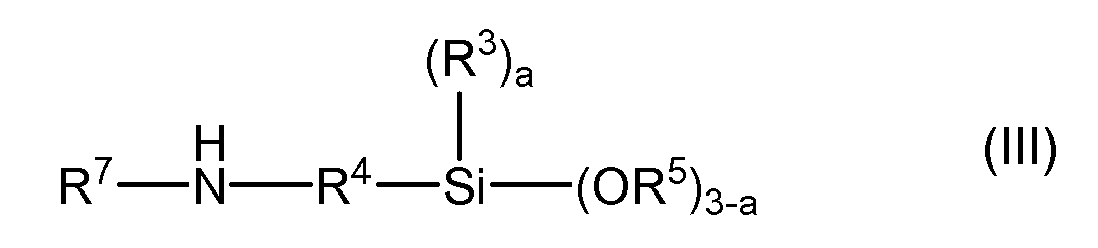

- Dabei stehen die Reste R8 und R9 jeweils unabhängig voneinander für ein Wasserstoffatom oder für einen Rest aus der Gruppe bestehend aus -R11, -COOR11 und -CN.
- Der Rest R10 steht für ein Wasserstoffatom oder für einen Rest aus der Gruppe bestehend aus -CH2-COOR11, -COOR11, -CONHR11, -CON(R11)2, -CN, -NO2, -PO(OR11)2, -SO2R11 und -SO2OR11.
- Der Rest R11 steht für einen, gegebenenfalls mindestens ein Heteroatom aufweisenden, Kohlenwasserstoffrest mit 1 bis 20 C-Atomen.
- Beispiele für geeignete Aminosilane AS sind primäre Aminosilane wie 3-Aminopropyltrimethoxysilan, 3-Aminopropyldimethoxymethylsilan; sekundäre Aminosilane wie N-Butyl-3-aminopropyltrimethoxysilan, N-Phenyl-3-aminopropyltrimethoxysilan; die Produkte aus der Michael-artigen Addition von primären Aminosilanen wie 3-Aminopropyltrimethoxysilan oder 3-Aminopropyldimethoxymethylsilan an Michael-Akzeptoren wie Acrylnitril, (Meth)acrylsäureestern, (Meth)acrylsäureamiden, Maleinsäure- und Fumarsäurediestern, Citraconsäurediestern und Itaconsäurediestern, beispielsweise N-(3-Trimethoxysilyl-propyl)-amino-bernsteinsäuredimethyl- und -diethylester; sowie Analoga der genannten Aminosilane mit Ethoxy- oder Isopropoxygruppen anstelle der Methoxygruppen am Silicium. Als Aminosilane AS besonders geeignet sind sekundäre Aminosilane, insbesondere Aminosilane AS, bei denen R7 in Formel (III) verschieden von H ist. Bevorzugt sind die Michael-artigen Addukte, insbesondere N-(3-Trimethoxysilyl-propyl)-amino-bernstein-säurediethylester.
- Der Begriff "Michael-Akzeptor" bezeichnet im vorliegenden Dokument Verbindungen, welche aufgrund der in ihnen enthaltenen, durch Elektronenakzeptor-Reste aktivierten Doppelbindungen befähigt sind, mit primären Aminogruppen (NH2-Gruppen) in einer der Michael-Addition analogen Weise nucleophile Additionsreaktionen einzugehen (Hetero-Michael-Addition).
- Als Isocyanatgruppen aufweisendes Polyurethanpolymer zur Herstellung eines silanfunktionellen Polyurethanpolymers P1 eignen sich beispielsweise Polymere, welche erhältlich sind durch die Umsetzung von mindestens einem Polyol mit mindestens einem Polyisocyanat, insbesondere einem Diisocyanat. Diese Umsetzung kann dadurch erfolgen, dass das Polyol und das Polyisocyanat mit üblichen Verfahren, beispielsweise bei Temperaturen von 50 °C bis 100 °C, gegebenenfalls unter Mitverwendung geeigneter Katalysatoren, zur Reaktion gebracht werden, wobei das Polyisocyanat so dosiert ist, dass dessen Isocyanatgruppen im Verhältnis zu den Hydroxylgruppen des Polyols im stöchiometrischen Überschuss vorhanden sind.
- Insbesondere wird der Überschuss an Polyisocyanat so gewählt, dass im resultierenden Polyurethanpolymer nach der Umsetzung aller Hydroxylgruppen des Polyols ein Gehalt an freien Isocyanatgruppen von 0.1 bis 5 Gew.-%, bevorzugt 0.1 bis 2.5 Gew.-%, besonders bevorzugt 0.2 bis 1 Gew.-%, bezogen auf das gesamte Polymer, verbleibt.
- Gegebenenfalls kann das Polyurethanpolymer unter Mitverwendung von Weichmachern hergestellt werden, wobei die verwendeten Weichmacher keine gegenüber Isocyanaten reaktive Gruppen enthalten.
- Bevorzugt sind Polyurethanpolymere mit dem genannten Gehalt an freien Isocyanatgruppen, welche aus der Umsetzung von Diisocyanaten mit hochmolekularen Diolen in einem NCO:OH-Verhältnis von 1.5:1 bis 2.2:1 erhalten werden.
- Geeignete Polyole für die Herstellung des Polyurethanpolymers sind insbesondere Polyetherpolyole, Polyesterpolyole und Polycarbonatpolyole sowie Mischungen dieser Polyole.
- Als Polyetherpolyole, auch Polyoxyalkylenpolyole oder Oligoetherole genannt, sind insbesondere jene geeignet, welche Polymerisationsprodukte von Ethylenoxid, 1,2-Propylenoxid, 1,2- oder 2,3-Butylenoxid, Oxetan, Tetrahydrofuran oder Mischungen davon sind, gegebenenfalls polymerisiert mit Hilfe eines Startermoleküls mit zwei oder mehreren aktiven Wasserstoffatomen wie beispielsweise Wasser, Ammoniak oder Verbindungen mit mehreren OH- oder NH-Gruppen wie beispielsweise 1,2-Ethandiol, 1,2- und 1,3-Propandiol, Neopentylglykol, Diethylenglykol, Triethylenglykol, die isomeren Dipropylenglykole und Tripropylenglykole, die isomeren Butandiole, Pentandiole, Hexandiole, Heptandiole, Octandiole, Nonandiole, Decandiole, Undecandiole, 1,3- und 1,4-Cyclohexandimethanol, Bisphenol A, hydriertes Bisphenol A, 1,1,1-Trimethylolethan, 1,1,1-Trimethylolpropan, Glycerin, Anilin, sowie Mischungen der genannten Verbindungen. Eingesetzt werden können sowohl Polyoxyalkylenpolyole, die einen niedrigen Ungesättigtheitsgrad aufweisen (gemessen nach ASTM D-2849-69 und angegeben in Milliäquivalent Ungesättigtheit pro Gramm Polyol (mEq/g)), hergestellt beispielsweise mit Hilfe von so genannten Double Metal Cyanide Komplex-Katalysatoren (DMC-Katalysatoren), als auch Polyoxyalkylenpolyole mit einem höheren Ungesättigtheitsgrad, hergestellt beispielsweise mit Hilfe von anionischen Katalysatoren wie NaOH, KOH, CsOH oder Alkalialkoholaten.
- Besonders geeignet sind Polyoxyethylenpolyole und Polyoxypropylenpolyole, insbesondere Polyoxyethylendiole, Polyoxypropylendiole, Polyoxyethylentriole und Polyoxypropylentriole.
- Insbesondere geeignet sind Polyoxyalkylendiole oder Polyoxyalkylentriole mit einem Ungesättigtheitsgrad tiefer als 0.02 mEq/g und mit einem Molekulargewicht im Bereich von 1'000 bis 30'000 g/mol, sowie Polyoxyethylendiole, Polyoxyethylentriole, Polyoxypropylendiole und Polyoxypropylentriole mit einem Molekulargewicht von 400 bis 20'000 g/mol.
- Ebenfalls besonders geeignet sind so genannte Ethylenoxidterminierte ("EO-endcapped", ethylene oxide-endcapped) Polyoxypropylenpolyole. Letztere sind spezielle Polyoxypropylenpolyoxyethylenpolyole, die beispielsweise dadurch erhalten werden, dass reine Polyoxypropylenpolyole, insbesondere Polyoxypropylendiole und -triole, nach Abschluss der Polypropoxylierungsreaktion mit Ethylenoxid weiter alkoxyliert werden und dadurch primäre Hydroxylgruppen aufweisen. Bevorzugt sind in diesem Fall Polyoxypropylenpolyoxyethylendiole und Polyoxypropylenpolyoxyethylentriole.
- Weiterhin geeignet sind Hydroxylgruppen terminierte Polybutadienpolyole, wie beispielsweise solche, die durch Polymerisation von 1,3-Butadien und Allylalkohol oder durch Oxidation von Polybutadien hergestellt werden, sowie deren Hydrierungsprodukte.
- Weiterhin geeignet sind Styrol-Acrylnitril gepfropfte Polyetherpolyole, wie sie beispielsweise unter dem Handelsnamen Lupranol® kommerziell erhältlich sind von der Firma Elastogran GmbH, Deutschland.
- Als Polyesterpolyole sind insbesondere Polyester geeignet, welche mindestens zwei Hydroxylgruppen tragen und nach bekannten Verfahren, insbesondere der Polykondensation von Hydroxycarbonsäuren oder der Polykondensation von aliphatischen und/oder aromatischen Polycarbonsäuren mit zwei- oder mehrwertigen Alkoholen, hergestellt werden.
- Insbesondere geeignet sind Polyesterpolyole, welche hergestellt sind aus zwei- bis dreiwertigen Alkoholen wie beispielsweise 1,2-Ethandiol, Diethylenglykol, 1,2-Propandiol, Dipropylenglykol, 1,4-Butandiol, 1,5-Pentandiol, 1,6-Hexandiol, Neopentylglykol, Glycerin, 1,1,1-Trimethylolpropan oder Mischungen der vorgenannten Alkohole mit organischen Dicarbonsäuren oder deren Anhydriden oder Estern wie beispielsweise Bernsteinsäure, Glutarsäure, Adipinsäure, Trimethyladipinsäure, Korksäure, Azelainsäure, Sebacinsäure, Dodecandicarbonsäure, Maleinsäure, Fumarsäure, Dimerfettsäure, Phthalsäure, Phthalsäureanhydrid, Isophthalsäure, Terephthalsäure, Dimethylterephthalat, Hexahydrophthalsäure, Trimellithsäure und Trimellithsäureanhydrid oder Mischungen der vorgenannten Säuren, sowie Polyesterpolyole aus Lactonen wie beispielsweise ε-Caprolacton.
- Besonders geeignet sind Polyesterdiole, insbesondere solche, die hergestellt sind aus Adipinsäure, Azelainsäure, Sebacinsäure, Dodecandicarbonsäure, Dimerfettsäure, Phthalsäure, Isophthalsäure und Terephthalsäure als Dicarbonsäure oder aus Lactonen wie beispielsweise ε-Caprolacton und aus Ethylenglykol, Diethylenglykol, Neopentylglykol, 1,4-Butandiol, 1,6-Hexandiol, Dimerfettsäurediol und 1,4-Cyclohexandimethanol als zweiwertigem Alkohol.
- Als Polycarbonatpolyole sind insbesondere jene geeignet, wie sie durch Umsetzung beispielsweise der oben genannten, zum Aufbau der Polyesterpolyole eingesetzten, Alkohole mit Dialkylcarbonaten wie Dimethylcarbonat, Diarylcarbonaten wie Diphenylcarbonat oder Phosgen zugänglich sind. Besonders geeignet sind Polycarbonatdiole, insbesondere amorphe Polycarbonatdiole.
- Weitere geeignete Polyole sind Poly(meth)acrylatpolyole.
- Weiterhin geeignet sind polyhydroxyfunktionelle Fette und Öle, beispielsweise natürliche Fette und Öle, insbesondere Ricinusöl, oder durch chemische Modifizierung von natürlichen Fetten und Ölen gewonnene, so genannte oleochemische, Polyole, die beispielsweise durch Epoxidierung ungesättigter Öle und anschliessender Ringöffnung mit Carbonsäuren bzw. Alkoholen erhaltenen Epoxypolyester bzw. Epoxypolyether, oder durch Hydroformylierung und Hydrierung ungesättigter Öle erhaltene Polyole. Weiterhin geeignet sind Polyole, welche aus natürlichen Fetten und Ölen durch Abbauprozesse wie Alkoholyse oder Ozonolyse und anschliessender chemischer Verknüpfung, beispielsweise durch Umesterung oder Dimerisierung, der so gewonnenen Abbauprodukte oder Derivate davon, erhalten werden. Geeignete Abbauprodukte von natürlichen Fetten und Ölen sind insbesondere Fettsäuren und Fettalkohole sowie Fettsäureester, insbesondere die Methylester (FAME), welche beispielsweise durch Hydroformylierung und Hydrierung zu Hydroxyfettsäureestern derivatisiert werden können.
- Ebenfalls geeignet sind weiterhin Polykohlenwasserstoffpolyole, auch Oligohydrocarbonole genannt, beispielsweise polyhydroxyfunktionelle Ethylen-Propylen-, Ethylen-Butylen- oder Ethylen-Propylen-Dien-Copolymere, wie sie beispielsweise von der Firma Kraton Polymers, USA, hergestellt werden, oder polyhydroxyfunktionelle Copolymere aus Dienen wie 1,3-Butandien oder Diengemischen und Vinylmonomeren wie Styrol, Acrylnitril oder Isobutylen, oder polyhydroxyfunktionelle Polybutadienpolyole, beispielsweise solche, die durch Copolymerisation von 1,3-Butadien und Allylalkohol hergestellt werden und auch hydriert sein können.
- Weiterhin geeignet sind Polyhydroxyfunktionelle Acrylnitril/Butadien-Copolymere, wie sie beispielsweise aus Epoxiden oder Aminoalkoholen und carboxylterminierten Acrylnitril/Butadien-Copolymeren, welche kommerziell erhältlich sind unter dem Namen Hypro® (früher Hycar®) CTBN von der Firma Emerald Performance Materials, LLC, USA, hergestellt werden können.
- Diese genannten Polyole weisen bevorzugt ein mittleres Molekulargewicht von 250 bis 30'000 g/mol, insbesondere von 1'000 bis 30'000 g/mol, und eine mittlere OH-Funktionalität im Bereich von 1.6 bis 3 auf.
- Besonders geeignete Polyole sind Polyesterpolyole und Polyetherpolyole, insbesondere Polyoxyethylenpolyol, Polyoxypropylenpolyol und Polyoxypropylenpolyoxyethylenpolyol, bevorzugt Polyoxyethylendiol, Polyoxypropylendiol, Polyoxyethylentriol, Polyoxypropylentriol, Polyoxypropylenpolyoxyethylendiol und Polyoxypropylenpolyoxyethylentriol.
- Zusätzlich zu diesen genannten Polyolen können kleine Mengen von niedrigmolekularen zwei- oder mehrwertigen Alkoholen wie beispielsweise 1,2-Ethandiol, 1,2- und 1,3-Propandiol, Neopentylglykol, Diethylenglykol, Triethylenglykol, die isomeren Dipropylenglykole und Tripropylenglykole, die isomeren Butandiole, Pentandiole, Hexandiole, Heptandiole, Octandiole, Nonandiole, Decandiole, Undecandiole, 1,3- und 1,4-Cyclohexandimethanol, hydriertes Bisphenol A, dimere Fettalkohole, 1,1,1-Trimethylolethan, 1,1,1-Trimethylolpropan, Glycerin, Pentaerythrit, Zuckeralkohole wie Xylit, Sorbit oder Mannit, Zucker wie Saccharose, andere höherwertige Alkohole, niedrigmolekulare Alkoxylierungsprodukte der vorgenannten zwei- und mehrwertigen Alkohole, sowie Mischungen der vorgenannten Alkohole bei der Herstellung des endständige Isocyanatgruppen aufweisenden Polyurethanpolymers mitverwendet werden.
- Als Polyisocyanate für die Herstellung des Polyurethanpolymers können handelsübliche Polyisocyanate, insbesondere Diisocyanate, verwendet werden.
- Beispielsweise sind geeignete Diisocyanate 1,6-Hexamethylendiisocyanat (HDI), 2-Methylpentamethylen-1,5-diisocyanat, 2,2,4- und 2,4,4-Trimethyl-1,6-hexamethylendiisocyanat (TMDI), 1,12-Dodecamethylendiisocyanat, Lysin- und Lysinesterdiisocyanat, Cyclohexan-1,3-diisocyanat, Cyclohexan-1,4-diisocyanat, 1-Isocyanato-3,3,5-trimethyl-5-isocyanatomethyl-cyclohexan (= Isophorondiisocyanat oder IPDI), Perhydro-2,4'-diphenylmethandiisocyanat und Perhydro-4,4'-diphenylmethandiisocyanat, 1,4-Diisocyanato-2,2,6-trimethylcyclohexan (TMCDI), 1,3- und 1,4-Bis-(isocyanatomethyl)-cyclohexan, m- und p-Xylylendiisocyanat (m- und p-XDI), m- und p-Tetramethyl-1,3-xylylendiisocyanat, m- und p-Tetramethyl-1,4-xylylendiisocyanat, Bis-(1-Isocyanato-1-methylethyl)-naphthalin, 2,4- und 2,6-Toluylendiisocyanat (TDI), 4,4'-, 2,4'- und 2,2'-Diphenylmethandiisocyanat (MDI), 1,3- und 1,4-Phenylendiisocyanat, 2,3,5,6-Tetramethyl-1,4-diisocyanatobenzol, Naphthalin-1,5-diisocyanat (NDI), 3,3'-Dimethyl-4,4'-diisocyanatodiphenyl (TODI), Oligomere und Polymere der vorgenannten Isocyanate, sowie beliebige Mischungen der vorgenannten Isocyanate.
- Beispielsweise sind geeignete silanfunktionelle Polymere P1 kommerziell erhältlich unter den Handelsnamen Polymer ST, beispielsweise Polymer ST50, von der Firma Hanse Chemie AG, Deutschland, sowie unter dem Handelsnamen Desmoseal® von der Firma Bayer MaterialScience AG, Deutschland.
- Das silanfunktionelle Polymer P ist in einer zweiten Ausführungsform ein silanfunktionelles Polyurethanpolymer P2, erhältlich durch die Umsetzung eines Isocyanatosilans IS mit einem Polymer, welches gegenüber Isocyanatgruppen reaktive funktionelle Endgruppen, insbesondere Hydroxylgruppen, Mercaptogruppen und/oder Aminogruppen, aufweist. Diese Umsetzung erfolgt im stöchiometrischen Verhältnis der Isocyanatgruppen zu den gegenüber Isocyanatgruppen reaktiven funktionellen Endgruppen von 1:1, oder mit leichtem Überschuss der gegenüber Isocyanatgruppen reaktiven funktionellen Endgruppen, beispielsweise bei Temperaturen von 20 °C bis 100 °C, gegebenenfalls unter Mitverwendung von Katalysatoren.
- Als Isocyanatosilan IS geeignet sind Verbindungen der Formel (V).

- Beispiele für geeignete Isocyanatosilane IS der Formel (V) sind Isocyanatomethyltrimethoxysilan, Isocyanatomethyldimethoxymethylsilan 3-Isocyanatopropyltrimethoxysilan, 3-Isocyanatopropyldimethoxymethylsilan, und deren Analoga mit Ethoxy- oder Isopropoxygruppen anstelle der Methoxygruppen am Silicium.
- Bevorzugt weist das Polymer als gegenüber Isocyanatgruppen reaktive funktionelle Endgruppen Hydroxylgruppen auf.
- Als Hydroxylgruppen aufweisende Polymere eignen sich einerseits bereits genannte hochmolekulare Polyoxyalkylenpolyole, bevorzugt Polyoxypropylendiole mit einem Ungesättigtheitsgrad tiefer als 0.02 mEq/g und mit einem Molekulargewicht im Bereich von 4'000 bis 30'000 g/mol, insbesondere solche mit einem Molekulargewicht im Bereich von 8'000 bis 30'000 g/mol.
- Andererseits eignen sich auch Hydroxylgruppen aufweisende, insbesondere Hydroxylgruppen terminierte, Polyurethanpolymere zur Umsetzung mit Isocyanatosilanen IS der Formel (V). Solche Polyurethanpolymere sind erhältlich durch die Umsetzung von mindestens einem Polyisocyanat mit mindestens einem Polyol. Diese Umsetzung kann dadurch erfolgen, dass das Polyol und das Polyisocyanat mit üblichen Verfahren, beispielsweise bei Temperaturen von 50 °C bis 100 °C, gegebenenfalls unter Mitverwendung geeigneter Katalysatoren, zur Reaktion gebracht werden, wobei das Polyol so dosiert ist, dass dessen Hydroxylgruppen im Verhältnis zu den Isocyanatgruppen des Polyisocyanates im stöchiometrischen Überschuss vorhanden sind. Bevorzugt ist ein Verhältnis von Hydroxylgruppen zu Isocyanatgruppen von 1.3:1 bis 4:1, insbesondere von 1.8:1 bis 3:1.
- Gegebenenfalls kann das Polyurethanpolymer unter Mitverwendung von Weichmachern hergestellt werden, wobei die verwendeten Weichmacher keine gegenüber Isocyanaten reaktive Gruppen enthalten.
- Für diese Umsetzung geeignet sind dieselben Polyole und Polyisocyanate, die bereits als geeignet zur Herstellung eines Isocyanatgruppen aufweisenden Polyurethanpolymers erwähnt wurden, welches zur Herstellung eines silanfunktionellen Polyurethanpolymers P1 verwendet wird.
- Beispielsweise sind geeignete silanfunktionelle Polymere P2 kommerziell erhältlich unter den Handelsnamen SPUR+® 1010LM, 1015LM und 1050MM von der Firma Momentive Performance Materials Inc., USA, sowie unter den Handelsnamen Geniosil® STP-E15, STP-10 und STP-E35 von der Firma Wacker Chemie AG, Deutschland.
- In einer dritten Ausführungsform ist das silanfunktionelle Polymer P ein silanfunktionelles Polymer P3, welches erhältlich ist durch eine Hydrosilylierungsreaktion von Polymeren mit endständigen Doppelbindungen, beispielsweise Poly(meth)acrylatpolymere oder Polyetherpolymere, insbesondere von allylterminierten Polyoxyalkylenpolymeren, beschrieben beispielsweise in
US 3,971,751 undUS 6,207,766 , deren gesamte Offenbarung hiermit eingeschlossen ist. - Beispielsweise sind geeignete silanfunktionelle Polymere P3 kommerziell erhältlich unter den Handelsnamen MS Polymer™ S203H, S303H, S227, S810, MA903 und S943, Silyl™ SAX220, SAX350, SAX400 und SAX725, Silyl™ SAT350 und SAT400, sowie XMAP™ SA100S und SA310S von der Firma Kaneka Corp., Japan, sowie unter den Handelsnamen Excestar® S241 0, S2420, S3430, S3630, W2450 und MSX931 von der Firma Asahi Glass Co, Ltd., Japan.
- Üblicherweise ist das silanfunktionelle Polymer P in einer Menge von 10 bis 80 Gew.-%, insbesondere in einer Menge von 15 bis 70 Gew.-%, bevorzugt 20 bis 40 Gew.-%, bezogen auf die gesamte Zusammensetzung, vorhanden.
- Bevorzugt entspricht in der erfindungsgemässen Zusammensetzung der Rest R5 in den Endgruppen der Formel (II) dem Rest R1 im Alkyltrialkoxysilan der Formel (I).
- Meist bevorzugt weist also das silanfunktionelle Polymer P in der erfindungsgemässen Zusammensetzung Endgruppen der Formel (II') auf

- Die Reste R3 und R4, sowie der Index a sind ebenfalls bereits vorhergehend beschrieben worden.
- Weiterhin umfasst die erfindungsgemässe Zusammensetzung mindestens ein Alkyltrialkoxysilan der Formel (I), wie es vorhergehend beschrieben worden ist.
- Der Rest R1 steht insbesondere für eine Methyl- oder für eine Ethyl-oder für eine Isopropylgruppe, bevorzugt für eine Methylgruppe.
- Der Rest R2 steht insbesondere für einen verzweigten Kohlenwasserstoffrest mit 8 C-Atomen. Bevorzugt handelt es sich beim verzweigten Kohlenwasserstoffrest um eine mehrfach verzweigte Alkylgruppe. Weiterhin bevorzugt enthält der verzweigte Kohlenwasserstoffrest eine tertiär-Butylgruppe. Meist bevorzugt steht der Rest R2 für einen 2,4,4-Trimethylpentylrest.
- Insbesondere handelt es sich beim Alkyltrialkoxysilan der Formel (I) in der erfindungsgemässen Zusammensetzung um Trimethoxy(2,4,4-trimethylpentyl)silan.
- Der Anteil an Alkyltrialkoxysilan der Formel (I) beträgt vorzugsweise 0.05 bis 4 Gew.-% der gesamten Zusammensetzung.
- Vorzugsweise enthält die Zusammensetzung weiterhin mindestens einen Füllstoff. Der Füllstoff beeinflusst sowohl die rheologischen Eigenschaften der nicht ausgehärteten Zusammensetzung als auch die mechanischen Eigenschaften und die Oberflächenbeschaffenheit der ausgehärteten Zusammensetzung. Geeignete Füllstoffe sind anorganische und organische Füllstoffe, zum Beispiel natürliche, gemahlene oder gefällte Calciumcarbonate, welche gegebenenfalls mit Fettsäuren, insbesondere Stearinsäure, beschichtet sind, Bariumsulfat (BaSO4, auch Baryt oder Schwerspat genannt), calcinierte Kaoline, Aluminiumoxide, Aluminiumhydroxide, Kieselsäuren, insbesondere hochdisperse Kieselsäuren aus Pyrolyseprozessen, Russe, insbesondere industriell hergestellter Russ (Carbon Black; im Folgenden als "Russ" bezeichnet), PVC-Pulver oder Hohlkugeln. Bevorzugte Füllstoffe sind Calciumcarbonate, calcinierte Kaoline, Russ, hochdisperse Kieselsäuren sowie flammhemmende Füllstoffe, wie Hydroxide oder Hydrate, insbesondere Hydroxide oder Hydrate von Aluminium, bevorzugt Aluminiumhydroxid.
- Es ist durchaus möglich und kann sogar von Vorteil sein, eine Mischung verschiedener Füllstoffe einzusetzen.
- Eine geeignete Menge Füllstoff liegt beispielsweise im Bereich von 20 bis 60 Gew.-%, bevorzugt 30 bis 60 Gew.-%, bezogen auf die gesamte Zusammensetzung.
- Weiterhin enthält die erfindungsgemässe Zusammensetzung insbesondere mindestens einen Katalysator für die Vernetzung der silanfunktionellen Polymere mittels Feuchtigkeit. Derartige Katalysatoren sind insbesondere Metallkatalysatoren in Form von Organozinnverbindungen wie Dibutylzinndilaurat und Dibutylzinndiacetylacetonat, Titankatalysatoren, Aminogruppenhaltige Verbindungen, beispielsweise 1,4-Diazabicyclo[2.2.2]octan und 2,2'-Dimorpholinodiethylether, Aminosilane sowie Mischungen der genannten Katalysatoren.
- Weiterhin kann die erfindungsgemässe Zusammensetzung zusätzlich weitere Bestandteile enthalten. Beispielsweise sind derartige Bestandteile Weichmacher wie Ester organischer Carbonsäuren oder deren Anhydride, wie Phthalate, beispielsweise Dioctylphthalat, Diisononylphthalat oder Diisodecylphthalat, Adipate, beispielsweise Dioctyladipat, Azelate und Sebacate, Polyole, beispielsweise Polyoxyalkylenpolyole oder Polyesterpolyole, organische Phosphor- und Sulfonsäureester oder Polybutene; Lösungsmittel; Fasern, beispielsweise aus Polyethylen; Farbstoffe; Pigmente; Rheologie-Modifizierer wie Verdickungsmittel oder Thixotropierungsmittel, beispielsweise Harnstoffverbindungen der Art, wie sie als Thixotropierungsmittel ("Thixotropy endowning agent") in
WO 02/48228 A2 - Weiterhin können gegebenenfalls so genannte Reaktivverdünner eingesetzt werden, welche bei der Aushärtung der Zusammensetzung, insbesondere durch Reaktion mit den Silangruppen, in die Polymermatrix eingebunden werden.
- Es ist vorteilhaft, alle genannten, in der Zusammensetzung gegebenenfalls vorhandenen Bestandteile, insbesondere Füllstoff und Katalysator, so auszuwählen, dass die Lagerstabilität der Zusammensetzung durch die Anwesenheit eines solchen Bestandteils nicht negativ beeinflusst wird, das heisst, dass sich die Zusammensetzung in ihren Eigenschaften, insbesondere den Applikations- und Aushärtungseigenschaften, bei der Lagerung nicht oder nur wenig verändert. Dies bedingt, dass zur chemischen Aushärtung der beschriebenen Zusammensetzung führende Reaktionen, insbesondere der Silangruppen, während der Lagerung nicht in signifikantem Ausmass auftreten. Es ist deshalb insbesondere von Vorteil, dass die genannten Bestandteile kein oder höchstens Spuren von Wasser enthalten oder beim Lagern freisetzen. Deshalb kann es sinnvoll sein, gewisse Bestandteile vor dem Einmischen in die Zusammensetzung chemisch oder physikalisch zu trocknen.
- Die erfindungsgemässe Zusammensetzung weist vorzugsweise nach deren Aushärtung, insbesondere nach deren Aushärtung während mindestens 14 Tagen bei 23 °C und 50 % relativer Luftfeuchtigkeit, einen Elastizitätsmodul bei 0 bis 100 % Dehnung von ≤ 0.4 MPa, insbesondere ≤ 0.36 MPa, gemessen nach DIN EN 53504 mit einer Zuggeschwindigkeit von 200 mm/min, und eine Härte Shore A von ≥ 10, gemessen nach DIN 53505, auf.
- Die vorhergehend beschriebene Zusammensetzung wird vorzugsweise unter Ausschluss von Feuchtigkeit hergestellt und aufbewahrt. Typischerweise ist die Zusammensetzung lagerstabil, das heisst, sie kann unter Ausschluss von Feuchtigkeit in einer geeigneten Verpackung oder Anordnung, wie beispielsweise einem Fass, einem Beutel oder einer Kartusche, über einen Zeitraum von mehreren Monaten bis zu einem Jahr und länger aufbewahrt werden, ohne dass sie sich in ihren Anwendungseigenschaften oder in ihren Eigenschaften nach der Aushärtung in einem für ihren Gebrauch relevanten Ausmass verändert. Üblicherweise wird die Lagerstabilität über die Messung der Viskosität oder der Auspresskraft ermittelt.
- Bei der Applikation der beschriebenen Zusammensetzung auf mindestens einen Festkörper oder Artikel kommen die in der Zusammensetzung enthaltenen Silangruppen in Kontakt mit Feuchtigkeit. Die Silangruppen haben die Eigenschaft, bei Kontakt mit Feuchtigkeit zu hydrolysieren. Dabei bilden sich Organosilanole und, durch nachfolgende Kondensationsreaktionen, Organosiloxane. Als Ergebnis dieser Reaktionen, welche durch den Einsatz von Katalysatoren beschleunigt werden können, härtet die Zusammensetzung schliesslich aus. Dieser Prozess wird auch als Vernetzung bezeichnet.
- Das für die Aushärtung benötigte Wasser kann entweder aus der Luft stammen (Luftfeuchtigkeit), oder aber die vorgängig beschriebene Zusammensetzung kann mit einer Wasser enthaltenden Komponente in Kontakt gebracht werden, zum Beispiel durch Bestreichen, beispielsweise mit einem Abglättmittel, oder durch Besprühen, oder es kann der Zusammensetzung bei der Applikation eine Wasser enthaltende Komponente zugesetzt werden, zum Beispiel in Form einer wasserhaltigen Paste, die beispielsweise über einen Statikmischer eingemischt wird. Bei der Aushärtung mittels Luftfeuchtigkeit härtet die Zusammensetzung von aussen nach innen durch. Die Geschwindigkeit der Aushärtung wird dabei von verschiedenen Faktoren, wie beispielsweise der Diffusionsrate des Wassers, der Temperatur, der Umgebungsfeuchte und der Klebegeometrie, bestimmt und verlangsamt sich in der Regel mit dem Fortschreiten der Aushärtung.
- Weiterhin umfasst die vorliegende Erfindung die Verwendung einer vorhergehend beschriebenen Zusammensetzung als feuchtigkeitshärtender Klebstoff, Dichtstoff oder Beschichtung, insbesondere als Baudichtstoff. Bevorzugt ist die Verwendung als niedermoduliger Baudichtstoff für Anschlussoder Dilatationsfugen.
- Die erfindungsgemässe Zusammensetzung wird insbesondere verwendet in einem Verfahren des Verklebens zweier Substrate S1 und S2 umfassend die Schritte
- i) Applikation einer Zusammensetzung gemäss vorhergehender Beschreibung auf ein Substrat S1 und/oder ein Substrat S2;
- ii) Kontaktieren der Substrate S1 und S2 über die applizierte Zusammensetzung innerhalb der Offenzeit der Zusammensetzung;
- iii) Aushärtung der Zusammensetzung mittels Wasser;
- Weiterhin kann die erfindungsgemässe Zusammensetzung auch verwendet werden in einem Verfahren der Abdichtung oder des Beschichtens umfassend die Schritte
- i') Applikation einer Zusammensetzung gemäss vorhergehender Beschreibung auf ein Substrat S1 und/oder zwischen zwei Substrate S1 und S2;
- ii') Aushärtung der Zusammensetzung mittels Wasser, insbesondere in der Form von Luftfeuchtigkeit;
- Als Substrate S1 und/oder S2 eignen sich insbesondere Substrate, welche ausgewählt sind aus der Gruppe bestehend aus Beton, Mörtel, Backstein, Ziegel, Gips, ein Naturstein wie Granit oder Marmor, Glas, Glaskeramik, Metall oder Metalllegierung, Holz, Kunststoff und Lack.
- Die erfindungsgemässe Zusammensetzung weist bevorzugt eine pastöse Konsistenz mit strukturviskosen Eigenschaften auf. Eine solche Zusammensetzung wird mittels einer geeigneten Vorrichtung auf das Substrat aufgetragen, bevorzugt in Form einer Raupe, wobei diese vorteilhaft eine im Wesentlichen runde oder dreieckige Querschnittsfläche aufweist. Geeignete Methoden zum Auftragen der Zusammensetzung sind beispielsweise die Applikation aus handelsüblichen Kartuschen, welche manuell oder mittels Druckluft betrieben werden, oder aus einem Fass oder Hobbock mittels einer Förderpumpe oder eines Extruders, gegebenenfalls mittels eines Applikations-Roboters. Eine erfindungsgemässe Zusammensetzung mit guten Applikationseigenschaften weist eine hohe Standfestigkeit und einen kurzen Fadenzug auf. Das heisst, sie bleibt nach der Applikation in der applizierten Form stehen, fliesst also nicht auseinander, und zieht nach dem Absetzen des Applikationsgerätes keinen oder nur einen sehr kurzen Faden, so dass das Substrat nicht verschmutzt wird.
- Weiterhin betrifft die Erfindung eine gehärtete Zusammensetzung, welche erhältlich ist aus einer Zusammensetzung, wie sie vorhergehend beschrieben worden ist, nach deren Härtung mit Wasser, insbesondere in Form von Luftfeuchtigkeit.
- Bei den Artikeln, welche mit einer erfindungsgemässen Zusammensetzung verklebt, abgedichtet oder beschichtet werden, handelt es sich insbesondere um ein Bauwerk, insbesondere ein Bauwerk des Hoch- oder Tiefbaus, um ein industriell gefertigtes Gut oder um ein Konsumgut, insbesondere ein Fenster, eine Haushaltsmaschine, oder ein Transportmittel oder ein Anbauteil eines Transportmittels.
- Weiterhin betrifft die Erfindung die Verwendung eines Alkyltrialkoxysilans der Formel (I), wie es als Bestandteil der erfindungsgemässen Zusammensetzung vorhergehend beschrieben worden ist, in Zusammensetzungen auf Basis von silanterminierten Polymeren zur Erhöhung der Elastizität und zur Erniedrigung des E-Moduls dieser Zusammensetzungen im ausgehärteten Zustand.
- Im Folgenden sind Ausführungsbeispiele aufgeführt, welche die beschriebene Erfindung näher erläutern sollen. Selbstverständlich ist die Erfindung nicht auf diese beschriebenen Ausführungsbeispiele beschränkt.
- Die Zugfestigkeit, die Bruchdehnung, und der Elastizitätsmodul (E-Modul) bei 0 bis 100 % Dehnung wurden nach DIN EN 53504 (Zuggeschwindigkeit: 200 mm/min) an während 14 Tagen bei 23 °C und 50 % relativer Luftfeuchtigkeit ausgehärteten Filmen mit einer Schichtdicke von 2 mm bestimmt.
- Der Zug-E-Modul wurde gemäss DIN EN ISO 8340 unter der Verwendung von mit Sika® Primer-3 N (kommerziell erhältlich bei Sika® Schweiz AG) vorbehandelten Beton-Prüfkörpern (Beton, nass, nach ISO 13640, von der Firma Rocholl GmbH, Deutschland, 70mm x 25mm x 12.5 mm) bestimmt. Die Probekörper wurden 4 Wochen bei 23 °C und 50 % relativer Luftfeuchtigkeit ausgehärtet.
- Die Shore A-Härte wurde bestimmt nach DIN 53505, an während 14 Tagen bei 23 °C und 50 % relativer Luftfeuchtigkeit ausgehärteten Probekörpern mit einer Schichtdicke von 6 mm.
- Die Hautbildungszeit (Zeit bis zur Klebefreiheit, "tack-free time") wurde bei 23 °C und 50 % relativer Luftfeuchtigkeit bestimmt. Zur Bestimmung der Hautbildungszeit wurde ein kleiner Teil des raumtemperaturwarmen Klebstoffs in einer Schichtdicke von ca. 2 mm auf Pappkarton aufgetragen und die Zeit bestimmt, die es dauerte, bis beim leichten Antippen der Oberfläche des Klebstoffs mittels einer Pipette aus LDPE erstmals keine Rückstände auf der Pipette mehr zurückblieben.
- Der Weiterreisswiderstand wurde bestimmt nach DIN 53515, an während 14 Tagen bei 23 °C und 50 % relativer Luftfeuchtigkeit ausgehärteten Filmen mit einer Schichtdicke von 2 mm.
- Unter Stickstoffatmosphäre wurden 700 g Polyol Acclaim® 12200 (Bayer MaterialScience AG, Deutschland; low monol Polyoxypropylendiol; OH-Zahl 11.0 mg KOH/g; Wassergehalt ca. 0.02 Gew.-%), 24.6 g Isophorondiisocyanat (Vestanat® IPDI, Evonik Degussa GmbH, Deutschland), 182 g 2,2,4-Trimethyl-1,3-pentandioldiisobutyrat (Eastman TXIB™; Eastman Chemical Company, USA) und 0.1 g Di-n-butyl-zinndilaurat (Metatin® K 712, Acima AG, Schweiz) unter stetigem Rühren auf 90 °C aufgeheizt und bei dieser Temperatur belassen. Nach einer Stunde Reaktionszeit wurde mittels Titration ein freier Gehalt an Isocyanatgruppen von 0.32 Gew.-% erreicht. Anschliessend wurden 24.5 g N-(3-Trimethoxysilyl-propyl)-amino-bernsteinsäure-diethylester beigefügt und für weitere 2 bis 3 Stunden bei 90 °C weitergerührt. Die Reaktion wurde abgebrochen, sobald kein freies Isocyanat mehr mittels IR-Spektroskopie (2275 - 2230 cm-1) nachzuweisen war. Das Produkt wurde auf Raumtemperatur (23 °C) abgekühlt und unter Ausschluss von Feuchtigkeit aufbewahrt (theoretischer Polymergehalt = 80%). Das so hergestellte silanfunktionelle Polyurethanpolymer SH ist bei Raumtemperatur flüssig.
- N-(3-Trimethoxysilyl-propyl)-amino-bernsteinsäure-diethylester wurde wie folgt hergestellt: 51.0 g 3-Aminopropyl-trimethoxysilan (Silquest® A-1110, Momentive Performance Materials Inc., USA) wurden vorgelegt. Unter gutem Rühren wurden bei Raumtemperatur langsam 49.0 g Maleinsäure-diethylester (Fluka Chemie GmbH, Schweiz) zugegeben und die Mischung während 2 Stunden bei Raumtemperatur gerührt.
- In einem Vakuummischer wurden 1000 g Diisodecylphthalat (Palatinol® Z, BASF SE, Deutschland) und 160 g 4,4'-Diphenylmethandiisocyanat (Desmodur® 44 MC L, Bayer MaterialScience AG, Deutschland) vorgelegt und leicht aufgewärmt. Dann wurden unter starkem Rühren 90 g Monobutylamin langsam zugetropft. Die entstehende weisse Paste wurde unter Vakuum und Kühlung eine Stunde weitergerührt. Das Thixotropierungsmittel TM enthält 20 Gew.-% Thixotropierungsmittel in 80 Gew.-% Diisodecylphthalat.
- In einem Vakuummischer wurden entsprechend den in den Tabellen 1 und 2 angegebenen Gewichtsteilen ein silanfunktionelles Polymer ( SH bzw. MS), Thixotropierungsmittel TM und Vinyltrimethoxysilan (Silquest® A-171 von Momentive Performance Materials Inc., USA) während 5 Minuten gut vermischt. Anschliessend wurde getrocknete, gefällte Kreide (Socal® U1S2, Solvay SA, Belgien, und Omyacarb® 5-GU, Omya AG, Schweiz) während 15 Minuten bei 60 °C eingeknetet. Bei ausgeschalteter Heizung wurden anschliessend N-(2-Aminoethyl)-(3-aminopropyl)trimethoxysilan (Silquest® A-1120 von Momentive Performance Materials Inc.) und Katalysator (Metatin® K712 als 10 %-ige Lösung in DIDP) unter Vakuum während 10 Minuten zu einer homogenen Paste verarbeitet. Diese wurde dann in innenlackierte Aluminium-Spreizkolbenkartuschen abgefüllt.
Tabelle 1 Zusammensetzungen der erfindungsgemässen Klebstoffe 1 bis 4 und der Referenzbeispiele 5 bis 9 in Gewichtsteilen sowie die Resultate; 1 2 3 4 5 6 7 8 9 SH 120 120 120 120 120 120 120 120 120 Silquest® A-171 4 4 4 4 4 4 4 4 4 TM 100 100 100 100 100 100 100 100 100 Omyacarb® 5-GU 80 80 80 80 80 80 80 80 80 Socal® U1S2 80 80 80 80 80 80 80 80 80 Silquest® A-1120 2 2 2 2 2 2 2 2 2 Metatin® K712 a) 10 10 10 10 10 10 10 10 10 Silan R2'-Si(OCH3)3 R2': 2,4,4-Trimethyl-pentyl b) 1 2 4 8 R2': Methyl b) 4 R2': n-Octyl c) 4 R2': n-Hexadecyl b) 4 R2': 1-Butyl b) 4 Zugfestigkeit [MPa] 1.3 1.3 1.3 1.0 1.4 1.2 1.3 1.3 1.3 Bruchdehnung[%] 681 754 932 936 497 368 695 724 735 E-Modul [MPa] 0.39 0.36 0.32 0.23 0.46 0.47 0.39 0.39 0.36 Zug-E-Modul [MPa] 0.41 0.35 0.30 0.21 0.48 0.48 0.36 0.38 0.37 Hautbildungszeit [min] 65 80 80 105 45 70 105 80 80 Shore A 21 19 17 13 20 25 20 20 20 Weiterreisswider-stand [N/mm] 6.1 6.3 6.4 5.7 6.1 5.0 5.8 6.1 6.0 a) 10 %-ige Lösung in DIDP;
b) erhältlich von Wacker Chemie AG, Deutschland;
c) erhältlich von ABCR GmbH & Co KG, Deutschland.Tabelle 2 Zusammensetzungen der erfindungsgemässen Klebstoffe 10 und 11 und des Referenzbeispiels 13 in Gewichtsteilen sowie die Resultate; 10 11 12 MS d) 120 120 120 Silquest® A-171 4 4 4 TM 100 100 100 Omyacarb® 5-GU 80 80 80 Socal® U1S2 80 80 80 Silquest® A-1120 2 2 2 Metatin® K740 1.2 1.2 1.2 Silan R2'-Si(OCH3)3 R2': 2,4,4-Trimethylpentyl 2 4 Zugfestigkeit [MPa] 1.2 1.1 1.1 Bruchdehnung[%] 617 695 474 E-Modul [MPa] 0.37 0.31 0.42 Zug-E-Modul [MPa] 0.43 0.37 0.49 Shore A 24 22 26 Weiterreisswiderstand [N/mm] 4.2 4.3 4.2 d) MS : MS Polymer S303H, Kaneka Corp., Japan.
wobei
R1 für einen linearen oder verzweigten, einwertigen Kohlenwasserstoffrest mit 1 bis 12 C-Atomen steht, welcher gegebenenfalls eine oder mehrere C-C-Mehrfachbindungen und/oder gegebenenfalls cycloaliphatische und/oder aromatische Anteile aufweist; und
R2 für einen verzweigten Kohlenwasserstoffrest mit 6 bis 10 C-Atomen steht.
Claims (14)
- Zusammensetzung umfassenda) mindestens ein silanfunktionelles Polymer P; sowieb) mindestens ein Alkyltrialkoxysilan der Formel (I),
R2-Si-(OR1)3 (I)
wobei
R1 für einen linearen oder verzweigten, einwertigen Kohlenwasserstoffrest mit 1 bis 12 C-Atomen steht, welcher gegebenenfalls eine oder mehrere C-C-Mehrfachbindungen und/oder gegebenenfalls cycloaliphatische und/oder aromatische Anteile aufweist; und
R2 für einen verzweigten Kohlenwasserstoffrest mit 6 bis 10 C-Atomen steht. - Zusammensetzung gemäss Anspruch 1, dadurch gekennzeichnet, dass R1 für eine Methyl- oder für eine Ethyl- oder für eine Isopropylgruppe, steht.
- Zusammensetzung gemäss Anspruch 2, dadurch gekennzeichnet, dass R1 für eine Methylgruppe steht.
- Zusammensetzung gemäss einem der vorhergehenden Ansprüche, dadurch gekennzeichnet, dass R2 für einen verzweigten Kohlenwasserstoffrest mit 8 C-Atomen steht.
- Zusammensetzung gemäss einem der vorhergehenden Ansprüche, dadurch gekennzeichnet, dass der verzweigte Kohlenwasserstoffrest eine mehrfach verzweigte Alkylgruppe ist.
- Zusammensetzung gemäss einem der vorhergehenden Ansprüche, dadurch gekennzeichnet, dass R2 für einen 2,4,4-Trimethylpentylrest steht.
- Zusammensetzung gemäss Anspruch 1, dadurch gekennzeichnet, dass das Alkyltrialkoxysilan der Formel (I) Trimethoxy(2,4,4-trimethylpentyl)silan ist.
- Zusammensetzung gemäss einem der vorhergehenden Ansprüche, dadurch gekennzeichnet, dass das silanfunktionelle Polymer P Endgruppen der Formel (II) aufweist

R1 sowohl im silanfunktionellen Polymer P als auch im Alkyltrialkoxysilan der Formel (I) für identische Reste steht;
R3 für eine Alkylgruppe mit 1 bis 8 C-Atomen steht;
R4 für eine lineare oder verzweigte, gegebenenfalls cyclische, Alkylengruppe mit 1 bis 12 C-Atomen, gegebenenfalls mit aromatischen Anteilen, und gegebenenfalls mit einem oder mehreren Heteroatomen steht; und
a für einen Wert von 0 oder 1 steht. - Zusammensetzung gemäss einem der vorhergehenden Ansprüche, dadurch gekennzeichnet, dass der Anteil an Alkyltrialkoxysilan der Formel (I) 0.05 bis 4 Gew.-% der gesamten Zusammensetzung beträgt.
- Zusammensetzung gemäss einem der vorhergehenden Ansprüche, dadurch gekennzeichnet, dass die Zusammensetzung nach deren Aushärtung einen Elastizitätsmodul bei 0 bis 100 % Dehnung von ≤ 0.4 MPa, gemessen nach DIN EN 53504 mit einer Zuggeschwindigkeit von 200 mm/min, und eine Härte Shore A von ≥ 10, gemessen nach DIN 53505, aufweist.
- Verwendung einer Zusammensetzung gemäss einem der Ansprüche 1 bis 10 als feuchtigkeitshärtender Klebstoff, Dichtstoff oder Beschichtung.
- Verwendung gemäss Anspruch 11 als Baudichtstoff.
- Gehärtete Zusammensetzung, dadurch gekennzeichnet, dass sie erhältlich ist aus einer Zusammensetzung gemäss einem der Ansprüche 1 bis 10 nach deren Härtung mit Wasser.
- Verwendung eines Alkyltrialkoxysilans der Formel (I), wie es in einem der Ansprüche 1 bis 10 beschreiben ist, in Zusammensetzungen auf Basis von silanterminierten Polymeren zur Erhöhung der Elastizität und zur Erniedrigung des E-Moduls dieser Zusammensetzungen im ausgehärteten Zustand.
Priority Applications (6)
| Application Number | Priority Date | Filing Date | Title |
|---|---|---|---|
| EP09168475A EP2289988A1 (de) | 2009-08-24 | 2009-08-24 | Zusammensetzungen auf Basis von silanterminierten Polymeren |
| JP2012526037A JP5638611B2 (ja) | 2009-08-24 | 2010-08-24 | シラン末端ポリマーに基づく組成物 |
| PCT/EP2010/062326 WO2011023691A1 (de) | 2009-08-24 | 2010-08-24 | Zusammensetzungen auf basis von silanterminierten polymeren |
| CN2010800375981A CN102482456A (zh) | 2009-08-24 | 2010-08-24 | 基于硅烷封端的聚合物的组合物 |
| EP10747191.4A EP2470599B1 (de) | 2009-08-24 | 2010-08-24 | Zusammensetzungen auf basis von silanterminierten polymeren |
| US13/404,821 US20120168080A1 (en) | 2009-08-24 | 2012-02-24 | Compositions on the basis of silane-terminated polymers |
Applications Claiming Priority (1)
| Application Number | Priority Date | Filing Date | Title |
|---|---|---|---|
| EP09168475A EP2289988A1 (de) | 2009-08-24 | 2009-08-24 | Zusammensetzungen auf Basis von silanterminierten Polymeren |
Publications (1)
| Publication Number | Publication Date |
|---|---|
| EP2289988A1 true EP2289988A1 (de) | 2011-03-02 |
Family
ID=41527703
Family Applications (2)
| Application Number | Title | Priority Date | Filing Date |
|---|---|---|---|
| EP09168475A Withdrawn EP2289988A1 (de) | 2009-08-24 | 2009-08-24 | Zusammensetzungen auf Basis von silanterminierten Polymeren |
| EP10747191.4A Active EP2470599B1 (de) | 2009-08-24 | 2010-08-24 | Zusammensetzungen auf basis von silanterminierten polymeren |
Family Applications After (1)
| Application Number | Title | Priority Date | Filing Date |
|---|---|---|---|
| EP10747191.4A Active EP2470599B1 (de) | 2009-08-24 | 2010-08-24 | Zusammensetzungen auf basis von silanterminierten polymeren |
Country Status (5)
| Country | Link |
|---|---|
| US (1) | US20120168080A1 (de) |
| EP (2) | EP2289988A1 (de) |
| JP (1) | JP5638611B2 (de) |
| CN (1) | CN102482456A (de) |
| WO (1) | WO2011023691A1 (de) |
Cited By (1)
| Publication number | Priority date | Publication date | Assignee | Title |
|---|---|---|---|---|
| EP2840087A1 (de) | 2013-08-23 | 2015-02-25 | Evonik Degussa GmbH | Guanidingruppen aufweisende semi-organische Siliciumgruppen enthaltende Verbindungen |
Families Citing this family (14)
| Publication number | Priority date | Publication date | Assignee | Title |
|---|---|---|---|---|
| JP6517489B2 (ja) * | 2013-12-16 | 2019-05-22 | シャープ化学工業株式会社 | 吸盤の固定方法 |
| FR3020636B1 (fr) * | 2014-04-30 | 2016-05-06 | Michelin & Cie | Pneumatique avec une bande de mousse amortissante |
| EP3137570B1 (de) * | 2014-04-30 | 2018-06-27 | Compagnie Générale des Etablissements Michelin | Reifen mit streifen aus dämpfendem schaum |
| CN107207870B (zh) * | 2015-01-16 | 2020-06-23 | 株式会社钟化 | 固化性组合物及其固化物 |
| US11421068B2 (en) | 2016-12-20 | 2022-08-23 | Wacker Chemie Ag | Method for producing organyloxysilyl-terminated polymers |
| BR112019017810A2 (pt) * | 2017-03-29 | 2020-03-31 | Sika Technology Ag | Composição à base de água com propriedades mecânicas aprimoradas |
| CN112189043A (zh) * | 2018-06-25 | 2021-01-05 | Sika技术股份公司 | 基于硅烷官能的聚合物的不含催化剂的可固化组合物 |
| US20220073738A1 (en) * | 2019-02-13 | 2022-03-10 | Sika Technology Ag | Thermally conductive curable composition |
| BR112022014200A2 (pt) * | 2020-02-10 | 2022-10-04 | Sika Tech Ag | Polímero ramificado contendo grupo silano |
| WO2021204783A1 (en) * | 2020-04-08 | 2021-10-14 | Sika Technology Ag | Compositions based on silane-functional polymers having enhanced overpaintability |
| CN113248710A (zh) * | 2021-06-29 | 2021-08-13 | 山东硅科新材料有限公司 | 一种(2,4,4-三甲基戊基)硅烷低聚物及其制备方法和应用 |
| CN114891473A (zh) * | 2022-06-15 | 2022-08-12 | 顶立新材料科技股份有限公司 | 一种结构集成材用可降解单组份聚氨酯结构胶及制备方法 |
| EP4606829A1 (de) | 2024-02-23 | 2025-08-27 | Covestro Deutschland AG | Verfahren zur herstellung alkoxysilanfunktioneller polyurethane und polyurethanharnstoffe |
| DE102024206479A1 (de) | 2024-07-09 | 2026-01-15 | Wacker Chemie Ag | Vernetzbare Massen auf Basis von organyloxysilanterminierten Polymeren |
Citations (9)
| Publication number | Priority date | Publication date | Assignee | Title |
|---|---|---|---|---|
| US3971751A (en) | 1975-06-09 | 1976-07-27 | Kanegafuchi Kagaku Kogyo Kabushiki Kaisha | Vulcanizable silylether terminated polymer |
| US6207766B1 (en) | 1997-04-21 | 2001-03-27 | Asahi Glass Company Ltd. | Room temperature-setting compositions |
| US6255404B1 (en) * | 1999-07-26 | 2001-07-03 | Bridgestone Corporation | Method to control increase in viscosity during aging of siloxane modified polymers |
| WO2002048228A2 (en) | 2000-12-13 | 2002-06-20 | Sika Schweiz Ag | Highly weatherable moisture-curable one-component polyurethane compositions |
| DE10139132A1 (de) * | 2001-08-09 | 2003-02-27 | Consortium Elektrochem Ind | Alkoxyvernetzende einkomponentige feuchtigkeitshärtende Massen |
| WO2003066701A1 (de) | 2002-02-05 | 2003-08-14 | Bayer Materialscience Ag | Alkoxysilan- und oh-endgruppen aufweisende polyurethanprepolymere mit erniedrigter funktionalität, ein verfahren zu ihrer herstellung sowie ihre verwendung |
| US20040116639A1 (en) * | 2002-02-22 | 2004-06-17 | Lim Thomas F. | Mixed alkoxysilyl functional polymers |
| WO2007085620A1 (de) * | 2006-01-26 | 2007-08-02 | Sika Technology Ag | Feuchtigkeitshärtende zusammensetzungen enthaltend silanfunktionelle polymere mit guter haftung |
| EP1877459A2 (de) | 2005-04-29 | 2008-01-16 | Sika Technology Ag | Feuchtigkeitshärtende zusammensetzung mit erhöhter dehnbarkeit |
Family Cites Families (7)
| Publication number | Priority date | Publication date | Assignee | Title |
|---|---|---|---|---|
| US5449712A (en) * | 1993-01-13 | 1995-09-12 | Thoro System Products, Inc. | Organosilicon emulsions for rendering porous substrates water repellent |
| US5686523A (en) * | 1995-05-26 | 1997-11-11 | Osi Specialties, Inc. | Aqueous curable silane/polymer compositions |
| DE19634500A1 (de) * | 1996-08-26 | 1998-03-05 | Wacker Chemie Gmbh | Zusammensetzungen für die wasser- und ölabweisende Behandlung saugfähiger Materialien |
| DE10237270A1 (de) * | 2002-08-14 | 2004-03-04 | Consortium für elektrochemische Industrie GmbH | Silanvernetzbare Beschichtungsformulierungen |
| DE102004035710A1 (de) * | 2004-07-23 | 2006-03-16 | Wacker Chemie Ag | Vernetzbares Siloxan-Harnstoff-Copolymere |
| DE102006048041A1 (de) * | 2006-10-09 | 2008-04-10 | Henkel Kgaa | Zusammensetzungen aus teilweise silylterminierten Polymeren |
| JP2010084062A (ja) * | 2008-10-01 | 2010-04-15 | Momentive Performance Materials Inc | 室温硬化性オルガノポリシロキサン組成物 |
-
2009
- 2009-08-24 EP EP09168475A patent/EP2289988A1/de not_active Withdrawn
-
2010
- 2010-08-24 CN CN2010800375981A patent/CN102482456A/zh active Pending
- 2010-08-24 WO PCT/EP2010/062326 patent/WO2011023691A1/de not_active Ceased
- 2010-08-24 JP JP2012526037A patent/JP5638611B2/ja active Active
- 2010-08-24 EP EP10747191.4A patent/EP2470599B1/de active Active
-
2012
- 2012-02-24 US US13/404,821 patent/US20120168080A1/en not_active Abandoned
Patent Citations (9)
| Publication number | Priority date | Publication date | Assignee | Title |
|---|---|---|---|---|
| US3971751A (en) | 1975-06-09 | 1976-07-27 | Kanegafuchi Kagaku Kogyo Kabushiki Kaisha | Vulcanizable silylether terminated polymer |
| US6207766B1 (en) | 1997-04-21 | 2001-03-27 | Asahi Glass Company Ltd. | Room temperature-setting compositions |
| US6255404B1 (en) * | 1999-07-26 | 2001-07-03 | Bridgestone Corporation | Method to control increase in viscosity during aging of siloxane modified polymers |
| WO2002048228A2 (en) | 2000-12-13 | 2002-06-20 | Sika Schweiz Ag | Highly weatherable moisture-curable one-component polyurethane compositions |
| DE10139132A1 (de) * | 2001-08-09 | 2003-02-27 | Consortium Elektrochem Ind | Alkoxyvernetzende einkomponentige feuchtigkeitshärtende Massen |
| WO2003066701A1 (de) | 2002-02-05 | 2003-08-14 | Bayer Materialscience Ag | Alkoxysilan- und oh-endgruppen aufweisende polyurethanprepolymere mit erniedrigter funktionalität, ein verfahren zu ihrer herstellung sowie ihre verwendung |
| US20040116639A1 (en) * | 2002-02-22 | 2004-06-17 | Lim Thomas F. | Mixed alkoxysilyl functional polymers |
| EP1877459A2 (de) | 2005-04-29 | 2008-01-16 | Sika Technology Ag | Feuchtigkeitshärtende zusammensetzung mit erhöhter dehnbarkeit |
| WO2007085620A1 (de) * | 2006-01-26 | 2007-08-02 | Sika Technology Ag | Feuchtigkeitshärtende zusammensetzungen enthaltend silanfunktionelle polymere mit guter haftung |
Cited By (3)
| Publication number | Priority date | Publication date | Assignee | Title |
|---|---|---|---|---|
| EP2840087A1 (de) | 2013-08-23 | 2015-02-25 | Evonik Degussa GmbH | Guanidingruppen aufweisende semi-organische Siliciumgruppen enthaltende Verbindungen |
| DE102013216787A1 (de) | 2013-08-23 | 2015-02-26 | Evonik Degussa Gmbh | Guanidingruppen aufweisende semi-organische Siliciumgruppen enthaltende Verbindungen |
| US9353225B2 (en) | 2013-08-23 | 2016-05-31 | Evonik Degussa Gmbh | Compounds having guanidine groups and containing semi-organic silicon groups |
Also Published As
| Publication number | Publication date |
|---|---|
| WO2011023691A1 (de) | 2011-03-03 |
| CN102482456A (zh) | 2012-05-30 |
| EP2470599B1 (de) | 2013-05-01 |
| EP2470599A1 (de) | 2012-07-04 |
| JP2013502503A (ja) | 2013-01-24 |
| JP5638611B2 (ja) | 2014-12-10 |
| US20120168080A1 (en) | 2012-07-05 |
Similar Documents
| Publication | Publication Date | Title |
|---|---|---|
| EP2470599B1 (de) | Zusammensetzungen auf basis von silanterminierten polymeren | |
| EP2872541B1 (de) | Hochgefüllte zusammensetzung auf basis von silanterminierten polymeren | |
| EP2098548B1 (de) | Zusammensetzung mit verbesserter Haftung auf porösen Substraten | |
| EP2398836B1 (de) | Silanterminierte polyurethanpolymere | |
| EP2435491B1 (de) | Silanfunktionelle polyester in feuchtigkeitshärtenden zusammensetzungen auf basis sinlanfunktioneller polymere | |
| EP2748263B1 (de) | Zweikomponentige zusammensetzung auf basis von silan-funktionellen polymeren | |
| EP2435492B1 (de) | Feuchtigkeitshärtende zusammensetzung mit verbesserter anfangsfestigkeit | |
| EP2852635B1 (de) | Zusammensetzung auf basis silanterminierter polymere, welche bei der aushärtung kein methanol abspaltet | |
| EP1981924B1 (de) | Feuchtigkeitshärtende zusammensetzungen enthaltend silanfunktionelle polymere mit guter haftung | |
| EP3152243A1 (de) | Zinn- und phthalat-freier dichtstoff auf basis von silanterminierten polymeren | |
| WO2006117338A2 (de) | Feuchtigkeitshärtende zusammensetzung mit erhöhter dehnbarkeit | |
| EP2984115B1 (de) | Primerlose haftung von kleb- und dichtstoffen auf basis von silanfunktionellen polymeren | |
| EP2828331B1 (de) | Zusammensetzung auf basis von silanterminierten polymeren | |
| EP2103648A1 (de) | Feuchtigkeitshärtende Zusammensetzung mit guter Lagerstabilität und geringem Volumenschwund | |
| EP3131993B1 (de) | Zusammensetzung auf basis von silanterminierten polymeren mit carbodiimid-additiven zur verbesserung der mechanischen eigenschaften | |
| EP2336210B1 (de) | Silanfunktionelle Polymere, welche bei der Vernetzung kein Methanol abspalten | |
| EP2108669B1 (de) | Feuchtigkeitshärtende Dichtstoffzusammensetzung mit guter Lagerstabilität und geringer Oberflächenklebrigkeit | |
| WO2018073166A1 (de) | Reaktivweichmacher für feuchtigkeitshärtende zusammensetzungen mit silanfunktionellen polymeren |
Legal Events
| Date | Code | Title | Description |
|---|---|---|---|
| PUAI | Public reference made under article 153(3) epc to a published international application that has entered the european phase |
Free format text: ORIGINAL CODE: 0009012 |
|
| AK | Designated contracting states |
Kind code of ref document: A1 Designated state(s): AT BE BG CH CY CZ DE DK EE ES FI FR GB GR HR HU IE IS IT LI LT LU LV MC MK MT NL NO PL PT RO SE SI SK SM TR |
|
| AX | Request for extension of the european patent |
Extension state: AL BA RS |
|
| STAA | Information on the status of an ep patent application or granted ep patent |
Free format text: STATUS: THE APPLICATION IS DEEMED TO BE WITHDRAWN |
|
| 18D | Application deemed to be withdrawn |
Effective date: 20110903 |