EP2288743B1 - Waschbares produkt - Google Patents
Waschbares produkt Download PDFInfo
- Publication number
- EP2288743B1 EP2288743B1 EP09757112.9A EP09757112A EP2288743B1 EP 2288743 B1 EP2288743 B1 EP 2288743B1 EP 09757112 A EP09757112 A EP 09757112A EP 2288743 B1 EP2288743 B1 EP 2288743B1
- Authority
- EP
- European Patent Office
- Prior art keywords
- washable product
- product according
- uhf
- detection plate
- seam
- Prior art date
- Legal status (The legal status is an assumption and is not a legal conclusion. Google has not performed a legal analysis and makes no representation as to the accuracy of the status listed.)
- Active
Links
Images


Classifications
-
- D—TEXTILES; PAPER
- D06—TREATMENT OF TEXTILES OR THE LIKE; LAUNDERING; FLEXIBLE MATERIALS NOT OTHERWISE PROVIDED FOR
- D06F—LAUNDERING, DRYING, IRONING, PRESSING OR FOLDING TEXTILE ARTICLES
- D06F93/00—Counting, sorting, or marking arrangements specially adapted for laundry purposes
- D06F93/005—Marking arrangements
Definitions
- the invention relates to a washable product according to the preamble of the claim (see FR-A-2 901 041 ).
- hard tags are currently used for the identification, either by Thermopatch on z. B. lingerie can be applied or fastened in a pocket on the hem. Hard tags have reading ranges of 10 - 30 cm typical. Older technologies in the 125 KHz range can not read a laundry pulse as they do not control anticollision. However, newer technologies in the 13.56 MHz range dominate anticollision.
- reading tunnels In order to detect incoming laundry items, which are usually in dirty laundry bags, reading tunnels are used, but where only small bags can be pushed through the limited reading range.
- detection stations could be set up both in the dirty laundry entrance area and in the clean laundry exit area, where no older piece of equipment, but only the weight of the respective deliveries are currently recorded with older technologies.
- Hardtags have the serious disadvantage that they are noticed as a foreign body in the garment or flat linen in the scarcity area are not used at all.
- the mechanical stress to which the laundry items are exposed in the defect immediately leads to the destruction of hard day or to punching the flat linen at the point where the hard day is appropriate.
- the RFID chip is coupled to the UHF antenna via an inductive coupling loop.
- the UHF antenna consists of an aluminum strip on a support.
- the UHF antenna is asymmetrical. From a coupling loop, with which the RFID chip is coupled, a first leg kinks for a distance that half Beam width corresponds, at right angles and ends after a distance that also corresponds to half the beam width.
- the invention has for its object to provide a washable product with a contactless readable UHF detector wafer, which remains comfortable to handle and portable, in which the detector plate is also readable in a Wäschepulk and in which no damage to the washable product by the presence of the Detektierplättchens or damage to the Detektierplättchens itself occurs.
- the inventive design of the UHF detector wafer results in a highly flexible soft day, which adapts to the flexibility of the washable product and thus does not affect the handling and portability.
- the UHF detector plate is readable over long distances also in the pulp with other washable products also equipped with similar UHF detector plates and insensitive to mechanical and chemical damage during handling before, during and after washing.
- the dipole antenna has an unusual shape, which initially extends on both sides in mutual longitudinal direction starting from the coupling loop of the chip module, then kinks at right angles, meanders at least once and then kinks oppositely at right angles and in turn expires in the longitudinal direction.
- the multifilament conductor may consist of stainless steel wires.
- a multifilament ladder has textile-like properties.
- the stainless steel wires of the multifilament conductor may be coated with a copper layer.
- the copper layer increases the electrical conductivity, so that the dipole antenna has a better efficiency and thus allows an increased reading range of the UHF detector wafer.
- the multifilament conductor may have a plastic jacket.
- the multifilament conductors are protected from excessive buckling and permanent deformation when the washable product is bent.
- the UHF detector wafer may be mounted on a substrate and the substrate coated with a hot melt or rubber adhesive and adhesively attached to the washable product.
- the UHF detector wafer may be mounted on a substrate and sewn into a hem of the washable product.
- the UHF detector wafer may be mounted on a substrate and sewn directly to a hem of the washable product.
- the dipole antenna of the UHF detector wafer can be sewn in the seam and only the chip with the coupling loop and a portion of the dipole antenna inductively coupled with the coupling loop can be arranged outside the seam.
- the UHF detector wafer may be sewn into a hem of the washable product.
- the multifilament conductors of the dipole antenna are preferably fixed by an additional hem seam against curling.
- the seam ensures that the detector plate is either protected by the seam itself or indirectly indirectly protected by the already increased in thickness in the immediate vicinity seam.
- the hem seam serves to fix the detector plate. An additional bulging of a product stack by the thickness of the UHF detector wafer is avoided.
- the UHF detector can be vulcanized into a rubber layer of the washable product.
- the UHF detector wafer is positioned midway between the ends of a washable product.
- the UHF detection platens are located both outside the gripping area and outside the folding area and thus remain undamaged during normal handling.
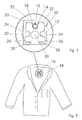
- Fig. 1 shows a UHF detector wafer 10 on a substrate 12 for subsequent attachment to a washable product.
- the UHF detector wafer 10 consists of a chip module 14 with a chip 16 and a coupling loop 18 and a dipole antenna 20 inductively coupled to the coupling loop 18.
- the dipole antenna 20 comprises a multifilament conductor made of stainless steel wires which has a plastic jacket made of teflon. The stainless steel wires in turn may be coated with a layer of copper.
- the chip module 14 with the chip 16 and the coupling loop 18 is protected by boards or potting material against mechanical and chemical influences.
- the coupled with the coupling loop 18 dipole antenna 20 is also protected by the plastic sheath against mechanical and chemical influences.
- the choice of material stainless steel also prevents corrosion due to the penetration of moisture.
- the training multifilament ladder provides an enlarged surface for improved conductivity at high frequencies and high flexibility in the handling of washable products. The conductivity and thus the efficiency of the dipole antenna can be further increased by a copper layer.
- the dipole antenna 20 has a shape which, starting from the coupling loop 18 of the chip module 14, initially extends on both sides in the mutual longitudinal direction 22, then kinks at right angles, meanders twice at locations 24, 26 and then kinks oppositely at right angles and in turn expires in the longitudinal direction 28. This will be in a center 30 generates an increased proportion of a magnetic H-field, which allows a better selection of adjacent detection plates in reading.
- Chip module 14 and dipole antenna 20 are arranged on a carrier material 12 that is coated with a hot melt adhesive 32.
- Fig. 2 shows as an application example a commercially used garment 34, in which in the vicinity of the collar a Detektierplättchen 10 after Fig. 1 adhesive is attached.
- Fig. 3 shows a UHF detection wafer 10 without a carrier material, which is suitable for attachment to a flat garment in the hem.
- the UHF detector wafer 10 consists of a chip module 14 having a chip 16 and a coupling loop 18 and a dipole antenna 20 inductively coupled to the coupling loop 18, here in an elongated form.
- the dipole antenna 20 is made of the same material as that of FIG Fig. 1 , A fixation between chip module and dipole antenna is effected by a common foil or a potting material.
- Fig. 4 shows a flat laundry piece 36 with a sewn in a hem 38 UHF detection wafer 10 after Fig. 3 ,
- the dipole antenna 20 is fixed here by an additional seam 40 with respect to the usual hem seam 44, so that it can not curl during the handling and thus become out of tune.
- Fig. 5 shows a non-inventive UHF detector wafer 10 on a support material 12 with stretched Dipolantenne 20 for sewing or sewing.
- the dipole antenna 20 may already be woven into the carrier material, as explained in FIGS. 9 to 11, or be glued or sewn onto the carrier material 12.
- the chip module 14 is fixed on the carrier material 12 by means of an adhesive strip 42.
- Fig. 6 shows a non-inventive UHF detector wafer 10 on a substrate 12 with a meandering dipole antenna 20 for sewing or sewing.
- the dipole antenna 20 may be glued or sewn onto the substrate 12.
- the chip module 14 is likewise fixed on the carrier material 12 by means of an adhesive strip 42.
- the meander structure of the dipole antenna 20 results in a similar radiation property, as related to Fig. 1 explained.
- Fig. 7 shows a section through a seam 38 with a sewn UHF detector wafer 10, as shown in the FIGS. 5 and 6 is described.
- the UHF detector wafer 10 is fixed by the same seam 44, which also fixes the seam 38 itself. In this case, the UHF detector wafer 10 is directly protected by the seam 38.
- Fig. 8 shows a section through a seam 38 with sewn UHF Detektierplättchen 10, as shown in the FIGS. 5 and 6 is described.
- the UHF detection wafer 10 is fixed by the same seam 44, which also fixes the seam 38 itself, but is located outside the seam 38. In this case, the UHF detector wafer 10 is indirectly protected by the adjacent increase in the seam 38.
Landscapes
- Engineering & Computer Science (AREA)
- Textile Engineering (AREA)
- Details Of Aerials (AREA)
- Variable-Direction Aerials And Aerial Arrays (AREA)
Description
- Die Erfindung betrifft ein waschbares Produkt nach dem Oberbegriff des Anspruchs (siehe
FR-A-2 901 041 - Um eingehende Wäscheteile zu erfassen, die sich meistens in Schmutzwäschesäcken befinden, werden Lesetunnel eingesetzt, bei denen aber durch die begrenzte Lesereichweite nur kleine Säcke durchgeschoben werden können.
- Mit UHF - Technik, die auch mehrere Meter Reichweite erlaubt, ließen sich Erfassungsstationen sowohl im Schmutzwäscheeingangsbereich sowie im Reinwäscheausgangsbereich einrichten, wo derzeit mit älteren Technologien kein Stücknachweis, sondern nur gewichtsmäßig die jeweiligen Lieferungen erfasst werden.
- Darüber hinaus haben bisher eingesetzte Hardtags den gravierenden Nachteil, dass sie als Fremdkörper im Kleidungsstück bemerkt werden bzw. bei Flachwäsche im Mangelbereich überhaupt nicht einsetzbar sind. Der mechanische Stress, dem die Wäschestücke in der Mangel ausgesetzt werden, führt umgehend zur Zerstörung des Hardtags bzw. zum Durchstanzen der Flachwäsche an der Stelle, wo der Hardtag angebracht ist.
- Aus der
FR-A-2901041 - Weiter knickt ein zweiter Schenkel nach eine Strecke, die ebenfalls der halben Trägerbreite entspricht, im rechten Winkel ab, erstreckt sich anschließend über eine volle Trägerbreite, knickt nochmals im rechten Winkel ab und endet nach einer Strecke, die dreiviertel der Trägerbreite entspricht.
- Der Erfindung liegt die Aufgabe zugrunde, ein waschbares Produkt mit einem berührungslos lesbaren UHF-Detektierplättchen auszustatten, das komfortabel handhabbar und tragbar bleibt, bei dem das Detektierplättchen auch in einem Wäschepulk lesbar ist und bei dem keine Beschädigung des waschbares Produkts durch das Vorhandensein des Detektierplättchens oder eine Beschädigung des Detektierplättchens selbst auftritt.
- Diese Aufgabe wird bei einem waschbaren Produkt nach dem Oberbegriff des Anspruchs 1 durch die Merkmale dieses Anspruchs gelöst.
- Durch die erfindungsgemäße Ausgestaltung des UHF-Detektierplättchens ergibt sich ein hochflexibler Softtag, der sich der Biegsamkeit des waschbaren Produkts anpasst und so die Handhabbarkeit und Tragbarkeit nicht beeinträchtigt. Darüber hinaus ist das UHF-Detektierplättchen über größere Distanzen auch im Pulk mit anderen ebenfalls mit gleichartigen UHF-Detektierplättchen ausgerüsteten waschbaren Produkten lesbar und gegen mechanische und chemische Beschädigung während der Handhabung vor, während und nach der Wäsche unempfindlich.
- Die Dipolantenne besitzt eine ungewöhnliche Form, die sich ausgehend von der Koppelschleife des Chipmoduls zunächst beidseitig in gegenseitiger Längsrichtung erstreckt, dann rechtwinklig abknickt, wenigstens einmalig mäandert und anschließend gegensätzlich rechtwinklig abknickt und wiederum in gegenseitiger Längsrichtung ausläuft.
- Bei dieser Form der Dipolantenne wird ein erhöhter Anteil eines magnetischen H-Feldes generiert, das eine bessere Selektion benachbarter Detektierplättchen beim Lesen ermöglicht und so eine getrennte Erfassung auch dicht übereinander liegender Produkte erleichtert. Dies trifft besonders auf Flachwäsche zu, die im sauberen Zustand gefaltet und dicht übereinander liegend angeliefert wird.
- Eine sichere Identifizierung der einzelnen waschbaren Produkte ist bei folgendem gewerblichen Einsatz zwingend nötig:
- Fußmatten, um entsprechend dem Logo des Nutzers das Produkt nach der Wäsche wieder der bestimmungsgemäßen Verwendung und dem Einsatzort zuzuordnen;
- OP-Wäsche, die in Deutschland nachweislich richtig gereinigt werden muss, da bei Infektionen und fehlendem Nachweis sonst das Krankenhaus in der Haftung steht;
- Feuerwehrschutzbekleidung, bei der die Anzahl der Reinigungszyklen erfasst werden müssen, da sie über die Nutzungshäufigkeit bzw. Waschhäufigkeit hinaus ihre Unbrennbarkeitseigenschaft verlieren.
- Gemäß einer Weiterbildung kann der Multifilamentleiter aus Edelstahldrähten bestehen.
- Dadurch wird eine verbesserte elektrische Leitfähigkeit bei gleichzeitig verringerter Bruchgefahr erzielt. Außerdem besitzt ein Multifilamentleiter textilähnliche Eigenschaften.
- Die Edelstahldrähte des Multifilamentleiters können mit einer Kupferschicht überzogen sein.
- Die Kupferschicht erhöht die elektrische Leitfähigkeit, so dass die Dipolantenne einen besseren Wirkungsgrad aufweist und damit eine erhöhte Lesereichweite des UHF-Detektierplättchens ermöglicht.
- Außerdem kann der der Multifilamentleiter einen Kunststoffmantel aufweisen.
- Dadurch werden die Multifilamentleiter bei Biegung des Waschbaren Produkts vor zu starkem Knicken und bleibender Verformung geschützt.
- Für sogenannte Softtags sind zwei Ausführungen vorgesehen, nämliche eine zum Nachrüsten und eine zum Einbau bei der Herstellung des Produkts.
- Bei der erstgenannten Ausführung kann das UHF-Detektierplättchen auf einem Trägermaterial befestigt und das Trägermaterial mit einem Heißkleber oder Gummikleber beschichtet und am waschbaren Produkt klebend angebracht sein.
- Bei der zweitgenannten Ausführung sind mehrere Alternativen möglich.
- Das UHF-Detektierplättchen kann auf einem Trägermaterial befestigt und in einem Saum des waschbaren Produkts eingenäht sein.
- Das UHF-Detektierplättchen kann auf einem Trägermaterial befestigt und unmittelbar an einem Saum des waschbaren Produkts angenäht sein.
- Dabei kann die Dipolantenne des UHF-Detektierplättchen im Saum vernäht und lediglich der Chip mit der Koppelschleife sowie ein Anteil der induktiv mit der Koppelschleife gekoppelten Dipolantenne außerhalb des Saums angeordnet sein.
- Außerdem kann das UHF-Detektierplättchen in einem Saum des waschbaren Produkts eingenäht sein.
- Dabei sind die Multifilamentleiter der Dipolantenne vorzugsweise durch eine zusätzliche Saumnaht gegen Kräuseln fixiert.
- Bei sämtlichen Ausführungen sorgt der Saum dafür, dass das Detektierplättchen entweder durch den Saum selbst geschützt ist oder durch den in der Dicke ohnehin erhöhten Saum in unmittelbarer Nachbarschaft mittelbar geschützt ist. Gleichzeitig dient die Saumnaht dabei zur Fixierung des Detektierplättchens. Ein zusätzliches Aufwölben eines Produktstapels durch die Dicke des UHF-Detektierplättchens wird vermieden.
- Im Falle eines Schmutzabtreters mit einer Gummibeschichtung kann das UHF-Detektierplättchen in eine Gummischicht des waschbaren Produkts einvulkanisiert sein.
- Vorzugsweise ist das UHF-Detektierplättchen in der Mitte zwischen den Enden eines waschbaren Produkts positioniert.
- Da beim automatischen Handling von waschbaren Produkten die Produkte von Greifern an den Ecken gegriffen werden und vor allem Flachwäsche im sauberen Zustand gefaltet wird, liegen die UHF-Detektierplättchen sowohl außerhalb des Greifbereichs als auch außerhalb des Faltungsbereichs und bleiben so beim üblichen Handling unbeschädigt.
- Nachfolgend wird die Erfindung anhand von Ausführungsbeispielen erläutert, die in der Zeichnung dargestellt sind.
- In der Zeichnung zeigen:
- Fig. 1
- ein UHF-Detektierplättchen auf einem Trägermaterial zur nachträglichen Anbringung,
- Fig. 2
- ein Kleidungsstück mit einem UHF-Detektierplättchen nach
Fig. 1 - Fig. 3
- ein UHF-Detektierplättchen ohne Trägermaterial,
- Fig. 4
- ein Flachwäschestück mit einem in einem Saum eingenähten UHF-Detektierplättchen nach
Fig. 3 - Fig. 5
- ein UHF-Detektierplättchen auf einem Trägermaterial mit gestreckter Dipolantenne zum Ein- oder Annähen,
- Fig. 6
- ein UHF-Detektierplättchen auf einem Trägermaterial mit mäanderförmiger Dipolantenne zum Ein- oder Annähen,
- Fig. 7
- einen Schnitt durch einen Saum mit eingenähtem UHF-Detektierplättchen,
- Fig. 8
- und einen Schnitt durch einen Saum mit angenähtem UHF-Detektierplättchen.
-
Fig. 1 zeigt ein UHF-Detektierplättchen 10 auf einem Trägermaterial 12 zur nachträglichen Anbringung an einem waschbaren Produkt. Das UHF-Detektierplättchen 10 besteht aus einem Chipmodul 14 mit einem Chip 16 und einer Koppelschleife 18 sowie einer induktiv mit der Koppelschleife 18 gekoppelten Dipolantenne 20. Die Dipolantenne 20 umfasst einen Multifilamentleiter aus Edelstahldrähten, die einen Kunststoffmantel aus Teflon tragen. Die Edelstahldrähte ihrerseits können mit einer Kupferschicht überzogen sein. - Das Chipmodul 14 mit dem Chip 16 und der Koppelschleife 18 ist durch Platinen oder Vergussmaterial gegen mechanische und chemische Einflüsse geschützt. Die mit der Koppelschleife 18 gekoppelte Dipolantenne 20 ist durch den Kunststoffmantel ebenfalls gegen mechanische und chemische Einflüsse geschützt. Durch die Materialwahl Edelstahl wird außerdem eine Korrosion durch eventuell eindringende Feuchtigkeit verhindert. Die Ausbildung Multifilamentleiter sorgt einmal durch vergrößerte Oberfläche für eine verbesserte Leitfähigkeit bei hohen Frequenzen und für hohe Flexibilität beim Handling von waschbaren Produkten. Die Leitfähigkeit und damit der Wirkungsgrad der Dipolantenne kann durch eine Kupferschicht noch weiter gesteigert werden.
- Die Dipolantenne 20 besitzt ein Form, die sich ausgehend von der Koppelschleife 18 des Chipmoduls 14 zunächst beidseitig in gegenseitiger Längsrichtung 22 erstreckt, dann rechtwinklig abknickt, zweimalig an Orten 24, 26 mäandert und anschließend gegensätzlich rechtwinklig abknickt und wiederum in gegenseitiger Längsrichtung 28 ausläuft. Dadurch wird in einem Zentrum 30 ein erhöhter Anteil eines magnetischen H-Feldes generiert, das eine bessere Selektion benachbarter Detektierplättchen beim Lesen ermöglicht.
- Chipmodul 14 und Dipolantenne 20 sind auf einem Trägermaterial 12 angeordnet, dass mit einem Heißkleber 32 beschichtet ist.
-
Fig. 2 zeigt als Anwendungsbeispiel ein gewerblich genutztes Kleidungsstück 34, bei dem in der Nähe des Kragens ein Detektierplättchen 10 nachFig. 1 klebend angebracht ist. -
Fig. 3 zeigt ein UHF-Detektierplättchen 10 ohne Trägermaterial, das für die Anbringung an einem Flachwäschestück in dessen Saum geeignet ist. Das UHF-Detektierplättchen 10 besteht aus einem Chipmodul 14 mit einem Chip 16 und einer Koppelschleife 18 sowie einer induktiv mit der Koppelschleife 18 gekoppelten Dipolantenne 20, hier in gestreckter Form. Die Dipolantenne 20 besteht aus dem gleichen Material wie die ausFig. 1 . Eine Fixierung zwischen Chipmodul und Dipolantenne erfolgt durch eine gemeinsame Folie oder ein Vergussmaterial. -
Fig. 4 zeigt ein Flachwäschestück 36 mit einem in einem Saum 38 eingenähten UHF-Detektierplättchen 10 nachFig. 3 . Die Dipolantenne 20 ist hier durch eine zusätzliche Naht 40 gegenüber der üblichen Saumnaht 44 fixiert, so dass sie sich im Laufe des Handlings nicht kräuseln und damit verstimmen kann. -
Fig. 5 zeigt ein nicht erfindungsgemäßes UHF-Detektierplättchen 10 auf einem Trägermaterial 12 mit gestreckter Dipolantenne 20 zum Ein- oder Annähen. Die Dipolantenne 20 kann bereits in das Trägermaterial eingewebt sein, wie in den Figuren 9 bis 11 erläutert, oder auf das Trägermaterial 12 aufgeklebt oder aufgenäht sein. Das Chipmodul 14 ist mittels eines Klebestreifens 42 auf dem Trägermaterial 12 fixiert. -
Fig. 6 zeigt ein nicht erfindungsgemäßes UHF-Detektierplättchen 10 auf einem Trägermaterial 12 mit mäanderförmiger Dipolantenne 20 zum Ein- oder Annähen. Die Dipolantenne 20 kann auf das Trägermaterial 12 aufgeklebt oder aufgenäht sein. Das Chipmodul 14 ist ebenfalls mittels eines Klebestreifens 42 auf dem Trägermaterial 12 fixiert. Durch die Mäanderstruktur der Dipolantenne 20 ergibt sich eine ähnliche Strahlungseigenschaft, wie im Zusammenhang mitFig. 1 erläutert. -
Fig. 7 zeigt einen Schnitt durch einen Saum 38 mit einem eingenähten UHF-Detektierplättchen 10, wie es in denFiguren 5 und 6 beschrieben ist. Das UHF-Detektierplättchen 10 ist durch die selbe Naht 44 fixiert, die auch den Saum 38 selbst fixiert. In diesem Fall ist das UHF-Detektierplättchen 10 durch den Saum 38 unmittelbar geschützt. -
Fig. 8 zeigt einen Schnitt durch einen Saum 38 mit angenähtem UHF-Detektierplättchen 10, wie es in denFiguren 5 und 6 beschrieben ist. Das UHF-Detektierplättchen 10 ist durch die selbe Naht 44 fixiert, die auch den Saum 38 selbst fixiert, jedoch außerhalb des Saums 38 angeordnet. In diesem Fall ist das UHF-Detektierplättchen 10 durch die benachbarte Erhöhung des Saums 38 mittelbar geschützt.
Claims (13)
- Waschbares Produkt mit einem berührungslos lesbaren UHF-Detektierplättchen (10), das aus einem Chipmodul (14) mit einem Chip (16) und einer Koppelschleife (18) sowie einer induktiv mit der Koppelschleife (18) gekoppelten Dipolantenne (20) besteht, dadurch gekennzeichnet, dass die Dipolantenne (20) aus einem Multifilamentleiter besteht und eine Form besitzt, die sich ausgehend von der Koppelschleife (18) des Chipmoduls (14) zunächst beidseitig in gegenseitiger Längsrichtung (22) erstreckt, dann rechtwinklig abknickt, wenigstens einmalig mäandert (24, 26) und anschließend gegensätzlich rechtwinklig abknickt und wiederum in gegenseitiger Längsrichtung (28) ausläuft.
- Waschbares Produkt nach Anspruch 1, dadurch gekennzeichnet, dass der Multifilamentleiter aus Edelstahldrähten besteht.
- Waschbares Produkt nach Anspruch 2, dadurch gekennzeichnet, dass die Edelstahldrähte des Multifilamentleiters mit einer Kupferschicht überzogen sind.
- Waschbares Produkt nach einem der Ansprüche 1 bis 3, dadurch gekennzeichnet, dass der Multifilamentleiter einen Kunststoffmantel aufweist.
- Waschbares Produkt nach einem der Ansprüche 1 bis 4, dadurch gekennzeichnet, dass das UHF-Detektierplättchen (10) auf einem Trägermaterial (12) befestigt ist und das Trägermaterial (12) mit einem Heißkleber (32) beschichtet und am waschbaren Produkt klebend angebracht ist.
- Waschbares Produkt nach einem der Ansprüche 1 bis 4, dadurch gekennzeichnet, dass das UHF-Detektierplättchen (10) auf einem Trägermaterial (12) befestigt ist und das Trägermaterial (12) mit einem Gummikleber beschichtet und am waschbaren Produkt klebend angebracht ist.
- Waschbares Produkt nach einem der Ansprüche 1 bis 4, dadurch gekennzeichnet, dass das UHF-Detektierplättchen (10) auf einem Trägermaterial (12) befestigt und in einem Saum (38) des waschbaren Produkts (36) eingenäht ist.
- Waschbares Produkt nach einem der Ansprüche 1 bis 4, dadurch gekennzeichnet, dass das UHF-Detektierplättchen (10) auf einem Trägermaterial (12 befestigt und unmittelbar an einem Saum (38) des waschbaren Produkts (36) angenäht ist.
- Waschbares Produkt nach Anspruch 8, dadurch gekennzeichnet, dass die Dipolantenne (20) des UHF-Detektierplättchens (10) im Saum (38) vernäht und lediglich der Chip (16) mit der Koppelschleife (18) sowie ein Anteil der induktiv mit der Koppelschleife gekoppelten Dipolantenne (20) außerhalb des Saums (38) angeordnet ist.
- Waschbares Produkt nach einem der Ansprüche 1 bis 4, dadurch gekennzeichnet, dass das UHF-Detektierplättchen (10) in eine Gummischicht des waschbaren Produkts einvulkanisiert ist.
- Waschbares Produkt nach einem der Ansprüche 1 bis 4, dadurch gekennzeichnet, dass das UHF-Detektierplättchen (10) in einem Saum (38) des waschbaren Produkts (36) eingenäht ist.
- Waschbares Produkt nach Anspruch 11, dadurch gekennzeichnet, dass die Multifilamentleiter der Dipolantenne (20) durch eine zusätzliche Saumnaht gegen Kräuseln fixiert sind.
- Waschbares Produkt nach einem der Ansprüche 5 bis 12, dadurch gekennzeichnet, dass das UHF-Detektierplättchen (10) in der Mitte zwischen den Enden eines waschbaren Produkts (36) positioniert ist.
Applications Claiming Priority (2)
| Application Number | Priority Date | Filing Date | Title |
|---|---|---|---|
| DE200810027246 DE102008027246A1 (de) | 2008-06-06 | 2008-06-06 | Waschbares Produkt |
| PCT/DE2009/000745 WO2009146678A1 (de) | 2008-06-06 | 2009-05-28 | Waschbares produkt |
Publications (2)
| Publication Number | Publication Date |
|---|---|
| EP2288743A1 EP2288743A1 (de) | 2011-03-02 |
| EP2288743B1 true EP2288743B1 (de) | 2016-11-23 |
Family
ID=41139027
Family Applications (1)
| Application Number | Title | Priority Date | Filing Date |
|---|---|---|---|
| EP09757112.9A Active EP2288743B1 (de) | 2008-06-06 | 2009-05-28 | Waschbares produkt |
Country Status (3)
| Country | Link |
|---|---|
| EP (1) | EP2288743B1 (de) |
| DE (1) | DE102008027246A1 (de) |
| WO (1) | WO2009146678A1 (de) |
Cited By (2)
| Publication number | Priority date | Publication date | Assignee | Title |
|---|---|---|---|---|
| DE102021102349A1 (de) | 2021-02-02 | 2022-08-04 | Manfred Rietzler | RFID-Funketikett zum Befestigen an einer Textilie |
| EP4151795A1 (de) * | 2021-09-16 | 2023-03-22 | Herbert Kannegiesser GmbH | Verfahren zum mangeln von elektronische datenträger aufweisenden wäschestücken |
Families Citing this family (4)
| Publication number | Priority date | Publication date | Assignee | Title |
|---|---|---|---|---|
| DE102009038511A1 (de) * | 2009-08-25 | 2011-03-10 | ASTRA Gesellschaft für Asset Management mbH & Co. KG | Gefaltetes und bedrucktes Pflegeetikett für Textilien |
| WO2011160606A1 (de) * | 2010-06-25 | 2011-12-29 | ASTRA Gesellschaft für Asset Management mbH & Co. KG | Detektierplättchen |
| DE102011090139B4 (de) * | 2011-12-29 | 2018-07-05 | Continental Automotive Gmbh | Sendeanordnung für eine Funkstation und Funkstation |
| EP3583842B1 (de) | 2018-06-18 | 2022-02-16 | Assa Abloy AB | Rfid-etikett |
Family Cites Families (4)
| Publication number | Priority date | Publication date | Assignee | Title |
|---|---|---|---|---|
| US6999028B2 (en) * | 2003-12-23 | 2006-02-14 | 3M Innovative Properties Company | Ultra high frequency radio frequency identification tag |
| DE102004003461C5 (de) * | 2004-01-22 | 2009-11-19 | ASTRA Gesellschaft für Asset Management mbH & Co. KG | Textilmaterial mit einem HF-Transponder |
| US7497004B2 (en) * | 2006-04-10 | 2009-03-03 | Checkpoint Systems, Inc. | Process for making UHF antennas for EAS and RFID tags and antennas made thereby |
| FR2901041B1 (fr) | 2006-05-12 | 2008-10-10 | Eric Heurtier | Etiquette integrant une antenne anti-vol rf et un transporteur rfid uhf |
-
2008
- 2008-06-06 DE DE200810027246 patent/DE102008027246A1/de not_active Withdrawn
-
2009
- 2009-05-28 WO PCT/DE2009/000745 patent/WO2009146678A1/de not_active Ceased
- 2009-05-28 EP EP09757112.9A patent/EP2288743B1/de active Active
Non-Patent Citations (1)
| Title |
|---|
| None * |
Cited By (3)
| Publication number | Priority date | Publication date | Assignee | Title |
|---|---|---|---|---|
| DE102021102349A1 (de) | 2021-02-02 | 2022-08-04 | Manfred Rietzler | RFID-Funketikett zum Befestigen an einer Textilie |
| US12254365B2 (en) | 2021-02-02 | 2025-03-18 | Manfred Rietzler | RFID tag for being fastened to a textile |
| EP4151795A1 (de) * | 2021-09-16 | 2023-03-22 | Herbert Kannegiesser GmbH | Verfahren zum mangeln von elektronische datenträger aufweisenden wäschestücken |
Also Published As
| Publication number | Publication date |
|---|---|
| DE102008027246A1 (de) | 2009-12-10 |
| WO2009146678A1 (de) | 2009-12-10 |
| EP2288743A1 (de) | 2011-03-02 |
Similar Documents
| Publication | Publication Date | Title |
|---|---|---|
| EP2066836B1 (de) | Rfid-textiletikette | |
| EP1870797B2 (de) | Informationsträger für Textilien | |
| DE102004003461C5 (de) | Textilmaterial mit einem HF-Transponder | |
| EP2288743A1 (de) | Waschbares produkt | |
| DE102010017684B4 (de) | Verfahren zum Herstellen von Antennen für RFID-Transponder | |
| EP1789913B1 (de) | Bandgewebe mit einem eingearbeiteten antennenfaden für einen rf-transponder | |
| DE102017006450B4 (de) | RFID-Transponder für eine kontaktlose Kommunikation mit Plastikgehäuse | |
| EP2757359B1 (de) | Vorrichtung zum Feststellen von Leckagen einer Flüssigkeitsleitung, insbesondere Hochdruck-Flüssigkeitsleitung | |
| DE102010016359A1 (de) | Elastomerprodukt, insbesondere Luftfeder mit einem Balg, mit einem elektrischen Bauteil | |
| DE102012109359A1 (de) | Booster-Antenne für eine Chip-Anordnung, Kontaktlos-Chipkartenmodul-Anordnung und Chip-Anordnung | |
| DE112019002093T5 (de) | Elektrodenverbindungsstruktur und Elektrodenverbindungsverfahren | |
| DE10136502A1 (de) | Identifikationsanordnung, Verfahren zu ihrer Herstellung und Vorrichtung zur Durchführung des Verfahrens | |
| EP2087481A1 (de) | Etikett mit abwinkelbarem teil | |
| DE112007000714T5 (de) | Transponder für ein Hochfrequenz-Identifikationssystem | |
| DE102022116891A1 (de) | Flexible-Struktur, Flexible-Struktur-Anordnung und Flexible- Struktur-System | |
| EP2586098B1 (de) | Detektierplättchen | |
| DE69609428T2 (de) | Intelligente spleissverbindung | |
| DE212012000055U1 (de) | Eintrittspunkt-Deaktivierung | |
| DE10311185A1 (de) | Funkabfragbares Etikett, Herstellungsverfahren sowie Verwendung eines derartigen funkabfragbaren Etiketts zur Identifizierung von Textilien und/oder in Wäschereinigungsbetrieben | |
| DE102017216265A1 (de) | Identifikationseinheit sowie Reifen mit einer derartigen Identifikationseinheit | |
| DE212011100117U1 (de) | Ic-tag | |
| EP1907994A1 (de) | Textiles flächengebilde, insbesondere etikett, mit einem chip | |
| DE202013000810U1 (de) | Elastomerprodukt | |
| DE102004052396B4 (de) | Erfassungsvorrichtung | |
| DE102012010848A1 (de) | Anordnung zur induktiven Übertragung elektrischer Energie |
Legal Events
| Date | Code | Title | Description |
|---|---|---|---|
| PUAI | Public reference made under article 153(3) epc to a published international application that has entered the european phase |
Free format text: ORIGINAL CODE: 0009012 |
|
| 17P | Request for examination filed |
Effective date: 20101008 |
|
| AK | Designated contracting states |
Kind code of ref document: A1 Designated state(s): AT BE BG CH CY CZ DE DK EE ES FI FR GB GR HR HU IE IS IT LI LT LU LV MC MK MT NL NO PL PT RO SE SI SK TR |
|
| AX | Request for extension of the european patent |
Extension state: AL BA RS |
|
| DAX | Request for extension of the european patent (deleted) | ||
| GRAP | Despatch of communication of intention to grant a patent |
Free format text: ORIGINAL CODE: EPIDOSNIGR1 |
|
| INTG | Intention to grant announced |
Effective date: 20160802 |
|
| GRAS | Grant fee paid |
Free format text: ORIGINAL CODE: EPIDOSNIGR3 |
|
| GRAA | (expected) grant |
Free format text: ORIGINAL CODE: 0009210 |
|
| AK | Designated contracting states |
Kind code of ref document: B1 Designated state(s): AT BE BG CH CY CZ DE DK EE ES FI FR GB GR HR HU IE IS IT LI LT LU LV MC MK MT NL NO PL PT RO SE SI SK TR |
|
| REG | Reference to a national code |
Ref country code: GB Ref legal event code: FG4D Free format text: NOT ENGLISH |
|
| REG | Reference to a national code |
Ref country code: CH Ref legal event code: EP |
|
| REG | Reference to a national code |
Ref country code: IE Ref legal event code: FG4D Free format text: LANGUAGE OF EP DOCUMENT: GERMAN |
|
| REG | Reference to a national code |
Ref country code: AT Ref legal event code: REF Ref document number: 848034 Country of ref document: AT Kind code of ref document: T Effective date: 20161215 |
|
| REG | Reference to a national code |
Ref country code: DE Ref legal event code: R096 Ref document number: 502009013405 Country of ref document: DE |
|
| PG25 | Lapsed in a contracting state [announced via postgrant information from national office to epo] |
Ref country code: LV Free format text: LAPSE BECAUSE OF FAILURE TO SUBMIT A TRANSLATION OF THE DESCRIPTION OR TO PAY THE FEE WITHIN THE PRESCRIBED TIME-LIMIT Effective date: 20161123 |
|
| REG | Reference to a national code |
Ref country code: LT Ref legal event code: MG4D |
|
| REG | Reference to a national code |
Ref country code: NL Ref legal event code: MP Effective date: 20161123 |
|
| PG25 | Lapsed in a contracting state [announced via postgrant information from national office to epo] |
Ref country code: SE Free format text: LAPSE BECAUSE OF FAILURE TO SUBMIT A TRANSLATION OF THE DESCRIPTION OR TO PAY THE FEE WITHIN THE PRESCRIBED TIME-LIMIT Effective date: 20161123 Ref country code: NL Free format text: LAPSE BECAUSE OF FAILURE TO SUBMIT A TRANSLATION OF THE DESCRIPTION OR TO PAY THE FEE WITHIN THE PRESCRIBED TIME-LIMIT Effective date: 20161123 Ref country code: LT Free format text: LAPSE BECAUSE OF FAILURE TO SUBMIT A TRANSLATION OF THE DESCRIPTION OR TO PAY THE FEE WITHIN THE PRESCRIBED TIME-LIMIT Effective date: 20161123 Ref country code: GR Free format text: LAPSE BECAUSE OF FAILURE TO SUBMIT A TRANSLATION OF THE DESCRIPTION OR TO PAY THE FEE WITHIN THE PRESCRIBED TIME-LIMIT Effective date: 20170224 Ref country code: NO Free format text: LAPSE BECAUSE OF FAILURE TO SUBMIT A TRANSLATION OF THE DESCRIPTION OR TO PAY THE FEE WITHIN THE PRESCRIBED TIME-LIMIT Effective date: 20170223 |
|
| REG | Reference to a national code |
Ref country code: FR Ref legal event code: PLFP Year of fee payment: 9 |
|
| PG25 | Lapsed in a contracting state [announced via postgrant information from national office to epo] |
Ref country code: HR Free format text: LAPSE BECAUSE OF FAILURE TO SUBMIT A TRANSLATION OF THE DESCRIPTION OR TO PAY THE FEE WITHIN THE PRESCRIBED TIME-LIMIT Effective date: 20161123 Ref country code: PL Free format text: LAPSE BECAUSE OF FAILURE TO SUBMIT A TRANSLATION OF THE DESCRIPTION OR TO PAY THE FEE WITHIN THE PRESCRIBED TIME-LIMIT Effective date: 20161123 Ref country code: FI Free format text: LAPSE BECAUSE OF FAILURE TO SUBMIT A TRANSLATION OF THE DESCRIPTION OR TO PAY THE FEE WITHIN THE PRESCRIBED TIME-LIMIT Effective date: 20161123 Ref country code: ES Free format text: LAPSE BECAUSE OF FAILURE TO SUBMIT A TRANSLATION OF THE DESCRIPTION OR TO PAY THE FEE WITHIN THE PRESCRIBED TIME-LIMIT Effective date: 20161123 Ref country code: PT Free format text: LAPSE BECAUSE OF FAILURE TO SUBMIT A TRANSLATION OF THE DESCRIPTION OR TO PAY THE FEE WITHIN THE PRESCRIBED TIME-LIMIT Effective date: 20170323 |
|
| PG25 | Lapsed in a contracting state [announced via postgrant information from national office to epo] |
Ref country code: SK Free format text: LAPSE BECAUSE OF FAILURE TO SUBMIT A TRANSLATION OF THE DESCRIPTION OR TO PAY THE FEE WITHIN THE PRESCRIBED TIME-LIMIT Effective date: 20161123 Ref country code: RO Free format text: LAPSE BECAUSE OF FAILURE TO SUBMIT A TRANSLATION OF THE DESCRIPTION OR TO PAY THE FEE WITHIN THE PRESCRIBED TIME-LIMIT Effective date: 20161123 Ref country code: EE Free format text: LAPSE BECAUSE OF FAILURE TO SUBMIT A TRANSLATION OF THE DESCRIPTION OR TO PAY THE FEE WITHIN THE PRESCRIBED TIME-LIMIT Effective date: 20161123 Ref country code: DK Free format text: LAPSE BECAUSE OF FAILURE TO SUBMIT A TRANSLATION OF THE DESCRIPTION OR TO PAY THE FEE WITHIN THE PRESCRIBED TIME-LIMIT Effective date: 20161123 Ref country code: CZ Free format text: LAPSE BECAUSE OF FAILURE TO SUBMIT A TRANSLATION OF THE DESCRIPTION OR TO PAY THE FEE WITHIN THE PRESCRIBED TIME-LIMIT Effective date: 20161123 |
|
| REG | Reference to a national code |
Ref country code: DE Ref legal event code: R097 Ref document number: 502009013405 Country of ref document: DE |
|
| PG25 | Lapsed in a contracting state [announced via postgrant information from national office to epo] |
Ref country code: BG Free format text: LAPSE BECAUSE OF FAILURE TO SUBMIT A TRANSLATION OF THE DESCRIPTION OR TO PAY THE FEE WITHIN THE PRESCRIBED TIME-LIMIT Effective date: 20170223 Ref country code: LU Free format text: LAPSE BECAUSE OF NON-PAYMENT OF DUE FEES Effective date: 20170531 Ref country code: IT Free format text: LAPSE BECAUSE OF FAILURE TO SUBMIT A TRANSLATION OF THE DESCRIPTION OR TO PAY THE FEE WITHIN THE PRESCRIBED TIME-LIMIT Effective date: 20161123 |
|
| PLBE | No opposition filed within time limit |
Free format text: ORIGINAL CODE: 0009261 |
|
| STAA | Information on the status of an ep patent application or granted ep patent |
Free format text: STATUS: NO OPPOSITION FILED WITHIN TIME LIMIT |
|
| 26N | No opposition filed |
Effective date: 20170824 |
|
| PG25 | Lapsed in a contracting state [announced via postgrant information from national office to epo] |
Ref country code: SI Free format text: LAPSE BECAUSE OF FAILURE TO SUBMIT A TRANSLATION OF THE DESCRIPTION OR TO PAY THE FEE WITHIN THE PRESCRIBED TIME-LIMIT Effective date: 20161123 |
|
| REG | Reference to a national code |
Ref country code: CH Ref legal event code: PL |
|
| PG25 | Lapsed in a contracting state [announced via postgrant information from national office to epo] |
Ref country code: MC Free format text: LAPSE BECAUSE OF FAILURE TO SUBMIT A TRANSLATION OF THE DESCRIPTION OR TO PAY THE FEE WITHIN THE PRESCRIBED TIME-LIMIT Effective date: 20161123 |
|
| REG | Reference to a national code |
Ref country code: IE Ref legal event code: MM4A |
|
| PG25 | Lapsed in a contracting state [announced via postgrant information from national office to epo] |
Ref country code: LI Free format text: LAPSE BECAUSE OF NON-PAYMENT OF DUE FEES Effective date: 20170531 Ref country code: CH Free format text: LAPSE BECAUSE OF NON-PAYMENT OF DUE FEES Effective date: 20170531 |
|
| PG25 | Lapsed in a contracting state [announced via postgrant information from national office to epo] |
Ref country code: LU Free format text: LAPSE BECAUSE OF NON-PAYMENT OF DUE FEES Effective date: 20170528 |
|
| REG | Reference to a national code |
Ref country code: BE Ref legal event code: MM Effective date: 20170531 |
|
| PG25 | Lapsed in a contracting state [announced via postgrant information from national office to epo] |
Ref country code: IE Free format text: LAPSE BECAUSE OF NON-PAYMENT OF DUE FEES Effective date: 20170528 |
|
| REG | Reference to a national code |
Ref country code: FR Ref legal event code: PLFP Year of fee payment: 10 |
|
| REG | Reference to a national code |
Ref country code: AT Ref legal event code: MM01 Ref document number: 848034 Country of ref document: AT Kind code of ref document: T Effective date: 20170528 |
|
| PG25 | Lapsed in a contracting state [announced via postgrant information from national office to epo] |
Ref country code: AT Free format text: LAPSE BECAUSE OF NON-PAYMENT OF DUE FEES Effective date: 20170528 Ref country code: BE Free format text: LAPSE BECAUSE OF NON-PAYMENT OF DUE FEES Effective date: 20170531 |
|
| PG25 | Lapsed in a contracting state [announced via postgrant information from national office to epo] |
Ref country code: MT Free format text: LAPSE BECAUSE OF FAILURE TO SUBMIT A TRANSLATION OF THE DESCRIPTION OR TO PAY THE FEE WITHIN THE PRESCRIBED TIME-LIMIT Effective date: 20161123 |
|
| PG25 | Lapsed in a contracting state [announced via postgrant information from national office to epo] |
Ref country code: HU Free format text: LAPSE BECAUSE OF FAILURE TO SUBMIT A TRANSLATION OF THE DESCRIPTION OR TO PAY THE FEE WITHIN THE PRESCRIBED TIME-LIMIT; INVALID AB INITIO Effective date: 20090528 |
|
| PG25 | Lapsed in a contracting state [announced via postgrant information from national office to epo] |
Ref country code: CY Free format text: LAPSE BECAUSE OF NON-PAYMENT OF DUE FEES Effective date: 20161123 |
|
| PG25 | Lapsed in a contracting state [announced via postgrant information from national office to epo] |
Ref country code: MK Free format text: LAPSE BECAUSE OF FAILURE TO SUBMIT A TRANSLATION OF THE DESCRIPTION OR TO PAY THE FEE WITHIN THE PRESCRIBED TIME-LIMIT Effective date: 20161123 |
|
| PG25 | Lapsed in a contracting state [announced via postgrant information from national office to epo] |
Ref country code: TR Free format text: LAPSE BECAUSE OF FAILURE TO SUBMIT A TRANSLATION OF THE DESCRIPTION OR TO PAY THE FEE WITHIN THE PRESCRIBED TIME-LIMIT Effective date: 20161123 |
|
| PG25 | Lapsed in a contracting state [announced via postgrant information from national office to epo] |
Ref country code: IS Free format text: LAPSE BECAUSE OF FAILURE TO SUBMIT A TRANSLATION OF THE DESCRIPTION OR TO PAY THE FEE WITHIN THE PRESCRIBED TIME-LIMIT Effective date: 20170323 |
|
| P01 | Opt-out of the competence of the unified patent court (upc) registered |
Effective date: 20230530 |
|
| PGFP | Annual fee paid to national office [announced via postgrant information from national office to epo] |
Ref country code: DE Payment date: 20250516 Year of fee payment: 17 |
|
| PGFP | Annual fee paid to national office [announced via postgrant information from national office to epo] |
Ref country code: GB Payment date: 20250522 Year of fee payment: 17 |
|
| PGFP | Annual fee paid to national office [announced via postgrant information from national office to epo] |
Ref country code: FR Payment date: 20250523 Year of fee payment: 17 |