EP2288669B1 - Verfahren zur herstellung eines heissschmelzbaren kleber - Google Patents
Verfahren zur herstellung eines heissschmelzbaren kleber Download PDFInfo
- Publication number
- EP2288669B1 EP2288669B1 EP09749757.2A EP09749757A EP2288669B1 EP 2288669 B1 EP2288669 B1 EP 2288669B1 EP 09749757 A EP09749757 A EP 09749757A EP 2288669 B1 EP2288669 B1 EP 2288669B1
- Authority
- EP
- European Patent Office
- Prior art keywords
- polysaccharide
- hot
- melt adhesive
- imidazole
- imidazolide
- Prior art date
- Legal status (The legal status is an assumption and is not a legal conclusion. Google has not performed a legal analysis and makes no representation as to the accuracy of the status listed.)
- Not-in-force
Links
- 239000004831 Hot glue Substances 0.000 title claims description 30
- 238000000034 method Methods 0.000 title claims description 22
- 238000004519 manufacturing process Methods 0.000 title claims description 10
- RAXXELZNTBOGNW-UHFFFAOYSA-N imidazole Natural products C1=CNC=N1 RAXXELZNTBOGNW-UHFFFAOYSA-N 0.000 claims description 61
- 229920001282 polysaccharide Polymers 0.000 claims description 42
- 239000005017 polysaccharide Substances 0.000 claims description 41
- -1 polysaccharide ester Chemical class 0.000 claims description 27
- 150000004804 polysaccharides Chemical class 0.000 claims description 21
- KFZMGEQAYNKOFK-UHFFFAOYSA-N Isopropanol Chemical compound CC(C)O KFZMGEQAYNKOFK-UHFFFAOYSA-N 0.000 claims description 16
- 229920002472 Starch Polymers 0.000 claims description 16
- 235000019698 starch Nutrition 0.000 claims description 16
- 239000008107 starch Substances 0.000 claims description 16
- JBFYUZGYRGXSFL-UHFFFAOYSA-N imidazolide Chemical compound C1=C[N-]C=N1 JBFYUZGYRGXSFL-UHFFFAOYSA-N 0.000 claims description 14
- 239000002105 nanoparticle Substances 0.000 claims description 12
- 239000000155 melt Substances 0.000 claims description 10
- NGNBDVOYPDDBFK-UHFFFAOYSA-N 2-[2,4-di(pentan-2-yl)phenoxy]acetyl chloride Chemical compound CCCC(C)C1=CC=C(OCC(Cl)=O)C(C(C)CCC)=C1 NGNBDVOYPDDBFK-UHFFFAOYSA-N 0.000 claims description 9
- 238000006243 chemical reaction Methods 0.000 claims description 7
- HEMHJVSKTPXQMS-UHFFFAOYSA-M Sodium hydroxide Chemical compound [OH-].[Na+] HEMHJVSKTPXQMS-UHFFFAOYSA-M 0.000 claims description 6
- 239000000975 dye Substances 0.000 claims description 6
- 238000011065 in-situ storage Methods 0.000 claims description 5
- 229920002307 Dextran Polymers 0.000 claims description 4
- 150000008065 acid anhydrides Chemical class 0.000 claims description 4
- 150000002596 lactones Chemical class 0.000 claims description 4
- FEBUJFMRSBAMES-UHFFFAOYSA-N 2-[(2-{[3,5-dihydroxy-2-(hydroxymethyl)-6-phosphanyloxan-4-yl]oxy}-3,5-dihydroxy-6-({[3,4,5-trihydroxy-6-(hydroxymethyl)oxan-2-yl]oxy}methyl)oxan-4-yl)oxy]-3,5-dihydroxy-6-(hydroxymethyl)oxan-4-yl phosphinite Chemical compound OC1C(O)C(O)C(CO)OC1OCC1C(O)C(OC2C(C(OP)C(O)C(CO)O2)O)C(O)C(OC2C(C(CO)OC(P)C2O)O)O1 FEBUJFMRSBAMES-UHFFFAOYSA-N 0.000 claims description 3
- 229920002558 Curdlan Polymers 0.000 claims description 3
- 239000001879 Curdlan Substances 0.000 claims description 3
- 229920001218 Pullulan Polymers 0.000 claims description 3
- 239000004373 Pullulan Substances 0.000 claims description 3
- 229920002305 Schizophyllan Polymers 0.000 claims description 3
- WQZGKKKJIJFFOK-VFUOTHLCSA-N beta-D-glucose Chemical compound OC[C@H]1O[C@@H](O)[C@H](O)[C@@H](O)[C@@H]1O WQZGKKKJIJFFOK-VFUOTHLCSA-N 0.000 claims description 3
- 229920002678 cellulose Polymers 0.000 claims description 3
- 239000001913 cellulose Substances 0.000 claims description 3
- 229940078035 curdlan Drugs 0.000 claims description 3
- 235000019316 curdlan Nutrition 0.000 claims description 3
- 235000019423 pullulan Nutrition 0.000 claims description 3
- 239000000725 suspension Substances 0.000 claims description 3
- 229920001221 xylan Polymers 0.000 claims description 3
- 150000004823 xylans Chemical class 0.000 claims description 3
- 238000002955 isolation Methods 0.000 claims description 2
- 230000008961 swelling Effects 0.000 claims description 2
- 238000005406 washing Methods 0.000 claims description 2
- 239000000853 adhesive Substances 0.000 description 9
- 230000001070 adhesive effect Effects 0.000 description 9
- 150000002148 esters Chemical class 0.000 description 9
- 239000011521 glass Substances 0.000 description 6
- 238000002844 melting Methods 0.000 description 5
- 230000008018 melting Effects 0.000 description 5
- 239000000203 mixture Substances 0.000 description 4
- 150000002772 monosaccharides Chemical class 0.000 description 4
- 229920000642 polymer Polymers 0.000 description 4
- 239000000126 substance Substances 0.000 description 4
- 230000015572 biosynthetic process Effects 0.000 description 3
- 125000004432 carbon atom Chemical group C* 0.000 description 3
- 239000002131 composite material Substances 0.000 description 3
- 150000007928 imidazolide derivatives Chemical class 0.000 description 3
- 239000000463 material Substances 0.000 description 3
- 230000003287 optical effect Effects 0.000 description 3
- 238000002360 preparation method Methods 0.000 description 3
- 238000006467 substitution reaction Methods 0.000 description 3
- 238000003786 synthesis reaction Methods 0.000 description 3
- 239000003963 antioxidant agent Substances 0.000 description 2
- 230000003078 antioxidant effect Effects 0.000 description 2
- 150000001875 compounds Chemical class 0.000 description 2
- 238000001816 cooling Methods 0.000 description 2
- 239000003085 diluting agent Substances 0.000 description 2
- 238000007306 functionalization reaction Methods 0.000 description 2
- 238000010438 heat treatment Methods 0.000 description 2
- 230000002209 hydrophobic effect Effects 0.000 description 2
- 239000011159 matrix material Substances 0.000 description 2
- 238000002156 mixing Methods 0.000 description 2
- LYRFLYHAGKPMFH-UHFFFAOYSA-N octadecanamide Chemical compound CCCCCCCCCCCCCCCCCC(N)=O LYRFLYHAGKPMFH-UHFFFAOYSA-N 0.000 description 2
- 238000007711 solidification Methods 0.000 description 2
- 230000008023 solidification Effects 0.000 description 2
- 125000001424 substituent group Chemical group 0.000 description 2
- 239000000758 substrate Substances 0.000 description 2
- JDIIGWSSTNUWGK-UHFFFAOYSA-N 1h-imidazol-3-ium;chloride Chemical compound [Cl-].[NH2+]1C=CN=C1 JDIIGWSSTNUWGK-UHFFFAOYSA-N 0.000 description 1
- 240000005702 Galium aparine Species 0.000 description 1
- RAXXELZNTBOGNW-UHFFFAOYSA-O Imidazolium Chemical compound C1=C[NH+]=CN1 RAXXELZNTBOGNW-UHFFFAOYSA-O 0.000 description 1
- 229920000881 Modified starch Polymers 0.000 description 1
- XBDQKXXYIPTUBI-UHFFFAOYSA-M Propionate Chemical compound CCC([O-])=O XBDQKXXYIPTUBI-UHFFFAOYSA-M 0.000 description 1
- 239000002253 acid Substances 0.000 description 1
- 125000001931 aliphatic group Chemical group 0.000 description 1
- 230000001315 anti-hyperlipaemic effect Effects 0.000 description 1
- 125000003118 aryl group Chemical group 0.000 description 1
- 239000006227 byproduct Substances 0.000 description 1
- 150000001735 carboxylic acids Chemical class 0.000 description 1
- 230000015556 catabolic process Effects 0.000 description 1
- 125000003636 chemical group Chemical group 0.000 description 1
- 150000001805 chlorine compounds Chemical class 0.000 description 1
- 235000019504 cigarettes Nutrition 0.000 description 1
- 239000000470 constituent Substances 0.000 description 1
- 230000003247 decreasing effect Effects 0.000 description 1
- 230000007547 defect Effects 0.000 description 1
- 238000006731 degradation reaction Methods 0.000 description 1
- 230000001419 dependent effect Effects 0.000 description 1
- 235000014113 dietary fatty acids Nutrition 0.000 description 1
- 125000004185 ester group Chemical group 0.000 description 1
- 230000032050 esterification Effects 0.000 description 1
- 238000005886 esterification reaction Methods 0.000 description 1
- 239000000194 fatty acid Substances 0.000 description 1
- 229930195729 fatty acid Natural products 0.000 description 1
- 238000000227 grinding Methods 0.000 description 1
- IPCSVZSSVZVIGE-UHFFFAOYSA-M hexadecanoate Chemical compound CCCCCCCCCCCCCCCC([O-])=O IPCSVZSSVZVIGE-UHFFFAOYSA-M 0.000 description 1
- ARBOVOVUTSQWSS-UHFFFAOYSA-N hexadecanoyl chloride Chemical compound CCCCCCCCCCCCCCCC(Cl)=O ARBOVOVUTSQWSS-UHFFFAOYSA-N 0.000 description 1
- 238000000265 homogenisation Methods 0.000 description 1
- 238000002372 labelling Methods 0.000 description 1
- 235000019426 modified starch Nutrition 0.000 description 1
- WTBAHSZERDXKKZ-UHFFFAOYSA-N octadecanoyl chloride Chemical compound CCCCCCCCCCCCCCCCCC(Cl)=O WTBAHSZERDXKKZ-UHFFFAOYSA-N 0.000 description 1
- 229920001542 oligosaccharide Polymers 0.000 description 1
- 150000002482 oligosaccharides Chemical class 0.000 description 1
- 239000003960 organic solvent Substances 0.000 description 1
- 239000002245 particle Substances 0.000 description 1
- 239000003208 petroleum Substances 0.000 description 1
- 239000003209 petroleum derivative Substances 0.000 description 1
- 150000002989 phenols Chemical class 0.000 description 1
- 229940075559 piperine Drugs 0.000 description 1
- WVWHRXVVAYXKDE-UHFFFAOYSA-N piperine Natural products O=C(C=CC=Cc1ccc2OCOc2c1)C3CCCCN3 WVWHRXVVAYXKDE-UHFFFAOYSA-N 0.000 description 1
- 235000019100 piperine Nutrition 0.000 description 1
- 239000004014 plasticizer Substances 0.000 description 1
- 229920001592 potato starch Polymers 0.000 description 1
- 239000000047 product Substances 0.000 description 1
- 230000005855 radiation Effects 0.000 description 1
- 239000002994 raw material Substances 0.000 description 1
- 239000012429 reaction media Substances 0.000 description 1
- 239000011541 reaction mixture Substances 0.000 description 1
- 230000008929 regeneration Effects 0.000 description 1
- 238000011069 regeneration method Methods 0.000 description 1
- 230000000630 rising effect Effects 0.000 description 1
- 229940037312 stearamide Drugs 0.000 description 1
- 238000003860 storage Methods 0.000 description 1
- 235000000346 sugar Nutrition 0.000 description 1
- 150000005846 sugar alcohols Chemical class 0.000 description 1
- 150000008163 sugars Chemical class 0.000 description 1
- 229920001169 thermoplastic Polymers 0.000 description 1
- 239000004416 thermosoftening plastic Substances 0.000 description 1
- XLYOFNOQVPJJNP-UHFFFAOYSA-N water Substances O XLYOFNOQVPJJNP-UHFFFAOYSA-N 0.000 description 1
Images
Classifications
-
- C—CHEMISTRY; METALLURGY
- C09—DYES; PAINTS; POLISHES; NATURAL RESINS; ADHESIVES; COMPOSITIONS NOT OTHERWISE PROVIDED FOR; APPLICATIONS OF MATERIALS NOT OTHERWISE PROVIDED FOR
- C09J—ADHESIVES; NON-MECHANICAL ASPECTS OF ADHESIVE PROCESSES IN GENERAL; ADHESIVE PROCESSES NOT PROVIDED FOR ELSEWHERE; USE OF MATERIALS AS ADHESIVES
- C09J103/00—Adhesives based on starch, amylose or amylopectin or on their derivatives or degradation products
- C09J103/04—Starch derivatives
- C09J103/06—Esters
-
- C—CHEMISTRY; METALLURGY
- C08—ORGANIC MACROMOLECULAR COMPOUNDS; THEIR PREPARATION OR CHEMICAL WORKING-UP; COMPOSITIONS BASED THEREON
- C08B—POLYSACCHARIDES; DERIVATIVES THEREOF
- C08B31/00—Preparation of derivatives of starch
- C08B31/02—Esters
-
- C—CHEMISTRY; METALLURGY
- C08—ORGANIC MACROMOLECULAR COMPOUNDS; THEIR PREPARATION OR CHEMICAL WORKING-UP; COMPOSITIONS BASED THEREON
- C08B—POLYSACCHARIDES; DERIVATIVES THEREOF
- C08B37/00—Preparation of polysaccharides not provided for in groups C08B1/00 - C08B35/00; Derivatives thereof
- C08B37/0006—Homoglycans, i.e. polysaccharides having a main chain consisting of one single sugar, e.g. colominic acid
- C08B37/0009—Homoglycans, i.e. polysaccharides having a main chain consisting of one single sugar, e.g. colominic acid alpha-D-Glucans, e.g. polydextrose, alternan, glycogen; (alpha-1,4)(alpha-1,6)-D-Glucans; (alpha-1,3)(alpha-1,4)-D-Glucans, e.g. isolichenan or nigeran; (alpha-1,4)-D-Glucans; (alpha-1,3)-D-Glucans, e.g. pseudonigeran; Derivatives thereof
- C08B37/0018—Pullulan, i.e. (alpha-1,4)(alpha-1,6)-D-glucan; Derivatives thereof
-
- C—CHEMISTRY; METALLURGY
- C08—ORGANIC MACROMOLECULAR COMPOUNDS; THEIR PREPARATION OR CHEMICAL WORKING-UP; COMPOSITIONS BASED THEREON
- C08B—POLYSACCHARIDES; DERIVATIVES THEREOF
- C08B37/00—Preparation of polysaccharides not provided for in groups C08B1/00 - C08B35/00; Derivatives thereof
- C08B37/0006—Homoglycans, i.e. polysaccharides having a main chain consisting of one single sugar, e.g. colominic acid
- C08B37/0009—Homoglycans, i.e. polysaccharides having a main chain consisting of one single sugar, e.g. colominic acid alpha-D-Glucans, e.g. polydextrose, alternan, glycogen; (alpha-1,4)(alpha-1,6)-D-Glucans; (alpha-1,3)(alpha-1,4)-D-Glucans, e.g. isolichenan or nigeran; (alpha-1,4)-D-Glucans; (alpha-1,3)-D-Glucans, e.g. pseudonigeran; Derivatives thereof
- C08B37/0021—Dextran, i.e. (alpha-1,4)-D-glucan; Derivatives thereof, e.g. Sephadex, i.e. crosslinked dextran
-
- C—CHEMISTRY; METALLURGY
- C08—ORGANIC MACROMOLECULAR COMPOUNDS; THEIR PREPARATION OR CHEMICAL WORKING-UP; COMPOSITIONS BASED THEREON
- C08B—POLYSACCHARIDES; DERIVATIVES THEREOF
- C08B37/00—Preparation of polysaccharides not provided for in groups C08B1/00 - C08B35/00; Derivatives thereof
- C08B37/0006—Homoglycans, i.e. polysaccharides having a main chain consisting of one single sugar, e.g. colominic acid
- C08B37/0024—Homoglycans, i.e. polysaccharides having a main chain consisting of one single sugar, e.g. colominic acid beta-D-Glucans; (beta-1,3)-D-Glucans, e.g. paramylon, coriolan, sclerotan, pachyman, callose, scleroglucan, schizophyllan, laminaran, lentinan or curdlan; (beta-1,6)-D-Glucans, e.g. pustulan; (beta-1,4)-D-Glucans; (beta-1,3)(beta-1,4)-D-Glucans, e.g. lichenan; Derivatives thereof
-
- C—CHEMISTRY; METALLURGY
- C08—ORGANIC MACROMOLECULAR COMPOUNDS; THEIR PREPARATION OR CHEMICAL WORKING-UP; COMPOSITIONS BASED THEREON
- C08B—POLYSACCHARIDES; DERIVATIVES THEREOF
- C08B37/00—Preparation of polysaccharides not provided for in groups C08B1/00 - C08B35/00; Derivatives thereof
- C08B37/0006—Homoglycans, i.e. polysaccharides having a main chain consisting of one single sugar, e.g. colominic acid
- C08B37/0057—Homoglycans, i.e. polysaccharides having a main chain consisting of one single sugar, e.g. colominic acid beta-D-Xylans, i.e. xylosaccharide, e.g. arabinoxylan, arabinofuronan, pentosans; (beta-1,3)(beta-1,4)-D-Xylans, e.g. rhodymenans; Hemicellulose; Derivatives thereof
-
- C—CHEMISTRY; METALLURGY
- C09—DYES; PAINTS; POLISHES; NATURAL RESINS; ADHESIVES; COMPOSITIONS NOT OTHERWISE PROVIDED FOR; APPLICATIONS OF MATERIALS NOT OTHERWISE PROVIDED FOR
- C09J—ADHESIVES; NON-MECHANICAL ASPECTS OF ADHESIVE PROCESSES IN GENERAL; ADHESIVE PROCESSES NOT PROVIDED FOR ELSEWHERE; USE OF MATERIALS AS ADHESIVES
- C09J101/00—Adhesives based on cellulose, modified cellulose, or cellulose derivatives
- C09J101/08—Cellulose derivatives
- C09J101/10—Esters of organic acids
-
- C—CHEMISTRY; METALLURGY
- C09—DYES; PAINTS; POLISHES; NATURAL RESINS; ADHESIVES; COMPOSITIONS NOT OTHERWISE PROVIDED FOR; APPLICATIONS OF MATERIALS NOT OTHERWISE PROVIDED FOR
- C09J—ADHESIVES; NON-MECHANICAL ASPECTS OF ADHESIVE PROCESSES IN GENERAL; ADHESIVE PROCESSES NOT PROVIDED FOR ELSEWHERE; USE OF MATERIALS AS ADHESIVES
- C09J105/00—Adhesives based on polysaccharides or on their derivatives, not provided for in groups C09J101/00 or C09J103/00
-
- C—CHEMISTRY; METALLURGY
- C09—DYES; PAINTS; POLISHES; NATURAL RESINS; ADHESIVES; COMPOSITIONS NOT OTHERWISE PROVIDED FOR; APPLICATIONS OF MATERIALS NOT OTHERWISE PROVIDED FOR
- C09J—ADHESIVES; NON-MECHANICAL ASPECTS OF ADHESIVE PROCESSES IN GENERAL; ADHESIVE PROCESSES NOT PROVIDED FOR ELSEWHERE; USE OF MATERIALS AS ADHESIVES
- C09J105/00—Adhesives based on polysaccharides or on their derivatives, not provided for in groups C09J101/00 or C09J103/00
- C09J105/02—Dextran; Derivatives thereof
Definitions
- the invention relates to a method for producing a hot-melt adhesive.
- Hot melt adhesives are those adhesives that are applied to parts to be bonded while hot or hot. The parts are then joined together. As the hot melt adhesive cools, it solidifies and bonds the parts together. With renewed application of heat, the hot-melt adhesive is liquefied again, so that the connection of the parts is detachable or their position is mutually variable. Steadily increasing raw material prices for petroleum with decreasing availability lead to rising costs in the production of such hot melt adhesives, since their main components are petroleum products.
- GB 2 291 333 A discloses casings of biodegradable cigarette filters sealed with a water-sensitive hot-melt adhesive containing 20-60% of starch esters having 2-18 C atoms in the ester group and a degree of substitution of 0.3-2.5 (eg, starch propionate), 5-40% polar wax (eg based on stearamide), 5-50% plasticizing diluent (eg an ethoxylated phenol) and optionally up to 25% tackifier and up to 3% antioxidant.
- starch esters having 2-18 C atoms in the ester group and a degree of substitution of 0.3-2.5 (eg, starch propionate), 5-40% polar wax (eg based on stearamide), 5-50% plasticizing diluent (eg an ethoxylated phenol) and optionally up to 25% tackifier and up to 3% antioxidant.
- EP 0705 895 A1 discloses a method of bonding tissue or nonwoven to similar or dissimilar substrates, comprising the step of applying a molten hot melt adhesive composition to the substrate, wherein the adhesive comprises from 20 to 60% by weight of a medium or high DS starch ester of from about 2 to 18 carbon atoms in the ester component and a DS (degree of substitution) of about 0.3 to 2.5, 5 to 40 wt% of a polar wax, 5 to 50 wt% of a plasticizing diluent, 0 to 25 wt% of a compatible tackifier and 0 to 3 wt.% of an antioxidant.
- the adhesive comprises from 20 to 60% by weight of a medium or high DS starch ester of from about 2 to 18 carbon atoms in the ester component and a DS (degree of substitution) of about 0.3 to 2.5, 5 to 40 wt% of a polar wax, 5 to 50 wt% of a plasticizing diluent, 0 to 25
- WO 2005/033243 A1 discloses a hot melt adhesive containing A) 20-95% by weight of at least one sugar alcohol and B) 5-80% by weight of at least one water-soluble or water-dispersible polymer.
- the hotmelt adhesive is water-soluble and is used for bonding recyclable or reusable materials. In particular, it is used for bonding cellulosehaItigen materials, for example for the carton closure, for the production of multi-ply bonded papers, eg. Envelopes, tissue, bookbinding and labeling.
- the hot-melt adhesive is characterized by being readily biodegradable and having a Gardner color number of less than or equal to 10 after storage at a temperature of 180 ° C over a period of 3 hours.
- the invention is based on the object to provide an improved method for producing a hot-melt adhesive.
- the hot-melt adhesive comprises at least one polysaccharide ester obtained by reacting a polysaccharide with an imidazolide in molten imidazole.
- the hot-melt adhesive is produced by a process in which imidazole is melted and an acid chloride and / or an acid anhydride and / or a lactone in and reacted with the molten imidazole to form an imidazolide.
- At least one polysaccharide is added to the molten imidazole.
- the polysaccharide is reacted with the imidazolide to a polysaccharide ester.
- This forms a transparent hot-melt adhesive which remains transparent even after solidification.
- a thermoplastic adhesive for example, glass parts can be reversibly bonded together without impairing the transparency.
- the hot-melt adhesive produced by the process of the present invention melts homogeneously over a wide range of temperatures, yielding a transparent melt which upon curing gives an optically completely transparent layer between the adherends (e.g., glass).
- polysaccharide esters are very pure, ie they contain no by-products and / or have no defects, as is the case with esters which are prepared by other processes. This high degree of purity is the reason for the high transparency of the melts.
- Polysaccharides and their derivatives are well suited for the preparation of specialty polymers as they are available from renewable resources, recyclable, highly modifiable, biocompatible and structuring.
- the molten imidazole is used in the process according to the invention not only as a suspension and swelling medium for the polysaccharides, but is partly reacted with the acid chloride, acid anhydride or lactone intermediate to imidazolides.
- the imidazolides ensure a very effective and uniform esterification of polysaccharides.
- the melting point of the polysaccharide ester can be adjusted by the choice of a polymer backbone, a branching structure, substituents and a degree of functionalization.
- the polymer backbone in multiple sugars refers to the selection of sites in the monosaccharides to which they are linked.
- the branching structure refers to the occupancy of in the connection of the monosaccharides with the same or other monosaccharides or oligosaccharides remaining free positions of the basic structure of the monosaccharide.
- the degree of functionalization is a measure of how many of these sites are occupied by chemical groups or compounds (substituents).
- functionalized nanoparticles are added to the polysaccharide ester to modify at least one property of the polysaccharide ester.
- these nanoparticles for example, a color and / or an electrical conductivity of the polysaccharide ester can be modified.
- the electrical conductivity can be designed so that when a voltage is applied, a current flow is established, which heats the adhesive so that it melts to reposition the interconnected parts or loosen their connection.
- the nanoparticles may contain permanent or photochromic switching dyes.
- Photochrom switching dyes change their color under the action of light.
- the polysaccharide ester is isolated by washing with isopropanol, in particular after cooling the reaction mixture.
- the isopropanol is then stripped off, for example by heating and vacuum, and washed with ethanolic sodium hydroxide, whereby the imidazole is regenerated. This makes it available again as a reaction medium.
- At least one substance from the group cellulose, scleroglucan, curdlan, xylan, pullulan, starch, dextran is used as the polysaccharide.
- These substances can be suspended at temperatures of more than 90 ° C in molten imidazole without apparent degradation.
- the polysaccharides can be converted directly to the corresponding derivatives.
- Suitable derivatives are aromatic unsaturated and aliphatic esters, preferably fatty acid esters (carboxylic acids having chain lengths of four to 18 carbon atoms).
- the imidazolide can be prepared in situ or in a separate reaction vessel. The regeneration of the imidazole is strongly favored by the production of the reactive imidazolides directly in the melt without isolation (in situ). In addition, the effectiveness of the process is increased by the in situ preparation of the imidazolide.
- dextran esters having melting points in the range from 40 ° C. to 70 ° C. are obtained.
- Starch gives rise to corresponding starch derivatives with melting points in the range from 160 ° C. to 280 ° C.
- the adhesive comprises exactly one polysaccharide ester, that is, exactly one polysaccharide is converted to exactly one polysaccharide ester.
- the adhesive contains no volatile admixtures, since they can hinder the homogeneous melting.
- volatile constituents in the adhesive can be released by solar radiation, which would jeopardize the stability of the composite. Therefore, the hot melt adhesive is preferably a single polymeric substance and not a mixture or moist or otherwise contaminated material.
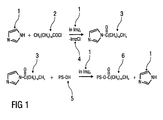
- FIG. 1 shows by way of example two reaction equations describing reactions in the production of a hot-melt adhesive.
- imidazole 1 is melted.
- An acid chloride 2 is added to the molten imidazole 1.
- Imidazolium chloride 4 is released.
- a polysaccharide 5 is added to the molten imidazole 1 with imidazolide 3.
- a stearic acid chloride is used as the acid chloride 2.
- the polysaccharide ester 6 is a polysaccharide stearate.
- other acid chlorides 2 can also be used.
- an acid anhydride and / or a lactone can be used instead of the acid chloride 2.
- the isolated product is washed three times with 200 ml of isopropanol and then dried in vacuo. As polysaccharide ester 6 while 25 g of starch palmitate are obtained. This gives a transparent melt at 160 ° C. Cast into films from it clear, colorless layers.
- Functionalized nanoparticles for modifying at least one property of the polysaccharide ester 6 can be added to the polysaccharide ester 6.
- a color and / or an electrical conductivity of the polysaccharide ester 6 can be modified.
- the electrical conductivity can be designed so that when a voltage is applied, a current flow is established, which heats the adhesive so that it melts to reposition the parts connected by the adhesive or to release their connection.
- the nanoparticles may contain permanent or photochromic switching dyes.
- Photochrom switching dyes change their color under the action of light.
- a coarse powdered polysaccharide polysaccharide ester 6 having a melting point in the range of 90 ° C to 120 ° C with 2% nanoparticles in the form of nanoscale Alumosilikat strictfige with encapsulated photochromic switching dyes by a mechanical grinding / mixing process. Homogenization of the nanoparticles in the now finely powdered matrix of the polysaccharide ester 6 was achieved by the mixing process. This mixture was placed between two glass plates and melted under light pressure of about 0.7 * 10 5 Pa at a temperature of 95 ° C. As a result, a transparent, firmly bonded at normal temperature glass composite was made, which assumes a slight blue color in intense sunlight. By re-heating to above 90 ° C, this glass composite can be dissolved again or the position of the glass plates to each other changed. After re-cooling the hot-melt adhesive, both its optical and mechanical properties are unchanged from the first configuration made.
- polysaccharide 5 As polysaccharide 5 according to the invention at least one substance from the group cellulose, scleroglucan, curdlan, xylan, pullulan, starch, dextran is used.
- the imidazolide 3 can be prepared in situ or in a separate reaction vessel.
Landscapes
- Chemical & Material Sciences (AREA)
- Organic Chemistry (AREA)
- Health & Medical Sciences (AREA)
- Life Sciences & Earth Sciences (AREA)
- Engineering & Computer Science (AREA)
- Biochemistry (AREA)
- Materials Engineering (AREA)
- Chemical Kinetics & Catalysis (AREA)
- Medicinal Chemistry (AREA)
- Polymers & Plastics (AREA)
- Molecular Biology (AREA)
- General Health & Medical Sciences (AREA)
- Adhesives Or Adhesive Processes (AREA)
Description
- Die Erfindung betrifft ein Verfahren zur Herstellung eines heißschmelzbaren Klebers.
- Heißschmelzbare Kleber sind solche Klebstoffe, die im warmen oder heißen Zustand auf zu verbindende Teile aufgetragen werden. Die Teile werden anschließend zusammen gefügt. Beim Abkühlen des heißschmelzbaren Klebers erstarrt dieser und verbindet die Teile miteinander. Unter erneuter Anwendung von Wärme wird der heißschmelzbare Kleber wieder verflüssigt, so dass die Verbindung der Teile lösbar oder ihre Position zueinander veränderbar ist. Stetig steigende Rohstoffpreise für Erdöl bei gleichzeitig abnehmender Verfügbarkeit führen zu steigenden Kosten bei der Herstellung solcher heißschmelzenden Kleber, da deren Hauptbestandteile Erdölprodukte sind.
- Aus der
US 5,434,201 ist ein Verfahren zur Herstellung eines Heißschmelzklebers bekannt, der einen Stärkeester mit einem Substitutionsgrad von 0.3 bis 3.0 sowie einen ausgewählten nichtflüchtigen organischen Weichmacher enthält, wobei der Stärkeester ein wässriges System mit mindestens 40 Gewichts-% Feuchtigkeit ist. Solche Heißschmelzkleber neigen beim Erstarren zu Phasenseparationen. Eine transparente Matrix ist auf diese Weise nicht realisierbar. - Aus NEUMANN U ET AL: "Synthesis of hydrophobic starch esters by reaction of starch with various carboxylic acid imidazolides" STARCH/STAERKE OC-TOBER 2002 WILEY-VCH VERLAG DE, Bd. 54, Nr. 10, Oktober 2002 (2002-10), Seiten 449-453, XP002542839 ist ein Verfahren zur Herstellung von hydrophoben Stärkeestern bekannt.
- Aus HAN ET AL: "Synthesis and anti-hyperlipidemic activity of a novel starch piperinic ester" CARBOHYDRATE POLYMERS, APPLIED SCIENCE PUB-LISHERS, LTD. BARKING, GB, Bd. 71, Nr. 3, 6. Dezember 2007 (2007-12-06), Seiten 441-447, XP022379015 ISSN: 0144-8617 ist die Synthetisierung eines Stärke-Piperin.Esters bekannt.
-
GB 2 291 333 A -
EP 0705 895 A1 offenbart ein Verfahren zum Verkleben von Gewebe oder Vlies zu ähnlichen oder unähnlichen Substraten, umfassend den Schritt des Aufbringens einer geschmolzenen Schmelzkleber-Zusammensetzung auf das Substrat, wobei der Klebstoff 20 bis 60 Gew.% von einem Stärkeester mit mittlerem oder hohem DS mit etwa 2 bis 18 Kohlenstoffatomen in der Ester-Komponente und einem DS (Substitutionsgrad) von etwa 0,3 bis 2,5, 5 bis 40 Gew.% eines polaren Wachses, 5 bis 50 Gew.% eines weichmachenden Verdünnungsmittel, 0 bis 25 Gew.% eines kompatiblen Klebrigmachers und 0 bis 3 Gew.% eines Antioxidans umfasst. -
WO 2005/033243 A1 offenbart einen Schmelzklebstoff, enthaltend A) 20 - 95 Gew.-% mindestens eines Zuckeralkohols und B) 5 - 80 Gew.-% mindestens eines wasserlöslichen oder wasserdispergierbaren Polymeren. Der Schmelzklebstoff ist wasserlöslich und wird zum Verkleben von recyclebaren bzw. mehrfach verwendbaren Materialien verwendet. Insbesondere wird er verwendet zum Verkleben von cellulosehaItigen Materialien, beispielsweise für den Kartonverschluss, zur Herstellung von mehrlagig verklebten Papieren, z. B. Briefumschläge, Tissue, in der Buchbinderei und zur Etikettierung. Der Schmelzklebstoff zeichnet sich dadurch aus, dass er leicht biologisch abbaubar ist und nach Lagerung bei einer Temperatur von 180° Celsius über einen Zeitraum von 3 Stunden eine Farbzahl nach Gardner von kleiner bis gleich 10 aufweist. - Der Erfindung liegt die Aufgabe zu Grunde, ein verbessertes Verfahren zur Herstellung eines heißschmelzbaren Klebers anzugeben.
- Die Aufgabe wird erfindungsgemäß gelöst durch ein Verfahren mit den Merkmalen des Anspruchs 1.
- Vorteilhafte Ausgestaltungen der Erfindung sind Gegenstand der Unteransprüche.
- Der heißschmelzbare Kleber umfasst mindestens einen durch Reaktion eines Polysaccharids mit einem Imidazolid in geschmolzenem Imidazol gewonnenen Polysaccharidester. Erfindungsgemäß wird der heißschmelzbare Kleber mittels eines Verfahrens hergestellt, bei dem Imidazol geschmolzen und ein Säurechlorid und/oder ein Säureanhydrid und/oder ein Lacton in und mit dem geschmolzenen Imidazol zu einem Imidazolid umgesetzt wird. Dem geschmolzenen Imidazol wird mindestens ein Polysaccharid zugesetzt. Das Polysaccharid wird mit dem Imidazolid zu einem Polysaccharidester umgesetzt. Dieser bildet einen transparenten heißschmelzbaren Kleber, der auch nach dem Erstarren transparent bleibt. Mit einem solchen thermoplastischen Kleber lassen sich beispielsweise Glasteile reversibel miteinander verkleben, ohne dass die Transparenz beeinträchtigt wird.
- Der durch das erfindungsgemäße Verfahren hergestellte heißschmelzende Kleber schmilzt in einem großen Temperaturbereich homogen und ergibt eine transparente Schmelze, die beim Erhärten eine optisch völlig transparente Schicht zwischen den zu klebenden Teilen (z.B. Glas) ergibt.
- Die durch das erfindungsgemäße Verfahren erzielten Verbindungen (Polysaccharidester) sind sehr rein, d.h. sie enthalten keine Nebenprodukte und/oder weisen keine Fehlstellen auf, wie das der Fall bei Estern ist, die über andere Verfahren hergestellt werden. Dieser hohe Reinheitsgrad ist der Grund für die hohe Transparenz der Schmelzen.
- Polysaccharide und deren Derivate sind gut geeignet für die Herstellung von Spezialpolymeren, da sie aus nachwachsenden Rohstoffen verfügbar, recycelbar, sehr gut modifizierbar, biokompatibel und strukturbildend sind.
- Das geschmolzene Imidazol dient im erfindungsgemäßen Verfahren nicht nur als Suspensions- und Quellmedium für die Polysaccharide, sondern wird zum Teil mit dem Säurechlorid, Säureanhydrid bzw. Lacton intermediär zu Imidazoliden umgesetzt. Die Imidazolide stellen eine sehr effektive und gleichmäßige Veresterung der Polysaccharide sicher. Der Schmelzpunkt des Polysaccharidesters lässt sich durch die Wahl eines Polymerrückgrats, einer Verzweigungsstruktur, von Substituenten und eines Funktionalisierungsgrades einstellen. Das Polymerrückgrat bezeichnet bei Mehrfachzuckern die Auswahl der Stellen in den Monosacchariden, an denen diese miteinander verbunden sind. Die Verzweigungsstruktur bezeichnet die Belegung von bei der Verbindung der Monosaccharide mit gleichen oder anderen Mono- oder Oligosacchariden freibleibenden Stellen der Grundstruktur des Monosaccharids. Der Funktionalisierungsgrad ist ein Maß dafür, wie viele dieser Stellen mit chemischen Gruppen oder Verbindungen (Substituenten) belegt werden. Mit der Auswahl dieser Parameter lässt sich außer einer Erweichungstemperatur auch die optische Transparenz, eine Viskosität der Schmelze, ein Haftverhalten und ein Suspensionsvermögen für eingebettete Partikel einstellen. Ein so gestalteter heißschmelzender Kleber kann wiederholt aufgeschmolzen werden und erstarren, ohne dass seine mechanischen und optischen Eigenschaften sich ändern.
- In einer bevorzugten Ausführungsform werden dem Polysaccharidester funktionalisierte Nanopartikel zur Modifikation mindestens einer Eigenschaft des Polysaccharidesters zugesetzt. Mit diesen Nanopartikeln kann beispielsweise eine Farbe und/oder eine elektrische Leitfähigkeit des Polysaccharidesters modifiziert werden. Die elektrische Leitfähigkeit kann dabei so gestaltet werden, dass bei Anlegen einer Spannung ein Stromfluss zustande kommt, der den Kleber so erwärmt, dass dieser schmilzt, um die miteinander verbundenen Teile zu repositionieren oder ihre Verbindung zu lösen.
- Die Nanopartikel können permanente oder photochrom schaltende Farbstoffe enthalten. Photochrom schaltende Farbstoffe ändern ihre Farbe unter Einwirkung von Licht.
- In einer besonders bevorzugten Ausführungsform des Verfahrens wird der Polysaccharidester durch Waschen mit Isopropanol isoliert, insbesondere nach dem Abkühlen der Reaktionsmischung. Das Isopropanol wird anschließend abgezogen, beispielsweise mittels Erwärmen und Vakuum, und mit ethanolischer Natronlauge gewaschen, wodurch das Imidazol regeneriert wird. Damit steht es als Reaktionsmedium anschließend wieder zur Verfügung.
- Als Polysaccharid kommt erfindungsgemäß mindestens ein Stoff aus der Gruppe Cellulose, Scleroglucan, Curdlan, Xylan, Pullulan, Stärke, Dextran zum Einsatz. Diese Stoffe lassen sich bei Temperaturen von mehr als 90° C in geschmolzenem Imidazol ohne erkennbaren Abbau suspendieren. In den entstehenden Schmelzen können die Polysaccharide direkt zu den entsprechenden Derivaten umgesetzt werden. Als Derivate kommen dabei aromatische ungesättigte und aliphatische Ester, vorzugsweise Fettsäureester (Carbonsäuren mit Kettenlängen von vier bis 18 Kohlenstoffatomen) in Frage. Das Imidazolid kann in situ oder in einem separaten Reaktionsgefäß hergestellt werden. Die Regeneration des Imidazols wird durch die Herstellung der reaktiven Imidazolide direkt in der Schmelze ohne Isolierung (in situ) stark begünstigt. Zudem erhöht sich die Effektivität des Verfahrens durch die in-situ-Herstellung des Imidazolids.
- Beim Einsatz von Dextran ergeben sich Dextranester mit Schmelzpunkten in einem Bereich von 40° C bis 70° C. Mit Stärke entstehen entsprechende Stärkederivate mit Schmelzpunkten im Bereich von 160° C bis 280° C.
- In einer besonders bevorzugten Ausführungsform umfasst der Kleber genau einen Polysaccharidester, das heißt, es wird genau ein Polysaccharid zu genau einem Polysaccharidester umgesetzt. Insbesondere enthält der Kleber keine flüchtigen Beimengungen, da diese das homogene Aufschmelzen behindern können. Außerdem können flüchtige Bestandteile im Kleber durch Sonneneinstrahlung freigesetzt werden, womit die Stabilität des Komposits gefährdet wäre. Daher ist der Schmelzkleber vorzugsweise eine einzige polymere Substanz und kein Gemisch oder feuchter Stoff oder anderweitig verunreinigter Stoff.
- Die kennzeichnenden Merkmale der Ansprüche 2 bis 8 sind auch mit anders hergestellten und/oder anders zusammengesetzten heißschmelzbaren Klebern kombinierbar.
- Ausführungsbeispiele der Erfindung werden im Folgenden anhand einer Zeichnung näher erläutert.
- Darin zeigt:
- Figur 1
- Reaktionsgleichungen für die Herstellung eines heißschmelzenden Klebers.
-
Figur 1 zeigt beispielhaft zwei Reaktionsgleichungen, die Reaktionen bei der Herstellung eines heißschmelzenden Klebers beschreiben. Dabei wird zunächst Imidazol 1 geschmolzen. Dem geschmolzenen Imidazol 1 wird ein Säurechlorid 2 zugegeben. Dabei entsteht ein Imidazolid 3. Imidazoliumchlorid 4 wird frei. Dem geschmolzenen Imidazol 1 mit dem Imidazolid 3 wird ein Polysaccharid 5 zugesetzt. Dabei entsteht ein Polysaccharidester 6 während Imidazol 1 regeneriert wird. Exemplarisch wird als Säurechlorid 2 ein Stearinsäurechlorid verwendet. Dementsprechend ist der Polysaccharidester 6 ein Polysaccharidstearat. Es können jedoch auch andere Säurechloride 2 verwendet werden. - Statt des Säurechlorids 2 kann ein Säureanhydrid und/oder ein Lacton verwendet werden.
- In einem weiteren, nicht illustrierten Ausführungsbeispiel des Verfahrens zur Herstellung des heißschmelzenden Klebers werden 45 g Imidazol 1 bei einer Temperatur von 90° C bis 95° C aufgeschmolzen. Zum geschmolzenen Imidazol 1 werden als Polysaccharid 5 fünf Gramm Kartoffelstärke gegeben. Die Schmelze wird etwa zwei Stunden lang auf dieser Temperatur gehalten. Danach wird als Säurechlorid 2 eine Menge von 93,6 ml Palmitoylchlorid zugesetzt. Nach weiteren 24 Stunden bei der angegebenen Temperatur wird die Wärmezufuhr gestoppt, so dass die Schmelze langsam abkühlt. Danach werden 500 ml Isopropanol zugesetzt. Die entstehende Mischung wird in 1 l Isopropanol überführt. Das dabei isolierte Produkt wird dreimal mit je 200 ml Isopropanol gewaschen und anschließend im Vakuum getrocknet. Als Polysaccharidester 6 werden dabei 25 g Stärkepalmitat erhalten. Dieses ergibt bei 160° C eine transparente Schmelze. Zu Filmen gegossen werden daraus klare, farblose Schichten.
- Dem Polysaccharidester 6 können funktionalisierte Nanopartikel zur Modifikation mindestens einer Eigenschaft des Polysaccharidesters 6 zugesetzt werden. Mit diesen Nanopartikeln kann beispielsweise eine Farbe und/oder eine elektrische Leitfähigkeit des Polysaccharidesters 6 modifiziert werden. Die elektrische Leitfähigkeit kann dabei so gestaltet werden, dass bei Anlegen einer Spannung ein Stromfluss zustande kommt, der den Kleber so erwärmt, dass dieser schmilzt, um durch den Kleber miteinander verbundene Teile zu repositionieren oder ihre Verbindung zu lösen.
- Die Nanopartikel können permanente oder photochrom schaltende Farbstoffe enthalten. Photochrom schaltende Farbstoffe ändern ihre Farbe unter Einwirkung von Licht.
- In einem nicht illustrierten Ausführungsbeispiel wurde ein grobpulvriger thermoplastischer Polysaccharidester 6 mit einem Schmelzpunkt in einem Bereich von 90° C bis 120° C mit 2% Nanopartikeln in Form nanoskaliger Alumosilikatkäfige mit darin verkapselten photochrom schaltenden Farbstoffen durch ein mechanisches Mahl-/Mischverfahren versetzt. Durch das Mischverfahren wurde eine Homogenisierung der Nanopartikel in der nun feinpulvrigen Matrix des Polysaccharidesters 6 erzielt. Diese Mischung wurde zwischen zwei Glasplatten verbracht und unter leichtem Druck von etwa 0,7 * 105 Pa bei einer Temperatur von 95° C geschmolzen. Dadurch wurde ein transparenter, bei Normaltemperatur fest haftender Glasverbund hergestellt, welcher bei intensiver Sonnenstrahlung eine leichte Blaufärbung annimmt. Durch erneutes Erwärmen auf über 90° C kann dieser Glasverbund wieder gelöst oder die Position der Glasplatten zueinander verändert werden. Nach dem erneuten Abkühlen des heißschmelzbaren Klebers sind sowohl seine optischen als auch mechanischen Eigenschaften unverändert gegenüber der ersten hergestellten Konfiguration.
- Als Polysaccharid 5 kommt erfindungsgemäß mindestens ein Stoff aus der Gruppe Cellulose, Scleroglucan, Curdlan, Xylan, Pullulan, Stärke, Dextran zum Einsatz.
- Das Imidazolid 3 kann in situ oder in einem separaten Reaktionsgefäß hergestellt werden.
- Anstatt Isopropanol kann im dargestellten Ausführungsbeispiel auch ein anderes organisches Lösungsmittel verwendet werden.
-
- 1
- Imidazol
- 2
- Säurechlorid
- 3
- Imidazolid
- 4
- Imidazoliumchlorid
- 5
- Polysaccharid
- 6
- Polysaccharidester
Claims (8)
- Verfahren zur Herstellung eines heißschmelzbaren Klebers, wobei ein Säurechlorid (2) und/oder ein Säureanhydrid und/oder ein Lacton in Imidazol (1) zu einem Imidazolid (3) umgesetzt wird, wobei dem Imidazol (1) mit dem Imidazolid (3) mindestens ein Polysaccharid (5) aus der Gruppe Cellulose, Scleroglucan, Curdlan, Xylan, Pullulan, Stärke, Dextran zugesetzt wird, wobei das Polysaccharid (5) mit dem Imidazolid (3) zu einem Polysaccharidester (6) umgesetzt wird,
dadurch gekennzeichnet, dass zuerst das Imidazol (1) geschmolzen wird, wobei die Bildung des Imidazolids (3) in-situ direkt in der Schmelze ohne Isolierung erfolgt, wobei auch die Umsetzung des Polysaccharids (5) im geschmolzenen Imidazol (1) als Suspensions- und Quellmedium durchgeführt wird. - Verfahren nach Anspruch 1, dadurch gekennzeichnet, dass funktionalisierte Nanopartikel zur Modifikation mindestens einer Eigenschaft des heißschmelzbaren Klebers zugegeben werden.
- Verfahren nach Anspruch 2, dadurch gekennzeichnet, dass durch die Nanopartikel eine Farbe des heißschmelzbaren Klebers modifiziert wird.
- Verfahren nach Anspruch 3, dadurch gekennzeichnet, dass Nanopartikel mit photochrom schaltenden Farbstoffen verwendet werden.
- Verfahren nach einem der Ansprüche 2 bis 4, dadurch gekennzeichnet, dass durch die Nanopartikel eine elektrische Leitfähigkeit des heißschmelzbaren Klebers modifiziert wird.
- Verfahren nach Anspruch 5, dadurch gekennzeichnet, dass die Leitfähigkeit so modifiziert wird, dass der heißschmelzbare Kleber durch Anlegen einer Spannung erwärmbar und schmelzbar wird.
- Verfahren nach einem der Ansprüche 1 bis 6, dadurch gekennzeichnet, dass der Polysaccharidester (6) durch Waschen mit Isopropanol isoliert wird, wobei das Isopropanol abgezogen und mit ethanolischer Natronlauge gewaschen wird, wodurch das Imidazol (1) regeneriert wird.
- Verfahren nach einem der vorhergehenden Ansprüche, dadurch gekennzeichnet, dass genau ein Polysaccharid zu genau einem Polysaccharidester umgesetzt wird.
Applications Claiming Priority (2)
| Application Number | Priority Date | Filing Date | Title |
|---|---|---|---|
| DE102008024089A DE102008024089B4 (de) | 2008-05-17 | 2008-05-17 | Verfahren zur Herstellung eines Klebers und Verwendung eines Polysaccharidesters |
| PCT/EP2009/055873 WO2009141267A1 (de) | 2008-05-17 | 2009-05-14 | Heissschmelzbarer kleber und verfahren zu dessen herstellung |
Publications (2)
| Publication Number | Publication Date |
|---|---|
| EP2288669A1 EP2288669A1 (de) | 2011-03-02 |
| EP2288669B1 true EP2288669B1 (de) | 2016-01-06 |
Family
ID=40957981
Family Applications (1)
| Application Number | Title | Priority Date | Filing Date |
|---|---|---|---|
| EP09749757.2A Not-in-force EP2288669B1 (de) | 2008-05-17 | 2009-05-14 | Verfahren zur herstellung eines heissschmelzbaren kleber |
Country Status (4)
| Country | Link |
|---|---|
| US (1) | US8277554B2 (de) |
| EP (1) | EP2288669B1 (de) |
| DE (1) | DE102008024089B4 (de) |
| WO (1) | WO2009141267A1 (de) |
Families Citing this family (8)
| Publication number | Priority date | Publication date | Assignee | Title |
|---|---|---|---|---|
| DE102009022805B4 (de) * | 2009-05-27 | 2013-04-25 | Fraunhofer-Gesellschaft zur Förderung der angewandten Forschung e.V. | Verfahren zur Herstellung von Polysaccharidestern oder Polysaccharidmischestern |
| DE102011005849B4 (de) | 2011-03-21 | 2015-06-03 | Innovent E.V. | Verfahren zur Herstellung eines Klebers, Kleber und dessen Verwendung |
| DE102017126340A1 (de) * | 2017-11-10 | 2019-05-16 | Innovent E.V. | Oberflächenbeschichtungszusammensetzung, verfahren zu ihrer herstellung und ihre verwendung |
| EP3914384B1 (de) | 2019-01-25 | 2024-12-11 | Nouryon Chemicals International B.V. | Kugelförmige kapseln auf dialkoholzellulosebasis |
| DE102020206231B4 (de) | 2020-05-18 | 2022-07-21 | Verein zur Förderung von Innovationen durch Forschung, Entwicklung und Technologietransfer e.V. (Verein INNOVENT e.V.) | Verfahren zur Beschichtung einer Oberfläche eines Substrats |
| DE102022117375A1 (de) | 2022-07-12 | 2024-01-18 | Robert Boyle - Thüringisches Institut für BioWasserstoff- und Umweltforschung e.V. | Verfahren zur Herstellung von thermoplastischen Polysaccharidestern |
| CN117136947B (zh) * | 2023-08-15 | 2026-01-09 | 江西众和化工有限公司 | 一种多种农药种子悬浮剂及其制备方法 |
| GB2635366A (en) * | 2023-11-10 | 2025-05-14 | Kelp Ind Ltd | Esterification method |
Family Cites Families (11)
| Publication number | Priority date | Publication date | Assignee | Title |
|---|---|---|---|---|
| DE1593152A1 (de) * | 1966-05-07 | 1970-07-16 | Nordmark Werke Gmbh | N-Desulfo-N-acyl-heparine und Verfahren zu ihrer Herstellung |
| US3720663A (en) * | 1971-06-24 | 1973-03-13 | Nat Starch Chem Corp | Preparation of starch esters |
| US4020272A (en) * | 1975-12-22 | 1977-04-26 | National Starch And Chemical Corporation | Preparation of starch esters |
| US4626288A (en) * | 1985-01-10 | 1986-12-02 | National Starch And Chemical Corporation | Starch derivatives forming reversible gels |
| US5360845A (en) * | 1992-12-23 | 1994-11-01 | National Starch And Chemical Investment Holding Corporation | Starch ester based hot melt adhesive |
| US5498224A (en) | 1994-07-20 | 1996-03-12 | National Starch And Chemical Investment Holding Corporation | Starch based hot melt adhesives for cigarettes |
| US5434201A (en) | 1994-07-29 | 1995-07-18 | National Starch And Chemical Investment Holding Corporation | Process for production of starch based hot melt adhesives |
| CA2159520A1 (en) | 1994-10-05 | 1996-04-06 | Martin Riswick | Starch based hot melt adhesives for nonwoven applications |
| DE19954960A1 (de) * | 1998-12-09 | 2000-06-15 | Henkel Kgaa | Klebstoff mit magnetischen Nanopartikeln |
| DE10344126A1 (de) | 2003-09-24 | 2005-04-21 | Henkel Kgaa | Wasserlöslicher Schmelzklebstoff |
| DE102009022805B4 (de) * | 2009-05-27 | 2013-04-25 | Fraunhofer-Gesellschaft zur Förderung der angewandten Forschung e.V. | Verfahren zur Herstellung von Polysaccharidestern oder Polysaccharidmischestern |
-
2008
- 2008-05-17 DE DE102008024089A patent/DE102008024089B4/de not_active Expired - Fee Related
-
2009
- 2009-05-14 WO PCT/EP2009/055873 patent/WO2009141267A1/de not_active Ceased
- 2009-05-14 EP EP09749757.2A patent/EP2288669B1/de not_active Not-in-force
-
2010
- 2010-11-16 US US12/947,337 patent/US8277554B2/en not_active Expired - Fee Related
Also Published As
| Publication number | Publication date |
|---|---|
| US8277554B2 (en) | 2012-10-02 |
| US20110180760A1 (en) | 2011-07-28 |
| DE102008024089A1 (de) | 2009-11-19 |
| EP2288669A1 (de) | 2011-03-02 |
| WO2009141267A1 (de) | 2009-11-26 |
| DE102008024089B4 (de) | 2011-09-22 |
Similar Documents
| Publication | Publication Date | Title |
|---|---|---|
| DE102008024089B4 (de) | Verfahren zur Herstellung eines Klebers und Verwendung eines Polysaccharidesters | |
| DE69317635T2 (de) | Schmelzklebstoffzusammensetzung auf der Basis von Stärke | |
| DE69405606T2 (de) | Verbesserter Heizschmelzkleber | |
| DE68914994T2 (de) | Heissschmelzklebemittelzusammensetzung. | |
| DE69220052T2 (de) | Klebehilfsmittel auf basis von säuremodifiziertem polyalkohol-kollophoniumester und schmelzklebemassen enthaltend dieselbe | |
| EP2225410B1 (de) | Verfahren zur herstellung von cellulosischen formkörpern, cellulosischer formkörper und dessen verwendung | |
| DE69203713T2 (de) | Schmelzkleber auf Basis von Polyhydroxybutyrat/Hydroxyvalerat. | |
| DE69602035T2 (de) | Schmelzkleber mit niedriger Anwendungstemperatur | |
| DE68916556T2 (de) | Verfahren zur Herstellung von destrukturierter Stärke. | |
| EP3221411B1 (de) | Modifizierte schichtsilikate zur steuerung der abrollkraft von haftklebemassen und verbesserung der barriereeigenschaften von klebebändern | |
| EP2898041B1 (de) | Thermochromes material, dieses enthaltende formkörper und deren verwendung | |
| WO2003016359A2 (de) | Teilvernetzter polyvinylalkohol | |
| DE2029708B2 (de) | Schmelzklebstoffmasse auf Basis von synthetischen Polymeren und einer Silanverbindung | |
| EP1282663A1 (de) | GEL AUS EINEM POLY-$g(a)-1,4-GLUCAN UND STÄRKE | |
| DE602004010591T2 (de) | Heissschmelzklebstoffzusammensetzung | |
| EP2794794B1 (de) | Reaktiver polyolefin-schmelzklebstoff mit niedriger viskosität und dessen verwendung für textilkaschierungen | |
| CN100350011C (zh) | 有机化蒙脱土改性乙烯-醋酸乙烯热熔胶粘剂的一步制备法 | |
| WO2018193094A1 (de) | Regenerierbare superhydrophobe beschichtung | |
| EP0771329A1 (de) | Vinylalkoholcopolymere, diese enthaltende wasserlösliche filme sowie deren verwendung als verpackungsmaterial | |
| DE69519138T2 (de) | Verfahren zur Herstellung von Schmelzklebstoffen auf Basis von Stärke | |
| US2402903A (en) | Process for coating sheet materials | |
| WO1992010537A1 (de) | Lyo-gel, seine herstellung und verwendung zum dichten | |
| DE102011005849B4 (de) | Verfahren zur Herstellung eines Klebers, Kleber und dessen Verwendung | |
| DE19523511C1 (de) | Wäßrige Dispersionen, Verfahren zu ihrer Herstellung und ihre Verwendung | |
| DE3636023A1 (de) | Thermoplastisches polymer |
Legal Events
| Date | Code | Title | Description |
|---|---|---|---|
| PUAI | Public reference made under article 153(3) epc to a published international application that has entered the european phase |
Free format text: ORIGINAL CODE: 0009012 |
|
| 17P | Request for examination filed |
Effective date: 20101217 |
|
| AK | Designated contracting states |
Kind code of ref document: A1 Designated state(s): AT BE BG CH CY CZ DE DK EE ES FI FR GB GR HR HU IE IS IT LI LT LU LV MC MK MT NL NO PL PT RO SE SI SK TR |
|
| AX | Request for extension of the european patent |
Extension state: AL BA RS |
|
| DAX | Request for extension of the european patent (deleted) | ||
| 17Q | First examination report despatched |
Effective date: 20130529 |
|
| GRAP | Despatch of communication of intention to grant a patent |
Free format text: ORIGINAL CODE: EPIDOSNIGR1 |
|
| INTG | Intention to grant announced |
Effective date: 20150723 |
|
| GRAS | Grant fee paid |
Free format text: ORIGINAL CODE: EPIDOSNIGR3 |
|
| GRAA | (expected) grant |
Free format text: ORIGINAL CODE: 0009210 |
|
| AK | Designated contracting states |
Kind code of ref document: B1 Designated state(s): AT BE BG CH CY CZ DE DK EE ES FI FR GB GR HR HU IE IS IT LI LT LU LV MC MK MT NL NO PL PT RO SE SI SK TR |
|
| REG | Reference to a national code |
Ref country code: GB Ref legal event code: FG4D Free format text: NOT ENGLISH |
|
| REG | Reference to a national code |
Ref country code: CH Ref legal event code: EP |
|
| REG | Reference to a national code |
Ref country code: IE Ref legal event code: FG4D Free format text: LANGUAGE OF EP DOCUMENT: GERMAN |
|
| REG | Reference to a national code |
Ref country code: AT Ref legal event code: REF Ref document number: 768862 Country of ref document: AT Kind code of ref document: T Effective date: 20160215 |
|
| REG | Reference to a national code |
Ref country code: DE Ref legal event code: R096 Ref document number: 502009011998 Country of ref document: DE |
|
| REG | Reference to a national code |
Ref country code: NL Ref legal event code: FP |
|
| REG | Reference to a national code |
Ref country code: LT Ref legal event code: MG4D |
|
| REG | Reference to a national code |
Ref country code: FR Ref legal event code: PLFP Year of fee payment: 8 |
|
| PG25 | Lapsed in a contracting state [announced via postgrant information from national office to epo] |
Ref country code: FI Free format text: LAPSE BECAUSE OF FAILURE TO SUBMIT A TRANSLATION OF THE DESCRIPTION OR TO PAY THE FEE WITHIN THE PRESCRIBED TIME-LIMIT Effective date: 20160106 Ref country code: ES Free format text: LAPSE BECAUSE OF FAILURE TO SUBMIT A TRANSLATION OF THE DESCRIPTION OR TO PAY THE FEE WITHIN THE PRESCRIBED TIME-LIMIT Effective date: 20160106 Ref country code: NO Free format text: LAPSE BECAUSE OF FAILURE TO SUBMIT A TRANSLATION OF THE DESCRIPTION OR TO PAY THE FEE WITHIN THE PRESCRIBED TIME-LIMIT Effective date: 20160406 Ref country code: HR Free format text: LAPSE BECAUSE OF FAILURE TO SUBMIT A TRANSLATION OF THE DESCRIPTION OR TO PAY THE FEE WITHIN THE PRESCRIBED TIME-LIMIT Effective date: 20160106 Ref country code: GR Free format text: LAPSE BECAUSE OF FAILURE TO SUBMIT A TRANSLATION OF THE DESCRIPTION OR TO PAY THE FEE WITHIN THE PRESCRIBED TIME-LIMIT Effective date: 20160407 Ref country code: IT Free format text: LAPSE BECAUSE OF FAILURE TO SUBMIT A TRANSLATION OF THE DESCRIPTION OR TO PAY THE FEE WITHIN THE PRESCRIBED TIME-LIMIT Effective date: 20160106 |
|
| PG25 | Lapsed in a contracting state [announced via postgrant information from national office to epo] |
Ref country code: BE Free format text: LAPSE BECAUSE OF NON-PAYMENT OF DUE FEES Effective date: 20160531 Ref country code: LT Free format text: LAPSE BECAUSE OF FAILURE TO SUBMIT A TRANSLATION OF THE DESCRIPTION OR TO PAY THE FEE WITHIN THE PRESCRIBED TIME-LIMIT Effective date: 20160106 Ref country code: LV Free format text: LAPSE BECAUSE OF FAILURE TO SUBMIT A TRANSLATION OF THE DESCRIPTION OR TO PAY THE FEE WITHIN THE PRESCRIBED TIME-LIMIT Effective date: 20160106 Ref country code: IS Free format text: LAPSE BECAUSE OF FAILURE TO SUBMIT A TRANSLATION OF THE DESCRIPTION OR TO PAY THE FEE WITHIN THE PRESCRIBED TIME-LIMIT Effective date: 20160506 Ref country code: SE Free format text: LAPSE BECAUSE OF FAILURE TO SUBMIT A TRANSLATION OF THE DESCRIPTION OR TO PAY THE FEE WITHIN THE PRESCRIBED TIME-LIMIT Effective date: 20160106 Ref country code: PL Free format text: LAPSE BECAUSE OF FAILURE TO SUBMIT A TRANSLATION OF THE DESCRIPTION OR TO PAY THE FEE WITHIN THE PRESCRIBED TIME-LIMIT Effective date: 20160106 Ref country code: PT Free format text: LAPSE BECAUSE OF FAILURE TO SUBMIT A TRANSLATION OF THE DESCRIPTION OR TO PAY THE FEE WITHIN THE PRESCRIBED TIME-LIMIT Effective date: 20160506 |
|
| REG | Reference to a national code |
Ref country code: DE Ref legal event code: R097 Ref document number: 502009011998 Country of ref document: DE |
|
| PG25 | Lapsed in a contracting state [announced via postgrant information from national office to epo] |
Ref country code: DK Free format text: LAPSE BECAUSE OF FAILURE TO SUBMIT A TRANSLATION OF THE DESCRIPTION OR TO PAY THE FEE WITHIN THE PRESCRIBED TIME-LIMIT Effective date: 20160106 Ref country code: EE Free format text: LAPSE BECAUSE OF FAILURE TO SUBMIT A TRANSLATION OF THE DESCRIPTION OR TO PAY THE FEE WITHIN THE PRESCRIBED TIME-LIMIT Effective date: 20160106 |
|
| PLBE | No opposition filed within time limit |
Free format text: ORIGINAL CODE: 0009261 |
|
| STAA | Information on the status of an ep patent application or granted ep patent |
Free format text: STATUS: NO OPPOSITION FILED WITHIN TIME LIMIT |
|
| PG25 | Lapsed in a contracting state [announced via postgrant information from national office to epo] |
Ref country code: RO Free format text: LAPSE BECAUSE OF FAILURE TO SUBMIT A TRANSLATION OF THE DESCRIPTION OR TO PAY THE FEE WITHIN THE PRESCRIBED TIME-LIMIT Effective date: 20160106 Ref country code: CZ Free format text: LAPSE BECAUSE OF FAILURE TO SUBMIT A TRANSLATION OF THE DESCRIPTION OR TO PAY THE FEE WITHIN THE PRESCRIBED TIME-LIMIT Effective date: 20160106 Ref country code: SK Free format text: LAPSE BECAUSE OF FAILURE TO SUBMIT A TRANSLATION OF THE DESCRIPTION OR TO PAY THE FEE WITHIN THE PRESCRIBED TIME-LIMIT Effective date: 20160106 |
|
| REG | Reference to a national code |
Ref country code: DE Ref legal event code: R119 Ref document number: 502009011998 Country of ref document: DE |
|
| 26N | No opposition filed |
Effective date: 20161007 |
|
| PG25 | Lapsed in a contracting state [announced via postgrant information from national office to epo] |
Ref country code: LU Free format text: LAPSE BECAUSE OF FAILURE TO SUBMIT A TRANSLATION OF THE DESCRIPTION OR TO PAY THE FEE WITHIN THE PRESCRIBED TIME-LIMIT Effective date: 20160514 |
|
| REG | Reference to a national code |
Ref country code: IE Ref legal event code: MM4A |
|
| PG25 | Lapsed in a contracting state [announced via postgrant information from national office to epo] |
Ref country code: SI Free format text: LAPSE BECAUSE OF FAILURE TO SUBMIT A TRANSLATION OF THE DESCRIPTION OR TO PAY THE FEE WITHIN THE PRESCRIBED TIME-LIMIT Effective date: 20160106 Ref country code: BG Free format text: LAPSE BECAUSE OF FAILURE TO SUBMIT A TRANSLATION OF THE DESCRIPTION OR TO PAY THE FEE WITHIN THE PRESCRIBED TIME-LIMIT Effective date: 20160406 |
|
| PG25 | Lapsed in a contracting state [announced via postgrant information from national office to epo] |
Ref country code: DE Free format text: LAPSE BECAUSE OF NON-PAYMENT OF DUE FEES Effective date: 20161201 |
|
| REG | Reference to a national code |
Ref country code: FR Ref legal event code: PLFP Year of fee payment: 9 |
|
| PG25 | Lapsed in a contracting state [announced via postgrant information from national office to epo] |
Ref country code: IE Free format text: LAPSE BECAUSE OF NON-PAYMENT OF DUE FEES Effective date: 20160514 |
|
| REG | Reference to a national code |
Ref country code: FR Ref legal event code: PLFP Year of fee payment: 10 |
|
| PG25 | Lapsed in a contracting state [announced via postgrant information from national office to epo] |
Ref country code: CY Free format text: LAPSE BECAUSE OF FAILURE TO SUBMIT A TRANSLATION OF THE DESCRIPTION OR TO PAY THE FEE WITHIN THE PRESCRIBED TIME-LIMIT Effective date: 20160106 Ref country code: HU Free format text: LAPSE BECAUSE OF FAILURE TO SUBMIT A TRANSLATION OF THE DESCRIPTION OR TO PAY THE FEE WITHIN THE PRESCRIBED TIME-LIMIT; INVALID AB INITIO Effective date: 20090514 |
|
| PG25 | Lapsed in a contracting state [announced via postgrant information from national office to epo] |
Ref country code: MK Free format text: LAPSE BECAUSE OF FAILURE TO SUBMIT A TRANSLATION OF THE DESCRIPTION OR TO PAY THE FEE WITHIN THE PRESCRIBED TIME-LIMIT Effective date: 20160106 Ref country code: MC Free format text: LAPSE BECAUSE OF FAILURE TO SUBMIT A TRANSLATION OF THE DESCRIPTION OR TO PAY THE FEE WITHIN THE PRESCRIBED TIME-LIMIT Effective date: 20160106 Ref country code: MT Free format text: LAPSE BECAUSE OF FAILURE TO SUBMIT A TRANSLATION OF THE DESCRIPTION OR TO PAY THE FEE WITHIN THE PRESCRIBED TIME-LIMIT Effective date: 20160106 Ref country code: TR Free format text: LAPSE BECAUSE OF FAILURE TO SUBMIT A TRANSLATION OF THE DESCRIPTION OR TO PAY THE FEE WITHIN THE PRESCRIBED TIME-LIMIT Effective date: 20160106 |
|
| PGFP | Annual fee paid to national office [announced via postgrant information from national office to epo] |
Ref country code: NL Payment date: 20200518 Year of fee payment: 12 Ref country code: FR Payment date: 20200519 Year of fee payment: 12 |
|
| PGFP | Annual fee paid to national office [announced via postgrant information from national office to epo] |
Ref country code: GB Payment date: 20200522 Year of fee payment: 12 |
|
| REG | Reference to a national code |
Ref country code: NL Ref legal event code: MM Effective date: 20210601 |
|
| GBPC | Gb: european patent ceased through non-payment of renewal fee |
Effective date: 20210514 |
|
| PG25 | Lapsed in a contracting state [announced via postgrant information from national office to epo] |
Ref country code: GB Free format text: LAPSE BECAUSE OF NON-PAYMENT OF DUE FEES Effective date: 20210514 |
|
| PG25 | Lapsed in a contracting state [announced via postgrant information from national office to epo] |
Ref country code: NL Free format text: LAPSE BECAUSE OF NON-PAYMENT OF DUE FEES Effective date: 20210601 Ref country code: FR Free format text: LAPSE BECAUSE OF NON-PAYMENT OF DUE FEES Effective date: 20210531 |
|
| PGFP | Annual fee paid to national office [announced via postgrant information from national office to epo] |
Ref country code: CH Payment date: 20220523 Year of fee payment: 14 Ref country code: AT Payment date: 20220517 Year of fee payment: 14 |
|
| REG | Reference to a national code |
Ref country code: CH Ref legal event code: PL |
|
| REG | Reference to a national code |
Ref country code: AT Ref legal event code: MM01 Ref document number: 768862 Country of ref document: AT Kind code of ref document: T Effective date: 20230514 |
|
| PG25 | Lapsed in a contracting state [announced via postgrant information from national office to epo] |
Ref country code: LI Free format text: LAPSE BECAUSE OF NON-PAYMENT OF DUE FEES Effective date: 20230531 Ref country code: CH Free format text: LAPSE BECAUSE OF NON-PAYMENT OF DUE FEES Effective date: 20230531 Ref country code: AT Free format text: LAPSE BECAUSE OF NON-PAYMENT OF DUE FEES Effective date: 20230514 |