EP2278298A1 - Quarzoszillator und messverfahren damit - Google Patents
Quarzoszillator und messverfahren damit Download PDFInfo
- Publication number
- EP2278298A1 EP2278298A1 EP09746624A EP09746624A EP2278298A1 EP 2278298 A1 EP2278298 A1 EP 2278298A1 EP 09746624 A EP09746624 A EP 09746624A EP 09746624 A EP09746624 A EP 09746624A EP 2278298 A1 EP2278298 A1 EP 2278298A1
- Authority
- EP
- European Patent Office
- Prior art keywords
- crystal oscillator
- frequency
- frequencies
- measured
- density
- Prior art date
- Legal status (The legal status is an assumption and is not a legal conclusion. Google has not performed a legal analysis and makes no representation as to the accuracy of the status listed.)
- Withdrawn
Links
- 238000000691 measurement method Methods 0.000 title claims abstract description 8
- 239000010453 quartz Substances 0.000 title 1
- VYPSYNLAJGMNEJ-UHFFFAOYSA-N silicon dioxide Inorganic materials O=[Si]=O VYPSYNLAJGMNEJ-UHFFFAOYSA-N 0.000 title 1
- 239000013078 crystal Substances 0.000 claims abstract description 77
- 239000000463 material Substances 0.000 claims abstract description 27
- 238000005259 measurement Methods 0.000 claims description 23
- 238000000034 method Methods 0.000 claims description 17
- 238000010586 diagram Methods 0.000 claims description 13
- 239000000243 solution Substances 0.000 description 52
- PEDCQBHIVMGVHV-UHFFFAOYSA-N Glycerine Chemical compound OCC(O)CO PEDCQBHIVMGVHV-UHFFFAOYSA-N 0.000 description 15
- 238000003380 quartz crystal microbalance Methods 0.000 description 9
- PCHJSUWPFVWCPO-UHFFFAOYSA-N gold Chemical compound [Au] PCHJSUWPFVWCPO-UHFFFAOYSA-N 0.000 description 4
- 239000010931 gold Substances 0.000 description 4
- 229910052737 gold Inorganic materials 0.000 description 4
- 239000007788 liquid Substances 0.000 description 4
- 230000010355 oscillation Effects 0.000 description 4
- 239000008367 deionised water Substances 0.000 description 3
- 229910021641 deionized water Inorganic materials 0.000 description 3
- 239000007792 gaseous phase Substances 0.000 description 3
- XLYOFNOQVPJJNP-UHFFFAOYSA-N water Chemical compound O XLYOFNOQVPJJNP-UHFFFAOYSA-N 0.000 description 3
- 239000007864 aqueous solution Substances 0.000 description 2
- 238000010408 sweeping Methods 0.000 description 2
- XAGFODPZIPBFFR-UHFFFAOYSA-N aluminium Chemical compound [Al] XAGFODPZIPBFFR-UHFFFAOYSA-N 0.000 description 1
- 229910052782 aluminium Inorganic materials 0.000 description 1
- 239000012620 biological material Substances 0.000 description 1
- 238000006243 chemical reaction Methods 0.000 description 1
- 238000001739 density measurement Methods 0.000 description 1
- 238000000151 deposition Methods 0.000 description 1
- 238000001514 detection method Methods 0.000 description 1
- 239000007789 gas Substances 0.000 description 1
- 230000003993 interaction Effects 0.000 description 1
- 239000007791 liquid phase Substances 0.000 description 1
- 238000004519 manufacturing process Methods 0.000 description 1
- 238000005498 polishing Methods 0.000 description 1
- 238000002360 preparation method Methods 0.000 description 1
- 102000004169 proteins and genes Human genes 0.000 description 1
- 108090000623 proteins and genes Proteins 0.000 description 1
- 238000002494 quartz crystal microgravimetry Methods 0.000 description 1
- 230000035945 sensitivity Effects 0.000 description 1
- 238000004544 sputter deposition Methods 0.000 description 1
- 239000012086 standard solution Substances 0.000 description 1
- 238000003756 stirring Methods 0.000 description 1
- 239000000126 substance Substances 0.000 description 1
- 238000007740 vapor deposition Methods 0.000 description 1
Images

Classifications
-
- G—PHYSICS
- G01—MEASURING; TESTING
- G01N—INVESTIGATING OR ANALYSING MATERIALS BY DETERMINING THEIR CHEMICAL OR PHYSICAL PROPERTIES
- G01N11/00—Investigating flow properties of materials, e.g. viscosity, plasticity; Analysing materials by determining flow properties
- G01N11/10—Investigating flow properties of materials, e.g. viscosity, plasticity; Analysing materials by determining flow properties by moving a body within the material
- G01N11/16—Investigating flow properties of materials, e.g. viscosity, plasticity; Analysing materials by determining flow properties by moving a body within the material by measuring damping effect upon oscillatory body
-
- G—PHYSICS
- G01—MEASURING; TESTING
- G01N—INVESTIGATING OR ANALYSING MATERIALS BY DETERMINING THEIR CHEMICAL OR PHYSICAL PROPERTIES
- G01N29/00—Investigating or analysing materials by the use of ultrasonic, sonic or infrasonic waves; Visualisation of the interior of objects by transmitting ultrasonic or sonic waves through the object
- G01N29/02—Analysing fluids
- G01N29/022—Fluid sensors based on microsensors, e.g. quartz crystal-microbalance [QCM], surface acoustic wave [SAW] devices, tuning forks, cantilevers, flexural plate wave [FPW] devices
-
- G—PHYSICS
- G01—MEASURING; TESTING
- G01N—INVESTIGATING OR ANALYSING MATERIALS BY DETERMINING THEIR CHEMICAL OR PHYSICAL PROPERTIES
- G01N29/00—Investigating or analysing materials by the use of ultrasonic, sonic or infrasonic waves; Visualisation of the interior of objects by transmitting ultrasonic or sonic waves through the object
- G01N29/02—Analysing fluids
- G01N29/036—Analysing fluids by measuring frequency or resonance of acoustic waves
-
- G—PHYSICS
- G01—MEASURING; TESTING
- G01N—INVESTIGATING OR ANALYSING MATERIALS BY DETERMINING THEIR CHEMICAL OR PHYSICAL PROPERTIES
- G01N29/00—Investigating or analysing materials by the use of ultrasonic, sonic or infrasonic waves; Visualisation of the interior of objects by transmitting ultrasonic or sonic waves through the object
- G01N29/22—Details, e.g. general constructional or apparatus details
- G01N29/24—Probes
- G01N29/2437—Piezoelectric probes
-
- G—PHYSICS
- G01—MEASURING; TESTING
- G01N—INVESTIGATING OR ANALYSING MATERIALS BY DETERMINING THEIR CHEMICAL OR PHYSICAL PROPERTIES
- G01N9/00—Investigating density or specific gravity of materials; Analysing materials by determining density or specific gravity
-
- G—PHYSICS
- G01—MEASURING; TESTING
- G01N—INVESTIGATING OR ANALYSING MATERIALS BY DETERMINING THEIR CHEMICAL OR PHYSICAL PROPERTIES
- G01N9/00—Investigating density or specific gravity of materials; Analysing materials by determining density or specific gravity
- G01N9/002—Investigating density or specific gravity of materials; Analysing materials by determining density or specific gravity using variation of the resonant frequency of an element vibrating in contact with the material submitted to analysis
-
- G—PHYSICS
- G01—MEASURING; TESTING
- G01R—MEASURING ELECTRIC VARIABLES; MEASURING MAGNETIC VARIABLES
- G01R1/00—Details of instruments or arrangements of the types included in groups G01R5/00 - G01R13/00 and G01R31/00
-
- G—PHYSICS
- G01—MEASURING; TESTING
- G01N—INVESTIGATING OR ANALYSING MATERIALS BY DETERMINING THEIR CHEMICAL OR PHYSICAL PROPERTIES
- G01N2291/00—Indexing codes associated with group G01N29/00
- G01N2291/02—Indexing codes associated with the analysed material
- G01N2291/028—Material parameters
- G01N2291/02818—Density, viscosity
-
- G—PHYSICS
- G01—MEASURING; TESTING
- G01N—INVESTIGATING OR ANALYSING MATERIALS BY DETERMINING THEIR CHEMICAL OR PHYSICAL PROPERTIES
- G01N2291/00—Indexing codes associated with group G01N29/00
- G01N2291/04—Wave modes and trajectories
- G01N2291/042—Wave modes
- G01N2291/0426—Bulk waves, e.g. quartz crystal microbalance, torsional waves
Definitions
- the present invention relates to a crystal oscillator, and a measurement method using same with which the density of a solution can be measured alone, or both the density and the viscosity of a solution can be measured at the same time.
- the QCM (Quartz Crystal Microbalance) method that utilizes the resonance phenomenon of a crystal oscillator allows for the detection of even very small mass changes using a simple apparatus, not only for measurements in a gaseous phase but also in a liquid phase. For this reason, the QCM method has been widely used for, for example, gas sensors, film thickness sensors, chemical sensors, and biosensors that measure interactions of biological materials such as DNA and protein. Conventionally, the QCM method is applied in a variety of measurements by being used to measure the resonant frequency that results from oscillation, or the resonant frequency obtained by sweeping a frequency using a device such as an impedance analyzer and a network analyzer.
- Patent Documents 1 and 2 propose methods for measuring solution density and viscosity using a sensor provided with two or more detectors. At least one of the detectors is used as a reference detector that measures the frequency due to solution resistance, and the solution resistance component of the reference detectors is removed from the measurement results of the other detectors so as to measure the density and viscosity of the solution.
- it is laborious to provide a plurality of detectors for a single piezoelectric plate, or to use a plurality of sensors. In addition to being laborious, it increases the manufacturing cost of the sensor.
- Another problem is the individual differences among the detectors. Further, drawing a standard curve with a single sensor requires preparation of a plurality of standard samples, and it takes time to start the actual measurement. Further, because the density and viscosity can only be determined from the resonant frequency that contains the information of both density and viscosity, measurement accuracy is considerably low.
- a measurement method of a first solution means of the present invention includes: contacting a material to be measured to the crystal oscillator and oscillating the crystal oscillator that includes electrodes formed on both surfaces of a piezoelectric plate, and an uneven-surface formed either on one of the electrodes disposed on the side in contact with the material to be measured, or on a detector formed on the electrode; and measuring an amount of change in frequency (f 2 ) that corresponds to the high-frequency side of two frequencies that represent a half value of a conductance maximum value of the crystal oscillator, so as to measure a density of the material.
- a second solution means In a second solution means according to the first solution means, amounts of change of at least two of the frequencies on an admittance circle diagram of the crystal oscillator are measured to also measure a viscosity of the material.
- the at least two frequencies on the admittance circle diagram are any two of frequencies (f 1 , f 2 ) that represent the half value of the conductance maximum value of the crystal oscillator, and a resonant frequency (f s ) of the crystal oscillator.
- the frequency (f 2 ) is obtained by directly measuring a frequency that corresponds to a susceptance minimum value (B min ) on an admittance circle diagram of the crystal oscillator.
- the viscosity of the material is also measured by measuring amounts of change of at least two of the frequencies between two frequencies (f 1 , f 2 ) that represent a half value of a conductance maximum value of the crystal oscillator.
- the at least two frequencies are any two of the frequencies (f 1 , f 2 ) that represent the half value of the conductance maximum value of the crystal oscillator, and a resonant frequency (f s ) of the crystal oscillator.
- the frequency (f 2 ) is obtained through indirect measurement from (I) a frequency (f 1 ) that corresponds to the low-frequency side of two frequencies that represent a half value of a conductance maximum value of the crystal oscillator, and (II) a resonant frequency (f s ).
- the measurement is made using a fundamental frequency or a higher-order wave of the crystal oscillator.
- a crystal oscillator of a ninth solution means of the present invention includes electrodes on both surfaces of a piezoelectric plate, and a density-measuring uneven-surface formed either on one of the electrodes disposed on the side in contact with a material to be measured, or on a detector formed on the electrode.
- the uneven-surface is a surface with an arithmetic average roughness (Ra) of from 0.1 ⁇ m to 20 ⁇ m.
- the uneven-surface includes a plurality of grooves formed adjacent to one another.
- the present invention overcomes the limitations of the conventional QCM method, and enables the measurement of solution density alone, or the simultaneous measurement of density and viscosity with ease using only a crystal oscillator that includes a single detector.
- the crystal oscillator used in the present invention includes electrodes on the both surfaces of a piezoelectric plate, and an uneven-surface formed on the electrode disposed on the side in contact with a material to be measured, or on a detector formed on the electrode by vapor deposition or sputtering.
- the uneven-surface can be formed on the electrode surface or the detector surface, for example, by making the surface of the crystal plate uneven such as patterned indented or roughed beforehand in a portion to be provided with the detector, or by depositing an electrode-forming metallic film on a surface of the crystal plate after subjected to limited polishing.
- the uneven-surface may be provided only in portions of the electrode surface or the detector.
- the uneven-surface is a surface with an arithmetic average roughness (Ra) of from 0.1 ⁇ m to 20 ⁇ m.
- Ra arithmetic average roughness
- the uneven-surface has a groove, preferably a plurality of grooves. In this way, the uneven-surface can provide recesses for accepting the material to be measured.
- the groove has a width of about 0.1 to 100 ⁇ m, and a depth of about 0.1 to 40 ⁇ m.
- the grooves are provided to extend in a direction crossing the oscillation direction of the crystal plate, preferably a direction perpendicular to the oscillation direction, in order to ensure trapping of the material to be measured in the grooves.
- the crystal oscillator is oscillated at a predetermined frequency, and a material to be measured is contacted to the electrode or the detector formed on the electrode. Measurement is made with regard to an amount of change in frequency (f 2 ) that corresponds to the high-frequency side of the two frequencies that represent the half value of the conductance maximum value of the crystal oscillator. Amounts of change of at least two frequencies on an admittance circle diagram ( Fig. 1 ) that represents the characteristic of the crystal oscillator are also measured.
- the amounts of frequency change on the admittance circle diagram are the same for the mass loading of the material, but the amounts of frequency change due to solution resistance become different for different frequencies.
- the amount of frequency change due to solution resistance for frequency f 1 that corresponds to the low-frequency side of the frequencies that represent the half value of the conductance maximum value of the crystal oscillator becomes twice as large as the amount of frequency change due to solution resistance for resonant frequency f s .
- the amount of frequency change due to solution resistance is almost zero for the frequency f 2 that corresponds to the high-frequency side of the frequencies that represent the half value of the conductance maximum value of the crystal oscillator.
- f 0 is the fundamental frequency
- ⁇ L the viscosity
- ⁇ 0 the density of the crystal oscillator
- ⁇ 0 the modulus of transverse elasticity of the crystal oscillator
- ⁇ m the amount of mass change
- A the electrode area
- ⁇ L the density of the solution
- ⁇ L the solution viscosity
- the amount of frequency change in f 2 gives the mass of the material to be measured captured on the concave part of uneven-surface by the oscillating electrode of the crystal oscillator, upon measuring f 1 , f 2 , and f s .
- the mass so obtained from equation (3) can then be used to determine density, by dividing the mass by the previously measured or derived volume of the liquid captured on the concave part of uneven-surface.
- the amount of change in f s is due to both solution resistance and mass loading.
- the amount of change in f 1 is also due to both solution resistance and mass loading.
- the frequencies measured to obtain the amount of frequency change due to only the resistance component of the material to be measured on the oscillating surface of the crystal oscillator are not particularly limited, as long as they are at least two frequencies on the admittance circle diagram.
- the frequencies are not limited to f 1 and f 2 , and may be f 1 and f s , or f s and f 2 .
- the frequencies used for the measurement are not limited to fundamental waves, and higher-order waves of these frequencies also can be used. In this way, the pressure wave that occurs between the crystal oscillator and the liquid surface can be reduced, and a solution measurement is enabled in even smaller quantities, as described in JP-A-2005-98866 .
- the frequency measurements may be performed using a frequency counter by measuring the oscillation of the crystal oscillator, or by sweeping the frequencies using an impedance analyzer or a network analyzer.
- the sensor portion including the sensor may be of, for example, a cup type, a liquid droplet placement type, or a flow-cell type. Measurement of solution density and viscosity is possible regardless of the shape of the sensor portion.
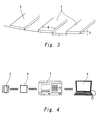
- a 27-MHz crystal oscillator 3 including gold electrodes 2, 2 on the both sides of a piezoelectric plate 1 was prepared.
- a plurality of grooves 4 having a rectangular cross section is provided adjacent to one another on the surface of the gold electrode 2 in contact with a solution, so as to form a detector on the electrode 2.
- the electrodes 2.2 were formed using gold that had a diameter of 2.7 mm.
- the width W and the interval I of the grooves 4 were both 5 ⁇ m.
- the depth D of the grooves was 600 nm.
- the crystal oscillator 3 was placed in an aluminum block provided with an automatic stirring function and a temperature regulator.
- the crystal oscillator 3 as a sensor 5 was then connected, as illustrated in Fig. 4 , to a frequency-measuring network analyzer 7 via a ⁇ circuit 6, and the network analyzer 7 was adapted to send signals to a personal computer 8.
- the sensor 5 was used to maintain the material to be measured to a liquid temperature of 25°C during the measurement, which was performed as follows.
- Frequencies were measured for a standard sample (deionized water; 500 ⁇ l), and for glycerol aqueous solutions of known density and known viscosity (10 wt%, 30 wt%, and 50 wt% samples; 500 ⁇ l each) placed on the electrode 4 of the crystal oscillator 3.
- Table 1 below presents amounts of change in frequency f 2 , resonant frequency f s , and the frequency (f 1 -f 2 )/2 determined from f 1 and f 2
- the resonant frequency f s was measured for comparison with the resonant frequency obtained by the conventional QCM method.
- the detected value of resonant frequency f s in the conventional QCM method is the sum of the frequency detected as the mass of the sample captured by the concave of the detector, plus the frequency due to solution resistance. Thus, the measured amount of frequency change cannot be used to determine the amount of the solution of the detected mass captured by the concave.
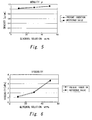
- the amount of the solution of the detected mass captured by the concave on the electrode 2 was 213 pl. Using this value, the densities of the 10 wt%, 30 wt%, and 50 wt% glycerol aqueous solutions were calculated from the amounts of frequency change of these samples. The results are presented in Table 2 below, and in the graph of Fig. 5 .
- Viscosities were determined from the amounts of frequency change in (f 1 - f 2 )/2 representing the frequency of only the solution resistance component on the oscillating surface of the crystal oscillator 3, using the densities obtained from the amounts of frequency change as above. Note that the calculations were made at the density 2.65 g/cm 3 of the crystal oscillator 3, and at the modulus of transverse elasticity 2.95 ⁇ 10 11 g/cm ⁇ S 2 of the crystal oscillator 3. Viscosities ⁇ were calculated by substituting the numerical values in equation (4). The results are presented in Table 3 below, and in the graph of Fig. 6 .
- the viscosity values determined from the amounts of frequency change were close to the viscosities calculated using the values of Kagaku Binran as reference.
- the present invention can be used for the measurement of density and/or viscosity using a minute amount of solution.
Landscapes
- Physics & Mathematics (AREA)
- General Physics & Mathematics (AREA)
- General Health & Medical Sciences (AREA)
- Chemical & Material Sciences (AREA)
- Analytical Chemistry (AREA)
- Biochemistry (AREA)
- Life Sciences & Earth Sciences (AREA)
- Health & Medical Sciences (AREA)
- Immunology (AREA)
- Pathology (AREA)
- Acoustics & Sound (AREA)
- Investigating Or Analyzing Materials By The Use Of Ultrasonic Waves (AREA)
- Piezo-Electric Or Mechanical Vibrators, Or Delay Or Filter Circuits (AREA)
- Investigating Or Analyzing Materials By The Use Of Electric Means (AREA)
Applications Claiming Priority (2)
| Application Number | Priority Date | Filing Date | Title |
|---|---|---|---|
| JP2008127519 | 2008-05-14 | ||
| PCT/JP2009/058930 WO2009139418A1 (ja) | 2008-05-14 | 2009-05-13 | 水晶振動子及びこれを使用した測定方法 |
Publications (2)
| Publication Number | Publication Date |
|---|---|
| EP2278298A1 true EP2278298A1 (de) | 2011-01-26 |
| EP2278298A4 EP2278298A4 (de) | 2017-08-30 |
Family
ID=41318784
Family Applications (1)
| Application Number | Title | Priority Date | Filing Date |
|---|---|---|---|
| EP09746624.7A Withdrawn EP2278298A4 (de) | 2008-05-14 | 2009-05-13 | Quarzoszillator und messverfahren damit |
Country Status (6)
| Country | Link |
|---|---|
| US (1) | US8601857B2 (de) |
| EP (1) | EP2278298A4 (de) |
| JP (1) | JP5140724B2 (de) |
| KR (1) | KR20110022598A (de) |
| CN (1) | CN102027349A (de) |
| WO (1) | WO2009139418A1 (de) |
Cited By (2)
| Publication number | Priority date | Publication date | Assignee | Title |
|---|---|---|---|---|
| EP3258239A1 (de) * | 2016-06-13 | 2017-12-20 | INL - International Iberian Nanotechnology Laboratory | Verfahren zur validierung eines resonators |
| EP4045188A4 (de) * | 2019-10-18 | 2023-11-22 | Qatch Technologies | Vorrichtung und verfahren zur echtzeitmessung rheologischer eigenschaften eines fluids |
Families Citing this family (11)
| Publication number | Priority date | Publication date | Assignee | Title |
|---|---|---|---|---|
| JP2011203246A (ja) * | 2010-03-03 | 2011-10-13 | Noboru Wakatsuki | 粘弾性評価装置 |
| CN102782473B (zh) * | 2010-03-16 | 2014-07-02 | 株式会社爱发科 | 粘弹性的测定方法以及粘弹性的测定装置 |
| EP2805158B8 (de) | 2012-01-16 | 2020-10-07 | Abram Scientific, Inc. | Verfahren und vorrichtungen zur messung von physikalischen eigenschaften von fluiden |
| WO2013142244A1 (en) | 2012-03-19 | 2013-09-26 | Oyj, Kemira | Methods of measuring a characteristic of a creping adhesive film and methods of modifying the creping adhesive film |
| WO2014024309A1 (ja) * | 2012-08-10 | 2014-02-13 | 富士通株式会社 | Qcmセンサとその製造方法 |
| WO2016109447A1 (en) | 2014-12-29 | 2016-07-07 | Concentric Meter Corporation | Fluid parameter sensor and meter |
| US10107784B2 (en) | 2014-12-29 | 2018-10-23 | Concentric Meter Corporation | Electromagnetic transducer |
| US10126266B2 (en) | 2014-12-29 | 2018-11-13 | Concentric Meter Corporation | Fluid parameter sensor and meter |
| CN104833610B (zh) * | 2015-04-23 | 2017-07-28 | 电子科技大学 | 一种基于压电体声波谐振式传感器的液体属性测量方法 |
| CN106153718B (zh) * | 2016-08-18 | 2018-09-18 | 中国工程物理研究院总体工程研究所 | 一种具有双工作模式的压电晶体气体传感器 |
| CN110346239B (zh) * | 2019-07-10 | 2022-02-11 | 国家纳米科学中心 | 一种纳米材料密度的检测方法 |
Family Cites Families (13)
| Publication number | Priority date | Publication date | Assignee | Title |
|---|---|---|---|---|
| JPS62195538A (ja) * | 1986-02-24 | 1987-08-28 | Fuji Electric Co Ltd | 振動式トランスジユ−サ |
| DE3673121D1 (de) * | 1985-10-25 | 1990-09-13 | Fuji Electric Co Ltd | Wandler vom schwingungstyp. |
| US5201215A (en) * | 1991-10-17 | 1993-04-13 | The United States Of America As Represented By The United States Department Of Energy | Method for simultaneous measurement of mass loading and fluid property changes using a quartz crystal microbalance |
| US5741961A (en) * | 1993-08-18 | 1998-04-21 | Sandia Corporation | Quartz resonator fluid density and viscosity monitor |
| JPH10115648A (ja) * | 1996-10-11 | 1998-05-06 | Advantest Corp | 圧電振動子の等価回路定数測定法 |
| JP3248683B2 (ja) * | 1998-01-20 | 2002-01-21 | 富士工業株式会社 | 液体の密度と粘度の分離測定方法及び装置 |
| US6247354B1 (en) * | 1998-05-13 | 2001-06-19 | The United States Of America As Represented By The Secretary Of The Army | Techniques for sensing the properties of fluids with resonators |
| JP4083621B2 (ja) * | 2003-04-24 | 2008-04-30 | 株式会社アルバック | 振動子を用いた分析方法 |
| US7111500B2 (en) * | 2002-12-26 | 2006-09-26 | Ulvac Inc. | Analysis method using piezoelectric resonator |
| JP4437022B2 (ja) | 2003-09-25 | 2010-03-24 | 株式会社アルバック | 生化学、医療及び食品分野における化学反応の追跡や状態分析等に使用される振動子を使用した測定方法及びバイオセンサー装置 |
| DE112004002772T5 (de) * | 2004-04-22 | 2007-03-15 | Biode, Inc. | Messungen von Dichte und Viskoelastizität mittels eines einzelnen akustischen Wellensensors |
| JP4616123B2 (ja) * | 2005-08-23 | 2011-01-19 | セイコーインスツル株式会社 | 分析用マイクロセンサ |
| JP2009534651A (ja) * | 2006-04-20 | 2009-09-24 | ヴェクトロン インターナショナル,インク | 高圧環境用の電気音響センサ |
-
2009
- 2009-05-13 CN CN2009801172657A patent/CN102027349A/zh active Pending
- 2009-05-13 EP EP09746624.7A patent/EP2278298A4/de not_active Withdrawn
- 2009-05-13 KR KR1020107027978A patent/KR20110022598A/ko not_active Ceased
- 2009-05-13 US US12/991,550 patent/US8601857B2/en active Active
- 2009-05-13 WO PCT/JP2009/058930 patent/WO2009139418A1/ja not_active Ceased
- 2009-05-13 JP JP2010512003A patent/JP5140724B2/ja not_active Expired - Fee Related
Non-Patent Citations (1)
| Title |
|---|
| See references of WO2009139418A1 * |
Cited By (7)
| Publication number | Priority date | Publication date | Assignee | Title |
|---|---|---|---|---|
| EP3258239A1 (de) * | 2016-06-13 | 2017-12-20 | INL - International Iberian Nanotechnology Laboratory | Verfahren zur validierung eines resonators |
| WO2017216067A1 (en) * | 2016-06-13 | 2017-12-21 | Inl - International Iberian Nanotechnology Laboratory | Method for validating a resonator |
| KR20190017976A (ko) * | 2016-06-13 | 2019-02-20 | 아이엔엘 - 인터내셔널 이베리안 나노테크놀로지 라보라토리 | 레조네이터 검증 방법 |
| CN109844493A (zh) * | 2016-06-13 | 2019-06-04 | Inl-国际伊比利亚纳米技术实验室 | 用于验证谐振器的方法 |
| US10724934B2 (en) | 2016-06-13 | 2020-07-28 | INL—International Iberian Nanotechnology Laboratory | Method for validating a resonator |
| CN109844493B (zh) * | 2016-06-13 | 2021-08-03 | Inl-国际伊比利亚纳米技术实验室 | 用于验证谐振器的方法 |
| EP4045188A4 (de) * | 2019-10-18 | 2023-11-22 | Qatch Technologies | Vorrichtung und verfahren zur echtzeitmessung rheologischer eigenschaften eines fluids |
Also Published As
| Publication number | Publication date |
|---|---|
| US8601857B2 (en) | 2013-12-10 |
| CN102027349A (zh) | 2011-04-20 |
| EP2278298A4 (de) | 2017-08-30 |
| JPWO2009139418A1 (ja) | 2011-09-22 |
| JP5140724B2 (ja) | 2013-02-13 |
| KR20110022598A (ko) | 2011-03-07 |
| WO2009139418A1 (ja) | 2009-11-19 |
| US20110061462A1 (en) | 2011-03-17 |
Similar Documents
| Publication | Publication Date | Title |
|---|---|---|
| EP2278298A1 (de) | Quarzoszillator und messverfahren damit | |
| Saluja et al. | Measurement of fluid viscosity at microliter volumes using quartz impedance analysis | |
| EP2097745B1 (de) | Biosensor | |
| US20040187580A1 (en) | QCM sensor and QCM sensor device | |
| US6874357B2 (en) | Method for studying liquid and device for carrying out said method | |
| EP1434047B1 (de) | Analyseverfahren mit Verwendung eines piezoelektrischen Resonators | |
| US6111342A (en) | Instrument for chemical measurement | |
| US20200256882A1 (en) | Fluid property measurement devices and methods | |
| CN102782473B (zh) | 粘弹性的测定方法以及粘弹性的测定装置 | |
| EP1605257B1 (de) | Zweifrequenz-Messmethode für einen Oberflächenwellensensor, sowie Oberflächenwellensensor und Biosensor mit Mittel zur Durchmischung der Analyseflüssigkeit | |
| US9140668B2 (en) | Device and method for detecting at least one substance | |
| CN110967380B (zh) | 一种用于液体检测的薄膜体声波传感器 | |
| EP1519162B1 (de) | Messverfahren und Biosensor-system mit Resonator | |
| Itoh et al. | Separate measurement of the density and viscosity of a liquid using a quartz crystal microbalance based on admittance analysis (QCM-A) | |
| Zhang et al. | Bulk acoustic wave sensors for sensing measurand-induced electrical property changes in solutions | |
| US7493798B2 (en) | Sensor for detecting the adulteration and quality of fluids | |
| Borodina et al. | Determination of viscosity and dielectric constant of liquids using the equivalent circuit method using a resonator with a lateral electric field | |
| JP5066404B2 (ja) | バイオセンサを使用した物性の測定方法 | |
| Muramatsu et al. | Basic characteristics of quartz crystal sensor with interdigitated electrodes | |
| RU2649217C1 (ru) | Гибридный акустический сенсор системы электронный нос и электронный язык | |
| EP3258239A1 (de) | Verfahren zur validierung eines resonators | |
| GB2445163A (en) | Disposable test strips and associated method for measuring viscosity and density changes in a biological fluid | |
| McCann et al. | 4D-5 Lateral Field Excited High Frequency Bulk Acoustic Wave Sensors | |
| Guhr et al. | Acoustoelectronic method for the detection of electrical and mechanical properties of adhering cell cultures | |
| Weber et al. | High frequency viscosity sensing with FBARs |
Legal Events
| Date | Code | Title | Description |
|---|---|---|---|
| PUAI | Public reference made under article 153(3) epc to a published international application that has entered the european phase |
Free format text: ORIGINAL CODE: 0009012 |
|
| 17P | Request for examination filed |
Effective date: 20101108 |
|
| AK | Designated contracting states |
Kind code of ref document: A1 Designated state(s): AT BE BG CH CY CZ DE DK EE ES FI FR GB GR HR HU IE IS IT LI LT LU LV MC MK MT NL NO PL PT RO SE SI SK TR |
|
| AX | Request for extension of the european patent |
Extension state: AL BA RS |
|
| DAX | Request for extension of the european patent (deleted) | ||
| RA4 | Supplementary search report drawn up and despatched (corrected) |
Effective date: 20170731 |
|
| RIC1 | Information provided on ipc code assigned before grant |
Ipc: G01N 29/24 20060101ALI20170725BHEP Ipc: G01N 9/00 20060101AFI20170725BHEP Ipc: G01N 29/02 20060101ALI20170725BHEP Ipc: H01L 41/09 20060101ALN20170725BHEP Ipc: H01L 41/187 20060101ALN20170725BHEP Ipc: H01L 41/047 20060101ALN20170725BHEP Ipc: G01N 29/036 20060101ALI20170725BHEP Ipc: G01N 11/16 20060101ALI20170725BHEP |
|
| STAA | Information on the status of an ep patent application or granted ep patent |
Free format text: STATUS: REQUEST FOR EXAMINATION WAS MADE |
|
| STAA | Information on the status of an ep patent application or granted ep patent |
Free format text: STATUS: THE APPLICATION IS DEEMED TO BE WITHDRAWN |
|
| 18D | Application deemed to be withdrawn |
Effective date: 20180301 |