EP2271730B1 - Elimination des composes chlores dans les coupes hydrocarbonees - Google Patents
Elimination des composes chlores dans les coupes hydrocarbonees Download PDFInfo
- Publication number
- EP2271730B1 EP2271730B1 EP09738294A EP09738294A EP2271730B1 EP 2271730 B1 EP2271730 B1 EP 2271730B1 EP 09738294 A EP09738294 A EP 09738294A EP 09738294 A EP09738294 A EP 09738294A EP 2271730 B1 EP2271730 B1 EP 2271730B1
- Authority
- EP
- European Patent Office
- Prior art keywords
- elimination
- purification
- mass
- zone
- hydrogen
- Prior art date
- Legal status (The legal status is an assumption and is not a legal conclusion. Google has not performed a legal analysis and makes no representation as to the accuracy of the status listed.)
- Active
Links
Images
Classifications
-
- B—PERFORMING OPERATIONS; TRANSPORTING
- B01—PHYSICAL OR CHEMICAL PROCESSES OR APPARATUS IN GENERAL
- B01D—SEPARATION
- B01D53/00—Separation of gases or vapours; Recovering vapours of volatile solvents from gases; Chemical or biological purification of waste gases, e.g. engine exhaust gases, smoke, fumes, flue gases, aerosols
- B01D53/02—Separation of gases or vapours; Recovering vapours of volatile solvents from gases; Chemical or biological purification of waste gases, e.g. engine exhaust gases, smoke, fumes, flue gases, aerosols by adsorption, e.g. preparative gas chromatography
- B01D53/04—Separation of gases or vapours; Recovering vapours of volatile solvents from gases; Chemical or biological purification of waste gases, e.g. engine exhaust gases, smoke, fumes, flue gases, aerosols by adsorption, e.g. preparative gas chromatography with stationary adsorbents
-
- B—PERFORMING OPERATIONS; TRANSPORTING
- B01—PHYSICAL OR CHEMICAL PROCESSES OR APPARATUS IN GENERAL
- B01D—SEPARATION
- B01D53/00—Separation of gases or vapours; Recovering vapours of volatile solvents from gases; Chemical or biological purification of waste gases, e.g. engine exhaust gases, smoke, fumes, flue gases, aerosols
- B01D53/34—Chemical or biological purification of waste gases
- B01D53/74—General processes for purification of waste gases; Apparatus or devices specially adapted therefor
- B01D53/75—Multi-step processes
-
- B—PERFORMING OPERATIONS; TRANSPORTING
- B01—PHYSICAL OR CHEMICAL PROCESSES OR APPARATUS IN GENERAL
- B01D—SEPARATION
- B01D53/00—Separation of gases or vapours; Recovering vapours of volatile solvents from gases; Chemical or biological purification of waste gases, e.g. engine exhaust gases, smoke, fumes, flue gases, aerosols
- B01D53/34—Chemical or biological purification of waste gases
- B01D53/74—General processes for purification of waste gases; Apparatus or devices specially adapted therefor
- B01D53/86—Catalytic processes
- B01D53/8659—Removing halogens or halogen compounds
- B01D53/8662—Organic halogen compounds
-
- C—CHEMISTRY; METALLURGY
- C10—PETROLEUM, GAS OR COKE INDUSTRIES; TECHNICAL GASES CONTAINING CARBON MONOXIDE; FUELS; LUBRICANTS; PEAT
- C10G—CRACKING HYDROCARBON OILS; PRODUCTION OF LIQUID HYDROCARBON MIXTURES, e.g. BY DESTRUCTIVE HYDROGENATION, OLIGOMERISATION, POLYMERISATION; RECOVERY OF HYDROCARBON OILS FROM OIL-SHALE, OIL-SAND, OR GASES; REFINING MIXTURES MAINLY CONSISTING OF HYDROCARBONS; REFORMING OF NAPHTHA; MINERAL WAXES
- C10G25/00—Refining of hydrocarbon oils in the absence of hydrogen, with solid sorbents
- C10G25/003—Specific sorbent material, not covered by C10G25/02 or C10G25/03
-
- C—CHEMISTRY; METALLURGY
- C10—PETROLEUM, GAS OR COKE INDUSTRIES; TECHNICAL GASES CONTAINING CARBON MONOXIDE; FUELS; LUBRICANTS; PEAT
- C10G—CRACKING HYDROCARBON OILS; PRODUCTION OF LIQUID HYDROCARBON MIXTURES, e.g. BY DESTRUCTIVE HYDROGENATION, OLIGOMERISATION, POLYMERISATION; RECOVERY OF HYDROCARBON OILS FROM OIL-SHALE, OIL-SAND, OR GASES; REFINING MIXTURES MAINLY CONSISTING OF HYDROCARBONS; REFORMING OF NAPHTHA; MINERAL WAXES
- C10G35/00—Reforming naphtha
- C10G35/04—Catalytic reforming
-
- C—CHEMISTRY; METALLURGY
- C10—PETROLEUM, GAS OR COKE INDUSTRIES; TECHNICAL GASES CONTAINING CARBON MONOXIDE; FUELS; LUBRICANTS; PEAT
- C10G—CRACKING HYDROCARBON OILS; PRODUCTION OF LIQUID HYDROCARBON MIXTURES, e.g. BY DESTRUCTIVE HYDROGENATION, OLIGOMERISATION, POLYMERISATION; RECOVERY OF HYDROCARBON OILS FROM OIL-SHALE, OIL-SAND, OR GASES; REFINING MIXTURES MAINLY CONSISTING OF HYDROCARBONS; REFORMING OF NAPHTHA; MINERAL WAXES
- C10G45/00—Refining of hydrocarbon oils using hydrogen or hydrogen-generating compounds
- C10G45/02—Refining of hydrocarbon oils using hydrogen or hydrogen-generating compounds to eliminate hetero atoms without changing the skeleton of the hydrocarbon involved and without cracking into lower boiling hydrocarbons; Hydrofinishing
- C10G45/04—Refining of hydrocarbon oils using hydrogen or hydrogen-generating compounds to eliminate hetero atoms without changing the skeleton of the hydrocarbon involved and without cracking into lower boiling hydrocarbons; Hydrofinishing characterised by the catalyst used
-
- C—CHEMISTRY; METALLURGY
- C10—PETROLEUM, GAS OR COKE INDUSTRIES; TECHNICAL GASES CONTAINING CARBON MONOXIDE; FUELS; LUBRICANTS; PEAT
- C10G—CRACKING HYDROCARBON OILS; PRODUCTION OF LIQUID HYDROCARBON MIXTURES, e.g. BY DESTRUCTIVE HYDROGENATION, OLIGOMERISATION, POLYMERISATION; RECOVERY OF HYDROCARBON OILS FROM OIL-SHALE, OIL-SAND, OR GASES; REFINING MIXTURES MAINLY CONSISTING OF HYDROCARBONS; REFORMING OF NAPHTHA; MINERAL WAXES
- C10G45/00—Refining of hydrocarbon oils using hydrogen or hydrogen-generating compounds
- C10G45/02—Refining of hydrocarbon oils using hydrogen or hydrogen-generating compounds to eliminate hetero atoms without changing the skeleton of the hydrocarbon involved and without cracking into lower boiling hydrocarbons; Hydrofinishing
- C10G45/04—Refining of hydrocarbon oils using hydrogen or hydrogen-generating compounds to eliminate hetero atoms without changing the skeleton of the hydrocarbon involved and without cracking into lower boiling hydrocarbons; Hydrofinishing characterised by the catalyst used
- C10G45/10—Refining of hydrocarbon oils using hydrogen or hydrogen-generating compounds to eliminate hetero atoms without changing the skeleton of the hydrocarbon involved and without cracking into lower boiling hydrocarbons; Hydrofinishing characterised by the catalyst used containing platinum group metals or compounds thereof
-
- C—CHEMISTRY; METALLURGY
- C10—PETROLEUM, GAS OR COKE INDUSTRIES; TECHNICAL GASES CONTAINING CARBON MONOXIDE; FUELS; LUBRICANTS; PEAT
- C10G—CRACKING HYDROCARBON OILS; PRODUCTION OF LIQUID HYDROCARBON MIXTURES, e.g. BY DESTRUCTIVE HYDROGENATION, OLIGOMERISATION, POLYMERISATION; RECOVERY OF HYDROCARBON OILS FROM OIL-SHALE, OIL-SAND, OR GASES; REFINING MIXTURES MAINLY CONSISTING OF HYDROCARBONS; REFORMING OF NAPHTHA; MINERAL WAXES
- C10G69/00—Treatment of hydrocarbon oils by at least one hydrotreatment process and at least one other conversion process
- C10G69/02—Treatment of hydrocarbon oils by at least one hydrotreatment process and at least one other conversion process plural serial stages only
- C10G69/08—Treatment of hydrocarbon oils by at least one hydrotreatment process and at least one other conversion process plural serial stages only including at least one step of reforming naphtha
-
- B—PERFORMING OPERATIONS; TRANSPORTING
- B01—PHYSICAL OR CHEMICAL PROCESSES OR APPARATUS IN GENERAL
- B01D—SEPARATION
- B01D2253/00—Adsorbents used in seperation treatment of gases and vapours
- B01D2253/10—Inorganic adsorbents
- B01D2253/104—Alumina
-
- B—PERFORMING OPERATIONS; TRANSPORTING
- B01—PHYSICAL OR CHEMICAL PROCESSES OR APPARATUS IN GENERAL
- B01D—SEPARATION
- B01D2255/00—Catalysts
- B01D2255/10—Noble metals or compounds thereof
- B01D2255/102—Platinum group metals
- B01D2255/1021—Platinum
-
- B—PERFORMING OPERATIONS; TRANSPORTING
- B01—PHYSICAL OR CHEMICAL PROCESSES OR APPARATUS IN GENERAL
- B01D—SEPARATION
- B01D2255/00—Catalysts
- B01D2255/10—Noble metals or compounds thereof
- B01D2255/102—Platinum group metals
- B01D2255/1023—Palladium
-
- B—PERFORMING OPERATIONS; TRANSPORTING
- B01—PHYSICAL OR CHEMICAL PROCESSES OR APPARATUS IN GENERAL
- B01D—SEPARATION
- B01D2255/00—Catalysts
- B01D2255/20—Metals or compounds thereof
- B01D2255/202—Alkali metals
-
- B—PERFORMING OPERATIONS; TRANSPORTING
- B01—PHYSICAL OR CHEMICAL PROCESSES OR APPARATUS IN GENERAL
- B01D—SEPARATION
- B01D2255/00—Catalysts
- B01D2255/20—Metals or compounds thereof
- B01D2255/204—Alkaline earth metals
-
- B—PERFORMING OPERATIONS; TRANSPORTING
- B01—PHYSICAL OR CHEMICAL PROCESSES OR APPARATUS IN GENERAL
- B01D—SEPARATION
- B01D2257/00—Components to be removed
- B01D2257/20—Halogens or halogen compounds
- B01D2257/204—Inorganic halogen compounds
- B01D2257/2045—Hydrochloric acid
-
- B—PERFORMING OPERATIONS; TRANSPORTING
- B01—PHYSICAL OR CHEMICAL PROCESSES OR APPARATUS IN GENERAL
- B01D—SEPARATION
- B01D2257/00—Components to be removed
- B01D2257/20—Halogens or halogen compounds
- B01D2257/206—Organic halogen compounds
- B01D2257/2064—Chlorine
-
- C—CHEMISTRY; METALLURGY
- C10—PETROLEUM, GAS OR COKE INDUSTRIES; TECHNICAL GASES CONTAINING CARBON MONOXIDE; FUELS; LUBRICANTS; PEAT
- C10G—CRACKING HYDROCARBON OILS; PRODUCTION OF LIQUID HYDROCARBON MIXTURES, e.g. BY DESTRUCTIVE HYDROGENATION, OLIGOMERISATION, POLYMERISATION; RECOVERY OF HYDROCARBON OILS FROM OIL-SHALE, OIL-SAND, OR GASES; REFINING MIXTURES MAINLY CONSISTING OF HYDROCARBONS; REFORMING OF NAPHTHA; MINERAL WAXES
- C10G2300/00—Aspects relating to hydrocarbon processing covered by groups C10G1/00 - C10G99/00
- C10G2300/20—Characteristics of the feedstock or the products
- C10G2300/201—Impurities
Definitions
- the present invention relates to a purification process by removing chlorine in the form of hydrogen chloride and organochlorine compounds.
- One of the aims of catalytic reforming is to obtain hydrocarbons having an increased octane number. It is established that the octane number of a hydrocarbon is greater when it is branched, cyclic or even aromatic. Thus, the reactions of cyclization and aromatisation of hydrocarbons will be favored.
- chlorinated bimetallic heterogeneous catalysts are based on alumina and comprise, most often, platinum and another metal such as for example tin, rhenium, or iridium.
- the presence of chlorine in said catalysts is important because, added to the alumina, it ensures the overall acidity of the system and participates in the redispersion of platinum over time, thereby stabilizing the catalytic activity of the catalyst.
- Catalytic reforming also produces hydrogen.
- hydrogen is a particularly valuable product, particularly through its use in hydrotreatments, which are increasingly being developed with the aim of improving the protection of the environment.
- the gaseous effluents are mainly composed of hydrogen, light hydrocarbons such as methane, ethane, etc., and are generally traces of hydrogen chloride and water. It is therefore important to be able to remove all traces of hydrogen chloride from these effluents, for example on alumina-based solids, and then to recycle and therefore use purified hydrogen, still in refinery.
- the object of the present invention is to provide an improved process for the efficient removal of chlorinated compounds and hydrogen chloride more particularly, contained in a gas or a liquid.
- Another object of the present invention is to provide a process using a composition which will substantially reduce, or even eliminate, the formation of oligomers, and in particular chlorinated oligomers called "green oils” or “green oils", downstream of the processes. regenerative reforming or new generation.
- An advantage of the present invention is that the removal of chlorinated compounds makes it possible in particular to avoid the harmful formation of NH 4 Cl as well as corrosion problems related to chlorine.
- Another advantage of the present invention is that the removal of the chlorinated compounds makes it possible to protect the catalysts of the downstream units, in particular the catalyst of the benzene hydrogenation unit.
- the patent application EP1053053 discloses a process for removing, reducing, and / or eliminating halogenated compounds contained in a gas or a liquid, wherein the gas or the liquid is contacted with a composition obtained by deposition on an alumina of at least one compound comprising at least one element selected from alkali followed, after the deposition, calcining the alumina at a temperature of at least 600 ° C.
- the patent application EP0948995 discloses a process for removing halogenated compounds contained in a gas or a liquid in which the gas or liquid is contacted with a composition comprising a hydrated alumina and / or alumina and at least one metal element selected from the group consisting of Group VIII, IB and / or IIB metals.
- the patent US6551566 discloses a method of treating a gas stream containing more than 90 vol% hydrogen and halogenated hydrocarbons such as chlorinated hydrocarbons comprising hydrodehalogenation of the gaseous feedstock on a nickel-supported catalyst which may comprise a promoter such as platinum or palladium and the elimination of products of the catalytic reaction, such as hydrohalogenated acids on an adsorbent such as an alumina impregnated with sodium, potassium or barium.
- a promoter such as platinum or palladium
- hydrohalogenated acids on an adsorbent such as an alumina impregnated with sodium, potassium or barium.
- the invention relates to a purification process by eliminating chlorine in the form of hydrogen chloride and organochlorine compounds by contacting, in the presence of hydrogen, at least part of the effluent of a reforming zone, said part of the effluent comprising olefins, hydrogen chloride and organochlorine compounds, a stripping zone comprising a sequence of two masses, the 1 st weight being a mass comprising at least one metal from group VIII selected from the group consisting of platinum and and palladium deposited on a mineral support, the 2nd mass being a hydrogen chloride adsorbent, said adsorbent being an alumina promoted with an alkali or alkaline earth metal.
- group VIII corresponds to group VIII according to the classification CAS corresponds to the metals of columns 8 to 10 according to the new IUPAC classification ( CRC Handbook of Chemistry and Physics, Editor CRC Press, Editor-in-Chief DR Lide, 81st Edition, 2000-2001 ).
- olefin corresponds to mono-olefins and / or diolefins.
- the invention relates to a purification process by eliminating chlorine in the form of hydrogen chloride and organochlorine compounds by contacting, in the presence of hydrogen, at least part of the effluent of a reforming zone, said portion of the effluent comprising olefins, hydrogen chloride and organochlorine compounds, a stripping zone comprising a sequence of two masses, the 1 st weight being a mass comprising at least one metal selected from group VIII in the group consisting of platinum and palladium and deposited on a mineral support, the 2nd mass being a hydrogen chloride adsorbent, said adsorbent being an alumina promoted with an alkali or an alkaline earth.
- At least a part of the effluent of the reforming zone circulates through a liquid gas separator, said separator leading to a flow of hydrogen-rich gas (A) and to a liquid effluent (B), said liquid effluent being sent to a stabilization zone, said stabilization zone leading to at least two cuts, a first light cut (C) and a first heavy cut (D), said first heavy cut being sent to a fractionation column leading to the production of at least two sections, a second light section (E1) withdrawn at the top of the column, optionally a section (E2) withdrawn between the column head and the feed of the column, each of the sections (E1) and (E2) can be sent to a hydrogenation zone of benzene, and a second heavy section (F).
- the purification zone is placed on any stream coming from the liquid gas separator, the stabilization column or the fractionation column.
- the purification zone is placed on the stream of hydrogen-rich gas (A), on the liquid effluent (B) or on at least one of the sections (E1) or (E2).
- hydrogen is added during the contacting of at least a part of the effluent of a reforming zone, of aromatics production, dehydrogenation, isomerization or hydrogenation.
- the two masses of the capture zone are generally either loaded in the same reactor or in two different reactors.
- the first mass is generally the catalytic mass and the second mass is generally the hydrogen chloride adsorbent.
- the two masses are arranged in the same reactor and the first mass is generally disposed at the head of the capture zone. It then occupies a volume corresponding generally to 10 to 60% of the total volume of said zone.
- the second mass when the second mass is saturated, it is discharged separately while deflecting the feedstock to be treated to a third reactor comprising a hydrogen chloride adsorbent. This ensures the continuity of the operation.
- the Group VIII metal is palladium and / or H is platinum. These metals are deposited on the support using the methods known to those skilled in the art, namely by impregnation of aqueous solutions of soluble salts of palladium and platinum.
- the Group VIII metal is palladium, it can be introduced by aqueous or organic solution impregnation techniques of a palladium precursor.
- This precursor may for example be a mineral compound such as palladium chloride, palladium nitrate, palladium tetramine dihydroxide, palladium tetramine chloride or an organometallic compound such as for example palladium bis-z-allyl or palladium bis- acetylacetonate.
- the palladium is deposited preferably in crust, that is to say on the surface of the catalyst grains, for example cylindrical or extruded beads, with a penetration into the grains included in a peripheral layer not exceeding, for example, 80% of the radius of the balls or cylinders.
- the thickness of the crust is generally between 100 and 700 micrometers.
- the catalyst is generally dried at about 120 ° C, and then calcined at temperatures generally between 150 and 700 ° C.
- the palladium or platinum content is generally between 0.1 and 1% by weight and preferably between 0.2 and 0.6% by weight.
- the inorganic support used may be chosen from alumina, silica, silica-alumina, silica-magnesia, titanium oxide, alumino-silicates such as zeolites, all these solids being taken alone or mixed with one another.
- Alumina will preferably be used.
- the second mass consists of one or more alkaline or alkaline earth compounds deposited on an alumina with a specific surface area generally between 50 and 400 m 2 / g.
- They may also include mixed oxides, especially those based on copper and / or zinc.
- the alkali or alkaline earth content is generally between 0.5% and 70% by weight and preferably between 2% and 35% by weight relative to the total weight of the composition.
- the deposition of the alkaline and alkaline earth elements can be achieved by any method known to those skilled in the art for example by impregnation of the alumina with an aqueous solution of soluble salts of alkali or alkaline earth. After impregnation, the mass is dried and calcined appropriately, the calcining temperature being generally between 300 and 900 ° C.
- the second mass may be in any form allowing the greatest accessibility and therefore the greatest possible adsorption capacity of hydrogen chloride.
- beads or extrudates which may be of any shape, for example in the form of trilobes, may be used.
- the average diameter of the balls and extrudates will be as small as possible, for example between 1 and 5 mm, while being careful not to cause excessive head losses in the reactor.
- the portion of the effluent from the treated reforming zone generally contains between 0.1 and 50 ppm by weight of chlorinated compounds counted as chlorine.
- the elimination zone is operated in the presence of hydrogen, preferably with a molar ratio of hydrogen to chlorine of greater than 5, very preferably with a molar ratio of hydrogen to chlorine of between 5 and 10 6 , at a temperature of between 25 and 350 ° C, preferably between 35 and 200 ° C, preferably between 130 and 180 ° C and at a pressure between 0.2 and 5 MPa, preferably between 0.5 and 4MPa, preferably between 1 and and 3 MPa.
- the space velocities of the gases to be purified expressed in TPN volume hourly flowrate of the gas divided by the mass volume, GHSV are generally between 50 and 2000 h -1 and preferably between 100 and 1000 h -1 .
- the space velocities of the liquids to be purified expressed in volume volume hourly flow rate divided by the volume volume (LHSV) are generally between 1 and 50 and preferably between 2 and 40 h -1 .
- the hydrogen may be present initially in the hydrocarbon feedstock to be treated. Particularly in liquid fillers in dissolved form from 100 ppm molar. Hydrogen can also be added during the contacting of at least a portion of the effluent of a reforming zone, aromatic production, dehydrogenation, isomerization or hydrogenation.
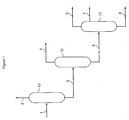
- the figure 1 represents the treatment of the effluent of the reforming zone.
- At least a portion of the effluent from the reforming zone flows via the line (1) through a liquid gas separator (10), said separator leading to a flow of hydrogen-rich gas (A) flowing via the line (2). ) and a liquid effluent (B) circulating via the line (3), said liquid effluent being sent via the line (3) to a stabilization zone (11), said stabilization zone leading to at least two cuts, a first light cut (C) circulating via line (4) and a first heavy cut (D) flowing via line (5), said first heavy cut being sent via line (5) to a fractionation column (12) leading to the production of at least two cuts, a second light cut (E1) withdrawn at the top of the column and flowing via the line (6), optionally a cut (E2) withdrawn between the column head and the supply of the column and circulating via the line (7), each of the cuts (E1) and (E2) being able to be sent to a hydrogenation zone of benzene, and a second heavy cut (F) flowing via
- An alumina prepared according to the method of preparation described in the patent application is used.
- EP1053053 It is in the form of balls of 2 to 5 mm and has a specific surface of 349 m 2 / g.
- the sodium is first incorporated by so-called dry impregnation of a NaNO 3 solution so as to obtain 6.7% by weight of sodium after drying at 100 ° C. and calcination at 820 ° C.
- This high severity reformat has the following characteristics: ASTM distillation Initial point: 20 ° C End point: 200 ° C Content of mono-olefins: 1.9% wt Diolefin content: 1000 ppm wt H2 content: 0.15% mole Chlorine content (ex HCl): 6 ppm wt (1) Chlorine content (eg organochlorine): 2 ppm wt (2) (1) Method of Analysis: UOP 588 (2) Method of Analysis: ASTM D 4929
- This reformate is circulated at a rate of 2 liters per hour, which corresponds to a liquid space velocity of 20 h -1 .
- the reactor is operated at a temperature of 140 ° C and a pressure of 1 MPa.
- This reactor is operated for 1000 hours.
- a mass B comprising 0.3% by weight of palladium deposited on alumina is prepared.
- the palladium is deposited by so-called dry impregnation from Pd (NO 3 ) 2 .
- the alumina is in the form of beads 3 mm in average diameter, it has a specific surface area of 120 m 2 / g.
- the mass is dried at 120 ° C. and then calcined at 450 ° C. This gives a palladium deposit which remains crusted on the ball. The thickness of this crust is 300 microns.
- a second mass C is prepared according to the method of preparation described in the patent application EP1053053 comprising 6.7% Na after impregnation of NaNO 3 and calcination at 820 ° C of an alumina equivalent to that described in Example 1.
- Example 1 The operation is carried out with the same liquid charge and under the same conditions as those of Example 1. This reactor is operated for 1000 hours. and the olefin and chlorine contents are measured after 200 hours, 800 hours, and 1000 hours.
- the light cut (called light reformate containing most of the benzene) from the fractionation column is treated before being sent to a hydrogenation zone of benzene.
- This cup is named E1 in the description.
- This cup has the following characteristics: ASTM distillation Starting point: 35 ° C End point: 75 ° C Content of mono-olefins: 1.0% wt Diolefin content: 1000 ppm wt Chlorine content (ex HCl): 2 ppm wt (1) Chlorine content (eg organochlorine): 1.5 ppm wt (2)
- the two reactors are run for 1000 hours and the olefins and chlorine contents are measured after 500 and 1000 hours.
- the hydrogen-rich gaseous effluent (named (A) in the description) originating from the separator of the reforming unit, the composition of which is as follows: Composition % mole H 2 92 C 1 1 C 2 1.2 C3 + 1.3 C4 + 4.5 olefins 0.1
- the behavior of the mass A is compared with that of the combination of masses B and C.
- Example 2 In one case the charged reactor is used as in Example 1 and in the other case the arrangement of Example 2.
- Example 2 It is observed that the mass A of Example 1, after 1000 hours, removes the HCl not by adsorption but by addition to the olefins present. On the contrary, the arrangement of Example 2 with masses B and C continues to virtually eliminate HCl by avoiding the formation of organochlorines through the almost complete hydrogenation of olefins present.
Landscapes
- Chemical & Material Sciences (AREA)
- Oil, Petroleum & Natural Gas (AREA)
- Engineering & Computer Science (AREA)
- Chemical Kinetics & Catalysis (AREA)
- General Chemical & Material Sciences (AREA)
- Organic Chemistry (AREA)
- Environmental & Geological Engineering (AREA)
- Analytical Chemistry (AREA)
- Health & Medical Sciences (AREA)
- Biomedical Technology (AREA)
- Production Of Liquid Hydrocarbon Mixture For Refining Petroleum (AREA)
- Organic Low-Molecular-Weight Compounds And Preparation Thereof (AREA)
- Catalysts (AREA)
- Solid-Sorbent Or Filter-Aiding Compositions (AREA)
Applications Claiming Priority (2)
| Application Number | Priority Date | Filing Date | Title |
|---|---|---|---|
| FR0802345A FR2930559B1 (fr) | 2008-04-25 | 2008-04-25 | Elimination de composes chlores dans les coupes hydrocarbonees |
| PCT/FR2009/000337 WO2009133260A1 (fr) | 2008-04-25 | 2009-03-27 | Elimination des composes chlores dans les coupes hydrocarbonees |
Publications (2)
| Publication Number | Publication Date |
|---|---|
| EP2271730A1 EP2271730A1 (fr) | 2011-01-12 |
| EP2271730B1 true EP2271730B1 (fr) | 2012-06-06 |
Family
ID=40021945
Family Applications (1)
| Application Number | Title | Priority Date | Filing Date |
|---|---|---|---|
| EP09738294A Active EP2271730B1 (fr) | 2008-04-25 | 2009-03-27 | Elimination des composes chlores dans les coupes hydrocarbonees |
Country Status (11)
| Country | Link |
|---|---|
| US (1) | US8771501B2 (enExample) |
| EP (1) | EP2271730B1 (enExample) |
| JP (1) | JP5567552B2 (enExample) |
| KR (1) | KR101671531B1 (enExample) |
| CN (2) | CN106064015A (enExample) |
| BR (1) | BRPI0911547A2 (enExample) |
| ES (1) | ES2386681T3 (enExample) |
| FR (1) | FR2930559B1 (enExample) |
| SA (1) | SA109300237B1 (enExample) |
| TW (1) | TWI461405B (enExample) |
| WO (1) | WO2009133260A1 (enExample) |
Families Citing this family (11)
| Publication number | Priority date | Publication date | Assignee | Title |
|---|---|---|---|---|
| GB201116801D0 (en) | 2011-09-29 | 2011-11-09 | Johnson Matthey Plc | Purification process |
| US9440218B2 (en) * | 2013-06-13 | 2016-09-13 | Clariant Corporation | Methods and active materials for reducing halide concentration in gas streams |
| US9718747B2 (en) * | 2013-06-19 | 2017-08-01 | Uop Llc | Process for high temperature removal of trace chloride contaminants in a catalytic dehydrogenation process |
| CN104560413B (zh) * | 2013-10-29 | 2017-08-22 | 中国石油化工股份有限公司 | 一种餐饮废油的加氢处理方法 |
| WO2017053501A1 (en) | 2015-09-23 | 2017-03-30 | Uop Llc | Process for purifying hydrocarbon streams using low reactivity adsorbents |
| EP3251741A1 (en) | 2016-05-30 | 2017-12-06 | Scg Chemicals Co. Ltd. | Adsorbent for hydrocarbon purification |
| EP3252030B1 (en) | 2016-05-30 | 2018-10-17 | Scg Chemicals Co. Ltd. | Process for purification of hydrocarbons |
| CN107573964A (zh) * | 2017-10-13 | 2018-01-12 | 北京赛诺时飞石化科技有限公司 | 一种正构烷烃低温异构化方法及装置 |
| CN110013758B (zh) * | 2018-01-09 | 2022-05-03 | 中国石油化工股份有限公司 | 氢化反应装置中氢化尾气安全回用与处理方法 |
| CN108435193B (zh) * | 2018-04-12 | 2020-08-28 | 武汉科林化工集团有限公司 | 一种可再生的脱除有机氯催化剂及其制备方法 |
| US20220135502A1 (en) * | 2019-04-23 | 2022-05-05 | Ptt Global Chemical Public Company Limited | An adsorbent for separating organochloride compound from liquid hydrocarbon and a process thereof |
Family Cites Families (16)
| Publication number | Priority date | Publication date | Assignee | Title |
|---|---|---|---|---|
| US3658690A (en) * | 1970-03-13 | 1972-04-25 | Mobil Oil Corp | Gasoline upgrading |
| US4639259A (en) * | 1985-10-09 | 1987-01-27 | Kaiser Aluminum & Chemical Corporation | Promoted scavenger for purifying HCl-contaminated gases |
| US4895995A (en) * | 1988-12-02 | 1990-01-23 | Uop | Process for the simultaneous hydroconversion of a first feedstock comprising unsaturated, halogenated organic compounds and a second feedstock comprising saturated, halogenated organic compounds |
| JPH03277693A (ja) * | 1989-11-08 | 1991-12-09 | Mitsui Petrochem Ind Ltd | 炭化水素系油中の微量塩素類の除去方法 |
| US5316998A (en) * | 1992-05-05 | 1994-05-31 | Discovery Chemicals, Inc. | HCl adsorbent and method for making and using same |
| JPH08141366A (ja) * | 1994-11-21 | 1996-06-04 | Dow Chem Co:The | ハロゲン化炭化水素の水素化処理法 |
| FR2774606B1 (fr) * | 1998-02-11 | 2000-03-17 | Rhodia Chimie Sa | Procede d'elimination de composes halogenes contenus dans un gaz ou un liquide |
| FR2776536B1 (fr) * | 1998-03-31 | 2000-04-28 | Rhodia Chimie Sa | Procede d'elimination de composes halogenes contenus dans un gaz ou un liquide avec une composition a base d'au moins un element metallique |
| FR2780300B1 (fr) * | 1998-06-25 | 2000-11-10 | Rhodia Chimie Sa | Procede de traitement de gaz ou de liquides issus de reformage catalytique |
| JP4218857B2 (ja) * | 1999-06-09 | 2009-02-04 | 太陽テクノサービス株式会社 | 塩素化合物除去剤 |
| JP4429423B2 (ja) * | 1999-09-07 | 2010-03-10 | 太陽テクノサービス株式会社 | 塩素化合物除去剤及びそれを用いる炭化水素流体中の塩素化合物の除去方法 |
| US6551566B1 (en) * | 2000-10-12 | 2003-04-22 | Air Liquide Process And Construction, Inc. | Hydrodehalogenation process using a catalyst containing nickel |
| JP3969633B2 (ja) * | 2001-12-19 | 2007-09-05 | 新日本石油株式会社 | 含ハロゲン有機化合物の分解処理方法 |
| US20040192983A1 (en) * | 2003-02-18 | 2004-09-30 | Chevron Phillips Chemical Co. | Acetylene hydrogenation catalyst with segregated palladium skin |
| EP1514879A1 (en) * | 2003-09-12 | 2005-03-16 | Shell Internationale Researchmaatschappij B.V. | A polyalphaolefin having a low halide concentration and a method of manufacturing thereof |
| US20070116620A1 (en) * | 2005-11-21 | 2007-05-24 | Kanazirev Vladislav I | Halide scavengers for high temperature applications |
-
2008
- 2008-04-25 FR FR0802345A patent/FR2930559B1/fr active Active
-
2009
- 2009-03-27 US US12/989,278 patent/US8771501B2/en not_active Expired - Fee Related
- 2009-03-27 CN CN201610506054.4A patent/CN106064015A/zh active Pending
- 2009-03-27 KR KR1020107023640A patent/KR101671531B1/ko active Active
- 2009-03-27 CN CN2009801147513A patent/CN102015970A/zh active Pending
- 2009-03-27 BR BRPI0911547A patent/BRPI0911547A2/pt not_active IP Right Cessation
- 2009-03-27 ES ES09738294T patent/ES2386681T3/es active Active
- 2009-03-27 WO PCT/FR2009/000337 patent/WO2009133260A1/fr not_active Ceased
- 2009-03-27 EP EP09738294A patent/EP2271730B1/fr active Active
- 2009-03-27 JP JP2011505546A patent/JP5567552B2/ja active Active
- 2009-04-22 SA SA109300237A patent/SA109300237B1/ar unknown
- 2009-04-22 TW TW098113330A patent/TWI461405B/zh active
Also Published As
| Publication number | Publication date |
|---|---|
| CN102015970A (zh) | 2011-04-13 |
| JP5567552B2 (ja) | 2014-08-06 |
| TWI461405B (zh) | 2014-11-21 |
| US8771501B2 (en) | 2014-07-08 |
| FR2930559B1 (fr) | 2011-10-14 |
| EP2271730A1 (fr) | 2011-01-12 |
| TW201000444A (en) | 2010-01-01 |
| FR2930559A1 (fr) | 2009-10-30 |
| BRPI0911547A2 (pt) | 2015-10-13 |
| CN106064015A (zh) | 2016-11-02 |
| US20110040136A1 (en) | 2011-02-17 |
| WO2009133260A1 (fr) | 2009-11-05 |
| SA109300237B1 (ar) | 2013-01-13 |
| KR101671531B1 (ko) | 2016-11-01 |
| JP2011518813A (ja) | 2011-06-30 |
| ES2386681T3 (es) | 2012-08-24 |
| KR20100137540A (ko) | 2010-12-30 |
Similar Documents
| Publication | Publication Date | Title |
|---|---|---|
| WO2009133260A1 (fr) | Elimination des composes chlores dans les coupes hydrocarbonees | |
| FR2755378A1 (fr) | Catalyseurs d'hydrogenation selective contenant du palladium et au moins un metal du groupe iva | |
| EP1487943A2 (fr) | Procede de production conjointe de propylene et d'essence a partir d'une charge relativement lourde | |
| EP0781829A1 (fr) | Procédé et dispositif d'hydrogénation sélective par distillation catalytique | |
| WO2015055380A1 (fr) | Procede d'hydrogenation selective mettant en œuvre un catalyseur contenant du cuivre et au moins un metal choisi parmi le nickel ou le cobalt | |
| CA2730515C (fr) | Procede d'hydrogenation du benzene | |
| EP2855018B1 (fr) | Procede de preparation d'un catalyseur a base d'un metal du groupe viii et contenant du silicium et procede d'hydrogenation selective mettant en oeuvre ledit catalyseur | |
| FR2984916A1 (fr) | Procede ameliore de conversion d'une charge lourde en distillat moyen faisant appel a un pretraitement en amont de l'unite de craquage catalytique | |
| EP2670822B1 (fr) | Catalyseur thioresistant, procede de fabrication et utilisation en hydrogenation selective | |
| EP1892229B1 (fr) | Procédé de production de propylène en presence d'un catalyseur macroporeux se presentant sous forme de billes spheriques | |
| FR2975701A1 (fr) | Procede de reformage catalytique de naphta | |
| FR2536410A1 (fr) | Procede d'hydrogenation selective des hydrocarbures acetyleniques d'une coupe d'hydrocarbures c4 renfermant du butadiene | |
| EP1700899B1 (fr) | Procédé d'hydrocraquage avec recyclage comprenant l'adsorption de composés polyaromatiques de la fraction recyclée sur un adsorbant à base de silice-alumine à teneur limitée en macropores | |
| EP3184610B1 (fr) | Procédé d'hydrogenation selective de charges olefiniques avec un seul reacteur principal et un reacteur de garde de taille reduite | |
| FR2764210A1 (fr) | Catalyseur d'hydrogenation selective utilisable pour le traitement des coupes essences contenant des diolefines et des composes styreniques | |
| FR2984915A1 (fr) | Procede d'hydrogenation selective de charges olefiniques avec des reacteurs permutables incluant au moins une etape de court-circuitage d'un reacteur | |
| FR2614295A1 (fr) | Procede d'isomerisation du butene-1 en butenes-2 dans une coupe d'hydrocarbures en c4 contenant du butadiene et des composes sulfures. | |
| EP2586851B1 (fr) | Procédé de production de distillats moyens dans lequel la charge issue du procédé Fischer-Tropsch et le flux d'hydrogéne contiennent une teneur limitée en oxygène | |
| FR2752236A1 (fr) | Procede de production d'isobutene de haute purete a partir d'une coupe c4 contenant de l'isobutene et du butene-1 | |
| FR2780300A1 (fr) | Procede de traitement de gaz ou de liquides issus de reformage catalytique | |
| EP2277980A1 (fr) | Procédé de réduction sélective de la teneur en benzène et en composés insatures legers de differentes coupes hydrocarbures | |
| FR3011847A1 (fr) | Procede d'hydrogenation selective mettant en œuvre un catalyseur contenant de l'argent et au moins un metal choisi parmi le fer, molybdene et/ou le cobalt | |
| WO2015055379A1 (fr) | Procede d'hydrogenation selective mettant en œuvre un catalyseur contenant du fer et au moins un metal choisi parmi le zinc ou le cuivre | |
| FR2884513A1 (fr) | Procede de purification d'une coupe olefinique |
Legal Events
| Date | Code | Title | Description |
|---|---|---|---|
| PUAI | Public reference made under article 153(3) epc to a published international application that has entered the european phase |
Free format text: ORIGINAL CODE: 0009012 |
|
| 17P | Request for examination filed |
Effective date: 20101125 |
|
| AK | Designated contracting states |
Kind code of ref document: A1 Designated state(s): AT BE BG CH CY CZ DE DK EE ES FI FR GB GR HR HU IE IS IT LI LT LU LV MC MK MT NL NO PL PT RO SE SI SK TR |
|
| AX | Request for extension of the european patent |
Extension state: AL BA RS |
|
| 17Q | First examination report despatched |
Effective date: 20110325 |
|
| DAX | Request for extension of the european patent (deleted) | ||
| REG | Reference to a national code |
Ref country code: DE Ref legal event code: R079 Ref document number: 602009007493 Country of ref document: DE Free format text: PREVIOUS MAIN CLASS: C10G0025000000 Ipc: B01D0053040000 |
|
| RIC1 | Information provided on ipc code assigned before grant |
Ipc: C10G 45/04 20060101ALI20111012BHEP Ipc: C10G 35/04 20060101ALI20111012BHEP Ipc: B01D 15/00 20060101ALI20111012BHEP Ipc: B01D 53/86 20060101ALI20111012BHEP Ipc: B01D 53/04 20060101AFI20111012BHEP Ipc: B01J 20/04 20060101ALI20111012BHEP Ipc: B01J 20/08 20060101ALI20111012BHEP Ipc: B01D 53/68 20060101ALI20111012BHEP Ipc: C10G 69/08 20060101ALI20111012BHEP Ipc: B01D 53/02 20060101ALI20111012BHEP Ipc: C10G 45/10 20060101ALI20111012BHEP Ipc: B01D 53/75 20060101ALI20111012BHEP Ipc: C10G 25/00 20060101ALI20111012BHEP |
|
| GRAP | Despatch of communication of intention to grant a patent |
Free format text: ORIGINAL CODE: EPIDOSNIGR1 |
|
| GRAS | Grant fee paid |
Free format text: ORIGINAL CODE: EPIDOSNIGR3 |
|
| GRAA | (expected) grant |
Free format text: ORIGINAL CODE: 0009210 |
|
| AK | Designated contracting states |
Kind code of ref document: B1 Designated state(s): AT BE BG CH CY CZ DE DK EE ES FI FR GB GR HR HU IE IS IT LI LT LU LV MC MK MT NL NO PL PT RO SE SI SK TR |
|
| REG | Reference to a national code |
Ref country code: GB Ref legal event code: FG4D Free format text: NOT ENGLISH |
|
| REG | Reference to a national code |
Ref country code: AT Ref legal event code: REF Ref document number: 560718 Country of ref document: AT Kind code of ref document: T Effective date: 20120615 Ref country code: CH Ref legal event code: EP |
|
| REG | Reference to a national code |
Ref country code: IE Ref legal event code: FG4D Free format text: LANGUAGE OF EP DOCUMENT: FRENCH |
|
| REG | Reference to a national code |
Ref country code: DE Ref legal event code: R096 Ref document number: 602009007493 Country of ref document: DE Effective date: 20120802 |
|
| REG | Reference to a national code |
Ref country code: ES Ref legal event code: FG2A Ref document number: 2386681 Country of ref document: ES Kind code of ref document: T3 Effective date: 20120824 |
|
| REG | Reference to a national code |
Ref country code: NL Ref legal event code: T3 |
|
| PG25 | Lapsed in a contracting state [announced via postgrant information from national office to epo] |
Ref country code: NO Free format text: LAPSE BECAUSE OF FAILURE TO SUBMIT A TRANSLATION OF THE DESCRIPTION OR TO PAY THE FEE WITHIN THE PRESCRIBED TIME-LIMIT Effective date: 20120906 Ref country code: SE Free format text: LAPSE BECAUSE OF FAILURE TO SUBMIT A TRANSLATION OF THE DESCRIPTION OR TO PAY THE FEE WITHIN THE PRESCRIBED TIME-LIMIT Effective date: 20120606 Ref country code: LT Free format text: LAPSE BECAUSE OF FAILURE TO SUBMIT A TRANSLATION OF THE DESCRIPTION OR TO PAY THE FEE WITHIN THE PRESCRIBED TIME-LIMIT Effective date: 20120606 Ref country code: CY Free format text: LAPSE BECAUSE OF FAILURE TO SUBMIT A TRANSLATION OF THE DESCRIPTION OR TO PAY THE FEE WITHIN THE PRESCRIBED TIME-LIMIT Effective date: 20120606 Ref country code: FI Free format text: LAPSE BECAUSE OF FAILURE TO SUBMIT A TRANSLATION OF THE DESCRIPTION OR TO PAY THE FEE WITHIN THE PRESCRIBED TIME-LIMIT Effective date: 20120606 |
|
| REG | Reference to a national code |
Ref country code: AT Ref legal event code: MK05 Ref document number: 560718 Country of ref document: AT Kind code of ref document: T Effective date: 20120606 |
|
| REG | Reference to a national code |
Ref country code: LT Ref legal event code: MG4D Effective date: 20120620 |
|
| PG25 | Lapsed in a contracting state [announced via postgrant information from national office to epo] |
Ref country code: LV Free format text: LAPSE BECAUSE OF FAILURE TO SUBMIT A TRANSLATION OF THE DESCRIPTION OR TO PAY THE FEE WITHIN THE PRESCRIBED TIME-LIMIT Effective date: 20120606 Ref country code: GR Free format text: LAPSE BECAUSE OF FAILURE TO SUBMIT A TRANSLATION OF THE DESCRIPTION OR TO PAY THE FEE WITHIN THE PRESCRIBED TIME-LIMIT Effective date: 20120907 Ref country code: HR Free format text: LAPSE BECAUSE OF FAILURE TO SUBMIT A TRANSLATION OF THE DESCRIPTION OR TO PAY THE FEE WITHIN THE PRESCRIBED TIME-LIMIT Effective date: 20120606 Ref country code: SI Free format text: LAPSE BECAUSE OF FAILURE TO SUBMIT A TRANSLATION OF THE DESCRIPTION OR TO PAY THE FEE WITHIN THE PRESCRIBED TIME-LIMIT Effective date: 20120606 |
|
| PG25 | Lapsed in a contracting state [announced via postgrant information from national office to epo] |
Ref country code: RO Free format text: LAPSE BECAUSE OF FAILURE TO SUBMIT A TRANSLATION OF THE DESCRIPTION OR TO PAY THE FEE WITHIN THE PRESCRIBED TIME-LIMIT Effective date: 20120606 Ref country code: EE Free format text: LAPSE BECAUSE OF FAILURE TO SUBMIT A TRANSLATION OF THE DESCRIPTION OR TO PAY THE FEE WITHIN THE PRESCRIBED TIME-LIMIT Effective date: 20120606 Ref country code: SK Free format text: LAPSE BECAUSE OF FAILURE TO SUBMIT A TRANSLATION OF THE DESCRIPTION OR TO PAY THE FEE WITHIN THE PRESCRIBED TIME-LIMIT Effective date: 20120606 Ref country code: AT Free format text: LAPSE BECAUSE OF FAILURE TO SUBMIT A TRANSLATION OF THE DESCRIPTION OR TO PAY THE FEE WITHIN THE PRESCRIBED TIME-LIMIT Effective date: 20120606 Ref country code: IS Free format text: LAPSE BECAUSE OF FAILURE TO SUBMIT A TRANSLATION OF THE DESCRIPTION OR TO PAY THE FEE WITHIN THE PRESCRIBED TIME-LIMIT Effective date: 20121006 Ref country code: CZ Free format text: LAPSE BECAUSE OF FAILURE TO SUBMIT A TRANSLATION OF THE DESCRIPTION OR TO PAY THE FEE WITHIN THE PRESCRIBED TIME-LIMIT Effective date: 20120606 |
|
| PG25 | Lapsed in a contracting state [announced via postgrant information from national office to epo] |
Ref country code: PT Free format text: LAPSE BECAUSE OF FAILURE TO SUBMIT A TRANSLATION OF THE DESCRIPTION OR TO PAY THE FEE WITHIN THE PRESCRIBED TIME-LIMIT Effective date: 20121008 Ref country code: PL Free format text: LAPSE BECAUSE OF FAILURE TO SUBMIT A TRANSLATION OF THE DESCRIPTION OR TO PAY THE FEE WITHIN THE PRESCRIBED TIME-LIMIT Effective date: 20120606 |
|
| PLBE | No opposition filed within time limit |
Free format text: ORIGINAL CODE: 0009261 |
|
| STAA | Information on the status of an ep patent application or granted ep patent |
Free format text: STATUS: NO OPPOSITION FILED WITHIN TIME LIMIT |
|
| PG25 | Lapsed in a contracting state [announced via postgrant information from national office to epo] |
Ref country code: DK Free format text: LAPSE BECAUSE OF FAILURE TO SUBMIT A TRANSLATION OF THE DESCRIPTION OR TO PAY THE FEE WITHIN THE PRESCRIBED TIME-LIMIT Effective date: 20120606 |
|
| 26N | No opposition filed |
Effective date: 20130307 |
|
| REG | Reference to a national code |
Ref country code: DE Ref legal event code: R097 Ref document number: 602009007493 Country of ref document: DE Effective date: 20130307 |
|
| PG25 | Lapsed in a contracting state [announced via postgrant information from national office to epo] |
Ref country code: BG Free format text: LAPSE BECAUSE OF FAILURE TO SUBMIT A TRANSLATION OF THE DESCRIPTION OR TO PAY THE FEE WITHIN THE PRESCRIBED TIME-LIMIT Effective date: 20120906 |
|
| BERE | Be: lapsed |
Owner name: IFP ENERGIES NOUVELLES Effective date: 20130331 |
|
| PG25 | Lapsed in a contracting state [announced via postgrant information from national office to epo] |
Ref country code: MC Free format text: LAPSE BECAUSE OF NON-PAYMENT OF DUE FEES Effective date: 20130331 |
|
| REG | Reference to a national code |
Ref country code: CH Ref legal event code: PL |
|
| GBPC | Gb: european patent ceased through non-payment of renewal fee |
Effective date: 20130327 |
|
| REG | Reference to a national code |
Ref country code: IE Ref legal event code: MM4A |
|
| PG25 | Lapsed in a contracting state [announced via postgrant information from national office to epo] |
Ref country code: LI Free format text: LAPSE BECAUSE OF NON-PAYMENT OF DUE FEES Effective date: 20130331 Ref country code: GB Free format text: LAPSE BECAUSE OF NON-PAYMENT OF DUE FEES Effective date: 20130327 Ref country code: BE Free format text: LAPSE BECAUSE OF NON-PAYMENT OF DUE FEES Effective date: 20130331 Ref country code: CH Free format text: LAPSE BECAUSE OF NON-PAYMENT OF DUE FEES Effective date: 20130331 Ref country code: IE Free format text: LAPSE BECAUSE OF NON-PAYMENT OF DUE FEES Effective date: 20130327 |
|
| PG25 | Lapsed in a contracting state [announced via postgrant information from national office to epo] |
Ref country code: MT Free format text: LAPSE BECAUSE OF FAILURE TO SUBMIT A TRANSLATION OF THE DESCRIPTION OR TO PAY THE FEE WITHIN THE PRESCRIBED TIME-LIMIT Effective date: 20120606 |
|
| PG25 | Lapsed in a contracting state [announced via postgrant information from national office to epo] |
Ref country code: TR Free format text: LAPSE BECAUSE OF FAILURE TO SUBMIT A TRANSLATION OF THE DESCRIPTION OR TO PAY THE FEE WITHIN THE PRESCRIBED TIME-LIMIT Effective date: 20120606 |
|
| PG25 | Lapsed in a contracting state [announced via postgrant information from national office to epo] |
Ref country code: LU Free format text: LAPSE BECAUSE OF NON-PAYMENT OF DUE FEES Effective date: 20130327 Ref country code: MK Free format text: LAPSE BECAUSE OF FAILURE TO SUBMIT A TRANSLATION OF THE DESCRIPTION OR TO PAY THE FEE WITHIN THE PRESCRIBED TIME-LIMIT Effective date: 20120606 Ref country code: HU Free format text: LAPSE BECAUSE OF FAILURE TO SUBMIT A TRANSLATION OF THE DESCRIPTION OR TO PAY THE FEE WITHIN THE PRESCRIBED TIME-LIMIT; INVALID AB INITIO Effective date: 20090327 |
|
| REG | Reference to a national code |
Ref country code: FR Ref legal event code: PLFP Year of fee payment: 8 |
|
| REG | Reference to a national code |
Ref country code: FR Ref legal event code: PLFP Year of fee payment: 9 |
|
| REG | Reference to a national code |
Ref country code: FR Ref legal event code: PLFP Year of fee payment: 10 |
|
| PGFP | Annual fee paid to national office [announced via postgrant information from national office to epo] |
Ref country code: DE Payment date: 20250327 Year of fee payment: 17 |
|
| PGFP | Annual fee paid to national office [announced via postgrant information from national office to epo] |
Ref country code: NL Payment date: 20250325 Year of fee payment: 17 |
|
| PGFP | Annual fee paid to national office [announced via postgrant information from national office to epo] |
Ref country code: FR Payment date: 20250324 Year of fee payment: 17 |
|
| PGFP | Annual fee paid to national office [announced via postgrant information from national office to epo] |
Ref country code: IT Payment date: 20250321 Year of fee payment: 17 |
|
| PGFP | Annual fee paid to national office [announced via postgrant information from national office to epo] |
Ref country code: ES Payment date: 20250415 Year of fee payment: 17 |
|
| REG | Reference to a national code |
Ref country code: DE Ref legal event code: R082 Ref document number: 602009007493 Country of ref document: DE Representative=s name: VKK PATENTANWAELTE PARTG MBB, DE |